EP1643748B1 - Information apparatus having a demonstration mode and control method of the same - Google Patents
Information apparatus having a demonstration mode and control method of the same Download PDFInfo
- Publication number
- EP1643748B1 EP1643748B1 EP05020612A EP05020612A EP1643748B1 EP 1643748 B1 EP1643748 B1 EP 1643748B1 EP 05020612 A EP05020612 A EP 05020612A EP 05020612 A EP05020612 A EP 05020612A EP 1643748 B1 EP1643748 B1 EP 1643748B1
- Authority
- EP
- European Patent Office
- Prior art keywords
- demonstration mode
- started
- mode
- selection
- demonstration
- Prior art date
- Legal status (The legal status is an assumption and is not a legal conclusion. Google has not performed a legal analysis and makes no representation as to the accuracy of the status listed.)
- Expired - Lifetime
Links
Images



Classifications
-
- G—PHYSICS
- G06—COMPUTING OR CALCULATING; COUNTING
- G06F—ELECTRIC DIGITAL DATA PROCESSING
- G06F9/00—Arrangements for program control, e.g. control units
-
- H—ELECTRICITY
- H04—ELECTRIC COMMUNICATION TECHNIQUE
- H04N—PICTORIAL COMMUNICATION, e.g. TELEVISION
- H04N1/00—Scanning, transmission or reproduction of documents or the like, e.g. facsimile transmission; Details thereof
- H04N1/0035—User-machine interface; Control console
- H04N1/00405—Output means
- H04N1/00408—Display of information to the user, e.g. menus
-
- G—PHYSICS
- G06—COMPUTING OR CALCULATING; COUNTING
- G06F—ELECTRIC DIGITAL DATA PROCESSING
- G06F13/00—Interconnection of, or transfer of information or other signals between, memories, input/output devices or central processing units
-
- H—ELECTRICITY
- H04—ELECTRIC COMMUNICATION TECHNIQUE
- H04N—PICTORIAL COMMUNICATION, e.g. TELEVISION
- H04N1/00—Scanning, transmission or reproduction of documents or the like, e.g. facsimile transmission; Details thereof
- H04N1/0035—User-machine interface; Control console
- H04N1/00405—Output means
- H04N1/00482—Output means outputting a plurality of job set-up options, e.g. number of copies, paper size or resolution
-
- H—ELECTRICITY
- H04—ELECTRIC COMMUNICATION TECHNIQUE
- H04N—PICTORIAL COMMUNICATION, e.g. TELEVISION
- H04N1/00—Scanning, transmission or reproduction of documents or the like, e.g. facsimile transmission; Details thereof
- H04N1/00912—Arrangements for controlling a still picture apparatus or components thereof not otherwise provided for
- H04N1/00928—Initialisation or control of normal start-up or shut-down, i.e. non failure or error related
-
- H—ELECTRICITY
- H04—ELECTRIC COMMUNICATION TECHNIQUE
- H04N—PICTORIAL COMMUNICATION, e.g. TELEVISION
- H04N1/00—Scanning, transmission or reproduction of documents or the like, e.g. facsimile transmission; Details thereof
- H04N1/32—Circuits or arrangements for control or supervision between transmitter and receiver or between image input and image output device, e.g. between a still-image camera and its memory or between a still-image camera and a printer device
- H04N1/327—Initiating, continuing or ending a single-mode communication; Handshaking therefor
- H04N1/32797—Systems adapted to communicate over more than one channel, e.g. via ISDN
-
- H—ELECTRICITY
- H04—ELECTRIC COMMUNICATION TECHNIQUE
- H04N—PICTORIAL COMMUNICATION, e.g. TELEVISION
- H04N2201/00—Indexing scheme relating to scanning, transmission or reproduction of documents or the like, and to details thereof
- H04N2201/0077—Types of the still picture apparatus
- H04N2201/0093—Facsimile machine
-
- H—ELECTRICITY
- H04—ELECTRIC COMMUNICATION TECHNIQUE
- H04N—PICTORIAL COMMUNICATION, e.g. TELEVISION
- H04N2201/00—Indexing scheme relating to scanning, transmission or reproduction of documents or the like, and to details thereof
- H04N2201/0098—User intervention not otherwise provided for, e.g. placing documents, responding to an alarm
-
- H—ELECTRICITY
- H04—ELECTRIC COMMUNICATION TECHNIQUE
- H04N—PICTORIAL COMMUNICATION, e.g. TELEVISION
- H04N2201/00—Indexing scheme relating to scanning, transmission or reproduction of documents or the like, and to details thereof
- H04N2201/32—Circuits or arrangements for control or supervision between transmitter and receiver or between image input and image output device, e.g. between a still-image camera and its memory or between a still-image camera and a printer device
- H04N2201/333—Mode signalling or mode changing; Handshaking therefor
- H04N2201/33307—Mode signalling or mode changing; Handshaking therefor of a particular mode
- H04N2201/33342—Mode signalling or mode changing; Handshaking therefor of a particular mode of transmission mode
- H04N2201/33364—Type of modulation; Type of channel, e.g. digital or analog; Type of communication, e.g. half-duplex or full-duplex
Definitions
- the invention relates to control means of a demonstration mode in an information apparatus and a control method of the information apparatus.
- Japanese Patent Application Laid-Open No. 2002-077477 discloses a control method and related information apparatus according to the preambles of claims 1 or 5, comprising a decision step for identifying the line connecting situation, i.e. "line connection exists” can be determined affirmative or not, a display step for displaying a demonstration mode and a controlling step for controlling the information apparatus. That is, the decision "line connection exists" is affirmative if a handset is hooked off and a DC loop is formed between the information apparatus and an exchange, or if the handset is not hooked off and a callable interface signal is detected. If the decision is affirmative, the demonstration mode is turned off; if not and if power is supplied to the line, the demonstration mode is turned on.
- the demonstration mode becomes unnecessary after the purchase. Therefore, if the demonstration mode is automatically cancelled after he purchased the information apparatus, it is convenient.
- a telephone apparatus as an information apparatus in which the demonstration mode has been installed.
- An automatic line identification function for identifying whether a connected telephone line is a PB (push-button, tone) line or a DP (dial-pulse) line at the time of turn-on of a power source has been installed in the recent telephone apparatus.
- the invention in which the foregoing automatic line identification function is used as a trigger to cancel the demonstration mode has been proposed (for example, refer to Japanese Patent Application Laid-Open No. 2002-232611 , Japanese Patent Application Laid-Open No. H06-233019 ).
- the automatic line identification fails, on the other hand, if the user purchases a telephone apparatus, since the power source is turned on after the line was set, the automatic line identification succeeds. Therefore, by checking whether or not the automatic line identification succeeds after the turn-on of the power source, whether the telephone apparatus exists in the shop or on the user destination side can be discriminated.
- the automatic line identification succeeds, it is determined that the user purchased the telephone apparatus, and the demonstration mode is cancelled. If the automatic line identification fails, it is determined that the telephone apparatus exists in the shop, and the demonstration mode is not cancelled.
- Document US 2004/0143746 A1 discloses a software license compliance system and a method, wherein a license compliance software is associated with a software program to be used by a user in a computer system.
- This license compliance software prevents access to the software program.
- the license compliance software establishes connection to a remotely located database by means of a computer network or other connection to obtain a unique validation code in connection with the user and the specific copy of the software program. If code matching has successfully been established, the user is permitted to access and use the software program desired.
- the current unique validation code can be updated and be renewed by the license compliance software.
- the license compliance software includes a client interface module for establishing the data communication to the remotely located database.
- prior art document US 6 058 336 discloses an electronic apparatus for carrying out physical processing on a work piece, wherein the mounting of the work piece in a pocket is detected and alarm is given for indicating when no work piece is mounted in the pocket. This alarm is automatically given after the electronic apparatus is started.
- the electronic apparatus emits alarms in the form of indications, displayed images and sounds to make the user aware that no unit is mounted in the pocket. This avoids useless operations when the work piece is not set.
- the present invention further provides a method of an information apparatus.
- the present invention provides an information apparatus for connection to a communication line.
- the apparatus comprises: a line connecting situation identifying unit adapted to identify a line connecting situation of the communication line of the information apparatus by detecting whether the information apparatus is connected to the communication line or not; an executing unit adapted to execute a demonstration mode of the information apparatus; a display unit adapted to display display screen information for causing a user to select the execution of the demonstration mode or the execution of a regular mode; an operation unit adapted to execute an operation; and a control unit adapted to identify the line connecting situation of the communication line when a power source is turned on, start the regular mode in which the information apparatus is normally used when the information apparatus is connected to the communication line and the identification of the line connecting situation succeeds, and display the demonstration mode selection display screen for selecting start-up of the demonstration mode when the information apparatus is not connected to the communication line and the identification of the line connecting situation fails.
- the control unit is a unit constructed in such a manner that when the operation to select the start-up of the demonstration mode is executed during the display of the demonstration mode selection display screen, the demonstration mode is started, and when the operation to select a mode in which the demonstration mode is not started is executed, the demonstration mode is not started but the regular mode is started.
- the present invention provides a method of an information apparatus.
- the method comprises the steps of: identifying a communicating situation of the information apparatus by detecting whether the information apparatus is connected to a communication line or not; displaying display screen information for causing a user to select the execution of the demonstration mode or the execution of a regular mode; controlling the information apparatus in such a manner that when a power source is turned on, the line connecting situation is identified, when the information apparatus is connected to the communication line and the identification of the line connecting situation succeeds, a regular mode in which the information apparatus is normally used is started, and when the information apparatus is not connected to the communication line and the identification of the connecting situation fails, a demonstration mode selection display screen to select start-up of the demonstration mode is displayed, and controlling the information apparatus in such a manner that when the operation to select the start-up of the demonstration mode is executed during the display of the demonstration mode selection display screen, the demonstration mode is started, and when the operation to select a mode in which the demonstration mode is not started is executed, the demonstration mode is not started but the regular mode is
- Fig. 1 is a constructional diagram showing a telephone apparatus T1 according to the embodiment 1.
- the telephone apparatus T1 has: a central processing unit (CPU) 10; a ROM 20; a non-volatile RAM 30; a memory unit (DRAM) 40; an answer phone control unit 50; a display unit 60; an operation unit 70; a communication unit 80; and a system bus B.
- CPU central processing unit
- ROM read-only memory
- DRAM memory unit
- the CPU 10 controls the whole telephone apparatus T1.
- the ROM 20 stores programs and data.
- the non-volatile RAM 30 is a memory to store backup data such as personal data, telephone directory, and the like.
- the memory unit (DRAM) 40 is constructed by a CPU work space, a user specifying information storing area, a response message selection information storing area, and the like.
- the answer phone control unit 50 accesses the user specifying information storing area, the response message selection information storing area, or the like and edits setting values and data.
- the display unit 60 displays display screen information such as a demonstration mode start-up selection display screen 90 or the like in color.
- the operation unit 70 has a ten-key and the like.
- the communication unit 80 is connected to a line L and constructed by a modem for communicating with the outside, an NCU (Network Control Unit) for performing call connection, and the like.
- NCU Network Control Unit
- the CPU 10 is an example of communicating situation identifying means for identifying a communicating situation of the information apparatus.
- the display unit 60 is an example of a display unit for displaying the demonstration mode for promoting sales of the information apparatus and electronic keys.
- the operation unit 70 is an example of an operation unit for selecting the electronic keys.
- the demonstration mode (also referred to as a sales promoting mode) is a mode for automatically repeating the demonstration in the case where the information apparatus is exhibited in a shop to promote the sales, that is, a mode for automatically repeating the demonstration to display an actual display screen when the apparatus is used or lighting on the ten-key.
- the CPU 10 is an example of control means for identifying the communicating situation when a power source is turned on, starting the regular mode in which the information apparatus is normally used when the identification of the communicating situation succeeds, and displaying the demonstration mode selection display screen to select the start-up of the demonstration mode when the identification of the communicating situation fails.
- Fig. 2 is a diagram showing a construction of the display unit 60 provided for the telephone apparatus T1.
- the display unit 60 has: a VRAM 61 for storing the display data; an LCD driver 62 for outputting contents in the VRAM 61 to a dot matrix LCD 63; and the dot matrix LCD 63.
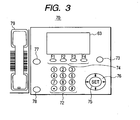
- Fig. 3 is a diagram showing an external construction of the operation unit 70 constructing the telephone apparatus T1.
- the operation unit 70 has: a ten-key 72 for inputting a telephone number or the like; a function key 73 which is used for function setting or the like; four function keys 74 which are used for multifunction inputting; a set key 75 as a setting input key; a right/left/upper/lower direction key (crossing key) 76 which is used for cursor movement or the like of the display unit 60; an answer phone key 77 which is used to switch an answer phone telephone mode; a stop key 78 which is used to interrupt the operation which is being executed; and a handset 79 which is used to record voice data of a speech or the answer phone .
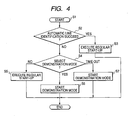
- Fig. 4 is a flowchart showing the operation which is executed until whether or not the demonstration mode is started is selected after turn-on of the power source of the telephone apparatus T1 and the regular start-up or the demonstration mode start-up is executed.
- the processing routine is started in step S1. Whether or not the line used by the user is the PB (push-button, tone) line or the DP (dial-pulse) line is discriminated by using the automatic line identification function in S2. If this identification succeeds, this means that after the purchasing of the telephone apparatus T1, he connected the telephone line and turned on the power source. Therefore, the regular start-up is executed in S3 and the processing routine is finished. If the identification fails, this means that the user turned on the power source without connecting the telephone line. Therefore, the processing routine advances to S4. That is, in S2, the type of the connected line is identified by using the automatic line identification function for automatically identifying the type of the connected telephone line and whether or not the line has been connected is discriminated.
- a salesperson inquires of the user about whether or not he starts the demonstration mode in S4. If he makes an answer showing that he does not start up the demonstration mode, the regular start-up is executed in S5. If he makes an answer showing that he starts the demonstration mode, the demonstration mode is started up in S6. If time-out of a predetermined time occurs without receiving such an answer, the demonstration mode is started up in S7.
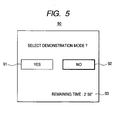
- Fig. 5 is a diagram showing the demonstration mode start-up selection display screen 90.
- a key 91 to start the demonstration mode, a key 92 which does not start the demonstration mode, and a remaining time 93 are displayed on the demonstration mode start-up selection display screen 90.
- the user selects whether or not the demonstration mode is started by using either the demonstration mode start-up key (also simply referred to as a "YES" key) 91 or the demonstration mode not-start-up key (also simply referred to as a "NO” key) 92.
- the key 91 or 92 is focused and the user selects a desired mode by using the crossing key 76 of the operation unit 70 and depresses the set key 75, so that a result of the selection by the user is determined.
- the not-start-up key 92 has been focused at the initial stage. A count-down of the predetermined time is displayed in the column of the remaining time 93. When the predetermined time elapses in the non-operating state, the demonstration mode start-up key 91 is automatically selected.
- the demonstration mode start-up selection display screen 90 is displayed in S4 shown in Fig. 4 .
- the regular mode is started in S5 and the processing routine is finished.
- the start-up key 91 is selected, the demonstration mode is started in S6 and the processing routine is finished.
- the demonstration mode is started in S7 in a manner similar to the case where the start-up key 91 is depressed and the processing routine is finished.
- the demonstration mode can be started.
- the demonstration mode can be started without executing any operation and he can properly cope with such a situation.
- the demonstration mode can be finished, he can properly cope with the operation, and the number of erroneous operations is reduced.
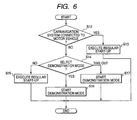
- Fig. 6 is a flowchart showing the operation in the embodiment 2 of the invention.
- the embodiment 2 relates to the case where the embodiment 1 is applied to a car navigation system. Whether or not the car navigation system has been connected to a motor vehicle is discriminated in S12. If it has been connected to the motor vehicle, the regular start-up is executed in S13. If it is not connected to the motor vehicle, the display screen is shifted to a demonstration mode start-up selection display screen and the apparatus inquires of the user about whether or not the demonstration mode is started in S14.
- the regular start-up is executed in S15 and the processing routine is finished.
- the demonstration mode is started in S16 and the processing routine is finished.
- the processing routine is finished.
- the demonstration mode is finished.
- the salesperson in the shop of the car navigation system merely selects the start-up key 91
- the demonstration mode can be started.
- the demonstration mode can be started without executing any operation and he can properly cope with such a situation.
- the communicating situation is automatically identified, if the identification succeeds, the regular mode which is normally used by the user is started, and when the identification fails, the demonstration mode start-up selection display screen to select the start-up of the demonstration mode is displayed. Therefore, such a situation that the demonstration mode is started when the user turns on the power source in the state where the communication is impossible can be prevented.
- the apparatus has the demonstration mode control means constructed in such a manner that when the operation to select the start-up of the demonstration mode is executed on the demonstration mode start-up selection display screen, the demonstration mode is started, and when the operation to select a mode in which the demonstration mode is not started is executed, the demonstration mode is not started and when the predetermined time elapses in the non-operating state, the demonstration mode is started. Therefore, when the user turns on the power source in the state where the communication is impossible, the user can cancel the demonstration mode by his own will. In the shop, even if the salesperson does not execute the operation to start the demonstration mode after the turn-on of the power source, the demonstration mode is automatically started. Therefore, a troublesomeness can be omitted.
- the process opposite to the process which is executed when the predetermined time elapses is shown on the initial selection display screen, for example, in the case of the apparatus which starts the demonstration mode if no operations are executed for the predetermined time, the side where the initial selection display screen is "the demonstration mode is not started” is the initial value on the demonstration mode start-up selection display screen.
- the unskilled user who does not know the wording of "demonstration mode" and does not see an operation manual, when considering such a situation that he is apt to select the initial value in the unknown scene, a probability that a desired operation can be provided even for the unskilled user since the side of "the demonstration mode is not started” is the initial value is high.
- the embodiment 3 is a modification of the embodiment 1 and is an example in which after the automatic line identification failed and the regular start-up was executed, a message for urging the user to make the manual line type setting (to execute the manual line selection) is displayed.
- a waiting display screen of Fig. 9A is displayed in S101 in Fig. 8 . If "0" has been set in the manual line selection flag, a waiting display screen of Fig. 9B is displayed.
- Fig. 9A the message for urging the user to execute the manual line selection is displayed on the waiting display screen. In Fig. 9B , such a message is not displayed.
- a menu key is depressed in S102, the processing routine advances to S104. If NO, other processes in S103 are executed. Whether or not the manual line selection has been made is discriminated in S104. If YES, S106 follows. If NO, such other menu processes are executed in S105. The manual line selection is executed in S106. In this instance, a display screen of Fig. 10 is displayed, thereby allowing the user to select the line type. If a registration button of a touch panel is depressed, the line type selected by the user is registered. After the line type was set, "0" is set into the manual line selection flag in S107.
- the mode in which the demonstration mode is not started can be selected while the selection display screen is displayed, so that the demonstration mode is not started.
- the demonstration mode can be certainly started by the minimum number of processing steps.
- the information apparatus has: a communicating situation identifying unit for identifying a communicating situation of the information apparatus; a display unit for displaying the demonstration mode and an electronic key for promoting sales of the information apparatus; an operation unit for selecting the electronic key; and a control unit for identifying the communicating situation when the power source is turned on, starting a regular mode in which the information apparatus is normally used when the identification of the communicating situation succeeds, and displaying a demonstration mode selection display screen to select start-up of the demonstration mode when the identification of the communicating situation fails.
Landscapes
- Engineering & Computer Science (AREA)
- Multimedia (AREA)
- Signal Processing (AREA)
- Theoretical Computer Science (AREA)
- Computer Networks & Wireless Communication (AREA)
- Physics & Mathematics (AREA)
- General Engineering & Computer Science (AREA)
- General Physics & Mathematics (AREA)
- Human Computer Interaction (AREA)
- Software Systems (AREA)
- Telephone Function (AREA)
- Display Devices Of Pinball Game Machines (AREA)
Applications Claiming Priority (1)
| Application Number | Priority Date | Filing Date | Title |
|---|---|---|---|
| JP2004283285A JP4347180B2 (ja) | 2004-09-29 | 2004-09-29 | 情報装置および情報装置の制御方法 |
Publications (2)
| Publication Number | Publication Date |
|---|---|
| EP1643748A1 EP1643748A1 (en) | 2006-04-05 |
| EP1643748B1 true EP1643748B1 (en) | 2011-05-25 |
Family
ID=35044934
Family Applications (1)
| Application Number | Title | Priority Date | Filing Date |
|---|---|---|---|
| EP05020612A Expired - Lifetime EP1643748B1 (en) | 2004-09-29 | 2005-09-21 | Information apparatus having a demonstration mode and control method of the same |
Country Status (5)
| Country | Link |
|---|---|
| US (2) | US7587035B2 (enExample) |
| EP (1) | EP1643748B1 (enExample) |
| JP (1) | JP4347180B2 (enExample) |
| KR (1) | KR100796105B1 (enExample) |
| CN (1) | CN100581181C (enExample) |
Families Citing this family (5)
| Publication number | Priority date | Publication date | Assignee | Title |
|---|---|---|---|---|
| JP4347180B2 (ja) * | 2004-09-29 | 2009-10-21 | キヤノン株式会社 | 情報装置および情報装置の制御方法 |
| JP5359826B2 (ja) * | 2009-12-02 | 2013-12-04 | 日本電気株式会社 | 携帯端末装置及び携帯端末装置の機能設定方法 |
| JP5436406B2 (ja) * | 2010-12-27 | 2014-03-05 | シャープ株式会社 | 画像形成装置、プログラムおよび記録媒体 |
| JP2014049883A (ja) * | 2012-08-30 | 2014-03-17 | Toshiba Corp | 情報処理装置及び情報処理方法及びデジタルテレビジョン受信装置及び記憶媒体 |
| JP6271693B2 (ja) * | 2016-12-16 | 2018-01-31 | 株式会社東芝 | 受信装置及び受信装置の制御方法及びデジタルテレビジョン受信装置 |
Citations (1)
| Publication number | Priority date | Publication date | Assignee | Title |
|---|---|---|---|---|
| US20020054369A1 (en) * | 2000-08-29 | 2002-05-09 | Yoshiyuki Hirai | Data communication apparatus capable of executing demonstration operation |
Family Cites Families (10)
| Publication number | Priority date | Publication date | Assignee | Title |
|---|---|---|---|---|
| JPH06233019A (ja) | 1993-02-04 | 1994-08-19 | Sanyo Electric Co Ltd | ファクシミリ装置 |
| JP2991044B2 (ja) | 1994-03-15 | 1999-12-20 | ヤマハ株式会社 | 自動演奏機能を有した電子楽器 |
| TW395331U (en) * | 1995-12-28 | 2000-06-21 | Seiko Epson Corp | Electronic machine |
| JP4243381B2 (ja) | 1999-03-30 | 2009-03-25 | Necディスプレイソリューションズ株式会社 | ディスプレイ装置 |
| US6909481B2 (en) | 2000-11-07 | 2005-06-21 | Seiko Epson Corporation | Liquid crystal display and electronic appliance |
| JP3521313B2 (ja) | 2001-01-31 | 2004-04-19 | ブラザー工業株式会社 | 電子装置、通信装置、および記憶媒体 |
| JP2004061148A (ja) * | 2002-07-25 | 2004-02-26 | Kenwood Corp | デモ機能を有する装置並びにその動作方法及びプログラム |
| US20040143746A1 (en) * | 2003-01-16 | 2004-07-22 | Jean-Alfred Ligeti | Software license compliance system and method |
| JP3578160B2 (ja) | 2003-01-30 | 2004-10-20 | セイコーエプソン株式会社 | 印刷装置 |
| JP4347180B2 (ja) * | 2004-09-29 | 2009-10-21 | キヤノン株式会社 | 情報装置および情報装置の制御方法 |
-
2004
- 2004-09-29 JP JP2004283285A patent/JP4347180B2/ja not_active Expired - Fee Related
-
2005
- 2005-09-21 EP EP05020612A patent/EP1643748B1/en not_active Expired - Lifetime
- 2005-09-27 US US11/235,118 patent/US7587035B2/en not_active Expired - Fee Related
- 2005-09-28 KR KR1020050090375A patent/KR100796105B1/ko not_active Expired - Fee Related
- 2005-09-28 CN CN200510105492A patent/CN100581181C/zh not_active Expired - Fee Related
-
2009
- 2009-06-03 US US12/477,761 patent/US8385520B2/en not_active Expired - Fee Related
Patent Citations (1)
| Publication number | Priority date | Publication date | Assignee | Title |
|---|---|---|---|---|
| US20020054369A1 (en) * | 2000-08-29 | 2002-05-09 | Yoshiyuki Hirai | Data communication apparatus capable of executing demonstration operation |
Also Published As
| Publication number | Publication date |
|---|---|
| EP1643748A1 (en) | 2006-04-05 |
| CN1761266A (zh) | 2006-04-19 |
| US20060067492A1 (en) | 2006-03-30 |
| KR20060051737A (ko) | 2006-05-19 |
| JP4347180B2 (ja) | 2009-10-21 |
| JP2006101067A (ja) | 2006-04-13 |
| US8385520B2 (en) | 2013-02-26 |
| KR100796105B1 (ko) | 2008-01-21 |
| US20090238351A1 (en) | 2009-09-24 |
| CN100581181C (zh) | 2010-01-13 |
| US7587035B2 (en) | 2009-09-08 |
Similar Documents
| Publication | Publication Date | Title |
|---|---|---|
| US8422044B2 (en) | Print control method capable of managing functions incorporated in printing device | |
| US6745253B2 (en) | System and method for locating and using a peripheral device | |
| US8385520B2 (en) | Information apparatus and control method of the same | |
| EP1220520A2 (en) | Message display method in mobile terminal | |
| JP2002251240A (ja) | ヘルプ機能を有する装置 | |
| JP2005057477A (ja) | 携帯電話端末、携帯電話端末の電話帳情報のバックアップ方法および電話帳情報のバックアップシステム | |
| EP1482397A2 (en) | Error-free data entry in a portable terminal device. | |
| JP2008028780A (ja) | ジョブ処理システム、ジョブ処理装置、ジョブ特定方法及びジョブ特定処理プログラム | |
| US20120327441A1 (en) | Scanners that display setting screens, image forming systems comprising such scanners, and methods for controlling such scanners | |
| JP2006085291A (ja) | 情報処理装置及びアプリケーションプログラム | |
| JP2020120354A (ja) | 画像形成装置 | |
| US20070032231A1 (en) | Telephone, telephone directory data checking method, and telephone directory data checking program | |
| JP5262745B2 (ja) | 発注管理装置、端末装置及びプログラム | |
| JP3984939B2 (ja) | 通信端末装置及びその制御方法 | |
| JP4188862B2 (ja) | ハンズフリー通話装置、その制御方法、制御プログラム及び記録媒体 | |
| JP2008199090A (ja) | 情報装置および情報装置の制御方法 | |
| US6771973B2 (en) | Method and apparatus for setting main-sub relation of electronic appliances | |
| JP2006209391A (ja) | 放置自転車対策システム、警告・回収連絡システム、放置自転車対策方法及びプログラム | |
| JP2010288102A (ja) | ファクシミリ装置及び同装置における誤送信防止方法 | |
| JP2008234097A (ja) | 電子機器及び電子機器の機能選択方法 | |
| JP2009171399A (ja) | 入力装置 | |
| CN100546317C (zh) | 通信装置与控制程序产品 | |
| KR100678242B1 (ko) | 애플리케이션 단축 구동방법과 그에 따른 휴대단말기 | |
| JP2009292013A (ja) | 画像形成装置及び通知プログラム | |
| JP4697264B2 (ja) | 画像形成装置、画像形成装置において実行される印刷ジョブ出力方法、印刷ジョブ出力プログラム、および、画像形成システム |
Legal Events
| Date | Code | Title | Description |
|---|---|---|---|
| PUAI | Public reference made under article 153(3) epc to a published international application that has entered the european phase |
Free format text: ORIGINAL CODE: 0009012 |
|
| AK | Designated contracting states |
Kind code of ref document: A1 Designated state(s): AT BE BG CH CY CZ DE DK EE ES FI FR GB GR HU IE IS IT LI LT LU LV MC NL PL PT RO SE SI SK TR |
|
| AX | Request for extension of the european patent |
Extension state: AL BA HR MK YU |
|
| 17P | Request for examination filed |
Effective date: 20061005 |
|
| 17Q | First examination report despatched |
Effective date: 20061107 |
|
| AKX | Designation fees paid |
Designated state(s): DE FR GB IT |
|
| GRAP | Despatch of communication of intention to grant a patent |
Free format text: ORIGINAL CODE: EPIDOSNIGR1 |
|
| GRAS | Grant fee paid |
Free format text: ORIGINAL CODE: EPIDOSNIGR3 |
|
| GRAA | (expected) grant |
Free format text: ORIGINAL CODE: 0009210 |
|
| AK | Designated contracting states |
Kind code of ref document: B1 Designated state(s): DE FR GB IT |
|
| REG | Reference to a national code |
Ref country code: GB Ref legal event code: FG4D |
|
| REG | Reference to a national code |
Ref country code: DE Ref legal event code: R096 Ref document number: 602005028211 Country of ref document: DE Effective date: 20110707 |
|
| PLBE | No opposition filed within time limit |
Free format text: ORIGINAL CODE: 0009261 |
|
| STAA | Information on the status of an ep patent application or granted ep patent |
Free format text: STATUS: NO OPPOSITION FILED WITHIN TIME LIMIT |
|
| 26N | No opposition filed |
Effective date: 20120228 |
|
| PG25 | Lapsed in a contracting state [announced via postgrant information from national office to epo] |
Ref country code: IT Free format text: LAPSE BECAUSE OF FAILURE TO SUBMIT A TRANSLATION OF THE DESCRIPTION OR TO PAY THE FEE WITHIN THE PRESCRIBED TIME-LIMIT Effective date: 20110525 |
|
| REG | Reference to a national code |
Ref country code: DE Ref legal event code: R097 Ref document number: 602005028211 Country of ref document: DE Effective date: 20120228 |
|
| REG | Reference to a national code |
Ref country code: FR Ref legal event code: ST Effective date: 20120531 |
|
| PG25 | Lapsed in a contracting state [announced via postgrant information from national office to epo] |
Ref country code: FR Free format text: LAPSE BECAUSE OF NON-PAYMENT OF DUE FEES Effective date: 20110930 |
|
| PGFP | Annual fee paid to national office [announced via postgrant information from national office to epo] |
Ref country code: GB Payment date: 20180928 Year of fee payment: 14 |
|
| PGFP | Annual fee paid to national office [announced via postgrant information from national office to epo] |
Ref country code: DE Payment date: 20181130 Year of fee payment: 14 |
|
| REG | Reference to a national code |
Ref country code: DE Ref legal event code: R119 Ref document number: 602005028211 Country of ref document: DE |
|
| PG25 | Lapsed in a contracting state [announced via postgrant information from national office to epo] |
Ref country code: DE Free format text: LAPSE BECAUSE OF NON-PAYMENT OF DUE FEES Effective date: 20200401 |
|
| GBPC | Gb: european patent ceased through non-payment of renewal fee |
Effective date: 20190921 |
|
| PG25 | Lapsed in a contracting state [announced via postgrant information from national office to epo] |
Ref country code: GB Free format text: LAPSE BECAUSE OF NON-PAYMENT OF DUE FEES Effective date: 20190921 |