EP1626558A1 - Terminal de communication mobile - Google Patents
Terminal de communication mobile Download PDFInfo
- Publication number
- EP1626558A1 EP1626558A1 EP04745250A EP04745250A EP1626558A1 EP 1626558 A1 EP1626558 A1 EP 1626558A1 EP 04745250 A EP04745250 A EP 04745250A EP 04745250 A EP04745250 A EP 04745250A EP 1626558 A1 EP1626558 A1 EP 1626558A1
- Authority
- EP
- European Patent Office
- Prior art keywords
- application program
- function
- suspension
- user
- execution
- Prior art date
- Legal status (The legal status is an assumption and is not a legal conclusion. Google has not performed a legal analysis and makes no representation as to the accuracy of the status listed.)
- Withdrawn
Links
Images






Classifications
-
- H—ELECTRICITY
- H04—ELECTRIC COMMUNICATION TECHNIQUE
- H04M—TELEPHONIC COMMUNICATION
- H04M1/00—Substation equipment, e.g. for use by subscribers
- H04M1/72—Mobile telephones; Cordless telephones, i.e. devices for establishing wireless links to base stations without route selection
- H04M1/724—User interfaces specially adapted for cordless or mobile telephones
- H04M1/72469—User interfaces specially adapted for cordless or mobile telephones for operating the device by selecting functions from two or more displayed items, e.g. menus or icons
-
- H—ELECTRICITY
- H04—ELECTRIC COMMUNICATION TECHNIQUE
- H04M—TELEPHONIC COMMUNICATION
- H04M1/00—Substation equipment, e.g. for use by subscribers
- H04M1/72—Mobile telephones; Cordless telephones, i.e. devices for establishing wireless links to base stations without route selection
- H04M1/724—User interfaces specially adapted for cordless or mobile telephones
- H04M1/72403—User interfaces specially adapted for cordless or mobile telephones with means for local support of applications that increase the functionality
- H04M1/72427—User interfaces specially adapted for cordless or mobile telephones with means for local support of applications that increase the functionality for supporting games or graphical animations
-
- H—ELECTRICITY
- H04—ELECTRIC COMMUNICATION TECHNIQUE
- H04M—TELEPHONIC COMMUNICATION
- H04M1/00—Substation equipment, e.g. for use by subscribers
- H04M1/72—Mobile telephones; Cordless telephones, i.e. devices for establishing wireless links to base stations without route selection
- H04M1/724—User interfaces specially adapted for cordless or mobile telephones
- H04M1/72448—User interfaces specially adapted for cordless or mobile telephones with means for adapting the functionality of the device according to specific conditions
-
- H—ELECTRICITY
- H04—ELECTRIC COMMUNICATION TECHNIQUE
- H04M—TELEPHONIC COMMUNICATION
- H04M1/00—Substation equipment, e.g. for use by subscribers
- H04M1/72—Mobile telephones; Cordless telephones, i.e. devices for establishing wireless links to base stations without route selection
- H04M1/724—User interfaces specially adapted for cordless or mobile telephones
- H04M1/72403—User interfaces specially adapted for cordless or mobile telephones with means for local support of applications that increase the functionality
Definitions
- the present invention relates to a mobile communication terminal, such as a mobile phone, having a function of executing an application program registered by a user.
- a mobile phone that is capable of executing an application program written in a platform-independent, object-oriented programming language (see Patent Document 1, for example).
- a mobile phone is known that is provided with JAVA (registered trademark) virtual machine functionality so as to be able to execute an application program written in JAVA (registered trademark).
- JAVA registered trademark
- a user downloads his/her desired application program from a server in a mobile communication network and registers the application program on the mobile phone. Then, by the user starting the registered application program, the user can allow a standby screen composed of a three-dimensional moving image to be displayed on a display of the mobile phone, or can play a game, perform fortune-telling, or play music on the mobile phone.
- Patent Document 1 Japanese Unexamined Patent Application Publication No. 2000-347867
- the user may want to suspend the application program and register a phone number or an e-mail address of the person with whom the user is exchanging information.
- the user allows the initial screen of a memory dial register function to be displayed, and then registers the phone number or e-mail address of the person with whom the user is exchanging information.
- a standby screen is displayed, and thus, the user needs to perform an operation to make a transition from the standby screen to the initial screen of a memory dial register function.
- the conventional mobile phone has a problem in that upon suspension of execution of an application program the user cannot promptly use a function that he/she requires, resulting in poor operability.
- An object of the present invention is to provide a mobile communication terminal whose operability is improved by enabling a user to promptly use a function that the user requires, upon suspension of execution of an application program.
- a first mobile communication terminal comprises: image displaying means for displaying an image; control means for controlling the image displaying means; and application program executing means for executing an application program registered by a user, wherein the application program executing means sends a function transition request instruction to make a transition to a function specified by the application program, to the control means, upon suspension of execution of the application program, and the control means controls the image displaying means to display one of an initial screen of the function and a menu screen for selecting the function, based on the function transition request instruction.
- the application program executing means sends a function transition request instruction to make a transition to a function specified by the application program, to the control means, upon suspension of execution of an application program.
- the control means controls the image displaying means and displays an initial screen of the function specified by the application program.
- a shortcut menu screen for selecting a function is displayed.
- at least one function that is likely to be required by the user upon suspension can be specified in the application program, and thus, the user can promptly use a function that he/she requires on the screen, upon suspension of execution of the application program.
- a second mobile communication terminal comprises: image displaying means for displaying an image; control means for controlling the image displaying means; and application program executing means for executing a application program in accordance with setting data in property information associated with the application program registered by a user, wherein the property information includes control data for suspension that specifies a function to which a transition is made upon suspension of execution of the application program, the application program executing means sends a function transition request instruction to make a transition to the function specified by the control data for suspension, to the control means, upon suspension of execution of the application program, and the control means controls the image displaying means to display one of an initial screen of the function and a menu screen for selecting the function, based on the function transition request instruction.
- property information associated with an application program executed by the application program executing means includes control data for suspension that specifies a function to be activated upon suspension of execution of the application program.
- the application program executing means sends a function transition request instruction to make a transition to the function specified by the control data for suspension included in the property information, to the control means, upon suspension of execution of the application program.
- the control means controls the image displaying means and allows an initial screen of the function specified by the control data for suspension or a menu screen to be displayed.
- control data for suspension in the property information functions that are likely to be required by the user upon suspension can be specified, and thus, the user can promptly use a function that he/she requires on the screen, upon the suspension of execution of the application program.
- the property information is information that can be referred to by a user
- the user can easily check the content of control data for suspension that specifies a function to be activated upon suspension of execution of an application program.
- the control data for suspension may be designed such that the data can be set by a user. In this case, the user can freely set a function that he/she wants to use upon suspension of execution of an application program.
- a third mobile communication terminal comprises: image displaying means for displaying an image; control means for controlling the image displaying means; an application program executing means for executing an application program registered by a user; and an operating means used by the user to input control data for suspension that specifies a function to be activated upon suspension of execution of the application program, wherein the control means controls the image displaying means to display one of an initial screen of the function specified by the control data for suspension and a menu screen for selecting the function, upon suspension of execution of the application program.
- control data for suspension that specifies a function to be activated upon suspension of execution of an application program is inputted by the user operating the operating means.
- the control means controls the image displaying means based on the control data for suspension and allows an initial screen of the function specified by the control data for suspension or a menu screen to be displayed, upon suspension of execution of the application program. Accordingly, upon suspension of execution of the application program, the user can promptly use a function on the screen that he/she requires.
- the aforementioned “mobile communication terminals” include mobile phones of the PDC (Personal Digital Cellular) system, the GSM (Global System for Mobile Communications) system, the TIA (Telecommunication Industry Association) system, and the like, mobile phones standardized by IMT (International Mobile Telecommunication)-2000, mobile phones of the TD-SCDMA (MC: Multi Carrier) system which is one of the TD-SCDMA (Time Division Synchronous Code Division Multiple Access) systems, PHSs (Personal Handyphone Systems), and phones, such as car phones, that are capable of executing application programs.
- the "mobile communication terminals” also include, in addition to the aforementioned phones, mobile communication terminals with no phone functionality such as PDAs (Personal Digital Assistance).
- Control and information processing on the mobile communication terminal can also be realized by allowing a computer provided to the mobile communication terminal to execute a predetermined program.
- Receiving and passing of a program used on the computer may be performed using a recording medium, such as an FD or a CD-ROM, having recorded thereon a program as digital information, or may be performed using a communication network such as a computer network.
- an initial screen of the specified function or a menu screen can be displayed, and thus, upon suspension of execution of the application program the user can promptly use a function on the screen that he/she requires, providing an advantageous effect that the operability can be improved.
- FIG. 1 is an illustrative diagram showing a main portion of a mobile communication system using a mobile phone according to an embodiment of the present invention.
- FIG. 1 is an illustrative diagram showing a main portion of a mobile communication system using mobile phones 20 according to the present embodiment.
- a mobile phone 20 used by a user 1 has a configuration capable of executing application programs developed by platform-independent object-oriented programming.
- application programs include those written in program languages such as JAVA (registered trademark), C, C++, and the like.
- the execution environment of such application programs can be constructed by middleware such as the virtual machine (VM: Virtual Machine) of JAVA (registered trademark) or BREW (registered trademark).
- the mobile phone 20 can be connected to a mobile phone communication network 10 serving as a communication network.
- a mobile phone communication network 10 serving as a communication network.
- an application program download server (hereinafter referred to as the "download server") 11 serving as a program providing server
- an information providing server, a location registering server, etc. which are not shown.
- these servers may be configured as a single server.
- these servers may be configured as dedicated control devices having different configurations, or may be configured using a general-purpose computer system.
- each server may be configured using a single computer or may be configured by connecting, via a network, a plurality of computers each having a plurality of functions.
- the download server 11 sends, upon receiving a download request from the mobile phone 20, an application program according to the request to the mobile phone 20.
- the Web server 12 sends, upon receiving a browse request from the mobile phone 20, a Web page screen which is a browse screen according to the request, to the mobile phone 20.
- An application program to be provided from the download server 11 is provided from an application program developer 2. Specifically, for example, an application program is uploaded via a leased line or a public line to the download server 11 from a personal computer or the like on the side of the application program developer 2, and thereby the application program is provided.
- an application program may be provided such that a recording medium, such as an optical disk or a magnetic disk, having recorded thereon a developed application program is sent from the application program developer 2 to a communication common carrier who manages and runs the download server 11 and then the application program on the recording medium is read by the download server 11.
- the application program thus provided is registered on the download server 11 in a state such that the mobile phone 20 can download the application program via the mobile phone communication network 10.
- FIG. 2 is an external view of the mobile phone 20 and FIG. 3 is a schematic configuration diagram showing a hardware configuration of the mobile phone 20.
- the mobile phone 20 is a clam-shell (folding) type mobile phone, and includes a system bus 200; a CPU 201; data memory means composed of RAM 202, ROM 203, and the like; an input device 204; an output device 205; and a communication device 206 for a mobile phone.
- the components such as the CPU 201 and the RAM 202 exchange with each other various data, instructions of a program which will be described later, etc., via the system bus 200.
- the input device 204 is composed of data entry keys (a numeric keypad, a * key, and a # key) 21, a call start key 22, a call end key 23, a scroll key 24, a multifunction key 25, a microphone 26, and the like.
- the output device 205 is composed of a liquid crystal display (LCD) 27 serving as an image display means, a speaker 28, and the like.
- the communication device 206 for a mobile phone establishes communication with other mobile phones or the aforementioned servers 11 and 12 via the mobile phone communication network 10.
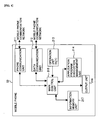
- FIG. 4 is a block diagram showing an extracted main portion of the mobile phone 20 and FIG. 5 is an illustrative diagram of a software structure of the mobile phone 20.
- the mobile phone 20 includes a phone communication unit 211, a data communication unit 212, an operating unit 213, an application program executing and managing unit 214 serving as an application program execution means, a main control unit 215 serving as a control means, and an output unit 216.
- the mobile phone 20 includes an information memory unit 217 serving as information memory means for storing various information received from the aforementioned information providing server 13.
- the phone communication unit 211 performs radio communication with a base station of the mobile phone communication network 10 to perform phone communication with another mobile phone or a fixed-line phone.
- the phone communication unit 211 corresponds to the communication device 206 for a mobile phone, etc., in the aforementioned hardware configuration.
- the data communication unit 212 corresponds to the communication device 206 for a mobile phone, etc., in the aforementioned hardware configuration, as in the phone communication unit 211.
- the data communication unit 212 exchanges e-mails with other mobile phones via the mobile phone communication network 10, or establishes a connection to an external communication network, such as the Internet, from the mobile phone communication network 10 via a gateway server and exchanges e-mails on the Internet.
- the data communication unit 212 is also used to download, via the mobile phone communication network 10, an application program provided by the download server 11.
- the data communication unit 212 is also used as an information reception means for receiving distributed information including location information about the current location.
- the operating unit 213 includes the numeric keypad 21, the call start key 22, the call end key 23, and the like, which can be operated by the user 1.
- the user can input data, such as a URL, to the mobile phone 20, can start and end a call upon incoming call, or can select, start, and stop an application program.
- the user can download and register an application program from the download server 11, or can select and execute the registered application program.
- information received from the information providing server 13 in the mobile phone communication network 10 can be displayed.
- the application program executing and managing unit 214 includes the system bus 200, the CPU 201, the RAM 202, and the like.
- the application program executing and managing unit 214 corresponds to the "program execution environment" shown in the center of the software structure in FIG. 5.
- the application program executing and managing unit 214 provides software, such as a class library, an execution environment management library, and an application management, which is used for an application program developed by object-oriented programming, and manages the execution environment of the application program.
- the application program can call and use a class library of functions, etc. in the aforementioned program execution environment, via a class library API (application interface).
- the history of calling to the class library of functions, etc. is held until a virtual execution environment (virtual machine: VM) for the application program is terminated.
- the execution environment management library in the program execution environment can call and use a phone platform library in a phone platform via a phone platform API, as will be described later.
- the main control unit 215 controls the phone communication unit 211, the data communication unit 212, the operating unit 213, the application program executing and managing unit 214, the output unit 216, and the information memory unit 217.
- the main control unit 215 includes the system bus 200, the CPU 201, the RAM 202, and the like. In addition, the main control unit 215 exchanges control instructions or various data with the application program executing and managing unit 214, the information memory unit 217, and the like, and performs control in cooperation with these units.
- the main control unit 215 corresponds to the "phone platform" shown at the bottom of the software structure in FIG. 5.
- the main control unit 215 executes a control program for controlling the phone communication unit 211 or the like, and a user interface, or provides a phone platform library.
- the phone platform can execute various processes in an application program by sending an event to the execution environment management library in the program execution environment, or can call, via an application management API, software of the application management in the program execution environment and use the software.
- the output unit 216 includes, for example, the output device 205 composed of the liquid crystal display (LCD) 27, the speaker 28, and the like.
- the output unit 216 is used to display on the liquid crystal display (LCD) 17 a Web page screen received by the data communication unit 212, or to notify the user that incoming information is received by the phone communication unit 211 or the data communication unit 212.
- the main control unit 215 allows an incoming-information notification image to be displayed on the liquid crystal display (LCD) 17 of the output unit 216, or allows a ring tone to be outputted from the speaker 18.
- the output unit 216 is also used to provide, during the execution of an application program such as the aforementioned game, a display of an image or an output of sound which is related to the program execution. In addition, the output unit 216 is also used to display information received from the information providing server 13.
- a control program for constructing a phone platform which allows the mobile phone 20 to operate in accordance with a predetermined procedure is memorized in the RAM 202 or the ROM 203.
- a basic OS (operating system) program, a program for constructing the program execution environment, and an application program are also memorized in the RAM 202 or the ROM 203. These programs are called, when necessary, in a work area of the CPU 201 or of the RAM 202 and executed.
- an application program consists of a JAD file (text data) that contains property information and a JAR file (binary data) that contains the main body of the program.
- the JAD file contains not only basic data such as an application name, an application version, an application's vendor name, and data of a URL indicating where the JAR file is stored, but also setting data indicating, for example, whether the application program is authenticated, whether the application program is used being connected to a network, or whether the application program is a resident application program.
- the JAD file also contains the URL (the address data of the distributor) of the official Web page where relevant information regarding the application program is disclosed.
- the main control unit 215 reads from the JAD file data of a URL indicating where a JAR file is stored, accesses the URL, and downloads the JAR file.
- the application program consisting of the JAD and JAR files thus downloaded is memorized in the RAM 102 of the information memory unit 217 by the main control unit 215.
- the user 1 When executing the application program thus downloaded, the user 1 operates the keys of the operating unit 213 to allow an application selection screen for selecting an application program to be executed to be displayed on the display 17.
- the application program executing and managing unit 214 reads the JAR file and starts the application program.
- the setting data of the JAD file may be referred to and an environment that performs a processing operation in accordance with the setting data may be set.
- the setting data of the JAD file regarding the processing operation is referred to, and a processing operation suitable for the application program is performed.
- the application programs include various application programs; for example, an application program that allows a user to enjoy a game, etc., by operating various keys of the operating unit 213, and a resident application program that allows a standby screen composed of a three-dimensional moving image to be displayed on the display 17.
- FIG. 6 is a sequence diagram showing a process performed when a transition to a function on the phone platform side is made upon suspension of execution of an application program.
- the user obtains an application program by downloading an application program from the download server 11, or by purchasing a mobile phone 20 in which the application program is registered in advance.
- the user can select his/her desired application program from an application program list and execute the selected application program.
- a command to request suspension that is called by a predetermined function for making a transition to the function is executed.
- the application program executing and managing unit 214 which constructs the application execution environment suspends the application program based on the command to request suspension, and outputs to the main control unit 215 on the platform side a screen transition request instruction serving as a function transition request instruction to make a transition to an initial screen of a function specified by the application program.
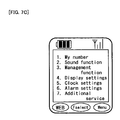
- the main control unit 215 having received the screen transition request instruction serving as the function transition request instruction controls the output unit 216 having the LCD 27 and allows a menu screen, such as the one exemplified in FIG. 7A, for shortcuts of a plurality of functions specified by the application program to be displayed.
- the user can select his/her desired function by looking at the menu screen. For example, when "WEB" is selected on the menu screen of FIG. 7A, a Web menu screen shown in FIG. 7B, which is the initial screen of a function of receiving various Web services, is displayed.
- FIG. 7C which is the initial screen of a function of performing various settings, is displayed.
- a resume request instruction is outputted from the main control unit 215 to the application program executing and managing unit 214.
- the application program executing and managing unit 214 having received the resume request instruction resumes the suspended application program.
- the present embodiment in an application program functions that are likely to be required by a user upon suspension are specified, whereby upon suspension of execution of the application program a shortcut menu screen allowing the user to select a plurality of the specified functions can be displayed. Accordingly, upon suspension of execution of the application program, the user can promptly use a function on the screen that he/she requires, making it possible to improve operability.
- the present embodiment is effective for the case where there are a plurality of functions that are likely to be activated upon suspension of an application program.
- control data for suspension regarding a transition destination upon suspension may be written as one of setting data in property information of an application program downloaded from the download server 11, and a transition to a function may be made using the control data for suspension.
- the application program executing and managing unit 214 in this case refers to control data for suspension included in the property information, upon suspension of execution of an application program, and sends a screen transition request instruction serving as a function transition request instruction to make a transition to an initial screen of a function specified by the control data for suspension, to the main control unit 215.
- the main control unit 215 controls the output unit 216 having the LCD 27, and allows the initial screen of the function specified by the control data for suspension or a shortcut menu screen to be displayed. Hence, in this case too, upon suspension of execution of the application program, the user can promptly use a function on the screen that he/she requires, making it possible to improve operability.
- control data for suspension in the property information of the application program may be designed such that the data can be modified by a user.
- the user operates the operating unit 213 having data entry keys (a numeric keypad, a * key, and a # key) 21 and the like and serving as operating means, to input control data for suspension.
- the main control unit 215 overwrites control data for suspension in the property information with the control data for suspension inputted by the user.
- the user can freely set a function that the user wants to use immediately after suspension of execution of an application program.
- a function transition upon suspension of execution of an application program may be controlled based on control data for suspension inputted by the user but not on a function transition request instruction sent from the application program executing and managing unit 214.
- the main control unit 215 receives suspension notification information from the application program executing and managing unit 214, upon suspension of execution of an application program, and thereafter, refers to control data for suspension in the information memory unit 217 which is inputted by the user operating the operating unit 213. Then, based on the control data for suspension, the main control unit 215 controls the output unit 216 having the LCD 27 and allows an initial screen of a function specified by the control data for suspension or a menu screen to be displayed. Accordingly, in this case too, upon suspension of execution of the application program, the user can promptly use a function on the screen that he/she requires.
Landscapes
- Engineering & Computer Science (AREA)
- Human Computer Interaction (AREA)
- Computer Networks & Wireless Communication (AREA)
- Signal Processing (AREA)
- Telephone Function (AREA)
- Telephonic Communication Services (AREA)
- Mobile Radio Communication Systems (AREA)
- Stored Programmes (AREA)
Applications Claiming Priority (2)
| Application Number | Priority Date | Filing Date | Title |
|---|---|---|---|
| JP2003140967 | 2003-05-19 | ||
| PCT/JP2004/006651 WO2004102932A1 (fr) | 2003-05-19 | 2004-05-18 | Terminal de communication mobile |
Publications (2)
| Publication Number | Publication Date |
|---|---|
| EP1626558A1 true EP1626558A1 (fr) | 2006-02-15 |
| EP1626558A4 EP1626558A4 (fr) | 2006-08-23 |
Family
ID=33447423
Family Applications (1)
| Application Number | Title | Priority Date | Filing Date |
|---|---|---|---|
| EP04745250A Withdrawn EP1626558A4 (fr) | 2003-05-19 | 2004-05-18 | Terminal de communication mobile |
Country Status (5)
| Country | Link |
|---|---|
| US (1) | US7742585B2 (fr) |
| EP (1) | EP1626558A4 (fr) |
| JP (1) | JPWO2004102932A1 (fr) |
| CN (1) | CN1792078A (fr) |
| WO (1) | WO2004102932A1 (fr) |
Families Citing this family (13)
| Publication number | Priority date | Publication date | Assignee | Title |
|---|---|---|---|---|
| JP4621589B2 (ja) | 2003-05-19 | 2011-01-26 | ソフトバンクモバイル株式会社 | 文字入力方法、文字入力装置及び移動通信端末装置 |
| US7761853B2 (en) * | 2005-02-25 | 2010-07-20 | Kyocera Corporation | Portable terminal device, method for restoring program, method for terminating program, and computer program therefor |
| KR100630204B1 (ko) * | 2005-08-30 | 2006-10-02 | 삼성전자주식회사 | 휴대단말기의 멀티태스킹 수행 장치 및 방법 |
| EP2071441A1 (fr) | 2007-12-03 | 2009-06-17 | Semiconductor Energy Laboratory Co., Ltd. | Téléphone mobile |
| US20090169008A1 (en) * | 2007-12-26 | 2009-07-02 | Gonzales Jesus Orlando Ii | System and method for tracking testing of software modification projects from a wireless mobile device |
| US8359580B2 (en) | 2007-12-26 | 2013-01-22 | Visa U.S.A. Inc. | System and method for tracking testing of software modification projects |
| WO2009107320A1 (fr) * | 2008-02-28 | 2009-09-03 | 株式会社日立製作所 | Système de distribution de contenu, serveur de distribution, terminal de réception et procédé de distribution de contenu |
| CN101621859A (zh) * | 2008-06-30 | 2010-01-06 | 鸿富锦精密工业(深圳)有限公司 | 便携式电子装置 |
| CN102243889B (zh) * | 2010-05-13 | 2014-12-17 | 北京三星通信技术研究有限公司 | 基于用户输入来执行应用程序的移动终端及其方法 |
| JP5247897B2 (ja) * | 2012-01-10 | 2013-07-24 | 京セラ株式会社 | アプリケーション実行制御装置及びアプリケーション実行制御方法 |
| JP6022215B2 (ja) | 2012-05-31 | 2016-11-09 | 任天堂株式会社 | 投稿情報共有システム、情報処理システム、情報処理方法、プログラムおよびコンピュータプラットフォーム |
| JP6159511B2 (ja) | 2012-06-01 | 2017-07-05 | 任天堂株式会社 | 情報処理システム、情報処理装置および情報処理方法 |
| JP6062722B2 (ja) * | 2012-11-16 | 2017-01-18 | 任天堂株式会社 | 情報処理システム、情報処理装置、情報処理方法、およびコンピュータプログラム |
Family Cites Families (4)
| Publication number | Priority date | Publication date | Assignee | Title |
|---|---|---|---|---|
| JP2000347867A (ja) | 1999-06-02 | 2000-12-15 | Toshiba Corp | 携帯無線電話機およびその制御方法 |
| JP2002152328A (ja) * | 2000-11-07 | 2002-05-24 | Nec Corp | 携帯端末、該携帯端末における表示切換方法、及び表示切換プログラムを記録した記録媒体 |
| US7010758B2 (en) | 2001-05-21 | 2006-03-07 | Leap Wireless International, Inc. | Dynamically defined context sensitive jump menu |
| US6901255B2 (en) * | 2001-09-05 | 2005-05-31 | Vocera Communications Inc. | Voice-controlled wireless communications system and method |
-
2004
- 2004-05-18 US US10/557,322 patent/US7742585B2/en not_active Expired - Fee Related
- 2004-05-18 WO PCT/JP2004/006651 patent/WO2004102932A1/fr not_active Ceased
- 2004-05-18 CN CNA2004800135802A patent/CN1792078A/zh active Pending
- 2004-05-18 JP JP2005506213A patent/JPWO2004102932A1/ja active Pending
- 2004-05-18 EP EP04745250A patent/EP1626558A4/fr not_active Withdrawn
Also Published As
| Publication number | Publication date |
|---|---|
| EP1626558A4 (fr) | 2006-08-23 |
| WO2004102932A1 (fr) | 2004-11-25 |
| JPWO2004102932A1 (ja) | 2006-07-20 |
| US7742585B2 (en) | 2010-06-22 |
| US20060229106A1 (en) | 2006-10-12 |
| CN1792078A (zh) | 2006-06-21 |
Similar Documents
| Publication | Publication Date | Title |
|---|---|---|
| US7583285B2 (en) | Mobile communication terminal | |
| US7742585B2 (en) | Mobile communication terminal | |
| KR101436160B1 (ko) | WebOS-기반 사용자 장치들을 위한 어플리케이션을핸드오프하는 방법 및 시스템 | |
| US8078228B2 (en) | Method and apparatus for displaying messages in an idle state of mobile terminal, driving an application for an idle state in a mobile terminal and providing idle state contents for a mobile terminal | |
| JP2002278767A (ja) | ネットワーク通信システム、サーバ装置、携帯端末、通信方法及びプログラム | |
| KR100597809B1 (ko) | 이동 단말기의 대기 모드 상태에서 메시지를 출력하는방법 및 장치 | |
| JP4332525B2 (ja) | 移動体通信端末 | |
| KR100663739B1 (ko) | 이동 단말기용 대기 화면 점유 대표형 어플리케이션을선물하는 방법 및 장치 | |
| JP4007936B2 (ja) | 制御サーバ装置 | |
| HK1088751A (en) | Mobile communication terminal | |
| KR20060104324A (ko) | 캐릭터 합성 메시지 전송 방법 및 시스템 | |
| JP4149898B2 (ja) | 移動体通信端末 | |
| JP4657647B2 (ja) | 移動体通信端末 | |
| JP3981653B2 (ja) | 移動体通信端末 | |
| KR100632217B1 (ko) | 대기 화면 제어 방법 및 장치 | |
| JP4887110B2 (ja) | 移動体通信端末およびサーバ | |
| KR100677652B1 (ko) | 대기모드용 어플리케이션 구동 방법 및 장치 | |
| JP4019017B2 (ja) | 移動体通信端末 | |
| JP4022168B2 (ja) | 携帯通信機器 | |
| KR100726079B1 (ko) | 휴대폰에서 정보수집 서비스 방법 | |
| KR100723711B1 (ko) | 무선 단말기에서 컨텐츠별 메뉴 리스트 동적 변경 방법 및시스템 | |
| JP2008108234A (ja) | 移動体通信端末およびサーバ | |
| US8949313B2 (en) | Mobile terminal and method for controlling function using contents | |
| CN117827227A (zh) | 功能组件安装方法、装置、设备及存储介质 | |
| JP2004341971A (ja) | 移動体通信端末、プログラム提供用サーバ及び移動体通信システム |
Legal Events
| Date | Code | Title | Description |
|---|---|---|---|
| PUAI | Public reference made under article 153(3) epc to a published international application that has entered the european phase |
Free format text: ORIGINAL CODE: 0009012 |
|
| 17P | Request for examination filed |
Effective date: 20051202 |
|
| AK | Designated contracting states |
Kind code of ref document: A1 Designated state(s): AT BE BG CH CY CZ DE DK EE ES FI FR GB GR HU IE IT LI LU MC NL PL PT RO SE SI SK TR |
|
| RIC1 | Information provided on ipc code assigned before grant |
Ipc: H04M 1/247 20060101AFI20060503BHEP |
|
| A4 | Supplementary search report drawn up and despatched |
Effective date: 20060721 |
|
| DAX | Request for extension of the european patent (deleted) | ||
| REG | Reference to a national code |
Ref country code: HK Ref legal event code: DE Ref document number: 1088751 Country of ref document: HK |
|
| 17Q | First examination report despatched |
Effective date: 20061016 |
|
| 17Q | First examination report despatched |
Effective date: 20061016 |
|
| RAP1 | Party data changed (applicant data changed or rights of an application transferred) |
Owner name: VODAFONE GROUP PLC |
|
| RAP1 | Party data changed (applicant data changed or rights of an application transferred) |
Owner name: VODAFONE IP LICENSING LIMITED |
|
| RAP1 | Party data changed (applicant data changed or rights of an application transferred) |
Owner name: NOCOM AUDIO NY LLC |
|
| GRAP | Despatch of communication of intention to grant a patent |
Free format text: ORIGINAL CODE: EPIDOSNIGR1 |
|
| INTG | Intention to grant announced |
Effective date: 20141020 |
|
| STAA | Information on the status of an ep patent application or granted ep patent |
Free format text: STATUS: THE APPLICATION IS DEEMED TO BE WITHDRAWN |
|
| 18D | Application deemed to be withdrawn |
Effective date: 20150303 |
|
| REG | Reference to a national code |
Ref country code: HK Ref legal event code: WD Ref document number: 1088751 Country of ref document: HK |