EP1621074B1 - Führleine, insbesondere für Pferde oder Hunde - Google Patents
Führleine, insbesondere für Pferde oder Hunde Download PDFInfo
- Publication number
- EP1621074B1 EP1621074B1 EP05009402A EP05009402A EP1621074B1 EP 1621074 B1 EP1621074 B1 EP 1621074B1 EP 05009402 A EP05009402 A EP 05009402A EP 05009402 A EP05009402 A EP 05009402A EP 1621074 B1 EP1621074 B1 EP 1621074B1
- Authority
- EP
- European Patent Office
- Prior art keywords
- leash
- resilient
- sliding grip
- grip element
- resilient sliding
- Prior art date
- Legal status (The legal status is an assumption and is not a legal conclusion. Google has not performed a legal analysis and makes no representation as to the accuracy of the status listed.)
- Expired - Lifetime
Links
- 241000283086 Equidae Species 0.000 title claims description 6
- 241000282472 Canis lupus familiaris Species 0.000 title claims description 5
- 239000011324 bead Substances 0.000 claims description 8
- 239000004033 plastic Substances 0.000 claims description 6
- 229920003023 plastic Polymers 0.000 claims description 6
- 239000010985 leather Substances 0.000 claims description 5
- 244000025254 Cannabis sativa Species 0.000 claims description 3
- 235000012766 Cannabis sativa ssp. sativa var. sativa Nutrition 0.000 claims description 3
- 235000012765 Cannabis sativa ssp. sativa var. spontanea Nutrition 0.000 claims description 3
- 239000004677 Nylon Substances 0.000 claims description 3
- -1 braided wool Substances 0.000 claims description 3
- 235000009120 camo Nutrition 0.000 claims description 3
- 235000005607 chanvre indien Nutrition 0.000 claims description 3
- 239000000835 fiber Substances 0.000 claims description 3
- 239000011487 hemp Substances 0.000 claims description 3
- 229920001778 nylon Polymers 0.000 claims description 3
- 210000002268 wool Anatomy 0.000 claims description 3
- 239000005060 rubber Substances 0.000 claims description 2
- 239000012858 resilient material Substances 0.000 claims 3
- 230000002093 peripheral effect Effects 0.000 claims 1
- 239000000463 material Substances 0.000 abstract description 7
- 238000003457 Shi epoxidation reaction Methods 0.000 abstract description 2
- 238000004873 anchoring Methods 0.000 description 4
- 241001465754 Metazoa Species 0.000 description 3
- 210000003811 finger Anatomy 0.000 description 3
- 239000002184 metal Substances 0.000 description 3
- 238000005452 bending Methods 0.000 description 2
- 239000013013 elastic material Substances 0.000 description 2
- 210000003813 thumb Anatomy 0.000 description 2
- 238000005299 abrasion Methods 0.000 description 1
- 239000011248 coating agent Substances 0.000 description 1
- 238000000576 coating method Methods 0.000 description 1
- 230000007423 decrease Effects 0.000 description 1
- 238000011161 development Methods 0.000 description 1
- 230000018109 developmental process Effects 0.000 description 1
- 239000004744 fabric Substances 0.000 description 1
- 239000006260 foam Substances 0.000 description 1
- 238000012986 modification Methods 0.000 description 1
- 230000004048 modification Effects 0.000 description 1
- 230000035484 reaction time Effects 0.000 description 1
- 239000002023 wood Substances 0.000 description 1
Images


Classifications
-
- A—HUMAN NECESSITIES
- A01—AGRICULTURE; FORESTRY; ANIMAL HUSBANDRY; HUNTING; TRAPPING; FISHING
- A01K—ANIMAL HUSBANDRY; AVICULTURE; APICULTURE; PISCICULTURE; FISHING; REARING OR BREEDING ANIMALS, NOT OTHERWISE PROVIDED FOR; NEW BREEDS OF ANIMALS
- A01K27/00—Leads or collars, e.g. for dogs
- A01K27/003—Leads, leashes
-
- B—PERFORMING OPERATIONS; TRANSPORTING
- B68—SADDLERY; UPHOLSTERY
- B68B—HARNESS; DEVICES USED IN CONNECTION THEREWITH; WHIPS OR THE LIKE
- B68B1/00—Devices in connection with harness, for hitching, reining, training, breaking or quietening horses or other traction animals
- B68B1/02—Halters
Definitions
- leashes of different materials such as nylon, wool, hemp, natural fibers or leather are known, which via a fastener, such as a made of plastic or metal or a similar material hook element on a collar, harness or halter.
- leashes are guided by the horse or handler through the palm of the hand and enclosed with fingers and thumb. Thus, there is a direct contact between the line element of the leash and the palm of the hand or the fingers and the thumb of the hand.
- short lead lines also called Anbindestricke used
- Anbindestricke used
- leashes or lunging lines also called lounging
- lounging are known for lungeing horses on the paddock, which may have a length of 5 to 15 m.
- the US 6,712,026 B1 discloses a leash for animals, which consists of at least one linen element and a fastener connected to the linen element, wherein the leash has a Gleitgriffelement surrounding the linen element.
- the Gleitgriffelement comprises a back plate, on the underside of an elastic coating is provided.
- Object of the present invention is to provide a leash, especially for horses, dogs or similar animals, which avoids the disadvantages described above.
- a leash according to claim 1 is formed.
- the leash according to the invention consists of a linen element connected to a fastening element and an elastic sliding grip element surrounding the leash element that comprises at least one guide channel with a funnel-shaped or staircase-shaped course extending along the center axis of the elastic sliding grip element for receiving at least a portion of the leash element.
- the elastic Gleitgriffelement has a preferably annular bead or bulge.
- the Gleitgriffelement forms a handle, which can be moved along the leash and in particular in a jerky pulling the leash slide the line element through the guide channel of the sliding handle without the thereby the elastic Gleitgriffelement embracing hand of the horse guide is burned or injured.
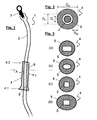
- 1 designates a leash, in particular a horse or dog leash, which for example consists of a line element 2 and a fastening element 3 connected thereto.
- the fastening element 3 can be designed, for example, as a hook element made of plastic or metal.
- the trained as a rope or knit linen element 2 of the leash 1 has a line 2 surrounding elastic Gleitgriffelement 4 on.
- the elastic Gleitgriffelement 4 is formed, for example, sleeve-like or hollow cylindrical and has a along the central axis M extending guide channel 5 for guiding the leash 2.
- the diameter D F of the guide channel 5 is in each case adapted to the line diameter D L or chosen such that the elastic Gleitgriffelement 4 is indeed held on the leash 2, but also along the line 2 is displaceable.
- the guide channel 5 has a diameter D F between 8 mm and 25 mm.
- the wall thickness Dw of the elastic Gleitgriffelements 5 may vary depending on the outer shape and portion of the elastic Gleitgriffelements 5 between 5 mm and 25 mm.
- the elastic Gleitgriffelement 4 also has, for example, a length between 10 and 30 cm.
- the elastic Gleitgriffelement 4 further has a concentric to the central axis M extending surface 8, wherein the outer diameter D A of the elastic Gleitgriffelements 5 is held at least partially constant in one embodiment along the central axis M. This results in an at least partially tubular or hollow cylindrical Gleitgriffelement 5 (see FIG. 4a ).
- the surface 8 of the Gleitschreibiatas 4 is non-slip in a preferred embodiment, ie 4 different profiles, recesses and / or material or fabric layers to increase the slip resistance are provided on the surface 8 of the elastic Gleitgriffiatas.
- a bead or bulge 6, 6.1, 6.2 is provided at least at the first or second free end 4.1, 4.2 or in the edge region 4.3 of the elastic Gleitschreibiatas 4, whose diameter D RW is greater than the outer diameter D A.
- This thus forms a counter to the pulling direction acting resistance, which prevents slippage of the elastic Gleitgriffelement 4 surrounding hand.
- the elastic Gleitgriffelement 4 is pushed onto the line member 2 such that, for example, the bead 6 having the first free end 4.1 of the elastic Gleitgriffiatas 4 facing away from the fastener 3, whereas the second free end 4.2 to the fastener 3 shows.
- a bead or bulge 6.1, 6.2 may be provided.
- the elastic Gleitgriffelement 4 is made for example of plastic, leather, rubber or similar elastic material and formed in one piece. In particular, when using plastic this should have a Shore hardness less than 35. Alternatively, however, the elastic Gleitgriffelement 4 may be formed of several parts that consists of individual movably interconnected Gleitgriff puzzle which are made of at least one of said elastic materials or a combination of these or in combination with other materials such as wood, metal, plastic.
- the guide channel 5 may in this case have different configurations.
- the guide channel 5 in cross-section round, rectangular, oval, triangular, diamond-shaped or square (see Fig. 3a - 3d ) be formed.
- the guide channel 5 in cross section form a polygon.
- the guide channel 5, for example, to increase the sliding friction between the line member 2 and the elastic Gleitgriffelement 4 on its inner surface 7 to the central axis M of the rod-shaped Gleitgriffiatas 4 wegspeaking anchoring elements 7.1, 7.2 have.
- the anchoring elements 7.1, 7.2 may be formed, for example, as nub elements 7.1 or hook-like elements 7.2.
- the rod-shaped Gleitschreibettis 4 at least two nub elements or bulges 7.1.
- the guide channel 5 in longitudinal section along a plane parallel to the central axis cutting plane along the line II - II a cylindrical (see Fig. 5a ) or a funnel-shaped course (see Fig. 5b and 5d ).
- the guide channel 5 may be formed in a staircase, ie the guide channel 5 comprises a plurality of guide channel sections 5.1, 5.2, 5.3. 5.4, which each have a different diameter D F1 , D F2 , D F3 , D F4 and / or different lengths L 1 to L 4 .
- the respective diameter D F1 , D F2 , D F3 , D decreases F4 from the first to the second free end 4.1, 4.2.
- Gleitgriffiatas 4 Due to the elastic design of Gleitgriffiatas 4 is a fixation of the elastic Gleitschreibiatas 4 with the trained as a rope or rope line element 2 by bending the Gleitschreibiatas 4 -. As in Fig. 6 shown - possible. By a simple, smooth kinking movement, preferably in the fastener facing portion of the Gleitschreibiatas 4, thereby the Gleitschreibiatas 4 can be fixed more strongly on the canvas element 2, which allows a secure holding example of a horse.
- the canvas element 2 can be made of different materials such as nylon, (braided) wool, leather, hemp or other natural fibers and / or have several different sections.
- a first portion of the linen element 2 of the leash 1 may be formed as a chain element, wherein the second section of the elastic Gleitgriffelement 4 receiving section is made of one of the materials described above.
Landscapes
- Life Sciences & Earth Sciences (AREA)
- Environmental Sciences (AREA)
- Animal Husbandry (AREA)
- Biodiversity & Conservation Biology (AREA)
- Engineering & Computer Science (AREA)
- Mechanical Engineering (AREA)
- Purses, Travelling Bags, Baskets, Or Suitcases (AREA)
- Walking Sticks, Umbrellas, And Fans (AREA)
- Steering Devices For Bicycles And Motorcycles (AREA)
Description
- Zum Führen von Tieren wie beispielsweise Pferden oder Hunden, sind Führleinen aus unterschiedlichen Materialien, beispielsweise Nylon, Wolle, Hanf, Naturfasern oder Leder bekannt, welche über ein Befestigungselement, beispielsweise ein aus Kunststoff oder Metall oder einem ähnlichen Material gefertigtes Hakenelement an einem Halsband, Geschirr oder Halfter befestigt werden.
- Derartige Führleinen werden hierbei vom Pferde- oder Hundeführer durch die Innenhandfläche geführt und mit Finger und Daumen umschlossen. Somit besteht ein unmittelbarer Kontakt zwischen dem Leinenelement der Führleine und der Handinnenfläche bzw. den Fingern und dem Daumen der Hand. Zum Verladen von Pferden oder zum kurzzeitigen Führen werden häufig kurze, d.h. 1,5 bis 3 m lange Führleinen, auch Anbindestricke genannt, verwendet, welche über ein hakenartiges Befestigungselement unmittelbar am Halfter des Pferdes befestigt werden. Ferner sind Führleinen bzw. Longierleinen, auch Loungen genannt, zum Longieren von Pferden auf der Koppel bekannt, die eine Länge von 5 bis 15 m aufweisen können.
- Oftmals scheut jedoch das Pferd beim Führen und reißt den Kopf zur Seite, so dass ein ruckartiger Zug an der Führleine entsteht. Dem von der ruckartigen Bewegung des Pferdes überraschten Pferdeführer verbleibt nahezu keine Reaktionszeit, um die Hand zu öffnen bzw. die Führleine bzw. den Anbindestrick los zu lassen. Durch das verspätete Loslassen der Führleine und den ruckartigen Zug des Pferdes an der Leine wird die Führleine über eine beachtliche Länge, beispielsweise ca. 1 m oder mehr durch die Hand des Pferdeführers geschliffen. Aufgrund der rasanten ruckartigen Zugbewegung sowie der beachtlichen Länge des durch die Hand geschliffenen Führleinenabschnitts entstehen nicht selten Verbrennungen der Handinnenfläche oder einzelner Finger. In Einzelfällen können auch schmerzliche Abschürfungen einzelner Hautpartien der Handinnenfläche auftreten, welche einer ärztlichen Behandlung bedürfen.
- Aus der
US 6,827,045 B1 ist bereits eine Führleine bestehend aus einem Leinenelement sowie einem mit diesem verbundenen Befestigungselement bekannt, bei dem ein aus Schaumstoff hergestelltes Gleitgriffelement vorgesehen ist, welches verschiebbar am Leinenelement angeordnet ist. - Die
US 6,712,026 B1 offenbart eine Führleine für Tiere, die aus zumindest einem Leinenelement und einem mit dem Leinenelement verbundenen Befestigungselement besteht, wobei die Führleine ein das Leinenelement umgebendes Gleitgriffelement aufweist. Das Gleitgriffelement umfasst eine Rückenplatte, an dessen Unterseite ein elastischer Belag vorgesehen ist. - Aufgabe der vorliegenden Erfindung ist es, eine Führleine, insbesondere für Pferde, Hunde oder ähnliche Tiere anzugeben, welche die zuvor beschriebenen Nachteile vermeidet.
- Zur Lösung dieser Aufgabe ist eine Führleine entsprechend dem Patentanspruch 1 ausgebildet.
- Die erfindungsgemäße Führleine besteht aus einem mit einem Befestigungselement verbundenen Leinenelement und einem das Leinenelement umgebenden, elastischen Gleitgriffelement, dass zur Aufnahme zumindest eines Abschnittes des Leinenelementes zumindest einen Führungskanal mit einen sich entlang der Mittelachse des elastischen Gleitgriffelementes erstreckenden trichterförmigen oder treppenförmigen Verlauf umfasst. Ferner weist das elastische Gleitgriffelement eine vorzugsweise ringförmige Wulst bzw. Ausbauchung auf. Das Gleitgriffelement bildet einen Haltegriff, der sich entlang der Führleine verschieben lässt und der insbesondere bei einem ruckartigen Ziehen der Führleine das Leinenelement durch den Führungskanal des Gleitgriffes gleiten lässt ohne das hierdurch die das elastische Gleitgriffelement umgreifende Hand des Pferdeführers verbrannt oder verletzt wird.
- Vorteilhafte Weiterbildungen der erfindungsgemäßen Führleine sind den weiteren Unteransprüchen zu entnehmen.
- Die Erfindung wird im Folgenden anhand von mehreren Ausführungsbeispielen sowie zugehöriger Figuren näher beschrieben.
- Hierbei zeigen:
- Fig. 1
- beispielhaft in Seitenansicht die erfindungsgemäße Führleine;
- Fig. 2
- einen Schnitt entlang der Linie I-I durch das elastische Gleitgriffelement der erfindungsgemäßen Führleine gemäß
Figur 1 ; - Fig. 3
- beispielhaft jeweils in Querschnittsdarstellung mehrere alternative Ausführungsformen des elastischen Gleitgriffelementes;
- Fig. 4
- beispielhaft jeweils in Seitenansicht weitere alternative Ausführungsformen des elastischen Gleitgriffelementes;
- Fig. 5
- beispielhaft im Längsschnitt entlang der Linie II-II unterschiedliche Ausbildungen des Führungskanals des elastischen Gleitgriffelementes;
- Fig. 6
- beispielhaft ein durch Abknicken mit der Leine fixiertes elastisches Gleitgriffelement.
- In den Figuren wird mit 1 eine Führleine, insbesondere Pferde- oder Hundeführleine bezeichnet, welche beispielhaft aus einem Leinenelement 2 sowie einem mit diesem verbundenen Befestigungselement 3 besteht. Das Befestigungselement 3 kann beispielsweise als ein aus Kunststoff oder Metall gefertigtes Hakenelement ausgebildet sein. Das beispielsweise als Seil oder Strick ausgebildete Leinenelement 2 der Führleine 1 weist ein die Leine 2 umgebendes elastisches Gleitgriffelement 4 auf.
- Das elastische Gleitgriffelement 4 ist beispielsweise hülsenartig bzw. hohlzylinderförmig ausgebildet und weist einen entlang der Mittelachse M verlaufenden Führungskanal 5 zur Führung der Leine 2 auf. Der Durchmesser DF des Führungskanals 5 ist hierbei jeweils an den Leinendurchmesser DL angepasst bzw. derart gewählt, dass das elastische Gleitgriffelement 4 zwar an der Leine 2 gehalten wird, jedoch auch entlang der Leine 2 verschiebbar ist. Beispielsweise weist der Führungskanals 5 einen Durchmesser DF zwischen 8 mm und 25 mm auf. Die Wandstärke Dw des elastischen Gleitgriffelements 5 kann je nach äußerer Form und Abschnitt des elastischen Gleitgriffelements 5 zwischen 5 mm und 25 mm variieren. Das elastische Gleitgriffelement 4 weist ferner beispielsweise eine Länge zwischen 10 und 30 cm auf.
- Das elastische Gleitgriffelement 4 besitzt ferner eine konzentrisch zur Mittelachse M verlaufende Oberfläche 8, wobei der Außendurchmesser DA des elastischen Gleitgriffelements 5 in einer Ausführungsform entlang der Mittelachse M zumindest abschnittsweise konstant gehalten wird. Hierdurch ergibt sich ein zumindest abschnittsweise röhrenförmiges bzw. hohlzylinderförmiges Gleitgriffelement 5 (siehe
Figur 4a ). Die Oberfläche 8 des Gleitgriffelementes 4 ist in einer bevorzugten Ausführungsform rutschfest ausgebildet, d.h. es werden auf der Oberfläche 8 des elastischen Gleitgriffelementes 4 unterschiedliche Profile, Vertiefungen und/oder Material- oder Stoffschichten zur Erhöhung der Rutschfestigkeit vorgesehen. - In einer alternativen Ausführungsform ist an zumindest am ersten oder zweiten freien Ende 4.1, 4.2 oder im Randbereich 4.3 des elastischen Gleitgriffelementes 4 eine Wulst bzw. Ausbauchung 6, 6.1, 6.2 vorgesehen, deren Durchmesser DRW größer als der Außendurchmesser DA ist. Diese bildet somit einen entgegen der Zugrichtung wirkenden Widerstand aus, der ein Abrutschen der das elastische Gleitgriffelement 4 umgebenden Hand verhindert. Hierzu wird das elastische Gleitgriffelement 4 derart auf das Leinenelement 2 aufgeschoben, dass beispielsweise das die Wulst 6 aufweisende erste freie Ende 4.1 des elastischen Gleitgriffelementes 4 vom Befestigungselement 3 abgewandt ist, wohingegen das zweite freie Ende 4.2 zum Befestigungselement 3 zeigt. Alternativ kann sowohl am ersten als auch am zweiten freien Ende 4.1, 4.2 des elastischen Gleitgriffelementes 4 eine Wulst bzw. Ausbauchung 6.1, 6.2 vorgesehen sein.
- Das elastische Gleitgriffelement 4 ist beispielsweise aus Kunststoff, Leder, Kautschuk oder einem ähnlichen elastischen Material gefertigt und einstückig ausgebildet. Insbesondere bei Verwendung von Kunststoff sollte dieser eine Shore-Härte kleiner 35 aufweisen. Alternativ kann das elastische Gleitgriffelement 4 jedoch auch mehrteilig ausgebildet sein, dass aus einzelnen beweglich miteinander verbundenen Gleitgriffteilen besteht, welche aus zumindest einem der genannten elastischen Materialien oder einer Kombination dieser oder in Kombination mit weiteren Materialien wie Holz, Metall, Kunststoff etc. hergestellt werden.
- Der Führungskanal 5 kann hierbei unterschiedliche Ausbildungen aufweisen. Beispielsweise kann der Führungskanal 5 im Querschnitt rund, rechteckig, oval, dreieckig, rautenförmig oder quadratisch (siehe hierzu
Fig. 3a - 3d ) ausgebildet sein. Auch kann der Führungskanal 5 im Querschnitt ein Polygon ausbilden. Insbesondere kann der Führungskanal 5 beispielsweise zur Erhöhung der Gleitreibung zwischen dem Leinenelement 2 und dem elastischen Gleitgriffelement 4 an seiner Innenfläche 7 zur Mittelachse M des stabförmigen Gleitgriffelementes 4 wegstehende Verankerungselemente 7.1, 7.2 aufweisen. Die Verankerungselemente 7.1, 7.2 können beispielsweise als Noppenelemente 7.1 oder hakenartige Elemente 7.2 ausgebildet sein. In einer bevorzugten Ausführungsform gemäßFigur 5 (a) weist das stabförmige Gleitgriffelementes 4 zumindest zwei Noppenelemente bzw. Ausbauchungen 7.1 auf. - Ferner weist der Führungskanal 5 im Längsschnitt entlang einer parallel zur Mittelachse verlaufenden Schnittebene entlang der Linie II - II einen zylinderförmigen (siehe hierzu
Fig. 5a ) oder einen trichterförmigen Verlauf auf (siehe hierzuFig. 5b und 5d ). In einer alternativen Ausführungsform gemäßFig. 5c kann der Führungskanal 5 treppenförmig ausgebildet sein, d.h. der Führungskanal 5 umfasst mehrere Führungskanalabschnitte 5.1, 5.2, 5.3. 5.4, welches jeweils einen unterschiedlichen Durchmesser DF1, DF2, DF3, DF4 und/ oder unterschiedliche Längen L1 bis L4 aufweisen. Sowohl bei der trichterförmigen als auch bei der stufenförmigen Ausbildung des Führungskanals 5 nimmt der jeweilige Durchmesser DF1, DF2, DF3, DF4 vom ersten zum zweiten freien Ende 4.1, 4.2 ab. - Aufgrund der elastischen Ausbildung des Gleitgriffelementes 4 ist eine Fixierung des elastischen Gleitgriffelementes 4 mit dem als Seil oder Strick ausgebildeten Leinenelement 2 durch ein Abknicken des Gleitgriffelementes 4 - wie in
Fig. 6 dargestellt - möglich. Über eine einfache, leichtgängige Knickbewegung, vorzugsweise in dem Befestigungselement zugewandeten Abschnitt des Gleitgriffelementes 4 kann hierdurch das Gleitgriffelementes 4 stärker am Leinenelement 2 fixiert werden, welches ein sicheres Halten beispielsweise eines Pferdes ermöglicht. - Das Leinenelement 2 kann aus unterschiedlichen Materialien wie beispielsweise Nylon, (geflochtene) Wolle, Leder, Hanf oder aus weiteren Naturfasern hergestellt sein und/oder mehrere unterschiedliche Abschnitte aufweisen. Beispielsweise kann ein erster Abschnitt des Leinenelementes 2 der Führleine 1 als Kettenelement ausgebildet sein, wobei der zweite das elastische Gleitgriffelement 4 aufnehmende Abschnitt aus einem der zuvor beschriebenen Materialen gefertigt ist.
- Die Erfindung wurde voranstehend an einem Ausführungsbeispiel beschrieben. Es versteht sich, dass zahlreiche Änderungen und Modifikationen möglich sind, ohne dass dadurch der der Erfindung zugrunde liegende Erfindungsgedanke verlassen wird. Beispielsweise können pro Leinenelement 2 zwei elastische Gleitgriffelemente 4 vorgesehen sein, um die Haltekraft zu erhöhen..
-
- 1
- Führleine
- 2
- Leinenelement
- 3
- Befestigungselement
- 4
- elastisches Gleitgriffelement
- 4.1
- erstes freies Ende
- 4.2
- zweites freies Ende
- 4.3
- Randbereich
- 5
- Führungskanal
- 6, 6.1, 6.2
- Wulst
- 7
- Innenfläche des Führungskanals
- 7.1
- Verankerungselemente
- 7.2
- Verankerungselemente
- 8
- Oberfläche des Gleitgriffelementes
- M
- Mittelachse
- DA
- Außendurchmesser
- DF
- Durchmesser des Führungskanals
- DF1
- Durchmesser eines ersten Abschnitts des Führungskanals
- DF2
- Durchmesser eines zweiten Abschnitts des Führungskanals
- DF3
- Durchmesser eines dritten Abschnitts des Führungskanals
- DF4
- Durchmesser eines vierten Abschnitts des Führungskanals
- DL
- Leinendurchmesser
- DRW
- Durchmesser der Wulst
- DW
- Wandstärke
- L1 - L4
- jeweilige Länge des ersten - vierten Abschnitt
Claims (12)
- Führleine, insbesondere für Pferde oder Hunde bestehend aus zumindest einem Leinenelement (2) und einem mit dem Leinenelement (2) verbundenen Befestigungselement (3), bei dem die Führleine (1) ein das Leinenelement (2) umgebendes elastisches Gleitgriffelement (4) aufweist,
dadurch gekennzeichnet,
dass das elastische Gleitgriffelement (4) zur Aufnahme zumindest einen Abschnittes des Leinenelementes (2) zumindest einen Führungskanal (5) mit einen sich entlang der Mittelachse (M) des elastischen Gleitgriffelementes (4) erstreckenden trichterförmigen oder treppenförmigen Verlauf aufweist und
dass das elastische Gleitgriffelement (4) eine vorzugsweise ringförmige Wulst bzw. Ausbauchung (6, 6.1, 6.2) aufweist. - Führleine nach Anspruch 1, dadurch gekennzeichnet, dass das elastische Gleitgriffelement (4) einen verschiebbaren Haltegriff bildet, der über den zumindest einen Führungskanal (5) mit dem Leinenelement (2) beweglich verbunden ist.
- Führleine nach Anspruch 1 oder 2, dadurch gekennzeichnet, dass die Wulst bzw.
Ausbauchung (6, 6.1, 6.2) an zumindest einem freien Ende (4.1, 4.2) oder in einem Randbereich (4.3) des elastischen Gleitgriffelementes (4) vorgesehen ist. - Führleine nach einem der vorhergehenden Ansprüche, dadurch gekennzeichnet, dass an der Innenfläche (7) des elastischen Gleitgriffelementes (4) zumindest zwei vorzugsweise radial nach innen wegstehende Verankerungselemente (7.1, 7.2) vorgesehen sind.
- Führleine nach einem der vorhergehenden Ansprüche, dadurch gekennzeichnet, dass der Führungskanal (5) einen rechteckförmigen, runden, ovalen, dreieckförmigen, rautenförmigen, quadratischen oder polygonen Querschnitt aufweist.
- Führleine nach einem der vorhergehenden Ansprüche, dadurch gekennzeichnet, dass das Leinenelement (2) aus Nylon, Leder, geflochtener Wolle, Hanf oder einer weiteren Naturfaser hergestellt ist.
- Führleine nach einem der vorhergehenden Ansprüche, dadurch gekennzeichnet, dass das elastische Gleitgriffelement (4) aus Kunststoff, Leder, Kautschuk oder einem ähnlichen elastischen Material hergestellt ist.
- Führleine nach einem der vorhergehenden Ansprüche, dadurch gekennzeichnet, dass das elastische Gleitgriffelement (4) einstückig oder mehrteilig ausgebildet ist.
- Führleine nach einem der vorhergehenden Ansprüche, dadurch gekennzeichnet, dass das elastische Gleitgriffelement (4) aus einer Kombination aus zumindest zwei elastischen Materialen oder einem elastischen und ein einem unelastischen Material hergestellt ist.
- Führleine nach einem der vorhergehenden Ansprüche, dadurch gekennzeichnet, dass die Führleine (1) zumindest zwei elastische Gleitgriffelemente (4) aufweist.
- Führleine nach einem der vorhergehenden Ansprüche, dadurch gekennzeichnet, dass das Leinenelement (2) der Führleine (1) mehrere Abschnitte aufweist, wobei zumindest ein Abschnitt als Kettenelement ausgebildet ist.
- Führleine nach einem der vorhergehenden Ansprüche, dadurch gekennzeichnet, dass das elastische Gleitgriffelement (4) eine rutschfeste Oberfläche (8) aufweist.
Priority Applications (1)
| Application Number | Priority Date | Filing Date | Title |
|---|---|---|---|
| US11/187,922 US20060027189A1 (en) | 2004-07-27 | 2005-07-25 | Leash, in particular for leading horses or dogs |
Applications Claiming Priority (1)
| Application Number | Priority Date | Filing Date | Title |
|---|---|---|---|
| DE202004011756U DE202004011756U1 (de) | 2004-07-27 | 2004-07-27 | Pferdeführstrick mit Gleitgriff |
Publications (2)
| Publication Number | Publication Date |
|---|---|
| EP1621074A1 EP1621074A1 (de) | 2006-02-01 |
| EP1621074B1 true EP1621074B1 (de) | 2011-07-13 |
Family
ID=34178138
Family Applications (1)
| Application Number | Title | Priority Date | Filing Date |
|---|---|---|---|
| EP05009402A Expired - Lifetime EP1621074B1 (de) | 2004-07-27 | 2005-04-29 | Führleine, insbesondere für Pferde oder Hunde |
Country Status (3)
| Country | Link |
|---|---|
| EP (1) | EP1621074B1 (de) |
| AT (1) | ATE515939T1 (de) |
| DE (1) | DE202004011756U1 (de) |
Families Citing this family (1)
| Publication number | Priority date | Publication date | Assignee | Title |
|---|---|---|---|---|
| FR2986438B1 (fr) * | 2012-02-02 | 2015-01-09 | Dominique Cornand Guichard | Dispositif de positionnement des mains d'un cavalier sur les renes de guidage d'une monture |
Family Cites Families (3)
| Publication number | Priority date | Publication date | Assignee | Title |
|---|---|---|---|---|
| US5915336A (en) * | 1997-03-21 | 1999-06-29 | Watson; George | Animal leash |
| US6712026B1 (en) * | 2003-05-05 | 2004-03-30 | J.T.M. Enterprises | Restraint-assisting handle, a restraint assembly, and a method for restraining an animal |
| US6827045B1 (en) * | 2003-10-06 | 2004-12-07 | Sherrill Willner | Leash with frictionally resistant slidably mounted grip |
-
2004
- 2004-07-27 DE DE202004011756U patent/DE202004011756U1/de not_active Expired - Lifetime
-
2005
- 2005-04-29 AT AT05009402T patent/ATE515939T1/de active
- 2005-04-29 EP EP05009402A patent/EP1621074B1/de not_active Expired - Lifetime
Also Published As
| Publication number | Publication date |
|---|---|
| ATE515939T1 (de) | 2011-07-15 |
| DE202004011756U1 (de) | 2005-02-03 |
| EP1621074A1 (de) | 2006-02-01 |
Similar Documents
| Publication | Publication Date | Title |
|---|---|---|
| DE69903108T2 (de) | Seilklemme mit Vorspannung | |
| DE60110525T2 (de) | Bandgürtel für Haustiere | |
| CH431809A (de) | Chirurgisches Instrument zum Entfernen von Steinen aus dem Gallengang | |
| EP1253822A1 (de) | Halte- und führungsvorrichtung | |
| DE112004000763T5 (de) | Führungshilfsgriff, Führungsbaugruppe und Verfahren zum Führen eines Tieres | |
| DE102012100385B4 (de) | Feststellbares Führungselement für längliche flexible Materialien | |
| EP0198515A1 (de) | Gebiss für Pferde | |
| EP1621074A1 (de) | Führleine, insbesondere für Pferde oder Hunde | |
| WO2004054355A1 (de) | Hundeleine | |
| DE202023101406U1 (de) | Hundeleine | |
| DE29902099U1 (de) | Führungs- oder Laufleine für Tiere | |
| DE10300805B4 (de) | Gegenstand zur Erhöhung der Kontroll- bzw. Gehorsamsmechanismen bei Hunden | |
| DE587614C (de) | Aus einem Bowdenzug bestehende Hundeleine | |
| DE102015116415B4 (de) | Verriegelungsvorrichtung für Haustier- und Hundeleinen | |
| DE102010018897B3 (de) | Dressurhalsband, insbesondere für Hunde | |
| DE202025101665U1 (de) | Sicherungsleine für Hunde | |
| DE29706263U1 (de) | Hundeleine | |
| DE102014217827B4 (de) | Lockenwickler oder Lockenaufsatz für einen Lockenstab | |
| DE202020104327U1 (de) | Längenverstellbare Leinenanordnung mit Zugstopp für Tiere | |
| EP1033074A2 (de) | Vorrichtung zum Führen von Pferden | |
| DE102014111333A1 (de) | Vorrichtung zum Führen von Tieren mittels einer Leine | |
| DE261286C (de) | ||
| DE202017104311U1 (de) | Sportgeräte-Handgriff | |
| EP0970726A2 (de) | Einrichtung zum Fixieren eines durch eine Bandschlinge gesteckten Gegenstandes | |
| DE19538840A1 (de) | Zügel zur Hilfegebung an ein Pferd oder dergleichen |
Legal Events
| Date | Code | Title | Description |
|---|---|---|---|
| PUAI | Public reference made under article 153(3) epc to a published international application that has entered the european phase |
Free format text: ORIGINAL CODE: 0009012 |
|
| AK | Designated contracting states |
Kind code of ref document: A1 Designated state(s): AT BE BG CH CY CZ DE DK EE ES FI FR GB GR HU IE IS IT LI LT LU MC NL PL PT RO SE SI SK TR |
|
| AX | Request for extension of the european patent |
Extension state: AL BA HR LV MK YU |
|
| 17P | Request for examination filed |
Effective date: 20060524 |
|
| AKX | Designation fees paid |
Designated state(s): AT BE BG CH CY CZ DE DK EE ES FI FR GB GR HU IE IS IT LI LT LU MC NL PL PT RO SE SI SK TR |
|
| 17Q | First examination report despatched |
Effective date: 20080403 |
|
| GRAP | Despatch of communication of intention to grant a patent |
Free format text: ORIGINAL CODE: EPIDOSNIGR1 |
|
| GRAS | Grant fee paid |
Free format text: ORIGINAL CODE: EPIDOSNIGR3 |
|
| GRAA | (expected) grant |
Free format text: ORIGINAL CODE: 0009210 |
|
| AK | Designated contracting states |
Kind code of ref document: B1 Designated state(s): AT BE BG CH CY CZ DE DK EE ES FI FR GB GR HU IE IS IT LI LT LU MC NL PL PT RO SE SI SK TR |
|
| REG | Reference to a national code |
Ref country code: GB Ref legal event code: FG4D Free format text: NOT ENGLISH |
|
| REG | Reference to a national code |
Ref country code: CH Ref legal event code: EP |
|
| REG | Reference to a national code |
Ref country code: IE Ref legal event code: FG4D Free format text: LANGUAGE OF EP DOCUMENT: GERMAN |
|
| REG | Reference to a national code |
Ref country code: DE Ref legal event code: R096 Ref document number: 502005011605 Country of ref document: DE Effective date: 20110908 |
|
| REG | Reference to a national code |
Ref country code: NL Ref legal event code: VDEP Effective date: 20110713 |
|
| PG25 | Lapsed in a contracting state [announced via postgrant information from national office to epo] |
Ref country code: NL Free format text: LAPSE BECAUSE OF FAILURE TO SUBMIT A TRANSLATION OF THE DESCRIPTION OR TO PAY THE FEE WITHIN THE PRESCRIBED TIME-LIMIT Effective date: 20110713 Ref country code: FI Free format text: LAPSE BECAUSE OF FAILURE TO SUBMIT A TRANSLATION OF THE DESCRIPTION OR TO PAY THE FEE WITHIN THE PRESCRIBED TIME-LIMIT Effective date: 20110713 Ref country code: SE Free format text: LAPSE BECAUSE OF FAILURE TO SUBMIT A TRANSLATION OF THE DESCRIPTION OR TO PAY THE FEE WITHIN THE PRESCRIBED TIME-LIMIT Effective date: 20110713 Ref country code: PT Free format text: LAPSE BECAUSE OF FAILURE TO SUBMIT A TRANSLATION OF THE DESCRIPTION OR TO PAY THE FEE WITHIN THE PRESCRIBED TIME-LIMIT Effective date: 20111114 Ref country code: LT Free format text: LAPSE BECAUSE OF FAILURE TO SUBMIT A TRANSLATION OF THE DESCRIPTION OR TO PAY THE FEE WITHIN THE PRESCRIBED TIME-LIMIT Effective date: 20110713 Ref country code: IS Free format text: LAPSE BECAUSE OF FAILURE TO SUBMIT A TRANSLATION OF THE DESCRIPTION OR TO PAY THE FEE WITHIN THE PRESCRIBED TIME-LIMIT Effective date: 20111113 |
|
| REG | Reference to a national code |
Ref country code: IE Ref legal event code: FD4D |
|
| PG25 | Lapsed in a contracting state [announced via postgrant information from national office to epo] |
Ref country code: CY Free format text: LAPSE BECAUSE OF FAILURE TO SUBMIT A TRANSLATION OF THE DESCRIPTION OR TO PAY THE FEE WITHIN THE PRESCRIBED TIME-LIMIT Effective date: 20110713 Ref country code: GR Free format text: LAPSE BECAUSE OF FAILURE TO SUBMIT A TRANSLATION OF THE DESCRIPTION OR TO PAY THE FEE WITHIN THE PRESCRIBED TIME-LIMIT Effective date: 20111014 Ref country code: SI Free format text: LAPSE BECAUSE OF FAILURE TO SUBMIT A TRANSLATION OF THE DESCRIPTION OR TO PAY THE FEE WITHIN THE PRESCRIBED TIME-LIMIT Effective date: 20110713 Ref country code: PL Free format text: LAPSE BECAUSE OF FAILURE TO SUBMIT A TRANSLATION OF THE DESCRIPTION OR TO PAY THE FEE WITHIN THE PRESCRIBED TIME-LIMIT Effective date: 20110713 |
|
| PG25 | Lapsed in a contracting state [announced via postgrant information from national office to epo] |
Ref country code: IE Free format text: LAPSE BECAUSE OF FAILURE TO SUBMIT A TRANSLATION OF THE DESCRIPTION OR TO PAY THE FEE WITHIN THE PRESCRIBED TIME-LIMIT Effective date: 20110713 Ref country code: SK Free format text: LAPSE BECAUSE OF FAILURE TO SUBMIT A TRANSLATION OF THE DESCRIPTION OR TO PAY THE FEE WITHIN THE PRESCRIBED TIME-LIMIT Effective date: 20110713 Ref country code: CZ Free format text: LAPSE BECAUSE OF FAILURE TO SUBMIT A TRANSLATION OF THE DESCRIPTION OR TO PAY THE FEE WITHIN THE PRESCRIBED TIME-LIMIT Effective date: 20110713 |
|
| PLBE | No opposition filed within time limit |
Free format text: ORIGINAL CODE: 0009261 |
|
| STAA | Information on the status of an ep patent application or granted ep patent |
Free format text: STATUS: NO OPPOSITION FILED WITHIN TIME LIMIT |
|
| PG25 | Lapsed in a contracting state [announced via postgrant information from national office to epo] |
Ref country code: RO Free format text: LAPSE BECAUSE OF FAILURE TO SUBMIT A TRANSLATION OF THE DESCRIPTION OR TO PAY THE FEE WITHIN THE PRESCRIBED TIME-LIMIT Effective date: 20110713 Ref country code: IT Free format text: LAPSE BECAUSE OF FAILURE TO SUBMIT A TRANSLATION OF THE DESCRIPTION OR TO PAY THE FEE WITHIN THE PRESCRIBED TIME-LIMIT Effective date: 20110713 Ref country code: EE Free format text: LAPSE BECAUSE OF FAILURE TO SUBMIT A TRANSLATION OF THE DESCRIPTION OR TO PAY THE FEE WITHIN THE PRESCRIBED TIME-LIMIT Effective date: 20110713 |
|
| 26N | No opposition filed |
Effective date: 20120416 |
|
| PG25 | Lapsed in a contracting state [announced via postgrant information from national office to epo] |
Ref country code: DK Free format text: LAPSE BECAUSE OF FAILURE TO SUBMIT A TRANSLATION OF THE DESCRIPTION OR TO PAY THE FEE WITHIN THE PRESCRIBED TIME-LIMIT Effective date: 20110713 |
|
| REG | Reference to a national code |
Ref country code: DE Ref legal event code: R097 Ref document number: 502005011605 Country of ref document: DE Effective date: 20120416 |
|
| BERE | Be: lapsed |
Owner name: LUBER, JOSEF Effective date: 20120430 |
|
| PG25 | Lapsed in a contracting state [announced via postgrant information from national office to epo] |
Ref country code: MC Free format text: LAPSE BECAUSE OF NON-PAYMENT OF DUE FEES Effective date: 20120430 |
|
| REG | Reference to a national code |
Ref country code: CH Ref legal event code: PL |
|
| GBPC | Gb: european patent ceased through non-payment of renewal fee |
Effective date: 20120429 |
|
| REG | Reference to a national code |
Ref country code: FR Ref legal event code: ST Effective date: 20121228 |
|
| PG25 | Lapsed in a contracting state [announced via postgrant information from national office to epo] |
Ref country code: BE Free format text: LAPSE BECAUSE OF NON-PAYMENT OF DUE FEES Effective date: 20120430 Ref country code: LI Free format text: LAPSE BECAUSE OF NON-PAYMENT OF DUE FEES Effective date: 20120430 Ref country code: GB Free format text: LAPSE BECAUSE OF NON-PAYMENT OF DUE FEES Effective date: 20120429 Ref country code: CH Free format text: LAPSE BECAUSE OF NON-PAYMENT OF DUE FEES Effective date: 20120430 |
|
| PG25 | Lapsed in a contracting state [announced via postgrant information from national office to epo] |
Ref country code: FR Free format text: LAPSE BECAUSE OF NON-PAYMENT OF DUE FEES Effective date: 20120430 |
|
| PG25 | Lapsed in a contracting state [announced via postgrant information from national office to epo] |
Ref country code: ES Free format text: LAPSE BECAUSE OF FAILURE TO SUBMIT A TRANSLATION OF THE DESCRIPTION OR TO PAY THE FEE WITHIN THE PRESCRIBED TIME-LIMIT Effective date: 20111024 |
|
| REG | Reference to a national code |
Ref country code: AT Ref legal event code: MM01 Ref document number: 515939 Country of ref document: AT Kind code of ref document: T Effective date: 20120429 |
|
| PG25 | Lapsed in a contracting state [announced via postgrant information from national office to epo] |
Ref country code: BG Free format text: LAPSE BECAUSE OF FAILURE TO SUBMIT A TRANSLATION OF THE DESCRIPTION OR TO PAY THE FEE WITHIN THE PRESCRIBED TIME-LIMIT Effective date: 20111013 |
|
| PG25 | Lapsed in a contracting state [announced via postgrant information from national office to epo] |
Ref country code: AT Free format text: LAPSE BECAUSE OF NON-PAYMENT OF DUE FEES Effective date: 20120429 |
|
| PG25 | Lapsed in a contracting state [announced via postgrant information from national office to epo] |
Ref country code: TR Free format text: LAPSE BECAUSE OF FAILURE TO SUBMIT A TRANSLATION OF THE DESCRIPTION OR TO PAY THE FEE WITHIN THE PRESCRIBED TIME-LIMIT Effective date: 20110713 |
|
| PG25 | Lapsed in a contracting state [announced via postgrant information from national office to epo] |
Ref country code: LU Free format text: LAPSE BECAUSE OF NON-PAYMENT OF DUE FEES Effective date: 20120429 |
|
| PG25 | Lapsed in a contracting state [announced via postgrant information from national office to epo] |
Ref country code: HU Free format text: LAPSE BECAUSE OF FAILURE TO SUBMIT A TRANSLATION OF THE DESCRIPTION OR TO PAY THE FEE WITHIN THE PRESCRIBED TIME-LIMIT Effective date: 20050429 |
|
| PGFP | Annual fee paid to national office [announced via postgrant information from national office to epo] |
Ref country code: DE Payment date: 20150429 Year of fee payment: 11 |
|
| REG | Reference to a national code |
Ref country code: DE Ref legal event code: R119 Ref document number: 502005011605 Country of ref document: DE |
|
| PG25 | Lapsed in a contracting state [announced via postgrant information from national office to epo] |
Ref country code: DE Free format text: LAPSE BECAUSE OF NON-PAYMENT OF DUE FEES Effective date: 20161101 |