EP1607600B1 - Vorrichtung zum Betreiben eines Lüfters - Google Patents
Vorrichtung zum Betreiben eines Lüfters Download PDFInfo
- Publication number
- EP1607600B1 EP1607600B1 EP05105038A EP05105038A EP1607600B1 EP 1607600 B1 EP1607600 B1 EP 1607600B1 EP 05105038 A EP05105038 A EP 05105038A EP 05105038 A EP05105038 A EP 05105038A EP 1607600 B1 EP1607600 B1 EP 1607600B1
- Authority
- EP
- European Patent Office
- Prior art keywords
- fan
- hydraulic
- hydraulic pump
- internal combustion
- combustion engine
- Prior art date
- Legal status (The legal status is an assumption and is not a legal conclusion. Google has not performed a legal analysis and makes no representation as to the accuracy of the status listed.)
- Expired - Lifetime
Links
Images
Classifications
-
- F—MECHANICAL ENGINEERING; LIGHTING; HEATING; WEAPONS; BLASTING
- F01—MACHINES OR ENGINES IN GENERAL; ENGINE PLANTS IN GENERAL; STEAM ENGINES
- F01P—COOLING OF MACHINES OR ENGINES IN GENERAL; COOLING OF INTERNAL-COMBUSTION ENGINES
- F01P7/00—Controlling of coolant flow
- F01P7/02—Controlling of coolant flow the coolant being cooling-air
- F01P7/04—Controlling of coolant flow the coolant being cooling-air by varying pump speed, e.g. by changing pump-drive gear ratio
- F01P7/044—Controlling of coolant flow the coolant being cooling-air by varying pump speed, e.g. by changing pump-drive gear ratio using hydraulic drives
-
- F—MECHANICAL ENGINEERING; LIGHTING; HEATING; WEAPONS; BLASTING
- F01—MACHINES OR ENGINES IN GENERAL; ENGINE PLANTS IN GENERAL; STEAM ENGINES
- F01P—COOLING OF MACHINES OR ENGINES IN GENERAL; COOLING OF INTERNAL-COMBUSTION ENGINES
- F01P7/00—Controlling of coolant flow
- F01P7/14—Controlling of coolant flow the coolant being liquid
- F01P7/16—Controlling of coolant flow the coolant being liquid by thermostatic control
- F01P7/167—Controlling of coolant flow the coolant being liquid by thermostatic control by adjusting the pre-set temperature according to engine parameters, e.g. engine load, engine speed
Definitions
- the invention relates to a device for operating a fan for a radiator of an internal combustion engine according to the preamble of patent claim 1.
- An internal combustion engine e.g. a diesel engine, which is intended in particular for driving a diesel locomotive, has a cooling system for heat dissipation.
- a cooling system for heat dissipation.
- the radiator is associated with a fan which generates in the manner of a fan, an air flow, which is directed to the radiator.
- a hydraulic motor is provided, which is part of a hydraulic circuit.
- Such hydraulic circuits are known. There is a distinction between an open and a closed circuit.
- a hydraulic pump sucks a hydraulic fluid from a reservoir via a filter and a diffuser. The hydraulic fluid then passes from the hydraulic pump to the hydraulic motor to drive it, and from there flows back to the reservoir via an associated hydraulic cooler and filter.
- a closed circuit the hydraulic fluid flows from the hydraulic pump to the hydraulic motor and from there back to the hydraulic pump. Only a small subset of the hydraulic fluid can be removed via a so-called rinsing block on the low pressure side of the hydraulic circuit and replaced by a feed pump from a container. This has the aim to dissipate a possible heat input.
- the cooling capacity of the fan is therefore not optimally adaptable to the existing temperature in the radiator of the internal combustion engine in the known.
- the invention has for its object to provide a device for operating a fan for a radiator of an internal combustion engine, which ensures an always reliable, according to the requirements cooling of the cooling liquid in the radiator by the fan.
- the speed of the fan can be limited by an associated limit value transmitter, which has stored a maximum value for the speed of the fan. This provides another possibility to avoid overloading the fan.
- a hydraulic pump is part of the closed hydraulic circuit.
- the delivery volume of the hydraulic pump for controlling the speed of the fan is adjustable. This advantageously saves previously necessary, expensive control valves.
- the delivery volume of the hydraulic pump can be regulated as a function of the rotational speed of the internal combustion engine.
- hydraulic motor is directly coupled to the fan. Elaborate additional components are not needed.
- the volume flow in the closed hydraulic circuit for easy control of the speed of the fan is adjustable.
- a volume flow regulator is arranged in the closed hydraulic circuit.
- a volumetric flow controller becomes active only from a certain volumetric flow, which would lead to too high a speed of the fan, and then prevents a further increase in the volumetric flow to the hydraulic motor.
- the advantage is achieved that the fan is not overloaded and the hydraulic motor can be operated energetically low.
- the fan speed rises from a first speed of the engine controlled and reaches at a second speed of the engine, a maximum value that remains unchanged in a further increase in the speed of the engine.
- a speed of the internal combustion engine which is smaller than said first speed of the internal combustion engine, cooling is not required. The fan then stops.
- this is connected to the internal combustion engine. It is thus ensured that the hydraulic circuit is in operation, even if the internal combustion engine is in operation.
- the hydraulic pump is connected directly to the internal combustion engine. This results in the advantage that the rotational speed of the hydraulic pump and thus also the fan speed increases or decreases with the speed of the internal combustion engine.
- the delivery volume of the hydraulic pump and thus the performance of the fan thus depends directly on the speed of the engine and thus on the temperature of the coolant.
- the delivery volume of the hydraulic pump in dependence on the temperature of the cooling liquid in the cooler associated with the cooling system can be controlled.
- the cooling liquid is reliably cooled.
- the delivery volume of the hydraulic pump can be regulated by changing the pivot angle of a swash plate arranged in the hydraulic pump.
- the advantage is achieved that an optimal, low-energy cooling via the fan with simple, inexpensive components can be achieved.
- a railcar e.g. a diesel locomotive
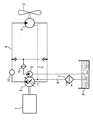
- An internal combustion engine 1 which drives a vehicle, in particular a rail vehicle, is associated with a cooling system, not shown, which contains a cooler for cooling liquid.
- This cooler is associated with a fan 2, which cools the cooler and thus the cooling liquid by generating an air flow.
- the fan 2 is driven by a hydraulic motor 3, which is part of a closed hydraulic circuit 4. Hydraulic fluid in the closed hydraulic circuit 4 is moved by a hydraulic pump 5 arranged there, which is driven by the internal combustion engine 1.
- either the pivot angle of a swash plate 11 in the hydraulic pump 5 can be changed or it can be a volume flow controller 12 are operated in the closed hydraulic circuit 4.
- Both a servo valve or a proportional valve for changing the swivel angle of the swash plate 11, as well as the volumetric flow controller 12, depending on the measured speed of the engine 1 can be controlled so that a desired volume flow in the closed hydraulic circuit 4 and thus a desired speed of the fan. 2 established. It is particularly important that the speed of the fan 2 can not exceed a maximum value even with further increasing speed of the internal combustion engine 1.
- Both an adjustable swivel disk 11 in the hydraulic pump 5 and a volumetric flow controller 12 in the closed hydraulic circuit 4 can also be present.
Landscapes
- Engineering & Computer Science (AREA)
- Chemical & Material Sciences (AREA)
- Combustion & Propulsion (AREA)
- Mechanical Engineering (AREA)
- General Engineering & Computer Science (AREA)
- Fluid-Pressure Circuits (AREA)
- Cooling, Air Intake And Gas Exhaust, And Fuel Tank Arrangements In Propulsion Units (AREA)
- Auxiliary Drives, Propulsion Controls, And Safety Devices (AREA)
- Eye Examination Apparatus (AREA)
- Power Steering Mechanism (AREA)
- Control Of Electric Motors In General (AREA)
Description
- Die Erfindung betrifft eine Vorrichtung zum Betreiben eines Lüfters für einen Kühler eines Verbrennungsmotors nach dem Oberbegriff des Patentanspruches 1.
- Ein Verbrennungsmotor, z.B. ein Dieselmotor, der insbesondere zum Antreiben einer Diesellokomotive bestimmt ist, weist zur Wärmeabfuhr eine Kühlanlage auf. Bestandteil dieser Kühlanlage ist ein Kühler, in dem zuvor im Motor erhitzte Kühlflüssigkeit wieder abgekühlt wird. Dazu ist dem Kühler ein Lüfter zugeordnet, der in der Art eines Ventilators einen Luftstrom erzeugt, der auf den Kühler gerichtet ist. Zum Antreiben dieses Lüfters ist ein Hydraulikmotor vorgesehen, der Teil eines Hydraulikkreislaufs ist.
- Derartige Hydraulikkreisläufe sind bekannt. Es wird zwischen einem offenen und einem geschlossenen Kreislauf unterschieden. Bei einem üblichen offenen Kreislauf saugt eine Hydraulikpumpe eine Hydraulikflüssigkeit aus einem Behälter über ein Filter und einen Diffusor an. Die Hydraulikflüssigkeit gelangt dann von der Hydraulikpumpe zum Hydraulikmotor, um diesen anzutreiben, und fließt von dort über einen zugeordneten Hydraulikkühler und einen Filter zum Behälter zurück. Bei einem geschlossenen Kreislauf strömt die Hydraulikflüssigkeit von der Hydraulikpumpe zum Hydraulikmotor und von dort zurück zur Hydraulikpumpe. Nur eine kleine Teilmenge der Hydraulikflüssigkeit kann über einen sogenannten Spülblock auf der Niederdruckseite aus dem Hydraulikkreislauf herausgenommen und über eine Speisepumpe aus einem Behälter ersetzt werden. Das hat zum Ziel, einen möglichen Wärmeeintrag abzuführen.
- Bisher wurde zum Betreiben eines Lüfters für einen Kühler eines Verbrennungsmotors stets ein offener Hydraulikkreislauf bevorzugt. Dort wären aber zur Regelung der Lüfterdrehzahl aufwändige, elektrisch verstellbare Proportionalventile erforderlich, die einen Teilstrom der Hydraulikflüssigkeit energetisch ungenützt am Hydraulikmotor vorbeileiten.
- Aus der Patentschrift
US 5,875,630 ist eine gattungsgemäße Vorrichtung zum Betreiben eines Lüfters bekannt. - Die Kühlleistung des Lüfters ist also beim Bekannten nicht in optimaler Weise an die jeweils vorhandene Temperatur im Kühler des Verbrennungsmotors anpassbar.
- Der Erfindung liegt die Aufgabe zugrunde, eine Vorrichtung zum Betreiben eines Lüfters für einen Kühler eines Verbrennungsmotors anzugeben, die eine stets zuverlässige, den Erfordernissen entsprechende Kühlung der Kühlflüssigkeit im Kühler durch den Lüfter gewährleistet.
- Die Aufgabe wird gemäß der Erfindung gelöst durch eine gattungsgemäße Vorrichtung mit den kennzeichnenden Merkmalen des Patentanspruches 1.
- Damit wird der Vorteil erzielt, dass durch eine Regelung von in einem geschlossenen Hydraulikkreislauf angeordneten Bauteilen in einfacher, energetisch günstiger Weise eine den Anforderungen entsprechende Regelung der Lüfterdrehzahl zu erreichen ist. Elektrisch verstellbare Proportionalventile können eingespart werden. Mit dem Einsatz eines geschlossenen Hydraulikkreislaufs wird darüber hinaus der Diffusor eingespart und man kommt mit einem kleineren Behälter für Hydraulikflüssigkeit aus, da nur ein kleiner Teil der Hydraulikflüssigkeit ausgetauscht wird. Falls ein Hydraulikkühler vorhanden ist, muss dieser nur für die relativ kleine Austauschrate der Hydraulikflüssigkeit ausgelegt sein, da er nur die in den kleinen Behälter zurückgeleitete Hydraulikflüssigkeit zu kühlen hat. Ebenso ist auch nur ein kleiner Filter notwendig, der in der Zuleitung für die geringe Menge neu einzuspeisender Hydraulikflüssigkeit angeordnet ist. Die Vorrichtung nach der Erfindung ist deutlich kostengünstiger aufzubauen als eine bekannte Vorrichtung zum Betreiben eines Lüfters. Insbesondere aber ist die Vorrichtung nach der Erfindung besonders einfach und energetisch günstig regelbar.
- Erfindungsgemäß ist die Drehzahl des Lüfters durch einen ihm zugeordneten Grenzwertgeber begrenzbar, der einen Maximalwert für die Drehzahl des Lüfters gespeichert hat. Hierdurch ist eine weitere Möglichkeit gegeben, um eine Überlastung des Lüfters zu vermeiden.
- Erfindungsgemäß ist eine Hydraulikpumpe Bestandteil des geschlossenen Hydraulikkreislaufs.
- Erfindungsgemäß ist das Fördervolumen der Hydraulikpumpe zum Regeln der Drehzahl des Lüfters regelbar. Man spart dadurch vorteilhaft bisher notwendige, teuere Regelventile ein.
- Erfindungsgemäß ist das Fördervolumen der Hydraulikpumpe abhängig von der Drehzahl des Verbrennungsmotors regelbar. Damit wird der Vorteil erzielt, dass gerade bei relativ hoher Drehzahl des Verbrennungsmotors keine unnötig hohe Leistung des Lüfters bereitgestellt wird.
- Beispielsweise ist der Hydraulikmotor mit dem Lüfter direkt gekoppelt. Aufwändige Zusatzbauteile werden nicht benötigt.
- Beispielsweise ist der Volumenstrom im geschlossenen Hydraulikkreislauf zum einfachen Regeln der Drehzahl des Lüfters regelbar.
- Dazu ist beispielsweise im geschlossenen Hydraulikkreislauf ein Volumenstromregler angeordnet. Ein solcher Volumenstromregler wird erst ab einem bestimmten Volumenstrom, der eine zu hohe Drehzahl des Lüfters nach sich ziehen würde, aktiv und verhindert dann ein weiteres Ansteigen des Volumenstroms zum Hydraulikmotor hin. Damit wird der Vorteil erzielt, dass der Lüfter nicht überlastet und der Hydraulikmotor energetisch günstig betrieben werden kann.
- Die Lüfterdrehzahl steigt ab einer ersten Drehzahl des Verbrennungsmotors geregelt an und erreicht bei einer zweiten Drehzahl des Verbrennungsmotors einen maximalen Wert, der bei einem weiteren Anstieg der Drehzahl des Verbrennungsmotors unverändert bleibt. Bei einer Drehzahl des Verbrennungsmotors, die kleiner ist als die genannte erste Drehzahl des Verbrennungsmotors, ist eine Kühlung nicht erforderlich. Der Lüfter steht dann still.
- Zum Antreiben der Hydraulikpumpe ist diese beispielsweise mit dem Verbrennungsmotor verbunden. Es ist somit sichergestellt, dass der Hydraulikkreislauf in Betrieb ist, wenn auch der Verbrennungsmotor in Betrieb ist.
- Beispielsweise ist die Hydraulikpumpe direkt mit dem Verbrennungsmotor verbunden. Das ergibt den Vorteil, dass die Drehzahl der Hydraulikpumpe und damit auch die Lüfterdrehzahl mit der Drehzahl des Verbrennungsmotors ansteigt oder zurückgeht. Das Fördervolumen der Hydraulikpumpe und damit die Leistung des Lüfters hängt folglich direkt von der Drehzahl des Verbrennungsmotors und damit von der Temperatur der Kühlflüssigkeit ab.
- Beispielsweise ist das Fördervolumen der Hydraulikpumpe in Abhängigkeit von der Temperatur der Kühlflüssigkeit in der dem Kühler zugeordneten Kühlanlage regelbar. Dadurch wird die Kühlflüssigkeit zuverlässig gekühlt.
- Beispielsweise ist das Fördervolumen der Hydraulikpumpe durch Verändern des Schwenkwinkels einer in der Hydraulikpumpe angeordneten Schwenkscheibe regelbar.
- Zum Verstellen des Schwenkwinkels dient ein in der Pumpe vorhandenes Servoventil oder Proportionalventil. Es kann dazu auch eine elektrische Steuerung vorgesehen sein, der die gemessene Drehzahl des Verbrennungsmotors zuführbar ist.
- Es kann vorteilhaft durch eine geeignete Einstellung des Schwenkwinkels der Schwenkscheibe in der Hydraulikpumpe erreicht werden, dass bei weiter ansteigender Drehzahl des Verbrennungsmotors die Drehzahl der Hydraulikpumpe und damit des Lüfters unverändert bleiben.
- Man erreicht mit einfachen Mitteln eine optimale und energetisch günstige Regelung des Lüfters in Abhängigkeit von der Leistung des Verbrennungsmotors und damit in Abhängigkeit von der Temperatur der zu kühlenden Kühlflüssigkeit des Verbrennungsmotors.
- Mit der Vorrichtung zum Betreiben eines Lüfters nach der Erfindung wird der Vorteil erzielt, dass eine optimale, energetisch günstige Kühlung über den Lüfter mit einfachen, kostengünstigen Bauteilen erreichbar ist. Beim Einsatz in einem Fahzeug, insbesondere in einem Schienentriebfahrzeug, z.B. einer Diesellokomotive, ergibt sich ein deutlicher Kostenvorteil gegenüber bisher üblichen Vorrichtungen mit offenem Hydraulikkreislauf und Regelventilen, z.B. Proportionalventilen.
- Die Vorrichtung zum Betreiben eines Lüfters nach der Erfindung wird anhand der Zeichnung näher erläutert:
- Einem Verbrennungsmotor 1, der ein Fahrzeug, insbesondere ein Schienenfahrzeug, antreibt, ist eine nicht gezeigte Kühlanlage zugeordnet, die einen Kühler für Kühlflüssigkeit enthält. Diesem Kühler ist ein Lüfter 2 zugeordnet, der durch die Erzeugung eines Luftstromes den Kühler und damit die Kühlflüssigkeit abkühlt.
- Der Lüfter 2 wird durch einen Hydraulikmotor 3 angetrieben, der Teil eines geschlossenen Hydraulikkreislaufs 4 ist. Hydraulikflüssigkeit im geschlossenen Hydraulikkreislauf 4 wird durch eine dort angeordnete Hydraulikpumpe 5 bewegt, die vom Verbrennungsmotor 1 angetrieben wird.
- Beim geschlossenen Hydraulikkreislauf 4 wird nur eine kleine Menge Hydraulikflüssigkeit über Leckleitungen 6 und einen Hydraulikkühler 7 in einen Behälter 8 geleitet. Von dort wird fehlende Hydraulikflüssigkeit über eine Speisepumpe 9 und ein Druckfilter 10 wieder in den geschlossenen Hydraulikkreislauf 4 eingespeist.
- Zur Regelung der Drehzahl des Hydraulikmotors 3 und damit des Lüfters 2 kann entweder der Schwenkwinkel einer Schwenkscheibe 11 in der Hydraulikpumpe 5 geändert werden oder es kann ein volumenstromregler 12 im geschlossenen Hydraulikkreislauf 4 betätigt werden. Sowohl ein Servoventil oder ein Proportionalventil zum Ändern des Schwenkwinkels der Schwenkscheibe 11, als auch der Volumenstromregler 12, können in Abhängigkeit der gemessenen Drehzahl des Verbrennungsmotors 1 so geregelt werden, dass sich ein gewünschter Volumenstrom im geschlossenen Hydraulikkreislauf 4 und damit eine gewünschte Drehzahl des Lüfters 2 einstellt. Dabei kommt es insbesondere darauf an, dass die Drehzahl des Lüfters 2 auch bei weiter ansteigender Drehzahl des Verbrennungsmotors 1 einen Maximalwert nicht übersteigen kann.
- Zum Ansteuern des Servoventils oder Proportionalventils der Schwenkscheibe 11 und zum Ansteuern des Volumenstromreglers 12 sind nicht gezeigte Datenleitungen erforderlich.
- Es können auch sowohl eine einstellbare Schwenkscheibe 11 in der Hydraulikpumpe 5 als auch ein Volumenstromregler 12 im geschlossenen Hydraulikkreislauf 4 vorhanden sein.
- Mit der Vorrichtung zum Betreiben eines Lüfters 2 nach der Erfindung kann in einfacher, energetisch günstiger Weise und mit kostengünstigen Bauteilen stets eine optimale Kühlung der Kühlflüssigkeit des Verbrennungsmotors 1 erreicht werden.
Claims (6)
- Vorrichtung zum Betreiben eines Lüfters (2) für einen Kühler eines Verbrennungsmotors (1), wobei ein mit dem Lüfter (2) verbundener Hydraulikmotor (3) und eine Hydraulikpumpe (5) Bestandteile eines geschlossenen Hydraulikkreislaufs (4) sind, dadurch gekennzeichnet,
dass das Fördervolumen der Hydraulikpumpe (5) zum Regeln der Drehzahl des Lüfters (2) abhängig von der Drehzahl des Verbrennungsmotors (1) regelbar ist und dass die Drehzahl des Lüfters (2) durch einen ihm zugeordneten Grenzwertgeber begrenzbar ist, der einen Maximalwert für die Drehzahl des Lüfters (2) gespeichert hat. - Vorrichtung nach Anspruch 1,
dadurch gekennzeichnet, dass der Hydraulikmotor (3) mit dem Lüfter (2) direkt gekoppelt ist. - Vorrichtung nach einem der Ansprüche 1 oder 2,
dadurch gekennzeichnet, dass im geschlossenen Hydraulikkreislauf (4) ein Volumenstromregler (12) angeordnet ist. - Vorrichtung nach einem der Ansprüche 1 bis 3,
dadurch gekennzeichnet, dass zum Antreiben der Hydraulikpumpe (5) diese mit dem Verbrennungsmotor (1) verbunden ist. - Vorrichtung nach einem der Ansprüche 1 bis 4,
dadurch gekennzeichnet, dass das Fördervolumen der Hydraulikpumpe (5) in Abhängigkeit von der Temperatur der Kühlflüssigkeit in der dem Kühler zugeordneten Kühlanlage regelbar ist. - Vorrichtung nach einem der Ansprüche 1 bis 5,
dadurch gekennzeichnet, dass das Fördervolumen der Hydraulikpumpe (5) durch Verändern des Schwenkwinkels einer in der Hydraulikpumpe (5) angeordneten Schwenkscheibe (11) regelbar ist.
Applications Claiming Priority (2)
| Application Number | Priority Date | Filing Date | Title |
|---|---|---|---|
| DE102004028354A DE102004028354A1 (de) | 2004-06-11 | 2004-06-11 | Vorrichtung zum Betreiben eines Lüfters |
| DE102004028354 | 2004-06-11 |
Publications (2)
| Publication Number | Publication Date |
|---|---|
| EP1607600A1 EP1607600A1 (de) | 2005-12-21 |
| EP1607600B1 true EP1607600B1 (de) | 2011-04-06 |
Family
ID=34982543
Family Applications (1)
| Application Number | Title | Priority Date | Filing Date |
|---|---|---|---|
| EP05105038A Expired - Lifetime EP1607600B1 (de) | 2004-06-11 | 2005-06-09 | Vorrichtung zum Betreiben eines Lüfters |
Country Status (3)
| Country | Link |
|---|---|
| EP (1) | EP1607600B1 (de) |
| AT (1) | ATE504728T1 (de) |
| DE (2) | DE102004028354A1 (de) |
Families Citing this family (3)
| Publication number | Priority date | Publication date | Assignee | Title |
|---|---|---|---|---|
| DE102007058534B4 (de) | 2007-12-06 | 2016-01-21 | Deere & Company | Kühlanordnung mit hydraulisch angetriebenen Lüftern |
| DE102014008477B4 (de) * | 2014-06-05 | 2019-07-04 | Liebherr-Mining Equipment Colmar Sas | Muldenkipper oder Truck mit einem dieselelektrischen Fahrantrieb, einem Kühlsystem und einem Hydromotor |
| EP3418451B1 (de) * | 2017-06-22 | 2019-07-24 | ABI Anlagentechnik-Baumaschinen-Industriebedarf Maschinenfabrik und Vertriebsgesellschaft mbH | Arbeitsgerät mit hydraulischem antrieb für tiefbauarbeiten |
Family Cites Families (7)
| Publication number | Priority date | Publication date | Assignee | Title |
|---|---|---|---|---|
| DE892393C (de) * | 1951-07-29 | 1953-10-08 | Erich Dipl-Ing Wachsmuth | Rotierender Hilfsmaschinenantrieb fuer fluessigkeitsgekuehlte Freiflugkolbenmaschinen |
| CH323708A (de) * | 1952-12-15 | 1957-08-15 | Sueddeutsche Kuehler Behr | Einrichtung zur selbsttätigen Anpassung der geförderten Kühlluftmenge eines Lüfters an den Kühlluftbedarf eines Kühlers |
| DE3903199C1 (de) * | 1989-02-03 | 1990-04-05 | Sueddeutsche Kuehlerfabrik Julius Fr. Behr Gmbh & Co Kg, 7000 Stuttgart, De | |
| JPH10196364A (ja) * | 1997-01-07 | 1998-07-28 | Toyota Motor Corp | 冷却ファン制御装置 |
| US5875630A (en) * | 1997-06-10 | 1999-03-02 | Sauer Inc. | Hydraulic drive assembly |
| DE10044607A1 (de) * | 2000-09-08 | 2002-04-04 | O & K Mining Gmbh | Verfahren und Einrichtung zur Regelung eines Lüfterantriebes einer Brennkraftmaschine in Bau- und/oder Arbeitsmaschinen |
| US6750623B1 (en) * | 2002-12-17 | 2004-06-15 | Caterpillar Inc. | Reversible automatic fan control system |
-
2004
- 2004-06-11 DE DE102004028354A patent/DE102004028354A1/de not_active Withdrawn
-
2005
- 2005-06-09 DE DE502005011205T patent/DE502005011205D1/de not_active Expired - Lifetime
- 2005-06-09 EP EP05105038A patent/EP1607600B1/de not_active Expired - Lifetime
- 2005-06-09 AT AT05105038T patent/ATE504728T1/de active
Also Published As
| Publication number | Publication date |
|---|---|
| DE102004028354A1 (de) | 2006-01-05 |
| DE502005011205D1 (de) | 2011-05-19 |
| ATE504728T1 (de) | 2011-04-15 |
| EP1607600A1 (de) | 2005-12-21 |
Similar Documents
| Publication | Publication Date | Title |
|---|---|---|
| DE10019606A1 (de) | Kühlgebläse-Antriebssteuereinrichtung | |
| DE102017207159A1 (de) | Antriebsstrang-wärmemanagementsystem und-verfahren | |
| DE3812267C2 (de) | Drehzahl-Regelvorrichtung für ein hydraulisch betriebenes Kühlgebläse einer Brennkraftmaschine | |
| DE102009053082B4 (de) | Hydrostatisches Getriebe mit einer druckproportionalen Verstellpumpe | |
| EP3275777A1 (de) | Verfahren zum betreiben eines kühlsystems eines schiffs | |
| DE10154926A1 (de) | Kühlmittelkreislauf für eine Brennkraftmaschine | |
| EP1607600B1 (de) | Vorrichtung zum Betreiben eines Lüfters | |
| DE102013205415B4 (de) | Dieselkraftstoffzufuhranordnung | |
| EP1399656A1 (de) | Verfahren zum überwachen eines kühlflüssigkeitskreislaufs einer brennkraftmaschine | |
| EP1038097A1 (de) | Vorrichtung zum kühlen eines motors für ein kraftfahrzeug | |
| DE112023003828T5 (de) | Arbeitsmaschine und deren temperaturmanagementsystem | |
| DE102019112500B4 (de) | Kühlmitteldruckregelsystem | |
| DE102013102879A1 (de) | Kompressor und Verfahren zum Betreiben eines Kompressors | |
| EP1586754B1 (de) | Kühlsystem | |
| DE10058374B4 (de) | Vorrichtung zur Temperaturregulierung einer Brennkraftmaschine | |
| DE4304403C2 (de) | Regeleinrichtung für einen hydrostatischen Antrieb | |
| DE102012112932A1 (de) | Hydrostatisches Antriebssystem einer mobilen Arbeitsmaschine mit Druckmittelkühlung | |
| DE102007008446A1 (de) | Verfahren und Vorrichtung zum Optimieren der Bremsarbeit eines Retarders | |
| DE102008041800B4 (de) | Kühleinrichtung für ein Kraftfahrzeug | |
| DE10054078B4 (de) | Antriebsanlage für ein Fahrzeug | |
| DE3018076A1 (de) | Verfahren und vorrichtung zur fluessigkeitskuehlung unterschiedlich belasteter antriebsmaschinen mit zuschaltbarem luefter | |
| WO2002077426A1 (de) | Wärmetauscher | |
| DE102018131033B4 (de) | Kühlkreislauf und Steuerverfahren für ein Wärmemanagementsystem | |
| DE3602228A1 (de) | Verfahren und einrichtung zum beheizen eines fahrgastraumes eines fahrzeuges sowie zum kuehlen der brennkraftmaschine des fahrzeuges | |
| EP3412885B1 (de) | Brennkraftmaschine mit einem kühlmittelkreislauf |
Legal Events
| Date | Code | Title | Description |
|---|---|---|---|
| PUAI | Public reference made under article 153(3) epc to a published international application that has entered the european phase |
Free format text: ORIGINAL CODE: 0009012 |
|
| AK | Designated contracting states |
Kind code of ref document: A1 Designated state(s): AT BE BG CH CY CZ DE DK EE ES FI FR GB GR HU IE IS IT LI LT LU MC NL PL PT RO SE SI SK TR |
|
| AX | Request for extension of the european patent |
Extension state: AL BA HR LV MK YU |
|
| 17P | Request for examination filed |
Effective date: 20060620 |
|
| AKX | Designation fees paid |
Designated state(s): AT DE FR |
|
| 17Q | First examination report despatched |
Effective date: 20100311 |
|
| GRAP | Despatch of communication of intention to grant a patent |
Free format text: ORIGINAL CODE: EPIDOSNIGR1 |
|
| GRAS | Grant fee paid |
Free format text: ORIGINAL CODE: EPIDOSNIGR3 |
|
| GRAA | (expected) grant |
Free format text: ORIGINAL CODE: 0009210 |
|
| AK | Designated contracting states |
Kind code of ref document: B1 Designated state(s): AT DE FR |
|
| REF | Corresponds to: |
Ref document number: 502005011205 Country of ref document: DE Date of ref document: 20110519 Kind code of ref document: P |
|
| REG | Reference to a national code |
Ref country code: DE Ref legal event code: R096 Ref document number: 502005011205 Country of ref document: DE Effective date: 20110519 |
|
| PLBE | No opposition filed within time limit |
Free format text: ORIGINAL CODE: 0009261 |
|
| STAA | Information on the status of an ep patent application or granted ep patent |
Free format text: STATUS: NO OPPOSITION FILED WITHIN TIME LIMIT |
|
| 26N | No opposition filed |
Effective date: 20120110 |
|
| REG | Reference to a national code |
Ref country code: DE Ref legal event code: R097 Ref document number: 502005011205 Country of ref document: DE Effective date: 20120110 |
|
| REG | Reference to a national code |
Ref country code: FR Ref legal event code: PLFP Year of fee payment: 12 |
|
| REG | Reference to a national code |
Ref country code: FR Ref legal event code: PLFP Year of fee payment: 13 |
|
| REG | Reference to a national code |
Ref country code: FR Ref legal event code: PLFP Year of fee payment: 14 |
|
| PGFP | Annual fee paid to national office [announced via postgrant information from national office to epo] |
Ref country code: FR Payment date: 20180614 Year of fee payment: 14 Ref country code: AT Payment date: 20180514 Year of fee payment: 14 |
|
| REG | Reference to a national code |
Ref country code: DE Ref legal event code: R081 Ref document number: 502005011205 Country of ref document: DE Owner name: SIEMENS MOBILITY GMBH, DE Free format text: FORMER OWNER: SIEMENS AKTIENGESELLSCHAFT, 80333 MUENCHEN, DE |
|
| REG | Reference to a national code |
Ref country code: AT Ref legal event code: PC Ref document number: 504728 Country of ref document: AT Kind code of ref document: T Owner name: SIEMENS MOBILITY GMBH, DE Effective date: 20190506 |
|
| PGFP | Annual fee paid to national office [announced via postgrant information from national office to epo] |
Ref country code: DE Payment date: 20190819 Year of fee payment: 15 |
|
| REG | Reference to a national code |
Ref country code: AT Ref legal event code: MM01 Ref document number: 504728 Country of ref document: AT Kind code of ref document: T Effective date: 20190609 |
|
| PG25 | Lapsed in a contracting state [announced via postgrant information from national office to epo] |
Ref country code: AT Free format text: LAPSE BECAUSE OF NON-PAYMENT OF DUE FEES Effective date: 20190609 |
|
| PG25 | Lapsed in a contracting state [announced via postgrant information from national office to epo] |
Ref country code: FR Free format text: LAPSE BECAUSE OF NON-PAYMENT OF DUE FEES Effective date: 20190630 |
|
| REG | Reference to a national code |
Ref country code: DE Ref legal event code: R119 Ref document number: 502005011205 Country of ref document: DE |
|
| PG25 | Lapsed in a contracting state [announced via postgrant information from national office to epo] |
Ref country code: DE Free format text: LAPSE BECAUSE OF NON-PAYMENT OF DUE FEES Effective date: 20210101 |