EP1590252B1 - Wiederverschliessbarer deckel, insbesondre einer getränkedose - Google Patents
Wiederverschliessbarer deckel, insbesondre einer getränkedose Download PDFInfo
- Publication number
- EP1590252B1 EP1590252B1 EP03813587A EP03813587A EP1590252B1 EP 1590252 B1 EP1590252 B1 EP 1590252B1 EP 03813587 A EP03813587 A EP 03813587A EP 03813587 A EP03813587 A EP 03813587A EP 1590252 B1 EP1590252 B1 EP 1590252B1
- Authority
- EP
- European Patent Office
- Prior art keywords
- lid
- opener
- opening
- opener tab
- lid plate
- Prior art date
- Legal status (The legal status is an assumption and is not a legal conclusion. Google has not performed a legal analysis and makes no representation as to the accuracy of the status listed.)
- Expired - Lifetime
Links
- 238000003825 pressing Methods 0.000 claims description 51
- 239000011324 bead Substances 0.000 claims description 15
- 230000003014 reinforcing effect Effects 0.000 claims description 14
- 239000000463 material Substances 0.000 claims description 12
- 230000002093 peripheral effect Effects 0.000 claims description 11
- 239000004033 plastic Substances 0.000 claims description 10
- 229920003023 plastic Polymers 0.000 claims description 10
- 230000015572 biosynthetic process Effects 0.000 claims description 6
- 238000007789 sealing Methods 0.000 claims description 6
- 239000011248 coating agent Substances 0.000 claims description 4
- 238000000576 coating method Methods 0.000 claims description 4
- 230000000694 effects Effects 0.000 claims description 4
- 230000003993 interaction Effects 0.000 claims description 2
- 230000004323 axial length Effects 0.000 claims 1
- 230000002787 reinforcement Effects 0.000 description 7
- 238000005452 bending Methods 0.000 description 5
- 239000007788 liquid Substances 0.000 description 5
- 239000000843 powder Substances 0.000 description 5
- 238000004519 manufacturing process Methods 0.000 description 4
- 230000035622 drinking Effects 0.000 description 3
- 238000000034 method Methods 0.000 description 3
- 239000007787 solid Substances 0.000 description 3
- 238000010276 construction Methods 0.000 description 2
- 229910052751 metal Inorganic materials 0.000 description 2
- 239000002184 metal Substances 0.000 description 2
- 238000004080 punching Methods 0.000 description 2
- 235000014347 soups Nutrition 0.000 description 2
- 239000000126 substance Substances 0.000 description 2
- 229910000838 Al alloy Inorganic materials 0.000 description 1
- 229910000640 Fe alloy Inorganic materials 0.000 description 1
- 235000009470 Theobroma cacao Nutrition 0.000 description 1
- 230000006978 adaptation Effects 0.000 description 1
- 229910052782 aluminium Inorganic materials 0.000 description 1
- XAGFODPZIPBFFR-UHFFFAOYSA-N aluminium Chemical compound [Al] XAGFODPZIPBFFR-UHFFFAOYSA-N 0.000 description 1
- 244000240602 cacao Species 0.000 description 1
- 239000003795 chemical substances by application Substances 0.000 description 1
- 239000012459 cleaning agent Substances 0.000 description 1
- 230000002349 favourable effect Effects 0.000 description 1
- 230000009969 flowable effect Effects 0.000 description 1
- 239000008187 granular material Substances 0.000 description 1
- 230000001771 impaired effect Effects 0.000 description 1
- 230000000630 rising effect Effects 0.000 description 1
- 238000007493 shaping process Methods 0.000 description 1
Images



Classifications
-
- B—PERFORMING OPERATIONS; TRANSPORTING
- B65—CONVEYING; PACKING; STORING; HANDLING THIN OR FILAMENTARY MATERIAL
- B65D—CONTAINERS FOR STORAGE OR TRANSPORT OF ARTICLES OR MATERIALS, e.g. BAGS, BARRELS, BOTTLES, BOXES, CANS, CARTONS, CRATES, DRUMS, JARS, TANKS, HOPPERS, FORWARDING CONTAINERS; ACCESSORIES, CLOSURES, OR FITTINGS THEREFOR; PACKAGING ELEMENTS; PACKAGES
- B65D17/00—Rigid or semi-rigid containers specially constructed to be opened by cutting or piercing, or by tearing of frangible members or portions
- B65D17/28—Rigid or semi-rigid containers specially constructed to be opened by cutting or piercing, or by tearing of frangible members or portions at lines or points of weakness
- B65D17/401—Rigid or semi-rigid containers specially constructed to be opened by cutting or piercing, or by tearing of frangible members or portions at lines or points of weakness characterised by having the line of weakness provided in an end wall
- B65D17/4012—Rigid or semi-rigid containers specially constructed to be opened by cutting or piercing, or by tearing of frangible members or portions at lines or points of weakness characterised by having the line of weakness provided in an end wall for opening partially by means of a tearing tab
- B65D17/4014—Rigid or semi-rigid containers specially constructed to be opened by cutting or piercing, or by tearing of frangible members or portions at lines or points of weakness characterised by having the line of weakness provided in an end wall for opening partially by means of a tearing tab and provided with attached means for reclosing or resealing
-
- Y—GENERAL TAGGING OF NEW TECHNOLOGICAL DEVELOPMENTS; GENERAL TAGGING OF CROSS-SECTIONAL TECHNOLOGIES SPANNING OVER SEVERAL SECTIONS OF THE IPC; TECHNICAL SUBJECTS COVERED BY FORMER USPC CROSS-REFERENCE ART COLLECTIONS [XRACs] AND DIGESTS
- Y10—TECHNICAL SUBJECTS COVERED BY FORMER USPC
- Y10S—TECHNICAL SUBJECTS COVERED BY FORMER USPC CROSS-REFERENCE ART COLLECTIONS [XRACs] AND DIGESTS
- Y10S220/00—Receptacles
- Y10S220/906—Beverage can, i.e. beer, soda
Definitions
- the invention relates to a lid of a container, in particular a drinks can, with a breakout portion, which is formed in the lid plate and can be broken out by means of an opener tab, so that an access opening to the contents of the container is produced, and with a closure attachment on the opener tab, with which the access opening can optionally be re-closed.
- the lid plate and the opener tab are respectively produced in a shaping manner from a thin, profiled plate material by a primary forming technique, or in particular by a re-forming technique, by punching and/or deep-drawing.
- the opener tab and/or the lid plate is produced from a plastics material, which is possibly fiber-reinforced, or - preferably - from a metal sheet material, in particular from an aluminum alloy or iron alloy.
- a lid according to the invention can be provided on containers for receiving a flowable substance, such as a powdered or granular substance, for example coffee powder or cocoa powder, powdered soup or other prepared powder or granules for domestic use, or in particular a liquid, which may also contain solids, for example a liquid for drinking, a liquid broth or soup, an oil and the like.
- a lid according to the invention may also be intended for other liquid or powder containers, which contain for example a liquid, powdered or granular cleaning agent or treating agent or the like.
- Such lids of a drinks can or a powder container with a breakout portion in the lid plate, which is at least partly bounded by a predetermined breaking line, and an opener tab, which is pivotably fastened, by means of a fastening tongue that can be bent about its foot, next to the breakout portion on the lid plate at a fastening stud, in particular in the form of a hollow rivet or solid rivet, are widely known.
- the fastening tongue is arranged in a cutout of the opener tab between a gripping portion and a pressing portion of the opener tab and, in the same way as the rim portion of the breakout portion alongside the fastening stud and therefore the opening produced by breaking it out, ends with its foot directly at the head of the fastening stud.
- a specially designed plastics body which serves for opening a drinking opening by breaking out a breakout portion of the lid plate and at the same time for renewed closing of this drinking opening.
- the plastics body is fastened to the lid plate in such a way that it can be swung and pivoted and elastically deflected with the aid of a flexibly deformable stud, which is riveted onto the lid plate and has, as a head, an axial web that extends transversely and protrudes on both sides, in order that the plastics body can be moved over the breakout portion and swung about the axial web for breaking out the breakout portion, and the opening produced as a result can be re-closed with the aid of a closure attachment after pivoting of the plastics body by 180°.
- a sliding groove for the axial web may be provided in the plastics body, in order that, for its swinging movement, the plastics body can be additionally displaced into a position suitable for the breaking out of the breakout portion.
- the opener tab pivotably fastened at a rivet has a depression on its gripping portion, so that on the underside of the gripping portion facing the lid plate there is formed a closure attachment which protrudes at an angle from a wide covering collar of the gripping portion.
- the opener tab consists of spring plate and the closure attachment is curved in an arcuately convex manner and is larger at the covering collar than the broken-out opening, so that, in an opener pivoted position, the closure attachment is resiliently pressed with its convexity into a receiving hollow in the lid plate and, after the pivoting of the opener tab about the fastening stud into a closure pivoted position, is resiliently pressed with its convexity onto the bounding edge of the opening, in order to re-close the opening.
- the covering collar protrudes obliquely upward above the lid plate at a distance above the axially protruding rim of the lid.
- the opener tab has a semicircular wide fastening tongue, which as a result is intended to be resiliently deflectable about a bending line perpendicularly crossing the rivet axis.
- the opener tab must be prestressed relatively strongly, in order that, with the only slight deflection of the opener tab about the bending line, a sufficiently large spring force is present at the foot of the fastening tongue to press the convexly curved closure attachment against the bounding edge of the opening.
- the strong prestressing of the opener tab has the effect on the other hand that the fastening stud of the opener tab is subjected to very strong loading, which can cause the fastening stud to be broken out from the thin lid plate if, when opening the lid, the breakout portion is to be pressed down with great force until breaking out from the lid plate occurs.
- US 4 463 866 discloses a lid for a container according to the preamble of appended claim 1.
- the invention provides a lid of a container, in particular a drinks can, in which the opening which is produced by breaking out the breakout portion of the lid plate can be effectively re-closed by simple means with the aid of the opener tab.
- the lid according to the invention is suitable for mass production accompanied by simple handling and great ease of use of the lid closure.
- the lid according to the invention of a container is provided with a lid plate, in which a breakout portion is formed, and with an opener tab, which is pivotably fastened with a fastening tongue at a fastening stud of the lid plate next to the breakout portion, so that the breakout portion can be pressed down and thereby broken out in an opener pivoted position of the opener tab by a pressing portion of the opener tab by means of lifting its gripping portion, and in the lid plate there is produced an opening which is bounded by a bounding rim.
- the gripping portion of the opener tab has a closed depression formed into its upper side at a distance on all sides from its outline, so that from the underside there protrudes a flat closure attachment, which in side view is substantially rectangular overall, or virtually rectangular, and the base of which is surrounded by a covering collar on the underside of the gripping portion.
- the closure attachment fits with its peripheral surrounding surface instead of the breakout portion in the bounding rim of the opening broken out from the lid plate substantially until the covering collar rests on the bounding rim.
- the fastening tongue is formed such that it is longer than those of the customary opener tabs, so that the opener tab can be relatively rigid for vigorous breaking out of the breakout portion and, nevertheless, a certain mobility is allowed for the positionally correct pressing down of the closure attachment into the opening, in order to allow a certain degree of compensation for deviations from the desired position of the opener tab in relation to the opening and dimensional changes caused by distortions and flexural deformations of the lid plate, which may occur during production and in particular during the breaking out of the breakout portion.
- the opener tab in further refinements of the invention it is envisaged to make the opener tab as flexurally rigid as possible, with the exception of the fastening tongue, with the aid of formed-in reinforcing beads and/or formed-out reinforcing bulges.
- the invention it is envisaged to reinforce those regions of the lid plate on which deforming forces act, in particular during the pressing down and breaking out of the breakout portion, with the aid of formed-in reinforcing beads or other formed-out reinforcements.
- Reinforcements of the pressing portion are preferably formed with the aid of bulges protruding toward the upper side, whereas reinforcements of the lid plate are formed as beads formed into its upper side, in order that there are least possible hindrances for the pivotability of the opener tab with as flat a design as possible.
- Such reinforcements of the opener tab and/or lid plate achieve the effect that, in spite of the bendability of the fastening tongue, as far as possible no deviations or only minor deviations occur in the dimensions and the position in particular of the closure attachment in relation to the broken-out opening in symmetry with the fixed-in-place fastening stud.
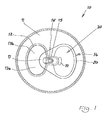
- a drinks can 10 which is produced as a cylindrical container from an aluminum material is represented in plan view.
- the drinks can 10 has a lid with a lid plate 11 and with an opener tab 14.
- a predetermined breaking line 12 is provided in the lid plate 11 .
- the opener tab 14 is mounted such that it can pivot horizontally about a rivet 15, forming an axis, preferably in the center of the lid plate 11.
- the rivet 15 penetrates a fastening tongue 16, which is formed on the opener tab 14 and is formed in a resilient manner.
- the tongue 16 is bent out upward at an angle, for example of approximately 15 to 30°, as represented by dashed lines in figure 2 , so that in the fully assembled state the tongue 16 is pressed by the rivet 15 downward against the surface of the lid plate 11, so that a resilient prestress is exerted on the opener tab 14.
- the upper tab 14 has a pressing portion 17, which covers over the lid plate 11 and protrudes at least partly into the region of the later opening 13. Lying opposite the projection 17, the opener tab 14 has a gripping portion 18 with a depression 30, and consequently a closure means facing the surface of the lid plate 11.
- the closure means is formed as a closure attachment 31 which projects in a heel-like manner and is adapted in size and shape to the later opening 13.
- the surrounding surface 19 of the closure attachment 31 may preferably be conically formed, which improves the sealing properties.
- the rim 20 on the opener tab 14 that is formed by the heel can be grasped for actuating said tab.
- Figures 2 and 3 show a second embodiment of a closure not forming part of the invention and of a related opener tab 14 .
- the opener tab 14 has at the end opposite from the pressing portion 17 a handle 21, by means of which the opener tab 14 can be securely grasped and actuated.
- Figure 2 further illustrates the operating mode of the closure shared by both embodiments shown in figures 1 and 2 .
- the pressing portion 17 is pressed onto the breakout portion 13a, marked by the predetermined breaking line 12, for breaking but the later opening 13b, so that the predetermined breaking line 12 breaks open, whereby the opening 13 is produced.
- the breakout portion is pressed downward and protrudes as portion 22 into the interior of the container 10, remaining hanging from the underside of the lid plate 11.
- the opener tab 14 is moved back at least partly into its original position on account of the spring force of the tongue 16, as represented in figure 2 .
- the opener tab 14 For closing the opening 13b, the opener tab 14 is moved by 180° about the fastening stud 15, so that the closure means 18, formed in the exemplary embodiment as a heel, comes to lie over the opening 13b. On account of the spring force of the prestressed tongue 16, the opener tab 14 is pressed downward in the direction of the opening 13 and closes the same. In this case, the closure attachment 31 is pressed into the opening 13b, which improves the sealing properties of the closure formed in this way. This operation can be repeated for the repeated opening and closing of the opening 13b.
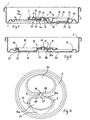
- a currently preferred embodiment of a lid according to the invention can be seen from figures 4 to 6 .
- the lid 1 according to the invention of a container in particular a drinks can 10 ( figure 9 ) is provided with a lid plate 11, in which a breakout portion 13a is formed, and with an integrally formed opener tab 14, which for its part is provided with a pressing portion 17 and a gripping portion 18 and also with a fastening tongue 16, which is arranged in a cutout 34 of the opener tab between the pressing portion and the gripping portion and has a foot 35 formed onto the pressing portion 17.
- the opener tab is pivotably fastened at a fastening stud 15 of the lid plate 11 next to the breakout portion 13a, so that, in an opener pivoted position of the opener tap ( figures 4 and 7 ), the breakout portion can be pressed down, and thereby broken out, by the pressing portion by lifting of the gripping portion, and the opening 13b bounded by a bounding rim 23 is produced in the lid plate 11.
- the fastening stud is preferably a hollow rivet pressed out from the lid plate. If appropriate, however, a solid rivet or some other stud construction may also be used as the fastening stud.
- the breakout portion 13a is bounded by by a predetermined breaking line 12 at least partly, preferably virtually completely, with the exception of a point of interruption 12a ( figure 6 ).
- the point of interruptions serves the purpose that - as shown in figure 2 at 22 - the broken-out breakout portion remains hanging from the rim of the broken-out opening 13b and does not fall into the container.
- the gripping portion 18 of the opener tab 14 has a depression 30 formed into its upper side at a distance on all sides from its outline 20 ( figure 4 ), so that there is formed on the underside facing the lid plate 11 a flat closure attachment 31.
- the closure attachment has in side view an outline which is rectangular overall, or virtually rectangular, and the base of which is surrounded by a covering collar 32, which is formed by the underside of the gripping portion 18 around the closure attachment.
- the closure attachment consequently has a peripheral surround, the outer surrounding surface 19 of which protrudes from the covering collar 32 at an angle of 90 angular degrees or preferably approximately more than 90 angular degrees, for example 93 to 100 angular degrees.
- the surrounding surface 19 has at the height of the covering collar 32 an outline which is at least approximately the same as or geometrically at least approximately similar to the outline of the breakout portion 13a determined by the predetermined breaking line 12 (at the same time the opening 13b) in the lid plate 11, so that, at its surrounding surface, the closure attachment 31 fits snugly into the bounding rim 23 of the opening 13b, and the covering collar 32 rests on the bounding rim of the opening, when the opener tab has been pivoted out of its opener pivoted position ( figures 4 and 7 ) about the fastening stud 15 into a closure pivoted position ( figures 5 and 8 ) and its gripping portion 18 has been pressed down.
- the underside of the closure attachment 31 preferably runs substantially parallel to the opener tab 14, which is flat overall, preferably planar overall, or is concavely formed, so that the base of the depression 30 runs in a correspondingly planar manner or protrudes convexly upward in its central region, for example by forming of a corresponding peripheral bead in the gripping portion 18.
- the fastening tongue 16 is formed in an elongated manner, so that between its foot 35, formed onto the pressing portion 17 of the opener tab 14, and the fastening stud 15 there is a freely bendable twisting portion 16a.
- pressing down of the gripping portion of the opener tab in a direction which runs at least approximately perpendicularly to the lid plate 11 is made possible, so that it is also made possible for the closure attachment 31 to be able to be moved at least approximately perpendicularly to the plane of the opening 13b into the latter.
- the closure attachment 31 can also be made possible by the forming of the free portion 16a on the fastening tongue 16, for example, to make the closure attachment 31 enter the opening 13b somewhat obliquely at first at its rim remote from the fastening tongue, and after that tilt back completely into the opening at the rim facing the fastening tongue, so that the opening rim can interact with the closure attachment 31 in an aligning manner, in order to correct minor positional deviations of the closure attachment.
- twisting portion 16a of the fastening tongue 16 it is possible by the forming of the twisting portion 16a of the fastening tongue 16 to provide a certain degree of compensation for dimensional tolerances and distortions and flexural deformations of the lid plate 11, which may occur during production and in particular during the breaking out of the breakout portion 13a.
- the free length of the fastening tongue 16 between its foot line 35 and the fastening stud 15 is somewhat greater than the (smallest) distance 27 ( figure 6 ) between the opening 13b and the fastening stud 15, so that the fastening tongue 16 protrudes with its foot 35 somewhat beyond the rim portion 26 of the breakout portion 13a alongside the fastening stud 15 in the opener pivoted position of the opener tab ( figure 7 ).
- the bending line about which the opener tab 14 is swung during the breaking out of the breakout portion 13a lies over the breakout portion.
- the breakout portion 13a may be wider than the pressing portion 17 at that cross-sectional line of the same which in the opener position of the opener tab lies over the portion 26 of the bounding rim 23 of the breakout portion or the opening that is alongside the fastening stud 15.
- the opening significantly wider than the pressing portion at said cross-sectional line of the same ( figure 4 ), the pressing portion 17 extending as far as possible over the opening 13b in the opener position.
- the gripping portion of an opener tab according to the invention is steadily wider than the pressing portion in adaptation to the size of the opening, the opener tab preferably widening steadily in its connecting portion from its pressing portion to the greatest width of its gripping portion.
- the lines of the outline of this connecting portion preferably run along straight lines ( figures 4 and 5 ) or slightly convex arcs.
- the preferred basic form of an opener tab 14 according to the invention can also be described as that of an isosceles triangle, the vertex of which is rounded off for forming and delimiting the pressing portion and the sides of which run, in a rounded-off manner, into the convexly arcuate base of the triangle at the gripping portion (see the outline of the opener tab 14 according to figures 4 and 5 ).
- the delimiting rim portion 26 of the broken-out opening 13b facing the fastening stud 15 can run in an arcuately concave or convex manner, it is preferred to allow this delimiting rim portion to run along a straight line ( figure 6 ), which in the opener position of the opener tab extends parallel to the straight foot line of the fastening tongue.
- the opener tab 14 as a whole extends parallel at some distance from the lid plate 11, there being formed between the twisting portion 16a and the foot line 35 of the fastening tongue 16 a foot portion 35a that preferably rises steeply ( figure 7 ).
- This allows the height of the closure attachment 31 to be relatively great and supporting of the opener tab on the connecting line between the twisting portion and the foot portion of the fastening tongue to be achieved ( figure 8 ), in order to be able to prize out the closure attachment 31 from the opening 13b more easily by pressing down the pressing portion 17.
- a receiving depression 33 is formed in the lid plate 11 for receiving the protruding closure attachment 31 in the opener position of the opener tab ( figure 8 ).
- the outline of the receiving depression 30 may be little greater than the outline of the closure attachment, but is preferably greater than the outline of the covering collar 32 around the closure attachment 31.
- the closure attachment enters the receiving depression as far as the base of the latter ( figure 7 ), which lies at a greater depth than the plane of the breakout portion 13a, and therefore of the opening 13b produced by this breaking out.
- the closure attachment In the closure pivoted position of the opener tab ( figure 8 ), the closure attachment therefore also already enters the opening 13b with the fastening tongue 16 undeformed, so that the gripping portion 18 need be pressed out only little until the covering collar 32 rests on the bounding rim 23 of the opening 13b.
- a reinforcing shoulder 38 can be formed by means of the formation in that region which is adjacent to the fastening stud 15, in order to allow tilting of the fastening stud with simultaneous deforming of the thin lid plate 11 under the considerable pulling force which is exerted laterally on the fastening stud 15 by the fastening tongue 16 of the opener tab during the breaking out of the breakout portion 13a to be largely prevented.
- the fastening stud 15 is not arranged as close as possible to the neighboring delimiting portion of the breakout portion but is arranged at a distance 27 from this delimiting rim portion 26, this distance corresponding at least to the diameter of the fastening stud 15 formed as a hollow rivet ( figures 7 and 8 ). This is so because this also has the result that the fastening stud is held in a more stable position on the lid plate 11, so that the pivotability of the opener tab 14 for its pivoting into the closure pivoted position is not impaired.
- tilting of the fastening stud could cause the dimensional conditions for the position of the closure attachment 31 to be changed so much that it can no longer be aligned with the opening 13b by the pivoting of the opener tab and can no longer close said opening.
- the bounding region of the breakout portion 13a cannot be significantly deformed when the breakout portion in the lid plate 11 is pressed down during breaking out of the same. Such permanent deformations can also cause the occurrence of a situation in which the outline of the closure attachment no longer matches the outline of the broken-out opening, so that the latter can no longer be securely closed. Therefore the bounding rim 23 of the breakout portion, and consequently at the same time of the opening 13b, is bounded by a reinforcing annular bead 4 formed as a depression into the upper side of the lid plate.
- This annular bead merges in the bounding region of the fastening stud 15 with two reinforcing beads 5 formed as a depression into the upper side of the lid plate, on both sides of the fastening stud ( figure 6 ), which for their part end at the formation 38 on the underside of the receiving depression 33.
- Maintaining the dimensional conditions for the closure attachment 31 may also depend furthermore on reinforcing the opener tab of a material of small thickness as well as possible against permanent deformation in regions outside the fastening tongue 16.
- the known opener tabs are also usually crimped along their bounding rim ( figures 7 and 8 ). This may also take place in the case of an opener tab according to the invention.
- the pressing portion 17 of the opener tab may be reinforced in the region of its free end by a central bead 6, figures 4, 5 and 7 .
- the rim of the cutout 34 in the opener tab on both sides of the fastening tongue 16 and the foot 35 of the same are preferably reinforced by bulge ribs 29, which are formed in the pressing portion 17 of the opener tab ( figures 4 and 5 ) and can run into the reinforcing bulges 28 on the lateral rims of the pressing portion.
- latching projections 39 that interact in a latching manner with the bounding edge 23 of the opening 13b are formed on the surrounding surface 19 of the closure attachment 31 as a preferred refinement of the invention.
- Such latching projections 39 are preferably provided on the portion of the surrounding surface 19 that is remote from the fastening stud 15 by corresponding small impressions being formed into the peripheral wall of the depression 30 of the gripping portion 18 ( figures 4, 5 , 7, 8 ).
- a finger clearance 24 may be formed in the lid plate 11 in the form of a depression on the side of the opening remote from the fastening stud 15, the clearance protruding beyond the covering collar 32 of the gripping portion in the closure pivoted position of the opener tab 14 ( figure 5 ). This allows the covering collar to be gripped underneath with the tip of a finger around the closure attachment 31 in its closure position, in order to prize the closure attachment out of the opening.
- such a finger clearance 24 in the form of a depression in the lid plate 11 may be made by corresponding convex extension of the annular bead 4 ( figure 4 ).
- the closure attachment 31 can be prized out by pressing down the pressing portion 17 of the opener tab, in particular if on the fastening tongue 16 there is formed a steeply rising foot portion 35a, by which the pressing portion 17 is held at some distance above the lid plate 11 when the closure attachment 31 engages in the opening 13b ( figure 7 ), and if on the side of the fastening stud 15 that is opposite from the opening there is formed in the lid plate a receiving depression 33, which is reached over by the pressing portion 17 in the closure pivoted position ( figure 8 ).
- a finger clearance 25 is preferably also formed in the lid plate 11 in the form of a depression on the side of the gripping portion 18 remote from the fastening stud 15 in the opener pivoted position of the opener tab 14 ( figures 4 and 7 ).
- gripping under the gripping portion 18 with the tip of a finger is made easier when the gripping portion lying flat over the lid plate is to be lifted for breaking out of the breakout portion 13a.
- the finger clearance 25 may also be formed by corresponding enlargement of the receiving depression 33 ( figure 4 ).
- the closure portion 31 on the underside of the gripping portion 18 may be shaped as a peripheral bulge ( figure 7 , left half of the closure attachment 31) or as a plateau-like elevation ( figure 7 , right half of the closure attachment 31). It is also possible to make the central region of the depression 30 curve upward in an arcuately convex manner, starting from an annular peripheral depression, so that the underside of the closure attachment 31 runs in a correspondingly arcuately concave manner. In all these cases, the outline of the underside of the closure attachment 31 in a side view extends substantially parallel to the covering collar 32.
- the underside of the covering collar 32 may have a coating of compliant rubber material or preferably plastics material (not shown), in order that a certain sealing effect is provided in interaction with the bounding rim 23 of the opening 13b in the closure pivoted position of the opener tab 14
- the surrounding surface 19 may also correspondingly have such a coating for sealing and/or holding the closure attachment on the bounding edge of the opening 13b.
- the lid plate 11 according to the invention and in particular the opener tab 14 according to the invention, may be produced from a thin plate material, in particular from a metal plate material, with substantially constant wall thickness, which is profiled by deforming techniques such as a combination of punching and deep-drawing for the forming of projections and depressions, such as beads and bulges, in the configuration according to the invention.
- the opener tab 14 according to the invention is made as flat as possible overall, in order that sufficient free space remains above the opener tab 14, inside the rim flange 2 of the lid plate 11, the flange projecting a distance above the opener tab, to continue to allow containers, in particular drinks cans, to be stacked by the upper can engaging in the lid of the next-lower can.
- a drinks can 10 provided with a lid according to the invention also has, in a way corresponding to figure 9 , a lower axial annular flange 3, the outside diameter of which is less than the inside diameter of the crimped upper rim flange 2 of the lid.
- the can body 10 has a correspondingly greater diameter and forms in the region above the lower annular flange 3 an obliquely running annular shoulder 40, with which the can in the stacked state rests on the upper rim flange 2, without the annular flange 3 of the respectively upper can 10 that enters the lid coming into contact with the opener tab.
Landscapes
- Engineering & Computer Science (AREA)
- Mechanical Engineering (AREA)
- Devices For Opening Bottles Or Cans (AREA)
- Containers Opened By Tearing Frangible Portions (AREA)
- Closures For Containers (AREA)
- Packages (AREA)
- Led Device Packages (AREA)
- Luminescent Compositions (AREA)
- Catalysts (AREA)
Claims (20)
- Ein Deckel (1) für einen Behälter (10), insbesondere für eine Getränkedose, mit einer Deckelplatte (11), in der ein Ausbrechabschnitt (13a) ausgebildet ist, und einer Öffnerlasche (14), die mit einem Drückerabschnitt (17) und einem Griffabschnitt (18) sowie mit einer Befestigungszunge (16) versehen ist, welche in einem Ausschnitt (34) der Öffnerlasche angeordnet ist und einen an den Drückerabschnitt (17) angeformten Fuß (35) aufweist und mit welcher die Öffnerlasche (14) an einem Befestigungszapfen (15) der Deckelplatte neben dem Ausbrechabschnitt (13a) drehbar befestigt ist, der in einer Öffnerdrehstellung der Öffnerlasche (14) von dem Drückerabschnitt (17) durch Anheben des Griffabschnitts (18) niederdrückbar und dadurch ausbrechbar ist, so dass in der Deckelplatte eine von einem Umgrenzungsrand (23) umgrenzte Öffnung (13b) entsteht, die in einer Verschlussdrehstellung der Öffnerlasche von einem Verschlussansatz (31) wieder verschließbar ist, der durch Einformen einer Vertiefung in den Griffabschnitt in einem Winkel von einem Abdeckkragen (32) an der Unterseite des Griffabschnitts absteht, wobei die Befestigungszunge (16) langgestreckt ausgebildet ist und zwischen ihrem Fuß (35) und dem Befestigungszapfen (15) einen Verwindungsabschnitt (16a) aufweist, und der Verschlussansatz (31) flach ausgebildet ist und im
Anschluss an den Abdeckkragen eine Mantelfläche (19) aufweist, die in ihrem Umriss der Öffnung (13b) entspricht, so dass der Griffabschnitt in der Verschlussdrehstellung der Öffnerlasche (14) in eine Schließlage niederdrückbar ist, in welcher der Verschlussansatz (31) in die Öffnung (13b) im wesentlichen bis zum Aufliegen des Abdeckkragens (32) auf dem Umgrenzungsrand (23) der Öffnung (13b) eingreift, wobei in die Oberseite der Deckelplatte (11) eine Aufnahmevertiefung (33) zum Aufnehmen des Verschlussansatzes in der Öffnerdrehstellung der Öffnerlasche (14) eingeformt ist, so dass an der Unterseite der Deckelplatte (11) eine abstehende Ausformung ausgebildet ist, dadurch gekennzeichnet, dass der Umgrenzungsrand (23) der Öffnung (13b) von einer versteifenden Ringsicke (4) umgrenzt wird, die als Vertiefung in die Oberseite der Deckelplatte (11) eingeformt ist, und in die Oberseite der Deckelplatte an jeder von beiden Seiten des Befestigungszapfens (15) eine Versteifungssicke (5) als Vertiefung ausgebildet ist und in die Ringsicke (4) mündet und an der von der Aufnahmevertiefung (33) gebildeten abstehenden Ausformung endet. - Der Deckel nach Anspruch 1, wobei die Befestigungszunge (16) in der Öffnerdrehstellung der Öffnerlasche (14) mit ihrem Fuß (35) über den dem Befestigungszapfen (15) benachbarten Randabschnitt (26) des Ausbrechabschnitts (13a) hinausragt.
- Der Deckel nach Anspruch 1 oder 2, wobei sich die Öffnung (13b) in der Öffnerstellung der Öffnerlasche (14) beidseitig wesentlich über deren Drückerabschnitt (17) hinaus erstreckt und sich die Öffnerlasche von ihrem Drückerabschnitt zu ihrem Griffabschnitt hin stetig verbreitert.
- Der Deckel nach einem der Ansprüche 1 bis 3, wobei die dem Befestigungszapfen (15) benachbarte Seite der Öffnung (13b) entlang einer Geraden verläuft.
- Der Deckel nach einem der Ansprüche 1 bis 4, wobei sich die Öffnerlasche (14) in einem Abstand von der Deckelplatte (11) erstreckt und zwischen dem Fuß (35) der Befestigungszunge (16) und deren Verwindungsabschnitt (16a) ein zu dem Verwindungsabschnitt und dem Drückerabschnitt (17) im Winkel angestellter Fußabschnitt (35a) ausgebildet ist.
- Der Deckel nach einem der Ansprüche 1 bis 5, wobei die Aufnahmevertiefung (33) einen größeren Umriss als der Umriss des Abdeckkragens (32) des Verschlussansatzes (31) hat und die abstehende Ausformung eine die Deckelplatte im Umgebungsbereich des Befestigungszapfens (15) versteifende Schulter aufweist.
- Der Deckel nach einem der Ansprüche 1 bis 6, wobei der Befestigungszapfen (15) der Deckelplatte (11) von der Öffnung (13b) in einem Abstand (27) angeordnet ist, der wenigstens dem Durchmesser des Befestigungszapfens entspricht.
- Der Deckel nach einem der Ansprüche 1 bis 7, wobei die Unterseite des Abdeckkragens eine Beschichtung aus nachgiebigem Gummimaterial oder Kunststoffmaterial zum Bereitstellen einer Dichtwirkung in Zusammenwirkung mit dem Umgrenzungsrand (23) der Öffnung (13b) in der Verschlussstellung der Öffnerlasche (14) aufweist.
- Der Deckel nach einem der Ansprüche 1 bis 8, wobei der Drückerabschnitt (17) der Öffnerlasche (14) im Bereich seines freien Endes von einer Mittelsicke (6) versteift wird.
- Der Deckel nach einem der Ansprüche 1 bis 9, wobei der Begrenzungsrand des Drückerabschnitts (17) der Öffnerlasche (14) bis zu deren Griffabschnitt (18) von einem Versteifungswulst (28) versteift wird.
- Der Deckel nach einem der Ansprüche 1 bis 10, wobei der Drückerabschnitt (17) der Öffnerlasche (14) entlang des Fußes (35) der Befestigungszunge (16) und beidseitig derselben entlang des Ausschnitts (34) von einer Wulstrippe (29) versteift wird.
- Der Deckel nach den Ansprüchen 10 und 11, wobei die beidseitig des Ausschnittes (34) verlaufenden Abschnitte der Wulstrippe (29) bis in den Versteifungswulst (28) hinein verlängert sind.
- Der Deckel nach einem der Ansprüche 1 bis 12, wobei mit dem Umgrenzungsrand (23) der Öffnung (13b) verrastend zusammenwirkende Rastvorsprünge (39) an der Mantelfläche (19) des Verschlussansatzes (31) ausgebildet sind.
- Der Deckel nach einem der Ansprüche 1 bis 13, wobei in der Deckelplatte (11) an der dem Befestigungszapfen (15) abgewandten Seite der Öffnung (13b) eine Fingerfreisparung (24) ausgebildet ist, die über den Abdeckkragen (32) des Griffabschnitts (18) in der Verschlussdrehstellung der Öffnerlasche (14) hinausragt.
- Der Deckel nach einem der Ansprüche 1 bis 14, wobei in der Deckelplatte (11) an der dem Befestigungszapfen (15) in der Öffnerdrehstellung der Öffnerlasche (14) abgewandten Seite des Griffabschnitts (18) eine Fingerfreisparung (25) ausgebildet ist.
- Der Deckel nach einem der Ansprüche 1 bis 15, wobei der Verschlussansatz (31) als umlaufender Wulst oder als plateau-artige Erhöhung ausgebildet ist.
- Der Deckel nach einem der Ansprüche 1 bis 16, wobei die Deckelplatte (11) einen vorstehenden Randbund (2) aufweist, von dem die Öffnerlasche (14) mit Abstand überragt wird.
- Der Deckel nach einem der Ansprüche 1 bis 17, wobei die Befestigungszunge (16) der Öffnerlasche (14) als Federzunge ausgebildet ist, von welcher der Verschlussansatz (31) der Öffnerlasche federnd gegen die Deckelplatte (11) gedrückt wird.
- Ein Behälter (10), insbesondere eine Getränkedose, mit einem Deckel (1) nach einem der Ansprüche 1 bis 18.
- Der Behälter (10), insbesondere eine Getränkedose, nach Anspruch 19, mit einem Deckel (1) nach Anspruch 17, wobei am unteren Ende des Behälters (10) radial im Abstand von dessen Umfangskörper ein axialer Ringbund (3) mit einer Axiallänge vorgesehen ist, die kleiner ist als der Abstand, um den die Öffnerlasche (14) von dem vorstehenden Randbund (2) der Deckelplatte (11) überragt wird.
Applications Claiming Priority (3)
| Application Number | Priority Date | Filing Date | Title |
|---|---|---|---|
| DE10261232A DE10261232A1 (de) | 2002-12-20 | 2002-12-20 | Verschluss für einen Behälter |
| DE10261232 | 2002-12-20 | ||
| PCT/EP2003/014675 WO2004056667A1 (en) | 2002-12-20 | 2003-12-19 | Re-closable lid, in particular of a drinks can |
Publications (2)
| Publication Number | Publication Date |
|---|---|
| EP1590252A1 EP1590252A1 (de) | 2005-11-02 |
| EP1590252B1 true EP1590252B1 (de) | 2011-03-02 |
Family
ID=32519412
Family Applications (1)
| Application Number | Title | Priority Date | Filing Date |
|---|---|---|---|
| EP03813587A Expired - Lifetime EP1590252B1 (de) | 2002-12-20 | 2003-12-19 | Wiederverschliessbarer deckel, insbesondre einer getränkedose |
Country Status (13)
| Country | Link |
|---|---|
| US (1) | US7500577B2 (de) |
| EP (1) | EP1590252B1 (de) |
| JP (1) | JP4288241B2 (de) |
| CN (1) | CN100348464C (de) |
| AT (1) | ATE500152T1 (de) |
| AU (1) | AU2003296697B2 (de) |
| BR (1) | BR0316866A (de) |
| CA (1) | CA2511171C (de) |
| DE (2) | DE10261232A1 (de) |
| PL (1) | PL201715B1 (de) |
| RU (1) | RU2309099C2 (de) |
| UA (1) | UA77638C2 (de) |
| WO (1) | WO2004056667A1 (de) |
Families Citing this family (62)
| Publication number | Priority date | Publication date | Assignee | Title |
|---|---|---|---|---|
| JP5328347B2 (ja) * | 2005-05-25 | 2013-10-30 | ボール パッケージング ユーロップ ゲゼルシャフト ミット ベシュレンクテル ハフツング | 容器用薄板製の蓋 |
| ATE499304T1 (de) | 2005-05-25 | 2011-03-15 | Ball Packaging Europe Gmbh | Deckel mit führungssäulen für einen behälter |
| PL208732B1 (pl) * | 2006-10-23 | 2011-06-30 | Invento Społka Z Ograniczoną Odpowiedzialnością | Pokrywka pojemnika zwłaszcza na napoje |
| US20090001092A1 (en) * | 2007-06-29 | 2009-01-01 | Mary Jenkins | Reusable Seal for Beverage Container |
| CA2638287A1 (en) * | 2007-07-26 | 2009-01-26 | Richard Hall | Coated lift-tab for resealing pop-top containers |
| BRPI0817411A2 (pt) | 2007-11-09 | 2017-09-26 | Crown Packaging Technology Inc | combinação de tampa de lata resselável e lata de bebida resselável |
| GB0807762D0 (en) * | 2008-04-29 | 2008-06-04 | Crown Packaging Technology Inc | Re-sealable beverage can end |
| US20090200306A1 (en) * | 2008-02-12 | 2009-08-13 | Brian Breunig | Easy-open pull tab container lid |
| US20110174821A1 (en) | 2008-05-27 | 2011-07-21 | Cliqloc Gmbh | Securing element for a closing element |
| DE102008025430B4 (de) | 2008-05-27 | 2011-08-25 | Cliqloc GmbH, 50769 | Verschlussvorrichtung für einen Behälter |
| DE102008031667A1 (de) * | 2008-07-04 | 2010-01-14 | Imv Innovation Marketing Und Vertriebs Gmbh | Wieder verschließbarer Dosendeckel sowie Getränkedose |
| ES2527928T3 (es) * | 2008-08-21 | 2015-02-02 | Ardagh Mp Group Netherlands B.V. | Tapa para un bote y método para orientar dicha tapa |
| FR2936227B3 (fr) * | 2008-09-22 | 2011-05-06 | Scr 3L | Dispositif integre d'ouverture et de refermeture pour tous types de canettes de boisson gazeuses ou non |
| WO2010080047A1 (ru) * | 2009-01-12 | 2010-07-15 | Morozov Alexander Evgenyevich | Алюминиевая тара для жидкостей с ключом для закупорки |
| US20100282706A1 (en) * | 2009-05-05 | 2010-11-11 | Gilliam James R | Lift lever crown cap system and method |
| US20110036840A1 (en) * | 2009-08-14 | 2011-02-17 | Tal Zakai | Ring pull can cap |
| PL2555988T3 (pl) | 2010-04-06 | 2014-11-28 | Can2Close Gmbh | Urządzenie zamykające pojemnik i wyposażony w nie pojemnik |
| EP2502838B1 (de) | 2010-07-19 | 2013-12-25 | Red Bull GmbH | Dichtungskonstruktion, insbesondere für wiederverschließbaren Gebindedeckel, wiederverschließbarer Gebindedeckel, enthaltend diese Dichtungskonstruktion, sowie Gebinde, enthaltend diesen Gebindedeckel |
| USD637489S1 (en) | 2010-12-10 | 2011-05-10 | Pactiv Corporation | Pull grip feature of a container lid |
| USD638704S1 (en) | 2010-12-10 | 2011-05-31 | Pactiv Corporation | Container lid |
| DK2607255T3 (en) * | 2011-12-20 | 2016-08-01 | Ardagh Mp Group Netherlands Bv | The plate and the container, which is provided with such a plate |
| JP5114619B1 (ja) * | 2012-03-23 | 2013-01-09 | 英裕毅 高橋 | プルトップ缶 |
| RU2493069C1 (ru) * | 2012-05-14 | 2013-09-20 | Владимир Васильевич Бережной | Банка с ключом на крышке для открывания или закрывания банки |
| RU2493070C1 (ru) * | 2012-05-24 | 2013-09-20 | Владимир Васильевич Бережной | Банка с крышкой и ключом для открывания и закрывания банки |
| PL221945B1 (pl) | 2012-06-27 | 2016-06-30 | Mieczysław Strzelczyk | Zamknięcie pojemnika, zwłaszcza na napoje |
| USD828753S1 (en) | 2012-08-10 | 2018-09-18 | Daniel A Zabaleta | Axially oriented peripheral sidewalled beverage container lid |
| USD1033215S1 (en) | 2012-08-10 | 2024-07-02 | Daniel A. Zabaleta | Container lid comprising frustum shaped sidewall and seaming chuck receiving radius |
| US8985371B2 (en) | 2012-08-10 | 2015-03-24 | Daniel A. Zabaleta | Resealable beverage containers and methods of making same |
| US12365511B1 (en) | 2012-08-10 | 2025-07-22 | Daniel A Zabaleta | Sealing cap having tamper evidence ring for sealing resealable container and method of use |
| US9637269B1 (en) | 2012-08-10 | 2017-05-02 | Daniel A. Zabaleta | Resealable container lid and accessories including methods of manufacturing and use |
| USD1033216S1 (en) | 2012-08-10 | 2024-07-02 | Daniel A. Zabaleta | Container cap having frustum shaped sidewall segment enabling nesting |
| US10968010B1 (en) | 2012-08-10 | 2021-04-06 | Daniel A Zabaleta | Resealable container lid and accessories including methods of manufacture and use |
| USD795693S1 (en) | 2012-08-10 | 2017-08-29 | Daniel A Zabeleta | Axially oriented peripheral sidewalled beverage container lid |
| USD693120S1 (en) | 2012-10-18 | 2013-11-12 | Cool Gear International, Llc | Resealable container |
| DE102014211265A1 (de) | 2014-06-12 | 2015-12-17 | Ball Europe Gmbh | Wiederverschließbarer Aufreißdeckel |
| BR112017002689A2 (pt) | 2014-08-11 | 2017-12-05 | Ball Corp | alça de puxar para coleta e distribuição de suco para um recipiente de bebida |
| WO2016029035A1 (en) | 2014-08-20 | 2016-02-25 | Ball Corporation | Container end closure with an integral fluid channel |
| CN104290990A (zh) * | 2014-09-28 | 2015-01-21 | 丁玉清 | 一种开合易拉罐 |
| DE102015208558A1 (de) | 2015-05-07 | 2016-11-10 | Ball Europe Gmbh | Deckel für eine Getränkedose |
| WO2017007042A1 (ko) * | 2015-07-06 | 2017-01-12 | 이건희 | 스크류 캡이 구비된 캔 |
| KR102516439B1 (ko) * | 2018-04-03 | 2023-03-30 | 토요 세이칸 가부시키가이샤 | 캔 뚜껑 |
| EP3753863A1 (de) * | 2018-06-19 | 2020-12-23 | Top Cap Holding GmbH | Metallischer dosendeckel |
| ES2882155T3 (es) * | 2018-07-04 | 2021-12-01 | Xolution Gmbh | Tapa de lata que puede volver a cerrarse |
| EP3670373B1 (de) | 2018-12-17 | 2021-05-12 | RE-LID Engineering AG | Verschlusssystem für getränkedosen |
| ES2767773A1 (es) * | 2018-12-18 | 2020-06-18 | Caselles Genoveva Serra | Dispositivo de abertura parcial y cierre para latas con dosificador de flujo y dispositivo de aireación |
| DE102019004542A1 (de) | 2019-06-24 | 2020-12-24 | Gert Löwe | Dosendeckel mit einer dicht wiederverschließbaren Trinköffnung |
| US11661233B2 (en) * | 2019-06-28 | 2023-05-30 | Florence M Vinger | Reclosable can ends |
| US20250276829A1 (en) * | 2019-06-28 | 2025-09-04 | Florence M. Vinger | Reclosable can ends |
| US12371224B2 (en) | 2019-11-08 | 2025-07-29 | Ball Coporation | Resealable can end with stay on tab |
| US12221247B2 (en) | 2020-06-16 | 2025-02-11 | Ball Coporation | Can end |
| DE102021207245A1 (de) * | 2020-07-10 | 2022-01-13 | Reinz-Dichtungs-Gmbh | Bipolarplatte, Rückstellmuster für eine Bipolarplatte, System sowie Verfahren zum Herstellen und Prüfen einer Bipolarplatte |
| CN112498903B (zh) * | 2020-10-26 | 2024-12-27 | 苏州斯莱克精密设备股份有限公司 | 一种可再封的易拉盖 |
| ES3031806T3 (en) * | 2021-02-24 | 2025-07-11 | Ball Corp | Can end |
| US12384594B2 (en) | 2021-04-05 | 2025-08-12 | Daniel A. Zabaleta | Threaded container components having frustum shaped surfaces enabling nesting |
| US11767152B2 (en) | 2021-06-29 | 2023-09-26 | Iv Thought Products And Design Corp. | Re-sealing vacuum package receptacle |
| RU207938U1 (ru) * | 2021-10-13 | 2021-11-25 | Общество с ограниченной ответственностью "Всесоюзный научно-исследовательский центр транспортных технологий" (ООО "ВНИЦТТ") | Запорно-сливное устройство вагона-цистерны |
| AT525699B1 (de) | 2021-12-14 | 2023-11-15 | Peter Burgstaller | Plättchen mit Öffnungshilfe für Dosen |
| WO2023194987A1 (en) * | 2022-04-06 | 2023-10-12 | Beverage Container Innovation Ltd. | Safety mechanism for containers |
| US20240109698A1 (en) * | 2022-09-30 | 2024-04-04 | CB Brand Strategies, LLC | Squeeze lid for a container |
| US12246371B1 (en) | 2023-09-11 | 2025-03-11 | Intellectual Capital Management | Pull tab with raised lift end and associated method |
| USD1095230S1 (en) | 2024-11-18 | 2025-09-30 | Intellectual Capital Management | Pull tab for a container |
| PL132567U1 (pl) * | 2025-01-22 | 2026-07-27 | Jacek Jędrzejowski | Zawleczka pełna do napoju, zabezpieczenie napoju przed owadami i rozlaniem |
Family Cites Families (56)
| Publication number | Priority date | Publication date | Assignee | Title |
|---|---|---|---|---|
| US3259265A (en) * | 1964-02-27 | 1966-07-05 | Crown Cork & Seal Co | Reseal for tab opening cans |
| US3967752A (en) * | 1972-09-28 | 1976-07-06 | Reynolds Metals Company | Easy-open wall |
| GB1540229A (en) | 1974-12-04 | 1979-02-07 | Reynolds Metals Co | Easy-open container wall |
| US4024981A (en) * | 1976-07-01 | 1977-05-24 | Ermal C. Fraze | Easy-open ecology end |
| US4444950A (en) * | 1982-03-15 | 1984-04-24 | Sumitomo Naugatuck Co., Ltd. | Thermoplastic resin composition |
| US4821912A (en) * | 1982-08-23 | 1989-04-18 | Wells Robert A | Reclosable self-opening can end |
| US4442950A (en) * | 1983-01-24 | 1984-04-17 | Wilson Thomas P | Opening and closing means for a container top |
| US4463866A (en) * | 1983-03-11 | 1984-08-07 | George Mandel | Contamination protection member for opening and resealing device |
| US4524879A (en) * | 1984-06-18 | 1985-06-25 | Van Dorn Company | Can end pour spout and pull tab construction |
| US4605141A (en) * | 1985-03-01 | 1986-08-12 | Duksoo Won | Opening means having hold down means |
| US4720022A (en) * | 1986-04-18 | 1988-01-19 | Gomes Rodney A | Beverage can opening and sealing tab |
| US4681238A (en) * | 1986-10-03 | 1987-07-21 | Sanchez Ruben G | Re-closure device for pop top containers |
| US4717039A (en) * | 1986-11-03 | 1988-01-05 | Luay Ayyoubi | Container reclosing device |
| JPS63102639U (de) * | 1986-12-24 | 1988-07-04 | ||
| US4763866A (en) * | 1988-02-19 | 1988-08-16 | Keystone Metal Products Company | Free standing base |
| DE8911286U1 (de) | 1989-09-22 | 1989-11-02 | Grau, Rainer, 8640 Kronach | Behälter mit einem Eindrückdeckelverschluß |
| DE3931573A1 (de) | 1989-09-22 | 1991-04-04 | Rainer Grau | Behaelter mit einem eindrueckdeckelverschluss |
| US4979635A (en) * | 1989-12-14 | 1990-12-25 | Joshua Levine | Easy opening can with internal reclosure flap |
| US4951835A (en) * | 1990-01-16 | 1990-08-28 | Demars Robert A | Beverage container opening and resealing device |
| US5080249A (en) * | 1990-08-29 | 1992-01-14 | Shock John P | Container and closeable pull tab |
| US5219257A (en) * | 1990-11-21 | 1993-06-15 | Koch Systems Incorporated | Self-opening can lid with improved contour of score and means for making |
| DE4103746A1 (de) | 1991-02-07 | 1992-08-13 | Mohl Rolf Dieter | Behaeltnis fuer getraenke |
| DE9102413U1 (de) * | 1991-02-22 | 1991-05-08 | Behneke, Peter, 8000 München | Getränkedose |
| DE4111364A1 (de) | 1991-04-09 | 1992-10-15 | Horst Roethig Fa | Dose mit dosenoeffner |
| DE9109081U1 (de) | 1991-07-19 | 1991-09-19 | Ströer, Kurt, Dipl.-Ing. | Verschließbare Aufreißlasche für Getränkedosen |
| EP0558442A1 (de) | 1992-02-27 | 1993-09-01 | Maschinenfabrik Rieter Ag | Kämmaschine |
| RU2053171C1 (ru) * | 1993-08-05 | 1996-01-27 | Олег Анатольевич Рыбьяков | Металлическая тара |
| DE4335709A1 (de) | 1993-10-20 | 1994-03-10 | Thomas Beier | Wiederverschließbare Trinkblechdose |
| DE9403674U1 (de) * | 1994-03-07 | 1994-05-26 | Müller, Paul, 28207 Bremen | Getränkedose |
| DE9409042U1 (de) | 1994-06-03 | 1994-08-04 | Forkmann, Joachim, 09212 Limbach-Oberfrohna | Wiederverschließbare Getränkedose |
| DE4443579A1 (de) | 1994-12-05 | 1995-08-03 | Antje Lischak | Mittel zum provisorischen Wiederverschließen von mit Öffnungslaschen versehenen Behältnissen |
| FR2735102B1 (fr) * | 1995-06-06 | 1997-08-08 | Benarrouch Jacques | Bec verseur, bras moteur d'un levier rivete de defoncement d'un opercule de couvercle de boite metallique contenant un liquide |
| DE29513370U1 (de) | 1995-08-21 | 1995-12-07 | Eckner, Lutz, 08468 Reichenbach | Öffnungs- und Verschlußeinrichtung an Einweg-Verpackungsdosen |
| KR0141618B1 (ko) * | 1995-11-28 | 1998-07-15 | 조성호 | 위생성이 개선된 캔뚜껑 |
| US5779087A (en) * | 1996-06-06 | 1998-07-14 | Sharpe; Andrew J. | Closing tab |
| DE29615277U1 (de) | 1996-09-03 | 1997-01-30 | Rohrbach, Peter, 48308 Senden | Dose mit verschließbarer Entnahmeöffnung |
| US6158608A (en) * | 1996-09-18 | 2000-12-12 | Cetoni Umwelttechnologie Entwicklungsgesellschaft Mbh | Container, in particular a drinks can, and lid for such a container |
| WO1998012118A2 (de) | 1996-09-18 | 1998-03-26 | Cetoni Umwelttechnologie-Entwicklungsgesellschaft Mbh | Behälter, insbesondere getränkedose, sowie deckel für einen solchen behälter |
| US6059137A (en) * | 1997-01-24 | 2000-05-09 | Westwood; Peter L. | Reclosable drink can |
| DE19750783A1 (de) | 1997-11-06 | 1998-10-01 | Reichow Jens Dipl Kristallogra | Integrierter Mechanismus zur Wiederverschließung von Getränkedosen aus Leichtmetall, Weißblech und Kunststoff |
| DE29803271U1 (de) | 1998-02-25 | 1998-10-08 | Roob, Josef, Dipl.-Ing. (FH), 66606 St Wendel | Sicherheitsverschluß von bereits geöffneten Getränkedosen gegen Eindringen von Insekten |
| US5975327A (en) * | 1998-02-26 | 1999-11-02 | Funk; Gerald L. | Covering tab for a beverage can opening |
| CA2325419A1 (en) * | 1998-03-23 | 1999-09-30 | Schmalbach-Lubeca Ag | Sheet-metal closing lid with slightly inclined surface area and tool for producing the same |
| OA11546A (en) * | 1998-04-29 | 2004-05-24 | Bongjeong Cantech Co Ltd | Top lid for beverage cans with opener integrated sanitary cover. |
| CA2334995C (fr) * | 1998-06-17 | 2005-11-29 | Akline | Etui amovible pour l'ouverture et le rebouchage d'une boite a boisson munie d'un obturateur frangible |
| US6286703B1 (en) * | 1998-07-02 | 2001-09-11 | Laurie Munro | Resealable drink can |
| DE29812116U1 (de) * | 1998-07-10 | 1998-11-19 | Schley, Alexander, 96052 Bamberg | Wiederverschließbarer Getränkedosendeckel |
| DE29815369U1 (de) | 1998-08-27 | 1999-01-21 | Wagner, Martin, 63477 Maintal | Getränkedose |
| DE29816084U1 (de) | 1998-09-01 | 1998-12-10 | Scheithauer, Ines, 13347 Berlin | Dosenwiederverschluß |
| DE29900136U1 (de) | 1999-01-07 | 1999-06-24 | Spittel, Wolfgang, 34132 Kassel | Getränkedosenverschluß |
| JP4208330B2 (ja) | 1999-03-16 | 2009-01-14 | 大和製罐株式会社 | 正内圧缶用開口容易缶蓋 |
| US6138856A (en) * | 1999-04-29 | 2000-10-31 | Ghim; Yongjae | Container end closure |
| US6460719B1 (en) * | 2000-04-17 | 2002-10-08 | Brian E. Finmark | Cover for a tab top can and method of use |
| US6793087B2 (en) * | 2000-08-15 | 2004-09-21 | Effektivator Foretagens Ledningsresurs | Sealing device |
| US20030102313A1 (en) * | 2001-12-03 | 2003-06-05 | Joseph Weber | Universal beverage can cover |
| US6722518B1 (en) * | 2003-01-07 | 2004-04-20 | Douglas Michael Bartz | Rotatable drink opening cover |
-
2002
- 2002-12-20 DE DE10261232A patent/DE10261232A1/de not_active Withdrawn
-
2003
- 2003-12-19 CN CNB2003801090541A patent/CN100348464C/zh not_active Expired - Fee Related
- 2003-12-19 DE DE60336268T patent/DE60336268D1/de not_active Expired - Lifetime
- 2003-12-19 CA CA002511171A patent/CA2511171C/en not_active Expired - Fee Related
- 2003-12-19 PL PL376002A patent/PL201715B1/pl not_active IP Right Cessation
- 2003-12-19 JP JP2004561402A patent/JP4288241B2/ja not_active Expired - Fee Related
- 2003-12-19 EP EP03813587A patent/EP1590252B1/de not_active Expired - Lifetime
- 2003-12-19 WO PCT/EP2003/014675 patent/WO2004056667A1/en not_active Ceased
- 2003-12-19 US US10/540,285 patent/US7500577B2/en not_active Expired - Fee Related
- 2003-12-19 AT AT03813587T patent/ATE500152T1/de not_active IP Right Cessation
- 2003-12-19 AU AU2003296697A patent/AU2003296697B2/en not_active Ceased
- 2003-12-19 RU RU2005121658/12A patent/RU2309099C2/ru not_active IP Right Cessation
- 2003-12-19 BR BR0316866-2A patent/BR0316866A/pt not_active IP Right Cessation
- 2003-12-19 UA UAA200507213A patent/UA77638C2/uk unknown
Also Published As
| Publication number | Publication date |
|---|---|
| US7500577B2 (en) | 2009-03-10 |
| US20060163254A1 (en) | 2006-07-27 |
| DE10261232A1 (de) | 2004-07-22 |
| RU2005121658A (ru) | 2006-02-27 |
| CA2511171C (en) | 2009-10-27 |
| JP4288241B2 (ja) | 2009-07-01 |
| EP1590252A1 (de) | 2005-11-02 |
| UA77638C2 (en) | 2006-12-15 |
| CN1741939A (zh) | 2006-03-01 |
| CN100348464C (zh) | 2007-11-14 |
| RU2309099C2 (ru) | 2007-10-27 |
| JP2006510553A (ja) | 2006-03-30 |
| ATE500152T1 (de) | 2011-03-15 |
| PL201715B1 (pl) | 2009-05-29 |
| DE60336268D1 (de) | 2011-04-14 |
| BR0316866A (pt) | 2005-10-25 |
| CA2511171A1 (en) | 2004-07-08 |
| AU2003296697B2 (en) | 2006-11-02 |
| WO2004056667A1 (en) | 2004-07-08 |
| PL376002A1 (en) | 2005-12-12 |
| AU2003296697A1 (en) | 2004-07-14 |
Similar Documents
| Publication | Publication Date | Title |
|---|---|---|
| CA2511171C (en) | Re-closable lid, in particular of a drinks can | |
| DK3009369T3 (en) | Resealable can end cap with a rotatable opening and re-closing tab | |
| US8720740B2 (en) | Reclosable closure of a liquid container | |
| US8215513B1 (en) | Self-closing resealable can end | |
| US20110240645A1 (en) | Beverage can lid | |
| CN1187165A (zh) | 安装时倒扣并凹入金属容器盖的罐装物倾注嘴 | |
| EP0599549A1 (de) | Behälterdeckel | |
| US5823404A (en) | Beverage can with integral pour spout | |
| US3912115A (en) | Double tethered push-in tab | |
| JP2024538988A (ja) | 飲料用金属缶のための再封止可能な缶蓋 | |
| US20030132230A1 (en) | Articulated tab opener for container | |
| JP2000159229A (ja) | パネル部が突出したイージーオープン缶蓋 | |
| AU688155C (en) | Beverage can with integral pour spout | |
| KR200253402Y1 (ko) | 병마개 |
Legal Events
| Date | Code | Title | Description |
|---|---|---|---|
| PUAI | Public reference made under article 153(3) epc to a published international application that has entered the european phase |
Free format text: ORIGINAL CODE: 0009012 |
|
| 17P | Request for examination filed |
Effective date: 20050624 |
|
| AK | Designated contracting states |
Kind code of ref document: A1 Designated state(s): AT BE BG CH CY CZ DE DK EE ES FI FR GB GR HU IE IT LI LU MC NL PT RO SE SI SK TR |
|
| AX | Request for extension of the european patent |
Extension state: AL LT LV MK |
|
| RAP1 | Party data changed (applicant data changed or rights of an application transferred) |
Owner name: IMV INNOVATION MARKETING UND VERTRIEBS GMBH |
|
| RIN1 | Information on inventor provided before grant (corrected) |
Inventor name: WICHELHAUS, ANDRE |
|
| GRAP | Despatch of communication of intention to grant a patent |
Free format text: ORIGINAL CODE: EPIDOSNIGR1 |
|
| GRAS | Grant fee paid |
Free format text: ORIGINAL CODE: EPIDOSNIGR3 |
|
| RAP1 | Party data changed (applicant data changed or rights of an application transferred) |
Owner name: IMV INNOVATION MARKETING UND VERTRIEBS GMBH |
|
| GRAA | (expected) grant |
Free format text: ORIGINAL CODE: 0009210 |
|
| AK | Designated contracting states |
Kind code of ref document: B1 Designated state(s): AT BE BG CH CY CZ DE DK EE ES FI FR GB GR HU IE IT LI LU MC NL PT RO SE SI SK TR |
|
| AX | Request for extension of the european patent |
Extension state: AL LT LV MK |
|
| REG | Reference to a national code |
Ref country code: GB Ref legal event code: FG4D |
|
| REG | Reference to a national code |
Ref country code: CH Ref legal event code: EP |
|
| REG | Reference to a national code |
Ref country code: IE Ref legal event code: FG4D |
|
| REF | Corresponds to: |
Ref document number: 60336268 Country of ref document: DE Date of ref document: 20110414 Kind code of ref document: P |
|
| REG | Reference to a national code |
Ref country code: DE Ref legal event code: R096 Ref document number: 60336268 Country of ref document: DE Effective date: 20110414 |
|
| REG | Reference to a national code |
Ref country code: NL Ref legal event code: VDEP Effective date: 20110302 |
|
| PG25 | Lapsed in a contracting state [announced via postgrant information from national office to epo] |
Ref country code: GR Free format text: LAPSE BECAUSE OF FAILURE TO SUBMIT A TRANSLATION OF THE DESCRIPTION OR TO PAY THE FEE WITHIN THE PRESCRIBED TIME-LIMIT Effective date: 20110603 Ref country code: SE Free format text: LAPSE BECAUSE OF FAILURE TO SUBMIT A TRANSLATION OF THE DESCRIPTION OR TO PAY THE FEE WITHIN THE PRESCRIBED TIME-LIMIT Effective date: 20110302 Ref country code: ES Free format text: LAPSE BECAUSE OF FAILURE TO SUBMIT A TRANSLATION OF THE DESCRIPTION OR TO PAY THE FEE WITHIN THE PRESCRIBED TIME-LIMIT Effective date: 20110613 |
|
| LTIE | Lt: invalidation of european patent or patent extension |
Effective date: 20110302 |
|
| PG25 | Lapsed in a contracting state [announced via postgrant information from national office to epo] |
Ref country code: AT Free format text: LAPSE BECAUSE OF FAILURE TO SUBMIT A TRANSLATION OF THE DESCRIPTION OR TO PAY THE FEE WITHIN THE PRESCRIBED TIME-LIMIT Effective date: 20110302 Ref country code: CY Free format text: LAPSE BECAUSE OF FAILURE TO SUBMIT A TRANSLATION OF THE DESCRIPTION OR TO PAY THE FEE WITHIN THE PRESCRIBED TIME-LIMIT Effective date: 20110302 Ref country code: FI Free format text: LAPSE BECAUSE OF FAILURE TO SUBMIT A TRANSLATION OF THE DESCRIPTION OR TO PAY THE FEE WITHIN THE PRESCRIBED TIME-LIMIT Effective date: 20110302 Ref country code: BG Free format text: LAPSE BECAUSE OF FAILURE TO SUBMIT A TRANSLATION OF THE DESCRIPTION OR TO PAY THE FEE WITHIN THE PRESCRIBED TIME-LIMIT Effective date: 20110602 Ref country code: SI Free format text: LAPSE BECAUSE OF FAILURE TO SUBMIT A TRANSLATION OF THE DESCRIPTION OR TO PAY THE FEE WITHIN THE PRESCRIBED TIME-LIMIT Effective date: 20110302 Ref country code: NL Free format text: LAPSE BECAUSE OF FAILURE TO SUBMIT A TRANSLATION OF THE DESCRIPTION OR TO PAY THE FEE WITHIN THE PRESCRIBED TIME-LIMIT Effective date: 20110302 |
|
| PG25 | Lapsed in a contracting state [announced via postgrant information from national office to epo] |
Ref country code: BE Free format text: LAPSE BECAUSE OF FAILURE TO SUBMIT A TRANSLATION OF THE DESCRIPTION OR TO PAY THE FEE WITHIN THE PRESCRIBED TIME-LIMIT Effective date: 20110302 |
|
| PG25 | Lapsed in a contracting state [announced via postgrant information from national office to epo] |
Ref country code: EE Free format text: LAPSE BECAUSE OF FAILURE TO SUBMIT A TRANSLATION OF THE DESCRIPTION OR TO PAY THE FEE WITHIN THE PRESCRIBED TIME-LIMIT Effective date: 20110302 Ref country code: PT Free format text: LAPSE BECAUSE OF FAILURE TO SUBMIT A TRANSLATION OF THE DESCRIPTION OR TO PAY THE FEE WITHIN THE PRESCRIBED TIME-LIMIT Effective date: 20110704 |
|
| PG25 | Lapsed in a contracting state [announced via postgrant information from national office to epo] |
Ref country code: CZ Free format text: LAPSE BECAUSE OF FAILURE TO SUBMIT A TRANSLATION OF THE DESCRIPTION OR TO PAY THE FEE WITHIN THE PRESCRIBED TIME-LIMIT Effective date: 20110302 Ref country code: SK Free format text: LAPSE BECAUSE OF FAILURE TO SUBMIT A TRANSLATION OF THE DESCRIPTION OR TO PAY THE FEE WITHIN THE PRESCRIBED TIME-LIMIT Effective date: 20110302 Ref country code: RO Free format text: LAPSE BECAUSE OF FAILURE TO SUBMIT A TRANSLATION OF THE DESCRIPTION OR TO PAY THE FEE WITHIN THE PRESCRIBED TIME-LIMIT Effective date: 20110302 |
|
| PLBE | No opposition filed within time limit |
Free format text: ORIGINAL CODE: 0009261 |
|
| STAA | Information on the status of an ep patent application or granted ep patent |
Free format text: STATUS: NO OPPOSITION FILED WITHIN TIME LIMIT |
|
| 26N | No opposition filed |
Effective date: 20111205 |
|
| PG25 | Lapsed in a contracting state [announced via postgrant information from national office to epo] |
Ref country code: DK Free format text: LAPSE BECAUSE OF FAILURE TO SUBMIT A TRANSLATION OF THE DESCRIPTION OR TO PAY THE FEE WITHIN THE PRESCRIBED TIME-LIMIT Effective date: 20110302 |
|
| REG | Reference to a national code |
Ref country code: DE Ref legal event code: R097 Ref document number: 60336268 Country of ref document: DE Effective date: 20111205 |
|
| PG25 | Lapsed in a contracting state [announced via postgrant information from national office to epo] |
Ref country code: IT Free format text: LAPSE BECAUSE OF FAILURE TO SUBMIT A TRANSLATION OF THE DESCRIPTION OR TO PAY THE FEE WITHIN THE PRESCRIBED TIME-LIMIT Effective date: 20110302 |
|
| PG25 | Lapsed in a contracting state [announced via postgrant information from national office to epo] |
Ref country code: MC Free format text: LAPSE BECAUSE OF NON-PAYMENT OF DUE FEES Effective date: 20111231 |
|
| REG | Reference to a national code |
Ref country code: CH Ref legal event code: PL |
|
| REG | Reference to a national code |
Ref country code: FR Ref legal event code: ST Effective date: 20120831 |
|
| REG | Reference to a national code |
Ref country code: IE Ref legal event code: MM4A |
|
| PG25 | Lapsed in a contracting state [announced via postgrant information from national office to epo] |
Ref country code: LI Free format text: LAPSE BECAUSE OF NON-PAYMENT OF DUE FEES Effective date: 20111231 Ref country code: IE Free format text: LAPSE BECAUSE OF NON-PAYMENT OF DUE FEES Effective date: 20111219 Ref country code: CH Free format text: LAPSE BECAUSE OF NON-PAYMENT OF DUE FEES Effective date: 20111231 |
|
| PG25 | Lapsed in a contracting state [announced via postgrant information from national office to epo] |
Ref country code: FR Free format text: LAPSE BECAUSE OF NON-PAYMENT OF DUE FEES Effective date: 20120102 |
|
| PG25 | Lapsed in a contracting state [announced via postgrant information from national office to epo] |
Ref country code: LU Free format text: LAPSE BECAUSE OF NON-PAYMENT OF DUE FEES Effective date: 20111219 |
|
| PG25 | Lapsed in a contracting state [announced via postgrant information from national office to epo] |
Ref country code: TR Free format text: LAPSE BECAUSE OF FAILURE TO SUBMIT A TRANSLATION OF THE DESCRIPTION OR TO PAY THE FEE WITHIN THE PRESCRIBED TIME-LIMIT Effective date: 20110302 |
|
| PG25 | Lapsed in a contracting state [announced via postgrant information from national office to epo] |
Ref country code: HU Free format text: LAPSE BECAUSE OF FAILURE TO SUBMIT A TRANSLATION OF THE DESCRIPTION OR TO PAY THE FEE WITHIN THE PRESCRIBED TIME-LIMIT Effective date: 20110302 |
|
| PGFP | Annual fee paid to national office [announced via postgrant information from national office to epo] |
Ref country code: GB Payment date: 20151221 Year of fee payment: 13 |
|
| PGFP | Annual fee paid to national office [announced via postgrant information from national office to epo] |
Ref country code: DE Payment date: 20151229 Year of fee payment: 13 |
|
| REG | Reference to a national code |
Ref country code: DE Ref legal event code: R119 Ref document number: 60336268 Country of ref document: DE |
|
| GBPC | Gb: european patent ceased through non-payment of renewal fee |
Effective date: 20161219 |
|
| PG25 | Lapsed in a contracting state [announced via postgrant information from national office to epo] |
Ref country code: DE Free format text: LAPSE BECAUSE OF NON-PAYMENT OF DUE FEES Effective date: 20170701 Ref country code: GB Free format text: LAPSE BECAUSE OF NON-PAYMENT OF DUE FEES Effective date: 20161219 |