EP1589061A1 - Verfahren zur Herstellung von Folien aus thermoplastischem polymeren Kunststoff - Google Patents
Verfahren zur Herstellung von Folien aus thermoplastischem polymeren Kunststoff Download PDFInfo
- Publication number
- EP1589061A1 EP1589061A1 EP05008146A EP05008146A EP1589061A1 EP 1589061 A1 EP1589061 A1 EP 1589061A1 EP 05008146 A EP05008146 A EP 05008146A EP 05008146 A EP05008146 A EP 05008146A EP 1589061 A1 EP1589061 A1 EP 1589061A1
- Authority
- EP
- European Patent Office
- Prior art keywords
- temperature
- polymer
- mpa
- process according
- mould
- Prior art date
- Legal status (The legal status is an assumption and is not a legal conclusion. Google has not performed a legal analysis and makes no representation as to the accuracy of the status listed.)
- Granted
Links
Images

Classifications
-
- C—CHEMISTRY; METALLURGY
- C08—ORGANIC MACROMOLECULAR COMPOUNDS; THEIR PREPARATION OR CHEMICAL WORKING-UP; COMPOSITIONS BASED THEREON
- C08J—WORKING-UP; GENERAL PROCESSES OF COMPOUNDING; AFTER-TREATMENT NOT COVERED BY SUBCLASSES C08B, C08C, C08F, C08G or C08H
- C08J5/00—Manufacture of articles or shaped materials containing macromolecular substances
- C08J5/18—Manufacture of films or sheets
-
- C—CHEMISTRY; METALLURGY
- C08—ORGANIC MACROMOLECULAR COMPOUNDS; THEIR PREPARATION OR CHEMICAL WORKING-UP; COMPOSITIONS BASED THEREON
- C08J—WORKING-UP; GENERAL PROCESSES OF COMPOUNDING; AFTER-TREATMENT NOT COVERED BY SUBCLASSES C08B, C08C, C08F, C08G or C08H
- C08J2327/00—Characterised by the use of homopolymers or copolymers of compounds having one or more unsaturated aliphatic radicals, each having only one carbon-to-carbon double bond, and at least one being terminated by a halogen; Derivatives of such polymers
- C08J2327/02—Characterised by the use of homopolymers or copolymers of compounds having one or more unsaturated aliphatic radicals, each having only one carbon-to-carbon double bond, and at least one being terminated by a halogen; Derivatives of such polymers not modified by chemical after-treatment
- C08J2327/12—Characterised by the use of homopolymers or copolymers of compounds having one or more unsaturated aliphatic radicals, each having only one carbon-to-carbon double bond, and at least one being terminated by a halogen; Derivatives of such polymers not modified by chemical after-treatment containing fluorine atoms
Definitions
- the present invention relates to a process for preparing films and sheets of thermoplastic or thermoprocessable (per)-fluorinated polymers for applications in the electronics field, for example for the laminate building to prepare mother cards, for applications of mechanical type, for example to allow the welding between PTFE coated cloths usable for industrial conveyor belts, or for applications of architectonic type, for example in the building coatings.
- thermoprocessable materials in particular of (per) fluorinated polymers
- the films of thermoprocessable materials can be obtained by various processing types, starting from the polymer extrusion of melt polymers.
- the polymer is melted in a screw extruder and the extruded profile, still at the melted state, is then finished at the required thickness by various technologies, in function of the film to be obtained.
- blowing for tubular films and the calendering for flat films are used. See for example in "Plastic Extrusion Technology", Friedhelm Hensen Ed., New York, 1988, pages 95, 183-184.
- An object of the present invention is a process to prepare films or sheets of (per)fluorinated, thermoprocessable or thermoplastic polymers comprising the following steps:
- the heating step is carrried out by using a temperature gradient from 0.5°C/min to 10°C/min.
- thermoprocessable polymer of TFE with (per)fluoroalkylvinylethers for example MFA or PFA type.
- thermoprocessable polymer of TFE with (per) fluoroalkylvinylethers for example MFA or PFA type:
- one operates with a gradient or cooling rate ranging from 0.1°C/min to 10°C/min.
- step c) making reference to a thermoprocessable polymer of TFE with (per)fluoroalkylvinylethers, for example MFA or PFA type, can be carried out with the following steps:
- the sleeve sizes obtained with the process of the present invention are for example the following:
- Step d) can be carried out for example by rotating the cylinder on its own axis and bringing near, at a constant rate, a blade parallel to the cylinder axis, thus obtaining the formation of a continuous film or sheet with a constant thickness.
- the temperature reached during the heating is in function of the used thermoprocessable polymer.
- the maximum temperature reached in S 1 must not bring to the polymer melting and to its degradation. Generally the maximum temperature reached is about 30°C-40°C lower than the melting temperature of the polymer. It has been found that by operating in this way one avoids the formation of bubbles inside the polymer. In practice the polymer warps but allows the air to come out from the mould.
- step S 2 the residence time has the function to homogenize the temperature in the polymeric mass.
- the residence time of S 2 is about 1-2 h.
- the residence time of S 2 is about 24-30 h.
- step S 3 the polymer is generally heated at temperature of about 10°C-40°C higher than the melting temperature.
- step S 4 the residence time has the function to homogenize the melted polymeric mass.
- step S 7 the cooling has the purpose of crystallizing the polymer.
- step S 8 the residence time has the function to homogenize the temperature and increase the polymeric mass density.
- thermoplastic (per)fluorinated polymers With the process of the present invention continuous exfoliated films or sheets of thermoplastic (per)fluorinated polymers can be obtained having a productivity up to 30 m/min.
- the thickness of the exfoliated films obtained, as said, is substantially constant and can range from 5 ⁇ m to 5,000 ⁇ m, preferably from 10 ⁇ m to 3,000 ⁇ m.
- thermoplastic (per) fluorinated polymers in particular the polymers obtained from the TFE polymerization with perfluoroalkylvinylethers.
- thermoplastic (per)fluorinated polymers are copolymers comprising:
- a1), b1) and c1) are the following:
- R F is a C 2 -C 6 perfluoroalkylene radical and T is F.
- the comonomers b1) (1) (ii) are for example described in the patent EP 75,312. Examples of these comonomers are those wherein in formula (II) n is equal to 1 or 2 and m is equal to 2.
- the comonomers b1) (1) (iii) are obtained by dechlorination of compounds of the following formula: which can be prepared as described in USP 4,906,770 (Example 11).
- the comonomers b1) (1) (v) can be prepared according to the method described in USP 4,013,689.
- R 2 is a C 2 -C 6 radical.
- examples of these comonomers are perfluorobutylethylene and perfluorohexylethylene.
- the above comonomers b1) can separately be copolymerized with TFE and perfluoromethylvinylether to give terpolymers, or mixtures of comonomers b1) with a1) and c1) can be used to give copolymers having a greater composition complexity.
- thermoprocessable copolymers can be prepared by radical polymerization in aqueous or organic medium.
- perfluoroethylvinylether and/or perfluoropropylvinylether are used.
- TFE copolymers containing said monomers are commercially available with the MFA name.
- comonomer b1) in the perfluoromethylvinylether/TFE copolymer one can alternatively use, in the same amounts mentioned above for the above fluorinated comonomers b1), even one or more fluorinated dioxoles having formula: wherein Z 1 and Z 2 , equal to or different from each other, have the following meanings: F, C1, H, or OR A T A wherein R A is a C 1 -C 5 perfluoroalkylene radical, and T A is F or C1, with the proviso that Z 1 and Z 2 cannot be both C1 or OR A T A ; Y 1 and Y 2 , equal to or different from each other, are F or CF 3 .
- the preferred percentages by weight of the comonomers a1), b1) and c1) in the terpolymer are the following:
- the preferred fluorodioxoles are the following: 4,5-di-fluoro-2,2-trifluoromethyl-1,3-dioxole, perfluorodioxole PD and the perfluorodioxoles described in EP 633,257.
- thermoprocessable (per)fluorinated polymer is PFA, which is a copolymer of TFE with propylvinylether wherein the comonomer amount is between 1.5% and 4.5% by weight, preferably from 2.5% to 3.5% by weight. See USP 3,635,926.
- thermoprocessable polymer which can be used in the process of the present invention is the TFE copolymer with hexafluoropropene known as FEP.
- the FEP has melting temperature between 260°C and 265°C. See USP 2,946,763.
- FEP can contain from 0.5 to 3% by weight of a third comonomer selected between perfluoropropylvinylether and perfluoroethylvinylether. See USP 4,029,868.
- thermoplastic (per)fluorinated polymers with inorganic fillers as, for example, carbon, and/or organic fillers as, for example, polyimides and polyamidoimides, can also be used.
- the amount of the added fillers can range from 0.1% to 40% by weight on the total of the mixture fillers + thermoplastic polymers.
- the mould is placed in a vertical press and on the upper bronze ring a pressure of 20 MPa is applied to remove the most part of air and of the gases contained in the powder. After 20 minutes the applied pressure is decreased and the mould is wound with an electrical heater and put in a vertical press with heated plates.
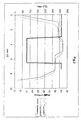
- the mould is then subjected to the thermal cycle reported in Fig. 2, wherein the continuous line represents the temperature of the cylinder 1 and the broken line the temperature of the cylinder 2.
- the pressure is indicated with a line having a bigger thickness.
- the mould is then subjected to the following thermal cycle:
- the cooling step is carried out by the following subsequent steps:
- the sleeve is let rotate along its central longitudinal axis at a rotation speed of 30 rpm and exfoliated on the surface, along the whole length, with a blade having a length equal to or higher than the sleeve heigth.
- the exfoliation is carried out at room temperature (25°C) so as to obtain thin films having the thickness as indicated hereunder.
- the blade is let move towards the sleeve so as to maintain the thickness of the exfoliated film unchanged.
- Films of various thicknesses have been obtained, depending on the advancement rate of the blade towards the sleeve.
- the thicknesses of the obtained films have been, of 25 ⁇ m, 50 ⁇ m, 80 ⁇ m, 100 ⁇ m and 150 ⁇ m, 1 mm, respectively.
- the stress and elongation at break was determined according to ASTM D 638 in the two orthogonal, longitudinal (MD) and transversal (TD) directions.
- the longitudinal direction is that in the way of the film exfoliation direction.
- the polymer Hyflon® MFA MFI 2.5 (ASTM D 1238-52T) is subjected to extrusion by operating at 360°C by Braebender extruder to obtain granules.
- the extrusion temperature used is high, since the polymer MFI value is rather low.
- T 1 335°C
- T 2 350°C
- T 3 355°C
- T 4 360°C.
- the extruder head temperature is maintained at 360°C. Under these conditions one reaches a temperature of the melted polymer of 373°C.
- the extruded compound is fed to a calender wherein the rolls are maintained at 250°C. Films having a thickness between 0.3 mm and 1 mm are obtained.
- the longitudinal direction is that in the film extrusion direction.
- the Table shows that, the polymer being equal, in comparison with the film obtained by extrusion, the exfoliated film shows uniform mechanical properties in the two MD and TD directions; the exfoliated film shows an improved elongation at break both in MD and in TD, while the stress at break values are substantially of the same order of magnitude in the two directions in comparison with the extruded film.
Landscapes
- Chemical & Material Sciences (AREA)
- Engineering & Computer Science (AREA)
- Manufacturing & Machinery (AREA)
- Materials Engineering (AREA)
- Health & Medical Sciences (AREA)
- Chemical Kinetics & Catalysis (AREA)
- Medicinal Chemistry (AREA)
- Polymers & Plastics (AREA)
- Organic Chemistry (AREA)
- Manufacture Of Macromolecular Shaped Articles (AREA)
- Extrusion Moulding Of Plastics Or The Like (AREA)
- Casting Or Compression Moulding Of Plastics Or The Like (AREA)
Applications Claiming Priority (2)
| Application Number | Priority Date | Filing Date | Title |
|---|---|---|---|
| ITMI20040788 | 2004-04-22 | ||
| ITMI20040788 ITMI20040788A1 (it) | 2004-04-22 | 2004-04-22 | Processo per l'ottenimento di film di polimeri termoplastici |
Publications (2)
| Publication Number | Publication Date |
|---|---|
| EP1589061A1 true EP1589061A1 (de) | 2005-10-26 |
| EP1589061B1 EP1589061B1 (de) | 2006-07-19 |
Family
ID=34935152
Family Applications (1)
| Application Number | Title | Priority Date | Filing Date |
|---|---|---|---|
| EP20050008146 Expired - Lifetime EP1589061B1 (de) | 2004-04-22 | 2005-04-14 | Verfahren zur Herstellung von Folien aus thermoplastischem polymeren Kunststoff |
Country Status (3)
| Country | Link |
|---|---|
| EP (1) | EP1589061B1 (de) |
| DE (1) | DE602005000048T2 (de) |
| IT (1) | ITMI20040788A1 (de) |
Citations (3)
| Publication number | Priority date | Publication date | Assignee | Title |
|---|---|---|---|---|
| GB593240A (en) * | 1944-05-25 | 1947-10-13 | Du Pont | Process for the production of film consisting essentially of a tetrafluoroethylene polymer |
| US3707416A (en) * | 1970-10-30 | 1972-12-26 | Minnesota Mining & Mfg | Skewed billets for making louvered films |
| US5939198A (en) * | 1992-06-25 | 1999-08-17 | E. I. Du Pont De Nemours And Company | Porous polytetrafluoro-ethylene and preparation |
-
2004
- 2004-04-22 IT ITMI20040788 patent/ITMI20040788A1/it unknown
-
2005
- 2005-04-14 EP EP20050008146 patent/EP1589061B1/de not_active Expired - Lifetime
- 2005-04-14 DE DE200560000048 patent/DE602005000048T2/de not_active Expired - Fee Related
Patent Citations (3)
| Publication number | Priority date | Publication date | Assignee | Title |
|---|---|---|---|---|
| GB593240A (en) * | 1944-05-25 | 1947-10-13 | Du Pont | Process for the production of film consisting essentially of a tetrafluoroethylene polymer |
| US3707416A (en) * | 1970-10-30 | 1972-12-26 | Minnesota Mining & Mfg | Skewed billets for making louvered films |
| US5939198A (en) * | 1992-06-25 | 1999-08-17 | E. I. Du Pont De Nemours And Company | Porous polytetrafluoro-ethylene and preparation |
Also Published As
| Publication number | Publication date |
|---|---|
| ITMI20040788A1 (it) | 2004-07-22 |
| DE602005000048D1 (de) | 2006-08-31 |
| DE602005000048T2 (de) | 2007-01-04 |
| EP1589061B1 (de) | 2006-07-19 |
Similar Documents
| Publication | Publication Date | Title |
|---|---|---|
| EP0353993B1 (de) | Verfahren zur Herstellung von gegossenen Folien aus Fluorpolymeren mit hoher Produktivität | |
| CN112384565B (zh) | 可熔融加工的氟树脂组合物以及由其形成的注塑制品 | |
| CN1134332C (zh) | 泡沫氟聚合物 | |
| US11033027B2 (en) | Synthesis and use of trans-1,3,3,3-tetrafluoropropene/vinylidene fluoride copolymers | |
| EP0296559B1 (de) | Modifiziertes feinpulveriges Polytetrafluoräthylen und Verfahren zu seiner Herstellung | |
| CA1248287A (en) | Melt-processible tetrafluoroethylene copolymers and process for preparing them | |
| JPH011711A (ja) | 変性ポリテトラフルオロエチレンフアインパウダ−及びその製造方法 | |
| JPS58174407A (ja) | 押出性の改良された含フツ素共重合体 | |
| US10807776B2 (en) | Resin film and process for its production | |
| EP2239282B1 (de) | Ethylen-tetrafluorethylen-copolymer | |
| JP7813892B2 (ja) | 高密度物品に膨張させたペースト加工された超高分子量ポリエチレン | |
| EP2928946B1 (de) | In der schmelze verarbeitbare perfluorpolymere mit verbesserten thermischen und mechanischen eigenschaften nach temperieren | |
| EP0397698B1 (de) | Fluoriertes copolymer und sperrschichten | |
| JPS59115313A (ja) | 改質された粒状ポリテトラフルオロエチレン共重合体およびその製造方法 | |
| EP1589061B1 (de) | Verfahren zur Herstellung von Folien aus thermoplastischem polymeren Kunststoff | |
| US20090152776A1 (en) | Core/Shell Polymer and Fluoropolymer Blending Blown Film Process | |
| JPH09316266A (ja) | テトラフルオロエチレン/パーフルオロ(アルキルビニルエーテル)共重合体組成物 | |
| JP4475699B2 (ja) | 透明性に優れる高強度高分子量ポリオレフィンフィルムおよびその製造方法 | |
| JPS59215833A (ja) | 超高分子量ポリエチレン多孔質フイルムの製造方法 | |
| CN117043261A (zh) | 含氟聚合物组合物 | |
| JPH03175029A (ja) | 少なくともポリエチレン層とエラストマー層とからなる製品の製造方法および該方法により得られる製品 | |
| JP2008514794A (ja) | ポリアセタールおよびポリアセタール/非溶融加工性ポリマーブレンドから成形物品を形成する方法 | |
| JP4345901B2 (ja) | 高伸びを有する高分子量ポリオレフィン透明フィルムおよびその製造方法 | |
| JP2001198937A (ja) | 透明性に優れる高分子量ポリオレフィン積層フィルムの製造方法 | |
| US5081188A (en) | Processing additives for tetrafluoroethylene polymers |
Legal Events
| Date | Code | Title | Description |
|---|---|---|---|
| PUAI | Public reference made under article 153(3) epc to a published international application that has entered the european phase |
Free format text: ORIGINAL CODE: 0009012 |
|
| AK | Designated contracting states |
Kind code of ref document: A1 Designated state(s): AT BE BG CH CY CZ DE DK EE ES FI FR GB GR HU IE IS IT LI LT LU MC NL PL PT RO SE SI SK TR |
|
| AX | Request for extension of the european patent |
Extension state: AL BA HR LV MK YU |
|
| 17P | Request for examination filed |
Effective date: 20051230 |
|
| GRAJ | Information related to disapproval of communication of intention to grant by the applicant or resumption of examination proceedings by the epo deleted |
Free format text: ORIGINAL CODE: EPIDOSDIGR1 |
|
| GRAP | Despatch of communication of intention to grant a patent |
Free format text: ORIGINAL CODE: EPIDOSNIGR1 |
|
| GRAP | Despatch of communication of intention to grant a patent |
Free format text: ORIGINAL CODE: EPIDOSNIGR1 |
|
| GRAS | Grant fee paid |
Free format text: ORIGINAL CODE: EPIDOSNIGR3 |
|
| GRAA | (expected) grant |
Free format text: ORIGINAL CODE: 0009210 |
|
| AKX | Designation fees paid |
Designated state(s): BE DE FR GB IT |
|
| AK | Designated contracting states |
Kind code of ref document: B1 Designated state(s): BE DE FR GB IT |
|
| PG25 | Lapsed in a contracting state [announced via postgrant information from national office to epo] |
Ref country code: IT Free format text: LAPSE BECAUSE OF FAILURE TO SUBMIT A TRANSLATION OF THE DESCRIPTION OR TO PAY THE FEE WITHIN THE PRESCRIBED TIME-LIMIT;WARNING: LAPSES OF ITALIAN PATENTS WITH EFFECTIVE DATE BEFORE 2007 MAY HAVE OCCURRED AT ANY TIME BEFORE 2007. THE CORRECT EFFECTIVE DATE MAY BE DIFFERENT FROM THE ONE RECORDED. Effective date: 20060719 Ref country code: BE Free format text: LAPSE BECAUSE OF FAILURE TO SUBMIT A TRANSLATION OF THE DESCRIPTION OR TO PAY THE FEE WITHIN THE PRESCRIBED TIME-LIMIT Effective date: 20060719 |
|
| REG | Reference to a national code |
Ref country code: GB Ref legal event code: FG4D |
|
| REF | Corresponds to: |
Ref document number: 602005000048 Country of ref document: DE Date of ref document: 20060831 Kind code of ref document: P |
|
| ET | Fr: translation filed | ||
| PLBE | No opposition filed within time limit |
Free format text: ORIGINAL CODE: 0009261 |
|
| STAA | Information on the status of an ep patent application or granted ep patent |
Free format text: STATUS: NO OPPOSITION FILED WITHIN TIME LIMIT |
|
| 26N | No opposition filed |
Effective date: 20070420 |
|
| PGFP | Annual fee paid to national office [announced via postgrant information from national office to epo] |
Ref country code: FR Payment date: 20080312 Year of fee payment: 4 Ref country code: DE Payment date: 20080417 Year of fee payment: 4 |
|
| PGRI | Patent reinstated in contracting state [announced from national office to epo] |
Ref country code: IT Effective date: 20090501 |
|
| PGFP | Annual fee paid to national office [announced via postgrant information from national office to epo] |
Ref country code: IT Payment date: 20090323 Year of fee payment: 5 |
|
| GBPC | Gb: european patent ceased through non-payment of renewal fee |
Effective date: 20090414 |
|
| REG | Reference to a national code |
Ref country code: FR Ref legal event code: ST Effective date: 20091231 |
|
| PG25 | Lapsed in a contracting state [announced via postgrant information from national office to epo] |
Ref country code: DE Free format text: LAPSE BECAUSE OF NON-PAYMENT OF DUE FEES Effective date: 20091103 |
|
| PG25 | Lapsed in a contracting state [announced via postgrant information from national office to epo] |
Ref country code: GB Free format text: LAPSE BECAUSE OF NON-PAYMENT OF DUE FEES Effective date: 20090414 Ref country code: FR Free format text: LAPSE BECAUSE OF NON-PAYMENT OF DUE FEES Effective date: 20091222 |
|
| PG25 | Lapsed in a contracting state [announced via postgrant information from national office to epo] |
Ref country code: IT Free format text: LAPSE BECAUSE OF NON-PAYMENT OF DUE FEES Effective date: 20100414 |