EP1588694A1 - Kit de formulation d'un produit cosmétique - Google Patents
Kit de formulation d'un produit cosmétique Download PDFInfo
- Publication number
- EP1588694A1 EP1588694A1 EP05290626A EP05290626A EP1588694A1 EP 1588694 A1 EP1588694 A1 EP 1588694A1 EP 05290626 A EP05290626 A EP 05290626A EP 05290626 A EP05290626 A EP 05290626A EP 1588694 A1 EP1588694 A1 EP 1588694A1
- Authority
- EP
- European Patent Office
- Prior art keywords
- les
- aqueous composition
- film
- water
- par
- Prior art date
- Legal status (The legal status is an assumption and is not a legal conclusion. Google has not performed a legal analysis and makes no representation as to the accuracy of the status listed.)
- Granted
Links
- 0 CC(C*(C)(CCO[Si](C)(C)C)[Si](C)(C)C)Cc1cc(C)cc([N+]/N=C(\C=CC=C2)/C2=N)c1O Chemical compound CC(C*(C)(CCO[Si](C)(C)C)[Si](C)(C)C)Cc1cc(C)cc([N+]/N=C(\C=CC=C2)/C2=N)c1O 0.000 description 1
Classifications
-
- A—HUMAN NECESSITIES
- A61—MEDICAL OR VETERINARY SCIENCE; HYGIENE
- A61K—PREPARATIONS FOR MEDICAL, DENTAL OR TOILETRY PURPOSES
- A61K8/00—Cosmetics or similar toiletry preparations
- A61K8/02—Cosmetics or similar toiletry preparations characterised by special physical form
- A61K8/0208—Tissues; Wipes; Patches
-
- A—HUMAN NECESSITIES
- A61—MEDICAL OR VETERINARY SCIENCE; HYGIENE
- A61Q—SPECIFIC USE OF COSMETICS OR SIMILAR TOILETRY PREPARATIONS
- A61Q19/00—Preparations for care of the skin
-
- A—HUMAN NECESSITIES
- A61—MEDICAL OR VETERINARY SCIENCE; HYGIENE
- A61Q—SPECIFIC USE OF COSMETICS OR SIMILAR TOILETRY PREPARATIONS
- A61Q19/00—Preparations for care of the skin
- A61Q19/008—Preparations for oily skin
-
- A—HUMAN NECESSITIES
- A61—MEDICAL OR VETERINARY SCIENCE; HYGIENE
- A61Q—SPECIFIC USE OF COSMETICS OR SIMILAR TOILETRY PREPARATIONS
- A61Q19/00—Preparations for care of the skin
- A61Q19/08—Anti-ageing preparations
-
- A—HUMAN NECESSITIES
- A61—MEDICAL OR VETERINARY SCIENCE; HYGIENE
- A61K—PREPARATIONS FOR MEDICAL, DENTAL OR TOILETRY PURPOSES
- A61K2800/00—Properties of cosmetic compositions or active ingredients thereof or formulation aids used therein and process related aspects
- A61K2800/80—Process related aspects concerning the preparation of the cosmetic composition or the storage or application thereof
- A61K2800/88—Two- or multipart kits
Definitions
- kits for formulating cosmetic products and in particular to a kit for the formulation of cosmetic products containing at least an anhydrous thin film and an aqueous composition, the film and the composition being intended to be mixed extemporaneously to form a cosmetic product which may be in particular a makeup or skin care product, mucous membranes, integuments or hair.
- the invention also relates to a cosmetic use of this product for the cosmetic treatment of the skin, mucous membranes, integuments or hair.
- the invention also relates to a product formulation process starting from a kit.
- Cosmetic products contain different compounds that each play a role, either for the product's galenical or for the activity of the product or for any other property of the product such as its smell or color. It is for example that the presence of assets contributes to the effectiveness of the product on skin, for example to keep the skin healthy and / or to improve the condition of the skin, while the viscosity agents help to adjust the texture of the product and that the dyes give it a certain hue.
- these products contain a large number of different compounds, and it may not be desirable, for various reasons, for all compounds are mixed before use of the product.
- compounds and in particular the assets may be incompatible with each other or cause instability of the composition containing them.
- compositions adapted to the use they want to make when they have it are increasingly want. So, according to the mood, the seasons, the outside temperature, the user aspires to have a composition adapted to your needs of the moment, for example have a more or less thick composition or more or less concentrated active or having a particular coloring or fragrance, these particularities being vary in time.
- kit subject of the invention solves these problems.
- This kit has several embodiments.
- the subject of the invention is a kit for the formulation of a cosmetic product comprising (1) an aqueous composition containing at least one fatty substance, and (2) at least one water-soluble anhydrous film comprising at least one compound which is capable of modifying the aqueous composition.
- the aqueous composition and the film or films are mixed extemporaneously with to form said cosmetic product.
- This cosmetic product can be used in particular as a care product or makeup of the skin, mucous membranes, integuments or hair:
- the term "compound which is capable of modifying the aqueous composition” any compound that will modify the activity and / or appearance of the said composition, for example its activity by adding one or more assets, or its appearance by adding a thickener (modification of the viscosity) or by adding dye (color change) or by adding a fragrance (modification of the smell).
- fatty substance any compound insoluble in water, this compound can be an oil (liquid fat) or a solid fat. It is preferably an oil.
- the extemporaneous mixture is obtained by simply mixing the desired quantities of the aqueous composition and of the film or films, these quantities being determined according to the desired end goal.
- the mixture obtained constitutes a cosmetic product to Disposable.
- the kit may contain several compositions identical or different, which makes it possible to obtain a product several times identical or different cosmetic for single use.
- Said cosmetic product is obtained by adding to the aqueous composition, one or a plurality of said first films and one or more of said second films.
- Customized formulation means a formulation adapted to the request of the consumer at the time of use.
- the subject of the invention is also a method of modifying the characteristics of rheology, color and / or fragrance of an aqueous composition for the purpose of formulation of a cosmetic product, especially care or makeup, of adding to an aqueous composition, one or more anhydrous films water-soluble compounds containing one or more compounds capable of modifying the rheology, the color and / or the fragrance of an aqueous composition.
- document JP-A-2002/212027 describes the obtaining and composition of cosmetic preparations in the form of water-soluble films
- WO-A-2002/05789, US-A-2002/0127254 and WO-A-2003/075812 describe obtaining and administering anhydrous polymeric films for a direct administration of cosmetic compositions to the skin wet
- the document US-A-2003/0186826 describes a composition dry cosmetics based on polymers and surfactants, to be administered on the skin or hair with water.
- these documents never envisage the extemporaneous preparation of a cosmetic or dermatological product from kits comprising thin films and an aqueous composition, in particular a aqueous composition in emulsion form.
- a cosmetic kit allowing to obtain products containing incompatible compounds, and elsewhere the user to obtain a product adapted to his skin type or purpose sought at the moment of use, as well as with regard to the assets contents as regards the texture of the product or any other specificity of the product to suit the user's needs at the time of use, which may result in a particular perfume or dye or effects specific optics or by a specific sun protection factor or pH particular or any other characteristic that may vary according to the desire of the user when he uses the kit.
- the present invention provides such a kit.
- the kit according to the invention which combines the use of at least one anhydrous film water-soluble composition based on polymers and an aqueous composition, in particular in the form of an emulsion, makes it possible to modulate extemporaneously by the user, the composition, rheology, color or active concentration of the final product.
- their incorporation into the anhydrous film (s) to be dissolved extemporaneously makes it possible to guarantee their effectiveness.
- good stability colloidal product can be obtained by extemporaneous dissolution of an excipient whose performance could not have been maintained during the time in liquid medium.
- the final cosmetic product is obtained by extemporaneous mixing of one or several water-soluble anhydrous films and an appropriate amount of aqueous composition.
- “Appropriate amount” of composition aqueous an amount such that the film or films dissolve quickly. This amount can range, for example, from 10 to 1000 mg, preferably from 50 to 800 mg, and better from 100 to 500 mg.
- the appropriate dose of aqueous composition may be obtained using single-dose presentation forms, such as sachets, tubes, ampoules, pre-filled syringes, capsules soft, hulls or trays made of thermoformed plastic.
- An appropriate dose can also be obtained from a multi-dose presentation using a system distributing a pre-defined dose. Such a system can be a bottle pump, an aerosol, a pipette or a graduated syringe, a dropper.
- film is meant in the present application, a fine and grippy solid.
- end is meant a solid having a thickness of at most 1000 ⁇ m. This film is generally of adequate size to be easily manipulated by the user. It can have a shape of square, rectangle, disk or any other form. Each film generally has a thickness of 10 ⁇ m to 1000 ⁇ m, preferably 20 to 500 ⁇ m and better still 50 to 300 ⁇ m. It may have an area of 0.25 to 25 cm 2 and preferably 2 to 10 cm 2 .
- anhydrous film is meant in the present application, a film containing less than 10% by weight of water, preferably less than 5% by weight relative to the total weight of the film, and more preferably, not containing of water.
- water-soluble film is intended to mean a film which dissolves in the water.
- This is a movie made of one or more water-soluble or water-dispersible polymers.
- Water-soluble or hydrodispersible polymers having a solubility in water measured at 25 ° C. at least equal to 0.1 gram / liter (g / L) (obtaining a solution macroscopically isotropic and transparent, colored or not). This solubility is preferably greater than or equal to 1 g / L.
- Polymers to form these films may be of synthetic or natural origin and, where appropriate, modified by chemical reactions. They may or may not be film-forming. These polymers must be physiologically acceptable ie compatible with the skin, mucous membranes, hair and scalp.
- water-soluble or water-dispersible polymers may for example be selected from (1) protein-like polymers, such as wheat proteins or soy; keratin, for example keratin hydrolysates and keratins sulfonic; casein; albumin; collagen; glutelin; glucagon; the gluten; zein; gelatines and their derivatives; (2) polymers derived from chitin or chitosan, such as anionic, cationic polymers, amphoteric or nonionic chitin or chitosan; (3) polymers polysaccharides such as in particular (i) cellulosic polymers, such as hydroxyethylcellulose, hydroxypropylcellulose, hydroxypropylmethylcellulose, methylcellulose, ethylhydroxyethylcellulose, carboxymethylcellulose, and quaternized derivatives of cellulose; and (ii) starches and their derivatives; (4) the acrylic polymers or copolymers such as polyacrylates, polymethacrylates and
- water-soluble polymers that may be mentioned include caprolactams, pullulan, pectin, mannan and galactomannans, glucomannans and their derivatives.
- films in accordance with the invention may comprise one or many of these polymers.
- the amount of water-soluble polymer (s) in the anhydrous film is generally from 5 to 100% by weight, in particular from 10 to 95% by weight, and more particularly from 20 to 90% by weight relative to the total weight of said film.
- the films can be packaged in an article facilitating their prehension, such that described in the patent application FR0351002 whose content is included in this application by reference.
- Movies can be packaged in a plastic dispenser box, in an individual bag or in a blister, contained in the kit of the invention.
- Movies can be packaged in a box type drawer or hinged lid on a bottom, the said box may include means to facilitate the distribution of items.
- the distribution means may be of the type described by for example in US-A-2,973,882, GB-A-2,358,627, CH-A-461025, or US Patent 6,578,732.
- the film may comprise one or more plasticizers, for example chosen from glycerine, sorbitol, mono- and / or disaccharides, dipropylene glycol, butylene glycol, pentylene glycol, polyethylene glycols such as PEG-400.
- the amount of plasticizer (s) can go for example from 1 to 40% by weight and better still from 2 to 15% by weight relative to total weight of the film.
- the film comprises at least one compound, in particular a compound capable of modifying the aqueous composition.
- “Compound” able to modify the aqueous composition "any compound that will, by mixing the film with the aqueous composition, modify the said composition and for example modify the rheology, texture, activity, color, fragrance or pH of the so-called composition.
- This compound can be simply the water-soluble polymer present in the film, which, by its nature, will change the rheology of the composition water and give it a new texture, or it can be one or more compounds selected from active ingredients or formulation adjuvants such as for example, rheology agents, perfumes, dyestuffs, surfactants, antioxidants, pH-regulating agents. These compounds will be detailed below.
- aqueous composition in the present application means a composition containing at least water.
- the aqueous composition may contain a soluble organic solvent in water, chosen for example from lower mono-alcohols containing from 1 to 8 carbon atoms and in particular 1 to 6 carbon atoms, as ethanol, isopropanol, propanol, butanol; polyethylene glycols having 6 80 ethylene oxides; polyols such as propylene glycol, isoprene glycol, butylene glycol, glycerine, sorbitol; acetone; and their mixtures.
- a soluble organic solvent in water chosen for example from lower mono-alcohols containing from 1 to 8 carbon atoms and in particular 1 to 6 carbon atoms, as ethanol, isopropanol, propanol, butanol; polyethylene glycols having 6 80 ethylene oxides; polyols such as propylene glycol, isoprene glycol, butylene glycol, glycerine, sorbitol; acetone; and their mixtures.
- the term "more or less fluid composition” in the present request a composition whose viscosity can be measured, and which goes from the liquid semi-solid (cream or soft dough).
- the viscosity can range, for example, from 1 to 20000 mPa.s (1 to 20000 cPoise), preferably 1 to 15000 mPa.s, this viscosity measured at 25 ° C using the Rheometric Rheomat RM180 Scientific, this device being equipped with a different mobile according to the viscosities.
- composition comprises a physiologically acceptable support, that is to say compatible with the skin, mucous membranes, hair and scalp.
- the aqueous composition contains, in addition to water, at least one fatty substance.
- “Fatty” means any compound which is insoluble in water, this compound possibly being an oil (fatty substance liquid) or solid fat. It is preferably an oil.
- the aqueous composition of the invention may especially be in the form of lotions (fluid emulsions).
- the aqueous composition may also be in the form of aqueous products foaming agents, as described for example in EP-A-1,166,747, EP-A-1,172,096, EP-A-1,172,095, EP-A-1,174,122, EP-A-1,277,463, EP-A-1,295,594, FR-A-2824262.
- the aqueous composition used according to the invention is an emulsion.
- the proportion of the oily phase of the emulsion may range from 1 to 80% by weight, and preferably from 1 to 50% by weight relative to the total weight of the composition.
- Oils, and emulsifiers and co-emulsifiers possibly present, used in the composition under emulsion form are chosen from those conventionally used in the field cosmetic or dermatological.
- Emulsifier and co-emulsifier when they are present are generally present in a proportion ranging from 0.2 to 30% weight, preferably from 0.3 to 20% by weight and better still from 0.5 to 15% by weight per relative to the total weight of the composition.
- the emulsion may further contain lipid vesicles.
- the emulsions generally contain at least one emulsifier chosen from amphoteric, anionic, cationic or nonionic emulsifiers used alone or in mixture. Emulsifiers are chosen appropriately following the continuous phase of the emulsion to be obtained (W / O or O / W). When the emulsion is multiple, it generally comprises an emulsifier in the emulsion primary and an emulsifier in the external phase into which is introduced the primary emulsion.
- emulsifiers that can be used for the preparation of W / O emulsions, mention may be made, for example, of alkyl esters or ethers of sorbitan, of glycerol or of sugars; silicone surfactants such as dimethicone copolyols such as the mixture of cyclomethicone and dimethicone copolyol, sold under the names DC 5225 C and DC 3225 C by the company Dow Corning, and as the alkyl-dimethicone copolyols such as Laurylmethicone copolyol sold under the name "Dow Corning 5200 Formulation Aid" by Dow Corning, Cetyl dimethicone copolyol sold under the name Abil EM 90 R by Goldschmidt and the mixture of Polyglyceryl-4 isostearate / Cetyl dimethicone copolyol / Hexyl laurate sold under the name Abil WE 09 R by the company Goldschmidt.
- co-emulsifiers which advantageously may be chosen from the group comprising branched chain fatty acid and polyol esters, and in particular the branched chain fatty acid esters and glycerol and / or sorbitan and for example polyglyceryl isostearate, such as the product sold under the name Isolan GI 34 by the company Goldschmidt, the sorbitan isostearate, such as the product sold under the name Arlacel 987 by the ICI company, sorbitan isostearate and glycerol, such as the product sold under the name Arlacel 986 by the company ICI, and mixtures thereof.
- co-emulsifiers which advantageously may be chosen from the group comprising branched chain fatty acid and polyol esters, and in particular the branched chain fatty acid esters and glycerol and / or sorbitan and for example polyglyceryl isostearate, such as the product sold under the name Isolan GI 34 by the company Gold
- non-ionic emulsifiers such as fatty acid esters and oxyalkylenated polyols (more particularly polyoxyethylenated), and by polyethylene glycol stearates such as PEG-100 stearate, PEG-50 stearate and PEG-40 stearate; and their mixtures such as mixture of glyceryl mono-stearate and polyethylene glycol stearate (100 OE) marketed under the name SIMULSOL 165 by the company SEPPIC; the oxyalkylenated fatty acid and sorbitan esters comprising, for example, 20 to 100 OE, and for example those marketed under the names commercial Tween 20 or Tween 60 by the company Ubiqema; the ethers oxyalkylenated fatty alcohols (oxyethylenated and / or oxypropylene); esters and esters and oxyalkylenated polyols (more particularly polyoxyethylenated), and by poly
- co-emulsifiers such as, for example fatty alcohols having 8 to 26 carbon atoms, such as cetyl alcohol, stearyl alcohol and their mixture (cetearyl alcohol), octyl dodecanol, 2-butyloctanol, 2-hexyldecanol, 2-undecylpentadecanol or oleic alcohol, or fatty acids.
- emulsions without emulsifying surfactants or containing less than 0.5% of the total weight of the composition, using suitable compounds, for example polymers having emulsifiers such as the polymers marketed under the names CARBOPOL 1342 and PEMULEN by the company Noveon; or polymers in such as that sold under the name Sepigel 305 by the Seppic company (INCl name: Polyacrylamide / C13-C14 isoparaffin / laureth-7); the particles of ionic or nonionic polymers, more particularly anionic polymer particles such as, in particular, acid polymers isophthalic or sulphoisophthalic acid, and in particular the copolymers of phthalate / sulfoisophthalate / glycol (e.g.
- suitable compounds for example polymers having emulsifiers such as the polymers marketed under the names CARBOPOL 1342 and PEMULEN by the company Noveon; or polymers in such as that sold under the name Sepigel
- diethylene glycol / phthalate / isophthalate / 1,4-cyclohexane dimethanol sold under the names Eastman AQ polymer (AQ35S, AQ38S, AQ55S, AQ48 Ultra) by Eastman Chemical.
- Eastman AQ polymer AQ35S, AQ38S, AQ55S, AQ48 Ultra
- the aqueous composition When the aqueous composition is in emulsion form, it comprises at least an oily phase which contains at least one oil, especially an oil cosmetic.
- oil means a fatty substance that is liquid at temperature ambient temperature (25 ° C).
- the water-soluble anhydrous film contains at least one compound, especially a compound capable of modifying the aqueous composition.
- This compound can be simply the polymer constituting the film, this polymer being able to modify the rheology of the composition, or the film may contain one or more other compounds.
- These compounds can be chosen in particular from active ingredients cosmetics, formulation adjuvants and mixtures thereof. It is possible to use also several films, one containing a formulation adjuvant, the other a adjuvant of different formulation or an asset, yet another may contain a other active ingredient and / or other formulation adjuvant.
- Cosmetic active ingredients means any compound that will have a beneficial effect on the keratin material to which the final product is applied.
- Formulation adjuvant means any compound capable of modifying the appearance of the aqueous composition and for example the rheology, the texture, the color, the perfume, the pH of the aqueous composition.
- the aqueous composition may also contain one or more compounds selected from the cosmetic actives, the adjuvants of formulation and their mixtures.
- these compounds can be incorporated either in the aqueous composition in one or more films, which makes it possible to solve any problems of physico-chemical incompatibility of these compounds, and also to have end products adapted to the user's request. This also allows ability to obtain products with higher concentrations of active ingredients than concentrations that could be achieved using a single composition.
- the kit according to the invention has the advantage of allowing the preparation of cosmetic or dermatological products containing incompatible compounds. It also has the advantage of making it possible to obtain cosmetic or dermatological products containing compounds that are sensitive to external stimuli, including those sensitive to water, oxidation, light and / or the rise in temperature.
- These compounds sensitive to an external stimulus water, oxidizing agents such as air, light and / or temperature
- These compounds sensitive to an external stimulus are unstable and undergoing exposure to such an external stimulus, degradation by a mechanism of chemical hydrolysis, oxidation, photolysis or photodegradation, or even ion exchange, which leads to compositions cosmetics that become ineffective and / or are of appearance, odor and / or unacceptable touch for the consumer. This is so for example ascorbic acid which, because of this degradation, tends to yellow the compositions containing it.
- Putting these sensitive compounds in a film anhydrous and to incorporate them into the aqueous composition only at the time of the use avoids all these problems.
- vitamin A vitamin A
- DHA dihydroxyacetone
- rutin enzymes such as lipase, protease, phospholipase and cellulases
- natural extracts such as green tea, extract of lemon balm, thyme extract, procyannidol oligomers (OPC) such as the hawthorn OPC, the pine OPC and the grape OPC
- OPC procyannidol oligomers
- some acids such as acid kojic, caffeic acid, retinoic acid and its derivatives, benzene 1,4-di- (3-methylidene) 10-camphosulphonic
- carotenoids such as carotenes such as ⁇ -, ⁇ - and ⁇ -carotenes, ⁇ , ⁇ -carotene, ⁇ -carotene, ⁇ , ⁇ -carotene, lycopene ( ⁇ , ⁇ -carotene
- the compounds mentioned above may be present in the final product in the usual quantities in the area under consideration, these quantities depending on the compound used and purpose.
- the compounds may be present by example in an amount ranging from 0.001 to 20% by weight, and more preferably from 0.01 to 10% by weight relative to the weight of the final product.
- the compounds are present in one or more films or in the aqueous composition.
- At least one film contains at least one compound selected from stimulus-sensitive compounds keratolytic agents, fillers, tensors and their mixtures.
- the kit according to the invention can be used in particular to obtain products intended for application to the skin, mucous membranes, integuments or integuments hair, in particular as skin care products or as products of make-up of the skin or as hair products or as sunscreens.
- compositions according to the invention are given as illustration and without limitation. Quantities are given in% in weight, unless otherwise indicated, and the names are given in the chemical name or CTFA name as appropriate.
- Film preparation procedure All the ingredients are mixed. The mixture is deposited on a silicone paper using conventional rolling or doctor coating techniques, in a thickness of the order of 500 microns. After drying in a hot air tunnel at a temperature of about 50 ° C, the resulting film is cut to the desired shape, for example in the form of 25 mm square wafers.
- Aqueous composition serum
- Phase A Xanthan gum 0.2% Methyl Paraben 0.2% Phenoxythanol 0.35%
- Procedure for preparing the serum It is heated to about 75.degree. stir, phase A, then pour phase B into phase A. Then, stop heating while maintaining agitation until return to room temperature. Slight stirring is then maintained for 30 minutes.
- the consumer mixes in the palm of her hand with the fingers, one or more plates of anhydrous film with a dose of between 100 and 500 mg of the aqueous composition for about ten seconds. She slightly mass the surface to be treated so as to favor the spreading of the composition thus obtained on the skin and the penetration of the active ingredients it contains in the skin.
- the resulting composition can be applied to the face or body, especially on the face for the treatment of wrinkles and fine lines of the paw goose.
- Procedure All ingredients are mixed. The mixture is deposited on a silicone paper using conventional rolling or doctor coating techniques, in a thickness of the order of 500 microns. After drying in a hot air tunnel at a temperature of about 50 ° C, the resulting film is cut to the desired shape, for example in the form of 25 mm square wafers.
- Aqueous composition (O / W emulsion) Phase A (aqueous phase) Xanthan gum 0.25% Tory 0.3% Water qsp 100% Phase B (oily phase) Shea Butter 2% Methyl glucose Sesquistearate 2% PEG 20 methyl glucose Sesquistearate 2% Apricot almond oil 6% Stearyl alcohol 2% Phase C Polyacrylamine / C13-14 isoparaffin / Laureth 7 (Sepigel 305) 1% Tory 0.35% Volatile silicone oil 10%
- Phase A is heated at approximately 75 ° C., followed by stirring. poured very vigorously, phase B into phase A. Then we stop heating while maintaining agitation until it returns to room temperature. Phase C is then added. Mild agitation is then maintained for 30 minutes.
- the consumer mixes in the palm of her hand with the fingers, one or more plates of anhydrous film with a dose of between 100 and 500 mg of the aqueous composition, for about ten seconds. She slightly mass the surface to be treated so as to favor the spreading of the composition thus obtained on the skin, and the penetration of the active ingredients it contains in the skin.
- the resulting composition can be applied to the face or particular body to prevent or treat the signs of age.
- Procedure All ingredients are mixed. The mixture is deposited on a silicone paper using conventional rolling or doctor coating techniques, in a thickness of the order of 500 microns. After drying in a hot air tunnel at a temperature of about 50 ° C, the resulting film is cut to the desired shape, for example in the form of 25 mm square wafers.
- Aqueous composition (O / W emulsion) Phase A (oily phase) Glyceryl stearate 1.35% Dimyristyl tartrate / cetearyl alcohol / 12-15 Pareth 7 / PPG 25 laureth 25 (Cosmacol PSE from Sasol) 2% PEG-400 stearate 2.7% isohexadecane 2% Stearyl alcohol 1.3% Vitamin E 0.1% Tory 0.6% Phase B (aqueous phase) Water qsp 100% Potassium hydroxide 1,5% Tory 0.25% Ammonium polyacryloyldimethyltaurate (Hostacerin AMPS) 0,5% Phase C Volatile silicone oil 6%
- Phase A is heated to about 75 ° C. with stirring. phase B separately, then phase A is poured into phase B under very strong agitation. Then, we stop the heating while maintaining the agitation until return to room temperature. Phase C is added. A slight agitation is then maintained for 30 minutes.
- the consumer mixes in the palm of her hand with the fingers, one or more plates of anhydrous films with a dose between 100 and 500 mg of the aqueous composition for about 10 seconds. It lightly massages the surface to be treated so as to favor the spreading of the composition thus obtained on the skin, and the penetration of the active ingredients that it contains in the skin.
- the resulting composition can be applied especially on the face where it gives an immediate matifying effect.
- Procedure All ingredients are mixed. The mixture is deposited on a silicone paper using conventional rolling or doctor coating techniques, in a thickness of the order of 500 microns. After drying in a hot air tunnel at a temperature of about 50 ° C, the resulting film is cut to the desired shape, for example in the form of 25 mm square wafers.
- Aqueous composition Phase A Xanthan gum 0.2% Methyl Paraben 0.2% phenoxyethanol 0.35% Water qsp 100% Phase B triethanolamine 0.2% Polyacrylamide / C13-C14 isoparaffin / laureth-7 (Sepigel 305) 1% Diazolidinyl Urea 0.3% Glycerin 7%
- Phase A is heated at approximately 75 ° C., followed by stirring. phase B into phase A. Then we stop the heating while stirring until return to room temperature. Slight agitation is then maintained for 30 minutes.
- the consumer mixes in the palm of her hand with the fingers, one or more plates of anhydrous film with a dose of between 100 and 500 mg of the aqueous composition for about ten seconds. She slightly mass the surface to be treated so as to favor the spreading of the composition thus obtained on the skin.
- the composition obtained is a cream thick having very good application properties.
- This cream can be applied on the face or on the body.
- Procedure All ingredients are mixed. The mixture is deposited on a silicone paper using conventional rolling or doctor coating techniques, in a thickness of the order of 500 microns. After drying in a hot air tunnel at a temperature of about 50 ° C, the resulting film is cut to the desired shape, for example in the form of 25 mm square wafers.
- Aqueous composition Phase A Xanthan gum 0.2% Methyl Paraben 0.2% phenoxyethanol 0.35% Water qsp 100% Phase B triethanolamine 0.2% Polyacrylamide / C13-C14 isoparaffin / laureth-7 (Sepigel 305) 1% Glycerin 7%
- Phase A is heated at approximately 75 ° C., followed by stirring. phase B into phase A. Then we stop the heating while stirring until return to room temperature. Slight agitation is then maintained for 30 minutes.
- the consumer mixes in her hand with her fingers, a or several platelets of anhydrous film with a dose of between 100 and 500 mg of the aqueous composition for about ten seconds. It mass slightly the surface to be treated so as to favor the spreading of the composition thus obtained on the skin.
- the composition obtained is a cream having the rheological characteristics of typical thickening associated with Serad FX polymer. The advantage is the control of the quantities applied and the massage qualities.
- This cream can be applied to the face or body for a massage relaxing.
Landscapes
- Health & Medical Sciences (AREA)
- Life Sciences & Earth Sciences (AREA)
- Animal Behavior & Ethology (AREA)
- General Health & Medical Sciences (AREA)
- Public Health (AREA)
- Veterinary Medicine (AREA)
- Dermatology (AREA)
- Biomedical Technology (AREA)
- Birds (AREA)
- Epidemiology (AREA)
- Engineering & Computer Science (AREA)
- Gerontology & Geriatric Medicine (AREA)
- Cosmetics (AREA)
Abstract
Description
- les émulsions H/E à base de globules huileux pourvus d'un enrobage cristal liquide lamellaire, telles que décrites dans les documents EP-A-641557 et EP-A-705593 ;
- Les émulsions H/E sans tensioactif, stabilisées par des polymères anioniques hydrodispersibles, telles que celles décrites dans le document EP-A-864320 ;
- Les émulsions H/E à base de polymères dérivés d'acide 2-acrylamido 2-méthylpropane sulfonique (Polymère AMPS), telles que décrites dans le document EP-A-815844 ;
- Les émulsions H/E stabilisées par des polymères d'AMPS hydrophobes, telles décrites dans les documents EP-A-1,069,142, WO-A-2002/43689, WO-A-2002/44231, WO-A-2002/44271, WO-A-2002/44270, WO-A-2002/43686, WO-A-2002/44267, WO-A-2002/43688, WO-A-2002/43677, WO-A-2002/43687, WO-A-2002/44230 ;
- Les émulsions fluides à base de polymères thermoassociatifs, telles que décrites dans les documents EP-A-1,355,990, EP-A-1,355,625, EP-A-1,307,501, EP-A-1,363,964 ;
- Les émulsions H/E obtenues par la méthode PIT (émulsion obtenue par inversion de phase. PIT = Phase Inversion Temperature), telles que décrites dans les documents WO-A-89/11907, DE-A-4318171, et EP-A-815846 ;
- Les nanoémulsions telles que celles décrites dans les demandes EP-A-728460, EP-A-780114, EP-A-780115, EP-A-879589, EP-A-1,010,413, EP-A-1,010,414, EP-A-1,010,415, EP-A-1,010,416, EP-A-1,013,338, EP-A-1,016,453, EP-A-1,018,363, EP-A-1,020,219, EP-A-1,025,898, EP-A-1,120,102, EP-A-1,120,101, EP-A-1,160,005, EP-A-1,172,077 et EP-A-1,353,629.
- les huiles hydrocarbonées d'origine animale, telles que le perhydrosqualène (ou squalane) ;
- les huiles hydrocarbonées d'origine végétale, telles que les triglycérides liquides d'acides gras comportant de 4 à 10 atomes de carbone comme les triglycérides des acides heptanoïque ou octanoïque ou encore les huiles d'origine végétale, par exemple les huiles de tournesol, de maïs, de soja, de courge, de pépins de raisin, de sésame, de noisette, d'abricot, de macadamia, d'arara, de coriandre, de ricin, d'avocat, l'huile de jojoba, l'huile de beurre de karité, ou encore les triglycérides des acides caprylique/caprique comme ceux vendus par la société Stearineries Dubois ou ceux vendus sous les dénominations Miglyol 810, 812 et 818 par la société Dynamit Nobel ;
- les esters et les éthers de synthèse, notamment d'acides gras, comme les huiles de formules R1COOR2 et R1OR2 dans laquelle R1 représente le reste d'un acide gras comportant de 8 à 29 atomes de carbone, et R2 représente une chaíne hydrocarbonée, ramifiée ou non, contenant de 3 à 30 atomes de carbone, comme par exemple l'huile de Purcellin, l'isononanoate d'isononyle, le myristate d'isopropyle, le palmitate d'éthyl-2-hexyle, le stéarate d'octyl-2-dodécyle, l'érucate d'octyl-2-dodécyle, l'isostéarate d'isostéaryle ; les esters hydroxylés comme l'isostéaryl lactate, l'octylhydroxystéarate, l'hydroxystéarate d'octyldodécyle, le diisostéaryl-malate, le citrate de triisocétyle, les heptanoates, octanoates, décanoates d'alcools gras ; les esters de polyol, comme le dioctanoate de propylène glycol, le diheptanoate de néopentylglycol et le diisononanoate de diéthylèneglycol ; les esters du pentaérythritol comme le tétraisostéarate de pentaérythrytyle ; les dérivés lipophiles d'acides aminés, tels que le lauroyl sarcosinate d'isopropyle (nom INCl : Isopropyl Lauroyl sarcosinate) commercialisé sous la dénomination Eldew SL 205 par la société Ajinomoto ;
- les hydrocarbures linéaires ou ramifiés, d'origines minérale ou synthétique, tels que les huiles minérales (mélange d'huiles hydrocarbonées dérivées du pétrole ; nom INCl : Mineral oil), les huiles de paraffine, volatiles ou non, et leurs dérivés, la vaseline, les polydécènes, l'isohexadécane, l'isododécane, l'isoparaffine hydrogéné tel que l'huile de Parléam® commercialisée par la société NOF Corporation (nom INCl ; Hydrogenated Polyisobutene) ;
- les huiles de silicone comme les polyméthylsiloxanes (PDMS) volatiles ou non à chaíne siliconée linéaire ou cyclique, liquides ou pâteux à température ambiante, notamment les cyclopolydiméthylsiloxanes (cyclométhicones) telles que la cyclopentasiloxane et la cyclohexadiméthylsiloxane ; les polydiméthylsiloxanes comportant des groupements alkyle, alcoxy ou phényle, pendant ou en bout de chaíne siliconée, groupements ayant de 2 à 24 atomes de carbone ; les silicones phénylées comme les phényltriméthicones, les phényldiméthicones, les phényltriméthylsiloxydiphényl-siloxanes, les diphényl-diméthicones, les diphénylméthyldiphényl trisiloxanes, les 2-phényléthyltriméthyl-siloxysilicates, et les polyméthylphénylsiloxanes ;
- les huiles fluorées telles que celles partiellement hydrocarbonées et/ou siliconées comme celles décrites dans le document JP-A-2-295912 ;
- les éthers tels que l'éther dicaprylique (nom CTFA : Dicaprylyl ether) ; et les benzoates d'alcools gras en C12-C15 (Finsolv TN de FINETEX) ;
- leurs mélanges. La composition aqueuse peut contenir en outre tout composé additif approprié. Elle peut par exemple contenir un ou plusieurs composés choisis parmi les adjuvants de formulation et/ou les actifs différents de ceux présents dans le ou les films.Un des intérêts du kit selon l'invention est par exemple de pouvoir obtenir un produit cosmétique contenant des actifs incompatibles, un ou plusieurs actifs compatibles étant présents dans la composition aqueuse et un ou plusieurs actifs différents et incompatibles avec ceux de la composition aqueuse étant présents dans le ou les films anhydres. Le mélange extemporané de la composition aqueuse et du ou des films aboutit alors à un produit contenant des actifs incompatibles, leur incompatibilité ne présentant pas d'inconvénient puisque l'utilisation du produit est immédiate.
- le soufre et les dérivés soufrés ;
- les sels de zinc tels que le lactate, le gluconate, le pidolate, le carboxylate, le salicylate et/ou le cystéate de zinc ;
- le chlorure de sélénium ;
- la vitamine B6 ou pyridoxine ;
- le mélange de capryloyl glycine, de sarcosine et d'extrait de cinnamomum zeylanicum commercialisé notamment par la société SEPPIC sous la dénomination commerciale Sepicontrol A5 ;
- un extrait de Laminaria saccharina commercialisé notamment par la société SECMA sous la dénomination commerciale Phlorogine® ;
- un extrait de Spiraea ulmaria commercialisé notamment par la société SILAB sous la dénomination commerciale Sebonormine® ;
- des extraits de végétaux des espèces Arnica montana, Cinchona succirubra, Eugenia caryophyllata, Humulus lupulus, Hypericum perforatum, Mentha piperita, Rosmarinus officinalis, Salvia oficinalis et Thymus vulgaris, tous commercialisés par exemple par la société MARUZEN ;
- un extrait de Serenoa repens commercialisé notamment par la société EUROMED;
- des extraits de plantes du genre Silybum ;
- des extraits végétaux contenant des sapogénines et en particulier les extraits de Dioscorées riches en diosgénine ou hécogénine ;
- des extraits d'Eugenia caryophyllata contenant de l'eugénol et du glucoside d'eugényle ;
- et leurs mélanges.
- les polymères synthétiques ;
- les polymères d'origine naturelle ;
- les silicates mixtes ;
- les microparticules de cire ;
- les particules colloïdales de charges inorganiques.
- Les polymères synthétiques utilisables en tant qu'agent tenseur peuvent être
choisis parmi :
- les polymères et copolymères de polyuréthanne ;
- les polymères et copolymères acryliques ;
- les polymères d'acide isophtalique sulfoné ;
- les polymères siliconés greffés ;
- les polymères hydrosolubles ou hydrodispersibles comprenant des unités hydrosolubles ou hydrodispersibles et des unités à LCST (Lower Critical Solution Temperature).
- Les copolymères de polyuréthanne, les copolymères acryliques et les autres polymères synthétiques pouvant être utilisés comme agents tenseurs peuvent notamment être choisis parmi les polycondensats, les polymères hybrides et les réseaux de polymères interpénétrés (IPNs). Par "réseau de polymères interpénétrés", on entend un mélange de deux polymères enchevêtrés, obtenu par polymérisation et/ou réticulation simultanée de deux types de monomères, le mélange obtenu ayant une température de transition vitreuse unique. Des exemples d'IPNs convenant comme polymères tenseurs, ainsi que leur procédé de préparation, sont décrits par exemple dans les documents US-A-6,139,322 et US-A-6,465,001. De préférence, l'IPN comprend au moins un polymère polyacrylique et, plus préférentiellement, il comprend en outre au moins un polyuréthane ou un copolymère de fluorure de vinylidène et d'hexafluoropropylène. Selon une forme d'exécution préférée, l'IPN comprend un polymère polyuréthane et un polymère polyacrylique. De tels IPNs sont notamment ceux de la série Hybridur commercialisés par la société Air Products. Un IPN particulièrement préféré comme polymère tenseur se trouve sous la forme d'une dispersion aqueuse de particules ayant une taille moyenne en poids comprise entre 90 et 110 nm et une taille moyenne en nombre d'environ 80 nm. Cet IPN a de préférence une température de transition vitreuse, Tg, qui va d'environ -60°C à +100°C. Un IPN de ce type est notamment commercialisé par la société Air Products sous la dénomination commerciale Hybridur X-01602. Un autre IPN convenant à une utilisation dans la présente invention est référencé Hybridur X18693-21 ou Hybridur 875 polymer dispersion.
- D'autres IPNs convenant comme polymères tenseurs comprennent les IPNs constitués du mélange d'un polyuréthane avec un copolymère de fluorure de vinylidène et d'hexafluoropropylène, notamment ceux préparés comme décrit dans le document US-A-5,349,003. En variante, ils sont disponibles dans le commerce sous forme de dispersion colloïdale dans l'eau, dans un rapport du copolymère fluoré au polymère acrylique comprise entre 70:30 et 75:25, sous les dénominations commerciales KYNAR RC-10,147 et KYNAR RC-10,151 auprès de la société Atofina.
- Des exemples de polymères siliconés greffés sont indiqués dans le document EP-A-1,038,519, qui est incorporé ici par référence. Un exemple préféré de polymère siliconé greffé est le polysilicone-8 (nom CTFA) qui est un polydiméthylsiloxane sur lequel sont greffés, par l'intermédiaire d'un chaínon de raccordement de type thiopropylène, des motifs polymères mixtes du type acide poly(méth)acrylique et du type poly(méth)acrylate d'alkyle. Un polymère de ce type est notamment disponible sous la dénomination commerciale VS 80 (à 10% dans l'eau) ou LO 21 (sous forme pulvérulente) auprès de la société 3M. Il s'agit d'un copolymère de polydiméthylsiloxane à groupements propylthio, d'acrylate de méthyle, de méthacrylate de méthyle et d'acide méthacrylique.
- Les polymères synthétiques susmentionnés peuvent se présenter sous forme de latex. Comme latex approprié pouvant être utilisé en tant qu'agent tenseur, on peut citer notamment les dispersions de polyester-polyuréthane et de polyéther-polyuréthane, telles que celles commercialisées sous les dénominations Avalure UR410 et UR460 par la société Noveon, et sous les dénominations Neorez R974, Neorez R981, Neorez R970, ainsi que les dispersions de copolymère acrylique telles que celles commercialisées sous la dénomination Neocryl XK-90 par la société Avecia.
- Enfin, des polymères synthétiques appropriés comme polymères tenseurs peuvent être des polymères hydrosolubles ou hydrodispersibles comprenant des unités hydrosolubles ou hydrodispersibles et comprenant des unités à LSCT, lesdites unités à LCST présentant, en particulier, une température de démixtion dans l'eau de 5 à 40°C à une concentration massique de 1%. Ce type de polymère est plus amplement décrit dans le document FR-A-2,819,429.
- Les polymères d'origine naturelle utilisables en tant qu'agent tenseur peuvent
être choisis parmi :
- les protéines végétales et hydrolysats de protéines végétales ;
- les polysaccharides d'origine végétale, éventuellement sous forme de microgels, tels que l'amidon ;
- les latex d'origine végétale.
- Comme exemples de protéines végétales et hydrolysats de protéines végétales utilisables comme agents tenseurs, on peut citer les protéines et hydrolysats de protéines de maïs, de seigle, de froment, de sarrasin, de sésame, d'épeautre, de pois, de fève, de lentille, de soja et de lupin.
- Les polysaccharides utilisables comme agents tenseurs peuvent être choisis parmi les polysaccharides d'origine naturelle, capables de former des gels thermoréversibles ou réticulés ainsi que des solutions. On entend par "thermoréversible" le fait que l'état gel de ces solutions de polymère est obtenu de façon réversible, une fois la solution refroidie en-dessous de la température de gélification caractéristique du polysaccharide utilisé. Comme polysaccharides d'origine naturelle de ce type, on peut citer les carraghénanes et tout particulièrement le kappa-carraghénane et le iota-carraghénane ; les agars ; les gellanes ; les alginates ; les pectines ; les chitosanes et leurs dérivés ; les pullulanes et leurs dérivés. Ces polysaccharides tenseurs peuvent être présents sous forme de microgels tels que décrits dans le document FR-A-2,829,025.
- Les polysaccharides peuvent être choisis aussi parmi l'amidon et ses dérivés. L'amidon peut être de toute origine : par exemple riz, maïs, pomme de terre, manioc, pois, froment, avoine, et il peut être naturel ou éventuellement modifié par un traitement de type réticulation, acétylation, oxydation. Il peut être éventuellement greffé. Comme amidon pouvant être utilisé comme agent tenseur, on peut citer par exemple celui commercialisé par la société Lambert-Rivière sous la dénomination Remi Dri.
- Une autre classe d'agents tenseurs utilisables selon l'invention est constituée par les silicates mixtes. Par cette expression, on entend tous les silicates d'origine naturelle ou synthétique renfermant plusieurs types de cations choisis parmi les métaux alcalins (par exemple Na, Li, K) ou alcalino-terreux (par exemple Be, Mg, Ca) et les métaux de transition. On utilise de préférence des phyllosilicates, à savoir des silicates ayant une structure dans laquelle les tétraèdres SiO4 sont organisés en feuillets entre lesquels se trouvent enfermés les cations métalliques. Une famille de silicates particulièrement préférée comme agents tenseurs est celle des laponites. Les laponites sont des silicates de magnésium, de lithium et de sodium ayant une structure en couches semblable à celle des montmorillonites. La laponite est la forme synthétique du minéral naturel appelé "hectorite". On peut utiliser par exemple la laponite commercialisée sous la dénomination Laponite XLS ou Laponite XLG par la société Rockwood.
- Une autre classe encore d'agents tenseurs est constituée par les microparticules de cire. Il s'agit de particules ayant un diamètre généralement inférieur à 5 µm, ou mieux à 0,5 µm, et constituées essentiellement d'une cire ou d'un mélange de cires choisies par exemple parmi les cires de Carnauba, de Candelilla ou d'Alfa. Le point de fusion de la cire ou du mélange de cires est de préférence compris entre 50°C et 150°C.
- En variante encore, on peut utiliser comme agent tenseur, des particules colloïdales de charges inorganiques. Par "particules colloïdales", on entend des particules colloïdales en dispersion dans un milieu aqueux, hydroalcoolique ou alcoolique, ayant un diamètre moyen en nombre compris entre 0,1 et 100 nm, de préférence entre 3 et 30 nm. Comme exemples de charges inorganiques, on peut citer la silice, l'oxyde de cérium, l'oxyde de zirconium, l'alumine, le carbonate de calcium, le sulfate de baryum, le sulfate de calcium, l'oxyde de zinc et le dioxyde de titane. Une charge inorganique particulièrement préférée est la silice. Des particules colloïdales de silice sont notamment disponibles sous forme de dispersion aqueuse de silice colloïdale auprès de la société catalysts & Chemicals sous les dénominations commerciales COSMO S-40 et COSMO S-50. on peut aussi utiliser des particules colloïdales composites silice-alumine, telles que celles commercialisées par la société Grace sous les noms de Ludox AM, Ludox HSA et Ludox TMA.
- Les polymères synthétiques utilisables en tant qu'agent tenseur peuvent être
choisis parmi :
- les dérivés xanthiques comme la caféine et ses dérivés, notamment les 1-hydroxyalkylxanthines décrites dans le document FR-A-2,617,401, la caféine citrate, la théophylline et ses dérivés, la théobromine, l'acéfylline, l'aminophylline, le chloroéthylthéophylline, le diprofylline, le diniprophylline, l'étamiphylline et ses dérivés, l'étofylline, la proxyphylline ; ou les associations contenant des dérivés xanthiques, comme l'association de caféine et de silanol (dérivé méthylsilanetriol de caféine), et par exemple le produit commercialisé par la société Exsymol sous la dénomination caféisilane C ;ou bien les composés d'origine naturelle contenant des bases xanthiques et notamment de la caféine, tels que les extraits de thé, de café, de guarana, de maté, de cola (Cola Nitida) et notamment l'extrait sec de fruit de guarana (Paulina sorbilis) contenant 8 à 10 % de caféine ; l'éphédrine et ses dérivés qui peuvent notamment se retrouver à l'état naturel dans les plantes telles que le Ma Huang (Ephedra plant) ;
- les extraits végétaux et les extraits d'origine marine, qui soit sont actifs sur les
récepteurs à inhiber, tels que les β-2-bloqueurs, les NPY-bloqueurs (décrits dans
le document EP-A-838217), soit inhibent la synthèse des récepteurs aux LDL ou
VLDL, soit sont actifs pour stimuler les récepteurs β et les protéines G, conduisant
à l'activation de l'adénylcyclase. Comme extraits végétaux de ce type, on peut
citer par exemple :
- le Garcinia Cambogia,
- les extraits de Bupleurum chinensis,
- les extraits de lierre grimpant (Hedera Helix), d'arnica (Arnica Montana L), de romarin (Rosmarinus officinalis N), de souci (Calendula officinalis), de sauge (Salvia officinalis L), de ginseng (Panax ginseng), de millepertuis (Byperycum Perforatum), de fragon (Ruscus aculeatus L), d'ulmaire (Filipendula ulmaria L), d'orthosiphon (Orthosiphon Stamincus Benth), de bouleau (Betula alba), de cécropia et d'arganier,
- les extraits de ginkgo biloba,
- les extraits de prêle,
- les extraits d'escine,
- les extraits de cangzhu,
- les extraits de chrysanthellum indicum,
- les extraits de dioscorés riches en diosgénine ou la diosgénine ou hécogénine pure et leurs dérivés.
- les extraits des plantes du genre Armeniacea, Atractylodis Platicodon, Sinom-menum, Pharbitidis, Flemingia,
- les extraits de Coleus tels que C. Forskohlii, C. blumei, C. esquirolii, C. scutellaroïdes , C. xanthantus et C. Barbatus, tel que l'extrait de racine de Coleus Barbatus contenant 60 % de forskoline,
- les extraits de Ballote,
- les extraits de Guioa, de Davallia, de Terminalia, de Barringtonia, de Trema, d'Antirobia.
- les extraits d'algues ou de phytopancton, tels que le rhodystérol ou l'extrait de Laminaria Digitata commercialisé sous la dénomination PHYCOX75 par la société Secma, l'algue skeletonema décrite dans le document FR-A-2,782,921 ou les diatomées décrites dans le document FR-A-2,774,292.
- matité ou diminution de la brillance ;
- effet Soft Focus : On entend par effet «soft focus» la diminution visible des ridules, des pores et des irrégularités du micro relief de la peau, diminution obtenue instantanément après application de la composition cosmétique sur une peau présentant des imperfections liées à un micro relief irrégulier ;
- homogénéisation et éclaircissement du teint : On entend par "homogénéité du teint", la diminution visible des dyschromies et irrégularités pigmentaires de la peau, obtenue instantanément après application de la composition cosmétique sur une peau présentant ces imperfections.
- la 2,4,6-tris[p-(2'-éthylhexyl-1'-oxycarbonyl)anilino]-1,3,5-triazine commercialisé par la société BASF sous la dénomination UVINUL T150, et
- le dioctyl butamido triazone commercialisé par la société Sigma 3V sous la dénomination UVASORB HEB ;
- (1) les dérivés de dibenzoylméthane, en particulier le 4-(tert.-butyl) 4'-méthoxy dibenzoylméthane commercialisé par la société Givaudan sous la dénomination PARSOL 1789 ;
- (2) l'acide benzène 1,4 [di(3-méthylidènecampho-10-sulfonique)] éventuellement sous forme partiellement ou totalement neutralisée, commercialisé sous la dénomination MEXORYL SX par la société Chimex.
- (3) les dérivés de benzophénone, par exemple :
- la 2,4-dihydroxybenzophénone (benzophénone-1) ;
- la 2,2',4,4'-tétra-hydroxybenzophénone (benzophénone-2) ;
- la 2-hydroxy-4-méthoxy-benzophénone (benzophénone-3), commercialisé sous la dénomination UVINUL M40 par la société BASF ;
- l'acide 2-hydroxy-4-méthoxy-benzophénone-5-sulfonique (benzophénone-4) ainsi que sa forme sulfonate (benzophénone-5), commercialisé par la société BASF sous la dénomination UVINUL MS40 ;
- la 2,2'-dihydroxy-4,4'-diméthoxy-benzophénone (benzophénone-6) ;
- la 5-chloro-2-hydroxybenzophénone (benzophénone-7) ;
- la 2,2'-dihydroxy-4-méthoxy-benzophénone (benzophénone-8) ;
- le sel disodique du diacide 2,2'-dihydroxy-4,4'-diméthoxy-benzophénone-5,5'-disulfonique (benzophénone-9) ;
- la 2-hydroxy-4-méthoxy-4'-méthyl-benzophénone (benzophénone-10) ;
- la benzophénone-11 ;
- la 2-hydroxy-4-(octyloxy)benzophénone (benzophénone-12).
- (4) les dérivés silanes ou les polyorganosiloxanes à groupement benzophénone ;
- (5) les anthranilates, en particulier l'anthranilate de menthyle commercialisé par la société Haarman & Reiner sous la dénomination NEO HELIOPAN MA ;
- (6) les composés comportant par molécule au moins deux groupes benzoazolyle ou au moins un groupe benzodiazolyle, en particulier l'acide 1,4-bis-benzimidazolyl-phenylèn-3,3',5,5'-tétrasulfonique ainsi que ses sels commercialisés par la société Haarman & Reimer ;
- (7) les dérivés siliciés de benzimidazolyl-benzazoles N-substitués ou de
benzofuranyl-benzazoles, et en particulier:
- le 2-[1-[3-[1,3,3,3-tétraméthyl-1-[(triméthylsilyl)oxy]disiloxanyl]propyl]-1H-benzimidazol-2-yl]-benzoxazole ;
- le 2-[1-[3-[1,3,3,3-tétraméthyl-1-[(triméthylsilyl)oxy]disiloxanyl]propyl]-1H-benzimidazol-2-yl]-benzothiazole ;
- le 2-[1-(3-trimethylsilanyl-propyl)-1H-benzimidazol-2-yl]-benzoxazole ;
- le 6-méthoxy-1,1'-bis-(3-triméthylsilanyl-propyl)-1H,1'H-[2,2']bibenzimidazolyl-benzoxazole ;
- le 2-[1-(3-trimethylsilanyl-propyl)-1 H-benzimidazol-2-yl]-benzothiazole, qui sont décrits dans le document EP-A-1 028 120 ;
- (8) les dérivés de triazine, et en particulier la 2,4-bis {[4-(2-éthyl-hexyloxy)-2-hydroxy]-phényl}-6-(4-méthoxy-phényl)-1,3,5-triazine commercialisé par la société Ciba Geigy sous la dénomination TINOSORB S, et le 2,2'-méthylènebis-[6-(2H benzotriazol-2-yl)4-(1,1,3,3-tétraméthylbutyl)phénol] commercialisé par la société Ciba Geigy sous la dénomination TINOSORB M ;
- (9) Les silicones benzotriazoles, qui sont décrits notamment dans le document
EP-A- 0392 883, en particulier le silicone benzotriazole de formule :
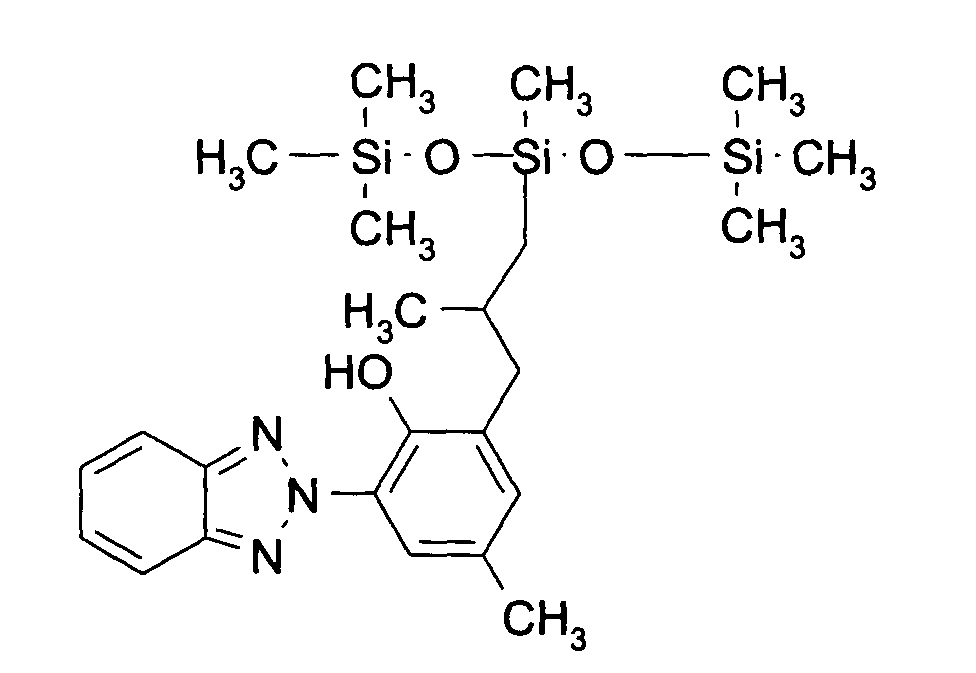
- (10) leurs mélanges.
| Film anhydre | |
| Hydroxypropyl-méthylcellulose | 10 % |
| Glycérine | 5 % |
| Panthénol | 2 % |
| Adénosine | 0.15 % |
| Eau purifiée | 50 % |
| Composition aqueuse (serum) | |
| Phase A | |
| Gomme de xanthane | 0.2 % |
| Methyl Paraben | 0.2 % |
| Phenoxythanol | 0.35 % |
| Eau | qsq 100 % |
| Phase B | |
| Triéthanolamine | 0,2 % |
| Polyacryalamide / C13-C14 isoparaffine / laureth-7 (Sepigel 305) | 1 % |
| Diazolidinyl Yrea | 0,3 % |
| Glycérine | 7 % |
| Film anhydre | |
| Polyvinylpyrrolidone | 83 % |
| Acide ascorbique | 7 % |
| PEG-400 | 10 % |
| Composition aqueuse (émulsion H/E) | |
| Phase A (phase aqueuse) | |
| Gomme de xanthane | 0,25 % |
| Conservateur | 0,3 % |
| Eau | qsp 100 % |
| Phase B (phase huileuse) | |
| Beurre de karité | 2 % |
| Methyl glucose Sesquistearate | 2 % |
| PEG 20 methyl glucose Sesquistearate | 2 % |
| Huile d'amande d'abricot | 6 % |
| Alcool gras stéarylique | 2 % |
| Phase C | |
| Polyacrylamine / C13-14 isoparaffin / Laureth 7 (Sepigel 305) | 1 % |
| Conservateur | 0,35 % |
| Huile de silicone volatile | 10 % |
| Film anhydre | |
| Hydroxypropylméthylcellulose | 68 % |
| Glycérine | 16 % |
| Silice (Sunsphere H33 de la société Asahi Glass) | 16 % |
| Composition aqueuse (Emulsion H/E) | |
| Phase A (phase huileuse) | |
| Stéarate de glycéryle | 1,35 % |
| Dimyristyl tartrate / cetearyl alcool /12-15 Pareth 7 / PPG 25 laureth 25 (Cosmacol PSE de la société Sasol) | 2 % |
| PEG-400 stéarate | 2,7 % |
| Isohexadécane | 2 % |
| Alcool stéarylique | 1,3 % |
| Vitamine E | 0,1 % |
| Conservateur | 0,6 % |
| Phase B (phase aqueuse) | |
| Eau | qsp 100 % |
| Hydroxyde de potassium | 1,5 % |
| Conservateur | 0,25 % |
| Ammonium polyacryloyldimethyltaurate (Hostacerin AMPS) | 0,5 % |
| Phase C | |
| Huile de silicone volatile | 6 % |
| Film anhydre | |
| Hydroxypropylméthylcellulose | 60 % |
| Glycérine | 30 % |
| Propylène glycol | 10 % |
| Composition aqueuse : | |
| Phase A | |
| Gomme de xanthane | 0,2 % |
| Methyl Paraben | 0,2 % |
| Phénoxyéthanol | 0,35 % |
| Eau | qsp 100% |
| Phase B | |
| Triéthanolamine | 0,2 % |
| Polyacrylamide / C13-C14 isoparaffine / laureth-7 (Sepigel 305) | 1 % |
| Diazolidinyl Urea | 0,3 % |
| Glycérine | 7 % |
| Film anhydre | |
| Hydroxypropylméthylcellulose | 40 % |
| Serad FX1100 | 20 % |
| Glycérine | 30 % |
| Propylène glycol | 10 % |
| Composition aqueuse : | |
| Phase A | |
| Gomme de xanthane | 0,2 % |
| Methyl Paraben | 0,2 % |
| Phenoxyéthanol | 0,35 % |
| Eau | qsp 100% |
| Phase B | |
| Triéthanolamine | 0,2 % |
| Polyacrylamide / C13-C14 isoparaffine / laureth-7 (Sepigel 305) | 1 % |
| Glycérine | 7 % |
Claims (18)
- Kit de formulation d'un produit cosmétique comprenant (1) une composition aqueuse contenant au moins un corps gras, et (2) au moins un film anhydre hydrosoluble comportant au moins un composé qui est apte à modifier la composition aqueuse.
- Kit de formulation d'un produit cosmétique comprenant :i) une composition aqueuse ; etii) au moins un film anhydre hydrosoluble comportant au moins un composé qui, pour des raisons de stabilité, ne peut être mélangé à la composition que de façon extemporanée en vue de former ledit produit cosmétique.
- Kit de formulation d'un produit cosmétique comprenant :i) une composition aqueuse ;ii) au moins un premier film anhydre hydrosoluble ; etiii) au moins un second film anhydre hydrosoluble, le second film étant distinct du premier, par la concentration et/ou par la nature d'au moins un composé qu'il contient.
- Kit de formulation customisée d'un produit cosmétique comprenant :i) une composition aqueuse ;ii) une pluralité de films anhydres hydrosolubles, identiques ou différents, destiné(s) à être mélangé(s) à la composition aqueuse pour former ledit produit cosmétique, etiii) des instructions pour formuler à façon ledit produit cosmétique en fonction du nombre de films anhydres hydrosolubles identiques ou différents à mélanger à la composition.
- Kit selon l'une quelconque des revendications 1 à 4, caractérisé en ce que le film est formé d'au moins un polymère hydrosoluble ou hydrodispersible
- Kit selon la revendication précédente, caractérisé en ce que le polymère est choisi parmi les polymères de type protéique ; les polymères dérivant de la chitine ou du chitosane; les polymères polysaccharidiques ; les polymères ou copolymères acryliques ; les polymères vinyliques ; les polymères d'origine naturelle ; et leurs mélanges.
- Kit selon l'une quelconque des revendications précédentes, caractérisé en ce que le film a une épaisseur de 10 µm à 1000 µm et de préférence de 20 à 500 µm.
- Kit selon l'une quelconque des revendications précédentes, caractérisé en ce que le film contient moins de 10 % d'eau.
- Kit selon l'une quelconque des revendications 5 à 8, caractérisé en ce que la quantité de polymère va de 5 à 100 % en poids par rapport au poids total du film.
- Kit selon l'une quelconque des revendications précédentes, caractérisé en ce que le film comprend un ou plusieurs plastifiants.
- Kit selon l'une quelconque des revendications 2 à 10, caractérisé en ce que la composition aqueuse contient, outre l'eau, au moins un corps gras.
- Kit selon l'une quelconque des revendications précédentes, caractérisé en ce que la composition aqueuse se présente sous forme d'émulsion comportant une phase aqueuse et une phase huileuse dispersées l'une dans l'autre.
- Kit selon l'une quelconque des revendications précédentes, caractérisé en ce que le composé du ou des films est choisi parmi les actifs cosmétiques, les adjuvants de formulation et leurs mélanges.
- Kit selon l'une quelconque des revendications précédentes, caractérisé en ce que la composition aqueuse contient un ou plusieurs composés choisis parmi les actifs cosmétiques, les adjuvants de formulation et leurs mélanges.
- Kit selon l'une quelconque des revendications 13 ou 14, caractérisé en ce que les composés sont choisis parmi les actifs hydratants, les agents anti-séborrhéiques, les actifs anti-vieillissement, les actifs antimicrobiens, les actifs anti-inflammatoires ou apaisants, les actifs lipolytiques ou amincissants, les charges, les filtres solaires, les agents de coloration de la peau ou des cheveux, les actifs anti-cernes, les actifs anti-transpirants, les actifs déodorants, les actifs des traitements capillaires, les agents dépilatoires, les pigments, les colorants, les polymères, les parfums, les électrolytes, les ajusteurs de pH, les conservateurs, et leurs mélanges.
- Kit selon l'une quelconque des revendications précédentes, caractérisé en ce qu'au moins un film contient au moins un composé choisi parmi les composés sensibles à un stimulus extérieur, les agents kératolytiques, les charges, les agents tenseurs et leurs mélanges.
- Procédé de formulation d'un produit cosmétique consistant à :a) déterminer au moins une caractéristique du produit cosmétique à formuler, caractéristique due à moins un composé présent, soit dans une pluralité de films anhydres hydrosolubles identiques, soit dans une pluralité de films anhydres hydrosolubles différant les uns des autres notamment par la concentration et/ou la nature d'au moins un composé qu'ils contiennent ; etb) ajouter à une composition aqueuse, un nombre desdits films identiques ou différents, ledit nombre étant fonction de ladite caractéristique du produit cosmétique à formuler.
- Procédé de modification des caractéristiques de rhéologie, de couleur et/ou de parfum d'une composition aqueuse en vue de la formulation d'un produit cosmétique, consistant à ajouter à une composition aqueuse, un ou plusieurs films anhydres hydrosolubles contenant un ou plusieurs composés aptes à modifier la rhéologie, la couleur et/ou le parfum d'une composition aqueuse.
Applications Claiming Priority (2)
| Application Number | Priority Date | Filing Date | Title |
|---|---|---|---|
| FR0404125A FR2868949B1 (fr) | 2004-04-19 | 2004-04-19 | Kit de formulation d'un produit cosmetique |
| FR0404125 | 2004-04-19 |
Publications (2)
| Publication Number | Publication Date |
|---|---|
| EP1588694A1 true EP1588694A1 (fr) | 2005-10-26 |
| EP1588694B1 EP1588694B1 (fr) | 2007-05-23 |
Family
ID=34942027
Family Applications (1)
| Application Number | Title | Priority Date | Filing Date |
|---|---|---|---|
| EP05290626A Expired - Lifetime EP1588694B1 (fr) | 2004-04-19 | 2005-03-22 | Kit de formulation d'un produit cosmétique |
Country Status (6)
| Country | Link |
|---|---|
| EP (1) | EP1588694B1 (fr) |
| JP (1) | JP2005306871A (fr) |
| AT (1) | ATE362750T1 (fr) |
| DE (1) | DE602005001170T2 (fr) |
| ES (1) | ES2286770T3 (fr) |
| FR (1) | FR2868949B1 (fr) |
Cited By (14)
| Publication number | Priority date | Publication date | Assignee | Title |
|---|---|---|---|---|
| EP1695688A1 (fr) * | 2005-02-28 | 2006-08-30 | L'oreal | Composition anhydre sous forme de film comprenant un polymère filmogène et un colorant direct |
| FR2895254A1 (fr) * | 2005-12-22 | 2007-06-29 | Oreal | Kit de soin de traitement associant un extrait de bacterie filamenteuse non photosynthetique non fructifiante et un actif cosmetique. |
| FR2904535A1 (fr) * | 2006-08-04 | 2008-02-08 | Oreal | Procede de traitement cosmetique comprenant l'application d'une composition anhydre sous forme de film hydrosolubl en presence d'un fluide comprenat de la vapeur d'eau |
| FR2904533A1 (fr) * | 2006-08-04 | 2008-02-08 | Oreal | Procede de traitement cosmetique mettant en oeuvre une composition anhydre sous forme de film comprenant un polymere filmogene et un agent de conditionnement. |
| FR2904765A1 (fr) * | 2006-08-10 | 2008-02-15 | Oreal | Film a dissolution amelioree et produit cosmetique le contenant |
| WO2008015366A3 (fr) * | 2006-08-04 | 2008-03-13 | Oreal | Procede de traitement cosmetique comprenant l'application d'une composition anhydre sous forme de film hydrosoluble en presence d'un fluide comprenant de la vapeur d'eau. |
| WO2008015367A3 (fr) * | 2006-08-04 | 2008-03-13 | Oreal | Procédé de traitement cosmétique mettant en oeuvre une composition anhydre sous forme de film comprenant un polymère zymogène et un agent de conditionnement |
| FR2911067A1 (fr) * | 2007-01-09 | 2008-07-11 | Oreal | Composition cosmetique contenant un polymere tenseur et des particules hybrides |
| WO2009006214A1 (fr) * | 2007-06-29 | 2009-01-08 | Union Carbide Chemicals & Plastics Technology Llc | Films solubles de soin d'hygiène personnelle |
| WO2009006210A1 (fr) * | 2007-06-29 | 2009-01-08 | Union Carbide Chemicals & Plastics Technology Llc | Coiffure et films de soins personnels de conditionnement capillaire |
| WO2009006218A3 (fr) * | 2007-06-29 | 2009-06-11 | Union Carbide Chem Plastic | Films solubles de soins d'hygiène personnelle |
| FR2924932A1 (fr) * | 2007-12-18 | 2009-06-19 | Oreal | Ciblage des rides par application de compositions fluides |
| EP1792641A3 (fr) * | 2005-12-05 | 2009-08-05 | Henkel AG & Co. KGaA | Film pour la coloration des fibres kératiniques |
| US20230218641A1 (en) * | 2020-05-19 | 2023-07-13 | L'oreal | Anti-acne compositions |
Families Citing this family (9)
| Publication number | Priority date | Publication date | Assignee | Title |
|---|---|---|---|---|
| JP2008503580A (ja) * | 2004-06-22 | 2008-02-07 | イーエルシー マネージメント エルエルシー | 可溶性フィルム組成物 |
| FR2882519B1 (fr) | 2005-02-28 | 2008-12-26 | Oreal | Coloration de matieres keratiniques notamment humaines par transfert thermique a sec d'un colorant direct azomethinique composition comprenant ledit colorant et son procede de preparation |
| FR2882518B1 (fr) | 2005-02-28 | 2012-10-19 | Oreal | Coloration de matieres keratiniques notamment humaines par transfert thermique a sec d'un colorant direct anthraquinonique, composition comprenant ledit colorant et son procede de preparation |
| FR2882521B1 (fr) | 2005-02-28 | 2008-05-09 | Oreal | Coloration de matieres keratiniques notamment humaines par transfert thermique a sec d'un colorant direct, composition comprenant ledit colorant et son procede de preparation |
| FR2892017B1 (fr) * | 2005-10-14 | 2012-11-09 | Oreal | Composition cosmetique contenant un compose non phosphate a base d'adenosine et un agent tenseur |
| DE102009032244A1 (de) * | 2009-07-06 | 2011-01-13 | Beiersdorf Ag | Glycyrrhetinsäure enthaltende, parfümierte kosmetische Zubereitung |
| DE102009032245A1 (de) * | 2009-07-06 | 2011-01-13 | Beiersdorf Ag | Glycyrrhetinsäure enthaltende kosmetische Zubereitung |
| FR2984733B1 (fr) * | 2011-12-22 | 2016-09-30 | Oreal | Association d'un agent nucleophile et d'un agent azote ou phosphore de pka superieur a 11 pour la peau glyquee |
| AU2019459969A1 (en) * | 2019-08-06 | 2022-03-24 | Natura Cosméticos S.A. | Topical cosmetic composition, use of the composition and serum for facial application |
Citations (3)
| Publication number | Priority date | Publication date | Assignee | Title |
|---|---|---|---|---|
| WO2002005789A2 (fr) * | 2000-07-15 | 2002-01-24 | Scs Skin Care Systems Gmbh | Feuille contenant des produits dermatologiques |
| US20030186826A1 (en) * | 2001-11-01 | 2003-10-02 | The Procter & Gamble Company | Method of using personal care compositions containing a high density, water disintegratable, polymeric foam |
| FR2840221A1 (fr) * | 2002-06-04 | 2003-12-05 | Backert Marie Elisabeth Cuine | Film polymerique contenant des "actifs" destines a etre liberes dans un liquide |
Family Cites Families (1)
| Publication number | Priority date | Publication date | Assignee | Title |
|---|---|---|---|---|
| FR2782923B1 (fr) * | 1998-09-07 | 2002-08-23 | Jean Noel Thorel | Procede de transformation d'une composition cosmetique en un film, film obtenu et kit |
-
2004
- 2004-04-19 FR FR0404125A patent/FR2868949B1/fr not_active Expired - Fee Related
-
2005
- 2005-03-22 DE DE602005001170T patent/DE602005001170T2/de not_active Expired - Lifetime
- 2005-03-22 EP EP05290626A patent/EP1588694B1/fr not_active Expired - Lifetime
- 2005-03-22 ES ES05290626T patent/ES2286770T3/es not_active Expired - Lifetime
- 2005-03-22 AT AT05290626T patent/ATE362750T1/de not_active IP Right Cessation
- 2005-04-18 JP JP2005120359A patent/JP2005306871A/ja not_active Withdrawn
Patent Citations (3)
| Publication number | Priority date | Publication date | Assignee | Title |
|---|---|---|---|---|
| WO2002005789A2 (fr) * | 2000-07-15 | 2002-01-24 | Scs Skin Care Systems Gmbh | Feuille contenant des produits dermatologiques |
| US20030186826A1 (en) * | 2001-11-01 | 2003-10-02 | The Procter & Gamble Company | Method of using personal care compositions containing a high density, water disintegratable, polymeric foam |
| FR2840221A1 (fr) * | 2002-06-04 | 2003-12-05 | Backert Marie Elisabeth Cuine | Film polymerique contenant des "actifs" destines a etre liberes dans un liquide |
Cited By (18)
| Publication number | Priority date | Publication date | Assignee | Title |
|---|---|---|---|---|
| FR2882561A1 (fr) * | 2005-02-28 | 2006-09-01 | Oreal | Composition anhydre sous forme de film comprenant un polymere filmogene et un colorant direct, preparation et procede de coloration la mettant en oeuvre |
| EP1695688A1 (fr) * | 2005-02-28 | 2006-08-30 | L'oreal | Composition anhydre sous forme de film comprenant un polymère filmogène et un colorant direct |
| EP1792641A3 (fr) * | 2005-12-05 | 2009-08-05 | Henkel AG & Co. KGaA | Film pour la coloration des fibres kératiniques |
| FR2895254A1 (fr) * | 2005-12-22 | 2007-06-29 | Oreal | Kit de soin de traitement associant un extrait de bacterie filamenteuse non photosynthetique non fructifiante et un actif cosmetique. |
| FR2904535A1 (fr) * | 2006-08-04 | 2008-02-08 | Oreal | Procede de traitement cosmetique comprenant l'application d'une composition anhydre sous forme de film hydrosolubl en presence d'un fluide comprenat de la vapeur d'eau |
| FR2904533A1 (fr) * | 2006-08-04 | 2008-02-08 | Oreal | Procede de traitement cosmetique mettant en oeuvre une composition anhydre sous forme de film comprenant un polymere filmogene et un agent de conditionnement. |
| WO2008015366A3 (fr) * | 2006-08-04 | 2008-03-13 | Oreal | Procede de traitement cosmetique comprenant l'application d'une composition anhydre sous forme de film hydrosoluble en presence d'un fluide comprenant de la vapeur d'eau. |
| WO2008015367A3 (fr) * | 2006-08-04 | 2008-03-13 | Oreal | Procédé de traitement cosmétique mettant en oeuvre une composition anhydre sous forme de film comprenant un polymère zymogène et un agent de conditionnement |
| FR2904765A1 (fr) * | 2006-08-10 | 2008-02-15 | Oreal | Film a dissolution amelioree et produit cosmetique le contenant |
| EP1892015A3 (fr) * | 2006-08-10 | 2009-12-02 | L'Oréal | Film à dissolution améliorée et produit cosmétique le contenant |
| FR2911067A1 (fr) * | 2007-01-09 | 2008-07-11 | Oreal | Composition cosmetique contenant un polymere tenseur et des particules hybrides |
| EP1944065A1 (fr) * | 2007-01-09 | 2008-07-16 | L'Oréal | Composition cosmétique contenant un polymère tenseur et des particules hybrides |
| WO2009006210A1 (fr) * | 2007-06-29 | 2009-01-08 | Union Carbide Chemicals & Plastics Technology Llc | Coiffure et films de soins personnels de conditionnement capillaire |
| WO2009006218A3 (fr) * | 2007-06-29 | 2009-06-11 | Union Carbide Chem Plastic | Films solubles de soins d'hygiène personnelle |
| WO2009006214A1 (fr) * | 2007-06-29 | 2009-01-08 | Union Carbide Chemicals & Plastics Technology Llc | Films solubles de soin d'hygiène personnelle |
| CN101686926B (zh) * | 2007-06-29 | 2012-10-10 | 联合碳化化学品及塑料技术公司 | 头发定型和调理个人护理膜 |
| FR2924932A1 (fr) * | 2007-12-18 | 2009-06-19 | Oreal | Ciblage des rides par application de compositions fluides |
| US20230218641A1 (en) * | 2020-05-19 | 2023-07-13 | L'oreal | Anti-acne compositions |
Also Published As
| Publication number | Publication date |
|---|---|
| JP2005306871A (ja) | 2005-11-04 |
| DE602005001170D1 (de) | 2007-07-05 |
| ES2286770T3 (es) | 2007-12-01 |
| ATE362750T1 (de) | 2007-06-15 |
| FR2868949A1 (fr) | 2005-10-21 |
| FR2868949B1 (fr) | 2006-06-09 |
| EP1588694B1 (fr) | 2007-05-23 |
| DE602005001170T2 (de) | 2008-01-17 |
Similar Documents
| Publication | Publication Date | Title |
|---|---|---|
| EP1588694B1 (fr) | Kit de formulation d'un produit cosmétique | |
| EP2335683B1 (fr) | Kit de formulation d'un produit cosmétique | |
| US20090324663A1 (en) | Kit for formulating a cosmetic product | |
| FR2886845A1 (fr) | Produit cosmetique solide | |
| EP1892015A2 (fr) | Film à dissolution améliorée et produit cosmétique le contenant | |
| EP1847247B1 (fr) | Compositions comprenant un dérivé diphényl-méthane hydroxylé | |
| EP1243252B1 (fr) | Composition pour le peau, contenant des fibres et des ubiquinones | |
| US20080008673A1 (en) | Compositions comprising at least one C-glycoside derivative | |
| FR2939669A1 (fr) | Procede cosmetique pour controler le brunissement de la peau induit par les radiations uv ; compositions. | |
| WO2011073437A2 (fr) | Compositions cosmétiques ou dermatologiques à base de bactériocines et de prébiotiques | |
| EP1262168A1 (fr) | Composition pour lutter contre le vieillissement de la peau, contenant des fibres | |
| FR2984089A1 (fr) | Dispositif d'application comprenant une composition a base de polymere filmogene hydrophobe et un solvant volatil, procede de traitement des fibres keratiniques le mettant en oeuvre | |
| EP1530961A2 (fr) | Emulsion renfermant des portions de sphères creuses organossiliconées | |
| FR2960773A1 (fr) | Procedes de traitement cosmetique utilisant un revetement a base d'un polymere polyamide-polyether | |
| WO2009044363A2 (fr) | Composition à appliquer sur des matières kératiniques et comprenant un pigment holographique | |
| FR2940053A1 (fr) | Utilisation de l'acide anisique et/ou d'au moins un de ses derives comme agent antioxydant | |
| US20070134173A1 (en) | Personal care compositions | |
| FR2939685A1 (fr) | Compositions comprenant un derive diphenyl-methane hydroxyle et un compose phenantrenol. | |
| EP1243254A1 (fr) | Composition contenant des fibres et un flavonoide | |
| FR2940121A1 (fr) | Composition pour le soin de la peau | |
| EP1754513A2 (fr) | Utilisation de l'acide 8-hexadécène-1,16-dicarboxylique comme agent de soin destiné à favoriser la cohésion de la couche cornée | |
| FR2917966A1 (fr) | Produit cosmetique de soin des matieres keratiniques | |
| EP1245222A2 (fr) | Composition contenant des fibres et des enzymes | |
| EP1243253A1 (fr) | Composition contenant des fibres et des stéroides | |
| BRPI1010383B1 (pt) | Cosmetic treatment processes of keratinal materials and formulation kit of a cosmetic product |
Legal Events
| Date | Code | Title | Description |
|---|---|---|---|
| PUAI | Public reference made under article 153(3) epc to a published international application that has entered the european phase |
Free format text: ORIGINAL CODE: 0009012 |
|
| AK | Designated contracting states |
Kind code of ref document: A1 Designated state(s): AT BE BG CH CY CZ DE DK EE ES FI FR GB GR HU IE IS IT LI LT LU MC NL PL PT RO SE SI SK TR |
|
| AX | Request for extension of the european patent |
Extension state: AL BA HR LV MK YU |
|
| 17P | Request for examination filed |
Effective date: 20060426 |
|
| AKX | Designation fees paid |
Designated state(s): AT BE BG CH CY CZ DE DK EE ES FI FR GB GR HU IE IS IT LI LT LU MC NL PL PT RO SE SI SK TR |
|
| 17Q | First examination report despatched |
Effective date: 20061005 |
|
| GRAP | Despatch of communication of intention to grant a patent |
Free format text: ORIGINAL CODE: EPIDOSNIGR1 |
|
| RIC1 | Information provided on ipc code assigned before grant |
Ipc: A61Q 5/00 20060101ALI20061102BHEP Ipc: A61Q 19/08 20060101ALI20061102BHEP Ipc: A61Q 19/00 20060101ALI20061102BHEP Ipc: A61K 8/02 20060101AFI20061102BHEP |
|
| GRAS | Grant fee paid |
Free format text: ORIGINAL CODE: EPIDOSNIGR3 |
|
| GRAA | (expected) grant |
Free format text: ORIGINAL CODE: 0009210 |
|
| AK | Designated contracting states |
Kind code of ref document: B1 Designated state(s): AT BE BG CH CY CZ DE DK EE ES FI FR GB GR HU IE IS IT LI LT LU MC NL PL PT RO SE SI SK TR |
|
| PG25 | Lapsed in a contracting state [announced via postgrant information from national office to epo] |
Ref country code: FI Free format text: LAPSE BECAUSE OF FAILURE TO SUBMIT A TRANSLATION OF THE DESCRIPTION OR TO PAY THE FEE WITHIN THE PRESCRIBED TIME-LIMIT Effective date: 20070523 |
|
| REG | Reference to a national code |
Ref country code: GB Ref legal event code: FG4D Free format text: NOT ENGLISH |
|
| REG | Reference to a national code |
Ref country code: CH Ref legal event code: EP |
|
| REG | Reference to a national code |
Ref country code: IE Ref legal event code: FG4D Free format text: LANGUAGE OF EP DOCUMENT: FRENCH |
|
| REF | Corresponds to: |
Ref document number: 602005001170 Country of ref document: DE Date of ref document: 20070705 Kind code of ref document: P |
|
| GBT | Gb: translation of ep patent filed (gb section 77(6)(a)/1977) |
Effective date: 20070726 |
|
| PG25 | Lapsed in a contracting state [announced via postgrant information from national office to epo] |
Ref country code: SE Free format text: LAPSE BECAUSE OF FAILURE TO SUBMIT A TRANSLATION OF THE DESCRIPTION OR TO PAY THE FEE WITHIN THE PRESCRIBED TIME-LIMIT Effective date: 20070823 |
|
| PG25 | Lapsed in a contracting state [announced via postgrant information from national office to epo] |
Ref country code: IS Free format text: LAPSE BECAUSE OF FAILURE TO SUBMIT A TRANSLATION OF THE DESCRIPTION OR TO PAY THE FEE WITHIN THE PRESCRIBED TIME-LIMIT Effective date: 20070923 |
|
| NLV1 | Nl: lapsed or annulled due to failure to fulfill the requirements of art. 29p and 29m of the patents act | ||
| PG25 | Lapsed in a contracting state [announced via postgrant information from national office to epo] |
Ref country code: PL Free format text: LAPSE BECAUSE OF FAILURE TO SUBMIT A TRANSLATION OF THE DESCRIPTION OR TO PAY THE FEE WITHIN THE PRESCRIBED TIME-LIMIT Effective date: 20070523 Ref country code: AT Free format text: LAPSE BECAUSE OF FAILURE TO SUBMIT A TRANSLATION OF THE DESCRIPTION OR TO PAY THE FEE WITHIN THE PRESCRIBED TIME-LIMIT Effective date: 20070523 |
|
| REG | Reference to a national code |
Ref country code: ES Ref legal event code: FG2A Ref document number: 2286770 Country of ref document: ES Kind code of ref document: T3 |
|
| REG | Reference to a national code |
Ref country code: IE Ref legal event code: FD4D |
|
| PG25 | Lapsed in a contracting state [announced via postgrant information from national office to epo] |
Ref country code: NL Free format text: LAPSE BECAUSE OF FAILURE TO SUBMIT A TRANSLATION OF THE DESCRIPTION OR TO PAY THE FEE WITHIN THE PRESCRIBED TIME-LIMIT Effective date: 20070523 Ref country code: DK Free format text: LAPSE BECAUSE OF FAILURE TO SUBMIT A TRANSLATION OF THE DESCRIPTION OR TO PAY THE FEE WITHIN THE PRESCRIBED TIME-LIMIT Effective date: 20070523 Ref country code: SI Free format text: LAPSE BECAUSE OF FAILURE TO SUBMIT A TRANSLATION OF THE DESCRIPTION OR TO PAY THE FEE WITHIN THE PRESCRIBED TIME-LIMIT Effective date: 20070523 Ref country code: PT Free format text: LAPSE BECAUSE OF FAILURE TO SUBMIT A TRANSLATION OF THE DESCRIPTION OR TO PAY THE FEE WITHIN THE PRESCRIBED TIME-LIMIT Effective date: 20071023 Ref country code: CZ Free format text: LAPSE BECAUSE OF FAILURE TO SUBMIT A TRANSLATION OF THE DESCRIPTION OR TO PAY THE FEE WITHIN THE PRESCRIBED TIME-LIMIT Effective date: 20070523 Ref country code: BG Free format text: LAPSE BECAUSE OF FAILURE TO SUBMIT A TRANSLATION OF THE DESCRIPTION OR TO PAY THE FEE WITHIN THE PRESCRIBED TIME-LIMIT Effective date: 20070823 Ref country code: IE Free format text: LAPSE BECAUSE OF FAILURE TO SUBMIT A TRANSLATION OF THE DESCRIPTION OR TO PAY THE FEE WITHIN THE PRESCRIBED TIME-LIMIT Effective date: 20070523 |
|
| PG25 | Lapsed in a contracting state [announced via postgrant information from national office to epo] |
Ref country code: LT Free format text: LAPSE BECAUSE OF FAILURE TO SUBMIT A TRANSLATION OF THE DESCRIPTION OR TO PAY THE FEE WITHIN THE PRESCRIBED TIME-LIMIT Effective date: 20070523 Ref country code: SK Free format text: LAPSE BECAUSE OF FAILURE TO SUBMIT A TRANSLATION OF THE DESCRIPTION OR TO PAY THE FEE WITHIN THE PRESCRIBED TIME-LIMIT Effective date: 20070523 |
|
| PLBE | No opposition filed within time limit |
Free format text: ORIGINAL CODE: 0009261 |
|
| STAA | Information on the status of an ep patent application or granted ep patent |
Free format text: STATUS: NO OPPOSITION FILED WITHIN TIME LIMIT |
|
| 26N | No opposition filed |
Effective date: 20080226 |
|
| PG25 | Lapsed in a contracting state [announced via postgrant information from national office to epo] |
Ref country code: GR Free format text: LAPSE BECAUSE OF FAILURE TO SUBMIT A TRANSLATION OF THE DESCRIPTION OR TO PAY THE FEE WITHIN THE PRESCRIBED TIME-LIMIT Effective date: 20070824 |
|
| PG25 | Lapsed in a contracting state [announced via postgrant information from national office to epo] |
Ref country code: RO Free format text: LAPSE BECAUSE OF FAILURE TO SUBMIT A TRANSLATION OF THE DESCRIPTION OR TO PAY THE FEE WITHIN THE PRESCRIBED TIME-LIMIT Effective date: 20070523 |
|
| BERE | Be: lapsed |
Owner name: L'OREAL Effective date: 20080331 |
|
| PG25 | Lapsed in a contracting state [announced via postgrant information from national office to epo] |
Ref country code: MC Free format text: LAPSE BECAUSE OF NON-PAYMENT OF DUE FEES Effective date: 20080331 |
|
| PG25 | Lapsed in a contracting state [announced via postgrant information from national office to epo] |
Ref country code: EE Free format text: LAPSE BECAUSE OF FAILURE TO SUBMIT A TRANSLATION OF THE DESCRIPTION OR TO PAY THE FEE WITHIN THE PRESCRIBED TIME-LIMIT Effective date: 20070523 |
|
| PG25 | Lapsed in a contracting state [announced via postgrant information from national office to epo] |
Ref country code: BE Free format text: LAPSE BECAUSE OF NON-PAYMENT OF DUE FEES Effective date: 20080331 |
|
| PG25 | Lapsed in a contracting state [announced via postgrant information from national office to epo] |
Ref country code: CY Free format text: LAPSE BECAUSE OF FAILURE TO SUBMIT A TRANSLATION OF THE DESCRIPTION OR TO PAY THE FEE WITHIN THE PRESCRIBED TIME-LIMIT Effective date: 20070523 |
|
| REG | Reference to a national code |
Ref country code: CH Ref legal event code: PL |
|
| PG25 | Lapsed in a contracting state [announced via postgrant information from national office to epo] |
Ref country code: CH Free format text: LAPSE BECAUSE OF NON-PAYMENT OF DUE FEES Effective date: 20090331 Ref country code: LI Free format text: LAPSE BECAUSE OF NON-PAYMENT OF DUE FEES Effective date: 20090331 |
|
| PG25 | Lapsed in a contracting state [announced via postgrant information from national office to epo] |
Ref country code: LU Free format text: LAPSE BECAUSE OF NON-PAYMENT OF DUE FEES Effective date: 20080322 Ref country code: HU Free format text: LAPSE BECAUSE OF FAILURE TO SUBMIT A TRANSLATION OF THE DESCRIPTION OR TO PAY THE FEE WITHIN THE PRESCRIBED TIME-LIMIT Effective date: 20071124 |
|
| PG25 | Lapsed in a contracting state [announced via postgrant information from national office to epo] |
Ref country code: TR Free format text: LAPSE BECAUSE OF FAILURE TO SUBMIT A TRANSLATION OF THE DESCRIPTION OR TO PAY THE FEE WITHIN THE PRESCRIBED TIME-LIMIT Effective date: 20070523 |
|
| PGFP | Annual fee paid to national office [announced via postgrant information from national office to epo] |
Ref country code: FR Payment date: 20110317 Year of fee payment: 7 |
|
| PGFP | Annual fee paid to national office [announced via postgrant information from national office to epo] |
Ref country code: DE Payment date: 20110316 Year of fee payment: 7 Ref country code: ES Payment date: 20110414 Year of fee payment: 7 Ref country code: GB Payment date: 20110316 Year of fee payment: 7 |
|
| PGFP | Annual fee paid to national office [announced via postgrant information from national office to epo] |
Ref country code: IT Payment date: 20110325 Year of fee payment: 7 |
|
| GBPC | Gb: european patent ceased through non-payment of renewal fee |
Effective date: 20120322 |
|
| REG | Reference to a national code |
Ref country code: FR Ref legal event code: ST Effective date: 20121130 |
|
| PG25 | Lapsed in a contracting state [announced via postgrant information from national office to epo] |
Ref country code: FR Free format text: LAPSE BECAUSE OF NON-PAYMENT OF DUE FEES Effective date: 20120402 Ref country code: GB Free format text: LAPSE BECAUSE OF NON-PAYMENT OF DUE FEES Effective date: 20120322 |
|
| REG | Reference to a national code |
Ref country code: DE Ref legal event code: R119 Ref document number: 602005001170 Country of ref document: DE Effective date: 20121002 |
|
| PG25 | Lapsed in a contracting state [announced via postgrant information from national office to epo] |
Ref country code: IT Free format text: LAPSE BECAUSE OF NON-PAYMENT OF DUE FEES Effective date: 20120322 |
|
| REG | Reference to a national code |
Ref country code: ES Ref legal event code: FD2A Effective date: 20140109 |
|
| PG25 | Lapsed in a contracting state [announced via postgrant information from national office to epo] |
Ref country code: ES Free format text: LAPSE BECAUSE OF NON-PAYMENT OF DUE FEES Effective date: 20120323 |
|
| PG25 | Lapsed in a contracting state [announced via postgrant information from national office to epo] |
Ref country code: DE Free format text: LAPSE BECAUSE OF NON-PAYMENT OF DUE FEES Effective date: 20121002 |