EP1588620B2 - Procédé et dispositif pour la préparation d'un produit basée sur une masse de confiserie - Google Patents
Procédé et dispositif pour la préparation d'un produit basée sur une masse de confiserie Download PDFInfo
- Publication number
- EP1588620B2 EP1588620B2 EP05008696.6A EP05008696A EP1588620B2 EP 1588620 B2 EP1588620 B2 EP 1588620B2 EP 05008696 A EP05008696 A EP 05008696A EP 1588620 B2 EP1588620 B2 EP 1588620B2
- Authority
- EP
- European Patent Office
- Prior art keywords
- embossing
- strand
- conveyor belt
- slab
- cross
- Prior art date
- Legal status (The legal status is an assumption and is not a legal conclusion. Google has not performed a legal analysis and makes no representation as to the accuracy of the status listed.)
- Expired - Lifetime
Links
Images
Classifications
-
- A—HUMAN NECESSITIES
- A23—FOODS OR FOODSTUFFS; TREATMENT THEREOF, NOT COVERED BY OTHER CLASSES
- A23G—COCOA; COCOA PRODUCTS, e.g. CHOCOLATE; SUBSTITUTES FOR COCOA OR COCOA PRODUCTS; CONFECTIONERY; CHEWING GUM; ICE-CREAM; PREPARATION THEREOF
- A23G3/00—Sweetmeats; Confectionery; Marzipan; Coated or filled products
- A23G3/02—Apparatus specially adapted for manufacture or treatment of sweetmeats or confectionery; Accessories therefor
- A23G3/0236—Shaping of liquid, paste, powder; Manufacture of moulded articles, e.g. modelling, moulding, calendering
- A23G3/0242—Apparatus in which the material is shaped at least partially by a die; Extrusion of cross-sections or plates, optionally the associated cutting device
- A23G3/0247—Devices for cutting, modelling of sections or plates; Embossing, punching, e.g. stamping tools
-
- A—HUMAN NECESSITIES
- A21—BAKING; EDIBLE DOUGHS
- A21C—MACHINES OR EQUIPMENT FOR MAKING OR PROCESSING DOUGHS; HANDLING BAKED ARTICLES MADE FROM DOUGH
- A21C11/00—Other machines for forming the dough into its final shape before cooking or baking
- A21C11/10—Other machines for forming the dough into its final shape before cooking or baking combined with cutting apparatus
-
- A—HUMAN NECESSITIES
- A21—BAKING; EDIBLE DOUGHS
- A21C—MACHINES OR EQUIPMENT FOR MAKING OR PROCESSING DOUGHS; HANDLING BAKED ARTICLES MADE FROM DOUGH
- A21C11/00—Other machines for forming the dough into its final shape before cooking or baking
- A21C11/12—Apparatus for slotting, slitting or perforating the surface of pieces of dough
-
- A—HUMAN NECESSITIES
- A23—FOODS OR FOODSTUFFS; TREATMENT THEREOF, NOT COVERED BY OTHER CLASSES
- A23G—COCOA; COCOA PRODUCTS, e.g. CHOCOLATE; SUBSTITUTES FOR COCOA OR COCOA PRODUCTS; CONFECTIONERY; CHEWING GUM; ICE-CREAM; PREPARATION THEREOF
- A23G3/00—Sweetmeats; Confectionery; Marzipan; Coated or filled products
- A23G3/0002—Processes of manufacture not relating to composition and compounding ingredients
- A23G3/0004—Processes specially adapted for manufacture or treatment of sweetmeats or confectionery
- A23G3/0019—Shaping of liquid, paste, powder; Manufacture of moulded articles, e.g. modelling, moulding, calendering
- A23G3/0021—Processes in which the material is shaped at least partially by a die; Extrusion of cross-sections or plates, optionally the associated cutting
- A23G3/0023—Processes for cutting, modelling of sections or plates; Embossing, punching
-
- A—HUMAN NECESSITIES
- A23—FOODS OR FOODSTUFFS; TREATMENT THEREOF, NOT COVERED BY OTHER CLASSES
- A23G—COCOA; COCOA PRODUCTS, e.g. CHOCOLATE; SUBSTITUTES FOR COCOA OR COCOA PRODUCTS; CONFECTIONERY; CHEWING GUM; ICE-CREAM; PREPARATION THEREOF
- A23G3/00—Sweetmeats; Confectionery; Marzipan; Coated or filled products
- A23G3/0002—Processes of manufacture not relating to composition and compounding ingredients
- A23G3/0046—Batch-rolling, rope-forming, or sizing
-
- A—HUMAN NECESSITIES
- A23—FOODS OR FOODSTUFFS; TREATMENT THEREOF, NOT COVERED BY OTHER CLASSES
- A23G—COCOA; COCOA PRODUCTS, e.g. CHOCOLATE; SUBSTITUTES FOR COCOA OR COCOA PRODUCTS; CONFECTIONERY; CHEWING GUM; ICE-CREAM; PREPARATION THEREOF
- A23G3/00—Sweetmeats; Confectionery; Marzipan; Coated or filled products
- A23G3/02—Apparatus specially adapted for manufacture or treatment of sweetmeats or confectionery; Accessories therefor
- A23G3/06—Batch-rolling, rope-forming, or sizing machines
Definitions
- the invention relates to a method for the continuous production of a product from edible mass, in particular confectionery mass, by forming a strand of defined cross-section from the mass, the strand is deposited on a conveyor belt and conveyed away and the strand is at least cross-cut into individual products.
- a device for the continuous production of a product of edible mass, in particular confectionery mass with a cross section of the mass determining strand former, a driven conveyor belt for depositing and conveying the strand former formed by the strand former and at least one cross cutter for dividing the strand into individual products demonstrated.
- the method and the device are used for the production of products of edible mass, so in particular from confectionery mass and other foods.
- the masses are liquid to pasty, so in any case deformable.
- a strand is first formed.
- the strand can be continuously produced as a carpet or band across the working width of the device.
- Such a continuous strand is then cut longitudinally and transversely, so that the individual products arise.
- These are usually bar products, ie individual product pieces, which generally have approximately rectangular outline in the horizontal section and often approximately square in cross section perpendicular to the conveying direction.
- products can also be produced with a circular or rounded shape in horizontal section, if the longitudinal and transverse cutting takes place by a kind of punching process.
- strand in the form of several separate single strands, so that can be dispensed with the longitudinal cutting.
- strand on the one hand meant a reaching over the working width total strand, which is divided in the course of shaping into several product strands, in particular longitudinally cut, is;
- a single product strand formed on a roll former may be meant, which only has to be cross-cut.
- the strand or the individual product strand is deposited on a driven conveyor belt after strand formation, which takes place via a strand former. Both the formation of the strand as well as the removal of the strand on the conveyor belt are carried out continuously.
- products of nougat, caramel, fudge or similar masses which also solid pieces, eg. As chopped almonds, nuts and the like, are produced.
- An essential field of application is also the production of cereal bars, which at least contain cereals as essential constituents.
- the masses may also be vented or contain compressible ingredients.
- the products may also contain soft confectionery mass, fruit pulp, brittle, toffee, but also high-boiled sugar masses, caramel, fat masses, nougat cream etc.
- a method and a device of the type described above are known.
- a strand former which has two driven rollers with a smooth surface, which are arranged at a distance to each other and thus form a gap between them, in which the moldable material is drawn.
- the mass then exits in the form of a carpet (strand) with a height corresponding to the gap width from the strand former and is thus deposited continuously on a driven conveyor belt.
- the rate of formation of the strand or carpet at the exit of the strand former corresponds to the speed at which the conveyor belt is driven.
- According to the gap width results in the height of the strand and thus ultimately the desired strand or product height of a z. B. produced bar.
- the strand is cut longitudinally and crosswise so that the products are formed in this way.
- the processing temperature it may be necessary to provide one or more cooling or Temperierkanalabwolfe after the roll former.
- a calibrating roller within the device is also known.
- Such a calibration roller also has a smooth surface and acts on one side of the carpet or strand to even out the height or reach the desired height.
- Such a calibration roller is employed against the conveyor belt conveyed off strand, wherein the conveyor belt is supported accordingly.
- an embossing roller of such a calibration roller has a profiled surface, with which it is employed in a manner similar to a sizing roll against the strand conveyed away on the conveyor belt. While the sizing roll only forms a flat surface on the strand, further regions of the surface of the strand or of the product strands are detected and reshaped by an embossing roll. In this way, strand areas or strands of product about semicircular cross-section can be formed in the upwardly swept area. However, an influence on the shape of the bottom of the strand or product strand is not possible. The floor remains flat and even. Its shape inevitably results from the circulation of the strand on the conveyor belt. Products which have in their vertical cross section transverse to the conveying direction circular, elliptical, hexagonal or corrugated shape, can not be produced in this way.
- EP-A-1 250 847 discloses a method for continuously providing longitudinally and transversely cut confectionery pieces by mixing a confectionery mass, forming an oversized confectionery band from the confectionery mass on an endless conveyor, conveying the confectionery band through a cooling channel and cutting longitudinally and transversely to form edge strips, the marginal strips be conveyed back into the mixer and mixed into the confectionery mass, characterized in that the edge strips are continuously fed back into the mixer and also mixed continuously into the confectionery mass, and that the edge strips are heated continuously before being mixed into the confectionery mass.
- the invention has for its object to provide a method and an apparatus of the type described above, with which it is possible to produce products that are not designed in any case in the field of soil.
- the products should have in their vertical cross section transverse to the conveying direction in particular circular, elliptical, hexagonal or corrugated shape.
- a strand having a fixed cross section is first formed from the mass. This is done with a strand former.
- the shaped strand is deposited on a conveyor belt and conveyed away.
- the strand is divided into individual products, that is usually cut longitudinally and crosswise.
- the strand is conveyed via an interruption point of the conveyor belt.
- the strand moves over the point of interruption of the conveyor belt away. During this movement, it is shaped on at least two sides and shaped not only on its surface, but also in the area of the floor.
- the embossing may include the entire circumference, ie the entire closed circumferential line of the strand or of the product strand with which the strand is produced, that is to say ultimately also the product should have. But it is also possible to emboss on both sides only essential components of the circumference and, for example, additionally use a slitter to divide a strand in product strands definitely.
- the longitudinal shearing can be done before or after embossing.
- the point of interruption between two mutually associated and spaced conveyor belts may be formed.
- two-sided embossing in particular floor areas and surface areas facing upwards are to be achieved. The embossing will usually be performed so that it is more or less symmetrical to the plane defined by the surface of the conveyor belt.
- the entire circumference of the cross section of the product is designed with the embossing on both sides, the subdivision of the strand into individual product strands can thus simultaneously take place, so that a separate longitudinal cutting becomes unnecessary.
- the longitudinal shearing can be done before or after embossing. But it is also possible to make with the embossing on both sides only a part of the peripheral line of the cross section of the product, in which case the definitive separation of the strand into individual product strands is carried out by subsequent longitudinal cutting.
- the embossing can be done in particular by rolling, d. H. It is a rolling process in which roller or drum-shaped embossing elements are driven to rotate about axes. The axes are arranged in a plane perpendicular to the conveying direction. But it is also possible, for. B. nozzle-like tools provide, with the aid of which the entire circumference of the cross section of the previously formed product strands is formed at the point of interruption.
- An apparatus for carrying out the method has a strand former which determines the cross-section of the mass as a strand and a driven conveyor belt for depositing and discharging the strand formed by the strand former.
- a strand former which determines the cross-section of the mass as a strand
- a driven conveyor belt for depositing and discharging the strand formed by the strand former.
- at least one cross cutter for dividing the strand is provided in individual products. Further components of the device may be cooling duct sections and / or a longitudinal cutter.
- an interruption point is formed in any case, at which the deposited strand is not directly supported by the conveyor belt. Instead, the strand is conveyed freely suspended over the point of interruption.
- at least two mutually complementary embossing units engage with the strand in the region of the point of interruption, with which the cross section of the strand is reshaped.
- the embossing units may be formed as embossing bands, which are driven and guided circumferentially.
- a particularly simple and effective realization possibility results from rotationally driven rollers whose surfaces are profiled profiled accordingly.
- these will be groove-like circumferential depressions on the surface of the rolls, for example around semicircular depressions, if product strands with a circular cross-section are to be produced.
- It is a variety of shapes and cross-sectional shapes possible. So oval, elliptical, rectangular rounded, pentagonal, hexagonal or similar cross sections are possible.
- band-shaped cross sections in V- or W-shape are readily possible. Accordingly, the rollers of the embossing units are profiled on their surfaces.
- the embossing units have axes, which are preferably arranged in the plane parallel to the plane of the conveyor belt planes.
- the embossing rollers can be arranged above and below, in each case relative to the plane spanned by the conveyor belt on the surface.
- the embossing rollers may have the same or unequal profiles on their surfaces, from which then the cross-sectional shape of the respective product strand is formed.
- the embossing units in the form of driven rollers may have the same or different diameters.
- the profiling in the circumferential direction can be constant or not constant. For example, it is possible in this way to form notches or predetermined breaking points in the product strands, with the aid of which an easier subdivision of the product strand into the individual products is possible.
- the distance of the embossing units to each other can be designed to be adjustable in order to realize a longitudinal cutting function more or less.
- the embossing units are driven in the form of driven rollers with a surface or peripheral speed corresponding to the conveying speed of the strand on the conveyor belt.
- the embossing units can be connected to a temperature control. Often, such a tempering circuit is designed as a cooling circuit in order to simultaneously achieve a reduction in the temperature of the hot processed masses with the embossing. But it is also possible that the embossing unit has a device for tempering their surfaces. In some cases, it may even be a heating device. If the masses to be processed in the device require it, the order of the individual stations in the device may also change. So it is quite possible, the embossing unit formed by the embossing units z. B. to arrange before or after a cooling duct section. The embossing station can also be provided at different distances to a cross-cutting station.
- the additional arrangement of cross-cutting stations can also be dispensed with and / or replaced by a breaking station, wherein the shape of the products can certainly be beneficial if the design produced in the breaking station is irregular, so that a certain range of design, similar to a manual work, is achieved.
- a cross-separation station can not be dispensed with.
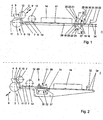
- Fig. 1 shows an apparatus which is suitable for carrying out the method, with their essential components for the invention.
- the device has a strand former 1.
- the strand former 1 consists essentially of two smooth rollers 2 and 3, which is preceded by a funnel 4 for receiving the mass 5 to be deformed.
- the mass is continuously fed or refilled by a device, not shown here in the hopper 5.
- the two rollers 2 and 3 together form an outlet gap 6, with the aid of which the mass 5 is drawn from the hopper 4 and deformed in the predetermined cross section, so that here a strand 7 is formed on a downstream of the strand former 1 driven conveyor belt. 8 is filed.
- an adjusting device is provided with the aid of which the gap width between the rollers 2 and 3 in the direction of a double arrow 9 is variable.
- the adjusting device may be associated with one or both of the rollers 2, 3, since with respect to the gap width, only the relative displacement of the rollers 2 and 3 relative to one another is important. It is also possible, for. B. only one of the rollers 2 or 3 to pivot in order to achieve a particularly sensitive change in the width of the exit gap 6.
- At least the roller 2 is driven according to arrow 10.
- the roller 3 is driven according to arrow 11.
- the adjusting device can be assigned to the drive of the rollers 2 and / or 3 at a constant or variable width of the exit slit 6.
- the formation speed is determined or determined, with which the mass 5 passes through the exit slit 6 and thus the strand 7 is formed.
- the initial cross section of the strand 7 is determined or determined.
- this drive speed of the rollers 2 and 3 and thus the formation speed is consistent with the drive speed of the conveyor belt 8.
- the formation of the cross section of the strand 7 in the region of the strand former 1 in conjunction with the conveyor belt 8 is thus influenced.
- the formation speed in the region of the strand former 1 does not necessarily have to match the drive speed of the conveyor belt 8. Again, differences between these two speeds depending on the nature of the mass may be useful or even necessary to place a uniform strand 7 with the provided, slightly stretched or compressed cross-section on the conveyor belt 8.
- the emerging from the exit slit 6 strand 7 will have a slightly greater height than corresponds to the desired product height.
- a driven calibrating roller 12 is usually used, which is employed in relation to the conveyor belt 8 supported in this area.
- the calibration roller 12 is driven in accordance with arrow 13 and serves to equalize the height of the strand 7.
- the mass 5 of the strand 7 also has compressible components, so that a certain compression of the strand 7 occurs or at least can occur due to the action of the calibrating roller 12.
- a tempering channel 14 can furthermore be provided, with the aid of which the strand 7 is tempered during the passage, ie cooled or heated.
- the arrangement point of the tempering channel 14 can also take place before the calibrating roller 12. It depends on the type and properties of the mass 5 or of the strand 7.
- the conveyor belt 8 is guided around deflection rollers 15 and 16 and is driven according to arrow 17, so that the resting on the surface of the conveyor belt 8 strand 7 is also conveyed away according to arrow 17.
- a further conveyor belt 18 is provided.
- the beginning of the conveyor belt 18 is guided around the deflection roller 19.
- the conveyor belt 18 is driven in the same direction as the conveyor belt 8.
- the drive speed of the conveyor belts 8 and 18 can be the same, but also selected or set differently.
- an interruption point 20 is formed between the end of the conveyor belt 8 and the beginning of the conveyor belt 18.
- the length of the point of interruption in the conveying direction according to arrow 17 is determined here by the distance between the deflection rollers 16 and 19.
- the strand 7 is conveyed freely suspended.
- two embossing units 21 and 22 are provided, the task of which is to act on the shaping of the surface of the strand 7. It is about the strand 7 at this point already subdivide in the longitudinal direction, so to design and transform individual product strands with respect to their cross-section.
- an embossing roller 23 is provided as embossing unit 21.
- the embossing unit 22 is formed by an embossing roller 24.
- the embossing roller 23 is driven about its axis 25 in the direction of the arrow 26. Accordingly, the embossing roller 24 is driven about its axis 27 in the direction of the arrow 28.
- the surface speed of the embossing rollers 23 and 24 is usually the same and also equal to the conveying speed of the strand 7 on the conveyor belt 8 is selected. In exceptional cases and in coordination with the properties of the mass 5 of the strand 7 but also different speeds can be useful.
- the embossing rollers 23 and 24 may be provided adjustable in their relative distance. The setting may be such that they touch one another or do not touch one another.
- the arrangement of the embossing rolls 23 and 24 preferably takes place in such a way that the strand 7 which is freely conveyed at the point of interruption 20 is deflected as little as possible out of the plane 29 in the middle of the height of the strand 7. It is understood that the plane 29 is provided horizontally aligned.
- the axes 25 and 27 of the two embossing rollers 23 and 24 are located in planes which are provided parallel to the plane 29 and in particular equidistant from this. But other arrangements are conceivable in which the axes 25 and 27 are arranged in any case in the vertical plane perpendicular to the conveying direction according to arrow 17. The arrangement depends in some cases on the cross-sectional profile of the products to be produced.
- a slitter 30 is provided in many cases, by means of which the contiguous, extending over the working width strand 7 is divided into individual product strands 31. This is the case in particular when the embossing rollers 23 and 24 do not perform a slitting function.
- the slitter 30 can also be arranged in front of the point of interruption and thus in front of the embossing rolls 23 and 24, and even before the tempering channel 14. In such cases, the individual product strands 31 are brought side by side over the working width in each case a small distance from each other and then formed by the embossing units 21, 22 circumferentially.
- a schematically illustrated cross cutter 32 is provided, which is driven according to double arrow 33 relative to the surface of the conveyor belt 18 and thereby dividing the product strands 31 into individual products 34. As a rule, this results in a plurality of row by row adjacent rows of products from the products 34.
- the products 34 have exactly the cross section, which has ultimately been formed by the embossing units 21, 22.
- the cross cutter 32 can work in such a way that the product strands 31 are completely severed, ie chopped. But it is also possible to dispense with a complete transection and formulate as it were only predetermined breaking points. In such cases, a downstream crushing device is then usually required.
- FIG. 2 illustrated second embodiment of an apparatus for the continuous production of a product or more products 34 is similar in many areas constructed as the embodiment of Fig. 1 , so that it can be referenced.
- a common conveyor belt 35 is provided, which is guided around a number of pulleys in the manner shown and driven according to arrow 17.
- the embossing units 21 and 22 are formed here as a drawing nozzles 36 and 37, resiliently mounted and employed against each other.
- the drawing nozzles 36 and 37 can process the entire peripheral surface of the strand 7 and thus form the overall cross section.
- the drawing nozzles 36 and 37 can also fulfill a longitudinal cutting function, so that the strand 7 at the exit from the drawing nozzles 36 and 37 is subdivided into individual juxtaposed product strands 31 and the separate arrangement of a slitter becomes dispensable.
- a cross cutter 32 is also provided here, which divides the individual product strands 31 into individual products 34.
- the inlet of the product strands 31 in the tempering channel can be set lower than the inlet of the strand 7 in the drawing nozzles 36 and 37th
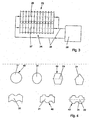
- Fig. 3 illustrates a section along the line III-III in Fig. 1 , So at the point of the two embossing rollers 23 and 24 at the point of interruption 20. It is here essentially the curved surface of the profile rollers 23 and 24 illustrates.
- the profile rollers 23 and 24 are made in contact with each other, so that these embossing units 21, 22 also perform longitudinal cutting function. It can be seen that the entire circumferential cross section of the strand or of the product strands that form is machined or shaped.
- the two embossing rollers 23 and 24 may be connected to a device 38 for tempering the embossing rollers 23 and 24.
- a circuit of corresponding line sections 39 is indicated schematically.
- Fig . 4 are possible cross sections 40 of product strands 31 shown, which are controllable by the method according to the invention and with the devices shown. It can be seen a circular cross-section, an ellipse-like cross-section, a hexagonal or pentagonal cross-section and wavy and indented cross-sections 40 in a symmetrical arrangement to the plane 29. But also designs over the width of constant thickness in corrugated shape are possible.
Landscapes
- Life Sciences & Earth Sciences (AREA)
- Engineering & Computer Science (AREA)
- Food Science & Technology (AREA)
- Chemical & Material Sciences (AREA)
- Polymers & Plastics (AREA)
- Confectionery (AREA)
- Manufacturing And Processing Devices For Dough (AREA)
Claims (10)
- Procédé de fabrication continue d'un produit à partir d'une masse comestible, en particulier une masse de confiserie, dans lequel:un brin (7) ayant une section définie est d'abord formé à partir de la masse (5),le brin (7) ainsi formé est ensuite déposé sur une bande transporteuse (8, 35) et éloigné au moyen de cette bande transporteuse (8, 35),le brin (7) est transporté au travers d'une zone d'interruption (20) de la bande transporteuse (8, 18; 35) et il est façonné dans la zone d'interruption (20) de manière à modifier sa forme depuis deux côtés, et ce faisant, non seulement sur sa surface, mais aussi au niveau du fond, etle brin (7) est finalement découpé au moins de façon transversale en produits individuels (34).
- Procédé selon la revendication 1, caractérisé en ce qu'avec le façonnage effectué sur les deux côtés, le périmètre complet de la section (40) des produits (34) est mis en forme.
- Procédé selon la revendication 1, caractérisé en ce qu'avec le façonnage effectué sur les deux côtés, une partie seulement du périmètre de la section (40) des produits (34) est mise en forme et le reste de la mise en forme est effectué par le biais d'une découpe longitudinale.
- Procédé selon au moins l'une des revendications 1 à 3, caractérisé en ce que le façonnage est effectué par le biais de cylindres.
- Dispositif de fabrication continue d'un produit à partir d'une masse comestible, en particulier une masse de confiserie, comprenant:un moyen de formation de brin (1) déterminant la section de la masse (5),une bande transporteuse entraînée (8) destinée au dépôt et à l'éloignement du brin (7) formé par le moyen de formation de brin (1) et au moyen un moyen de découpe transversale (32) destiné à la division du brin (7) en produits individuels (34), en particulier selon au moins l'une des revendications 1 à 4, caractérisé en ce que:dans la zone de la bande transporteuse (8, 18; 35), une zone d'interruption (20) est réalisée, et à cet endroit, deux unités de façonnage se complétant mutuellement (21, 22) destinées à modifier la forme de la section du brin (7) non seulement sur sa surface, mais aussi au niveau du fond, sont prévues.
- Dispositif selon la revendication 5, caractérisé en ce que comme unités de façonnage (21, 22), il est prévu des cylindres de façonnage entraînés en rotation (23, 24), dont les surfaces sont profilées.
- Dispositif selon au moins l'une des revendications 5 ou 6, caractérisé en ce que les unités de façonnage (21; 22) présentent des axes (25, 27) qui sont agencés dans des plans parallèles au plan (29) de la bande transporteuse (8, 35).
- Dispositif selon au moins l'une des revendications 5 à 7, caractérisé en ce que les unités de façonnage (21, 22) présentent des surfaces profilées de façon symétrique.
- Dispositif selon au moins l'une des revendications 5 à 8, caractérisé en ce que la distance entre les unités de façonnage (21, 22) est réglable et/ou en ce que les vitesses des surfaces des unités de façonnage (21, 22) l'une par rapport à l'autre et/ou par rapport à la vitesse de la bande transporteuse (8, 35) sont réglables.
- Dispositif selon au moins l'une des revendications 5 à 9, caractérisé en ce que les unités de façonnage (21, 22) présentent un dispositif (38) destiné à équilibrer la température de leurs surfaces.
Applications Claiming Priority (2)
| Application Number | Priority Date | Filing Date | Title |
|---|---|---|---|
| DE200410019795 DE102004019795C5 (de) | 2004-04-23 | 2004-04-23 | Verfahren und Vorrichtung zur Herstellung eines Produkts aus Süsswarenmasse |
| DE102004019795 | 2004-04-23 |
Publications (3)
| Publication Number | Publication Date |
|---|---|
| EP1588620A1 EP1588620A1 (fr) | 2005-10-26 |
| EP1588620B1 EP1588620B1 (fr) | 2007-05-16 |
| EP1588620B2 true EP1588620B2 (fr) | 2013-11-20 |
Family
ID=34935493
Family Applications (1)
| Application Number | Title | Priority Date | Filing Date |
|---|---|---|---|
| EP05008696.6A Expired - Lifetime EP1588620B2 (fr) | 2004-04-23 | 2005-04-21 | Procédé et dispositif pour la préparation d'un produit basée sur une masse de confiserie |
Country Status (3)
| Country | Link |
|---|---|
| EP (1) | EP1588620B2 (fr) |
| DE (2) | DE102004019795C5 (fr) |
| ES (1) | ES2285599T5 (fr) |
Families Citing this family (5)
| Publication number | Priority date | Publication date | Assignee | Title |
|---|---|---|---|---|
| ES2599459T3 (es) | 2012-09-26 | 2017-02-01 | Sollich Kg | Laminador para conformar una lámina uniforme de masa de confitería |
| DE102014006658A1 (de) * | 2014-05-07 | 2015-11-12 | Hosokawa Bepex Gmbh | Vorrichtung zum Bilden eines gleichförmigen Strangs einer Lebensmittelmasse |
| EP3837979B1 (fr) * | 2019-12-18 | 2023-07-12 | Radie B.V. | Dispositif de traitement de pâte |
| CN112868691A (zh) * | 2021-01-18 | 2021-06-01 | 王远清 | 一种手抓饼成型设备 |
| IT202100018062A1 (it) * | 2021-07-08 | 2023-01-08 | Perfetti Van Melle Spa | Apparato per la realizzazione di un prodotto di confetteria |
Citations (1)
| Publication number | Priority date | Publication date | Assignee | Title |
|---|---|---|---|---|
| US5516542A (en) † | 1991-03-04 | 1996-05-14 | General Mills, Inc. | Rolled food item fabricating methods |
Family Cites Families (6)
| Publication number | Priority date | Publication date | Assignee | Title |
|---|---|---|---|---|
| DE262490C (fr) * | ||||
| DE394995C (de) * | 1922-04-14 | 1924-05-13 | Fritz Gessner | Bonbonmaschine zur Formung des Zuckerstranges durch Stempel |
| DE516730C (de) * | 1929-10-08 | 1931-01-27 | Max Poenisch | Maschine zur Herstellung von Sahne- oder aehnlichen Karamellen |
| DE3004022C2 (de) * | 1980-02-05 | 1987-01-22 | Sollich Gmbh & Co Kg, 4902 Bad Salzuflen | Vorrichtung zum Unterteilen von aus einem Vorratsbehälter zulaufenden Bahnen aus verformbarer Masse in Produktstränge |
| US4468186A (en) * | 1980-05-05 | 1984-08-28 | Sollich Kg, Spezialmaschinenfabrik | Apparatus for forming strands from moldable confectionary substance |
| DE10119077C1 (de) * | 2001-04-19 | 2002-11-28 | Sollich Kg | Verfahren und Vorrichtung zum kontinuierlichen Bereitstellen von längs und quer geschnittenen Süßwarenstücken |
-
2004
- 2004-04-23 DE DE200410019795 patent/DE102004019795C5/de not_active Expired - Fee Related
-
2005
- 2005-04-21 DE DE200550000720 patent/DE502005000720D1/de not_active Expired - Lifetime
- 2005-04-21 ES ES05008696T patent/ES2285599T5/es not_active Expired - Lifetime
- 2005-04-21 EP EP05008696.6A patent/EP1588620B2/fr not_active Expired - Lifetime
Patent Citations (1)
| Publication number | Priority date | Publication date | Assignee | Title |
|---|---|---|---|---|
| US5516542A (en) † | 1991-03-04 | 1996-05-14 | General Mills, Inc. | Rolled food item fabricating methods |
Non-Patent Citations (8)
| Title |
|---|
| Fotographien des in der an die Firma Beacon Sweets ausgelieferten Formpressmaschine eingesetzten Profil-Walzgeräts † |
| Propspekt der Firma Hosokawa Bepex GmbH betreffend Universal-Formpresssysteme † |
| Prospekt der Firma Hosokawa Bepex GmbH betreffend Schnellschneidemaschinen † |
| Seite 1 der Stückliste des in der an die Firma Beacon Sweets ausgelieferten Formpressmaschine eingesetzen Profil-Walzgeräts † |
| Technische Zeichnung einer von der Firma Bepex Hutt Engineering GmbH im Jahre 1980 an die Firma Hai Tai, Korea ausgelieferten Formpressmaschine † |
| Technische Zeichnung einer von der Firma Bepex Hutt Engineering GmbH im Jahre 1984 an die Firma Beacon Sweets, Südafrika ausgelieferten Formpressmachine † |
| Technische Zeichnung eines in der an die Firma Hai Tai ausgelieferten Formpressmaschine eingesetzten Profil-Walzgeräts † |
| Technische Zeichnungen eines in der an die Firma Beacon Sweets ausgelieferten Formpressmaschine eingesetzen Profil-Walzgeräts † |
Also Published As
| Publication number | Publication date |
|---|---|
| EP1588620B1 (fr) | 2007-05-16 |
| ES2285599T5 (es) | 2014-01-08 |
| DE102004019795B3 (de) | 2006-01-05 |
| EP1588620A1 (fr) | 2005-10-26 |
| DE102004019795C5 (de) | 2011-12-22 |
| ES2285599T3 (es) | 2007-11-16 |
| DE502005000720D1 (de) | 2007-06-28 |
Similar Documents
| Publication | Publication Date | Title |
|---|---|---|
| DE69421527T2 (de) | Verfahren und Vorrichtung zur Herstellung von gefüllten Teigprodukten | |
| DE2632802A1 (de) | Verfahren und vorrichtung zur herstellung von gebaeckstuecken | |
| EP3247214B1 (fr) | Machine de traitement de pâtes, procédé de fabrication de pâtes avec une telle machine de traitement de pâtes et son utilisation et composite d'ébauche de pâtes | |
| DE68910981T2 (de) | Herstellung von Flocken. | |
| DE69706120T2 (de) | Vorrichtung zum Formen von Brotteigstücken oder dergleichen | |
| DE10338217B3 (de) | Verfahren und Vorrichtung zur Herstellung eines Produkts aus Süsswarenmasse | |
| EP2510791B1 (fr) | Dispositif de formage d'une bande de pâte à partir de portions de pâtes alimentées | |
| EP1588620B1 (fr) | Procédé et dispositif pour la préparation d'un produit basée sur une masse de confiserie | |
| EP2712506B1 (fr) | Rouleau de formage destiné à démouler un tapis régulier de masse de confiserie | |
| DE10035461B4 (de) | Verfahren und Vorrichtung zum Ausformen einer Süßwarenmasse | |
| AT507711B1 (de) | Vorrichtung zum formen von gutbällchen, insbesondere aus einer fleischmasse | |
| DE4242121A1 (de) | Verfahren und Vorrichtung zur Herstellung von Schichtgebäck | |
| EP0024716A1 (fr) | Procédé et appareil de fabrication de produits alimentaires en forme de bloc | |
| DE69028543T2 (de) | Verfahren und einrichtung zur herstellung von extrudierten speiseeisprodukten | |
| DE19917390C2 (de) | Vorrichtung zum Bearbeiten eines Teigstrangs | |
| EP0668016B1 (fr) | Appareil pour la production de morceaux de pâte pour les petits pains rustiques | |
| EP1338201A1 (fr) | Machine de traitement de pâte pour la fabrication de produits de boulangerie fourrés | |
| DE10119077C1 (de) | Verfahren und Vorrichtung zum kontinuierlichen Bereitstellen von längs und quer geschnittenen Süßwarenstücken | |
| DE2815804C3 (de) | Vorrichtung zum Ausformen von bei der Süßwarenfertigung verwendeten Massen zu Massesträngen | |
| DE3704665C2 (de) | Verfahren und Vorrichtung zur kontinuierlichen Herstellung von spiralförmigen Teigwaren | |
| DE3004022C2 (de) | Vorrichtung zum Unterteilen von aus einem Vorratsbehälter zulaufenden Bahnen aus verformbarer Masse in Produktstränge | |
| DE102004014249B4 (de) | Verfahren und Vorrichtung zum Herstellen von mit Füllung versehenen Backwaren | |
| EP4066646B1 (fr) | Dispositif de division en portions de la pâte | |
| EP1614353A1 (fr) | Dispositif pour alimenter et former une masse de confiserie plastiquement déformable | |
| EP1020116A1 (fr) | Procédé et système de fabrication de pâtons de pain |
Legal Events
| Date | Code | Title | Description |
|---|---|---|---|
| PUAI | Public reference made under article 153(3) epc to a published international application that has entered the european phase |
Free format text: ORIGINAL CODE: 0009012 |
|
| 17P | Request for examination filed |
Effective date: 20050827 |
|
| AK | Designated contracting states |
Kind code of ref document: A1 Designated state(s): AT BE BG CH CY CZ DE DK EE ES FI FR GB GR HU IE IS IT LI LT LU MC NL PL PT RO SE SI SK TR |
|
| AX | Request for extension of the european patent |
Extension state: AL BA HR LV MK YU |
|
| AKX | Designation fees paid |
Designated state(s): DE ES FR GB NL |
|
| GRAP | Despatch of communication of intention to grant a patent |
Free format text: ORIGINAL CODE: EPIDOSNIGR1 |
|
| GRAS | Grant fee paid |
Free format text: ORIGINAL CODE: EPIDOSNIGR3 |
|
| GRAA | (expected) grant |
Free format text: ORIGINAL CODE: 0009210 |
|
| AK | Designated contracting states |
Kind code of ref document: B1 Designated state(s): DE ES FR GB NL |
|
| REG | Reference to a national code |
Ref country code: GB Ref legal event code: FG4D Free format text: NOT ENGLISH |
|
| GBT | Gb: translation of ep patent filed (gb section 77(6)(a)/1977) |
Effective date: 20070516 |
|
| REF | Corresponds to: |
Ref document number: 502005000720 Country of ref document: DE Date of ref document: 20070628 Kind code of ref document: P |
|
| ET | Fr: translation filed | ||
| REG | Reference to a national code |
Ref country code: ES Ref legal event code: FG2A Ref document number: 2285599 Country of ref document: ES Kind code of ref document: T3 |
|
| PLBI | Opposition filed |
Free format text: ORIGINAL CODE: 0009260 |
|
| 26 | Opposition filed |
Opponent name: HOSOKAWA BEPEX GMBH Effective date: 20080213 |
|
| PLAX | Notice of opposition and request to file observation + time limit sent |
Free format text: ORIGINAL CODE: EPIDOSNOBS2 |
|
| PLBB | Reply of patent proprietor to notice(s) of opposition received |
Free format text: ORIGINAL CODE: EPIDOSNOBS3 |
|
| NLR1 | Nl: opposition has been filed with the epo |
Opponent name: HOSOKAWA BEPEX GMBH |
|
| RIC2 | Information provided on ipc code assigned after grant |
Ipc: A21C 3/02 20060101AFI20130111BHEP Ipc: A21C 11/12 20060101ALI20130111BHEP Ipc: A21C 3/10 20060101ALI20130111BHEP Ipc: A23G 3/12 20060101ALI20130111BHEP Ipc: A23G 3/00 20060101ALI20130111BHEP Ipc: A23G 3/06 20060101ALI20130111BHEP Ipc: A21C 11/10 20060101ALI20130111BHEP Ipc: A23G 3/02 20060101ALI20130111BHEP |
|
| PGFP | Annual fee paid to national office [announced via postgrant information from national office to epo] |
Ref country code: GB Payment date: 20130422 Year of fee payment: 9 |
|
| PGFP | Annual fee paid to national office [announced via postgrant information from national office to epo] |
Ref country code: FR Payment date: 20130523 Year of fee payment: 9 |
|
| PUAH | Patent maintained in amended form |
Free format text: ORIGINAL CODE: 0009272 |
|
| STAA | Information on the status of an ep patent application or granted ep patent |
Free format text: STATUS: PATENT MAINTAINED AS AMENDED |
|
| 27A | Patent maintained in amended form |
Effective date: 20131120 |
|
| AK | Designated contracting states |
Kind code of ref document: B2 Designated state(s): DE ES FR GB NL |
|
| REG | Reference to a national code |
Ref country code: ES Ref legal event code: DC2A Ref document number: 2285599 Country of ref document: ES Kind code of ref document: T5 Effective date: 20140108 |
|
| REG | Reference to a national code |
Ref country code: DE Ref legal event code: R102 Ref document number: 502005000720 Country of ref document: DE Effective date: 20131120 |
|
| REG | Reference to a national code |
Ref country code: NL Ref legal event code: T3 |
|
| GBPC | Gb: european patent ceased through non-payment of renewal fee |
Effective date: 20140421 |
|
| REG | Reference to a national code |
Ref country code: FR Ref legal event code: ST Effective date: 20141231 |
|
| PG25 | Lapsed in a contracting state [announced via postgrant information from national office to epo] |
Ref country code: GB Free format text: LAPSE BECAUSE OF NON-PAYMENT OF DUE FEES Effective date: 20140421 |
|
| PG25 | Lapsed in a contracting state [announced via postgrant information from national office to epo] |
Ref country code: FR Free format text: LAPSE BECAUSE OF NON-PAYMENT OF DUE FEES Effective date: 20140430 |
|
| PGFP | Annual fee paid to national office [announced via postgrant information from national office to epo] |
Ref country code: NL Payment date: 20160422 Year of fee payment: 12 |
|
| PGFP | Annual fee paid to national office [announced via postgrant information from national office to epo] |
Ref country code: ES Payment date: 20160422 Year of fee payment: 12 |
|
| REG | Reference to a national code |
Ref country code: NL Ref legal event code: MM Effective date: 20170501 |
|
| PG25 | Lapsed in a contracting state [announced via postgrant information from national office to epo] |
Ref country code: NL Free format text: LAPSE BECAUSE OF NON-PAYMENT OF DUE FEES Effective date: 20170501 |
|
| REG | Reference to a national code |
Ref country code: ES Ref legal event code: FD2A Effective date: 20180705 |
|
| PG25 | Lapsed in a contracting state [announced via postgrant information from national office to epo] |
Ref country code: ES Free format text: LAPSE BECAUSE OF NON-PAYMENT OF DUE FEES Effective date: 20170422 |
|
| PGFP | Annual fee paid to national office [announced via postgrant information from national office to epo] |
Ref country code: DE Payment date: 20220202 Year of fee payment: 18 |
|
| REG | Reference to a national code |
Ref country code: DE Ref legal event code: R119 Ref document number: 502005000720 Country of ref document: DE |
|
| PG25 | Lapsed in a contracting state [announced via postgrant information from national office to epo] |
Ref country code: DE Free format text: LAPSE BECAUSE OF NON-PAYMENT OF DUE FEES Effective date: 20231103 |