EP1580740A1 - Optisches Datenspeichermedium - Google Patents
Optisches Datenspeichermedium Download PDFInfo
- Publication number
- EP1580740A1 EP1580740A1 EP05006008A EP05006008A EP1580740A1 EP 1580740 A1 EP1580740 A1 EP 1580740A1 EP 05006008 A EP05006008 A EP 05006008A EP 05006008 A EP05006008 A EP 05006008A EP 1580740 A1 EP1580740 A1 EP 1580740A1
- Authority
- EP
- European Patent Office
- Prior art keywords
- layer
- substrate
- recording
- light transmittance
- information recording
- Prior art date
- Legal status (The legal status is an assumption and is not a legal conclusion. Google has not performed a legal analysis and makes no representation as to the accuracy of the status listed.)
- Granted
Links
- 230000003287 optical effect Effects 0.000 title claims abstract description 53
- 239000010410 layer Substances 0.000 claims abstract description 185
- 239000000758 substrate Substances 0.000 claims abstract description 77
- 238000002834 transmittance Methods 0.000 claims abstract description 53
- 239000011241 protective layer Substances 0.000 claims abstract description 45
- 238000010521 absorption reaction Methods 0.000 claims abstract description 36
- 239000000463 material Substances 0.000 claims description 24
- XLOMVQKBTHCTTD-UHFFFAOYSA-N zinc oxide Inorganic materials [Zn]=O XLOMVQKBTHCTTD-UHFFFAOYSA-N 0.000 claims description 22
- QZQVBEXLDFYHSR-UHFFFAOYSA-N gallium(III) oxide Inorganic materials O=[Ga]O[Ga]=O QZQVBEXLDFYHSR-UHFFFAOYSA-N 0.000 claims description 5
- PJXISJQVUVHSOJ-UHFFFAOYSA-N indium(III) oxide Inorganic materials [O-2].[O-2].[O-2].[In+3].[In+3] PJXISJQVUVHSOJ-UHFFFAOYSA-N 0.000 claims description 5
- 239000000975 dye Substances 0.000 description 48
- 238000002310 reflectometry Methods 0.000 description 29
- 238000004544 sputter deposition Methods 0.000 description 16
- VYPSYNLAJGMNEJ-UHFFFAOYSA-N Silicium dioxide Chemical compound O=[Si]=O VYPSYNLAJGMNEJ-UHFFFAOYSA-N 0.000 description 13
- 229910003465 moissanite Inorganic materials 0.000 description 13
- ZKATWMILCYLAPD-UHFFFAOYSA-N niobium pentoxide Chemical compound O=[Nb](=O)O[Nb](=O)=O ZKATWMILCYLAPD-UHFFFAOYSA-N 0.000 description 13
- 229910010271 silicon carbide Inorganic materials 0.000 description 13
- 229910052751 metal Inorganic materials 0.000 description 11
- 239000002184 metal Substances 0.000 description 11
- 239000000203 mixture Substances 0.000 description 10
- 230000007423 decrease Effects 0.000 description 8
- 229920005989 resin Polymers 0.000 description 8
- 239000011347 resin Substances 0.000 description 8
- XOLBLPGZBRYERU-UHFFFAOYSA-N tin dioxide Chemical compound O=[Sn]=O XOLBLPGZBRYERU-UHFFFAOYSA-N 0.000 description 7
- 229910005842 GeS2 Inorganic materials 0.000 description 5
- 238000004519 manufacturing process Methods 0.000 description 5
- 229920000515 polycarbonate Polymers 0.000 description 5
- 239000004417 polycarbonate Substances 0.000 description 5
- 239000004925 Acrylic resin Substances 0.000 description 4
- 229920000178 Acrylic resin Polymers 0.000 description 4
- GWEVSGVZZGPLCZ-UHFFFAOYSA-N Titan oxide Chemical compound O=[Ti]=O GWEVSGVZZGPLCZ-UHFFFAOYSA-N 0.000 description 4
- 239000012790 adhesive layer Substances 0.000 description 4
- 229910052782 aluminium Inorganic materials 0.000 description 4
- 230000008859 change Effects 0.000 description 4
- 229910052681 coesite Inorganic materials 0.000 description 4
- 150000001875 compounds Chemical class 0.000 description 4
- 229910052906 cristobalite Inorganic materials 0.000 description 4
- 230000000694 effects Effects 0.000 description 4
- 239000010408 film Substances 0.000 description 4
- 239000000377 silicon dioxide Substances 0.000 description 4
- 229910052682 stishovite Inorganic materials 0.000 description 4
- 229910052905 tridymite Inorganic materials 0.000 description 4
- 239000000853 adhesive Substances 0.000 description 3
- 230000004888 barrier function Effects 0.000 description 3
- 229910052804 chromium Inorganic materials 0.000 description 3
- 229910052802 copper Inorganic materials 0.000 description 3
- 150000002739 metals Chemical class 0.000 description 3
- 229910052759 nickel Inorganic materials 0.000 description 3
- 229920005668 polycarbonate resin Polymers 0.000 description 3
- 239000004431 polycarbonate resin Substances 0.000 description 3
- 229910052710 silicon Inorganic materials 0.000 description 3
- 229910052814 silicon oxide Inorganic materials 0.000 description 3
- 229910052709 silver Inorganic materials 0.000 description 3
- 238000003860 storage Methods 0.000 description 3
- 229910052725 zinc Inorganic materials 0.000 description 3
- KLZUFWVZNOTSEM-UHFFFAOYSA-K Aluminium flouride Chemical compound F[Al](F)F KLZUFWVZNOTSEM-UHFFFAOYSA-K 0.000 description 2
- 239000004593 Epoxy Substances 0.000 description 2
- -1 MgF2 Chemical compound 0.000 description 2
- 229910052779 Neodymium Inorganic materials 0.000 description 2
- 229910034327 TiC Inorganic materials 0.000 description 2
- 229910007709 ZnTe Inorganic materials 0.000 description 2
- 239000000956 alloy Substances 0.000 description 2
- 229910045601 alloy Inorganic materials 0.000 description 2
- 230000002238 attenuated effect Effects 0.000 description 2
- 239000000987 azo dye Substances 0.000 description 2
- 238000010586 diagram Methods 0.000 description 2
- 239000003822 epoxy resin Substances 0.000 description 2
- 239000011521 glass Substances 0.000 description 2
- 229910052737 gold Inorganic materials 0.000 description 2
- LNEPOXFFQSENCJ-UHFFFAOYSA-N haloperidol Chemical compound C1CC(O)(C=2C=CC(Cl)=CC=2)CCN1CCCC(=O)C1=CC=C(F)C=C1 LNEPOXFFQSENCJ-UHFFFAOYSA-N 0.000 description 2
- 239000002245 particle Substances 0.000 description 2
- 229910052697 platinum Inorganic materials 0.000 description 2
- 229920003229 poly(methyl methacrylate) Polymers 0.000 description 2
- 229920000647 polyepoxide Polymers 0.000 description 2
- 239000004645 polyester resin Substances 0.000 description 2
- 229920001225 polyester resin Polymers 0.000 description 2
- 239000004926 polymethyl methacrylate Substances 0.000 description 2
- 229920005672 polyolefin resin Polymers 0.000 description 2
- 230000009467 reduction Effects 0.000 description 2
- SBIBMFFZSBJNJF-UHFFFAOYSA-N selenium;zinc Chemical compound [Se]=[Zn] SBIBMFFZSBJNJF-UHFFFAOYSA-N 0.000 description 2
- 239000002904 solvent Substances 0.000 description 2
- 229910052959 stibnite Inorganic materials 0.000 description 2
- 239000000126 substance Substances 0.000 description 2
- 229910052715 tantalum Inorganic materials 0.000 description 2
- PBCFLUZVCVVTBY-UHFFFAOYSA-N tantalum pentoxide Inorganic materials O=[Ta](=O)O[Ta](=O)=O PBCFLUZVCVVTBY-UHFFFAOYSA-N 0.000 description 2
- ANRHNWWPFJCPAZ-UHFFFAOYSA-M thionine Chemical compound [Cl-].C1=CC(N)=CC2=[S+]C3=CC(N)=CC=C3N=C21 ANRHNWWPFJCPAZ-UHFFFAOYSA-M 0.000 description 2
- 229910052719 titanium Inorganic materials 0.000 description 2
- 229910052721 tungsten Inorganic materials 0.000 description 2
- 229910052720 vanadium Inorganic materials 0.000 description 2
- 229910052726 zirconium Inorganic materials 0.000 description 2
- NBUKAOOFKZFCGD-UHFFFAOYSA-N 2,2,3,3-tetrafluoropropan-1-ol Chemical compound OCC(F)(F)C(F)F NBUKAOOFKZFCGD-UHFFFAOYSA-N 0.000 description 1
- XURABDHWIADCPO-UHFFFAOYSA-N 4-prop-2-enylhepta-1,6-diene Chemical compound C=CCC(CC=C)CC=C XURABDHWIADCPO-UHFFFAOYSA-N 0.000 description 1
- NIXOWILDQLNWCW-UHFFFAOYSA-M Acrylate Chemical compound [O-]C(=O)C=C NIXOWILDQLNWCW-UHFFFAOYSA-M 0.000 description 1
- OKTJSMMVPCPJKN-UHFFFAOYSA-N Carbon Chemical compound [C] OKTJSMMVPCPJKN-UHFFFAOYSA-N 0.000 description 1
- 229910020187 CeF3 Inorganic materials 0.000 description 1
- JOYRKODLDBILNP-UHFFFAOYSA-N Ethyl urethane Chemical compound CCOC(N)=O JOYRKODLDBILNP-UHFFFAOYSA-N 0.000 description 1
- IAYPIBMASNFSPL-UHFFFAOYSA-N Ethylene oxide Chemical group C1CO1 IAYPIBMASNFSPL-UHFFFAOYSA-N 0.000 description 1
- 229910005543 GaSe Inorganic materials 0.000 description 1
- 229910002319 LaF3 Inorganic materials 0.000 description 1
- 229930192627 Naphthoquinone Natural products 0.000 description 1
- 229910019714 Nb2O3 Inorganic materials 0.000 description 1
- 229910052581 Si3N4 Inorganic materials 0.000 description 1
- BZHJMEDXRYGGRV-UHFFFAOYSA-N Vinyl chloride Chemical compound ClC=C BZHJMEDXRYGGRV-UHFFFAOYSA-N 0.000 description 1
- 238000000862 absorption spectrum Methods 0.000 description 1
- NIXOWILDQLNWCW-UHFFFAOYSA-N acrylic acid group Chemical group C(C=C)(=O)O NIXOWILDQLNWCW-UHFFFAOYSA-N 0.000 description 1
- 239000000654 additive Substances 0.000 description 1
- 230000001070 adhesive effect Effects 0.000 description 1
- PNEYBMLMFCGWSK-UHFFFAOYSA-N aluminium oxide Inorganic materials [O-2].[O-2].[O-2].[Al+3].[Al+3] PNEYBMLMFCGWSK-UHFFFAOYSA-N 0.000 description 1
- 239000001000 anthraquinone dye Substances 0.000 description 1
- 229910052787 antimony Inorganic materials 0.000 description 1
- 239000011230 binding agent Substances 0.000 description 1
- 230000015572 biosynthetic process Effects 0.000 description 1
- 239000000919 ceramic Substances 0.000 description 1
- 239000013522 chelant Substances 0.000 description 1
- 239000011248 coating agent Substances 0.000 description 1
- 238000000576 coating method Methods 0.000 description 1
- 229920001577 copolymer Polymers 0.000 description 1
- 230000007797 corrosion Effects 0.000 description 1
- 238000005260 corrosion Methods 0.000 description 1
- 229910052593 corundum Inorganic materials 0.000 description 1
- 239000013078 crystal Substances 0.000 description 1
- 125000004122 cyclic group Chemical group 0.000 description 1
- 230000002950 deficient Effects 0.000 description 1
- 230000006866 deterioration Effects 0.000 description 1
- 238000011156 evaluation Methods 0.000 description 1
- 150000002222 fluorine compounds Chemical class 0.000 description 1
- 229910052733 gallium Inorganic materials 0.000 description 1
- 229910052732 germanium Inorganic materials 0.000 description 1
- 229910002804 graphite Inorganic materials 0.000 description 1
- 239000010439 graphite Substances 0.000 description 1
- 229910052738 indium Inorganic materials 0.000 description 1
- 239000001013 indophenol dye Substances 0.000 description 1
- 231100001231 less toxic Toxicity 0.000 description 1
- 239000007788 liquid Substances 0.000 description 1
- 229910001635 magnesium fluoride Inorganic materials 0.000 description 1
- CPLXHLVBOLITMK-UHFFFAOYSA-N magnesium oxide Inorganic materials [Mg]=O CPLXHLVBOLITMK-UHFFFAOYSA-N 0.000 description 1
- 238000002844 melting Methods 0.000 description 1
- 230000008018 melting Effects 0.000 description 1
- 239000000434 metal complex dye Substances 0.000 description 1
- 238000000034 method Methods 0.000 description 1
- 238000002156 mixing Methods 0.000 description 1
- 150000002791 naphthoquinones Chemical class 0.000 description 1
- 229910052758 niobium Inorganic materials 0.000 description 1
- 150000004767 nitrides Chemical class 0.000 description 1
- 239000001006 nitroso dye Substances 0.000 description 1
- 239000001007 phthalocyanine dye Substances 0.000 description 1
- 239000004800 polyvinyl chloride Substances 0.000 description 1
- 229920000915 polyvinyl chloride Polymers 0.000 description 1
- WVIICGIFSIBFOG-UHFFFAOYSA-N pyrylium Chemical compound C1=CC=[O+]C=C1 WVIICGIFSIBFOG-UHFFFAOYSA-N 0.000 description 1
- 239000004065 semiconductor Substances 0.000 description 1
- 230000035945 sensitivity Effects 0.000 description 1
- 238000004904 shortening Methods 0.000 description 1
- 238000005245 sintering Methods 0.000 description 1
- 239000005361 soda-lime glass Substances 0.000 description 1
- 238000004528 spin coating Methods 0.000 description 1
- 239000003381 stabilizer Substances 0.000 description 1
- YKENVNAJIQUGKU-UHFFFAOYSA-N tetraazaporphin Chemical compound C=1C(C=N2)=NC2=NC(NN2)=NC2=CC(C=C2)=NC2=CC2=NC=1C=C2 YKENVNAJIQUGKU-UHFFFAOYSA-N 0.000 description 1
- 229920001187 thermosetting polymer Polymers 0.000 description 1
- 239000010409 thin film Substances 0.000 description 1
- 150000003568 thioethers Chemical class 0.000 description 1
- OKYDCMQQLGECPI-UHFFFAOYSA-N thiopyrylium Chemical compound C1=CC=[S+]C=C1 OKYDCMQQLGECPI-UHFFFAOYSA-N 0.000 description 1
- 229910052718 tin Inorganic materials 0.000 description 1
- 230000009466 transformation Effects 0.000 description 1
- BYMUNNMMXKDFEZ-UHFFFAOYSA-K trifluorolanthanum Chemical compound F[La](F)F BYMUNNMMXKDFEZ-UHFFFAOYSA-K 0.000 description 1
- AAAQKTZKLRYKHR-UHFFFAOYSA-N triphenylmethane Chemical compound C1=CC=CC=C1C(C=1C=CC=CC=1)C1=CC=CC=C1 AAAQKTZKLRYKHR-UHFFFAOYSA-N 0.000 description 1
- 229910001845 yogo sapphire Inorganic materials 0.000 description 1
Images


Classifications
-
- G—PHYSICS
- G11—INFORMATION STORAGE
- G11B—INFORMATION STORAGE BASED ON RELATIVE MOVEMENT BETWEEN RECORD CARRIER AND TRANSDUCER
- G11B7/00—Recording or reproducing by optical means, e.g. recording using a thermal beam of optical radiation by modifying optical properties or the physical structure, reproducing using an optical beam at lower power by sensing optical properties; Record carriers therefor
- G11B7/24—Record carriers characterised by shape, structure or physical properties, or by the selection of the material
- G11B7/241—Record carriers characterised by shape, structure or physical properties, or by the selection of the material characterised by the selection of the material
- G11B7/242—Record carriers characterised by shape, structure or physical properties, or by the selection of the material characterised by the selection of the material of recording layers
- G11B7/244—Record carriers characterised by shape, structure or physical properties, or by the selection of the material characterised by the selection of the material of recording layers comprising organic materials only
- G11B7/246—Record carriers characterised by shape, structure or physical properties, or by the selection of the material characterised by the selection of the material of recording layers comprising organic materials only containing dyes
-
- G—PHYSICS
- G11—INFORMATION STORAGE
- G11B—INFORMATION STORAGE BASED ON RELATIVE MOVEMENT BETWEEN RECORD CARRIER AND TRANSDUCER
- G11B7/00—Recording or reproducing by optical means, e.g. recording using a thermal beam of optical radiation by modifying optical properties or the physical structure, reproducing using an optical beam at lower power by sensing optical properties; Record carriers therefor
- G11B7/24—Record carriers characterised by shape, structure or physical properties, or by the selection of the material
- G11B7/241—Record carriers characterised by shape, structure or physical properties, or by the selection of the material characterised by the selection of the material
- G11B7/252—Record carriers characterised by shape, structure or physical properties, or by the selection of the material characterised by the selection of the material of layers other than recording layers
- G11B7/257—Record carriers characterised by shape, structure or physical properties, or by the selection of the material characterised by the selection of the material of layers other than recording layers of layers having properties involved in recording or reproduction, e.g. optical interference layers or sensitising layers or dielectric layers, which are protecting the recording layers
- G11B7/2578—Record carriers characterised by shape, structure or physical properties, or by the selection of the material characterised by the selection of the material of layers other than recording layers of layers having properties involved in recording or reproduction, e.g. optical interference layers or sensitising layers or dielectric layers, which are protecting the recording layers consisting essentially of inorganic materials
-
- G—PHYSICS
- G11—INFORMATION STORAGE
- G11B—INFORMATION STORAGE BASED ON RELATIVE MOVEMENT BETWEEN RECORD CARRIER AND TRANSDUCER
- G11B7/00—Recording or reproducing by optical means, e.g. recording using a thermal beam of optical radiation by modifying optical properties or the physical structure, reproducing using an optical beam at lower power by sensing optical properties; Record carriers therefor
- G11B7/24—Record carriers characterised by shape, structure or physical properties, or by the selection of the material
- G11B7/241—Record carriers characterised by shape, structure or physical properties, or by the selection of the material characterised by the selection of the material
- G11B7/252—Record carriers characterised by shape, structure or physical properties, or by the selection of the material characterised by the selection of the material of layers other than recording layers
- G11B7/257—Record carriers characterised by shape, structure or physical properties, or by the selection of the material characterised by the selection of the material of layers other than recording layers of layers having properties involved in recording or reproduction, e.g. optical interference layers or sensitising layers or dielectric layers, which are protecting the recording layers
- G11B2007/25705—Record carriers characterised by shape, structure or physical properties, or by the selection of the material characterised by the selection of the material of layers other than recording layers of layers having properties involved in recording or reproduction, e.g. optical interference layers or sensitising layers or dielectric layers, which are protecting the recording layers consisting essentially of inorganic materials
- G11B2007/25706—Record carriers characterised by shape, structure or physical properties, or by the selection of the material characterised by the selection of the material of layers other than recording layers of layers having properties involved in recording or reproduction, e.g. optical interference layers or sensitising layers or dielectric layers, which are protecting the recording layers consisting essentially of inorganic materials containing transition metal elements (Zn, Fe, Co, Ni, Pt)
-
- G—PHYSICS
- G11—INFORMATION STORAGE
- G11B—INFORMATION STORAGE BASED ON RELATIVE MOVEMENT BETWEEN RECORD CARRIER AND TRANSDUCER
- G11B7/00—Recording or reproducing by optical means, e.g. recording using a thermal beam of optical radiation by modifying optical properties or the physical structure, reproducing using an optical beam at lower power by sensing optical properties; Record carriers therefor
- G11B7/24—Record carriers characterised by shape, structure or physical properties, or by the selection of the material
- G11B7/241—Record carriers characterised by shape, structure or physical properties, or by the selection of the material characterised by the selection of the material
- G11B7/252—Record carriers characterised by shape, structure or physical properties, or by the selection of the material characterised by the selection of the material of layers other than recording layers
- G11B7/257—Record carriers characterised by shape, structure or physical properties, or by the selection of the material characterised by the selection of the material of layers other than recording layers of layers having properties involved in recording or reproduction, e.g. optical interference layers or sensitising layers or dielectric layers, which are protecting the recording layers
- G11B2007/25705—Record carriers characterised by shape, structure or physical properties, or by the selection of the material characterised by the selection of the material of layers other than recording layers of layers having properties involved in recording or reproduction, e.g. optical interference layers or sensitising layers or dielectric layers, which are protecting the recording layers consisting essentially of inorganic materials
- G11B2007/25708—Record carriers characterised by shape, structure or physical properties, or by the selection of the material characterised by the selection of the material of layers other than recording layers of layers having properties involved in recording or reproduction, e.g. optical interference layers or sensitising layers or dielectric layers, which are protecting the recording layers consisting essentially of inorganic materials containing group 13 elements (B, Al, Ga)
-
- G—PHYSICS
- G11—INFORMATION STORAGE
- G11B—INFORMATION STORAGE BASED ON RELATIVE MOVEMENT BETWEEN RECORD CARRIER AND TRANSDUCER
- G11B7/00—Recording or reproducing by optical means, e.g. recording using a thermal beam of optical radiation by modifying optical properties or the physical structure, reproducing using an optical beam at lower power by sensing optical properties; Record carriers therefor
- G11B7/24—Record carriers characterised by shape, structure or physical properties, or by the selection of the material
- G11B7/241—Record carriers characterised by shape, structure or physical properties, or by the selection of the material characterised by the selection of the material
- G11B7/252—Record carriers characterised by shape, structure or physical properties, or by the selection of the material characterised by the selection of the material of layers other than recording layers
- G11B7/257—Record carriers characterised by shape, structure or physical properties, or by the selection of the material characterised by the selection of the material of layers other than recording layers of layers having properties involved in recording or reproduction, e.g. optical interference layers or sensitising layers or dielectric layers, which are protecting the recording layers
- G11B2007/25705—Record carriers characterised by shape, structure or physical properties, or by the selection of the material characterised by the selection of the material of layers other than recording layers of layers having properties involved in recording or reproduction, e.g. optical interference layers or sensitising layers or dielectric layers, which are protecting the recording layers consisting essentially of inorganic materials
- G11B2007/2571—Record carriers characterised by shape, structure or physical properties, or by the selection of the material characterised by the selection of the material of layers other than recording layers of layers having properties involved in recording or reproduction, e.g. optical interference layers or sensitising layers or dielectric layers, which are protecting the recording layers consisting essentially of inorganic materials containing group 14 elements except carbon (Si, Ge, Sn, Pb)
-
- G—PHYSICS
- G11—INFORMATION STORAGE
- G11B—INFORMATION STORAGE BASED ON RELATIVE MOVEMENT BETWEEN RECORD CARRIER AND TRANSDUCER
- G11B7/00—Recording or reproducing by optical means, e.g. recording using a thermal beam of optical radiation by modifying optical properties or the physical structure, reproducing using an optical beam at lower power by sensing optical properties; Record carriers therefor
- G11B7/24—Record carriers characterised by shape, structure or physical properties, or by the selection of the material
- G11B7/241—Record carriers characterised by shape, structure or physical properties, or by the selection of the material characterised by the selection of the material
- G11B7/252—Record carriers characterised by shape, structure or physical properties, or by the selection of the material characterised by the selection of the material of layers other than recording layers
- G11B7/257—Record carriers characterised by shape, structure or physical properties, or by the selection of the material characterised by the selection of the material of layers other than recording layers of layers having properties involved in recording or reproduction, e.g. optical interference layers or sensitising layers or dielectric layers, which are protecting the recording layers
- G11B2007/25705—Record carriers characterised by shape, structure or physical properties, or by the selection of the material characterised by the selection of the material of layers other than recording layers of layers having properties involved in recording or reproduction, e.g. optical interference layers or sensitising layers or dielectric layers, which are protecting the recording layers consisting essentially of inorganic materials
- G11B2007/25711—Record carriers characterised by shape, structure or physical properties, or by the selection of the material characterised by the selection of the material of layers other than recording layers of layers having properties involved in recording or reproduction, e.g. optical interference layers or sensitising layers or dielectric layers, which are protecting the recording layers consisting essentially of inorganic materials containing carbon
-
- G—PHYSICS
- G11—INFORMATION STORAGE
- G11B—INFORMATION STORAGE BASED ON RELATIVE MOVEMENT BETWEEN RECORD CARRIER AND TRANSDUCER
- G11B7/00—Recording or reproducing by optical means, e.g. recording using a thermal beam of optical radiation by modifying optical properties or the physical structure, reproducing using an optical beam at lower power by sensing optical properties; Record carriers therefor
- G11B7/24—Record carriers characterised by shape, structure or physical properties, or by the selection of the material
- G11B7/241—Record carriers characterised by shape, structure or physical properties, or by the selection of the material characterised by the selection of the material
- G11B7/252—Record carriers characterised by shape, structure or physical properties, or by the selection of the material characterised by the selection of the material of layers other than recording layers
- G11B7/257—Record carriers characterised by shape, structure or physical properties, or by the selection of the material characterised by the selection of the material of layers other than recording layers of layers having properties involved in recording or reproduction, e.g. optical interference layers or sensitising layers or dielectric layers, which are protecting the recording layers
- G11B2007/25705—Record carriers characterised by shape, structure or physical properties, or by the selection of the material characterised by the selection of the material of layers other than recording layers of layers having properties involved in recording or reproduction, e.g. optical interference layers or sensitising layers or dielectric layers, which are protecting the recording layers consisting essentially of inorganic materials
- G11B2007/25713—Record carriers characterised by shape, structure or physical properties, or by the selection of the material characterised by the selection of the material of layers other than recording layers of layers having properties involved in recording or reproduction, e.g. optical interference layers or sensitising layers or dielectric layers, which are protecting the recording layers consisting essentially of inorganic materials containing nitrogen
-
- G—PHYSICS
- G11—INFORMATION STORAGE
- G11B—INFORMATION STORAGE BASED ON RELATIVE MOVEMENT BETWEEN RECORD CARRIER AND TRANSDUCER
- G11B7/00—Recording or reproducing by optical means, e.g. recording using a thermal beam of optical radiation by modifying optical properties or the physical structure, reproducing using an optical beam at lower power by sensing optical properties; Record carriers therefor
- G11B7/24—Record carriers characterised by shape, structure or physical properties, or by the selection of the material
- G11B7/241—Record carriers characterised by shape, structure or physical properties, or by the selection of the material characterised by the selection of the material
- G11B7/252—Record carriers characterised by shape, structure or physical properties, or by the selection of the material characterised by the selection of the material of layers other than recording layers
- G11B7/257—Record carriers characterised by shape, structure or physical properties, or by the selection of the material characterised by the selection of the material of layers other than recording layers of layers having properties involved in recording or reproduction, e.g. optical interference layers or sensitising layers or dielectric layers, which are protecting the recording layers
- G11B2007/25705—Record carriers characterised by shape, structure or physical properties, or by the selection of the material characterised by the selection of the material of layers other than recording layers of layers having properties involved in recording or reproduction, e.g. optical interference layers or sensitising layers or dielectric layers, which are protecting the recording layers consisting essentially of inorganic materials
- G11B2007/25715—Record carriers characterised by shape, structure or physical properties, or by the selection of the material characterised by the selection of the material of layers other than recording layers of layers having properties involved in recording or reproduction, e.g. optical interference layers or sensitising layers or dielectric layers, which are protecting the recording layers consisting essentially of inorganic materials containing oxygen
-
- G—PHYSICS
- G11—INFORMATION STORAGE
- G11B—INFORMATION STORAGE BASED ON RELATIVE MOVEMENT BETWEEN RECORD CARRIER AND TRANSDUCER
- G11B7/00—Recording or reproducing by optical means, e.g. recording using a thermal beam of optical radiation by modifying optical properties or the physical structure, reproducing using an optical beam at lower power by sensing optical properties; Record carriers therefor
- G11B7/24—Record carriers characterised by shape, structure or physical properties, or by the selection of the material
- G11B7/241—Record carriers characterised by shape, structure or physical properties, or by the selection of the material characterised by the selection of the material
- G11B7/252—Record carriers characterised by shape, structure or physical properties, or by the selection of the material characterised by the selection of the material of layers other than recording layers
- G11B7/257—Record carriers characterised by shape, structure or physical properties, or by the selection of the material characterised by the selection of the material of layers other than recording layers of layers having properties involved in recording or reproduction, e.g. optical interference layers or sensitising layers or dielectric layers, which are protecting the recording layers
- G11B2007/25705—Record carriers characterised by shape, structure or physical properties, or by the selection of the material characterised by the selection of the material of layers other than recording layers of layers having properties involved in recording or reproduction, e.g. optical interference layers or sensitising layers or dielectric layers, which are protecting the recording layers consisting essentially of inorganic materials
- G11B2007/25716—Record carriers characterised by shape, structure or physical properties, or by the selection of the material characterised by the selection of the material of layers other than recording layers of layers having properties involved in recording or reproduction, e.g. optical interference layers or sensitising layers or dielectric layers, which are protecting the recording layers consisting essentially of inorganic materials containing sulfur
-
- G—PHYSICS
- G11—INFORMATION STORAGE
- G11B—INFORMATION STORAGE BASED ON RELATIVE MOVEMENT BETWEEN RECORD CARRIER AND TRANSDUCER
- G11B7/00—Recording or reproducing by optical means, e.g. recording using a thermal beam of optical radiation by modifying optical properties or the physical structure, reproducing using an optical beam at lower power by sensing optical properties; Record carriers therefor
- G11B7/24—Record carriers characterised by shape, structure or physical properties, or by the selection of the material
- G11B7/241—Record carriers characterised by shape, structure or physical properties, or by the selection of the material characterised by the selection of the material
- G11B7/252—Record carriers characterised by shape, structure or physical properties, or by the selection of the material characterised by the selection of the material of layers other than recording layers
- G11B7/257—Record carriers characterised by shape, structure or physical properties, or by the selection of the material characterised by the selection of the material of layers other than recording layers of layers having properties involved in recording or reproduction, e.g. optical interference layers or sensitising layers or dielectric layers, which are protecting the recording layers
- G11B2007/25705—Record carriers characterised by shape, structure or physical properties, or by the selection of the material characterised by the selection of the material of layers other than recording layers of layers having properties involved in recording or reproduction, e.g. optical interference layers or sensitising layers or dielectric layers, which are protecting the recording layers consisting essentially of inorganic materials
- G11B2007/25718—Record carriers characterised by shape, structure or physical properties, or by the selection of the material characterised by the selection of the material of layers other than recording layers of layers having properties involved in recording or reproduction, e.g. optical interference layers or sensitising layers or dielectric layers, which are protecting the recording layers consisting essentially of inorganic materials containing halides (F, Cl, Br, l)
-
- G—PHYSICS
- G11—INFORMATION STORAGE
- G11B—INFORMATION STORAGE BASED ON RELATIVE MOVEMENT BETWEEN RECORD CARRIER AND TRANSDUCER
- G11B7/00—Recording or reproducing by optical means, e.g. recording using a thermal beam of optical radiation by modifying optical properties or the physical structure, reproducing using an optical beam at lower power by sensing optical properties; Record carriers therefor
- G11B7/24—Record carriers characterised by shape, structure or physical properties, or by the selection of the material
- G11B7/241—Record carriers characterised by shape, structure or physical properties, or by the selection of the material characterised by the selection of the material
- G11B7/242—Record carriers characterised by shape, structure or physical properties, or by the selection of the material characterised by the selection of the material of recording layers
- G11B7/244—Record carriers characterised by shape, structure or physical properties, or by the selection of the material characterised by the selection of the material of recording layers comprising organic materials only
- G11B7/246—Record carriers characterised by shape, structure or physical properties, or by the selection of the material characterised by the selection of the material of recording layers comprising organic materials only containing dyes
- G11B7/2463—Record carriers characterised by shape, structure or physical properties, or by the selection of the material characterised by the selection of the material of recording layers comprising organic materials only containing dyes azulene
-
- G—PHYSICS
- G11—INFORMATION STORAGE
- G11B—INFORMATION STORAGE BASED ON RELATIVE MOVEMENT BETWEEN RECORD CARRIER AND TRANSDUCER
- G11B7/00—Recording or reproducing by optical means, e.g. recording using a thermal beam of optical radiation by modifying optical properties or the physical structure, reproducing using an optical beam at lower power by sensing optical properties; Record carriers therefor
- G11B7/24—Record carriers characterised by shape, structure or physical properties, or by the selection of the material
- G11B7/241—Record carriers characterised by shape, structure or physical properties, or by the selection of the material characterised by the selection of the material
- G11B7/242—Record carriers characterised by shape, structure or physical properties, or by the selection of the material characterised by the selection of the material of recording layers
- G11B7/244—Record carriers characterised by shape, structure or physical properties, or by the selection of the material characterised by the selection of the material of recording layers comprising organic materials only
- G11B7/246—Record carriers characterised by shape, structure or physical properties, or by the selection of the material characterised by the selection of the material of recording layers comprising organic materials only containing dyes
- G11B7/2467—Record carriers characterised by shape, structure or physical properties, or by the selection of the material characterised by the selection of the material of recording layers comprising organic materials only containing dyes azo-dyes
-
- G—PHYSICS
- G11—INFORMATION STORAGE
- G11B—INFORMATION STORAGE BASED ON RELATIVE MOVEMENT BETWEEN RECORD CARRIER AND TRANSDUCER
- G11B7/00—Recording or reproducing by optical means, e.g. recording using a thermal beam of optical radiation by modifying optical properties or the physical structure, reproducing using an optical beam at lower power by sensing optical properties; Record carriers therefor
- G11B7/24—Record carriers characterised by shape, structure or physical properties, or by the selection of the material
- G11B7/241—Record carriers characterised by shape, structure or physical properties, or by the selection of the material characterised by the selection of the material
- G11B7/242—Record carriers characterised by shape, structure or physical properties, or by the selection of the material characterised by the selection of the material of recording layers
- G11B7/244—Record carriers characterised by shape, structure or physical properties, or by the selection of the material characterised by the selection of the material of recording layers comprising organic materials only
- G11B7/246—Record carriers characterised by shape, structure or physical properties, or by the selection of the material characterised by the selection of the material of recording layers comprising organic materials only containing dyes
- G11B7/247—Record carriers characterised by shape, structure or physical properties, or by the selection of the material characterised by the selection of the material of recording layers comprising organic materials only containing dyes methine or polymethine dyes
- G11B7/2472—Record carriers characterised by shape, structure or physical properties, or by the selection of the material characterised by the selection of the material of recording layers comprising organic materials only containing dyes methine or polymethine dyes cyanine
-
- G—PHYSICS
- G11—INFORMATION STORAGE
- G11B—INFORMATION STORAGE BASED ON RELATIVE MOVEMENT BETWEEN RECORD CARRIER AND TRANSDUCER
- G11B7/00—Recording or reproducing by optical means, e.g. recording using a thermal beam of optical radiation by modifying optical properties or the physical structure, reproducing using an optical beam at lower power by sensing optical properties; Record carriers therefor
- G11B7/24—Record carriers characterised by shape, structure or physical properties, or by the selection of the material
- G11B7/241—Record carriers characterised by shape, structure or physical properties, or by the selection of the material characterised by the selection of the material
- G11B7/242—Record carriers characterised by shape, structure or physical properties, or by the selection of the material characterised by the selection of the material of recording layers
- G11B7/244—Record carriers characterised by shape, structure or physical properties, or by the selection of the material characterised by the selection of the material of recording layers comprising organic materials only
- G11B7/246—Record carriers characterised by shape, structure or physical properties, or by the selection of the material characterised by the selection of the material of recording layers comprising organic materials only containing dyes
- G11B7/248—Record carriers characterised by shape, structure or physical properties, or by the selection of the material characterised by the selection of the material of recording layers comprising organic materials only containing dyes porphines; azaporphines, e.g. phthalocyanines
-
- G—PHYSICS
- G11—INFORMATION STORAGE
- G11B—INFORMATION STORAGE BASED ON RELATIVE MOVEMENT BETWEEN RECORD CARRIER AND TRANSDUCER
- G11B7/00—Recording or reproducing by optical means, e.g. recording using a thermal beam of optical radiation by modifying optical properties or the physical structure, reproducing using an optical beam at lower power by sensing optical properties; Record carriers therefor
- G11B7/24—Record carriers characterised by shape, structure or physical properties, or by the selection of the material
- G11B7/241—Record carriers characterised by shape, structure or physical properties, or by the selection of the material characterised by the selection of the material
- G11B7/242—Record carriers characterised by shape, structure or physical properties, or by the selection of the material characterised by the selection of the material of recording layers
- G11B7/244—Record carriers characterised by shape, structure or physical properties, or by the selection of the material characterised by the selection of the material of recording layers comprising organic materials only
- G11B7/249—Record carriers characterised by shape, structure or physical properties, or by the selection of the material characterised by the selection of the material of recording layers comprising organic materials only containing organometallic compounds
-
- G—PHYSICS
- G11—INFORMATION STORAGE
- G11B—INFORMATION STORAGE BASED ON RELATIVE MOVEMENT BETWEEN RECORD CARRIER AND TRANSDUCER
- G11B7/00—Recording or reproducing by optical means, e.g. recording using a thermal beam of optical radiation by modifying optical properties or the physical structure, reproducing using an optical beam at lower power by sensing optical properties; Record carriers therefor
- G11B7/24—Record carriers characterised by shape, structure or physical properties, or by the selection of the material
- G11B7/241—Record carriers characterised by shape, structure or physical properties, or by the selection of the material characterised by the selection of the material
- G11B7/252—Record carriers characterised by shape, structure or physical properties, or by the selection of the material characterised by the selection of the material of layers other than recording layers
- G11B7/253—Record carriers characterised by shape, structure or physical properties, or by the selection of the material characterised by the selection of the material of layers other than recording layers of substrates
- G11B7/2531—Record carriers characterised by shape, structure or physical properties, or by the selection of the material characterised by the selection of the material of layers other than recording layers of substrates comprising glass
-
- G—PHYSICS
- G11—INFORMATION STORAGE
- G11B—INFORMATION STORAGE BASED ON RELATIVE MOVEMENT BETWEEN RECORD CARRIER AND TRANSDUCER
- G11B7/00—Recording or reproducing by optical means, e.g. recording using a thermal beam of optical radiation by modifying optical properties or the physical structure, reproducing using an optical beam at lower power by sensing optical properties; Record carriers therefor
- G11B7/24—Record carriers characterised by shape, structure or physical properties, or by the selection of the material
- G11B7/241—Record carriers characterised by shape, structure or physical properties, or by the selection of the material characterised by the selection of the material
- G11B7/252—Record carriers characterised by shape, structure or physical properties, or by the selection of the material characterised by the selection of the material of layers other than recording layers
- G11B7/253—Record carriers characterised by shape, structure or physical properties, or by the selection of the material characterised by the selection of the material of layers other than recording layers of substrates
- G11B7/2533—Record carriers characterised by shape, structure or physical properties, or by the selection of the material characterised by the selection of the material of layers other than recording layers of substrates comprising resins
-
- G—PHYSICS
- G11—INFORMATION STORAGE
- G11B—INFORMATION STORAGE BASED ON RELATIVE MOVEMENT BETWEEN RECORD CARRIER AND TRANSDUCER
- G11B7/00—Recording or reproducing by optical means, e.g. recording using a thermal beam of optical radiation by modifying optical properties or the physical structure, reproducing using an optical beam at lower power by sensing optical properties; Record carriers therefor
- G11B7/24—Record carriers characterised by shape, structure or physical properties, or by the selection of the material
- G11B7/241—Record carriers characterised by shape, structure or physical properties, or by the selection of the material characterised by the selection of the material
- G11B7/252—Record carriers characterised by shape, structure or physical properties, or by the selection of the material characterised by the selection of the material of layers other than recording layers
- G11B7/253—Record carriers characterised by shape, structure or physical properties, or by the selection of the material characterised by the selection of the material of layers other than recording layers of substrates
- G11B7/2533—Record carriers characterised by shape, structure or physical properties, or by the selection of the material characterised by the selection of the material of layers other than recording layers of substrates comprising resins
- G11B7/2534—Record carriers characterised by shape, structure or physical properties, or by the selection of the material characterised by the selection of the material of layers other than recording layers of substrates comprising resins polycarbonates [PC]
-
- G—PHYSICS
- G11—INFORMATION STORAGE
- G11B—INFORMATION STORAGE BASED ON RELATIVE MOVEMENT BETWEEN RECORD CARRIER AND TRANSDUCER
- G11B7/00—Recording or reproducing by optical means, e.g. recording using a thermal beam of optical radiation by modifying optical properties or the physical structure, reproducing using an optical beam at lower power by sensing optical properties; Record carriers therefor
- G11B7/24—Record carriers characterised by shape, structure or physical properties, or by the selection of the material
- G11B7/241—Record carriers characterised by shape, structure or physical properties, or by the selection of the material characterised by the selection of the material
- G11B7/252—Record carriers characterised by shape, structure or physical properties, or by the selection of the material characterised by the selection of the material of layers other than recording layers
- G11B7/253—Record carriers characterised by shape, structure or physical properties, or by the selection of the material characterised by the selection of the material of layers other than recording layers of substrates
- G11B7/2533—Record carriers characterised by shape, structure or physical properties, or by the selection of the material characterised by the selection of the material of layers other than recording layers of substrates comprising resins
- G11B7/2535—Record carriers characterised by shape, structure or physical properties, or by the selection of the material characterised by the selection of the material of layers other than recording layers of substrates comprising resins polyesters, e.g. PET, PETG or PEN
-
- G—PHYSICS
- G11—INFORMATION STORAGE
- G11B—INFORMATION STORAGE BASED ON RELATIVE MOVEMENT BETWEEN RECORD CARRIER AND TRANSDUCER
- G11B7/00—Recording or reproducing by optical means, e.g. recording using a thermal beam of optical radiation by modifying optical properties or the physical structure, reproducing using an optical beam at lower power by sensing optical properties; Record carriers therefor
- G11B7/24—Record carriers characterised by shape, structure or physical properties, or by the selection of the material
- G11B7/241—Record carriers characterised by shape, structure or physical properties, or by the selection of the material characterised by the selection of the material
- G11B7/252—Record carriers characterised by shape, structure or physical properties, or by the selection of the material characterised by the selection of the material of layers other than recording layers
- G11B7/258—Record carriers characterised by shape, structure or physical properties, or by the selection of the material characterised by the selection of the material of layers other than recording layers of reflective layers
- G11B7/259—Record carriers characterised by shape, structure or physical properties, or by the selection of the material characterised by the selection of the material of layers other than recording layers of reflective layers based on silver
-
- Y—GENERAL TAGGING OF NEW TECHNOLOGICAL DEVELOPMENTS; GENERAL TAGGING OF CROSS-SECTIONAL TECHNOLOGIES SPANNING OVER SEVERAL SECTIONS OF THE IPC; TECHNICAL SUBJECTS COVERED BY FORMER USPC CROSS-REFERENCE ART COLLECTIONS [XRACs] AND DIGESTS
- Y10—TECHNICAL SUBJECTS COVERED BY FORMER USPC
- Y10T—TECHNICAL SUBJECTS COVERED BY FORMER US CLASSIFICATION
- Y10T428/00—Stock material or miscellaneous articles
- Y10T428/21—Circular sheet or circular blank
Definitions
- the present invention relates to an information recording medium in which information is recorded and played back with irradiation of a laser beam and more particularly to a double-layer Digital Versatile Disc (DVD) having two write-once information recording layers.
- DVD Digital Versatile Disc
- DVD Digital Versatile Discs
- DVD+RWs DVD+Rs, DVD-Rs, DVD-RWs and DVD-RAMs
- CD-Rs and CD-RWs conventional recordable compact discs
- the recording density (track pitch and signal mark length) and the thickness of the substrate of DVD+Rs and DVD+RWs are changed to DVDs from CDs .
- a dye is spin-coated onto a substrate to provide an optical information recording layer; further, a metal reflective layer is provided to the backside of the optical information recording layer to form an information recording substrate; and furthermore, another similar information recording substrate is attached to the information recording substrate with an adhesive material.
- a dye material is used to form the optical information recording layer.
- CD-Rs are characteristic in having a high reflectivity (i.e., 65 %) complying with the specification of CDs. To obtain such a high reflectivity for the structure mentioned above, it is required that the optical information recording (absorbing) layer satisfies a predetermined complex refractive index for its recording wavelength and/or playback wavelength. The optical absorption characteristics of such a dye material is suitable to satisfy the requirement mentioned above. This is true in the case of DVD+Rs.
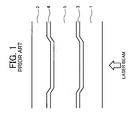
- Fig. 1 is a cross section of a DVD having such double information recording layers.
- a substrate 1 and a substrate 2 are attached to each other with a transparent intermediate layer 5 therebetween.
- the transparent intermediate layer 5 is formed of an ultraviolet curing resin.
- a semi-transmittance layer 3 functioning as a first information recording layer is provided.
- a reflection layer 4 is formed inside the substrate 2.
- the semi-transmittance layer 3 is formed of a dielectric film or a thin metal film.
- the reflective layer 4 also functions as a second information recording layer and is formed of a metal layer or the like.
- Each of the substrate 1 and the substrate 2 has a thickness of 0. 6 mm.
- the transparent intermediate layer 5 has a thickness of approximately 50 ⁇ m.
- the semi-transmittance layer 3, i.e., the first information recording layer, is formed to have a reflectivity of approximately 30 %.
- the laser beam irradiated to play back information recorded in the reflective layer 4 also functioning as the second information recording layer is reflected at the semi-transmittance layer 3 and attenuated in an amount of approximately 30 % of the entire laser beam.
- a playback laser beam is focused on the first information recording layer or the second information recording layer to play back signals therein by detecting its reflection light.
- the wavelength of the laser beam for use in recording and/or playback signals in a DVD is approximately 650 nm.
- the recordable DVDs i.e., DVD+Rs, DVD-Rs, DVD-RW, DVD+RWs, etc.
- the recordable DVDs i.e., DVD+Rs, DVD-Rs, DVD-RW, DVD+RWs, etc.
- JOP 11-66622 discloses an optical information recording medium having double information recording layers formed of an organic dye in which information can be written and read from one side.
- this medium has just a structure of two attached substrates. These attached substrates are that one has a conventional structure of a substrate on the incident side and the other has a conventional structure of a substrate on the recording layer side. Therefore, the medium does not solve the problem of optical absorption and reflection deriving from the second information recording layer mentioned above.
- JOP 10-340483 discloses an optical information recording medium containing a metal reflective layer, a dye containing recording layer and a protective layer.
- the medium can use SiO and SiO 2 in the protective layer.
- JOP 2000-311384 discloses an optical information recording medium having a second barrier layer between an intermediate layer (adhesive layer) and a second optical absorption layer.
- the literature describes only a single example in which Au is used as a material for the second barrier layer.
- the absorption index k in the complex refractive index increases. As a result, it is impossible to fulfill the purpose of the present invention.
- absorption index k of a material for use in the second barrier layer is preferably not less than 0.1
- absorption index k there is no technical idea of lowering the absorption index k to the level not greater than 0.05 like the present invention.
- an object of the present invention is to provide a one side recording and playback optical information medium having double information recording layers in which information can be recorded and played back with good signal characteristics even for the layer located at the back from the side of irradiation light.
- an optical information recording medium containing a first information substrate including a first substrate having a guide groove thereon, a first recording layer containing a dye, located overlying the first substrate and a first reflective layer being a semi-transmittance layer, located overlying the first recording layer, a second information substrate including a second substrate having a guide groove thereon, a second recording layer containing a dye, located overlying the second substrate, a second reflective layer being a semi-transmittance layer, located overlying the second recording layer, and a light transmittance protective layer located overlying the second reflective layer, and a transparent intermediate layer.
- the first information substrate and the second information substrate are attached to each other by an intermediary of the transparent intermediate layer with the first substrate and the second substrate outside. Further, the following relationships (1) and (2) are satisfied: (1) 0.3 ⁇ nd/ ⁇ ⁇ 0. 7, wherein n represents refractive index in a complex refractive index n-ik of the light transmittance protective layer, d represents a thickness of the light transmittance protective layer, and ⁇ is at least one of a recording wavelength and a playback wavelength, (2) k ⁇ 0.05, wherein k represents absorption index of the light transmittance protective layer of the complex refractive index n-ik.
- optical information recording medium satisfies the following relationship: 0.4 ⁇ nd/ ⁇ ⁇ 0.6.
- the refractive index of the light transmittance protective layer is from 1. 9 to 2. 5 and the thickness thereof is from 90 to 210 nm.
- n-iK a complex refractive index of the second recording layer
- k an absorption index thereof
- the refractive index n is from 2.2 to 2.8 and the absorption index k is from 0.03 to 0.07.
- the light transmittance protective layer contains ZnS as its main component and a transparent electroconductive oxide.
- the transparent electroconductive oxide is at least one of In 2 O 3 , ZnO and Ga 2 O 3 .
- the ratio of ZnS contained in the light transmittance protective layer based on an entire material contained therein is 50/100 to 93/100 by mol.
- the light transmittance protective layer comprises multiple layers having different refractive indices.
- Fig. 2 is a diagram illustrating an embodiment of a structure of the optical information recording medium of the present invention.
- the optical information recording medium contains a first information substrate and a second information substrate.
- the first information substrate contains a first substrate having a guide groove thereon on which at least a first recording layer formed of a dye and a first reflective layer (a semi-transmittance layer) are provided in this order.
- the second information substrate contains a second substrate having a guide groove thereon on which at least a second reflective layer, a second recording layer formed of a dye and a light transmittance protective layer are provided in this order.
- the first information substrate and the second information substrate are attached to each other with a transparent intermediate layer (adhesive layer) therebetween with the recording layers inside.
- the first information substrate has a structure containing a first substrate, a first recording layer and a first reflective layer. This is the same as the structure of a conventional medium having a single recoding layer such as DVD+R and DVD-R except that the conventional medium has a second substrate on the first information substrate.
- Reflectivity and recording signal modulation depth can be obtained through multiple interference effect at both interfaces of the first recording layer and transformation of the first substrate caused by mark formation.
- required reflectivity and recording signal modulation depth can be obtained through the form of its guide groove and optical absorption characteristics of the dye.
- the light transmittance protective layer formed of an inflexible material between the second recording layer and the transparent intermediate layer formed of organic resins, etc. it is possible to prevent the dye from flowing out due to the presence of the organic resin and to adjust the form of marks.
- the thickness of the second recording layer is 1.5 to 2.5 times as thick as that of the first recording layer.
- the difference in both thicknesses is out of this preferred range, it is difficult to record information in both layers with the same strategy (light emission pulse patterns of a recording laser beam) because recording marks spread differently on both layers.
- dye films typically an application solvent in which a dye is dissolved is spin-coated. When such a dye solvent is applied to a substrate having a guide groove, the thickness of the dye applied to a groove portion and a portion between grooves is different. In addition, the groove forms formed on the first substrate and the second substrate are different.
- a 4.7 GB DVD+R or DVD-R having a 0.74 ⁇ m pitch has a groove depth of from 100 to 200 nm and a groove width (at its bottom) of from 0.2 to 0.3 ⁇ m.
- a dye tends to be filled in the groove. Forms formed at the interface between the dye recording layer and the reflective layer are determined by the amount of the dye filled and the groove form of the substrate. Therefore, when reflection at the interface therebetween is utilized, the range mentioned above is suitable.
- the groove form of the second substrate preferably has a depth of from 20 to 60 nm and a groove width of from 0.2 to 0.4 ⁇ m.
- the range mentioned above is suitable to utilize the reflection at the interface.
- the groove depth of the first substrate and the second substrate is relatively deep in comparison to the range mentioned above, the reflectivity easily decreases.
- the groove depth is relatively shallow in comparison to the range mentioned above or the groove width is out thereof, tracking is unstable during recording and recording marks formed tend to vary so that jitter tend to increase.
- the first recording layer at the groove portions and the second recording layer at the portions between grooves preferably have a thickness of from 40 to 100 nm and from 60 to 200 ⁇ m, respectively.
- signal modulation depth (contrast) is difficult to obtain.
- the thickness of the recording layer is relatively thick in comparison with the range mentioned above, the marks formed tend to have different forms so that jitter easily increase.
- the optical information recording medium of the present invention has a structure in which a high reflectivity can be obtained by multiple interference effect at both interfaces of a recording layer containing a dye as in the case of a DVD+R and a CD-R.
- the recording layer containing a dye is necessary to have optical characteristics such that the refractive index n and the absorption index k in the complex refractive index n-ik are large and relatively small, respectively, for a recording wavelength and/or playback wavelength ⁇ (nm).
- the refractive index n is greater than 2 and preferably from 2.2 to 2.8.
- the absorption index k is from 0.02 to 0.2 and preferably from 0.03 to 0.07.
- the optical information recording medium of the present invention is for a red laser beam having a wavelength of from 600 to 800 nm and preferred writing and/or reading wavelength ⁇ is from 650 to 670 nm.
- the wavelength of a writing and/or reading laser beam is determined to be in the range mentioned above and then materials for and the thickness of each layer are selected under the conditions of the present invention.
- dye materials for use in the first and second recording layers include cyanine dyes, phthalocyanine dyes, pyrylium / thiopyrylium dyes, azulenium dyes, squarilium dyes, azo dyes, formazane chelate dyes, metal complex dyes (e.g., Ni and Cr) , naphthoquinone / anthraquinone dyes, indophenol dyes, indoaniline dyes, triphenyl methane dyes, triallyl methane dyes, aminium / diimmonium dyes and nitroso dyes.
- cyanine dyes cyanine dyes
- phthalocyanine dyes phthalocyanine dyes
- pyrylium / thiopyrylium dyes azulenium dyes
- squarilium dyes azo dyes
- formazane chelate dyes e.g., Ni and Cr
- tetraazaporphyrin dyes, cyanine dyes, azo dyes and squarilium dyes are preferred as dyes which have a maximum absorption wavelength of optical absorption spectrum of from 580 to 620 nm and which can easily obtain predetermined optical characteristics for a laser beam wavelength for DVD, i.e., approximately 650 nm.
- a recording layer can be formed of a dye alone or a combination of a dye and other components such as a binder and a stabilizer.
- any substrate for use in conventional information recording media can be used as the substrate of the present invention.
- materials for use in the substrate of the present invention include acrylic resins such as polymethylmethacrylate, vinyl chloride resins such as polyvinyl chloride resins and vinyl chloride copolymers, epoxy resins, polycarbonate resins, amorphous polyolefin resins., polyester resins and glass and ceramics such as soda lime glass.
- acrylic resins such as polymethylmethacrylate
- vinyl chloride resins such as polyvinyl chloride resins and vinyl chloride copolymers
- epoxy resins polycarbonate resins
- amorphous polyolefin resins amorphous polyolefin resins.
- polyester resins and glass and ceramics such as soda lime glass.
- polycarbonate resins are most preferred in terms of processability.
- Materials having a high reflectivity for a laser beam wavelength are preferred for the first reflective layers (semi-transmittance layer).
- Preferred specific examples of materials therefor include metals and half metals such as Au, Ag, Cu, Al, Ti, V, Cr, Ni, Nd, Mg, Pd, Zr, Pt, Ta, W, Si and Zn.
- the first reflective layer preferably has a thickness of from 5 to 30 nm.
- a recording layer containing a dye and a transparent intermediate layer formed of an acrylic resin, etc. are in contact with an extremely thin first reflective layer having a thickness of 30 nm therebetween, it is necessary to prevent the dye and the acrylic resin from moving through the reflective layer and reacting with each other.
- a reflective layer is formed of an unalloyed metal thin layer containing crystal having a large particle diameter, such a thin layer tends to be island-shaped and the acrylic resin easily infiltrates from the grain boundary.
- a light transmittance protective layer is provided between the second recording layer and the transparent intermediate layer to chemically and physically protect the recording layer containing a dye.
- materials for use in such a light transmittance protective layer include oxides such as SiO x (x is 1 or 2), In 2 O 3 , SnO 2 , ZnO, Ga 2 O 3 , Al 2 O 3 , MgO, TiO 2 , Ta 2 O 5 , half metals or semiconductors such as Si, Ge, SiC, TiC and graphite, fluorides such as MgF 2 , AlF 3 , LaF 3 and CeF 3 , sulfides such as ZnS, CdS and Sb 2 S 3 , nitrides such as Si 3 N 4 and AlN, ZnSe, GaSe, ZnTe and their combinations.
- materials containing compounds having a small internal stress such as ZnS, CdS, ZnSe, ZnTe, Sb 2 S 3 and SiO x in a large amount are preferred.
- mixtures of these compounds can be used. These materials have a high melting point. When materials do not react with each other during sintering of a target, the refractive index n and the absorption index k are almost equal to the weighted mean of their mixture ratio.
- ZnS is suitable to improve productivity and to reduce cost because ZnS is less toxic and less expensive and has a high sputtering rate.
- the mixture ratio of ZnS is preferably from 50 to 93 mol % and more preferably from 70 to 91 mol %. When the mixture ratio of ZnS is too high, a thin layer is not formed well on the second recording layer containing a dye.
- the mixture ratio of ZnS is determined to be not greater than 93 mol % and preferably not greater than 91 mol %. In addition, it is good to mix ZnS with a material having a different refractive index.
- a mixture ratio of ZnS is not preferred because one of the good characteristics of ZnS, i.e., high sputtering rate, is degraded.
- high sputtering rate When a thin layer of a mixture is formed, it is possible to sputter plural targets simultaneously. However, this is not preferred because equipment cost rises and controlling the mixing ratio is difficult. Therefore, it is advantageous in terms of productivity to manufacture a mixture of ZnS and additives before sputtering.
- the refractive index of ZnS is approximately 2.35. To decrease the refractive index, ZnS is mixed with SiO 2 . Such a mixture can be used for a target for CD-RWs, DVD-RWs and DVD+RWs currently in the market so that the quality of obtained media is stable.
- electroconductivity can be added to a target by adding a transparent electroconductive oxide such as In 2 O 3 , SnO 2 , ZnO, Ga 2 O 3 and Nb 2 O 3 or an oxide in which an element such as Al, Ga, In, Sn, Nb, Zn, Ta, F and Sb is doped to the transparent electroconductive oxide.
- a transparent electroconductive oxide such as In 2 O 3 , SnO 2 , ZnO, Ga 2 O 3 and Nb 2 O 3 or an oxide in which an element such as Al, Ga, In, Sn, Nb, Zn, Ta, F and Sb is doped to the transparent electroconductive oxide.
- a target is necessary to have a specific resistance not greater than 1 ⁇ cm, preferably not greater than 0.1 ⁇ cm to prevent a problem such as arc even when a sputtering power is high, and more preferably not greater than 0.01 ⁇ cm to unnecessitate an arc cut device or pulse overlapping device to a sputtering power source, resulting in cost reduction of production equipment.
- the addition amount is too much, the stress of a film layer increases and thus the recording layer and the light transmittance protective layer detach at their interface. Therefore, the addition amount is limited to 50 mol % at maximum.
- a first transparency protective layer which is soft and contains ZnS in a relatively large amount is provided on a dye recording layer and a second transparency protective layer which is hard and contains ZnS in a relatively small amount is provided on the first transparency protective layer to prevent deformation of the dye recording layer caused by recording. Thereby, crosstalk between adjacent tracks can be restrained.
- the layer thickness of a light transmittance protective layer is preferably from 10 to 300 nm, more preferably from 90 to 210 nm and further more preferably from 95 to 200 nm.
- materials in the transparent intermediate layer infiltrates into the second recording layer through defective portions in the light transmittance protective layer, resulting in deterioration of the dye in the recording layer.
- the layer thickness is too thick, the temperature of a substrate during sputtering greatly rises, resulting in increase of the layer stress. Therefore, the substrate tends to deform and the light transmittance protective layer easily detaches.
- the absorption index k is not zero, the reflectivity at the reflective layer decreases by absorption.
- jitter can be limited to not greater than 11 %, which is not a problematic level when information is recorded or played back by a DVD player.
- a medium can have a reflectivity not less than 15 %, a modulation depth not less than 0. 6 and a jitter not greater than 10 % so that playback compatibility thereof can be improved.
- the absorption index k can be determined to be not greater than 0. 05 so that it is possible to have a reflectivity not less than 11 %, which does not cause a practical problem.
- the absorption index k is determined to be not greater than 0.05 and nd/ ⁇ is determined to be from 0.3 to 0.7, preferably from 0.4 to 0.6 and further more preferably from 0.4 to 0.5, wherein ⁇ represents recording wavelength and/or playback wavelength for a light transmittance protective layer and wherein n and k in the complex refractive index n-ik represent refractive index and absorption index, respectively, and d represents layer thickness of the light transmittance protective layer.
- the same material as mentioned for a first reflective layer can be used for a second reflective layer.
- the thickness of a second reflective layer is approximately 120 to 160 nm.
- a transparent intermediate layer also functions as an adhesive layer.
- materials for such a transparent intermediate layer include conventional acrylate, epoxy and urethane ultraviolet curing resin or thermosetting adhesive agents.
- a transparent sheet can be used as an adhesive layer.
- the thickness of a transparent intermediate layer is from 40 to 70 ⁇ m and preferably from 50 to 60 ⁇ m.
- acrylic or epoxy ultraviolet curing resins, etc. can be inserted between a light transmittance protective layer and a transparent intermediate layer to protect the layers chemically or physically.
- Dimension of the polycarbonate substrate diameter 120 mm thickness 0.58 mm Guide groove having convexocancave patterns on the polycarbonate substrate depth 140 nm width 0.25 ⁇ m track pitch 0.74 ⁇ m
- the maximum absorption wavelength of this recording layer was 609 nm and the absorption level was 0. 6 at the maximum absorption wavelength.
- a first reflective layer having a thickness of 9 nm formed of Ag 99.5 In 0.5 was formed under the following conditions:
- a second reflective layer having a thickness of approximately 120 nm formed of Ag 98 Cu 2 was formed on a second substrate having the following dimensions using BIGSPRINTER (manufactured by Unaxis Co. Ltd.) as a sputtering device and Ar as a sputtering gas:
- Dimension of the second polycarbonate substrate diameter 120 mm thickness 0.60 mm Guide groove having convexocancave patterns on the second polycarbonate substrate depth 40 nm width 0.25 ⁇ m track pitch 0.74 ⁇ m
- a squarilium dye compound represented by the following chemical formula 1 was spin-coated on the second reflective layer to form a second recording layer having a thickness such that absorption level of the second recording layer is 1.1. Further, GeS 2 was sputtered using Ar as a sputtering gas to form a light transmittance protective layer having a thickness of 110 nm (Example 1), 130 nm (Example 2), 140 nm (Example 3) and 150 nm (Example 4).
- the first substrate and the second substrate on which the recording and reflective layers were formed were attached to each other with an ultraviolet curing adhesive agent (KARAYAD DVD576M manufactured by Nippon Kayaku Co., Ltd.) functioning as a transparent intermediate layer to obtain an optical information recording medium having a structure illustrated in Fig. 2.
- an ultraviolet curing adhesive agent KARAYAD DVD576M manufactured by Nippon Kayaku Co., Ltd.
- Optical information recording media for Examples 5 to 19 were obtained in the same manner as described in Example 1 except that materials and the thickness of the light transmittance protective layer were changed as shown in Table 1.
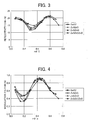
- the optical information recording media of Examples 1 to 19 were evaluated using a DVD evaluation device (DDU1000 manufactured by Pulstec Industrial Co., Ltd. ) with a wavelength of 657 nm and numerical aperture NA of 0.65 in the following way: Record DVD (8 to 16) signals with an optimal recording power Po (mW) (i.e., the recording power at which data to data clock jitter was minimum) at a linear velocity of 9.2 m/s; and Evaluate playback performance at a linear velocity of 3.8 m/s . The results are shown in Figs. 3 to 6.
- the recording pulse strategy was a multiple pulse system of (n-2)T with a multiple pulse width of 10/16.
- the jitter was not greater than 10 %, meaning that problems such as decrease in playback velocity did not occur even when a DVD-ROM drive or DVD-Video in the market was used for playback.
- Optical information recording media for Examples 20 to 26 were obtained in the same manner as described in Example 1 except that materials and the thickness of the light transmittance protective layer were changed as shown in Table 1. The recording characteristics were measured in the same manner as in Example 1. The results are shown in Table 1.
Landscapes
- Chemical & Material Sciences (AREA)
- Inorganic Chemistry (AREA)
- Optical Record Carriers And Manufacture Thereof (AREA)
- Thermal Transfer Or Thermal Recording In General (AREA)
Applications Claiming Priority (4)
| Application Number | Priority Date | Filing Date | Title |
|---|---|---|---|
| JP2004081173 | 2004-03-19 | ||
| JP2004081173 | 2004-03-19 | ||
| JP2004343159A JP2005302261A (ja) | 2004-03-19 | 2004-11-26 | 光記録媒体 |
| JP2004343159 | 2004-11-26 |
Publications (2)
| Publication Number | Publication Date |
|---|---|
| EP1580740A1 true EP1580740A1 (de) | 2005-09-28 |
| EP1580740B1 EP1580740B1 (de) | 2008-02-13 |
Family
ID=34863545
Family Applications (1)
| Application Number | Title | Priority Date | Filing Date |
|---|---|---|---|
| EP05006008A Expired - Lifetime EP1580740B1 (de) | 2004-03-19 | 2005-03-18 | Optisches Datenspeichermedium |
Country Status (6)
| Country | Link |
|---|---|
| US (2) | US7095706B2 (de) |
| EP (1) | EP1580740B1 (de) |
| JP (1) | JP2005302261A (de) |
| CN (1) | CN100345199C (de) |
| DE (1) | DE602005004686T2 (de) |
| TW (1) | TWI315519B (de) |
Cited By (1)
| Publication number | Priority date | Publication date | Assignee | Title |
|---|---|---|---|---|
| EP2012309A1 (de) * | 2007-07-04 | 2009-01-07 | Ricoh Company, Ltd. | Optisches Aufzeichnungsmedium |
Families Citing this family (7)
| Publication number | Priority date | Publication date | Assignee | Title |
|---|---|---|---|---|
| US7027382B2 (en) * | 2001-06-26 | 2006-04-11 | Ricoh Company, Ltd. | Optical recording medium having relation between reflection layer and pit lengths |
| JP4198918B2 (ja) * | 2002-02-14 | 2008-12-17 | 日鉱金属株式会社 | 硫化亜鉛を主成分とするスパッタリングターゲット及び該スパッタリングターゲットの製造方法 |
| JP4276516B2 (ja) * | 2003-10-20 | 2009-06-10 | パイオニア株式会社 | 多層光記録媒体および光ピックアップ装置 |
| CN101138035A (zh) * | 2005-03-17 | 2008-03-05 | 株式会社理光 | 光学记录介质 |
| US20090279416A1 (en) * | 2005-03-18 | 2009-11-12 | Hiroshi Kubo | Optical disc and optical recording method |
| JP4880488B2 (ja) | 2007-01-12 | 2012-02-22 | 株式会社リコー | 光記録材料および光記録媒体、並びに光記録媒体記録再生方法 |
| JP6134368B2 (ja) * | 2015-10-19 | 2017-05-24 | Jx金属株式会社 | 焼結体及び該焼結体からなるスパッタリングターゲット並びに該スパッタリングターゲットを用いて形成した薄膜 |
Citations (3)
| Publication number | Priority date | Publication date | Assignee | Title |
|---|---|---|---|---|
| JP2000311384A (ja) * | 1999-04-26 | 2000-11-07 | Fuji Photo Film Co Ltd | 光情報記録媒体 |
| EP1229528A2 (de) * | 2001-01-31 | 2002-08-07 | Pioneer Corporation | Informationsaufzeichnungsmedium |
| EP1496509A2 (de) * | 2003-07-10 | 2005-01-12 | Ricoh Company, Ltd. | Optisches Aufzeichnungsmedium und Verfahren zur dessen Herstellung |
Family Cites Families (9)
| Publication number | Priority date | Publication date | Assignee | Title |
|---|---|---|---|---|
| EP0575176B1 (de) * | 1992-06-18 | 1998-08-19 | Canon Kabushiki Kaisha | Optisches Aufzeichnungsmedium, Informationsaufzeichnungsmethode und Informationswiedergabemethode |
| JPH09282710A (ja) * | 1996-04-15 | 1997-10-31 | Sony Corp | 光ディスクおよび光学的情報記録再生装置 |
| JP2000030276A (ja) | 1998-07-09 | 2000-01-28 | Yamaha Corp | 光ディスク記録パワー制御方法及び装置 |
| JP2001319370A (ja) * | 2000-05-11 | 2001-11-16 | Nec Corp | 相変化光ディスク |
| CN1194348C (zh) * | 2000-11-30 | 2005-03-23 | 日本胜利株式会社 | 光记录媒体 |
| JP2002267222A (ja) * | 2001-03-12 | 2002-09-18 | Hitachi Plant Eng & Constr Co Ltd | 局所排気ユニット及び排気システム |
| DE60222306T2 (de) * | 2001-10-12 | 2008-01-03 | Matsushita Electric Industrial Co., Ltd., Kadoma | Verfahren zum Bestimmen einer Änderung des Durchlassgrades eines optischen Informationsaufzeichnungsmediums |
| JP2004139690A (ja) * | 2002-10-18 | 2004-05-13 | Toshiba Corp | 相変化光記録媒体 |
| US20060174256A1 (en) * | 2005-02-03 | 2006-08-03 | Tohru Yashiro | Optical recording medium, production method thereof, and, method and apparatus for recording and reproducing optical recording medium |
-
2004
- 2004-11-26 JP JP2004343159A patent/JP2005302261A/ja active Pending
-
2005
- 2005-03-15 TW TW094107897A patent/TWI315519B/zh not_active IP Right Cessation
- 2005-03-18 US US11/082,866 patent/US7095706B2/en not_active Expired - Lifetime
- 2005-03-18 DE DE602005004686T patent/DE602005004686T2/de not_active Expired - Lifetime
- 2005-03-18 EP EP05006008A patent/EP1580740B1/de not_active Expired - Lifetime
- 2005-03-18 CN CNB2005100565065A patent/CN100345199C/zh not_active Expired - Fee Related
-
2006
- 2006-04-26 US US11/410,853 patent/US7251212B2/en not_active Expired - Fee Related
Patent Citations (3)
| Publication number | Priority date | Publication date | Assignee | Title |
|---|---|---|---|---|
| JP2000311384A (ja) * | 1999-04-26 | 2000-11-07 | Fuji Photo Film Co Ltd | 光情報記録媒体 |
| EP1229528A2 (de) * | 2001-01-31 | 2002-08-07 | Pioneer Corporation | Informationsaufzeichnungsmedium |
| EP1496509A2 (de) * | 2003-07-10 | 2005-01-12 | Ricoh Company, Ltd. | Optisches Aufzeichnungsmedium und Verfahren zur dessen Herstellung |
Non-Patent Citations (1)
| Title |
|---|
| PATENT ABSTRACTS OF JAPAN vol. 2000, no. 14 5 March 2001 (2001-03-05) * |
Cited By (1)
| Publication number | Priority date | Publication date | Assignee | Title |
|---|---|---|---|---|
| EP2012309A1 (de) * | 2007-07-04 | 2009-01-07 | Ricoh Company, Ltd. | Optisches Aufzeichnungsmedium |
Also Published As
| Publication number | Publication date |
|---|---|
| DE602005004686D1 (de) | 2008-03-27 |
| US7251212B2 (en) | 2007-07-31 |
| JP2005302261A (ja) | 2005-10-27 |
| CN100345199C (zh) | 2007-10-24 |
| US20050237916A1 (en) | 2005-10-27 |
| DE602005004686T2 (de) | 2009-02-12 |
| TW200532680A (en) | 2005-10-01 |
| EP1580740B1 (de) | 2008-02-13 |
| TWI315519B (en) | 2009-10-01 |
| CN1670849A (zh) | 2005-09-21 |
| US20060204704A1 (en) | 2006-09-14 |
| US7095706B2 (en) | 2006-08-22 |
Similar Documents
| Publication | Publication Date | Title |
|---|---|---|
| JP2004213753A (ja) | 短波長対応のロー・ツー・ハイ記録極性を有する追記型光記録媒体 | |
| EP1496509A2 (de) | Optisches Aufzeichnungsmedium und Verfahren zur dessen Herstellung | |
| EP1626400A1 (de) | Optisches aufzeichnungsmedium | |
| EP2057628A1 (de) | Einmal beschreibbares, mehrmals lesbares optisches aufzeichnungsmedium und aufzeichnungsverfahren dafür | |
| US7251212B2 (en) | Optical information recording medium | |
| EP1585116B1 (de) | Gerät zur Aufzeichnung von auf Farbstoff basierenden DVD Medien und Verfahren zur Aufzeichnung | |
| US7755995B2 (en) | Recording and reproducing method for dye-based recordable DVD medium and apparatus for the same | |
| JP2005050497A (ja) | 光記録媒体 | |
| EP1650748A1 (de) | Optisches Aufzeichnungsmedium, Verfahren zu seiner Herstellung und Aufzeichnung | |
| US7727706B2 (en) | Recording method for dye-based recordable optical recording medium | |
| EP1736979A1 (de) | Optisches aufzeichnungsmedium des zweischichttyps und aufzeichnungs-/wiedergabeverfahren dafür und optische aufzeichnungs-/wiedergabeeinrichtung | |
| JP4806377B2 (ja) | 光記録媒体 | |
| US20080291816A1 (en) | Optical Recording Medium | |
| JP2008217955A (ja) | 光記録媒体及びその製造方法 | |
| KR20080095303A (ko) | 광 기록 매체 | |
| JP2007080389A (ja) | 光記録媒体 | |
| JP2002260227A (ja) | 光記録媒体 | |
| JP2006294224A (ja) | 光記録媒体 | |
| JP2005100493A (ja) | 光記録媒体とその製造方法 | |
| EP1688930A1 (de) | Auf Farbstoff basierendes DVD Medium sowie Verfahren und Vorrichtung zur Aufzeichnung und Wiedergabe davon | |
| JP2003034078A (ja) | 光記録媒体 | |
| JP2001014723A (ja) | 情報記録媒体 | |
| JP2003248926A (ja) | 光記録方法及び光記録媒体 | |
| JP2007080445A (ja) | 光記録媒体 | |
| JP2008181620A (ja) | 光記録媒体 |
Legal Events
| Date | Code | Title | Description |
|---|---|---|---|
| PUAI | Public reference made under article 153(3) epc to a published international application that has entered the european phase |
Free format text: ORIGINAL CODE: 0009012 |
|
| AK | Designated contracting states |
Kind code of ref document: A1 Designated state(s): AT BE BG CH CY CZ DE DK EE ES FI FR GB GR HU IE IS IT LI LT LU MC NL PL PT RO SE SI SK TR |
|
| AX | Request for extension of the european patent |
Extension state: AL BA HR LV MK YU |
|
| 17P | Request for examination filed |
Effective date: 20060127 |
|
| AKX | Designation fees paid |
Designated state(s): DE ES FR GB IT NL |
|
| RAP1 | Party data changed (applicant data changed or rights of an application transferred) |
Owner name: RICOH COMPANY, LTD |
|
| GRAP | Despatch of communication of intention to grant a patent |
Free format text: ORIGINAL CODE: EPIDOSNIGR1 |
|
| GRAS | Grant fee paid |
Free format text: ORIGINAL CODE: EPIDOSNIGR3 |
|
| GRAA | (expected) grant |
Free format text: ORIGINAL CODE: 0009210 |
|
| AK | Designated contracting states |
Kind code of ref document: B1 Designated state(s): DE ES FR GB IT NL |
|
| REG | Reference to a national code |
Ref country code: GB Ref legal event code: FG4D |
|
| REF | Corresponds to: |
Ref document number: 602005004686 Country of ref document: DE Date of ref document: 20080327 Kind code of ref document: P |
|
| PG25 | Lapsed in a contracting state [announced via postgrant information from national office to epo] |
Ref country code: ES Free format text: LAPSE BECAUSE OF FAILURE TO SUBMIT A TRANSLATION OF THE DESCRIPTION OR TO PAY THE FEE WITHIN THE PRESCRIBED TIME-LIMIT Effective date: 20080524 |
|
| NLV1 | Nl: lapsed or annulled due to failure to fulfill the requirements of art. 29p and 29m of the patents act | ||
| ET | Fr: translation filed | ||
| PG25 | Lapsed in a contracting state [announced via postgrant information from national office to epo] |
Ref country code: NL Free format text: LAPSE BECAUSE OF FAILURE TO SUBMIT A TRANSLATION OF THE DESCRIPTION OR TO PAY THE FEE WITHIN THE PRESCRIBED TIME-LIMIT Effective date: 20080213 |
|
| PLBE | No opposition filed within time limit |
Free format text: ORIGINAL CODE: 0009261 |
|
| STAA | Information on the status of an ep patent application or granted ep patent |
Free format text: STATUS: NO OPPOSITION FILED WITHIN TIME LIMIT |
|
| 26N | No opposition filed |
Effective date: 20081114 |
|
| PG25 | Lapsed in a contracting state [announced via postgrant information from national office to epo] |
Ref country code: IT Free format text: LAPSE BECAUSE OF FAILURE TO SUBMIT A TRANSLATION OF THE DESCRIPTION OR TO PAY THE FEE WITHIN THE PRESCRIBED TIME-LIMIT Effective date: 20080213 |
|
| REG | Reference to a national code |
Ref country code: DE Ref legal event code: R082 Ref document number: 602005004686 Country of ref document: DE Representative=s name: MEISSNER, BOLTE & PARTNER GBR, DE Ref country code: DE Ref legal event code: R082 Ref document number: 602005004686 Country of ref document: DE Representative=s name: MEISSNER BOLTE PATENTANWAELTE RECHTSANWAELTE P, DE |
|
| REG | Reference to a national code |
Ref country code: DE Ref legal event code: R082 Ref document number: 602005004686 Country of ref document: DE Representative=s name: MEISSNER, BOLTE & PARTNER GBR, DE |
|
| REG | Reference to a national code |
Ref country code: FR Ref legal event code: PLFP Year of fee payment: 12 |
|
| REG | Reference to a national code |
Ref country code: FR Ref legal event code: PLFP Year of fee payment: 13 |
|
| REG | Reference to a national code |
Ref country code: FR Ref legal event code: PLFP Year of fee payment: 14 |
|
| PGFP | Annual fee paid to national office [announced via postgrant information from national office to epo] |
Ref country code: FR Payment date: 20190322 Year of fee payment: 15 Ref country code: GB Payment date: 20190320 Year of fee payment: 15 Ref country code: DE Payment date: 20190321 Year of fee payment: 15 |
|
| REG | Reference to a national code |
Ref country code: DE Ref legal event code: R119 Ref document number: 602005004686 Country of ref document: DE |
|
| PG25 | Lapsed in a contracting state [announced via postgrant information from national office to epo] |
Ref country code: DE Free format text: LAPSE BECAUSE OF NON-PAYMENT OF DUE FEES Effective date: 20201001 Ref country code: FR Free format text: LAPSE BECAUSE OF NON-PAYMENT OF DUE FEES Effective date: 20200331 |
|
| GBPC | Gb: european patent ceased through non-payment of renewal fee |
Effective date: 20200318 |
|
| PG25 | Lapsed in a contracting state [announced via postgrant information from national office to epo] |
Ref country code: GB Free format text: LAPSE BECAUSE OF NON-PAYMENT OF DUE FEES Effective date: 20200318 |