EP1580065B1 - Fahrzeugsitz für stapelfahrzeuge - Google Patents
Fahrzeugsitz für stapelfahrzeuge Download PDFInfo
- Publication number
- EP1580065B1 EP1580065B1 EP05101976.8A EP05101976A EP1580065B1 EP 1580065 B1 EP1580065 B1 EP 1580065B1 EP 05101976 A EP05101976 A EP 05101976A EP 1580065 B1 EP1580065 B1 EP 1580065B1
- Authority
- EP
- European Patent Office
- Prior art keywords
- backrest
- vehicle seat
- seat
- plate
- frame
- Prior art date
- Legal status (The legal status is an assumption and is not a legal conclusion. Google has not performed a legal analysis and makes no representation as to the accuracy of the status listed.)
- Expired - Lifetime
Links
Images



Classifications
-
- B—PERFORMING OPERATIONS; TRANSPORTING
- B60—VEHICLES IN GENERAL
- B60N—SEATS SPECIALLY ADAPTED FOR VEHICLES; VEHICLE PASSENGER ACCOMMODATION NOT OTHERWISE PROVIDED FOR
- B60N2/00—Seats specially adapted for vehicles; Arrangement or mounting of seats in vehicles
- B60N2/02—Seats specially adapted for vehicles; Arrangement or mounting of seats in vehicles the seat or part thereof being movable, e.g. adjustable
- B60N2/04—Seats specially adapted for vehicles; Arrangement or mounting of seats in vehicles the seat or part thereof being movable, e.g. adjustable the whole seat being movable
- B60N2/06—Seats specially adapted for vehicles; Arrangement or mounting of seats in vehicles the seat or part thereof being movable, e.g. adjustable the whole seat being movable slidable
- B60N2/07—Slide construction
- B60N2/0702—Slide construction characterised by its cross-section
- B60N2/0705—Slide construction characterised by its cross-section omega-shaped
-
- B—PERFORMING OPERATIONS; TRANSPORTING
- B60—VEHICLES IN GENERAL
- B60N—SEATS SPECIALLY ADAPTED FOR VEHICLES; VEHICLE PASSENGER ACCOMMODATION NOT OTHERWISE PROVIDED FOR
- B60N2/00—Seats specially adapted for vehicles; Arrangement or mounting of seats in vehicles
- B60N2/02—Seats specially adapted for vehicles; Arrangement or mounting of seats in vehicles the seat or part thereof being movable, e.g. adjustable
- B60N2/22—Seats specially adapted for vehicles; Arrangement or mounting of seats in vehicles the seat or part thereof being movable, e.g. adjustable the back-rest being adjustable
- B60N2/2209—Seats specially adapted for vehicles; Arrangement or mounting of seats in vehicles the seat or part thereof being movable, e.g. adjustable the back-rest being adjustable by longitudinal displacement of the cushion, e.g. back-rest hinged on the bottom to the cushion and linked on the top to the vehicle frame
-
- B—PERFORMING OPERATIONS; TRANSPORTING
- B60—VEHICLES IN GENERAL
- B60N—SEATS SPECIALLY ADAPTED FOR VEHICLES; VEHICLE PASSENGER ACCOMMODATION NOT OTHERWISE PROVIDED FOR
- B60N2/00—Seats specially adapted for vehicles; Arrangement or mounting of seats in vehicles
- B60N2/80—Head-rests
- B60N2/806—Head-rests movable or adjustable
- B60N2/809—Head-rests movable or adjustable vertically slidable
- B60N2/829—Head-rests movable or adjustable vertically slidable characterised by their adjusting mechanisms, e.g. electric motors
Definitions
- the invention relates to a vehicle seat for stacking vehicles, comprising a mast with an attached up and down movable load carrying means, wherein the vehicle seat has a seat plate and a tiltable backrest, according to the preamble of claim 1.
- the viewing direction of the operator is different depending on the current height position of the load bearing means.
- the driver must look substantially horizontally while the vehicle is moving. If, on the other hand, the load carrying means for receiving or depositing a load in a high-bay rack is moved upwards, the driver has to lay his head backwards and turn his face upwards in order to be able to follow the picking or depositing procedure with the eye with sufficient accuracy.
- Such a head position of the driver is ergonomically unfavorable and thus uncomfortable for the driver.
- a stacking vehicle with a vehicle seat is known, the operator's cab is mounted together with the vehicle seat about a horizontal axis pivotally mounted in a frame of the vehicle, so that the driver's line of sight can be changed by pivoting the entire operator's cab.
- Such stacking vehicles have a complex construction, since a pivoting mechanism for pivoting such a rotary cabin and strong drive motors are required for this purpose. In addition, such a construction is costly in its production.
- Such a vehicle seat is attached directly to the stacking vehicle by means of seat attachment elements attached to the rear side of the backrest and the underside of the seat plate such that a pin directly attached to the vehicle engages in a slot-like opening which is respectively arranged in the retaining elements slit-like opening to move along the pin. In this way, the seat is displaced and inclined on a predetermined path by means of the slot-like openings.
- Such vehicle seats require additional attachment of the pins to the stacking vehicle itself and its precise alignment with the slot-like openings.
- the publication FR 2 285 260 A discloses a vehicle seat, the seat part and backrest are connected to each other via a hinge.
- the seat part is rollably mounted on a rail by means of rollers, while the backrest is displaceably mounted in the vertical direction via a guide device arranged on the backrest frame.
- the publication US 1 414 637 A shows a seat or chair, in which the inclination of the backrest is dependent on the position of the longitudinally displaceably mounted in the longitudinal direction of the seat part.
- a seat which shows a pivotable relative to a base frame seat part and a pivotally arranged thereto backrest. Furthermore, seats are shown, which are arranged directly on a vehicle wall.
- the vehicle seat for backhoe according to document DE 196 12 979 A has a seat base, which is installed in cabins. It has a rotating device for rotating the seat about the height axis and a sliding bearing device for longitudinal displacement of the seat. Again, a seat-length adjustment, which is accompanied at the same time with a change in inclination of the backrest, not disclosed.
- the US 4,890,887 A. shows a vehicle seat for stacking vehicles according to the preamble of claim 1, with a frame, a seat plate and a reclining backrest, which is mounted vertically displaceable by means of a connecting element on the frame.
- the seat plate is horizontally displaceable by means of adjustment elements connected to the frame at the same time as an inclination of the backrest. Between seat subframe and stacking vehicle slide rails are arranged.
- the shows US 4 687 250 A also a vehicle seat with seat part and backrest, which are mounted on a support frame.
- the seat part is arranged horizontally displaceable by means of an arrangement of bolt and slot simultaneously with an inclination of the backrest.
- the present invention seeks to provide a vehicle seat for stacking vehicles available that allows a change in the line of sight of the operator while maintaining a high level of comfort and its installation and removal in and out of the stacking vehicle is easy to carry out.
- a vehicle seat for stacking vehicles comprising a mast with an up and down movable load carrying means attached thereto, wherein the vehicle seat has a seat plate and a tiltable backrest, in addition a frame detachable from the stacking vehicle with a behind the backrest substantially vertically extending first portion and a below the seat plate has substantially horizontally extending second portion.
- An arranged in the upper region of the backrest connecting element is slidably mounted on the first portion along the direction of extension for tilting the backrest and the seat plate is displaceable by means connected to the second section first slide simultaneously with the tilting movement of the backrest in the horizontal direction.
- the second portion of the frame has two mutually parallel second tubular frame sections, which are slidably connected to arranged on the stacking vehicle second slide rails.
- the first slide rails are disposed on an underside of the seat plate and slidably movable on the second tube frame portions of the frame, the second tube frame portions are supported with the entire vehicle seat by a plate-like member which is formed at its left and right side edge regions such that the second slide rails, which are mounted on the stacking vehicle, are included, and wherein in the edge regions, the plate-like element rests on the second slide rails and rest outside the edge regions, the first slide rails on the plate-like formed element. Due to its own frame, whose first section is preferably designed as a U-shaped first tubular frame section, such a vehicle seat can be quickly and easily integrated into a stacking vehicle as an entire unit and removed from it.
- a synchronization of the inclination movement of the backrest with the displacement movement of the seat plate is achieved due to an interaction between the connecting element and the first portion of the frame and an interaction between the first slide rails and the second portion of the frame in a simple, repair-unfriendly and comfortable way without this additional movement of a vehicle seat part relative to the actual stacking vehicle is required.
- This allows a quick replacement of the entire vehicle seat in the presence of a non-functioning synchronization of the backrest tilt and the seat plate displacement without the stacking vehicle fails for a long time and may need to be taken to a workshop.
- the connecting element is designed as rollers rollable on or in the first tubular frame section, which are rotatably mounted on a rear side of the backrest. If the first pipe frame section has two parallel aligned substantially vertically extending pipe sections in its U-shape, a simple embodiment of the connecting element can be obtained in a simple manner by arranging a backrest left and right side roll.
- the second section of the frame has two second tubular frame sections running parallel to one another, which are slidably connected to second sliding rails arranged on the stacking vehicle.
- the second portion of the frame can further slide against the stacking vehicle to primarily set an initial shift position of the entire vehicle seat depending on the leg length and desired operating position of the serving driver.
- an initial pivotal position of the backrest relative to the seat plate by means of an actuating element, which is arranged on two sides of the vehicle seat arranged pivot connection elements for connecting the backrest to the seat plate can be adjusted.
- the synchronized backrest tilt and seat plate displacement movement then takes place with a desired change in driver's line of sight.
- the second tube frame sections are arranged on an at least partially plate-like shaped element, which is mounted with its left and right edge portion of the second slide rails.
- the first slide rails are in turn attached to an underside of the seat plate and rest on the second tube frame sections.
- the connecting element may be formed as sliding elements, such as sliding blocks, for sliding within arranged on the first portion of the frame third slide rails.
- the third slide rails have a U-shaped cross-section which includes the sliding block.
- the frame in the upper part of its first section has a neck support which can be moved up and down to support the driver's neck or a headrest to support the driver's head when the backrest tilts backwards.
- the driver can conveniently take off his neck or head with a strong Nachhinten tilt the backrest.
- the support is preferably adjustable in height in a mechanical or electrical manner according to an embodiment not claimed here, preferably by means of a control element.
- the backrest is preferably at an angle of max. 20 ° tilted backwards.
- the driver's head can be tilted by another 10 ° backwards, so that a maximum neck angle relative to the vertical of 30 ° is formed.
- an upward angle of view of the driver includes an angle of 60 °. If, in addition, the maximum angle of inclination of the backrest of 20 ° is taken into account, the driver can set a viewing angle range of max. Cover 80 ° with his eyes.
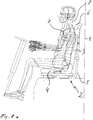
- a stacking vehicle 1 with a vehicle seat 2 arranged therein is shown in a side view.
- the vehicle seat 2 is composed of a backrest 3 and a seat plate 4 and a frame 5 and a neck support 6 together.
- Fig. 1 b is in a side view the in Fig. 1a shown vehicle seat 2 shown with inclined backrest.
- the frame 5 extends behind the backrest with a relative to the vertical slightly inclined backwards orientation to below the seat plate. 4
- the neck support 6 serves to support the neck 8 of a person operating the stacking vehicle 7.
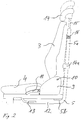
- Fig. 2 is shown in a side view of the vehicle seat in unclassified position according to an embodiment of the invention.
- the frame 5 consists of a first, substantially vertically extending section 5a, which is arranged behind the backrest 3 and a second section 5b connected to the first section 5a, the second section 5b below the seat plate 4 is oriented substantially horizontally.
- the first portion 5a is formed as a U-shaped tube such that it has two pipe sections which are aligned parallel to each other on the left and right sides with respect to the vehicle seat 2.
- the second section 5b consists of second tube-like sections, which are also aligned parallel to each other, and each having a not-shown here end-side end.
- the backrest 3 and the seat plate 4 are interconnected via pivotal connection elements 9 in such a way that the backrest 3 can pivot freely about an axis 10 extending substantially horizontally.
- an actuating lever 11 By means of an actuating lever 11, the backrest 3 can be tilted in a desired initial pivot position to obtain a high level of comfort even at normal position of the vehicle seat 2.
- the seat plate 4 can be horizontally displaced by second slide rails 12 mounted on the stacking vehicle 1 to a desired seating position of the driver 7 using the vehicle seat 2 depending on the leg length thereof in the stacking vehicle To obtain 1 arranged foot pedals.
- Such an initial displacement position of the seat plate 4 is performed by means of an operating lever 13.
- a neck support 14, which can also be designed as a headrest, is arranged on the top side on the first section 5a of the frame 5 by means of two rods 15 on the frame 5 and can preferably be adjusted in height by a path length of 170 mm.
- the height adjustment via an operating element 14 a, which is attached to the frame 5. From this operating element 14a from an electrical height adjustment or a mechanical height adjustment, for example by means of a cable frame mounted in the cable, done.
- All adjustment of the vehicle seat 2, so the longitudinal adjustment by a preferred length of 200 mm, the backrest adjustment and neck support adjustment are independently presettable.
- a roller 16 is disposed on the backrest back, which is on rails on a front side of the first portion 5a of the left and right side extending pipe sections unrolled.
- Fig. 3 is shown in a side view of the vehicle seat 2 in an inclined position according to the embodiment of the invention.
- the rollers 16 fixed to the backrest 3 roll downwards along the first section 5a of the frame and when the inclined backrest 3 is returned. This is indicated by the double arrow 17a.
- tilting of the backrest 3 takes place by pulling the lower region of the backrest 3 away by means of the seat plate 4 shifting forward and a vertical downward movement of the upper region of the backrest 3.
- the synchronous movement can be locked, initiated or terminated.
- Fig. 4 is a front view of a section of the vehicle seat 2 according to the embodiment of the invention shown.
- First slide rails 19 are on an underside of the seat plate 4 and slidably move on the second tube frame sections 5b of the frame 5.
- a plate-like formed member 20 carries the tube frame portions 5 b with the entire vehicle seat 2 and is formed at its left and right side edge portions 20 a and 20 b such that it includes the second slide rails 12 which are mounted on the stacking vehicle 1.
- the entire vehicle seat 2 including the member 20 is displaced from the left and right side second slide rails 12 by means of the operation member 13.
- Fig. 5a is a cross-sectional view taken along the line A- - -A Fig. 4 with a connecting element according to an embodiment of the invention.
- the connecting element is designed as a roller 16, which are connected by means of two sheet-like elements 16 a and 16 b with the rear wall of the backrest 3. These rollers 16 are connected via a in its side regions U-shaped wide frame 16c with the first portion 5a of the frame 5. The rollers can be moved within the U-shaped side portions of the further frame 16c with little play up and down.
- Fig. 5b is in a cross-sectional view taken along the line A- - -A Fig. 4 the connecting element according to another embodiment of the invention shown.
- the connecting element is not designed as a roller but as a sliding element 16d within the frame 16c, which is formed as a third slide rail in its side regions and is U-shaped.
- the further frame 16c is in turn connected to the first section 5a of the frame 5.
- the vehicle seat 2 can optionally also be equipped with a seat suspension in the vertical direction, a simple manual adjustment of the driver's weight, easy-to-read scales and - if desired - an automatic adjustment of the driver's weight with air suspension.
Landscapes
- Engineering & Computer Science (AREA)
- Aviation & Aerospace Engineering (AREA)
- Transportation (AREA)
- Mechanical Engineering (AREA)
- Seats For Vehicles (AREA)
- Forklifts And Lifting Vehicles (AREA)
Description
- Die Erfindung betrifft einen Fahrzeugsitz für Stapelfahrzeuge, die einen Hubmast mit einem daran angebrachten auf- und abwärtsbewegbaren Lasttragemittel umfassen, wobei der Fahrzeugsitz eine Sitzplatte und eine neigbare Rückenlehne aufweist, gemäß dem Oberbegriff des Patentanspruches 1.
- Bei Stapelfahrzeugen, insbesondere Hochregalstaplern, ist die Blickrichtung des bedienenden Fahrers in Abhängigkeit von der momentanen Höhenposition des Lasttragemittels unterschiedlich. Der Fahrer muss während eines Sich Fortbewegens des Fahrzeuges im Wesentlichen horizontal blicken. Wird hingegen das Lasttragemittel zur Aufnahme oder Ablage einer Last in einem Hochregal nach oben bewegt, muss der Fahrer seinen Kopf nach hinten legen und das Gesicht nach oben wenden, um den Aufnahme- bzw. Ablagevorgang ausreichend genau mit dem Auge verfolgen zu können. Eine derartige Kopfstellung des Fahrers ist ergonomisch ungünstig und somit für den Fahrer unbequem.
- Aus
DE 195 24 319 C2 ist ein Stapelfahrzeug mit einem Fahrzeugsitz bekannt, dessen Bedienerkabine mitsamt dem Fahrzeugsitz um eine horizontale Achse schwenkbar in einem Rahmen des Fahrzeuges gelagert ist, so dass die Blickrichtung des Fahrers durch Verschwenken der gesamten Bedienerkabine verändert werden kann. Derartige Stapelfahrzeuge weisen eine aufwändige Konstruktion auf, da eine Schwenkmechanik zum Verschwenken einer derartigen Drehkabine und starke Antriebsmotoren hierfür erforderlich sind. Zudem ist ein derartiger Aufbau kostenintensiv in seiner Herstellung. - Aus
EP 0 543 791 A1 ist ein Fahrzeugsitz für Stapelfahrzeuge bekannt, der gegenüber einem Rahmen des Stapelfahrzeuges mit seiner Sitzplatte in horizontaler Richtung verschiebbar ist. Zudem kann die Rückenlehne durch eine derartige Verschiebebewegung geneigt werden. - Ein derartiger Fahrzeugsitz ist mittels an der Rückseite der Rückenlehne und der Unterseite der Sitzplatte angebrachten Sitzhalteelementen derart an dem Stapelfahrzeug direkt angebracht, dass in eine schlitzartige Öffnung, die in den Halteelementen jeweils angeordnet ist, ein an dem Fahrzeug direkt angebrachter Zapfen jeweils eingreift, um die schlitzartige Öffnung entlang des Zapfens zu verschieben. Auf diese Weise wird der Sitz auf einer vorbestimmten Bahn mittels der schlitzartigen Öffnungen verschoben und geneigt. Derartige Fahrzeugsitze erfordern das zusätzliche Anbringen der Zapfen an dem Stapelfahrzeug selbst und deren genaue Ausrichtung gegenüber den schlitzartigen Öffnungen.
- Die Druckschrift
FR 2 285 260 A - Die Druckschrift
US 1 414 637 A zeigt einen Sitz bzw. Stuhl, bei dem die Neigung der Rückenlehne abhängig ist von der Position des in Längsrichtung des Sitzes verschiebbar gelagerten Sitzteils. - Gemäß der Druckschrift
JP 09 202167 A - Eine zusätzliche Verstellung bzw. Längsverstellung des gesamten Sitzes unabhängig von der Neigung der Rückenlehne ist allerdings bei keiner der obigen Druckschriften möglich.
- Der gemäß der Druckschrift
US 6 135 412 A gezeigte Sitz ist für Gartentraktoren geeignet und sowohl höhenverstellbar als auch hinsichtlich der Längsrichtung verschiebbar; allerdings können die Sitzkontur und insbesondere die Neigung der Rückenlehne gegenüber dem Sitzteil nicht verstellt werden. - Der Fahrzeugsitz für Löffelbagger gemäß Druckschrift
DE 196 12 979 A weist ein Sitzgrundgestell auf, welches in Kabinen einbaubar ist. Er weist eine Dreheinrichtung zur Drehung des Sitzes um die Höhenachse sowie eine Gleitlagereinrichtung zum Längsverschieben des Sitzes auf. Auch hier ist eine Sitzlängsverstellung, welche zeitgleich mit einer Neigungsänderung der Rückenlehne einhergeht, nicht offenbart. - Dies gilt auch für die
US 6 336 619 B1 , die eine Sitzplattform für landwirtschaftliche oder industrielle Fahrzeuge zeigt, welche eine in Fahrzeuglängsrichtung verschiebbare Gleiteinrichtung aufweist. - Die
US 4 890 887 A zeigt einen Fahrzeugsitz für Stapelfahrzeuge nach dem Oberbegriff des Anspruchs 1, mit einem Rahmen, einer Sitzplatte und einer neigbaren Rückenlehne, welche mittels eines Verbindungselements am Rahmen vertikal verschieblich gelagert ist. Die Sitzplatte ist mittels mit dem Rahmen verbundenen Verstellelementen zeitgleich mit einer Neigung der Rückenlehne horizontal verschiebbar. Zwischen Sitzteilrahmen und Stapelfahrzeug sind Gleitschienen angeordnet. - Ähnlich dazu zeigt die
US 4 687 250 A ebenfalls einen Fahrzeugsitz mit Sitzteil und Rückenlehne, welche an einem Stützrahmen montiert sind. Auch hier ist das Sitzteil mittels einer Anordnung aus Bolzen und Langloch zeitgleich mit einer Neigung der Rückenlehne horizontal verschiebbar angeordnet. - Demzufolge liegt der vorliegenden Erfindung die Aufgabe zugrunde, einen Fahrzeugsitz für Stapelfahrzeuge zur Verfügung zu stellen, der eine Veränderung der Blickrichtung des bedienenden Fahrers unter Beibehaltung eines hohen Sitzkomforts erlaubt und dessen Ein- und Ausbau in und aus dem Stapelfahrzeug einfach durchführbar ist.
- Diese Aufgabe wird gemäß den Merkmalen des Patentanspruches 1 gelöst.
- Kerngedanke der Erfindung ist, dass ein Fahrzeugsitz für Stapelfahrzeuge, die einen Hubmast mit einem daran angebrachten auf- und abwärtsbewegbaren Lasttragemittel umfassen, wobei der Fahrzeugsitz eine Sitzplatte und einen neigbare Rückenlehne aufweist, zusätzlich einen vom Stapelfahrzeug lösbaren Rahmen mit einem sich hinter der Rückenlehne im Wesentlichen vertikal erstreckenden ersten Abschnitt und einem sich unterhalb der Sitzplatte im Wesentlichen horizontal erstreckenden zweiten Abschnitt aufweist. Ein im oberen Bereich der Rückenlehne angeordnetes Verbindungselement ist an dem ersten Abschnitt entlang dessen Erstreckungsrichtung zum Neigen der Rückenlehne verschiebbar gelagert und die Sitzplatte ist mittels mit dem zweiten Abschnitt verbundenen ersten Gleitschienen zeitgleich mit der Neigungsbewegung der Rückenlehne in Horizontalrichtung verschiebbar. Der zweite Abschnitt des Rahmens weist zwei parallel zueinander verlaufende zweite Rohrrahmenabschnitte auf, die mit an dem Stapelfahrzeug angeordneten zweiten Gleitschienen gleitend verbunden sind. Die ersten Gleitschienen sind an einer Unterseite der Sitzplatte angeordnet und gleitend bewegbar auf den zweiten Rohrrahmenabschnitten des Rahmens, wobei die zweiten Rohrrahmenabschnitte mit dem gesamten Fahrzeugsitz von einem plattenartig ausgebildeten Element getragen sind, welches an seinen links- und rechtsseitigen Randbereichen derart ausgebildet ist, dass die zweiten Gleitschienen, welche auf dem Stapelfahrzeug befestigt sind, umfasst sind, und wobei in den Randbereichen das plattenartig ausgebildete Element auf den zweiten Gleitschienen aufliegt und außerhalb der Randbereiche die ersten Gleitschienen auf dem plattenartigen ausgebildeten Element aufliegen. Ein derartiger Fahrzeugsitz kann aufgrund des eigenen Rahmens, dessen erster Abschnitt vorzugsweise als U-förmiger erster Rohrrahmenabschnitt ausgebildet ist, als gesamte Einheit schnell und einfach in ein Stapelfahrzeug ein- und aus diesem ausgebaut werden.
- Eine Synchronisation der Neigungsbewegung der Rückenlehne mit der Verschiebungsbewegung der Sitzplatte wird aufgrund einer Wechselwirkung zwischen dem Verbindungselement und dem ersten Abschnitt des Rahmens sowie einer Wechselwirkung zwischen den ersten Gleitschienen und dem zweiten Abschnitt des Rahmens auf einfache, reparaturunanfällige und komfortable Weise erreicht, ohne dass hierfür eine zusätzliche Bewegung eines Fahrzeugsitzteiles gegenüber dem eigentlichen Stapelfahrzeug erforderlich ist. Dies ermöglicht ein schnelles Auswechseln des gesamten Fahrzeugsitzes bei Vorliegen einer nichtfunktionierenden Synchronisation der Rückenlehnenneigung und der Sitzplattenverschiebung, ohne dass hierfür das Stapelfahrzeug für längere Zeit ausfällt und gegebenenfalls in eine Werkstatt gebracht werden muss.
- Gemäß einer bevorzugten Ausführungsform ist das Verbindungselement als auf oder in dem ersten Rohrrahmenabschnitt abrollbare Rollen, die an einer Rückseite der Rückenlehne drehbar befestigt sind, ausgebildet. Sofern der erste Rohrrahmenabschnitt in seiner U-Form zwei parallel zueinander ausgerichtete sich im Wesentlichen vertikal erstreckende Rohrabschnitte aufweist, kann auf einfache Weise durch Anordnen einer rückenlehnenlinks- und -rechtsseitigen Rolle eine einfach Ausgestaltung des Verbindungselementes erhalten werden.
- Der zweite Abschnitt des Rahmens weist wie beschrieben zwei parallel zueinander verlaufende zweite Rohrrahmenabschnitte auf, die mit an dem Stapelfahrzeug angeordneten zweiten Gleitschienen gleitend verbunden sind. Somit kann der zweite Abschnitt des Rahmens zusätzlich zu einer mittels der ersten Gleitschienen durchgeführten Gleitbewegung eine weitere Gleitbewegung gegenüber dem Stapelfahrzeug durchführen, um vorrangig eine Anfangsverschiebeposition des gesamten Fahrzeugsitzes in Abhängigkeit von der Beinlänge und gewünschten Bedienungsposition des bedienenden Fahrers einzustellen.
- Ebenso kann eine Anfangsschwenkposition der Rückenlehne gegenüber der Sitzplatte mittels eines Betätigungselementes, das an zwei beidseitig des Fahrzeugsitzes angeordneten Schwenkverbindungselementen zum Verbinden der Rückenlehne mit der Sitzplatte angeordnet ist, eingestellt werden. Im Anschluss an die Einstellung derartiger Anfangsverschiebeund Anfangsschwenkpositionen findet dann bei einer gewünschten Veränderung der Blickrichtung des Fahrers die synchronisierte Rückenlehnenneigungs- und Sitzplattenverschiebungsbewegung statt.
- Die zweiten Rohrrahmenabschnitte sind dabei auf einem zumindest abschnittsweise plattenartig geformten Element angeordnet, welches mit seinem linken und rechten Randbereich an den zweiten Gleitschienen gelagert ist.
- Die ersten Gleitschienen sind wiederum an einer Unterseite der Sitzplatte befestigt und liegen auf den zweiten Rohrrahmenabschnitten auf.
- Gemäß einer bevorzugten Ausführungsform kann das Verbindungselement als Gleitelemente, wie beispielsweise Nutensteine, zum Gleiten innerhalb an dem ersten Abschnitt des Rahmens angeordneten dritten Gleitschienen ausgebildet sein. Die dritten Gleitschienen weisen in diesem Fall einen den Nutenstein umfassenden U-förmigen Querschnitt auf.
- Gemäß einer hier nicht beanspruchten Weiterbildung der Erfindung weist der Rahmen in dem oberen Bereich seines ersten Abschnittes eine auf- und abwärtsbewegbare Nackenstütze zur Stützung des Nackens des Fahrers oder eine Kopfstütze zur Stützung des Kopfes des Fahrers beim Nachhintenneigen der Rückenlehne auf. Somit kann der Fahrer bei einer starken Nachhintenneigung der Rückenlehne seinen Nacken bzw. seinen Kopf bequem ablegen.
- Die Stütze ist gemäß einer hier nicht beanspruchten Ausbildungsform vorzugsweise mittels eines Bedienungselementes in mechanischer oder elektrischer Weise höhenverstellbar.
- Die Rückenlehne ist vorzugsweise um eine Winkel von max. 20° nach hinten neigbar. Durch eine entsprechende Ausbildung der Nacken- bzw. Kopfstütze und gegebenenfalls deren zusätzliche Verschwenkung kann der Kopf des Fahrers um weitere 10° nach hinten geneigt werden, so dass ein maximaler Halswinkel gegenüber der Vertikalen von 30° entsteht. Bei einer derartigen Position des Fahrers und dessen Kopfes schließt ein nach oben gerichteter Blickwinkel des Fahrers einen Winkel von 60° ein. Sofern zusätzlich der maximale Neigungswinkel der Rückenlehne von 20° mitberücksichtigt wird, kann der Fahrer einen Blickwinkelbereich von max. 80° mit seinen Augen abdecken.
- Weitere bevorzugte Ausführungsformen ergeben sich aus den Unteransprüchen.
- Vorteile und Zweckmäßigkeiten sind der nachfolgenden Beschreibung in Verbindung mit der Zeichnung zu entnehmen. Hierbei zeigen:
- Fig. 1a
- in einer Seitenansicht ein Ausschnitt eines Stapelfahrzeuges mit einem erfindungsgemäßen Fahrzeugsitz in ungeneigter Stellung;
- Fig. 1b
- in einer Seitenansicht ein Ausschnitt eines Stapelfahrzeuges mit einem erfindungsgemäßen Fahrzeugsitz in geneigter Stellung;
- Fig. 2
- in einer Seitenansicht den Fahrzeugsitz in ungeneigter Stellung gemäß einer Ausführungsform der Erfindung;
- Fig. 3
- in einer Seitenansicht den Fahrzeugsitz in geneigter Stellung gemäß der Ausführungsform der Erfindung;
- Fig. 4
- in einer Vorderansicht einen Ausschnitt des Fahrzeugsitzes gemäß der Ausführungsform der Erfindung;
- Fig. 5a
- eine Querschnittsansicht entlang der Linie A- - -A aus
Fig. 4 mit einem Verbindungselement gemäß einer Ausführungsform der Erfindung; und - Fig. 5b
- eine Querschnittsansicht entlang der Linie A- - -A aus
Fig. 4 mit einem Verbindungselement gemäß einer weiteren Ausführungsform der Erfindung. - In
Fig. 1a wird in einer Seitenansicht ein Stapelfahrzeug 1 mit einem darin angeordneten erfindungsgemäßen Fahrzeugsitz 2 gezeigt. Der Fahrzeugsitz 2 setzt sich aus einer Rückenlehne 3 und einer Sitzplatte 4 sowie einem Rahmen 5 und einer Nackenstütze 6 zusammen. - In
Fig. 1 b wird in einer Seitenansicht der inFig. 1a dargestellte Fahrzeugsitz 2 mit geneigter Rückenlehne gezeigt. - Der Rahmen 5 erstreckt sich hinter der Rückenlehne mit einer gegenüber der Vertikalen leicht nach hinten geneigten Ausrichtung bis unterhalb der Sitzplatte 4.
- Die Nackenstütze 6 dient zur Stützung des Nackens 8 einer das Stapelfahrzeug bedienenden Person 7.
- In
Fig. 2 wird in einer Seitenansicht der Fahrzeugsitz in ungeneigter Stellung gemäß einer Ausführungsform der Erfindung gezeigt. Dieser Darstellung ist zu entnehmen, dass sich der Rahmen 5 aus einem ersten sich im Wesentlichen vertikal erstreckenden Abschnitt 5a, welcher hinter der Rückenlehne 3 angeordnet ist und einem zweiten mit dem ersten Abschnitt 5a verbundenen Abschnitt 5b zusammensetzt, wobei der zweite Abschnitt 5b unterhalb der Sitzplatte 4 im Wesentlichen horizontal ausgerichtet ist. Der erste Abschnitt 5a ist als U-förmiges Rohr derart ausgebildet, dass er zwei Rohrabschnitte aufweist, die parallel zueinander verlaufend links- und rechtsseitig bezüglich des Fahrzeugsitzes 2 ausgerichtet sind. - Der zweite Abschnitt 5b besteht aus zweiten rohrartigen Abschnitten, die ebenso parallel zueinander verlaufend ausgerichtet sind, und die jeweils ein hier nicht gezeigtes stirnseitiges Ende aufweisen.
- Die Rückenlehne 3 und die Sitzplatte 4 sind über Schwenkverbindungselemente 9 derart miteinander verbunden, dass sich die Rückenlehne 3 um eine sich im Wesentlichen horizontal erstreckende Achse 10 frei verschwenken lässt. Mittels eines Betätigungshebels 11 kann die Rückenlehne 3 in eine gewünschte Anfangsschwenkposition geneigt werden, um einen hohen Sitzkomfort auch bei Normalstellung des Fahrzeugsitzes 2 zu erhalten.
- Unabhängig von dem Verschwenken der Rückenlehne kann die Sitzplatte 4 mittels zweiten Gleitschienen 12, die an dem Stapelfahrzeug 1 angebracht sind, in Horizontalrichtung verschoben werden, um eine gewünschte Sitzposition des den Fahrzeugsitz 2 benutzenden Fahrers 7 in Abhängigkeit von dessen Beinlänge im Bezug auf in dem Stapelfahrzeug 1 angeordnete Fußpedale zu erhalten. Eine derartige Anfangsverschiebeposition der Sitzplatte 4 wird mittels eines Betätigungshebels 13 durchgeführt.
- Eine Nackenstütze 14, die ebenso als Kopfstütze ausgebildet sein kann, ist oberseitig am ersten Abschnitt 5a des Rahmens 5 mittels zweier Stäbe 15 an dem Rahmen 5 angeordnet und kann vorzugsweise um eine Weglänge von 170 mm höhenverstellt werden. Die Höhenverstellung erfolgt über ein Bedienungselement 14a, welches am Rahmen 5 angebracht ist. Von diesem Bedienungselement 14a aus kann eine elektrische Höhenverstellung oder eine mechanische Höhenverstellung, beispielsweise mittels eines im Rohrrahmen angebrachten Seilzugs, erfolgen.
- Sämtliche Verstellmöglichkeiten des Fahrzeugsitzes 2, also die Längsverstellung um eine bevorzugte Länge von 200 mm, die Rückenlehnenverstellung und die Nackenstützenverstellung, sind unabhängig voneinander vorabeinstellbar.
- Als Verbindungselement zwischen der Rückseite der Rückenlehne 3 und dem ersten Abschnitt 5a des Rahmens 5 ist an der Rückenlehnenrückseite jeweils eine Rolle 16 angeordnet, die auf Gleitschienen an einer Vorderseite des ersten Abschnitts 5a der links- und rechtsseitig verlaufenden Rohrabschnitte abrollbar ist.
- In
Fig. 3 wird in einer Seitenansicht der Fahrzeugsitz 2 in geneigter Stellung gemäß der Ausführungsform der Erfindung gezeigt. - Sobald sich eine Synchronbewegung der Rückenlehne 3 und der Sitzplatte 4 zur Einstellung einer gewünschten Neigung der Rückenlehne 3 ergibt, rollen die an der Rückenlehne 3 befestigten Rollen 16 entlang des ersten Abschnittes 5a des Rahmens nach unten und bei Zurückstellen der geneigten Rückenlehne 3 nach oben. Dies wird durch den Doppelpfeil 17a angedeutet.
- Zeitgleich mit der Neigungsbewegung der Rückenlehne 3 findet eine Längsverschiebung 17b der Sitzplatte 4 statt. Für eine derartige synchrone Verstellbarkeit von Sitzfläche und Rückenlehne 3 kann beispielsweise ein Verschiebeweg der Sitzplatte 4 von 100 mm in horizontaler Richtung und eine Neigung der Rückenlehne 3 um +10° gegenüber der Vertikalen vorgesehen sein. Eine Rückstellung des Fahrzeugsitzes 2 in seine Normalposition kann federkraftunterstützend durchgeführt werden.
- Bei Durchführung einer derartigen Synchronbewegung findet ein Neigen der Rückenlehne 3 durch Wegziehen des unteren Bereiches der Rückenlehne 3 mittels der nach vorne sich verschiebenden Sitzplatte 4 und eine vertikal nach unten gerichtete Rollbewegung des oberen Bereichs der Rückenlehne 3 statt. Mittels eines Betätigungshebels 18 kann die Synchronbewegung arretiert, eingeleitet oder beendet werden.
- In
Fig. 4 wird in einer Vorderansicht ein Ausschnitt des Fahrzeugsitzes 2 gemäß der Ausführungsform der Erfindung gezeigt. Erste Gleitschienen 19 sind an einer Unterseite der Sitzplatte 4 angebracht und bewegen sich gleitend auf den zweiten Rohrrahmenabschnitten 5b des Rahmens 5. - Ein plattenartig ausgebildetes Element 20 trägt die Rohrrahmenabschnitte 5b mit dem gesamten Fahrzeugsitz 2 und ist an seinen links- und rechtsseitigen Randbereichen 20a und 20b derart ausgebildet, dass es die zweiten Gleitschienen 12, welche auf dem Stapelfahrzeug 1 befestigt sind, umfasst. Wenn der Fahrer eine gewünschte Anfangsverschiebeeinstellung des Fahrzeugsitzes 2 wünscht, so wird der gesamte Fahrzeugsitz 2 einschließlich dem Element 20 gegenüber den links- und rechtsseitig angeordneten zweiten Gleitschienen 12 mittels des Betätigungselementes 13 verschoben.
- In
Fig. 5a wird eine Querschnittsansicht entlang der Linie A- - -A ausFig. 4 mit einem Verbindungselement gemäß einer Ausführungsform der Erfindung gezeigt. Das Verbindungselement ist als Rollen 16 ausgebildet, die mittels zweier blechartig ausgebildeten Elemente 16a und 16b mit der Rückwand der Rückenlehne 3 verbunden sind. Diese Rollen 16 sind über einen in seinen Seitenbereichen U-förmig ausgebildeten weiten Rahmen 16c mit dem ersten Abschnitt 5a des Rahmens 5 verbunden. Die Rollen können innerhalb der U-förmig ausgebildeten Seitenbereiche des weiteren Rahmen 16c mit wenig Spiel auf- und abwärts bewegt werden. - In
Fig. 5b wird in einer Querschnittsansicht entlang der Linie A- - -A ausFig. 4 das Verbindungselement gemäß einer weitere Ausführungsform der Erfindung gezeigt. Dieser Figur ist zu entnehmen, dass das Verbindungselement nicht als Rollen, sondern als Gleitelement 16d innerhalb des in seinen Seitenbereichen als dritte Gleitschienen U-förmig ausgebildeten Rahmen 16c ausgebildet ist. Der weitere Rahmen 16c ist wiederum mit dem ersten Abschnitt 5a des Rahmens 5 verbunden. - Der Fahrzeugsitz 2 kann optional zusätzlich mit einer Sitzfederung in vertikaler Richtung, einer einfachen manuellen Einstellung des Fahrergewichtes, gut ablesbaren Skalen und - sofern gewünscht - einer automatischen Einstellung des Fahrergewichts bei Luftfederung ausgestattet sein.
-
- 1
- Stapelfahrzeug
- 2
- Fahrzeugsitz
- 3
- Rückenlehne
- 4
- Sitzplatte
- 5
- Rahmen
- 5a
- erster Abschnitt des Rahmens
- 5b
- zweiter Abschnitt des Rahmens
- 6
- Nackenstütze
- 7
- Fahrer
- 8
- Nacken des Fahrers
- 9
- Schwenkverbindungselemente
- 10
- Achse
- 11, 13, 18
- Betätigungselemente
- 12, 19
- Gleitschienen
- 14
- Nackenstütze
- 14a
- Bedienungselement für eine Höhenverstellung der Kopf- oder Nackenstütze
- 15
- Stäbe
- 16
- Rollen
- 16a, 16b
- blechartige ausgebildete Elemente
- 16c
- weiterer Rahmen
- 16d
- Gleitelement
- 17a
- Verschieberichtung der Rückenlehne
- 17b
- Verschieberichtung der Sitzplatte
- 20
- plattenartig ausgebildetes Element
- 20a, 20b
- Randbereiche des plattenartig ausgebildeten Elementes
Claims (6)
- Fahrzeugsitz für Stapelfahrzeuge (1), die einen Hubmast mit einem daran angebrachten auf- und abwärtsbewegbaren Lasttragemittel umfassen, wobei der Fahrzeugsitz (2) eine Sitzplatte (4) und eine neigbare Rückenlehne (3) aufweist,
der Fahrzeugsitz (2) einen vom Stapelfahrzeug lösbaren Rahmen (5) mit einem sich hinter der Rückenlehne (3) im Wesentlichen vertikal erstreckenden ersten Abschnitt (5a) und einen sich unterhalb der Sitzplatte (4) im Wesentlichen horizontal erstreckenden zweiten Abschnitt (5b) aufweist, wobei ein im oberen Bereich der Rückenlehne (3) angeordnetes Verbindungselement (16) an dem ersten Abschnitt (5a) entlang dessen Erstreckungsrichtung (17a) zum Neigen der Rückenlehne (3) verschiebbar gelagert ist und
der zweite Abschnitt (5b) des Rahmens (5) zwei parallel zueinander verlaufende zweite Rohrrahmenabschnitte (5b) aufweist, die mit an dem Stapelfahrzeug (1) angeordneten zweiten Gleitschienen (12) gleitend verbunden sind,
dadurch gekennzeichnet,dass
die Sitzplatte (4) mittels mit dem zweiten Abschnitt (5b) verbundenen ersten Gleitschienen (19) zeitgleich mit der Neigungsbewegung der Rückenlehne (3) in horizontaler Richtung (17b) verschiebbar ist und die ersten Gleitschienen (19) an einer Unterseite der Sitzplatte (4) angeordnet sind und gleitend bewegbar auf den zweiten Rohrrahmenabschnitten (5b) des Rahmens (5) sind, wobei die zweiten Rohrrahmenabschnitte (5b) mit dem gesamten Fahrzeugsitz von einem plattenartig ausgebildeten Element (20) getragen sind, welches an seinen links- und rechtsseitigen Randbereichen (20a) und (20b) derart ausgebildet ist, dass die zweiten Gleitschienen (12), welche auf dem Stapelfahrzeug befestigt sind, umfasst sind, und wobei in den Randbereichen (20a, 20b) das plattenartig ausgebildete Element (20) auf den zweiten Gleitschienen (12) aufliegt und außerhalb der Randbereiche (20a, 20b) die ersten Gleitschienen (19) auf dem plattenartigen ausgebildeten Element (20) aufliegen. - Fahrzeugsitz nach Anspruch 1,
dadurch gekennzeichnet,dass
der erste Abschnitt (5a) als U-förmiger erster Rohrrahmenabschnitt (5a) ausgebildet ist. - Fahrzeugsitz nach Anspruch 2,
dadurch gekennzeichnet,dass
das Verbindungselement (16) als auf oder in dem ersten Rohrrahmenabschnitt (5a) abrollbare Rollen (16), die an einer Rückseite der Rückenlehne (3) befestigt sind, ausgebildet ist. - Fahrzeugsitz nach Anspruch 2,
dadurch gekennzeichnet,dass d
as Verbindungselement als Gleitelemente (16d) zum Gleiten innerhalb an dem ersten Abschnitt (5a) angeordneten dritten Gleitschienen ausgebildet ist. - Fahrzeugsitz nach einem der vorangegangenen Ansprüche,
dadurch gekennzeichnet,dass
die Rückenlehne (3) mittels zwei beidseitig des Fahrzeugsitzes (2) angeordneten Schwenkverbindungselementen (9) schwenkbar gegenüber der Sitzplatte (4) mit dieser verbunden ist. - Fahrzeugsitz nach Anspruch 5,
dadurch gekennzeichnet, dass
die Schwenkverbindungselemente (9) ein Betätigungselement (11) zum Einstellen einer individuellen Anfangsschwenkposition der Rückenlehne (3) gegenüber der Sitzplatte (4) aufweisen.
Applications Claiming Priority (2)
| Application Number | Priority Date | Filing Date | Title |
|---|---|---|---|
| DE102004014333A DE102004014333B4 (de) | 2004-03-22 | 2004-03-22 | Fahrzeugsitz für Stapelfahrzeuge |
| DE102004014333 | 2004-03-22 |
Publications (3)
| Publication Number | Publication Date |
|---|---|
| EP1580065A2 EP1580065A2 (de) | 2005-09-28 |
| EP1580065A3 EP1580065A3 (de) | 2009-11-04 |
| EP1580065B1 true EP1580065B1 (de) | 2016-02-17 |
Family
ID=34854023
Family Applications (1)
| Application Number | Title | Priority Date | Filing Date |
|---|---|---|---|
| EP05101976.8A Expired - Lifetime EP1580065B1 (de) | 2004-03-22 | 2005-03-14 | Fahrzeugsitz für stapelfahrzeuge |
Country Status (2)
| Country | Link |
|---|---|
| EP (1) | EP1580065B1 (de) |
| DE (1) | DE102004014333B4 (de) |
Cited By (1)
| Publication number | Priority date | Publication date | Assignee | Title |
|---|---|---|---|---|
| CN109849744A (zh) * | 2017-11-30 | 2019-06-07 | 格拉默公司 | 具有椅背悬架和座椅表面调节装置的车辆座椅 |
Families Citing this family (7)
| Publication number | Priority date | Publication date | Assignee | Title |
|---|---|---|---|---|
| DE102006051263B4 (de) * | 2006-10-31 | 2023-05-11 | Kion Warehouse Systems Gmbh | Fahrerplatz eines Flurförderzeugs |
| DE102007006246B4 (de) * | 2007-02-08 | 2009-12-03 | GM Global Technology Operations, Inc., Detroit | Personenkraftwagen mit Notsitz |
| FR3006254B1 (fr) * | 2013-06-03 | 2015-05-22 | Renault Sa | Banquette pour vehicule automobile |
| CN109070779B (zh) * | 2016-04-29 | 2021-11-05 | 恺博座椅机械部件有限公司 | 用于车辆座椅的扶手和车辆座椅 |
| DE102016011354A1 (de) | 2016-09-20 | 2018-03-22 | Liebherr-Werk Biberach Gmbh | Steuerstand für einen Kran, Bagger und dergleichen |
| EP3972454B1 (de) * | 2019-05-21 | 2023-07-19 | Adient US LLC | Fahrzeugsitz |
| US12103444B2 (en) | 2021-01-20 | 2024-10-01 | Lear Corporation | Seat assembly |
Family Cites Families (13)
| Publication number | Priority date | Publication date | Assignee | Title |
|---|---|---|---|---|
| GB173772A (en) * | 1921-01-04 | 1922-12-14 | Albert Edwin Gell | Improvements in reclining adjustable chairs and seats |
| DE810177C (de) * | 1950-01-17 | 1951-08-06 | Bremshey & Co | Verstell- und ausziehbare Sitzeinrichtung |
| DE2041787C3 (de) * | 1970-08-22 | 1974-05-16 | Bremshey Ag, 5650 Solingen | Sitzeinrichtung, insbesondere für Schienenfahrzeuge |
| FR2285260A1 (fr) * | 1974-09-20 | 1976-04-16 | Sable Freres Int | Siege a dossier inclinable |
| DE3151259A1 (de) * | 1981-01-13 | 1982-08-05 | Stabilus Gmbh, 5400 Koblenz | Fahrzeugsitz |
| SE502714C2 (sv) * | 1991-11-18 | 1995-12-11 | Bt Ind Ab | Lyftfordon med inställbar förarstol för stapling av laster på hög höjd |
| DE9318743U1 (de) * | 1993-12-08 | 1994-05-11 | Biese, Gabriela-Maria, 35606 Solms | Sitzbank für Reisemobile, Transporter, etc. mit mindestens zwei Sitzteilen und mindestens zwei Rückenlehnenteilen sowie einer Einrichtung zur Aufnahme des oberen Punktes des Schultergurtes von mindestens einem Dreipunkt-Rückhaltesystem |
| US5584460A (en) * | 1995-03-31 | 1996-12-17 | Sears Manufacturing Co. | Adjustable seat apparatus and controls |
| JPH09202167A (ja) * | 1996-01-25 | 1997-08-05 | Nissan Motor Co Ltd | サスペンションシート |
| US6135412A (en) * | 1999-05-12 | 2000-10-24 | Buehler; Richard B. | Universal seat assembly for garden tractor |
| US6336619B1 (en) * | 2000-06-21 | 2002-01-08 | Michigan Seat Company | Adjustable seat platform |
| US6450578B1 (en) * | 2000-08-18 | 2002-09-17 | Michael Blake Taggett | Ergonomic chair |
| DE10064574C1 (de) * | 2000-12-22 | 2002-01-17 | Vogel Ind Gmbh | Fahrgastsitz für Personenbeförderungsfahrzeuge |
-
2004
- 2004-03-22 DE DE102004014333A patent/DE102004014333B4/de not_active Expired - Fee Related
-
2005
- 2005-03-14 EP EP05101976.8A patent/EP1580065B1/de not_active Expired - Lifetime
Cited By (2)
| Publication number | Priority date | Publication date | Assignee | Title |
|---|---|---|---|---|
| CN109849744A (zh) * | 2017-11-30 | 2019-06-07 | 格拉默公司 | 具有椅背悬架和座椅表面调节装置的车辆座椅 |
| CN109849744B (zh) * | 2017-11-30 | 2021-07-06 | 格拉默公司 | 具有椅背悬架和座椅表面调节装置的车辆座椅 |
Also Published As
| Publication number | Publication date |
|---|---|
| EP1580065A2 (de) | 2005-09-28 |
| EP1580065A3 (de) | 2009-11-04 |
| DE102004014333A1 (de) | 2005-10-20 |
| DE102004014333B4 (de) | 2007-02-22 |
Similar Documents
| Publication | Publication Date | Title |
|---|---|---|
| EP1712410B1 (de) | Fahrzeugsitz mit verformbarer Rückenlehne | |
| DE60107287T2 (de) | In ein bett umwandelbarer sitz, insbesondere für ein flugzeug | |
| DE69004161T2 (de) | Fahrzeugsitz, insbesondere für Kraftfahrzeuge. | |
| EP1970245B1 (de) | Passagiersitz für Bahnfahrzeuge | |
| DE60210583T2 (de) | Fahrzeugsitzanordnung mit einer nockengetriebenen, selbstpositionierenden kopfstütze | |
| DE60005510T2 (de) | Kontinuierliches, selbstverstellbares kopfstützensystem | |
| DE69803469T2 (de) | Fahrerstand für flurförderzeug mit in drei positionen verstellbarer sitzeinrichtung | |
| WO2003084811A1 (de) | Sitz, insbesondere fluggastsitz | |
| EP2746103B1 (de) | Nutzfahrzeugsitz mit doppelarretierbarem querschlittenteil | |
| DE102021003146B4 (de) | Sitzverstellvorrichtung für ein Fahrzeug | |
| DE112017003744T5 (de) | Verstellbare Kopfstütze | |
| DE112014001121T5 (de) | Räumlich kippender Rollstuhl mit Verwendung mehrerer Steuerwege | |
| EP1584553B1 (de) | Fahrzeugsitzsystem, insbesondere für Luftfahrzeuge | |
| EP1360086B1 (de) | Sitz, insbesondere Fahrzeugsitz, vorzugsweise Fluggastsitz | |
| DE102020116841A1 (de) | Drehende sitzbaugruppe | |
| EP4029727A1 (de) | Bedienstand mit sitzkonsole für eine baumaschine | |
| EP1414670A1 (de) | Sitz | |
| DE102004014333B4 (de) | Fahrzeugsitz für Stapelfahrzeuge | |
| WO2018215570A1 (de) | Fahrzeugsitzkonsole, fahrzeugsitz und fahrzeug | |
| EP2548763B1 (de) | Fahrzeugsitz mit Rückenlehnenverformung | |
| DE102017122823A1 (de) | Zusammenklappbarer autositz zum erhöhen des frachtraums und der flexibilität | |
| EP1048510A2 (de) | Kraftfahrzeug-Rücksitzbank | |
| EP1777100B1 (de) | Lehnenanordnung | |
| DE202020104509U1 (de) | Sitz- und Liegemöbel | |
| DE102020216333B4 (de) | Sitzanordnung für ein Fahrzeug |
Legal Events
| Date | Code | Title | Description |
|---|---|---|---|
| PUAI | Public reference made under article 153(3) epc to a published international application that has entered the european phase |
Free format text: ORIGINAL CODE: 0009012 |
|
| AK | Designated contracting states |
Kind code of ref document: A2 Designated state(s): AT BE BG CH CY CZ DE DK EE ES FI FR GB GR HU IE IS IT LI LT LU MC NL PL PT RO SE SI SK TR |
|
| AX | Request for extension of the european patent |
Extension state: AL BA HR LV MK YU |
|
| 17P | Request for examination filed |
Effective date: 20060107 |
|
| RIC1 | Information provided on ipc code assigned before grant |
Ipc: B60N 2/22 20060101ALI20090508BHEP Ipc: B60N 2/07 20060101AFI20090508BHEP Ipc: B60N 2/48 20060101ALI20090508BHEP |
|
| PUAL | Search report despatched |
Free format text: ORIGINAL CODE: 0009013 |
|
| AK | Designated contracting states |
Kind code of ref document: A3 Designated state(s): AT BE BG CH CY CZ DE DK EE ES FI FR GB GR HU IE IS IT LI LT LU MC NL PL PT RO SE SI SK TR |
|
| AX | Request for extension of the european patent |
Extension state: AL BA HR LV MK YU |
|
| AKX | Designation fees paid |
Designated state(s): AT BE BG CH CY CZ DE DK EE ES FI FR GB GR HU IE IS IT LI LT LU MC NL PL PT RO SE SI SK TR |
|
| 17Q | First examination report despatched |
Effective date: 20100723 |
|
| GRAP | Despatch of communication of intention to grant a patent |
Free format text: ORIGINAL CODE: EPIDOSNIGR1 |
|
| INTG | Intention to grant announced |
Effective date: 20151006 |
|
| RIN1 | Information on inventor provided before grant (corrected) |
Inventor name: HALLER, NIKOLAUS Inventor name: MEILLER, HERMANN Inventor name: OTT, RICHARD |
|
| GRAS | Grant fee paid |
Free format text: ORIGINAL CODE: EPIDOSNIGR3 |
|
| GRAA | (expected) grant |
Free format text: ORIGINAL CODE: 0009210 |
|
| AK | Designated contracting states |
Kind code of ref document: B1 Designated state(s): AT BE BG CH CY CZ DE DK EE ES FI FR GB GR HU IE IS IT LI LT LU MC NL PL PT RO SE SI SK TR |
|
| REG | Reference to a national code |
Ref country code: GB Ref legal event code: FG4D Free format text: NOT ENGLISH |
|
| REG | Reference to a national code |
Ref country code: CH Ref legal event code: EP |
|
| REG | Reference to a national code |
Ref country code: IE Ref legal event code: FG4D Free format text: LANGUAGE OF EP DOCUMENT: GERMAN |
|
| REG | Reference to a national code |
Ref country code: AT Ref legal event code: REF Ref document number: 775479 Country of ref document: AT Kind code of ref document: T Effective date: 20160315 |
|
| REG | Reference to a national code |
Ref country code: FR Ref legal event code: PLFP Year of fee payment: 12 |
|
| REG | Reference to a national code |
Ref country code: DE Ref legal event code: R096 Ref document number: 502005015112 Country of ref document: DE |
|
| REG | Reference to a national code |
Ref country code: NL Ref legal event code: MP Effective date: 20160217 |
|
| REG | Reference to a national code |
Ref country code: LT Ref legal event code: MG4D |
|
| PG25 | Lapsed in a contracting state [announced via postgrant information from national office to epo] |
Ref country code: ES Free format text: LAPSE BECAUSE OF FAILURE TO SUBMIT A TRANSLATION OF THE DESCRIPTION OR TO PAY THE FEE WITHIN THE PRESCRIBED TIME-LIMIT Effective date: 20160217 Ref country code: FI Free format text: LAPSE BECAUSE OF FAILURE TO SUBMIT A TRANSLATION OF THE DESCRIPTION OR TO PAY THE FEE WITHIN THE PRESCRIBED TIME-LIMIT Effective date: 20160217 Ref country code: GR Free format text: LAPSE BECAUSE OF FAILURE TO SUBMIT A TRANSLATION OF THE DESCRIPTION OR TO PAY THE FEE WITHIN THE PRESCRIBED TIME-LIMIT Effective date: 20160518 |
|
| PG25 | Lapsed in a contracting state [announced via postgrant information from national office to epo] |
Ref country code: NL Free format text: LAPSE BECAUSE OF FAILURE TO SUBMIT A TRANSLATION OF THE DESCRIPTION OR TO PAY THE FEE WITHIN THE PRESCRIBED TIME-LIMIT Effective date: 20160217 Ref country code: BE Free format text: LAPSE BECAUSE OF NON-PAYMENT OF DUE FEES Effective date: 20160331 Ref country code: PT Free format text: LAPSE BECAUSE OF FAILURE TO SUBMIT A TRANSLATION OF THE DESCRIPTION OR TO PAY THE FEE WITHIN THE PRESCRIBED TIME-LIMIT Effective date: 20160617 Ref country code: LT Free format text: LAPSE BECAUSE OF FAILURE TO SUBMIT A TRANSLATION OF THE DESCRIPTION OR TO PAY THE FEE WITHIN THE PRESCRIBED TIME-LIMIT Effective date: 20160217 Ref country code: PL Free format text: LAPSE BECAUSE OF FAILURE TO SUBMIT A TRANSLATION OF THE DESCRIPTION OR TO PAY THE FEE WITHIN THE PRESCRIBED TIME-LIMIT Effective date: 20160217 Ref country code: SE Free format text: LAPSE BECAUSE OF FAILURE TO SUBMIT A TRANSLATION OF THE DESCRIPTION OR TO PAY THE FEE WITHIN THE PRESCRIBED TIME-LIMIT Effective date: 20160217 |
|
| PG25 | Lapsed in a contracting state [announced via postgrant information from national office to epo] |
Ref country code: DK Free format text: LAPSE BECAUSE OF FAILURE TO SUBMIT A TRANSLATION OF THE DESCRIPTION OR TO PAY THE FEE WITHIN THE PRESCRIBED TIME-LIMIT Effective date: 20160217 Ref country code: EE Free format text: LAPSE BECAUSE OF FAILURE TO SUBMIT A TRANSLATION OF THE DESCRIPTION OR TO PAY THE FEE WITHIN THE PRESCRIBED TIME-LIMIT Effective date: 20160217 |
|
| REG | Reference to a national code |
Ref country code: CH Ref legal event code: PL |
|
| REG | Reference to a national code |
Ref country code: DE Ref legal event code: R097 Ref document number: 502005015112 Country of ref document: DE |
|
| PG25 | Lapsed in a contracting state [announced via postgrant information from national office to epo] |
Ref country code: RO Free format text: LAPSE BECAUSE OF FAILURE TO SUBMIT A TRANSLATION OF THE DESCRIPTION OR TO PAY THE FEE WITHIN THE PRESCRIBED TIME-LIMIT Effective date: 20160217 Ref country code: SK Free format text: LAPSE BECAUSE OF FAILURE TO SUBMIT A TRANSLATION OF THE DESCRIPTION OR TO PAY THE FEE WITHIN THE PRESCRIBED TIME-LIMIT Effective date: 20160217 Ref country code: CZ Free format text: LAPSE BECAUSE OF FAILURE TO SUBMIT A TRANSLATION OF THE DESCRIPTION OR TO PAY THE FEE WITHIN THE PRESCRIBED TIME-LIMIT Effective date: 20160217 |
|
| PLBE | No opposition filed within time limit |
Free format text: ORIGINAL CODE: 0009261 |
|
| STAA | Information on the status of an ep patent application or granted ep patent |
Free format text: STATUS: NO OPPOSITION FILED WITHIN TIME LIMIT |
|
| REG | Reference to a national code |
Ref country code: IE Ref legal event code: MM4A |
|
| 26N | No opposition filed |
Effective date: 20161118 |
|
| PG25 | Lapsed in a contracting state [announced via postgrant information from national office to epo] |
Ref country code: IE Free format text: LAPSE BECAUSE OF NON-PAYMENT OF DUE FEES Effective date: 20160314 Ref country code: LI Free format text: LAPSE BECAUSE OF NON-PAYMENT OF DUE FEES Effective date: 20160331 Ref country code: CH Free format text: LAPSE BECAUSE OF NON-PAYMENT OF DUE FEES Effective date: 20160331 |
|
| PG25 | Lapsed in a contracting state [announced via postgrant information from national office to epo] |
Ref country code: BG Free format text: LAPSE BECAUSE OF FAILURE TO SUBMIT A TRANSLATION OF THE DESCRIPTION OR TO PAY THE FEE WITHIN THE PRESCRIBED TIME-LIMIT Effective date: 20160517 Ref country code: SI Free format text: LAPSE BECAUSE OF FAILURE TO SUBMIT A TRANSLATION OF THE DESCRIPTION OR TO PAY THE FEE WITHIN THE PRESCRIBED TIME-LIMIT Effective date: 20160217 |
|
| REG | Reference to a national code |
Ref country code: FR Ref legal event code: PLFP Year of fee payment: 13 |
|
| REG | Reference to a national code |
Ref country code: AT Ref legal event code: MM01 Ref document number: 775479 Country of ref document: AT Kind code of ref document: T Effective date: 20160314 |
|
| PG25 | Lapsed in a contracting state [announced via postgrant information from national office to epo] |
Ref country code: AT Free format text: LAPSE BECAUSE OF NON-PAYMENT OF DUE FEES Effective date: 20160314 |
|
| REG | Reference to a national code |
Ref country code: FR Ref legal event code: PLFP Year of fee payment: 14 |
|
| PG25 | Lapsed in a contracting state [announced via postgrant information from national office to epo] |
Ref country code: HU Free format text: LAPSE BECAUSE OF FAILURE TO SUBMIT A TRANSLATION OF THE DESCRIPTION OR TO PAY THE FEE WITHIN THE PRESCRIBED TIME-LIMIT; INVALID AB INITIO Effective date: 20050314 Ref country code: CY Free format text: LAPSE BECAUSE OF FAILURE TO SUBMIT A TRANSLATION OF THE DESCRIPTION OR TO PAY THE FEE WITHIN THE PRESCRIBED TIME-LIMIT Effective date: 20160217 |
|
| PG25 | Lapsed in a contracting state [announced via postgrant information from national office to epo] |
Ref country code: MC Free format text: LAPSE BECAUSE OF FAILURE TO SUBMIT A TRANSLATION OF THE DESCRIPTION OR TO PAY THE FEE WITHIN THE PRESCRIBED TIME-LIMIT Effective date: 20160217 Ref country code: IS Free format text: LAPSE BECAUSE OF FAILURE TO SUBMIT A TRANSLATION OF THE DESCRIPTION OR TO PAY THE FEE WITHIN THE PRESCRIBED TIME-LIMIT Effective date: 20160217 Ref country code: TR Free format text: LAPSE BECAUSE OF FAILURE TO SUBMIT A TRANSLATION OF THE DESCRIPTION OR TO PAY THE FEE WITHIN THE PRESCRIBED TIME-LIMIT Effective date: 20160217 Ref country code: LU Free format text: LAPSE BECAUSE OF NON-PAYMENT OF DUE FEES Effective date: 20160314 |
|
| PGFP | Annual fee paid to national office [announced via postgrant information from national office to epo] |
Ref country code: GB Payment date: 20190325 Year of fee payment: 15 Ref country code: FR Payment date: 20190326 Year of fee payment: 15 Ref country code: IT Payment date: 20190321 Year of fee payment: 15 |
|
| PG25 | Lapsed in a contracting state [announced via postgrant information from national office to epo] |
Ref country code: FR Free format text: LAPSE BECAUSE OF NON-PAYMENT OF DUE FEES Effective date: 20200331 |
|
| GBPC | Gb: european patent ceased through non-payment of renewal fee |
Effective date: 20200314 |
|
| PG25 | Lapsed in a contracting state [announced via postgrant information from national office to epo] |
Ref country code: GB Free format text: LAPSE BECAUSE OF NON-PAYMENT OF DUE FEES Effective date: 20200314 |
|
| PGFP | Annual fee paid to national office [announced via postgrant information from national office to epo] |
Ref country code: DE Payment date: 20210209 Year of fee payment: 17 |
|
| PG25 | Lapsed in a contracting state [announced via postgrant information from national office to epo] |
Ref country code: IT Free format text: LAPSE BECAUSE OF NON-PAYMENT OF DUE FEES Effective date: 20200314 |
|
| REG | Reference to a national code |
Ref country code: DE Ref legal event code: R119 Ref document number: 502005015112 Country of ref document: DE |
|
| PG25 | Lapsed in a contracting state [announced via postgrant information from national office to epo] |
Ref country code: DE Free format text: LAPSE BECAUSE OF NON-PAYMENT OF DUE FEES Effective date: 20221001 |