EP1578672B1 - Container - Google Patents
Container Download PDFInfo
- Publication number
- EP1578672B1 EP1578672B1 EP03775590A EP03775590A EP1578672B1 EP 1578672 B1 EP1578672 B1 EP 1578672B1 EP 03775590 A EP03775590 A EP 03775590A EP 03775590 A EP03775590 A EP 03775590A EP 1578672 B1 EP1578672 B1 EP 1578672B1
- Authority
- EP
- European Patent Office
- Prior art keywords
- blank
- lid
- wall panel
- panel
- end wall
- Prior art date
- Legal status (The legal status is an assumption and is not a legal conclusion. Google has not performed a legal analysis and makes no representation as to the accuracy of the status listed.)
- Expired - Lifetime
Links
- 239000000463 material Substances 0.000 claims abstract description 48
- 239000000853 adhesive Substances 0.000 claims description 28
- 230000002745 absorbent Effects 0.000 claims description 25
- 239000002250 absorbent Substances 0.000 claims description 25
- 230000001070 adhesive effect Effects 0.000 claims description 24
- 239000012530 fluid Substances 0.000 claims description 16
- XLYOFNOQVPJJNP-UHFFFAOYSA-N water Substances O XLYOFNOQVPJJNP-UHFFFAOYSA-N 0.000 claims description 6
- 230000000844 anti-bacterial effect Effects 0.000 claims description 5
- 239000003899 bactericide agent Substances 0.000 claims description 5
- 239000005871 repellent Substances 0.000 claims description 5
- 235000013305 food Nutrition 0.000 claims description 4
- 239000011248 coating agent Substances 0.000 claims description 3
- 238000000576 coating method Methods 0.000 claims description 3
- 238000000034 method Methods 0.000 claims description 3
- 238000004806 packaging method and process Methods 0.000 claims description 3
- 239000011888 foil Substances 0.000 claims description 2
- 230000005855 radiation Effects 0.000 claims description 2
- 241000251468 Actinopterygii Species 0.000 description 21
- 239000010410 layer Substances 0.000 description 16
- 239000004033 plastic Substances 0.000 description 6
- 229920003023 plastic Polymers 0.000 description 6
- 239000000123 paper Substances 0.000 description 5
- 238000003860 storage Methods 0.000 description 4
- 239000002023 wood Substances 0.000 description 3
- 241000894006 Bacteria Species 0.000 description 2
- 241000186781 Listeria Species 0.000 description 2
- 241000607142 Salmonella Species 0.000 description 2
- 239000012790 adhesive layer Substances 0.000 description 2
- 239000002390 adhesive tape Substances 0.000 description 2
- 239000008280 blood Substances 0.000 description 2
- 210000004369 blood Anatomy 0.000 description 2
- DQXBYHZEEUGOBF-UHFFFAOYSA-N but-3-enoic acid;ethene Chemical compound C=C.OC(=O)CC=C DQXBYHZEEUGOBF-UHFFFAOYSA-N 0.000 description 2
- 239000005038 ethylene vinyl acetate Substances 0.000 description 2
- 238000009413 insulation Methods 0.000 description 2
- 239000011344 liquid material Substances 0.000 description 2
- 238000012856 packing Methods 0.000 description 2
- 229920001200 poly(ethylene-vinyl acetate) Polymers 0.000 description 2
- 239000000126 substance Substances 0.000 description 2
- 241000208199 Buxus sempervirens Species 0.000 description 1
- 230000004888 barrier function Effects 0.000 description 1
- 238000010276 construction Methods 0.000 description 1
- 230000002708 enhancing effect Effects 0.000 description 1
- 239000003292 glue Substances 0.000 description 1
- 238000005470 impregnation Methods 0.000 description 1
- 238000003475 lamination Methods 0.000 description 1
- 239000007788 liquid Substances 0.000 description 1
- 238000004519 manufacturing process Methods 0.000 description 1
- 229920005606 polypropylene copolymer Polymers 0.000 description 1
- 239000011241 protective layer Substances 0.000 description 1
- 230000009182 swimming Effects 0.000 description 1
Images






Classifications
-
- B—PERFORMING OPERATIONS; TRANSPORTING
- B65—CONVEYING; PACKING; STORING; HANDLING THIN OR FILAMENTARY MATERIAL
- B65D—CONTAINERS FOR STORAGE OR TRANSPORT OF ARTICLES OR MATERIALS, e.g. BAGS, BARRELS, BOTTLES, BOXES, CANS, CARTONS, CRATES, DRUMS, JARS, TANKS, HOPPERS, FORWARDING CONTAINERS; ACCESSORIES, CLOSURES, OR FITTINGS THEREFOR; PACKAGING ELEMENTS; PACKAGES
- B65D5/00—Rigid or semi-rigid containers of polygonal cross-section, e.g. boxes, cartons or trays, formed by folding or erecting one or more blanks made of paper
- B65D5/20—Rigid or semi-rigid containers of polygonal cross-section, e.g. boxes, cartons or trays, formed by folding or erecting one or more blanks made of paper by folding-up portions connected to a central panel from all sides to form a container body, e.g. of tray-like form
- B65D5/24—Rigid or semi-rigid containers of polygonal cross-section, e.g. boxes, cartons or trays, formed by folding or erecting one or more blanks made of paper by folding-up portions connected to a central panel from all sides to form a container body, e.g. of tray-like form with adjacent sides interconnected by gusset folds
- B65D5/248—Rigid or semi-rigid containers of polygonal cross-section, e.g. boxes, cartons or trays, formed by folding or erecting one or more blanks made of paper by folding-up portions connected to a central panel from all sides to form a container body, e.g. of tray-like form with adjacent sides interconnected by gusset folds and at least one side being extended and doubled-over to enclose the adjacent gusset flaps
-
- B—PERFORMING OPERATIONS; TRANSPORTING
- B65—CONVEYING; PACKING; STORING; HANDLING THIN OR FILAMENTARY MATERIAL
- B65D—CONTAINERS FOR STORAGE OR TRANSPORT OF ARTICLES OR MATERIALS, e.g. BAGS, BARRELS, BOTTLES, BOXES, CANS, CARTONS, CRATES, DRUMS, JARS, TANKS, HOPPERS, FORWARDING CONTAINERS; ACCESSORIES, CLOSURES, OR FITTINGS THEREFOR; PACKAGING ELEMENTS; PACKAGES
- B65D5/00—Rigid or semi-rigid containers of polygonal cross-section, e.g. boxes, cartons or trays, formed by folding or erecting one or more blanks made of paper
- B65D5/42—Details of containers or of foldable or erectable container blanks
- B65D5/64—Lids
- B65D5/68—Telescope flanged lids
-
- B—PERFORMING OPERATIONS; TRANSPORTING
- B65—CONVEYING; PACKING; STORING; HANDLING THIN OR FILAMENTARY MATERIAL
- B65D—CONTAINERS FOR STORAGE OR TRANSPORT OF ARTICLES OR MATERIALS, e.g. BAGS, BARRELS, BOTTLES, BOXES, CANS, CARTONS, CRATES, DRUMS, JARS, TANKS, HOPPERS, FORWARDING CONTAINERS; ACCESSORIES, CLOSURES, OR FITTINGS THEREFOR; PACKAGING ELEMENTS; PACKAGES
- B65D81/00—Containers, packaging elements, or packages, for contents presenting particular transport or storage problems, or adapted to be used for non-packaging purposes after removal of contents
- B65D81/24—Adaptations for preventing deterioration or decay of contents; Applications to the container or packaging material of food preservatives, fungicides, pesticides or animal repellants
- B65D81/26—Adaptations for preventing deterioration or decay of contents; Applications to the container or packaging material of food preservatives, fungicides, pesticides or animal repellants with provision for draining away, or absorbing, or removing by ventilation, fluids, e.g. exuded by contents; Applications of corrosion inhibitors or desiccators
- B65D81/264—Adaptations for preventing deterioration or decay of contents; Applications to the container or packaging material of food preservatives, fungicides, pesticides or animal repellants with provision for draining away, or absorbing, or removing by ventilation, fluids, e.g. exuded by contents; Applications of corrosion inhibitors or desiccators for absorbing liquids
-
- B—PERFORMING OPERATIONS; TRANSPORTING
- B65—CONVEYING; PACKING; STORING; HANDLING THIN OR FILAMENTARY MATERIAL
- B65D—CONTAINERS FOR STORAGE OR TRANSPORT OF ARTICLES OR MATERIALS, e.g. BAGS, BARRELS, BOTTLES, BOXES, CANS, CARTONS, CRATES, DRUMS, JARS, TANKS, HOPPERS, FORWARDING CONTAINERS; ACCESSORIES, CLOSURES, OR FITTINGS THEREFOR; PACKAGING ELEMENTS; PACKAGES
- B65D81/00—Containers, packaging elements, or packages, for contents presenting particular transport or storage problems, or adapted to be used for non-packaging purposes after removal of contents
- B65D81/24—Adaptations for preventing deterioration or decay of contents; Applications to the container or packaging material of food preservatives, fungicides, pesticides or animal repellants
- B65D81/26—Adaptations for preventing deterioration or decay of contents; Applications to the container or packaging material of food preservatives, fungicides, pesticides or animal repellants with provision for draining away, or absorbing, or removing by ventilation, fluids, e.g. exuded by contents; Applications of corrosion inhibitors or desiccators
- B65D81/261—Adaptations for preventing deterioration or decay of contents; Applications to the container or packaging material of food preservatives, fungicides, pesticides or animal repellants with provision for draining away, or absorbing, or removing by ventilation, fluids, e.g. exuded by contents; Applications of corrosion inhibitors or desiccators for draining or collecting liquids without absorbing them
-
- B—PERFORMING OPERATIONS; TRANSPORTING
- B65—CONVEYING; PACKING; STORING; HANDLING THIN OR FILAMENTARY MATERIAL
- B65D—CONTAINERS FOR STORAGE OR TRANSPORT OF ARTICLES OR MATERIALS, e.g. BAGS, BARRELS, BOTTLES, BOXES, CANS, CARTONS, CRATES, DRUMS, JARS, TANKS, HOPPERS, FORWARDING CONTAINERS; ACCESSORIES, CLOSURES, OR FITTINGS THEREFOR; PACKAGING ELEMENTS; PACKAGES
- B65D81/00—Containers, packaging elements, or packages, for contents presenting particular transport or storage problems, or adapted to be used for non-packaging purposes after removal of contents
- B65D81/24—Adaptations for preventing deterioration or decay of contents; Applications to the container or packaging material of food preservatives, fungicides, pesticides or animal repellants
- B65D81/28—Applications of food preservatives, fungicides, pesticides or animal repellants
-
- B—PERFORMING OPERATIONS; TRANSPORTING
- B65—CONVEYING; PACKING; STORING; HANDLING THIN OR FILAMENTARY MATERIAL
- B65D—CONTAINERS FOR STORAGE OR TRANSPORT OF ARTICLES OR MATERIALS, e.g. BAGS, BARRELS, BOTTLES, BOXES, CANS, CARTONS, CRATES, DRUMS, JARS, TANKS, HOPPERS, FORWARDING CONTAINERS; ACCESSORIES, CLOSURES, OR FITTINGS THEREFOR; PACKAGING ELEMENTS; PACKAGES
- B65D81/00—Containers, packaging elements, or packages, for contents presenting particular transport or storage problems, or adapted to be used for non-packaging purposes after removal of contents
- B65D81/38—Containers, packaging elements, or packages, for contents presenting particular transport or storage problems, or adapted to be used for non-packaging purposes after removal of contents with thermal insulation
- B65D81/3848—Containers, packaging elements, or packages, for contents presenting particular transport or storage problems, or adapted to be used for non-packaging purposes after removal of contents with thermal insulation semi-rigid container folded up from one or more blanks
Definitions
- This invention relates to a container comprising a base and lid, each made of stiff yet foldable sheet material, e.g. corrugated material.
- the container is particularly, but not exclusively, suitable for containing food produce such as, for example, fresh fish.
- the invention also relates to a blank of stiff yet foldable sheet material, e.g. corrugated material, which is erectable into a base of a container and to a packaging method.
- a blank made of stiff yet foldable sheet material according to claim 1.
- Background art EP-A-1 122 177 , NL-A-1 019 538 and GB-A-614 444 relate to a blank of stiff yet foldable sheet of material and an open-topped container erected from such a blank, comprising a rectangular bottom, double thickness side walls extending upwardly from said bottom, double thickness end walls extending upwardly from said bottom, and a gusset at each corner of the container.
- a blank according to the invention enables a container base to be erected having double thickness side and end walls thereby enhancing the thermally insulating properties of the container base.
- the second side wall panels are folded downwardly outside the first side wall panels in the erected container in which case the second end wall panels are also folded outside the first end wall panels.
- the second side wall panels it is also possible for the second side wall panels to be folded downwardly inside the first side wall panels and in this case the second end wall panels would be folded downwardly inside the corresponding first end wall panels.
- each end flap is shaped so as to overlap the other end flap of the pair when the blank is erected into as container base.
- the blank has adhesive means for connecting the second end wall panels to the underlying end flaps.
- the adhesive means comprises double-sided adhesive strip or tape one side of which is adhered to the blank and the other side of which has a removable non-adhesive covering thereon.
- the adhesive strip or tape is provided on the second end wall panels although, alternatively, it could be provided on the end flaps.
- the sheet material of the or each blank comprises corrugated material, e.g. corrugated fibreboard or cardboard.
- Corrugated material with its cavities, has good thermally insulating properties and these thermally insulating properties are considerably enhanced in an erected container having walls of more than a single thickness.
- the provision of good thermal insulation is important since any ice added to the contents in use, e.g. whilst fish is being packed on a trawler, will thaw less quickly the better the thermally insulating properties of the walls of the fish box.
- the sheet material will be provided on both, sides with a water resistant coating, such as a plastics material and/or wax, or a laminated finish or may be impregnated with water-repellent material.
- a water resistant coating such as a plastics material and/or wax, or a laminated finish or may be impregnated with water-repellent material.
- water-repellent corrugated sheet material is described in US-A-5,626,945 .
- the sheet material at least for the blank of the container top, may have, on its side destined to form the outside of the container, a reflective foil covering for reflecting external heat and light radiation.
- the containers can be erected onsite without the use of container erecting machinery.
- At least one hole may be arranged in the blank to provide drainage in the erected base.
- a hole in the stiff yet foldable sheet material may have at least one fluid resistant film applied over its periphery such as to allow fluid to flow through the hole without exposing the periphery to the fluid.
- a first layer of fluid resistant film may be applied to a first side of the blank and a second layer of fluid resistant film may be applied to a second side of the blank, the first and second layers of film having mutually coincident apertures which allow fluid to flow through the hole.
- a container base erected from a blank according to said one aspect of the present invention.
- a set of blanks according to a further aspect of the invention comprises a base blank as described above and a lid blank erectable to into a lid sized to fit the container base, the second end wall panel of each end wall panel means being arranged to be spaced from the first end wall panel in the erected base so as to engage an end panel of the lid when the latter is fitted to the erected base to keep the lid so fitted.
- the second end wall panel of the base blank, and said end panel of the lid blank may in particular be sized to pass fully past one another on fitting the erected lid to the erected base; said end panel of the lid blank then engaging below a bottom edge of said second end wall panel.
- the container may be provided with an absorbent pad or member positioned inside the base on top of the bottom panel.
- an absorbent pad is to absorb liquid material, such as melted ice and blood from the stored contents, e.g. fish, inside the container base when the latter is in use. This is intended to prevent the stored contents from "floating" in the liquid material.
- the absorbent member is intended to fit closely inside the container base, i.e. it will have substantially the same dimensions as the bottom panel so that there are gap or only small gaps between the positioned absorbent pad and the side walls of the container base.
- the absorbent pad comprises a liquid-impervious top layer and an absorbent bottom layer, which may itself be several layers thick.
- the absorbent bottom layer may comprise corrugated cardboard material, layers, e.g. from 3 to 5, of paper.
- the pad may incorporate a bactericide or other substance for controlling possibly harmful bacteria, such as salmonella, listeria and leionella.
- a method of packaging products comprising erecting .a container base from a blank according to said one aspect of the present invention, loading the container base with the products to be packaged, and closing the container base with a top formed from the said further blank.
- An absorbent member may be positioned in the container base after erection of the base and before loading the container base with products.
- Figures 1 and 2 show container blanks, generally designated by the reference numerals 1 and 2, made of stiff yet foldable sheet material.
- Blank 1 is intended to be erected into a container base 3 and blank 2 is intended to form a container top 4 of a container 5; for example a fish box, shown in Figures 6 and 7 .
- a particularly suitable material for the blanks 1 and 2 which has good thermally insulating, properties is corrugated material, e.g. corrugated fibreboard or corrugated cardboard, having a pair of spaced apart flat parallel outer liner sheets and one or more fluted or corrugated sheets between these outer liner sheets. If more than one, e.g. two, fluted/corrugated sheets are provided they are separated by one or more intermediate flat sheets.
- the blank is made from corrugated fibreboard comprising spaced apart outer liner sheets which are provided with a water-resistant or water-repellent coating or lamination sandwiching a single corrugated sheet, the flutes or corrugations of the corrugated sheets extending in the directions of doubleheaded arrow A.
- the blank 2 may be provided with a light and heat reflective layer on its lower face, i.e. the face destined to form the outside of the erected container.
- fold lines are represented by dashed and chain lines, the dashed lines representing folds upwardly out of the plane of the paper and the chain lines representing fold lines downwardly out of the plane of the paper.
- the fold lines are typically crease lines but may, for example, be full or partially perforated lines. Dotted portions of the blanks represent parts of the blank which are provided with adhesive means.
- the blank 1 comprises a rectangular bottom panel 10 with a pair of side wall panel means and a pair of end wall panel means joined thereto.
- Each side wall panel means comprises a first side wall panel 11 (12) foldably connected to a side 13 (14) of the bottom panel 10 and a second side wall panel 15 (16) foldably connected to its associated first side wall panel 11 (12) along fold line 17 (18).
- Each second side wall panel 15 (16) has end flaps or panels 19 and 20 (21 and 22) foldably connected thereto about fold lines 23 and 24 (25 and 26), respectively.
- Each end wall panel means comprises a first end wall panel 27 (28) foldably connected to an end 29 (30) of the bottom panel, and a second end wall panel 31 (32) foldably connected to the first end wall panel 27 (28) about a pair of closely spaced apart fold lines 33,34 (35,36).
- the second end wall panels 31 and 32 are divided along fold lines 39 and 40, respectively, into inner and outer portions 37a, 37b and 38a, 38b.
- the upper face (as viewed in Figure 1 ) of the blank 1 has double-sided self-adhesive strips 41 and 42 provided on the portions 37b and 38b, respectively. These self adhesive strips 41 and 42 are covered by removable non-adhesive release covering strips.
- gusset means 43 At each of the four corners of the bottom panel there is a gusset means generally designated 43-46, respectively, only one (gusset means 43) of which will be described in detail hereinafter.
- the gusset means 43 comprises a pair of gusset panels 43a and 43b separated by a diagonal fold line 43c.
- Gusset panel 43a is foldably joined to the first end wall panel 27 about fold line 43d and gusset panel 43b is foldably connected to the first side wall panel 11 and the end panel 19 along fold lines 43e and 43f, respectively.
- Figures 3 to 6 show various stages in the erection of an open-topped container from the blank 1.
- Figure 3 shows initial stages of the folding of one of the side wall panel means and one of the end wall panel means relative to the bottom panel 10.
- Figure 4 it can be seen how the second side wall panels 15 and 16 are folded outwardly back against first side wall panels 11 and 12, respectively to form double thickness side walls.
- Figures 4 to 6 it can be seen how the end flaps or panels 19-22 and gusset means 43-46 are folded flat against the outside of the respective first end wall panels 27 and 28 to form at least double thickness end walls for the open-topped container.
- the release covering strips are removed from the self-adhesive strips 41 and 42, the outer portions 37b and 38b of the end wall panels 31 and 32 are folded back against the inner portions 37a and 38a, respectively, of the end wall panels 131 and 32 and the folded over panels 31, 37 and 32, 38 are pressed against the underlying end panels 19, 21 and 20, 22 to be adhered thereto by the self-adhesive strips 41 and 42 (see Figure 6 ).
- the blank 2 comprises a rectangular top panel 50 having side panels 51 and 52 foldably joined to the top panel along sides 53 and 54, respectively, and end panels 55 and 56 foldably joined to the top panel along ends 57 and 58, respectively.
- End flaps 59, 60 and 61, 62 are foldably joined to opposite ends of the end panels 55 and 56, respectively.
- Double-sided adhesive tape is adhered to opposite side regions of the blank 2 to provide parallel adhesive strips 63 and 64 on side panels 51 and 52, respectively, and parallel adhesive strips 65-68 on end flaps 59-62, respectively.
- the outer adhesive layer is covered by a suitable removable covering strip.
- the top 4 is erected from the blank 2.
- the top is not pre-erected but instead is positioned with the top panel 50 over the top of the open topped container.
- the end panels are then folded downwardly against the end walls of the container, the covering strip is removed from the adhesive strips 65-67 and the flaps 59-62 are folded against, and adhered to, the side walls of the container.
- the removable covering strips are removed from the adhesive strips 63 and 64 and the side panels 51 and 52 are folded downwardly against, and adhered to, the side walls of the container (see Figure 7 ).
- Figures 8 and 9 show alternative first and second blanks respectively. Reference numerals in Figures 8 and 9 correspond to those in Figures 1 to 7 but with the addition of 100.
- Figure 8 shows an alternative first blank 101, which is largely similar to the first blank 1 of Figure 1 .
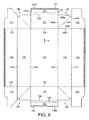
- the main difference is that the end flaps 119 to 122 of the alternative first blank 101 are elongated in the longitudinal direction of the blank. This means that when the blank is erected into a container, end flaps 119 and 121 overlap and end flaps 120 and 122 overlap. This provides additional strength to the ends of the container and helps in preventing buckling of the ends when the full container is pulled in a longitudinal direction.
- Figure 9 shows an alternative second blank 102 which comprises a rectangular top panel 150 having side panels 151 and 152 foldably joined to the top panel along sides 153 and 154, respectively, and end panels 155 and 156 foldably joined to the top panel along ends 157 and 158, respectively.
- End flaps 159,160 and 161, 162 are foldably joined to opposite ends of the side panels 151 and 152 respectively.
- Double-sided adhesive tape is adhered to opposite side regions of the blank 102 to provide an adhesive strip 163 running along side panel 151 and end flaps 159, 161, and a parallel adhesive strip 164 running along side panel 152 and end flaps 160, 162.
- the outer adhesive layer is covered by a suitable removable covering strip.
- a top is erected from the blank 102. Either the top may be pre-erected or the blank 102 may be positioned with the top panel 150 over the top of the open topped container.
- the end panels 155,156 are then folded downwardly against the end walls of the container.
- the covering strip is removed from the adhesive strips 163, 164 and the side panels 151, 152 are folded downwardly against, and adhered to, the side walls of the container.
- the end flaps 159-162 are then folded against, and adhered to, the end panels 155,156.
- the side and end walls provided by the open-topped container and the lid or top each have at least three thicknesses of blank material to provide good thermal insulation to any contents of the container.
- the open topped container would be packed with suitable products, such as fresh fish and optionally also ice, and would be closed by the'top erected from the blank 2 or 102.
- suitable products such as fresh fish and optionally also ice
- the blanks 1 and 2 or 101 and 102 can be kept in their unerected flat storage condition until a container is required to be used. Storage space is therefore not taken up by erected, non-filled containers.
- One particular advantage of the erected open-topped container is that the construction is intended to protect any open ended flutes of the corrugated sheet material from contact/exposure to ice or water when it is being packed. Normally during packing ice is thrown in on top of the packed contents in a haphazard manner.
- edge fluting there is a minimum of exposure of the edge fluting with inner and outer protective layers throughout the design. In particular, none of the upper edges of the upstanding walls has exposed edge fluting.
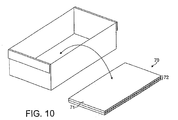
- an absorbent member 70 may be positioned in the bottom of the erected open-topped container before the container is filled with products.
- the absorbent member 70 has a liquid-impervious, e.g. plastics, top layer 71 and an absorbent bottom layer 72 typically comprising a number, e.g. from 3 to 5, layers of paper, one or more layers of corrugated cardboard or other absorbent material.
- the purpose of the absorbent member 70 is to provide an absorbent pad at the bottom of the container for absorbing liquids, e.g. melted ice and blood from stored produce such as fish, to prevent the stored product from "swimming" in fluid.
- the absorbent member 70 is sized to be similar to the bottom of the container so that there are no gaps, or only small gaps, between the edge of the absorbent pad and the walls of the container.
- the liquid-impervious top layer 71 provides a virtually dry surface or barrier on which the product to be packaged is supported.
- the absorbent member or "pad” may incorporate a bactericide for controlling possible harmful bacteria, such as salmonella, listeria, and leionella.
- the bactericide or other substance may be impregnated in the paper or incorporated in glue or other material of the absorbent pad.
- Figure 11 shows a further alternative first blank 201, which is largely similar to the blank 101 of Figure 8 .
- second end wall panels 231, 232 of the blank of Figure 11 are wider than the corresponding second end wall panels of Figure 8 .
- tabs 280, 281 are provided at the centre of the free edges of the second end wall panels 231, 232 respectively.
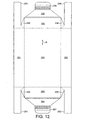
- FIG 12 shows a further alternative lid blank 202.
- This has panels which correspond to those of the lid blank 102 of Figure 9 (and designated by reference numerals with the addition of 100).
- triangular corner pieces 285 connect end panels 255, 256 to end flaps 259-262.
- the end flaps 259-262 are elongated.
- End tabs 290, 291 are provided on second end wall panels 292, 293 of the lid blank which are connected by crease lines to the first end wall panels 255, 256 respectively.
- the side wall panels 251, 252 and the end wall panels 255, 256 are folded downwardly from the top panel 250.
- the end flaps 259-262 and triangular pieces 285 are folded to create gusseted corners thus preventing leakage even when the closed container is inverted.
- the end flaps 259-262 of the lid blank are folded inside the first end wall panels 255,256; Second end wall panels 292, 293 are then folded inwardly and upwardly over the end flaps 259-262 and tabs 290, 291 are tucked over and behind the end flaps.
- the second end wall panels 231, 232 of the base press against the second end wall panels 292, 293 of the lid and provide a tight fit
- Figures 13 and 14 show base and lid blanks respectively having an enhanced engagement between the lid and base when erected.
- the second end wall panels 331, 332 of the base and the second end wall panels 392, 393 of the lid are narrower than the corresponding panels shown in Figures 11 and 12 .
- the base end flaps 319-322, and the outermost parts of the lid end flaps 359-362 are narrower so that tabs 380, 381, 390, 391, can still be tucked therebehind respectively.
- a lid erected from the blank of Figure 14 has its second end wall panels 392, 393 extending upwardly inside the first end panels 355, 356 over only a part, for example about half, of the height thereof.
- a base erected from the blank of Figure 13 has its second end wall panels 331, 332 extending upwardly inside the first end panels 355, 356 over only a part, of the height thereof, preferably about the same extent as the part of lid first end panels 355, 356 which are not covered by lid second end wall panels 331, 332.
- end tabs 280, 281, 290, 291, 380, 381, 390, 391 are omitted and securing of the second end wall panels could be achieved solely by adhesive means.
- drainage holes may be provided.
- drainage holes 95 can be provided at the crease between the bottom panel and the walls (here the end walls) of the container base.
- Simply providing a hole in the corrugated sheet material may be unacceptable because of the possible ingress of fluid into the flutes of the material.
- water resistant films preferably in the form of adhesive patches 96 having drainage apertures 97, are applied to the holes.
- the patches 96 are applied to both sides of the blank and prevent fluid reaching the edges of the holes 95 that would otherwise be exposed.
- thermally insulating blanks may be positioned in the bottom of the erected open-topped container before the latter is filled with products and on top of the filled container just before the lid is fitted over the container. In this way, additional thermally insulating layers can be provided on the bottom and top of the container.
- a light and heat reflective layer at least on the surface of the blank 2, 102, 202 or 302 destined to form the outside of the lid or top, improves the thermal insulating properties of the top.
- corrugated fibreboard/cardboard is the presently preferred material for the enclosure it may be made, for example, of double skinned fluted polypropylene copolymer or of other stiff yet foldable sheet material which may or may not be corrugated or fluted and which may comprise plastics materials, e.g. EVA (ethylene vinyl acetate), EPS (polyform) or PVC.
- EVA ethylene vinyl acetate
- EPS polyform
- PVC polyform
- an absorbent pad for inclusion in a fish box or other food product box and incorporating a bactericide.
Landscapes
- Engineering & Computer Science (AREA)
- Mechanical Engineering (AREA)
- Food Science & Technology (AREA)
- Cartons (AREA)
- Glass Compositions (AREA)
- Packages (AREA)
Abstract
Description
- This invention relates to a container comprising a base and lid, each made of stiff yet foldable sheet material, e.g. corrugated material. The container is particularly, but not exclusively, suitable for containing food produce such as, for example, fresh fish. The invention also relates to a blank of stiff yet foldable sheet material, e.g. corrugated material, which is erectable into a base of a container and to a packaging method.
- Conventionally fish boxes, i.e. boxes used for the packing, storage and dispatch of fish, have been made from wood or plastics material. Such boxes are often filled on board deep-sea trawlers and take up valuable deck and storage space when not in use. These known fish boxes are relatively expensive and, as such, are re-used after being cleaned. However, it is difficult effectively to clean such fish boxes to the required hygienic standards.
- It is desirable for fish boxes to have good thermally insulating properties so that fresh fish stored within the boxes do not become too hot It is difficult to provide relatively cheap, thermally insulating fish boxes made of wood or plastics material.
- It has been proposed in
US-A-3,937,390 to manufacture a fish box from corrugated board provided with a water-repellent impregnation. In particular, blanks of such impregnated corrugated board can be stored on board a trawler and erected when required into fish boxes having single thickness walls of the corrugated board. However although such a known fish box overcomes many of the disadvantages of fish boxes made of wood or plastics material, the thermally insulating properties of a fish box having walls of single thickness corrugated board could be improved. - It is an aim of the present invention to provide an easily erectable container comprising a base and a top or lid having walls made of stiff yet foldable sheet material and possessing improved thermally insulating properties. It is also an aim of the invention to provide a container base erectable from a blank of stiff yet foldable sheet material.
- According to one aspect of the present invention there is provided a blank made of stiff yet foldable sheet material according to
claim 1.
Background artEP- ,A-1 122 177NL-A-1 019 538 GB-A-614 444 - A blank according to the invention enables a container base to be erected having double thickness side and end walls thereby enhancing the thermally insulating properties of the container base.
- Conveniently, the second side wall panels are folded downwardly outside the first side wall panels in the erected container in which case the second end wall panels are also folded outside the first end wall panels. However it is also possible for the second side wall panels to be folded downwardly inside the first side wall panels and in this case the second end wall panels would be folded downwardly inside the corresponding first end wall panels.
- In an embodiment of the invention more suitable for erection by a machine, each end flap is shaped so as to overlap the other end flap of the pair when the blank is erected into as container base.
- The blank has adhesive means for connecting the second end wall panels to the underlying end flaps. Typically the adhesive means comprises double-sided adhesive strip or tape one side of which is adhered to the blank and the other side of which has a removable non-adhesive covering thereon. Suitably the adhesive strip or tape is provided on the second end wall panels although, alternatively, it could be provided on the end flaps.
- Suitably the sheet material of the or each blank comprises corrugated material, e.g. corrugated fibreboard or cardboard. Corrugated material, with its cavities, has good thermally insulating properties and these thermally insulating properties are considerably enhanced in an erected container having walls of more than a single thickness. In the case of a fish box the provision of good thermal insulation is important since any ice added to the contents in use, e.g. whilst fish is being packed on a trawler, will thaw less quickly the better the thermally insulating properties of the walls of the fish box. Typically, the sheet material will be provided on both, sides with a water resistant coating, such as a plastics material and/or wax, or a laminated finish or may be impregnated with water-repellent material. By way of example only, water-repellent corrugated sheet material is described in
US-A-5,626,945 . The sheet material, at least for the blank of the container top, may have, on its side destined to form the outside of the container, a reflective foil covering for reflecting external heat and light radiation. - By using strips of adhesive material on the blanks to retain the erected containers in their erected condition, the containers can be erected onsite without the use of container erecting machinery.
- At least one hole may be arranged in the blank to provide drainage in the erected base. For example, a hole in the stiff yet foldable sheet material may have at least one fluid resistant film applied over its periphery such as to allow fluid to flow through the hole without exposing the periphery to the fluid. In particular, a first layer of fluid resistant film may be applied to a first side of the blank and a second layer of fluid resistant film may be applied to a second side of the blank, the first and second layers of film having mutually coincident apertures which allow fluid to flow through the hole.
- According to another aspect of the present invention there is provided a container base erected from a blank according to said one aspect of the present invention.
- A set of blanks according to a further aspect of the invention comprises a base blank as described above and a lid blank erectable to into a lid sized to fit the container base, the second end wall panel of each end wall panel means being arranged to be spaced from the first end wall panel in the erected base so as to engage an end panel of the lid when the latter is fitted to the erected base to keep the lid so fitted.
- The second end wall panel of the base blank, and said end panel of the lid blank, may in particular be sized to pass fully past one another on fitting the erected lid to the erected base; said end panel of the lid blank then engaging below a bottom edge of said second end wall panel.
- The container may be provided with an absorbent pad or member positioned inside the base on top of the bottom panel. The purpose of such an absorbent pad is to absorb liquid material, such as melted ice and blood from the stored contents, e.g. fish, inside the container base when the latter is in use. This is intended to prevent the stored contents from "floating" in the liquid material. Ideally, the absorbent member is intended to fit closely inside the container base, i.e. it will have substantially the same dimensions as the bottom panel so that there are gap or only small gaps between the positioned absorbent pad and the side walls of the container base. Typically, the absorbent pad comprises a liquid-impervious top layer and an absorbent bottom layer, which may itself be several layers thick. In particular the absorbent bottom layer may comprise corrugated cardboard material, layers, e.g. from 3 to 5, of paper. The pad may incorporate a bactericide or other substance for controlling possibly harmful bacteria, such as salmonella, listeria and leionella.
- According to a still further aspect of the present invention there is provided a method of packaging products; such as food produce, comprising erecting .a container base from a blank according to said one aspect of the present invention, loading the container base with the products to be packaged, and closing the container base with a top formed from the said further blank. An absorbent member may be positioned in the container base after erection of the base and before loading the container base with products.
- Embodiments of the invention will now be described, by way of example only, with particular reference to the accompanying drawings, in which:
-
Figure 1 is a plan of a first blank of stiff yet foldable sheet material which can be erected to form a base of a container according to the present invention; -
Figure 2 is a plan of a second blank of stiff yet foldable sheet material for a top of a container according to the present invention; -
Figures 3 to 7 are schematic views not drawn to scale showing various stages in the erection of the blanks shown inFigures 1 and2 into a container; -
Figure 8 is a plan of an alternative first blank of stiff yet foldable sheet material which can be erected to form a base of a container according to the present invention; -
Figure 9 is a plan of an alternative second blank of stiff yet foldable sheet material for a top of a container according to the present invention; -
Figure 10 is a schematic view showing the use of an absorbent member in the container base; -
Figure 11 is a plan of a further alternative first blank; -
Figure 12 is a plan of a further alternative second blank for use with the blank ofFigure 11 ; -
Figure 13 is a plan of yet a further alternative first blank; -
Figure 14 is a plan of yet a further alternative second blank for use with the blank ofFigure 13 ; -
Figure 15 is a partially cut-away view of a container according to the invention having drainage holes; and -
Figure 16 is a schematic sectional view of a drainage hole. -
Figures 1 and2 show container blanks, generally designated by thereference numerals Blank 1 is intended to be erected into a container base 3 and blank 2 is intended to form a container top 4 of acontainer 5; for example a fish box, shown inFigures 6 and 7 . - A particularly suitable material for the
blanks Figures 1 and2 the blank is made from corrugated fibreboard comprising spaced apart outer liner sheets which are provided with a water-resistant or water-repellent coating or lamination sandwiching a single corrugated sheet, the flutes or corrugations of the corrugated sheets extending in the directions of doubleheaded arrow A. The blank 2 may be provided with a light and heat reflective layer on its lower face, i.e. the face destined to form the outside of the erected container. In theblanks - The blank 1 comprises a
rectangular bottom panel 10 with a pair of side wall panel means and a pair of end wall panel means joined thereto. Each side wall panel means comprises a first side wall panel 11 (12) foldably connected to a side 13 (14) of thebottom panel 10 and a second side wall panel 15 (16) foldably connected to its associated first side wall panel 11 (12) along fold line 17 (18). Each second side wall panel 15 (16) has end flaps orpanels 19 and 20 (21 and 22) foldably connected thereto aboutfold lines 23 and 24 (25 and 26), respectively. - Each end wall panel means comprises a first end wall panel 27 (28) foldably connected to an end 29 (30) of the bottom panel, and a second end wall panel 31 (32) foldably connected to the first end wall panel 27 (28) about a pair of closely spaced apart fold
lines 33,34 (35,36). As can be seen inFigure 1 , the secondend wall panels fold lines outer portions Figure 1 ) of the blank 1 has double-sided self-adhesive strips portions adhesive strips second panels adhesive strips Figure 1 ). - At each of the four corners of the bottom panel there is a gusset means generally designated 43-46, respectively, only one (gusset means 43) of which will be described in detail hereinafter. The gusset means 43 comprises a pair of
gusset panels diagonal fold line 43c.Gusset panel 43a is foldably joined to the firstend wall panel 27 aboutfold line 43d andgusset panel 43b is foldably connected to the firstside wall panel 11 and theend panel 19 alongfold lines -
Figures 3 to 6 show various stages in the erection of an open-topped container from the blank 1.Figure 3 shows initial stages of the folding of one of the side wall panel means and one of the end wall panel means relative to thebottom panel 10. InFigure 4 it can be seen how the secondside wall panels side wall panels Figures 4 to 6 it can be seen how the end flaps or panels 19-22 and gusset means 43-46 are folded flat against the outside of the respective firstend wall panels adhesive strips outer portions end wall panels inner portions end wall panels panels underlying end panels adhesive strips 41 and 42 (seeFigure 6 ). - The blank 2 comprises a rectangular
top panel 50 havingside panels sides panels end panels adhesive strips side panels - In order to close the open-topped container 3, the top 4 is erected from the blank 2. Suitably the top is not pre-erected but instead is positioned with the
top panel 50 over the top of the open topped container. The end panels are then folded downwardly against the end walls of the container, the covering strip is removed from the adhesive strips 65-67 and the flaps 59-62 are folded against, and adhered to, the side walls of the container. Finally, the removable covering strips are removed from theadhesive strips side panels Figure 7 ). -
Figures 8 and9 show alternative first and second blanks respectively. Reference numerals inFigures 8 and9 correspond to those inFigures 1 to 7 but with the addition of 100. -
Figure 8 shows an alternative first blank 101, which is largely similar to thefirst blank 1 ofFigure 1 . The main difference is that the end flaps 119 to 122 of the alternative first blank 101 are elongated in the longitudinal direction of the blank. This means that when the blank is erected into a container, end flaps 119 and 121 overlap and endflaps -
Figure 9 shows an alternative second blank 102 which comprises a rectangulartop panel 150 havingside panels panels side panels adhesive strip 163 running alongside panel 151 and endflaps adhesive strip 164 running alongside panel 152 and endflaps - In order to close an open-topped container erected from the blank 102, a top is erected from the blank 102. Either the top may be pre-erected or the blank 102 may be positioned with the
top panel 150 over the top of the open topped container. The end panels 155,156 are then folded downwardly against the end walls of the container. The covering strip is removed from theadhesive strips side panels - In the closed container according to the invention the side and end walls provided by the open-topped container and the lid or top each have at least three thicknesses of blank material to provide good thermal insulation to any contents of the container. Typically, in use, the open topped container would be packed with suitable products, such as fresh fish and optionally also ice, and would be closed by the'top erected from the blank 2 or 102. If used onsite on a trawler or the like, the
blanks - One particular advantage of the erected open-topped container is that the construction is intended to protect any open ended flutes of the corrugated sheet material from contact/exposure to ice or water when it is being packed. Normally during packing ice is thrown in on top of the packed contents in a haphazard manner. However, as can be seen in the drawings, there is a minimum of exposure of the edge fluting with inner and outer protective layers throughout the design. In particular, none of the upper edges of the upstanding walls has exposed edge fluting.
- Conveniently, an absorbent member 70 (see
Figure 10 ) may be positioned in the bottom of the erected open-topped container before the container is filled with products. Theabsorbent member 70 has a liquid-impervious, e.g. plastics,top layer 71 and an absorbentbottom layer 72 typically comprising a number, e.g. from 3 to 5, layers of paper, one or more layers of corrugated cardboard or other absorbent material. The purpose of theabsorbent member 70 is to provide an absorbent pad at the bottom of the container for absorbing liquids, e.g. melted ice and blood from stored produce such as fish, to prevent the stored product from "swimming" in fluid. Ideally, theabsorbent member 70 is sized to be similar to the bottom of the container so that there are no gaps, or only small gaps, between the edge of the absorbent pad and the walls of the container. The liquid-impervious top layer 71 provides a virtually dry surface or barrier on which the product to be packaged is supported. The absorbent member or "pad" may incorporate a bactericide for controlling possible harmful bacteria, such as salmonella, listeria, and leionella. The bactericide or other substance may be impregnated in the paper or incorporated in glue or other material of the absorbent pad. -
Figure 11 shows a further alternative first blank 201, which is largely similar to the blank 101 ofFigure 8 . However secondend wall panels Figure 11 are wider than the corresponding second end wall panels ofFigure 8 . Additionallytabs end wall panels tab 280 is tucked underneath the overlapping bottom edges of end flaps 220 and 222 andtab 281 is tucked underneath the overlapping bottom edges of end flaps 219 and 221 to secure the second end wall panels in place. -
Figure 12 shows a further alternative lid blank 202. This has panels which correspond to those of thelid blank 102 ofFigure 9 (and designated by reference numerals with the addition of 100). However in the lid blank ofFigure 12 ,triangular corner pieces 285connect end panels End tabs end wall panels end wall panels - In erecting a lid from the lid blank 202, the
side wall panels end wall panels top panel 250. The end flaps 259-262 andtriangular pieces 285 are folded to create gusseted corners thus preventing leakage even when the closed container is inverted. In contrast to the end flaps 219-222 of the base which are folded outside the first end wall panels thereof, the end flaps 259-262 of the lid blank are folded inside the first end wall panels 255,256; Secondend wall panels tabs - On fitting a lid erected from the blank 202 to a base erected from the blank, the second
end wall panels end wall panels -
Figures 13 and14 show base and lid blanks respectively having an enhanced engagement between the lid and base when erected. In this embodiment of the invention the secondend wall panels end wall panels Figures 11 and12 . Also the base end flaps 319-322, and the outermost parts of the lid end flaps 359-362 are narrower so thattabs - A lid erected from the blank of
Figure 14 has its secondend wall panels first end panels Figure 13 has its secondend wall panels first end panels first end panels end wall panels end wall panels end wall panels - In machine-erectable versions (not shown) of the
blanks 201, 202, 301 and 302 theend tabs - It is often desirable to allow drainage of fluid, such as melt-water resulting from ice packed around produce in the container. To this end drainage holes may be provided. For example, as shown in
Figure 15 , drainage holes 95 can be provided at the crease between the bottom panel and the walls (here the end walls) of the container base. Simply providing a hole in the corrugated sheet material may be unacceptable because of the possible ingress of fluid into the flutes of the material. Thus, water resistant films, preferably in the form ofadhesive patches 96 havingdrainage apertures 97, are applied to the holes. As shown inFigure 16 , thepatches 96 are applied to both sides of the blank and prevent fluid reaching the edges of theholes 95 that would otherwise be exposed. - If desired additional flat, rectangular thermally insulating blanks (not shown) may be positioned in the bottom of the erected open-topped container before the latter is filled with products and on top of the filled container just before the lid is fitted over the container. In this way, additional thermally insulating layers can be provided on the bottom and top of the container.
- The provision of a light and heat reflective layer, at least on the surface of the blank 2, 102, 202 or 302 destined to form the outside of the lid or top, improves the thermal insulating properties of the top.
- Although corrugated fibreboard/cardboard is the presently preferred material for the enclosure it may be made, for example, of double skinned fluted polypropylene copolymer or of other stiff yet foldable sheet material which may or may not be corrugated or fluted and which may comprise plastics materials, e.g. EVA (ethylene vinyl acetate), EPS (polyform) or PVC.
- According to a further aspect of the invention there is provided an absorbent pad for inclusion in a fish box or other food product box and incorporating a bactericide.
Claims (24)
- A blank (1, 101, 201) made of stiff yet foldable sheet material erectable into a container base, comprising:a rectangular bottom panel (10,110);a pair of side wall panel means each comprising a first side wall panel (11,12,111,112) foldably connected to an associated side of the bottom wall panel so as to be foldable upwardly therefrom to provide one layer of a side wall, a second side wall panel (15,16,15,116) foldably connected to the first side wall panel so as to be foldable over against the latter to provide a second layer of the side wall, and end flaps (19, 20, 21, 22, 119,120,121,122, 219, 220, 221, 222, 319, 320, 321, 322) foldably connected to opposite ends of the second side wall panel;a pair of end wall panel means each comprising a first end wall panel (27, 28, 127, 128, 327, 328) foldably connected to an associated end of the bottom wall panel (10, 110) so as to be foldable upwardly therefrom to provide one layer of an end wall, and a second end wall panel (31, 32, 131, 132, 231, 331, 332) foldably connected to the first end wall panel; andfoldable gusset means (43, 44, 45, 46,143,144,145,146) at each corner of the bottom panel (10, 110) connecting opposite ends of each side wall panel means to opposite ones of said end wall panel means;whereby in the erected container base the two end flaps (19, 20, 21, 22,119, 220, 121, 122, 219, 220, 221, 222, 319, 320, 321, 322) associated with each end of the blank are folded against the associated first end wall panel (27, 28, 127, 128, 327, 328) to provide a second layer of the end wall and the second end wall panel (31, 32, 131, 132, 231, 331, 332) of each end wall panel means is folded over, for connection to, the underlying end flaps (19, 20, 21, 22, 119, 120, 121, 122, 219, 220, 221, 222, 319, 320, 321, 322);
characterised by adhesive means (41, 42, 141, 142) for adhering the second end wall panels (31, 32, 131, 132, 231, 331, 332) to the underlying end flaps (19, 20, 21, 22,119,120,121,122, 219, 220, 221, 222, 319, 320, 321, 322). - A blank according to claim 1, wherein each end flap (19,20,21, 22, 119, 120, 121, 122, 219, 220, 221, 222, 319, 320, 321, 322) is shaped so as to overlap the other end flap of the pair when the blank is erected into a container base.
- A blank according to claim 1 or 2, wherein the adhesive means comprises a double-sided adhesive strip (41, 42, 141, 142) one side of which is adhered to the blank (1, 101, 201) and the other side of which has a removable non-adhesive covering thereon.
- A blank according to claim 1, 2 or 3, in which the adhesive means (41, 42, 141, 142) is provided on the said second end wall panels (31, 32, 131,132,231,331,332).
- A blank according to any one of the preceding claims, in which the sheet material comprises corrugated material.
- A blank according to claim 5, wherein said corrugated material comprises corrugated fibreboard or cardboard.
- A blank according to any one of the preceding claims, wherein the sheet material is provided on both sides with a water resistant coating or a laminated finish or is impregnated with water-repellent material.
- A blank according to any one of the preceding claims, including at least one hole (95) arranged to provide drainage in the erected base.
- A blank according to claim 8, wherein the at least one hole (95) comprises a hole in the stiff yet foldable sheet material and at least one fluid resistant film (96) applied over a periphery of the hole in the stiff yet foldable sheet material such as to allow fluid to flow through the hole (95) without exposing said periphery to the fluid.
- A blank according to claim 9, wherein the at least one hole (95) has a first layer of fluid resistant film (96) applied to a first side of the blank and a second layer of fluid resistant film (96) applied to a second side of the blank, the first and second layers of film having mutually coincident apertures (97) which allow fluid to flow through the hole (95).
- A set of blanks made of stiff yet foldable sheet material comprising a blank (1, 101, 201) according to any preceding claim, erectable into a container base (3), and a lid blank (2,102) erectable to into a lid (4) sized to fit the container base, the second end wall panel (31, 32, 131, 132, 231, 331, 332) of each end wall panel means being arranged to be spaced from the first end wall panel (27, 28,127,128, 327, 328) in the erected base so as to engage an end panel (55, 56, 155, 156, 255, 256, 355, 356) of the lid (4) when the latter is fitted to the erected base (3) to keep the lid so fitted.
- A set of blanks according to claim 11, wherein the second end wall panel (331, 332) of the blank erectable into the base, and said end panel (355, 356) of the lid blank, are sized to pass fully past one another on fitting the erected lid to the erected base, said end panel of the lid blank then engaging below a bottom edge of said second end wall panel (331, 332).
- An open-topped container (3) erected from a blank (1, 101, 201) according to any one of claims 1 to 10, comprising a rectangular bottom (10, 110), double thickness side walls extending upwardly from said bottom, double thickness end walls extending upwardly from said bottom panel (10, 110), a gusset (43, 44, 45, 46, 143, 144, 145, 146) at each corner of the container connecting opposite ends of each side wall to opposite ones of said end walls, end flaps (19, 20, 21, 22,119,120,121,122, 219, 220, 221, 222, 319, 320, 321, 322) connected to opposite ends of each side wall and folded with the gusset means against the end walls, and connection means (41, 42, 141, 142), typically adhesive means, connecting the end flaps to the end walls.
- A container according to claim 13 having a lid (4).
- A container according to claim 14, wherein said lid comprises a rectangular top panel (250), lid side walls (251, 252) extending downwardly from said top panel, double thickness lid end walls (255, 292, 256, 293, 355, 392, 356, 393) extending downwardly from said top panel (250), a lid gusset means (285) at each corner of the lid connecting opposite ends of each lid side wall (251, 252) to opposite ones of said lid end walls, lid end flaps (259, 260, 261, 262, 359, 260, 361, 362) connected to opposite ends of each lid side wall and folded with the lid gusset means (285) against the lid end walls (255, 292, 256, 293, 355, 392, 356, 393), and lid connection means (290, 291, 390, 391) connecting the end flaps to the end walls.
- A container according to claim 15, wherein the second end wall panel (231, 331, 332) of each end wall panel means of the base is spaced from the first end wall panel so as to engage a lid end panel (255, 292, 256, 293, 355, 392, 356, 393) forming part of the lid end wall when the latter is fitted to the base to keep the lid so fitted.
- A container according to claim 16, wherein the second end wall panel (331, 332) of the base, and said lid end panel (355, 392, 356, 393) are sized to pass fully past one another on fitting the lid to the base, said end panel of the lid blank then engaging below a bottom edge of said second end wall panel of the base.
- A container according to claim 14, 15, 16 or 17, wherein said lid (4) is adhesively joined to said side walls and/or said end walls.
- A container according to any one of claims 14 to 18, wherein said lid (4) has a reflective foil covering for reflecting external heat and light radiation.
- A container according to any one of claims 13 to 19, and an absorbent member (70) for positioning inside the base (3) on top of the bottom panel (10,110).
- A container according to claim 20, in which the absorbent member (70) has the same dimensions as the bottom panel (10, 110) of the container.
- A container according to claim 20 or 21, in which the absorbent member (70) has a liquid-impervious top layer (71) and an absorbent bottom layer (72).
- A container according to any one of claims 20 to 22, in which the absorbent member (70) includes a bactericide.
- A method of packaging products, such as food produce, comprising erecting a container base (3) from a blank (1, 101, 201) according to any one of claims 1 to 10, loading the container base with the products to be packaged, and closing the container base (3) with a top (4) formed from a further blank (2,102).
Applications Claiming Priority (9)
| Application Number | Priority Date | Filing Date | Title |
|---|---|---|---|
| GB0227120A GB0227120D0 (en) | 2002-11-20 | 2002-11-20 | Container |
| GB0227120 | 2002-11-20 | ||
| GB0301951 | 2003-01-28 | ||
| GB0301951A GB0301951D0 (en) | 2002-11-20 | 2003-01-28 | Container |
| GB0309768 | 2003-04-29 | ||
| GB0309768A GB0309768D0 (en) | 2002-11-20 | 2003-04-29 | Container |
| GB0312438 | 2003-05-30 | ||
| GBGB0312438.5A GB0312438D0 (en) | 2002-11-20 | 2003-05-30 | Container |
| PCT/GB2003/005040 WO2004045971A2 (en) | 2002-11-20 | 2003-11-19 | Container |
Publications (2)
| Publication Number | Publication Date |
|---|---|
| EP1578672A2 EP1578672A2 (en) | 2005-09-28 |
| EP1578672B1 true EP1578672B1 (en) | 2008-04-02 |
Family
ID=32329938
Family Applications (1)
| Application Number | Title | Priority Date | Filing Date |
|---|---|---|---|
| EP03775590A Expired - Lifetime EP1578672B1 (en) | 2002-11-20 | 2003-11-19 | Container |
Country Status (8)
| Country | Link |
|---|---|
| US (1) | US20060151584A1 (en) |
| EP (1) | EP1578672B1 (en) |
| AT (1) | ATE391082T1 (en) |
| AU (1) | AU2003283611A1 (en) |
| CA (1) | CA2506861A1 (en) |
| DE (1) | DE60320140T2 (en) |
| ES (1) | ES2303908T3 (en) |
| WO (1) | WO2004045971A2 (en) |
Families Citing this family (30)
| Publication number | Priority date | Publication date | Assignee | Title |
|---|---|---|---|---|
| GB0917627D0 (en) * | 2009-10-08 | 2009-11-25 | Ds Smith Packaging Ltd | Packaging carton and lid |
| DE112012002042T5 (en) | 2011-06-17 | 2014-04-10 | Berry Plastics Corporation | Isolated container |
| KR20140044369A (en) | 2011-06-17 | 2014-04-14 | 베리 플라스틱스 코포레이션 | Insulated sleeve for a cup |
| WO2012174568A2 (en) | 2011-06-17 | 2012-12-20 | Berry Plastics Corporation | Process for forming an insulated container having artwork |
| DE112012003070T5 (en) | 2011-08-31 | 2014-04-30 | Berry Plastics Corp. | Polymer material for an insulated container |
| FR2988705B1 (en) * | 2012-03-30 | 2014-05-09 | Saica Pack Sl | PACKAGING OF PRESERVATION AND TRANSPORT OF FRESH PRODUCTS |
| US8596520B2 (en) | 2012-04-16 | 2013-12-03 | International Paper Co. | Waterproof and anti-wicking corrugated container |
| EP2888092A4 (en) | 2012-08-07 | 2016-03-23 | Berry Plastics Corp | METHOD AND CUTTING FORMING MACHINE |
| KR20150079726A (en) | 2012-10-26 | 2015-07-08 | 베리 플라스틱스 코포레이션 | Polymeric material for an insulated container |
| AR093943A1 (en) | 2012-12-14 | 2015-07-01 | Berry Plastics Corp | EDGE OF A THERMAL PACK |
| US9840049B2 (en) | 2012-12-14 | 2017-12-12 | Berry Plastics Corporation | Cellular polymeric material |
| AR093944A1 (en) | 2012-12-14 | 2015-07-01 | Berry Plastics Corp | PUNCHED FOR PACKAGING |
| US9957365B2 (en) | 2013-03-13 | 2018-05-01 | Berry Plastics Corporation | Cellular polymeric material |
| US20140262916A1 (en) | 2013-03-14 | 2014-09-18 | Berry Plastics Corporation | Container |
| AU2014286923B2 (en) * | 2013-07-05 | 2018-05-10 | Visy R & D Pty Ltd | Container for reducing deterioration of horticultural produce |
| CN105592997A (en) | 2013-08-16 | 2016-05-18 | 比瑞塑料公司 | Polymeric material for an insulated container |
| BR112016002805A2 (en) | 2013-08-26 | 2017-08-01 | Berry Plastics Corp | container polymer material |
| US9758655B2 (en) | 2014-09-18 | 2017-09-12 | Berry Plastics Corporation | Cellular polymeric material |
| NL2013818B1 (en) * | 2014-11-14 | 2016-10-07 | Bioboxx Trading B V | Box and box holding frame suitable for waste. |
| FR3029509B1 (en) * | 2014-12-05 | 2017-08-11 | Mecaflor | PACKAGING IN PARTICULAR FOR CUT FLOWERS |
| WO2016118838A1 (en) | 2015-01-23 | 2016-07-28 | Berry Plastics Corporation | Polymeric material for an insulated container |
| US9937652B2 (en) | 2015-03-04 | 2018-04-10 | Berry Plastics Corporation | Polymeric material for container |
| CA3013585A1 (en) | 2017-08-08 | 2019-02-08 | Berry Global, Inc. | Insulated container |
| SE544410C2 (en) * | 2018-05-25 | 2022-05-10 | Stora Enso Oyj | Package and blank |
| GB202008550D0 (en) * | 2020-06-05 | 2020-07-22 | Softbox Systems Ltd | A wet cold chain distribution system and apparatus therefor |
| FR3113853B1 (en) * | 2020-09-07 | 2023-08-25 | Sven Holtzinger | Fluid protection and retention device, particularly for machine tools or portable tanks |
| AU2022273768B2 (en) * | 2021-05-14 | 2025-10-30 | Unilever Global Ip Limited | Package containing water-soluble capsules |
| FR3122869A1 (en) * | 2021-05-14 | 2022-11-18 | Unilever Ip Holdings B.V. | Packaging containing water-soluble capsules |
| WO2023081598A1 (en) * | 2021-11-02 | 2023-05-11 | The Coleman Company, Inc. | Corrugate cooler |
| US12064018B2 (en) * | 2022-09-27 | 2024-08-20 | Johnson & Johnson Vision Care, Inc. | Contact lens package with draining port |
Family Cites Families (28)
| Publication number | Priority date | Publication date | Assignee | Title |
|---|---|---|---|---|
| US1601625A (en) * | 1926-01-26 | 1926-09-28 | Charles D Ordway | Fruit preserving and shipping package |
| GB453180A (en) * | 1934-12-21 | 1936-09-07 | Henri Thiolat | Improvements relating to the manufacture of cardboard and like boxes |
| GB614444A (en) * | 1944-11-20 | 1948-12-15 | Cartonnage D Echantillonage Et | Improved method of manufacturing foldable cardboard boxes |
| US2495807A (en) * | 1946-09-09 | 1950-01-31 | Sutherland Paper Co | Double walled box or carton |
| US2688433A (en) * | 1952-03-18 | 1954-09-07 | Charles Dreifus Jr | Container |
| US2954913A (en) * | 1957-07-19 | 1960-10-04 | Norton L Rossman | Insulating container |
| US3342401A (en) * | 1966-05-20 | 1967-09-19 | Union Camp Corp | Iced pack shipping box |
| US3531041A (en) * | 1968-01-31 | 1970-09-29 | John J Rohde | Carton |
| US3511429A (en) * | 1968-04-23 | 1970-05-12 | Crown Zellerbach Corp | Portable beverage cooler |
| US3536249A (en) * | 1968-10-02 | 1970-10-27 | St Joe Paper Co | Container with outfolded flanges |
| US3917155A (en) * | 1972-03-02 | 1975-11-04 | Robert P Bemiss | Carton |
| US3876131A (en) * | 1973-07-02 | 1975-04-08 | Hoerner Waldorf Corp | Wedge shaped carton |
| US4003514A (en) * | 1976-01-21 | 1977-01-18 | Olinkraft, Inc. | Frozen food tray |
| GB1593730A (en) * | 1977-12-15 | 1981-07-22 | Corruplast Ltd | Blank for making a box and a box made from the blank |
| US4260098A (en) * | 1979-05-07 | 1981-04-07 | Federal Paper Board Company, Inc. | Tray container with reinforced sidewalls |
| FR2576874B1 (en) * | 1985-02-04 | 1987-10-02 | Socar | CARRIER CONDITIONING WATERPROOF AND GAS-TIGHT AND SEALABLE BY A PLASTIC FILM |
| US4582247A (en) * | 1985-05-31 | 1986-04-15 | Container Corporation Of America | Rounded corner locking carton lid |
| US5495727A (en) * | 1994-04-22 | 1996-03-05 | Strong; Bryan | Container and expandable cooler |
| US6171695B1 (en) * | 1994-09-21 | 2001-01-09 | Kimberly-Clark Worldwide, Inc. | Thin absorbent pads for food products |
| US5752648A (en) * | 1996-06-19 | 1998-05-19 | International Paper | Web bottomed eight sided tray |
| CA2262284C (en) * | 1998-02-23 | 2007-12-18 | Batesville Services, Inc. | Modular casket |
| US5967407A (en) * | 1998-08-27 | 1999-10-19 | Mueller; Charles J. | Auto-erecting box |
| US6338234B1 (en) * | 1999-11-24 | 2002-01-15 | Weyerhauser Company | Method of encapsulating shipping container blanks in plastic film |
| NL1014270C2 (en) * | 2000-02-02 | 2001-08-03 | Smurfit Solidpack B V | Mountable box. |
| US20020079238A1 (en) * | 2000-12-22 | 2002-06-27 | Wilson Ollie B. | Bag with absorbent pad |
| US6695138B1 (en) * | 2001-07-16 | 2004-02-24 | Commodaic Machine Co. Inc. | Food package with integral juice absorbing bottom |
| US6736309B1 (en) * | 2001-11-16 | 2004-05-18 | Wes-Pak, Inc. | Quick erecting foldable portable cooler |
| NL1019538C1 (en) * | 2001-12-11 | 2002-03-12 | V O F Vrinten & Lohman | Flat material piece for forming double-walled box by folding comprises rectangular box base and two double-walled side pieces connecting on opposing longitudinal edges of box base |
-
2003
- 2003-11-19 EP EP03775590A patent/EP1578672B1/en not_active Expired - Lifetime
- 2003-11-19 AU AU2003283611A patent/AU2003283611A1/en not_active Abandoned
- 2003-11-19 DE DE60320140T patent/DE60320140T2/en not_active Expired - Lifetime
- 2003-11-19 WO PCT/GB2003/005040 patent/WO2004045971A2/en not_active Ceased
- 2003-11-19 CA CA002506861A patent/CA2506861A1/en not_active Abandoned
- 2003-11-19 US US10/535,960 patent/US20060151584A1/en not_active Abandoned
- 2003-11-19 ES ES03775590T patent/ES2303908T3/en not_active Expired - Lifetime
- 2003-11-19 AT AT03775590T patent/ATE391082T1/en not_active IP Right Cessation
Also Published As
| Publication number | Publication date |
|---|---|
| CA2506861A1 (en) | 2004-06-03 |
| ES2303908T3 (en) | 2008-09-01 |
| AU2003283611A1 (en) | 2004-06-15 |
| US20060151584A1 (en) | 2006-07-13 |
| AU2003283611A8 (en) | 2004-06-15 |
| EP1578672A2 (en) | 2005-09-28 |
| WO2004045971A3 (en) | 2004-08-12 |
| WO2004045971A2 (en) | 2004-06-03 |
| DE60320140D1 (en) | 2008-05-15 |
| DE60320140T2 (en) | 2009-05-20 |
| ATE391082T1 (en) | 2008-04-15 |
Similar Documents
| Publication | Publication Date | Title |
|---|---|---|
| EP1578672B1 (en) | Container | |
| US3756495A (en) | Boilable bakeable package | |
| US4754914A (en) | Package for wrapping food or other articles | |
| US4628863A (en) | Disposable cat litter box | |
| US2983421A (en) | Compartmented carton | |
| US4804137A (en) | Food container | |
| CN214139311U (en) | Corrugated boxes for fresh product shipping | |
| US3064876A (en) | Ornamental wrapped box | |
| KR200496512Y1 (en) | Leakproof and liquid-tight packaging box of corrugated board | |
| CA1095857A (en) | Sift-proof, shiping and dispensing container | |
| US4165030A (en) | Two cell bulk box | |
| US5265796A (en) | Plural compartment carton food tray with improved corner construction | |
| US3501084A (en) | Packaging structures | |
| US4802620A (en) | Gable top carton for preventing wicking | |
| JP2005503293A (en) | Cardboard container with folded bottom | |
| US3077709A (en) | Filling and sealing method | |
| JP3018048U (en) | Paper container | |
| JP2006213386A (en) | Delivery box | |
| US20230105561A1 (en) | Insulating packaging for crustaceans | |
| JP2526408Y2 (en) | Cool and waterproof package | |
| DK167059B1 (en) | WATERPROOF BOX OR COVER | |
| GB2407809A (en) | Collapsible container | |
| SE546444C2 (en) | A blank and a package | |
| EP4549333A1 (en) | Blank and a package | |
| JP3150680B2 (en) | Cardboard airtight container |
Legal Events
| Date | Code | Title | Description |
|---|---|---|---|
| PUAI | Public reference made under article 153(3) epc to a published international application that has entered the european phase |
Free format text: ORIGINAL CODE: 0009012 |
|
| 17P | Request for examination filed |
Effective date: 20050530 |
|
| AK | Designated contracting states |
Kind code of ref document: A2 Designated state(s): AT BE BG CH CY CZ DE DK EE ES FI FR GB GR HU IE IT LI LU MC NL PT RO SE SI SK TR |
|
| AX | Request for extension of the european patent |
Extension state: AL LT LV MK |
|
| DAX | Request for extension of the european patent (deleted) | ||
| 17Q | First examination report despatched |
Effective date: 20060529 |
|
| GRAP | Despatch of communication of intention to grant a patent |
Free format text: ORIGINAL CODE: EPIDOSNIGR1 |
|
| GRAS | Grant fee paid |
Free format text: ORIGINAL CODE: EPIDOSNIGR3 |
|
| GRAA | (expected) grant |
Free format text: ORIGINAL CODE: 0009210 |
|
| AK | Designated contracting states |
Kind code of ref document: B1 Designated state(s): AT BE BG CH CY CZ DE DK EE ES FI FR GB GR HU IE IT LI LU MC NL PT RO SE SI SK TR |
|
| REG | Reference to a national code |
Ref country code: GB Ref legal event code: FG4D |
|
| REG | Reference to a national code |
Ref country code: CH Ref legal event code: EP Ref country code: IE Ref legal event code: FG4D |
|
| REF | Corresponds to: |
Ref document number: 60320140 Country of ref document: DE Date of ref document: 20080515 Kind code of ref document: P |
|
| REG | Reference to a national code |
Ref country code: ES Ref legal event code: FG2A Ref document number: 2303908 Country of ref document: ES Kind code of ref document: T3 |
|
| REG | Reference to a national code |
Ref country code: GR Ref legal event code: EP Ref document number: 20080401698 Country of ref document: GR |
|
| PG25 | Lapsed in a contracting state [announced via postgrant information from national office to epo] |
Ref country code: SI Free format text: LAPSE BECAUSE OF FAILURE TO SUBMIT A TRANSLATION OF THE DESCRIPTION OR TO PAY THE FEE WITHIN THE PRESCRIBED TIME-LIMIT Effective date: 20080402 |
|
| NLV1 | Nl: lapsed or annulled due to failure to fulfill the requirements of art. 29p and 29m of the patents act | ||
| REG | Reference to a national code |
Ref country code: FR Ref legal event code: RN |
|
| PG25 | Lapsed in a contracting state [announced via postgrant information from national office to epo] |
Ref country code: BG Free format text: LAPSE BECAUSE OF FAILURE TO SUBMIT A TRANSLATION OF THE DESCRIPTION OR TO PAY THE FEE WITHIN THE PRESCRIBED TIME-LIMIT Effective date: 20080702 Ref country code: FI Free format text: LAPSE BECAUSE OF FAILURE TO SUBMIT A TRANSLATION OF THE DESCRIPTION OR TO PAY THE FEE WITHIN THE PRESCRIBED TIME-LIMIT Effective date: 20080402 Ref country code: NL Free format text: LAPSE BECAUSE OF FAILURE TO SUBMIT A TRANSLATION OF THE DESCRIPTION OR TO PAY THE FEE WITHIN THE PRESCRIBED TIME-LIMIT Effective date: 20080402 Ref country code: PT Free format text: LAPSE BECAUSE OF FAILURE TO SUBMIT A TRANSLATION OF THE DESCRIPTION OR TO PAY THE FEE WITHIN THE PRESCRIBED TIME-LIMIT Effective date: 20080903 |
|
| REG | Reference to a national code |
Ref country code: FR Ref legal event code: FC |
|
| EN | Fr: translation not filed | ||
| PG25 | Lapsed in a contracting state [announced via postgrant information from national office to epo] |
Ref country code: AT Free format text: LAPSE BECAUSE OF FAILURE TO SUBMIT A TRANSLATION OF THE DESCRIPTION OR TO PAY THE FEE WITHIN THE PRESCRIBED TIME-LIMIT Effective date: 20080402 |
|
| ET | Fr: translation filed | ||
| EN | Fr: translation not filed | ||
| PG25 | Lapsed in a contracting state [announced via postgrant information from national office to epo] |
Ref country code: CZ Free format text: LAPSE BECAUSE OF FAILURE TO SUBMIT A TRANSLATION OF THE DESCRIPTION OR TO PAY THE FEE WITHIN THE PRESCRIBED TIME-LIMIT Effective date: 20080402 Ref country code: DK Free format text: LAPSE BECAUSE OF FAILURE TO SUBMIT A TRANSLATION OF THE DESCRIPTION OR TO PAY THE FEE WITHIN THE PRESCRIBED TIME-LIMIT Effective date: 20080402 Ref country code: SE Free format text: LAPSE BECAUSE OF FAILURE TO SUBMIT A TRANSLATION OF THE DESCRIPTION OR TO PAY THE FEE WITHIN THE PRESCRIBED TIME-LIMIT Effective date: 20080702 |
|
| PLBE | No opposition filed within time limit |
Free format text: ORIGINAL CODE: 0009261 |
|
| STAA | Information on the status of an ep patent application or granted ep patent |
Free format text: STATUS: NO OPPOSITION FILED WITHIN TIME LIMIT |
|
| PG25 | Lapsed in a contracting state [announced via postgrant information from national office to epo] |
Ref country code: SK Free format text: LAPSE BECAUSE OF FAILURE TO SUBMIT A TRANSLATION OF THE DESCRIPTION OR TO PAY THE FEE WITHIN THE PRESCRIBED TIME-LIMIT Effective date: 20080402 Ref country code: BE Free format text: LAPSE BECAUSE OF FAILURE TO SUBMIT A TRANSLATION OF THE DESCRIPTION OR TO PAY THE FEE WITHIN THE PRESCRIBED TIME-LIMIT Effective date: 20080402 Ref country code: RO Free format text: LAPSE BECAUSE OF FAILURE TO SUBMIT A TRANSLATION OF THE DESCRIPTION OR TO PAY THE FEE WITHIN THE PRESCRIBED TIME-LIMIT Effective date: 20080402 |
|
| 26N | No opposition filed |
Effective date: 20090106 |
|
| PG25 | Lapsed in a contracting state [announced via postgrant information from national office to epo] |
Ref country code: EE Free format text: LAPSE BECAUSE OF FAILURE TO SUBMIT A TRANSLATION OF THE DESCRIPTION OR TO PAY THE FEE WITHIN THE PRESCRIBED TIME-LIMIT Effective date: 20080402 |
|
| PG25 | Lapsed in a contracting state [announced via postgrant information from national office to epo] |
Ref country code: MC Free format text: LAPSE BECAUSE OF NON-PAYMENT OF DUE FEES Effective date: 20081130 |
|
| REG | Reference to a national code |
Ref country code: CH Ref legal event code: PL |
|
| PG25 | Lapsed in a contracting state [announced via postgrant information from national office to epo] |
Ref country code: IT Free format text: LAPSE BECAUSE OF FAILURE TO SUBMIT A TRANSLATION OF THE DESCRIPTION OR TO PAY THE FEE WITHIN THE PRESCRIBED TIME-LIMIT Effective date: 20080402 |
|
| PG25 | Lapsed in a contracting state [announced via postgrant information from national office to epo] |
Ref country code: CY Free format text: LAPSE BECAUSE OF FAILURE TO SUBMIT A TRANSLATION OF THE DESCRIPTION OR TO PAY THE FEE WITHIN THE PRESCRIBED TIME-LIMIT Effective date: 20080402 |
|
| PG25 | Lapsed in a contracting state [announced via postgrant information from national office to epo] |
Ref country code: CH Free format text: LAPSE BECAUSE OF NON-PAYMENT OF DUE FEES Effective date: 20081130 Ref country code: LI Free format text: LAPSE BECAUSE OF NON-PAYMENT OF DUE FEES Effective date: 20081130 |
|
| PG25 | Lapsed in a contracting state [announced via postgrant information from national office to epo] |
Ref country code: HU Free format text: LAPSE BECAUSE OF FAILURE TO SUBMIT A TRANSLATION OF THE DESCRIPTION OR TO PAY THE FEE WITHIN THE PRESCRIBED TIME-LIMIT Effective date: 20081003 Ref country code: LU Free format text: LAPSE BECAUSE OF NON-PAYMENT OF DUE FEES Effective date: 20081119 |
|
| PG25 | Lapsed in a contracting state [announced via postgrant information from national office to epo] |
Ref country code: TR Free format text: LAPSE BECAUSE OF FAILURE TO SUBMIT A TRANSLATION OF THE DESCRIPTION OR TO PAY THE FEE WITHIN THE PRESCRIBED TIME-LIMIT Effective date: 20080402 |
|
| REG | Reference to a national code |
Ref country code: FR Ref legal event code: EERR Free format text: CORRECTION DE BOPI 09/04 - 3.2. Ref country code: FR Ref legal event code: EERR Free format text: CORRECTION DE BOPI 08/48 - 3.2. |
|
| PGFP | Annual fee paid to national office [announced via postgrant information from national office to epo] |
Ref country code: IE Payment date: 20121120 Year of fee payment: 10 Ref country code: FR Payment date: 20121130 Year of fee payment: 10 |
|
| PGFP | Annual fee paid to national office [announced via postgrant information from national office to epo] |
Ref country code: ES Payment date: 20121116 Year of fee payment: 10 Ref country code: GR Payment date: 20121112 Year of fee payment: 10 Ref country code: GB Payment date: 20121129 Year of fee payment: 10 |
|
| PGFP | Annual fee paid to national office [announced via postgrant information from national office to epo] |
Ref country code: DE Payment date: 20130114 Year of fee payment: 10 |
|
| REG | Reference to a national code |
Ref country code: DE Ref legal event code: R119 Ref document number: 60320140 Country of ref document: DE |
|
| GBPC | Gb: european patent ceased through non-payment of renewal fee |
Effective date: 20131119 |
|
| REG | Reference to a national code |
Ref country code: GR Ref legal event code: ML Ref document number: 20080401698 Country of ref document: GR Effective date: 20140603 |
|
| REG | Reference to a national code |
Ref country code: FR Ref legal event code: ST Effective date: 20140731 |
|
| REG | Reference to a national code |
Ref country code: IE Ref legal event code: MM4A |
|
| PG25 | Lapsed in a contracting state [announced via postgrant information from national office to epo] |
Ref country code: GR Free format text: LAPSE BECAUSE OF NON-PAYMENT OF DUE FEES Effective date: 20140603 Ref country code: DE Free format text: LAPSE BECAUSE OF NON-PAYMENT OF DUE FEES Effective date: 20140603 |
|
| REG | Reference to a national code |
Ref country code: DE Ref legal event code: R119 Ref document number: 60320140 Country of ref document: DE Effective date: 20140603 |
|
| PG25 | Lapsed in a contracting state [announced via postgrant information from national office to epo] |
Ref country code: IE Free format text: LAPSE BECAUSE OF NON-PAYMENT OF DUE FEES Effective date: 20131119 |
|
| PG25 | Lapsed in a contracting state [announced via postgrant information from national office to epo] |
Ref country code: FR Free format text: LAPSE BECAUSE OF NON-PAYMENT OF DUE FEES Effective date: 20131202 Ref country code: GB Free format text: LAPSE BECAUSE OF NON-PAYMENT OF DUE FEES Effective date: 20131119 |
|
| REG | Reference to a national code |
Ref country code: ES Ref legal event code: FD2A Effective date: 20150709 |
|
| PG25 | Lapsed in a contracting state [announced via postgrant information from national office to epo] |
Ref country code: ES Free format text: LAPSE BECAUSE OF NON-PAYMENT OF DUE FEES Effective date: 20131120 |