EP1575266A1 - Filtersmechanismus zum Kamerarecorder - Google Patents
Filtersmechanismus zum Kamerarecorder Download PDFInfo
- Publication number
- EP1575266A1 EP1575266A1 EP05101472A EP05101472A EP1575266A1 EP 1575266 A1 EP1575266 A1 EP 1575266A1 EP 05101472 A EP05101472 A EP 05101472A EP 05101472 A EP05101472 A EP 05101472A EP 1575266 A1 EP1575266 A1 EP 1575266A1
- Authority
- EP
- European Patent Office
- Prior art keywords
- olpf
- lever
- link
- switching
- switching lever
- Prior art date
- Legal status (The legal status is an assumption and is not a legal conclusion. Google has not performed a legal analysis and makes no representation as to the accuracy of the status listed.)
- Withdrawn
Links
Images



Classifications
-
- H—ELECTRICITY
- H04—ELECTRIC COMMUNICATION TECHNIQUE
- H04N—PICTORIAL COMMUNICATION, e.g. TELEVISION
- H04N23/00—Cameras or camera modules comprising electronic image sensors; Control thereof
- H04N23/50—Constructional details
- H04N23/55—Optical parts specially adapted for electronic image sensors; Mounting thereof
-
- A—HUMAN NECESSITIES
- A47—FURNITURE; DOMESTIC ARTICLES OR APPLIANCES; COFFEE MILLS; SPICE MILLS; SUCTION CLEANERS IN GENERAL
- A47G—HOUSEHOLD OR TABLE EQUIPMENT
- A47G9/00—Bed-covers; Counterpanes; Travelling rugs; Sleeping rugs; Sleeping bags; Pillows
- A47G9/10—Pillows
-
- A—HUMAN NECESSITIES
- A47—FURNITURE; DOMESTIC ARTICLES OR APPLIANCES; COFFEE MILLS; SPICE MILLS; SUCTION CLEANERS IN GENERAL
- A47G—HOUSEHOLD OR TABLE EQUIPMENT
- A47G9/00—Bed-covers; Counterpanes; Travelling rugs; Sleeping rugs; Sleeping bags; Pillows
- A47G9/10—Pillows
- A47G9/1081—Pillows comprising a neck support, e.g. a neck roll
- A47G9/109—Pillows comprising a neck support, e.g. a neck roll adapted to lie on the side and in supine position
-
- A—HUMAN NECESSITIES
- A47—FURNITURE; DOMESTIC ARTICLES OR APPLIANCES; COFFEE MILLS; SPICE MILLS; SUCTION CLEANERS IN GENERAL
- A47G—HOUSEHOLD OR TABLE EQUIPMENT
- A47G9/00—Bed-covers; Counterpanes; Travelling rugs; Sleeping rugs; Sleeping bags; Pillows
- A47G9/10—Pillows
- A47G2009/1018—Foam pillows
Definitions
- the present invention relates to a camcorder comprising an optical filter mounted to a carrier for rotation into and out of an operational position, a lever coupled to the carrier for rotating the carrier so as to move the optical filter into and out of the operation position, a user-operable slider mounted for linear motion and coupled to the lever for pivoting the lever.
- digital camcorders are divided into a colour camcorders capable of recording colour images and colour/monochrome camcorders capable of recording both colour and monochrome images.
- colour/monochrome camcorders use the ambient light to record images in colour image and, therefore, without the need for a separate illuminator.
- colour/monochrome camcorders use a strobo or flash as a supplementary illuminator in order to record in colour or use a plurality of infrared light emitting diodes (IR LEDs), projecting infrared light forwards from around the camcorder's, in order to record infrared images in monochrome.
- IR LEDs infrared light emitting diodes
- Colour/monochrome camcorders use visible light, ranging from about 400 to 700nm, for recording in colour and infrared light of about 900nm when recording in monochrome.
- the same image sensing device such as a charge-coupled device (CCD) or a complementary metal oxide semiconductor (CMOS)
- CCD charge-coupled device
- CMOS complementary metal oxide semiconductor
- colour/monochrome camcorders have a switchable optical low pass filter (OLPF), which blocks infrared rays from reaching the image sensing device.
- OLPF optical low pass filter
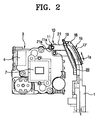
- FIGS 1 and 2 illustrate an OLPF switching apparatus 10 used in a general combined colour and monochrome camcorder.
- the OLPF switching apparatus 10 comprises an OLPF fixing part (not shown) pivotably fixed to a rear fixing plate 7 (shown in Figure 2) of a housing 4 of a lens assembly 3 and having a diurnal filter (not shown) and a nocturnal filter, a switching lever 11, pivotably fixed to the rear fixing plate 7 of the housing 4, for turning the OLPF fixing part between the diurnal filter setting position, wherein the diurnal filter is located in the image propagation path between the lens 5 and the image sensing element (not shown), and a nocturnal filter setting position, wherein the nocturnal filter is located in the image propagation path between the lens 5 and the image sensing element, and an operating part 15 for operating the switching lever 11 to move the OLPF fixing part between the diurnal filter setting position and the nocturnal filter setting position.
- the operating part 15 comprises a knob 17 protruding from an outer casing 1 of the camcorder and movably disposed in a slider slot 1a, formed in the outer casing 1, and a slider 19, movably held in a holder 22, is formed in the outer casing 1.
- the OLPF filter switching apparatus 10 is in the diurnal mode for recording a colour image. That is, in the diurnal mode, as shown by dotted lines in Figure 2, the knob 17 of the operating part 15 is located at a lower position to set the OLPF fixing part in the diurnal filter setting position.
- the operator slides the knob 17 of the operating part 15 up to set the OLPF fixing part in the nocturnal filter setting position as illustrated in solid lines of Figure 2.
- the OLPF fixing part connected to the opposite side of the switching lever 11 to the axially protruding end 11 a, turns accordingly and moves to the nocturnal filter setting position where the nocturnal filter is located on the image propagation path between the lens 5 and the image sensing element.
- the OLPF switching apparatus 10 switches to the nocturnal mode.
- the operator wants to return the OLPF switching apparatus 10 back to the diurnal mode after recording an image in the nocturnal mode, the operator slides down the knob 17 of the operating part 15. Then, the protruding member 21, the switching lever 11 and the OLPF fixing part are operated in the reverse of the operation described above, so that the OLPF fixing part is moved from the nocturnal filter setting position to the diurnal filter setting position. As a result, the OLPF switching apparatus 10 switches to the diurnal mode.
- the protruding member 21 of the operating part 15 moves up and down along the outer casing 1 in a substantially linear pattern, while the switching lever 11 connected with the protruding member 21 moves in a rotational pattern. That is, since the protruding member 21 and the switching lever 11 having different movement trajectories are directly connected with each other, when the protruding member 21 is moved up and down by the knob 17 to switch the diurnal mode and the nocturnal mode, the linear movement of the protruding member 21 is not smoothly transformed into the rotational movement of the switching lever 11.
- a camcorder is characterised in that the slider is coupled to the lever by a link configured to convert linear motion of the slider into motion substantially conforming to the locus of the joint between the link and the lever.
- said joint comprises an aperture in which an end of the lever is moveably received.
- the link is pivotably coupled at one end to the slider and pivotably coupled at its other end to the lever. More preferably, the link is bent.
- FIGS 3 and 4 illustrate an OLPF switching apparatus 110 used in a colour/monochrome digital camcorder according to the present invention.
- the OLPF switching apparatus 110 comprises an OLPF fixing part 131 (see Figure 5A), a switching lever 111 (see Figure 5A), an operating part 115 and a link part 123.
- the OLPF fixing part 131 comprises a diurnal filter 130 (see Figure 5A) and a nocturnal filter 129, which are disposed spaced apart from each other by a predetermined distance, and is pivotably fixed to a rear side fixing plate 107 of a housing 104 of a lens assembly 103.
- the switching lever 111 is pivotably fixed to the rear side fixing plate 107 of the housing 104 and has a first end 111a, which is linked with the OLPF fixing part 131 to turn the OLPF fixing part 131 between a diurnal OLPF setting position (See dotted lines of Figure 4, and Figure 5B) and a nocturnal OLPF setting position (See solid lines of Figure 4, and Figure 5A).
- a diurnal OLPF setting position See dotted lines of Figure 4, and Figure 5B
- a nocturnal OLPF setting position See solid lines of Figure 4, and Figure 5A.
- the nocturnal filter 129 is located in the image propagation path between the lens 105 and the image sensing element.
- the operating part 115 is slidably disposed in an outer casing 101 which seals the lens assembly 103.
- the link part 123 is connected with the operating part 115 and a second end 111b of the switching lever 111 which forms a predetermined angle with respect to the first end 111a.
- the link part 123 transforms the movement of the operating part 115 into a tangential movement S in a rotational trajectory of the second end 111b of the switching lever 111.
- the OLPF fixing part 131 has an upper portion pivotably fixed to a first shaft 134, formed on the rear side fixing plate 107 of the housing 104, to turn on the first shaft 134.
- the OLPF fixing part 131 has side surfaces 139 and 139' contacting first and second stoppers 136, 138 which are formed on the rear side fixing plate 107 to prevent the OLPF fixing part 131 from moving further than the diurnal OLPF setting position and the nocturnal OLPF setting position.
- the diurnal filter 130 is an infrared rays blocking filter for removing light in the infrared spectrum from the image formed on the image sensing element and transmitting only light in the visible spectrum, while the nocturnal filter 130 is a dummy filter which transmits light in both the visible and the infrared spectra.
- the switching lever 111 is pivotably fixed to a second shaft 141 formed on the rear side fixing plate 107 of the housing 104.
- the first end 111a of the switching lever 111 has a first axially protruding part 112a inserted in a first movement hole 143, which is defined in the upper portion of the OLPF fixing part 131, adjacent the first shaft 134, and has one side open.
- the OLPF fixing part 131 is turned by the first axially protruding part 112a.
- the operating part 115 comprises a knob 117, protruding from a sidewall of the outer casing 101 of the camcorder to the outside and movably disposed in a sliding slot 101a formed in the sidewall of the outer casing 101, and a slider 119 held in a holder 125 formed in the outer casing 101 and movable up and down therein.
- the slider 119 slides up and down in an inclined manner.
- the slider 119 has a protruding member 121, protruding from the inner side thereof toward the inner side of the outer casing 101.
- the protruding member 121 has a pivoting shaft 120, inserted into a fixing hole 128 formed in one end 123a of the link part 123.
- One end 123a of the link part 123 is pivotably connected with the pivoting shaft 120 of the protruding member 121 of the operating part 115 and the other end 123b of the link part 123 is preferably elbow-shaped and has a second movement hole 124 in which a second axially protruding part 112b, formed at the second end 111b of the switching lever 111, is movably received.
- the protruding member 121 is moved up and down by the knob 117 in a linear movement, the other end 123b of the link part 123 moves in a tangential direction along the rotational trajectory S of the second axially protruding part 112b of the second end 111b of the switching part 111, thereby pushing and pulling the switching part 111.
- the slider 119 of the operating part 115 and the knob 117 can be smoothly moved.
- the knob 117 of the operating part 115 is located at the lower position and the OLPF fixing part 131 is located in the diurnal OLPF setting position as shown in Figure 5B.
- the operator slides up the knob 117 of the operating lever 115 to set the OLPF fixing part 131 in the nocturnal OLPF setting position.
- the protruding member 121 of the slider 119 moves up and, thus, one end 123a of the link part 123, pivotably connected with the pivoting shaft 120 of the protruding member 121, also moves up.
- the other end 123b of the link part 120 which has the second movement hole 124 engaged with the second axially-protruding part 112b of the second end 111b of the switching lever 111, moves in a tangential direction along the rotational trajectory of the second axially protruding part 112b, thereby moving up the second axially protruding part 112b.
- the switching lever 111 turns on the second shaft 141 in a clockwise direction as shown in Figure 5A.
- the first axially-protruding part 112a of the first end 111a inserted in the first movement hole 143 turns the OLPF fixing part 131 about the first shaft 134 in a counter clockwise direction.
- the nocturnal filter 129 moves to the nocturnal OLPF setting position ( Figure 5A) where it is located on the image propagation path between the lens 105 and the image sensing element until the side surface 139 of the OLPF fixing plate 131 is blocked from moving by the second stopper 138.
- the OLPF switching apparatus 110 is set in the nocturnal mode.
- the OLPF switching apparatus 110 smoothly transforms the up and down linear movement of the knob 117 of the operating part 115 into the rotational movement of the switching lever 111. Accordingly, the knob 117 of the operating part 115 moves smoothly, and thus, the related parts are prevented from being damaged and the reliability of a product can be maintained.
Landscapes
- Engineering & Computer Science (AREA)
- Multimedia (AREA)
- Signal Processing (AREA)
- Health & Medical Sciences (AREA)
- General Health & Medical Sciences (AREA)
- Otolaryngology (AREA)
- Pulmonology (AREA)
- Studio Devices (AREA)
- Blocking Light For Cameras (AREA)
- Optical Filters (AREA)
Applications Claiming Priority (2)
| Application Number | Priority Date | Filing Date | Title |
|---|---|---|---|
| KR2004016053 | 2004-03-10 | ||
| KR1020040016053A KR20050090803A (ko) | 2004-03-10 | 2004-03-10 | 디지털 캠코더의 광학필터 절환 장치 |
Publications (1)
| Publication Number | Publication Date |
|---|---|
| EP1575266A1 true EP1575266A1 (de) | 2005-09-14 |
Family
ID=34825202
Family Applications (1)
| Application Number | Title | Priority Date | Filing Date |
|---|---|---|---|
| EP05101472A Withdrawn EP1575266A1 (de) | 2004-03-10 | 2005-02-25 | Filtersmechanismus zum Kamerarecorder |
Country Status (5)
| Country | Link |
|---|---|
| US (1) | US20050200742A1 (de) |
| EP (1) | EP1575266A1 (de) |
| JP (1) | JP4047338B2 (de) |
| KR (1) | KR20050090803A (de) |
| CN (1) | CN100338500C (de) |
Families Citing this family (1)
| Publication number | Priority date | Publication date | Assignee | Title |
|---|---|---|---|---|
| KR102147252B1 (ko) * | 2018-05-28 | 2020-08-25 | 주식회사 뷰웍스 | 렌즈 조절부를 구비한 촬영 장치 |
Citations (6)
| Publication number | Priority date | Publication date | Assignee | Title |
|---|---|---|---|---|
| JPS61286828A (ja) * | 1985-06-14 | 1986-12-17 | Minolta Camera Co Ltd | バウンド防止装置 |
| US4681418A (en) * | 1984-08-23 | 1987-07-21 | Canon Kabushiki Kaisha | Camera |
| US5010419A (en) * | 1986-12-04 | 1991-04-23 | James C. Wickstead | Apparatus for storing video signals on audio cassette |
| JPH06289474A (ja) * | 1993-03-30 | 1994-10-18 | Sony Corp | レンズの開閉機構 |
| EP0966149A2 (de) | 1998-06-16 | 1999-12-22 | Eastman Kodak Company | Dateneinlesung-Bildaufnahmegerät, Kamera, und Gebrauchsverfahren |
| EP1220547A1 (de) * | 1999-09-17 | 2002-07-03 | Nature Technology Co., Ltd. | Bildaufnahemsystem, bildverarbeitungsger ät und kamera |
Family Cites Families (4)
| Publication number | Priority date | Publication date | Assignee | Title |
|---|---|---|---|---|
| US4862279A (en) * | 1987-10-09 | 1989-08-29 | Minolta Camera Kabushiki Kaisha | Video camera with automatically movable microphone |
| JPH07107355A (ja) * | 1993-09-30 | 1995-04-21 | Victor Co Of Japan Ltd | 低照度対応型撮像装置 |
| JP4250818B2 (ja) * | 1999-08-09 | 2009-04-08 | ソニー株式会社 | ビデオカメラ |
| JP3953401B2 (ja) * | 2002-10-11 | 2007-08-08 | 三洋電機株式会社 | 移動制御装置及び方法 |
-
2004
- 2004-03-10 KR KR1020040016053A patent/KR20050090803A/ko not_active Withdrawn
-
2005
- 2005-01-31 US US11/045,143 patent/US20050200742A1/en not_active Abandoned
- 2005-02-25 EP EP05101472A patent/EP1575266A1/de not_active Withdrawn
- 2005-03-07 JP JP2005063131A patent/JP4047338B2/ja not_active Expired - Fee Related
- 2005-03-08 CN CNB200510053520XA patent/CN100338500C/zh not_active Expired - Fee Related
Patent Citations (6)
| Publication number | Priority date | Publication date | Assignee | Title |
|---|---|---|---|---|
| US4681418A (en) * | 1984-08-23 | 1987-07-21 | Canon Kabushiki Kaisha | Camera |
| JPS61286828A (ja) * | 1985-06-14 | 1986-12-17 | Minolta Camera Co Ltd | バウンド防止装置 |
| US5010419A (en) * | 1986-12-04 | 1991-04-23 | James C. Wickstead | Apparatus for storing video signals on audio cassette |
| JPH06289474A (ja) * | 1993-03-30 | 1994-10-18 | Sony Corp | レンズの開閉機構 |
| EP0966149A2 (de) | 1998-06-16 | 1999-12-22 | Eastman Kodak Company | Dateneinlesung-Bildaufnahmegerät, Kamera, und Gebrauchsverfahren |
| EP1220547A1 (de) * | 1999-09-17 | 2002-07-03 | Nature Technology Co., Ltd. | Bildaufnahemsystem, bildverarbeitungsger ät und kamera |
Non-Patent Citations (2)
| Title |
|---|
| PATENT ABSTRACTS OF JAPAN vol. 011, no. 151 (P - 576) 16 May 1987 (1987-05-16) * |
| PATENT ABSTRACTS OF JAPAN vol. 1995, no. 01 28 February 1995 (1995-02-28) * |
Also Published As
| Publication number | Publication date |
|---|---|
| KR20050090803A (ko) | 2005-09-14 |
| US20050200742A1 (en) | 2005-09-15 |
| CN100338500C (zh) | 2007-09-19 |
| CN1667451A (zh) | 2005-09-14 |
| JP4047338B2 (ja) | 2008-02-13 |
| JP2005260946A (ja) | 2005-09-22 |
Similar Documents
| Publication | Publication Date | Title |
|---|---|---|
| US8004774B2 (en) | Lens apparatus and image-pickup apparatus | |
| JP2003134533A (ja) | ステレオ画像撮像装置 | |
| US20040119869A1 (en) | Dual sensor camera | |
| JP4120940B2 (ja) | レンズ鏡筒および撮像装置 | |
| EP1575266A1 (de) | Filtersmechanismus zum Kamerarecorder | |
| JP2006033716A (ja) | 撮像装置 | |
| KR19990077796A (ko) | 촬상장치 | |
| US6641311B2 (en) | Camera, and method of opening and closing a lens | |
| US7577352B2 (en) | Mobile communication device | |
| EP2320261B1 (de) | Linsenvorrichtung | |
| JP4909103B2 (ja) | 操作装置及び電子機器 | |
| US6952232B2 (en) | Digital camera having a viewfinder with adjustable length | |
| KR100690826B1 (ko) | 카메라 개폐장치를 구비한 휴대 단말기 | |
| US6041185A (en) | Camera with remote-control photography and stroboscopic photography function | |
| JP2011043676A (ja) | レンズ鏡胴および撮影装置 | |
| JP2000227620A (ja) | 絞り装置およびシャッター装置 | |
| WO2001069315A3 (en) | Camera with flash unit disposed in between viewfinder lenses | |
| US7358998B2 (en) | Image switching apparatus providing an optical compensator | |
| US6636698B2 (en) | Zoom actuating apparatus for cameras | |
| JPH1195092A (ja) | 電子スチルカメラ | |
| KR100609208B1 (ko) | 슬라이딩에 의해 접사모드로 전환 가능한 슬라이드형이동통신단말기 | |
| JPH02287333A (ja) | ビデオカメラ装置 | |
| JP2008197507A (ja) | レリーズスイッチ機構、及び撮影装置 | |
| JP2005077787A (ja) | レンズ装置 | |
| JP6071355B2 (ja) | レンズ鏡筒およびそれを備えた撮像装置 |
Legal Events
| Date | Code | Title | Description |
|---|---|---|---|
| PUAI | Public reference made under article 153(3) epc to a published international application that has entered the european phase |
Free format text: ORIGINAL CODE: 0009012 |
|
| AK | Designated contracting states |
Kind code of ref document: A1 Designated state(s): AT BE BG CH CY CZ DE DK EE ES FI FR GB GR HU IE IS IT LI LT LU MC NL PL PT RO SE SI SK TR |
|
| AX | Request for extension of the european patent |
Extension state: AL BA HR LV MK YU |
|
| 17P | Request for examination filed |
Effective date: 20051014 |
|
| AKX | Designation fees paid |
Designated state(s): DE GB NL |
|
| STAA | Information on the status of an ep patent application or granted ep patent |
Free format text: STATUS: THE APPLICATION IS DEEMED TO BE WITHDRAWN |
|
| 18D | Application deemed to be withdrawn |
Effective date: 20100901 |