EP1570870A1 - Ballonexpandierbarer superelastischer Stent - Google Patents
Ballonexpandierbarer superelastischer Stent Download PDFInfo
- Publication number
- EP1570870A1 EP1570870A1 EP20050004807 EP05004807A EP1570870A1 EP 1570870 A1 EP1570870 A1 EP 1570870A1 EP 20050004807 EP20050004807 EP 20050004807 EP 05004807 A EP05004807 A EP 05004807A EP 1570870 A1 EP1570870 A1 EP 1570870A1
- Authority
- EP
- European Patent Office
- Prior art keywords
- stent
- shape memory
- shape
- living body
- temperature
- Prior art date
- Legal status (The legal status is an assumption and is not a legal conclusion. Google has not performed a legal analysis and makes no representation as to the accuracy of the status listed.)
- Granted
Links
Images
Classifications
-
- B—PERFORMING OPERATIONS; TRANSPORTING
- B65—CONVEYING; PACKING; STORING; HANDLING THIN OR FILAMENTARY MATERIAL
- B65G—TRANSPORT OR STORAGE DEVICES, e.g. CONVEYORS FOR LOADING OR TIPPING, SHOP CONVEYOR SYSTEMS OR PNEUMATIC TUBE CONVEYORS
- B65G21/00—Supporting or protective framework or housings for endless load-carriers or traction elements of belt or chain conveyors
- B65G21/10—Supporting or protective framework or housings for endless load-carriers or traction elements of belt or chain conveyors movable, or having interchangeable or relatively movable parts; Devices for moving framework or parts thereof
-
- A—HUMAN NECESSITIES
- A61—MEDICAL OR VETERINARY SCIENCE; HYGIENE
- A61F—FILTERS IMPLANTABLE INTO BLOOD VESSELS; PROSTHESES; DEVICES PROVIDING PATENCY TO, OR PREVENTING COLLAPSING OF, TUBULAR STRUCTURES OF THE BODY, e.g. STENTS; ORTHOPAEDIC, NURSING OR CONTRACEPTIVE DEVICES; FOMENTATION; TREATMENT OR PROTECTION OF EYES OR EARS; BANDAGES, DRESSINGS OR ABSORBENT PADS; FIRST-AID KITS
- A61F2/00—Filters implantable into blood vessels; Prostheses, i.e. artificial substitutes or replacements for parts of the body; Appliances for connecting them with the body; Devices providing patency to, or preventing collapsing of, tubular structures of the body, e.g. stents
- A61F2/82—Devices providing patency to, or preventing collapsing of, tubular structures of the body, e.g. stents
- A61F2/86—Stents in a form characterised by the wire-like elements; Stents in the form characterised by a net-like or mesh-like structure
- A61F2/90—Stents in a form characterised by the wire-like elements; Stents in the form characterised by a net-like or mesh-like structure characterised by a net-like or mesh-like structure
- A61F2/91—Stents in a form characterised by the wire-like elements; Stents in the form characterised by a net-like or mesh-like structure characterised by a net-like or mesh-like structure made from perforated sheets or tubes, e.g. perforated by laser cuts or etched holes
- A61F2/915—Stents in a form characterised by the wire-like elements; Stents in the form characterised by a net-like or mesh-like structure characterised by a net-like or mesh-like structure made from perforated sheets or tubes, e.g. perforated by laser cuts or etched holes with bands having a meander structure, adjacent bands being connected to each other
-
- A—HUMAN NECESSITIES
- A61—MEDICAL OR VETERINARY SCIENCE; HYGIENE
- A61F—FILTERS IMPLANTABLE INTO BLOOD VESSELS; PROSTHESES; DEVICES PROVIDING PATENCY TO, OR PREVENTING COLLAPSING OF, TUBULAR STRUCTURES OF THE BODY, e.g. STENTS; ORTHOPAEDIC, NURSING OR CONTRACEPTIVE DEVICES; FOMENTATION; TREATMENT OR PROTECTION OF EYES OR EARS; BANDAGES, DRESSINGS OR ABSORBENT PADS; FIRST-AID KITS
- A61F2/00—Filters implantable into blood vessels; Prostheses, i.e. artificial substitutes or replacements for parts of the body; Appliances for connecting them with the body; Devices providing patency to, or preventing collapsing of, tubular structures of the body, e.g. stents
- A61F2/82—Devices providing patency to, or preventing collapsing of, tubular structures of the body, e.g. stents
- A61F2/86—Stents in a form characterised by the wire-like elements; Stents in the form characterised by a net-like or mesh-like structure
- A61F2/90—Stents in a form characterised by the wire-like elements; Stents in the form characterised by a net-like or mesh-like structure characterised by a net-like or mesh-like structure
- A61F2/91—Stents in a form characterised by the wire-like elements; Stents in the form characterised by a net-like or mesh-like structure characterised by a net-like or mesh-like structure made from perforated sheets or tubes, e.g. perforated by laser cuts or etched holes
-
- A—HUMAN NECESSITIES
- A61—MEDICAL OR VETERINARY SCIENCE; HYGIENE
- A61L—METHODS OR APPARATUS FOR STERILISING MATERIALS OR OBJECTS IN GENERAL; DISINFECTION, STERILISATION OR DEODORISATION OF AIR; CHEMICAL ASPECTS OF BANDAGES, DRESSINGS, ABSORBENT PADS OR SURGICAL ARTICLES; MATERIALS FOR BANDAGES, DRESSINGS, ABSORBENT PADS OR SURGICAL ARTICLES
- A61L31/00—Materials for other surgical articles, e.g. stents, stent-grafts, shunts, surgical drapes, guide wires, materials for adhesion prevention, occluding devices, surgical gloves, tissue fixation devices
- A61L31/02—Inorganic materials
- A61L31/022—Metals or alloys
-
- A—HUMAN NECESSITIES
- A61—MEDICAL OR VETERINARY SCIENCE; HYGIENE
- A61F—FILTERS IMPLANTABLE INTO BLOOD VESSELS; PROSTHESES; DEVICES PROVIDING PATENCY TO, OR PREVENTING COLLAPSING OF, TUBULAR STRUCTURES OF THE BODY, e.g. STENTS; ORTHOPAEDIC, NURSING OR CONTRACEPTIVE DEVICES; FOMENTATION; TREATMENT OR PROTECTION OF EYES OR EARS; BANDAGES, DRESSINGS OR ABSORBENT PADS; FIRST-AID KITS
- A61F2/00—Filters implantable into blood vessels; Prostheses, i.e. artificial substitutes or replacements for parts of the body; Appliances for connecting them with the body; Devices providing patency to, or preventing collapsing of, tubular structures of the body, e.g. stents
- A61F2/82—Devices providing patency to, or preventing collapsing of, tubular structures of the body, e.g. stents
- A61F2/86—Stents in a form characterised by the wire-like elements; Stents in the form characterised by a net-like or mesh-like structure
- A61F2/90—Stents in a form characterised by the wire-like elements; Stents in the form characterised by a net-like or mesh-like structure characterised by a net-like or mesh-like structure
- A61F2/91—Stents in a form characterised by the wire-like elements; Stents in the form characterised by a net-like or mesh-like structure characterised by a net-like or mesh-like structure made from perforated sheets or tubes, e.g. perforated by laser cuts or etched holes
- A61F2/915—Stents in a form characterised by the wire-like elements; Stents in the form characterised by a net-like or mesh-like structure characterised by a net-like or mesh-like structure made from perforated sheets or tubes, e.g. perforated by laser cuts or etched holes with bands having a meander structure, adjacent bands being connected to each other
- A61F2002/91533—Stents in a form characterised by the wire-like elements; Stents in the form characterised by a net-like or mesh-like structure characterised by a net-like or mesh-like structure made from perforated sheets or tubes, e.g. perforated by laser cuts or etched holes with bands having a meander structure, adjacent bands being connected to each other characterised by the phase between adjacent bands
- A61F2002/91541—Adjacent bands are arranged out of phase
-
- A—HUMAN NECESSITIES
- A61—MEDICAL OR VETERINARY SCIENCE; HYGIENE
- A61F—FILTERS IMPLANTABLE INTO BLOOD VESSELS; PROSTHESES; DEVICES PROVIDING PATENCY TO, OR PREVENTING COLLAPSING OF, TUBULAR STRUCTURES OF THE BODY, e.g. STENTS; ORTHOPAEDIC, NURSING OR CONTRACEPTIVE DEVICES; FOMENTATION; TREATMENT OR PROTECTION OF EYES OR EARS; BANDAGES, DRESSINGS OR ABSORBENT PADS; FIRST-AID KITS
- A61F2/00—Filters implantable into blood vessels; Prostheses, i.e. artificial substitutes or replacements for parts of the body; Appliances for connecting them with the body; Devices providing patency to, or preventing collapsing of, tubular structures of the body, e.g. stents
- A61F2/82—Devices providing patency to, or preventing collapsing of, tubular structures of the body, e.g. stents
- A61F2/86—Stents in a form characterised by the wire-like elements; Stents in the form characterised by a net-like or mesh-like structure
- A61F2/90—Stents in a form characterised by the wire-like elements; Stents in the form characterised by a net-like or mesh-like structure characterised by a net-like or mesh-like structure
- A61F2/91—Stents in a form characterised by the wire-like elements; Stents in the form characterised by a net-like or mesh-like structure characterised by a net-like or mesh-like structure made from perforated sheets or tubes, e.g. perforated by laser cuts or etched holes
- A61F2/915—Stents in a form characterised by the wire-like elements; Stents in the form characterised by a net-like or mesh-like structure characterised by a net-like or mesh-like structure made from perforated sheets or tubes, e.g. perforated by laser cuts or etched holes with bands having a meander structure, adjacent bands being connected to each other
- A61F2002/9155—Adjacent bands being connected to each other
- A61F2002/91558—Adjacent bands being connected to each other connected peak to peak
-
- A—HUMAN NECESSITIES
- A61—MEDICAL OR VETERINARY SCIENCE; HYGIENE
- A61F—FILTERS IMPLANTABLE INTO BLOOD VESSELS; PROSTHESES; DEVICES PROVIDING PATENCY TO, OR PREVENTING COLLAPSING OF, TUBULAR STRUCTURES OF THE BODY, e.g. STENTS; ORTHOPAEDIC, NURSING OR CONTRACEPTIVE DEVICES; FOMENTATION; TREATMENT OR PROTECTION OF EYES OR EARS; BANDAGES, DRESSINGS OR ABSORBENT PADS; FIRST-AID KITS
- A61F2210/00—Particular material properties of prostheses classified in groups A61F2/00 - A61F2/26 or A61F2/82 or A61F9/00 or A61F11/00 or subgroups thereof
- A61F2210/0014—Particular material properties of prostheses classified in groups A61F2/00 - A61F2/26 or A61F2/82 or A61F9/00 or A61F11/00 or subgroups thereof using shape memory or superelastic materials, e.g. nitinol
- A61F2210/0019—Particular material properties of prostheses classified in groups A61F2/00 - A61F2/26 or A61F2/82 or A61F9/00 or A61F11/00 or subgroups thereof using shape memory or superelastic materials, e.g. nitinol operated at only one temperature whilst inside or touching the human body, e.g. constrained in a non-operative shape during surgery, another temperature only occurring before the operation
-
- A—HUMAN NECESSITIES
- A61—MEDICAL OR VETERINARY SCIENCE; HYGIENE
- A61L—METHODS OR APPARATUS FOR STERILISING MATERIALS OR OBJECTS IN GENERAL; DISINFECTION, STERILISATION OR DEODORISATION OF AIR; CHEMICAL ASPECTS OF BANDAGES, DRESSINGS, ABSORBENT PADS OR SURGICAL ARTICLES; MATERIALS FOR BANDAGES, DRESSINGS, ABSORBENT PADS OR SURGICAL ARTICLES
- A61L2400/00—Materials characterised by their function or physical properties
- A61L2400/16—Materials with shape-memory or superelastic properties
Definitions
- This invention relates to a stent to be placed in a lumen of a human body or an animal.
- a shape memory alloy such as a Ti-Ni alloy
- the shape memory alloy exhibits excellent superelasticity or pseudoelasticity in association with stress-induced martensitic transformation caused by strong deformation in a parent phase, that is, austenite phase after the reverse transformation.
- the superelasticity is observed in a number of shape memory alloys.
- the shape memory effect of the Ti-Ni alloy is described in US patent No. 3174851 (hereinafter referred to as a patent document 1).
- the superelasticity of the Ti-Ni alloy is described in Japanese Unexamined Patent Application Publication (JP-A) No. S58-161753 (hereinafter referred to as a patent document 2).
- JP-A Japanese Unexamined Patent Application Publications
- S63-171844 hereinafter referred to as a patent document 3
- S63-14834 hereinafter referred to as a patent document 4
- US patent No. 4770725 hereinafter referred to as a patent document 5
- the Ti-Ni-Nb alloy has a characteristic that transformation temperature hysteresis is increased by imposing a stress. Therefore, the Ti-Ni-Nb alloy is put into practical use as a joint for reactor piping.
- Angioplasty using a stent is a technique for treating occlusion or narrowing of a blood vessel or a heart valve.
- the stent is a mash-like metal tube or tube to be placed in a living body in order to prevent re-narrowing of a narrow portion, such as a blood vessel, after it is radially expanded.
- the stent is folded into a small size and mounted to an end portion of a catheter. After introduced into the narrow portion together with the catheter, the stent is released from the catheter and radially expanded to be attached to an inner wall of a lumen such as a blood vessel.
- the stent in case of PTCA (percutaneous transluminal coronary angioplasty), the stent is radially expanded following a blood vessel expanding operation by inflation of an internal balloon set on an inner wall of the catheter.
- the stent is called a balloon expandable stent and formed by the use of a metal such as stainless steel or tantalum.
- a covered stent technique in which the aneurysm is embolized by the use of a graft.
- the stent is radially expanded by its own spring function to press the graft against a blood vessel wall.
- Such stent is called a self expandable stent.
- a material having an excellent spring characteristic is desired for the self expandable stent.
- the superelasticity in the Ti-Ni alloy is a behavior that, at a temperature above a reverse transformation finish temperature (Af point, austenitic transformation finish temperature) thereof, the alloy which has been deformed under an external load is recovered into an original shape simultaneously when the external load is released.
- a recoverable deformation is as high as about 7% in case of an elongation strain.
- the alloy is formed into a hoop shape slightly greater in diameter than the lumen where the stent is to be placed.
- the stent is radially contracted and mounted to the catheter. Simultaneously when the stent is released from the catheter, the stent is autonomously recovered into the diameter of the original hoop shape to be brought into tight contact with the lumen such as the blood vessel.
- the alloy has the Af point lower than a living body temperature (37°C) and always exhibits the superelasticity at the living body temperature.
- the superelastic stent has several problems. For example, its own spring function may damage the blood vessel wall and its autonomous shape recovery may cause a positioning error in the lumen. Therefore, it is difficult to use the superelastic stent in a blood vessel system such as a coronary system.
- the stent for use in PTCA is preferably made of a metal material having a low spring function and a high rigidity.
- use of such material is disadvantageous in that a force urging a lumen wall outward is weak to cause a positioning error following blood vessel pulsation.
- JP-A Japanese Unexamined Patent Application Publication
- JP-A Japanese Unexamined Patent Application Publication
- H11-42283 discloses that a Ti-Ni-Nb alloy is applied to a stent.
- the above-mentioned publication describes that the stent made of a Ti-Ni-Nb alloy and having a low Young's modulus upon shape recovery and a high Young's modulus upon shape deformation under an external load is obtained if the ratio of the stress on loading to the stress on unloading at the respective inflection points on the stress-strain curve is at least about 2.5 : 1.
- This stent exhibits superelasticity at the living body temperature after it is released from the catheter but does not sufficiently achieve desired positioning of the stent as required in PTCA.
- JP-A Japanese Unexamined Patent Application Publication
- H11-99207 Japanese Unexamined Patent Application Publication
- the patent document 7 proposes the stent which exhibits no shape memory effect at the living body temperature during insertion into the living body and exhibits superelasticity after shape recovery by inflation of a balloon.
- the strong deformation is performed merely by accommodating the heat-treated stent into the catheter. Therefore, depending upon a slot shape, sufficient deformation is difficult and sufficient effect is not obtained.
- a balloon expandable superelastic stent which comprises a Ti-Ni-Nb shape memory alloy, in which the content of Nb is at least 3 at%.
- the stent has a shape memory temperature lower than a living body temperature in an unloaded state after shape memory treatment.
- the shape recovery temperature exceeds the living body temperature when the stent is inserted into a living body.
- a method of producing a balloon expandable superelastic stent which comprises a Ti-Ni-Nb shape memory alloy in which the content of Nb is at least 3 at%.
- the method comprises the steps of slotting a tubular material of the shape memory alloy, expanding the tubular material in a radial direction, subjecting the tubular material to shape memory treatment, and radially contracting the tubular material.
- a Ti-Ni-Nb alloy is used as a stent material so as to provide a stent which is for use in a blood vessel treatment such as PTCA and which assures a balloon expandable function upon insertion into a living body and a superelastic function while the stent is tightly adhered to a lumen after it is radially expanded.
- a balloon expandable superelastic stent of this invention is made of a Ti-Ni-Nb shape memory alloy.
- the content of Nb is at least 3 at%.
- a shape recovery temperature in an unloaded state after shape memory treatment is lower than a living body temperature and is higher than the living body temperature when the stent is mounted to a catheter and released from the catheter.
- the balloon expandable superelastic stent is radially contracted and mounted to a balloon portion in the catheter and guided to a diseased site. After the stent is released from the catheter, a shape recovery function is exhibited simultaneously with balloon expansion or when the stent is warmed thereafter. After the shape recovery function is exhibited, a shape recovery force is continued at the living body temperature.
- warming may be carried out either electrically or thermally.
- the electrical warming is electric heating, such as resistance heating or induction heating.
- the thermal warming is, for example, heating using hot water or the like.
- the balloon expandable superelastic stent mentioned above is processed into a mesh tube, subjected to shape memory treatment, and mounted to the catheter after a strain of 8% or more is imposed.
- the stent as the mesh tube is produced by forming a wire material into a mesh pattern or processing a tube into a mesh pattern by laser machining or etching.
- the strain is imposed by elongation, bending, compression, or shearing.
- the balloon expandable superelastic stent may be mounted to the catheter after the strain of at least 8% is imposed by mechanical expansion.
- the balloon expandable superelastic stent may be mounted to the catheter after the strain of at least 8% is imposed by mechanical radial contraction.
- a superelastic stent having a balloon expandable function is obtained by forming a Ti-Ni-Nb alloy material (preferably having a tubular shape) containing 3 at% or more Nb into a predetermined shape and imposing an elongation strain or a bending strain of at least 8%.
- Ti-Ni-Nb alloys Ti-Ni-Nb alloys
- the strain ⁇ 15% or more is imposed to the No. 1 alloy, the recovery temperature falls within an applicable range of this invention. In this event, however, a permanent strain is introduced and the shape recovery amount after heating is extremely reduced.
- the elevating effect of the recovery temperature by imposing the strain is more remarkable as the content of Nb is increased. However, if the content of Nb is excessively large, plastic workability is deteriorated. Further, imposing a high strain results in decrease in shape recovery amount, like in the Ti-Ni alloy.
- the shape recovery amount was 80% or more and 60% or more for the strain of up to 8% and 15%, respectively. However, for the strain of 20%, the shape recovery amount was less than 50%.
- the content of Ni is 3 at% or more, preferably 6-9 at%, and the strain to be imposed is 8% or more, preferably 10-15%.
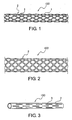
- Each of tubes of ⁇ 5.0mm of the Nos. 3 and 4 alloys was processed into a slotted shape illustrated in Fig. 1 by laser machining to obtain a stent 100 of a first embodiment.
- the stent 100 has a shape as a mesh tube 2 formed by a mesh wire 1 having slots 3.
- the stent 100 was subjected to shape memory treatment.
- the tube 2 of ⁇ 1.2mm of the No. 4 alloy was provided with the slots 3 in a staggered fashion in a longitudinal direction and in a circumferential direction, as illustrated in Fig. 3. Thereafter, the tube 2 was radially expanded into ⁇ 5.0mm to obtain a mesh tube and subjected to shape memory treatment at 600°C. Then, the tube 2 was radially contracted into ⁇ 1.2mm and subjected to swaging into ⁇ 1.05mm (the strain of about 13%). This tube had a shape recovery temperature of 55°C. Thus, an appropriateness of such strain imposing technique was confirmed.
- the slotted tube of ⁇ 1.2mm of the No. 4 alloy in Fig. 3 was radially expanded into ⁇ 5.5mm and subjected to heat treatment. Thereafter, the tube was radially contracted into ⁇ 1.2mm again (the maximum strain of a slot angle was about 10%).
- the shape recovery temperature was examined and was about 40°C. alloy expanded diameter (mm) shape recovery behavior 37°C shape recovery temperature No.3 ⁇ 5.5 shape recovered completely ⁇ 5.75 no shape change observed shape recovered at 55°C No. 4 ⁇ 5.5 shape recovered slightly, but not completely shape recovered at 40°C ⁇ 5.75 no shape change observed shape recovered at 60°C
- a catheter equipped with the ⁇ 5.5mm expanded stent of the No. 4 alloy was guided into a blood vessel having a diameter of about 4mm.
- the stent was released at the living body temperature (37°C).
- the stent was slowly expanded simultaneously when it was released, but was not completely recovered.
- the stent was expanded by a balloon and fixed to an inner wall of the blood vessel. Thereafter, saline solution at about 45°C was supplied into the balloon to warm the stent to a temperature of 40°C or higher.
- the ⁇ 5.75mm expanded stent of the No. 4 alloy was tested in the similar manner. At 37°C, no change in shape of the stent was observed. For the purpose of shape recovery, warming was carried out by means of induction heating. Specifically, hot water of 37°C was circulated through the blood vessel and warming was carried out by the induction heating. The temperature was measured by a thermocouple attached to the stent.
- the stent was taken out from the blood vessel to examine any damage of the blood vessel wall caused by heating and the shape recovery temperature of the stent. In either case, no remarkable deterioration of the blood vessel wall was observed and the superelasticity was exhibited at 37°C.
- the stent may be restrained by a restraining component such as tungsten, tantalum, or a gold alloy in order to suppress slight shape recovery at the living body temperature.
- a restraining component such as tungsten, tantalum, or a gold alloy
- the functionality and the angiographic effect can be improved.
- heating for shape recovery of the stent is possible by applying electric current to the above-mentioned restraining component or a conductor wire such as copper and steel.
- the optimum shape memory alloy used in this invention is the Ti-Ni-Nb alloy. Altematively, use may be made of an alloy further containing a fourth element such as Fe, Cr, V, or Co in addition to Ti, Ni, and Nb. As described above, according to this invention, it is possible to provide the stent which can easily be mounted not only to a blood vessel but also to a lumen of a human body or an animal.
- the balloon expandable superelastic stent according to this invention is optimum as an apparatus for medical treatment using a stent.
Landscapes
- Health & Medical Sciences (AREA)
- Engineering & Computer Science (AREA)
- Biomedical Technology (AREA)
- Vascular Medicine (AREA)
- Life Sciences & Earth Sciences (AREA)
- Veterinary Medicine (AREA)
- Public Health (AREA)
- General Health & Medical Sciences (AREA)
- Animal Behavior & Ethology (AREA)
- Heart & Thoracic Surgery (AREA)
- Transplantation (AREA)
- Optics & Photonics (AREA)
- Oral & Maxillofacial Surgery (AREA)
- Cardiology (AREA)
- Physics & Mathematics (AREA)
- Chemical & Material Sciences (AREA)
- Inorganic Chemistry (AREA)
- Surgery (AREA)
- Epidemiology (AREA)
- Mechanical Engineering (AREA)
- Media Introduction/Drainage Providing Device (AREA)
- Materials For Medical Uses (AREA)
Applications Claiming Priority (2)
| Application Number | Priority Date | Filing Date | Title |
|---|---|---|---|
| JP2004062664 | 2004-03-05 | ||
| JP2004062664A JP4351560B2 (ja) | 2004-03-05 | 2004-03-05 | バルーン拡張超弾性ステント |
Publications (2)
| Publication Number | Publication Date |
|---|---|
| EP1570870A1 true EP1570870A1 (de) | 2005-09-07 |
| EP1570870B1 EP1570870B1 (de) | 2007-10-10 |
Family
ID=34747701
Family Applications (1)
| Application Number | Title | Priority Date | Filing Date |
|---|---|---|---|
| EP20050004807 Expired - Lifetime EP1570870B1 (de) | 2004-03-05 | 2005-03-04 | Ballonexpandierbarer superelastischer Stent |
Country Status (8)
| Country | Link |
|---|---|
| US (1) | US7658761B2 (de) |
| EP (1) | EP1570870B1 (de) |
| JP (1) | JP4351560B2 (de) |
| KR (1) | KR20060043396A (de) |
| CN (1) | CN100502805C (de) |
| AU (1) | AU2005201000B2 (de) |
| CA (1) | CA2499453C (de) |
| DE (1) | DE602005002764T2 (de) |
Cited By (1)
| Publication number | Priority date | Publication date | Assignee | Title |
|---|---|---|---|---|
| WO2011134146A1 (en) * | 2010-04-28 | 2011-11-03 | Empire Technology Development Llc | Intravitreous self adaptive stent |
Families Citing this family (20)
| Publication number | Priority date | Publication date | Assignee | Title |
|---|---|---|---|---|
| WO2004091680A1 (en) * | 2003-03-31 | 2004-10-28 | Memry Corporation | Medical devices having drug eluting properties and methods of manufacture thereof |
| JP5143342B2 (ja) * | 2005-05-23 | 2013-02-13 | Necトーキン株式会社 | 自律機能性ステント |
| JP4737518B2 (ja) * | 2005-05-23 | 2011-08-03 | Necトーキン株式会社 | Ti−Ni−Nb合金素子 |
| DK2059619T3 (da) | 2006-09-06 | 2011-02-21 | Cook Inc | Nikkel-titan-legering omfattende et sjældent jordmetal |
| JP5008181B2 (ja) * | 2006-11-07 | 2012-08-22 | 株式会社日本ステントテクノロジー | ステント |
| EP2238270A2 (de) * | 2007-12-21 | 2010-10-13 | Cook Incorporated | Röntgenopake legierung und aus dieser legierung hergestellte medizinische vorrichtung |
| CA3063001A1 (en) | 2008-02-29 | 2009-09-03 | Edwards Lifesciences Corporation | Expandable member for deploying a prosthetic device |
| CN100545283C (zh) * | 2008-03-25 | 2009-09-30 | 厦门大学 | 一种镍钛铌负热膨胀合金及其制备方法 |
| WO2010065070A2 (en) * | 2008-11-25 | 2010-06-10 | M Cubed Technologies, Inc. | Electrostatic chuck |
| GB2475340B (en) | 2009-11-17 | 2013-03-27 | Univ Limerick | Nickel-titanium alloy and method of processing the alloy |
| WO2011120050A1 (en) * | 2010-03-26 | 2011-09-29 | Thubrikar Aortic Valve, Inc. | Valve component, frame component and prosthetic valve device including the same for implantation in a body lumen |
| GB2495772B (en) | 2011-10-21 | 2014-02-12 | Univ Limerick | Method of forming a sintered nickel-titanium-rare earth (Ni-Ti-RE) alloy |
| US9212409B2 (en) | 2012-01-18 | 2015-12-15 | Cook Medical Technologies Llc | Mixture of powders for preparing a sintered nickel-titanium-rare earth metal (Ni-Ti-RE) alloy |
| US9283069B2 (en) | 2012-04-13 | 2016-03-15 | Empire Technology Development Llc | Intravitreous self adaptive stent |
| US20140255246A1 (en) * | 2013-03-08 | 2014-09-11 | Abbott Laboratories | Medical device having niobium nitinol alloy |
| US9119904B2 (en) | 2013-03-08 | 2015-09-01 | Abbott Laboratories | Guide wire utilizing a nickel—titanium alloy having high elastic modulus in the martensitic phase |
| US9339401B2 (en) | 2013-03-08 | 2016-05-17 | Abbott Laboratories | Medical device utilizing a nickel-titanium ternary alloy having high elastic modulus |
| JP2015036455A (ja) | 2013-08-12 | 2015-02-23 | クリノ株式会社 | 医療用Ti−Ni合金 |
| US10912664B2 (en) | 2017-11-21 | 2021-02-09 | Cook Medical Technologies, LLC | Stent with induction responsive muscles that facilitate implantation adjustments |
| CN108836420B (zh) * | 2018-07-26 | 2021-04-20 | 李强 | 一种肝门血流阻断装置 |
Citations (5)
| Publication number | Priority date | Publication date | Assignee | Title |
|---|---|---|---|---|
| US4770725A (en) * | 1984-11-06 | 1988-09-13 | Raychem Corporation | Nickel/titanium/niobium shape memory alloy & article |
| WO1995031945A1 (en) * | 1994-05-19 | 1995-11-30 | Scimed Life Systems, Inc. | Improved tissue supporting devices |
| JPH1199207A (ja) * | 1997-09-30 | 1999-04-13 | Tokin Corp | ステント |
| US20020082681A1 (en) * | 2000-12-27 | 2002-06-27 | Boylan John F. | Radiopaque nitinol alloys for medical devices |
| US20040249447A1 (en) * | 2000-12-27 | 2004-12-09 | Boylan John F. | Radiopaque and MRI compatible nitinol alloys for medical devices |
Family Cites Families (15)
| Publication number | Priority date | Publication date | Assignee | Title |
|---|---|---|---|---|
| US3174851A (en) | 1961-12-01 | 1965-03-23 | William J Buehler | Nickel-base alloys |
| JPS58161753A (ja) | 1982-03-18 | 1983-09-26 | Kazuhiro Otsuka | Ti−Ni系超弾性材料の製造方法 |
| JP2541802B2 (ja) | 1986-07-07 | 1996-10-09 | 株式会社トーキン | 形状記憶TiNiV合金及びその製造方法 |
| JPS6396234A (ja) * | 1986-10-09 | 1988-04-27 | Tokin Corp | 形状記憶合金材料 |
| JPH0665742B2 (ja) | 1987-01-08 | 1994-08-24 | 株式会社ト−キン | 形状記憶TiNiV合金の製造方法 |
| JPH09511281A (ja) * | 1994-03-31 | 1997-11-11 | エー. ベッセリンク,ペトルス | Ni−Ti−Nb合金の処理方法と該合金から作られた物品 |
| US5545210A (en) * | 1994-09-22 | 1996-08-13 | Advanced Coronary Technology, Inc. | Method of implanting a permanent shape memory alloy stent |
| US5830179A (en) | 1996-04-09 | 1998-11-03 | Endocare, Inc. | Urological stent therapy system and method |
| US5846247A (en) * | 1996-11-15 | 1998-12-08 | Unsworth; John D. | Shape memory tubular deployment system |
| US6312455B2 (en) | 1997-04-25 | 2001-11-06 | Nitinol Devices & Components | Stent |
| US6485507B1 (en) * | 1999-07-28 | 2002-11-26 | Scimed Life Systems | Multi-property nitinol by heat treatment |
| US7402173B2 (en) * | 2000-09-18 | 2008-07-22 | Boston Scientific Scimed, Inc. | Metal stent with surface layer of noble metal oxide and method of fabrication |
| AU2002233936A1 (en) * | 2000-11-07 | 2002-05-21 | Advanced Bio Prosthetic Surfaces, Ltd. | Endoluminal stent, self-fupporting endoluminal graft and methods of making same |
| JP4955162B2 (ja) * | 2001-08-28 | 2012-06-20 | テルモ株式会社 | 生体器官拡張器具用バルーンおよび生体器官拡張器具 |
| US20040172127A1 (en) * | 2002-12-09 | 2004-09-02 | John Kantor | Modular stent having polymer bridges at modular unit contact sites |
-
2004
- 2004-03-05 JP JP2004062664A patent/JP4351560B2/ja not_active Expired - Fee Related
-
2005
- 2005-03-03 US US11/071,516 patent/US7658761B2/en not_active Expired - Fee Related
- 2005-03-04 CA CA2499453A patent/CA2499453C/en not_active Expired - Fee Related
- 2005-03-04 EP EP20050004807 patent/EP1570870B1/de not_active Expired - Lifetime
- 2005-03-04 AU AU2005201000A patent/AU2005201000B2/en not_active Ceased
- 2005-03-04 CN CNB2005100716313A patent/CN100502805C/zh not_active Expired - Fee Related
- 2005-03-04 KR KR20050018049A patent/KR20060043396A/ko not_active Ceased
- 2005-03-04 DE DE200560002764 patent/DE602005002764T2/de not_active Expired - Lifetime
Patent Citations (5)
| Publication number | Priority date | Publication date | Assignee | Title |
|---|---|---|---|---|
| US4770725A (en) * | 1984-11-06 | 1988-09-13 | Raychem Corporation | Nickel/titanium/niobium shape memory alloy & article |
| WO1995031945A1 (en) * | 1994-05-19 | 1995-11-30 | Scimed Life Systems, Inc. | Improved tissue supporting devices |
| JPH1199207A (ja) * | 1997-09-30 | 1999-04-13 | Tokin Corp | ステント |
| US20020082681A1 (en) * | 2000-12-27 | 2002-06-27 | Boylan John F. | Radiopaque nitinol alloys for medical devices |
| US20040249447A1 (en) * | 2000-12-27 | 2004-12-09 | Boylan John F. | Radiopaque and MRI compatible nitinol alloys for medical devices |
Non-Patent Citations (1)
| Title |
|---|
| PATENT ABSTRACTS OF JAPAN vol. 1999, no. 09 30 July 1999 (1999-07-30) * |
Cited By (2)
| Publication number | Priority date | Publication date | Assignee | Title |
|---|---|---|---|---|
| WO2011134146A1 (en) * | 2010-04-28 | 2011-11-03 | Empire Technology Development Llc | Intravitreous self adaptive stent |
| US9539087B2 (en) | 2010-04-28 | 2017-01-10 | Empire Technology Development Llc | Intravitreous self adaptive stent |
Also Published As
| Publication number | Publication date |
|---|---|
| KR20060043396A (ko) | 2006-05-15 |
| CN100502805C (zh) | 2009-06-24 |
| US20050209683A1 (en) | 2005-09-22 |
| DE602005002764T2 (de) | 2008-03-06 |
| CN1672661A (zh) | 2005-09-28 |
| CA2499453A1 (en) | 2005-09-05 |
| JP4351560B2 (ja) | 2009-10-28 |
| JP2005245848A (ja) | 2005-09-15 |
| AU2005201000B2 (en) | 2010-08-19 |
| AU2005201000A1 (en) | 2005-09-22 |
| US7658761B2 (en) | 2010-02-09 |
| EP1570870B1 (de) | 2007-10-10 |
| CA2499453C (en) | 2010-06-22 |
| DE602005002764D1 (de) | 2007-11-22 |
Similar Documents
| Publication | Publication Date | Title |
|---|---|---|
| US7658761B2 (en) | Balloon expandable superelastic stent | |
| US7918011B2 (en) | Method for providing radiopaque nitinol alloys for medical devices | |
| CA2206762C (en) | A stent assembly | |
| US6569194B1 (en) | Thermoelastic and superelastic Ni-Ti-W alloy | |
| EP1545679B1 (de) | Strahlungsundurchlässige nitinollegierungen für medizinische geräte | |
| US7128757B2 (en) | Radiopaque and MRI compatible nitinol alloys for medical devices | |
| US20070239259A1 (en) | Nitinol alloy design and composition for medical devices | |
| EP1177778B1 (de) | Verfahren zur Herstellung eines Stents | |
| US8652199B2 (en) | Stent with autonomic function | |
| JP5248165B2 (ja) | 生体内留置用ステントおよび生体器官拡張器具 | |
| WO2021192636A1 (ja) | 生体内留置用ステントおよびステントデリバリーシステム |
Legal Events
| Date | Code | Title | Description |
|---|---|---|---|
| PUAI | Public reference made under article 153(3) epc to a published international application that has entered the european phase |
Free format text: ORIGINAL CODE: 0009012 |
|
| AK | Designated contracting states |
Kind code of ref document: A1 Designated state(s): AT BE BG CH CY CZ DE DK EE ES FI FR GB GR HU IE IS IT LI LT LU MC NL PL PT RO SE SI SK TR |
|
| AX | Request for extension of the european patent |
Extension state: AL BA HR LV MK YU |
|
| 17P | Request for examination filed |
Effective date: 20060303 |
|
| AKX | Designation fees paid |
Designated state(s): DE FR GB IT |
|
| 17Q | First examination report despatched |
Effective date: 20060504 |
|
| RIC1 | Information provided on ipc code assigned before grant |
Ipc: A61L 31/02 20060101AFI20070209BHEP Ipc: A61L 27/06 20060101ALI20070209BHEP Ipc: A61F 2/90 20060101ALI20070209BHEP |
|
| GRAP | Despatch of communication of intention to grant a patent |
Free format text: ORIGINAL CODE: EPIDOSNIGR1 |
|
| GRAS | Grant fee paid |
Free format text: ORIGINAL CODE: EPIDOSNIGR3 |
|
| GRAA | (expected) grant |
Free format text: ORIGINAL CODE: 0009210 |
|
| AK | Designated contracting states |
Kind code of ref document: B1 Designated state(s): DE FR GB IT |
|
| REG | Reference to a national code |
Ref country code: GB Ref legal event code: FG4D |
|
| REF | Corresponds to: |
Ref document number: 602005002764 Country of ref document: DE Date of ref document: 20071122 Kind code of ref document: P |
|
| ET | Fr: translation filed | ||
| PLBE | No opposition filed within time limit |
Free format text: ORIGINAL CODE: 0009261 |
|
| STAA | Information on the status of an ep patent application or granted ep patent |
Free format text: STATUS: NO OPPOSITION FILED WITHIN TIME LIMIT |
|
| 26N | No opposition filed |
Effective date: 20080711 |
|
| PGFP | Annual fee paid to national office [announced via postgrant information from national office to epo] |
Ref country code: IT Payment date: 20140307 Year of fee payment: 10 Ref country code: FR Payment date: 20140311 Year of fee payment: 10 |
|
| PGFP | Annual fee paid to national office [announced via postgrant information from national office to epo] |
Ref country code: GB Payment date: 20140226 Year of fee payment: 10 |
|
| PGFP | Annual fee paid to national office [announced via postgrant information from national office to epo] |
Ref country code: DE Payment date: 20140417 Year of fee payment: 10 |
|
| REG | Reference to a national code |
Ref country code: DE Ref legal event code: R119 Ref document number: 602005002764 Country of ref document: DE |
|
| GBPC | Gb: european patent ceased through non-payment of renewal fee |
Effective date: 20150304 |
|
| PG25 | Lapsed in a contracting state [announced via postgrant information from national office to epo] |
Ref country code: IT Free format text: LAPSE BECAUSE OF NON-PAYMENT OF DUE FEES Effective date: 20150304 |
|
| REG | Reference to a national code |
Ref country code: FR Ref legal event code: ST Effective date: 20151130 |
|
| PG25 | Lapsed in a contracting state [announced via postgrant information from national office to epo] |
Ref country code: DE Free format text: LAPSE BECAUSE OF NON-PAYMENT OF DUE FEES Effective date: 20151001 Ref country code: GB Free format text: LAPSE BECAUSE OF NON-PAYMENT OF DUE FEES Effective date: 20150304 |
|
| PG25 | Lapsed in a contracting state [announced via postgrant information from national office to epo] |
Ref country code: FR Free format text: LAPSE BECAUSE OF NON-PAYMENT OF DUE FEES Effective date: 20150331 |