EP1568625B1 - Inspektionsmaschine mit einer Vorrichtung zum Transportieren von Hohlkörpern - Google Patents
Inspektionsmaschine mit einer Vorrichtung zum Transportieren von Hohlkörpern Download PDFInfo
- Publication number
- EP1568625B1 EP1568625B1 EP05003613A EP05003613A EP1568625B1 EP 1568625 B1 EP1568625 B1 EP 1568625B1 EP 05003613 A EP05003613 A EP 05003613A EP 05003613 A EP05003613 A EP 05003613A EP 1568625 B1 EP1568625 B1 EP 1568625B1
- Authority
- EP
- European Patent Office
- Prior art keywords
- machine according
- belts
- conveying
- support ring
- belt
- Prior art date
- Legal status (The legal status is an assumption and is not a legal conclusion. Google has not performed a legal analysis and makes no representation as to the accuracy of the status listed.)
- Expired - Lifetime
Links
- 238000007689 inspection Methods 0.000 title claims abstract description 51
- 239000004033 plastic Substances 0.000 claims description 4
- 229920003023 plastic Polymers 0.000 claims description 4
- 238000004519 manufacturing process Methods 0.000 claims 1
- 238000003384 imaging method Methods 0.000 description 3
- 238000000034 method Methods 0.000 description 3
- 235000013361 beverage Nutrition 0.000 description 2
- 230000000694 effects Effects 0.000 description 2
- 229920000139 polyethylene terephthalate Polymers 0.000 description 2
- 239000005020 polyethylene terephthalate Substances 0.000 description 2
- 238000005085 air analysis Methods 0.000 description 1
- 238000007664 blowing Methods 0.000 description 1
- 150000001875 compounds Chemical class 0.000 description 1
- 230000002950 deficient Effects 0.000 description 1
- 230000001419 dependent effect Effects 0.000 description 1
- 238000011161 development Methods 0.000 description 1
- 230000018109 developmental process Effects 0.000 description 1
- 229910052736 halogen Inorganic materials 0.000 description 1
- 150000002367 halogens Chemical class 0.000 description 1
- 238000005286 illumination Methods 0.000 description 1
- 238000002347 injection Methods 0.000 description 1
- 239000007924 injection Substances 0.000 description 1
- -1 polyethylene terephthalate Polymers 0.000 description 1
- 239000000243 solution Substances 0.000 description 1
- 229920001169 thermoplastic Polymers 0.000 description 1
- 239000004416 thermosoftening plastic Substances 0.000 description 1
Images


Classifications
-
- B—PERFORMING OPERATIONS; TRANSPORTING
- B29—WORKING OF PLASTICS; WORKING OF SUBSTANCES IN A PLASTIC STATE IN GENERAL
- B29C—SHAPING OR JOINING OF PLASTICS; SHAPING OF MATERIAL IN A PLASTIC STATE, NOT OTHERWISE PROVIDED FOR; AFTER-TREATMENT OF THE SHAPED PRODUCTS, e.g. REPAIRING
- B29C49/00—Blow-moulding, i.e. blowing a preform or parison to a desired shape within a mould; Apparatus therefor
- B29C49/42—Component parts, details or accessories; Auxiliary operations
- B29C49/4205—Handling means, e.g. transfer, loading or discharging means
- B29C49/42093—Transporting apparatus, e.g. slides, wheels or conveyors
-
- B—PERFORMING OPERATIONS; TRANSPORTING
- B29—WORKING OF PLASTICS; WORKING OF SUBSTANCES IN A PLASTIC STATE IN GENERAL
- B29C—SHAPING OR JOINING OF PLASTICS; SHAPING OF MATERIAL IN A PLASTIC STATE, NOT OTHERWISE PROVIDED FOR; AFTER-TREATMENT OF THE SHAPED PRODUCTS, e.g. REPAIRING
- B29C49/00—Blow-moulding, i.e. blowing a preform or parison to a desired shape within a mould; Apparatus therefor
- B29C49/42—Component parts, details or accessories; Auxiliary operations
- B29C49/78—Measuring, controlling or regulating
- B29C49/80—Testing, e.g. for leaks
-
- B—PERFORMING OPERATIONS; TRANSPORTING
- B65—CONVEYING; PACKING; STORING; HANDLING THIN OR FILAMENTARY MATERIAL
- B65G—TRANSPORT OR STORAGE DEVICES, e.g. CONVEYORS FOR LOADING OR TIPPING, SHOP CONVEYOR SYSTEMS OR PNEUMATIC TUBE CONVEYORS
- B65G15/00—Conveyors having endless load-conveying surfaces, i.e. belts and like continuous members, to which tractive effort is transmitted by means other than endless driving elements of similar configuration
- B65G15/10—Conveyors having endless load-conveying surfaces, i.e. belts and like continuous members, to which tractive effort is transmitted by means other than endless driving elements of similar configuration comprising two or more co-operating endless surfaces with parallel longitudinal axes, or a multiplicity of parallel elements, e.g. ropes defining an endless surface
- B65G15/12—Conveyors having endless load-conveying surfaces, i.e. belts and like continuous members, to which tractive effort is transmitted by means other than endless driving elements of similar configuration comprising two or more co-operating endless surfaces with parallel longitudinal axes, or a multiplicity of parallel elements, e.g. ropes defining an endless surface with two or more endless belts
- B65G15/14—Conveyors having endless load-conveying surfaces, i.e. belts and like continuous members, to which tractive effort is transmitted by means other than endless driving elements of similar configuration comprising two or more co-operating endless surfaces with parallel longitudinal axes, or a multiplicity of parallel elements, e.g. ropes defining an endless surface with two or more endless belts the load being conveyed between the belts
-
- G—PHYSICS
- G01—MEASURING; TESTING
- G01N—INVESTIGATING OR ANALYSING MATERIALS BY DETERMINING THEIR CHEMICAL OR PHYSICAL PROPERTIES
- G01N21/00—Investigating or analysing materials by the use of optical means, i.e. using sub-millimetre waves, infrared, visible or ultraviolet light
- G01N21/84—Systems specially adapted for particular applications
- G01N21/88—Investigating the presence of flaws or contamination
- G01N21/90—Investigating the presence of flaws or contamination in a container or its contents
- G01N21/9009—Non-optical constructional details affecting optical inspection, e.g. cleaning mechanisms for optical parts, vibration reduction
-
- G—PHYSICS
- G01—MEASURING; TESTING
- G01N—INVESTIGATING OR ANALYSING MATERIALS BY DETERMINING THEIR CHEMICAL OR PHYSICAL PROPERTIES
- G01N21/00—Investigating or analysing materials by the use of optical means, i.e. using sub-millimetre waves, infrared, visible or ultraviolet light
- G01N21/84—Systems specially adapted for particular applications
- G01N21/88—Investigating the presence of flaws or contamination
- G01N21/90—Investigating the presence of flaws or contamination in a container or its contents
- G01N21/9081—Inspection especially designed for plastic containers, e.g. preforms
-
- B—PERFORMING OPERATIONS; TRANSPORTING
- B29—WORKING OF PLASTICS; WORKING OF SUBSTANCES IN A PLASTIC STATE IN GENERAL
- B29C—SHAPING OR JOINING OF PLASTICS; SHAPING OF MATERIAL IN A PLASTIC STATE, NOT OTHERWISE PROVIDED FOR; AFTER-TREATMENT OF THE SHAPED PRODUCTS, e.g. REPAIRING
- B29C49/00—Blow-moulding, i.e. blowing a preform or parison to a desired shape within a mould; Apparatus therefor
- B29C49/42—Component parts, details or accessories; Auxiliary operations
- B29C49/78—Measuring, controlling or regulating
- B29C2049/7874—Preform or article shape, weight, defect or presence
- B29C2049/7876—Defects
-
- B—PERFORMING OPERATIONS; TRANSPORTING
- B29—WORKING OF PLASTICS; WORKING OF SUBSTANCES IN A PLASTIC STATE IN GENERAL
- B29C—SHAPING OR JOINING OF PLASTICS; SHAPING OF MATERIAL IN A PLASTIC STATE, NOT OTHERWISE PROVIDED FOR; AFTER-TREATMENT OF THE SHAPED PRODUCTS, e.g. REPAIRING
- B29C49/00—Blow-moulding, i.e. blowing a preform or parison to a desired shape within a mould; Apparatus therefor
- B29C49/42—Component parts, details or accessories; Auxiliary operations
- B29C49/4205—Handling means, e.g. transfer, loading or discharging means
- B29C49/42069—Means explicitly adapted for transporting blown article
-
- B—PERFORMING OPERATIONS; TRANSPORTING
- B29—WORKING OF PLASTICS; WORKING OF SUBSTANCES IN A PLASTIC STATE IN GENERAL
- B29C—SHAPING OR JOINING OF PLASTICS; SHAPING OF MATERIAL IN A PLASTIC STATE, NOT OTHERWISE PROVIDED FOR; AFTER-TREATMENT OF THE SHAPED PRODUCTS, e.g. REPAIRING
- B29C49/00—Blow-moulding, i.e. blowing a preform or parison to a desired shape within a mould; Apparatus therefor
- B29C49/42—Component parts, details or accessories; Auxiliary operations
- B29C49/42378—Handling malfunction
- B29C49/4238—Ejecting defective preforms or products
-
- B—PERFORMING OPERATIONS; TRANSPORTING
- B65—CONVEYING; PACKING; STORING; HANDLING THIN OR FILAMENTARY MATERIAL
- B65G—TRANSPORT OR STORAGE DEVICES, e.g. CONVEYORS FOR LOADING OR TIPPING, SHOP CONVEYOR SYSTEMS OR PNEUMATIC TUBE CONVEYORS
- B65G2201/00—Indexing codes relating to handling devices, e.g. conveyors, characterised by the type of product or load being conveyed or handled
- B65G2201/02—Articles
- B65G2201/0235—Containers
- B65G2201/0244—Bottles
- B65G2201/0247—Suspended bottles
Definitions
- the invention relates to an inspection machine with inspection units and with a device for transporting hollow bodies, according to the preamble of claim 1.
- Such inspection machines are used in industries that use hollow bodies to store their products. Such inspection machines find particular application in the food industry, especially in the beverage industry. Here they are used, inter alia, to plastic preforms, from which later the hollow body arise, for any errors, such. To investigate irregularities in the mouth diameter or damage.
- the plastic hollow bodies mentioned are often thermoplastic hollow plastic bodies, preferably PET bottles (polyethylene terephthalate). For inspection, they are transported by means of a transport device through the inspection machine, which may contain one or more inspection units.
- the inspection equipment such as a CCD camera and a lighting unit are located above and / or below the belt return. From this arrangement, there is the problem that the inspection units are relatively far away from the preforms, since the returning run of the conveyor belt runs between the preforms and the inspection units. In addition, the available field of view is very limited. Therefore, at high throughput speeds through the inspection area, inadequate inspection results regarding the quality of the preforms may occur. However, the quality of the preforms has a decisive effect on the quality of the final products or on the performance of the machines that process the preforms (such as a stretch blow molder).
- the invention is therefore based on the object to provide an inspection machine with good inspection options despite compact volume.
- the hollow bodies are fed in the direction of an inspection machine, at whose entrance they are detected by four transport elements on the support ring and transported through the inspection machine.
- at least one of the transport elements is an endless belt, which rotates in a circulation plane over deflection or drive rollers.
- At least one of these belts is drivable to ensure forward movement within the inspection machine.
- the other belts are either not driven independently or by a connection to the first belt.
- the compounds are adjustable cardan shafts. Also conceivable is a separate drive for each belt.
- At least one belt can be driven separately and thereby also at different speeds relative to one of the other belts.
- a rotation of the preform about its longitudinal axis can be generated.
- the circulating planes in which the belts revolve are arranged at an angle greater than 0 ° and less than 90 ° with respect to the support ring plane.
- the angle is between 20 ° and 80 °, preferably between 55 ° and 65 °.
- This oblique arrangement creates above or below the preform at least one extended free space in the inspection machine, in the various inspection machine or components thereof such as a camera (eg CCD camera), sensors (eg for air analysis in the preform) or lighting units (eg toroidal Halogen lamp under the camera or lamp under the preform) can be introduced.
- a camera eg CCD camera
- sensors eg for air analysis in the preform
- lighting units eg toroidal Halogen lamp under the camera or lamp under the preform
- the inspection units very close to the preform to be inspected, in particular its mouth, in order to achieve the best possible inspection results, above all in the case of imaging inspection methods.
- large-area images of the areas of interest with high resolution can be achieved.
- the inspection of the critical areas e.g., orifice or gate
- a recording is made when the passing longitudinal axis of the preform is aligned with the perpendicular to the support ring plane of the preform camera axis.
- the preform is illuminated almost simultaneously by the illumination device.
- the inspection machine has four belt-shaped transport devices. In this form it is possible that all four angles between the support ring plane and the circulation planes are the same.
- the transport device is adjustable so that it can accommodate both preforms with different support ring thicknesses as well as preforms with different diameters.
- the adjustment may be both mechanical, such as via a crank and a spindle, as well as electrically, such as via a manual or program controlled servomotor or otherwise, such as pneumatically.
- the gap between the two offset transversely to the longitudinal axis of the preform transport element pairs that grip the preform on the support ring is preferably smaller than the diameter of the preform. In this way, a frictional transport is ensured also with respect to the preform width.
- spring-loaded pressure rollers are provided which press the belts in the direction of the support ring.
- spring-loaded pressure rollers instead of the spring-loaded pressure rollers.
- fixed and adjustable pressure rollers instead of the spring-loaded pressure rollers.
- a sliding strip or the like could be used.
- the transport of the hollow body or preform by the inspection machine is substantially linear and horizontal.
- it can easily be retrofitted without altering the height levels in an existing line, for example, between blowing and filling machine.
- preforms are faulty, they must be sorted out and withdrawn from further use. For this reason, after the inspection part of the machine is a controllable sorting device for unusable preforms.
- the ejection device can be integrated into the inspection machine as well as connected to the outlet-side transport region of the machine. There are known in the art various ejection devices, which is why they will not be described in detail here.
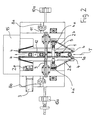
- FIGS. 1, 2 and 3 an inspection machine is shown in which four transport elements are provided, each formed as endless belts 2a, 2b, 2c, 2d.
- the four belts are arranged symmetrically both with respect to a support ring plane A and with respect to the plane spanned by the longitudinal axis of a preform and the transport direction, and in each case have the same angles ⁇ a, ⁇ b, ⁇ c, ⁇ d with respect to the support ring plane A.
- the circulation planes B1-B4 are substantially straight and run parallel to the carrier plate pairs 6a-6d. Between the legs of this X arrangement, there is sufficient space above and below the preform 1 for inspection units 12, 13, 14. With the aid of a camera 12, the mouth areas and possibly the injection points of the preforms are inspected by an imaging method.
- the preforms 1 are illuminated by means of a lamp 13 which is attached laterally and whose light is redirected to the preform 1 by means of a semipermeable mirror 14.
- the belt 2c and 2d are adjusted by tension rollers 7 in their clamping force. But it is also possible to tighten all belts of the machine 2a-2e by tension rollers 7.
- the belts 2a, 2b, 2c, 2d, 2e receiving drive wheels 4a ', 4a and the guide rollers 4 are rotatably mounted on support plates 6a-6d, which in turn are mounted on a base frame 8a-8d. For orientation, the base frame 8a-8d runs in profile rails 9.
- the two parts of the base frame 8c and 8d, and thus also attached to these belts 2a and 2b, are vertically adjustable by an adjusting device 10b, so that the vertical gap S 'between the upper Support plate pair 6a, 6c and the lower support plate pair 6b, 6d is variable.
- the adjusting device 10b consists of a spindle and a crank. Upon actuation of the crank, the upper pair of carrier plates 6a and 6c with all elements attached thereto, such as belts 2a, 2b, or drive roller 4a ', are moved along the profile rails 11.
- this vertical gap S ' is located during the transport of preforms 1 of the support ring 1a.
- the adjustment of the vertical gap S ' is present because the inspection machine can accommodate different preforms 1 with different support ring thicknesses 1a during a grade change.
- the adjustment of the vertical gap becomes S 'made so that it is slightly smaller than the support ring thickness 1a of the preform 1 to be transported in order to ensure a frictional engagement of the belt 2a, 2b, 2c and 2d on the support ring 1a.
- the horizontal gap S can be adjusted by means of an adjusting device 10a, which also consists of a crank and a threaded spindle here.
- the left 6c, 6d and the right pair of carrier plates 6a, 6c is preferably adjusted so that the horizontal gap S between them is slightly smaller than the diameter of the preforms 1 to be transported, in order to achieve a frictional transport here as well. If one wishes to convey through the inspection machine hollow body 1 with a different orifice diameter, the adjusting device 10a is actuated such that the base frame halves 8a, 8b move horizontally transversely to the transport direction apart or toward one another in order to make the gap S larger or smaller.
- the propeller shafts 5, which transmit the driving force from the motor 3 and the drive roller 4a 'to the other drive rollers 4a, are designed to be longitudinally adjustable. This is necessary because in the horizontal and vertical adjustment of the belt (2a-2d) for the purpose of receiving different preforms 1 with different mouth and Tragringgeometrien, also the distances between the drive rollers 4a 'and 4a change.
- the belts 2a, 2b, 2c and 2d are equipped with a specific geometry in order to lie as well as possible on the support ring 1a of the preform 1 (see FIG. 3).
- the two lower belts 2c and 2d have surfaces at right angles to each other, which are in engagement with the preform 1 on the underside of the support ring, where this also forms a right angle between the support ring A and its longitudinal axis.
- the two upper belts 2a and 2b run on the side facing away from the preform 1 side parallel to the support ring plane A and the lower belt 2c and 2d.
- the belts 2a and 2b run at an angle corresponding to that between the support ring plane A and the upper part of the support ring.
- the inner sides of the belts 2a-2d that is to say the sides on which the belts engage with the deflection 4 or drive rollers 4a and 4a ', are designed as toothed belts. For the sake of clarity, this is not shown here.
- the timing belt side of belts 2a-2d is made of HTD while the applied profiled side is made of Linatex®.
- an ejecting device 15 which removes defective or no longer usable preforms 1 for further use in the subsequent machine cycle.
- This is an arbitrary commercial ejection device 15, which is not shown in greater detail here for the sake of clarity.
Landscapes
- Engineering & Computer Science (AREA)
- Mechanical Engineering (AREA)
- Manufacturing & Machinery (AREA)
- Biochemistry (AREA)
- General Physics & Mathematics (AREA)
- Life Sciences & Earth Sciences (AREA)
- Chemical & Material Sciences (AREA)
- Analytical Chemistry (AREA)
- Physics & Mathematics (AREA)
- General Health & Medical Sciences (AREA)
- Health & Medical Sciences (AREA)
- Immunology (AREA)
- Pathology (AREA)
- Blow-Moulding Or Thermoforming Of Plastics Or The Like (AREA)
- Separation Using Semi-Permeable Membranes (AREA)
- Investigating Materials By The Use Of Optical Means Adapted For Particular Applications (AREA)
- Structure Of Belt Conveyors (AREA)
Description
- Die Erfindung betrifft eine Inspektionsmaschine mit Inspektionseinheiten und mit einer Vorrichtung zum Transportieren von Hohlkörpern, gemäß dem Oberbegriff des Anspruchs 1.
- Derartige Inspektionsmaschinen werden in Industriezweigen verwendet, die Hohlkörper zum Aufbewahren ihrer Produkte benutzen. Besondere Verwendung finden solche Inspektionsmaschinen in der Lebensmittelindustrie, insbesondere in der Getränkeindustrie. Hier werden sie unter anderem dazu eingesetzt, um Kunststoff-Preforms, aus denen später die Hohlkörper entstehen, auf etwaige Fehler, wie z.B. Unregelmäßigkeiten im Mündungsdurchmesser oder Beschädigungen zu untersuchen. In der Getränkeindustrie handelt es sich bei den genannten Kunststoffhohlkörpern oft um thermoplastische Kunststoffhohlkörper, vorzugsweise PET-Flaschen (Polyethylenterephthalat). Zur Inspektion werden sie mit Hilfe einer Transportvorrichtung durch die Inspektionsmaschine, die eine oder mehrere Inspektionseinheiten enthalten kann, transportiert.
- Es sind bereits Vorrichtungen bekannt, bei denen die einen Tragring aufweisenden Preforms mit Hilfe von Riemenförderern durch die Inspektionsmaschine transportiert werden (JP-OS 2000-168945). Bei dieser Vorrichtung, die eine Schrägstellung gegenüber der Bodenebene aufweist, werden die Preforms, deren durch die Tragringe gebildete Tragringebene zunächst noch parallel zur Bodenebene ist, durch eine Vorrichtung schräg gestellt, so dass die Tragringebene nun parallel zu den Riemenförderern ist und die Preforms so durch den Inspektionsbereich der Maschine transportiert werden können. Die Riemen sind dabei als Endlosriemen ausgebildet, die mit Hilfe von Umlenkrollen jeweils in einer vertikalen Umlaufebene umlaufen. Die Umlaufebenen stehen dabei im wesentlichen paarweise senkrecht auf der Tragringebene, weshalb der Rücklauf der Transportriemen im wesentlichen über bzw. unter den Preforms beziehungsweise deren Tragringen erfolgt. Die Inspektionsgeräte wie beispielsweise eine CCD-Kamera und eine Beleuchteinheit befinden sich über und/oder unter dem Riemenrücklauf. Aus dieser Anordnung ergibt sich das Problem, dass die Inspektionseinheiten relativ weit entfernt von den Preforms sind, da das rücklaufende Trum der Transportriemen zwischen den Preforms und den Inspektionseinheiten verläuft. Zudem ist das zur Verfügung stehende Blickfeld stark begrenzt. Deswegen kann es bei hohen Durchlaufgeschwindigkeiten durch den Inspektionsbereich zu unzureichenden Inspektionsergebnissen bezüglich der Qualität der Preforms kommen. Die Qualität der Preforms wirkt sich aber maßgeblich auf die Qualität der Endprodukte beziehungsweise auf die Leistung der die Preforms weiterverarbeitenden Maschinen (wie zum Beispiel eine Streckblasmaschine) aus.
- Der Erfindung liegt deshalb die Aufgabe zu Grunde, eine Inspektionsmaschine mit guten Inspektionsmöglichkeiten trotz kompakten Volumens bereitzustellen.
- Erfindungsgemäß wird diese Aufgabe durch die im Anspruch 1 angegebenen kennzeichnenden Merkmale gelöst.
- Bevorzugte Weiterbildungen sind Gegenstand der Unteransprüche.
- Bei einer erfindungsgemäßen Vorrichtung werden die Hohlkörper in Richtung einer Inspektionsmaschine zugeführt, an deren Eingang sie von vier Transportelementen am Tragring erfasst und durch die Inspektionsmaschine transportiert werden. Vorzugsweise handelt es sich bei mindestens einem der Transportelemente um einen Endlosriemen, der in einer Umlaufebene über Umlenk- bzw. Antriebsrollen geführt umläuft.
- Vorzugsweise ist mindestens einer dieser Riemen antreibbar, um eine Vorwärtsbewegung innerhalb der Inspektionsmaschine zu gewährleisten. Dadurch ist ein gefällefreier Transport realisierbar. Die anderen Riemen werden entweder nicht selbstständig oder durch eine Verbindung zum ersten Riemen angetrieben. In einer bevorzugten Ausführungsform handelt es sich bei den Verbindungen um verstellbare Gelenkwellen. Denkbar ist ferner ein jeweils eigener Antrieb für jeden Riemen.
- In einer weiteren bevorzugten Ausführungsform ist mindestens ein Riemen separat und dadurch auch mit unterschiedlicher Geschwindigkeit relativ zu einem der anderen Riemen antreibbar. Dadurch kann eine Rotation des Preforms um seine Längsachse erzeugt werden. Diese Lösung ist insbesondere bei einer Seitenwandinspektion von Vorteil, weil der gesamte Umfang durch Mehrfachaufnahmen erfassbar ist
- Die Umlaufebenen, in denen die Riemen umlaufen, sind gegenüber der Tragringebene in einem Winkel größer 0° und kleiner 90° angeordnet. In einer bevorzugten Ausführungsform beträgt der Winkel zwischen 20° und 80°, vorzugsweise zwischen 55° und 65°. Durch diese schräge Anordnung entsteht über beziehungsweise unter dem Preform mindestens ein erweiterter Freiraum in der Inspektionsmaschine, in den verschiedene Inspektionsmaschine oder Bestandteile davon wie zum Beispiel eine Kamera (z.B. CCD-Kamera), Sensoren (z.B. zur Luftanalyse im Preform) oder Beleuchtungseinheiten (z.B. torusförmige Halogenlampe unter der Kamera oder Lampe unter dem Preform) eingebracht werden können.
- Außerdem ist es Vorteilhafterweise möglich, die Inspektionseinheiten sehr nahe an den zu inspizierenden Preform, insbesondere dessen Mündung, heran zu bringen, um vor allem bei bildgebenden Inspektionsverfahren möglichst optimale Inspektionsergebnisse zu erzielen. Auf diese Weise sind großflächige Aufnahmen der interessierenden Bereiche mit hoher Auflösung erreichbar. Bei bildgebenden Inspektionsverfahren erfolgt die Inspektion der kritischen Bereiche (z.B. Mündung oder Anspritzpunkt) senkrecht von oben beziehungsweise unten. Eine Aufnahme wird dann gemacht, wenn die vorbeilaufende Längsachse des Preforms mit der zur Tragringebene des Preforms senkrecht stehenden Kameraachse fluchtet. Um ein optimales Inspektionsergebnis zu erzielen, wird der Preform nahezu gleichzeitig durch die Beleuchtungseinrichtung beleuchtet.
- In einer bevorzugten Ausführungsform hat die Inspektionsmaschine vier als Riemen ausgebildete Transportvorrichtungen. In dieser Ausprägung ist es möglich, dass alle vier Winkel zwischen der Tragringebene und den Umlaufebenen gleich sind.
- Die Transportvorrichtung ist so verstellbar, dass sie sowohl Preforms mit verschiedenen Tragringdicken als auch Preforms mit verschiedenen Durchmessern aufnehmen kann. Die Verstellung kann sowohl mechanisch, wie zum Beispiel über eine Kurbel und eine Spindel, als auch elektrisch, wie zum Beispiel über einen manuell oder programmgesteuerten Servomotor oder anderweitig, wie zum Beispiel pneumatisch, erfolgen.
In einer bevorzugten Ausführungsform ist der Spalt zwischen den oberen und unteren Transportelementen, in dem sich während des Transports des Preforms der Tragring befindet, kleiner als die Dicke des Tragrings, um den Transport reibschlüssig zu vollziehen. Der Spalt zwischen den beiden quer zur Längsachse des Preforms versetzten Transportelementpaaren, die den Preform am Tragring greifen, ist vorzugsweise kleiner als der Durchmesser des Preforms. Auf diese Weise wird auch bezüglich der Preformbreite ein reibschlüssiger Transport gewährleistet. - In einer weiteren Ausführungsform sind gefederte Andrückrollen vorhanden, die die Riemen in Richtung des Tragrings drücken. Dadurch können trotz des reibschlüssigen Transports der Preforms eventuelle Dicketoleranzen der Tragringe problemlos ausgeglichen werden. Es ist aber auch denkbar, anstelle der gefederten Andrückrollen feste und einstellbare Andrückrollen zu verwenden. Anstelle der festen Andrückrollen wäre aber auch ein Gleitstreifen oder ähnliches einsetzbar.
- Vorzugsweise erfolgt der Transport der Hohlkörper bzw. Preforms durch die Inspektionsmaschine im wesentlichen linear und horizontal. Dadurch kann sie problemlos ohne Änderung der Höhenniveaus auch noch nachträglich in eine bestehende Linie eingebaut werden, zum Beispiel zwischen Blas- und Füllmaschine.
- Es ist nicht nur möglich, die Inspektionsmaschine vor eine die Preforms weiterverarbeitende Maschine zu stellen, um diese zu inspizieren, sondern auch denkbar, die Inspektionsmaschine vor eine Füllmaschine zu stellen, um die Preforms beziehungsweise die schon fertigen Flaschen auf eventuelle Fehler zu überprüfen.
- Sind Preforms fehlerhaft, so müssen Sie aussortiert und einer weiteren Verwendung entzogen werden. Aus diesem Grund befindet sich nach dem Inspektionsteil der Maschine eine ansteuerbare Aussortiereinrichtung für nicht verwendbare Preforms. Die Auswerfvorrichtung kann sowohl in die Inspektionsmaschine integriert, als auch an den auslaufseitigen Transportbereich der Maschine angeschlossen sein. Es sind im Stand der Technik verschiedenste Auswerfvorrichtungen bekannt, weshalb sie hier nicht näher beschrieben werden.
- Im Nachstehenden wird ein Ausführungsbeispiel der Erfindung anhand der Zeichnungen erläutert. Es zeigt:
- Fig. 1:
- Vorderansicht einer Inspektionsmaschine,
- Fig. 2:
- Draufsicht auf eine Inspektionsmaschine und
- Fig. 3:
- Vorderansicht der mit dem Preform in Eingriff stehenden Riemen.
- Bei diesem bevorzugten Ausführungsbeispiel nach Fig. 1, Fig. 2 und Fig. 3 wird eine Inspektionsmaschine gezeigt, bei der vier Transportelemente vorhanden sind, die jeweils als endlose Riemen 2a, 2b, 2c, 2d ausgebildet sind. Die vier Riemen sind sowohl bezüglich einer Tragringebene A als auch bezüglich der von der Längsachse eines Preforms und der Transportrichtung aufgespannten Ebene symmetrisch angeordnet und weisen gegenüber der Tragringebene A jeweils gleiche Winkel αa, αb, αc, αd auf. Dadurch entsteht in Transportrichtung der Preforms 1 gesehen eine annähernd X-förmige Anordnung der Riemen 2a, 2b, 2c, 2d und ihrer Umlaufebenen B1, B2, B3, B4 (siehe Fig. 3). Die Umlaufebenen B1-B4 sind dabei im Wesentlichen gerade und laufen parallel zu den Trägerplattenpaaren 6a-6d.
Zwischen den Schenkeln dieser X-Anordnung bietet sich über und unter dem Preform 1 jeweils genügend Platz für Inspektionseinheiten 12, 13, 14. Mit Hilfe einer Kamera 12 werden die Mündungsbereiche und gegebenenfalls die Anspritzpunkte der Preforms durch ein bildgebendes Verfahren inspiziert. Beleuchtet werden die Preforms 1 mit Hilfe einer oberhalb seitlich angebrachten Lampe 13, deren Licht mit Hilfe eines semipermeablen Spiegels 14 zum Preform 1 umgeleitet wird. - Für den Antrieb der Riemen 2a, 2b, 2c, 2d steht nur ein Motor 3 zur Verfügung, der über einen Zahnriemen 2e ein Antriebsrad 4a' antreibt. Die anderen Antriebsräder 4a sind über verstellbare Gelenkwellen 5 direkt oder indirekt mit dem ersten Antriebsrad 4a' verbunden und werden dadurch ebenfalls vom Motor 3 angetrieben. Dadurch, dass alle Antriebsräder 4a und 4a' direkt bzw. indirekt mit dem einen Motor 3 verbunden sind, besteht ein absoluter Gleichlauf. Daraus ergibt sich der Vorteil, dass sich die Preforms 1 im Laufe des Transports durch die Inspektionsmaschine nicht schief stellen. Eine Schiefstellung würde die Qualität der Inspektionsergebnisse herabsetzen.
- Bei diesem konkreten Ausführungsbeispiel sind nur die Riemen 2c und 2d durch Spannrollen 7 in ihrer Spannkraft einzustellen. Es ist aber auch möglich, alle Riemen der Maschine 2a-2e durch Spannrollen 7 zu straffen. Die die Riemen 2a, 2b, 2c, 2d, 2e aufnehmenden Antriebsräder 4a', 4a und die Umlenkrollen 4 sind auf Trägerplatten 6a-6d drehbar gelagert, die ihrerseits wiederum an einem Grundgestell 8a-8d montiert sind. Zur Ausrichtung läuft das Grundgestell 8a-8d in Profilschienen 9. Die beiden Teile des Grundgestells 8c und 8d, und somit auch die auf diesen befestigten Riemen 2a und 2b, sind durch eine Verstelleinrichtung 10b vertikal verstellbar, sodass der vertikale Spalt S' zwischen dem oberen Trägerplattenpaar 6a, 6c und dem unteren Trägerplattenpaar 6b, 6d variabel ist. Die Verstelleinrichtung 10b besteht dabei aus einer Spindel und einer Kurbel. Bei Betätigung der Kurbel wird das obere Trägerplattenpaar 6a und 6c mit allen daran befestigten Elementen wie Riemen 2a, 2b, oder Antriebsrolle 4a' an den Profilschienen 11 entlang bewegt.
- In diesem vertikalen Spalt S' befindet sich beim Transport von Preforms 1 der Tragring 1a. Die Einstellung des vertikalen Spalts S' ist vorhanden, weil die Inspektionsmaschine bei einem Sortenwechsel verschiedene Preforms 1 mit verschiedenen Tragringdicken 1a aufnehmen kann. Vorzugsweise wird die Einstellung des vertikalen Spalts S' so vorgenommen, dass er etwas kleiner ist als die Tragringdicke 1a des zu transportierenden Preforms 1, um ein reibschlüssiges Eingreifen der Riemen 2a, 2b, 2c und 2d am Tragring 1a zu gewährleisten.
- Auch der horizontale Spalt S kann mit Hilfe einer Verstelleinrichtung 10a, die auch hier aus einer Kurbel und einer Gewindespindel besteht, verstellt werden. Das linke 6c,6d und das rechte Trägerplattenpaar 6a,6c wird vorzugsweise so eingestellt, dass der horizontale Spalt S zwischen diesen etwas kleiner ist als der Durchmesser der zu transportierenden Preforms 1, um auch hier einen reibschlüssigen Transport zu erreichen. Will man durch die Inspektionsmaschine Hohlkörper 1 mit anderem Mündungsdurchmesser transportieren, so wird die Verstelleinrichtung 10a so betätigt, dass sich die Grundgestellhälften 8a,8b horizontal quer zur Transportrichtung auseinander oder aufeinander zu bewegen, um den Spalt S größer oder kleiner werden zu lassen.
- Sowohl die Spaltbreite des Spalts S als auch die des Spalts S' ist im Preformeinlaufbereich der Inspektionsmaschine größer als im weiteren Verlauf der Inspektionsmaschine. Durch die zur Größe des Spalts S und S' zusammenlaufenden Riemen wird ein Trichtereffekt erzeugt, der Problemen beim Einfädeln der Preforms 1 in die Maschine entgegenwirkt.
- Die Gelenkwellen 5, die die Antriebskraft vom Motor 3 und der Antriebsrolle 4a' zu den anderen Antriebsrollen 4a übertragen, sind längsverstellbar ausgebildet. Dies ist nötig, da sich bei der horizontalen und vertikalen Verstellung der Riemen (2a-2d) zum Zweck der Aufnahme verschiedener Preforms 1 mit verschiedenen Mündungs- und Tragringgeometrien, auch die Abstände zwischen den Antriebsrollen 4a' und 4a verändern.
- Die Riemen 2a, 2b, 2c und 2d sind mit einer bestimmten Geometrie ausgestattet, um möglichst gut am Tragring 1a des Preforms 1 anzuliegen (siehe Fig. 3). Die beiden unteren Riemen 2c und 2d weisen im rechten Winkel zueinander stehende Flächen auf, die mit dem Preform 1 an der Unterseite des Tragrings in Eingriff stehen, wo dieser ebenfalls einen rechten Winkel zwischen der Tragringebene A und seiner Längsachse ausbildet. Die beiden oberen Riemen 2a und 2b laufen auf der vom Preform 1 abgewandten Seite parallel mit der Tragringebene A und den unteren Riemen 2c und 2d. Auf der dem Preform 1 zugewandten Seite laufen die Riemen 2a und 2b in einem Winkel, der dem zwischen der Tragringebene A und dem oberen Teil des Tragrings entspricht. Die Innenseiten der Riemen 2a-2d, also die Seiten, an der die Riemen mit den Umlenk- 4 bzw. Antriebsrollen 4a bzw. 4a' in Eingriff stehen, sind als Zahnriemen ausgebildet. Der Übersichtlichkeit halber ist dies hier nicht abgebildet. Die Zahnriemenseite der Riemen 2a-2d besteht aus HTD, während die aufgebrachte, profilierte Seite aus Linatex ® besteht.
- Am Ausgang der Inspektionsmaschine befindet sich eine Auswerfvorrichtung 15, die defekte beziehungsweise nicht mehr brauchbare Preforms 1 der weiteren Verwendung im nachfolgenden Maschinenkreislauf entzieht. Dabei handelt es sich um eine beliebige handelsübliche Auswerfvorrichtung 15, die hier der Übersichtlichkeit halber nicht detaillierter dargestellt ist.
Claims (18)
- Inspektionsmaschine mit Inspektionseinheiten (12,13,14) zum Inspizieren von Hohlkörpern (1) die einen Tragring (1a) aufweisen und mit einer Vorrichtung zum Transportieren der Hohlkörper (1), bestehend aus vier die Hohlkörper (1) führenden Transportelementen (2a bis 2d), die in Umlaufebenen (B1 bis B4) endlos umlaufen, von denen mindestens eines antreibbar ist und die jeweils paarweise an gegenüberliegenden Seiten oben und unten am Tragring (1a) angreifen, dadurch gekennzeichnet, dass die vier Umlaufebenen (B1 bis B4) an der vom Hohlkörper (1) wegweisenden Seite in einem Winkel (αa-αd) von größer 0° und kleiner 90° zu einer Tragringebene (A) angeordnet sind und dass sie bezüglich der Transportrichtung (T) so angeordnet sind, dass sie im Wesentlichen eine X-Anordnung bilden.
- Maschine nach Anspruch 1, dadurch gekennzeichnet, dass es sich bei dem mindestens einen antreibbaren Transportelement (2a bis 2d) um einen Riemen handelt.
- Maschine nach den Ansprüchen 1 bis 2, dadurch gekennzeichnet, dass das mindestens eine antreibbare Transportelement (2a bis 2d) an Umlenkrollen (4) und Antriebsrollen (4a,4a') anliegt.
- Maschine nach einem der vorhergehenden Ansprüche, dadurch gekennzeichnet, dass es sich bei mindestens zwei Transportelementen (2a bis 2d) um antreibbare Riemen handelt.
- Maschine nach Anspruch 4, dadurch gekennzeichnet, dass mindestens ein Transportelement (2a bis 2d) separat antreibbar ist.
- Maschine nach wenigstens einem der vorangegangenen Ansprüche 1 bis 5, dadurch gekennzeichnet, dass die Winkel (αa-αd) zwischen den Umlaufebenen (B1 bis B4) und der Tragringebene (A) gleich sind.
- Maschine nach wenigstens einem der vorangegangenen Ansprüche 1 bis 6, dadurch gekennzeichnet, dass die Winkel (αa bis αd) zwischen 20° und 80°, vorzugsweise zwischen 55° und 65° liegen.
- Maschine nach wenigstens einem der vorangegangenen Ansprüche, dadurch gekennzeichnet, dass die vier Transportelemente (2a bis 2d) als Riemen ausgebildet sind.
- Maschine nach Anspruch 8, dadurch gekennzeichnet, dass mindestens ein Riemenpaar (2a,2b; 2c,2d), das oben und unten am Tragring (1a) angreift, vertikal verstellbar ist, um einen Spalt S', in dem sich beim Transport der Hohlkörper (1) der Tragring (1a) befindet, variieren zu können.
- Maschine nach Anspruch 9, dadurch gekennzeichnet, dass der Spalt S' kleiner als die Dicke des Tragrings (1a) der Hohlkörper (1) ist und die Riemen (2a bis 2d) somit reibschlüssig am Tragring (1a) angreifen.
- Maschine nach einem der vorhergehenden Ansprüche, dadurch gekennzeichnet, dass mindestens ein Riemenpaar (2a,2d; 2b,2c), das seitlich am Hohlkörper (1) angreift, quer zu einer Transportrichtung (T) verstellbar ist, um Hohlkörper (1) verschiedener Durchmesser aufnehmen zu können.
- Maschine nach den Ansprüchen 8 bis 11 dadurch gekennzeichnet, dass die Umlaufebenen (B1 bis B4)bezüglich der Transportrichtung (T) der Hohlkörper (1) so angeordnet sind, dass sie eine symmetrische X-Anordnung bilden.
- Maschine nach einem der vorhergehenden Ansprüche, dadurch gekennzeichnet, dass sich im oberen und/oder unteren Schenkelbereich der X-Anordnung mindestens eine Inspektionseinheit (12,13,14) zum Inspizieren der Hohlkörper (1) befindet.
- Maschine nach einem der vorhergehenden Ansprüche, dadurch gekennzeichnet, dass der Transport der Hohlkörper (1) im Wesentlichen linear und horizontal erfolgt.
- Maschine nach einem der vorhergehenden Ansprüche, dadurch gekennzeichnet, dass die Riemen (2a bis 2d) durch jeweils einen eigenen Motor (3) angetrieben werden.
- Maschine nach einem der vorhergehenden Ansprüche, dadurch gekennzeichnet, dass nur ein Riemen (2a) durch einen Motor (3) angetrieben wird, während der Antrieb der anderen Riemen (2b bis 2d) über Verbindungen (5) zum ersten erfolgt.
- Maschine nach einem der vorhergehenden Ansprüche, dadurch gekennzeichnet, dass nach der Transportstrecke durch die Inspektionsmaschine eine Auswerfvorrichtung (15) für nicht verwendbare Hohlköper (1) angeordnet ist.
- Maschine nach einem der vorangegangenen Ansprüche, dadurch gekennzeichnet, dass die Hohlkörper (1) Gefäße sind, insbesondere Flaschen aus Kunststoff oder Preforms zur Herstellung derselben.
Applications Claiming Priority (2)
| Application Number | Priority Date | Filing Date | Title |
|---|---|---|---|
| DE102004009698 | 2004-02-27 | ||
| DE102004009698A DE102004009698A1 (de) | 2004-02-27 | 2004-02-27 | Inspektionsmaschine mit einer Vorrichtung zum Transportieren von Hohlkörpern |
Publications (2)
| Publication Number | Publication Date |
|---|---|
| EP1568625A1 EP1568625A1 (de) | 2005-08-31 |
| EP1568625B1 true EP1568625B1 (de) | 2006-08-23 |
Family
ID=34745306
Family Applications (1)
| Application Number | Title | Priority Date | Filing Date |
|---|---|---|---|
| EP05003613A Expired - Lifetime EP1568625B1 (de) | 2004-02-27 | 2005-02-19 | Inspektionsmaschine mit einer Vorrichtung zum Transportieren von Hohlkörpern |
Country Status (3)
| Country | Link |
|---|---|
| EP (1) | EP1568625B1 (de) |
| AT (1) | ATE337241T1 (de) |
| DE (2) | DE102004009698A1 (de) |
Cited By (1)
| Publication number | Priority date | Publication date | Assignee | Title |
|---|---|---|---|---|
| US12158433B2 (en) | 2019-06-28 | 2024-12-03 | Sacmi Cooperativa Meccanici Imola Societa′ Cooperativa | Device for optical inspection of preforms |
Families Citing this family (4)
| Publication number | Priority date | Publication date | Assignee | Title |
|---|---|---|---|---|
| CN102303769B (zh) * | 2005-09-09 | 2016-03-30 | 西得乐参股,S.A.S | 输送物体的装置 |
| DE102005060814B4 (de) * | 2005-12-20 | 2014-12-31 | Krones Aktiengesellschaft | Vorrichtung und Verfahren zum Formblasen von Behältern |
| GB2482473A (en) * | 2010-06-29 | 2012-02-08 | Constar Internat Uk Ltd | Inspection of articles |
| DE102018110803A1 (de) | 2018-05-04 | 2019-11-07 | INTRAVIS Gesellschaft für Lieferungen und Leistungen von bildgebenden und bildverarbeitenden Anlagen und Verfahren mbH | Vorrichtung zum Transport und Prüfen von Vorformlingen |
Family Cites Families (7)
| Publication number | Priority date | Publication date | Assignee | Title |
|---|---|---|---|---|
| NL8303007A (nl) * | 1983-04-22 | 1984-11-16 | Thomassen & Drijver | Inrichting voor het controleren van houders. |
| DE3515353A1 (de) * | 1985-04-27 | 1986-10-30 | Seitz Enzinger Noll Maschinenbau Ag, 6800 Mannheim | Vorrichtung zum foerdern von flaschen in haengender lage |
| NL9001589A (nl) * | 1990-07-12 | 1992-02-03 | Smit Gerardus | Transportinrichting voor flessen. |
| US5553698A (en) * | 1994-12-28 | 1996-09-10 | J And J Container Handling Systems | Conveyor belt apparatus for bottles |
| US6109426A (en) * | 1996-11-13 | 2000-08-29 | Simplimatic Engineering Company | Oriented bottle conveyor |
| JP2000168945A (ja) * | 1998-12-07 | 2000-06-20 | Kirin Techno System:Kk | プリフォーム検査用搬送装置 |
| JP2001063807A (ja) * | 1999-08-31 | 2001-03-13 | Sakamoto Engineering:Kk | 搬送装置 |
-
2004
- 2004-02-27 DE DE102004009698A patent/DE102004009698A1/de not_active Withdrawn
-
2005
- 2005-02-19 EP EP05003613A patent/EP1568625B1/de not_active Expired - Lifetime
- 2005-02-19 DE DE502005000061T patent/DE502005000061D1/de not_active Expired - Lifetime
- 2005-02-19 AT AT05003613T patent/ATE337241T1/de active
Cited By (1)
| Publication number | Priority date | Publication date | Assignee | Title |
|---|---|---|---|---|
| US12158433B2 (en) | 2019-06-28 | 2024-12-03 | Sacmi Cooperativa Meccanici Imola Societa′ Cooperativa | Device for optical inspection of preforms |
Also Published As
| Publication number | Publication date |
|---|---|
| DE102004009698A1 (de) | 2005-09-15 |
| ATE337241T1 (de) | 2006-09-15 |
| EP1568625A1 (de) | 2005-08-31 |
| DE502005000061D1 (de) | 2006-10-05 |
Similar Documents
| Publication | Publication Date | Title |
|---|---|---|
| EP3678964B1 (de) | Vorrichtung und verfahren zur ausrichtung von gebinden | |
| DE10259589B3 (de) | Verfahren und Vorrichtung zum Herstellen von Hohlkörpern aus Kunststoff | |
| DE10154203B4 (de) | Einlaufsystem für flaschenverarbeitende Maschinen in der Getränke- und Abfülltechnik | |
| EP2059386B1 (de) | Vorrichtung und verfahren zur herstellung von säcken aus beschichtetem kunststoffgewebe | |
| EP0996531B1 (de) | Vorrichtung und verfahren zur herstellung von kunststoffhohlkörpern | |
| EP3635376B1 (de) | Vorrichtung und verfahren zum prüfen von hohlkörpern | |
| DE9007826U1 (de) | Vorrichtung zur Seitenwand- und Bodeninspektion rotationssymmetrischer Gegenstände, insbesondere Flaschen | |
| EP2112502B1 (de) | Verfahren und Vorrichtung zur Prüfung von Behälter-Preforms | |
| DE69718374T2 (de) | Verfahren und Vorrichtung zum geordneten Abführen von ungeordnet zugeführten Produkten | |
| DE102012102073A1 (de) | Kontrollmodul | |
| DE19737527C2 (de) | Vorrichtung zur Herstellung von Kunststoffhohlkörpern | |
| DE60317990T2 (de) | Vorrichtung zur Inspektion flacher Tabletten | |
| EP3402722A1 (de) | Behälterbehandlungsanlage und verfahren zum umstellen des betriebs einer behälterbehandlungsanlage | |
| DE69426514T2 (de) | Anordnung zur Kontrolle von Hohlglasbehältern | |
| DE60108776T2 (de) | Vorrichtung zum kontinuierlichen Aufreihen rotationssymmetrischer Gegenstände - Verwendung zur visuellen Inspektion und Kontrolle | |
| EP1568625A1 (de) | Inspektionsmaschine mit einer Vorrichtung zum Transportieren von Hohlkörpern | |
| DE202004021491U1 (de) | Inspektionsmaschine mit einer Vorrichtung zum Transportieren von Hohlkörpern | |
| AT518335B1 (de) | Verfahren zum Prüfen eines, aus Druckfolien hergestellten, spritzgussgefertigten, Behälters | |
| EP3577445B1 (de) | Inspektionsvorrichtung und -verfahren zur seitenwand- und verschlusskopfinspektion von behältern | |
| DE4418359C2 (de) | Verfahren und Vorrichtung zum Ausrichten von Stückgut | |
| EP1271123A1 (de) | Verfahren und Vorrichtung zur Qualitätsprüfung elastischer und runder Formteile | |
| DE112023005593T5 (de) | Folientransportmaschine, folientransportverfahren und vorrichtung zur folienherstellung | |
| EP2808275A1 (de) | Transportvorrichtung und Verfahren zum Umlenken von Behältern aus einer ersten in eine zweite Transportrichtung | |
| EP4548084B1 (de) | Prüfsystem | |
| EP3953261B1 (de) | Band-umreifungsmaschine zum umreifen eines umreifungsgutes mit einem band |
Legal Events
| Date | Code | Title | Description |
|---|---|---|---|
| PUAI | Public reference made under article 153(3) epc to a published international application that has entered the european phase |
Free format text: ORIGINAL CODE: 0009012 |
|
| AK | Designated contracting states |
Kind code of ref document: A1 Designated state(s): AT BE BG CH CY CZ DE DK EE ES FI FR GB GR HU IE IS IT LI LT LU MC NL PL PT RO SE SI SK TR |
|
| AX | Request for extension of the european patent |
Extension state: AL BA HR LV MK YU |
|
| 17P | Request for examination filed |
Effective date: 20050805 |
|
| GRAP | Despatch of communication of intention to grant a patent |
Free format text: ORIGINAL CODE: EPIDOSNIGR1 |
|
| AKX | Designation fees paid |
Designated state(s): AT BE BG CH CY CZ DE DK EE ES FI FR GB GR HU IE IS IT LI LT LU MC NL PL PT RO SE SI SK TR |
|
| GRAS | Grant fee paid |
Free format text: ORIGINAL CODE: EPIDOSNIGR3 |
|
| GRAA | (expected) grant |
Free format text: ORIGINAL CODE: 0009210 |
|
| AK | Designated contracting states |
Kind code of ref document: B1 Designated state(s): AT BE BG CH CY CZ DE DK EE ES FI FR GB GR HU IE IS IT LI LT LU MC NL PL PT RO SE SI SK TR |
|
| PG25 | Lapsed in a contracting state [announced via postgrant information from national office to epo] |
Ref country code: CZ Free format text: LAPSE BECAUSE OF FAILURE TO SUBMIT A TRANSLATION OF THE DESCRIPTION OR TO PAY THE FEE WITHIN THE PRESCRIBED TIME-LIMIT Effective date: 20060823 Ref country code: PL Free format text: LAPSE BECAUSE OF FAILURE TO SUBMIT A TRANSLATION OF THE DESCRIPTION OR TO PAY THE FEE WITHIN THE PRESCRIBED TIME-LIMIT Effective date: 20060823 Ref country code: LT Free format text: LAPSE BECAUSE OF FAILURE TO SUBMIT A TRANSLATION OF THE DESCRIPTION OR TO PAY THE FEE WITHIN THE PRESCRIBED TIME-LIMIT Effective date: 20060823 Ref country code: IT Free format text: LAPSE BECAUSE OF FAILURE TO SUBMIT A TRANSLATION OF THE DESCRIPTION OR TO PAY THE FEE WITHIN THE PRESCRIBED TIME-LIMIT;WARNING: LAPSES OF ITALIAN PATENTS WITH EFFECTIVE DATE BEFORE 2007 MAY HAVE OCCURRED AT ANY TIME BEFORE 2007. THE CORRECT EFFECTIVE DATE MAY BE DIFFERENT FROM THE ONE RECORDED. Effective date: 20060823 Ref country code: IE Free format text: LAPSE BECAUSE OF FAILURE TO SUBMIT A TRANSLATION OF THE DESCRIPTION OR TO PAY THE FEE WITHIN THE PRESCRIBED TIME-LIMIT Effective date: 20060823 Ref country code: RO Free format text: LAPSE BECAUSE OF FAILURE TO SUBMIT A TRANSLATION OF THE DESCRIPTION OR TO PAY THE FEE WITHIN THE PRESCRIBED TIME-LIMIT Effective date: 20060823 Ref country code: IS Free format text: LAPSE BECAUSE OF FAILURE TO SUBMIT A TRANSLATION OF THE DESCRIPTION OR TO PAY THE FEE WITHIN THE PRESCRIBED TIME-LIMIT Effective date: 20060823 Ref country code: SI Free format text: LAPSE BECAUSE OF FAILURE TO SUBMIT A TRANSLATION OF THE DESCRIPTION OR TO PAY THE FEE WITHIN THE PRESCRIBED TIME-LIMIT Effective date: 20060823 Ref country code: NL Free format text: LAPSE BECAUSE OF FAILURE TO SUBMIT A TRANSLATION OF THE DESCRIPTION OR TO PAY THE FEE WITHIN THE PRESCRIBED TIME-LIMIT Effective date: 20060823 Ref country code: SK Free format text: LAPSE BECAUSE OF FAILURE TO SUBMIT A TRANSLATION OF THE DESCRIPTION OR TO PAY THE FEE WITHIN THE PRESCRIBED TIME-LIMIT Effective date: 20060823 Ref country code: FI Free format text: LAPSE BECAUSE OF FAILURE TO SUBMIT A TRANSLATION OF THE DESCRIPTION OR TO PAY THE FEE WITHIN THE PRESCRIBED TIME-LIMIT Effective date: 20060823 |
|
| REG | Reference to a national code |
Ref country code: GB Ref legal event code: FG4D Free format text: NOT ENGLISH |
|
| REG | Reference to a national code |
Ref country code: CH Ref legal event code: NV Representative=s name: PATENTANWALTSBUERO JEAN HUNZIKER Ref country code: CH Ref legal event code: EP |
|
| REG | Reference to a national code |
Ref country code: IE Ref legal event code: FG4D Free format text: LANGUAGE OF EP DOCUMENT: GERMAN |
|
| REF | Corresponds to: |
Ref document number: 502005000061 Country of ref document: DE Date of ref document: 20061005 Kind code of ref document: P |
|
| GBT | Gb: translation of ep patent filed (gb section 77(6)(a)/1977) |
Effective date: 20061018 |
|
| PG25 | Lapsed in a contracting state [announced via postgrant information from national office to epo] |
Ref country code: SE Free format text: LAPSE BECAUSE OF FAILURE TO SUBMIT A TRANSLATION OF THE DESCRIPTION OR TO PAY THE FEE WITHIN THE PRESCRIBED TIME-LIMIT Effective date: 20061123 Ref country code: BG Free format text: LAPSE BECAUSE OF FAILURE TO SUBMIT A TRANSLATION OF THE DESCRIPTION OR TO PAY THE FEE WITHIN THE PRESCRIBED TIME-LIMIT Effective date: 20061123 Ref country code: DK Free format text: LAPSE BECAUSE OF FAILURE TO SUBMIT A TRANSLATION OF THE DESCRIPTION OR TO PAY THE FEE WITHIN THE PRESCRIBED TIME-LIMIT Effective date: 20061123 |
|
| PG25 | Lapsed in a contracting state [announced via postgrant information from national office to epo] |
Ref country code: ES Free format text: LAPSE BECAUSE OF FAILURE TO SUBMIT A TRANSLATION OF THE DESCRIPTION OR TO PAY THE FEE WITHIN THE PRESCRIBED TIME-LIMIT Effective date: 20061204 |
|
| PG25 | Lapsed in a contracting state [announced via postgrant information from national office to epo] |
Ref country code: PT Free format text: LAPSE BECAUSE OF FAILURE TO SUBMIT A TRANSLATION OF THE DESCRIPTION OR TO PAY THE FEE WITHIN THE PRESCRIBED TIME-LIMIT Effective date: 20070125 |
|
| NLV1 | Nl: lapsed or annulled due to failure to fulfill the requirements of art. 29p and 29m of the patents act | ||
| ET | Fr: translation filed | ||
| PG25 | Lapsed in a contracting state [announced via postgrant information from national office to epo] |
Ref country code: MC Free format text: LAPSE BECAUSE OF NON-PAYMENT OF DUE FEES Effective date: 20070228 |
|
| REG | Reference to a national code |
Ref country code: IE Ref legal event code: FD4D |
|
| PLBE | No opposition filed within time limit |
Free format text: ORIGINAL CODE: 0009261 |
|
| STAA | Information on the status of an ep patent application or granted ep patent |
Free format text: STATUS: NO OPPOSITION FILED WITHIN TIME LIMIT |
|
| 26N | No opposition filed |
Effective date: 20070524 |
|
| BERE | Be: lapsed |
Owner name: KRONES A.G. Effective date: 20070228 |
|
| PG25 | Lapsed in a contracting state [announced via postgrant information from national office to epo] |
Ref country code: BE Free format text: LAPSE BECAUSE OF NON-PAYMENT OF DUE FEES Effective date: 20070228 |
|
| PG25 | Lapsed in a contracting state [announced via postgrant information from national office to epo] |
Ref country code: GR Free format text: LAPSE BECAUSE OF FAILURE TO SUBMIT A TRANSLATION OF THE DESCRIPTION OR TO PAY THE FEE WITHIN THE PRESCRIBED TIME-LIMIT Effective date: 20061124 |
|
| PG25 | Lapsed in a contracting state [announced via postgrant information from national office to epo] |
Ref country code: EE Free format text: LAPSE BECAUSE OF FAILURE TO SUBMIT A TRANSLATION OF THE DESCRIPTION OR TO PAY THE FEE WITHIN THE PRESCRIBED TIME-LIMIT Effective date: 20060823 |
|
| PGRI | Patent reinstated in contracting state [announced from national office to epo] |
Ref country code: IT Effective date: 20090401 |
|
| PG25 | Lapsed in a contracting state [announced via postgrant information from national office to epo] |
Ref country code: CY Free format text: LAPSE BECAUSE OF FAILURE TO SUBMIT A TRANSLATION OF THE DESCRIPTION OR TO PAY THE FEE WITHIN THE PRESCRIBED TIME-LIMIT Effective date: 20060823 Ref country code: LU Free format text: LAPSE BECAUSE OF NON-PAYMENT OF DUE FEES Effective date: 20070219 |
|
| PG25 | Lapsed in a contracting state [announced via postgrant information from national office to epo] |
Ref country code: HU Free format text: LAPSE BECAUSE OF FAILURE TO SUBMIT A TRANSLATION OF THE DESCRIPTION OR TO PAY THE FEE WITHIN THE PRESCRIBED TIME-LIMIT Effective date: 20070224 Ref country code: TR Free format text: LAPSE BECAUSE OF FAILURE TO SUBMIT A TRANSLATION OF THE DESCRIPTION OR TO PAY THE FEE WITHIN THE PRESCRIBED TIME-LIMIT Effective date: 20060823 |
|
| PGFP | Annual fee paid to national office [announced via postgrant information from national office to epo] |
Ref country code: CH Payment date: 20120214 Year of fee payment: 8 |
|
| PGFP | Annual fee paid to national office [announced via postgrant information from national office to epo] |
Ref country code: GB Payment date: 20120215 Year of fee payment: 8 |
|
| PGFP | Annual fee paid to national office [announced via postgrant information from national office to epo] |
Ref country code: AT Payment date: 20120126 Year of fee payment: 8 |
|
| REG | Reference to a national code |
Ref country code: CH Ref legal event code: PL |
|
| REG | Reference to a national code |
Ref country code: AT Ref legal event code: MM01 Ref document number: 337241 Country of ref document: AT Kind code of ref document: T Effective date: 20130228 |
|
| GBPC | Gb: european patent ceased through non-payment of renewal fee |
Effective date: 20130219 |
|
| PG25 | Lapsed in a contracting state [announced via postgrant information from national office to epo] |
Ref country code: LI Free format text: LAPSE BECAUSE OF NON-PAYMENT OF DUE FEES Effective date: 20130228 Ref country code: CH Free format text: LAPSE BECAUSE OF NON-PAYMENT OF DUE FEES Effective date: 20130228 Ref country code: AT Free format text: LAPSE BECAUSE OF NON-PAYMENT OF DUE FEES Effective date: 20130228 |
|
| PG25 | Lapsed in a contracting state [announced via postgrant information from national office to epo] |
Ref country code: GB Free format text: LAPSE BECAUSE OF NON-PAYMENT OF DUE FEES Effective date: 20130219 |
|
| REG | Reference to a national code |
Ref country code: FR Ref legal event code: PLFP Year of fee payment: 11 |
|
| PGFP | Annual fee paid to national office [announced via postgrant information from national office to epo] |
Ref country code: IT Payment date: 20150216 Year of fee payment: 11 Ref country code: DE Payment date: 20150210 Year of fee payment: 11 |
|
| PGFP | Annual fee paid to national office [announced via postgrant information from national office to epo] |
Ref country code: FR Payment date: 20150210 Year of fee payment: 11 |
|
| REG | Reference to a national code |
Ref country code: DE Ref legal event code: R119 Ref document number: 502005000061 Country of ref document: DE |
|
| REG | Reference to a national code |
Ref country code: FR Ref legal event code: ST Effective date: 20161028 |
|
| PG25 | Lapsed in a contracting state [announced via postgrant information from national office to epo] |
Ref country code: IT Free format text: LAPSE BECAUSE OF FAILURE TO SUBMIT A TRANSLATION OF THE DESCRIPTION OR TO PAY THE FEE WITHIN THE PRESCRIBED TIME-LIMIT Effective date: 20160219 |
|
| PG25 | Lapsed in a contracting state [announced via postgrant information from national office to epo] |
Ref country code: FR Free format text: LAPSE BECAUSE OF NON-PAYMENT OF DUE FEES Effective date: 20160229 Ref country code: DE Free format text: LAPSE BECAUSE OF NON-PAYMENT OF DUE FEES Effective date: 20160901 |