EP1568440B1 - Werkzeug zur spanabhebenden Bearbeitung - Google Patents
Werkzeug zur spanabhebenden Bearbeitung Download PDFInfo
- Publication number
- EP1568440B1 EP1568440B1 EP04030401A EP04030401A EP1568440B1 EP 1568440 B1 EP1568440 B1 EP 1568440B1 EP 04030401 A EP04030401 A EP 04030401A EP 04030401 A EP04030401 A EP 04030401A EP 1568440 B1 EP1568440 B1 EP 1568440B1
- Authority
- EP
- European Patent Office
- Prior art keywords
- tool according
- equal
- longitudinal axis
- carrier part
- central longitudinal
- Prior art date
- Legal status (The legal status is an assumption and is not a legal conclusion. Google has not performed a legal analysis and makes no representation as to the accuracy of the status listed.)
- Expired - Lifetime
Links
Images

Classifications
-
- B—PERFORMING OPERATIONS; TRANSPORTING
- B24—GRINDING; POLISHING
- B24D—TOOLS FOR GRINDING, BUFFING OR SHARPENING
- B24D9/00—Wheels or drums supporting in exchangeable arrangement a layer of flexible abrasive material, e.g. sandpaper
- B24D9/08—Circular back-plates for carrying flexible material
-
- B—PERFORMING OPERATIONS; TRANSPORTING
- B24—GRINDING; POLISHING
- B24B—MACHINES, DEVICES, OR PROCESSES FOR GRINDING OR POLISHING; DRESSING OR CONDITIONING OF ABRADING SURFACES; FEEDING OF GRINDING, POLISHING, OR LAPPING AGENTS
- B24B23/00—Portable grinding machines, e.g. hand-guided; Accessories therefor
- B24B23/02—Portable grinding machines, e.g. hand-guided; Accessories therefor with rotating grinding tools; Accessories therefor
-
- B—PERFORMING OPERATIONS; TRANSPORTING
- B24—GRINDING; POLISHING
- B24B—MACHINES, DEVICES, OR PROCESSES FOR GRINDING OR POLISHING; DRESSING OR CONDITIONING OF ABRADING SURFACES; FEEDING OF GRINDING, POLISHING, OR LAPPING AGENTS
- B24B23/00—Portable grinding machines, e.g. hand-guided; Accessories therefor
- B24B23/02—Portable grinding machines, e.g. hand-guided; Accessories therefor with rotating grinding tools; Accessories therefor
- B24B23/028—Angle tools
Definitions
- the invention relates to a tool for machining according to the preamble of claim 1.
- Such known tools are preferably operated with a working part, which is designed as an abrasive on a base, that is highly elastic.
- the chip removal to be performed with these working parts are very high, which leads to a very rapid heating of the working part.
- the already designed to eliminate this problem generically supporting members have straight radially outwardly directed or concave in the direction of rotation curved flow channels with an air inlet on the central longitudinal axis side facing that do not lead to a satisfactory cooling.
- the invention is therefore based on the object, the tool in such a way that a satisfactory cooling of the working part is achieved.
- the tool shown in the drawing consists in its basic structure of a support member 1 in the form of a support plate and a working part 2.
- the support member 1 is integrally formed and is usually made of an elastic plastic. It has an annular contact surface 3. Concentric with its central longitudinal axis 4, the support member 1 is provided with a cylindrical passage opening 5, through which a connectable to a drive tool, not shown drive shaft 6 can be pushed.
- the drive shaft 6 has an external thread 7 at its free end.
- the actual working part 2 is also formed circular disk-shaped and has a counter-abutment surface 8, which comes into contact with the mounting surface 3 in the attachment of the working part 2 on the support member 1.
- the working part 2 has approximately the diameter or the circumference of the support part 1.
- the working part 2 is formed by an abrasive 9 on pad 10, wherein the counter-abutment surface 8 is formed on the side facing away from the abrasive 9 side of the pad 10.
- a nut 11 is provided with an external thread 7 adapted internal thread 12.
- the shaft 6 is inserted with its outer thread 7 as shown in Fig.
- the abutment surface 3 of the support member 1 is formed essentially by ribs 13 and intermediate ribs 14.
- the inner circumference 15 of the contact surface 3 delimits a serving for receiving the nut 11, from the contact surface 3 recessed, recess 16 into which the opening 5 opens.
- the ribs 13 are connected to each other by a narrow annular web 17, on which the assembled working part 2 tightly rests over the entire circumference 15, so that there is no connection between the recess 16 and the outer area of the contact surface 3.
- the supply channels 20 have - as shown in FIG. 1 reveals - transverse to the axis 4, the cross section of a slot 21. They form insofar as the radial to the axis 4 inner initial region of the flow channels 19 and thus also a part of these.
- two adjacent radii 22, 23 of two adjacent flow channels 19 enclose a pitch angle ⁇ .
- These radii 22, 23 pass through the central longitudinal axis 4 of the support member 1 and through the lying on the outer periphery 18 center 24 of a flow channel 19.
- the center 24 of a flow channel 19 is interposed by the lying in this area Rib 14 formed.
- the pitch angle a With the uniform distribution of the channels 19 over the circumference of the support member 1, this means that between 4 and 36 and preferably between 12 and 36 flow channels 19 are provided.
- the pitch angle a becomes smaller, that is, smaller. H. the number of flow channels 19 and thus also the number of ribs 13 and possibly the intermediate ribs 14 larger.
- the lead angle b is a lead angle, because it indicates how far the slot 21, so the initial region of the flow channel 19, relative to the defined by the center 24 on the outer periphery 18 outlet region relative to the Direction of rotation 27 leads.
- the lead angle b 5 ° ⁇ b ⁇ 45 ° and preferably 5 ° ⁇ b ⁇ 25 °.
- the flow channels 19 exit at the outer periphery 18 of the support member 1 approximately radially to the axis 4 from. Starting from the formed by the respective slot 21 initial region of the flow channels 19 are these - as also Fig. 1 reveals - curved in the direction of rotation 27 of the support member 1, which results from the previously described lead angle b. In other words, the flow channels 19 are formed concave against the direction of rotation 27.
- the guided through the center 25 of the slot 21 radius 26 and drawn through the center 25 of the elongated hole 21 central longitudinal axis 28 of the slot 21 include an inclination angle c through which the inclination of the slot 21 and thus the beginning Region of each flow channel 19 is indicated with respect to the radial direction, wherein the slot 21 is seen from the axis 4 to the outer periphery 18 out towards the direction of rotation 27 inclined.
- the inclination angle c the following applies: 5 ° ⁇ c ⁇ 90 ° and preferably 20 ° ⁇ c ⁇ 60 °.
- the axial height d of the channels 19 decreases towards the outside.
- the radially outward in the circumferential direction of the support member 1 increasing width e of the flow channels 19 again at least partially, possibly completely compensated, so that the Cross-section of the flow channels 19 from its initial region 21 to the outer periphery 18 is approximately constant. Furthermore, this ensures that the existing elastic plastic support member 1 in the region of its outer periphery 18 is not too stiff.
- the shape of the flow channels 19 causes a particularly intensive air intake and a correspondingly intensive air transport radially outwards; the air flows with high turbulence and thus with a high heat transfer coefficient past the counter-abutment surface 8 of the working part 2.
- the cooling is so intense.
Landscapes
- Engineering & Computer Science (AREA)
- Mechanical Engineering (AREA)
- Polishing Bodies And Polishing Tools (AREA)
- Turning (AREA)
- Auxiliary Devices For Machine Tools (AREA)
- Scissors And Nippers (AREA)
- Feeding Of Articles To Conveyors (AREA)
- Finish Polishing, Edge Sharpening, And Grinding By Specific Grinding Devices (AREA)
Description
- Die Erfindung betrifft ein Werkzeug für eine spanende Bearbeitung nach dem Oberbegriff des Anspruches 1.
- Derartige bekannte Werkzeuge werden bevorzugt mit einem Arbeitsteil betrieben, das als Schleifmittel auf Unterlage ausgebildet ist, also hochelastisch ist. Die mit diesen Arbeitsteilen zu erbringenden Spanabträge sind sehr hoch, was zu einer sehr schnellen Erwärmung des Arbeitsteils führt. Die zur Beseitigung dieses Problems bereits gattungsgemäß ausgestalteten Tragteile weisen geradlinig radial nach außen gerichtete oder in Drehrichtung konkav gekrümmte Strömungs-Kanäle mit einem Lufteintritt an der der Mittel-Längs-Achse zugewandten Seite auf, die nicht zu einer zufriedenstellenden Kühlung führen.
- Der Erfindung liegt daher die Aufgabe zugrunde, das Werkzeug so auszugestalten, dass eine zufriedenstellende Kühlung des Arbeitsteils erreicht wird.
- Diese Aufgabe wird erfindungsgemäß durch die Merkmale im Kennzeichnungsteil des Anspruches 1 gelöst. Durch die erfindungsgemäßen Maßnahmen wird eine große Fördermenge der durchströmenden, zur Kühlung dienenden Luft erreicht, wobei diese keine Druckerhöhung erfährt. Diese große Fördermenge führt weiterhin zu einer turbulenten Durchströmung mit der Folge eines besonders guten Wärmeübergangs zwischen Arbeitsteil und Kühlluft. Die Fördermenge wird insbesondere durch die weiteren Ausgestaltungen nach den Ansprüchen 2 bis 6 und 8 erhöht.
- Durch die Ausgestaltung nach den Ansprüchen 9 bis 16 wird nicht nur der angestrebte Effekt weiter optimiert, sondern gleichzeitig auch erreicht, dass das aus elastischem Werkstoff bestehende Tragteil auch in den Außenbereichen nachgiebiger ausgebildet werden kann, also nicht zu steif wird.
- Weitere Merkmale, Vorteile und Einzelheiten der Erfindung ergeben sich aus der nachfolgenden Beschreibung eines Ausführungsbeispiels anhand der Zeichnung. Es zeigt
- Fig. 1
- eine Draufsicht auf die Anlage-Fläche eines Tragteils,
- Fig. 2
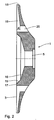
- einen Querschnitt durch das Tragteil entsprechend der Schnittlinie II-II in Fig. 1 und
- Fig. 3
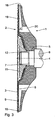
- ein Werkzeug bestehend aus Tragteil und Arbeitsteil in montiertem Zustand in einer Querschnittsdarstellung entsprechend Fig. 2.
- Das in der Zeichnung dargestellte Werkzeug besteht in seinem grundsätzlichen Aufbau aus einem Tragteil 1 in Form eines Stütz-Tellers und einem Arbeitsteil 2. Das Tragteil 1 ist einstückig ausgebildet und besteht in der Regel aus einem elastischen Kunststoff. Es weist eine kreisringförmige Anlage-Fläche 3 auf. Konzentrisch zu seiner Mittel-Längs-Achse 4 ist das Tragteil 1 mit einer zylindrischen Durchgangs-Öffnung 5 versehen, durch die eine mit einem nicht dargestellten Antriebs-Werkzeug verbindbare Antriebs-Welle 6 hindurchsteckbar ist. Die Antriebs-Welle 6 weist an ihrem freien Ende ein Außen-Gewinde 7 auf.
- Der eigentliche Arbeitsteil 2 ist ebenfalls kreisscheibenförmig ausgebildet und weist eine Gegen-Anlage-Fläche 8 auf, die bei der Anbringung des Arbeitsteils 2 am Tragteil 1 gegen die Anlage-Fläche 3 zur Anlage kommt. Das Arbeitsteil 2 weist etwa den Durchmesser bzw. den Umfang des Tragteils 1 auf. Im vorliegenden Fall ist das Arbeitsteil 2 durch ein Schleifmittel 9 auf Unterlage 10 gebildet, wobei die Gegen-Anlage-Fläche 8 auf der dem Schleifmittel 9 abgewandten Seite der Unterlage 10 ausgebildet ist. Zur Befestigung des Arbeitsteils 2 ist eine Mutter 11 mit einem dem Außen-Gewinde 7 angepassten Innen-Gewinde 12 vorgesehen. Zur Befestigung des Arbeitsteils 2 am Tragteil 1 wird die Welle 6 mit ihrem Außen-Gewinde 7 entsprechend der Darstellung in Fig. 3 durch die Öffnung 5 und das mit seiner Gegen-Anlage-Fläche 8 gegen die Anlage-Fläche 3 angelegte Arbeitsteil 2 hindurchgesteckt und dann die Mutter 11 auf das Außen-Gewinde 7 aufgeschraubt, wodurch das Arbeitsteil 2 zwischen der Mutter 11 und dem Tragteil 1 eingespannt wird, wie es in Fig. 3 dargestellt ist.
- Wie der Zeichnung entnehmbar ist, wird die Anlage-Fläche 3 des Tragteils 1 im Wesentlichen durch Rippen 13 und Zwischen-Rippen 14 gebildet. Der Innen-Umfang 15 der Anlage-Fläche 3 begrenzt eine zur Aufnahme der Mutter 11 dienende, von der Anlage-Fläche 3 rückspringende, Ausnehmung 16, in die die Öffnung 5 einmündet. Hier sind die Rippen 13 durch einen schmalen Ring-Steg 17 miteinander verbunden, an dem das montierte Arbeitsteil 2 über den gesamten Umfang 15 dicht anliegt, sodass keine Verbindung zwischen der Ausnehmung 16 und dem weiter außen liegenden Bereich der Anlage-Fläche 3 besteht.
- Zwischen den Rippen 13 münden jeweils am Außen-Umfang der Anlage-Fläche 3 des Arbeitsteils 2 Strömungs-Kanäle 19 frei aus, deren radial zur Achse 4 benachbarter Bereich durch parallel zur Achse 4 verlaufende Zuführ-Kanäle 20 gebildet wird. Die Strömungs-Kanäle 19 und die Zuführ-Kanäle 20 sind also miteinander verbunden. Die sich in Umfangsrichtung des Tragteils 1 erweiternden Strömungs-Kanäle 19 sind im äußeren Bereich durch die Zwischen-Rippen 14 in zwei Teil-Kanäle 19a, 19b unterteilt.
- Die Zuführ-Kanäle 20 haben - wie Fig. 1 erkennen lässt - quer zur Achse 4 den Querschnitt eines Langloches 21. Sie bilden insofern den radial zur Achse 4 innenliegenden Anfangs-Bereich der Strömungs-Kanäle 19 und somit auch einen Teil von diesen.
- Wie Fig. 1 erkennen lässt, schließen zwei benachbarte Radien 22, 23 zweier benachbarter Strömungs-Kanäle 19 einen Teilungs-Winkel a ein. Diese Radien 22, 23 gehen durch die Mittel-Längs-Achse 4 des Tragteils 1 und durch die am Außen-Umfang 18 liegende Mitte 24 eines Strömungs-Kanals 19. Die Mitte 24 eines Strömungs-Kanals 19 wird durch die in diesem Bereich liegende Zwischen-Rippe 14 gebildet. Für den Teilungs-Winkel a gilt: 10° ≤ a ≤ 45° und bevorzugt 10° ≤ a ≤ 30°. Bei der gleichmäßigen Verteilung der Kanäle 19 über den Umfang des Tragteils 1 bedeutet dies, dass zwischen 4 und 36 und bevorzugt zwischen 12 und 36 Strömungs-Kanäle 19 vorgesehen sind. Mit zunehmendem Durchmesser des Tragteils 1 wird der Teilungs-Winkel a kleiner, d. h. die Zahl der Strömungs-Kanäle 19 und damit auch die Zahl der Rippen 13 und gegebenenfalls der Zwischen-Rippen 14 größer.
- Wie weiterhin aus Fig. 1 hervorgeht, schließen ein von der Achse 4 durch den Mittelpunkt 25 des Langlochs 21 eines Strömungs-Kanals 19 gehender Radius 26 und der durch die Mitte 24 desselben Strömungs-Kanals 19 geführte Radius 22 einen Voreil-Winkel b ein. Der Voreil-Winkel b ist ein Voreil-Winkel, weil er angibt, wie weit das Langloch 21, also der Anfangs-Bereich des Strömungs-Kanals 19, gegenüber des durch die Mitte 24 am Außen-Umfang 18 definierten Austritts-Bereich bezogen auf die Drehrichtung 27 voreilt. Für den Voreil-Winkel b gilt: 5° ≤ b ≤ 45° und bevorzugt 5° ≤ b ≤ 25°.
- Wie weiterhin aus Fig. 1 hervorgeht, treten die Strömungs-Kanäle 19 am Außen-Umfang 18 des Tragteils 1 etwa radial zur Achse 4 aus. Ausgehend vom durch das jeweilige Langloch 21 gebildeten Anfangs-Bereich der Strömungs-Kanäle 19 sind diese - wie ebenfalls Fig. 1 erkennen lässt - in Drehrichtung 27 des Tragteils 1 gekrümmt, was sich aus dem zuvor erläuterten Voreil-Winkel b ergibt. Mit anderen Worten sind die Strömungs-Kanäle 19 entgegen der Drehrichtung 27 konkav gekrümmt ausgebildet.
- Schließlich schließen der durch den Mittelpunkt 25 des Langlochs 21 geführte Radius 26 und die durch den Mittelpunkt 25 des Langlochs 21 gezogene Mittel-Längs-Achse 28 des Langlochs 21 einen Neigungs-Winkel c ein, durch den die Neigung des Langlochs 21 und damit des Anfangs-Bereichs jedes Strömungs-Kanals 19 gegenüber der radialen Richtung angegeben wird, wobei das Langloch 21 von der Achse 4 her zum Außen-Umfang 18 hin gesehen gegen die Drehrichtung 27 geneigt ist. Für den Neigungs-Winkel c gilt: 5° ≤ c ≤90° und bevorzugt 20° ≤ c ≤ 60°.
- Wie aus den Fig. 2 und 3 hervorgeht, nimmt die axiale Höhe d der Kanäle 19 nach außen hin ab. Damit wird die radial nach außen in Umfangsrichtung des Tragteils 1 zunehmende Breite e der Strömungs-Kanäle 19 wieder zumindest teilweise, gegebenenfalls vollständig, kompensiert, sodass der Querschnitt der Strömungs-Kanäle 19 von ihrem Anfangs-Bereich 21 bis zum Außen-Umfang 18 hin etwa konstant ist. Des weiteren wird hierdurch erreicht, dass das aus elastischem Kunststoff bestehende Tragteil 1 im Bereich seines Außen-Umfangs 18 nicht zu steif wird.
- Während des Einsatzes des aus dem Tragteil 1 und dem montierten Arbeitsteil 2 bestehenden Werkzeuges unter hochtourigem Antrieb in Drehrichtung 24 wird durch die Zuführ-Kanäle 20 parallel zur Achse 4 Luft angesaugt und strömt im Wesentlichen ohne Druckerhöhung nach außen und tritt am Außen-Umfang 18 aus den Strömungs-Kanälen 19 aus. Da die Breite e der Strömungs-Kanäle 19 deutlich größer ist als die Breite f der Rippen 13 und als die Breite g der Zwischen-Rippen 14 steht an der Gegen-Anlage-Fläche 8 des Arbeitsteils 2 eine relativ große Kühl-Fläche zur Verfügung, an der die Luft unter Kühlung des Arbeitsteils 2 vorbeiströmt. Durch die Formgebung der Strömungs-Kanäle 19 wird eine besonders intensive Luftansaugung und ein entsprechend intensiver Lufttransport radial nach außen bewirkt; die Luft strömt mit hoher Turbulenz und damit mit einem hohen Wärmeübergangskoeffizienten an der Gegen-Anlage-Fläche 8 des Arbeitsteils 2 vorbei. Die Kühlung ist also besonders intensiv.
Claims (16)
- Werkzeug
mit einem um eine Mittel-Längs-Achse (4) in einer Drehrichtung (27) drehantreibbaren Tragteil (1),
mit einem scheibenförmigen Arbeitsteil (2) für eine spanende Bearbeitung und
mit Verbindungsmitteln zum lösbaren Verbinden des Arbeitsteils (2) mit dem Tragteil (1) koaxial miteinander,
wobei das Tragteil (1) eine Anlage-Fläche (3) für das Arbeitsteil (2) aufweist,
wobei das Arbeitsteil (2) eine Gegen-Anlage-Fläche (8) zur Anlage an der Anlage-Fläche (3) aufweist und
wobei in der Anlage-Fläche (3) im Wesentlichen von der Mittel-Längs-Achse (4) nach außen gerichtete, zur Gegen-Anlage-Fläche (8) hin offene Strömungs-Kanäle (19) ausgebildet sind, in die im Tragteil (1) ausgebildete Zuführ-Kanäle (20) einmünden,
dadurch gekennzeichnet,
dass jeder Zuführ-Kanal (20) in einen - bezogen auf die Mittel-Längs-Achse (4) - innenliegenden Anfangs-Bereich eines Strömungs-Kanals (19) einmündet,
dass der Anfangs-Bereich entgegen der Drehrichtung (27) um einen Neigungs-Winkel (c) geneigt ausgebildet ist und
dass der Strömungs-Kanal (19) vom Anfangs-Bereich in Drehrichtung (27) gekrümmt nach außen verläuft. - Werkzeug nach Anspruch 1, dadurch gekennzeichnet,
dass die Strömungs-Kanäle (19) etwa in radialer Richtung aus dem Tragteil (1) ausmünden. - Werkzeug nach Anspruch 1 oder 2, dadurch gekennzeichnet,
dass der Neigungs-Winkel (c) zwischen der Mittel-Längs-Achse (28) des Langlochs (21) und dem Radius (26) durch den Mittelpunkt (25) des Langlochs (21) eingeschlossen ist. - Werkzeug nach Anspruch 3, dadurch gekennzeichnet,
dass für den Neigungs-Winkel (c) gilt: 15° ≤ c ≤ 90° und bevorzugt 20° ≤ c ≤ 60°. - Werkzeug nach einem der Ansprüche 1 bis 4, dadurch gekennzeichnet,
dass der Anfangs-Bereich jedes Strömungs-Kanals (19) als Langloch (21) mit einer Mittel-Längs-Achse (28) und einem Mittelpunkt (25) ausgebildet ist, und
dass ein Radius (26) durch den Mittelpunkt (25) des Langlochs (21) und ein Radius (22) durch die Mitte (24) des Strömungs-Kanals (19) am Außen-Umfang (18) des Tragteils (1) einen Voreil-Winkel (b) einschließen. - Werkzeug nach Anspruch 5, dadurch gekennzeichnet,
dass für den Voreil-Winkel (b) gilt: 5° ≤ b ≤ 45° und bevorzugt 5° ≤ b ≤ 25°. - Werkzeug nach einem der Ansprüche 1 bis 6, dadurch gekennzeichnet,
dass zwischen unmittelbar benachbarten Strömungs-Kanälen (19) ein Teilungs-Winkel (a) eingeschlossen ist, für den gilt: 10° ≤ a ≤ 45° und bevorzugt 10° ≤ a ≤ 30°. - Werkzeug nach einem der Ansprüche 1 bis 7, dadurch gekennzeichnet,
dass die Strömungs-Kanäle (19) im - bezogen auf die Mittel-Längs-Achse (4) des Tragteils (1) - außen liegenden Bereich durch Zwischen-Rippen (14) in Teil-Strömungs-Kanäle (19a, 19b) unterteilt sind. - Werkzeug nach einem der Ansprüche 1 bis 8, dadurch gekennzeichnet,
dass die benachbarten Strömungs-Kanäle (19) durch Rippen (13) voneinander getrennt sind. - Werkzeug nach Anspruch 9, dadurch gekennzeichnet,
dass die Rippen (13) durch einen inneren Ring-Steg (17) miteinander verbunden sind. - Werkzeug nach Anspruch 9, dadurch gekennzeichnet,
dass die Breite (e) der Strömungs-Kanäle (19) deutlich größer ist als die Breite (f) der Rippen (13). - Werkzeug nach Anspruch 8, dadurch gekennzeichnet,
dass die Breite (e) der Strömungs-Kanäle (19) deutlich größer ist als die Breite (g) der Zwischen-Rippen (14). - Werkzeug nach einem der Ansprüche 1 bis 12, dadurch gekennzeichnet,
dass die Höhe (d) der Strömungs-Kanäle (19) in Richtung der Mittel-Längs-Achse (4) des Tragteils (1) von der Mittel-Längs-Achse (4) nach außen hin abnimmt. - Werkzeug nach einem der Ansprüche 1 bis 13, dadurch gekennzeichnet,
dass der Querschnitt der Strömungs-Kanäle (19) von der Mittel-Längs-Achse (4) des Tragteils (1) nach außen etwa konstant ist. - Werkzeug nach einem der Ansprüche 1 bis 14, dadurch gekennzeichnet,
dass das Arbeitsteil durch ein Schleifmittel (9) auf Unterlage (10) gebildet ist. - Werkzeug nach einem der Ansprüche 1 bis 15, dadurch gekennzeichnet,
dass das Tragteil (1) aus elastisch nachgiebigem Material besteht.
Priority Applications (1)
| Application Number | Priority Date | Filing Date | Title |
|---|---|---|---|
| PL04030401T PL1568440T3 (pl) | 2004-02-27 | 2004-12-22 | Narzędzie do obróbki wiórowej |
Applications Claiming Priority (2)
| Application Number | Priority Date | Filing Date | Title |
|---|---|---|---|
| DE102004009443A DE102004009443A1 (de) | 2004-02-27 | 2004-02-27 | Werkzeug zur spanabhebenden Bearbeitung |
| DE102004009443 | 2004-02-27 |
Publications (2)
| Publication Number | Publication Date |
|---|---|
| EP1568440A1 EP1568440A1 (de) | 2005-08-31 |
| EP1568440B1 true EP1568440B1 (de) | 2006-11-08 |
Family
ID=34745293
Family Applications (1)
| Application Number | Title | Priority Date | Filing Date |
|---|---|---|---|
| EP04030401A Expired - Lifetime EP1568440B1 (de) | 2004-02-27 | 2004-12-22 | Werkzeug zur spanabhebenden Bearbeitung |
Country Status (7)
| Country | Link |
|---|---|
| EP (1) | EP1568440B1 (de) |
| AT (1) | ATE344711T1 (de) |
| DE (2) | DE102004009443A1 (de) |
| DK (1) | DK1568440T3 (de) |
| ES (1) | ES2276216T3 (de) |
| PL (1) | PL1568440T3 (de) |
| PT (1) | PT1568440E (de) |
Cited By (1)
| Publication number | Priority date | Publication date | Assignee | Title |
|---|---|---|---|---|
| WO2025113935A1 (de) * | 2023-11-29 | 2025-06-05 | Robert Bosch Gmbh | Stütztellervorrichtung |
Families Citing this family (10)
| Publication number | Priority date | Publication date | Assignee | Title |
|---|---|---|---|---|
| EP1741515B1 (de) | 2005-07-05 | 2007-11-07 | August Rüggeberg GmbH & Co. KG | Werkzeug |
| DE102007014766A1 (de) * | 2007-03-28 | 2008-10-02 | Robert Bosch Gmbh | Exzentertellerschleifer |
| DE102008015180A1 (de) * | 2008-03-20 | 2009-09-24 | Livre Verlags- Und Vertriebs- Gmbh | Schleifelement für eine Schleifmaschine, insbesondere für eine Handschleifmaschine |
| IT1391160B1 (it) * | 2008-08-05 | 2011-11-18 | Bdl S R L | Disco per elettroutensili per il supporto di materiale abrasivo. |
| IT1404215B1 (it) * | 2011-01-25 | 2013-11-15 | Campana Mirco E Figli S N C | Disco per elettroutensili, di supporto di materiale abrasivo |
| JP2015071217A (ja) * | 2013-10-04 | 2015-04-16 | スリーエム イノベイティブ プロパティズ カンパニー | 研磨ディスクを支持するためのパッド |
| DE102014102688A1 (de) * | 2014-02-28 | 2015-09-03 | Adolf Würth GmbH & Co. KG | Poliervorrichtung mit Wärmeabführeinrichtung |
| DE202015100548U1 (de) * | 2015-02-05 | 2015-02-26 | Industrias Tenazit, S.A. De C.V. | Trägerplatte für Lamellenschleifscheiben |
| CN104690649B (zh) * | 2015-02-13 | 2017-04-26 | 浙江工业大学 | 一种人工关节复杂曲面固液二相软性磨粒流湍流加工方法 |
| CN110587499A (zh) * | 2019-09-12 | 2019-12-20 | 扬中市红洲磨具有限公司 | 一种新型钹型砂轮 |
Family Cites Families (6)
| Publication number | Priority date | Publication date | Assignee | Title |
|---|---|---|---|---|
| CA1049265A (en) * | 1976-09-24 | 1979-02-27 | Miksa Marton | Pad assembly for vacuum rotary sander |
| FR2365411A1 (fr) * | 1976-09-27 | 1978-04-21 | Robert Jean | Ponceuse a disque de papier abrasif monte sur un plateau circulaire tournant |
| US4287685A (en) * | 1978-12-08 | 1981-09-08 | Miksa Marton | Pad assembly for vacuum rotary sander |
| DE9002801U1 (de) * | 1990-03-09 | 1990-06-21 | Nied, Hans Rainer, 8760 Miltenberg | Schleifteller für Hand-Schleifmaschinen |
| WO1993008955A1 (de) * | 1991-11-02 | 1993-05-13 | Fabritius Hans Josef | Arbeitsscheibenanordnung |
| DE19945060B4 (de) * | 1999-09-20 | 2010-12-02 | Robert Bosch Gmbh | Schleifhandwerkzeugmaschine |
-
2004
- 2004-02-27 DE DE102004009443A patent/DE102004009443A1/de not_active Withdrawn
- 2004-12-22 PL PL04030401T patent/PL1568440T3/pl unknown
- 2004-12-22 EP EP04030401A patent/EP1568440B1/de not_active Expired - Lifetime
- 2004-12-22 AT AT04030401T patent/ATE344711T1/de active
- 2004-12-22 DE DE502004001950T patent/DE502004001950D1/de not_active Expired - Lifetime
- 2004-12-22 DK DK04030401T patent/DK1568440T3/da active
- 2004-12-22 ES ES04030401T patent/ES2276216T3/es not_active Expired - Lifetime
- 2004-12-22 PT PT04030401T patent/PT1568440E/pt unknown
Cited By (1)
| Publication number | Priority date | Publication date | Assignee | Title |
|---|---|---|---|---|
| WO2025113935A1 (de) * | 2023-11-29 | 2025-06-05 | Robert Bosch Gmbh | Stütztellervorrichtung |
Also Published As
| Publication number | Publication date |
|---|---|
| DE102004009443A1 (de) | 2005-09-15 |
| ATE344711T1 (de) | 2006-11-15 |
| PT1568440E (pt) | 2007-02-28 |
| EP1568440A1 (de) | 2005-08-31 |
| DK1568440T3 (da) | 2006-12-27 |
| PL1568440T3 (pl) | 2007-01-31 |
| DE502004001950D1 (de) | 2006-12-21 |
| ES2276216T3 (es) | 2007-06-16 |
Similar Documents
| Publication | Publication Date | Title |
|---|---|---|
| DE3902666C2 (de) | ||
| DE69817526T2 (de) | Axiallüfter | |
| EP3611432B1 (de) | Fahrzeugheizgerät | |
| EP2771581B1 (de) | Axialventilatorrad | |
| EP1568440A1 (de) | Werkzeug zur spanabhebenden Bearbeitung | |
| WO2013127534A1 (de) | Vorrichtung zum mischen mindestens zweier fluider komponenten, drehangetriebener mischereinsatz dafür und system aus beidem | |
| DE2510422A1 (de) | Kreiselpumpe | |
| EP3617529A1 (de) | Lüfterzarge eines kraftfahrzeugs | |
| DE102008053144B4 (de) | Gargerät mit Lüfteranordnung | |
| EP3751145A1 (de) | Ventilatoreinrichtung | |
| DE102014111055A1 (de) | Lüftereinheit mit einem Axiallüfter | |
| DE202008000855U1 (de) | Kombinierter Axial-Radial-Lüfter für den Einsatz in beliebigen Lüftungseinrichtungen, z.B. für Dunstabzugshauben | |
| DE3734497A1 (de) | Blasvorrichtung | |
| DE202021101830U1 (de) | Düsenkopf und Düse | |
| EP1384554B1 (de) | Strahleinrichtung | |
| DE102022121237A1 (de) | Bohrvorrichtung mit einer Absaugeinheit | |
| DE102022123882A1 (de) | Vorrichtung zum Leiten von Kühlluft an einer Motoraufnahme für einen Ventilatormotor | |
| DE102009047446A1 (de) | Pumpe | |
| DE4414118A1 (de) | Schubzentrifuge | |
| DE20118332U1 (de) | Düse für Whirlpoolwannen | |
| DE2417506C2 (de) | Axialgebläse für Mähdrescher | |
| DE102025120065A1 (de) | Vorrichtung zum Fördern von Flüssigkeit | |
| EP1380387A1 (de) | Strahleinrichtung | |
| DE9100671U1 (de) | Ventilator, insbesondere Rohr- oder Kanalventilator | |
| EP0234424A1 (de) | Einrichtung zum Auftragen von Farbe auf Flächen |
Legal Events
| Date | Code | Title | Description |
|---|---|---|---|
| PUAI | Public reference made under article 153(3) epc to a published international application that has entered the european phase |
Free format text: ORIGINAL CODE: 0009012 |
|
| AK | Designated contracting states |
Kind code of ref document: A1 Designated state(s): AT BE BG CH CY CZ DE DK EE ES FI FR GB GR HU IE IS IT LI LT LU MC NL PL PT RO SE SI SK TR |
|
| AX | Request for extension of the european patent |
Extension state: AL BA HR LV MK YU |
|
| 17P | Request for examination filed |
Effective date: 20050922 |
|
| AKX | Designation fees paid |
Designated state(s): AT BE BG CH CY CZ DE DK EE ES FI FR GB GR HU IE IS IT LI LT LU MC NL PL PT RO SE SI SK TR |
|
| GRAP | Despatch of communication of intention to grant a patent |
Free format text: ORIGINAL CODE: EPIDOSNIGR1 |
|
| GRAS | Grant fee paid |
Free format text: ORIGINAL CODE: EPIDOSNIGR3 |
|
| GRAA | (expected) grant |
Free format text: ORIGINAL CODE: 0009210 |
|
| AK | Designated contracting states |
Kind code of ref document: B1 Designated state(s): AT BE BG CH CY CZ DE DK EE ES FI FR GB GR HU IE IS IT LI LT LU MC NL PL PT RO SE SI SK TR |
|
| PG25 | Lapsed in a contracting state [announced via postgrant information from national office to epo] |
Ref country code: CZ Free format text: LAPSE BECAUSE OF FAILURE TO SUBMIT A TRANSLATION OF THE DESCRIPTION OR TO PAY THE FEE WITHIN THE PRESCRIBED TIME-LIMIT Effective date: 20061108 Ref country code: SK Free format text: LAPSE BECAUSE OF FAILURE TO SUBMIT A TRANSLATION OF THE DESCRIPTION OR TO PAY THE FEE WITHIN THE PRESCRIBED TIME-LIMIT Effective date: 20061108 Ref country code: SI Free format text: LAPSE BECAUSE OF FAILURE TO SUBMIT A TRANSLATION OF THE DESCRIPTION OR TO PAY THE FEE WITHIN THE PRESCRIBED TIME-LIMIT Effective date: 20061108 Ref country code: FI Free format text: LAPSE BECAUSE OF FAILURE TO SUBMIT A TRANSLATION OF THE DESCRIPTION OR TO PAY THE FEE WITHIN THE PRESCRIBED TIME-LIMIT Effective date: 20061108 Ref country code: IE Free format text: LAPSE BECAUSE OF FAILURE TO SUBMIT A TRANSLATION OF THE DESCRIPTION OR TO PAY THE FEE WITHIN THE PRESCRIBED TIME-LIMIT Effective date: 20061108 Ref country code: RO Free format text: LAPSE BECAUSE OF FAILURE TO SUBMIT A TRANSLATION OF THE DESCRIPTION OR TO PAY THE FEE WITHIN THE PRESCRIBED TIME-LIMIT Effective date: 20061108 |
|
| REG | Reference to a national code |
Ref country code: GB Ref legal event code: FG4D Free format text: NOT ENGLISH |
|
| REG | Reference to a national code |
Ref country code: SE Ref legal event code: TRGR |
|
| GBT | Gb: translation of ep patent filed (gb section 77(6)(a)/1977) |
Effective date: 20061108 |
|
| REG | Reference to a national code |
Ref country code: CH Ref legal event code: EP |
|
| REG | Reference to a national code |
Ref country code: IE Ref legal event code: FG4D Free format text: LANGUAGE OF EP DOCUMENT: GERMAN |
|
| REF | Corresponds to: |
Ref document number: 502004001950 Country of ref document: DE Date of ref document: 20061221 Kind code of ref document: P |
|
| REG | Reference to a national code |
Ref country code: DK Ref legal event code: T3 |
|
| PG25 | Lapsed in a contracting state [announced via postgrant information from national office to epo] |
Ref country code: MC Free format text: LAPSE BECAUSE OF NON-PAYMENT OF DUE FEES Effective date: 20061231 |
|
| REG | Reference to a national code |
Ref country code: PL Ref legal event code: T3 |
|
| PG25 | Lapsed in a contracting state [announced via postgrant information from national office to epo] |
Ref country code: BG Free format text: LAPSE BECAUSE OF FAILURE TO SUBMIT A TRANSLATION OF THE DESCRIPTION OR TO PAY THE FEE WITHIN THE PRESCRIBED TIME-LIMIT Effective date: 20070208 |
|
| REG | Reference to a national code |
Ref country code: PT Ref legal event code: SC4A Free format text: AVAILABILITY OF NATIONAL TRANSLATION Effective date: 20070123 |
|
| PG25 | Lapsed in a contracting state [announced via postgrant information from national office to epo] |
Ref country code: IS Free format text: LAPSE BECAUSE OF FAILURE TO SUBMIT A TRANSLATION OF THE DESCRIPTION OR TO PAY THE FEE WITHIN THE PRESCRIBED TIME-LIMIT Effective date: 20070308 |
|
| ET | Fr: translation filed | ||
| REG | Reference to a national code |
Ref country code: ES Ref legal event code: FG2A Ref document number: 2276216 Country of ref document: ES Kind code of ref document: T3 |
|
| REG | Reference to a national code |
Ref country code: IE Ref legal event code: FD4D |
|
| PLBE | No opposition filed within time limit |
Free format text: ORIGINAL CODE: 0009261 |
|
| STAA | Information on the status of an ep patent application or granted ep patent |
Free format text: STATUS: NO OPPOSITION FILED WITHIN TIME LIMIT |
|
| 26N | No opposition filed |
Effective date: 20070809 |
|
| PG25 | Lapsed in a contracting state [announced via postgrant information from national office to epo] |
Ref country code: GR Free format text: LAPSE BECAUSE OF FAILURE TO SUBMIT A TRANSLATION OF THE DESCRIPTION OR TO PAY THE FEE WITHIN THE PRESCRIBED TIME-LIMIT Effective date: 20070209 |
|
| PG25 | Lapsed in a contracting state [announced via postgrant information from national office to epo] |
Ref country code: EE Free format text: LAPSE BECAUSE OF FAILURE TO SUBMIT A TRANSLATION OF THE DESCRIPTION OR TO PAY THE FEE WITHIN THE PRESCRIBED TIME-LIMIT Effective date: 20061108 |
|
| PG25 | Lapsed in a contracting state [announced via postgrant information from national office to epo] |
Ref country code: TR Free format text: LAPSE BECAUSE OF FAILURE TO SUBMIT A TRANSLATION OF THE DESCRIPTION OR TO PAY THE FEE WITHIN THE PRESCRIBED TIME-LIMIT Effective date: 20061108 Ref country code: HU Free format text: LAPSE BECAUSE OF FAILURE TO SUBMIT A TRANSLATION OF THE DESCRIPTION OR TO PAY THE FEE WITHIN THE PRESCRIBED TIME-LIMIT Effective date: 20070509 Ref country code: LT Free format text: LAPSE BECAUSE OF FAILURE TO SUBMIT A TRANSLATION OF THE DESCRIPTION OR TO PAY THE FEE WITHIN THE PRESCRIBED TIME-LIMIT Effective date: 20061108 Ref country code: LU Free format text: LAPSE BECAUSE OF NON-PAYMENT OF DUE FEES Effective date: 20061222 |
|
| PG25 | Lapsed in a contracting state [announced via postgrant information from national office to epo] |
Ref country code: CY Free format text: LAPSE BECAUSE OF FAILURE TO SUBMIT A TRANSLATION OF THE DESCRIPTION OR TO PAY THE FEE WITHIN THE PRESCRIBED TIME-LIMIT Effective date: 20061108 |
|
| PGFP | Annual fee paid to national office [announced via postgrant information from national office to epo] |
Ref country code: DK Payment date: 20141215 Year of fee payment: 11 |
|
| PGFP | Annual fee paid to national office [announced via postgrant information from national office to epo] |
Ref country code: PT Payment date: 20141212 Year of fee payment: 11 |
|
| REG | Reference to a national code |
Ref country code: FR Ref legal event code: PLFP Year of fee payment: 12 |
|
| PGFP | Annual fee paid to national office [announced via postgrant information from national office to epo] |
Ref country code: GB Payment date: 20151221 Year of fee payment: 12 Ref country code: CH Payment date: 20151119 Year of fee payment: 12 |
|
| PGFP | Annual fee paid to national office [announced via postgrant information from national office to epo] |
Ref country code: BE Payment date: 20151221 Year of fee payment: 12 |
|
| REG | Reference to a national code |
Ref country code: PT Ref legal event code: MM4A Free format text: LAPSE DUE TO NON-PAYMENT OF FEES Effective date: 20160622 |
|
| REG | Reference to a national code |
Ref country code: DK Ref legal event code: EBP Effective date: 20151231 |
|
| PG25 | Lapsed in a contracting state [announced via postgrant information from national office to epo] |
Ref country code: PT Free format text: LAPSE BECAUSE OF NON-PAYMENT OF DUE FEES Effective date: 20160622 |
|
| REG | Reference to a national code |
Ref country code: FR Ref legal event code: PLFP Year of fee payment: 13 |
|
| PG25 | Lapsed in a contracting state [announced via postgrant information from national office to epo] |
Ref country code: DK Free format text: LAPSE BECAUSE OF NON-PAYMENT OF DUE FEES Effective date: 20151231 |
|
| PG25 | Lapsed in a contracting state [announced via postgrant information from national office to epo] |
Ref country code: BE Free format text: LAPSE BECAUSE OF NON-PAYMENT OF DUE FEES Effective date: 20161231 |
|
| REG | Reference to a national code |
Ref country code: CH Ref legal event code: PL |
|
| GBPC | Gb: european patent ceased through non-payment of renewal fee |
Effective date: 20161222 |
|
| PG25 | Lapsed in a contracting state [announced via postgrant information from national office to epo] |
Ref country code: LI Free format text: LAPSE BECAUSE OF NON-PAYMENT OF DUE FEES Effective date: 20161231 Ref country code: CH Free format text: LAPSE BECAUSE OF NON-PAYMENT OF DUE FEES Effective date: 20161231 |
|
| PG25 | Lapsed in a contracting state [announced via postgrant information from national office to epo] |
Ref country code: GB Free format text: LAPSE BECAUSE OF NON-PAYMENT OF DUE FEES Effective date: 20161222 |
|
| REG | Reference to a national code |
Ref country code: FR Ref legal event code: PLFP Year of fee payment: 14 |
|
| REG | Reference to a national code |
Ref country code: BE Ref legal event code: MM Effective date: 20161231 |
|
| P01 | Opt-out of the competence of the unified patent court (upc) registered |
Effective date: 20230525 |
|
| PGFP | Annual fee paid to national office [announced via postgrant information from national office to epo] |
Ref country code: SE Payment date: 20231219 Year of fee payment: 20 Ref country code: NL Payment date: 20231219 Year of fee payment: 20 Ref country code: FR Payment date: 20231219 Year of fee payment: 20 Ref country code: AT Payment date: 20231117 Year of fee payment: 20 |
|
| PGFP | Annual fee paid to national office [announced via postgrant information from national office to epo] |
Ref country code: PL Payment date: 20231116 Year of fee payment: 20 |
|
| PGFP | Annual fee paid to national office [announced via postgrant information from national office to epo] |
Ref country code: ES Payment date: 20240118 Year of fee payment: 20 |
|
| PGFP | Annual fee paid to national office [announced via postgrant information from national office to epo] |
Ref country code: DE Payment date: 20240216 Year of fee payment: 20 |
|
| PGFP | Annual fee paid to national office [announced via postgrant information from national office to epo] |
Ref country code: IT Payment date: 20231229 Year of fee payment: 20 |
|
| REG | Reference to a national code |
Ref country code: DE Ref legal event code: R071 Ref document number: 502004001950 Country of ref document: DE |
|
| REG | Reference to a national code |
Ref country code: ES Ref legal event code: FD2A Effective date: 20250102 |
|
| REG | Reference to a national code |
Ref country code: NL Ref legal event code: MK Effective date: 20241221 |
|
| PG25 | Lapsed in a contracting state [announced via postgrant information from national office to epo] |
Ref country code: ES Free format text: LAPSE BECAUSE OF EXPIRATION OF PROTECTION Effective date: 20241223 |
|
| REG | Reference to a national code |
Ref country code: SE Ref legal event code: EUG |
|
| PG25 | Lapsed in a contracting state [announced via postgrant information from national office to epo] |
Ref country code: ES Free format text: LAPSE BECAUSE OF EXPIRATION OF PROTECTION Effective date: 20241223 |
|
| REG | Reference to a national code |
Ref country code: AT Ref legal event code: MK07 Ref document number: 344711 Country of ref document: AT Kind code of ref document: T Effective date: 20241222 |