EP1561450A2 - Dünnflüssige O/W-Emulsion - Google Patents
Dünnflüssige O/W-Emulsion Download PDFInfo
- Publication number
- EP1561450A2 EP1561450A2 EP04106847A EP04106847A EP1561450A2 EP 1561450 A2 EP1561450 A2 EP 1561450A2 EP 04106847 A EP04106847 A EP 04106847A EP 04106847 A EP04106847 A EP 04106847A EP 1561450 A2 EP1561450 A2 EP 1561450A2
- Authority
- EP
- European Patent Office
- Prior art keywords
- advantageous
- emulsion
- acid
- oil
- textile
- Prior art date
- Legal status (The legal status is an assumption and is not a legal conclusion. Google has not performed a legal analysis and makes no representation as to the accuracy of the status listed.)
- Granted
Links
- 0 CC(*)(*)C(*)(*)N Chemical compound CC(*)(*)C(*)(*)N 0.000 description 1
- HHPUJTXTHHJXHX-UHFFFAOYSA-N CCC(C(C)(C)C(C)(C)CC(C)N(CCC1)C1=O)C(NC(C)(C)CS(O)(=O)=O)=O Chemical compound CCC(C(C)(C)C(C)(C)CC(C)N(CCC1)C1=O)C(NC(C)(C)CS(O)(=O)=O)=O HHPUJTXTHHJXHX-UHFFFAOYSA-N 0.000 description 1
Classifications
-
- A—HUMAN NECESSITIES
- A61—MEDICAL OR VETERINARY SCIENCE; HYGIENE
- A61K—PREPARATIONS FOR MEDICAL, DENTAL OR TOILETRY PURPOSES
- A61K8/00—Cosmetics or similar toiletry preparations
- A61K8/18—Cosmetics or similar toiletry preparations characterised by the composition
- A61K8/30—Cosmetics or similar toiletry preparations characterised by the composition containing organic compounds
- A61K8/33—Cosmetics or similar toiletry preparations characterised by the composition containing organic compounds containing oxygen
- A61K8/39—Derivatives containing from 2 to 10 oxyalkylene groups
-
- A—HUMAN NECESSITIES
- A61—MEDICAL OR VETERINARY SCIENCE; HYGIENE
- A61K—PREPARATIONS FOR MEDICAL, DENTAL OR TOILETRY PURPOSES
- A61K8/00—Cosmetics or similar toiletry preparations
- A61K8/02—Cosmetics or similar toiletry preparations characterised by special physical form
- A61K8/0208—Tissues; Wipes; Patches
-
- A—HUMAN NECESSITIES
- A61—MEDICAL OR VETERINARY SCIENCE; HYGIENE
- A61K—PREPARATIONS FOR MEDICAL, DENTAL OR TOILETRY PURPOSES
- A61K8/00—Cosmetics or similar toiletry preparations
- A61K8/02—Cosmetics or similar toiletry preparations characterised by special physical form
- A61K8/04—Dispersions; Emulsions
- A61K8/06—Emulsions
- A61K8/062—Oil-in-water emulsions
-
- A—HUMAN NECESSITIES
- A61—MEDICAL OR VETERINARY SCIENCE; HYGIENE
- A61K—PREPARATIONS FOR MEDICAL, DENTAL OR TOILETRY PURPOSES
- A61K8/00—Cosmetics or similar toiletry preparations
- A61K8/18—Cosmetics or similar toiletry preparations characterised by the composition
- A61K8/30—Cosmetics or similar toiletry preparations characterised by the composition containing organic compounds
- A61K8/33—Cosmetics or similar toiletry preparations characterised by the composition containing organic compounds containing oxygen
- A61K8/37—Esters of carboxylic acids
- A61K8/375—Esters of carboxylic acids the alcohol moiety containing more than one hydroxy group
-
- A—HUMAN NECESSITIES
- A61—MEDICAL OR VETERINARY SCIENCE; HYGIENE
- A61K—PREPARATIONS FOR MEDICAL, DENTAL OR TOILETRY PURPOSES
- A61K8/00—Cosmetics or similar toiletry preparations
- A61K8/18—Cosmetics or similar toiletry preparations characterised by the composition
- A61K8/30—Cosmetics or similar toiletry preparations characterised by the composition containing organic compounds
- A61K8/55—Phosphorus compounds
- A61K8/556—Derivatives containing from 2 to 10 oxyalkylene groups
-
- A—HUMAN NECESSITIES
- A61—MEDICAL OR VETERINARY SCIENCE; HYGIENE
- A61K—PREPARATIONS FOR MEDICAL, DENTAL OR TOILETRY PURPOSES
- A61K8/00—Cosmetics or similar toiletry preparations
- A61K8/18—Cosmetics or similar toiletry preparations characterised by the composition
- A61K8/72—Cosmetics or similar toiletry preparations characterised by the composition containing organic macromolecular compounds
- A61K8/81—Cosmetics or similar toiletry preparations characterised by the composition containing organic macromolecular compounds obtained by reactions involving only carbon-to-carbon unsaturated bonds
- A61K8/8141—Compositions of homopolymers or copolymers of compounds having one or more unsaturated aliphatic radicals, each having only one carbon-to-carbon double bond, and at least one being terminated by only one carboxyl radical, or of salts, anhydrides, esters, amides, imides or nitriles thereof; Compositions of derivatives of such polymers
- A61K8/8152—Homopolymers or copolymers of esters, e.g. (meth)acrylic acid esters; Compositions of derivatives of such polymers
-
- A—HUMAN NECESSITIES
- A61—MEDICAL OR VETERINARY SCIENCE; HYGIENE
- A61Q—SPECIFIC USE OF COSMETICS OR SIMILAR TOILETRY PREPARATIONS
- A61Q1/00—Make-up preparations; Body powders; Preparations for removing make-up
- A61Q1/14—Preparations for removing make-up
-
- A—HUMAN NECESSITIES
- A61—MEDICAL OR VETERINARY SCIENCE; HYGIENE
- A61Q—SPECIFIC USE OF COSMETICS OR SIMILAR TOILETRY PREPARATIONS
- A61Q19/00—Preparations for care of the skin
- A61Q19/10—Washing or bathing preparations
Definitions
- the present invention relates to a low viscosity oil in water (O / W) emulsion.
- Cleaning the human body means removing (environmental) dirt and thus causes an increase in mental and physical well-being.
- the Cleaning the surface of the skin and hair is a very complex, of many Parameters dependent operation.
- substances coming from outside should be used such as hydrocarbons or inorganic pigments various environments as well as residues of cosmetics or even unwanted microorganisms are removed as completely as possible.
- excretions of the body such as sweat, sebum, dandruff and dandruff without thorough interventions to wash off the physiological balance of the skin.
- Emulsions in the form of cleaning emulsions Use are mostly used for facial cleansing and especially for Removal of decorative cosmetics used.
- Cleaning emulsions have, in contrast to other cleaning preparations such as For example, soap, the advantage of being particularly skin-friendly, as they are in their lipophilic phase containing nourishing oils and nonpolar agents such as vitamin E. can.
- O / W emulsions A particularly widespread form of cosmetic emulsions make thin Oil-in-water emulsions (O / W emulsions).
- Low-viscosity O / W emulsions are usually based on an emulsifier system from Ceteareth -20, Ceteareth 12, Cetearyl alcohol, cetyl palmitate and glyceryl stearate.
- Other O / W emulsifier systems are: triceteareth-4 phosphates; Trilaureth-4 phosphates; Glyceryl isostearate + Isoceteth-20; PEG-60 Hydrogenated Castor Oil or Polysorbate 20.
- a special product form for cleaning preparations provide solid Cleaning substrates or textiles, in particular cloths. These can already be impregnated with the cleaning preparation by the manufacturer (a combination for which in the context of the present invention, the term "cleaning article” used becomes) and thereby have the advantage that in them the preparation already in the correct dosage is given. In addition, they avoid the disadvantage of in Bottles of stored preparations whose packaging is broken and their contents can "leak". Other benefits of cleaning substrates / textiles include also the circumstances that they travel comfortably in counted quantity usually no water is needed for their application.
- Textiles can be woven, knitted or knitted or be present as a composite (English nonwoven textile). Usually composites are used (for cost reasons). For composites the formation of tissue does not occur by warp and weft or stitch formation, but by entanglement, and / or cohesive and / or adhesive connection of Textile fibers.
- Composite materials can be used according to the DIN 61210 T2 in fleece, paper and cotton wool Felt be distinguished. Nonwovens are loose materials of staple fibers (i.e., fiber of limited length) or filaments (continuous fibers), mostly of polypropylene, Polyester or viscose produced, the cohesion in general by the Fibers own liability is given.
- the individual fibers can be a Preferred direction (oriented or cross-layer webs) or non-directional (Wirrvliese) be.
- the nonwovens can be mechanically consolidated by needling, Meshing or by vortexing with sharp water jets.
- adhesively solidified nonwovens are formed by bonding the fibers with liquid binders (e.g., acrylate polymers, SBR / NBR, polyvinyl esters, polyurethane dispersions) or by melting or dissolving so-called binding fibers, which are the fleece in the Were added.
- liquid binders e.g., acrylate polymers, SBR / NBR, polyvinyl esters, polyurethane dispersions
- binding fibers which are the fleece in the Were added.
- cohesive consolidation the Fiber surfaces are dissolved by suitable chemicals and connected by pressure or welded at elevated temperature [J. Falbe, M. Regnitz: Römpp-Chemie-Lexikon, 9th ed. Thieme-
- a second variant is the "spraying process" in which the preparation is based on the is sprayed on by passing cloth. This method is suitable for all textiles, but no strong foaming preparations can be applied to the cloth because the foaming process in the spraying process becomes too large.
- the object of the present invention was to eliminate the disadvantages of the prior art.
- the object was to develop low-viscosity O / W cleaning emulsions and cleaning textiles, which avoid the deficiencies of the prior art.
- the requirement for the O / W emulsion was made to be both suitable as impregnation preparation for cloths and other textiles, as well as by means of a spray device (eg aerosol can, pump spray) to be sprayed.
- a spray device eg aerosol can, pump spray
- viscosity values of the preparations listed in the context of the present specification and individual substances were measured by means of a Viskotester viscometer VT 02 of the company Haake determined (temperature: 25 ° C, spindle diameter 23 mm, rotor speed 62.5 rpm).
- glyceryl stearate citrate is used as emulsifier a.
- Glycerol Stearate Citrate (CAS 39175-72-9, INCI: Glyceryl Stearate Citrate) can u.a. under the trade name Imwitor 370 at the company Hüls be acquired.
- glyceryl stearate citrate is advantageous in a concentration of 0.01 to 1.5% by weight and according to the invention preferably in a concentration of 0.1 to 1.3% by weight, based in each case on the total weight of the preparation used.
- Invention is used as emulsifier a) Polyglycerinmethylglucose distearate.
- Polyglycerol methyl glucose distearate (INCI: Polyglycerol Methyl Glucose Distearate) can u.a. under the trade name Tego Care-450 at Goldschmidt be acquired.
- Tego Care-450 at Goldschmidt be acquired.
- Polyglycerol methyl glucose distearate in a concentration of 0.01 to 1.5% by weight and according to the invention preferably in a concentration of 0.1 to 1.3% by weight, in each case based on the total weight of the preparation used.
- Invention is used as emulsifier a) triceteareth-4-phosphate.
- Triceteareth -4-phosphate (INCI: triceteareth-4-phosphate) is e.g. from the company Clariant under the Brand name Hostaphat KW 340D offered. It is according to the invention advantageous triceteareth-4-phosphate in a concentration of 0.01 to 1.5% by weight and according to the invention preferably in a concentration of 0.1 to 1.3% by weight, in each case based on the total weight of the preparation to use.
- Polymeric stabilizers can be used in the emulsions according to the invention become.
- Advantageously in accordance with the invention e.g. Homo- or copolymer of acrylic acid.
- R ' represents a long-chain alkyl radical and x and y represent numbers which correspond to the respective symbolize stoichiometric proportion of the respective comonomers.
- acrylate copolymers and / or acrylate-alkyl acrylate copolymers which under the trade names Carbopol® 1382, Carbopol® 981 and Carbopol® 5984 are available from the B.F. Goodrich Company, as well as Polyacrylates from the group of carbopols types 980, 981, 1382, 2984, 5984 and Carbomer 2001.
- sodium polyacrylates available e.g. under the trade name Cosmedia SP of Cognis.
- copolymers / crosspolymers comprising sodium acrylates such as Aqua SF-1 from Noveon
- Particularly advantageous compounds are those bearing the INCI name "Acrylates / C 10-30 Alkyl Acrylate Crosspolymer". Particularly advantageous are those available under the trade names Pemulen TR1 and Pemulen TR2, Carbopol 1328, Ultrez 21 from BF Goodrich Company and under the trade name Tegocarbomer TC 341 ER from Goldschmidt / Degussa.
- AMPS Acrylamidomethylpropylsulfonic acid
- ammoniumacryloyldimethyltaurate-vinylpyrrolidone copolymer advantageous according to the invention has the empirical formula [C 7 H 16 N 2 SO 4 ] n [C 6 H 9 NO] m , corresponding to a statistical structure as follows:
- copolymers / crosspolymers comprising acryloyldimethyl Taurates, such as Simugel® EG or Simugel® EG from the company Seppic S.A.
- the aforementioned synthetic polyelectrolytes are usually, if not already preneutralized, by addition of suitable inorganic or organic Bases, e.g. Sodium hydroxide solution, potassium hydroxide solution, triethylamine or ammoniawax at least partially neutralized and thus in the advantageous in the sense of application ionic Salt form transferred.
- suitable inorganic or organic Bases e.g. Sodium hydroxide solution, potassium hydroxide solution, triethylamine or ammoniawax at least partially neutralized and thus in the advantageous in the sense of application ionic Salt form transferred.
- the concentration of polymeric stabilizer is from 0.001 to 1.5 % By weight, and preferably from 0.05 to 0.2% by weight, based in each case on Total weight of the preparation is.
- the weight ratio of emulsifier a) is advantageous polymeric stabilizer b) from 20: 1 to 1: 1.
- the emulsion according to the invention contains one or more oil, lipid and / or wax components of the same or different polarity.
- Polar oils are, for example, those from the group of lecithins and fatty acid triglycerides, namely the triglycerol esters of saturated and / or unsaturated, branched and / or unbranched alkanecarboxylic acids having a chain length of 8 to 24, in particular 12 to 18, carbon atoms.
- the fatty acid triglycerides may be advantageously selected from the group of synthetic, semisynthetic and natural oils such as olive oil, sunflower oil, soybean oil, peanut oil, rapeseed oil, almond oil, palm oil, coconut oil, castor oil, wheat germ oil, grapeseed oil, thistle oil, evening primrose oil, macadamia nut oil and the like .
- Particularly advantageous polar lipids in the context of the present invention are all native lipids, such as.
- Olive oil sunflower oil, soybean oil, peanut oil, rapeseed oil, almond oil, palm oil, coconut oil, castor oil, wheat germ oil, grapeseed oil, thistle oil, evening primrose oil, macadamia nut oil, corn oil, avocado oil and the like and those listed below.
- the oil phase can be advantageously chosen from the group of dialkyl ethers. It is particularly advantageous if the oil phase contains or consists entirely of C 12-15 -alkyl benzoate.
- the oil phase can be advantageously selected from the group of Guerbet alcohols.
- Guerbet alcohols are named after Marcel Guerbet, who first described their production. They arise according to the reaction equation by oxidation of an alcohol to an aldehyde, by aldol condensation of the aldehyde, elimination of water from the aldol and hydrogenation of allyl aldehyde. Guerbet alcohols are fluid even at low temperatures and cause virtually no skin irritation. Advantageously, they can be used as greasing, overfatting and also moisturizing ingredients in skin and hair care products.
- R 1 and R 2 are generally unbranched alkyl radicals.
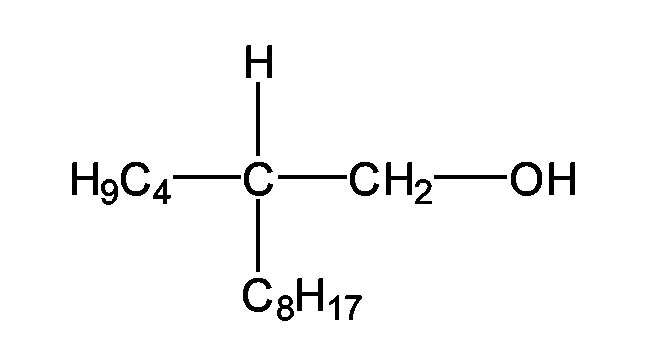
- Guerbet alcohols preferred according to the invention are the 2-butyloctanol - it has the chemical structure and is available, for example, under the trade name Isofol® 12 from Condea Chemie GmbH - and 2-hexyldecanol - it has the chemical structure and is available, for example, under the trade name Isofol® 16 from Condea Chemie GmbH.
- Mixtures of Guerbet alcohols according to the invention are also advantageously usable according to the invention.
- Mixtures of 2-butyloctanol and 2-hexyldecanol are available, for example, under the trade name Isofol® 14 from Condea Chemie GmbH.
- the total amount of Guerbet alcohols in the finished cosmetic or dermatological Preparations are advantageously from the range up to 25.0 wt .-%, preferably 0.5 to 15.0 wt .-%, based on the total weight of Preparations.
- waxes such as cetyl palmitate, as the sole lipid component to use the oil phase.
- Non-polar oils are, for example, those which are selected from the group the branched and unbranched hydrocarbons and waxes, in particular Vaseline (petrolatum), paraffin oil, squalane and squalene, and polyolefins hydrogenated polyisobutenes.
- Vaseline petrolatum
- paraffin oil squalane and squalene
- polyolefins hydrogenated polyisobutenes Among the polyolefins, polydecenes are preferred substances.
- the oil phase can be advantageously selected from the Group of branched and unbranched hydrocarbons and waxes, Dialkyl ethers, the group of saturated or unsaturated, branched or unbranched alcohols, and the fatty acid triglycerides, namely the triglycerol esters saturated and / or unsaturated, branched and / or unbranched alkanecarboxylic acids a chain length of 8 to 24, in particular 12 to 18 carbon atoms.
- fatty acid triglycerides can be advantageously selected from Group of synthetic, semi-synthetic and natural oils, e.g. Olive oil, sunflower oil, Soybean oil, peanut oil, rapeseed oil, almond oil, palm oil, coconut oil, palm kernel oil and such more, provided the conditions required in the main claim become.
- fat and / or wax components from the group of vegetable waxes, animal waxes, mineral waxes and petrochemical waxes are chosen.
- the invention for example, are favorable Candelilla wax, carnauba wax, japan wax, esparto wax, cork wax, Guaruma wax, rice germ oil wax, sugarcane wax, berry wax, ouricury wax, Montan wax, jojoba wax, shea butter, beeswax, shellac wax, Spermaceti, lanolin (wool wax), crepe fat, ceresin, ozokerite (earth wax), paraffin waxes and micro waxes, provided that the conditions required in the main claim are met become.
- fat and / or wax components are chemically modified waxes and synthetic waxes, such as those available under the trade names Syncrowax HRC (glyceryl tribehenate), and Syncrowax AW 1C (C 18-36 fatty acid) from CRODA GmbH, and montan ester waxes, Sasol waxes, hydrogenated jojoba waxes, synthetic or modified beeswaxes (eg dimethicone copolyol beeswax and / or C 30-50 -alkyl beeswax), polyalkylene waxes, polyethylene glycol waxes, but also chemically modified fats such.
- Syncrowax HRC glycol tribehenate
- Syncrowax AW 1C C 18-36 fatty acid
- Hydrogenated vegetable oils for example hydrogenated castor oil and / or hydrogenated coconut fat glycerides
- triglycerides such as trihydroxystearin, fatty acids, fatty acid esters and glycol esters such as C 20-40 alkyl stearate, C 20-40 alkyl hydroxystearoyl stearate and / or glycol montanate.
- organosilicon compounds which have similar physical properties as the said fat and / or wax components, such as stearoxytrimethylsilane, provided that the conditions required in the main claim are met.
- the fat and / or wax components can be used both individually also present in a mixture. Also, any mixtures of such oil and wax components are advantageous to use in the context of the present invention.
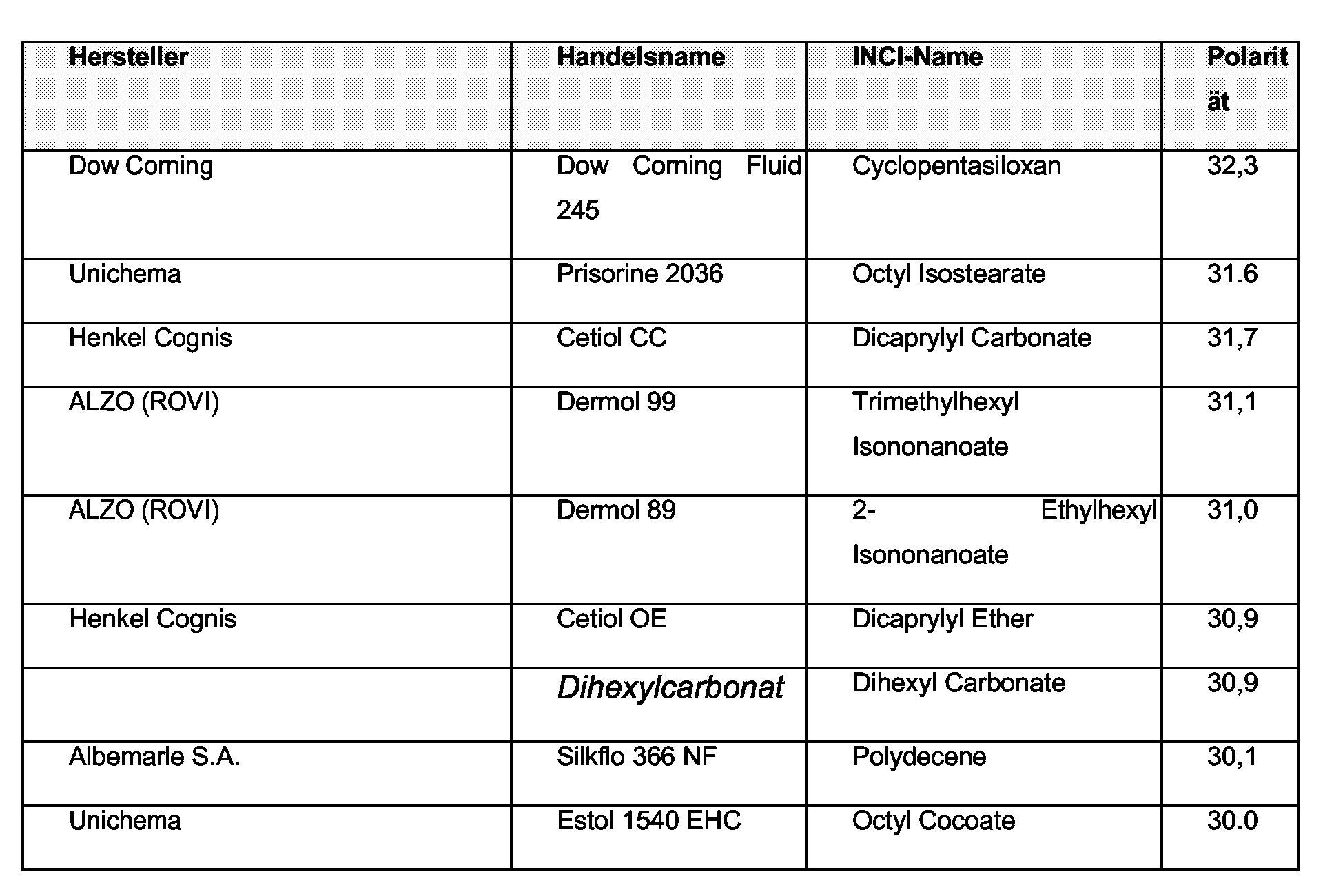
- the oil phase is selected from the group consisting of 2-ethylhexyl isostearate, octyldodecanol, isotridecyl isononanoate, butylene glycol dicaprylate / dicaprate, 2-ethylhexyl cocoate, C 12-15 alkyl benzoate, caprylic capric triglyceride, dicaprylyl ether, if the conditions required in the main claim are met.
- Particularly advantageous are mixtures of octyldodecanol, caprylic-capric triglyceride, dicaprylyl ether, dicaprylyl carbonate, cocoglycerides, or mixtures of C 12-15 -alkyl benzoate and 2-ethylhexyl isostearate, mixtures of C 12-15 -alkyl benzoate and butylene glycol dicaprylate / dicaprate and mixtures from C 12-15 -alkyl benzoate, 2-ethylhexyl isostearate and isotridecyl isononanoate if the conditions required in the main claim are met.
- hydrocarbons are paraffin oil, cycloparaffin, squalane, squalene, hydrogenated Polyisobutene or polydecene advantageous in the context of the present invention to use. provided that the conditions required in the main claim are met become.
- silicone oils are also referred to in the present disclosure as "silicone oils".
- silicones or silicone oils may be present as monomers, which are typically characterized by structural elements, as follows: Silicone oils are high molecular weight synthetic polymeric compounds in which silicon atoms via oxygen atoms chain and / or net-like linked and the remaining valences of silicon by hydrocarbon radicals (usually methyl, more rarely ethyl, propyl, phenyl groups, etc.) are saturated.
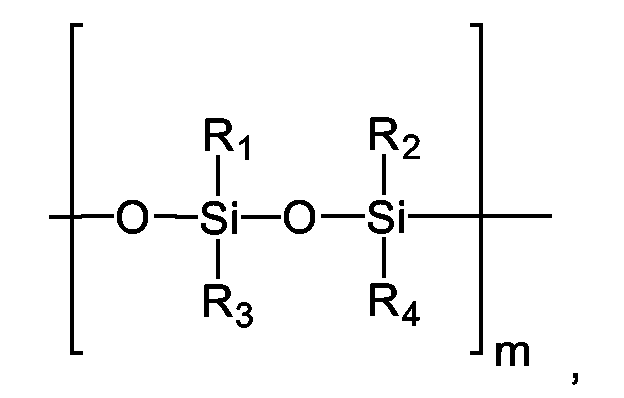
- linear silicones having several siloxy units which are advantageously used according to the invention, they are generally characterized by structural elements as follows: wherein the silicon atoms can be substituted with identical or different alkyl radicals and / or aryl radicals, which are here generalized by the radicals R 1 - R 4 (to say that the number of different radicals is not necessarily limited to 4).
- m can assume values of 2 - 200,000.
- the linear silicone oils are called polyorganosiloxanes; the methyl-substituted polyorganosiloxanes, which are the quantitatively most important compounds of this group and are characterized by the following structural formula are also referred to as polydimethylsiloxane or dimethicone (INCI).
- Dimethicones are available in different chain lengths or with different molecular weights. Dimethicones of different chain lengths and phenyltrimethicones are particularly advantageous linear silicone oils in the context of the present invention.
- Particularly advantageous polyorganosiloxanes in the context of the present invention are, for example, dimethylpolysiloxanes [poly (dimethylsiloxane)], which, for. B. available under the trade names ABIL 10 to 10,000 from Th. Goldschmidt are.
- phenylmethylpolysiloxanes INCI: phenyl dimethicone, Phenyl trimethicone
- cyclic silicones octamethylcyclotetrasiloxane or decamethylcyclopentasiloxane
- cyclomethicones amino-modified silicones INCI: amodimethicones
- silicone waxes z. B.
- Polysiloxane-polyalkylene copolymers (INCI: stearyl dimethicone and cetyl dimethicone) and dialkoxydimethylpolysiloxanes (stearoxy dimethicones and behenoxy Stearyl dimethicone), which are available as various Abil-Wax types from Th. Goldschmidt are available.
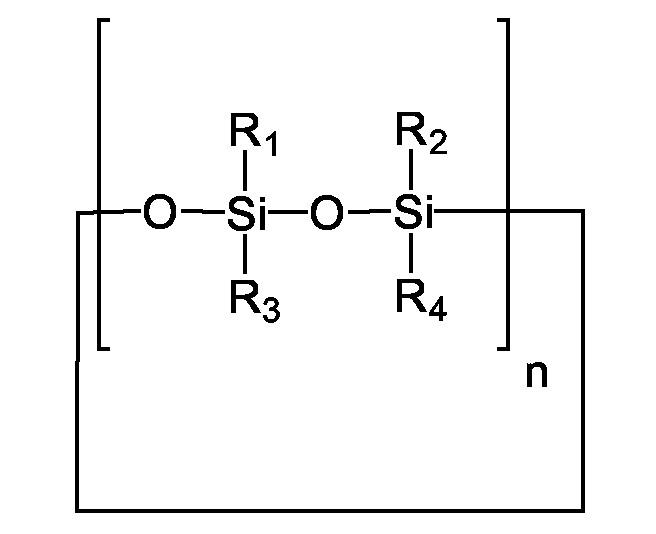
- Cyclic silicones which are advantageously used in accordance with the invention are generally characterized by structural elements as follows wherein the silicon atoms can be substituted with identical or different alkyl radicals and / or aryl radicals, which are here generalized by the radicals R 1 - R 4 (to say that the number of different radicals is not necessarily limited to 4).
- n can assume values of 3/2 to 20. Broken values for n take into account that odd numbers of siloxyl groups may be present in the cycle.
- Particularly advantageous cyclic silicone oils in the context of the present invention are Cyclomethicones, in particular Cyclomethicone D5 and / or Cyclomethicone D6.
- silicone oils or silicone waxes in the context of the present invention are cyclic and / or linear silicone oils and silicone waxes.
- the ratio of To choose lipids to silicone oils in about as 1: 1 (generally x: y).
- phenyltrimethicone is chosen as the silicone oil.
- silicone oils for example Dimethicone, phenyldimethicone, cyclomethicone (octamethylcyclotetrasiloxane) for example, hexamethylcyclotrisiloxane, polydimethylsiloxane, poly (methylphenylsiloxane), Cetyl dimethicone, behenoxydimethicone are advantageous for the purposes of the present To use invention.
- silicone oils of similar constitution to those mentioned above Select compounds whose derivatized organic side chains, for example polyethoxylated and / or polypropoxylated.
- These include, for example Poly-siloxane-polyalkyl-polyether copolymers such as the cetyl dimethicone copolyol and the cetyl dimethicone copolyol (and) polyglyceryl-4-isostearate (and) hexyl laurate.
- the emulsions according to the invention can advantageously be moistened or moisturizers (so-called moisturizers) included.
- Advantageous humectant for the purposes of the present invention, means are, for example, glycerol, lactic acid and / or lactates, especially sodium lactate, butylene glycol, propylene glycol, Biosaccaride gum-1, glycine soy, ethylhexyloxyglycerol, pyrrolidonecarboxylic acid and Urea.
- polymeric moisturizers from the group the water-soluble and / or water-swellable and / or with the aid of water to use gelable polysaccharides.
- Hyaluronic acid for example Hyaluronic acid, chitosan and / or a fucose-rich polysaccharide, which in the Chemical Abstracts filed under the registry number 178463-23-5 and z. More colorful the name Fucogel® 1000 from SOLABIA S.A. is available.
- the antioxidants are selected from the group consisting of amino acids (eg glycine, lysine, arginine, cysteine, histidine, tyrosine, tryptophan) and their derivatives (as salt, ester, ether, sugar, nucleotide, nucleoside, Peptide and lipid compound), imidazoles (eg urocanic acid) and their derivatives (as a salt, ester, ether, sugar, nucleotide, nucleoside, peptide and / or lipid compound), peptides such as D, L-carnosine, D-carnosine, L-carnosine, anserine and their derivatives (eg as salt, ester, ether, sugar, thiol, nucleotide, nucleoside, peptide and lipid combination), carotenoids, Carotenes (eg .alpha.-carotene, .beta.-carotene, .alpha.
- chelators eg apoferritin, desferral, lactoferrin, ⁇ -hydroxyfatty acids, palmitic acid, phytic acid
- their derivatives as salt, ester, ether, sugar, thiol, nucleotide, nucleoside, peptide and / or lipid combination
- ⁇ -hydroxy acids eg citric acid, lactic acid, malic acid
- humic acid bile acid, bile extracts, bilirubin, biliverdin, EDTA, EGTA and their derivatives
- unsaturated fatty acids and their derivatives eg ⁇ -linolenic acid, linoleic acid, Oleic acid
- folic acid and its derivatives furfurylidene sorbitol and its derivatives, ubiquinone, ubiquinol, plastoquinone and their derivatives (as a salt, ester, ether, sugar, thiol, nucleotide
- Flavonoids eg, glycosylrutin, ferulic acid, caffeic acid
- furfurylidene glucitol butylhydroxytoluene, butylhydroxyanisole, nordihydroguaiacetic acid, nordihydroguiaretic acid, trihydroxybutyrophenone and their derivatives (as the salt, ester, ether, sugar, nucleotide, nucleoside, peptide and lipid association).
- Uric acid and its derivatives, mannose and its derivatives as a salt, ester, ether, sugar, thiol, nucleotide, nucleoside, peptide and lipid combination).
- Zinc and its derivatives eg ZnO, ZnSO 4
- selenium and its derivatives eg selenium methionine, Ebselen
- stilbenes and their derivatives eg stilbene oxide, trans-stilbene oxide
- inventively suitable derivatives as salt, ester, ether
- Sugar, thiol, nucleotide, nucleoside, peptide and / or lipid Verbidung of these drugs.
- active ingredients in the context of the present invention are natural Active ingredients and / or their derivatives, such as. Alpha-lipoic acid, phytoene, D-biotin, Coenzyme Q10, alpha-glucosylrutin, carnitine, carnosine, vitamin A and its derivatives, natural and / or synthetic isoflavonoids, creatine, creatinine, urine and / or ß-alanine.
- Inventive formulations which z. B. known anti-wrinkling agents such as flavone glycosides (especially ⁇ -glycosylrutin), coenzyme Q10, vitamin E and / or derivatives and the like, are particularly advantageous for prophylaxis and Treatment of cosmetic or dermatological lesions, as described, for. B. at Skin aging (such as dryness, roughness and training dryness wrinkles, itching, decreased refatting (eg after Washing), visible vascular dilations (telangiectasia, cuperosis), slackness and training of wrinkles and fine lines, local hyper, hypo and Benedictmenttechniken (eg, age spots), increased susceptibility to mechanical stress (eg cracking) and the like).
- flavone glycosides especially ⁇ -glycosylrutin
- coenzyme Q10 coenzyme Q10
- vitamin E and / or derivatives and the like are particularly advantageous for prophylaxis and Treatment of cosmetic or dermatological lesions, as described, for. B. at
- the skin soothing and nourishing substances include, for example, panthenol, niacinamide, allantoin, tannin, antihistamines, anti-inflammatory drugs, glucocorticoids (eg hydrocortisone) and plant active ingredients such as azulene and bisabolol, glycyrrhizin, hamamelin and plant extracts such as chamomile, aloe vera, hamazelis, licorice root.
- glucocorticoids eg hydrocortisone
- plant active ingredients such as azulene and bisabolol, glycyrrhizin, hamamelin and plant extracts such as chamomile, aloe vera, hamazelis, licorice root.
- vitamin D 3 analogues tacalcitol, calcipotriol, tacalcitol, colecalciferol and calcitrol (vitamin D 3 ) and / or fumaric acid esters can be successfully incorporated into the preparations.
- the preparations according to the invention may contain one or more of these active ingredients (Moisturizers, antioxidants, other active ingredients), each in a concentration of 0.001 to 30% by weight, based on the total weight of the preparation.
- the emulsions of the invention a Contain content of UV protection substances.
- So z. B. in day creams or Make-up products usually incorporated UV-A or UV-B filter substances.
- UV protectants, as well as antioxidants and, if desired, preservatives, effective protection of the preparations themselves against spoilage Also suitable are cosmetic and dermatological preparations which are used in the Form of a sunscreen.
- the emulsions according to the present invention preferably contain at least one UV-A and / or UV-B filter substance.
- the formulations may, although not necessary, optionally also one or more organic and / or inorganic pigments as UV filter substances, which in the Water and / or the oil phase may be present.
- Preferred inorganic pigments are metal oxides and / or other water-insoluble or insoluble metal compounds, in particular oxides of titanium (TiO 2 ), zinc (ZnO), iron (eg Fe 2 O 3 ), zirconium (ZrO 2 ), silicon ( SiO 2 ), manganese (for example MnO), aluminum (Al 2 O 3 ), cerium (for example Ce 2 O 3 ), mixed oxides of the corresponding metals and mixtures of such oxides, and the barium sulfate (BaSO 4) 4 ).
- the titanium dioxide pigments can be rutile as well as in the crystal modification Anatase and may be advantageous in the context of the present invention be superficially treated ("coated"), where, for example, a hydrophilic, amphiphilic or hydrophobic character to be formed or retained.
- This surface treatment can consist in that the pigments in per se known methods with a thin hydrophilic and / or hydrophobic inorganic and / or organic layer are provided.
- the different Surface coating can in the context of the present invention also water contain.
- Coated and uncoated titanium dioxides described in the present invention may also be used in the form of commercially available oily or aqueous predispersions. Dispersants and / or solubilizers may advantageously be added to these predispersions.
- the titanium dioxides according to the invention are distinguished by a primary particle size of between 10 nm and 150 nm.
- titanium dioxides are the MT-100 Z and MT-100 TV from Tayca Corporation, Eusolex T-2000 and Eusolex TS from Merck and the titanium dioxide T 805 from Degussa.
- zinc oxides can also be used in the form of commercially available oily or aqueous predispersions.
- Zinc oxide particles and predispersions of zinc oxide particles which are suitable according to the invention are distinguished by a primary particle size of ⁇ 300 nm and can be obtained from the following companies under the following trade names: trade name coating Manufacturer Z-Cote HP1 2% Dimethicone BASF Z Cote / BASF ZnO NDM 5% Dimethicone MR MZ 707M 7% Dimethicone M. Tayca Corp. Nanox 500 / Elementis ZnO neutral / MR
- Particularly preferred zinc oxides in the context of the invention are the Z-Cote HP1 of BASF and the zinc oxide NDM from Haarmann & Reimer.
- the total amount of one or more inorganic pigments in the finished cosmetic preparation is advantageously from the range 0.1 wt .-% to 25 wt .-% selected, preferably 0.5 wt .-% to 18 wt .-%.
- organic pigment for the purposes of the present invention is 2,2'-methylenebis (6- (2H-benzotriazol-2-yl) -4- (1,1,3,3-tetramethylbutyl) -phenol) [INCI: bisoctyltriazole], which is marketed under the trade name Tinosorb® M in CIBA chemicals GmbH is available.
- UV-A filter substances for the purposes of the present invention are dibenzoylmethane derivatives, in particular 4- (tert-butyl) -4'-methoxydibenzoylmethane (CAS No. 70356-09-1) available from Givaudan under the trademark Parsol® 1789 and from Merck is sold under the trade name Eusolex® 9020.
- dibenzoylmethane derivatives in particular 4- (tert-butyl) -4'-methoxydibenzoylmethane (CAS No. 70356-09-1) available from Givaudan under the trademark Parsol® 1789 and from Merck is sold under the trade name Eusolex® 9020.
- UV-A filter substances are the phenylene-1,4-bis (2-benzimidazyl) -3,3'-5,5'-tetrasulfonic acid and their salts, especially the corresponding sodium, potassium or triethanolammonium salts, especially the phenylene-1,4-bis (2-benzimidazyl) -3,3'-5,5'-tetrasulfonic acid bis-sodium salt with the INCI name Bisimidazylate, which, for example, under the trade name Neo Heliopan AP is available from Haarmann & Reimer.
- 1,4-di (2-oxo-10-sulfo-3-bomylidenemethyl) benzene and its salts especially the entprechenden 10-sulfato compounds, in particular the corresponding sodium, potassium or triethanolammonium salt, which is also known as Benzene-1,4-di (2-oxo-3-bomylidenemethyl-10-sulfonic acid).
- a particularly advantageous hydroxybenzophenone in the context of the present invention is the 2- (4'-diethylamino-2'-hydroxybenzoyl) -benzoic acid hexyl ester (also: Aminobenzophenone), which under the trade name Uvinul A Plus in the Fa. BASF is available.
- Advantageous UV filter substances in the sense of the present invention are also so-called Broadband filter, i. Filter substances containing both UV-A and UV-B radiation absorb.
- Advantageous broadband filters or UV-B filter substances are, for example, bis-resorcinyl triazine derivatives having the following structure: wherein R 1 , R 2 and R 3 are independently selected from the group of branched and unbranched alkyl groups having 1 to 10 carbon atoms or represent a single hydrogen atom.
- R 1 , R 2 and R 3 are independently selected from the group of branched and unbranched alkyl groups having 1 to 10 carbon atoms or represent a single hydrogen atom.
- R 1 , R 2 and R 3 are independently selected from the group of branched and unbranched alkyl groups having 1 to 10 carbon atoms or represent a single hydrogen atom.
- R 1 , R 2 and R 3 are independently selected from the group of branched and unbranched alkyl groups having 1 to 10 carbon atoms or represent a single hydrogen atom.
- Particularly advantageous preparations in the context of the present invention which characterized by a high or very high UV-A protection, preferably contain several UV-A and / or broadband filters, in particular Dibenzoylmethanderivate [for example, 4- (tert-butyl) -4'-methoxydibenzoylmethane], benzotriazole derivatives [for example, the 2,2'-methylenebis (6- (2H-benzotriazol-2-yl) -4- (1,1,3,3-tetramethylbutyl) phenol)], Phenylene-1,4-bis- (2-benzimidazyl) -3,3'-5,5'-tetrasulfonic and / or their salts, the 1,4-di (2-oxo-10-sulfo-3-bomylidenemethyl) benzene and / or its salts and / or the 2,4-bis - [[4- (2-ethyl-hexyloxy) -2-hydroxy]
- UV filter substance in the context of the present invention furthermore an unsymmetrically substituted s-triazine, which in the following also as Dioctylbutylamidotriazon (INCI: Dioctylbutamidotriazone) is referred to and under the Trade name UVASORB HEB is available from Sigma 3V.
- Dioctylbutylamidotriazon ICI: Dioctylbutamidotriazone
- UVASORB HEB is available from Sigma 3V.
- s-triazine is also a symmetrically substituted s-triazine
- Also advantageous for the purposes of the present invention are the 2,4-bis - ⁇ [4- (3-sulfonato) -2-hydroxy-propyloxy) -2-hydroxy] -phenyl-6- (4-methoxyphenyl) -1,3 , 5-triazine sodium salt, 2,4-bis - ⁇ [4- (3- (2-propyloxy) -2-hydroxy-propyloxy) -2-hydroxy] -phenyl ⁇ -6- (4-methoxyphenyl) -1 , 3,5-triazine, the 2,4-bis - ⁇ [4- (2-ethyl-hexyloxy) -2-hydroxy] -phenyl ⁇ -6- [4- (2-methoxyethylcarboxyl) -phenylamino] - 1,3,5-triazine which is 2,4-bis - ⁇ [4- (3- (2-propyloxy) -2-hydroxy-propyloxy) -2-hydroxy] -phen
- An advantageous broadband filter for the purposes of the present invention is the 2,2'-methylene-bis (6- (2H-benzotriazol-2-yl) -4- (1,1,3,3-tetramethylbutyl) phenol), which available under the trade name Tinosorb® M from CIBA-Chemikalien GmbH.
- Advantageous broadband filter according to the present invention is further 2- (2Hbenzotriazol-2-yl) -4-methyl-6- [2-methyl-3- [1,3,3,3-tetramethyl-1 - [(tri methylsilyl) oxy] di-siloxanyl] propyl] phenol (CAS No .: 155633-54-8) with the INCI name Drometrizole trisiloxanes.
- Homomenthylsalicylat (INCI: Homosalate), 2-ethylhexyl-2-hydroxybenzoate (2-ethylhexyl salicylate, octyl salicylate, INCI: octyl salicylates), 4-isopropylbenzyl salicylate and esters of cinnamic acid, preferably 4-methoxycinnamic acid (2-ethylhexyl) ester (2-ethylhexyl-4-methoxycinnamate, INCI: octyl methoxycinnamate) and Isopentyl 4-methoxycinnamate (isopentyl 4-methoxycinnamate, INCI: isoamyl p-methoxycinnamate), 3- (4- (2,2-Ethoxycarbonylvinyl) phenoxy) propenyl) methoxysi
- a further light stabilizer filter substance to be advantageously used according to the invention is ethylhexyl 2-cyano-3,3-diphenylacrylate (octocrylene), which is available from BASF the name Uvinul® N 539 is available.
- polymer-bound or polymeric UV filter substances to use in preparations according to the present invention, in particular those as described in WO-A-92/20690.
- UV filters used in the context of the present invention of course, should not be limiting.
- the preparations according to the invention contain the substances, the UV radiation in the UV-A and / or UV-B range, in a total amount of z. B. 0.1 wt .-% to 30 wt .-%, preferably 0.5 to 20 wt .-%, in particular 1.0 to 15.0% by weight, in each case based on the total weight of the preparations, of cosmetic Preparations that provide the hair or the skin before the protect entire area of ultraviolet radiation. They can also be used as sunscreen for the hair or the skin.
- the emulsion according to the invention may advantageously be microparticles whose average particle diameter is between 1 nm and 200 nm, especially is advantageously between 5 nm and 100 nm.
- the concentration of all particles is greater than 0.1% by weight, particularly advantageous between 0.1 wt .-% and 30 wt .-%, based on the total weight of the preparations.
- untreated, almost pure pigment particles are used, in particular those which are also used as dye in the food industry and / or as Absorber can be used by UV radiation in sunscreen.
- the zinc oxide pigments available from Merck are advantageous as well as those which are neutral under the trade names zinc oxide Haarmann & Reimer or NanoX available from the Harcros Chemical Group.
- pigments which are water-repellent on the surface are also advantageous.
- This surface treatment can consist in that the pigments according to known methods with a thin hydrophobic layer be provided.
- TiO 2 pigments for example those coated with aluminum stearate, available under the trade name MT 100 T from TAYCA.
- Another advantageous coating of the inorganic pigments consists of dimethylpolysiloxane (also: dimethicone), a mixture of fully methylated, linear Siloxane polymers which are terminally blocked with trimethylsiloxy units.
- dimethylpolysiloxane also: dimethicone
- a mixture of fully methylated, linear Siloxane polymers which are terminally blocked with trimethylsiloxy units.
- zinc oxide pigments are particularly advantageous for the purposes of the present invention.
- the inorganic pigments are also advantageous.
- a coating of the inorganic pigments with a Mixture of dimethylpolysiloxane, especially dimethylpolysiloxane with an average Chain length from 200 to 350 dimethylsiloxane units, and silica gel, which is also referred to as simethicone. It is particularly advantageous if the inorganic pigments additionally with aluminum hydroxide or
- Alumina hydrate (also: Alumina, CAS No .: 1333-84-2) are coated. Titanium dioxides coated with simethicones and alumina are particularly advantageous are, wherein the coating can also contain water.
- An example of this is the Titanium dioxide available from Merck under the trade name Eusolex T2000.
- Another advantage of the present invention is the use of a mixture different pigment types both within a crystal, for example as mixed iron oxide, as well as by combining several pigment types within a preparation.
- boron nitride particles for example the boron nitrides listed below: trade name Available at Boron Nitride Powder Advanced Ceramics Boron Nitride Powder Sintec ceramics Ceram Blanche Kawasaki HCST Boron Nitride strongly Tres BN® Carborundum Wacker boron nitride BNP Wacker-Chemie
- the mean particle diameter of the boron nitride particles used smaller than 20 ⁇ m, particularly advantageously smaller than 15 ⁇ m.
- boron nitride particles treated with methicone are those used in the Company Carborundum under the trade name réelle BN® UHP 1107 available.
- Further advantageous pigments are microfine polymer particles.
- microfine polymer particles are for the purposes of the present invention, for example Polycarbonates, polyethers, polyethylene, polypropylene, polyvinyl chloride, Polystyrene, polyamides and the like more.
- microfine polyamide particles which are advantageous according to the invention are advantageous available under the trade name SP-500 at the company TORAY.
- Further polyamide 6 (also: nylon 6) or polyamide 12 (also: nylon 12) particles are advantageous.
- Polyamide 6 is that from ⁇ -aminocaproic acid (6-aminohexanoic acid) or e-caprolactam constructed polyamide [poly ( ⁇ -caprolactam)]
- polyamide 12 is a Poly ( ⁇ -laurolactam) from ⁇ -laurolactam.
- Advantageous in the sense of the present Invention are, for example, Orgasol® 1002 (polyamide 6) and Orgasol® 2002 (Polyamide 12) from the company ELF ATOCHEM.
- microfine polymer particles used are superficially coated.
- This surface treatment may consist in providing the pigments with a thin hydrophilic layer by methods known per se.
- Advantageous coatings consist for example of TiO 2 , ZrO 2 or other polymers.
- microfine polymer particles in the context of the present invention are further according to the method described in US Patent 4,898,913 hydrophilic coating of hydrophobic polymer particles available.
- microfine used Polymer particles smaller than 100 microns, particularly advantageously less than 50 microns to choose. It is essentially irrelevant in which form (platelets, rods, Beads, etc.) the polymer particles used are present.
- Modified polysaccharides in the context of the present invention are, for example by reacting starch with mono-, bi- or polyfunctional reagents or Oxidizing agents in largely polymer-analogous reactions available.
- Such reactions are based essentially on conversions of the hydroxy groups the polyglucans by etherification, esterification or selective oxidation.
- starch ethers and starch esters of the general structural formula where R can represent, for example, a hydrogen and / or an alkyl and / or aralkyl radical (in the case of the starch ethers) or a hydrogen and / or an organic and / or inorganic acid radical (in the case of the starch esters).
- R can represent, for example, a hydrogen and / or an alkyl and / or aralkyl radical (in the case of the starch ethers) or a hydrogen and / or an organic and / or inorganic acid radical (in the case of the starch esters).
- Starch ethers and starch esters are advantageous modified polysaccharides in the sense of the present invention.
- starch ethers z particularly advantageous starch ethers z.
- those by etherification of starch are available with Tetramethylolacetylendiharnstoff and which as Amylum non mucilaginosum (non-swelling starch).
- starch esters and their salts for example the sodium and / or aluminum salts of low-substituted half esters of starch, in particular sodium starch n-octenylsuccinate of the structural formula (I), wherein R is characterized by the following structure and which z. B. under the trade name Amiogum® 23 available from CERESTAR and aluminum starch octenylsuccinates, in particular those available under the trade names Dry Flo® Elite LL and Dry Flo® PC from CERESTAR.
- Amiogum® 23 available from CERESTAR
- aluminum starch octenylsuccinates in particular those available under the trade names Dry Flo® Elite LL and Dry Flo® PC from CERESTAR.
- modified polysaccharides should not be limiting be.
- Modified polysaccharides in the context of the present invention are on numerous routes known per se, both chemical and physical Nature available.
- compositions according to the invention contain, in addition to the aforementioned Substances optionally the customary in cosmetics additives, for example Perfumes, dyes, antimicrobials, replenishing agents, complexing agents and Sequestering agents, pearlescent agents, plant extracts, vitamins, active ingredients, Preservatives, bactericides, surfactants, pigments that have a coloring effect have, thickeners, softening, moisturizing and / or moisturizing Substances, or other common ingredients of a cosmetic or dermatological formulation such as alcohols, polyols, polymers, foam stabilizers, Electrolytes, organic solvents or silicone derivatives.
- the customary in cosmetics additives for example Perfumes, dyes, antimicrobials, replenishing agents, complexing agents and Sequestering agents, pearlescent agents, plant extracts, vitamins, active ingredients, Preservatives, bactericides, surfactants, pigments that have a coloring effect have, thickeners, softening, moisturizing and / or moisturizing Sub
- the preparation according to the invention can advantageously contain one or more preservatives.
- Advantageous preservatives for the purposes of the present invention are, for example, formaldehyde releasers (such as, for example, DMDM hydantoin, which is available under the trade name Glydant TM from Lonza), iodopropyl butylcarbamates (for example those sold under the trade names Glycacil-L, Glycacil -S. From the company.
- the preservative system according to the invention also advantageously also comprises preserving aids, such as, for example, octoxyglycerol, glycine soy etc.
- E 200 sorbic acid E 227 calcium bisulfite E 201 sodium sorbate E 228 potassium hydrogen sulfite) E 202 potassium sorbate E 230 Biphenyl (diphenyl) E 203 calcium sorbate E 231 orthophenylphenol E 210 benzoic acid E 232 sodium orthophenylphenolate E 211 sodium benzoate E 233 thiabendazole E 212 potassium benzoate E 235 natamycin E 213 calcium benzoate E 236 formic acid E 214 p-hydroxybenzoic acid ethyl ester E 237 sodium E 215 p-hydroxybenzoic acid ethyl ester sodium salt E 238 calcium E 216 p-hydroxybenzoic acid n-propyl ester E 239 hexamethylenetetramine E 217 p-hydroxybenzoic acid n-propyl ester sodium salt E 249 potassium nitrite E 227 calcium bisulfite E 201 sodium sorbate E 228 potassium hydrogen
- preservatives or preservatives which are conventional, such as dibromodicyanobutane (2-bromo-2-bromomethylglutarodinitrile), phenoxyethanol, 3-iodo-2-propynyl butylcarbamate, 2-bromo-2-nitropropane-1,3-diol, imidazolidinyl urea , 5-chloro-2-methyl-4-isothiazolin-3-one, 2-chloroacetamide, benzalkonium chloride, benzyl alcohol. It is particularly preferred according to the invention if benzoic acid and / or salicylic acid and / or their derivatives or salts are used as preservatives.
- one or more preservatives are advantageous in one Concentration of 2% by weight or less 2% by weight, preferably 1.5% by weight or less than 1.5% by weight, and more preferably 1% by weight or less % By weight, in each case based on the total weight of the preparation A or B in one of the two partial preparations or in both partial preparations.
- the preparations according to the invention advantageously contain one or more conditioners.
- Conditioners preferred according to the invention are, for example, all compounds disclosed in section 4 of the International Cosmetic Ingredient Dictionary and Handbook (Volume 4, publisher: RC Pepe, JA Wenninger, GN McEwen, The Cosmetic, Toiletry, and Fragrance Association, 9th Edition, 2002)
- the keywords Hair Conditioning Agents, Humectants, Skin Conditioning Agents, Skin Conditioning Agents Emollient, Skin Conditioning Agents Humactant, Skin Conditioning Agents-Miscellaneous, Skin Conditioning Agents-Occlusive and Skin Protectans are listed as well as all in the EP 0934956 (S.11-13) under water soluble conditioning agent and oil soluble conditioning agent listed compounds.
- a particularly preferred embodiment of the present invention Textiles which are impregnated with an emulsion according to the invention. That's it According to the invention, when the textile is in the form of a nonwoven web, especially in the form of a cloth or "pads" is present.
- textiles which consist of fleece, in particular from hydroentangled and / or water-jet-embossed nonwoven.
- the textiles according to the invention can be smooth or surface-structured (for example, studded or perforated). According to the invention are preferred surface-structured textiles.
- Such textiles may have macro imprints of any desired pattern.
- the choice to be made depends on the one hand on the impregnation to be applied and secondly, according to the field of application on which the subsequent textile use should find.
- embossed nonwovens are used, large cavities on the wall facilitate this Fleece surface and in the fleece the inclusion of dirt and impurities, if with the soaked cloth over the skin is driven.
- the cleaning effect can be increased compared to unembossed towels many times.
- the cloth has a weight of 35 to 120 g / m 2 , preferably from 40 to 60 g / m 2 , (measured at 20 ° C ⁇ 2 ° C and at a humidity of the room air of 65% ⁇ 5% for 24 hours).
- the average thickness of the nonwoven is preferably 0.4 mm to 2 mm, in particular 0.6 mm to 1.2 mm (measured by the method ERT 30.5-99).
- the nonwoven fabric of the textile can in addition to the Fibers of the invention generally all organic and inorganic Fibers are used on a natural and synthetic basis.
- exemplary are cellulose, jute, hemp, sisal, silk, wool, polypropylene, polyethylene terephthalate (PET), aramid, nylon, polyvinyl derivatives, polyurethanes, polylactide, Polyhydroxyalkanoate, cellulose esters and / or polyethylene as well as mineral Fibers such as glass fibers or carbon fibers.
- PET polyethylene terephthalate
- aramid nylon
- polyvinyl derivatives polyurethanes
- polyurethanes polyurethanes
- polylactide Polyhydroxyalkanoate
- cellulose esters Polyhydroxyalkanoate
- cellulose esters Polyhydroxyalkanoate
- polyethylene such as glass fibers or carbon fibers.
- the present invention is but not limited to the materials mentioned, but it can be a variety other fibers are used for web formation. It is
- the fibers may also be colored to enhance their visual attractiveness emphasize the fleece and / or increase.
- the fibers can additionally UV stabilizers and / or preservatives.
- the fibers used to form the cloth preferably have a Water uptake rate of more than> 20 mm / [10 min] (measured with the EDANA test 10.2-96), on.
- the fibers used to form the cloth preferably have a water absorption capacity greater than> 9 g / g (measured by EDANA test 10.2-96), on.
- Advantageous wipes according to the present invention have a breaking strength of in particular (measured by the method ERT 20.2-89) [N / 50mm] in the dry state machine direction > 70, preferably> 80 transversely > 28, preferably> 30 in the drenched state machine direction > 50, preferably> 60 transversely > 24, preferably> 30
- the extensibility of advantageous cloth is preferably (measured by the method ERT 20.2-89) in the dry state machine direction 45 +/- 15% transversely 110 +/- 20% in the drenched state machine direction 45 +/- 15% transversely 90 +/- 20%
- the fibers consist of a Blend of about 70% viscose and 30% PET.
- a textile which consists of a mixture of Viscose fibers, polyester fibers and / or cotton fibers is formed.
- the textile according to the invention has on the surface a cotton content up to 30% by weight and inside a cotton content up to 10 % By weight, based in each case on the total weight of the textile.
- the degree of impregnation is advantageously between 2 and 4 and According to the invention preferably between 2.8 and 3.4. This means a degree of soaking of 2.8 the 1g of fabric contains 2.8 g of impregnation medium.
- the use of the invention is also advantageous according to the invention Emulsion as a sprayable emulsion.
- the inventive Emulsion with the aid of a compressed gas from an aerosol can or with the aid of a pump be applied from a pump spray applicator out.
Landscapes
- Health & Medical Sciences (AREA)
- Life Sciences & Earth Sciences (AREA)
- Animal Behavior & Ethology (AREA)
- General Health & Medical Sciences (AREA)
- Public Health (AREA)
- Veterinary Medicine (AREA)
- Birds (AREA)
- Epidemiology (AREA)
- Emergency Medicine (AREA)
- Chemical & Material Sciences (AREA)
- Oil, Petroleum & Natural Gas (AREA)
- Dispersion Chemistry (AREA)
- Dermatology (AREA)
- Engineering & Computer Science (AREA)
- Biomedical Technology (AREA)
- Cosmetics (AREA)
- Colloid Chemistry (AREA)
- Treatments For Attaching Organic Compounds To Fibrous Goods (AREA)
- Compositions Of Macromolecular Compounds (AREA)
Abstract
Description
Nicht zuletzt wurde die Anforderung an die O/W-Emulsion gestellt, sowohl als Tränkzubereitung für Tücher und andere Textilien geeignet zu sein, als auch mittels einer Sprühvorrichtung (z.B. Aerosoldose, Pumpspray) versprühbar zu sein.


Besonders vorteilhafte polare Lipide im Sinne der vorliegenden Erfindung sind alle nativen Lipide, wie z. B. Olivenöl, Sonnenblumenöl, Sojaöl, Erdnußöl, Rapsöl, Mandelöl, Palmöl, Kokosöl, Rizinusöl, Weizenkeimöl, Traubenkernöl, Distelöl, Nachtkerzenöl, Macadamianußöl, Maiskeimöl, Avocadoöl und dergleichen sowie die im folgenden aufgelisteten.


- R1 =
- Propyl, Butyl, Pentyl, Hexyl, Heptyl oder Octyl und
- R2 =
- Hexyl, Heptyl, Octyl, Nonyl, Decyl, Undecyl, Dodecyl, Tridecyl oder Tetradecyl.





Gebrochene Werte für n berücksichtigen, daß ungeradzahlige Anzahlen von Siloxylgruppen im Cyclus vorhanden sein können.
Die erfindungsgemäßen Titandioxide zeichnen sich durch eine Primärpartikelgröße zwischen 10 nm bis 150 nm aus.
| Handelsname | Coating | zusätzliche Bestandteile der Vordispersion | Hersteller |
| MT-100TV | Aluminiumhydroxid Stearinsäure | - | Tayca Corporation |
| MT-100Z | Aluminiumhydroxid Stearinsäure | - | Tayca Corporation |
| MT-100F | Stearinsäure Eisenoxid | - | Tayca Corporation |
| MT-500SAS | Alumina, Silica Silikon | - | Tayca Corporation |
| MT-100AQ | Silica Aluminiumhydroxid Alginsäure | - | Tayca Corporation |
| Eusolex T-2000 | Alumina Simethicone | - | Merck KgaA |
| Eosolex TS | Alumina, Stearinsäure - | Merck KgaA | |
| Titandioxid P25 | None | - | Degussa |
| Titandioxid T805 (Uvinul TiO2) | Octyltrimethylsilan | - | Degussa |
| UV-Titan X170 | Alumina Dimethicone | - | Kemira |
| UV-Titan X161 | Alumina, Silica Stearinsäure | - | Kemira |
| Tioveil AQ 10PG | Alumina Silica | Wasser Propylenglycol | Solaveil Uniquema |
| Mirasun TiW 60 | Alumina Silica | Wasser | Rhone-Poulenc |
| Handelsname | Coating | Hersteller |
| Z- Cote HP1 | 2% Dimethicone | BASF |
| Z- Cote | / | BASF |
| ZnO NDM | 5% Dimethicone | H&R |
| MZ 707M | 7% Dimethicone | M. Tayca Corp. |
| Nanox 500 | / | Elementis |
| ZnO Neutral | / | H&R |

- R1 und R2 unabhängig voneinander Wasserstoff, C1-C20-Alkyl, C3-C10-Cycloalkyl oder C3-C10-Cycloalkenyl bedeuten, wobei die Substituenten R1 und R2 gemeinsam mit dem Stickstoffatom, an das sie gebunden sind, einen 5- oder 6-Ring bilden können und
- R3 einen C1-C20-Alkyl Rest bedeutet.


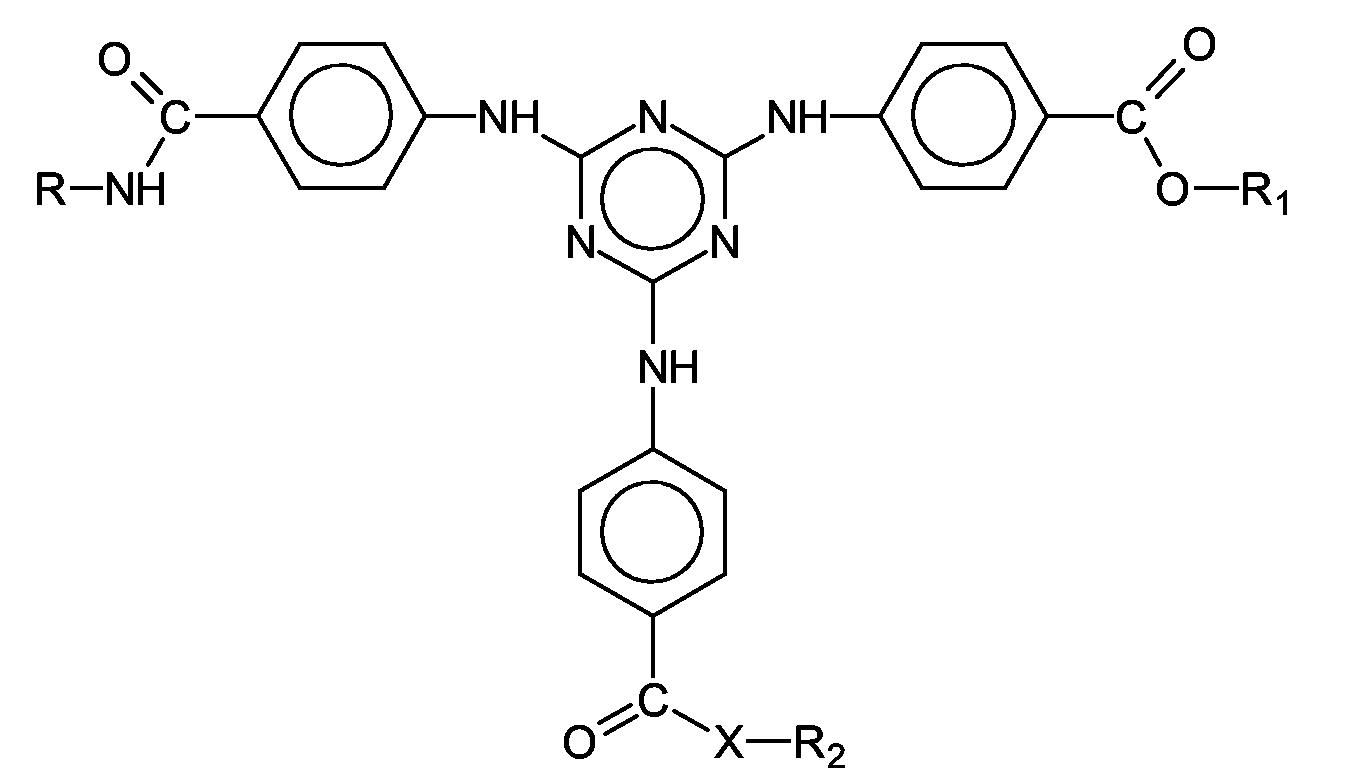
- R
- einen verzweigten oder unverzweigten C1-C18-Alkylrest, einen C5-C12-Cycloalkylrest, gegebenenfalls substituiert mit einer oder mehreren C1-C4- Al kylgruppen, darstellt,
- X
- ein Sauerstoffatom oder eine NH-Gruppe darstellt,
- R1
- einen verzweigten oder unverzweigten C1-C18-Alkylrest, einen C5-C12-Cycloalkylrest,
gegebenenfalls substituiert mit einer oder mehreren C1-C4- Al kylgruppen,
oder ein Wasserstoffatom, ein Alkalimetallatom, eine Ammoniumgruppe oder
eine Gruppe der Formel
bedeutet, in welcher
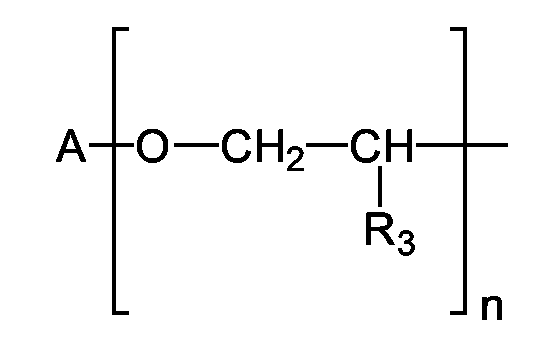
- A
- einen verzweigten oder unverzweigten C1-C18-Alkylrest, einen C5-C12-Cycloalkyl- oder Arylrest darstellt, gegebenenfalls substituiert mit einer oder mehreren C1-C4- Alkylgruppen,
- R3
- ein Wasserstoffatom oder eine Methylgruppe darstellt,
- n
- eine Zahl von 1 bis 10 darstellt,
- R2
- einen verzweigten oder unverzweigten C1-C18-Alkylrest, einen C5-C12-Cycloalkylrest,
gegebenenfalls substituiert mit einer oder mehreren C1-C4- Al kylgruppen,
darstellt, wenn X die NH-Gruppe darstellt, und
einen verzweigten oder unverzweigten C1-C18-Alkylrest, einen C5-C12-Cycloalkylrest, gegebenenfalls substituiert mit einer oder mehreren C1-C4- Al kylgruppen, oder ein Wasserstoffatom, ein Alkalimetallatom, eine Ammoniumgruppe oder eine Gruppe der Formel

- A
- einen verzweigten oder unverzweigten C1-C18-Alkylrest, einen C5-C12- Cycloalkyl- oder Arylrest darstellt, gegebenenfalls substituiert mit einer oder mehreren C1-C4- Alkylgruppen,
- R3
- ein Wasserstoffatom oder eine Methylgruppe darstellt,
- n
- eine Zahl von 1 bis 10 darstellt,

Ein vorteilhafter Breitbandfilter im Sinne der vorliegenden Erfindung ist das 2,2'-Methylen-bis-(6-(2H-benzotriazol-2-yl)-4-(1,1,3,3-tetramethylbutyl)-phenol), welches unter der Handelsbezeichnung Tinosorb® M bei der CIBA-Chemikalien GmbH erhältlich ist.
- 3-Benzylidencampher-Derivate, vorzugsweise 3-(4-Methylbenzyliden)campher, 3-Benzylidencampher;
- 4-Aminobenzoesäure-Derivate, vorzugsweise 4-(Dimethylamino)-benzoesäure(2-ethylhexyl)ester, 4-(Dimethylamino)benzoesäureamylester;
- 2,4,6-Trianilino-(p-carbo-2'-ethyl-1'-hexyloxy)-1,3,5-triazin;
- Ester der Benzalmalonsäure, vorzugsweise 4-Methoxybenzalmalonsäuredi(2-ethylhexyl)ester;
- Ester der Zimtsäure, vorzugsweise 4-Methoxyzimtsäure(2-ethylhexyl)ester, 4-Methoxyzimtsäureisopentylester;
- Derivate des Benzophenons, vorzugsweise 2-Hydroxy-4-methoxybenzophenon, 2-Hydroxy-4-methoxy-4'-methylbenzophenon, 2,2'-Dihydroxy-4-methoxybenzophenon
- sowie an Polymere gebundene UV-Filter.
- Salze der 2-Phenylbenzimidazol-5-sulfonsäure, wie ihr Natrium-, Kalium- oder ihr Triethanolammonium-Salz, sowie die Sulfonsäure selbst;
- Sulfonsäure-Derivate des 3-Benzylidencamphers, wie z. B. 4-(2-Oxo-3-bornylidenmethyl)benzolsulfonsäure, 2-Methyl-5-(2-oxo-3-bornylidenmethyl)sulfonsäure und deren Salze.
| Handelsname | erhältlich bei |
| Boron Nitride Powder | Advanced Ceramics |
| Boron Nitride Powder | Sintec Keramik |
| Ceram Blanche | Kawasaki |
| HCST Boron Nitride | Stark |
| Tres BN® | Carborundum |
| Wacker-Bornitrid BNP | Wacker-Chemie |

| E 200 | Sorbinsäure | E 227 | Calciumhydrogensulfit |
| E 201 | Natriumsorbat | E 228 | Kaliumhydrogensulfit) |
| E 202 | Kaliumsorbat | E 230 | Biphenyl (Diphenyl) |
| E 203 | Calciumsorbat | E 231 | Orthophenylphenol |
| E 210 | Benzoesäure | E 232 | Natriumorthophenylphenolat |
| E 211 | Natriumbenzoat | E 233 | Thiabendazol |
| E 212 | Kaliumbenzoat | E 235 | Natamycin |
| E 213 | Calciumbenzoat | E 236 | Ameisensäure |
| E 214 | p-Hydroxybenzoesäureethylester | E 237 | Natriumformiat |
| E 215 | p-Hydroxybenzoesäureethylester-Na-Salz | E 238 | Calciumformiat |
| E 216 | p-Hydroxybenzoesäure-n-propylester | E 239 | Hexamethylentetramin |
| E 217 | p-Hydroxybenzoesäure-n-propylester-Na-Salz | E 249 | Kaliumnitrit |
| E 218 | p-Hydroxybenzoesäuremethylester | E 250 | Natriumnitrit |
| E 219 | p-Hydroxybenzoesäuremethylester-Na-Salz | E 251 | Natriumnitrat |
| E 220 | Schwefeldioxid | E 252 | Kaliumnitrat |
| E 221 | Natriumsulfit | E 280 | Propionsäure |
| E 222 | Natriumyhdrogensulfit | E 281 | Natriumpropionat |
| E 223 | Natriumdisulfit | E 282 | Calciumpropionat |
| E 224 | Kaliumdisulfit | E 283 | Kaliumpropionat |
| E 226 | Calciumsulfit | E 290 | Kohlendioxid |
Es ist dabei erfindungsgemäß besonders bevorzugt, wenn als Konservierungsstoffe Benzoesäure und/oder Salicylsäure und/oder deren Derivate oder Salze eingesetzt werden.
| [N/50mm] | ||
| im trockenen Zustand | Maschinenrichtung | >70, vorzugsweise >80 |
| Querrichtung | >28, vorzugsweise >30 | |
| im getränkten Zustand | Maschinenrichtung | >50, vorzugsweise >60 |
| Querrichtung | >24, vorzugsweise >30 |
| im trockenen Zustand | Maschinenrichtung | 45 +/- 15% |
| Querrichtung | 110 +/- 20% | |
| im getränkten Zustand | Maschinenrichtung | 45 +/- 15% |
| Querrichtung | 90 +/- 20% |
Claims (10)
- Kosmetische und/oder dermatologische Öl-in-Wasser- (O/W-) Emulsion mit einer Viskosität von 10 bis 1500 mPaS, enthaltendwobei die Gesamtkonzentration der Summe aus Emulgator a) und polymeren Stabilisator b) zwischen 0,01 und 1,5 Gewichts-%, bezogen auf das Gesamtgewicht der Emulsion beträgt und die Emulsion frei ist von Fettalkoholen mit einer Kettenlänge von 12 bis 20 Kohlenstoffatomen.a) einen oder mehrere Emulgatoren gewählt aus der Gruppe Glycerylstearatcitrat, Polyglycerinmethylglucosedistearat, Triceteareth-4-phosphat, b) einem Homo- oder Copolymer der Arcrylsäure und/oder ihrer Derivate als polymeren Stabilisator,
- Emulsion nach Anspruch 1, dadurch gekennzeichnet, dass als Emulgator a) Glycerylstearatcitrat eingesetzt wird.
- Emulsion nach Anspruch 1, dadurch gekennzeichnet, dass als Emulgator a) Polyglycerinmethylglucosedistearat eingesetzt wird.
- Emulsion nach Anspruch 1, dadurch gekennzeichnet, dass als Emulgator a) Triceteareth-4-phosphat eingesetzt wird.
- Emulsion nach einem der Ansprüche 1 bis 4, dadurch gekennzeichnet, dass als polymerer Stabilisator Polyacrylate und/oder Acrylat/C10-C30Alkylacrylat-Copolymer eingesetzt wird.
- Emulsion nach einem der Ansprüche 1 bis 5, dadurch gekennzeichnet, dass die Konzentration an polymeren Stabilisator 0,001 bis 0,1 Gewichts-%, bezogen auf das Gesamtgewicht der Zubereitung beträgt.
- Textil getränkt mit einer Emulsion nach einem der Ansprüche 1 bis 6.
- Textil nach Anspruch 7, dadurch gekennzeichnet, dass das Textil in Form eines ungewebten Vlieses, insbesondere in Form eines Tuches, vorliegt.
- Textil nach einem der Ansprüche 7 oder 8, dadurch gekennzeichnet, dass das Textil aus einer Mischung von Viskosefasern, Polyesterfasern und/oder Baumwollfasern gebildet wird.
- Verwendung einer Zubereitung nach einem der Ansprüche 1 bis 6 oder eines Textils nach einem der Ansprüche 7 bis 9 zur Reinigung der Haut, insbesondere der Gesichtshaut.
Applications Claiming Priority (2)
| Application Number | Priority Date | Filing Date | Title |
|---|---|---|---|
| DE102004003435 | 2004-01-21 | ||
| DE102004003435A DE102004003435A1 (de) | 2004-01-21 | 2004-01-21 | Dünnflüssige O/W-Emulsion |
Publications (3)
| Publication Number | Publication Date |
|---|---|
| EP1561450A2 true EP1561450A2 (de) | 2005-08-10 |
| EP1561450A3 EP1561450A3 (de) | 2005-08-17 |
| EP1561450B1 EP1561450B1 (de) | 2011-09-28 |
Family
ID=34673115
Family Applications (1)
| Application Number | Title | Priority Date | Filing Date |
|---|---|---|---|
| EP04106847A Expired - Lifetime EP1561450B1 (de) | 2004-01-21 | 2004-12-22 | Dünnflüssige O/W-Emulsion |
Country Status (5)
| Country | Link |
|---|---|
| US (1) | US20050238605A1 (de) |
| EP (1) | EP1561450B1 (de) |
| AT (1) | ATE526009T1 (de) |
| DE (1) | DE102004003435A1 (de) |
| ES (1) | ES2374185T3 (de) |
Cited By (3)
| Publication number | Priority date | Publication date | Assignee | Title |
|---|---|---|---|---|
| FR2947177A1 (fr) * | 2009-06-24 | 2010-12-31 | Oreal | Lingette impregnee d'une emulsion comprenant un polymere a groupement sulfonique et une inuline modifiee hydrophobe |
| FR2949058A1 (fr) * | 2009-06-24 | 2011-02-18 | Oreal | Lingette impregnee d'une emulsion comprenant un polymere epaississant et une inuline modifiee hydrophobe |
| EP2364688A3 (de) * | 2010-03-12 | 2015-04-29 | Beiersdorf AG | Kosmetische Zubereitungen mit hoch-elastischer Textur |
Families Citing this family (10)
| Publication number | Priority date | Publication date | Assignee | Title |
|---|---|---|---|---|
| DE102005023638A1 (de) * | 2005-05-19 | 2006-11-23 | Beiersdorf Ag | Kosmetische Zubereitungen mit einem Gehalt an Glucosylglyceriden und einem oder mehreren Acrylamidomethylpropylsulfonsäure-Polymeren |
| DE102005028590A1 (de) * | 2005-06-21 | 2007-01-04 | Beiersdorf Ag | Kosmetische Zubereitungen mit einem Gehalt an Isotridecylisononanoat und niedrigviskose, gut spreitende Lipidkomponenten |
| DE102005051864A1 (de) * | 2005-10-25 | 2007-04-26 | Beiersdorf Ag | Kosmetische O/W-Emulsion mit 1,2-Hexandiol |
| DE102005051862B4 (de) * | 2005-10-25 | 2018-08-30 | Beiersdorf Ag | Emulsion enthaltend 1,2-Alkandiole, Emulgatoren und polare Ölkomponenten sowie deren Verwendung |
| DE102006009783A1 (de) * | 2006-03-01 | 2007-09-06 | Beiersdorf Ag | Verwendung kosmetischer oder dermatologische Zubereitungen enthaltend Glycyrrhetin und/oder Glycyrrhizin und 2,4-Bis-{[4-(2-ethyl-hexyloxy)-2-hydroxy]-phenyl}-6-(4-methoxyphenyl)-1,3,5-triazin t zur Steigerung der Pigmentierung der Humanhaut |
| US8732887B2 (en) | 2010-12-08 | 2014-05-27 | Conopco, Inc. | Personal care implement with low active cleansing composition |
| DE102013206718A1 (de) | 2013-04-15 | 2014-10-16 | Beiersdorf Ag | Emulgatorfreie, hautkonditionierende kosmetische oder dermatologische Zubereitung |
| FR3070860B1 (fr) * | 2017-09-11 | 2019-09-20 | Oleon Nv | Combinaison emulsifiante pour l'obtention d'emulsions de faible viscosite |
| DE102018220913A1 (de) * | 2018-12-04 | 2020-06-04 | Beiersdorf Ag | O/W-Emulsion mit Rhamnolipiden |
| US20200368558A1 (en) * | 2019-05-25 | 2020-11-26 | L'oreal | Compositions and articles for make-up removal |
Family Cites Families (12)
| Publication number | Priority date | Publication date | Assignee | Title |
|---|---|---|---|---|
| TW592713B (en) * | 1998-05-11 | 2004-06-21 | Ciba Sc Holding Ag | Use of nanodispersions in cosmetic end formulations |
| DE19949281A1 (de) * | 1999-10-12 | 2001-04-19 | Cognis Deutschland Gmbh | Verwendung von Emulgatormischungen |
| DE10000209A1 (de) * | 2000-01-05 | 2001-07-12 | Beiersdorf Ag | Kosmetische oder dermatologische Zubereitungen vom Typ Öl-in-Wasser |
| US20020119114A1 (en) * | 2000-12-18 | 2002-08-29 | Beiersdorf Aktiengesellschaft | Active ingredient combinations of surface-active citric esters and alpha-lipoic acid, and cosmetic and dermatological preparations containing such mixtures |
| DE10107240A1 (de) * | 2001-02-16 | 2002-08-29 | Beiersdorf Ag | Gelemulsionen in Form von O/W-Emulsionen mit einem Gehalt an Hydrokolloiden |
| DE10121092A1 (de) * | 2001-04-26 | 2002-10-31 | Beiersdorf Ag | Kosmetische oder dermatologische Formulierungen mit einem Gehalt an Sericosid und/oder Pflanzenextrakten, dasselbe enthaltend |
| DE10141258B4 (de) * | 2001-08-23 | 2004-09-23 | Beiersdorf Ag | Kosmetische und dermatologische Zubereitung und ihre Verwendung |
| DE10141477A1 (de) * | 2001-08-29 | 2003-03-20 | Beiersdorf Ag | Stabilisierung oxidations- und/oder UV-empfindlicher Wirkstoffe |
| DE10148827B4 (de) * | 2001-10-04 | 2004-12-09 | Beiersdorf Ag | Ascorbinsäurehaltige O/W-Emulsionen, diese enthaltende kosmetische und/oder dermatologische Zubereitungen, deren Verwendung sowie Verfahren zu ihrer Herstellung |
| DE10247646B4 (de) * | 2002-10-11 | 2004-08-19 | Westfalia Separator Ag | Zentrifuge mit Not-Aus-System |
| DE10307465A1 (de) * | 2003-02-21 | 2004-09-02 | Beiersdorf Ag | Kosmetische und dermatologische Emulsionen |
| DE10307468A1 (de) * | 2003-02-21 | 2004-09-02 | Beiersdorf Ag | Kosmetische und dermatologische Emulsionen |
-
2004
- 2004-01-21 DE DE102004003435A patent/DE102004003435A1/de not_active Withdrawn
- 2004-12-22 EP EP04106847A patent/EP1561450B1/de not_active Expired - Lifetime
- 2004-12-22 AT AT04106847T patent/ATE526009T1/de active
- 2004-12-22 ES ES04106847T patent/ES2374185T3/es not_active Expired - Lifetime
-
2005
- 2005-01-21 US US11/041,016 patent/US20050238605A1/en not_active Abandoned
Cited By (3)
| Publication number | Priority date | Publication date | Assignee | Title |
|---|---|---|---|---|
| FR2947177A1 (fr) * | 2009-06-24 | 2010-12-31 | Oreal | Lingette impregnee d'une emulsion comprenant un polymere a groupement sulfonique et une inuline modifiee hydrophobe |
| FR2949058A1 (fr) * | 2009-06-24 | 2011-02-18 | Oreal | Lingette impregnee d'une emulsion comprenant un polymere epaississant et une inuline modifiee hydrophobe |
| EP2364688A3 (de) * | 2010-03-12 | 2015-04-29 | Beiersdorf AG | Kosmetische Zubereitungen mit hoch-elastischer Textur |
Also Published As
| Publication number | Publication date |
|---|---|
| EP1561450A3 (de) | 2005-08-17 |
| DE102004003435A1 (de) | 2005-08-11 |
| ES2374185T3 (es) | 2012-02-14 |
| EP1561450B1 (de) | 2011-09-28 |
| ATE526009T1 (de) | 2011-10-15 |
| US20050238605A1 (en) | 2005-10-27 |
Similar Documents
| Publication | Publication Date | Title |
|---|---|---|
| EP1534217B1 (de) | Dünnflüssige kosmetische oder dermatologische zubereitungen von typ öl-in-wasser | |
| DE10333710A1 (de) | Kosmetische, dermatologische oder pharmazeutische Zubereitungen auf Basis von Gase enthaltenden Lipid/Wachs-Gemischen | |
| DE102004003436A1 (de) | Dünnflüssige O/W-Emulsion II | |
| EP1561450B1 (de) | Dünnflüssige O/W-Emulsion | |
| EP1077058A2 (de) | Emulgatorfreie feindisperse Systeme vom Typ Wasser-in-Öl | |
| DE10247695A1 (de) | Emulsion mit substituierten Sacchariden | |
| DE10155962A1 (de) | Kosmetische und dermatologische Lichtschutzformulierungen mit einem Gehalt an Hydroxybenzophenonen und Acrylamid-Polymeren | |
| DE10205190B4 (de) | 2-Methyl-1,3-propandiol haltige Zubereitungen | |
| EP1405632B1 (de) | Imprägnierte kosmetische Tücher, welche nanoskalige Zinkoxide enthalten | |
| DE10301836A1 (de) | Kosmetische oder dermatologische Zubereitungen mit Perlglanzoptik | |
| DE102004003437B4 (de) | Dünnflüssige O/W-Emulsion und diese enthaltender Sprayapplikator | |
| DE10254334A1 (de) | Kosmetikkonzentrat | |
| DE10209111A1 (de) | Tücher mit Produktreservoir | |
| JP2012514614A (ja) | 自由流動性エマルジョン濃縮物 | |
| DE10239647A1 (de) | Kosmetische O/W-Emulsion | |
| EP1491186B1 (de) | Inhomogen aufgebauter Reinigungsartikel | |
| DE10319373A1 (de) | Selbstbräuner enthaltende kosmetische Stifte | |
| DE10260877A1 (de) | Stabile zinkoxidhaltige Öl-in-Wasser-Emulsionen | |
| DE19936913A1 (de) | Ölfreie kosmetische oder dermatologischen Zubereitungen mit einem Gehalt an unsymmetrisch substituierten Triazinderivaten und flüssigen UV-Filtersubstanzen | |
| DE10351859A1 (de) | Emulsionen mit zwei Verdickungsmitteln | |
| DE10241074A1 (de) | Emulsionen mit Mikrocellulose | |
| EP1595529B1 (de) | Kosmetische oder dermatologische getränkte Tücher | |
| DE10336218A1 (de) | Dünnflüssige O/W-Emulsionen | |
| DE10252235A1 (de) | Emulgatorkombination | |
| DE102004039726A1 (de) | Fließfähige kosmetische Zubereitung mit Lichtschutzfiltern |
Legal Events
| Date | Code | Title | Description |
|---|---|---|---|
| PUAI | Public reference made under article 153(3) epc to a published international application that has entered the european phase |
Free format text: ORIGINAL CODE: 0009012 |
|
| PUAL | Search report despatched |
Free format text: ORIGINAL CODE: 0009013 |
|
| AK | Designated contracting states |
Kind code of ref document: A2 Designated state(s): AT BE BG CH CY CZ DE DK EE ES FI FR GB GR HU IE IS IT LI LT LU MC NL PL PT RO SE SI SK TR |
|
| AX | Request for extension of the european patent |
Extension state: AL BA HR LV MK YU |
|
| AK | Designated contracting states |
Kind code of ref document: A3 Designated state(s): AT BE BG CH CY CZ DE DK EE ES FI FR GB GR HU IE IS IT LI LT LU MC NL PL PT RO SE SI SK TR |
|
| AX | Request for extension of the european patent |
Extension state: AL BA HR LV MK YU |
|
| RIC1 | Information provided on ipc code assigned before grant |
Ipc: 7C 08L 33/08 B Ipc: 7C 08L 33/10 B Ipc: 7C 08L 33/12 B Ipc: 7A 61K 7/48 B Ipc: 7A 61K 7/00 A |
|
| 17P | Request for examination filed |
Effective date: 20060217 |
|
| AKX | Designation fees paid |
Designated state(s): AT BE BG CH CY CZ DE DK EE ES FI FR GB GR HU IE IS IT LI LT LU MC NL PL PT RO SE SI SK TR |
|
| 17Q | First examination report despatched |
Effective date: 20060714 |
|
| REG | Reference to a national code |
Ref country code: DE Ref legal event code: R079 Ref document number: 502004012901 Country of ref document: DE Free format text: PREVIOUS MAIN CLASS: A61K0007000000 Ipc: A61K0008370000 |
|
| GRAP | Despatch of communication of intention to grant a patent |
Free format text: ORIGINAL CODE: EPIDOSNIGR1 |
|
| RIC1 | Information provided on ipc code assigned before grant |
Ipc: A61Q 1/14 20060101ALI20110407BHEP Ipc: A61K 8/06 20060101ALI20110407BHEP Ipc: A61K 8/55 20060101ALI20110407BHEP Ipc: A61K 8/81 20060101ALI20110407BHEP Ipc: A61K 8/37 20060101AFI20110407BHEP Ipc: A61K 8/38 20060101ALI20110407BHEP Ipc: A61Q 19/10 20060101ALI20110407BHEP |
|
| RIC1 | Information provided on ipc code assigned before grant |
Ipc: A61K 8/37 20060101AFI20110511BHEP Ipc: A61Q 1/14 20060101ALI20110511BHEP Ipc: A61K 8/06 20060101ALI20110511BHEP Ipc: A61K 8/02 20060101ALI20110511BHEP Ipc: A61Q 19/10 20060101ALI20110511BHEP Ipc: A61K 8/81 20060101ALI20110511BHEP Ipc: A61K 8/55 20060101ALI20110511BHEP Ipc: A61K 8/39 20060101ALI20110511BHEP |
|
| GRAS | Grant fee paid |
Free format text: ORIGINAL CODE: EPIDOSNIGR3 |
|
| GRAA | (expected) grant |
Free format text: ORIGINAL CODE: 0009210 |
|
| AK | Designated contracting states |
Kind code of ref document: B1 Designated state(s): AT BE BG CH CY CZ DE DK EE ES FI FR GB GR HU IE IS IT LI LT LU MC NL PL PT RO SE SI SK TR |
|
| REG | Reference to a national code |
Ref country code: GB Ref legal event code: FG4D Free format text: NOT ENGLISH |
|
| REG | Reference to a national code |
Ref country code: CH Ref legal event code: EP |
|
| REG | Reference to a national code |
Ref country code: IE Ref legal event code: FG4D |
|
| REG | Reference to a national code |
Ref country code: DE Ref legal event code: R096 Ref document number: 502004012901 Country of ref document: DE Effective date: 20111124 |
|
| REG | Reference to a national code |
Ref country code: NL Ref legal event code: VDEP Effective date: 20110928 |
|
| PG25 | Lapsed in a contracting state [announced via postgrant information from national office to epo] |
Ref country code: SE Free format text: LAPSE BECAUSE OF FAILURE TO SUBMIT A TRANSLATION OF THE DESCRIPTION OR TO PAY THE FEE WITHIN THE PRESCRIBED TIME-LIMIT Effective date: 20110928 Ref country code: LT Free format text: LAPSE BECAUSE OF FAILURE TO SUBMIT A TRANSLATION OF THE DESCRIPTION OR TO PAY THE FEE WITHIN THE PRESCRIBED TIME-LIMIT Effective date: 20110928 Ref country code: FI Free format text: LAPSE BECAUSE OF FAILURE TO SUBMIT A TRANSLATION OF THE DESCRIPTION OR TO PAY THE FEE WITHIN THE PRESCRIBED TIME-LIMIT Effective date: 20110928 |
|
| REG | Reference to a national code |
Ref country code: ES Ref legal event code: FG2A Ref document number: 2374185 Country of ref document: ES Kind code of ref document: T3 Effective date: 20120214 |
|
| LTIE | Lt: invalidation of european patent or patent extension |
Effective date: 20110928 |
|
| PG25 | Lapsed in a contracting state [announced via postgrant information from national office to epo] |
Ref country code: CY Free format text: LAPSE BECAUSE OF FAILURE TO SUBMIT A TRANSLATION OF THE DESCRIPTION OR TO PAY THE FEE WITHIN THE PRESCRIBED TIME-LIMIT Effective date: 20110928 Ref country code: GR Free format text: LAPSE BECAUSE OF FAILURE TO SUBMIT A TRANSLATION OF THE DESCRIPTION OR TO PAY THE FEE WITHIN THE PRESCRIBED TIME-LIMIT Effective date: 20111229 Ref country code: SI Free format text: LAPSE BECAUSE OF FAILURE TO SUBMIT A TRANSLATION OF THE DESCRIPTION OR TO PAY THE FEE WITHIN THE PRESCRIBED TIME-LIMIT Effective date: 20110928 |
|
| REG | Reference to a national code |
Ref country code: IE Ref legal event code: FD4D |
|
| PG25 | Lapsed in a contracting state [announced via postgrant information from national office to epo] |
Ref country code: IS Free format text: LAPSE BECAUSE OF FAILURE TO SUBMIT A TRANSLATION OF THE DESCRIPTION OR TO PAY THE FEE WITHIN THE PRESCRIBED TIME-LIMIT Effective date: 20120128 Ref country code: CZ Free format text: LAPSE BECAUSE OF FAILURE TO SUBMIT A TRANSLATION OF THE DESCRIPTION OR TO PAY THE FEE WITHIN THE PRESCRIBED TIME-LIMIT Effective date: 20110928 Ref country code: SK Free format text: LAPSE BECAUSE OF FAILURE TO SUBMIT A TRANSLATION OF THE DESCRIPTION OR TO PAY THE FEE WITHIN THE PRESCRIBED TIME-LIMIT Effective date: 20110928 |
|
| PGFP | Annual fee paid to national office [announced via postgrant information from national office to epo] |
Ref country code: CH Payment date: 20120110 Year of fee payment: 8 |
|
| PG25 | Lapsed in a contracting state [announced via postgrant information from national office to epo] |
Ref country code: IT Free format text: LAPSE BECAUSE OF FAILURE TO SUBMIT A TRANSLATION OF THE DESCRIPTION OR TO PAY THE FEE WITHIN THE PRESCRIBED TIME-LIMIT Effective date: 20110928 Ref country code: RO Free format text: LAPSE BECAUSE OF FAILURE TO SUBMIT A TRANSLATION OF THE DESCRIPTION OR TO PAY THE FEE WITHIN THE PRESCRIBED TIME-LIMIT Effective date: 20110928 Ref country code: EE Free format text: LAPSE BECAUSE OF FAILURE TO SUBMIT A TRANSLATION OF THE DESCRIPTION OR TO PAY THE FEE WITHIN THE PRESCRIBED TIME-LIMIT Effective date: 20110928 Ref country code: NL Free format text: LAPSE BECAUSE OF FAILURE TO SUBMIT A TRANSLATION OF THE DESCRIPTION OR TO PAY THE FEE WITHIN THE PRESCRIBED TIME-LIMIT Effective date: 20110928 Ref country code: PT Free format text: LAPSE BECAUSE OF FAILURE TO SUBMIT A TRANSLATION OF THE DESCRIPTION OR TO PAY THE FEE WITHIN THE PRESCRIBED TIME-LIMIT Effective date: 20120130 |
|
| BERE | Be: lapsed |
Owner name: BEIERSDORF A.G. Effective date: 20111231 |
|
| PG25 | Lapsed in a contracting state [announced via postgrant information from national office to epo] |
Ref country code: DK Free format text: LAPSE BECAUSE OF FAILURE TO SUBMIT A TRANSLATION OF THE DESCRIPTION OR TO PAY THE FEE WITHIN THE PRESCRIBED TIME-LIMIT Effective date: 20110928 Ref country code: MC Free format text: LAPSE BECAUSE OF NON-PAYMENT OF DUE FEES Effective date: 20111231 Ref country code: IE Free format text: LAPSE BECAUSE OF FAILURE TO SUBMIT A TRANSLATION OF THE DESCRIPTION OR TO PAY THE FEE WITHIN THE PRESCRIBED TIME-LIMIT Effective date: 20110928 |
|
| PLBE | No opposition filed within time limit |
Free format text: ORIGINAL CODE: 0009261 |
|
| STAA | Information on the status of an ep patent application or granted ep patent |
Free format text: STATUS: NO OPPOSITION FILED WITHIN TIME LIMIT |
|
| PG25 | Lapsed in a contracting state [announced via postgrant information from national office to epo] |
Ref country code: PL Free format text: LAPSE BECAUSE OF FAILURE TO SUBMIT A TRANSLATION OF THE DESCRIPTION OR TO PAY THE FEE WITHIN THE PRESCRIBED TIME-LIMIT Effective date: 20110928 |
|
| 26N | No opposition filed |
Effective date: 20120629 |
|
| REG | Reference to a national code |
Ref country code: DE Ref legal event code: R097 Ref document number: 502004012901 Country of ref document: DE Effective date: 20120629 |
|
| PG25 | Lapsed in a contracting state [announced via postgrant information from national office to epo] |
Ref country code: BE Free format text: LAPSE BECAUSE OF NON-PAYMENT OF DUE FEES Effective date: 20111231 |
|
| REG | Reference to a national code |
Ref country code: AT Ref legal event code: MM01 Ref document number: 526009 Country of ref document: AT Kind code of ref document: T Effective date: 20111222 |
|
| PG25 | Lapsed in a contracting state [announced via postgrant information from national office to epo] |
Ref country code: LU Free format text: LAPSE BECAUSE OF NON-PAYMENT OF DUE FEES Effective date: 20111222 |
|
| PG25 | Lapsed in a contracting state [announced via postgrant information from national office to epo] |
Ref country code: AT Free format text: LAPSE BECAUSE OF NON-PAYMENT OF DUE FEES Effective date: 20111222 Ref country code: BG Free format text: LAPSE BECAUSE OF FAILURE TO SUBMIT A TRANSLATION OF THE DESCRIPTION OR TO PAY THE FEE WITHIN THE PRESCRIBED TIME-LIMIT Effective date: 20111228 |
|
| REG | Reference to a national code |
Ref country code: CH Ref legal event code: PL |
|
| GBPC | Gb: european patent ceased through non-payment of renewal fee |
Effective date: 20121222 |
|
| PG25 | Lapsed in a contracting state [announced via postgrant information from national office to epo] |
Ref country code: TR Free format text: LAPSE BECAUSE OF FAILURE TO SUBMIT A TRANSLATION OF THE DESCRIPTION OR TO PAY THE FEE WITHIN THE PRESCRIBED TIME-LIMIT Effective date: 20110928 |
|
| PG25 | Lapsed in a contracting state [announced via postgrant information from national office to epo] |
Ref country code: LI Free format text: LAPSE BECAUSE OF NON-PAYMENT OF DUE FEES Effective date: 20121231 Ref country code: HU Free format text: LAPSE BECAUSE OF FAILURE TO SUBMIT A TRANSLATION OF THE DESCRIPTION OR TO PAY THE FEE WITHIN THE PRESCRIBED TIME-LIMIT Effective date: 20110928 Ref country code: CH Free format text: LAPSE BECAUSE OF NON-PAYMENT OF DUE FEES Effective date: 20121231 |
|
| PG25 | Lapsed in a contracting state [announced via postgrant information from national office to epo] |
Ref country code: GB Free format text: LAPSE BECAUSE OF NON-PAYMENT OF DUE FEES Effective date: 20121222 |
|
| REG | Reference to a national code |
Ref country code: FR Ref legal event code: PLFP Year of fee payment: 12 |
|
| REG | Reference to a national code |
Ref country code: FR Ref legal event code: PLFP Year of fee payment: 13 |
|
| REG | Reference to a national code |
Ref country code: FR Ref legal event code: PLFP Year of fee payment: 14 |
|
| PGFP | Annual fee paid to national office [announced via postgrant information from national office to epo] |
Ref country code: FR Payment date: 20201223 Year of fee payment: 17 |
|
| PGFP | Annual fee paid to national office [announced via postgrant information from national office to epo] |
Ref country code: DE Payment date: 20201231 Year of fee payment: 17 Ref country code: ES Payment date: 20210219 Year of fee payment: 17 |
|
| REG | Reference to a national code |
Ref country code: DE Ref legal event code: R119 Ref document number: 502004012901 Country of ref document: DE |
|
| PG25 | Lapsed in a contracting state [announced via postgrant information from national office to epo] |
Ref country code: DE Free format text: LAPSE BECAUSE OF NON-PAYMENT OF DUE FEES Effective date: 20220701 |
|
| PG25 | Lapsed in a contracting state [announced via postgrant information from national office to epo] |
Ref country code: FR Free format text: LAPSE BECAUSE OF NON-PAYMENT OF DUE FEES Effective date: 20211231 |
|
| REG | Reference to a national code |
Ref country code: ES Ref legal event code: FD2A Effective date: 20230221 |
|
| PG25 | Lapsed in a contracting state [announced via postgrant information from national office to epo] |
Ref country code: ES Free format text: LAPSE BECAUSE OF NON-PAYMENT OF DUE FEES Effective date: 20211223 |