EP1550633A1 - Verfahren zur herstellung von nanoteilchen und durch das herstellungsverfahren hergestelltes nanoteilchen - Google Patents
Verfahren zur herstellung von nanoteilchen und durch das herstellungsverfahren hergestelltes nanoteilchen Download PDFInfo
- Publication number
- EP1550633A1 EP1550633A1 EP03807970A EP03807970A EP1550633A1 EP 1550633 A1 EP1550633 A1 EP 1550633A1 EP 03807970 A EP03807970 A EP 03807970A EP 03807970 A EP03807970 A EP 03807970A EP 1550633 A1 EP1550633 A1 EP 1550633A1
- Authority
- EP
- European Patent Office
- Prior art keywords
- apoferritin
- solution
- ion
- nanoparticle
- protein
- Prior art date
- Legal status (The legal status is an assumption and is not a legal conclusion. Google has not performed a legal analysis and makes no representation as to the accuracy of the status listed.)
- Granted
Links
Images



Classifications
-
- B—PERFORMING OPERATIONS; TRANSPORTING
- B82—NANOTECHNOLOGY
- B82Y—SPECIFIC USES OR APPLICATIONS OF NANOSTRUCTURES; MEASUREMENT OR ANALYSIS OF NANOSTRUCTURES; MANUFACTURE OR TREATMENT OF NANOSTRUCTURES
- B82Y30/00—Nanotechnology for materials or surface science, e.g. nanocomposites
-
- B—PERFORMING OPERATIONS; TRANSPORTING
- B82—NANOTECHNOLOGY
- B82Y—SPECIFIC USES OR APPLICATIONS OF NANOSTRUCTURES; MEASUREMENT OR ANALYSIS OF NANOSTRUCTURES; MANUFACTURE OR TREATMENT OF NANOSTRUCTURES
- B82Y10/00—Nanotechnology for information processing, storage or transmission, e.g. quantum computing or single electron logic
-
- C—CHEMISTRY; METALLURGY
- C01—INORGANIC CHEMISTRY
- C01G—COMPOUNDS CONTAINING METALS NOT COVERED BY SUBCLASSES C01D OR C01F
- C01G3/00—Compounds of copper
- C01G3/02—Oxides; Hydroxides
-
- C—CHEMISTRY; METALLURGY
- C01—INORGANIC CHEMISTRY
- C01G—COMPOUNDS CONTAINING METALS NOT COVERED BY SUBCLASSES C01D OR C01F
- C01G37/00—Compounds of chromium
- C01G37/02—Oxides or hydrates thereof
-
- C—CHEMISTRY; METALLURGY
- C01—INORGANIC CHEMISTRY
- C01G—COMPOUNDS CONTAINING METALS NOT COVERED BY SUBCLASSES C01D OR C01F
- C01G53/00—Compounds of nickel
- C01G53/04—Oxides
-
- H—ELECTRICITY
- H10—SEMICONDUCTOR DEVICES; ELECTRIC SOLID-STATE DEVICES NOT OTHERWISE PROVIDED FOR
- H10D—INORGANIC ELECTRIC SEMICONDUCTOR DEVICES
- H10D64/00—Electrodes of devices having potential barriers
- H10D64/01—Manufacture or treatment
- H10D64/031—Manufacture or treatment of data-storage electrodes
- H10D64/035—Manufacture or treatment of data-storage electrodes comprising conductor-insulator-conductor-insulator-semiconductor structures
-
- C—CHEMISTRY; METALLURGY
- C01—INORGANIC CHEMISTRY
- C01P—INDEXING SCHEME RELATING TO STRUCTURAL AND PHYSICAL ASPECTS OF SOLID INORGANIC COMPOUNDS
- C01P2004/00—Particle morphology
- C01P2004/01—Particle morphology depicted by an image
- C01P2004/04—Particle morphology depicted by an image obtained by TEM, STEM, STM or AFM
-
- C—CHEMISTRY; METALLURGY
- C01—INORGANIC CHEMISTRY
- C01P—INDEXING SCHEME RELATING TO STRUCTURAL AND PHYSICAL ASPECTS OF SOLID INORGANIC COMPOUNDS
- C01P2004/00—Particle morphology
- C01P2004/60—Particles characterised by their size
- C01P2004/64—Nanometer sized, i.e. from 1-100 nanometer
Definitions
- the present invention relates to a method of the production of a nanoparticle in which a cavity of a protein is utilized, a nanoparticle produced by the method of the production, and a nanoparticle-protein complex generated in the production step of the method of the production.
- Methods of the production of nanoparticles which have been conventionally carried out involve physical grinding methods, chemical synthesis methods and the like.
- the physical grinding methods have been widely used in order to obtain starting materials upon baking of ceramics.
- examples of the chemical synthesis method include methods in which gold nanoparticles are produced through reducing chloroauric acid among long chain organic compounds. The long chain organic compound in this process inhibits the growing of a gold particle to an enormous size.
- Apoferritin is a protein which is present widespread in an animate nature, and plays a role to regulate the amount of iron which is an essential trace element in a living body.
- a complex of iron or an iron compound with apoferritin is referred to as ferritin. Since iron is deleterious to a living body when it is present in an excessive amount in the body, excess iron is stored in the body in the form of ferritin. Furthermore, ferritin returns to apoferritin through releasing an iron ion as needed.
- Fig. 1 is a schematic view illustrating the structure of apoferritin.
- apoferritin 1 is a spherical protein having the molecular weight of about 460,000 with 24 monomer subunits, which are formed from a single polypeptide chain, being assembled via noncovalent bonds, having the diameter of about 12 nm, and exhibits higher thermostability and pH stability in comparison with general proteins.
- the iron ion when a bivalent iron ion is incorporated into apoferritin 1, the iron ion enters from the channel 3, and reaches to the holding part 4 after being oxidized in a place which is present within a part of the subunits and is referred to as a ferrooxidase center (iron oxidation active center).
- the iron ion is thereafter concentrated in a negative charge region on the inner surface of the holding part 4.
- the iron atoms assemble by 3000 to 4000, and held in the holding part 4 in the form of a ferrihalide (5Fe 2 O 3 ⁇ 9H 2 O) crystal. Diameter of the nanoparticle, which was held in the holding part 4, comprising the metal atom is nearly equal to the diameter of the holding part 4, which is about 6 nm.
- nanoparticle-apoferritin complexes have been generated in which a metal or a metal compound other than iron is artificially carried.
- the diameter of the nanoparticles including any one of these metals or metal compounds is also nearly equal to the diameter of the holding part 4 of apoferritin, which is about 6 nm.
- a core which comprises iron oxide is grown through adherence of the iron ions, which are sequentially incorporated, to the crystal core, and accordingly, a nanoparticle having the particle diameter of 6 nm is formed in the holding part 4.
- Summary of the formation of a nanoparticle including iron oxide as well as the incorporation of the iron ions is as set forth above.
- An object of the present invention is to provide a method of the production a nanoparticle in which a cavity of a protein is utilized, which enables to obtain also nanoparticles having a uniform particle diameter including a metal ion such as nickel ion (Ni 2+ ), chromium ion (Cr 2+ ), copper ion (Cu 2+ ) or the like which has not been hitherto reported on the formation of a nanoparticle in a cavity part of a protein.
- a metal ion such as nickel ion (Ni 2+ ), chromium ion (Cr 2+ ), copper ion (Cu 2+ ) or the like which has not been hitherto reported on the formation of a nanoparticle in a cavity part of a protein.
- the present invention is directed to a method of the production of a nanoparticle which comprises a step of forming a nanoparticle, which includes compound of a metal ion in a cavity part of a protein, in a solution containing the protein having the cavity part therein, the metal ion, and a carbonate ion and/or a hydrogen carbonate ion.
- Examples of the aforementioned compound include e.g., a hydroxide.
- the aforementioned metal ion is preferably any one of a nickel ion (Ni 2+ ), a chromium ion (Cr 2+ ) or a copper ion (Cu 2+ ).
- the pH of the aforementioned solution is preferably approximately equal to a precipitation point of a hydroxide of the aforementioned metal ion.
- the pH of the aforementioned solution is preferably 8 or greater and 9 or less.
- the aforementioned solution preferably includes an ammonium ion, and in this instance, the pH of the aforementioned solution is preferably greater than 8.3 and equal to or less than 8.65.
- the aforementioned protein is at least one of apoferritin, Dps protein, CCMV protein, TMV protein or a heat shock protein.
- the aforementioned solution contains a carbonate ion and/or a hydrogen carbonate ion produced by bubbling carbon dioxide thereto.
- the method may further comprise a step of eliminating the protein by a heat treatment.
- the present invention concerns a nanoparticle including a compound of a metal ion, which is formed in a cavity part of a protein, in a solution containing the protein having the cavity part therein, the metal ion, and a carbonate ion and/or a hydrogen carbonate ion.
- the present invention concerns a complex comprising a protein having a cavity part therein, and a nanoparticle formed in the cavity part of the protein; the nanoparticle being a nanoparticle including a compound of a metal ion, which is formed in the cavity part of the protein, in a solution containing the protein, the metal ion, and a carbonate ion and/or a hydrogen carbonate ion.
- Fig. 2 is a flow chart illustrating a method of the production of a complex comprising a protein including a nanoparticle of a nickel compound therein of this embodiment (hereinafter, may be also referred to as "nickel compound-apoferritin complex”)
- a buffer including a mixed solution of HEPES and CAPSO, an apoferritin solution, a nickel salt solution, Milli Q water, and carbon dioxide are provided.
- the buffer, apoferritin solution, nickel salt solution and Milli Q water provided for use in this step should be degassed.
- carbon dioxide-bubbled water is prepared by bubbling carbon dioxide in degassed Milli Q water.
- a reaction solution is prepared by adding the buffer, apoferritin solution and nickel salt solution to the carbon dioxide-bubbled water obtained in the aforementioned step St2. Thereafter, the reaction solution is left to stand for 24 hours.
- the operations for producing the nickel compound-apoferritin complex explained hereinabove are all conducted at room temperature, or in the range of the temperature which does not result in denaturation of apoferritin, while stirring with a stirrer.
- the compound of a nickel ion (Ni 2+ ) is introduced into a holding part 4 of apoferritin 1 to form a nickel compound-apoferritin complex.
- Proteins including apoferritin are produced on the basis of information of a DNA, and are readily reproduced in a large number by any known method. Further, it is well known that proteins reproduced from the identical DNA in a large number have the same structure in an accuracy of the angstrom level. Therefore, the cavity like holding parts 4 carried by apoferritin used in this embodiment all have the same size and shape.
- the diameter of the nanoparticle is defined by the protein to result in nanoparticles having a uniform particle diameter.
- the diameter of the nanoparticle becomes 6 nm which is almost the same as the diameter of the holding part of apoferritin.
- any protein constituted from a single subunit or any protein constituted from multiple subunits may be used in stead of apoferritin as long as the protein has a cavity part.
- the protein is not limited to one with a cavity part having a spherical form, but may be any one with a cavity part having a rod shape, a ring shape or the like.
- Dps protein, viral protein, a heat shock protein or the like may be used.
- Dps protein a spherical shell-like protein having the diameter of 9 nm, and having a holding part therein with the diameter of 4 nm
- nanoparticles having the diameter of 4 nm can be produced.
- the viral protein examples include for example, CPMV, CCMV, HSV, Rotavirus, Reovirus, LA-1, Polyoma, CaMV, HPV, Ross River, SpV-4, fX174, FHV, HRV-14, Polio and the like.
- a viral protein such as CPMV or CCMV may be used.
- formation of nanoparticles are rendered in compliance with the shape and size of the cavity part of the protein used.
- Nanoparticle herein refers to a particle having a major axis of 50 nm or less, and having the size at least allowing for stable presence as a particle.
- An exemplary nanoparticle corresponds to a particle having a major axis of 1 nm to 50 nm.
- a nanoparticle composed of a nickel compound is explained in this embodiment, the method of this embodiment can be applied to also in the case where a nanoparticle composed of a compound including a metal atom such as chromium or copper is produced.
- Metal compounds which may constitute the nanoparticle formed by the method of this embodiment vary depending on the added metal ion or the like, however, they may be for example, a hydroxide and/or an oxide.
- a chromium salt solution is mixed in the reaction solution in stead of the nickel salt solution used in this embodiment.
- Other conditions are as set forth in this embodiment.
- a copper salt solution is mixed in the reaction solution in stead of the nickel salt solution used in this embodiment.
- Other conditions are as set forth in this embodiment.
- a hydrogen carbonate ion (HCO 3- ) and/or carbonate ion (CO 3 2- ) in the reaction solution is important for the formation of a nanoparticle in this embodiment. Therefore, bubbling of carbon dioxide in degassed Milli Q water is executed in the step St2 in this embodiment, however, this step is not limited thereto but a process in which a hydrogen carbonate ion (HCO 3- ) and/or carbonate ion (CO 3 2- ) is added to the reaction solution may be employed.
- a carbonate such as sodium carbonate (Na 2 CO 3 ) or sodium bicarbonate (NaHCO 3 ) or the like may be used through dissolving in Milli Q water.
- the buffer for use is a mixed solution of HEPES and CAPSO.
- means for adjusting the pH is not limited thereto, but any means may be employed.
- a buffer containing one kind of a buffering agent may be used, or a mixed solution of multiple kinds of buffering agents may be also used as a buffer.
- using a mixed solution of multiple kinds of buffering agents as a buffer is more advantageous than using a buffer containing one kind of a buffering agent, because the pH of the reaction solution can be readily adjusted. Accordingly, it is preferred that a mixed solution of multiple kinds of buffering agents is used as a buffer.
- ammonium nickel sulfate (NiNH 3 (SO 4 )) is used as the nickel salt solution, but not limited thereto.
- nickel sulfate Ni(SO 4 )
- nickel nitrate Ni(NO 3 ) 2
- nickel chloride NiCl 2
- the reaction solution shall contain an ammonium ion without adding any other component to the reaction solution.
- time period for leaving to stand after preparing the reaction solution is set to be 24 hours, however the time period is not limited thereto, but it is desirable to select the most appropriate time period to comply with the constitution, pH and the like of each reaction solution.
- a nonvolatile memory cell which includes dot bodies composed of nanoparticles produced by utilizing nickel compound-apoferritin complexes produced in the embodiment 1 described above, as a floating gate.
- Figs. 3 (a) to (d) are process sectional views illustrating a method of the production of a nonvolatile memory cell of this embodiment.
- a type p Si basal plate 101 on a type p Si basal plate 101 is formed a chip separating oxide membrane 102 surrounding the active region by a LOGOS method, and thereafter a gate oxide membrane 103 which functions as a tunnel insulation membrane is formed on the basal plate by a thermal oxidation method. Then, dot bodies 104 composed of a nanoparticle of nickel having the diameter of approximately 6 nm are formed on the basal plate. Process for forming the dot bodies 104 on the basal plate is explained later.
- a SiO 2 membrane into which the dot bodies 104 are embedded is deposited on the basal plate.
- an Al membrane is deposited on the basal plate.
- a silicon oxide membrane 105 which shall be an insulation membrane between electrodes and an Al electrode 106 which shall be a regulation gate electrode are formed by patterning of the SiO 2 membrane and Al membrane using a photo resist mask Pr1.
- a part of the gate oxide membrane 103 without being covered by the photo resist mask Pr1 is eliminated, therefore, the dot bodies 104 thereon are concurrently eliminated.
- first and second diffusion layers 107a and 107b of type n are formed through carrying out the infusion of an impure ion, with the photo resist mask and the Al electrode 106 as masks.
- step depicted in Fig. 3 (d) formation of an insulation membrane 108 between layers; opening of a contact hole 109 of the insulation membrane 108 between layers; formation of a tungsten plug 110 by embedding tungsten into a contact hole 109; and formation of first and second aluminum wirings 111a and 111b are carried out by any known method.
- Si basal plate of type p was used as a basal plate in this embodiment, also an Si basal plate of type n may be used, or alternatively, any basal plate which is constituted from other semiconductor such as a compound semiconductor including GaAs may be also used.
- a process for forming dot bodies 104 on the basal plate in the step depicted in Fig. 3 (a) is explained below with reference to Fig. 4 and Fig. 5.
- the process for forming dot bodies 104 on the basal plate is not limited to the process as explained below, but any other known process can be also applied.
- nickel compound-apoferritin complexes (hereinafter, abbreviated as "complex" in this embodiment) 150 obtained in the aforementioned embodiment 1 are provided, and these complexes 150 are arranged on the surface of a basal plate 130.
- the basal plate 130 herein refers to that formed on an Si basal plate 101 of type p in the step depicted in Fig. 3 (a) by a LOCOS method through forming a chip separating oxide membrane 102 surrounding the active region, and thereafter forming a gate oxide membrane 103 which functions as a tunnel insulation membrane on the basal plate by a thermal oxidation method. Similar matter can be applied in the following explanation.
- dot bodies 104 are formed on the basal plate 130 by eliminating the protein molecules 140 in the complexes 150 to leave the nanoparticles 104a of the nickel compounds alone.
- a liquid 160 (the nickel compound-apoferritin complexes dispersed in a mixed solution of an equal amount of a phosphate buffer solution having the concentration of 40 mM and pH of 5.3 and an aqueous sodium chloride solution having the concentration of 40 mM) including complexes 150 dispersed therein is provided.
- PBLH Poly-1-Benzil-L-Histidine
- a polypeptide membrane 170 which is composed of PBLH is thereby formed on the surface of the liquid 160.
- the pH of the liquid 160 is adjusted.
- the complexes 150 are adhered onto the polypeptide membrane 170 in a time dependent manner to yield two dimensional crystals of the complexes 150. This is caused by the positively charged polypeptide membrane 170, contrary to the negatively charged complexes 150.
- the basal plate 130 is placed (floated) on the polypeptide membrane 170 to allow adhesion of the polypeptide membrane 170 onto the basal plate 130.
- the basal plate 130 having two dimensional crystals of the complexes 150 adhered via the polypeptide membrane 170 can be obtained.
- a protein molecule is generally weak against heat
- elimination of the protein molecule 140 in the complex 150 is carried out by a heat treatment.
- an inert gas such as nitrogen or the like at 400-500°C for about 1 hour
- the protein molecule 140 and the polypeptide membrane 170 are burnt out, and thus nickel nanoparticles 104a remain on the basal plate 130 in a two dimensional fashion as dot bodies 104 which are regularly aligned at high density and with high accuracy.
- the dot bodies 104 which are aligned at high density and with high accuracy can be formed by rendering the nickel nanoparticles 104a that were held by the complexes 150 appear on the basal plate 130 in a two dimensional fashion, as shown in Fig. 4 (b).
- Heat treatment was employed as the process for eliminating the protein molecules 140 in this embodiment, however, the process is not limited thereto but may be executed by deleting through the decomposition of the protein using for example, a proteolytic enzyme, a chemical substance or the like.
- the memory cell 100 of this embodiment is equipped with the A1 electrode 106 which functions as a regulation gate and a MOS transistor(memory cell transistor) composed of the first and second diffusion layers 107a and 107b of type n which function as a source or a drain, and is a nonvolatile memory cell in which alteration of threshold potential of the aforementioned memory transistor is utilized depending upon the amount of the charge accumulated in the dot bodies 104 which function as a floating gate.
- a function as a memory which memorizes two values can be achieved according to this nonvolatile memory cell.
- nickel, chromium and copper are different in terms of their work functions from iron, manganese, cobalt and the like, as shown in Table 1.
- the work functions presented in Table 1 are cited from H. B. Michaelson "Work Functions of the elements" Journal of Applied Physics, pp. 536-540, volume 21, 1950.
- Metal Work function Mn 4.08 Zn 4.33 Fe 4.60 Co 4.97 Ni 5.22 Pt 5.63 Cr 4.50 Cu 4.50
- control of the accumulation of electrons is enabled by utilizing these nanoparticles in combination through the use of differences in likelihood of accumulation of the electrons therein. Therefore, versatility of design of the quantum effect device can be achieved.
- Fig. 6 is a top view illustrating a nonvolatile memory cell 100' having exactly the same constitution as that of the aforementioned memory cell 100 except that multiple kinds of dot bodies 104, which are formed from compounds having different work functions with each other, are formed as a floating gate.
- dot bodies 104 which are formed from compounds having different work functions with each other, as a floating gate
- memory of multiple values that are three values or more (four values memory in the nonvolatile memory cell 100') can be also put into practice capable of controlling not only the presence of the charge accumulated in the dot bodies 104 but also the amount of accumulation of the charge.
- an FN (Fowler-Nordheim) current via an oxide membrane or a direct tunneling current is utilized.
- a direct tunneling current or channel hot electron (CHE) infusion is employed.
- the nonvolatile memory cell of this embodiment is composed of nickel nanoparticles having the particle diameter small enough to allow the floating gate to function as a quantum dot, the amount of the accumulation of charge becomes slight. Therefore, the amount of current upon writing and clearing can be diminished, and thus a nonvolatile memory cell with low electric power consumption can be constituted.
- the size of the nickel dot bodies 104 that constitute the floating gate is uniform, properties exhibited during infusion and drawing of the charge are uniform among respective nickel dot bodies 104, and thus regulation upon these manipulations can be readily conducted.
- each of the solutions was first prepared, i.e., an apoferritin solution in which HEPES buffer, CAPSO buffer and commercially available apoferritin (derived from equine spleen) were dissolved, and an ammonium nickel sulfate solution. Concentration and pH of each solution are as shown in Table 2. After preparing each solution, degassing of the HEPES buffer and CAPSO buffer was immediately conducted. Solution (pH) Concentration HEPES buffer (pH 7.5) 500 mM CAPSO buffer (pH 9.5) 500 mM Apoferritin solution 55 mg/ml Ammonium nickel sulfate solution 200 mM
- each reaction solution having the constitution presented in Table 3 was prepared to give the total volume of 3 ml, therefore, the amount added of carbon dioxide-bubbled water and each solution presented in Table 2 was as shown in Table 4.
- Solution (concentration, pH) Concentration Carbon dioxide-bubbled water Added to give total volume of 3 ml HEPES buffer (500 mM, pH 7.5) 900 ⁇ l CAPSO buffer (500 mM, pH 9.5) 1410, 1500, 1590 ⁇ l Apoferritin solution (55 mg/ml) 16.35 ⁇ l Ammonium nickel sulfate solution 75 ⁇ l
- Each of the three kinds of reaction solutions obtained as described above was left to stand at 23°C for 24 hours. Thereafter, each reaction solution was centrifuged at 8000 G for 30 minutes. Each supernatant was collected, and the state of the supernatant was observed.
- each of thus resulting supernatants was diluted to three fold with water, stained apoferritin with 2% gold glucose, and observed with a transmission electron microscope (TEM) with fifty thousand fold magnification.
- TEM transmission electron microscope
- the results of observation as described above are presented in Table 5 as a relationship between the concentration of the CAPSO buffer and the yield of nanoparticle formation (hereinafter, may be also referred to as YCF).
- the yield of nanoparticle formation (YCF) is a ratio of apoferritin including the nanoparticle of the nickel compound (i.e., nickel compound-apoferritin complex) therein among apoferritin in the supernatant.
- the supernatant of the reaction solution including CAPSO at the concentration of 250 mM was turbid, and plenty of precipitations of Ni(OH) 2 were found in the supernatant of the reaction solution including CAPSO at the concentration of 265 mM. Therefore, it is believed that the precipitation point of Ni(OH) 2 in the constitution of the reaction solution of this Example is approximately pH 8.3 (approximately pH 8.2 when oxygen bubbled water was used). At the higher pH than the precipitation point, nickel ions (Ni 2+ ) rapidly precipitates in the form of Ni(OH) 2 , thus, it is believed that a lot of apoferritin aggregates to give precipitates accompanied by such precipitation of Ni(OH) 2 .
- nanoparticles becomes difficult as the pH becomes lower, because the presence of enough hydroxide ion to form nanoparticles is not ensured in the solution. Therefore, it is concluded that preferable condition for efficiently forming nanoparticles involves the pH which is approximate to the precipitation point or the pH which is slightly lower than the precipitation point.
- nanoparticles of the nickel compound were formed in the holding part of most apoferritin at the pH which is slightly lower than the precipitation point (in the supernatant of the reaction solution including CAPSO at the concentration of 235 mM and 250 mM), and the aggregation and precipitation of apoferritin was also suppressed.
- nanoparticles were not formed in the holding part of most apoferritin at the pH which is approximate to the precipitation point or is slightly lower than the precipitation point (in the supernatant of the reaction solution including CAPSO at the concentration of 235 mM and 250 mM).
- each of the solutions was first prepared, i.e., an apoferritin solution in which HEPES buffer, CAPSO buffer and commercially available apoferritin (derived from equine spleen) were dissolved, and nickel salt solutions (nickel sulfate solution, nickel nitrate solution and nickel chloride solution). Concentration and pH of each solution are as shown in Table 8. After preparing each solution, degassing of the HEPES buffer and CAPSO buffer was immediately conducted. Solution (pH) Concentration HEPES buffer (pH 7.5) 500 mM CAPSO buffer (pH 9.5) 500 mM Apoferritin solution 55 mg/ml Nickel salt solution 200 mM
- each reaction solution having the constitution presented in Table 9 was prepared to give the total volume of 3 ml, therefore, the amount added of carbon dioxide-bubbled water and each solution presented in Table 8 was as shown in Table 10.
- Solution (concentration, pH) Concentration Carbon dioxide-bubbled water Added to give total volume of 3 ml HEPES buffer (500 mM, pH 7.5) 900 ⁇ l CAPSO buffer (500 mM, pH 9.5) 840, 900, 960 ⁇ l Apoferritin solution (55 mg/ml) 16.35 ⁇ l Nickel salt solution (200 mM) 75 ⁇ l
- Each of the three kinds of reaction solutions obtained as described above was left to stand at 23°C for 24 hours. Thereafter, each reaction solution was centrifuged at 8000 G for 30 minutes. Each supernatant was collected, and the state of the supernatant was observed. Each supernatant of the reaction solution including CAPSO at the concentration of 160 mM (pH 8.24) was slightly turbid, thus it was believed that the precipitation point of Ni(OH) 2 in the constitution of the reaction solution of this Example was approximately pH 8.2.
- each of thus resulting supernatants was diluted to three fold with water, stained apoferritin with 2% gold glucose, and observed with a transmission electron microscope (TEM) with fifty thousand fold magnification.
- TEM transmission electron microscope
- Figs. 7 (a) to (c) Results of observation of each supernatant with a transmission electron microscope are illustrated in Figs. 7 (a) to (c).
- Figs. 7 (a) to (c) apoferritin including a nanoparticle of a nickel compound therein, with the appearance of a protein portion having a white colored doughnut like shape, with a central portion which appears black, was observed.
- nanoparticles of the nickel compound had a spherical shape, with the diameter of 6 nm (standard deviation: 1 nm). In other words, it is deemed that nanoparticles having a uniform particle diameter could be obtained.
- nanoparticles of a nickel compound were formed in the holding part of almost 100% apoferritin at the pH of approximately 8.2 which is a precipitation point of Ni(OH) 2 in the constitution of the reaction solution of this Example. Furthermore, also in each supernatant of the reaction solution including CAPSO at the concentration of 140 mM (pH 8.14), it is revealed that nanoparticles of a nickel compound were formed in the holding part of apoferritin, although the yield of nanoparticle formation was low.
- Example 3 Test for exploring optimal conditions: pH; concentration of ammonium nickel sulfate solution; and time period for leaving to stand, upon production of nickel compound-apoferritin complex
- each of the solutions was first prepared, i.e., an apoferritin solution in which HEPES buffer, CAPSO buffer and commercially available apoferritin (derived from equine spleen) were dissolved, and an ammonium nickel sulfate solution. Concentration and pH of each solution are as shown in Table 12. After preparing each solution, degassing of the HEPES buffer and CAPSO buffer was immediately conducted. Solution (pH) Concentration HEPES buffer (pH 7.5) 500 mM CAPSO buffer (pH 9.5) 500 mM Apoferritin solution 55 mg/ml Ammonium nickel sulfate solution 200 mM
- Milli Q water was provided, and carbon dioxide-bubbled water was prepared by bubbling carbon dioxide into Milli Q water for 30 minutes.
- twelve kinds of reaction solutions having the constitutions 1 to 12 presented in Table 13 were prepared by admixing each solution described above into the carbon dioxide-bubbled water such that the total volume became 3 ml.
- each reaction solution was centrifuged at 8000 G for 10 minutes. Each supernatant was collected, and the state of the supernatant was observed.
- the concentration of apoferritin in the resulting supernatant was determined using a protein assay kit (manufactured by BioRad).
- a nickel compound-apoferritin complex presented the appearance of a protein portion having a white colored doughnut like shape, with a central portion including a nanoparticle of a nickel compound which appears black.
- Figs. 8 (a) to (d) illustrate the results in which the time period for leaving to stand and the concentration of apoferritin (solid curve), and as a relationship between the time period for leaving to stand and the yield of nanoparticle formation (YCF) (dashed curve).
- Figs. 8 (a), (b), (c) and (d) illustrate the cases in which the concentration of ammonium nickel sulfate is 2, 3, 5 and 10 mM, respectively.
- Any of the solutions including CAPSO at the concentration of 260 mM (compositions 3, 6, 9 and 12) resulted in precipitation of almost all apoferritin after leaving to stand for 8 hours, with the concentration of apoferritin in the supernatant of approximately 0. Therefore, the results obtained thereby are omitted in Fig. 8.
- the results illustrated in Fig. 8 are: (a) for samples 1 and 2; (b) for samples 4 and 5; (c) for samples 7 and 8; (d) for samples 10 and 11.
- Fig. 9 results of observation described above are illustrated in Fig. 9 as a relationship between the concentration of ammonium nickel sulfate and the efficiency of nanoparticle formation (ECF) (solid curve), and as a relationship between the concentration of ammonium nickel sulfate and the pH of precipitation point (dashed curve).
- the efficiency of nanoparticle formation (ECF) is a ratio of apoferritin including the nanoparticle therein (i.e., nickel compound-apoferritin complex) in the supernatant among apoferritin which was added initially (when the solution was prepared).
- the efficiency of nanoparticle formation exhibits a maximum value at the concentration of approximately 3 mM of ammonium nickel sulfate when the solution was left to stand for 16 hours or longer.
- the yield of nanoparticle formation (YCF) under this condition is not 100% at any concentration of ammonium nickel sulfate, as is clear from Fig. 8.
- the yield of nanoparticle formation (YCF) is not 100%, it turns out that apoferritin which includes a nanoparticle and apoferritin which does not include apoferritin coexist, therefore, a further purification step for separating these is required.
- a condition of: the concentration of ammonium nickel sulfate of 3 mM; pH of approximately 8.58; and time period for leaving to stand the solution post preparation of 24 hours may be an optimal condition for producing a nickel compound-apoferritin complex, in light of the efficiency of formation and the efficiency of purification.
- each of the solutions was first prepared, i.e., an apoferritin solution in which HEPES buffer, CAPSO buffer and commercially available apoferritin were dissolved, and an ammonium nickel sulfate solution. Concentration and pH of each solution are as shown in Table 15. After preparing each solution, degassing of the HEPES buffer and CAPSO buffer was immediately conducted. Solution (pH) Concentration HEPES buffer (pH 7.5) 500 mM CAPSO buffer (pH 9.5) 500 mM Apoferritin solution 55 mg/ml Aqueous ammonia 1000 mM Nickel salt solution 200 mM
- each reaction solution having the constitution presented in Table 16 was prepared to give the total volume of 3 ml, therefore, the amount added of each solution presented in Table 15 and carbon dioxide-bubbled water or degassed water was as shown in Table 17.
- Solution (pH) Concentration Carbon dioxide-bubbled water or degassed water Added to give total volume of 3 ml HEPES buffer (500 mM, pH 7.5) 900 ⁇ l CAPSO buffer (500 mM, pH 9.5) 1260 ⁇ l Apoferritin solution (55 mg/ml) 16.35 ⁇ l
- each of thus resulting supernatants was diluted to three fold with water, stained apoferritin with 2% gold glucose, and observed with a transmission electron microscope (TEM) with fifty thousand fold magnification.
- TEM transmission electron microscope
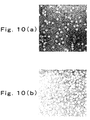
- Fig. 10 (a) Result of observation with a transmission electron microscope of the supernatant of the reaction solution in which carbon dioxide-bubbled water was used is illustrated in Fig. 10 (a).
- Fig. 10 (a) apoferritin including a nanoparticle of a nickel compound therein, with the appearance of a protein portion having a white colored doughnut like shape with a central portion which appears black, was observed.
- Fig. 10 (b) a result of observation with a transmission electron microscope of the supernatant of the reaction solution in which degassed water was used is illustrated in Fig. 10 (b).
- Fig. 10 (b) apoferritin including a nanoparticle of a nickel compound therein, with the appearance of a protein portion having a white colored doughnut like shape with a central portion which appears black, was not observed.
- similar results were obtained even though the pH of the supernatant of the reaction solution in which degassed water was used was variously altered. Although causes of failure of formation of a nanoparticle are believed to involve influences of the ammonium ion, the mechanism thereof is uncertain.
- the pH of the precipitation point of Ni(OH) 2 becomes high in this Example. Importance of the presence of a carbonate ion and/or a hydrogen carbonate ion in the reaction solution for the formation of a nanoparticle, and suitability for forming the nanoparticle of keeping the pH of the reaction solution to be slightly lower than the pH of the precipitation point of Ni(OH) 2 are commonly found as in the aforementioned Examples 1 to 3.
- each of the solutions was first prepared, i.e., an apoferritin solution in which HEPES buffer, CAPSO buffer and commercially available apoferritin (derived from equine spleen) were dissolved, and an ammonium nickel sulfate solution. Concentration and pH of each solution are as shown in Table 18. After preparing each solution, degassing of the HEPES buffer and CAPSO buffer was immediately conducted. Solution (pH) Concentration HEPES buffer (pH 7.5) 500 mM CAPSO buffer (pH 9.5) 500 mM Apoferritin solution 55 mg/ml Aqueous ammonia 1000 mM Ammonium nickel salt solution 200 mM
- reaction solutions obtained as described above were left to stand at 23°C for 48 hours. Thereafter, each reaction solution was centrifuged at 8000 G for 30 minutes. Each supernatant was collected, and the state of the supernatant was observed.
- each of thus resulting supernatants was diluted to three fold with water, stained apoferritin with 2% gold glucose, and observed with a transmission electron microscope (TEM) with fifty thousand fold magnification.
- TEM transmission electron microscope
- Fig. 11 (a) for yield of nanoparticle formation (YCF), and in Fig. 11 (b) for efficiency of nanoparticle formation (ECF) versus pH of the supernatant of the reaction solution.
- the precipitation point of each solution was: pH of 8.42 for the solution to which aqueous ammonia was not added, pH of 8.58 at 10 mM of the ammonium ion (hereinafter, the ammonium ion in this Example refers to one supplied from aqueous ammonia), pH of 8.65 at 20 mM of the ammonium ion, and pH of approximately 8.92 at 30 mM of the ammonium ion.
- the pH of the precipitation point increases depending on the concentration of the ammonium ion as added. Grounds for this event are believed to involve protection of a nickel ion (Ni 2+ ) through the formation of a complex between the ammonium ion and the nickel ion (Ni 2+ ) as is also analyzed in Example 4. Range of pH, from the pH which is approximate to the pH of this precipitation point or slightly lower than this precipitation point is optimal for forming nanoparticles in each of the solutions including an ammonium ion at different concentrations.
- the best yield of the nanoparticles is achieved when an ammonium ion is added such that the concentration becomes 20 mM. Irrespective of the addition of aqueous ammonia, the yield of nanoparticle formation (YCF) attained 100% at the pH which is approximate to the precipitation point, respectively.
- each of the solutions was first prepared, i.e., an L chain apoferritin solution in which HEPES buffer, MES buffer and genetically engineered apoferritin of L chain alone were dissolved, and an ammonium chromium sulfate solution. Concentration and pH of each solution are as shown in Table 20. After preparing each solution, degassing of the HEPES buffer and MES buffer was immediately conducted. Solution (pH) Concentration HEPES buffer (pH 7.5) 500 mM MES buffer (pH 5.5) 55 mM L chain apoferritin solution 55 mg/ml Ammonium chromium sulfate solution 200 mM
- each reaction solution having the constitution presented in Table 21 was prepared to give the total volume of 3 ml, therefore, the amount added of carbon dioxide-bubbled water and each solution presented in Table 20 was as shown in Table22.
- Solution (concentration, pH) Concentration Carbon dioxide-bubbled water Added to give total volume of 3 ml HEPES buffer (500 mM, pH 7.5) 900 ⁇ l MES buffer (500 mM, pH 5.5) 1260 ⁇ l L chain apoferritin solution (27.5 mg/ml) 16.35 ⁇ l Ammonium chromium sulfate solution (200 mM) 75 ⁇ l
- reaction solutions obtained as described above were left to stand at 23°C for 24 hours. Thereafter, each reaction solution was centrifuged at 8000 G for 30 minutes. Each supernatant was collected, and the state of the supernatant was observed.
- each of thus resulting supernatants was diluted to three fold with water, stained apoferritin with 2% gold glucose, and observed with a transmission electron microscope (TEM) with fifty thousand fold magnification.
- TEM transmission electron microscope
- Nanoparticles of the chromium compound had a spherical shape, with the diameter of 6 nm (standard deviation: 1 nm). In other words, it is deemed that nanoparticles having a uniform particle diameter could be obtained.
- nanoparticles of the chromium compound were ascertained within about 50% of apoferritin in the supernatant. In other words, the yield of nanoparticle formation (YCF) was about 50%.
- YCF nanoparticle formation
- each of the solutions was first prepared, i.e., an apoferritin solution in which MES buffer, and commercially available apoferritin (derived from equine spleen) were dissolved, and an ammonium copper sulfate solution. Concentration and pH of each solution are as shown in Table 23. After preparing each solution, degassing of the MES buffer was immediately conducted. Solution (pH) Concentration MES buffer (pH 6.0) 500 mM Apoferritin solution 5 mg/ml Ammonium copper sulfate solution 10 mM
- each reaction solution having the constitution presented in Table 23 was prepared to give the total volume of 3 ml, therefore, the amount added of carbon dioxide-bubbled water and each solution presented in Table 23 was as shown in Table 25.
- Solution (concentration, pH) Concentration Carbon dioxide-bubbled water Added to give total volume of 3 ml MES buffer (500 mM, pH 6.0) 600 ⁇ l Apoferritin solution (5 mg/ml) 90 ⁇ l Ammonium copper sulfate solution (10 mM) 360 ⁇ l
- reaction solutions obtained as described above were left to stand at 23°C for 24 hours. Thereafter, each reaction solution was centrifuged at 8000 G for 30 minutes. Each supernatant was collected, and the state of the supernatant was observed.
- each of thus resulting supernatants was diluted to three fold with water, stained apoferritin with 2% gold glucose, and observed with a transmission electron microscope (TEM) with fifty thousand fold magnification.
- TEM transmission electron microscope
- Nanoparticles of the copper compound had a spherical shape, with the diameter of 6 nm (standard deviation: 1 nm). In other words, it is deemed that nanoparticles having a uniform particle diameter could be obtained.
- nanoparticles of the copper compound were ascertained within about 30 to 40% of apoferritin in the supernatant.
- the yield of nanoparticle formation (YCF) was about 30 to 40%.
- nanoparticles having a uniform particle diameter can be obtained according to the present invention.
- a compound particle is enabled in a cavity part of a protein also with a metal ion which had not been hitherto reported on the formation of a particle in the cavity part of a protein, and in addition, nanoparticles having a uniform particle diameter composed of such a metal ion can be obtained.
- Nanoparticles having a uniform particle diameter can be provided. Nanoparticles which are provided by the present invention can be utilized for semiconductor chips, single-gun devices, quantum dots, light emitting elements and the like through utilizing the quantum effects of the same.
- the nanoparticles provided by the present invention can be utilized as a material with a sophisticated function, high performance, high density and high precision, such as e.g., optical function coating materials, electromagnetic wave shielding materials, materials for secondary batteries, fluorescent materials, materials for electronic parts, materials for magnetic recording, materials for grinding, materials for cosmetics and the like.
Landscapes
- Chemical & Material Sciences (AREA)
- Engineering & Computer Science (AREA)
- Organic Chemistry (AREA)
- Nanotechnology (AREA)
- Inorganic Chemistry (AREA)
- Crystallography & Structural Chemistry (AREA)
- Physics & Mathematics (AREA)
- Condensed Matter Physics & Semiconductors (AREA)
- Theoretical Computer Science (AREA)
- Composite Materials (AREA)
- Mathematical Physics (AREA)
- General Physics & Mathematics (AREA)
- Materials Engineering (AREA)
- Manufacture Of Metal Powder And Suspensions Thereof (AREA)
- Inorganic Compounds Of Heavy Metals (AREA)
- Powder Metallurgy (AREA)
- Compositions Of Macromolecular Compounds (AREA)
- Luminescent Compositions (AREA)
Applications Claiming Priority (5)
| Application Number | Priority Date | Filing Date | Title |
|---|---|---|---|
| JP2002275598 | 2002-09-20 | ||
| JP2002275598 | 2002-09-20 | ||
| JP2003105676 | 2003-04-09 | ||
| JP2003105676 | 2003-04-09 | ||
| PCT/JP2003/011810 WO2004033366A1 (ja) | 2002-09-20 | 2003-09-17 | ナノ粒子の製造方法及び該製造方法によって製造されたナノ粒子 |
Publications (3)
| Publication Number | Publication Date |
|---|---|
| EP1550633A1 true EP1550633A1 (de) | 2005-07-06 |
| EP1550633A4 EP1550633A4 (de) | 2005-12-21 |
| EP1550633B1 EP1550633B1 (de) | 2011-02-09 |
Family
ID=32095393
Family Applications (1)
| Application Number | Title | Priority Date | Filing Date |
|---|---|---|---|
| EP03807970A Expired - Lifetime EP1550633B1 (de) | 2002-09-20 | 2003-09-17 | Verfahren zur herstellung von nanoteilchen |
Country Status (7)
| Country | Link |
|---|---|
| US (1) | US7204999B2 (de) |
| EP (1) | EP1550633B1 (de) |
| JP (1) | JP3703479B2 (de) |
| AT (1) | ATE497927T1 (de) |
| AU (1) | AU2003264452A1 (de) |
| DE (1) | DE60336000D1 (de) |
| WO (1) | WO2004033366A1 (de) |
Families Citing this family (35)
| Publication number | Priority date | Publication date | Assignee | Title |
|---|---|---|---|---|
| JP3588602B2 (ja) * | 2001-10-01 | 2004-11-17 | 松下電器産業株式会社 | コバルト−タンパク質複合体の作製方法 |
| US7588828B2 (en) | 2004-04-30 | 2009-09-15 | Nanoco Technologies Limited | Preparation of nanoparticle materials |
| GB0409877D0 (en) | 2004-04-30 | 2004-06-09 | Univ Manchester | Preparation of nanoparticle materials |
| JP2006008436A (ja) * | 2004-06-24 | 2006-01-12 | Mitsuhiro Okuda | ナノ粒子−タンパク質複合体とその作製方法 |
| US7901978B2 (en) | 2005-04-11 | 2011-03-08 | National University Corporation NARA Institute of Science and Technology | Method of fabricating thin-film transistor |
| JP3999255B2 (ja) * | 2005-06-07 | 2007-10-31 | 松下電器産業株式会社 | 酸化亜鉛−タンパク質複合体の製造方法 |
| GB2472541B (en) | 2005-08-12 | 2011-03-23 | Nanoco Technologies Ltd | Nanoparticles |
| WO2007032241A1 (ja) | 2005-09-12 | 2007-03-22 | Japan Science And Technology Agency | 微粒子-タンパク質複合体およびその作製方法、半導体装置、蛍光標識方法 |
| GB0522027D0 (en) | 2005-10-28 | 2005-12-07 | Nanoco Technologies Ltd | Controlled preparation of nanoparticle materials |
| GB0606845D0 (en) | 2006-04-05 | 2006-05-17 | Nanoco Technologies Ltd | Labelled beads |
| EP2066814A4 (de) | 2006-09-14 | 2010-12-29 | Univ California | Molekulares nanoplasmonisches lineal für nukleaseaktivität und dna-footprint |
| WO2008147471A2 (en) * | 2006-12-28 | 2008-12-04 | University Of Maryland Biotechnology Institute | Metal coated virus-based nanoelectrodes and method of assembling of same |
| US8563348B2 (en) | 2007-04-18 | 2013-10-22 | Nanoco Technologies Ltd. | Fabrication of electrically active films based on multiple layers |
| US20080264479A1 (en) | 2007-04-25 | 2008-10-30 | Nanoco Technologies Limited | Hybrid Photovoltaic Cells and Related Methods |
| DE102007049392A1 (de) * | 2007-05-29 | 2008-12-04 | Linde Material Handling Gmbh | Gabelstapler |
| US8784701B2 (en) | 2007-11-30 | 2014-07-22 | Nanoco Technologies Ltd. | Preparation of nanoparticle material |
| US8865227B2 (en) * | 2007-12-20 | 2014-10-21 | Smith & Nephew (Overseas) Limited | Metal carbonate particles and methods of making thereof |
| CA2716552C (en) | 2008-02-25 | 2016-02-02 | Nanoco Technologies Limited | Semiconductor nanoparticle capping agents |
| GB0813273D0 (en) | 2008-07-19 | 2008-08-27 | Nanoco Technologies Ltd | Method for producing aqueous compatible nanoparticles |
| GB0814458D0 (en) | 2008-08-07 | 2008-09-10 | Nanoco Technologies Ltd | Surface functionalised nanoparticles |
| GB0820101D0 (en) | 2008-11-04 | 2008-12-10 | Nanoco Technologies Ltd | Surface functionalised nanoparticles |
| GB0821122D0 (en) | 2008-11-19 | 2008-12-24 | Nanoco Technologies Ltd | Semiconductor nanoparticle - based light emitting devices and associated materials and methods |
| US8383237B2 (en) | 2009-06-01 | 2013-02-26 | University Of Maryland, College Park | Preparation of silica stabilized biological templates for the production of metal and layered nanoparticles |
| GB0916700D0 (en) | 2009-09-23 | 2009-11-04 | Nanoco Technologies Ltd | Semiconductor nanoparticle-based materials |
| GB0916699D0 (en) | 2009-09-23 | 2009-11-04 | Nanoco Technologies Ltd | Semiconductor nanoparticle-based materials |
| GB201005601D0 (en) | 2010-04-01 | 2010-05-19 | Nanoco Technologies Ltd | Ecapsulated nanoparticles |
| KR101968778B1 (ko) | 2011-05-13 | 2019-04-12 | 더 리전트 오브 더 유니버시티 오브 캘리포니아 | 세포의 선택적 트랜스펙션을 위한 광열 기판 |
| GB2502085A (en) * | 2012-05-15 | 2013-11-20 | Univ Newcastle | Carbon capture by metal catalysed hydration of carbon dioxide |
| KR101753953B1 (ko) * | 2014-12-23 | 2017-07-07 | 한국과학기술원 | 나노입자 촉매가 포함된 아포페리틴을 이용하여 기능화된 1 차원 나노튜브 구조를 갖는 금속산화물 반도체 및 이를 이용한 가스센서용 부재, 가스센서 및 그 제조방법 |
| CA3025903A1 (en) * | 2016-06-10 | 2017-12-14 | Prestech Limited | Submicron particle compositions |
| CN110697758B (zh) * | 2018-08-16 | 2021-10-08 | 扬州大学 | 一种生物模板法构筑多级结构硫化铜纳米酶的方法 |
| US12150326B2 (en) * | 2019-10-02 | 2024-11-19 | Sharp Kabushiki Kaisha | Display device and method of manufacturing display device |
| US12150359B2 (en) | 2019-10-02 | 2024-11-19 | Sharp Kabushiki Kaisha | Display device and method for manufacturing display device |
| WO2021156935A1 (ja) * | 2020-02-04 | 2021-08-12 | シャープ株式会社 | 発光素子、及び発光素子の製造方法 |
| CN117185351B (zh) * | 2023-09-07 | 2024-06-18 | 有研资源环境技术研究院(北京)有限公司 | 一种超细高纯三氧化二铬及其制备方法 |
Family Cites Families (10)
| Publication number | Priority date | Publication date | Assignee | Title |
|---|---|---|---|---|
| US4458584A (en) * | 1983-02-22 | 1984-07-10 | General Foods Corporation | Beverage carbonation device |
| DK0487615T3 (da) * | 1989-08-18 | 1994-03-14 | Monsanto Co | Ferritin-analoger |
| US5443813A (en) * | 1991-06-06 | 1995-08-22 | Associated Universities, Inc. | Loading and conjugating cavity biostructures |
| GB2319253A (en) | 1996-11-16 | 1998-05-20 | Eric Leigh Mayes | Composition, for use in a device, comprising a magnetic layer of domain-separated magnetic particles |
| US5992700A (en) * | 1997-05-28 | 1999-11-30 | Apex Medical Technologies, Inc. | Controlled gas generation for gas-driven infusion devices |
| EP0881691B1 (de) * | 1997-05-30 | 2004-09-01 | Matsushita Electric Industrial Co., Ltd. | Anordnung mit Quanten-Schachteln |
| US6251356B1 (en) * | 1999-07-21 | 2001-06-26 | G. R. International, Inc. | High speed manufacturing process for precipitated calcium carbonate employing sequential perssure carbonation |
| JP4403618B2 (ja) * | 1999-12-21 | 2010-01-27 | パナソニック株式会社 | カーボンナノチューブの製造方法 |
| CN1407947A (zh) * | 2000-03-16 | 2003-04-02 | 松下电器产业株式会社 | 细微构造体的精密加工方法 |
| JP4992003B2 (ja) * | 2000-12-27 | 2012-08-08 | 独立行政法人産業技術総合研究所 | 金属酸化物微粒子の製造方法 |
-
2003
- 2003-09-17 WO PCT/JP2003/011810 patent/WO2004033366A1/ja not_active Ceased
- 2003-09-17 EP EP03807970A patent/EP1550633B1/de not_active Expired - Lifetime
- 2003-09-17 JP JP2005501012A patent/JP3703479B2/ja not_active Expired - Fee Related
- 2003-09-17 AT AT03807970T patent/ATE497927T1/de not_active IP Right Cessation
- 2003-09-17 DE DE60336000T patent/DE60336000D1/de not_active Expired - Lifetime
- 2003-09-17 AU AU2003264452A patent/AU2003264452A1/en not_active Abandoned
- 2003-11-07 US US10/702,459 patent/US7204999B2/en not_active Expired - Lifetime
Also Published As
| Publication number | Publication date |
|---|---|
| ATE497927T1 (de) | 2011-02-15 |
| US20040197884A1 (en) | 2004-10-07 |
| US7204999B2 (en) | 2007-04-17 |
| JPWO2004033366A1 (ja) | 2006-02-09 |
| EP1550633A4 (de) | 2005-12-21 |
| AU2003264452A1 (en) | 2004-05-04 |
| EP1550633B1 (de) | 2011-02-09 |
| JP3703479B2 (ja) | 2005-10-05 |
| WO2004033366A1 (ja) | 2004-04-22 |
| DE60336000D1 (de) | 2011-03-24 |
Similar Documents
| Publication | Publication Date | Title |
|---|---|---|
| US7204999B2 (en) | Method of production of nanoparticle and nanoparticle produced by the method of production | |
| US7129058B2 (en) | Method of production of a nanoparticle of a compound semiconductor in a cavity of protein | |
| US7253119B2 (en) | Passivated nanoparticles, method of fabrication thereof, and devices incorporating nanoparticles | |
| Casavola et al. | Colloidal strategies for preparing oxide‐based hybrid nanocrystals | |
| JP5071854B2 (ja) | 微粒子−タンパク質複合体およびその作製方法、半導体装置、蛍光標識方法 | |
| Rusch et al. | Nanocrystal Heterostructures Based On Halide Perovskites and Lead–Bismuth Chalcogenides | |
| Ahmed et al. | Facile and green synthesis of CdSe quantum dots in protein matrix: tuning of morphology and optical properties | |
| US8569008B2 (en) | Multifunctional biomemory device | |
| US7033613B2 (en) | Recombinant cage-like protein, method for producing the same, precious metal-recombinant cage-like protein complex, method for producing the same and recombinant DNA | |
| US7223847B2 (en) | Method for producing cobalt-protein complex | |
| Brizzolara et al. | Evidence for covalent attachment of purple membrane to a gold surface via genetic modification of bacteriorhodopsin | |
| JP2006008436A (ja) | ナノ粒子−タンパク質複合体とその作製方法 | |
| JP4596705B2 (ja) | 複合微細粒子およびその製造方法 | |
| CN118730998A (zh) | 一种用于神经毒剂检测的双分子共修饰金属sers衬底及其制备方法 | |
| US7834160B2 (en) | Process for producing zinc oxide-protein complex | |
| Colby et al. | Biotemplated synthesis of metallic nanoparticle chains on an α-synuclein fiber scaffold | |
| Mandal et al. | Synthesis of water-soluble core/shell CdS/ZnS nanoparticles at room temperature under ultrasonic irradiation: potential for human serum detection | |
| JP2003033191A (ja) | 組み換えかご状タンパク質、その作製方法、貴金属−組み換えかご状タンパク質複合体、その作製方法、及び組み換えdna | |
| McMillan et al. | A robust and engineerable self-assembling protein template for the synthesis and patterning of ordered nanoparticle arrays | |
| JPWO2001068513A1 (ja) | 微小構造体の精密加工方法 |
Legal Events
| Date | Code | Title | Description |
|---|---|---|---|
| PUAI | Public reference made under article 153(3) epc to a published international application that has entered the european phase |
Free format text: ORIGINAL CODE: 0009012 |
|
| 17P | Request for examination filed |
Effective date: 20050412 |
|
| AK | Designated contracting states |
Kind code of ref document: A1 Designated state(s): AT BE BG CH CY CZ DE DK EE ES FI FR GB GR HU IE IT LI LU MC NL PT RO SE SI SK TR |
|
| AX | Request for extension of the european patent |
Extension state: AL LT LV MK |
|
| RIC1 | Information provided on ipc code assigned before grant |
Ipc: 7C 01G 3/02 B Ipc: 7H 01L 29/06 B Ipc: 7H 01L 29/792 B Ipc: 7H 01L 29/788 B Ipc: 7B 82B 3/00 A Ipc: 7H 01L 21/8247 B Ipc: 7C 01G 53/04 B Ipc: 7H 01L 27/115 B |
|
| A4 | Supplementary search report drawn up and despatched |
Effective date: 20051108 |
|
| DAX | Request for extension of the european patent (deleted) | ||
| RAP1 | Party data changed (applicant data changed or rights of an application transferred) |
Owner name: PANASONIC CORPORATION |
|
| 17Q | First examination report despatched |
Effective date: 20090305 |
|
| GRAP | Despatch of communication of intention to grant a patent |
Free format text: ORIGINAL CODE: EPIDOSNIGR1 |
|
| RTI1 | Title (correction) |
Free format text: METHOD FOR PREPARING NANO-PARTICLES |
|
| GRAS | Grant fee paid |
Free format text: ORIGINAL CODE: EPIDOSNIGR3 |
|
| GRAA | (expected) grant |
Free format text: ORIGINAL CODE: 0009210 |
|
| AK | Designated contracting states |
Kind code of ref document: B1 Designated state(s): AT BE BG CH CY CZ DE DK EE ES FI FR GB GR HU IE IT LI LU MC NL PT RO SE SI SK TR |
|
| REG | Reference to a national code |
Ref country code: GB Ref legal event code: FG4D |
|
| REG | Reference to a national code |
Ref country code: CH Ref legal event code: EP |
|
| REG | Reference to a national code |
Ref country code: IE Ref legal event code: FG4D |
|
| REF | Corresponds to: |
Ref document number: 60336000 Country of ref document: DE Date of ref document: 20110324 Kind code of ref document: P |
|
| REG | Reference to a national code |
Ref country code: DE Ref legal event code: R096 Ref document number: 60336000 Country of ref document: DE Effective date: 20110324 |
|
| REG | Reference to a national code |
Ref country code: NL Ref legal event code: VDEP Effective date: 20110209 |
|
| PG25 | Lapsed in a contracting state [announced via postgrant information from national office to epo] |
Ref country code: ES Free format text: LAPSE BECAUSE OF FAILURE TO SUBMIT A TRANSLATION OF THE DESCRIPTION OR TO PAY THE FEE WITHIN THE PRESCRIBED TIME-LIMIT Effective date: 20110520 Ref country code: GR Free format text: LAPSE BECAUSE OF FAILURE TO SUBMIT A TRANSLATION OF THE DESCRIPTION OR TO PAY THE FEE WITHIN THE PRESCRIBED TIME-LIMIT Effective date: 20110510 Ref country code: PT Free format text: LAPSE BECAUSE OF FAILURE TO SUBMIT A TRANSLATION OF THE DESCRIPTION OR TO PAY THE FEE WITHIN THE PRESCRIBED TIME-LIMIT Effective date: 20110609 Ref country code: SE Free format text: LAPSE BECAUSE OF FAILURE TO SUBMIT A TRANSLATION OF THE DESCRIPTION OR TO PAY THE FEE WITHIN THE PRESCRIBED TIME-LIMIT Effective date: 20110209 |
|
| PG25 | Lapsed in a contracting state [announced via postgrant information from national office to epo] |
Ref country code: BG Free format text: LAPSE BECAUSE OF FAILURE TO SUBMIT A TRANSLATION OF THE DESCRIPTION OR TO PAY THE FEE WITHIN THE PRESCRIBED TIME-LIMIT Effective date: 20110509 Ref country code: AT Free format text: LAPSE BECAUSE OF FAILURE TO SUBMIT A TRANSLATION OF THE DESCRIPTION OR TO PAY THE FEE WITHIN THE PRESCRIBED TIME-LIMIT Effective date: 20110209 Ref country code: SI Free format text: LAPSE BECAUSE OF FAILURE TO SUBMIT A TRANSLATION OF THE DESCRIPTION OR TO PAY THE FEE WITHIN THE PRESCRIBED TIME-LIMIT Effective date: 20110209 Ref country code: FI Free format text: LAPSE BECAUSE OF FAILURE TO SUBMIT A TRANSLATION OF THE DESCRIPTION OR TO PAY THE FEE WITHIN THE PRESCRIBED TIME-LIMIT Effective date: 20110209 Ref country code: NL Free format text: LAPSE BECAUSE OF FAILURE TO SUBMIT A TRANSLATION OF THE DESCRIPTION OR TO PAY THE FEE WITHIN THE PRESCRIBED TIME-LIMIT Effective date: 20110209 Ref country code: CY Free format text: LAPSE BECAUSE OF FAILURE TO SUBMIT A TRANSLATION OF THE DESCRIPTION OR TO PAY THE FEE WITHIN THE PRESCRIBED TIME-LIMIT Effective date: 20110209 Ref country code: BE Free format text: LAPSE BECAUSE OF FAILURE TO SUBMIT A TRANSLATION OF THE DESCRIPTION OR TO PAY THE FEE WITHIN THE PRESCRIBED TIME-LIMIT Effective date: 20110209 |
|
| PG25 | Lapsed in a contracting state [announced via postgrant information from national office to epo] |
Ref country code: EE Free format text: LAPSE BECAUSE OF FAILURE TO SUBMIT A TRANSLATION OF THE DESCRIPTION OR TO PAY THE FEE WITHIN THE PRESCRIBED TIME-LIMIT Effective date: 20110209 Ref country code: DK Free format text: LAPSE BECAUSE OF FAILURE TO SUBMIT A TRANSLATION OF THE DESCRIPTION OR TO PAY THE FEE WITHIN THE PRESCRIBED TIME-LIMIT Effective date: 20110209 |
|
| PG25 | Lapsed in a contracting state [announced via postgrant information from national office to epo] |
Ref country code: SK Free format text: LAPSE BECAUSE OF FAILURE TO SUBMIT A TRANSLATION OF THE DESCRIPTION OR TO PAY THE FEE WITHIN THE PRESCRIBED TIME-LIMIT Effective date: 20110209 Ref country code: RO Free format text: LAPSE BECAUSE OF FAILURE TO SUBMIT A TRANSLATION OF THE DESCRIPTION OR TO PAY THE FEE WITHIN THE PRESCRIBED TIME-LIMIT Effective date: 20110209 Ref country code: CZ Free format text: LAPSE BECAUSE OF FAILURE TO SUBMIT A TRANSLATION OF THE DESCRIPTION OR TO PAY THE FEE WITHIN THE PRESCRIBED TIME-LIMIT Effective date: 20110209 |
|
| PLBE | No opposition filed within time limit |
Free format text: ORIGINAL CODE: 0009261 |
|
| STAA | Information on the status of an ep patent application or granted ep patent |
Free format text: STATUS: NO OPPOSITION FILED WITHIN TIME LIMIT |
|
| 26N | No opposition filed |
Effective date: 20111110 |
|
| REG | Reference to a national code |
Ref country code: DE Ref legal event code: R097 Ref document number: 60336000 Country of ref document: DE Effective date: 20111110 |
|
| PG25 | Lapsed in a contracting state [announced via postgrant information from national office to epo] |
Ref country code: MC Free format text: LAPSE BECAUSE OF NON-PAYMENT OF DUE FEES Effective date: 20110930 |
|
| REG | Reference to a national code |
Ref country code: CH Ref legal event code: PL |
|
| GBPC | Gb: european patent ceased through non-payment of renewal fee |
Effective date: 20110917 |
|
| PG25 | Lapsed in a contracting state [announced via postgrant information from national office to epo] |
Ref country code: IT Free format text: LAPSE BECAUSE OF FAILURE TO SUBMIT A TRANSLATION OF THE DESCRIPTION OR TO PAY THE FEE WITHIN THE PRESCRIBED TIME-LIMIT Effective date: 20110209 |
|
| REG | Reference to a national code |
Ref country code: IE Ref legal event code: MM4A |
|
| REG | Reference to a national code |
Ref country code: FR Ref legal event code: ST Effective date: 20120531 |
|
| PG25 | Lapsed in a contracting state [announced via postgrant information from national office to epo] |
Ref country code: LI Free format text: LAPSE BECAUSE OF NON-PAYMENT OF DUE FEES Effective date: 20110930 Ref country code: IE Free format text: LAPSE BECAUSE OF NON-PAYMENT OF DUE FEES Effective date: 20110917 Ref country code: CH Free format text: LAPSE BECAUSE OF NON-PAYMENT OF DUE FEES Effective date: 20110930 |
|
| PG25 | Lapsed in a contracting state [announced via postgrant information from national office to epo] |
Ref country code: FR Free format text: LAPSE BECAUSE OF NON-PAYMENT OF DUE FEES Effective date: 20110930 Ref country code: GB Free format text: LAPSE BECAUSE OF NON-PAYMENT OF DUE FEES Effective date: 20110917 |
|
| PG25 | Lapsed in a contracting state [announced via postgrant information from national office to epo] |
Ref country code: LU Free format text: LAPSE BECAUSE OF NON-PAYMENT OF DUE FEES Effective date: 20110917 |
|
| PG25 | Lapsed in a contracting state [announced via postgrant information from national office to epo] |
Ref country code: TR Free format text: LAPSE BECAUSE OF FAILURE TO SUBMIT A TRANSLATION OF THE DESCRIPTION OR TO PAY THE FEE WITHIN THE PRESCRIBED TIME-LIMIT Effective date: 20110209 |
|
| PG25 | Lapsed in a contracting state [announced via postgrant information from national office to epo] |
Ref country code: HU Free format text: LAPSE BECAUSE OF FAILURE TO SUBMIT A TRANSLATION OF THE DESCRIPTION OR TO PAY THE FEE WITHIN THE PRESCRIBED TIME-LIMIT Effective date: 20110209 |
|
| PGFP | Annual fee paid to national office [announced via postgrant information from national office to epo] |
Ref country code: DE Payment date: 20220726 Year of fee payment: 20 |
|
| REG | Reference to a national code |
Ref country code: DE Ref legal event code: R071 Ref document number: 60336000 Country of ref document: DE |