EP1544731A1 - Informationsverarbeitungsverfahren und programm und aufzeichnungsmedium zur implementierung des verfahrens - Google Patents
Informationsverarbeitungsverfahren und programm und aufzeichnungsmedium zur implementierung des verfahrens Download PDFInfo
- Publication number
- EP1544731A1 EP1544731A1 EP03788134A EP03788134A EP1544731A1 EP 1544731 A1 EP1544731 A1 EP 1544731A1 EP 03788134 A EP03788134 A EP 03788134A EP 03788134 A EP03788134 A EP 03788134A EP 1544731 A1 EP1544731 A1 EP 1544731A1
- Authority
- EP
- European Patent Office
- Prior art keywords
- central processing
- storage means
- executed
- reset
- processing units
- Prior art date
- Legal status (The legal status is an assumption and is not a legal conclusion. Google has not performed a legal analysis and makes no representation as to the accuracy of the status listed.)
- Withdrawn
Links
Images




Classifications
-
- G—PHYSICS
- G06—COMPUTING OR CALCULATING; COUNTING
- G06F—ELECTRIC DIGITAL DATA PROCESSING
- G06F9/00—Arrangements for program control, e.g. control units
- G06F9/06—Arrangements for program control, e.g. control units using stored programs, i.e. using an internal store of processing equipment to receive or retain programs
- G06F9/44—Arrangements for executing specific programs
- G06F9/4401—Bootstrapping
- G06F9/4405—Initialisation of multiprocessor systems
-
- G—PHYSICS
- G06—COMPUTING OR CALCULATING; COUNTING
- G06F—ELECTRIC DIGITAL DATA PROCESSING
- G06F8/00—Arrangements for software engineering
- G06F8/40—Transformation of program code
- G06F8/54—Link editing before load time
-
- G—PHYSICS
- G06—COMPUTING OR CALCULATING; COUNTING
- G06F—ELECTRIC DIGITAL DATA PROCESSING
- G06F8/00—Arrangements for software engineering
- G06F8/60—Software deployment
-
- G—PHYSICS
- G06—COMPUTING OR CALCULATING; COUNTING
- G06F—ELECTRIC DIGITAL DATA PROCESSING
- G06F8/00—Arrangements for software engineering
- G06F8/70—Software maintenance or management
- G06F8/71—Version control; Configuration management
Definitions
- the present invention relates to an information processing method, a program for realizing the method, and a recording medium on which the program is recorded.
- SOC system-on-chip
- CPU central processing unit
- memory mounted on a single semiconductor chip
- This SOC has the advantage that the bus width between the CPU and the memory can be increased, and is incorporated into a system as a constituent element.
- this SOC since the capacity of a mountable memory is limited according to the size of the chip, it is important to efficiently use the mounted memory.
- Codec There are various kinds of audio compression methods (Codec), such as MPEG1 Audio and MPEG2 Audio, which are recently used in music distribution and portable audio devices.
- Codec audio compression methods
- a system for executing compression and expansion of audio data is constructed of a plurality of CPUs (multiprocessor)
- the load can be divided and a process which takes time with a single CPU can be processed at high speed.
- codec by allocating a CPU to each codec, it is possible to realize the transcoding operation of decoding data through a first CPU and simultaneously encoding the decoded data through a second CPU, and the operation of performing parallel encoding through different codecs.
- Fig. 5 is a block diagram showing the construction of a conventional information processing system.
- the conventional information processing system is equipped with a bus 3 as well as a chip 1, an external memory 110, a host CPU 111 and a server 120 all of which are interconnected by the bus 3.
- the chip 1 includes an internal memory 101, a DMA (Direct Memory Access) controller 102 which transfers an executable code or data from the external memory 110 directly to the internal memory 101, a first CPU 103, a second CPU 104, and a boot memory 105.
- the internal memory 101 formed in the chip 1 and the DMA (Direct Memory Access) controller 102, the first CPU 103, the second CPU 104 and the boot memory 105 are interconnected by a bus formed in the chip 1.
- the chip 1 having the above-mentioned construction is called "loosely-coupled multiprocessor" because the chip 1 is equipped with a plurality of CPUs which operate independently of one another and share the internal memory 101.
- bootstraps for the first CPU 103 and the second CPU 104 are stored into the boot memory 105 in accordance with an instruction from the host CPU 111. Then, the first CPU 103 and the second CPU 104 download an executable code from the external memory 110 or the server 120 on a network to the internal memory 101 by using the DMA controller 102 in accordance with the respective bootstraps, and activate the system.
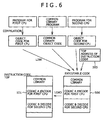
- the executable code is generated in the following manner. As shown in Fig. 6, programs created for the respective CPU provided in the chip 1 (a program for the first CPU and a program for the second CPU) and a program to be shared by a plurality of CPUs (a common library program) are compiled to generate object codes corresponding to the respective programs (an object code for a CPU 0, an object code for a CPU 1, and a common library object code).
- Fig. 6 shows by way of example the executable code 506 for causing the first CPU to realize encoding operation in a codec A and the second CPU to realize decoding operation in a codec B.
- the OS Operating System
- the OS generally can change the address of an executable code during loading of a program.
- the address of an executable code is fixed when the executable code is generated, so that a loading location for the code cannot be dynamically switched.
- the code for the first CPU and the code for the second CPU are integrated in the conventional executable code 506, so that if only the operation of either one of the first CPU 103 and the second CPU 104 is to be switched, the whole of the executable code 506 needs to be reloaded into the internal memory 101.
- Fig. 7 shows the case where the first to fourth instruction codes 212 to 215 are previously stored in the external memory 110 and the first instruction code 212 is first loaded into the internal memory 101.
- the second instruction code 213 contains a code which causes the first CPU 103 to perform encoding operation by means of on a codec A, and causes the second CPU 104 to perform decoding operation by means of a codec D
- the third instruction code 214 contains a code, which causes the first CPU 103 to perform encoding operation by means of on a codec C, and causes the second CPU 104 to perform decoding operation by means of a codec B
- the fourth instruction code 215 contains a code, which causes the first CPU 103 to perform encoding operation by means of on the codec C, and causes the second CPU 104 to perform decoding operation by means of the codec D.
- Step S1 the host CPU 111 resets the first CPU 103, and in Step S2, the host CPU 111 writes a bootstrap to the boot memory 105. Then, in Step S3, the host CPU 111 cancels the reset state of the first CPU 103. Then, in Step S4, the first CPU 103 executes the bootstrap written in the boot memory 105, and in Step S5, transfers via DMA, for example, the first instruction code 212 from the external memory 110 to the internal memory 101 by using the DMA controller 102.
- DMA for example, the first instruction code 212 from the external memory 110 to the internal memory 101 by using the DMA controller 102.
- Step S6 after the first CPU 103 confirms the completion of the transfer, the first CPU 103 resets the second CPU 104, and then activates the second CPU 104 by canceling the reset state of the second CPU 104.
- Step S7 the first CPU 103 executes the instruction code for the first CPU 103 stored in the internal memory 101.
- Step S8 the first CPU 103 operates as the encoder of the codec A
- Step S9 the second CPU 104 operates as the decoder of the codec B by executing the instruction code for the second CPU 104 stored in the internal memory 101.
- the instruction code for the first CPU and the instruction code for the second CPU are integrated as one instruction code as mentioned above, if, for example, the first CPU 103 is to be operated as the encoder of the codec C, the whole of the first instruction code 212 loaded in the internal memory 101 needs to be replaced with the third instruction code 214 even if the function of the second CPU 104 need not be changed.
- the above-mentioned conventional information processing system has the following problems.
- one executable code is formed by instructions for the first CPU 103 and instructions for the second CPU 104 as mentioned above, even when, for example, the operation of only the first CPU 103 is to be changed as mentioned above, the operation of the second CPU 104 must also be interrupted.
- the operation of the second CPU 104 must also be interrupted.
- the present invention has been made in order to solve the above-mentioned problems, and an object of the present invention is to provide an information processing method for an information processing system having a plurality of CPUs, a program which realizes the information processing method, and a recording medium on which the program is recorded, which method is capable of reducing the necessary storage capacity of the system and enhancing the processing speed thereof, and is also capable of easily changing the function of each of the CPUs without affecting the operation of the other CPUs.
- the object of the invention is achieved by providing an information processing method, a program for realizing the information processing method, or a recording medium on which the program is recorded, the method being realized in a system in which a processor including a plurality of central processing units and internal storage means, external storage means in which are stored a common code to be executed in common by the plurality of central processing units and an instruction code to be respectively executed by predetermined one of the central processing units, and host processing means are interconnected by a bus, which method is characterized by including: a step of loading, by means of one of the central processing units, the common code and the instruction code defined to be executed by one of the central processing units, into the internal storage means from the external storage means in accordance with an instruction from the host processing means; a step of loading, by means of one of other central processing units, the instruction code defined to be executed by the one of other central processing units, into the internal storage means from the external storage means; and a step of executing the common code and the instruction codes defined to be executed by the central processing units, which are loaded in
- each of the central processing units loads an instruction code defined to be executed by itself into the internal storage means and executes the instruction code loaded therein, the common code and the instruction codes can be efficiently stored in the external storage means, whereby it is possible to reduce the necessary storage capacity of the external storage means and the amount of information to be loaded from the external storage means into the internal storage means.
- the program for realizing the information processing means, or the recording medium on which the program is recorded which method further includes: a step of selectively resetting the central processing units by means of the host processing means; a step of newly loading an instruction code defined to be executed by a selectively reset one of the central processing units, from the external storage means into the internal storage means by means of the selectively reset one itself in accordance with an instruction from the host processing means; and a step of executing, by means of the reset central processing unit, the instruction code defined to be executed by the reset central processing unit itself, which is newly loaded in the internal storage means, it is possible to easily change the function of the selected central processing unit without affecting the operation of the other central processing units.
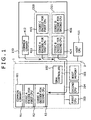
- Fig. 1 is a diagram for explaining information processing according to the embodiment of the personal identification number.
- the information processing according to the embodiment is realized by an information processing system including a host CPU 411 and a chip 1 as well as an external memory 110 all of which are interconnected by a bus 3.
- the chip 1 is provided with a DMA controller 102, a first CPU 103, a second CPU 104, a boot memory 105, and an internal memory 101 all of which are interconnected by an internal bus.
- a common object code is linked to object codes to be executed by the respective first and second CPUs 103 and 104 and executable codes for the respective first and second CPUs 103 and 104 are generated so that the first CPU 103 and the second CPU 104 can operate independently.
- an object code for the first CPU is generated by compiling a program for the first CPU to be executed by the first CPU 103
- an object code for the second CPU is generated by compiling a program for the second CPU to be executed by the second CPU 104.
- a common library object code is generated by compiling a common library program to be executed by the first and second CPU 103 and 104.
- link information 302 which describes a common-library top address indicating a storage location for the common object code in the internal memory 101 and a first-CPU top address indicating a storage location for the first-CPU object code in the internal memory 101 is linked to the object code for the first CPU and the common library object code and an executable code 305 is generated
- link information 304 which describes the same common-library top address and a second-CPU top address indicating a storage location for the second-CPU object code in the internal memory 101 is linked to the object code for the second CPU and the common library object code and an executable code 306 is generated.
- Each of the top addresses is determined by taking into account a storage capacity which is necessary for the corresponding object code to be stored in the internal memory 101.
- a text command for reading is created in a common library area in which the common object code is written, while in an area in which the object code for the first CPU 103 or the second CPU 104 is written, a text command for reading and a readable/writable data area are created.
- the common object codes contained in an object code 301 and an object code 303 are completely the same, and the top addresses corresponding to the common object codes contained in the link information 302 and 304 are also the same. Accordingly, when both the executable codes 305 and 306 are loaded into the internal memory 101, the common object code is shared as shown in Fig. 2.
- one common object code is shared by the first CPU 103 and the second CPU 104 as will be described later, so that the necessary capacity of the internal memory 101 is decreased.
- the first CPU code group CG0 contains an instruction code 413 which causes the first CPU 103 to operate as the encoder of a codec A and an instruction code 415 which causes the first CPU 103 to operate as the encoder of a codec C.
- the second CPU code group CG1 contains an instruction code 414 which causes the second CPU 104 to operate as the decoder of a codec B and an instruction code 416 which causes the second CPU 103 to operate as the decoder of a codec D.
- the common library 412 contains instructions to be shared by the first CPU 103 and the second CPU 104, and addresses designating allocations for the respective instructions in the internal memory 101, and top addresses are determined in advance.
- the instruction codes 413 and 415 contain instructions to and data for the first CPU 103 as well as addresses indicating allocations for the instructions and the data in the internal memory 101.
- each of the instruction codes 414 and 416 contains instructions to and data for the second CPU 104 as well as addresses indicating allocations for the instructions and the data in the internal memory 101.
- the common library 412, the instruction code 413 for the first CPU and the instruction code 414 for the second CPU are loaded into the internal memory 101 by using a bootstrap.
- the common library 412 since the common library 412 is shared by the first CPU 103 and the second CPU 104, the common library 412 needs only to be loaded into the internal memory 101 once.
- the storage area of the internal memory 101 is previously divided into a first area R1, a second area R2 and a third area R3, and the common library 412 is stored into the first area R1, the instruction codes 413 and 415 for the first CPU are stored into the second area R2, and the instruction codes 414 and 416 for the second CPU are stored into the third area R3.
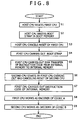
- Step S1 the host CPU 411 resets the first CPU 103, and in Step S2, the host CPU 411 resets the second CPU 104. Then, in Step S3, the host CPU 411 writes a bootstrap for the first CPU to the boot memory 105, and in Step S4, the host CPU 411 writes a bootstrap for the second CPU to the same boot memory 105.
- Step S5 the host CPU 411 cancels the reset state of the first CPU 103, and in Step S6, the host CPU 411 cancels the reset state of the second CPU 104.
- Step S7 in accordance with an instruction from the host CPU 411, the first CPU 103 executes the bootstrap for the first CPU stored in the boot memory 105, and the first CPU 103 DMA-transfers the common library 412 and the instruction code 413 for the first CPU from the external memory 110 to the internal memory 101 by using the DMA controller 102.
- Step S8 in accordance with an instruction from the host CPU 411, the second CPU 104 executes the bootstrap for the second CPU stored in the boot memory 105, and the second CPU 104 DMA-transfers the instruction code 414 for the second CPU from the external memory 110 to the internal memory 101 by using the DMA controller 102.
- Step S9 after the first CPU 103 confirms that the DMA transfer of the instruction code 413 has been completed, the first CPU 103 executes the instruction code 413 for the first CPU stored in the internal memory 101.
- Step S10 after the second CPU 104 confirms that the DMA transfer of the instruction code 414 has been completed, the second CPU 104 executes the instruction code 414 for the second CPU stored in the internal memory 101.
- Step S9 and Step S10 if necessary, the first CPU 103 and the second CPU 104 read and execute the common library 412 stored in the internal memory 101.
- Step S11 the first CPU 103 starts operating as the encoder of the codec A
- Step S12 the second CPU 104 starts operating as the decoder of the codec B.
- each of the CPUs reads the code written in the common library 412 and executes read/write of data in a data area for each of the CPUs in the internal memory 101, so that the above-mentioned replacement of instruction codes is prevented from affecting the operation of the other CPU.
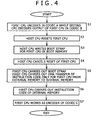
- Step S1 the first CPU 103 is encoding data by using the codec A as described above, and the second CPU 104, as described above, is decoding the data encoded by the operation of the first CPU 103.
- Step S2 the host CPU 411 resets the first CPU 103.
- Step S3 the host CPU 411 writes a bootstrap for the first CPU to the boot memory 105.
- Step S4 the host CPU 411 cancels the reset state of the first CPU 103. Furthermore, in Step S5, the first CPU 103 executes the bootstrap written to the boot memory 105, and the first CPU 103 DMA-transfers only the instruction code 415 for the first CPU from the external memory 110 to the internal memory 101 by using the DMA controller 102.
- Step S6 after the first CPU 103 confirms that the DMA transfer of the instruction code 415 has been completed, the first CPU 103 executes the instruction code 415 stored in the internal memory 101. In this manner, the function of the first CPU 103 is changed, and in Step S7, the first CPU 103 functions as the encoder of the codec C.
- the common library 412 stored in the external memory 110 or a server 120 is shared by the first CPU 103 and the second CPU 104.
- An object code to be executed by each of the CPUs is independently stored in the external memory 110 or the like, and the object code is loaded into the internal memory 101 as a unit.
- the information processing method it is possible to change the function of each of the CPUs without affecting the operation of the other, and it is also possible to reduce the sizes of codes to be held in the external memory 110 and the like.
- the information processing method may be written with a program to be executed by a computer, and the program may be recorded on a recording medium such as a flexible disk or a CD-ROM. Accordingly, by executing the program through a computer, it is possible to easily realize the information processing method according to the present embodiment.
- audio compression/decompression programs based on a plurality of codecs may be efficiently held in the external memory 110, and a program (instruction code) to be executed by a certain CPU may be replaced without affecting the operation of another CPU.
- a program for realizing the method, or a recording medium on which the program is recorded it is possible to reduce the storage capacity necessary for external storage means and the amount of information to be loaded from the external storage means into internal storage means. Accordingly, it is possible to reduce the scale and the cost of the system, and it is also possible to enhance information processing speed in the system.
- the program for realizing the method, or the recording medium on which the program is recorded it is possible to easily change the function of a selected central processing unit without affecting the operation of another central processing unit, whereby it is possible to enhance the versatility of the system while ensuring the reliability of operation.
Landscapes
- Engineering & Computer Science (AREA)
- Software Systems (AREA)
- Theoretical Computer Science (AREA)
- General Engineering & Computer Science (AREA)
- Physics & Mathematics (AREA)
- General Physics & Mathematics (AREA)
- Computer Security & Cryptography (AREA)
- Stored Programmes (AREA)
- Multi Processors (AREA)
Applications Claiming Priority (3)
| Application Number | Priority Date | Filing Date | Title |
|---|---|---|---|
| JP2002238437A JP3826859B2 (ja) | 2002-08-19 | 2002-08-19 | 情報処理方法とその方法を実現するプログラム及び記録媒体 |
| JP2002238437 | 2002-08-19 | ||
| PCT/JP2003/010409 WO2004017200A1 (ja) | 2002-08-19 | 2003-08-18 | 情報処理方法とその方法を実現するプログラム及び記録媒体 |
Publications (2)
| Publication Number | Publication Date |
|---|---|
| EP1544731A1 true EP1544731A1 (de) | 2005-06-22 |
| EP1544731A4 EP1544731A4 (de) | 2009-12-16 |
Family
ID=31884455
Family Applications (1)
| Application Number | Title | Priority Date | Filing Date |
|---|---|---|---|
| EP03788134A Withdrawn EP1544731A4 (de) | 2002-08-19 | 2003-08-18 | Informationsverarbeitungsverfahren und programm und aufzeichnungsmedium zur implementierung des verfahrens |
Country Status (4)
| Country | Link |
|---|---|
| US (1) | US7363481B2 (de) |
| EP (1) | EP1544731A4 (de) |
| JP (1) | JP3826859B2 (de) |
| WO (1) | WO2004017200A1 (de) |
Families Citing this family (7)
| Publication number | Priority date | Publication date | Assignee | Title |
|---|---|---|---|---|
| JP4976817B2 (ja) * | 2006-11-06 | 2012-07-18 | オンセミコンダクター・トレーディング・リミテッド | プログラム処理装置及びプログラム処理方法 |
| JP2008276395A (ja) * | 2007-04-26 | 2008-11-13 | Toshiba Corp | 情報処理装置およびプログラム実行制御方法 |
| US8788850B1 (en) * | 2009-01-22 | 2014-07-22 | Marvell International Ltd. | Systems and methods for using a security circuit to monitor a voltage of an integrated circuit to counter security threats to the integrated circuit |
| CN102467472B (zh) * | 2010-11-08 | 2015-01-28 | 中兴通讯股份有限公司 | SoC芯片的BOOT启动装置和SoC芯片 |
| JP5259784B2 (ja) * | 2011-07-25 | 2013-08-07 | 株式会社東芝 | 情報処理装置およびプログラム実行制御方法 |
| US9229729B2 (en) * | 2012-11-26 | 2016-01-05 | International Business Machines Corporation | Initializing processor cores in a multiprocessor system |
| US9753710B2 (en) * | 2013-11-07 | 2017-09-05 | Netronome Systems, Inc. | Resource allocation with hierarchical scope |
Family Cites Families (14)
| Publication number | Priority date | Publication date | Assignee | Title |
|---|---|---|---|---|
| JPS59100967A (ja) | 1982-11-30 | 1984-06-11 | Fuji Facom Corp | マルチプロセツサ・システムのイニシヤル処理方式 |
| JPH01194054A (ja) * | 1988-01-29 | 1989-08-04 | Hitachi Ltd | 分散処理システムのプログラムローデイング方式 |
| EP0335812B1 (de) * | 1988-03-28 | 1995-05-10 | International Business Machines Corporation | Sekundärprozessorinitialisierungssystem |
| JPH0264844A (ja) | 1988-08-31 | 1990-03-05 | Nec Corp | 情報処理装置 |
| EP0483433A1 (de) * | 1990-10-31 | 1992-05-06 | International Business Machines Corporation | Initialisierungsverfahren für die Initialisierung der Unterstationen in einem Datenverarbeitungssystem |
| JP2906958B2 (ja) | 1993-12-17 | 1999-06-21 | 日本電気株式会社 | ユーザプログラムロード方式 |
| JPH08185384A (ja) | 1994-10-31 | 1996-07-16 | Nec Corp | ロードモジュール割り当て方法および割り当て装置 |
| JPH08161283A (ja) | 1994-12-07 | 1996-06-21 | Sony Corp | 複数プロセツサシステム |
| US6041180A (en) * | 1997-04-28 | 2000-03-21 | International Business Machines Corporation | System and method for optimizing template object files |
| JPH1131076A (ja) | 1997-07-10 | 1999-02-02 | Nec Robotics Eng Ltd | マルチcpuシステム |
| JP2000235495A (ja) | 1999-02-17 | 2000-08-29 | Nippon Telegr & Teleph Corp <Ntt> | ファイル作成及びファイルローディング装置 |
| JP4317296B2 (ja) * | 1999-09-17 | 2009-08-19 | 株式会社ターボデータラボラトリー | 並列コンピュータのアーキテクチャおよびこのアーキテクチャを利用した情報処理ユニット |
| WO2001027753A2 (en) * | 1999-10-12 | 2001-04-19 | Scientific-Atlanta, Inc. | Method and apparatus for loading software into a plurality of processors |
| KR100387059B1 (ko) * | 2001-02-06 | 2003-06-12 | 삼성전자주식회사 | 이동통신 시스템에서 보드별 식별자를 이용하는 프로그램공용화 방법 |
-
2002
- 2002-08-19 JP JP2002238437A patent/JP3826859B2/ja not_active Expired - Fee Related
-
2003
- 2003-08-18 US US10/523,786 patent/US7363481B2/en not_active Expired - Fee Related
- 2003-08-18 EP EP03788134A patent/EP1544731A4/de not_active Withdrawn
- 2003-08-18 WO PCT/JP2003/010409 patent/WO2004017200A1/ja not_active Ceased
Also Published As
| Publication number | Publication date |
|---|---|
| US20060010312A1 (en) | 2006-01-12 |
| WO2004017200A1 (ja) | 2004-02-26 |
| JP2004078604A (ja) | 2004-03-11 |
| US7363481B2 (en) | 2008-04-22 |
| JP3826859B2 (ja) | 2006-09-27 |
| EP1544731A4 (de) | 2009-12-16 |
Similar Documents
| Publication | Publication Date | Title |
|---|---|---|
| US7386653B2 (en) | Flash memory arrangement | |
| US20080198658A1 (en) | Memory card, semiconductor device, and method of controlling memory card | |
| JP2009032252A (ja) | クラッシュダンプ用のメモリアロケーション | |
| CN113468079B (zh) | 内存访问方法及装置 | |
| JP2010500682A (ja) | フラッシュメモリアクセス回路 | |
| US8266416B2 (en) | Dynamic reconfiguration supporting method, dynamic reconfiguration supporting apparatus, and dynamic reconfiguration system | |
| US7363481B2 (en) | Information processing method for controlling the function of a plurality of processors, program for realizing the method, and recording medium | |
| JPH09231071A (ja) | コンピュータ装置 | |
| CN100594481C (zh) | 允许运行在逻辑分区上的程序访问资源的方法与系统 | |
| EP1103898A2 (de) | Mikroprozessor und Speicher | |
| CN119781955A (zh) | 用于嵌入式系统的内存资源分配方法和计算机设备 | |
| US8117427B2 (en) | Motherboard, storage device and controller thereof, and booting method | |
| US20050027940A1 (en) | Methods and apparatus for migrating a temporary memory location to a main memory location | |
| EP0543032A1 (de) | Erweitertes Speicheradressierungsschema | |
| KR100861896B1 (ko) | 데이터 프로세싱 장치 및 데이터 프로세싱 방법 | |
| US20070283333A1 (en) | Medium for recording compiler program, compile method, and information processing apparatus therewith | |
| CN121501377B (zh) | 一种在处理单元上加载计算核的方法、设备、介质 | |
| JP2001356916A (ja) | メモリブロック化コンパイラ及びプログラム実行方法 | |
| US6029210A (en) | Memory initialization system selectively outputting a data between a normal data stored in the memory and a fixed value according to a registered access state | |
| US12242379B2 (en) | Software sharing across multiple cores | |
| KR930002324B1 (ko) | 기억버퍼를 갖는 마이크로 프로세서 | |
| JP2007122337A (ja) | 演算装置 | |
| JP2008046981A (ja) | システム制御装置、情報処理装置および入出力要求制御方法 | |
| US20060242351A1 (en) | Method and apparatus for loading instructions into high memory | |
| CN117707641A (zh) | 一种线程级动态库的链接方法、装置、操作系统及设备 |
Legal Events
| Date | Code | Title | Description |
|---|---|---|---|
| PUAI | Public reference made under article 153(3) epc to a published international application that has entered the european phase |
Free format text: ORIGINAL CODE: 0009012 |
|
| 17P | Request for examination filed |
Effective date: 20050216 |
|
| AK | Designated contracting states |
Kind code of ref document: A1 Designated state(s): AT BE BG CH CY CZ DE DK EE ES FI FR GB GR HU IE IT LI LU MC NL PT RO SE SI SK TR |
|
| RBV | Designated contracting states (corrected) |
Designated state(s): DE FR GB |
|
| A4 | Supplementary search report drawn up and despatched |
Effective date: 20091118 |
|
| RIC1 | Information provided on ipc code assigned before grant |
Ipc: G06F 15/177 20060101AFI20091112BHEP Ipc: G06F 9/445 20060101ALI20091112BHEP |
|
| 17Q | First examination report despatched |
Effective date: 20101013 |
|
| RAP1 | Party data changed (applicant data changed or rights of an application transferred) |
Owner name: SONY CORPORATION |
|
| STAA | Information on the status of an ep patent application or granted ep patent |
Free format text: STATUS: THE APPLICATION IS DEEMED TO BE WITHDRAWN |
|
| 18D | Application deemed to be withdrawn |
Effective date: 20180413 |