EP1542247A2 - Berührungslose Stromversorgungsmittel für eine bewegende elektrische Last - Google Patents
Berührungslose Stromversorgungsmittel für eine bewegende elektrische Last Download PDFInfo
- Publication number
- EP1542247A2 EP1542247A2 EP04102142A EP04102142A EP1542247A2 EP 1542247 A2 EP1542247 A2 EP 1542247A2 EP 04102142 A EP04102142 A EP 04102142A EP 04102142 A EP04102142 A EP 04102142A EP 1542247 A2 EP1542247 A2 EP 1542247A2
- Authority
- EP
- European Patent Office
- Prior art keywords
- pick
- feeder system
- core
- electrical load
- feeding cables
- Prior art date
- Legal status (The legal status is an assumption and is not a legal conclusion. Google has not performed a legal analysis and makes no representation as to the accuracy of the status listed.)
- Withdrawn
Links
Images





Classifications
-
- H—ELECTRICITY
- H02—GENERATION; CONVERSION OR DISTRIBUTION OF ELECTRIC POWER
- H02J—ELECTRIC POWER NETWORKS; CIRCUIT ARRANGEMENTS OR SYSTEMS FOR SUPPLYING OR DISTRIBUTING ELECTRIC POWER; SYSTEMS FOR STORING ELECTRIC ENERGY
- H02J50/00—Circuit arrangements or systems for wireless supply or distribution of electric power
- H02J50/40—Circuit arrangements or systems for wireless supply or distribution of electric power using two or more transmitting or receiving devices
-
- H—ELECTRICITY
- H01—ELECTRIC ELEMENTS
- H01F—MAGNETS; INDUCTANCES; TRANSFORMERS; SELECTION OF MATERIALS FOR THEIR MAGNETIC PROPERTIES
- H01F38/00—Adaptations of transformers or inductances for specific applications or functions
- H01F38/14—Inductive couplings
-
- H—ELECTRICITY
- H02—GENERATION; CONVERSION OR DISTRIBUTION OF ELECTRIC POWER
- H02J—ELECTRIC POWER NETWORKS; CIRCUIT ARRANGEMENTS OR SYSTEMS FOR SUPPLYING OR DISTRIBUTING ELECTRIC POWER; SYSTEMS FOR STORING ELECTRIC ENERGY
- H02J50/00—Circuit arrangements or systems for wireless supply or distribution of electric power
- H02J50/10—Circuit arrangements or systems for wireless supply or distribution of electric power using inductive coupling
-
- H—ELECTRICITY
- H04—ELECTRIC COMMUNICATION TECHNIQUE
- H04B—TRANSMISSION
- H04B5/00—Near-field transmission systems, e.g. inductive or capacitive transmission systems
- H04B5/20—Near-field transmission systems, e.g. inductive or capacitive transmission systems characterised by the transmission technique; characterised by the transmission medium
- H04B5/24—Inductive coupling
-
- H—ELECTRICITY
- H04—ELECTRIC COMMUNICATION TECHNIQUE
- H04B—TRANSMISSION
- H04B5/00—Near-field transmission systems, e.g. inductive or capacitive transmission systems
- H04B5/70—Near-field transmission systems, e.g. inductive or capacitive transmission systems specially adapted for specific purposes
- H04B5/79—Near-field transmission systems, e.g. inductive or capacitive transmission systems specially adapted for specific purposes for data transfer in combination with power transfer
Definitions
- the present invention relates to a non-contact feeder system for energising an electrical load by induction, comprising a plurality of conductors, including a first conductor, a second conductor and a third conductor, wherein a first magnetic field is generated when a first current flows through said first conductor, a second magnetic field, which is generated when a second current flows through said second conductor, and a third magnetic field is generated when a third current flows through said third conductor and power supply means arranged to cause said first, second and third currents to flow.
- the present invention also relates to an electrical load configured to be energised by such a feeder system.
- a moving system having a moving component such as a carrier
- a power cable is connected to the moving component for use in supplying electrical power to the moving component and operating it.
- this arrangement is noisy and results in dust being kicked up, because the power cable is dragged together with the moving component.
- the power cable may be damaged or cut as it is repeatedly bent while being dragged.
- non-contact feeder systems which supply electrical power to a moving component without requiring physical contact between a power cable and the moving component.
- a feeding cable through which an AC current flows, extends along a direction of movement of the moving component.
- a magnetic field is generated due to the flow of AC current through the feeding cable, which can be used to produce an induced current within the moving component.
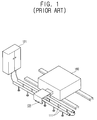
- a conventional non-contact feeder system comprises an AC power supply 121, a parallel cable 111 arranged along a direction of movement of a moving component 160, where the moving component 160 moves back and forth with respect to the parallel cable 111, and a pick-up 131 arranged to move with the moving object 160 and to provide an induced current from a magnetic field arising from an AC current flowing through the parallel cable 111.
- a non-contact power supply system may include two AC power supplies 121, 122, with two corresponding parallel cables 111, 112 and pick-ups 131, 132, as shown in Figure 2.
- the pick-ups 131 and 132 should be separated from each other by a predetermined interval "d", as shown in Figure 3.
- This separation is required because the AC power supplies 121, 122 are controlled separately, so that the phase and direction of the AC currents supplied from the AC power supplies 121, 122 are determined independently.
- the direction of a magnetic field formed around one of the parallel cables 111 is does not depend on the magnetic field formed around the other parallel cable 112 and vice versa. If the AC currents have the directions shown in Figure 3, the magnetic fields formed around the parallel cables 111 and 112 destructively interfere with each other, decreasing the efficiency of the induction performed by the pick-ups 131, 132.
- the parallel cables 111, 112 should be spaced apart from each other at predetermined intervals "d", in order to avoid decreasing the efficiency of the induction. This places a restriction on the minimum physical size of the non-contact feeder system and, therefore, the size of a space required for its mounting.
- a non-contact feeder system is characterised in that the first conductor is disposed sufficiently closely to the second and third conductors so as to permit significant interaction between the first and second magnetic fields and between the first and third magnetic fields and the first current is in anti-phase relative to the second and third currents.
- the power supply means may comprise first and second AC power supplies, wherein each AC power supply corresponds to two of said cables and forms a closed loop therewith, and a controller for controlling a phase and a direction of AC current supplied to the cables by said AC power supplies.
- the non-contact feeder system may comprise a single power supply, with a single closed loop.
- the closed loop or loops may comprise more than one turn, if required.
- the invention also provides an electrical load configured to be energised by the feeder system, comprising pick-up means having first, second and third pick-up cores associated with the first, second and conductors respectively and at least one coil, wherein the first pick-up core is in physical contact with the second and third pick-up cores.
- the at least one coil may be wound around two of said pick-up cores, the two pick-up cores being associated with conductors in different closed loops.
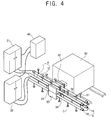
- a non-contact feeder system is arranged to supply an induced current to an electrical load 60, such as a carrier.
- the non-contact feeder system comprises a plurality of AC power supplies 21, 22, feeding cables 11, 12, 13, 14, and pick-ups 31, 32, 33, 34, together with a controller 40.
- the feeding cables 11, 12, 13, 14 are hereafter referred to as a first feeding cable 11, a second feeding cable 12, a third feeding cable 13 and a fourth feeding cable 14 respectively.
- the pick-ups 31, 32, 33, 34 corresponding to the first to fourth feeding cables 11, 12, 13 and 14 are referred to as a first pick-up 31, a second pick-up 32, a third pick-up 33 and a fourth pick-up 34 respectively.
- pick-up cores 31a, 32a, 33a, 34a provided in the first to fourth pick-ups 31, 32, 33 34 respectively are referred to as a first pick-up core 31a, a second pick-up core 32a, a third pick-up core 33a and a fourth pick-up core 34a.
- each of the AC power supplies 21, 22 converts a standard AC current supplied from an external source into an AC current with a high frequency.
- the AC power supplies 21, 22 supply the high frequency AC currents with a high frequency to corresponding ones of the feeding cables 11, 12, 13, 14.
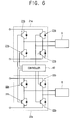
- each AC power supply 21, 22 may comprise a rectifying unit, not shown, for rectifying and smoothing the standard AC current, and inverters 21a and 22a for converting the rectified and smoothed direct current into an AC current and supplying the high frequency AC current to the feeding cables 11, 12, 13 and 14.
- the inverters 21a, 22a are provided by bridge circuits, each of which comprises a plurality of switching elements 21b and 22b. The switching elements 21b and 22b are turned on and off in accordance with control signals generated by the controller 40.
- Each of the AC power supplies 21, 22 forms a closed loop with its associated feeding cables 11, 12 or 13, 14.
- one of the AC power supplies 21, the first feeding cable 11 and the second feeding cable 12 form a closed loop
- the other AC power supply 22, the third feeding cable 13 and the fourth feeding cable 14 form another closed loop.
- the one AC power supply 21 is referred to as the first AC power supply and the other AC power supply 22 is referred to as the second AC power supply.
- the inverter 21a of the first AC power supply 21 is referred to as the first inverter 21a while the inverter 22a of the second AC power supply 22 is referred to as the second inverter 21 a.
- the feeding cables 11, 12, 13, 14 are arranged so that they extend in a direction that is substantially parallel to a direction of movement of the electrical load 60.
- the first feeding cable 11 and the second feeding cable 12 a parallel "loop" of cable A, hereafter referred to as the first parallel cable A
- the third feeding cable 13 and the fourth feeding cable 14 form another parallel loop of cable B, hereafter referred to as the second parallel cable B.
- the first parallel cable A is positioned so that it extends in a direction that is transverse to the pick-ups 31, 32 and the second parallel cable B is positioned in a traverse direction to the pick-ups 33, 34 directly below the first parallel cable A.
- the controller 40 controls the phase and direction of the AC current supplied from the first AC power supply 21 and/or the second AC power supply 22 so that the AC currents passing through feeding cables 11, 12, 13, 14 that are positioned adjacent to one another match each another in terms of phase but have opposite directions.
- the first feeding cable 11 and the second feeding cable 12 form the first parallel round cable A.
- the phases of the AC currents of the first and second feeding cables 11, 12 are the same, but the directions of these AC currents are opposite to one another. In other words, the phases of the AC currents of the first and second feeding cables 11, 12 are in anti-phase.
- the AC currents of the third feeding cable 13 and the fourth feeding cable 14 have the same phase but have opposite directions
- the cable fixer comprises a supporter 52 and a cable supporting bar 51.
- the cable supporting bar 51 has a first end which is connected to the feeding cables 11, 12, 13, 14 and a second end that is connected to the supporter 52.
- the cable supporting bar 51 prevents the feeding cables 11, 12, 13, 14 from drooping under their own weight.
- a plurality of cable supporting bars 51 may be provided at predetermined intervals along the feeding cables 11, 12, 13,14.
- the supporter 52 may be provided as a separate structure, although an external structure having a suitable surface, such as a bottom surface, a wall, or a ceiling, may be used as the supporter 52 if the suitable surface on which the non-contact feeder system is to be positioned is disposed adjacent to the cable supporting bar 51.
- Each of the pick-ups 31, 32, 33, 34 induces an induced current due to a magnetic field generated by the AC current of a corresponding one of the feeding cables 11, 12, 13, 14, and supplies the induced current to the electrical load 60.
- the pick-ups 31, 32, 33 and 34 move with the electrical load 60 without making any physical contact with their respective feeding cable 11, 12, 13, 14.
- each pick-up 31, 32, 33, 34 comprises the pick-up core 31 a, 32a, 33a, 34a, which is arranged to cover a corresponding one of the feeding cables 11, 12, 13, 14 without being in physical contact therewith, and a pick-up coil 35 that is wound around the pick-up core 31 a, 32a, 33a, 34a.
- Each pick-up core 31a, 32a, 33a, 34a has a substantially tubular shape and may be of a rectangular section in a direction that is transverse to the direction of movement of the electrical load 60.
- the pick-up cores 31a, 32a, 33a, 34a are positioned adjacent to one another in a closely contacting manner, so that the plurality of pick-up cores 31a, 32a, 33a and 34a have a cross-section with a matrix-like structure in said direction.
- the pick-up cores 31a, 32a, 33a and 34a may be positioned so that they are in contact with one another, thereby decreasing the physical size of the non-contact feeder system and, therefore, the space required for mounting.
- the directions of the currents flowing through the feeding cables 11, 12, 13, 14 that are adjacent to one another are opposite to one another.
- the AC current of the first feeding cable 11 passing through the first pick-up core 31a has the same phase as the AC currents of the second and third feeding cables 12, 13, which pass through the second and third pick-up cores 32a, 33a, respectively, where the second and third pick-up cores 32a, 33a are adjacent to the first pick-up core 31a.
- the direction of the AC current of the first feeding cable 11 is opposite to the directions of the AC currents of the second and third feeding cables 12, 13.
- An opening 36 is provided in each pick-up core 31 a, 32a, 33a, 34a along the direction of the feeding cables 11, 12, 13, 14, i.e., the moving direction of the electrical load 60. This allows the pick-up cores 31a, 32a, 33a, 34a to move along the direction of the corresponding feeding cables 11, 12, 13, 14 without being caught by the cable supporting bar 51.
- a pick-up coil 35 is wound around the inside and the outside of each of the pick-up cores 31a, 32a, 33a and 34a.
- the pick-up coil 35 transmits each of the currents induced in the pick-up cores 31a, 32a, 33a, 34a to a rectifying unit, not shown.
- the rectifying unit outputs a rectified current which is supplied to a constant voltage controller, not shown.
- the constant voltage controller supplies the electrical power to the electrical load 60 according to its requirements.
- Pick-up coils 35 are wound around each pair of pick-up cores 31a, 32a, 33a, 34a that are disposed adjacent to one another.
- the adjacent pick-up cores 31a, 32a, 33a, 34a closely contact one another.
- a pick-up coil 35 is wound around the first pick-up core 31a and the second pick-up coil 32a, and another pick-up coil 35 is wound around the first pick-up core 31a and the third pick-up coil 33a.
- the pick-up cores 31a, 32a, 33a, 34a can be in physical contact with one another, the space required to mount the pick-ups 31, 32, 33 and 34 is decreased.
- the controller 40 controls the phase and direction of the AC currents output by the AC power supplies 21, 22, so that the magnetic fields formed around the corresponding the feeding cables 11, 12, 13, 14 constructively interfere with one another. If the direction of the current within each feeding cable 11, 12, 13, 14 is as shown in Figure 5, the magnetic fields that form around the feeding cables 11, 12, 13, 14 do not destructively interfere with one another.
- the controller 40 controls switching of each of the switching elements 21b, 22b of the inverters 21a and 22a of the AC power supplies 21, 22 in order to control the direction and the phase of the AC current supplied by each of the AC power supplies 21, 22.
- the controller 40 turns the switching element 21b and 22b of the first inverter 21a and the second inverter 22a on and off, using a scheme in which the same timing and period is used for both inverters 21 a, 22b. This results in the phase of the AC current from the first AC power supply 21 and the phase of the AC current from the second AC power supply 22 being the same.
- the controller 40 also determines which one of the switching elements 21b and 22b is turned on or off, so that the directions of the AC currents in the first and third feeding cables 11, 13 which are adjacent to each other, are opposite to one another, and the directions of the AC currents in the second and fourth feeding cables 12, 14, which are also adjacent to each other, are also opposite to one another.
- the AC currents flowing through adjacent feeding cables 11, 12, 13, 14 have opposite directions with respect to each other and the same phases, the magnetic fields formed around the feeding cables 11, 12, 13, 14 constructively interfere with each other. This constructive interference increases the efficiency with which current is induced by the pick-ups 31, 32, 33, 34 when compared with the prior non-contact feeder systems described above.
- Figure 7 shows the waveforms of AC currents i1, i3, which are supplied by the AC power supplies 21, 22 to the first and third feeding cable 11, 13 respectively.
- the AC power supplies 21, 22 are installed in an apparatus so that they are physically separated from each other.
- the AC power supplies 21, 22 may be installed together in an apparatus, if they are arranged so that AC currents having two different waveforms are supplied to the feeding cables 11, 12, 13, 14.
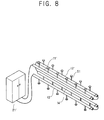
- a non-contact feeder system comprises feeding cables 11', 12', 13', 14' which are connected in series and disposed parallel to a direction of movement of an electrical load, not shown.
- the feeding cables 11', 12', 13', 14' in combination with a signal AC power supply 21', form a closed loop.
- An AC current is supplied by the AC power supply 21', so that directions of the AC currents flowing through the feeding cables 11', 12', 13', 14' are opposite to one another, while having the same phase.
- the magnetic fields formed around the corresponding ones of the feeding cables 11', 12', 13', 14' can constructively interfere with one another if an arrangement of the feeding cables 11', 12', 13', 14' are varied.
- a controller for controlling the supply of AC current to the feeding cables 11', 12', 13', 14' is not required.
- each of components used for the non-contact feeder system shown in Figure 4 can be used for the non-contact feeder system according to this embodiment of the present invention. For this reason, a detailed description of the components is omitted.
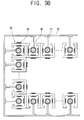
- FIGS 9A and 9B show cross-sectional views of parts of non-contact feeder systems according to further embodiments of the invention.
- Each non-contact feeder system has a plurality of feeding cables 10 and 10' and pick-ups 30 and 30'. If magnetic fields MF formed around the feeding cables 10 and 10' that are adjacent to one another constructively interfere, it is not necessary to maintain a given physical separation between the feeding cables 10, 10' and pick-ups 30, 30', such as the interval "d" shown in prior art Figure 3.
- the pick-ups 30, 30' may be positioned adjacent to one another.
- the present invention provides a non-contact feeder system in which the space to mount the non-contact feeder system is decreased and the induced current is generated with greater efficiency when compared with prior art systems.
Landscapes
- Engineering & Computer Science (AREA)
- Power Engineering (AREA)
- Computer Networks & Wireless Communication (AREA)
- Signal Processing (AREA)
- Current-Collector Devices For Electrically Propelled Vehicles (AREA)
- Non-Mechanical Conveyors (AREA)
Applications Claiming Priority (2)
| Application Number | Priority Date | Filing Date | Title |
|---|---|---|---|
| KR1020030089456A KR100573769B1 (ko) | 2003-12-10 | 2003-12-10 | 비접촉 급전시스템 |
| KR2003089456 | 2003-12-10 |
Publications (2)
| Publication Number | Publication Date |
|---|---|
| EP1542247A2 true EP1542247A2 (de) | 2005-06-15 |
| EP1542247A3 EP1542247A3 (de) | 2007-04-11 |
Family
ID=34511200
Family Applications (1)
| Application Number | Title | Priority Date | Filing Date |
|---|---|---|---|
| EP04102142A Withdrawn EP1542247A3 (de) | 2003-12-10 | 2004-05-14 | Berührungslose Stromversorgungsmittel für eine bewegende elektrische Last |
Country Status (5)
| Country | Link |
|---|---|
| US (1) | US7138614B2 (de) |
| EP (1) | EP1542247A3 (de) |
| JP (1) | JP2005170380A (de) |
| KR (1) | KR100573769B1 (de) |
| CN (1) | CN100384054C (de) |
Families Citing this family (15)
| Publication number | Priority date | Publication date | Assignee | Title |
|---|---|---|---|---|
| JP2009126430A (ja) * | 2007-11-27 | 2009-06-11 | Toyota Industries Corp | 非接触給電システム |
| KR101124606B1 (ko) * | 2010-06-03 | 2012-03-20 | 한국과학기술원 | 모듈별 온오프 제어되는 교차형 세그멘트 급전장치 |
| KR101230238B1 (ko) * | 2011-08-26 | 2013-02-06 | 한국과학기술원 | 이동체용 집전 장치 및 그 장치의 전력 보상 방법 |
| CN103675716B (zh) * | 2012-08-31 | 2016-12-21 | 国网电力科学研究院 | 一种通过测量磁场监测用电负荷的装置、系统和方法 |
| CN103675490B (zh) * | 2012-08-31 | 2016-12-21 | 国网电力科学研究院 | 一种用电负荷监测装置、系统及其监测方法 |
| CN103675488B (zh) * | 2012-08-31 | 2016-12-21 | 国网电力科学研究院 | 一种用电负荷监测装置、系统及其监测方法 |
| US9277787B2 (en) | 2013-03-15 | 2016-03-08 | Nike, Inc. | Microwave bonding of EVA and rubber items |
| US9955536B2 (en) | 2013-03-15 | 2018-04-24 | Nike, Inc. | Customized microwave energy distribution utilizing slotted cage |
| US9781778B2 (en) | 2013-03-15 | 2017-10-03 | Nike, Inc. | Customized microwaving energy distribution utilizing slotted wave guides |
| JP6579434B2 (ja) * | 2015-08-21 | 2019-09-25 | シンフォニアテクノロジー株式会社 | 非接触給電装置、および非接触給電装置を備えた処理装置 |
| CN107276238B (zh) * | 2016-04-08 | 2020-12-22 | 泰科电子(上海)有限公司 | 无线供电装置和电气设备 |
| JP7838259B2 (ja) * | 2021-11-30 | 2026-04-01 | 村田機械株式会社 | 非接触給電装置および非接触給電方法 |
| CN115663932B (zh) * | 2022-09-07 | 2023-08-15 | 中国科学院电工研究所 | 一种大电流旋转传输组合式馈电装置 |
| JP7750201B2 (ja) * | 2022-10-12 | 2025-10-07 | 株式会社ダイフク | 非接触給電設備 |
| KR102846743B1 (ko) * | 2023-02-01 | 2025-08-14 | 조현경 | 무선전력 송신기 및 무선전력 수신기, 이를 포함하는 무선 전력 전송 시스템 |
Citations (3)
| Publication number | Priority date | Publication date | Assignee | Title |
|---|---|---|---|---|
| DE4446779A1 (de) | 1994-12-24 | 1996-06-27 | Daimler Benz Ag | Anordnung zur berührungslosen induktiven Übertragung elektrischer Leistung |
| US5855261A (en) | 1994-12-26 | 1999-01-05 | Kabushiki Kaisha Toyoda Jidoshokki Seisakusho | Non-contact electric power supplying system for vehicle |
| US6515878B1 (en) | 1997-08-08 | 2003-02-04 | Meins Juergen G. | Method and apparatus for supplying contactless power |
Family Cites Families (27)
| Publication number | Priority date | Publication date | Assignee | Title |
|---|---|---|---|---|
| US5293308A (en) | 1991-03-26 | 1994-03-08 | Auckland Uniservices Limited | Inductive power distribution system |
| JP3512798B2 (ja) * | 1992-05-10 | 2004-03-31 | オークランド ユニサービシズ リミテッド | 非接触配電システム |
| JPH06321351A (ja) | 1993-05-14 | 1994-11-22 | Hiroshi Akashi | 無接触ピックアップ装置 |
| JP3244932B2 (ja) | 1994-04-01 | 2002-01-07 | トリニティ工業株式会社 | コンベア装置 |
| KR970002906A (ko) | 1995-06-30 | 1997-01-28 | 김광호 | 헤드드럼의 자기헤드 |
| JP2978100B2 (ja) * | 1995-10-25 | 1999-11-15 | ティーディーケイ株式会社 | 非接触充電器 |
| JPH1080076A (ja) | 1996-09-05 | 1998-03-24 | Toyota Autom Loom Works Ltd | 移動体への非接触式給電装置及びピックアップコイルユニット |
| JP3303686B2 (ja) * | 1996-09-17 | 2002-07-22 | 株式会社豊田自動織機 | 移動体への非接触式給電システム及びピックアップコイルユニット |
| US5968398A (en) * | 1997-05-16 | 1999-10-19 | The Lepel Corporation | Apparatus and method for non-contact detection and inductive heating of heat retentive food server warming plates |
| JPH11164497A (ja) | 1997-11-28 | 1999-06-18 | Shinko Electric Co Ltd | 非接触給電装置 |
| JP3247328B2 (ja) * | 1997-12-09 | 2002-01-15 | 浩 坂本 | 非接触電力伝達装置 |
| KR100341288B1 (ko) * | 1998-11-11 | 2002-10-25 | 삼성전자 주식회사 | 직류전원을단속하는마이크로스위치의과전류를방지할수있는전자렌지 |
| KR100306633B1 (ko) * | 1998-11-11 | 2001-11-17 | 윤종용 | 도어 개폐에 따라 고압트랜스로의 전원공급을 단속하는 도전부재를 구비한 전자렌지 |
| JP2000173843A (ja) | 1998-12-09 | 2000-06-23 | Tsubakimoto Chain Co | 非接触給電装置 |
| JP3743193B2 (ja) * | 1999-02-23 | 2006-02-08 | 松下電工株式会社 | 非接触電力伝達装置 |
| JP2001016702A (ja) | 1999-06-29 | 2001-01-19 | Tsubakimoto Chain Co | 非接触給電装置及びこれに用いるピックアップ部 |
| JP2001177901A (ja) | 1999-12-20 | 2001-06-29 | Tsubakimoto Chain Co | 非接触給電用ピックアップ、搬送車及び搬送システム |
| DE60139512D1 (de) * | 2000-02-24 | 2009-09-17 | Panasonic Elec Works Co Ltd | Kontaktloses Leistungsübertragungssystem mit Funktion zur Konstanthaltung der Lastspannung |
| JP3909550B2 (ja) | 2000-04-25 | 2007-04-25 | 株式会社日立プラントテクノロジー | 非接触給電設備 |
| JP2002078103A (ja) | 2000-08-23 | 2002-03-15 | Tsubakimoto Chain Co | 非接触給電用ピックアップ、搬送車及び搬送システム |
| JP2002134340A (ja) * | 2000-10-20 | 2002-05-10 | Shinko Electric Co Ltd | 非接触給電トランス |
| JP3380886B2 (ja) * | 2000-11-24 | 2003-02-24 | 株式会社椿本チエイン | 移動体への非接触給電システム |
| JP3778874B2 (ja) | 2001-05-23 | 2006-05-24 | 株式会社椿本チエイン | 非接触給電装置 |
| US6430064B1 (en) * | 2001-06-29 | 2002-08-06 | Aichi Electric Co. Ltd. | Non-contact power supply device |
| JP3521255B2 (ja) * | 2001-08-10 | 2004-04-19 | 株式会社椿本チエイン | 非接触給電装置及び搬送車 |
| KR100436149B1 (ko) * | 2001-12-24 | 2004-06-14 | 삼성전자주식회사 | 전자렌지 |
| JP3945300B2 (ja) * | 2002-04-18 | 2007-07-18 | 神鋼電機株式会社 | 非接触給電装置 |
-
2003
- 2003-12-10 KR KR1020030089456A patent/KR100573769B1/ko not_active Expired - Fee Related
-
2004
- 2004-05-03 US US10/837,296 patent/US7138614B2/en not_active Expired - Lifetime
- 2004-05-14 EP EP04102142A patent/EP1542247A3/de not_active Withdrawn
- 2004-05-31 CN CNB2004100464407A patent/CN100384054C/zh not_active Expired - Lifetime
- 2004-12-09 JP JP2004356599A patent/JP2005170380A/ja active Pending
Patent Citations (3)
| Publication number | Priority date | Publication date | Assignee | Title |
|---|---|---|---|---|
| DE4446779A1 (de) | 1994-12-24 | 1996-06-27 | Daimler Benz Ag | Anordnung zur berührungslosen induktiven Übertragung elektrischer Leistung |
| US5855261A (en) | 1994-12-26 | 1999-01-05 | Kabushiki Kaisha Toyoda Jidoshokki Seisakusho | Non-contact electric power supplying system for vehicle |
| US6515878B1 (en) | 1997-08-08 | 2003-02-04 | Meins Juergen G. | Method and apparatus for supplying contactless power |
Also Published As
| Publication number | Publication date |
|---|---|
| CN100384054C (zh) | 2008-04-23 |
| US20050127066A1 (en) | 2005-06-16 |
| JP2005170380A (ja) | 2005-06-30 |
| US7138614B2 (en) | 2006-11-21 |
| EP1542247A3 (de) | 2007-04-11 |
| KR100573769B1 (ko) | 2006-04-25 |
| KR20050056440A (ko) | 2005-06-16 |
| CN1627595A (zh) | 2005-06-15 |
Similar Documents
| Publication | Publication Date | Title |
|---|---|---|
| JP6608498B2 (ja) | 複数コイル磁束パッド | |
| CN102341871B (zh) | 用于感应式能量供给的设备 | |
| US7138614B2 (en) | Non-contact feeder system | |
| US11251661B2 (en) | Inductive power transmitter | |
| US8174152B2 (en) | Assembly for supplying a consumer with electric power | |
| JP6059202B2 (ja) | 逆巻き誘導電源 | |
| JP2006121791A (ja) | 移動体の非接触給電装置 | |
| US20180019624A1 (en) | Inductive power transmitter | |
| KR20200131321A (ko) | 코일 모듈, 무선 충전 방출 장치, 수신 장치, 시스템 및 단말 | |
| JP2009044918A (ja) | 非接触給電装置 | |
| JP2013027132A (ja) | 非接触給電システム | |
| US9780569B2 (en) | Modular data system with inductive energy transfer | |
| WO2011152678A2 (ko) | 공간분할 다중 급집전 장치 | |
| JP3399319B2 (ja) | 有軌道台車の非接触給電システム | |
| US12515562B2 (en) | Non-contact power supply system and transportation system | |
| JP2006141115A (ja) | 給電装置 | |
| US12627175B2 (en) | Contactless power feeding facility | |
| JP6701231B2 (ja) | 非接触給電装置 | |
| WO2008092251A1 (en) | Assembly for transmitting n-phase current | |
| JP2005027401A (ja) | 非接触受電装置及び移動体 | |
| JP2000184625A (ja) | 搬送システムにおける搬送車の非接触給電方法 | |
| JP2004166449A (ja) | 給電装置 | |
| JP2007053861A (ja) | 非接触給電装置 | |
| US20060214516A1 (en) | 2-Dimensional displacement device | |
| KR20150098735A (ko) | 합산형 픽업장치 |
Legal Events
| Date | Code | Title | Description |
|---|---|---|---|
| PUAI | Public reference made under article 153(3) epc to a published international application that has entered the european phase |
Free format text: ORIGINAL CODE: 0009012 |
|
| AK | Designated contracting states |
Kind code of ref document: A2 Designated state(s): AT BE BG CH CY CZ DE DK EE ES FI FR GB GR HU IE IT LI LU MC NL PL PT RO SE SI SK TR |
|
| AX | Request for extension of the european patent |
Extension state: AL HR LT LV MK |
|
| PUAL | Search report despatched |
Free format text: ORIGINAL CODE: 0009013 |
|
| AK | Designated contracting states |
Kind code of ref document: A3 Designated state(s): AT BE BG CH CY CZ DE DK EE ES FI FR GB GR HU IE IT LI LU MC NL PL PT RO SE SI SK TR |
|
| AX | Request for extension of the european patent |
Extension state: AL HR LT LV MK |
|
| 17P | Request for examination filed |
Effective date: 20070817 |
|
| AKX | Designation fees paid |
Designated state(s): DE FR GB |
|
| 17Q | First examination report despatched |
Effective date: 20091002 |
|
| RAP1 | Party data changed (applicant data changed or rights of an application transferred) |
Owner name: SAMSUNG ELECTRONICS CO., LTD. |
|
| STAA | Information on the status of an ep patent application or granted ep patent |
Free format text: STATUS: THE APPLICATION IS DEEMED TO BE WITHDRAWN |
|
| 18D | Application deemed to be withdrawn |
Effective date: 20151201 |