The present invention relates to a game system playable by a plurality of players, a
game apparatus, and a storage medium storing a game program. More specifically, the
present invention relates to a game system playable by a plurality of players, a game
apparatus, and a storage medium storing a game program that allow a plurality of player
characters simultaneously displayed to search a non-displayed item such as a treasure
hidden being not displayed on a screen.
A game apparatus in which by connecting a plurality of controllers to one game
apparatus, a plurality of players play the same game while simultaneously viewing a
common display. In the literature 1 ("Mario Party 4 Nintendo Official Guide Book", first
impression of the first edition, SHOGAKUKAN Inc., January 1, 2003, page 54 to 69), a
number of mini games playable by a plurality of players simultaneously are published.
For example, the games includes a game for causing a character operated by a player
himself to swim faster to finish in first place, or a game for causing players to shoot balls
toward a plurality of goals for the basketball to compete the number of goals made by
operating the respective controllers of a plurality of players.
On the other hand, a game for searching items hidden in the map is also known. In
the literature 2 ("The Legend of ZELDA Dream Island DX Nintendo Official Guide
Book", first impression of the first edition, March 10, 1993 page 16 to 17), a player
searches various items hidden in the game field to proceed the game play with advantage,
or to generate a successive event.
However, in the game described in the literature 1, when the plurality of players
simultaneously play the game, an emphasis for the game playing is placed on merely
making a high score. Therefore, a player who acquires a facility with the game to be
played takes an advantage, while other players is forced to play the uninteresting game
due to the difference in the level of performance of the game when playing the game with
the player with advantage. Alternatively, in the game described in the literature 2, an
object for obtaining the item is for proceeding the game with advantage after obtaining it,
and even if the game is remade so as to be playable by a plurality of players, a game in
which a hunt for treasure for searching non-displayed items is played by a plurality of
players with delights cannot be provided.
Therefore, it is a primary object of the present invention to provide a novel game
system playable by a plurality of players, a game apparatus, and a storage medium storing
a game program.
Another object of the present invention is to provide a game system playable by a
plurality of players, a game apparatus, and a storage medium storing a game program that
allow notification of the progress of the game by sound when searching an invisible
non-displayed item by a plurality of players, thereby to give an influence on player's
psychology.
The other object of the present invention is to provide a game system playable by a
plurality of players, a game apparatus, and a storage medium storing a game program, in
which during playing a game searching an invisible non-displayed item by a plurality of
players, by notifying of being close to the hiding place with sound so that another player
can hear, the player whose game apparatus rings plays a game with a delight, knowing
that he is about to obtain the non-displayed item, and the other players feel restless,
knowing someone among them during playing is about to obtain the non-displayed item,
thereby heating up the game play.
A further object of the present invention is to provide a game system playable by a
plurality of players, a game apparatus, and a storage medium storing a game program, in
which the tone of the sound is rendered in common to the game apparatuses, this
consciously makes difficult to know which player is the closest to the hiding place of the
non-displayed item, that is, which player is about to obtain the non-displayed item, thus
further giving a restless feeling during the game and heating up the game play.
Another object of the present invention is to provide a game system playable by a
plurality of players, a game apparatus, and a storage medium storing a game program, in
which by changing an output sound depending on the distance between a non-displayed
item and a player character, the sound gives a restless feeling or a sense of security caused
by being aware of a delay, capable of increasing a level of savor or taste.
A game system according to the present invention is a game system playable by
the plurality of players provided with a game console including a first display apparatus,
and a plurality of hand-held game apparatuses including at least an operating means with
which the player plays a game and a sound outputting means, and for searching an
invisible non-displayed item by a plurality of player characters simultaneously displayed.
In the game system, the game console further includes a processing means, a first display
means, a field generating means, a non-displayed item data storing means, a player
position storing means, a distance calculating means, and an instructing means. The
processing means performs a game processing in response to an input from the operating
means of the plurality of hand-held game apparatuses. The first display means displays a
result processed by the processing means as an image on the first display apparatus. The
field generating means generates a game field where at least one non-displayed item is
arranged. The non-displayed item data storing means stores at least a position of the
non-displayed item in the game field. The player position storing means temporarily
stores positions of the plurality of player characters in the game field that are operated by
the plurality of operating means respectively. The distance calculating means calculates a
distance between the non-displayed item and the player character on the basis of a
position of the non-displayed item and a position of the player character. The instructing
means instructs, when the position of the player character falls within a predetermined
range from the position of the non-displayed item, the hand-held game apparatus
operating the player character to emit at least one kind of notification sound on the basis
of the distance obtained by the distance calculating means. Then, the sound outputting
means of the hand-held game apparatus outputs the notification sound when receiving the
instruction by the instructing means.
More specifically, the game system (10: reference numeral corresponding in the
embodiment, and so forth) includes one game console (12) and the plurality of hand-held
game apparatuses (14) to be connected thereto. The game console includes the first
display apparatus (26), and the hand-held game apparatus includes at least the operating
means (28) with which the player plays the game, and the sound outputting means (30,
52). In the game system, the plurality of player characters (P1, P2, P3, P4)
simultaneously displayed on the first display apparatus search the invisible non-displayed
items (116). The processing means (36) of the game console performs the game
processing in response to the input by the operating means from the plurality of hand-held
game apparatuses, and the first display means (36, 42) displays the result processed by the
processing means as an image on the first display apparatus. The field generating means
(36, 64, S5) generates the game field where at least one non-displayed item as an object to
be sought is arranged. The non-displayed item data storing means (36, 90) stores at least
the position of the non-displayed item in the game field. The player position storing
means (36, 72, 86, S9) temporarily stores positions of the plurality ofplayer characters in
the game field that are operated by the plurality of operating means respectively. The
distance calculating means (36, 74, S11) calculates the distance between the
non-displayed item and the player character on the basis of the position of the
non-displayed item and the position of the player character. The instructing means (36,
80, S15, S51, S53) instructs, when the position of the player character falls within the
predetermined range from the position of the non-displayed item, the hand-held game
apparatus that takes charge of the operation of the player character to emit at least one
kind of notification sound on the basis of the distance obtained by the distance calculating
means. In response thereto, the sound outputting means (46, 108, S73) of the hand-held
game apparatus outputs the notification sound when receiving the instruction by the
instructing means. Accordingly, depending on the distance between the player character
and the non-displayed item, the notification sound can be output, and therefore, the
progress of searching the non-displayed item for each player can be notified by sound
thereby to exert an influence on psychology of the players. For example, the player who
is notified can enjoy playing the game with a sense of superiority, and the other players
have an irritated feeling. In a case of outputting one kind of common notification sound,
not easily knowing who is about to obtain the non-displayed item, the players have a more
restless feeling.
In one embodiment, the instructing means changes the notification sound to be
emitted depending on the distance obtained by the distance calculating means. That is,
the instructing means (S23, S25) changes the notification sound to be emitted depending
on the distance between the player character and the non-displayed item, for example.
Accordingly, notified by a different sound depending on the distance, the players who
know the distance from the non-displayed item by the changes of the notification sound
can alternate between joy and sorrow.
In one aspect, the game console further includes a non-displayed item displaying
means for displaying, after the non-displayed item is found, an image of the
non-displayed item on the first display apparatus. That is, the non-displayed item
displaying means (36, 42, 76, S27) of the game console displays, after the non-displayed
item is found, an image of the non-displayed item on the first display apparatus, for
example. Accordingly, as a result of playing the game with a restless feeling by the
notification sound, the players can know which player is about to obtain the hidden item
only when the hidden item is fmally found or obtained, capable of directing the end of the
searching at a climax in a dramatic way.
In another embodiment, the non-displayed item data storing means (92) further
stores type data of the non-displayed item. Accordingly, with referring to the attribute
data, a game processing according to the attribute of the obtained item is executed to
thereby develop the game after the non-displayed item is obtained or found in various
ways.
A game apparatus according to this invention is a game apparatus for searching an
invisible non-displayed item by a plurality of player characters simultaneously displayed.
The game apparatus includes a plurality of operating means, a sound outputting means, a
processing means, a first display means, a field generating means, a non-displayed item
data storing means, a player position storing means, a distance calculating means, and a
notification sound generating means. The sound outputting means is provided to each of
the plurality of operating means. The processing means performs a game processing in
response to an input from the plurality of operating means. The first display means
displays a result processed by the processing means as an image. The field generating
means generates a game field where the at least one non-displayed item is arranged. The
non-displayed item data storing means stores at least a position of the non-displayed item
in the game field. The player position storing means temporarily stores positions of the
plurality of player characters in the game field that are operated by the plurality of
operating means respectively. The distance calculating means calculates a distance
between the non-displayed item and the player character on the basis of a position of the
non-displayed item and a position of the player character. The notification sound
generating means generates, when the position of the player character falls within a
predetermined range from the position of the non-displayed item, at least one kind of
notification sound on the basis of the distance obtained by the distance calculating means.
The sound outputting means of the operating means for operating the player character that
exists within the predetermined range outputs the notification sound generated by the
notification sound generating means.
In one embodiment, the notification sound generating means changes the
notification sound depending on the distance obtained by the distance calculating means.
In one aspect, a game apparatus further includes a non-displayed item displaying
means for displaying, after the non-displayed item is found, an image of the
non-displayed item on the first display means.
In another embodiment, the non-displayed item data storing means further stores
type data of the non-displayed item.
A storage medium storing a game program according to this invention is a storage
medium storing a game program that causes a game apparatus including a plurality of
operating means, a sound outputting means provided to each of the plurality of operating
means, a processing means for performing a game processing in response to an input
from the plurality of operating means, and a first display means for displaying a result
processed by the processing means as an image to function as a game apparatus for
searching an invisible non-displayed item by a plurality of player characters
simultaneously displayed. The game program of the storage medium causes the
computer of the processing means to execute a field generating step, a non-displayed item
data storing step, a player position storing step, a distance calculating step, a notification
sound generating step, and a sound outputting step. The field generating step generates a
game field where at least one non-displayed item is arranged. The non-displayed item
data storing step stores at least a position of the non-displayed item in the game field. The
player position storing step temporarily stores positions of the plurality of player
characters in the game field that are operated by the plurality of operating means. The
distance calculating step calculates a distance between the non-displayed item and the
player character on the basis of a position of the non-displayed item and a position of the
player character. The notification sound generating step generates, when the position of
the player character falls within a predetermined range from the position of the
non-displayed item, at least one kind of notification sound on the basis of the distance
obtained by the distance calculating step. The sound outputting step causes the sound
outputting means of the operating means operating the player character that exists within
the predetermined range to output the notification sound generated by the notification
sound generating step.
In one embodiment, the notification sound generating step changes the
notification sound depending on the distance obtained by the distance calculating step.
In one aspect, the game program further includes a non-displayed item displaying
step for displaying, after the non-displayed item is found, an image of the non-displayed
item on the first display means.
In another embodiment, the non-displayed item data storing step further stores
type data of the non-displayed item.
In the game apparatus and the storage medium storing the game program also,
similarly to the above-described game system, the notification sound is output from the
sound outputting means of the operating means depending on the distance between the
player character and the non-displayed item, and therefore, the progress of the game for
each player can be notified by sound, capable of exerting an influence on psychology of
the players.
According to the present invention, the notification sound is output as necessary
from the operating means (hand-held game apparatus) at hand depending on the distance
between the player character and the non-displayed item, and therefore, the player who is
notified can play the game with a delightful feeling by knowing that the player character
operated by him is close to the non-displayed item. On the other hand, the other players,
by hearing the notification sound, notify that the player other than themselves is about to
obtain the non-displayed item, so that they became very frustrated for themselves.
Therefore, it becomes possible to perform a heated search for the non-displayed item or
hunt for treasure. In a case that one kind of the notification sound is output, the
notification sound has a tone commonly used for the respective player characters, and this
makes it difficult for the players to know which player is about to obtain the
non-displayed item. Therefore, the other players have a more restless feeling, capable of
boosting the game play.
Furthermore, in a case notification sound rung from the operating means
(hand-held game apparatus) at hand is changed depending on the distance between the
player character and the non-displayed item, the player who is notified can know to what
extent his player object is close to the non-displayed item or away from it, while the other
players can know whether the player other than themselves is close to or far from the
non-displayed item. Thus, the notification sound enables direction allowing the players
to be alternated from joy to sorrow when searching the non-displayed item.
Furthermore, in a case the image of the non-displayed item is displayed after the
non-displayed item is found, the players can know, as a result of playing the game with a
restless feeling, which player is about to obtain the non-displayed item only when the
non-displayed item is finally found or obtained, capable of directing the end of the search
at a climax in a dramatic way.
In addition, in a case that the type data or the attribute of the non-displayed item is
stored, the development of the game after the non-displayed item is obtained or found can
be conceived in various ways in correspondence to the kind, etc. capable of providing a
more interesting non-displayed item search game.
The above described objects and other objects, features, aspects and advantages of
the present invention will become more apparent from the following detailed description
of the present invention when taken in conjunction with the accompanying drawings.
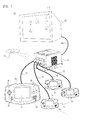
A game system 10 of this embodiment shown in Figure 1 is for playing a game to
search an invisible non-displayed item like a hunt for treasure by a plurality of players,
and includes one game console (fixed-type game apparatus) 12 and a plurality of
hand-held game apparatuses 14 (four in this embodiment).
The game console 12 is provided with an optical disk drive 16 (Figure 2) on an
upper surface of an approximately cubic housing. An optical disk 18 which is one
example of an information storage medium storing a game program and data is loaded on
the optical disk drive 16. The housing is provided with a plurality of connectors 20 (four
in this embodiment) on a front surface thereof (Figure 2). These connectors 20 are
connected with a plurality of hand-held game apparatuses 14 by a plurality of connecting
cables 22.
Furthermore, the game console 12 is connected with a monitor 26 as a first display
apparatus via an AV cable 24. The monitor 26 is typically a color television receiver, and
via the AV cable 24, a video signal from the game console 12 is input to a video input
terminal of the color television, and a sound signal is applied to a sound input terminal.
Accordingly, a game image generated according to the processing of the program is
displayed on the screen of the monitor 26, and a game sound such as a game music
(BGM), a sound effect, etc. is output from a speaker not shown. Each player plays a game
by operating the operating means (hand-held game apparatus 14) of his own while
viewing a common image displayed on the monitor 26.
The hand-held game apparatus 14 is a hand-held type game apparatus having a
size capable of being held with both hands, and includes a rectangular-shaped housing.
The housing is provided with an operating switch 28 as an operating means to be operated
by each player on a front surface thereof. The operating switch 28, for example, includes
a direction switch for moving a player character and a cursor during the game, a plurality
of action switches for instructing a movement of the character, etc., and a start switch for
instructing a start, a suspend, etc. of the game, and so on.
A speaker 30 as a sound outputting means is integrated inside sound-bleeding
holes provided on the surface of the housing. As described later, when the player
character operated by the hand-held game apparatus 14 is close to the neighborhood of an
arrangement position of a hidden non-displayed item, a notification sound is output from
the speaker 30. A liquid crystal display (hereinafter, referred to as "LCD") 32 is provided
at the approximately center of the housing. Furthermore, a connector 34 (Figure 2) is
provided on the top surface of the housing, and the connector 34 is connected with the
connecting cable 22.
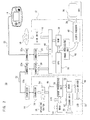
Figure 2 is an internal block diagram showing the game system10. With referring
to Figure 2, the game console 12 includes a CPU 36. The CPU 36 is called a processor or
a computer, and entirely controls the game console 12. The CPU 36 executes a game
processing according to the game program. The CPU 36 is connected with a RAM 38, an
input/output interface (hereinafter, referred to as "I/O") 40, an image processing unit 42,
etc.
The RAM 38 is utilized as a working memory or a buffer memory for CPU 36, and
into the RAM 38, data required at a time of performing the game processing by the CPU
36 is loaded, and data generated by the game processing is temporarily stored. The image
processing unit 42 processes the data temporarily stored in the RAM 38 on the basis of the
instruction by the CPU 36 to generate image data for display. The generated image is
displayed on the monitor 26 via a video encoder 44 and the AV cable 24.
The I/O 40 is connected with the disk drive 16. The data of the optical disk 18 is
read by the disk drive16 on the basis of the instruction by the CPU 36, and transferred to
the RAM 38 so as to be stored. Furthermore, the I/O 40 is connected with the plurality of
connectors 20, and each of the connectors 20 is connected with a connector 22a being one
end of the connecting cable 22 for being connected to the hand-held game apparatus 14.
Data received from the hand-held game apparatus 14 such as operation data, etc. is
applied to the CPU 36 via the connector 20 and the I/O 40, and stored in a predetermined
area of the RAM 38. Also, transmission data such as a game program, game data,
instruction data, etc. directed to the hand-held game apparatus 14 is transmitted from the
predetermined area to each hand-held game apparatus 14 via the I/O 40 and each
connector 20 by the CPU 36.
Furthermore, although omitted in Figure 2, the CPU 36 is also connected with a
sound processing unit, etc. The sound processing unit generates sound output data on the
basis of the instruction by the CPU 36, and applies it to the speaker of the monitor 26 via
the AV cable 24, and whereby, a game music, etc. is output from the speaker.
The hand-held game apparatus 14 includes a CPU 46, and the CPU 46 entirely
controls the hand-held game apparatus 14. The CPU 46 is connected with a working
RAM (hereinafter abbreviated as "WRAM") 48, an image processing unit 50, a sound
unit52, and an input-output interface (hereinafter abbreviated as "I/O") 54.
The WRAM 48 is utilized as a work memory or a buffer memory for the CPU 46.
In the WRAM 48, a game program and data transmitted from the game console 12 is
stored, and the CPU 46 executes a processing according to the game program. The image
processing unit 50 is connected with a video RAM (hereinafter abbreviated as "VRAM")
56. The image processing unit 50 generates, according to an instruction of the CPU 46,
image data for display on the basis of the data temporarily stored in the WRAM 48. The
VRAM 56 temporarily stores the image data for display generated by the image
processing unit 50. The image data stored in the VRAM 56 is applied to the LCD 32 via
an LCD driver 58 so as to be displayed on the LCD 32. The sound unit 52 converts sound
data generated by the processing of the CPU 32 into an analog signal to output it as a
sound from the speaker 30.
The I/O 54 connects the CPU 46 with the operating switch 28, the connector 34,
etc. The connector 34 is connected with a connector 22b being the other end of the
connecting cable 22 that is connected to the game console 12. The CPU 46 receives the
data from the operating switch 28 via the I/O 54 so as to use it for the program processing,
and transmits to the game console 12 the input data as an operation data via the I/O 54 and
the connector 34. Also, the transmission data from the game console 12 is applied to the
CPU 46 via the connector 34 and the I/O 54 so as to be stored in a predetermined area of
the WRAM 48.
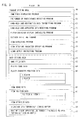
Figure 3 shows one example of a memory map of the RAM 38 of the game console
12. Into the RAM 38, all or a necessary part of the program and data are loaded from the
optical disk 18 when starting the game or when necessary.
The memory map of the RAM 3 8 is roughly divided into a program storing area 60
and a data storing area 62. In the program storing area 60, various programs to be
executed by the CPU 36 are stored. In the data storing area 62, various data to be utilized
by the programs stored in the program storing area 60 are stored. Also, the data storing
area 62 is an area for temporarily storing the data generated as a result of the program
processing.
The program storing area 60 includes a game field displaying program storing area
64, the number of participants detecting program storing area 66, a hand-held
game-destination-data transmitting program storing area 68, a hand-held game apparatus
data receiving program storing area 70, a player character display controlling program
storing area 72, a distance detecting program storing area 74, an item display program
storing area 76, an item obtaining character specifying program storing area 78, a sound
output instructing program storing area 80, etc.
In the game field displaying program storing area 64, a program for generating a
game field where a plurality ofplayer characters simultaneously search the non-displayed
item and displaying the image of the game field is stored. In the game field, at least one
hidden item as a non-displayed item is arranged at a predetermined position. The
invisible hidden item becomes an object to be sought.
In the number of participants detecting program storing area 66, a program for
detecting the number of the hand-held game apparatuses 14 connected with the game
console 12, and detecting the number of the participants in the game is stored.
In the hand-held game-destination-data transmitting program storing area 68, a
program for transmitting the data to the hand-held game apparatus 14 is stored.
According to this program, for example, a program for making the hand-held game
apparatus 14 function as an operating means of the player in the game console 12, a
program for outputting a sound from the hand-held game apparatus 14, and so on are
transmitted.
In the hand-held game apparatus data receiving program storing area 70, a
program for receiving the transmission data including the operation data, etc. transmitted
from the hand-held game apparatus 14 is stored.
In the player character display controlling program storing area 72, a program for
controlling the actions of the plurality of player characters and displaying these images in
the game field is stored. According to this program, a position of each player character is
calculated on the basis of the operation data from each hand-held game apparatus 14, and
temporarily stored.
In the distance detecting program storing area 74, a program for calculating a
distance between each player character and a hidden item on the basis of a position of
each player character and a position of the hidden item is stored.
In the item displaying program storing area 76, a program for displaying, after a
hidden item is found, an image of the hidden item at an arrangement position in the game
field is stored.
In the item obtaining character specifying program storing area 78, a program for
specifying a player character who obtains the hidden item is stored. Furthermore, this
program, when the position of the player character and the position of the hidden item
have a predetermined relationship, that is, when the position of the player character
reaches a place where the hidden item is obtainable, causes the player character to obtain
the hidden item.
In the sound output instructing program storing area 80, a program for transmitting
a command for instructing it to output a notification sound to the hand-held game
apparatus 14 is stored. According to this program, when the distance between the player
character and the hidden item falls within a predetermined range, sound data to be rung is
set depending on the distance, and a command for providing an instruction to ring the set
sound data is transmitted to the hand-held game apparatus 14 that takes charge of the
operation of the player character. Furthermore, according to this program, when the
player character obtains the item, the sound data for reproduction when obtaining item is
set as the sound data to be rung, and the command for providing the instruction to ring the
set sound data is transmitted to the hand-held game apparatus 14 that takes charge of the
operation of the player character.
The data storing area 62 includes a game field data area 82, a player image data
area 84, a player character position data area 86, an item image data area 88, an item
position data area 90, an item attribute data area 92, an operation data temporarily storing
buffer area 94, and a hand-held game apparatus-use transmitting/receiving data
temporarily storing buffer 96 area, etc.
In the game field data area 82, data relating to the game field where at least one
hidden item is arranged, and a plurality of player characters simultaneously search the
hidden item is stored. By use of the data, the game field displaying program generates
and displays the game field.
In the player image data area 84, image data for displaying the plurality of player
characters is stored. In the player character position data area 86, data relating to
positions of the player characters (1 player, 2 player,...) calculated by the character
display controlling program on the basis of the operation data, etc are temporarily stored.
By use of the position data, the distance detecting program calculates the distance
between each player character and a hidden item.
In the item image data area 88, image data of a hidden item to be displayed when it
is found is stored. In the item position data area 90, the data relating to the position of
each hidden item arranged in the game field is stored. By use of the position data, the
distance detecting program calculates the distance between the hidden item and each
player character.
In the item attribute data area 92, data relating to type data or an attribute of each
hidden item arranged in the game field is stored. As an attribute of the hidden item, for
example, money, various items equipped or used by the player character, an extra game
for hand-held game apparatus, etc. are set. For example, in a case that a hidden item
whose attribute is the extra game for hand-held game apparatus is obtained, a program
relating to the extra game is transmitted to only the hand-held game apparatus 14 of the
player who obtains the hidden item, and in the only hand-held game apparatus 14, the
extra game is playable.
In the operation data temporarily storing buffer area 94, each operation data
transmitted from each hand-held game apparatus 14 is temporarily stored. In the
hand-held game apparatus-use transmitting/receiving data temporarily storing buffer 96,
data to be transmitted to each hand-held game apparatus 14, and data received from each
hand-held game apparatus 14 are temporarily stored.
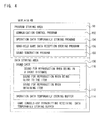
Figure 4 shows one example of a memory map of the WRAM 48 of the hand-held
game apparatus 14. Into the WRAM 48, programs and data transmitted from the game
console 12 when starting the game or when necessary are stored. The memory map of the
WRAM 48 includes a program storing area 98 and a data storing area 100. In the program
storing area 98, various programs to be executed by the CPU 46 are stored. In the data
storing area 100, various data to be used by the programs stored in the program storing
area 98 are stored, and data generated by the processing is also temporarily stored.
The program storing area 98 includes a communication control program storing
area 102, an operation data temporarily storing program storing area 104, a hand-held
game data reception storing program storing area 106, a sound generation program
storing area 108, etc.
In the communication control program storing area 102, a program for controlling
the communication with the game console 12 is stored.
In the operation data temporarily storing program storing area 104, a program for
temporarily storing input data from the operating switch 28 as the operation data is stored.
In the hand-held game data reception storing program storing area 106, a program
for receiving and storing data for hand-held game transmitted from the game console 12
is stored. According to the program, for example, a program for making the hand-held
game apparatus 14 function as the operating means of the player in the game console 12,
a program for outputting a sound from the hand-held game apparatus 14, and so on are
received.
In the sound generation program storing area 108, a program for generating a
sound to be rung according to a sound output command from the game console 12 and
outputting the sound from the speaker 30 is stored.
The data storing area 100 includes a sound data area 110, an operation data
temporarily storing buffer area 112, and a game console-use transmitting/receiving data
temporarily storing buffer area 114, etc.
In the sound data area 110, sound data for outputting at least one kind of
notification sound is stored. In this embodiment, a plurality of sound data different
depending on the distance between the player character and the hidden item are stored.
More specifically, sound data for reproduction when being in a short distance indicating a
case that the player character exists within the range of a short distance from the hidden
item, sound data for reproduction when being close to the item indicating a case that the
player character exists within a nearby range closer to the hidden item than in the short
distance case, sound data for reproduction when obtaining the item indicating a case that
the player character obtains the hidden item, etc. are stored. A sound generation program
obtains the sound data designated by the command from the game console 12 from the
area 110 to thereby generate the sound and output it from the speaker 30. In this
embodiment, the sound data is commonly used to the respective player characters, and
therefore, the notification sound having a tone common to the respective player
characters is output.
In the operation data temporarily storing buffer area 112, the operation data input
from the operating switch 28 is temporarily stored. In the game console-use
transmitting/receiving data temporarily storing buffer area 114, the data to be transmitted
to the game console 12 and the data received from the game console 12 are temporarily
stored.
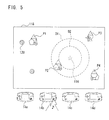
Figure 5 shows one example of a display screen, and a manner of sound outputs of
the respective hand-held game apparatuses 14 at the display screen. With referring to
Figure 5, in the game system 10, a plurality ofplayer characters of P1, P2, P3, P4 (four in
this embodiment) are simultaneously displayed, and a game for searching the hidden item
116 of an object to be found by the player as an invisible non-displayed item is
performed. At least one hidden item 116 is hidden at a predetermined position within the
game field, and is not displayed on the display screen 118 until being discovered. It is
noted that in Figure 5, the hidden item 116 is displayed by dotted lines for the sake of
convenience.
The plurality of players respectively move the player characters P1, P2, P3, P4
belonging to themselves in an arbitrary direction by operating the operating switches 28
of the respective hand-held game apparatuses 14a, 14b, 14c, 14d, and search the hidden
item 116 by digging a hole 120 at an arbitrary place, for example.
Then, in the game system10, the progress of the search for each player is notified
by sound from the hand-held game apparatus 14 at hand as the operating means.
Specifically, the player character is moved on the basis of the operation data from the
hand-held game apparatus 14, and whereby, it is determined whether or not the player
character exists within the range of the predetermined distance from the hidden item 116.
If the player character exists within the range of the predetermined distance from the
hidden item 116, the game console 12 transmits to the hand-held game apparatus 14 that
takes charge of the operation of the player character a command for providing an
instruction to output a predetermined sound depending on the distance between the player
character and the hidden item 116. The hand-held game apparatus 14 outputs the
predetermined sound according to the received command.
In Figure 5 example, the player character P2 exists within the range of the short
distance from the hidden item 116 (area between the dash lines D1 and dash lines D2 in
Figure 5), and therefore, a notification sound indicative of existing in the short distance
from the hidden item 116 is output from the speaker 30 of the hand-held game apparatus
14b that takes charge of operating the player character P2.
The player who hears the sound from his own hand-held game apparatus 14b at
hand notifies that the player character P2 operated by him is close to the hidden item 116
to have a delightful feeling, and further concentrates on playing the game in order to try to
find the position of the hidden item 116. On the other hand, the rest of the players hear the
notification sound from the hand-held game apparatus 14b other than themselves, and
whereby they notifies that the player other than themselves is about to obtain the hidden
item 116, so that they became very frustrated for themselves. This makes it possible to
perform a heated hunt for treasure. As the notification sound is, in this embodiment, the
tone in common to the respective player characters is used, and this makes difficult to
know which player is close to the hidden item 116. Therefore, this causes other players to
have a restless feeling, capable of boosting the game play.
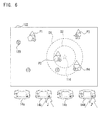
Figure 6 shows one example of a display screen when the game further proceeds
from a state of Figure 5, and a state of a sound output of the respective hand-held game
apparatuses 14 at that time. On a display screen 122 in Figure 6, the player character P2
exists within the range of the nearby distance from the hidden item 116 (area circled by
the dash lines D2 in Figure 6) closer to the hidden item than in the short distance range.
Accordingly, a notification sound indicative of being closer to the hidden item 116 is
output from the speaker 30 of the hand-held game apparatus 14b operating the player
character P2. Furthermore, in Figure 6, the player character P4 exists within the range of
short distance from the hidden item 116, and therefore, a notification sound indicative of
existing in the short distance from the hidden item 116 is output from the speaker 30 of
the hand-held game apparatus 14d operating the player character P4.
Thus, the notification sound is changed depending on the distance from the hidden
item 116, and therefore, the player who is notified can know to what extent his player
object is close to the hidden item or away from it. On the other hand, the other players can
know whether the player other than themselves is close to the hidden item or away from
it. Thus, with respect to the other players, the notification sound gives a restless feeling or
a sense of security caused by being aware of a little delay. Therefore, direction is
performed on the search for the non-displayed item such that the players are moved from
joy to sorrow by sound, capable of increasing a level of savor or taste of the game.
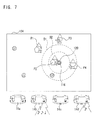
Figure 7 shows one example of a display screen when the game further proceeds
from a state of Figure 6, and a sound output state of the respective hand-held game
apparatuses 14 at that time. On a display screen 124 in Figure 7, the player character P2
digs a hole 120 at the arrangement position of the hidden item 116, and finally finds the
hidden item 116. By this find, the hidden item 116 is displayed on the display screen 124.
Thereafter, in a case that the position of the player character P2 is equal to the place where
the found hidden item 116 is obtainable, that is, the arrangement position of the hidden
item 116 or its nearby position, the player character P2 obtains the hidden item 116.
Then, a notification sound indicative of obtaining the hidden item 116 is output from the
speaker 30 of the hand-held game apparatus 14b that takes charge of operating the player
character P2.
Thus, the image of the hidden item 116 is displayed only after the hidden item 116
is found, and therefore, the players can know which player is about to obtain the hidden
item 116 only when the hidden item 116 is finally found or obtained as a result of playing
the game with a restless feeling, capable of directing the end of the hidden item searching
game in a dramatic way at a climax.
Furthermore, in this embodiment, the attribute of the hidden item 116 is stored in
the item attribute data storing area 92, and therefore, with referring to the attribute data
after the item is obtained or found, a game processing according to the attribute of the
obtained item is executed to develop the game after obtaining or finding the item in
various ways. In a case that the attribute of the hidden item 116 is money, for example,
money carried by the player character is increased by a predetermined amount while in a
case of the various items, the item can be possessed, equipped, or utilized by the player
character.
Alternatively, the attribute of the obtained hidden item 116 is an extra game for
hand-held game apparatus, a program and data for extra game are transmitted to only the
hand-held game apparatus 14 operating the player character who obtains the hidden item
to allow the player to play the extra game in only the hand-held game apparatus 14. In
this case, the player who obtains the hidden item can play the special game such as
fmding another item, and so forth while viewing the display screen displayed on the LCD
32 of the hand-held game apparatus 14 at hand that cannot be seen from the other players,
thereby, capable of proceeding the game with a delightful feeling and a sense of
superiority due to be able to a further item. On the other hand, the other players result in
proceeding the game with a restless frustrated feeling because the player other than
themselves plays the secret game.
Figure 8 shows one example of an operation of the game console 12 in the game
system 10. When starting the game, necessary programs and data are loaded from the
optical disk 18 to the predetermined area of the RAM 38, and stored according to the
memory map in Figure 3, for example. In a first step S1 in Figure 8, the CPU 36 of the
game console 12 detects the hand-held game apparatuses 14 connected thereto. Next, in a
step S3, the CPU 36 transmits the hand-held game apparatus destination programs and
data to each of the detected hand-held game apparatus 14. The programs and data to be
transmitted include, for example, a program for making the hand-held game apparatus 14
serve as the operating means for the game console 12, a program for outputting a
notification sound according to the instruction, sound data of the notification sound, etc.
The programs and data are, for example, stored in the WRAM 48 of the hand-held game
apparatus 14 according to the memory map in Figure 4.
Succeedingly, in a step S5, the CPU 36 generates a game field on the basis of the
game field data, etc. by use of the image processing unit 42 to display the display screen
on the monitor 26. In a step S7, the CPU 36 requests each hand-held game apparatus 14
to transmit the operation data, receives the operation data from each hand-held game
apparatus 14, and temporarily stores it in the operation data temporarily storing buffer
area 94. In a step S9, the CPU 36 calculates a position of each player character on the
basis of each operation data, temporarily stores each position data in the player character
position data area 86, and generates in the game field an image of each player character
on the basis of the position data of each player character, the player image data, etc. by
use of the image processing unit 42 to display the display screen on monitor 26.
Then, in a step S11, the CPU 36 calculates distances between the arrangement
position of each hidden item and each player character in the game field on the basis of
the item position data, the player character position data, etc. On the basis of the
calculated distance, the CPU 36, in a step S13, determines whether or not the player
character exists within the range of a predetermined distance from each hidden item. For
example, as shown in Figure 5, it is determined whether or not the player character having
data value being lower than a distance defined by the short distance from the hidden item
116 represented by the dash lines D1 exists. If "NO" in the step S13, that is, if no player
characters reach the short distance from the hidden item, the process returns to the step S7
to repeat this processing.
On the other hand, if "YES" in the step S 13, that is, if any one of the player
characters exists in the short distance from the hidden item, the CPU 36 executes an item
obtaining process in a step S 15. According to the item obtaining process, depending on
the distance between the player character existing in the short distance and the hidden
item, a predetermined notification sound is output from the hand-held game apparatus 14
that takes charge of the operation of the player character. The detail of the item obtaining
process is described later.
Then, in a step S17, the CPU 36 determines whether or not the game is over, and if
''NO'', the process returns to the step S7 to repeat this processing, while if "YES", the
game is ended.
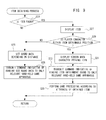
Figure 9 shows a detail operation of the item obtaining process in the step S15
shown in Figure 8. The CPU 36 determines whether or not the hidden item is found in a
first step S21 in Figure 9. For example, as shown in Figure 7, if the hole 120 is dug at the
arrangement position of the hidden item 116, this means that the hidden item 116 is
found.
If "NO" in the step S21, that is, if the hidden item has not yet been found, the CPU
36 sets the sound data to be rung depending on the distance between the player who is
determined to exist in the range of the predetermined distance and the hidden item in a
succeeding step S23. For example, as shown in Figure 5, in a case that the distance data
value between player character P2 and the hidden item 116 is larger than the distance data
value defining the nearby distance represented by the dash lines D2, the sound data for
reproduction when being in a short distance is set. As shown in Figure 6, for example, in
a case that the distance data value between the player character P2 and the hidden item
116 corresponds to the nearby distance represented by the dash lines D2, the sound data
for reproduction when being close to the item is set.
Then, in a step S25, the CPU 36 transmits a command for providing an instruction
to ring the set sound data only to the hand-held game apparatus 14 that takes charge of
operating the relevant player character. The command includes an identifier, and so on
for designating the set sound data. The hand-held game apparatus 14 receiving the
command outputs the notification sound from the speaker 30 on the basis of the set sound
data. For example, as shown in Figure 5, in a case that the player character P2 exists
within the range of the short distance, the notification sound indicative of being within the
short distance is output from the hand-held game apparatus 14b while as shown in Figure
6, the player character P2 exists within the range of the nearby distance, the notification
sound indicative of being closer to the hidden item is output from the hand-held game
apparatus 14b. After completion of the step S25, the item obtaining process is ended, and
the process is returned to the step S17 in Figure 8.
On the other hand, if "YES" in the step S21, that is, ifthe hidden item is found, the
CPU 36 generates in the game field the image of the hidden item on the basis of the item
position data, item image data, etc. by use of the image processing unit 42, and displays
the display screen on the monitor 26 in a succeeding step S27.
Then, in a step S29, the CPU 36 determines whether or not the player character
that is determined to exist within the range of the predetermined distance exists in a
position where the hidden item is obtainable. As shown in Figure 7, for example, it is
determined whether or not the position of the player character P2 is equal to the
arrangement position of the hidden item 116 or its periphery. If "NO" in the step S29,
that is, if the hidden item cannot be obtained, the process proceeds to the step S23 to cause
the relevant hand-held game apparatus 14 to output a sound depending on the distance
from the hidden item in the above-described manner.
On the other hand, if "YES" in the step S29, that is, if the position of the relevant
player character is equal to the position where the hidden item is obtainable, the CPU 36
generates a screen at a time the player character obtains the hidden item by use of the
image processing unit 42, and displays it on the monitor 26 in a succeeding step S31.
Then, in a step S33, the CPU 36 sets the sound data for reproduction when obtaining the
item as the sound data to be rung, and transmits to only the hand-held game apparatus 14
operating the player character who obtains the item a command indicative of ringing the
item obtaining sound. The hand-held game apparatus 14 that has received the command,
as shown in Figure 7, for example, outputs from the speaker 30 the notification sound on
the basis of the sound data for reproduction when obtaining the item.
In a step S35, the CPU 36 of the game console 12 executes a game processing
according to the attribute of the obtained item on the basis of the item attribute data. For
example, in a case that the attribute of the item is money, the money carried by the player
character is increased while in a case that the attribute is various items, the player
character is allowed to possess, equip or use the item. Alternatively, in a case that the
attribute is an extra game for hand-held game apparatus, the CPU 36 loads into the RAM
38 the programs and data for playing the extra game from the optical disk 18, and
transmits the programs and data to only the relevant hand-held game apparatus 14 so as to
allow the player who operates the hand-held game apparatus 14 to play the extra game. It
is noted that in response to the transmission, the CPU 46 of the hand-held game apparatus
14 receives the programs and data of the extra game, executes the game processing
according to the programs, the operation data from the operating switch 28, etc., and
displays the game image of the extra game on the LCD 32. After completion of the step
S35, the item obtaining process is ended, and the process returns to the step S17 in Figure
8.
Figure 10 shows one example of a timing diagram of a communication between
the game console 12 and the hand-held game apparatus 14 in this game system 10. First,
the CPU 36 of the game console 12 detects the hand-held game apparatuses 14 connected
thereto in a step S41. Furthermore, the CPU 46 of the hand-held game apparatus 14
detects capability of data exchange in a step S61, and establishes a communication
between the game console 12 and each hand-held game apparatus 14.
Then, the CPU 36 of the game console 12 transmits to each hand-held game
apparatus 14 hand-held-game-destination-data and programs in a step S43. In response
thereto, the CPU 46 of the hand-held game apparatus 14 receives the hand-held
game-destination-data and programs, and stores it in the predetermined area of the
WRAM 48.
Thereafter, the CPU 46 of the hand-held game apparatus 14 generates operation
data on the basis of the input data from the operating switch 28 in a step S65, and stores it
in the operation data temporarily storing buffer area 112. On the other hand, the CPU 36
of the game console 12 transmits to each hand-held game apparatus 14 a command for
requesting the operation data in a step S45. In response thereto, the CPU 46 of the
hand-held game apparatus 14 receives the command for requesting the transmission of
the operation data in a step S67, and transmits the operation data to the game console 12
in a step S69.
In response to the transmission, the CPU 36 of the game console 12 receives the
operation data transmitted from each hand-held game apparatus 14, and stores it in the
operation data temporarily storing buffer area 94 in a step S47. Then, the CPU 36
executes the game processing in a succeeding step S49. In the step S49, as described
above, the CPU 36 calculates a position of each player character on the basis of each
operation data to display each player character, and calculates a distance between each
player character and the hidden item. Then, in a step S51, the CPU 36 sets the sound data
to be rung in the hand-held game apparatus 14 that takes charge of operating the player
character on the basis of the distance between each player character and the hidden item
in a case that the player character exists within the range of the predetermined distance
from the hidden item. Succeedingly, in a step S53, the CPU 36 transmits only to the
hand-held game apparatus 14 from which the sound data has to be rung a command for
providing an instruction to output the set sound data. Then, in a step S55, the CPU 36
repeats the processing from the step S45 onward until the game is over, and ends the
process when the game is over.
On the other hand, in correspondence to the transmission of the sound output
command in the step S53, the CPU 46 of the hand-held game apparatus 14 receives the
sound output command in a step S71. Succeedingly, in a step S73, the CPU 46 reads-out
the sound data designated by the command from the sound data area 110 to generate the
data of the notification sound to be output based on the sound data, and outputs the
notification sound from the speaker 30 by utilizing the sound unit 52. Then, the CPU 46
repeats the processing from the step S65 onward until the game is over in a step S75, and
ends the processing when the game is over.
It is noted that the notification sound has a tone in common to the each of the
attribute or the type data of the hidden item in the above-described embodiment.
However, by preparing the sound data for each attribute or each type data of the item, a
different notification sound may be output in correspondence to the attribute or the type
data of the item. In this case, the player can presume the type data of the hidden item
before finding or obtaining it by hearing out the difference between the notification
sounds. In a case that it is presumed that the item is not one which he wants, for example,
by postponing the obtainment of the item to search another place, and so forth, it is
possible to search the only item he wants. This makes it possible to search the item
efficiently and makes the competition with the other players intense and heated. The
value indicative of the predetermined distance for determining whether or not the sound is
output depending on the attribute or the type data of the hidden item may be set to a
different value.
Furthermore, in each of the above-described embodiments, although the hidden
item as a non-displayed item is fixedly arranged at a predetermined position in the game
field, the hidden non-displayed item may be an item (invisible non player object, etc.)
moving in the game field.
Furthermore, in each of the above-described embodiments, as an operating means
for the game console 12, the hand-held game apparatus 14 that is provided with the LCD
32, etc. and is able to function as a singly game apparatus is utilized. However, the
operating means may be a general game controller that applies the operation signal from
operating switch 28 to the game console 12, and is further provided with a sound
outputting means such as a speaker, a sound processing circuit, etc. In this case, the
sound generation programs, the sound data, etc. stored in the WRAM 48 of the hand-held
game apparatus 14 is stored in the RAM 38 of the game console 12. Then, in a case that
the player character exists within the range of the predetermined distance from the hidden
item, the CPU 36 selectively processes the predetermined sound data on the basis of the
distance between the player character and the hidden item to generate the notification
sound, and applies it to the sound processing circuit of the relevant controller to output the
notification sound from the speaker.
Although the present invention has been described and illustrated in detail, it is
clearly understood that the same is by way of illustration and example only and is not to
be taken by way of limitation, the spirit and scope of the present invention being limited
only by the terms of the appended claims.