EP1534883B1 - Fasern und fibride enthaltende artikel, fasern und fibride und herstellungsverfahren - Google Patents
Fasern und fibride enthaltende artikel, fasern und fibride und herstellungsverfahren Download PDFInfo
- Publication number
- EP1534883B1 EP1534883B1 EP20030753670 EP03753670A EP1534883B1 EP 1534883 B1 EP1534883 B1 EP 1534883B1 EP 20030753670 EP20030753670 EP 20030753670 EP 03753670 A EP03753670 A EP 03753670A EP 1534883 B1 EP1534883 B1 EP 1534883B1
- Authority
- EP
- European Patent Office
- Prior art keywords
- fibers
- polymer
- article
- fibrids
- thermoplastic polymer
- Prior art date
- Legal status (The legal status is an assumption and is not a legal conclusion. Google has not performed a legal analysis and makes no representation as to the accuracy of the status listed.)
- Expired - Lifetime
Links
Images
Classifications
-
- D—TEXTILES; PAPER
- D04—BRAIDING; LACE-MAKING; KNITTING; TRIMMINGS; NON-WOVEN FABRICS
- D04H—MAKING TEXTILE FABRICS, e.g. FROM FIBRES OR FILAMENTARY MATERIAL; FABRICS MADE BY SUCH PROCESSES OR APPARATUS, e.g. FELTS, NON-WOVEN FABRICS; COTTON-WOOL; WADDING ; NON-WOVEN FABRICS FROM STAPLE FIBRES, FILAMENTS OR YARNS, BONDED WITH AT LEAST ONE WEB-LIKE MATERIAL DURING THEIR CONSOLIDATION
- D04H1/00—Non-woven fabrics formed wholly or mainly of staple fibres or like relatively short fibres
- D04H1/70—Non-woven fabrics formed wholly or mainly of staple fibres or like relatively short fibres characterised by the method of forming fleeces or layers, e.g. reorientation of fibres
- D04H1/72—Non-woven fabrics formed wholly or mainly of staple fibres or like relatively short fibres characterised by the method of forming fleeces or layers, e.g. reorientation of fibres the fibres being randomly arranged
- D04H1/728—Non-woven fabrics formed wholly or mainly of staple fibres or like relatively short fibres characterised by the method of forming fleeces or layers, e.g. reorientation of fibres the fibres being randomly arranged by electro-spinning
-
- D—TEXTILES; PAPER
- D01—NATURAL OR MAN-MADE THREADS OR FIBRES; SPINNING
- D01F—CHEMICAL FEATURES IN THE MANUFACTURE OF ARTIFICIAL FILAMENTS, THREADS, FIBRES, BRISTLES OR RIBBONS; APPARATUS SPECIALLY ADAPTED FOR THE MANUFACTURE OF CARBON FILAMENTS
- D01F6/00—Monocomponent artificial filaments or the like of synthetic polymers; Manufacture thereof
- D01F6/88—Monocomponent artificial filaments or the like of synthetic polymers; Manufacture thereof from mixtures of polycondensation products as major constituent with other polymers or low-molecular-weight compounds
- D01F6/90—Monocomponent artificial filaments or the like of synthetic polymers; Manufacture thereof from mixtures of polycondensation products as major constituent with other polymers or low-molecular-weight compounds of polyamides
- D01F6/905—Monocomponent artificial filaments or the like of synthetic polymers; Manufacture thereof from mixtures of polycondensation products as major constituent with other polymers or low-molecular-weight compounds of polyamides of aromatic polyamides
-
- D—TEXTILES; PAPER
- D01—NATURAL OR MAN-MADE THREADS OR FIBRES; SPINNING
- D01F—CHEMICAL FEATURES IN THE MANUFACTURE OF ARTIFICIAL FILAMENTS, THREADS, FIBRES, BRISTLES OR RIBBONS; APPARATUS SPECIALLY ADAPTED FOR THE MANUFACTURE OF CARBON FILAMENTS
- D01F6/00—Monocomponent artificial filaments or the like of synthetic polymers; Manufacture thereof
- D01F6/88—Monocomponent artificial filaments or the like of synthetic polymers; Manufacture thereof from mixtures of polycondensation products as major constituent with other polymers or low-molecular-weight compounds
- D01F6/94—Monocomponent artificial filaments or the like of synthetic polymers; Manufacture thereof from mixtures of polycondensation products as major constituent with other polymers or low-molecular-weight compounds of other polycondensation products
-
- D—TEXTILES; PAPER
- D04—BRAIDING; LACE-MAKING; KNITTING; TRIMMINGS; NON-WOVEN FABRICS
- D04H—MAKING TEXTILE FABRICS, e.g. FROM FIBRES OR FILAMENTARY MATERIAL; FABRICS MADE BY SUCH PROCESSES OR APPARATUS, e.g. FELTS, NON-WOVEN FABRICS; COTTON-WOOL; WADDING ; NON-WOVEN FABRICS FROM STAPLE FIBRES, FILAMENTS OR YARNS, BONDED WITH AT LEAST ONE WEB-LIKE MATERIAL DURING THEIR CONSOLIDATION
- D04H1/00—Non-woven fabrics formed wholly or mainly of staple fibres or like relatively short fibres
- D04H1/40—Non-woven fabrics formed wholly or mainly of staple fibres or like relatively short fibres from fleeces or layers composed of fibres without existing or potential cohesive properties
- D04H1/54—Non-woven fabrics formed wholly or mainly of staple fibres or like relatively short fibres from fleeces or layers composed of fibres without existing or potential cohesive properties by welding together the fibres, e.g. by partially melting or dissolving
-
- D—TEXTILES; PAPER
- D21—PAPER-MAKING; PRODUCTION OF CELLULOSE
- D21H—PULP COMPOSITIONS; PREPARATION THEREOF NOT COVERED BY SUBCLASSES D21C OR D21D; IMPREGNATING OR COATING OF PAPER; TREATMENT OF FINISHED PAPER NOT COVERED BY CLASS B31 OR SUBCLASS D21G; PAPER NOT OTHERWISE PROVIDED FOR
- D21H15/00—Pulp or paper, comprising fibres or web-forming material characterised by features other than their chemical constitution
- D21H15/02—Pulp or paper, comprising fibres or web-forming material characterised by features other than their chemical constitution characterised by configuration
- D21H15/10—Composite fibres
-
- Y—GENERAL TAGGING OF NEW TECHNOLOGICAL DEVELOPMENTS; GENERAL TAGGING OF CROSS-SECTIONAL TECHNOLOGIES SPANNING OVER SEVERAL SECTIONS OF THE IPC; TECHNICAL SUBJECTS COVERED BY FORMER USPC CROSS-REFERENCE ART COLLECTIONS [XRACs] AND DIGESTS
- Y10—TECHNICAL SUBJECTS COVERED BY FORMER USPC
- Y10T—TECHNICAL SUBJECTS COVERED BY FORMER US CLASSIFICATION
- Y10T292/00—Closure fasteners
- Y10T292/03—Miscellaneous
-
- Y—GENERAL TAGGING OF NEW TECHNOLOGICAL DEVELOPMENTS; GENERAL TAGGING OF CROSS-SECTIONAL TECHNOLOGIES SPANNING OVER SEVERAL SECTIONS OF THE IPC; TECHNICAL SUBJECTS COVERED BY FORMER USPC CROSS-REFERENCE ART COLLECTIONS [XRACs] AND DIGESTS
- Y10—TECHNICAL SUBJECTS COVERED BY FORMER USPC
- Y10T—TECHNICAL SUBJECTS COVERED BY FORMER US CLASSIFICATION
- Y10T428/00—Stock material or miscellaneous articles
- Y10T428/249921—Web or sheet containing structurally defined element or component
- Y10T428/249924—Noninterengaged fiber-containing paper-free web or sheet which is not of specified porosity
-
- Y—GENERAL TAGGING OF NEW TECHNOLOGICAL DEVELOPMENTS; GENERAL TAGGING OF CROSS-SECTIONAL TECHNOLOGIES SPANNING OVER SEVERAL SECTIONS OF THE IPC; TECHNICAL SUBJECTS COVERED BY FORMER USPC CROSS-REFERENCE ART COLLECTIONS [XRACs] AND DIGESTS
- Y10—TECHNICAL SUBJECTS COVERED BY FORMER USPC
- Y10T—TECHNICAL SUBJECTS COVERED BY FORMER US CLASSIFICATION
- Y10T442/00—Fabric [woven, knitted, or nonwoven textile or cloth, etc.]
- Y10T442/60—Nonwoven fabric [i.e., nonwoven strand or fiber material]
- Y10T442/637—Including strand or fiber material which is a monofilament composed of two or more polymeric materials in physically distinct relationship [e.g., sheath-core, side-by-side, islands-in-sea, fibrils-in-matrix, etc.] or composed of physical blend of chemically different polymeric materials or a physical blend of a polymeric material and a filler material
-
- Y—GENERAL TAGGING OF NEW TECHNOLOGICAL DEVELOPMENTS; GENERAL TAGGING OF CROSS-SECTIONAL TECHNOLOGIES SPANNING OVER SEVERAL SECTIONS OF THE IPC; TECHNICAL SUBJECTS COVERED BY FORMER USPC CROSS-REFERENCE ART COLLECTIONS [XRACs] AND DIGESTS
- Y10—TECHNICAL SUBJECTS COVERED BY FORMER USPC
- Y10T—TECHNICAL SUBJECTS COVERED BY FORMER US CLASSIFICATION
- Y10T442/00—Fabric [woven, knitted, or nonwoven textile or cloth, etc.]
- Y10T442/60—Nonwoven fabric [i.e., nonwoven strand or fiber material]
- Y10T442/69—Autogenously bonded nonwoven fabric
Definitions
- the present invention relates in particular to new articles, in particular nonwoven articles comprising fibers and / or fibrids. It also relates to new fibers and fibrids and a process for obtaining these fibers and fibrids.
- thermostable fibers In the field of electrical insulation in particular, it is sought to obtain products having good temperature resistance and good mechanical properties and / or good dielectric properties. These products may for example be nonwoven articles made from thermostable fibers. In such an article, a good cohesion of thermostable fibers is necessary to obtain a good level of mechanical properties, or even a homogeneous and dense structure of the article for obtaining dielectric properties. For this purpose, it is sought to obtain good cohesion of thermostable fibers at the article. It is also sought to obtain a homogeneous and compact structure at the article level.
- These articles according to their structure (in particular their density) and / or their formulation, can have a function of mechanical and / or dielectric reinforcement.
- the document FR 2 163 383 proposes to prepare non-woven articles constituted by a sheet of fibers based on an infusible material or having a melting point greater than 180 ° C., the fibers being bound together by means of a polyamide-imide binder, used in proportion of 5 to 150% of the weight of dry fibers used. But the impregnation of the resin is in solution in a solvent, which has the consequence of adverse effects on the characteristics of the nonwovens.
- the document FR 2 156 452 proposes the wet preparation of nonwoven webs of fibers consisting of infusible material or having a melting point greater than 180 ° C, bonded together by powdered thermoplastic polymer.
- the document FR 2,685,363 proposes to prepare by wet paper made of fibers having a thermal resistance greater than or equal to 180 ° C, bonded together by means of a fibrous binder and a chemical binder.
- gaseous separation membrane in the form of a film or hollow fibers, which is formed from a mixture of polyethersulfones with polyimides, polyamides or polyamide-imides.
- hollow fibers they are assembled using a binder, containing an epoxy resin.
- binders to ensure the cohesion of the fibers in articles such as non-woven entails particular difficulties and costs in the implementation of these binders.
- the subject of the present invention is a process for the manufacture of articles consisting in particular of non-woven articles, not having the above-mentioned drawbacks, which method comprises the features of claim 1.
- the thermoplastic part of the fiber or fibride of the In particular, the invention plays the role of the chemical binder described above. It has the property of "flowing" under pressure and temperature constraints. Thus the cohesion of thermostable fibers in these articles is ensured, their level of thermal and mechanical properties is very satisfactory.
- These articles can have a homogeneous and dense structure, and therefore a good level of dielectric properties.
- the invention proposes the use of the articles obtained by the above method in the field of electrical insulation.
- thermostable polymer of the invention is preferably infusible or has a glass transition temperature greater than 180 ° C, preferably greater than or equal to 230 ° C, or higher.
- the thermostable polymer of the invention has a thermal resistance (that is to say a conservation of its physical properties in particular) long-term at a temperature above 180 ° C.
- This thermostable polymer is preferably chosen from polyaramids and polyimides.
- polyaramids include aromatic polyamides such as the polymer known under the trade name Nomex®, or polyamide imides such as the polymer known under the trade name Kermel®.
- polyimides that may be mentioned are the polyimides obtained according to the document EP 0119185 , known under the trade name P84®.
- the aromatic polyamides can be as described in the patent EP 0360707 . They can be obtained according to the process described in the patent EP 0360707 .
- the thermoplastic polymer is selected from the group of polysulfides and polysulfones.
- polysulfide there may be mentioned polyphenylene sulphide noted PPS thereafter.
- polysulfones noted PSU thereafter mention may be made of the polyether sulfone noted PESU later or polyphenylene sulfone noted PPSU thereafter.
- thermoplastic polymers have a glass transition temperature of less than or equal to 250 ° C., which enables them to act in particular as a chemical binder in the articles of the invention and to "flow" under pressure and temperature stress. These polymers also have good thermostability because they belong to a thermal class (thermal index) greater than 130 ° C. This has an advantage for obtaining articles having good thermostability.
- the thermoplastic polymer and the thermostable polymer are soluble in the same solvent.
- the solvent is polar aprotic. It is more preferably chosen from DMEU, DMAC, NMP, DMF.
- the fiber or fibride according to the invention comprises at least 10% by weight of thermoplastic polymer.
- Fibrides are small non-granular fibrous or film-like particles that are not rigid. Two of their three dimensions are of the order of a few microns. Their small size and flexibility allow them to be deposited in physically interwoven configurations such as those commonly found in pulp papers.
- the fiber according to the invention preferably has a titer of between 0.5 dtex and 13.2 dtex.
- the fiber of the invention preferably has a length of between 1 and 100 mm.
- the fiber according to the invention may have various section shapes such as a round, trilobed, "flat" shape.
- fiber of flat section is meant a fiber whose length / width ratio is greater than or equal to 2.
- the fiber or fibride according to the invention can be treated by sizing.
- the fibers are obtained by mixing the thermostable polymer and the thermoplastic polymer, and then spinning the mixture.
- the polymer mixture is obtained by dissolving the polymers in at least one common solvent.
- the thermoplastic polymer and the heat-stable polymer may be dissolved together, simultaneously or successively in a solvent or a mixture of solvents miscible with each other, in a single reactor for example.
- the polymers can also be dissolved separately in the same solvent or in different solvents miscible with each other, for example in two different containers, then the polymer solutions mixed together.
- the dissolution conditions such as temperature, are determined by those skilled in the art depending on the nature of the polymers and the solvent (s) used.
- the dissolution may for example be carried out hot, with stirring, to facilitate dissolution.
- the dissolution can be carried out at room temperature.
- the dissolution temperature is between 50 and 150 ° C.
- the dissolution solvent (s) is (are) advantageously an aprotic polar solvent.
- Dimethylalkylene urea for example dimethylethylene urea (DMEU) or dimethylpropylene urea, may be used. Preferably it is selected from DMEU, dimethylacetamide (DMAC), N-methyl pyrrolidone (NMP), dimethylformamide (DMF).
- the dissolution solvent can be a mixture of aprotic polar solvents, for example a mixture of dimethylethylene urea and an anhydrous aprotic polar solvent such as NMP, DMAC, DMF, tetramethylurea or ⁇ -butyrolactone.
- the solution of polymers obtained after dissolution is called collodion.
- the resulting solution is preferably clear.
- the total concentration by weight of the polymers relative to the solution is preferably between 5 and 40%.
- the solution may also include additives such as pigments, reinforcing agents, stabilizers, mattifying agents.
- the solution must also have a viscosity allowing its spinning, generally between 100 and 1000 poise.
- the viscosity is preferably between 400 and 800 poises measured using a viscometer known in the trade under the trademark EPPRECHT RHEOMAT 15.
- the viscosity is preferably between 1500 and 3000 poise.
- the polymer mixture can also be made in line during the spinning step, for example by online injection of each polymer-whether or not dissolved in a solvent-during the spinning process.
- Dry spinning for example, in which the solution of polymers (fibrogenic substance in the solution state) is extruded through capillaries in an environment favorable to the elimination of the solvent, for example in an evaporating atmosphere maintained at a temperature near or above the boiling point of the solvent, allowing the solidification of the filaments.
- the filaments leaving the evaporation chamber are freed of their residual solvent.
- they can be washed with water, possibly boiling and under pressure; dried in the usual manner, preferably at a temperature above 80 ° C. They can also be heat treated at a temperature greater than or equal to 160 ° C under reduced pressure, and / or under an inert atmosphere. After being freed from their residual solvent, they may be drawn for example at a temperature above 250.degree. C., preferably above 300.degree. C., preferably in the absence of oxygen.
- the spinning method is a wet spinning, in which the polymer solution (fibrogenic substance solution) is extruded into a coagulating bath.
- the temperature of the spinning solution can vary within wide limits depending on the viscosity of the solution to be spun.
- a solution having a low viscosity can easily be extruded at ordinary temperature, while it is preferable to extrude hot, for example at 120 ° C or even higher, a solution of high viscosity to avoid using too much. great pressures in the sector.
- the spinning solution is advantageously maintained between 15 and 40 ° C, preferably between 15 and 25 ° C.
- the coagulant bath used in the process according to the invention is preferably an aqueous solution containing from 30 to 80% by weight, preferably from 40 to 70% by weight of a solvent or solvent mixture, preferably a dimethylalkylene urea (DMAU ) or DMF or their mixture, although it is often advantageous to use a bath containing more than 50% by weight of solvent to obtain filaments of better stretchability, thus better final properties.
- a solvent or solvent mixture preferably a dimethylalkylene urea (DMAU ) or DMF or their mixture
- the polymers of the solution to be spun have close coagulation rates.
- the spinning speed in the coagulant bath can vary within wide limits, depending on its solvent concentration and the distance of the filaments in this bath.
- This spinning rate in the coagulant bath can be easily selected between 10 and 60 m / min, for example, although higher speeds can be achieved. It is generally not advantageous to spin at lower speeds for reasons of cost efficiency of the process. Moreover, too high speeds of spinning in the coagulant bath reduce the stretchability of the filaments in the air. The spinning speed in the coagulant bath will therefore be chosen to take into account both the profitability and the desired qualities on the finished filament.
- the filaments emerging from the coagulating bath in the gel state are then stretched, for example in air, at a rate defined by the ratio (V 2 / V 1) * 100, V 2 being the speed of the drawing rolls, V 1 that delivery rollers.
- the stretching rate of the son in the gel state is greater than 100%, preferably greater than or equal to 110% or even greater, for example greater than or equal to 200%.
- the residual solvent of the filaments is removed by known means, generally by means of a washing with water flowing against the current or on washing rollers, preferably at room temperature.
- the spinning method is dry spinning.
- the washed filaments are then dried by known means, for example in a drier or on rollers.
- the temperature of this drying can vary within wide limits as well as the speed which is greater as the temperature is higher. It is generally advantageous to perform a drying with gradual rise in temperature, this temperature being able to reach and even exceed 200 ° C. for example.
- the filaments can then undergo a warm overetching to improve their mechanical properties and in particular their toughness, which can be interesting for some jobs.
- This hot stretching can be carried out by any known means: oven, plate, roller, roller and plate, preferably in a closed enclosure. It is carried out at a temperature of at least 150 ° C, which can reach and even exceed 200 to 300 ° C. Its rate is generally at least 150% but it can vary within wide limits depending on the qualities desired for the finished yarn. The total draw ratio is then at least 250%, preferably at least 260%.
- the stretching assembly and optionally super stretching can be carried out in one or more stages, continuously or discontinuously with the previous operations.
- overdrawing can be combined with drying. For this purpose, it is sufficient to provide, at the end of the drying, a zone of higher temperature which makes it possible to overetch.
- the filaments obtained are then cut in the form of fibers according to a method known to those skilled in the art
- the fibrids are obtained by mixing the thermostable polymer and the thermoplastic polymer, and then precipitating the mixture under shear stress.
- the mixture of the thermostable polymer and the thermoplastic polymer may be made in a manner analogous to that described above for the fibers.
- the fibrids of the invention can in particular be obtained by precipitating a solution of polymers in a fibridation apparatus of the type described in the patent US 3,018,091 wherein the polymers are sheared as they precipitate.
- the articles are nonwoven articles.
- the nonwoven articles are in the form of sheets, films, felts and generally they denote any coherent fibrous structure involving no textile operation such as spinning, knitting, weaving.
- the article can be obtained from a single type of fiber or on the contrary from fiber mixtures.
- the nonwoven article of the invention comprises at least in part fibers and / or fibrids according to the invention.
- the article of the invention may comprise fibers of different natures and / or fibrids of different natures.
- the nonwoven article may comprise, for example, thermostable fibers and / or fibrids or reinforcements of the para-aramid, meta-aramid, polyamide imide, etc. type.
- the nonwoven article may comprise, for example, fibers according to the invention and heat-stable fibers.
- the article may for example comprise fibers according to the invention and thermostable polymer fibrids according to a first embodiment; or the article may for example comprise thermostable fibers and fibrids according to the invention according to another embodiment.
- the nonwoven article of the invention may be obtained by a method and apparatus for preparing a nonwoven article known to those skilled in the art.
- the article of the invention is generally obtained by implementing a "lapping" step, that is to say a step of distribution of the fibers and / or fibrids on a surface, then a step of "Consolidation" of the structure obtained.
- the "lapping” step is carried out by "dry route"("drylaid"), for example from, in particular, the invention whose length is between 40 and 80 mm.
- the fibers may for example be processed using an ordinary carding machine.
- the "nappage” step is carried out by “wet” or “papermaking” (“wetlaid”).
- the fibers used in this embodiment generally have a length between 2 and 12 mm, preferably between 3 and 7 mm, and their title, expressed in decitex is generally between 0.5 and 20. It is theoretically possible to use fibers longer than 12 mm, but in practice longer fibers become entangled, requiring a greater amount of water, making the process heavier and more complicated.
- the nonwoven article is obtained by introducing into water, the various constituents of the article: the fibers and a fibrous binder composed of a pulp based on a synthetic polymer having a thermal resistance greater than or equal to 180 ° C (such as a para-aramid pulp) and / or fibrids based on a synthetic polymer having a heat resistance greater than or equal to 180 ° C and / or fibrids according to the invention, and optionally other adjuvants, additives or desired fillers.
- a fibrous binder composed of a pulp based on a synthetic polymer having a thermal resistance greater than or equal to 180 ° C (such as a para-aramid pulp) and / or fibrids based on a synthetic polymer having a heat resistance greater than or equal to 180 ° C and / or fibrids according to the invention, and optionally other adjuvants, additives or desired fillers.
- the pulp based on a synthetic polymer having a heat resistance greater than or equal to 180 ° C. has generally been obtained from fibers of the usual length, in particular fibrils, in a known manner, to give it a large number of dots. snagging and thus increase its specific surface area.
- synthetic fibers only highly crystallized fibers can be fibrillated. This is the case of totally aromatic polyamides and polyesters, but other highly crystallized polymers are cleavable along the fiber axis or fibrillable.
- adjuvants, additives or fillers can also be used in various proportions depending on the desired properties; for example mica can be introduced to further increase the dielectric properties of the article.
- the "consolidation" step of the structure obtained by layering as described above is carried out by thermal pressing of the article:
- the thermal pressing temperature is greater than the glass transition temperature of the thermoplastic polymer of the fibers and / or fibrids according to the invention contained in the article.
- the thermal pressing temperature is between the glass transition temperature and the softening temperature of the thermoplastic polymer.
- the thermal pressing temperature is between 200 and 350 ° C.
- the pressure is preferably greater than or equal to 5 bars.
- This pressing ensures densification and consolidation of the article of the invention. It is generally accompanied by creep of the thermoplastic polymer fibers and / or fibrids according to the invention contained in the article through the structure of the article,
- Thermal pressing is not limited to the level of its implementation. Any means of thermal pressing a nonwoven article can be used.
- the pressing may for example be carried out using a press or a heated roller calender. It is possible to make several passes on the pressing apparatus so as to obtain the desired density.
- the preferred thermal pressing method of the invention is calendering. According to a particular embodiment of the invention, the thermal pressing is carried out using a continuous press.
- the articles obtained by this pressing are various and varied according to the conditions of the thermal pressing implemented - in particular the temperature, the pressure and the pressing time - and according to the formulation of the article - in particular the amount of fibers and / or fibrids according to the invention contained in the article and the amount of thermoplastic polymer present in these fibers and / or fibrldes-.
- the articles of the invention can be implemented in particular in the field of electrical insulation.
- the role of the articles varies according to their density and therefore according to their dielectric strength properties. They may for example be used in an insulation system in which the main insulation is an oil or a resin, such as "spacer” or “reinforcement” mechanical interposed between two parts to be electrically insulated.
- the articles can also be used directly as insulation in “dry” type insulation systems.
- the invention also relates to the use of the articles obtained by the method of the invention as described above in the field of electrical insulation.
- DMEU solvent 180 kg are introduced into a heated and stirred reactor. This solvent is first heated to a temperature between 60 ° C and 120 ° C.
- the PESU polymer (MW 80000 to 90000 g / mol) in the form of lenticular granules is introduced into the hot solvent, in 10 equal fractions. The time required between each fraction is a function of the intensity of the agitation and the temperature.
- the polymer is introduced to represent 20 to 40% by weight of the mixture.
- the polymer content in the medium affects its viscosity.
- the viscosity at 25 ° C. is 350 poise; at 28% the viscosity is 460 poises.
- thermoplastic polymer PESU with the polyamide imide Kermel® is produced by hot mixing, between 60 and 120 ° C., of the medium described above containing the PESU and a solution containing 21% by weight of Kermel® polyamide imide in the DMEU solvent (MW 150000 g / mol in polystyrene equivalents, viscosity: 600 poise at 25 ° C.).
- the proportion of the two solutions in the mixture is expressed in proportion of PESU polymer in the dry matter and is between 40 and 60%.
- a polyamide-imide Kermel® / PESU mixture is obtained directly by dissolving the PESU polymer in a solution containing 13% by weight of Kermel® polyamide imide in the DMEU solvent, using a high shear gradient mixing apparatus. , and high recycling rate.
- a medium containing PESU is prepared according to the procedure of Example 1.
- the mixture with Kermel® polyamide imide (in the form of a 21% by weight solution of Kermel® polyamide imide in DMEU solvent) is produced during spinning, by joint injection of the two solutions in a common pipe, upstream of static mixers implanted in this pipe which feeds the spinning loom. Respect of the proportions of the two solutions in the mixture is ensured by the adjustment of the rotational speeds of volumetric pumps.
- the fiber is dried under conventional conditions. Crimping and cutting are done under conventional conditions
- Non-woven articles of different grammages are prepared from the fibers of Example 4 by "dry route” and “consolidation” (carding, glazing, calendering) according to a method known to those skilled in the art.
- Table 1 describes the operating conditions used and the characteristics of the articles obtained.
- Example 7 (*) Example 8 Calender speed (m / min) 5 5 5 Calender temperature (° C) 250 250 270 Calender pressure (bar) 6 6 6 6 Weight (g / m 2 ) 42 60 65 Thickness ( ⁇ m) 50 65 70 Density (g / cm 3 ) 0.84 0.92 0.93 Force breaking machine direction (N / 5cm) 20.2 41 60.9 Elongation breaking machine direction (%) 1.4 2.1 2.9 (*) The article according to Example 7 has undergone two calendering passes. The creep and the density obtained after calendering are observed.
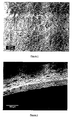
- the figure 1 is a photograph of the surface of the article according to Example 8 after calendering.
- the figure 2 is a photograph of the section of the article according to Example 8 after calendering.
- Table 2 describes the conditions of preparation of fibrids. ⁇ u> Table 2 ⁇ / u> Examples Proportion of PESU / polyamide imide Kermel® by weight (%) before precipitation Proportion of solvent in the coagulation bath by weight (%) 9 9.5 25 10 15 50 11 9.5 0 12 9.5 50
- the characteristics of the fibrids were measured on MORFI apparatus (conventional apparatus for measuring paper cellulosic fibers). Table 3 describes these characteristics. ⁇ u> Table 3 ⁇ / u> Examples 9 10 11 12 Length (mm) 0,315 0.431 0.351 0.289 Width ( ⁇ m) 40.2 44.6 49.7 30.3 Fine elements (% in length) 19.5 11.0 14.7 24.9 Fine element rate (% on the surface) 1.6 0.4 0.6 3.6
- the fibrids of Examples 9 to 12 were mixed with an equal weight of Kermel® polyamide imide fibers 6 mm in length. These four preparations were used to make paper on FRANK-type form apparatus wet and in a conventional paper-making process.
- the target density of the samples is 80g / m 2 .
- the characteristics of the papers are shown in Table 4.
- Retention rate ( % ) ( 1 - [ ( mass introduced ( boy Wut ) - mass after passage boy Wut ) / mass introduced boy Wut ] * 100 ⁇ u> Table 4 ⁇ / u> Examples fibrids Thickness in ⁇ m Mass introduced into the device (g) Mass after passing through the device (g) Retention rate (%) Grammage (g / m 2 ) Main (cm 3 / g) 13 Ex.9 199.6 2,506 2,448 98 77 2.6 14 Ex.10 238.8 2,516 2,478 98 81 2.9 15 Ex.11 199.5 2,517 2,342 93 74 2.7 16 Ex.12 191.3 2,525 2,500 99 77 2.5
Landscapes
- Engineering & Computer Science (AREA)
- Textile Engineering (AREA)
- Chemical & Material Sciences (AREA)
- Chemical Kinetics & Catalysis (AREA)
- General Chemical & Material Sciences (AREA)
- Paper (AREA)
- Artificial Filaments (AREA)
- Nonwoven Fabrics (AREA)
- Compositions Of Macromolecular Compounds (AREA)
Claims (19)
- Verfahren zur Herstellung eines verfestigten Artikels auf Faserbasis, dadurch gekennzeichnet, daß der Artikel wenigstens Fasern und/oder Fibride aufweist, die aus einem Polymergemisch gebildet sind, das wenigstens ein thermostabiles Polymer und ein thermoplastisches Polymer umfaßt, das aus der Gruppe der Polysulfide und der Polysulfone ausgewählt ist, und daß die Verfestigung des Artikels durch thermisches Pressen bei einer Temperatur oberhalb der Glasübergangstemperatur des thermoplastischen Polymers erreicht wird.
- Verfahren nach Anspruch 1, dadurch gekennzeichnet, daß das thermostabile Polymer aus den aromatischen Polyamiden, den aromatischen Polyamidimiden oder den Polyimiden ausgewählt ist.
- Verfahren nach Anspruch 1 oder 2, dadurch gekennzeichnet, daß das thermoplastische Polymer aus Polyethersulfon oder Polyphenylensulfon ausgewählt ist.
- Verfahren nach einem der vorhergehenden Ansprüche, dadurch gekennzeichnet, daß das thermoplastische Polymer und das thermostabile Polymer in einem gleichen Lösungsmittel löslich sind.
- Verfahren nach einem der vorhergehenden Ansprüche, dadurch gekennzeichnet, daß das Polymergemisch wenigstens 10 Gew.-% thermoplastisches Polymer enthält.
- Verfahren nach einem der vorhergehenden Ansprüche, dadurch gekennzeichnet, daß die Fasern durch Mischen des thermostabilen Polymers und des thermoplastischen Polymers, anschließend durch Spinnen des Gemischs erhalten werden.
- Verfahren nach Anspruch 6, dadurch gekennzeichnet, daß das Gemisch durch Auflösen der Polymere in einem Lösungsmittel hergestellt wird.
- Verfahren nach Anspruch 7, dadurch gekennzeichnet, daß das Lösungsmittel ein aprotisch polares Lösungsmittel ist.
- Verfahren nach Anspruch 8, dadurch gekennzeichnet, daß das Lösungsmittel aus DMEU, DMAC, NMP, DMF ausgewählt ist.
- Verfahren nach einem der Ansprüche 6 bis 8, dadurch gekennzeichnet, daß das Spinnen ein Naßspinnen ist.
- Verfahren nach einem der Ansprüche 6 bis 8, dadurch gekennzeichnet, daß das Spinnen ein Trockenspinnen ist.
- Verfahren nach einem der vorhergehenden Ansprüche, dadurch gekennzeichnet, daß die Fibride durch Mischen des thermostabilen Polymers und des thermoplastischen Polymers, anschließend durch Ausfällen des Gemischs unter Scherspannung erhalten werden.
- Verfahren nach einem der Ansprüche 1 bis 12, dadurch gekennzeichnet, daß das thermische Pressen unter Druck- und Temperaturbedingungen durchgeführt wird, die ein thermisches Kriechen wenigstens des thermoplastischen Polymers bewirken.
- Verfahren nach Anspruch 13, dadurch gekennzeichnet, daß während des thermischen Pressens die Temperatur zwischen der Glasübergangstemperatur und der Erweichungstemperatur des thermoplastischen Polymers liegt.
- Verfahren nach Anspruch 14, dadurch gekennzeichnet, daß während des thermischen Pressens die Temperatur zwischen 200 und 350°C liegt und der Druck größer oder gleich 5 bar ist.
- Verfahren nach Anspruch 1, dadurch gekennzeichnet, daß der Artikel ferner thermostabile Fasern und/oder Fibride, vor allem Para-Aramid-, Meta-Aramid- oder Polyamidimidfaserm umfaßt.
- Verfahren nach einem der Ansprüche 1 bis 16, dadurch gekennzeichnet, daß die Fasern einen Titer kleiner oder gleich 13.2 dtex aufweisen.
- Verwendung des mittels des Verfahrens nach einem der Ansprüche 1 bis 17 erhaltenen Artikels auf dem Gebiet der elektrischen Isolierung.
- Verwendung nach Anspruch 18, dadurch gekennzeichnet, daß der Artikel auch Mika aufweist.
Applications Claiming Priority (3)
| Application Number | Priority Date | Filing Date | Title |
|---|---|---|---|
| FR0210913 | 2002-09-04 | ||
| FR0210913A FR2843975B1 (fr) | 2002-09-04 | 2002-09-04 | Fibres et fibrides, leur procede d'obtention, articles obtenus a partir de ces fibres et/ou fibrides. |
| PCT/FR2003/002495 WO2004022823A2 (fr) | 2002-09-04 | 2003-08-08 | Articles comprenant des fibres, et/ou fibrides, fibres et fibrides et leur procede d'obtention |
Publications (2)
| Publication Number | Publication Date |
|---|---|
| EP1534883A2 EP1534883A2 (de) | 2005-06-01 |
| EP1534883B1 true EP1534883B1 (de) | 2009-02-25 |
Family
ID=31503090
Family Applications (1)
| Application Number | Title | Priority Date | Filing Date |
|---|---|---|---|
| EP20030753670 Expired - Lifetime EP1534883B1 (de) | 2002-09-04 | 2003-08-08 | Fasern und fibride enthaltende artikel, fasern und fibride und herstellungsverfahren |
Country Status (12)
| Country | Link |
|---|---|
| US (3) | US7459407B2 (de) |
| EP (1) | EP1534883B1 (de) |
| JP (1) | JP4596914B2 (de) |
| CN (1) | CN100335692C (de) |
| AT (1) | ATE423862T1 (de) |
| AU (1) | AU2003271832A1 (de) |
| DE (1) | DE60326358D1 (de) |
| ES (1) | ES2323687T3 (de) |
| FR (1) | FR2843975B1 (de) |
| RU (1) | RU2315827C2 (de) |
| TW (1) | TWI268968B (de) |
| WO (1) | WO2004022823A2 (de) |
Families Citing this family (21)
| Publication number | Priority date | Publication date | Assignee | Title |
|---|---|---|---|---|
| US7771638B2 (en) * | 2007-12-19 | 2010-08-10 | E. I. Du Pont De Nemours And Company | Rapid plasticization of quenched yarns |
| US7998575B2 (en) * | 2007-12-19 | 2011-08-16 | E.I. Du Pont De Nemours And Company | Low shrinkage, dyeable MPD-I yarn |
| US7771637B2 (en) | 2007-12-19 | 2010-08-10 | E. I. Du Pont De Nemours And Company | High-speed meta-aramid fiber production |
| WO2010083530A2 (en) * | 2009-01-16 | 2010-07-22 | Zeus Industrial Products, Inc. | Electrospinning of ptfe with high viscosity materials |
| RU2415221C1 (ru) * | 2010-04-30 | 2011-03-27 | Учреждение Российской академии наук Институт высокомолекулярных соединений РАН | Способ получения электроизоляционной бумаги |
| US20130337246A1 (en) * | 2012-06-15 | 2013-12-19 | 3M Innovative Properties Company | Electrical insulation material |
| US9314993B2 (en) * | 2013-03-15 | 2016-04-19 | National Nonwovens Inc. | Composites and articles made from nonwoven structures |
| US9314995B2 (en) | 2013-03-15 | 2016-04-19 | National Nonwovens Inc. | Composites comprising nonwoven structures and foam |
| US9663875B2 (en) * | 2013-10-30 | 2017-05-30 | Ei Du Pont De Nemours And Company | Sheets and fibrids comprising a mixture of poly(m-phenylene isophthalamide) and copolymer made from 5(6)-amino-2-(p-aminophenyl)benzimidazole |
| CN103774268B (zh) * | 2014-01-20 | 2016-05-11 | 江苏巨贤合成材料有限公司 | 一种聚酰胺酰亚胺沉析纤维的制备方法 |
| CN104846473B (zh) * | 2014-02-14 | 2016-05-25 | 上海特安纶纤维有限公司 | 一种基于芳香族聚酰胺和聚芳砜的共混纤维、纱线、织物、制品及其制备方法 |
| US9773583B2 (en) * | 2014-04-24 | 2017-09-26 | Essex Group, Inc. | Continously transposed conductor |
| CN104667630B (zh) * | 2015-01-14 | 2017-04-19 | 上海特安纶纤维有限公司 | 一种含砜基的共混型芳族聚酰胺纤维耐高温滤料及其制造方法 |
| CN104674405B (zh) * | 2015-01-14 | 2018-01-05 | 上海特安纶纤维有限公司 | 含砜基的共混型芳族聚酰胺纤维混合物及其制品 |
| CN104630957B (zh) * | 2015-02-13 | 2017-11-17 | 上海特安纶纤维有限公司 | 由一种基于芳香族聚酰胺和聚芳砜的共混纤维和聚苯硫醚纤维制成的纱线和织物及制备方法 |
| CN104630959B (zh) * | 2015-02-13 | 2018-03-02 | 上海特安纶纤维有限公司 | 包含一种基于芳香族聚酰胺和聚芳砜的共混纤维和纤维素纤维的纱线、织物及制备方法 |
| CN104611840B (zh) * | 2015-02-13 | 2018-05-01 | 上海特安纶纤维有限公司 | 包含芳香族聚酰胺和聚芳砜的混合聚合物纤维的絮片及其制备方法 |
| CN104651997B (zh) * | 2015-02-13 | 2018-05-01 | 上海特安纶纤维有限公司 | 包含一种含砜基的共混型芳族聚酰胺纤维的纤维混合物、及由其纱线、织物和制备方法 |
| CN104611839B (zh) * | 2015-02-13 | 2018-05-01 | 上海特安纶纤维有限公司 | 包含一种基于芳香族聚酰胺和聚芳砜的共混纤维和耐高温阻燃纤维的无纺织品及制备方法 |
| CN107287988B (zh) * | 2017-07-20 | 2019-04-02 | 清华大学 | 一种微/纳米复合纤维电气绝缘纸的制备方法 |
| CN109722945B (zh) * | 2018-11-30 | 2021-07-20 | 山东鲁南新材料股份有限公司 | 一种耐击穿复合电解电容器纸及其生产方法 |
Family Cites Families (33)
| Publication number | Priority date | Publication date | Assignee | Title |
|---|---|---|---|---|
| NL246230A (de) * | 1958-12-09 | |||
| BE704356A (de) * | 1966-09-29 | 1968-02-01 | ||
| US3534003A (en) * | 1968-05-08 | 1970-10-13 | Gen Electric | Polyamide imides prepared from aromatic cyclic sulfone amines and haloformylphthalic anhydrides |
| US3523061A (en) * | 1969-06-20 | 1970-08-04 | Minnesota Mining & Mfg | Porous sheet materials of mica and unfused staple fibers |
| US3985934A (en) * | 1974-07-26 | 1976-10-12 | The Upjohn Company | Polyimide fiber having a serrated surface and a process of producing same |
| AR204955A1 (es) * | 1975-03-14 | 1976-03-19 | Kendall & Co | Tela no tejida mejorada para uso como base reforzadora para aislacion electrica |
| DE3070426D1 (en) * | 1979-12-11 | 1985-05-09 | Asea Ab | Insulated electric conductor for windings of transformers and reactive coils |
| US5093435A (en) * | 1984-06-29 | 1992-03-03 | Amoco Corporation | Molded electrical device and composition therefore |
| JPS626958A (ja) * | 1985-07-03 | 1987-01-13 | 工業技術院長 | ポリマ−アロイ系積層体及びその製造法 |
| US4703081A (en) * | 1986-04-08 | 1987-10-27 | Phillips Petroleum Company | Poly(arylene sulfide) resin ternary blends |
| US4780359A (en) * | 1987-04-03 | 1988-10-25 | Gates Formed-Fibre Products, Inc. | Fire retardent structural textile panel |
| US4960549A (en) * | 1988-05-23 | 1990-10-02 | Amoco Corporation | Process for preparing polyamide-imide foam |
| JPH0226975A (ja) * | 1988-07-14 | 1990-01-29 | Teijin Ltd | 固綿 |
| JPH0247389A (ja) * | 1988-08-08 | 1990-02-16 | Teijin Ltd | 混抄紙 |
| JPH0225598U (de) * | 1988-08-08 | 1990-02-20 | ||
| JPH0252743U (de) * | 1988-10-06 | 1990-04-16 | ||
| US5011643A (en) * | 1989-04-13 | 1991-04-30 | E. I. Du Pont De Nemours And Company | Process for making oriented, shaped articles of para-aramid/thermally-consolidatable polymer blends |
| JP3110787B2 (ja) * | 1990-04-13 | 2000-11-20 | 三井化学株式会社 | 導電性ポリスルフォン樹脂組成物およびそれから得られる高耐熱導電性半導体用成形品 |
| JP2872756B2 (ja) * | 1990-05-30 | 1999-03-24 | 株式会社豊田中央研究所 | ポリイミド複合材料およびその製造方法 |
| US5149749A (en) * | 1990-05-31 | 1992-09-22 | Phillips Petroleum Company | Poly(phenylene sulfide) composition and articles having improved thermal stability at high temperatures |
| RU2056466C1 (ru) * | 1990-06-29 | 1996-03-20 | Карчмарчик Олег Семенович | Способ получения электропроводящих материалов |
| RU1779082C (ru) * | 1990-12-25 | 1995-03-27 | Акционерное общество открытого типа "ВНИИБ" | Бумажный материал, используемый в качестве электроизоляции и основы конструкционных композитов |
| RU2026439C1 (ru) * | 1991-07-01 | 1995-01-09 | Валерий Александрович Романов | Способ изготовления многослойного бумажного электроизоляционного материала |
| JPH05321026A (ja) | 1992-05-20 | 1993-12-07 | Toray Ind Inc | 耐熱性繊維 |
| US5295406A (en) * | 1992-09-23 | 1994-03-22 | Dana Corporation | Load lock for ball nut and screw mechanism |
| US5274875A (en) * | 1993-01-25 | 1994-01-04 | Chou Liao Ter | Displaceable rear windshield wiper incorporating trunk lid interaction and a rear brake light |
| US5917137A (en) * | 1993-10-19 | 1999-06-29 | L'air Liquide, Societe Anonyme Pour L'etude Et L'exploitation Des Procedes Georges Claude | Gas separation membranes of blends of polyethersulfones with aromatic polyimides |
| DE69433127T2 (de) * | 1993-10-19 | 2004-07-08 | L'Air Liquide, S.A. a Directoire et Conseil de Surveillance pour l'Etude et l'Exploitation des Procédés Georges Claude | Mischungen aus Polyethersulfonen und aromatischen Polyimiden, Polyamiden oder Polyamid-imiden und daraus hergestellte Gastrennmembranen |
| JPH07189169A (ja) * | 1993-12-27 | 1995-07-25 | Toyobo Co Ltd | 耐熱性機能紙の製造方法 |
| RU2086717C1 (ru) * | 1995-05-31 | 1997-08-10 | Товарищество с ограниченной ответственностью предприятие "Автохимэкс" | Полимерная композиция для получения пленок и волокон |
| JPH11222798A (ja) * | 1998-02-02 | 1999-08-17 | Oji Paper Co Ltd | プリント配線基板用基材、積層板及びそれらの製造方法 |
| KR100578777B1 (ko) * | 2000-08-04 | 2006-05-12 | 데이진 가부시키가이샤 | 내열성 섬유지 |
| JP4552315B2 (ja) * | 2000-12-07 | 2010-09-29 | 東レ株式会社 | 熱可塑性樹脂組成物およびその成形体 |
-
2002
- 2002-09-04 FR FR0210913A patent/FR2843975B1/fr not_active Expired - Fee Related
-
2003
- 2003-08-08 US US10/526,676 patent/US7459407B2/en not_active Expired - Fee Related
- 2003-08-08 JP JP2004533552A patent/JP4596914B2/ja not_active Expired - Fee Related
- 2003-08-08 EP EP20030753670 patent/EP1534883B1/de not_active Expired - Lifetime
- 2003-08-08 WO PCT/FR2003/002495 patent/WO2004022823A2/fr not_active Ceased
- 2003-08-08 AT AT03753670T patent/ATE423862T1/de active
- 2003-08-08 DE DE60326358T patent/DE60326358D1/de not_active Expired - Lifetime
- 2003-08-08 AU AU2003271832A patent/AU2003271832A1/en not_active Abandoned
- 2003-08-08 RU RU2005109419A patent/RU2315827C2/ru not_active IP Right Cessation
- 2003-08-08 CN CNB038211173A patent/CN100335692C/zh not_active Expired - Fee Related
- 2003-08-08 ES ES03753670T patent/ES2323687T3/es not_active Expired - Lifetime
- 2003-09-02 TW TW92124220A patent/TWI268968B/zh not_active IP Right Cessation
-
2008
- 2008-08-21 US US12/195,950 patent/US20080302495A1/en not_active Abandoned
-
2011
- 2011-06-08 US US13/156,027 patent/US8293042B2/en not_active Expired - Fee Related
Also Published As
| Publication number | Publication date |
|---|---|
| WO2004022823A3 (fr) | 2004-05-06 |
| US8293042B2 (en) | 2012-10-23 |
| CN1678776A (zh) | 2005-10-05 |
| JP2005538261A (ja) | 2005-12-15 |
| JP4596914B2 (ja) | 2010-12-15 |
| RU2005109419A (ru) | 2006-01-20 |
| US20120001359A1 (en) | 2012-01-05 |
| EP1534883A2 (de) | 2005-06-01 |
| DE60326358D1 (de) | 2009-04-09 |
| RU2315827C2 (ru) | 2008-01-27 |
| TWI268968B (en) | 2006-12-21 |
| TW200419024A (en) | 2004-10-01 |
| US20080302495A1 (en) | 2008-12-11 |
| FR2843975A1 (fr) | 2004-03-05 |
| WO2004022823A2 (fr) | 2004-03-18 |
| US20060105157A1 (en) | 2006-05-18 |
| AU2003271832A8 (en) | 2004-03-29 |
| FR2843975B1 (fr) | 2008-11-14 |
| AU2003271832A1 (en) | 2004-03-29 |
| US7459407B2 (en) | 2008-12-02 |
| ATE423862T1 (de) | 2009-03-15 |
| ES2323687T3 (es) | 2009-07-23 |
| CN100335692C (zh) | 2007-09-05 |
Similar Documents
| Publication | Publication Date | Title |
|---|---|---|
| EP1534883A2 (de) | Fasern und fibride enthaltende artikel, fasern und fibride und herstellungsverfahren | |
| EP3418323B1 (de) | Fasermaterial, das mit thermoplastischem polymer imprägniert ist | |
| WO2018115736A1 (fr) | Procédé de fabrication d'un matériau fibreux pré-imprégné de polymère thermoplastique en lit fluidise | |
| EP3768768B1 (de) | Fasermaterial impregniert mit thermoplastischem polymer und mit einer dicke von weniger als oder gleich 100 mikrometer, und sein herstellungsverfahren | |
| EP0267092B1 (de) | Papier aus Glasfasern | |
| EP3887115B1 (de) | Verfahren zum imprägnieren eines fasermaterials in einem durchdrungenen fliessbett | |
| TWI604100B (zh) | 包含氟樹脂纖維之氟樹脂系薄片及其製造方法 | |
| EP3670128B1 (de) | Herstellungsverfahren eines fasermaterials, das mit thermoplastischem polymer in einer wirbelschicht vorimprägniert ist | |
| JP7826935B2 (ja) | ポリフェニレンスルフィド繊維不織布およびこれを含む隔膜 | |
| JPH03891A (ja) | ポリフェニレンスルフィド繊維からなる紙状材とその製造方法 | |
| JP7334623B2 (ja) | 共重合ポリフェニレンスルフィド繊維 | |
| JP7259360B2 (ja) | 液晶ポリエステル繊維からなる不織布 | |
| EP3640398B1 (de) | Metaaramid und polyphenylensulfid enthaltender nassvliesstoff und mehrlagige schicht daraus | |
| JP3612689B2 (ja) | 耐熱性濾布 | |
| WO2020126997A1 (fr) | Procede de fabrication d'un materiau fibreux pre-impregne de polymere thermoplastique en lit fluidise | |
| US20240337045A1 (en) | Fibers and composites using tailored natural fiber precursor materials | |
| FR2480798A1 (fr) | Procede de filature d'une fibre de poly(polymethylene terephtalamide) ou de polyamide 4 | |
| WO2021050078A1 (en) | Method of forming a composite, and associated composite and apparatus |
Legal Events
| Date | Code | Title | Description |
|---|---|---|---|
| PUAI | Public reference made under article 153(3) epc to a published international application that has entered the european phase |
Free format text: ORIGINAL CODE: 0009012 |
|
| 17P | Request for examination filed |
Effective date: 20050215 |
|
| AK | Designated contracting states |
Kind code of ref document: A2 Designated state(s): AT BE BG CH CY CZ DE DK EE ES FI FR GB GR HU IE IT LI LU MC NL PT RO SE SI SK TR |
|
| AX | Request for extension of the european patent |
Extension state: AL LT LV MK |
|
| DAX | Request for extension of the european patent (deleted) | ||
| 17Q | First examination report despatched |
Effective date: 20071018 |
|
| GRAP | Despatch of communication of intention to grant a patent |
Free format text: ORIGINAL CODE: EPIDOSNIGR1 |
|
| GRAS | Grant fee paid |
Free format text: ORIGINAL CODE: EPIDOSNIGR3 |
|
| GRAA | (expected) grant |
Free format text: ORIGINAL CODE: 0009210 |
|
| AK | Designated contracting states |
Kind code of ref document: B1 Designated state(s): AT BE BG CH CY CZ DE DK EE ES FI FR GB GR HU IE IT LI LU MC NL PT RO SE SI SK TR |
|
| REG | Reference to a national code |
Ref country code: GB Ref legal event code: FG4D Free format text: NOT ENGLISH |
|
| REG | Reference to a national code |
Ref country code: CH Ref legal event code: EP |
|
| REG | Reference to a national code |
Ref country code: IE Ref legal event code: FG4D Free format text: LANGUAGE OF EP DOCUMENT: FRENCH |
|
| REF | Corresponds to: |
Ref document number: 60326358 Country of ref document: DE Date of ref document: 20090409 Kind code of ref document: P |
|
| REG | Reference to a national code |
Ref country code: ES Ref legal event code: FG2A Ref document number: 2323687 Country of ref document: ES Kind code of ref document: T3 |
|
| PG25 | Lapsed in a contracting state [announced via postgrant information from national office to epo] |
Ref country code: SI Free format text: LAPSE BECAUSE OF FAILURE TO SUBMIT A TRANSLATION OF THE DESCRIPTION OR TO PAY THE FEE WITHIN THE PRESCRIBED TIME-LIMIT Effective date: 20090225 Ref country code: FI Free format text: LAPSE BECAUSE OF FAILURE TO SUBMIT A TRANSLATION OF THE DESCRIPTION OR TO PAY THE FEE WITHIN THE PRESCRIBED TIME-LIMIT Effective date: 20090225 |
|
| PG25 | Lapsed in a contracting state [announced via postgrant information from national office to epo] |
Ref country code: SE Free format text: LAPSE BECAUSE OF FAILURE TO SUBMIT A TRANSLATION OF THE DESCRIPTION OR TO PAY THE FEE WITHIN THE PRESCRIBED TIME-LIMIT Effective date: 20090525 |
|
| REG | Reference to a national code |
Ref country code: IE Ref legal event code: FD4D |
|
| PG25 | Lapsed in a contracting state [announced via postgrant information from national office to epo] |
Ref country code: CZ Free format text: LAPSE BECAUSE OF FAILURE TO SUBMIT A TRANSLATION OF THE DESCRIPTION OR TO PAY THE FEE WITHIN THE PRESCRIBED TIME-LIMIT Effective date: 20090225 Ref country code: EE Free format text: LAPSE BECAUSE OF FAILURE TO SUBMIT A TRANSLATION OF THE DESCRIPTION OR TO PAY THE FEE WITHIN THE PRESCRIBED TIME-LIMIT Effective date: 20090225 Ref country code: DK Free format text: LAPSE BECAUSE OF FAILURE TO SUBMIT A TRANSLATION OF THE DESCRIPTION OR TO PAY THE FEE WITHIN THE PRESCRIBED TIME-LIMIT Effective date: 20090225 Ref country code: PT Free format text: LAPSE BECAUSE OF FAILURE TO SUBMIT A TRANSLATION OF THE DESCRIPTION OR TO PAY THE FEE WITHIN THE PRESCRIBED TIME-LIMIT Effective date: 20090812 Ref country code: IE Free format text: LAPSE BECAUSE OF FAILURE TO SUBMIT A TRANSLATION OF THE DESCRIPTION OR TO PAY THE FEE WITHIN THE PRESCRIBED TIME-LIMIT Effective date: 20090225 |
|
| PG25 | Lapsed in a contracting state [announced via postgrant information from national office to epo] |
Ref country code: SK Free format text: LAPSE BECAUSE OF FAILURE TO SUBMIT A TRANSLATION OF THE DESCRIPTION OR TO PAY THE FEE WITHIN THE PRESCRIBED TIME-LIMIT Effective date: 20090225 Ref country code: RO Free format text: LAPSE BECAUSE OF FAILURE TO SUBMIT A TRANSLATION OF THE DESCRIPTION OR TO PAY THE FEE WITHIN THE PRESCRIBED TIME-LIMIT Effective date: 20090225 |
|
| PLBE | No opposition filed within time limit |
Free format text: ORIGINAL CODE: 0009261 |
|
| STAA | Information on the status of an ep patent application or granted ep patent |
Free format text: STATUS: NO OPPOSITION FILED WITHIN TIME LIMIT |
|
| PG25 | Lapsed in a contracting state [announced via postgrant information from national office to epo] |
Ref country code: BG Free format text: LAPSE BECAUSE OF FAILURE TO SUBMIT A TRANSLATION OF THE DESCRIPTION OR TO PAY THE FEE WITHIN THE PRESCRIBED TIME-LIMIT Effective date: 20090525 |
|
| 26N | No opposition filed |
Effective date: 20091126 |
|
| BERE | Be: lapsed |
Owner name: KERMEL Effective date: 20090831 |
|
| PG25 | Lapsed in a contracting state [announced via postgrant information from national office to epo] |
Ref country code: MC Free format text: LAPSE BECAUSE OF NON-PAYMENT OF DUE FEES Effective date: 20090831 |
|
| REG | Reference to a national code |
Ref country code: CH Ref legal event code: PL |
|
| PG25 | Lapsed in a contracting state [announced via postgrant information from national office to epo] |
Ref country code: LI Free format text: LAPSE BECAUSE OF NON-PAYMENT OF DUE FEES Effective date: 20090831 Ref country code: CH Free format text: LAPSE BECAUSE OF NON-PAYMENT OF DUE FEES Effective date: 20090831 |
|
| PG25 | Lapsed in a contracting state [announced via postgrant information from national office to epo] |
Ref country code: BE Free format text: LAPSE BECAUSE OF NON-PAYMENT OF DUE FEES Effective date: 20090831 |
|
| PG25 | Lapsed in a contracting state [announced via postgrant information from national office to epo] |
Ref country code: GR Free format text: LAPSE BECAUSE OF FAILURE TO SUBMIT A TRANSLATION OF THE DESCRIPTION OR TO PAY THE FEE WITHIN THE PRESCRIBED TIME-LIMIT Effective date: 20090526 |
|
| PG25 | Lapsed in a contracting state [announced via postgrant information from national office to epo] |
Ref country code: LU Free format text: LAPSE BECAUSE OF NON-PAYMENT OF DUE FEES Effective date: 20090808 |
|
| PG25 | Lapsed in a contracting state [announced via postgrant information from national office to epo] |
Ref country code: HU Free format text: LAPSE BECAUSE OF FAILURE TO SUBMIT A TRANSLATION OF THE DESCRIPTION OR TO PAY THE FEE WITHIN THE PRESCRIBED TIME-LIMIT Effective date: 20090826 |
|
| PG25 | Lapsed in a contracting state [announced via postgrant information from national office to epo] |
Ref country code: TR Free format text: LAPSE BECAUSE OF FAILURE TO SUBMIT A TRANSLATION OF THE DESCRIPTION OR TO PAY THE FEE WITHIN THE PRESCRIBED TIME-LIMIT Effective date: 20090225 |
|
| PG25 | Lapsed in a contracting state [announced via postgrant information from national office to epo] |
Ref country code: CY Free format text: LAPSE BECAUSE OF FAILURE TO SUBMIT A TRANSLATION OF THE DESCRIPTION OR TO PAY THE FEE WITHIN THE PRESCRIBED TIME-LIMIT Effective date: 20090225 |
|
| REG | Reference to a national code |
Ref country code: FR Ref legal event code: PLFP Year of fee payment: 14 |
|
| PGFP | Annual fee paid to national office [announced via postgrant information from national office to epo] |
Ref country code: NL Payment date: 20160711 Year of fee payment: 14 |
|
| PGFP | Annual fee paid to national office [announced via postgrant information from national office to epo] |
Ref country code: IT Payment date: 20160818 Year of fee payment: 14 Ref country code: DE Payment date: 20160817 Year of fee payment: 14 Ref country code: GB Payment date: 20160823 Year of fee payment: 14 |
|
| PGFP | Annual fee paid to national office [announced via postgrant information from national office to epo] |
Ref country code: FR Payment date: 20160808 Year of fee payment: 14 Ref country code: AT Payment date: 20160721 Year of fee payment: 14 |
|
| PGFP | Annual fee paid to national office [announced via postgrant information from national office to epo] |
Ref country code: ES Payment date: 20160830 Year of fee payment: 14 |
|
| REG | Reference to a national code |
Ref country code: DE Ref legal event code: R119 Ref document number: 60326358 Country of ref document: DE |
|
| REG | Reference to a national code |
Ref country code: NL Ref legal event code: MM Effective date: 20170901 |
|
| REG | Reference to a national code |
Ref country code: AT Ref legal event code: MM01 Ref document number: 423862 Country of ref document: AT Kind code of ref document: T Effective date: 20170808 |
|
| GBPC | Gb: european patent ceased through non-payment of renewal fee |
Effective date: 20170808 |
|
| REG | Reference to a national code |
Ref country code: FR Ref legal event code: ST Effective date: 20180430 |
|
| PG25 | Lapsed in a contracting state [announced via postgrant information from national office to epo] |
Ref country code: AT Free format text: LAPSE BECAUSE OF NON-PAYMENT OF DUE FEES Effective date: 20170808 |
|
| PG25 | Lapsed in a contracting state [announced via postgrant information from national office to epo] |
Ref country code: NL Free format text: LAPSE BECAUSE OF NON-PAYMENT OF DUE FEES Effective date: 20170901 |
|
| PG25 | Lapsed in a contracting state [announced via postgrant information from national office to epo] |
Ref country code: GB Free format text: LAPSE BECAUSE OF NON-PAYMENT OF DUE FEES Effective date: 20170808 Ref country code: DE Free format text: LAPSE BECAUSE OF NON-PAYMENT OF DUE FEES Effective date: 20180301 |
|
| PG25 | Lapsed in a contracting state [announced via postgrant information from national office to epo] |
Ref country code: FR Free format text: LAPSE BECAUSE OF NON-PAYMENT OF DUE FEES Effective date: 20170831 Ref country code: IT Free format text: LAPSE BECAUSE OF NON-PAYMENT OF DUE FEES Effective date: 20170808 |
|
| REG | Reference to a national code |
Ref country code: ES Ref legal event code: FD2A Effective date: 20181029 |
|
| PG25 | Lapsed in a contracting state [announced via postgrant information from national office to epo] |
Ref country code: ES Free format text: LAPSE BECAUSE OF NON-PAYMENT OF DUE FEES Effective date: 20170809 |