EP1534883B1 - Articles comprising fibres and/or fibrids, fibres and fibrids and production method of same - Google Patents
Articles comprising fibres and/or fibrids, fibres and fibrids and production method of same Download PDFInfo
- Publication number
- EP1534883B1 EP1534883B1 EP20030753670 EP03753670A EP1534883B1 EP 1534883 B1 EP1534883 B1 EP 1534883B1 EP 20030753670 EP20030753670 EP 20030753670 EP 03753670 A EP03753670 A EP 03753670A EP 1534883 B1 EP1534883 B1 EP 1534883B1
- Authority
- EP
- European Patent Office
- Prior art keywords
- fibers
- polymer
- article
- fibrids
- thermoplastic polymer
- Prior art date
- Legal status (The legal status is an assumption and is not a legal conclusion. Google has not performed a legal analysis and makes no representation as to the accuracy of the status listed.)
- Expired - Lifetime
Links
Images
Classifications
-
- D—TEXTILES; PAPER
- D04—BRAIDING; LACE-MAKING; KNITTING; TRIMMINGS; NON-WOVEN FABRICS
- D04H—MAKING TEXTILE FABRICS, e.g. FROM FIBRES OR FILAMENTARY MATERIAL; FABRICS MADE BY SUCH PROCESSES OR APPARATUS, e.g. FELTS, NON-WOVEN FABRICS; COTTON-WOOL; WADDING ; NON-WOVEN FABRICS FROM STAPLE FIBRES, FILAMENTS OR YARNS, BONDED WITH AT LEAST ONE WEB-LIKE MATERIAL DURING THEIR CONSOLIDATION
- D04H1/00—Non-woven fabrics formed wholly or mainly of staple fibres or like relatively short fibres
- D04H1/70—Non-woven fabrics formed wholly or mainly of staple fibres or like relatively short fibres characterised by the method of forming fleeces or layers, e.g. reorientation of fibres
- D04H1/72—Non-woven fabrics formed wholly or mainly of staple fibres or like relatively short fibres characterised by the method of forming fleeces or layers, e.g. reorientation of fibres the fibres being randomly arranged
- D04H1/728—Non-woven fabrics formed wholly or mainly of staple fibres or like relatively short fibres characterised by the method of forming fleeces or layers, e.g. reorientation of fibres the fibres being randomly arranged by electro-spinning
-
- D—TEXTILES; PAPER
- D01—NATURAL OR MAN-MADE THREADS OR FIBRES; SPINNING
- D01F—CHEMICAL FEATURES IN THE MANUFACTURE OF ARTIFICIAL FILAMENTS, THREADS, FIBRES, BRISTLES OR RIBBONS; APPARATUS SPECIALLY ADAPTED FOR THE MANUFACTURE OF CARBON FILAMENTS
- D01F6/00—Monocomponent artificial filaments or the like of synthetic polymers; Manufacture thereof
- D01F6/88—Monocomponent artificial filaments or the like of synthetic polymers; Manufacture thereof from mixtures of polycondensation products as major constituent with other polymers or low-molecular-weight compounds
- D01F6/90—Monocomponent artificial filaments or the like of synthetic polymers; Manufacture thereof from mixtures of polycondensation products as major constituent with other polymers or low-molecular-weight compounds of polyamides
- D01F6/905—Monocomponent artificial filaments or the like of synthetic polymers; Manufacture thereof from mixtures of polycondensation products as major constituent with other polymers or low-molecular-weight compounds of polyamides of aromatic polyamides
-
- D—TEXTILES; PAPER
- D01—NATURAL OR MAN-MADE THREADS OR FIBRES; SPINNING
- D01F—CHEMICAL FEATURES IN THE MANUFACTURE OF ARTIFICIAL FILAMENTS, THREADS, FIBRES, BRISTLES OR RIBBONS; APPARATUS SPECIALLY ADAPTED FOR THE MANUFACTURE OF CARBON FILAMENTS
- D01F6/00—Monocomponent artificial filaments or the like of synthetic polymers; Manufacture thereof
- D01F6/88—Monocomponent artificial filaments or the like of synthetic polymers; Manufacture thereof from mixtures of polycondensation products as major constituent with other polymers or low-molecular-weight compounds
- D01F6/94—Monocomponent artificial filaments or the like of synthetic polymers; Manufacture thereof from mixtures of polycondensation products as major constituent with other polymers or low-molecular-weight compounds of other polycondensation products
-
- D—TEXTILES; PAPER
- D04—BRAIDING; LACE-MAKING; KNITTING; TRIMMINGS; NON-WOVEN FABRICS
- D04H—MAKING TEXTILE FABRICS, e.g. FROM FIBRES OR FILAMENTARY MATERIAL; FABRICS MADE BY SUCH PROCESSES OR APPARATUS, e.g. FELTS, NON-WOVEN FABRICS; COTTON-WOOL; WADDING ; NON-WOVEN FABRICS FROM STAPLE FIBRES, FILAMENTS OR YARNS, BONDED WITH AT LEAST ONE WEB-LIKE MATERIAL DURING THEIR CONSOLIDATION
- D04H1/00—Non-woven fabrics formed wholly or mainly of staple fibres or like relatively short fibres
- D04H1/40—Non-woven fabrics formed wholly or mainly of staple fibres or like relatively short fibres from fleeces or layers composed of fibres without existing or potential cohesive properties
- D04H1/54—Non-woven fabrics formed wholly or mainly of staple fibres or like relatively short fibres from fleeces or layers composed of fibres without existing or potential cohesive properties by welding together the fibres, e.g. by partially melting or dissolving
-
- D—TEXTILES; PAPER
- D21—PAPER-MAKING; PRODUCTION OF CELLULOSE
- D21H—PULP COMPOSITIONS; PREPARATION THEREOF NOT COVERED BY SUBCLASSES D21C OR D21D; IMPREGNATING OR COATING OF PAPER; TREATMENT OF FINISHED PAPER NOT COVERED BY CLASS B31 OR SUBCLASS D21G; PAPER NOT OTHERWISE PROVIDED FOR
- D21H15/00—Pulp or paper, comprising fibres or web-forming material characterised by features other than their chemical constitution
- D21H15/02—Pulp or paper, comprising fibres or web-forming material characterised by features other than their chemical constitution characterised by configuration
- D21H15/10—Composite fibres
-
- Y—GENERAL TAGGING OF NEW TECHNOLOGICAL DEVELOPMENTS; GENERAL TAGGING OF CROSS-SECTIONAL TECHNOLOGIES SPANNING OVER SEVERAL SECTIONS OF THE IPC; TECHNICAL SUBJECTS COVERED BY FORMER USPC CROSS-REFERENCE ART COLLECTIONS [XRACs] AND DIGESTS
- Y10—TECHNICAL SUBJECTS COVERED BY FORMER USPC
- Y10T—TECHNICAL SUBJECTS COVERED BY FORMER US CLASSIFICATION
- Y10T292/00—Closure fasteners
- Y10T292/03—Miscellaneous
-
- Y—GENERAL TAGGING OF NEW TECHNOLOGICAL DEVELOPMENTS; GENERAL TAGGING OF CROSS-SECTIONAL TECHNOLOGIES SPANNING OVER SEVERAL SECTIONS OF THE IPC; TECHNICAL SUBJECTS COVERED BY FORMER USPC CROSS-REFERENCE ART COLLECTIONS [XRACs] AND DIGESTS
- Y10—TECHNICAL SUBJECTS COVERED BY FORMER USPC
- Y10T—TECHNICAL SUBJECTS COVERED BY FORMER US CLASSIFICATION
- Y10T428/00—Stock material or miscellaneous articles
- Y10T428/249921—Web or sheet containing structurally defined element or component
- Y10T428/249924—Noninterengaged fiber-containing paper-free web or sheet which is not of specified porosity
-
- Y—GENERAL TAGGING OF NEW TECHNOLOGICAL DEVELOPMENTS; GENERAL TAGGING OF CROSS-SECTIONAL TECHNOLOGIES SPANNING OVER SEVERAL SECTIONS OF THE IPC; TECHNICAL SUBJECTS COVERED BY FORMER USPC CROSS-REFERENCE ART COLLECTIONS [XRACs] AND DIGESTS
- Y10—TECHNICAL SUBJECTS COVERED BY FORMER USPC
- Y10T—TECHNICAL SUBJECTS COVERED BY FORMER US CLASSIFICATION
- Y10T442/00—Fabric [woven, knitted, or nonwoven textile or cloth, etc.]
- Y10T442/60—Nonwoven fabric [i.e., nonwoven strand or fiber material]
- Y10T442/637—Including strand or fiber material which is a monofilament composed of two or more polymeric materials in physically distinct relationship [e.g., sheath-core, side-by-side, islands-in-sea, fibrils-in-matrix, etc.] or composed of physical blend of chemically different polymeric materials or a physical blend of a polymeric material and a filler material
-
- Y—GENERAL TAGGING OF NEW TECHNOLOGICAL DEVELOPMENTS; GENERAL TAGGING OF CROSS-SECTIONAL TECHNOLOGIES SPANNING OVER SEVERAL SECTIONS OF THE IPC; TECHNICAL SUBJECTS COVERED BY FORMER USPC CROSS-REFERENCE ART COLLECTIONS [XRACs] AND DIGESTS
- Y10—TECHNICAL SUBJECTS COVERED BY FORMER USPC
- Y10T—TECHNICAL SUBJECTS COVERED BY FORMER US CLASSIFICATION
- Y10T442/00—Fabric [woven, knitted, or nonwoven textile or cloth, etc.]
- Y10T442/60—Nonwoven fabric [i.e., nonwoven strand or fiber material]
- Y10T442/69—Autogenously bonded nonwoven fabric
Definitions
- the present invention relates in particular to new articles, in particular nonwoven articles comprising fibers and / or fibrids. It also relates to new fibers and fibrids and a process for obtaining these fibers and fibrids.
- thermostable fibers In the field of electrical insulation in particular, it is sought to obtain products having good temperature resistance and good mechanical properties and / or good dielectric properties. These products may for example be nonwoven articles made from thermostable fibers. In such an article, a good cohesion of thermostable fibers is necessary to obtain a good level of mechanical properties, or even a homogeneous and dense structure of the article for obtaining dielectric properties. For this purpose, it is sought to obtain good cohesion of thermostable fibers at the article. It is also sought to obtain a homogeneous and compact structure at the article level.
- These articles according to their structure (in particular their density) and / or their formulation, can have a function of mechanical and / or dielectric reinforcement.
- the document FR 2 163 383 proposes to prepare non-woven articles constituted by a sheet of fibers based on an infusible material or having a melting point greater than 180 ° C., the fibers being bound together by means of a polyamide-imide binder, used in proportion of 5 to 150% of the weight of dry fibers used. But the impregnation of the resin is in solution in a solvent, which has the consequence of adverse effects on the characteristics of the nonwovens.
- the document FR 2 156 452 proposes the wet preparation of nonwoven webs of fibers consisting of infusible material or having a melting point greater than 180 ° C, bonded together by powdered thermoplastic polymer.
- the document FR 2,685,363 proposes to prepare by wet paper made of fibers having a thermal resistance greater than or equal to 180 ° C, bonded together by means of a fibrous binder and a chemical binder.
- gaseous separation membrane in the form of a film or hollow fibers, which is formed from a mixture of polyethersulfones with polyimides, polyamides or polyamide-imides.
- hollow fibers they are assembled using a binder, containing an epoxy resin.
- binders to ensure the cohesion of the fibers in articles such as non-woven entails particular difficulties and costs in the implementation of these binders.
- the subject of the present invention is a process for the manufacture of articles consisting in particular of non-woven articles, not having the above-mentioned drawbacks, which method comprises the features of claim 1.
- the thermoplastic part of the fiber or fibride of the In particular, the invention plays the role of the chemical binder described above. It has the property of "flowing" under pressure and temperature constraints. Thus the cohesion of thermostable fibers in these articles is ensured, their level of thermal and mechanical properties is very satisfactory.
- These articles can have a homogeneous and dense structure, and therefore a good level of dielectric properties.
- the invention proposes the use of the articles obtained by the above method in the field of electrical insulation.
- thermostable polymer of the invention is preferably infusible or has a glass transition temperature greater than 180 ° C, preferably greater than or equal to 230 ° C, or higher.
- the thermostable polymer of the invention has a thermal resistance (that is to say a conservation of its physical properties in particular) long-term at a temperature above 180 ° C.
- This thermostable polymer is preferably chosen from polyaramids and polyimides.
- polyaramids include aromatic polyamides such as the polymer known under the trade name Nomex®, or polyamide imides such as the polymer known under the trade name Kermel®.
- polyimides that may be mentioned are the polyimides obtained according to the document EP 0119185 , known under the trade name P84®.
- the aromatic polyamides can be as described in the patent EP 0360707 . They can be obtained according to the process described in the patent EP 0360707 .
- the thermoplastic polymer is selected from the group of polysulfides and polysulfones.
- polysulfide there may be mentioned polyphenylene sulphide noted PPS thereafter.
- polysulfones noted PSU thereafter mention may be made of the polyether sulfone noted PESU later or polyphenylene sulfone noted PPSU thereafter.
- thermoplastic polymers have a glass transition temperature of less than or equal to 250 ° C., which enables them to act in particular as a chemical binder in the articles of the invention and to "flow" under pressure and temperature stress. These polymers also have good thermostability because they belong to a thermal class (thermal index) greater than 130 ° C. This has an advantage for obtaining articles having good thermostability.
- the thermoplastic polymer and the thermostable polymer are soluble in the same solvent.
- the solvent is polar aprotic. It is more preferably chosen from DMEU, DMAC, NMP, DMF.
- the fiber or fibride according to the invention comprises at least 10% by weight of thermoplastic polymer.
- Fibrides are small non-granular fibrous or film-like particles that are not rigid. Two of their three dimensions are of the order of a few microns. Their small size and flexibility allow them to be deposited in physically interwoven configurations such as those commonly found in pulp papers.
- the fiber according to the invention preferably has a titer of between 0.5 dtex and 13.2 dtex.
- the fiber of the invention preferably has a length of between 1 and 100 mm.
- the fiber according to the invention may have various section shapes such as a round, trilobed, "flat" shape.
- fiber of flat section is meant a fiber whose length / width ratio is greater than or equal to 2.
- the fiber or fibride according to the invention can be treated by sizing.
- the fibers are obtained by mixing the thermostable polymer and the thermoplastic polymer, and then spinning the mixture.
- the polymer mixture is obtained by dissolving the polymers in at least one common solvent.
- the thermoplastic polymer and the heat-stable polymer may be dissolved together, simultaneously or successively in a solvent or a mixture of solvents miscible with each other, in a single reactor for example.
- the polymers can also be dissolved separately in the same solvent or in different solvents miscible with each other, for example in two different containers, then the polymer solutions mixed together.
- the dissolution conditions such as temperature, are determined by those skilled in the art depending on the nature of the polymers and the solvent (s) used.
- the dissolution may for example be carried out hot, with stirring, to facilitate dissolution.
- the dissolution can be carried out at room temperature.
- the dissolution temperature is between 50 and 150 ° C.
- the dissolution solvent (s) is (are) advantageously an aprotic polar solvent.
- Dimethylalkylene urea for example dimethylethylene urea (DMEU) or dimethylpropylene urea, may be used. Preferably it is selected from DMEU, dimethylacetamide (DMAC), N-methyl pyrrolidone (NMP), dimethylformamide (DMF).
- the dissolution solvent can be a mixture of aprotic polar solvents, for example a mixture of dimethylethylene urea and an anhydrous aprotic polar solvent such as NMP, DMAC, DMF, tetramethylurea or ⁇ -butyrolactone.
- the solution of polymers obtained after dissolution is called collodion.
- the resulting solution is preferably clear.
- the total concentration by weight of the polymers relative to the solution is preferably between 5 and 40%.
- the solution may also include additives such as pigments, reinforcing agents, stabilizers, mattifying agents.
- the solution must also have a viscosity allowing its spinning, generally between 100 and 1000 poise.
- the viscosity is preferably between 400 and 800 poises measured using a viscometer known in the trade under the trademark EPPRECHT RHEOMAT 15.
- the viscosity is preferably between 1500 and 3000 poise.
- the polymer mixture can also be made in line during the spinning step, for example by online injection of each polymer-whether or not dissolved in a solvent-during the spinning process.
- Dry spinning for example, in which the solution of polymers (fibrogenic substance in the solution state) is extruded through capillaries in an environment favorable to the elimination of the solvent, for example in an evaporating atmosphere maintained at a temperature near or above the boiling point of the solvent, allowing the solidification of the filaments.
- the filaments leaving the evaporation chamber are freed of their residual solvent.
- they can be washed with water, possibly boiling and under pressure; dried in the usual manner, preferably at a temperature above 80 ° C. They can also be heat treated at a temperature greater than or equal to 160 ° C under reduced pressure, and / or under an inert atmosphere. After being freed from their residual solvent, they may be drawn for example at a temperature above 250.degree. C., preferably above 300.degree. C., preferably in the absence of oxygen.
- the spinning method is a wet spinning, in which the polymer solution (fibrogenic substance solution) is extruded into a coagulating bath.
- the temperature of the spinning solution can vary within wide limits depending on the viscosity of the solution to be spun.
- a solution having a low viscosity can easily be extruded at ordinary temperature, while it is preferable to extrude hot, for example at 120 ° C or even higher, a solution of high viscosity to avoid using too much. great pressures in the sector.
- the spinning solution is advantageously maintained between 15 and 40 ° C, preferably between 15 and 25 ° C.
- the coagulant bath used in the process according to the invention is preferably an aqueous solution containing from 30 to 80% by weight, preferably from 40 to 70% by weight of a solvent or solvent mixture, preferably a dimethylalkylene urea (DMAU ) or DMF or their mixture, although it is often advantageous to use a bath containing more than 50% by weight of solvent to obtain filaments of better stretchability, thus better final properties.
- a solvent or solvent mixture preferably a dimethylalkylene urea (DMAU ) or DMF or their mixture
- the polymers of the solution to be spun have close coagulation rates.
- the spinning speed in the coagulant bath can vary within wide limits, depending on its solvent concentration and the distance of the filaments in this bath.
- This spinning rate in the coagulant bath can be easily selected between 10 and 60 m / min, for example, although higher speeds can be achieved. It is generally not advantageous to spin at lower speeds for reasons of cost efficiency of the process. Moreover, too high speeds of spinning in the coagulant bath reduce the stretchability of the filaments in the air. The spinning speed in the coagulant bath will therefore be chosen to take into account both the profitability and the desired qualities on the finished filament.
- the filaments emerging from the coagulating bath in the gel state are then stretched, for example in air, at a rate defined by the ratio (V 2 / V 1) * 100, V 2 being the speed of the drawing rolls, V 1 that delivery rollers.
- the stretching rate of the son in the gel state is greater than 100%, preferably greater than or equal to 110% or even greater, for example greater than or equal to 200%.
- the residual solvent of the filaments is removed by known means, generally by means of a washing with water flowing against the current or on washing rollers, preferably at room temperature.
- the spinning method is dry spinning.
- the washed filaments are then dried by known means, for example in a drier or on rollers.
- the temperature of this drying can vary within wide limits as well as the speed which is greater as the temperature is higher. It is generally advantageous to perform a drying with gradual rise in temperature, this temperature being able to reach and even exceed 200 ° C. for example.
- the filaments can then undergo a warm overetching to improve their mechanical properties and in particular their toughness, which can be interesting for some jobs.
- This hot stretching can be carried out by any known means: oven, plate, roller, roller and plate, preferably in a closed enclosure. It is carried out at a temperature of at least 150 ° C, which can reach and even exceed 200 to 300 ° C. Its rate is generally at least 150% but it can vary within wide limits depending on the qualities desired for the finished yarn. The total draw ratio is then at least 250%, preferably at least 260%.
- the stretching assembly and optionally super stretching can be carried out in one or more stages, continuously or discontinuously with the previous operations.
- overdrawing can be combined with drying. For this purpose, it is sufficient to provide, at the end of the drying, a zone of higher temperature which makes it possible to overetch.
- the filaments obtained are then cut in the form of fibers according to a method known to those skilled in the art
- the fibrids are obtained by mixing the thermostable polymer and the thermoplastic polymer, and then precipitating the mixture under shear stress.
- the mixture of the thermostable polymer and the thermoplastic polymer may be made in a manner analogous to that described above for the fibers.
- the fibrids of the invention can in particular be obtained by precipitating a solution of polymers in a fibridation apparatus of the type described in the patent US 3,018,091 wherein the polymers are sheared as they precipitate.
- the articles are nonwoven articles.
- the nonwoven articles are in the form of sheets, films, felts and generally they denote any coherent fibrous structure involving no textile operation such as spinning, knitting, weaving.
- the article can be obtained from a single type of fiber or on the contrary from fiber mixtures.
- the nonwoven article of the invention comprises at least in part fibers and / or fibrids according to the invention.
- the article of the invention may comprise fibers of different natures and / or fibrids of different natures.
- the nonwoven article may comprise, for example, thermostable fibers and / or fibrids or reinforcements of the para-aramid, meta-aramid, polyamide imide, etc. type.
- the nonwoven article may comprise, for example, fibers according to the invention and heat-stable fibers.
- the article may for example comprise fibers according to the invention and thermostable polymer fibrids according to a first embodiment; or the article may for example comprise thermostable fibers and fibrids according to the invention according to another embodiment.
- the nonwoven article of the invention may be obtained by a method and apparatus for preparing a nonwoven article known to those skilled in the art.
- the article of the invention is generally obtained by implementing a "lapping" step, that is to say a step of distribution of the fibers and / or fibrids on a surface, then a step of "Consolidation" of the structure obtained.
- the "lapping” step is carried out by "dry route"("drylaid"), for example from, in particular, the invention whose length is between 40 and 80 mm.
- the fibers may for example be processed using an ordinary carding machine.
- the "nappage” step is carried out by “wet” or “papermaking” (“wetlaid”).
- the fibers used in this embodiment generally have a length between 2 and 12 mm, preferably between 3 and 7 mm, and their title, expressed in decitex is generally between 0.5 and 20. It is theoretically possible to use fibers longer than 12 mm, but in practice longer fibers become entangled, requiring a greater amount of water, making the process heavier and more complicated.
- the nonwoven article is obtained by introducing into water, the various constituents of the article: the fibers and a fibrous binder composed of a pulp based on a synthetic polymer having a thermal resistance greater than or equal to 180 ° C (such as a para-aramid pulp) and / or fibrids based on a synthetic polymer having a heat resistance greater than or equal to 180 ° C and / or fibrids according to the invention, and optionally other adjuvants, additives or desired fillers.
- a fibrous binder composed of a pulp based on a synthetic polymer having a thermal resistance greater than or equal to 180 ° C (such as a para-aramid pulp) and / or fibrids based on a synthetic polymer having a heat resistance greater than or equal to 180 ° C and / or fibrids according to the invention, and optionally other adjuvants, additives or desired fillers.
- the pulp based on a synthetic polymer having a heat resistance greater than or equal to 180 ° C. has generally been obtained from fibers of the usual length, in particular fibrils, in a known manner, to give it a large number of dots. snagging and thus increase its specific surface area.
- synthetic fibers only highly crystallized fibers can be fibrillated. This is the case of totally aromatic polyamides and polyesters, but other highly crystallized polymers are cleavable along the fiber axis or fibrillable.
- adjuvants, additives or fillers can also be used in various proportions depending on the desired properties; for example mica can be introduced to further increase the dielectric properties of the article.
- the "consolidation" step of the structure obtained by layering as described above is carried out by thermal pressing of the article:
- the thermal pressing temperature is greater than the glass transition temperature of the thermoplastic polymer of the fibers and / or fibrids according to the invention contained in the article.
- the thermal pressing temperature is between the glass transition temperature and the softening temperature of the thermoplastic polymer.
- the thermal pressing temperature is between 200 and 350 ° C.
- the pressure is preferably greater than or equal to 5 bars.
- This pressing ensures densification and consolidation of the article of the invention. It is generally accompanied by creep of the thermoplastic polymer fibers and / or fibrids according to the invention contained in the article through the structure of the article,
- Thermal pressing is not limited to the level of its implementation. Any means of thermal pressing a nonwoven article can be used.
- the pressing may for example be carried out using a press or a heated roller calender. It is possible to make several passes on the pressing apparatus so as to obtain the desired density.
- the preferred thermal pressing method of the invention is calendering. According to a particular embodiment of the invention, the thermal pressing is carried out using a continuous press.
- the articles obtained by this pressing are various and varied according to the conditions of the thermal pressing implemented - in particular the temperature, the pressure and the pressing time - and according to the formulation of the article - in particular the amount of fibers and / or fibrids according to the invention contained in the article and the amount of thermoplastic polymer present in these fibers and / or fibrldes-.
- the articles of the invention can be implemented in particular in the field of electrical insulation.
- the role of the articles varies according to their density and therefore according to their dielectric strength properties. They may for example be used in an insulation system in which the main insulation is an oil or a resin, such as "spacer” or “reinforcement” mechanical interposed between two parts to be electrically insulated.
- the articles can also be used directly as insulation in “dry” type insulation systems.
- the invention also relates to the use of the articles obtained by the method of the invention as described above in the field of electrical insulation.
- DMEU solvent 180 kg are introduced into a heated and stirred reactor. This solvent is first heated to a temperature between 60 ° C and 120 ° C.
- the PESU polymer (MW 80000 to 90000 g / mol) in the form of lenticular granules is introduced into the hot solvent, in 10 equal fractions. The time required between each fraction is a function of the intensity of the agitation and the temperature.
- the polymer is introduced to represent 20 to 40% by weight of the mixture.
- the polymer content in the medium affects its viscosity.
- the viscosity at 25 ° C. is 350 poise; at 28% the viscosity is 460 poises.
- thermoplastic polymer PESU with the polyamide imide Kermel® is produced by hot mixing, between 60 and 120 ° C., of the medium described above containing the PESU and a solution containing 21% by weight of Kermel® polyamide imide in the DMEU solvent (MW 150000 g / mol in polystyrene equivalents, viscosity: 600 poise at 25 ° C.).
- the proportion of the two solutions in the mixture is expressed in proportion of PESU polymer in the dry matter and is between 40 and 60%.
- a polyamide-imide Kermel® / PESU mixture is obtained directly by dissolving the PESU polymer in a solution containing 13% by weight of Kermel® polyamide imide in the DMEU solvent, using a high shear gradient mixing apparatus. , and high recycling rate.
- a medium containing PESU is prepared according to the procedure of Example 1.
- the mixture with Kermel® polyamide imide (in the form of a 21% by weight solution of Kermel® polyamide imide in DMEU solvent) is produced during spinning, by joint injection of the two solutions in a common pipe, upstream of static mixers implanted in this pipe which feeds the spinning loom. Respect of the proportions of the two solutions in the mixture is ensured by the adjustment of the rotational speeds of volumetric pumps.
- the fiber is dried under conventional conditions. Crimping and cutting are done under conventional conditions
- Non-woven articles of different grammages are prepared from the fibers of Example 4 by "dry route” and “consolidation” (carding, glazing, calendering) according to a method known to those skilled in the art.
- Table 1 describes the operating conditions used and the characteristics of the articles obtained.
- Example 7 (*) Example 8 Calender speed (m / min) 5 5 5 Calender temperature (° C) 250 250 270 Calender pressure (bar) 6 6 6 6 Weight (g / m 2 ) 42 60 65 Thickness ( ⁇ m) 50 65 70 Density (g / cm 3 ) 0.84 0.92 0.93 Force breaking machine direction (N / 5cm) 20.2 41 60.9 Elongation breaking machine direction (%) 1.4 2.1 2.9 (*) The article according to Example 7 has undergone two calendering passes. The creep and the density obtained after calendering are observed.
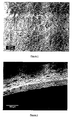
- the figure 1 is a photograph of the surface of the article according to Example 8 after calendering.
- the figure 2 is a photograph of the section of the article according to Example 8 after calendering.
- Table 2 describes the conditions of preparation of fibrids. ⁇ u> Table 2 ⁇ / u> Examples Proportion of PESU / polyamide imide Kermel® by weight (%) before precipitation Proportion of solvent in the coagulation bath by weight (%) 9 9.5 25 10 15 50 11 9.5 0 12 9.5 50
- the characteristics of the fibrids were measured on MORFI apparatus (conventional apparatus for measuring paper cellulosic fibers). Table 3 describes these characteristics. ⁇ u> Table 3 ⁇ / u> Examples 9 10 11 12 Length (mm) 0,315 0.431 0.351 0.289 Width ( ⁇ m) 40.2 44.6 49.7 30.3 Fine elements (% in length) 19.5 11.0 14.7 24.9 Fine element rate (% on the surface) 1.6 0.4 0.6 3.6
- the fibrids of Examples 9 to 12 were mixed with an equal weight of Kermel® polyamide imide fibers 6 mm in length. These four preparations were used to make paper on FRANK-type form apparatus wet and in a conventional paper-making process.
- the target density of the samples is 80g / m 2 .
- the characteristics of the papers are shown in Table 4.
- Retention rate ( % ) ( 1 - [ ( mass introduced ( boy Wut ) - mass after passage boy Wut ) / mass introduced boy Wut ] * 100 ⁇ u> Table 4 ⁇ / u> Examples fibrids Thickness in ⁇ m Mass introduced into the device (g) Mass after passing through the device (g) Retention rate (%) Grammage (g / m 2 ) Main (cm 3 / g) 13 Ex.9 199.6 2,506 2,448 98 77 2.6 14 Ex.10 238.8 2,516 2,478 98 81 2.9 15 Ex.11 199.5 2,517 2,342 93 74 2.7 16 Ex.12 191.3 2,525 2,500 99 77 2.5
Landscapes
- Engineering & Computer Science (AREA)
- Textile Engineering (AREA)
- Chemical & Material Sciences (AREA)
- Chemical Kinetics & Catalysis (AREA)
- General Chemical & Material Sciences (AREA)
- Paper (AREA)
- Artificial Filaments (AREA)
- Nonwoven Fabrics (AREA)
- Compositions Of Macromolecular Compounds (AREA)
Abstract
Description
La présente invention concerne notamment de nouveaux articles, notamment des articles non tissés comprenant des fibres et/ou fibrides. Elle concerne également de nouvelles fibres et fibrides ainsi qu'un procédé d'obtention de ces fibres et fibrides.The present invention relates in particular to new articles, in particular nonwoven articles comprising fibers and / or fibrids. It also relates to new fibers and fibrids and a process for obtaining these fibers and fibrids.
Dans le domaine de l'isolation électrique notamment, on cherche à obtenir des produits présentant une bonne résistance à la température et de bonnes propriétés mécaniques et/ou de bonnes propriétés diélectriques. Ces produits peuvent par exemple être des articles non tissés réalisés à partir de fibres thermostables. Dans un tel article, une bonne cohésion des fibres thermostables est nécessaire pour l'obtention d'un bon niveau de propriétés mécaniques, voire également une structure homogène et dense de l'article pour l'obtention des propriétés diélectriques. Dans ce but, on cherche à obtenir une bonne cohésion des fibres thermostables au niveau de l'article. On cherche aussi à obtenir une structure homogène et compacte au niveau de l'article. Ces articles, selon leur structure (notamment leur densité) et/ou leur formulation, peuvent avoir une fonction de renfort mécanique et/ou diélectrique.In the field of electrical insulation in particular, it is sought to obtain products having good temperature resistance and good mechanical properties and / or good dielectric properties. These products may for example be nonwoven articles made from thermostable fibers. In such an article, a good cohesion of thermostable fibers is necessary to obtain a good level of mechanical properties, or even a homogeneous and dense structure of the article for obtaining dielectric properties. For this purpose, it is sought to obtain good cohesion of thermostable fibers at the article. It is also sought to obtain a homogeneous and compact structure at the article level. These articles, according to their structure (in particular their density) and / or their formulation, can have a function of mechanical and / or dielectric reinforcement.
Le document
Le document
Pour améliorer la faisabilité des nappes non-tissées, le document
Si l'obtention de ces nappes peut , en théorie, être réalisée par voie papetière, en pratique, leur réalisation industrielle est difficile : en effet le mélange fibres synthétiques-liant à base de résine présente une trop faible cohésion pour pouvoir être manipulé et en particulier un tel mélange n'a pas la cohésion suffisante pour pouvoir être préparé de manière dynamique, par exemple sur une machine papetière du commerce ; de telles nappes sont réalisables principalement sur des appareils de laboratoire du type "Formette Franck", c'est-à-dire de manière statique et en discontinu comme cela ressort des exemples.If obtaining these sheets can, in theory, be carried out by paper, in practice, their industrial realization is difficult: in fact the mixture of synthetic fibers-resin-based binder has too little cohesion to be handled and in In particular, such a mixture does not have sufficient cohesion to be able to be prepared dynamically, for example on a commercial papermaking machine; such plies are feasible mainly on laboratory devices of the "Formette Franck" type, that is to say statically and discontinuously as is apparent from the examples.
Le document
On connaît par le document
L'utilisation de liants pour assurer la cohésion des fibres dans les articles par exemple non tissés entraîne notamment des difficultés et des coûts au niveau de la mise en oeuvre de ces liants.The use of binders to ensure the cohesion of the fibers in articles such as non-woven entails particular difficulties and costs in the implementation of these binders.
La présente invention a pour objet un procédé pour la fabrication d'articles constitués notamment des articles non-tissés, ne présentant pas les inconvénients précédents, lequel procédé comporte les caractéristiques de la revendication 1. La partie thermoplastique de la fibre ou fibride de l'invention joue notamment le rôle du liant chimique décrit ci-dessus. Elle présente notamment la propriété de « fluer » sous contrainte de pression et de température. Ainsi la cohésion des fibres thermostables dans ces articles est assurée, leur niveau de propriétés thermiques et mécaniques est très satisfaisant. Ces articles peuvent présenter une structure homogène et dense, et donc un bon niveau de propriétés diélectriques.The subject of the present invention is a process for the manufacture of articles consisting in particular of non-woven articles, not having the above-mentioned drawbacks, which method comprises the features of claim 1. The thermoplastic part of the fiber or fibride of the In particular, the invention plays the role of the chemical binder described above. It has the property of "flowing" under pressure and temperature constraints. Thus the cohesion of thermostable fibers in these articles is ensured, their level of thermal and mechanical properties is very satisfactory. These articles can have a homogeneous and dense structure, and therefore a good level of dielectric properties.
Dans un autre objet, l'invention propose l'utilisation des articles obtenus par le procédé ci-dessus dans le domaine de l'isolation électrique.In another object, the invention proposes the use of the articles obtained by the above method in the field of electrical insulation.
Le polymère thermostable de l'invention est de préférence infusible ou présente une température de transition vitreuse supérieure à 180°C, de préférence supérieure ou égale à 230°C, ou supérieure. Le polymère thermostable de l'invention présente une tenue thermique (c'est-à-dire une conservation de ses propriétés physiques notamment) à long terme à une température supérieure à 180°C. Ce polymère thermostable est de préférence choisi parmi les polyaramides et les polyimides. On peut citer comme exemple de polyaramides les polyamide aromatiques tels que le polymère connu sous le nom commercial Nomex®, ou les polyamides imide tels que le polymère connu sous le nom commercial Kermel®. Comme exemple de polyimides on peut citer les polyimides obtenus selon le document
Le polymère thermoplastique est choisi dans le groupe des polysulfures et des polysulfones. A titre d'exemple de polysulfure, on peut citer le polyphénylène sulfure noté PPS par la suite. A titre d'exemple de polysulfones notés PSU par la suite, on peut citer le polyéther sulfone noté PESU par la suite ou le polyphénylène sulfone noté PPSU par la suite.The thermoplastic polymer is selected from the group of polysulfides and polysulfones. As an example of polysulfide, there may be mentioned polyphenylene sulphide noted PPS thereafter. By way of example of polysulfones noted PSU thereafter, mention may be made of the polyether sulfone noted PESU later or polyphenylene sulfone noted PPSU thereafter.
Ces polymères thermoplastiques présentent une température de transition vitreuse inférieure ou égale à 250°C, ce qui leur permet de jouer notamment le rôle de liant chimique dans les articles de l'invention, et de "fluer" sous contrainte de pression et de température. Ces polymères présentent également une bonne thermostabilité, car ils appartiennent à une classe thermique (indice thermique) supérieur à 130°C. Ceci présente un avantage pour l'obtention d'articles présentant une bonne thermostabilité.These thermoplastic polymers have a glass transition temperature of less than or equal to 250 ° C., which enables them to act in particular as a chemical binder in the articles of the invention and to "flow" under pressure and temperature stress. These polymers also have good thermostability because they belong to a thermal class (thermal index) greater than 130 ° C. This has an advantage for obtaining articles having good thermostability.
Selon un mode de réalisation préférentiel de l'invention, le polymère thermoplastique et le polymère thermostable sont solubles dans un même solvant. Avantageusement le solvant est polaire aprotique. Il est plus préférentiellement choisi parmi la DMEU, le DMAC, le NMP, le DMF.According to a preferred embodiment of the invention, the thermoplastic polymer and the thermostable polymer are soluble in the same solvent. Advantageously, the solvent is polar aprotic. It is more preferably chosen from DMEU, DMAC, NMP, DMF.
Avantageusement la fibre ou fibride selon l'invention comprend au moins 10% en poids de polymère thermoplastique.Advantageously, the fiber or fibride according to the invention comprises at least 10% by weight of thermoplastic polymer.
Les fibrides sont de petites particules non granulaires fibreuses ou en forme de pellicules qui ne sont pas rigides. Deux de leurs trois dimensions sont de l'ordre de quelques microns. Leur petitesse et leur souplesse permettent de les déposer dans des configurations physiquement entrelacées comme celles qu'on trouve couramment dans les papiers formés à partir de pulpe.Fibrides are small non-granular fibrous or film-like particles that are not rigid. Two of their three dimensions are of the order of a few microns. Their small size and flexibility allow them to be deposited in physically interwoven configurations such as those commonly found in pulp papers.
La fibre selon l'invention présente de préférence un titre compris entre 0.5 dtex et 13.2 dtex. La fibre de l'invention présente de préférence une longueur comprise entre 1 et 100 mm.The fiber according to the invention preferably has a titer of between 0.5 dtex and 13.2 dtex. The fiber of the invention preferably has a length of between 1 and 100 mm.
La fibre selon l'invention peut présenter des formes de section variées telles qu'une forme ronde, trilobée, « plate ». Par fibre de forme de section plate on entend une fibre dont le rapport longueur/largeur est supérieur ou égal à 2.The fiber according to the invention may have various section shapes such as a round, trilobed, "flat" shape. By fiber of flat section is meant a fiber whose length / width ratio is greater than or equal to 2.
La fibre ou fibride selon l'invention peut être traitée par ensimage.The fiber or fibride according to the invention can be treated by sizing.
Selon un mode de réalisation particulier de l'article de l'invention, les fibres sont obtenues par mélange du polymère thermostable et du polymère thermoplastique, puis filage du mélange.According to a particular embodiment of the article of the invention, the fibers are obtained by mixing the thermostable polymer and the thermoplastic polymer, and then spinning the mixture.
Tout moyen connu de l'homme du métier pour mélanger deux polymères peut être utilisé. De préférence le mélange des polymères est obtenu par dissolution des polymères dans au moins un solvant commun. Le polymère thermoplastique et le polymère thermostable peuvent être dissous ensemble, simultanément ou successivement dans un solvant ou un mélange de solvants miscibles entre eux, dans un seul réacteur par exemple. Les polymères peuvent également être dissous séparément dans un même solvant ou dans des solvants différents miscibles entre eux, par exemple dans deux contenants différents, puis les solutions de polymère mélangées ensemble.Any means known to those skilled in the art for mixing two polymers can be used. Preferably, the polymer mixture is obtained by dissolving the polymers in at least one common solvent. The thermoplastic polymer and the heat-stable polymer may be dissolved together, simultaneously or successively in a solvent or a mixture of solvents miscible with each other, in a single reactor for example. The polymers can also be dissolved separately in the same solvent or in different solvents miscible with each other, for example in two different containers, then the polymer solutions mixed together.
Les conditions de dissolution, telles que la température, sont déterminées par l'homme du métier suivant la nature des polymères et du (des) solvant(s) utilisés. La dissolution peut par exemple être réalisée à chaud, avec agitation, pour faciliter la dissolution.The dissolution conditions, such as temperature, are determined by those skilled in the art depending on the nature of the polymers and the solvent (s) used. The dissolution may for example be carried out hot, with stirring, to facilitate dissolution.
La dissolution peut être réalisée à température ambiante. De préférence la température de dissolution est comprise entre 50 et 150°C.The dissolution can be carried out at room temperature. Preferably the dissolution temperature is between 50 and 150 ° C.
Le(s) solvant(s) de dissolution est (sont) avantageusement un solvant polaire aprotique. On peut utiliser une diméthylalkylène urée, par exemple la diméthyléthylène urée (DMEU) ou la diméthylpropylène urée. De préférence il est choisi parmi la DMEU, le diméthylacétamide (DMAC), la N-méthyl pyrrolidone (NMP), le diméthylformamide (DMF). Le solvant de dissolution peut être un mélange de solvants polaires aprotiques, par exemple un mélange de diméthyléthylène urée et d'un solvant polaire aprotique anhydre tel que la NMP, le DMAC, le DMF, la tétraméthylurée ou la γ-butyrolactone.The dissolution solvent (s) is (are) advantageously an aprotic polar solvent. Dimethylalkylene urea, for example dimethylethylene urea (DMEU) or dimethylpropylene urea, may be used. Preferably it is selected from DMEU, dimethylacetamide (DMAC), N-methyl pyrrolidone (NMP), dimethylformamide (DMF). The dissolution solvent can be a mixture of aprotic polar solvents, for example a mixture of dimethylethylene urea and an anhydrous aprotic polar solvent such as NMP, DMAC, DMF, tetramethylurea or γ-butyrolactone.
La solution de polymères obtenue après dissolution est appelée collodion. La solution obtenue est de préférence limpide.The solution of polymers obtained after dissolution is called collodion. The resulting solution is preferably clear.
La concentration totale en poids des polymères par rapport à la solution est de préférence comprise entre 5 et 40%.The total concentration by weight of the polymers relative to the solution is preferably between 5 and 40%.
La solution peut également comprendre des additfs tels que des pigments, des agents de renfort, des stabilisants, des matifiants.The solution may also include additives such as pigments, reinforcing agents, stabilizers, mattifying agents.
La solution doit de plus présenter une viscosité permettant son filage, généralement comprise entre 100 et 1000 poises. Pour un filage humide, la viscosité est de préférence comprise entre 400 et 800 poises mesurée au moyen d'un viscosimètre connu dans le commerce sous la marque EPPRECHT RHEOMAT 15. Pour un filage à sec, la viscosité est de préférence comprise entre 1500 et 3000 poises.The solution must also have a viscosity allowing its spinning, generally between 100 and 1000 poise. For wet spinning, the viscosity is preferably between 400 and 800 poises measured using a viscometer known in the trade under the trademark EPPRECHT RHEOMAT 15. For dry spinning, the viscosity is preferably between 1500 and 3000 poise.
Le mélange des polymères peut également être réalisé en ligne lors de l'étape de filage, par exemple par injection en ligne de chaque polymère -dissous ou non dans un solvant- lors du processus de filage.The polymer mixture can also be made in line during the spinning step, for example by online injection of each polymer-whether or not dissolved in a solvent-during the spinning process.
Toute méthode de filage d'un mélange de polymères, en particulier d'une solution de polymères, connue de l'homme du métier peut être utilisée ici dans le cadre de l'invention.Any method of spinning a mixture of polymers, in particular a polymer solution, known to those skilled in the art can be used here within the scope of the invention.
On peut citer par exemple le filage à sec, selon lequel la solution de polymères (substance fibrogène à l'état de solution) est extrudée à travers des capillaires dans un environnement favorable à l'élimination du solvant, par exemple dans une atmosphère évaporatoire maintenue à une température voisine ou supérieure au point d'ébullition du solvant, permettant la solidification des filaments. Les filaments à la sortie de l'enceinte évaporatoire sont débarrassés de leur solvant résiduel. Pour cela ils peuvent être lavés avec de l'eau, éventuellement bouillante et sous pression; séchés de manière habituelle , de préférence à une température supérieure à 80°C. Ils peuvent aussi être traités thermiquement à une température supérieure ou égale à 160°C sous pression réduite, et/ou sous atmosphère inerte. Après être débarrassés de leur solvant résiduel ils peuvent être étirés par exemple à une température supérieure à 250°C, de préférence supérieure à 300°C, de préférence en absence d'oxygène.Dry spinning, for example, in which the solution of polymers (fibrogenic substance in the solution state) is extruded through capillaries in an environment favorable to the elimination of the solvent, for example in an evaporating atmosphere maintained at a temperature near or above the boiling point of the solvent, allowing the solidification of the filaments. The filaments leaving the evaporation chamber are freed of their residual solvent. For this they can be washed with water, possibly boiling and under pressure; dried in the usual manner, preferably at a temperature above 80 ° C. They can also be heat treated at a temperature greater than or equal to 160 ° C under reduced pressure, and / or under an inert atmosphere. After being freed from their residual solvent, they may be drawn for example at a temperature above 250.degree. C., preferably above 300.degree. C., preferably in the absence of oxygen.
Selon un mode particulier de réalisation de l'invention, la méthode de filage est un filage humide, selon lequel la solution de polymères (solution de substance fibrogène) est extrudée dans un bain coagulant.According to a particular embodiment of the invention, the spinning method is a wet spinning, in which the polymer solution (fibrogenic substance solution) is extruded into a coagulating bath.
La température de la solution de filage peut varier dans de grandes limites selon la viscosité de la solution à filer. Par exemple une solution présentant une faible viscosité peut facilement être extrudée à température ordinaire, tandis qu'il est préférable d'extruder à chaud, par exemple à 120°C ou même plus, une solution de viscosité élevée pour éviter d'utiliser de trop grandes pressions à la filière. La solution de filage est avantageusement maintenue entre 15 et 40°C, de préférence entre 15 et 25°C.The temperature of the spinning solution can vary within wide limits depending on the viscosity of the solution to be spun. For example, a solution having a low viscosity can easily be extruded at ordinary temperature, while it is preferable to extrude hot, for example at 120 ° C or even higher, a solution of high viscosity to avoid using too much. great pressures in the sector. The spinning solution is advantageously maintained between 15 and 40 ° C, preferably between 15 and 25 ° C.
Le bain coagulant utilisé dans le procédé selon l'invention est de préférence une solution aqueuse contenant de 30 à 80% en poids, de préférence de 40 à 70% en poids d'un solvant ou mélange solvant, de préférence une diméthylalkylène urée (DMAU) ou le DMF ou leur mélange, quoique l'on ait souvent avantage à utiliser un bain contenant plus de 50% en poids de solvant pour obtenir des filaments de meilleure étirabilité, donc de meilleures propriétés finales.The coagulant bath used in the process according to the invention is preferably an aqueous solution containing from 30 to 80% by weight, preferably from 40 to 70% by weight of a solvent or solvent mixture, preferably a dimethylalkylene urea (DMAU ) or DMF or their mixture, although it is often advantageous to use a bath containing more than 50% by weight of solvent to obtain filaments of better stretchability, thus better final properties.
De préférence les polymères de la solution à filer ont des vitesses de coagulation proches.Preferably, the polymers of the solution to be spun have close coagulation rates.
La vitesse de filage dans le bain coagulant peut varier dans de grandes limites, en fonction de sa concentration en solvant et de la distance de parcours des filaments dans ce bain. Cette vitesse de filage dans le bain coagulant peut être choisie aisément entre 10 et 60 m/min, par exemple, quoique des vitesses plus élevées puissent être atteintes. On n'a généralement pas avantage à filer à des vitesses inférieures pour des raisons de rentabilité du procédé. Par ailleurs, des vitesses trop élevées de filage dans le bain coagulant diminuent l'étirabilité des filaments dans l'air. La vitesse de filage dans le bain coagulant sera donc choisie pour tenir compte à la fois de la rentabilité et des qualités désirées sur le filament terminé.The spinning speed in the coagulant bath can vary within wide limits, depending on its solvent concentration and the distance of the filaments in this bath. This spinning rate in the coagulant bath can be easily selected between 10 and 60 m / min, for example, although higher speeds can be achieved. It is generally not advantageous to spin at lower speeds for reasons of cost efficiency of the process. Moreover, too high speeds of spinning in the coagulant bath reduce the stretchability of the filaments in the air. The spinning speed in the coagulant bath will therefore be chosen to take into account both the profitability and the desired qualities on the finished filament.
Les filaments sortant du bain coagulant à l'état de gel sont ensuite étirés, par exemple dans l'air, à un taux défini par le rapport (V2/V1)*100, V2 étant la vitesse des rouleaux d'étirage, V1 celle des rouleaux délivreurs. Le taux détirage des fils à l'état de gel est supérieur à 100%, de préférence supérieur ou égal à 110% ou même supérieur, par exemple supérieur ou égal à 200%.The filaments emerging from the coagulating bath in the gel state are then stretched, for example in air, at a rate defined by the ratio (V 2 / V 1) * 100, V 2 being the speed of the drawing rolls, V 1 that delivery rollers. The stretching rate of the son in the gel state is greater than 100%, preferably greater than or equal to 110% or even greater, for example greater than or equal to 200%.
Après étirage, de préférence dans l'air, généralement réalisé par passage entre deux séries de rouleaux, on élimine le solvant résiduel des filaments par des moyens connus, généralement au moyen d'un lavage à l'eau circulant à contre-courant ou sur des rouleaux laveurs, de préférence à température ambiante.After drawing, preferably in air, generally carried out by passage between two sets of rollers, the residual solvent of the filaments is removed by known means, generally by means of a washing with water flowing against the current or on washing rollers, preferably at room temperature.
Selon un autre mode de réalisation particulier de l'invention, la méthode de filage est un filage à sec.According to another particular embodiment of the invention, the spinning method is dry spinning.
Dans les deux procédés de filage décrits ci-dessus (filage à sec et filage humide), les filaments lavés sont alors séchés par des moyens connus, par exemple dans un séchoir ou sur des rouleaux. La température de ce séchage peut varier dans de grandes limites ainsi que la vitesse qui est d'autant plus grande que la température est plus élevée. On a généralement avantage à effectuer un séchage avec élévation progressive de la température, cette température pouvant atteindre et même dépasser 200°C par exemple.In the two spinning processes described above (dry spinning and wet spinning), the washed filaments are then dried by known means, for example in a drier or on rollers. The temperature of this drying can vary within wide limits as well as the speed which is greater as the temperature is higher. It is generally advantageous to perform a drying with gradual rise in temperature, this temperature being able to reach and even exceed 200 ° C. for example.
Les filaments peuvent subir ensuite un surétirage à chaud pour améliorer leurs qualités mécaniques et en particulier leur ténacité, ce qui peut être intéressant pour certains emplois.The filaments can then undergo a warm overetching to improve their mechanical properties and in particular their toughness, which can be interesting for some jobs.
Ce surétirage à chaud peut être effectué par tout moyen connu : four, plaque, rouleau, rouleau et plaque, de préférence dans une enceinte fermée. Il est effectué à température d'au moins 150°C, pouvant atteindre et même dépasser 200 à 300°C. Son taux est généralement d'au moins 150% mais il peut varier dans de grandes limites selon les qualités désirées pour le fil fini. Le taux d'étirage total est alors d'au moins 250%, de préférence au moins 260%.This hot stretching can be carried out by any known means: oven, plate, roller, roller and plate, preferably in a closed enclosure. It is carried out at a temperature of at least 150 ° C, which can reach and even exceed 200 to 300 ° C. Its rate is generally at least 150% but it can vary within wide limits depending on the qualities desired for the finished yarn. The total draw ratio is then at least 250%, preferably at least 260%.
L'ensemble étirage et éventuellement surétirage peut être effectué en un ou plusieurs stades, en continu ou en discontinu avec les opérations précédentes. De plus le surétirage peut être combiné avec le séchage. Il suffit pour cela de prévoir, à la fin du séchage, une zone de température plus élevée permettant le surétirage.The stretching assembly and optionally super stretching can be carried out in one or more stages, continuously or discontinuously with the previous operations. In addition, overdrawing can be combined with drying. For this purpose, it is sufficient to provide, at the end of the drying, a zone of higher temperature which makes it possible to overetch.
Les filaments obtenus sont ensuite coupés sous forme de fibres selon une méthode connue de l'homme du métierThe filaments obtained are then cut in the form of fibers according to a method known to those skilled in the art
Selon un autre mode de réalisation de l'article de l'invention, les fibrides sont obtenues par mélange du polymère thermostable et du polymère thermoplastique, puis précipitation du mélange sous contrainte de cisaillement.According to another embodiment of the article of the invention, the fibrids are obtained by mixing the thermostable polymer and the thermoplastic polymer, and then precipitating the mixture under shear stress.
Le mélange du polymère thermostable et du polymère thermoplastique peut être réalisé d'une manière analogue à celle décrite ci-dessus pour les fibres. Les fibrides de l'invention peuvent notamment être obtenus en précipitant une solution de polymères dans un appareil de fibridation du type décrit dans le brevet
Selon un mode de réalisation particulier de l'invention, les articles sont des articles non tissés. Les articles non tissés se présentent sous forme de feuilles, films, feutres et de manière générale ils désignent toute structure fibreuse cohérente ne faisant intervenir aucune opération textile telle que filature, tricotage, tissage.According to a particular embodiment of the invention, the articles are nonwoven articles. The nonwoven articles are in the form of sheets, films, felts and generally they denote any coherent fibrous structure involving no textile operation such as spinning, knitting, weaving.
L'article peut être obtenu à partir d'un seul type de fibres ou au contraire de mélanges de fibres. L'article non tissé de l'invention comprend au moins en partie des fibres et/ou fibrides selon l'invention. L'article de l'invention peut comprendre des fibres de natures différentes et/ou des fibrides de natures différentes. Outre les fibres et/ou fibrides selon l'invention, l'article non tissé peut comprendre par exemple des fibres et/ou des fibrides thermostables ou de renfort du type para-aramide, méta-aramide, polyamide imide etc.The article can be obtained from a single type of fiber or on the contrary from fiber mixtures. The nonwoven article of the invention comprises at least in part fibers and / or fibrids according to the invention. The article of the invention may comprise fibers of different natures and / or fibrids of different natures. In addition to the fibers and / or fibrids according to the invention, the nonwoven article may comprise, for example, thermostable fibers and / or fibrids or reinforcements of the para-aramid, meta-aramid, polyamide imide, etc. type.
L'article non tissé peut comprendre par exemple des fibres selon l'invention et des fibres thermostables. Dans le cas où l'article comprend des fibrides, l'article peut par exemple comprendre des fibres selon l'invention et des fibrides de polymère thermostable selon un premier mode de réalisation ; ou l'article peut par exemple comprendre des fibres thermostables et des fibrides selon l'invention selon un autre mode de réalisation.The nonwoven article may comprise, for example, fibers according to the invention and heat-stable fibers. In the case where the article comprises fibrids, the article may for example comprise fibers according to the invention and thermostable polymer fibrids according to a first embodiment; or the article may for example comprise thermostable fibers and fibrids according to the invention according to another embodiment.
L'article non tissé de l'invention peut être obtenu par une méthode et un appareil pour préparer un article non tissé connus de l'homme du métier. L'article de l'invention est généralement obtenu par mise en oeuvre d'une étape de « nappage », c'est-à-dire une étape de répartition des fibres et/ou fibrides sur une surface, puis d'une étape de « consolidation » de la structure obtenue.The nonwoven article of the invention may be obtained by a method and apparatus for preparing a nonwoven article known to those skilled in the art. The article of the invention is generally obtained by implementing a "lapping" step, that is to say a step of distribution of the fibers and / or fibrids on a surface, then a step of "Consolidation" of the structure obtained.
Selon un mode de réalisation avantageux de l'invention, l'étape de « nappage » est réalisée par « voie sèche » (« drylaid »), par exemple à partir notamment de fibres de l'invention dont la longueur est comprise entre 40 et 80 mm. Les fibres peuvent par exemple être traitées à l'aide d'une machine ordinaire de cardage.According to an advantageous embodiment of the invention, the "lapping" step is carried out by "dry route"("drylaid"), for example from, in particular, the invention whose length is between 40 and 80 mm. The fibers may for example be processed using an ordinary carding machine.
Selon un autre mode de réalisation avantageux de l'invention, l'étape de « nappage » est réalisée par « voie humide » ou « voie papetière » (« wetlaid »). Les fibres utilisées dans ce mode de réalisation ont généralement une longueur comprise entre 2 et 12 mm, de préférence entre 3 et 7 mm, et leur titre, exprimé en décitex est généralement compris entre 0,5 et 20. Il est théoriquement possible d'utiliser des fibres de longueur supérieure à 12 mm, mais en pratique des fibres plus longues s'enchevêtrent, nécessitant une plus grande quantité d'eau, ce qui rend le procédé plus lourd et plus compliqué.According to another advantageous embodiment of the invention, the "nappage" step is carried out by "wet" or "papermaking" ("wetlaid"). The fibers used in this embodiment generally have a length between 2 and 12 mm, preferably between 3 and 7 mm, and their title, expressed in decitex is generally between 0.5 and 20. It is theoretically possible to use fibers longer than 12 mm, but in practice longer fibers become entangled, requiring a greater amount of water, making the process heavier and more complicated.
Selon ce mode de réalisation, l'article non tissé est obtenu par introduction dans l'eau, des différents constituants de l'article : les fibres et un liant fibreux composé d'une pulpe à base d'un polymère synthétique possédant une tenue thermique supérieure ou égale à 180°C (telle qu'une pulpe para-aramide) et/ou de fibrides à base d'un polymère synthétique possédant une tenue thermique supérieure ou égale à 180°C et/ou de fibrides selon l'invention, et éventuellement d'autres adjuvants, additifs ou charges souhaités.According to this embodiment, the nonwoven article is obtained by introducing into water, the various constituents of the article: the fibers and a fibrous binder composed of a pulp based on a synthetic polymer having a thermal resistance greater than or equal to 180 ° C (such as a para-aramid pulp) and / or fibrids based on a synthetic polymer having a heat resistance greater than or equal to 180 ° C and / or fibrids according to the invention, and optionally other adjuvants, additives or desired fillers.
La pulpe à base d'un polymère synthétique possédant une tenue thermique supérieure ou égale à 180°C a été généralement obtenue à partir de fibres de longueur habituelle, notamment des fibrilles, de manière connue, pour lui donner un grand nombre de points d'accrochage et augmenter ainsi sa surface spécifique. Parmi les fibres synthétiques, seules les fibres très cristallisées peuvent être fibrillées. C'est le cas de polyamides et polyesters totalement aromatiques, mais d'autres polymères très cristallisés, sont scindables suivant l'axe des fibres ou fibrillables.The pulp based on a synthetic polymer having a heat resistance greater than or equal to 180 ° C. has generally been obtained from fibers of the usual length, in particular fibrils, in a known manner, to give it a large number of dots. snagging and thus increase its specific surface area. Of the synthetic fibers, only highly crystallized fibers can be fibrillated. This is the case of totally aromatic polyamides and polyesters, but other highly crystallized polymers are cleavable along the fiber axis or fibrillable.
Pour améliorer certaines propriétés, des adjuvants, additifs ou charges peuvent également être utilisés dans des proportions diverses selon les propriétés désirées; par exemple du mica peut être introduit pour augmenter encore les propriétés diélectriques de l'article.To improve certain properties, adjuvants, additives or fillers can also be used in various proportions depending on the desired properties; for example mica can be introduced to further increase the dielectric properties of the article.
La « voie papetière » de préparation d'articles non tissés est connue de l'homme du métier.The "paper route" for preparing non-woven articles is known to those skilled in the art.
L'étape de « consolidation » de la structure obtenue par nappage tel que décrit ci-dessus est réalisée par pressage thermique de l'article: La température de pressage thermique est supérieure à la température de transition vitreuse du polymère thermoplastique des fibres et/ou fibrides selon l'invention contenus dans l'article. De préférence la température de pressage thermique est comprise entre la température de transition vitreuse et la température de ramollissement du polymère thermoplastique.The "consolidation" step of the structure obtained by layering as described above is carried out by thermal pressing of the article: The thermal pressing temperature is greater than the glass transition temperature of the thermoplastic polymer of the fibers and / or fibrids according to the invention contained in the article. Preferably the thermal pressing temperature is between the glass transition temperature and the softening temperature of the thermoplastic polymer.
Selon un mode de réalisation avantageux de l'invention, la température de pressage thermique est comprise entre 200 et 350°C. De préférence la pression est supérieure ou égale à 5 bars.According to an advantageous embodiment of the invention, the thermal pressing temperature is between 200 and 350 ° C. The pressure is preferably greater than or equal to 5 bars.
Ce pressage assure la densification et la consolidation de l'article de l'invention. Il s'accompagne généralement d'un fluage du polymère thermoplastique des fibres et/ou fibrides selon l'invention contenus dans l'article à travers la structure de l'article,This pressing ensures densification and consolidation of the article of the invention. It is generally accompanied by creep of the thermoplastic polymer fibers and / or fibrids according to the invention contained in the article through the structure of the article,
Le pressage thermique n'est pas limité au niveau de sa mise en oeuvre. Tout moyen de pressage thermique d'un article non tissé peut être utilisé.Thermal pressing is not limited to the level of its implementation. Any means of thermal pressing a nonwoven article can be used.
Le pressage peut par exemple être mis en oeuvre à l'aide d'une presse ou d'une calandre à rouleaux chauffés. Il est possible de réaliser plusieurs passages sur l'appareil de pressage de manière à obtenir la densité souhaitée.The pressing may for example be carried out using a press or a heated roller calender. It is possible to make several passes on the pressing apparatus so as to obtain the desired density.
La méthode de pressage thermique préférée de l'invention est le calandrage. Selon un mode de réalisation particulier de l'invention, le pressage thermique est réalisé à l'aide d'une presse en continu.The preferred thermal pressing method of the invention is calendering. According to a particular embodiment of the invention, the thermal pressing is carried out using a continuous press.
Les articles obtenus par ce pressage sont divers et variés selon les conditions du pressage thermique mises en oeuvre -notamment la température, la pression et le temps de pressage- et selon la formulation de l'article -notamment la quantité de fibres et/ou fibrides selon invention contenus dans l'article et la quantité de polymère thermoplastique présente dans ces fibres et/ou fibrldes-.The articles obtained by this pressing are various and varied according to the conditions of the thermal pressing implemented - in particular the temperature, the pressure and the pressing time - and according to the formulation of the article - in particular the amount of fibers and / or fibrids according to the invention contained in the article and the amount of thermoplastic polymer present in these fibers and / or fibrldes-.
Le choix de ces paramètres est réalisé en fonction du type d'articles et des propriétés recherchées sur cet article.The choice of these parameters is made according to the type of articles and the properties sought on this article.
Les articles de l'invention peuvent être mis en oeuvre notamment dans le domaine de l'isolation électrique.The articles of the invention can be implemented in particular in the field of electrical insulation.
Le rôle des articles varie selon leur densité et donc selon leurs propriétés de rigidité diélectriques. Ils peuvent par exemple être utilisés dans un système d'isolation dans lequel l'isolant principal est une huile ou une résine, comme « espaceur » ou « renfort » mécanique à intercaler entre deux pièces à isoler électriquement. Les articles peuvent également être utilisés directement comme isolant dans des systèmes d'isolation de type « secs ».The role of the articles varies according to their density and therefore according to their dielectric strength properties. They may for example be used in an insulation system in which the main insulation is an oil or a resin, such as "spacer" or "reinforcement" mechanical interposed between two parts to be electrically insulated. The articles can also be used directly as insulation in "dry" type insulation systems.
L'invention concerne également l'utilisation des articles obtenus par le procédé de l'invention tels que décrits ci-dessus dans le domaine de l'isolation électrique.The invention also relates to the use of the articles obtained by the method of the invention as described above in the field of electrical insulation.
D'autres détails et avantages de l'invention apparaîtront plus clairement à la vue des exemples décrits ci-dessous.Other details and advantages of the invention will emerge more clearly from the view of the examples described below.
On introduit dans un réacteur chauffé et agité 180kg de solvant DMEU. Ce solvant est d'abord chauffé à une température comprise entre 60°C et 120°C. Le polymère PESU (MW 80000 à 90000 g/mol) sous forme de granulés lenticulaires est introduit dans le solvant chaud, en 10 fractions égales. Le temps nécessaire entre chaque fraction est fonction de l'intensité de l'agitation, et de la température. Le polymère est introduit jusqu'à représenter 20 à 40% en poids du mélange.180 kg of DMEU solvent are introduced into a heated and stirred reactor. This solvent is first heated to a temperature between 60 ° C and 120 ° C. The PESU polymer (MW 80000 to 90000 g / mol) in the form of lenticular granules is introduced into the hot solvent, in 10 equal fractions. The time required between each fraction is a function of the intensity of the agitation and the temperature. The polymer is introduced to represent 20 to 40% by weight of the mixture.
La teneur en polymère dans le milieu influe sur sa viscosité. A titre d'exemple, à 21% la viscosité à 25°C est de 350 poises ; à 28% la viscosité est de 460 poises.The polymer content in the medium affects its viscosity. By way of example, at 21% the viscosity at 25 ° C. is 350 poise; at 28% the viscosity is 460 poises.
Le mélange du polymère thermoplastique PESU avec le polyamide imide Kermel® est réalisé par mélange à chaud, entre 60 et 120°C, du milieu décrit ci-dessus contenant le PESU et d'une solution à 21% en poids de polyamide imide Kermel® dans le solvant DMEU (MW 150000 g/mol en équivalents polystyrène, viscosité : 600 poises à 25°C). La proportion des deux solutions dans le mélange est exprimée en proportion de polymère PESU dans la matière sèche et est comprise entre 40 et 60%.The mixture of the thermoplastic polymer PESU with the polyamide imide Kermel® is produced by hot mixing, between 60 and 120 ° C., of the medium described above containing the PESU and a solution containing 21% by weight of Kermel® polyamide imide in the DMEU solvent (MW 150000 g / mol in polystyrene equivalents, viscosity: 600 poise at 25 ° C.). The proportion of the two solutions in the mixture is expressed in proportion of PESU polymer in the dry matter and is between 40 and 60%.
Un mélange polyamide-imide Kermel® / PESU est obtenu directement par dissolution du polymère PESU dans une solution à 13% en poids de polyamide imide Kermel® dans le solvant DMEU, à l'aide d'un appareil de mélange à haut gradient de cisaillement, et fort taux de recyclage.A polyamide-imide Kermel® / PESU mixture is obtained directly by dissolving the PESU polymer in a solution containing 13% by weight of Kermel® polyamide imide in the DMEU solvent, using a high shear gradient mixing apparatus. , and high recycling rate.
Un milieu contenant le PESU est préparé selon le mode opératoire de l'exemple 1. Le mélange avec le polyamide imide Kermel® (sous la forme d'une solution à 21% en poids de polyamide imide Kermel® dans le solvant DMEU) est réalisé lors du filage, par injection conjointe des deux solutions dans une conduite commune, en amont de mélangeurs statiques implantés dans cette conduite qui alimente le métier de filature. Le respect des proportions des deux solutions dans le mélange est assuré par l'ajustement des vitesses de rotation de pompes volumétriques.A medium containing PESU is prepared according to the procedure of Example 1. The mixture with Kermel® polyamide imide (in the form of a 21% by weight solution of Kermel® polyamide imide in DMEU solvent) is produced during spinning, by joint injection of the two solutions in a common pipe, upstream of static mixers implanted in this pipe which feeds the spinning loom. Respect of the proportions of the two solutions in the mixture is ensured by the adjustment of the rotational speeds of volumetric pumps.
Les mélanges PESU/polyamide imide Kermel® des exemples 1 à 3 sont filés selon un procédé de filage humide. La part de polymère PESU est de 40% en poids. Les conditions ci-dessous présentent à titre d'exemple les paramètres de filage utilisés :
- Filières 10.000 trous de 50µm
- Bain de coagulation à 55% de solvant, 19°C
- Vitesse de filage 14 m/min
- Taux d'étirage: 2 x
- Titre final obtenu : 4.4 dtex
- Dies 10,000 holes of 50μm
- Coagulation bath with 55% solvent, 19 ° C
- Spinning speed 14 m / min
- Drawing ratio: 2 x
- Final title obtained: 4.4 dtex
La fibre est séchée, frisée et coupée dans des conditions conventionnelles (longueur des fibres=60 mm).The fiber is dried, crimped and cut under conventional conditions (fiber length = 60 mm).
Les mélanges PESU/polyamide imide Kermel® des exemples 1 à 3 sont filés selon un procédé de filage humide. La part de polymère PESU est de 50%. Les conditions ci-dessous présentent à titre d'exemple les paramètres de filage utilisés :
- Filières 10.000 trous de 40µm
- Bain de coagulation à 60% de solvant, 19°C
- Vitesse de filage 14 m/min
- Taux d'étirage : 2 x
- Titre final obtenu : 2.2 dtex
- Dies 10,000 holes of 40μm
- Coagulation bath with 60% solvent, 19 ° C
- Spinning speed 14 m / min
- Drawing ratio: 2 x
- Final title obtained: 2.2 dtex
La fibre est séchée dans des conditions conventionnelles. Le frisage et la coupe se font dans des conditions conventionnellesThe fiber is dried under conventional conditions. Crimping and cutting are done under conventional conditions
Des articles non tissés de différents grammages sont préparés à partir des fibres de l'exemple 4 par « voie sèche » et « consolidation » (cardage, nappage, calandrage) selon une méthode connue de l'homme du métier.Non-woven articles of different grammages are prepared from the fibers of Example 4 by "dry route" and "consolidation" (carding, glazing, calendering) according to a method known to those skilled in the art.
Le matériel mis en oeuvre est le suivant :
- carde de type Garnett® à sortie parallèle
- nappeur Asselin®
- calandre KTM®
- Garnett® type card with parallel output
- Asselin® lapper
- KTM® grille
Le tableau 1 décrit les conditions opératoires mises en oeuvre et les caractéristiques des articles obtenus.Table 1 describes the operating conditions used and the characteristics of the articles obtained.
Les propriétés mécaniques de force et allongement à la rupture sont mesurées selon la norme NF-EN 29073-3 de décembre 1992. L'épaisseur des articles est mesurée à l'aide d'un micromètre de type Palmer®.
La
La
Le mélange PESU/polyamide imide Kermel® de l'exemple 1, dilué par de la DMEU pour obtenir la concentration de polymères PESU/polyamide imide Kermel® souhaitée, est précipité sous fort cisaillement, selon une méthode telle que décrite dans les documents
Les caractéristiques des fibrides ont été mesurées sur appareil MORFI (appareil conventionnel de mesure des fibres cellulosiques papetières). Le tableau 3 décrit ces caractéristiques.
Les fibrides des exemples 9 à 12 ont été mélangées à un poids égal de fibres polyamide imide Kermel® de 6 mm de longueur. Ces quatre préparations ont été utilisées pour réaliser des papiers sur appareil à formette de type FRANK par voie humide et suivant un procédé classique papetier. La densité visée des échantillons est de 80g/m2. Les caractéristiques des papiers sont consignés dans le tableau 4.The fibrids of Examples 9 to 12 were mixed with an equal weight of Kermel® polyamide imide fibers 6 mm in length. These four preparations were used to make paper on FRANK-type form apparatus wet and in a conventional paper-making process. The target density of the samples is 80g / m 2 . The characteristics of the papers are shown in Table 4.
Le taux de rétention est défini comme suit : 
Les papiers obtenus, après séchage ont été caractérisés par leurs propriétés mécaniques (tableau 5) et par leur perméabilité à l'air sur l'appareil BENDTSEN sous une pression de 1,47 kPa (tableau 6) selon les méthodes traditionnelles de l'industrie papetière.
Les papiers des exemples 13 à 16 ont été pressés à chaud sur une presse de laboratoire à plateaux à 280°c :
- soit 10min sous 100 bars
- soit 5min sous 200 bars.
- 10min under 100 bars
- ie 5min under 200 bars.
Claims (19)
- A method of manufacturing a consolidated fiber-based article, the method being characterized in that the article comprises at least fibers and/or fibrids formed from a mixture of polymers comprising at least a thermostable polymer, and a thermoplastic polymer selected from the group formed by polysulfides and polysulfones, and in that said article is consolidated by heat pressing at a temperature above the glass transition temperature of said thermoplastic polymer.
- A method according to claim 1, characterized in that the thermostable polymer is selected from aromatic polyamides, aromatic polyamide imides and polyimides.
- A method according to claim 1 or claim 2, characterized in that the thermoplastic polymer is selected from polyether sulfone and polyphenylene sulfone.
- A method according to any preceding claim, characterized in that the thermoplastic polymer and the thermostable polymer are soluble in the same solvent.
- A method according to any preceding claim, characterized in that the mixture of polymers comprises at least 10% by weight of thermoplastic polymer.
- A method according to any preceding claim, characterized in that the fibers are obtained by mixing the thermostable polymer and the thermoplastic polymer, followed by spinning the mixture.
- A method according to claim 6, characterized in that the mixture is produced by dissolving the polymers in a solvent.
- A method according to claim 7, characterized in that the solvent is a polar aprotic solvent.
- A method according to claim 8, characterized in that the solvent is selected from DMEU, DMAC, NMP and DMF.
- A method according to any one of claims 6 to 8, characterized in that spinning is wet spinning.
- A method according to any one of claims 6 to 8, characterized in that spinning is dry spinning.
- A method according to any preceding claim, characterized in that the fibrids are obtained by mixing the thermostable polymer and the thermoplastic polymer then shear precipitating the mixture.
- A method according to any one of claims 1 to 12, characterized in that heat pressing is performed in pressure and temperature conditions that impart hot flow to at least the thermoplastic polymer.
- A method according to claim 13, characterized in that, during heat pressing, the temperature is in the range between the glass transition temperature and the softening temperature of the thermoplastic polymer.
- A method according to claim 14, characterized in that, during heat pressing, the temperature is in the range 200°C to 350°C, and the pressure is 5 bars or more.
- A method according to claim 1, characterized in that the article further comprises fibers and/or fibrids which are thermostable, in particular para-aramid, meta-aramid, polyamide imide fibers.
- A method according to any one of claims 1 to 16, characterized in that the fibers have a size of 13.2 dtex or less.
- The use of an article obtained by the method according to any one of claims 1 to 17, in the field of electrical insulation.
- A use according to claim 18, characterized in that the article also includes mica.
Applications Claiming Priority (3)
| Application Number | Priority Date | Filing Date | Title |
|---|---|---|---|
| FR0210913 | 2002-09-04 | ||
| FR0210913A FR2843975B1 (en) | 2002-09-04 | 2002-09-04 | FIBERS AND FIBRIDES, PROCESS FOR OBTAINING THEM, ARTICLES OBTAINED THEREFROM THESE FIBERS AND / OR FIBRIDES. |
| PCT/FR2003/002495 WO2004022823A2 (en) | 2002-09-04 | 2003-08-08 | Articles comprising fibres and/or fibrids, fibres and fibrids and production method of same |
Publications (2)
| Publication Number | Publication Date |
|---|---|
| EP1534883A2 EP1534883A2 (en) | 2005-06-01 |
| EP1534883B1 true EP1534883B1 (en) | 2009-02-25 |
Family
ID=31503090
Family Applications (1)
| Application Number | Title | Priority Date | Filing Date |
|---|---|---|---|
| EP20030753670 Expired - Lifetime EP1534883B1 (en) | 2002-09-04 | 2003-08-08 | Articles comprising fibres and/or fibrids, fibres and fibrids and production method of same |
Country Status (12)
| Country | Link |
|---|---|
| US (3) | US7459407B2 (en) |
| EP (1) | EP1534883B1 (en) |
| JP (1) | JP4596914B2 (en) |
| CN (1) | CN100335692C (en) |
| AT (1) | ATE423862T1 (en) |
| AU (1) | AU2003271832A1 (en) |
| DE (1) | DE60326358D1 (en) |
| ES (1) | ES2323687T3 (en) |
| FR (1) | FR2843975B1 (en) |
| RU (1) | RU2315827C2 (en) |
| TW (1) | TWI268968B (en) |
| WO (1) | WO2004022823A2 (en) |
Families Citing this family (21)
| Publication number | Priority date | Publication date | Assignee | Title |
|---|---|---|---|---|
| US7771638B2 (en) * | 2007-12-19 | 2010-08-10 | E. I. Du Pont De Nemours And Company | Rapid plasticization of quenched yarns |
| US7998575B2 (en) * | 2007-12-19 | 2011-08-16 | E.I. Du Pont De Nemours And Company | Low shrinkage, dyeable MPD-I yarn |
| US7771637B2 (en) | 2007-12-19 | 2010-08-10 | E. I. Du Pont De Nemours And Company | High-speed meta-aramid fiber production |
| WO2010083530A2 (en) * | 2009-01-16 | 2010-07-22 | Zeus Industrial Products, Inc. | Electrospinning of ptfe with high viscosity materials |
| RU2415221C1 (en) * | 2010-04-30 | 2011-03-27 | Учреждение Российской академии наук Институт высокомолекулярных соединений РАН | Method to produce electric insulation paper |
| US20130337246A1 (en) * | 2012-06-15 | 2013-12-19 | 3M Innovative Properties Company | Electrical insulation material |
| US9314993B2 (en) * | 2013-03-15 | 2016-04-19 | National Nonwovens Inc. | Composites and articles made from nonwoven structures |
| US9314995B2 (en) | 2013-03-15 | 2016-04-19 | National Nonwovens Inc. | Composites comprising nonwoven structures and foam |
| US9663875B2 (en) * | 2013-10-30 | 2017-05-30 | Ei Du Pont De Nemours And Company | Sheets and fibrids comprising a mixture of poly(m-phenylene isophthalamide) and copolymer made from 5(6)-amino-2-(p-aminophenyl)benzimidazole |
| CN103774268B (en) * | 2014-01-20 | 2016-05-11 | 江苏巨贤合成材料有限公司 | A kind of preparation method of polyamidoimide fibrid |
| CN104846473B (en) * | 2014-02-14 | 2016-05-25 | 上海特安纶纤维有限公司 | A kind of blended fiber based on aromatic polyamide and polyarylsulfone (PAS), yarn, fabric, goods and preparation method thereof |
| US9773583B2 (en) * | 2014-04-24 | 2017-09-26 | Essex Group, Inc. | Continously transposed conductor |
| CN104667630B (en) * | 2015-01-14 | 2017-04-19 | 上海特安纶纤维有限公司 | Sulfuryl-containing blended aromatic polyamide fiber high-temperature-resistant filter material and manufacturing method thereof |
| CN104674405B (en) * | 2015-01-14 | 2018-01-05 | 上海特安纶纤维有限公司 | Blending type aramid fiber mixture and its product containing sulfuryl |
| CN104630957B (en) * | 2015-02-13 | 2017-11-17 | 上海特安纶纤维有限公司 | Yarn and fabric and preparation method made of a kind of blended fiber and polyphenylene sulfide fibre based on aromatic polyamide and polyarylsulfone (PAS) |
| CN104630959B (en) * | 2015-02-13 | 2018-03-02 | 上海特安纶纤维有限公司 | Yarn, fabric and preparation method comprising a kind of blended fiber based on aromatic polyamide and polyarylsulfone (PAS) and cellulose fibre |
| CN104611840B (en) * | 2015-02-13 | 2018-05-01 | 上海特安纶纤维有限公司 | Flocculus of permalon comprising aromatic polyamide and polyarylsulfone (PAS) and preparation method thereof |
| CN104651997B (en) * | 2015-02-13 | 2018-05-01 | 上海特安纶纤维有限公司 | Fibre blend comprising a kind of blending type aramid fibre containing sulfuryl and by its yarn, fabric and preparation method |
| CN104611839B (en) * | 2015-02-13 | 2018-05-01 | 上海特安纶纤维有限公司 | Nonwoven webs and preparation method comprising a kind of blended fiber based on aromatic polyamide and polyarylsulfone (PAS) and heat-resistance and flame-retardant fiber |
| CN107287988B (en) * | 2017-07-20 | 2019-04-02 | 清华大学 | A kind of preparation method of micro/nano composite fiber electrical insulating paper |
| CN109722945B (en) * | 2018-11-30 | 2021-07-20 | 山东鲁南新材料股份有限公司 | A kind of breakdown-resistant composite electrolytic capacitor paper and production method thereof |
Family Cites Families (33)
| Publication number | Priority date | Publication date | Assignee | Title |
|---|---|---|---|---|
| NL246230A (en) * | 1958-12-09 | |||
| BE704356A (en) * | 1966-09-29 | 1968-02-01 | ||
| US3534003A (en) * | 1968-05-08 | 1970-10-13 | Gen Electric | Polyamide imides prepared from aromatic cyclic sulfone amines and haloformylphthalic anhydrides |
| US3523061A (en) * | 1969-06-20 | 1970-08-04 | Minnesota Mining & Mfg | Porous sheet materials of mica and unfused staple fibers |
| US3985934A (en) * | 1974-07-26 | 1976-10-12 | The Upjohn Company | Polyimide fiber having a serrated surface and a process of producing same |
| AR204955A1 (en) * | 1975-03-14 | 1976-03-19 | Kendall & Co | IMPROVED NON-WOVEN FABRIC FOR USE AS A REINFORCING BASE FOR ELECTRICAL INSULATION |
| DE3070426D1 (en) * | 1979-12-11 | 1985-05-09 | Asea Ab | Insulated electric conductor for windings of transformers and reactive coils |
| US5093435A (en) * | 1984-06-29 | 1992-03-03 | Amoco Corporation | Molded electrical device and composition therefore |
| JPS626958A (en) * | 1985-07-03 | 1987-01-13 | 工業技術院長 | Polymer alloy laminate and its production |
| US4703081A (en) * | 1986-04-08 | 1987-10-27 | Phillips Petroleum Company | Poly(arylene sulfide) resin ternary blends |
| US4780359A (en) * | 1987-04-03 | 1988-10-25 | Gates Formed-Fibre Products, Inc. | Fire retardent structural textile panel |
| US4960549A (en) * | 1988-05-23 | 1990-10-02 | Amoco Corporation | Process for preparing polyamide-imide foam |
| JPH0226975A (en) * | 1988-07-14 | 1990-01-29 | Teijin Ltd | Solid cotton |
| JPH0247389A (en) * | 1988-08-08 | 1990-02-16 | Teijin Ltd | Blend formed paper |
| JPH0225598U (en) * | 1988-08-08 | 1990-02-20 | ||
| JPH0252743U (en) * | 1988-10-06 | 1990-04-16 | ||
| US5011643A (en) * | 1989-04-13 | 1991-04-30 | E. I. Du Pont De Nemours And Company | Process for making oriented, shaped articles of para-aramid/thermally-consolidatable polymer blends |
| JP3110787B2 (en) * | 1990-04-13 | 2000-11-20 | 三井化学株式会社 | Conductive polysulfone resin composition and molded article for highly heat-resistant conductive semiconductor obtained therefrom |
| JP2872756B2 (en) * | 1990-05-30 | 1999-03-24 | 株式会社豊田中央研究所 | Polyimide composite material and method for producing the same |
| US5149749A (en) * | 1990-05-31 | 1992-09-22 | Phillips Petroleum Company | Poly(phenylene sulfide) composition and articles having improved thermal stability at high temperatures |
| RU2056466C1 (en) * | 1990-06-29 | 1996-03-20 | Карчмарчик Олег Семенович | Method of conducting material producing |
| RU1779082C (en) * | 1990-12-25 | 1995-03-27 | Акционерное общество открытого типа "ВНИИБ" | Paper material used as an electrical insulation and basis for structural composites |
| RU2026439C1 (en) * | 1991-07-01 | 1995-01-09 | Валерий Александрович Романов | Method of preparing of multilayer paper dielectric material |
| JPH05321026A (en) | 1992-05-20 | 1993-12-07 | Toray Ind Inc | Heat-resistant fiber |
| US5295406A (en) * | 1992-09-23 | 1994-03-22 | Dana Corporation | Load lock for ball nut and screw mechanism |
| US5274875A (en) * | 1993-01-25 | 1994-01-04 | Chou Liao Ter | Displaceable rear windshield wiper incorporating trunk lid interaction and a rear brake light |
| US5917137A (en) * | 1993-10-19 | 1999-06-29 | L'air Liquide, Societe Anonyme Pour L'etude Et L'exploitation Des Procedes Georges Claude | Gas separation membranes of blends of polyethersulfones with aromatic polyimides |
| DE69433127T2 (en) * | 1993-10-19 | 2004-07-08 | L'Air Liquide, S.A. a Directoire et Conseil de Surveillance pour l'Etude et l'Exploitation des Procédés Georges Claude | Mixtures of polyether sulfones and aromatic polyimides, polyamides or polyamide-imides and gas separation membranes made from them |
| JPH07189169A (en) * | 1993-12-27 | 1995-07-25 | Toyobo Co Ltd | Production of thermoresistant functional paper |
| RU2086717C1 (en) * | 1995-05-31 | 1997-08-10 | Товарищество с ограниченной ответственностью предприятие "Автохимэкс" | Polymer composition for production of films and fibers |
| JPH11222798A (en) * | 1998-02-02 | 1999-08-17 | Oji Paper Co Ltd | Substrate for printed circuit board, laminated sheet and their production |
| KR100578777B1 (en) * | 2000-08-04 | 2006-05-12 | 데이진 가부시키가이샤 | Heat resistant fiber paper |
| JP4552315B2 (en) * | 2000-12-07 | 2010-09-29 | 東レ株式会社 | Thermoplastic resin composition and molded article thereof |
-
2002
- 2002-09-04 FR FR0210913A patent/FR2843975B1/en not_active Expired - Fee Related
-
2003
- 2003-08-08 US US10/526,676 patent/US7459407B2/en not_active Expired - Fee Related
- 2003-08-08 JP JP2004533552A patent/JP4596914B2/en not_active Expired - Fee Related
- 2003-08-08 EP EP20030753670 patent/EP1534883B1/en not_active Expired - Lifetime
- 2003-08-08 WO PCT/FR2003/002495 patent/WO2004022823A2/en not_active Ceased
- 2003-08-08 AT AT03753670T patent/ATE423862T1/en active
- 2003-08-08 DE DE60326358T patent/DE60326358D1/en not_active Expired - Lifetime
- 2003-08-08 AU AU2003271832A patent/AU2003271832A1/en not_active Abandoned
- 2003-08-08 RU RU2005109419A patent/RU2315827C2/en not_active IP Right Cessation
- 2003-08-08 CN CNB038211173A patent/CN100335692C/en not_active Expired - Fee Related
- 2003-08-08 ES ES03753670T patent/ES2323687T3/en not_active Expired - Lifetime
- 2003-09-02 TW TW92124220A patent/TWI268968B/en not_active IP Right Cessation
-
2008
- 2008-08-21 US US12/195,950 patent/US20080302495A1/en not_active Abandoned
-
2011
- 2011-06-08 US US13/156,027 patent/US8293042B2/en not_active Expired - Fee Related
Also Published As
| Publication number | Publication date |
|---|---|
| WO2004022823A3 (en) | 2004-05-06 |
| US8293042B2 (en) | 2012-10-23 |
| CN1678776A (en) | 2005-10-05 |
| JP2005538261A (en) | 2005-12-15 |
| JP4596914B2 (en) | 2010-12-15 |
| RU2005109419A (en) | 2006-01-20 |
| US20120001359A1 (en) | 2012-01-05 |
| EP1534883A2 (en) | 2005-06-01 |
| DE60326358D1 (en) | 2009-04-09 |
| RU2315827C2 (en) | 2008-01-27 |
| TWI268968B (en) | 2006-12-21 |
| TW200419024A (en) | 2004-10-01 |
| US20080302495A1 (en) | 2008-12-11 |
| FR2843975A1 (en) | 2004-03-05 |
| WO2004022823A2 (en) | 2004-03-18 |
| US20060105157A1 (en) | 2006-05-18 |
| AU2003271832A8 (en) | 2004-03-29 |
| FR2843975B1 (en) | 2008-11-14 |
| AU2003271832A1 (en) | 2004-03-29 |
| US7459407B2 (en) | 2008-12-02 |
| ATE423862T1 (en) | 2009-03-15 |
| ES2323687T3 (en) | 2009-07-23 |
| CN100335692C (en) | 2007-09-05 |
Similar Documents
| Publication | Publication Date | Title |
|---|---|---|
| EP1534883A2 (en) | Articles comprising fibres and/or fibrids, fibres and fibrids and production method of same | |
| EP3418323B1 (en) | Fibrous material impregnated with thermoplastic polymer | |
| WO2018115736A1 (en) | Process for manufacturing a fibrous material preimpregnated with thermoplastic polymer in a fluidized bed | |
| EP3768768B1 (en) | Fibrous material impregnated with thermoplastic polymer and having a thickness lower than or equal to 100 micrometres, and its preparation process | |
| EP0267092B1 (en) | Glass fibre paper | |
| EP3887115B1 (en) | Method for impregnating a fibrous material in an interpenetrated fluidised bed | |
| TWI604100B (en) | Fluorine resin fiber-containing fluorine resin sheet and method for manufacturing the same | |
| EP3670128B1 (en) | Method for producing a fibrous material pre-impregnated with thermoplastic polymer in a fluidised bed | |
| JP7826935B2 (en) | Polyphenylene sulfide fiber nonwoven fabric and membrane containing same | |
| JPH03891A (en) | Paperlike material comprising polyphenylene sulfide fiber and production thereof | |
| JP7334623B2 (en) | Copolymer polyphenylene sulfide fiber | |
| JP7259360B2 (en) | Non-woven fabric made of liquid crystalline polyester fiber | |
| EP3640398B1 (en) | Wet nonwoven fabric containing meta-aramid and polyphenylene sulfide, and multilayer sheet of same | |
| JP3612689B2 (en) | Heat resistant filter cloth | |
| WO2020126997A1 (en) | Method for manufacturing a fibrous material pre-impregnated with thermoplastic polymer in a fluidised bed | |
| US20240337045A1 (en) | Fibers and composites using tailored natural fiber precursor materials | |
| FR2480798A1 (en) | PROCESS FOR FILTERING A POLY (POLYMETHYLENE TEREPHTHALAMIDE) FIBER OR POLYAMIDE 4 | |
| WO2021050078A1 (en) | Method of forming a composite, and associated composite and apparatus |
Legal Events
| Date | Code | Title | Description |
|---|---|---|---|
| PUAI | Public reference made under article 153(3) epc to a published international application that has entered the european phase |
Free format text: ORIGINAL CODE: 0009012 |
|
| 17P | Request for examination filed |
Effective date: 20050215 |
|
| AK | Designated contracting states |
Kind code of ref document: A2 Designated state(s): AT BE BG CH CY CZ DE DK EE ES FI FR GB GR HU IE IT LI LU MC NL PT RO SE SI SK TR |
|
| AX | Request for extension of the european patent |
Extension state: AL LT LV MK |
|
| DAX | Request for extension of the european patent (deleted) | ||
| 17Q | First examination report despatched |
Effective date: 20071018 |
|
| GRAP | Despatch of communication of intention to grant a patent |
Free format text: ORIGINAL CODE: EPIDOSNIGR1 |
|
| GRAS | Grant fee paid |
Free format text: ORIGINAL CODE: EPIDOSNIGR3 |
|
| GRAA | (expected) grant |
Free format text: ORIGINAL CODE: 0009210 |
|
| AK | Designated contracting states |
Kind code of ref document: B1 Designated state(s): AT BE BG CH CY CZ DE DK EE ES FI FR GB GR HU IE IT LI LU MC NL PT RO SE SI SK TR |
|
| REG | Reference to a national code |
Ref country code: GB Ref legal event code: FG4D Free format text: NOT ENGLISH |
|
| REG | Reference to a national code |
Ref country code: CH Ref legal event code: EP |
|
| REG | Reference to a national code |
Ref country code: IE Ref legal event code: FG4D Free format text: LANGUAGE OF EP DOCUMENT: FRENCH |
|
| REF | Corresponds to: |
Ref document number: 60326358 Country of ref document: DE Date of ref document: 20090409 Kind code of ref document: P |
|
| REG | Reference to a national code |
Ref country code: ES Ref legal event code: FG2A Ref document number: 2323687 Country of ref document: ES Kind code of ref document: T3 |
|
| PG25 | Lapsed in a contracting state [announced via postgrant information from national office to epo] |
Ref country code: SI Free format text: LAPSE BECAUSE OF FAILURE TO SUBMIT A TRANSLATION OF THE DESCRIPTION OR TO PAY THE FEE WITHIN THE PRESCRIBED TIME-LIMIT Effective date: 20090225 Ref country code: FI Free format text: LAPSE BECAUSE OF FAILURE TO SUBMIT A TRANSLATION OF THE DESCRIPTION OR TO PAY THE FEE WITHIN THE PRESCRIBED TIME-LIMIT Effective date: 20090225 |
|
| PG25 | Lapsed in a contracting state [announced via postgrant information from national office to epo] |
Ref country code: SE Free format text: LAPSE BECAUSE OF FAILURE TO SUBMIT A TRANSLATION OF THE DESCRIPTION OR TO PAY THE FEE WITHIN THE PRESCRIBED TIME-LIMIT Effective date: 20090525 |
|
| REG | Reference to a national code |
Ref country code: IE Ref legal event code: FD4D |
|
| PG25 | Lapsed in a contracting state [announced via postgrant information from national office to epo] |
Ref country code: CZ Free format text: LAPSE BECAUSE OF FAILURE TO SUBMIT A TRANSLATION OF THE DESCRIPTION OR TO PAY THE FEE WITHIN THE PRESCRIBED TIME-LIMIT Effective date: 20090225 Ref country code: EE Free format text: LAPSE BECAUSE OF FAILURE TO SUBMIT A TRANSLATION OF THE DESCRIPTION OR TO PAY THE FEE WITHIN THE PRESCRIBED TIME-LIMIT Effective date: 20090225 Ref country code: DK Free format text: LAPSE BECAUSE OF FAILURE TO SUBMIT A TRANSLATION OF THE DESCRIPTION OR TO PAY THE FEE WITHIN THE PRESCRIBED TIME-LIMIT Effective date: 20090225 Ref country code: PT Free format text: LAPSE BECAUSE OF FAILURE TO SUBMIT A TRANSLATION OF THE DESCRIPTION OR TO PAY THE FEE WITHIN THE PRESCRIBED TIME-LIMIT Effective date: 20090812 Ref country code: IE Free format text: LAPSE BECAUSE OF FAILURE TO SUBMIT A TRANSLATION OF THE DESCRIPTION OR TO PAY THE FEE WITHIN THE PRESCRIBED TIME-LIMIT Effective date: 20090225 |
|
| PG25 | Lapsed in a contracting state [announced via postgrant information from national office to epo] |
Ref country code: SK Free format text: LAPSE BECAUSE OF FAILURE TO SUBMIT A TRANSLATION OF THE DESCRIPTION OR TO PAY THE FEE WITHIN THE PRESCRIBED TIME-LIMIT Effective date: 20090225 Ref country code: RO Free format text: LAPSE BECAUSE OF FAILURE TO SUBMIT A TRANSLATION OF THE DESCRIPTION OR TO PAY THE FEE WITHIN THE PRESCRIBED TIME-LIMIT Effective date: 20090225 |
|
| PLBE | No opposition filed within time limit |
Free format text: ORIGINAL CODE: 0009261 |
|
| STAA | Information on the status of an ep patent application or granted ep patent |
Free format text: STATUS: NO OPPOSITION FILED WITHIN TIME LIMIT |
|
| PG25 | Lapsed in a contracting state [announced via postgrant information from national office to epo] |
Ref country code: BG Free format text: LAPSE BECAUSE OF FAILURE TO SUBMIT A TRANSLATION OF THE DESCRIPTION OR TO PAY THE FEE WITHIN THE PRESCRIBED TIME-LIMIT Effective date: 20090525 |
|
| 26N | No opposition filed |
Effective date: 20091126 |
|
| BERE | Be: lapsed |
Owner name: KERMEL Effective date: 20090831 |
|
| PG25 | Lapsed in a contracting state [announced via postgrant information from national office to epo] |
Ref country code: MC Free format text: LAPSE BECAUSE OF NON-PAYMENT OF DUE FEES Effective date: 20090831 |
|
| REG | Reference to a national code |
Ref country code: CH Ref legal event code: PL |
|
| PG25 | Lapsed in a contracting state [announced via postgrant information from national office to epo] |
Ref country code: LI Free format text: LAPSE BECAUSE OF NON-PAYMENT OF DUE FEES Effective date: 20090831 Ref country code: CH Free format text: LAPSE BECAUSE OF NON-PAYMENT OF DUE FEES Effective date: 20090831 |
|
| PG25 | Lapsed in a contracting state [announced via postgrant information from national office to epo] |
Ref country code: BE Free format text: LAPSE BECAUSE OF NON-PAYMENT OF DUE FEES Effective date: 20090831 |
|
| PG25 | Lapsed in a contracting state [announced via postgrant information from national office to epo] |
Ref country code: GR Free format text: LAPSE BECAUSE OF FAILURE TO SUBMIT A TRANSLATION OF THE DESCRIPTION OR TO PAY THE FEE WITHIN THE PRESCRIBED TIME-LIMIT Effective date: 20090526 |
|
| PG25 | Lapsed in a contracting state [announced via postgrant information from national office to epo] |
Ref country code: LU Free format text: LAPSE BECAUSE OF NON-PAYMENT OF DUE FEES Effective date: 20090808 |
|
| PG25 | Lapsed in a contracting state [announced via postgrant information from national office to epo] |
Ref country code: HU Free format text: LAPSE BECAUSE OF FAILURE TO SUBMIT A TRANSLATION OF THE DESCRIPTION OR TO PAY THE FEE WITHIN THE PRESCRIBED TIME-LIMIT Effective date: 20090826 |
|
| PG25 | Lapsed in a contracting state [announced via postgrant information from national office to epo] |
Ref country code: TR Free format text: LAPSE BECAUSE OF FAILURE TO SUBMIT A TRANSLATION OF THE DESCRIPTION OR TO PAY THE FEE WITHIN THE PRESCRIBED TIME-LIMIT Effective date: 20090225 |
|
| PG25 | Lapsed in a contracting state [announced via postgrant information from national office to epo] |
Ref country code: CY Free format text: LAPSE BECAUSE OF FAILURE TO SUBMIT A TRANSLATION OF THE DESCRIPTION OR TO PAY THE FEE WITHIN THE PRESCRIBED TIME-LIMIT Effective date: 20090225 |
|
| REG | Reference to a national code |
Ref country code: FR Ref legal event code: PLFP Year of fee payment: 14 |
|
| PGFP | Annual fee paid to national office [announced via postgrant information from national office to epo] |
Ref country code: NL Payment date: 20160711 Year of fee payment: 14 |
|
| PGFP | Annual fee paid to national office [announced via postgrant information from national office to epo] |
Ref country code: IT Payment date: 20160818 Year of fee payment: 14 Ref country code: DE Payment date: 20160817 Year of fee payment: 14 Ref country code: GB Payment date: 20160823 Year of fee payment: 14 |
|
| PGFP | Annual fee paid to national office [announced via postgrant information from national office to epo] |
Ref country code: FR Payment date: 20160808 Year of fee payment: 14 Ref country code: AT Payment date: 20160721 Year of fee payment: 14 |
|
| PGFP | Annual fee paid to national office [announced via postgrant information from national office to epo] |
Ref country code: ES Payment date: 20160830 Year of fee payment: 14 |
|
| REG | Reference to a national code |
Ref country code: DE Ref legal event code: R119 Ref document number: 60326358 Country of ref document: DE |
|
| REG | Reference to a national code |
Ref country code: NL Ref legal event code: MM Effective date: 20170901 |
|
| REG | Reference to a national code |
Ref country code: AT Ref legal event code: MM01 Ref document number: 423862 Country of ref document: AT Kind code of ref document: T Effective date: 20170808 |
|
| GBPC | Gb: european patent ceased through non-payment of renewal fee |
Effective date: 20170808 |
|
| REG | Reference to a national code |
Ref country code: FR Ref legal event code: ST Effective date: 20180430 |
|
| PG25 | Lapsed in a contracting state [announced via postgrant information from national office to epo] |
Ref country code: AT Free format text: LAPSE BECAUSE OF NON-PAYMENT OF DUE FEES Effective date: 20170808 |
|
| PG25 | Lapsed in a contracting state [announced via postgrant information from national office to epo] |
Ref country code: NL Free format text: LAPSE BECAUSE OF NON-PAYMENT OF DUE FEES Effective date: 20170901 |
|
| PG25 | Lapsed in a contracting state [announced via postgrant information from national office to epo] |
Ref country code: GB Free format text: LAPSE BECAUSE OF NON-PAYMENT OF DUE FEES Effective date: 20170808 Ref country code: DE Free format text: LAPSE BECAUSE OF NON-PAYMENT OF DUE FEES Effective date: 20180301 |
|
| PG25 | Lapsed in a contracting state [announced via postgrant information from national office to epo] |
Ref country code: FR Free format text: LAPSE BECAUSE OF NON-PAYMENT OF DUE FEES Effective date: 20170831 Ref country code: IT Free format text: LAPSE BECAUSE OF NON-PAYMENT OF DUE FEES Effective date: 20170808 |
|
| REG | Reference to a national code |
Ref country code: ES Ref legal event code: FD2A Effective date: 20181029 |
|
| PG25 | Lapsed in a contracting state [announced via postgrant information from national office to epo] |
Ref country code: ES Free format text: LAPSE BECAUSE OF NON-PAYMENT OF DUE FEES Effective date: 20170809 |