EP1529696A2 - Zündpille - Google Patents
Zündpille Download PDFInfo
- Publication number
- EP1529696A2 EP1529696A2 EP04026447A EP04026447A EP1529696A2 EP 1529696 A2 EP1529696 A2 EP 1529696A2 EP 04026447 A EP04026447 A EP 04026447A EP 04026447 A EP04026447 A EP 04026447A EP 1529696 A2 EP1529696 A2 EP 1529696A2
- Authority
- EP
- European Patent Office
- Prior art keywords
- ignition
- explosive
- squib
- communication
- bus line
- Prior art date
- Legal status (The legal status is an assumption and is not a legal conclusion. Google has not performed a legal analysis and makes no representation as to the accuracy of the status listed.)
- Granted
Links
Images


Classifications
-
- F—MECHANICAL ENGINEERING; LIGHTING; HEATING; WEAPONS; BLASTING
- F42—AMMUNITION; BLASTING
- F42D—BLASTING
- F42D1/00—Blasting methods or apparatus, e.g. loading or tamping
- F42D1/04—Arrangements for ignition
- F42D1/045—Arrangements for electric ignition
- F42D1/05—Electric circuits for blasting
-
- B—PERFORMING OPERATIONS; TRANSPORTING
- B60—VEHICLES IN GENERAL
- B60R—VEHICLES, VEHICLE FITTINGS, OR VEHICLE PARTS, NOT OTHERWISE PROVIDED FOR
- B60R21/00—Arrangements or fittings on vehicles for protecting or preventing injuries to occupants or pedestrians in case of accidents or other traffic risks
- B60R21/01—Electrical circuits for triggering passive safety arrangements, e.g. airbags, safety belt tighteners, in case of vehicle accidents or impending vehicle accidents
- B60R21/017—Electrical circuits for triggering passive safety arrangements, e.g. airbags, safety belt tighteners, in case of vehicle accidents or impending vehicle accidents including arrangements for providing electric power to safety arrangements or their actuating means, e.g. to pyrotechnic fuses or electro-mechanic valves
-
- F—MECHANICAL ENGINEERING; LIGHTING; HEATING; WEAPONS; BLASTING
- F42—AMMUNITION; BLASTING
- F42B—EXPLOSIVE CHARGES, e.g. FOR BLASTING, FIREWORKS, AMMUNITION
- F42B3/00—Blasting cartridges, i.e. case and explosive
- F42B3/10—Initiators therefor
- F42B3/12—Bridge initiators
- F42B3/121—Initiators with incorporated integrated circuit
-
- B—PERFORMING OPERATIONS; TRANSPORTING
- B60—VEHICLES IN GENERAL
- B60R—VEHICLES, VEHICLE FITTINGS, OR VEHICLE PARTS, NOT OTHERWISE PROVIDED FOR
- B60R21/00—Arrangements or fittings on vehicles for protecting or preventing injuries to occupants or pedestrians in case of accidents or other traffic risks
- B60R21/02—Occupant safety arrangements or fittings, e.g. crash pads
- B60R21/16—Inflatable occupant restraints or confinements designed to inflate upon impact or impending impact, e.g. air bags
- B60R21/26—Inflatable occupant restraints or confinements designed to inflate upon impact or impending impact, e.g. air bags characterised by the inflation fluid source or means to control inflation fluid flow
- B60R2021/26029—Ignitors
Definitions
- the present invention relates to a squib (an ignition apparatus) which is used in a system which employs explosive, such as, for example, an air bag device or a pretensioner apparatus for an automobile, and particularly relates to a squib which incorporates an ignition element which can be ignited with low energy.
- Occupant protection apparatuses such as pretensioner apparatuses and airbag apparatuses that are mounted in automobiles operate by being ignited by a squib (i.e., an ignition apparatus) in which a gas generating agent is contained in an inflator, and high pressure gas that is generated by the combustion thereof is introduced into an airbag or the like.
- a squib i.e., an ignition apparatus
- a squib is constructed such that an igniting element is mounted on a header to which is fixed a connecting terminal in the form of a pin.
- an igniting agent in the form of an explosive is inserted under pressure into a cap so as to be in contact with the igniting element.
- the pin that is fixed to the header is electrically connected with a master control unit.
- a squib is a device which operates a system such as an air bag device or a pre-tensioner device or the like, it is used with the objective of igniting the material which is used for evolving gas.
- FIGS. 9 and 10 show an example of this type of prior art squib.
- the squib 130 comprises a quantity of explosive 135, which is a so called igniter material and is stored internally, and a header 132; a fine wire (a bridging wire) 131 which is made from a material such as nickel-chrome or platinum is welded to the header 132, and pins 133 and 134 are formed as projecting from the header 132.
- an external control unit (not shown in the figures) is connected to these pins 133 and 134 of the squib 130, and, when electrical current is supplied to these pins 133 and 134 from said control unit, the Joule heat generated due to the electrical resistance of the fine bridging wire 131 causes the explosive 135 to be ignited.
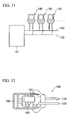
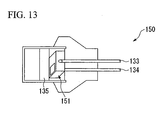
- a technique is currently under test in which, by housing a communication circuit, an ignition circuit, and an ignition element within a single package 151, and by housing that package 151 internally within a squib 150 which is formed in the same external shape as a squib according to the prior art, the squib can be directly connected to the bus of the vehicle without making any changes to a passenger restraint device which is already in existence.
- the ignition element is integrated with the IC
- the explosive and the IC are both housed within the cap, it is desirable to provide some type of construction for protecting the ignition element and the IC from gas which is emitted from the explosive over time.
- the present invention has been conceived in the light of the above problem, and one of its objects is to provide a squib which, while maintaining its function as a squib, also protects the ignition element and IC from gas which is emitted by the explosive.
- the present invention has been conceived in the light of the above problem as well, and another of its objectives is to provide, as a means for solving the above described problems, a low energy squib which, while lowering the work burden, reducing the cost, and providing more reliable ignition, does not require addition of any changes to currently existing restraint devices for persons riding in a vehicle, and which can be connected to the bus.
- the first preferred embodiment of the present invention proposes a squib (such as, for example, the squibs 2a, 2b, 2c, ... of the subsequently described preferred embodiments) of which a plurality are connected via a common bus line (such as, for example, the bus line 3 of the subsequently described preferred embodiments) to a control device (such as, for example, the control device 1 of the subsequently described preferred embodiments), and which is adapted for bus connection so as to be capable of selective operation according to electrical energy (for example, the electrical power in the subsequently described preferred embodiments) and an electrical signal (such as, for example, the control signal and the ignition signal of the subsequently described preferred embodiments) supplied from said control device, wherein: a communication and ignition unit (such as, for example, communication and ignition unit 50 of the subsequently described preferred embodiments), which comprises a communication and ignition circuit (such as, for example, the control circuit 21 which is mounted upon an IC substrate board 52 of the subsequently described preferred embodiments) which
- a communication and ignition unit
- the second preferred embodiment of the present invention proposes a squib of which a plurality are connected via a common bus line to a control device, and which is adapted for bus connection so as to be capable of selective operation according to electrical energy and an electrical signal supplied from said control device, wherein: a communication and ignition unit, which comprises a communication and ignition circuit which is electrically connected with said bus line and an ignition element which is connected to said communication and ignition circuit, is received in a first chamber (such as, for example, the interior of the inner cap 41 of the subsequently described preferred embodiments) along with a quantity of a first explosive; and a quantity of a second explosive, which is of a different type from said first explosive, is charged in a second chamber (such as, for example, the gap between the inner bottom surface 42A of the outer cap 42, and the outer bottom surface 41B of the inner cap 41, of the subsequently described preferred embodiments), which is cut off, with regard to gas flow, from said first chamber by a partition wall (such as, for example, the inner cap 41 of
- an explosive which does not emit any corrosive gas such as, for example, in the subsequently described preferred embodiments, tricyanate or the like.
- the fourth preferred embodiment of the present invention proposes a squib (such as, for example, the squib 101 of the subsequently described preferred embodiments) of which a plurality are connected via a common bus line to a control device, and which is adapted for bus connection so as to be capable of selective operation according to electrical energy and an electrical signal supplied from said control device, wherein: a header section (such as, for example, the header section 104 of the subsequently described preferred embodiments), an explosive section (such as, for example, the flammable material 109 of the subsequently described preferred embodiments), and a communication and ignition circuit (such as, for example, the IC ignition circuit 106 of the subsequently described preferred embodiments) are formed separately, and, between said header section and said explosive section, there is formed a package (such as, for example, the package 102 of the subsequently described preferred embodiments) in which said communication ignition circuit is disposed, with a capacitor (such as, for example, the capacitor 105 of the subsequently described preferred embodiments) for ignition being housed
- said communication ignition circuit and said explosive section as separate from said header, it is possible to simplify the manufacture of said header, and it is accordingly possible to anticipate a reduction in the burden and in the cost of the work. Furthermore, since it becomes unnecessary to assemble said ignition assembly within said package, accordingly it becomes possible to ensure the internal space for housing the capacitor for ignition, so that it is possible to simplify the process of assembly of the squib, thus making it possible to anticipate a reduction in the burden of the work involved. Yet further, by forming said package and said ignition element as separate elements, it becomes possible to manufacture the various elements while benefiting from division of labor, so that it also becomes possible to enhance the effectiveness of production.
- the fifth preferred embodiment of the present invention proposes a squib as described above, in which, further, the outer shape of said package is formed as a circular cylinder, and an ignition element (such as, for example, the ignition element 103 of the subsequently described preferred embodiments) is connected to the tip end surface thereof.
- an ignition element such as, for example, the ignition element 103 of the subsequently described preferred embodiments
- the outer shape of said package as a circular cylinder, along with it being possible to simplify the shape of said package, it also becomes possible to ensure closeness of contact by compressing said flammable material in an even manner, since said package is inserted through said ignition element into the flammable material.
- the flow of said gas is intercepted by the inner cap or by the partition wall, and said gas is accordingly prevented from coming into contact with the ignition element or with the communication and ignition circuit, accordingly, for the first explosive, it is possible to utilize an explosive which, to the utmost extent possible, avoids exerting any influence upon the ignition element or upon the communication and ignition circuit; while, for the second explosive, it is possible to utilize an explosive which is most suitable to implement the basic function of the squib.
- the third preferred embodiment of the present invention it is possible even more effectively to prevent any influence due to gas emitted from the first explosive being exerted upon the ignition element or upon the communication and ignition circuit.
- the fourth preferred embodiment of the present invention it is possible to anticipate a reduction in the burden of the work and in the cost thereof, and, along with ensuring a good ignition performance which can perform ignition at low energy, it is also possible to connect this device to the bus of the vehicle, without making any change to a passenger restraint device which is already fitted to the vehicle; in other words, this squib may be retrofitted to a currently existing passenger restraint device.
- this squib may be retrofitted to a currently existing passenger restraint device.
- the squib according to this first preferred embodiment is most suitable for use in a protective device for persons riding in a vehicle, such as in an air bag device or a pre-tensioner device or the like which is mounted to, for example, an automobile.
- a protective device for persons riding in a vehicle such as in an air bag device or a pre-tensioner device or the like which is mounted to, for example, an automobile.
- the explanation will be made for the case of a protective device for persons riding in a vehicle incorporating this squib according to the first preferred embodiment being mounted to an automobile.
- control unit 1 is a control section which constitutes the central portion of a passenger protective device which protects persons riding in the vehicle from any collision in which the vehicle is involved, and squibs 2a, 2b, 2c, ... of a plurality of auxiliary restraint devices (not shown in the figures) which are provided in locations in the vehicle for protecting persons riding in said vehicle (said squibs being provided in one to one correspondence with said auxiliary restraint devices) are connected to the control unit 1 using an unbalanced type of bus line 3 in which, for example, a pair of wires are provided.
- auxiliary restraint devices which operate the auxiliary restraint devices by taking advantage of flammable material (an explosive which consists of material in the auxiliary restraint devices which evolves gas when fire is applied to it), and they internally store this flammable material 54, and operate the auxiliary restraint devices by igniting this flammable material 54 based upon an ignition execute signal (an ignition execute command) which has been emitted from the communication unit 1 to the communication address of the squib 2a, 2b, 2c, ... as a command.
- flammable material an explosive which consists of material in the auxiliary restraint devices which evolves gas when fire is applied to it
- an ignition execute signal an ignition execute command
- a collision determination section 11 is comprised in the control unit 1, and this operates by means of a CPU (a central processing device): and this collision determination section 11 decides whether or not, due to the vehicle colliding with another object, a shock has been applied which makes it necessary to operate the protective devices for the persons riding in the vehicle, based upon the output signal of a front sensor 4 which, along with being provided at the frontal portion of the vehicle, is connected via a communication circuit 12 and detects the acceleration due to deformation of the frontal portion of the vehicle, and upon the output signal of a G sensor 13 which, along with being provided to the control unit 1, detects the acceleration of the vehicle.
- a front sensor 4 which, along with being provided at the frontal portion of the vehicle, is connected via a communication circuit 12 and detects the acceleration due to deformation of the frontal portion of the vehicle, and upon the output signal of a G sensor 13 which, along with being provided to the control unit 1, detects the acceleration of the vehicle.
- a communication circuit 14 for performing communication with the squibs 2a, 2b, 2c, ... for which communication addresses are designated via control signals (electrical signals), and, if the collision determination section has decided that an unnecessary shock has been applied to the vehicle due to the vehicle colliding with another object, then an ignition execute signal (an ignition execute command) is dispatched by the communication circuit 14 via the bus line 3 to the squibs 2a, 2b, 2c, ... for operating the auxiliary restraint devices (not shown in the figures).
- a vehicle battery 7 is connected to the control unit 1 via a fuse 5 for preventing excess current and via an ignition switch (IGSW) 6, and is charged up with electrical power and is utilized by the vehicle, and, along with electrical power from this vehicle battery 7 which has been inputted being supplied to a +5V power source 16 which generates electrical power for the CPU and the like which constitute the collision determination section 11, this power is also supplied, via a protective diode 15 which prevents reverse flow of electrical current, to a communication circuit 14 which supplies electrical power to the squibs 2a, 2b, 2c, ....
- IGSW ignition switch
- control unit also comprises a backup capacitor 17 which stores electrical power and backs up the power source so as to allow the control unit 1 to operate for a certain time period even if the supply of electrical power from the vehicle battery 7 is cut off, protective diodes 18a and 18b for charging up this backup capacitor 17, a voltage rise circuit 19, and the like.
- a control circuit 21 which performs diagnosis of communication via the bus line 3 and ignition control based upon orders from the control unit 1 is provided to the squib 2a, and, along with control signals (commands) being inputted to the control circuit 21 via a receive buffer 22 from the bus line 3, response signals (responses) are also outputted from the control circuit 21 via a send buffer 23 to the bus line 3.
- a capacitor 28 is connected via a protective diode 27 to the output of the voltage rise circuit 26, and is made so as to be able to accumulate the electrical power whose voltage has been raised by the voltage rise circuit 26, and which is required in order for the squib 2a to ignite the flammable material so as to operate the auxiliary restraint device.
- a switching element 29 To the output (the cathode terminal) of the protective diode 27, in parallel with the capacitor 28, there are connected, in series, a switching element 29, an ignition element 30 for igniting the flammable material which is stored in the squib 2a, and a switching element 31.
- one terminal of the ignition element 30 is connected via the switching element 29 to the output of the protective diode 27, while the other terminal of said ignition element 30 is connected to ground via the switching element 31.
- the control terminals which control the switching element 29 and the switching element 31 to be conductive or interrupted are also both connected to the control circuit 21.
- the squib 2a comprises a cap unit 40 which is formed in the shape of a cylindrical tube with a bottom, and a communication and ignition unit 50 which is coaxially received in said cap unit 40.
- an inner cap 41 which is an essential structural element of the cap unit 40, and a header 51 which is an essential structural unit of the communication and ignition unit 50 are integrated into one unit by, for example, laser welding or the like, and the vicinity of the opening portion of the cap unit 40 is closed up by a resin molding 55.
- the cap unit 40 comprises an inner cap 41 which is shaped as a circular cylinder which has a bottom and into which the communication and ignition unit 50 is coaxially inserted, and an outer cap 42 which is shaped as a circular cylinder which has a bottom and into which said inner cap 41 is coaxially inserted; and these caps 41 and 42, which are made from a metallic material such as stainless steel or the like, are mutually connected together by, for example, laser welding or the like.
- first explosive powder 54a is pressure-packed into the inner portion of the inner cap 41 (i.e. into a first chamber) - in more concrete terms, into the gap which is defined between the inner bottom surface (the inner wall) 41A of the inner cap 41 and the tip end surface (the outer wall) 50A of the communication and ignition unit 50 - and, furthermore, the second explosive 54b is pressure-packed into the gap (i.e. into a second chamber) which is defined between the inner bottom surface (the inner wall) 42A of the outer cap 42 and the outer bottom surface (the outer wall) 41B of the inner cap 41.
- the communication and ignition unit 50 comprises a header 51 which includes a header main body 51a which is electrically conductive and an insulating member 51b at the inner portion of said header main body 51a and shaped as a tube, and an IC main board 52 for communication and ignition which is connected to the tip end of said header 51, for example by welding or the like; and in the header 51 there are fixed two pins 53a and 53b, which are connection terminals to the two wire type bus line 3 which is the external signal line.
- control circuit 21 receive buffer 22, send buffer 23, +5V power source 24, protective diode 25, voltage rise circuit 26, protective diode 27, capacitor 28, switching element 29, ignition element 30, and switching element 31 are mounted to the IC main board 52.
- the first explosive 54a is in direct contact with the IC main board 52. And for the first explosive 54a, in order to ensure protection of the condition of the components such as the control circuit 21 and the ignition element 30 and so on which are mounted to the IC main board 52 from deterioration by gas which is emitted by said first explosive 54a, there is used an explosive which does not emit corrosive gas, such as for example lead trinitroresorcinate (C 6 H(NO 2 ) 3 O 2 Pb) or the like.
- lead trinitroresorcinate C 6 H(NO 2 ) 3 O 2 Pb
- the second explosive 54b is kept in a state in which any gas which is emitted by said second explosive 54b cannot penetrate through to the side of the IC main board 52, since it is isolated by the inner cap 41 so that to be kept out of contact with the IC main board 52.
- an explosive of the same type as is used for the material which evolves gas in a conventional type squib may be utilized as the second explosive 54b, such as for example ZPP or the like.
- the flammable material 54 which ignites the material which evolves gas of the auxiliary restraint device is constituted by these first and second explosives 54a and 54b which are of mutually different types.
- the assembly of the squib 2a may be performed, for example, by performing the following procedure.
- the outer cap 42 and the inner cap 41 are joined together by welding, so as to constitute the cap unit 40. Furthermore, separately from these members, the IC main board 52 is welded to the tip end surface 51A of the header 51 so as to join together these two members, and thereby the communication and ignition unit 50 is constituted.
- the first explosive 54a and the communication and ignition unit 50 are inserted in turn into the cap unit 40, and the inner cap 41 of the cap unit 40 and the header 51 of the communication and ignition unit 50 are joined together by laser welding.
- the opening end portion 41a of the inner cap 41 extends further outwards to the outer side in the axial direction than the opening end portion 42a of the outer cap 42, by a predetermined length.
- the ignition element 30 which is connected to the above described switching element 29 and switching element 31 comes to be disposed at a portion on the tip end of the IC main board 52 where it contacts the first explosive 54a, so that electrical power for ignition of said ignition element 30 and control signals for the control circuit 21 come to be supplied via the header 51.
- the cap unit 40 and the communication and ignition unit 50 which have been joined together into one unit are sealed with a resin molding 55, so that said resin molding 55 spans between the opening end portions 42a and 41a of the outer cap 42 and the inner cap 41 of the cap unit 40, and the portions of the pins 53a and 53b of the communication and ignition unit 50 towards the header 51.
- the second explosive 54b is charged into a closed chamber which coexists together with the first explosive 54a in the inner portion (the first chamber) of the inner cap 41, and for which the flow of gas to said inner portion is intercepted by the inner cap (the partition wall) 41; in other words, said second explosive 54b is charged into the gap (the second chamber) between the inner bottom surface 42A of the outer cap 42 and the outer bottom surface 41B of the inner cap 41.
- the ignition system which comprises these squibs 2a, 2b, 2c, ... according to this first preferred embodiment of the present invention, since the electrical power which is required for the ignition element 30 of the squib 2a to ignite the flammable material 54, in other words the first and second explosives 54a and 54b in that order, and to operate the auxiliary restraint device is charged into the capacitor 28 as the control unit 1 supplies electrical power to the bus line 3, when in this state the control unit 1 transmits an ignition execute signal (an ignition execute command) to the squib 2a, the control circuit 21 of the squib 2a makes the switching element 29 and the switching element 31 electrically conductive, and the electrical power which has been charged into the capacitor 20 flows to the ignition element 30, so that the flammable material 54 which is loaded into the squib 2a can be caused to explode and the auxiliary restraint device can be caused to operate.
- an ignition execute signal an ignition execute command
- the first explosive 54a it is possible to utilize an explosive such as, for example, lead trinitroresorcinate or the like which does not emit corrosive gas, so as to avoid exerting influence upon the IC main board 52 as much as absolutely possible; while, for the second explosive 54b, it becomes possible to utilize an explosive which is appropriate for ensuring the function of the squib 2a as a squib, in other words an explosive such as ZPP or the like which can easily be ignited to evolve gas.
- an explosive such as, for example, lead trinitroresorcinate or the like which does not emit corrosive gas
- the present invention is not to be considered as being limited to the above described preferred embodiments; various alterations and omissions to the details and to the design of any preferred embodiment will be acceptable, provided that the scope of the present invention is not departed from.
- the object of application of the present invention is not to be considered as being limited to a device for protecting persons riding in a vehicle such as an air bag device or a pre-tensioner device or the like which is fitted to a vehicle; various other types of application are possible.
- FIG 5 is an exploded perspective view showing the essential structural elements of this squib according to the second preferred embodiment of the present invention
- FIG. 6 is a schematic perspective view of the squib when the various essential structural elements shown in FIG. 5 have been assembled together.
- FIG 7 is an explanatory structural view showing a communication ignition circuit which was shown in FIG. 5.
- FIG 8 is a schematic perspective view showing a communication ignition unit, in which the communication ignition circuit shown in FIG. 7 has been resin molded.
- this squib 101 is made up from a package 102, an ignition element 103, and a header 104. In the following, each of these components will be explained separately.
- the package 102 is constructed to house within itself a capacitor 105 which can be charged up with the electrical power which is supplied from an ignition control device (not shown in the figures), an IC ignition circuit 106 which communicates with said ignition control device and performs ignition control, and reeds 111 which are arranged at both the sides thereof, and these elements are joined together into one unit by a resin molding 110.
- the overall shape of this package 102 is formed as, roughly, a circular cylindrical shape.
- the ignition element 103 comprises a heat producing portion and a fuel portion which is adjacent thereto.
- heat is generated therein, and this activates the fuel portion; and, when the fuel portion is activated, it becomes excited and a chemical reaction occurs, and a great amount of heat is generated.
- the heat generation portion in this manner as an electrically conductive portion and a fuel portion, it becomes possible to ignite this squib 101 with lower energy than in the case of a conventional squib.
- the header 104 comprises a pair of pins 107 and 108 which are formed to project downward from the main body whose outer shape is formed in a roughly circular cylindrical shape, and it is arranged to be possible to connect the squib 101, via said pins 107 and 108, to a two line type bus line (not shown in the figures) which is an external signal line.
- the unit is formed by fitting the ignition element 103 upon the upper end surface of said package 102 and joining them together into a unit.
- the squib 101 is made by pressing said unit, in this state, into a mass of flammable material 109 which is held in a roughly circular tube shaped cap (not shown in the drawings).
- a number of these squibs 101 are provided to respective air bag devices which are deployed in appropriate locations in the vehicle, such as in the steering wheel and in the dashboard, in the left and right side seats, and in the left and right side portions of the roof and so on; and these squibs 101 are all connected to said ignition control device via said bus.
- the outer shape of the package 102 as a circular cylinder, along with being able to simplify the shape of the package 102, by inserting the package 102 via the ignition element 103 into the flammable material 109, it becomes possible to ensure the closeness of the contact therebetween by compressing said flammable material 109 in a uniform manner.
Landscapes
- Engineering & Computer Science (AREA)
- General Engineering & Computer Science (AREA)
- Mechanical Engineering (AREA)
- Computer Hardware Design (AREA)
- Microelectronics & Electronic Packaging (AREA)
- Air Bags (AREA)
- Feeding, Discharge, Calcimining, Fusing, And Gas-Generation Devices (AREA)
Applications Claiming Priority (4)
| Application Number | Priority Date | Filing Date | Title |
|---|---|---|---|
| JP2003379873 | 2003-11-10 | ||
| JP2003379873A JP2005140478A (ja) | 2003-11-10 | 2003-11-10 | 着火装置 |
| JP2003419479A JP2005180737A (ja) | 2003-12-17 | 2003-12-17 | スクイブ |
| JP2003419479 | 2003-12-17 |
Publications (3)
| Publication Number | Publication Date |
|---|---|
| EP1529696A2 true EP1529696A2 (de) | 2005-05-11 |
| EP1529696A3 EP1529696A3 (de) | 2005-11-09 |
| EP1529696B1 EP1529696B1 (de) | 2011-12-21 |
Family
ID=34436966
Family Applications (1)
| Application Number | Title | Priority Date | Filing Date |
|---|---|---|---|
| EP04026447A Expired - Lifetime EP1529696B1 (de) | 2003-11-10 | 2004-11-08 | Zündpille |
Country Status (3)
| Country | Link |
|---|---|
| US (1) | US7343859B2 (de) |
| EP (1) | EP1529696B1 (de) |
| CN (1) | CN100404999C (de) |
Cited By (1)
| Publication number | Priority date | Publication date | Assignee | Title |
|---|---|---|---|---|
| WO2020163883A1 (en) * | 2019-02-04 | 2020-08-13 | Detnet South Africa (Pty) Ltd | Boost pump |
Families Citing this family (22)
| Publication number | Priority date | Publication date | Assignee | Title |
|---|---|---|---|---|
| EP1693644A1 (de) * | 2003-11-26 | 2006-08-23 | Nippon Kayaku Kabushiki Kaisha | Zünder und gaserzeugungsvorrichtung |
| DE102005045233A1 (de) * | 2005-09-22 | 2007-03-29 | Robert Bosch Gmbh | Steuergerät für den Personenschutz |
| US7430963B2 (en) | 2005-11-29 | 2008-10-07 | Reynolds Systems, Inc. | Energetic material initiation device utilizing exploding foil initiated ignition system with secondary explosive material |
| JP4813904B2 (ja) * | 2006-01-06 | 2011-11-09 | 日本化薬株式会社 | 点火装置およびその製造方法ならびにエアバッグ用ガス発生装置およびシートベルトプリテンショナー用ガス発生装置 |
| JP4996481B2 (ja) * | 2006-01-06 | 2012-08-08 | 日本化薬株式会社 | 点火装置ならびにエアバッグ用ガス発生装置およびシートベルトプリテンショナー用ガス発生装置 |
| US7823508B2 (en) * | 2006-08-24 | 2010-11-02 | Orica Explosives Technology Pty Ltd | Connector for detonator, corresponding booster assembly, and method of use |
| US7571679B2 (en) * | 2006-09-29 | 2009-08-11 | Reynolds Systems, Inc. | Energetic material initiation device having integrated low-energy exploding foil initiator header |
| US8408131B1 (en) | 2006-09-29 | 2013-04-02 | Reynolds Systems, Inc. | Energetic material initiation device |
| JP4705550B2 (ja) * | 2006-10-26 | 2011-06-22 | 日本化薬株式会社 | スクイブならびにエアバッグ用ガス発生装置およびシートベルトプリテンショナー用ガス発生装置 |
| JP4714669B2 (ja) * | 2006-12-01 | 2011-06-29 | 日本化薬株式会社 | ヘッダーアッシー、スクイブならびにエアバッグ用ガス発生装置およびシートベルトプリテンショナー用ガス発生装置 |
| US8100043B1 (en) | 2008-03-28 | 2012-01-24 | Reynolds Systems, Inc. | Detonator cartridge and methods of use |
| US8276516B1 (en) | 2008-10-30 | 2012-10-02 | Reynolds Systems, Inc. | Apparatus for detonating a triaminotrinitrobenzene charge |
| US8056477B2 (en) * | 2009-06-10 | 2011-11-15 | Autoliv Asp, Inc. | Protection system for use with airbag inflators and initiators |
| CN102155883A (zh) * | 2010-12-27 | 2011-08-17 | 北京理工大学 | 一种小型、快速分离的火工解锁螺栓 |
| US20120234193A1 (en) | 2011-03-17 | 2012-09-20 | Special Devices, Inc. | Igniter with a locked consolidated powder charge |
| US8863665B2 (en) | 2012-01-11 | 2014-10-21 | Alliant Techsystems Inc. | Connectors for separable firing unit assemblies, separable firing unit assemblies, and related methods |
| GB201207450D0 (en) * | 2012-04-26 | 2012-06-13 | Secr Defence | An electrical pulse splitter for an explosives system |
| DE102013017383A1 (de) * | 2013-10-21 | 2015-04-23 | Trw Airbag Systems Gmbh | Anzündeinheit, insbesondere für einen Gasgenerator, Gasgenerator, Gassackmodul, Fahrzeugsicherheitssystem und Verfahren zur Herstellung einer Anzündeinheit |
| CN115950918B (zh) * | 2023-02-10 | 2025-09-23 | 中国工程物理研究院化工材料研究所 | 一种炸药燃烧火焰进入缝隙的临界压力测试系统及方法 |
| US12510336B1 (en) | 2023-08-03 | 2025-12-30 | Bae Systems Information And Electronic Systems Integration Inc. | Squib enabled hold up battery switch |
| US12253342B1 (en) | 2023-08-03 | 2025-03-18 | Bae Systems Information And Electronic Systems Integration Inc. | Impulse cartridge cup for smart stores communication interface squib with electronics |
| US12235061B1 (en) | 2023-08-03 | 2025-02-25 | Bae Systems Information And Electronic Systems Integration Inc. | Smart store communication interface (SSCI) compatible squib design |
Citations (2)
| Publication number | Priority date | Publication date | Assignee | Title |
|---|---|---|---|---|
| US5142982A (en) | 1990-01-25 | 1992-09-01 | Bayern-Chemie Gesellschaft Fur Flugchemische Antriebe Mbh | Ignition device |
| EP0805074A1 (de) | 1996-05-02 | 1997-11-05 | Motorola, Inc. | Airbagsystem für ein Kraftfahrzeug |
Family Cites Families (26)
| Publication number | Priority date | Publication date | Assignee | Title |
|---|---|---|---|---|
| JPS57142498A (en) | 1981-02-27 | 1982-09-03 | Asahi Chemical Ind | Delayed electric fuse |
| JPH0694996B2 (ja) * | 1989-11-24 | 1994-11-24 | 繁明 國友 | 花火点火装置 |
| US5140906A (en) * | 1991-11-05 | 1992-08-25 | Ici Americas, Inc. | Airbag igniter having double glass seal |
| JPH0792359A (ja) | 1992-09-23 | 1995-04-07 | Northern Telecom Ltd | 光ファイバユニット及び光ケーブル並びに光ファイバユニットの製造装置 |
| US5847309A (en) * | 1995-08-24 | 1998-12-08 | Auburn University | Radio frequency and electrostatic discharge insensitive electro-explosive devices having non-linear resistances |
| DE19610799C1 (de) | 1996-03-19 | 1997-09-04 | Siemens Ag | Zündeinrichtung zum Auslösen eines Rückhaltemittels in einem Kraftfahrzeug |
| US5760489A (en) | 1996-10-04 | 1998-06-02 | Motorola, Inc. | Method for transmitting signals between a microprocessor and an interface circuit |
| US5969286A (en) | 1996-11-29 | 1999-10-19 | Electronics Development Corporation | Low impedence slapper detonator and feed-through assembly |
| US5831203A (en) | 1997-03-07 | 1998-11-03 | The Ensign-Bickford Company | High impedance semiconductor bridge detonator |
| FR2760525B1 (fr) * | 1997-03-07 | 1999-04-16 | Livbag Snc | Initiateur electro-pyrotechnique constitue autour d'un circuit imprime complet |
| FR2772909B1 (fr) | 1997-12-22 | 2000-01-28 | Livbag Snc | Initiateur electro-pyrotechnique a trois connexions electriques |
| DE19836278C2 (de) | 1998-08-11 | 2000-07-20 | Dynamit Nobel Ag | Extern ansteuerbare Anzündeinheit mit integrierter Elektronik zum Auslösen eines Rückhaltesystems |
| DE19846350A1 (de) | 1998-10-08 | 2000-04-13 | Philips Corp Intellectual Pty | Anordnung zur Steuerung vorgegebener Funktionen über einen Datenbus |
| US6166452A (en) | 1999-01-20 | 2000-12-26 | Breed Automotive Technology, Inc. | Igniter |
| FR2790077B1 (fr) | 1999-02-18 | 2001-12-28 | Livbag Snc | Allumeur electro-pyrotechnique a electronique integree |
| JP3175051B2 (ja) | 1999-10-14 | 2001-06-11 | 昭和金属工業株式会社 | 電気発火式イニシエータ |
| US6156137A (en) | 1999-11-05 | 2000-12-05 | Atlantic Research Corporation | Gas generative compositions |
| US6659500B2 (en) * | 2000-05-11 | 2003-12-09 | Automotive Systems Laboratory, Inc. | Multi-chamber inflator |
| US6557474B1 (en) * | 2000-08-30 | 2003-05-06 | Glasseal Products | Initiator header subassembly for inflation devices |
| US6584911B2 (en) | 2001-04-26 | 2003-07-01 | Trw Inc. | Initiators for air bag inflators |
| US6467414B1 (en) * | 2001-06-29 | 2002-10-22 | Breed Automotive Technology, Inc. | Ignitor with printed electrostatic discharge spark gap |
| WO2003064220A1 (en) | 2002-01-25 | 2003-08-07 | Daicel Chemical Industries, Ltd. | Air bag system |
| JP4205985B2 (ja) | 2002-04-25 | 2009-01-07 | ダイセル化学工業株式会社 | コンデンサの充電容量の決定方法 |
| JP3803636B2 (ja) | 2002-12-26 | 2006-08-02 | 本田技研工業株式会社 | バス接続用点火装置 |
| US7107908B2 (en) * | 2003-07-15 | 2006-09-19 | Special Devices, Inc. | Firing-readiness diagnostic of a pyrotechnic device such as an electronic detonator |
| US6892643B2 (en) * | 2003-07-15 | 2005-05-17 | Special Devices, Inc. | Constant-current, rail-voltage regulated charging electronic detonator |
-
2004
- 2004-11-05 US US10/982,417 patent/US7343859B2/en not_active Expired - Fee Related
- 2004-11-08 EP EP04026447A patent/EP1529696B1/de not_active Expired - Lifetime
- 2004-11-08 CN CNB200410090766XA patent/CN100404999C/zh not_active Expired - Fee Related
Patent Citations (2)
| Publication number | Priority date | Publication date | Assignee | Title |
|---|---|---|---|---|
| US5142982A (en) | 1990-01-25 | 1992-09-01 | Bayern-Chemie Gesellschaft Fur Flugchemische Antriebe Mbh | Ignition device |
| EP0805074A1 (de) | 1996-05-02 | 1997-11-05 | Motorola, Inc. | Airbagsystem für ein Kraftfahrzeug |
Cited By (1)
| Publication number | Priority date | Publication date | Assignee | Title |
|---|---|---|---|---|
| WO2020163883A1 (en) * | 2019-02-04 | 2020-08-13 | Detnet South Africa (Pty) Ltd | Boost pump |
Also Published As
| Publication number | Publication date |
|---|---|
| EP1529696B1 (de) | 2011-12-21 |
| CN1616914A (zh) | 2005-05-18 |
| CN100404999C (zh) | 2008-07-23 |
| US20050155509A1 (en) | 2005-07-21 |
| US7343859B2 (en) | 2008-03-18 |
| EP1529696A3 (de) | 2005-11-09 |
Similar Documents
| Publication | Publication Date | Title |
|---|---|---|
| EP1529696B1 (de) | Zündpille | |
| JP2002535195A (ja) | 点火装置 | |
| JP4065582B2 (ja) | 自動車用エアバッグ・システム | |
| WO2008050860A1 (en) | Squib, gas generation device for airbag, and gas generation device for seat belt pretensioner | |
| JP2001021293A (ja) | スクイブ、及びスクイブの製造方法 | |
| JP6781072B2 (ja) | 点火器および当該点火器を備えるガス発生器 | |
| JP6289490B2 (ja) | 膨張可能な拘束具用の2重作動システム | |
| US7322292B2 (en) | Squib | |
| KR100235790B1 (ko) | 발화식 가스 발생기의 전기 점화기 | |
| US9248802B2 (en) | Surface mount initiators | |
| US7466532B2 (en) | Ignition circuit for squib | |
| EP1544570B1 (de) | Zünder | |
| JP3917127B2 (ja) | 着火装置 | |
| JP2005140478A (ja) | 着火装置 | |
| JP4260611B2 (ja) | 乗員保護装置、及び乗員保護装置の点火制御装置と着火装置 | |
| JP2005201628A (ja) | スクイブ | |
| JP4219796B2 (ja) | 着火装置 | |
| JP4037358B2 (ja) | 点火システム | |
| JP2005175672A (ja) | 点火システム | |
| JP2005170091A (ja) | 着火装置 | |
| JP2005180737A (ja) | スクイブ | |
| KR20000015165A (ko) | 에어백 인플레터의 기폭장치 |
Legal Events
| Date | Code | Title | Description |
|---|---|---|---|
| PUAI | Public reference made under article 153(3) epc to a published international application that has entered the european phase |
Free format text: ORIGINAL CODE: 0009012 |
|
| AK | Designated contracting states |
Kind code of ref document: A2 Designated state(s): AT BE BG CH CY CZ DE DK EE ES FI FR GB GR HU IE IS IT LI LU MC NL PL PT RO SE SI SK TR |
|
| AX | Request for extension of the european patent |
Extension state: AL HR LT LV MK YU |
|
| RIC1 | Information provided on ipc code assigned before grant |
Ipc: 7B 60R 21/01 B Ipc: 7B 60R 21/26 A |
|
| PUAL | Search report despatched |
Free format text: ORIGINAL CODE: 0009013 |
|
| AK | Designated contracting states |
Kind code of ref document: A3 Designated state(s): AT BE BG CH CY CZ DE DK EE ES FI FR GB GR HU IE IS IT LI LU MC NL PL PT RO SE SI SK TR |
|
| AX | Request for extension of the european patent |
Extension state: AL HR LT LV MK YU |
|
| 17P | Request for examination filed |
Effective date: 20051228 |
|
| AKX | Designation fees paid |
Designated state(s): DE GB |
|
| 17Q | First examination report despatched |
Effective date: 20100319 |
|
| GRAP | Despatch of communication of intention to grant a patent |
Free format text: ORIGINAL CODE: EPIDOSNIGR1 |
|
| GRAJ | Information related to disapproval of communication of intention to grant by the applicant or resumption of examination proceedings by the epo deleted |
Free format text: ORIGINAL CODE: EPIDOSDIGR1 |
|
| GRAP | Despatch of communication of intention to grant a patent |
Free format text: ORIGINAL CODE: EPIDOSNIGR1 |
|
| RIN1 | Information on inventor provided before grant (corrected) |
Inventor name: AIDA, HIROMIC/O K.K. HONDA Inventor name: NISHIMURA, JUNICHIC/O K.K. HONDA Inventor name: MIYAKE, ETSUYAC/O K.K. HONDA Inventor name: SAITO, KAZUTAKAC/O K.K. HONDA Inventor name: MATSUDA, KAZUOC/O K.K. HONDA |
|
| GRAS | Grant fee paid |
Free format text: ORIGINAL CODE: EPIDOSNIGR3 |
|
| GRAA | (expected) grant |
Free format text: ORIGINAL CODE: 0009210 |
|
| AK | Designated contracting states |
Kind code of ref document: B1 Designated state(s): DE GB |
|
| REG | Reference to a national code |
Ref country code: GB Ref legal event code: FG4D |
|
| REG | Reference to a national code |
Ref country code: DE Ref legal event code: R096 Ref document number: 602004035734 Country of ref document: DE Effective date: 20120209 |
|
| PLBE | No opposition filed within time limit |
Free format text: ORIGINAL CODE: 0009261 |
|
| STAA | Information on the status of an ep patent application or granted ep patent |
Free format text: STATUS: NO OPPOSITION FILED WITHIN TIME LIMIT |
|
| 26N | No opposition filed |
Effective date: 20120924 |
|
| REG | Reference to a national code |
Ref country code: DE Ref legal event code: R097 Ref document number: 602004035734 Country of ref document: DE Effective date: 20120924 |
|
| PGFP | Annual fee paid to national office [announced via postgrant information from national office to epo] |
Ref country code: DE Payment date: 20121031 Year of fee payment: 9 |
|
| PGFP | Annual fee paid to national office [announced via postgrant information from national office to epo] |
Ref country code: GB Payment date: 20121107 Year of fee payment: 9 |
|
| GBPC | Gb: european patent ceased through non-payment of renewal fee |
Effective date: 20131108 |
|
| REG | Reference to a national code |
Ref country code: DE Ref legal event code: R119 Ref document number: 602004035734 Country of ref document: DE Effective date: 20140603 |
|
| PG25 | Lapsed in a contracting state [announced via postgrant information from national office to epo] |
Ref country code: DE Free format text: LAPSE BECAUSE OF NON-PAYMENT OF DUE FEES Effective date: 20140603 |
|
| PG25 | Lapsed in a contracting state [announced via postgrant information from national office to epo] |
Ref country code: GB Free format text: LAPSE BECAUSE OF NON-PAYMENT OF DUE FEES Effective date: 20131108 |