EP1529247B1 - Verwendung von salzen schichtartiger doppelhydroxide, elektrophotographischer toner, pulver und pulverlack - Google Patents
Verwendung von salzen schichtartiger doppelhydroxide, elektrophotographischer toner, pulver und pulverlack Download PDFInfo
- Publication number
- EP1529247B1 EP1529247B1 EP03792189A EP03792189A EP1529247B1 EP 1529247 B1 EP1529247 B1 EP 1529247B1 EP 03792189 A EP03792189 A EP 03792189A EP 03792189 A EP03792189 A EP 03792189A EP 1529247 B1 EP1529247 B1 EP 1529247B1
- Authority
- EP
- European Patent Office
- Prior art keywords
- acid
- compounds
- salts
- powder
- metal cations
- Prior art date
- Legal status (The legal status is an assumption and is not a legal conclusion. Google has not performed a legal analysis and makes no representation as to the accuracy of the status listed.)
- Expired - Lifetime
Links
Classifications
-
- G—PHYSICS
- G03—PHOTOGRAPHY; CINEMATOGRAPHY; ANALOGOUS TECHNIQUES USING WAVES OTHER THAN OPTICAL WAVES; ELECTROGRAPHY; HOLOGRAPHY
- G03G—ELECTROGRAPHY; ELECTROPHOTOGRAPHY; MAGNETOGRAPHY
- G03G9/00—Developers
- G03G9/08—Developers with toner particles
- G03G9/097—Plasticisers; Charge controlling agents
-
- D—TEXTILES; PAPER
- D01—NATURAL OR MAN-MADE THREADS OR FIBRES; SPINNING
- D01F—CHEMICAL FEATURES IN THE MANUFACTURE OF ARTIFICIAL FILAMENTS, THREADS, FIBRES, BRISTLES OR RIBBONS; APPARATUS SPECIALLY ADAPTED FOR THE MANUFACTURE OF CARBON FILAMENTS
- D01F1/00—General methods for the manufacture of artificial filaments or the like
- D01F1/02—Addition of substances to the spinning solution or to the melt
- D01F1/10—Other agents for modifying properties
-
- C—CHEMISTRY; METALLURGY
- C09—DYES; PAINTS; POLISHES; NATURAL RESINS; ADHESIVES; COMPOSITIONS NOT OTHERWISE PROVIDED FOR; APPLICATIONS OF MATERIALS NOT OTHERWISE PROVIDED FOR
- C09D—COATING COMPOSITIONS, e.g. PAINTS, VARNISHES OR LACQUERS; FILLING PASTES; CHEMICAL PAINT OR INK REMOVERS; INKS; CORRECTING FLUIDS; WOODSTAINS; PASTES OR SOLIDS FOR COLOURING OR PRINTING; USE OF MATERIALS THEREFOR
- C09D5/00—Coating compositions, e.g. paints, varnishes or lacquers, characterised by their physical nature or the effects produced; Filling pastes
- C09D5/03—Powdery paints
- C09D5/033—Powdery paints characterised by the additives
- C09D5/034—Charge control agents
-
- G—PHYSICS
- G03—PHOTOGRAPHY; CINEMATOGRAPHY; ANALOGOUS TECHNIQUES USING WAVES OTHER THAN OPTICAL WAVES; ELECTROGRAPHY; HOLOGRAPHY
- G03G—ELECTROGRAPHY; ELECTROPHOTOGRAPHY; MAGNETOGRAPHY
- G03G9/00—Developers
- G03G9/08—Developers with toner particles
-
- G—PHYSICS
- G03—PHOTOGRAPHY; CINEMATOGRAPHY; ANALOGOUS TECHNIQUES USING WAVES OTHER THAN OPTICAL WAVES; ELECTROGRAPHY; HOLOGRAPHY
- G03G—ELECTROGRAPHY; ELECTROPHOTOGRAPHY; MAGNETOGRAPHY
- G03G9/00—Developers
- G03G9/08—Developers with toner particles
- G03G9/097—Plasticisers; Charge controlling agents
- G03G9/09708—Inorganic compounds
-
- G—PHYSICS
- G03—PHOTOGRAPHY; CINEMATOGRAPHY; ANALOGOUS TECHNIQUES USING WAVES OTHER THAN OPTICAL WAVES; ELECTROGRAPHY; HOLOGRAPHY
- G03G—ELECTROGRAPHY; ELECTROPHOTOGRAPHY; MAGNETOGRAPHY
- G03G9/00—Developers
- G03G9/08—Developers with toner particles
- G03G9/097—Plasticisers; Charge controlling agents
- G03G9/09783—Organo-metallic compounds
-
- B—PERFORMING OPERATIONS; TRANSPORTING
- B03—SEPARATION OF SOLID MATERIALS USING LIQUIDS OR USING PNEUMATIC TABLES OR JIGS; MAGNETIC OR ELECTROSTATIC SEPARATION OF SOLID MATERIALS FROM SOLID MATERIALS OR FLUIDS; SEPARATION BY HIGH-VOLTAGE ELECTRIC FIELDS
- B03C—MAGNETIC OR ELECTROSTATIC SEPARATION OF SOLID MATERIALS FROM SOLID MATERIALS OR FLUIDS; SEPARATION BY HIGH-VOLTAGE ELECTRIC FIELDS
- B03C7/00—Separating solids from solids by electrostatic effect
- B03C7/006—Charging without electricity supply, e.g. by tribo-electricity or pyroelectricity
Definitions
- the present invention is in the field of charge control agents in terms of a component that selectively affects the electrostatic charging behavior in a matrix.
- a "latent charge image” is formed on a photoconductor.
- This "latent charge image” is developed by applying an electrostatically charged toner, which is then transferred, for example, to paper, textiles, films or plastic and fixed for example by means of pressure, radiation, heat or solvent action.
- Typical toners are one- or two-component powder toners (also called one- or two-component developers), in addition special toners, such as e.g. Magnetic toner, liquid toner or polymerization toner in use.
- polymerization toners are meant those toners which are e.g. by suspension polymerization (condensation) or emulsion polymerization and lead to improved particle properties of the toner.
- those toners are also meant which are basically produced in non-aqueous dispersions.
- toner quality is its specific charge q / m (charge per unit mass).
- charge per unit mass charge per unit mass
- q / m charge per unit mass
- the constancy of this charge over a longer activation period and the insensitivity of the toner to climatic influences, such as temperature and humidity an important quality criterion.
- Both positively and negatively chargeable toners find use in copiers and laser printers, depending on the type of process and device.
- charge control agents are often added.
- toner binders often have a strong dependence of the charge on the activation time, it is the task of a charge control agent, on the one hand to adjust the sign and the amount of toner charging and, on the other hand, to counteract the charging drift of the toner binder and to ensure consistency of the toner charge.
- the charge control agents have sufficient thermal stability and good dispersibility. Typical incorporation temperatures for charge control agents in the toner resins are between 100 and 200 ° C when using kneaders or extruders. Accordingly, a thermal stability of 200 ° C is of great advantage. It is also important that the thermal stability over a longer period (about 30 minutes) and in various binder systems is guaranteed.
- the charge control agent has no waxy properties, no stickiness and a melting or softening point of> 150 ° C, better> 200 ° C. Tackiness often introduces problems with dosing into the toner formulation, and low melting or softening points can result in a lack of homogenous distribution upon dispersion as the material contracts in droplet form in the substrate.
- Typical toner binders are polymerization, polyaddition and polycondensation resins such as styrene, styrene acrylate, styrene butadiene, acrylate; Polyester, phenolic epoxy resins, as well as cycloolefin copolymers, alone or in combination, which contain other ingredients, e.g. Colorants, such as dyes and pigments, waxes or flow aids, may contain or may be added afterwards, such as highly disperse silicas.
- Charge control agents can also be used to improve the electrostatic charging of powders and paints, in particular in triboelectrically or electrokinetically sprayed powder coatings, as used for the surface coating of objects made of, for example, metal, wood, plastic, glass, ceramic, concrete, textile material, paper or rubber, used become.
- the powder coating or powder generally receives its electrostatic charge by one of the following two methods: In the corona process, the powder coating or the powder is conducted past a charged corona and charged thereby, in the triboelectric or electrokinetic method, the principle of the friction electricity is used. A combination of both methods is possible.
- the powder coating or the powder obtained in the sprayer an electrostatic charge, which is opposite to the charge of the friction partner, generally a hose or spray tube, for example made of polytetrafluoroethylene.
- powder coating resins typically epoxy resins, carboxyl and hydroxyl polyester resins, polyurethane and acrylic resins are used together with the usual hardeners. Combinations of resins are also used. For example, epoxy resins are frequently used in combination with polyester resins containing carboxyl and hydroxyl groups.
- charge control agents can significantly improve the charging and the charge stability behavior of electret materials, in particular electret fibers ( DE-A-43 21 289 ).
- Typical electret materials are based on polyolefins, halogenated polyolefins, polyacrylates, polyacrylonitriles, polystyrenes or fluoropolymers, such as polyethylene, polypropylene, polytetrafluoroethylene and perfluorinated ethylene and propylene, or on polyesters, polycarbonates, polyamides, polyimides, polyether ketones, on polyarylene sulfides, especially polyphenylene sulfides, on polyacetals , Cellulose esters, polyalkylene terephthalates and mixtures thereof.
- Electret materials, in particular electret fibers can be used, for example, for (very fine) dust filtration. The electret materials can receive their charge by corona or tribocharging.
- charge control agents can be used in electrostatic separation processes, in particular in separation processes of polymers. Without charge control agents, "low density polyethylene (LDPE)" and “high After charge control agent addition, LDPE become highly positive and HDPE strongly negative and can be separated so well
- LDPE low density polyethylene
- incorporation into the polymer is also possible, for example a polymer
- PP polypropylene
- PET polyethylene terephthalate
- PVC polyvinyl chloride
- Salt minerals can also be separated if an agent has previously been added (surface conditioning), which improves the substrate-specific electrostatic charge ( A. Singewald et al., Journal of Physical. Chem., Vol. 124, pp. 223-248 (1981 )).
- charge control agents are referred to as “Electroconductivity Providing Agents” (ECPA) ( JP-05-163 449 ) are used in inks for inkjet printers.
- ECPA Electrode Providing Agents
- the said double hydroxides are suitable as charge control agents in color filters for additive or subtractive color generation, as well as in “electronic inks” for “electronic newspapers”.
- charge control agents can be used to surface modify free flow agents such as fumed silicas in their pyrogenic as precipitated form or metal oxides such as titanium dioxide. In this case, an optimization of the physical properties, such as triboelectric charging behavior, causes. Free flow agents are subsequently added to the toner for better flowability.
- toner binders such as polyesters, polystyrene acrylates or polystyrene butadiene / epoxy resins and cycloolefin copolymers. Furthermore, their effect should be largely independent of the resin / carrier combination in order to develop a broad application. Likewise, they should be readily and undecomposable dispersible in common powder coating binders and electret materials such as polyester (PES), epoxy, PES epoxy hybrid, polyurethane, acrylic systems and polypropylenes.
- PET polyester
- the charge control agents should be effective even at the lowest possible concentration (1% or less) and should not lose this efficiency in conjunction with carbon black or other colorants.
- Colorants are known to have a partially lasting effect on the triboelectric charging of toners.
- the salts of layered double hydroxides described below have advantageous charge control properties, in particular for negative charge and high thermal stabilities, the charge control property being lost neither by combination with carbon black or other colorants.
- the compounds are well tolerated with the usual toner, powder coating and electret binders and are easily dispersed.
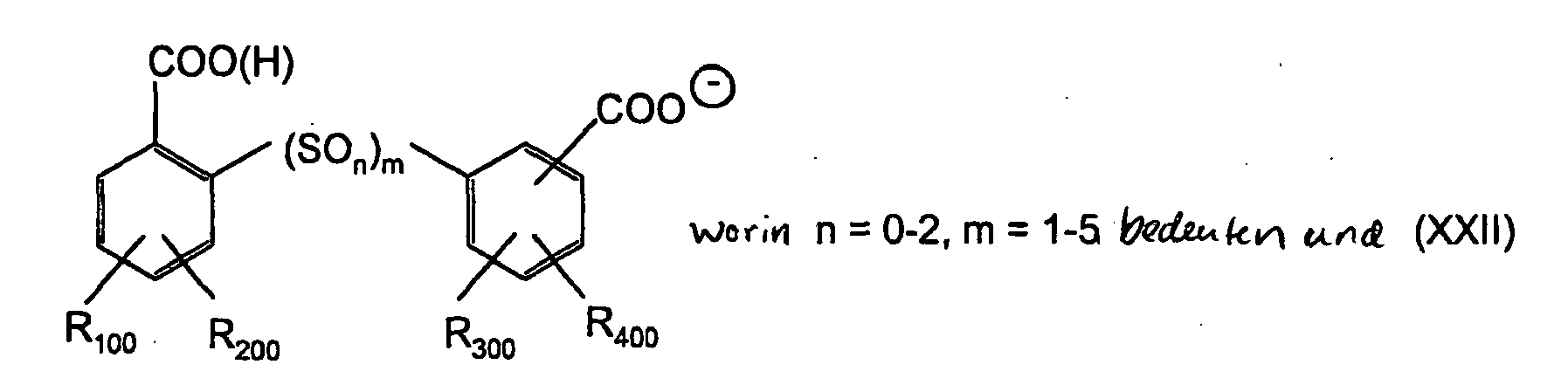
- the present invention is the use of layered double hydroxide salts as charge control agents in electrophotographic toners and developers, in powder coatings, electret materials and in electrostatic separations of chargeable materials, such as polymers, characterized in that the double hydroxide salt monovalent or divalent metal cations or a mixture thereof, as well as trivalent metal cations, as well as organic anions A of the formulas below wherein R 18 , R 19 and R 20 are the same or different and are hydrogen, C 1 -C 22 alkyl, C 1 -C 18 alkenyl, C 1 -C 18 alkoxy; in which the radicals R 100 to R 400 are identical or different and are hydrogen, C 1 -C 22 -alkyl, C 1 -C 18 -alkenyl, C 1 -C 18 -alkoxy, hydroxy (C 1 -C 18 ) -alkylene, Amino (C 1 -C 18 ) alkylene, C 1 -C 18 alkylimino, carboxy
- Compounds in this sense are, for example, the anions of the following acids: benzoic acid, naphthoic acid, 4-tert-butylbenzoic acid, benzenesulfonic acid, p-toluenesulfonic acid, naphthalenesulfonic acid, 2,2'-dithiobenzoic acid.
- Said double hydroxide salt is characterized in that the number of hydroxy groups is about 1.8 to 2.2 times, preferably about 2 times, the sum of all metal cations.
- the molar ratio of the monovalent and / or divalent metal cations to the trivalent metal cations may be between 10 4 and 10 -4 , preferably between 10 and 0.1, in particular between 5 and 0.2.
- the ratio of the monovalent to the divalent metal cations may be arbitrary, but preferred are double hydroxide salts, which are exclusively divalent Metal cations or a mixture of monovalent and divalent metal cations.
- A can be a single or multiple charged organic anion.
- the amount of anions A is determined by the stoichiometry of the positive and negative charges in the double hydroxide salt such that the sum of all charges is zero.
- one part, for example 0.1 to 99 mol%, in particular 1 to 90 mol%, of the anions by other anions, such as inorganic anions, such as halide, carbonate, sulfate, nitrate, phosphate or borate is replaced.
- the double hydroxide salts used according to the invention may also contain water molecules as water of crystallization or intercalated between individual layers.
- Particularly suitable monohydric metal cations are alkali metal cations, such as Li + , Na + or K + .
- Suitable divalent metal cations are, in particular, Mg 2+ , Ca 2+ , Zn 2+ , Co 2+ , Ni 2+ , Fe 2+ , Cu 2+ or Mn 2+ .
- Particularly suitable trivalent metal cations are Al 3+ , Fe 3+ , Co 3+ , Mn 3+ , Ni 3+ , Cr 3+ and B 3+ .
- double hydroxide salts which contain Mg 2+ and Al 3+ , in particular in a molar ratio of 3.1: 1 to 1: 2.
- Starting materials for double hydroxides in the context of the present invention are hydrotalcites, which are usually commercially available and contain an inorganic anion, usually carbonate.
- suitable methods such as reaction in aqueous, organic, eg alcoholic or aqueous-organic suspension with the corresponding organic anions, for example in the form of their salts, from these commercial products, the invention used Double hydroxide salts are produced.
- the hydrotalcite thus prepared is calcined, ie heated to a temperature of 150 to 1000 ° C, optionally under reduced pressure.
- double hydroxide salts having a molar ratio Mg: Al of about 3: 1, about 2: 1, about 5: 4 or about 1: 2 and the calcined forms thereof.
- the salts of layered double hydroxides are advantageously prepared in an aqueous medium at a pH of 3 to 14 and at a temperature between 0 and 100 ° C, preferably with stirring and optionally also under pressure.
- the preparation can also be carried out under autoclave conditions, ie under pressures between 1.1 and 1000 bar, preferably between 1.1 and 500 bar, in particular between 1.1 and 200 bar, and at temperatures between 20 and 200 ° C, preferably between 30 and 190 ° C, in particular between 40 and 180 ° C.
- the or used organic anions are expediently used in equimolar amounts, but also a 0.1 to 99.9% deficit is possible.
- the organic anions can be used directly as salt, for example as sodium or potassium salt or as acid in the protonated form, in the latter case optionally a pH adjustment by means of a base such as sodium or potassium hydroxide or - carbonate is necessary to ensure a better distribution of the acid in the aqueous medium.
- the organic anions can also be used as acid halides, acid anhydrides, acid azides or acid esters. This applies in particular to the production in organic solvents.
- the compounds described in the invention can also be prepared by direct reaction of the calcined or uncalcined double hydroxides with the corresponding organic acids or their salts with heating in a mixing unit, such as a kneader, extruder, dissolver, a bead mill, a Henschel mixer or a mill , Furthermore, the preparation is also possible by the reaction of salts of the double hydroxide-building metal cations, such as magnesium chloride and aluminum chloride, in aqueous solution of alkali metal hydroxide with the acid or the salt of the organic anions.
- a mixing unit such as a kneader, extruder, dissolver, a bead mill, a Henschel mixer or a mill
- salts of the double hydroxide-building metal cations such as magnesium chloride and aluminum chloride
- the salts of layered double hydroxides used according to the invention can be tailored precisely to the particular resin / toner system. Another technical advantage of these compounds is that they behave inertly with respect to the different binder systems and thus have many uses, it being of particular importance that they are not dissolved in the polymer matrix but are present as small, very finely divided solids. Furthermore, they show high and often very constant charge control properties as well as very good thermal stabilities. Furthermore, the double hydroxides used according to the invention are free-flowing and have good dispersibility.
- Dispersion means the distribution of one substance in another, for the purposes of the invention, the distribution of a charge control agent in the toner binder, powder coating binder or electret material. It is known that crystalline substances are present in their coarsest form as agglomerates. In order to achieve a homogeneous distribution in the binder, they must be divided by the dispersing into smaller aggregates or ideally into primary particles.
- the charge control agent particles present in the binder after dispersion should be less than 1 ⁇ m, preferably less than 0.5 ⁇ m, with a narrow particle size distribution being advantageous.
- optimal effective ranges are found depending on the substance. For example, coarse particles (1 mm) are partly not dispersible or only with a considerable expenditure of time and energy, while very fine particles in the submicron range harbor an increased safety risk, such as the possibility of dust explosion.
- the particle size and shape is adjusted and modified either by the synthesis and / or post-treatment. Frequently, the required property is only possible by targeted post-treatment such as grinding and / or drying. For this purpose, various grinding techniques are available. For example, air jet mills, granulators, hammer mills, bead mills and impact mills are advantageous.
- the binder systems mentioned in the present invention are hydrophobic materials.
- High water contents of the charge control agent can either oppose wetting or promote dispersion (flushing). Therefore, the practicable moisture content is substance-specific.
- the compounds according to the invention are characterized by the following chemical / physical properties:
- the water content determined by the Karl Fischer method, is usually between 0.001% and 30%, preferably between 0.01 and 25% and particularly preferably between 0.1 and 15%, whereby the water can be adsorbed and / or bound, and its content can be adjusted by the action of temperature up to 200 ° C and vacuum to 10 -8 Torr or by addition of water or storage under defined humidity conditions.
- the compounds used according to the invention which contain one or more organic anions as defined above, after 48 hours of storage at 90% rel.
- the particle size determined by light microscopic evaluation or laser light diffraction, and defined by the d 50 value, is between 0.01 ⁇ m and 1000 ⁇ m, preferably between 0.1 and 500 ⁇ m and very particularly preferably between 0.5 and 400 ⁇ m. It is particularly advantageous if the grinding results in a narrow particle size.
- the conductivity of the 5% aqueous dispersion is between 0.001 and 2000 mS, preferably between 0.01 and 100 mS.
- the compounds of the invention contain predominantly crystalline, but also amorphous portions.
- the compounds used according to the invention incorporated into a toner binder, exhibit a temperature stability up to 200 ° C. (no discoloration) in a thermal gradient test (Kofler test).
- the compounds used according to the invention surprisingly show significantly lower surface potentials (positive or negative sign) than the corresponding double hydroxides with inorganic anions.
- the titration of these compounds with appropriate surface-active reagents to the zero point of the surface potential (SCD tracking of the titration) in the compounds with inorganic anions significantly more surfactant reagent required than the corresponding double hydroxides with organic anions. This indicates a high stability of the sentence bond between double hydroxide and organic anion.
- the salts of layered double hydroxides used according to the invention can also be combined with other positively or negatively controlling charge control agents in order to achieve good performance chargeability, the total concentration of the charge control agents advantageously being between 0.01 and 50% by weight, preferably between 0.05 and 20 wt .-%, particularly preferably between 0.1 and 5 wt .-%, based on the total weight of the electrophotographic toner, developer, powder or powder coating.
- Examples of further charge control agents are: triphenylmethane; Ammonium and immonium compounds, iminium compounds; fluorinated ammonium and fluorinated immonium compounds; biscationic acid amides; polymeric ammonium compounds; diallylammonium compounds; Aryl sulfide derivatives, phenol derivatives; Phosphonium compounds and fluorinated phosphonium compounds; Calix (n) arene, cyclically linked oligosaccharides (cyclodextrins) and their derivatives, especially borate derivatives, interpolyelectrolyte complexes (IPECs); Polyester salts; Metal complex compounds, in particular, salicylate-metal complexes and salicylate-nonmetal complexes, salts of ionic structural silicates, hydroxycarboxylic acid-metal complexes and hydroxycarboxylic acid-nonmetal complexes, benzimidazolones; Azines, thiazines or oxa
- the layered double hydroxides used according to the invention are used individually or in combination with one another or with further charge control agents mentioned above in a concentration of 0.01 to 50% by weight, preferably 0.05 to 20% by weight, more preferably 0, 1 to 5.0 wt .-%, based on the total mixture, in the binder of the respective toner, developer, paint, powder coating, electret or the electrostatically separated polymer homogeneously, for example by extrusion or kneading, bead milling or with Ultraturrax (high speed stirrer) incorporated.
- Ultraturrax high speed stirrer
- the compounds used according to the invention may be used as dried and ground powders, dispersions or solutions, presscakes, masterbatches, preparations, pasty pastes, as mixed onto suitable carriers, such as silica gel or with such carriers, TiO 2 , Al 2 O 3 , carbon black, be added from aqueous or non-aqueous solution compounds or in any other form.
- suitable carriers such as silica gel or with such carriers, TiO 2 , Al 2 O 3 , carbon black
- the compounds used according to the invention can in principle also be added during the preparation of the respective binders, ie in the course of their polymerization, polyaddition or polycondensation, as well as in the production of polymerization toners, for example during the suspension, emulsion polymerization or in the aggregation of Polymer systems to toner particles.
- the charge control agents according to the invention can also be used in the form of finely divided aqueous, aqueous-organic or organic dispersions.
- the particle sizes (d 50 values) are between 20 nm and 1 ⁇ m, preferably between 50 and 500 nm.
- concentrations of charge control agents are between 0.01 and 50% by weight, preferably between 0.1 and 30% by weight. , based on the total weight of the dispersion.
- the viscosity of such a dispersion is suitably between 0.5 and 10 6 mPa s, preferably between 1 and 5000 mPa s.
- water is preferably used in the form of distilled or demineralized water.
- one or more organic solvents are used as the organic medium, preferably from the group of monohydric or polyhydric alcohols, their ethers and esters, eg. B. alkanols, in particular having 1 to 4 carbon atoms, such as methanol, ethanol, propanol, isopropanol, butanol, isobutanol; di- or trihydric alcohols, in particular having 2 to 6 C atoms, for.
- ethylene glycol propylene glycol, 1,3-propanediol, 1,4-butanediol, 1,5-pentanediol, 1,6-hexanediol, 1,2,6-hexanetriol, glycerol, diethylene glycol, dipropylene glycol, triethylene glycol, polyethylene glycol, tripropylene glycol, polypropylene glycol; lower alkyl ethers of polyhydric alcohols, such as ethylene glycol monomethyl or ethyl or butyl ether, triethylene glycol monomethyl or ethyl ether; Ketones and ketone alcohols, such as acetone, methyl ethyl ketone, di-ethyl ketone, methyl isobutyl ketone, methyl pentyl ketone, cyclopentanone, cyclohexanone, diacetone alcohol; Amides, such as dimethylformamide, dimethylacetamide and N-
- dispersions for the preparation of stable dispersions it is also possible to use customary ionic or nonionic dispersing aids, for example sulfonates, phosphates, polyphosphates, carbonates, silicates, hydroxides, metal soaps, polymers, such as acrylates, fatty acid derivatives and glycoside compounds.
- the dispersions may contain metal complexing agents, such as EDTA or NTA.
- the dispersions may contain other conventional additives, such as preservatives, biocides, antioxidants, cationic, anionic, amphoteric or nonionic surfactants (Surfactants and wetting agents), degasser / defoamers and viscosity modifiers, for example polyvinyl alcohol, cellulose derivatives or water-soluble natural or synthetic resins and polymers as film formers or binders to increase the adhesion and abrasion resistance.
- surfactants and wetting agents cationic, anionic, amphoteric or nonionic surfactants
- degasser / defoamers for example polyvinyl alcohol, cellulose derivatives or water-soluble natural or synthetic resins and polymers as film formers or binders to increase the adhesion and abrasion resistance.
- pH regulators organic or inorganic bases and acids are used.
- Preferred organic bases are amines, such as, for example, ethanolamine, diethanolamine, triethanolamine, N, N-dimethylethanolamine, diisopropylamine, aminomethylpropanol or dimethylminomethylpropanol.
- Preferred inorganic bases are sodium, potassium, lithium hydroxide or ammonia.
- Further constituents may be hydrotropic compounds, such as, for example, formamide, urea, tetramethylurea, ⁇ -caprolactam, ethylene glycol, diethylene glycol, triethylene glycol, polyethylene glycol, butyl glycol, methyl cellosolve, glycerol, sugars, N-methylpyrrolidone, 1,3-diethyl-2-imidazolidinone, thiodiglycol, sodium benzenesulfonate, sodium xylenesulfonate, sodium toluenesulfonate, sodium Cumene sulfonate, Na benzoate, Na salicylate or Na-butyl monoglycol sulfate.
- concentration of these dispersing aids and / or customary additives in the dispersion is expediently between 0.001 and 80% by weight, preferably between 0.01 and 50% by weight, based on the total weight of the dispersion.
- colorants such as organic pigments, inorganic pigments or dyes, usually in the form of powders, dispersions, press cakes, solutions or masterbatches, are added.
- the organic color pigments may be from the group of azo pigments or polycyclic pigments or solid solutions of such pigments.
- Preferred blue and / or green pigments are copper phthalocyanines, such as CI Pigment Blue 15, 15: 1, 15: 2, 15: 3, 15: 4, 15: 6, P.
- Blue 16 metal-free phthalocyanine
- phthalocyanines with aluminum, Nickel, iron or vanadium as the central atom, furthermore triaryl carbonium pigments, such as Pigment Blue 1, 2, 9, 10, 14, 62, 68, Pigment Green 1, 4, 7, 45; Orange pigments such as PO 5, 62, 36, 34, 13, 43, 71; Yellow pigments such as PY 12, 13, 14, 17, 74, 83, 93, 97, 111, 120,122, 139,151, 154, 155, 174, 175, 176, 180, 174, 185, 194, 213, 214.
- Red pigments such as PR 2,3, 4,5,9, 38, 48, 53, 57, 112 , 122, 144, 146, 147, 149, 168, 170, 175, 176, 177, 179, 181, 184, 185, 186, 188, 189, 202, 207, 208, 209, 210, 214, 219, 238, 253, 254, 255, 256, 257 , 266, 269, 270, 272, 279.
- Violet pigments such as PV 1, 19, 23, 32, carbon blacks such as P.
- the mixtures may be in the form of powders, by mixing presscake, spray-dried presscake, masterbatches and by dispersing (extrusion, kneading, roller mill, bead mills, Ultraturrax, ultrasonics) in the presence of a solid or liquid carrier material (aqueous and nonaqueous inks) Base) as well as by flushing in the presence of a carrier material.
- a solid or liquid carrier material aqueous and nonaqueous inks
- a carrier material aqueous and nonaqueous inks
- the mixing can also take place in the presence of elevated temperatures by subsequent cooling of the mixture mass and assisted by vacuum.
- the flushing process can proceed in the presence or absence of organic solvents and waxes.
- mixtures with organic dyes offer.
- water-soluble dyes such as Direct, Reactive and Acid Dyes
- solvent-soluble dyes such as Solvent Dyes, Disperse Dyes and Vat Dyes.
- Examples include CI Reactive Yellow 37, Acid Yellow 23, Reactive Red 23, 180, Acid Red 52, Reactive Blue 19, 21, Acid Blue 9, Direct Blue 199, Solvent Yellow 14, 16, 25, 56, 62, 64, 79, 81, 82, 83, 83: 1, 93, 98, 133, 162, 174, Solvent Red 8, 19, 24, 49, 89, 90, 91, 92, 109, 118, 119, 122, 124, 127, 135, 160, 195, 212, 215, Solvent Blue 44, 45, Solvent Orange 41, 60, 63, Disperse Yellow 64, Vat Red 41, Solvent Black 45, 27.
- dyes and pigments having fluorescent properties such as ® luminol (Riedel-de Haen)
- ® luminol Rost-de Haen
- the colorants can also in a special wax-coated form, as in EP-A-1 204 005 described, be used in combination with the invention Ladunngs Kunststoffstoffn.
- Inorganic pigments such as TiO 2 or BaSO 4
- mixtures with effect pigments such as, for example, pearlescent pigments, Fe 2 O 3 pigments ( ® Paliochromes) and pigments based on cholesteric polymers, which give different color impressions as a function of the viewing angle, are suitable.
- Electrophotographic toners and also powder coatings may still contain waxes.
- the term "wax” refers to a number of natural or synthetically derived substances, which generally have the following properties: kneadable at 20 ° C, solid to brittle hard, coarse to fine crystalline, translucent to opaque, but not glassy; melting above 40 ° C. without decomposition, already a little above the melting point, relatively low-viscous and non-stringy, strongly temperature-dependent consistency and solubility, polishable under slight pressure (cf. Ullmann's Encyclopedia of Industrial Chemistry, Volume 24, 4th Edition 1983, pp. 1-49, Verlag Chemie, Weinheim and Rompps Chemie-Lexikon, Volume 6, 8th Edition 1988, p. 463, Franck'sche Verlags Stuttgart ).
- Preferred waxes are: natural waxes, such as plant waxes, eg carnauba wax, candellila wax, and animal waxes, eg beeswax, modified natural waxes, such as paraffin waxes, microwaxes, semi-synthetic waxes, such as montan ester waxes, or fully synthetic waxes, such as polyolefin waxes, for example polyethylene and polypropylene waxes, Polyethylene glycol waxes, cycloolefin copolymer waxes, amide waxes, such as N, N'-distearylethylenediamine, zirconocene waxes and chlorine or fluorine-containing polyolefin waxes or polyethylene-polytetrafluoroethylene wax mixtures.
- natural waxes such as plant waxes, eg carnauba wax, candellila wax, and animal waxes, eg beeswax
- polyolefin waxes and polyolefin waxes containing polar groups formed by subsequent oxidation of the polyolefin wax, by grafting reaction with carboxylic acid, carboxylic ester, carboxylic anhydride or hydroxyl-containing monomers or by copolymerization of an olefin and a carboxylic acid, carboxylic ester, carboxylic acid amide, Carboxylic anhydride or hydroxy containing monomer.
- Waxes for the purposes of the present invention may also be relatively high molecular weight compounds which have a waxy character and are preferably prepared by polycondensation, polyaddition or polymerization processes, for example thermoplastic polyester, epoxide, styrene-acrylate copolymer, styrene-butadiene copolymer -, cycloolefin copolymer resins, such as ® Topas.
- such polymers usually have a number average molecular weight ( M n ) from 500 to 20,000.
- the dropping point of the waxes used according to the invention or the softening temperature of said waxy polymers is preferably in the range from 20 to 180.degree. C., more preferably in the range from 30 to 140.degree.
- the present invention also provides an electrophotographic toner, powder or powder coating containing 30 to 99.99% by weight, preferably 40 to 99.5% by weight, of a conventional binder, for example a styrene, styrene acrylate, styrene-butadiene, Acrylate, urethane, acrylic, polyester or epoxy resin or a combination of the last two, 0.01 to 50 wt .-%, preferably 0.05 to 20 wt .-%, particularly preferably 0.1 to 5 wt.
- a conventional binder for example a styrene, styrene acrylate, styrene-butadiene, Acrylate, urethane, acrylic, polyester or epoxy resin or a combination of the last two, 0.01 to 50 wt .-%, preferably 0.05 to 20 wt .-%, particularly preferably 0.1 to 5 wt.
- % of at least one salt of layered double hydroxides as described above, and optionally 0.001 to 50% by weight, preferably 0.05 to 20 wt .-%, of a colorant, each based on the total weight of the electrophotographic toner, powder or powder coating.
- the compounds described according to the invention can be applied to "free-flow agents" as an additional charge control element in suspended form or in dry admixture.
- the compounds described according to the invention can also be used for a "carrier coating". In the following examples, parts are parts by weight and percent are by weight.
- 1 part of the compound from Preparation Example 1 is homogeneously incorporated by means of a kneader within 30 min.
- a toner binder styrene-acrylate copolymer 60:40 ® Almacryl B-1501. It is then ground on a laboratory universal mill and then classified on a centrifugal separator.
- the desired particle fraction (4 to 25 microns) is activated with a carrier consisting of styrene-methacrylate copolymer (90:10) coated magnetite particles of size 50 to 200 microns.
- the measurement is carried out on a standard q / m measuring stand. By using a sieve with a mesh size of 45 microns ensures that no carrier is entrained in the toner blowouts. The measurements take place at approx. 50% relative humidity.
- q / m values [ ⁇ C / g] are measured: Activation example 1 2 Charge q / m [ ⁇ C / g] 5 min. -10 -23 10 minutes -10 -23 30 min. -11 -24 2 hours. -12 -27
- Example 2 The procedure is as in Application Example 2, wherein instead of the compound from Preparation Example 1, the compounds listed below are used.
- Application Examples 5-11 and 14-15 are comparative examples.
- Example no. used compound q / m [ ⁇ C / g] 5 min. 10 minutes 30 min. 2 hours.
Landscapes
- Chemical & Material Sciences (AREA)
- Engineering & Computer Science (AREA)
- Physics & Mathematics (AREA)
- General Physics & Mathematics (AREA)
- Wood Science & Technology (AREA)
- Organic Chemistry (AREA)
- Manufacturing & Machinery (AREA)
- Chemical Kinetics & Catalysis (AREA)
- General Chemical & Material Sciences (AREA)
- Textile Engineering (AREA)
- Inorganic Chemistry (AREA)
- Life Sciences & Earth Sciences (AREA)
- Materials Engineering (AREA)
- Developing Agents For Electrophotography (AREA)
- Compounds Of Alkaline-Earth Elements, Aluminum Or Rare-Earth Metals (AREA)
- Compositions Of Macromolecular Compounds (AREA)
- Paints Or Removers (AREA)
Description
- Die vorliegende Erfindung liegt auf dem Gebiet der Ladungssteuermittel im Sinne einer Komponente, die das elektrostatische Aufladungsverhalten in einer Matrix selektiv beeinflusst.
- Bei elektrophotographischen Aufzeichnungsverfahren wird auf einem Photoleiter ein "latentes Ladungsbild" erzeugt. Dieses "latente Ladungsbild" wird durch Aufbringen eines elektrostatisch geladenen Toners entwickelt, der dann beispielsweise auf Papier, Textilien, Folien oder Kunststoff übertragen und beispielsweise mittels Druck, Strahlung, Hitze oder Lösungsmitteleinwirkung fixiert wird. Typische Toner sind Ein- oder Zweikomponentenpulvertoner (auch Ein- oder Zweikomponentenentwickler genannt), darüber hinaus sind noch Spezialtoner, wie z.B. Magnettoner, Flüssigtoner oder Polymerisationstoner im Einsatz. Unter Polymerisationstonern sind solche Toner zu verstehen, die z.B. durch Suspensionspolymerisation (Kondensation) oder Emulsionspolymerisation entstehen und zu verbesserten Teilcheneigenschaften des Toners führen. Weiterhin sind auch solche Toner gemeint, die grundsätzlich in nicht-wässrigen Dispersionen erzeugt werden.
- Ein Maß für die Tonerqualität ist seine spezifische Aufladung q/m (Ladung pro Masseeinheit). Neben Vorzeichen und Höhe der elektrostatischen Aufladung ist das schnelle Erreichen der gewünschten Ladungshöhe, die Konstanz dieser Ladung über einen längeren Aktivierzeitraum sowie die Unempfindlichkeit des Toners gegen Klimaeinflüsse, wie Temperatur und Luftfeuchtigkeit ein wichtiges Qualitätskriterium.
Sowohl positiv als auch negativ aufladbare Toner finden Verwendung in Kopierern und Laserdruckern in Abhängigkeit vom Verfahrens- und Gerätetyp. - Um elektrophotographische Toner oder Entwickler mit entweder positiver oder negativer Aufladung zu erhalten, werden häufig Ladungssteuermittel zugesetzt.
- Da Tonerbindemittel oftmals eine starke Abhängigkeit der Aufladung von der Aktivierzeit aufweisen, ist es Aufgabe eines Ladungssteuermittels, zum einen Vorzeichen und Höhe der Toneraufladung einzustellen und zum anderen der Aufladungsdrift des Tonerbindemittels entgegenzuwirken und für Konstanz der Toneraufladung zu sorgen. Darüber hinaus ist für die Praxis wichtig, dass die Ladungssteuermittel eine ausreichende Thermostabilität und eine gute Dispergierbarkeit besitzen. Typische Einarbeitungstemperaturen für Ladungssteuermittel in die Tonerharze liegen bei Verwendung von Knetern oder Extrudern zwischen 100 und 200°C. Dementsprechend ist eine Thermostabilität von 200°C von großem Vorteil. Wichtig ist auch, dass die Thermostabilität über einen längeren Zeitraum (ca. 30 Minuten) und in verschiedenen Bindemittelsystemen gewährleistet ist.
- Für eine gute Dispergierbarkeit ist es von Vorteil, wenn das Ladungssteuermittel keine wachsartigen Eigenschaften, keine Klebrigkeit und einen Schmelz- oder Erweichungspunkt von > 150°C, besser > 200°C, aufweist. Klebrigkeit führt häufig zu Problemen beim Zudosieren in die Tonerformulierung, und niedrige Schmelz- oder Erweichungspunkte können dazu führen, dass beim Eindispergieren keine homogene Verteilung erreicht wird, da sich das Material tröpfchenförmig im Trägermaterial zusammenschließt.
- Typische Tonerbindemittel sind Polymerisations-, Polyadditions- und Polykondensationsharze wie Styrol-, Styrolacrylat-, Styrolbutadien-, Acrylat-; Polyester-, Phenol-Epoxidharze, sowie Cycloolefincopolymere, einzeln oder in Kombination, die noch weitere Inhaltsstoffe, z.B. Farbmittel, wie Farbstoffe und Pigmente, Wachse oder Fließhilfsmittel, enthalten können oder im Nachhinein zugesetzt bekommen können, wie hochdisperse Kieselsäuren.
- Ladungssteuermittel können auch zur Verbesserung der elektrostatischen Aufladung von Pulvern und Lacken, insbesondere in triboelektrisch oder elektrokinetisch versprühten Pulverlacken, wie sie zur Oberflächenbeschichtung von Gegenständen aus beispielsweise Metall, Holz, Kunststoff, Glas, Keramik, Beton, Textilmaterial, Papier oder Kautschuk zur Anwendung kommen, eingesetzt werden. Der Pulverlack oder das Pulver erhält seine elektrostatische Aufladung im allgemeinen nach einem der beiden folgenden Verfahren:
Beim Corona-Verfahren wird der Pulverlack oder das Pulver an einer geladenen Corona vorbeigeführt und hierbei aufgeladen, beim triboelektrischen oder elektrokinetischen Verfahren wird vom Prinzip der Reibungselektrizität Gebrauch gemacht. Auch eine Kombination von beiden Verfahren ist möglich.
Der Pulverlack oder das Pulver erhalten im Sprühgerät eine elektrostatische Aufladung, die der Ladung des Reibungspartners, im allgemeinen ein Schlauch oder Sprührohr, beispielsweise aus Polytetrafluorethylen, entgegengesetzt ist. - Als Pulverlackharze werden typischerweise Epoxidharze, carboxyl- und hydroxylgruppenhaltige Polyesterharze, Polyurethan- und Acrylharze zusammen mit den üblichen Härtern eingesetzt. Auch Kombinationen von Harzen finden Verwendung. So werden beispielsweise häufig Epoxidharze in Kombination mit carboxyl- und hydroxylgruppenhaltigen Polyesterharzen eingesetzt.
- Darüber hinaus ist gefunden worden, dass Ladungssteuermittel das Aufladungssowie das Ladungsstabilitätsverhalten von Elektretmaterialien, insbesondere Elektretfasern, erheblich verbessern können (
DE-A-43 21 289 ). Typische Elektretmaterialien basieren auf Polyolefinen, halogenierten Polyolefinen, Polyacrylaten, Polyacrylnitrilen, Polystyrolen oder Fluorpolymeren, wie beispielsweise Polyethylen, Polypropylen, Polytetrafluorethylen und perfluoriertes Ethylen und Propylen, oder auf Polyestern, Polycarbonaten, Polyamiden, Polyimiden, Polyetherketonen, auf Polyarylensulfiden, insbesondere Polyphenylensulfiden, auf Polyacetalen, Celluloseestern, Polyalkylenterephthalaten sowie Mischungen daraus. Elektretmaterialien, - insbesondere Elektretfasern, können beispielsweise zur (Feinst-)Staubfiltration eingesetzt werden. Die Elektretmaterialien können ihre Ladung durch Corona- oder Triboaufladung erhalten. - Weiterhin können Ladungssteuermittel in elektrostatischen Trennvorgängen, insbesondere in Trennvorgängen von Polymeren verwendet werden. Ohne Ladungssteuermittel laden sich "Low Density Polyethylen (LDPE)" und "High Density Polyethylen" (HDPE) reibungselektrisch weitestgehend ähnlich auf. Nach Ladungssteuermittelzugabe laden sich LDPE stark positiv und HDPE stark negativ auf und lassen sich so gut trennen. Neben der äußerlichen Aufbringung der Ladungssteuermittel ist auch eine Einarbeitung derselben in das Polymer möglich, um beispielsweise ein Polymer innerhalb der triboelektrischen Spannungsreihe zu verschieben und eine entsprechende Trennwirkung zu erhalten. Ebenso lassen sich auf diese Weise andere Polymere wie z.B. Polypropylen (PP) und/oder Polyethylenterephthalat (PET) und/oder Polyvinylchlorid (PVC) voneinander trennen.
- Auch Salzmineralien lassen sich trennen, wenn ihnen zuvor ein Mittel zugegeben wurde (Oberflächenkonditionierung), das die substratspezifische elektrostatische Aufladung verbessert (A. Singewald et al., Zeitschrift für Physikal. Chem., Bd. 124, S. 223 - 248 (1981)).
- Weiterhin werden Ladungssteuermittel als "Electroconductivity Providing Agents" (ECPA) (
JP-05-163 449
Außerdem sind die besagten Doppelhydroxide als Ladungssteuermittel in Farbfiltern für die additive oder subtraktive Farberzeugung, sowie in "Electronic Inks" für "Electronic Newspapers" geeignet. - Zusätzlich können Ladungssteuermittel zur Oberflächenmodifizierung von Free Flow Agents, wie hochdispersen Kieselsäuren in ihrer pyrogenen wie gefällten Form, oder Metalloxiden, wie Titandioxid, verwendet werden. Hierbei wird eine Optimierung der physikalischen Eigenschaften, wie reibungselektrischem Ladungsverhalten, bewirkt. Free Flow Agents werden nachträglich dem Toner zudosiert, um bessere Rieselfähigkeit zu erzeugen.
- In der
US-A-6,207,335 werden Metallcarboxylate und -sulfate als ladungssteuernde Additive eingesetzt.
In derUS-A-5,288,581 werden bestimmte Hydrotalcite als ladungssteuernde Additive eingesetzt.
InJP 10-090 941
Aufgabe der vorliegenden Erfindung war es, wirksame und ökotoxikologisch verträgliche Ladungssteuermittel zu finden, die insbesondere eine hohe Schnellaufladung und hohe Ladungsstabilität aufweisen. Weiterhin sollten sie in verschiedenen praxisnahen Tonerbindemitteln wie Polyestern, Polystyrolacrylaten oder Polystyrolbutadienen/Epoxidharzen sowie Cycloolefincopolymeren gut und unzersetzt dispergierbar sein. Weiterhin sollte ihre Wirkung weitgehend unabhängig von der Harz/Carrier-Kombination sein, um eine breite Anwendung zu erschließen. Ebenso sollten sie in gängigen Pulverlack-Bindemitteln und Elektretmaterialien wie z.B. Polyester (PES), Epoxid, PES-Epoxyhybrid, Polyurethan, Acrylsystemen sowie Polypropylenen gut und unzersetzt dispergierbar sein. - Bezüglich ihrer elektrostatischen Effizienz sollten die Ladungssteuermittel bereits bei möglichst geringer Konzentration (1 % oder kleiner) wirksam sein und diese Effizienz in Verbindung mit Ruß oder anderen Farbmitteln nicht verlieren. Von Farbmitteln ist bekannt, dass sie die triboelektrische Aufladung von Tonern teilweise nachhaltig beeinflussen können.
- Überraschenderweise hat sich nun gezeigt, dass nachstehend beschriebene Salze schichtartiger Doppelhydroxide vorteilhafte Ladungssteuereigenschaften insbesondere für negative Aufladung und hohe Thermostabilitäten besitzen, wobei die Ladungssteuereigenschaft weder durch Kombination mit Ruß oder anderen Farbmitteln verloren geht. Darüber hinaus sind die Verbindungen mit den üblichen Toner-, Pulverlack- und Elektretbindemitteln gut verträgtich und lassen sich leicht dispergieren.
- Gegenstand der vorliegenden Erfindung ist die Verwendung von schichtartigen Doppelhydroxid-Salzen als Ladungssteuermittel in elektrophotographischen Tonern und Entwicklern, in Pulverlacken, Elektretmaterialien und in elektrostatischen Trennvorgängen von aufladbaren Materialien, wie z.B. Polymeren, dadurch gekennzeichnet, dass das Doppelhydroxid-Salz einwertige oder zweiwertige Metallkationen oder eine Mischung davon, sowie dreiwertige Metallkationen, sowie organische Anionen A der nachstehenden Formeln enthält


- Verbindungen in diesem Sinne sind beispielsweise die Anionen folgender Säuren: Benzoesäure, Naphthoesäure, 4-tert.-Butylbenzoesäure, Benzolsulfonsäure, p-Toluolsulfonsäure, Naphthalinsulfonsäure, 2,2'-Dithiobenzoesäure.
- Das besagte Doppelhydroxid-Salz ist dadurch gekennzeichnet, dass die Anzahl der Hydroxygruppen etwa das 1,8 bis 2,2-fache, bevorzugt das etwa 2-fache, der Summe aller Metallkationen beträgt.
Das molare Verhältnis der ein- und/oder zweiwertigen Metallkationen zu den dreiwertigen Metallkationen kann zwischen 104 und 10-4, bevorzugt zwischen 10 und 0,1, insbesondere zwischen 5 und 0,2, liegen.
Das Verhältnis der einwertigen zu den zweiwertigen Metallkationen kann beliebig sein, bevorzugt sind jedoch Doppelhydroxid-Salze, die ausschließlich zweiwertige Metallkationen oder eine Mischung aus ein- und zweiwertigen Metallkationen enthalten.
A kann ein einfach oder mehrfach geladenes organisches Anion sein. Die Menge der Anionen A wird durch die Stöchiometrie der positiven und negativen Ladungen im Doppelhydroxid-Salz so bestimmt, dass die Summe aller Ladungen Null ergibt. Es ist jedoch möglich, dass ein Teil, beispielsweise 0,1 bis 99 Mol-%, insbesondere 1 bis 90 Mol-%, der Anionen durch andere Anionen, wie z.B. anorganische Anionen, wie Halogenid, Carbonat, Sulfat, Nitrat, Phosphat oder Borat, ersetzt ist. - Die erfindungsgemäß verwendeten Doppelhydroxid-Salze können auch Wassermoleküle als Kristallwasser oder eingelagert zwischen einzelnen Schichten enthalten.
- Als einwertige Metallkationen kommen insbesondere Alkalimetallkationen, wie Li+, Na+ oder K+, in Betracht.
Als zweiwertige Metallkationen kommen insbesondere Mg2+, Ca2+, Zn2+, Co2+, Ni2+, Fe2+, Cu2+ oder Mn2+ in Betracht.
Als dreiwertige Metallkationen kommen insbesondere Al3+, Fe3+, Co3+, Mn3+, Ni3+, Cr3+ sowie B3+ in Betracht. - Besonders bevorzugt sind Doppelhydroxid-Salze, die Mg2+ und Al3+ enthalten, insbesondere im molaren Verhältnis 3,1:1 bis 1:2. Ausgangsprodukte für Doppelhydroxide im Sinne der vorliegenden Erfindung sind Hydrotalcite, die meist kommerziell erhältlich sind und ein anorganisches Anion, meist Carbonat, enthalten. Durch geeignete Methoden, wie z.B. Umsetzung in wässriger, organischer, z.B. alkoholischer, oder wässrig-organischer Suspension mit den entsprechenden organischen Anionen, z.B. in Form ihrer Salze, können aus diesen kommerziellen Produkten die erfindungsgemäß verwendeten
Doppelhydroxid-Salze hergestellt werden.
In einer bevorzugten Ausführungsform wird das so hergestellte Hydrotalcit calciniert, d.h. auf eine Temperatur von 150 bis 1000°C, gegebenenfalls unter vermindertem Druck, erhitzt. - Besonders bevorzugt sind Doppelhydroxid-Salze mit einem molaren Verhältnis Mg : Al von etwa 3:1, etwa 2:1, etwa 5:4 oder etwa 1:2 sowie die calcinierten Formen davon.
- Die Salze schichtartiger Doppelhydroxide werden zweckmäßigerweise in wässrigem Medium in einem pH-Wert von 3 bis 14 und bei einer Temperatur zwischen 0 und 100°C, vorzugsweise unter Rührung und gegebenenfalls auch unter Druck hergestellt. Gegebenenfalls kann die Herstellung auch unter Autoklav-Bedingungen erfolgen, d.h. unter Drücken zwischen 1,1 und 1000 bar, vorzugsweise zwischen 1,1 und 500 bar, insbesondere zwischen 1,1 und 200 bar, sowie bei Temperaturen zwischen 20 und 200°C, vorzugsweise zwischen 30 und 190°C, insbesondere zwischen 40 und 180°C.
Das oder die angesetzten organischen Anionen werden zweckmäßigerweise in equimolaren Mengen eingesetzt, jedoch ist auch ein 0,1 bis 99,9 %iger Unterschuss möglich. Die organischen Anionen können dabei direkt als Salz, z.B. als Natrium- oder Kaliumsalz oder aber als Säure in der protonierten Form eingesetzt werden, wobei im letzteren Fall gegebenenfalls eine pH-Einstellung mittels einer Base wie beispielsweise Natrium- oder Kaliumhydroxid oder - carbonat notwendig ist, um eine bessere Verteilung der Säure im wässrigen Medium zu gewährleisten. Die organischen Anionen können auch als Säurehalogenide, Säureanhydride, Säureazide oder Säureester eingesetzt werden. Dies gilt insbesondere für die Herstellung in organischen Lösemitteln. Ferner können die erfindungsgemäss beschriebenen Verbindungen auch hergestellt werden durch direkte Umsetzung der calcinierten oder uncalcinierten Doppelhydroxide mit den entsprechenden organischen Säuren oder deren Salzen unter Erwärmung in einem Mischaggregat, wie beispielsweise einem Kneter, Extruder, Dissolver, einer Perlmühle, einem Henschel-Mischer oder einer Mühle. Ferner ist die Herstellung auch möglich durch die Reaktion von Salzen der Doppelhydroxid-aufbauenden Metallkationen, wie beispielsweise Magnesiumchlorid und Aluminiumchlorid, in wässriger Lösung von Alkalihydroxid mit der Säure oder dem Salz der organischen Anionen. - Die erfindungsgemäß verwendeten Salze schichtartiger Doppelhydroxide können genau auf das jeweilige Harz/Toner-System abgestimmt werden. Ein weiterer technischer Vorteil dieser Verbindungen liegt darin, dass sie sich gegenüber den unterschiedlichen Bindemittelsystemen inert verhalten und somit vielfältig einsetzbar sind, wobei von besonderer Bedeutung ist, dass sie nicht in der Polymermatrix gelöst sind, sondern als kleine, feinstverteilte Festkörper vorliegen.
Ferner zeigen sie hohe und oftmals sehr konstante Ladungssteuereigenschaften sowie sehr gute Thermostabilitäten. Weiterhin sind die erfindungsgemäß eingesetzten Doppelhydroxide rieselfähig und besitzen eine gute Dispergierbarkeit. - Dispergierung bedeutet die Verteilung eines Stoffes in einem anderen, im Sinne der Erfindung die Verteilung eines Ladungssteuermittels im Tonerbindemittel, Pulverlackbindemittel oder Elektretmaterial.
Es ist bekannt, dass kristalline Stoffe in ihrer gröbsten Form als Agglomerate vorliegen. Um eine homogene Verteilung im Bindemittel zu erreichen, müssen diese durch den Dispergiervorgang in kleinere Aggregate oder idealerweise in Primärteilchen zerteilt werden. Die Ladungssteuermittel-Partikel, die nach der Dispergierung im Bindemittel vorliegen, sollten kleiner als 1 µm, vorzugsweise kleiner als 0,5 µm, sein, wobei eine enge Teilchengrößen-Verteilung von Vorteil ist.
Für die Teilchengröße, definiert durch den d50-Wert, finden sich stoffabhängig optimale Wirkbereiche. So sind beispielsweise grobe Teilchen (1 mm) zum Teil gar nicht oder nur mit einem erheblichen Zeit- und Energieaufwand dispergierbar, während sehr feine Teilchen im Submicron-Bereich ein erhöhtes sicherheitstechnisches Risiko, wie die Möglichkeit der Staubexplosion, bergen. - Die Teilchengröße und Form wird entweder durch die Synthese und/oder Nachbehandlung eingestellt und modifiziert. Häufig wird die geforderte Eigenschaft erst durch gezielte Nachbehandlung wie Mahlung und/oder Trocknung möglich. Hierzu bieten sich verschiedene Mahltechniken an. Vorteilhaft sind beispielsweise Luftstrahlmühlen, Schneidmühlen, Hammermühlen, Perlmühlen sowie Prallmühlen.
- Typischerweise handelt es sich bei den in der vorliegenden Erfindung erwähnten Bindemittelsystemen um hydrophobe Materialien. Hohe Wassergehalte des Ladungssteuermittels können entweder einer Benetzung entgegenstehen oder aber eine Dispergierung begünstigen (Flushen). Daher ist der praktikable Feuchtegehalt stoffspezifisch.
- Die erfindungsgemäßen Verbindungen sind durch folgende chemisch/physikalische Eigenschaften gekennzeichnet:
Der Wassergehalt, nach der Karl-Fischer Methode bestimmt, liegt meist zwischen 0,001 % und 30 %, bevorzugt zwischen 0,01 und 25 % und besonders bevorzugt zwischen 0,1 und 15 %, wobei das Wasser adsorbiert und/oder gebunden sein kann, und sich dessen Anteil durch Temperatureinwirkung bis 200°C und Vakuum bis 10-8 Torr oder durch Wasserzugabe oder Lagerung unter definierten Luftfeuchtebedingungen einstellen lässt.
Überraschenderweise zeigen die erfindungsgemäß verwendeten Verbindungen, die ein oder mehrere vorstehend definierte organische Anionen enthalten, nach 48 h Lagerung bei 90 % rel. Luftfeuchte und 25°C in einem Klimaprüfschrank keinen sonderlich erhöhten H2O-Gehalt (Karl-Fischer Methode), während die analogen Doppelhydroxide mit anorganischen Anionen deutlich höhere H2O-Gehalte aufweisen, teilweise ein Vielfaches gegenüber denen vor der Klimalagerung.
Die Teilchengröße, mittels lichtmikroskopischer Auswertung oder Laserlichtbeugung bestimmt, und definiert durch den d50-Wert, liegt zwischen 0,01 µm und 1000 µm, bevorzugt zwischen 0,1 und 500 µm und ganz besonders bevorzugt zwischen 0,5 und 400 µm. Besonders vorteilhaft ist es, wenn durch die Mahlung eine enge Teilchengröße resultiert. Bevorzugt ist ein Bereich Δ (d95-d50) von kleiner als 500 µm, insbesondere kleiner als 400 µm. - Die Leitfähigkeit der 5 %igen wässrigen Dispersion liegt zwischen 0,001 und 2000 mS, vorzugsweise zwischen 0,01 und 100 mS. Die erfindungsgemäßen Verbindungen enthalten überwiegend kristalline, aber auch amorphe Anteile.
- Die erfindungsgemäß verwendeten Verbindungen, eingearbeitet in ein Tonerbindemittel, zeigen in einer thermischen Gradientenprüfung (Kofler-Test) eine Temperaturstabilität bis 200°C (keine Verfärbung).
- Bei der elektrokinetischen Oberflächenpotentialbestimmung mittels SCD (streaming current detection) zeigen die erfindungsgemäß verwendeten Verbindungen überraschenderweise deutlich niedrigere Oberflächenpotentiale (positives oder negatives Vorzeichen) als die entsprechenden Doppelhydroxide mit anorganischen Anionen. Bei der Titration dieser Verbindungen mit entsprechenden oberflächenaktiven Reagenzien bis zum Nullpunkt des Oberflächenpotentials (SCD-Verfolgung der Titration) ist bei den Verbindungen mit anorganischen Anionen deutlich mehr oberflächenaktives Reagenz nötig als bei den entsprechenden Doppelhydroxiden mit organischen Anionen. Dies weist auf eine hohe Stabilität der Satzbindung zwischen Doppelhydroxid und organischem Anion hin.
- Die erfindungsgemäß eingesetzten Salze schichtartiger Doppelhydroxide können auch mit weiteren positiv oder negativ steuernden Ladungssteuermitteln kombiniert werden, um gute anwendungstechnische Aufladbarkeiten zu erzielen, wobei die Gesamt-Konzentration der Ladungssteuermittel zweckmäßig zwischen 0,01 und 50 Gew.-%, bevorzugt zwischen 0,05 und 20 Gew.-%, besonders bevorzugt zwischen 0,1 und 5 Gew.-%, liegt, bezogen auf das Gesamtgewicht des elektrophotographischen Toners, Entwicklers, Pulvers oder Pulverlacks.
- Als weitere Ladungssteuermittel kommen beispielsweise in Betracht:
Triphenylmethane; Ammonium- und Immoniumverbindungen, Iminiumverbindungen; fluorierte Ammonium- und fluorierte Immoniumverbindungen; biskationische Säureamide; polymere Ammoniumverbindungen; Diallylammoniumverbindungen; Arylsulfid-Derivate, Phenolderivate; Phosphoniumverbindungen und fluorierte Phosphoniumverbindungen; Calix(n)arene, ringförmig verknüpfte Oligosaccharide (Cyclodextrine) und deren Derivate, insbesondere Borester-Derivate, Interpolyelektrolytkomplexe (IPECs); Polyestersalze; Metallkomplexverbindungen, insbesondere Salicylat-Metall-Komplexe und Salicylat-Nichtmetalkomplexe, Salze ionischer Struktursilikate, Hydroxycarbonsäure-Metall-Komplexe und Hydroxycarbonsäure-Nichtmetallkomplexe, Benzimidazolone; Azine, Thiazine oder Oxazine, die im Colour Index als Pigments, Solvent Dyes, Basic Dyes oder Acid Dyes aufgeführt sind. - Besonders bevorzugt sind die nachfolgend genannten Ladungssteuermittel, die einzeln oder in Kombination miteinander mit den erfindungsgemäß verwendeten Doppelhydroxiden kombiniert werden können:
- Triphenylmethane, wie z.B. beschrieben in
US-A-5 051 585 ; - Ammonium- und Immoniumverbindungen, wie z.B. beschrieben in
US-A-5 015 676 ; - Fluorierte Ammonium- und fluorierte Immoniumverbindungen, wie z.B. beschrieben in
US-A-5 069 994 ; biskationische Säureamide, wie z.B. beschrieben inWO 91/10172 DE-A-4 142 541 ,DE-A-4 029 652 oderDE-A-4 103 610 ; - Arylsulfid-Derivate, wie z.B. beschrieben in
DE-A-4 031 705 ; - Phenolderivate, wie z.B. beschrieben in
EP-A-0 258 651 ; - Phosphoniumverbindungen und fluorierte Phosphoniumverbindungen, wie z.B. beschrieben in
US-A-5 021 473 undUS-A-5 147 748 ; - Calix(n)arene, wie z.B. beschrieben in
EP-A-0 385 580 ; - Benzimidazolone, wie z.B. beschrieben in
EP-A-0 347 695 ; - Ringförmig verknüpfte Oligosaccharide, wie z.B. beschrieben in
DE-A-4 418 842 ; Polyestersalze, wie z.B. beschrieben inDE-A-4 332 170 ; - Cyclooligosaccharid-Verbindungen, wie z.B. beschrieben in
DE-A-197 11 260 ; Inter-Polyelektrolyt-Komplexe, wie z.B. beschrieben inDE-A-197 32 995 , - Salze ionischer Struktursilikate, wie z.B. beschrieben in
PCT/EP 00/11217 . - Die erfindungsgemäß verwendeten schichtartigen Doppelhydroxide werden einzeln oder in Kombination miteinander oder mit weiteren, vorstehend genannten Ladungssteuermitteln, in einer Konzentration von 0,01 bis 50 Gew.-%, vorzugsweise von 0,05 bis 20 Gew.-%, besonders bevorzugt von 0,1 bis 5,0 Gew.-%, bezogen auf die Gesamtmischung, in das Bindemittel des jeweiligen Toners, Entwicklers, Lacks, Pulverlacks, Elektretmaterials oder des elektrostatisch zu trennenden Polymers homogen, beispielsweise durch Extrudieren oder Einkneten, Perlmahlen oder mit Ultraturrax (Schnellrührer) eingearbeitet. Dabei können die erfindungsgemäß eingesetzten Verbindungen als getrocknete und gemahlene Pulver, Dispersionen oder Lösungen, Presskuchen, Masterbatches, Präparationen, angeteigte Pasten, als auf geeignete Träger, wie z.B. Kieselgel bzw. mit solchen Trägern vermischt, TiO2, Al2O3, Ruß, aus wässriger oder nicht-wässriger Lösung aufgezogene Verbindungen oder in sonstiger Form zugegeben werden. Ebenso können die erfindungsgemäß verwendeten Verbindungen grundsätzlich auch schon bei der Herstellung der jeweiligen Bindemittel zugegeben werden, d.h. im Verlauf von deren Polymerisation, Polyaddition oder Polykondensation, sowie bei der Herstellung von Polymerisationstonern, beispielsweise während der Suspensions-, Emulsions-polymerisation oder bei der Aggregation der Polymersysteme zu Tonerteilchen.
- Die erfindungsgemäßen Ladungssteuermittel können auch in Form feinverteilter wässriger, wässrig-organischer oder organischer Dispersionen eingesetzt werden. Die Teilchengrößen (d50-Werte) liegen zwischen 20 nm und 1 µm, bevorzugt zwischen 50 und 500 nm. Zweckmäßig sind Konzentrationen an Ladungssteuermittel zwischen 0,01 und 50 Gew.-%, vorzugsweise zwischen 0,1 und 30 Gew.-%, bezogen auf das Gesamtgewicht der Dispersion. Die Viskosität einer solchen Dispersion liegt zweckmäßigerweise zwischen 0,5 und 106 mPa s, vorzugsweise zwischen 1 und 5000 mPa s.
Im Falle wässriger oder wässrig-organischer Dispersionen wird Wasser vorzugsweise in Form von destilliertem oder entsalztem Wasser eingesetzt.
Im Fall organischer oder wässrig-organischer Dispersionen werden als organisches Medium ein oder mehrere organische Lösemittel eingesetzt, vorzugsweise aus der Gruppe der ein- oder mehrwertigen Alkohole, deren Ether und Ester, z. B. Alkanole, insbesondere mit 1 bis 4 C-Atomen, wie z.B. Methanol, Ethanol, Propanol, Isopropanol, Butanol, Isobutanol; zwei- oder dreiwertige Alkohole, insbesondere mit 2 bis 6 C-Atomen, z. B. Ethylenglykol, Propylenglykol, 1,3-Propandiol, 1,4-Butandiol, 1,5-Pentandiol, 1,6-Hexandiol, 1,2,6-Hexantriol, Glyzerin, Diethylenglykol, Dipropylenglykol, Triethylenglykol, Polyethylenglykol, Tripropylenglykol, Polypropylenglykol; niedere Alkylether von mehrwertigen Alkoholen, wie z.B. Ethylenglykolmonomethyl- oder ethyl- oder butylether, Triethylenglykolmonomethyl- oder ethylether; Ketone und Ketonalkohole, wie z.B. Aceton, Methylethylketon, Di-ethylketon, Methylisobutylketon, Methylpentylketon, Cyclopentanon, Cyclohexanon, Diacetonalkohol; Amide, wie z.B. Dimethylformamid, Dimethylacetamid und N-Methylpyrrolidon.
Zur Herstellung stabiler Dispersionen können zusätzlich noch übliche ionische oder nichtionische Dispergierhilfsmittel, wie z.B. Sulfonate, Phosphate, Polyphosphate, Carbonate, Silicate, Hydroxide, Metallseifen, Polymere, wie Acrylate, Fettsäurederivate und Glycosidverbindungen, eingesetzt werden. Weiterhin können die Dispersionen Metallkomplexbildner, wie z.B. EDTA oder NTA, enthalten.
Weiterhin können die Dispersionen noch weitere übliche Zusatzstoffe enthalten, wie beispielsweise Konservierungsmittel, Biocide, Antioxidantien, kationische, anionische, amphotere oder nichtionogene oberflächenaktive Substanzen (Tenside und Netzmittel), Entgaser/Entschäumer sowie Mittel zur Regulierung der Viskosität, z.B. Polyvinylalkohol, Cellulosederivate oder wasserlösliche natürliche oder künstliche Harze und Polymere als Filmbildner bzw. Bindemittel zur Erhöhung der Haft- und Abriebfestigkeit. Als pH-Regulatoren kommen organische oder anorganische Basen und Säuren zum Einsatz. Bevorzugte organische Basen sind Amine, wie z.B. Ethanolamin, Diethanolamin, Triethanolamin, N,N-Dimethylethanolamin, Diisopropylamin, Aminomethylpropanol oder Dimethylminomethylpropanol. Bevorzugte anorganische Basen sind Natrium-, Kalium-, Lithiumhydroxid oder Ammoniak. Weitere Bestandteile können hydrotrope Verbindungen sein, wie z.B. Formamid, Harnstoff, Tetramethylharnstoff,
ε-Caprolactam, Ethylenglykol, Diethylenglykol, Triethylenglykol, Polyethylenglykol, Butylglykol, Methylcellosolve, Glycerin, Zucker, N-Methylpyrrolidon, 1,3-Diethyl-2-imidazolidinon, Thiodiglykol, Natrium-Benzolsulfonat, Na-Xylolsulfonat, Na-Toluolsulfonat, Na-Cumolsulfonat, Na-Benzoat, Na-Salicylat oder Na-Butylmonoglykolsulfat.
Die Konzentration dieser Dispergierhilfsmittel und/oder üblicher Zusatzstoffe in der Dispersion liegt zweckmäßigerweise zwischen 0,001 und 80 Gew.-%, vorzugsweise zwischen 0,01 und 50 Gew.-%, bezogen auf das Gesamtgewicht der Dispersion. - Um elektrophotographische Bunttoner herzustellen, werden Farbmittel wie organische Buntpigmente, anorganische Pigmente oder Farbstoffe, üblicherweise in Form von Pulvern, Dispersionen, Presskuchen, Lösungen oder Masterbatches, zugesetzt.
Die organischen Buntpigmente können aus der Gruppe der Azopigmente oder polycyclischen Pigmente oder Mischkristalle (solid solutions) solcher Pigmente sein.
Bevorzugte Blau- und/oder Grünpigmente sind Kupferphthalocyanine, wie C.I. Pigment Blue 15, 15:1, 15:2, 15:3, 15:4, 15:6, P. Blue 16 (metallfreies Phthalocyanin), oder Phthalocyanine mit Aluminium, Nickel, Eisen oder Vanadium als Zentralatom, weiterhin Triarylcarboniumpigmente, wie Pigment Blue 1, 2, 9, 10, 14, 62, 68, Pigment Green 1, 4, 7, 45; Orange-Pigmente, wie z.B. P.O. 5, 62, 36, 34, 13, 43, 71; Gelbpigmente, wie z.B. P.Y. 12, 13, 14,17, 74, 83, 93, 97, 111, 120,122, 139,151, 154, 155, 174, 175, 176,180, 174, 185, 194, 213, 214. Rot-Pigmente, wie z.B. P.R. 2,3, 4,5,9, 38, 48, 53, 57, 112, 122, 144, 146, 147,149, 168, 170, 175,176, 177,179,181, 184, 185, 186, 188, 189, 202, 207, 208, 209, 210, 214, 219, 238, 253, 254, 255, 256,257, 266, 269, 270, 272, 279. Violett-Pigmente wie P.V. 1, 19, 23,32, Ruße wie P. Black 7, 11, 33 oder in ihrer oberflächenmodifizierten Form wie inUS 5,554,739 beschrieben, Eisen/ManganOxide; weiterhin Mischkristalle wie beispielsweise aus oben beschriebenen Pigmenten wie C.I. Pigment Violett 19 und C.I. Pigment Red 122, sowie azo-oberflächenmodifizierte Pigmente wie inWO 01/30919 - Die Mischungen können in Form der Pulver, durch Mischen von Presskuchen, sprühgetrockneten Presskuchen, Masterbatches sowie durch Dispergieren (Extrusion, Kneten, Walzenstuhlverfahren, Perlmühlen, Ultraturrax, Ultraschall) in Gegenwart eines Trägermaterials in fester oder flüssiger Form (Tinten auf wässriger und nicht-wässriger Basis) sowie durch Flushen in Gegenwart eines Trägermaterials hergestellt werden. Wird das Farbmittel mit hohen Wasser- oder Lösemittelanteilen eingesetzt (> 5 %), so kann das Mischen auch in Gegenwart erhöhter Temperaturen durch nachträgliches Abkühlen der Mischungs-Masse und durch Vakuum unterstützt ablaufen. Der Flushvorgang kann in Gegenwart oder Abwesenheit von organischen Lösemitteln und von Wachsen ablaufen.
- Insbesondere zur Steigerung der Brillanz, aber auch zur Nuancierung des Farbtones bieten sich Mischungen mit organischen Farbstoffen an. Als solche sind bevorzugt zu nennen:
wasserlösliche Farbstoffe, wie z.B. Direct, Reactive und Acid Dyes, sowie lösemittellösliche Farbstoffe, wie z.B. Solvent Dyes, Disperse Dyes und Vat Dyes. Als Beispiele seien genannt: C.I. Reactive Yellow 37, Acid Yellow 23, Reactive Red 23, 180, Acid Red 52, Reactive Blue 19, 21, Acid Blue 9, Direct Blue 199, Solvent Yellow 14, 16, 25, 56, 62, 64, 79, 81, 82, 83, 83:1, 93, 98, 133, 162, 174, Solvent Red 8, 19, 24, 49, 89, 90, 91, 92, 109, 118, 119, 122, 124, 127, 135, 160, 195, 212, 215, Solvent Blue 44, 45, Solvent Orange 41, 60, 63, Disperse Yellow 64, Vat Red 41, Solvent Black 45, 27. - Auch können Farbstoffe und Pigmente mit fluoreszierenden Eigenschaften, wie ®Luminole (Riedel-de Haen) eingesetzt werden, beispielsweise um fälschungssichere Toner herzustellen.
Weiterhin können die Farbmittel auch in einer speziellen wachsgecoateten Form, wie in derEP-A-1 204 005 beschrieben, in Kombination mit den erfindungsgemäßen Ladunngssteuermitteln verwendet werden. - Anorganische Pigmente, wie beispielsweise TiO2 oder BaSO4, dienen in Mischungen zur Aufhellung. Weiterhin sind Mischungen mit Effekt-Pigmenten, wie beispielsweise Perlglanz-Pigmenten, Fe2O3-Pigmenten (®Paliochrome) sowie Pigmenten auf Basis cholesterischer Polymere, die in Abhängigkeit vom Beobachtungswinkel unterschiedliche Farbeindrücke ergeben, geeignet.
- Elektrophotographische Toner und auch Pulverlacke können weiterhin noch Wachse enthalten. Der Begriff "Wachs" bezeichnet eine Reihe natürlicher oder künstlich gewonnener Stoffe, die in der Regel folgende Eigenschaften aufweisen: Bei 20°C knetbar, fest bis brüchig hart, grob bis feinkristallin, durchscheinend bis opak, jedoch nicht glasartig; über 40°C ohne Zersetzung schmelzend, schon wenig oberhalb des Schmelzpunktes verhältnismäßig niedrigviskos und nicht fadenziehend, stark temperaturabhängige Konsistenz und Löslichkeit, unter leichtem Druck polierbar (vgl. Ullmanns Enzyklopädie der technischen Chemie, Band 24, 4. Auflage 1983, S. 1-49, Verlag Chemie, Weinheim und Römpps Chemie-Lexikon, Band 6, 8. Auflage1988, S. 463, Franck'sche Verlagshandlung).
- Als Wachse werden bevorzugt: Naturwachse, wie Pflanzenwachse, z.B. Carnaubawachs, Candellilawachs, und tierische Wachse, z.B. Bienenwachs, modifizierte Naturwachse, wie z.B. Paraffinwachse, Mikrowachse, teilsynthetische Wachse, wie z.B. Montanesterwachse, oder vollsynthetische Wachse, wie Polyolefinwachse, z.B. Polyethylen und Polypropylenwachse, Polyethylenglykolwachse, Cycloolefincopolymerwachse, Amidwachse, wie z.B. N,N'-Distearylethylendiamin, Zirconocenwachse sowie chlor- oder fluorhaltige Polyolefinwachse oder Polyethylen-Polytetrafluorethylen-Wachsmischungen.
- Besonders bevorzugt sind Polyolefinwachse, sowie polare Gruppen enthaltende Polyolefinwachse, entstanden durch nachträgliche Oxidation des Polyolefinwachses, durch Pfropfreaktion mit Carbonsäure-, Carbonsäureester-, Carbonsäureanhydrid- oder Hydroxygruppen enthaltenden Monomeren oder durch Copolymerisation aus einem Olefin und einem Carbonsäure-, Carbonsäureester-, Carbonsäureamid-, Carbonsäureanhydrid- oder Hydroxygruppen enthaltenden Monomer.
- Wachse im Sinne der vorliegenden Erfindung können auch höhermolekulare Verbindungen sein, die einen wachsartigen Charakter aufweisen und vorzugsweise durch Polykondensations-, Polyadditions- oder Polymerisationsverfahren hergestellt wurden, z.B. thermoplastische Polyester-, Epoxid-, Styrol-Acrylat-Copolymer-, Styrol-Butadien-Copolymer-, Cycloolefincopolymer-Harze, wie z.B. ®Topas. Um eine ausreichende Löslichkeit bei erhöhter Temperatur in organischen Lösungsmitteln zu besitzen, besitzen solche Polymere meist ein Zahlenmittel des Molekulargewichts (
M n) von 500 bis zu 20000. Bevorzugt sind Wachse mit einem Zahlenmittel des Molekulargewichts (M n) von 800 bis zu 10000, besonders bevorzugt mit einem Zahlenmittel des Molekulargewichts (M n ) von 1000 bis zu 5000. - Der Tropfpunkt der erfindungsgemäß eingesetzten Wachse oder die Erweichungstemperatur der genannten wachsartigen Polymere liegt vorzugsweise im Bereich von 20 bis 180°C, besonders bevorzugt im Bereich von 30 bis 140°C.
- Gegenstand der vorliegenden Erfindung ist auch ein elektrophotographischer Toner, Pulver oder Pulverlack, enthaltend 30 bis 99,99 Gew.-%, vorzugsweise 40 bis 99,5 Gew.-%, eines üblichen Bindemittels, beispielsweise ein Styrol-, Styrolacrylat, Styrolbutadien-, Acrylat-, Urethan-, Acryl-, Polyester- oder Epoxidharz oder eine Kombination der letzten beiden, 0,01 bis 50 Gew.-%, vorzugsweise 0,05 bis 20 Gew.-%, besonders bevorzugt 0,1 bis 5 Gew.-%, mindestens eines Salzes schichtartiger Doppelhydroxide, wie vorstehend beschrieben, und gegebenenfalls 0,001 bis 50 Gew.-%, vorzugsweise 0,05 bis 20 Gew.-%, eines Farbmittels, jeweils bezogen auf das Gesamtgewicht des elektrophotographischen Toners, Pulvers oder Pulverlacks.
- Ferner können die erfindungsgemäß beschriebenen Verbindungen auf "Free-Flow Agents" als zusätzliches Ladungssteuerelement in suspendierter Form oder in trockener Abmischung aufgebracht werden. Die erfindungsgemäß beschriebenen Verbindungen können auch für ein "Carrier-Coating" eingesetzt werden.
In den nachfolgenden Beispielen bedeuten Teile Gewichtsteile und Prozent Gewichtsprozent. - 10 g Mg-Al-Hydroxid-carbonat (stöchiometrisches Mg:Al-Verhältnis=2:1) (Syntal HSA 696, Fa. Südchemie, Deutschland) werden in 100 ml deionisiertem Wasser 1 Stunde bei 60 - 80°C mittels Rühren dispergiert. Dann wird eine Lösung aus 3 g Benzoesäure in 100 ml deionisiertem Wasser unter Zugabe von Natriumhydroxid bis zu einem pH von ca. 8 hergestellt und zur Mg-AI-Hydroxid-carbonat-Suspension zugegeben. Die Mischung wird bei 70°C 6 Stunden gerührt, die Suspension abfiltriert, mehrmals mit deionisiertem Wasser nachgewaschen und anschließend bei 60 - 80°C im Vakuum getrocknet.
- 10 g calciniertes Mg-Al-Hydroxid-carbonat (stöchiometrisches Mg:Al-Verhältnis = 2:1) (Syntal HSAC 701, Fa. Südchemie) werden in 100 ml deionisiertem Wasser 1 Stunde bei 60°C mittels Rühren dispergiert. Dann wird eine Lösung aus 3 g 4-Toluolsulfonsäure in 100 ml deionisiertem Wasser zur Mg-AI-Hydroxid-carbonat-Suspension zugegeben und die Mischung bei 80°C 30 Stunden gerührt. Danach wird die Suspension abfiltriert, mehrmals mit deionisiertem Wasser nachgewaschen und anschließend bei 70°C im Vakuum getrocknet.
-
Bsp. Nr. Doppelhydroxid Anion A 1 Syntal HSA 696 Benzoesäure 2 Syntal HSAC 701 4-Toluolsulfonsäure 3 Syntal HSA 696 Dithiodisalicylsäure 4 Sorbacid 911, Fa. Südchemie
(Mg:Al = 2:1)längerkettige Carbonsäure 5 Syntal HSAC 701 (calcin.) Citronensäure 6 Syntal HSAC 701 (calcin.) Milchsäure 7 Syntal HSAC 701 (calcin.) Glycolsäure 8 Syntal HSAC 701 (calcin.) Weinsäure 9 Syntal HSAC 701 (calcin.) Dodecylbenzolsulfonsäure 10 Syntal HSAC 701 (calcin.) C12/C14-Alkyl-triglykolethersulfat-Na 11 Syntal HSAC 701 (calcin.) Naphthalin-2-sulfonsäure 12 Syntal HSAC 701 (calcin.) 1-Naphthoesäure 13 Syntal HSAC 701 (calcin.) Decansäure 14 Syntal HSAC 701 (calcin.) Hexansäure - 1 Teil der Verbindung aus Herstellungsbeispiel 1 wird mittels eines Kneters innerhalb von 30 Min. in 99 Teile eines Tonerbindemittels (Styrol-Acrylat-Copolymer 60:40 ®Almacryl B-1501) homogen eingearbeitet. Anschließend wird auf einer Labor-Universalmühle gemahlen und dann auf einem Zentrifugalsichter klassifiziert. Die gewünschte Teilchenfraktion (4 bis 25 µm) wird mit einem Carrier aktiviert, der aus mit Styrol-Methacrylat-Copolymer (90:10) beschichteten Magnetit-Teilchen der Größe 50 bis 200 µm besteht.
- Es wird wie in Anwendungsbeispiel 1 verfahren, wobei, anstelle des Styrol-Acrylat-Copolymers ein Polyesterharz auf Bisphenol-A-Basis (®Fine Tone 382-ES ) und als Carrier mit Silikon beschichtete Ferrit-Teilchen der Größe 50 - 200 µm verwendet werden.
- Die Messung erfolgt an einem üblichen q/m-Messstand. Durch Verwendung eines Siebes mit einer Maschenweite von 45 µm wird sichergestellt, dass bei den Tonerausblasungen kein Carrier mitgerissen wird. Die Messungen erfolgen bei ca. 50 %iger relativer Luftfeuchte. In Abhängigkeit von der Aktivierdauer werden folgende q/m-Werte [µC/g] gemessen:
Aktivierdauer Anwendungsbeispiel 1 2 Aufladung q/m [µC/g] 5 Min. -10 -23 10 Min. -10 -23 30 Min. -11 -24 2 Std. -12 -27 - Es wird wie in Anwendungsbeispiel 2 verfahren, wobei anstelle der Verbindung aus Herstellungsbeispiel 1 die unten aufgeführten Verbindungen eingesetzt werden. Die Anwendungsbeispiele 5-11 und 14-15 sind Vergleichsbeipiele.
Bsp. Nr. eingesetzte Verbindung q/m [µC/g] 5 Min. 10 Min. 30 Min. 2 Std. 3 Herstellungsbeispiel 2 - 21 - 23 - 25 - 26 4 Herstellungsbeispiel 3 - 22 - 23 - 25 - 25 5 Herstellungsbeispiel 4 - 19 - 22 - 27 - 30 6 Herstellungsbeispiel 5 - 16 - 17 - 17 - 18 7 Herstellungsbeispiel 6 - 19 - 19 - 20 - 17 8 Herstellungsbeispiel 7 - 18 - 19 - 20 - 19 9 Herstellungsbeispiel 8 - 16 - 18 - 19 - 16 10 Herstellungsbeispiel 9 - 6 - 4 - 4 - 4 11 Herstellungsbeispiel 10 - 8 - 6 - 4 - 3 12 Herstellungsbeispiel 11 - 20 - 23 - 26 - 25 13 Herstellungsbeispiel 12 - 19 - 24 - 28 - 30 14 Herstellungsbeispiel 13 - 20 - 22 - 24 - 25 15 Herstellungsbeispiel 14 - 22 - 25 - 28 - 29
Besonders geeignet sind alkylierte Arylsulfonate, wie Bariumpetronate, Calciumpetronate, Bariumdinonylnaphthalensulfonate (basisch und neutral), Calciumdinonylsulfonat oder Dodecylbenzolsulfonsäure-Na-salz und Polyisobutylensuccinimide (Chevrons Oloa 1200).
Weiterhin geeignet sind Soyalecithin und N-Vinylpyrrolidon-Polymere.
Weiterhin geeignet sind Natriumsalze von phosphatierten Mono- und Diglyceriden mit gesättigten und ungesättigten Substituenten, AB- Diblockcopolymere von A:
Polymere von 2-(N;N)di-methylaminoethyl-methacrylat quarternisiert mit Methyl-p-toluolsulfonat, und B: Poly-2-ethylhexylmethacrylat.
Weiterhin geeignet, insbesondere in Flüssigtonern, sind di- und trivalente Carboxylate, insbesondere Aluminium-tristearat, Bariumstearat, Chromstearat, Magnesiumoktat, Calciumstearat, Eisennaphthalit und Zinknaphthalit.
Weiterhin sind geeignet chelatisierende Ladungssteuermittel (
Claims (10)
- Verwendung von schichtartigen Doppelhydroxid-Salzen als Ladungssteuermittel in elektrophotographischen Tonern und Entwicklern, in Pulverlacken, Elektretmaterialien und in elektrostatischen Trennvorgängen von aufladbaren Materialien, dadurch gekennzeichnet, dass das Doppelhydroxid-Salz einwertige Metallkationen oder eine Mischung davon oder zweiwertige, sowie dreiwertige Metallkationen, sowie organische Anionen A der nachstehenden Formeln enthält


- Verwendung nach Anspruch 1, dadurch gekennzeichnet, dass als organisches Anion ein Anion folgender Säuren eingesetzt wird: Benzoesäure, Naphthoesäure, 4-tert.-Butylbenzoesäure, Benzolsulfonsäure, p-Toluolsulfonsäure, Naphthalinsulfonsäure, 2,2'-Dithiobenzoesäure.
- Verwendung nach Anspruch 1 oder 2, dadurch gekennzeichnet, dass die Anzahl der Hydroxygruppen etwa das 1,8 bis 2,2-fache der Summe aller Metallkationen beträgt.
- Verwendung nach mindestens einem der Ansprüche 1 bis 3, dadurch gekennzeichnet, dass als einwertige Metallkationen solche aus der Gruppe Li+, Na+ und K+, als zweiwertige Metallkationen solche aus der Gruppe Mg2+, Ca2+, Zn2+, Co2+, Ni2+, Fe2+, Cu2+ und Mn2+, als dreiwertige Metallkationen solche aus der Gruppe Al3+, Fe3+, Co3+, Mn3+, Ni3+, Cr3+ und B3+ enthalten sind.
- Verwendung nach mindestens einem der Ansprüche 1 bis 4, dadurch gekennzeichnet, dass die Doppelhydroxid-Salze Mg2+ und Al3+ enthalten.
- Verwendung nach Anspruch 5, dadurch gekennzeichnet, dass das molare Verhältnis Mg2+: Al3+ 3,1:1 bis 1:2 beträgt.
- Verwendung nach mindestens einem der Ansprüche 1 bis 6, dadurch gekennzeichnet, dass das Doppelhydroxid-Salz ein calciniertes Hydrotalcit ist.
- Verwendung nach mindestens einem der Ansprüche 1 bis 7, dadurch gekennzeichnet, dass das Doppelhydroxid-Salz in Kombination mit einem oder mehreren weiteren Ladungssteuermitteln aus der Gruppe der Triphenylmethane; Ammonium- und Immoniumverbindungen, Iminiumverbindungen; fluorierte Ammonium- und fluorierte Immoniumverbindungen; biskationische Säureamide; polymere Ammoniumverbindungen; Diallylammoniumverbindungen; Arylsulfid-Derivate, Phenolderivate; Phosphoniumverbindungen und fluorierte Phosphoniumverbindungen; Calix(n)arene, ringförmig verknüpfte Oligosaccharide (Cyclodextrine) und deren Derivate, insbesondere Borester-Derivate, Interpolyelektrolytkomplexe (IPECs); Polyestersalze; Metallkomplexverbindungen, insbesondere Salicylat-Metall-Komplexe und Salicylat-Nichtmetalkomplexe, Salze ionischer Struktursilikate, Hydroxycarbonsäure-Metall-Komplexe und Hydroxycarbonsäure-Nichtmetallkomplexe, Benzimidazolone; Azine, Thiazine oder Oxazine, die im Colour Index als Pigments, Solvent Dyes, Basic Dyes oder Acid Dyes aufgeführt sind, eingesetzt wird.
- Verwendung nach mindestens einem der Ansprüche 1 bis 8 in einer Konzentration von 0,01 bis 50 Gew.-%, bezogen auf das Gesamtgewicht des Toners, Entwicklers, Lacks, Pulverlacks, Elektretmaterials oder der elektrostatisch zu trennenden Materialien.
- Elektrophotographischer Toner, Pulver oder Pulverlack, enthaltend 30 bis 99,99 Gew.-%, eines Bindemittels, 0,01 bis 50 Gew.-% mindestens eines schichtartigen Doppelhydroxid-Salzes gemäß Ansprüchen 1 bis 7, und gegebenenfalls 0,001 bis 50 Gew.-% eines Farbmittels, jeweils bezogen auf das Gesamtgewicht des elektrophotographischen Toners, Pulvers oder Pulverlacks.
Applications Claiming Priority (3)
| Application Number | Priority Date | Filing Date | Title |
|---|---|---|---|
| DE10235570A DE10235570A1 (de) | 2002-08-03 | 2002-08-03 | Verwendung von Salzen schichtartiger Doppelhydroxide |
| DE10235570 | 2002-08-03 | ||
| PCT/EP2003/007424 WO2004019138A1 (de) | 2002-08-03 | 2003-07-09 | Verwendung von salzen schichtartiger doppelhydroxide |
Publications (2)
| Publication Number | Publication Date |
|---|---|
| EP1529247A1 EP1529247A1 (de) | 2005-05-11 |
| EP1529247B1 true EP1529247B1 (de) | 2009-11-04 |
Family
ID=30469391
Family Applications (1)
| Application Number | Title | Priority Date | Filing Date |
|---|---|---|---|
| EP03792189A Expired - Lifetime EP1529247B1 (de) | 2002-08-03 | 2003-07-09 | Verwendung von salzen schichtartiger doppelhydroxide, elektrophotographischer toner, pulver und pulverlack |
Country Status (9)
| Country | Link |
|---|---|
| US (1) | US7569318B2 (de) |
| EP (1) | EP1529247B1 (de) |
| JP (1) | JP4157525B2 (de) |
| KR (1) | KR20050040914A (de) |
| CN (1) | CN100485538C (de) |
| BR (1) | BR0313216A (de) |
| CA (1) | CA2494655C (de) |
| DE (2) | DE10235570A1 (de) |
| WO (1) | WO2004019138A1 (de) |
Families Citing this family (27)
| Publication number | Priority date | Publication date | Assignee | Title |
|---|---|---|---|---|
| DE102004024001A1 (de) * | 2004-05-14 | 2005-12-08 | Clariant Gmbh | Hydrophobiertes salzartiges Struktursilikat |
| DE102004028493A1 (de) * | 2004-06-11 | 2005-12-29 | Clariant Gmbh | Hydrophobierte Salze schichtartiger Metallhydroxide |
| DE602006012357D1 (de) * | 2005-12-06 | 2010-04-01 | Akzo Nobel Nv | Ladungsausgleichende organische ionen enthaltender ton und nanoverbundwerkstoffe damit |
| PL386474A1 (pl) * | 2006-01-24 | 2009-04-14 | Kimoto Co., Ltd. | Optyczna błona i podświetlony element wytwarzany przy jej użyciu |
| JP4736834B2 (ja) * | 2006-02-10 | 2011-07-27 | コニカミノルタビジネステクノロジーズ株式会社 | 静電荷像現像用トナー |
| CA2648194C (en) * | 2006-03-06 | 2013-07-09 | Ricoh Company, Ltd. | Toner, vessel with the toner, developer, image forming apparatus and process cartridge and image forming method |
| KR20080111073A (ko) | 2006-04-19 | 2008-12-22 | 호도가야 가가쿠 고교 가부시키가이샤 | 전하 제어제 조성물 및 그것을 사용한 토너 |
| DE102006018555B4 (de) * | 2006-04-21 | 2007-12-27 | Knorr-Bremse Systeme für Nutzfahrzeuge GmbH | Trennbare Kupplung für ein Kraftfahrzeug mit selbsttätiger Verschleiß- und Temperaturnachstellung |
| US8043778B2 (en) | 2006-09-15 | 2011-10-25 | Ricoh Company Limited | Toner, method for preparing the toner, and image forming apparatus using the toner |
| US7824834B2 (en) | 2006-09-15 | 2010-11-02 | Ricoh Company Limited | Toner for developing electrostatic image, method for preparing the toner, and image forming method and apparatus using the toner |
| US20080213682A1 (en) * | 2007-03-02 | 2008-09-04 | Akinori Saitoh | Toner for developing electrostatic image, method for producing the toner, image forming method, image forming apparatus and process cartridge using the toner |
| US20080227018A1 (en) | 2007-03-16 | 2008-09-18 | Junichi Awamura | Toner for developing a latent electrostatic image, and image forming method and apparatus using the toner |
| JP4866278B2 (ja) | 2007-03-19 | 2012-02-01 | 株式会社リコー | トナー、並びに現像剤、トナー入り容器、プロセスカートリッジ、画像形成方法及び画像形成装置 |
| US8435709B2 (en) | 2007-03-19 | 2013-05-07 | Ricoh Company, Ltd. | Toner for developing latent electrostatic image, process cartridge and image forming method |
| JP4879145B2 (ja) * | 2007-12-03 | 2012-02-22 | 株式会社リコー | 電子写真現像剤用キャリアと電子写真現像剤、及び画像形成方法、プロセスカートリッジ、画像形成装置 |
| WO2009080629A2 (en) * | 2007-12-21 | 2009-07-02 | Akzo Nobel N.V. | A process to make a clay comprising charge-balancing organic ions, clays thus obtained, and nanocomposite materials comprising the same |
| US20090258307A1 (en) * | 2008-04-11 | 2009-10-15 | Kabushiki Kaisha Toshiba | Developer and image forming apparatus |
| WO2010051201A1 (en) | 2008-10-31 | 2010-05-06 | Cytec Technology Corp. | Process for enhancing electrostatic separation in the beneficiation of ores |
| US20110040006A1 (en) * | 2009-08-17 | 2011-02-17 | Basf Se | Compositions with Improved Dirt Pickup Resistance Comprising Layered Double Hydroxide Particles |
| US9103046B2 (en) | 2010-07-07 | 2015-08-11 | Southwest Research Institute | Electrophoretic formation of nanostructured composites |
| JP5703933B2 (ja) | 2010-07-22 | 2015-04-22 | 株式会社リコー | トナー及びその製造方法 |
| US8999876B2 (en) | 2010-12-06 | 2015-04-07 | Georgia Tech Research Corporation | Carbon-supported catalysts for production of higher alcohols from syngas |
| WO2012078437A1 (en) | 2010-12-06 | 2012-06-14 | Georgia Tech Research Corporation | Catalyst compositions for converting syngas to produce higher alcohols |
| US10182567B2 (en) | 2011-03-27 | 2019-01-22 | Cellresin Technologies, Llc | Cyclodextrin compositions, articles, and methods |
| PL3157650T3 (pl) | 2014-06-23 | 2018-08-31 | 3M Innovative Properties Co | Wstęgi elektretowe z dodatkami zwiększającymi ładunek |
| US9421793B2 (en) * | 2014-06-26 | 2016-08-23 | Cellresin Technologies, Llc | Electrostatic printing of cyclodextrin compositions |
| US10324390B2 (en) | 2017-03-08 | 2019-06-18 | Ricoh Company, Ltd. | Toner, developer, and image forming apparatus |
Family Cites Families (40)
| Publication number | Priority date | Publication date | Assignee | Title |
|---|---|---|---|---|
| JPH0766204B2 (ja) | 1986-08-04 | 1995-07-19 | 日本化薬株式会社 | 電子写真用トナー |
| DE3737496A1 (de) | 1987-11-05 | 1989-05-18 | Hoechst Ag | Verfahren zur erhoehung der elektrostatischen aufladbarkeit von pulverlacken oder pulvern und deren verwendung zur oberflaechenbeschichtung von festen gegenstaenden |
| DE3821199A1 (de) | 1988-06-23 | 1989-12-28 | Basf Ag | Elektrostatischer toner |
| JPH02100704A (ja) | 1988-10-08 | 1990-04-12 | Fanuc Ltd | ロボットプログラミングチェック方式 |
| DE3837345A1 (de) | 1988-11-03 | 1990-05-10 | Hoechst Ag | Verwendung farbloser hochgradig fluorierter ammonium- und immoniumverbindungen als ladungssteuermittel fuer elektrophotographische aufzeichnungsverfahren |
| JP2568675B2 (ja) | 1989-01-30 | 1997-01-08 | オリヱント化学工業株式会社 | 静電荷像現像用トナー |
| DE3912396A1 (de) | 1989-04-15 | 1990-10-25 | Hoechst Ag | Verwendung farbloser hochgradig fluorsubstituierter phosphoniumverbindungen als ladungssteuermittel fuer elektrophotographische aufzeichnungsverfahren |
| CA2072560A1 (en) | 1989-12-28 | 1991-06-29 | Hans-Tobias Macholdt | Biscationic acid amide and acid imide derivatives as charge controllers |
| DE4029652A1 (de) * | 1990-09-19 | 1992-03-26 | Hoechst Ag | Polymere ammoniumborate und verfahren zu ihrer herstellung |
| DE4031705A1 (de) | 1990-10-06 | 1992-04-09 | Hoechst Ag | Aryl- und aralkylsulfid-, sulfoxid- oder -sulfonverbindungen als ladungssteuermittel |
| JPH05163449A (ja) | 1991-12-12 | 1993-06-29 | Dainippon Ink & Chem Inc | ジェットプリンター用マーキングインキ |
| DE4142541A1 (de) | 1991-12-21 | 1993-06-24 | Hoechst Ag | Diallylammonium-verbindungen, verfahren zu ihrer herstellung sowie ihre verwendung |
| JPH072858B2 (ja) * | 1991-12-27 | 1995-01-18 | 水澤化学工業株式会社 | 樹脂用安定剤 |
| US5288581A (en) * | 1992-05-19 | 1994-02-22 | Xerox Corporation | Toner compositions with anionic clay or clay-like charge enhancing additives |
| EP0615007B1 (de) | 1993-03-09 | 2004-02-04 | Trevira Gmbh | Elektretfasern mit verbesserter Ladungsstabilität, Verfahren zu ihrer Herstellung, und Textilmaterial enthaltend diese Elektretfasern |
| DE4321289A1 (de) | 1993-06-26 | 1995-01-05 | Hoechst Ag | Elektretfasern mit verbesserter Ladungsstabilität, Verfahren zu ihrer Herstellung, und Textilmaterial enthaltend diese Elektretfasern |
| US5410809A (en) * | 1993-03-30 | 1995-05-02 | The Torrington Company | Method of making a bearing cage with depressed slot end |
| US5445911A (en) * | 1993-07-28 | 1995-08-29 | Hewlett-Packard Company | Chelating positive charge director for liquid electrographic toner |
| US5393635A (en) | 1993-07-28 | 1995-02-28 | Hewlett-Packard Company | Chelating negative charge director for liquid electrographic toner |
| DE4332170A1 (de) | 1993-09-22 | 1995-03-23 | Hoechst Ag | Polyestersalze und ihre Verwendung als Ladungssteuermittel |
| US5728366A (en) | 1994-04-29 | 1998-03-17 | Aluminum Company Of America | Two powder synthesis of hydrotalcite and hydrotalcite-like compounds with monovalent organic anions |
| DE4418842A1 (de) | 1994-05-30 | 1995-12-07 | Hoechst Ag | Verwendung ringförmiger Oligosaccharide als Ladungssteuermittel |
| EP0778501A1 (de) | 1995-12-04 | 1997-06-11 | Mitsubishi Chemical Corporation | Ladungssteuerungsmittel für die Entwicklung elektrostatischer Bilder, sowie Toner und Aufladungsmittel worin es ausgewendet wird |
| DE19647572A1 (de) | 1996-11-18 | 1998-05-20 | Bayer Ag | Verfahren zum Schutz von Elastan-Fasern |
| JPH1090941A (ja) | 1996-09-11 | 1998-04-10 | Mitsubishi Chem Corp | 正帯電性現像剤およびそれを用いる画像形成方法 |
| JP3566062B2 (ja) * | 1997-01-21 | 2004-09-15 | 協和化学工業株式会社 | 非晶質塩基性複水酸化物およびその製造方法 |
| WO1998036112A1 (fr) | 1997-02-13 | 1998-08-20 | Asahi Kasei Kogyo Kabushiki Kaisha | Fibre en polyurethanne elastique et son procede de production |
| DE19711260A1 (de) | 1997-03-18 | 1998-09-24 | Clariant Gmbh | Cyclooligosaccharid-Borkomplex |
| DE19732995A1 (de) | 1997-07-31 | 1999-02-04 | Clariant Gmbh | Verwendung von Inter-Polyelektrolyt-Komplexen als Ladungssteuermittel |
| EP0957407B1 (de) * | 1998-05-13 | 2005-08-17 | Canon Kabushiki Kaisha | Toner und Bildherstellungsverfahren |
| DE19837522A1 (de) | 1998-08-19 | 2000-02-24 | Clariant Gmbh | Verwendung von Metall-Carboxylaten und -Sulfonaten als Ladungssteuermittel |
| JP2000086245A (ja) * | 1998-09-11 | 2000-03-28 | New Japan Chem Co Ltd | 合成ハイドロタルサイト、酸化触媒及びアルデヒド、ケトン又はカルボン酸の製造方法 |
| DE29903080U1 (de) | 1999-02-22 | 1999-05-20 | Reitter & Schefenacker GmbH & Co. KG, 73730 Esslingen | Leuchtenanordnung für Kraftfahrzeuge |
| JP2001081374A (ja) * | 1999-09-17 | 2001-03-27 | Sony Corp | 水性インク |
| CN100386390C (zh) | 1999-10-28 | 2008-05-07 | 卡伯特公司 | 喷墨油墨、油墨以及含着色颜料的其它组合物 |
| DE19957245A1 (de) | 1999-11-27 | 2001-05-31 | Clariant Gmbh | Verwendung von salzartigen Struktursilikaten als Ladungssteuermittel |
| DE10054344A1 (de) * | 2000-11-02 | 2002-05-29 | Clariant Gmbh | Verwendung von gecoateten Pigmentgranulaten in elektrophotographischen Tonern und Entwicklern, Pulverlacken und Ink-Jet-Tinten |
| US6924076B2 (en) * | 2001-08-20 | 2005-08-02 | Canon Kabushiki Kaisha | Developing assembly, process cartridge and image-forming method |
| JP4065508B2 (ja) * | 2001-08-20 | 2008-03-26 | キヤノン株式会社 | 画像形成方法 |
| DE10235571A1 (de) * | 2002-08-03 | 2004-02-12 | Clariant Gmbh | Verwendung von Salzen schichtartiger Doppelhydroxide als Ladungssteuermittel |
-
2002
- 2002-08-03 DE DE10235570A patent/DE10235570A1/de not_active Withdrawn
-
2003
- 2003-07-09 CN CNB038186993A patent/CN100485538C/zh not_active Expired - Lifetime
- 2003-07-09 US US10/523,502 patent/US7569318B2/en not_active Expired - Lifetime
- 2003-07-09 KR KR1020057001975A patent/KR20050040914A/ko not_active Ceased
- 2003-07-09 BR BR0313216-1A patent/BR0313216A/pt not_active IP Right Cessation
- 2003-07-09 WO PCT/EP2003/007424 patent/WO2004019138A1/de not_active Ceased
- 2003-07-09 CA CA2494655A patent/CA2494655C/en not_active Expired - Lifetime
- 2003-07-09 DE DE50312090T patent/DE50312090D1/de not_active Expired - Lifetime
- 2003-07-09 EP EP03792189A patent/EP1529247B1/de not_active Expired - Lifetime
- 2003-07-09 JP JP2004530011A patent/JP4157525B2/ja not_active Expired - Lifetime
Also Published As
| Publication number | Publication date |
|---|---|
| CA2494655C (en) | 2015-01-06 |
| WO2004019138A1 (de) | 2004-03-04 |
| DE10235570A1 (de) | 2004-02-19 |
| JP2006503313A (ja) | 2006-01-26 |
| JP4157525B2 (ja) | 2008-10-01 |
| CN1675595A (zh) | 2005-09-28 |
| KR20050040914A (ko) | 2005-05-03 |
| US20060020069A1 (en) | 2006-01-26 |
| US7569318B2 (en) | 2009-08-04 |
| CN100485538C (zh) | 2009-05-06 |
| CA2494655A1 (en) | 2004-03-04 |
| EP1529247A1 (de) | 2005-05-11 |
| DE50312090D1 (de) | 2009-12-17 |
| BR0313216A (pt) | 2005-07-05 |
Similar Documents
| Publication | Publication Date | Title |
|---|---|---|
| EP1530745B1 (de) | Verwendung von salzen schichtartiger doppelhydroxide als ladungssteuermittel | |
| EP1244942B1 (de) | Verwendung von salzartigen struktursilikaten als ladungssteuermittel | |
| EP1061419B1 (de) | Verwendung von Cyanpigmenten in elektrophotographischen Tonern und Entwicklern, Pulverlacken und Ink-Jet-Tinten | |
| WO2004019138A1 (de) | Verwendung von salzen schichtartiger doppelhydroxide | |
| EP0705886B1 (de) | Pigmente für elektrophotographische Toner und Entwickler | |
| EP0908789B1 (de) | Verwendung von Pigment Yellow 155 in elektrophotographischen Tonern und Entwicklern und Ink-Jet-Tinten | |
| EP1204005A2 (de) | Verwendung von gecoateten Pigmentgranulaten in elektrophotographischen Tonern und Entwicklern, Pulverlacken und Ink-Jet-Tinten | |
| DE19854571A1 (de) | Verwendung von Mischkristallpigmenten der Chinacridonreihe in elektrophotographischen Tonern und Entwicklern, Pulverlacken und Ink-Jet-Tinten | |
| DE102004024001A1 (de) | Hydrophobiertes salzartiges Struktursilikat | |
| EP1758958B1 (de) | Hydrophobierte salze schichtartiger metallhydroxide | |
| EP0866076B1 (de) | Cyclooligosaccharid-Borkomplex | |
| DE10032138A1 (de) | Verwendung von Eisen-Azokomplexverbindungen als Ladungssteuermittel | |
| DE19654959A1 (de) | Verwendung eines Azomagentapigments als Farbmittel in elektrophotographischen Tonern und Entwicklern, Pulvern und Pulverlacken, Elektretmaterialien und Ink-Jet-Tinten | |
| EP0974872A2 (de) | Verwendung von Aluminium-Azokomplexfarbstoffen als Ladungssteuermittel | |
| EP1560886B1 (de) | Blaues farbmittel mit besonders hoher reinheit und positiver triboelektrischer steuerwirkung | |
| DE4435543C2 (de) | Pigment für elektrophotographische Toner und Entwickler | |
| DE19623565A1 (de) | Elektrophotographischer Toner und Entwickler, enthaltend ein Azomagentapigment |
Legal Events
| Date | Code | Title | Description |
|---|---|---|---|
| PUAI | Public reference made under article 153(3) epc to a published international application that has entered the european phase |
Free format text: ORIGINAL CODE: 0009012 |
|
| 17P | Request for examination filed |
Effective date: 20050303 |
|
| AK | Designated contracting states |
Kind code of ref document: A1 Designated state(s): AT BE BG CH CY CZ DE DK EE ES FI FR GB GR HU IE IT LI LU MC NL PT RO SE SI SK TR |
|
| RAP1 | Party data changed (applicant data changed or rights of an application transferred) |
Owner name: CLARIANT PRODUKTE (DEUTSCHLAND) GMBH |
|
| 17Q | First examination report despatched |
Effective date: 20061130 |
|
| GRAP | Despatch of communication of intention to grant a patent |
Free format text: ORIGINAL CODE: EPIDOSNIGR1 |
|
| RTI1 | Title (correction) |
Free format text: USE OF SALTS OF LAYERED DOUBLE HYDROXIDES, ELECTROPHOTOGRAPHIC TONER, POWDER, POWDER COATING |
|
| RBV | Designated contracting states (corrected) |
Designated state(s): BE CH DE GB LI NL |
|
| GRAS | Grant fee paid |
Free format text: ORIGINAL CODE: EPIDOSNIGR3 |
|
| GRAA | (expected) grant |
Free format text: ORIGINAL CODE: 0009210 |
|
| REG | Reference to a national code |
Ref country code: DE Ref legal event code: R081 Ref document number: 50312090 Country of ref document: DE Owner name: CLARIANT PRODUKTE (DEUTSCHLAND) GMBH, DE Free format text: FORMER OWNER: CLARIANT GMBH, 65929 FRANKFURT, DE |
|
| AK | Designated contracting states |
Kind code of ref document: B1 Designated state(s): BE CH DE GB LI NL |
|
| REG | Reference to a national code |
Ref country code: GB Ref legal event code: FG4D Free format text: NOT ENGLISH |
|
| REG | Reference to a national code |
Ref country code: CH Ref legal event code: EP |
|
| REF | Corresponds to: |
Ref document number: 50312090 Country of ref document: DE Date of ref document: 20091217 Kind code of ref document: P |
|
| REG | Reference to a national code |
Ref country code: DE Ref legal event code: R096 Ref document number: 50312090 Country of ref document: DE Effective date: 20091217 |
|
| PLBE | No opposition filed within time limit |
Free format text: ORIGINAL CODE: 0009261 |
|
| STAA | Information on the status of an ep patent application or granted ep patent |
Free format text: STATUS: NO OPPOSITION FILED WITHIN TIME LIMIT |
|
| 26N | No opposition filed |
Effective date: 20100805 |
|
| REG | Reference to a national code |
Ref country code: DE Ref legal event code: R097 Ref document number: 50312090 Country of ref document: DE Effective date: 20100805 |
|
| REG | Reference to a national code |
Ref country code: CH Ref legal event code: PCOW Free format text: NEW ADDRESS: PATENT MANAGEMENT INDUSTRIEPARK HOECHST / G 860, 65926 FRANKFURT AM MAIN (DE) |
|
| PGFP | Annual fee paid to national office [announced via postgrant information from national office to epo] |
Ref country code: NL Payment date: 20220726 Year of fee payment: 20 |
|
| PGFP | Annual fee paid to national office [announced via postgrant information from national office to epo] |
Ref country code: GB Payment date: 20220719 Year of fee payment: 20 Ref country code: DE Payment date: 20220727 Year of fee payment: 20 |
|
| PGFP | Annual fee paid to national office [announced via postgrant information from national office to epo] |
Ref country code: BE Payment date: 20220726 Year of fee payment: 20 |
|
| PGFP | Annual fee paid to national office [announced via postgrant information from national office to epo] |
Ref country code: CH Payment date: 20220726 Year of fee payment: 20 |
|
| P01 | Opt-out of the competence of the unified patent court (upc) registered |
Effective date: 20230523 |
|
| REG | Reference to a national code |
Ref country code: DE Ref legal event code: R071 Ref document number: 50312090 Country of ref document: DE |
|
| REG | Reference to a national code |
Ref country code: NL Ref legal event code: MK Effective date: 20230708 |
|
| REG | Reference to a national code |
Ref country code: CH Ref legal event code: PL |
|
| REG | Reference to a national code |
Ref country code: BE Ref legal event code: MK Effective date: 20230709 |
|
| REG | Reference to a national code |
Ref country code: GB Ref legal event code: PE20 Expiry date: 20230708 |
|
| PG25 | Lapsed in a contracting state [announced via postgrant information from national office to epo] |
Ref country code: GB Free format text: LAPSE BECAUSE OF EXPIRATION OF PROTECTION Effective date: 20230708 |