EP1527137B1 - Schlagzähmodifizierte polycarbonat blends - Google Patents
Schlagzähmodifizierte polycarbonat blends Download PDFInfo
- Publication number
- EP1527137B1 EP1527137B1 EP03766215A EP03766215A EP1527137B1 EP 1527137 B1 EP1527137 B1 EP 1527137B1 EP 03766215 A EP03766215 A EP 03766215A EP 03766215 A EP03766215 A EP 03766215A EP 1527137 B1 EP1527137 B1 EP 1527137B1
- Authority
- EP
- European Patent Office
- Prior art keywords
- weight
- graft
- parts
- composition according
- bis
- Prior art date
- Legal status (The legal status is an assumption and is not a legal conclusion. Google has not performed a legal analysis and makes no representation as to the accuracy of the status listed.)
- Expired - Lifetime
Links
- 0 C*1C=CC(C(C)(C)c2ccccc2)=CCC1 Chemical compound C*1C=CC(C(C)(C)c2ccccc2)=CCC1 0.000 description 1
Classifications
-
- C—CHEMISTRY; METALLURGY
- C08—ORGANIC MACROMOLECULAR COMPOUNDS; THEIR PREPARATION OR CHEMICAL WORKING-UP; COMPOSITIONS BASED THEREON
- C08L—COMPOSITIONS OF MACROMOLECULAR COMPOUNDS
- C08L69/00—Compositions of polycarbonates; Compositions of derivatives of polycarbonates
-
- C—CHEMISTRY; METALLURGY
- C08—ORGANIC MACROMOLECULAR COMPOUNDS; THEIR PREPARATION OR CHEMICAL WORKING-UP; COMPOSITIONS BASED THEREON
- C08J—WORKING-UP; GENERAL PROCESSES OF COMPOUNDING; AFTER-TREATMENT NOT COVERED BY SUBCLASSES C08B, C08C, C08F, C08G or C08H
- C08J5/00—Manufacture of articles or shaped materials containing macromolecular substances
-
- C—CHEMISTRY; METALLURGY
- C08—ORGANIC MACROMOLECULAR COMPOUNDS; THEIR PREPARATION OR CHEMICAL WORKING-UP; COMPOSITIONS BASED THEREON
- C08K—Use of inorganic or non-macromolecular organic substances as compounding ingredients
- C08K5/00—Use of organic ingredients
- C08K5/49—Phosphorus-containing compounds
- C08K5/51—Phosphorus bound to oxygen
-
- C—CHEMISTRY; METALLURGY
- C08—ORGANIC MACROMOLECULAR COMPOUNDS; THEIR PREPARATION OR CHEMICAL WORKING-UP; COMPOSITIONS BASED THEREON
- C08K—Use of inorganic or non-macromolecular organic substances as compounding ingredients
- C08K5/00—Use of organic ingredients
- C08K5/49—Phosphorus-containing compounds
- C08K5/51—Phosphorus bound to oxygen
- C08K5/52—Phosphorus bound to oxygen only
- C08K5/521—Esters of phosphoric acids, e.g. of H3PO4
- C08K5/523—Esters of phosphoric acids, e.g. of H3PO4 with hydroxyaryl compounds
-
- C—CHEMISTRY; METALLURGY
- C08—ORGANIC MACROMOLECULAR COMPOUNDS; THEIR PREPARATION OR CHEMICAL WORKING-UP; COMPOSITIONS BASED THEREON
- C08L—COMPOSITIONS OF MACROMOLECULAR COMPOUNDS
- C08L67/00—Compositions of polyesters obtained by reactions forming a carboxylic ester link in the main chain; Compositions of derivatives of such polymers
- C08L67/02—Polyesters derived from dicarboxylic acids and dihydroxy compounds
- C08L67/03—Polyesters derived from dicarboxylic acids and dihydroxy compounds the dicarboxylic acids and dihydroxy compounds having the carboxyl- and the hydroxy groups directly linked to aromatic rings
-
- C—CHEMISTRY; METALLURGY
- C08—ORGANIC MACROMOLECULAR COMPOUNDS; THEIR PREPARATION OR CHEMICAL WORKING-UP; COMPOSITIONS BASED THEREON
- C08L—COMPOSITIONS OF MACROMOLECULAR COMPOUNDS
- C08L69/00—Compositions of polycarbonates; Compositions of derivatives of polycarbonates
- C08L69/005—Polyester-carbonates
-
- C—CHEMISTRY; METALLURGY
- C08—ORGANIC MACROMOLECULAR COMPOUNDS; THEIR PREPARATION OR CHEMICAL WORKING-UP; COMPOSITIONS BASED THEREON
- C08L—COMPOSITIONS OF MACROMOLECULAR COMPOUNDS
- C08L2207/00—Properties characterising the ingredient of the composition
- C08L2207/53—Core-shell polymer
-
- C—CHEMISTRY; METALLURGY
- C08—ORGANIC MACROMOLECULAR COMPOUNDS; THEIR PREPARATION OR CHEMICAL WORKING-UP; COMPOSITIONS BASED THEREON
- C08L—COMPOSITIONS OF MACROMOLECULAR COMPOUNDS
- C08L27/00—Compositions of homopolymers or copolymers of compounds having one or more unsaturated aliphatic radicals, each having only one carbon-to-carbon double bond, and at least one being terminated by a halogen; Compositions of derivatives of such polymers
- C08L27/02—Compositions of homopolymers or copolymers of compounds having one or more unsaturated aliphatic radicals, each having only one carbon-to-carbon double bond, and at least one being terminated by a halogen; Compositions of derivatives of such polymers not modified by chemical after-treatment
- C08L27/12—Compositions of homopolymers or copolymers of compounds having one or more unsaturated aliphatic radicals, each having only one carbon-to-carbon double bond, and at least one being terminated by a halogen; Compositions of derivatives of such polymers not modified by chemical after-treatment containing fluorine atoms
-
- C—CHEMISTRY; METALLURGY
- C08—ORGANIC MACROMOLECULAR COMPOUNDS; THEIR PREPARATION OR CHEMICAL WORKING-UP; COMPOSITIONS BASED THEREON
- C08L—COMPOSITIONS OF MACROMOLECULAR COMPOUNDS
- C08L51/00—Compositions of graft polymers in which the grafted component is obtained by reactions only involving carbon-to-carbon unsaturated bonds; Compositions of derivatives of such polymers
- C08L51/04—Compositions of graft polymers in which the grafted component is obtained by reactions only involving carbon-to-carbon unsaturated bonds; Compositions of derivatives of such polymers grafted on to rubbers
-
- C—CHEMISTRY; METALLURGY
- C08—ORGANIC MACROMOLECULAR COMPOUNDS; THEIR PREPARATION OR CHEMICAL WORKING-UP; COMPOSITIONS BASED THEREON
- C08L—COMPOSITIONS OF MACROMOLECULAR COMPOUNDS
- C08L67/00—Compositions of polyesters obtained by reactions forming a carboxylic ester link in the main chain; Compositions of derivatives of such polymers
- C08L67/02—Polyesters derived from dicarboxylic acids and dihydroxy compounds
Definitions
- the invention relates to impact-modified blends containing poly (ester) carbonate having an average molecular weight (M w ) of ⁇ 25,000 g / mol, aromatic polyester, graft copolymer with acrylate monomer-containing graft and oligomeric phosphoric acid esters as flame retardants.
- US Pat. No. 4,888,388 describes compositions of polycarbonate, polyethylene terephthalate, and a graft copolymer based on a silicone-butyl acrylate-compitite rubber, which are distinguished by improved low-temperature toughness. Flame-resistant molding compounds are not described.
- JP 04 345 657 A2 mixtures of halogenated aromatic.
- halogen-containing flame retardant additives are the molding compositions which are described in JP 06 239 965-A.
- aromatic polycarbonate and aromatic polyesters they contain graft polymers based on silicone-acrylate composite rubbers and halogenated epoxy resins.
- the molding compositions described in WO 94/11429 contain polycarbonate, polyester and a halogenated aryl phosphate as flame retardant additive.
- those compositions which also contain core / shell methacrylate / butadiene / styrene elastomers.
- halogen-containing additives flame-retardant molding compositions can cause corrosion during processing by release of halogen-containing gases and release harmful and corrosive hydrogen halides in the combustion, it is desirable halogen-free equipped flame retardant. To develop molding compounds.
- JP 2001 031 860-A discloses high impact, chemical and hydrolysis resistant compositions comprising polycarbonate, a blend of polyethylene and polybutylene terephthalate, a core-shell structural grafted paste, a silicate salt, and flame retardant stabilized red phosphorus and polytetrafluoroethylene (PTFE). contain.
- PTFE polytetrafluoroethylene
- the problem of volatility of the flame retardant additive is solved by using oligomeric phosphoric acid esters, as described in EP-A 0 594 021.
- the PC / ABS compositions disclosed herein contain polyalkylene terephthalate as well as oligophosphoric acid ester and fluorinated polyolefin flame retardant additive and have good impact strength, stress cracking resistance complemented by a high heat resistance and trouble-free surface finish. However, they usually show insufficient Bindenahtfestmaschine and unfavorable processing window, ie at higher processing temperatures, there is a significant deterioration in essential properties such as chemical resistance.
- Equally flame-resistant with oligophosphoric acid esters are the compositions described in EP-A 0 829 517, EP-A 0 884 366 and JP 08 073 692-A.
- the PC / PET molding compositions described here contain, in addition to the flame retardant and optionally other additives, a graft polymer with methyl methacrylate in the graft shell.
- graft polymers MBS and MMA-grafted polybutadiene rubber are described.
- the molding compositions described in these documents are characterized i.a. through improved resistance to chemicals and oils.
- the object of the present invention was to provide compositions characterized by a combination of excellent mechanical performance, i. high impact strength, Bindenahtfestmaschine, tensile elongation at break and stress cracking resistance under chemical action, flame retardance down to thin wall thicknesses as well as good processability by injection molding, i. designate a large processing window.
- compositions according to the invention particularly preferably do not contain any halogen-containing compounds, for example halogenated bisphenol-based aromatic polycarbonates or epoxy resins.
- Aromatic polycarbonates and / or aromatic polyester carbonates according to component A which are suitable according to the invention are known from the literature or can be prepared by processes known from the literature (for example, for the preparation of aromatic polycarbonates, see Schnell, Chemistry and Physics of Polycarbonates, Interscience Publishers, 1964, and DE-AS 1 495 626, DE-A 2 232 877, DE-A 2 703 376, DE-A 2 714 544, DE-A 3 000 610, DE-A 3 832 396, for the preparation of aromatic polyester carbonates, eg DE-A 3 077 934).
- aromatic polycarbonates is e.g. by melt processes or by reaction of diphenols with carbonyl halides, preferably phosgene and / or with aromatic dicarboxylic acid dihalides, preferably benzenedicarboxylic acid dihalides, by the interfacial process, optionally using chain terminators, for example monophenols and optionally using trifunctional or more than trifunctional branching agents, for example triphenols or tetraphenols ,
- Preferred diphenols are hydroquinone, resorcinol, dihydroxydiphenols, bis (hydroxyphenyl) -C 1 -C 5 -alkanes, bis (hydroxyphenyl) -C 5 -C 6 -cycloalkanes, bis (hydroxyphenyl) ethers, bis (hydroxyphenyl) sulfoxides, bis (hydroxyphenyl) ketones, bis (hydroxyphenyl) sulfones and ⁇ , ⁇ -bis (hydroxyphenyl) diisopropylbenzenes.
- diphenols are 4,4'-dihydroxydiphenyl, bisphenol-A, 2,4-bis (4-hydroxyphenyl) -2-methylbutane, 1,1-bis (4-hydroxyphenyl) -cyclohexane, 1,1-bis- (4-hydroxyphenyl) -3,3,5-trimethylcyclohexane, 4,4'-dihydroxydiphenylsulfide, 4,4'-dihydroxydiphenylsulfone.
- 2,2-bis (4-hydroxyphenyl) propane bisphenol-A.
- the diphenols can be used individually or as any mixtures.
- the diphenols are known from the literature or obtainable by literature methods.
- Chain terminators suitable for the preparation of the thermoplastic, aromatic polycarbonates are, for example, phenol, p-chlorophenol, p-tert-butylphenol, but also long-chain alkylphenols, such as 4- (1,3-tetramethylbutyl) phenol according to DE-A 2 842 005 or US Pat Monoalkylphenol or dialkylphenols having a total of 8 to 20 carbon atoms in the alkyl substituents such as 3,5-di-tert-butylphenol, p-iso-octylphenol, p-tert-octylphenol, p-dodecylphenol and 2- (3,5-dimethylheptyl ) -phenol and 4- (3,5-dimethylheptyl) -phenol.
- the amount of chain terminators to be used is generally between 0.5 mol%, and 10 mol%, based on the molar sum of the diphenols used in each case.
- thermoplastic, aromatic polycarbonates may be branched in a known manner, preferably by the incorporation of from 0.05 to 2.0 mol%, based on the sum of the diphenols used, of trifunctional or more than trifunctional compounds, for example those with three or more phenolic groups.
- both homopolycarbonates and copolycarbonates are suitable.
- inventive copolycarbonates according to component A it is also possible to use from 1 to 25% by weight, preferably from 2.5 to 25% by weight, based on the total amount of diphenols to be used, of hydroxyaryloxy-endblocked polydiorganosiloxanes. These are known (US 3 419 634) and can be prepared by literature methods. The preparation of polydiorganosiloxane-containing copolycarbonates is described in DE-A 3 334 782.
- Preferred polycarbonates are, besides the bisphenol A homopolycarbonates, the copolycarbonates of bisphenol A with up to 15 mol%, based on the molar sums of diphenols, of other than preferred or particularly preferred diphenols.
- Aromatic dicarboxylic acid dihalides for the preparation of aromatic polyester carbonates are preferably the diacid dichlorides of isophthalic acid, terephthalic acid, diphenyl ether-4,4'-dicarboxylic acid and naphthalene-2,6-dicarboxylic acid.
- a carbonyl halide preferably phosgene, is additionally used as the bifunctional acid derivative.
- the amount of chain terminators is in each case from 0.1 to 10 mol%, based on moles of diphenol in the case of the phenolic chain terminators and, in the case of monocarboxylic acid chloride chain terminators, per mole of dicarboxylic acid dichlorides.
- the aromatic polyester carbonates may also contain incorporated aromatic hydroxycarboxylic acids.
- the aromatic polyester carbonates can be branched both linearly and in a known manner (see DE-A 2 940 024 and DE-A 3 007 934).
- branching agents are trifunctional or polyfunctional carboxylic acid chlorides, such as trimesic acid trichloride, cyanuric trichloride, 3,3 ', 4,4'-benzophenone-tetracarboxylic acid tetrachloride, 1,4,5,8-naphthalene tetracarboxylic acid tetrachloride or pyromellitic acid tetrachloride, in amounts of 0.01 to 1.0 mol% (based on dicarboxylic acid dichlorides used) or trifunctional or polyfunctional phenols, such as phloroglucinol, 4,6-dimethyl-2,4,6-tri- (4-hydroxyphenyl) -heptene-2,4,4 Dimethyl 2,4,6-tris (4-hydroxyphenyl) heptane, 1,3,5-tri (4-hydroxyphenyl) benzene, 1,1,1-tri (4-hydroxyphenyl) ethane , Tri- (4-hydroxyphenyl)
- the proportion of carbonate structural units can vary as desired.
- the proportion of carbonate groups is preferably up to 100 mol%, in particular up to 80 mol%, particularly preferably up to 50 mol%, based on the sum of ester groups and carbonate groups.
- Both the ester and the carbonate portion of the aromatic polyester carbonates may be present in the form of blocks or randomly distributed in the polycondensate.
- thermoplastic, aromatic poly (ester) carbonates have weight average molecular weights (M w measured by gel permeation chromotography) of ⁇ 25,000, preferably ⁇ 26,000.
- M w measured by gel permeation chromotography weight average molecular weight measured by gel permeation chromotography
- poly (ester) carbonates having a weight-average molecular weight of up to 35,000, preferably to used to 32 000, more preferably up to 30 000 g / mol.
- thermoplastic, aromatic poly (ester) carbonates can be used alone or in any desired mixture.
- the polyalkylene terephthalates according to component B are reaction products of aromatic dicarboxylic acids or their reactive derivatives, such as dimethyl esters or anhydrides, and aliphatic, cycloaliphatic or araliphatic diols and mixtures of these reaction products.
- Preferred polyalkylene terephthalates contain at least 80 wt .-%, preferably at least 90 wt .-%, based on the dicarboxylic acid terephthalate and at least 80 wt .-%, preferably at least 90 mol%, based on the diol component of ethylene glycol and / or butanediol-1 , 4-residues.
- the preferred polyalkylene terephthalates may contain up to 20 mol%, preferably up to 10 mol%, of other aromatic or cycloaliphatic dicarboxylic acids having 8 to 14 carbon atoms or aliphatic dicarboxylic acids having 4 to 12 carbon atoms, such as phthalic acid residues , Isophthalic acid, Naphthalene-2,6-dicarboxylic acid, 4,4'-diphenyldicarboxylic acid, succinic acid, adipic acid, sebacic acid, azelaic acid, cyclohexanediacetic acid.
- phthalic acid residues Isophthalic acid, Naphthalene-2,6-dicarboxylic acid, 4,4'-diphenyldicarboxylic acid, succinic acid, adipic acid, sebacic acid, azelaic acid, cyclohexanediacetic acid.
- the preferred polyalkylene terephthalates may contain up to 20 mol%, preferably up to 10 mol%, of other aliphatic diols of 3 to 12 carbon atoms or cycloaliphatic diols of 6 to 21 carbon atoms included, eg Remains of 1,3-propanediol, 2-ethylpropane-1,3-diol, neopentyl glycol, 1,5-pentanediol, 1,6-hexanediol, 1,4-cyclohexanedimethane oil, 3-ethylpentanediol-2,4, 2-methylpentanediol 2,4, 2,2,4-trimethylpentanediol-1,3, 2-ethylhexanediol-1,3, 2,2-diethylpropanediol-1,3, hexaned
- the polyalkylene terephthalates may be prepared by incorporation of relatively small amounts of tri- or tetrahydric alcohols or 3- or 4-basic carboxylic acids, e.g. in accordance with DE-A 1900 270 and US Pat. No. 3,692,744.
- preferred branching agents are trimesic acid, trimellitic acid, trimethylolethane and -propane and pentaerythritol.
- polyethylene terephthalates and / or polybutylene terephthalate are particularly preferred.
- polyethylene terephthalate is preferred.
- polyalkylene terephthalates having a high tendency to crystallize are characterized in that the isothermal crystallization time determined by the method given in the example section is preferably ⁇ 20 min, more preferably ⁇ 10 min, in particular ⁇ 7 min.
- the polyalkylene terephthalates preferably have an intrinsic viscosity, measured in phenol / o-dichlorobenzene (1: 1 parts by weight) at 25 ° C. in the Ubbelohde viscometer of ⁇ 0.8 cm 3 / g; In general, the intrinsic viscosity of the polyalkylene terephthalates is greater than 0.3, in particular greater than 0.4 cm 3 / g.
- the polyalkylene terephthalates can be prepared by known methods (for example Kunststoff-Handbuch, Volume VIII, pp. 695 et seq., Carl-Hanser-Verlag, Kunststoff 1973).
- Suitable graft bases C.1 for the graft polymers with core-shell structure C are, for example, diene rubbers, EP (D) M rubbers, ie those based on ethylene / propylene and optionally diene compounds, furthermore acrylate, polyurethane, silicone, Chloroprene and ethylene / vinyl acetate rubbers and silicone-acrylate composite rubbers.
- diene rubbers silicone rubbers and silicone-acrylate composite rubbers.
- Silicone-acrylate composite rubbers are particularly preferred.
- graft C.1 suitable rubbers are diene rubbers, eg. B: those based on butadiene or isoprene, or mixtures of diene rubbers or copolymers of diene rubbers or mixtures thereof with other copolymerizable monomers.
- Preferred copolymerizable monomers are vinyl monomers selected from the group of vinylaromatics, ring-substituted vinylaromatics (such as styrene, ⁇ -methylstyrene, p-methylstyrene), methacrylic acid (C 1 -C 8 ) -alkyl esters, (such as methyl methacrylate, ethyl methacrylate), acrylic acid ( C 1 -C 8 ) -alkyl esters (such as n-butyl acrylate and tert-butyl acrylate or mixtures thereof), vinyl cyanides (unsaturated nitriles such as acrylonitrile and methacrylonitrile) and derivatives of unsaturated carboxylic acids such as anhydrides and imides (for example maleic anhydride and N-phenyl-maleimide) ,
- Especially preferred is pure polybutadiene rubber.
- These graft bases generally have an average particle size (d 50 value) of 0.05 to 5 .mu.m, preferably 0.1 to 2 .mu.m, in particular 0.1 to 1 .mu.m.
- the average particle size d 50 is the diameter, above and below which each 50 wt .-% of the particles are. It can be determined by ultracentrifuge measurement (W. Scholtan, H. Lange, Kolloid, Z. and Z. Polymere 250 (1972), 782-1796).
- the gel content of these grafting bases is at least 30% by weight, preferably at least 40% by weight (measured in toluene).
- the gel content is determined at 25 ° C. in a suitable solvent (M. Hoffmann, H. Krömer, R. Kuhn, Polymeranalytik I and II, Georg Thieme Verlag, Stuttgart 1977).
- the grafting base C.1. are suitable for the graft polymers with core-shell structure C such acrylate rubbers, silicone rubbers or silicone acrylate kompositkautschuke suitable containing 0 to 100 wt.%, Preferably 1 to 99 wt.%, In particular 10 to 99 wt.%, Particularly preferably 30 to 99 wt % Polyorganosiloxane component and 100 to 0% by weight, preferably 99 to 1% by weight, in particular 90 to 1% by weight, particularly preferably 70 to 1% by weight of polyalkyl (meth) acrylate rubber component (the total amount of the respective rubber component is 100% by weight).
- acrylate rubbers silicone rubbers or silicone acrylate kompositkautschuke suitable containing 0 to 100 wt.%, Preferably 1 to 99 wt.%, In particular 10 to 99 wt.%, Particularly preferably 30 to 99 wt % Polyorganosiloxane component and 100 to 0% by
- Such rubbers preferably have an average particle diameter of 0.01 to 0.6 microns.
- Preferred silicone acrylate rubbers are those whose preparation is described in JP 08 259 791-A, JP 07 316 409-A and EP-A 0 315 035. The relevant contents of these applications are hereby incorporated into this application.
- the polyorganosiloxane component in the silicone acrylate composite rubber can be prepared by reacting an organosiloxane and a multifunctional crosslinking agent in an emulsion polymerization process. It is furthermore possible to introduce graft-active sites into the rubber by adding suitable unsaturated organosiloxanes.
- the organosiloxane is generally cyclic, with the ring structures preferably containing 3 to 6 Si atoms. Examples which may be mentioned are hexamethylcyclotrisiloxane, octamethylcyclotetrasiloxane, decamethylcyclopentasiloxane, dodecamethylcyclohexasiloxane, trimethyltriphenylcyclotrisiloxane, tetramethyltetraphenylcyclotetrasiloxane, octaaphenylcyclotetrasiloxane, which can be used alone or in a mixture of two or more compounds.
- the organosiloxane component should be involved in the build-up of the silicone fraction in the silicone acrylate rubber to at least 50% by weight, preferably at least 70% by weight, based on the silicone content in the silicone acrylate rubber.
- the crosslinking agents used are generally 3- or 4-functional silane compounds. Examples of these are particularly preferred: trimethoxymethylsilane, triethoxyphenylsilane, tetramethoxysilane, tetraethoxysilane, tetra-n-propoxysilane, tetrabutoxysilane. 4 functional branching agents, in particular tetraethoxysilane.
- the amount of branching agent is generally 0 to 30 wt .-% (based on the polyorganosiloxane in the silicone acrylate rubber).
- (Meth) acryloyloxysilane is a preferred compound for forming the structure (GI 1).
- Preferred (meth) acryloyloxysilanes are, for example, ⁇ -methacryloyloxyethyldimethoxymethyl-silane, ⁇ -methacryloyl-oxy-propylmethoxy-dimethyl-silane, ⁇ -methacryloyloxypropyl-dimethoxymethyl-silane, ⁇ -methacryloyloxypropyl-trimethoxysilane, ⁇ -methacryloyloxy -propyl-ethoxy-diethyl-silane, ⁇ -methacryloyloxypropyl-diethoxy-methyl-silane, ⁇ -methacryloyloxy-butyl-diethoxy-methyl-silane.
- Vinyl siloxanes especially tetramethyl tetravinyl cyclotetrasiloxane, are capable of forming the structure GI-2.
- p-vinylphenyl-dimethoxy-methylsilane can form structure GI-3.
- ⁇ -Mercaptopropyldimethoxy-methylsilane, ⁇ -mercaptopropylmethoxy-dimethylsilane, ⁇ -mercaptopropyldiethoxymethylsilane, etc. can form sturcture (GI-4).
- the amount of these compounds is 0 to 10, preferably 0.5 to 5 wt .-% (based on the polyorganosiloxane).
- the acrylate component in the silicone acrylate composite rubber can be prepared from alkyl (meth) acrylates, crosslinkers, and graft-active monomer units.
- Alkyl (meth) acrylates which may be mentioned by way of example and by preference are alkyl acrylates such as methyl acrylate, ethyl acrylate, n-propyl acrylate, n-butyl acrylate, 2-ethylhexyl acrylate and alkyl methacrylates such as hexyl methacrylate, 2-ethylhexyl methacrylate, n-lauryl methacrylate and n-butyl acrylate in a particularly preferred manner.
- Suitable co-builders are multifunctional compounds. Commitment. Examples which may be mentioned are: ethylene glycol dimethacrylate, propylene glycol dimethacrylate, 1,3-butylene glycol dimethacrylate and 1,4-butylene glycol dimethacrylate.
- allyl methacrylate for the insertion of graft-active sites, for example, the following compounds are used, alone or in admixture: allyl methacrylate, triallyl cyanurate, triallyl isocyanurate, allyl methacrylate. Allyl methacrylate can also act as a crosslinking agent. These compounds are used in amounts of 0.1 to 20 wt .-%, based on the acrylate rubber component in the silicone acrylate composite rubber.
- Suitable grafting base C.1 for the graft polymer C are both those silicone acrylate composite rubbers in question whose silicone and acrylate components form a core-shell structure, as well those that form a network in which the acrylate and silicone components are completely interpenetrated ("interpenetrating network").
- the graft polymerization onto the graft bases described above can be carried out in suspension, dispersion or emulsion. Preference is given to continuous or discontinuous emulsion polymerization.
- This graft polymerization is carried out with free-radical initiators (e.g., peroxides, azo compounds, hydroperoxides, persulfates, perphosphates) and optionally with the use of anionic emulsifiers, e.g. Carboxonium salts, sulfonic acid salts or organic sulfates.
- This graft polymers form with high grafting yields, i. a large proportion of the polymer of the graft monomers is chemically bound to the rubber.
- the graft shell particularly preferably consists of one or a mixture of several pure (meth) acrylic acid (C 1 -C 8 ) -alkyl esters, in particular of pure methyl methacrylate.
- the phosphorus compounds according to component C are known (cf., for example, EP-A 0 363 608, EP-A 0 640 655) or can be prepared by known methods in an analogous manner (eg Ullmanns Enzyklopadie der ischen Chemie, Vol. 301 ff. 1979; Houben-Weyl, Methods of Organic Chemistry, Vol. 12/1, p. 43; Beilstein, Vol. 6, p. 177).
- the mean q values can be determined by determining the composition of the phosphate mixture (molecular weight distribution) using a suitable method (gas chromatography (GC), high pressure liquid chromatography (HPLC), gel permeation chromatography (GPC)) and calculating the mean values for q become.
- a suitable method gas chromatography (GC), high pressure liquid chromatography (HPLC), gel permeation chromatography (GPC)
- the flame retardants according to component D are often used in combination with so-called anti-drip agents, which reduce the tendency of the material for burning dripping in case of fire.
- anti-drip agents compounds of the substance classes of fluorinated polyolefins, silicones and aramid fibers may be mentioned here. These can also be used in the compositions according to the invention. Fluorinated polyolefins are preferably used as anti-dripping agents.
- Fluorinated polyolefins are known and described for example in EP-A 0 640 655. They are sold, for example, under the trademark Teflon® 30N by DuPont.
- the fluorinated polyolefins can be used either in pure form or in the form of a coagulated mixture of emulsions of the fluorinated polyolefins with emulsions of the graft polymers (component B) or with an emulsion of a (co) polymer based on vinyl monomer, wherein the fluorinated polyolefin as Emulsion is mixed with an emulsion of the graft polymer or of the copolymer and then coagulated.
- the fluorinated polyolefins can be used as a pre-compound with the graft polymer (component B) or a copolymer, preferably based on vinyl monomer.
- the fluorinated polyolefins are mixed as a powder with a powder or granules of the graft polymer or copolymer and in the melt generally at temperatures of 200 to 330 ° C in conventional. Aggregates such as internal mixers, extruders, or twin-screw compounded.
- the fluorinated polyolefins may also be employed in the form of a masterbatch prepared by emulsion polymerization of at least one monoethylenically unsaturated monomer in the presence of an aqueous dispersion of the fluorinated polyolefin.
- Preferred monomer components are styrene, acrylonitrile, methyl methacrylate and mixtures thereof.
- the polymer is used after acid precipitation and subsequent drying as a free-flowing powder.
- the coagulates, pre-compounds or masterbatches usually have fluorinated polyolefin solids contents of 5 to 95% by weight, preferably 7 to 80% by weight.
- the fluorinated polyolefins come in a concentration of 0 to 1 parts by weight, preferably from 0.1 to 0.5 parts by weight, in particular 0.2 to 0.5 parts by weight are used, these amounts are in use a coagulum, pre-compounds or masterbatches on the pure fluorinated polyolefin.
- compositions according to the invention can furthermore contain up to 10 parts by weight, preferably 0.1 to 5 parts by weight, of at least one customary polymer additive as a lubricant and mold release agent, for example, pentaerythritol tetrastearate, a nucleating agent, an antistatic agent, a stabilizer, a light stabilizer, a filler and reinforcing agent, a dye or pigment and another flame retardant or a Flammtiksynergisten, for example, an inorganic material in nanoscale form and / or contain a silicate material such as talc or wollastonite.
- a customary polymer additive for example, pentaerythritol tetrastearate, a nucleating agent, an antistatic agent, a stabilizer, a light stabilizer, a filler and reinforcing agent, a dye or pigment and another flame retardant or a Flammschutzsynergisten, for example, an inorganic material in nanoscale
- compositions according to the invention are prepared by mixing the respective constituents in known manner and melt-compounding at temperatures of 200 ° C. to 300 ° C. in customary aggregates such as internal mixers, extruders and twin-screw screws and melt-extruding.
- the mixing of the individual constituents can be carried out in a known manner both successively and simultaneously, both at about 20 ° C. (room temperature) and at a higher temperature.
- the inventive compositions can be used for the production of moldings of any kind. These can be produced for example by injection molding, extrusion and blow molding. Another form of processing is the production of moldings by deep drawing from previously prepared plates or films.
- moldings are films, profiles, housing parts of any kind, eg for household appliances such as juice presses, coffee machines, blenders; for office machines such as monitors, printers, copiers; furthermore plates, tubes, electrical installation ducts, profiles for the construction industry, interior design and exterior applications; Parts from the field of electrical engineering such as switches and plugs as well as automotive interior and exterior parts.
- compositions according to the invention can be used, for example, for the production of the following molded parts:
- test specimens were produced on an injection molding machine of the type Arburg 270 E at 240 ° C.
- polyethylene terephthalate having an intrinsic viscosity IV of 0.74 cm 3 / g and an isothermal crystallization time at 215 ° C of about 4.2 minutes.
- the intrinsic viscosity is measured in phenol / o-dichlorobenzene (1: 1 parts by weight) at 25 ° C.
- the evaluation software is PE Thermal Analysis 4.00.
- ABS graft polymer prepared by emulsion polymerization with a rubber content of 50% by weight and an A: B: S ratio of 15:45:50 and an acrylonitrile: styrene ratio of 30:70.
- Paraloid ® EXL 2600 MBS (methyl methacrylate-grafted butadiene-styrene rubber, core-shell structure with a glass transition temperature of -80 ° C) from Rohm and Haas, Antwerpen (Belgium).
- Metablen S2001 ® methyl methacrylate-grafted silicone-butyl acrylate composite rubber, core-shell Strukhzr, Fa. Mitsubishi Rayon Co., Ltd., Tokyo (Japan).
- Blendex 449 ® Teflon-master batch consisting of 50 wt .-% of styrene-acrylonitrile copolymer and 50 wt .-% of PTFE Fa. GE Specialty Chemicals, Bergen op Zoom (Netherlands).
- the stress cracking behavior (ESC behavior) is investigated on rods measuring 80 mm ⁇ 10 mm ⁇ 4 mm.
- the test medium used is a mixture of 60% by volume of toluene and 40% by volume of isopropanol.
- the specimens are pre-stretched by means of a circular arc template and the time to breakage failure in this medium determined as a function of the pre-strain. It assesses the maximum pre-strain, which does not break within 5 minutes.
- the drop in ESC behavior at higher processing temperatures is evaluated as follows: Test bars measuring 80 mm x 10 mm x 4 mm become at 240 ° C. and 300 ° C on an injection molding machine type Arburg 270 E produced. The rods are pre-stretched at a bending strain of 2.4% at room temperature to a bath of rapeseed oil and the time to stress cracking failure is determined in both cases. The drop in ESC behavior is calculated as (Time to failure at 240 ° C - time to failure at 300 ° C) / (time to failure at 240 ° C).
- the determination of the notched impact strength a k is carried out in accordance with ISO 180/1 A.
- the elongation at break is determined in the tensile test according to ISO 527.
- the fire behavior was according to UL subj. 94 V measured on rods measuring 127 mm x 12.7 mm x 1.5 mm.
- the determination of the heat resistance according to Vicat B is carried out in accordance with DIN 53 460 (ISO 306) on rods measuring 80 mm x 10 mm x 4 mm.
- the impact resistance at the weld line of specimens injection molded on both sides and measuring 170 ⁇ 10 ⁇ 4 mm is measured in accordance with ISO 179 / 1U.
- the melt viscosity is determined at 260 ° C. and a shear rate of 1000 s -1 in accordance with DIN 54 811.
Landscapes
- Chemical & Material Sciences (AREA)
- Health & Medical Sciences (AREA)
- Chemical Kinetics & Catalysis (AREA)
- Medicinal Chemistry (AREA)
- Polymers & Plastics (AREA)
- Organic Chemistry (AREA)
- Engineering & Computer Science (AREA)
- Manufacturing & Machinery (AREA)
- Materials Engineering (AREA)
- Compositions Of Macromolecular Compounds (AREA)
Description
- Die Erfindung betrifft schlagzähmodifizierte Blends enthaltend Poly(ester)carbonat mit einem mittleren Molekulargewicht (Mw) von ≥25 000 g/Mol, aromatische Polyester, Pfropfcopolymer mit Acrylatmonomer-enthaltender Pfropfhülle und oligomere Phosphorsäureester als Flammschutzmittel.
- Schlagzähmodifizierte Blends aus Polycarbonat und aromatischen Polyestern sind bekannt.
- US-A 4,888,388 beschreibt beispielsweise Zusammensetzungen aus Polycarbonat, Polyethylenterephthalat und einem Pfropfpolymer auf Basis eines Silikon-Butylacrylat-Komppsitkautschuks, welche sich durch verbesserte Tieftemperaturzähigkeit auszeichnen. Flammwidrige Formmassen werden nicht beschrieben.
- Auch flammwidrig ausgerüstete, schlagzähmodifizierte Blends aus Polycarbonat und aromatischen Polyestern sind bekannt.
- In JP 04 345 657-A2 werden Mischungen aus halogeniertem aromatischen. Polycarbonat, aromatischen Polyestern und Pfropfpolymeren auf Basis von Silikon-Acrylat-Kompositkautschuken beschrieben. Ebenfalls auf halogenhaltigen Flammschutzadditiven basieren die Formmassen, die in der JP 06 239 965-A beschrieben werden. Sie enthalten neben aromatischem Polycarbonat und aromatischen Polyestern, Pfropfpolymere auf Basis von Silikon-Akrylat-Kompositkautschuken und halogenierte Epoxyharze. Die in der WO 94/11429 beschriebenen Formmassen enthalten Polycarbonat, Polyester und ein halogeniertes Arylphosphat als Flammschutzadditiv. Es werden auch solche Zusammensetzungen beschrieben, die darüber hinaus Methacrylat/Butadien/Styrol-Elastomere mit Kern-Schale-Struktur enthalten.
- Da mit halogenhaltigen Additiven flammwidrig ausgerüstete Formmassen bei der Verarbeitung durch Freisetzung halogenhaltiger Gase Werkzeugkorrosion verursachen können und bei der Verbrennung gesundheitsschädliche und korrosive Halogenwasserstoffe freisetzen, ist es gewünscht, halogenfrei flammwidrig ausgerüstete. Formmassen zu entwickeln.
- Auch halogenfrei flammwidrig ausgerüstete, schlagzähmodifizierte Blends aus Polycarbonat und aromatischen Polyestern sind bekannt.
- JP 2001 031 860-A beschreibt Zusammensetzungen mit hoher Schlagzähigkeit, Chemikalien- und Hydrolysebeständigkeit, die Polycarbonat, eine Mischung aus Polyethylen- und Polybutylenterephthalat, ein Pfropfelastomer mit Kern-Schale-Struktur, ein Silikatsalz und als Flammschutzadditiv stabilisierten roten Phosphor und Polytetrafluorethylen (PTFE) enthalten. Derartige Formmassen zeigen eine für viele Anwendungen nicht ausreichende. Zähigkeit und lassen sich nicht in hellen Farben einstellen, wie sie seitens der IT-Industrie beispielsweise für Gehäuse von Monitoren, Druckern, etc. gefordert werden.
- In der US-A 5,030,675 werden Formmassen aus Polycarbonat, Polyalkylenterephthalat, Emulsions-ABS-Pfropfpolymeren, Monophaten als Flammschutzadditiv und fluorierten Polyolefinen als Antidrippingmittel beschrieben. Die Formmassen zeichnen sich durch eine verbesserte Bindenahtfestigkeit aus, weisen aber ein vergleichsweise niedriges Schlagzähigkeitsniveau auf. Ferner neigen die verwendeten Flammschutzadditive zum Ausbluten, was zu erheblichen Störungen der Verarbeitungsprozesse führen kann.
- Das Problem der Flüchtigkeit des Flammschutzadditivs wird gelöst durch Verwendung von oligomeren Phosphorsäureestern, wie sie in der EP-A 0 594 021 beschrieben wird. Die hier offenbarten PC/ABS-Zusammensetzungen enthalten Polyalkylenterephthalat sowie Oligophosphorsäureester und fluoriertes Polyolefin als Flammschutzadditiv und weisen eine gute Kerbschlagzähigkeit, Spannungsrissbeständigkeit ergänzt durch eine hohe Wärmeformbeständigkeit und störungsfreie Oberflächenbeschaffenheit auf. Sie zeigen jedoch in der Regel eine unzureichende Bindenahtfestigkeit und ein ungünstiges Verarbeitungsfenster, d.h. bei höheren Verarbeitungstemperaturen kommt es zur deutlichen Verschlechterung wesentlicher Eigenschaften wie beispielsweise der Chemikalienbeständigkeit.
- Ebenso mit Oligophosphorsäureester flammwidrig ausgerüstet sind die Zusammensetzungen, die in der EP-A 0 829 517, EP-A 0 884 366 und JP 08 073 692-A beschrieben sind. Die hier beschriebenen PC/PET-Formmassen enthalten neben dem Flammschutzmittel und gegebenenfalls weiteren Additiven ein Pfropfpolymer mit Methylmethacrylat in der.Pfropfhülle. Als Beispiele solcher Pfropfpolymere werden MBS und MMA-gepfropfter Polybutadienkautschuk beschrieben. Die in diesen Dokumenten beschriebenen Formmassen zeichnen sich u.a. durch eine verbesserte Beständigkeit gegenüber Chemikalien und Ölen aus.
- Aufgabe der vorliegenden Erfindung war es, Zusammensetzungen bereitzustellen, die sich durch eine Kombination aus exzellenter mechanischer Performance, d.h. hoher Kerbschlagzähigkeit, Bindenahtfestigkeit, Reißdehnung im Zugversuch und Spannungsrissbeständigkeit unter Chemikalieneinwirkung, Flammwidrigkeit bis herab zu dünnen Wandstärken sowie eine gute Verarbeitbarkeit im Spritzgussverfahren, d.h. ein großes Verarbeitungsfenster auszeichnen.
- Es wurde gefunden, dass Zusammensetzungen enthaltend aromatisches Poly(ester)-carbonat mit einem gewichtsgemittelten Molekulargewicht Mw 25 000 g/Mol - 35 000 g/Mol, Polyalkylenterephthalat mit einer intrinsischen Viskosität IV ≤ 0,8 cm3/g, Pfropfcopolymer mit Kern-Schale-Struktur und einem Gehalt an Acrylatmonomoren in der Pfropfhülle von mindestens 20 Gew.-% und einen oligomeren organischen Phosphorsäureester das gewünschte Eigenschaftsprofil aufweisen.
- Gegenstand der vorliegenden Erfindung sind daher Zusammensetzungen enthaltend
- A) 40 bis 90 Gew.-Teile, bevorzugt 50 bis 80 Gew.-Teile, insbesondere 60 bis 80 Gew.-Teile aromatisches Poly(ester)carbonat mit einem gewichtsgemittelten Molekulargewicht Mw 25 000 - 35 000 g/Mol,
- B) 0,5 bis 15 Gew.-Teile, bevorzugt 1 bis 12 Gew.-Teile, besonders bevorzugt 3 bis 10 Gew.-Teile, höchst bevorzugt 5 bis 10 Gew.-Teile Polyalkylenterephthalat, bevorzugt Polyethylenterephthalat, insbesondere mit einer intrinsischen Viskosität IV ≤ 0,8 cm3/g,
- C) 1 bis 20 Gew.-Teile, bevorzugt 2 bis 15 Gew.-Teile, insbesondere 3 bis 12 Gew.-Teile, höchst bevorzugt 5 bis 10 Gew.-Teile eines Pfropf(co)polymer mit einer Kern-Schale-Morphologie, bestehend aus 10 bis 90 Gew.-%, bevorzugt 30 bis 80 Gew.-%, insbesondere 50 bis 80 Gew.-% (bezogen auf das Pfropf(co)polymer) eines teilchenförmigen Polymerisats mit einer Glasübergangstemperatur unter 0°C, bevorzugt unter -20°C, insbesondere unter -40°C als Pfropfgrundlage und 90 bis 10, vorzugsweise 70 bis 20, insbesondere 50 bis 20 Gew.-% (bezogen auf das Pfropf(co)polymer) Vinyl-monomeren als Pfropfmonomere, wobei die Pfropfmonomere einen Anteil von mindestens 20 Gew.-%, bevorzugt von mindestens 50 Gew.-%, insbesondere von mindestens 75 Gew.-%, (bezogen auf die Pfropfmonomere), an Acrylatmonomeren enthalten,
- D) 2 bis 20 Gew.-Teile, bevorzugt 5 bis 15 Gew.-Teile, besonders bevorzugt 7 bis 15 Gew.-Teile, höchst bevorzugt 10 bis 15 Gew.-Teile eines oligomeren organischen Phosphorsäureesters, insbesondere eines solchen auf Basis von Bisphenol-A,
- E) 0 bis 1 Gew.-Teile, bevorzugt 0,1 bis 0,5 Gew.-Teile, insbesondere 0,2 bis 0,5 Gew.-Teile fluoriertes Polyolefin,
- Die erfindungsgemäßen Zusammensetzungen enthalten besonders bevorzugt keine halogenhaltigen Verbindungen wie beispielsweise auf halogenierten Bisphenolen basierende aromatischen Polycarbonate oder Epoxy-Harze.
- Erfindungsgemäß geeignete aromatische Polycarbonate und/oder aromatische Polyestercarbonate gemäß Komponente A, sind literaturbekannt oder nach literaturbekannten Verfahren herstellbar (zur Herstellung aromatischer Polycarbonate siehe beispielsweise Schnell, "Chemistry and Physics of Polycarbonates", Interscience Publishers, 1964 sowie die DE-AS 1 495 626, DE-A 2 232 877, DE-A 2 703 376, DE-A 2 714 544, DE-A 3 000 610, DE-A 3 832 396; zur Herstellung aromatischer Polyestercarbonate, z.B. DE-A 3 077 934).
- Die Herstellung aromatischer Polycarbonate erfolgt z.B. durch Schmelzeverfahren oder durch Umsetzung von Diphenolen mit Kohlensäurehalogeniden, vorzugsweise Phosgen und/oder mit aromatischen Dicarbonsäuredihalogeniden, vorzugsweise Benzoldicarbonsäuredihalogeniden, nach dem Phasengrenzflächenverfahren, gegebenenfalls unter Verwendung von Kettenabbrechern, beispielsweise Monophenolen und gegebenenfalls unter Verwendung von trifunktionellen oder mehr als trifunktionellen Verzweigern, beispielsweise Triphenolen oder Tetraphenolen.
- Diphenole zur Herstellung der aromatischen Polycarbonate und/oder aromatischen Polyestercarbonate sind vorzugsweise solche der Formel (I)

- A
- eine Einfachbindung, C1 bis C5-Alkylen, C2 bis C5-Alkyliden, C5 bis C6-Cycloalkyliden, -O-, -SO-, -CO-, -S-, -SO2-, C6 bis C12-Arylen, an das weitere aromatische gegebenenfalls Heteroatome enthaltende Ringe kondensiert sein können,
oder ein Rest der Formel (II) oder (III)

- B
- jeweils C1 bis C12-Alkyl, vorzugsweise Methyl,
- x
- jeweils unabhängig voneinander 0, 1 oder 2,
- p
- 1 oder 0 sind, und
- X1
- Kohlenstoff und
- m-
- eine ganze Zahl von 4 bis 7, bevorzugt 4 oder 5 bedeuten, mit der Maßgabe, dass an mindestens einem Atom X1, R5 und R6 gleichzeitig Alkyl sind.
- Bevorzugte Diphenole sind Hydrochinon, Resorcin, Dihydroxydiphenole, Bis-(hydroxyphenyl)-C1-C5-alkane, Bis-(hydroxyphenyl)-C5-C6-cycloalkane, Bis-(hydroxyphenyl)-ether, Bis-(hydroxyphenyl)-sulfoxide, Bis-(hydroxyphenyl)-ketone, Bis-(hydroxyphenyl)-sulfone und α,α-Bis-(hydroxyphenyl)-diisopropyl-benzole.
- Besonders bevorzugte Diphenole sind 4,4'-Dihydroxydiphenyl, Bisphenol-A, 2,4-Bis(4-hydroxyphenyl)-2-methylbutan, 1,1-Bis-(4-hydroxyphenyl)-cyclohexan, 1,1-Bis-(4-hydroxyphenyl)-3.3.5-trimethylcyclohexan, 4,4'-Dihydroxydiphenylsulfid, 4,4'-Dihydroxydiphenylsulfon. Insbesondere bevorzugt ist 2,2-Bis-(4-hydroxyphenyl)-propan (Bisphenol-A).
- Es können die Diphenole einzeln oder als beliebige Mischungen eingesetzt werden. Die Diphenole sind literaturbekannt oder nach literaturbekannten Verfahren erhältlich.
- Für die Herstellung der thermoplastischen, aromatischen Polycarbonate geeignete Kettenabbrecher sind beispielsweise Phenol, p-Chlorphenol, p-tert.-Butylphenol, aber auch langkettige Alkylphenole, wie 4-(1,3-Tetramethylbutyl)-phenol gemäß DE-A 2 842 005 oder Monoalkylphenol oder Dialkylphenole mit insgesamt 8 bis 20 Kohlenstoffatomen in den Alkylsubstituenten, wie 3,5-di-tert.-Butylphenol, p-iso-Octylphenol, p-tert.-Octylphenol, p-Dodecylphenol und 2-(3,5-Dimethylheptyl)-phenol und 4-(3,5-Dimethylheptyl)-phenol. Die Menge an einzusetzenden Kettenabbrechern beträgt im allgemeinen zwischen 0,5 Mol-%, und 10 Mol-%, bezogen auf die Molsumme der jeweils eingesetzten Diphenole.
- Die thermoplastischen, aromatischen Polycarbonate können in bekannter Weise verzweigt sein, und zwar vorzugsweise durch den Einbau von 0,05 bis 2,0 Mol-%, bezogen auf die Summe der eingesetzten Diphenole, an dreifunktionellen oder mehr als dreifunktionellen Verbindungen, beispielsweise solchen mit drei und mehr phenolischen Gruppen.
- Geeignet sind sowohl Homopolycarbonate als auch Copolycarbonate. Zur Herstellung erfindungsgemäßer Copolycarbonate gemäß Komponente A können auch 1 bis 25 Gew.-%, vorzugsweise 2,5 bis 25 Gew.-%, bezogen auf die Gesamtmenge an einzusetzenden Diphenolen, Polydiörganosiloxane mit Hydroxyaryloxy-Endgruppen eingesetzt werden. Diese sind bekannt (US 3 419 634) und nach literaturbekannten Verfahren herstellbar. Die Herstellung Polydiorganosiloxanhaltiger Copolycarbonate ist in der DE-A 3 334 782 beschrieben.
- Bevorzugte Polycarbonate sind neben den Bisphenol-A-Homopolycarbonaten, die Copolycarbonate von Bisphenol-A mit bis zu 15 Mol-%, bezogen auf die Molsummen an Diphenolen, anderen als bevorzugt oder besonders bevorzugt genannten Diphenolen.
- Aromatische Dicarbonsäuredihalogenide zur Herstellung von aromatischen Polyestercarbonaten sind vorzugsweise die Disäuredichloride der Isophthalsäure, Terephthalsäure, Diphenylether-4,4'-dicarbonsäure und der Naphthalin-2,6-dicarbonsäure.
- Besonders bevorzugt sind Gemische der Disäuredichloride der Isophthalsäure und der Terephthalsäure im Verhältnis zwischen 1:20 und 20:1.
- Bei der Herstellung von Polyestercarbonaten wird zusätzlich ein Kohlensäurehalogenid, vorzugsweise Phosgen, als bifunktionelles Säurederivat mit verwendet.
- Als Kettenabbrecher für.die Herstellung der aromatischen Polyestercarbonate kommen außer den bereits genannten Monophenolen noch deren Chlorkohlensäureester sowie die Säurechloride von aromatischen Monocarbonsäuren, die gegebenenfalls durch C1 bis C22-Alkylgruppen substituiert sein können, sowie aliphatische C2 bis C22-Monocarbonsäurechloride in Betracht.
- Die Menge an Kettenabbrechern beträgt jeweils 0,1 bis 10 Mol-%, bezogen im Falle der phenolischen Kettenabbrecher auf Mol Diphenol und im Falle von Monocarbonsäurechlorid-Kettenabbrecher auf Mol Dicarbonsäuredichloride.
- Die aromatischen Polyestercarbonate können auch aromatische Hydroxycarbonsäuren eingebaut enthalten.
- Die aromatischen Polyestercarbonate können sowohl linear als auch in bekannter Weise verzweigt sein (siehe dazu DE-A 2 940 024 und DE-A 3 007 934).
- Als Verzweigungsmittel können beispielsweise drei- oder mehrfunktionelle Carbonsäurechloride, wie Trimesinsäuretrichlorid, Cyanursäuretrichlorid, 3,3'-,4,4'-Benzophenon-tetracarbonsäuretetrachlorid, 1,4,5,8-Napthalintetracarbon-säuretetrachlorid oder Pyromellithsäuretetrachlorid, in Mengen von 0,01 bis 1,0 Mol-% (bezogen auf eingesetzte Dicarbonsäuredichloride) oder drei- oder mehrfunktionelle Phenole, wie Phloroglucin, 4,6-Dimethyl-2,4,6-tri-(4-hydroxyphenyl)-hepten-2,4,4-Dimethyl-2,4-6-tri-(4-hydroxyphenyl)-heptan, 1,3,5-Tri-(4-hydroxyphenyl)-benzol, 1,1,1-Tri-(4-hydroxyphenyl)-ethan, Tri-(4-hydroxyphenyl)-phenylmethan, 2,2-Bis[4,4-bis(4-hydroxy-phenyl)-cyclohexyl]-propan, 2,4-Bis(4-hydroxyphenyl-isopropyl)-phenol, Tetra-(4-hydroxyphenyl)-methan, 2,6-Bis(2-hydroxy-5-methyl-benzyl)-4-methylphenol, 2-(4-Hydroxyphenyl)-1-(2,4-dihydroxyphenyl)-propan, Tetra-(4-[4-hydroxyphenyl-isopropyl]-phenoxy)-methan, 1,4-Bis[4,4'-dihydroxytri-phenyl)-methyl]-benzol, in Mengen von 0,01 bis 1,0 Mol-% bezogen auf eingesetzte Diphenole verwendet werden. Phenolische Verzweigungsmittel können mit den Diphenolen vorgelegt, Säurechlorid-Verzweigungsmittel können zusammen mit den Säuredichloriden eingetragen werden.
- In den thermoplastischen, aromatischen Polyestercarbonaten kann der Anteil an Carbonatstruktureinheiten beliebig variieren. Vorzugsweise beträgt der Anteil an Carbonatgruppen bis zu 100 Mol-%, insbesondere bis zu 80 Mol-%, besonders bevorzugt bis zu 50 Mol-%, bezogen auf die Summe an Estergruppen und Carbonat-gruppen. Sowohl der Ester- als auch der Carbonatanteil der aromatischen Polyestercarbonate kann in Form von Blöcken oder statistisch verteilt im Polykondensat vorliegen.
- Die thermoplastischen, aromatischen Poly(ester)carbonate haben mittlere Gewichtsmittelmolekulargewichte (Mw gemessen durch Gelpermeationchromotographie) von ≥25 000, bevorzugt ≥26 000. Vorzugsweise werden gemäß vorliegender Erfindung Poly(ester)carbonate mit einem gewichtsgemittelten Molekulargewicht bis zu 35 000, bevorzugt bis zu 32 000, besonders bevorzugt bis zu 30 000 g/Mol eingesetzt.
- Die thermoplastischen, aromatischen Poly(ester)carbonate können allein oder im beliebigen Gemisch eingesetzt werden.
- Die Polyalkylenterephthalate gemäß Komponente B sind Reaktionsprodukte aus aromatischen Dicarbonsäuren oder ihren reaktionsfähigen Derivaten, wie Dimethylestern oder Anhydriden, und aliphatischen, cycloaliphatischen oder araliphatischen Diolen sowie Mischungen dieser Reaktionsprodukte.
- Bevorzugte Polyalkylenterephthalate enthalten mindestens 80 Gew.-%, vorzugsweise mindestens 90 Gew.-%, bezogen auf die Dicarbonsäurekomponente Terephthalsäurereste und mindestens 80 Gew.-%, vorzugsweise mindestens 90 Mol-%, bezogen auf die Diolkomponente Ethylenglykol- und/oder Butandiol-1,4-Reste.
- Die bevorzugten Polyalkylenterephthalate können neben Terephthalsäureresten bis zu 20 Mol-%, vorzugsweise bis zu 10 Mol-%, Reste anderer aromatischer oder cycloaliphatischer Dicarbonsäuren mit 8 bis 14 C-Atomen oder aliphatischer Dicarbonsäuren mit 4 bis 12 C-Atomen enthalten, wie Reste von Phthalsäure, Isophthalsäure, Naphthalin-2,6-dicarbonsäure, 4,4'-Diphenyldicarbonsäure, Bernsteinsäure, Adipinsäure, Sebacinsäure, Azelainsäure, Cyclohexandiessigsäure.
- Die bevorzugten Polyalkylenterephthalate können neben Ethylenglykol- oder Butandiol-1,4-Resten bis zu 20 Mol-%, vorzugsweise bis zu 10 Mol-%, andere aliphatische Diole mit 3 bis 12 C-Atomen oder cycloaliphatische Diole mit 6 bis 21 C-Atomen enthalten, z.B. Reste von Propandiol-1,3, 2-Ethylpropandiol-1,3, Neopentylglykol, Pentandiol-1,5, Hexandiol-1,6, Cyclohexan-dimethanöl-1,4, 3-Ethylpentandiol-2,4, 2-Methylpentandiol-2,4, 2,2,4-Trimethylpentandiol-1,3, 2-Ethylhexandiol-1,3, 2,2-Diethylpropandiol-1,3, Hexandiol-2,5, 1,4-Di-(β-hydroxyethoxy)-benzol, 2,2-Bis-(4-hydroxycyclohexyl)-propan, . 2,4-Dihydroxy-1,1,3,3-tetramethyl-cyclobutan, 2,2-Bis-(4-β-hydroxyethoxy-phenyl)-propan und 2,2-Bis-(4-hydroxypropoxyphenyl)-propan (DE-A 2 407 674, 2 407 776, 2 715 932).
- Die Polyalkylenterephthalate können durch Einbau relativ kleiner Mengen drei- oder vierwertiger Alkohole oder 3- oder 4-basischer Carbonsäuren, z.B. gemäß DE-A 1900 270 und US-PS 3 692 744, verzweigt werden. Beispiele bevorzugter Verzweigungsmittel sind Trimesinsäure, Trimellithsäure, Trimethylolethan und -propan und Pentaerythrit.
- Besonders bevorzugt sind Polyethylenterephthalate und/oder Polybutylenterephthalat, insbesondere ist Polyethylenterephthalat bevorzugt. Besonders bevorzugt werden Polyalkylenterephthalate mit hoher Kristallisationsneigung eingesetzt. Diese sind dadurch gekennzeichnet, dass die isotherme Kristallisationszeit bestimmt nach der im Beispielteil angegebenen Methode bevorzugt <20 min, besonders bevorzugt <10 min, insbesondere <7 min ist.
- Die Polyalkylenterephthalate besitzen vorzugsweise eine intrinsische Viskosität gemessen in Phenol/o-Dichlorbenzol (1:1 Gewichtsteile) bei 25°C im Ubbelohde-Viskosimeter von ≤0,8 cm3/g; im Allgemeinen ist die intrinsische Viskosität der' Polyalkylenterephthalate größer als 0,3, insbesondere größer 0,4 cm3/g.
- Die Polyalkylenterephthalate lassen sich nach bekannten Methoden herstellen (z.B. Kunststoff-Handbuch, Band VIII, S. 695 ff., Carl-Hanser-Verlag, München 1973).
- Für die Pfropfpolymerisate mit Kern-Schale-Struktur C geeignete Pfropfgrundlagen C.1 sind beispielsweise Dienkautschuke, EP(D)M-Kautschuke, also solche auf Basis Ethylen/Propylen und gegebenenfalls Dien-Verbindungen, weiterhin Acrylat-, Polyurethan-, Silikon-, Chloropren- und Ethylen/Vinylacetat-Kautschuke sowie Silikon-Acrylat-Kompositkautschuke.
- Bevorzugt sind Dienkautschuke, Silikonkautschuke und Silikon-Acrylat-Kompositkautschuke. Besonders bevorzugt sind Silikon-Acrylät-Kompositkautschuke.
- Bevorzugt als Pfropfgrundlage C.1 geeignete Kautschuke sind Dienkautschuke, z. B: solche auf Basis von Butadien oder Isopren, oder Gemische von Dienkautschuken oder Copolymerisate von Dienkautschuken oder deren Gemischen mit weiteren copolymerisierbaren Monomeren. Bevorzugte copolymerisierbare Monomere sind Vinylmonomere ausgewählt aus der Gruppe der Vinylaromaten, kernsubstituierten Vinylaromaten (wie beispielsweise Styrol, α-Methylstyrol, p-Methylstyrol), Methacrylsäure-(C1-C8)-Alkylester, (wie Methylmethacrylat, Ethylmethacrylat), Acrylsäure-(C1-C8)-Alkylester (wie n-Butylacrylat und tert.-Butylacrylat oder Mischungen hieraus), Vinylcyanide (ungesättigte Nitrile wie Acrylnitril und Methacrylnitril) und Derivate ungesättigter Carbonsäuren wie Anhydride und Imide (beispielsweise Maleinsäureanhydrid und N-Phenyl-Maleinimid).
- Besonders bevorzugt ist reiner Polybutadienkautschuk.
- Diese Pfropfgrundlagen haben im Allgemeinen eine mittlere Teilchengröße (d50-Wert) von 0,05 bis 5 µm, vorzugsweise 0,1 bis 2 µm, insbesondere 0,1 bis 1 µm.
- Die mittlere Teilchengröße d50 ist der Durchmesser, oberhalb und unterhalb dessen jeweils 50 Gew.-% der Teilchen liegen. Er kann mittels Ultrazentrifugenmessung (W. Scholtan, H. Lange, Kolloid, Z. und Z. Polymere 250 (1972), 782-1796) bestimmt werden.
- Der Gelanteil dieser Pfropfgrundlagen beträgt mindestens 30 Gew.%, vorzugsweise mindestens 40 Gew.-% (in Toluol gemessen).
- Der Gelgehalt wird bei 25°C in einem geeigneten Lösungsmittel bestimmt (M. Hoffmann, H. Krömer, R. Kuhn, Polymeranalytik I und II, Georg Thieme-Verlag, Stuttgart 1977).
- Besonders bevorzugt als Pfropfgrundlage C.1. sind für die Pfropfpolymere mit Kern-Schale-Struktur C solche Acrylatkautschuke, Silikonkautschuke oder Silikonacrylat-kompositkautschuke geeignet enthaltend 0 bis 100 Gew.%, bevorzugt 1 bis 99 Gew.%, insbesondere 10 bis 99 Gew.%, besonders bevorzugt 30 bis 99 Gew.-% Polyorganosiloxan-Komponente und 100 bis 0 Gew.%, bevorzugt 99 bis 1 Gew.-%, insbesondere 90 bis 1 Gew.%, besonders bevorzug 70 bis 1 Gew.-% Polyalkyl-(meth)acrylat-Kautschuk-Komponente (die Gesamtmenge der jeweiligen Kautschuk-komponente ergibt 100 Gew.%).
- Derartige Kautschuke haben vorzugsweise einen mittleren Teilchendurchmesser von 0,01 bis 0,6 µm.
- Als bevorzugte Silikonacrylatkautschuke kommen solche zum Einsatz, deren Herstellung in der JP 08 259 791-A, JP 07 316 409-A und EP-A 0 315 035 beschrieben werden. Die diesbezüglichen Inhalte dieser Anmeldungen werden hiermit in diese Anmeldung übernommen.
- Die Polyorganosiloxan-Komponente im Silikonacrylat-Kompositkautschuk kann durch Umsetzung eines Organosiloxans und eines multifunktionalen Vernetzungsmittels in einem Emulsionspolymerisationsprozess hergestellt werden. Es ist weiterhin möglich, über Zusatz geeigneter ungesättigter Organosiloxane pfropfaktive Stellen in den Kautschuk einzufügen.
- Das Organosiloxan ist im Allgemeinen cyclisch, wobei die Ringstrukturen bevorzugt 3 bis 6 Si-Atome enthalten. Beispielhaft seien genannt Hexamethylcyclotrisiloxan, Octamethylcyclotetrasiloxan, Decamethylcyclopentasiloxan, Dodecamethylcyclohexasiloxan, Trimethyltriphenylcyclotrisiloxan, Tetramethyltetraphenylcyclotetrasiloxan, Octaaphenylcyclotetrasiloxan, welche allein oder in Mischung von 2 oder mehr Verbindungen eingesetzt werden können. Die Organosiloxankomponente sollte am Aufbau des Silikonanteils im Silikonacrylatkautschuk zu mindestens 50 Gew.%, bevorzugt mindestens 70 Gew.-% bezogen auf den Silikonanteil im Silikonacrylatkautschuk beteiligt sein.
- Als Vernetzungsmittel werden im Allgemeinen 3- oder 4-funktionelle Silanverbindungen eingesetzt. Beispielhaft hierfür seien als besonders bevorzugt genannt: Trimethoxymethylsilan, Triethoxyphenylsilan, Tetramethoxysilan, Tetraethoxysilan, Tetra-n-propoxysilan, Tetrabutoxysilan. 4 funktionelle Verzweigungsmittel, insbesondere Tetraethoxysilan. Die Menge an Verzweigungsmittel beträgt im Allgemeinen 0 bis 30 Gew.-% (bezogen auf die Polyorganosiloxankomponente im Silikonacrylatkautschuk).
- Zum Einbringen pfropfaktiver Stellen in die Polyorganosiloxankomponente des Silikonacrylatkautschuks kommen bevorzugt Verbindungen zum Einsatz, die eine der folgenden Strukturen bilden:


CH2=CH-SiR5 nO(3-n)/2 (GI-3)

- R5
- Methyl, Ethyl, Propyl oder Phenyl,
- R6
- Wasserstoff oder Methyl,
- n
- 0,1 oder 2 und
- p
- eine Zahl von 1 bis 6
- (Meth)acryloyloxysilan ist eine bevorzugte Verbindung zur Bildung der Struktur (GI 1). Bevorzugte (Meth)acryloyloxysilane sind beispielsweise β-Methacryloyloxyethyl-dimethoxy-methyl-silan, γ-Methacryloyl-oxy-propylmethoxy-dimethyl-silan, γ-Methacryloyloxypropyl-dimethoxy-methyl-silan, γ-Methacryloyloxypropyl-trimethoxy-silan, γ-Methacryloyloxy-propyl-ethoxy-diethyl-silan, γ-Methacryloyloxypropyldiethoxy-methyl-silan, γ-Methacryloyloxy-butyl-diethoxy-methyl-silan.
- Vinylsiloxane, insbesondere Tetramethyl-tetravinyl-cyclotetrasiloxan sind fähig die Sturktur GI-2 zu bilden.
- Beispielsweise p-Vinylphenyl-dimethoxy-methylsilan kann Struktur GI-3 bilden. γ-Mercaptopropyldimethoxy-methylsilan, γ-Mercaptopropylmethoxy-dimethylsilan, γ-mercaptopropyldiethoxymethylsilan usw. können Sturktur (GI-4) bilden.
- Die Menge an diesen Verbindungen beträgt 0 bis 10, vorzugsweise 0,5 bis 5 Gew.-% (bezogen auf die Polyorganosiloxankomponente).
- Die Acrylat-Komponente im Silikonakrylat-Kompositkautschuk kann aus Alkyl-(meth)acrylaten, Vernetzungsmitteln und pfropfaktiven Monomereinheiten hergestellt werden.
- Als Alkyl(meth)acrylate seien beispielhaft und bevorzugt genannt Alkylacrylate wie Methylacrylat, Ethylacrylat, n-Propylacrylat, n-Butylacrylat, 2-Ethylhexylacrylat und Alkylmethacrylate wie Hexylmethacrylat, 2-Ethylhexylmethacrylat, n-Laurylmethacrylat und in besonders bevorzugter Weise n-Butylacrylat.
- Als Vcmetzungsmittel kommen multifunktionelle Verbindungen zum. Einsatz. Es seien beispielhaft hierfür genannt: Ethylenglycoldimethacrylat, Propylenglycoldimethacrylat, 1,3-Butylenglycoldimethacrylat und 1,4-Butylenglykoldimethacrylat.
- Zum Einfügen pfropfaktiver Stellen kommen beispielsweise folgende Verbindungen, allein oder in Mischung, zum Einsatz: Allylmethacrylat, Triallylcyanurat, Triallylisocyanurat, Allylmethacrylat. Allylmethacrylat kann auch als Vemetzungsmittel fungieren. Diese Verbindungen werden in Mengen von 0,1 bis 20 Gew.-%, bezogen auf die Acrylatkautschuk-Komponente im Silikonacrylat-Kompositkautschuk eingesetzt.
- Methoden zur Herstellung der bevorzugt in den erfindungsgemäßen Zusammensetzungen eingesetzten Silikonacrylatkompositkautschuke sowie dessen Pfropfung mit Monomeren werden beispielsweise beschrieben in US-A 4 888 388, JP 08 259 791 A2, JP-07-316 409A und EP-A 0 315 035. Als Pfropfgrundlage C.1 für das Pfropfpolymer C kommen sowohl solche Silikonacrylat-Kompositkautschuke in Frage, deren Silikon- und Acrylatkomponenten eine Kern-Schale-Struktur bilden, als auch solche, die ein Netzwerk bilden, in denen Acrylat- und Silikonkomponente völlig miteinander durchdrungen sind ("interpenetrating network").
- Die Pfropfpolymerisation auf die zuvor beschriebenen Pfropfgrundlagen kann in Suspension, Dispersion oder Emulsion durchgeführt werden. Bevorzugt ist die kontinuierliche oder diskontinuierliche Emulsionspolymerisation. Diese Pfropfpolymerisation wird mit Radikalinitiatoren durchgeführt (z.B. Peroxiden, Azoverbindungen, Hydroperoxiden, Persulfaten, Perphosphaten) und gegebenenfalls unter Einsatz von anionischen Emulgatoren, z.B. Carboxoniumsalzen, Sulfonsäuresalzen oder organischen Sulfaten. Dabei bilden sich Pfropfpolymerisate mit hohen Pfropfausbeuten, d.h. ein großer Anteil des Polymerisates der Pfropfmonomeren wird an den Kautschuk chemisch gebunden.
- Für den Aufbau der Pfropfhülle C.2 kommen vorzugsweise Gemische aus
- C.2.1 0 bis 80 Gew.-% bevorzugt 0 bis 50 Gew.-%, insbesondere 0 bis 25 Gew.-% (bezogen auf die Pfropfhülle) Vinylaromaten oder kernsubstituierten Vinylaromaten (wie beispielsweise Styrol, α-Methylstyrol, p-Methylstyrol), Vinylcyaniden (ungesättigte Nitrile wie Acrylnitril und Methacrylnitril) und
- C.2.2 100 bis 20 Gew.-%, bevorzugt 100 bis 50 Gew.-%, insbesondere 100 bis 75 Gew.-% (bezogen auf die Pfropfhülle) Monomeren ausgewählt aus der Gruppe der (Meth)Acrylsäure-(C1-C8)-Alkylester (wie Methylmethacrylat, n-Butylacrylat, t-Butylacrylat) und Derivate (wie Anhydride und Imide) ungesättigter Carbonsäuren (wie Maleinsäureanhydrid und N-Phenyl-Maleinimid)
- Besonders bevorzugt besteht die Pfropfhülle aus einem oder einer Mischung mehrerer reiner (Meth)Acrylsäure-(C1-C8)-Alkylester, insbesondere aus reinem Methylmethacrylat.
- Bevorzugt kommen als FR-Additiv zum Einsatz solche oligomeren Phosphor- bzw. Phosphonsäureester der allgemeinen Formel (TV)

- R1, R2, R3 und R4,
- unabhängig voneinander jeweils C1 bis C8-Alkyl, jeweils gegebenenfalls durch Alkyl, vorzugsweise C1 bis C4-Alkyl, substituiertes C5 bis C6-Cycloalkyl, C6 bis C20-Aryl oder C7 bis C12-Aralkyl,
- n
- unabhängig voneinander, 0 oder 1
- q
- 0,5 bis 30 und
- X
- einen ein- oder mehrkernigen aromatischen Rest mit 6 bis 30 C-Atomen, oder einen linearen oder verzweigten aliphatischen Rest mit 2 bis 30 C-Atomen, der OH-substituiert sein und bis zu 8 Etherbindungen enthalten kann, bedeuten.
- Bevorzugt stehen R1, R2, R3 und R4 unabhängig voneinander für C1 bis C4-Alkyl, Phenyl, Naphthyl oder Phenyl-C1-C4-alkyl. Die aromatischen Gruppen R1, R2, R3 und R4 können ihrerseits mit Alkylgruppen, vorzugsweise C1 bis C4-Alkyl substituiert sein. Besonders bevorzugte Aryl-Reste sind Kresyl, Phenyl, Xylenyl, Propylphenyl oder Butylphenyl.
- X
- in der Formel (IV) bedeutet bevorzugt einen ein- oder mehrkernigen aromatischen Rest mit 6 bis 30 C-Atomen. Dieser leitet sich bevorzugt von Diphenolen der Formel (I) ab.
- n
- in der Formel (IV) kann, unabhängig voneinander, O oder 1 sein, vorzugsweise ist n gleich 1.
- q
- steht für Werte von 0,5 bis 30, vorzugsweise 0,8 bis 15, besonders bevorzugt 1 bis 5, insbesondere 1 bis 2.
- X
- steht besonders bevorzugt für


- Weitere bevorzugte phosphorhaltige Verbindungen sind Verbindungen der Formel (IVa)

- R1, R2, R3, R4, n und q
- die bei der Formel (IV) angegebene Bedeutung haben,
- m
- unabhängig voneinander 0, 1, 2, 3 oder 4,
- R5 und R6
- unabhängig voneinander C1 bis C4-Alkyl, vorzugsweise Methyl oder Ethyl und
- Y
- C1 bis C7-Alkyliden, C1-C7-Alkylen, C5 bis C12-Cycloalkylen, C5 bis C12-Cycloalkyliden, -O-, -S-, -SO2 oder -CO-, vorzugsweise Isopropyliden oder Methylen, bedeuten.
- Besonders bevorzugt ist

- Die Phosphorverbindungen gemäß Komponente C. sind bekannt (vgl. z.B. EP-A 0 363 608, EP-A 0 640 655) oder lassen sich nach bekannten Methoden in analoger Weise herstellen (z.B. Ullmanns Enzyklopädie der technischen Chemie, Bd. 18, S. 301 ff. 1979; Houben-Weyl, Methoden der organischen Chemie, Bd. 12/1, S. 43; Beilstein Bd. 6, S. 177).
- Die mittleren q-Werte können bestimmt werden, indem mittels geeigneter Methode (Gaschromatographie (GC), High Pressure Liquid Chromatography (HPLC), Gelpermeationschromatographie (GPC)) die Zusammensetzung der Phosphat-Mischung (Molekulargewichtsverteilung) bestimmt wird und daraus die Mittelwerte für q berechnet werden.
- Die Flammschutzmittel entsprechend Komponente D werden oft in Kombination mit sogenannten Antidrippingmitteln verwendet, welche die Neigung des Materials zum brennenden Abtropfen im Brandfall verringern. Beispielhaft seien hier Verbindungen der Substanzklassen der fluorierten Polyolefine, der Silikone sowie Aramidfasern genannt. Diese können auch in den erfindungsgemäßen Zusammensetzungen zum Einsatz kommen. Bevorzugt werden fluorierte Polyolefine als Antidrippingmittel eingesetzt.
- Fluorierte Polyolefine sind bekannt und beispielsweise in der EP-A 0 640 655 beschrieben. Sie werden zum Beispiel unter der Marke Teflon® 30N von DuPont vertrieben.
- Die fluorierten Polyolefine können sowohl in reiner Form als auch in Form einer koagulierten Mischung von Emulsionen der fluorierten Polyolefine mit Emulsionen der Pfropfpolymerisate (Komponente B) oder mit einer Emulsion eines (Co)polymerisats auf Vinylmonomer-Basis eingesetzt werden, wobei das fluorierte Polyolefin als Emulsion mit einer Emulsion des Pfropfpolymerisats oder des Copolymerisats gemischt und anschließend koaguliert wird.
- Weiterhin können die fluorierten Polyolefine als Präcompound mit dem Pfropfpolymerisat (Komponente B) oder einem Copolymerisat, vorzugsweise auf Vinylmonomer-Basis, eingesetzt werden. Die fluorierten Polyolefine werden als Pulver mit einem Pulver oder Granulat des Pfropfpolymerisats oder Copolymerisats vermischt und in der Schmelze im allgemeinen bei Temperaturen von 200 bis 330°C in üblichen. Aggregaten wie Innenknetern, Extrudern, oder Doppelwellenschnecken compoundiert.
- Die fluorierten Polyolefine können auch in Form eines Masterbatches eingesetzt werden, der durch Emulsionspolymerisation mindestens eines monoethylenisch ungesättigten Monomers in Gegenwart einer wässrigen Dispersion des fluorierten Polyolefins hergestellt wird. Bevorzugte Monomerkomponenten sind Styrol, Acrylnitril, Methylmethacrylat und deren Gemische. Das Polymerisat wird nach saurer Fällung und nachfolgender Trocknung als rieselfähiges Pulver eingesetzt.
- Die Koagulate, Präcompounds oder Masterbatches besitzen üblicherweise Feststoffgehalte an fluoriertem Polyolefin von 5 bis 95 Gew.-%, vorzugsweise 7 bis 80 Gew.-%.
- Die fluorierten Polyolefine kommen in Konzentration von 0 bis 1 Gew.-Teilen, bevorzugt von 0,1 bis 0,5 Gew.-Teilen, insbesondere 0,2 bis 0,5 Gew.-Teilen zum Einsatz, wobei sich diese Mengenangaben bei Einsatz eines Koagulats, Präcompounds oder Masterbatches auf das reine fluorierte Polyolefin beziehen.
- Die erfindungsgemäßen Zusammensetzungen können weiterhin bis zu 10 Gew.-Teile, bevorzugt 0,1 bis 5 Gew.-Teile, wenigstens eines üblichen Polymeradditivs wie ein Gleit- und Entformungsmittel, beispielsweise Pentaerythrittetrastearat, ein Nukleiermittel, ein Antistatikum, einen Stabilisator, ein Lichtschutzmittel, einen Füll- und Verstärkungsstoff, ein Farbstoff oder Pigment sowie ein weiteres Flammschutzmittel oder einen Flammschutzsynergisten, beispielsweise einen anorganischen Stoff in nanoskaliger Form und/oder ein silikatisches Material wie Talk oder Wollastonit enthalten.
- Alle Gewichtsteil-Angaben in dieser Anmeldung sind so normiert, dass die Summe der Gewichtsteile aller Komponenten in der Zusammensetzung 100 ergibt.
- Die erfindungsgemäßen Zusammensetzungen werden hergestellt, indem man die jeweiligen Bestandteile in bekannter Weise vermischt und bei Temperaturen von 200°C bis 300°C in üblichen Aggregaten wie Innenknetern, Extrudern und Doppelwellenschnecken schmelzcompoundiert und schmelzextrudiert.
- Die Vermischung der einzelnen Bestandteile kann in bekannter Weise sowohl sukzessive als auch simultan erfolgen, und zwar sowohl bei etwa 20°C (Raumtemperatur) als auch bei höherer Temperatur.
- Die erfmdungsgemäßen Zusammensetzungen können zur Herstellung von Formteilen jeder Art verwendet werden. Diese können beispielsweise durch Spritzguss, Extrusion und Blasformverfahren hergestellt werden. Eine weitere Form der Verarbeitung ist die Herstellung von Formkörpern durch Tiefziehen aus zuvor hergestellten Platten oder Folien.
- Beispiele für solche Formteile sind Folien, Profile, Gehäuseteile jeder Art, z.B. für Haushaltsgeräte wie Saftpressen, Kaffeemaschinen, Mixer; für Büromaschinen wie Monitore, Drucker, Kopierer; weiterhin Platten, Rohre, Elektroinstallationskanäle, Profile für den Bausektor, Innenausbau und Außenanwendungen; Teile aus dem Gebiet der Elektrotechnik wie Schalter und Stecker sowie Automobilinnen- und -außenteile.
- Insbesondere können die erfindungsgemäßen Zusammensetzungen beispielsweise zur Herstellung von folgenden Formteilen verwendet werden:
- Innenausbauteile für Schienenfahrzeuge, Schiffe, Flugzeuge, Busse und Automobile, Radkappen, Gehäuse von Kleintransformatoren enthaltenden Elektrogeräten, Gehäuse für Geräte zur Informationsverbreitung und -Übermittlung, Gehäuse und Verkleidung für medizinische Zwecke, Massagegeräte und Gehäuse dafür, Spielfahrzeuge für Kinder, Flächige Wandelemente, Gehäuse für Sicherheitseinrichtungen, Heckspoiler, Karosserieteile für KFZ, Wärmeisolierte Transportbehältnisse, Vorrichtung zur Haltung oder Versorgung von Kleintieren, Formteile für Sanitär- und Badausrüstungen, Abdeckgitter für Lüfteröffnungen, Formteile für Garten- und Gerätehäuser, Gehäuse für Gartengeräte.
- Die folgenden Beispiele dienen der weiteren Erläuterung der Erfindung.
- Die in der Tabelle 1 angegebenen und nachfolgend kurz erläuterten Komponenten wurden auf einer ZSK-25 bei 240°C schmelzcompoundiert. Die Prüfkörper wurden sofern nicht anders , beschrieben auf einer Spritzgießmaschine Typ Arburg 270 E bei 240°C hergestellt.
- Lineares Polycarbonat auf Basis Bisphenol A mit einem gewichtsgemittelten Molekulargewicht (Mw) gemäß GPC von 28 000 g/Mol.
- Lineares Polycarbonat auf Basis Bisphenol A mit einem gewichtsgemittelten Molekulargewicht (Mw) gemäß GPC von 26 000 g/Mol.
- Lineares Polycarbonat auf Basis Bisphenol A mit einem gewichtsgemittelten Molekulargewicht (Mw) gemäß GPC von 23 000 g/Mol.
- Lineares Polycarbonat auf Basis Bisphenol A mit einem gewichtsgemittelten Molekulargewicht (M̅w) gemäß GPC von 18 000 g/Mol..
- Es handelt sich um Polyethylenterephthalat mit einer intrinsischen Viskosität IV von 0,74 cm3/g und einer isothermen Kristallisationszeit bei 215°C von ca. 4,2 Minuten.
- Die intrinsische Viskosität wird gemessen in Phenol/o-Dichlorbenzol (1:1 Gew.-Teile) bei 25°C.
- Die Bestimmung der isothermen Kristallisationszeit von PET mit der DSC-Methode (differential scanning calometry) erfolgt mit einem PERKIN ELMER DSC 7 Differential Scanning Calometer (Einwaage ca. 10 mg, gelochtes Al-Pfännchen) mit folgendem Temperaturprogramm:
- 1. Aufheizen von 30°C bis 290°C mit 40°C/min,
- 2. 5 min isotherm bei 290°C,
- 3. Kühlen von 290°C auf 215°C mit 160°C/min,
- 4. 30 min isotherm bei 215°C (Kristallisationstemperatur).
- Die Auswertungssoftware ist PE Thermal Analysis 4.00.
- ABS-Pfropfpolymerisat, hergestellt durch Emulsionspolymerisation, mit einem Kautschukanteil von 50 Gew.-% und einem A:B:S-Verhältnis von 15:45:50 und einem Acrylnitril:Styrol-Verhältnis von 30:70.
- Pfropfpolymerisat von 84 Gew.-Teilen eines Copolymerisats aus Styrol und Acrylnitril im Verhältnis 73:27 auf 16 Gew.-Teile vernetzten Polybutadienkautschuk, hergestellt durch Masse-Polymerisation.
- Paraloid® EXL 2600: MBS (Methyhnethacrylat-gepfropfter Butadien-Styrol-Kautschuk, Kem-Schale-Struktur, mit einer Glasübergangstemperatur von -80°C) der Fa. Rohm und Haas, Antwerpen (Belgien).
- Metablen® S2001, Methylmethacrylat-gepfropfter Silikon-Butylacrylat-Kompositkautschuk, Kern-Schale-Strukhzr, der Fa. Mitsubishi Rayon Co., Ltd., Tokyo (Japan).
- Bisphenol-A basierendes Oligophosphat

- Blendex® 449, Teflon-Masterbatch aus 50 Gew.-% Styrol-Acrylnitril-Copolymerisat und 50 Gew.-% PTFE der Fa. GE Specialty Chemicals, Bergen op Zoom (Niederlande).
-
- Pentaerythrittetrastearat (PETS) (F1)
- Phosphitstabilisator (F2)
- Das Spannungsrissverhalten (ESC-Verhalten) wird an Stäben der Abmessung 80 mm x 10 mm x 4 mm untersucht. Als Testmedium wird eine Mischung 60 Vol.-% Toluol und 40 Vol.-% Isopropanol verwendet. Die Probekörper werden mittels einer Kreisbogenschablone vorgedehnt und die Zeit bis zum Bruchversagen im diesem Medium als Funktion der Vordehnung bestimmt. Beurteilt wird die maximale Vordehnung, bei der innerhalb von 5 min kein Bruchversagen eintritt.
- Der Abfall des ESC-Verhaltens bei höheren Verarbeitungstemperaturen wird wie folgt bewertet: Prüfstäbe der Abmessung 80 mm x 10 mm x 4 mm werden bei 240°C. und 300°C auf einer Spritzgießmaschine Typ Arburg 270 E hergestellt. Die Stäbe werden mit einer Biegedehnung von 2,4 % vorgedehnt bei Raumtemperatur einem Bad aus Rapsöl ausgesetzt und die Zeit bis zum Spannungsrissversagen in beiden Fällen bestimmt. Der Abfall des ESC-Verhaltens wird berechnet als
(Zeit bis zum Versagen bei 240°C - Zeit bis zum Versagen bei 300°C)/(Zeit bis zum Versagen bei 240°C). - Die Bestimmung der Kerbschlagzähigkeit ak wird gemäß ISO 180/1 A durchgeführt.
- Die Reißdehnung wird im Zugversuch nach ISO 527 bestimmt.
- Das Brandverhalten wurde nach UL-Subj. 94 V an Stäben der Abmessung 127 mm x 12,7 mm x 1,5 mm gemessen.
- Die Bestimmung der Wärmeformbeständigkeit nach Vicat B erfolgt gemäß DIN 53 460 (ISO 306) an Stäben der Abmessung 80 mm x 10 mm x 4 mm.
- Zur Ermittlung der Bindenahtfestigkeit wird gemäß ISO 179/1U die Schlagzähigkeit an der Bindenaht von beidseitig angespritzten Prüfkörpern der Dimension 170 x 10 x 4 mm gemessen.
- Die Schmelzeviskosität wird bei 260°C und einer Scherrate von 1 000 s-1 gemäß DIN 54 811 bestimmt.
- Eine Zusammenstellung der Eigenschaften der erfindungsgemäßen Zusammensetzung bzw. daraus erhaltener Prüfkörper ist in der Tabelle 1 wiedergegeben.
Tabelle 1: Formmassen und ihre Eigenschaften 1 V1 V2 2 3 V3 V4 4 5 V5 V6 Komponenten [Gew.-Teile] A1 (PC1) 70,0 - - - - - A2 (PC2) 70,0 70,0 70,0 70,0 - - - 72,0 67,0 62,0 57,0 A3 (PC3) - - - - - - 70,0 - - - - - A4 (PC4) - - - - - - 70,0 - - - - B (PET) 7,0 7,0 7,0 7,0 7,0 7,0 . 7,0 5,0 10,0 15,0 20,0 C1 - 9,0 - - - - - - - - - (Emulsions-ABS) C2 (Masse-ABS) - - 9,0 - - - - - - - - C3 (MBS) - - - 9,0 - - - - - - - C4 (Metablen S2001) 9,0 - - - 9,0 9,0 9,0 9,0 9,0 9,0 9,0 D (BDP) 12,5 12,5 12,5 12,5 12,5 12,5 12,5 12,5 12,5 12,5 12,5 E (Blendex 449) 1,0 1,0 1,0 1,0 1,0 1,0 1,0 1,0 1,0 1,0 1,0 F1 (PETS) 0,4 0,4 0,4 0,4 0,4 0,4 0,4 0,4 0,4 0,4 0,4 F2 0,1 0,1 0,1 0,1 0,1 0,1 0,1 0,1 0,1 0,1 0,1 (Phosphitstabilisator) Eigenschaften Kerbschlagzähigkeit 55 15 8 43 55 48 8 57 43 12 10 [kJ/m2] Vicat B 120 [°C] 103 102 105 101 103 102 101 102 100 99 98 Schmelzeviskosität 211 267 192 236 223 168 91 209 184 167 148 (260°C/1000s-1) [Pas] ESC-Verhalten [%] >3,2 >3,2 >3,2 >3,2 >3,2 2,2 0,6 >3,2 >3,2 >3,2 >3,2 ESC-Abfall 63 79 - 56 - - - - - - - (240°C→300°C) [%] Reißdehnung [%] 117 85 21 121 117 92 28 116 122 115 35 Bindenahtfestigkeit [kJ/m2] 24 11 7 42 28 20 14 32 20 19 16 UL94 V-Tesf bei 1,5 mm V-0 V-0 V-0 V-0 V-0 V-0 V-0 V-0 V-0- V-1 V-1 V = Vergleich
n.g. = nicht gebrochen
Aus Tabelle 1 geht hervor:
1.) Nur die Formmassen, die als Pfropfpolymer ein solches mit MMA-haltiger Hülle enthalten, besitzen eine ausreichende Kerbschlagzähigkeit, Bindenahtfestigkeit, Reißdehnung und Verarbeitungsstabilität (gemessen am ESC-Abfall bei hohen Verarbeitungstemperaturen).
2.) Bei Einsatz von Polycarbonaten mit geringem mittleren Molekulargewicht verbessert sich zwar naturgemäß die Schmelzefließfähigkeit jedoch nehmen Kerbschlagzähigkeit, ESC-Verhalten, Reißdehnung und Bindenahtfestigkeit ab. Bei Einsatz von Polycarbonaten mit einem gewichtsgemitteltem Molekulargewicht < 25 000 g/Mol erfüllen diese mechanischen Eigenschaften nicht mehr die Anforderungen der avisierten Anwendungsgebiete.
3.) Mit zunehmendem PET/PC-Verhältnis nehmen Kerbschlagzähigkeit, Reißdehnüng, Bindenahtfestigkeit, Wäremformbeständigkeit und vor allen Dingen die Flammwidrigkeit ab. Andererseits nimmt bei gleichbleibender Chemikalienbeständigkeit die Schmelzefließfähigkeit zu. Als besonders günstig erweisen sich daher PET-Gehalte von 5 bis 10 Gew.-%.
Claims (18)
- Zusammensetzung enthaltendA) 40 bis 90 Gew.-Teile aromatisches Poly(ester)carbonat mit einem gewichtsgemittelten Molekulargewicht Mw von 25 000 g/Mol bis zu 35 000 g/Mol,B) 0,5 bis 30 Gew.-Teile Polyalkylenterephthalat,C) 1 bis 20 Gew.-Teile Pfropf(co)polymer mit einer Kern-Schale-Morphologie, bestehend aus
10 bis 90 Gew.-%, (bezogen auf das Pfropf(co)polymer) einer Pfropfgrundlage mit einer Glasübergangstemperatur unter 0°C und
90 bis 10 Gew.-% (bezogen auf das Pfropf(co)polymer) Pfropfmonomere ausgewählt aus mindestens einem Monomer der Gruppe der Vinylaromaten, kernsubstituierten Vinylaromaten, (Meth)Acrylsäure-(C1-C8)-Alkylester, Vinylcyanide und Derivate ungesättigter Carbonsäuren, wobei die Pfropfmonomere einen Anteil von mindestens 20 Gew.-% (bezogen auf die Pfropfmonomere) an Acrylatmonomeren enthalten,D) 2 bis 20 Gew.-Teile eines oligomeren organischen Phosphorsäureesters undE) 0 bis 1 Gew.-Teil fluoriertes Polyolefin,wobei die Summe der Gew.-Teile aller Komponenten 100 ergibt. - Zusammensetzung gemäß Anspruch 1, wobei das aromatische Poly(ester)carbonat ein M̅w von 26 000 g/Mol bis zu 32 000 g/Mol aufweist.
- Zusammensetzung gemäß Anspruch 1, wobei das Polyalkylenterephthalat eine intrinsische Viskosität ≤0,8 cm3/g aufweist.
- Zusammensetzung gemäß Anspruch 1, wobei die Pfropfgrundlage ausgewählt ist aus mindestens einer aus der Gruppe der Dienkautschuke, Copolymerisaten von Dienkautschuken, EP(D)M-Kautschuke, Acrylat- und Silikon-Acrylat-Kompositkautschuke.
- Zusammensetzung gemäß Anspruch 1, wobei der Anteil an Acrylatmonomer als Pfropfmonomer mindestens 50 Gew.-% beträgt.
- Zusammensetzung gemäß Anspruch 1, wobei der Anteil an Acrylatmonomer als Pfropfmonomer mindestens 75 Gew.-% beträgt.
- Zusammensetzung gemäß Anspruch 1, wobei als Komponente D oligomere Phosphor bzw. Phosphonsäureester der Formel (IV)
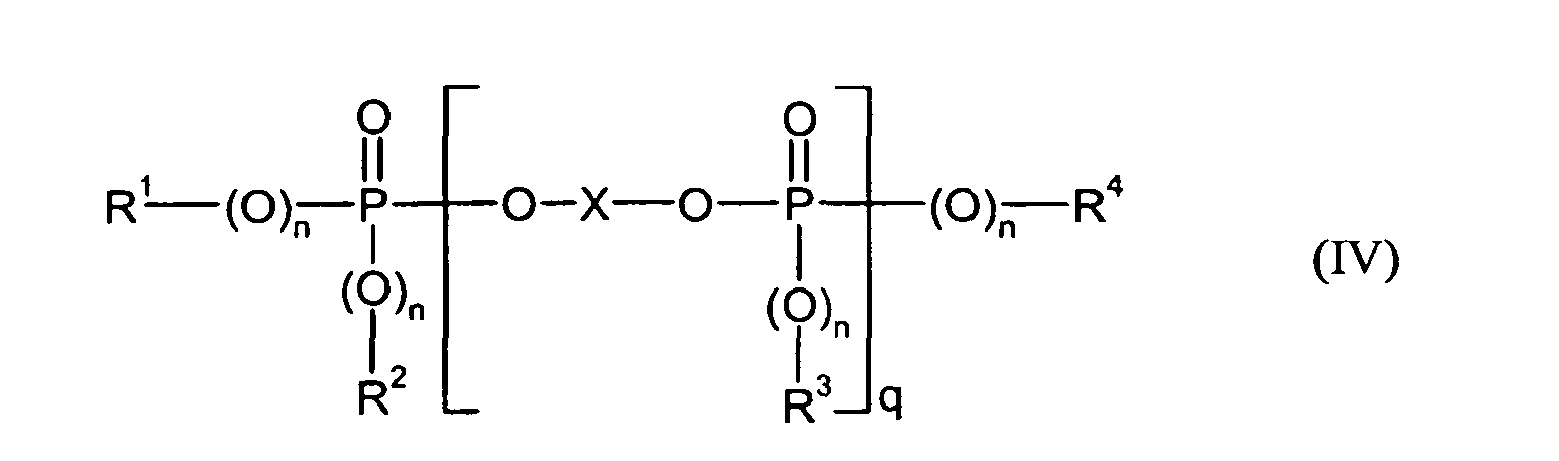 R1, R2, R3 und R4, unabhängig voneinander jeweils C1 bis C8-Alkyl, jeweils gegebenenfalls durch Alkyl substituiertes C5 bis C6-Cycloalkyl, C6 bis C20-Aryl oder C7 bis C12-Aralkyl,n unabhängig voneinander, 0 oder 1q 0,5 bis 30 undX einen ein- oder mehrkernigen aromatischen Rest mit 6 bis 30 C-Atomen, oder einen linearen oder verzweigten aliphatischen Rest mit 2 bis 30 C-Atomen, der OH-substituiert sein und bis zu 8 Etherbindungen enthalten kann, bedeuten,enthalten sind.
 - Zusammensetzung gemäß Anspruch 7, wobei q 1 bis 5 bedeutet.
- Zusammensetzung gemäß Anspruch 8, wobei q 1 bis 2 bedeutet.
- Zusammensetzung gemäß Anspruch 7, wobei X in Formel IV für


- Zusammensetzung gemäß Anspruch 10, wobei X von Hydrochinon, Resorcin oder Bisphenol A abgeleitet ist.
- Zusammensetzung gemäß Anspruch 1, enthaltend
50 bis 80 Gew.-Teile Komponente A),
1 bis 10 Gew.-Teile Komponente C),
2 bis 15 Gew.-Teile Komponente D). - Zusammensetzung gemäß Anspruch 1, enthaltend 5 bis 10 Gew.-Teile Komponente B)
- Zusammensetzung gemäß Anspruch 1, enthaltend Polyethylenterephthalat als Komponente B).
- Zusammensetzung gemäß Anspruch 1, enthaltend Additive, ausgewählt aus mindestens einem aus der Gruppe der Gleit- und Entformungsmittel, Nukleiermittel, Antistatika, Stabilisatoren, Lichtschutzmittel, Farbstoff, Pigment, Füll- und Verstärkungsstoffe, Flammschutzmittel verschieden von Komponente D) und Flammschutzsynergisten.
- Verfahren zur Herstellung der Zusammensetzung gemäß Anspruch 1, in dem man die Bestandteile vermischt und bei erhöhter Temperatur schmelzcompoundiert bzw. schmelextrudiert.
- Verwendung der Zusammensetzung gemäß Anspruch 1 zur Herstellung von Formteilen.
- Formteile, erhältlich aus Zusammensetzung gemäß Anspruch 1.
Applications Claiming Priority (3)
| Application Number | Priority Date | Filing Date | Title |
|---|---|---|---|
| DE10234420 | 2002-07-29 | ||
| DE10234420A DE10234420A1 (de) | 2002-07-29 | 2002-07-29 | Schlagzähmodifizierte Polycarbonat Blends |
| PCT/EP2003/007825 WO2004013228A1 (de) | 2002-07-29 | 2003-07-18 | Schlagzähmodifizierte polycarbonat blends |
Publications (2)
| Publication Number | Publication Date |
|---|---|
| EP1527137A1 EP1527137A1 (de) | 2005-05-04 |
| EP1527137B1 true EP1527137B1 (de) | 2007-03-07 |
Family
ID=30128471
Family Applications (1)
| Application Number | Title | Priority Date | Filing Date |
|---|---|---|---|
| EP03766215A Expired - Lifetime EP1527137B1 (de) | 2002-07-29 | 2003-07-18 | Schlagzähmodifizierte polycarbonat blends |
Country Status (13)
| Country | Link |
|---|---|
| EP (1) | EP1527137B1 (de) |
| JP (1) | JP4276170B2 (de) |
| KR (1) | KR100954005B1 (de) |
| CN (1) | CN1329437C (de) |
| AT (1) | ATE356171T1 (de) |
| AU (1) | AU2003250988A1 (de) |
| BR (1) | BR0305683B1 (de) |
| CA (1) | CA2494351C (de) |
| DE (2) | DE10234420A1 (de) |
| ES (1) | ES2280803T3 (de) |
| MX (1) | MXPA05001110A (de) |
| TW (1) | TWI303256B (de) |
| WO (1) | WO2004013228A1 (de) |
Families Citing this family (28)
| Publication number | Priority date | Publication date | Assignee | Title |
|---|---|---|---|---|
| CN1990514B (zh) * | 2005-12-30 | 2010-05-12 | 上海杰事杰新材料股份有限公司 | 用于pet树脂增韧结晶的核壳结构离聚物及其制备方法 |
| DE102006012990A1 (de) | 2006-03-22 | 2007-09-27 | Bayer Materialscience Ag | Flammgeschützte schlagzähmodifizierte Polycarbonat-Zusammensetzungen |
| DE102006012988A1 (de) * | 2006-03-22 | 2007-09-27 | Bayer Materialscience Ag | Flammgeschützte schlagzähmodifizierte Polycarbonat-Zusammensetzungen |
| JP5508013B2 (ja) * | 2006-08-31 | 2014-05-28 | スプレスタ エルエルシー | オリゴマー状のビスホスフェート難燃剤およびこれを含有する組成物 |
| US9127154B2 (en) * | 2006-10-13 | 2015-09-08 | Bayer Materialscience Llc | Impact resistant, flame retardant thermoplastic molding composition |
| US8217101B2 (en) * | 2007-03-02 | 2012-07-10 | Bayer Materialscience Llc | Flame retardant thermoplastic molding composition |
| DE102007061761A1 (de) * | 2007-12-20 | 2009-06-25 | Bayer Materialscience Ag | Flammgeschützte schlagzähmodifizierte Polycarbonat-Zusammensetzungen |
| DE102007061759A1 (de) * | 2007-12-20 | 2009-06-25 | Bayer Materialscience Ag | Flammgeschützte schlagzähmodifizierte Polycarbonat-Zusammensetzungen |
| DE102007061762A1 (de) * | 2007-12-20 | 2009-06-25 | Bayer Materialscience Ag | Flammgeschützte schlagzähmodifizierte Polycarbonat-Zusammensetzungen |
| DE102007061760A1 (de) * | 2007-12-20 | 2009-06-25 | Bayer Materialscience Ag | Flammgeschützte schlagzähmodifizierte Polyalkylenterephthalat/Polycarbonat-Zusammensetzungen |
| ATE541888T1 (de) * | 2008-11-21 | 2012-02-15 | Rohm & Haas | Polymerzusammensetzungen mit phosphaten |
| KR101266294B1 (ko) | 2008-12-19 | 2013-05-22 | 제일모직주식회사 | 폴리에스테르/폴리카보네이트 얼로이 수지 조성물 |
| DE102008062945A1 (de) * | 2008-12-23 | 2010-06-24 | Bayer Materialscience Ag | Flammgeschützte schlagzähmodifizierte Polycarbonat-Zusammensetzungen |
| DE102009005762A1 (de) * | 2008-12-23 | 2010-06-24 | Bayer Materialscience Ag | Schlagzähmodifizierte Polycarbonat-Zusammensetzungen |
| EP2377899A1 (de) * | 2010-04-14 | 2011-10-19 | Styron Europe GmbH | Carbonatmischungszusammensetzung mit verbesserter Widerstandsfähigkeit gegen Rissbildung aufgrund von Umweltbelastungen |
| KR101360892B1 (ko) | 2011-06-21 | 2014-02-11 | 제일모직주식회사 | 반사성, 내열성, 내황변성 및 내습성이 우수한 폴리에스테르 수지 조성물. |
| KR101549492B1 (ko) | 2011-12-28 | 2015-09-03 | 제일모직주식회사 | 내황변성과 내충격성이 우수한 폴리에스테르 수지 조성물 |
| KR20140086738A (ko) | 2012-12-28 | 2014-07-08 | 제일모직주식회사 | 수지 조성물 및 이를 포함한 성형품 |
| WO2014104485A1 (ko) | 2012-12-28 | 2014-07-03 | 제일모직 주식회사 | 열가소성 수지 조성물 및 이를 포함한 성형품 |
| US10017640B2 (en) | 2013-03-08 | 2018-07-10 | Covestro Llc | Halogen free flame retarded polycarbonate |
| KR20150126848A (ko) * | 2013-03-11 | 2015-11-13 | 바이엘 머티리얼싸이언스 엘엘씨 | 난연성 폴리카르보네이트 |
| US10301449B2 (en) | 2013-11-29 | 2019-05-28 | Lotte Advanced Materials Co., Ltd. | Thermoplastic resin composition having excellent light stability at high temperature |
| KR101690829B1 (ko) | 2013-12-30 | 2016-12-28 | 롯데첨단소재(주) | 내충격성 및 내광성이 우수한 열가소성 수지 조성물 |
| US10636951B2 (en) | 2014-06-27 | 2020-04-28 | Lotte Advanced Materials Co., Ltd. | Thermoplastic resin composition having excellent reflectivity |
| KR101793319B1 (ko) | 2014-12-17 | 2017-11-03 | 롯데첨단소재(주) | 폴리에스테르 수지 조성물 및 이로부터 제조된 성형품 |
| KR101953647B1 (ko) * | 2014-12-23 | 2019-03-04 | 사빅 글로벌 테크놀러지스 비.브이. | 보강된 폴리카보네이트 조성물 |
| KR101849830B1 (ko) | 2015-06-30 | 2018-04-18 | 롯데첨단소재(주) | 내충격성 및 광신뢰성이 우수한 폴리에스테르 수지 조성물 및 이를 이용한 성형품 |
| USD825341S1 (en) | 2017-05-30 | 2018-08-14 | Mary Kay Inc. | Bottle |
Family Cites Families (2)
| Publication number | Priority date | Publication date | Assignee | Title |
|---|---|---|---|---|
| DE4235642A1 (de) * | 1992-10-22 | 1994-04-28 | Bayer Ag | Flammwidrige Formmassen |
| EP0992542B1 (de) * | 1997-06-27 | 2003-09-03 | Kaneka Corporation | Flammhemmende thermoplastische harzzusammensetzung |
-
2002
- 2002-07-29 DE DE10234420A patent/DE10234420A1/de not_active Withdrawn
-
2003
- 2003-07-18 ES ES03766215T patent/ES2280803T3/es not_active Expired - Lifetime
- 2003-07-18 CA CA2494351A patent/CA2494351C/en not_active Expired - Fee Related
- 2003-07-18 JP JP2004525242A patent/JP4276170B2/ja not_active Expired - Fee Related
- 2003-07-18 WO PCT/EP2003/007825 patent/WO2004013228A1/de not_active Ceased
- 2003-07-18 MX MXPA05001110A patent/MXPA05001110A/es active IP Right Grant
- 2003-07-18 AT AT03766215T patent/ATE356171T1/de not_active IP Right Cessation
- 2003-07-18 CN CNB038228831A patent/CN1329437C/zh not_active Expired - Fee Related
- 2003-07-18 KR KR1020057001659A patent/KR100954005B1/ko not_active Expired - Fee Related
- 2003-07-18 EP EP03766215A patent/EP1527137B1/de not_active Expired - Lifetime
- 2003-07-18 BR BRPI0305683-0A patent/BR0305683B1/pt not_active IP Right Cessation
- 2003-07-18 AU AU2003250988A patent/AU2003250988A1/en not_active Abandoned
- 2003-07-18 DE DE50306760T patent/DE50306760D1/de not_active Expired - Lifetime
- 2003-07-28 TW TW092120475A patent/TWI303256B/zh not_active IP Right Cessation
Also Published As
| Publication number | Publication date |
|---|---|
| ATE356171T1 (de) | 2007-03-15 |
| BR0305683A (pt) | 2004-10-19 |
| DE10234420A1 (de) | 2004-02-12 |
| DE50306760D1 (de) | 2007-04-19 |
| CN1694922A (zh) | 2005-11-09 |
| JP4276170B2 (ja) | 2009-06-10 |
| KR100954005B1 (ko) | 2010-04-20 |
| BR0305683B1 (pt) | 2014-11-25 |
| TWI303256B (en) | 2008-11-21 |
| EP1527137A1 (de) | 2005-05-04 |
| WO2004013228A1 (de) | 2004-02-12 |
| JP2005534756A (ja) | 2005-11-17 |
| CN1329437C (zh) | 2007-08-01 |
| KR20050032100A (ko) | 2005-04-06 |
| CA2494351A1 (en) | 2004-02-12 |
| HK1085231A1 (zh) | 2006-08-18 |
| MXPA05001110A (es) | 2005-04-28 |
| ES2280803T3 (es) | 2007-09-16 |
| CA2494351C (en) | 2011-10-18 |
| AU2003250988A1 (en) | 2004-02-23 |
| TW200415198A (en) | 2004-08-16 |
Similar Documents
| Publication | Publication Date | Title |
|---|---|---|
| EP1527138B1 (de) | Flammwidrige polycarbonat-formmassen | |
| EP2382269B1 (de) | Flammgeschützte schlagzähmodifizierte polycarbonat-zusammensetzungen | |
| EP1490436B1 (de) | Schlagzähmodifizierte polycarbonat-zusammensetzung, enthaltend kalzinierten talk | |
| EP2373743B1 (de) | Saure phosphorverbindungen enthaltende schlagzähmodifizierte polycarbonat-zusammensetzungen mit basisch gefälltem emulsionspfropfpolymersiat | |
| DE10294990B4 (de) | Mineralverstärkte schlagzähmodifizierte Polycarbonat-Blends | |
| WO2004013228A1 (de) | Schlagzähmodifizierte polycarbonat blends | |
| EP2097477B1 (de) | Schlagzähmodifizierte gefüllte polycarbonat-zusammensetzungen | |
| EP1592740B1 (de) | Flammwidrige polycarbonat-blends | |
| EP1165680B1 (de) | Flammwidrige, schlagzähmodifizierte polycarbonat-formmassen | |
| EP1641880B1 (de) | Polycarbonatformmassen mit verbesserter schmelzefliessfähigkeit und chemikalienbeständigkeit | |
| EP2097478A1 (de) | Schlagzähmodifizierte gefüllte polycarbonat-zusammensetzungen | |
| EP1458813B1 (de) | Extrudierbare polycarbonat-formmassen | |
| WO2008086961A1 (de) | Schlagzähmodifizierte polycarbonat-zusammensetzungen | |
| EP2609153B1 (de) | SCHLAGZÄHMODIFIZIERTE POLYESTER/POLYCARBONAT-ZUSAMMENSETZUNGEN MIT VERBESSERTER REIßDEHNUNG | |
| EP2291451B1 (de) | Schlagzähmodifizierte polycarbonat-zusammensetzungen | |
| DE10234419A1 (de) | Flammwidrige Formmassen | |
| EP1169385B1 (de) | Flammwidrige mit pfropfpolymerisat modifizierte polycarbonat-formmassen | |
| EP2225316B1 (de) | Flammgeschützte schlagzähmodifizierte polycarbonat-zusammensetzungen | |
| EP1846504B1 (de) | Polycarbonatformmassen mit verbesserter hydrolysebestaendigkeit | |
| EP1499678B1 (de) | Thermoplastische zusammensetzungen mit verbesserter tieftemperaturzähigkeit | |
| EP1910469B1 (de) | Schlagzähmodifizierte polycarbonat- zusammensetzungen, verfahren zu ihrer herstellung und formkörper enthaltend diese zusammensetzungen | |
| DE10360367A1 (de) | Stabilisierte thermoplastische Zusammensetzungen | |
| DE10254549A1 (de) | Flammwidrige Polycarbonat-Formmassen |
Legal Events
| Date | Code | Title | Description |
|---|---|---|---|
| PUAI | Public reference made under article 153(3) epc to a published international application that has entered the european phase |
Free format text: ORIGINAL CODE: 0009012 |
|
| 17P | Request for examination filed |
Effective date: 20050228 |
|
| AK | Designated contracting states |
Kind code of ref document: A1 Designated state(s): AT BE BG CH CY CZ DE DK EE ES FI FR GB GR HU IE IT LI LU MC NL PT RO SE SI SK TR |
|
| AX | Request for extension of the european patent |
Extension state: AL LT LV MK |
|
| 17Q | First examination report despatched |
Effective date: 20050530 |
|
| DAX | Request for extension of the european patent (deleted) | ||
| GRAP | Despatch of communication of intention to grant a patent |
Free format text: ORIGINAL CODE: EPIDOSNIGR1 |
|
| GRAS | Grant fee paid |
Free format text: ORIGINAL CODE: EPIDOSNIGR3 |
|
| GRAA | (expected) grant |
Free format text: ORIGINAL CODE: 0009210 |
|
| AK | Designated contracting states |
Kind code of ref document: B1 Designated state(s): AT BE BG CH CY CZ DE DK EE ES FI FR GB GR HU IE IT LI LU MC NL PT RO SE SI SK TR |
|
| PG25 | Lapsed in a contracting state [announced via postgrant information from national office to epo] |
Ref country code: FI Free format text: LAPSE BECAUSE OF FAILURE TO SUBMIT A TRANSLATION OF THE DESCRIPTION OR TO PAY THE FEE WITHIN THE PRESCRIBED TIME-LIMIT Effective date: 20070307 Ref country code: SI Free format text: LAPSE BECAUSE OF FAILURE TO SUBMIT A TRANSLATION OF THE DESCRIPTION OR TO PAY THE FEE WITHIN THE PRESCRIBED TIME-LIMIT Effective date: 20070307 |
|
| REG | Reference to a national code |
Ref country code: GB Ref legal event code: FG4D Free format text: NOT ENGLISH |
|
| REG | Reference to a national code |
Ref country code: CH Ref legal event code: EP |
|
| REF | Corresponds to: |
Ref document number: 50306760 Country of ref document: DE Date of ref document: 20070419 Kind code of ref document: P |
|
| REG | Reference to a national code |
Ref country code: IE Ref legal event code: FG4D Free format text: LANGUAGE OF EP DOCUMENT: GERMAN |
|
| GBT | Gb: translation of ep patent filed (gb section 77(6)(a)/1977) |
Effective date: 20070430 |
|
| PG25 | Lapsed in a contracting state [announced via postgrant information from national office to epo] |
Ref country code: SE Free format text: LAPSE BECAUSE OF FAILURE TO SUBMIT A TRANSLATION OF THE DESCRIPTION OR TO PAY THE FEE WITHIN THE PRESCRIBED TIME-LIMIT Effective date: 20070607 |
|
| PG25 | Lapsed in a contracting state [announced via postgrant information from national office to epo] |
Ref country code: PT Free format text: LAPSE BECAUSE OF FAILURE TO SUBMIT A TRANSLATION OF THE DESCRIPTION OR TO PAY THE FEE WITHIN THE PRESCRIBED TIME-LIMIT Effective date: 20070807 |
|
| ET | Fr: translation filed | ||
| REG | Reference to a national code |
Ref country code: ES Ref legal event code: FG2A Ref document number: 2280803 Country of ref document: ES Kind code of ref document: T3 |
|
| PG25 | Lapsed in a contracting state [announced via postgrant information from national office to epo] |
Ref country code: SK Free format text: LAPSE BECAUSE OF FAILURE TO SUBMIT A TRANSLATION OF THE DESCRIPTION OR TO PAY THE FEE WITHIN THE PRESCRIBED TIME-LIMIT Effective date: 20070307 |
|
| REG | Reference to a national code |
Ref country code: IE Ref legal event code: FD4D |
|
| PG25 | Lapsed in a contracting state [announced via postgrant information from national office to epo] |
Ref country code: CZ Free format text: LAPSE BECAUSE OF FAILURE TO SUBMIT A TRANSLATION OF THE DESCRIPTION OR TO PAY THE FEE WITHIN THE PRESCRIBED TIME-LIMIT Effective date: 20070307 Ref country code: RO Free format text: LAPSE BECAUSE OF FAILURE TO SUBMIT A TRANSLATION OF THE DESCRIPTION OR TO PAY THE FEE WITHIN THE PRESCRIBED TIME-LIMIT Effective date: 20070307 |
|
| PLBE | No opposition filed within time limit |
Free format text: ORIGINAL CODE: 0009261 |
|
| STAA | Information on the status of an ep patent application or granted ep patent |
Free format text: STATUS: NO OPPOSITION FILED WITHIN TIME LIMIT |
|
| PG25 | Lapsed in a contracting state [announced via postgrant information from national office to epo] |
Ref country code: DK Free format text: LAPSE BECAUSE OF FAILURE TO SUBMIT A TRANSLATION OF THE DESCRIPTION OR TO PAY THE FEE WITHIN THE PRESCRIBED TIME-LIMIT Effective date: 20070307 Ref country code: IE Free format text: LAPSE BECAUSE OF FAILURE TO SUBMIT A TRANSLATION OF THE DESCRIPTION OR TO PAY THE FEE WITHIN THE PRESCRIBED TIME-LIMIT Effective date: 20070307 |
|
| 26N | No opposition filed |
Effective date: 20071210 |
|
| REG | Reference to a national code |
Ref country code: CH Ref legal event code: PL |
|
| PG25 | Lapsed in a contracting state [announced via postgrant information from national office to epo] |
Ref country code: GR Free format text: LAPSE BECAUSE OF FAILURE TO SUBMIT A TRANSLATION OF THE DESCRIPTION OR TO PAY THE FEE WITHIN THE PRESCRIBED TIME-LIMIT Effective date: 20070608 Ref country code: LI Free format text: LAPSE BECAUSE OF NON-PAYMENT OF DUE FEES Effective date: 20070731 Ref country code: CH Free format text: LAPSE BECAUSE OF NON-PAYMENT OF DUE FEES Effective date: 20070731 Ref country code: MC Free format text: LAPSE BECAUSE OF NON-PAYMENT OF DUE FEES Effective date: 20070731 |
|
| PG25 | Lapsed in a contracting state [announced via postgrant information from national office to epo] |
Ref country code: AT Free format text: LAPSE BECAUSE OF NON-PAYMENT OF DUE FEES Effective date: 20070718 |
|
| PG25 | Lapsed in a contracting state [announced via postgrant information from national office to epo] |
Ref country code: EE Free format text: LAPSE BECAUSE OF FAILURE TO SUBMIT A TRANSLATION OF THE DESCRIPTION OR TO PAY THE FEE WITHIN THE PRESCRIBED TIME-LIMIT Effective date: 20070307 |
|
| PG25 | Lapsed in a contracting state [announced via postgrant information from national office to epo] |
Ref country code: CY Free format text: LAPSE BECAUSE OF FAILURE TO SUBMIT A TRANSLATION OF THE DESCRIPTION OR TO PAY THE FEE WITHIN THE PRESCRIBED TIME-LIMIT Effective date: 20070307 |
|
| PG25 | Lapsed in a contracting state [announced via postgrant information from national office to epo] |
Ref country code: LU Free format text: LAPSE BECAUSE OF NON-PAYMENT OF DUE FEES Effective date: 20070718 Ref country code: BG Free format text: LAPSE BECAUSE OF FAILURE TO SUBMIT A TRANSLATION OF THE DESCRIPTION OR TO PAY THE FEE WITHIN THE PRESCRIBED TIME-LIMIT Effective date: 20070607 |
|
| PG25 | Lapsed in a contracting state [announced via postgrant information from national office to epo] |
Ref country code: TR Free format text: LAPSE BECAUSE OF FAILURE TO SUBMIT A TRANSLATION OF THE DESCRIPTION OR TO PAY THE FEE WITHIN THE PRESCRIBED TIME-LIMIT Effective date: 20070307 Ref country code: HU Free format text: LAPSE BECAUSE OF FAILURE TO SUBMIT A TRANSLATION OF THE DESCRIPTION OR TO PAY THE FEE WITHIN THE PRESCRIBED TIME-LIMIT Effective date: 20070908 |
|
| REG | Reference to a national code |
Ref country code: DE Ref legal event code: R081 Ref document number: 50306760 Country of ref document: DE Owner name: BAYER INTELLECTUAL PROPERTY GMBH, DE Free format text: FORMER OWNER: BAYER MATERIALSCIENCE AKTIENGESELLSCHAFT, 51373 LEVERKUSEN, DE Effective date: 20140317 Ref country code: DE Ref legal event code: R081 Ref document number: 50306760 Country of ref document: DE Owner name: COVESTRO DEUTSCHLAND AG, DE Free format text: FORMER OWNER: BAYER MATERIALSCIENCE AKTIENGESELLSCHAFT, 51373 LEVERKUSEN, DE Effective date: 20140317 |
|
| REG | Reference to a national code |
Ref country code: DE Ref legal event code: R081 Ref document number: 50306760 Country of ref document: DE Owner name: COVESTRO DEUTSCHLAND AG, DE Free format text: FORMER OWNER: BAYER INTELLECTUAL PROPERTY GMBH, 40789 MONHEIM, DE |
|
| REG | Reference to a national code |
Ref country code: FR Ref legal event code: PLFP Year of fee payment: 14 |
|
| REG | Reference to a national code |
Ref country code: NL Ref legal event code: HC Owner name: COVESTRO DEUTSCHLAND AG; DE Free format text: DETAILS ASSIGNMENT: VERANDERING VAN EIGENAAR(S), VERANDERING VAN NAAM VAN DE EIGENAAR(S); FORMER OWNER NAME: BAYER MATERIALSCIENCE AG Effective date: 20160810 |
|
| REG | Reference to a national code |
Ref country code: ES Ref legal event code: PC2A Owner name: COVESTRO DEUTSCHLAND AG Effective date: 20170207 |
|
| REG | Reference to a national code |
Ref country code: FR Ref legal event code: CA Effective date: 20170201 Ref country code: FR Ref legal event code: CD Owner name: COVESTRO DEUTSCHLAND AG, DE Effective date: 20170201 |
|
| REG | Reference to a national code |
Ref country code: FR Ref legal event code: PLFP Year of fee payment: 15 |
|
| REG | Reference to a national code |
Ref country code: FR Ref legal event code: PLFP Year of fee payment: 16 |
|
| PGFP | Annual fee paid to national office [announced via postgrant information from national office to epo] |
Ref country code: FR Payment date: 20200625 Year of fee payment: 18 |
|
| PGFP | Annual fee paid to national office [announced via postgrant information from national office to epo] |
Ref country code: BE Payment date: 20200624 Year of fee payment: 18 |
|
| PGFP | Annual fee paid to national office [announced via postgrant information from national office to epo] |
Ref country code: NL Payment date: 20200715 Year of fee payment: 18 |
|
| PGFP | Annual fee paid to national office [announced via postgrant information from national office to epo] |
Ref country code: ES Payment date: 20200803 Year of fee payment: 18 Ref country code: GB Payment date: 20200708 Year of fee payment: 18 |
|
| PGFP | Annual fee paid to national office [announced via postgrant information from national office to epo] |
Ref country code: IT Payment date: 20200625 Year of fee payment: 18 |
|
| PGFP | Annual fee paid to national office [announced via postgrant information from national office to epo] |
Ref country code: DE Payment date: 20210622 Year of fee payment: 19 |
|
| REG | Reference to a national code |
Ref country code: NL Ref legal event code: MM Effective date: 20210801 |
|
| GBPC | Gb: european patent ceased through non-payment of renewal fee |
Effective date: 20210718 |
|
| REG | Reference to a national code |
Ref country code: BE Ref legal event code: MM Effective date: 20210731 |
|
| PG25 | Lapsed in a contracting state [announced via postgrant information from national office to epo] |
Ref country code: GB Free format text: LAPSE BECAUSE OF NON-PAYMENT OF DUE FEES Effective date: 20210718 |
|
| PG25 | Lapsed in a contracting state [announced via postgrant information from national office to epo] |
Ref country code: NL Free format text: LAPSE BECAUSE OF NON-PAYMENT OF DUE FEES Effective date: 20210801 Ref country code: FR Free format text: LAPSE BECAUSE OF NON-PAYMENT OF DUE FEES Effective date: 20210731 |
|
| PG25 | Lapsed in a contracting state [announced via postgrant information from national office to epo] |
Ref country code: IT Free format text: LAPSE BECAUSE OF NON-PAYMENT OF DUE FEES Effective date: 20210718 Ref country code: BE Free format text: LAPSE BECAUSE OF NON-PAYMENT OF DUE FEES Effective date: 20210731 |
|
| REG | Reference to a national code |
Ref country code: ES Ref legal event code: FD2A Effective date: 20220831 |
|
| PG25 | Lapsed in a contracting state [announced via postgrant information from national office to epo] |
Ref country code: ES Free format text: LAPSE BECAUSE OF NON-PAYMENT OF DUE FEES Effective date: 20210719 |
|
| REG | Reference to a national code |
Ref country code: DE Ref legal event code: R119 Ref document number: 50306760 Country of ref document: DE |
|
| PG25 | Lapsed in a contracting state [announced via postgrant information from national office to epo] |
Ref country code: DE Free format text: LAPSE BECAUSE OF NON-PAYMENT OF DUE FEES Effective date: 20230201 |