EP1524840B1 - Endgerät geeignet zur Anwendung in mehreren PSTNs - Google Patents
Endgerät geeignet zur Anwendung in mehreren PSTNs Download PDFInfo
- Publication number
- EP1524840B1 EP1524840B1 EP04105086.5A EP04105086A EP1524840B1 EP 1524840 B1 EP1524840 B1 EP 1524840B1 EP 04105086 A EP04105086 A EP 04105086A EP 1524840 B1 EP1524840 B1 EP 1524840B1
- Authority
- EP
- European Patent Office
- Prior art keywords
- signals
- physical characteristics
- communication signals
- unit
- handset
- Prior art date
- Legal status (The legal status is an assumption and is not a legal conclusion. Google has not performed a legal analysis and makes no representation as to the accuracy of the status listed.)
- Expired - Lifetime
Links
Images




Classifications
-
- H—ELECTRICITY
- H04—ELECTRIC COMMUNICATION TECHNIQUE
- H04M—TELEPHONIC COMMUNICATION
- H04M1/00—Substation equipment, e.g. for use by subscribers
-
- H—ELECTRICITY
- H04—ELECTRIC COMMUNICATION TECHNIQUE
- H04N—PICTORIAL COMMUNICATION, e.g. TELEVISION
- H04N1/00—Scanning, transmission or reproduction of documents or the like, e.g. facsimile transmission; Details thereof
- H04N1/32—Circuits or arrangements for control or supervision between transmitter and receiver or between image input and image output device, e.g. between a still-image camera and its memory or between a still-image camera and a printer device
- H04N1/333—Mode signalling or mode changing; Handshaking therefor
- H04N1/33307—Mode signalling or mode changing; Handshaking therefor prior to start of transmission, input or output of the picture signal only
- H04N1/33323—Mode signalling or mode changing; Handshaking therefor prior to start of transmission, input or output of the picture signal only transmission mode only, e.g. speed
-
- H—ELECTRICITY
- H04—ELECTRIC COMMUNICATION TECHNIQUE
- H04N—PICTORIAL COMMUNICATION, e.g. TELEVISION
- H04N1/00—Scanning, transmission or reproduction of documents or the like, e.g. facsimile transmission; Details thereof
- H04N1/32—Circuits or arrangements for control or supervision between transmitter and receiver or between image input and image output device, e.g. between a still-image camera and its memory or between a still-image camera and a printer device
- H04N1/327—Initiating, continuing or ending a single-mode communication; Handshaking therefor
- H04N1/32704—Establishing a communication with one of a facsimile and another telecommunication apparatus sharing a single line
-
- H—ELECTRICITY
- H04—ELECTRIC COMMUNICATION TECHNIQUE
- H04N—PICTORIAL COMMUNICATION, e.g. TELEVISION
- H04N1/00—Scanning, transmission or reproduction of documents or the like, e.g. facsimile transmission; Details thereof
- H04N1/32—Circuits or arrangements for control or supervision between transmitter and receiver or between image input and image output device, e.g. between a still-image camera and its memory or between a still-image camera and a printer device
- H04N1/327—Initiating, continuing or ending a single-mode communication; Handshaking therefor
- H04N1/32704—Establishing a communication with one of a facsimile and another telecommunication apparatus sharing a single line
- H04N1/32706—Type of the other apparatus
- H04N1/32708—Telephone
-
- H—ELECTRICITY
- H04—ELECTRIC COMMUNICATION TECHNIQUE
- H04N—PICTORIAL COMMUNICATION, e.g. TELEVISION
- H04N1/00—Scanning, transmission or reproduction of documents or the like, e.g. facsimile transmission; Details thereof
- H04N1/32—Circuits or arrangements for control or supervision between transmitter and receiver or between image input and image output device, e.g. between a still-image camera and its memory or between a still-image camera and a printer device
- H04N1/327—Initiating, continuing or ending a single-mode communication; Handshaking therefor
- H04N1/32704—Establishing a communication with one of a facsimile and another telecommunication apparatus sharing a single line
- H04N1/32715—Detecting
- H04N1/32728—Detecting an off-hook condition
-
- H—ELECTRICITY
- H04—ELECTRIC COMMUNICATION TECHNIQUE
- H04N—PICTORIAL COMMUNICATION, e.g. TELEVISION
- H04N1/00—Scanning, transmission or reproduction of documents or the like, e.g. facsimile transmission; Details thereof
- H04N1/32—Circuits or arrangements for control or supervision between transmitter and receiver or between image input and image output device, e.g. between a still-image camera and its memory or between a still-image camera and a printer device
- H04N1/333—Mode signalling or mode changing; Handshaking therefor
- H04N1/33361—Mode signalling or mode changing; Handshaking therefor according to characteristics or the state of the communication line
Definitions
- the present invention relates to a terminal equipment for a PSTN, comprising transmitting means for transmitting audio signals to a PSTN.
- PSTN public switched telephone network
- Figure 1 is a block diagram of a facsimile machine.
- the facsimile machine in Figure 1 includes a modular jack 10 for connecting it to a telecommunication network, a facsimile unit 20, a telephone circuit unit 30 and a switch 15 for selectively connecting the facsimile unit 20 and the telephone circuit unit 30 to the modular jack 10.
- the facsimile machine is connected to the PSTN by the modular jack 10.
- a diode bridge (BD) 35 supplies a dc voltage to the telephone circuit unit, regardless of the voltage polarity of the signals from PSTN, to power the electronics of the telephone circuit unit 30.
- Each of the telephone circuit unit 30 and the facsimile unit 20 further includes a DC feeding circuit (not shown) for supplying a DC voltage.
- the DC feeding circuit maintains the telephone line connection by continuously supplying a DC voltage to keep the connection between the facsimile machine and PSTN from being disconnected.
- a ring detector 25 delivers ring signals incoming from the PSTN to a central processing unit (CPU) 24 to notify the CPU 24 of calls from the PSTN. After determining that there is a ring signal, the CPU 24 determines whether the incoming call is a speech call or an incoming facsimile transmission and then selects the telephone circuit unit 30 or the facsimile unit 20.
- the telephone circuit 34 processes voice signals incoming from the PSTN and delivers them to a handset 36.
- the telephone circuit 34 also processes the voice signals, which are input from the handset 36, and delivers them to the PSTN. Also, the telephone circuit 34 controls the magnitudes of the sidetone signals, which are fed back to the handset 36 among the signals input from the handset 36 and transmitted to the PSTN.
- a modem 26 decodes the facsimile signals delivered from the PSTN.
- An impedance matching unit 28 includes a transformer element and a capacitor to match the impedances of the PSTN and the modem 26. Therefore, when the PSTN is connected to the facsimile unit, it enables the facsimile signals and the like to be transmitted and received between the PSTN and the modem 26.
- the capacitor included in the impedance matching unit 28 prevents the transformer element from being damaged by an excessive DC current and transmits AC signals only.
- the telephone circuit unit offered in a single element form includes a microphone terminal for receiving voice signals from the handset and a receiving terminal for receiving voice signals from the PSTN. As noted above, a part of the voice signals, which is received from the microphone terminal and transmitted to the PSTN, is fed back to be delivered again to the handset by the receiving terminal.
- the physical characteristics of the PSTNs in different countries all differ. Therefore, different country's PSTNs require communication terminal devices that comply with different specifications.
- the physical characteristics of different PSTNs differ, for example, in the magnitude and frequency characteristics of the voice signals transmitted from handsets to the PSTN, the magnitude and frequency characteristics signals of voice signals and the magnitude of sidetone signals delivered from PSTN to the handset.
- US 6,396,922 discloses a telecommunications card for use in a telecommunications terminal for connecting subscriber lines of different types to a telephone exchange.
- EP-A-0748104 discloses an apparatus for adapting the DC Loop current of a fax or a telephone to different PSTN'S.
- the present invention provides a communication terminal device according to claim 1 of the appended claims.
- the present invention also provides a method according to claim 8 of the appended claims.
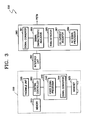
- a communication terminal device 200 comprises a main unit 250, an interface unit 290, and a telephone network adaptor unit 280.
- the telephone network adaptor unit 280 manages the physical connection between the communication terminal device 200 and the PSTN. Also, the telephone network adaptor unit 280 detects ring signals from the PSTN and supplies DC current to maintain the connection between the communication terminal device 200 and the PSTN when ring signals are detected. In doing so, the telephone network adaptor unit 280 is in charge of transmitting and receiving analogue communication signals between the communication terminal device 200 and the PSTN. Moreover, the telephone network adaptor unit 280 converts the received analogue communication signals into digital communication signals and transmits the result to the main unit 250 via the interface unit 290. That is, the analogue communication signals received from the PSTN are converted into digital communication signals by the telephone network adaptor unit 280 and delivered to the main unit 250 via the interface unit 290. The configuration and operation of the telephone adaptor unit 280 will now be described in detail.
- the interface unit 290 transfers the digital communication signals between the telephone network adaptor unit 280 and the main unit 250. According to international safety regulations, the telephone network adaptor unit 280 and the main unit 250 must be isolated by the interface unit 290. Using elements such as a transformer or a high voltage capacitor, the interface unit 290 delivers digital communication signals between the telephone network adaptor unit 280 and the main unit 250 that are isolated.
- the digital communication signals can include various control signals as well as digitized analogue communication signals. The digital communication signals will now be described in detail.
- the main unit 250 comprises a memory 210, a facsimile unit 220, a central controller 230, a telephone circuit unit 240 and a handset 225.
- the central controller 230 controls the overall operation of the communication terminal device.
- the facsimile unit 220 processes the received facsimile signal.
- the received analogue signals are processed by the telephone circuit unit and delivered to the handset 225.
- the communication terminal device 200 in Figure 2 is connected to the PSTN through the telephone network adaptor unit 280.
- the telephone network adaptor unit 280 converts the physical characteristics of the analogue communication signals, received from the PSTN, and adapts the communication terminal device to the physical characteristics of the PSTN.
- the amplitude of the analogue communication signals under the control of the central processor 230 can be altered by changing the gain of an amplifier (not shown) embedded in the telephone network adaptor unit 280.
- the frequency characteristics of the analogue communication signals can be altered by changing the transfer function, e.g. the pass band, of a digital filter (not shown). Therefore, by only changing the telephone network adaptor unit 280, communication terminal devices having identical telephone circuit units 240 can be adapted to various PSTNs.
- the memory unit 210 can store information regarding the PSTN specifications for all or some countries.
- the information on the physical characteristics of the PSTN to which the communication terminal device 200 is connected can be read and the physical characteristics of the analogue communication signals can be changed according to the read information.
- the information on the physical characteristics of the PSTN is provided as firmware. Then, a user can change the physical characteristics of the analogue communication signals based on the information offered in the firmware, for example by only choosing the name of the nation, without requiring knowledge of the physical characteristics of the PSTN to which his communication terminal device 200 is connected.
- a communication terminal device 300 comprises a main unit 350, an interface unit 390 and a telephone network adaptor unit 380.
- the main unit 350 comprises a memory unit 310, a facsimile unit 320, a central controller 330, a telephone circuit unit 340 and a handset 325.
- the telephone circuit unit 340 comprises a voice signal processor 342 and a signal converter 344.
- the telephone network adaptor unit 380 comprises a signal converter 381, a signal characteristic adjustor 383, a ring detector 385, a DC current adjustor 387 and an AC signal processor 389.
- the DC current adjustor 387 included in the telephone network adaptor unit 380, controls the amount of DC current incoming from the PSTN to the telephone network adaptor unit.
- the signal converter 381 converts the analogue communication signals, such as voice or facsimile signals, received from the PSTN by the telephone network adaptor unit, into digital communication signals and converts the digital communication signals received from the interface unit 390 by the telephone network adaptor unit 380 into analogue communication signals and transmits the converted analogue signals to the PSTN.
- the components included in the telephone network adaptor unit 380 are controlled by the central controller 330.
- the control signals generated by the central controller 330 are transmitted and received between the telephone circuit unit 340 and the telephone network adaptor unit 380 via the interface unit 390.
- the control signals are digital signals delivered in packets and will be described below in detail.
- the ring detector 385 When there is an incoming call from the PSTN to the communication terminal device 300. That is, when a ring signal from the exchange is received by the communication terminal device 300, the ring detector 385 detects the received ring signal. The ring detector 385 notifies the central controller 330, via interface unit 390, that the ring signal is detected. Then, the central controller 330 generates the control signals, operates the DC current adjuster 387 in the telephone network adaptor unit 380, and connects the communication terminal device 300 to the PSTN. While communication between the PSTN and the communication terminal device 300 is in progress, the analogue communication signals from the calling party, incoming from the PSTN, are received by the AC signal processor 389 in the telephone network adaptor unit 380.
- the physical characteristics of the analogue communication signals, received by the AC signal processor 389, are changed by the signal characteristic adjustor 383.
- the signal converter 381 converts the analogue communication signals into digital communication signals and the converted digital communication signals are transmitted to the main unit 350 via the interface unit 390.
- the main unit 350 discriminates only voice signals from the received digital communication signals of predetermined form, and restores the analog communication signals using the signal converter 344.
- the voice signal processor 342 alters the physical characteristics of the voice signals in accordance with the characteristics of the PSTN and transmits them to the handset 325.
- Voice signals, received by the handset 325, are processed by the voice signal processor 342.
- the voice signal processor alters the physical characteristics of the received voice signals.
- the processed voice signals are converted into digital communication signals by the signal converter 344.
- the converted digital communication signals are transmitted to the telephone network adaptor unit 380 via the interface unit 390.
- the digital communication signals, transmitted to the telephone network adaptor unit 380, are converted into analogue signals by the signal converter 381.
- the digital communication signals, whose physical characteristics have been altered by the signal characteristic adjustor 383, are transmitted to the PSTN by the AC signal processor 389.
- the physical characteristics of the analogue communication signals transmitted and received between the PSTN and the telephone network adaptor unit 380 are adjusted by the signal characteristic adjustor 383.
- the amplitude and frequency characteristics of the analogue communication signals can be included in the physical characteristics of the analogue communication signals. Each of the amplitude and frequency characteristics are easily altered by changing the gain of an amplifier (not shown) and the frequency pass band of a digital filter embedded in the signal characteristic adjustor 383.
- the physical characteristics of the analogue communication signals transmitted and received between the telephone circuit unit 340 and the handset 325 can preferably be changed by the voice signal processor 342 in the telephone circuit unit 340.
- the determination on the target unit out of the telephone circuit unit 340 and the facsimile unit 320, to which the digital communication signals received from the telephone network adaptor unit 380 are to be transmitted is as follows. That is, the central controller 330 can determine whether the handset 325 is off-hooked, and then determine whether the digital communication signals are either voice signals or facsimile signals.
- the digital communication signals are delivered to the telephone circuit unit 340.
- the handset 325 is determined to be on-hook, it can be expected that a telephone line has been established between the telephone network and the communication terminal device 300 possibly by a device with an automatic facsimile mode function. In which case, the digital communication signals are delivered to the facsimile unit 320.
- the memory unit 310 stores the information regarding the physical characteristics demanded in the PSTN by nations for meeting the requirements of the different telephone characteristics of the specific nations. This information can be offered in firmware or software. Then, without necessarily knowing the physical characteristics of the PSTN, a user can adapt the communication terminal device 300 to the specific PSTN.
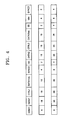
- a signal packet delivered by an interface unit comprises first through third synchronization patterns SYNC1, SYNC2, SYNC3, first and second data patterns DATA1, DATA2, first and second control patterns CTRL1, CTRL2, first and second duplicate data patterns DATA1bis, DATA2bis, a steady state pattern (SS) and an idle pattern (Idle).
- the middle row in Figure 4 represents the number of symbols constituting each pattern and the bottom row represents the number of data bits constituting each pattern.
- the number of data bits constituting each pattern correspond to two times the number of symbols.
- 2-bit binary data is encoded to represent one symbol for facilitating the prevention of data noise and the maintenance of synchronization. That is, one of the digital communication signal packets transmitted and received by the interface unit 390 in Figure 3 is constituted with 126 symbols in total, and since one symbol is represented by two data bits, the total number of bits in one packet is 252.
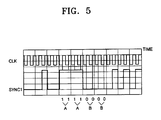
- Figure 5 is a waveform diagram illustrating an exemplary first synchronization pattern of the signal packets shown in Figure 4 .
- the first synchronization pattern SYNC1 notifies a start point of the digital communication signals.
- the first synchronization pattern SYNC1 preferably consists of symbol "AABB". Referring to Table 1 above, the symbol “AABB” corresponds to data bits "11110000". As shown in Figure 5 , when the logic value of the first synchronization pattern SYNC1 is detected at rising edges of successive clock pulses, the bit values "1111000" are obtained. Since the bit values "11110000" corresponds to the symbol "AABB", the first synchronization pattern SYNC1 is identified, and the start of the digital communication is recognized.
- the reason for representing the first synchronization SYNC1 by using the symbol "AABB" is that logic 0 and logic 1 cannot occur in series during data or control patterns. If logic 1 or logic 0 occurred in series during the data or control patterns, it would be determined that an error had occurred.
- the first data pattern DATA1, the first control pattern CTRL1 and the first duplicate data pattern are transmitted sequentially; total of 18 symbols.
- the first data pattern DATA1 which is transmitted from a main unit to a telephone network adaptor unit 380 comprises eighteen symbols.
- the data transmitted to the PSTN via the telephone network adaptor unit 380 from the main unit 350 is transmitted in the form of digital communication signals.
- the transmitted digital communication signals are restored to analogue communication signals by the signal converter in the telephone network adaptor unit 380 and transmitted to the PSTN.
- the first data pattern DATA1 includes net data comprising sixteen symbols and an error correction code comprising two symbols.
- the first control pattern CTRL1 is transmitted from the main unit 350 to the telephone network adaptor unit 380 and includes eighteen symbols in total.
- 8-bit registers for a total of 38 can be included.
- the address of the register whose values are read or changed can be allocated by using the first control pattern CTRL1.
- the first control pattern CTRL1 can include one symbol of a read/write flag, seven symbols of an address pattern, eight symbols of a data pattern and two symbols of an error correction code.
- the seven symbols of the address pattern allocate an 8-bit register address, and eight symbols of data pattern represent the values of respective registers.
- the first duplicate data pattern DATA1bis has the value identical to that of the first data pattern DATA1.
- the reason for further including the first duplicate data pattern DATA1bis besides the first date pattern DATA1 is to enhance the error detection efficiency. Therefore, for simplicity of configuration, the first duplicate data pattern DATA1bis can be omitted.
- the first duplicate data pattern DATA1bis and the first data pattern DATA1 are not in accord with each other by comparison, it is determined that an error has occurred during transmission. If the main unit 350 does not transmit the first duplicate data pattern DATA1 bis, the telephone network adaptor unit 380 will not transmit the second duplicate data pattern DATA2bis correspondingly.
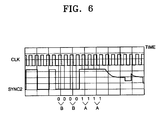
- FIG. 6 is a waveform diagram illustrating a second exemplary synchronization pattern among the signal packets shown in Figure 4 .
- the second synchronization pattern SYNC2 is "BBAA". Therefore, referring to the waveform diagram in Figure 6 , the second synchronization pattern SYNC2 is identified since the logic values of the second synchronization pattern SYNC2 detected at rising edges of clocks correspond to "00001111".
- the second synchronization pattern SYNC2 is located at the tail of the data packet transmitted from the main unit 350 to the telephone network adaptor unit 380.
- the telephone network adaptor unit 380 alters the channel from the reception mode to the transmission mode.
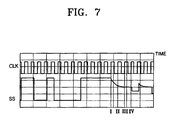
- FIG 7 is a waveform diagram illustrating a steady-state pattern of the signal packets shown in Figure 4 .
- the steady-state packet represents the time interval from the instance when the second synchronization pattern SYNC2 is identified until the instance when the direction of data transmission is changed.
- a driver channel between the main unit 350 and the telephone network adaptor unit 380 is altered. That is, during the steady-state period after the second synchronization pattern SYNC2 is transmitted, the channel of the main unit 350 is altered to reception mode, and in the meantime, the channel of the telephone network adaptor unit 380 is altered from reception mode to transmission mode.
- Two symbol periods (I, II, III, IV) elapse during one steady state pattern.
- the second data pattern DATA2 is transmitted from the telephone adaptor unit 380 to the main unit 350.
- the second data pattern DATA2 comprises eighteen symbols in total.
- the data can be changed.
- the data is transmitted from the telephone network adaptor unit 380 to the main unit 350. If loop monitoring register is set to 0, the analogue communication signals (such as modem data, caller indicating information, etc.) received from the PSTN are transmitted to main unit 350 since it is determined that the telephone network adaptor unit 380 is forming an actual loop. If loop monitoring register is set to 1, input ring signals are delivered to the main unit 350, since it is determined that the telephone network adaptor unit 380 is in idle state.
- the loop monitoring register can be set by the first control pattern CTRL1 transmitted from the main unit 350.
- the second control pattern CTRL2 is data transmitted from the telephone network adaptor unit 380 to the main unit 350, and comprises eighteen symbols just as the first control pattern CTRL1.
- the second control pattern CTRL2 delivers the value of the register included in the telephone adaptor unit to the main unit. If the first control pattern CTRL1 of the main unit is set to 'read' and sent to the telephone network adaptor unit 380, the telephone network adaptor unit 380 can load the 8-bit data read from the requested register and send the data to the main unit 350.
- the telephone network adaptor unit 380 can write the data on the requested register and load the written value on the second control patter CTRL2 to send it to the main unit 350.
- the second duplicate data pattern DATA2bis has the same value as the second data pattern DATA2. If the main unit 350 does not transmit the first duplicate pattern DATA1bis, the telephone network adaptor unit 380 will recognize so and will not transmit the second duplicate pattern DATA2bis, as noted above.
- FIG 8 is a waveform diagram illustrating an exemplary idle pattern of the signal packet shown in Figure 4 .
- the idle pattern (Idle) is a time interval from when data is sent from the telephone network adapter unit 380 to the main unit 350 to complete one frame to when next frame is transmitted.
- the idle pattern Idle preferably comprises "BBBB" which correspond to a bit data "00000000”.
- Figure 9 is a waveform diagram illustrating an exemplary synchronization pattern of the signal packets shown in Figure 4 .
- the third synchronization pattern SYNC3 is marked with two symbols of "0B".
- the data packet is recognized to be completed, and a new data packet is transmitted.
- Figure 4 through Figure 9 is to be comprehended only as examples. That is, any communication terminal device which includes a separate telephone network adapter unit for connecting to the PSTN, and uses various signal waveforms allowing the device to transmit and receive digital communication signals between the main unit and the telephone network adapter unit is to be understood to be within the technical scope of the present invention.
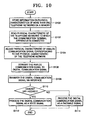
- Figure 10 is a flowchart of a method for adapting the communication terminal device to physical characteristics of various telephone networks according to the present invention.
- information on or related to the physical characteristics of one or more telecommunication networks is stored in a memory S100.
- the reason for storing the physical characteristics of a plurality of telecommunication networks is to adapt the communication terminal device by using a simple name of the nation, even when the user does not know the physical characteristics of telecommunication network to which his communication terminal device is connected.
- the communication terminal device reads the physical characteristics of the telephone network supplied in firmware, when it is used in a particular country S102. Therefore, the physical characteristics of the analogue communication signals are changed so as to be adapted to the physical characteristics of the telecommunication network S104.
- the communication terminal device to which the method is applied comprises the telephone network adaptor unit separately from the telephone circuit unit which are in charge of the physical connection to the PSTN, so the physical characteristics of the telephone network adaptor unit are changed corresponding to the physical characteristics of the PSTN to which the communication terminal device is connected.
- the analogue communication signals from the PSTN are received by the telephone network adaptor unit, and are converted into digital communication signals S106.
- the converted digital communication signals are delivered to the main unit of the communication terminal device via the interface unit S108.
- Whether the delivered digital communication signals are facsimile signals or telephone signals is decided by whether the handset is off-hook S110. That is, when it is determined the handset is off-hook, it is determined that a user is to use telephone functions of the communication terminal device. Therefore, the digital communication signals are processed as voice signals S112. On the other hand, when the handset is not off-hook, since the digital communication signals processed as facsimile signals S114.
- the flowchart shown in Figure 10 only depicts processes of receiving and processing analogue communication signals from the PSTN. However, it is certain that incoming voice signals from the handset can be delivered after adapting the communication terminal device to the physical characteristics of the PSTN.
- a communication terminal device which satisfies the physical characteristic requirements of different telephone networks using the same telephone circuit unit is provided.
Landscapes
- Engineering & Computer Science (AREA)
- Signal Processing (AREA)
- Multimedia (AREA)
- Telephonic Communication Services (AREA)
Claims (10)
- Kommunikationsendgerätvorrichtung, umfassend einen Handapparat (225, 325) zum Eingeben und Ausgeben von Sprachsignalen und Verarbeiten von Signalen gemäß einer einem oder mehreren Ländern entsprechenden Vorgabe für physikalische Charakteristiken eines designierten Telekommunikationsnetzes, wobei die Vorrichtung Folgendes umfasst:ein Steuergerät (230, 330);eine Telefonnetz-Adaptereinheit (280, 380), die dazu konfiguriert ist, zwischen einem Telekommunikationsnetz und der Kommunikationsendgerätvorrichtung übertragene und empfangene analoge Kommunikationssignale in digitale Kommunikationssignale zu wandeln;eine Schnittstelleneinheit (290, 390), die dazu konfiguriert ist, das Steuergerät (230, 330) von der Telefonnetz-Adaptereinheit (280, 380) zu trennen und die gewandelten digitalen Kommunikationssignale zwischen dem Steuergerät (230, 330) und der Telefonnetz-Adaptereinheit (280, 380) zu übertragen und zu empfangen, undeine Telefonleitungseinheit (240, 340), die dazu konfiguriert ist, analoge Kommunikationssignale aus Sprachsignalen widerherzustellen, die von den digitalen Kommunikationssignalen unterschieden wurden, die von der Telefonnetz-Adaptereinheit (280, 380) durch die Schnittstelleneinheit (290, 390) empfangen wurden und physikalische Charakteristiken der wiederhergestellten analogen Kommunikationssignale gemäß von dem designierten Telekommunikationsnetz verlangten physikalischen Charakteristiken zu ändern und physikalische Charakteristiken von von dem Handapparat (225, 325) empfangenen Sprachsignalen gemäß von dem designierten Telekommunikationsnetz verlangten physikalischen Charakteristiken zu ändern und die Sprachsignale in digitale Kommunikationssignale zu wandeln und die gewandelten digitalen Kommunikationssignale durch die Schnittstelleneinheit (290, 390) an die Telefonnetz-Adaptereinheit (280, 380) zu übertragen, wobei die von dem designierten Telekommunikationsnetz verlangten physikalischen Charakteristiken die Größen- und die Frequenzcharakteristik der von dem Handapparat an das Telekommunikationsnetz übertragenen Sprachsignale umfassen und die Größen- und die Frequenzcharakteristik von Sprachsignalen und die Größe von Nebengeräuschen umfassen, die von dem Telekommunikationsnetz an den Handapparat geliefert werden;eine Telefaxeinheit (220, 320), die dazu konfiguriert ist, Telefaxsignale aus von der Telefonnetz-Adaptereinheit (280, 380) durch die Schnittstelleneinheit (290, 390) empfangenen digitalen Kommunikationssignalen zu verarbeiten;eine Speichereinheit (210, 310), die die Vorgabe für physikalische Charakteristiken des einen bzw. der mehreren Telekommunikationsnetze betreffende Informationen speichert;wobei das Steuergerät (230, 330) dazu konfiguriert ist, festzustellen, ob der Handapparat (225, 325) abgehoben ist oder nicht, so dass die digitalen Kommunikationssignale an die Telefonleitungseinheit (240, 340) geliefert werden, wenn festgestellt wird, dass der Handapparat (225, 325) abgehoben ist und die digitalen Kommunikationssignale an die Telefaxeinheit (220, 320) geliefert werden, wenn festgestellt wird, dass der Handapparat (225, 325) nicht abgehoben ist,wobei das Steuergerät (230, 330) dazu konfiguriert ist, die Vorgabe für physikalische Charakteristiken des designierten Telekommunikationsnetzes zu lesen und die Telefonnetz-Adaptereinheit (280, 380) basierend auf der gelesenen Vorgabe für physikalische Charakteristiken zu steuern, um physikalische Charakteristiken der wiederhergestellten analogen Kommunikationssignale zu ändern, so dass sie an die Vorgabe für physikalische Charakteristiken des designierten Telefonnetzes angepasst werden, und wobei das Steuergerät (230, 330) weiter dazu konfiguriert ist, die Telefonleitungseinheit (240,340) gemäß der gelesenen Vorgabe für physikalische Charakteristiken zu steuern, um physikalische Charakteristiken von zu dem Handapparat gesendeten und davon empfangenen Sprachsignalen zu ändern, so dass sie an die Vorgabe für physikalische Charakteristiken des designierten Telekommunikationsnetzes angepasst werden.
- Kommunikationsendgerätvorrichtung nach Anspruch 1, wobei die Telefonnetz-Adaptereinheit (380) Folgendes umfasst:einen Klingeldetektor (385), der dazu konfiguriert ist, von dem Telekommunikationsnetz empfangene Klingelsignale zu erfassen;eine Gleichstrom-Einstellvorrichtung (387), die dazu konfiguriert ist, einen Gleichstrom zu erzeugen, um eine Verbindung zu dem Telekommunikationsnetz aufrechtzuerhalten, wenn die Klingelsignale von dem Klingeldetektor (385) erfasst werden;einen Wechselstrom-Signalprozessor (389), der dazu konfiguriert ist, zwischen dem Telekommunikationsnetz und der Kommunikationsendgerätvorrichtung übertragene und empfangene analoge Signale zu verarbeiten;eine Signalcharakteristik-Einstellvorrichtung (383), die von dem Steuergerät (330) gesteuert wird, um physikalische Charakteristiken der analogen Kommunikationssignale zu ändern, so dass sie an die Vorgabe für physikalische Charakteristiken des designierten Telekommunikationsnetzes angepasst werden; undeinen Signalwandler (381), der dazu konfiguriert ist, analoge Kommunikationssignale in die digitalen Kommunikationssignale zu wandeln.
- Kommunikationsendgerätvorrichtung nach Anspruch 2, wobei die Signalcharakteristik-Einstellvorrichtung (383) einen Verstärker zum Verstärken von analogen Kommunikationssignalen umfasst, wobei der Verstärker von dem Steuergerät (330) gesteuert wird, um die Verstärkung des Verstärkers zu ändern.
- Kommunikationsendgerätvorrichtung nach einem der vorangehenden Ansprüche, wobei die Telefonleitungseinheit (340) Folgendes umfasst:eine Signalwandeleinheit (344), die dazu konfiguriert ist, die von der Schnittstelleneinheit (290, 390) empfangenen digitalen Kommunikationssignale in analoge Kommunikationssignale zu wandeln; undeinen Sprachsignalprozessor (342), der dazu konfiguriert ist, die zwischen dem Handapparat (325) und dem Signalwandler (344) übertragenen und empfangenen analogen Kommunikationssignale zu verarbeiten, wobei der Sprachsignalprozessor (342) von dem Steuergerät (330) gesteuert wird, um die physikalischen Charakteristiken der analogen Kommunikationssignale zu ändern, so dass sie an die Vorgabe für physikalische Charakteristiken für das designierte Telekommunikationsnetz angepasst werden.
- Kommunikationsendgerätvorrichtung nach Anspruch 4, wobei die Telefonleitung weiter einen Verstärker umfasst, der dazu konfiguriert ist, die analogen Kommunikationssignale zu verstärken; und
einen digitalen Filter umfasst, der dazu konfiguriert ist, nur ein vorherbestimmtes Frequenzband aus den analogen Kommunikationssignalen durchzulassen, wobei der Verstärker von dem Steuergerät gesteuert wird, um das Frequenzband zu ändern. - Kommunikationsendgerätvorrichtung nach einem der vorangehenden Ansprüche, wobei die Schnittstelleneinheit (290, 390) einen Transformator umfasst, der dazu konfiguriert ist, die digitalen Kommunikationssignale zwischen dem Steuergerät (230, 330) und der Telefonnetz-Adaptereinheit (280, 380) zu übertragen und zu empfangen.
- Kommunikationsendgerätvorrichtung nach einem der vorangehenden Ansprüche, wobei die Schnittstelleneinheit (290, 390) einen Hochspannungskondensator umfasst, der dazu konfiguriert ist, die digitalen Kommunikationssignale zwischen dem Steuergerät (230, 330) und der Telefonnetz-Adaptereinheit (280, 380) zu übertragen und zu empfangen.
- Verfahren für eine Kommunikationsendgerätvorrichtung, umfassend einen Handapparat (225,325) zum Eingeben und Ausgeben von Sprachsignalen und Verarbeiten von Signalen gemäß einer einem oder mehreren Ländern entsprechenden Vorgabe für physikalische Charakteristiken eines designierten Telekommunikationsnetzes, wobei das Verfahren folgende Schritte umfasst:(a) Wandeln, über eine Telefonnetz-Adaptereinheit (280, 380), von eingehenden analogen Kommunikationssignalen in zwischen einem Telekommunikationsnetz und der Kommunikationsendgerätvorrichtung zu übertragende und empfangende digitale Kommunikationssignale;(b) Verwenden einer Schnittstelleneinheit (290, 390) zum Trennen der Telefonnetz-Adaptereinheit (280, 380) von einer Telefonleitungseinheit;(c) Übertragen, über die Telefonleitung und an den Handapparat (225, 325), von analogen Kommunikationssignalen, die aus Sprachsignalen wiederhergestellt wurden, die von den von der Schnittstelleneinheit (290, 390) empfangenen digitalen Kommunikationssignalen unterschieden wurden und Übertragen von digitalen Kommunikationssignalen, die aus von dem Handapparat (225, 325) empfangenen Sprachsignalen gewandelt wurden, an die Schnittstelleneinheit (290, 390);(d) Ändern, über die Telefonnetz-Adaptereinheit (280, 380), von physikalischen Charakteristiken der eingehenden analogen Kommunikationssignale, so dass sie an die Vorgabe für physikalische Charakteristiken des designierten Telekommunikationsnetzes angepasst werden, wobei die physikalischen Charakteristiken der eingehenden analogen Kommunikationssignale Amplituden- und Frequenzcharakteristiken umfassen;(e) Ändern, über die Telefonleitungseinheit, von physikalischen Charakteristiken der wiederhergestellten analogen Kommunikationssignale und der Sprachsignale, so dass sie an die Vorgabe für physikalische Charakteristiken des designierten Telekommunikationsnetzes angepasst werden, wobei die von dem designierten Telekommunikationsnetz verlangten physikalischen Charakteristiken die Größen- und die Frequenzcharakteristik der von dem Handapparat an das Telekommunikationsnetz übertragenen Sprachsignale umfassen und die Größen- und die Frequenzcharakteristik von Sprachsignalen und die Größe von Nebengeräuschsignalen, die von dem Telekommunikationsnetz an den Handapparat geliefert werden, umfassen;(f) Feststellen, ob der Handapparat (225, 325) abgehoben ist;(g) Verarbeiten der digitalen Kommunikationssignale als Telefaxsignale, wenn festgestellt wird, dass der Handapparat (225, 325) nicht abgehoben ist; und(h) Speichern von die Vorgabe für physikalische Charakteristiken von zwei oder mehr Telekommunikationsnetzen betreffenden Informationen in einem Speicher (210, 310), wobei der Änderungsschritt (d) die die Vorgabe für physikalische Charakteristiken des designierten Telekommunikationsnetzes betreffenden Informationen aus dem Speicher (210, 310) liest und physikalische Charakteristiken der wiederhergestellten analogen Kommunikationssignale gemäß den gelesenen Informationen über physikalische Charakteristiken ändert und wobei der Änderungsschritt (e) die die Vorgabe für physikalische Charakteristiken des designierten Telekommunikationsnetzes betreffende Informationen aus dem Speicher (210,310) liest und physikalische Charakteristiken der zu dem Handapparat gesendeten und davon empfangenen Sprachsignale gemäß den gelesenen Informationen über physikalische Charakteristiken ändert.
- Verfahren nach Anspruch 8, wobei der Änderungsschritt (d) die Verstärkung eines Verstärkers ändert, um die Amplitude der analogen Kommunikationssignale zu ändern, so dass sie an die Vorgabe für physikalische Charakteristiken des designierten Telekommunikationsnetzes angepasst wird.
- Verfahren nach Anspruch 8 oder 9, wobei der Änderungsschritt (d) ein Durchlassfrequenzband durch einen digitalen Filter ändert, um eine Frequenzcharakteristik der analogen Kommunikationssignale zu ändern, so dass sie an die Vorgabe für physikalische Charakteristiken des designierten Telekommunikationsnetzes angepasst wird.
Priority Applications (2)
| Application Number | Priority Date | Filing Date | Title |
|---|---|---|---|
| EP10161607A EP2209296A3 (de) | 2003-10-18 | 2004-10-15 | Für eine Vielzahl von öffentlichen Fernsprechnetzwerken geeignete Endgeräteausrüstung |
| EP09168740A EP2120445A1 (de) | 2003-10-18 | 2004-10-15 | Zur Anwendung in mehreren PSTNs geeignetes Endgerät |
Applications Claiming Priority (2)
| Application Number | Priority Date | Filing Date | Title |
|---|---|---|---|
| KR2003072802 | 2003-10-18 | ||
| KR1020030072802A KR100547148B1 (ko) | 2003-10-18 | 2003-10-18 | 전화망의 물리적 특성에 적응된 통신 단말 장치 및 통신단말 장치를 전화망의 물리적 특성에 적응시키기 위한 방법 |
Related Child Applications (3)
| Application Number | Title | Priority Date | Filing Date |
|---|---|---|---|
| EP09168740A Division EP2120445A1 (de) | 2003-10-18 | 2004-10-15 | Zur Anwendung in mehreren PSTNs geeignetes Endgerät |
| EP09168740.0 Division-Into | 2009-08-26 | ||
| EP10161607.6 Division-Into | 2010-04-30 |
Publications (2)
| Publication Number | Publication Date |
|---|---|
| EP1524840A1 EP1524840A1 (de) | 2005-04-20 |
| EP1524840B1 true EP1524840B1 (de) | 2013-12-04 |
Family
ID=34374297
Family Applications (3)
| Application Number | Title | Priority Date | Filing Date |
|---|---|---|---|
| EP10161607A Withdrawn EP2209296A3 (de) | 2003-10-18 | 2004-10-15 | Für eine Vielzahl von öffentlichen Fernsprechnetzwerken geeignete Endgeräteausrüstung |
| EP09168740A Ceased EP2120445A1 (de) | 2003-10-18 | 2004-10-15 | Zur Anwendung in mehreren PSTNs geeignetes Endgerät |
| EP04105086.5A Expired - Lifetime EP1524840B1 (de) | 2003-10-18 | 2004-10-15 | Endgerät geeignet zur Anwendung in mehreren PSTNs |
Family Applications Before (2)
| Application Number | Title | Priority Date | Filing Date |
|---|---|---|---|
| EP10161607A Withdrawn EP2209296A3 (de) | 2003-10-18 | 2004-10-15 | Für eine Vielzahl von öffentlichen Fernsprechnetzwerken geeignete Endgeräteausrüstung |
| EP09168740A Ceased EP2120445A1 (de) | 2003-10-18 | 2004-10-15 | Zur Anwendung in mehreren PSTNs geeignetes Endgerät |
Country Status (3)
| Country | Link |
|---|---|
| US (4) | US7634078B2 (de) |
| EP (3) | EP2209296A3 (de) |
| KR (1) | KR100547148B1 (de) |
Families Citing this family (1)
| Publication number | Priority date | Publication date | Assignee | Title |
|---|---|---|---|---|
| KR100547148B1 (ko) * | 2003-10-18 | 2006-01-26 | 삼성전자주식회사 | 전화망의 물리적 특성에 적응된 통신 단말 장치 및 통신단말 장치를 전화망의 물리적 특성에 적응시키기 위한 방법 |
Family Cites Families (54)
| Publication number | Priority date | Publication date | Assignee | Title |
|---|---|---|---|---|
| US4928306A (en) * | 1989-02-28 | 1990-05-22 | International Business Machines Corporation | Dynamically configurable telephone |
| US5583922A (en) * | 1990-09-27 | 1996-12-10 | Radish Communication Systems, Inc. | Telecommunication system for automatic switching between voice and visual data communications using forms |
| US5333185A (en) * | 1991-06-03 | 1994-07-26 | At&T Bell Laboratories | System for processing calling party information for international communications services |
| US5506894A (en) * | 1991-06-03 | 1996-04-09 | At&T Corp. | System for processing calling party information for international communications services |
| US5519774A (en) * | 1992-12-08 | 1996-05-21 | Bell Communications Research, Inc. | Method and system for detecting at a selected station an alerting signal in the presence of speech |
| JPH06232999A (ja) | 1993-02-03 | 1994-08-19 | Matsushita Electric Ind Co Ltd | 電話機付ファクシミリ装置 |
| JP2812125B2 (ja) | 1993-02-05 | 1998-10-22 | 村田機械株式会社 | 留守録音機能付きファクシミリ装置 |
| US5590397A (en) * | 1993-12-17 | 1996-12-31 | Nec Corporation | Selecting and prioritizing radio telephone systems at radio terminal |
| US6058104A (en) * | 1994-06-17 | 2000-05-02 | Home Wireless Networks, Inc. | Communications webs for PSTN subscribers |
| US5661792A (en) * | 1994-10-18 | 1997-08-26 | At&T | Completing telecommunications calls in a competitive local and toll enviroment |
| US5649002A (en) * | 1994-12-13 | 1997-07-15 | Colonial Data Technologies Corp. | Method and apparatus for detecting a telephone CPE alerting signal |
| US5586338A (en) * | 1994-12-22 | 1996-12-17 | Bell Atlantic Mobile Systems, Inc. | System identification (SID) list for selecting operating frequencies |
| US6041118A (en) * | 1994-12-22 | 2000-03-21 | Lucent Technologies Inc. | Architecture for telephone set |
| JP3970945B2 (ja) | 1995-06-01 | 2007-09-05 | ブラザー工業株式会社 | 電話付ファクシミリ装置 |
| JP3305161B2 (ja) * | 1995-06-07 | 2002-07-22 | キヤノン株式会社 | 通信装置 |
| US5712977A (en) * | 1995-09-18 | 1998-01-27 | Tdk Systems, Inc. | Method and apparatus for initial country selection in a universal modem with cable |
| US5903832A (en) * | 1995-12-21 | 1999-05-11 | Nokia Mobile Phones Llimited | Mobile terminal having enhanced system selection capability |
| JPH11507490A (ja) * | 1996-01-11 | 1999-06-29 | ベル コミュニケーションズ リサーチ,インコーポレイテッド | 国際電話番号を処理するシステムおよび方法 |
| US6332019B1 (en) * | 1996-03-27 | 2001-12-18 | British Telecommunications Public Limited Company | Telecommunications network with store for data associated with an area code |
| JP3759546B2 (ja) * | 1996-12-03 | 2006-03-29 | ソニー株式会社 | 電話装置、モデム装置、コンピユータ装置及び通信端末装置 |
| SE9604601L (sv) * | 1996-12-16 | 1998-06-17 | Ericsson Telefon Ab L M | Anordning, system och förfarande avseende access till och styrning av telekommunikation |
| US5892822A (en) * | 1996-12-30 | 1999-04-06 | Mci Communications Corporation | Method of and system for call routing compliant with international regulatory routing requirements |
| US7079810B2 (en) * | 1997-02-14 | 2006-07-18 | Statsignal Ipc, Llc | System and method for communicating with a remote communication unit via the public switched telephone network (PSTN) |
| JPH10257196A (ja) * | 1997-03-07 | 1998-09-25 | Canon Inc | ターミナルアダプタ装置または構内交換装置 |
| CA2228879C (en) * | 1997-03-25 | 2001-08-07 | At&T Corp. | Methods for identifying service processing of telephone calls |
| US6091806A (en) * | 1997-10-16 | 2000-07-18 | International Business Machines Corporation | Data processing system having a programmable modem and method therefor |
| EP0976231B1 (de) * | 1997-10-31 | 2012-09-26 | ST-Ericsson SA | Drahtgebundenes nachrichtenübertragungsgerät und schaltkreis zur verwendung in einem solchen gerät |
| US6396922B1 (en) | 1997-12-30 | 2002-05-28 | Alcatel Usa Sourcing, L.P. | Telecommunications terminal card |
| USH1920H (en) * | 1998-01-12 | 2000-11-07 | Dsc/Celcore, Inc. | System and method for processing wireless voice and data/fax telecommunications data |
| US6198817B1 (en) * | 1998-01-23 | 2001-03-06 | International Business Machines Corporation | Communication interface having combined shaping of receive response and synthesized matching terminating impedances for different frequency bands and a design method therefor |
| ES2177239T3 (es) * | 1998-02-05 | 2002-12-01 | Siemens Ag | Procedimiento para el tratamiento de señales telefonicas alimentadas por un terminal telefonico analogico y de datos alimentados a traves deun dispositivo terminal de datos. |
| US7126713B1 (en) * | 1998-03-17 | 2006-10-24 | Brother Kogyo Kabushiki Kaisha | Communication terminal apparatus and method |
| US6269160B1 (en) * | 1998-04-20 | 2001-07-31 | Advanced Micro Devices, Inc. | Communications device including an improved CPE alerting signal (CAS) detection system |
| US6539077B1 (en) * | 1998-06-05 | 2003-03-25 | Netnumber.Com, Inc. | Method and apparatus for correlating a unique identifier, such as a PSTN telephone number, to an internet address to enable communications over the internet |
| JP4024477B2 (ja) * | 1998-06-16 | 2007-12-19 | シリコン・ラボラトリーズ・インコーポレーテツド | 直流保持作用を有する電話線接続用のデーエイエイ回路とその方法 |
| US6052457A (en) * | 1998-07-02 | 2000-04-18 | At&T Corp. | Method of routing universal international free telephone phone numbers |
| US6487600B1 (en) * | 1998-09-12 | 2002-11-26 | Thomas W. Lynch | System and method for supporting multimedia communications upon a dynamically configured member network |
| DE19843601A1 (de) * | 1998-09-23 | 2000-03-30 | Alcatel Sa | Netzabschlußeinrichtung eines Telekommunikationsnetzes |
| USH1880H (en) * | 1998-09-25 | 2000-10-03 | Dsc/Celcore, Inc. | System and method for processing wireless voice and data telecommunications |
| KR20000047221A (ko) | 1998-12-31 | 2000-07-25 | 강병호 | 단일회선을 통한 팩시밀리/전화기 경로 공유장치 |
| JP3929673B2 (ja) * | 1999-09-30 | 2007-06-13 | 株式会社リコー | 通信装置 |
| US6587688B1 (en) * | 1999-12-09 | 2003-07-01 | Lucent Technologies Inc. | Providing telephone number data for international cellular roamer service |
| US6816512B2 (en) * | 1999-12-30 | 2004-11-09 | General Instrument Corporation | Arrangement for managing multiple telephone lines terminating at a single location |
| US6570973B1 (en) * | 2000-03-31 | 2003-05-27 | Bellsouth Intellectual Property Corporation | System and method for toll notification when placing a call |
| US6611831B1 (en) * | 2000-08-07 | 2003-08-26 | Lucent Technologies Inc. | Method for worldwide administration of advanced number portability numbers |
| US7012915B1 (en) * | 2001-02-14 | 2006-03-14 | 3Com Corporation | Personalized LCD directory |
| FI114770B (fi) * | 2001-05-21 | 2004-12-15 | Nokia Corp | Matkaviestimen äänidatan kontrollointi solukkojärjestelmässä |
| GB2385740B (en) * | 2002-02-22 | 2005-04-20 | Zarlink Semiconductor Ltd | A telephone subscriber unit and a semiconductor device for use in or with a telephone subscriber unit |
| DK1527614T3 (da) * | 2002-08-08 | 2008-07-21 | Claudio Allegretti | Telekommunikation og telefonnetværk |
| US7110513B2 (en) * | 2002-08-13 | 2006-09-19 | Sbc Properties, L.P. | System and method for determining characteristics of international calls |
| US8027440B2 (en) * | 2002-08-13 | 2011-09-27 | At&T Intellectual Property I, L.P. | System and method for facilitating call routing |
| US20040218748A1 (en) * | 2003-04-30 | 2004-11-04 | Stephen Fisher | Method and system for providing and using telephone call routing rules |
| US20040228472A1 (en) * | 2003-05-14 | 2004-11-18 | Mohamed El-Hennawey | Method and apparatus for controlling the transmit level of telephone terminal equipment |
| KR100547148B1 (ko) * | 2003-10-18 | 2006-01-26 | 삼성전자주식회사 | 전화망의 물리적 특성에 적응된 통신 단말 장치 및 통신단말 장치를 전화망의 물리적 특성에 적응시키기 위한 방법 |
-
2003
- 2003-10-18 KR KR1020030072802A patent/KR100547148B1/ko not_active Expired - Fee Related
-
2004
- 2004-10-15 EP EP10161607A patent/EP2209296A3/de not_active Withdrawn
- 2004-10-15 EP EP09168740A patent/EP2120445A1/de not_active Ceased
- 2004-10-15 EP EP04105086.5A patent/EP1524840B1/de not_active Expired - Lifetime
- 2004-10-18 US US10/965,872 patent/US7634078B2/en not_active Expired - Fee Related
-
2009
- 2009-09-09 US US12/585,227 patent/US8014515B2/en not_active Expired - Fee Related
- 2009-09-09 US US12/585,226 patent/US8014514B2/en not_active Expired - Fee Related
-
2011
- 2011-07-12 US US13/181,152 patent/US20110268264A1/en not_active Abandoned
Non-Patent Citations (2)
| Title |
|---|
| "Public Switched Telephone Network (PSTN); Attachment requirements for a terminal equipment incorporating an analogue handset function capable of supporting the justified case service when connected to the analogue interface of the PSTN in Europe; TBR 38", IEEE, LIS, SOPHIA ANTIPOLIS CEDEX, FRANCE, vol. AT, 1 May 1998 (1998-05-01), XP014011045, ISSN: 0000-0001 * |
| "Terminal Equipment (TE); Attachment requirements for pan-European approval for connection to the analogue Public Switched Telephone Networks (PSTNs) of TE (excluding TE supporting the voice telephony service) in which network addressing, if provided, is by means of Dual Tone Multi Frequency (DTMF) s", IEEE, LIS, SOPHIA ANTIPOLIS CEDEX, FRANCE, vol. AT;TRAC, 1 January 1998 (1998-01-01), XP014010998, ISSN: 0000-0001 * |
Also Published As
| Publication number | Publication date |
|---|---|
| US20100002856A1 (en) | 2010-01-07 |
| EP2120445A1 (de) | 2009-11-18 |
| KR100547148B1 (ko) | 2006-01-26 |
| US8014514B2 (en) | 2011-09-06 |
| EP2209296A2 (de) | 2010-07-21 |
| US7634078B2 (en) | 2009-12-15 |
| US8014515B2 (en) | 2011-09-06 |
| US20050084080A1 (en) | 2005-04-21 |
| US20110268264A1 (en) | 2011-11-03 |
| US20100002855A1 (en) | 2010-01-07 |
| EP2209296A3 (de) | 2011-03-02 |
| KR20050037314A (ko) | 2005-04-21 |
| EP1524840A1 (de) | 2005-04-20 |
Similar Documents
| Publication | Publication Date | Title |
|---|---|---|
| EP0463968B1 (de) | Kommunikationsendgerät und Methode zum Gebrauch desselben | |
| US7489776B2 (en) | Facsimile apparatus | |
| US6343126B1 (en) | Method and apparatus for interfacing analog telephone apparatus to a digital, analog or hybrid telephone switching system | |
| CN1499813A (zh) | 建立无线通讯连结的电路系统 | |
| US5877872A (en) | Facsimile apparatus | |
| US6347134B1 (en) | Recording and playing voicemail with improved DTMF detection | |
| US8014514B2 (en) | Communication terminal device adapted to physical characteristics of telecommunication network and method for adapting communication terminal device to physical characteristic of telecommunication network | |
| US6353748B1 (en) | Digital wireless local loop fax/data interface | |
| AU770970B2 (en) | A system and method for announcing a message through a private branch exchange | |
| CN1277788A (zh) | 无线本地回路系统的终端设备 | |
| US6226375B1 (en) | Communication system including digital error message detection | |
| KR20010031588A (ko) | 아날로그 전화 장치를 디지털, 아날로그 또는 하이브리드전화 스위칭 시스템에 인터페이싱하는 방법 및 장치 | |
| IE49774B1 (en) | Digital telephone station | |
| US20080192304A1 (en) | Method And System For Facsimile Transmission | |
| US7184543B2 (en) | Method and circuit arrangement for controlling a subscriber line interface circuit | |
| JP4081279B2 (ja) | ドアホン・アダプタ | |
| US6005933A (en) | Method for communication with no power feed and exchange for realizing the method | |
| US7010120B2 (en) | Method for adjusting a ringing signal current in a subscriber line and circuit arrangement | |
| KR100607990B1 (ko) | 복합기에서 전화 시스템 | |
| US20050220281A1 (en) | Communication apparatus capable of adjusting volume of voice to be reproduced | |
| KR100765322B1 (ko) | 가변 정합이 가능한 아날로그 트렁크 정합장치 및 그제어방법 | |
| KR100320229B1 (ko) | 사령전화장치 | |
| JP2001053863A (ja) | 電話機及び電話機の通話品質最適化方法 | |
| US20070041510A1 (en) | Telephone apparatus, telephone switchboard, and telephone line connection method | |
| KR20010028279A (ko) | 피씨 통신 또는 인터넷 사용 중 통화중대기 신호 인식장치 및 방법 |
Legal Events
| Date | Code | Title | Description |
|---|---|---|---|
| PUAI | Public reference made under article 153(3) epc to a published international application that has entered the european phase |
Free format text: ORIGINAL CODE: 0009012 |
|
| AK | Designated contracting states |
Kind code of ref document: A1 Designated state(s): AT BE BG CH CY CZ DE DK EE ES FI FR GB GR HU IE IT LI LU MC NL PL PT RO SE SI SK TR |
|
| AX | Request for extension of the european patent |
Extension state: AL HR LT LV MK |
|
| 17P | Request for examination filed |
Effective date: 20050622 |
|
| AKX | Designation fees paid |
Designated state(s): DE FR GB NL |
|
| 17Q | First examination report despatched |
Effective date: 20071121 |
|
| RAP1 | Party data changed (applicant data changed or rights of an application transferred) |
Owner name: SAMSUNG ELECTRONICS CO., LTD. |
|
| GRAJ | Information related to disapproval of communication of intention to grant by the applicant or resumption of examination proceedings by the epo deleted |
Free format text: ORIGINAL CODE: EPIDOSDIGR1 |
|
| GRAP | Despatch of communication of intention to grant a patent |
Free format text: ORIGINAL CODE: EPIDOSNIGR1 |
|
| INTG | Intention to grant announced |
Effective date: 20130626 |
|
| RIN1 | Information on inventor provided before grant (corrected) |
Inventor name: KIM, EOG-KYU |
|
| GRAS | Grant fee paid |
Free format text: ORIGINAL CODE: EPIDOSNIGR3 |
|
| GRAA | (expected) grant |
Free format text: ORIGINAL CODE: 0009210 |
|
| AK | Designated contracting states |
Kind code of ref document: B1 Designated state(s): DE FR GB NL |
|
| REG | Reference to a national code |
Ref country code: GB Ref legal event code: FG4D |
|
| REG | Reference to a national code |
Ref country code: DE Ref legal event code: R081 Ref document number: 602004043921 Country of ref document: DE Owner name: S-PRINTING SOLUTION CO., LTD., SUWON-SI, KR Free format text: FORMER OWNER: SAMSUNG ELECTRONICS CO., LTD., SUWON-SI, GYEONGGI-DO, KR |
|
| REG | Reference to a national code |
Ref country code: DE Ref legal event code: R096 Ref document number: 602004043921 Country of ref document: DE Effective date: 20140130 |
|
| REG | Reference to a national code |
Ref country code: NL Ref legal event code: T3 |
|
| REG | Reference to a national code |
Ref country code: DE Ref legal event code: R097 Ref document number: 602004043921 Country of ref document: DE |
|
| PLBE | No opposition filed within time limit |
Free format text: ORIGINAL CODE: 0009261 |
|
| STAA | Information on the status of an ep patent application or granted ep patent |
Free format text: STATUS: NO OPPOSITION FILED WITHIN TIME LIMIT |
|
| 26N | No opposition filed |
Effective date: 20140905 |
|
| REG | Reference to a national code |
Ref country code: DE Ref legal event code: R097 Ref document number: 602004043921 Country of ref document: DE Effective date: 20140905 |
|
| REG | Reference to a national code |
Ref country code: FR Ref legal event code: PLFP Year of fee payment: 13 |
|
| REG | Reference to a national code |
Ref country code: NL Ref legal event code: PD Owner name: S-PRINTING SOLUTION CO., LTD.; KO Free format text: DETAILS ASSIGNMENT: CHANGE OF OWNER(S), ASSIGNMENT; FORMER OWNER NAME: SAMSUNG ELECTRONICS CO., LTD. Effective date: 20170221 |
|
| REG | Reference to a national code |
Ref country code: DE Ref legal event code: R081 Ref document number: 602004043921 Country of ref document: DE Owner name: HP PRINTING KOREA CO., LTD., SUWON-SI, KR Free format text: FORMER OWNER: SAMSUNG ELECTRONICS CO., LTD., SUWON-SI, GYEONGGI-DO, KR Ref country code: DE Ref legal event code: R081 Ref document number: 602004043921 Country of ref document: DE Owner name: HEWLETT-PACKARD DEVELOPMENT COMPANY, L.P., SPR, US Free format text: FORMER OWNER: SAMSUNG ELECTRONICS CO., LTD., SUWON-SI, GYEONGGI-DO, KR Ref country code: DE Ref legal event code: R081 Ref document number: 602004043921 Country of ref document: DE Owner name: S-PRINTING SOLUTION CO., LTD., SUWON-SI, KR Free format text: FORMER OWNER: SAMSUNG ELECTRONICS CO., LTD., SUWON-SI, GYEONGGI-DO, KR |
|
| REG | Reference to a national code |
Ref country code: FR Ref legal event code: PLFP Year of fee payment: 14 |
|
| REG | Reference to a national code |
Ref country code: FR Ref legal event code: TP Owner name: S-PRINTING SOLUTION CO., LTD., KR Effective date: 20170912 |
|
| REG | Reference to a national code |
Ref country code: NL Ref legal event code: HC Owner name: HP PRINTING KOREA CO., LTD.; KR Free format text: DETAILS ASSIGNMENT: CHANGE OF OWNER(S), CHANGE OF OWNER(S) NAME; FORMER OWNER NAME: S-PRINTING SOLUTION CO., LTD. Effective date: 20180816 |
|
| REG | Reference to a national code |
Ref country code: FR Ref legal event code: PLFP Year of fee payment: 15 |
|
| REG | Reference to a national code |
Ref country code: DE Ref legal event code: R081 Ref document number: 602004043921 Country of ref document: DE Owner name: HP PRINTING KOREA CO., LTD., SUWON-SI, KR Free format text: FORMER OWNER: S-PRINTING SOLUTION CO., LTD., SUWON-SI, GYEONGGI-DO, KR Ref country code: DE Ref legal event code: R081 Ref document number: 602004043921 Country of ref document: DE Owner name: HEWLETT-PACKARD DEVELOPMENT COMPANY, L.P., SPR, US Free format text: FORMER OWNER: S-PRINTING SOLUTION CO., LTD., SUWON-SI, GYEONGGI-DO, KR |
|
| PGFP | Annual fee paid to national office [announced via postgrant information from national office to epo] |
Ref country code: FR Payment date: 20190919 Year of fee payment: 16 Ref country code: NL Payment date: 20190925 Year of fee payment: 16 |
|
| REG | Reference to a national code |
Ref country code: NL Ref legal event code: PD Owner name: HEWLETT-PACKARD DEVELOPMENT COMPANY, L.P.; US Free format text: DETAILS ASSIGNMENT: CHANGE OF OWNER(S), CHANGE OF LEGAL ENTITY; FORMER OWNER NAME: SAMSUNG ELECTRONICS CO., LTD. Effective date: 20191030 |
|
| REG | Reference to a national code |
Ref country code: DE Ref legal event code: R081 Ref document number: 602004043921 Country of ref document: DE Owner name: HEWLETT-PACKARD DEVELOPMENT COMPANY, L.P., SPR, US Free format text: FORMER OWNER: HP PRINTING KOREA CO., LTD., SUWON-SI, GYEONGGI-DO, KR |
|
| PGFP | Annual fee paid to national office [announced via postgrant information from national office to epo] |
Ref country code: GB Payment date: 20190923 Year of fee payment: 16 |
|
| REG | Reference to a national code |
Ref country code: GB Ref legal event code: 732E Free format text: REGISTERED BETWEEN 20191212 AND 20191218 |
|
| PGFP | Annual fee paid to national office [announced via postgrant information from national office to epo] |
Ref country code: DE Payment date: 20190918 Year of fee payment: 16 |
|
| REG | Reference to a national code |
Ref country code: DE Ref legal event code: R119 Ref document number: 602004043921 Country of ref document: DE |
|
| REG | Reference to a national code |
Ref country code: NL Ref legal event code: MM Effective date: 20201101 |
|
| GBPC | Gb: european patent ceased through non-payment of renewal fee |
Effective date: 20201015 |
|
| PG25 | Lapsed in a contracting state [announced via postgrant information from national office to epo] |
Ref country code: FR Free format text: LAPSE BECAUSE OF NON-PAYMENT OF DUE FEES Effective date: 20201031 Ref country code: DE Free format text: LAPSE BECAUSE OF NON-PAYMENT OF DUE FEES Effective date: 20210501 Ref country code: NL Free format text: LAPSE BECAUSE OF NON-PAYMENT OF DUE FEES Effective date: 20201101 |
|
| PG25 | Lapsed in a contracting state [announced via postgrant information from national office to epo] |
Ref country code: GB Free format text: LAPSE BECAUSE OF NON-PAYMENT OF DUE FEES Effective date: 20201015 |