EP1518828A1 - Verfahren und Vorrichtung zur anodischen Oxidation von Cyaniden in wässrigen Lösungen - Google Patents
Verfahren und Vorrichtung zur anodischen Oxidation von Cyaniden in wässrigen Lösungen Download PDFInfo
- Publication number
- EP1518828A1 EP1518828A1 EP04021752A EP04021752A EP1518828A1 EP 1518828 A1 EP1518828 A1 EP 1518828A1 EP 04021752 A EP04021752 A EP 04021752A EP 04021752 A EP04021752 A EP 04021752A EP 1518828 A1 EP1518828 A1 EP 1518828A1
- Authority
- EP
- European Patent Office
- Prior art keywords
- cyanide
- anode
- particles
- cathode
- bed
- Prior art date
- Legal status (The legal status is an assumption and is not a legal conclusion. Google has not performed a legal analysis and makes no representation as to the accuracy of the status listed.)
- Granted
Links
- 238000000034 method Methods 0.000 title claims abstract description 24
- 230000003647 oxidation Effects 0.000 title claims abstract description 24
- 238000007254 oxidation reaction Methods 0.000 title claims abstract description 24
- 239000007864 aqueous solution Substances 0.000 title claims abstract description 15
- 230000008569 process Effects 0.000 title claims abstract description 11
- XFXPMWWXUTWYJX-UHFFFAOYSA-N Cyanide Chemical compound N#[C-] XFXPMWWXUTWYJX-UHFFFAOYSA-N 0.000 title claims description 50
- 239000002245 particle Substances 0.000 claims abstract description 59
- 239000011572 manganese Substances 0.000 claims abstract description 25
- 150000002825 nitriles Chemical class 0.000 claims abstract description 22
- PWHULOQIROXLJO-UHFFFAOYSA-N Manganese Chemical compound [Mn] PWHULOQIROXLJO-UHFFFAOYSA-N 0.000 claims abstract description 19
- 229910052748 manganese Inorganic materials 0.000 claims abstract description 19
- 239000000243 solution Substances 0.000 claims description 22
- 239000010936 titanium Substances 0.000 claims description 15
- OKTJSMMVPCPJKN-UHFFFAOYSA-N Carbon Chemical compound [C] OKTJSMMVPCPJKN-UHFFFAOYSA-N 0.000 claims description 13
- 229910002804 graphite Inorganic materials 0.000 claims description 11
- 239000010439 graphite Substances 0.000 claims description 11
- RTAQQCXQSZGOHL-UHFFFAOYSA-N Titanium Chemical compound [Ti] RTAQQCXQSZGOHL-UHFFFAOYSA-N 0.000 claims description 10
- 229910052751 metal Inorganic materials 0.000 claims description 10
- 239000002184 metal Substances 0.000 claims description 10
- 229910052719 titanium Inorganic materials 0.000 claims description 10
- 150000001768 cations Chemical class 0.000 claims description 5
- 239000010949 copper Substances 0.000 claims description 5
- 229910052802 copper Inorganic materials 0.000 claims description 4
- 238000006056 electrooxidation reaction Methods 0.000 claims description 4
- 239000011800 void material Substances 0.000 claims description 4
- 238000004140 cleaning Methods 0.000 claims description 3
- RYGMFSIKBFXOCR-UHFFFAOYSA-N Copper Chemical compound [Cu] RYGMFSIKBFXOCR-UHFFFAOYSA-N 0.000 claims description 2
- 239000000203 mixture Substances 0.000 claims 3
- OGIDPMRJRNCKJF-UHFFFAOYSA-N titanium oxide Inorganic materials [Ti]=O OGIDPMRJRNCKJF-UHFFFAOYSA-N 0.000 abstract description 15
- GWEVSGVZZGPLCZ-UHFFFAOYSA-N Titan oxide Chemical compound O=[Ti]=O GWEVSGVZZGPLCZ-UHFFFAOYSA-N 0.000 abstract description 3
- 210000004027 cell Anatomy 0.000 description 40
- 238000006243 chemical reaction Methods 0.000 description 18
- 239000000463 material Substances 0.000 description 9
- 239000002351 wastewater Substances 0.000 description 9
- 229910010413 TiO 2 Inorganic materials 0.000 description 7
- MHAJPDPJQMAIIY-UHFFFAOYSA-N Hydrogen peroxide Chemical compound OO MHAJPDPJQMAIIY-UHFFFAOYSA-N 0.000 description 6
- BASFCYQUMIYNBI-UHFFFAOYSA-N platinum Chemical compound [Pt] BASFCYQUMIYNBI-UHFFFAOYSA-N 0.000 description 6
- -1 Carot Chemical class 0.000 description 5
- 210000005056 cell body Anatomy 0.000 description 5
- 238000005868 electrolysis reaction Methods 0.000 description 5
- 150000002978 peroxides Chemical class 0.000 description 5
- CBENFWSGALASAD-UHFFFAOYSA-N Ozone Chemical compound [O-][O+]=O CBENFWSGALASAD-UHFFFAOYSA-N 0.000 description 4
- QVGXLLKOCUKJST-UHFFFAOYSA-N atomic oxygen Chemical compound [O] QVGXLLKOCUKJST-UHFFFAOYSA-N 0.000 description 4
- 238000005260 corrosion Methods 0.000 description 4
- 230000007797 corrosion Effects 0.000 description 4
- 239000003792 electrolyte Substances 0.000 description 4
- 239000007800 oxidant agent Substances 0.000 description 4
- 229910052760 oxygen Inorganic materials 0.000 description 4
- 239000001301 oxygen Substances 0.000 description 4
- 231100000331 toxic Toxicity 0.000 description 4
- 230000002588 toxic effect Effects 0.000 description 4
- 238000010626 work up procedure Methods 0.000 description 4
- 239000012670 alkaline solution Substances 0.000 description 3
- 238000010923 batch production Methods 0.000 description 3
- 230000015572 biosynthetic process Effects 0.000 description 3
- 238000000151 deposition Methods 0.000 description 3
- 230000008021 deposition Effects 0.000 description 3
- 238000005516 engineering process Methods 0.000 description 3
- 229910001385 heavy metal Inorganic materials 0.000 description 3
- WQYVRQLZKVEZGA-UHFFFAOYSA-N hypochlorite Chemical class Cl[O-] WQYVRQLZKVEZGA-UHFFFAOYSA-N 0.000 description 3
- PXHVJJICTQNCMI-UHFFFAOYSA-N nickel Substances [Ni] PXHVJJICTQNCMI-UHFFFAOYSA-N 0.000 description 3
- 229910052697 platinum Inorganic materials 0.000 description 3
- 238000007789 sealing Methods 0.000 description 3
- 239000010865 sewage Substances 0.000 description 3
- QGZKDVFQNNGYKY-UHFFFAOYSA-N Ammonia Chemical compound N QGZKDVFQNNGYKY-UHFFFAOYSA-N 0.000 description 2
- CURLTUGMZLYLDI-UHFFFAOYSA-N Carbon dioxide Chemical compound O=C=O CURLTUGMZLYLDI-UHFFFAOYSA-N 0.000 description 2
- 229910052770 Uranium Inorganic materials 0.000 description 2
- 239000002253 acid Substances 0.000 description 2
- 150000007513 acids Chemical class 0.000 description 2
- 229910052799 carbon Inorganic materials 0.000 description 2
- 230000015556 catabolic process Effects 0.000 description 2
- 238000000576 coating method Methods 0.000 description 2
- 238000011109 contamination Methods 0.000 description 2
- 150000001879 copper Chemical class 0.000 description 2
- 238000006731 degradation reaction Methods 0.000 description 2
- 238000009792 diffusion process Methods 0.000 description 2
- 238000009713 electroplating Methods 0.000 description 2
- 238000002474 experimental method Methods 0.000 description 2
- 229910021397 glassy carbon Inorganic materials 0.000 description 2
- 150000002739 metals Chemical class 0.000 description 2
- 150000002896 organic halogen compounds Chemical class 0.000 description 2
- 230000001590 oxidative effect Effects 0.000 description 2
- 230000010287 polarization Effects 0.000 description 2
- 230000005855 radiation Effects 0.000 description 2
- 230000009467 reduction Effects 0.000 description 2
- 239000004065 semiconductor Substances 0.000 description 2
- 239000000126 substance Substances 0.000 description 2
- XLYOFNOQVPJJNP-UHFFFAOYSA-N water Substances O XLYOFNOQVPJJNP-UHFFFAOYSA-N 0.000 description 2
- BVKZGUZCCUSVTD-UHFFFAOYSA-L Carbonate Chemical compound [O-]C([O-])=O BVKZGUZCCUSVTD-UHFFFAOYSA-L 0.000 description 1
- UFHFLCQGNIYNRP-UHFFFAOYSA-N Hydrogen Chemical compound [H][H] UFHFLCQGNIYNRP-UHFFFAOYSA-N 0.000 description 1
- VEQPNABPJHWNSG-UHFFFAOYSA-N Nickel(2+) Chemical compound [Ni+2] VEQPNABPJHWNSG-UHFFFAOYSA-N 0.000 description 1
- 239000004743 Polypropylene Substances 0.000 description 1
- 239000005708 Sodium hypochlorite Substances 0.000 description 1
- 229910000831 Steel Inorganic materials 0.000 description 1
- QAOWNCQODCNURD-UHFFFAOYSA-L Sulfate Chemical compound [O-]S([O-])(=O)=O QAOWNCQODCNURD-UHFFFAOYSA-L 0.000 description 1
- 238000010521 absorption reaction Methods 0.000 description 1
- 229910021529 ammonia Inorganic materials 0.000 description 1
- 239000010405 anode material Substances 0.000 description 1
- 229940043430 calcium compound Drugs 0.000 description 1
- 150000001674 calcium compounds Chemical class 0.000 description 1
- PASHVRUKOFIRIK-UHFFFAOYSA-L calcium sulfate dihydrate Chemical compound O.O.[Ca+2].[O-]S([O-])(=O)=O PASHVRUKOFIRIK-UHFFFAOYSA-L 0.000 description 1
- 239000001569 carbon dioxide Substances 0.000 description 1
- 229910002092 carbon dioxide Inorganic materials 0.000 description 1
- 230000003197 catalytic effect Effects 0.000 description 1
- 230000008859 change Effects 0.000 description 1
- 150000001805 chlorine compounds Chemical class 0.000 description 1
- 230000000052 comparative effect Effects 0.000 description 1
- 150000001875 compounds Chemical class 0.000 description 1
- 125000004093 cyano group Chemical group *C#N 0.000 description 1
- 238000000354 decomposition reaction Methods 0.000 description 1
- 230000001066 destructive effect Effects 0.000 description 1
- 238000002848 electrochemical method Methods 0.000 description 1
- 230000007613 environmental effect Effects 0.000 description 1
- 239000002920 hazardous waste Substances 0.000 description 1
- 231100000086 high toxicity Toxicity 0.000 description 1
- 229910052739 hydrogen Inorganic materials 0.000 description 1
- 239000001257 hydrogen Substances 0.000 description 1
- XLYOFNOQVPJJNP-UHFFFAOYSA-M hydroxide Chemical compound [OH-] XLYOFNOQVPJJNP-UHFFFAOYSA-M 0.000 description 1
- 150000004679 hydroxides Chemical class 0.000 description 1
- 239000010842 industrial wastewater Substances 0.000 description 1
- 230000005764 inhibitory process Effects 0.000 description 1
- 230000003993 interaction Effects 0.000 description 1
- 150000002500 ions Chemical class 0.000 description 1
- IQPQWNKOIGAROB-UHFFFAOYSA-N isocyanate Chemical compound [N-]=C=O IQPQWNKOIGAROB-UHFFFAOYSA-N 0.000 description 1
- 230000007774 longterm Effects 0.000 description 1
- 238000004519 manufacturing process Methods 0.000 description 1
- 229910021645 metal ion Inorganic materials 0.000 description 1
- 239000010814 metallic waste Substances 0.000 description 1
- 238000001465 metallisation Methods 0.000 description 1
- 230000003278 mimic effect Effects 0.000 description 1
- SOQBVABWOPYFQZ-UHFFFAOYSA-N oxygen(2-);titanium(4+) Chemical class [O-2].[O-2].[Ti+4] SOQBVABWOPYFQZ-UHFFFAOYSA-N 0.000 description 1
- 230000035515 penetration Effects 0.000 description 1
- HRGDZIGMBDGFTC-UHFFFAOYSA-N platinum(2+) Chemical compound [Pt+2] HRGDZIGMBDGFTC-UHFFFAOYSA-N 0.000 description 1
- 229920001155 polypropylene Polymers 0.000 description 1
- 238000002360 preparation method Methods 0.000 description 1
- 238000000746 purification Methods 0.000 description 1
- 238000007873 sieving Methods 0.000 description 1
- SUKJFIGYRHOWBL-UHFFFAOYSA-N sodium hypochlorite Chemical compound [Na+].Cl[O-] SUKJFIGYRHOWBL-UHFFFAOYSA-N 0.000 description 1
- 239000010959 steel Substances 0.000 description 1
- 239000004094 surface-active agent Substances 0.000 description 1
- 230000007704 transition Effects 0.000 description 1
- 230000007306 turnover Effects 0.000 description 1
- 239000002699 waste material Substances 0.000 description 1
Images



Classifications
-
- C—CHEMISTRY; METALLURGY
- C02—TREATMENT OF WATER, WASTE WATER, SEWAGE, OR SLUDGE
- C02F—TREATMENT OF WATER, WASTE WATER, SEWAGE, OR SLUDGE
- C02F1/00—Treatment of water, waste water, or sewage
- C02F1/46—Treatment of water, waste water, or sewage by electrochemical methods
- C02F1/461—Treatment of water, waste water, or sewage by electrochemical methods by electrolysis
- C02F1/46104—Devices therefor; Their operating or servicing
- C02F1/46109—Electrodes
- C02F1/46114—Electrodes in particulate form or with conductive and/or non conductive particles between them
-
- C—CHEMISTRY; METALLURGY
- C02—TREATMENT OF WATER, WASTE WATER, SEWAGE, OR SLUDGE
- C02F—TREATMENT OF WATER, WASTE WATER, SEWAGE, OR SLUDGE
- C02F1/00—Treatment of water, waste water, or sewage
- C02F1/46—Treatment of water, waste water, or sewage by electrochemical methods
- C02F1/461—Treatment of water, waste water, or sewage by electrochemical methods by electrolysis
- C02F1/467—Treatment of water, waste water, or sewage by electrochemical methods by electrolysis by electrochemical disinfection; by electrooxydation or by electroreduction
- C02F1/4672—Treatment of water, waste water, or sewage by electrochemical methods by electrolysis by electrochemical disinfection; by electrooxydation or by electroreduction by electrooxydation
-
- C—CHEMISTRY; METALLURGY
- C02—TREATMENT OF WATER, WASTE WATER, SEWAGE, OR SLUDGE
- C02F—TREATMENT OF WATER, WASTE WATER, SEWAGE, OR SLUDGE
- C02F1/00—Treatment of water, waste water, or sewage
- C02F1/66—Treatment of water, waste water, or sewage by neutralisation; pH adjustment
-
- C—CHEMISTRY; METALLURGY
- C02—TREATMENT OF WATER, WASTE WATER, SEWAGE, OR SLUDGE
- C02F—TREATMENT OF WATER, WASTE WATER, SEWAGE, OR SLUDGE
- C02F1/00—Treatment of water, waste water, or sewage
- C02F1/46—Treatment of water, waste water, or sewage by electrochemical methods
- C02F1/461—Treatment of water, waste water, or sewage by electrochemical methods by electrolysis
- C02F1/46104—Devices therefor; Their operating or servicing
- C02F1/46109—Electrodes
- C02F2001/46133—Electrodes characterised by the material
-
- C—CHEMISTRY; METALLURGY
- C02—TREATMENT OF WATER, WASTE WATER, SEWAGE, OR SLUDGE
- C02F—TREATMENT OF WATER, WASTE WATER, SEWAGE, OR SLUDGE
- C02F2101/00—Nature of the contaminant
- C02F2101/10—Inorganic compounds
- C02F2101/16—Nitrogen compounds, e.g. ammonia
- C02F2101/18—Cyanides
-
- C—CHEMISTRY; METALLURGY
- C02—TREATMENT OF WATER, WASTE WATER, SEWAGE, OR SLUDGE
- C02F—TREATMENT OF WATER, WASTE WATER, SEWAGE, OR SLUDGE
- C02F2103/00—Nature of the water, waste water, sewage or sludge to be treated
- C02F2103/16—Nature of the water, waste water, sewage or sludge to be treated from metallurgical processes, i.e. from the production, refining or treatment of metals, e.g. galvanic wastes
-
- C—CHEMISTRY; METALLURGY
- C02—TREATMENT OF WATER, WASTE WATER, SEWAGE, OR SLUDGE
- C02F—TREATMENT OF WATER, WASTE WATER, SEWAGE, OR SLUDGE
- C02F2201/00—Apparatus for treatment of water, waste water or sewage
- C02F2201/46—Apparatus for electrochemical processes
- C02F2201/461—Electrolysis apparatus
- C02F2201/46105—Details relating to the electrolytic devices
- C02F2201/4616—Power supply
- C02F2201/4617—DC only
Definitions
- the present invention relates to a cell for the electrochemical oxidation of Cyanides in aqueous solutions and a process for carrying out the oxidation.
- a particular problem is the exposure to cyanides, especially in industrial environments These fall in the fields of surface technology, in particular at the metal deposition, demetallization processes, as well as the production of Metal coatings on. Other areas include the hardening of steels by the Badnitr Schl and the general area of hazardous waste treatment.
- a commonly required limit for cyanide contamination in wastewater is 1 mg / L. Due to national or regional legislation, the allowed Limit values for cyanide contamination in wastewater are still below this value.
- the oxidation is carried out in principle in two reaction steps, the first reaction step in the degradation of the cyanide ion in alkaline solution via the oxidation to the cyanate anion according to the following redox half reaction (1): CN - + 2OH - ⁇ H 2 O + OCN - + 2e -
- the transfer of two electrons per formula conversion can be achieved by oxidizing agents or take place electrochemical ways.
- Suitable oxidizing agents are, for example, peroxides.
- processes using peroxides are generally uneconomical, as a strong decomposition of the peroxide to oxygen is used by catalytic effects of the metal cations usually present in the wastewater. Frequently, therefore, hydrogen peroxide must be used in about 10-fold excess in order to ensure a safe oxidation of the cyanides.
- the kinetically stable cyano complex [Ni (CN) 4 ] 2- is often destroyed to an insufficient extent.
- Ozone has a high toxicity, low durability and in particular a high aggressiveness towards the apparatus components. The Service life of appropriate equipment is thereby greatly reduced.
- the sum parameter for such organic halogen compounds is the so-called AOX value, defined as adsorbable on activated carbon organic halogen compounds.
- a typical tolerable limit for the AOX value for wastewater is 1 mg / L.
- platinum coatings of platinum-coated titanium anodes dissolve under the Slow formation of the tetracyano-platinate (II) complex. These too can Therefore, do not prove in practice.
- the complexed platinum (II) cation toxic and hardly degradable.
- Object of the present invention is the method and electrochemical cell for efficient and cost-effective oxidation of cyanides in aqueous solutions to provide and overcome the disadvantages of the prior art.
- the following invention provides an electrochemical cell comprising a cathode and an anode in the form of a fixed bed electrode.
- Fixed bed electrodes are in principle known.
- Another feature of the invention is that the bed of the fixed bed electrode high-purity manganese particles and / or particles consisting of oxides of titanium where the titanium oxide particles are in the Magneli configuration.
- the present invention is based on the following known facts:
- the current density for the electrochemical oxidation of CN - is limited by the mass transport at the electrode.
- 3-dimensional electrodes can be the same Operating conditions achieve about 20 times higher turnover speeds than the Use of 2-dimensional electrodes. Accordingly, the space-time yield increases to this value, so that advantageously 3-dimensional electrodes also operated extremely economically in the range of low cyanide concentrations can be.
- the TiO unit is thereby protected from oxidation by adjacent TiO 2 units.
- the redox couple Ti 4+ / Ti 2+ represents a semiconductor system, whereby the material is given a good electrical conductivity. This is similar in magnitude, as that of graphite. Furthermore, such phases have a high chemical resistance.
- the Magneli phases Ti 4 O 7 and Ti 5 O 9 are particularly suitable. These have superior electrical semiconductor properties.
- the oxygen overvoltage was sufficiently high in alkaline aqueous solutions, so that cyanides, even complex cyanides, according to the reaction equation (1) with high efficiency in the range of low concentrations, ie with low reaction inhibition and thus low Overvoltages for the cyanides at the TiO x Mageli phases can be oxidized.
- the recognition of this behavior of the TiO x -Magneli phases compared to the alkaline cyanide-containing solutions is new and has been implemented in this invention to a technical system. Surprisingly, pure manganese behaves analogously.
- Magneli phases have high levels in alkaline solutions Oxygen surges off. It has been found that such fixed bed anodes in an inventive electrochemical cell in the alkaline and cyanide electrolytes in the temperature range of 20 - 40 degrees Celsius and high Anodic current loads were stable for months.
- Processes for the preparation of titanium oxide particles in the Magneli phase are e.g. in the EP 0 047 595.
- the fixed bed can Particles are formed from manganese.
- the particles are fundamentally nonexistent Restriction except that the purity is at least 95%, preferably 99% particularly preferably 99.5%.
- Such particles of high-purity manganese are known in principle.
- Manganese platelets Made of commercially available high purity Manganese platelets can be produced by slight mechanical pressure and subsequent sieving the desired particle fractions are obtained.
- the manganese particles coat with anodic polarization in a short start-up phase with MnO 2 .
- the MnO 2 forms the electrochemically active surface for cyanide oxidation.
- the electrical fixed bed resistance of a fixed bed of manganese particles is higher than that of a fixed bed of pure TiO x ⁇ is particles.
- the cell voltage is here about 2 to 5 V higher.
- a fixed-bed anode with anodically polarized lead particles was used for the oxidation of cyanides in aqueous solutions. It was found that the electrochemically active PbO 2 layer was slowly converted to lead (II) oxides, hydroxides and / or carbonate. The fixed bed became inactive and was not dimensionally stable. The voluminous Pb corrosion products increased the fixed bed and the flow resistance grew strongly. At the same time, the water was contaminated with highly toxic Pb 2+ compounds.
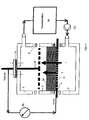
- FIG. 1 shows an embodiment of a cell according to the invention.
- the cell body consists of a lower tub body 1, an overlying center ring 2, and a final lid body 3.
- a suitable material for the cell bodies is polypropylene.
- Sealing rings 5 Between the individual cell body parts 1, 2 and 3 are Sealing rings 5 for sealing the cell body.
- the cathode is in the form of a copper sheet with a Circular geometry of about 280 mm diameter formed.
- the cathode sheet is further provided with bores to prevent passage of the electrolyte, i. to cleansing cyanide-containing solution.
- the cathode 8 is provided with a web, the passes through the lid body 3 and is held by means of crimp 4, at the same time the crimp 4 produces a gas-tight seal.
- One Another suitable material for the cathode 8 is graphite.
- the electrochemical cell is for the batch process designed.
- the solution to be purified is in the reservoir. 6 cached and rinsed by the pump 7 through the cell. This is the case cleaning solution below the anode 10 in the tub body 1, penetrates Anode and cathode and is pumped off in the upper area.
- the volume flow is v 100-300 L / h in the illustrated embodiment, for the illustrated embodiment with a cell cross-section of 30 cm.
- the arrow v inside the cell indicates the flow direction. Of the Arrow I shown in the cell represents the cell current direction.
- the anode 10 is formed as a particle bed 12 with a defined layer height and a defined degree of void.
- the layer height hereinafter referred to as the fixed bed depth h F , is 2 to 8 cm, preferably 3 to 6 cm, particularly preferably 5 to 6 cm.
- the average gap degree ⁇ is 0.4-0.65, preferably 0.45-0.6, particularly preferably 0.5-0.55.
- the fixed bed anode 10 rests on the feeder electrode 11, through which the electrical contact is provided to the voltage source 9.
- the Feeder electrode covered by a perforated Pb sheet with approximately 7000 1 mm holes formed on the 30 cm circle diameter.
- Feeder electrode 11 is shown in FIG Embodiment squeezed sealingly between the sealing rings 5.
- the Feeder electrode 11 may also be made of other suitable materials, such as. Graphite, glassy carbon or so-called mesographite.
- the Feeder electrode 11 no corrosion by the electrochemical Interaction subject. It can thus be advantageous for the feeder electrode 11 also materials are used, which are not suitable for forming the anode 10. Without being bound by theory, it is assumed that the Feeder electrode 11 is not or only slightly polarized, creating an electrochemical Corrosion of the feeder electrode 11 does not occur. The polarization is exclusive or almost exclusively in the fixed bed 12 of the anode 10 instead.
- the cathode 8 is in the illustrated embodiment, a copper sheet in a circle geometry with about 280 mm diameter, which is designed as a perforated plate.
- the whole Cathode is displaceable in the axial direction.
- divorce in Dependency of the solution to be worked up optionally metals in sponge-shaped Shape off. These can be easily removed from the cathode.
- the Removed cathode 8 by opening the lid body.
- hydrogen is primarily formed on the cathode 8 according to the formula 4: 2H 2 O + 2e -1 ⁇ H 2 (g) + 2OH - .
- the hydroxide ion is also formed in an advantageous manner, which raises the pH of the solution leads.
- the cyanide ions released at the cathode according to Equation 6 are subsequently oxidized at the fixed bed anode. In the illustrated batch process, this may e.g. at the second pass of the solution to be worked up by the cell.
- thermodynamically and kinetically very stable nickel (II) cyano complex which is considered to be particularly ecotoxic, is degraded almost completely in the cell according to the invention.
- strong oxidants such as peroxides or hypochorites.
- the content of the complex could be lowered below 0.05 mg Ni 2+ / L.
- the nickel (II) cyano complex becomes anode-side destroyed. Due to the high selective oxidation ability of the cell according to the invention as to cyanide ions, it is possible to add the complexed cyanide ions oxidize. The metal cations in question thereby become from their cyanide complexes liberated and are accessible to cathodic deposition.
- Table 1 shows the results of the workup of galvanoÜ, cyanide and heavy metal-containing waste solutions by means of the cell according to the invention.
- the total volume of the solution to be worked up was 14 liters.
- the fixed bed was formed from manganese particles or TiO x Mageli particles.
- the purity of the manganese particle bed was 99.5%.
- the geometry of the particles was platelet-shaped with a diameter of 1.5 mm and a thickness of 1.5 to 3 mm.
- the TiO x Mageli particles had a cylindrical particle shape with a diameter of 1.6 mm and a height of 1.6 mm.
- the cell is undivided.
- the cathode is in the form of a copper sheet.
- the feeder electrode is a Pb perforated disc.
- the workup of the solution to be purified is carried out in a batch process, at the same time the solution is in each case conveyed through the cell in a circular process.
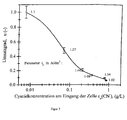
- Figure 2 is a graphic representation of the results of the work-up for cleaning solution, the average current efficiency depending on the Cyanide concentration is shown in the range of low cyanide concentrations.
- the fixed bed was continuously flowed through with the solution to be purified.
- the cell was undivided and provided with a graphite electrode.
- the Feeder electrode was a Pb perforated disc. The concentrations were measured after a single pass through the cell.
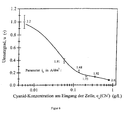
- FIG. 3 shows the degree of conversion as a function of the cyanide concentration FIG. 2.
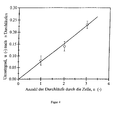
- Figure 4 shows the results of a long-term experiment.
- the degree of conversion is plotted as a function of the number of passes (n) of the solution to be purified through the cell. Also in the range of low cyanide concentrations.
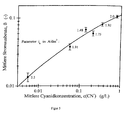
- FIG. 5 shows the average current efficiency as a function of the cyanide concentration in the region of low cyanide concentrations when using a fixed bed with Mn particles.
- the cell was undivided and provided with a graphite electrode, and a Pb perforated disc was used as feeder electrode.
- FIG. 6 shows the results according to FIG. 5 plotted as the degree of conversion in FIG Dependence of cyanide concentration.
- FIG. 7 is a summary of the average current efficiency in FIG Dependence on the average cyanide concentration in the workup of electroplating, cyanide and heavy metal waste solutions by means of Inventive cell according to the results of Table 1.
- Figure 8 is a summary of the mean space, time yield in Dependence on the mean cyanide concentration according to the data according to Table 1.
Landscapes
- Chemical & Material Sciences (AREA)
- Engineering & Computer Science (AREA)
- Electrochemistry (AREA)
- General Chemical & Material Sciences (AREA)
- Life Sciences & Earth Sciences (AREA)
- Hydrology & Water Resources (AREA)
- Chemical Kinetics & Catalysis (AREA)
- Environmental & Geological Engineering (AREA)
- Water Supply & Treatment (AREA)
- Organic Chemistry (AREA)
- Electrolytic Production Of Non-Metals, Compounds, Apparatuses Therefor (AREA)
- Water Treatment By Electricity Or Magnetism (AREA)
- Battery Electrode And Active Subsutance (AREA)
Abstract
Description

Claims (14)
- Zelle zur anodischen Oxidation von Cyaniden in wässerigen Lösungen, umfassend eine Festbettanode (10) sowie eine Kathode (8), dadurch gekennzeichnet, dass das Partikelbett (12) der Anode (10) aus Partikeln gebildet ist, bestehend aus Mangan oder den Oxiden des Titans oder Mischungen dieser Partikel, wobei die Partikel, bestehend aus den Oxiden des Titans, in der Magneli-Phase vorliegen und die Manganpartikel eine Reinheit von wenigstens 95% aufweisen, bevorzugt 99%, besonders bevorzugt 99.5%, wobei weiterhin gilt, das an die Zelle ein Gleichstrom angelegt wird.
- Zelle nach Anspruch 1, dadurch gekennzeichnet, dass das Partikelbett (12) eine Festbettiefe hF im Bereich von 2 bis 8 cm, bevorzugt 3 bis 6 cm, besonders bevorzugt 5 bis 6 cm und einen durchschnittlichen Lückengrad ε im Bereich von 0,4 bis 0,65, bevorzugt 0,45 bis 0,6, besonders bevorzugt 0,5 bis 0,55 aufweist.
- Zelle nach Anspruch 1 oder 2, dadurch gekennzeichnet, dass die Partikelgröße 0,5 bis 4 mm, vorzugsweise1,0 bis 3,5 mm, besonders bevorzugt 1,6 bis 3.0 mm beträgt.
- Zelle nach einem der vorhergehenden Ansprüche, dadurch gekennzeichnet, dass die Spannung an die Festbettanode mittels einer Feederelektrode (11) angelegt wird.
- Zelle nach einem der vorhergehenden Ansprüche, dadurch gekennzeichnet, dass die Kathode (8) in Form einer Lochscheibe ausgebildet und oberhalb der Festbettanode angeordnet ist.
- Zelle nach einem der vorhergehenden Ansprüche, dadurch gekennzeichnet, dass die Kathode (8) aus Kupfer oder Graphit besteht.
- Zelle nach einem der vorhergehenden Ansprüche, dadurch gekennzeichnet, dass die cyanidhaltige wässerige Lösung so geleitet wird, dass sie zuerst durch die Festbettanode (10) hindurchtritt und anschließend die Kathode (8) kontaktiert.
- Verfahren zur anodischen Oxidation von Cyaniden in wässerigen Lösungen, dadurch gekennzeichnet, dass die zur reinigende Lösung durch Partikelbett (12) einer Festbettanode (10) hindurchgeleitet sowie an einer Kathode (8) vorbeigeleitet wird, wobei das Partikelbett (12) aus Partikeln aus Mangan mit einer Reinheit von wenigstens 95 %, bevorzugt 99%, besonders bevorzugt 99.5%, Oxiden des Titans in der Magneli-Phase oder Mischungen hieraus gebildet ist und weiterhin eine Gleichstromspannung an Anode und Kathode angelegt ist.
- Verfahren nach Anspruch 8, dadurch gekennzeichnet, dass das Partikelbett (12) eine Festbettiefe hF im Bereich von 2 bis 8 cm, bevorzugt 3 bis 6 cm, besonders bevorzugt 5 bis 6 cm und einen durchschnittlichen Lückengrad ε im Bereich von 0,4 bis 0,65, bevorzugt 0,45 bis 0,6, besonders bevorzugt 0,5 bis 0,55 aufweist.
- Verfahren nach Anspruch 8 oder 9, dadurch gekennzeichnet, dass die cyanidhaltige wässerige Lösung so geleitet wird, dass sie zuerst durch die Festbettanode (10) hindurchtritt und anschließend die Kathode (8) kontaktiert.
- Verfahren nach einem der Ansprüche 8 bis 10, dadurch gekennzeichnet, dass pH-Wert der cyanidhaltigen wässerigen Lösung auf einen im Bereich von 8 bis 14, vorzugsweise 13 bis 14, eingestellt ist.
- Verfahren nach einem der Ansprüche 8 bis 11, dadurch gekennzeichnet, dass das Cyanid aus in der zu reinigenden Lösung vorliegenden, kinetisch und thermodynamisch stabilen Metall-Cyanid-Komplexe, an der Festbettanode (10) oxidiert wird und die freigeworden Metallkationen an der Kathode abgeschieden werden.
- Verfahren nach Anspruch 12, dadurch gekennzeichnet, dass der Metall-Cyanid-Komplex [Ni(CN)4]2- ist.
- Verwendung einer Festbettanode (10) mit einer Partikelschüttung zur elektrochemischen Oxidation von Cyaniden in wässerigen Lösungen, dadurch gekennzeichnet, dass das Partikelbett (12) der Anode aus Partikeln gebildet ist, bestehend aus Mangan oder den Oxiden des Titans oder Mischungen dieser Partikel, wobei die Partikel, bestehend aus den Oxiden des Titans, in der Magnéli-Phase vorliegen und die Manganpartikel eine Reinheit von wenigstens 95%, bevorzugt 99%, besonders bevorzugt 99.5%, aufweisen.
Applications Claiming Priority (2)
| Application Number | Priority Date | Filing Date | Title |
|---|---|---|---|
| DE10345594A DE10345594A1 (de) | 2003-09-29 | 2003-09-29 | Verfahren und Zelle zur elektrochemischen Oxidation von Cyaniden |
| DE10345594 | 2003-09-29 |
Publications (2)
| Publication Number | Publication Date |
|---|---|
| EP1518828A1 true EP1518828A1 (de) | 2005-03-30 |
| EP1518828B1 EP1518828B1 (de) | 2011-11-30 |
Family
ID=34178027
Family Applications (1)
| Application Number | Title | Priority Date | Filing Date |
|---|---|---|---|
| EP04021752A Expired - Lifetime EP1518828B1 (de) | 2003-09-29 | 2004-09-14 | Verfahren und Vorrichtung zur anodischen Oxidation von Cyaniden in wässrigen Lösungen |
Country Status (3)
| Country | Link |
|---|---|
| EP (1) | EP1518828B1 (de) |
| AT (1) | ATE535498T1 (de) |
| DE (1) | DE10345594A1 (de) |
Cited By (2)
| Publication number | Priority date | Publication date | Assignee | Title |
|---|---|---|---|---|
| CN105948227A (zh) * | 2016-05-18 | 2016-09-21 | 广西南宁明科环保科技有限公司 | 含氰废水处理装置及方法 |
| EP3500528A4 (de) * | 2016-08-19 | 2020-06-03 | University of Georgia Research Foundation, Inc. | Verfahren und systeme zur elektrochemischen oxidation von polyfluoralkyl- und perfluoralkylverunreinigungen |
Families Citing this family (3)
| Publication number | Priority date | Publication date | Assignee | Title |
|---|---|---|---|---|
| DE102012100481A1 (de) | 2012-01-20 | 2013-07-25 | Hochschule Niederrhein | Verfahren zur Entfernung von Mangan aus manganhaltigem Wasser |
| EP3358045A1 (de) | 2017-02-07 | 2018-08-08 | Dr.Ing. Max Schlötter GmbH & Co. KG | Verfahren zur galvanischen abscheidung von zink- und zinklegierungsüberzügen aus einem alkalischen beschichtungsbad mit reduziertem abbau von organischen badzusätzen |
| CN113277654A (zh) * | 2021-05-28 | 2021-08-20 | 金川集团股份有限公司 | 一种利用电化学方法处理电积高纯锰废液的方法及装置 |
Citations (5)
| Publication number | Priority date | Publication date | Assignee | Title |
|---|---|---|---|---|
| DE2316124A1 (de) * | 1973-01-02 | 1974-07-11 | Cyanil Co Ltd | Verfahren und vorrichtung zur verringerung der konzentration von anodisch oxidierbaren verbindungen |
| GB1498355A (en) | 1975-04-30 | 1978-01-18 | Westinghouse Electric Corp | Electrolytic process and apparatus for removal of contaminants from water |
| GB2051865A (en) | 1979-04-26 | 1981-01-21 | Nanao Kogyo Co Ltd | Electrodes for electrolyzing device |
| US4569729A (en) | 1984-07-16 | 1986-02-11 | Chlorine Engineers Corp., Ltd. | Electrolyzing method and electrolytic cell employing fluidized bed |
| US5281496A (en) | 1991-02-21 | 1994-01-25 | Atraverda Limited | Electrochemical cell containing a titanium suboxide electrode |
Family Cites Families (2)
| Publication number | Priority date | Publication date | Assignee | Title |
|---|---|---|---|---|
| US4399020A (en) * | 1981-07-24 | 1983-08-16 | Diamond Shamrock Corporation | Device for waste water treatment |
| WO2000032521A1 (en) * | 1998-11-30 | 2000-06-08 | Stauffer John E | Electrochemical process for removing ions from solution |
-
2003
- 2003-09-29 DE DE10345594A patent/DE10345594A1/de not_active Ceased
-
2004
- 2004-09-14 AT AT04021752T patent/ATE535498T1/de active
- 2004-09-14 EP EP04021752A patent/EP1518828B1/de not_active Expired - Lifetime
Patent Citations (5)
| Publication number | Priority date | Publication date | Assignee | Title |
|---|---|---|---|---|
| DE2316124A1 (de) * | 1973-01-02 | 1974-07-11 | Cyanil Co Ltd | Verfahren und vorrichtung zur verringerung der konzentration von anodisch oxidierbaren verbindungen |
| GB1498355A (en) | 1975-04-30 | 1978-01-18 | Westinghouse Electric Corp | Electrolytic process and apparatus for removal of contaminants from water |
| GB2051865A (en) | 1979-04-26 | 1981-01-21 | Nanao Kogyo Co Ltd | Electrodes for electrolyzing device |
| US4569729A (en) | 1984-07-16 | 1986-02-11 | Chlorine Engineers Corp., Ltd. | Electrolyzing method and electrolytic cell employing fluidized bed |
| US5281496A (en) | 1991-02-21 | 1994-01-25 | Atraverda Limited | Electrochemical cell containing a titanium suboxide electrode |
Non-Patent Citations (1)
| Title |
|---|
| SMITH J R ET AL: "ELECTRODES BASED ON MAGNELI PHASE TITANIUM OXIDES: THE PROPERTIES AND APPLICATIONS OF EBONEX MATERIALS", JOURNAL OF APPLIED ELECTROCHEMISTRY, CHAPMAN AND HALL. LONDON, GB, vol. 28, no. 10, October 1998 (1998-10-01), pages 1021 - 1033, XP000786928, ISSN: 0021-891X * |
Cited By (3)
| Publication number | Priority date | Publication date | Assignee | Title |
|---|---|---|---|---|
| CN105948227A (zh) * | 2016-05-18 | 2016-09-21 | 广西南宁明科环保科技有限公司 | 含氰废水处理装置及方法 |
| EP3500528A4 (de) * | 2016-08-19 | 2020-06-03 | University of Georgia Research Foundation, Inc. | Verfahren und systeme zur elektrochemischen oxidation von polyfluoralkyl- und perfluoralkylverunreinigungen |
| US11512011B2 (en) | 2016-08-19 | 2022-11-29 | University Of Georgia Research Foundation, Inc. | Methods and systems for electrochemical oxidation of polyfluoroalkyl and perfluroalkyl contaminants |
Also Published As
| Publication number | Publication date |
|---|---|
| ATE535498T1 (de) | 2011-12-15 |
| EP1518828B1 (de) | 2011-11-30 |
| DE10345594A1 (de) | 2005-05-04 |
Similar Documents
| Publication | Publication Date | Title |
|---|---|---|
| DE69908476T2 (de) | Gebrauch einer Anode mit einer elektrisch leitenden Diamantstruktur zur Herstellung von aufgelöstem Wasserstoffperoxid enthaltendem Säurewasser | |
| DE69410576T2 (de) | Abwasserbehandlung durch Elektrolyse mit einer dotierten Diamantanode | |
| EP0994074A2 (de) | Anordnung und Verfahren zur anodischen Oxidation von wässrigen Lösungen, Elektrode dafür und Verfahren zur Herstellung dieser Elektrode | |
| DE10013339C1 (de) | Verfahren und Vorrichtung zum Regulieren der Konzentration von Metallionen in einer Elektrolytflüssigkeit sowie Anwendung des Verfahrens und Verwendung der Vorrichtung | |
| DE60129594T2 (de) | Vorrichtung zur reinigung von wasser, welches gelöste organische substanzen sowie spuren schädlicher stoffe enthält | |
| DE2604371C2 (de) | ||
| DE10216860A1 (de) | Elektrolysezelle für die Herstellung von Wasserstoffperoxid und Verfahren zur Herstelung von Wasserstoffperoxid | |
| EP1581673B1 (de) | Anode zur galvanisierung | |
| DE1299608B (de) | Verfahren und Vorrichtung zur elektrolytischen Entfernung von Spuren von Metallen aus nichtmetallischen waessrigen Salzloesungen | |
| DE10025551C2 (de) | Kathode für die elektrochemische Regenerierung von Permanganat-Ätzlösungen, Verfahren zu deren Herstellung sowie elektrochemische Regeneriervorrichtung | |
| DE1949129A1 (de) | Anordnung zum elektrolytischen Entfernen von Verunreinigungen aus waessrigen Fluessigkeiten | |
| DE60104211T2 (de) | Elektrochemische zelle und elektrochemische behandlung von kontaminiertem wasser | |
| WO2002072921A2 (de) | Verfahren und vorrichtung zur rückgewinnung von metallen mit pulsierenden kathodischen strömen, auch in kombination mit anodischen koppelprozessen | |
| DD140262A5 (de) | Verfahren zur kontinuierlichen herstellung von chlor | |
| DE2316124A1 (de) | Verfahren und vorrichtung zur verringerung der konzentration von anodisch oxidierbaren verbindungen | |
| EP0862538B1 (de) | Verfahren und vorrichtung zur behandlung von mit mikroorganismen und/oder schadstoffen belastetem wasser | |
| DE3014867A1 (de) | Elektrolysiereinrichtung | |
| DE60308949T2 (de) | Verfahren zum Abbau organischer Verbindungen in zu behandelnder Flüssigkeit | |
| DE2607512C2 (de) | Verfahren zur Herstellung eines Metallpulvers, Elektrolysezelle zur Durchführung des Verfahrens und Anwendung des Verfahrens | |
| EP0238975B1 (de) | Verfahren zur Aktivierung von Wasserstoffperoxid zur Oxidationsbehandlung von schwer abbaubaren toxischen Substanzen | |
| EP1518828B1 (de) | Verfahren und Vorrichtung zur anodischen Oxidation von Cyaniden in wässrigen Lösungen | |
| EP1015667A2 (de) | Verfahren und vorrichtung zur konzentrationsregulierung von stoffen in elektrolyten | |
| EP0801692A2 (de) | Galvanikanlage | |
| DE10015209A1 (de) | Verfahren und Vorrichtung zur elektrochemischen Desinfektion von Wässern | |
| DE2218124A1 (de) | Verfahren zur Verringerung des Metallgehaltes einer Lösung |
Legal Events
| Date | Code | Title | Description |
|---|---|---|---|
| PUAI | Public reference made under article 153(3) epc to a published international application that has entered the european phase |
Free format text: ORIGINAL CODE: 0009012 |
|
| AK | Designated contracting states |
Kind code of ref document: A1 Designated state(s): AT BE BG CH CY CZ DE DK EE ES FI FR GB GR HU IE IT LI LU MC NL PL PT RO SE SI SK TR |
|
| AX | Request for extension of the european patent |
Extension state: AL HR LT LV MK |
|
| 17P | Request for examination filed |
Effective date: 20050924 |
|
| AKX | Designation fees paid |
Designated state(s): AT BE BG CH CY CZ DE DK EE ES FI FR GB GR HU IE IT LI LU MC NL PL PT RO SE SI SK TR |
|
| GRAP | Despatch of communication of intention to grant a patent |
Free format text: ORIGINAL CODE: EPIDOSNIGR1 |
|
| GRAS | Grant fee paid |
Free format text: ORIGINAL CODE: EPIDOSNIGR3 |
|
| GRAA | (expected) grant |
Free format text: ORIGINAL CODE: 0009210 |
|
| AK | Designated contracting states |
Kind code of ref document: B1 Designated state(s): AT BE BG CH CY CZ DE DK EE ES FI FR GB GR HU IE IT LI LU MC NL PL PT RO SE SI SK TR |
|
| REG | Reference to a national code |
Ref country code: GB Ref legal event code: FG4D Free format text: NOT ENGLISH Ref country code: CH Ref legal event code: EP |
|
| REG | Reference to a national code |
Ref country code: IE Ref legal event code: FG4D Free format text: LANGUAGE OF EP DOCUMENT: GERMAN |
|
| RIN2 | Information on inventor provided after grant (corrected) |
Inventor name: RHEINDORF, ANGELA Inventor name: KORNELI, DIRK Inventor name: NOWACK, NORBERT Inventor name: HEGER, KLAUS |
|
| REG | Reference to a national code |
Ref country code: DE Ref legal event code: R096 Ref document number: 502004013106 Country of ref document: DE Effective date: 20120126 |
|
| REG | Reference to a national code |
Ref country code: NL Ref legal event code: VDEP Effective date: 20111130 |
|
| PG25 | Lapsed in a contracting state [announced via postgrant information from national office to epo] |
Ref country code: NL Free format text: LAPSE BECAUSE OF FAILURE TO SUBMIT A TRANSLATION OF THE DESCRIPTION OR TO PAY THE FEE WITHIN THE PRESCRIBED TIME-LIMIT Effective date: 20111130 Ref country code: GR Free format text: LAPSE BECAUSE OF FAILURE TO SUBMIT A TRANSLATION OF THE DESCRIPTION OR TO PAY THE FEE WITHIN THE PRESCRIBED TIME-LIMIT Effective date: 20120301 Ref country code: PT Free format text: LAPSE BECAUSE OF FAILURE TO SUBMIT A TRANSLATION OF THE DESCRIPTION OR TO PAY THE FEE WITHIN THE PRESCRIBED TIME-LIMIT Effective date: 20120330 Ref country code: SE Free format text: LAPSE BECAUSE OF FAILURE TO SUBMIT A TRANSLATION OF THE DESCRIPTION OR TO PAY THE FEE WITHIN THE PRESCRIBED TIME-LIMIT Effective date: 20111130 Ref country code: SI Free format text: LAPSE BECAUSE OF FAILURE TO SUBMIT A TRANSLATION OF THE DESCRIPTION OR TO PAY THE FEE WITHIN THE PRESCRIBED TIME-LIMIT Effective date: 20111130 |
|
| REG | Reference to a national code |
Ref country code: IE Ref legal event code: FD4D |
|
| PG25 | Lapsed in a contracting state [announced via postgrant information from national office to epo] |
Ref country code: CY Free format text: LAPSE BECAUSE OF FAILURE TO SUBMIT A TRANSLATION OF THE DESCRIPTION OR TO PAY THE FEE WITHIN THE PRESCRIBED TIME-LIMIT Effective date: 20111130 |
|
| PG25 | Lapsed in a contracting state [announced via postgrant information from national office to epo] |
Ref country code: SK Free format text: LAPSE BECAUSE OF FAILURE TO SUBMIT A TRANSLATION OF THE DESCRIPTION OR TO PAY THE FEE WITHIN THE PRESCRIBED TIME-LIMIT Effective date: 20111130 Ref country code: EE Free format text: LAPSE BECAUSE OF FAILURE TO SUBMIT A TRANSLATION OF THE DESCRIPTION OR TO PAY THE FEE WITHIN THE PRESCRIBED TIME-LIMIT Effective date: 20111130 Ref country code: CZ Free format text: LAPSE BECAUSE OF FAILURE TO SUBMIT A TRANSLATION OF THE DESCRIPTION OR TO PAY THE FEE WITHIN THE PRESCRIBED TIME-LIMIT Effective date: 20111130 Ref country code: DK Free format text: LAPSE BECAUSE OF FAILURE TO SUBMIT A TRANSLATION OF THE DESCRIPTION OR TO PAY THE FEE WITHIN THE PRESCRIBED TIME-LIMIT Effective date: 20111130 Ref country code: BG Free format text: LAPSE BECAUSE OF FAILURE TO SUBMIT A TRANSLATION OF THE DESCRIPTION OR TO PAY THE FEE WITHIN THE PRESCRIBED TIME-LIMIT Effective date: 20120229 Ref country code: IE Free format text: LAPSE BECAUSE OF FAILURE TO SUBMIT A TRANSLATION OF THE DESCRIPTION OR TO PAY THE FEE WITHIN THE PRESCRIBED TIME-LIMIT Effective date: 20111130 |
|
| PG25 | Lapsed in a contracting state [announced via postgrant information from national office to epo] |
Ref country code: PL Free format text: LAPSE BECAUSE OF FAILURE TO SUBMIT A TRANSLATION OF THE DESCRIPTION OR TO PAY THE FEE WITHIN THE PRESCRIBED TIME-LIMIT Effective date: 20111130 Ref country code: RO Free format text: LAPSE BECAUSE OF FAILURE TO SUBMIT A TRANSLATION OF THE DESCRIPTION OR TO PAY THE FEE WITHIN THE PRESCRIBED TIME-LIMIT Effective date: 20111130 Ref country code: IT Free format text: LAPSE BECAUSE OF FAILURE TO SUBMIT A TRANSLATION OF THE DESCRIPTION OR TO PAY THE FEE WITHIN THE PRESCRIBED TIME-LIMIT Effective date: 20111130 |
|
| PLBE | No opposition filed within time limit |
Free format text: ORIGINAL CODE: 0009261 |
|
| STAA | Information on the status of an ep patent application or granted ep patent |
Free format text: STATUS: NO OPPOSITION FILED WITHIN TIME LIMIT |
|
| 26N | No opposition filed |
Effective date: 20120831 |
|
| REG | Reference to a national code |
Ref country code: DE Ref legal event code: R097 Ref document number: 502004013106 Country of ref document: DE Effective date: 20120831 |
|
| BERE | Be: lapsed |
Owner name: HOCHSCHULE NIEDERRHEIN Effective date: 20120930 |
|
| PG25 | Lapsed in a contracting state [announced via postgrant information from national office to epo] |
Ref country code: MC Free format text: LAPSE BECAUSE OF NON-PAYMENT OF DUE FEES Effective date: 20120930 Ref country code: ES Free format text: LAPSE BECAUSE OF FAILURE TO SUBMIT A TRANSLATION OF THE DESCRIPTION OR TO PAY THE FEE WITHIN THE PRESCRIBED TIME-LIMIT Effective date: 20120311 |
|
| REG | Reference to a national code |
Ref country code: CH Ref legal event code: PL |
|
| GBPC | Gb: european patent ceased through non-payment of renewal fee |
Effective date: 20120914 |
|
| PG25 | Lapsed in a contracting state [announced via postgrant information from national office to epo] |
Ref country code: FI Free format text: LAPSE BECAUSE OF FAILURE TO SUBMIT A TRANSLATION OF THE DESCRIPTION OR TO PAY THE FEE WITHIN THE PRESCRIBED TIME-LIMIT Effective date: 20111130 |
|
| REG | Reference to a national code |
Ref country code: FR Ref legal event code: ST Effective date: 20130531 |
|
| PG25 | Lapsed in a contracting state [announced via postgrant information from national office to epo] |
Ref country code: GB Free format text: LAPSE BECAUSE OF NON-PAYMENT OF DUE FEES Effective date: 20120914 Ref country code: CH Free format text: LAPSE BECAUSE OF NON-PAYMENT OF DUE FEES Effective date: 20120930 Ref country code: BE Free format text: LAPSE BECAUSE OF NON-PAYMENT OF DUE FEES Effective date: 20120930 Ref country code: LI Free format text: LAPSE BECAUSE OF NON-PAYMENT OF DUE FEES Effective date: 20120930 |
|
| PG25 | Lapsed in a contracting state [announced via postgrant information from national office to epo] |
Ref country code: FR Free format text: LAPSE BECAUSE OF NON-PAYMENT OF DUE FEES Effective date: 20121001 |
|
| PGFP | Annual fee paid to national office [announced via postgrant information from national office to epo] |
Ref country code: DE Payment date: 20130926 Year of fee payment: 10 |
|
| REG | Reference to a national code |
Ref country code: AT Ref legal event code: MM01 Ref document number: 535498 Country of ref document: AT Kind code of ref document: T Effective date: 20120914 |
|
| PG25 | Lapsed in a contracting state [announced via postgrant information from national office to epo] |
Ref country code: AT Free format text: LAPSE BECAUSE OF NON-PAYMENT OF DUE FEES Effective date: 20120914 |
|
| PG25 | Lapsed in a contracting state [announced via postgrant information from national office to epo] |
Ref country code: TR Free format text: LAPSE BECAUSE OF FAILURE TO SUBMIT A TRANSLATION OF THE DESCRIPTION OR TO PAY THE FEE WITHIN THE PRESCRIBED TIME-LIMIT Effective date: 20111130 |
|
| PG25 | Lapsed in a contracting state [announced via postgrant information from national office to epo] |
Ref country code: LU Free format text: LAPSE BECAUSE OF NON-PAYMENT OF DUE FEES Effective date: 20120914 |
|
| PG25 | Lapsed in a contracting state [announced via postgrant information from national office to epo] |
Ref country code: HU Free format text: LAPSE BECAUSE OF FAILURE TO SUBMIT A TRANSLATION OF THE DESCRIPTION OR TO PAY THE FEE WITHIN THE PRESCRIBED TIME-LIMIT Effective date: 20040914 |
|
| REG | Reference to a national code |
Ref country code: DE Ref legal event code: R119 Ref document number: 502004013106 Country of ref document: DE |
|
| REG | Reference to a national code |
Ref country code: DE Ref legal event code: R119 Ref document number: 502004013106 Country of ref document: DE Effective date: 20150401 |
|
| PG25 | Lapsed in a contracting state [announced via postgrant information from national office to epo] |
Ref country code: DE Free format text: LAPSE BECAUSE OF NON-PAYMENT OF DUE FEES Effective date: 20150401 |