EP1515950B1 - Kationische alkoxyaminen zur verwendung in der herstellung von nanopartikeln von natürlichen oder synthetischen clays - Google Patents
Kationische alkoxyaminen zur verwendung in der herstellung von nanopartikeln von natürlichen oder synthetischen clays Download PDFInfo
- Publication number
- EP1515950B1 EP1515950B1 EP03740262A EP03740262A EP1515950B1 EP 1515950 B1 EP1515950 B1 EP 1515950B1 EP 03740262 A EP03740262 A EP 03740262A EP 03740262 A EP03740262 A EP 03740262A EP 1515950 B1 EP1515950 B1 EP 1515950B1
- Authority
- EP
- European Patent Office
- Prior art keywords
- alkyl
- group
- hydrogen
- methyl
- direct bond
- Prior art date
- Legal status (The legal status is an assumption and is not a legal conclusion. Google has not performed a legal analysis and makes no representation as to the accuracy of the status listed.)
- Expired - Lifetime
Links
- 0 C*c1ccc([*+])cc1 Chemical compound C*c1ccc([*+])cc1 0.000 description 22
- OYDNCVFOOWIMGP-UHFFFAOYSA-N CC1C=CC(NN)=CC1 Chemical compound CC1C=CC(NN)=CC1 OYDNCVFOOWIMGP-UHFFFAOYSA-N 0.000 description 1
- NWQADSDPVOTSFC-UHFFFAOYSA-N CCC(C)(CC(C(C)C1(C)CC)O)N1OC(C)(C)C(NCCC[N](C)(C)CC)=O Chemical compound CCC(C)(CC(C(C)C1(C)CC)O)N1OC(C)(C)C(NCCC[N](C)(C)CC)=O NWQADSDPVOTSFC-UHFFFAOYSA-N 0.000 description 1
- ASIZADKXKZSRSZ-UHFFFAOYSA-N CCC(C)(CCC(C)C1(C)CC)N1OC(C)C(NCCC[N](C)(C)CC)=O Chemical compound CCC(C)(CCC(C)C1(C)CC)N1OC(C)C(NCCC[N](C)(C)CC)=O ASIZADKXKZSRSZ-UHFFFAOYSA-N 0.000 description 1
Classifications
-
- C—CHEMISTRY; METALLURGY
- C08—ORGANIC MACROMOLECULAR COMPOUNDS; THEIR PREPARATION OR CHEMICAL WORKING-UP; COMPOSITIONS BASED THEREON
- C08F—MACROMOLECULAR COMPOUNDS OBTAINED BY REACTIONS ONLY INVOLVING CARBON-TO-CARBON UNSATURATED BONDS
- C08F4/00—Polymerisation catalysts
-
- C—CHEMISTRY; METALLURGY
- C07—ORGANIC CHEMISTRY
- C07F—ACYCLIC, CARBOCYCLIC OR HETEROCYCLIC COMPOUNDS CONTAINING ELEMENTS OTHER THAN CARBON, HYDROGEN, HALOGEN, OXYGEN, NITROGEN, SULFUR, SELENIUM OR TELLURIUM
- C07F9/00—Compounds containing elements of Groups 5 or 15 of the Periodic Table
- C07F9/02—Phosphorus compounds
- C07F9/28—Phosphorus compounds with one or more P—C bonds
- C07F9/38—Phosphonic acids [RP(=O)(OH)2]; Thiophosphonic acids ; [RP(=X1)(X2H)2(X1, X2 are each independently O, S or Se)]
-
- B—PERFORMING OPERATIONS; TRANSPORTING
- B82—NANOTECHNOLOGY
- B82B—NANOSTRUCTURES FORMED BY MANIPULATION OF INDIVIDUAL ATOMS, MOLECULES, OR LIMITED COLLECTIONS OF ATOMS OR MOLECULES AS DISCRETE UNITS; MANUFACTURE OR TREATMENT THEREOF
- B82B3/00—Manufacture or treatment of nanostructures by manipulation of individual atoms or molecules, or limited collections of atoms or molecules as discrete units
-
- C—CHEMISTRY; METALLURGY
- C07—ORGANIC CHEMISTRY
- C07D—HETEROCYCLIC COMPOUNDS
- C07D211/00—Heterocyclic compounds containing hydrogenated pyridine rings, not condensed with other rings
- C07D211/92—Heterocyclic compounds containing hydrogenated pyridine rings, not condensed with other rings with a hetero atom directly attached to the ring nitrogen atom
- C07D211/94—Oxygen atom, e.g. piperidine N-oxide
-
- C—CHEMISTRY; METALLURGY
- C07—ORGANIC CHEMISTRY
- C07D—HETEROCYCLIC COMPOUNDS
- C07D241/00—Heterocyclic compounds containing 1,4-diazine or hydrogenated 1,4-diazine rings
- C07D241/02—Heterocyclic compounds containing 1,4-diazine or hydrogenated 1,4-diazine rings not condensed with other rings
- C07D241/06—Heterocyclic compounds containing 1,4-diazine or hydrogenated 1,4-diazine rings not condensed with other rings having one or two double bonds between ring members or between ring members and non-ring members
- C07D241/08—Heterocyclic compounds containing 1,4-diazine or hydrogenated 1,4-diazine rings not condensed with other rings having one or two double bonds between ring members or between ring members and non-ring members with oxygen atoms directly attached to ring carbon atoms
-
- C—CHEMISTRY; METALLURGY
- C07—ORGANIC CHEMISTRY
- C07F—ACYCLIC, CARBOCYCLIC OR HETEROCYCLIC COMPOUNDS CONTAINING ELEMENTS OTHER THAN CARBON, HYDROGEN, HALOGEN, OXYGEN, NITROGEN, SULFUR, SELENIUM OR TELLURIUM
- C07F9/00—Compounds containing elements of Groups 5 or 15 of the Periodic Table
- C07F9/02—Phosphorus compounds
- C07F9/28—Phosphorus compounds with one or more P—C bonds
- C07F9/38—Phosphonic acids [RP(=O)(OH)2]; Thiophosphonic acids ; [RP(=X1)(X2H)2(X1, X2 are each independently O, S or Se)]
- C07F9/40—Esters thereof
- C07F9/4003—Esters thereof the acid moiety containing a substituent or a structure which is considered as characteristic
- C07F9/4006—Esters of acyclic acids which can have further substituents on alkyl
-
- C—CHEMISTRY; METALLURGY
- C07—ORGANIC CHEMISTRY
- C07F—ACYCLIC, CARBOCYCLIC OR HETEROCYCLIC COMPOUNDS CONTAINING ELEMENTS OTHER THAN CARBON, HYDROGEN, HALOGEN, OXYGEN, NITROGEN, SULFUR, SELENIUM OR TELLURIUM
- C07F9/00—Compounds containing elements of Groups 5 or 15 of the Periodic Table
- C07F9/02—Phosphorus compounds
- C07F9/547—Heterocyclic compounds, e.g. containing phosphorus as a ring hetero atom
- C07F9/553—Heterocyclic compounds, e.g. containing phosphorus as a ring hetero atom having one nitrogen atom as the only ring hetero atom
- C07F9/576—Six-membered rings
- C07F9/59—Hydrogenated pyridine rings
Definitions
- the instant invention relates to cationic alkoxyamines, which are useful as polymerization initiators/regulators in a controlled free radical polymerization process to produce intercalated and/or exfoliated nanoparticles from natural or synthetic clays.
- the invention also relates to improved nanocomposite compositions produced by this process and to the use of these nanocomposite compositions as, for example, coatings, sealants, caulks, adhesives and as plastic additives.
- One way of improving polymer properties is by adding a natural or synthetic clay material to polymers to form composite materials.
- incorporating clays into polymers may not provide a desirable improvement in the physical properties, particularly mechanical and optical properties of the polymer may be adversely affected.
- Nanonocomposite compositions containing finely dispersed natural or synthetic clay with at least partially intercalated and/or exfoliated layers and mixtures of ethylenically unsaturated monomers and/or polymers therefrom have therefore attracted much interest in the last years. These materials combine the desired effects of dispersed clay by avoiding the negative influence on, for example, the mechanical or optical properties.
- compositions, methods for making them and their use in polymers and coatings are for example described in WO 02/24759 .
- Polymerization processes are described using montmorillonite clay, acrylate monomers and for example ammonium persulfate as radical initiator. This conventional polymerization process leads to polymers with broad molecular weight distributions and a high polydispersity index (PD).
- PD polydispersity index
- the present invention provides alkoxyamines, which can be anchored to natural or synthetic clays by a cationic anchor group and which have a high reactivity towards acrylates, methacrylates, styrene and other monomers resulting in a controlled molecular weight with narrow molecular weight distribution. With these compounds polymerization leads to high monomer to polymer conversions in short times and at relatively low temperatures.
- controlled radical polymerization allows to adjust the molecular weight of all growing chains almost uniformly to a predetermined length (low polydispersity), resulting in an almost ideal dispersion of the intercalated and/or exfoliated clay particles.
- the nanocomposite compositions of the instant invention can be optically almost transparent, indicating the fine distribution, on the nanometer scale, of the clay.
- G 1 and G 2 independently represent a tertiary carbon atom to which unsubstituted C 1 -C 18 alkyl or phenyl or with CN, COC 1 -C 18 alkyl, CO-phenyl, COOC 1 -C 18 alkyl, OC 1 -C 18 alkyl, NO 2 , NHC 1 -C 18 alkyl or N(C 1 -C 18 ) 2 alkyl substituted alkyl or phenyl groups are bonded; or one of G 1 and G 2 is a secondary carbon atom to which a group -P(O)(OR 22 ) 2 and the other is as defined above; or G 1 and G 2 together with the nitrogen atom to which they are bonded to form a 5 to 8 membered heterocyclic ring or a polycyclic or spirocyclic 5 to 20 membered heterocyclic ring system, which is substituted with 4 C 1
- Alkyl having up to 18 carbon atoms is a branched or unbranched radical, for example methyl, ethyl, propyl, isopropyl, n-butyl, sec-butyl, isobutyl, tert-butyl, 2-ethylbutyl, n-pentyl, isopentyl, 1-methylpentyl, 1,3-dimethylbutyl, n-hexyl, 1-methylhexyl, n-heptyl, isoheptyl, 1,1,3,3-tetramethylbutyl, 1-methylheptyl, 3-methylheptyl, n-octyl, 2-ethylhexyl, 1,1,3-trimethylhexyl, 1,1,3,3-tetramethylpentyl, nonyl, decyl, undecyl, 1-methylundecyl, dodecyl, 1,1,3,3,5,5-hexamethylhexy
- C 3 -C 18 Alkyl interrupted by oxygen, sulfur or by is, for example, CH 3 -O-CH 2 CH 2 -, CH 3 -S-CH 2 CH 2 -, CH 3 -N(CH 3 )-CH 2 CH 2 - , CH 3 -O-CH 2 CH 2 -O-CH 2 CH 2 - , CH 3 -(O-CH 2 CH 2 -) 2 O-CH 2 CH 2 -, CH 3 -(O-CH 2 CH 2 -) 3 O-CH 2 CH 2 - or CH 3 -(O-CH 2 CH 2 -) 4 O-CH 2 CH 2 -.
- Phenylalkyl is, for example, benzyl, ⁇ -methylbenzyl, ⁇ , ⁇ -dimethylbenzyl or 2-phenylethyl. Preference is given to benzyl and ⁇ , ⁇ -dimethylbenzyl.
- C 1 -C 25 Alkylene is a branched or unbranched radical, for example methylene, ethylene, propylene, trimethylene, tetramethylene, pentamethylene, hexamethylene, heptamethylene, octamethylene, decamethylene, dodecamethylene or octadecamethylene.
- C 2 -C 25 alkylene interrupted by -O-, -S-, -SO-, -SO 2 -, phenylene or C 5 -C 8 cydoalkylene is, for example, -CH 2 -O-CH 2 -, -CH 2 -S-CH 2 -, -CH 2 -N(CH 3 )-CH 2 -, -CH 2 -O-CH 2 CH 2 -, -CH 2 CH 2 -O-CH 2 CH 2 -, -CH 2 CH 2 -O-CH 2 CH 2 -, -CH 2 CH 2 -O-CH 2 CH 2 -O-CH 2 CH 2 - , -CH 2 CH 2 -(O-CH 2 CH 2 -) 2 O-CH 2 CH 2 -, -CH 2 CH 2 -(O-CH 2 CH 2 -) 3 O-CH 2 CH 2 -, -CH 2 CH 2 -(O-CH 2 CH 2 -) 4 O-CH
- Alkenyl having 2 to 24 carbon atoms is a branched or unbranched radical such as, for example, vinyl, propenyl, 2-butenyl, 3-butenyl, isobutenyl, n-2,4-pentadienyl, 3-methyl-2-butenyl, n-2-octenyl, n-2-dodecenyl, iso-dodecenyl, oleyl, n-2-octadecenyl or n-4-octadecenyl. Preference is given to alkenyl having 3 to 18, especially 3 to 12, for example 3 to 6, especially 3 to 4 carbon atoms.
- Alkinyl having from 3 to 18 carbon atoms is a branched or unbranched radical, for example propinyl, 2-butinyl, 3-butinyl, isobutinyl, n-2,4-pentadiinyl, 3-methyl-2-butinyl, n-2-octinyl, n-2-dodecinyl, isododecinyl.
- Halogen is, for example, chlorine, bromine or iodine. Preference is given to chlorine and bromine.
- Alkoxy having up to 25 carbon atoms is a branched or unbranched radical, for example methoxy, ethoxy, propoxy, isopropoxy, n-butoxy, isobutoxy, pentyloxy, isopentyloxy, hexyloxy, heptyloxy, octyloxy, decyloxy, tetradecyloxy, hexadecyloxy or octadecyloxy.
- Alkanoyloxy having up to 25 carbon atoms is a branched or unbranched radical, for example acetoxy, propionyloxy, butanoyloxy, pentanoyloxy, hexanoyloxy, heptanoyloxy, octanoyloxy, nonanoyloxy, decanoyloxy, undecanoyloxy, dodecanoyloxy, tridecanoyloxy, tetradecanoyloxy, pentadecanoyloxy, hexadecanoyloxy, heptadecanoyloxy, octadecanoyloxy, icosanoyloxy or docosanoyloxy.
- Preference is given to alkanoyloxy having from 2 to 18, especially from 2 to 12, e.g. from 2 to 6, carbon atoms.
- Hydroxyl-substituted C 2 -C 18 alkyl is a branched or unbranched radical which contains preferably 1 to 3, in particular 1 or 2, hydroxyl groups, such as, for example, hydroxyethyl, 3-hydroxypropyl, 2-hydroxypropyl, 4-hydroxybutyl, 3-hydroxybutyl, 2-hydroxybutyl, 5-hydroxypentyl, 4-hydroxypentyl, 3-hydroxypentyl, 2-hydroxypentyl, 6-hydroxyhexyl, 5-hydroxyhexyl, 4-hydroxyhexyl, 3-hydroxyhexyl, 2-hydroxyhexyl, 7-hydroxyheptyl, 6-hydroxyheptyl, 5-hydroxyheptyl, 4-hydroxyheptyl, 3-hydroxyheptyl, 2-hydroxyheptyl, 8-hydroxyoctyl, 7-hydroxyoctyl, 6-hydroxyoctyl, 5-hydroxyoctyl, 4-hydroxyoctyl, 3-hydroxyoctyl, 2-hydroxyoctyl, 9
- C 5 -C 12 cycloalkyl is for example cyclopentyl, cyclohexyl, cycloheptyl, methylcyclopentyl or cyclooctyl.
- X - is a monovalent radical of a saturated, unsaturated or aromatic carboxylic acid, it is, for example, an acetyl, caproyl, stearoyl, acryloyl, methacryloyl, benzoyl or ⁇ -(3,5-di-tert-butyl-4-hydroxyphenyl)propionyl radical.
- X - is a divalent radical of a dicarboxylic acid, it is, for example, a malonyl, succinyl, glutaryl, adipoyl, suberoyl, sebacoyl, maleoyl, itaconyl, phthaloyl, dibutylmalonyl, dibenzylmalonyl, butyl(3,5-di-tert-butyl-4-hydroxybenzyl)malonyl or bicycloheptenedicarbonyl radical.
- X - is a trivalent radical of a tricarboxylic acid, it is, for example, a trimellitoyl, citryl or nitrilotriacetyl radical.
- Heteroaryl is for example pyryl, thiophenyl, furyl, pyridyl or pyrimidyl.
- R 5 , R 6 and R 7 form a monocyclic or polycyclic heterocyclic ring
- the resulting cation is for example a pyridinium, quinolinium, isoquinolinium, imidazolium or thiazolium cation.
- the compounds are of formula IIa, IIb, IIc, IId or IIe wherein A 1 and A 2 are independently hydrogen or together with the carbon atom to which they are bonded form a carbonylgroup, -C(O)-; D is a direct bond or C 1 -C 12 alkylene, C 1 -C 12 alkylene which is interrupted by one or more O, S, or NR 9 atoms, C 5 -C 12 cycloalkylene or phenylene; E is a group -NR 9 -(CH 2 ) x -NR 9 - where x is a number from 2 to 12 or a group v is a number from 0 to 10 and w is 0 or 1; Q 1 is a direct bond or a -CH 2 - group; if Q 1 is a direct bond, T 8 is hydrogen, if Q 1 is -CH 2 -, T 8 is hydrogen, methyl or ethyl; Y is -0- or -
- T 1 , T 2 , T 3 and T 4 are independently methyl or ethyl with the proviso that at least one is ethyl;
- T 7 is hydrogen or methyl;
- Y is O or NR 9 ;
- Q 1 is a direct bond or a -CH 2 - group; if Q 1 is a direct bond, T 8 is hydrogen, if Q 1 is -CH 2 -, T 8 is methyl or ethyl;
- v is a number from 0 to 10 and w is 0 or 1;
- K 7 is a group -CH 2 -CHOH-CH 2 -N + R 5 R 6 X - - ⁇ [(CH 2 -CH 2 )-(CH 2 ) s -N + R 5 R 6 X - ] t -CH 2 -CH 2 -(CH 2 ) s -N + R 5 R 6 R 7 X - ⁇
- T 1 , T 2 , T 3 and T 4 are independently methyl or ethyl with the proviso that at least one is ethyl;
- T 7 is hydrogen or methyl;
- Q 1 is a direct bond or a -CH 2 - group; if Q 1 is a direct bond, T 8 is hydrogen, if Q 1 is -CH 2 -, T 8 is methyl or ethyl;
- K 1 and K 2 are hydrogen, C 5 -C 12 cydoalkyl, phenyl or C 7 -C 9 phenylalkyl and K 3 is a group -COK 4 or where K 4 is Y-[(CH 2 -CH 2 )-(CH 2 ) s -N + R 5 R 6 X - ] t -CH 2 -CH 2 -(CH 2 ) s -N + R 5 R 6 R 7 X - or
- T 1 , T 2 , T 3 and T 4 are independently methyl or ethyl with the proviso that at least one is ethyl; T 7 is hydrogen or methyl; E 1 is where x is a number from 2 to 12; K 1 and K 2 are hydrogen, C 5 -C 12 cycloalkyl, phenyl or C 7 -C 9 phenylalkyl and K 3 is a group -COK 4 or where K 4 is Y-[(CH 2 -CH 2 )-(CH 2 ) s -N + R 5 R 6 X - ] t -CH 2 -CH 2 -(CH 2 ) s -N + R 5 R 6 R 7 X - or -Y-CH 2 -CHOH-CH 2 -N + R 5 R 6 X- ⁇ [(CH 2 -CH 2 )-(CH 2)s -N + R 5 R 6 X - ] t -
- the precursors of the above compounds can be prepared according to known methods.
- the preparation of open chain alkoxyamines is for example described in WO 99/03894 or in WO 00/07981 .
- Alkoxyamines based on tetraalkyl piperidine are for example described in GB 2 335 1290 or in GB 2 361 235 . Further heterocyclic alkoxyamines are described in GB 2 342 649 .
- a very suitable, but not the only possible, method for the introduction of the cationic moiety into the molecule of the alkoxyamine consists of first preparing the suitable precursor alkoxyamine wich is then quarternised. Examples of such alkoxyamines are given in the examples in Table 1.
- the non cationic precursors can be prepared by a variety of methods described in the cited patents using the suitable building blocks bearing the appropriate nucleophilic groups capable of quarternisation. Few examples of such groups are primary, secondary or tertiary amine group, pyridyl, quinolyl, isoquinolyl, imidazolyl, thiazolyl groups, trialkyl or triaryl or alkylarylphosphine groups or a thioether group.
- a further aspect of the invention is a process for preparing a monomer/polymer clay nanocomposite dispersion comprising the steps of
- Clay minerals are typically comprised of hydrated aluminum silicates that are fine-grained and have a platy habit.
- the crystalline structure of a typical clay mineral is a multi-layered structure comprised of combinations of layers of SiO 4 tetrahedra that are joined to layers of AlO(OH) 2 octahedra.
- a so called "gallery" is formed which describes the defined interlayer spaces of the layered clay minerals.
- the gallery may contain water and/or other constituents such as potassium, sodium or calcium cations.
- Clay minerals vary based upon the combination their constituent layers and cations.
- Isomorphic substitution of the cations of clay mineral typically occurs and may impart a net negative charge on the clay structure. Natural occurring elements within the gallery of the clay, such as water molecules or sodium or potassium cations, are attracted to the surface of the clay layers due to this net charge.
- Nanocomposites are compositions in which at least one of its constituents has one or more dimensions, such as length, width or thickness in the nanometer size range.
- the term nanocomposite, as used herein, denotes the state of matter wherein polymer molecules exist among at least partially exfoliated clay layers.
- intercalated nanocomposite describes a nanocomposite that contains a regular insertion between the clay layers.
- exfoliated nanocomposite describes a nanocomposite wherein the 1 nm thick layers of clay are dispersed in the matrix (oligomer/polymer) forming a composite structure on the nano/micro scale.
- the clay minerals are items of commerce and are for example supplied by Süd-Chemie Inc., Germany.
- the ethylenically unsaturated monomer or oligomer is selected from the group consisting of ethylene, propylene, n-butylene, i-butylene, styrene, substituted styrene, conjugated dienes, acrolein, vinyl acetate, vinylpyrrolidone, vinylimidazole, maleic anhydride, (alkyl)acrylic acidanhydrides, (alkyl)acrylic acid salts, (alkyl)acrylic esters, (meth)acrylonitriles, (alkyl)acrylamides, vinyl halides or vinylidene halides.
- R a as C 2 -C 100 alkoxy interrupted by at least one O atom are of formula wherein R c is C 1 -C 25 alkyl, phenyl or phenyl substituted by C 1 -C 18 alkyl, R d is hydrogen or methyl and v is a number from 1 to 50.
- R c is C 1 -C 25 alkyl, phenyl or phenyl substituted by C 1 -C 18 alkyl
- R d is hydrogen or methyl
- v is a number from 1 to 50.
- These monomers are for example derived from non ionic surfactants by acrylation of the corresponding alkoxylated alcohols or phenols.
- the repeating units may be derived from ethylene oxide, propylene oxide or mixtures of both.
- Suitable acrylate or methacrylate monomers are given below.
- An - and R a have the meaning as defined above and R e is methyl or benzyl.
- An' is preferably Cl - , Br - or O 3 S-CH 3 .
- R a is hydrogen or methyl
- R b is NH 2 , gycidyl, unsubstituted or with hydroxy substituted C 1 -C 4 alkoxy, unsubstituted C 1 -C 4 alkylamino, di(C 1 -C 4 alkyl)amino, hydroxy-substituted C 1 -C 4 alkylamino or hydroxy-substituted di(C 1 -C 4 alkyl)amino;and Z is oxygen.
- ethylenically unsaturated monomers are styrene, methylacrylate, ethylacrylate, butylacrylate, isobutylacrylate, tert. butylacrylate, hydroxyethylacrylate, hydroxypropylacrylate, dimethylaminoethylacrylate, glycidylacrylates, methyl(meth)acrylate, ethyl(meth)-acrylate, butyl(meth)acrylate, hydroxyethyl(meth)acrylate, hydroxypropyl(meth)acrylate, dimethylaminoethyl(meth)acrylate, glycidyl(meth)acrylates, acrylonitrile, acrylamide, methacrylamide or dimethylaminopropyl-methacrylamide.
- the ethylenically unsaturated monomer is selected from the group consisting of C 1 -C 18 alkyl methacrylate, C 1 -C 18 alkyl acrylate, 2-ethylhexyl (meth)acrylate, isobornyl (meth)acrylate, lauryl (meth)acrylate, allyl (meth)acrylate, stearyl (meth)acrylate, acrylic acid, itaconic acid, methacrylic acid, butadiene, vinyl acetate, vinyl versa tate, styrene, hydroxyethyl(meth)acrylate, hydroxypropyl(meth)acrylate, vinyl aromatic monomers, divinylbenzene, divinylpyridine, divinyltoluene, diallyl phthalate, ethylene glycol di(meth)acrylate, butylene glycol di(meth)acrylate, divinylxylene, divinylethylbenzene, divin
- an acid containing unsaturated monomer which is selected from the group consisting of methacrylic anhydride, maleic anhydride, itaconic anhydride, acrylic acid, methacrylic acid, itaconic acid, maleic acid, fumaric acid, acryloxypropionic acid, (meth)acryloxypropionic acid, styrene sulfonic acid, ethylmethacrylate-2-sulphonic acid, 2-acrylamido-2-methylpropane, sulphonic acid; phosphoethylmethacrylate; the corresponding salts of the acid containing monomer, and combinations thereof.
- step A the process is carried out wherein the water phase of step A) is at least partially removed before performing step B).
- step B) an organic solvent is additionally added.
- Preferred is a process wherein the polymerization is carried out by applying heat, at a temperature of from 60° C to 160° C.
- Preferred is a process wherein the compound of formula I or II is added in an amount of from 1% to 100% by weight, based on the weight of the clay.
- the weight ratio between the ethylenically unsaturated monomer added in step B) and the clay of step A) which is at least partially intercalated with a compound of formula I or II is from 500:1 to 1:5.
- step A the process is carried out wherein a further cationic compound selected from the group of cationic surfactants is added in step A).
- Typical surfactants are amino acids or alkylammonium ions.
- the amino acid surfactants transfer a proton from the COOH group to the NH 2 group forming a NH 3 + group which can exchange with a cation of the clay mineral.
- alkylammonium ion is CH 3 -(CH 2 ) n -NH 3 + where n is from 1 to 18. It is believed that the alkylammonium cations readily exchange with the naturally occurring cations present inbetween the clay platelets resulting in an intercalated state.
- the clay may be a natural or synthetic clay material.
- the clay material When the clay material is a synthetic one, it may be produced by gas-phase or sol-gel processes, for example SiO 2 , [e.g. Aerosil ® from Degussa; Ludox ® from DuPont; Snowtex ® from Nissan Chemical; Levasil ® from Bayer; or Sylysia ® from Fuji Silysia Chemical]; colloidal silica [e.g.Klebosol®], or organosols [e.g. Highlink ® OG from Clariant].
- gas-phase or sol-gel processes for example SiO 2 , [e.g. Aerosil ® from Degussa; Ludox ® from DuPont; Snowtex ® from Nissan Chemical; Levasil ® from Bayer; or Sylysia ® from Fuji Silysia Chemical]; colloidal silica [e.g.Klebosol®], or organosols [e.g. Highlink ® OG from Clariant].
- SiO 2
- Typical clays are natural or synthetic phyllosilicates, which may be organophilically modified montmorillonites [e.g. Nanomer ® from Nanocor or Nanofil ® from Suedchemie], bentonites [e.g. Cloisite ® from Southern Clay Products], beidellites, hectorites, saponites, nontronites, sauconites, vermiculites, ledikites, magadiites, kenyaites or stevensites.
- montmorillonites e.g. Nanomer ® from Nanocor or Nanofil ® from Suedchemie
- bentonites e.g. Cloisite ® from Southern Clay Products
- the natural or synthetic clay is selected from the group consisting of smectite, phyllosilicate, montmorillonite, saponite, beidellite, montronite, hectorite, stevensite, vermiculite, kaolinite, hallosite, synthetic phyllosilicates, and combinations thereof.
- montmorillonite Most preferred is montmorillonite.
- a monomer/polymer clay nanocomposite dispersion obtainable by a process as described above, a composition comprising an aqueous dispersion of a natural or synthetic clay which is partially intercalated and/or exfoliated and a compound as described above and a composition, which contains additionally an ethylenically unsaturated monomer and/or a organic solvent.
- Yet another aspect of the invention is the use of a compound of formula I or II for the polymerization of ethylenically unsaturated monomers and the use of a monomer/polymer clay nanocomposite dispersion obtainable according to the process as defined above as additive in paints, coatings, inks, adhesives, reactive diluents or in thermoplastic materials.
- Example A1 ⁇ 4-[1-(4-tert-butyl-2,2-diethyl-6,6-dimethyl-3-oxo-piperazine-1-yloxy)-ethyl]-benzyl ⁇ -triethyl-ammonium chloride (compound 101, Table 1)
- Example A2 4- ⁇ 4-[1-(4-tert-butyl-2,2-diethyl-6,6-dimethyl-3-oxo-piperazine-1-yloxy)-ethyl]-benzoyl ⁇ -1,1-dimethyl-piperazine-1-ium iodide (compound 102, Table 1)
- Example A3 ⁇ 3-[2-(2,6-diethyl-2,3,6-trimethyl-piperidine-1-yloxy)-propionylamino]-propyl ⁇ -ethyl-dimethyl-ammonium bromide (compound 103, Table 1)
- Example A4 ⁇ 3-[2-(2,6-diethyl-4-hydroxy-2,3,6-trimethyl-piperidine-1-yloxy)-propionylamino]-propyl ⁇ -ethyl-dimethyl-ammonium bromide (compound 104, Table 1)
- Example A5 [3-(2- ⁇ .N.-.tert.-butyl-.N.-[1-(diethoxy-phosphoryl)-2,2-dimethyl-propyl]-aminooxy ⁇ -propionylamino)-propyl]-ethyl-dimethyl-ammonium bromide (compound 105, Table 1)
- Example A6 ⁇ 3-[2,6-Diethyl-2,3,6-trimethyl-1-(1-phenyl-ethoxy)-piperidine-4-ylidene-aminooxy]-propyl ⁇ -ethyl-dimethyl-ammonium-bromide (Compound 106, Table 1)
- Example A7 ⁇ 3-[2-(2,6-Diethyl-4-hydroxy-2,3,6-trimethyl-piperidine-1-yloxy)-propionylamino]-propyl ⁇ -ethyl-dimethyl-ammonium-bromide-terephthalate (Compound 107, Table 1)
- Terephthaloylchloride (12.2 g, 0.06 mol) is added dropwise to a solution of 2,6-diethyl-2,3,6-trimethyl-piperidine-4-hydroxy-N-oxyl (25.72g, 0.12 mol, prepared as described in DE 19909767 A1 ) in dichloromethane (80 ml) and pyridine (30 ml). The mixture is stirred 72 h, is then diluted with dichloromethane (100 ml) and water (100 ml). The organic layer is washed with water (2x 50 ml), dried over MgSO4 and evaporated. The residue is chromatographed on silica gel column (500 g, hexanes-ethylacetate 4:1) to afford 31.85 g of the title compound as a thick red oil.
- Ethylbromide (7.5 ml) is added to a solution of terephthalic acid bis- ⁇ 1-[1-(3-dimethylami-nopropylcarbamoyl)-ethoxy]-2,6-diethyl-2,3,6-trimethyl-piperidine-4-yl ⁇ ester (11.0g, 0.0125 mol) in acetonitrile (20 ml). The mixture is stirred at room temperature for 17 h and is then evaporated to afford 14.1 g of the title compound as a colorless amorphous solid. MS (ESI), cation C 52 H 94 N 6 O 8 (930.7): found 931.8.
- Example A8 Ethyl- ⁇ 3-[2-(4-hydroxy-2,2,6,6-tetramethyl-piperidine-1-yloxy)-propionylamino]-propyl ⁇ -dimethyl-ammonium-bromide (Compound 108, Table 1)
- Example A9 ⁇ 3-[2-(2,6-Diethyl-4-hydroxy-2,3,6-trimethyl-piperidine-1-yloxy)-2-methylpropionylamino]-propyl ⁇ -ethyl-dimethyl-ammonium-bromide (Compound 109, Table 1)
- Example A10 2-(2,6-Diethyl-4-hydroxy-2,3,6-trimethyl-piperidine-1-yloxy)-.N.-(3-dimethylamino-propyl)-2-methyl-propionamide (Compound 110, Table 1)
- Example A11 Benzyl- ⁇ 3-(2-(2,6-diethyl-4-hydroxy-2,3,6-trimethyl-piperidine-1-yloxy)-2-methyl-propionylamino]-propyl ⁇ -dimethyl-ammonium-chloride (Compound 111, Table 1)
- Example A12 Benzyl- ⁇ 3-[2-(2,6-diethyl-4-hydroxy-2,3,6-trimethyl-piperidine-1-yloxy)-propionylamino]-propyl ⁇ -dimethyl-ammonium-chloride (Compound 112, Table 1)
- Benzylchloride (3.8g, 0.03 mol) is added to a solution of 2-(2,6-diethyl-4-hydroxy-2,3,6-trimethyl-piperidine-1-yloxy)-.N.-(3-dimethylamino-propyl)-propionamide (10.1 g, 0.0272 mol) in acetonitrile (15 ml). The mixture is stirred for 18 h at room temperature and is then evaporated. The residue is triturated with diethylether to remove the excess of benzylchloride, the solid is filtered off and dried to afford 13.1 g of the title compound as a colorless amorphous solid.
- Example A13 Tributyl- ⁇ 3-[2-(2,6-diethyl-4-hydroxy-2,3,6-trimethyl-piperidine-1-yloxy)-propionyloxy]-propyl ⁇ -phosphonium-bromide (Compound 113, Table 1)
- 3-Bromopropanol (10.75 g, 0.075 mol) is added over 20 minutes to a solution of 2-bromopropionylbromide (17.9 g, 0.079 mol) in toluene (75 ml) while keeping the temperature between 15-20 °C.
- the mixture is stirred for 6 h at room temperature and is then poured under vigorous stirring into 1 M solution of Na 2 CO 3 (80 ml).
- the organic layer is separated, washed with water (3 x 50 ml), dried over MgSO 4 and evaporated to afford 19.75 g of the title compound as a colorless oil.
- Tributylphosphine (3 ml, 0.012 mol) is added to a solution of 2-(2,6-diethyl-4-hydroxy-2,3,6-trimethyl-piperidine-1-yloxy)-propionic acid 3-bromo-propyl ester (4.08 g, 0.01 mol) in acetonitrile (5 ml). The solution is stirred under argon at 60° C for 23 h. The solvent is evaporated and the residue is triturated with diethyl ether (2 x 15 ml) to remove the excess of the phosphine. Drying of the oily, in ether insoluble, residue affords 6.45 g of the title compound as a thick resin.
- 1 H-NMR 300 MHz, CDCl 3 ): 4.38-4.13 (m, 4H), 2.66-2.47 (m, 8H), 2.1-0.83 (m, 49H).
- NOR's are tested in pure n-butyl acrylate monomer: In a 50 ml round bottom flask with vacuum and nitrogen inlet and magnetic stirrer 10 g n-butyl acrylate (BASF, techn. quality) is mixed with 1.5 mol% of the cationic alkoxyamine (NOR), evacuated and purged with nitrogen 3 times and polymerized at 140°C (examples B1-B4) in an oil bath for 7-20 h under good stirring. The conversion is measured by 1 H-NMR, M n and PDI with GPC in THF, values are relative to PS-standards.
- BASF cationic alkoxyamine
- Example C1 Intercalation of Nanofil EXM 588 (Layered silicate of Montmorillonite-type from Süd Chemie, Germany) with compound 101.
- Examples C2-C5 are carried out in analogy to Example C1, the following cationic NOR's are intercalated into Nanofil EXM 588: The results are given in Table 3.
- Table 3 Example No. NOR Intercalated amount NOR* Sheet distance after intercalation Remarks
- Example C3 Compound 103 24.9 wt.% 2 ⁇ max.
- Example D1 In a 50 ml round bottom flask with magnetic stirring and vacuum and nitrogen inlet 0.5 g with compound 101 intercalated Nanofil EXM588 in 9.5 g n-butyl acrylate (BASF, techn. quality) and 4.28 g 2-methoxypropyl acetat is dispersed and homogenized in an ultrasonic bath. After evacuation and purging 5 times with N 2 , the monomer is polymerized during 9 h at 140°C (bath temperature) under vigorous stirring. The monomer conversion, determined by 1 H-NMR, is 85%. The dispersion is subjected to centrifugation at 2000 rpm during 60 min and the sedimented solid washed with EtOAc and dried.
- BASF techn. quality
- 2-methoxypropyl acetat is dispersed and homogenized in an ultrasonic bath. After evacuation and purging 5 times with N 2 , the monomer is polymerized during 9 h at 140°C (bath temperature) under
- the supernatant solution can be centrifuged during many hours (2000 rpm, corresponding to ca. 850 g), without further sedimentation. Even after 10-fold dilution with EtOAC it is stable for months (no sedimentation observed) which proves the nm size of the particles, indicating complete exfoliation.
- inventive example D1 shows that the exfoliation of the layered silicate using intercalated NOR (ex. 1) followed by controlled radical polymerization is much more efficient: Firstly a much higher monomer conversion (85% compared to 20%) is obtained; secondly only a small amount of the layered silicate is not exfoliated (11.4% compared with 80% in ex. 1), which can be explained by an efficient initiation in all layers, and thirdly the formed polymer has a much lower, controlled molecular weight.
- Example D2 In analogy to example D1, the controlled radical polymerization of styrene is used to exfoliate the sheet silicate Nanofil EXM588, intercalated with the cationic NOR compound 104.
- the exfoliated sheet silicate contains 66 wt.% polystyrene and 34 wt.% sheet silicate as measured by TGA.
- Example D3 In analogy to example D1, 10 g with compound 104 intercalated Nanofil EXM588 (ex. 7), 40 g n-butyl acrylate (BASF, techn. quality) and 120 g 2-methoxypropyl acetat is dispersed in a 350 ml round bottom flask with an ultraturax mixer during 25 min. After evacuation and purging 5 times with N 2 , the monomer is polymerized during 18 h at 140°C (oil bath temperature: 155°C) with mechanical stirring. The monomer conversion, determined by 1 H-NMR, is 33%. The dispersion is diluted with 100 ml EtOH and subjected to centrifugation at 2000 rpm during 60 min. 2 products, consisting of exfoliated sheet silicate with attached polymer are obtained:
- Example D4 In analogy to example D3, 7.5 g with compound 111 intercalated Nanofil EXM588 (ex. 9), 40 g n-butyl acrylate (BASF, techn. quality) and 120 g 2-methoxypropyl acetat is dispersed in a 350 ml round bottom flask with an ultraturax mixer during 25 min. After evacuation and purging 5 times with N 2 , the monomer is polymerized during 19 h at 140°C (oil bath temperature: 155°C) with mechanical stirring. The dispersion is put into a rotavap and all the solvents are evaporated.
- BASF n-butyl acrylate
- 2-methoxypropyl acetat 2-methoxypropyl acetat
- the highly viscous solid is than put into a Soxhlet extraction apparatus and continuously extracted with 300 ml EtOAc during 18 h. The remaining solid is dried in high vacuum at 90°C over night: 15.5 g of a grey solid is obtained.
- Weight loss measured by TGA 25° to 600°C, 10°C/min gives 64 wt.% polymer attached to the sheet silicate (36 wt.%).
- Example D5 In analogy to example D4, 7.5 g with compound 111 intercalated Nanofil EXM588 (ex. 9), 32.5 g styrene (Fluka, purum) and 75 g butylacetate (Fluka, purum) is dispersed in a 350 ml round bottom flask with an ultraturax mixer during 25 min. After evacuation and purging 5 times with N 2 , the monomer is polymerized during 24 h at 120°C with mechanical stirring. The dispersion is precipitated in EtOH and the solid dried in a vacuum oven at 50°C over night: 20 g of white solid.
- the extracted fraction is only 1.6 g, consisting of 82% polystyrene and only 18% sheet silicate, as measured by TGA.
- Example D6 In analogy to example D4, 5 g with compound 111 intercalated Optigel SH, 25.8 g n-butyl acrylate (BASF, techn. quality) and 77.3 g 2-methoxypropyl acetate (Fluka, purum) is dispersed in a 350 ml round bottom flask with an ultraturax mixer during 25 min. After evacuation and purging 5 times with N 2 , the monomer is polymerized during 19 h at 140°C with mechanical stirring. The dispersion is put into a rotavap and all the solvents are evaporated. The paste is than put into a Soxhlet extraction apparatus and continuously extracted with 300 ml EtOAc during 18 h.
- BASF techn. quality
- 2-methoxypropyl acetate Fluka, purum
Landscapes
- Chemical & Material Sciences (AREA)
- Organic Chemistry (AREA)
- Health & Medical Sciences (AREA)
- Life Sciences & Earth Sciences (AREA)
- Engineering & Computer Science (AREA)
- Molecular Biology (AREA)
- General Health & Medical Sciences (AREA)
- Biochemistry (AREA)
- Materials Engineering (AREA)
- Medicinal Chemistry (AREA)
- Polymers & Plastics (AREA)
- Chemical Kinetics & Catalysis (AREA)
- Nanotechnology (AREA)
- Crystallography & Structural Chemistry (AREA)
- Manufacturing & Machinery (AREA)
- Organic Low-Molecular-Weight Compounds And Preparation Thereof (AREA)
- Compositions Of Macromolecular Compounds (AREA)
- Low-Molecular Organic Synthesis Reactions Using Catalysts (AREA)
- Polymerisation Methods In General (AREA)
- Paints Or Removers (AREA)
- Inks, Pencil-Leads, Or Crayons (AREA)
- Adhesives Or Adhesive Processes (AREA)
- Hydrogenated Pyridines (AREA)
- Sealing Material Composition (AREA)
Claims (23)
- Verbindung der Formel (I) oder (II)

G1 und G2 unabhängig ein tertiäres Kohlenstoffatom darstellen, an welchen unsubstituierte C1-C18Alkyl- oder Phenyl- oder mit CN, COC1-C18Alkyl, CO-Phenyl, COOC1-C18Alkyl,
OC1-C18Alkyl, NO2, NHC1-C18Alkyl oder N(C1-C18)2Alkyl substituierte Alkyl- oder Phenylreste gebunden sind; oder eines von
G1 and G2 ein sekundäres Kohlenstoffatom ist, an welchen ein Rest -P(O)(OR22)2 gebunden ist, und das andere ist wie vorstehend definiert; oder
G1 und G2 zusammen mit dem Stickstoffatom, an welchem sie gebunden sind, einen 5- bis 8-gliedrigen heterocyclischen Ring oder ein polycyclisches oder spirocyclisches 5- bis 20-gliedriges heterocyclisches Ringsystem bilden, der oder das in ortho-Position zum Stickstoffatom mit 4 C1-C4Alkylresten oder 2 C5-C12 Spirocycloalkylresten substituiert ist und
die weiter mit einem oder mehreren C1-C18Alkyl-, C1-C18Alkoxy- oder =O-Resten substituiert sein können; und
die von einem weiteren Sauerstoff- oder Stickstoffatom unterbrochen sein können;
mit der Massgabe, dass mindestens einer der 4 C1-C4Alkylreste in ortho-Position zum Stickstoffatom ein höheres Alkyl als Methyl ist;
L4 ein Linker ist, ausgewählt aus der Gruppe bestehend aus einer direkten Bindung, R1-Y oder R2-C(O)-Y-, worin Y an G1 und/oder G2 gebunden ist; C1-C25Alkylen, C2-C25Alkylen, das von -O-, -S-, -SO-, -SO2-,

C5-C8Cycloalkylen;
Y O, oder NR9 ist
Q2 eine direkte Bindung, O, NR5 oder NR5R6 ist;
-L1(Q+X-), -L2(Q+X-),und -L3(Q+X-), ein Rest
K1 und K2 Wasserstoff, C1-C18Alkyl, C5-C12Cycloalkyl, Phenyl oder C7-C9Phenylalkyl ist und
K3 ein Rest -COK4 oder
K4 -Y-[(CH2-CH2)-(CH2)s-N+ R5R6 X-]t-CH2-CH2-(CH2)s-N+ R5R6R7 X- oder
-Y-CH2-CHOH-CH2-N+R5R6X--{[(CH2-CH2)-(CH2)s-N+X-R5R6]t-CH2-CH2-(CH2)sN+ R5R6R7 X-}u,
worin s eine Zahl von 0-8 ist, t eine Zahl von 0-4 ist und u 1 ist und Y -O- oder NR9 ist; oder
K4 ein Rest
Z -C(O)- oder eine direkte Bindung ist,
wenn Z -C(O)- ist, hat K5 die gleiche Bedeutung wie K4,
wenn Z eine direkte Bindung ist, ist K5 Y-CH2-CHOH-CH2-N+ R5R6 X--{[(CH2-CH2)-(CH2)sN+ R5R6 X-]t-CH2-CH2-(CH2)s-N+ R5R6R7 X-}u, Q+X-, -CH2Q+X- oder -CHCH3Q+X-;
und Y -O-, -NR9 oder eine direkte Bindung ist; und
Q+ X-
worin
R1 C1-C18Alkylen ist,
R2 eine direkte Bindung oder C1-C18Alkylen ist,
R3 Wasserstoff oder C1-C18Alkyl ist,
R4 Wasserstoff oder C1-C18Alkyl ist,
R5, R6 und R7 jeweils unabhängig voneinander Wasserstoff, C1-C18Alkyl,
C3-C12Cycloalkyl, Phenyl oder C7-C9Phenylalkyl oder C6-C10Heteroaryl sind, die alle unsubstituiert oder mit Halogen, OH, NO2, CN, C1-C4Alkoxy substituiert sein können, oder R5, R6 und R7 zusammen mit dem Stickstoff- oder Phosphoratom, an welchem sie gebunden sind, einen 3-12-gliedrigen monocyclischen oder polycyclischen Ring bilden, der weitere Heteroatome enthalten kann;
R8 Wasserstoff oder C1-C25Alkyl, C3-C25Alkyl, das von Sauerstoff, Schwefel oder
R9 Wasserstoff, C1-C18Alkyl, C3-C18Alkenyl, C3-C18Alkinyl, Phenyl, C7-C9Phenylalkyl ist, die alle unsubstituiert oder mit einem oder mehreren Hydroxyl-, Halogen- oder C1-C4Alkoxyresten substituiert sein können;
R22 C1-C18Alkyl ist; und
X- das Anion einer C1-C18Carbonsäure, die mehr als einen Carbonsäurerest enthalten kann, Fluorid, Chlorid, Bromid, Iodid, Nitrit, Nitrat, Hydroxid, Acetat, Hydrogensulfat, Sulfat, C1-C18Alkoxysulfat, aromatisches oder aliphatisches Sulfonat, Carbonat, Hydrogencarbonat, Perchlorat, Chlorat, Tetrafluoroborat, Borat, Phosphat, Hydrogenphosphat, Dihydrogenphosphat oder Gemische davon ist; und
p, q, und r unabhängig voneinander 0 und 1 sind und mindestens eines verschieden von 0 ist. - Verbindung nach Anspruch 1 der Formel Ia, Ib, Ic, Id oder Ie


Q1 eine direkte Bindung oder ein -CH2- Rest ist;
wenn Q1 eine direkte Bindung ist, ist T8 Wasserstoff,
wenn Q1 -CH2- ist, ist T8 Methyl oder Ethyl;
T1, T2, T3 und T4 unabhängig Methyl oder Ethyl sind, mit der Massgabe, dass mindestens eines Ethyl ist;
T7 und T10 unabhängig Wasserstoff oder Methyl ist;
T5 und T6 Wasserstoff sind oder
T5 und T6 zusammen ein Rest =O, =NOH, =NO-T9 sind oder
T5 Wasserstoff und T6 -O-T9 oder -NR9-T9 ist, worin T9 Wasserstoff, R9 oder -C(O)-R9 ist,
worin R9 Wasserstoff, C1-C18Alkyl, C3-C18Alkenyl, C3-C18Alkinyl, Phenyl, C7-C9Phenylalkyl ist, die unsubstituiert oder mit einem oder mehreren Hydroxyl-, Halogen- oder C1-C4Alkoxyresten substituiert sein können;
T11, T12, T13, T14, T15 und T16 unabhängig C1-C18Alkyl, C3-C18Alkenyl, C3-C18Alkinyl, C5-C12Cycloalkyl, Phenyl oder C7-C9Phenylalkyl sind; oder
T11 Wasserstoff und T12 ein Rest -P(O)(OC2H5)2 ist und die anderen wie vorstehend definiert sind;
oder T11 und T14 ein Rest -CH2-O-T9 sind und die anderen sind wie vorstehend definiert; oder T16 ein Rest -C(O)-Y-R5 ist und die anderen wie vorstehend definiert sind; oder
T11, T12 und T13 ein Rest -CH2OH ist; - Verbindung nach Anspruch 1 der Formel IIa, IIb, IIc, IId oder IIe


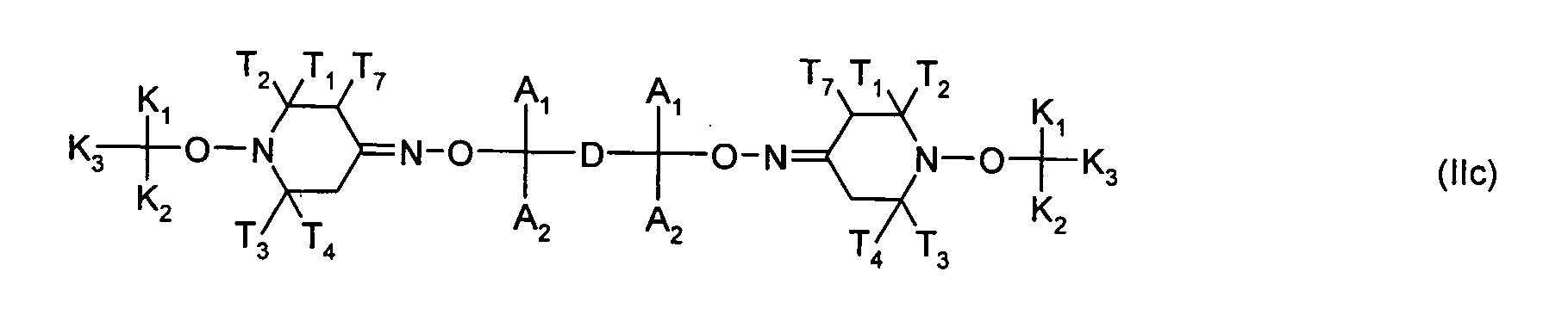


A1 und A2 unabhängig Wasserstoff sind oder zusammen mit dem Kohlenstoffatom, an das sie gebunden sind, einen Carbonylrest, -C(O)- bilden;
D eine direkte Bindung oder C1-C12Alkylen, C1-C12Alkylen, das von einem oder mehreren O-, S-, oder NR9-Atomen unterbrochen ist, C5-C12Cycloalkylen oder Phenylen ist;
E ein Rest -NR9-(CH2)x-NR9-, worin x eine Zahl von 2 bis 12 ist, oder eine Rest
v eine Zahl von 0 bis 10 ist und w 0 oder 1 ist;
Q1 eine direkte Bindung oder ein -CH2-Rest ist;
wenn Q1 eine direkte Bindung ist, ist T8 Wasserstoff,
wenn Q1 -CH2- ist, ist T8 Wasserstoff, Methyl oder Ethyl;
Y -O- oder -NR9 ist;
T1, T2, T3 und T4 unabhängig Methyl oder Ethyl ist, mit der Massgabe dass mindestens eines Ethyl ist;
T7 Wasserstoff oder Methyl ist; - Verbindung nach Anspruch 1 der Formel IIIa, IIIb, IIIc, IIId oder IIIe


T1, T2, T3 und T4 unabhängig Methyl oder Ethyl ist, mit der Massgabe dass mindestens eines Ethyl ist;
T7 Wasserstoff oder Methyl ist;
Y O oder NR9 ist;
Q1 eine direkte Bindung oder ein -CH2- Rest ist;
wenn Q1 eine direkte Bindung ist, ist T8 Wasserstoff,
wenn Q1 -CH2- ist, ist T8 Methyl oder Ethyl;
v eine Zahl von 0 bis 10 ist und w 0 oder 1 ist;
K7 ein Rest -CH2-CHOH-CH2-N+ R5R6 X--{[(CH2-CH2)-(CH2)s-N+R5R6X-]t-CH2-CH2-(CH2)s-N+R5R6R7 X-}u,
worin s und t eine Zahl von 0-4 ist und u 1 ist; oder ein Rest -D1- Q+ X- ist, worin
D1 C1-C12Alkylen, C1-C12Alkylen, das von einem oder mehreren O-, S-, oder NR9-Atomen unterbrochen ist, C5-C12Cycloalkylen oder Phenylen ist;
Q+ X-
K6 ausgewählt ist aus der Gruppe bestehend aus
-CH2-Aryl,
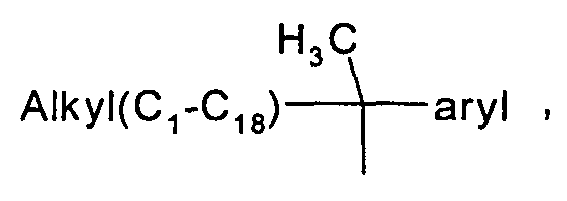


R30 Wasserstoff oder C1-C12Alkyl ist;
die Alkylreste unsubstituiert oder mit einem oder mehreren Reste von -OH, -COOH oder -C(O)R30 substituiert sind; und
die Arylreste Phenyl oder Naphthyl sind, die unsubstituiert oder mit C1-C12Alkyl, Halogen, C1-C12Alkoxy, C1-C12Alkylcarbonyl, Glycidyloxy, OH, -COOH oder -COO(C1-C12)Alkyl substituiert sind und
X- und die anderen Substituenten wie in Anspruch 1 definiert sind. - Verbindung nach Formel IVa

T1, T2, T3 und T4 unabhängig Methyl oder Ethyl ist, mit der Massgabe, dass mindestens eines Ethyl ist;
T7 Wasserstoff oder Methyl ist;
E1
K6 ausgewählt ist aus der Gruppe bestehend aus
-CH2-Aryl,


R30 Wasserstoff oder C1-C12Alkyl ist;
die Alkylreste unsubstituiert oder mit einem oder mehreren Reste von -OH, -COOH oder -C(O)R30 substituiert sind; und
die Arylreste Phenyl oder Naphthyl sind, die unsubstituiert oder mit C1-C12Alkyl, Halogen, C1-C12Alkoxy, C1-C12Alkylcarbonyl, Glycidyloxy, OH, -COOH oder -COO(C1-C12)Alkyl substituiert sind, und
X- und die anderen Substituenten wie in Anspruch 1 definiert sind. - Verbindung nach Anspruch 1 der Formel Va, Vb, Vc, Vd oder Ve


T1, T2, T3 und T4 unabhängig Methyl oder Ethyl sind, mit der Massgabe, dass mindestens eines Ethyl ist;
T7 Wasserstoff oder Methyl ist;
Q1 eine direkte Bindung oder ein -CH2- Rest ist;
wenn Q1 eine direkte Bindung ist, ist T8 Wasserstoff,
wenn Q1 -CH2- ist, ist T8 Methyl oder Ethyl;
K1 und K2 Wasserstoff, C5-C12Cycloalkyl, Phenyl oder C7-C9Phenylalkyl sind, und K3 ein Rest -COK4 oder
K4 Y-[(CH2-CH2)-(CH2)s-N+ R5R6 X-]t-CH2-CH2-(CH2)s-N+ R5R6R7X- oder
-Y-CH2-CHOH-CH2-N+R5R6X--{[(CH2-CH2)-(CH2)s-N+ R5R6 X-]t-CH2-CH2-(CH2)s-N+R5R6R7 X-}u,
worin s und t eine Zahl von 0-4 sind und u 1 ist; oder
K4 ein Rest
Z -C(O)- oder eine direkte Bindung ist,
wenn Z -C(O)- ist, hat K5 die Bedeutung von K4,
wenn Z eine direkte Bindung ist, ist K5 O-CH2-CHOH-CH2-N+R5R6X--{[(CH2-CH2)-(CH2)s-N+ R5R6 X-]t-CH2-CH2-(CH2)s-N+ R5R6R7 X-}u, Q+X-, -CH2Q+X- oder -CHCH3Q+X-;
K7 ein Rest -CH2-CHOH-CH2-N+ R5R6 X--{[(CH2-CH2)-(CH2)s-N+ R5R6 X-]t-CH2-CH2-(CH2)s-N+R5R6R7 X-}u,
worin s und t eine Zahl von 0-4 sind und u 1 ist; oder ein Rest -D1- Q+ X-, worin
D1 C1-C12Alkylen, C1-C12Alkylen, das von einem oder mehreren O-, S-, oder NR9-Atomen unterbrochen ist, C5-C12Cycloalkylen oder Phenylen ist;
Q+ X'
X- und die anderen Substituenten wie in Anspruch 1 definiert sind. - Verbindung nach Anspruch 1 der Formel VIa

T1, T2, T3 und T4 unabhängig Methyl oder Ethyl sind, mit der Massgabe, dass mindestens eines Ethyl ist;
T7 Wasserstoff oder Methyl ist;
E1
K1 und K2 Wasserstoff, C5-C12Cycloalkyl, Phenyl oder C7-C9Phenylalkyl sind und
K3 ein Rest -COK4 oder
K4 Y-[(CH2-CH2)-(CH2)s-N+ R5R6 X-]t-CH2-CH2-(CH2)s-N+ R5R6R7 X- oder
-Y-CH2-CHOH-CH2-N+R5R6X--{[(CH2-CH2)-(CH2)s-N+ R5R6 X-]t-CH2-CH2-(CH2)s-N+R5R6R7 X-}u ist,
worin s und t eine Zahl von 0-4 sind und u 0 oder 1 ist; oder
K4 ein Rest
Z -C(O)- oder eine direkte Bindung ist,
wenn Z -C(O)- ist, hat K5 die Bedeutung von K4,
wenn Z eine direkte Bindung ist, ist K5 O-CH2-CHOH-CH2-N+ R5R6 X--{[(CH2-CH2)-(CH2)s-N+ R5R6 X-]t-CH2-CH2-(CH2)s-N+ R5R6R7 X-}u, Q+X-, -CH2Q+X- oder -CHCH3Q+X- und
X- und die anderen Substituenten sind wie in Anspruch 1 definiert. - Verbindung nach Anspruch 2 der Formel Ia1, Ib1, Ic1, Id1 oder Ie1


Q1 eine direkte Bindung oder CH2 ist;
T1, T3 Ethyl sind und T2, T4 Methyl sind;
T7 Methyl oder H ist;
wenn Q1 eine direkte Bindung ist, ist T8 H;
wenn Q1 CH2 ist, ist T8 Methyl oder Ethyl;
T10 H ist, wenn T7 Methyl ist, oder T10 Methyl ist, wenn T7 H ist;
T11, T12, T13, T14, T15 und T16 unabhängig Methyl oder Ethyl sind; oder
T11 H ist, T12 Isopropyl ist, T13 Phenyl ist und T14,T15,T16 Methyl sind; oder
T11 H ist, T12 -P(=O)(OC2H5)2 ist, T13 t-Butyl ist und T14, T15, T16 Methyl sind; oder
T11 und T14 -CH2O-T9 sind und T12, T15 Methyl oder Phenyl sind und T13, T16 Methyl oder Ethyl sind;
oder
T11, T12, T13, T14, T15 Methyl sind und T16 ein Rest -CO-O-R9 oder -CON(R9)2 ist, oder
T11, T12 und T13 -CH2OH sind, T14 H ist, T15 Isopropyl ist und T16 Phenyl ist;
T9 Wasserstoff, R9 oder -C(O)-R9 ist, worin R9 Wasserstoff, C1-C18Alkyl, C3-C18Alkenyl, C3-C18Alkinyl, Phenyl, C7-C9Phenylalkyl ist;
K1 H ist, K2 Methyl oder Ethyl ist und
K3 ein Rest -CO-K4 oder
K4 -Y-CH2-CH2-(CH2)s-N+X-R5R6R7 oder
-Y-CH2-CHOH-CH2-N-CH2-CH2-(CH2)s-N+X-R5R6R7 ist, worin Y O oder NR9 ist und s eine Zahl von 0 bis 2 ist;
wenn K3
wenn Z -CO- ist, hat K5 die gleiche Bedeutung wie K4;
wenn Z eine direkte Bindung ist, ist K5 ein Rest -O-CH2-CHOH-CH2-N-CH2-CH2-(CH2)s-N+X-R5R6R7
oder -CH2N+R5R6R7 X- und
X- und die anderen Substituenten sind wie in Anspruch 1 definiert. - Verbindung nach Anspruch 3 der Formel IIa1, IIb1, IIc1 oder IId1

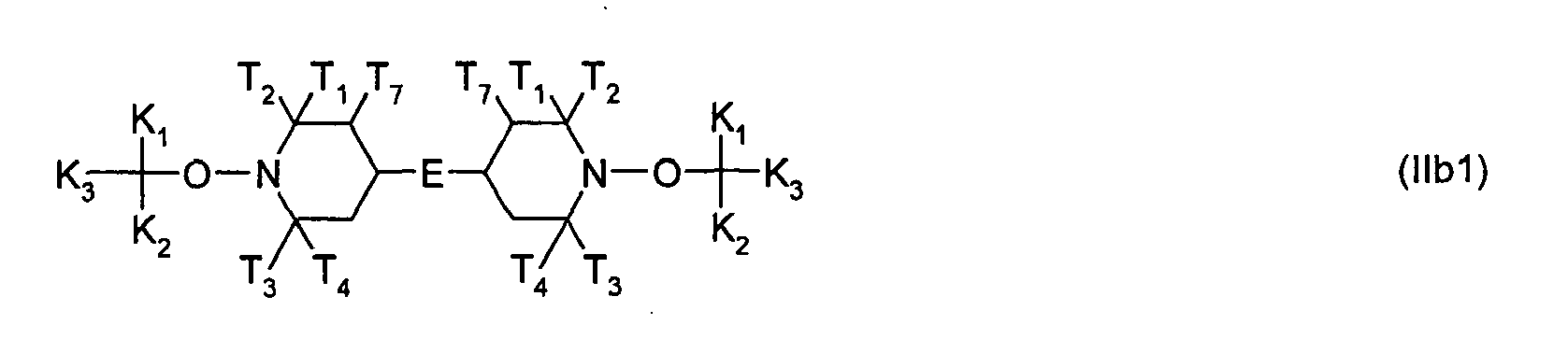


Q1 eine direkte Bindung oder CH2 ist;
T1, T3 Ethyl und T2, T4 und T7 Methyl sind;
wenn Q1 eine direkte Bindung ist, ist T8 H;
wenn Q1 CH2 ist, ist T8 Methyl oder Ethyl;
D eine direkte Bindung, C1-C12Alkylen oder Phenylen ist;
E -NR5-(CH2)x -NR5-, worin x 2 bis 12 ist, oder ein Rest
K1 H ist, K2 Methyl oder Ethyl ist und
K3 ein Rest -CO-K4 oder
K4 -Y-CH2-CH2-(CH2)s-N+X-R5R6R7 oder;
-Y-CH2-CHOH-CH2-N-CH2-CH2-(CH2)s-N+X-R5R6R7 ist, worin Y O oder NR9 ist und s eine Zahl von 0 bis 2 ist;
R9 Wasserstoff, C1-C18Alkyl, C3-C18Alkenyl, C3-C18Alkinyl, Phenyl, C7-C9Phenylalkyl ist;
wenn K3
wenn Z -CO- ist, hat K5 die gleiche Bedeutung wie K4;
wenn Z eine direkte Bindung ist, ist K5 ein Rest -O-CH2-CHOH-CH2-N-CH2-CH2-(CH2)s-N+X-R5R6R7
oder -CH2N+R5R6R7 X-;
und
X- und die anderen Substituenten sind wie in Anspruch 1 definiert. - Verfahren zur Herstellung einer Monomer/Polymer-Ton-Nanokomposit-Dispersion, das die SchritteA) Bereitstellen einer ersten wässerigen Dispersion eines natürlichen oder synthetischen Tons, der partiell interkaliert und/oder exfoliert ist und wobei der Ton ein austauschbares Kation aufweist; Hinzufügen einer Verbindung nach Anspruch 1 zu der Dispersion und zumindest teilweise Austauschen des Kations;B) Hinzufügen mindestens eines ethylenisch ungesättigten Monomers zu der Dispersion und Polymerisieren mindestens eines Teils des ethylenisch ungesättigten Monomers,umfasst.
- Verfahren nach Anspruch 10, wobei die Wasserphase des Schrittes A) mindestens teilweise vor der Durchführung von Schritt B) entfernt wird.
- Verfahren nach Anspruch 10, wobei die Verbindung nach Anspruch 1 in einer Menge von 1 Gew.-% bis 100 Gew.-%, bezogen auf das Gewicht von Ton, hinzugefügt wird.
- Verfahren nach Anspruch 10, wobei das ethylenisch ungesättigte Monomer oder Oligomer aus der Gruppe ausgewählt ist bestehend aus Styrol, substituiertes Styrol, konjugierten Dienen, Acrolein, Vinylacetat, Vinylpyrrolidon, Vinylimidazol, Maleinsäureanhydrid, (Alkyl)acrylsäureanhydriden, (Alkyl)acrylsäuresalzen, (Alkyl)acrylestern, (Meth)acrylnitrilen und (Alkyl)acrylamiden, Vinylhalogeniden oder Vinylidenhalogeniden oder Gemische davon.
- Verfahren nach Anspruch 13, wobei die ethylenisch ungesättigten Monomere Styrol, α-Methylstyrol, p-Methylstyrol oder eine Verbindung der Formel CH2=C(Ra)-(C=Z)-Rb, worin Ra Wasserstoff oder C1-C4Alkyl ist, Rb NH2, O-(Me+), Glycidyl, unsubstituiertes C1-C18Alkoxy, C2-C100Alkoxy, das von mindestens einem N- und/oder O-Atom unterbrochen ist, oder hydroxy-substituiertes C1-C18Alkoxy, unsubstituiertes C1-C18Alkylamino, Di(C1-C18alkyl)amino, hydroxy-substituiertes C1-C18Alkylamino oder hydroxy-substituiertes Di(C1-C18alkyl)amino, -O-CH2-CH2-N(CH3)2 oder -O-CH2-CH2-N+H(CH3)2 An ist;
An- ein Anion einer einwertigen organischen oder anorganischen Säure ist;
Me ein einwertiges Metallatom oder das Ammoniumion ist,
Z Sauerstoff oder Schwefel ist. - Verfahren nach Anspruch 10, wobei ein eine Säure enthaltendes ungesättigtes Monomer hinzugefügt wird, welches ausgewählt ist aus der Gruppe bestehend aus Methacrylsäureanhydrid, Maleinsäureanhydrid, Itaconsäureanhydrid, Acrylsäure, Methacrylsäure, Itaconsäure, Maleinsäure, Fumarsäure, Acryloxypropionsäure, (Meth)acryloxypropionsäure, Styrolsulfonsäure, Ethylmethacrylat-2-sulfonsäure, 2-Acrylamid-2-methylpropan-sulfonsäure; Phosphoethylmethacrylat; den entsprechenden Salzen des die Säure enthaltenden Monomers, und Kombinationen davon.
- Verfahren nach Anspruch 10, wobei Schritt B) mit einem zweiten ethylenisch ungesättigten Monomer, das von dem ersten verschieden ist, wiederholt wird und zu einem Blockcopolymer führt.
- Verfahren nach Anspruch 10, wobei der natürliche oder synthetische Ton ausgewählt ist aus der Gruppe bestehend aus Smektit, Phyllosilicat, Montmorillonit, Saponit, Beidellit, Montronit, Hectorit, Stevensit, Vermiculit, Kaolinit, Hallosit, synthetischen Phyllosilicaten, und Kombinationen davon.
- Monomer/Polymer-Ton-Nanokomposit-Dispersion erhältlich nach einem Verfahren nach Anspruch 10.
- Zusammensetzung, die eine wässerige Dispersion eines natürlichen oder synthetischen Tons, der partiell interkaliert und/oder exfoliert ist, und eine Verbindung nach Anspruch 1 umfasst.
- Zusammensetzung nach Anspruch 19, die zusätzlich ein ethylenisch ungesättigtes Monomer und/oder ein organisches Lösungsmittel enthält.
- Verwendung einer Verbindung der Formel I oder II zur Polymerisation ethylenisch ungesättigter Monomere.
- Verwendung einer Monomer/Polymer-Ton-Nanokomposit-Dispersion erhältlich nach Anspruch 10 als Additiv in Farben, Beschichtungen, Tinten, Klebstoffen, Reaktivverdünnern oder in thermoplastischen Materialien.
- Verbindungen wie in Tabelle 1 definiert:
Tabelle 1 Nr. Struktur Nr. Struktur 101 
102 
103 
104 
105 
106 
107 
108 
109 
110 
111 
112 
113 
Priority Applications (1)
| Application Number | Priority Date | Filing Date | Title |
|---|---|---|---|
| EP03740262A EP1515950B1 (de) | 2002-06-24 | 2003-06-17 | Kationische alkoxyaminen zur verwendung in der herstellung von nanopartikeln von natürlichen oder synthetischen clays |
Applications Claiming Priority (4)
| Application Number | Priority Date | Filing Date | Title |
|---|---|---|---|
| EP02405520 | 2002-06-24 | ||
| EP02405520 | 2002-06-24 | ||
| PCT/EP2003/006370 WO2004000809A1 (en) | 2002-06-24 | 2003-06-17 | Cationic alkoxyamines and their use in producing nano particles from natural or synthetic clays |
| EP03740262A EP1515950B1 (de) | 2002-06-24 | 2003-06-17 | Kationische alkoxyaminen zur verwendung in der herstellung von nanopartikeln von natürlichen oder synthetischen clays |
Publications (2)
| Publication Number | Publication Date |
|---|---|
| EP1515950A1 EP1515950A1 (de) | 2005-03-23 |
| EP1515950B1 true EP1515950B1 (de) | 2009-12-02 |
Family
ID=29797353
Family Applications (1)
| Application Number | Title | Priority Date | Filing Date |
|---|---|---|---|
| EP03740262A Expired - Lifetime EP1515950B1 (de) | 2002-06-24 | 2003-06-17 | Kationische alkoxyaminen zur verwendung in der herstellung von nanopartikeln von natürlichen oder synthetischen clays |
Country Status (11)
| Country | Link |
|---|---|
| US (2) | US7595359B2 (de) |
| EP (1) | EP1515950B1 (de) |
| JP (1) | JP4640936B2 (de) |
| KR (1) | KR101015028B1 (de) |
| CN (1) | CN1662499A (de) |
| AT (1) | ATE450509T1 (de) |
| AU (1) | AU2003279373A1 (de) |
| CA (1) | CA2486958A1 (de) |
| DE (1) | DE60330340D1 (de) |
| MX (1) | MXPA04012885A (de) |
| WO (1) | WO2004000809A1 (de) |
Families Citing this family (10)
| Publication number | Priority date | Publication date | Assignee | Title |
|---|---|---|---|---|
| FR2843394B1 (fr) * | 2002-08-07 | 2005-12-30 | Atofina | Alcoxyamines issues de nitroxydes b-phosphore, leur utilisation en polymerisation radicalaire |
| WO2004063268A1 (en) | 2003-01-15 | 2004-07-29 | Ciba Specialty Chemicals Holding Inc. | Stabilization of thermoplastic nanocomposites |
| KR101114272B1 (ko) * | 2003-02-26 | 2012-03-28 | 시바 홀딩 인크 | 수 혼화성의 입체적으로 속박된 하이드록시 치환된 알콕시아민 |
| US7550599B2 (en) | 2003-02-26 | 2009-06-23 | Ciba Specialty Chemicals Corporation | Water compatible sterically hindered alkoxyamines and hydroxy substituted alkoxyamines |
| DE10353890A1 (de) * | 2003-11-17 | 2005-06-23 | Fraunhofer-Gesellschaft zur Förderung der angewandten Forschung e.V. | Nanokomposite auf der Basis von Schichtsilikaten und deren Anwendung |
| WO2006055372A2 (en) | 2004-11-17 | 2006-05-26 | Cornell Research Foundation, Inc. | Photoinitiator anchored to silicate and use thereof to prepare polymer exfoliated silicate nanocomposite |
| JP2008524577A (ja) | 2004-12-15 | 2008-07-10 | コーニンクレッカ フィリップス エレクトロニクス エヌ ヴィ | 多変量光学要素を用いる光学分析マーキングの較正方法及び装置 |
| US20060211803A1 (en) * | 2005-03-16 | 2006-09-21 | Rodak Nicholas J | Clays pre-activated with intercalated polymerization initiation sites |
| CN101595169B (zh) * | 2006-11-30 | 2012-11-21 | 德克萨斯A&M大学系统 | 可用于制备纳米复合聚合物的不含插层剂的组合物 |
| CN114849654B (zh) * | 2022-05-13 | 2023-03-17 | 成都理工大学 | 一种草酸插层膨胀高岭土的制备方法及吸附应用 |
Family Cites Families (19)
| Publication number | Priority date | Publication date | Assignee | Title |
|---|---|---|---|---|
| US5204473A (en) * | 1987-09-21 | 1993-04-20 | Ciba-Geigy Corporation | O-substituted N-hydroxy hindered amine stabilizers |
| US5004770A (en) * | 1988-10-19 | 1991-04-02 | Ciba-Geigy Corporation | Polymeric substrates stabilized with N-substituted hindered amines |
| US5096950A (en) * | 1988-10-19 | 1992-03-17 | Ciba-Geigy Corporation | Polyolefin compositions stabilized with NOR-substituted hindered amines |
| US4972009A (en) * | 1989-08-18 | 1990-11-20 | Ciba-Geigy Corporation | Polymer stabilizers containing both hindered amine and nitrone moieties |
| US5627248A (en) * | 1995-09-26 | 1997-05-06 | The Dow Chemical Company | Difunctional living free radical polymerization initiators |
| USH1957H1 (en) * | 1997-10-29 | 2001-04-03 | Basf Aktiengesellschaft | Immediate termination of free radical polymerizations |
| TWI246519B (en) * | 1998-06-25 | 2006-01-01 | Ciba Sc Holding Ag | Use of 2,2,6,6 tetraalkylpiperidine-N-oxyl radicals having long alkyl chains as polymerization regulators |
| US6392041B1 (en) * | 1999-02-25 | 2002-05-21 | Ciba Specialty Chemicals Corporation | Hydroxy-substituted N-alkoxy hindered amines and compositions stabilized therewith |
| US6559207B1 (en) * | 2000-03-14 | 2003-05-06 | Si Corporation | Flame resistant polymer composition and method for rendering polymers flame resistant |
| EP1322675A2 (de) | 2000-09-21 | 2003-07-02 | Rohm And Haas Company | Nanoverbunwerkstoffe aus hydrophobmodifiziertem ton und polymer |
| US6414155B1 (en) * | 2000-11-03 | 2002-07-02 | Cytec Technology Corp. | Oligomeric hindered amine light stabilizers based on multi-functional carbonyl compounds and methods of making same |
| US6727300B2 (en) * | 2000-11-03 | 2004-04-27 | Cytec Technology Corp. | Polymeric articles containing hindered amine light stabilizers based on multi-functional carbonyl compounds |
| US6492521B2 (en) * | 2000-11-03 | 2002-12-10 | Cytec Technology Corp. | Hindered amine light stabilizers based on multi-functional carbonyl compounds and methods of making same |
| TWI273115B (en) * | 2000-12-12 | 2007-02-11 | Ciba Sc Holding Ag | Improved weatherability of flame retardant polyolefin |
| AU2002363869A1 (en) * | 2001-12-21 | 2003-07-09 | Ciba Specialty Chemicals Holding Inc. | Transition-metal-catalyzed process for the conversion of alkenes to sterically hindered substituted n-alkoxyamines |
| CA2467119C (en) * | 2001-12-21 | 2012-02-07 | Ciba Specialty Chemicals Holding Inc. | Novel flame retarding compounds |
| US7323502B2 (en) * | 2002-03-12 | 2008-01-29 | Ciba Specialty Chemicals Corporation | Flame retardant compositions |
| US7109260B2 (en) * | 2002-10-17 | 2006-09-19 | Ciba Specialty Chemicals Corporation | Flame retardant compositions |
| MY139230A (en) * | 2002-10-17 | 2009-08-28 | Ciba Holding Inc | Flame retardant polymeric electrical parts |
-
2003
- 2003-06-17 DE DE60330340T patent/DE60330340D1/de not_active Expired - Lifetime
- 2003-06-17 WO PCT/EP2003/006370 patent/WO2004000809A1/en not_active Ceased
- 2003-06-17 US US10/519,030 patent/US7595359B2/en not_active Expired - Fee Related
- 2003-06-17 MX MXPA04012885A patent/MXPA04012885A/es not_active Application Discontinuation
- 2003-06-17 JP JP2004514745A patent/JP4640936B2/ja not_active Expired - Fee Related
- 2003-06-17 AU AU2003279373A patent/AU2003279373A1/en not_active Abandoned
- 2003-06-17 CN CN038146657A patent/CN1662499A/zh active Pending
- 2003-06-17 EP EP03740262A patent/EP1515950B1/de not_active Expired - Lifetime
- 2003-06-17 AT AT03740262T patent/ATE450509T1/de not_active IP Right Cessation
- 2003-06-17 CA CA002486958A patent/CA2486958A1/en not_active Abandoned
- 2003-06-17 KR KR1020047021209A patent/KR101015028B1/ko not_active Expired - Fee Related
-
2009
- 2009-08-05 US US12/535,747 patent/US7902368B2/en not_active Expired - Fee Related
Also Published As
| Publication number | Publication date |
|---|---|
| US20090306382A1 (en) | 2009-12-10 |
| US7595359B2 (en) | 2009-09-29 |
| DE60330340D1 (de) | 2010-01-14 |
| US20050215691A1 (en) | 2005-09-29 |
| JP2005538964A (ja) | 2005-12-22 |
| AU2003279373A1 (en) | 2004-01-06 |
| CN1662499A (zh) | 2005-08-31 |
| KR101015028B1 (ko) | 2011-02-16 |
| MXPA04012885A (es) | 2005-03-31 |
| US7902368B2 (en) | 2011-03-08 |
| JP4640936B2 (ja) | 2011-03-02 |
| KR20050014021A (ko) | 2005-02-05 |
| ATE450509T1 (de) | 2009-12-15 |
| CA2486958A1 (en) | 2003-12-31 |
| EP1515950A1 (de) | 2005-03-23 |
| WO2004000809A1 (en) | 2003-12-31 |
Similar Documents
| Publication | Publication Date | Title |
|---|---|---|
| US7902368B2 (en) | Cationic substituted 2,2,6,6-tetraalkylpiperidinyl alkoxyamines | |
| US4161592A (en) | Piperidinyl-s-triazines | |
| RU2719592C2 (ru) | Способ получения ацилфосфатов | |
| US6566468B1 (en) | Nitroxyl derivatives with glycidyl or alkylcarbonyl groups as initiators for radical polymerization | |
| JP4651137B2 (ja) | 1−アルコキシ−ポリアルキル−ピペリジン誘導体および重合調節剤としてのその使用 | |
| KR101991272B1 (ko) | 트리알콕시실릴알킬기를 갖는 오늄염 | |
| DE19705013A1 (de) | Korrosionsinhibierende Überzugszusammensetzung für Metalle | |
| CN101490100B (zh) | 交联的硝基氧聚合物的制备方法 | |
| EP1397349B1 (de) | 4-imin-n-alkoxy- oder oxy-polyalkyl-piperidin-verbindungen zur verwendung als polymerisationsregulatoren | |
| EP1189875B1 (de) | Mono- und multifunktionelle alkoxyamine zur herstellung von funktionalisierten makromeren | |
| EP1417171A1 (de) | Multifunktionale alkoxyamine auf grundlage von polyalkylpiperidinen, polyalkylpiperazinonen und polyalkylmorpholinonen, und deren verwendung als polymerisationsregulatoren/-initiatoren | |
| US7781509B2 (en) | Clays pre-activated with intercalated polymerization initiation sites | |
| GB1569669A (en) | Phosphorus-containing piperidine compounds | |
| Chirowodza | Polymer-clay nanocomposites prepared by RAFT-supported grafting | |
| WO2008017757A2 (fr) | Materiau a structure lamellaire modifie, de type polysilicate ou phosphate de zirconium et/ou de titane, modifie par un oligoamide, son procede de preparation et son utilisation |
Legal Events
| Date | Code | Title | Description |
|---|---|---|---|
| PUAI | Public reference made under article 153(3) epc to a published international application that has entered the european phase |
Free format text: ORIGINAL CODE: 0009012 |
|
| 17P | Request for examination filed |
Effective date: 20041101 |
|
| AK | Designated contracting states |
Kind code of ref document: A1 Designated state(s): AT BE BG CH CY CZ DE DK EE ES FI FR GB GR HU IE IT LI LU MC NL PT RO SE SI SK TR |
|
| AX | Request for extension of the european patent |
Extension state: AL LT LV MK |
|
| 17Q | First examination report despatched |
Effective date: 20060102 |
|
| RAP1 | Party data changed (applicant data changed or rights of an application transferred) |
Owner name: CIBA HOLDING INC. |
|
| GRAP | Despatch of communication of intention to grant a patent |
Free format text: ORIGINAL CODE: EPIDOSNIGR1 |
|
| RAP1 | Party data changed (applicant data changed or rights of an application transferred) |
Owner name: BASF SE |
|
| GRAS | Grant fee paid |
Free format text: ORIGINAL CODE: EPIDOSNIGR3 |
|
| GRAA | (expected) grant |
Free format text: ORIGINAL CODE: 0009210 |
|
| AK | Designated contracting states |
Kind code of ref document: B1 Designated state(s): AT BE BG CH CY CZ DE DK EE ES FI FR GB GR HU IE IT LI LU MC NL PT RO SE SI SK TR |
|
| REG | Reference to a national code |
Ref country code: GB Ref legal event code: FG4D |
|
| REG | Reference to a national code |
Ref country code: CH Ref legal event code: EP |
|
| REG | Reference to a national code |
Ref country code: IE Ref legal event code: FG4D |
|
| REF | Corresponds to: |
Ref document number: 60330340 Country of ref document: DE Date of ref document: 20100114 Kind code of ref document: P |
|
| REG | Reference to a national code |
Ref country code: NL Ref legal event code: VDEP Effective date: 20091202 |
|
| PG25 | Lapsed in a contracting state [announced via postgrant information from national office to epo] |
Ref country code: FI Free format text: LAPSE BECAUSE OF FAILURE TO SUBMIT A TRANSLATION OF THE DESCRIPTION OR TO PAY THE FEE WITHIN THE PRESCRIBED TIME-LIMIT Effective date: 20091202 Ref country code: SE Free format text: LAPSE BECAUSE OF FAILURE TO SUBMIT A TRANSLATION OF THE DESCRIPTION OR TO PAY THE FEE WITHIN THE PRESCRIBED TIME-LIMIT Effective date: 20091202 |
|
| PG25 | Lapsed in a contracting state [announced via postgrant information from national office to epo] |
Ref country code: SI Free format text: LAPSE BECAUSE OF FAILURE TO SUBMIT A TRANSLATION OF THE DESCRIPTION OR TO PAY THE FEE WITHIN THE PRESCRIBED TIME-LIMIT Effective date: 20091202 Ref country code: CY Free format text: LAPSE BECAUSE OF FAILURE TO SUBMIT A TRANSLATION OF THE DESCRIPTION OR TO PAY THE FEE WITHIN THE PRESCRIBED TIME-LIMIT Effective date: 20091202 |
|
| PG25 | Lapsed in a contracting state [announced via postgrant information from national office to epo] |
Ref country code: AT Free format text: LAPSE BECAUSE OF FAILURE TO SUBMIT A TRANSLATION OF THE DESCRIPTION OR TO PAY THE FEE WITHIN THE PRESCRIBED TIME-LIMIT Effective date: 20091202 |
|
| PG25 | Lapsed in a contracting state [announced via postgrant information from national office to epo] |
Ref country code: BG Free format text: LAPSE BECAUSE OF FAILURE TO SUBMIT A TRANSLATION OF THE DESCRIPTION OR TO PAY THE FEE WITHIN THE PRESCRIBED TIME-LIMIT Effective date: 20100302 Ref country code: ES Free format text: LAPSE BECAUSE OF FAILURE TO SUBMIT A TRANSLATION OF THE DESCRIPTION OR TO PAY THE FEE WITHIN THE PRESCRIBED TIME-LIMIT Effective date: 20100313 Ref country code: NL Free format text: LAPSE BECAUSE OF FAILURE TO SUBMIT A TRANSLATION OF THE DESCRIPTION OR TO PAY THE FEE WITHIN THE PRESCRIBED TIME-LIMIT Effective date: 20091202 Ref country code: EE Free format text: LAPSE BECAUSE OF FAILURE TO SUBMIT A TRANSLATION OF THE DESCRIPTION OR TO PAY THE FEE WITHIN THE PRESCRIBED TIME-LIMIT Effective date: 20091202 Ref country code: PT Free format text: LAPSE BECAUSE OF FAILURE TO SUBMIT A TRANSLATION OF THE DESCRIPTION OR TO PAY THE FEE WITHIN THE PRESCRIBED TIME-LIMIT Effective date: 20100402 Ref country code: RO Free format text: LAPSE BECAUSE OF FAILURE TO SUBMIT A TRANSLATION OF THE DESCRIPTION OR TO PAY THE FEE WITHIN THE PRESCRIBED TIME-LIMIT Effective date: 20091202 |
|
| PG25 | Lapsed in a contracting state [announced via postgrant information from national office to epo] |
Ref country code: CZ Free format text: LAPSE BECAUSE OF FAILURE TO SUBMIT A TRANSLATION OF THE DESCRIPTION OR TO PAY THE FEE WITHIN THE PRESCRIBED TIME-LIMIT Effective date: 20091202 Ref country code: SK Free format text: LAPSE BECAUSE OF FAILURE TO SUBMIT A TRANSLATION OF THE DESCRIPTION OR TO PAY THE FEE WITHIN THE PRESCRIBED TIME-LIMIT Effective date: 20091202 Ref country code: BE Free format text: LAPSE BECAUSE OF FAILURE TO SUBMIT A TRANSLATION OF THE DESCRIPTION OR TO PAY THE FEE WITHIN THE PRESCRIBED TIME-LIMIT Effective date: 20091202 |
|
| PLBE | No opposition filed within time limit |
Free format text: ORIGINAL CODE: 0009261 |
|
| STAA | Information on the status of an ep patent application or granted ep patent |
Free format text: STATUS: NO OPPOSITION FILED WITHIN TIME LIMIT |
|
| PG25 | Lapsed in a contracting state [announced via postgrant information from national office to epo] |
Ref country code: GR Free format text: LAPSE BECAUSE OF FAILURE TO SUBMIT A TRANSLATION OF THE DESCRIPTION OR TO PAY THE FEE WITHIN THE PRESCRIBED TIME-LIMIT Effective date: 20100303 |
|
| 26N | No opposition filed |
Effective date: 20100903 |
|
| PG25 | Lapsed in a contracting state [announced via postgrant information from national office to epo] |
Ref country code: DK Free format text: LAPSE BECAUSE OF FAILURE TO SUBMIT A TRANSLATION OF THE DESCRIPTION OR TO PAY THE FEE WITHIN THE PRESCRIBED TIME-LIMIT Effective date: 20091202 Ref country code: MC Free format text: LAPSE BECAUSE OF NON-PAYMENT OF DUE FEES Effective date: 20100630 |
|
| REG | Reference to a national code |
Ref country code: CH Ref legal event code: PL |
|
| GBPC | Gb: european patent ceased through non-payment of renewal fee |
Effective date: 20100617 |
|
| REG | Reference to a national code |
Ref country code: FR Ref legal event code: ST Effective date: 20110228 |
|
| PG25 | Lapsed in a contracting state [announced via postgrant information from national office to epo] |
Ref country code: IT Free format text: LAPSE BECAUSE OF FAILURE TO SUBMIT A TRANSLATION OF THE DESCRIPTION OR TO PAY THE FEE WITHIN THE PRESCRIBED TIME-LIMIT Effective date: 20091202 |
|
| PG25 | Lapsed in a contracting state [announced via postgrant information from national office to epo] |
Ref country code: IE Free format text: LAPSE BECAUSE OF NON-PAYMENT OF DUE FEES Effective date: 20100617 Ref country code: CH Free format text: LAPSE BECAUSE OF NON-PAYMENT OF DUE FEES Effective date: 20100630 Ref country code: LI Free format text: LAPSE BECAUSE OF NON-PAYMENT OF DUE FEES Effective date: 20100630 |
|
| PG25 | Lapsed in a contracting state [announced via postgrant information from national office to epo] |
Ref country code: FR Free format text: LAPSE BECAUSE OF NON-PAYMENT OF DUE FEES Effective date: 20100630 |
|
| PG25 | Lapsed in a contracting state [announced via postgrant information from national office to epo] |
Ref country code: GB Free format text: LAPSE BECAUSE OF NON-PAYMENT OF DUE FEES Effective date: 20100617 |
|
| PG25 | Lapsed in a contracting state [announced via postgrant information from national office to epo] |
Ref country code: HU Free format text: LAPSE BECAUSE OF FAILURE TO SUBMIT A TRANSLATION OF THE DESCRIPTION OR TO PAY THE FEE WITHIN THE PRESCRIBED TIME-LIMIT Effective date: 20100603 Ref country code: LU Free format text: LAPSE BECAUSE OF NON-PAYMENT OF DUE FEES Effective date: 20100617 |
|
| PG25 | Lapsed in a contracting state [announced via postgrant information from national office to epo] |
Ref country code: TR Free format text: LAPSE BECAUSE OF FAILURE TO SUBMIT A TRANSLATION OF THE DESCRIPTION OR TO PAY THE FEE WITHIN THE PRESCRIBED TIME-LIMIT Effective date: 20091202 |
|
| PGFP | Annual fee paid to national office [announced via postgrant information from national office to epo] |
Ref country code: DE Payment date: 20170831 Year of fee payment: 15 |
|
| REG | Reference to a national code |
Ref country code: DE Ref legal event code: R119 Ref document number: 60330340 Country of ref document: DE |
|
| PG25 | Lapsed in a contracting state [announced via postgrant information from national office to epo] |
Ref country code: DE Free format text: LAPSE BECAUSE OF NON-PAYMENT OF DUE FEES Effective date: 20190101 |