EP1514864B1 - Difluoralkylaromaten - Google Patents
Difluoralkylaromaten Download PDFInfo
- Publication number
- EP1514864B1 EP1514864B1 EP04020499A EP04020499A EP1514864B1 EP 1514864 B1 EP1514864 B1 EP 1514864B1 EP 04020499 A EP04020499 A EP 04020499A EP 04020499 A EP04020499 A EP 04020499A EP 1514864 B1 EP1514864 B1 EP 1514864B1
- Authority
- EP
- European Patent Office
- Prior art keywords
- compounds
- formula
- difluoro
- iii
- exception
- Prior art date
- Legal status (The legal status is an assumption and is not a legal conclusion. Google has not performed a legal analysis and makes no representation as to the accuracy of the status listed.)
- Expired - Lifetime
Links
- 0 *c(c(*)c(cc1)F)c1C#N Chemical compound *c(c(*)c(cc1)F)c1C#N 0.000 description 2
Classifications
-
- C—CHEMISTRY; METALLURGY
- C07—ORGANIC CHEMISTRY
- C07C—ACYCLIC OR CARBOCYCLIC COMPOUNDS
- C07C51/00—Preparation of carboxylic acids or their salts, halides or anhydrides
- C07C51/15—Preparation of carboxylic acids or their salts, halides or anhydrides by reaction of organic compounds with carbon dioxide, e.g. Kolbe-Schmitt synthesis
-
- C—CHEMISTRY; METALLURGY
- C07—ORGANIC CHEMISTRY
- C07C—ACYCLIC OR CARBOCYCLIC COMPOUNDS
- C07C17/00—Preparation of halogenated hydrocarbons
- C07C17/093—Preparation of halogenated hydrocarbons by replacement by halogens
- C07C17/10—Preparation of halogenated hydrocarbons by replacement by halogens of hydrogen atoms
- C07C17/12—Preparation of halogenated hydrocarbons by replacement by halogens of hydrogen atoms in the ring of aromatic compounds
-
- C—CHEMISTRY; METALLURGY
- C07—ORGANIC CHEMISTRY
- C07C—ACYCLIC OR CARBOCYCLIC COMPOUNDS
- C07C211/00—Compounds containing amino groups bound to a carbon skeleton
- C07C211/01—Compounds containing amino groups bound to a carbon skeleton having amino groups bound to acyclic carbon atoms
- C07C211/26—Compounds containing amino groups bound to a carbon skeleton having amino groups bound to acyclic carbon atoms of an unsaturated carbon skeleton containing at least one six-membered aromatic ring
- C07C211/29—Compounds containing amino groups bound to a carbon skeleton having amino groups bound to acyclic carbon atoms of an unsaturated carbon skeleton containing at least one six-membered aromatic ring the carbon skeleton being further substituted by halogen atoms or by nitro or nitroso groups
-
- C—CHEMISTRY; METALLURGY
- C07—ORGANIC CHEMISTRY
- C07C—ACYCLIC OR CARBOCYCLIC COMPOUNDS
- C07C25/00—Compounds containing at least one halogen atom bound to a six-membered aromatic ring
- C07C25/02—Monocyclic aromatic halogenated hydrocarbons
- C07C25/13—Monocyclic aromatic halogenated hydrocarbons containing fluorine
-
- C—CHEMISTRY; METALLURGY
- C07—ORGANIC CHEMISTRY
- C07C—ACYCLIC OR CARBOCYCLIC COMPOUNDS
- C07C33/00—Unsaturated compounds having hydroxy or O-metal groups bound to acyclic carbon atoms
- C07C33/40—Halogenated unsaturated alcohols
- C07C33/46—Halogenated unsaturated alcohols containing only six-membered aromatic rings as cyclic parts
-
- C—CHEMISTRY; METALLURGY
- C07—ORGANIC CHEMISTRY
- C07C—ACYCLIC OR CARBOCYCLIC COMPOUNDS
- C07C51/00—Preparation of carboxylic acids or their salts, halides or anhydrides
- C07C51/58—Preparation of carboxylic acid halides
- C07C51/60—Preparation of carboxylic acid halides by conversion of carboxylic acids or their anhydrides or esters, lactones, salts into halides with the same carboxylic acid part
Definitions
- the present invention relates to 3,4-difluoro-2-alkylaromatics and 2,4-difluoro-3-alkylaromatics, a process for their preparation and their use for the preparation of active compounds.
- 2,3,4-trisubstituted aromatics are important building blocks for active substances in medicaments, especially in analgesic and antibacterial active substances and crop protection agents, especially in herbicides and fungicides (see also US Pat EP-A 864 559 . EP-A 609 798 . WO 95/31446 . EP-A 625 505 . DE-A 36 157 67 and WO 98/46608 ).
- 2,4-difluoro-3-methylbenzoic acid is WO 99/14214 and WO 99/35117 known.
- the preparation initially comprises the reaction of 2,4-difluorobromobenzene with a strong base and a methylating reagent to give 2,6-difluoro-3-bromotoluene and also the conversion into an organometallic reagent and subsequent treatment with carbon dioxide.
- 2,4-difluoro-3-methylbenzoic acid is obtained by oxidizing 2,4-difluoro-3-methylacetophenone with bromine and sodium hydroxide solution.
- 3,4-difluoro-2-methylbenzoic acid is, for example, from EP-A 609 798 .
- WO 95/31446 and EP-A 625 505 known and carried out by dilithiation of 3,4-difluorobenzoic acid and subsequent reaction with methyl iodide.
- a disadvantage of the said processes is the fact that the multiple use of organometallic reagents on an industrial scale for safety reasons is critical and very expensive overall and the methods mentioned are different for each product.
- Preferred compounds of the formula (I) are:
- Each C 1 -C 4 alkyl independently represents a straight, branched or unbranched alkyl radical, such as preferably methyl, ethyl, n-propyl, iso-propyl, n-butyl and tert-butyl.
- Preferred compound of formula (III) is 2-bromo-5,6-difluorotoluene.
- Preferred compounds of formula (IV) are 3,4-difluoro-2-methylbenzoic acid nitrile and 2,4-difluoro-3-methylbenzoic acid nitrile.
- Preferred compound of the formula (VI) is 3,4-difluoro-2-methylbenzoic acid chloride.
- Preferred compounds of the formula (VII) are 3,4-difluoro-2-methylbenzaldehyde and 2,4-difluoro-3-methylbenzaldehyde.
- the bromination according to step A) is carried out with bromine and in the presence of catalyst, wherein iron and iron sulfide are preferably used as the catalyst.
- the reaction may be carried out, for example, in a temperature range of -10 to 50 ° C, preferably at 0 to 30 ° C.
- step B1 with cyanide is preferably carried out such that the compounds of the formula (III) with a metal cyanide, preferably alkali metal and / or copper cyanide, in an aprotic polar solvent in a temperature range of for example 50 to 200 ° C, preferably be implemented from 130 to 170 ° C.
- a metal cyanide preferably alkali metal and / or copper cyanide
- Aprotic-polar solvents are, for example, nitriles, such as acetonitrile, propionitrile or benzonitrile; Amides, such as N, N-dimethylformamide, N, N-dimethylacetamide, N-methylformanilide, N-methylpyrrolidone or N, N-dimethylimidazolin-2-one, sulfoxides such as dimethyl sulfoxide, sulfones such as tetramethylene sulfone or mixtures of the solvents mentioned.
- step B2 can preferably be carried out by reacting the compounds of the formula (IV) with complex aluminum hydrogen compounds in an inert solvent at a reaction temperature of for example -30 to 70 ° C, preferably between 0 to 30 ° C.
- Inert solvents are, for example, aromatic or aliphatic hydrocarbons, such as toluene, xylene, various petroleum ethers, hexane, cyclohexane and ethers, such as diethyl ether, methyl tert-butyl ether, diisopropyl ether, dioxane, tetrahydrofuran or ethylene glycol dimethyl or diethyl ether, or mixtures of such organic solvents.
- aromatic or aliphatic hydrocarbons such as toluene, xylene, various petroleum ethers, hexane, cyclohexane and ethers, such as diethyl ether, methyl tert-butyl ether, diisopropyl ether, dioxane, tetrahydrofuran or ethylene glycol dimethyl or diethyl ether, or mixtures of such organic solvents.
- the catalytic hydrogenation in a protic solvent is possible, with particular suitable catalysts being those which contain palladium, rhodium, iridium or platinum, with palladium being preferred. Particularly preferred as a catalyst is palladium on carbon with a content of 0.1 to 20 wt .-%.
- Protic solvents are, for example, alcohols, such as methanol, ethanol, n- or i-propanol, ethylene glycol monomethyl ether, ethylene glycol monoethyl ether, diethylene glycol monomethyl ether, diethylene glycol monoethyl ether or mixtures thereof.
- the reaction according to step B3 can preferably be carried out by reacting the compounds of the formula (III) with magnesium or Grignard reagents such as isopropylmagnesium bromide in an inert solvent as defined above in a temperature range from -20 to 70 ° C, preferably at 0 to 30 ° C.
- magnesium or Grignard reagents such as isopropylmagnesium bromide in an inert solvent as defined above in a temperature range from -20 to 70 ° C, preferably at 0 to 30 ° C.
- the subsequent reaction with carbon dioxide can be carried out by introducing gaseous or by reaction with solid carbon dioxide.
- the subsequent acidic workup can be carried out, for example, in a manner known per se by acidification with an aqueous acid and extraction with an organic solvent.
- a preferred N, N-substituted formic acid amide is N, N-dimethylformamide.
- the corresponding benzoic acid chloride is prepared by reacting the benzoic acid with a chlorinating agent, e.g. Thionyl chloride, in a nonpolar-aprotic solvent, e.g. Dichloromethane, and a catalytic amount of dimethylformamide in a temperature range of 10 - 50 ° C, preferably at 20 - 25 ° C, the reaction.
- a chlorinating agent e.g. Thionyl chloride
- a nonpolar-aprotic solvent e.g. Dichloromethane
- the conversion into compounds of the formula (VI) according to step B4 can preferably be carried out by reacting the compounds of the formula (V) with thionyl chloride, thionyl bromide, phosphorus oxychloride, phosphoryl chloride or phosgene.
- step B5 can preferably be carried out by reacting the compounds of the formula (VI) with complex hydrogenated element compounds in an inert solvent as defined above at a reaction temperature of for example -30 to 70 ° C, preferably between 0 to 30 ° C.
- step B7 the reduction according to step B7 can be performed.
- the compounds of the formula (I) according to the invention are particularly suitable as building blocks for active substances in medicaments, such as above all in analgesic and antibacterial active ingredients and pesticides, especially in herbicides and fungicides or intermediates thereof.
- the reaction mixture was refluxed for 4 hours, then hydrolyzed by pouring onto ice-water. The remaining magnesium chips were filtered off.
- the suspension was acidified with concentrated hydrochloric acid (pH 1).
- the aqueous phase was extracted 3 times with 50 ml of ethyl acetate each time.
- the combined organic phases were washed with 100 ml of saturated sodium chloride solution, dried and concentrated.
- the crude product thus obtained contained 12% of the desired target product and higher molecular weight components.
Landscapes
- Chemical & Material Sciences (AREA)
- Organic Chemistry (AREA)
- Engineering & Computer Science (AREA)
- Oil, Petroleum & Natural Gas (AREA)
- Chemical Kinetics & Catalysis (AREA)
- Organic Low-Molecular-Weight Compounds And Preparation Thereof (AREA)
Description
- Die vorliegende Erfindung betrifft 3,4-Difluor-2-alkylaromaten und 2,4-Difluor-3-alkylaromaten, ein Verfahren zu deren Herstellung sowie ihre Verwendung zur Herstellung von Wirkstoffen.
- 2,3,4-Trisubstituierte Aromaten wie insbesondere solche die Fluor oder fluorhaltige Gruppen als Substituenten tragen sind wichtige Bausteine für Wirkstoffe in Arzneimitteln, wie vor allem in analgetisch und antibakteriellen Wirkstoffen und Pflanzenschutzmitteln, wie vor allem in Herbiziden und Fungiziden (siehe auch
EP-A 864 559 EP-A 609 798 WO 95/31446 EP-A 625 505 DE-A 36 157 67 undWO 98/46608 - Es ist deshalb wünschenswert, 2,3,4-trisubstituierte Aromaten bereitzustellen, mit denen die Lipophilie des gesamten Wirkstoffmoleküls und damit dessen Wirksamkeit positiv beeinflusst werden kann und die sich als Synthesebaustein besonders breit verwenden lassen.
- Weiterhin ist es wünschenswert, ein Verfahren bereitzustellen, mit dem diese 2,3,4-trisubstituierten Aromaten in guten Ausbeuten ausgehend von einfach erhältlichen Edukten gewonnen werden können.
- Beispielsweise ist 2,4-Difluor-3-methylbenzoesäure aus
WO 99/14214 WO 99/35117 - Gemäß
DE-A 36 157 67 wird 2,4-Difluor-3-methylbenzoesäure erhalten, indem 2,4-Difluor-3-methylacetophenon mit Brom und Natronlauge oxidiert wird. - Die Herstellung von 3,4-Difluor-2-methyl-benzoesäure ist beispielsweise aus
EP-A 609 798 WO 95/31446 EP-A 625 505 - Nachteilig an den genannten Verfahren ist die Tatsache, dass der mehrfache Einsatz metallorganischer Reagentien im industriellen Maßstab aus sicherheitstechnischen Gründen kritisch und insgesamt sehr teuer ist und die genannten Verfahren für jedes Produkt unterschiedlich sind.
- Es wurden nun Verbindungen der Formel (I) gefunden

Het für Amino oder Hydroxy steht und einer der Reste R1 für Fluor und der andere Rest R1 für C1-C4-Alkyl steht. - Bevorzugte Verbindungen der Formel (I) sind:
- 3,4-Difluor-2-methyl-benzylalkohol, 2,4-Difluor-3-methyl-benzylalkohol, 3,4-Difluor-2-methyl-benzylamin und 2,4-Difluor-3-methyl-benzylamin.
- Vorzugsweise stellt man die Verbindungen der Formel (I) so her, dass
- in einem Schritt A)
Verbindungen der Formel (II)

- in einem Schritt B1 mit Cyanid zunächst zu Verbindungen der Formel (IV)

- in einem Schritt B2 durch Reduktion in die entsprechenden Verbindungen der Formel (I) überführt werden oder
für den Fall, dass Het für Hydroxy steht, - in einem Schritt B3 die Verbindungen der Formel (III) durch Überführung in eine magnesiumorganische Verbindung, Umsetzung dieser magnesiumorganischen Verbindung mit Kohlendioxid und anschließender Behandlung mit Säure zu Verbindungen der Formel (V) umsetzt

- in einem Schritt B4 durch Umsetzung mit einem Halogenierungsmittel in Verbindungen der Formel (VI) überführt werden

- und in einem Schritt B5 die Verbindungen der Formel (VI) durch Reduktion in die entsprechenden Verbindungen der Formel (I) überführt werden.
- Alternativ zu den Schritten B3 bis B5 ist auch
- in einem Schritt B6 die Umsetzung der Verbindungen der Formel (III) durch Überführung in eine magnesiumorganische Verbindung, Umsetzung dieser magnesiumorganischen Verbindung mit einem N,N-substituierten-Ameisensäureamid und anschließender Behandlung mit Säure zu Verbindungen der Formel (VII) möglich

- in einem Schritt B7 die Verbindungen der Formel (VII) durch Reduktion in die entsprechenden Verbindungen der Formel (I) überführt werden.
- Im Rahmen der Erfindung können alle oben stehenden und im Folgenden aufgeführten, allgemeinen oder in Vorzugsbereichen genannten Restedefinitionen, Parameter und Erläuterungen untereinander, also auch zwischen den jeweiligen Bereichen und Vorzugsbereichen in beliebiger Weise kombiniert werden.
- C1-C4-Alkyl bedeutet jeweils unabhängig einen geradkettigen, verzweigten oder unverzweigten Alkyl-Rest, wie vorzugsweise Methyl, Ethyl, n-Propyl, iso-Propyl, n-Butyl und tert.-Butyl.
- Von der Erfindung sind als unverzichtbare Intermediate mit umfasst:
- Verbindungen der Formel (III) mit Ausnahme von 3-Brom-2,6-difluortoluol.
- Verbindungen der Formel (IV).
- Verbindungen der Formel (V) mit Ausnahme von 2,4-Difluor-3-methylbenzoesäure und 3,4-Difluor-2-methylbenzoesäure.
- Verbindungen der Formel (VI) mit Ausnahme von 2,4-Difluor-3-methylbenzoesäure-chlorid.
- Verbindungen der Formel (VII).
- Bevorzugte Verbindung der Formel (III) ist 2-Brom-5,6-difluortoluol.
- Bevorzugte Verbindungen der Formel (IV) sind 3,4-Difluor-2-methylbenzoesäurenitril und 2,4-Difluor-3-methylbenzoesäurenitril.
- Bevorzugte Verbindung der Formel (VI) ist 3,4-Difluor-2-methylbenzoesäurechlorid.
- Bevorzugte Verbindungen der Formel (VII) sind 3,4-Difluor-2-methylbenzaldehyd und 2,4-Difluor-3-methylbenzaldehyd.
- Die Bromierung gemäß Schritt A) erfolgt mit Brom und in Gegenwart von Katalysator, wobei als Katalysator vorzugsweise Eisen und Eisensulfid eingesetzt werden. Die Reaktion kann beispielsweise in einem Temperaturbereich von -10 bis 50°C, vorzugsweise bei 0 bis 30°C durchgeführt werden.
- Die Umsetzung gemäß Schritt B1 mit Cyanid wird vorzugsweise so durchgeführt, dass die Verbindungen der Formel (III) mit einem Metallcyanid, vorzugsweise Alkalimetall- und/oder Kupfercyanid, in einem aprotisch-polaren Lösungsmittel in einem Temperaturbereich von beispielsweise 50 bis 200°C, vorzugsweise von 130 bis 170°C umgesetzt werden.
- Aprotisch-polare Lösungsmittel sind beispielsweise Nitrile, wie Acetonitril, Propionitril oder Benzonitril; Amide, wie N,N-Dimethylformamid, N,N-Dimethylacetamid, N-Methylformanilid, N-Methylpyrrolidon oder N,N-Dimethylimidazolin-2-on, Sulfoxide wie Dimethylsulfoxid, Sulfone wie Tetramethylensulfon oder Mischungen der genannten Lösungsmittel.
- Die Reduktion gemäß Schritt B2 kann vorzugsweise durch Umsetzung der Verbindungen der Formel (IV) mit komplexen Aluminiumwasserstoffverbindungen in einem inerten Lösungsmittel bei einer Reaktionstemperatur von beispielsweise -30 bis 70°C, bevorzugt zwischen 0 bis 30°C erfolgen.
- Komplexen Aluminiumwasserstoffverbindungen sind beispielsweise solche der Formel (VIII)
Met[AlHqR2 (4-q)]p (VIII)
in der - Met
- für ein ein- oder zweiwertiges Metall wie vorzugsweise Zink, Lithium, Natrium oder Kalium steht und
- R2
- für C1-C8-Alkyl steht und
- q
- für 1, 2, 3 oder 4, bevorzugt für 4 oder 1 und
- p
- für die Wertigkeit von Met steht.
- Inerte Lösungsmittel sind beispielsweise aromatische oder aliphatische Kohlenwasserstoffe wie Toluol, Xylol, verschiedene Petrolether, Hexan, Cyclohexan und Ether, wie Diethylether, Methyl-tert.-butylether, Diisopropylether, Dioxan, Tetrahydrofuran oder Ethylenglykoldimethyl- oder -diethylether oder Gemische solcher organischen Lösungsmittel.
- Alternativ ist die katalytische Hydrierung in einem protischen Lösungsmittelmöglich, wobei sich als Katalysatoren insbesondere solche eignen, die Palladium, Rhodium, Iridium oder Platin enthalten, wobei Palladium bevorzugt ist. Besonders bevorzugt als Katalysator ist Palladium auf Kohle mit einem Gehalt von 0,1 bis 20 Gew.-%.
- Protische Lösungsmittel sind beispielsweise Alkohole, wie Methanol, Ethanol, n- oder i-Propanol, Ethylenglykolmonomethylether, Ethylenglykolmonoethylether, Diethylenglykolmonomethylether, Diethylenglykolmonoethylether oder Gemische davon.
- Die Umsetzung gemäß Schritt B3 kann vorzugsweise durch Umsetzung der Verbindungen der Formel (III) mit Magnesium oder Grignardreagentien wie beispielsweise Isopropylmagnesiumbromid in einem inerten Lösungsmittel gemäß obiger Definition in einem Temperaturbereich von -20 bis 70°C, vorzugsweise bei 0 bis 30°C erfolgen.
- Die anschließende Reaktion mit Kohlendioxid kann durch Einleiten von gasförmigem oder durch Umsetzung mit festem Kohlendioxid erfolgen. Die anschließende saure Aufarbeitung kann beispielsweise in an sich bekannter Weise durch Ansäuren mit einer wässrigen Säure und Extraktion mit einem organischen Lösungsmittel erfolgen.
- Analog dazu kann die Reaktion gemäß B6 durchgeführt werden. In diesem Fall ist ein bevorzugtes N,N-substituiertes Ameisensäureamid N,N-Dimethylformamid.
- Das entsprechende Benzoesäurechlorid wird dargestellt, indem man die Benzoesäure mit einem Chlorierungsmittel, wie z.B. Thionylchlorid, in einem unpolar-aprotsichen Lösungsmittel, wie z.B. Dichlormethan, und einer katalytischen Menge Dimethylformamid in einem Temperaturbereich von 10 - 50°C, vorzugsweise bei 20 - 25°C, zur Reaktion bringt.
- Die Umsetzung zu Verbindungen der Formel (VI) gemäß Schritt B4 kann vorzugsweise durch Umsetzung der Verbindungen der Formel (V) mit Thionylchlorid, Thionylbromid, Phosphoroxychlorid, Phosphorylchlorid oder Phosgen erfolgen.
- Die Reduktion gemäß Schritt B5 kann vorzugsweise durch Umsetzung der Verbindungen der Formel (VI) mit komplexen Elementwasserstoffverbindungen in einem inerten Lösungsmittel gemäß obiger Definition bei einer Reaktionstemperatur von beispielsweise -30 bis 70°C, bevorzugt zwischen 0 bis 30°C erfolgen.
- Komplexe Elementwasserstoffverbindungen sind beispielsweise solche der Formel (IX)
Met[EHqR3 (4-q)]p (IX)
in der - Met
- für ein ein- oder zweiwertiges Metall wie vorzugsweise Zink, Lithium, Natrium oder Kalium steht und
- E
- für Aluminium oder Bor
- R3
- für C1-C8-Alkyl steht und
- q
- für 1, 2, 3 oder 4, bevorzugt für 4 oder 1 und
- p
- für die Wertigkeit von Met steht.
- Analog dazu kann die Reduktion gemäß Schritt B7 durchgeführt werden.
- Auf erfindungsgemäße Weise erhält man die Verbindungen der Formel (I) in guten Ausbeuten.
- Die erfindungsgemäßen Verbindungen der Formel (I) eignen sich insbesondere als Bausteine für Wirkstoffe in Arzneimitteln, wie vor allem in analgetisch und antibakteriellen Wirkstoffen und Pflanzenschutzmitteln, wie vor allem in Herbiziden und Fungiziden oder Zwischenprodukten davon.
- 300 g (2.34 mol) 2,3-Difluortoluol und 7.9 g (141 mmol) Eisen wurden vorgelegt und 374 g (2.34 mol) Brom innerhalb von 4 Stunden langsam zugetropft, wobei die Temperatur durch Kühlung unter 30°C gehalten wurde. Man ließ über Nacht (8 Stunden) bei Raumtemperatur nachrühren. Das Reaktionsgemisch wurde mit 300 ml Wasser und 300 ml Methyl-tert.butylether verdünnt. Die Phasen wurden getrennt und die wässrige Phase gründlich mit Methyl-tert.butylether extrahiert. Die vereinigten organischen Phasen wurden mit Natriumthiosulfatlösung und Wasser gewaschen, getrocknet und eingeengt. Destillation über eine Vigreux-Kolonne lieferte 293 g farblose Flüssigkeit; Sdp. = 68-70°C bei 57 mbar.
- Zu einer Lösung von 35 g (170 mmol) 2-Brom-5,6-difluortoluol aus Beispiel 1 in 80 ml THF wurden unter Stickstoff und Kühlung 26.2 g (255 mmol) einer 2 M Lösung von 2-Propylmagnesiumchlorid in THF zugetropft. Nach vollständiger Zugabe wurde 15 Stunden bei Raumtemperatur nachgerührt. Dann wurde langsam über 5 Stunden Kohlendioxid eingeleitet und 1 Stunde nachgerührt. Zur Aufarbeitung wurde langsam Wasser zugetropft, und die Lösung mit konzentrierter Salzsäure auf pH 1 angesäuert. Die wässrige Phase wurde mehrfach mit Methyltert.butylether und Essigsäureethylester extrahiert. Die vereinigten organischen Phasen wurden mit gesättigter Natriumchloridlösung gewaschen, mit Magnesiumsulfat getrocknet und eingeengt. Der feste Rückstand wurde aus Dichlormethan umkristallisiert.
- Man erhielt 21 g farblosen Feststoff; Schmp.: 135°C.
- 32.0 g (185 mmol) 3,4-Difluor-2-methylbenzoesäure aus Beispiel 2 wurden unter Stickstoff in 350 ml Dichlormethan vorgelegt und 36.8 g (309 mmol) Thionylchlorid innerhalb von 5 Minuten zugetropft. Man erhitzte 27 Stunden auf Rückfluss und destillierte dann Thionylchlorid und Dichlormethan ab. Destillation des Rückstands lieferte 30 g farblose Flüssigkeit; Sdp.: 35°C bei 2.2 mbar.
- 54 g (261 mmol) 2-Brom-5,6-difluortoluol aus Beispiel 1, 28 g (313 mmol) Kupfercyanid und 9.9 g (52 mmol) Kupferiodid wurden unter Stickstoff in 600 ml Dimethylformamid vorgelegt. Man erhitzte 16 Stunden lang unter Rückfluss. Der entstandene Feststoff wurde abfiltriert und mehrfach mit wenig Methyl-tert.-butylether gewaschen. Das Filtrat wurde mit 400 ml Wasser versetzt und die organischen Phase abgetrennt. Die wässrige Phase wurde viermal mit je ca. 200 ml Methyl-tert.-butylether extrahiert. Die vereinigten organischen Phasen wurden mit Wasser gewaschen, mit Magnesiumsulfat getrocknet und eingeengt. Man erhielt 35.5 g eines gelben Feststoffs; Schmp.: 37 - 38.5°C.
- Unter Stickstoff wurden 1.3 g (53 mmol) Magnesium in 65 ml Tetrahydrofuran vorgelegt und über Nacht mit einem Magnetrührer langsam gerührt. Der Rührer wurde abgestellt und ein Iod-Kristall zur Lösung gegeben. Dann tropfte man 10 g (48 mmol) 2-Brom-5,6-difluortoluol aus Beispiel 2 so langsam zu, dass ein kontinuierlicher leichter Rückfluss erhalten wurde. Nach beendeter Zugabe wurde nachgerührt, bis eine klare Lösung entstand (ca. 2 Stunden). Dann tropft man innerhalb von 100 Minuten bei Raumtemperatur 7.1 g (97 mmol) Dimethylformamid in 35 ml Tetrahydrofuran zu. Die Reaktionsmischung wurde 4 Stunden unter Rückfluss erhitzt, dann durch Gießen auf Eiswasser hydrolysiert. Die restlichen Magnesium-Späne wurden abfiltriert. Man stellte die Suspension mit konzentrierte Salzsäure sauer (pH 1). Die wässrige Phase extrahierte man 3 mal mit jeweils 50 ml Ethylacetat. Die vereinigten organischen Phasen wurden mit 100 ml gesättigter Natriumchloridlösung gewaschen, getrocknet und eingeengt.
- Man erhielt 13 g eines farblosen Öls; Sdp.: 40°C (0.9 mbar).
- 33 g (213 mmol) 3,4-Difluor-2-methylbenzoesäurenitril aus Beispiel 5 wurden unter Stickstoff in 300 ml Tetrahydrofuran aufgenommen. Zu dieser Lösung wurden 8.1 g (213 mmol) Lithiumaluminiumhydrid portionsweise zugegeben und anschließend 6 Stunden bei Raumtemperatur nachgerührt. Man hydrolysierte überschüssiges Lithiumaluminiumhydrid durch vorsichtige Zugabe von Wasser und filtrierte den entstandenen Niederschlag ab. Das erhaltene Filtrat wurde mit Wasser gewaschen und die vereinigten wässrigen Phasen mit Methyl-tert.butylether extrahiert. Die vereinigten organischen Phasen wurden mit gesättigter Natriumchloridlösung gewaschen, mit Magnesiumsulfat getrocknet und eingeengt.
- Destillation lieferte 17 g dunkelrotes Harz; Sdp.: 65 - 70 °C bei 2.3 -1.8 mbar.
- 12.6 g (66 mmol) 3,4-Difluor-2-methylbenzoesäurechlorid aus Beispiel 3 wurden unter Stickstoff in einem Gemisch aus 40 ml Dimethylformamid und 40 ml Tetrahydrofuran vorgelegt. Man gab portionsweise 5 g (132 mmol) Natriumborhydrid zu und ließ anschließend noch 2 Stunden bei Raumtemperatur rühren. Das Reaktionsgemisch wurde unter Eiskühlung mit 100 ml Eiswasser versetzt und dreimal mit jeweils 70 ml Dichlormethan extrahiert. Die vereinten organischen Phasen wurden über Magnesiumsulfat getrocknet und eingeengt. Destillation lieferte 9 g farblose Flüssigkeit; Sdp.: 27°C bei 1.4 mbar.
- 300 g (2.34 mol) 2,6-Difluortoluol und 7.9 g (141 mmol) Eisen wurden vorgelegt und 374 g (2.34 mol) Brom innerhalb von 4 Stunden langsam zugetropft, wobei die Temperatur durch Kühlung unter 30°C gehalten wurde. Man ließ über Nacht (8 Stunden) bei Raumtemperatur nachrühren. Das Reaktionsgemisch wurde mit 300 ml Wasser und 300 ml Dichlormethan verdünnt. Die Phasen wurden getrennt und die wässrige Phase gründlich mit Dichlormethan extrahiert. Die vereinigten organischen Phasen wurden mit Natriumthiosulfatlösung und Wasser gewaschen, getrocknet und eingeengt. Destillation lieferte 450 g farblose Flüssigkeit; Sdp. = 65°C bei 15 mbar.
- 13 g (534 mmol) Magnesium wurden unter Stickstoff in 600 ml Tetrahydrofuran vorgelegt und über Nacht mit einem Magnetrührer langsam gerührt. Der Rührer wurde abgestellt, man gab zunächst einen Iod-Kristall zu, dann tropfte man ca. 10 g 3-Brom-2,6-difluortoluol aus Beispiel 8 zu, bis die Reaktion ansprang. Anschließend wurden unter Rühren die restlichen 90 g 3-Brom-2,6-difluortoluol (insgesamt 483 mmol) innerhalb von 65 Minuten zugetropft, so dass ein kontinuierlicher leichter Rückfluss erhalten wurde (Eigenwärme). Nach Ende der Zugabe wurde nachgerührt, bis eine klare Lösung erhalten wurde. Anschließend wurde ca. 35 Minuten lang Kohlendioxid eingeleitet, bis keine Exothermie mehr beobachtet werden konnte. Man tropfte vorsichtig 500 ml Wasser zu. Die restlichen Mg-Späne wurden abfiltriert und das Filtrat mit ca. 250 ml konzentrierter Salzsäure angesäuert (pH 1). Der dabei ausfallende Feststoff wurde abgesaugt und im Vakuum getrocknet. Umkristallisieren aus Ethanol lieferte 38 g farblosen Feststoff; Schmp.: 168 - 170°C.
- 25.0 g (145 mmol) 2,4-Difluor-3-methylbenzoesäure aus Beispiel 9 und 2.1 g (29 mmol) Dimethylformamid wurden unter Stickstoff in 300 ml Dichlormethan vorgelegt und 26 g (217 mmol) Thionylchlorid innerhalb von 5 Minuten zugetropft. Man erhitzte 70 Stunden auf Rückfluss und destillierte dann Thionylchlorid und Dichlormethan ab. Man erhielt 22 g eines farblosen Feststoffs.
- 100 g (483 mmol) 3-Brom-2,6-difluortoluol, 52 g (580 mmol) Kupfercyanid und 9,2 g (48 mmol) Kupferiodid wurden unter Stickstoff in 700 ml Dimethylformamid vorgelegt. Man erhitzte 18 Stunden lang unter Rückfluss. Der entstandene Feststoff wurde abfiltriert und mehrfach mit wenig Methyl-tert.butylether gewaschen. Das Filtrat wurde mit 400 ml Wasser versetzt und die organischen Phase abgetrennt. Dabei bildete sich erneut ein Niederschlag, der abgesaugt wurde. Die wässrige Phase wurde viermal mit je ca. 200 ml Methyl-tert.butylether extrahiert. Die vereinigten organischen Phasen wurden mit Natriumchloridlösung gewaschen, mit Magnesiumsulfat getrocknet und eingeengt. Nach Destillation und Umkristallisieren aus Ethanol erhielt man 49 g farblose Kristalle; Schmp.: 40 - 44°C.
- Unter Stickstoff wurden 1.3 g (53 mmol) Magnesium in 20 ml Tetrahydrofuran vorgelegt und über Nacht mit einem Magnetrührer langsam gerührt. Der Rührer wurde abgestellt und ein Iod-Kristall zur Lösung gegeben. Dann tropfte man 10 g (48 mmol) 3-Brom-2,4-difluortoluol aus Beispiel 8 in 15 ml Tetrahydrofuran so langsam zu, dass ein kontinuierlicher leichter Rückfluss erhalten wurde (Eigenwärme). Nach beendeter der Zugabe wurde nachgerührt, bis eine klare Lösung entstand (ca. 2 Stunden). Dann tropft man innerhalb von 100 Minuten bei Raumtemperatur 7.1 g (97 mmol) Dimethylformamid in 35 ml Tetrahydrofuran zu. Die Reaktionsmischung wurde 4 Stunden unter Rückfluss erhitzt, dann durch Gießen auf Eiswasser hydrolysiert. Die restlichen Magnesium-Späne wurden abfiltriert. Man stellte die Suspension mit konzentrierte Salzsäure sauer (pH 1). Die wässrige Phase extrahierte man 3 mal mit jeweils 50 ml Ethylacetat. Die vereinigten organischen Phasen wurden mit 100 ml gesättigter Natriumchloridlösung gewaschen, getrocknet und eingeengt.
- Das so erhaltene Rohprodukt enthielt 12 % an gewünschtem Zielprodukt und höhermolekulare Komponenten.
- 8.8 g (58 mmol) 2,4-Difluor-3-methylbenzoesäurenitril aus Beispiel 11 wurden unter Stickstoff in 70 ml Tetrahydrofuran aufgenommen. Zu dieser Lösung wurden 4.4 g (116 mmol) Lithiumaluminiumhydrid portionsweise zugegeben und anschließend 10 Stunden bei Raumtemperatur nachgerührt. Man hydrolysierte überschüssiges Lithiumaluminiumhydrid durch vorsichtige Zugabe von 150 ml Wasser und filtrierte den entstandenen Niederschlag ab. Das erhaltene Filtrat wurde mit Wasser gewaschen und die vereinigten wässrigen Phasen mit Methyl-tert.butylether extrahiert. Die vereinigten organischen Phasen wurden mit gesättigter Natriumchloridlösung gewaschen, mit Magnesiumsulfat getrocknet und eingeengt.
- Man erhielt 8.2 g einer farblosen Flüssigkeit, die laut GC-MS 76 % des Zielproduktes enthielt.
- 11 g (58 mmol) 2,4-Difluor-3-methylbenzoesäurechlorid aus Beispiel 10 wurden unter Stickstoff in einem Gemisch aus 80 ml Dimethylformamid und 80 ml Tetrahydrofuran vorgelegt. Man gab portionsweise 4.4 g (115 mmol) Natriumborhydrid zu und ließ anschließend noch 18 Stunden bei Raumtemperatur rühren. Das Reaktionsgemisch wurde unter Eiskühlung mit 200 ml Eiswasser versetzt und dreimal mit jeweils 100 ml Dichlormethan extrahiert. Die vereinten organischen Phasen wurden über Magnesiumsulfat getrocknet und eingeengt.
- Man erhielt 8.5 g einer farblosen Flüssigkeit, die laut GC-MS 80 % des Zielproduktes enthielt.
Claims (9)
- Verbindungen der Formel (I)

Het für Amino oder Hydroxy steht und einer der Reste R1 für Fluor und der andere Rest R1 für C1-C4-Alkyl steht. - Verbindungen nach Anspruch 1, dadurch gekennzeichnet, dass die Verbindungen ausgewählt sind aus 3,4-Difluor-2-methyl-benzylalkohol, 2,4-bifluor-3-methyl-benzylalkohol, 3,4-Difluor-2-methyl-benzylamin und 2,4-Difluor-3-methyl-benzylamin.
- Verfahren zur Herstellung von Verbindungen gemäß Formel (I) nach Anspruch 1 oder 2, dadurch gekennzeichnet, dass• in einem Schritt A)
Verbindungen der Formel (II)
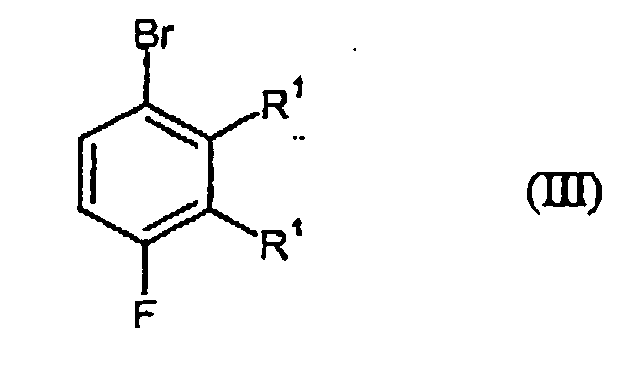 • in einem Schritt B mit Cyanid zunächst zu Verbindungen der Formel (IV)
 • in einem Schritt B2 durch Reduktion in die entsprechenden Verbindungen der Formel (I) überführt werden oder
für den Fall, dass Het für Hydroxy steht,• in einem Schritt B3 die Verbindungen der Formel (III) durch Überführung in eine magnesiumorganische Verbindung, Umsetzung dieser magnesiumorganischen Verbindung mit Kohlendioxid und anschließender Behandlung mit Säure zu Verbindungen der Formel (V) umsetzt • in einem Schritt B4 durch Umsetzung mit einem Halogenierungsmittel in Verbindungen der Formel (VI) überführt werden
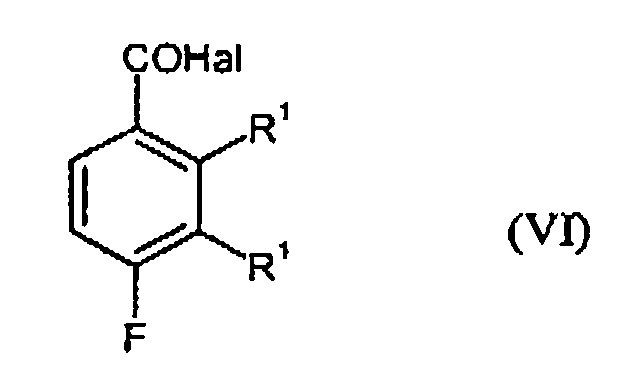 • und in einem Schritt B5 die Verbindungen der Formel (VI) durch Reduktion in die entsprechenden Verbindungen der Formel (I) überführt werden.
 - Verfahren nach Anspruch 3, dadurch gekennzeichnet, dass alternativ zu den Schritten B3 bis B5• in einem Schritt B6 die Umsetzung der Verbindungen der Formel (III) durch Überführung in eine magnesiumorganische Verbindung, Umsetzung dieser magnesiumorganischen Verbindung mit einem N,N-substituierten-Ameisensäureamid und anschließender Behandlung mit Säure zu Verbindungen der Formel (VII) erfolgt
 • in einem Schritt B7 die Verbindungen der Formel (VII) durch Reduktion in die entsprechenden Verbindungen der Formel (I) überführt werden.
 - Verbindungen der Formel (III) gemäß Anspruch 3 mit Ausnahme von 3-Brom-2,6-difluortoluol,
- Verbindungen der Formel (IV) gemäß Anspruch 3.
- Verbindungen der Formel (V) gemäß Anspruch mit Ausnahme von 2,4-Difluor-3-methylbenzoesäure und 3,4-Difluor-2-methylbenzoesäure.
- Verbindungen der Formel (VI) gemäß Anspruch 3 mit Ausnahme von 2,4-Difluor-3-methylbenzoesäure-chlorid
- Verwendung von Verbindungen gemäß Ansprüchen 1, 2 und 5 bis 8 oder solchen Verbindungen, die nach zumindest einem der Ansprüche 3 und 4 hergestellt wurden in einem Verfahren zur Herstellung von Wirkstoffen in Arzneimitteln und Pflanzenschutzmitteln oder Zwischenprodukten davon.
Applications Claiming Priority (2)
| Application Number | Priority Date | Filing Date | Title |
|---|---|---|---|
| DE10341534 | 2003-09-09 | ||
| DE10341534A DE10341534A1 (de) | 2003-09-09 | 2003-09-09 | Difluoralkylaromaten |
Publications (3)
| Publication Number | Publication Date |
|---|---|
| EP1514864A2 EP1514864A2 (de) | 2005-03-16 |
| EP1514864A3 EP1514864A3 (de) | 2005-03-23 |
| EP1514864B1 true EP1514864B1 (de) | 2008-03-19 |
Family
ID=34129716
Family Applications (1)
| Application Number | Title | Priority Date | Filing Date |
|---|---|---|---|
| EP04020499A Expired - Lifetime EP1514864B1 (de) | 2003-09-09 | 2004-08-28 | Difluoralkylaromaten |
Country Status (6)
| Country | Link |
|---|---|
| US (1) | US20050054733A1 (de) |
| EP (1) | EP1514864B1 (de) |
| CN (1) | CN1616384A (de) |
| AT (1) | ATE389632T1 (de) |
| DE (2) | DE10341534A1 (de) |
| ES (1) | ES2302532T3 (de) |
Families Citing this family (8)
| Publication number | Priority date | Publication date | Assignee | Title |
|---|---|---|---|---|
| EP1973881B1 (de) * | 2006-01-13 | 2009-10-28 | Dow Agrosciences LLC | 6-(poly-substituierte aryl)-4-aminopicolinate und ihre verwendung als herbizide |
| CN101712603B (zh) * | 2009-12-04 | 2013-05-22 | 江苏工业学院 | 用格氏反应制备卤代甲基苯甲醛的方法 |
| CN103553900B (zh) * | 2013-10-28 | 2015-05-20 | 浙江中欣化工股份有限公司 | 一种2,4,5-三氟苯乙酸的合成方法 |
| CN108929217B (zh) * | 2017-05-26 | 2021-02-26 | 浙江天宇药业股份有限公司 | 一种2-甲基-5-氟苯甲酸的制备方法 |
| CN109796386B (zh) * | 2018-12-19 | 2021-07-13 | 浙江工业大学 | (6-溴-2,3-二氟苄基)苯基硫醚及其制备方法 |
| CN110105327A (zh) * | 2019-06-05 | 2019-08-09 | 南京焕然生物科技有限公司 | 一种7,8-二氟-6,11-二氢-二苯并噻吩并-11-醇的制备方法 |
| CN110204415A (zh) * | 2019-06-26 | 2019-09-06 | 王海峻 | 一种3-氯-2-甲基联苯的合成方法 |
| CN114773316B (zh) * | 2022-06-17 | 2022-10-25 | 上海睿跃生物科技有限公司 | 2-(2,6-二氧代-哌啶-3-基)-5-氟-异吲哚-1,3-二酮的制备方法 |
Family Cites Families (9)
| Publication number | Priority date | Publication date | Assignee | Title |
|---|---|---|---|---|
| DE3615767A1 (de) * | 1986-05-10 | 1987-11-12 | Bayer Ag | Verfahren zur herstellung von 4-hydroxy-chinolin-3-carbonsaeuren |
| US5804532A (en) * | 1991-01-25 | 1998-09-08 | Rhone-Poulenc Agriculture Limited | Herbicidal 2-cyano-1,3-diones |
| GB9302049D0 (en) * | 1993-02-03 | 1993-03-24 | Rhone Poulenc Agriculture | Compositions of new matter |
| US5547975A (en) * | 1994-09-20 | 1996-08-20 | Talley; John J. | Benzopyranopyrazolyl derivatives for the treatment of inflammation |
| DE19805370A1 (de) * | 1997-03-14 | 1998-09-17 | Gruenenthal Gmbh | Substituierte Aminoverbindungen und ihre Verwendung als analgetisch wirksame Substanzen |
| CN1264837C (zh) * | 1997-09-15 | 2006-07-19 | 普罗克特和甘保尔公司 | 喹诺酮抗微生物剂、其组合物和应用 |
| US6387928B1 (en) * | 1997-09-15 | 2002-05-14 | The Procter & Gamble Co. | Antimicrobial quinolones, their compositions and uses |
| US6348624B1 (en) * | 1998-01-09 | 2002-02-19 | The Procter & Gamble Co. | Process for making certain benzoic acid compounds |
| US6284762B1 (en) * | 1998-03-23 | 2001-09-04 | American Cyanamid Company | Fungicidal 6-(2-halo-4-alkoxyphenyl)-triazolopyrimidines |
-
2003
- 2003-09-09 DE DE10341534A patent/DE10341534A1/de not_active Withdrawn
-
2004
- 2004-08-28 ES ES04020499T patent/ES2302532T3/es not_active Expired - Lifetime
- 2004-08-28 EP EP04020499A patent/EP1514864B1/de not_active Expired - Lifetime
- 2004-08-28 AT AT04020499T patent/ATE389632T1/de not_active IP Right Cessation
- 2004-08-28 DE DE502004006553T patent/DE502004006553D1/de not_active Expired - Lifetime
- 2004-09-07 US US10/935,575 patent/US20050054733A1/en not_active Abandoned
- 2004-09-09 CN CN200410078556.9A patent/CN1616384A/zh active Pending
Also Published As
| Publication number | Publication date |
|---|---|
| US20050054733A1 (en) | 2005-03-10 |
| DE10341534A1 (de) | 2005-03-31 |
| CN1616384A (zh) | 2005-05-18 |
| ATE389632T1 (de) | 2008-04-15 |
| DE502004006553D1 (de) | 2008-04-30 |
| ES2302532T3 (es) | 2008-07-16 |
| EP1514864A2 (de) | 2005-03-16 |
| EP1514864A3 (de) | 2005-03-23 |
Similar Documents
| Publication | Publication Date | Title |
|---|---|---|
| EP0718279A1 (de) | Verfahren zur Herstellung von o-substituierten Benzoylcyaniden | |
| DE69628472T2 (de) | Anzeigegerät und Zusammenbau seiner Treiberschaltung | |
| DE69403149T2 (de) | Verfahren zur Herstellung 1-substituierte-5(4H)-Tetrazolinone | |
| DE10341534A1 (de) | Difluoralkylaromaten | |
| DE102004041531A1 (de) | Verfahren zum Herstellen von Biphenylaminen | |
| EP1077208A2 (de) | Verfahren zur Herstellung von (Bis-(trifluormethyl)-phenyl)-essigsäuren und deren Alkylestern sowie (Bis-(trifluormethyl)-phenyl)-malonsäure-dialkylester | |
| JPH0784413B2 (ja) | 3−(無置換または置換ベンジル)−1−アルキル−2−オキソシクロペンタンカルボン酸アルキルエステル誘導体、その製造方法、殺菌剤及び中間体としての利用 | |
| EP3774719B1 (de) | Verfahren zur herstellung von 2,6-dialkylphenyl-essigsäuren | |
| EP2111389A1 (de) | Verfahren zur herstellung substituierter 2-arylmalonsäureester | |
| DE4328028A1 (de) | Verfahren zur Herstellung von Trifluormethylanilinen | |
| EP0693466B1 (de) | Verfahren zur Herstellung von aromatischen fluorierten Verbindungen und neue Diamide | |
| EP0748798B1 (de) | N-substituierte cis-N-propenyl-acetamide und Verfahren zu ihrer Herstellung | |
| EP0089485B1 (de) | Verfahren zur Herstellung von 5-Chlor-1H-tetrazol-1-carbonsäureestern sowie Verfahren zur Herstellung der erforderlichen Dichlorisonitril-carbonsäureester | |
| DE69213264T2 (de) | Verfahren zur Herstellung von Fluorbenzolderivaten und verwandter Verbindungen | |
| EP0144044A2 (de) | Substituierte Acetylenketone | |
| EP0731094B1 (de) | Verfahren zur Herstellung von Pyrazolen | |
| DE19704885C1 (de) | Verfahren zur Herstellung von 3-Hydroxy-2-methylbenzoesäure und 3-Acetoxy-2-methylbenzoesäure | |
| EP1957463B1 (de) | Verfahren zum herstellen von 5-fluor-1,3-dialkyl-1h-pyrazol-4-carbonsäurechloriden | |
| DE2924712A1 (de) | Verfahren zur herstellung von n-alkylbenzothiazolonderivaten | |
| DE3853605T2 (de) | Herstellung von N-[4-Chloro-2-fluoro-5-(pentyloxy-carbonylmethyloxy)phenyl]-3,4,5,6-tetrahydrophthalimide. | |
| DE3880072T2 (de) | N-phenyl-2,2,6,6-tetrahalogencyclohexanimin und verfahren zur herstellung von derivaten des 2,2,6,6-tetrahalogencyclohexanimins und von derivaten des 2,6-dihalogenanilins. | |
| DE3888861T2 (de) | Verfahren zur Herstellung von Tetrazolderivaten. | |
| EP1123913B1 (de) | Verfahren zur Herstellung von 2-Methoxyethoxy-benzolen und neue 2-Methoxyethoxy-benzylcyanide | |
| EP0621264A2 (de) | Verfahren zur Herstellung von 4-Alkanoaryl-benzylethern | |
| EP1514865A1 (de) | Verfahren zur Herstellung von Halogenhaltigen 4-Aminophenolen |
Legal Events
| Date | Code | Title | Description |
|---|---|---|---|
| PUAI | Public reference made under article 153(3) epc to a published international application that has entered the european phase |
Free format text: ORIGINAL CODE: 0009012 |
|
| PUAL | Search report despatched |
Free format text: ORIGINAL CODE: 0009013 |
|
| AK | Designated contracting states |
Kind code of ref document: A2 Designated state(s): AT BE BG CH CY CZ DE DK EE ES FI FR GB GR HU IE IT LI LU MC NL PL PT RO SE SI SK TR |
|
| AX | Request for extension of the european patent |
Extension state: AL HR LT LV MK |
|
| AK | Designated contracting states |
Kind code of ref document: A3 Designated state(s): AT BE BG CH CY CZ DE DK EE ES FI FR GB GR HU IE IT LI LU MC NL PL PT RO SE SI SK TR |
|
| AX | Request for extension of the european patent |
Extension state: AL HR LT LV MK |
|
| RAP1 | Party data changed (applicant data changed or rights of an application transferred) |
Owner name: LANXESS DEUTSCHLAND GMBH |
|
| 17P | Request for examination filed |
Effective date: 20050923 |
|
| AKX | Designation fees paid |
Designated state(s): AT BE BG CH CY CZ DE DK EE ES FI FR GB GR HU IE IT LI LU MC NL PL PT RO SE SI SK TR |
|
| RAP1 | Party data changed (applicant data changed or rights of an application transferred) |
Owner name: SALTIGO GMBH |
|
| 17Q | First examination report despatched |
Effective date: 20061205 |
|
| RAP1 | Party data changed (applicant data changed or rights of an application transferred) |
Owner name: SALTIGO GMBH |
|
| GRAP | Despatch of communication of intention to grant a patent |
Free format text: ORIGINAL CODE: EPIDOSNIGR1 |
|
| GRAS | Grant fee paid |
Free format text: ORIGINAL CODE: EPIDOSNIGR3 |
|
| GRAA | (expected) grant |
Free format text: ORIGINAL CODE: 0009210 |
|
| AK | Designated contracting states |
Kind code of ref document: B1 Designated state(s): AT BE BG CH CY CZ DE DK EE ES FI FR GB GR HU IE IT LI LU MC NL PL PT RO SE SI SK TR |
|
| REG | Reference to a national code |
Ref country code: GB Ref legal event code: FG4D Free format text: NOT ENGLISH |
|
| REG | Reference to a national code |
Ref country code: CH Ref legal event code: EP Ref country code: CH Ref legal event code: NV Representative=s name: ISLER & PEDRAZZINI AG |
|
| REF | Corresponds to: |
Ref document number: 502004006553 Country of ref document: DE Date of ref document: 20080430 Kind code of ref document: P |
|
| REG | Reference to a national code |
Ref country code: IE Ref legal event code: FG4D Free format text: LANGUAGE OF EP DOCUMENT: GERMAN |
|
| REG | Reference to a national code |
Ref country code: ES Ref legal event code: FG2A Ref document number: 2302532 Country of ref document: ES Kind code of ref document: T3 |
|
| PG25 | Lapsed in a contracting state [announced via postgrant information from national office to epo] |
Ref country code: FI Free format text: LAPSE BECAUSE OF FAILURE TO SUBMIT A TRANSLATION OF THE DESCRIPTION OR TO PAY THE FEE WITHIN THE PRESCRIBED TIME-LIMIT Effective date: 20080319 |
|
| PG25 | Lapsed in a contracting state [announced via postgrant information from national office to epo] |
Ref country code: SI Free format text: LAPSE BECAUSE OF FAILURE TO SUBMIT A TRANSLATION OF THE DESCRIPTION OR TO PAY THE FEE WITHIN THE PRESCRIBED TIME-LIMIT Effective date: 20080319 Ref country code: PL Free format text: LAPSE BECAUSE OF FAILURE TO SUBMIT A TRANSLATION OF THE DESCRIPTION OR TO PAY THE FEE WITHIN THE PRESCRIBED TIME-LIMIT Effective date: 20080319 |
|
| PG25 | Lapsed in a contracting state [announced via postgrant information from national office to epo] |
Ref country code: CZ Free format text: LAPSE BECAUSE OF FAILURE TO SUBMIT A TRANSLATION OF THE DESCRIPTION OR TO PAY THE FEE WITHIN THE PRESCRIBED TIME-LIMIT Effective date: 20080319 Ref country code: PT Free format text: LAPSE BECAUSE OF FAILURE TO SUBMIT A TRANSLATION OF THE DESCRIPTION OR TO PAY THE FEE WITHIN THE PRESCRIBED TIME-LIMIT Effective date: 20080826 Ref country code: SK Free format text: LAPSE BECAUSE OF FAILURE TO SUBMIT A TRANSLATION OF THE DESCRIPTION OR TO PAY THE FEE WITHIN THE PRESCRIBED TIME-LIMIT Effective date: 20080319 Ref country code: SE Free format text: LAPSE BECAUSE OF FAILURE TO SUBMIT A TRANSLATION OF THE DESCRIPTION OR TO PAY THE FEE WITHIN THE PRESCRIBED TIME-LIMIT Effective date: 20080619 |
|
| ET | Fr: translation filed | ||
| PG25 | Lapsed in a contracting state [announced via postgrant information from national office to epo] |
Ref country code: RO Free format text: LAPSE BECAUSE OF FAILURE TO SUBMIT A TRANSLATION OF THE DESCRIPTION OR TO PAY THE FEE WITHIN THE PRESCRIBED TIME-LIMIT Effective date: 20080319 |
|
| PLBE | No opposition filed within time limit |
Free format text: ORIGINAL CODE: 0009261 |
|
| STAA | Information on the status of an ep patent application or granted ep patent |
Free format text: STATUS: NO OPPOSITION FILED WITHIN TIME LIMIT |
|
| PG25 | Lapsed in a contracting state [announced via postgrant information from national office to epo] |
Ref country code: DK Free format text: LAPSE BECAUSE OF FAILURE TO SUBMIT A TRANSLATION OF THE DESCRIPTION OR TO PAY THE FEE WITHIN THE PRESCRIBED TIME-LIMIT Effective date: 20080319 |
|
| 26N | No opposition filed |
Effective date: 20081222 |
|
| PG25 | Lapsed in a contracting state [announced via postgrant information from national office to epo] |
Ref country code: MC Free format text: LAPSE BECAUSE OF NON-PAYMENT OF DUE FEES Effective date: 20080831 |
|
| PG25 | Lapsed in a contracting state [announced via postgrant information from national office to epo] |
Ref country code: BG Free format text: LAPSE BECAUSE OF FAILURE TO SUBMIT A TRANSLATION OF THE DESCRIPTION OR TO PAY THE FEE WITHIN THE PRESCRIBED TIME-LIMIT Effective date: 20080619 Ref country code: EE Free format text: LAPSE BECAUSE OF FAILURE TO SUBMIT A TRANSLATION OF THE DESCRIPTION OR TO PAY THE FEE WITHIN THE PRESCRIBED TIME-LIMIT Effective date: 20080319 |
|
| PG25 | Lapsed in a contracting state [announced via postgrant information from national office to epo] |
Ref country code: CY Free format text: LAPSE BECAUSE OF FAILURE TO SUBMIT A TRANSLATION OF THE DESCRIPTION OR TO PAY THE FEE WITHIN THE PRESCRIBED TIME-LIMIT Effective date: 20080319 |
|
| PG25 | Lapsed in a contracting state [announced via postgrant information from national office to epo] |
Ref country code: AT Free format text: LAPSE BECAUSE OF NON-PAYMENT OF DUE FEES Effective date: 20080828 |
|
| PGFP | Annual fee paid to national office [announced via postgrant information from national office to epo] |
Ref country code: ES Payment date: 20090902 Year of fee payment: 6 Ref country code: IE Payment date: 20090818 Year of fee payment: 6 |
|
| PGFP | Annual fee paid to national office [announced via postgrant information from national office to epo] |
Ref country code: CH Payment date: 20090814 Year of fee payment: 6 Ref country code: NL Payment date: 20090803 Year of fee payment: 6 |
|
| PGFP | Annual fee paid to national office [announced via postgrant information from national office to epo] |
Ref country code: BE Payment date: 20090825 Year of fee payment: 6 |
|
| PGFP | Annual fee paid to national office [announced via postgrant information from national office to epo] |
Ref country code: IT Payment date: 20090820 Year of fee payment: 6 |
|
| PG25 | Lapsed in a contracting state [announced via postgrant information from national office to epo] |
Ref country code: HU Free format text: LAPSE BECAUSE OF FAILURE TO SUBMIT A TRANSLATION OF THE DESCRIPTION OR TO PAY THE FEE WITHIN THE PRESCRIBED TIME-LIMIT Effective date: 20080920 Ref country code: LU Free format text: LAPSE BECAUSE OF NON-PAYMENT OF DUE FEES Effective date: 20080828 |
|
| PG25 | Lapsed in a contracting state [announced via postgrant information from national office to epo] |
Ref country code: TR Free format text: LAPSE BECAUSE OF FAILURE TO SUBMIT A TRANSLATION OF THE DESCRIPTION OR TO PAY THE FEE WITHIN THE PRESCRIBED TIME-LIMIT Effective date: 20080319 |
|
| PG25 | Lapsed in a contracting state [announced via postgrant information from national office to epo] |
Ref country code: GR Free format text: LAPSE BECAUSE OF FAILURE TO SUBMIT A TRANSLATION OF THE DESCRIPTION OR TO PAY THE FEE WITHIN THE PRESCRIBED TIME-LIMIT Effective date: 20080620 |
|
| PGFP | Annual fee paid to national office [announced via postgrant information from national office to epo] |
Ref country code: DE Payment date: 20100825 Year of fee payment: 7 Ref country code: FR Payment date: 20100824 Year of fee payment: 7 |
|
| PGFP | Annual fee paid to national office [announced via postgrant information from national office to epo] |
Ref country code: GB Payment date: 20100825 Year of fee payment: 7 |
|
| BERE | Be: lapsed |
Owner name: SALTIGO G.M.B.H. Effective date: 20100831 |
|
| REG | Reference to a national code |
Ref country code: NL Ref legal event code: V1 Effective date: 20110301 |
|
| REG | Reference to a national code |
Ref country code: CH Ref legal event code: PL |
|
| PG25 | Lapsed in a contracting state [announced via postgrant information from national office to epo] |
Ref country code: CH Free format text: LAPSE BECAUSE OF NON-PAYMENT OF DUE FEES Effective date: 20100831 Ref country code: LI Free format text: LAPSE BECAUSE OF NON-PAYMENT OF DUE FEES Effective date: 20100831 |
|
| PG25 | Lapsed in a contracting state [announced via postgrant information from national office to epo] |
Ref country code: NL Free format text: LAPSE BECAUSE OF NON-PAYMENT OF DUE FEES Effective date: 20110301 Ref country code: IT Free format text: LAPSE BECAUSE OF NON-PAYMENT OF DUE FEES Effective date: 20100828 |
|
| PG25 | Lapsed in a contracting state [announced via postgrant information from national office to epo] |
Ref country code: IE Free format text: LAPSE BECAUSE OF NON-PAYMENT OF DUE FEES Effective date: 20100830 Ref country code: BE Free format text: LAPSE BECAUSE OF NON-PAYMENT OF DUE FEES Effective date: 20100831 |
|
| REG | Reference to a national code |
Ref country code: ES Ref legal event code: FD2A Effective date: 20111019 |
|
| PG25 | Lapsed in a contracting state [announced via postgrant information from national office to epo] |
Ref country code: ES Free format text: LAPSE BECAUSE OF NON-PAYMENT OF DUE FEES Effective date: 20100829 |
|
| GBPC | Gb: european patent ceased through non-payment of renewal fee |
Effective date: 20110828 |
|
| REG | Reference to a national code |
Ref country code: FR Ref legal event code: ST Effective date: 20120430 |
|
| REG | Reference to a national code |
Ref country code: DE Ref legal event code: R119 Ref document number: 502004006553 Country of ref document: DE Effective date: 20120301 |
|
| PG25 | Lapsed in a contracting state [announced via postgrant information from national office to epo] |
Ref country code: GB Free format text: LAPSE BECAUSE OF NON-PAYMENT OF DUE FEES Effective date: 20110828 Ref country code: FR Free format text: LAPSE BECAUSE OF NON-PAYMENT OF DUE FEES Effective date: 20110831 |
|
| PG25 | Lapsed in a contracting state [announced via postgrant information from national office to epo] |
Ref country code: DE Free format text: LAPSE BECAUSE OF NON-PAYMENT OF DUE FEES Effective date: 20120301 |