EP1513884B1 - Verfahren zur herstellung von olefinpolymerisationskatalysatoren - Google Patents
Verfahren zur herstellung von olefinpolymerisationskatalysatoren Download PDFInfo
- Publication number
- EP1513884B1 EP1513884B1 EP02796672A EP02796672A EP1513884B1 EP 1513884 B1 EP1513884 B1 EP 1513884B1 EP 02796672 A EP02796672 A EP 02796672A EP 02796672 A EP02796672 A EP 02796672A EP 1513884 B1 EP1513884 B1 EP 1513884B1
- Authority
- EP
- European Patent Office
- Prior art keywords
- compound
- catalyst
- solution
- group
- iupac
- Prior art date
- Legal status (The legal status is an assumption and is not a legal conclusion. Google has not performed a legal analysis and makes no representation as to the accuracy of the status listed.)
- Expired - Lifetime
Links
- 239000003054 catalyst Substances 0.000 title claims description 153
- 238000000034 method Methods 0.000 title claims description 53
- 150000001336 alkenes Chemical class 0.000 title claims description 20
- JRZJOMJEPLMPRA-UHFFFAOYSA-N olefin Natural products CCCCCCCC=C JRZJOMJEPLMPRA-UHFFFAOYSA-N 0.000 title claims description 13
- 238000002360 preparation method Methods 0.000 title claims description 13
- 150000001875 compounds Chemical class 0.000 claims description 150
- 239000000839 emulsion Substances 0.000 claims description 51
- 239000011777 magnesium Substances 0.000 claims description 50
- 239000002904 solvent Substances 0.000 claims description 42
- 239000002245 particle Substances 0.000 claims description 40
- 230000000737 periodic effect Effects 0.000 claims description 30
- 230000008569 process Effects 0.000 claims description 30
- 239000000203 mixture Substances 0.000 claims description 24
- -1 alkyl aluminium halide Chemical class 0.000 claims description 22
- 239000010936 titanium Substances 0.000 claims description 22
- 230000008859 change Effects 0.000 claims description 16
- 239000000460 chlorine Substances 0.000 claims description 13
- ZAMOUSCENKQFHK-UHFFFAOYSA-N Chlorine atom Chemical compound [Cl] ZAMOUSCENKQFHK-UHFFFAOYSA-N 0.000 claims description 12
- 229910052801 chlorine Inorganic materials 0.000 claims description 12
- LFQSCWFLJHTTHZ-UHFFFAOYSA-N Ethanol Chemical compound CCO LFQSCWFLJHTTHZ-UHFFFAOYSA-N 0.000 claims description 11
- 229910052749 magnesium Inorganic materials 0.000 claims description 11
- 239000011949 solid catalyst Substances 0.000 claims description 10
- XJDNKRIXUMDJCW-UHFFFAOYSA-J titanium tetrachloride Chemical compound Cl[Ti](Cl)(Cl)Cl XJDNKRIXUMDJCW-UHFFFAOYSA-J 0.000 claims description 9
- 150000003623 transition metal compounds Chemical class 0.000 claims description 9
- YIWUKEYIRIRTPP-UHFFFAOYSA-N 2-ethylhexan-1-ol Chemical compound CCCCC(CC)CO YIWUKEYIRIRTPP-UHFFFAOYSA-N 0.000 claims description 8
- 238000010438 heat treatment Methods 0.000 claims description 8
- FYYHWMGAXLPEAU-UHFFFAOYSA-N Magnesium Chemical compound [Mg] FYYHWMGAXLPEAU-UHFFFAOYSA-N 0.000 claims description 7
- UAIZDWNSWGTKFZ-UHFFFAOYSA-L ethylaluminum(2+);dichloride Chemical compound CC[Al](Cl)Cl UAIZDWNSWGTKFZ-UHFFFAOYSA-L 0.000 claims description 6
- 239000012442 inert solvent Substances 0.000 claims description 6
- 229910052768 actinide Inorganic materials 0.000 claims description 4
- 150000001255 actinides Chemical class 0.000 claims description 4
- 150000004945 aromatic hydrocarbons Chemical class 0.000 claims description 4
- 229910052747 lanthanoid Inorganic materials 0.000 claims description 4
- 150000002602 lanthanoids Chemical class 0.000 claims description 4
- YVBBRRALBYAZBM-UHFFFAOYSA-N perfluorooctane Chemical compound FC(F)(F)C(F)(F)C(F)(F)C(F)(F)C(F)(F)C(F)(F)C(F)(F)C(F)(F)F YVBBRRALBYAZBM-UHFFFAOYSA-N 0.000 claims description 4
- 150000003609 titanium compounds Chemical class 0.000 claims description 4
- 150000001924 cycloalkanes Chemical class 0.000 claims description 2
- 229960004624 perflexane Drugs 0.000 claims description 2
- ZJIJAJXFLBMLCK-UHFFFAOYSA-N perfluorohexane Chemical compound FC(F)(F)C(F)(F)C(F)(F)C(F)(F)C(F)(F)C(F)(F)F ZJIJAJXFLBMLCK-UHFFFAOYSA-N 0.000 claims description 2
- 229910052751 metal Inorganic materials 0.000 claims 4
- 239000002184 metal Substances 0.000 claims 4
- 125000004432 carbon atom Chemical group C* 0.000 claims 2
- 229910021482 group 13 metal Inorganic materials 0.000 claims 2
- QIROQPWSJUXOJC-UHFFFAOYSA-N 1,1,2,2,3,3,4,4,5,5,6-undecafluoro-6-(trifluoromethyl)cyclohexane Chemical compound FC(F)(F)C1(F)C(F)(F)C(F)(F)C(F)(F)C(F)(F)C1(F)F QIROQPWSJUXOJC-UHFFFAOYSA-N 0.000 claims 1
- LGUZHRODIJCVOC-UHFFFAOYSA-N perfluoroheptane Chemical compound FC(F)(F)C(F)(F)C(F)(F)C(F)(F)C(F)(F)C(F)(F)C(F)(F)F LGUZHRODIJCVOC-UHFFFAOYSA-N 0.000 claims 1
- IMNFDUFMRHMDMM-UHFFFAOYSA-N N-Heptane Chemical compound CCCCCCC IMNFDUFMRHMDMM-UHFFFAOYSA-N 0.000 description 28
- 238000007711 solidification Methods 0.000 description 21
- 230000008023 solidification Effects 0.000 description 21
- OFBQJSOFQDEBGM-UHFFFAOYSA-N Pentane Chemical compound CCCCC OFBQJSOFQDEBGM-UHFFFAOYSA-N 0.000 description 18
- 230000015572 biosynthetic process Effects 0.000 description 13
- 239000007788 liquid Substances 0.000 description 13
- VGGSQFUCUMXWEO-UHFFFAOYSA-N Ethene Chemical compound C=C VGGSQFUCUMXWEO-UHFFFAOYSA-N 0.000 description 12
- VLKZOEOYAKHREP-UHFFFAOYSA-N n-Hexane Chemical compound CCCCCC VLKZOEOYAKHREP-UHFFFAOYSA-N 0.000 description 12
- 239000002243 precursor Substances 0.000 description 12
- 229930195733 hydrocarbon Natural products 0.000 description 11
- 239000004094 surface-active agent Substances 0.000 description 11
- TWRXJAOTZQYOKJ-UHFFFAOYSA-L Magnesium chloride Chemical compound [Mg+2].[Cl-].[Cl-] TWRXJAOTZQYOKJ-UHFFFAOYSA-L 0.000 description 10
- 150000002430 hydrocarbons Chemical class 0.000 description 10
- VYPSYNLAJGMNEJ-UHFFFAOYSA-N Silicium dioxide Chemical compound O=[Si]=O VYPSYNLAJGMNEJ-UHFFFAOYSA-N 0.000 description 9
- YXFVVABEGXRONW-UHFFFAOYSA-N Toluene Chemical compound CC1=CC=CC=C1 YXFVVABEGXRONW-UHFFFAOYSA-N 0.000 description 9
- 238000002156 mixing Methods 0.000 description 9
- 239000007787 solid Substances 0.000 description 9
- 238000009826 distribution Methods 0.000 description 8
- QQONPFPTGQHPMA-UHFFFAOYSA-N Propene Chemical compound CC=C QQONPFPTGQHPMA-UHFFFAOYSA-N 0.000 description 7
- 229910003074 TiCl4 Inorganic materials 0.000 description 7
- 125000000524 functional group Chemical group 0.000 description 7
- 239000004215 Carbon black (E152) Substances 0.000 description 6
- 239000005977 Ethylene Substances 0.000 description 6
- 239000004698 Polyethylene Substances 0.000 description 6
- 125000000217 alkyl group Chemical group 0.000 description 6
- 230000000694 effects Effects 0.000 description 6
- 125000001183 hydrocarbyl group Chemical group 0.000 description 6
- 150000004703 alkoxides Chemical class 0.000 description 5
- 238000006243 chemical reaction Methods 0.000 description 5
- 239000007795 chemical reaction product Substances 0.000 description 5
- 239000006185 dispersion Substances 0.000 description 5
- 239000007789 gas Substances 0.000 description 5
- 229910001629 magnesium chloride Inorganic materials 0.000 description 5
- 239000000178 monomer Substances 0.000 description 5
- IJGRMHOSHXDMSA-UHFFFAOYSA-N Atomic nitrogen Chemical compound N#N IJGRMHOSHXDMSA-UHFFFAOYSA-N 0.000 description 4
- 239000011954 Ziegler–Natta catalyst Substances 0.000 description 4
- 150000001399 aluminium compounds Chemical class 0.000 description 4
- 230000001804 emulsifying effect Effects 0.000 description 4
- 238000004519 manufacturing process Methods 0.000 description 4
- 239000000463 material Substances 0.000 description 4
- 239000003960 organic solvent Substances 0.000 description 4
- 229920000642 polymer Polymers 0.000 description 4
- 238000001556 precipitation Methods 0.000 description 4
- 239000000377 silicon dioxide Substances 0.000 description 4
- 239000002002 slurry Substances 0.000 description 4
- 238000004381 surface treatment Methods 0.000 description 4
- UHOVQNZJYSORNB-UHFFFAOYSA-N Benzene Chemical compound C1=CC=CC=C1 UHOVQNZJYSORNB-UHFFFAOYSA-N 0.000 description 3
- 241000282326 Felis catus Species 0.000 description 3
- 238000007792 addition Methods 0.000 description 3
- 150000001338 aliphatic hydrocarbons Chemical class 0.000 description 3
- 239000004411 aluminium Substances 0.000 description 3
- 229910052782 aluminium Inorganic materials 0.000 description 3
- 150000001412 amines Chemical class 0.000 description 3
- 239000012876 carrier material Substances 0.000 description 3
- 239000003995 emulsifying agent Substances 0.000 description 3
- 239000003381 stabilizer Substances 0.000 description 3
- 238000012360 testing method Methods 0.000 description 3
- 229910052719 titanium Inorganic materials 0.000 description 3
- NMRPBPVERJPACX-UHFFFAOYSA-N (3S)-octan-3-ol Natural products CCCCCC(O)CC NMRPBPVERJPACX-UHFFFAOYSA-N 0.000 description 2
- XWJBRBSPAODJER-UHFFFAOYSA-N 1,7-octadiene Chemical compound C=CCCCCC=C XWJBRBSPAODJER-UHFFFAOYSA-N 0.000 description 2
- VXNZUUAINFGPBY-UHFFFAOYSA-N 1-Butene Chemical compound CCC=C VXNZUUAINFGPBY-UHFFFAOYSA-N 0.000 description 2
- ZGEGCLOFRBLKSE-UHFFFAOYSA-N 1-Heptene Chemical compound CCCCCC=C ZGEGCLOFRBLKSE-UHFFFAOYSA-N 0.000 description 2
- KBPLFHHGFOOTCA-UHFFFAOYSA-N 1-Octanol Chemical compound CCCCCCCCO KBPLFHHGFOOTCA-UHFFFAOYSA-N 0.000 description 2
- AFFLGGQVNFXPEV-UHFFFAOYSA-N 1-decene Chemical compound CCCCCCCCC=C AFFLGGQVNFXPEV-UHFFFAOYSA-N 0.000 description 2
- LIKMAJRDDDTEIG-UHFFFAOYSA-N 1-hexene Chemical compound CCCCC=C LIKMAJRDDDTEIG-UHFFFAOYSA-N 0.000 description 2
- KWKAKUADMBZCLK-UHFFFAOYSA-N 1-octene Chemical compound CCCCCCC=C KWKAKUADMBZCLK-UHFFFAOYSA-N 0.000 description 2
- WOFPPJOZXUTRAU-UHFFFAOYSA-N 2-Ethyl-1-hexanol Natural products CCCCC(O)CCC WOFPPJOZXUTRAU-UHFFFAOYSA-N 0.000 description 2
- WSSSPWUEQFSQQG-UHFFFAOYSA-N 4-methyl-1-pentene Chemical compound CC(C)CC=C WSSSPWUEQFSQQG-UHFFFAOYSA-N 0.000 description 2
- KAKZBPTYRLMSJV-UHFFFAOYSA-N Butadiene Chemical compound C=CC=C KAKZBPTYRLMSJV-UHFFFAOYSA-N 0.000 description 2
- HEDRZPFGACZZDS-UHFFFAOYSA-N Chloroform Chemical compound ClC(Cl)Cl HEDRZPFGACZZDS-UHFFFAOYSA-N 0.000 description 2
- VQTUBCCKSQIDNK-UHFFFAOYSA-N Isobutene Chemical compound CC(C)=C VQTUBCCKSQIDNK-UHFFFAOYSA-N 0.000 description 2
- LRHPLDYGYMQRHN-UHFFFAOYSA-N N-Butanol Chemical compound CCCCO LRHPLDYGYMQRHN-UHFFFAOYSA-N 0.000 description 2
- OAICVXFJPJFONN-UHFFFAOYSA-N Phosphorus Chemical compound [P] OAICVXFJPJFONN-UHFFFAOYSA-N 0.000 description 2
- 239000004743 Polypropylene Substances 0.000 description 2
- 239000000654 additive Substances 0.000 description 2
- 150000001335 aliphatic alkanes Chemical class 0.000 description 2
- 125000001931 aliphatic group Chemical group 0.000 description 2
- 150000001408 amides Chemical class 0.000 description 2
- 125000003118 aryl group Chemical group 0.000 description 2
- 125000000484 butyl group Chemical group [H]C([*])([H])C([H])([H])C([H])([H])C([H])([H])[H] 0.000 description 2
- 239000012018 catalyst precursor Substances 0.000 description 2
- 230000003197 catalytic effect Effects 0.000 description 2
- 239000003795 chemical substances by application Substances 0.000 description 2
- 229920001577 copolymer Polymers 0.000 description 2
- 125000001495 ethyl group Chemical group [H]C([H])([H])C([H])([H])* 0.000 description 2
- 229910052736 halogen Inorganic materials 0.000 description 2
- 230000002140 halogenating effect Effects 0.000 description 2
- 150000002367 halogens Chemical group 0.000 description 2
- 125000003187 heptyl group Chemical group [H]C([*])([H])C([H])([H])C([H])([H])C([H])([H])C([H])([H])C([H])([H])C([H])([H])[H] 0.000 description 2
- 125000004051 hexyl group Chemical group [H]C([H])([H])C([H])([H])C([H])([H])C([H])([H])C([H])([H])C([H])([H])* 0.000 description 2
- 239000002815 homogeneous catalyst Substances 0.000 description 2
- 238000011065 in-situ storage Methods 0.000 description 2
- QWTDNUCVQCZILF-UHFFFAOYSA-N isopentane Chemical compound CCC(C)C QWTDNUCVQCZILF-UHFFFAOYSA-N 0.000 description 2
- 150000002681 magnesium compounds Chemical class 0.000 description 2
- 229910052757 nitrogen Inorganic materials 0.000 description 2
- ZWRUINPWMLAQRD-UHFFFAOYSA-N nonan-1-ol Chemical compound CCCCCCCCCO ZWRUINPWMLAQRD-UHFFFAOYSA-N 0.000 description 2
- 125000002347 octyl group Chemical group [H]C([*])([H])C([H])([H])C([H])([H])C([H])([H])C([H])([H])C([H])([H])C([H])([H])C([H])([H])[H] 0.000 description 2
- 150000007524 organic acids Chemical class 0.000 description 2
- YWAKXRMUMFPDSH-UHFFFAOYSA-N pentene Chemical compound CCCC=C YWAKXRMUMFPDSH-UHFFFAOYSA-N 0.000 description 2
- 125000001147 pentyl group Chemical group C(CCCC)* 0.000 description 2
- 229910052698 phosphorus Inorganic materials 0.000 description 2
- 239000011574 phosphorus Substances 0.000 description 2
- 229920000573 polyethylene Polymers 0.000 description 2
- 230000001376 precipitating effect Effects 0.000 description 2
- 239000000047 product Substances 0.000 description 2
- 125000001436 propyl group Chemical group [H]C([*])([H])C([H])([H])C([H])([H])[H] 0.000 description 2
- 239000000376 reactant Substances 0.000 description 2
- 239000012798 spherical particle Substances 0.000 description 2
- 230000003019 stabilising effect Effects 0.000 description 2
- 239000007858 starting material Substances 0.000 description 2
- 238000003756 stirring Methods 0.000 description 2
- 239000000126 substance Substances 0.000 description 2
- 230000007704 transition Effects 0.000 description 2
- VOITXYVAKOUIBA-UHFFFAOYSA-N triethylaluminium Chemical class CC[Al](CC)CC VOITXYVAKOUIBA-UHFFFAOYSA-N 0.000 description 2
- 238000013022 venting Methods 0.000 description 2
- 239000004711 α-olefin Substances 0.000 description 2
- PRBHEGAFLDMLAL-GQCTYLIASA-N (4e)-hexa-1,4-diene Chemical compound C\C=C\CC=C PRBHEGAFLDMLAL-GQCTYLIASA-N 0.000 description 1
- BBMCTIGTTCKYKF-UHFFFAOYSA-N 1-heptanol Chemical class CCCCCCCO BBMCTIGTTCKYKF-UHFFFAOYSA-N 0.000 description 1
- 229910018575 Al—Ti Inorganic materials 0.000 description 1
- VEXZGXHMUGYJMC-UHFFFAOYSA-M Chloride anion Chemical compound [Cl-] VEXZGXHMUGYJMC-UHFFFAOYSA-M 0.000 description 1
- VEXZGXHMUGYJMC-UHFFFAOYSA-N Hydrochloric acid Chemical compound Cl VEXZGXHMUGYJMC-UHFFFAOYSA-N 0.000 description 1
- UAEPNZWRGJTJPN-UHFFFAOYSA-N Methylcyclohexane Natural products CC1CCCCC1 UAEPNZWRGJTJPN-UHFFFAOYSA-N 0.000 description 1
- ISWSIDIOOBJBQZ-UHFFFAOYSA-N Phenol Chemical compound OC1=CC=CC=C1 ISWSIDIOOBJBQZ-UHFFFAOYSA-N 0.000 description 1
- NINIDFKCEFEMDL-UHFFFAOYSA-N Sulfur Chemical compound [S] NINIDFKCEFEMDL-UHFFFAOYSA-N 0.000 description 1
- 239000005864 Sulphur Substances 0.000 description 1
- 239000002253 acid Substances 0.000 description 1
- 239000012190 activator Substances 0.000 description 1
- 239000011149 active material Substances 0.000 description 1
- 230000000996 additive effect Effects 0.000 description 1
- 150000001298 alcohols Chemical class 0.000 description 1
- 150000001299 aldehydes Chemical class 0.000 description 1
- 125000002723 alicyclic group Chemical group 0.000 description 1
- 125000003545 alkoxy group Chemical group 0.000 description 1
- 125000002877 alkyl aryl group Chemical group 0.000 description 1
- 150000001350 alkyl halides Chemical class 0.000 description 1
- 239000003849 aromatic solvent Substances 0.000 description 1
- 125000003710 aryl alkyl group Chemical group 0.000 description 1
- QVGXLLKOCUKJST-UHFFFAOYSA-N atomic oxygen Chemical compound [O] QVGXLLKOCUKJST-UHFFFAOYSA-N 0.000 description 1
- 230000002051 biphasic effect Effects 0.000 description 1
- HQMRIBYCTLBDAK-UHFFFAOYSA-M bis(2-methylpropyl)alumanylium;chloride Chemical compound CC(C)C[Al](Cl)CC(C)C HQMRIBYCTLBDAK-UHFFFAOYSA-M 0.000 description 1
- 238000009835 boiling Methods 0.000 description 1
- 229910052799 carbon Inorganic materials 0.000 description 1
- 125000003178 carboxy group Chemical group [H]OC(*)=O 0.000 description 1
- 150000001735 carboxylic acids Chemical class 0.000 description 1
- 239000000969 carrier Substances 0.000 description 1
- 150000008280 chlorinated hydrocarbons Chemical class 0.000 description 1
- 239000000084 colloidal system Substances 0.000 description 1
- 230000000052 comparative effect Effects 0.000 description 1
- 238000007796 conventional method Methods 0.000 description 1
- 125000004122 cyclic group Chemical group 0.000 description 1
- 230000009849 deactivation Effects 0.000 description 1
- 230000001419 dependent effect Effects 0.000 description 1
- 238000011161 development Methods 0.000 description 1
- 150000001993 dienes Chemical class 0.000 description 1
- YNLAOSYQHBDIKW-UHFFFAOYSA-M diethylaluminium chloride Chemical compound CC[Al](Cl)CC YNLAOSYQHBDIKW-UHFFFAOYSA-M 0.000 description 1
- 239000003085 diluting agent Substances 0.000 description 1
- AFABGHUZZDYHJO-UHFFFAOYSA-N dimethyl butane Natural products CCCC(C)C AFABGHUZZDYHJO-UHFFFAOYSA-N 0.000 description 1
- JGHYBJVUQGTEEB-UHFFFAOYSA-M dimethylalumanylium;chloride Chemical compound C[Al](C)Cl JGHYBJVUQGTEEB-UHFFFAOYSA-M 0.000 description 1
- 238000004945 emulsification Methods 0.000 description 1
- 150000002148 esters Chemical class 0.000 description 1
- 150000002170 ethers Chemical class 0.000 description 1
- 239000011521 glass Substances 0.000 description 1
- 150000004820 halides Chemical class 0.000 description 1
- 150000008282 halocarbons Chemical class 0.000 description 1
- 150000005826 halohydrocarbons Chemical class 0.000 description 1
- 125000005842 heteroatom Chemical group 0.000 description 1
- 239000002638 heterogeneous catalyst Substances 0.000 description 1
- 238000005470 impregnation Methods 0.000 description 1
- 239000003701 inert diluent Substances 0.000 description 1
- 239000011261 inert gas Substances 0.000 description 1
- 229910052809 inorganic oxide Inorganic materials 0.000 description 1
- 150000002576 ketones Chemical class 0.000 description 1
- 238000003760 magnetic stirring Methods 0.000 description 1
- 239000000155 melt Substances 0.000 description 1
- 238000002844 melting Methods 0.000 description 1
- 230000008018 melting Effects 0.000 description 1
- 150000002736 metal compounds Chemical class 0.000 description 1
- GYNNXHKOJHMOHS-UHFFFAOYSA-N methyl-cycloheptane Natural products CC1CCCCCC1 GYNNXHKOJHMOHS-UHFFFAOYSA-N 0.000 description 1
- YSTQWZZQKCCBAY-UHFFFAOYSA-L methylaluminum(2+);dichloride Chemical compound C[Al](Cl)Cl YSTQWZZQKCCBAY-UHFFFAOYSA-L 0.000 description 1
- 239000003607 modifier Substances 0.000 description 1
- 239000012452 mother liquor Substances 0.000 description 1
- TVMXDCGIABBOFY-UHFFFAOYSA-N n-Octanol Natural products CCCCCCCC TVMXDCGIABBOFY-UHFFFAOYSA-N 0.000 description 1
- 238000009828 non-uniform distribution Methods 0.000 description 1
- JFNLZVQOOSMTJK-KNVOCYPGSA-N norbornene Chemical compound C1[C@@H]2CC[C@H]1C=C2 JFNLZVQOOSMTJK-KNVOCYPGSA-N 0.000 description 1
- 235000005985 organic acids Nutrition 0.000 description 1
- 150000002894 organic compounds Chemical class 0.000 description 1
- 125000002370 organoaluminium group Chemical group 0.000 description 1
- 229910052760 oxygen Inorganic materials 0.000 description 1
- 239000001301 oxygen Substances 0.000 description 1
- 239000010702 perfluoropolyether Substances 0.000 description 1
- 239000002861 polymer material Substances 0.000 description 1
- 229920000098 polyolefin Polymers 0.000 description 1
- 229920001155 polypropylene Polymers 0.000 description 1
- 229920005629 polypropylene homopolymer Polymers 0.000 description 1
- 239000002244 precipitate Substances 0.000 description 1
- 125000004805 propylene group Chemical group [H]C([H])([H])C([H])([*:1])C([H])([H])[*:2] 0.000 description 1
- 230000035484 reaction time Effects 0.000 description 1
- 230000009257 reactivity Effects 0.000 description 1
- 238000011084 recovery Methods 0.000 description 1
- 239000011369 resultant mixture Substances 0.000 description 1
- 238000000926 separation method Methods 0.000 description 1
- 150000004756 silanes Chemical class 0.000 description 1
- 239000011877 solvent mixture Substances 0.000 description 1
- 238000005507 spraying Methods 0.000 description 1
- 239000000725 suspension Substances 0.000 description 1
- 150000003573 thiols Chemical class 0.000 description 1
- 229910052723 transition metal Inorganic materials 0.000 description 1
- 150000003624 transition metals Chemical class 0.000 description 1
- 238000009827 uniform distribution Methods 0.000 description 1
- 238000005406 washing Methods 0.000 description 1
Images


Classifications
-
- C—CHEMISTRY; METALLURGY
- C08—ORGANIC MACROMOLECULAR COMPOUNDS; THEIR PREPARATION OR CHEMICAL WORKING-UP; COMPOSITIONS BASED THEREON
- C08F—MACROMOLECULAR COMPOUNDS OBTAINED BY REACTIONS ONLY INVOLVING CARBON-TO-CARBON UNSATURATED BONDS
- C08F4/00—Polymerisation catalysts
- C08F4/42—Metals; Metal hydrides; Metallo-organic compounds; Use thereof as catalyst precursors
- C08F4/44—Metals; Metal hydrides; Metallo-organic compounds; Use thereof as catalyst precursors selected from light metals, zinc, cadmium, mercury, copper, silver, gold, boron, gallium, indium, thallium, rare earths or actinides
- C08F4/60—Metals; Metal hydrides; Metallo-organic compounds; Use thereof as catalyst precursors selected from light metals, zinc, cadmium, mercury, copper, silver, gold, boron, gallium, indium, thallium, rare earths or actinides together with refractory metals, iron group metals, platinum group metals, manganese, rhenium technetium or compounds thereof
- C08F4/62—Refractory metals or compounds thereof
- C08F4/64—Titanium, zirconium, hafnium or compounds thereof
- C08F4/65—Pretreating the metal or compound covered by group C08F4/64 before the final contacting with the metal or compound covered by group C08F4/44
- C08F4/652—Pretreating with metals or metal-containing compounds
- C08F4/654—Pretreating with metals or metal-containing compounds with magnesium or compounds thereof
-
- C—CHEMISTRY; METALLURGY
- C08—ORGANIC MACROMOLECULAR COMPOUNDS; THEIR PREPARATION OR CHEMICAL WORKING-UP; COMPOSITIONS BASED THEREON
- C08F—MACROMOLECULAR COMPOUNDS OBTAINED BY REACTIONS ONLY INVOLVING CARBON-TO-CARBON UNSATURATED BONDS
- C08F10/00—Homopolymers and copolymers of unsaturated aliphatic hydrocarbons having only one carbon-to-carbon double bond
-
- C—CHEMISTRY; METALLURGY
- C08—ORGANIC MACROMOLECULAR COMPOUNDS; THEIR PREPARATION OR CHEMICAL WORKING-UP; COMPOSITIONS BASED THEREON
- C08F—MACROMOLECULAR COMPOUNDS OBTAINED BY REACTIONS ONLY INVOLVING CARBON-TO-CARBON UNSATURATED BONDS
- C08F4/00—Polymerisation catalysts
- C08F4/42—Metals; Metal hydrides; Metallo-organic compounds; Use thereof as catalyst precursors
- C08F4/44—Metals; Metal hydrides; Metallo-organic compounds; Use thereof as catalyst precursors selected from light metals, zinc, cadmium, mercury, copper, silver, gold, boron, gallium, indium, thallium, rare earths or actinides
- C08F4/60—Metals; Metal hydrides; Metallo-organic compounds; Use thereof as catalyst precursors selected from light metals, zinc, cadmium, mercury, copper, silver, gold, boron, gallium, indium, thallium, rare earths or actinides together with refractory metals, iron group metals, platinum group metals, manganese, rhenium technetium or compounds thereof
- C08F4/62—Refractory metals or compounds thereof
- C08F4/64—Titanium, zirconium, hafnium or compounds thereof
- C08F4/65—Pretreating the metal or compound covered by group C08F4/64 before the final contacting with the metal or compound covered by group C08F4/44
-
- C—CHEMISTRY; METALLURGY
- C08—ORGANIC MACROMOLECULAR COMPOUNDS; THEIR PREPARATION OR CHEMICAL WORKING-UP; COMPOSITIONS BASED THEREON
- C08F—MACROMOLECULAR COMPOUNDS OBTAINED BY REACTIONS ONLY INVOLVING CARBON-TO-CARBON UNSATURATED BONDS
- C08F2410/00—Features related to the catalyst preparation, the catalyst use or to the deactivation of the catalyst
- C08F2410/06—Catalyst characterized by its size
Definitions
- the present invention relates to a process for the production of catalysts, particularly of Ziegler-Natta type of catalysts for olefin polymerisation, to the catalysts as such, and to their use in polymerising olefins.
- ZN type polyolefin catalysts are well known in the field of polymers, generally, they comprise (a) at least a catalyst component formed from a transition metal compound of Group 4 to 6 of the Periodic Table (IUPAC, Nomenclature of Inorganic Chemistry, 1989), a metal compound of Group 1 to 3 of the Periodic Table (IUPAC), and, optionally, a compound of Group 13 of the Periodic Table (IUPAC) and/or an internal donor compound.
- ZN catalyst may also comprise (b) further catalyst component(s), such as a cocatalyst and/or an external donor.
- a supported ZN catalyst system is prepared by impregnating the catalyst components on a particulate support material.
- the catalyst component(s) are supported on a porous, inorganic or organic particulate carrier material, such as silica.
- the carrier material is based on one of the catalyst components, e.g. on a magnesium compound, such as MgCl 2 .
- EP-A-713 886 of Japan Olefins describes the formation of Mg solution by melting MgCl 2 with an alcohol which is then emulsified and finally the resultant mixture is quenched to cause the solidification of the droplets.
- EP-A-856 013 of BP discloses the formation of a solid Mg-based carrier, wherein the Mg component containing phase is dispersed to a continuous phase and the dispersed Mg phase is solidified by adding the two-phase mixture to a liquid hydrocarbon.
- the formed solid carrier particles are normally treated with a transition metal compound and optionally with other compounds for forming the active catalyst.
- the morphology of the carrier is one of the defining factors for the morphology of the final catalyst.
- the subsequent surface treatment of the particles may have an impact on the morphology of the final supported catalyst.
- One disadvantage encountered with the supported catalyst systems is that the surface treatment (impregnation step) of the support with one or more catalytically active compounds may lead to non-uniform distribution of the active component(s) and in turn to an inhomogeneous polymer material.
- WO-A-00 08073 and WO-A-00 08074 of Borealis describe a further method for producing a solid ZN catalyst, wherein a solution of a Mg-based compound and one or more further catalyst compounds are formed and the reaction product thereof is precipitated out of the solution by heating the system.
- EP-A-926 165 of Borealis discloses another precipitating method, wherein a mixture of MgCl 2 and Mg alkoxide is precipitated together with a Ti compound to give a ZN catalyst.
- EP-A-83 074 and EP-A-83 073 of Montedison disclose methods for producing a ZN catalyst or a precursor thereof, wherein an emulsion or dispersion of Mg and/or Ti compound is formed in an inert liquid medium or inert gas phase and said system is reacted with an Al alkyl compound to precipitate a solid catalyst. According to examples said emulsion is then added to a larger volume of Al compound in hexane to cause the precipitation.
- an emulsion of a catalyst components, or a precursor thereof, comprising a Mg and/or Ti compound is formed in perfluoropolyether and the dispersed phase is reacted with a reducing and/or halogenating agent to precipitate said catalyst components or a precursor thereof.
- said emulsion is then added to a larger volume of a solution of a halogenating agent and TiCl 4 treatment is further continued in the formed suspension to effect the surface treatment of the particles.
- the precipitation of the catalyst component(s) may often proceed via a "tar-like" intermediate stage. Said undesired sticky precipitate agglomerates easily and sticks to the walls of the reactor. The morphology of the catalyst would then of course be lost.
- EP-A-536 840 of Enichem discloses i.a. the preparation of a catalyst emulsion by contacting in an inert diluent a Mg dialkyl and Al trichloride. This emulsified precursor is then contacted with at least one compound of a transition metal to obtain the final catalyst in the form of an emulsion. The emulsion is used as such for polymerisation of olefins.
- ethylene is polymerised using a Ziegler Natta catalyst system.
- the catalyst is formed from precursor components in an inert solvent which is evaporated down and reacted with the final catalyst components to form the active material.
- CNI334276 A Describes catalysts for the production of linear polyethylene by a gas phase fluidised bed process.
- the process described comprises reacting titanium tetrachloride with magnesium in the presence of THF and adding enough magnesium chloride to obtain a mother liquor. That it contacted with silica and dispersed in isopentane and subsequently treated with an aluminium alkyl fluoride compound to obtain a base catalyst. That base catalyst can then be treated with a halo hydrocarbon modifier.
- the object of the present invention is to provide a further method for producing solid Ziegler-Natta catalyst particles comprising at least one catalyst component.
- Another object of the present invention is to provide a new process for producing solid particles of a Ziegler-Natta catalyst in a controlled manner, whereby particles with a preferable chemical composition distribution and morphology, such as a spherical shape, an uniform particle size (a narrow particle size distribution) and/or advantageous surface properties, can be obtained.
- a further object of the present invention is to provide an olefin polymerisation process using the catalyst prepared according to the process of the invention, as well as a catalyst obtainable by the method of the invention.
- the invention is based on the finding that a solution which is prepared by contacting at least: (a) a compound of Group 1 to 3 of the Periodic Table (IUPAC, Nomenclature of Inorganic Chemistry, 1989), with (b) a transition metal compound of Group 4 to 10 of the Periodic Table (IUPAC), or a compound of an actinide or lanthanide; for forming an olefin polymerisation catalyst component; can be converted, in a controlled manner, to a solid particulate form with advantageous properties:
- the present conversion method enables to create the morphology of the final catalyst in situ during the solidification step of the catalyst component(s).
- the invention thus provides a controlled method to obtain active catalyst particles with highly preferable morphology, e.g. with a predetermined spherical shape, uniform particle'size distribution without using any added external porous support material, such as an inorganic oxide, e.g. silica. Also desirable surface properties can be obtained.
- the invention provides a process for producing an olefin polymerisation catalyst, comprising a catalyst component formed by contacting at least: (a) a compound of Group 1 to 3 of the Periodic Table (IUPAC), with (b) a transition metal compound of Group 4 to 10 of the Periodic Table (IUPAC), or a compound of an actinide or lanthanide, in the form of solid catalyst particles, said process comprising:
- a compound of Group 13 of the Periodic Table (IUPAC) is added to the dispersed phase before solidifying the catalyst component in the droplets.
- IUPAC Periodic Table
- catalyst forming compounds (a), (b) and, optionally (c) may be combined in one solution which is dispersed to the immiscible solvent, or, alternatively, at least two separate catalyst solutions for each or part of the catalyst forming compounds may be prepared, which are then dispersed successively to the immiscible solvent.
- the invention provides a process for producing an olefin polymerisation catalyst which comprises a catalyst component formed at least from (a) a compound of Group 1 to 3 of the Periodic Table (IUPAC) and (b1) a chlorine-containing transition metal compound of Group 4 to 10 of the Periodic Table (IUPAG) and/or (c1) a chlorine-containing compound of Group 13 of the Periodic Table (IUPAC).
- a catalyst component formed at least from (a) a compound of Group 1 to 3 of the Periodic Table (IUPAC) and (b1) a chlorine-containing transition metal compound of Group 4 to 10 of the Periodic Table (IUPAG) and/or (c1) a chlorine-containing compound of Group 13 of the Periodic Table (IUPAC).
- the solid catalyst (or catalyst precursor) particles may be isolated, optionally washed and dried in a manner known in the art to obtain said catalyst as particulate solids.
- the term "to a solvent immiscible therewith and inert in relation to said compounds” means herein that said solvent forming the continuous phase is chemically inert.
- the solvent of said continuous phase does not contain dissolved therein any significant amounts of catalyst forming compounds ((a), (b) or (c,c1)) as defined below under "Catalyst Compounds and preparation of the solution”.
- catalyst forming compounds ((a), (b) or (c,c1)) as defined below under "Catalyst Compounds and preparation of the solution”.
- the solid particles of the catalyst are formed in the droplets from the compounds which originate from the dispersed phase (i.e. are provided to the emulsion in a solution dispersed into the continuous phase).
- said catalyst component may be formed, in addition to above said compounds, also from further compounds, which can be added to the solution of the catalyst component forming compounds before or after the dispersing step.
- further compounds may be those conventionally used in the art, such as an aluminium compound and/or an internal donor compound, preferably an aluminium compound, such as a compound of formula VI as defined below, e.g. an alkyl aluminium halide.
- the catalyst of the invention may comprise further catalyst component(s), such as a cocatalyst and/or an external donor compound known in the art.
- the further catalyst component(s) can be incorporated to the catalyst during the preparation method of the invention, or added separately with the catalyst of the invention at the actual polymerisation step.
- the invention enables the inclusion of all the desired compounds to the dispersed phase and thus the solidification of the final composition of the catalyst component(s).
- the obtained particles need no subsequent surface treatment(s) normally required for supported catalyst systems of the prior art.
- the preferable morphology achievable with the present bi- or multiphase solidification method can be maintained.
- the active catalyst sites can be evenly distributed throughout the particle compared e.g. to the prior art supported systems.
- An uniform distribution of the chemical composition, both intra- and interparticles, can thus be obtained.
- the catalyst particles of the invention have an a uniform catalytic behaviour in a polymerisation process.
- the catalyst can provide a uniform start-up of the polymerisation in a polymerisation process.
- the catalyst comprising the catalyst component(s) of the invention, or a catalyst precursor of the invention (comprising (a) a compound of group 1 to 3 of the Periodic Table and (c1) a chlorine-containing compound of group 13 of the Periodic Table), can further be surface treated with further compound(s) in a manner known in the art.
- the solution to be dispersed into the immiscible solvent can be any solution prepared from the catalyst component(s) forming compounds, provided that it is in a form of a liquid when dispersed into the continuous phase.
- solution is understood herein broadly to include solutions prepared from (a) one or more catalyst forming compound in liquid form, (b) from an inert solvent, and/or (c) a melt of said compound(s);as described herein below.
- any suitable solvent which dissolves said compounds may be used, preferably an organic solvent including linear or branched aliphatic, alicyclic and aromatic hydrocarbons, suitably an aliphatic or aromatic hydrocarbon, e.g. pentane, hexane, heptane, toluene and benzene.
- a mixture of solvents may also be used, provided that said mixture dissolves the compounds and is immiscible with the continuous phase at least during the emulsion formation step.
- the solvent used to form the continuous phase is chosen, as stated above, to be inert, and also immiscible with the solution to be dispersed at least at the conditions (e.g. temperature) used during the dispersing step. Said solvent may also be a mixture of one or more solvents. Furthermore, the solvent is chosen so that the compounds and possible intermediate(s) thereof which form the solidifying catalyst component (s) as defined under " Catalyst Compound and Preparation of the Solution ", as well as the solidified catalyst, are practically insoluble or only poorly soluble to the continuous phase.
- Said solvent forming the continuous phase is an inert solvent which is a perfluorinated hydrocarbon such as alkanes, alkenes and cycloalkanes, e.g. perfluorohydrocarbons of e.g. C3-C30, such as C4-C10.
- suitable perfluoroalkanes and -cycloalkanes include perfluorohexane, -heptane, -octane and -(methylcyclohexane).
- "Perfluorinated” means that all -C-H units are replaced with -C-F units. See the articles of A. Enders and G. Maas in "Chemie in shu Zeit", 34. Gonzg. 2000, Nr. 6 , and of Pierandrea Lo Nostro in "Advances in Colloid and Interface Science, 56 (1995) 245-287, Elsevier Science
- the emulsion can be formed by any means known in the art: by mixing, such as by stirring said solution vigorously to said solvent forming the continuous phase or by means of mixing mills, or by means of ultra sonic wave.
- a further possibility is to use a so called phase change method for preparing the emulsion by first forming a homogeneous system which is then transferred by changing the temperature of the system to a biphasic system so that droplets will be formed. If needed, part of the catalyst forming compounds may be added after the emulsion system is formed.
- the emulsion formation via "one phase” change may be one preferable method, since the miscibility of the perfluorinated solvents, with common organic solvents (e.g. alkane, such as pentane, hexane, chloroform, toluene) is dependent on the temperature so that a one phase system (homogeneous phase) of the fluorous solvent and a common organic solvent can be formed above a certain critical temperature.
- common organic solvents e.g. alkane, such as pentane, hexane, chloroform, toluene
- the two phase state is maintained during the emulsion formation step and the solidification step, as, for example, by appropriate stirring.
- the ratio of catalyst component(s) forming solution and the solvent immiscible therewith is chosen so that the first solution forms the discontinuous phase (droplets) in the bi- or multiphase system.
- emulsifying agents/emulsion stabilisers can be used, preferably in a manner known in the art, for facilitating the formation and/or stability of the emulsion.
- surfactants e.g. a class based on hydrocarbons (including polymeric hydrocarbons with a molecular weight e.g. up to 10 000 and optionally interrupted with a heteroatom(s)), preferably halogenated hydrocarbons, such as semi- or highly fluorinated hydrocarbons optionally having a functional group, or, preferably semi-, highly- or perfluorinated hydrocarbons having a functionalised terminal, can be used.
- an emulsifying and/or emulsion stabilising aid can also be formed by reacting a surfactant precursor bearing at least one functional group with a compound reactive with said functional group and present in the catalyst solution or in the solvent forming the continuous phase.
- the obtained reaction product acts as the actual emulsifying aid and or stabiliser in the formed emulsion system.
- This embodiment is not bound to the present invention, but, in principal, can be used for forming any emulsion system, and also for preparing catalysts other than the present Ziegler Natta type catalysts, e.g. single site (such as metallocene) catalysts.
- the surfactant precursors usable for forming said reaction product include e.g. known surfactants which bear at least one functional group selected e.g. from -OH, -SH, NH 2 , -COOH, -COONH 2 , and/or any reactive derivative of these groups; e.g. semi-, highly or perfluorinated hydrocarbons bearing one or more of said functional groups.
- the surfactant precursor has a terminal functionality as defined above.
- the compound reacting with such surfactant precursor is preferably contained in the catalyst solution and may be a further additive or one or more of the catalyst forming compounds.
- Such compound is e.g. a compound of group 13 (e.g. a compound (c) as defined below) and/or a transition compound (e.g. a compound (b) as defined below).
- the addition of the surfactant precursor can be effected before or after the dispersing step, suitably after the dispersing step of part or all, preferably all, of the catalyst forming compounds.
- a highly fluorinated C 1-n - (suitably C 4-30 - or C 5-15 -) alcohol e.g. highly fluorinated heptanol, octanol or nonanol
- the addition is preferably effected after a solution of compounds (a), (c) (or (c1)) and (b) as defined below, is dispersed to a solvent forming the continuous phase.
- the droplet size and size distribution of the formed discontinuous phase can be selected or controlled in a manner known in the art, i.a. by the choice of the device for emulsion formation and by the energy put into emulsification.
- the solution may already contain all the compounds (to be added) before the dispersing step thereof.
- the dispersed phase can be formed first from one or more of the compounds and, thereafter, the other compound(s) can be added separately to said dispersed phase.
- Said other compounds can be added in a form of a solution or already in a form of an emulsion. Portion-wise additions of the dispersed phase are also possible.
- the solidification of the catalyst component(s) in the dispersed droplets is effected with a temperature change of the system, by heating.
- the rate of the solidification reactions occurring in said droplets may be accelerated by increasing the temperature of the dispersed phase in the emulsion system.
- the solidification may also be controlled by the reaction time.
- the system may be heated gradually, up to 10 °C per minute, preferably 0.5 to 6 °C per minute and more preferably 1 to 5 °C per minute.
- the emulsion system may be subjected to a very rapid temperature change to cause a fast/immediate (e.g. in 0.1 to 10 s, such as in few seconds) solidification in the dispersed system.
- a fast/immediate e.g. in 0.1 to 10 s, such as in few seconds
- the appropriate temperature change i.e. an increase in the temperature of an emulsion system, required for the desired solidification rate of the components cannot be limited to any specific range, but naturally depends on the emulsion system, i.a. on the used compounds and the concentrations/ratios thereof and/or on the used solvents, and is chosen accordingly.
- Temperature difference e.g. 5 to 100 °C, such as 10 to 100 °C, or 20 to 90 °C, such as 50 to 80 °C, e.g. 70 to 80 °C can be used. It is also evident that any techniques may be used to provide sufficient heating effect to the dispersed system to cause the desired solidification.
- the heat treatment is effected by bringing, e.g. dispersing, such as spraying or preferably siphoning, the emulsion system to an inert receiving medium.
- the temperature of the receiving system can be significantly higher than that of the emulsion to cause an instant solidification of the reaction product in the droplets.
- the receiving medium can be gaseous, e.g. air, or a liquid, preferably a solvent, and suitably the same as used as the continuous phase in the formation of the emulsion.
- a perfluorinated hydrocarbon as defined above or a mixture thereof with other solvents, e.g. with an aliphatic or aromatic hydrocarbon as defined above can be used.
- the receiving medium is mixed during the siphoning step.
- the siphoning techniques are known in the art.
- the "phase change" as used for forming an emulsion can also be utilised for solidifying the catalytically active contents within the droplets of an emulsion system by, again, effecting a temperature change in the dispersed system, whereby the solvent used in the droplets becomes miscible with the continuous phase, e.g. with the fluorous continuous phase as defined above, so that the droplets become impoverished of the solvent and the solidifying components remaining in the "droplets" start to solidify.
- the immisciblity can be adjusted with respect to the solvents and conditions (temperature) to control the solidification step
- the miscibility of e.g. fluorous solvents with organic solvents can be found from the literature and be chosen accordingly by a skilled person.
- the critical temperatures needed for the phase change are available from the literature or can be determined using methods known in the art, e.g. the Hildebrand-Scatchard-Theorie. Reference is also made to the articles of A. Enders and G. and of Pierandrea Lo Nostro cited above.
- the entire droplet or only part of the droplet may be converted to a solid form.
- the size of the "solidified" droplet may thus be smaller or greater than that of the original droplet, if e.g. the amount of the monomer used for the prepolymerisation is relatively large.
- the solidified catalyst particles may be subjected to washing step(s).
- the droplet shape of the particles is substantially maintained.
- the formed particles may have an average size range of 1 to 500 ⁇ m, e.g. 5 to 500 ⁇ m, advantageously 5 to 200 ⁇ m or 10 to 150 ⁇ m. Even an average size range of 5 to 50 ⁇ m is possible.
- the size may be chosen depending on the polymerisation the catalyst is used for.
- the particles are essentially spherical in shape.
- the catalyst particles have a low porosity and a low surface area.
- One of the further advantages of the solidification of the dispersed droplets according to the invention is that the undesirable tar formation can be avoided.
- this invention lies in the emulsion/solidification method which provides the advantageous morphology of the final catalyst. Therefore this invention is not limited to a specific ZN catalyst composition, but covers the preparation of any ZN catalyst, the starting material of which can be provided in liquid state during the preparation step.
- ZN catalysts for (co)polymerising ethene (PE catalyst) or propene (PP catalyst) can be prepared.
- the solution of catalyst forming compounds can be formed by contacting:
- chlorine-containing compound (b1) or (c1) used in an alternative embodiment of the invention together with a compound of Group 1 to 3 of the Periodic Table, e.g. those chlorine containing Al (c1) and/or Ti compounds (b1), such as an aluminium alkyl compound and/or a tetravalent titanium compound each containing chlorine as listed above, can be used (i.e. Compound (c) and/or (b) bearing at least one chlorine are referred herein as Compound (c1) and (b1), respectively).
- the solid catalyst particles may contain further catalyst component(s), such as cocatalysts and/or external donor(s), depending on the used polymerisation process, in a manner known in the art.
- catalyst component(s) such as cocatalysts and/or external donor(s)
- cocatalyst e.g. conventional activators based on compounds of Group 13 of the Periodic Table (IUPAC)
- organo aluminium such as aluminium alkyl compounds (e.g. triethylaluminium) compounds
- one or more external donors can be used which may be selected e.g. from silanes or from the list of internal donor of point (d) above.
- the preparation of the solution may also result in a bi- or multiphase liquid/liquid form already in the preparation step of said solution.
- Such system can be subjected as such to the solidification step or added to an immiscible solvent of the invention as such or after the separation of the catalyst forming phase.
- Compound (c) can be added to the solution of (a) before or after, preferably before, said dispersion step of the solution of Compound (a).
- Compound (b) is added as a solution to the dispersed phase of Compound (a) containing optionally Compound (c).
- a separate emulsion can also be formed from Compound (b), which is then added to said emulsion of Compound (a) and, optionally, of Compound (c).
- the solution and the dispersion formation steps can be effected at the temperatures indicated,above in the embodiment (1).
- the compound (a), (b) and (c) may be added in molar ratios known in the art, e.g in molar ratio of the element of Compound (c), e.g. Al, to the element of Compound (a), e.g. Mg, may be between 0.3:1 to 3:1, e.g. 0.5:1 to 2:1, the molar ratio of the element of Compound (b), e.g. Ti, to the element of compound (a), e.g. Mg, may be between 3:1 to 0.1:1, e.g. 2:1 to 0.3:1.
- a fluorinated solvent or a mixture thereof as defined above is preferably used.
- An emulsifying agent such as a surfactant as defined above, is suitably used and this may be added to a catalyst solution or a continuous phase before or after the dispersing step.
- a highly fluorinated alkanol as defined above may be added e.g. to the formed emulsion as the surfactant precursor as defined above.
- said emulsifying and/or emulsion stabilising aid can be formed by reacting a surfactant precursor bearing at least one functional group with a compound reactive with said functional group and present in the catalyst solution or in the solvent forming the continuous phase.
- the obtained reaction product acts as the actual emulsifying aid and or stabiliser in the formed emulsion system.
- the liquid catalyst is prepared by contacting a magnesium dihydrocarbyl compound, e.g. magnesium dialkyl, such as butyloctyl-Mg (BOMAG), with an alcohol R 1 OH, wherein R 1 is as defined above, e.g. 2-ethyl-1-hexanol (EHA).
- a magnesium dihydrocarbyl compound e.g. magnesium dialkyl, such as butyloctyl-Mg (BOMAG)
- R 1 OH e.g. 2-ethyl-1-hexanol (EHA).
- EHA 2-ethyl-1-hexanol
- the Al compound is added first.
- the solution may contain additional solvents as described above, e.g. an aliphatic or aromatic solvent, such as n-heptane.
- Said solution can be formed at a temperature range at 0 - 100°C, preferably between the ambient temperature to 100°C, e.g. 40 to 80 °C, such as 50 to 70 °C, e.g. 60 °C.
- TiCl 4 is added to the solution, this is preferably done at or below room temperature.
- the obtained solution is then dispersed, e.g. by mixing, to an immiscible perfluorinated hydrocarbon as defined above. The mixing is suitably carried out at room temperature, but e.g. lower or elevated temperatures may also be used.
- an emulsifying agent as defined above such as a highly or perfluorinated hydrocarbon having a functional terminal, may be added to improve/stabilise the droplet formation.
- the solidification of the catalyst component in the droplets is preferably effected by raising the temperature of the mixture gradually, e.g. from the room temperature up to 100°C, e.g. up to 60 - 90°C, in 1 to 120 minutes, e.g. 1 - 60 or 5 - 20 minutes.
- the gradual heating comprises a temperature change treatment comprising subjecting the emulsion to gradual temperature change of up to 10 °C per minute, preferably 0.5 to 6°C per minute and more preferably 1 to 5 °C per minute.
- the solidification may be effected by changing rapidly the temperature of said emulsion system, e.g. by siphoning the emulsion to a receiving medium as disclosed above.
- Said rapid temperature change treatment comprises subjecting the emulsion to a temperature change of more than 40 °C, preferably more than 50 °C within less than 10 seconds, preferably less than 6 seconds.
- the molar ratio of Mg:Ti can be e.g. between 10:1 to 1:10, preferably 5:1 to 1:1, e.g. 1:1.
- the molar ratio of Ti:Al can be e.g. between 10:1 to 1:2, e.g. 3:1 to 1:1.
- Compound (a) is prepared by contacting the Mg hydrocarbyl with an alcohol, suitably in a molar ratio of Mg:R 1 OH between 1:1 to 1:4, e.g. 1:1 to 1:3.5, such as 1:1.5 to 1:3.1.
- the catalyst particles of the invention can be used as such or together with a separate cocatalyst and/or an electron donor, as a Ziegler-Natta catalyst for the (co)polymerisation of an olefin in a manner known in the art. It is also possible to combine said catalyst with one or more other ZN and/or non-ZN catalysts.
- the olefin to be polymerised using the catalyst system of the invention can be any olefin polymerisable in a coordination polymerisation including an alpha-olefin alone or as a mixture with one or more comonomers.
- Preferable olefins are ethylene or propene, or a mixture of ethylene or propene with one or more alpha-olefin(s).
- Preferable comonomers are C2-C12 olefins, preferably C4-C10 olefins, such as 1-butene, isobutene, 1-pentene, 1-hexene, 4-methyl-1-pentene, 1-heptene, 1-octene, 1-nonene, 1-decene, as well as diene, such as butadiene, 1,7-octadiene and 1,4-hexadiene, or cyclic olefins, such as norbornene, and any mixtures thereof.
- C2-C12 olefins such as 1-butene, isobutene, 1-pentene, 1-hexene, 4-methyl-1-pentene, 1-heptene, 1-octene, 1-nonene, 1-decene, as well as diene, such as butadiene, 1,7-octadiene and 1,4-hexadiene, or cyclic o
- Polyethylene and any copolymers thereof are particularly contemplated, as are polypropylene homopolymers and any copolymers thereof.
- Polymerisation may be effected in one or more, e.g. one, two or three polymerisation reactors, using conventional polymerisation techniques, in particular gas phase, solution phase, slurry or bulk polymerisation.
- Polymerisation can be a batch or continuous polymerisation process. Generally a combination of slurry (or bulk) and at least one gas phase reactor is preferred, particularly with gas phase operation coming last.
- the reaction temperature will generally be in the range of 40 to 110 °C (e.g. 60 -110 °C)
- the reactor pressure will generally be in the range 5 to 80 bar (e.g. 50-60 bar)
- the residence time will generally be in the range 0.3 to 5 hours (e.g. 0.5 to 2 hours).
- the diluent used will generally be an aliphatic hydrocarbon having a boiling point in the range -70 to +100 °C. In such reactors, polymerisation may, if desired, be effected under supercritical conditions.
- the reaction temperature used will generally be in the range 60 to 115 °C (e.g. 70 to 110 °C)
- the reactor pressure will generally be in the range 10 to 25 bar
- the residence time will generally be 1 to 8 hours.
- catalyst quantities will depend upon the nature of the catalyst, the reactor types and conditions and the properties desired for the polymer product. Conventional catalyst quantities, such as described in the publications referred herein, may be used.
- the catalyst With the method of the invention a catalyst system with a good morphology is obtained and the catalyst exhibits high catalytic activity. According to the so-called “replica effect" the morphology correlates with product morphology. Thus the catalyst leads to a polymer which also has advantageous properties, e.g. high bulk density.
- MFR was determined according to ISO 1133 using 190 °C, load as subscript.
- FRR means MFR 21 :MFR 2 .
- the particle size distribution was analysed by Coulter.
- the solidification was effected by siphoning the catalyst complex emulsion in small portions, during 10 min into the hot receiving solution. After the siphoning the droplets were allowed to stabilise in the receiving vessel for 15 min. After this the receiving solution was cooled down, octadecafluorooctane was removed by siphoning, and the catalyst was washed two times with 30 ml portions of n-heptane. Morphology was good in the resulting catalyst material: spherical particles with an average particle size of 70 ⁇ m.
- Composition of the catalyst Mg 6.99 wt-%, Ti 7.42 wt-%.
- the added molar ratio of Mg:Ti:Al had been 1:1:1 and the obtained catalyst complex of the invention shows the molar ratio of Mg:Ti:Al of 1.9:1:0.3.
- the spherical particles with a smooth surface are illustrated in Figure 1 .
- the catalyst was tested in a homo-polymerisation of ethene.
- Two different polymerisation conditions were used in order to produce both high and low molecular flow rate material (HMFR and LMFR). 5 bar of H 2 pressure corresponded to LMFR polymerisation conditions, and 17.5 bar to the HMFR conditions.
- TEA-10 was used as the cocatalyst.
- An Al/Ti molar ratio of 15 was used in the homopolymerisations (0.9 - 1.5 ml TEA).
- a new slurry of the carrier was created in 15 ml heptane. 0.48 ml (4.38 mmol) of TiCl 4 was now added, to create a Ti/Mg molar ratio of 1:1. Temperature was increased to 75 °C and the reaction was maintained fot 30 min. After siphoning off the liquid, the catalyst was washed twice in 30 ml (20.5 g, 0.205 mol) heptane at 75 °C and last with a similar portion of pentane (30 ml, 19.8 g, 0.275 mol) at room temperature after which the catalyst was dried at 60 °C under a stream of nitrogen for 15 min.
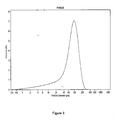
- the polymers were characterised in respect of their MFR values, bulk density (BD) and their particle size distribution (PSD).
Landscapes
- Chemical & Material Sciences (AREA)
- Health & Medical Sciences (AREA)
- Chemical Kinetics & Catalysis (AREA)
- Medicinal Chemistry (AREA)
- Polymers & Plastics (AREA)
- Organic Chemistry (AREA)
- Engineering & Computer Science (AREA)
- Materials Engineering (AREA)
- Transition And Organic Metals Composition Catalysts For Addition Polymerization (AREA)
- Organic Low-Molecular-Weight Compounds And Preparation Thereof (AREA)
Claims (14)
- Ein Verfahren um einen Katalysator für die Olefinpolymerisation herzustellen, was eine Katalysatorkomponente umfasst, die durch in Berührung bringen von mindestens: (a) einer Verbindung der Gruppe 1 bis 3 des Periodensystems (IUPAC), mit (b) einer Verbindung eines Übergangsmetalls der Gruppe 4 bis 10 des Periodensystems (IUPAC) oder einer Verbindung eines Aktinids oder eines Lanthanoids gebildet wird, in Form von festen Katalysatorpartikeln, wobei das besagte Verfahren umfasst:- Herstellen einer Lösung aus den Verbindungen;- Dispergieren besagter Lösung in einem Lösungsmittel, welches damit nicht mischbar ist und in Beziehung zu den besagten Verbindungen inert ist, um eine Emulsion zu erhalten, in welcher die besagte Lösung die disperse Phase in Form von dispergierten Tröpfchen im damit nicht mischbaren Lösungsmittel bildet;- Verfestigen der dispersen Tröpfchen zu festen Katalysatorpartikeln durch eine Änderung der Temperatur durch Erhitzen, wobei die Form der Tröpfchen im Wesentlichen beibehalten wird; und- Rückgewinnen der festen Katalysatorpartikel;wobei das inerte, nicht mischbare Lösungsmittel, welches die kontinuierliche Phase bildet, einen Perfluorkohlenwasserstoff oder eine Mischung davon, umfasst.
- Verfahren gemäß Anspruch 1, wobei (c) eine Lösung einer Verbindung von Metall aus Gruppe 13 des Periodensystems (IUPAC) zugegeben wird, bevor der Katalysatorbestandteil in den dispergierten Tröpfchen verfestigt wird.
- Ein Verfahren um einen Katalysator für die Olefinpolymerisation herzustellen, wie in Anspruch 1 beansprucht, wobei (a) eine Verbindung der Gruppe 1 bis 3 des Periodensystems (IUPAC) mit (b1) einer Chlor enthaltenden Übergangsmetallverbindung der Gruppe 4 bis 10 des Periodensystems (IUPAC) und (c1) einer Chlor enthaltenden Verbindung der Gruppe 13 des Periodensystems (IUPAC) in Berührung gebracht wird.
- Ein Verfahren gemäß der Ansprüche 1 bis 3, wobei ein inertes Lösungsmittel für die Herstellung von besagter Lösung verwendet wird, dieses Lösungsmittel wird aus einem linearen oder zyklischem Alkan oder Alken, oder einem aromatischen Kohlenwasserstoff, oder einer Mischung davon, ausgewählt.
- Ein Verfahren gemäß der Ansprüche 1 bis 4, wobei der besagte Perfluorkohlenwasserstoff aus Perfluoralkanen, -alkenen oder -cycloalkanen, vorzugsweise C3-C30 Perfluoralkanen, -alkenen oder -cycloalkanen, bevorzugter C4-C10 Perfluoralkanen, -alkenen oder -cycloalkanen, einschließlich Perfluorhexan, Perfluorheptan, Perfluoroctan. oder Perfluor(methylcyclohexan) oder einer Mischung davon, ausgewählt wird.
- Ein Verfahren gemäß der Ansprüche 1 bis 5, wobei die besagte Emulsion, die die besagte kontinuierliche Phase und die besagte disperse Phase aufweist, ein bi- oder multiphasisches System ist.
- Ein Verfahren gemäß Anspruch 3, wobei die besagte Änderung der Temperatur umfasst, die Emulsion einer graduellen Temperaturänderung von bis zu 10°C pro Minute auszusetzen, bevorzugt 0,5 bis 6 pro Minute und bevorzugter 1 bis 5 °C pro Minute.
- Ein Verfahren gemäß jedwedem der Ansprüche 3 bis 7, wobei die disperse Phase durch eine Lösung gebildet wird, die hergestellt wird, indem (a) eine Verbindung eines Metalls der Gruppe 2 des Periodensystems (IUPAC) mit (c) einer Verbindung eines Metalls der Gruppe 13 des Periodensystems (IUPAC) und mit (b) einer Verbindung eines Metalls der Gruppe 4 des Periodensystems (IUPAC), und optional weiteren Katalysator-bildenden Verbindungen in Kontakt gebracht wird.
- Ein Verfahren gemäß Anspruch 8, wobei die besagte Verbindung eines Metalls der Gruppe 2 des Periodensystems (IUPAC) eine Mg-Verbindung ist, die besagte Verbindung eines Metalls der Gruppe 13 des Periodensystems (IUPAC) eine Al-Verbindung ist und die besagte Verbindung eines Metalls der Gruppe 4 des Periodensystems (IUPAC) eine Ti-Verbindung ist.
- Ein Verfahren gemäß jedwedem der vorhergehenden Ansprüche wobei die besagte Verbindung (a) hergestellt wird, indem Mg(R2)2 mit einem Alkohol R1OH zur Reaktion gebracht wird, wobei R1 und jedes R2 unabhängig ein Kohlenwasserstoffradikal sind, das ausgewählt wird aus linearen oder verzweigten Alkylradikalen, die 1 bis 20 Kohlenstoffatome aufweisen, um eine Verbindung der Formel Mg(OR1)2-nR2 n zu erhalten, wobei O ≤ n < 2 und wobei R1 und R2 wie vorher definiert sind.
- Ein Verfahren gemäß Anspruch 10, wobei das besagte Mg(R2)2 Magnesiumbutyloctyl ist.
- Ein Verfahren gemäß Anspruch 10 oder 11, wobei das besagte R1OH ein verzweigter Alkohol ist, der 5 bis 10 Kohlenstoffatome hat, bevorzugt 2-Ethyl-hexanol.
- Ein Verfahren gemäß Anspruch 10, wobei der Katalysatorbestandteil gebildet wird, indem eine Magnesiumdialkyl-Verbindung, ein Alkohol und ein Alkylmagnesiumhalogenid und optional eine vierwertige Titanverbindung zur Reaktion gebracht werden, in den Tröpfchen, die in der besagten inerten kontinuierlichen Phase dispergiert sind.
- Ein Verfahren gemäß Anspruch 13, wobei der Katalysatorbestandteil gebildet wird, indem ein Magnesiumdialkyl mit einem Alkohol der Formel R1OH zur Reaktion gebracht wird, wobei R1 ein lineares oder verzweigtes C2-10 Alkyl ist, und zur erhaltenen Lösung Ethylaluminiumdichlorid, und optional anschließend Titantetrachlorid, zugegeben wird.
Priority Applications (1)
| Application Number | Priority Date | Filing Date | Title |
|---|---|---|---|
| EP02796672A EP1513884B1 (de) | 2002-06-18 | 2002-12-18 | Verfahren zur herstellung von olefinpolymerisationskatalysatoren |
Applications Claiming Priority (4)
| Application Number | Priority Date | Filing Date | Title |
|---|---|---|---|
| EP02013305 | 2002-06-18 | ||
| EP02013305A EP1375528A1 (de) | 2002-06-18 | 2002-06-18 | Verfahren zur Herstellung von Olefinpolymerisationskatalysatoren |
| EP02796672A EP1513884B1 (de) | 2002-06-18 | 2002-12-18 | Verfahren zur herstellung von olefinpolymerisationskatalysatoren |
| PCT/EP2002/014462 WO2003106510A1 (en) | 2002-06-18 | 2002-12-18 | Method for the preparation of olefin polymerisation catalysts |
Publications (2)
| Publication Number | Publication Date |
|---|---|
| EP1513884A1 EP1513884A1 (de) | 2005-03-16 |
| EP1513884B1 true EP1513884B1 (de) | 2013-02-13 |
Family
ID=29716776
Family Applications (2)
| Application Number | Title | Priority Date | Filing Date |
|---|---|---|---|
| EP02013305A Withdrawn EP1375528A1 (de) | 2002-06-18 | 2002-06-18 | Verfahren zur Herstellung von Olefinpolymerisationskatalysatoren |
| EP02796672A Expired - Lifetime EP1513884B1 (de) | 2002-06-18 | 2002-12-18 | Verfahren zur herstellung von olefinpolymerisationskatalysatoren |
Family Applications Before (1)
| Application Number | Title | Priority Date | Filing Date |
|---|---|---|---|
| EP02013305A Withdrawn EP1375528A1 (de) | 2002-06-18 | 2002-06-18 | Verfahren zur Herstellung von Olefinpolymerisationskatalysatoren |
Country Status (11)
| Country | Link |
|---|---|
| US (2) | US7238637B2 (de) |
| EP (2) | EP1375528A1 (de) |
| JP (1) | JP2005529997A (de) |
| KR (1) | KR100883441B1 (de) |
| CN (2) | CN100509871C (de) |
| AU (2) | AU2002361157A1 (de) |
| BR (1) | BR0215743A (de) |
| EA (1) | EA008860B1 (de) |
| TW (1) | TW200400204A (de) |
| WO (2) | WO2003106510A1 (de) |
| ZA (1) | ZA200410187B (de) |
Families Citing this family (83)
| Publication number | Priority date | Publication date | Assignee | Title |
|---|---|---|---|---|
| WO2004055068A1 (en) * | 2002-12-18 | 2004-07-01 | Borealis Technology Oy | Method for the preparation of olefin polymerisation catalyst support and an olefin polymerisation catalyst |
| DE60137638D1 (de) * | 2001-12-19 | 2009-03-26 | Borealis Tech Oy | Herstellung von geträgerten Katalysatoren für die Olefinpolymerisation |
| EP1375528A1 (de) | 2002-06-18 | 2004-01-02 | Borealis Polymers Oy | Verfahren zur Herstellung von Olefinpolymerisationskatalysatoren |
| GB0423555D0 (en) | 2004-10-22 | 2004-11-24 | Borealis Tech Oy | Process |
| US7610786B2 (en) * | 2004-12-21 | 2009-11-03 | Nissan Motor Co., Ltd. | Apparatus for forming microscopic recesses on a cylindrical bore surface and method of forming the microscopic recesses on the cylindrical bore surface by using the apparatus |
| KR101286307B1 (ko) * | 2004-12-31 | 2013-07-15 | 보레알리스 테크놀로지 오와이. | 공정 |
| ATE478921T1 (de) | 2005-10-21 | 2010-09-15 | Borealis Tech Oy | Zusammensetzung |
| WO2007048659A1 (en) | 2005-10-27 | 2007-05-03 | International Business Machines Corporation | System and method for dynamically managing badge access |
| EP1795542A1 (de) | 2005-12-07 | 2007-06-13 | Borealis Technology Oy | Polymer |
| EP1878755A1 (de) * | 2006-07-14 | 2008-01-16 | Borealis Technology Oy | Mit einem Liganden modifizierten Ziegler-Natta Katalysator und dessen Benutzung zur Polymerisation von Olefinen. |
| ATE480586T1 (de) | 2006-07-14 | 2010-09-15 | Borealis Tech Oy | Polyethylen hoher dichte |
| EP2011822A1 (de) | 2007-07-04 | 2009-01-07 | Borealis Technology Oy | Multimodale Polyethylen-Copolymer-Harz-Zusammensetzung, Herstellungsverfahren dafür und damit hergestelltes Polymerprodukt |
| DE602007011259D1 (de) | 2007-08-10 | 2011-01-27 | Borealis Tech Oy | Artikel der eine Polypropylenzusammensetzung beinhaltet |
| EP2030991A1 (de) * | 2007-08-31 | 2009-03-04 | Borealis Technology Oy | Festes vanadiumhaltiges Ziegler-Natta-Katalysatorsystem |
| EP2067799A1 (de) | 2007-12-05 | 2009-06-10 | Borealis Technology OY | Polymer |
| EP2077284B1 (de) | 2008-01-07 | 2011-11-30 | Borealis Technology Oy | Verwendung eines verbesserten Festkörper-Vanadium-haltigen Ziegler-Natta-Katalysatorensystems zur Herstellung von Ethylenpolymerzusammensetzungen in einem mehrstufigen Verfahren |
| EP2430054A4 (de) * | 2009-05-15 | 2014-02-12 | Grace W R & Co | Olefinpolymerisationsverfahren mit geringerer fäulnisbildung |
| PL2256158T3 (pl) | 2009-05-26 | 2014-09-30 | Borealis Ag | Kompozycja polimerowa do usieciowanych wyrobów |
| EP2256159A1 (de) | 2009-05-26 | 2010-12-01 | Borealis AG | Polymerzusammensetzung für vernetzte Rohre |
| EP2289950B1 (de) | 2009-08-25 | 2014-03-05 | Borealis AG | Verbesserte Ethylenpolymerisationskatalysatorzusammensetzung |
| PL2471077T5 (pl) | 2009-08-26 | 2023-11-27 | Borealis Ag | Kabel i kompozycja polimerowa |
| EP2330135B1 (de) | 2009-12-02 | 2012-11-07 | Borealis AG | Verfahren zur Herstellung von Polyolefinen |
| EP2330136B1 (de) * | 2009-12-07 | 2013-08-28 | Borealis AG | Verfahren zur Herstellung eines nicht geträgerten, festen Metallocenkatalysatorsystems und dessen Verwendung bei der Polymerisation von Olefinen |
| PL2354184T3 (pl) | 2010-01-29 | 2013-01-31 | Borealis Ag | Tłoczywo polietylenowe o ulepszonym stosunku odporność na pękanie /sztywność i ulepszone udarności |
| EP2354183B1 (de) | 2010-01-29 | 2012-08-22 | Borealis AG | Formungszusammensetzung |
| EP2399943A1 (de) * | 2010-06-28 | 2011-12-28 | Borealis AG | Verfahren zur Herstellung von Polyethylen |
| ES2430856T3 (es) | 2010-06-29 | 2013-11-22 | Borealis Ag | Composición de polietileno bimodal para artículos moldeados por inyección |
| EP2452920A1 (de) | 2010-11-12 | 2012-05-16 | Borealis AG | Verfahren zur Rückgewinnung von Übergangsmetalltetrahaliden und Kohlenwasserstoffen aus einem Abfallstrom |
| PT2495038T (pt) | 2011-03-02 | 2020-11-06 | Borealis Ag | Conjunto de reator flexível para polimerização de olefinas |
| ES2813282T3 (es) | 2011-03-02 | 2021-03-23 | Borealis Ag | Conjunto de reactor de alto rendimiento para la polimerización de olefinas |
| EP2578606B2 (de) | 2011-10-04 | 2019-08-28 | Borealis AG | Verfahren zur Herstellung von Polyolefinen, wobei ein Antioxidationsmittel während des Verfahrens dem Reaktionsgemisch zugeführt wird |
| ES2657137T5 (en) | 2012-03-28 | 2025-02-12 | Borealis Ag | Multimodal polymer |
| EP2831166B1 (de) | 2012-03-28 | 2017-12-27 | Borealis AG | Multimodales polymer |
| US9617357B2 (en) | 2012-07-02 | 2017-04-11 | Irpc Public Company Limited. | Catalyst for olefin polymerization and a method for the preparation thereof |
| US9382359B2 (en) | 2012-08-29 | 2016-07-05 | Borealis Ag | Reactor assembly and method for polymerization of olefins |
| CN103665207B (zh) * | 2012-09-10 | 2016-03-30 | 中国石油化工股份有限公司 | 一种用于乙烯聚合反应的催化剂组分及其催化剂 |
| RU2615153C2 (ru) | 2012-09-24 | 2017-04-04 | Индийская Нефтяная Корпорация Лимитэд | Катализатор для полимеризации олефинов и способ его получения |
| EP2740748B1 (de) | 2012-12-07 | 2015-06-10 | Borealis AG | Verfahren zur Polymerisierung von Olefinen in Suspensionsreaktoren |
| EP2745927A1 (de) | 2012-12-21 | 2014-06-25 | Borealis AG | Fließbettreaktor mit interner Wanderbettreaktionseinheit |
| EP2745926A1 (de) | 2012-12-21 | 2014-06-25 | Borealis AG | Gasphasenpolymerisation und Reaktoranordnung mit einem Fließbettreaktor und einem externen Wanderbettreaktor |
| EP2860203B1 (de) | 2013-10-10 | 2016-12-14 | Borealis AG | Mehrstufenverfahren zur herstellung von polyethylenzusammensetzungen |
| EP2883887A1 (de) | 2013-12-13 | 2015-06-17 | Borealis AG | Mehrstufenverfahren zur Herstellung von Polyethylenzusammensetzungen |
| EP2883885A1 (de) | 2013-12-13 | 2015-06-17 | Borealis AG | Mehrstufenverfahren zur Herstellung von Polyethylenzusammensetzungen |
| PL2907843T3 (pl) | 2014-02-13 | 2018-06-29 | Borealis Ag | Mieszanka polietylenu bimodalnego z polietylenem unimodalnym o bardzo dużej masie cząsteczkowej o lepszych własnościach mechanicznych |
| EP2907829B1 (de) | 2014-02-13 | 2020-08-19 | Borealis AG | Mit Ziegler-Natta-Katalysator hergestelltes, entwirrtes Polyethylen mit hohem oder ultrahohem Molekulargewicht |
| EP2913345B1 (de) | 2014-02-28 | 2016-11-02 | Borealis AG | Gasphasenpolymerisationsverfahren |
| EP2913346B1 (de) | 2014-02-28 | 2016-11-02 | Borealis AG | Verfahren zur Polymerisation von Olefinen in einem Fließbett |
| EP2995631A1 (de) | 2014-09-12 | 2016-03-16 | Borealis AG | Verfahren zur Herstellung von Pfropfcopolymeren auf einem Polyolefinrückgrat |
| BR112017006060B1 (pt) | 2014-09-30 | 2021-09-08 | Borealis Ag | Processo para a polimerização de etileno na presença de um catalisador de polimerização de olefinas |
| US9714302B2 (en) | 2014-10-10 | 2017-07-25 | W. R. Grace & Co.—Conn. | Process for preparing spherical polymerization catalyst components for use in olefin polymerizations |
| CN108137830B (zh) | 2015-06-10 | 2021-02-26 | 博里利斯股份公司 | 多峰聚乙烯共聚物 |
| ES2743481T3 (es) | 2015-06-10 | 2020-02-19 | Borealis Ag | Copolímero multimodal de etileno y al menos dos comonómeros de alfa-olefina y artículos finales hechos del mismo |
| ES2673428T3 (es) | 2015-06-12 | 2018-06-21 | Borealis Ag | Procedimiento y aparato para la polimerización de olefinas en fase gaseosa |
| EP3178853B1 (de) | 2015-12-07 | 2018-07-25 | Borealis AG | Verfahren zur polymerisierung von alpha-olefin-monomeren |
| EP3184167B8 (de) | 2015-12-22 | 2022-03-30 | Borealis AG | Verfahren zur rückführung von polymer zu einem fliessbettreaktor |
| EP3184166A1 (de) | 2015-12-22 | 2017-06-28 | Borealis AG | Verfahren zum entnehmen von agglomeraten aus einem fliessbettreaktor |
| EP3238938A1 (de) | 2016-04-29 | 2017-11-01 | Borealis AG | Maschinenlaufrichtungorientierte folie enthaltend multimodal ethylen-copolymer und mindestens zwei alpha-olefin comonomeren |
| EP3241611B1 (de) | 2016-05-02 | 2020-03-04 | Borealis AG | Verfahren zum zuführen eines polymerisations-katalysators |
| EP3418308B1 (de) | 2017-06-20 | 2020-03-11 | Borealis AG | Verfahren, anordnung und verwendung einer anordnung zur olefinpolymerisation |
| EP3418309A1 (de) | 2017-06-20 | 2018-12-26 | Borealis AG | Verfahren, anordnung und verwendung einer anordnung zur herstellung von polymer |
| ES2786567T3 (es) | 2017-06-23 | 2020-10-13 | Borealis Ag | Procedimiento y aparato para la retirada de material polimérico de un reactor de polimerización de olefinas con gases y sólido |
| EP3479896A1 (de) | 2017-11-03 | 2019-05-08 | Borealis AG | Polymerisationsreaktorsystem mit mindestens einer enthnahmeventil |
| EP3483189A1 (de) | 2017-11-14 | 2019-05-15 | Borealis AG | Automatisiertes verfahren zur beendigung einer olefinpolymerisierungsreaktion unter notbedingungen |
| EP3486260B1 (de) | 2017-11-17 | 2020-04-01 | Borealis AG | Verfahren zur spaltung des rücklauffluidisierungsgases in einem gas-feststoff-olefin-polymerisationsreaktor |
| ES2806646T3 (es) | 2017-11-17 | 2021-02-18 | Borealis Ag | Procedimiento para mejorar la capacidad de enfriamiento de un reactor de polimerización de olefinas de gas-sólidos |
| EP3802636B1 (de) | 2018-05-30 | 2023-07-05 | Borealis AG | Verfahren zur herstellung von multimodalem high density polyethylen. |
| KR102498543B1 (ko) | 2018-06-14 | 2023-02-09 | 보레알리스 아게 | 개선된 열 균질성을 갖는 기체상 반응기에서 올레핀의 중합 방법 |
| KR20210033017A (ko) | 2018-07-19 | 2021-03-25 | 보레알리스 아게 | 초고분자량 폴리에틸렌 동종중합체의 제조 방법 |
| WO2020025757A1 (en) | 2018-08-02 | 2020-02-06 | Borealis Ag | Process for polymerizing ethylene in a multi-stage polymerization process |
| KR102723897B1 (ko) | 2019-06-04 | 2024-11-01 | 보레알리스 아게 | 폴리올레핀의 생산 방법 및 폴리올레핀 생산을 위한 다단계 반응기 어셈블리 |
| US20220177616A1 (en) | 2019-06-04 | 2022-06-09 | Borealis Ag | Process and reactor assembly for the enhancement of hydrodynamics in a gas-solids fluidized bed reactor |
| KR102670190B1 (ko) | 2019-06-24 | 2024-05-28 | 보레알리스 아게 | 회수율이 개선된 폴리프로필렌의 제조 공정 |
| WO2021064080A1 (en) | 2019-10-04 | 2021-04-08 | Borealis Ag | Ziegler-natta catalysts for olefin polymerization |
| US12398225B2 (en) | 2019-10-04 | 2025-08-26 | Borealis Ag | Ziegler-Natta catalysts for olefin polymerization |
| CN114585654B (zh) | 2019-10-04 | 2023-11-07 | 北欧化工公司 | 用于烯烃聚合的齐格勒-纳塔催化剂 |
| US12338311B2 (en) | 2019-10-04 | 2025-06-24 | Borealis Ag | Ziegler-Natta catalysts for olefin polymerization |
| EP3838984A1 (de) | 2019-12-20 | 2021-06-23 | Borealis AG | Polymerzusammensetzung und -artikel |
| PL3868793T3 (pl) | 2020-02-24 | 2026-04-20 | Borealis Gmbh | Sposób produkcji polimerów alfa-olefinowych w procesie polimeryzacji wieloetapowej |
| EP4144435A1 (de) | 2021-09-01 | 2023-03-08 | Borealis AG | Gasphasenpolymerisationsverfahren mit verbesserter gasrückführung |
| KR102867179B1 (ko) | 2022-07-04 | 2025-10-01 | 에스케이이노베이션 주식회사 | 저밀도 공중합체 중합용 지글러-나타 촉매의 제조방법 |
| WO2025219499A1 (en) | 2024-04-18 | 2025-10-23 | Borealis Gmbh | Processes for polymerising olefins |
| WO2025262147A1 (en) | 2024-06-19 | 2025-12-26 | Borealis Gmbh | Processes for polymerising olefins |
| WO2026002813A1 (en) | 2024-06-24 | 2026-01-02 | Borealis Gmbh | Processes for polymerising olefins |
Family Cites Families (27)
| Publication number | Priority date | Publication date | Assignee | Title |
|---|---|---|---|---|
| IT1098272B (it) * | 1978-08-22 | 1985-09-07 | Montedison Spa | Componenti,di catalizzatori e catalizzatori per la polimerizzazione delle alfa-olefine |
| IT1169292B (it) | 1981-12-24 | 1987-05-27 | Montedison Spa | Componenti di catalizzatori per la polimerizzazione delle alfa olefine e i catalizzatori da essi ottenuti |
| IT1169291B (it) * | 1981-12-24 | 1987-05-27 | Montedison Spa | Componenti di catalizzatori per la polimerizzazione dell'etilene e sue miscele con olefine ed i soui catalizzatori da essi ottenuti |
| US4540679A (en) | 1984-03-23 | 1985-09-10 | Amoco Corporation | Magnesium hydrocarbyl carbonate supports |
| CA1293242C (en) | 1986-06-17 | 1991-12-17 | Gregory Gerasimos Arzoumanidis | Olefin polymerization catalyst |
| EP0258089B1 (de) * | 1986-07-31 | 1990-10-24 | Montedison S.p.A. | Verfahren zur Herstellung mikrospheroidaler fester Katalysatorbestandteile oder ihrer Vorläufer und ihre Anwendung bei der Herstellung von Äthylenpolymeren |
| DE3765351D1 (de) * | 1986-07-31 | 1990-11-08 | Montedison Spa | Verfahren zur polymerisierung von alpha-olefinen oder ihrer mischungen mit aethylen unter anwendung eines mikrosphaeroidalen, teilchenfoermigen, festen katalysatorbestandteils oder eines deren vorlaeufer enthaltenden katalysators. |
| IT1213474B (it) | 1986-07-31 | 1989-12-20 | Montedison Spa | Procedimento per preparare componenti solidi di catalizzatori, o precursori di tali componenti, in forma di particellmicrosferoidali per la polimerizzazione delle alfa-olefine. |
| DE3634915A1 (de) | 1986-10-14 | 1988-04-28 | Basf Ag | Verfahren zum herstellen von homo- und copolymerisaten des ethylens mittels eines ziegler-katalysatorsystems |
| FR2654431B1 (fr) | 1989-11-16 | 1993-07-23 | Atochem | Support de catalyseur pour la polymerisation des olefines - procede de fabrication du support et catalyseur obtenu a partir de ce support. |
| FR2658498B1 (fr) | 1990-02-19 | 1992-05-15 | Atochem | Particules de chlorure de magnesium a structure tronc conique, composante catalytique supportee sur ces particules, polyolefines obtenues a partir de cette composante catalytique, procedes de fabrication de ces produits. |
| IT1251679B (it) | 1991-10-09 | 1995-05-19 | Enichem Polimeri | Catalizzatori per la polimerizzazione delle olefine |
| JPH0649119A (ja) | 1992-07-30 | 1994-02-22 | Tonen Corp | オレフィン重合用触媒成分の製造方法 |
| JP3471099B2 (ja) | 1994-11-25 | 2003-11-25 | 昭和電工株式会社 | オレフィン重合用触媒担体の製造方法 |
| US5955396A (en) | 1995-10-17 | 1999-09-21 | Bp Amoco Corporation | Morphology-controlled olefin polymerization catalyst formed from an emulsion |
| DE19545444A1 (de) | 1995-12-06 | 1997-06-12 | Du Pont | Alkoxide mit Erdalkalien und Titan, Zirkon und/oder Hafnium, deren Herstellung und Verwendung |
| DE69821710T2 (de) | 1997-03-29 | 2005-01-13 | Basell Poliolefine Italia S.P.A. | Magnesiumdihalogenid/alkohol addukte, verfahren zu ihrer herstellung und damit hergestellte katalysatorbestandteile |
| EP0926165B1 (de) | 1997-12-23 | 2002-02-27 | Borealis Technology Oy | Magnesium, Titanium, Halogen und Elektronendonor-enthaltendes Kalalysatorkomponent, seine Herstellung und Verwendung |
| JP3539873B2 (ja) | 1998-07-29 | 2004-07-07 | 出光石油化学株式会社 | エチレン系重合体製造用触媒及び該触媒を用いるエチレン系重合体の製造方法 |
| FI981718L (fi) | 1998-08-07 | 2000-02-08 | Borealis As | Katalysaattorikomponentti, joka käsittää magnesiumia, titaania, halogeenia ja elektrodonorin, sen valmistus ja käyttö |
| FI981717L (fi) | 1998-08-07 | 2000-02-08 | Borealis As | Katalysaattorikomponentti, joka käsittää magnesiumia, titaania, halogeenia ja elektronidonorin, sen valmistus ja käyttö |
| KR100705475B1 (ko) | 1998-12-30 | 2007-12-20 | 삼성토탈 주식회사 | 올레핀 중합 및 공중합용 촉매 |
| DE10003872A1 (de) | 1999-11-26 | 2001-08-16 | Basell Polyolefine Gmbh | Verfahren zum Herstellen eines Poly-l-olefins in Gegenwart eines Ziegler Katalysators |
| GB0001914D0 (en) | 2000-01-27 | 2000-03-22 | Borealis Polymers Oy | Catalyst |
| CN1129617C (zh) | 2000-07-19 | 2003-12-03 | 杨明生 | 气相流化床法线性聚乙烯催化剂及其制备方法 |
| ATE328912T1 (de) * | 2001-06-20 | 2006-06-15 | Borealis Tech Oy | Herstellung eines katalysatorbestandteils zur olefinpolymerisation |
| EP1375528A1 (de) | 2002-06-18 | 2004-01-02 | Borealis Polymers Oy | Verfahren zur Herstellung von Olefinpolymerisationskatalysatoren |
-
2002
- 2002-06-18 EP EP02013305A patent/EP1375528A1/de not_active Withdrawn
- 2002-12-18 AU AU2002361157A patent/AU2002361157A1/en not_active Abandoned
- 2002-12-18 EP EP02796672A patent/EP1513884B1/de not_active Expired - Lifetime
- 2002-12-18 US US10/515,997 patent/US7238637B2/en not_active Expired - Fee Related
- 2002-12-18 WO PCT/EP2002/014462 patent/WO2003106510A1/en not_active Ceased
- 2002-12-18 KR KR1020047019103A patent/KR100883441B1/ko not_active Expired - Fee Related
- 2002-12-18 EA EA200401474A patent/EA008860B1/ru not_active IP Right Cessation
- 2002-12-18 CN CNB028291468A patent/CN100509871C/zh not_active Expired - Fee Related
- 2002-12-18 CN CN2008101087327A patent/CN101298484B/zh not_active Expired - Fee Related
- 2002-12-18 BR BR0215743-8A patent/BR0215743A/pt not_active IP Right Cessation
- 2002-12-18 JP JP2004513340A patent/JP2005529997A/ja active Pending
- 2002-12-19 TW TW091136609A patent/TW200400204A/zh unknown
-
2003
- 2003-06-18 WO PCT/EP2003/006524 patent/WO2003106508A1/en not_active Ceased
- 2003-06-18 AU AU2003245977A patent/AU2003245977A1/en not_active Abandoned
-
2004
- 2004-12-17 ZA ZA200410187A patent/ZA200410187B/en unknown
-
2007
- 2007-06-06 US US11/759,086 patent/US7608555B2/en not_active Expired - Fee Related
Also Published As
| Publication number | Publication date |
|---|---|
| EA200401474A1 (ru) | 2005-06-30 |
| JP2005529997A (ja) | 2005-10-06 |
| WO2003106510A1 (en) | 2003-12-24 |
| US7608555B2 (en) | 2009-10-27 |
| EA008860B1 (ru) | 2007-08-31 |
| AU2003245977A1 (en) | 2003-12-31 |
| AU2002361157A1 (en) | 2003-12-31 |
| EP1375528A1 (de) | 2004-01-02 |
| CN100509871C (zh) | 2009-07-08 |
| KR100883441B1 (ko) | 2009-02-11 |
| ZA200410187B (en) | 2005-09-06 |
| CN1628133A (zh) | 2005-06-15 |
| BR0215743A (pt) | 2005-03-22 |
| EP1513884A1 (de) | 2005-03-16 |
| US7238637B2 (en) | 2007-07-03 |
| WO2003106508A1 (en) | 2003-12-24 |
| CN101298484B (zh) | 2012-03-21 |
| CN101298484A (zh) | 2008-11-05 |
| KR20050009717A (ko) | 2005-01-25 |
| US20060111523A1 (en) | 2006-05-25 |
| US20070249489A1 (en) | 2007-10-25 |
| TW200400204A (en) | 2004-01-01 |
Similar Documents
| Publication | Publication Date | Title |
|---|---|---|
| US7238637B2 (en) | Method for the preparation of olefin polymerization catalysts | |
| EP1397395B1 (de) | Katalysator für die olefinpolymerisation und verfahren zu seiner herstellung | |
| EP1572760B1 (de) | Verfahren zur herstellung von einem katalysatorträger und katalysator zur olefinpolymerisation | |
| KR100199686B1 (ko) | 기체상 올레핀 중합법 | |
| AU2002325838A1 (en) | Olefin polymerisation catalyst and methods for preparing the same | |
| US9068025B2 (en) | Catalyst component for polymerization of olefin and preparation method | |
| AU2004293404B2 (en) | Spray-dried, mixed metal Ziegler catalyst compositions | |
| US7998894B2 (en) | Ligand modified Ziegler-Natta catalyst for olefin (co-)polymerization | |
| KR20010095059A (ko) | 올레핀의 기상 중합용 예비중합 촉매 및 이의 제조 방법 방법 | |
| EP2838922B1 (de) | Katalysator für die polymerisation von olefinen, verfahren zu deren herstellung und verwendung | |
| CN102209732B (zh) | 无载体的固体烯烃聚合催化剂的制备方法以及在烯烃聚合中的用途 | |
| EP2030991A1 (de) | Festes vanadiumhaltiges Ziegler-Natta-Katalysatorsystem | |
| EP4638513A1 (de) | Verfahren | |
| EP2077284A1 (de) | Verwendung eines verbesserten Festkörper-Vanadium-haltigen Ziegler-Natta-Katalysatorensystems zur Herstellung von Ethylenpolymerzusammensetzungen in einem mehrstufigen Verfahren |
Legal Events
| Date | Code | Title | Description |
|---|---|---|---|
| PUAI | Public reference made under article 153(3) epc to a published international application that has entered the european phase |
Free format text: ORIGINAL CODE: 0009012 |
|
| 17P | Request for examination filed |
Effective date: 20041122 |
|
| AK | Designated contracting states |
Kind code of ref document: A1 Designated state(s): AT BE BG CH CY CZ DE DK EE ES FI FR GB GR IE IT LI LU MC NL PT SE SI SK TR |
|
| AX | Request for extension of the european patent |
Extension state: AL LT LV MK RO |
|
| RIN1 | Information on inventor provided before grant (corrected) |
Inventor name: PESONEN, KARI Inventor name: LAINE, TIMO, V. Inventor name: WALDVOGEL, PAEIVI Inventor name: GAROFF, THOMAS Inventor name: LINDROOS, JARMO Inventor name: DENIFL, PETER |
|
| DAX | Request for extension of the european patent (deleted) | ||
| RAP1 | Party data changed (applicant data changed or rights of an application transferred) |
Owner name: BOREALIS TECHNOLOGY OY |
|
| GRAP | Despatch of communication of intention to grant a patent |
Free format text: ORIGINAL CODE: EPIDOSNIGR1 |
|
| GRAS | Grant fee paid |
Free format text: ORIGINAL CODE: EPIDOSNIGR3 |
|
| GRAA | (expected) grant |
Free format text: ORIGINAL CODE: 0009210 |
|
| AK | Designated contracting states |
Kind code of ref document: B1 Designated state(s): AT BE BG CH CY CZ DE DK EE ES FI FR GB GR IE IT LI LU MC NL PT SE SI SK TR |
|
| REG | Reference to a national code |
Ref country code: GB Ref legal event code: FG4D |
|
| REG | Reference to a national code |
Ref country code: AT Ref legal event code: REF Ref document number: 596458 Country of ref document: AT Kind code of ref document: T Effective date: 20130215 |
|
| REG | Reference to a national code |
Ref country code: IE Ref legal event code: FG4D |
|
| REG | Reference to a national code |
Ref country code: DE Ref legal event code: R096 Ref document number: 60244512 Country of ref document: DE Effective date: 20130411 |
|
| REG | Reference to a national code |
Ref country code: AT Ref legal event code: MK05 Ref document number: 596458 Country of ref document: AT Kind code of ref document: T Effective date: 20130213 |
|
| REG | Reference to a national code |
Ref country code: NL Ref legal event code: VDEP Effective date: 20130213 |
|
| PG25 | Lapsed in a contracting state [announced via postgrant information from national office to epo] |
Ref country code: CY Free format text: LAPSE BECAUSE OF FAILURE TO SUBMIT A TRANSLATION OF THE DESCRIPTION OR TO PAY THE FEE WITHIN THE PRESCRIBED TIME-LIMIT Effective date: 20130213 Ref country code: SE Free format text: LAPSE BECAUSE OF FAILURE TO SUBMIT A TRANSLATION OF THE DESCRIPTION OR TO PAY THE FEE WITHIN THE PRESCRIBED TIME-LIMIT Effective date: 20130213 Ref country code: AT Free format text: LAPSE BECAUSE OF FAILURE TO SUBMIT A TRANSLATION OF THE DESCRIPTION OR TO PAY THE FEE WITHIN THE PRESCRIBED TIME-LIMIT Effective date: 20130213 Ref country code: BG Free format text: LAPSE BECAUSE OF FAILURE TO SUBMIT A TRANSLATION OF THE DESCRIPTION OR TO PAY THE FEE WITHIN THE PRESCRIBED TIME-LIMIT Effective date: 20130513 Ref country code: ES Free format text: LAPSE BECAUSE OF FAILURE TO SUBMIT A TRANSLATION OF THE DESCRIPTION OR TO PAY THE FEE WITHIN THE PRESCRIBED TIME-LIMIT Effective date: 20130524 |
|
| PG25 | Lapsed in a contracting state [announced via postgrant information from national office to epo] |
Ref country code: FI Free format text: LAPSE BECAUSE OF FAILURE TO SUBMIT A TRANSLATION OF THE DESCRIPTION OR TO PAY THE FEE WITHIN THE PRESCRIBED TIME-LIMIT Effective date: 20130213 Ref country code: PT Free format text: LAPSE BECAUSE OF FAILURE TO SUBMIT A TRANSLATION OF THE DESCRIPTION OR TO PAY THE FEE WITHIN THE PRESCRIBED TIME-LIMIT Effective date: 20130613 Ref country code: BE Free format text: LAPSE BECAUSE OF FAILURE TO SUBMIT A TRANSLATION OF THE DESCRIPTION OR TO PAY THE FEE WITHIN THE PRESCRIBED TIME-LIMIT Effective date: 20130213 Ref country code: GR Free format text: LAPSE BECAUSE OF FAILURE TO SUBMIT A TRANSLATION OF THE DESCRIPTION OR TO PAY THE FEE WITHIN THE PRESCRIBED TIME-LIMIT Effective date: 20130514 Ref country code: SI Free format text: LAPSE BECAUSE OF FAILURE TO SUBMIT A TRANSLATION OF THE DESCRIPTION OR TO PAY THE FEE WITHIN THE PRESCRIBED TIME-LIMIT Effective date: 20130213 |
|
| PG25 | Lapsed in a contracting state [announced via postgrant information from national office to epo] |
Ref country code: SK Free format text: LAPSE BECAUSE OF FAILURE TO SUBMIT A TRANSLATION OF THE DESCRIPTION OR TO PAY THE FEE WITHIN THE PRESCRIBED TIME-LIMIT Effective date: 20130213 Ref country code: EE Free format text: LAPSE BECAUSE OF FAILURE TO SUBMIT A TRANSLATION OF THE DESCRIPTION OR TO PAY THE FEE WITHIN THE PRESCRIBED TIME-LIMIT Effective date: 20130213 Ref country code: DK Free format text: LAPSE BECAUSE OF FAILURE TO SUBMIT A TRANSLATION OF THE DESCRIPTION OR TO PAY THE FEE WITHIN THE PRESCRIBED TIME-LIMIT Effective date: 20130213 Ref country code: CZ Free format text: LAPSE BECAUSE OF FAILURE TO SUBMIT A TRANSLATION OF THE DESCRIPTION OR TO PAY THE FEE WITHIN THE PRESCRIBED TIME-LIMIT Effective date: 20130213 Ref country code: NL Free format text: LAPSE BECAUSE OF FAILURE TO SUBMIT A TRANSLATION OF THE DESCRIPTION OR TO PAY THE FEE WITHIN THE PRESCRIBED TIME-LIMIT Effective date: 20130213 |
|
| PLBE | No opposition filed within time limit |
Free format text: ORIGINAL CODE: 0009261 |
|
| STAA | Information on the status of an ep patent application or granted ep patent |
Free format text: STATUS: NO OPPOSITION FILED WITHIN TIME LIMIT |
|
| PG25 | Lapsed in a contracting state [announced via postgrant information from national office to epo] |
Ref country code: IT Free format text: LAPSE BECAUSE OF FAILURE TO SUBMIT A TRANSLATION OF THE DESCRIPTION OR TO PAY THE FEE WITHIN THE PRESCRIBED TIME-LIMIT Effective date: 20130213 |
|
| 26N | No opposition filed |
Effective date: 20131114 |
|
| REG | Reference to a national code |
Ref country code: DE Ref legal event code: R097 Ref document number: 60244512 Country of ref document: DE Effective date: 20131114 |
|
| REG | Reference to a national code |
Ref country code: DE Ref legal event code: R119 Ref document number: 60244512 Country of ref document: DE |
|
| REG | Reference to a national code |
Ref country code: CH Ref legal event code: PL |
|
| GBPC | Gb: european patent ceased through non-payment of renewal fee |
Effective date: 20131218 |
|
| PG25 | Lapsed in a contracting state [announced via postgrant information from national office to epo] |
Ref country code: LU Free format text: LAPSE BECAUSE OF FAILURE TO SUBMIT A TRANSLATION OF THE DESCRIPTION OR TO PAY THE FEE WITHIN THE PRESCRIBED TIME-LIMIT Effective date: 20131218 Ref country code: MC Free format text: LAPSE BECAUSE OF FAILURE TO SUBMIT A TRANSLATION OF THE DESCRIPTION OR TO PAY THE FEE WITHIN THE PRESCRIBED TIME-LIMIT Effective date: 20130213 |
|
| REG | Reference to a national code |
Ref country code: IE Ref legal event code: MM4A |
|
| REG | Reference to a national code |
Ref country code: FR Ref legal event code: ST Effective date: 20140829 |
|
| REG | Reference to a national code |
Ref country code: DE Ref legal event code: R119 Ref document number: 60244512 Country of ref document: DE Effective date: 20140701 |
|
| PG25 | Lapsed in a contracting state [announced via postgrant information from national office to epo] |
Ref country code: CH Free format text: LAPSE BECAUSE OF NON-PAYMENT OF DUE FEES Effective date: 20131231 Ref country code: DE Free format text: LAPSE BECAUSE OF NON-PAYMENT OF DUE FEES Effective date: 20140701 Ref country code: LI Free format text: LAPSE BECAUSE OF NON-PAYMENT OF DUE FEES Effective date: 20131231 Ref country code: IE Free format text: LAPSE BECAUSE OF NON-PAYMENT OF DUE FEES Effective date: 20131218 |
|
| PG25 | Lapsed in a contracting state [announced via postgrant information from national office to epo] |
Ref country code: GB Free format text: LAPSE BECAUSE OF NON-PAYMENT OF DUE FEES Effective date: 20131218 Ref country code: FR Free format text: LAPSE BECAUSE OF NON-PAYMENT OF DUE FEES Effective date: 20131231 |
|
| PG25 | Lapsed in a contracting state [announced via postgrant information from national office to epo] |
Ref country code: TR Free format text: LAPSE BECAUSE OF FAILURE TO SUBMIT A TRANSLATION OF THE DESCRIPTION OR TO PAY THE FEE WITHIN THE PRESCRIBED TIME-LIMIT Effective date: 20130213 |