EP1510187A2 - Verfahren zur Herstellung eines dentalen Restaurationsteils - Google Patents
Verfahren zur Herstellung eines dentalen Restaurationsteils Download PDFInfo
- Publication number
- EP1510187A2 EP1510187A2 EP04015714A EP04015714A EP1510187A2 EP 1510187 A2 EP1510187 A2 EP 1510187A2 EP 04015714 A EP04015714 A EP 04015714A EP 04015714 A EP04015714 A EP 04015714A EP 1510187 A2 EP1510187 A2 EP 1510187A2
- Authority
- EP
- European Patent Office
- Prior art keywords
- heat protection
- heat
- framework
- veneer
- protection paste
- Prior art date
- Legal status (The legal status is an assumption and is not a legal conclusion. Google has not performed a legal analysis and makes no representation as to the accuracy of the status listed.)
- Granted
Links
Images

Classifications
-
- A—HUMAN NECESSITIES
- A61—MEDICAL OR VETERINARY SCIENCE; HYGIENE
- A61C—DENTISTRY; APPARATUS OR METHODS FOR ORAL OR DENTAL HYGIENE
- A61C13/00—Dental prostheses; Making same
- A61C13/0003—Making bridge-work, inlays, implants or the like
Definitions
- the invention relates to a method for producing a dental restoration parts, according to the preamble of claim 1.
- Veneering plastics are regularly exposed to light or heat or cured by combination of light and heat. This conditionally a temperature increase. Problem with the metal framework adjacent veneering plastics is then the metal between and plastic different thermal expansion coefficient. While during warming, ie at a positive temperature gradient, the veneer plastic is still soft on a regular basis, is it hardens on cooling, so that tensions arise after plastic contracts more when cooled than Metal.
- the whole is suffering as well Strength of the veneering plastic, so there is a risk that parts detach.
- the voltage discharge arises even on the thinnest parts of the restoration, for example, interdental.
- the invention is based on the object, a method for producing a dental restoration part according to the preamble of claim 1, which provides improved long term stability without hygienic and strength problems in two-layered Dental restoration parts offers.
- the solution according to the invention provides for providing at least the most important parts, that is to say in particular the protruding parts of the exposed metal framework, with heat protection paste.
- the heat protection paste forms a thermal insulation for the particularly good heat-conducting metallic areas. When heated by convection or by radiant heat, as provided regularly, resulting from the use of thermal insulation paste that the metal framework is heated less than the veneering resin.
- the temperature difference can be, for example, quite 40 ° C, depending on which area of the Verblendbuchs is measured. This measure ensures that the stresses at the interface are less plastic.
- titanium has a linear thermal expansion coefficient of 8.35 x 10 -6 per degree. In contrast, many plastics have linear thermal expansion coefficients of 50 to 100 x 10 -6 per degree.
- the heat protection paste can advantageously about 60% water, about 20% Diethylene glycol and about 1% high temperature resistant fibers, and suitable heat-resistant fillers.
- the strength of the heat protection paste in many areas to the requirements ie the required lowering of the temperature level for provision a stress-free hardening, can be adjusted. If a maximum temperature of 70 ° C instead of a maximum temperature of 110 ° C for the surface of the metal framework is, a material thickness of 2 mm when used commercially Heat protection pastes sufficient.
- the metal it is particularly favorable according to the invention for the metal to be comparatively has high heat capacity.
- the heating phase the for example, may be 10 minutes, that heats up Metal scaffolding though by the ambient air, even if it is with Heat protection paste is covered. Due to the thermal insulation by the Thermal insulation paste, however, the heating is less strong, so that the peak temperature is still near the end of the heating phase for example, 30 ° C below the temperature of the ambient air lies.
- the heat protection paste ensures that the entire restoration part, or areas of the restoration part, do not cool down so quickly.
- This long-term cooling is currently carried out with the kiln.
- the restoration part remains in the kiln, and the temperature in the combustion chamber is shut down timed. This long-term cooling takes about 15 minutes, which one saves themselves with the use of the heat protection paste can.
- the dental restoration part consisted of a metal framework and a veneering plastic that partially covers the metal framework.
- the veneering polymer was a denatl polymer based used on polymethyl methacrylate.
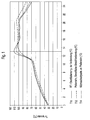
- a light phase I which is shown in Fig. 1, the Dental restoration part subjected to light beaming.
- the surface temperature T10 of the veneer ie the ambient temperature measured, as well as the temperature T12 at one Abutment tooth, at the interface metal / veneer.
- T10 is normally the room temperature, otherwise the Operating temperature of the oven with the lid open.
- a similar dental restoration part has now been incorporated in provided according to the invention with a heat protection paste.
- the thermal protection paste SR Adoro ThermoGuard was used Fa. Ivoclar Vivadent AG.
- the following table shows the temperature profile, with the same designations being selected here as in FIG. 1: measuring point Light phase I Heating phase II Heating phase III Cooling phase IV T10 60 ° C 109 ° C 96 ° C 67 ° C T12 50 ° C 82 ° C 85 ° C 68 ° C T14 42 ° C 59 ° C 66 ° C 57 ° C
- T14 ie the temperature of the Metal framework, which is covered by the thermal insulation paste, significantly under the temperature in the embodiment according to Fig. 1.
Landscapes
- Health & Medical Sciences (AREA)
- Oral & Maxillofacial Surgery (AREA)
- Dentistry (AREA)
- Epidemiology (AREA)
- Life Sciences & Earth Sciences (AREA)
- Animal Behavior & Ethology (AREA)
- General Health & Medical Sciences (AREA)
- Public Health (AREA)
- Veterinary Medicine (AREA)
- Dental Preparations (AREA)
- Dental Tools And Instruments Or Auxiliary Dental Instruments (AREA)
- Dental Prosthetics (AREA)
Abstract
Description
- Fig. 1
- der Temperaturverlauf an einer viergliedrigen Brücke ohne die Verwendung einer erfindungsgemäßen Wärmeschutzpaste; und
- Fig. 2
- der Temperaturverlauf gemäß Fig. 1, jedoch unter Verwendung der Wärmeschutzpaste.
| T10 | 34°C |
| T12 | 32°C |
| T14 | 32°C |
| Meßpunkt | Lichtphase I | Aufheizphase II | Heizphase III | Abkühlphase IV |
| T10 | 68°C | 112°C | 98°C | 70°C |
| T12 | 67°C | 97°C | 107°C | 86°C |
| T14 | 68°C | 105°C | 101°C | 74°C |
| Meßpunkt | Lichtphase I | Aufheizphase II | Heizphase III | Abkühlphase IV |
| T10 | 60°C | 109°C | 96°C | 67°C |
| T12 | 50°C | 82°C | 85°C | 68°C |
| T14 | 42°C | 59°C | 66°C | 57°C |
Claims (22)
- Verfahren zur Herstellung eines dentalen Restaurationsteils mit einem Gerüst und einer Verblendung, wobei der Wärmeausdehnungskoeffizient des Materials der Verblendung grösser ist als der Wärmeausdehnungskoeffizient des Gerüstmaterials, dadurch gekennzeichnet, dass vor einer thermischen Behandlung des Restaurationsteils mindestens der größte Teil des freiliegenden Bereichs, insbesondere der gesamte freiliegende Bereich des Gerüstes, mit einer Wärmeschutzpaste abgedeckt wird.
- Verfahren zur Herstellung eines dentalen Restaurationsteils mit einem Gerüst und einer Verblendung, wobei der Wärmeausdehnungskoeffizient des Materials der Verblendung kleiner ist als der Wärmeausdehnungskoeffizient des Gerüstmaterials, dadurch gekennzeichnet, dass vor einer thermischen Behandlung des Restaurationsteils mindestens der größte Teil des freiliegenden Bereichs, insbesondere der gesamte freiliegende Bereich des Gerüsts, mit einer Wärmeschutzpaste abgedeckt wird.
- Verfahren nach Anspruch 1, dadurch gekennzeichnet, dass bei der thermischen Behandlung das Restaurationsteil zur Aushärtung des Verblendungsmaterials erwärmt und hieran anschließend abgekühlt wird und dass die Erwärmung über Strahlungwärme oder Konvektionwärme erfolgt.
- Verfahren nach einem der vorhergehenden Ansprüche, dadurch gekennzeichnet, dass die Erwärmung des Restaurationsteils von außerhalb des Restaurationsteils erfolgt.
- Verfahren nach einem der vorhergehenden Ansprüche, dadurch gekennzeichnet, dass die Verblendung und die Wärmeschutzpaste zusammen das Gerüst abdecken und umhüllen.
- Verfahren nach einem der vorhergehenden Ansprüche, dadurch gekennzeichnet, dass das Material der Verblendung ein dual druck-hitze-, ein wärme- und/oder ein lichthärtbarer Kunststoff ist.
- Verfahren nach einem der vorhergehenden Ansprüche, dadurch gekennzeichnet, dass die Verblendung wenigstens teilweise aus Keramikmaterial besteht.
- Verfahren nach einem der vorhergehenden Ansprüche, dadurch gekennzeichnet, dass das Material des Gerüsts ein Metall oder eine Metalllegierung ist.
- Verfahren nach einem der vorhergehenden Ansprüche, dadurch gekennzeichnet, dass die Wärmeschutzpaste in einer Schichtstärke von 0,2 bis 10 mm, insbesondere 0,5 bis 2 mm und bevorzugt etwa 1 mm aufgetragen ist.
- Verfahren nach einem der vorhergehenden Ansprüche, dadurch gekennzeichnet, dass durch die Verwendung der Wärmeschutzpaste die Temperatur des Gerüstes erheblich, um mindestens 20°C und bevorzugt um 40°C reduziert wird, während die thermische Behandlung vorgenommen wird.
- Verfahren nach einem der vorhergehenden Ansprüche, dadurch gekennzeichnet, dass die Wärmeschutzpaste nach ihrer Verwendung während der thermischen Behandlung mechanisch entfernt und/oder abgewaschen wird.
- Verfahren nach einem der vorhergehenden Ansprüche, dadurch gekennzeichnet, dass die Wärmeschutzpaste mindestens Wasser, Diethylenglykol sowie hochtemperaturfeste Fasern enthält.
- Verfahren nach einem der vorhergehenden Ansprüche, dadurch gekennzeichnet, dass die Wärmeschutzpaste Füllstoffe, insbesondere Schichtsilikate und/oder Farbstoffe, enthält.
- Verfahren nach einem der vorhergehenden Ansprüche, dadurch gekennzeichnet, dass die Wärmeschutzpaste Polyethylenglykol enthält.
- Verfahren nach einem der vorhergehenden Ansprüche, dadurch gekennzeichnet, dass die Wärmeleitzahl der Wärmeschutzpaste kleiner ist als 0,1 W/cm °C aufweist.
- Restaurationsteil mit einem Gerüst und einer Verblendung, deren Wärmeausdehnungskoeffizient größer als der Wärmeausdehnungskoeffizient des Gerüstmaterials ist, dadurch gekennzeichnet, dass insbesondere während einer thermischen Behandlung des dentalen Restaurationsteils, mindestens ein wesentlicher Teil des Gerüstes, so weit es nicht von der Verblendung abgedeckt ist, mit einer Wärmeschutzpaste abgedeckt ist.
- Restaurationsteil nach Anspruch 16, dadurch gekennzeichnet, dass die Wärmeschutzpaste einen Wärmeleitwert aufweist, der kleiner oder gleich dem Wärmeleitwert des Verblendungsmaterials ist.
- Verwendung einer Wärmeschutzpaste während der thermischen Behandlung eines Dental-Restaurationsteils, dessen Gerüst teilweise von einer Verblendung abgedeckt ist, zur Abdeckung wenigstens eines teils des restlichen Bereichs des Gerüstes.
- Wärmeschutzpastenset für dentale Restaurationsteile, mit einem Auftragelement und der Wärmeschutzpaste, die mindestens vor dem Auftragen streichfähig ist.
- Wärmeschutzpastenset nach Anspruch 19, dadurch gekennzeichnet, dass die Wärmeschutzpaste einen Wärmeleitwert von weniger als 0,5 Watt pro Zentimeter und Grad aufweist.
- Set nach Anspruch 19 oder 20, dadurch gekennzeichnet, dass das Auftragelement ein Spatel oder ein ähnlicher Formkörper ist, das ein Glätten der Oberfläche der aufgetragenen Wärmeschutzpaste erlaubt.
- Set nach einem der Ansprüche 19 bis 21, dadurch gekennzeichnet, dass das Auftragelement von einer Spritze, Tube, Kartusche oder einem Beutel gebildet ist, in der bzw. dem die Wärmeschutzpaste bevorratet ist.
Applications Claiming Priority (2)
| Application Number | Priority Date | Filing Date | Title |
|---|---|---|---|
| DE10339246 | 2003-08-26 | ||
| DE10339246A DE10339246B4 (de) | 2003-08-26 | 2003-08-26 | Verfahren zur Herstellung eines dentalen Restaurationsteils |
Publications (3)
| Publication Number | Publication Date |
|---|---|
| EP1510187A2 true EP1510187A2 (de) | 2005-03-02 |
| EP1510187A3 EP1510187A3 (de) | 2006-03-29 |
| EP1510187B1 EP1510187B1 (de) | 2009-02-11 |
Family
ID=34089194
Family Applications (1)
| Application Number | Title | Priority Date | Filing Date |
|---|---|---|---|
| EP04015714A Expired - Lifetime EP1510187B1 (de) | 2003-08-26 | 2004-07-03 | Verfahren zur Herstellung eines dentalen Restaurationsteils |
Country Status (5)
| Country | Link |
|---|---|
| US (1) | US7374422B2 (de) |
| EP (1) | EP1510187B1 (de) |
| JP (1) | JP2005066347A (de) |
| AT (1) | ATE422344T1 (de) |
| DE (2) | DE10339246B4 (de) |
Cited By (2)
| Publication number | Priority date | Publication date | Assignee | Title |
|---|---|---|---|---|
| WO2012076681A1 (en) * | 2010-12-09 | 2012-06-14 | Vita Zahnfabrik H. Rauter Gmbh & Co. Kg | Universal veneering of frameworks of dental restorations |
| US10391671B2 (en) | 2012-04-16 | 2019-08-27 | Vita Zahnfabrik H. Rauter Gmbh & Co. Kg | Process for producing a non-dense sintered ceramic molded body having at least two layers |
Families Citing this family (1)
| Publication number | Priority date | Publication date | Assignee | Title |
|---|---|---|---|---|
| DE102005062192A1 (de) | 2005-12-23 | 2007-07-05 | Ivoclar Vivadent Ag | Stützpaste |
Family Cites Families (22)
| Publication number | Priority date | Publication date | Assignee | Title |
|---|---|---|---|---|
| US2192902A (en) * | 1936-01-20 | 1940-03-12 | Dental Res Corp | Method of molding dentures |
| US3052982A (en) * | 1959-10-15 | 1962-09-11 | Lenore K Weinstein | Fused porcelain-to-metal teeth |
| US3786565A (en) * | 1972-03-06 | 1974-01-22 | Rech Pour Applic Ceramique Ser | Process for manufacturing false teeth |
| CA1081506A (en) | 1975-07-21 | 1980-07-15 | Shigeo Takahashi | Porcelain surfaced dental crown |
| US4585417A (en) * | 1979-12-14 | 1986-04-29 | Coors Porcelain Company | Dental appliance and method of manufacture |
| US4431451A (en) * | 1981-02-24 | 1984-02-14 | American Dental Association Health Foundation | Dental material |
| JPS58118746A (ja) * | 1982-01-07 | 1983-07-14 | 株式会社ニコン | 歯科用インプラント及びその製造方法 |
| DE8227782U1 (de) | 1982-10-04 | 1989-04-13 | Kreitmair, Albert, Dipl.-Phys. | Bestrahlungsgerät für die Strahlungspolymerisation von Zahnersatzteilen |
| US4557691A (en) * | 1983-04-11 | 1985-12-10 | Johnson & Johnson Dental Products Company | Dental porcelain paste and method of using the same |
| US4818559A (en) * | 1985-08-08 | 1989-04-04 | Sumitomo Chemical Company, Limited | Method for producing endosseous implants |
| US4957440A (en) * | 1986-08-07 | 1990-09-18 | Hankins Robert B | Process for preparing nonshrinking porcelain opaque covering for dental appliances |
| US4879136A (en) * | 1987-02-24 | 1989-11-07 | Dentsply G.M.B.H. | Method of applying opaque dental ceramic material to a metal structure |
| US4806383A (en) * | 1987-02-24 | 1989-02-21 | Dentsply Gmbh | Method of applying opaque dental cermic material to a metal structure |
| DE3713919A1 (de) * | 1987-04-25 | 1988-11-10 | Uwe Michel | Verfahren zum beschichten von herausnehmbaren zahnprothesen oder kieferorthopaedischen teilen |
| US4834651A (en) * | 1987-06-01 | 1989-05-30 | Fenick Thomas J | Process of forming all porcelain dental prosthesis and thermal conducting pin for use therein |
| US4812120A (en) * | 1987-11-02 | 1989-03-14 | Flanagan Dennis F | Implantable percutaneous device |
| US4917347A (en) * | 1988-11-14 | 1990-04-17 | Fenick Thomas J | Refractory die for making porcelain dental prosthesis and a thermal conducting pin for use therein |
| DE9204832U1 (de) | 1992-04-10 | 1992-06-11 | Jung, Axel, 2940 Wilhelmshaven | Mehrlagiges flexibles Bahnenmaterial |
| JP4653264B2 (ja) * | 1996-09-03 | 2011-03-16 | 明俊 町田 | 高純度の金箔/プラチナ箔を封入したセラミック構造体 |
| US5852248A (en) * | 1998-05-21 | 1998-12-22 | Den-Mat Corporation | Method for accurate replication of shaped articles using sinterable powders |
| US6206958B1 (en) | 1998-07-17 | 2001-03-27 | Jeneric/Pentron, Incorporated | Dental porcelain compositions |
| JP4091728B2 (ja) * | 2000-03-27 | 2008-05-28 | 京セラ株式会社 | 生体インプラント材とその製法 |
-
2003
- 2003-08-26 DE DE10339246A patent/DE10339246B4/de not_active Expired - Fee Related
- 2003-12-31 US US10/753,187 patent/US7374422B2/en not_active Expired - Lifetime
-
2004
- 2004-07-03 AT AT04015714T patent/ATE422344T1/de active
- 2004-07-03 EP EP04015714A patent/EP1510187B1/de not_active Expired - Lifetime
- 2004-07-03 DE DE502004008958T patent/DE502004008958D1/de not_active Expired - Lifetime
- 2004-08-24 JP JP2004244424A patent/JP2005066347A/ja active Pending
Cited By (3)
| Publication number | Priority date | Publication date | Assignee | Title |
|---|---|---|---|---|
| WO2012076681A1 (en) * | 2010-12-09 | 2012-06-14 | Vita Zahnfabrik H. Rauter Gmbh & Co. Kg | Universal veneering of frameworks of dental restorations |
| US10391671B2 (en) | 2012-04-16 | 2019-08-27 | Vita Zahnfabrik H. Rauter Gmbh & Co. Kg | Process for producing a non-dense sintered ceramic molded body having at least two layers |
| US11034051B2 (en) | 2012-04-16 | 2021-06-15 | Vita Zahnfabrik H. Rauter Gmbh & Co. Kg | Non-dense sintered ceramic molded body having at least two layers |
Also Published As
| Publication number | Publication date |
|---|---|
| ATE422344T1 (de) | 2009-02-15 |
| DE10339246B4 (de) | 2012-03-29 |
| EP1510187A3 (de) | 2006-03-29 |
| US7374422B2 (en) | 2008-05-20 |
| JP2005066347A (ja) | 2005-03-17 |
| US20050048441A1 (en) | 2005-03-03 |
| EP1510187B1 (de) | 2009-02-11 |
| DE10339246A1 (de) | 2005-03-31 |
| DE502004008958D1 (de) | 2009-03-26 |
Similar Documents
| Publication | Publication Date | Title |
|---|---|---|
| EP2945563B1 (de) | Verfahren zur herstellung eines verankerungselements | |
| DE2640708A1 (de) | Photopolymerisierbare masse fuer an ort und stelle sich bildende kuenstliche fingernaegel | |
| WO2008128620A1 (de) | Künstlicher zahnersatz, verfahren zur herstellung eines verankerungsteils | |
| DE1516453A1 (de) | Mit Polyglykol-Dimethacrylat beschichtete Zahnkronen und Verfahren zur Herstellung derselben | |
| DE102012108153A1 (de) | Rohling und Verfahren zur Herstellung einer Dentalrestauration durch substraktive Bearbeitung | |
| EP1047355B1 (de) | Verfahren zur herstellung vollkeramischer inlays, kronen, brücken, teilbrücken, gerüste für implantate oder superstrukturen in der zahntechnik | |
| DE69935509T2 (de) | Verfahren zur herstellung von durchscheinenden zahnersätzen | |
| DE3019539C2 (de) | ||
| EP1523952B1 (de) | Zahnrestaurationsteil | |
| EP1510187B1 (de) | Verfahren zur Herstellung eines dentalen Restaurationsteils | |
| DE4441124C2 (de) | Verfahren zur Erzeugung eines haftfesten, feuchtigkeitsdichten Überzugs aus Kunststoff auf einer Unterlage und dessen Verwendung | |
| DE102015106424A1 (de) | Verfahren zur Herstellung von Zahnersatz mit einem Kunststoffkern | |
| EP0185613A1 (de) | Verfahren und Verwendung eines Isoliermittels zur Trennung eines in einer Kavität vorpolymerisierten Composite-Inlays | |
| DE2315721A1 (de) | Ultraviolett-bestrahlungsgeraet | |
| DE3211123A1 (de) | Festsitzender zahnersatz und verfahren zu dessen herstellung | |
| DE3231546A1 (de) | Verfahren zum brennen dentaler, metallkeramischer gegenstaende | |
| EP3463177A1 (de) | Keramikschale zur herstellung von zahnersatz und verfahren zur herstellung einer keramikschale für zahnersatz | |
| DE19630412C2 (de) | Verfahren zur Herstellung eines vollkeramischen Dentalaufbaus | |
| EP3595577B1 (de) | Endodontiestift | |
| WO1990011732A1 (de) | Verfahren zur herstellung einer stahlarmierte, dauerhaft weichbleibend unterfutterten totalen oder partiellen zahnprothese und nach dem verfahren hergestellte zahnprothese | |
| WO1998003128A1 (de) | Verfahren zur herstellung eines zahnersatzteiles | |
| EP0434010A1 (de) | Haftmittlergemisch (Blend) für die zahnärtzliche Prothetik und dessen Verwendung als Dentalbindemittel | |
| DE3804154C2 (de) | ||
| DE10251076B4 (de) | Schmelztiegel und Verfahren zu seiner Herstellung | |
| DE3713919C2 (de) |
Legal Events
| Date | Code | Title | Description |
|---|---|---|---|
| PUAI | Public reference made under article 153(3) epc to a published international application that has entered the european phase |
Free format text: ORIGINAL CODE: 0009012 |
|
| AK | Designated contracting states |
Kind code of ref document: A2 Designated state(s): AT BE BG CH CY CZ DE DK EE ES FI FR GB GR HU IE IT LI LU MC NL PL PT RO SE SI SK TR |
|
| AX | Request for extension of the european patent |
Extension state: AL HR LT LV MK |
|
| PUAL | Search report despatched |
Free format text: ORIGINAL CODE: 0009013 |
|
| AK | Designated contracting states |
Kind code of ref document: A3 Designated state(s): AT BE BG CH CY CZ DE DK EE ES FI FR GB GR HU IE IT LI LU MC NL PL PT RO SE SI SK TR |
|
| AX | Request for extension of the european patent |
Extension state: AL HR LT LV MK |
|
| RIC1 | Information provided on ipc code assigned before grant |
Ipc: A61C 13/083 20060101ALI20060203BHEP Ipc: A61C 13/09 20060101ALI20060203BHEP Ipc: A61C 13/00 20060101AFI20041207BHEP |
|
| 17P | Request for examination filed |
Effective date: 20060425 |
|
| 17Q | First examination report despatched |
Effective date: 20060707 |
|
| AKX | Designation fees paid |
Designated state(s): AT BE BG CH CY CZ DE DK EE ES FI FR GB GR HU IE IT LI LU MC NL PL PT RO SE SI SK TR |
|
| GRAP | Despatch of communication of intention to grant a patent |
Free format text: ORIGINAL CODE: EPIDOSNIGR1 |
|
| GRAS | Grant fee paid |
Free format text: ORIGINAL CODE: EPIDOSNIGR3 |
|
| GRAA | (expected) grant |
Free format text: ORIGINAL CODE: 0009210 |
|
| AK | Designated contracting states |
Kind code of ref document: B1 Designated state(s): AT BE BG CH CY CZ DE DK EE ES FI FR GB GR HU IE IT LI LU MC NL PL PT RO SE SI SK TR |
|
| REG | Reference to a national code |
Ref country code: GB Ref legal event code: FG4D Free format text: NOT ENGLISH |
|
| REG | Reference to a national code |
Ref country code: CH Ref legal event code: EP |
|
| REG | Reference to a national code |
Ref country code: IE Ref legal event code: FG4D Free format text: LANGUAGE OF EP DOCUMENT: GERMAN |
|
| REF | Corresponds to: |
Ref document number: 502004008958 Country of ref document: DE Date of ref document: 20090326 Kind code of ref document: P |
|
| REG | Reference to a national code |
Ref country code: CH Ref legal event code: NV Representative=s name: KELLER & PARTNER PATENTANWAELTE AG |
|
| REG | Reference to a national code |
Ref country code: SE Ref legal event code: TRGR |
|
| PG25 | Lapsed in a contracting state [announced via postgrant information from national office to epo] |
Ref country code: FI Free format text: LAPSE BECAUSE OF FAILURE TO SUBMIT A TRANSLATION OF THE DESCRIPTION OR TO PAY THE FEE WITHIN THE PRESCRIBED TIME-LIMIT Effective date: 20090211 Ref country code: ES Free format text: LAPSE BECAUSE OF FAILURE TO SUBMIT A TRANSLATION OF THE DESCRIPTION OR TO PAY THE FEE WITHIN THE PRESCRIBED TIME-LIMIT Effective date: 20090522 Ref country code: SI Free format text: LAPSE BECAUSE OF FAILURE TO SUBMIT A TRANSLATION OF THE DESCRIPTION OR TO PAY THE FEE WITHIN THE PRESCRIBED TIME-LIMIT Effective date: 20090211 Ref country code: NL Free format text: LAPSE BECAUSE OF FAILURE TO SUBMIT A TRANSLATION OF THE DESCRIPTION OR TO PAY THE FEE WITHIN THE PRESCRIBED TIME-LIMIT Effective date: 20090211 |
|
| NLV1 | Nl: lapsed or annulled due to failure to fulfill the requirements of art. 29p and 29m of the patents act | ||
| PG25 | Lapsed in a contracting state [announced via postgrant information from national office to epo] |
Ref country code: PL Free format text: LAPSE BECAUSE OF FAILURE TO SUBMIT A TRANSLATION OF THE DESCRIPTION OR TO PAY THE FEE WITHIN THE PRESCRIBED TIME-LIMIT Effective date: 20090211 |
|
| REG | Reference to a national code |
Ref country code: IE Ref legal event code: FD4D |
|
| PG25 | Lapsed in a contracting state [announced via postgrant information from national office to epo] |
Ref country code: CZ Free format text: LAPSE BECAUSE OF FAILURE TO SUBMIT A TRANSLATION OF THE DESCRIPTION OR TO PAY THE FEE WITHIN THE PRESCRIBED TIME-LIMIT Effective date: 20090211 Ref country code: EE Free format text: LAPSE BECAUSE OF FAILURE TO SUBMIT A TRANSLATION OF THE DESCRIPTION OR TO PAY THE FEE WITHIN THE PRESCRIBED TIME-LIMIT Effective date: 20090211 Ref country code: DK Free format text: LAPSE BECAUSE OF FAILURE TO SUBMIT A TRANSLATION OF THE DESCRIPTION OR TO PAY THE FEE WITHIN THE PRESCRIBED TIME-LIMIT Effective date: 20090211 Ref country code: PT Free format text: LAPSE BECAUSE OF FAILURE TO SUBMIT A TRANSLATION OF THE DESCRIPTION OR TO PAY THE FEE WITHIN THE PRESCRIBED TIME-LIMIT Effective date: 20090713 Ref country code: IE Free format text: LAPSE BECAUSE OF FAILURE TO SUBMIT A TRANSLATION OF THE DESCRIPTION OR TO PAY THE FEE WITHIN THE PRESCRIBED TIME-LIMIT Effective date: 20090211 |
|
| PG25 | Lapsed in a contracting state [announced via postgrant information from national office to epo] |
Ref country code: SK Free format text: LAPSE BECAUSE OF FAILURE TO SUBMIT A TRANSLATION OF THE DESCRIPTION OR TO PAY THE FEE WITHIN THE PRESCRIBED TIME-LIMIT Effective date: 20090211 Ref country code: RO Free format text: LAPSE BECAUSE OF FAILURE TO SUBMIT A TRANSLATION OF THE DESCRIPTION OR TO PAY THE FEE WITHIN THE PRESCRIBED TIME-LIMIT Effective date: 20090211 |
|
| PLBE | No opposition filed within time limit |
Free format text: ORIGINAL CODE: 0009261 |
|
| STAA | Information on the status of an ep patent application or granted ep patent |
Free format text: STATUS: NO OPPOSITION FILED WITHIN TIME LIMIT |
|
| 26N | No opposition filed |
Effective date: 20091112 |
|
| PG25 | Lapsed in a contracting state [announced via postgrant information from national office to epo] |
Ref country code: BG Free format text: LAPSE BECAUSE OF FAILURE TO SUBMIT A TRANSLATION OF THE DESCRIPTION OR TO PAY THE FEE WITHIN THE PRESCRIBED TIME-LIMIT Effective date: 20090511 |
|
| BERE | Be: lapsed |
Owner name: FIRMA IVOCLAR VIVADENT AG Effective date: 20090731 |
|
| PG25 | Lapsed in a contracting state [announced via postgrant information from national office to epo] |
Ref country code: MC Free format text: LAPSE BECAUSE OF NON-PAYMENT OF DUE FEES Effective date: 20090731 |
|
| PG25 | Lapsed in a contracting state [announced via postgrant information from national office to epo] |
Ref country code: BE Free format text: LAPSE BECAUSE OF NON-PAYMENT OF DUE FEES Effective date: 20090731 |
|
| PG25 | Lapsed in a contracting state [announced via postgrant information from national office to epo] |
Ref country code: GR Free format text: LAPSE BECAUSE OF FAILURE TO SUBMIT A TRANSLATION OF THE DESCRIPTION OR TO PAY THE FEE WITHIN THE PRESCRIBED TIME-LIMIT Effective date: 20090512 |
|
| PG25 | Lapsed in a contracting state [announced via postgrant information from national office to epo] |
Ref country code: LU Free format text: LAPSE BECAUSE OF NON-PAYMENT OF DUE FEES Effective date: 20090703 |
|
| PG25 | Lapsed in a contracting state [announced via postgrant information from national office to epo] |
Ref country code: IT Free format text: LAPSE BECAUSE OF NON-PAYMENT OF DUE FEES Effective date: 20100703 |
|
| PG25 | Lapsed in a contracting state [announced via postgrant information from national office to epo] |
Ref country code: HU Free format text: LAPSE BECAUSE OF FAILURE TO SUBMIT A TRANSLATION OF THE DESCRIPTION OR TO PAY THE FEE WITHIN THE PRESCRIBED TIME-LIMIT Effective date: 20090812 |
|
| PG25 | Lapsed in a contracting state [announced via postgrant information from national office to epo] |
Ref country code: TR Free format text: LAPSE BECAUSE OF FAILURE TO SUBMIT A TRANSLATION OF THE DESCRIPTION OR TO PAY THE FEE WITHIN THE PRESCRIBED TIME-LIMIT Effective date: 20090211 |
|
| PG25 | Lapsed in a contracting state [announced via postgrant information from national office to epo] |
Ref country code: CY Free format text: LAPSE BECAUSE OF FAILURE TO SUBMIT A TRANSLATION OF THE DESCRIPTION OR TO PAY THE FEE WITHIN THE PRESCRIBED TIME-LIMIT Effective date: 20090211 |
|
| REG | Reference to a national code |
Ref country code: CH Ref legal event code: PCAR Free format text: NEW ADDRESS: EIGERSTRASSE 2 POSTFACH, 3000 BERN 14 (CH) |
|
| REG | Reference to a national code |
Ref country code: FR Ref legal event code: PLFP Year of fee payment: 13 |
|
| PGFP | Annual fee paid to national office [announced via postgrant information from national office to epo] |
Ref country code: CH Payment date: 20160714 Year of fee payment: 13 Ref country code: GB Payment date: 20160712 Year of fee payment: 13 Ref country code: IT Payment date: 20160629 Year of fee payment: 13 Ref country code: DE Payment date: 20160713 Year of fee payment: 13 |
|
| PGFP | Annual fee paid to national office [announced via postgrant information from national office to epo] |
Ref country code: SE Payment date: 20160711 Year of fee payment: 13 Ref country code: FR Payment date: 20160707 Year of fee payment: 13 Ref country code: AT Payment date: 20160714 Year of fee payment: 13 |
|
| REG | Reference to a national code |
Ref country code: DE Ref legal event code: R119 Ref document number: 502004008958 Country of ref document: DE |
|
| REG | Reference to a national code |
Ref country code: CH Ref legal event code: PL |
|
| REG | Reference to a national code |
Ref country code: SE Ref legal event code: EUG |
|
| REG | Reference to a national code |
Ref country code: AT Ref legal event code: MM01 Ref document number: 422344 Country of ref document: AT Kind code of ref document: T Effective date: 20170703 |
|
| GBPC | Gb: european patent ceased through non-payment of renewal fee |
Effective date: 20170703 |
|
| REG | Reference to a national code |
Ref country code: FR Ref legal event code: ST Effective date: 20180330 |
|
| PG25 | Lapsed in a contracting state [announced via postgrant information from national office to epo] |
Ref country code: DE Free format text: LAPSE BECAUSE OF NON-PAYMENT OF DUE FEES Effective date: 20180201 Ref country code: GB Free format text: LAPSE BECAUSE OF NON-PAYMENT OF DUE FEES Effective date: 20170703 Ref country code: SE Free format text: LAPSE BECAUSE OF NON-PAYMENT OF DUE FEES Effective date: 20170704 Ref country code: CH Free format text: LAPSE BECAUSE OF NON-PAYMENT OF DUE FEES Effective date: 20170731 Ref country code: LI Free format text: LAPSE BECAUSE OF NON-PAYMENT OF DUE FEES Effective date: 20170731 |
|
| PG25 | Lapsed in a contracting state [announced via postgrant information from national office to epo] |
Ref country code: FR Free format text: LAPSE BECAUSE OF NON-PAYMENT OF DUE FEES Effective date: 20170731 Ref country code: AT Free format text: LAPSE BECAUSE OF NON-PAYMENT OF DUE FEES Effective date: 20170703 |
|
| PG25 | Lapsed in a contracting state [announced via postgrant information from national office to epo] |
Ref country code: IT Free format text: LAPSE BECAUSE OF NON-PAYMENT OF DUE FEES Effective date: 20170703 |