EP1506968A1 - Verfahren zur Herstellung von 9,10-Dihydro-9-oxa-10-organyl-oxyphosphaphenanthren-10-oxid oder -thion und an den Phenylgruppen substituierten Derivativen desselben - Google Patents
Verfahren zur Herstellung von 9,10-Dihydro-9-oxa-10-organyl-oxyphosphaphenanthren-10-oxid oder -thion und an den Phenylgruppen substituierten Derivativen desselben Download PDFInfo
- Publication number
- EP1506968A1 EP1506968A1 EP04018830A EP04018830A EP1506968A1 EP 1506968 A1 EP1506968 A1 EP 1506968A1 EP 04018830 A EP04018830 A EP 04018830A EP 04018830 A EP04018830 A EP 04018830A EP 1506968 A1 EP1506968 A1 EP 1506968A1
- Authority
- EP
- European Patent Office
- Prior art keywords
- alcohol
- dihydro
- oxa
- radicals
- oxide
- Prior art date
- Legal status (The legal status is an assumption and is not a legal conclusion. Google has not performed a legal analysis and makes no representation as to the accuracy of the status listed.)
- Granted
Links
- 0 *c(c(*)c1*)c(*)c(-c2c(*)c(*)c(*)c(*)c22)c1OP2O* Chemical compound *c(c(*)c1*)c(*)c(-c2c(*)c(*)c(*)c(*)c22)c1OP2O* 0.000 description 1
Classifications
-
- C—CHEMISTRY; METALLURGY
- C08—ORGANIC MACROMOLECULAR COMPOUNDS; THEIR PREPARATION OR CHEMICAL WORKING-UP; COMPOSITIONS BASED THEREON
- C08K—Use of inorganic or non-macromolecular organic substances as compounding ingredients
- C08K5/00—Use of organic ingredients
- C08K5/49—Phosphorus-containing compounds
- C08K5/51—Phosphorus bound to oxygen
- C08K5/53—Phosphorus bound to oxygen bound to oxygen and to carbon only
- C08K5/5313—Phosphinic compounds, e.g. R2=P(:O)OR'
-
- C—CHEMISTRY; METALLURGY
- C07—ORGANIC CHEMISTRY
- C07F—ACYCLIC, CARBOCYCLIC OR HETEROCYCLIC COMPOUNDS CONTAINING ELEMENTS OTHER THAN CARBON, HYDROGEN, HALOGEN, OXYGEN, NITROGEN, SULFUR, SELENIUM OR TELLURIUM
- C07F9/00—Compounds containing elements of Groups 5 or 15 of the Periodic Table
- C07F9/02—Phosphorus compounds
- C07F9/547—Heterocyclic compounds, e.g. containing phosphorus as a ring hetero atom
- C07F9/6564—Heterocyclic compounds, e.g. containing phosphorus as a ring hetero atom having phosphorus atoms, with or without nitrogen, oxygen, sulfur, selenium or tellurium atoms, as ring hetero atoms
- C07F9/6571—Heterocyclic compounds, e.g. containing phosphorus as a ring hetero atom having phosphorus atoms, with or without nitrogen, oxygen, sulfur, selenium or tellurium atoms, as ring hetero atoms having phosphorus and oxygen atoms as the only ring hetero atoms
- C07F9/657163—Heterocyclic compounds, e.g. containing phosphorus as a ring hetero atom having phosphorus atoms, with or without nitrogen, oxygen, sulfur, selenium or tellurium atoms, as ring hetero atoms having phosphorus and oxygen atoms as the only ring hetero atoms the ring phosphorus atom being bound to at least one carbon atom
- C07F9/657181—Heterocyclic compounds, e.g. containing phosphorus as a ring hetero atom having phosphorus atoms, with or without nitrogen, oxygen, sulfur, selenium or tellurium atoms, as ring hetero atoms having phosphorus and oxygen atoms as the only ring hetero atoms the ring phosphorus atom being bound to at least one carbon atom the ring phosphorus atom and, at least, one ring oxygen atom being part of a (thio)phosphonic acid derivative
-
- C—CHEMISTRY; METALLURGY
- C07—ORGANIC CHEMISTRY
- C07F—ACYCLIC, CARBOCYCLIC OR HETEROCYCLIC COMPOUNDS CONTAINING ELEMENTS OTHER THAN CARBON, HYDROGEN, HALOGEN, OXYGEN, NITROGEN, SULFUR, SELENIUM OR TELLURIUM
- C07F9/00—Compounds containing elements of Groups 5 or 15 of the Periodic Table
- C07F9/02—Phosphorus compounds
- C07F9/547—Heterocyclic compounds, e.g. containing phosphorus as a ring hetero atom
- C07F9/6564—Heterocyclic compounds, e.g. containing phosphorus as a ring hetero atom having phosphorus atoms, with or without nitrogen, oxygen, sulfur, selenium or tellurium atoms, as ring hetero atoms
- C07F9/6571—Heterocyclic compounds, e.g. containing phosphorus as a ring hetero atom having phosphorus atoms, with or without nitrogen, oxygen, sulfur, selenium or tellurium atoms, as ring hetero atoms having phosphorus and oxygen atoms as the only ring hetero atoms
- C07F9/657163—Heterocyclic compounds, e.g. containing phosphorus as a ring hetero atom having phosphorus atoms, with or without nitrogen, oxygen, sulfur, selenium or tellurium atoms, as ring hetero atoms having phosphorus and oxygen atoms as the only ring hetero atoms the ring phosphorus atom being bound to at least one carbon atom
- C07F9/65719—Heterocyclic compounds, e.g. containing phosphorus as a ring hetero atom having phosphorus atoms, with or without nitrogen, oxygen, sulfur, selenium or tellurium atoms, as ring hetero atoms having phosphorus and oxygen atoms as the only ring hetero atoms the ring phosphorus atom being bound to at least one carbon atom the ring phosphorus atom and, at least, one ring oxygen atom being part of a (thio)phosphonous acid derivative
Definitions
- the invention relates to a novel process for the preparation of 9,10-dihydro-9-oxa-10-oxide or organyloxyphosphaphenanthren-10 -thione and their derivatives substituted on the phenyl groups. Furthermore, the invention relates to a process for the preparation of flame retardant treated natural and synthetic materials Use of these derivatives.
- JP-A-2001270993 organic phosphorus compounds as Flame retardant additives are known in which optionally substituted 9,10-dihydro-9-oxa-10-phosphaphenanthrene-10-oxide units by divalent hydrocarbon radicals, optionally Heteroatoms or functional groups are included.
- JP-A-63135396 and JP-A-11106619 discloses that in the production halogen-containing compounds such as 1,2-dichloroethane can be used.
- JP-A-63135396 discloses that the preparation starting from a phosphinic acid derivative, which is a having aromatic diol group, which with a glycidyl compound such as polyethylene glycol diglycidyl ether in solvent, preferably in the presence of a catalyst, e.g. Li, Mg, Cu Fe, is reacted with heating.
- a catalyst e.g. Li, Mg, Cu Fe
- JP-A-200127-0993 Similar bridged phosphorus compounds as in JP-A-200127-0993 are disclosed in JP-A-57105456 and JP-A-57105451.
- DOP 9,10-dihydro-9-oxa-10-phosphaphenanthrene-10-oxide
- EP-A-1 279 719 describes flame retardant fiber treatment agents based on derivatives of DOP.
- substituents on Phosphorus are alkyl, hydroxyalkyl, aralkyl, succinimide, Provided hydroxy, alkoxy or aralkoxy groups.
- US-A-4,228,064 and US-A-4,198,492 are similar compounds for the preparation of flame retardant polyphenylene ether resin compositions proposed. For the production becomes to the above-discussed US-A-3,702,878.
- the present invention was therefore based on the object, a Process for the preparation of 9,10-dihydro-9-oxa-10-organyloxyphosphaphenanthrene-10-oxide or thiones and derivatives thereof, which are suitable for use as flame retardants, for To provide that the above-mentioned disadvantages of the prior art the technology avoids.
- the method of commercially readily available DOP or derivatives thereof go out and get as simple and inexpensive as possible provide halogen-free as possible synthesis route.
- valence means the number of OH groups of the alcohol. These may also be mono-, di-, tri-, tetra- or polyfunctional, ie have different functional groups. See, for example, Römpp Chemie-Lexikon, 9th edition, volume 1, 1989, page 106, entry "Alcohols”; Page 417, "Bindness” and “Binding Values” entries. See also Fresenius, Görlitzer, Organic Chemical Nomenclature,ticianliche Verlagsgesellschaft mbH, Stuttgart 1989, pages 11, 28 to 32.
- the inventive method has the particular advantage that it in the form of a one-pot synthesis, i. in a single Reaction vessel, with excellent yields without consuming Purification operations performed between the reaction stages can be.
- the desired product is obtained in a purity over 90% after gas chromatography.
- on the Fine distillation for product purification can be dispensed with.
- the method according to the invention has the advantage that it can work halogen-free.
- hydrochloric acid at most as a catalyst in the reaction steps (a) and / or (b) used.
- the hydrochloric acid can also be recovered, which the accumulation of halide waste is completely avoided.
- catalysts which are used according to the invention may be organic sulfonic acids, e.g. p-toluenesulfonic acid, which is a preferred catalyst.
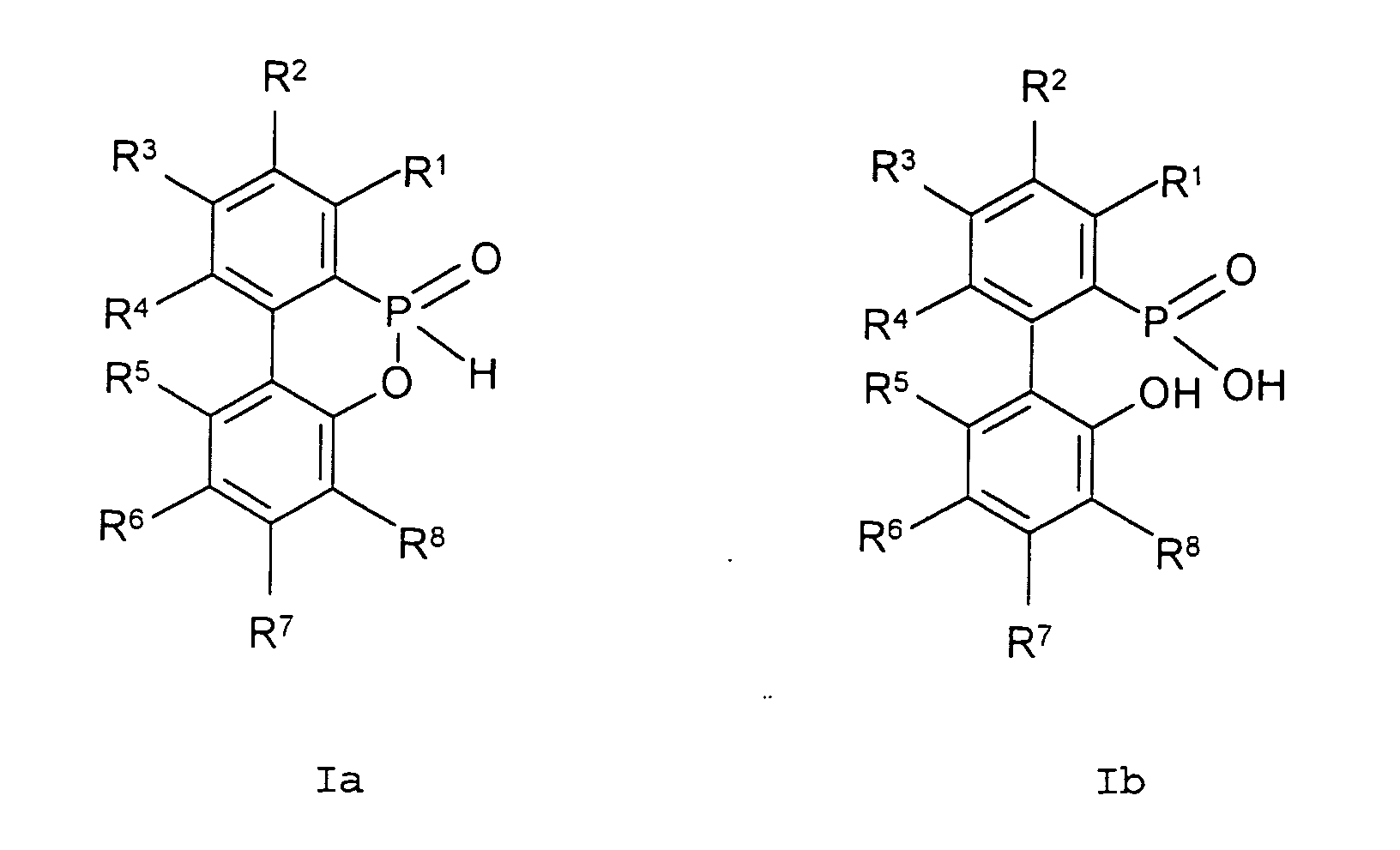
- the starting material in stage (a) of the process according to the invention can therefore be DOP or a derivative thereof according to the formulas Ia or Ib wherein R 1 to R 8 are independently a hydrogen atom, halogen atom or a hydrocarbon group, wherein the hydrocarbon groups optionally contain one or more heteroatoms selected from oxygen, nitrogen, sulfur, phosphorus, silicon and halogen, and two or more of the radicals R 1 to R 8 are optionally linked to form one or more cycles.
- Optionally substituted alkyl saturated, straight-chain or branched hydrocarbon radicals, in particular having 1 to 10 carbon atoms, for example C 1 - to C 6 -alkyl, such as methyl, ethyl, propyl, 1-methylethyl, butyl, 1-methylpropyl, 2-methylpropyl, 1, 1-dimethylethyl, pentyl, 1-methylbutyl, 2-methylbutyl, 3-methylbutyl, 2,2-dimethylpropyl, 1-ethylpropyl, hexyl, 1,1-dimethylpropyl, 1,2-dimethylpropyl, 1-methylpentyl, 2-methylpentyl, 3-methylpentyl, 4-methylpentyl, 1,1-dimethylbutyl, 1,2-dimethylbutyl, 1,3-dimethylbutyl, 2,2-dimethylbutyl, 2,3-dimethylbutyl, 3,3-dimethylbutyl, 1-ethylbuty
- Optionally substituted alkenyl saturated, straight-chain or branched hydrocarbon radicals, in particular having 2 to 10 hydrocarbon atoms and one double bond in any position, for example C 2 - to C 6 -alkenyl, such as ethenyl, 1-propenyl, 2-propenyl, 1-methylethenyl, 1 -Butenyl, 2-butenyl, 3-butenyl, 1-methyl-1-propenyl, 2-methyl-1-propenyl, 1-methyl-2-propenyl, 2-methyl-2-propenyl, 1-pentenyl, 2-pentenyl , 3-pentenyl, 4-pentenyl, 1-methyl-butenyl, 2-methyl-1-butenyl, 3-methyl-1-butenyl, 1-methyl-2-butenyl, 2-methyl-2-butenyl, 3-methyl 2-butenyl, 1-methyl-3-butenyl, 2-methyl-3-butenyl, 3-methyl-3-butenyl, 1,1-dimethyl-2-
- Optionally substituted alkynyl straight-chain or branched hydrocarbon groups, in particular having 2 to 20 hydrocarbon atoms and a triple bond in any position, for example C 2 - to C 6 -alkynyl, such as ethynyl, 1-propynyl, 2-propynyl, 1-butynyl, 2-butynyl , 3-butynyl, 1-methyl-2-propynyl, 1-pentynyl, 2-pentynyl, 3-pentynyl, 4-pentynyl, 1-methyl-2-butynyl, 1-methyl-3-butynyl, 2-methyl-3 -butynyl, 3-methyl-1-butynyl, 1,1-dimethyl-2-propynyl, 1-ethyl-2-propynyl, 1-hexynyl, 2-hexynyl, 3-hexynyl, 4-hexynyl, 5-hexynyl, 1
- An optionally substituted, saturated or a-or diunsaturated ring which in addition to carbon atoms to contain three of the following heteroatoms as ring members can: oxygen, sulfur and nitrogen, for example Carbocycles such as cyclopropyl, cyclopentyl, cyclohexyl, cyclopent-2-enyl, Cyclohex-2-enyl, 5- to 6-membered, saturated or unsaturated heterocycles containing one to three nitrogen atoms and / or an oxygen or sulfur atom, such as 2-tetrahydrofuranyl, 3-tetrahydrofuranyl, 2-tetrahydrothienyl, 3-tetrahydrothienyl, 2-pyrrolidinyl, 3-pyrrolidinyl, 3-isoxazolidinyl, 4-isoxazolidinyl, 5-isoxazolidinyl, 3-isothiazolidinyl, 4-isothiazolidinyl, 5-isothiazolidinyl,
- An optionally substituted mono- or binuclear aromatic ring system which in addition to carbon atoms one to four nitrogen atoms or one or two nitrogen atoms and one Oxygen or sulfur atom or an oxygen or sulfur atom as ring members, i.
- Aryl radicals such as phenyl and naphthyl, preferably phenyl or 1- or 2-naphthyl, and Hetaryl radicals, for example 5-ring heteroaromatics, include up to three nitrogen atoms and / or one oxygen or sulfur atom such as 2-furyl, 3-furyl, 2-thienyl, 3-thienyl, 1-pyrrolyl, 2-pyrrolyl, 3-pyrrolyl, 3-isoxazolyl, 4-isoxazolyl, 5-isoxazolyl, 3-isothiazolyl, 4-isothiazolyl, 5-isothiazolyl, 1-pyrazolyl, 3-pyrazolyl, 4-pyrazolyl, 5-pyrazolyl, 2-oxazolyl, 4-oxazolyl, 5-oxazolyl, 2-thiazolyl, 4-thiazolyl, 5-thiazolyl, 1-imidazolyl, 2-imidazolyl, 4-imidazolyl, 1,2,4-oxadiazol-3
- heteroaromatic compounds containing one to four nitrogen atoms as heteroatoms such as 2-pyridinyl, 3-pyridinyl, 4-pyridinyl, 3-pyradazinyl, 4-pyradazinyl, 2-pyrimidinyl, 4-pyrimidinyl, 5-pyrimidinyl, 2-pyrazinyl, 1,3,5-triazin-2-yl, 1,2,4-triazin-3-yl and 1,2,4,5-tetrazino-3-yl, especially 2-pyridinyl, 3-pyridinyl, 4-pyridinyl, 2-pyrimidinyl, 4-pyrimidinyl, 2-pyrazinyl and 4-pyrazinyl.
- alkyl, Alkenyl and alkynyl groups are intended to express that these May be partially or completely halogenated (i.e. the hydrogen atoms of these groups may be partially or completely by the same or different halogen atoms as mentioned above (preferably fluorine, chlorine and bromine, in particular Fluorine and chlorine) may be replaced and / or one to three, in particular one of the following radicals can carry:
- the substituents may be six-membered heteroaromatic containing one to four nitrogen atoms as heteroatoms such as 2-pyridinyl, 3-pyridinyl, 4-pyridinyl, 3-pyradazinyl, 4-pyradazinyl, 2-pyrimidinyl, 4-pyrimidinyl, 5-pyrimidinyl, 2-pyrazinyl, 1,3,5-triazin-2-yl, 1,2,4-triazin-3-yl and 1,2,4,5-tetrazine-3-yl, in particular 2-pyridinyl, 3-pyridinyl, 4-pyridinyl, 2-pyrimidinyl, 4-pyrimidinyl, 2-pyrazinyl and 4-pyrazinyl.
- cyclic (saturated, unsaturated or aromatic) groups is intended to indicate that these groups may be partially or fully halogenated (ie, the hydrogen atoms of these groups may be partially or fully substituted by the same or different halogen atoms as above (preferably fluorine, chlorine and bromine, in particular fluorine and chlorine) may be replaced) and / or one to three, preferably one of the following radicals: nitro, cyano, C 1 - to C 4 alkyl, C 1 - to C 4 alkoxy and C 1 - to C 4 alkoxycarbonyl.
- the mononuclear or dinuclear aromatic radicals mentioned in the radicals or heteroaromatic systems may in turn be partial or completely halogenated, i. the hydrogen atoms of these Groups can be partially or fully halogenated by such atoms Fluorine, chlorine, bromine and iodine, preferably fluorine and chlorine replaced be.
- radicals R 1 to R 8 may be halogen, such as fluorine, chlorine, bromine or iodine, preferably chlorine or bromine
- derivatives are preferred in which none of the radicals R 1 to R 8 is a halogen atom. Accordingly, derivatives are preferred in which none of the radicals R 1 to R 11 has halogen atoms, wherein R 9 to R 11 are as defined below. Halogen-free derivatives are therefore preferred according to the invention.
- R 1 , R 2 , R 3 and R 4 are independently a halogen atom or a hydrocarbon group
- a preferred embodiment relates to the case where R 1 , R 2 , R 3 and R 4 are at least two, preferably at least three hydrogen atoms, in particular R 1 , R 2 , R 3 and R 4 are all hydrogen atoms.
- R 5 , R 6 , R 7 and R 8 are independently a halogen atom or a hydrocarbon group
- a preferred embodiment concerns the case where R 5 , R 6 , R 7 and R 8 are at least two, preferably at least three hydrogen atoms, in particular R 5 , R 6 , R 7 and R 8 are all hydrogen atoms.
- substitution patterns on the aromatic ring systems are preferred in which in each case two of the radicals R 1 , R 2 , R 3 and R 4 and the radicals R 5 , R 6 , R 7 and R 8 is a halogen atom or a hydrocarbon group, more preferably only in each case one of the radicals R 1 , R 2 , R 3 and R 4 and the radicals R 5 , R 6 , R 7 and R 8 is a halogen atom or a hydrocarbon group and in particular all radicals R 1 to R 8 are hydrogen atoms.
- C 1 to C 6 groups are preferred as hydrocarbon groups. If the hydrocarbon groups contain a heteroatom, C 1 to C 6 alkoxy groups are the preferred radicals for these embodiments. The heteroatom is then oxygen.
- step (a) of the reaction according to the invention is thus DOP or a derivative thereof, in particular a derivative according to the above Formulas Ia or Ib, in the presence of at least one on or polyhydric alcohol with at least one orthocarboxylic acid ester implemented, forming a first intermediate.
- step (a) is an orthocarboxylic acid ester of the formula II R 9 C (OR 10 ) 3 used in which R 9 is a hydrogen atom or a hydrocarbon group and the radicals R 10 are the same or different hydrocarbon groups which optionally contain one or more heteroatoms selected from oxygen, nitrogen, sulfur, phosphorus, silicon and halogen.
- R 9 is a hydrogen atom or a hydrocarbon group
- the radicals R 10 are the same or different hydrocarbon groups which optionally contain one or more heteroatoms selected from oxygen, nitrogen, sulfur, phosphorus, silicon and halogen.
- step (a) is an alcohol of the formula IIIa R 11 (OH) y in which R 11 is a mono- or polyhydric hydrocarbon group which optionally contains one or more heteroatoms selected from oxygen, nitrogen, sulfur, phosphorus, silicon and halogen, and y is from 1 to 10, preferably 1 to 4, in particular 1, 2, 3 or 4.
- R 9 is a hydrogen atom, an alkyl or an aryl group, the definitions of the definitions of R 1 to R 8 apply mutatis mutandis, and a hydrogen atom or a methyl group are particularly preferred.
- radicals R 10 and R 11 are independently selected from alkyl, alkenyl, alkynyl, aryl and glycidyl groups, the definitions of the definitions corresponding to the radicals R 1 to R 8 apply accordingly, and methyl, ethyl and allyl are particularly preferred. In a further preferred embodiment, the radicals R 10 and R 11 are the same. Further examples of the radicals R 10 and R 11 are the optionally substituted alkyl, alkenyl and alkynyl radicals listed above in relation to the definitions of R 1 to R 8 and the abovementioned, optionally substituted, saturated or mono- or diunsaturated rings.
- Orthocarbon Acidester in particular Trimethylorthoformiat, Triethylorthoformiat or Triallylorthoformiat are preferred.
- orthocarboxylic acid esters in which the R 10 radicals are different.
- alcohols in particular methanol, ethanol, propanol, Isopropanol and butanol are preferred.
- polyhydric alcohols are Diols, glycols, polyglycols, trihydric and tetrahydric alcohols, e.g. Ethylene glycol, glycerol and pentaerythritol are preferred.
- Examples of tetravalent radicals in alcohols of the formula R 11 (OH) 4 are: C (CH 2 ) 1 (CH 2 ) m (CH 2 ) n (CH 2 ) o Si (OCH 2 CH 2 ) 4 M '(COO (CH 2 ) 1 ) (COO (CH 2 ) m ) (COO (CH 2 ) n ) (COO (CH 2 ) o ) (CH 2 ) n (CH 2 ) o NOC ⁇ CON (CH 2 ) 1 (CH 2 ) m , (CH 2 ) n (CH 2 ) o N- ⁇ -N (CH 2 ) 1 (CH 2 ) m wherein ⁇ , R, l, m, n are as defined above for the trivalent radicals and o is defined as l, m, n and M 'is a tetravalent hydrocarbon radical and the ester groups are located on the same or different carbon atoms.
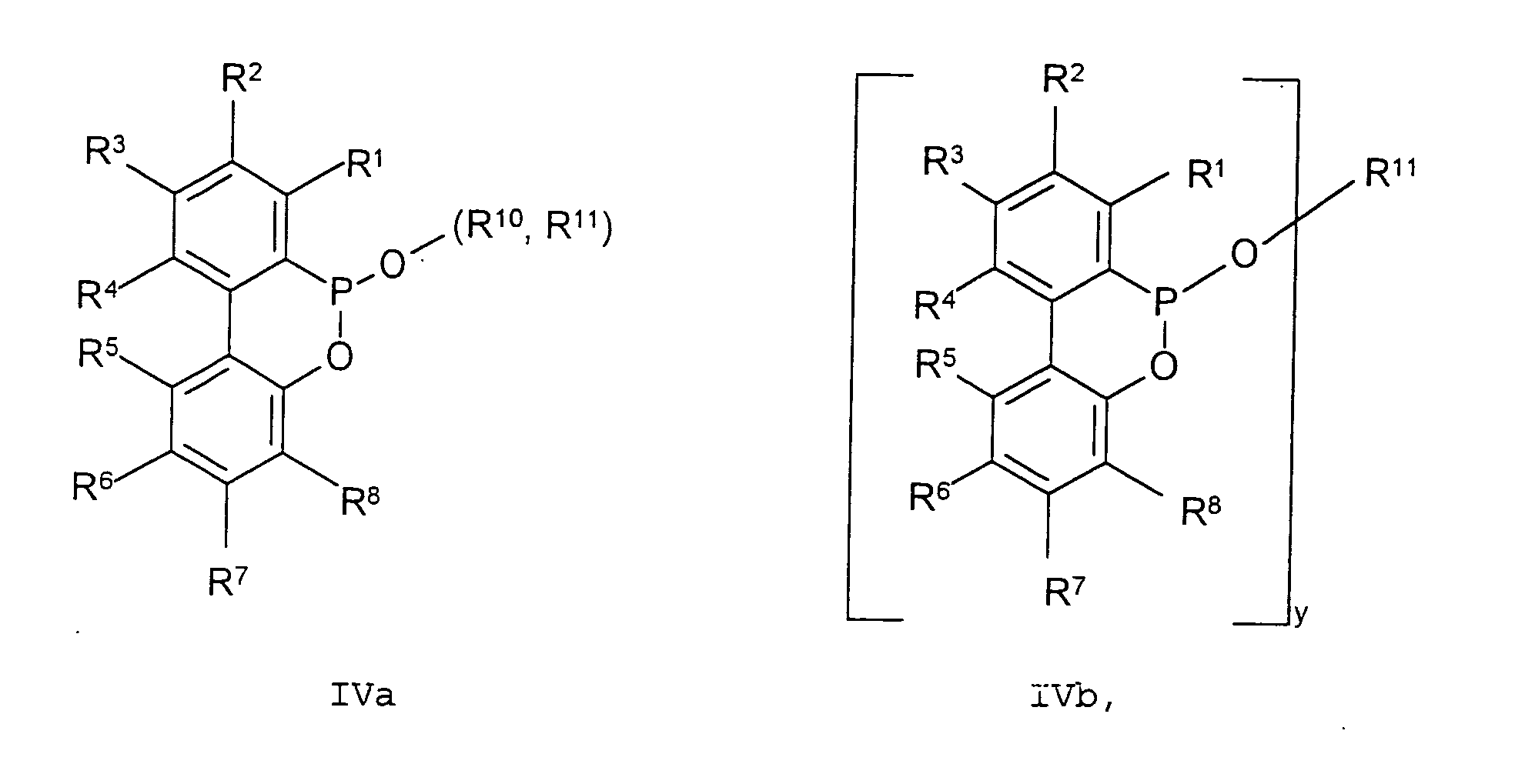
- step (a) according to the preferred embodiments of the invention described above can be described by the following formulas IVa or IVb: wherein the radicals R 1 to R 11 and y have the meanings given above.
- Reaction stage (a) can according to the invention without further solvents be performed.
- a solvent This may be benzene, alkylated benzenes, aliphatic or cycloaliphatic Be ether.
- the reaction is at Temperatures from -20 ° C to 120 ° C, preferably 0 ° C to 100 ° C, in particular 5 ° C to 80 ° C carried out.
- Reaction step (a) can be carried out at atmospheric pressure or slight overpressure.
- reaction stage (b) the intermediate from stage (a) can be reacted with at least one further monohydric or polyhydric alcohol to form a further intermediate.
- the alcohol used here preferably has the formula IIIb R 12 (OH) y in which R 12 is a monovalent or polyvalent hydrocarbon group which optionally contains one or more heteroatoms selected from oxygen, nitrogen, sulfur, phosphorus, silicon and halogen, and y is from 1 to 10, preferably 1 to 4, in particular 1, 2, Is 3 or 4 and that is different from the alcohol used in step (a).
- R 12 With respect to preferred radicals R 12 , reference is made to the above definitions for R 11 . These also apply to R 12 .
- the reaction with at least one further alcohol in stage (b) of the process according to the invention has the advantage that it is possible to use inexpensive orthocarboxylic esters in stage (a), which leads to a product mixture in the case where R 10 is different from R 11 .
- By transesterification with another alcohol in step (b) then, if desired, a uniform product can be obtained.
- the reaction steps (a) and (b) in the presence carried out by catalysts can be, for example, Lewis acids or Bronsted acids.
- catalysts can be, for example, Lewis acids or Bronsted acids.
- hydrochloric acid or p-toluenesulfonic acid is preferably recovered.
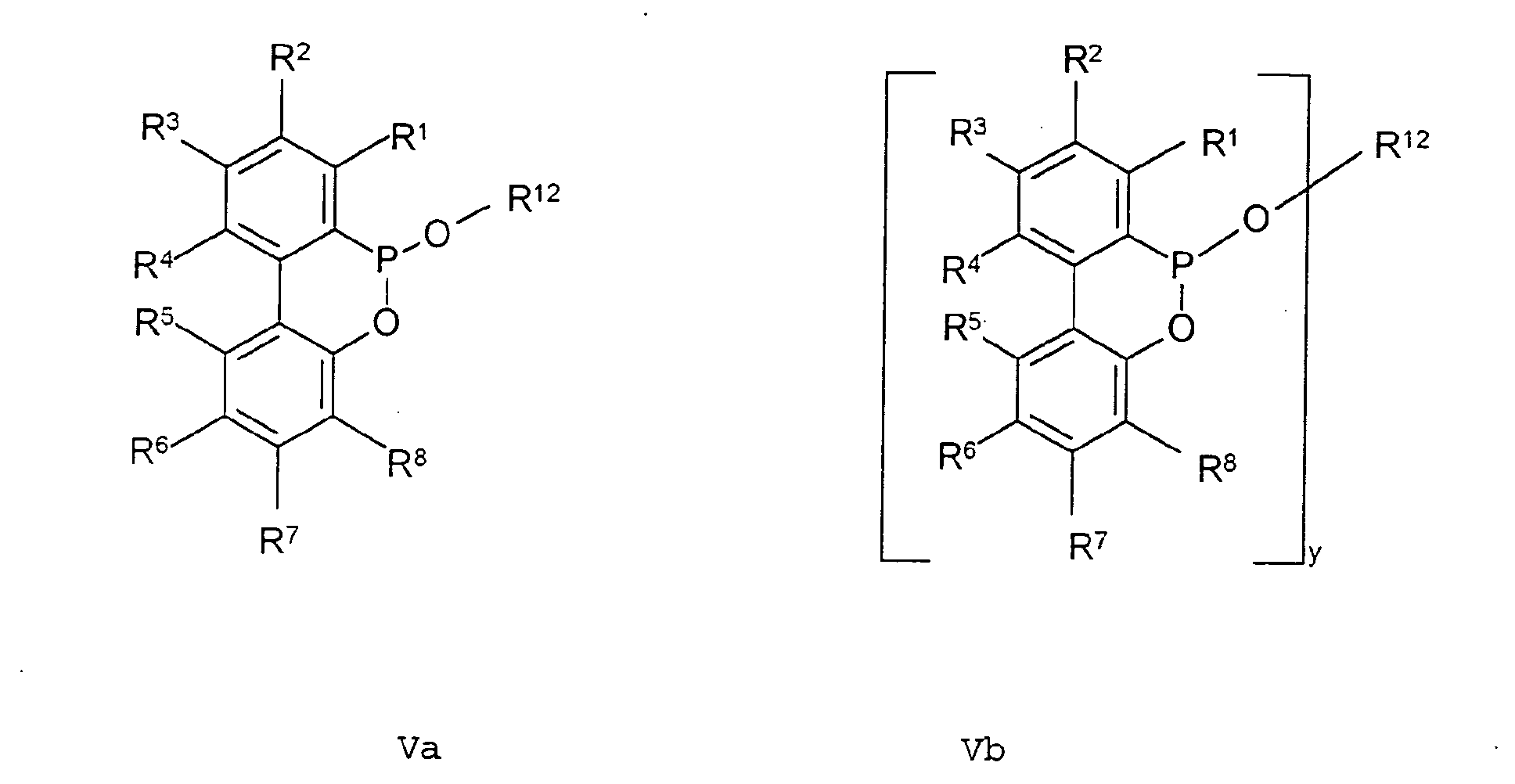
- step (b) can be represented by formulas Va or Vb be described, wherein the radicals R 1 to R 12 have the meanings given above.
- the undistilled residue becomes either solvent-free or in an inert solvent (e.g., hydrocarbon such as toluene or petroleum ether, N-methylpyrrolidone (NMP), Dimethylformamide (DMF), etc.) with oxidizing agents such as organic Peroxides, e.g. tert-butyl peroxide, oxygen with or without catalyst or sulfur to the oxides or thiones transformed.
- an inert solvent e.g., hydrocarbon such as toluene or petroleum ether, N-methylpyrrolidone (NMP), Dimethylformamide (DMF), etc.
- oxidizing agents such as organic Peroxides, e.g. tert-butyl peroxide, oxygen with or without catalyst or sulfur to the oxides or thiones transformed.
- organic Peroxides e.g. tert-butyl peroxide
- inert solvents generally cooled, e.g. to temperatures in the range of 0 up to 30 ° C.
- step (c) After the oxidation in step (c) are optionally volatile Ingredients generally by distillation, if appropriate under reduced pressure or vacuum, and so on the product receive.
- DOP unreacted Educt
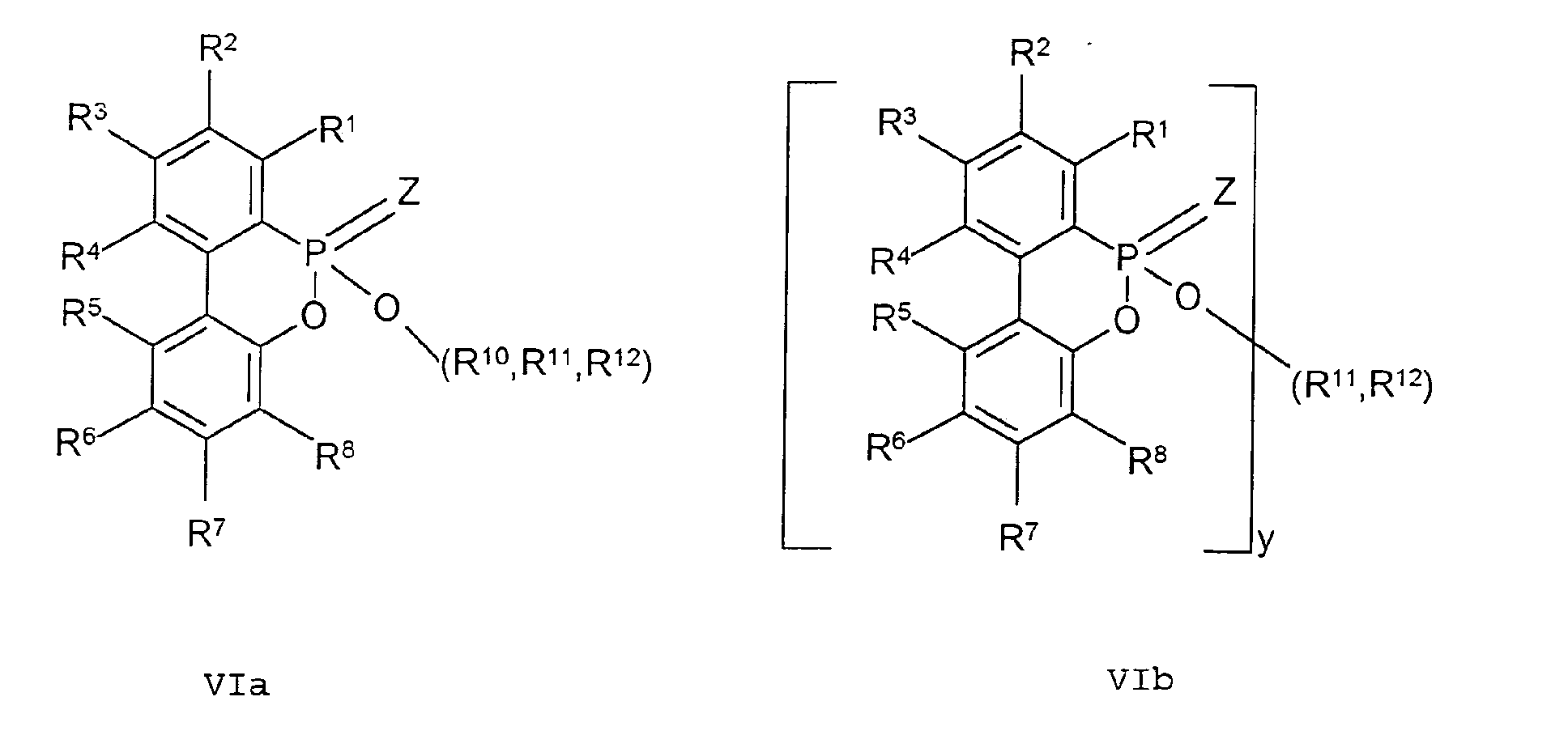
- the products obtained using the preferred reaction components described above may be represented by the formulas VIa or VIb in which R 1 to R 12 and y have the meanings given above and Z is oxygen or sulfur.
- the radicals R 1 to R 8 are preferably hydrogen, the radical R 10 is methyl or ethyl and the radicals R 11 or R 12 are methyl, methylene, methanetriyl or methanetetrayl, ethyl, ethylene, ethanetriyl or ethanetetrayl.
- the invention further relates to a process for the preparation of Flame retardant treated natural and synthetic materials, in which one Natural or plastic one or more derivatives of the invention be added.
- the process is characterized in that as intermediates first according to the above method 9,10-dihydro-9-oxa-10-organyloxyphosphaphenanthren-10-oxide or -thion or to the Phenyl-substituted derivatives thereof and then these intermediates in the natural or Plastic are introduced.
- the intermediates may be added in an additive or reactive manner the natural or plastic are introduced.
- the DOP derivatives prepared by means of polyhydric alcohols the reactive incorporation, i. the integration into the natural or Plastic by means of a chemical reaction an advantageous Variant.
- an unhardened natural or plastic synthetic resin
- one or more of the invention produced Derivatives are added and the mixture of uncured Natural or plastic and inventively produced derivative can then be transformed into a flame-retardant, hardened natural or plastic hardened.
- Plastics are preferably selected from the group made of polyester, polyamide, polycarbonate, polystyrene, polyethylene, Polypropylene, phenolic and epoxy resins, in particular phenolic and Epoxy resins.
- Natural substances are preferably selected from Group consisting of cotton, wool, linen and hemp.
- a flame-resistant epoxy resin produced according to the invention preferably contains 2 to 7% by weight of phosphorus in the resin composition.
- "resin composition” is to be understood as meaning only the total weight of epoxy resin used and derivative of the formula VI a / b prepared according to the invention.
- Other optionally used components such as hardener, filler or glass fiber mat are disregarded in this determination of the phosphorus content.
- An advantage of the present invention flameproof epoxy resin is that it can be prepared using a reactive derivative (eg R 10 and / or R 11 is allyl or glycidyl). At least a part of the reactive derivative of the formula I then reacts with the epoxy resin and / or the optionally used hardener. It is inventively preferred that at least 50 wt .-% of the phosphorus content are chemically incorporated into the epoxy resin.
Landscapes
- Chemical & Material Sciences (AREA)
- Organic Chemistry (AREA)
- Health & Medical Sciences (AREA)
- Life Sciences & Earth Sciences (AREA)
- Biochemistry (AREA)
- General Health & Medical Sciences (AREA)
- Molecular Biology (AREA)
- Chemical Kinetics & Catalysis (AREA)
- Medicinal Chemistry (AREA)
- Polymers & Plastics (AREA)
- Organic Low-Molecular-Weight Compounds And Preparation Thereof (AREA)
Abstract
Description

- Alkenyl, Alkinyl, Halogenalkenyl, Halogenalkinyl, Alkenyloxy, Alkinyloxy, Halogenalkenyloxy, Halogenalkinyloxy, Alkenylthio, Alkinylthio, Alkylsulfoxy, Alkylsulfonyl, Alkenylsulfoxy, Alkinylsulfoxy, Alkinylsulfonyl.
(CH2)n, (CH2)nO(CH2)m, (CH2)nNR(CH2)m, (CH2)nN(COR)(CH2)m, (CH2)nS(CH2)m, OPR(OCH2CH2)2, (CH2)nOOC∼∼COO(CH2)m, (CH2)nX∼∼X(CH2)m,



Claims (27)
- Verfahren zur Herstellung von 9,10-Dihydro-9-oxa-10-organyloxyphosphaphenanthren-10-oxid oder -thion und an den Phenylgruppen substituierten Derivaten derselben, bei dem:(a) 9,10-Dihydro-9-oxa-10-phosphaphenanthren-10-oxid oder ein Derivat desselben in Gegenwart von mindestens einem ein- oder mehrwertigen Alkohol mit mindestens einem Orthocarbonsäureester unter Bildung eines ersten Zwischenprodukts umgesetzt wird,(b) das Zwischenprodukt aus Stufe (a) gegebenenfalls mit mindestens einem weiteren ein- oder mehrwertigen Alkohol unter Bildung eines weiteren Zwischenprodukts umgesetzt wird und(c) das Zwischenprodukt aus den Stufen (a) oder (b) durch Zugabe von Oxidationsmittel in 9,10-Dihydro-9-oxa-10-organyloxyphosphaphenanthren-10-oxid oder -thion oder ein an den Phenygruppen substituiertes Derivat derselben überführt wird.
- Verfahren nach Anspruch 1, dadurch gekennzeichnet, dass in Stufe (a) ein 9,10-Dihydro-9-oxa-10-phosphaphenanthren-10-oxid-Derivat der Formeln Ia oder Ibverwendet wird, worin R1 bis R8 unabhängig voneinander ein Wasserstoffatom, Halogenatom oder eine Kohlenwasserstoffgruppe sind, wobei die Kohlenwasserstoffgruppen gegebenenfalls ein oder mehrere Heteroatome ausgewählt aus Sauerstoff, Stickstoff, Schwefel, Phosphor, Silicium und Halogen enthalten, und zwei oder mehr der Reste R1 bis R8 gegebenenfalls unter Ausbildung von einem oder mehreren Cyclen verknüpft sind.
- Verfahren nach Anspruch 1, dadurch gekennzeichnet, dass in Stufe (a) ein Orthocarbonsäureester der Formel II
- Verfahren nach Anspruch 1, dadurch gekennzeichnet, dass in Stufe (a) ein Alkohol der Formel IIIa
- Verfahren nach einem der vorhergehenden Ansprüche, dadurch gekennzeichnet, dass in Stufe (b) ein Alkohol gemäß Formel IIIb
- Verfahren nach einem der vorhergehenden Ansprüche, dadurch gekennzeichnet, dass y für die in den Stufen (a) und (b) verwendeten Alkohole jeweils 1 ist.
- Verfahren nach einem der Ansprüche 1 bis 5, dadurch gekennzeichnet, dass für den in Stufe (a) verwendeten Alkohol y = 1 ist und für den in Stufe (b) verwendeten Alkohol y = 2 bis 4 ist.
- Verfahren nach einem der Ansprüche 1 bis 5, dadurch gekennzeichnet, dass für den in Stufe (a) verwendeten Alkohol y = 2 bis 4 ist.
- Verfahren nach einem der Ansprüche 1 bis 5, dadurch gekennzeichnet, dass y für die in den Stufen (a) und (b) verwendeten Alkohole jeweils 2 bis 4 ist.
- Verfahren nach einem der Ansprüche 1 bis 5, dadurch gekennzeichnet, dass für den in Stufe (a) verwendeten Alkohol y = 2 bis 4 ist und für den in Stufe (b) verwendeten Alkohol y = 1 ist.
- Verfahren nach einem der vorhergehenden Ansprüche, dadurch gekennzeichnet, dass das in Stufe (a) erhaltene Produkt die Formeln IVa oder IVbhat, worin die Reste R1 bis R11 und y die in den Ansprüchen 2 bis 4 angegebenen Bedeutungen haben.

- Verfahren nach einem der vorhergehenden Ansprüche, dadurch gekennzeichnet, dass das in Stufe (b) erhaltene Produkt die Formeln Va oder Vbhat, worin die Reste R1 bis R12 und y die in den Ansprüchen 2 bis 5 angegebenen Bedeutungen haben.
- Verfahren nach einem der vorhergehenden Ansprüche, dadurch gekennzeichnet, dass in Stufe (a) 9,10-Dihydro-9-oxa-10-phosphaphenanthren-10-oxid eingesetzt wird.
- Verfahren nach einem der vorhergehenden Ansprüche, dadurch gekennzeichnet, dass als Orthocarbonsäureester ein Orthoameisensäureester ausgewählt aus der Gruppe bestehend aus Trimethylorthoformiat, Triethylorthoformiat und Triallylorthoformiat verwendet wird.
- Verfahren nach Anspruch 14, dadurch gekennzeichnet, dass der einwertige Alkohol (y = 1) ausgewählt ist aus der Gruppe bestehend aus Methanol, Ethanol und Isopropanol.
- Verfahren nach Anspruch 14, dadurch gekennzeichnet, dass der mehrwertige Alkohol (y = 2 bis 4) ausgewählt ist aus der Gruppe bestehend aus einem Diol, Glykol, Polyglykol, dreiwertigem Alkohol und vierwertigem Alkohol.
- Verfahren nach Anspruche 16, dadurch gekennzeichnet, dass der mehrwertige Alkohol ausgewählt ist aus der Gruppe bestehend aus Ethylenglykol, Glycerin und Pentaerythrit.
- Verfahren nach einem oder mehreren der vorhergehenden Ansprüche, dadurch gekennzeichnet, dass das Oxidationsmittel in Stufe (c) ausgewählt ist aus Sauerstoff und Schwefel.
- Verfahren nach einem oder mehreren der vorhergehenden Ansprüche, dadurch gekennzeichnet, dass das in Stufe (c) erhaltene Produkt die Formel VIa oder VIbaufweist, worin R1 bis R12 und y wie in den Ansprüchen 2 bis 5 definiert sind und Z = O oder S ist.

- Verfahren nach einem der vorhergehenden Ansprüche 1 bis 19, dadurch gekennzeichnet, dass in den Stufen (a) und/oder (b) ein Katalysator ausgewählt aus der Gruppe bestehend aus Lewis-Säuren und Brönsted-Säuren verwendet wird.
- Verfahren nach Anspruch 21, dadurch gekennzeichnet, dass der Katalysator ausgewählt ist aus Halogenwasserstoffen und organischen Sulfonsäuren ist.
- Verfahren nach Anspruch 21, dadurch gekennzeichnet, dass der Katalysator Salzsäure oder p-Toluolsulfonsäure ist.
- Verfahren nach einem der Ansprüche 20 bis 22, dadurch gekennzeichnet, dass überschüssiger Alkohol entfernt und der in den Stufen (a) und/oder (b) verwendete Katalysator wiedergewonnen wird.
- Verfahren nach einem der vorhergehenden Ansprüche, dadurch gekennzeichnet, dass die Reaktionsstufen (a) bis (c) in einem Reaktionsgefäß durchgeführt werden.
- Verfahren zur Herstellung eines flammhemmend ausgerüsteten Natur- oder Kunststoffes, dadurch gekennzeichnet, dass als Zwischenprodukt gemäß einem der vorhergehenden Ansprüche 1 bis 23 ein 9,10-Dihydro-9-oxa-10-organyoxyphosphaphenanthren-10-oxid oder -thion oder ein an den Phenylgruppen substituiertes Derivat derselben hergestellt wird und dieses Zwischenprodukt in den Natur- oder Kunststoff eingebracht wird.
- Verfahren nach Anspruch 25, dadurch gekennzeichnet, dass das das Zwischenprodukt auf additive oder reaktive Weise in den Natur- oder Kunststoff eingebracht wird.
- Verfahren nach Anspruch 24, dadurch gekennzeichnet, dass der Kunststoff ausgewählt ist aus der Gruppe bestehend aus Polyester, Polyamid, Polycarbonat, Polystyrol, Polyethylen, Polypropylen, Phenol- und Epoxidharzen.
Applications Claiming Priority (2)
| Application Number | Priority Date | Filing Date | Title |
|---|---|---|---|
| DE10338131A DE10338131A1 (de) | 2003-08-15 | 2003-08-15 | Verfahren zur Herstellung von 9,10-Dihydro-9-oxa-10-organyloxy-phosphaphenanthren-10-oxid oder -thion und an den Phenylgruppen substitutierten Derivaten desselben |
| DE10338131 | 2003-08-15 |
Publications (2)
| Publication Number | Publication Date |
|---|---|
| EP1506968A1 true EP1506968A1 (de) | 2005-02-16 |
| EP1506968B1 EP1506968B1 (de) | 2009-09-23 |
Family
ID=33560348
Family Applications (1)
| Application Number | Title | Priority Date | Filing Date |
|---|---|---|---|
| EP04018830A Expired - Lifetime EP1506968B1 (de) | 2003-08-15 | 2004-08-09 | Verfahren zur Herstellung von 9,10-Dihydro-9-oxa-10-organyl-oxyphosphaphenanthren-10-oxid oder -thion und an den Phenylgruppen substituierten Derivativen desselben |
Country Status (4)
| Country | Link |
|---|---|
| US (1) | US7317119B2 (de) |
| EP (1) | EP1506968B1 (de) |
| AT (1) | ATE443709T1 (de) |
| DE (2) | DE10338131A1 (de) |
Cited By (1)
| Publication number | Priority date | Publication date | Assignee | Title |
|---|---|---|---|---|
| EP2921498A1 (de) | 2014-03-17 | 2015-09-23 | Eidgenössische Materialprüfungs- und Forschungsanstalt EMPA | Hybride dopo-basierte Flammschutzmittel |
Families Citing this family (7)
| Publication number | Priority date | Publication date | Assignee | Title |
|---|---|---|---|---|
| CN102597091A (zh) * | 2009-07-03 | 2012-07-18 | 森波尔塑料有限责任公司 | 阻燃可膨胀聚合物 |
| WO2011000019A1 (de) * | 2009-07-03 | 2011-01-06 | Krems Chemie Chemical Services Ag | Neue derivate von 9,10-dihydro-9-oxa-10-phosphaphenanthren-10-on |
| CN102971333B (zh) | 2010-03-31 | 2015-09-09 | 雅宝公司 | 制备dopo衍生的化合物及其组合物的方法 |
| TWI667276B (zh) * | 2014-05-29 | 2019-08-01 | 美商羅傑斯公司 | 具改良耐燃劑系統之電路物質及由其形成之物件 |
| CN104153196A (zh) * | 2014-08-12 | 2014-11-19 | 安徽一隆羽绒有限公司 | 一种阻燃棉整理工艺 |
| US10233365B2 (en) | 2015-11-25 | 2019-03-19 | Rogers Corporation | Bond ply materials and circuit assemblies formed therefrom |
| CN111100303B (zh) * | 2019-12-02 | 2020-11-17 | 厦门大学 | 一种有机膦接枝中空金属有机框架材料的制备方法及其应用 |
Citations (7)
| Publication number | Priority date | Publication date | Assignee | Title |
|---|---|---|---|---|
| US3702878A (en) | 1969-12-31 | 1972-11-14 | Sanko Chemical Co Ltd | Cyclic organophosphorus compounds and process for making same |
| US4198492A (en) | 1977-09-27 | 1980-04-15 | Asahi-Dow Limited | Flame-retardant polyphenylene ether resin composition |
| US4228064A (en) | 1976-10-04 | 1980-10-14 | Asaki-Dow Limited | Flame-retardant polyphenylene ether resin composition |
| EP0787738A1 (de) * | 1996-02-01 | 1997-08-06 | Hoechst Aktiengesellschaft | Verfahren zur Herstellung von 6-Alkoxy-(6H)-dibenz[c, e][1,2]-oxaphosphorinen |
| EP0806429A2 (de) | 1996-05-06 | 1997-11-12 | Schill & Seilacher GmbH & Co. | Flammfeste Expoxidharze und Flammschutzmittel für Epoxidharze |
| EP1279719A1 (de) | 2001-03-21 | 2003-01-29 | Nicca Chemical Co., Ltd. | Flammenhemmende behandlungsmittel, flammenhemmendes bearbeitungsverfahren und flammenhemmende fasern |
| WO2003070736A1 (de) * | 2002-02-20 | 2003-08-28 | Forschungszentrum Karlsruhe Gmbh | Verfahren zur herstellung von 6-alkoxy-(6h)-dibenz(c,e)(1,2)-oxaphosphorinen |
Family Cites Families (6)
| Publication number | Priority date | Publication date | Assignee | Title |
|---|---|---|---|---|
| JPS57105456A (en) | 1980-12-20 | 1982-06-30 | Asahi Chem Ind Co Ltd | Organic material stabilized with cyclic phosphonite |
| JPS57105451A (en) | 1980-12-20 | 1982-06-30 | Asahi Chem Ind Co Ltd | Stabilized resin composition |
| JPS63135396A (ja) | 1986-11-26 | 1988-06-07 | Nippon Ester Co Ltd | 新規な有機リン化合物 |
| DE3885969D1 (de) * | 1987-08-24 | 1994-01-13 | Hoechst Ag | Neue 6-Acyl-(6H)-dibenz[c,e] [1,2]oxaphosphorin-6-oxyde, ihre Herstellung und Verwendung als Photoinitiatoren. |
| JP3897138B2 (ja) | 1997-10-03 | 2007-03-22 | 有限会社斉藤化成品研究所 | 難燃性ポリエステル樹脂組成物およびその製造方法 |
| JP2001270993A (ja) | 2000-01-21 | 2001-10-02 | Daicel Chem Ind Ltd | 難燃性樹脂組成物 |
-
2003
- 2003-08-15 DE DE10338131A patent/DE10338131A1/de not_active Ceased
-
2004
- 2004-08-09 DE DE502004010100T patent/DE502004010100D1/de not_active Expired - Lifetime
- 2004-08-09 EP EP04018830A patent/EP1506968B1/de not_active Expired - Lifetime
- 2004-08-09 AT AT04018830T patent/ATE443709T1/de not_active IP Right Cessation
- 2004-08-13 US US10/918,836 patent/US7317119B2/en not_active Expired - Fee Related
Patent Citations (7)
| Publication number | Priority date | Publication date | Assignee | Title |
|---|---|---|---|---|
| US3702878A (en) | 1969-12-31 | 1972-11-14 | Sanko Chemical Co Ltd | Cyclic organophosphorus compounds and process for making same |
| US4228064A (en) | 1976-10-04 | 1980-10-14 | Asaki-Dow Limited | Flame-retardant polyphenylene ether resin composition |
| US4198492A (en) | 1977-09-27 | 1980-04-15 | Asahi-Dow Limited | Flame-retardant polyphenylene ether resin composition |
| EP0787738A1 (de) * | 1996-02-01 | 1997-08-06 | Hoechst Aktiengesellschaft | Verfahren zur Herstellung von 6-Alkoxy-(6H)-dibenz[c, e][1,2]-oxaphosphorinen |
| EP0806429A2 (de) | 1996-05-06 | 1997-11-12 | Schill & Seilacher GmbH & Co. | Flammfeste Expoxidharze und Flammschutzmittel für Epoxidharze |
| EP1279719A1 (de) | 2001-03-21 | 2003-01-29 | Nicca Chemical Co., Ltd. | Flammenhemmende behandlungsmittel, flammenhemmendes bearbeitungsverfahren und flammenhemmende fasern |
| WO2003070736A1 (de) * | 2002-02-20 | 2003-08-28 | Forschungszentrum Karlsruhe Gmbh | Verfahren zur herstellung von 6-alkoxy-(6h)-dibenz(c,e)(1,2)-oxaphosphorinen |
Non-Patent Citations (3)
| Title |
|---|
| BHATIA, M. S. ET AL: "Synthesis and reactions of 6-chloro-6H-dibenz[c,e][1,2] oxaphosphorin- 6-sulfide", INDIAN JOURNAL OF CHEMISTRY, SECTION B: ORGANIC CHEMISTRY INCLUDING MEDICINAL CHEMISTRY , 14B(10), 811-12 CODEN: IJSBDB; ISSN: 0376-4699, 1976, XP008038489 * |
| BHATIA, M.S. ET AL: "Synthesis of 6-Chloro-6H-dibenz[ce][1.2]oxaphosphine-6-sulphide", CHEMISTRY & INDUSTRY (LONDON, UNITED KINGDOM) , (24), 1058 CODEN: CHINAG; ISSN: 0009-3068, 1975, XP008038487 * |
| GLOEDE, J. ET AL: "Ein stabiles Trichlor-oxyphosphoran mit einem Oxaphosphorinring", ZEITSCHRIFT FUER ANORGANISCHE UND ALLGEMEINE CHEMIE , 629(6), 998-1000 CODEN: ZAACAB; ISSN: 0044-2313, 2003, XP008038453 * |
Cited By (1)
| Publication number | Priority date | Publication date | Assignee | Title |
|---|---|---|---|---|
| EP2921498A1 (de) | 2014-03-17 | 2015-09-23 | Eidgenössische Materialprüfungs- und Forschungsanstalt EMPA | Hybride dopo-basierte Flammschutzmittel |
Also Published As
| Publication number | Publication date |
|---|---|
| EP1506968B1 (de) | 2009-09-23 |
| DE10338131A1 (de) | 2005-03-17 |
| US7317119B2 (en) | 2008-01-08 |
| DE502004010100D1 (de) | 2009-11-05 |
| US20050038278A1 (en) | 2005-02-17 |
| ATE443709T1 (de) | 2009-10-15 |
Similar Documents
| Publication | Publication Date | Title |
|---|---|---|
| EP1512690B1 (de) | Verfahren zur Herstellung von 9,10-Dihydro-9-oxa-10-organyl-phosphaphenanthren-10-oxid und Derivaten desselben | |
| EP1476453B1 (de) | Verfahren zur herstellung von 6-alkoxy-(6h)-dibenz(c,e)(1,2)-oxaphosphorinen | |
| EP2449019B1 (de) | Neue derivate von 9,10-dihydro-9-oxa-10-phosphaphenanthren-10-on | |
| RU95122817A (ru) | Ортозамещенные метиламиды 2-метоксииминофенилуксусной кислоты | |
| EP1506968B1 (de) | Verfahren zur Herstellung von 9,10-Dihydro-9-oxa-10-organyl-oxyphosphaphenanthren-10-oxid oder -thion und an den Phenylgruppen substituierten Derivativen desselben | |
| EP0032663B1 (de) | Verfahren zur Herstellung von Vinylphosphonsäurederivaten | |
| EP1529783B1 (de) | Derivative von 9,10-Dihydro-9-oxa-10-phosphaphenanthren-10-oxid | |
| EP0765304B2 (de) | Verfahren und zwischenprodukte zur herstellung von alpha-methoxyiminocarbonsäuremethylamiden | |
| WO2005010000A2 (de) | Arylkondensierte 3-arylpyridinverbindungen und ihre verwendung zur bekämpfung von schadpilzen | |
| EP2256122A1 (de) | Halogenfreie Derivate des Triazins und Heptazins | |
| Mukaiyama et al. | Oxidation of phosphites and phosphines via quaternary phosphonium salts | |
| EP0632023B1 (de) | Verfahren zur Herstellung von gamma-Vinylpyrrolidonen | |
| DE3853030T2 (de) | Verfahren zur Herstellung eines Aliphatylphosphinsäure-Derivates. | |
| EP2260045B1 (de) | Ungesättigte diphosphinmonoxide | |
| DE69806513T2 (de) | Herstellung von phosphonsäurederivaten | |
| DE1518060C (de) | 0.0-Dialkyl-S- eckige Klammer auf 2-(acetamido)-äthyl eckige Klammer zu -dithiophosphate und Verfahren zur Herstellung dieser Verbindungen | |
| EP1284955A1 (de) | Verfahren zur herstellung von acyloxyacetaldehyden | |
| DE2413824C2 (de) | Verfahren zur Herstellung von tertiären (Hydroxymehtyl)-methylphosphinoxiden | |
| DE2125143C3 (de) | N-Chlorsulfonyl-carbamoylphosphonsäureester sowie Verfahren zu deren Herstellung | |
| DE10313228A1 (de) | Synthese von 2-Chlormethyl-6-methylbenzoesäureestern | |
| DE1518060B (de) | 0.0-Dialkyl-S- eckige Klammer auf 2-(acetamido)-äthyl eckige Klammer zu -dithiophosphate und Verfahren zur Herstellung dieser Verbindungen | |
| DE3213526A1 (de) | 2-(2-oxyethyl)-2,3-dihydro-4h-l,3-benzoxazin-4-on-ester, verfahren zu deren herstellung und diese enthaltende arzneimittel | |
| DE1137429B (de) | Verfahren zur Herstellung von Carbamylphosphaten | |
| WO2005121146A2 (de) | 1, 2, 4-TRIAZOLO[1,5a]PYRIMIDINE UND DEREN VERWENDUNG ZUR BEKÄMPFUNG VON PFLANZEN-PATHOGENEN PILZEN | |
| DD264921A5 (de) | Verfahren zur herstellung von n-sulfonyl-acetamido-aminomethan-phosphonaten |
Legal Events
| Date | Code | Title | Description |
|---|---|---|---|
| PUAI | Public reference made under article 153(3) epc to a published international application that has entered the european phase |
Free format text: ORIGINAL CODE: 0009012 |
|
| AK | Designated contracting states |
Kind code of ref document: A1 Designated state(s): AT BE BG CH CY CZ DE DK EE ES FI FR GB GR HU IE IT LI LU MC NL PL PT RO SE SI SK TR |
|
| AX | Request for extension of the european patent |
Extension state: AL HR LT LV MK |
|
| 17P | Request for examination filed |
Effective date: 20050210 |
|
| AKX | Designation fees paid |
Designated state(s): AT BE BG CH CY CZ DE DK EE ES FI FR GB GR HU IE IT LI LU MC NL PL PT RO SE SI SK TR |
|
| 17Q | First examination report despatched |
Effective date: 20070912 |
|
| GRAP | Despatch of communication of intention to grant a patent |
Free format text: ORIGINAL CODE: EPIDOSNIGR1 |
|
| GRAS | Grant fee paid |
Free format text: ORIGINAL CODE: EPIDOSNIGR3 |
|
| GRAA | (expected) grant |
Free format text: ORIGINAL CODE: 0009210 |
|
| AK | Designated contracting states |
Kind code of ref document: B1 Designated state(s): AT BE BG CH CY CZ DE DK EE ES FI FR GB GR HU IE IT LI LU MC NL PL PT RO SE SI SK TR |
|
| REG | Reference to a national code |
Ref country code: GB Ref legal event code: FG4D Free format text: NOT ENGLISH |
|
| REG | Reference to a national code |
Ref country code: CH Ref legal event code: EP |
|
| REG | Reference to a national code |
Ref country code: IE Ref legal event code: FG4D |
|
| REF | Corresponds to: |
Ref document number: 502004010100 Country of ref document: DE Date of ref document: 20091105 Kind code of ref document: P |
|
| PG25 | Lapsed in a contracting state [announced via postgrant information from national office to epo] |
Ref country code: FI Free format text: LAPSE BECAUSE OF FAILURE TO SUBMIT A TRANSLATION OF THE DESCRIPTION OR TO PAY THE FEE WITHIN THE PRESCRIBED TIME-LIMIT Effective date: 20090923 Ref country code: SE Free format text: LAPSE BECAUSE OF FAILURE TO SUBMIT A TRANSLATION OF THE DESCRIPTION OR TO PAY THE FEE WITHIN THE PRESCRIBED TIME-LIMIT Effective date: 20090923 |
|
| PG25 | Lapsed in a contracting state [announced via postgrant information from national office to epo] |
Ref country code: PL Free format text: LAPSE BECAUSE OF FAILURE TO SUBMIT A TRANSLATION OF THE DESCRIPTION OR TO PAY THE FEE WITHIN THE PRESCRIBED TIME-LIMIT Effective date: 20090923 Ref country code: SI Free format text: LAPSE BECAUSE OF FAILURE TO SUBMIT A TRANSLATION OF THE DESCRIPTION OR TO PAY THE FEE WITHIN THE PRESCRIBED TIME-LIMIT Effective date: 20090923 |
|
| NLV1 | Nl: lapsed or annulled due to failure to fulfill the requirements of art. 29p and 29m of the patents act | ||
| PG25 | Lapsed in a contracting state [announced via postgrant information from national office to epo] |
Ref country code: CY Free format text: LAPSE BECAUSE OF FAILURE TO SUBMIT A TRANSLATION OF THE DESCRIPTION OR TO PAY THE FEE WITHIN THE PRESCRIBED TIME-LIMIT Effective date: 20090923 |
|
| REG | Reference to a national code |
Ref country code: IE Ref legal event code: FD4D |
|
| PG25 | Lapsed in a contracting state [announced via postgrant information from national office to epo] |
Ref country code: PT Free format text: LAPSE BECAUSE OF FAILURE TO SUBMIT A TRANSLATION OF THE DESCRIPTION OR TO PAY THE FEE WITHIN THE PRESCRIBED TIME-LIMIT Effective date: 20100125 Ref country code: ES Free format text: LAPSE BECAUSE OF FAILURE TO SUBMIT A TRANSLATION OF THE DESCRIPTION OR TO PAY THE FEE WITHIN THE PRESCRIBED TIME-LIMIT Effective date: 20100103 Ref country code: CZ Free format text: LAPSE BECAUSE OF FAILURE TO SUBMIT A TRANSLATION OF THE DESCRIPTION OR TO PAY THE FEE WITHIN THE PRESCRIBED TIME-LIMIT Effective date: 20090923 Ref country code: IE Free format text: LAPSE BECAUSE OF FAILURE TO SUBMIT A TRANSLATION OF THE DESCRIPTION OR TO PAY THE FEE WITHIN THE PRESCRIBED TIME-LIMIT Effective date: 20090923 Ref country code: RO Free format text: LAPSE BECAUSE OF FAILURE TO SUBMIT A TRANSLATION OF THE DESCRIPTION OR TO PAY THE FEE WITHIN THE PRESCRIBED TIME-LIMIT Effective date: 20090923 Ref country code: EE Free format text: LAPSE BECAUSE OF FAILURE TO SUBMIT A TRANSLATION OF THE DESCRIPTION OR TO PAY THE FEE WITHIN THE PRESCRIBED TIME-LIMIT Effective date: 20090923 |
|
| PG25 | Lapsed in a contracting state [announced via postgrant information from national office to epo] |
Ref country code: SK Free format text: LAPSE BECAUSE OF FAILURE TO SUBMIT A TRANSLATION OF THE DESCRIPTION OR TO PAY THE FEE WITHIN THE PRESCRIBED TIME-LIMIT Effective date: 20090923 |
|
| PG25 | Lapsed in a contracting state [announced via postgrant information from national office to epo] |
Ref country code: NL Free format text: LAPSE BECAUSE OF FAILURE TO SUBMIT A TRANSLATION OF THE DESCRIPTION OR TO PAY THE FEE WITHIN THE PRESCRIBED TIME-LIMIT Effective date: 20090923 Ref country code: DK Free format text: LAPSE BECAUSE OF FAILURE TO SUBMIT A TRANSLATION OF THE DESCRIPTION OR TO PAY THE FEE WITHIN THE PRESCRIBED TIME-LIMIT Effective date: 20090923 |
|
| PLBE | No opposition filed within time limit |
Free format text: ORIGINAL CODE: 0009261 |
|
| STAA | Information on the status of an ep patent application or granted ep patent |
Free format text: STATUS: NO OPPOSITION FILED WITHIN TIME LIMIT |
|
| 26N | No opposition filed |
Effective date: 20100624 |
|
| PG25 | Lapsed in a contracting state [announced via postgrant information from national office to epo] |
Ref country code: GR Free format text: LAPSE BECAUSE OF FAILURE TO SUBMIT A TRANSLATION OF THE DESCRIPTION OR TO PAY THE FEE WITHIN THE PRESCRIBED TIME-LIMIT Effective date: 20091224 |
|
| PGFP | Annual fee paid to national office [announced via postgrant information from national office to epo] |
Ref country code: GB Payment date: 20100811 Year of fee payment: 7 |
|
| PG25 | Lapsed in a contracting state [announced via postgrant information from national office to epo] |
Ref country code: IT Free format text: LAPSE BECAUSE OF FAILURE TO SUBMIT A TRANSLATION OF THE DESCRIPTION OR TO PAY THE FEE WITHIN THE PRESCRIBED TIME-LIMIT Effective date: 20090923 Ref country code: MC Free format text: LAPSE BECAUSE OF NON-PAYMENT OF DUE FEES Effective date: 20100831 |
|
| REG | Reference to a national code |
Ref country code: CH Ref legal event code: PL |
|
| PG25 | Lapsed in a contracting state [announced via postgrant information from national office to epo] |
Ref country code: LI Free format text: LAPSE BECAUSE OF NON-PAYMENT OF DUE FEES Effective date: 20100831 Ref country code: CH Free format text: LAPSE BECAUSE OF NON-PAYMENT OF DUE FEES Effective date: 20100831 |
|
| REG | Reference to a national code |
Ref country code: FR Ref legal event code: ST Effective date: 20110502 |
|
| PGFP | Annual fee paid to national office [announced via postgrant information from national office to epo] |
Ref country code: BE Payment date: 20110111 Year of fee payment: 7 |
|
| PG25 | Lapsed in a contracting state [announced via postgrant information from national office to epo] |
Ref country code: FR Free format text: LAPSE BECAUSE OF NON-PAYMENT OF DUE FEES Effective date: 20100831 |
|
| PG25 | Lapsed in a contracting state [announced via postgrant information from national office to epo] |
Ref country code: AT Free format text: LAPSE BECAUSE OF NON-PAYMENT OF DUE FEES Effective date: 20100809 |
|
| PGFP | Annual fee paid to national office [announced via postgrant information from national office to epo] |
Ref country code: DE Payment date: 20110803 Year of fee payment: 8 |
|
| BERE | Be: lapsed |
Owner name: SCHILL + SEILACHER "STRUKTOL" A.G. Effective date: 20110831 |
|
| GBPC | Gb: european patent ceased through non-payment of renewal fee |
Effective date: 20110809 |
|
| PG25 | Lapsed in a contracting state [announced via postgrant information from national office to epo] |
Ref country code: BE Free format text: LAPSE BECAUSE OF NON-PAYMENT OF DUE FEES Effective date: 20110831 |
|
| PG25 | Lapsed in a contracting state [announced via postgrant information from national office to epo] |
Ref country code: GB Free format text: LAPSE BECAUSE OF NON-PAYMENT OF DUE FEES Effective date: 20110809 |
|
| PG25 | Lapsed in a contracting state [announced via postgrant information from national office to epo] |
Ref country code: HU Free format text: LAPSE BECAUSE OF FAILURE TO SUBMIT A TRANSLATION OF THE DESCRIPTION OR TO PAY THE FEE WITHIN THE PRESCRIBED TIME-LIMIT Effective date: 20100324 Ref country code: LU Free format text: LAPSE BECAUSE OF NON-PAYMENT OF DUE FEES Effective date: 20100809 Ref country code: BG Free format text: LAPSE BECAUSE OF FAILURE TO SUBMIT A TRANSLATION OF THE DESCRIPTION OR TO PAY THE FEE WITHIN THE PRESCRIBED TIME-LIMIT Effective date: 20090923 |
|
| PG25 | Lapsed in a contracting state [announced via postgrant information from national office to epo] |
Ref country code: TR Free format text: LAPSE BECAUSE OF FAILURE TO SUBMIT A TRANSLATION OF THE DESCRIPTION OR TO PAY THE FEE WITHIN THE PRESCRIBED TIME-LIMIT Effective date: 20090923 |
|
| PG25 | Lapsed in a contracting state [announced via postgrant information from national office to epo] |
Ref country code: DE Free format text: LAPSE BECAUSE OF NON-PAYMENT OF DUE FEES Effective date: 20130301 |
|
| REG | Reference to a national code |
Ref country code: DE Ref legal event code: R119 Ref document number: 502004010100 Country of ref document: DE Effective date: 20130301 |