EP1497602B1 - Control of refractory wear - Google Patents
Control of refractory wear Download PDFInfo
- Publication number
- EP1497602B1 EP1497602B1 EP03743760.5A EP03743760A EP1497602B1 EP 1497602 B1 EP1497602 B1 EP 1497602B1 EP 03743760 A EP03743760 A EP 03743760A EP 1497602 B1 EP1497602 B1 EP 1497602B1
- Authority
- EP
- European Patent Office
- Prior art keywords
- melt
- temperature
- refractory
- rate
- viscosity
- Prior art date
- Legal status (The legal status is an assumption and is not a legal conclusion. Google has not performed a legal analysis and makes no representation as to the accuracy of the status listed.)
- Expired - Lifetime
Links
- 239000000155 melt Substances 0.000 claims description 92
- 238000010079 rubber tapping Methods 0.000 claims description 24
- 238000000034 method Methods 0.000 claims description 20
- 238000004458 analytical method Methods 0.000 claims description 6
- 238000001816 cooling Methods 0.000 claims description 5
- 238000005259 measurement Methods 0.000 claims description 5
- 238000009434 installation Methods 0.000 claims description 4
- 238000012544 monitoring process Methods 0.000 claims description 4
- 230000003287 optical effect Effects 0.000 claims description 4
- 238000007710 freezing Methods 0.000 description 11
- 230000008014 freezing Effects 0.000 description 11
- 239000011449 brick Substances 0.000 description 6
- 239000000203 mixture Substances 0.000 description 6
- 239000011819 refractory material Substances 0.000 description 6
- XEEYBQQBJWHFJM-UHFFFAOYSA-N Iron Chemical compound [Fe] XEEYBQQBJWHFJM-UHFFFAOYSA-N 0.000 description 4
- 238000004519 manufacturing process Methods 0.000 description 4
- 229910000831 Steel Inorganic materials 0.000 description 3
- -1 ferrous metals Chemical class 0.000 description 3
- 239000002184 metal Substances 0.000 description 3
- 229910052751 metal Inorganic materials 0.000 description 3
- 239000010959 steel Substances 0.000 description 3
- OKTJSMMVPCPJKN-UHFFFAOYSA-N Carbon Chemical compound [C] OKTJSMMVPCPJKN-UHFFFAOYSA-N 0.000 description 2
- 238000004364 calculation method Methods 0.000 description 2
- 238000005260 corrosion Methods 0.000 description 2
- 230000007797 corrosion Effects 0.000 description 2
- 229910052742 iron Inorganic materials 0.000 description 2
- 239000000463 material Substances 0.000 description 2
- 238000012546 transfer Methods 0.000 description 2
- 238000013459 approach Methods 0.000 description 1
- 238000010420 art technique Methods 0.000 description 1
- 229910052799 carbon Inorganic materials 0.000 description 1
- 230000007423 decrease Effects 0.000 description 1
- 230000003247 decreasing effect Effects 0.000 description 1
- 230000001419 dependent effect Effects 0.000 description 1
- 238000011161 development Methods 0.000 description 1
- 238000005516 engineering process Methods 0.000 description 1
- 238000002474 experimental method Methods 0.000 description 1
- 239000012530 fluid Substances 0.000 description 1
- 229910002804 graphite Inorganic materials 0.000 description 1
- 239000010439 graphite Substances 0.000 description 1
- 238000002844 melting Methods 0.000 description 1
- 230000008018 melting Effects 0.000 description 1
- 150000001247 metal acetylides Chemical class 0.000 description 1
- 239000002893 slag Substances 0.000 description 1
- 239000007787 solid Substances 0.000 description 1
- 150000003568 thioethers Chemical class 0.000 description 1
Images

Classifications
-
- C—CHEMISTRY; METALLURGY
- C21—METALLURGY OF IRON
- C21C—PROCESSING OF PIG-IRON, e.g. REFINING, MANUFACTURE OF WROUGHT-IRON OR STEEL; TREATMENT IN MOLTEN STATE OF FERROUS ALLOYS
- C21C5/00—Manufacture of carbon-steel, e.g. plain mild steel, medium carbon steel or cast steel or stainless steel
- C21C5/28—Manufacture of steel in the converter
- C21C5/42—Constructional features of converters
- C21C5/44—Refractory linings
-
- C—CHEMISTRY; METALLURGY
- C21—METALLURGY OF IRON
- C21B—MANUFACTURE OF IRON OR STEEL
- C21B7/00—Blast furnaces
- C21B7/24—Test rods or other checking devices
-
- C—CHEMISTRY; METALLURGY
- C21—METALLURGY OF IRON
- C21C—PROCESSING OF PIG-IRON, e.g. REFINING, MANUFACTURE OF WROUGHT-IRON OR STEEL; TREATMENT IN MOLTEN STATE OF FERROUS ALLOYS
- C21C5/00—Manufacture of carbon-steel, e.g. plain mild steel, medium carbon steel or cast steel or stainless steel
- C21C5/28—Manufacture of steel in the converter
- C21C5/42—Constructional features of converters
- C21C5/46—Details or accessories
- C21C5/4673—Measuring and sampling devices
-
- F—MECHANICAL ENGINEERING; LIGHTING; HEATING; WEAPONS; BLASTING
- F27—FURNACES; KILNS; OVENS; RETORTS
- F27D—DETAILS OR ACCESSORIES OF FURNACES, KILNS, OVENS OR RETORTS, IN SO FAR AS THEY ARE OF KINDS OCCURRING IN MORE THAN ONE KIND OF FURNACE
- F27D21/00—Arrangement of monitoring devices; Arrangement of safety devices
- F27D21/0021—Devices for monitoring linings for wear
-
- C—CHEMISTRY; METALLURGY
- C21—METALLURGY OF IRON
- C21B—MANUFACTURE OF IRON OR STEEL
- C21B7/00—Blast furnaces
- C21B7/04—Blast furnaces with special refractories
- C21B7/06—Linings for furnaces
-
- C—CHEMISTRY; METALLURGY
- C21—METALLURGY OF IRON
- C21C—PROCESSING OF PIG-IRON, e.g. REFINING, MANUFACTURE OF WROUGHT-IRON OR STEEL; TREATMENT IN MOLTEN STATE OF FERROUS ALLOYS
- C21C5/00—Manufacture of carbon-steel, e.g. plain mild steel, medium carbon steel or cast steel or stainless steel
- C21C5/28—Manufacture of steel in the converter
- C21C5/42—Constructional features of converters
- C21C5/44—Refractory linings
- C21C2005/448—Lining wear indicators
-
- C—CHEMISTRY; METALLURGY
- C21—METALLURGY OF IRON
- C21C—PROCESSING OF PIG-IRON, e.g. REFINING, MANUFACTURE OF WROUGHT-IRON OR STEEL; TREATMENT IN MOLTEN STATE OF FERROUS ALLOYS
- C21C5/00—Manufacture of carbon-steel, e.g. plain mild steel, medium carbon steel or cast steel or stainless steel
- C21C5/52—Manufacture of steel in electric furnaces
- C21C2005/5288—Measuring or sampling devices
-
- F—MECHANICAL ENGINEERING; LIGHTING; HEATING; WEAPONS; BLASTING
- F27—FURNACES; KILNS; OVENS; RETORTS
- F27D—DETAILS OR ACCESSORIES OF FURNACES, KILNS, OVENS OR RETORTS, IN SO FAR AS THEY ARE OF KINDS OCCURRING IN MORE THAN ONE KIND OF FURNACE
- F27D3/00—Charging; Discharging; Manipulation of charge
- F27D3/16—Introducing a fluid jet or current into the charge
- F27D2003/168—Introducing a fluid jet or current into the charge through a lance
-
- F—MECHANICAL ENGINEERING; LIGHTING; HEATING; WEAPONS; BLASTING
- F27—FURNACES; KILNS; OVENS; RETORTS
- F27D—DETAILS OR ACCESSORIES OF FURNACES, KILNS, OVENS OR RETORTS, IN SO FAR AS THEY ARE OF KINDS OCCURRING IN MORE THAN ONE KIND OF FURNACE
- F27D19/00—Arrangements of controlling devices
- F27D2019/0003—Monitoring the temperature or a characteristic of the charge and using it as a controlling value
-
- F—MECHANICAL ENGINEERING; LIGHTING; HEATING; WEAPONS; BLASTING
- F27—FURNACES; KILNS; OVENS; RETORTS
- F27D—DETAILS OR ACCESSORIES OF FURNACES, KILNS, OVENS OR RETORTS, IN SO FAR AS THEY ARE OF KINDS OCCURRING IN MORE THAN ONE KIND OF FURNACE
- F27D19/00—Arrangements of controlling devices
- F27D2019/0028—Regulation
- F27D2019/0056—Regulation involving cooling
-
- F—MECHANICAL ENGINEERING; LIGHTING; HEATING; WEAPONS; BLASTING
- F27—FURNACES; KILNS; OVENS; RETORTS
- F27D—DETAILS OR ACCESSORIES OF FURNACES, KILNS, OVENS OR RETORTS, IN SO FAR AS THEY ARE OF KINDS OCCURRING IN MORE THAN ONE KIND OF FURNACE
- F27D19/00—Arrangements of controlling devices
- F27D2019/0087—Automatisation of the whole plant or activity
-
- F—MECHANICAL ENGINEERING; LIGHTING; HEATING; WEAPONS; BLASTING
- F27—FURNACES; KILNS; OVENS; RETORTS
- F27D—DETAILS OR ACCESSORIES OF FURNACES, KILNS, OVENS OR RETORTS, IN SO FAR AS THEY ARE OF KINDS OCCURRING IN MORE THAN ONE KIND OF FURNACE
- F27D3/00—Charging; Discharging; Manipulation of charge
- F27D3/15—Tapping equipment; Equipment for removing or retaining slag
- F27D3/1509—Tapping equipment
-
- Y—GENERAL TAGGING OF NEW TECHNOLOGICAL DEVELOPMENTS; GENERAL TAGGING OF CROSS-SECTIONAL TECHNOLOGIES SPANNING OVER SEVERAL SECTIONS OF THE IPC; TECHNICAL SUBJECTS COVERED BY FORMER USPC CROSS-REFERENCE ART COLLECTIONS [XRACs] AND DIGESTS
- Y02—TECHNOLOGIES OR APPLICATIONS FOR MITIGATION OR ADAPTATION AGAINST CLIMATE CHANGE
- Y02P—CLIMATE CHANGE MITIGATION TECHNOLOGIES IN THE PRODUCTION OR PROCESSING OF GOODS
- Y02P10/00—Technologies related to metal processing
- Y02P10/20—Recycling
Definitions
- the present invention relates to refractory linings and refractory walls used to contain a melt in the production of iron and non-ferrous metals.
- Refractory linings and walls are used in the production of iron, steel and non-ferrous metals.
- the purpose of the refractory lining or walls is to contain "a melt" within a furnace.
- the melt may include molten metal, oxides, slag and molten sulphides.
- the furnace is typically a steel shell lined with refractory material.
- Refractories are typically high melting point crystalline solids, carbides, carbon or graphite that have been engineered to withstand the high temperatures and the corrosive environments within the furnace and contain the melt.
- refractory materials While refractory materials have a good corrosion resistance, the extreme environment within a furnace will eventually cause the refractory to wear out.
- the operative lifetime of the refractory is referred to as a "campaign".
- the replacement of refractory represents a significant cost as the refractory material is expensive, the installation is difficult and there is lost production while the furnace is out of operation. In light of this, there is an ongoing effort to extend the campaign life of the refractory through the development of new refractory materials that offer improved performance with reduced wear rates or lower installation times.
- the refractory wear rate decreases with decreasing temperature within the furnace.
- the melt in order to tap the melt from the furnace at an adequate flow rate, the melt must be maintained at a temperature that is greater than its freezing point to keep it sufficiently fluid.
- the freezing point temperature of the melt is dependent on the particular composition of the melt. For a known melt composition, the freezing point is also known from calculation, experiment or plant experience. Therefore it is possible to determine the minimum temperature at which the viscosity of the melt is low enough (or conversely, the fluidity is high enough) to provide the desired tapping flow rate. By keeping the furnace temperature as close as possible to the minimum, the corrosion of the refractory is minimised thereby extending the campaign of the lining.
- the composition of the melt within the furnace will vary over time and hence the freezing point is likewise subject to variation.
- the furnace is operated to maintain the melt at a temperature set point calculated such that an adequate tapping rate will be maintained if the freezing point is at the upper limit of the typical deviations from the theoretical freezing point. Therefore, the melt temperature is usually higher than it needs to be for most of the time during the operation of the furnace. As a result, the refractory wear rate is greater than it needs to be, thereby reducing the campaign to less than the theoretically ideal campaign for that lining.
- JP 60141813 discloses an approach where the residual thickness of a refractory wall of a converter is detected on the basis of measuring the change in temperature at a point in the refractories between when the vessel is full, and when the vessel is empty.
- the present invention provides a refractory wear control assembly for installation in a refractory furnace, the assembly including:
- the present invention provides a method of controlling refractory wear rates within a refractory furnace, the method including:
- the viscosity of the melt is determined using a measurement of the flow rate as it is tapped from the furnace.
- the refractory temperature and the tapping flow rate are continuously monitored. This provides real time adjustment of the optimum set point temperature.
- the refractory temperature and the tapping flow rate may be periodically monitored to provide periodically calculated optimum set point temperatures which are then compared to periodically measured melt temperatures.
- the refractory temperature is measured in a high wear area of the furnace.
- the melt temperature sensor is at least one thermocouple is used for continuously measuring the temperature of the melt and the refractory sensor is at least one other thermocouple is used for continuously monitoring the refractory temperature.
- the rate of change of the refractory temperature is compared to a theoretically calculated ideal rate of change in the refractory temperature based on the theoretical minimum possible refractory wear rate for the particular operating conditions of the furnace, whereby the comparison between the actual rate of change in the refractory temperature and the monitored value of the melt viscosity against the theoretically ideal rate of change in refractory temperature and the melt viscosity is used to determine the adjustment required in the melt temperature.
- the theoretically ideal rate of change in the refractory temperature is calculated from the expected wear rate of a refractory lining that maintains an ideal accretion layer on its internal surface. It will be appreciated by those skilled in this field of technology, that the ideal accretion layer will vary in thickness depending on the particular melt. In some cases, the ideal situation is not to have an accretion layer at all.
- the height of the melt within the furnace is measured during tapping using an air-cooled lance whereby the rate of change of the height of the melt is used to determine the tapping flow rate and thereby determine the melt viscosity.
- the refractory temperature, and/or the melt temperature is measured using an optical pyrometer.
- forced cooling is applied to the refractory in order to further retard the refractory wear rate.
- the melt viscosity is measured using an inclined slope viscometer.
- a relationship between viscosity and temperature of the melt is derived from an analysis of the feed prior to entering the furnace.
- a relationship between viscosity and temperature of the melt is derived from an analysis of the melt. The freezing point of the melt may also be estimated using these techniques.
- the melt temperature is continually adjusted to an actual minimum value above the freezing point that will provide a melt viscosity suitable for the desired tapping rate.
- the refractory wear rate is likewise kept to a minimum, which in turn extends the campaign of the refractory lining.
- the refractory furnace 100 consists of a steel casing 101 enclosing a refractory lining 102.
- the temperature of the melt 106 is measured using the thermocouple 105 which extends from the casing 101 to the interior of the furnace in order to "see" the melt 106
- the temperature of the refractory layer 102 is monitored using the "in-brick" thermocouples such as those shown at locations 104a, b and c.
- the in-brick thermocouple are embedded at a set depth within the refractory.
- the temperature sensors used are generally type N thermocouples, however, other thermocouple types and optical pyrometers may also be used.
- the in-brick thermocouple is carefully positioned as the distance from the exterior surface influences the heat transfer calculations for the material.
- the melt is tapped from the furnace 100 through the tapping block 107.
- An air-cooled lance 103 lowered into the furnace is used to measure the tapping rate.
- the flow rate of the melt as it is tapped from the furnace, it is possible to estimate the relative viscosity of the melt.
- the present invention allows the system to continuously provide real time control of refractory wear rates.
- the thickness of the refractory layer was measured every month or so using a manual method.
- a monthly measurement of the refractory thickness also known as the "brick length” is inferior to real time control.
- Real time control of the refractory wear rate allows the campaign of the refractory lining to be maximised without the use of forced cooling systems for the refractory.
- the invention uses the relationship between the tapping rate and the freezing point of the melt to keep the furnace temperature at a minimum. It is known in the industry that the refractory wear rate increases when the furnace temperature is higher. However, in order to ensure that the melt can be tapped from the furnace at a sufficient flow rate, the melt needs to have a sufficiently high fluidity (or conversely, a sufficiently low viscosity).
- the present invention has provided the ability to monitor the refractory wear by measuring the refractory temperature and the rate of change of the refractory temperature then comparing these values to theoretically optimum values for minimum refractory wear calculated using the known heat transfer characteristics of the material.
- the optimum set point temperature is the actual minimum temperature at which the melt viscosity is low enough for an effective tapping rate. Therefore the temperature in the furnace is continually at the actual minimum thereby reducing refractory wear rate and extending the campaign of the refractory lining.
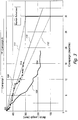
- Figure 3 shows a comparison between the actual refractory wear rates from subsequent campaigns in the same furnace.
- the brick length is a measurement of the refractory thickness and the campaign is measured in months.
- the furnace was operated in accordance with the techniques discussed in the Background of the Invention.
- the plot of the refractory wear during campaign no. 7 is shown along line 109.
- Line 110 is the statistically calculated trend line for refractory wear during campaign no. 8 calculated at 79.3 weeks into the campaign. The trend line indicates that the average wear rate during campaign no. 8 will be 1.7 mm per week.
- dotted line 111 shows a wear rate of 1 mm per week and dotted line 112 shows a wear rate of 2.24 mm per week.
- the data presented in Figure 3 confirms that the present invention provides an effective method of reducing refractory wear and increasing refractory campaigns.
- the relatively close alignment between the actual wear rate 108 during campaign no. 8 and the statistical trend line 110 is a further indication of the degree of control the present invention provides over wear rates and the increased accuracy of the predicted campaign.
Landscapes
- Engineering & Computer Science (AREA)
- Chemical & Material Sciences (AREA)
- Manufacturing & Machinery (AREA)
- Materials Engineering (AREA)
- Metallurgy (AREA)
- Organic Chemistry (AREA)
- Mechanical Engineering (AREA)
- General Engineering & Computer Science (AREA)
- Waste-Gas Treatment And Other Accessory Devices For Furnaces (AREA)
- Furnace Housings, Linings, Walls, And Ceilings (AREA)
- Vertical, Hearth, Or Arc Furnaces (AREA)
- Gasification And Melting Of Waste (AREA)
Applications Claiming Priority (5)
| Application Number | Priority Date | Filing Date | Title |
|---|---|---|---|
| AUPS1027A AUPS102702A0 (en) | 2002-03-12 | 2002-03-12 | Control of refractory wear |
| AUPS102702 | 2002-03-12 | ||
| AUPS319202 | 2002-06-26 | ||
| AUPS3192A AUPS319202A0 (en) | 2002-06-26 | 2002-06-26 | Control of refractory wear |
| PCT/AU2003/000295 WO2003076858A1 (en) | 2002-03-12 | 2003-03-12 | Control of refractory wear |
Publications (3)
| Publication Number | Publication Date |
|---|---|
| EP1497602A1 EP1497602A1 (en) | 2005-01-19 |
| EP1497602A4 EP1497602A4 (en) | 2006-03-08 |
| EP1497602B1 true EP1497602B1 (en) | 2018-04-25 |
Family
ID=27805835
Family Applications (1)
| Application Number | Title | Priority Date | Filing Date |
|---|---|---|---|
| EP03743760.5A Expired - Lifetime EP1497602B1 (en) | 2002-03-12 | 2003-03-12 | Control of refractory wear |
Country Status (10)
| Country | Link |
|---|---|
| EP (1) | EP1497602B1 (pl) |
| CN (1) | CN100535566C (pl) |
| AP (1) | AP1746A (pl) |
| AU (1) | AU2003209816B2 (pl) |
| BR (1) | BR0308390A (pl) |
| ES (1) | ES2674906T3 (pl) |
| MX (1) | MXPA04008859A (pl) |
| PL (1) | PL201060B1 (pl) |
| RU (1) | RU2286523C2 (pl) |
| WO (1) | WO2003076858A1 (pl) |
Families Citing this family (5)
| Publication number | Priority date | Publication date | Assignee | Title |
|---|---|---|---|---|
| PL1759024T3 (pl) | 2004-04-07 | 2014-12-31 | Outotec Oyj | Sposób konwertowania miedzi |
| RU2516416C1 (ru) * | 2012-12-04 | 2014-05-20 | Общество с ограниченной ответственностью "Объединенная Компания РУСАЛ Инженерно-технологический центр" | Способ определения степени износа карбидокремниевых блоков для боковой футеровки кожуха алюминиевых электролизеров |
| US10556598B2 (en) * | 2016-11-23 | 2020-02-11 | Ge Global Sourcing Llc | Vehicle control systems and methods |
| CN111279143A (zh) * | 2017-12-20 | 2020-06-12 | 日本制铁株式会社 | 电炉的耐火材料损耗管理装置、系统、方法以及存储介质 |
| FR3084662B1 (fr) * | 2018-08-01 | 2022-06-24 | Saint Gobain Ct Recherches | Detecteur d'usure pour four de verrerie |
Family Cites Families (14)
| Publication number | Priority date | Publication date | Assignee | Title |
|---|---|---|---|---|
| SU407176A1 (ru) * | 1972-06-26 | 1973-11-21 | Чел бинский металлургический завод | Способ регулирования температуры футеровки |
| JPS5816121B2 (ja) * | 1974-09-03 | 1983-03-29 | 住友金属工業株式会社 | レイキヤクバコノ ソンモウソクテイホウホウ |
| SU850676A1 (ru) * | 1979-06-07 | 1981-07-30 | Донецкий Ордена Трудового Красногознамени Политехнический Институт | Способ увеличени стойкости футеровкиМНОгОфАзНыХ элЕКТРОпЕчЕй |
| US4269397A (en) * | 1979-08-24 | 1981-05-26 | Bethlehem Steel Corporation | Method for measuring the thickness of a refractory in a metallurgical apparatus |
| SU901289A1 (ru) * | 1980-04-21 | 1982-01-30 | Донецкий Ордена Трудового Красного Знамени Политехнический Институт | Способ увеличени стойкости футеровки трехфазных электропечей |
| JPS60141813A (ja) * | 1983-12-28 | 1985-07-26 | Nippon Steel Corp | 溶鋼精錬炉の耐火壁管理方法 |
| SU1196662A1 (ru) * | 1984-06-25 | 1985-12-07 | Государственный Специализированный Трест "Уралцветметремонт" | Способ контрол толщины футеровки металлургической печи |
| DE3526391A1 (de) * | 1985-07-24 | 1987-02-05 | Werner Fischer | Verfahren und vorrichtung zur feststellung des verschleisses von feuerfest-steinen |
| SU1310433A1 (ru) * | 1985-09-20 | 1987-05-15 | Запорожский Металлургический Комбинат Им.Орджоникидзе | Способ нейтрализации конечного шлака |
| SU1406445A1 (ru) * | 1986-12-01 | 1988-06-30 | Челябинский металлургический комбинат | Способ контрол толщины футеровки плавильного агрегата |
| JP3858285B2 (ja) * | 1995-08-21 | 2006-12-13 | 住友金属工業株式会社 | 高炉操業方法 |
| JPH09287009A (ja) * | 1996-04-19 | 1997-11-04 | Nippon Steel Corp | 高炉操業方法 |
| JPH11316188A (ja) * | 1998-04-30 | 1999-11-16 | Zexel:Kk | オゾン濃度測定方法 |
| JPH11316118A (ja) * | 1998-05-06 | 1999-11-16 | Nippon Steel Corp | 耐火物の厚さ推定方法 |
-
2003
- 2003-03-12 AP APAP/P/2004/003133A patent/AP1746A/en active
- 2003-03-12 WO PCT/AU2003/000295 patent/WO2003076858A1/en not_active Ceased
- 2003-03-12 EP EP03743760.5A patent/EP1497602B1/en not_active Expired - Lifetime
- 2003-03-12 ES ES03743760.5T patent/ES2674906T3/es not_active Expired - Lifetime
- 2003-03-12 BR BR0308390-0A patent/BR0308390A/pt active IP Right Grant
- 2003-03-12 AU AU2003209816A patent/AU2003209816B2/en not_active Expired
- 2003-03-12 PL PL372891A patent/PL201060B1/pl unknown
- 2003-03-12 RU RU2004130306/02A patent/RU2286523C2/ru active
- 2003-03-12 MX MXPA04008859A patent/MXPA04008859A/es active IP Right Grant
- 2003-03-12 CN CNB038057980A patent/CN100535566C/zh not_active Expired - Lifetime
Non-Patent Citations (1)
| Title |
|---|
| None * |
Also Published As
| Publication number | Publication date |
|---|---|
| MXPA04008859A (es) | 2005-09-08 |
| EP1497602A1 (en) | 2005-01-19 |
| RU2286523C2 (ru) | 2006-10-27 |
| AP1746A (en) | 2007-05-31 |
| RU2004130306A (ru) | 2005-05-10 |
| PL372891A1 (pl) | 2005-08-08 |
| BR0308390A (pt) | 2005-01-11 |
| PL201060B1 (pl) | 2009-03-31 |
| EP1497602A4 (en) | 2006-03-08 |
| AU2003209816A1 (en) | 2003-09-22 |
| CN1643325A (zh) | 2005-07-20 |
| AP2004003133A0 (en) | 2004-09-30 |
| AU2003209816B2 (en) | 2008-09-04 |
| CN100535566C (zh) | 2009-09-02 |
| WO2003076858A1 (en) | 2003-09-18 |
| ES2674906T3 (es) | 2018-07-04 |
Similar Documents
| Publication | Publication Date | Title |
|---|---|---|
| EP1497602B1 (en) | Control of refractory wear | |
| JP4752021B2 (ja) | 高炉の減尺休風操業方法 | |
| KR880002277B1 (ko) | 고로 | |
| EP0128987B1 (en) | Tuyere and method for blowing gas into molten metal | |
| JPH0967607A (ja) | 高炉の炉底監視方法 | |
| JP2669279B2 (ja) | 高炉の操業方法 | |
| JP4949074B2 (ja) | プラズマ式溶融炉の運転制御方法及び装置 | |
| BRPI0308390B1 (pt) | Refractory wear control set for installation in a refractory oven and method of control of refractory wear rates within a refractory oven | |
| JPH10280020A (ja) | 溶融還元操業方法 | |
| EP3450575B1 (en) | A method for detecting a predetermined wear of a refractory lining of a metallurgical vessel and a corresponding refractory lining | |
| US4139183A (en) | Refractory-lined shaft furnace containing free carbon | |
| Bonte et al. | Influence of the coke and burden quality on the productivity of the blast furnace | |
| Joubert et al. | PGM Furnace Crucible Performance Following Design Upgrade | |
| JPS6137327B2 (pl) | ||
| JPH055117A (ja) | 冶金用精錬容器内の溶融物レベル検知方法 | |
| JPH10245604A (ja) | 高炉操業方法 | |
| Coetzee et al. | Application of UCAR® Chill Kote™ lining to ilmenite smelting | |
| JP2004052038A (ja) | シャフト炉の炉下部内壁形成装置 | |
| JPS62238308A (ja) | 溶鉱炉炉底部の測温方法 | |
| JP2001263960A (ja) | 高炉炉壁レンガ支持構造及び高炉操業方法 | |
| JP2004059956A (ja) | 高炉煉瓦の損耗防止方法 | |
| JP2002038207A (ja) | 高炉操業方法 | |
| JP2002267144A (ja) | 廃棄物溶融炉の溶融スラグの出湯方法及び出湯構造 | |
| KR20210074881A (ko) | 용융로 냉각설비 냉각 프로세스 제어 방법 및 이를 이용하는 냉각설비 장치 | |
| JPH0610289B2 (ja) | 高炉操業法 |
Legal Events
| Date | Code | Title | Description |
|---|---|---|---|
| PUAI | Public reference made under article 153(3) epc to a published international application that has entered the european phase |
Free format text: ORIGINAL CODE: 0009012 |
|
| 17P | Request for examination filed |
Effective date: 20040916 |
|
| AK | Designated contracting states |
Kind code of ref document: A1 Designated state(s): AT BE BG CH CY CZ DE DK EE ES FI FR GB GR HU IE IT LI LU MC NL PT RO SE SI SK TR |
|
| AX | Request for extension of the european patent |
Extension state: AL LT LV MK |
|
| A4 | Supplementary search report drawn up and despatched |
Effective date: 20060124 |
|
| 17Q | First examination report despatched |
Effective date: 20060905 |
|
| 17Q | First examination report despatched |
Effective date: 20060905 |
|
| STAA | Information on the status of an ep patent application or granted ep patent |
Free format text: STATUS: EXAMINATION IS IN PROGRESS |
|
| GRAP | Despatch of communication of intention to grant a patent |
Free format text: ORIGINAL CODE: EPIDOSNIGR1 |
|
| STAA | Information on the status of an ep patent application or granted ep patent |
Free format text: STATUS: GRANT OF PATENT IS INTENDED |
|
| RIC1 | Information provided on ipc code assigned before grant |
Ipc: C21C 5/46 20060101ALI20171031BHEP Ipc: C21C 5/44 20060101ALI20171031BHEP Ipc: F27D 3/16 20060101ALN20171031BHEP Ipc: C21C 5/52 20060101ALN20171031BHEP Ipc: F27D 21/04 20060101AFI20171031BHEP Ipc: C21B 7/24 20060101ALI20171031BHEP Ipc: F27D 21/00 20060101ALI20171031BHEP Ipc: F27D 3/15 20060101ALI20171031BHEP Ipc: F27D 19/00 20060101ALN20171031BHEP Ipc: C21B 7/06 20060101ALI20171031BHEP |
|
| INTG | Intention to grant announced |
Effective date: 20171201 |
|
| GRAA | (expected) grant |
Free format text: ORIGINAL CODE: 0009210 |
|
| GRAS | Grant fee paid |
Free format text: ORIGINAL CODE: EPIDOSNIGR3 |
|
| STAA | Information on the status of an ep patent application or granted ep patent |
Free format text: STATUS: THE PATENT HAS BEEN GRANTED |
|
| RAP1 | Party data changed (applicant data changed or rights of an application transferred) |
Owner name: XSTRATA QUEENSLAND LIMITED |
|
| AK | Designated contracting states |
Kind code of ref document: B1 Designated state(s): AT BE BG CH CY CZ DE DK EE ES FI FR GB GR HU IE IT LI LU MC NL PT RO SE SI SK TR |
|
| REG | Reference to a national code |
Ref country code: GB Ref legal event code: FG4D |
|
| REG | Reference to a national code |
Ref country code: CH Ref legal event code: EP |
|
| REG | Reference to a national code |
Ref country code: AT Ref legal event code: REF Ref document number: 993377 Country of ref document: AT Kind code of ref document: T Effective date: 20180515 |
|
| REG | Reference to a national code |
Ref country code: IE Ref legal event code: FG4D |
|
| REG | Reference to a national code |
Ref country code: DE Ref legal event code: R096 Ref document number: 60351146 Country of ref document: DE |
|
| REG | Reference to a national code |
Ref country code: ES Ref legal event code: FG2A Ref document number: 2674906 Country of ref document: ES Kind code of ref document: T3 Effective date: 20180704 |
|
| REG | Reference to a national code |
Ref country code: NL Ref legal event code: FP |
|
| PG25 | Lapsed in a contracting state [announced via postgrant information from national office to epo] |
Ref country code: SE Free format text: LAPSE BECAUSE OF FAILURE TO SUBMIT A TRANSLATION OF THE DESCRIPTION OR TO PAY THE FEE WITHIN THE PRESCRIBED TIME-LIMIT Effective date: 20180425 |
|
| PG25 | Lapsed in a contracting state [announced via postgrant information from national office to epo] |
Ref country code: GR Free format text: LAPSE BECAUSE OF FAILURE TO SUBMIT A TRANSLATION OF THE DESCRIPTION OR TO PAY THE FEE WITHIN THE PRESCRIBED TIME-LIMIT Effective date: 20180726 |
|
| REG | Reference to a national code |
Ref country code: AT Ref legal event code: MK05 Ref document number: 993377 Country of ref document: AT Kind code of ref document: T Effective date: 20180425 |
|
| PG25 | Lapsed in a contracting state [announced via postgrant information from national office to epo] |
Ref country code: PT Free format text: LAPSE BECAUSE OF FAILURE TO SUBMIT A TRANSLATION OF THE DESCRIPTION OR TO PAY THE FEE WITHIN THE PRESCRIBED TIME-LIMIT Effective date: 20180827 |
|
| REG | Reference to a national code |
Ref country code: DE Ref legal event code: R097 Ref document number: 60351146 Country of ref document: DE |
|
| PG25 | Lapsed in a contracting state [announced via postgrant information from national office to epo] |
Ref country code: AT Free format text: LAPSE BECAUSE OF FAILURE TO SUBMIT A TRANSLATION OF THE DESCRIPTION OR TO PAY THE FEE WITHIN THE PRESCRIBED TIME-LIMIT Effective date: 20180425 Ref country code: CZ Free format text: LAPSE BECAUSE OF FAILURE TO SUBMIT A TRANSLATION OF THE DESCRIPTION OR TO PAY THE FEE WITHIN THE PRESCRIBED TIME-LIMIT Effective date: 20180425 Ref country code: SK Free format text: LAPSE BECAUSE OF FAILURE TO SUBMIT A TRANSLATION OF THE DESCRIPTION OR TO PAY THE FEE WITHIN THE PRESCRIBED TIME-LIMIT Effective date: 20180425 Ref country code: RO Free format text: LAPSE BECAUSE OF FAILURE TO SUBMIT A TRANSLATION OF THE DESCRIPTION OR TO PAY THE FEE WITHIN THE PRESCRIBED TIME-LIMIT Effective date: 20180425 Ref country code: EE Free format text: LAPSE BECAUSE OF FAILURE TO SUBMIT A TRANSLATION OF THE DESCRIPTION OR TO PAY THE FEE WITHIN THE PRESCRIBED TIME-LIMIT Effective date: 20180425 Ref country code: DK Free format text: LAPSE BECAUSE OF FAILURE TO SUBMIT A TRANSLATION OF THE DESCRIPTION OR TO PAY THE FEE WITHIN THE PRESCRIBED TIME-LIMIT Effective date: 20180425 |
|
| REG | Reference to a national code |
Ref country code: CH Ref legal event code: PK Free format text: BERICHTIGUNGEN |
|
| RIC2 | Information provided on ipc code assigned after grant |
Ipc: F27D 19/00 20060101ALN20171031BHEP Ipc: F27D 21/00 20060101ALI20171031BHEP Ipc: C21C 5/44 20060101ALI20171031BHEP Ipc: C21B 7/24 20060101ALI20171031BHEP Ipc: F27D 21/04 20060101AFI20171031BHEP Ipc: C21C 5/46 20060101ALI20171031BHEP Ipc: F27D 3/15 20060101ALI20171031BHEP Ipc: C21C 5/52 20060101ALN20171031BHEP Ipc: F27D 3/16 20060101ALN20171031BHEP Ipc: C21B 7/06 20060101ALI20171031BHEP |
|
| PG25 | Lapsed in a contracting state [announced via postgrant information from national office to epo] |
Ref country code: IT Free format text: LAPSE BECAUSE OF FAILURE TO SUBMIT A TRANSLATION OF THE DESCRIPTION OR TO PAY THE FEE WITHIN THE PRESCRIBED TIME-LIMIT Effective date: 20180425 |
|
| PLBE | No opposition filed within time limit |
Free format text: ORIGINAL CODE: 0009261 |
|
| STAA | Information on the status of an ep patent application or granted ep patent |
Free format text: STATUS: NO OPPOSITION FILED WITHIN TIME LIMIT |
|
| 26N | No opposition filed |
Effective date: 20190128 |
|
| PG25 | Lapsed in a contracting state [announced via postgrant information from national office to epo] |
Ref country code: SI Free format text: LAPSE BECAUSE OF FAILURE TO SUBMIT A TRANSLATION OF THE DESCRIPTION OR TO PAY THE FEE WITHIN THE PRESCRIBED TIME-LIMIT Effective date: 20180425 |
|
| PG25 | Lapsed in a contracting state [announced via postgrant information from national office to epo] |
Ref country code: MC Free format text: LAPSE BECAUSE OF FAILURE TO SUBMIT A TRANSLATION OF THE DESCRIPTION OR TO PAY THE FEE WITHIN THE PRESCRIBED TIME-LIMIT Effective date: 20180425 |
|
| PG25 | Lapsed in a contracting state [announced via postgrant information from national office to epo] |
Ref country code: LU Free format text: LAPSE BECAUSE OF NON-PAYMENT OF DUE FEES Effective date: 20190312 |
|
| PG25 | Lapsed in a contracting state [announced via postgrant information from national office to epo] |
Ref country code: IE Free format text: LAPSE BECAUSE OF NON-PAYMENT OF DUE FEES Effective date: 20190312 |
|
| PG25 | Lapsed in a contracting state [announced via postgrant information from national office to epo] |
Ref country code: FR Free format text: LAPSE BECAUSE OF NON-PAYMENT OF DUE FEES Effective date: 20190331 |
|
| PG25 | Lapsed in a contracting state [announced via postgrant information from national office to epo] |
Ref country code: TR Free format text: LAPSE BECAUSE OF FAILURE TO SUBMIT A TRANSLATION OF THE DESCRIPTION OR TO PAY THE FEE WITHIN THE PRESCRIBED TIME-LIMIT Effective date: 20180425 |
|
| PG25 | Lapsed in a contracting state [announced via postgrant information from national office to epo] |
Ref country code: CY Free format text: LAPSE BECAUSE OF FAILURE TO SUBMIT A TRANSLATION OF THE DESCRIPTION OR TO PAY THE FEE WITHIN THE PRESCRIBED TIME-LIMIT Effective date: 20180425 |
|
| PG25 | Lapsed in a contracting state [announced via postgrant information from national office to epo] |
Ref country code: HU Free format text: LAPSE BECAUSE OF FAILURE TO SUBMIT A TRANSLATION OF THE DESCRIPTION OR TO PAY THE FEE WITHIN THE PRESCRIBED TIME-LIMIT; INVALID AB INITIO Effective date: 20030312 |
|
| PGFP | Annual fee paid to national office [announced via postgrant information from national office to epo] |
Ref country code: GB Payment date: 20220224 Year of fee payment: 20 Ref country code: FI Payment date: 20220309 Year of fee payment: 20 Ref country code: DE Payment date: 20220223 Year of fee payment: 20 Ref country code: CH Payment date: 20220301 Year of fee payment: 20 Ref country code: BG Payment date: 20220304 Year of fee payment: 20 |
|
| PGFP | Annual fee paid to national office [announced via postgrant information from national office to epo] |
Ref country code: NL Payment date: 20220314 Year of fee payment: 20 Ref country code: BE Payment date: 20220301 Year of fee payment: 20 |
|
| PGFP | Annual fee paid to national office [announced via postgrant information from national office to epo] |
Ref country code: ES Payment date: 20220406 Year of fee payment: 20 |
|
| REG | Reference to a national code |
Ref country code: DE Ref legal event code: R071 Ref document number: 60351146 Country of ref document: DE |
|
| REG | Reference to a national code |
Ref country code: CH Ref legal event code: PL Ref country code: NL Ref legal event code: MK Effective date: 20230311 |
|
| REG | Reference to a national code |
Ref country code: BE Ref legal event code: MK Effective date: 20230312 |
|
| REG | Reference to a national code |
Ref country code: GB Ref legal event code: PE20 Expiry date: 20230311 |
|
| REG | Reference to a national code |
Ref country code: ES Ref legal event code: FD2A Effective date: 20230426 |
|
| PG25 | Lapsed in a contracting state [announced via postgrant information from national office to epo] |
Ref country code: GB Free format text: LAPSE BECAUSE OF EXPIRATION OF PROTECTION Effective date: 20230311 |
|
| PG25 | Lapsed in a contracting state [announced via postgrant information from national office to epo] |
Ref country code: ES Free format text: LAPSE BECAUSE OF EXPIRATION OF PROTECTION Effective date: 20230313 |