EP1497263B1 - Acyl-3-carboxyphenyl-harnstoffderivate, verfahren zu deren herstellung und deren verwendung - Google Patents
Acyl-3-carboxyphenyl-harnstoffderivate, verfahren zu deren herstellung und deren verwendung Download PDFInfo
- Publication number
- EP1497263B1 EP1497263B1 EP03745772A EP03745772A EP1497263B1 EP 1497263 B1 EP1497263 B1 EP 1497263B1 EP 03745772 A EP03745772 A EP 03745772A EP 03745772 A EP03745772 A EP 03745772A EP 1497263 B1 EP1497263 B1 EP 1497263B1
- Authority
- EP
- European Patent Office
- Prior art keywords
- alkyl
- cycloalkyl
- phenyl
- alkenyl
- alkynyl
- Prior art date
- Legal status (The legal status is an assumption and is not a legal conclusion. Google has not performed a legal analysis and makes no representation as to the accuracy of the status listed.)
- Expired - Lifetime
Links
- 0 CC*(c(c(*)c1*CC(**)C(C)=*)c(*=C)c(C(*C)=*)c1O)=C Chemical compound CC*(c(c(*)c1*CC(**)C(C)=*)c(*=C)c(C(*C)=*)c1O)=C 0.000 description 1
Classifications
-
- C—CHEMISTRY; METALLURGY
- C07—ORGANIC CHEMISTRY
- C07C—ACYCLIC OR CARBOCYCLIC COMPOUNDS
- C07C275/00—Derivatives of urea, i.e. compounds containing any of the groups, the nitrogen atoms not being part of nitro or nitroso groups
- C07C275/46—Derivatives of urea, i.e. compounds containing any of the groups, the nitrogen atoms not being part of nitro or nitroso groups containing any of the groups, X being a hetero atom, Y being any atom, e.g. acylureas
- C07C275/48—Y being a hydrogen or a carbon atom
- C07C275/54—Y being a carbon atom of a six-membered aromatic ring, e.g. benzoylureas
-
- A—HUMAN NECESSITIES
- A61—MEDICAL OR VETERINARY SCIENCE; HYGIENE
- A61K—PREPARATIONS FOR MEDICAL, DENTAL OR TOILETRY PURPOSES
- A61K31/00—Medicinal preparations containing organic active ingredients
- A61K31/33—Heterocyclic compounds
- A61K31/395—Heterocyclic compounds having nitrogen as a ring hetero atom, e.g. guanethidine or rifamycins
- A61K31/54—Heterocyclic compounds having nitrogen as a ring hetero atom, e.g. guanethidine or rifamycins having six-membered rings with at least one nitrogen and one sulfur as the ring hetero atoms, e.g. sulthiame
-
- A—HUMAN NECESSITIES
- A61—MEDICAL OR VETERINARY SCIENCE; HYGIENE
- A61P—SPECIFIC THERAPEUTIC ACTIVITY OF CHEMICAL COMPOUNDS OR MEDICINAL PREPARATIONS
- A61P3/00—Drugs for disorders of the metabolism
- A61P3/08—Drugs for disorders of the metabolism for glucose homeostasis
- A61P3/10—Drugs for disorders of the metabolism for glucose homeostasis for hyperglycaemia, e.g. antidiabetics
Definitions
- the invention relates to acyl-3-carboxyphenyl-urea derivatives and their physiologically acceptable salts and physiologically functional derivatives.
- EP 0 193 249 (Duphar ) are described acyl-carboxyphenyl-urea derivatives having antitumor activity.
- the object of the invention was to provide compounds with which a prevention and treatment of type 2 diabetes is possible.
- the task was that new compounds with a significantly improved effect over the EP 0 193 249 known compounds are provided.
- radicals or substituents can occur several times in the compounds of the formula I, such as, for example, -O-R11, they may all, independently of one another, have the meanings indicated and be identical or different.
- the invention relates to compounds of the formula I, in the form of their racemates, racemic mixtures and pure enantiomers, and to their diastereomers and mixtures thereof.
- alkyl radicals in the substituents R1, R2, R3, R4, R5, R6, R7, R8, R9, R10, R11, R12, R13, R14, R15, R16 and R17 can be both straight-chain and branched.
- Suitable pharmaceutically acceptable salts are particularly suitable for medical applications because of their higher water solubility compared to the starting or basic compounds. These salts must have a pharmaceutically acceptable anion or cation.
- Suitable pharmaceutically acceptable acid addition salts of the compounds according to the invention are salts of inorganic acids, such as hydrochloric acid, hydrobromic acid, phosphoric acid, metaphosphoric acid, nitric acid and sulfuric acid, and also organic acids, such as, for example, acetic acid, benzenesulfonic, benzoic, citric, ethanesulfonic, fumaric acid.
- Suitable pharmaceutically acceptable basic salts are ammonium salts, alkali metal salts (such as sodium and potassium salts), alkaline earth salts (such as magnesium and Calcium salts), trometamol (2-amino-2-hydroxymethyl-1,3-propanediol), diethanolamine, lysine or ethylenediamine.
- Salts with a non-pharmaceutically acceptable anion are also within the scope of the invention as useful intermediates for the preparation or purification of pharmaceutically acceptable salts and / or for use in non-therapeutic, for example, in vitro applications.
- the physiologically functional derivatives also include prodrugs of the compounds of the invention, such as in Chem. Pharm. Bull. 1994, 42, 57-61 described. Such prodrugs can be metabolized in vivo to a compound of the invention. These prodrugs may or may not be effective.
- the compounds of the invention may also be in various polymorphic forms, e.g. as amorphous and crystalline polymorphic forms. All polymorphic forms of the compounds of the invention are within the scope of the invention and are a further aspect of the invention.
- the compound (s) of the formula (I) can also be administered in combination with other active substances.
- the amount of a compound of Formula I required to achieve the desired biological effect is dependent upon a number of factors, eg, the specific compound chosen, the intended use, the mode of administration, and the clinical condition of the patient.
- the daily dose ranges from 0.3 mg to 100 mg (typically 3 mg and 50 mg) per day per kilogram of body weight, eg 3-10 mg / kg / day.
- an intravenous dose may range from 0.3 mg to 1.0 mg / kg, which may conveniently be administered as an infusion of 10 ng to 100 ng per kilogram per minute.
- Suitable infusion solutions for these purposes may contain, for example, from 0.1 ng to 10 mg, typically from 1 ng to 10 mg per milliliter.
- Single doses may contain, for example, from 1 mg to 10 g of the active ingredient.
- injectable ampoules, and orally administrable unit dose formulations such as tablets or capsules, may contain, for example, from 1.0 to 1000 mg, typically from 10 to 600 mg.
- the compounds according to formula I can themselves be used as compound, but they are preferably present with a compatible carrier in the form of a pharmaceutical composition.
- the carrier must of course be compatible in the sense that it is compatible with the other ingredients of the composition and is not harmful to the patient.
- the carrier may be a solid or a liquid, or both, and is preferably formulated with the compound as a single dose, for example, as a tablet, which may contain from 0.05% to 95% by weight of the active ingredient.
- Other pharmaceutically active substances may likewise be present, including further compounds of the formula I.
- the pharmaceutical compositions according to the invention can be prepared by one of the known pharmaceutical methods, which essentially consist in mixing the ingredients with pharmacologically acceptable carriers and / or excipients ,
- compositions according to the invention are those which are suitable for oral, rectal, topical, peroral (eg sublingual) and parenteral (eg subcutaneous, intramuscular, intradermal or intravenous) administration, although the most suitable mode of administration in each individual case is of the type and severity of the treatment to be treated State and on the nature of the particular compound used in accordance with formula I is dependent.
- coated formulations and coated slow release formulations are within the scope of the invention.
- Suitable pharmaceutical compounds for oral administration may be in separate units, such as capsules, cachets, lozenges or tablets, each containing a certain amount of the compound of formula I; as a powder or granules; as a solution or suspension in an aqueous or non-aqueous liquid; or as an oil-in-water or water-in-oil emulsion.
- these compositions may be formulated by any suitable pharmaceutical method comprising a step in which the active ingredient and the carrier (selected from a or several additional constituents).
- the compositions are prepared by uniformly and homogeneously mixing the active ingredient with a liquid and / or finely divided solid carrier, after which the product is molded, if necessary.
- a tablet can be made by compressing or molding a powder or granules of the compound, optionally with one or more additional ingredients.
- Compressed tablets can be prepared by tableting the compound in free-flowing form, such as a powder or granules, optionally mixed with a binder, lubricant, inert diluent and / or surfactant / dispersant in a suitable machine.
- Shaped tablets can by molding the powdered, moistened with an inert liquid diluent compound can be prepared in a suitable machine.
- compositions suitable for peroral (sublingual) administration include lozenges containing a compound of Formula I with a flavor, usually sucrose and gum arabic or tragacanth, and lozenges containing the compound in an inert base such as gelatin and glycerol or sucrose and gum arabic.
- Suitable pharmaceutical compositions for parenteral administration preferably comprise sterile aqueous preparations of a compound according to formula I which are preferably isotonic with the blood of the intended recipient. These preparations are preferably administered intravenously, although the administration may also be subcutaneous, intramuscular or intradermal as an injection. These preparations may preferably be prepared by mixing the compound with water and rendering the resulting solution sterile and isotonic with the blood. Injectable compositions of the invention generally contain from 0.1% to 5% by weight of the active compound.
- Suitable pharmaceutical compositions for rectal administration are preferably as single dose suppositories. These can be prepared by mixing a compound according to formula I with one or more conventional solid carriers, for example cocoa butter, and shaping the resulting mixture.
- Suitable pharmaceutical compositions for topical application to the skin are preferably as an ointment, cream, lotion, paste, spray, aerosol or oil.
- Vaseline, lanolin, polyethylene glycols, alcohols and combinations of two or more of these substances can be used as the carrier.
- the active ingredient is generally present at a level of from 0.1% to 15% by weight of the composition, for example from 0.5% to 2%.
- Suitable pharmaceutical compositions for transdermal applications may exist as single patches suitable for long-term close contact with the epidermis of the patient. Such patches suitably contain the active ingredient in an optionally buffered aqueous solution, dissolved and / or dispersed in an adhesive or dispersed in a polymer.
- a suitable active ingredient concentration is about 1% to 35%, preferably about 3% to 15%.
- the active ingredient can be released by electrotransport or iontophoresis as described, for example, in Pharmaceutical Research, 2 (6): 318 (1986).
- active ingredients for the combination preparations are suitable: All antidiabetic medicines mentioned in the Red List 2001, chapter 12. They can be combined with the compounds of the formula I according to the invention in particular for the synergistic effect improvement.
- the administration of the active ingredient combination can be carried out either by separate administration of the active ingredients to the patient or in the form of combination preparations in which several active ingredients are present in a pharmaceutical preparation.
- Most of the drugs listed below are disclosed in USP Dictionary of USAN and International Drug Names, US Pharmacopeia, Rockville 2001.
- Antidiabetics include insulin and insulin derivatives, such as Lantus ® (see www.lantus.com) or HMR 1964, fast-acting insulins (see US 6,221,633 ), GLP-1 derivatives such as those in WO 98/08871 by Novo Nordisk A / S, as well as orally active hypoglycemic agents.
- the orally active hypoglycemic agents preferably include sulphonylureas, biguanidines, meglitinides, oxadiazolidinediones, thiazolidinediones, glucosidase inhibitors, glucagon antagonists, GLP-1 agonists, Potassium channel openers, such as those in WO 97/26265 and WO 99/03861 by Novo Nordisk A / S, insulin sensitizers, inhibitors of liver enzymes involved in the stimulation of gluconeogenesis and / or glycogenolysis, modulators of glucose uptake, lipid metabolism altering compounds such as antihyperlipidemic agents and antilipidemic agents, compounds, which reduce food intake, PPAR and PXR agonists and drugs that act on the ATP-dependent potassium channel of beta cells.
- sulphonylureas biguanidines, meglitinides, oxadiazolidinediones, thiazolidinediones,
- the compounds of formula I are administered in combination with an HMGCoA reductase inhibitor such as simvastatin, fluvastatin, pravastatin, lovastatin, atorvastatin, cerivastatin, rosuvastatin.
- an HMGCoA reductase inhibitor such as simvastatin, fluvastatin, pravastatin, lovastatin, atorvastatin, cerivastatin, rosuvastatin.
- the compounds of formula I are administered in combination with a cholesterol resorption inhibitor, e.g. Ezetimibe, Tiqueside, Pamaqueside.
- a cholesterol resorption inhibitor e.g. Ezetimibe, Tiqueside, Pamaqueside.
- the compounds of formula I are administered in combination with a PPAR gamma agonist, e.g. Rosiglitazone, pioglitazone, JTT-501, GI 262570.
- a PPAR gamma agonist e.g. Rosiglitazone, pioglitazone, JTT-501, GI 262570.
- the compounds of formula I in combination with PPAR alpha agonist e.g. GW 9578, GW 7647.
- the compounds of formula I are used in combination with a mixed PPAR alpha / gamma agonist such as GW 1536, AVE 8042, AVE 8134, AVE 0847, or as in PCT / US 11833 .
- a mixed PPAR alpha / gamma agonist such as GW 1536, AVE 8042, AVE 8134, AVE 0847, or as in PCT / US 11833 .
- PCT / US 11490 . DE10142734.4 described administered.
- the compounds of formula I are used in combination with a fibrate, e.g. Fenofibrate, clofibrate, bezafibrate.
- a fibrate e.g. Fenofibrate, clofibrate, bezafibrate.
- the compounds of the formula I are administered in combination with an MTP inhibitor, such as eg Implitapide, BMS-201038, R-103757.
- an MTP inhibitor such as eg Implitapide, BMS-201038, R-103757.
- the compounds of the formula I in combination with bile acid resorption inhibitor in combination with bile acid resorption inhibitor (see, for example US 6,245,744 or US 6,221,897 ), such as HMR 1741.
- the compounds of formula I are administered in combination with a CETP inhibitor, e.g. JTT-705.
- a CETP inhibitor e.g. JTT-705.
- the compounds of formula I are used in combination with a polymeric bile acid adsorber, e.g. Cholestyramine, colesevelam.
- a polymeric bile acid adsorber e.g. Cholestyramine, colesevelam.
- the compounds of the formula I in combination with an LDL receptor inducers such as HMR1171, HMR1586.
- the compounds of formula I are administered in combination with an ACAT inhibitor, e.g. Avasimibe, administered.
- an ACAT inhibitor e.g. Avasimibe
- the compounds of formula I are used in combination with an antioxidant, e.g. OPC-14117 administered.
- the compounds of formula I are used in combination with a lipoprotein lipase inhibitor, e.g. NO-1886, administered.
- a lipoprotein lipase inhibitor e.g. NO-1886
- the compounds of formula I are used in combination with an ATP citrate lyase inhibitor, e.g. SB-204990 administered.
- the compounds of formula I are administered in combination with a squalene synthetase inhibitor, such as BMS-188494.
- the compounds of formula I in combination with a lipoprotein (a) antagonist, e.g. Cl-1027 or nicotinic acid.
- a lipoprotein (a) antagonist e.g. Cl-1027 or nicotinic acid.
- the compounds of formula I are administered in combination with a lipase inhibitor, e.g. Orlistat, administered.
- a lipase inhibitor e.g. Orlistat
- the compounds of the formula I are administered in combination with insulin.
- the compounds of formula I are administered in combination with a sulphonylurea, such as, for example, tolbutamide, glibenclamide, glipizide or glimepiride.
- the compounds of formula I are administered in combination with a biguanide such as metformin.
- the compounds of formula I are administered in combination with a meglitinide, such as repaglinide.
- the compounds of formula I are in combination with a thiazolidinedione; such as troglitazone, ciglitazone, pioglitazone, rosiglitazone or the in WO 97/41097 from dr.
- Reddy's Research Foundation disclosed compounds, particularly 5 - [[4 - [(3,4-dihydro-3-methyl-4-oxo-2-quinazolinylmethoxy] -phenyl] methyl] -2,4-thiazolidinedione.
- the compounds of formula I are administered in combination with an ⁇ -glucosidase inhibitor, such as miglitol or acarbose.
- the compounds of formula I are administered in combination with an agent that acts on the ATP-dependent potassium channel of beta cells, such as tolbutamide, glibenclamide, glipizide, glimepiride or repaglinide.
- the compounds of the formula I are used in combination with more than one of the abovementioned compounds, for example in combination with a sulphonylurea and metformin, a sulphonylurea and acarbose, repaglinide and metformin, insulin and a sulphonylurea, insulin and metformin, insulin and troglitazone , Insulin and lovastatin, etc. administered.
- the compounds of the formula I are used in combination with CART modulators (see " Cocaine-amphetamine-regulated transcript-influencing energy metabolism, anxiety and gastric emptying in mice "Asakawa, A., et al., M.: Hormones and Metabolic Research (2001), 33 (9), 554-558 ), NPY antagonists eg naphthalene-1-sulfonic acid ⁇ 4 - [(4-amino-quinazolin-2-ylamino) -methyl] -cyclohexylmethyl ⁇ -amide; hydrochloride (CGP 71683A)), MC4 agonists (eg, 1-amino-1,2,3,4-tetrahydronaphthalene-2-carboxylic acid [2- (3a-benzyl-2-methyl-3-oxo-2,3 , 3a, 4,6,7-hexahydro-pyrazolo [4,3-c] pyridine-5-yl) -1- (4-
- DA agonists bromocriptine, doprexin
- lipase / amylase inhibitors eg WO 00/40569
- PPAR modvlators eg WO 00/78312
- RXR modulators or TR- ⁇ agonists.
- the further active ingredient is leptin; see eg " Perspectives in the therapeutic use of leptin “, Salvador, Javier, Gomez-Ambrosi, Javier, Fruhbeck, Gema, Expert Opinion on Pharmacotherapy (2001), 2 (10), 1615-1622 ,
- the further active ingredient is dexamphatamine or amphetamine.
- the other active ingredient is fenfluramine or dexfenfluramine.
- the other active ingredient is sibutramine.
- the other active ingredient is orlistat.
- the other active ingredient is mazindol or phentermine.
- the compounds of the formula I are used in combination with fibers, preferably insoluble fibers (see, for example, Carob / Caromax® (US Pat. Guild HJ; et al., Carob pulp preparation for the treatment of hypercholesterolemia, ADVANCES IN THERAPY (2001 Sep-Oct), 18 (5), 230-6 .)
- Caromax is a carob-containing product of the company Nutrinova, Nutrition Specialties & Food Ingredients GmbH, Industriepark availability, 65926 Frankfurt / Main)) administered.
- the combination with Caromax® can be carried out in one preparation or by separate administration of compounds of the formula I and Caromax®.
- Caromax® can also be administered in the form of food, such as in baked goods or muesli bars.
- Example 5 was from EP 0 193 249 synthesized. Comparative Example A has the structure:
- the compounds of the formula I are distinguished by favorable effects on the sugar metabolism, they reduce in particular the blood sugar level and are suitable for the treatment of type 2 diabetes.
- the compounds can therefore be used alone or in combination with other blood sugar lowering agents (antidiabetics).
- the compounds of the formula I are furthermore suitable for the treatment of diabetic late damage, such as, for example, nephropathy, retinopathy, neuropathy and myocardial infarction, peripheral arterial occlusive diseases, thromboses, arteriosclerosis, syndrome X, obesity, inflammations, immune diseases, autoimmune diseases, such as, for example, AIDS. Asthma, osteoporosis, cancer, psoriasis, Alzheimer's, schizophrenia and infectious diseases.
- diabetic late damage such as, for example, nephropathy, retinopathy, neuropathy and myocardial infarction, peripheral arterial occlusive diseases, thromboses, arteriosclerosis, syndrome X, obesity, inflammations, immune diseases, autoimmune diseases, such as, for
- the effect of compounds on the activity of the active form of glycogen phosphorylase (GPa) was measured in the reverse direction by following the glycogen synthesis from glucose 1-phosphate by determination of the release of inorganic phosphate. All reactions were performed as duplicate determinations in 96-well microtiter plates (Halfarea Plates, Costar # 3696), with the change in absorbance due to Formation of the reaction product at the wavelength specified below was measured in a Multiskan Ascent Elisa Reader (Lab Systems, Finland). In order to measure the GPa enzyme activity in the reverse direction, the conversion of glucose 1-phosphate to glycogen and inorganic phosphate was determined by the general method of Engers et al.
- Human glycogen phosphorylase a (for example with 0.76 mg protein / ml (Aventis Pharma GmbH), dissolved in buffer solution E (25 mM ⁇ -glycerophosphate, pH 7.0, 1 mM EDTA and 1 mM dithiothreitol ) was supplemented with buffer T (50 mM Hepes, pH 7.0, 100 mM KCl, 2.5 mM EDTA, 2.5 mM MgCl 2 .6H 2 O) and 5 mg / ml glycogen to a concentration of 10 Test substances were prepared as 10 mM solution in DMSO and diluted to 50 ⁇ M with buffer solution T.
- buffer solution E 25 mM ⁇ -glycerophosphate, pH 7.0, 1 mM EDTA and 1 mM dithiothreitol
- buffer T 50 mM Hepes, pH 7.0, 100 mM KCl, 2.5 mM EDTA, 2.5 mM MgCl
- Comparative Example A shows 3% inhibition at 10 ⁇ M.
- the compounds of the formula I inhibit the activity of glycogen phosphorylase a and are therefore well suited for lowering the blood sugar level.
- the compounds of the formula I have a 14- to 32-fold increased activity over the comparative example A.
- 2,4-Dichlorobenzamide was dissolved in dichloromethane, with 1.5 eq. Oxalyl chloride and heated to reflux for 16 hours. The reaction mixture was concentrated under high vacuum and reacted without further purification in step b.
Landscapes
- Health & Medical Sciences (AREA)
- Chemical & Material Sciences (AREA)
- Organic Chemistry (AREA)
- Diabetes (AREA)
- Medicinal Chemistry (AREA)
- Veterinary Medicine (AREA)
- Public Health (AREA)
- General Health & Medical Sciences (AREA)
- Animal Behavior & Ethology (AREA)
- Life Sciences & Earth Sciences (AREA)
- Pharmacology & Pharmacy (AREA)
- Hematology (AREA)
- Nuclear Medicine, Radiotherapy & Molecular Imaging (AREA)
- General Chemical & Material Sciences (AREA)
- Chemical Kinetics & Catalysis (AREA)
- Obesity (AREA)
- Bioinformatics & Cheminformatics (AREA)
- Engineering & Computer Science (AREA)
- Endocrinology (AREA)
- Emergency Medicine (AREA)
- Epidemiology (AREA)
- Pharmaceuticals Containing Other Organic And Inorganic Compounds (AREA)
- Organic Low-Molecular-Weight Compounds And Preparation Thereof (AREA)
- Acyclic And Carbocyclic Compounds In Medicinal Compositions (AREA)
Description
- Die Erfindung betrifft Acyl-3-carboxyphenyl-harnstoffderivate sowie deren physiologisch verträgliche Salze und physiologisch funktionelle Derivate.
- In
EP 0 193 249 (Duphar ) werden Acyl-carboxyphenyl-harnstoffderivate mit Antitumoraktivität beschrieben. - In
WO 01/94300 (Aventis - Der Erfindung lag die Aufgabe zugrunde, Verbindungen zur Verfügung zu stellen, mit denen eine Prävention und Behandlung von Diabetes Typ 2 möglich ist. Insbesonders lag die Aufgabe darin, dass neue Verbindungen mit einer deutlich verbesserten Wirkung gegenüber den aus
EP 0 193 249 bekannten Verbindungen zur Verfügung gestellt werden. - Die Erfindung betrifft daher Verbindungen der Formel I,
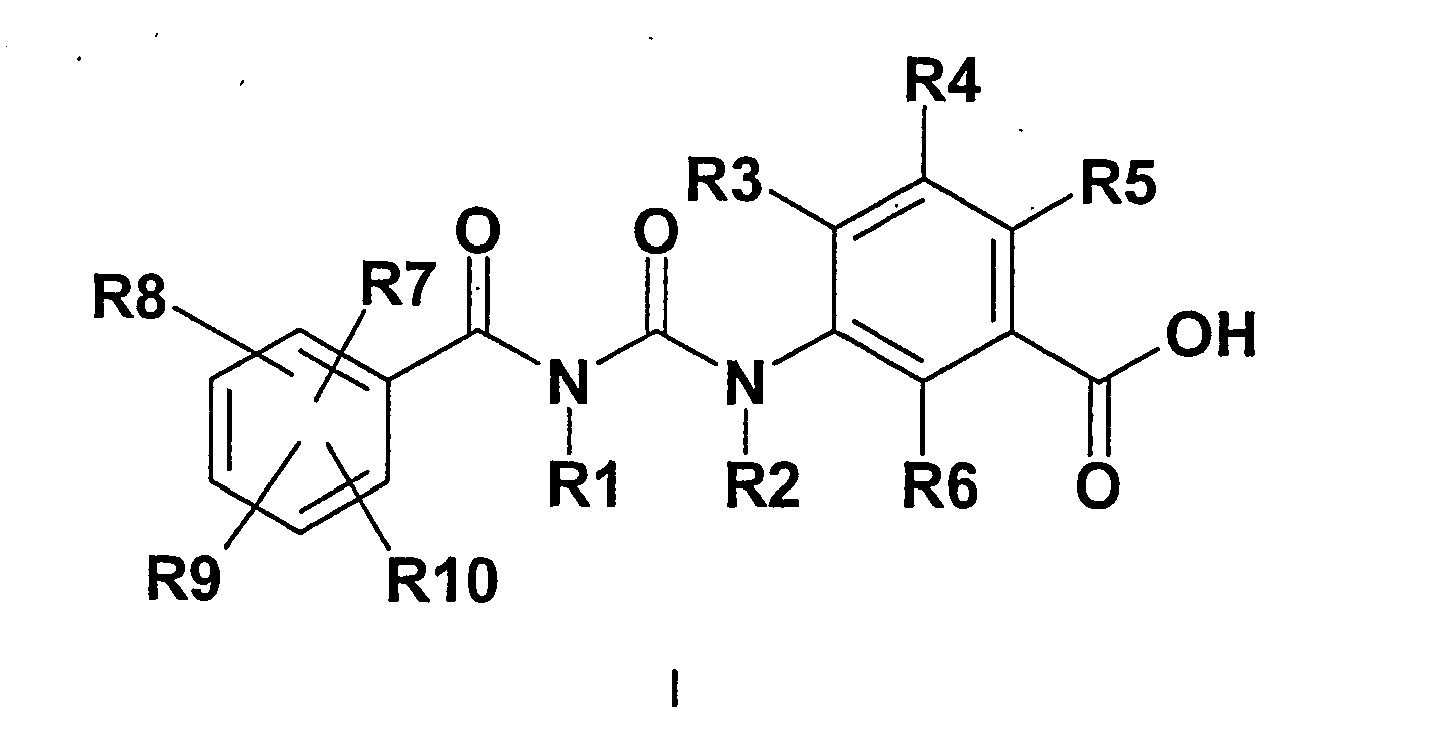
- R7, R8, R9, R10
- unabhängig voneinander H, F, Cl, Br, OH, NO2, CN, O-(C1-C6)-Alkyl, O-(C2-C6)-Alkenyl, O-(C2-C6)-Alkinyl, O-SO2-(C1-C4)-Alkyl, (C1-C6)-Alkyl, (C2-C6)-Alkenyl, (C2-C6)-Alkinyl, wobei Alkyl, Alkenyl und Alkinyl ein oder mehrfach durch F, Cl oder Br substituiert sein können;
- R1, R2
- unabhängig voneinander H, (C1-C6)-Alkyl, wobei Alkyl mit OH, O-(C1-C4)-Alkyl, NH2, NH(C1-C4)-Alkyl, N[(C1-C6)-Alkyl]2 substituiert sein kann, O-(C1-C6)-Alkyl, CO-(C1-C6)-Alkyl, COO-(C1-C6)-Alkyl, (C1-C6)-Alkylen-COOH oder (C1-C6)-Alkylen-COO-(C1-C6)-alkyl;
- R3
- H, F, Cl, Br, NO2, CN, O-R11, O-Phenyl, S-R11, COOR11, N(R12)(R13), (C1-C6)-Alkyl, (C2-C6)-Alkenyl, (C2-C6)-Alkinyl, (C3-C7)-Cycloalkyl oder (C3-C7)-Cycloalkyl-(C1-C4)-alkylen, wobei Alkyl, Cycloalkyl und Alkinyl ein oder mehrfach mit F, Cl, Br, OR11, COOR11 oder N(R16)(R17) substituiert sein können;
- R4
- H, F, Cl, Br, NO2, CN, O-R11, O-Phenyl, S-R11, COOR11, N(R12)(R13), (C1-C6)-Alkyl, (C2-C6)-Alkenyl, (C2-C6)-Alkinyl, (C3-C7)-Cycloalkyl oder (C3-C7)-Cycloalkyl-(C1-C4)-alkylen, wobei Alkyl, Cycloalkyl und Alkinyl ein oder mehrfach mit F, Cl, Br, OR11, COOR11 oder N(R16)(R17) substituiert sein können;
- R5
- H, F, Cl, Br, NO2, CN, O-R11, O-Phenyl, S-R11, COOR11, N(R12)(R13), (C1-C6)-Alkyl, (C2-C6)-Alkenyl, (C2-C6)-Alkinyl, (C3-C7)-Cycloalkyl oder (C3-C7)-Cycloalkyl-(C1-C4)-alkylen, wobei Alkyl, Cycloalkyl und Alkinyl ein oder mehrfach mit F, Cl, Br, OR11, COOR11 oder N(R16)(R17) substituiert sein können;
- R6
- H, F, Cl, Br, NO2, CN, O-R11, O-Phenyl, S-R11, COOR11, N(R12)(R13), (C1-C6)-Alkyl, (C2-C6)-Alkenyl, (C2-C6)-Alkinyl, (C3-C7)-Cycloalkyl oder (C3-C7)-Cycloalkyl-(C1-C4)-alkylen, wobei Alkyl, Cycloalkyl und Alkinyl ein oder mehrfach mit F, Cl, Br, OR11, COOR11 oder N(R16)(R17) substituiert sein können;
- R11
- H, (C1-C8)-Alkyl, (C2-C8)-Alkenyl oder (C2-C8)-Alkinyl, wobei Alkyl, Alkenyl und Alkinyl ein oder mehrfach mit F, Cl, Br, OH oder O-(C1-C4)-Alkyl substituiert sein können;
- R12, R13
- unabhängig voneinander H, (C1-C8)-Alkyl, (C2-C8)-Alkenyl, (C2-C8)-Alkinyl, (C3-C7)-Cycloalkyl, (C3-C7)-Cycloalkyl-(C1-C4)-alkylen, COO-(C1-C4)-Alkyl, COO-(C2-C4)-Alkenyl, Phenyl oder SO2-Phenyl, wobei der Phenylring bis zu zweifach mit F, Cl, CN, OH, (C1-C6)-Alkyl, O-(C1-C6)-Alkyl, CF3, OCF3, COOH, COO-(C1-C6)-Alkyl oder CONH2 substituiert sein kann;
- oder R12 und R13
- bilden gemeinsam mit dem Stickstoffatom an das sie gebunden sind einen 3-7 gliedrigen, gesättigten heterozyklischen Ring, der bis zu 2 weitere Heteroatome aus der Gruppe N, O oder S enthalten kann und wobei der heterozyklische Ring bis zu vierfach mit F, Cl, Br, OH, Oxo, (C1-C4)-Alkyl oder N(R14)(R15) substituiert sein kann;
- R14, R15
- unabhängig voneinander H, (C1-C8)-Alkyl, (C2-C8)-Alkenyl, (C2-C8)-Alkinyl, (C3-C7)-Cycloalkyl, (C3-C7)-Cycloalkyl-(C1-C4)-alkylen, COO-(C1-C4)-Alkyl, COO-(C2-C4)-Alkenyl, Phenyl oder SO2-Phenyl, wobei der Phenylring bis zu zweifach mit F, Cl, CN, OH, (C1-C6)-Alkyl, O-(C1-C6)-Alkyl, CF3, OCF3, COOH, COO(C1-C6)-Alkyl oder CONH2 substituiert sein kann;
- R16, R17
- unabhängig voneinander H, (C1-C8)-Alkyl, (C2-C8)-Alkenyl, (C2-C8)-Alkinyl, (C3-C7)-Cycloalkyl, (C3-C7)-Cycloalkyl-(C1-C4)-alkylen, COO-(C1-C4)-Alkyl, COO-(C2-C4)-Alkenyl, Phenyl oder SO2-Phenyl, wobei der Phenylring bis zu zweifach mit F, Cl, CN, OH, (C1-C6)-Alkyl, O-(C1-C6)-Alkyl, CF3, OCF3, COOH, COO-(C1-C6)-Alkyl oder CONH2 substituiert sein kann;
- oder R16 und R17
- bilden gemeinsam mit dem Stickstoffatom an das sie gebunden sind einen 3-7 gliedrigen, gesättigten heterozyklischen Ring, der bis zu 2 weitere Heteroatome aus der Gruppe N, O oder S enthalten kann und wobei der heterozyklische Ring bis zu vierfach mit F, Cl, Br, OH, Oxo, (C1-C4)-Alkyl oder N(R14)(R15) substituiert sein kann;
- Bevorzugt sind Verbindungen der Formel I worin ein oder mehrere Reste folgende Bedeutung haben:
- R7, R8, R9, R10
- unabhängig von einander H, F, Cl, Br, OH, NO2, CN, (C1-C6)-Alkyl oder O-(C1-C6)-Alkyl;
- R1, R2
- H;
- R3
- H, F, Cl, Br, NO2, CN, O-R11, O-Phenyl, S-R11, COOR11, N(R12)(R13), (C1-C6)-Alkyl, (C2-C6)-Alkenyl, (C2-C6)-Alkinyl, (C3-C7)-Cycloalkyl oder (C3-C7)-Cycloalkyl-(C1-C4)-alkylen, wobei Alkyl, Cycloalkyl und Alkinyl ein oder mehrfach mit F, Cl, Br, OR11, COOR11 oder N(R16)(R17) substituiert sein können;
- R4
- H, F, Cl, Br, NO2, CN, O-R11, O-Phenyl, S-R11, COOR11, N(R12)(R13), (C1-C6)-Alkyl, (C2-C6)-Alkenyl, (C2-C6)-Alkinyl, (C3-C7)-Cycloalkyl oder (C3-C7)-Cycloalkyl-(C1-C4)-alkylen, wobei Alkyl, Cycloalkyl und Alkinyl ein oder mehrfach mit F, Cl, Br, OR11, COOR11 oder N(R16)(R17) substituiert sein können;
- R5
- H, F, Cl, Br, NO2, CN, O-R11, O-Phenyl, S-R11, COOR11, N(R12)(R13), (C1-C6)-Alkyl, (C2-C6)-Alkenyl, (C2-C6)-Alkinyl, (C3-C7)-Cycloalkyl oder (C3-C7)-Cycloalkyl-(C1-C4)-alkylen, wobei Alkyl, Cycloalkyl und Alkinyl ein oder mehrfach mit F, Cl, Br, OR11, COOR11 oder N(R16)(R17) substituiert sein können;
- R6
- H, F, Cl, Br, NO2, CN, O-R11, O-Phenyl, S-R11, COOR11, N(R12)(R13), (C1-C6)-Alkyl, (C2-C6)-Alkenyl, (C2-C6)-Alkinyl, (C3-C7)-Cycloalkyl oder (C3-C7)-Cycloalkyl-(C1-C4)-alkylen, wobei Alkyl, Cycloalkyl und Alkinyl ein oder mehrfach mit F, Cl, Br, OR11, COOR11 oder N(R16)(R17) substituiert sein können;
- R11
- H, (C1-C8)-Alkyl, (C1-C8)-Alkylen-O-(C1-C8)-Alkyl oder (C1-C8)-Alkyl-OH, wobei Alkyl ein oder mehrfach durch F substituiert sein kann;
- R12, R13
- unabhängig voneinander H oder (C1-C8)-Alkyl;
- R14, R15
- unabhängig voneinander H, (C1-C8)-Alkyl, (C2-C8)-Alkenyl, (C2-C8)-Alkinyl, (C3-C7)-Cycloalkyl, (C3-C7)-Cycloalkyl-(C1-C4)-alkylen, COO-(C1-C4)-Alkyl, COO-(C2-C4)-Alkenyl, Phenyl oder SO2-Phenyl, wobei der Phenylring bis zu zweifach mit F, CI, CN, OH, (C1-C6)-Alkyl, O-(C1-C6)-Alkyl, CF3, OCF3, COOH, COO(C1-C6)-Alkyl oder CONH2 substituiert sein kann;
- R16, R17
- unabhängig voneinander H, (C1-C8)-Alkyl, (C2-C8)-Alkenyl, (C2-C8)-Alkinyl, (C3-C7)-Cycloalkyl, (C3-C7)-Cycloalkyl-(C1-C4)-alkylen, COO-(C1-C4)-Alkyl, COO-(C2-C4)-Alkenyl, Phenyl oder SO2-Phenyl, wobei der Phenylring bis zu zweifach mit F, Cl, CN, OH, (C1-C6)-Alkyl, O-(C1-C6)-Alkyl, CF3, OCF3, COOH, COO-(C1-C6)-Alkyl oder CONH2 substituiert sein kann;
- oder R16 und R17
- bilden gemeinsam mit dem Stickstoffatom an das sie gebunden sind einen 3-7 gliedrigen, gesättigten heterozyklischen Ring, der bis zu 2 weitere Heteroatome aus der Gruppe N, O oder S enthalten kann und wobei der heterozyklische Ring bis zu vierfach mit F, Cl, Br, OH, Oxo, (C1-C4)-Alkyl oder N(R14)(R15) substituiert sein kann;
- Ganz besonders bevorzugt sind Verbindungen der Formel I worin ein oder mehrere Reste folgende Bedeutung haben:
- R7, R8, R9, R10
- unabhängig von einander H, F, Cl oder CH3;
- R1, R2, R4, R5, R6
- H;
- R3
- F, Cl, CF3, O-R11 oder O-Phenyl;
- R11
- H, (C1-C8)-Alkyl, (C1-C8)-Alkylen-O-(C1-C8)-Alkyl oder (C1-C8)-Alkyl-OH;
- Können Reste oder Substituenten mehrfach in den Verbindungen der Formel I auftreten, wie zum Beispiel-O-R11, so können sie alle unabhängig voneinander die angegebenen Bedeutungen haben und gleich oder verschieden sein.
- Die Erfindung bezieht sich auf Verbindungen der Formel I, in Form ihrer Racemate, racemischen Mischungen und reinen Enantiomere sowie auf ihre Diastereomere und Mischungen davon.
- Die Alkylreste in den Substituenten R1, R2, R3, R4, R5, R6, R7, R8, R9, R10, R11 R12, R13, R14, R15, R16 und R17 können sowohl geradkettig wie verzweigt sein.
- Pharmazeutisch verträgliche Salze sind aufgrund ihrer höheren Wasserlöslichkeit gegenüber den Ausgangs- bzw. Basisverbindungen besonders geeignet für medizinische Anwendungen. Diese Salze müssen ein pharmazeutisch verträgliches Anion oder Kation aufweisen. Geeignete pharmazeutisch verträgliche Säureadditionssalze der erfindungsgemäßen Verbindungen sind Salze anorganischer Säuren, wie Salzsäure, Bromwasserstoff-, Phosphor-, Metaphosphor-, Salpeter- und Schwefelsäure sowie organischer Säuren, wie z.B. Essigsäure, Benzolsulfon-, Benzoe-, Zitronen-, Ethansulfon-, Fumar-, Glucon-, Glykol-, Isethion-, Milch-, Lactobion-, Malein-, Äpfel-, Methansulfon-, Bernstein-, p-Toluolsulfon- und Weinsäure. Geeignete pharmazeutisch verträgliche basische Salze sind Ammoniumsalze, Alkalimetallsalze (wie Natrium- und Kaliumsalze), Erdalkalisalze (wie Magnesium- und Calciumsalze), Trometamol (2-Amino-2-hydroxymethyl-1,3-propandiol), Diethanolamin, Lysin oder Ethylendiamin.
- Salze mit einem nicht pharmazeutisch verträglichen Anion, wie zum Beispiel Trifluoracetat, gehören ebenfalls in den Rahmen der Erfindung als nützliche Zwischenprodukte für die Herstellung oder Reinigung pharmazeutisch verträglicher Salze und/oder für die Verwendung in nicht-therapeutischen, zum Beispiel in-vitro-Anwendungen.
- Zu den physiologisch funktionellen Derivaten zählen auch Prodrugs der erfindungsgemäßen Verbindungen, wie zum Beispiel in H. Okada et al., Chem. Pharm. Bull. 1994, 42, 57-61 beschrieben. Solche Prodrugs können in vivo zu einer erfindungsgemäßen Verbindung metabolisiert werden. Diese Prodrugs können selbst wirksam sein oder nicht.
- Die erfindungsgemäßen Verbindungen können auch in verschiedenen polymorphen Formen vorliegen, z.B. als amorphe und kristalline polymorphe Formen. Alle polymorphen Formen der erfindungsgemäßen Verbindungen gehören in den Rahmen der Erfindung und sind ein weiterer Aspekt der Erfindung.
- Nachfolgend beziehen sich alle Verweise auf "Verbindung(en) gemäß Formel I" auf Verbindung(en) der Formel I wie vorstehend beschrieben, sowie ihre Salze, Solvate und physiologisch funktionellen Derivate wie hierin beschrieben.
- Die Verbindung(en) der Formel (I) können auch in Kombination mit weiteren Wirkstoffen verabreicht werden.
- Die Menge einer Verbindung gemäß Formel I, die erforderlich ist, um den gewünschten biologischen Effekt zu erreichen, ist abhängig von einer Reihe von Faktoren, z.B. der gewählten spezifischen Verbindung, der beabsichtigten Verwendung, der Art der Verabreichung und dem klinischen Zustand des Patienten. Im allgemeinen liegt die Tagesdosis im Bereich von 0,3 mg bis 100 mg (typischerweise von 3 mg und 50 mg) pro Tag pro Kilogramm Körpergewicht, z.B. 3-10 mg/kg/Tag. Eine intravenöse Dosis kann z.B. im Bereich von 0,3 mg bis 1,0 mg/kg liegen, die geeigneterweise als Infusion von 10 ng bis 100 ng pro Kilogramm pro Minute verabreicht werden kann. Geeignete Infusionslösungen für diese Zwecke können z.B. von 0,1 ng bis 10 mg, typischerweise von 1 ng bis 10 mg pro Milliliter, enthalten. Einzeldosen können z.B. von 1 mg bis 10 g des Wirkstoffs enthalten. Somit können Ampullen für Injektionen beispielsweise von 1 mg bis 100 mg, und oral verabreichbare Einzeldosisformulierungen, wie zum Beispiel Tabletten oder Kapseln, können beispielsweise von 1,0 bis 1000 mg, typischerweise von 10 bis 600 mg enthalten. Zur Therapie der oben genannten Zustände können die Verbindungen gemäß Formel I selbst als Verbindung verwendet werden, vorzugsweise liegen sie jedoch mit einem verträglichen Träger in Form einer pharmazeutischen Zusammensetzung vor. Der Träger muss natürlich verträglich sein, in dem Sinne, dass er mit den anderen Bestandteilen der Zusammensetzung kompatibel ist und nicht gesundheitsschädlich für den Patienten ist. Der Träger kann ein Feststoff oder eine Flüssigkeit oder beides sein und wird vorzugsweise mit der Verbindung als Einzeldosis formuliert, beispielsweise als Tablette, die von 0,05% bis 95 Gew.-% des Wirkstoffs enthalten kann. Weitere pharmazeutisch aktive Substanzen können ebenfalls vorhanden sein, einschließlich weiterer Verbindungen gemäß Formel I. Die erfindungsgemäßen pharmazeutischen Zusammensetzungen können nach einer der bekannten pharmazeutischen Methoden hergestellt werden, die im wesentlichen darin bestehen, dass die Bestandteile mit pharmakologisch verträglichen Träger- und/oder Hilfsstoffen gemischt werden.
- Erfindungsgemäße pharmazeutische Zusammensetzungen sind solche, die für orale, rektale, topische, perorale (z.B. sublinguale) und parenterale (z.B. subkutane, intramuskuläre, intradermale oder intravenöse) Verabreichung geeignet sind, wenngleich die geeignetste Verabreichungsweise in jedem Einzelfall von der Art und Schwere des zu behandelnden Zustandes und von der Art der jeweils verwendeten Verbindung gemäß Formel I abhängig ist. Auch dragierte Formulierungen und dragierte Retardformulierungen gehören in den Rahmen der Erfindung. Bevorzugt sind säure- und magensaftresistente Formulierungen. Geeignete magensaftresistente Beschichtungen umfassen Celluloseacetatphthalat, Poylvinylacetatphthalat, Hydroxypropylmethylcellulosephthalat und anionische Polymere von Methacrylsäure und Methacrylsäuremethylester.
- Geeignete pharmazeutische Verbindungen für die orale Verabreichung können in separaten Einheiten vorliegen, wie zum Beispiel Kapseln, Oblatenkapseln, Lutschtabletten oder Tabletten, die jeweils eine bestimmte Menge der Verbindung gemäß Formel I enthalten; als Pulver oder Granulate; als Lösung oder Suspension in einer wässrigen oder nicht-wässrigen Flüssigkeit; oder als eine Öl-in-Wasser- oder Wasser-in-Öl-Emulsion, Diese Zusammensetzungen können, wie bereits erwähnt, nach jeder geeigneten pharmazeutischen Methode zubereitet werden, die einen Schritt umfasst, bei dem der Wirkstoff und der Träger (der aus einem oder mehreren zusätzlichen Bestandteilen bestehen kann) in Kontakt gebracht werden. Im allgemeinen werden die Zusammensetzungen durch gleichmäßiges und homogenes Vermischen des Wirkstoffs mit einem flüssigen und/oder feinverteilten festen Träger hergestellt, wonach das Produkt, falls erforderlich, geformt wird. So kann beispielsweise eine Tablette hergestellt werden, indem ein Pulver oder Granulat der Verbindung verpresst oder geformt wird, gegebenenfalls mit einem oder mehreren zusätzlichen Bestandteilen. Gepresste Tabletten können durch tablettieren der Verbindung in frei fließender Form, wie beispielsweise einem Pulver oder Granulat, gegebenenfalls gemischt mit einem Bindemittel, Gleitmittel, inertem Verdünner und/oder einem (mehreren) oberflächenaktiven/dispergierenden Mittel in einer geeigneten Maschine hergestellt werden. Geformte Tabletten können durch Formen der pulverförmigen, mit einem inerten flüssigen Verdünnungsmittel befeuchteten Verbindung in einer geeigneten Maschine hergestellt werden.
- Pharmazeutische Zusammensetzungen, die für eine perorale (sublinguale) Verabreichung geeignet sind, umfassen Lutschtabletten, die eine Verbindung gemäß Formel I mit einem Geschmacksstoff enthalten, üblicherweise Saccharose und Gummi arabicum oder Tragant, und Pastillen, die die Verbindung in einer inerten Basis wie Gelatine und Glycerin oder Saccharose und Gummi arabicum umfassen.
- Geeignete pharmazeutische Zusammensetzungen für die parenterale Verabreichung umfassen vorzugsweise sterile wässrige Zubereitungen einer Verbindung gemäß Formel I, die vorzugsweise isotonisch mit dem Blut des vorgesehenen Empfängers sind. Diese Zubereitungen werden vorzugsweise intravenös verabreicht, wenngleich die Verabreichung auch subkutan, intramuskulär oder intradermal als Injektion erfolgen kann. Diese Zubereitungen können vorzugsweise hergestellt werden, indem die Verbindung mit Wasser gemischt wird und die erhaltene Lösung steril und mit dem Blut isotonisch gemacht wird. Injizierbare erfindungsgemäße Zusammensetzungen enthalten im allgemeinen von 0,1 bis 5 Gew.-% der aktiven Verbindung.
- Geeignete pharmazeutische Zusammensetzungen für die rektale Verabreichung liegen vorzugsweise als Einzeldosis-Zäpfchen vor. Diese können hergestellt werden, indem man eine Verbindung gemäß Formel I mit einem oder mehreren herkömmlichen festen Trägern, beispielsweise Kakaobutter, mischt und das entstehende Gemisch in Form bringt.
- Geeignete pharmazeutische Zusammensetzungen für die topische Anwendung auf der Haut liegen vorzugsweise als Salbe, Creme, Lotion, Paste, Spray, Aerosol oder Öl vor. Als Träger können Vaseline, Lanolin, Polyethylenglykole, Alkohole und Kombinationen von zwei oder mehreren dieser Substanzen verwendet werden. Der Wirkstoff ist im allgemeinen in einer Konzentration von 0,1 bis 15 Gew.-% der Zusammensetzung vorhanden, beispielsweise von 0,5 bis 2%.
- Auch eine transdermale Verabreichung ist möglich. Geeignete pharmazeutische Zusammensetzungen für transdermale Anwendungen können als einzelne Pflaster vorliegen, die für einen langzeitigen engen Kontakt mit der Epidermis des Patienten geeignet sind. Solche Pflaster enthalten geeigneterweise den Wirkstoff in einer gegebenenfalls gepufferten wässrigen Lösung, gelöst und/oder dispergiert in einem Haftmittel oder dispergiert in einem Polymer. Eine geeignete Wirkstoff-Konzentration beträgt ca. 1% bis 35%, vorzugsweise ca. 3% bis 15%. Als eine besondere Möglichkeit kann der Wirkstoff, wie beispielsweise in Pharmaceutical Research, 2(6): 318 (1986) beschrieben, durch Elektrotransport oder lontophorese freigesetzt werden.
- Als weitere Wirkstoffe für die Kombinationspräparate sind geeignet:
Alle Antidiabetika, die in der Roten Liste 2001, Kapitel 12 genannt sind. Sie können mit den erfindungsgemäßen Verbindungen der Formel I insbesondere zur synergistischen Wirkungsverbesserung kombiniert werden. Die Verabreichung der Wirkstoffkombination kann entweder durch getrennte Gabe der Wirkstoffe an den Patienten oder in Form von Kombinationspräparaten, worin mehrere Wirkstoffe in einer pharmazeutischen Zubereitung vorliegen, erfolgen. Die meisten der nachfolgend aufgeführten Wirkstoffe sind in USP Dictionary of USAN and International Drug Names, US Pharmacopeia, Rockville 2001, offenbart.
Antidiabetika umfassen Insulin und Insulinderivate, wie z.B. Lantus® (siehe www.lantus.com) oder HMR 1964, schnell wirkende Insuline (sieheUS 6,221,633 ), GLP-1-Derivate wie z.B. diejenigen die inWO 98/08871
Die oral wirksamen hypoglykämischen Wirkstoffe umfassen vorzugsweise Sulphonylfharnstoffe, Biguanidine, Meglitinide, Oxadiazolidindione, Thiazolidindione, Glukosidase-Inhibitoren, Glukagon-Antagonisten, GLP-1-Agonisten,
Kaliumkanalöffner, wie z.B. diejenigen, die inWO 97/26265 WO 99/03861 - Bei einer Ausführungsform der Erfindung werden die Verbindungen der Formel I in Kombination mit einem HMGCoA-Reduktase Inhibitor wie Simvastatin, Fluvastatin, Pravastatin, Lovastatin, Atorvastatin, Cerivastatin, Rosuvastatin verabreicht.
- Bei einer Ausführungsform der Erfindung werden die Verbindungen der Formel I in Kombination mit einem Cholesterinresorptionsinhibitor, wie z.B. Ezetimibe, Tiqueside, Pamaqueside, verabreicht.
- Bei einer Ausführungsform der Erfindung werden die Verbindungen der Formel I in Kombination mit einem PPAR gamma Agonist, wie z.B. Rosiglitazon, Pioglitazon, JTT-501, GI 262570, verabreicht.
- Bei einer Ausführungsform der Erfindung werden die Verbindungen der Formel I in Kombination mit PPAR alpha Agonist, wie z.B. GW 9578, GW 7647, verabreicht.
- Bei einer Ausführungsform der Erfindung werden die Verbindungen der Formel I in Kombination mit einem gemischten PPAR alpha/gamma Agonisten, wie z.B. GW 1536, AVE 8042, AVE 8134, AVE 0847, oder wie in
PCT/US 11833 ,PCT/US 11490 ,DE10142734.4 beschrieben verabreicht. - Bei einer Ausführungsform der Erfindung werden die Verbindungen der Formel I in Kombination mit einem Fibrat, wie z.B. Fenofibrat, Clofibrat, Bezafibrat, verabreicht.
- Bei einer Ausführungsform der Erfindung werden die Verbindungen der Formel I in Kombination mit einem MTP-Inhibitor, wie z.B. Implitapide , BMS-201038, R-103757, verabreicht.
- Bei einer Ausführungsform der Erfindung werden die Verbindungen der Formel I in -Kombination-mit Gallensäureresorptionsinhibitor (siehe z.B.
US 6,245,744 oderUS 6,221,897 ), wie z.B. HMR 1741, verabreicht. - Bei einer Ausführungsform der Erfindung werden die Verbindungen der Formel I in Kombination mit einem CETP-Inhibitor, wie z.B. JTT-705 , verabreicht.
- Bei einer Ausführungsform der Erfindung werden die Verbindungen der Formel I in Kombination mit einem polymeren Gallensäureadsorber, wie z.B. Cholestyramin, Colesevelam, verabreicht.
- Bei einer Ausführungsform der Erfindung werden die Verbindungen der Formel I in Kombination mit einem LDL-Rezeptorinducer (siehe
US 6,342,512 ), wie z.B. HMR1171, HMR1586, verabreicht. - Bei einer Ausführungsform der Erfindung werden die Verbindungen der Formel I in Kombination mit einem ACAT-Inhibitor, wie z.B. Avasimibe, verabreicht.
- Bei einer Ausführungsform der Erfindung werden die Verbindungen der Formel I in Kombination mit einem Antioxidans, wie z.B. OPC-14117, verabreicht.
- Bei einer Ausführungsform der Erfindung werden die Verbindungen der Formel I in Kombination mit einem Lipoprotein-Lipase Inhibitor, wie z.B. NO-1886, verabreicht.
- Bei einer Ausführungsform der Erfindung werden die Verbindungen der Formel I in Kombination mit einem ATP-Citrat-Lyase Inhibitor, wie z.B. SB-204990, verabreicht.
- Bei einer Ausführungsform der Erfindung werden die Verbindungen der Formel I in Kombination mit einem Squalen Synthetase Inhibitor, wie z.B. BMS-188494, verabreicht.
- Bei einer Ausführungsform der Erfindung werden die Verbindungen der Formel I in Kombination mit einem Lipoprotein(a) antagonist, wie z.B. Cl-1027 oder Nicotinsäure, verabreicht.
- Bei einer Ausführungsform der Erfindung werden die Verbindungen der Formel I in Kombination mit einem Lipase Inhibitor, wie z.B. Orlistat, verabreicht.
- Bei einer Ausführungsform der Erfindung werden die Verbindungen der Formel I in Kombination mit Insulin verabreicht.
Bei einer Ausführungsform werden die Verbindungen der Formel I in Kombination mit einem Sulphonylharnstoff, wie z.B. Tolbutamid, Glibenclamid, Glipizid oder Glimepirid verabreicht.
Bei einer Ausführungsform werden die Verbindungen der Formel I in Kombination mit einem Biguanid, wie z.B. Metformin, verabreicht. - Bei wieder einer Ausführungsform werden die Verbindungen der Formel I in Kombination mit einem Meglitinid, wie z.B. Repaglinid, verabreicht.
Bei einer Ausführungsform werden die Verbindungen der Formel I in Kombination mit einem Thiazolidindion; wie z.B. Troglitazon, Ciglitazon, Pioglitazon, Rosiglitazon oder den inWO 97/41097
Bei einer Ausführungsform werden die Verbindungen der Formel I in Kombination mit einem α-Glukosidase-Inhibitor, wie z.B. Miglitol oder Acarbose, verabreicht.
Bei einer Ausführungsform werden die Verbindungen der Formel I in Kombination mit einem Wirkstoff verabreicht, der auf den ATP-abhängigen Kaliumkanal der Betazellen wirkt, wie z.B. Tolbutamid, Glibenclamid, Glipizid, Glimepirid oder Repaglinid.
Bei einer Ausführungsform werden die Verbindungen der Formel I in Kombination mit mehr als einer der vorstehend genannten Verbindungen, z.B. in Kombination mit einem Sulphonylharnstoff und Metformin, einem Sulphonylharnstoff und Acarbose, Repaglinid und Metformin, Insulin und einem Sulphonylharnstoff, Insulin und Metformin, Insulin und Troglitazon, Insulin und Lovastatin, etc. verabreicht.
Bei einer weiteren Ausführungsform werden die Verbindungen der Formel I in Kombination mit CART-Modulatoren (siehe "Cocaine-amphetamine-regulated transcript influences energy metabolism, anxiety and gastric emptying in mice" Asakawa, A, et al., M.:Hormone and Metabolic Research (2001), 33(9), 554-558), NPY-Antagonisten z.B. Naphthalin-1-sulfonsäure {4-[(4-amino-quinazolin-2-ylamino)-methyl]-cyclohexylmethyl}- amid; hydrochlorid (CGP 71683A)), MC4-Agonisten (z.B. 1-Amino-1,2,3,4-tetrahydro-naphthalin-2-carbonsäure [2-(3a-benzyl-2-methyl-3-oxo-2,3,3a,4,6,7-hexahydro-pyrazolo[4,3-c] pyrid in-5-yl)-1-(4-chloro-phenyl)-2-oxo-ethyl]-amid; (WO 01/91752 WO 00 / 63208 WO 00/66585 WO 01/83451 WO 99/15525 WO 00/71549 WO 01/09111 WO 01/85695 EP 0 462 884 ) entkoppelnde Protein 2- oder 3-Modulatoren, Leptinagonisten (siehe z.B. Lee, Daniel W.; Leinung, Matthew C.; Rozhavskaya-Arena, Marina; Grasso, Patricia. Leptin agonists as a potential approach to the treatment of obesity. Drugs of the Future (2001), 26(9), 873-881), - DA-Agonisten (Bromocriptin, Doprexin), Lipase/Amylase-Inhibitoren (z.B.
WO 00/40569 WO 00/78312 - Bei einer Ausführungsform der Erfindung ist der weitere Wirkstoff Leptin; siehe z.B. "Perspectives in the therapeutic use of leptin", Salvador, Javier; Gomez-Ambrosi, Javier; Fruhbeck, Gema, Expert Opinion on Pharmacotherapy (2001), 2(10), 1615-1622.
- Bei einer Ausführungsform ist der weitere Wirkstoff Dexamphatamin oder Amphetamin.
Bei einer Ausführungsform ist der weitere Wirkstoff Fenfluramin oder Dexfenfluramin. Bei noch einer Ausführungsform ist der weitere Wirkstoff Sibutramin.
Bei einer Ausführungsform ist der weitere Wirkstoff Orlistat.
Bei einer Ausführungsform ist der weitere Wirkstoff Mazindol oder Phentermin. - Bei einer Ausführungsform werden die Verbindungen der Formel I in Kombination mit Ballaststoffen, vorzugsweise unlöslichen Ballaststoffen (siehe z.B. Carob/ Caromax® (Zunft H J; et al., Carob pulp preparation for treatment of hypercholesterolemia, ADVANCES IN THERAPY (2001 Sep-Oct), 18(5), 230-6.) Caromax ist ein Carob enthaltendes Produkt der Fa. Nutrinova, Nutrition Specialties &Food Ingredients GmbH, Industriepark Höchst, 65926 Frankfurt / Main)) verabreicht. Die Kombination mit Caromax® kann in einer Zubereitung erfolgen, oder durch getrennte Gabe von Verbindungen der Formel I und Caromax®. Caromax® kann dabei auch in Form von Lebensmitteln, wie z.B. in Backwaren oder Müsliriegeln, verabreicht werden.
- Es versteht sich, dass jede geeignete Kombination der erfindungsgemäßen Verbindungen mit einer oder mehreren der vorstehend genannten Verbindungen und wahlweise einer oder mehreren weiteren pharmakologisch wirksamen Substanzen als unter den Schutzbereich der vorliegenden Erfindung fallend angesehen wird.


- Die nachfolgend aufgeführten Beispiele dienen zur Erläuterung der Erfindung, ohne diese jedoch einzuschränken
Tabelle 1: Verbindungen der Formel I
Bsp. R7, R8, R9, R10 R1 R2 R3 R4 R5 R6 Salz MS* 1 2-Cl, 4-Cl, H, H H H OCH3 H H H - ok 2 2-Cl, H, H, H H H OCH3 H H H - ok 3 2-Cl, 4-Cl, H, H H H OH H H H - ok 4 2-Cl, 4-Cl, H, H H H F H H H - ok 5 2-CH3, H, H, H H H Cl H H H - ok 6 2-Cl, 5-Cl, H, H H H Cl H H H - ok 7 2-Cl, 5-Cl, H, H H H Cl H H H TRIS ok 8 2-CH3, H, H, H H H OCH3 H H H - ok 9 2-Cl, 5-Cl, H, H H H OCH3 H H H - ok 10 3-Cl, 4-Cl, H, H H H OCH3 H H H - ok 11 2-Cl, H, H, H H H Cl H H H - ok 12 2-Cl, 4-Cl, H, H H H Cl H H H - ok 13 2-Cl, 4-Cl, H, H H H OCH2CH3 H H H - ok 14 2-CH3, 4-CH3, H, H H H OCH3 H H H - ok 15 2-F, 4-Cl, H, H H H Cl H H H - ok 16 2-F, 4-Cl, H, H H H OCH3 H H H - ok 17 2-F, 4-F, H, H H H Cl H H H - ok 18 2-F, 4-F, H, H H H OCH3 H H H - ok 19 2-Cl, 4-Cl, H, H H H OCH2CH2OH H H H - ok 20 2-Cl, 4-Cl, H, H H H OCH2CH2CH3 H H H - ok 21 2-Cl, 4-Cl, H, H H H OCH2CH2CH2CH3 H H H - ok 22 2-Cl, 4-Cl, H, H H H OCH2CH2OCH3 H H H - ok 23 2-Cl, 4-Cl, H, H H H O-Phenyl H H H - ok 24 2-Cl, 4-Cl, H, H H H O-Phenyl H H H TRIS ok 25 2-Cl, 4-F, H, H H H CF3 H H H - ok 26 2-Cl, 4-Cl, H, H H H CF3 H H H - ok * Unter der Angabe "MS ist ok" wird verstanden, dass ein Massenspektrum oder HPLC/MS gemessen wurde und in diesem der Molpeak (Molmasse + H+) nachgewiesen wurde - Als Vergleichsbeispiel A wurde das Beispiel 5 aus
EP 0 193 249 synthetisiert. Vergleichsbeispiel A hat die Struktur:
- Die Verbindungen der Formel I zeichnen sich durch günstige Wirkungen auf den Zuckerstoffwechsel aus, sie senken insbesondere den Blutzuckerspiegel und sind zur Behandlung von Typ 2 Diabetes geeignet. Die Verbindungen können daher allein oder in Kombination mit weiteren Blutzucker senkenden Wirkstoffen (Antidiabetika) eingesetzt werden.
Die Verbindungen der Formel I eignen sich weiterhin zur Behandlung von Diabetischen Spätschäden, wie z.B. Nephropatie, Retinopathie, Neuropathie sowie Herzinfarkt, Myocardialem Infarkt, peripheren arteriellen Verschlusskrankheiten, Thrombosen, Arteriosklerose, Syndrom X, Obesitas, Entzündungen, Immunkrankheiten, Autoimmunkrankheiten, wie z.B. AIDS, Asthma, Osteoporose, Krebs, Psoriasis, Alzheimer, Schizophrenie und Infektionskrankheiten. - Der Effekt von Verbindungen auf die Aktivität der aktiven Form der Glykogenphosphorylase (GPa) wurde in der umgekehrten Richtung, durch Verfolgen der Glykogensynthese aus Glukose-1-Phosphat an Hand der Bestimmung der Freisetzung von anorganischem Phosphat, gemessen. Alle Reaktionen wurden als Doppelbestimmungen in Mikrotiterplatten mit 96-Vertiefungen (Half Area Plates, Costar Nr. 3696) durchgeführt, wobei die Änderung der Absorption auf Grund der Bildung des Reaktionsprodukts bei der weiter unten spezifizierten Wellenlänge in einem Multiskan Ascent Elisa Reader (Lab Systems, Finnland) gemessen wurde. Um die GPa Enzymaktivität in der umgekehrten Richtung zu messen, wurde die Umwandlung von Glukose-1-Phosphat in Glykogen und anorganisches Phosphat nach der allgemeinen Methode von Engers et al. (Engers HD, Shechosky S, Madsen NB, Can J Biochem 1970 Jul;48(7):746-754) mit folgenden Modifikationen gemessen: Humane Glykogenphosphorylase a (zum Beispiel mit 0,76 mg Protein / ml (Aventis Pharma Deutschland GmbH), gelöst in Pufferlösung E (25 mM β-Glyzerophosphat, pH 7,0, 1 mM EDTA und 1 mM Dithiotreitol) wurde mit Puffer T (50 mM Hepes, pH 7,0, 100 mM KCI, 2,5 mM. EDTA, 2,5 mM MgCl2·6H2O) und Zusatz von 5 mg/ml Glykogen auf eine Konzentration von 10 µg Protein/ml verdünnt. Prüfsubstanzen wurden als 10 mM Lösung in DMSO zubereitet und auf 50 µM mit Pufferlösung T verdünnt. Zu 10 µl dieser Lösung wurden 10 µl 37,5 mM Glukose, gelöst in Pufferlösung T und 5 mg/mL Glykogen, sowie 10 µl einer Lösung von humaner Glykogenphosphorylase a (10 µg Protein/ml) und 20 µl Glukose-1-Phosphat, 2,5 mM zugegeben. Der basale Wert der Glykogenphosphorylase a Aktivität in Abwesenheit von Prüfsubstanz wurde durch Zugabe von 10 µl Pufferlösung T (0,1 % DMSO) bestimmt. Die Mischung wurde 40 Minuten bei Raumtemperatur inkubiert und das freigesetzte anorganische Phosphat mittels der allgemeinen Methode von Drueckes et al. (Drueckes P, Schinzel R, Palm D, Anal Biochem 1995 Sep 1;230(1):173-177) mit folgenden Modifikationen gemessen: 50 µl einer Stop-Lösung von 7,3 mM Ammoniummolybdat, 10,9 mM Zinkacetat, 3,6 % Askorbinsäure, 0,9 % SDS werden zu 50 µl der Enzymmischung gegeben. Nach 60 Minuten Inkubation bei 45 °C wurde die Absorption bei 820 nm gemessen. Zur Bestimmung der Hintergrundsabsorption wurde in einem separaten Ansatz die Stop-Lösung unmittelbar nach Zugabe der Glukose-1-Phosphatlösung zugegeben. Dieser Test wurde mit einer Konzentrationen von 10 µM der Prüfsubstanz durchgeführt, um die jeweilige Hemmung der Glykogenphosphorylase a in vitro durch die Prüfsubstanz zu bestimmen.
Tabelle 2: Biologische Aktivität Bsp. % Inhibition bei 10 µM Bsp. % Inhibition bei 10 µM 1 95 14 57 2 75 15 61 3 74 16 48 4 75 17 52 5 46 18 69 6 57 19 90 7 54 20 62 8 77 21 64 9 81 22 72 10 41 23 55 11 49 24 65 12 83 25 49 13 86 26 44 - Aus der Tabelle ist abzulesen, dass die Verbindungen der Formel I die Aktivität der Glykogenphosphorylase a hemmen und dadurch zur Senkung des Blutzuckerspiegels gut geeignet sind. Insbesondere weisen die Verbindungen der Formel I eine 14-bis 32-fach erhöhte Wirkung gegenüber dem Vergleichsbeispiel A auf.
- Nachfolgend wird die Herstellung eines Beispiels detailliert beschrieben, die übrigen Verbindungen der Formel I wurden analog erhalten:
- 2,4-Dichlorbenzamid wurde in Dichlormethan gelöst, mit 1,5 eq. Oxalylchlorid versetzt und 16 Stunden zum Rückfluss erhitzt. Das Reaktionsgemisch wurde am Hochvakuum eingeengt und ohne weitere Reinigung in Stufe b umgesetzt.
- 20 g (120 mmol) 3-Amino-4-methoxy-benzoesäure wurden mit 36 g (168 mmol) 2,4-Dichlorobenzoylisocyanat aus Stufe a in 400 ml Acetonitril umgesetzt und 2 Stunden bei Rückfluss zur Reaktion gebracht. Nach dem Abkühlen auf Raumtemperatur wird der Niederschlag abgesaugt, zweimal mit je 20 ml Acetonitril gewaschen, trockengesaugt und im Hochvakuum getrocknet. Man erhält 44 g (96%) des gewünschten Produktes.
Smp.: 290°C
Claims (10)
- Verbindungen der Formel I,
 R7, R8, R9, R10 unabhängig von einander H, F, Cl, Br, OH, NO2, CN, O-(C1-C6)-Alkyl, O-(C2-C6)-Alkenyl, O-(C2-C6)-Alkinyl, O-SO2-(C1-C4)-Alkyl, (C1-C6)-Alkyl, (C2-C6)-Alkenyl, (C2-C6)-Alkinyl, wobei Alkyl, Alkenyl und Alkinyl ein oder mehrfach durch F, Cl oder Br substituiert sein können;R1, R2 unabhängig voneinander H, (C1-C6)-Alkyl, wobei Alkyl mit OH, O-(C1-C4)-Alkyl, NH2, NH(C1-C4)-Alkyl, N[(C1-C6)-Alkyl]2 substituiert sein kann, O-(C1-C6)-Alkyl, CO-(C1-C6)-Alkyl, COO-(C1-C6)-Alkyl, (C1-C6)-Alkylen-COOH oder (C1-C6)-Alkylen-COO-(C1-C6)-alkyl;R3 H, F, Cl, Br, NO2, CN, O-R11, O-Phenyl, S-R11, COOR11, N(R12)(R13), (C1-C6)-Alkyl, (C2-C6)-Alkenyl, (C2-C6)-Alkinyl, (C3-C7)-Cycloalkyl oder (C3-C7)-Cycloalkyl-(C1-C4)-alkylen, wobei Alkyl, Cycloalkyl und Alkinyl ein oder mehrfach mit F, Cl, Br, OR11, COOR11 oder N(R16)(R17) substituiert sein können;R4 H, F, Cl, Br, NO2, CN, O-R11, O-Phenyl, S-R11, COOR11, N(R12)(R13), (C1-C6)-Alkyl, (C2-C6)-Alkinyl, (C2-C6)-Alkinyl, (C3-C7)-Cycloalkyl oder (C3-C7)-Cycloalkyl-(C1-C4)-alkylen, wobei Alkyl, Cycloalkyl und Alkinyl ein oder mehrfach mit F, Cl, Br, OR11, COOR11 oder N(R16)(R17) substituiert sein können;R5 H, F, Cl, Br, NO2, CN, O-R11, O-Phenyl, S-R11, COOR11, N(R12)(R13), (C1-C6)-Alkyl, (C2-C6)-Alkenyl, (C2-C6)-Alkinyl, (C3-C7)-Cycloalkyl oder (C3-C7)-Cycloalkyl-(C1-C4)-alkylen, wobei Alkyl, Cycloalkyl und Alkinyl ein oder mehrfach mit F, Cl, Br, OR11, COOR11 oder N(R16)(R17) substituiert sein können;R6 H, F, Cl, Br, NO2, CN, O-R11, O-Phenyl, S-R11, COOR11, N(R12)(R13), (C1-C6)-Alkyl, (C2-C6)-Alkenyl, (C2-C6)-Alkinyl, (C3-C7)-Cycloalkyl oder (C3-C7)-Cycloalkyl-(C1-C4)-alkylen, wobei Alkyl, Cycloalkyl und Alkinyl ein oder mehrfach mit F, Cl, Br, OR11, COOR11 oder N(R16)(R17) substituiert sein können;R11 H, (C1-C8)-Alkyl, (C2-C8)-Alkenyl oder (C2-C8)-Alkinyl, wobei Alkyl, Alkenyl und Alkinyl ein oder mehrfach mit F, Cl, Br, OH oder O-(C1-C4)-Alkyl substituiert sein können;R12, R13 unabhängig voneinander H, (C1-C8)-Alkyl, (C2-C8)-Alkenyl, (C2-C8)-Alkinyl, (C3-C7)-Cycloalkyl, (C3-C7)-Cycloalkyl-(C1-C4)-alkylen, COO-(C1-C4)-Alkyl, COO-(C2-C4)-Alkenyl, Phenyl oder SO2-Phenyl, wobei der Phenylring bis zu zweifach mit F, Cl, CN, OH, (C1-C6)-Alkyl, O-(C1-C6)-Alkyl, CF3, OCF3, COOH, COO-(C1-C6)-Alkyl oder CONH2 substituiert sein kann;oder R12 und R13 bilden gemeinsam mit dem Stickstoffatom an das sie gebunden sind einen 3-7 gliedrigen, gesättigten heterozyklischen Ring, der bis zu 2 weitere Heteroatome aus der Gruppe N, O oder S enthalten kann und wobei der heterozyklische Ring bis zu vierfach mit F, Cl, Br, OH, Oxo, (C1-C4)-Alkyl oder N(R14)(R15) substituiert sein kann;R14, R15 unabhängig voneinander H, (C1-C8)-Alkyl, (C2-C8)-Alkenyl, (C2-C8)-Alkinyl, (C3-C7)-Cycloalkyl, (C3-C7)-Cycloalkyl-(C1-C4)-alkylen, COO-(C1-C4)-Alkyl, COO-(C2-C4)-Alkenyl, Phenyl oder SO2-Phenyl, wobei der Phenylring bis zu zweifach mit F, Cl, CN, OH, (C1-C6)-Alkyl, O-(C1-C6)-Alkyl, CF3, OCF3, COOH, COO(C1-C6)-Alkyl oder CONH2 substituiert sein kann;R16, R17 unabhängig voneinander H, (C1-C8)-Alkyl, (C2-C8)-Alkenyl, (C2-C8)-Alkinyl, (C3-C7)-Cycloalkyl, (C3-C7)-Cycloalkyl-(C1-C4)-alkylen, COO-(C1-C4)-Alkyl, COO-(C2-C4)-Alkenyl, Phenyl oder SO2-Phenyl, wobei der Phenylring bis zu zweifach mit F, Cl, CN, OH, (C1-C6)-Alkyl, O-(C1-C6)-Alkyl, CF3, OCF3, COOH, COO-(C1-C6)-Alkyl oder CONH2 substituiert sein kann;oder R16 und R17 bilden gemeinsam mit dem Stickstoffatom an das sie gebunden sind einen 3-7 gliedrigen, gesättigten heterozyklischen Ring, der bis zu 2 weitere Heteroatome aus der Gruppe N, O oder S enthalten kann und wobei der heterozyklische Ring bis zu vierfach mit F, Cl, Br, OH, Oxo, (C1-C4)-Alkyl oder N(R14)(R15) substituiert sein kann;sowie deren physiologisch verträgliche Salze.
 - Verbindungen der Formel I, gemäß Anspruch 1, dadurch gekennzeichnet, dass darin bedeutenR7, R8, R9, R10 unabhängig von einander H, F, Cl, Br, OH, NO2, CN, (C1-C6)-Alkyl oder O-(C1-C6)-Alkyl;R1, R2 H;R3 H, F, Cl, Br, NO2, CN, O-R11, O-Phenyl, S-R11, COOR11, N(R12)(R13), (C1-C6)-Alkyl, (C2-C6)-Alkenyl, (C2-C6)-Alkinyl, (C3-C7)-Cycloalkyl oder (C3-C7)-Cycloalkyl-(C1-C4)-alkylen, wobei Alkyl, Cycloalkyl und Alkinyl ein oder mehrfach mit F, Cl, Br, OR11, COOR11 oder N(R16)(R17) substituiert sein können;R4 H, F, Cl, Br, NO2, CN, O-R11, O-Phenyl, S-R11, COOR11, N(R12)(R13), (C1-C6)-Alkyl, (C2-C6)-Alkenyl, (C2-C6)-Alkinyl, (C3-C7)-Cycloalkyl oder (C3-' C7)-Cycloalkyl-(C1-C4)-alkylen, wobei Alkyl, Cycloalkyl und Alkinyl ein oder mehrfach mit F, Cl, Br, OR11, COOR11 oder N(R16)(R17) substituiert sein können;R5 H, F, Cl, Br, NO2, CN, O-R11, O-Phenyl, S-R11, COOR11, N(R12)(R13), (C1-C6)-Alkyl, (C2-C6)-Alkenyl, (C2-C6)-Alkinyl, (C3-C7)-Cycloalkyl oder (C3-C7)-Cycloalkyl-(C1-C4)-alkylen, wobei Alkyl, Cycloalkyl und Alkinyl ein oder mehrfach mit F, Cl, Br, OR11, COOR11 oder N(R16)(R17) substituiert sein können;R6 H, F, Cl, Br, NO2, CN, O-R11, O-Phenyl, S-R11, COOR11, N(R12)(R13), (C1-C6)-Alkyl, (C2-C6)-Alkenyl, (C2-C6)-Alkinyl, (C3-C7)-Cycloalkyl oder (C3-C7)-Cycloalkyl-(C1-C4)-alkylen, wobei Alkyl, Cycloalkyl und Alkinyl ein oder mehrfach mit F, Cl, Br, OR11, COOR11 oder N(R16)(R17) substituiert sein können;R11 H, (C1-C8)-Alkyl, (C1-C8)-Alkylen-O-(C1-C8)-Alkyl oder (C1-C8)-Alkyl-OH, wobei Alkyl ein oder mehrfach durch F substituiert sein kann;R12, R13 unabhängig voneinander H oder (C1-C8)-Alkyl;R14, R15 unabhängig voneinander H, (C1-C8)-Alkyl, (C2-C8)-Alkenyl, (C2-C8)-Alkinyl, (C3-C7)-Cycloalkyl, (C3-C7)-Cycloalkyl-(C1-C4)-alkylen, COO-(C1-C4)-Alkyl, COO-(C2-C4)-Alkenyl, Phenyl oder SO2-Phenyl, wobei der Phenylring bis zu zweifach mit F, Cl, CN, OH, (C1-C6)-Alkyl, O-(C1-C6)-Alkyl, CF3, OCF3, COOH, COO(C1-C6)-Alkyl oder CONH2 substituiert sein kann;R16, R17 unabhängig voneinander H, (C1-C8)-Alkyl, (C2-C8)-Alkenyl, (C2-C8)-Alkinyl, (C3-C7)-Cycloalkyl, (C3-C7)-Cycloalkyl-(C1-C4)-alkylen, COO-(C1-C4)-Alkyl, COO-(C2-C4)-Alkenyl, Phenyl oder SO2-Phenyl, wobei der Phenylring bis zu zweifach mit F, Cl, CN, OH, (C1-C6)-Alkyl, O-(C1-C6)-Alkyl, CF3, OCF3, COOH, COO-(C1-C6)-Alkyl oder CONH2 substituiert sein kann;oder R16 und R17 bilden gemeinsam mit dem Stickstoffatom an das sie gebunden sind einen 3-7 gliedrigen, gesättigten heterozyklischen Ring, der bis zu 2 weitere Heteroatome aus der Gruppe N, O oder S enthalten kann und wobei der heterozyklische Ring bis zu vierfach mit F, Cl, Br, OH, Oxo, (C1-C4)-Alkyl oder N(R14)(R15) substituiert sein kann;sowie deren physiologisch verträgliche Salze.
- Verbindungen der Formel I, gemäß Anspruch 1 oder 2, dadurch gekennzeichnet, dass darin bedeutenR7,R8,R9,R10 unabhängig von einander H, F, Cl oder CH3;R1, R2, R4, R5, R6 H;R3 F, Cl, CF3, O-R11 oder O-Phenyl;R11 H, (C1-C8)-Alkyl, (C1-C8)-Alkylen-O-(C1-C8)-Alkyl oder (C1-C8)-Alkyl-OH;sowie deren physiologisch verträgliche Salze.
- Arzneimittel enthaltend eine oder mehrere der Verbindungen gemäß einem oder mehreren der Ansprüche 1 bis 3.
- Arzneimittel enthaltend eine oder mehrere der Verbindungen gemäß einem oder mehreren der Ansprüche 1 bis 3 und ein oder mehrere Blutzucker senkende Wirkstoffe.
- Verwendung der Verbindungen gemäß einem oder mehreren der Ansprüche 1 bis 3 zur Herstellung eines Medikamentes zur Behandlung des Typ 2 Diabetes.
- Verwendung der Verbindungen gemäß einem oder mehreren der Ansprüche 1 bis 3 zur Herstellung eines Medikamentes zur Blutzuckersenkung.
- Verwendung der Verbindungen gemäß einem oder mehreren der Ansprüche 1 bis 3 in Kombination mit mindestens einem weiteren Blutzucker senkenden Wirkstoff zur Herstellung eines Medikamentes zur Behandlung des Typ 2 Diabetes.
- Verwendung der Verbindungen gemäß einem oder mehreren der Ansprüche 1 bis 3 in Kombination mit mindestens einem weiteren Blutzucker senkenden Wirkstoff zur Herstellung eines Medikamentes zur Blutzuckersenkung.
- Verfahren zur Herstellung eines Arzneimittels enthaltend eine oder mehrere der Verbindungen gemäß einem oder mehreren der Ansprüche 1 bis 3, dadurch gekennzeichnet, dass der Wirkstoff mit einem pharmazeutisch geeigneten Träger vermischt wird und diese Mischung in eine für die Verabreichung geeignete Form gebracht wird.
Applications Claiming Priority (3)
| Application Number | Priority Date | Filing Date | Title |
|---|---|---|---|
| DE10215908 | 2002-04-11 | ||
| DE10215908A DE10215908B4 (de) | 2002-04-11 | 2002-04-11 | Acyl-3-carboxyphenyl-harnstoffderivate und deren Verwendung als Arzneimittel |
| PCT/EP2003/003254 WO2003084923A1 (de) | 2002-04-11 | 2003-03-28 | Acyl-3-carboxyphenyl-harnstoffderivate, verfahren zu deren herstellung und deren verwendung |
Publications (2)
| Publication Number | Publication Date |
|---|---|
| EP1497263A1 EP1497263A1 (de) | 2005-01-19 |
| EP1497263B1 true EP1497263B1 (de) | 2008-08-13 |
Family
ID=28684936
Family Applications (1)
| Application Number | Title | Priority Date | Filing Date |
|---|---|---|---|
| EP03745772A Expired - Lifetime EP1497263B1 (de) | 2002-04-11 | 2003-03-28 | Acyl-3-carboxyphenyl-harnstoffderivate, verfahren zu deren herstellung und deren verwendung |
Country Status (23)
| Country | Link |
|---|---|
| EP (1) | EP1497263B1 (de) |
| JP (1) | JP4328212B2 (de) |
| KR (1) | KR20040097332A (de) |
| CN (1) | CN1263734C (de) |
| AR (1) | AR039402A1 (de) |
| AT (1) | ATE404532T1 (de) |
| AU (1) | AU2003232192A1 (de) |
| BR (1) | BR0309130A (de) |
| CA (1) | CA2481819A1 (de) |
| DE (2) | DE10215908B4 (de) |
| HR (1) | HRP20040931A2 (de) |
| HU (1) | HUP0500203A2 (de) |
| IL (1) | IL164248A0 (de) |
| MA (1) | MA27195A1 (de) |
| MX (1) | MXPA04009239A (de) |
| NO (1) | NO20044881L (de) |
| NZ (1) | NZ535833A (de) |
| PL (1) | PL371317A1 (de) |
| RS (1) | RS88704A (de) |
| RU (1) | RU2004133046A (de) |
| TW (1) | TW200401765A (de) |
| WO (1) | WO2003084923A1 (de) |
| ZA (1) | ZA200407361B (de) |
Families Citing this family (11)
| Publication number | Priority date | Publication date | Assignee | Title |
|---|---|---|---|---|
| DE10215907A1 (de) * | 2002-04-11 | 2003-11-06 | Aventis Pharma Gmbh | Acyl-4-carboxyphenyl-harnstoffderivate, Verfahren zu deren Herstellung und deren Verwendung |
| DE10306502B4 (de) * | 2003-02-17 | 2005-03-17 | Aventis Pharma Deutschland Gmbh | Substituierte 3-(Benzoylureido)-thiophenderivate und sie enthaltende Arzneimittel |
| DE10308351A1 (de) | 2003-02-27 | 2004-11-25 | Aventis Pharma Deutschland Gmbh | 1,3-substituierte Cycloalkylderivate mit sauren, meist heterocyclischen Gruppen, Verfahren zu ihrer Herstellung und ihre Verwendung als Arzneimittel |
| DE10308355A1 (de) | 2003-02-27 | 2004-12-23 | Aventis Pharma Deutschland Gmbh | Aryl-cycloalkyl substituierte Alkansäurederivate, Verfahren zu ihrer Herstellung und ihre Anwendung als Arzneimittel |
| DE10308352A1 (de) | 2003-02-27 | 2004-09-09 | Aventis Pharma Deutschland Gmbh | Arylcycloalkylderivate mit verzweigten Seitenketten, Verfahren zu ihrer Herstellung und ihre Anwendung als Arzneimittel |
| US7148246B2 (en) | 2003-02-27 | 2006-12-12 | Sanofi-Aventis Deutschland Gmbh | Cycloalkyl derivatives having bioisosteric carboxylic acid groups, processes for their preparation and their use as pharmaceuticals |
| DE10308353A1 (de) | 2003-02-27 | 2004-12-02 | Aventis Pharma Deutschland Gmbh | Diarylcycloalkylderivate, Verfahren zu ihrer Herstellung und ihre Verwendung als Arzneimittel |
| US7241787B2 (en) | 2004-01-25 | 2007-07-10 | Sanofi-Aventis Deutschland Gmbh | Substituted N-cycloexylimidazolinones, process for their preparation and their use as medicaments |
| EP1586573B1 (de) | 2004-04-01 | 2007-02-07 | Sanofi-Aventis Deutschland GmbH | Oxadiazolone, Verfahren zu ihrer Herstellung sowie ihre Verwendung als Pharmazeutika |
| DE102005026762A1 (de) | 2005-06-09 | 2006-12-21 | Sanofi-Aventis Deutschland Gmbh | Azolopyridin-2-on-derivate als Inhibitoren von Lipasen und Phospholipasen |
| PE20080251A1 (es) | 2006-05-04 | 2008-04-25 | Boehringer Ingelheim Int | Usos de inhibidores de dpp iv |
Family Cites Families (8)
| Publication number | Priority date | Publication date | Assignee | Title |
|---|---|---|---|---|
| ZA867420B (en) * | 1985-09-30 | 1987-05-27 | Union Carbide Corp | Pesticidal 1-(4-aryloxyphenyl)-3-benzoyl urea compounds and process for preparation |
| GB9313268D0 (en) * | 1993-06-28 | 1993-08-11 | Zeneca Ltd | Chemical compounds |
| FI974437A0 (fi) * | 1995-06-06 | 1997-12-05 | Pfizer | Substituoituja N-(indoli-2-karbonyyli)amideja ja johdannaisia glykogeenifosforylaasi-inhibiittoreina |
| WO2000056707A1 (en) * | 1999-03-24 | 2000-09-28 | Sepracor, Inc. | Diaryl thioethers, compositions and uses thereof |
| UY26615A1 (es) * | 2000-03-16 | 2001-10-25 | Pfizer Prod Inc | Inhibidor de la glucogeno fosforilasa. |
| EP1294682B1 (de) * | 2000-06-09 | 2004-04-28 | Aventis Pharma Deutschland GmbH | Acylphenylharnstoffderivate, verfahren zu ihrer herstellung und ihre verwendung als arzneimittel |
| GB0021831D0 (en) * | 2000-09-06 | 2000-10-18 | Astrazeneca Ab | Chemical compounds |
| PE20021091A1 (es) * | 2001-05-25 | 2003-02-04 | Aventis Pharma Gmbh | Derivados de fenilurea sustituidos con carbonamida y procedimiento para su preparacion |
-
2002
- 2002-04-11 DE DE10215908A patent/DE10215908B4/de not_active Expired - Fee Related
-
2003
- 2003-03-28 BR BR0309130-9A patent/BR0309130A/pt not_active IP Right Cessation
- 2003-03-28 AT AT03745772T patent/ATE404532T1/de not_active IP Right Cessation
- 2003-03-28 EP EP03745772A patent/EP1497263B1/de not_active Expired - Lifetime
- 2003-03-28 RS YUP-887/04A patent/RS88704A/sr unknown
- 2003-03-28 KR KR10-2004-7016149A patent/KR20040097332A/ko not_active Withdrawn
- 2003-03-28 RU RU2004133046/04A patent/RU2004133046A/ru not_active Application Discontinuation
- 2003-03-28 AU AU2003232192A patent/AU2003232192A1/en not_active Abandoned
- 2003-03-28 IL IL16424803A patent/IL164248A0/xx unknown
- 2003-03-28 MX MXPA04009239A patent/MXPA04009239A/es active IP Right Grant
- 2003-03-28 JP JP2003582122A patent/JP4328212B2/ja not_active Expired - Fee Related
- 2003-03-28 WO PCT/EP2003/003254 patent/WO2003084923A1/de not_active Ceased
- 2003-03-28 HR HR20040931A patent/HRP20040931A2/hr not_active Application Discontinuation
- 2003-03-28 PL PL03371317A patent/PL371317A1/xx not_active Application Discontinuation
- 2003-03-28 DE DE50310320T patent/DE50310320D1/de not_active Expired - Lifetime
- 2003-03-28 HU HU0500203A patent/HUP0500203A2/hu unknown
- 2003-03-28 NZ NZ535833A patent/NZ535833A/xx unknown
- 2003-03-28 CN CNB038082241A patent/CN1263734C/zh not_active Expired - Fee Related
- 2003-03-28 CA CA002481819A patent/CA2481819A1/en not_active Abandoned
- 2003-04-09 AR ARP030101246A patent/AR039402A1/es unknown
- 2003-04-09 TW TW092108055A patent/TW200401765A/zh unknown
-
2004
- 2004-09-14 ZA ZA200407361A patent/ZA200407361B/xx unknown
- 2004-10-08 MA MA27903A patent/MA27195A1/fr unknown
- 2004-11-09 NO NO20044881A patent/NO20044881L/no unknown
Also Published As
| Publication number | Publication date |
|---|---|
| CN1263734C (zh) | 2006-07-12 |
| NZ535833A (en) | 2006-03-31 |
| PL371317A1 (en) | 2005-06-13 |
| EP1497263A1 (de) | 2005-01-19 |
| RU2004133046A (ru) | 2005-04-20 |
| AU2003232192A1 (en) | 2003-10-20 |
| CA2481819A1 (en) | 2003-10-16 |
| HUP0500203A2 (hu) | 2005-06-28 |
| DE10215908B4 (de) | 2005-08-18 |
| DE50310320D1 (de) | 2008-09-25 |
| AR039402A1 (es) | 2005-02-16 |
| CN1646486A (zh) | 2005-07-27 |
| ZA200407361B (en) | 2006-02-22 |
| WO2003084923A1 (de) | 2003-10-16 |
| TW200401765A (en) | 2004-02-01 |
| MA27195A1 (fr) | 2005-01-03 |
| JP4328212B2 (ja) | 2009-09-09 |
| KR20040097332A (ko) | 2004-11-17 |
| NO20044881L (no) | 2005-01-07 |
| DE10215908A1 (de) | 2003-11-06 |
| MXPA04009239A (es) | 2005-01-25 |
| BR0309130A (pt) | 2005-02-01 |
| HRP20040931A2 (en) | 2005-02-28 |
| ATE404532T1 (de) | 2008-08-15 |
| RS88704A (sr) | 2007-02-05 |
| HK1075650A1 (en) | 2005-12-23 |
| JP2005522481A (ja) | 2005-07-28 |
| IL164248A0 (en) | 2005-12-18 |
Similar Documents
| Publication | Publication Date | Title |
|---|---|---|
| EP1497262B1 (de) | Acyl-4-carboxy-phenyl-harnstoffderivate, verfahren zu deren herstellung und deren verwendung | |
| EP1713803B1 (de) | 7-phenylamino-4-chinolon-3-carbonsäure-derivate, verfahren zu ihrer herstellung und ihre verwendung als arzneimittel | |
| EP1404650B1 (de) | Carbonsäureamid substituierte phenylharnstoffderivate, verfahren zu ihrer herstellung als arzneimittel | |
| EP1513800B1 (de) | N-benzoylureido-zimts urederivate, verfahren zu deren herste llung und deren verwendung | |
| EP1523471B1 (de) | Harnstoff- und urethan-substituierte acylharnstoffe, verfahren zu deren herstellung und deren verwendung als arzneimittel | |
| DE10215908B4 (de) | Acyl-3-carboxyphenyl-harnstoffderivate und deren Verwendung als Arzneimittel | |
| EP1720870B1 (de) | Heterocyclisch substituierte 7-amino-4-chinolon-3-carbonsäure-derivate, verfahren zu ihrer herstellung und ihre verwendung als arzneimittel | |
| EP1713804B1 (de) | Cycloalkyl substituierte 7-amino-4-chinolon-3-carbonsäure-derivate, verfahren zu ihrer herstellung und ihre verwendung als arzneimittel | |
| EP1603895B1 (de) | Substituierte benzoylureidopyridyl-piperidin- und -pyrrolidin-carbons urederivate, verfahren zu deren herstellung und deren v erwendung | |
| DE10306502B4 (de) | Substituierte 3-(Benzoylureido)-thiophenderivate und sie enthaltende Arzneimittel | |
| EP1590322B1 (de) | Carbonylamino-substituierte acyl-phenyl-harnstoffderivate, verfahren zu deren herstellung und deren verwendung | |
| DE102004004973A1 (de) | 7-Phenylamino-4-chinolon-3-carbonsäure-Derivate, Verfahren zu ihrer Herstellung und ihre Verwendung als Arzneimittel | |
| EP1556339B1 (de) | Carboxyalkoxy-substituierte acyl-carboxyphenyl-harnstoffderivate, verfahren zu ihre herstellung und ihre verwendung als arzneimittel | |
| DE10335092B3 (de) | Substituierte Benzoylureido-o-benzoylamide, Verfahren zu deren Herstellung und deren Verwendung | |
| DE10306503A1 (de) | Substituierte Benzoylureidophenyl-piperidin- und pyrrolidin-carbonsäurederivate, Verfahren zu deren Herstellung und deren Verwendung | |
| DE102004033405A1 (de) | 7-Phenylamino-4-chinolon-3-carbonsäure-Derivate, Verfahren zu ihrer Herstellung und ihre Verwendung als Arzneimittel | |
| DE10231627A1 (de) | Heterozyklisch substituierte Benzoylharnstoffe, Verfahren zu ihrer Herstellung und ihre Verwendung als Arzneimittel |
Legal Events
| Date | Code | Title | Description |
|---|---|---|---|
| PUAI | Public reference made under article 153(3) epc to a published international application that has entered the european phase |
Free format text: ORIGINAL CODE: 0009012 |
|
| 17P | Request for examination filed |
Effective date: 20041111 |
|
| AK | Designated contracting states |
Kind code of ref document: A1 Designated state(s): AT BE BG CH CY CZ DE DK EE ES FI FR GB GR HU IE IT LI LU MC NL PT RO SE SI SK TR |
|
| AX | Request for extension of the european patent |
Extension state: AL LT LV MK |
|
| RIN1 | Information on inventor provided before grant (corrected) |
Inventor name: VON ROEDERN, ERICH Inventor name: BURGER, HANS-JOERG Inventor name: HERLING, ANDREAS Inventor name: KADEREIT, DIETER Inventor name: SCHOENAFINGER, KARL Inventor name: ENHSEN, ALFONS Inventor name: DEFOSSA, ELISABETH Inventor name: WENDT, KARL-ULRICH Inventor name: KLABUNDE, THOMAS |
|
| RAP1 | Party data changed (applicant data changed or rights of an application transferred) |
Owner name: SANOFI-AVENTIS DEUTSCHLAND GMBH |
|
| GRAP | Despatch of communication of intention to grant a patent |
Free format text: ORIGINAL CODE: EPIDOSNIGR1 |
|
| GRAS | Grant fee paid |
Free format text: ORIGINAL CODE: EPIDOSNIGR3 |
|
| GRAA | (expected) grant |
Free format text: ORIGINAL CODE: 0009210 |
|
| AK | Designated contracting states |
Kind code of ref document: B1 Designated state(s): AT BE BG CH CY CZ DE DK EE ES FI FR GB GR HU IE IT LI LU MC NL PT RO SE SI SK TR |
|
| AX | Request for extension of the european patent |
Extension state: AL LT LV MK |
|
| REG | Reference to a national code |
Ref country code: GB Ref legal event code: FG4D Free format text: NOT ENGLISH |
|
| REG | Reference to a national code |
Ref country code: CH Ref legal event code: EP |
|
| REG | Reference to a national code |
Ref country code: IE Ref legal event code: FG4D Free format text: LANGUAGE OF EP DOCUMENT: GERMAN |
|
| REF | Corresponds to: |
Ref document number: 50310320 Country of ref document: DE Date of ref document: 20080925 Kind code of ref document: P |
|
| LTIE | Lt: invalidation of european patent or patent extension |
Effective date: 20080813 |
|
| PG25 | Lapsed in a contracting state [announced via postgrant information from national office to epo] |
Ref country code: NL Free format text: LAPSE BECAUSE OF FAILURE TO SUBMIT A TRANSLATION OF THE DESCRIPTION OR TO PAY THE FEE WITHIN THE PRESCRIBED TIME-LIMIT Effective date: 20080813 Ref country code: ES Free format text: LAPSE BECAUSE OF FAILURE TO SUBMIT A TRANSLATION OF THE DESCRIPTION OR TO PAY THE FEE WITHIN THE PRESCRIBED TIME-LIMIT Effective date: 20081124 |
|
| PG25 | Lapsed in a contracting state [announced via postgrant information from national office to epo] |
Ref country code: SI Free format text: LAPSE BECAUSE OF FAILURE TO SUBMIT A TRANSLATION OF THE DESCRIPTION OR TO PAY THE FEE WITHIN THE PRESCRIBED TIME-LIMIT Effective date: 20080813 Ref country code: FI Free format text: LAPSE BECAUSE OF FAILURE TO SUBMIT A TRANSLATION OF THE DESCRIPTION OR TO PAY THE FEE WITHIN THE PRESCRIBED TIME-LIMIT Effective date: 20080813 |
|
| REG | Reference to a national code |
Ref country code: IE Ref legal event code: FD4D |
|
| PG25 | Lapsed in a contracting state [announced via postgrant information from national office to epo] |
Ref country code: BG Free format text: LAPSE BECAUSE OF FAILURE TO SUBMIT A TRANSLATION OF THE DESCRIPTION OR TO PAY THE FEE WITHIN THE PRESCRIBED TIME-LIMIT Effective date: 20081113 Ref country code: DK Free format text: LAPSE BECAUSE OF FAILURE TO SUBMIT A TRANSLATION OF THE DESCRIPTION OR TO PAY THE FEE WITHIN THE PRESCRIBED TIME-LIMIT Effective date: 20080813 Ref country code: IE Free format text: LAPSE BECAUSE OF FAILURE TO SUBMIT A TRANSLATION OF THE DESCRIPTION OR TO PAY THE FEE WITHIN THE PRESCRIBED TIME-LIMIT Effective date: 20080813 |
|
| PG25 | Lapsed in a contracting state [announced via postgrant information from national office to epo] |
Ref country code: SK Free format text: LAPSE BECAUSE OF FAILURE TO SUBMIT A TRANSLATION OF THE DESCRIPTION OR TO PAY THE FEE WITHIN THE PRESCRIBED TIME-LIMIT Effective date: 20080813 Ref country code: RO Free format text: LAPSE BECAUSE OF FAILURE TO SUBMIT A TRANSLATION OF THE DESCRIPTION OR TO PAY THE FEE WITHIN THE PRESCRIBED TIME-LIMIT Effective date: 20080813 Ref country code: PT Free format text: LAPSE BECAUSE OF FAILURE TO SUBMIT A TRANSLATION OF THE DESCRIPTION OR TO PAY THE FEE WITHIN THE PRESCRIBED TIME-LIMIT Effective date: 20090113 Ref country code: CZ Free format text: LAPSE BECAUSE OF FAILURE TO SUBMIT A TRANSLATION OF THE DESCRIPTION OR TO PAY THE FEE WITHIN THE PRESCRIBED TIME-LIMIT Effective date: 20080813 |
|
| PLBE | No opposition filed within time limit |
Free format text: ORIGINAL CODE: 0009261 |
|
| STAA | Information on the status of an ep patent application or granted ep patent |
Free format text: STATUS: NO OPPOSITION FILED WITHIN TIME LIMIT |
|
| 26N | No opposition filed |
Effective date: 20090514 |
|
| PG25 | Lapsed in a contracting state [announced via postgrant information from national office to epo] |
Ref country code: EE Free format text: LAPSE BECAUSE OF FAILURE TO SUBMIT A TRANSLATION OF THE DESCRIPTION OR TO PAY THE FEE WITHIN THE PRESCRIBED TIME-LIMIT Effective date: 20080813 |
|
| PG25 | Lapsed in a contracting state [announced via postgrant information from national office to epo] |
Ref country code: IT Free format text: LAPSE BECAUSE OF FAILURE TO SUBMIT A TRANSLATION OF THE DESCRIPTION OR TO PAY THE FEE WITHIN THE PRESCRIBED TIME-LIMIT Effective date: 20080813 |
|
| BERE | Be: lapsed |
Owner name: SANOFI-AVENTIS DEUTSCHLAND G.M.B.H. Effective date: 20090331 |
|
| PG25 | Lapsed in a contracting state [announced via postgrant information from national office to epo] |
Ref country code: MC Free format text: LAPSE BECAUSE OF NON-PAYMENT OF DUE FEES Effective date: 20090331 |
|
| REG | Reference to a national code |
Ref country code: CH Ref legal event code: PL |
|
| PG25 | Lapsed in a contracting state [announced via postgrant information from national office to epo] |
Ref country code: SE Free format text: LAPSE BECAUSE OF FAILURE TO SUBMIT A TRANSLATION OF THE DESCRIPTION OR TO PAY THE FEE WITHIN THE PRESCRIBED TIME-LIMIT Effective date: 20081113 Ref country code: LI Free format text: LAPSE BECAUSE OF NON-PAYMENT OF DUE FEES Effective date: 20090331 Ref country code: CH Free format text: LAPSE BECAUSE OF NON-PAYMENT OF DUE FEES Effective date: 20090331 |
|
| PG25 | Lapsed in a contracting state [announced via postgrant information from national office to epo] |
Ref country code: BE Free format text: LAPSE BECAUSE OF NON-PAYMENT OF DUE FEES Effective date: 20090331 |
|
| PG25 | Lapsed in a contracting state [announced via postgrant information from national office to epo] |
Ref country code: AT Free format text: LAPSE BECAUSE OF NON-PAYMENT OF DUE FEES Effective date: 20090328 |
|
| PG25 | Lapsed in a contracting state [announced via postgrant information from national office to epo] |
Ref country code: GR Free format text: LAPSE BECAUSE OF FAILURE TO SUBMIT A TRANSLATION OF THE DESCRIPTION OR TO PAY THE FEE WITHIN THE PRESCRIBED TIME-LIMIT Effective date: 20081114 |
|
| PG25 | Lapsed in a contracting state [announced via postgrant information from national office to epo] |
Ref country code: LU Free format text: LAPSE BECAUSE OF NON-PAYMENT OF DUE FEES Effective date: 20090328 |
|
| PG25 | Lapsed in a contracting state [announced via postgrant information from national office to epo] |
Ref country code: HU Free format text: LAPSE BECAUSE OF FAILURE TO SUBMIT A TRANSLATION OF THE DESCRIPTION OR TO PAY THE FEE WITHIN THE PRESCRIBED TIME-LIMIT Effective date: 20090214 |
|
| PG25 | Lapsed in a contracting state [announced via postgrant information from national office to epo] |
Ref country code: TR Free format text: LAPSE BECAUSE OF FAILURE TO SUBMIT A TRANSLATION OF THE DESCRIPTION OR TO PAY THE FEE WITHIN THE PRESCRIBED TIME-LIMIT Effective date: 20080813 |
|
| PG25 | Lapsed in a contracting state [announced via postgrant information from national office to epo] |
Ref country code: CY Free format text: LAPSE BECAUSE OF FAILURE TO SUBMIT A TRANSLATION OF THE DESCRIPTION OR TO PAY THE FEE WITHIN THE PRESCRIBED TIME-LIMIT Effective date: 20080813 |
|
| PGFP | Annual fee paid to national office [announced via postgrant information from national office to epo] |
Ref country code: FR Payment date: 20140311 Year of fee payment: 12 |
|
| PGFP | Annual fee paid to national office [announced via postgrant information from national office to epo] |
Ref country code: GB Payment date: 20140326 Year of fee payment: 12 |
|
| PGFP | Annual fee paid to national office [announced via postgrant information from national office to epo] |
Ref country code: DE Payment date: 20140417 Year of fee payment: 12 |
|
| REG | Reference to a national code |
Ref country code: DE Ref legal event code: R119 Ref document number: 50310320 Country of ref document: DE |
|
| GBPC | Gb: european patent ceased through non-payment of renewal fee |
Effective date: 20150328 |
|
| REG | Reference to a national code |
Ref country code: FR Ref legal event code: ST Effective date: 20151130 |
|
| PG25 | Lapsed in a contracting state [announced via postgrant information from national office to epo] |
Ref country code: DE Free format text: LAPSE BECAUSE OF NON-PAYMENT OF DUE FEES Effective date: 20151001 Ref country code: GB Free format text: LAPSE BECAUSE OF NON-PAYMENT OF DUE FEES Effective date: 20150328 |
|
| PG25 | Lapsed in a contracting state [announced via postgrant information from national office to epo] |
Ref country code: FR Free format text: LAPSE BECAUSE OF NON-PAYMENT OF DUE FEES Effective date: 20150331 |