EP1556339B1 - Carboxyalkoxy-substituierte acyl-carboxyphenyl-harnstoffderivate, verfahren zu ihre herstellung und ihre verwendung als arzneimittel - Google Patents
Carboxyalkoxy-substituierte acyl-carboxyphenyl-harnstoffderivate, verfahren zu ihre herstellung und ihre verwendung als arzneimittel Download PDFInfo
- Publication number
- EP1556339B1 EP1556339B1 EP03757879A EP03757879A EP1556339B1 EP 1556339 B1 EP1556339 B1 EP 1556339B1 EP 03757879 A EP03757879 A EP 03757879A EP 03757879 A EP03757879 A EP 03757879A EP 1556339 B1 EP1556339 B1 EP 1556339B1
- Authority
- EP
- European Patent Office
- Prior art keywords
- alkyl
- compounds
- agonists
- medicament
- producing
- Prior art date
- Legal status (The legal status is an assumption and is not a legal conclusion. Google has not performed a legal analysis and makes no representation as to the accuracy of the status listed.)
- Expired - Lifetime
Links
- YUUXFBGXUKAEKP-UHFFFAOYSA-N CC(CCCCCOc(cc1)cc(F)c1NC(NC(c(ccc(Cl)c1)c1Cl)=O)=O)=O Chemical compound CC(CCCCCOc(cc1)cc(F)c1NC(NC(c(ccc(Cl)c1)c1Cl)=O)=O)=O YUUXFBGXUKAEKP-UHFFFAOYSA-N 0.000 description 1
Classifications
-
- C—CHEMISTRY; METALLURGY
- C07—ORGANIC CHEMISTRY
- C07C—ACYCLIC OR CARBOCYCLIC COMPOUNDS
- C07C275/00—Derivatives of urea, i.e. compounds containing any of the groups, the nitrogen atoms not being part of nitro or nitroso groups
- C07C275/46—Derivatives of urea, i.e. compounds containing any of the groups, the nitrogen atoms not being part of nitro or nitroso groups containing any of the groups, X being a hetero atom, Y being any atom, e.g. acylureas
- C07C275/48—Y being a hydrogen or a carbon atom
- C07C275/54—Y being a carbon atom of a six-membered aromatic ring, e.g. benzoylureas
-
- A—HUMAN NECESSITIES
- A61—MEDICAL OR VETERINARY SCIENCE; HYGIENE
- A61P—SPECIFIC THERAPEUTIC ACTIVITY OF CHEMICAL COMPOUNDS OR MEDICINAL PREPARATIONS
- A61P3/00—Drugs for disorders of the metabolism
- A61P3/06—Antihyperlipidemics
-
- A—HUMAN NECESSITIES
- A61—MEDICAL OR VETERINARY SCIENCE; HYGIENE
- A61P—SPECIFIC THERAPEUTIC ACTIVITY OF CHEMICAL COMPOUNDS OR MEDICINAL PREPARATIONS
- A61P3/00—Drugs for disorders of the metabolism
- A61P3/08—Drugs for disorders of the metabolism for glucose homeostasis
- A61P3/10—Drugs for disorders of the metabolism for glucose homeostasis for hyperglycaemia, e.g. antidiabetics
-
- A—HUMAN NECESSITIES
- A61—MEDICAL OR VETERINARY SCIENCE; HYGIENE
- A61P—SPECIFIC THERAPEUTIC ACTIVITY OF CHEMICAL COMPOUNDS OR MEDICINAL PREPARATIONS
- A61P35/00—Antineoplastic agents
-
- A—HUMAN NECESSITIES
- A61—MEDICAL OR VETERINARY SCIENCE; HYGIENE
- A61P—SPECIFIC THERAPEUTIC ACTIVITY OF CHEMICAL COMPOUNDS OR MEDICINAL PREPARATIONS
- A61P9/00—Drugs for disorders of the cardiovascular system
-
- A—HUMAN NECESSITIES
- A61—MEDICAL OR VETERINARY SCIENCE; HYGIENE
- A61P—SPECIFIC THERAPEUTIC ACTIVITY OF CHEMICAL COMPOUNDS OR MEDICINAL PREPARATIONS
- A61P9/00—Drugs for disorders of the cardiovascular system
- A61P9/10—Drugs for disorders of the cardiovascular system for treating ischaemic or atherosclerotic diseases, e.g. antianginal drugs, coronary vasodilators, drugs for myocardial infarction, retinopathy, cerebrovascula insufficiency, renal arteriosclerosis
Definitions
- the invention relates to carboxyalkoxy-substituted acyl-carboxyphenyl-urea derivatives and their physiologically acceptable salts and physiologically functional derivatives.
- the invention had the object of providing compounds that develop a therapeutically useful blood sugar lowering effect.
- the task consisted in compounds with improved activity against the compounds WO 01/94300 to provide.
- the invention relates to compounds of the formula I, in the form of their racemates, racemic mixtures and pure enantiomers, and to their diastereomers and mixtures thereof.
- alkyl radicals in the substituents R1, R2 and R3 can be both straight-chain and branched.
- Suitable pharmaceutically acceptable salts are particularly suitable for medical applications because of their higher water solubility compared to the starting or basic compounds. These salts must have a pharmaceutically acceptable anion or cation.
- Suitable pharmaceutically acceptable acid addition salts of the compounds according to the invention are salts of inorganic acids, such as hydrochloric acid, hydrobromic acid, phosphoric acid, metaphosphoric acid, nitric acid and sulfuric acid, and also organic acids, such as, for example, acetic acid, benzenesulfonic, benzoic, citric, ethanesulfonic, fumaric acid.
- Suitable pharmaceutically acceptable basic salts are ammonium salts, alkali metal salts (such as sodium and potassium salts), alkaline earth salts (such as magnesium and calcium salts), trometamol (2-amino-2-hydroxymethyl-1,3-propanediol), diethanolamine, lysine or ethylenediamine.
- Salts with a non-pharmaceutically acceptable anion are also within the scope of the invention as useful intermediates for the preparation or purification of pharmaceutically acceptable salts and / or for use in non-therapeutic, for example, in vitro applications.
- physiologically functional derivative refers to any physiologically acceptable derivative of a compound of formula I, e.g. an ester which, when administered to a mammal, e.g. humans, is able to form (directly or indirectly) a compound of formula I or an active metabolite thereof.
- the physiologically functional derivatives also include prodrugs of the compounds of the invention, such as in Chem. Pharm. Bull. 1994, 42, 57-61 described. Such prodrugs can be metabolized in vivo to a compound of the invention. These prodrugs may or may not be effective.
- the compounds of the invention may also be in various polymorphic forms, e.g. as amorphous and crystalline polymorphic forms. All polymorphic forms of the compounds of the invention are within the scope of the invention and are a further aspect of the invention.
- the compound (s) of the formula (I) can also be administered in combination with other active substances.
- the amount of a compound of formula I required to achieve the desired biological effect is dependent on a number of Factors such as the specific compound chosen, the intended use, the mode of administration and the clinical condition of the patient.
- the daily dose ranges from 0.3 mg to 100 mg (typically from 3 mg to 50 mg) per day per kilogram of body weight, eg, 3-10 mg / kg / day.
- an intravenous dose may range from 0.3 mg to 1.0 mg / kg, which may conveniently be administered as an infusion of 10 ng to 100 ng per kilogram per minute.
- Suitable infusion solutions for these purposes may contain, for example, from 0.1 ng to 10 mg, typically from 1 ng to 10 mg per milliliter.
- Single doses may contain, for example, from 1 mg to 10 g of the active ingredient.
- injectable ampoules, and orally administrable unit dose formulations such as tablets or capsules, may contain, for example, from 1.0 to 1000 mg, typically from 10 to 600 mg.
- the compounds according to formula I can themselves be used as compound, but they are preferably present with a compatible carrier in the form of a pharmaceutical composition.
- the carrier must of course be compatible in the sense that it is compatible with the other ingredients of the composition and is not harmful to the patient.
- the carrier may be a solid or a liquid, or both, and is preferably formulated with the compound as a single dose, for example, as a tablet, which may contain from 0.05% to 95% by weight of the active ingredient.
- Other pharmaceutically active substances may likewise be present, including further compounds of the formula I.
- the pharmaceutical compositions according to the invention can be prepared by one of the known pharmaceutical methods, which essentially consist in mixing the ingredients with pharmacologically acceptable carriers and / or excipients ,
- compositions according to the invention are those which are suitable for oral, rectal, topical, peroral (eg sublingual) and parenteral (eg subcutaneous, intramuscular, intradermal or intravenous) administration, although the most suitable mode of administration in each individual case is the nature and severity of the treatment Condition and the type of each used Compound according to formula I is dependent.
- coated formulations and coated slow release formulations are within the scope of the invention. Preference is given to acid and enteric formulations. Suitable enteric coatings include cellulose acetate phthalate, polyvinyl acetate phthalate, hydroxypropylmethylcellulose phthalate and anionic polymers of methacrylic acid and methyl methacrylate.
- Suitable pharmaceutical compounds for oral administration may be in separate units, such as capsules, cachets, lozenges or tablets, each containing a certain amount of the compound of formula I; as a powder or granules; as a solution or suspension in an aqueous or non-aqueous liquid; or as an oil-in-water or water-in-oil emulsion.
- these compositions may be prepared by any suitable pharmaceutical method comprising a step of contacting the active ingredient and the carrier (which may consist of one or more additional ingredients).
- the compositions are prepared by uniformly and homogeneously mixing the active ingredient with a liquid and / or finely divided solid carrier, after which the product is molded, if necessary.
- a tablet can be made by compressing or molding a powder or granules of the compound, optionally with one or more additional ingredients.
- Compressed tablets can be prepared by tableting the compound in free-flowing form, such as a powder or granules, optionally mixed with a binder, lubricant, inert diluent and / or surfactant / dispersant in a suitable machine.
- Molded tablets may be prepared by shaping the powdered compound moistened with an inert liquid diluent in a suitable machine.
- compositions suitable for peroral (sublingual) administration include lozenges containing a compound of formula I with a flavor, usually sucrose and gum arabic or tragacanth, and lozenges comprising the compound in an inert base such as gelatin and glycerine or sucrose and gum arabic.
- Suitable pharmaceutical compositions for parenteral administration preferably comprise sterile aqueous preparations of a compound according to formula I which are preferably isotonic with the blood of the intended recipient. These preparations are preferably administered intravenously, although the administration may also be subcutaneous, intramuscular or intradermal as an injection. These preparations may preferably be prepared by mixing the compound with water and rendering the resulting solution sterile and isotonic with the blood. Injectable compositions of the invention generally contain from 0.1% to 5% by weight of the active compound.
- Suitable pharmaceutical compositions for rectal administration are preferably as single dose suppositories. These can be prepared by mixing a compound according to formula I with one or more conventional solid carriers, for example cocoa butter, and shaping the resulting mixture.
- Suitable pharmaceutical compositions for topical application to the skin are preferably as an ointment, cream, lotion, paste, spray, aerosol or oil.
- Vaseline, lanolin, polyethylene glycols, alcohols and combinations of two or more of these substances can be used as the carrier.
- the active ingredient is generally present at a level of from 0.1% to 15% by weight of the composition, for example from 0.5% to 2%.
- Suitable pharmaceutical compositions for transdermal applications may exist as single patches suitable for long-term close contact with the epidermis of the patient. Such patches suitably contain the active ingredient in an optionally buffered aqueous solution, dissolved and / or dispersed in an adhesive or dispersed in a polymer.
- An appropriate drug concentration is about 1% to 35%, preferably about 3% to 15%.
- the active ingredient can be released by electrotransport or iontophoresis as described, for example, in Pharmaceutical Research, 2 (6): 318 (1986).
- active ingredients for the combination preparations are suitable: All antidiabetic medicines mentioned in the Red List 2001, chapter 12. They can be combined with the compounds of the formula I according to the invention in particular for the synergistic effect improvement.
- the administration of the active ingredient combination can be carried out either by separate administration of the active ingredients to the patient or in the form of combination preparations in which several active ingredients are present in a pharmaceutical preparation.
- Most of the drugs listed below are disclosed in USP Dictionary of USAN and International Drug Names, US Pharmacopeia, Rockville 2001.
- Antidiabetics include insulin and insulin derivatives, such as Lantus ® (see www.lantus.com) or HMR 1964, fast-acting insulins (see US 6,221,633 ), GLP-1 derivatives such as those in WO 98/08871 by Novo Nordisk A / S, as well as orally active hypoglycemic agents.
- the orally active hypoglycemic agents preferably include sulphonylureas, biguanides, meglitinides, oxadiazolidinediones, thiazolidinediones, glucosidase inhibitors, glucagon antagonists, GLP-1 agonists, potassium channel openers, such as those described in U.S.
- Pat WO 97/26265 and WO 99/03861 by Novo Nordisk A / S insulin sensitizers, inhibitors of liver enzymes involved in the stimulation of gluconeogenesis and / or glycogenolysis, modulators of glucose uptake, lipid metabolism altering compounds such as antihyperlipidemic agents and antilipidemic agents, food intake compounds PPAR and PXR agonists and drugs that act on the ATP-dependent potassium channel of beta cells.
- the compounds of formula I are administered in combination with an HMGCoA reductase inhibitor such as simvastatin, fluvastatin, pravastatin, lovastatin, atorvastatin, cerivastatin, rosuvastatin.
- an HMGCoA reductase inhibitor such as simvastatin, fluvastatin, pravastatin, lovastatin, atorvastatin, cerivastatin, rosuvastatin.
- the compounds of formula I are administered in combination with a cholesterol resorption inhibitor, e.g. Ezetimibe, Tiqueside, Pamaqueside.
- a cholesterol resorption inhibitor e.g. Ezetimibe, Tiqueside, Pamaqueside.
- the compounds of formula I are administered in combination with a PPAR gamma agonist, e.g. Rosiglitazone, pioglitazone, JTT-501, GI 262570.
- a PPAR gamma agonist e.g. Rosiglitazone, pioglitazone, JTT-501, GI 262570.
- the compounds of formula I are used in combination with a PPAR alpha agonist, e.g. GW 9578, GW 7647.
- a PPAR alpha agonist e.g. GW 9578, GW 7647.
- the compounds of formula I are used in combination with a mixed PPAR alpha / gamma agonist such as GW 1536, AVE 8042, AVE 8134, AVE 0847, or as in PCT / US00 / 11833 .
- the compounds of formula I are used in combination with a fibrate, e.g. Fenofibrate, clofibrate, bezafibrate.
- a fibrate e.g. Fenofibrate, clofibrate, bezafibrate.
- the compounds of formula I are administered in combination with an MTP inhibitor, e.g. Implitapide, BMS-201038, R-103757.
- an MTP inhibitor e.g. Implitapide, BMS-201038, R-103757.
- the compounds of the formula I are used in combination with a bile acid resorption inhibitor (see, for example, US Pat US 6,245,744 or US 6,221,897 ), such as HMR 1741.
- a bile acid resorption inhibitor see, for example, US Pat US 6,245,744 or US 6,221,897 , such as HMR 1741.
- the compounds of formula I are administered in combination with a CETP inhibitor, such as JTT-705.
- the compounds of formula I are used in combination with a polymeric bile acid adsorber, e.g. Cholestyramine, colesevelam.
- a polymeric bile acid adsorber e.g. Cholestyramine, colesevelam.
- the compounds of the formula I in combination with an LDL receptor inducers such as HMR1171, HMR1586.
- the compounds of formula I are administered in combination with an ACAT inhibitor, e.g. Avasimibe, administered.
- an ACAT inhibitor e.g. Avasimibe
- the compounds of formula I are used in combination with an antioxidant, e.g. OPC-14117 administered.
- the compounds of formula I are used in combination with a lipoprotein lipase inhibitor, e.g. NO-1886, administered.
- a lipoprotein lipase inhibitor e.g. NO-1886
- the compounds of formula I are used in combination with an ATP citrate lyase inhibitor, e.g. SB-204990 administered.
- the compounds of formula I are administered in combination with a squalene synthetase inhibitor, e.g. BMS-188494.
- a squalene synthetase inhibitor e.g. BMS-188494.
- the compounds of formula I in combination with a lipoprotein (a) antagonist, e.g. CI-1027 or nicotinic acid.
- a lipoprotein (a) antagonist e.g. CI-1027 or nicotinic acid.
- the compounds of formula I are administered in combination with a lipase inhibitor, such as orlistat.
- the compounds of the formula I are administered in combination with insulin.
- the compounds of formula I are used in combination with a sulphonylurea, e.g. Tolbutamide, glibenclamide, glipizide or glimepiride.
- a sulphonylurea e.g. Tolbutamide, glibenclamide, glipizide or glimepiride.
- the compounds of formula I are used in combination with a biguanide, e.g. Metformin, administered.
- a biguanide e.g. Metformin
- the compounds of formula I are used in combination with a meglitinide, e.g. Repaglinide, administered.
- the compounds of the formula I are used in combination with a thiazolidinedione, such as troglitazone, ciglitazone, pioglitazone, rosiglitazone or the in WO 97/41097 from dr.
- a thiazolidinedione such as troglitazone, ciglitazone, pioglitazone, rosiglitazone or the in WO 97/41097 from dr.
- Reddy's Research Foundation disclosed compounds, particularly 5 - [[4 - [(3,4-dihydro-3-methyl-4-oxo-2-quinazolinylmethoxy] -phenyl] methyl] -2,4-thiazolidinedione.
- the compounds of formula I are administered in combination with an ⁇ -glucosidase inhibitor, e.g. Miglitol or acarbose, administered.
- an ⁇ -glucosidase inhibitor e.g. Miglitol or acarbose
- the compounds of formula I are administered in combination with an agent which acts on the ATP-dependent potassium channel of the beta cells, e.g. Tolbutamide, glibenclamide, glipizide, glimepiride or repaglinide.
- an agent which acts on the ATP-dependent potassium channel of the beta cells e.g. Tolbutamide, glibenclamide, glipizide, glimepiride or repaglinide.
- the compounds of formula I are used in combination with more than one of the aforementioned compounds, e.g. in combination with a sulphonylurea and metformin, a sulphonylurea and acarbose, repaglinide and metformin, insulin and a sulphonylurea, insulin and metformin, insulin and troglitazone, insulin and lovastatin, etc.
- the compounds of the formula I are used in combination with CART modulators (see " Cocaine-amphetamine-regulated transcript-influencing energy metabolism, anxiety and gastric emptying in mice "Asakawa, A., et al., In.: Hormones and Metabolic Research (2001), 33 (9), 554-558 ), NPY antagonists eg naphthalene-1-sulfonic acid ⁇ 4 - [(4-aminoquinazolin-2-ylamino) -methyl] -cyclohexylmethyl ⁇ -amide hydrochloride (CGP 71683A)), MC4-agonists (eg 1-amino-1, 2,3,4-tetrahydronaphthalene-2-carboxylic acid [2- (3a-benzyl-2-methyl-3-oxo-2,3,3a, 4,6,7-hexahydro-pyrazolo [4,3-c] pyridin-5-yl) -1- (4-chlorophen
- DA agonists bromocriptine, doprexin
- lipase / amylase inhibitors eg WO 00/40569
- PPAR modulators eg WO 00/78312
- RXR modulators or TR- ⁇ agonists.
- the further active ingredient is leptin; see eg " Perspectives in the therapeutic use of leptin “, Salvador, Javier, Gomez-Ambrosi, Javier, Fruhbeck, Gema, Expert Opinion on Pharmacotherapy (2001), 2 (10), 1615-1622 ,
- the other active ingredient is dexamphetamine or amphetamine.
- the other active ingredient is fenfluramine or dexfenfluramine. In yet another embodiment, the other active ingredient is sibutramine.
- the other active ingredient is mazindol or phentermine.
- the compounds of formula I in combination with bulking agents preferably insoluble bulking agents (see, for example, carob / Caromax ® ( Guild HJ; et al., Carob pulp preparation for the treatment of hypercholesterolemia, ADVANCES IN THERAPY (2001 Sep-Oct), 18 (5), 230-6 ).
- Caromax is a carob-containing product of the company Nutrinova, Nutrition Specialties & Food Ingredients GmbH, Industriepark availability, 65926 Frankfurt / Main)) administered.
- Combination with Caromax ® is possible in one preparation or by separate administration of compounds of the formula I and Caromax ®.
- Caromax ® can also be administered in the form of food, such as in baked goods or muesli bars.
- the compounds of the formula I are distinguished by favorable effects on the lipid and carbohydrate metabolism, in particular they lower the blood sugar level and are suitable for the treatment of type 2 diabetes, insulin resistance, dyslipidaemias and the metabolic syndrome / syndrome X. Furthermore, the compounds are suitable for the prophylaxis and treatment of arteriosclerotic phenomena.
- the compounds may be used alone or in combination with other blood sugar lowering agents.
- the compounds of formula I are suitable due to their pharmacological properties (see JL Treadway, P. Mendys, DJ Hoover, Exp. Opin. Invest. Drugs 2001, 10 (3), 439-454 ) as cardioprotective drugs for infarction prophylaxis and infarction treatment and for the treatment of angina pectoris outstandingly well, and they also preventively reduce or greatly reduce the pathophysiological processes in the development of ischemic-induced damage, especially in the induction of ischemic induced cardiac arrhythmias.
- the compounds can be used alone or in combination with other cardioprotective or antiarrhythmic agents.
- the compounds of the formula I are also suitable for the treatment of tumor diseases.
- Various studies have shown that there is a direct correlation between glycogen levels and various parameters of tumor growth and development (see M. Rousset, E. Dussaulx, G. Chevalier, A.Baumaum, J. Natl. Cancer Inst. 1980, 65 (5), 885-889 ; K. Yano, S. Ohoshima, Y. Shimizu, T. Moriguchi, H. Katayama, Cancer Letters 1996, 110 (1,2), 29-34 ; L. Skwarski, Z. Namiot, J. Stasiewicz, A. Kemona, M. Kralisz, J.
- Hepatocytes were isolated from the livers of fed rats (Sprague-Dawley or Wistar, 220-240 g body weight) by standard 2-step perfusion first with calcium-free buffer followed by perfusion with collagenase-containing tissue disintegration solution ( Seglen et al, 1979). The cells were incubated in an incubator with 90% humidity at 37 ° C and one atmosphere with 5% CO 2 in air. Cultivation was usually carried out with Williams Medium E supplemented with 20 mM glucose, 0.1 mM fructose, 1 ⁇ M dexamethasone and 100 nM insulin.
- Glycogenolysis was induced by a change of culture medium to preheated carbogen-fumed and glucagon 100 nM supplemented Krebs-Henseleit bicarbonate Hepes (20 mM) buffer, pH 7.4 (time 0 min).
- the test substances were usually added at time 0 min as a 100-fold stock solution in DMSO.
- the final DMSO concentration was not higher than 1% (v / v).
- the amount of glucose in the culture supernatant after addition of glucagon in the presence or absence of test substance was determined by taking small aliquots of the cell culture supernatant at times 0, 30, 60 and 90 min.
- the determination of the glucose concentration (mM) was carried out by enzymatic methods in a clinical-chemical analysis laboratory of Aventis Pharma Germany.
- Percent inhibition 100 ⁇ 1 - Glucose production rate in the presence of test substance Glucose production rate in the absence of test substance
- IC 50 values (IC 50 : the concentration ( ⁇ M) of test substance causing a reduction of 50% of the glucose production rate) were estimated by means of the standard inhibition method percent inhibitions obtained at relevant concentrations of test substance.
- Table 2 Biological activity Example no. IC50 on Hep. 1 1161 2 1:46 3 0776 4 1191 5 0407 6 0134 7 0226 8th 0069 9 ⁇ 0.1 10 0106 11 0156 12 12:34 13 0113 14 0312 15 0032
Landscapes
- Health & Medical Sciences (AREA)
- Chemical & Material Sciences (AREA)
- Organic Chemistry (AREA)
- Life Sciences & Earth Sciences (AREA)
- General Chemical & Material Sciences (AREA)
- Medicinal Chemistry (AREA)
- Nuclear Medicine, Radiotherapy & Molecular Imaging (AREA)
- Pharmacology & Pharmacy (AREA)
- Engineering & Computer Science (AREA)
- Animal Behavior & Ethology (AREA)
- General Health & Medical Sciences (AREA)
- Public Health (AREA)
- Veterinary Medicine (AREA)
- Chemical Kinetics & Catalysis (AREA)
- Bioinformatics & Cheminformatics (AREA)
- Diabetes (AREA)
- Heart & Thoracic Surgery (AREA)
- Hematology (AREA)
- Obesity (AREA)
- Cardiology (AREA)
- Endocrinology (AREA)
- Emergency Medicine (AREA)
- Urology & Nephrology (AREA)
- Vascular Medicine (AREA)
- Acyclic And Carbocyclic Compounds In Medicinal Compositions (AREA)
- Pharmaceuticals Containing Other Organic And Inorganic Compounds (AREA)
- Organic Low-Molecular-Weight Compounds And Preparation Thereof (AREA)
- Medicines That Contain Protein Lipid Enzymes And Other Medicines (AREA)
Description
- Die Erfindung betrifft Carboxyalkoxy-substituierte Acyl-carboxyphenyl-hamstoffderivate sowie deren physiologisch verträgliche Salze und physiologisch funktionelle Derivate.
- Es sind bereits Acylphenylharnstoffderivate als Antitumormittel und als Antidiabetika im Stand der Technik beschrieben (
EP 0 193 249 undWO 01/94300 - Der Erfindung lag die Aufgabe zugrunde, Verbindungen zur Verfügung zu stellen, die eine therapeutisch verwertbare Blutzucker senkende Wirkung entfalten. Insbesonders bestand die Aufgabe darin Verbindungen mit verbesserter Wirkung gegenüber den Verbindungen aus
WO 01/94300 - Die Erfindung betrifft daher Verbindungen der Formel I,

- R1
- H, (C1-C6)-Alkyl, (C0-C6)-Alkyl-Phenyl, wobei der Phenylring bis zu zweifach mit F, Cl, CN, OH, (C1-C6)-Alkyl, O-(C1-C6)-Alkyl, CF3, OCF3, COOH, COO(C1-C6)-Alkyl oder CONH2 substituiert sein kann;
- R2
- H, (C1-C6)-Alkyl, O-(C1-C6)-Alkyl, CO-(C1-C6)-Alkyl, COO-(C1-C6)-Alkyl, (C0-C6)-Alkylen-COOH;
- R3
- H, F, Cl, Br, OH, CF3, NO2, CN, OCF3, O-(C1-C6)-Alkyl, (C1-C6)-Alkyl;
- n
- 1,2,3,4,5,6,7,8;
- Bevorzugt sind Verbindungen der Formel I, worin bedeuten
- R1
- H, (C1-C6)-Alkyl;
- R2
- H, (C1-C6)-Alkyl, O-(C1-C6)-Alkyl, CO-(C1-C6)-Alkyl, COO-(C1-C6)-Alkyl, (C0-C6)-Alkylen-COOH;
- R3
- H, F, Cl, Br, OH, CF3, NO2, CN, OCF3, O-(C1-C6)-Alkyl, (C1-C6)-Alkyl;
- n
- 1, 2, 3, 4, 5, 6, 7, 8;
- Besonders bevorzugt sind Verbindungen der Formel I, worin bedeuten
- R1
- H, (C1-C6)-Alkyl;
- R2
- H, COO-(C1-C6)-Alkyl, -COOH;
- R3
- H, F;
- n
- 1, 2, 3, 4;
- Die Erfindung bezieht sich auf Verbindungen der Formel I, in Form ihrer Racemate, racemischen Mischungen und reinen Enantiomere sowie auf ihre Diastereomere und Mischungen davon.
- Die Alkylreste in den Substituenten R1, R2 und R3, können sowohl geradkettig wie verzweigt sein.
- Pharmazeutisch verträgliche Salze sind aufgrund ihrer höheren Wasserlöslichkeit gegenüber den Ausgangs- bzw. Basisverbindungen besonders geeignet für medizinische Anwendungen. Diese Salze müssen ein pharmazeutisch verträgliches Anion oder Kation aufweisen. Geeignete pharmazeutisch verträgliche Säureadditionssalze der erfindungsgemäßen Verbindungen sind Salze anorganischer Säuren, wie Salzsäure, Bromwasserstoff-, Phosphor-, Metaphosphor-, Salpeter- und Schwefelsäure sowie organischer Säuren, wie z.B. Essigsäure, Benzolsulfon-, Benzoe-, Zitronen-, Ethansulfon-, Fumar-, Glucon-, Glykol-, Isethion-, Milch-, Lactobion-, Malein-, Äpfel-, Methansulfon-, Bernstein-, p-Toluolsulfon- und Weinsäure. Geeignete pharmazeutisch verträgliche basische Salze sind Ammoniumsalze, Alkalimetallsalze (wie Natrium- und Kaliumsalze), Erdalkalisalze (wie Magnesium- und Calciumsalze), Trometamol (2-Amino-2-hydroxymethyl-1,3-propandiol), Diethanolamin, Lysin oder Ethylendiamin.
- Salze mit einem nicht pharmazeutisch verträglichen Anion, wie zum Beispiel Trifluoracetat, gehören ebenfalls in den Rahmen der Erfindung als nützliche Zwischenprodukte für die Herstellung oder Reinigung pharmazeutisch verträglicher Salze und/oder für die Verwendung in nicht-therapeutischen, zum Beispiel in-vitro-Anwendungen.
- Der hier verwendete Begriff "physiologisch funktionelles Derivat" bezeichnet jedes physiologisch verträgliche Derivat einer erfindungsgemäßen Verbindung der Formel I, z.B. einen Ester, der bei Verabreichung an einen Säuger, wie z.B. den Menschen, in der Lage ist, (direkt oder indirekt) eine Verbindung der Formel I oder einen aktiven Metaboliten hiervon zu bilden.
- Zu den physiologisch funktionellen Derivaten zählen auch Prodrugs der erfindungsgemäßen Verbindungen, wie zum Beispiel in H. Okada et al., Chem. Pharm. Bull. 1994, 42, 57-61 beschrieben. Solche Prodrugs können in vivo zu einer erfindungsgemäßen Verbindung metabolisiert werden. Diese Prodrugs können selbst wirksam sein oder nicht.
- Die erfindungsgemäßen Verbindungen können auch in verschiedenen polymorphen Formen vorliegen, z.B. als amorphe und kristalline polymorphe Formen. Alle polymorphen Formen der erfindungsgemäßen Verbindungen gehören in den Rahmen der Erfindung und sind ein weiterer Aspekt der Erfindung.
- Nachfolgend beziehen sich alle Verweise auf "Verbindung(en) gemäß Formel I" auf Verbindung(en) der Formel I wie vorstehend beschrieben, sowie ihre Salze, Solvate und physiologisch funktionellen Derivate wie hierin beschrieben.
- Die Verbindung(en) der Formel (I) können auch in Kombination mit weiteren Wirkstoffen verabreicht werden.
- Die Menge einer Verbindung gemäß Formel I, die erforderlich ist, um den gewünschten biologischen Effekt zu erreichen, ist abhängig von einer Reihe von Faktoren, z.B. der gewählten spezifischen Verbindung, der beabsichtigten Verwendung, der Art der Verabreichung und dem klinischen Zustand des Patienten. Im allgemeinen liegt die Tagesdosis im Bereich von 0,3 mg bis 100 mg (typischerweise von 3 mg bis 50 mg) pro Tag pro Kilogramm Körpergewicht, z.B. 3-10 mg/kg/Tag. Eine intravenöse Dosis kann z.B. im Bereich von 0,3 mg bis 1,0 mg/kg liegen, die geeigneterweise als Infusion von 10 ng bis 100 ng pro Kilogramm pro Minute verabreicht werden kann. Geeignete Infusionslösungen für diese Zwecke können z.B. von 0,1 ng bis 10 mg, typischerweise von 1 ng bis 10 mg pro Milliliter, enthalten. Einzeldosen können z.B. von 1 mg bis 10 g des Wirkstoffs enthalten. Somit können Ampullen für Injektionen beispielsweise von 1 mg bis 100 mg, und oral verabreichbare Einzeldosisformulierungen, wie zum Beispiel Tabletten oder Kapseln, können beispielsweise von 1,0 bis 1000 mg, typischerweise von 10 bis 600 mg enthalten. Zur Therapie der oben genannten Zustände können die Verbindungen gemäß Formel I selbst als Verbindung verwendet werden, vorzugsweise liegen sie jedoch mit einem verträglichen Träger in Form einer pharmazeutischen Zusammensetzung vor. Der Träger muss natürlich verträglich sein, in dem Sinne, dass er mit den anderen Bestandteilen der Zusammensetzung kompatibel ist und nicht gesundheitsschädlich für den Patienten ist. Der Träger kann ein Feststoff oder eine Flüssigkeit oder beides sein und wird vorzugsweise mit der Verbindung als Einzeldosis formuliert, beispielsweise als Tablette, die von 0,05% bis 95 Gew.-% des Wirkstoffs enthalten kann. Weitere pharmazeutisch aktive Substanzen können ebenfalls vorhanden sein, einschließlich weiterer Verbindungen gemäß Formel I. Die erfindungsgemäßen pharmazeutischen Zusammensetzungen können nach einer der bekannten pharmazeutischen Methoden hergestellt werden, die im wesentlichen darin bestehen, dass die Bestandteile mit pharmakologisch verträglichen Träger- und/oder Hilfsstoffen gemischt werden.
- Erfindungsgemäße pharmazeutische Zusammensetzungen sind solche, die für orale, rektale, topische, perorale (z.B. sublinguale) und parenterale (z.B. subkutane, intramuskuläre, intradermale oder intravenöse) Verabreichung geeignet sind, wenngleich die geeignetste Verabreichungsweise in jedem Einzelfall von der Art und Schwere des zu behandelnden Zustandes und von der Art der jeweils verwendeten Verbindung gemäß Formel I abhängig ist. Auch dragierte Formulierungen und dragierte Retardformulierungen gehören in den Rahmen der Erfindung. Bevorzugt sind säure- und magensaftresistente Formulierungen. Geeignete magensaftresistente Beschichtungen umfassen Celluloseacetatphthalat, Poylvinylacetatphthalat, Hydroxypropylmethylcellulosephthalat und anionische Polymere von Methacrylsäure und Methacrylsäuremethylester.
- Geeignete pharmazeutische Verbindungen für die orale Verabreichung können in separaten Einheiten vorliegen, wie zum Beispiel Kapseln, Oblatenkapseln, Lutschtabletten oder Tabletten, die jeweils eine bestimmte Menge der Verbindung gemäß Formel I enthalten; als Pulver oder Granulate; als Lösung oder Suspension in einer wässrigen oder nicht-wässrigen Flüssigkeit; oder als eine Öl-in-Wasser- oder Wasser-in-Öl-Emulsion. Diese Zusammensetzungen können, wie bereits erwähnt, nach jeder geeigneten pharmazeutischen Methode zubereitet werden, die einen Schritt umfasst, bei dem der Wirkstoff und der Träger (der aus einem oder mehreren zusätzlichen Bestandteilen bestehen kann) in Kontakt gebracht werden. Im allgemeinen werden die Zusammensetzungen durch gleichmäßiges und homogenes Vermischen des Wirkstoffs mit einem flüssigen und/oder feinverteilten festen Träger hergestellt, wonach das Produkt, falls erforderlich, geformt wird. So kann beispielsweise eine Tablette hergestellt werden, indem ein Pulver oder Granulat der Verbindung verpresst oder geformt wird, gegebenenfalls mit einem oder mehreren zusätzlichen Bestandteilen. Gepresste Tabletten können durch tablettieren der Verbindung in frei fließender Form, wie beispielsweise einem Pulver oder Granulat, gegebenenfalls gemischt mit einem Bindemittel, Gleitmittel, inertem Verdünner und/oder einem (mehreren) oberflächenaktiven/dispergierenden Mittel in einer geeigneten Maschine hergestellt werden. Geformte Tabletten können durch Formen der pulverförmigen, mit einem inerten flüssigen Verdünnungsmittel befeuchteten Verbindung in einer geeigneten Maschine hergestellt werden.
- Pharmazeutische Zusammensetzungen, die für eine perorale (sublinguale) Verabreichung geeignet sind, umfassen Lutschtabletten, die eine Verbindung gemäß Formel I mit einem Geschmacksstoff enthalten, üblicherweise Saccharose und Gummi arabicum oder Tragant, und Pastillen, die die Verbindung in einer inerten Basis wie Gelatine und Glycerin oder Saccharose und Gummi arabicum umfassen.
- Geeignete pharmazeutische Zusammensetzungen für die parenterale Verabreichung umfassen vorzugsweise sterile wässrige Zubereitungen einer Verbindung gemäß Formel I, die vorzugsweise isotonisch mit dem Blut des vorgesehenen Empfängers sind. Diese Zubereitungen werden vorzugsweise intravenös verabreicht, wenngleich die Verabreichung auch subkutan, intramuskulär oder intradermal als Injektion erfolgen kann. Diese Zubereitungen können vorzugsweise hergestellt werden, indem die Verbindung mit Wasser gemischt wird und die erhaltene Lösung steril und mit dem Blut isotonisch gemacht wird. Injizierbare erfindungsgemäße Zusammensetzungen enthalten im allgemeinen von 0,1 bis 5 Gew.-% der aktiven Verbindung.
- Geeignete pharmazeutische Zusammensetzungen für die rektale Verabreichung liegen vorzugsweise als Einzeldosis-Zäpfchen vor. Diese können hergestellt werden, indem man eine Verbindung gemäß Formel I mit einem oder mehreren herkömmlichen festen Trägem, beispielsweise Kakaobutter, mischt und das entstehende Gemisch in Form bringt.
- Geeignete pharmazeutische Zusammensetzungen für die topische Anwendung auf der Haut liegen vorzugsweise als Salbe, Creme, Lotion, Paste, Spray, Aerosol oder Öl vor. Als Träger können Vaseline, Lanolin, Polyethylenglykole, Alkohole und Kombinationen von zwei oder mehreren dieser Substanzen verwendet werden. Der Wirkstoff ist im allgemeinen in einer Konzentration von 0,1 bis 15 Gew.-% der Zusammensetzung vorhanden, beispielsweise von 0,5 bis 2%.
- Auch eine transdermale Verabreichung ist möglich. Geeignete pharmazeutische Zusammensetzungen für transdermale Anwendungen können als einzelne Pflaster vorliegen, die für einen langzeitigen engen Kontakt mit der Epidermis des Patienten geeignet sind. Solche Pflaster enthalten geeigneterweise den Wirkstoff in einer gegebenenfalls gepufferten wässrigen Lösung, gelöst und/oder dispergiert in einem Haftmittel oder dispergiert in einem Polymer. Eine geeignete Wirkstoff-Konzentration beträgt ca. 1% bis 35%, vorzugsweise ca. 3% bis 15%. Als eine besondere Möglichkeit kann der Wirkstoff, wie beispielsweise in Pharmaceutical Research, 2(6): 318 (1986) beschrieben, durch Elektrotransport oder lontophorese freigesetzt werden.
- Als weitere Wirkstoffe für die Kombinationspräparate sind geeignet:
Alle Antidiabetika, die in der Roten Liste 2001, Kapitel 12 genannt sind. Sie können mit den erfindungsgemäßen Verbindungen der Formel I insbesondere zur synergistischen Wirkungsverbesserung kombiniert werden. Die Verabreichung der Wirkstoffkombination kann entweder durch getrennte Gabe der Wirkstoffe an den Patienten oder in Form von Kombinationspräparaten, worin mehrere Wirkstoffe in einer pharmazeutischen Zubereitung vorliegen, erfolgen. Die meisten der nachfolgend aufgeführten Wirkstoffe sind in USP Dictionary of USAN and International Drug Names, US Pharmacopeia, Rockville 2001, offenbart. - Antidiabetika umfassen Insulin und Insulinderivate, wie z.B. Lantus® (siehe www.lantus.com) oder HMR 1964, schnell wirkende Insuline (siehe
US 6,221,633 ), GLP-1-Derivate wie z.B. diejenigen die inWO 98/08871 - Die oral wirksamen hypoglykämischen Wirkstoffe umfassen vorzugsweise Sulphonylharnstoffe, Biguanide, Meglitinide, Oxadiazolidindione, Thiazolidindione, Glukosidase-Inhibitoren, Glukagon-Antagonisten, GLP-1-Agonisten, Kaliumkanalöffner, wie z.B. diejenigen, die in
WO 97/26265 WO 99/03861 - Bei einer Ausführungsform der Erfindung werden die Verbindungen der Formel I in Kombination mit einem HMGCoA-Reduktase Inhibitor wie Simvastatin, Fluvastatin, Pravastatin, Lovastatin, Atorvastatin, Cerivastatin, Rosuvastatin verabreicht.
- Bei einer Ausführungsform der Erfindung werden die Verbindungen der Formel I in Kombination mit einem Cholesterinresorptionsinhibitor, wie z.B. Ezetimibe, Tiqueside, Pamaqueside, verabreicht.
- Bei einer Ausführungsform der Erfindung werden die Verbindungen der Formel I in Kombination mit einem PPAR gamma Agonist, wie z.B. Rosiglitazon, Pioglitazon, JTT-501, GI 262570, verabreicht.
- Bei einer Ausführungsform der Erfindung werden die Verbindungen der Formel I in Kombination mit einem PPAR alpha Agonist, wie z.B. GW 9578, GW 7647, verabreicht.
- Bei einer Ausführungsform der Erfindung werden die Verbindungen der Formel I in Kombination mit einem gemischten PPAR alpha/gamma Agonisten, wie z.B. GW 1536, AVE 8042, AVE 8134, AVE 0847, oder wie in
PCT/US00/11833 ,PCT/US00/11490 ,DE10142734.4 beschrieben verabreicht. - Bei einer Ausführungsform der Erfindung werden die Verbindungen der Formel I in Kombination mit einem Fibrat, wie z.B. Fenofibrat, Clofibrat, Bezafibrat, verabreicht.
- Bei einer Ausführungsform der Erfindung werden die Verbindungen der Formel I in Kombination mit einem MTP-Inhibitor, wie z.B. Implitapide, BMS-201038, R-103757, verabreicht.
- Bei einer Ausführungsform der Erfindung werden die Verbindungen der Formel I in Kombination mit einem Gallensäureresorptionsinhibitor (siehe z.B.
US 6,245,744 oderUS 6,221,897 ), wie z.B. HMR 1741, verabreicht. - Bei einer Ausführungsform der Erfindung werden die Verbindungen der Formel I in Kombination mit einem CETP-Inhibitor, wie z.B. JTT-705, verabreicht.
- Bei einer Ausführungsform der Erfindung werden die Verbindungen der Formel I in Kombination mit einem polymeren Gallensäureadsorber, wie z.B. Cholestyramin, Colesevelam, verabreicht.
- Bei einer Ausführungsform der Erfindung werden die Verbindungen der Formel I in Kombination mit einem LDL-Rezeptorinducer (siehe
US 6,342,512 ), wie z.B. HMR1171, HMR1586, verabreicht. - Bei einer Ausführungsform der Erfindung werden die Verbindungen der Formel I in Kombination mit einem ACAT-Inhibitor, wie z.B. Avasimibe, verabreicht.
- Bei einer Ausführungsform der Erfindung werden die Verbindungen der Formel I in Kombination mit einem Antioxidans, wie z.B. OPC-14117, verabreicht.
- Bei einer Ausführungsform der Erfindung werden die Verbindungen der Formel I in Kombination mit einem Lipoprotein-Lipase Inhibitor, wie z.B. NO-1886, verabreicht.
- Bei einer Ausführungsform der Erfindung werden die Verbindungen der Formel I in Kombination mit einem ATP-Citrat-Lyase Inhibitor, wie z.B. SB-204990, verabreicht.
- Bei einer Ausführungsform der Erfindung werden die Verbindungen der Formel I in Kombination mit einem Squalen Synthetase Inhibitor, wie z.B. BMS-188494, verabreicht.
- Bei einer Ausführungsform der Erfindung werden die Verbindungen der Formel I in Kombination mit einem Lipoprotein(a) antagonist, wie z.B. CI-1027 oder Nicotinsäure, verabreicht.
- Bei einer Ausführungsform der Erfindung werden die Verbindungen der Formel I in Kombination mit einem Lipase Inhibitor, wie z.B. Orlistat, verabreicht.
- Bei einer Ausführungsform der Erfindung werden die Verbindungen der Formel I in Kombination mit Insulin verabreicht.
- Bei einer Ausführungsform werden die Verbindungen der Formel I in Kombination mit einem Sulphonylharnstoff, wie z.B. Tolbutamid, Glibenclamid, Glipizid oder Glimepirid verabreicht.
- Bei einer Ausführungsform werden die Verbindungen der Formel I in Kombination mit einem Biguanid, wie z.B. Metformin, verabreicht.
- Bei wieder einer Ausführungsform werden die Verbindungen der Formel I in Kombination mit einem Meglitinid, wie z.B. Repaglinid, verabreicht.
- Bei einer Ausführungsform werden die Verbindungen der Formel I in Kombination mit einem Thiazolidindion, wie z.B. Troglitazon, Ciglitazon, Pioglitazon, Rosiglitazon oder den in
WO 97/41097 - Bei einer Ausführungsform werden die Verbindungen der Formel I in Kombination mit einem α-Glukosidase-Inhibitor, wie z.B. Miglitol oder Acarbose, verabreicht.
- Bei einer Ausführungsform werden die Verbindungen der Formel I in Kombination mit einem Wirkstoff verabreicht, der auf den ATP-abhängigen Kaliumkanal der Betazellen wirkt, wie z.B. Tolbutamid, Glibenclamid, Glipizid, Glimepirid oder Repaglinid.
- Bei einer Ausführungsform werden die Verbindungen der Formel I in Kombination mit mehr als einer der vorstehend genannten Verbindungen, z.B. in Kombination mit einem Sulphonylharnstoff und Metformin, einem Sulphonylharnstoff und Acarbose, Repaglinid und Metformin, Insulin und einem Sulphonylharnstoff, Insulin und Metformin, Insulin und Troglitazon, Insulin und Lovastatin, etc. verabreicht.
- Bei einer weiteren Ausführungsform werden die Verbindungen der Formel I in Kombination mit CART-Modulatoren (siehe "Cocaine-amphetamine-regulated transcript influences energy metabolism, anxiety and gastric emptying in mice" Asakawa, A, et al., in.:Hormone and Metabolic Research (2001), 33(9), 554-558), NPY-Antagonisten z.B. Naphthalin-1-sulfonsäure {4-[(4-aminoquinazolin-2-ylamino)-methyl]-cyclohexylmethyl}-amid Hydrochlorid (CGP 71683A)), MC4-Agonisten (z.B. 1-Amino-1,2,3,4-tetrahydronaphthalin-2-carbonsäure [2-(3a-benzyl-2-methyl-3-oxo-2,3,3a,4,6,7-hexahydropyrazolo[4,3-c]pyridin-5-yl)-1-(4-chlorophenyl)-2-oxoethyl]-amid; (
WO 01/91752 WO 00 / 63208 WO 00/66585 WO 01/83451 WO 99/15525 WO 00/71549 WO 01/09111 WO 01/85695 EP 0 462 884 ) entkoppelnde Protein 2- oder 3-Modulatoren, Leptinagonisten (siehe z.B. Lee, Daniel W.; Leinung, Matthew C.; Rozhavskaya-Arena, Marina; Grasso, Patricia. Leptin agonists as a potential approach to the treatment of obesity. Drugs of the Future (2001), 26(9), 873-881), - DA-Agonisten (Bromocriptin, Doprexin), Lipase/Amylase-Inhibitoren (z.B.
WO 00/40569 WO 00/78312 - Bei einer Ausführungsform der Erfindung ist der weitere Wirkstoff Leptin;
siehe z.B. "Perspectives in the therapeutic use of leptin", Salvador, Javier; Gomez-Ambrosi, Javier; Fruhbeck, Gema, Expert Opinion on Pharmacotherapy (2001), 2(10), 1615-1622. - Bei einer Ausführungsform ist der weitere Wirkstoff Dexamphetamin oder Amphetamin.
- Bei einer Ausführungsform ist der weitere Wirkstoff Fenfluramin oder Dexfenfluramin. Bei noch einer Ausführungsform ist der weitere Wirkstoff Sibutramin.
- Bei einer Ausführungsform ist der weitere Wirkstoff Mazindol oder Phentermin.
- Bei einer Ausführungsform werden die Verbindungen der Formel I in Kombination mit Ballaststoffen, vorzugsweise unlöslichen Ballaststoffen (siehe z.B. Carob/Caromax®(Zunft H J; et al., Carob pulp preparation for treatment of hypercholesterolemia, ADVANCES IN THERAPY (2001 Sep-Oct), 18(5), 230-6). Caromax ist ein Carob enthaltendes Produkt der Fa. Nutrinova, Nutrition Specialties &Food Ingredients GmbH, Industriepark Höchst, 65926 Frankfurt / Main)) verabreicht. Die Kombination mit Caromax® kann in einer Zubereitung erfolgen, oder durch getrennte Gabe von Verbindungen der Formel I und Caromax®. Caromax® kann dabei auch in Form von Lebensmitteln, wie z.B. in Backwaren oder Müsliriegeln, verabreicht werden.
- Es versteht sich, dass jede geeignete Kombination der erfindungsgemäßen Verbindungen mit einer oder mehreren der vorstehend genannten Verbindungen und wahlweise einer oder mehreren weiteren pharmakologisch wirksamen Substanzen als unter den Schutzbereich der vorliegenden Erfindung fallend angesehen wird.

Tabelle 1: Beispiele 
Beispiel-
Nr.X R1 R2 n Smp.
[°C]MS 1 H H H 1 180-181 ok 2 H H COOH 1 279-281 ok 3 F H H 1 179-180 ok 4 F Me COOMe 1 268 ok 5 F H COOH 1 294-297 ok 6 F H H 3 168 ok 7 F Me H 3 228 ok 8 F Me COOMe 3 209 ok 9 F H COOH 3 194 ok 10 F Me COOH 3 227 ok 11 H H H 4 197 ok 12 H H COOH 4 253-254 ok 13 F H H 4 164 ok 14 F H COOH 4 293-296 ok 15 F Me COOH 4 220 ok * Unter der Angabe "MS ist ok" wird verstanden, daß ein Massenspektrum gemessen wurde und in diesem der Molpeak (Molmasse + H+) nachgewiesen wurde. - Die Verbindungen der Formel I zeichnen sich durch günstige Wirkungen auf den Lipid- und Kohlenhydratstoffwechsels aus, sie senken insbesondere den Blutzuckerspiegel und sind zur Behandlung von Typ 2 Diabetes, von Insulinresistenz, von Dyslipidämien und des metabolischen Syndroms / Syndrom X geeignet. Weiterhin sind die Verbindungen zur Prophylaxe und Behandlung von arteriosklerotischer Erscheinungen geeignet. Die Verbindungen können allein oder in Kombination mit weiteren Blutzucker senkenden Wirkstoffen eingesetzt werden.
- Ferner eignen sich die Verbindungen der Formel I infolge ihrer pharmakologischen Eigenschaften (siehe J. L. Treadway, P. Mendys, D. J. Hoover, Exp. Opin. Invest. Drugs 2001, 10(3), 439-454) als cardioprotektive Arzneimittel zur Infarktprophylaxe und der Infarktbehandlung sowie zur Behandlung der Angina Pectoris hervorragend geeignet, wobei sie auch präventiv die pathophysiologischen Vorgänge beim Entstehen ischämisch induzierter Schäden, insbesondere bei der Auslösung ischämisch induzierter Herzarrhythmien, inhibieren oder stark vermindern. Die Verbindungen können allein oder in Kombination mit weiteren cardioprotectiven bzw. antiarrhythmischen Wirkstoffen eingesetzt werden.
- Weiterhin sind die Verbindungen der Formel I auf Grund ihrer pharmakologischen Eigenschaften auch zur Behandlung von Tumorerkrankungen geeignet. In verschiedenen Untersuchungen hierzu konnte gezeigt werden, dass ein direkter Zusammenhang zwischen Glycogenspiegel und verschiedenen Parametern des Tumorwachstums und der Tumorentwicklung besteht (siehe M. Rousset, E. Dussaulx, G. Chevalier, A. Zweibaum, J. Natl. Cancer Inst. 1980, 65(5), 885-889; K. Yano, S. Ohoshima, Y. Shimizu, T. Moriguchi, H. Katayama, Cancer Letters 1996, 110(1,2), 29-34; L. Skwarski, Z. Namiot, J. Stasiewicz, A. Kemona, M. Kralisz, J. Gorski, Cancer Letters 1998, 127(1,2), 123-128; S. Takahashi, A. Satomi, K. Yano, H. Kawase, T. Tanimizu, Y. Tuji, S. Murakami, R. Hirayama, J. Gastroenterology 1999, 34(4), 474-480). Durch die Manipulation der Menge der freigesetzten Glucose ist dadurch auch eine Verringerung des Tumorwachstums möglich. Die Verbindungen der Formel I können hierzu gegebenenfalls auch in Verbindung mit anderen Antitumormedikamenten eingesetzt werden.
- Die Wirksamkeit der Verbindungen wurde wie folgt getestet:
- Analyse von Testsubstanzen hinsichtlich Ihrer Potenz die Glykogenolyse in Primärkulturen von Rattenhepatozyten zu hemmen
- Hepatozyten wurden aus den Lebem von gefütterten Ratten (Sprague-Dawley oder Wistar, 220-240 g Körpergewicht) mittels einer Standard 2-Stufen-Perfusion zuerst mit Calcium-freier Pufferlösung gefolgt von einer Perfusion mit Kollagenase-haltiger Lösung zur Auflösung des Gewebeverbands isoliert (Seglen et al, 1979). Die Zellen wurden in einem Brutschrank mit 90 % Luftfeuchtigkeit bei 37 °C und einer Atmosphäre mit 5 % CO2 in Luft inkubiert. Die Kultivierung erfolgte üblicherweise mit Williams Medium E ergänzt mit 20 mM Glukose, 0,1 mM Fruktose, 1 µM Dexamethason und 100 nM Insulin. Glykogenolyse wurde durch einen Wechsel des Kulturmediums zu vorgewärmtem mit Carbogen begastem und mit Glukagon 100 nM ergänztem Krebs-Henseleit-Bikarbonat Hepes (20 mM) -Puffer, pH 7,4 induziert (Zeitpunkt 0 min). Die Prüfsubstanzen wurden üblicherweise zum Zeitpunkt 0 min als 100-fache Stammlösung in DMSO zugegeben. Die DMSO Endkonzentration war nicht höher als 1 % (v/v). Die Glukose-Menge im Kulturüberstand wurde nach Zugabe von Glukagon in der Gegenwart bzw. Abwesenheit von Prüfsubstanz durch Entnahme von kleinen Aliquots des Zellkulturüberstands zu den Zeitpunkten 0, 30, 60 und 90 min bestimmt. Die Bestimmung der Glukosekonzentration (mM) erfolgte mit enzymatischen Methoden in einem klinisch-chemischen Analyse Labor von Aventis Pharma Deutschland. Die Glukose-Produktionsrate wurde mittels linearer Regression der Glukosekonzentration zu den Zeitpunkten 30, 60 und 90 min mittels folgender Formel ermittelt:

- Prozent Hemmung wurde mittels folgender Formel berechnet:

- IC50-Werte (IC50: Die Konzentration (µM) an Prüfsubstanz die eine Reduktion von 50 % der Glukoseproduktionsrate bewirkt) wurden mittels der bei relevanten Konzentrationen an Prüfsubstanz erhaltenen Prozent Hemmungen mit Standard-Kurvenanpassungsverfahren abgeschätzt.
Tabelle 2: Biologische Aktivität Beispiel-Nr. IC50 am Hep. 1 1.161 2 1.46 3 0.776 4 1.191 5 0.407 6 0.134 7 0.226 8 0.069 9 <0,1 10 0.106 11 0.156 12 0.34 13 0.113 14 0.312 15 0.032 - Aus der Tabelle ist abzulesen, daß die Verbindungen der Formel I die Glycogenolyse in Rattenhepatocyten hemmen und dadurch die Senkung des Blutzuckerspiegels bewirken.
- Es wurden 2 Verbindungen aus
WO 01/94300 Tabelle 3: Biologische Aktivität der Vergleichsbeispiele Struktur MW IC50 am Hep
[µM]Beispiel Nr. 105 aus WO 01/94300 491,73 17,524 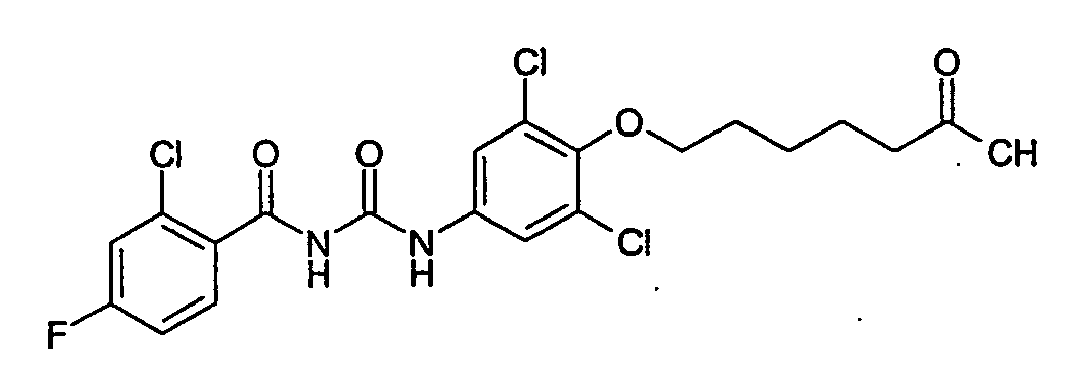
Beispiel Nr. 116 aus WO 01/94300 457,28 13,522 
- Aus der Tabelle ist abzulesen, dass die Verbindung der Formel I eine deutlich erhöhte Wirkung gegenüber den Vergleichsbeispielen aus
WO 01/94300 - Nachfolgend wird die Herstellung einiger Beispiele detailliert beschrieben, die übrigen Verbindungen der Formel I wurde analog erhalten:
Experimenteller Teil: - Beispiel 1:
2-[3-(2-Chlor-4-fluorbenzoyl)-ureido]-phenoxyessigsäure- a) 2-Nitrophenoxyessigsäure-tert-butylester
Zu einer Lösung von 1,0 g (7,2 mmol) 2-Nitrophenol in 20 ml Aceton gibt man 2,8 g (14,4 mmol) Bromessigsäure-tert-butylester und 2,6 g (7,9 mmol) Cäsiumkarbonat. Die Suspension wird 48 Stunden zum Rückfluss erhitzt. Anschließend gibt man 50 ml Wasser hinzu und extrahiert zwei mal mit je 50 ml Essigsäureethylester. Die vereinigten organische Phasen werden mit Wasser gewaschen, über Na2SO4 getrocknet und am Rotationsverdampfer eingeengt. Das Produkt wird ohne Reinigung im nächsten Schritt eingesetzt. Rohausbeute: 2,4 g - b) 2-Aminophenoxyessigsäure-tert-butylester
0,5 g Rohmaterial aus a) werden in Methanol gelöst, mit 0,3 g Raney-Ni versetzt und bei Raumtemperatur mit Wasserstoff hydriert. Die Reaktion wird per LC-MS kontrolliert.
Nach vollständiger Reduktion wird über Celite abgesaugt und mit Methanol nachgewaschen. Das Filtrat wird am Rotationsverdampfer eingeengt und das Produkt ohne Reinigung in Schritt d) eingesetzt. Rohausbeute: 0,34 g - c) 2-Chlor-4-fluorbenzoylisocyanat
2-Chlor-4-fluorbenzamid wurde in Dichlormethan gelöst, mit 1,5 eq. Oxalylchlorid versetzt und 16 Stunden zum Rückfluss erhitzt. Das Reaktionsgemisch wurde am Hochvakuum eingeengt und ohne weitere Reinigung in Stufe d) eingesetzt. - d) 2-[3-(2-Chlor-4-fluorbenzoyl)-ureido]-phenoxyessigsäure-tert-butylester
Zu einer Lösung von 129 mg (0,6 mmol) 2-Aminophenoxyessigsäure-tert-butylester in 5 ml trockenem Acetonitril unter Schutzgasatmosphäre wird bei Raumtemperatur eine Lösung von 230 mg (1,2 mmol) 2-Chlor-4-fluorbenzoylisocyanat in 5 ml Acetonitril zugegeben. Es wird 4 Stunden zum Rückfluss erhitzt und auf Raumtemperatur abgekühlt. Das Lösungsmittel wird am Rotationsverdampfer abdestilliert und der erhaltene Rückstand ohne weitere Aufreinigung in den nächsten Schritt eingesetzt.
Rohausbeute: 0,33 g. - e) 2-[3-(2-Chlor-4-fluorbenzoyl)-ureido]-phenoxyessigsäure-tert-butylester
0,33 g Rohmaterial aus Stufe d) werden in 10 ml Methylenchlorid aufgenommen, mit 10 ml Trifluoressigsäure versetzt und zwei Stunden bei Raumtemperatur gerührt. Die Lösung wird anschließend zweimal nach Zugabe von 3 ml Toluol am Rotationsverdampfer eingeengt und der so erhaltene Rückstand über eine präparative HPLC-Anlage (Säule: Waters Xterra ™MS C18, 5 µm, 30x100 mm, Laufmittel: A: H2O + 0,2 % Trifluoressigsäure, B: Acetonitril, Gradient: 2,5 Minuten 90 % A/ 10 % B bis 17,5 Minuten 10 % A / 90 % B) gereinigt. Man erhält 88 mg (0,23 mmol) des gewünschten
Produktes.
Schmelzpunkt: 180-181 °C
- a) 2-Nitrophenoxyessigsäure-tert-butylester
- Beispiel 3 wurde entsprechend dieser Vorschrift hergestellt.
- Beispiel 2:
3-Carboxymethoxy-4-[3-(2-chlor-4-fluor-benzoyl)-ureido]-benzoesäure- a) 3-Methoxycarbonylmethoxy-4-nitrobenzoesäure-methylester
Zu einer Lösung von 0,50 g (2,5 mmol) 3-Hydroxy-4-nitrobenzoesäure-methylester in 10 ml Aceton gibt man 0,77 g (5,1 mmol) Bromessigsäuremethylester und 0,91 g (2,8 mmol) Cäsiumkarbonat. Die Suspension wird 48 Stunden zum Rückfluss erhitzt. Anschließend gibt man 50 ml Wasser hinzu und extrahiert zweimal mit je 50 ml Essigsäureethylester. Die vereinigten organische Phasen werden mit Wasser gewaschen, über Na2SO4 getrocknet und am Rotationsverdampfer eingeengt. Rohausbeute: 0,64 g - b) 3-Carboxymethoxy-4-[3-(2-chlor-4-fluor-benzoyl)-ureido]-benzoesäure
Das Rohprodukt aus Schritt a) wird analog Beispiel 1b) bis 1d) in 3-Methoxycarbonylmethoxy-4-[3-(2-chlor-4-fluor-benzoyl)-ureido]-benzoesäuremethylester überführt, von dem 50 mg (0,11 mmol) in 5 ml THF gelöst und mit 1 ml Wasser versetzt werden. Dazu werden 27 mg (1,1 mmol) LiOH gegeben und die Reaktion bei Raumtemperatur gerührt bis das Edukt vollständig umgesetzt ist. Die Reaktionskontrolle erfolgt per LC-MS. Nach Abschluß der Reaktion wird mit verdünnter Salzsäure angesäuert und mit zweimal mit je 20 ml Essigsäureethylester extrahiert. Die vereinten organischen Phasen werden über Na2SO4 getrocknet, filtriert, am Rotationsverdampfer eingeengt und der so erhaltene Rückstand. über eine präparative HPLC-Anlage (Säule: Waters Xterra ™MS C18, 5 µm, 30x100 mm, Laufmittel: A: H2O + 0,2 % Trifluoressigsäure, B: Acetonitril, Gradient: 2,5 Minuten 90 % A /10 % B bis 17,5 Minuten 10 % A / 90 % B) gereinigt. Man erhält 28 mg (0,068 mmol) des gewünschten Produktes.
Schmelzpunkt: 279-281 °C
Die Beispiele 4-9 und 11-14 wurden analog dieser Vorschrift hergestellt.
- a) 3-Methoxycarbonylmethoxy-4-nitrobenzoesäure-methylester
- Beispiel 10:
4-[3-(2-Chlor-4,5-difluorbenzoyl)-ureido]-3-(3-methoxycarbonylpropoxy)-benzoesäure- a) 3-Hydroxy-4-nitrobenzoesäure-benzylester
2,0 g (11 mmol) 3-Hydroxy-4-nitrobenzoesäure werden in 25 ml Toluol suspendiert und mit 1,8 g (16 mmol) Benzylalkohol und 0,2 g (1,1 mmol) p-Toluolsulfonsäure versetzt. Unter Verwendung eines Wasserabscheiders erhitzt man die Reaktion zum Rückfluß bis sich kein weiteres Wasser abscheidet. Nach vollständiger Umsetzung wird die Lösung am Rotationsverdampfer eingedampft und das Rohprodukt chromatographisch gereinigt. Ausbeute 1,6 g (5,9 mmol). - b) 4-[3-(2-Chlor-4,5-difluorbenzoyl)-ureido]-3-(3-methoxycarbonylpropoxy)-benzoesäure
Der 3-Hydroxy-4-nitrobenzoesäure-benzylester aus Schritt a) wurde analog Vorschrift 2a) unter Bildung von 3-(3-Methoxycarbonylpropoxy)-4-nitro-benzoesäure-benzylester alkyliert. 450 mg (1,2 mmol) des Benzylesters werden in 20 ml Methanol gelöst mit 13 mg (0,1 mmol) Palladium auf Aktivkohle (10%) versetzt und bei Raumtemperatur hydriert. Die Reaktionskontrolle erfolgt per LC-MS.
Nach vollständiger Reduktion wird über Celite abgesaugt und mit Methanol nachgewaschen. Das Filtrat wird am Rotationsverdampfer eingeengt und das Produkt ohne vorherige Aufreinigung analog Vorschrift 1d) zu 4-[3-(2-Chlor-4,5-difluorbenzoyl)-ureido]-3-(3-methoxycarbonylpropoxy)-benzoesäure umgesetzt. Die abschließende Reinigung erfolgt über präparative HPLC (Säule: Waters Xterra ™MS C18, 5 µm, 30x100 mm, Laufmittel: A: H2O + 0,2 % Trifluoressigsäure, B: Acetonitril, Gradient: 2,5 Minuten 90 % A / 10 % B bis 17,5 Minuten 10 % A / 90 % B). Ausbeute: 0,51 mg (0,11 mmol)
Schmelzpunkt: 227°C
- a) 3-Hydroxy-4-nitrobenzoesäure-benzylester
- Beispiel 15 wurde analog dieser Vorschrift hergestellt.
Claims (21)
- Verbindungen der Formel I,
 R1 H, (C1-C6)-Alkyl, (C0-C6)-Alkyl-Phenyl, wobei der Phenylring bis zu zweifach mit F, Cl, CN, OH, (C1-C6)-Alkyl, O-(C1-C6)-Alkyl, CF3, OCF3, COOH, COO(C1-C6)-Alkyl oder CONH2 substituiert sein kann;R2 H, (C1-C6)-Alkyl, O-(C1-C6)-Alkyl, CO-(C1-C6)-Alkyl, COO-(C1-C6)-Alkyl, (C0-C6)-Alkylen-COOH;R3 H, F, Cl, Br, OH, CF3, NO2, CN, OCF3, O-(C1-C6)-Alkyl, (C1-C6)-Alkyl;n 1,2,3,4,5,6,7,8;sowie deren physiologisch verträgliche Salze.
 - Verbindungen der Formel I, gemäß Anspruch 1, dadurch gekennzeichnet, daß darin bedeutenR1 H, (C1-C6)-Alkyl;R2 H, (C1-C6)-Alkyl, O-(C1-C6)-Alkyl, CO-(C1-C6)-Alkyl, COO-(C1-C6)-Alkyl, (C0-C6)-Alkylen-COOH;R3 H, F, Cl, Br, OH, CF3, NO2, CN, OCF3, O-(C1-C6)-Alkyl, (C1-C6)-Alkyl;n 1, 2, 3, 4, 5, 6, 7, 8;sowie deren physiologisch verträgliche Salze.
- Verbindungen der Formel I, gemäß Anspruch 1 oder 2, dadurch gekennzeichnet, daß darin bedeutenR1 H, (C1-C6)-Alkyl;R2 H, COO-(C1-C6)-Alkyl, -COOH;R3 H, F;n 1, 2, 3, 4;sowie deren physiologisch verträgliche Salze.
- Arzneimittel enthaltend eine oder mehrere der Verbindungen gemäß einem oder mehreren der Ansprüche 1 bis 3.
- Arzneimittel enthaltend eine oder mehrere der Verbindungen gemäß einem oder mehreren der Ansprüche 1 bis 3 und mindestens einen weiteren Wirkstoff.
- Arzneimittel, gemäß Anspruch 5, dadurch gekennzeichnet, daß es als weiteren Wirkstoff eine oder mehrere
Antidiabetika, hypoglykämischen Wirkstoffe, Antiobesics, Anorektika, HMGCoA-Reduktase Inhibitoren, Cholesterinresorptionsinhibitoren, PPAR gamma Agonisten, PPAR alpha Agonisten, PPAR alpha/gamma Agonisten, PPAR delta-Agonisten, Fibrate, MTP-Inhibitoren, Gallensäureresorptionsinhibitoren, CETP-Inhibitoren, polymere Gallensäureadsorber, LDL-Rezeptorinducer, Cholesterin-Absorptionsinhibitoren (Ezetimibe), ACAT-Inhibitoren, Antioxidantien, Lipoprotein-Lipase Inhibitoren, ATP-Citrat-Lyase Inhibitoren, ACC-Inhibitoren, Squalen synthetase inhibitoren, Lipoprotein(a) antagonisten, Lipase Inhibitoren, Insuline, Sulphonylharnstoffe, Biguanide, Glitinide, Thiazolidindione, α-Glukosidase-Inhibitoren, Glucagon-Rezeptor-Antagonisten, auf den ATP-abhängigen Kaliumkanal der Betazellen wirkende Wirkstoffe, CART-Agonisten, NPY-Antagonisten, GLP1-Agonisten, GIP-Agonisten, MC4-Agonisten, MCH-Antagonisten, Orexin-Agonisten, H3-Agonisten, TNF-Agonisten, CRF-Agonisten, CRF BP-Antagonisten, Urocortin-Agonisten, β3-Agonisten, MSH (Melanocyt-stimulierendes Hormon)-Agonisten, CCK-Agonisten, Serotonin-Wiederaufnahme-Inhibitoren, gemischte Serotonin- und noradrenerge Verbindungen, 5HT-Agonisten, Bombesin-Agonisten, Galanin-Antagonisten, Wachstumshormone, Wachstumshormon freisetzende Verbindungen, TRH-Agonisten, LXR-Modulatoren, FXR- Modulatoren, entkoppelnde Protein 2- oder 3-Modulatoren, Leptinagonisten, DA-Agonisten (Bromocriptin, Doprexin), Lipase/Amylase-Inhibitoren, PPAR-Modulatoren, RXR-Modulatoren, TR-β-Agonisten oder Amphetamine enthält. - Verwendung der Verbindungen gemäß einem oder mehreren der Ansprüche 1 bis 3 zur Herstellung eines Medikamentes zur Blutzuckersenkung.
- Verwendung der Verbindungen gemäß einem oder mehreren der Ansprüche 1 bis 3 zur Herstellung eines Medikamentes zur Behandlung des Typ II Diabetes.
- Verwendung der Verbindungen gemäß einem oder mehreren der Ansprüche 1 bis 3 zur Herstellung eines Medikamentes zur Behandlung von Lipid- und Kohlenhydratstoffwechselstörungen.
- Verwendung der Verbindungen gemäß einem oder mehreren der Ansprüche 1 bis 3 zur Herstellung eines Medikaments zur Behandlung arteriosklerotischer Erscheinungen.
- Verwendung der Verbindungen gemäß einem oder mehreren der Ansprüche 1 bis 3 zur Herstellung eines Medikaments zur Behandlung von Insulin Resistenz.
- Verfahren zur Herstellung eines Arzneimittels enthaltend eine oder mehrere der Verbindungen gemäß einem oder mehreren der Ansprüche 1 bis 3, dadurch gekennzeichnet, dass der Wirkstoff mit einem pharmazeutisch geeigneten Träger vermischt wird und diese Mischung in eine für die Verabreichung geeignete Form gebracht wird.
- Verwendung der Verbindungen gemäß einem oder mehreren der Ansprüche 1 bis 3 zur Herstellung eines Medikaments zur Behandlung oder Prophylaxe von akuten und chronischen Schäden und Erkrankungen des Herzens, peripherer Organe und Gliedmaßen, die durch Ischämie- oder durch Reperfusionsereignisse verursacht werden.
- Verwendung der Verbindungen gemäß einem oder mehreren der Ansprüche 1 bis 3 zur Herstellung eines Medikaments zur Behandlung oder Prophylaxe von akuten und chronischen Schäden und Erkrankungen des Herzens, die durch Ischämie- oder durch Reperfusionsereignisse verursacht werden, und zur Behandlung oder Prophylaxe des Herzinfarkts.
- Verwendung der Verbindungen gemäß einem oder mehreren der Ansprüche 1 bis 3 zur Herstellung eines Medikaments zur Behandlung oder Prophylaxe der Angina Pectoris.
- Verwendung der Verbindungen gemäß einem oder mehreren der Ansprüche 1 bis 3 zur Herstellung eines Medikaments zur Behandlung oder Prophylaxe von ischämischen Zuständen des Herzens.
- Verwendung der Verbindungen gemäß einem oder mehreren der Ansprüche 1 bis 3 zur Herstellung eines Medikaments zur Behandlung oder Prophylaxe von ischämischen Zuständen des peripheren und zentralen Nervensystems und des Schlaganfalls.
- Verwendung der Verbindungen gemäß einem oder mehreren der Ansprüche 1 bis 3 zur Herstellung eines Medikaments zur Behandlung oder Prophylaxe von ischämischen Zuständen peripherer Organe und Gliedmaßen.
- Verwendung der Verbindungen gemäß einem oder mehreren der Ansprüche 1 bis 3 zur Herstellung eines Medikaments zur Behandlung von Tumorerkrankungen
- Verwendung der Verbindungen gemäß einem oder mehreren der Ansprüche 1 bis 3 zur Herstellung eines Medikaments zur Behandlung von Tumorerkrankungen, bei denen das Tumorwachstum von der Glycogen Phosphorylase-Aktivität abhängig ist.
- Verwendung der Verbindungen gemäß einem oder mehreren der Ansprüche 1 bis 3 zur Herstellung eines Medikaments zur Behandlung von Lungen-, Brust- und Darmkrebs.
Applications Claiming Priority (3)
| Application Number | Priority Date | Filing Date | Title |
|---|---|---|---|
| DE10246434A DE10246434B4 (de) | 2002-10-04 | 2002-10-04 | Carboxyalkoxy-substituierte Acyl-carboxyphenyl-harnstoffderivate und ihre Verwendung als Arzneimittel |
| DE10246434 | 2002-10-04 | ||
| PCT/EP2003/010501 WO2004033416A2 (de) | 2002-10-04 | 2003-09-22 | Carboxyalkoxy-substituierte acyl-carboxyphenyl-harnstoffderivate, verfahren zu ihre herstellung und ihre verwendung als arzneimittel |
Publications (2)
| Publication Number | Publication Date |
|---|---|
| EP1556339A2 EP1556339A2 (de) | 2005-07-27 |
| EP1556339B1 true EP1556339B1 (de) | 2010-09-01 |
Family
ID=32010248
Family Applications (1)
| Application Number | Title | Priority Date | Filing Date |
|---|---|---|---|
| EP03757879A Expired - Lifetime EP1556339B1 (de) | 2002-10-04 | 2003-09-22 | Carboxyalkoxy-substituierte acyl-carboxyphenyl-harnstoffderivate, verfahren zu ihre herstellung und ihre verwendung als arzneimittel |
Country Status (9)
| Country | Link |
|---|---|
| EP (1) | EP1556339B1 (de) |
| JP (1) | JP4355290B2 (de) |
| AT (1) | ATE479653T1 (de) |
| AU (1) | AU2003273913A1 (de) |
| BR (1) | BR0314861A (de) |
| CA (1) | CA2500763A1 (de) |
| DE (2) | DE10246434B4 (de) |
| MX (1) | MXPA05003320A (de) |
| WO (1) | WO2004033416A2 (de) |
Families Citing this family (3)
| Publication number | Priority date | Publication date | Assignee | Title |
|---|---|---|---|---|
| DE10306502B4 (de) * | 2003-02-17 | 2005-03-17 | Aventis Pharma Deutschland Gmbh | Substituierte 3-(Benzoylureido)-thiophenderivate und sie enthaltende Arzneimittel |
| PE20080251A1 (es) | 2006-05-04 | 2008-04-25 | Boehringer Ingelheim Int | Usos de inhibidores de dpp iv |
| CN103298469A (zh) | 2010-08-31 | 2013-09-11 | 首尔大学校产学协力财团 | PPARδ激动剂的胎儿重编程的用途 |
Family Cites Families (3)
| Publication number | Priority date | Publication date | Assignee | Title |
|---|---|---|---|---|
| ES8801896A1 (es) * | 1985-03-01 | 1988-03-01 | Duphar Int Res | Procedimiento para preparar derivados de urea |
| GB9313268D0 (en) * | 1993-06-28 | 1993-08-11 | Zeneca Ltd | Chemical compounds |
| AU6231801A (en) * | 2000-06-09 | 2001-12-17 | Aventis Pharma Gmbh | Acylphenyl urea derivatives, methods for the production thereof and use thereof as a medicament |
-
2002
- 2002-10-04 DE DE10246434A patent/DE10246434B4/de not_active Expired - Fee Related
-
2003
- 2003-09-22 AT AT03757879T patent/ATE479653T1/de not_active IP Right Cessation
- 2003-09-22 DE DE50313047T patent/DE50313047D1/de not_active Expired - Lifetime
- 2003-09-22 BR BR0314861-0A patent/BR0314861A/pt not_active IP Right Cessation
- 2003-09-22 MX MXPA05003320A patent/MXPA05003320A/es unknown
- 2003-09-22 JP JP2004542363A patent/JP4355290B2/ja not_active Expired - Fee Related
- 2003-09-22 AU AU2003273913A patent/AU2003273913A1/en not_active Abandoned
- 2003-09-22 EP EP03757879A patent/EP1556339B1/de not_active Expired - Lifetime
- 2003-09-22 CA CA002500763A patent/CA2500763A1/en not_active Abandoned
- 2003-09-22 WO PCT/EP2003/010501 patent/WO2004033416A2/de not_active Ceased
Also Published As
| Publication number | Publication date |
|---|---|
| DE10246434B4 (de) | 2005-08-04 |
| JP4355290B2 (ja) | 2009-10-28 |
| DE50313047D1 (de) | 2010-10-14 |
| BR0314861A (pt) | 2005-08-02 |
| MXPA05003320A (es) | 2005-07-05 |
| EP1556339A2 (de) | 2005-07-27 |
| AU2003273913A1 (en) | 2004-05-04 |
| WO2004033416A2 (de) | 2004-04-22 |
| CA2500763A1 (en) | 2004-04-22 |
| JP2006502206A (ja) | 2006-01-19 |
| WO2004033416A3 (de) | 2004-05-13 |
| ATE479653T1 (de) | 2010-09-15 |
| DE10246434A1 (de) | 2004-04-15 |
Similar Documents
| Publication | Publication Date | Title |
|---|---|---|
| EP1497262B1 (de) | Acyl-4-carboxy-phenyl-harnstoffderivate, verfahren zu deren herstellung und deren verwendung | |
| EP1572708B1 (de) | Neue heterocyclische fluorglykosidderivate, diese verbindungen enthaltende arzneimittel und deren verwendung | |
| EP1713803B1 (de) | 7-phenylamino-4-chinolon-3-carbonsäure-derivate, verfahren zu ihrer herstellung und ihre verwendung als arzneimittel | |
| EP1513800B1 (de) | N-benzoylureido-zimts urederivate, verfahren zu deren herste llung und deren verwendung | |
| EP1523471B1 (de) | Harnstoff- und urethan-substituierte acylharnstoffe, verfahren zu deren herstellung und deren verwendung als arzneimittel | |
| EP1497263B1 (de) | Acyl-3-carboxyphenyl-harnstoffderivate, verfahren zu deren herstellung und deren verwendung | |
| DE102004004972B3 (de) | Heterocyclisch substituierte 7-Amino-4-chinolon-3-carbonsäure-Derivate, Verfahren zu ihrer Herstellung und ihre Verwendung als Arzneimittel | |
| EP1713804B1 (de) | Cycloalkyl substituierte 7-amino-4-chinolon-3-carbonsäure-derivate, verfahren zu ihrer herstellung und ihre verwendung als arzneimittel | |
| DE10309929B4 (de) | Substituierte Benzoylureidopyridyl-piperidin- und -pyrrolidin-carbonsäurederivate, Verfahren zu deren Herstellung und deren Verwendung | |
| DE10246434B4 (de) | Carboxyalkoxy-substituierte Acyl-carboxyphenyl-harnstoffderivate und ihre Verwendung als Arzneimittel | |
| DE102004004973A1 (de) | 7-Phenylamino-4-chinolon-3-carbonsäure-Derivate, Verfahren zu ihrer Herstellung und ihre Verwendung als Arzneimittel | |
| US7781459B2 (en) | Carboxyalkoxy-substituted acyl-carboxyphenylurea derivatives and their use as medicaments | |
| EP1654224A1 (de) | Substituierte benzoylureido-o-benzoylamide, verfahren zu deren herstellung und deren verwendung | |
| DE10306503A1 (de) | Substituierte Benzoylureidophenyl-piperidin- und pyrrolidin-carbonsäurederivate, Verfahren zu deren Herstellung und deren Verwendung | |
| DE102004033405A1 (de) | 7-Phenylamino-4-chinolon-3-carbonsäure-Derivate, Verfahren zu ihrer Herstellung und ihre Verwendung als Arzneimittel |
Legal Events
| Date | Code | Title | Description |
|---|---|---|---|
| PUAI | Public reference made under article 153(3) epc to a published international application that has entered the european phase |
Free format text: ORIGINAL CODE: 0009012 |
|
| 17P | Request for examination filed |
Effective date: 20050504 |
|
| AK | Designated contracting states |
Kind code of ref document: A2 Designated state(s): AT BE BG CH CY CZ DE DK EE ES FI FR GB GR HU IE IT LI LU MC NL PT RO SE SI SK TR |
|
| AX | Request for extension of the european patent |
Extension state: AL LT LV MK |
|
| RAP1 | Party data changed (applicant data changed or rights of an application transferred) |
Owner name: SANOFI-AVENTIS DEUTSCHLAND GMBH |
|
| DAX | Request for extension of the european patent (deleted) | ||
| RIN1 | Information on inventor provided before grant (corrected) |
Inventor name: VON REODERN, ERICH Inventor name: KLABUNDE, THOMAS Inventor name: BURGER, HANS-JOERG Inventor name: ENHSEN, ALFONS Inventor name: HERLING, ANDREAS Inventor name: WENDT, KARL-ULRICH Inventor name: SCHOENAFINGER, KARL Inventor name: KADEREIT, DIETER Inventor name: DEFOSSA, ELISABETH |
|
| RIN1 | Information on inventor provided before grant (corrected) |
Inventor name: ENHSEN, ALFONS Inventor name: KADEREIT, DIETER Inventor name: SCHOENAFINGER, KARL Inventor name: KLABUNDE, THOMAS Inventor name: VON REODERN, ERICH Inventor name: DEFOSSA, ELISABETH Inventor name: BURGER, HANS-JOERG Inventor name: HERLING, ANDREAS Inventor name: WENDT, KARL-ULRICH |
|
| 17Q | First examination report despatched |
Effective date: 20090925 |
|
| RIC1 | Information provided on ipc code assigned before grant |
Ipc: A61K 31/17 20060101ALI20100302BHEP Ipc: C07C 275/54 20060101AFI20100302BHEP Ipc: A61P 3/10 20060101ALI20100302BHEP |
|
| GRAP | Despatch of communication of intention to grant a patent |
Free format text: ORIGINAL CODE: EPIDOSNIGR1 |
|
| GRAS | Grant fee paid |
Free format text: ORIGINAL CODE: EPIDOSNIGR3 |
|
| GRAA | (expected) grant |
Free format text: ORIGINAL CODE: 0009210 |
|
| AK | Designated contracting states |
Kind code of ref document: B1 Designated state(s): AT BE BG CH CY CZ DE DK EE ES FI FR GB GR HU IE IT LI LU MC NL PT RO SE SI SK TR |
|
| REG | Reference to a national code |
Ref country code: GB Ref legal event code: FG4D Free format text: NOT ENGLISH |
|
| REG | Reference to a national code |
Ref country code: CH Ref legal event code: EP |
|
| REG | Reference to a national code |
Ref country code: IE Ref legal event code: FG4D Free format text: LANGUAGE OF EP DOCUMENT: GERMAN |
|
| REF | Corresponds to: |
Ref document number: 50313047 Country of ref document: DE Date of ref document: 20101014 Kind code of ref document: P |
|
| REG | Reference to a national code |
Ref country code: NL Ref legal event code: VDEP Effective date: 20100901 |
|
| PG25 | Lapsed in a contracting state [announced via postgrant information from national office to epo] |
Ref country code: FI Free format text: LAPSE BECAUSE OF FAILURE TO SUBMIT A TRANSLATION OF THE DESCRIPTION OR TO PAY THE FEE WITHIN THE PRESCRIBED TIME-LIMIT Effective date: 20100901 |
|
| PG25 | Lapsed in a contracting state [announced via postgrant information from national office to epo] |
Ref country code: SI Free format text: LAPSE BECAUSE OF FAILURE TO SUBMIT A TRANSLATION OF THE DESCRIPTION OR TO PAY THE FEE WITHIN THE PRESCRIBED TIME-LIMIT Effective date: 20100901 Ref country code: CY Free format text: LAPSE BECAUSE OF FAILURE TO SUBMIT A TRANSLATION OF THE DESCRIPTION OR TO PAY THE FEE WITHIN THE PRESCRIBED TIME-LIMIT Effective date: 20100901 |
|
| REG | Reference to a national code |
Ref country code: IE Ref legal event code: FD4D |
|
| BERE | Be: lapsed |
Owner name: SANOFI-AVENTIS DEUTSCHLAND G.M.B.H. Effective date: 20100930 |
|
| PG25 | Lapsed in a contracting state [announced via postgrant information from national office to epo] |
Ref country code: GR Free format text: LAPSE BECAUSE OF FAILURE TO SUBMIT A TRANSLATION OF THE DESCRIPTION OR TO PAY THE FEE WITHIN THE PRESCRIBED TIME-LIMIT Effective date: 20101202 Ref country code: SE Free format text: LAPSE BECAUSE OF FAILURE TO SUBMIT A TRANSLATION OF THE DESCRIPTION OR TO PAY THE FEE WITHIN THE PRESCRIBED TIME-LIMIT Effective date: 20100901 Ref country code: NL Free format text: LAPSE BECAUSE OF FAILURE TO SUBMIT A TRANSLATION OF THE DESCRIPTION OR TO PAY THE FEE WITHIN THE PRESCRIBED TIME-LIMIT Effective date: 20100901 |
|
| PG25 | Lapsed in a contracting state [announced via postgrant information from national office to epo] |
Ref country code: MC Free format text: LAPSE BECAUSE OF NON-PAYMENT OF DUE FEES Effective date: 20100930 Ref country code: IE Free format text: LAPSE BECAUSE OF FAILURE TO SUBMIT A TRANSLATION OF THE DESCRIPTION OR TO PAY THE FEE WITHIN THE PRESCRIBED TIME-LIMIT Effective date: 20100901 |
|
| REG | Reference to a national code |
Ref country code: CH Ref legal event code: PL |
|
| PG25 | Lapsed in a contracting state [announced via postgrant information from national office to epo] |
Ref country code: PT Free format text: LAPSE BECAUSE OF FAILURE TO SUBMIT A TRANSLATION OF THE DESCRIPTION OR TO PAY THE FEE WITHIN THE PRESCRIBED TIME-LIMIT Effective date: 20110103 Ref country code: IT Free format text: LAPSE BECAUSE OF FAILURE TO SUBMIT A TRANSLATION OF THE DESCRIPTION OR TO PAY THE FEE WITHIN THE PRESCRIBED TIME-LIMIT Effective date: 20100901 Ref country code: SK Free format text: LAPSE BECAUSE OF FAILURE TO SUBMIT A TRANSLATION OF THE DESCRIPTION OR TO PAY THE FEE WITHIN THE PRESCRIBED TIME-LIMIT Effective date: 20100901 Ref country code: RO Free format text: LAPSE BECAUSE OF FAILURE TO SUBMIT A TRANSLATION OF THE DESCRIPTION OR TO PAY THE FEE WITHIN THE PRESCRIBED TIME-LIMIT Effective date: 20100901 Ref country code: CZ Free format text: LAPSE BECAUSE OF FAILURE TO SUBMIT A TRANSLATION OF THE DESCRIPTION OR TO PAY THE FEE WITHIN THE PRESCRIBED TIME-LIMIT Effective date: 20100901 Ref country code: EE Free format text: LAPSE BECAUSE OF FAILURE TO SUBMIT A TRANSLATION OF THE DESCRIPTION OR TO PAY THE FEE WITHIN THE PRESCRIBED TIME-LIMIT Effective date: 20100901 |
|
| PG25 | Lapsed in a contracting state [announced via postgrant information from national office to epo] |
Ref country code: ES Free format text: LAPSE BECAUSE OF FAILURE TO SUBMIT A TRANSLATION OF THE DESCRIPTION OR TO PAY THE FEE WITHIN THE PRESCRIBED TIME-LIMIT Effective date: 20101212 |
|
| PLBE | No opposition filed within time limit |
Free format text: ORIGINAL CODE: 0009261 |
|
| STAA | Information on the status of an ep patent application or granted ep patent |
Free format text: STATUS: NO OPPOSITION FILED WITHIN TIME LIMIT |
|
| PG25 | Lapsed in a contracting state [announced via postgrant information from national office to epo] |
Ref country code: BE Free format text: LAPSE BECAUSE OF NON-PAYMENT OF DUE FEES Effective date: 20100930 Ref country code: CH Free format text: LAPSE BECAUSE OF NON-PAYMENT OF DUE FEES Effective date: 20100930 Ref country code: LI Free format text: LAPSE BECAUSE OF NON-PAYMENT OF DUE FEES Effective date: 20100930 |
|
| 26N | No opposition filed |
Effective date: 20110606 |
|
| PG25 | Lapsed in a contracting state [announced via postgrant information from national office to epo] |
Ref country code: DK Free format text: LAPSE BECAUSE OF FAILURE TO SUBMIT A TRANSLATION OF THE DESCRIPTION OR TO PAY THE FEE WITHIN THE PRESCRIBED TIME-LIMIT Effective date: 20100901 |
|
| REG | Reference to a national code |
Ref country code: DE Ref legal event code: R097 Ref document number: 50313047 Country of ref document: DE Effective date: 20110606 |
|
| PG25 | Lapsed in a contracting state [announced via postgrant information from national office to epo] |
Ref country code: AT Free format text: LAPSE BECAUSE OF NON-PAYMENT OF DUE FEES Effective date: 20100922 |
|
| PG25 | Lapsed in a contracting state [announced via postgrant information from national office to epo] |
Ref country code: BG Free format text: LAPSE BECAUSE OF FAILURE TO SUBMIT A TRANSLATION OF THE DESCRIPTION OR TO PAY THE FEE WITHIN THE PRESCRIBED TIME-LIMIT Effective date: 20100901 Ref country code: LU Free format text: LAPSE BECAUSE OF NON-PAYMENT OF DUE FEES Effective date: 20100922 Ref country code: HU Free format text: LAPSE BECAUSE OF FAILURE TO SUBMIT A TRANSLATION OF THE DESCRIPTION OR TO PAY THE FEE WITHIN THE PRESCRIBED TIME-LIMIT Effective date: 20110302 |
|
| PG25 | Lapsed in a contracting state [announced via postgrant information from national office to epo] |
Ref country code: TR Free format text: LAPSE BECAUSE OF FAILURE TO SUBMIT A TRANSLATION OF THE DESCRIPTION OR TO PAY THE FEE WITHIN THE PRESCRIBED TIME-LIMIT Effective date: 20100901 |
|
| PG25 | Lapsed in a contracting state [announced via postgrant information from national office to epo] |
Ref country code: BG Free format text: LAPSE BECAUSE OF FAILURE TO SUBMIT A TRANSLATION OF THE DESCRIPTION OR TO PAY THE FEE WITHIN THE PRESCRIBED TIME-LIMIT Effective date: 20101201 |
|
| PGFP | Annual fee paid to national office [announced via postgrant information from national office to epo] |
Ref country code: DE Payment date: 20140917 Year of fee payment: 12 |
|
| PGFP | Annual fee paid to national office [announced via postgrant information from national office to epo] |
Ref country code: GB Payment date: 20140917 Year of fee payment: 12 |
|
| PGFP | Annual fee paid to national office [announced via postgrant information from national office to epo] |
Ref country code: FR Payment date: 20140906 Year of fee payment: 12 |
|
| REG | Reference to a national code |
Ref country code: DE Ref legal event code: R119 Ref document number: 50313047 Country of ref document: DE |
|
| GBPC | Gb: european patent ceased through non-payment of renewal fee |
Effective date: 20150922 |
|
| REG | Reference to a national code |
Ref country code: FR Ref legal event code: ST Effective date: 20160531 |
|
| PG25 | Lapsed in a contracting state [announced via postgrant information from national office to epo] |
Ref country code: DE Free format text: LAPSE BECAUSE OF NON-PAYMENT OF DUE FEES Effective date: 20160401 Ref country code: GB Free format text: LAPSE BECAUSE OF NON-PAYMENT OF DUE FEES Effective date: 20150922 |
|
| PG25 | Lapsed in a contracting state [announced via postgrant information from national office to epo] |
Ref country code: FR Free format text: LAPSE BECAUSE OF NON-PAYMENT OF DUE FEES Effective date: 20150930 |