EP1495162B1 - Web processing method and apparatus - Google Patents
Web processing method and apparatus Download PDFInfo
- Publication number
- EP1495162B1 EP1495162B1 EP03717898A EP03717898A EP1495162B1 EP 1495162 B1 EP1495162 B1 EP 1495162B1 EP 03717898 A EP03717898 A EP 03717898A EP 03717898 A EP03717898 A EP 03717898A EP 1495162 B1 EP1495162 B1 EP 1495162B1
- Authority
- EP
- European Patent Office
- Prior art keywords
- web
- cassette
- processing container
- processing
- fluid
- Prior art date
- Legal status (The legal status is an assumption and is not a legal conclusion. Google has not performed a legal analysis and makes no representation as to the accuracy of the status listed.)
- Expired - Lifetime
Links
- 238000003672 processing method Methods 0.000 title 1
- 238000012545 processing Methods 0.000 claims description 149
- 239000012530 fluid Substances 0.000 claims description 100
- 238000000034 method Methods 0.000 claims description 80
- 238000000576 coating method Methods 0.000 claims description 26
- 239000000463 material Substances 0.000 claims description 25
- 239000011248 coating agent Substances 0.000 claims description 24
- 238000004070 electrodeposition Methods 0.000 claims description 17
- 238000003780 insertion Methods 0.000 claims description 13
- 230000037431 insertion Effects 0.000 claims description 13
- 241000842962 Apoda limacodes Species 0.000 claims description 12
- 238000006073 displacement reaction Methods 0.000 claims description 11
- 230000007246 mechanism Effects 0.000 claims description 11
- 238000000151 deposition Methods 0.000 claims description 7
- 230000008021 deposition Effects 0.000 claims description 5
- 238000007772 electroless plating Methods 0.000 claims description 4
- 238000004140 cleaning Methods 0.000 claims description 3
- 238000005530 etching Methods 0.000 claims description 3
- 239000011888 foil Substances 0.000 claims description 3
- 238000003801 milling Methods 0.000 claims description 3
- 238000009738 saturating Methods 0.000 claims description 3
- 239000002904 solvent Substances 0.000 claims description 3
- 239000000126 substance Substances 0.000 claims description 3
- 230000008961 swelling Effects 0.000 claims description 3
- 238000005406 washing Methods 0.000 claims description 3
- 230000008569 process Effects 0.000 description 47
- 238000007747 plating Methods 0.000 description 14
- 239000007788 liquid Substances 0.000 description 11
- PXHVJJICTQNCMI-UHFFFAOYSA-N Nickel Chemical compound [Ni] PXHVJJICTQNCMI-UHFFFAOYSA-N 0.000 description 8
- 230000002411 adverse Effects 0.000 description 6
- 230000008901 benefit Effects 0.000 description 5
- 239000000758 substrate Substances 0.000 description 5
- 238000007704 wet chemistry method Methods 0.000 description 5
- 102100026827 Protein associated with UVRAG as autophagy enhancer Human genes 0.000 description 4
- 101710102978 Protein associated with UVRAG as autophagy enhancer Proteins 0.000 description 4
- 238000004519 manufacturing process Methods 0.000 description 4
- 239000002184 metal Substances 0.000 description 4
- 229910052751 metal Inorganic materials 0.000 description 4
- 229910052759 nickel Inorganic materials 0.000 description 4
- KERTUBUCQCSNJU-UHFFFAOYSA-L nickel(2+);disulfamate Chemical compound [Ni+2].NS([O-])(=O)=O.NS([O-])(=O)=O KERTUBUCQCSNJU-UHFFFAOYSA-L 0.000 description 4
- 238000009713 electroplating Methods 0.000 description 3
- 239000004642 Polyimide Substances 0.000 description 2
- 239000002131 composite material Substances 0.000 description 2
- 238000007796 conventional method Methods 0.000 description 2
- 230000008878 coupling Effects 0.000 description 2
- 238000010168 coupling process Methods 0.000 description 2
- 238000005859 coupling reaction Methods 0.000 description 2
- 230000001419 dependent effect Effects 0.000 description 2
- 238000001652 electrophoretic deposition Methods 0.000 description 2
- 238000012986 modification Methods 0.000 description 2
- 230000004048 modification Effects 0.000 description 2
- 239000004745 nonwoven fabric Substances 0.000 description 2
- 239000004033 plastic Substances 0.000 description 2
- 229920001721 polyimide Polymers 0.000 description 2
- 239000011148 porous material Substances 0.000 description 2
- 239000007787 solid Substances 0.000 description 2
- XLYOFNOQVPJJNP-UHFFFAOYSA-N water Chemical compound O XLYOFNOQVPJJNP-UHFFFAOYSA-N 0.000 description 2
- 238000004804 winding Methods 0.000 description 2
- RYGMFSIKBFXOCR-UHFFFAOYSA-N Copper Chemical compound [Cu] RYGMFSIKBFXOCR-UHFFFAOYSA-N 0.000 description 1
- 101100271175 Oryza sativa subsp. japonica AT10 gene Proteins 0.000 description 1
- 208000034804 Product quality issues Diseases 0.000 description 1
- 238000005273 aeration Methods 0.000 description 1
- 238000003491 array Methods 0.000 description 1
- 230000009286 beneficial effect Effects 0.000 description 1
- 238000005234 chemical deposition Methods 0.000 description 1
- 238000012993 chemical processing Methods 0.000 description 1
- 150000001875 compounds Chemical class 0.000 description 1
- 230000003750 conditioning effect Effects 0.000 description 1
- 238000010276 construction Methods 0.000 description 1
- 229910052802 copper Inorganic materials 0.000 description 1
- 239000010949 copper Substances 0.000 description 1
- 230000007797 corrosion Effects 0.000 description 1
- 238000005260 corrosion Methods 0.000 description 1
- 230000007547 defect Effects 0.000 description 1
- 238000013461 design Methods 0.000 description 1
- 238000011549 displacement method Methods 0.000 description 1
- 239000012153 distilled water Substances 0.000 description 1
- 238000003708 edge detection Methods 0.000 description 1
- 230000000694 effects Effects 0.000 description 1
- 230000005684 electric field Effects 0.000 description 1
- 230000008030 elimination Effects 0.000 description 1
- 238000003379 elimination reaction Methods 0.000 description 1
- 239000004744 fabric Substances 0.000 description 1
- 230000006872 improvement Effects 0.000 description 1
- 239000011810 insulating material Substances 0.000 description 1
- 238000002955 isolation Methods 0.000 description 1
- 238000007726 management method Methods 0.000 description 1
- 150000002739 metals Chemical class 0.000 description 1
- 239000000203 mixture Substances 0.000 description 1
- 238000012544 monitoring process Methods 0.000 description 1
- ORQBXQOJMQIAOY-UHFFFAOYSA-N nobelium Chemical compound [No] ORQBXQOJMQIAOY-UHFFFAOYSA-N 0.000 description 1
- 230000003287 optical effect Effects 0.000 description 1
- 229920000642 polymer Polymers 0.000 description 1
- 230000002265 prevention Effects 0.000 description 1
- 238000005086 pumping Methods 0.000 description 1
- 229910001220 stainless steel Inorganic materials 0.000 description 1
- 239000010935 stainless steel Substances 0.000 description 1
- 239000011800 void material Substances 0.000 description 1
- 230000037303 wrinkles Effects 0.000 description 1
Images


Classifications
-
- C—CHEMISTRY; METALLURGY
- C25—ELECTROLYTIC OR ELECTROPHORETIC PROCESSES; APPARATUS THEREFOR
- C25D—PROCESSES FOR THE ELECTROLYTIC OR ELECTROPHORETIC PRODUCTION OF COATINGS; ELECTROFORMING; APPARATUS THEREFOR
- C25D7/00—Electroplating characterised by the article coated
- C25D7/06—Wires; Strips; Foils
- C25D7/0614—Strips or foils
- C25D7/0628—In vertical cells
-
- B—PERFORMING OPERATIONS; TRANSPORTING
- B65—CONVEYING; PACKING; STORING; HANDLING THIN OR FILAMENTARY MATERIAL
- B65H—HANDLING THIN OR FILAMENTARY MATERIAL, e.g. SHEETS, WEBS, CABLES
- B65H23/00—Registering, tensioning, smoothing or guiding webs
- B65H23/04—Registering, tensioning, smoothing or guiding webs longitudinally
- B65H23/24—Registering, tensioning, smoothing or guiding webs longitudinally by fluid action, e.g. to retard the running web
-
- B—PERFORMING OPERATIONS; TRANSPORTING
- B65—CONVEYING; PACKING; STORING; HANDLING THIN OR FILAMENTARY MATERIAL
- B65H—HANDLING THIN OR FILAMENTARY MATERIAL, e.g. SHEETS, WEBS, CABLES
- B65H23/00—Registering, tensioning, smoothing or guiding webs
- B65H23/04—Registering, tensioning, smoothing or guiding webs longitudinally
- B65H23/32—Arrangements for turning or reversing webs
-
- C—CHEMISTRY; METALLURGY
- C25—ELECTROLYTIC OR ELECTROPHORETIC PROCESSES; APPARATUS THEREFOR
- C25D—PROCESSES FOR THE ELECTROLYTIC OR ELECTROPHORETIC PRODUCTION OF COATINGS; ELECTROFORMING; APPARATUS THEREFOR
- C25D7/00—Electroplating characterised by the article coated
- C25D7/06—Wires; Strips; Foils
Definitions
- the present invention relates to a web handling apparatus and process ideally suited for applications involving wet chemistry, more particularly the invention involves the horizontal processing of webs utilizing unique handling practices that improve the quality of the processed web.
- Products are often manufactured in a continuous web format for economic reasons and to obtain processing efficiencies.
- wet chemistries i.e. for methods such as plating or coating
- the web materials often passes through a liquid processing tank.
- Continuous web processing with wet chemistry can create material handling issues as well as finished product quality issues.
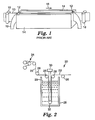
- a conventionally practiced electrodeposition method for continuous webs is generally shown in Figure 1 .
- the method includes holding a web 10 in a vertical orientation and passing it through slots 12 located on opposing ends of liquid processing tank 14.
- the web 10 travels in direction 16.
- Idler or contact rolls 18 provide an electrical charge to the web 10.
- Liquid processing tank 14 contains a process solution 19 containing a component to be deposited on the web 10.
- Anode screens, not shown, inside the liquid processing tank 14 complete an electrical circuit causing the desired component in the process solution 19 to be deposited on the web 10.
- the size of the liquid processing tank 14 and the speed of the web through the liquid processing tank 14 are generally designed to achieve the desired residence time necessity to complete the processing of the web 10.
- the established length of the liquid processing tank 14 severely limits the ability to adjust residence time for different web applications through the same system, especially in a multi-step process where the ratio of residence times cannot be adjusted independently.
- some amount of the process solution 19 escapes the liquid processing tank 14 through the slots 12 requiring a capture system. This flow of process solution 19 from the liquid processing tank 14 may cause aeration of the process solution 19 which can adversely affect the electrodeposition process and the quality of the finished web 10.
- weir flows lead to situations where the residence times between the upper portion and lower portion of the web can vary resulting in cross web uniformity differences.
- Web handling processes similar to the one described in F1G. 1 are often used to apply coating to delicate webs.
- Delicate webs are generally considered webs that are fragile either due to the thinness of the substrate or due to a lack of structural integrity caused by holes or other discontinuities in the web. Additionally, wet chemistry processing can create situations where conventional webs become fragile and thus should be treated in the same manner as delicate webs.
- the tensions on the free span of the web may cause the material to bow or form wrinkles, In the case of electrodeposition, this will cause a non-uniform distance between the web and the anode screen resulting in poor uniformity of the deposition thickness. These winkles may also introduce varying stresses into the web which may exceed the critical yield stress of the web.
- Horizontal processing of webs generally requires threading the web around rollers in an open top cavity liquid processing tank.
- the liquid processing tank is then filled with the process solution.
- the rollers may introduce damage, such as stretching, tears, or scratched, to the web as it is dragged over the rollers.
- US 5,942,096 A discloses an apparatus for electro-depositing a material on at least one side of a metal strip that is conveyed past the apparatus, and a method for electro-depositing a material on at least one side of a metal strip that is conveyed past at least one casing comprising first and second container sections and a panel having at least one first outlet therein and at least one second outlet therein.
- US 4,248,516 A discloses an apparatus and method for inserting a roller across a horizontal web path for redirecting said web into a processing container thereby creating at least one festoon.
- the present invention is directed to a method and apparatus for processing webs of sheet-like material as defined in the claims.
- the apparatus of invention includes a substantially horizontal web path for directing a web of sheet-like material.
- Also included in the apparatus is at least one processing container and at least one cassette.
- the cassette has at least one functional fluid element affixed to it.
- the cassette is generally movable and, upon insertion of the cassette across the web and into the processing container, redirects the web into the processing container.
- the cassette includes at least one functional fluids element that facilitates processing of the web.
- the apparatus is utilized to practice a method comprising inserting at least one cassette having at least one functional fluid element across a substantially horizontal web to introduce the web into a processing container.
- the insertion of the cassette across the web forms a festoon, or a directional displacement of the web in a processing zone in the processing container.
- the cassette and the processing container may be designed with varying dimensions in order to achieve a desired residence time for the web in the processing zone. Once the festoon is created by insertion of the cassette processing of the web may begin while the web is conveyed through the processing container.
- the method and apparatus of the present invention are ideally suited for web processing practices that would benefit from reduced tension on the web.
- the present invention may be utilized for various web processing practices such as, for example, electroless plating, electrodeposition, delaminating, stripping, swelling, developing, saturating, washing, cleaning, rinsing, etching, chemical milling, coating, solvent deposition, fuming, sparging or combinations of the noted practices.
- multiple embodiments of the present invention may be placed in series to enable multiple step processes.
- the present invention exhibits a relatively flat web with a significantly reduced tension on the web during processing.
- the improvement of web characteristic during processing result in enhanced properties of the finished web. This is particularly true for coating or plating operations where tension on the web during application of a coating can adversely affect the finished web by imparting defects such as a permanent curvature.
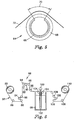
- the apparatus 20 includes a web 22 traveling in a substantially horizontal web path.
- the web is optionally conveyed through a steering unit 24 and over a plurality of rollers 26.
- the web path is generally directed over a processing container 28 which contains an amount of processing fluid 29.
- the web 22 essentially travels over, and subsequently past, the processing container 28.
- the web 22 is redirected into the processing container 28 upon insertion of a moveable cassette 30 across the web 22 and into the processing container 28.
- the insertion of the cassette creates a festoon, or a directional displacement of the web 22 into a processing zone within the processing container 28.
- the cassette 30 includes at least one functional fluid element 32 that is generally utilized for processing the web 10 in a desired manner.
- the method of the present invention is suitable for use with various types of web processing techniques.
- Non-limiting examples of potential applications for the invention include electroless plating, electrodeposition, delaminating, stripping, swelling, developing, saturating, washing, cleaning, rinsing, etching, chemical milling, coating, solvent deposition, fuming, or sparging.
- two or more embodiments of the invention may be placed in series along the web to perform various sequential processing steps.
- the web is a sheet of material that has a predetermined width and thickness and an indeterminate length.
- the web is generally flexible to enable the insertion of the cassette across the web, thereby permitting the redirection of the web into the processing container.
- the web may be made of varying materials, or combinations of materials or compositions. Additionally, the web may include one or more layers of material or coatings applied onto a substrate. Non-limiting examples include polymeric films, wovens, non-wovens, foils or combinations thereof. Wovens generally include various fabrics. Non-wovens include materials, such as paper, filter media, or insulating material.
- Polymeric films include, for example, clear and opaque polymeric films including laminates and coated films.
- the present invention is utilized for manufacturing or processing delicate webs.
- Delicate webs are generally webs that create processing issues in conventional web handling processes due to either their caliper, structure or both. The web thickness and the intricate structures within the web often adversely affect productivity and quality in conventional web handling processes.
- delicate webs are generally webs having a thickness of about 25 microns or less or webs with an effective elastic modulus of 1000 MPa or less. Low effective moduli may be achieved by choice of material, web temperature, chemical processing conditions, removal of material in the form of patterned holes in the web, or combinations thereof.
- the , method of the present invention is capable of handling webs of about 12 microns or less and an elastic modulus of 700 Mpa or less.
- the webs may also include cantilevered structures.
- Cantilevered web structures are formed by the removal of web material at predetermined locations on the web. The removal of web material leaves a free standing feature, typically within a hole or void in the web, connected by only one end to the body of the web.
- the cantilevered structure preferably has a total width of 100 microns or less and a length to width aspect ratio of at least 2 to 1.
- FIG. 3 is an illustration of a cantilevered structure on a web.
- Web 34 includes a plurality of voids 36 which define free standing cantilevered features 38.
- the unique conveying mechanism and the web processing techniques of the present invention improve web, and delicate web, handling practices and eliminate production and quality concerns associated with conventional web processing practices.
- a substantially horizontal web path is one in which the width of the web is essentially parallel to the ground. More specifically, the web, when viewed from corresponding cross-web edges, is primarily traveling in a horizontal plane as it is conveyed through the process.
- a substantially horizontal web path is contrary to some conventional processing practices, such as the vertical plating process generally shown and previously described in FIG. 1 .
- the horizontal web path provides certain advantages over conventional processes using vertical web paths. For example, the horizontal web path has an order of magnitude lower tension requirement than the vertical path and a stress state that is uniformly distributed in the cross-web direction. Greater levels of tension and stress nonuniformity on the web during processing may adversely affect finished web quality.
- the processing container is generally utilized as a vessel for holding or capturing processing fluids or materials used for various conventional techniques. Typically, the container will function as a fluid bath. However, the function of the container may vary depending upon the selected processing techniques desired for a given application. Those skilled in the art are capable of selecting appropriate materials of construction and container dimensions to meet the processing demands for specific applications.
- the container may be designed in a modular fashion to enable multiple uses for varying processes. Additionally, the container may be replicated and placed in close proximity to other containers to provide a series of multiple step processing stations. For example, a system may include two or more processing containers placed next to each other with each vessel serving as a metal plating station for multiple plating processes.
- the cassette may be utilized to provide functional fluid supply and process management functions.
- the cassette is generally inserted downward across the web and into the processing container.
- the use of the moveable cassettes improves the efficiency of the web threading process and reduces an individual's exposure to the compounds and solutions often utilized in wet chemistry processes.
- a cassette is generally depicted in FIG. 4 .
- the cassette 40 includes at least one functional fluid element 42.
- the functional fluid element 42 may be located at various positions on the cassette 40. In FIG. 4 , the functional fluid element 42 is located at the lower edge 44 of cassette 40.
- the cassette includes a handle 46 to assist in the insertion of the cassette 40 across the web 48 and onto the processing container 52.
- Side edges 50 are generally aligned with channels 54 that assist in maintaining the cassette 40 in a fixed position in the processing container 52.
- the embodiment depicted in FIG. 4 also includes functional fluid elements 56 at the leading edge 58 and back edge 60 of the processing container 52 to assist in guiding the web 48 into the processing container 52 upon insertion of the cassette 40. Additionally, the embodiment of FIG. 4 includes an optional set of air knives 62 at the back edge 60 of the processing container 52 to assist in removing fluid from the surface of the web 48.
- the method and apparatus of the present invention may often utilize processing fluids that are introduced to the web through the functional fluid element.
- the fluid is preferably delivered through the cassette through conventional piping systems.
- coupling connections may be provided within or near the channels of the processing container.
- the connectors are attached to fluid delivery system such as a pumping system external to then processing container.
- fluid delivery system such as a pumping system external to then processing container.
- the cassette may also include an internal manifold to permit the delivery of the fluid to multiple functional fluid elements on the cassette.
- At least one functional fluid element is located on the cassette.
- a functional fluid element may be utilized to deliver or introduce processing fluids to the web while the web is redirected into the processing container.
- Functional fluid elements may take various forms depending on the processing fluid desired for specific applications and webs.
- Preferred functional fluid elements include fluid bearings, sparging jets, nozzles, fluid foils, pressure pads, suction elements, fluid delivery openings or combinations thereof.
- the functional fluid elements may be used individually or with other functional fluid elements in various arrays depending upon the desired process and finished web characteristics. Additionally, the functional fluid elements may be placed on opposing sides of the web.
- functional fluid elements are utilized to control the processing characteristics or the web.
- pressure from fluid flow from the functional fluid element may be used to control web shape and position during processing.
- the functional fluid elements may also prevent the contact of the web with rigid structural components of either the cassette or the processing container. This may be of particular importance with delicate webs.
- a preferred embodiment of a functional fluid element is a fluid bearing.
- a fluid bearing is preferably utilized as a web redirecting element. Fluid bearings may be used to achieve the web direction changes that make up the festoon web path. In general, the web direction changes typically involve 90 degree or 180 degree turns. Freshly processed web surfaces can be turned on a fluid bearing turn with no contact with any solid surface.
- FIG. 5 depicts one embodiment of a fluid bearing 64 suitable for use in the present invention.
- the non-rotating fluid bearing is constructed from all or a portion of a cylindrical shell 66 of a suitable porous material.
- Solid end caps (not shown) on the turn provide connections to the fluid supply system and also secure an internal non-porous mask 68 which determines the arc sector 70 over which fluid is allowed to pass through the porous cylindrical shell 66.
- the processing fluid flows from the fluid bearing and contacts the web 72.
- the fluid bearing is one embodiment of a functional fluid element that is attached or an integral part of the cassette. However, fluid bearings may also provide a directional turn at the leading edge or the back edge of a processing container.
- Fluid bearings may also be used at various processing locations on the cassette or in the processing tank depending upon the type of processing selected for the web. For example, it may be beneficial in coating or plating applications to introduce the coating fluid at multiple points along the web path while the web is in the processing container. Fluid bearings applied at various locations on the cassette may take different forms than that described with respect to FIG. 5 . Those skilled in the art are capable of selecting fluid bearings for specific webs and web processes.
- Another preferred embodiment is a series of fluid bearings off-set in the down web direction on alternating sides of the web.
- the fluid bearings are used in a manner similar to the air support nozzles in an air floatation oven design.
- An alternating or staggered positioning of the fluid bearings allow accurate positioning and flattening of the web in the cross web direction.
- a first set of fluid bearings may be fixed to the cassette while a second set is generally fixed at in the processing container with the web interposed between the first and second set of fluid bearings when the cassette is inserted.
- the fluid bearings may be provided as strips and machined from a suitable porous material which is chemically compatible with the processing fluid.
- Web handling mechanisms can include one or more of a web driving device, a web guiding device, an electrical contact device, a tension sensing device or combinations thereof.
- the web handling mechanisms transport the web in a substantially horizontal path through the processing container. Additionally, conventional rollers are used to transport the web outside of the processing container. Those skilled in the art are capable of selecting appropriate web handling equipment for specific web applications.
- an integrated, modular web handling assembly is provided in a single unit.
- the single unit can include driving, guiding, tensioning and, optionally, electrical contact to one or both sides of the web.
- Web guiding may be accomplished by the offset pivot or displacement method which provides accurate web positioning with minimum web stress.
- a conventional web edge detector is able to sense web position by means of first edge detection even in the presence of features or holes in the web.
- a conventional load cell equipped roller integrated into the web handling assembly senses web tension which is adjusted by a driven roller pair by feedback control. When required, the driven roller pair provides electrical contact to one or both sides of the web using slip ring electrical contacts which, because these rollers are driven, do not add additional stress to the web.
- the web handling assembly provides a convenient web handling path from one processing tank to another in multi-step processes. Threading of the web is handled using conventional techniques generally recognized by those skilled in the art.
- FIG. 6 is an illustration of a typical web conveying process employed with the apparatus and method of the present invention.
- a reel 80 of unprocessed web material is positioned at the forward end of the process.
- the web 82 is unwound from the reel 80 by incorporating dancer roll 84 with a series of idler rolls 86.
- a multi-functional unit 88 serves as a primary web handling unit for conveying the web 82.
- the multi-functional unit 88 includes a driven electrical contact roll 90, idler roll 92, driven roll 94 and a tension sensing roll 96.
- the tension sensing roll 96 provides feedback to control the drive rolls 90 and 94 through the use of a conventional control loop.
- the multi-functional unit 88 also may include active web guiding devices, passive web guiding devices or combinations thereof to assist in the prevention of lateral movement of the web 82 during processing.
- the web 82 is transported across a processing container 98.
- a cassette 100 having a functional fluid element 102 is inserted across the web 82 and into the processing container.
- the web 82 is then redirected into the processing container 98 forming a festoon. Additional idler rolls 104 assist in redirecting the web into the processing container 98.
- the web 82 upon exiting the processing container 98, is conveyed through the use of an additional dancer roll 106 and idler rolls 108.
- the web is then wound onto reel 110.
- the present invention employs conventional web handling practices after the web has passed through the processing container.
- An optional air knife or other conventional fluid removal devices may be utilized to remove excess fluid from the surface of the web as it exits the processing container.
- Conventional winding mechanisms and idler rollers are then employed to wind the web.
- Those skilled in the art are capable of designing web handling layouts and selecting appropriate web handling mechanisms based on the specific web materials and the specific processing practices employed through the use of the present invention.
- At least one cassette is inserted into the processing container.
- the motion of the cassette across the web redirects the web into the processing container to form a festoon for subsequent processing of the web.
- the steps taken to initiate processing of the web are dependent upon the specific application. Those skilled in the art are capable of addressing start up steps during or after insertion of the cassette based on the web and the desired processing of the web.
- one or more processing containers and cassettes may be utilized in series for complete processing of the web.
- residence time in the processing vessel can be important to achieve desired results with respect to the finished web.
- the residence time of the web in the processing container may be adjusted without undue effort.
- the residence time may be adjusted by varying cassette length, varying cassette insertion distance, using multiple cassettes, varying fluid level height in the container or combinations thereof.
- Those skilled in the art are capable of determining the appropriate residence time needed, and the appropriate mechanism to achieve the residence time, based on the web and the desired finished properties of the web.
- the characteristics and quality of the finished web are often dependent upon the tension on the web during processing.
- the present invention through the utilization of a substantially horizontal web path and through the use of functional fluid elements, reduces the tension on the web during processing.
- the tension on the web is less than 1000 grams total.
- the finished web may exhibit improved coating uniformity in coating applications.
- the finished properties of the web may be enhanced due to the low web stress characteristics present during processing.
- a tensioned web during a plating process can result in a finished web with significant curl.
- Web curl generally results when a stress free material is plated or applied to a tensioned substrate.
- Web curl is indicated by the inverse of the measured radius of a sample web material laid on its edge and having no applied web stress.
- a web without curl is indicated by an infinite radius for the sample web.
- Lower plating tensions on the web will result in dramatically reduced part curl and a reduced potential for delicate web structures to extend beyond the plane of the web and become damaged.
- Lateral motion of the web during processing may also create undesirable characteristics in the finished web.
- the web handling practices employed by the present invention significantly reduce the lateral displacement of the web during processing which enhances the results of the finished web.
- the web Preferably, the web exhibits a lateral displacement of less than 0.2 cm within the processing container.
- the web handling practices of the present invention provide lower web tensions and flatter webs during processing. This allows the manufacture of products with lower effective moduli than conventional practices permit at acceptable yields.
- the present invention permits the manufacture of thinner webs, alternate materials, delicate webs or combinations thereof over processes previously recognized in the art.
- the present invention is capable of maintaining an applied stress on the web below the elastic yield stress of the delicate web thereby preventing undesired deformation in the web.
- electrodeposition generally includes any process that applies an electrical potential to produce a coating on a substrate such as, for example, electrophoretic deposition of polymers as well as electroplating of metals.
- the processing container may be filled with an electrodeposition fluid.
- An anode is affixed to at least a portion of the cassette.
- the web serves as the cathode in the process.
- An electrodeposition coating is then plated onto the web upon application of an electrical charge to the web.
- the cassette of the present invention may include either an anode or a cathode with the web functioning as the opposite potential for the desired processing application.
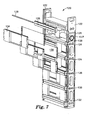
- FIG. 7 is an exploded view of a cassette 120 used in applying an electrodeposition coating onto a web through the use of the present invention.
- the cassette 120 includes side rails 122 that enable placement of the cassette 120 into a processing container.
- the side rails 122 provide structural support for multiple manifolds 124.
- Processing fluids are provided to the manifolds 124 through manifold feed pipe 126.
- Manifold feed pipe 126 connects to a corresponding connecting unit (not shown) located on the side of the processing container via o-ring seal 127.
- the manifolds supply processing fluid through manifold face plates 125 to corresponding fluid bearings 128.
- Anode screens 130 are positioned between the manifolds 124 and the fluid bearings 128, and between the outer edges 132 of opposing side rails 122.
- Optional plating masks 134 are preferably slide mounted onto the side rails 122 through the use of support brackets 136 affixed to the outer edges 132 of the side rails 122.
- the masks 134 positioned between a web (cathode) and the anode screen during processing, are utilized to provide a predetermined pattern of an electrodeposited coating onto the web.
- anode-to-cathode spacing is the one variable affecting the uniformity of plating thickness. Since anodes can be machined flat, the cross-web flatness achieved through the horizontal festoon of the present invention provides a distinct plating uniformity advantage over conventional processes. Furthermore, the functional fluid elements within the processing container enable additional uniformity benefits, especially due to the elimination of the weir flows used in conventional electrodeposition processes.
- the present invention is capable of achieving a coating thickness with a standard deviation of about 4% or less when measured in either the cross web or down web direction. Conventional vertical processes generally have coating thickness with a standard deviation of greater than about 7%.
- FIG. 8 depicts the special relationship between the web and the anode that enable improved electrodeposited coatings in conjunction with the present invention.
- Alternating fluid bearings 140 are located on opposing sides of web 142.
- An anode screen 144 is placed near the web 142.
- Masks 146 may also be fixed into selective locations near the web 142.
- the anode screens 144 are attached to the masks 146 and held in place through the use of supports 148.
- the supports 148 are integrally formed in masks 146.
- the fluid flow from the fluid bearings 140 causes the web 142 to curve slightly in the downweb direction as it passes by each fluid bearing 140 thereby imparting cross web stiffness in the web 142.
- the cross web stiffness in conjunction with the low tension on the web, enhances the ability to coat webs uniformly at low stress and thereby achieve desirable finished web characteristics.
- the present example utilized a 20.3 cm (8 inch) wide web of 1 mil thick polyimide.
- the polyimide web was previously sputter coated with a 2 micron thick layer of copper.
- a web transport system was generally employed to convey the web through a processing container of nickel sulfamate (Technic High Speed Nickel Sulfamate Bath).
- the web transport system consisted of four sections: an unwind, pacer pull roll, tension pull roll, and winder sections. The web was threaded through the system to provide substantially horizontal path and placement of the web over the processing container.
- the web transport system utilized a conventional PID controller to maintain a desired tension on the web during processing.
- the unwind section included an unwind spindle employing a Kollmorgen BDS4 AC servo drive with Kollmorgen brand Goldline model 203 Series motors with resolver feedback (Kollmorgen Inc, Radford, VA).
- a conventional Bayside brand PG series planetary gearbox (Bayside Gearboxes Co., Port Washington, NY) is connected to the unwind spindle to provide low backlash.
- a vertical hanging pivoting dancer system was used to regulate tension on the web between the unwind and the pacer pull roll. The dancer tension force was applied by a low friction pneumatic cylinder.
- a conventional rotary variable displacement transducer (RVDT) coupled to the dancer pivot detected the dancer position.
- the pacer pull roll section is a composite pull roll / steering / tension sensing /anode roller.
- the anode roller was driven to reduce friction effects.
- the roll was electrically isolated from the machine via insulating plastic mounts and a plastic coupling.
- Litton Poly-Scientific brand model # AC4598 slip rings (Litton Poly-Scientific, Blacksburg , VA ) were used to electrically connect the roll to the power supply.
- a Fife brand model CDP-01-M steering guide (Fife Corp., Oklahoma City, OK), with stainless steel mechanical components for corrosion resistance was used for web steering.
- the guide was implemented in an offset pivot guide configuration. Conventional ultrasonic or optical web edge sensors were employed for web positioning sensing.
- the drive system consisted of a Kollmorgen model Servostar SC amplifier, with Kollmorgen XT series servo AC brushless servo-motors, with encoder feedback.
- Micron brand model number AT10 series (Micron gearboxes, a division of Thomson Industries, Inc., Port Washington, NY) straight through low backlash gearboxes were employed.
- Tension sensing was accomplished via two BLH brand LTT-020 tension transducers (BLH Electronics Co., Canton, MA), with a low drag roller mounted between the transducers.
- a BLH brand model Baldwin 2010 tension amplifier with model 308A summing junction was used for signal conditioning. This section functioned as the line pacer, and the tension signal was used for monitoring only.
- the web was inserted into the process container by inserting a cassette, similar to that disclosed in FIG. 7 , across the web and into the processing container to create a festoon.
- the cassette included an anode screen and fluid bearings as previously shown and described in relation to FIG. 7 .
- a fluid delivery system coupled to the cassette by conventional piping mechanisms, was initiated upon secured placement of the cassette into the processing container.
- the total length of web in the processing solution was about 0.92 meters. Since only one side of the cassette anode was electrified, the effective plating length of the web was about 0.46 meters.
- the fluid delivery system circulated the nickel sulfamate solution at 48 C through the fluid bearing at a rate of about 256 liters per minute (64 gpm) or approximately 5.3 liters per square centimeter (3 gpm per square inch) of fluid bearing surface.
- the web was charged at a current of 430 amps per square meter (40 ASF) in order to plate the nickel from the nickel sulfamate solution onto the web.
- the web was conveyed at a speed of 0.15 meters per minute and a tension of about 0.9 Newtons per cm.
- the resulting effective residence time of the web in the processing solution was about 3 minutes.
- the web Upon exiting the processing container, the web was rinsed with distilled water. An air knife was utilized to assist in the removal of process solution from the surface of the web after plating and another was used to remove excess water after rinsing. The web then passed through another composite pull roll / steering / anode roller to allow tension isolation between the plating process and winding process, as well as steering and electrification.
- the resulting nickel plated web passed through a second dancer and was collected at a winder spindle which was essentially identical to the unwind section.
- the resulting nickel plated web had a nickel coating thickness of about 2.2 microns.
- the cross-web thickness standard deviation was about 1.9% and the cross-web thickness range was about 5%.
Landscapes
- Chemical & Material Sciences (AREA)
- Engineering & Computer Science (AREA)
- Chemical Kinetics & Catalysis (AREA)
- Electrochemistry (AREA)
- Materials Engineering (AREA)
- Metallurgy (AREA)
- Organic Chemistry (AREA)
- Electroplating Methods And Accessories (AREA)
- Electrolytic Production Of Metals (AREA)
- Treatment Of Fiber Materials (AREA)
Priority Applications (1)
| Application Number | Priority Date | Filing Date | Title |
|---|---|---|---|
| EP12166886A EP2520694A1 (en) | 2002-04-05 | 2003-02-14 | Web processing method and apparatus |
Applications Claiming Priority (3)
| Application Number | Priority Date | Filing Date | Title |
|---|---|---|---|
| US10/116,822 US6991717B2 (en) | 2002-04-05 | 2002-04-05 | Web processing method and apparatus |
| US116822 | 2002-04-05 | ||
| PCT/US2003/004686 WO2003087437A1 (en) | 2002-04-05 | 2003-02-14 | Web processing method and apparatus |
Related Child Applications (1)
| Application Number | Title | Priority Date | Filing Date |
|---|---|---|---|
| EP12166886.7 Division-Into | 2012-05-04 |
Publications (2)
| Publication Number | Publication Date |
|---|---|
| EP1495162A1 EP1495162A1 (en) | 2005-01-12 |
| EP1495162B1 true EP1495162B1 (en) | 2012-11-28 |
Family
ID=28674068
Family Applications (2)
| Application Number | Title | Priority Date | Filing Date |
|---|---|---|---|
| EP03717898A Expired - Lifetime EP1495162B1 (en) | 2002-04-05 | 2003-02-14 | Web processing method and apparatus |
| EP12166886A Withdrawn EP2520694A1 (en) | 2002-04-05 | 2003-02-14 | Web processing method and apparatus |
Family Applications After (1)
| Application Number | Title | Priority Date | Filing Date |
|---|---|---|---|
| EP12166886A Withdrawn EP2520694A1 (en) | 2002-04-05 | 2003-02-14 | Web processing method and apparatus |
Country Status (8)
| Country | Link |
|---|---|
| US (2) | US6991717B2 (enExample) |
| EP (2) | EP1495162B1 (enExample) |
| JP (1) | JP2005522586A (enExample) |
| KR (1) | KR20040091786A (enExample) |
| CN (1) | CN100439568C (enExample) |
| AU (1) | AU2003222219A1 (enExample) |
| BR (1) | BR0308689B1 (enExample) |
| WO (1) | WO2003087437A1 (enExample) |
Families Citing this family (14)
| Publication number | Priority date | Publication date | Assignee | Title |
|---|---|---|---|---|
| US7655117B2 (en) | 2005-04-06 | 2010-02-02 | Leviton Manufacturing Co., Inc. | Continuous plating system and method with mask registration |
| US7744732B2 (en) * | 2005-04-06 | 2010-06-29 | Leviton Manufacturing Company, Inc. | Continuous plating system and method with mask registration |
| US7611584B2 (en) * | 2005-12-13 | 2009-11-03 | Lg Electronics Inc. | Electroless metal film-plating system |
| US8110076B2 (en) * | 2006-04-20 | 2012-02-07 | Inco Limited | Apparatus and foam electroplating process |
| EP1865094B1 (de) * | 2006-06-08 | 2009-10-21 | BCT Coating Technologies AG | Vorrichtung zur galvanischen Abscheidung von Oberflächen und Galvanisierungssystem |
| US7891276B2 (en) * | 2007-08-31 | 2011-02-22 | Kimbelry-Clark Worldwide, Inc. | System and method for controlling the length of a discrete segment of a continuous web of elastic material |
| US8182655B2 (en) * | 2007-09-05 | 2012-05-22 | Leviton Manufacturing Co., Inc. | Plating systems and methods |
| GB0719218D0 (en) * | 2007-10-02 | 2007-11-14 | Lymn Peter P A | Process tank |
| EP2376694B1 (en) * | 2008-11-25 | 2014-12-17 | 3M Innovative Properties Company | Apparatus and method for cleaning flexible webs |
| US20110024043A1 (en) | 2009-07-02 | 2011-02-03 | Dexcom, Inc. | Continuous analyte sensors and methods of making same |
| ITMI20100504A1 (it) * | 2010-03-26 | 2011-09-27 | Otomec S R L | Impianto per il trattamento galvanico di rivestimento in continuo di materiale in forma di prodotto lungo |
| US20160040290A1 (en) * | 2014-08-08 | 2016-02-11 | Uni-Pixel Displays, Inc. | Roll-to-roll electroless plating system for controlled substrate depth |
| US11674235B2 (en) | 2018-04-11 | 2023-06-13 | Hutchinson Technology Incorporated | Plating method to reduce or eliminate voids in solder applied without flux |
| WO2025143766A1 (ko) * | 2023-12-28 | 2025-07-03 | 주식회사 피엔티 | 선택적 전해 및 무전해 도금 장치 및 그 방법 |
Citations (1)
| Publication number | Priority date | Publication date | Assignee | Title |
|---|---|---|---|---|
| US4248516A (en) * | 1980-01-17 | 1981-02-03 | Pako Corporation | Self-threading photographic processor |
Family Cites Families (40)
| Publication number | Priority date | Publication date | Assignee | Title |
|---|---|---|---|---|
| US359851A (en) * | 1887-03-22 | Machine for cleaning and separating cotton waste | ||
| US2035517A (en) * | 1933-04-13 | 1936-03-31 | Anaconda Copper Mining Co | Apparatus for electrodeposition |
| BE412395A (enExample) * | 1934-11-24 | |||
| US2993848A (en) * | 1952-11-04 | 1961-07-25 | Helen E Brennan | Method of forming a dielectric oxide film on a porous metal strip |
| US2930739A (en) * | 1956-06-28 | 1960-03-29 | Burnham John | Method and apparatus for forming valve metal foil |
| US3156399A (en) * | 1961-10-23 | 1964-11-10 | Sperry Rand Corp | Fluid bearing |
| US3267017A (en) * | 1962-01-31 | 1966-08-16 | Ibm | Apparatus for producing magnetic recording materials |
| GB1016703A (en) * | 1962-04-16 | 1966-01-12 | British Iron Steel Research | Improvements relating to fluid pressure support bearings |
| US3156396A (en) * | 1962-10-08 | 1964-11-10 | Ind Ovens Inc | Web guiding means |
| US3498515A (en) * | 1967-10-06 | 1970-03-03 | Michigan Oven Co | Fluid cushion turning rolls for supporting and guiding strip material |
| US3567093A (en) * | 1969-06-03 | 1971-03-02 | Michigan Oven Co | Fluid cushion turning roll for moving web |
| US3644181A (en) * | 1969-07-24 | 1972-02-22 | Sylvania Electric Prod | Localized electroplating method |
| US3599851A (en) * | 1970-05-08 | 1971-08-17 | Buckbee Mears Co | Hydrodynamic turnover mechanisms |
| US3741650A (en) * | 1971-02-11 | 1973-06-26 | Cutler Hammer Inc | Film handling method and apparatus |
| NL170027C (nl) * | 1971-05-25 | 1982-09-16 | Galentan Ag | Verbetering van een om een vaste as draaibare elektrolyt-verdeelinrichting. |
| US4138047A (en) * | 1977-04-11 | 1979-02-06 | Western Electric Company, Inc. | Fluid bearing |
| US4132609A (en) * | 1977-08-08 | 1979-01-02 | National Steel Corporation | Method of and apparatus for electrolytic treatment of metal |
| US4182472A (en) * | 1978-07-13 | 1980-01-08 | W. R. Grace & Co. | Contactless turning guide for running webs |
| AU525633B2 (en) * | 1980-03-07 | 1982-11-18 | Nippon Steel Corporation | Metal strip treated by moving electrolyte |
| US4322026A (en) * | 1980-04-14 | 1982-03-30 | Young Engineering, Inc. | Method and apparatus for controlling a moving web |
| NL8103979A (nl) * | 1981-08-26 | 1983-03-16 | Bok Edward | Methode en inrichting voor het aanbrengen van een film vloeibaar medium op een substraat. |
| US4507190A (en) * | 1982-09-28 | 1985-03-26 | United States Steel Corporation | Horizontal-pass electrotreating cell |
| JPS6283492A (ja) | 1985-10-09 | 1987-04-16 | Nippon Kokan Kk <Nkk> | 垂直型電気亜鉛メツキ槽における鋼ストリツプの移動方向反転装置 |
| DE3717910A1 (de) * | 1986-05-29 | 1987-12-03 | Noritsu Kenkyu Center Co | Filmtransporteinheit zur verwendung bei einer automatischen filmentwicklungsmaschine |
| JPH0234852A (ja) * | 1988-04-20 | 1990-02-05 | Fuji Photo Film Co Ltd | 感光材料処理装置 |
| US4910546A (en) * | 1988-04-27 | 1990-03-20 | Fuji Photo Film Co., Ltd. | Film processing device |
| ES2029422A6 (es) | 1991-03-14 | 1992-08-01 | Cristia Llongueras Eduardo | Aparato para el tratamiento de tejidos en humedo. |
| DE4033642A1 (de) * | 1990-10-23 | 1992-04-30 | Hoechst Ag | Leitvorrichtung zum fuehren, aus- und/oder umlenken einer materialbahn |
| US5311235A (en) * | 1992-03-02 | 1994-05-10 | Eastman Kodak Company | Driving mechanism for a photographic processing apparatus |
| US5289639A (en) | 1992-07-10 | 1994-03-01 | International Business Machines Corp. | Fluid treatment apparatus and method |
| NL9201274A (nl) * | 1992-07-15 | 1994-02-01 | Dsm Nv | Werkwijze voor het vervaardigen van een polymeer vormdeel, dat een electrisch geleidend polymeer bevat. |
| FR2696478B1 (fr) * | 1992-10-05 | 1994-10-28 | Commissariat Energie Atomique | Procédé de dépôt électrolytique d'un métal sur un substrat souple faiblement conducteur, dispositif de dépôt électrolytique permettant la réalisation de ce procédé et produit obtenu par ce procédé. |
| GB9227187D0 (en) * | 1992-12-18 | 1993-02-24 | Mabbott Robert J | Printing process |
| US5525751A (en) * | 1993-09-28 | 1996-06-11 | Monsanto Company | System for moving a submerged web |
| US5418073A (en) * | 1993-10-25 | 1995-05-23 | Pre Finish Metals Incorporated | Method of forming noise-damping composite with externally galvanized surfaces and composite formed thereby |
| US5804053A (en) * | 1995-12-07 | 1998-09-08 | Eltech Systems Corporation | Continuously electroplated foam of improved weight distribution |
| AT405194B (de) * | 1996-04-15 | 1999-06-25 | Andritz Patentverwaltung | Vorrichtung zum galvanischen abscheiden eines ein- oder beidseitigen metall- oder legierungsüberzuges auf einem metallband |
| JP3299451B2 (ja) * | 1996-09-30 | 2002-07-08 | 新日本製鐵株式会社 | 竪型電解装置 |
| CN1189544A (zh) * | 1997-01-30 | 1998-08-05 | 天津市有色金属研究所 | 在导电性多孔网带上进行连续电沉积的方法和设备 |
| JPH11223913A (ja) | 1998-02-09 | 1999-08-17 | Noritsu Koki Co Ltd | 写真感光材料自動現像装置 |
-
2002
- 2002-04-05 US US10/116,822 patent/US6991717B2/en not_active Expired - Lifetime
-
2003
- 2003-02-14 BR BRPI0308689-5A patent/BR0308689B1/pt not_active IP Right Cessation
- 2003-02-14 EP EP03717898A patent/EP1495162B1/en not_active Expired - Lifetime
- 2003-02-14 EP EP12166886A patent/EP2520694A1/en not_active Withdrawn
- 2003-02-14 CN CNB038076950A patent/CN100439568C/zh not_active Expired - Fee Related
- 2003-02-14 JP JP2003584369A patent/JP2005522586A/ja not_active Withdrawn
- 2003-02-14 KR KR10-2004-7015738A patent/KR20040091786A/ko not_active Ceased
- 2003-02-14 AU AU2003222219A patent/AU2003222219A1/en not_active Abandoned
- 2003-02-14 WO PCT/US2003/004686 patent/WO2003087437A1/en not_active Ceased
-
2006
- 2006-01-11 US US11/329,472 patent/US20060116268A1/en not_active Abandoned
Patent Citations (1)
| Publication number | Priority date | Publication date | Assignee | Title |
|---|---|---|---|---|
| US4248516A (en) * | 1980-01-17 | 1981-02-03 | Pako Corporation | Self-threading photographic processor |
Also Published As
| Publication number | Publication date |
|---|---|
| EP1495162A1 (en) | 2005-01-12 |
| BR0308689A (pt) | 2005-02-15 |
| US6991717B2 (en) | 2006-01-31 |
| CN100439568C (zh) | 2008-12-03 |
| BR0308689B1 (pt) | 2012-06-26 |
| KR20040091786A (ko) | 2004-10-28 |
| WO2003087437A1 (en) | 2003-10-23 |
| EP2520694A1 (en) | 2012-11-07 |
| CN1646733A (zh) | 2005-07-27 |
| AU2003222219A1 (en) | 2003-10-27 |
| US20060116268A1 (en) | 2006-06-01 |
| US20030188965A1 (en) | 2003-10-09 |
| JP2005522586A (ja) | 2005-07-28 |
Similar Documents
| Publication | Publication Date | Title |
|---|---|---|
| EP1495162B1 (en) | Web processing method and apparatus | |
| US6364247B1 (en) | Pneumatic flotation device for continuous web processing and method of making the pneumatic flotation device | |
| US4687528A (en) | Process and device for fabrication of copper-lined laminates | |
| US6752915B2 (en) | Web conveying apparatus, and apparatus and method for electrodeposition using web conveying apparatus | |
| US20110186423A1 (en) | Electroplating apparatus | |
| CN113430605A (zh) | 一种用于柔性薄膜基材表面电镀加工的水电镀设备及方法 | |
| AU2008211764A2 (en) | Method of preparing a primary electrode array for photovoltaic electrochemical cell arrays | |
| KR101226401B1 (ko) | 유전 기판뿐만 아니라, 유전 기판 상에 전기적으로 도전성 패턴의 두께를 전해적으로 증가시키는 방법 및 장치 | |
| CN215947431U (zh) | 一种用于柔性薄膜基材表面电镀加工的水电镀设备 | |
| JP2010179987A (ja) | 表面処理システムおよび表面処理方法 | |
| CN112779578B (zh) | 一种超薄膜电镀装置 | |
| JP2001518562A (ja) | 銅箔製造のための簡易化方法および装置 | |
| KR100665481B1 (ko) | 필름 연속 도금 장치 및 방법 | |
| TW200525051A (en) | Method and apparatus for carrying and treating flat material without contact by continuous equipment | |
| JP6252401B2 (ja) | 成膜方法及びそれを用いた金属膜付樹脂フィルムの製造方法 | |
| KR20220000608U (ko) | 도금장치 | |
| CN222008142U (zh) | 夹边装置及电镀设备 | |
| US20080000769A1 (en) | Conductive coating of surfaces | |
| JP3336040B2 (ja) | フィルム材の液中緊張装置 | |
| JPH0631865U (ja) | フィルム材の連続処理槽 | |
| JP2001127402A (ja) | 回路板製造用基材処理装置及び回路板の製造方法 |
Legal Events
| Date | Code | Title | Description |
|---|---|---|---|
| PUAI | Public reference made under article 153(3) epc to a published international application that has entered the european phase |
Free format text: ORIGINAL CODE: 0009012 |
|
| AK | Designated contracting states |
Kind code of ref document: A1 Designated state(s): AT BE BG CH CY CZ DE DK EE ES FI FR GB GR HU IE IT LI LU MC NL PT SE SI SK TR |
|
| AX | Request for extension of the european patent |
Extension state: AL LT LV MK RO |
|
| 17P | Request for examination filed |
Effective date: 20041104 |
|
| 17Q | First examination report despatched |
Effective date: 20100427 |
|
| GRAP | Despatch of communication of intention to grant a patent |
Free format text: ORIGINAL CODE: EPIDOSNIGR1 |
|
| GRAS | Grant fee paid |
Free format text: ORIGINAL CODE: EPIDOSNIGR3 |
|
| GRAA | (expected) grant |
Free format text: ORIGINAL CODE: 0009210 |
|
| AK | Designated contracting states |
Kind code of ref document: B1 Designated state(s): AT BE BG CH CY CZ DE DK EE ES FI FR GB GR HU IE IT LI LU MC NL PT SE SI SK TR |
|
| REG | Reference to a national code |
Ref country code: GB Ref legal event code: FG4D |
|
| REG | Reference to a national code |
Ref country code: CH Ref legal event code: EP |
|
| REG | Reference to a national code |
Ref country code: AT Ref legal event code: REF Ref document number: 586236 Country of ref document: AT Kind code of ref document: T Effective date: 20121215 |
|
| REG | Reference to a national code |
Ref country code: IE Ref legal event code: FG4D |
|
| REG | Reference to a national code |
Ref country code: DE Ref legal event code: R096 Ref document number: 60342705 Country of ref document: DE Effective date: 20130124 |
|
| REG | Reference to a national code |
Ref country code: AT Ref legal event code: MK05 Ref document number: 586236 Country of ref document: AT Kind code of ref document: T Effective date: 20121128 |
|
| REG | Reference to a national code |
Ref country code: NL Ref legal event code: VDEP Effective date: 20121128 |
|
| PG25 | Lapsed in a contracting state [announced via postgrant information from national office to epo] |
Ref country code: ES Free format text: LAPSE BECAUSE OF FAILURE TO SUBMIT A TRANSLATION OF THE DESCRIPTION OR TO PAY THE FEE WITHIN THE PRESCRIBED TIME-LIMIT Effective date: 20130311 Ref country code: SE Free format text: LAPSE BECAUSE OF FAILURE TO SUBMIT A TRANSLATION OF THE DESCRIPTION OR TO PAY THE FEE WITHIN THE PRESCRIBED TIME-LIMIT Effective date: 20121128 Ref country code: FI Free format text: LAPSE BECAUSE OF FAILURE TO SUBMIT A TRANSLATION OF THE DESCRIPTION OR TO PAY THE FEE WITHIN THE PRESCRIBED TIME-LIMIT Effective date: 20121128 |
|
| PG25 | Lapsed in a contracting state [announced via postgrant information from national office to epo] |
Ref country code: SI Free format text: LAPSE BECAUSE OF FAILURE TO SUBMIT A TRANSLATION OF THE DESCRIPTION OR TO PAY THE FEE WITHIN THE PRESCRIBED TIME-LIMIT Effective date: 20121128 Ref country code: CY Free format text: LAPSE BECAUSE OF FAILURE TO SUBMIT A TRANSLATION OF THE DESCRIPTION OR TO PAY THE FEE WITHIN THE PRESCRIBED TIME-LIMIT Effective date: 20121128 Ref country code: GR Free format text: LAPSE BECAUSE OF FAILURE TO SUBMIT A TRANSLATION OF THE DESCRIPTION OR TO PAY THE FEE WITHIN THE PRESCRIBED TIME-LIMIT Effective date: 20130301 Ref country code: PT Free format text: LAPSE BECAUSE OF FAILURE TO SUBMIT A TRANSLATION OF THE DESCRIPTION OR TO PAY THE FEE WITHIN THE PRESCRIBED TIME-LIMIT Effective date: 20130328 Ref country code: BE Free format text: LAPSE BECAUSE OF FAILURE TO SUBMIT A TRANSLATION OF THE DESCRIPTION OR TO PAY THE FEE WITHIN THE PRESCRIBED TIME-LIMIT Effective date: 20121128 |
|
| PG25 | Lapsed in a contracting state [announced via postgrant information from national office to epo] |
Ref country code: AT Free format text: LAPSE BECAUSE OF FAILURE TO SUBMIT A TRANSLATION OF THE DESCRIPTION OR TO PAY THE FEE WITHIN THE PRESCRIBED TIME-LIMIT Effective date: 20121128 |
|
| PG25 | Lapsed in a contracting state [announced via postgrant information from national office to epo] |
Ref country code: SK Free format text: LAPSE BECAUSE OF FAILURE TO SUBMIT A TRANSLATION OF THE DESCRIPTION OR TO PAY THE FEE WITHIN THE PRESCRIBED TIME-LIMIT Effective date: 20121128 Ref country code: CZ Free format text: LAPSE BECAUSE OF FAILURE TO SUBMIT A TRANSLATION OF THE DESCRIPTION OR TO PAY THE FEE WITHIN THE PRESCRIBED TIME-LIMIT Effective date: 20121128 Ref country code: BG Free format text: LAPSE BECAUSE OF FAILURE TO SUBMIT A TRANSLATION OF THE DESCRIPTION OR TO PAY THE FEE WITHIN THE PRESCRIBED TIME-LIMIT Effective date: 20130228 Ref country code: EE Free format text: LAPSE BECAUSE OF FAILURE TO SUBMIT A TRANSLATION OF THE DESCRIPTION OR TO PAY THE FEE WITHIN THE PRESCRIBED TIME-LIMIT Effective date: 20121128 Ref country code: DK Free format text: LAPSE BECAUSE OF FAILURE TO SUBMIT A TRANSLATION OF THE DESCRIPTION OR TO PAY THE FEE WITHIN THE PRESCRIBED TIME-LIMIT Effective date: 20121128 |
|
| PG25 | Lapsed in a contracting state [announced via postgrant information from national office to epo] |
Ref country code: IT Free format text: LAPSE BECAUSE OF FAILURE TO SUBMIT A TRANSLATION OF THE DESCRIPTION OR TO PAY THE FEE WITHIN THE PRESCRIBED TIME-LIMIT Effective date: 20121128 Ref country code: NL Free format text: LAPSE BECAUSE OF FAILURE TO SUBMIT A TRANSLATION OF THE DESCRIPTION OR TO PAY THE FEE WITHIN THE PRESCRIBED TIME-LIMIT Effective date: 20121128 |
|
| PG25 | Lapsed in a contracting state [announced via postgrant information from national office to epo] |
Ref country code: MC Free format text: LAPSE BECAUSE OF NON-PAYMENT OF DUE FEES Effective date: 20130228 |
|
| REG | Reference to a national code |
Ref country code: CH Ref legal event code: PL |
|
| PLBE | No opposition filed within time limit |
Free format text: ORIGINAL CODE: 0009261 |
|
| STAA | Information on the status of an ep patent application or granted ep patent |
Free format text: STATUS: NO OPPOSITION FILED WITHIN TIME LIMIT |
|
| PG25 | Lapsed in a contracting state [announced via postgrant information from national office to epo] |
Ref country code: CH Free format text: LAPSE BECAUSE OF NON-PAYMENT OF DUE FEES Effective date: 20130228 Ref country code: LI Free format text: LAPSE BECAUSE OF NON-PAYMENT OF DUE FEES Effective date: 20130228 |
|
| 26N | No opposition filed |
Effective date: 20130829 |
|
| REG | Reference to a national code |
Ref country code: FR Ref legal event code: ST Effective date: 20131031 |
|
| REG | Reference to a national code |
Ref country code: IE Ref legal event code: MM4A |
|
| REG | Reference to a national code |
Ref country code: DE Ref legal event code: R097 Ref document number: 60342705 Country of ref document: DE Effective date: 20130829 |
|
| PG25 | Lapsed in a contracting state [announced via postgrant information from national office to epo] |
Ref country code: IE Free format text: LAPSE BECAUSE OF NON-PAYMENT OF DUE FEES Effective date: 20130214 Ref country code: FR Free format text: LAPSE BECAUSE OF NON-PAYMENT OF DUE FEES Effective date: 20130228 |
|
| PG25 | Lapsed in a contracting state [announced via postgrant information from national office to epo] |
Ref country code: TR Free format text: LAPSE BECAUSE OF FAILURE TO SUBMIT A TRANSLATION OF THE DESCRIPTION OR TO PAY THE FEE WITHIN THE PRESCRIBED TIME-LIMIT Effective date: 20121128 |
|
| PG25 | Lapsed in a contracting state [announced via postgrant information from national office to epo] |
Ref country code: LU Free format text: LAPSE BECAUSE OF NON-PAYMENT OF DUE FEES Effective date: 20130214 Ref country code: HU Free format text: LAPSE BECAUSE OF FAILURE TO SUBMIT A TRANSLATION OF THE DESCRIPTION OR TO PAY THE FEE WITHIN THE PRESCRIBED TIME-LIMIT; INVALID AB INITIO Effective date: 20030214 |
|
| PGFP | Annual fee paid to national office [announced via postgrant information from national office to epo] |
Ref country code: GB Payment date: 20160210 Year of fee payment: 14 |
|
| PGFP | Annual fee paid to national office [announced via postgrant information from national office to epo] |
Ref country code: DE Payment date: 20170207 Year of fee payment: 15 |
|
| GBPC | Gb: european patent ceased through non-payment of renewal fee |
Effective date: 20170214 |
|
| PG25 | Lapsed in a contracting state [announced via postgrant information from national office to epo] |
Ref country code: GB Free format text: LAPSE BECAUSE OF NON-PAYMENT OF DUE FEES Effective date: 20170214 |
|
| REG | Reference to a national code |
Ref country code: DE Ref legal event code: R119 Ref document number: 60342705 Country of ref document: DE |
|
| PG25 | Lapsed in a contracting state [announced via postgrant information from national office to epo] |
Ref country code: DE Free format text: LAPSE BECAUSE OF NON-PAYMENT OF DUE FEES Effective date: 20180901 |