EP1487835B1 - Essig- und propionsäureamide - Google Patents
Essig- und propionsäureamide Download PDFInfo
- Publication number
- EP1487835B1 EP1487835B1 EP03744337A EP03744337A EP1487835B1 EP 1487835 B1 EP1487835 B1 EP 1487835B1 EP 03744337 A EP03744337 A EP 03744337A EP 03744337 A EP03744337 A EP 03744337A EP 1487835 B1 EP1487835 B1 EP 1487835B1
- Authority
- EP
- European Patent Office
- Prior art keywords
- salts
- solvates
- compounds
- alkyl
- hydrogen
- Prior art date
- Legal status (The legal status is an assumption and is not a legal conclusion. Google has not performed a legal analysis and makes no representation as to the accuracy of the status listed.)
- Expired - Lifetime
Links
- 235000011054 acetic acid Nutrition 0.000 title abstract description 4
- 150000001408 amides Chemical class 0.000 title abstract description 3
- 235000019260 propionic acid Nutrition 0.000 title abstract description 3
- 150000001243 acetic acids Chemical class 0.000 title abstract 2
- 150000004672 propanoic acids Chemical class 0.000 title abstract 2
- 238000011282 treatment Methods 0.000 claims abstract description 14
- 239000003814 drug Substances 0.000 claims abstract description 11
- 208000037265 diseases, disorders, signs and symptoms Diseases 0.000 claims abstract description 7
- 230000008447 perception Effects 0.000 claims abstract description 7
- 238000011321 prophylaxis Methods 0.000 claims abstract description 7
- 201000010099 disease Diseases 0.000 claims abstract description 5
- 238000004519 manufacturing process Methods 0.000 claims abstract 3
- -1 benzopyrazinyl Chemical group 0.000 claims description 63
- 150000001875 compounds Chemical class 0.000 claims description 63
- 150000003839 salts Chemical class 0.000 claims description 24
- UFHFLCQGNIYNRP-UHFFFAOYSA-N Hydrogen Chemical compound [H][H] UFHFLCQGNIYNRP-UHFFFAOYSA-N 0.000 claims description 20
- 229910052739 hydrogen Inorganic materials 0.000 claims description 20
- 239000001257 hydrogen Substances 0.000 claims description 20
- 239000012453 solvate Substances 0.000 claims description 20
- 125000004196 benzothienyl group Chemical group S1C(=CC2=C1C=CC=C2)* 0.000 claims description 15
- 125000002943 quinolinyl group Chemical group N1=C(C=CC2=CC=CC=C12)* 0.000 claims description 15
- 229910052736 halogen Inorganic materials 0.000 claims description 14
- 150000002367 halogens Chemical class 0.000 claims description 14
- 125000004169 (C1-C6) alkyl group Chemical group 0.000 claims description 13
- 125000004093 cyano group Chemical group *C#N 0.000 claims description 13
- 125000000449 nitro group Chemical group [O-][N+](*)=O 0.000 claims description 13
- 125000001624 naphthyl group Chemical group 0.000 claims description 12
- 125000002023 trifluoromethyl group Chemical group FC(F)(F)* 0.000 claims description 12
- 125000003354 benzotriazolyl group Chemical group N1N=NC2=C1C=CC=C2* 0.000 claims description 10
- 150000002431 hydrogen Chemical class 0.000 claims description 10
- 239000002904 solvent Substances 0.000 claims description 10
- 125000000876 trifluoromethoxy group Chemical group FC(F)(F)O* 0.000 claims description 10
- 125000004178 (C1-C4) alkyl group Chemical group 0.000 claims description 9
- 125000000229 (C1-C4)alkoxy group Chemical group 0.000 claims description 9
- ZAMOUSCENKQFHK-UHFFFAOYSA-N Chlorine atom Chemical compound [Cl] ZAMOUSCENKQFHK-UHFFFAOYSA-N 0.000 claims description 9
- PXGOKWXKJXAPGV-UHFFFAOYSA-N Fluorine Chemical compound FF PXGOKWXKJXAPGV-UHFFFAOYSA-N 0.000 claims description 9
- 239000000460 chlorine Substances 0.000 claims description 7
- 229910052801 chlorine Inorganic materials 0.000 claims description 7
- 125000000325 methylidene group Chemical group [H]C([H])=* 0.000 claims description 7
- 125000006700 (C1-C6) alkylthio group Chemical class 0.000 claims description 5
- WKBOTKDWSSQWDR-UHFFFAOYSA-N Bromine atom Chemical compound [Br] WKBOTKDWSSQWDR-UHFFFAOYSA-N 0.000 claims description 5
- 229910052731 fluorine Inorganic materials 0.000 claims description 5
- 239000011737 fluorine Substances 0.000 claims description 5
- 125000002887 hydroxy group Chemical group [H]O* 0.000 claims description 5
- 125000004191 (C1-C6) alkoxy group Chemical class 0.000 claims description 4
- 239000002253 acid Substances 0.000 claims description 4
- GDTBXPJZTBHREO-UHFFFAOYSA-N bromine Substances BrBr GDTBXPJZTBHREO-UHFFFAOYSA-N 0.000 claims description 4
- 229910052794 bromium Inorganic materials 0.000 claims description 4
- 239000000546 pharmaceutical excipient Substances 0.000 claims description 4
- VGGSQFUCUMXWEO-UHFFFAOYSA-N Ethene Chemical compound C=C VGGSQFUCUMXWEO-UHFFFAOYSA-N 0.000 claims description 3
- 150000007513 acids Chemical class 0.000 claims description 3
- 125000003828 azulenyl group Chemical group 0.000 claims description 3
- 125000001797 benzyl group Chemical group [H]C1=C([H])C([H])=C(C([H])=C1[H])C([H])([H])* 0.000 claims description 3
- 125000002485 formyl group Chemical group [H]C(*)=O 0.000 claims description 3
- 231100000252 nontoxic Toxicity 0.000 claims description 3
- 230000003000 nontoxic effect Effects 0.000 claims description 3
- 125000001997 phenyl group Chemical group [H]C1=C([H])C([H])=C(*)C([H])=C1[H] 0.000 claims description 3
- 239000005977 Ethylene Substances 0.000 claims description 2
- 230000006735 deficit Effects 0.000 claims 2
- 125000004435 hydrogen atom Chemical group [H]* 0.000 claims 1
- 238000000034 method Methods 0.000 abstract description 18
- ZMXDDKWLCZADIW-UHFFFAOYSA-N N,N-Dimethylformamide Chemical compound CN(C)C=O ZMXDDKWLCZADIW-UHFFFAOYSA-N 0.000 description 46
- WEVYAHXRMPXWCK-UHFFFAOYSA-N Acetonitrile Chemical compound CC#N WEVYAHXRMPXWCK-UHFFFAOYSA-N 0.000 description 27
- VEXZGXHMUGYJMC-UHFFFAOYSA-N Hydrochloric acid Chemical compound Cl VEXZGXHMUGYJMC-UHFFFAOYSA-N 0.000 description 24
- 238000012360 testing method Methods 0.000 description 22
- OKKJLVBELUTLKV-UHFFFAOYSA-N Methanol Chemical compound OC OKKJLVBELUTLKV-UHFFFAOYSA-N 0.000 description 21
- YMWUJEATGCHHMB-UHFFFAOYSA-N Dichloromethane Chemical compound ClCCl YMWUJEATGCHHMB-UHFFFAOYSA-N 0.000 description 19
- WYURNTSHIVDZCO-UHFFFAOYSA-N Tetrahydrofuran Chemical compound C1CCOC1 WYURNTSHIVDZCO-UHFFFAOYSA-N 0.000 description 16
- 238000004128 high performance liquid chromatography Methods 0.000 description 14
- 241000700159 Rattus Species 0.000 description 13
- 239000000203 mixture Substances 0.000 description 12
- JGFZNNIVVJXRND-UHFFFAOYSA-N N,N-Diisopropylethylamine (DIPEA) Chemical compound CCN(C(C)C)C(C)C JGFZNNIVVJXRND-UHFFFAOYSA-N 0.000 description 11
- 102000019315 Nicotinic acetylcholine receptors Human genes 0.000 description 11
- 108050006807 Nicotinic acetylcholine receptors Proteins 0.000 description 11
- 208000002193 Pain Diseases 0.000 description 11
- 241001465754 Metazoa Species 0.000 description 10
- 229920005989 resin Polymers 0.000 description 10
- 239000011347 resin Substances 0.000 description 10
- 239000000243 solution Substances 0.000 description 10
- 239000000126 substance Substances 0.000 description 10
- QTBSBXVTEAMEQO-UHFFFAOYSA-N Acetic acid Chemical compound CC(O)=O QTBSBXVTEAMEQO-UHFFFAOYSA-N 0.000 description 9
- XEKOWRVHYACXOJ-UHFFFAOYSA-N Ethyl acetate Chemical compound CCOC(C)=O XEKOWRVHYACXOJ-UHFFFAOYSA-N 0.000 description 9
- ZMANZCXQSJIPKH-UHFFFAOYSA-N Triethylamine Chemical compound CCN(CC)CC ZMANZCXQSJIPKH-UHFFFAOYSA-N 0.000 description 9
- 239000003480 eluent Substances 0.000 description 9
- VHYFNPMBLIVWCW-UHFFFAOYSA-N 4-Dimethylaminopyridine Chemical compound CN(C)C1=CC=NC=C1 VHYFNPMBLIVWCW-UHFFFAOYSA-N 0.000 description 8
- IAZDPXIOMUYVGZ-UHFFFAOYSA-N Dimethylsulphoxide Chemical compound CS(C)=O IAZDPXIOMUYVGZ-UHFFFAOYSA-N 0.000 description 8
- 238000002360 preparation method Methods 0.000 description 8
- 150000003254 radicals Chemical group 0.000 description 8
- HEDRZPFGACZZDS-UHFFFAOYSA-N Chloroform Chemical compound ClC(Cl)Cl HEDRZPFGACZZDS-UHFFFAOYSA-N 0.000 description 7
- 125000002496 methyl group Chemical group [H]C([H])([H])* 0.000 description 7
- 239000000047 product Substances 0.000 description 7
- XLYOFNOQVPJJNP-UHFFFAOYSA-N water Substances O XLYOFNOQVPJJNP-UHFFFAOYSA-N 0.000 description 7
- 206010012289 Dementia Diseases 0.000 description 6
- RTZKZFJDLAIYFH-UHFFFAOYSA-N Diethyl ether Chemical compound CCOCC RTZKZFJDLAIYFH-UHFFFAOYSA-N 0.000 description 6
- SJRJJKPEHAURKC-UHFFFAOYSA-N N-Methylmorpholine Chemical compound CN1CCOCC1 SJRJJKPEHAURKC-UHFFFAOYSA-N 0.000 description 6
- YXFVVABEGXRONW-UHFFFAOYSA-N Toluene Chemical compound CC1=CC=CC=C1 YXFVVABEGXRONW-UHFFFAOYSA-N 0.000 description 6
- 125000004432 carbon atom Chemical group C* 0.000 description 6
- 238000001035 drying Methods 0.000 description 6
- 239000000706 filtrate Substances 0.000 description 6
- 239000012458 free base Substances 0.000 description 6
- 229910052757 nitrogen Inorganic materials 0.000 description 6
- 239000002244 precipitate Substances 0.000 description 6
- WSLDOOZREJYCGB-UHFFFAOYSA-N 1,2-Dichloroethane Chemical compound ClCCCl WSLDOOZREJYCGB-UHFFFAOYSA-N 0.000 description 5
- ASOKPJOREAFHNY-UHFFFAOYSA-N 1-Hydroxybenzotriazole Chemical compound C1=CC=C2N(O)N=NC2=C1 ASOKPJOREAFHNY-UHFFFAOYSA-N 0.000 description 5
- 238000005160 1H NMR spectroscopy Methods 0.000 description 5
- 239000002585 base Substances 0.000 description 5
- 230000000694 effects Effects 0.000 description 5
- 229920000642 polymer Polymers 0.000 description 5
- 238000002953 preparative HPLC Methods 0.000 description 5
- 230000008569 process Effects 0.000 description 5
- 239000011541 reaction mixture Substances 0.000 description 5
- PAMIQIKDUOTOBW-UHFFFAOYSA-N 1-methylpiperidine Chemical compound CN1CCCCC1 PAMIQIKDUOTOBW-UHFFFAOYSA-N 0.000 description 4
- HCMSYUHZEXYCNS-UHFFFAOYSA-N 2-(1-azabicyclo[2.2.2]octan-3-yl)acetic acid;hydrochloride Chemical compound Cl.C1CC2C(CC(=O)O)CN1CC2 HCMSYUHZEXYCNS-UHFFFAOYSA-N 0.000 description 4
- BVKZGUZCCUSVTD-UHFFFAOYSA-L Carbonate Chemical compound [O-]C([O-])=O BVKZGUZCCUSVTD-UHFFFAOYSA-L 0.000 description 4
- 239000007821 HATU Substances 0.000 description 4
- FAPWRFPIFSIZLT-UHFFFAOYSA-M Sodium chloride Chemical compound [Na+].[Cl-] FAPWRFPIFSIZLT-UHFFFAOYSA-M 0.000 description 4
- 206010002026 amyotrophic lateral sclerosis Diseases 0.000 description 4
- 125000000499 benzofuranyl group Chemical group O1C(=CC2=C1C=CC=C2)* 0.000 description 4
- 210000004556 brain Anatomy 0.000 description 4
- 239000003795 chemical substances by application Substances 0.000 description 4
- 229960001701 chloroform Drugs 0.000 description 4
- 208000010877 cognitive disease Diseases 0.000 description 4
- NPZTUJOABDZTLV-UHFFFAOYSA-N hydroxybenzotriazole Substances O=C1C=CC=C2NNN=C12 NPZTUJOABDZTLV-UHFFFAOYSA-N 0.000 description 4
- QWPPOHNGKGFGJK-UHFFFAOYSA-N hypochlorous acid Chemical compound ClO QWPPOHNGKGFGJK-UHFFFAOYSA-N 0.000 description 4
- 125000001041 indolyl group Chemical group 0.000 description 4
- 125000001570 methylene group Chemical group [H]C([H])([*:1])[*:2] 0.000 description 4
- YBYRMVIVWMBXKQ-UHFFFAOYSA-N phenylmethanesulfonyl fluoride Chemical compound FS(=O)(=O)CC1=CC=CC=C1 YBYRMVIVWMBXKQ-UHFFFAOYSA-N 0.000 description 4
- 239000000725 suspension Substances 0.000 description 4
- FYSNRJHAOHDILO-UHFFFAOYSA-N thionyl chloride Chemical compound ClS(Cl)=O FYSNRJHAOHDILO-UHFFFAOYSA-N 0.000 description 4
- 229960000549 4-dimethylaminophenol Drugs 0.000 description 3
- HBAQYPYDRFILMT-UHFFFAOYSA-N 8-[3-(1-cyclopropylpyrazol-4-yl)-1H-pyrazolo[4,3-d]pyrimidin-5-yl]-3-methyl-3,8-diazabicyclo[3.2.1]octan-2-one Chemical class C1(CC1)N1N=CC(=C1)C1=NNC2=C1N=C(N=C2)N1C2C(N(CC1CC2)C)=O HBAQYPYDRFILMT-UHFFFAOYSA-N 0.000 description 3
- CSCPPACGZOOCGX-UHFFFAOYSA-N Acetone Chemical compound CC(C)=O CSCPPACGZOOCGX-UHFFFAOYSA-N 0.000 description 3
- 208000024827 Alzheimer disease Diseases 0.000 description 3
- 208000008035 Back Pain Diseases 0.000 description 3
- UHOVQNZJYSORNB-UHFFFAOYSA-N Benzene Chemical compound C1=CC=CC=C1 UHOVQNZJYSORNB-UHFFFAOYSA-N 0.000 description 3
- OKTJSMMVPCPJKN-UHFFFAOYSA-N Carbon Chemical compound [C] OKTJSMMVPCPJKN-UHFFFAOYSA-N 0.000 description 3
- 208000000094 Chronic Pain Diseases 0.000 description 3
- KDLHZDBZIXYQEI-UHFFFAOYSA-N Palladium Chemical compound [Pd] KDLHZDBZIXYQEI-UHFFFAOYSA-N 0.000 description 3
- 239000004793 Polystyrene Substances 0.000 description 3
- VYPSYNLAJGMNEJ-UHFFFAOYSA-N Silicium dioxide Chemical compound O=[Si]=O VYPSYNLAJGMNEJ-UHFFFAOYSA-N 0.000 description 3
- 208000006011 Stroke Diseases 0.000 description 3
- 208000030886 Traumatic Brain injury Diseases 0.000 description 3
- 208000005298 acute pain Diseases 0.000 description 3
- 230000001684 chronic effect Effects 0.000 description 3
- KRKNYBCHXYNGOX-UHFFFAOYSA-N citric acid Chemical compound OC(=O)CC(O)(C(O)=O)CC(O)=O KRKNYBCHXYNGOX-UHFFFAOYSA-N 0.000 description 3
- 239000012043 crude product Substances 0.000 description 3
- 238000001514 detection method Methods 0.000 description 3
- 238000005516 engineering process Methods 0.000 description 3
- 238000009472 formulation Methods 0.000 description 3
- 125000005842 heteroatom Chemical group 0.000 description 3
- 238000011068 loading method Methods 0.000 description 3
- 230000014759 maintenance of location Effects 0.000 description 3
- XLTANAWLDBYGFU-VTLKBQQISA-N methyllycaconitine Chemical compound C([C@]12CN([C@@H]3[C@@]4(O)[C@]5(O)[C@H]6[C@@H](OC)[C@@H]([C@H](C5)OC)C[C@H]6[C@@]3([C@@H]1[C@@H]4OC)[C@@H](OC)CC2)CC)OC(=O)C1=CC=CC=C1N1C(=O)C[C@H](C)C1=O XLTANAWLDBYGFU-VTLKBQQISA-N 0.000 description 3
- VLKZOEOYAKHREP-UHFFFAOYSA-N n-Hexane Chemical compound CCCCCC VLKZOEOYAKHREP-UHFFFAOYSA-N 0.000 description 3
- 239000008188 pellet Substances 0.000 description 3
- 239000000825 pharmaceutical preparation Substances 0.000 description 3
- 229920005990 polystyrene resin Polymers 0.000 description 3
- 238000000746 purification Methods 0.000 description 3
- 239000007787 solid Substances 0.000 description 3
- 230000000638 stimulation Effects 0.000 description 3
- 230000009529 traumatic brain injury Effects 0.000 description 3
- 238000000825 ultraviolet detection Methods 0.000 description 3
- SNICXCGAKADSCV-JTQLQIEISA-N (-)-Nicotine Chemical compound CN1CCC[C@H]1C1=CC=CN=C1 SNICXCGAKADSCV-JTQLQIEISA-N 0.000 description 2
- SUCPBNJIHBKXGG-UHFFFAOYSA-N (2,3,4,5,6-pentafluorophenyl) 2-(1-azabicyclo[2.2.2]octan-3-yl)acetate;hydrochloride Chemical compound Cl.FC1=C(F)C(F)=C(F)C(F)=C1OC(=O)CC1C(CC2)CCN2C1 SUCPBNJIHBKXGG-UHFFFAOYSA-N 0.000 description 2
- QPFMBZIOSGYJDE-UHFFFAOYSA-N 1,1,2,2-tetrachloroethane Chemical compound ClC(Cl)C(Cl)Cl QPFMBZIOSGYJDE-UHFFFAOYSA-N 0.000 description 2
- BDNKZNFMNDZQMI-UHFFFAOYSA-N 1,3-diisopropylcarbodiimide Chemical compound CC(C)N=C=NC(C)C BDNKZNFMNDZQMI-UHFFFAOYSA-N 0.000 description 2
- RYHBNJHYFVUHQT-UHFFFAOYSA-N 1,4-Dioxane Chemical compound C1COCCO1 RYHBNJHYFVUHQT-UHFFFAOYSA-N 0.000 description 2
- ZKMZPXWMMSBLNO-UHFFFAOYSA-N 1-azabicyclo[2.2.2]octan-3-one Chemical compound C1CC2C(=O)CN1CC2 ZKMZPXWMMSBLNO-UHFFFAOYSA-N 0.000 description 2
- FTLHGQOBAPTEHE-UHFFFAOYSA-N 2,3,5,6-tetrafluoro-4-hydroxybenzoic acid Chemical compound OC(=O)C1=C(F)C(F)=C(O)C(F)=C1F FTLHGQOBAPTEHE-UHFFFAOYSA-N 0.000 description 2
- JLUOHHFAHYVFGJ-UHFFFAOYSA-N 2-(1-azabicyclo[2.2.2]octan-3-yl)acetic acid Chemical compound C1CC2C(CC(=O)O)CN1CC2 JLUOHHFAHYVFGJ-UHFFFAOYSA-N 0.000 description 2
- CKBBSFOOIOHLPC-UHFFFAOYSA-N 6-bromo-1-benzothiophene-2-carboxylic acid Chemical compound C1=C(Br)C=C2SC(C(=O)O)=CC2=C1 CKBBSFOOIOHLPC-UHFFFAOYSA-N 0.000 description 2
- QGZKDVFQNNGYKY-UHFFFAOYSA-N Ammonia Chemical compound N QGZKDVFQNNGYKY-UHFFFAOYSA-N 0.000 description 2
- XKRFYHLGVUSROY-UHFFFAOYSA-N Argon Chemical compound [Ar] XKRFYHLGVUSROY-UHFFFAOYSA-N 0.000 description 2
- 108091003079 Bovine Serum Albumin Proteins 0.000 description 2
- QOSSAOTZNIDXMA-UHFFFAOYSA-N Dicylcohexylcarbodiimide Chemical compound C1CCCCC1N=C=NC1CCCCC1 QOSSAOTZNIDXMA-UHFFFAOYSA-N 0.000 description 2
- VZCYOOQTPOCHFL-OWOJBTEDSA-N Fumaric acid Chemical compound OC(=O)\C=C\C(O)=O VZCYOOQTPOCHFL-OWOJBTEDSA-N 0.000 description 2
- 208000023105 Huntington disease Diseases 0.000 description 2
- DGAQECJNVWCQMB-PUAWFVPOSA-M Ilexoside XXIX Chemical compound C[C@@H]1CC[C@@]2(CC[C@@]3(C(=CC[C@H]4[C@]3(CC[C@@H]5[C@@]4(CC[C@@H](C5(C)C)OS(=O)(=O)[O-])C)C)[C@@H]2[C@]1(C)O)C)C(=O)O[C@H]6[C@@H]([C@H]([C@@H]([C@H](O6)CO)O)O)O.[Na+] DGAQECJNVWCQMB-PUAWFVPOSA-M 0.000 description 2
- KFZMGEQAYNKOFK-UHFFFAOYSA-N Isopropanol Chemical compound CC(C)O KFZMGEQAYNKOFK-UHFFFAOYSA-N 0.000 description 2
- 208000008930 Low Back Pain Diseases 0.000 description 2
- 208000026139 Memory disease Diseases 0.000 description 2
- AFVFQIVMOAPDHO-UHFFFAOYSA-N Methanesulfonic acid Chemical compound CS(O)(=O)=O AFVFQIVMOAPDHO-UHFFFAOYSA-N 0.000 description 2
- BZLVMXJERCGZMT-UHFFFAOYSA-N Methyl tert-butyl ether Chemical compound COC(C)(C)C BZLVMXJERCGZMT-UHFFFAOYSA-N 0.000 description 2
- 238000005481 NMR spectroscopy Methods 0.000 description 2
- CTQNGGLPUBDAKN-UHFFFAOYSA-N O-Xylene Chemical compound CC1=CC=CC=C1C CTQNGGLPUBDAKN-UHFFFAOYSA-N 0.000 description 2
- 208000018737 Parkinson disease Diseases 0.000 description 2
- NBIIXXVUZAFLBC-UHFFFAOYSA-N Phosphoric acid Chemical compound OP(O)(O)=O NBIIXXVUZAFLBC-UHFFFAOYSA-N 0.000 description 2
- NQRYJNQNLNOLGT-UHFFFAOYSA-N Piperidine Chemical compound C1CCNCC1 NQRYJNQNLNOLGT-UHFFFAOYSA-N 0.000 description 2
- 229920002873 Polyethylenimine Polymers 0.000 description 2
- JUJWROOIHBZHMG-UHFFFAOYSA-N Pyridine Chemical compound C1=CC=NC=C1 JUJWROOIHBZHMG-UHFFFAOYSA-N 0.000 description 2
- KEAYESYHFKHZAL-UHFFFAOYSA-N Sodium Chemical compound [Na] KEAYESYHFKHZAL-UHFFFAOYSA-N 0.000 description 2
- PMZURENOXWZQFD-UHFFFAOYSA-L Sodium Sulfate Chemical compound [Na+].[Na+].[O-]S([O-])(=O)=O PMZURENOXWZQFD-UHFFFAOYSA-L 0.000 description 2
- WQDUMFSSJAZKTM-UHFFFAOYSA-N Sodium methoxide Chemical compound [Na+].[O-]C WQDUMFSSJAZKTM-UHFFFAOYSA-N 0.000 description 2
- QAOWNCQODCNURD-UHFFFAOYSA-N Sulfuric acid Chemical compound OS(O)(=O)=O QAOWNCQODCNURD-UHFFFAOYSA-N 0.000 description 2
- DKGAVHZHDRPRBM-UHFFFAOYSA-N Tert-Butanol Chemical compound CC(C)(C)O DKGAVHZHDRPRBM-UHFFFAOYSA-N 0.000 description 2
- 201000004810 Vascular dementia Diseases 0.000 description 2
- 230000004913 activation Effects 0.000 description 2
- 230000001154 acute effect Effects 0.000 description 2
- 239000000556 agonist Substances 0.000 description 2
- 125000004414 alkyl thio group Chemical group 0.000 description 2
- 238000010171 animal model Methods 0.000 description 2
- 238000003556 assay Methods 0.000 description 2
- 230000006399 behavior Effects 0.000 description 2
- WPYMKLBDIGXBTP-UHFFFAOYSA-N benzoic acid Chemical compound OC(=O)C1=CC=CC=C1 WPYMKLBDIGXBTP-UHFFFAOYSA-N 0.000 description 2
- 239000012148 binding buffer Substances 0.000 description 2
- 230000037396 body weight Effects 0.000 description 2
- 229940098773 bovine serum albumin Drugs 0.000 description 2
- CODNYICXDISAEA-UHFFFAOYSA-N bromine monochloride Chemical compound BrCl CODNYICXDISAEA-UHFFFAOYSA-N 0.000 description 2
- 239000000969 carrier Substances 0.000 description 2
- 210000004027 cell Anatomy 0.000 description 2
- 230000007850 degeneration Effects 0.000 description 2
- XBDQKXXYIPTUBI-UHFFFAOYSA-N dimethylselenoniopropionate Natural products CCC(O)=O XBDQKXXYIPTUBI-UHFFFAOYSA-N 0.000 description 2
- 208000035475 disorder Diseases 0.000 description 2
- 238000010494 dissociation reaction Methods 0.000 description 2
- 230000005593 dissociations Effects 0.000 description 2
- 125000001495 ethyl group Chemical group [H]C([H])([H])C([H])([H])* 0.000 description 2
- 238000002474 experimental method Methods 0.000 description 2
- 238000001914 filtration Methods 0.000 description 2
- 125000001072 heteroaryl group Chemical group 0.000 description 2
- 210000001320 hippocampus Anatomy 0.000 description 2
- 239000005457 ice water Substances 0.000 description 2
- 238000000338 in vitro Methods 0.000 description 2
- 238000011534 incubation Methods 0.000 description 2
- 125000003453 indazolyl group Chemical group N1N=C(C2=C1C=CC=C2)* 0.000 description 2
- 239000012442 inert solvent Substances 0.000 description 2
- 125000001449 isopropyl group Chemical group [H]C([H])([H])C([H])(*)C([H])([H])[H] 0.000 description 2
- 230000000366 juvenile effect Effects 0.000 description 2
- JVTAAEKCZFNVCJ-UHFFFAOYSA-N lactic acid Chemical compound CC(O)C(O)=O JVTAAEKCZFNVCJ-UHFFFAOYSA-N 0.000 description 2
- 230000007786 learning performance Effects 0.000 description 2
- 239000003446 ligand Substances 0.000 description 2
- 238000004949 mass spectrometry Methods 0.000 description 2
- 239000012528 membrane Substances 0.000 description 2
- 230000007334 memory performance Effects 0.000 description 2
- XLTANAWLDBYGFU-UHFFFAOYSA-N methyllycaconitine hydrochloride Natural products C1CC(OC)C2(C3C4OC)C5CC(C(C6)OC)C(OC)C5C6(O)C4(O)C2N(CC)CC31COC(=O)C1=CC=CC=C1N1C(=O)CC(C)C1=O XLTANAWLDBYGFU-UHFFFAOYSA-N 0.000 description 2
- 239000002480 mineral oil Substances 0.000 description 2
- 235000010446 mineral oil Nutrition 0.000 description 2
- 201000006417 multiple sclerosis Diseases 0.000 description 2
- 125000001298 n-hexoxy group Chemical group [H]C([H])([H])C([H])([H])C([H])([H])C([H])([H])C([H])([H])C([H])([H])O* 0.000 description 2
- 125000001280 n-hexyl group Chemical group C(CCCCC)* 0.000 description 2
- 125000004718 n-hexylthio group Chemical group C(CCCCC)S* 0.000 description 2
- 125000000740 n-pentyl group Chemical group [H]C([H])([H])C([H])([H])C([H])([H])C([H])([H])C([H])([H])* 0.000 description 2
- 125000004123 n-propyl group Chemical group [H]C([H])([H])C([H])([H])C([H])([H])* 0.000 description 2
- 229960002715 nicotine Drugs 0.000 description 2
- SNICXCGAKADSCV-UHFFFAOYSA-N nicotine Natural products CN1CCCC1C1=CC=CN=C1 SNICXCGAKADSCV-UHFFFAOYSA-N 0.000 description 2
- 239000012074 organic phase Substances 0.000 description 2
- 229910052760 oxygen Inorganic materials 0.000 description 2
- 230000000144 pharmacologic effect Effects 0.000 description 2
- 239000012071 phase Substances 0.000 description 2
- 229920002223 polystyrene Polymers 0.000 description 2
- BWHMMNNQKKPAPP-UHFFFAOYSA-L potassium carbonate Chemical compound [K+].[K+].[O-]C([O-])=O BWHMMNNQKKPAPP-UHFFFAOYSA-L 0.000 description 2
- 125000002924 primary amino group Chemical group [H]N([H])* 0.000 description 2
- 239000002287 radioligand Substances 0.000 description 2
- 201000000980 schizophrenia Diseases 0.000 description 2
- 239000011734 sodium Substances 0.000 description 2
- 239000011780 sodium chloride Substances 0.000 description 2
- 239000012312 sodium hydride Substances 0.000 description 2
- 229910000104 sodium hydride Inorganic materials 0.000 description 2
- 229910052938 sodium sulfate Inorganic materials 0.000 description 2
- 235000011152 sodium sulphate Nutrition 0.000 description 2
- 239000007858 starting material Substances 0.000 description 2
- 125000001424 substituent group Chemical group 0.000 description 2
- 229910052717 sulfur Inorganic materials 0.000 description 2
- 239000006228 supernatant Substances 0.000 description 2
- 208000011580 syndromic disease Diseases 0.000 description 2
- YLQBMQCUIZJEEH-UHFFFAOYSA-N tetrahydrofuran Natural products C=1C=COC=1 YLQBMQCUIZJEEH-UHFFFAOYSA-N 0.000 description 2
- VZCYOOQTPOCHFL-UHFFFAOYSA-N trans-butenedioic acid Natural products OC(=O)C=CC(O)=O VZCYOOQTPOCHFL-UHFFFAOYSA-N 0.000 description 2
- 239000008096 xylene Substances 0.000 description 2
- JVVXZOOGOGPDRZ-UHFFFAOYSA-N (1,4a-dimethyl-7-propan-2-yl-2,3,4,9,10,10a-hexahydrophenanthren-1-yl)methanamine Chemical compound NCC1(C)CCCC2(C)C3=CC=C(C(C)C)C=C3CCC21 JVVXZOOGOGPDRZ-UHFFFAOYSA-N 0.000 description 1
- UOCLXMDMGBRAIB-UHFFFAOYSA-N 1,1,1-trichloroethane Chemical compound CC(Cl)(Cl)Cl UOCLXMDMGBRAIB-UHFFFAOYSA-N 0.000 description 1
- RFDPHKHXPMDJJD-UHFFFAOYSA-N 1-azabicyclo[2.2.2]octan-3-one;hydron;chloride Chemical compound Cl.C1CC2C(=O)CN1CC2 RFDPHKHXPMDJJD-UHFFFAOYSA-N 0.000 description 1
- LMDZBCPBFSXMTL-UHFFFAOYSA-N 1-ethyl-3-(3-dimethylaminopropyl)carbodiimide Chemical compound CCN=C=NCCCN(C)C LMDZBCPBFSXMTL-UHFFFAOYSA-N 0.000 description 1
- 238000001644 13C nuclear magnetic resonance spectroscopy Methods 0.000 description 1
- XBNGYFFABRKICK-UHFFFAOYSA-N 2,3,4,5,6-pentafluorophenol Chemical compound OC1=C(F)C(F)=C(F)C(F)=C1F XBNGYFFABRKICK-UHFFFAOYSA-N 0.000 description 1
- IVVPUUMIUYWFJL-UHFFFAOYSA-N 2-(1-azabicyclo[2.2.2]octan-3-yl)-n-(6-bromo-1-benzothiophen-2-yl)acetamide;hydrochloride Chemical compound Cl.C1N(CC2)CCC2C1CC(=O)NC1=CC2=CC=C(Br)C=C2S1 IVVPUUMIUYWFJL-UHFFFAOYSA-N 0.000 description 1
- XCORCIPNBIMHOT-UHFFFAOYSA-N 2-(1-azabicyclo[2.2.2]octan-3-yl)-n-(7-bromo-1-benzothiophen-2-yl)acetamide;hydrochloride Chemical compound Cl.C1N(CC2)CCC2C1CC(=O)NC1=CC(C=CC=C2Br)=C2S1 XCORCIPNBIMHOT-UHFFFAOYSA-N 0.000 description 1
- SQYCMOONFGWJKQ-UHFFFAOYSA-N 2-(1-azabicyclo[2.2.2]octan-3-yl)-n-(8-nitronaphthalen-2-yl)acetamide;hydrochloride Chemical compound Cl.C1N(CC2)CCC2C1CC(=O)NC1=CC=C2C=CC=C([N+](=O)[O-])C2=C1 SQYCMOONFGWJKQ-UHFFFAOYSA-N 0.000 description 1
- XTXKJXUPFKSJFI-UHFFFAOYSA-N 2-(1-azabicyclo[2.2.2]octan-3-yl)-n-quinolin-7-ylacetamide;hydrochloride Chemical compound Cl.C1=CC=NC2=CC(NC(CC3C4CCN(CC4)C3)=O)=CC=C21 XTXKJXUPFKSJFI-UHFFFAOYSA-N 0.000 description 1
- LBLYYCQCTBFVLH-UHFFFAOYSA-N 2-Methylbenzenesulfonic acid Chemical compound CC1=CC=CC=C1S(O)(=O)=O LBLYYCQCTBFVLH-UHFFFAOYSA-N 0.000 description 1
- QKNYBSVHEMOAJP-UHFFFAOYSA-N 2-amino-2-(hydroxymethyl)propane-1,3-diol;hydron;chloride Chemical compound Cl.OCC(N)(CO)CO QKNYBSVHEMOAJP-UHFFFAOYSA-N 0.000 description 1
- YFACSBNCXCBPGK-UHFFFAOYSA-M 2-butyl-5-methyl-1,2-oxazol-2-ium;perchlorate Chemical compound [O-]Cl(=O)(=O)=O.CCCC[N+]1=CC=C(C)O1 YFACSBNCXCBPGK-UHFFFAOYSA-M 0.000 description 1
- YOETUEMZNOLGDB-UHFFFAOYSA-N 2-methylpropyl carbonochloridate Chemical compound CC(C)COC(Cl)=O YOETUEMZNOLGDB-UHFFFAOYSA-N 0.000 description 1
- JBIJLHTVPXGSAM-UHFFFAOYSA-N 2-naphthylamine Chemical compound C1=CC=CC2=CC(N)=CC=C21 JBIJLHTVPXGSAM-UHFFFAOYSA-N 0.000 description 1
- KLDLRDSRCMJKGM-UHFFFAOYSA-N 3-[chloro-(2-oxo-1,3-oxazolidin-3-yl)phosphoryl]-1,3-oxazolidin-2-one Chemical compound C1COC(=O)N1P(=O)(Cl)N1CCOC1=O KLDLRDSRCMJKGM-UHFFFAOYSA-N 0.000 description 1
- BMYNFMYTOJXKLE-UHFFFAOYSA-N 3-azaniumyl-2-hydroxypropanoate Chemical compound NCC(O)C(O)=O BMYNFMYTOJXKLE-UHFFFAOYSA-N 0.000 description 1
- YOZXBGDQHSBQNS-UHFFFAOYSA-N 3-bromo-1-benzothiophen-2-amine Chemical compound C1=CC=C2C(Br)=C(N)SC2=C1 YOZXBGDQHSBQNS-UHFFFAOYSA-N 0.000 description 1
- UFQKVFFKLSNHAY-UHFFFAOYSA-N 4-[2-(1-azabicyclo[2.2.2]octan-3-yl)acetyl]oxy-2,3,5,6-tetrafluorobenzoic acid Chemical compound FC1=C(F)C(C(=O)O)=C(F)C(F)=C1OC(=O)CC1C(CC2)CCN2C1 UFQKVFFKLSNHAY-UHFFFAOYSA-N 0.000 description 1
- UPCARQPLANFGQJ-UHFFFAOYSA-N 4-bromo-2-fluorobenzaldehyde Chemical compound FC1=CC(Br)=CC=C1C=O UPCARQPLANFGQJ-UHFFFAOYSA-N 0.000 description 1
- OCKGFTQIICXDQW-ZEQRLZLVSA-N 5-[(1r)-1-hydroxy-2-[4-[(2r)-2-hydroxy-2-(4-methyl-1-oxo-3h-2-benzofuran-5-yl)ethyl]piperazin-1-yl]ethyl]-4-methyl-3h-2-benzofuran-1-one Chemical compound C1=C2C(=O)OCC2=C(C)C([C@@H](O)CN2CCN(CC2)C[C@H](O)C2=CC=C3C(=O)OCC3=C2C)=C1 OCKGFTQIICXDQW-ZEQRLZLVSA-N 0.000 description 1
- ZDKHTZYKKXVACO-UHFFFAOYSA-N 6-bromo-1-benzothiophen-2-amine Chemical compound C1=C(Br)C=C2SC(N)=CC2=C1 ZDKHTZYKKXVACO-UHFFFAOYSA-N 0.000 description 1
- DXEGIOHBMCDNII-UHFFFAOYSA-N 6-bromo-1-benzothiophen-2-amine;hydrochloride Chemical compound Cl.C1=C(Br)C=C2SC(N)=CC2=C1 DXEGIOHBMCDNII-UHFFFAOYSA-N 0.000 description 1
- ZCYVEMRRCGMTRW-UHFFFAOYSA-N 7553-56-2 Chemical compound [I] ZCYVEMRRCGMTRW-UHFFFAOYSA-N 0.000 description 1
- FGLPIWSCAOGYBA-UHFFFAOYSA-N 8-nitronaphthalen-2-amine Chemical compound C1=CC=C([N+]([O-])=O)C2=CC(N)=CC=C21 FGLPIWSCAOGYBA-UHFFFAOYSA-N 0.000 description 1
- 101710195183 Alpha-bungarotoxin Proteins 0.000 description 1
- 208000000044 Amnesia Diseases 0.000 description 1
- 208000006096 Attention Deficit Disorder with Hyperactivity Diseases 0.000 description 1
- 208000036864 Attention deficit/hyperactivity disease Diseases 0.000 description 1
- 239000005711 Benzoic acid Substances 0.000 description 1
- BVKZGUZCCUSVTD-UHFFFAOYSA-M Bicarbonate Chemical compound OC([O-])=O BVKZGUZCCUSVTD-UHFFFAOYSA-M 0.000 description 1
- 201000006474 Brain Ischemia Diseases 0.000 description 1
- ARPWWDBRSBYILL-RMKNXTFCSA-N COC(/C=C1/C(CC2)CCN2C1)=O Chemical compound COC(/C=C1/C(CC2)CCN2C1)=O ARPWWDBRSBYILL-RMKNXTFCSA-N 0.000 description 1
- OYPRJOBELJOOCE-UHFFFAOYSA-N Calcium Chemical compound [Ca] OYPRJOBELJOOCE-UHFFFAOYSA-N 0.000 description 1
- BHPQYMZQTOCNFJ-UHFFFAOYSA-N Calcium cation Chemical compound [Ca+2] BHPQYMZQTOCNFJ-UHFFFAOYSA-N 0.000 description 1
- 206010008120 Cerebral ischaemia Diseases 0.000 description 1
- 208000011990 Corticobasal Degeneration Diseases 0.000 description 1
- XDTMQSROBMDMFD-UHFFFAOYSA-N Cyclohexane Chemical compound C1CCCCC1 XDTMQSROBMDMFD-UHFFFAOYSA-N 0.000 description 1
- 206010067889 Dementia with Lewy bodies Diseases 0.000 description 1
- FEWJPZIEWOKRBE-JCYAYHJZSA-N Dextrotartaric acid Chemical compound OC(=O)[C@H](O)[C@@H](O)C(O)=O FEWJPZIEWOKRBE-JCYAYHJZSA-N 0.000 description 1
- 208000032131 Diabetic Neuropathies Diseases 0.000 description 1
- BWLUMTFWVZZZND-UHFFFAOYSA-N Dibenzylamine Chemical compound C=1C=CC=CC=1CNCC1=CC=CC=C1 BWLUMTFWVZZZND-UHFFFAOYSA-N 0.000 description 1
- XTHFKEDIFFGKHM-UHFFFAOYSA-N Dimethoxyethane Chemical compound COCCOC XTHFKEDIFFGKHM-UHFFFAOYSA-N 0.000 description 1
- KCXVZYZYPLLWCC-UHFFFAOYSA-N EDTA Chemical compound OC(=O)CN(CC(O)=O)CCN(CC(O)=O)CC(O)=O KCXVZYZYPLLWCC-UHFFFAOYSA-N 0.000 description 1
- GKQLYSROISKDLL-UHFFFAOYSA-N EEDQ Chemical compound C1=CC=C2N(C(=O)OCC)C(OCC)C=CC2=C1 GKQLYSROISKDLL-UHFFFAOYSA-N 0.000 description 1
- 238000006546 Horner-Wadsworth-Emmons reaction Methods 0.000 description 1
- 102000004310 Ion Channels Human genes 0.000 description 1
- 108090000862 Ion Channels Proteins 0.000 description 1
- 208000020358 Learning disease Diseases 0.000 description 1
- 201000002832 Lewy body dementia Diseases 0.000 description 1
- 102000018697 Membrane Proteins Human genes 0.000 description 1
- 108010052285 Membrane Proteins Proteins 0.000 description 1
- 241000699670 Mus sp. Species 0.000 description 1
- FXHOOIRPVKKKFG-UHFFFAOYSA-N N,N-Dimethylacetamide Chemical compound CN(C)C(C)=O FXHOOIRPVKKKFG-UHFFFAOYSA-N 0.000 description 1
- 206010028980 Neoplasm Diseases 0.000 description 1
- 208000028389 Nerve injury Diseases 0.000 description 1
- 208000014060 Niemann-Pick disease Diseases 0.000 description 1
- 206010033799 Paralysis Diseases 0.000 description 1
- 206010036376 Postherpetic Neuralgia Diseases 0.000 description 1
- KWYUFKZDYYNOTN-UHFFFAOYSA-M Potassium hydroxide Chemical compound [OH-].[K+] KWYUFKZDYYNOTN-UHFFFAOYSA-M 0.000 description 1
- OFOBLEOULBTSOW-UHFFFAOYSA-N Propanedioic acid Natural products OC(=O)CC(O)=O OFOBLEOULBTSOW-UHFFFAOYSA-N 0.000 description 1
- 208000025747 Rheumatic disease Diseases 0.000 description 1
- 229930006000 Sucrose Natural products 0.000 description 1
- CZMRCDWAGMRECN-UGDNZRGBSA-N Sucrose Chemical compound O[C@H]1[C@H](O)[C@@H](CO)O[C@@]1(CO)O[C@@H]1[C@H](O)[C@@H](O)[C@H](O)[C@@H](CO)O1 CZMRCDWAGMRECN-UGDNZRGBSA-N 0.000 description 1
- FEWJPZIEWOKRBE-UHFFFAOYSA-N Tartaric acid Natural products [H+].[H+].[O-]C(=O)C(O)C(O)C([O-])=O FEWJPZIEWOKRBE-UHFFFAOYSA-N 0.000 description 1
- XSTXAVWGXDQKEL-UHFFFAOYSA-N Trichloroethylene Chemical group ClC=C(Cl)Cl XSTXAVWGXDQKEL-UHFFFAOYSA-N 0.000 description 1
- FZNCGRZWXLXZSZ-CIQUZCHMSA-N Voglibose Chemical compound OCC(CO)N[C@H]1C[C@](O)(CO)[C@@H](O)[C@H](O)[C@H]1O FZNCGRZWXLXZSZ-CIQUZCHMSA-N 0.000 description 1
- 201000008485 Wernicke-Korsakoff syndrome Diseases 0.000 description 1
- SORGEQQSQGNZFI-UHFFFAOYSA-N [azido(phenoxy)phosphoryl]oxybenzene Chemical compound C=1C=CC=CC=1OP(=O)(N=[N+]=[N-])OC1=CC=CC=C1 SORGEQQSQGNZFI-UHFFFAOYSA-N 0.000 description 1
- OIPILFWXSMYKGL-UHFFFAOYSA-N acetylcholine Chemical compound CC(=O)OCC[N+](C)(C)C OIPILFWXSMYKGL-UHFFFAOYSA-N 0.000 description 1
- 229960004373 acetylcholine Drugs 0.000 description 1
- 230000009471 action Effects 0.000 description 1
- 239000004480 active ingredient Substances 0.000 description 1
- 239000008186 active pharmaceutical agent Substances 0.000 description 1
- 125000004442 acylamino group Chemical group 0.000 description 1
- 230000006978 adaptation Effects 0.000 description 1
- 239000000443 aerosol Substances 0.000 description 1
- 239000003513 alkali Substances 0.000 description 1
- 229910052783 alkali metal Inorganic materials 0.000 description 1
- 125000000217 alkyl group Chemical group 0.000 description 1
- 102000047725 alpha7 Nicotinic Acetylcholine Receptor Human genes 0.000 description 1
- 108700006085 alpha7 Nicotinic Acetylcholine Receptor Proteins 0.000 description 1
- 229910000147 aluminium phosphate Inorganic materials 0.000 description 1
- 150000001412 amines Chemical class 0.000 description 1
- 125000004202 aminomethyl group Chemical group [H]N([H])C([H])([H])* 0.000 description 1
- 229910021529 ammonia Inorganic materials 0.000 description 1
- 150000003863 ammonium salts Chemical class 0.000 description 1
- 150000008064 anhydrides Chemical class 0.000 description 1
- 230000003288 anthiarrhythmic effect Effects 0.000 description 1
- 239000003416 antiarrhythmic agent Substances 0.000 description 1
- 229910052786 argon Inorganic materials 0.000 description 1
- 125000003118 aryl group Chemical group 0.000 description 1
- 239000012298 atmosphere Substances 0.000 description 1
- 208000015802 attention deficit-hyperactivity disease Diseases 0.000 description 1
- CBHOOMGKXCMKIR-UHFFFAOYSA-N azane;methanol Chemical compound N.OC CBHOOMGKXCMKIR-UHFFFAOYSA-N 0.000 description 1
- 230000009286 beneficial effect Effects 0.000 description 1
- SRSXLGNVWSONIS-UHFFFAOYSA-N benzenesulfonic acid Chemical compound OS(=O)(=O)C1=CC=CC=C1 SRSXLGNVWSONIS-UHFFFAOYSA-N 0.000 description 1
- 229940092714 benzenesulfonic acid Drugs 0.000 description 1
- 235000010233 benzoic acid Nutrition 0.000 description 1
- RROBIDXNTUAHFW-UHFFFAOYSA-N benzotriazol-1-yloxy-tris(dimethylamino)phosphanium Chemical compound C1=CC=C2N(O[P+](N(C)C)(N(C)C)N(C)C)N=NC2=C1 RROBIDXNTUAHFW-UHFFFAOYSA-N 0.000 description 1
- 230000027455 binding Effects 0.000 description 1
- 230000015572 biosynthetic process Effects 0.000 description 1
- 238000009835 boiling Methods 0.000 description 1
- 210000005013 brain tissue Anatomy 0.000 description 1
- 244000309464 bull Species 0.000 description 1
- 239000011575 calcium Substances 0.000 description 1
- 229910052791 calcium Inorganic materials 0.000 description 1
- 229910001424 calcium ion Inorganic materials 0.000 description 1
- 201000011510 cancer Diseases 0.000 description 1
- 150000001718 carbodiimides Chemical class 0.000 description 1
- 229910052799 carbon Inorganic materials 0.000 description 1
- 229950005499 carbon tetrachloride Drugs 0.000 description 1
- 150000004649 carbonic acid derivatives Chemical class 0.000 description 1
- 150000001728 carbonyl compounds Chemical class 0.000 description 1
- PFKFTWBEEFSNDU-UHFFFAOYSA-N carbonyldiimidazole Chemical compound C1=CN=CN1C(=O)N1C=CN=C1 PFKFTWBEEFSNDU-UHFFFAOYSA-N 0.000 description 1
- 150000001735 carboxylic acids Chemical class 0.000 description 1
- 239000003054 catalyst Substances 0.000 description 1
- 150000001768 cations Chemical class 0.000 description 1
- 210000003710 cerebral cortex Anatomy 0.000 description 1
- 206010008118 cerebral infarction Diseases 0.000 description 1
- 238000000451 chemical ionisation Methods 0.000 description 1
- 238000006243 chemical reaction Methods 0.000 description 1
- 208000022371 chronic pain syndrome Diseases 0.000 description 1
- 235000015165 citric acid Nutrition 0.000 description 1
- 238000004440 column chromatography Methods 0.000 description 1
- 238000001816 cooling Methods 0.000 description 1
- 239000013078 crystal Substances 0.000 description 1
- DEZRYPDIMOWBDS-UHFFFAOYSA-N dcm dichloromethane Chemical compound ClCCl.ClCCl DEZRYPDIMOWBDS-UHFFFAOYSA-N 0.000 description 1
- HPNMFZURTQLUMO-UHFFFAOYSA-N diethylamine Chemical compound CCNCC HPNMFZURTQLUMO-UHFFFAOYSA-N 0.000 description 1
- SBZXBUIDTXKZTM-UHFFFAOYSA-N diglyme Chemical compound COCCOCCOC SBZXBUIDTXKZTM-UHFFFAOYSA-N 0.000 description 1
- 239000003085 diluting agent Substances 0.000 description 1
- UXGNZZKBCMGWAZ-UHFFFAOYSA-N dimethylformamide dmf Chemical compound CN(C)C=O.CN(C)C=O UXGNZZKBCMGWAZ-UHFFFAOYSA-N 0.000 description 1
- 239000002270 dispersing agent Substances 0.000 description 1
- CETRZFQIITUQQL-UHFFFAOYSA-N dmso dimethylsulfoxide Chemical compound CS(C)=O.CS(C)=O CETRZFQIITUQQL-UHFFFAOYSA-N 0.000 description 1
- 239000008298 dragée Substances 0.000 description 1
- 229940079593 drug Drugs 0.000 description 1
- 238000000132 electrospray ionisation Methods 0.000 description 1
- 239000003995 emulsifying agent Substances 0.000 description 1
- 239000000839 emulsion Substances 0.000 description 1
- 238000010931 ester hydrolysis Methods 0.000 description 1
- CCIVGXIOQKPBKL-UHFFFAOYSA-M ethanesulfonate Chemical compound CCS([O-])(=O)=O CCIVGXIOQKPBKL-UHFFFAOYSA-M 0.000 description 1
- 150000002170 ethers Chemical class 0.000 description 1
- 210000001652 frontal lobe Anatomy 0.000 description 1
- 239000001530 fumaric acid Substances 0.000 description 1
- 235000011087 fumaric acid Nutrition 0.000 description 1
- 229940052308 general anesthetics halogenated hydrocarbons Drugs 0.000 description 1
- 239000011521 glass Substances 0.000 description 1
- 239000003365 glass fiber Substances 0.000 description 1
- 239000008187 granular material Substances 0.000 description 1
- 230000003370 grooming effect Effects 0.000 description 1
- 150000008282 halocarbons Chemical class 0.000 description 1
- 239000011539 homogenization buffer Substances 0.000 description 1
- 150000004677 hydrates Chemical class 0.000 description 1
- 229930195733 hydrocarbon Natural products 0.000 description 1
- 150000002430 hydrocarbons Chemical class 0.000 description 1
- 238000005984 hydrogenation reaction Methods 0.000 description 1
- 230000006872 improvement Effects 0.000 description 1
- 230000004941 influx Effects 0.000 description 1
- 239000003112 inhibitor Substances 0.000 description 1
- 230000005764 inhibitory process Effects 0.000 description 1
- 229910052500 inorganic mineral Inorganic materials 0.000 description 1
- 238000007689 inspection Methods 0.000 description 1
- 238000011835 investigation Methods 0.000 description 1
- 239000011630 iodine Substances 0.000 description 1
- PNDPGZBMCMUPRI-UHFFFAOYSA-N iodine Chemical compound II PNDPGZBMCMUPRI-UHFFFAOYSA-N 0.000 description 1
- 229910052740 iodine Inorganic materials 0.000 description 1
- 125000002183 isoquinolinyl group Chemical group C1(=NC=CC2=CC=CC=C12)* 0.000 description 1
- 125000005956 isoquinolyl group Chemical group 0.000 description 1
- CTAPFRYPJLPFDF-UHFFFAOYSA-N isoxazole Chemical class C=1C=NOC=1 CTAPFRYPJLPFDF-UHFFFAOYSA-N 0.000 description 1
- 239000004310 lactic acid Substances 0.000 description 1
- 235000014655 lactic acid Nutrition 0.000 description 1
- 201000003723 learning disability Diseases 0.000 description 1
- 239000007788 liquid Substances 0.000 description 1
- 238000004811 liquid chromatography Methods 0.000 description 1
- 238000004895 liquid chromatography mass spectrometry Methods 0.000 description 1
- 239000003589 local anesthetic agent Substances 0.000 description 1
- 229960005015 local anesthetics Drugs 0.000 description 1
- 159000000003 magnesium salts Chemical class 0.000 description 1
- VZCYOOQTPOCHFL-UPHRSURJSA-N maleic acid Chemical compound OC(=O)\C=C/C(O)=O VZCYOOQTPOCHFL-UPHRSURJSA-N 0.000 description 1
- 239000011976 maleic acid Substances 0.000 description 1
- 239000000463 material Substances 0.000 description 1
- 238000005259 measurement Methods 0.000 description 1
- 230000006984 memory degeneration Effects 0.000 description 1
- 208000023060 memory loss Diseases 0.000 description 1
- 229940098779 methanesulfonic acid Drugs 0.000 description 1
- MKIJJIMOAABWGF-UHFFFAOYSA-N methyl 2-sulfanylacetate Chemical compound COC(=O)CS MKIJJIMOAABWGF-UHFFFAOYSA-N 0.000 description 1
- SFDVDNLBYGHFNF-UHFFFAOYSA-N methyl 6-bromo-1-benzothiophene-2-carboxylate Chemical compound C1=C(Br)C=C2SC(C(=O)OC)=CC2=C1 SFDVDNLBYGHFNF-UHFFFAOYSA-N 0.000 description 1
- 229940073584 methylene chloride Drugs 0.000 description 1
- 208000027061 mild cognitive impairment Diseases 0.000 description 1
- 235000010755 mineral Nutrition 0.000 description 1
- 239000011707 mineral Substances 0.000 description 1
- 230000004048 modification Effects 0.000 description 1
- 238000012986 modification Methods 0.000 description 1
- 210000000663 muscle cell Anatomy 0.000 description 1
- 125000003935 n-pentoxy group Chemical group [H]C([H])([H])C([H])([H])C([H])([H])C([H])([H])C([H])([H])O* 0.000 description 1
- 125000004712 n-pentylthio group Chemical group C(CCCC)S* 0.000 description 1
- AZIAXPYKZXZLBY-UHFFFAOYSA-N n-phenyl-1-azabicyclo[2.2.2]octane-2-carboxamide Chemical class C1C(CC2)CCN2C1C(=O)NC1=CC=CC=C1 AZIAXPYKZXZLBY-UHFFFAOYSA-N 0.000 description 1
- YZMHQCWXYHARLS-UHFFFAOYSA-N naphthalene-1,2-disulfonic acid Chemical compound C1=CC=CC2=C(S(O)(=O)=O)C(S(=O)(=O)O)=CC=C21 YZMHQCWXYHARLS-UHFFFAOYSA-N 0.000 description 1
- 230000008764 nerve damage Effects 0.000 description 1
- 210000000653 nervous system Anatomy 0.000 description 1
- 208000004296 neuralgia Diseases 0.000 description 1
- 210000002241 neurite Anatomy 0.000 description 1
- 230000004770 neurodegeneration Effects 0.000 description 1
- 208000015122 neurodegenerative disease Diseases 0.000 description 1
- 210000002569 neuron Anatomy 0.000 description 1
- 230000007996 neuronal plasticity Effects 0.000 description 1
- 208000021722 neuropathic pain Diseases 0.000 description 1
- LYGJENNIWJXYER-UHFFFAOYSA-N nitromethane Chemical compound C[N+]([O-])=O LYGJENNIWJXYER-UHFFFAOYSA-N 0.000 description 1
- 230000009871 nonspecific binding Effects 0.000 description 1
- 239000012038 nucleophile Substances 0.000 description 1
- 210000000056 organ Anatomy 0.000 description 1
- 150000007530 organic bases Chemical class 0.000 description 1
- 239000003960 organic solvent Substances 0.000 description 1
- 229910052763 palladium Inorganic materials 0.000 description 1
- 208000021090 palsy Diseases 0.000 description 1
- IZUPBVBPLAPZRR-UHFFFAOYSA-N pentachloro-phenol Natural products OC1=C(Cl)C(Cl)=C(Cl)C(Cl)=C1Cl IZUPBVBPLAPZRR-UHFFFAOYSA-N 0.000 description 1
- VLTRZXGMWDSKGL-UHFFFAOYSA-N perchloric acid Chemical compound OCl(=O)(=O)=O VLTRZXGMWDSKGL-UHFFFAOYSA-N 0.000 description 1
- 210000000578 peripheral nerve Anatomy 0.000 description 1
- 230000035699 permeability Effects 0.000 description 1
- 239000003208 petroleum Substances 0.000 description 1
- 239000006187 pill Substances 0.000 description 1
- 235000015497 potassium bicarbonate Nutrition 0.000 description 1
- 229910000027 potassium carbonate Inorganic materials 0.000 description 1
- 235000011181 potassium carbonates Nutrition 0.000 description 1
- 159000000001 potassium salts Chemical class 0.000 description 1
- 230000002265 prevention Effects 0.000 description 1
- MFDFERRIHVXMIY-UHFFFAOYSA-N procaine Chemical compound CCN(CC)CCOC(=O)C1=CC=C(N)C=C1 MFDFERRIHVXMIY-UHFFFAOYSA-N 0.000 description 1
- 229960004919 procaine Drugs 0.000 description 1
- 230000000750 progressive effect Effects 0.000 description 1
- QLNJFJADRCOGBJ-UHFFFAOYSA-N propionamide Chemical class CCC(N)=O QLNJFJADRCOGBJ-UHFFFAOYSA-N 0.000 description 1
- 238000000159 protein binding assay Methods 0.000 description 1
- UMJSCPRVCHMLSP-UHFFFAOYSA-N pyridine Natural products COC1=CC=CN=C1 UMJSCPRVCHMLSP-UHFFFAOYSA-N 0.000 description 1
- IUVKMZGDUIUOCP-BTNSXGMBSA-N quinbolone Chemical compound O([C@H]1CC[C@H]2[C@H]3[C@@H]([C@]4(C=CC(=O)C=C4CC3)C)CC[C@@]21C)C1=CCCC1 IUVKMZGDUIUOCP-BTNSXGMBSA-N 0.000 description 1
- RJSRSRITMWVIQT-UHFFFAOYSA-N quinolin-6-amine Chemical compound N1=CC=CC2=CC(N)=CC=C21 RJSRSRITMWVIQT-UHFFFAOYSA-N 0.000 description 1
- 102000005962 receptors Human genes 0.000 description 1
- 108020003175 receptors Proteins 0.000 description 1
- 238000001953 recrystallisation Methods 0.000 description 1
- 238000010992 reflux Methods 0.000 description 1
- 230000000552 rheumatic effect Effects 0.000 description 1
- 125000006413 ring segment Chemical group 0.000 description 1
- 239000000741 silica gel Substances 0.000 description 1
- 229910002027 silica gel Inorganic materials 0.000 description 1
- 229910052708 sodium Inorganic materials 0.000 description 1
- 235000015424 sodium Nutrition 0.000 description 1
- CDBYLPFSWZWCQE-UHFFFAOYSA-L sodium carbonate Substances [Na+].[Na+].[O-]C([O-])=O CDBYLPFSWZWCQE-UHFFFAOYSA-L 0.000 description 1
- 229910000029 sodium carbonate Inorganic materials 0.000 description 1
- 238000001228 spectrum Methods 0.000 description 1
- 208000020431 spinal cord injury Diseases 0.000 description 1
- 239000007921 spray Substances 0.000 description 1
- 238000003756 stirring Methods 0.000 description 1
- 238000006467 substitution reaction Methods 0.000 description 1
- 239000005720 sucrose Substances 0.000 description 1
- 150000003460 sulfonic acids Chemical class 0.000 description 1
- 230000024587 synaptic transmission, glutamatergic Effects 0.000 description 1
- 239000006188 syrup Substances 0.000 description 1
- 235000020357 syrup Nutrition 0.000 description 1
- 239000003826 tablet Substances 0.000 description 1
- 239000011975 tartaric acid Substances 0.000 description 1
- 235000002906 tartaric acid Nutrition 0.000 description 1
- 125000000999 tert-butyl group Chemical group [H]C([H])([H])C(*)(C([H])([H])[H])C([H])([H])[H] 0.000 description 1
- VZGDMQKNWNREIO-UHFFFAOYSA-N tetrachloromethane Chemical compound ClC(Cl)(Cl)Cl VZGDMQKNWNREIO-UHFFFAOYSA-N 0.000 description 1
- WHRNULOCNSKMGB-UHFFFAOYSA-N tetrahydrofuran thf Chemical compound C1CCOC1.C1CCOC1 WHRNULOCNSKMGB-UHFFFAOYSA-N 0.000 description 1
- 230000000542 thalamic effect Effects 0.000 description 1
- 125000005270 trialkylamine group Chemical group 0.000 description 1
- 206010044652 trigeminal neuralgia Diseases 0.000 description 1
- LYTCVQQGCSNFJU-LKGYBJPKSA-N α-bungarotoxin Chemical compound C(/[C@H]1O[C@H]2C[C@H]3O[C@@H](CC(=C)C=O)C[C@H](O)[C@]3(C)O[C@@H]2C[C@@H]1O[C@@H]1C2)=C/C[C@]1(C)O[C@H]1[C@@]2(C)O[C@]2(C)CC[C@@H]3O[C@@H]4C[C@]5(C)O[C@@H]6C(C)=CC(=O)O[C@H]6C[C@H]5O[C@H]4C[C@@H](C)[C@H]3O[C@H]2C1 LYTCVQQGCSNFJU-LKGYBJPKSA-N 0.000 description 1
Classifications
-
- C—CHEMISTRY; METALLURGY
- C07—ORGANIC CHEMISTRY
- C07D—HETEROCYCLIC COMPOUNDS
- C07D453/00—Heterocyclic compounds containing quinuclidine or iso-quinuclidine ring systems, e.g. quinine alkaloids
- C07D453/02—Heterocyclic compounds containing quinuclidine or iso-quinuclidine ring systems, e.g. quinine alkaloids containing not further condensed quinuclidine ring systems
-
- A—HUMAN NECESSITIES
- A61—MEDICAL OR VETERINARY SCIENCE; HYGIENE
- A61K—PREPARATIONS FOR MEDICAL, DENTAL OR TOILETRY PURPOSES
- A61K31/00—Medicinal preparations containing organic active ingredients
- A61K31/33—Heterocyclic compounds
- A61K31/395—Heterocyclic compounds having nitrogen as a ring hetero atom, e.g. guanethidine or rifamycins
- A61K31/435—Heterocyclic compounds having nitrogen as a ring hetero atom, e.g. guanethidine or rifamycins having six-membered rings with one nitrogen as the only ring hetero atom
- A61K31/439—Heterocyclic compounds having nitrogen as a ring hetero atom, e.g. guanethidine or rifamycins having six-membered rings with one nitrogen as the only ring hetero atom the ring forming part of a bridged ring system, e.g. quinuclidine
-
- A—HUMAN NECESSITIES
- A61—MEDICAL OR VETERINARY SCIENCE; HYGIENE
- A61P—SPECIFIC THERAPEUTIC ACTIVITY OF CHEMICAL COMPOUNDS OR MEDICINAL PREPARATIONS
- A61P21/00—Drugs for disorders of the muscular or neuromuscular system
- A61P21/02—Muscle relaxants, e.g. for tetanus or cramps
-
- A—HUMAN NECESSITIES
- A61—MEDICAL OR VETERINARY SCIENCE; HYGIENE
- A61P—SPECIFIC THERAPEUTIC ACTIVITY OF CHEMICAL COMPOUNDS OR MEDICINAL PREPARATIONS
- A61P25/00—Drugs for disorders of the nervous system
-
- A—HUMAN NECESSITIES
- A61—MEDICAL OR VETERINARY SCIENCE; HYGIENE
- A61P—SPECIFIC THERAPEUTIC ACTIVITY OF CHEMICAL COMPOUNDS OR MEDICINAL PREPARATIONS
- A61P25/00—Drugs for disorders of the nervous system
- A61P25/02—Drugs for disorders of the nervous system for peripheral neuropathies
-
- A—HUMAN NECESSITIES
- A61—MEDICAL OR VETERINARY SCIENCE; HYGIENE
- A61P—SPECIFIC THERAPEUTIC ACTIVITY OF CHEMICAL COMPOUNDS OR MEDICINAL PREPARATIONS
- A61P25/00—Drugs for disorders of the nervous system
- A61P25/04—Centrally acting analgesics, e.g. opioids
-
- A—HUMAN NECESSITIES
- A61—MEDICAL OR VETERINARY SCIENCE; HYGIENE
- A61P—SPECIFIC THERAPEUTIC ACTIVITY OF CHEMICAL COMPOUNDS OR MEDICINAL PREPARATIONS
- A61P25/00—Drugs for disorders of the nervous system
- A61P25/14—Drugs for disorders of the nervous system for treating abnormal movements, e.g. chorea, dyskinesia
-
- A—HUMAN NECESSITIES
- A61—MEDICAL OR VETERINARY SCIENCE; HYGIENE
- A61P—SPECIFIC THERAPEUTIC ACTIVITY OF CHEMICAL COMPOUNDS OR MEDICINAL PREPARATIONS
- A61P25/00—Drugs for disorders of the nervous system
- A61P25/14—Drugs for disorders of the nervous system for treating abnormal movements, e.g. chorea, dyskinesia
- A61P25/16—Anti-Parkinson drugs
-
- A—HUMAN NECESSITIES
- A61—MEDICAL OR VETERINARY SCIENCE; HYGIENE
- A61P—SPECIFIC THERAPEUTIC ACTIVITY OF CHEMICAL COMPOUNDS OR MEDICINAL PREPARATIONS
- A61P25/00—Drugs for disorders of the nervous system
- A61P25/28—Drugs for disorders of the nervous system for treating neurodegenerative disorders of the central nervous system, e.g. nootropic agents, cognition enhancers, drugs for treating Alzheimer's disease or other forms of dementia
-
- A—HUMAN NECESSITIES
- A61—MEDICAL OR VETERINARY SCIENCE; HYGIENE
- A61P—SPECIFIC THERAPEUTIC ACTIVITY OF CHEMICAL COMPOUNDS OR MEDICINAL PREPARATIONS
- A61P43/00—Drugs for specific purposes, not provided for in groups A61P1/00-A61P41/00
-
- C—CHEMISTRY; METALLURGY
- C07—ORGANIC CHEMISTRY
- C07D—HETEROCYCLIC COMPOUNDS
- C07D453/00—Heterocyclic compounds containing quinuclidine or iso-quinuclidine ring systems, e.g. quinine alkaloids
- C07D453/02—Heterocyclic compounds containing quinuclidine or iso-quinuclidine ring systems, e.g. quinine alkaloids containing not further condensed quinuclidine ring systems
- C07D453/04—Heterocyclic compounds containing quinuclidine or iso-quinuclidine ring systems, e.g. quinine alkaloids containing not further condensed quinuclidine ring systems having a quinolyl-4, a substituted quinolyl-4 or a alkylenedioxy-quinolyl-4 radical linked through only one carbon atom, attached in position 2, e.g. quinine
Definitions
- the invention relates to novel acetic and propionic acid amides, to processes for their preparation and to their use for the preparation of medicaments for the treatment and / or prophylaxis of diseases and for the improvement of perception, concentration performance, learning performance and / or memory performance.
- Nicotinic acetylcholine receptors form a large family of ion channels that are activated by the body's own messenger acetylcholine (Galzi and Changeux, Neuropharmacol., 1995 , 34 , 563-582).
- a functional nAChR consists of five subunits that may be different (certain combinations of ⁇ 1-9 and ⁇ 1-4, ⁇ , ⁇ , ⁇ subunits) or identical ( ⁇ 7-9). This results in the formation of a variety of subtypes that exhibit differential distribution in the musculature, the nervous system, and other organs (McGehee and Role, Annu., Rev. Physiol., 1995, 57 , 521-546).
- nAChR Activation of nAChR results in the influx of cations into the cell and the stimulation of nerve or muscle cells. Selective activation of individual nAChR subtypes restricts this stimulation to the cell types that possess the appropriate subtype, thus avoiding unwanted side effects such as stimulation of nAChR in the musculature.
- Nicotinic acetylcholine receptors of the alpha7 subtype have a particularly high concentration in learning and memory brain regions, such as the hippocampus and the cerebral cortex (Séguéla et al., J. Neurosci., 1993, 13 , 596-604).
- the ⁇ 7-nAChR has a particularly high permeability for calcium ions, increases glutamatergic neurotransmission, influences the growth of neurites and thus modulates neuronal plasticity (Broide and Leslie, Mol. Neurobiol., 1999, 20 , 1-16).
- WO 01/60821 discloses biarylcarboxylic acid amides having affinity for ⁇ 7-nAChR for the treatment of learning and perception disorders.
- the compounds of the invention may exist in stereoisomeric forms that behave either as image and mirror image (enantiomers) or that do not behave as image and mirror image (diastereomers).
- the invention relates to both the enantiomers or diastereomers or their respective mixtures. These mixtures of the enantiomers and diastereomers can be separated in a known manner in the stereoisomerically uniform components.
- the compounds according to the invention can also be present in the form of their salts, solvates or solvates of the salts.
- physiologically acceptable salts of the compounds according to the invention are preferred in the context of the invention.
- Physiologically acceptable salts of the compounds according to the invention may be acid addition salts of the compounds with mineral acids, carboxylic acids or sulfonic acids. Particular preference is given, for example, to salts with hydrochloric acid, hydrobromic acid, sulfuric acid, phosphoric acid, methanesulfonic acid, ethanesulfonic acid, toluenesulfonic acid, benzenesulfonic acid, naphthalenedisulfonic acid, acetic acid, propionic acid, lactic acid, tartaric acid, citric acid, fumaric acid, maleic acid or benzoic acid.
- salts with customary bases can also be mentioned as salts, for example alkali metal salts (for example sodium or potassium salts), alkaline earth salts (for example calcium or magnesium salts) or ammonium salts derived from ammonia or organic amines such as, for example, diethylamine, triethylamine, ethyldiisopropylamine, procaine, Dibenzylamine, N-methylmorpholine, dihydroabietylamine, 1-ephenamine or N-methylpiperidine.
- alkali metal salts for example sodium or potassium salts
- alkaline earth salts for example calcium or magnesium salts
- ammonium salts derived from ammonia or organic amines such as, for example, diethylamine, triethylamine, ethyldiisopropylamine, procaine, Dibenzylamine, N-methylmorpholine, dihydroabietylamine, 1-ephenamine or N-methylpiperidine.
- Solvates in the context of the invention are those forms of the compounds which form a complex in the solid or liquid state by coordination with solvent molecules. Hydrates are a special form of solvates that coordinate with water.
- radicals in the compounds according to the invention are optionally substituted , the radicals, unless otherwise specified, may be mono- or polysubstituted or differently substituted. Substitution with up to three identical or different substituents is preferred.
- X is a leaving group
- Inert solvents are, for example, halogenated hydrocarbons such as methylene chloride, trichloromethane, tetrachloromethane, trichloroethane, tetrachloroethane, 1,2-dichloroethane or trichlorethylene, ethers such as diethyl ether, methyl tert-butyl ether, dioxane, tetrahydrofuran, glycol dimethyl ether or diethylene glycol dimethyl ether, hydrocarbons such as benzene, xylene, toluene , Hexane, cyclohexane or petroleum fractions, or other solvents such as nitromethane, ethyl acetate, acetone, dimethylformamide, dimethylacetamide, dimethyl sulfoxide, acetonitrile or pyridine. Preference is given to dimethylformamide, tetrahydrofuran, methylene chloride or chlor
- Condensing agents are, for example, carbodiimides, e.g. N, N'-diethyl, N, N, '- dipropyl, N, N'-diisopropyl, N, N'-dicyclohexylcarbodiimide, N- (3-dimethylaminoisopropyl) -N'-ethylcarbodiimide hydrochloride (EDC), N-cyclohexylcarbodiimide-N'-propyloxymethyl-polystyrene (PS-carbodiimide) or carbonyl compounds such as carbonyldiimidazole, or 1,2-oxazolium compounds such as 2-ethyl-5-phenyl-1,2-oxazolium-3-sulfate or 2-tert.
- carbodiimides e.g. N, N'-diethyl, N, N, '- dipropyl, N, N'-diisopropyl,
- Butyl-5-methylisoxazolium perchlorate, or acylamino compounds such as 2-ethoxy-1-ethoxycarbonyl-1,2-dihydroquinoline, or propanephosphonic anhydride, or isobutylchloroformate, or bis (2-oxo-3-oxazolidinyl) -phosphoryl chloride or benzotriazolyloxy tri (dimethylamino) phosphonium hexafluorophosphate, or O- (benzotriazol-1-yl) -N, N, N ', N'-tetramethyluronium hexafluorophosphate (HBTU), 2- (2-oxo-1- (2H) -pyridyl) -1, 1,3,3-tetramethyluronium tetrafluoroborate (TPTU) or O- (7-azabenzotriazol-1-yl) -N, N, N ', N'-tetramethyluronium hexa
- auxiliary nucleophile e.g. 1-hydroxybenzotriazole (HOBt) to use.
- HOBt 1-hydroxybenzotriazole
- HATU or the combination of N- (3-dimethylaminoisopropyl) -N'-ethylcarbodiimide hydrochloride (EDC) and 1-hydroxybenzotriazole (HOBt) in dimethylformamide.
- EDC N- (3-dimethylaminoisopropyl) -N'-ethylcarbodiimide hydrochloride
- HOBt 1-hydroxybenzotriazole
- Bases are, for example, alkali carbonates, e.g. Sodium or potassium carbonate, or bicarbonate, or organic bases such as trialkylamines e.g. Triethylamine, N-methylmorpholine, N-methylpiperidine, 4-dimethylaminopyridine or diisopropylethylamine.
- alkali carbonates e.g. Sodium or potassium carbonate, or bicarbonate
- organic bases such as trialkylamines e.g. Triethylamine, N-methylmorpholine, N-methylpiperidine, 4-dimethylaminopyridine or diisopropylethylamine.
- the inventive method is carried out in a temperature range from room temperature to + 50 ° C at atmospheric pressure.
- the compounds of the general formulas (II) and (III) are known or can be synthesized by known processes from the corresponding starting materials (cf., for example, Kato et al., Chem. Pharm. Bull. 1995, 43 , 1351-1357).
- 1-azabicyclo [2.2.2] oct-3-yl-acetic acid can be obtained from quinuclidin-3-one by Wittig-Horner reaction and subsequent hydrogenation and ester hydrolysis according to the following synthetic scheme:
- the compounds of the general formula (I) according to the invention are suitable for use as medicaments for the treatment and / or prophylaxis of diseases in humans and / or animals.
- the compounds of the invention show an unpredictable, valuable spectrum of pharmacological activity.
- ligands are characterized as ligands, in particular agonists on ⁇ 7-nAChR.
- the compounds according to the invention can be used alone or in combination with other medicaments for the treatment and / or prevention of cognitive disorders, in particular Alzheimer's disease.
- the compounds according to the invention are particularly suitable for improving perception, concentration performance, learning performance or memory performance, especially after cognitive disorders such as those occurring in situations / diseases / syndromes such as mild cognitive impairment or age-associated learning and memory disorders, age-associated memory loss, vascular dementia, traumatic brain injury, stroke, post-stroke dementia, post-traumatic traumatic brain injury, generalized concentration disorder, difficulty concentrating in children with learning difficulties and memory problems, attention deficit hyperactivity disorder, Alzheimer's disease, vascular dementia, dementia with Lewy bodies, dementia with degeneration of the frontal lobe including Pick's Syndrome, Parkinson's disease, progressive nuclear palsy, dementia with corticobasal degeneration n, amyotrophic lateral sclerosis (ALS), Huntington's disease, multiple sclerosis, thalamic degeneration
- ALS amyotrophic lateral sclerosis
- the compounds according to the invention can be used alone or in combination with other medicaments for the prophylaxis and treatment of acute and / or chronic pain (for a classification see "Classification of Chronic Pain, Descriptions of Chronic Pain Syndromes and Definitions of Pain Terms", 2nd ed , Meskey and Begduk, eds., IASP-Press, Seattle, 1994), in particular for the treatment of cancer-induced pain and chronic neuropathic pain, such as in diabetic neuropathy, postherpetic neuralgia, peripheral nerve damage, central pain (for example, as a result of cerebral ischemia) and trigeminal neuralgia, and other chronic pain, such as lumbago Back pain (low back pain) or rheumatic pain.
- these substances are also suitable for the treatment of primarily acute pain of any genesis and the resulting secondary pain, as well as for the treatment of chronic, formerly acute pain.
- the compounds of the present invention may be used alone or in combination with other agents for the treatment of acute or chronic neurodegenerative diseases such as stroke, traumatic brain injury, spinal cord injury, Parkinson's disease, Huntington's disease, Alzheimer's disease, multiple Sclerosis, Amyotrophic Lateral Sclerosis (ALS) and Niemann Pick Disease.
- acute or chronic neurodegenerative diseases such as stroke, traumatic brain injury, spinal cord injury, Parkinson's disease, Huntington's disease, Alzheimer's disease, multiple Sclerosis, Amyotrophic Lateral Sclerosis (ALS) and Niemann Pick Disease.
- the [ 3 H] -methyllycaconitine binding assay is a modification of the Davies et al. ( Neuropharmacol ., 1999 , 38 , 679-690).
- Rat brain tissue (hippocampus or whole brain) is added to homogenization buffer (10% w / v) [0.32 M sucrose, 1 mM EDTA, 0.1 mM phenylmethylsulfonyl fluoride (PMSF), 0.01% (w / v) NaN 3 , pH 7.4, 4 ° C] Homogenized 600 rpm in a glass homogenizer.
- the homogenate is centrifuged (1000 xg, 4 ° C, 10 min) and the supernatant is removed.
- the pellet is resuspended (20% w / v) and centrifuged (1000 xg, 4 ° C, 10 min).
- the two supernatants are combined and centrifuged (15,000 xg, 4 ° C, 30 min). This pellet is called the P2 fraction.
- the P2 pellet is washed twice with binding buffer (50mM Tris-HCl, 1mM MgCl 2 , 120mM NaCl, 5mM KCl, 2mM CaCl 2 , pH 7.4) and centrifuged (15,000xg, 4 ° C, 30 min). ,
- the P2 membranes are resuspended in binding buffer and incubated in a volume of 250 ⁇ l (membrane protein amount 0.1-0.5 mg) for 2.5 h at 21 ° C in the presence of 1-5 nM [ 3 H] -methyllycaconitine, 0.1% (w / v). v) BSA (bovine serum albumin) and various concentrations of the test substance.
- the nonspecific binding is determined by incubation in the presence of 1 ⁇ M ⁇ -bungarotoxin or 100 ⁇ M nicotine or 10 ⁇ M MLA (methyl glycateditines).
- the incubation is terminated by addition of 4 ml of PBS (20 mM Na 2 HPO 4 , 5 mM KH 2 PO 4 , 150 mM NaCl, pH 7.4, 4 ° C.) and filtration through type A / E glass fiber filters (Gelman Sciences). previously loaded for 3 h in 0.3% (v / v) polyethyleneimine (PEI). The filters are washed twice with 4 ml of PBS (4 ° C) and the bound radioactivity determined by scintillation measurement. All tests are done in triplicate.
- ⁇ 7-nAChR-selective radioligands such as [ 125 I] - ⁇ -bungarotoxin or nAChR nonselective radioligands can also be used together with inhibitors of other nAChRs.
- the Object Recognition Test is a memory test. It measures the ability of rats (and mice) to distinguish between known and unknown objects.
- the assay is performed as described (Blokland et al NeuroReport 1998, 9, 4205-4208; Ennaceur, A., Delacour, J., Behav. Brain Res. 1988, 31, 47-59; Ennaceur, A., Meliani , K., Psychopharmacology 1992, 109, 321-330; Prickaerts, et al., Eur. J. Pharmacol., 1997 , 337 , 125-136).
- a rat In a first pass, a rat is confronted with two identical objects in an otherwise empty, larger observation arena. The rat will examine both objects extensively, ie sniff and touch. In a second round, after a waiting period of 24 hours, the rat is again in the Observation arena set. Now one of the known objects is replaced by a new, unknown object. When a rat recognizes the known object, it will first of all examine the unknown object. After 24 hours, however, a rat has usually forgotten which object it has already examined in the first pass, and will therefore inspect both objects equally. The gift of a substance with a learning and memory-improving effect will cause a rat to recognize the object seen 24 hours earlier, in the first round, as known.
- a discrimination index means that the rat examines both objects, the old and the new, for the same length of time; ie she did not recognize the old object and reacts to both objects as if they were unknown and new.
- a discrimination index greater than zero means that the rat inspects the new object longer than the old one; ie the rat has recognized the old object.
- the social recognition test is a test for testing the learning or memory-improving effects of test substances.
- Test animals are individually placed in test cages 30 minutes prior to testing. Four minutes before the start of the test, the test animal is placed in an observation box. After this adaptation time, a juvenile animal is placed on the test animal and the total time taken for the adult animal to study the boy for 2 minutes (Trial 1). It measures all behaviors that are clearly aimed at the young, ie ano-genital inspection, follow-up and grooming, in which the adult has a distance of no more than 1 cm from the young. The juvenile is then removed and the adult left in his test cage (with 24 hours of retention, the animal is returned to its home cage). Before or after the first test, the test animal is treated with substance.
- the learning or the storage of the information about the young animal is influenced by the substance. After a specified period of time (retention), the test is repeated (trial 2). The greater the difference between the investigation times determined in Trial 1 and 2, the better the adult animal remembers the young
- the compounds of the general formula (I) according to the invention are suitable for use as medicaments for humans and animals.
- the present invention also includes pharmaceutical preparations which contain, in addition to inert, non-toxic, pharmaceutically suitable excipients and carriers, one or more compounds of the general formula (I), or consisting of one or more compounds of the formula (I), and processes for the preparation of these preparations.
- the compounds of the formula (I) should be present in these preparations in a concentration of from 0.1 to 99.5% by weight, preferably from 0.5 to 95% by weight, of the total mixture.
- the pharmaceutical preparations may also contain other active pharmaceutical ingredients.
- the abovementioned pharmaceutical preparations can be prepared in a customary manner by known methods, for example with or with the auxiliaries or excipients.
- the new active compounds can be converted in a known manner into the customary formulations, such as tablets, dragees, pills, granules, aerosols, syrups, emulsions, suspensions and solutions, using inert, non-toxic, pharmaceutically suitable excipients or solvents.
- the therapeutically active compound in each case in a concentration of about 0.5 to 90% by weight of the total mixture, ie in amounts sufficient to achieve the stated dosage margin.
- the formulations are prepared, for example, by stretching the active ingredients with solvents and / or carriers, optionally using emulsifiers and / or dispersants, e.g. in the case of using water as the diluent, organic solvents may optionally be used as auxiliary solvents.
- the application is carried out in a customary manner, preferably orally, transdermally or parenterally, in particular perlingually or intravenously. But it can also be done by inhalation through the mouth or nose, for example by means of a spray, or topically on the skin.
- the resulting resin is resuspended in 450 mL of DMF, treated with 8.26 mL (83.5 mmol) of piperidine and shaken. After 2 h, it is again filtered and the remaining resin is added to a solution of 120 mL 1 M hydrochloric acid in 500 mL DMF and shaken for a further 2 h. After renewed filtration is washed with 500 mL DMF, THF and DCM. After drying at 50 ° C. under reduced pressure, 77.2 g of the polymer-bound title compound are obtained.
Landscapes
- Health & Medical Sciences (AREA)
- Chemical & Material Sciences (AREA)
- Organic Chemistry (AREA)
- Medicinal Chemistry (AREA)
- Veterinary Medicine (AREA)
- Public Health (AREA)
- Pharmacology & Pharmacy (AREA)
- Life Sciences & Earth Sciences (AREA)
- Animal Behavior & Ethology (AREA)
- General Health & Medical Sciences (AREA)
- Engineering & Computer Science (AREA)
- Bioinformatics & Cheminformatics (AREA)
- Neurology (AREA)
- Nuclear Medicine, Radiotherapy & Molecular Imaging (AREA)
- General Chemical & Material Sciences (AREA)
- Biomedical Technology (AREA)
- Chemical Kinetics & Catalysis (AREA)
- Neurosurgery (AREA)
- Epidemiology (AREA)
- Pain & Pain Management (AREA)
- Psychology (AREA)
- Psychiatry (AREA)
- Orthopedic Medicine & Surgery (AREA)
- Physical Education & Sports Medicine (AREA)
- Hospice & Palliative Care (AREA)
- Pharmaceuticals Containing Other Organic And Inorganic Compounds (AREA)
- Nitrogen Condensed Heterocyclic Rings (AREA)
- Acyclic And Carbocyclic Compounds In Medicinal Compositions (AREA)
Abstract
Description
- Die Erfindung betrifft neue Essig- und Propionsäureamide, Verfahren zu ihrer Herstellung sowie ihre Verwendung zur Herstellung von Arzneimitteln zur Behandlung und/oder Prophylaxe von Krankheiten und zur Verbesserung der Wahrnehmung, Konzentrationsleistung, Lernleistung und/oder Gedächtnisleistung.
- Nikotinische Acetylcholin-Rezeptoren (nAChR) bilden eine große Familie von Ionenkanälen, die durch den körpereigenen Botenstoff Acetylcholin aktiviert werden (Galzi und Changeux, Neuropharmacol. 1995, 34, 563-582). Ein funktioneller nAChR besteht aus fünf Untereinheiten, die unterschiedlich (bestimmte Kombinationen von α1-9 und β1-4,γ,δ,ε-Untereinheiten) oder identisch (α7-9) sein können. Dies führt zur Bildung einer Vielfalt von Subtypen, die eine unterschiedliche Verteilung in der Muskulatur, dem Nervensystem und anderen Organen zeigen (McGehee und Role, Annu. Rev. Physiol., 1995, 57, 521-546). Aktivierung von nAChR führt zum Einstrom von Kationen in die Zelle und zur Stimulation von Nerven- oder Muskelzellen. Selektive Aktivierung einzelner nAChR-Subtypen beschränkt diese Stimulation auf die Zelltypen, die den entsprechenden Subtyp besitzen und kann so unerwünschte Nebeneffekte wie z.B. die Stimulierung von nAChR in der Muskulatur vermeiden. Klinische Experimente mit Nikotin und Experimente in verschiedenen Tiermodellen weisen auf eine Rolle von zentralen nikotinischen Acetylcholin-Rezeptoren bei Lern- und Gedächtnisvorgängen hin (z.B. Rezvani und Levin, Biol. Psychiatry 2001, 49, 258-267). Nikotinische Acetylcholinrezeptoren des alpha7-Subtyps (α7-nAChR) haben eine besonders hohe Konzentration in für Lernen und Gedächtnis wichtigen Hirnregionen, wie dem Hippocampus und dem cerebralen Cortex (Séguéla et al., J. Neurosci. 1993, 13, 596-604). Der α7-nAChR besitzt eine besonders hohe Durchlässigkeit für Calcium-Ionen, erhöht glutamaterge Neurotransmission, beeinflusst das Wachstum von Neuriten und moduliert auf diese Weise die neuronale Plastizität (Broide und Leslie, Mol. Neurobiol. 1999, 20, 1-16).
- Bestimmte Chinuclidincarbonsäureanilide sind als Antiarrhythmika und Lokalanästhetika beschrieben (vgl. beispielsweise FR 1.566.045, GB 1 578 421 und Oppenheimer et al., Life Sci. 1991, 48, 977-985).
- Die WO 01/60821 offenbart Biarylcarbonsäureamide mit Affinität zum α7-nAChR zur Behandlung von Lern- und Wahrnehmungsstörungen.
- Die vorliegende Erfindung betrift Verbindungen der allgemeinen Formel (I)

- R1
- für einen 1-Aza-bicyclo[2.2.2]octyl- Rest steht,
welcher gegebenenfalls durch (C1-C6)-Alkyl substituiert ist, - A
- für Methylen oder Ethylen steht,
- R2
- für Benzotriazolyl, Benzothiophenyl, Chinolinyl, Benzopyrazinyl Naphthyl oder Azulenyl steht, wobei die Ringe gegebenenfalls durch Reste ausgewählt aus der Gruppe Halogen, Formyl, -CO-NR4R5, -CO-OR6, -NR7R8, -NR9-CO-R10, Cyano, Trifluormethyl, Trifluormethoxy, Nitro, gegebenenfalls durch Hydroxyl, Amino, -NH-CO-R11 oder Cyano substituiertes (C1-C6)-Alkyl, (C1-C6)-Alkoxy und (C1-C6)-Alkylthio substituiert sind,
worin R4, R5, R6, R7, R8, R9, R10 und R11 unabhängig voneinander Wasserstoff, (C1-C6)-Alkyl, Phenyl oder Benzyl bedeuten,
und - R3
- für Wasserstoff oder (C1-C6)-Alkyl steht.
- Die erfindungsgemäßen Verbindungen können in stereoisomeren Formen, die sich entweder wie Bild und Spiegelbild (Enantiomere), oder die sich nicht wie Bild und Spiegelbild (Diastereomere) verhalten, existieren. Die Erfindung betrifft sowohl die Enantiomeren oder Diastereomeren oder deren jeweiligen Mischungen. Diese Mischungen der Enantiomere und Diastereomere lassen sich in bekannter Weise in die stereoisomer einheitlichen Bestandteile trennen.
- Die erfindungsgemäßen Verbindungen können auch in Form ihrer Salze, Solvate oder Solvate der Salze vorliegen.
- Als Salze sind im Rahmen der Erfindung physiologisch unbedenkliche Salze der erfindungsgemäßen Verbindungen bevorzugt.
- Physiologisch unbedenkliche Salze der erfindungsgemäßen Verbindungen können Säureadditionssalze der Verbindungen mit Mineralsäuren, Carbonsäuren oder Sulfonsäuren sein. Besonders bevorzugt sind z.B. Salze mit Chlorwasserstoffsäure, Bromwasserstoffsäure, Schwefelsäure, Phosphorsäure, Methansulfonsäure, Ethansulfonsäure, Toluolsulfonsäure, Benzolsulfonsäure, Naphthalindisulfonsäure, Essigsäure, Propionsäure, Milchsäure, Weinsäure, Zitronensäure, Fumarsäure, Maleinsäure oder Benzoesäure.
- Als Salze können aber auch Salze mit üblichen Basen genannt werden, wie beispielsweise Alkalimetallsalze (z.B. Natrium- oder Kaliumsalze), Erdalkalisalze (z.B. Calcium- oder Magnesiumsalze) oder Ammoniumsalze, abgeleitet von Ammoniak oder organischen Aminen wie beispielsweise Diethylamin, Triethylamin, Ethyldiisopropylamin, Prokain, Dibenzylamin, N-Methylmorpholin, Dihydroabietylamin, 1-Ephenamin oder N-Methylpiperidin.
- Als Solvate werden im Rahmen der Erfindung solche Formen der Verbindungen bezeichnet, welche in festem oder flüssigem Zustand durch Koordination mit Lösungsmittelmolekülen einen Komplex bilden. Hydrate sind eine spezielle Form der Solvate, bei denen die Koordination mit Wasser erfolgt.
- Im Rahmen der vorliegenden Erfmdung haben die Substituenten im Allgemeinen die folgende Bedeutung:
- (C 1 -C 6 )- und (C 1 -C 4 )-Alkoxy steht für einen geradkettigen oder verzweigten Alkoxyrest mit 1 bis 6 bzw. 1 bis 4 Kohlenstoffatomen. Bevorzugt ist ein geradkettiger oder verzweigter Alkoxyrest mit 1 bis 4, besonders bevorzugt mit 1 bis 3 Kohlenstoffatomen. Beispielsweise und vorzugsweise seien genannt: Methoxy, Ethoxy, n-Propoxy, Isopropoxy, tert.-Butoxy, n-Pentoxy und n-Hexoxy.
- (C 1 -C 6 )- und (C 1 -C 4 )-Alkyl stehen für einen geradkettigen oder verzweigten Alkylrest mit 1 bis 6 bzw. 1 bis 4 Kohlenstoffatomen. Bevorzugt ist ein geradkettiger oder verzweigter Alkylrest mit 1 bis 4, besonders bevorzugt mit 1 bis 3 Kohlenstoffatomen. Beispielsweise und vorzugsweise seien genannt: Methyl, Ethyl, n-Propyl, Isopropyl, tert.-Butyl, n-Pentyl und n-Hexyl.
- (C 1 -C 6 )-Alkylthio steht für einen geradkettigen oder verzweigten Alkylthiorest mit 1 bis 6 Kohlenstoffatomen. Bevorzugt ist ein geradkettiger oder verzweigter Alkylthiorest mit 1 bis 4, besonders bevorzugt mit 1 bis 3 Kohlenstoffatomen. Beispielsweise und vorzugsweise seien genannt: Methylthio, Ethylthio, n-Propylthio, Isopropylthio, tert.-Butylthio, n-Pentylthio und n-Hexylthio.
- Halogen steht für Fluor, Chlor, Brom und Iod. Bevorzugt sind Fluor, Chlor und Brom. Besonders bevorzugt sind Fluor und Chlor.
- 8- bis 10-gliedriges Heteroaryl steht für einen aromatischen, bicyclischen Rest mit 8 bis 10, vorzugsweise 9 bis 10 Ringatomen und bis zu 5, vorzugsweise bis zu 4 Heteroatomen aus der Reihe S, O und/oder N. Der Heteroarylrest kann über ein Kohlenstoff- oder Heteroatom gebunden sein. Beispielsweise und vorzugsweise seien genannt: Indolyl, Indazolyl, Benzofuranyl, Benzothiophenyl, Chinolinyl, Isochinolinyl.
- Wenn Reste in den erfindungsgemäßen Verbindungen gegebenenfalls substituiert sind, können die Reste, soweit nicht anders spezifiziert, ein- oder mehrfach gleich oder verschieden substituiert sein. Eine Substitution mit bis zu drei gleichen oder verschiedenen Substituenten ist bevorzugt.
- Bevorzugt sind Verbindungen der allgemeinen Formel (I), in welcher
- R1
- für 1-Aza-bicyclo[2.2.2]octyl steht.
- Besonders bevorzugt sind Verbindungen der allgemeinen Formel (I), in welcher
- R1
- für 1-Aza-bicyclo[2.2.2]oct-3-yl steht.
- Ebenfalls bevorzugt sind Verbindungen der allgemeinen Formel (I), in welcher
- A
- für Methylen steht.
- Ebenfalls bevorzugt sind Verbindungen der allgemeinen Formel (I), in welcher
- R2
- für Indolyl, Benzoimidazolyl, Benzotriazolyl, Benzothiophenyl, Benzofuranyl, Chinolinyl, Isochinolyl, Benzopyrazinyl, Benzopyrimidinyl, Benzopyridizanyl oder Naphthyl steht, wobei die Ringe gegebenenfalls durch 1 bis 3 Reste ausgewählt aus der Gruppe Wasserstoff, Halogen, Cyano, Trifluormethyl, Trifluormethoxy, Nitro, (C1-C4)-Alkyl, (C1-C4)-Alkoxy, (C1-C4)-Alkylthio substituiert sind.
- Ganz besonders bevorzugt sind Verbindungen der allgemeinen Formel (I), in welcher
- R2
- für Benzotriazolyl, Benzothiophenyl, Chinolinyl, Benzopyrazinyl oder Naphthyl steht, wobei die Ringe gegebenenfalls durch 1 bis 3 Reste ausgewählt aus der Gruppe Wasserstoff, Halogen, Cyano, Trifluormethyl, Trifluormethoxy, Nitro, (C1-C4)-Alkyl, (C1-C4)-Alkoxy, (C1-C4)-Alkylthio substituiert sind.
- Am meisten bevorzugt sind Verbindungen der allgemeinen Formel (I), in welcher
- R2
- für Benzothiophen-2-yl, das gegebenenfalls durch 1 bis 3 Reste ausgewählt aus der Gruppe Wasserstoff, Halogen, Cyano, Trifluormethyl und C1-C4)-Alkyl substituiert ist, steht.
- Ebenfalls bevorzugt sind Verbindungen der allgemeinen Formel (I), in welcher
- R3
- für Wasserstoff oder Methyl steht.
- Besonders bevorzugt sind Verbindungen der allgemeinen Formel (I), in welcher
- R3
- für Wasserstoff steht.
- Ganz besonders bevorzugt sind Kombinationen von zwei oder mehreren der oben genannten Vorzugsbereiche.
- Ebenfalls ganz besonders bevorzugt sind Verbindungen der allgemeinen Formel (I), in welcher
- R1
- für 1-Aza-bicyclo[2.2.2]oct-3-yl steht,
- A
- für Methylen steht,
- R2
- für Benzotriazolyl, Benzothiophenyl, Chinolinyl, Benzopyrazinyl oder Naphthyl steht, wobei die Ringe gegebenenfalls durch 1 bis 3 Reste ausgewählt aus der Gruppe Wasserstoff, Halogen, Cyano, Trifluormethyl, Trifluormethoxy, Nitro, (C1-C4)-Alkyl, (C1-C4)-Alkoxy, (C1-C4)-Alkylthio substituiert sind,
und - R3
- für Wasserstoff steht.
- Ebenfalls ganz besonders bevorzugt sind Verbindungen der allgemeinen Formel (I), in welcher
- R1
- für 1-Aza-bicyclo[2.2.2]oct-3-yl steht,
- A
- für Methylen steht,
- R2
- für Benzothiophenyl, Chinolinyl oder Naphthyl steht, wobei die Ringe gegebenenfalls durch 1 bis 2 Reste ausgewählt aus der Gruppe Wasserstoff, Fluor, Chlor, Brom, Nitro substituiert sind, und
- R3
- für Wasserstoff steht, und deren Salze, Solvate und Solvate der Salze.
- Die Erfindung betrifft weiterhin Verfahren zur Herstellung der Verbindungen der Formel (I), dadurch gekennzeichnet, dass man Verbindungen der allgemeinen Formel (II)
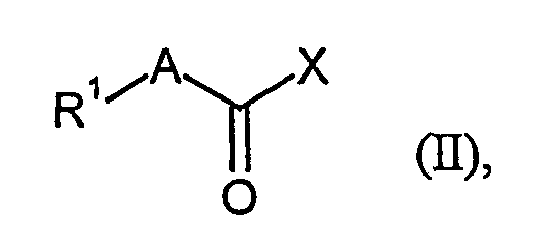
- R1 und A
- die oben angegebene Bedeutung haben, und
- X
- für Hydroxy oder eine geeignete Abgangsgruppe steht,
- Wenn X eine Abgangsgruppe ist, sind Chlor, Mesyloxy, Isobutyloxycarbonyloxy, Pentafluorphenoxy oder Polymer-gebundenes 4-Carboxy-2,3,5,6-tetrafluorphenoxy, insbesondere Chlor bevorzugt.
- Inerte Lösungsmittel sind beispielsweise Halogenkohlenwasserstoffe wie Methylenchlorid, Trichlormethan, Tetrachlormethan, Trichlorethan, Tetrachlorethan, 1,2-Dichlorethan oder Trichlorethylen, Ether wie Diethylether, Methyl-tert.-butylether, Dioxan, Tetrahydrofuran, Glykoldimethylether oder Diethylenglykoldimethylether, Kohlenwasserstoffe wie Benzol, Xylol, Toluol, Hexan, Cyclohexan oder Erdölfraktionen, oder andere Lösungsmittel wie Nitromethan, Ethylacetat, Aceton, Dimethylformamid, Dimethylacetamid, Dimethylsulfoxid, Acetonitril oder Pyridin. Bevorzugt ist Dimethylformamid, Tetrahydrofuran, Methylenchlorid oder Chloroform.
- Kondensationsmittel sind beispielsweise Carbodiimide wie z.B. N,N'-Diethyl-, N,N,'-Dipropyl-, N,N'-Diisopropyl-, N,N'-Dicyclohexylcarbodiimid, N-(3-Dimethylaminoisopropyl)-N'-ethylcarbodiimid-Hydrochlorid (EDC), N-Cyclohexylcarbodiimid-N'-propyloxymethyl-Polystyrol (PS-Carbodiimid) oder Carbonylverbindungen wie Carbonyldiimidazol, oder 1,2-Oxazoliumverbindungen wie 2-Ethyl-5-phenyl-1,2-oxazolium-3-sulfat oder 2-tert.-Butyl-5-methyl-isoxazolium-perchlorat, oder Acylaminoverbindungen wie 2-Ethoxy-1-ethoxycarbonyl-1,2-dihydrochinolin, oder Propanphosphonsäureanhydrid, oder Isobutylchloroformiat, oder Bis-(2-oxo-3-oxazolidinyl)-phosphorylchlorid oder Benzotriazolyloxy-tri(dimethylamino)phosphoniumhexafluorophosphat, oder O-(Benzotriazol-1-yl)-N,N,N',N'-tetramethyluroniumhexafluorophosphat (HBTU), 2-(2-Oxo-1-(2H)-pyridyl)-1,1,3,3-tetramethyluroniumtetrafluoroborat (TPTU) oder O-(7-Azabenzotriazol-1-yl)-N,N,N',N'-tetramethyluroniumhexafluorophosphat (HATU) oder Benzotriazol-1-yloxytris(dimethylamino)-phosphoniumhexafluorophosphat (BOP), oder Mischungen aus diesen.
- Gegebenenfalls kann es vorteilhaft sein, diese Kondensationsmittel in Gegenwart eines Hilfsnucleophils wie z.B. 1-Hydroxybenzotriazol (HOBt) zu verwenden.
- Besonders bevorzugt ist HATU oder die Kombination von N-(3-Dimethylaminoisopropyl)-N'-ethylcarbodiimid-Hydrochlorid (EDC) und 1-Hydroxybenzotriazol (HOBt) in Dimethylformamid.
- Basen sind beispielsweise Alkalicarbonate, wie z.B. Natrium- oder Kaliumcarbonat, oder -hydrogencarbonat, oder organische Basen wie Trialkylamine z.B. Triethylamin, N-Methylmorpholin, N-Methylpiperidin, 4- Dimethylaminopyridin oder Diisopropylethylamin.
- Vorzugsweise wird das erfindungsgemäße Verfahren in einem Temperaturbereich von Raumtemperatur bis +50°C bei Normaldruck durchgeführt.
- Die Verbindungen der allgemeinen Formeln (II) und (III) sind bekannt oder lassen sich nach bekannten Verfahren aus den entsprechenden Edukten synthetisieren (vgl. z.B. Kato et al. Chem. Pharm. Bull. 1995, 43, 1351-1357).
- So kann beispielsweise 1-Azabicyclo[2.2.2]oct-3-yl-essigsäure aus Chinuclidin-3-on durch Wittig-Horner-Reaktion und nachfolgende Hydrierung und Ester-Hydrolyse gemäß folgendem Syntheseschema erhalten werden:
-

- Die erfindungsgemäßen Verbindungen der allgemeinen Formel (I) eignen sich zur Verwendung als Arzneimittel zur Behandlung und/oder Prophylaxe von Krankheiten bei Menschen und/oder Tieren.
- Die erfindungsgemäßen Verbindungen zeigen ein nicht vorhersehbares, wertvolles pharmakologisches Wirkspektrum.
- Sie zeichnen sich als Liganden, insbesondere Agonisten am α7-nAChR aus.
- Die erfindungsgemäßen Verbindungen können aufgrund ihrer pharmakologischen Eigenschaften allein oder in Kombination mit anderen Arzneimitteln zur Behandlung und/oder Prävention von kognitiven Störungen, insbesondere der Alzheimerschen Krankheit eingesetzt werden. Wegen ihrer selektiven Wirkung als a7-nAChR-Agonisten eignen sich die erfindungsgemäßen Verbindungen besonders zur Verbesserung der Wahrnehmung, Konzentrationsleistung, Lernleistung oder Gedächtnisleistung insbesondere nach kognitiven Störungen, wie sie beispielsweise bei Situationen/Krankheiten/Syndromen auftreten wie "Mild cognitive impairment", Altersassoziierte Lern- und Gedächtnisstörungen, Altersassoziierte Gedächtnisverluste, Vaskuläre Demenz, Schädel-Hirn-Trauma, Schlaganfall, Demenz, die nach Schlaganfällen auftritt ("post stroke dementia"), post-traumatisches Schädel-Hirn-Trauma, allgemeine Konzentrationsstörungen, Konzentrationsstörungen in Kindern mit Lern- und Gedächtnisproblemen, Attention Deficit Hyperactivity Disorder, Alzheimersche Krankheit, Vaskuläre Demenz, Demenz mit Lewy-Körperchen, Demenz mit Degeneration der Frontallappen einschließlich des Pick's Syndroms, Parkinsonsche Krankheit, Progressive nuclear palsy, Demenz mit corticobasaler Degeneration, Amyotrophe Lateralsklerose (ALS), Huntingtonsche Krankheit, Multiple Sklerose, Thalamische Degeneration, Creutzfeld-Jacob-Demenz, HIV-Demenz, Schizophrenie, Schizophrenie mit Demenz oder Korsakoff-Psychose.
- Die erfindungsgemäßen Verbindungen können allein oder in Kombination mit anderen Arzneimitteln eingesetzt werden zur Prophylaxe und Behandlung von akuten und/oder chronischen Schmerzen (für eine Klassifizierung siehe "Classification of Chronic Pain, Descriptions of Chronic Pain Syndromes and Definitions of Pain Terms", 2. Aufl., Meskey und Begduk, Hrsg.; IASP-Press, Seattle, 1994), insbesondere zur Behandlung von Krebs-induzierten Schmerzen und chronischen neuropathischen Schmerzen, wie zum Beispiel, bei diabetischer Neuropathie, postherpetischer Neuralgie, peripheren Nervenbeschädigungen, zentralem Schmerz (beispielsweise als Folge von cerebraler Ischämie) und trigeminaler Neuralgie, und anderen chronischen Schmerzen, wie zum Beispiel Lumbago, Rückenschmerz (low back pain) oder rheumatischen Schmerzen. Daneben eignen sich diese Substanzen auch zur Therapie von primär akuten Schmerzen jeglicher Genese und von daraus resultierenden sekundären Schmerzzuständen, sowie zur Therapie chronifizierter, ehemals akuter Schmerzzustände.
- Die erfindungsgemäßen Verbindungen können allein oder in Kombination mit anderen Wirkstoffen zur Behandlung akuter oder chronischer neurodegenerativer Erkrankungen eingesetzt werden, wie zum Beispiel Schlaganfall, Schädel-Hirn-Trauma, Rückenmarksverletzungen, Parkinson'sche Krankheit, Huntington'sche Krankheit, Alzheimer'sche Krankheit, Multiple Sklerose, Amyotrophe Lateralsklerose (ALS) und Niemann Pick Krankheit.
- Die in vitro-Wirkung der erfindungsgemäßen Verbindungen kann in folgenden Assays gezeigt werden:
- Der [3H]-Methyllycaconitine Bindungstest ist eine Modifikation der von Davies et al. (Neuropharmacol. 1999, 38, 679-690) beschriebenen Methode.
- Rattenhirngewebe (Hippocampus oder Gesamthirn) wird in Homogenisierungspuffer (10% w/v) [0.32 M Sucrose, 1 mM EDTA, 0.1 mM Phenylmethylsulfonylfluorid (PMSF), 0.01% (w/v) NaN3, pH 7.4, 4°C] bei 600 rpm in einem Glashomogenisator homogenisiert. Das Homogenat wird zentrifugiert (1000 x g, 4°C, 10 min) und der Überstand wird abgenommen. Das Pellet wird erneut suspendiert (20% w/v) und zentrifugiert (1000 x g, 4°C, 10 min). Die beiden Überstände werden vereinigt und zentrifugiert (15.000 x g, 4°C, 30 min). Dieses Pellet wird als P2-Fraktion bezeichnet.
- Das P2-Pellet wird zweimal mit Bindungspuffer gewaschen (50 mM Tris-HCl, 1 mM MgCl2, 120 mM NaCl, 5 mM KCl, 2 mM CaCl2, pH 7.4) und zentrifugiert (15.000 x g, 4°C, 30 min).
- Die P2-Membranen werden in Bindungspuffer resuspendiert und in einem Volumen von 250 µl (Membranproteinmenge 0.1 - 0.5 mg) für 2.5 h bei 21°C inkubiert in der Gegenwart von 1-5 nM [3H]-Methyllycaconitine, 0.1% (w/v) BSA (bovines Serumalbumin) und verschiedenen Konzentrationen der Testsubstanz. Die unspezifische Bindung wird bestimmt durch Inkubation in der Gegenwart von 1 µM α-Bungarotoxin oder 100 µM Nicotin oder 10 µM MLA (Methyllycaconitine).
- Die Inkubation wird beendet durch Zugabe von 4 ml PBS (20 mM Na2HPO4, 5 mM KH2PO4, 150 mM NaCl, pH 7.4, 4°C) und Filtration durch Typ A/E glass fibre filters (Gelman Sciences), die vorher 3 h in 0.3% (v/v) Polyethyleneimine (PEI) eingelegt waren. Die Filter werden zweimal mit 4 ml PBS (4°C) gewaschen und die gebundene Radioaktivität durch Szintillationsmessung bestimmt. Alle Tests werden in Dreifachbestimmungen durchgeführt. Aus dem IC50-Wert der Verbindungen (Konzentration der Testsubstanz, bei der 50% des am Rezeptor gebundenen Liganden verdrängt werden), der Dissoziationskonstante KD und der Konzentration L von [3H]-Methyllycaconitine wird die Dissoziationskonstante der Testsubstanz Ki bestimmt (Ki = IC50 / (1+L/KD)).
- Anstelle von [3H]-Methyllycaconitine können auch andere α7-nAChR-selektive Radioliganden wie z.B. [125I]-α-Bungarotoxin oder unselektive nAChR-Radioliganden gemeinsam mit Inhibitoren anderer nAChR eingesetzt werden.
- Die in-vitro-Wirkdaten für die erfindungsgemäßen Verbindungen sind in Tabelle A wiedergegeben:
Tabelle A Beispiel Nr. K i -Wert [nM] 1 120 2 200 3 280 4 42 5 170 - Die Eignung der erfindungsgemäßen Verbindungen zur Behandlung von kognitiven Störungen kann in folgenden Tiermodellen gezeigt werden:
- Der Objekt-Wiedererkennungstest ist ein Gedächtnistest. Er misst die Fähigkeit von Ratten (und Mäusen), zwischen bekannten und unbekannten Objekten zu unterscheiden.
- Der Test wird wie beschrieben durchgeführt (Blokland et al. NeuroReport 1998, 9, 4205-4208; Ennaceur, A., Delacour, J.,. Behav. Brain Res. 1988, 31, 47-59; Ennaceur, A., Meliani, K.,. Psychopharmacology 1992, 109, 321-330; Prickaerts, et al. Eur. J. Pharmacol. 1997, 337, 125-136).
- In einem ersten Durchgang wird eine Ratte in einer ansonsten leeren größeren Beobachtungsarena mit zwei identischen Objekten konfrontiert. Die Ratte wird beide Objekte ausgiebig untersuchen, d.h. beschnüffeln und berühren. In einem zweiten Durchgang, nach einer Wartezeit von 24 Stunden, wird die Ratte erneut in die Beobachtrungsarena gesetzt. Nun ist eines der bekannten Objekte durch ein neues, unbekanntes Objekt ersetzt. Wenn eine Ratte das bekannte Objekt wiedererkennt, wird sie vor allem das unbekannte Objekt untersuchen. Nach 24 Stunden hat eine Ratte jedoch normalerweise vergessen, welches Objekt sie bereits im ersten Durchgang untersucht hat, und wird daher beide Objekte gleichstark inspektieren. Die Gabe einer Substanz mit lern-und gedächtnisverbessernder Wirkung wird dazu führen, dass eine Ratte das bereits 24 Stunden vorher, im ersten Durchgang, gesehene Objekt als bekannt wiedererkennt. Sie wird das neue, unbekannte Objekt ausführlicher untersuchen als das bereits bekannte. Diese Gedächtnisleistung wird in einem Diskriminationsindex ausgedrückt. Ein Diskiminationsindex von Null bedeutet, dass die Ratte beide Objekte, das alte und das neue, gleichlang untersucht; d.h. sie hat das alte Objekt nicht wiedererkannt und reagiert auf beide Objekte als wären sie unbekannt und neu. Ein Diskriminationsindex größer Null bedeutet, dass die Ratte das neue Objekt länger inspektiert als das alte; d.h. die Ratte hat das alte Objekt wiedererkannt.
- Der Soziale Wiedererkennungstest ist ein Test zur Prüfung der lern- oder gedächtnisverbessernden Wirkung von Testsubstanzen.
- Erwachsene Ratten, die in Gruppen gehalten werden, werden 30 Minuten vor Testbeginn einzeln in Testkäfige gesetzt. Vier Minuten vor Testbeginn wird das Testtier in eine Beobachtungsbox gebracht. Nach dieser Adaptationszeit wird ein juveniles Tier zu dem Testtier gesetzt und 2 Minuten lang die totale Zeit gemessen, die das adulte Tier das Junge investigiert (Trial 1). Gemessen werden alle deutlich auf das Jungtier gerichteten Verhaltensweisen, d.h. ano-genitale Inspektion, Verfolgen sowie Fellpflege, bei denen das Alttier einen Abstand von höchstens 1 cm zu dem Jungtier hat. Danach wird das Juvenile herausgenommen und das Adulte in seinem Testkäfig belassen (bei 24 Stunden Retention wird das Tier in seinen Heimkäfig zurückgesetzt). Vor oder nach dem ersten Test wird das Versuchstier mit Substanz behandelt. Je nach Zeitpunkt der Substanzgabe wird das Erlernen oder das Speichern der Information über das Jungtier durch die Substanz beeinflusst. Nach einem festgelegten Zeitraum (Retention) wird der Test wiederholt (Trial 2). Je größer die Differenz zwischen den in Trial 1 und 2 ermittelten Investigationszeiten, desto besser hat sich das adulte Tier an das Jungtier erinnert
- Die erfindungsgemäßen Verbindungen der allgemeinen Formel (I) eignen sich zur Verwendung als Arzneimittel für Menschen und Tiere.
- Zur vorliegenden Erfindung gehören auch pharmazeutische Zubereitungen, die neben inerten, nicht-toxischen, pharmazeutisch geeigneten Hilfs- und Trägerstoffen eine oder mehrere Verbindungen der allgemeinen Formel (I) enthalten, oder die aus einem oder mehreren Verbindungen der Formel (I) bestehen, sowie Verfahren zur Herstellung dieser Zubereitungen.
- Die Verbindungen der Formel (I) sollen in diesen Zubereitungen in einer Konzentration von 0,1 bis 99,5 Gew.-%, bevorzugt von 0,5 bis 95 Gew.-% der Gesamtmischung vorhanden sein.
- Neben den Verbindungen der Formel (I) können die pharmazeutischen Zubereitungen auch andere pharmazeutische Wirkstoffe enthalten.
- Die oben aufgeführten pharmazeutischen Zubereitungen können in üblicher Weise nach bekannten Methoden hergestellt werden, beispielsweise mit dein oder den Hilfs- oder Trägerstoffen.
- Die neuen Wirkstoffe können in bekannter Weise in die üblichen Formulierungen überführt werden, wie Tabletten, Dragees, Pillen, Granulate, Aerosole, Sirupe, Emulsionen, Suspensionen und Lösungen, unter Verwendung inerter, nicht toxischer, pharmazeutisch geeigneter Trägerstoffe oder Lösungsmittel. Hierbei soll die therapeutisch wirksame Verbindung jeweils in einer Konzentration von etwa 0,5 bis 90 Gew.-% der Gesamtmischung vorhanden sein, d.h. in Mengen, die ausreichend sind, um den angegebenen Dosierungsspielraum zu erreichen.
- Die Formulierungen werden beispielsweise hergestellt durch Verstrecken der Wirkstoffe mit Lösungsmitteln und/oder Trägerstoffen, gegebenenfalls unter Verwendung von Emulgiermitteln und/oder Dispergiermitteln, wobei z.B. im Fall der Benutzung von Wasser als Verdünnungsmittel gegebenenfalls organische Lösungsmittel als Hilfslösungsmittel verwendet werden können.
- Die Applikation erfolgt in üblicher Weise, vorzugsweise oral, transdermal oder parenteral, insbesondere perlingual oder intravenös. Sie kann aber auch durch Inhalation über Mund oder Nase, beispielsweise mit Hilfe eines Sprays erfolgen, oder topisch über die Haut.
- Im Allgemeinen hat es sich als vorteilhaft erwiesen, Mengen von etwa 0,001 bis 10 mg/kg, bei oraler Anwendung vorzugsweise etwa 0,005 bis 3 mg/kg Körpergewicht zur Erzielung wirksamer Ergebnisse zu verabreichen.
- Trotzdem kann es gegebenenfalls erforderlich sein, von den genannten Mengen abzuweichen, und zwar in Abhängigkeit vom Körpergewicht bzw. der Art des Applikationsweges, vom individuellen Verhalten gegenüber dem Medikament, der Art von dessen Formulierung und dem Zeitpunkt bzw. Intervall, zu welchen die Verabreichung erfolgt. So kann es in einigen Fällen ausreichend sein, mit weniger als der vorgenannten Mindestmenge auszukommen, während in anderen Fällen die genannte obere Grenze überschritten werden muss. Im Falle der Applikation größerer Mengen kann es empfehlenswert sein, diese in mehreren Einzelgaben über den Tag zu verteilen.
-
- DCI
- direkte chemische Ionisation (bei MS)
- DCM
- Dichlormethan
- DMAP
- 4-N,N-Dimethylaminopyridin
- DMF
- N,N-Dimethylformamid
- DMSO
- Dimethylsulfoxid
- d.Th.
- der Theorie (bei Ausbeute)
- EDC
- N'-(3-Dimethylaminopropyl)-N-ethylcarbodiimid x HCl
- ESI
- Elektrospray-Ionisation (bei MS)
- HATU
- O-(7-Azabenzotriazol-1-yl)-N,N,N',N'-tetramethyluronium-Hexafluorophosphat
- HOBt
- 1-Hydroxy-1H-benzotriazol x H2O
- HPLC
- Hochdruck-, Hochleistungsflüssigchromatographie
- LC-MS
- Flüssigchromatographie-gekoppelte Massenspektroskopie
- MS
- Massenspektroskopie
- NMR
- Kernresonanzspektroskopie
- PS
- Polystyrol (-Harz)
- RT
- Raumtemperatur
- Rt
- Retentionszeit (bei HPLC)
- THF
- Tetrahydrofuran
- Instrument: HP 1100 mit DAD-Detektion; Säule: Kromasil RP-18, 60 mm x 2 mm, 3.5 µm; Eluent A: 5 ml HClO4/L H2O, Eluent B: Acetonitril; Gradient: 0 min 2% B, 0.5 min 2% B, 4.5 min 90% B, 6.5 min 90% B; Fluss: 0.75 mL/min; Temperatur: 30°C; Detektion: UV 210 nm.
- Säule: Kromasil 100 C-18, 125 mm x 3 mm, 5 µm; Eluent A: 0.2% HClO4, Eluent B: Acetonitril; Gradient: 0 min 5% B, 5 min 95% B; Fluss: 1.25 mL/min; Temperatur: 40°C; Detektion: UV 210 nm.
-
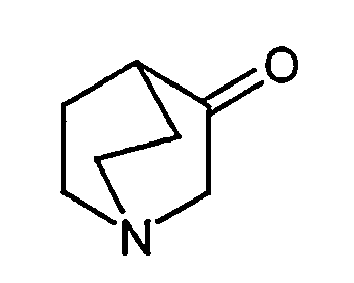
- 100 g (0.62 mol) Chinuclidin-3-on-Hydrochlorid werden in 2 L Methanol suspendiert. Bei 0°C wird eine Lösung von 33.4 g (0.62 mol) Natriummethylat in 250 mL Methanol langsam zugetropft. Es wird 16 h bei Raumtemperatur nachgerührt. Der entstandene Niederschlag wird abgesaugt, das Filtrat wird im Vakuum eingeengt. Der Rückstand wird zwischen Chloroform und Wasser verteilt und mit Chloroform extrahiert. Die vereinigten organischen Phasen werden über Natriumsulfat getrocknet und im Vakuum eingeengt. Man erhält 58.8 g (75.9% d.Th.) der Titelverbindung.
MS (DCI): m/z = 126 (M+H)+, 143 (M+NH4)+
1H-NMR (300 MHz, CDCl3): δ = 3.30 (m, 2H), 3.19-2.86 (m, 4H), 2.46 (m, 1H), 1.99 (m, 4H). -

- 25.3 g (0.63 mol) Natriumhydrid (als 60%-ige Suspension in Mineralöl) werden in 480 mL Dimethylformamid suspendiert. Nach dem Hinzutropfen einer Lösung von 104.8 g (0.58 mol) Phosphonoessigsäuretrimethylester in 480 mL Dimethylformamid wird bis zur Beendigung der Wasserstoffentwicklung bei Raumtemperatur nachgerührt. Eine Lösung von 36 g (0.29 mol) Chinuclidin-3-on in 480 mL Dimethylformamid wird über einen Zeitraum von 40 Minuten hinzugetropft und anschließend für 16 h bei Raumtemperatur nachgerührt. Das Reaktionsgemisch wird im Vakuum eingeengt, der Rückstand zwischen Wasser und Essigsäureethylester verteilt und mit Essigsäureethylester extrahiert. Die vereinigten organischen Phasen werden über Natriumsulfat getrocknet und im Vakuum eingeengt. Der Rückstand wird an Kieselgel säulenchromatographisch gereinigt (Laufmittel: Dichlormethan / Methanol Ammoniak = 95:5:0.5). Das erneut eingeengte Material wird in wenig Dichlormethan gelöst und mit etherischer HCl versetzt. Der entstehende Niederschlag wird abgesaugt und mit Diethylether nachgewaschen. Nach der Trocknung bei 35°C werden 19.53 g (31.2% d.Th.) der Titelverbindung in Form weißer Kristalle erhalten. HPLC (Kromasil RP-18, 60 x 2.1 mm; Eluent A: H2O + 5 mL HClO4/L, Eluent B: Acetonitril; Gradient: 0 - 4.5 min 98% A → 90% B, 4.5 - 6.5 min 90% B; Fluss: 0.75 mL/min; Temp.: 30°C; UV-Detektion bei 210 nm): Rt = 2.40 min.
MS (DCI): m/z = 182 (M+H)+, 199 (M+NH4)+, 363 (2M+H)+
1H-NMR (500 MHz, DMSO-d6): δ = 11.56 (breites s, 1H), 5.97 (m, 1H), 4.32 (m, 2H), 3.66 (s, 3H), 3.27 (m, 4H), 2.84 (m, 1H), 2.13-1.92 (m, 2H), 1.91-1.69 (m, 2H); 13C-NMR (125 MHz, DMSO-d6): δ = 165.72, 155.95, 113.08, 53.55, 51.28, 45.29, 30.14, 22.41. -

- 13.5 g (62 mmol) Methyl (2Z)-1-azabicyclo[2.2.2]oct-3-yliden-ethanoat werden in 200 mL Methanol gelöst und unter Argon mit 1 g Palladium auf Aktivkohle (10%-ig) versetzt. Bei Raumtemperatur wird das Reaktionsgemisch für 16 h unter Wasserstoffatmosphäre (Normaldruck) gerührt. Es wird über Kieselgur filtriert und mit Methanol nachgewaschen. Das Filtrat wird mit 50 mL 1 N Salzsäure versetzt, im Vakuum eingeengt und im Hochvakuum getrocknet. Der Rückstand wird in 100 mL 32%-iger Salzsäure für 5 h am Rückfluss erhitzt. Es wird im Vakuum eingeengt, zweimal mit Toluol codestilliert und im Hochvakuum getrocknet. Man erhält 11.8 g des Produkts in einer Reinheit von 89% (77% d.Th.).
HPLC (Kromasil RP-18, 60 x 2.1 mm; Eluent A: H2O + 5 mL HClO4/L, Eluent B: Acetonitril; Gradient: 0 - 4.5 min 98% A → 90% B, 4.5 - 6.5 min 90% B; Fluss: 0.75 mL/min; Temp.: 30°C; UV-Detektion bei 210 nm): Rt= 0.80 min.
MS (DCI): m/z = 170 (M+H)+, 339 (2M+H)+
1H-NMR (200 MHz, DMSO-d6): δ = 12.32 (breites s, 1H), 10.61 (s, 1H), 3.38 (m, 1H), 3.14 (m, 4H), 2.76 (dd, 1H), 2.67-2.22 (m, 4H), 2.01-1.55 (m, 4H). -

- Zu einer Suspension von 1.93 g (48.3 mmol) Natriumhydrid (als 60%-ige Suspension in Mineralöl) in 65 mL DMSO werden bei Raumtemperatur langsam 3.76 g (35.5 mmol) Mercaptoessigsäuremethylester hinzugetropft. Nach Beendigung der Wasserstoffentwicklung gibt man eine Lösung von 6.54 g (32.2 mmol) 4-Brom-2-fluorbenzaldehyd in 10 mL DMSO hinzu. Nach 10 min. rührt man das Reaktionsgemisch in 200 mL Eiswasser ein und isoliert den entstehenden Niederschlag. Der Feststoff wird zweimal mit Wasser gewaschen und bei 50°C im Vakuum getrocknet. Man erhält 4.06 g (46.4% d.Th) der Titelverbindung.
1H-NMR (200 MHz, DMSO-d6): δ = 8.42 (d, 1H), 8.22 (s, 1H), 7.98 (d, 1H), 7.65 (dd, 1H), 3.90 (s, 3H).
HPLC (Methode 1): Rt = 5.3 min.
MS (ESIpos): m/z = 270 (M+). -

- Eine Lösung von 4.0 g (14.8 mmol) 6-Brom-1-benzothiophen-2-carbonsäuremethylester in 40 mL einer 1:1-Mischung aus THF und 2 N Kalilauge wird 2 h bei Raumtemperatur gerührt. Das Lösungsmittel wird im Vakuum entfernt, und der Rückstand wird mit konzentrierter Salzsäure angesäuert. Der entstehende Niederschlag wird abgesaugt, mit Wasser nachgewaschen und bei 50°C im Vakuum getrocknet. Es werden 3.55 g (93.5% d.Th.) des gewünschten Produkts erhalten.
1H-NMR (400 MHz, DMSO-d6): δ = 13.48 (breites s, 1H), 8.38 (s, 1H), 8.22 (s, 1H), 7.96 (d, 1H), 7.63 (m, 1H).
HPLC (Methode 1): Rt = 4.5 min. -
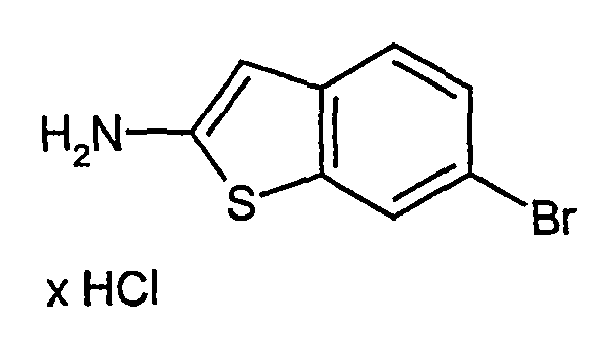
- Zu einer Lösung von 1 g (3.89 mmol) 6-Brom-1-benzothiophen-2-carbonsäure und 1.35 mL (7.78 mmol) N,N-Diisopropylethylamin in 10 mL DMF werden bei 0°C 0.92 mL (4.28 mmol) Diphenylphosphorazidat hinzugefügt. Nach 2 h bei 0°C wird das Reaktionsgemisch auf Eiswasser gegeben und mit Essigsäure neutralisiert. Der entstehende Niederschlag wird abgesaugt und mit Wasser nachgewaschen. Der noch feuchte Feststoff wird in 5 mL Xylol suspendiert, in 1 mL siedendes tert.-Butanol getropft und 3 h am Rückfluss erhitzt. Nach dem Abkühlen wird das Lösungsmittel im Vakuum entfernt. Der Rückstand wird in 4 M HCl in Dioxan gelöst und 1 h bei Raumtemperatur gerührt. Der entstehende Niederschlag wird abgesaugt und im Vakuum getrocknet. Man erhält 294 mg (28.1% d.Th.) der Titelverbindung.
HPLC (Methode 1): Rt = 5.5 min.
MS (ESIpos): m/z = 228 (M+H)+ (freie Base). -

- Zu einer Lösung aus 100 mg (0.49 mmol) 1-Azabicyclo[2.2.2]oct-3-yl-essigsäure-Hydrochlorid in 4 mL Dichlormethan werden bei 0°C 358 mg (1.94 mmol) Pentafluorphenol, 120.5 mg (0.63 mmol) EDC sowie ein Tropfen N,N-Diisopropylethylamin hinzugefügt. Bei Raumtemperatur wird für 18 h gerührt. Der Kolbeninhalt wird im Vakuum eingeengt und im Hochvakuum getrocknet. Das erhaltene Rohprodukt wird ohne weitere Reinigung in den Folgestufen eingesetzt.
-

- 51.2 g Polystyrol-Aminomethyl-Harz (Beladung 1.36 mmol/g, 69.6 mmol; Fa. Argonaut Technologies, USA) werden in 700 mL DMF suspendiert. Es werden 41.6 g (107.8 mmol) HOBt und 24.1 g (114.8 mmol) 4-Hydroxy-2,3,5,6-tetrafluorbenzoesäure zugegeben. Das Reaktionsgemisch wird unter gelindem Rühren nach 15 min mit 16.9 mL (107.8 mmol) N,N'-Diisopropylcarbodiimid versetzt, und anschließend wird über Nacht gerührt. Es wird filtriert, und das zurückbleibende Harz wird mit DMF nachgewaschen. Das erhaltene Harz wird in 450 mL DMF resuspendiert, mit 8.26 mL (83.5 mmol) Piperidin versetzt und geschüttelt. Nach 2 h wird erneut filriert und das verbleibende Harz in eine Lösung von 120 mL 1 M Salzsäure in 500 mL DMF gegeben und weitere 2 h geschüttelt. Nach erneuter Filtration wird mit jeweils 500 mL DMF, THF und DCM nachgewaschen. Nach Trocknen bei 50°C im Vakuum werden 77.2 g der Polymer-gebundenen Titelverbindung erhalten.
-

- 2 g des polymeren Trägerharzes aus Beispiel 8A (Beladung ca. 1.36 mmol/g, 2.72 mmol) werden in 20 mL DMF suspendiert und mit 1.23 g (5.98 mmol) 1-Azabicyclo[2.2.2]oct-3-yl-essigsäure-Hydrochlorid und 130 mg (1.09 mmol) DMAP 10 min lang geschüttelt. Anschließend werden 1.06 mL (6.80 mmol) N,N'-Diisopropylcarbodiimid zugegeben und über Nacht geschüttelt. Das Harz wird abgesaugt, jeweils zweimal mit je 20 mL DMF, THF und DCM nachgewaschen und im Hochvakuum getrocknet. Es werden 2.318 g der Polymer-gebundenen Titelverbindung erhalten.
-

- 162.3 mg (0.79 mmol) der racemischen 1-Azabicyclo[2.2.2]oct-3-yl-essigsäure werden zusammen mit 120 mg (0.53 mmol) 3-Brom-1-benzothiophen-2-amin und 300.0 mg (0.79 mmol) HATU bei 0°C in DMF vorgelegt. Nach Zugabe von 102.0 mg (0.79 mmol) N,N-Diisopropylethylamin wird 30 min. gerührt. Es werden weitere 204.0 mg (1.58 mmol) N,N-Diisopropylethylamin zugegeben und bei RT über Nacht nachgerührt. Die Reinigung erfolgt durch präparative HPLC. Das Produkt wird in wenig Acetonitril gelöst und mit einem Überschuß an 1 N etherischer HCl versetzt. Das Solvens wird im Vakuum abgezogen. Es werden 12 mg (5% d.Th.) der Titelverbindung erhalten.
HPLC (Kromasil RP-18, 60 x 2.1 mm; Eluent A: H2O + 5 mL HClO4/L, Eluent B: Acetonitril; Gradient: 0 - 4.5 min 98% A → 90% B, 4.5 - 6.5 min 90% B; Fluss: 0.75 mL/min; Temp:: 30°C; UV-Detektion bei 210 nm): Rt = 4.20 min.
MS (ESIpos): m/z = 379 (M+H)+ (freie Base). -

- 89.2 mg (0.24 mmol) (1-Azabicyclo[2.2.2]oct-3-yl)-essigsäure-pentafluorphenyl-, ester-Hydrochlorid werden in 1 mL DMF gelöst, mit 71.2 mg (0.31 mmol) 6-Brom-1-benzothiophen-2-amin versetzt und über Nacht bei Raumtemperatur gerührt. Es wird 1 g MP-Carbonat (Polymer-gebundenes Carbonat, Kapazität: 2.5 - 3.5 mmol/g; Fa. Argonaut Technologies, USA) zugegeben. Nach 3 h wird das Polystyrol-Harz abfiltriert und mit THF nachgewaschen. Die vereinigten Filtrate werden im Vakuum eingeengt und das Rohprodukt über präparative HPLC gereinigt. Zur Hydrochlorid-Herstellung wird das Produkt mit einer Mischung aus 1 M Salzsäure und Acetonitril versetzt und erneut eingeengt. Nach Trocknen im Hochvakuum erhält man 14 mg (14% d.Th.) der Titelverbindung.
HPLC (Methode 1): Rt = 4.2 min.
MS (ESIpos): m/z = 379 (M+H)+ (freie Base). -

- 90.3 mg (0.24 mmol) (1-Azabicyclo[2.2.2]oct-3-yl)-essigsäure-pentafluorphenylester-Hydrochlorid werden in 1 mL DMF gelöst, mit 52.6 mg (0.36 mmol) 6-Aminochinolin versetzt und über Nacht bei Raumtemperatur gerührt. Es wird 1 g MP-Carbonat (Polymer-gebundenes Carbonat, Kapazität: 2.5 - 3.5 mmol/g; Fa. Argonaut Technologies, USA) zugegeben. Nach 1 h wird das Polystyrol-Harz abfiltriert und mit THF nachgewaschen. Die vereinigten Filtrate werden im Vakuum eingeengt und das Rohprodukt über präparative HPLC gereinigt. Zur Hydrochlorid-Herstellung wird das Produkt mit einer Mischung aus 1 M Salzsäure und Acetonitril versetzt und erneut eingeengt. Nach Trocknen im Hochvakuum erhält man 44 mg (50.2% d.Th.) der Titelverbindung.
HPLC (Methode 2): Rt = 2.8 min.
MS (DCI): m/z = 296 (M+H)+ (freie Base). -

- 500 mg des polymeren Trägerharzes aus Beispiel 9A (Beladung ca. 1.36 mmol/g, 0.68 mmol) werden in 5 mL DMF suspendiert, mit 77.9 mg (0.54 mmol) 2-Aminonaphthylamin versetzt und 2 Tage bei Raumtemperatur geschüttelt. Das Harz wird abgesaugt und jeweils zweimal mit THF und DMF nachgewaschen. Die vereinigten Filtrate werden im Vakuum eingeengt. Der Rückstand wird in Methanol aufgenommen, mit etwas Palladium auf Aktivkohle (10%-ig) versetzt und über Nacht bei Normaldruck hydriert. Der Katalysator wird über Kieselgur abfiltriert und mit Methanol nachgewaschen. Der nach dem Einengen erhaltene Rückstand der vereinigten Methanol-Filtrate wird mittels präparativer HPLC gereinigt. Die vereinigten Produkt-Fraktionen werden mit 1 M Salzsäure versetzt und eingeengt. Nach Trocknen im Hochvakuum erhält man 13 mg (4.75% d.Th.) der Titelverbindung.
HPLC (Methode 1): Rt = 3.9 min.
MS (ESIpos): m/z = 295 (M+H)+ (freie Base). -

- 200 mg (0.97 mmol) 1-Azabicyclo[2.2.2]oct-3-yl-essigsäure-Hydrochlorid werden 2 h lang in 2 mL (27.42 mmol) Thionylchlorid unter Rückfluss erhitzt. Anschließend wird das Gemisch im Vakuum vom überschüssigen Thionylchlorid befreit und der Rückstand in 4 mL DMF aufgenommen. Zu dieser Lösung werden 0.54 mL (3.89 mmol) Triethylamin, 59.4 mg (0.4 mmol) DMAP und 183.0 mg (0.97 mmol) 8-Nitro-2-naphthylamin gegeben. Nach Reaktion über Nacht und Reinigung mittels präparativer HPLC werden die erhaltenen Produkt-Fraktionen mit 1 M Salzsäure versetzt und im Vakuum eingeengt. Nach Umkristallisation des Rückstandes aus Isopropanol und Trocknen im Hochvakuum erhält man 59 mg (15.9% d.Th.) der Titelverbindung.
HPLC (Methode 1): Rt = 3.9 min.
MS (ESIpos): m/z = 340 (M+H)+ (freie Base).
R2R3NH (III),
in welcher R2 und R3 die oben angegebene Bedeutung haben,
gegebenenfalls in einem inerten Lösungsmittel gegebenenfalls in Gegenwart eines Kondensationsmittels und gegebenenfalls in Gegenwart einer Base umsetzt,
und die resultierenden Verbindungen (I) gegebenenfalls mit den entsprechenden (i) Lösungsmitteln und/oder (ii) Basen oder Säuren zu ihren Solvaten, Salzen oder Solvaten der Salze umsetzt.
Claims (10)
- Verbindungen der allgemeinen Formel (I)
 R1 für einen 1-Aza-bicyclo[2.2.2]octyl-Rest steht,
welcher gegebenenfalls durch (C1-C6)-Alkyl substituiert ist,A für Methylen oder Ethylen steht,R2 für Benzotriazolyl, Benzothiophenyl, Chinolinyl, Benzopyrazinyl, Naphthyl oder Azulenyl steht, wobei die Ringe gegebenenfalls durch Reste ausgewählt aus der Gruppe Halogen, Formyl, -CO-NR4R5, -CO-OR6, -NR7R8, -NR9-CO-R10, Cyano, Trifluormethyl, Trifluormethoxy, Nitro, gegebenenfalls durch Hydroxyl, Amino, -NH-CO-R11 oder Cyano substituiertes (C1-C6)-Alkyl, (C1-C6)-Alkoxy und (C1-C6)-Alkylthio substituiert sind, worin R4, R5, R6, R7, R8, R9, R10 und R11 unabhängig voneinander: Wasserstoff, (C1-C6)-Alkyl, Phenyl oder Benzyl bedeuten,
undR3 für Wasserstoff oder (C1-C6)-Alkyl steht,und deren Salze, Solvate und Solvate der Salze. - Verbindungen nach Anspruch 1, wobeiR1 für 1-Aza-bicyclo[2.2.2]oct-3-yl steht,und R2 und R3 die in Anspruch 1 angegebene Bedeutung haben,
und deren Salze, Solvate und Solvate der Salze. - Verbindungen nach Anspruch 1 oder 2, wobeiR1 für 1-Aza-bicyclo[2.2.2]oct-3-yl steht,A für Methylen steht,R2 für Benzotriazolyl, Benzothiophenyl, Chinolinyl, Benzopyrazinyl oder Naphthyl steht, wobei die Ringe gegebenenfalls durch 1 bis 3 Reste ausgewählt aus der Gruppe Wasserstoff, Halogen, Cyano, Trifluormethyl, Trifluormethoxy, Nitro, (C1-C4)-Alkyl, (C1-C4)-Alkoxy, (C1-C4)-Alkylthio substituiert sind,
undR3 für Wasserstoff steht,und deren Salze, Solvate und Solvate der Salze. - Verbindungen nach Ansprüchen 1, 2 oder 3, wobeiR1 für 1-Aza-bicyclo[2.2.2]oct-3-yl steht,A für Methylen steht,R2 für Benzothiophenyl, Chinolinyl oder Naphthyl steht, wobei die Ringe gegebenenfalls durch 1 bis 2 Reste ausgewählt aus der Gruppe Wasserstoff, Fluor, Chlor, Brom, Nitro substituiert sind,
undR3 für Wasserstoff steht,und deren Salze, Solvate und Solvate der Salze. - Verfahren zur Herstellung von Verbindungen der allgemeinen Formel (I) nach Anspruch 1, dadurch gekennzeichnet, dass man Verbindungen der allgemeinen Formel (II),
 R1 und A die in Anspruch 1 angegebene Bedeutung haben, undX für Hydroxy oder eine geeignete Abgangsgruppe steht,mit einer Verbindung der allgemeinen Formel (III)
R2R3NH (III),
in welcher R2 und R3 die in Anspruch 1 angegebene Bedeutung haben,
umsetzt und die resultierenden Verbindungen (I) gegebenenfalls mit den entsprechenden (i) Lösungsmitteln und/oder (ii) Basen oder Säuren zu ihren Solvaten, Salzen oder Solvaten der Salze umsetzt. - Verbindungen nach einem der Ansprüche 1 bis 4 zur Behandlung und/oder Prophylaxe von Krankheiten.
- Arzneimittel enthaltend mindestens eine der Verbindungen nach einem der Ansprüche 1 bis 4 in Zusammenmischung mit mindestens einem pharmazeutisch verträglichen, im wesentlichen nichtgiftigen Träger oder Exzipienten.
- Verwendung, von Verbindungen nach einem der Ansprüche 1 bis 4 zur Herstellung eines Arzneimittels zur Verbesserung der Wahrnehmung, Konzentrationsleistung, Lernleistung und/oder Gedächtnisleistung.
- Verwendung von Verbindungen nach einem der Ansprüche 1 bis 4 zur Herstellung eines Arzneimittels zur Behandlung und/oder Prophylaxe von Störungen der Wahrnehmung, Konzentrationsleistung, Lernleistung und/oder Gedächtnisleistung.
- Arzneimittel nach Anspruch 7 zur Behandlung und/oder Prophylaxe von Störungen der Wahrnehmung, Konzentrationsleistung, Lernleistung und/oder Gedächtnisleistung.
Applications Claiming Priority (3)
| Application Number | Priority Date | Filing Date | Title |
|---|---|---|---|
| DE10211416A DE10211416A1 (de) | 2002-03-15 | 2002-03-15 | Essig- und Propionsäureamide |
| DE10211416 | 2002-03-15 | ||
| PCT/EP2003/002152 WO2003078430A1 (de) | 2002-03-15 | 2003-03-03 | Essig- und propionsäureamide |
Publications (2)
| Publication Number | Publication Date |
|---|---|
| EP1487835A1 EP1487835A1 (de) | 2004-12-22 |
| EP1487835B1 true EP1487835B1 (de) | 2006-09-20 |
Family
ID=27771327
Family Applications (1)
| Application Number | Title | Priority Date | Filing Date |
|---|---|---|---|
| EP03744337A Expired - Lifetime EP1487835B1 (de) | 2002-03-15 | 2003-03-03 | Essig- und propionsäureamide |
Country Status (8)
| Country | Link |
|---|---|
| US (6) | US7553851B2 (de) |
| EP (1) | EP1487835B1 (de) |
| JP (1) | JP4497927B2 (de) |
| AU (1) | AU2003210402A1 (de) |
| CA (1) | CA2479097C (de) |
| DE (2) | DE10211416A1 (de) |
| ES (1) | ES2273017T3 (de) |
| WO (1) | WO2003078430A1 (de) |
Families Citing this family (18)
| Publication number | Priority date | Publication date | Assignee | Title |
|---|---|---|---|---|
| DE10164139A1 (de) | 2001-12-27 | 2003-07-10 | Bayer Ag | 2-Heteroarylcarbonsäureamide |
| DE10211416A1 (de) * | 2002-03-15 | 2003-09-25 | Bayer Ag | Essig- und Propionsäureamide |
| GB0220581D0 (en) | 2002-09-04 | 2002-10-09 | Novartis Ag | Organic Compound |
| PE20060437A1 (es) | 2004-06-18 | 2006-06-08 | Novartis Ag | COMPUESTOS AZA-BICICLONONANOS COMO LIGANDOS COLINERGICOS DE nAChR |
| GB0415746D0 (en) | 2004-07-14 | 2004-08-18 | Novartis Ag | Organic compounds |
| GB0521508D0 (en) * | 2005-10-21 | 2005-11-30 | Novartis Ag | Organic compounds |
| GB0525672D0 (en) | 2005-12-16 | 2006-01-25 | Novartis Ag | Organic compounds |
| GB0525673D0 (en) | 2005-12-16 | 2006-01-25 | Novartis Ag | Organic compounds |
| CN105687190A (zh) | 2008-11-19 | 2016-06-22 | 福拉姆医药股份有限公司 | 用(R)-7-氯-N-(奎宁环-3-基)苯并[b]噻吩-2-甲酰胺及其可药用盐治疗认知障碍 |
| PE20120324A1 (es) * | 2009-05-11 | 2012-04-17 | Envivo Pharmaceuticals Inc | Combinacion que comprende (r)-7-cloro-n-(quinuclidin-3-il)benzo[b]tiofeno-2-carboxamida y donezepilo como moduladora de trastornos cognitivos |
| JO3250B1 (ar) | 2009-09-22 | 2018-09-16 | Novartis Ag | إستعمال منشطات مستقبل نيكوتينيك أسيتيل كولين ألفا 7 |
| KR20180101641A (ko) | 2010-05-17 | 2018-09-12 | 포럼 파마슈티칼즈 인크. | (R)-7-클로로-N-(퀴누클리딘-3-일)벤조[b]티오펜-2-카르복사미드 히드로클로리드 모노히드레이트의 결정질 형태 |
| MX2013008704A (es) | 2011-01-27 | 2013-08-21 | Novartis Ag | Uso de activadores del receptor de acetil-colina nicotinico alfa-7. |
| MX2013010698A (es) | 2011-03-18 | 2014-02-17 | Novartis Ag | Combinaciones de activadores del receptor de acetil-colina nicotinico alfa-7 y antagonistas del receptor de glutamato metabotropico 5 (mglur5) para usarse en la discinesia inducida por dopamina en la enfermedad de parkinson. |
| CA2852268C (en) | 2011-10-20 | 2020-08-25 | Novartis Ag | Biomarkers predictive of responsiveness to alpha 7 nicotinic acetylcholine receptor activator treatment |
| EP3461481A1 (de) | 2012-05-08 | 2019-04-03 | Forum Pharmaceuticals Inc. | Verfahren zur aufrechterhaltung, behandlung oder verbesserung der kognitiven funktion |
| CA2894384C (en) | 2012-12-11 | 2018-03-06 | Novartis Ag | Biomarker predictive of responsiveness to alpha 7 nicotinic acetylcholine receptor activator treatment |
| KR20230097093A (ko) * | 2020-10-29 | 2023-06-30 | 머크 샤프 앤드 돔 엘엘씨 | Lrrk2 억제제로서의 n-연결된 이소퀴놀린 아미드, 제약 조성물 및 그의 용도 |
Family Cites Families (8)
| Publication number | Priority date | Publication date | Assignee | Title |
|---|---|---|---|---|
| SE331841B (de) | 1967-05-23 | 1971-01-18 | Astra Ab | |
| IL51296A (en) | 1977-01-19 | 1983-10-31 | Purdue Frederick Co | Antiarrhythmic composition comprising a quinuclidine-3-carboxylic acid anilide and novel method for the preparation of such anilides |
| US5716965A (en) * | 1991-05-22 | 1998-02-10 | Pfizer Inc. | Substituted 3-aminoquinuclidines |
| SE9600683D0 (sv) * | 1996-02-23 | 1996-02-23 | Astra Ab | Azabicyclic esters of carbamic acids useful in therapy |
| AU5912900A (en) * | 1999-07-06 | 2001-01-22 | Vertex Pharmaceuticals Incorporated | Quinuclidine derivatives for treatment of neurological disorders |
| SE0000540D0 (sv) * | 2000-02-18 | 2000-02-18 | Astrazeneca Ab | New compounds |
| WO2002016355A2 (en) * | 2000-08-21 | 2002-02-28 | Pharmacia & Upjohn Company | Quinuclidine-substituted heteroaryl moieties for treatment of disease (nicotinic) acetylcholine receptor ligands |
| DE10211416A1 (de) * | 2002-03-15 | 2003-09-25 | Bayer Ag | Essig- und Propionsäureamide |
-
2002
- 2002-03-15 DE DE10211416A patent/DE10211416A1/de not_active Withdrawn
-
2003
- 2003-03-03 WO PCT/EP2003/002152 patent/WO2003078430A1/de not_active Ceased
- 2003-03-03 AU AU2003210402A patent/AU2003210402A1/en not_active Abandoned
- 2003-03-03 EP EP03744337A patent/EP1487835B1/de not_active Expired - Lifetime
- 2003-03-03 ES ES03744337T patent/ES2273017T3/es not_active Expired - Lifetime
- 2003-03-03 JP JP2003576435A patent/JP4497927B2/ja not_active Expired - Fee Related
- 2003-03-03 DE DE50305117T patent/DE50305117D1/de not_active Expired - Lifetime
- 2003-03-03 CA CA2479097A patent/CA2479097C/en not_active Expired - Fee Related
- 2003-03-03 US US10/508,106 patent/US7553851B2/en not_active Expired - Fee Related
-
2009
- 2009-06-29 US US12/494,009 patent/US8518967B2/en not_active Expired - Fee Related
-
2013
- 2013-08-16 US US13/968,536 patent/US9000008B2/en not_active Expired - Fee Related
-
2015
- 2015-02-27 US US14/633,985 patent/US9433614B2/en not_active Expired - Fee Related
-
2016
- 2016-08-05 US US15/229,561 patent/US9914729B2/en not_active Expired - Fee Related
-
2018
- 2018-01-30 US US15/884,159 patent/US10414762B2/en not_active Expired - Fee Related
Also Published As
| Publication number | Publication date |
|---|---|
| US20090258898A1 (en) | 2009-10-15 |
| DE50305117D1 (de) | 2006-11-02 |
| EP1487835A1 (de) | 2004-12-22 |
| US20130338186A1 (en) | 2013-12-19 |
| AU2003210402A1 (en) | 2003-09-29 |
| JP2005526777A (ja) | 2005-09-08 |
| US8518967B2 (en) | 2013-08-27 |
| WO2003078430A1 (de) | 2003-09-25 |
| ES2273017T3 (es) | 2007-05-01 |
| CA2479097A1 (en) | 2003-09-25 |
| US20070037844A1 (en) | 2007-02-15 |
| US9433614B2 (en) | 2016-09-06 |
| JP4497927B2 (ja) | 2010-07-07 |
| DE10211416A1 (de) | 2003-09-25 |
| US20170183339A1 (en) | 2017-06-29 |
| US9914729B2 (en) | 2018-03-13 |
| US9000008B2 (en) | 2015-04-07 |
| US20190010150A1 (en) | 2019-01-10 |
| US7553851B2 (en) | 2009-06-30 |
| CA2479097C (en) | 2011-09-20 |
| US10414762B2 (en) | 2019-09-17 |
| US20160022651A1 (en) | 2016-01-28 |
| WO2003078430A8 (de) | 2004-10-07 |
Similar Documents
| Publication | Publication Date | Title |
|---|---|---|
| EP1448530B1 (de) | Heteroarylcarbonsäureamide | |
| EP1458716B1 (de) | Bicyclische n-arylamide | |
| EP1487834B1 (de) | Aza-bicyclische n-biarylamide mit affinität zum alpha7 nikotinischen acetylcholin-rezeptor | |
| EP1461335B1 (de) | 2-heteroarylcarbonsäureamide | |
| EP1487835B1 (de) | Essig- und propionsäureamide | |
| DE60102581T2 (de) | Azabizyklische carbamate und ihre anwendung als antagonisten des alpha-7 nikotinischen acetylcholin rezeptors | |
| EP1527073B1 (de) | Benzothiophen-, benzofuran- und indolharnstoffe und deren verwendung als alpha7-achr agonisten | |
| DE69208877T2 (de) | Chinuclidinderivate | |
| EP0222996A2 (de) | 3-Amino-dihydro-[1]-benzopyrane und Benzothiopyrane | |
| CH626343A5 (de) | ||
| EP1651645B1 (de) | N-biarylamide | |
| DD300105A5 (de) | Neue R(-)3-Quinuliclidinol - Derivate | |
| DD235259A5 (de) | Verfahren zur herstellung von 5,11-dihydro-11-[[(1-methyl-4-piperidinyl)amino]carbonyl]-6 h-dibenz[b,e]azepin-6-on und dessen salzen | |
| DE10162442A1 (de) | Monocyclische N-Aryl-amide | |
| DE69714019T2 (de) | 1,4-dihydropyridin-verbindungen als bradykinin-antagonisten | |
| DE68905799T2 (de) | (+)1-[(3,4,5-Trimethoxy)benzyloxymethyl]-1-phenyl-N,N-dimethyl-n-propylamine, Verfahren zu ihrer Herstellung und ihre therapeutische Verwendung. | |
| AT390614B (de) | Verfahren zur herstellung von neuen 2-halogen-nicergolinen | |
| DE2222931C3 (de) | Piperidinoalkylphenthiazine, Verfahren zur Herstellung derselben sowie diese enthaltende pharmazeutische Mittel | |
| DE10257537A1 (de) | 2-Heteroarylcarbonsäureamide | |
| DE10257078A1 (de) | 2-Heteroarylcarbonsäureamide | |
| DE102022115963A1 (de) | Azabicycloalkane und Verfahren zur Herstellung von Azabicycloalkanen | |
| EP0013561A1 (de) | Neue linksdrehende bicyclische Thia-diaza-Verbindung, Verfahren zu ihrer Herstellung, diese enthaltende pharmazeutische Präparate und ihre Verwendung |
Legal Events
| Date | Code | Title | Description |
|---|---|---|---|
| PUAI | Public reference made under article 153(3) epc to a published international application that has entered the european phase |
Free format text: ORIGINAL CODE: 0009012 |
|
| 17P | Request for examination filed |
Effective date: 20041015 |
|
| AK | Designated contracting states |
Kind code of ref document: A1 Designated state(s): AT BE BG CH CY CZ DE DK EE ES FI FR GB GR HU IE IT LI LU MC NL PT RO SE SI SK TR |
|
| AX | Request for extension of the european patent |
Extension state: AL LT LV MK |
|
| 17Q | First examination report despatched |
Effective date: 20050218 |
|
| GRAP | Despatch of communication of intention to grant a patent |
Free format text: ORIGINAL CODE: EPIDOSNIGR1 |
|
| RAP1 | Party data changed (applicant data changed or rights of an application transferred) |
Owner name: BAYER HEALTHCARE AG |
|
| GRAS | Grant fee paid |
Free format text: ORIGINAL CODE: EPIDOSNIGR3 |
|
| RBV | Designated contracting states (corrected) |
Designated state(s): DE ES FR GB |
|
| GRAA | (expected) grant |
Free format text: ORIGINAL CODE: 0009210 |
|
| RBV | Designated contracting states (corrected) |
Designated state(s): DE ES FR GB IT |
|
| AK | Designated contracting states |
Kind code of ref document: B1 Designated state(s): DE ES FR GB IT |
|
| PG25 | Lapsed in a contracting state [announced via postgrant information from national office to epo] |
Ref country code: IT Free format text: LAPSE BECAUSE OF FAILURE TO SUBMIT A TRANSLATION OF THE DESCRIPTION OR TO PAY THE FEE WITHIN THE PRESCRIBED TIME-LIMIT;WARNING: LAPSES OF ITALIAN PATENTS WITH EFFECTIVE DATE BEFORE 2007 MAY HAVE OCCURRED AT ANY TIME BEFORE 2007. THE CORRECT EFFECTIVE DATE MAY BE DIFFERENT FROM THE ONE RECORDED. Effective date: 20060920 |
|
| REG | Reference to a national code |
Ref country code: GB Ref legal event code: FG4D Free format text: NOT ENGLISH |
|
| REF | Corresponds to: |
Ref document number: 50305117 Country of ref document: DE Date of ref document: 20061102 Kind code of ref document: P |
|
| GBT | Gb: translation of ep patent filed (gb section 77(6)(a)/1977) |
Effective date: 20061220 |
|
| ET | Fr: translation filed | ||
| REG | Reference to a national code |
Ref country code: ES Ref legal event code: FG2A Ref document number: 2273017 Country of ref document: ES Kind code of ref document: T3 |
|
| PLBE | No opposition filed within time limit |
Free format text: ORIGINAL CODE: 0009261 |
|
| STAA | Information on the status of an ep patent application or granted ep patent |
Free format text: STATUS: NO OPPOSITION FILED WITHIN TIME LIMIT |
|
| 26N | No opposition filed |
Effective date: 20070621 |
|
| REG | Reference to a national code |
Ref country code: FR Ref legal event code: TP |
|
| REG | Reference to a national code |
Ref country code: DE Ref legal event code: R081 Ref document number: 50305117 Country of ref document: DE Owner name: BAYER INTELLECTUAL PROPERTY GMBH, DE Free format text: FORMER OWNER: BAYER SCHERING PHARMA AKTIENGESELLSCHAFT, 13353 BERLIN, DE Effective date: 20120612 |
|
| REG | Reference to a national code |
Ref country code: FR Ref legal event code: TP Owner name: BAYER INTELLECTUAL PROPERTY GMBH, DE Effective date: 20130130 Ref country code: FR Ref legal event code: CD Owner name: BAYER INTELLECTUAL PROPERTY GMBH, DE Effective date: 20130130 |
|
| REG | Reference to a national code |
Ref country code: ES Ref legal event code: PC2A Owner name: BAYER INTELLECTUAL PROPERTY GMBH Effective date: 20130319 |
|
| REG | Reference to a national code |
Ref country code: DE Ref legal event code: R081 Ref document number: 50305117 Country of ref document: DE Owner name: BAYER INTELLECTUAL PROPERTY GMBH, DE Free format text: FORMER OWNER: BAYER PHARMA AKTIENGESELLSCHAFT, 13353 BERLIN, DE Effective date: 20130410 |
|
| REG | Reference to a national code |
Ref country code: GB Ref legal event code: 732E Free format text: REGISTERED BETWEEN 20131212 AND 20131218 |
|
| REG | Reference to a national code |
Ref country code: FR Ref legal event code: PLFP Year of fee payment: 14 |
|
| REG | Reference to a national code |
Ref country code: FR Ref legal event code: PLFP Year of fee payment: 15 |
|
| REG | Reference to a national code |
Ref country code: FR Ref legal event code: PLFP Year of fee payment: 16 |
|
| PGFP | Annual fee paid to national office [announced via postgrant information from national office to epo] |
Ref country code: DE Payment date: 20200218 Year of fee payment: 18 Ref country code: IT Payment date: 20200226 Year of fee payment: 18 Ref country code: GB Payment date: 20200219 Year of fee payment: 18 |
|
| PGFP | Annual fee paid to national office [announced via postgrant information from national office to epo] |
Ref country code: FR Payment date: 20200227 Year of fee payment: 18 |
|
| PGFP | Annual fee paid to national office [announced via postgrant information from national office to epo] |
Ref country code: ES Payment date: 20200401 Year of fee payment: 18 |
|
| REG | Reference to a national code |
Ref country code: DE Ref legal event code: R119 Ref document number: 50305117 Country of ref document: DE |
|
| GBPC | Gb: european patent ceased through non-payment of renewal fee |
Effective date: 20210303 |
|
| PG25 | Lapsed in a contracting state [announced via postgrant information from national office to epo] |
Ref country code: FR Free format text: LAPSE BECAUSE OF NON-PAYMENT OF DUE FEES Effective date: 20210331 Ref country code: GB Free format text: LAPSE BECAUSE OF NON-PAYMENT OF DUE FEES Effective date: 20210303 Ref country code: DE Free format text: LAPSE BECAUSE OF NON-PAYMENT OF DUE FEES Effective date: 20211001 |
|
| PG25 | Lapsed in a contracting state [announced via postgrant information from national office to epo] |
Ref country code: IT Free format text: LAPSE BECAUSE OF NON-PAYMENT OF DUE FEES Effective date: 20210303 |
|
| REG | Reference to a national code |
Ref country code: ES Ref legal event code: FD2A Effective date: 20220517 |
|
| PG25 | Lapsed in a contracting state [announced via postgrant information from national office to epo] |
Ref country code: ES Free format text: LAPSE BECAUSE OF NON-PAYMENT OF DUE FEES Effective date: 20210304 |