EP1486588B1 - Verfahren zum Hydratisieren von Metalloxidschichten aufweisendende Metallteilen - Google Patents
Verfahren zum Hydratisieren von Metalloxidschichten aufweisendende Metallteilen Download PDFInfo
- Publication number
- EP1486588B1 EP1486588B1 EP03022760.7A EP03022760A EP1486588B1 EP 1486588 B1 EP1486588 B1 EP 1486588B1 EP 03022760 A EP03022760 A EP 03022760A EP 1486588 B1 EP1486588 B1 EP 1486588B1
- Authority
- EP
- European Patent Office
- Prior art keywords
- oxide layer
- metal oxide
- surface coating
- carried out
- hydration
- Prior art date
- Legal status (The legal status is an assumption and is not a legal conclusion. Google has not performed a legal analysis and makes no representation as to the accuracy of the status listed.)
- Expired - Lifetime
Links
- 238000000034 method Methods 0.000 title claims description 40
- 229910044991 metal oxide Inorganic materials 0.000 title claims description 23
- 150000004706 metal oxides Chemical class 0.000 title claims description 23
- 229910052751 metal Inorganic materials 0.000 title claims description 15
- 239000002184 metal Substances 0.000 title claims description 15
- 230000000887 hydrating effect Effects 0.000 title claims description 8
- 239000010410 layer Substances 0.000 claims description 65
- 238000000576 coating method Methods 0.000 claims description 35
- 239000011248 coating agent Substances 0.000 claims description 34
- 230000036571 hydration Effects 0.000 claims description 23
- 238000006703 hydration reaction Methods 0.000 claims description 23
- XLYOFNOQVPJJNP-UHFFFAOYSA-N water Substances O XLYOFNOQVPJJNP-UHFFFAOYSA-N 0.000 claims description 18
- PNEYBMLMFCGWSK-UHFFFAOYSA-N Alumina Chemical compound [O-2].[O-2].[O-2].[Al+3].[Al+3] PNEYBMLMFCGWSK-UHFFFAOYSA-N 0.000 claims description 14
- AZDRQVAHHNSJOQ-UHFFFAOYSA-N alumane Chemical group [AlH3] AZDRQVAHHNSJOQ-UHFFFAOYSA-N 0.000 claims description 14
- VYPSYNLAJGMNEJ-UHFFFAOYSA-N Silicium dioxide Chemical compound O=[Si]=O VYPSYNLAJGMNEJ-UHFFFAOYSA-N 0.000 claims description 10
- 239000002344 surface layer Substances 0.000 claims description 10
- 229910000838 Al alloy Chemical group 0.000 claims description 7
- 239000000919 ceramic Substances 0.000 claims description 7
- 239000000654 additive Substances 0.000 claims description 5
- 238000005524 ceramic coating Methods 0.000 claims description 5
- 235000012239 silicon dioxide Nutrition 0.000 claims description 5
- 239000000377 silicon dioxide Substances 0.000 claims description 5
- 239000002253 acid Substances 0.000 claims description 4
- 238000010438 heat treatment Methods 0.000 claims description 4
- 150000007513 acids Chemical class 0.000 claims description 3
- 238000002048 anodisation reaction Methods 0.000 claims description 3
- 150000001875 compounds Chemical class 0.000 claims description 3
- 238000007598 dipping method Methods 0.000 claims description 3
- 229920000515 polycarbonate Polymers 0.000 claims description 3
- 239000004417 polycarbonate Substances 0.000 claims description 3
- 238000005096 rolling process Methods 0.000 claims description 3
- 238000005507 spraying Methods 0.000 claims description 3
- 229910045601 alloy Inorganic materials 0.000 claims description 2
- 239000000956 alloy Substances 0.000 claims description 2
- 238000007789 sealing Methods 0.000 claims 1
- TWNQGVIAIRXVLR-UHFFFAOYSA-N oxo(oxoalumanyloxy)alumane Chemical compound O=[Al]O[Al]=O TWNQGVIAIRXVLR-UHFFFAOYSA-N 0.000 description 24
- 229910052782 aluminium Inorganic materials 0.000 description 10
- XAGFODPZIPBFFR-UHFFFAOYSA-N aluminium Chemical compound [Al] XAGFODPZIPBFFR-UHFFFAOYSA-N 0.000 description 10
- 239000011148 porous material Substances 0.000 description 9
- MXRIRQGCELJRSN-UHFFFAOYSA-N O.O.O.[Al] Chemical compound O.O.O.[Al] MXRIRQGCELJRSN-UHFFFAOYSA-N 0.000 description 4
- 238000007743 anodising Methods 0.000 description 4
- 229910004298 SiO 2 Inorganic materials 0.000 description 3
- 230000007797 corrosion Effects 0.000 description 3
- 238000005260 corrosion Methods 0.000 description 3
- 238000005336 cracking Methods 0.000 description 3
- 238000005238 degreasing Methods 0.000 description 3
- 238000004140 cleaning Methods 0.000 description 2
- 230000006835 compression Effects 0.000 description 2
- 238000007906 compression Methods 0.000 description 2
- 238000000280 densification Methods 0.000 description 2
- 239000000463 material Substances 0.000 description 2
- 238000005554 pickling Methods 0.000 description 2
- 230000035882 stress Effects 0.000 description 2
- 239000000126 substance Substances 0.000 description 2
- 230000008646 thermal stress Effects 0.000 description 2
- 230000000007 visual effect Effects 0.000 description 2
- BUGBHKTXTAQXES-UHFFFAOYSA-N Selenium Chemical compound [Se] BUGBHKTXTAQXES-UHFFFAOYSA-N 0.000 description 1
- 239000003929 acidic solution Substances 0.000 description 1
- 239000012670 alkaline solution Substances 0.000 description 1
- 239000010407 anodic oxide Substances 0.000 description 1
- 238000005266 casting Methods 0.000 description 1
- 238000005056 compaction Methods 0.000 description 1
- 238000009833 condensation Methods 0.000 description 1
- 230000005494 condensation Effects 0.000 description 1
- 238000010276 construction Methods 0.000 description 1
- 238000010411 cooking Methods 0.000 description 1
- 239000013078 crystal Substances 0.000 description 1
- 230000000694 effects Effects 0.000 description 1
- 238000010304 firing Methods 0.000 description 1
- 239000004922 lacquer Substances 0.000 description 1
- 230000003287 optical effect Effects 0.000 description 1
- 230000003647 oxidation Effects 0.000 description 1
- 238000007254 oxidation reaction Methods 0.000 description 1
- 239000003973 paint Substances 0.000 description 1
- 230000001681 protective effect Effects 0.000 description 1
- 229910052711 selenium Inorganic materials 0.000 description 1
- 239000011669 selenium Substances 0.000 description 1
- 150000004760 silicates Chemical class 0.000 description 1
- 239000000243 solution Substances 0.000 description 1
Images

Classifications
-
- C—CHEMISTRY; METALLURGY
- C25—ELECTROLYTIC OR ELECTROPHORETIC PROCESSES; APPARATUS THEREFOR
- C25D—PROCESSES FOR THE ELECTROLYTIC OR ELECTROPHORETIC PRODUCTION OF COATINGS; ELECTROFORMING; APPARATUS THEREFOR
- C25D11/00—Electrolytic coating by surface reaction, i.e. forming conversion layers
- C25D11/02—Anodisation
- C25D11/04—Anodisation of aluminium or alloys based thereon
- C25D11/18—After-treatment, e.g. pore-sealing
-
- C—CHEMISTRY; METALLURGY
- C25—ELECTROLYTIC OR ELECTROPHORETIC PROCESSES; APPARATUS THEREFOR
- C25D—PROCESSES FOR THE ELECTROLYTIC OR ELECTROPHORETIC PRODUCTION OF COATINGS; ELECTROFORMING; APPARATUS THEREFOR
- C25D11/00—Electrolytic coating by surface reaction, i.e. forming conversion layers
- C25D11/02—Anodisation
- C25D11/04—Anodisation of aluminium or alloys based thereon
- C25D11/18—After-treatment, e.g. pore-sealing
- C25D11/24—Chemical after-treatment
- C25D11/246—Chemical after-treatment for sealing layers
Definitions
- the invention relates to a method for hydrating metal parts having metal oxide layers, according to the preamble of claim 1.
- an aluminum component is present as the metal part, a thin, so-called natural aluminum oxide layer spontaneously forms on the surface under atmospheric conditions, which gives the aluminum component a relatively good corrosion protection.
- Anodic (electrolytic) oxidation of the aluminum component makes it possible to form a porous anodic aluminum oxide layer on the surface, which is very hard and resistant to wear. Due to its pore structure, the anodic aluminum oxide layer has a very large surface area.
- the aluminum oxide layer is hydrated. In this case, water is stored in the form of crystal water in the initially amorphous aluminum oxide layer. The volume of this alumina hydrate is greater than that of the alumina, so that the pores of the alumina layer are filled and sealed.
- Anodized aluminum components withstand many mechanical and chemical stresses due to their aluminum oxide layer.
- anodic oxide layers are attacked in both alkaline and acidic solutions.
- Such solutions are increasingly used in the cleaning of aluminum components.
- the surface is covered with highly transparent coatings.
- Particularly suitable are so-called SolGel lacquers based on SiO 2 .
- Such coating systems are baked after application by dipping, spraying, rolling or casting in an oven at temperatures up to 300 ° C. During this firing, the SiO 2 crosslinks, so that the layer can thereby develop its protective properties.
- microcracks occur due to the different thermal expansion coefficients of the aluminum body and its aluminum oxide layer during the temperature stress caused by the baking process.
- the visually visible microcracks disturb the visual appearance of the decorative component.
- hydrated, ie compacted aluminum oxide layers are susceptible to cracking under thermal stress than non-hydrated, ie non-compacted aluminum oxide layers.
- non-densified alumina layers are used, low molecular weight coating systems can completely penetrate the porous alumina layer. As a result, however, the optical properties of the aluminum component are changed in such a way that the decorative effect is lost.
- non-compacted aluminum anodic components are difficult to handle industrially because of the porous surface structure and the associated high absorbency.
- the invention is therefore based on the object to avoid the disadvantages mentioned above.
- a method for hydrating metal oxide metal parts according to claim 1 is provided in accordance with claim 1, wherein the hydration only in the region of a thinner compared to the thickness of the metal oxide outer surface layer by stopping the hydration process for obtaining a partially hydrated Metal oxide layer is performed.
- a metal part which has a metal oxide layer, which may be produced in particular by anodizing, not "fully" hydrated, so that the pores of the oxide layer does not completely fill up, but they are only in the region of the surface, ie in said surface layer locked.
- the surface layer forms only part of the thickness of the entire metal oxide layer. So there is only a partial condensation or hydration before.
- additives may be added to the water, steam or water bath used for partial hydration.
- the additives are polycarbonates, polyhydroxy compounds, polyhydroxycarboxylates, polyphosphonates and / or polycarboxylic acids.
- the metal oxide layer is produced by anodization. This is to be understood in particular as an electrolytic treatment method.
- the metal part may consist of pure metal or of an alloy.
- the metal part is an aluminum part or aluminum alloy part with an aluminum oxide layer or aluminum alloy oxide layer forming the metal oxide layer.
- the partial hydratization is carried out by hot compression.
- This H thus takes place under temperature and is inventively not completed, so that not the entire metal oxide layer is compacted, but only a surface layer of the metal oxide.
- the partial hydration may preferably be carried out with hot water or with hot steam.
- a hot water bath is used.
- the partial hydration is preferably carried out at a temperature less than 100 ° C, in particular at a temperature of 65 ° C to 99 ° C.
- the water bath has a temperature of less than 100 ° C., in particular a temperature of 65 ° C. to 99 ° C.
- the partial hydratization takes place at a temperature of less than 100 ° C., in particular at a temperature of 65 ° C. to 99 ° C., and a duration of less than 3 minutes treatment duration time per ⁇ m layer thickness of the metal oxide layer.
- the partial hydration extends over a treatment period of 0.5 to 120 minutes.
- the partially hydrated metal part or its partially hydrated metal oxide layer is preferably provided with a surface coating.
- a surface coating is in particular a transparent, in particular a highly transparent surface coating.
- a ceramic surface coating can be applied.
- This ceramic surface coating is formed as a thin ceramic coating, that is, it has a thickness of 0.2 to 7 .mu.m, in particular from 0.5 to 5 .mu.m.
- the surface coating may be by spraying, rolling, pouring or dipping, preferably with electrostatic assistance, be applied.
- the surface coating is cured in particular by heating.
- the surface coating used is in particular silicon dioxide or a coating which comprises silicon dioxide.
- the metal oxide layer is hydrated only in the region of an outer surface layer thinner than its thickness by discontinuing the hydrating process to obtain only a partially hydrated metal oxide layer.
- a metal part there is an aluminum part or aluminum alloy part.
- aluminum oxide layer or aluminum alloy oxide layer is preferably an anodized aluminum oxide layer or aluminum alloy oxide layer.
- On the surface This layer is preferably a ceramic coating, in particular a thin ceramic coating.
- the process sequence for anodizing, hydrating and coating, in particular coating with a SolGel system is as follows:
- the aluminum part is degreased.
- it can be mechanically polished before degreasing.
- a rinse takes place.
- a pickling is optionally provided after degreasing, it is first rinsed, then pickled and then rinsed again.
- rinsing, optional chemical or electrochemical glazing, optional rinsing, optionally alkaline decaping, optional rinsing, optionally pickling, all or some of these processes being carried out successively or only one of these processes is / are carried out.
- the aluminum part is anodized, which takes place in particular by electrolytic means. Thereafter, a rinse cycle is performed.
- the hydration takes place only in the region of a thinner compared to the thickness of the aluminum oxide outer surface layer by discontinuation of the hydration process for obtaining an only partially hydrated aluminum oxide layer.
- the hydration process is carried out in a hot water bath at a temperature of 65 ° C to 99 ° C and a treatment time of less than 3 minutes per ⁇ m of the aluminum oxide layer.
- Additives such as polycarbonates, polyhydroxy compounds, polyhydroxycarboxylates, polyphosphonates and / or polycarboxylic acids are added to the water bath.
- the surface of the partially hydrated aluminum part is provided with a ceramic surface coating having a thickness of 0.5 to 5 microns.
- the coating is crosslinked by a heat treatment, in particular in the range of 150 to 300 ° C.
- the coating is a SolGel system or other low-molecular paint systems.
- the surface coating has, in particular, silicon dioxide.
- the FIG. 1 shows a section through the mentioned aluminum part 1, which has an aluminum oxide layer 2.
- the thickness of the aluminum oxide layer 2 is marked D. It can be seen that the alumina layer 2 has a plurality of surface 3 open Having pores 4.
- the aluminum oxide layer 2 of the aluminum part 1 was produced by anodizing, ie electrolytic treatment.
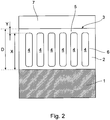
- the aluminum oxide layer 2 is thus composed of a base layer 6 having the thickness X and having the outer, hydrated surface layer 5 of the thickness Y which has a pore 4.
- D X + Y.
- the surface 3 of the partially hydrated aluminum oxide layer 2 was accordingly prepared FIG. 2 - Applied a surface coating 7.
- the applied ceramic surface layer 7 was crosslinked.
- the surface coating is 5 to 7 microns thick and has SiO 2 .
- the method according to the invention for aluminum parts for motor vehicle construction. So it is particularly possible, for example, trim strips and the like by means form the above-mentioned method steps optically very appealing.
- the method may also be used for household items such as cake pans, pans, pans, and the like.
- the coating material used is a SolGel system.
Landscapes
- Chemical & Material Sciences (AREA)
- Engineering & Computer Science (AREA)
- Chemical Kinetics & Catalysis (AREA)
- Electrochemistry (AREA)
- Materials Engineering (AREA)
- Metallurgy (AREA)
- Organic Chemistry (AREA)
- General Chemical & Material Sciences (AREA)
- Other Surface Treatments For Metallic Materials (AREA)
- Chemical Treatment Of Metals (AREA)
- Laminated Bodies (AREA)
- Chemically Coating (AREA)
Description
- Die Erfindung betrifft ein Verfahren zum Hydratisieren von Metalloxidschichten aufweisenden Metallteilen, gemäß Oberbegriff des Anspruchs 1.
- Liegt als Metallteil ein Aluminiumbauteil vor, so bildet sich unter atmosphärischen Bedingungen an der Oberfläche spontan eine dünne, sogenannte natürliche Aluminiumoxidschicht, die dem Aluminiumbauteil einen relativ guten Korrosionsschutz gibt. Durch eine anodische (elektrolytische) Oxidation des Aluminiumbauteils lässt sich an der Oberfläche eine poröse anodische Aluminiumoxidschicht bilden, die sehr hart und verschleißfest ist. Aufgrund ihrer Porenstruktur weist die anodische Aluminiumoxidschicht eine sehr große Oberfläche auf. Bei einem der Anodisation anschließenden Verdichtungsprozess wird die Aluminiumoxidschicht hydratisiert. Dabei wird Wasser in Form von Kristallwasser in die anfangs amorphe Aluminiumoxidschicht eingelagert. Das Volumen dieses Aluminiumoxidhydrats ist größer als jenes des Aluminiumoxids, so dass die Poren der Aluminiumoxidschicht aufgefüllt und verschlossen werden. Hierdurch ist eine gute Korrosionsbeständigkeit erreicht. Anodisch oxidierte Aluminiumbauteile widerstehen aufgrund ihrer Aluminiumoxidschicht vielen mechanischen und chemischen Beanspruchungen. Aufgrund des amphoteren Charakters von Aluminium und Aluminiumoxid werden anodische Oxidschichten jedoch sowohl in alkalischen, als auch in sauren Lösungen angegriffen. Derartige Lösungen werden zunehmend bei der Reinigung von Aluminiumbauteilen eingesetzt. Um die anodischen Aluminiumoxidschichten vor einem Korrosionsangriff bei der Reinigung zu schützen, wird die Oberfläche mit hochtransparenten Beschichtungen abgedeckt. Besonders geeignet sind sogenannte SolGel-Lacke auf der Basis von SiO2. Solche Beschichtungssysteme werden nach dem Auftrag durch Tauchen, Spritzen, Walzen oder Gießen in einem Ofen bei Temperaturen bis 300°C eingebrannt. Bei diesem Einbrennen vernetzt sich das SiO2, so dass die Schicht hierdurch ihre schützenden Eigenschaften entfalten kann.
- Es hat sich gezeigt, dass bei der Temperaturbeanspruchung durch den Einbrennvorgang Mikrorisse auftreten, die aufgrund der unterschiedlichen thermischen Ausdehnungkoeffizienten des Aluminiumkörpers und seiner Aluminiumoxidschicht entstehen. Durch die visuell sichtbaren Mikrorisse wird das optische Erscheinungsbild des dekorativen Bauteils gestört. Es hat sich gezeigt, dass hydratisierte, also verdichtete Aluminiumoxidschichten bei thermischer Beanspruchung rissanfälliger als nicht hydratisierte, also nicht verdichtete Aluminiumoxidschichten sind. Werden allerdings nicht verdichtete Aluminiumoxidschichten eingesetzt, so können niedrigmolekulare Beschichtungssysteme vollständig in die poröse Aluminiumoxidschicht eindringen. Dadurch werden die optischen Eigenschaften des Aluminiumbauteils aber derart verändert, dass die dekorative Wirkung verloren geht. Außerdem lassen sich nicht verdichtete, anodische Aluminiumbauteile aufgrund der porösen Oberflächenstruktur und dem damit zusammenhängenden großen Absorptionsvermögen industriell nur schwierig handhaben.
- Aus der
US 3440150 A ist ein Verfahren bekannt, mit dem eine teilweise Verdichtung durch Hydratisieren von porösen Aluminiumoxidschichten auf Aluminiumteilen erfolgt. Die Aluminiumoxidschichten werden durch Anodisieren erzeugt. Danach wird Dampf oder kochendes Wasser eingesetzt. Anschließend wird eine Oberflächenbeschichtung durchgeführt. - Aus der
US 965837 A ist ein Verdichtungsverfahren entsprechend derUS 3440150 A bekannt, jedoch erfolgt hier eine Oberflächenbeschichtung mit Silikaten. - Aus der
GB 1467184 A - Der Erfindung liegt daher die Aufgabe zugrunde, die eingangs genannten Nachteile zu vermeiden.
- Erfindungsgemäß ist zur Lösung dieser Aufgabe ein Verfahren zum Hydratisieren von Metalloxidschichten aufweisenden Metallteilen gemäß Anspruch 1 vorgesehen, bei dem das Hydratisieren nur im Bereich einer gegenüber der Dicke der Metalloxidschicht dünneren, außen liegenden Oberflächenschicht durch Abbruch des Hydratisier-Prozesses für den Erhalt einer nur teilweisen hydratisierten Metalloxidschicht durchgeführt wird. Demnach wird ein derartiges Metallteil, das eine Metalloxidschicht aufweist, die insbesondere durch Anodisieren erzeugt sein kann, nicht "vollständig" hydratisiert, so dass sich die Poren der Oxidschicht nicht vollständig auffüllen, sondern sie werden nur im Bereich der Oberfläche, also in der genannten Oberflächenschicht verschlossen. Die Oberflächenschicht bildet nur einen Teil der Dicke der gesamten Metalloxidschicht. Damit liegt also nur eine teilweise erfolgte Verdichtung beziehungsweise Hydratisierung vor. Es hat sich gezeigt, dass hierdurch die insbesondere bei thermischer Beanspruchung entstehende Rissanfälligkeit beseitigt ist. Damit bleibt das optisch attraktive Erscheinungsbild, was insbesondere bei Aluminiumteilen vorliegt, erhalten. Aufgrund des erfindungsgemäßen Vorgehens dringt ein Beschichtungsmaterial nicht oder nur geringfügig in die anodische Aluminiumoxidschicht ein, so dass sich das optische Erscheinungsbild dieser Beschichtung nicht oder nur unwesentlich verändert, so dass auch die dekorativen Eigenschaften dieser Beschichtung und damit des Bauteils nicht verloren gehen. Es ist vorgesehen, dass dem für das teilweise erfolgende Hydratisieren verwendeten Wasser, Dampf oder Wasserbad Zusätze zugegeben werden. Bei den Zusätzen handelt es sich um Polycarbonate, Polyhydroxiverbindungen, Polyhydroxicarboxylate, Polyphosphonate und/oder Polycarbonsäuren.
- Wie bereits erwähnt, ist es vorteilhaft, wenn die Metalloxidschicht durch Anodisieren erzeugt wird. Hierunter ist insbesondere eine elektrolytische Behandlungsmethode zu verstehen.
- Das Metallteil kann aus Reinmetall bestehen oder aber aus einer Legierung. Insbesondere ist vorgesehen, dass es sich bei dem Metallteil um ein Aluminiumteil oder Aluminiumlegierungsteil mit einer die Metalloxidschicht bildenden Aluminiumoxidschicht beziehungsweise Aluminiumlegierungsoxidschicht handelt.
- Nach einer Weiterbildung der Erfindung ist vorgesehen, dass das teilweise erfolgende Hydratisieren durch Heißverdichten durchgeführt wird. Dieser Heißverdichtungsvorgang erfolgt somit unter Temperaturbeaufschlagung und wird erfindungsgemäß nicht zu Ende geführt, so dass nicht die gesamte Metalloxidschicht verdichtet ist, sondern nur eine Oberflächenschicht der Metalloxidschicht.
- Das teilweise erfolgende Hydratisieren kann bevorzugt mit heißem Wasser oder mit heißem Dampf durchgeführt werden. Insbesondere wird ein heißes Wasserbad angewendet.
- Das teilweise erfolgende Hydratisieren wird bevorzugt mit einer Temperatur kleiner 100°C, insbesondere mit einer Temperatur von 65°C bis 99°C, durchgeführt.
- Wird das Hydratisieren in dem erwähnten Wasserbad vorgenommen, so weist das Wasserbad eine Temperatur kleiner 100°C, insbesondere eine Temperatur von 65°C bis 99°C, auf.
- Nach einer Weiterbildung der Erfindung ist vorgesehen, dass das teilweise erfolgende Hydratisieren bei einer Temperatur kleiner 100°C, insbesondere bei einer Temperatur von 65°C bis 99°C, und einer Dauer von weniger als 3 Minuten Behandlungsdauerzeit pro µm Schichtdicke der Metalloxidschicht. Insbesondere kann vorgesehen sein, dass das teilweise erfolgende Hydratisieren sich über eine Behandlungszeitdauer von 0,5 bis 120 Minuten erstreckt. Diese Werte gelten insbesondere für Aluminiumbauteile.
- Das teilweise hydratisierte Metallteil beziehungsweise seine teilweise hydratisierte Metalloxidschicht wird bevorzugt mit einer Oberflächenbeschichtung versehen. Hierbei handelt es sich insbesondere um eine transparente, insbesondere eine hochtransparente Oberflächenbeschichtung. Bevorzugt kann eine keramische Oberflächenbeschichtung aufgebracht werden. Diese keramische Oberflächenbeschichtung wird als dünnkeramische Beschichtung ausgebildet, das heißt, sie weist eine Dicke von 0,2 bis 7 µm, insbesondere von 0,5 bis 5 µm auf. Die Oberflächenbeschichtung kann durch Spritzen, Walzen, Gießen oder Tauchen, bevorzugt mit elektrostatischer Unterstützung, aufgebracht werden. Die Oberflächenbeschichtung wird insbesondere durch Erwärmung ausgehärtet.
- Als Oberflächenbeschichtung wird insbesondere Siliciumdioxid verwendet oder eine Beschichtung, die Siliciumdioxid aufweist.
- Die Metalloxidschicht ist nur im Bereich einer gegenüber ihrer Dicke dünneren, außen liegenden Oberflächenschicht durch Abbruch des Hydratisier-Prozesses für den Erhalt einer nur teilweisen hydratisierten Metalloxidschicht hydratisiert. Als Metallteil liegt ein Aluminiumteil oder Aluminiumlegierungsteil vor. Dessen Aluminiumoxidschicht beziehungsweise Aluminiumlegierungsoxidschicht ist bevorzugt eine anodisierte Aluminiumoxidschicht beziehungsweise Aluminiumlegierungsoxidschicht. Auf der Oberfläche
dieser Schicht befindet sich bevorzugt eine keramische Beschichtung, insbesondere eine dünnkeramische Beschichtung. - Die Zeichnungen veranschaulichen die Erfindung anhand eines Ausführungsbeispiels und zwar zeigt:
- Figur 1
- eine schematische Schnittansicht durch ein mit anodisierter Aluminiumoxidschicht versehenes Aluminiumteil und
- Figur 2
- das Aluminiumteil der
Figur 1 mit teilweise hydratisierter Aluminiumoxidschicht und auf die Oberfläche der Alumiumoxidschicht aufgebrachter dünnkeramischer Beschichtung. - Bei dem Verfahren zum Hydratisieren von Metalloxidschichten aufweisenden Metallteilen wird nachstehend auf ein Aluminiumteil eingegangen, das eine Aluminiumoxidschicht aufweist.
- Der Prozessablauf beim Anodisieren, Hydratisieren und Beschichten, insbesondere einem Beschichten mit einem SolGel-System, stellt sich wie folgt dar: Das Aluminiumteil wird entfettet. Optional kann es vor dem Entfetten mechanisch poliert werden. Nach dem Entfetten erfolgt eine Spülung. Wenn nach dem Entfetten optional eine Beizung vorgesehen ist, so wird zunächst gespült, dann gebeizt und anschließend nochmals gespült. Als nächstes erfolgt ein saures Dekapieren. An dieser Stelle kann auch vorgesehen sein: Optional Spülen, optional chemisch oder elektrochemisch Glänzen, optional Spülen, optional alkalisch Dekapieren, optional Spülen, optional sauer Dekapieren, wobei alle oder einige dieser Vorgänge nacheinander oder nur einer dieser Vorgänge durchgeführt werden/wird.
- Anschließend wird das Aluminiumteil anodisiert, was insbesondere auf elektrolytischem Wege erfolgt. Danach wird ein Spüldurchgang durchgeführt.
- Nunmehr erfolgt das Hydratisieren nur im Bereich einer gegenüber der Dicke der Aluminiumoxidschicht dünneren, außen liegenden Oberflächenschicht durch Abbruch des Hydratisier-Prozesses für den Erhalt einer nur teilweise hydratisierten Aluminiumoxidschicht. Das Hydratisierverfahren wird in einem heißen Wasserbad bei einer Temperatur von 65°C bis 99°C und einer Behandlungsdauer von weniger als 3 Minuten pro µm der Aluminiumoxidschicht durchgeführt. Es werden dem Wasserbad Zusätze wie Polycarbonate, Polyhydroxiverbindungen, Polyhydroxicarboxylate, Polyphosphonate und/oder Polycarbonsäuren zugesetzt. Anschließend wird die Oberfläche des nur teilweise hydratisierten Aluminiumteils mit einer keramischen Oberflächenbeschichtung mit einer Dicke von 0,5 bis 5 µm versehen. Anschließend wird durch eine Wärmebehandlung, insbesondere im Bereich von 150 bis 300°C, die Beschichtung vernetzt. Bei der Beschichtung handelt es sich um ein SolGel-System oder um andere niedrigmolekulare Lacksysteme. Die Oberflächenbeschichtung weist insbesondere Siliciumdioxid auf.
- Es hat sich insbesondere gezeigt, dass durch das erfindungsgemäße Vorgehen die Rissbildung beim Einbrennen der Beschichtung wirksam unterdrückt ist.
- Die
Figur 1 zeigt einen Schnitt durch das erwähnte Aluminiumteil 1, das eine Aluminiumoxidschicht 2 aufweist. Die Dicke der Aluminiumoxidschicht 2 ist mit D gekennzeichnet. Es ist erkennbar, dass die Aluminiumoxidschicht 2 eine Vielzahl von an der Oberfläche 3 offenen Poren 4 aufweist. Die Aluminiumoxidschicht 2 des Aluminiumteils 1 wurde durch Anodisieren, also elektrolytische Behandlung, erzeugt. - Aus der
Figur 2 ist erkennbar, dass das Aluminiumteil 1 derFigur 1 teilweise hydratisiert ist. Die Behandlung erfolgte in einem heißen Wasserbad und wurde nicht zu Ende geführt, sondern abgebrochen. Hierdurch haben sich die Poren 4 nicht ganz aufgefüllt und verschlossen, sondern die Hydratisierung hat nur im Bereich einer Oberflächenschicht 5 der Aluminiumoxidschicht 2 derart stattgefunden, dass die Poren 4 nur im oberen Bereich aufgefüllt und verschlossen sind, sich jedoch nach wie vor innerhalb der Aluminiumoxidschicht 2, nunmehr jedoch mit einer verkürzten Länge, befinden. Die Aluminiumoxidschicht 2 setzt sich somit aus einer Poren 4 aufweisenden Grundschicht 6 der Dicke X und der darüber liegenden, äußeren, hydratisierten Oberflächenschicht 5 der Dicke Y zusammen. Es gilt: D = X+Y. - Nachfolgend wurde auf die Oberfläche 3 der teilweise hydratisierten Aluminiumoxidschicht 2 -gemäß
Figur 2 - eine Oberflächenbeschichtung 7 aufgebracht. Hierbei handelt es sich um eine dünnkeramische Oberflächenbeschichtung, die -aufgrund der verschlossenen Poren 4- nicht oder nur geringfügig in die teilweise hydratisierte Aluminiumoxidschicht 2 eindringen kann. Durch Wärmebehandlung wurde die aufgebrachte keramische Oberflächenschicht 7 vernetzt. Die Oberflächenbeschichtung ist 5 bis 7 µm dick und weist SiO2 auf. - Insbesondere ist vorgesehen, das erfindungsgemäße Verfahren bei Aluminiumteilen für den Kraftfahrzeugbau einzusetzen. So ist es insbesondere möglich, beispielsweise Zierleisten und dergleichen mittels der genannten Verfahrensschritte optisch sehr ansprechend auszubilden. Das Verfahren kann ferner für Haushaltsgegenstände, beispielsweise Kuchenformen, Kochtöpfen, Pfannen und dergleichen eingesetzt werden. Als Beschichtungsmaterial wird ein SolGel-System eingesetzt.
Claims (18)
- Verfahren zum Hydratisieren von porösen Metalloxidschichten aufweisenden Metallteilen, wobei das Hydratisieren nur im Bereich einer gegenüber der Dicke der Metalloxidschicht dünneren, außenliegenden Oberflächenschicht durch Abbruch des Hydratisier-Prozesses für den Erhalt einer nur teilweisen hydratisierten Metallloxidschicht durchgeführt wird, dadurch gekennzeichnet, dass dem für das teilweise erfolgende Hydratisieren verwendeten Wasser, Dampf oder Wasserbad Zusätze zugegeben werden, wobei als Zusätze Polycarbonate, Polyhydroxiverbindungen, Polyhydroxicarboxylate, Polyphosphonate und/oder Polycarbonsäuren verwendet werden.
- Verfahren nach Anspruch 1, dadurch gekennzeichnet, dass die Metalloxidschicht durch Anodisieren erzeugt wird.
- Verfahren nach einem der vorhergehenden Ansprüche, dadurch gekennzeichnet, dass ein Metallteil bestehend aus Reinmetall oder bestehend aus einer Legierung verwendet wird.
- Verfahren nach einem der vorhergehenden Ansprüche, dadurch gekennzeichnet, dass als Metallteil ein Aluminiumteil oder Aluminiumlegierungsteil mit einer die Metalloxidschicht bildenden Aluminiumoxidschicht beziehungsweise Aluminiumlegierungsoxidschicht verwendet wird.
- Verfahren nach einem der vorhergehenden Ansprüche, dadurch gekennzeichnet, dass das teilweise erfolgende Hydratisieren durch Heißverdichten durchgeführt wird.
- Verfahren nach einem der vorhergehenden Ansprüche, dadurch gekennzeichnet, dass das teilweise erfolgende Hydratisieren mit heißem Wasser oder heißem Dampf durchgeführt wird.
- Verfahren nach einem der vorhergehenden Ansprüche, dadurch gekennzeichnet, dass das teilweise erfolgende Hydratisieren in einem heißen Wasserbad durchgeführt wird.
- Verfahren nach einem der vorhergehenden Ansprüche, dadurch gekennzeichnet, dass das teilweise erfolgende Hydratisieren mit einer Temperatur < 100°C, insbesondere mit einer Temperatur von 65 bis 99°C, durchgeführt wird.
- Verfahren nach einem der vorhergehenden Ansprüche, dadurch gekennzeichnet, dass das teilweise erfolgende Hydratisieren in einem Wasserbad mit einer Temperatur < 100°C, insbesondere mit einer Temperatur von 65 bis 99°C, durchgeführt wird.
- Verfahren nach einem der vorhergehenden Ansprüche, dadurch gekennzeichnet, dass das teilweise erfolgende Hydratisieren bei einer Temperatur < 100°C, insbesondere bei einer Temperatur von 65 bis 99°C, und einer Dauer von weniger als drei Minuten Behandlungszeitdauer pro µm Schichtdicke der Metalloxidschicht durchgeführt wird.
- Verfahren nach einem der vorhergehenden Ansprüche, dadurch gekennzeichnet, dass das teilweise erfolgende Hydratisieren sich über eine Behandlungszeitdauer von 0,5 bis 120 Minuten erstreckt.
- Verfahren nach einem der vorhergehenden Ansprüche, dadurch gekennzeichnet, dass die teilweise hydratisierte Metalloxidschicht mit einer Oberflächenbeschichtung versehen wird.
- Verfahren nach einem der vorhergehenden Ansprüche, dadurch gekennzeichnet, dass eine transparente, insbesondere eine hochtransparente Oberflächenbeschichtung verwendet wird.
- Verfahren nach einem der vorhergehenden Ansprüche, dadurch gekennzeichnet, dass eine keramische Oberflächenbeschichtung aufgebracht wird.
- Verfahren nach einem der vorhergehenden Ansprüche, dadurch gekennzeichnet, dass die keramische Oberflächenbeschichtung bis zu einer Dicke von 0,2 bis 7 µm, insbesondere von 0,5 bis 5 µm zur Erzeugung einer dünnkeramischen Beschichtung aufgebracht wird.
- Verfahren nach einem der vorhergehenden Ansprüche, dadurch gekennzeichnet, dass die Oberflächenbeschichtung durch Spritzen, Walzen, Gießen oder Tauchen, bevorzugt mit elektrostatischer Unterstützung, aufgetragen wird.
- Verfahren nach einem der vorhergehenden Ansprüche, dadurch gekennzeichnet, dass die Oberflächenbeschichtung durch Erwärmung ausgehärtet wird.
- Verfahren nach einem der vorhergehenden Ansprüche, dadurch gekennzeichnet, dass eine Oberflächenbeschichtung verwendet wird, die Siliciumdioxid aufweist oder aus Siliciumdioxid besteht.
Priority Applications (1)
| Application Number | Priority Date | Filing Date | Title |
|---|---|---|---|
| SI200332561T SI1486588T1 (en) | 2002-10-10 | 2003-10-10 | Method for the hydrogenation of metal parts with metallo-oxide layers |
Applications Claiming Priority (2)
| Application Number | Priority Date | Filing Date | Title |
|---|---|---|---|
| DE20220540 | 2002-10-10 | ||
| DE20220540U | 2002-10-10 |
Publications (3)
| Publication Number | Publication Date |
|---|---|
| EP1486588A2 EP1486588A2 (de) | 2004-12-15 |
| EP1486588A3 EP1486588A3 (de) | 2006-09-06 |
| EP1486588B1 true EP1486588B1 (de) | 2017-12-13 |
Family
ID=33185814
Family Applications (1)
| Application Number | Title | Priority Date | Filing Date |
|---|---|---|---|
| EP03022760.7A Expired - Lifetime EP1486588B1 (de) | 2002-10-10 | 2003-10-10 | Verfahren zum Hydratisieren von Metalloxidschichten aufweisendende Metallteilen |
Country Status (6)
| Country | Link |
|---|---|
| EP (1) | EP1486588B1 (de) |
| ES (1) | ES2658830T3 (de) |
| HU (1) | HUE036817T2 (de) |
| PT (1) | PT1486588T (de) |
| SI (1) | SI1486588T1 (de) |
| TR (1) | TR201802092T4 (de) |
Families Citing this family (3)
| Publication number | Priority date | Publication date | Assignee | Title |
|---|---|---|---|---|
| DE102012019969A1 (de) * | 2012-10-08 | 2014-04-24 | Hans und Ottmar Binder GbR (vertretungsberechtigte Gesellschafter: Hans Binder, 89558 Böhmenkirch; Ottmar Binder, 89558 Böhmenkirch) | Verfahren zum Herstellen einer Sol-Gel-Beschichtung auf einer zu beschichtenden Oberfläche eines Bauteils sowie entsprechendes Bauteil |
| EP2824221A1 (de) * | 2013-07-12 | 2015-01-14 | Eloxal Höfler GmbH | Verfahren zur Herstellung eines korrosionsbeständigen und verschleissfähigen Aluminiumsubstrats |
| US11312107B2 (en) * | 2018-09-27 | 2022-04-26 | Apple Inc. | Plugging anodic oxides for increased corrosion resistance |
Family Cites Families (3)
| Publication number | Priority date | Publication date | Assignee | Title |
|---|---|---|---|---|
| GB965837A (en) * | 1962-06-19 | 1964-08-06 | Charles Calvin Cohn | Treatment of aluminum oxide coatings |
| US3440150A (en) * | 1966-02-10 | 1969-04-22 | Martin Marietta Corp | Dual-seal anodized aluminum |
| BE817875A (fr) * | 1973-07-30 | 1974-11-18 | Procede pour augmenter l'adherence d'une couche isolante photoconductrice sur un substrat conducteur et application a un element de formation d'image utilise dans un appareil electrophotographique |
-
2003
- 2003-10-10 SI SI200332561T patent/SI1486588T1/en unknown
- 2003-10-10 EP EP03022760.7A patent/EP1486588B1/de not_active Expired - Lifetime
- 2003-10-10 ES ES03022760.7T patent/ES2658830T3/es not_active Expired - Lifetime
- 2003-10-10 PT PT30227607T patent/PT1486588T/pt unknown
- 2003-10-10 HU HUE03022760A patent/HUE036817T2/hu unknown
- 2003-10-10 TR TR2018/02092T patent/TR201802092T4/tr unknown
Non-Patent Citations (1)
| Title |
|---|
| None * |
Also Published As
| Publication number | Publication date |
|---|---|
| PT1486588T (pt) | 2018-02-27 |
| SI1486588T1 (en) | 2018-03-30 |
| TR201802092T4 (tr) | 2018-03-21 |
| EP1486588A2 (de) | 2004-12-15 |
| ES2658830T3 (es) | 2018-03-12 |
| EP1486588A3 (de) | 2006-09-06 |
| HUE036817T2 (hu) | 2018-07-30 |
Similar Documents
| Publication | Publication Date | Title |
|---|---|---|
| EP0937012A1 (de) | Temperaturbeständige und kratzfeste antihaftbeschichtung | |
| EP3019644B1 (de) | Verfahren zur herstellung eines korrosionsbeständigen und verschleissfähigen aluminiumsubstrats | |
| DE3913014A1 (de) | Beschichteter gegenstand mit metallischem aussehen und verfahren zu seiner herstellung | |
| DE102016106931A1 (de) | Verfahren zum Ausbilden eines Wärmeschutzfilms und Wärmeschutzfilmstruktur | |
| EP2145980A1 (de) | Farbige Edelstahloberfläche und Verfahren zum Färben von Edelstahl | |
| DE3133189C2 (de) | "Verfahren zur Aktivierung von Titanoberflächen" | |
| EP1706518B1 (de) | Schutzschicht fur eine aluminiumhaltige legierung fur den einsatz bei hohen temperaturen, sowie verfahren zur herstellung einer solchen schutzschicht | |
| EP1486588A2 (de) | Verfahren zum Hydratisieren von Metalloxidschichten aufweisendende Metallteilen sowie hydratisierte Metallteile. | |
| DE3644211C2 (de) | ||
| DE4120202A1 (de) | Verfahren zur emissionsfreien, insbesondere fckw-freien, reinigung von praezisions-optiken bzw. -optikbaugruppen | |
| DE2809709B2 (de) | Verfahren zur Herstellung eines mindestens eine Keramikschicht aufweisenden Schutzüberzugs für thermisch hochbelastete Bauteile, insbesondere Waffenkomponenten | |
| DE2205367A1 (de) | Gegen Anlaufen widerstandsfähige Erzeugnisse aus Silber | |
| DE3441841A1 (de) | Verfahren zur endbearbeitung einer mattierten metallischen oberflaeche | |
| DE69937012T2 (de) | Kochgeschirr und Verfahren zur Herstellung | |
| WO2007093261A1 (de) | Kochgeschirr, insbesondere topf, pfanne oder dergleichen | |
| DE1621632A1 (de) | Mittel zum Beizen von Aluminium | |
| EP0127774B1 (de) | Verfahren zum Schutz von anodisch oxidiertem Aluminium | |
| EP1601731B1 (de) | Beschichtungsverfahren für sanitärgegenstände | |
| DE764929C (de) | Verfahren zum Erzeugen von fluoridhaltigen Schutzschichten auf Werkstuecken aus Magnesium und seinen Legierungen | |
| DE668041T1 (de) | Küchengerät und dessen Herstellung. | |
| DE10347145A1 (de) | Verfahren zur Herstellung einer Verschleißschutzschicht | |
| DE10049579B4 (de) | Verfahren zur Herstellung einer dekorativen Oberfläche | |
| AT403001B (de) | Verfahren zur herstellung einer beschichteten oberfläche für bratpfannen | |
| DE2723124C2 (de) | Reliefartiges Dekor auf silikatischem Material sowie Verfahren zu seiner Herstellung | |
| DE742341C (de) | Verfahren zum Nachdichten elektrolytisch erzeugter Schichten auf Leichtmetallen |
Legal Events
| Date | Code | Title | Description |
|---|---|---|---|
| PUAI | Public reference made under article 153(3) epc to a published international application that has entered the european phase |
Free format text: ORIGINAL CODE: 0009012 |
|
| AK | Designated contracting states |
Kind code of ref document: A2 Designated state(s): AT BE BG CH CY CZ DE DK EE ES FI FR GB GR HU IE IT LI LU MC NL PT RO SE SI SK TR |
|
| AX | Request for extension of the european patent |
Extension state: AL LT LV MK |
|
| PUAL | Search report despatched |
Free format text: ORIGINAL CODE: 0009013 |
|
| AK | Designated contracting states |
Kind code of ref document: A3 Designated state(s): AT BE BG CH CY CZ DE DK EE ES FI FR GB GR HU IE IT LI LU MC NL PT RO SE SI SK TR |
|
| AX | Request for extension of the european patent |
Extension state: AL LT LV MK |
|
| RIC1 | Information provided on ipc code assigned before grant |
Ipc: C25D 11/18 20060101AFI20041026BHEP Ipc: C25D 11/24 20060101ALI20060801BHEP |
|
| 17P | Request for examination filed |
Effective date: 20070306 |
|
| AKX | Designation fees paid |
Designated state(s): AT BE BG CH CY CZ DE DK EE ES FI FR GB GR HU IE IT LI LU MC NL PT RO SE SI SK TR |
|
| 17Q | First examination report despatched |
Effective date: 20090826 |
|
| GRAP | Despatch of communication of intention to grant a patent |
Free format text: ORIGINAL CODE: EPIDOSNIGR1 |
|
| INTG | Intention to grant announced |
Effective date: 20170616 |
|
| GRAS | Grant fee paid |
Free format text: ORIGINAL CODE: EPIDOSNIGR3 |
|
| GRAA | (expected) grant |
Free format text: ORIGINAL CODE: 0009210 |
|
| AK | Designated contracting states |
Kind code of ref document: B1 Designated state(s): AT BE BG CH CY CZ DE DK EE ES FI FR GB GR HU IE IT LI LU MC NL PT RO SE SI SK TR |
|
| REG | Reference to a national code |
Ref country code: GB Ref legal event code: FG4D Free format text: NOT ENGLISH |
|
| REG | Reference to a national code |
Ref country code: AT Ref legal event code: REF Ref document number: 954442 Country of ref document: AT Kind code of ref document: T Effective date: 20171215 Ref country code: CH Ref legal event code: EP |
|
| REG | Reference to a national code |
Ref country code: IE Ref legal event code: FG4D Free format text: LANGUAGE OF EP DOCUMENT: GERMAN |
|
| REG | Reference to a national code |
Ref country code: DE Ref legal event code: R096 Ref document number: 50315723 Country of ref document: DE |
|
| REG | Reference to a national code |
Ref country code: RO Ref legal event code: EPE Ref country code: PT Ref legal event code: SC4A Ref document number: 1486588 Country of ref document: PT Date of ref document: 20180227 Kind code of ref document: T Free format text: AVAILABILITY OF NATIONAL TRANSLATION Effective date: 20180221 |
|
| REG | Reference to a national code |
Ref country code: ES Ref legal event code: FG2A Ref document number: 2658830 Country of ref document: ES Kind code of ref document: T3 Effective date: 20180312 |
|
| REG | Reference to a national code |
Ref country code: SE Ref legal event code: TRGR |
|
| REG | Reference to a national code |
Ref country code: NL Ref legal event code: MP Effective date: 20171213 |
|
| PG25 | Lapsed in a contracting state [announced via postgrant information from national office to epo] |
Ref country code: BG Free format text: LAPSE BECAUSE OF FAILURE TO SUBMIT A TRANSLATION OF THE DESCRIPTION OR TO PAY THE FEE WITHIN THE PRESCRIBED TIME-LIMIT Effective date: 20180313 Ref country code: GR Free format text: LAPSE BECAUSE OF FAILURE TO SUBMIT A TRANSLATION OF THE DESCRIPTION OR TO PAY THE FEE WITHIN THE PRESCRIBED TIME-LIMIT Effective date: 20180314 |
|
| PG25 | Lapsed in a contracting state [announced via postgrant information from national office to epo] |
Ref country code: NL Free format text: LAPSE BECAUSE OF FAILURE TO SUBMIT A TRANSLATION OF THE DESCRIPTION OR TO PAY THE FEE WITHIN THE PRESCRIBED TIME-LIMIT Effective date: 20171213 |
|
| REG | Reference to a national code |
Ref country code: HU Ref legal event code: AG4A Ref document number: E036817 Country of ref document: HU |
|
| PG25 | Lapsed in a contracting state [announced via postgrant information from national office to epo] |
Ref country code: CY Free format text: LAPSE BECAUSE OF FAILURE TO SUBMIT A TRANSLATION OF THE DESCRIPTION OR TO PAY THE FEE WITHIN THE PRESCRIBED TIME-LIMIT Effective date: 20171213 Ref country code: EE Free format text: LAPSE BECAUSE OF FAILURE TO SUBMIT A TRANSLATION OF THE DESCRIPTION OR TO PAY THE FEE WITHIN THE PRESCRIBED TIME-LIMIT Effective date: 20171213 |
|
| REG | Reference to a national code |
Ref country code: DE Ref legal event code: R097 Ref document number: 50315723 Country of ref document: DE |
|
| PLBE | No opposition filed within time limit |
Free format text: ORIGINAL CODE: 0009261 |
|
| STAA | Information on the status of an ep patent application or granted ep patent |
Free format text: STATUS: NO OPPOSITION FILED WITHIN TIME LIMIT |
|
| 26N | No opposition filed |
Effective date: 20180914 |
|
| PG25 | Lapsed in a contracting state [announced via postgrant information from national office to epo] |
Ref country code: DK Free format text: LAPSE BECAUSE OF FAILURE TO SUBMIT A TRANSLATION OF THE DESCRIPTION OR TO PAY THE FEE WITHIN THE PRESCRIBED TIME-LIMIT Effective date: 20171213 |
|
| REG | Reference to a national code |
Ref country code: CH Ref legal event code: PL |
|
| REG | Reference to a national code |
Ref country code: BE Ref legal event code: MM Effective date: 20181031 |
|
| PG25 | Lapsed in a contracting state [announced via postgrant information from national office to epo] |
Ref country code: MC Free format text: LAPSE BECAUSE OF FAILURE TO SUBMIT A TRANSLATION OF THE DESCRIPTION OR TO PAY THE FEE WITHIN THE PRESCRIBED TIME-LIMIT Effective date: 20171213 Ref country code: LU Free format text: LAPSE BECAUSE OF NON-PAYMENT OF DUE FEES Effective date: 20181010 |
|
| PG25 | Lapsed in a contracting state [announced via postgrant information from national office to epo] |
Ref country code: CZ Free format text: LAPSE BECAUSE OF NON-PAYMENT OF DUE FEES Effective date: 20181010 Ref country code: FI Free format text: LAPSE BECAUSE OF NON-PAYMENT OF DUE FEES Effective date: 20181010 |
|
| PG25 | Lapsed in a contracting state [announced via postgrant information from national office to epo] |
Ref country code: CH Free format text: LAPSE BECAUSE OF NON-PAYMENT OF DUE FEES Effective date: 20181031 Ref country code: BE Free format text: LAPSE BECAUSE OF NON-PAYMENT OF DUE FEES Effective date: 20181031 Ref country code: RO Free format text: LAPSE BECAUSE OF NON-PAYMENT OF DUE FEES Effective date: 20171213 Ref country code: LI Free format text: LAPSE BECAUSE OF NON-PAYMENT OF DUE FEES Effective date: 20181031 Ref country code: SI Free format text: LAPSE BECAUSE OF NON-PAYMENT OF DUE FEES Effective date: 20181011 Ref country code: FR Free format text: LAPSE BECAUSE OF NON-PAYMENT OF DUE FEES Effective date: 20181031 |
|
| REG | Reference to a national code |
Ref country code: SI Ref legal event code: KO00 Effective date: 20190701 |
|
| PGFP | Annual fee paid to national office [announced via postgrant information from national office to epo] |
Ref country code: PT Payment date: 20190919 Year of fee payment: 17 Ref country code: SK Payment date: 20190924 Year of fee payment: 17 |
|
| REG | Reference to a national code |
Ref country code: AT Ref legal event code: MM01 Ref document number: 954442 Country of ref document: AT Kind code of ref document: T Effective date: 20181010 |
|
| PG25 | Lapsed in a contracting state [announced via postgrant information from national office to epo] |
Ref country code: AT Free format text: LAPSE BECAUSE OF NON-PAYMENT OF DUE FEES Effective date: 20181010 |
|
| PGFP | Annual fee paid to national office [announced via postgrant information from national office to epo] |
Ref country code: DE Payment date: 20191019 Year of fee payment: 17 Ref country code: HU Payment date: 20191016 Year of fee payment: 17 Ref country code: SE Payment date: 20191021 Year of fee payment: 17 Ref country code: IE Payment date: 20191022 Year of fee payment: 17 |
|
| PGFP | Annual fee paid to national office [announced via postgrant information from national office to epo] |
Ref country code: ES Payment date: 20191122 Year of fee payment: 17 Ref country code: IT Payment date: 20191024 Year of fee payment: 17 |
|
| PGFP | Annual fee paid to national office [announced via postgrant information from national office to epo] |
Ref country code: GB Payment date: 20191021 Year of fee payment: 17 |
|
| REG | Reference to a national code |
Ref country code: DE Ref legal event code: R119 Ref document number: 50315723 Country of ref document: DE |
|
| REG | Reference to a national code |
Ref country code: SE Ref legal event code: EUG |
|
| GBPC | Gb: european patent ceased through non-payment of renewal fee |
Effective date: 20201010 |
|
| REG | Reference to a national code |
Ref country code: SK Ref legal event code: MM4A Ref document number: E 26456 Country of ref document: SK Effective date: 20201010 |
|
| PG25 | Lapsed in a contracting state [announced via postgrant information from national office to epo] |
Ref country code: DE Free format text: LAPSE BECAUSE OF NON-PAYMENT OF DUE FEES Effective date: 20210501 Ref country code: PT Free format text: LAPSE BECAUSE OF NON-PAYMENT OF DUE FEES Effective date: 20210412 Ref country code: SK Free format text: LAPSE BECAUSE OF NON-PAYMENT OF DUE FEES Effective date: 20201010 |
|
| PG25 | Lapsed in a contracting state [announced via postgrant information from national office to epo] |
Ref country code: SE Free format text: LAPSE BECAUSE OF NON-PAYMENT OF DUE FEES Effective date: 20201011 Ref country code: HU Free format text: LAPSE BECAUSE OF NON-PAYMENT OF DUE FEES Effective date: 20201011 Ref country code: GB Free format text: LAPSE BECAUSE OF NON-PAYMENT OF DUE FEES Effective date: 20201010 |
|
| PG25 | Lapsed in a contracting state [announced via postgrant information from national office to epo] |
Ref country code: IE Free format text: LAPSE BECAUSE OF NON-PAYMENT OF DUE FEES Effective date: 20201010 Ref country code: IT Free format text: LAPSE BECAUSE OF NON-PAYMENT OF DUE FEES Effective date: 20201010 |
|
| REG | Reference to a national code |
Ref country code: ES Ref legal event code: FD2A Effective date: 20220127 |
|
| PG25 | Lapsed in a contracting state [announced via postgrant information from national office to epo] |
Ref country code: ES Free format text: LAPSE BECAUSE OF NON-PAYMENT OF DUE FEES Effective date: 20201011 |
|
| PG25 | Lapsed in a contracting state [announced via postgrant information from national office to epo] |
Ref country code: TR Free format text: LAPSE BECAUSE OF NON-PAYMENT OF DUE FEES Effective date: 20181010 |