EP1484973B1 - Verfahren zur immunisierung von pflanzen gegen bakteriosen - Google Patents
Verfahren zur immunisierung von pflanzen gegen bakteriosen Download PDFInfo
- Publication number
- EP1484973B1 EP1484973B1 EP03708204A EP03708204A EP1484973B1 EP 1484973 B1 EP1484973 B1 EP 1484973B1 EP 03708204 A EP03708204 A EP 03708204A EP 03708204 A EP03708204 A EP 03708204A EP 1484973 B1 EP1484973 B1 EP 1484973B1
- Authority
- EP
- European Patent Office
- Prior art keywords
- membered
- alkyl
- och
- radicals
- formula
- Prior art date
- Legal status (The legal status is an assumption and is not a legal conclusion. Google has not performed a legal analysis and makes no representation as to the accuracy of the status listed.)
- Expired - Lifetime
Links
- 238000000034 method Methods 0.000 title claims abstract description 23
- 230000003053 immunization Effects 0.000 title claims abstract description 11
- 150000001875 compounds Chemical class 0.000 claims abstract description 48
- 125000001997 phenyl group Chemical group [H]C1=C([H])C([H])=C(*)C([H])=C1[H] 0.000 claims abstract description 21
- 125000000956 methoxy group Chemical group [H]C([H])([H])O* 0.000 claims abstract description 19
- 229910052736 halogen Inorganic materials 0.000 claims abstract description 17
- 125000001072 heteroaryl group Chemical group 0.000 claims abstract description 16
- 125000001160 methoxycarbonyl group Chemical group [H]C([H])([H])OC(*)=O 0.000 claims abstract description 15
- 125000000623 heterocyclic group Chemical group 0.000 claims abstract description 13
- 125000002496 methyl group Chemical group [H]C([H])([H])* 0.000 claims abstract description 12
- 125000002023 trifluoromethyl group Chemical group FC(F)(F)* 0.000 claims abstract description 9
- 229910052739 hydrogen Inorganic materials 0.000 claims abstract description 8
- 239000001257 hydrogen Substances 0.000 claims abstract description 8
- 125000004093 cyano group Chemical group *C#N 0.000 claims abstract description 7
- 125000004434 sulfur atom Chemical group 0.000 claims abstract description 7
- 150000002431 hydrogen Chemical group 0.000 claims abstract description 6
- 125000004178 (C1-C4) alkyl group Chemical group 0.000 claims abstract description 5
- 125000004430 oxygen atom Chemical group O* 0.000 claims abstract description 5
- 239000002689 soil Substances 0.000 claims abstract description 5
- 125000003236 benzoyl group Chemical group [H]C1=C([H])C([H])=C(C([H])=C1[H])C(*)=O 0.000 claims abstract description 4
- 125000001624 naphthyl group Chemical group 0.000 claims abstract description 4
- 125000004433 nitrogen atom Chemical group N* 0.000 claims abstract description 4
- 125000003170 phenylsulfonyl group Chemical group C1(=CC=CC=C1)S(=O)(=O)* 0.000 claims abstract description 4
- -1 cyano, nitro, amino, aminocarbonyl Chemical group 0.000 claims description 50
- 239000004480 active ingredient Substances 0.000 claims description 30
- 125000005913 (C3-C6) cycloalkyl group Chemical group 0.000 claims description 18
- 150000002367 halogens Chemical group 0.000 claims description 16
- 125000004169 (C1-C6) alkyl group Chemical group 0.000 claims description 13
- 125000000882 C2-C6 alkenyl group Chemical group 0.000 claims description 12
- 125000004890 (C1-C6) alkylamino group Chemical group 0.000 claims description 9
- 125000004739 (C1-C6) alkylsulfonyl group Chemical group 0.000 claims description 9
- 125000006700 (C1-C6) alkylthio group Chemical group 0.000 claims description 9
- 125000003320 C2-C6 alkenyloxy group Chemical group 0.000 claims description 9
- 125000004682 aminothiocarbonyl group Chemical group NC(=S)* 0.000 claims description 9
- 125000004191 (C1-C6) alkoxy group Chemical group 0.000 claims description 7
- 125000004122 cyclic group Chemical group 0.000 claims description 7
- 125000004454 (C1-C6) alkoxycarbonyl group Chemical group 0.000 claims description 6
- 125000000051 benzyloxy group Chemical group [H]C1=C([H])C([H])=C(C([H])=C1[H])C([H])([H])O* 0.000 claims description 6
- 125000006374 C2-C10 alkenyl group Chemical group 0.000 claims description 5
- UFHFLCQGNIYNRP-UHFFFAOYSA-N Hydrogen Chemical compound [H][H] UFHFLCQGNIYNRP-UHFFFAOYSA-N 0.000 claims description 5
- 239000000460 chlorine Substances 0.000 claims description 5
- 239000004215 Carbon black (E152) Substances 0.000 claims description 4
- 241000588698 Erwinia Species 0.000 claims description 4
- 125000001797 benzyl group Chemical group [H]C1=C([H])C([H])=C(C([H])=C1[H])C([H])([H])* 0.000 claims description 4
- 229930195733 hydrocarbon Natural products 0.000 claims description 4
- 125000004076 pyridyl group Chemical group 0.000 claims description 4
- 125000004916 (C1-C6) alkylcarbonyl group Chemical group 0.000 claims description 3
- 125000005865 C2-C10alkynyl group Chemical group 0.000 claims description 3
- 125000005844 heterocyclyloxy group Chemical group 0.000 claims description 3
- 229910052757 nitrogen Chemical group 0.000 claims description 3
- 125000001424 substituent group Chemical group 0.000 claims description 3
- 125000000008 (C1-C10) alkyl group Chemical group 0.000 claims description 2
- 125000000229 (C1-C4)alkoxy group Chemical group 0.000 claims description 2
- 125000003601 C2-C6 alkynyl group Chemical group 0.000 claims description 2
- ZAMOUSCENKQFHK-UHFFFAOYSA-N Chlorine atom Chemical compound [Cl] ZAMOUSCENKQFHK-UHFFFAOYSA-N 0.000 claims description 2
- 229910052801 chlorine Inorganic materials 0.000 claims description 2
- 125000000118 dimethyl group Chemical group [H]C([H])([H])* 0.000 claims description 2
- 125000000449 nitro group Chemical group [O-][N+](*)=O 0.000 claims description 2
- 229910052760 oxygen Inorganic materials 0.000 claims description 2
- 125000003226 pyrazolyl group Chemical group 0.000 claims description 2
- 125000000714 pyrimidinyl group Chemical group 0.000 claims description 2
- 125000001425 triazolyl group Chemical group 0.000 claims description 2
- 229910052799 carbon Inorganic materials 0.000 claims 1
- 125000004432 carbon atom Chemical group C* 0.000 claims 1
- 125000000951 phenoxy group Chemical group [H]C1=C([H])C([H])=C(O*)C([H])=C1[H] 0.000 claims 1
- 125000000217 alkyl group Chemical group 0.000 abstract description 3
- 125000003342 alkenyl group Chemical group 0.000 abstract 2
- 125000000304 alkynyl group Chemical group 0.000 abstract 2
- 125000000753 cycloalkyl group Chemical group 0.000 abstract 2
- 125000005090 alkenylcarbonyl group Chemical group 0.000 abstract 1
- 125000003545 alkoxy group Chemical group 0.000 abstract 1
- 125000004448 alkyl carbonyl group Chemical group 0.000 abstract 1
- 150000001350 alkyl halides Chemical group 0.000 abstract 1
- 125000004390 alkyl sulfonyl group Chemical group 0.000 abstract 1
- 125000005087 alkynylcarbonyl group Chemical group 0.000 abstract 1
- 125000005843 halogen group Chemical group 0.000 abstract 1
- 125000000547 substituted alkyl group Chemical group 0.000 abstract 1
- 241000196324 Embryophyta Species 0.000 description 36
- 239000000203 mixture Substances 0.000 description 15
- IAYPIBMASNFSPL-UHFFFAOYSA-N Ethylene oxide Chemical compound C1CO1 IAYPIBMASNFSPL-UHFFFAOYSA-N 0.000 description 12
- 241000589615 Pseudomonas syringae Species 0.000 description 10
- 244000061176 Nicotiana tabacum Species 0.000 description 9
- 239000000243 solution Substances 0.000 description 9
- XLYOFNOQVPJJNP-UHFFFAOYSA-N water Substances O XLYOFNOQVPJJNP-UHFFFAOYSA-N 0.000 description 9
- 235000002637 Nicotiana tabacum Nutrition 0.000 description 8
- ZXEKIIBDNHEJCQ-UHFFFAOYSA-N isobutanol Chemical compound CC(C)CO ZXEKIIBDNHEJCQ-UHFFFAOYSA-N 0.000 description 8
- 150000003254 radicals Chemical class 0.000 description 8
- 241000894006 Bacteria Species 0.000 description 7
- 238000009472 formulation Methods 0.000 description 7
- 241000282414 Homo sapiens Species 0.000 description 6
- 239000013543 active substance Substances 0.000 description 6
- JHIVVAPYMSGYDF-UHFFFAOYSA-N cyclohexanone Chemical compound O=C1CCCCC1 JHIVVAPYMSGYDF-UHFFFAOYSA-N 0.000 description 6
- 201000010099 disease Diseases 0.000 description 6
- 208000037265 diseases, disorders, signs and symptoms Diseases 0.000 description 6
- 238000011081 inoculation Methods 0.000 description 6
- 239000003242 anti bacterial agent Substances 0.000 description 5
- 229940088710 antibiotic agent Drugs 0.000 description 5
- 230000001580 bacterial effect Effects 0.000 description 5
- 239000003814 drug Substances 0.000 description 5
- 230000000694 effects Effects 0.000 description 5
- 239000000417 fungicide Substances 0.000 description 5
- 238000002649 immunization Methods 0.000 description 5
- 230000003993 interaction Effects 0.000 description 5
- 239000003921 oil Substances 0.000 description 5
- 238000002360 preparation method Methods 0.000 description 5
- 230000008569 process Effects 0.000 description 5
- KBLAMUYRMZPYLS-UHFFFAOYSA-N 2,3-bis(2-methylpropyl)naphthalene-1-sulfonic acid Chemical compound C1=CC=C2C(S(O)(=O)=O)=C(CC(C)C)C(CC(C)C)=CC2=C1 KBLAMUYRMZPYLS-UHFFFAOYSA-N 0.000 description 4
- NFAOATPOYUWEHM-UHFFFAOYSA-N 2-(6-methylheptyl)phenol Chemical compound CC(C)CCCCCC1=CC=CC=C1O NFAOATPOYUWEHM-UHFFFAOYSA-N 0.000 description 4
- 235000007688 Lycopersicon esculentum Nutrition 0.000 description 4
- VYPSYNLAJGMNEJ-UHFFFAOYSA-N Silicium dioxide Chemical compound O=[Si]=O VYPSYNLAJGMNEJ-UHFFFAOYSA-N 0.000 description 4
- 230000006378 damage Effects 0.000 description 4
- 239000006185 dispersion Substances 0.000 description 4
- 229940079593 drug Drugs 0.000 description 4
- 244000052769 pathogen Species 0.000 description 4
- 239000000741 silica gel Substances 0.000 description 4
- 229910002027 silica gel Inorganic materials 0.000 description 4
- 159000000000 sodium salts Chemical class 0.000 description 4
- 239000002904 solvent Substances 0.000 description 4
- 208000024891 symptom Diseases 0.000 description 4
- 235000013311 vegetables Nutrition 0.000 description 4
- 125000004737 (C1-C6) haloalkoxy group Chemical group 0.000 description 3
- 125000000171 (C1-C6) haloalkyl group Chemical group 0.000 description 3
- 240000003768 Solanum lycopersicum Species 0.000 description 3
- 244000061456 Solanum tuberosum Species 0.000 description 3
- 235000002595 Solanum tuberosum Nutrition 0.000 description 3
- 239000004359 castor oil Substances 0.000 description 3
- 235000019438 castor oil Nutrition 0.000 description 3
- 239000000839 emulsion Substances 0.000 description 3
- 238000002474 experimental method Methods 0.000 description 3
- ZEMPKEQAKRGZGQ-XOQCFJPHSA-N glycerol triricinoleate Natural products CCCCCC[C@@H](O)CC=CCCCCCCCC(=O)OC[C@@H](COC(=O)CCCCCCCC=CC[C@@H](O)CCCCCC)OC(=O)CCCCCCCC=CC[C@H](O)CCCCCC ZEMPKEQAKRGZGQ-XOQCFJPHSA-N 0.000 description 3
- 230000006698 induction Effects 0.000 description 3
- 208000015181 infectious disease Diseases 0.000 description 3
- 230000017074 necrotic cell death Effects 0.000 description 3
- 239000006072 paste Substances 0.000 description 3
- 235000012015 potatoes Nutrition 0.000 description 3
- 239000000843 powder Substances 0.000 description 3
- 230000000638 stimulation Effects 0.000 description 3
- 239000000126 substance Substances 0.000 description 3
- 125000004765 (C1-C4) haloalkyl group Chemical group 0.000 description 2
- WBIQQQGBSDOWNP-UHFFFAOYSA-N 2-dodecylbenzenesulfonic acid Chemical compound CCCCCCCCCCCCC1=CC=CC=C1S(O)(=O)=O WBIQQQGBSDOWNP-UHFFFAOYSA-N 0.000 description 2
- 125000004105 2-pyridyl group Chemical group N1=C([*])C([H])=C([H])C([H])=C1[H] 0.000 description 2
- FOGYNLXERPKEGN-UHFFFAOYSA-N 3-(2-hydroxy-3-methoxyphenyl)-2-[2-methoxy-4-(3-sulfopropyl)phenoxy]propane-1-sulfonic acid Chemical compound COC1=CC=CC(CC(CS(O)(=O)=O)OC=2C(=CC(CCCS(O)(=O)=O)=CC=2)OC)=C1O FOGYNLXERPKEGN-UHFFFAOYSA-N 0.000 description 2
- 239000005995 Aluminium silicate Substances 0.000 description 2
- IJGRMHOSHXDMSA-UHFFFAOYSA-N Atomic nitrogen Chemical compound N#N IJGRMHOSHXDMSA-UHFFFAOYSA-N 0.000 description 2
- 208000035143 Bacterial infection Diseases 0.000 description 2
- 241001295925 Gegenes Species 0.000 description 2
- CTQNGGLPUBDAKN-UHFFFAOYSA-N O-Xylene Chemical compound CC1=CC=CC=C1C CTQNGGLPUBDAKN-UHFFFAOYSA-N 0.000 description 2
- 241000589516 Pseudomonas Species 0.000 description 2
- LSNNMFCWUKXFEE-UHFFFAOYSA-N Sulfurous acid Chemical compound OS(O)=O LSNNMFCWUKXFEE-UHFFFAOYSA-N 0.000 description 2
- 235000012211 aluminium silicate Nutrition 0.000 description 2
- 230000015572 biosynthetic process Effects 0.000 description 2
- 239000003795 chemical substances by application Substances 0.000 description 2
- 239000012141 concentrate Substances 0.000 description 2
- 230000007123 defense Effects 0.000 description 2
- 238000010790 dilution Methods 0.000 description 2
- 239000012895 dilution Substances 0.000 description 2
- 239000002270 dispersing agent Substances 0.000 description 2
- 235000013399 edible fruits Nutrition 0.000 description 2
- 239000003995 emulsifying agent Substances 0.000 description 2
- 230000003601 intercostal effect Effects 0.000 description 2
- NLYAJNPCOHFWQQ-UHFFFAOYSA-N kaolin Chemical compound O.O.O=[Al]O[Si](=O)O[Si](=O)O[Al]=O NLYAJNPCOHFWQQ-UHFFFAOYSA-N 0.000 description 2
- 244000005700 microbiome Species 0.000 description 2
- 230000001717 pathogenic effect Effects 0.000 description 2
- SNOOUWRIMMFWNE-UHFFFAOYSA-M sodium;6-[(3,4,5-trimethoxybenzoyl)amino]hexanoate Chemical compound [Na+].COC1=CC(C(=O)NCCCCCC([O-])=O)=CC(OC)=C1OC SNOOUWRIMMFWNE-UHFFFAOYSA-M 0.000 description 2
- UCSJYZPVAKXKNQ-HZYVHMACSA-N streptomycin Chemical compound CN[C@H]1[C@H](O)[C@@H](O)[C@H](CO)O[C@H]1O[C@@H]1[C@](C=O)(O)[C@H](C)O[C@H]1O[C@@H]1[C@@H](NC(N)=N)[C@H](O)[C@@H](NC(N)=N)[C@H](O)[C@H]1O UCSJYZPVAKXKNQ-HZYVHMACSA-N 0.000 description 2
- 239000002699 waste material Substances 0.000 description 2
- CXNPLSGKWMLZPZ-GIFSMMMISA-N (2r,3r,6s)-3-[[(3s)-3-amino-5-[carbamimidoyl(methyl)amino]pentanoyl]amino]-6-(4-amino-2-oxopyrimidin-1-yl)-3,6-dihydro-2h-pyran-2-carboxylic acid Chemical compound O1[C@@H](C(O)=O)[C@H](NC(=O)C[C@@H](N)CCN(C)C(N)=N)C=C[C@H]1N1C(=O)N=C(N)C=C1 CXNPLSGKWMLZPZ-GIFSMMMISA-N 0.000 description 1
- 125000004767 (C1-C4) haloalkoxy group Chemical group 0.000 description 1
- WRIDQFICGBMAFQ-UHFFFAOYSA-N (E)-8-Octadecenoic acid Natural products CCCCCCCCCC=CCCCCCCC(O)=O WRIDQFICGBMAFQ-UHFFFAOYSA-N 0.000 description 1
- 125000001376 1,2,4-triazolyl group Chemical group N1N=C(N=C1)* 0.000 description 1
- UPUWMQZUXFAUCJ-UHFFFAOYSA-N 2,5-dihydro-1,2-thiazole Chemical class C1SNC=C1 UPUWMQZUXFAUCJ-UHFFFAOYSA-N 0.000 description 1
- LQJBNNIYVWPHFW-UHFFFAOYSA-N 20:1omega9c fatty acid Natural products CCCCCCCCCCC=CCCCCCCCC(O)=O LQJBNNIYVWPHFW-UHFFFAOYSA-N 0.000 description 1
- QSBYPNXLFMSGKH-UHFFFAOYSA-N 9-Heptadecensaeure Natural products CCCCCCCC=CCCCCCCCC(O)=O QSBYPNXLFMSGKH-UHFFFAOYSA-N 0.000 description 1
- 229920001817 Agar Polymers 0.000 description 1
- 241000589158 Agrobacterium Species 0.000 description 1
- 101001053401 Arabidopsis thaliana Acid beta-fructofuranosidase 3, vacuolar Proteins 0.000 description 1
- 101001053395 Arabidopsis thaliana Acid beta-fructofuranosidase 4, vacuolar Proteins 0.000 description 1
- 235000006810 Caesalpinia ciliata Nutrition 0.000 description 1
- 241000059739 Caesalpinia ciliata Species 0.000 description 1
- IAZDPXIOMUYVGZ-UHFFFAOYSA-N Dimethylsulphoxide Chemical compound CS(C)=O IAZDPXIOMUYVGZ-UHFFFAOYSA-N 0.000 description 1
- 241000282412 Homo Species 0.000 description 1
- 206010021033 Hypomenorrhoea Diseases 0.000 description 1
- 206010061217 Infestation Diseases 0.000 description 1
- 241000227653 Lycopersicon Species 0.000 description 1
- 241001465754 Metazoa Species 0.000 description 1
- SECXISVLQFMRJM-UHFFFAOYSA-N N-Methylpyrrolidone Chemical compound CN1CCCC1=O SECXISVLQFMRJM-UHFFFAOYSA-N 0.000 description 1
- 206010028980 Neoplasm Diseases 0.000 description 1
- JCXJVPUVTGWSNB-UHFFFAOYSA-N Nitrogen dioxide Chemical class O=[N]=O JCXJVPUVTGWSNB-UHFFFAOYSA-N 0.000 description 1
- 239000005642 Oleic acid Substances 0.000 description 1
- ZQPPMHVWECSIRJ-UHFFFAOYSA-N Oleic acid Natural products CCCCCCCCC=CCCCCCCCC(O)=O ZQPPMHVWECSIRJ-UHFFFAOYSA-N 0.000 description 1
- 240000007594 Oryza sativa Species 0.000 description 1
- 235000007164 Oryza sativa Nutrition 0.000 description 1
- 229910019142 PO4 Inorganic materials 0.000 description 1
- 239000005662 Paraffin oil Substances 0.000 description 1
- ZLMJMSJWJFRBEC-UHFFFAOYSA-N Potassium Chemical compound [K] ZLMJMSJWJFRBEC-UHFFFAOYSA-N 0.000 description 1
- 235000014443 Pyrus communis Nutrition 0.000 description 1
- 241000209140 Triticum Species 0.000 description 1
- 235000021307 Triticum Nutrition 0.000 description 1
- 230000009471 action Effects 0.000 description 1
- 239000000654 additive Substances 0.000 description 1
- 239000008272 agar Substances 0.000 description 1
- 230000000844 anti-bacterial effect Effects 0.000 description 1
- 239000007864 aqueous solution Substances 0.000 description 1
- 208000022362 bacterial infectious disease Diseases 0.000 description 1
- 244000052616 bacterial pathogen Species 0.000 description 1
- 239000003899 bactericide agent Substances 0.000 description 1
- CXNPLSGKWMLZPZ-UHFFFAOYSA-N blasticidin-S Natural products O1C(C(O)=O)C(NC(=O)CC(N)CCN(C)C(N)=N)C=CC1N1C(=O)N=C(N)C=C1 CXNPLSGKWMLZPZ-UHFFFAOYSA-N 0.000 description 1
- 159000000007 calcium salts Chemical class 0.000 description 1
- 238000004113 cell culture Methods 0.000 description 1
- 235000020971 citrus fruits Nutrition 0.000 description 1
- 230000003111 delayed effect Effects 0.000 description 1
- 239000003085 diluting agent Substances 0.000 description 1
- 229940060296 dodecylbenzenesulfonic acid Drugs 0.000 description 1
- 238000012377 drug delivery Methods 0.000 description 1
- 239000000428 dust Substances 0.000 description 1
- 230000001804 emulsifying effect Effects 0.000 description 1
- 239000003337 fertilizer Substances 0.000 description 1
- 230000002538 fungal effect Effects 0.000 description 1
- 239000008187 granular material Substances 0.000 description 1
- 239000004009 herbicide Substances 0.000 description 1
- 210000000987 immune system Anatomy 0.000 description 1
- 238000000338 in vitro Methods 0.000 description 1
- 238000011534 incubation Methods 0.000 description 1
- 238000002347 injection Methods 0.000 description 1
- 239000007924 injection Substances 0.000 description 1
- 239000002054 inoculum Substances 0.000 description 1
- 239000002917 insecticide Substances 0.000 description 1
- 239000003621 irrigation water Substances 0.000 description 1
- QXJSBBXBKPUZAA-UHFFFAOYSA-N isooleic acid Natural products CCCCCCCC=CCCCCCCCCC(O)=O QXJSBBXBKPUZAA-UHFFFAOYSA-N 0.000 description 1
- 235000021374 legumes Nutrition 0.000 description 1
- 239000000463 material Substances 0.000 description 1
- 230000007246 mechanism Effects 0.000 description 1
- 230000004060 metabolic process Effects 0.000 description 1
- 230000001338 necrotic effect Effects 0.000 description 1
- RJMUSRYZPJIFPJ-UHFFFAOYSA-N niclosamide Chemical compound OC1=CC=C(Cl)C=C1C(=O)NC1=CC=C([N+]([O-])=O)C=C1Cl RJMUSRYZPJIFPJ-UHFFFAOYSA-N 0.000 description 1
- 238000000655 nuclear magnetic resonance spectrum Methods 0.000 description 1
- ZQPPMHVWECSIRJ-KTKRTIGZSA-N oleic acid Chemical compound CCCCCCCC\C=C/CCCCCCCC(O)=O ZQPPMHVWECSIRJ-KTKRTIGZSA-N 0.000 description 1
- 239000002420 orchard Substances 0.000 description 1
- 239000003960 organic solvent Substances 0.000 description 1
- 238000004806 packaging method and process Methods 0.000 description 1
- 239000000575 pesticide Substances 0.000 description 1
- 239000000546 pharmaceutical excipient Substances 0.000 description 1
- NBIIXXVUZAFLBC-UHFFFAOYSA-K phosphate Chemical compound [O-]P([O-])([O-])=O NBIIXXVUZAFLBC-UHFFFAOYSA-K 0.000 description 1
- 239000010452 phosphate Substances 0.000 description 1
- 230000003032 phytopathogenic effect Effects 0.000 description 1
- 239000011591 potassium Substances 0.000 description 1
- 229910052700 potassium Inorganic materials 0.000 description 1
- 230000001681 protective effect Effects 0.000 description 1
- 235000009566 rice Nutrition 0.000 description 1
- 238000013207 serial dilution Methods 0.000 description 1
- 239000007921 spray Substances 0.000 description 1
- 239000008223 sterile water Substances 0.000 description 1
- 229960005322 streptomycin Drugs 0.000 description 1
- 239000000725 suspension Substances 0.000 description 1
- 125000001973 tert-pentyl group Chemical group [H]C([H])([H])C([H])([H])C(*)(C([H])([H])[H])C([H])([H])[H] 0.000 description 1
- 238000009827 uniform distribution Methods 0.000 description 1
- 238000009736 wetting Methods 0.000 description 1
- 239000000080 wetting agent Substances 0.000 description 1
- 239000008096 xylene Substances 0.000 description 1
Classifications
-
- A—HUMAN NECESSITIES
- A01—AGRICULTURE; FORESTRY; ANIMAL HUSBANDRY; HUNTING; TRAPPING; FISHING
- A01N—PRESERVATION OF BODIES OF HUMANS OR ANIMALS OR PLANTS OR PARTS THEREOF; BIOCIDES, e.g. AS DISINFECTANTS, AS PESTICIDES OR AS HERBICIDES; PEST REPELLANTS OR ATTRACTANTS; PLANT GROWTH REGULATORS
- A01N37/00—Biocides, pest repellants or attractants, or plant growth regulators containing organic compounds containing a carbon atom having three bonds to hetero atoms with at the most two bonds to halogen, e.g. carboxylic acids
- A01N37/36—Biocides, pest repellants or attractants, or plant growth regulators containing organic compounds containing a carbon atom having three bonds to hetero atoms with at the most two bonds to halogen, e.g. carboxylic acids containing at least one carboxylic group or a thio analogue, or a derivative thereof, and a singly bound oxygen or sulfur atom attached to the same carbon skeleton, this oxygen or sulfur atom not being a member of a carboxylic group or of a thio analogue, or of a derivative thereof, e.g. hydroxy-carboxylic acids
- A01N37/38—Biocides, pest repellants or attractants, or plant growth regulators containing organic compounds containing a carbon atom having three bonds to hetero atoms with at the most two bonds to halogen, e.g. carboxylic acids containing at least one carboxylic group or a thio analogue, or a derivative thereof, and a singly bound oxygen or sulfur atom attached to the same carbon skeleton, this oxygen or sulfur atom not being a member of a carboxylic group or of a thio analogue, or of a derivative thereof, e.g. hydroxy-carboxylic acids having at least one oxygen or sulfur atom attached to an aromatic ring system
- A01N37/40—Biocides, pest repellants or attractants, or plant growth regulators containing organic compounds containing a carbon atom having three bonds to hetero atoms with at the most two bonds to halogen, e.g. carboxylic acids containing at least one carboxylic group or a thio analogue, or a derivative thereof, and a singly bound oxygen or sulfur atom attached to the same carbon skeleton, this oxygen or sulfur atom not being a member of a carboxylic group or of a thio analogue, or of a derivative thereof, e.g. hydroxy-carboxylic acids having at least one oxygen or sulfur atom attached to an aromatic ring system having at least one carboxylic group or a thio analogue, or a derivative thereof, and one oxygen or sulfur atom attached to the same aromatic ring system
-
- A—HUMAN NECESSITIES
- A01—AGRICULTURE; FORESTRY; ANIMAL HUSBANDRY; HUNTING; TRAPPING; FISHING
- A01N—PRESERVATION OF BODIES OF HUMANS OR ANIMALS OR PLANTS OR PARTS THEREOF; BIOCIDES, e.g. AS DISINFECTANTS, AS PESTICIDES OR AS HERBICIDES; PEST REPELLANTS OR ATTRACTANTS; PLANT GROWTH REGULATORS
- A01N37/00—Biocides, pest repellants or attractants, or plant growth regulators containing organic compounds containing a carbon atom having three bonds to hetero atoms with at the most two bonds to halogen, e.g. carboxylic acids
- A01N37/36—Biocides, pest repellants or attractants, or plant growth regulators containing organic compounds containing a carbon atom having three bonds to hetero atoms with at the most two bonds to halogen, e.g. carboxylic acids containing at least one carboxylic group or a thio analogue, or a derivative thereof, and a singly bound oxygen or sulfur atom attached to the same carbon skeleton, this oxygen or sulfur atom not being a member of a carboxylic group or of a thio analogue, or of a derivative thereof, e.g. hydroxy-carboxylic acids
-
- A—HUMAN NECESSITIES
- A01—AGRICULTURE; FORESTRY; ANIMAL HUSBANDRY; HUNTING; TRAPPING; FISHING
- A01N—PRESERVATION OF BODIES OF HUMANS OR ANIMALS OR PLANTS OR PARTS THEREOF; BIOCIDES, e.g. AS DISINFECTANTS, AS PESTICIDES OR AS HERBICIDES; PEST REPELLANTS OR ATTRACTANTS; PLANT GROWTH REGULATORS
- A01N37/00—Biocides, pest repellants or attractants, or plant growth regulators containing organic compounds containing a carbon atom having three bonds to hetero atoms with at the most two bonds to halogen, e.g. carboxylic acids
- A01N37/44—Biocides, pest repellants or attractants, or plant growth regulators containing organic compounds containing a carbon atom having three bonds to hetero atoms with at the most two bonds to halogen, e.g. carboxylic acids containing at least one carboxylic group or a thio analogue, or a derivative thereof, and a nitrogen atom attached to the same carbon skeleton by a single or double bond, this nitrogen atom not being a member of a derivative or of a thio analogue of a carboxylic group, e.g. amino-carboxylic acids
- A01N37/50—Biocides, pest repellants or attractants, or plant growth regulators containing organic compounds containing a carbon atom having three bonds to hetero atoms with at the most two bonds to halogen, e.g. carboxylic acids containing at least one carboxylic group or a thio analogue, or a derivative thereof, and a nitrogen atom attached to the same carbon skeleton by a single or double bond, this nitrogen atom not being a member of a derivative or of a thio analogue of a carboxylic group, e.g. amino-carboxylic acids the nitrogen atom being doubly bound to the carbon skeleton
-
- A—HUMAN NECESSITIES
- A01—AGRICULTURE; FORESTRY; ANIMAL HUSBANDRY; HUNTING; TRAPPING; FISHING
- A01N—PRESERVATION OF BODIES OF HUMANS OR ANIMALS OR PLANTS OR PARTS THEREOF; BIOCIDES, e.g. AS DISINFECTANTS, AS PESTICIDES OR AS HERBICIDES; PEST REPELLANTS OR ATTRACTANTS; PLANT GROWTH REGULATORS
- A01N43/00—Biocides, pest repellants or attractants, or plant growth regulators containing heterocyclic compounds
- A01N43/34—Biocides, pest repellants or attractants, or plant growth regulators containing heterocyclic compounds having rings with one nitrogen atom as the only ring hetero atom
- A01N43/40—Biocides, pest repellants or attractants, or plant growth regulators containing heterocyclic compounds having rings with one nitrogen atom as the only ring hetero atom six-membered rings
-
- A—HUMAN NECESSITIES
- A01—AGRICULTURE; FORESTRY; ANIMAL HUSBANDRY; HUNTING; TRAPPING; FISHING
- A01N—PRESERVATION OF BODIES OF HUMANS OR ANIMALS OR PLANTS OR PARTS THEREOF; BIOCIDES, e.g. AS DISINFECTANTS, AS PESTICIDES OR AS HERBICIDES; PEST REPELLANTS OR ATTRACTANTS; PLANT GROWTH REGULATORS
- A01N43/00—Biocides, pest repellants or attractants, or plant growth regulators containing heterocyclic compounds
- A01N43/48—Biocides, pest repellants or attractants, or plant growth regulators containing heterocyclic compounds having rings with two nitrogen atoms as the only ring hetero atoms
- A01N43/54—1,3-Diazines; Hydrogenated 1,3-diazines
-
- A—HUMAN NECESSITIES
- A01—AGRICULTURE; FORESTRY; ANIMAL HUSBANDRY; HUNTING; TRAPPING; FISHING
- A01N—PRESERVATION OF BODIES OF HUMANS OR ANIMALS OR PLANTS OR PARTS THEREOF; BIOCIDES, e.g. AS DISINFECTANTS, AS PESTICIDES OR AS HERBICIDES; PEST REPELLANTS OR ATTRACTANTS; PLANT GROWTH REGULATORS
- A01N47/00—Biocides, pest repellants or attractants, or plant growth regulators containing organic compounds containing a carbon atom not being member of a ring and having no bond to a carbon or hydrogen atom, e.g. derivatives of carbonic acid
- A01N47/08—Biocides, pest repellants or attractants, or plant growth regulators containing organic compounds containing a carbon atom not being member of a ring and having no bond to a carbon or hydrogen atom, e.g. derivatives of carbonic acid the carbon atom having one or more single bonds to nitrogen atoms
- A01N47/10—Carbamic acid derivatives, i.e. containing the group —O—CO—N<; Thio analogues thereof
- A01N47/24—Carbamic acid derivatives, i.e. containing the group —O—CO—N<; Thio analogues thereof containing the groups, or; Thio analogues thereof
Definitions
- Bacteria occur preferentially in temperate and humid climates as pathogens of diseases (bacterioses) in numerous crops. These diseases sometimes cause high economic damage.
- diseases Commonly known are, for example, caused by various types of Erwinia whole orchards ("fire blight" in pear and apple), and the wet rot on potatoes and many other plants, various Agrobacterium-induced plant tumors and caused by xanthomonads necroses of various vegetables, rice , Wheat and citrus fruits.
- bacterioses caused by pseudomonas , especially in vegetables, fruit trees and tobacco.
- antibiotics eg streptomycin, blasticidin S or kasugamicin
- streptomycin can only be controlled by antibiotics, but this is rarely done: the widespread use of antibiotics in agriculture is controversial because the same mechanisms of action are generally used for these antibiotics come as against bacterial pathogens in human and veterinary medicine. Thus, they can favor the development of resistance.
- the antibiotics are expensive because of their usually complicated molecular structures and only biotechnological way to produce.
- EP-A 420 803 describes the immunizing effect of benzo-1,2,3-thiazole derivatives against various phytopathogenic microorganisms.
- WO-A 96/37493 a similar effect of pyridylthiazoles is known. But the effect of these substances is insufficient in many cases.
- the present invention therefore an object of the invention to provide a method that is widely applicable, not interfere with the instrumentation against bacterial infections in humans and animals, is ecologically and toxicologically safe, does not damage the plants and yet causes an effective immunization against Phytobakteriosen.
- the active ingredients used are known as fungicides and partly as insecticides ( EP-A 178 826 ; EP-A 253 213 ; WO-A 93/15046 ; WO-A 95/18789 ; WO-A 95/21153 ; WO-A 95/21154 ; WO-A 95/24396 ; WO-A 96/01256 ; WO-A 97/15552 ).
- the good plant tolerance of the active compounds of the formula I in the concentrations necessary for the control of plant diseases allows a treatment of above-ground parts of plants, as well as a treatment of plant and seed and the soil.
- the active ingredient is taken up by the plant either through the leaf surface or through the roots and distributed in the plant sap throughout the plant.
- the protective effect after application of the method according to the invention occurs not only in the parts of plants which have been sprayed directly, but the resistance of the whole plant against bacteriosis is increased.
- the aboveground plant parts are treated with a formulation of the active ingredient I.
- active compounds I are active compounds I in which Q is C (CHCH-OCH 3 ) -COOCH 3 , C (NN-OCH 3 ) -COOCH 3 or N (-OCH 3 ) -COOCH 3 .
- Preferred meanings for B in formula I are phenyl, pyridyl, pyrimidinyl, triazolyl and pyrazolyl.
- Preferred active compounds of the formula I, in which Q is N (-OCH 3 ) -COOCH 3 are those in the publications WO-A 93/15046 and WO-A 96/01256 described compounds.
- Preferred active compounds of the formula I in which Q is C (CHCH-OCH 3 ) -COOCH 3 are those in the publications EP-A 178 826 and EP-A 278 595 described compounds.
- Preferred active compounds of the formula I in which Q is C (CHCH-CH 3 ) -COOCH 3 are those in the publications EP-A 280 185 and EP-A 350 691 described compounds.
- Preferred active compounds of the formula I in which A is -OB are those in the publications EP-A 382 375 and EP-A 398 692 described compounds.
- R a ' is chlorine, methyl or trifluoromethyl
- R b has the meaning given for formula I and x is 1 or 2 and y is 0 or 1.
- active compounds of the formula II ' are also preferred.
- V Y T R a literature III-1 OCH 3 CH N 2-OCH 3 , 4-CF 3 WO-A 96/16047 III-2 OCH 3 CH N 2-OCH (CH 3 ) 2 , 4-CF 3 WO-A 96/16047 III-3 OCH 3 CH CH 2-CF 3 EP-A 278 595 III-4 OCH 3 CH CH 3-CF 3 EP-A 278 595 III 5 NHCH 3 N CH 3-Cl EP-A 398 692 III-6 NHCH 3 N CH 3-CF 3 EP-A 398 692 III-7 NHCH 3 N CH 3-CF 3 , 5-Cl EP-A 398 692 III-8 NHCH 3 N CH 3-Cl, 5-CF 3 EP-A 398 692 No.
- the compounds I increase the resistance of plants to bacterioses. They are particularly important for the control of bacteria on various crops such as vegetables, Obsthözenzen and tobacco, as well as the seeds of these plants.
- Particularly suitable compounds of formula III, in particular compound II-1, are suitable for combating Erwinia species.
- the compounds I are applied by treating the plants, seeds or soil to be protected from bacterial attack with an effective amount of the active ingredients.
- the application takes place before the infection of the plants or seeds by the bacteria. This results in a significantly reduced susceptibility of the plant to bacterial diseases.
- the application rates in the application in crop protection depending on the type of pathogen and the plant between 0.01 and 2.0 kg of active ingredient per ha.
- the compounds I can be converted into the formulations customary for fungicides, e.g. Solutions, emulsions, suspensions, dusts, powders, pastes and granules.
- the application form depends on the respective purpose; It should in any case ensure a fine and uniform distribution of the compound according to the invention.
- the formulations are prepared in a known manner, e.g. by stretching the active compound with solvents and / or excipients, if desired using emulsifiers and dispersants, wherein in the case of water as a diluent, other organic solvents can also be used as auxiliary solvents.
- Suitable auxiliaries are essentially those which are also fungicides.
- the formulations generally contain between 0.01 and 95 wt .-%, preferably between 0.1 and 90 wt .-% of the active ingredient.
- the active ingredients are used in a purity of 90% to 100%, preferably 95% to 100% (according to NMR spectrum).
- Aqueous application forms can usually be prepared from emulsion concentrates, pastes or wettable powders (wettable powders, oil dispersions) by adding water.
- the substances can be dissolved as such or in an oil or solvent, homogenized by means of wetting agent, tackifier, dispersant or emulsifier in water become. But it can also be made of effective substance wetting, adhesion, dispersing or emulsifying and possibly solvent or oil concentrates, which are suitable for dilution with water.
- the active compound concentrations in the ready-to-use preparations can be varied within wide ranges. In general, they are between 0.0001 and 10%, preferably between 0.01 and 1%.
- the active ingredients can also be used with great success in the ultra-low-volume (ULV) process, it being possible to apply formulations containing more than 95% by weight of active ingredient or even the active ingredient without additives.
- UUV ultra-low-volume
- oils of various types, herbicides, other fungicides, other pesticides, bactericides, possibly also just before use are added.
- These agents can be added to the inventive compositions in a weight ratio of 1:10 to 10: 1.
- the reference to the resistance induction effect of the active compounds I against bacteria can be made as packaging imprint or in product data sheets.
- the indication can also be made for preparations that can be used in combination with the active ingredients I.
- the induction of resistance may also be an indication that may be the subject of an official approval of the active ingredients I.
- tobacco plants (Nicotinia tabacum cv. Xanthi-nc) at 25 ° C, 59% humidity and a daily light period of 16 hours (150-200 ⁇ M quanta / s -1 / m -2 ) for 6 to 8 weeks in Pikiererde (unit earth type ED 73) tightened.
- a portion of the plants were fertilized once a week by adding to the irrigation water a commercial flower fertilizer (10% total nitrogen, 9% phosphate, 7% potassium) at the recommended dosage.
- the drug was sprayed onto the plants as 0.1 mM aqueous solution (dilutions with 1% v / v dimethylsulfoxide [DMSO]) or infiltrated directly into the leaf tissue using a very thin injection cannula.
- the control plants were treated analogously with active substance-free solutions. In order to minimize the influence of biological variability, in some experiments half of each leaf (left or right of the midrib) was treated with drug solution and the other half of the same leaf with control solutions.
- the tobacco plants or leaves applied with active substance as described above were mixed with Pseudomonas syringae pv.to mato (strain DC3000, origin: Brian Staskawicz, University of California, Berkeley, CA) or Pseudomonas syringae pv. Tabaci (German Collection of Microorganisms and Cell Cultures , Braunschweig, Germany), infected.
- the bacteria were grown for 1 day at 30 ° C on King's B medium, centrifuged, washed and adjusted in a 10mM MgCl 2 solution to a density of 10 5 cfu ml -1 . About 200 ⁇ l (2x10 4 cfu ml -1 ) of this inoculum was infiltrated directly into the leaf tissue via small cannulated leaf injuries.
- Table A Growth of ⁇ i> Pseudomonas syringae pv. Tabaci ⁇ / i> in inoculated tobacco leaves Time [hrs.] Bacteria (x10 6 cells / ml (leaf disc -1 ) Active ingredient I-5 control 0 0 0 16 0.3 0.3 24 1.2 3.3 48 1.4 3.7
- Leaf changes area% of the intercostal field
- Active ingredient I-5 control Welkesymtome necrosis Welkesymtome necrosis 0 0 0 0 0 24 0 0 100 0 48 0 5 - 100 72 0 8th - 100 144 0 15 - 100 168 0 20 - 100
Landscapes
- Life Sciences & Earth Sciences (AREA)
- Dentistry (AREA)
- Wood Science & Technology (AREA)
- Plant Pathology (AREA)
- Health & Medical Sciences (AREA)
- Engineering & Computer Science (AREA)
- Agronomy & Crop Science (AREA)
- General Health & Medical Sciences (AREA)
- Pest Control & Pesticides (AREA)
- Zoology (AREA)
- Environmental Sciences (AREA)
- Agricultural Chemicals And Associated Chemicals (AREA)
- Organic Low-Molecular-Weight Compounds And Preparation Thereof (AREA)
- Pharmaceuticals Containing Other Organic And Inorganic Compounds (AREA)
- Plural Heterocyclic Compounds (AREA)
Abstract
Description
- Die vorliegende Erfindung betrifft ein Verfahren zur Immunisierung von Pflanzen gegen Bakteriosen, welches dadurch gekennzeichnet ist, daß man die Pflanzen, den Boden oder Saatgüter mit einer wirksamen Menge einer Verbindung der Formel I

- X
- Halogen, C1-C4-Alkyl oder Trifluormethyl;
- m
- 0 oder 1;
- Q
- C(=CH-CH3)-COOCH3, C(=CH-OCH3)-COOCH3, C(=N-OCH3)-CONHCH3, C(=N-OCH3)-COOCH3 oder N(-OCH3)-COOCH3;
- A
- -O-B, -CH2O-B, -CH2S-B, -OCH2-B, -CH=CH-B, -C≡C-B, -CH2O-N=C(R1)-B oder -CH2O-N=C(R1)-C(R2)=N-OR3, wobei
B Phenyl, Naphthyl, 5-gliedriges oder 6-gliedriges Hetaryl oder 5-gliedriges oder 6-gliedriges Heterocyclyl, enthaltend ein bis drei N-Atome und/oder ein O- oder S-Atom oder ein oder zwei O- und/oder S-Atome, wobei die Ringsysteme unsubstituiert oder substituiert sind durch einen bis drei Reste Ra:
Ra Cyano, Nitro, Amino, Aminocarbonyl, Aminothiocarbonyl, Halogen, C1-C6-Alkyl, C1-C6-Halogenalkyl, C1-C6-Alkylcarbonyl, C1-C6-Alkylsulfonyl, C1-C6-Alkyl-sulfoxyl, C3-C6-Cycloalkyl, C1-C6-Alkoxy, C1-C6-Halogenalkoxy, C1-C6-Alkyloxycarbonyl, C1-C6-Alkylthio, C1-C6-Alkylamino, Di-C1-C6-Alkyl-amino, C1-C6-Alkylaminocarbonyl, Di-C1-C6-Alkylamino-carbonyl, C1-C6-Alkylaminothiocarbonyl, Di-C1-C6-Alkylaminothiocarbonyl, C2-C6-Alkenyl, C2-C6-Alkenyloxy, Phenyl, Phenoxy, Benzyl, Benzyloxy, 5- oder 6-gliedriges Heterocyclyl, 5- oder 6-gliedriges Hetaryl, 5- oder 6-gliedriges Hetaryloxy, C(=NORα)-ORβ oder OC(Rα)2-C(Rβ)=NORβ
wobei die cyclischen Reste ihrerseits unsubstituiert oder substituiert sind durch einen bis drei Reste Rb:
Rb Cyano, Nitro, Halogen, Amino, Aminocarbonyl, Aminothiocarbonyl, C1-C6-Alkyl, C1-C6-Halogenalkyl, C1-C6-Alkylsulfonyl, C1-C6-Alkylsulfoxyl, C3-C6-Cycloalkyl, C1-C6-Alkoxy, C1-C6-Halogen-alkoxy, C1-C6-Alkoxycarbonyl, C1-C6-Alkylthio, C1-C6-Alkylamino, Di-C1-C6-alkylamino, C1-C6-Al-kylaminocarbonyl, Di-C1-C6-alkylaminocarbonyl, C1-C6-Alkylaminothiocarbonyl, Di-C1-C6-alkyl-aminothiocarbonyl, C2-C6-Alkenyl, C2-C6-Alkenyloxy, C3-C6-Cycloalkyl, C3-C6-Cycloalkenyl, Phenyl, Phenoxy, Phenylthio, Benzyl, Benzyloxy, 5- oder 6-gliedriges Heterocyclyl, 5- oder 6-gliedriges Hetaryl, 5- oder 6-gliedriges Hetaryloxy oder C(=NORα)-ORβ;
Rα,Rβ Wasserstoff oder C1-C6-Alkyl; - R1
- Wasserstoff, Cyano, C1-C4-Alkyl, C1-C4-Halogenalkyl, C3-C6-Cycloalkyl, C1-C4-Alkoxy;
- R2
- Phenyl, Phenylcarbonyl, Phenylsulfonyl, 5- oder 6-gliedriges Hetaryl, 5- oder 6-gliedriges Hetarylcarbonyl oder 5- oder 6-gliedriges Hetarylsulfonyl, wobei die Ringsysteme unsubstituiert oder substituiert sind durch ein bis drei Reste Ra, C1-C10-Alkyl, C3-C6-Cycloalkyl, C2-C10-Alkenyl, C2-C10-Alkinyl, C1-C10-Alkylcarbonyl, C2-C10-Alkenylcarbonyl, C3-C10-Alkinylcarbonyl, C1-C10-Alkylsulfonyl, oder C(Rα)=NORβ, wobei die Kohlenwasserstoffreste dieser Gruppen unsubstituiert oder substituiert sind durch einen bis drei Reste Rc:
Rc Cyano, Nitro, Amino, Aminocarbonyl, Aminothiocarbonyl, Halogen, C1-C6-Alkyl, C1-C6-Halogenalkyl, C1-C6-Alkylsulfonyl, C1-C6-Alkylsulfoxyl, C1-C6-Alkoxy, C1-C6-Halogenalkoxy, C1-C6-Alkoxycarbonyl, C1-C6-Alkylthio, C1-C6-Alkylamino, Di-C1-C6-alkylamino, C1-C6-Alkylaminocarbonyl, Di-C1-C6-alkylaminocarbonyl, C1-C6-Alkylaminothiocarbonyl, Di-C1-C6-alkylaminothiocarbonyl, C2-C6-Alkenyl, C2-C6-Alkenyloxy, C3-C6-Cycloalkyl, C3-C6-Cycloalkyloxy, 5- oder6-gliedriges Heterocyclyl, 5- oder 6-gliedriges Heterocyclyloxy, Benzyl, Benzyloxy, Phenyl, Phenoxy, Phenylthio, 5- oder 6-gliedriges Hetaryl, 5- oder 6-gliedriges Hetaryloxy und Hetarylthio, wobei die cyclischen Gruppen ihrerseits partiell oder vollständig halogeniert sein können oder einen bis drei Reste Ra tragen können; und - R3
- Wasserstoff, C1-C6-Alkyl, C2-C6-Alkenyl, C2-C6-Alkinyl, wobei die Kohlenwasserstoffreste dieser Gruppen unsubstituiert oder substituiert sind durch einen bis drei Reste Rc;
- Bakterien treten vorzugsweise in gemäßigten und feucht-warmen Klimagebieten als Erreger von Krankheiten (Bakteriosen) in zahlreichen Kulturpflanzen auf. Durch diese Krankheiten entsteht mitunter hoher wirtschaftlicher Schaden. Allgemein bekannt sind beispielsweise das durch verschiedene Erwinia-Arten hervorgerufene Absterben ganzer Obstanlagen ("Feuerbrand" bei Birne und Apfel), sowie die Naßfäulen an Kartoffeln und vielen anderen Pflanzen, verschiedene von Agrobakterien ausgelösten Pflanzentumoren und die von Xanthomonaden verursachten Nekrosen an verschiedenen Gemüsearten, Reis, Weizen und Zitrusfrüchten. Besonders gefürchtet sind die von Pseudomonaden verursachten Bakteriosen insbesondere in Gemüse, Obstgehölzen und Tabak.
- Herkömmliche Fungizide, die in pilzspezifische Stoffwechselvorgänge eingreifen, wirken erwartungsgemäß nicht gegen Bakteriosen. Eine Bekämpfung ist daher bisher nur über den Einsatz von Antibiotika (z.B. Streptomycin, Blasticidin S oder Kasugamicin) möglich, was jedoch nur selten praktiziert wird: der großflächige Einsatz von Antibiotika in der Landwirtschaft ist umstritten, da bei diesen Antibiotika grundsätzlich die gleichen Wirkungsmechanismen zur Anwendung kommen wie gegen bakterielle Pathogene in der Human- und Tiermedizin. Somit können sie die Entwicklung von Resistenzen begünstigen. Zudem sind die Antibiotika wegen ihrer meist komplizierten Molekülstrukturen teuer und nur auf biotechnologischem Weg herzustellen.
- Ein elegantes Prinzip würde daher die Nutzung bzw. Stimulation der pflanzeneigenen Abwehrkräfte darstellen.
- In
EP-A 420 803 WO-A 96/37493 - Der vorliegenden Erfindung lag daher die Aufgabe zugrunde, ein Verfahren bereitzustellen, das breit anwendbar ist, nicht mit dem Instrumentarium gegen Bakteriosen bei Mensch und Tier interferiert, ökologisch und toxikologisch unbedenklich ist, die Pflanzen nicht schädigt und dennoch eine wirkungsvolle Immunisierung gegen Phytobakteriosen bewirkt.
- Demgemäß wurde das eingangs definierte Verfahren gefunden. Die verwendeten Wirkstoffe sind als Fungizide und z.T. auch als Insektizide bekannt (
EP-A 178 826 EP-A 253 213 WO-A 93/15046 WO-A 95/18789 WO-A 95/21153 WO-A 95/21154 WO-A 95/24396 WO-A 96/01256 WO-A 97/15552 - Die gute Pflanzenverträglichkeit der Wirkstoffe der Formel I in den zur Bekämpfung von Pflanzenkrankheiten notwendigen Konzentrationen erlaubt eine Behandlung von oberirdischen Pflanzenteilen, wie auch eine Behandlung von Pflanz- und Saatgut und des Bodens.
- In dem erfindungsgemäßen Verfahren wird der Wirkstoff entweder durch die Blattoberfläche oder durch die Wurzeln von der Pflanze aufgenommen und im Pflanzensaft in der ganzen Pflanze verteilt.
- Daher tritt die Schutzwirkung nach Anwendung des erfindungsgemäßen Verfahrens nicht nur bei den Pflanzenteilen auf, die direkt besprüht wurden, sondern die Resistenz der ganzen Pflanze gegen Bakteriosen ist erhöht.
- Bei einer bevorzugten Ausführungsform des Verfahrens werden die oberirdischen Pflanzenteile mit einer Formulierung des Wirkstoffs I behandelt.
- Die Herstellung der in dem erfindungsgemäßen Verfahren verwendeten Wirkstoffe ist aus den eingangs zitierten Schriften bekannt. Für das erfindungsgemäße Verfahren werden Wirkstoffe mit den folgenden Bedeutungen der Substituenten, und zwar jeweils für sich allein oder in Kombination, besonders bevorzugt:
- Besonders bevorzugt für das erfindungsgemäße Verfahren sind Wirkstoffe I, in denen Q für C(=CH-OCH3)-COOCH3, C(=N-OCH3)-COOCH3 oder N(-OCH3)-COOCH3 steht.
- Bevorzugte Bedeutungen für B in Formel I sind Phenyl, Pyridyl, Pyrimidinyl, Triazolyl und Pyrazolyl.
- Für das erfindungsgemäße Verfahren werden besonders die Wirkstoffe der Formeln II bis VIII besonders bevorzugt, in denen
- V
- OCH3 und NHCH3, insbesondere OCH3,
- Y
- CH und N und
- T und Z
- unabhängig voneinander CH und N bedeuten.
- Bevorzugte Wirkstoffe der Formel I, in denen Q für N(-OCH3)-COOCH3 steht, sind die in den Schriften
WO-A 93/15046 WO-A 96/01256 - Bevorzugte Wirkstoffe der Formel I, in denen Q für C(=CH-OCH3)-COOCH3 steht, sind die in den Schriften
EP-A 178 826 EP-A 278 595 - Bevorzugte Wirkstoffe der Formel I, in denen Q für C(=N-OCH3)-COOCH3 steht, sind die in den Schriften
EP-A 253 213 EP-A 254 426 - Bevorzugte Wirkstoffe der Formel I, in denen Q für C(=N-OCH3)-CONHCH3 steht, sind die in den Schriften
EP-A 398 692 EP-A 477 631 EP-A 628 540 - Bevorzugte Wirkstoffe der Formel I, in denen Q für C(=CH-CH3)-COOCH3 steht, sind die in den Schriften
EP-A 280 185 EP-A 350 691 - Bevorzugte Wirkstoffe der Formel I, in denen A für -CH2O-N=C(R1)-B steht, sind die in den Schriften-
EP-A 460 575 EP-A 463 488 - Bevorzugte Wirkstoffe der Formel I, in denen A für -O-B steht, sind die in den Schriften
EP-A 382 375 EP-A 398 692 - Bevorzugte Wirkstoffe der Formel I, in denen A für -CH2O-N=C(R1)-C(R2)=N-OR3 steht, sind die in den Schriften
WO-A 95/18789 WO-A 95/21153 WO-A 95/21154 WO-A 97/05103 WO-A 97/06133 - Insbesondere werden Wirkstoffe der Formel I bevorzugt, in denen Q für N(-OCH3)-COOCH3,
A für CH2-O- und
B für 3-Pyrazolyl oder 1,2,4-Triazolyl steht, wobei B einen oder zwei Substituenten tragen kann ausgewählt aus der Gruppe - Halogen, Methyl und Trifluormethyl und
- Phenyl und Pyridyl, insbesondere 2-Pyridyl, wobei diese Reste substituiert sind durch 1 bis 3 Reste Rb.
- Diese Wirkstoffe werden durch die Formel II beschrieben,
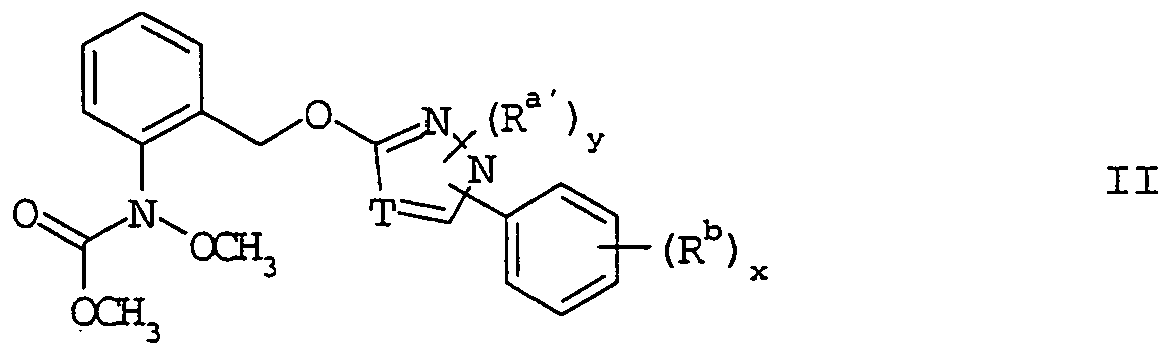
- Insbesondere werden auch Wirkstoffe der Formel II' bevorzugt.


- Besonders bevorzugt sind Wirkstoffe der Formel III, in der V für OCH3 steht und Ra für Halogen, Methyl, Dimethyl oder Trifluormethyl, insbesondere für Methyl steht.
- Im Hinblick auf ihre Verwendung sind die in den folgenden Tabellen zusammengestellten Verbindungen besonders bevorzugt.
Tabelle I 
Nr. T (Ra')y Position der Gruppe Phenyl-(Rb)x (Rb)x Literatur I-1 N - 1 2,4-Cl2 WO-A 96/01256 I-2 N - 1 4-Cl WO-A 96/01256 I-3 CH - 1 2-Cl WO-A 96/01256 I-4 CH - 1 3-Cl WO-A 96/01256 I-5 CH - 1 4-Cl WO-A 96/01256 I-6 CH - 1 4-CH3 WO-A 96/01256 I-7 CH - 1 H WO-A 96/01256 I-8 CH - 1 3-CH3 WO-A 96/01256 I-9 CH 5-CH3 1 3-CF3 WO-A 96/01256 I-10 CH 1-CH3 5 3-CF3 WO-A 99/33812 I-11 CH 1-CH3 5 4-Cl WO-A 99/33812 I-12 CH 1-CH3 5 - WO-A 99/33812 Tabelle II 
Nr. V Y Ra Literatur II-1 OCH3 N 2-CH3 EP-A 253 213 II-2 OCH3 N 2,5-(CH3)2 EP-A 253 213 II-3 NHCH3 N 2,5-(CH3)2 EP-A 477 631 II-4 NHCH3 N 2-Cl EP-A 477 631 II-5 NHCH3 N 2-CH3 EP-A 477 631 II-6 NHCH3 N 2-CH3, 4-OCF3 EP-A 628 540 II-7 NHCH3 N 2-Cl, 4-OCF3 EP-A 628 540 II-8 NHCH3 N 2-CH3, 4-OCH(CH3)-C(CH3)=NOCH3 EP-A 11 18 609 II-9 NHCH3 N 2-Cl, 4-OCH(CH3)-C(CH3)=NOCH3 EP-A 11 18 609 II-10 NHCH3 N 2-CH3, 4-OCH(CH3)-C(CH2CH3)=NOCH3 EP-A 11 18 609 II-11 NHCH3 N 2-Cl, 4-OCH(CH3)-C(CH3)=NOCH2CH3 EP-A 11 18 609 Tabelle III 
Nr. V Y T Ra Literatur III-1 OCH3 CH N 2-OCH3, 4-CF3 WO-A 96/16047 III-2 OCH3 CH N 2-OCH(CH3)2, 4-CF3 WO-A 96/16047 III-3 OCH3 CH CH 2-CF3 EP-A 278 595 III-4 OCH3 CH CH 3-CF3 EP-A 278 595 III-5 NHCH3 N CH 3-Cl EP-A 398 692 III-6 NHCH3 N CH 3-CF3 EP-A 398 692 III-7 NHCH3 N CH 3-CF3, 5-Cl EP-A 398 692 III-8 NHCH3 N CH 3-Cl, 5-CF3 EP-A 398 692 Tabelle IV 
Nr. V Y R1 B Literatur IV-1 OCH3 CH CH3 (3-CF3)C6H4 EP-A 370 629 IV-2 OCH3 CH CH3 (3,5-Cl2)C6H3 EP-A 370 629 IV-3 NHCH3 N CH3 (3-CF3)C6H4 WO-A 92/13830 IV-4 NHCH3 N CH3 (3-OCF3)C6H4 WO-A 92/13830 IV-5 OCH3 N CH3 (3-OCF3)C6H4 EP-A 460 575 IV-6 OCH3 N CH3 (3-CF3)C6H4 EP-A 460 575 IV-7 OCH3 N CH3 (3, 4-Cl2)C6H3 EP-A 460 575 IV-8 OCH3 N CH3 (3,5-Cl2)C6H3 EP-A 463 488 Tabelle V 
Nr. V R1 R2 R3 Literatur V-1 OCH3 CH3 CH3 CH3 WO-A 95/18789 V-2 OCH3 CH3 CH(CH3)2 CH3 WO-A 95/18789 V-3 OCH3 CH3 CH2CH3 CH3 WO-A 95/18789 V-4 NHCH3 CH3 CH3 CH3 WO-A 95/18789 V-5 NHCH3 CH3 4-F-C6H4 CH3 WO-A 95/18789 V-6 NHCH3 CH3 4-Cl-C6H4 CH3 WO-A 95/18789 V-7 NHCH3 CH3 2,4-Cl2-C6H3 CH3 WO-A 95/18789 V-8 NHCH3 Cl 4-F-C6H4 CH3 WO-A 98/38857 V-9 NHCH3 Cl 4-Cl-C6H4 CH2CH3 WO-A 98/38857 V-10 NHCH3 CH3 CH2C(=CH2)CH3 CH3 WO-A 97/05103 V-11 NHCH3 CH3 CH=C(CH3)2 CH3 WO-A 97/05103 V-12 NHCH3 CH3 CH=C(CH3)2 CH2CH3 WO-A 97/05103 V-13 NHCH3 CH3 CH=C(CH3)CH2CH3 CH3 WO-A 97/05103 V-14 NHCH3 CH3 O-CH(CH3)2 CH3 WO-A 97/06133 V-15 NHCH3 CH3 O-CH2CH(CH3)2 CH3 WO-A 97/06133 V-16 NHCH3 CH3 C(CH3)=NOCH3 CH3 WO-A 97/15552 Tabelle VI 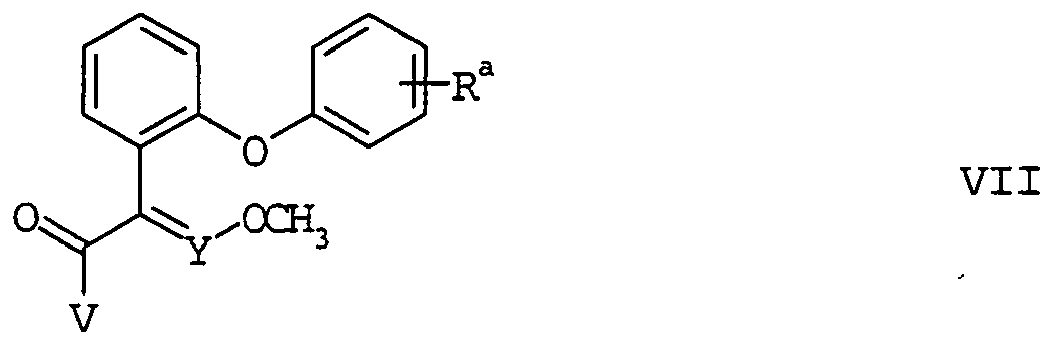
Nr. V Y Ra Literatur VI-1 NHCH3 N H EP-A 398 692 VI-2 NHCH3 N 3-CH3 EP-A 398 692 VI-3 NHCH3 N 2-NO2 EP-A 398 692 VI-4 NHCH3 N 4-NO2 EP-A 398 692 VI-5 NHCH3 N 4-Cl EP-A 398 692 VI-6 NHCH3 N 4-Br EP-A 398 692 Tabelle VII 
Nr. V Y T Ra Literatur VII-1 OCH3 CH N 4-O-(2-CN-C6H4) EP-A 382 375 VII-2 OCH3 CH N 4-O-(2-Cl-C6H4) EP-A 382 375 VII-3 OCH3 CH N 4-O-(2-CH3-C6H4) EP-A 382 375 VII-4 NHCH3 N N 4-O-(2-Cl-C6H4) GB-A 22 53 624 VII-5 NHCH3 N N 4-O-(2,4-Cl2-C6H3) GB-A 22 53 624 VII-6 NHCH3 N N 4-O-(2-CH3-C6H4) GB-A 22 53 624 VII-7 NHCH3 N N 4-O-(2-CH3,3-Cl-C6H3) GB-A 22 53 624 VII-8 NHCH3 N N 4-O-(2-CH3-C6H4), 5-F WO-A 98/21189 VII-9 NHCH3 N N 4-O-(2-Cl-C6H4), 5-F WO-A 98/21189 VII-10 NHCH3 N N 4-O-(2-CH3, 3-Cl-C6H3), 5-F WO-A 98/21189 VII-11 NHCH3 N N 4-O-(2-Cl, 3-CH3-C6H3), 5-F WO-A 98/21189 - Die Verbindungen I erhöhen die Resistenz von Pflanzen gegen Bakteriosen. Besondere Bedeutung haben sie für die Bekämpfung von Bakterien an verschiedenen Kulturpflanzen wie Gemüse, Obstgehözen und Tabak, sowie an den Samen dieser Pflanzen.
- Speziell eignen sie sich zur Bekämpfung folgender Pflanzenkrankheiten:
- Pseudomona-Arten an Tabak, Kartoffeln, Tomaten und Hülsenfrüchten und, insbesondere,
- Erwinia-Arten an Obst, Gemüse und Kartoffeln.
- Besonders eignen sich Verbindungen der Formel III, insbesondere Verbindung II-1, zur Bekämpfung von Erwinia-Arten.
- Die Verbindungen I werden angewendet, indem man die vor Bakterienbefall zu schützenden Pflanzen, Saatgüter oder den Erdboden mit einer wirksamen Menge der Wirkstoffe behandelt. Die Anwendung erfolgt vor der Infektion der Pflanzen oder Samen durch die Bakterien. Hierdurch ist eine deutlich reduzierte Anfälligkeit der Pflanze gegen Bakteriosen zu verzeichnen.
- Die Aufwandmengen liegen bei der Anwendung im Pflanzenschutz je nach Art des Erregers und der Pflanze zwischen 0,01 und 2,0 kg Wirkstoff pro ha.
- Bei der Saatgutbehandlung werden im allgemeinen Wirkstoffmengen von 0,001 bis 0,1 g, vorzugsweise 0,01 bis 0,05 g je Kilogramm Saatgut benötigt.
- Die Verbindungen I können in die für Fungizide üblichen Formulierungen überführt werden, z.B. Lösungen, Emulsionen, Suspensionen, Stäube, Pulver, Pasten und Granulate. Die Anwendungsform richtet sich nach dem jeweiligen Verwendungszweck; sie soll in jedem Fall eine feine und gleichmäßige Verteilung der erfindungsgemäßen Verbindung gewährleisten.
- Die Formulierungen werden in bekannter Weise hergestellt, z.B. durch Verstrecken des Wirkstoffs mit Lösungsmitteln und/oder Trägerstoffen, gewünschtenfalls unter Verwendung von Emulgiermitteln und Dispergiermitteln, wobei im Falle von Wasser als Verdünnungsmittel auch andere organische Lösungsmittel als Hilfslösungsmittel verwendet werden können. Als Hilfsstoffe kommen im wesentlichen die auch bei Fungiziden Üblichen in Betracht.
- Die Formulierungen enthalten im allgemeinen zwischen 0,01 und 95 Gew.-%, vorzugsweise zwischen 0,1 und 90 Gew.-% des Wirkstoffs. Die Wirkstoffe werden dabei in einer Reinheit von 90% bis 100%, vorzugsweise 95% bis 100% (nach NMR-Spektrum) eingesetzt.
- Beispiele für Formulierungen sind:
- I. 5 Gew.-Teile einer erfindungsgemäßen Verbindung werden mit 95 Gew.-Teilen feinteiligem Kaolin innig vermischt. Man erhält auf diese Weise ein Stäubemittel, das 5 Gew.-% des Wirkstoffs enthält.
- II. 30 Gew.-Teile einer erfindungsgemäßen Verbindung werden mit einer Mischung aus 92 Gew.-Teilen pulverförmigem Kieselsäuregel und8 Gew.-Teilen Paraffinöl, das auf die Oberfläche dieses Kieselsäuregels gesprüht wurde, innig vermischt. Man erhält auf diese Weise eine Aufbereitung des Wirkstoffs mit guter Haftfähigkeit (Wirkstoffgehalt 23 Gew.-%).
- III. 10 Gew.-Teile einer erfindungsgemäßen Verbindung werden in einer Mischung gelöst, die aus 90 Gew.-Teilen Xylol, 6 Gew.-Teilen des Anlagerungsproduktes von 8 bis 10 Mol Ethylenoxid an 1Mol Ölsäure-N-monoethanolamid, 2 Gew.-Teilen Calciumsalz der Dodecylbenzolsulfonsäure und 2 Gew.-Teilen des Anlagerungsproduktes von 40 Mol Ethylenoxid an 1 Mol Ricinusöl besteht (Wirkstoffgehalt 9 Gew.-%).
- IV. 20 Gew.-Teile einer erfindungsgemäßen Verbindung werden in einer Mischung gelöst, die aus 60 Gew.-Teilen Cyclohexanon, 30 Gew.-Teilen Isobutanol, 5 Gew.-Teilen des Anlagerungsproduktes von 7 Mol Ethylenoxid an 1 Mol Isooctylphenol und 5Gew.-Teilen des Anlagerungsproduktes von 40 Mol Ethylenoxid an 1 Mol Ricinusöl besteht (Wirkstoffgehalt 16 Gew.-%).
- V. 80 Gew.-Teile einer erfindungsgemäßen Verbindung werden mit 3 Gew.-Teilen des Natriumsalzes der Diisobutylnaphthalin-alpha-sulfonsäure, 10 Gew.-Teilen des Natriumsalzes einer Ligninsulfonsäure aus einer Sulfit-Ablauge und 7 Gew.-Teilen pulverförmigem Kieselsäuregel gut vermischt und in einer Hammermühle vermahlen (Wirkstoffgehalt 80 Gew.-%).
- VI. Man vermischt 90 Gew.-Teile einer erfindungsgemäßen Verbindung mit 10 Gew.-Teilen N-Methyl-α-pyrrolidon und erhält eine Lösung, die zur Anwendung in Form kleinster Tropfen geeignet ist (Wirkstoffgehalt 90 Ges.-%).
- VII. 20 Gew.-Teile einer erfindungsgemäßen Verbindung werden in einer Mischung gelöst, die aus 40 Gew.-Teilen Cyclohexanon, 30Gew.-Teilen Isobutanol, 20 Gew.-Teilen des Anlagerungsproduktes von 7 Mol Ethylenoxid an 1 Mol Isooctylphenol und 10 Gew.-Teilen des Anlagerungsproduktes von 40 Mol Ethylenoxid an 1 Mol Ricinusöl besteht. Durch Eingießen und feines Verteilen der Lösung in 100 000 Gew.-Teilen Wasser erhält man eine wäßrige Dispersion, die 0,02 Gew.-% des Wirkstoffs enthält.
- VIII. 20 Gew.-Teile einer erfindungsgemäßen Verbindung werden mit 3 Gew.-Teilen des Natriumsalzes der Diisobutylnaphthalin-α-sulfonsäure, 17 Gew.-Teilen des Natriumsalzes einer Ligninsulfonsäure aus einer Sulfit-Ablauge und 60 Gew.-Teilen pulverförmigem Kieselsäuregel gut vermischt und in einer Hammermühle vermahlen. Durch feines Verteilen der Mischung in 20000 Gew.-Teilen Wasser erhält man eine Spritzbrühe, die 0,1 Gew.-% des Wirkstoffs enthält.
- Wäßrige Anwendungsformen können üblicherweise aus Emulsionskonzentraten, Pasten oder netzbaren Pulvern (Spritzpulver, Öldispersionen) durch Zusatz von Wasser bereitet werden. Zur Herstellung von Emulsionen, Pasten oder Öldispersionen können die Substanzen als solche oder in einem Öl oder Lösungsmittel gelöst, mittels Netz-, Haft-, Dispergier- oder Emulgiermitttel in Wasser homogenisiert werden. Es können aber auch aus wirksamer Substanz Netz-, Haft-, Dispergier- oder Emulgiermittel und eventuell Lösungsmittel oder Öl bestehende Konzentrate hergestellt werden, die zur Verdünnung mit Wasser geeignet sind. Die Wirkstoffkonzentrationen in den anwendungsfertigen Zubereitungen können in größeren Bereichen variiert werden. Im allgemeinen liegen sie zwischen 0,0001 und 10%, vorzugsweise zwischen 0,01 und 1%.
- Die Wirkstoffe können auch mit gutem Erfolg im Ultra-Low-Volume-Verfahren (ULV) verwendet werden, wobei es möglich ist, Formulierungen mit mehr als 95 Gew.-% Wirkstoff oder sogar den Wirkstoff ohne Zusätze auszubringen.
- Zu den Wirkstoffen können Öle verschiedenen Typs, Herbizide, andere Fungizide, andere Schädlingsbekämpfungsmittel, Bakterizide, gegebenenfalls auch erst unmittelbar vor der Anwendung (Tankmix), zugesetzt werden. Diese Mittel können zu den erfindungsgemäßen Mitteln im Gewichtsverhältnis 1:10 bis 10:1 zugemischt werden.
- Der Hinweis auf die Resistenzinduktionswirkung der Wirkstoffe I gegen Bakterien kann als Verpackungsaufdruck oder in Produktdatenblättern erfolgen. Der Hinweis kann auch bei Präparaten erfolgen, die mit den Wirkstoffen I in Kombination angewendet werden können.
- Die Resistenzinduktion kann auch eine Indikation sein, die Gegenstand einer behördlichen Zulassung der Wirkstoffe I sein kann.
- Die Wirkung der Verbindungen der Formel I ließ sich durch die folgenden Versuche zeigen:
- Anwendungsbeispiele für die Resistenzinduktion gegen Bakterien
- Für die Versuche wurden Tabakpflanzen (Nicotinia tabacum cv. Xanthi-nc) bei 25°C, 59% Luftfeuchte und einer täglichen Lichtperiode von 16 Stunden (150-200 µM Quanten/s-1/m-2) für 6 bis 8 Wochen in Pikiererde (Einheitserde Typ ED 73) angezogen. Ein Teil der Pflanzen wurde einmal wöchentlich gedüngt, indem dem Gießwasser ein kommerzieller Blumendünger (10% Gesamtstickstoff, 9% Phosphat; 7% Kalium) in der empfohlenen Dosierung zugesetzt wurde.
- Der Wirkstoff wurde als 0,1 mM wässrige Lösung (Verdünnungen mit 1% v/v Dimethylsulfoxid [DMSO]) auf die Pflanzen gesprüht oder direkt mit Hilfe einer sehr dünnen Injektionskanüle in das Blattgewebe infiltriert. Die Kontrollpflanzen wurden mit wirkstofffreien Lösungen analog behandelt. Um den Einfluß biologischer Streuungen zu minimieren wurde in einigen Versuchen jeweils die Hälfte eines Blattes (links oder rechts von der Mittelrippe) mit Wirkstofflösung, die andere Hälfte des selben Blattes mit Kontrolllösungen behandelt.
- Nach der Applikation und auch nach späterer Inokulation mit Pseudomonas syringae verblieben die Pflanzen in der Anzuchtkammer.
- Die wie voranstehend beschrieben mit Wirkstoff applizierten Tabakpflanzen bzw. -blätter wurden mit Pseudomonas syringae pv. tomato (strain DC3000; Herkunft: Brian Staskawicz, University of California, Berkeley, CA) oder Pseudomonas syringae pv. tabaci (Deutsche Sammlung von Mikroorganismen und Zellkulturen, Braunschweig, Deutschland), infiziert. Dazu wurden die Bakterien 1 Tag bei 30°C auf King's B Medium angezogen, zentrifugiert, gewaschen und in einer 10mM MgCl2-Lösung auf eine Dichte von 105 cfu ml-1 eingestellt. Etwa 200 µl (2x10⁴ cfu ml-1) dieses Inokulums wurden über kleine Blattverletzungen, die mit einer Kanüle gesetzt wurden, direkt in das Blattgewebe infiltriert.
- In der folgenden Woche wurde die Ausprägung von Blattnekrosen als Folge der Infektion bestimmt. Das Ausbleiben nekrotischer Symptome ist dabei kennzeichnend für die induzierte Resistenz des Blattgewebes.
- Zur Quantifizierung der Bakterienpopulation wurden je zwei Blattstücke (Ø 1 cm) aus infizierten Blattbereichen ausgestanzt und in 500 µL sterilem Wasser homogenisiert. Eine Verdünnungsreihe davon wurde auf King's B Agar ausplattiert und nach 2 Tagen Inkubation bei 30°C aus der Anzahl der gebildeten Kolonien die Dichte der Ausgangspopulation (cfu) pro Blattscheibe errechnet.
- Erhöhte Resistenz gegen Pseudomonas syringae pv. tomato DC3000 (inkompatible Interaktion) und verzögerte Bildung von Krankheitssymptomen, hervorgerufen durch Pseudomonas syringae pv. tabaci (kompatible Interaktion) an Tabakblättern nach Behandlung mit Wirkstoff I-5.
- Durch die Applikation (24 bis 48 Stunden vor Inokulation) mit ≤ 0,01 %igen Zubereitung des Wirkstoffs I-5 wird im Falle einer kompatiblen Wirt-Pathogen-Kombination das Bakterienwachstum unterdrückt und die Ausbildung von Krankheitssymptomen vermindert.
- Der Verlauf der Wachstumskinetik von Pseudomonas syringae pv. tabaci nach Animpfen von King B-Medium mit einer Kolonie zeigte in An-, bzw. Abwesenheit von Wirkstoff I-5, dass der Wirkstoff selbst keinen Einfluß auf das Bakterienwachstum in vitro hat.
- Der beobachtete Effekt beruht daher auf einer Stimulation der pflanzeneigenen Abwehr bzw. Resistenz gegenüber dem Pathogen.
Tabelle A: Wachstum von Pseudomonas syringae pv. tabaci in inokulierten Tabakblättern Zeit [Std.] Bakterien (x106 Zellen/ml (Blattscheibe-1) Wirkstoff I-5 Kontrolle 0 0 0 16 0,3 0,3 24 1,2 3,3 48 1,4 3,7 - Auch im Falle einer inkompatiblen Interaktion (d.h., die Pflanze reagiert von sich aus rasch auf eingedrungene Pathogene mit der Bildung von ("Abwehr"-)Nekrosen, bei der allerdings die infizierten Gewebsbereiche absterben, wird die Symptomausprägung stark verringert.
Tabelle B: Befallsverlauf bei Tabakblättern nach Inokulation eines Interkostalfeldes mit Pseudomonas syringae pv. tomato DC3000 Zeit [Std.] Blattveränderungen (Flächen-% des Interkostalfeldes) Wirkstoff I-5 Kontrolle Welkesymtome Nekrosen Welkesymtome Nekrosen 0 0 0 0 0 24 0 0 100 0 48 0 5 - 100 72 0 8 - 100 144 0 15 - 100 168 0 20 - 100 - Nach Applikation der Zubereitung des Wirkstoffs I-5 beschränkten sich die wenigen nekrotisierten Bereiche direkt auf die Inokulationsstellen an den Blattverletzungen. Die Blätter der Kontrollpflanzen waren nach 24 Std. welk und nach 48 vollständig abgestorben.
behandelt, die von den Pflanzen oder Saatgütern aufgenommen wird. Daneben berifft die Erfindung generell die Verwendung der Verbindungen der Formel I zur Immunisierung von Pflanzen gegen Bakteriosen.
Claims (11)
- Verfahren zur Immunisierung von Pflanzen gegen Bakteriosen, dadurch gekennzeichnet, daß man die Pflanzen, den Boden oder Saatgüter mit einer wirksamen Menge einer Verbindung der Formel I,
 X Halogen, C1-C4-Alkyl oder Trifluormethyl;m 0 oder 1:Q C(=CH-CH3)-COOCH3, C(=CH-OCH3)-COOCH3, C(=N-OCH3)-CONHCH3, C(=N-OCH3)-COOCH3 oder N(-OCH3)-COOCH3:A -O-B, -CH2O-B, -OCH2-B. -CH=CH-B, -C≡C-B, -CH2O-N=C(R1)-B oder -CH2O-N=C(R1)-C(R2)=N-OR3, wobeiB Phenyl, Naphthyl, 5-gliedriges oder 6-gliedrige Hetaryl oder 5-gliedriges oder 6-gliedriges Heterocyclyl, enthaltend ein bis drei N-Atome und/oder ein O- oder S-Atom oder ein oder zwei O- und/oder S-Atome, wobei die Ringsysteme unsubstituiert oder substituiert sind durch einen bis drei Reste Ra:Ra Cyano, Nitro, Amino, Aminocarbonyl, Aminothiocarbonyl, Halogen, C1-C6-Alkyl, C1-C6-Halogenalkyl, C1-C6-Alkylcarbonyl, C1-C6-Alkylsulfonyl, C1-C6-Alkylsulfoxyl, C3-C6-Cycloalkyl, C1-C6-Alkoxy, C1-C6-Halogenalkoxy, C1-C6-Alkyloxycarbonyl, C1-C6-Alkylthio, C1-C6-Alkylamino, Di-C1-C6-Alkylamino, C1-C6-Alkylaminocarbonyl, Di-C1-C6-Alkylaminocarbonyl, C1-C6-Alkylaminothiocarbonyl, Di-C1-C6-Alkylaminothiocarbonyl, C2-C6-Alkenyl, C2-C6-Alkenyloxy, Phenyl, Phenoxy, Benzyl, Benzyloxy, 5- oder 6-gliedriges Heterocyclyl, 5- oder 6-gliedrige Hetaryl, 5- oder 6-gliedriges Hetaryloxy, C(=NORα)-ORβ oderOC(Rα)2-C(Rβ)=NORβ,
wobei die cyclischen Reste ihrerseits unsubstituiert oder substituiert sind durch einen bis drei Reste Rb:Rb Cyano, Nitro, Halogen, Amino, Aminocarbonyl, Aminothiocarbonyl, C1-C6-Alkyl, C1-C6-Halogenalkyl, C1-C6-Alkylsulfonyl, C1-C6-Alkylsulfoxyl, C3-C6-Cycloalkyl, C1-C6-Alkoxy, C1-C6-Halogenalkoxy, C1-C6-Alkoxycarbanyl, C1-C6-Alkylthio, C1-C6-Alkylamino, Di-C1-C6-alkylamino, C1-C6-Alkylamnocarbonyl, Di-C1-C6-alkylaminocarbonyl, C1-C6-Alkylaminothiocarbonyl, Di-C1-C6-alkylaminothio-carbonyl, C2-C6-Alkenyl, C2-C6-Alkenyloxy, C3-C6-Cycloalkyl, C3-C6-Cycloalkenyl, Phenyl, Phenoxy, Phenylthio, Benzyl, Benzyloxy, 5- oder 6-gliedriges Heterocyclyl, 5- oder 6-gliedriges Hetaryl, 5- oder 6-gliedriges Hetaryloxy oder C(=NORα )-ORβ;Rα, Rβ Wasserstoff oder C1-C6-Alkyl;R1 Wasserstoff, Cyano, C1-C4-Alkyl, C1-C4-Halogenalkyl, C3-C6-Cycloalkyl, C1-C4-Alkoxy;R2 Phenyl, Phenylcarbonyl, Phenylsulfonyl, 5- oder 6-gliedriges Hetaryl, 5- oder 6-gliedriges Hetarylcarbonyl oder 5- oder 6-gliedriges Hetarylsulfonyl, wobei die Ringsysteme unsubstituiert oder substituiert sind durch ein bis drei Reste Ra; C1-C10-Alkyl, C3-C6-Cycloalkyl, C2-C10-Alkenyl, C2-C10-Alkinyl, C1-C10-Alkylcarbonyl, C2-C10-Alkenylcarbonyl, C3-C10-Alkinylcarbonyl, C1-C10-Alkylsulfonyl, oder C(Rα )=NORβ, wobei die Kohlenwasserstoffreste dieser Gruppen unsubstituiert oder substituiert sind durch einen bis drei Reste Rc:Rc Cyano, Nitro, Amino, Aminocarbonyl, Aminothiocarbonyl, Halogen, C1-C6-Alkyl, C1-C6-Halogenalkyl, C1-C6-Alkylsulfonyl, C1-C6-Alkylsulfoxyl, C1-C6-Alkoxy, C1-C6-Halogenalkoxy, C1-C6- Alkoxycarbonyl, C1-C6-Alkylthio, C1-C6-Alkylamino, Di-C1-C6-alkylamino, C1-C6-Alkylaminocarbonyl, Di-C1-C6-alkylaminocarbonyl, C1-C6-Alkylaminothiocarbonyl Di-C1-C6-alkylaminothiocarbonyl, C2-C6-Alkenyl, C2-C6-Alkenyloxy,
C3-C6-Cycloalkyl, C3-C6-Cycloalkyloxy, 5- oder 6-gliedriges Heterocydyl, 5- oder 6-gliedriges Heterocyclyloxy, Benzyl, Benzyloxy, Phenyl, Phenoxy, Phenylthio, 5- oder 6-gliedriges Hetaryl, 5- oder 6-gliedriges Hetaryloxy und Hetarylthio, wobei die cyclischen Gruppen ihrerseits partiell oder vollständig halogeniert sein können oder einen bis drei Reste Ra tragen können; undR3 Wasserstoff,behandelt, die von den Pflanzen oder Saatgütem aufgenommen wird.
C1-C6-Alkyl, C2-C6-Alkenyl, C2-C6-Alkinyl, wobei die Kohlenwasserstoffreste dieser Gruppen unsubstituiert oder substituiert sind durch einen bis drei Reste Rc; - Verfahren nach Anspruch 1, wobei ein Wirkstoff der Formel I verwendet wird, in dem Q für C(=CH-OCH3)-COOCH3, C(=N-OCH3)-COOCH3 oder N(-OCH3)-COOCH3 steht.
- Verfahren nach Ansprüchen 1 oder 2, wobei der Index m Null bedeutet und die Substituenten in Formel I folgende Bedeutung haben:A -O-B, -CH2O-B, -CH2O-N=C(R1)-B oder CH2-O-N=C(R1)-C(R2)=N-OR3;B Phenyl, Pyridyl, Pyrimidinyl, Pyrazolyl, Triazolyl, wobei diese Ringsysteme substituiert sind durch einen oder zwei Reste Ra;R2 C1-C6-Alkyl, C2-C10-Alkenyl, C3-C6-Cycloalkyl, wobei diese Gruppen unsubstituiert oder substituiert sind durch einen oder zwei Reste Rb';Rb' C1-C6-Alkyl, C3-C6-Cycloalkyl, C1-C6-Alkoxy, C1-C6-Halogenalkoxy, Benzyl, Phenyl oder Phenoxy;
oder Phenyl, das unsubstituiert oder substituiert ist durch ein oder zwei Reste Ra; undR3 C1-C6-Alkyl, C2-C10-Alkenyl oder C2-C10-Alkinyl. - Verfahren nach Ansprüchen 1 bis 3, wobei ein Wirkstoff der Formel II

- Verfahren nach Anspruch 4, wobei ein Wirkstoff der Formel II verwendet wird, in der T für CH und Rb für Cl steht sowie x 1 und y Null bedeutet.
- Verfahren nach Ansprüchen 1 bis 3, wobei ein Wirkstoff der Formel III

- Verfahren nach Anspruch 6, wobei ein Wirkstoff der Formel III verwendet wird, in der Ra für Methyl steht.
- Verfahren nach Ansprüchen 1 bis 7 zur Immunisierung gegen Erwinia- Arten.
- Verfahren nach Ansprüchen 1 bis 8, wobei die Pflanzen behandelt werden.
- Verfahren nach Ansprüchen 1 bis 8, wobei die Saatgüter behandelt werden.
- Verwendung der Verbindungen der Formel 1, II oder III gemäß der Anspn3che 1 bis 7 zur Immunisiervng von Pflanzen gegen Bakteriosen.
Applications Claiming Priority (5)
| Application Number | Priority Date | Filing Date | Title |
|---|---|---|---|
| DE10210473 | 2002-03-11 | ||
| DE10210473 | 2002-03-11 | ||
| US44709603P | 2003-02-13 | 2003-02-13 | |
| US447096P | 2003-02-13 | ||
| PCT/EP2003/002420 WO2003075663A1 (de) | 2002-03-11 | 2003-03-10 | Verfahren zur immunisierung von pflanzen gegen bakteriosen |
Publications (2)
| Publication Number | Publication Date |
|---|---|
| EP1484973A1 EP1484973A1 (de) | 2004-12-15 |
| EP1484973B1 true EP1484973B1 (de) | 2012-05-09 |
Family
ID=27806074
Family Applications (1)
| Application Number | Title | Priority Date | Filing Date |
|---|---|---|---|
| EP03708204A Expired - Lifetime EP1484973B1 (de) | 2002-03-11 | 2003-03-10 | Verfahren zur immunisierung von pflanzen gegen bakteriosen |
Country Status (12)
| Country | Link |
|---|---|
| EP (1) | EP1484973B1 (de) |
| CN (1) | CN100345483C (de) |
| AU (1) | AU2003212325B2 (de) |
| BR (1) | BR0308325A8 (de) |
| CA (1) | CA2478591C (de) |
| EA (1) | EA012135B1 (de) |
| IL (1) | IL163465A (de) |
| MX (1) | MXPA04008043A (de) |
| NZ (1) | NZ534978A (de) |
| PL (1) | PL211515B1 (de) |
| TW (1) | TWI349525B (de) |
| WO (1) | WO2003075663A1 (de) |
Families Citing this family (24)
| Publication number | Priority date | Publication date | Assignee | Title |
|---|---|---|---|---|
| JP5175109B2 (ja) | 2005-02-21 | 2013-04-03 | ビーエーエスエフ ソシエタス・ヨーロピア | 少なくとも1種の窒素原子含有ハイパーブランチポリマーを含む活性物質組成物 |
| DK1926370T3 (da) | 2005-09-13 | 2013-03-25 | Isagro Spa | Fremgangsmåde til beskyttelse mod fytopatogener med kiralaxyl, tilsvarende anvendelse og middel dertil |
| KR20080061408A (ko) * | 2005-10-28 | 2008-07-02 | 바스프 에스이 | 유해 진균에 대한 저항성을 유도하는 방법 |
| CN101400260A (zh) * | 2006-03-14 | 2009-04-01 | 巴斯夫欧洲公司 | 诱导植物对细菌病害耐受性的方法 |
| KR20080111058A (ko) * | 2006-03-14 | 2008-12-22 | 바스프 에스이 | 세균증에 대해 식물의 내성을 유도하는 방법 |
| PT2001294T (pt) | 2006-03-24 | 2017-01-13 | Basf Se | Método para combater fungos fitopatogénicos |
| KR20080111021A (ko) * | 2006-03-29 | 2008-12-22 | 바스프 에스이 | 철 대사 장애의 치료를 위한 스트로빌루린의 용도 |
| EP2676680A1 (de) | 2007-09-13 | 2013-12-25 | Basf Se | Verwendung von Hydrophobin-Polipeptiden als Penetrationsverstärker |
| NZ585882A (en) * | 2007-12-21 | 2012-05-25 | Basf Se | Method of increasing the milk and/or meat quantity of animals fed with silage from strobilurin treated plants |
| US20110312497A1 (en) | 2009-02-10 | 2011-12-22 | Basf Se | Use of hydrophobin as a spreading agent |
| US20120129696A1 (en) | 2009-07-28 | 2012-05-24 | Basf Se | Method for increasing the level of free amino acids in storage tissues of perennial plants |
| NZ598965A (en) | 2009-09-25 | 2013-03-28 | Basf Se | Method for reducing pistillate flower abortion in plants using at least one strobilurin |
| WO2011095449A1 (de) | 2010-02-05 | 2011-08-11 | Basf Se | Verfahren zur solubilisierung von hydrophoben wirkstoffen in wässrigem medium |
| US8728504B2 (en) | 2010-02-05 | 2014-05-20 | Basf Se | Process for solubilizing hydrophobic active ingredients in aqueous medium |
| US20130085066A1 (en) | 2010-05-31 | 2013-04-04 | Basf Se | Method for Increasing the Health of a Plant |
| US20130274104A1 (en) | 2010-12-22 | 2013-10-17 | Basf Se | Agrochemical mixtures for increasing the health of a plant |
| EP2688405B1 (de) | 2011-03-23 | 2017-11-22 | Basf Se | Zusammensetzungen mit polymeren, ionischen verbindungen mit imidazoliumgruppen |
| EP3050919A1 (de) | 2015-01-29 | 2016-08-03 | Basf Se | Lignocellulosehaltige materialen enthaltend mischungen mit salzen von n-substituierten carbamidsäuren |
| AU2022413634A1 (en) | 2021-12-17 | 2024-06-27 | Basf Se | Lactones for enhancing the activity of antimicrobial agents |
| KR20240121836A (ko) | 2021-12-17 | 2024-08-09 | 바스프 에스이 | 항미생물제 및 카르복스아미드를 포함하는 조성물 |
| EP4289273A1 (de) | 2022-06-07 | 2023-12-13 | Basf Se | Zusammensetzung, die ein antimikrobielles mittel und ein n-cyclohexyldiazeniumdioxysalz umfasst |
| EP4385328A1 (de) | 2022-12-15 | 2024-06-19 | Basf Se | Alpha-hydroxyketone zur verbesserung der wirkung antimikrobieller mittel |
| KR20250172867A (ko) | 2023-04-17 | 2025-12-09 | 바스프 에스이 | 항미생물제 및 알콕실화 아민을 포함하는 조성물 |
| WO2025157800A1 (en) | 2024-01-22 | 2025-07-31 | Basf Se | Biocidal composition comprising an alkoxylated amine and an organic solvent |
Family Cites Families (3)
| Publication number | Priority date | Publication date | Assignee | Title |
|---|---|---|---|---|
| DE19775050I2 (de) * | 1987-08-21 | 2010-12-16 | Syngenta Participations Ag | Benzothiadiazole und ihre Verwendung in Verfahren und Mitteln gegen Pflanzenkrankheiten. |
| EP1194416B1 (de) * | 1999-06-18 | 2004-09-08 | Bayer CropScience AG | Halogenpyrimidine |
| DK1278415T3 (da) * | 2000-05-03 | 2004-01-26 | Basf Ag | Fremgangsmåde til induktion af virusresistens i planter |
-
2003
- 2003-03-10 PL PL372938A patent/PL211515B1/pl unknown
- 2003-03-10 BR BRPI0308325A patent/BR0308325A8/pt active IP Right Grant
- 2003-03-10 CN CNB038057417A patent/CN100345483C/zh not_active Expired - Fee Related
- 2003-03-10 AU AU2003212325A patent/AU2003212325B2/en not_active Ceased
- 2003-03-10 EA EA200401131A patent/EA012135B1/ru not_active IP Right Cessation
- 2003-03-10 NZ NZ534978A patent/NZ534978A/xx not_active IP Right Cessation
- 2003-03-10 CA CA2478591A patent/CA2478591C/en not_active Expired - Fee Related
- 2003-03-10 WO PCT/EP2003/002420 patent/WO2003075663A1/de not_active Ceased
- 2003-03-10 MX MXPA04008043A patent/MXPA04008043A/es active IP Right Grant
- 2003-03-10 EP EP03708204A patent/EP1484973B1/de not_active Expired - Lifetime
- 2003-03-11 TW TW092105211A patent/TWI349525B/zh not_active IP Right Cessation
-
2004
- 2004-08-11 IL IL163465A patent/IL163465A/en not_active IP Right Cessation
Also Published As
| Publication number | Publication date |
|---|---|
| BR0308325A8 (pt) | 2018-03-20 |
| AU2003212325B8 (en) | 2003-09-22 |
| AU2003212325B2 (en) | 2007-08-23 |
| TWI349525B (en) | 2011-10-01 |
| MXPA04008043A (es) | 2004-11-26 |
| CN1642424A (zh) | 2005-07-20 |
| EP1484973A1 (de) | 2004-12-15 |
| AU2003212325A1 (en) | 2003-09-22 |
| TW200408350A (en) | 2004-06-01 |
| WO2003075663A1 (de) | 2003-09-18 |
| BR0308325A (pt) | 2004-12-28 |
| BR0308325B1 (pt) | 2014-10-07 |
| IL163465A (en) | 2010-05-31 |
| NZ534978A (en) | 2006-03-31 |
| CN100345483C (zh) | 2007-10-31 |
| PL372938A1 (en) | 2005-08-08 |
| EA200401131A1 (ru) | 2005-02-24 |
| CA2478591C (en) | 2012-01-03 |
| EA012135B1 (ru) | 2009-08-28 |
| CA2478591A1 (en) | 2003-09-18 |
| PL211515B1 (pl) | 2012-05-31 |
Similar Documents
| Publication | Publication Date | Title |
|---|---|---|
| EP1484973A1 (de) | Verfahren zur immunisierung von pflanzen gegen bakteriosen | |
| EP1651040B1 (de) | Fungizide ternäre wirkstoffkombinationen | |
| EP1278415B1 (de) | Verfahren zur induktion der virenresistenz von pflanzen | |
| EP1276375B1 (de) | Fungizide wirkstoffkombinationen | |
| DD232418A5 (de) | Verwendung von aryloxy-verbindungen als antidots | |
| WO2001084931A1 (de) | Fungizide wirkstoffkombinationen | |
| EP1947941A1 (de) | Fungizide mischungen enthaltend boscalid und pyrimethanil | |
| DE69402223T2 (de) | Antimikrobielle und fungizide Zusammensetzungen enthaltend Siliziumverbindungen, und ihre Verwendung in der Landwirtschaft und in Gartenbau | |
| DE3605551A1 (de) | Fungizide mittel | |
| WO1996032015A1 (de) | Synergistische fungizide zusammensetzungen aus chinolinderivaten und cytochrom b/c-inhibitors | |
| WO2024214121A1 (en) | Insecticidal composition comprising 2-sec-butylphenyl methylcarbamate | |
| EP0296319B1 (de) | Herbizide Mittel auf der Basis von Heteroaryloxyphenoxycarbonsäure-Derivaten | |
| CN100393212C (zh) | 一种杀菌、杀虫组合物 | |
| EP1041881B1 (de) | Fungizide mischungen auf der basis von pyridincarboxamiden | |
| DD228155A5 (de) | Fungizides und insektizides mittel | |
| EP0515934B1 (de) | Verwendung von 1-Thiocarbamoyl 5-hydroxy-pyrazolen als Mikrobizide, 1-Thiocarbamoyl 5-hydroxy-pyrazole und Verfahren zu ihrer Herstellung | |
| DE3129193A1 (de) | Azolderivate, verfahren zu ihrer herstellung und ihre verwendung als schaedlingsbekaempfungsmittel | |
| WO1998041094A1 (de) | Fungizide mischung | |
| KR100976938B1 (ko) | 세균증에 대해 식물을 면역시키는 방법 | |
| DE69833677T2 (de) | Chloracetamid zusammensetzungen mit unterdrückter fällung | |
| EP0023539B1 (de) | 3-(N-1,3,4-Thiadiazolyl-2)-amino-alkyl-acrylsäurealkylester, Verfahren zu ihrer Herstellung und ihre Verwendung als Pflanzenbakterizide | |
| DE3340026A1 (de) | Triazinone, verfahren zur herstellung dieser verbindungen sowie diese enthaltende mittel mit herbizider wirkung | |
| DE3013104A1 (de) | Fungizide cyanimidodithiokohlensaeureester | |
| DD297959A5 (de) | N-vinyl-3-cyano-4-phenyl-pyrrol-derivate | |
| DE3206900A1 (de) | Neue dichlorpyrimidin(thio)-carbonsaeure-derivate, verfahren zu ihrer herstellung, diese enthaltende mittel und deren verwendung als fungizide und bakterizide |
Legal Events
| Date | Code | Title | Description |
|---|---|---|---|
| PUAI | Public reference made under article 153(3) epc to a published international application that has entered the european phase |
Free format text: ORIGINAL CODE: 0009012 |
|
| 17P | Request for examination filed |
Effective date: 20041011 |
|
| AK | Designated contracting states |
Kind code of ref document: A1 Designated state(s): AT BE BG CH CY CZ DE DK EE ES FI FR GB GR HU IE IT LI LU MC NL PT RO SE SI SK TR |
|
| AX | Request for extension of the european patent |
Extension state: AL LT LV MK |
|
| RAP1 | Party data changed (applicant data changed or rights of an application transferred) |
Owner name: BASF SE |
|
| 17Q | First examination report despatched |
Effective date: 20090826 |
|
| GRAP | Despatch of communication of intention to grant a patent |
Free format text: ORIGINAL CODE: EPIDOSNIGR1 |
|
| GRAS | Grant fee paid |
Free format text: ORIGINAL CODE: EPIDOSNIGR3 |
|
| GRAA | (expected) grant |
Free format text: ORIGINAL CODE: 0009210 |
|
| AK | Designated contracting states |
Kind code of ref document: B1 Designated state(s): AT BE BG CH CY CZ DE DK EE ES FI FR GB GR HU IE IT LI LU MC NL PT RO SE SI SK TR |
|
| AX | Request for extension of the european patent |
Extension state: LT LV |
|
| REG | Reference to a national code |
Ref country code: GB Ref legal event code: FG4D Free format text: NOT ENGLISH |
|
| REG | Reference to a national code |
Ref country code: CH Ref legal event code: EP Ref country code: AT Ref legal event code: REF Ref document number: 556592 Country of ref document: AT Kind code of ref document: T Effective date: 20120515 |
|
| REG | Reference to a national code |
Ref country code: IE Ref legal event code: FG4D Free format text: LANGUAGE OF EP DOCUMENT: GERMAN Ref country code: PT Ref legal event code: SC4A Free format text: AVAILABILITY OF NATIONAL TRANSLATION Effective date: 20120530 |
|
| REG | Reference to a national code |
Ref country code: DE Ref legal event code: R096 Ref document number: 50314329 Country of ref document: DE Effective date: 20120705 |
|
| REG | Reference to a national code |
Ref country code: ES Ref legal event code: FG2A Ref document number: 2385390 Country of ref document: ES Kind code of ref document: T3 Effective date: 20120724 |
|
| REG | Reference to a national code |
Ref country code: RO Ref legal event code: EPE |
|
| REG | Reference to a national code |
Ref country code: SK Ref legal event code: T3 Ref document number: E 11826 Country of ref document: SK |
|
| REG | Reference to a national code |
Ref country code: NL Ref legal event code: T3 |
|
| REG | Reference to a national code |
Ref country code: GR Ref legal event code: EP Ref document number: 20120401411 Country of ref document: GR Effective date: 20120713 |
|
| REG | Reference to a national code |
Ref country code: LT Ref legal event code: MG9D Effective date: 20120509 |
|
| PG25 | Lapsed in a contracting state [announced via postgrant information from national office to epo] |
Ref country code: CY Free format text: LAPSE BECAUSE OF FAILURE TO SUBMIT A TRANSLATION OF THE DESCRIPTION OR TO PAY THE FEE WITHIN THE PRESCRIBED TIME-LIMIT Effective date: 20120509 Ref country code: SE Free format text: LAPSE BECAUSE OF FAILURE TO SUBMIT A TRANSLATION OF THE DESCRIPTION OR TO PAY THE FEE WITHIN THE PRESCRIBED TIME-LIMIT Effective date: 20120509 Ref country code: FI Free format text: LAPSE BECAUSE OF FAILURE TO SUBMIT A TRANSLATION OF THE DESCRIPTION OR TO PAY THE FEE WITHIN THE PRESCRIBED TIME-LIMIT Effective date: 20120509 |
|
| REG | Reference to a national code |
Ref country code: HU Ref legal event code: AG4A Ref document number: E014424 Country of ref document: HU |
|
| PG25 | Lapsed in a contracting state [announced via postgrant information from national office to epo] |
Ref country code: SI Free format text: LAPSE BECAUSE OF FAILURE TO SUBMIT A TRANSLATION OF THE DESCRIPTION OR TO PAY THE FEE WITHIN THE PRESCRIBED TIME-LIMIT Effective date: 20120509 |
|
| PG25 | Lapsed in a contracting state [announced via postgrant information from national office to epo] |
Ref country code: DK Free format text: LAPSE BECAUSE OF FAILURE TO SUBMIT A TRANSLATION OF THE DESCRIPTION OR TO PAY THE FEE WITHIN THE PRESCRIBED TIME-LIMIT Effective date: 20120509 Ref country code: EE Free format text: LAPSE BECAUSE OF FAILURE TO SUBMIT A TRANSLATION OF THE DESCRIPTION OR TO PAY THE FEE WITHIN THE PRESCRIBED TIME-LIMIT Effective date: 20120509 |
|
| PLBE | No opposition filed within time limit |
Free format text: ORIGINAL CODE: 0009261 |
|
| STAA | Information on the status of an ep patent application or granted ep patent |
Free format text: STATUS: NO OPPOSITION FILED WITHIN TIME LIMIT |
|
| 26N | No opposition filed |
Effective date: 20130212 |
|
| PGFP | Annual fee paid to national office [announced via postgrant information from national office to epo] |
Ref country code: RO Payment date: 20130301 Year of fee payment: 11 |
|
| PGFP | Annual fee paid to national office [announced via postgrant information from national office to epo] |
Ref country code: SK Payment date: 20130308 Year of fee payment: 11 |
|
| REG | Reference to a national code |
Ref country code: DE Ref legal event code: R097 Ref document number: 50314329 Country of ref document: DE Effective date: 20130212 |
|
| BERE | Be: lapsed |
Owner name: BASF SE Effective date: 20130331 |
|
| PG25 | Lapsed in a contracting state [announced via postgrant information from national office to epo] |
Ref country code: MC Free format text: LAPSE BECAUSE OF NON-PAYMENT OF DUE FEES Effective date: 20130331 |
|
| REG | Reference to a national code |
Ref country code: CH Ref legal event code: PL |
|
| PG25 | Lapsed in a contracting state [announced via postgrant information from national office to epo] |
Ref country code: LI Free format text: LAPSE BECAUSE OF NON-PAYMENT OF DUE FEES Effective date: 20130331 Ref country code: BE Free format text: LAPSE BECAUSE OF NON-PAYMENT OF DUE FEES Effective date: 20130331 Ref country code: CH Free format text: LAPSE BECAUSE OF NON-PAYMENT OF DUE FEES Effective date: 20130331 |
|
| PGFP | Annual fee paid to national office [announced via postgrant information from national office to epo] |
Ref country code: GB Payment date: 20140331 Year of fee payment: 12 |
|
| PG25 | Lapsed in a contracting state [announced via postgrant information from national office to epo] |
Ref country code: RO Free format text: LAPSE BECAUSE OF NON-PAYMENT OF DUE FEES Effective date: 20140310 |
|
| REG | Reference to a national code |
Ref country code: SK Ref legal event code: MM4A Ref document number: E 11826 Country of ref document: SK Effective date: 20140310 |
|
| PG25 | Lapsed in a contracting state [announced via postgrant information from national office to epo] |
Ref country code: SK Free format text: LAPSE BECAUSE OF NON-PAYMENT OF DUE FEES Effective date: 20140310 |
|
| PGFP | Annual fee paid to national office [announced via postgrant information from national office to epo] |
Ref country code: BG Payment date: 20150313 Year of fee payment: 13 Ref country code: CZ Payment date: 20150305 Year of fee payment: 13 Ref country code: PT Payment date: 20150304 Year of fee payment: 13 Ref country code: IE Payment date: 20150324 Year of fee payment: 13 Ref country code: NL Payment date: 20150323 Year of fee payment: 13 |
|
| PGFP | Annual fee paid to national office [announced via postgrant information from national office to epo] |
Ref country code: GR Payment date: 20150326 Year of fee payment: 13 Ref country code: AT Payment date: 20150326 Year of fee payment: 13 |
|
| PG25 | Lapsed in a contracting state [announced via postgrant information from national office to epo] |
Ref country code: LU Free format text: LAPSE BECAUSE OF NON-PAYMENT OF DUE FEES Effective date: 20130310 |
|
| PGFP | Annual fee paid to national office [announced via postgrant information from national office to epo] |
Ref country code: HU Payment date: 20150619 Year of fee payment: 13 |
|
| GBPC | Gb: european patent ceased through non-payment of renewal fee |
Effective date: 20150310 |
|
| PG25 | Lapsed in a contracting state [announced via postgrant information from national office to epo] |
Ref country code: GB Free format text: LAPSE BECAUSE OF NON-PAYMENT OF DUE FEES Effective date: 20150310 |
|
| REG | Reference to a national code |
Ref country code: FR Ref legal event code: PLFP Year of fee payment: 14 |
|
| REG | Reference to a national code |
Ref country code: AT Ref legal event code: MM01 Ref document number: 556592 Country of ref document: AT Kind code of ref document: T Effective date: 20160310 |
|
| REG | Reference to a national code |
Ref country code: NL Ref legal event code: MM Effective date: 20160401 |
|
| PG25 | Lapsed in a contracting state [announced via postgrant information from national office to epo] |
Ref country code: PT Free format text: LAPSE BECAUSE OF NON-PAYMENT OF DUE FEES Effective date: 20160912 Ref country code: CZ Free format text: LAPSE BECAUSE OF NON-PAYMENT OF DUE FEES Effective date: 20160310 |
|
| REG | Reference to a national code |
Ref country code: IE Ref legal event code: MM4A |
|
| PG25 | Lapsed in a contracting state [announced via postgrant information from national office to epo] |
Ref country code: NL Free format text: LAPSE BECAUSE OF NON-PAYMENT OF DUE FEES Effective date: 20160401 Ref country code: IE Free format text: LAPSE BECAUSE OF NON-PAYMENT OF DUE FEES Effective date: 20160310 Ref country code: HU Free format text: LAPSE BECAUSE OF NON-PAYMENT OF DUE FEES Effective date: 20160311 |
|
| REG | Reference to a national code |
Ref country code: GR Ref legal event code: ML Ref document number: 20120401411 Country of ref document: GR Effective date: 20161006 |
|
| PG25 | Lapsed in a contracting state [announced via postgrant information from national office to epo] |
Ref country code: IT Free format text: LAPSE BECAUSE OF NON-PAYMENT OF DUE FEES Effective date: 20160310 Ref country code: GR Free format text: LAPSE BECAUSE OF NON-PAYMENT OF DUE FEES Effective date: 20161006 Ref country code: AT Free format text: LAPSE BECAUSE OF NON-PAYMENT OF DUE FEES Effective date: 20160310 |
|
| REG | Reference to a national code |
Ref country code: FR Ref legal event code: PLFP Year of fee payment: 15 |
|
| PG25 | Lapsed in a contracting state [announced via postgrant information from national office to epo] |
Ref country code: IT Free format text: LAPSE BECAUSE OF NON-PAYMENT OF DUE FEES Effective date: 20160310 |
|
| PGRI | Patent reinstated in contracting state [announced from national office to epo] |
Ref country code: IT Effective date: 20170710 |
|
| REG | Reference to a national code |
Ref country code: FR Ref legal event code: PLFP Year of fee payment: 16 |
|
| PGFP | Annual fee paid to national office [announced via postgrant information from national office to epo] |
Ref country code: IT Payment date: 20190321 Year of fee payment: 17 |
|
| PGFP | Annual fee paid to national office [announced via postgrant information from national office to epo] |
Ref country code: TR Payment date: 20190226 Year of fee payment: 17 |
|
| PGFP | Annual fee paid to national office [announced via postgrant information from national office to epo] |
Ref country code: DE Payment date: 20190531 Year of fee payment: 17 Ref country code: ES Payment date: 20190425 Year of fee payment: 17 |
|
| PGFP | Annual fee paid to national office [announced via postgrant information from national office to epo] |
Ref country code: FR Payment date: 20190401 Year of fee payment: 17 |
|
| REG | Reference to a national code |
Ref country code: DE Ref legal event code: R119 Ref document number: 50314329 Country of ref document: DE |
|
| PG25 | Lapsed in a contracting state [announced via postgrant information from national office to epo] |
Ref country code: DE Free format text: LAPSE BECAUSE OF NON-PAYMENT OF DUE FEES Effective date: 20201001 Ref country code: FR Free format text: LAPSE BECAUSE OF NON-PAYMENT OF DUE FEES Effective date: 20200331 |
|
| REG | Reference to a national code |
Ref country code: ES Ref legal event code: FD2A Effective date: 20210727 |
|
| PG25 | Lapsed in a contracting state [announced via postgrant information from national office to epo] |
Ref country code: ES Free format text: LAPSE BECAUSE OF NON-PAYMENT OF DUE FEES Effective date: 20200311 |
|
| PG25 | Lapsed in a contracting state [announced via postgrant information from national office to epo] |
Ref country code: TR Free format text: LAPSE BECAUSE OF NON-PAYMENT OF DUE FEES Effective date: 20200310 |
|
| PG25 | Lapsed in a contracting state [announced via postgrant information from national office to epo] |
Ref country code: IT Free format text: LAPSE BECAUSE OF NON-PAYMENT OF DUE FEES Effective date: 20200310 Ref country code: BG Free format text: LAPSE BECAUSE OF NON-PAYMENT OF DUE FEES Effective date: 20160310 |