EP1469656A2 - Mobiltelefon mit einem drehbaren Kameraobjektivgehäuse - Google Patents
Mobiltelefon mit einem drehbaren Kameraobjektivgehäuse Download PDFInfo
- Publication number
- EP1469656A2 EP1469656A2 EP04008781A EP04008781A EP1469656A2 EP 1469656 A2 EP1469656 A2 EP 1469656A2 EP 04008781 A EP04008781 A EP 04008781A EP 04008781 A EP04008781 A EP 04008781A EP 1469656 A2 EP1469656 A2 EP 1469656A2
- Authority
- EP
- European Patent Office
- Prior art keywords
- housing
- camera lens
- hinge
- hinge axis
- mobile phone
- Prior art date
- Legal status (The legal status is an assumption and is not a legal conclusion. Google has not performed a legal analysis and makes no representation as to the accuracy of the status listed.)
- Withdrawn
Links
Images








Classifications
-
- H—ELECTRICITY
- H04—ELECTRIC COMMUNICATION TECHNIQUE
- H04N—PICTORIAL COMMUNICATION, e.g. TELEVISION
- H04N1/00—Scanning, transmission or reproduction of documents or the like, e.g. facsimile transmission; Details thereof
- H04N1/00127—Connection or combination of a still picture apparatus with another apparatus, e.g. for storage, processing or transmission of still picture signals or of information associated with a still picture
- H04N1/00281—Connection or combination of a still picture apparatus with another apparatus, e.g. for storage, processing or transmission of still picture signals or of information associated with a still picture with a telecommunication apparatus, e.g. a switched network of teleprinters for the distribution of text-based information, a selective call terminal
- H04N1/00307—Connection or combination of a still picture apparatus with another apparatus, e.g. for storage, processing or transmission of still picture signals or of information associated with a still picture with a telecommunication apparatus, e.g. a switched network of teleprinters for the distribution of text-based information, a selective call terminal with a mobile telephone apparatus
-
- H—ELECTRICITY
- H04—ELECTRIC COMMUNICATION TECHNIQUE
- H04M—TELEPHONIC COMMUNICATION
- H04M1/00—Substation equipment, e.g. for use by subscribers
- H04M1/02—Constructional features of telephone sets
- H04M1/0202—Portable telephone sets, e.g. cordless phones, mobile phones or bar type handsets
- H04M1/0206—Portable telephones comprising a plurality of mechanically joined movable body parts, e.g. hinged housings
- H04M1/0208—Portable telephones comprising a plurality of mechanically joined movable body parts, e.g. hinged housings characterized by the relative motions of the body parts
- H04M1/021—Portable telephones comprising a plurality of mechanically joined movable body parts, e.g. hinged housings characterized by the relative motions of the body parts using combined folding and rotation motions
-
- H—ELECTRICITY
- H04—ELECTRIC COMMUNICATION TECHNIQUE
- H04M—TELEPHONIC COMMUNICATION
- H04M1/00—Substation equipment, e.g. for use by subscribers
- H04M1/02—Constructional features of telephone sets
- H04M1/0202—Portable telephone sets, e.g. cordless phones, mobile phones or bar type handsets
- H04M1/026—Details of the structure or mounting of specific components
- H04M1/0264—Details of the structure or mounting of specific components for a camera module assembly
-
- H—ELECTRICITY
- H04—ELECTRIC COMMUNICATION TECHNIQUE
- H04N—PICTORIAL COMMUNICATION, e.g. TELEVISION
- H04N23/00—Cameras or camera modules comprising electronic image sensors; Control thereof
- H04N23/50—Constructional details
- H04N23/55—Optical parts specially adapted for electronic image sensors; Mounting thereof
-
- H—ELECTRICITY
- H04—ELECTRIC COMMUNICATION TECHNIQUE
- H04N—PICTORIAL COMMUNICATION, e.g. TELEVISION
- H04N23/00—Cameras or camera modules comprising electronic image sensors; Control thereof
- H04N23/57—Mechanical or electrical details of cameras or camera modules specially adapted for being embedded in other devices
-
- H—ELECTRICITY
- H04—ELECTRIC COMMUNICATION TECHNIQUE
- H04N—PICTORIAL COMMUNICATION, e.g. TELEVISION
- H04N23/00—Cameras or camera modules comprising electronic image sensors; Control thereof
- H04N23/58—Means for changing the camera field of view without moving the camera body, e.g. nutating or panning of optics or image sensors
-
- H—ELECTRICITY
- H04—ELECTRIC COMMUNICATION TECHNIQUE
- H04N—PICTORIAL COMMUNICATION, e.g. TELEVISION
- H04N7/00—Television systems
- H04N7/14—Systems for two-way working
- H04N7/141—Systems for two-way working between two video terminals, e.g. videophone
- H04N7/142—Constructional details of the terminal equipment, e.g. arrangements of the camera and the display
-
- H—ELECTRICITY
- H04—ELECTRIC COMMUNICATION TECHNIQUE
- H04M—TELEPHONIC COMMUNICATION
- H04M1/00—Substation equipment, e.g. for use by subscribers
- H04M1/02—Constructional features of telephone sets
- H04M1/0202—Portable telephone sets, e.g. cordless phones, mobile phones or bar type handsets
- H04M1/0206—Portable telephones comprising a plurality of mechanically joined movable body parts, e.g. hinged housings
- H04M1/0208—Portable telephones comprising a plurality of mechanically joined movable body parts, e.g. hinged housings characterized by the relative motions of the body parts
- H04M1/0214—Foldable telephones, i.e. with body parts pivoting to an open position around an axis parallel to the plane they define in closed position
- H04M1/0216—Foldable in one direction, i.e. using a one degree of freedom hinge
- H04M1/0218—The hinge comprising input and/or output user interface means
-
- H—ELECTRICITY
- H04—ELECTRIC COMMUNICATION TECHNIQUE
- H04M—TELEPHONIC COMMUNICATION
- H04M2250/00—Details of telephonic subscriber devices
- H04M2250/20—Details of telephonic subscriber devices including a rotatable camera
-
- H—ELECTRICITY
- H04—ELECTRIC COMMUNICATION TECHNIQUE
- H04N—PICTORIAL COMMUNICATION, e.g. TELEVISION
- H04N7/00—Television systems
- H04N7/14—Systems for two-way working
- H04N7/141—Systems for two-way working between two video terminals, e.g. videophone
- H04N7/142—Constructional details of the terminal equipment, e.g. arrangements of the camera and the display
- H04N2007/145—Handheld terminals
-
- H—ELECTRICITY
- H04—ELECTRIC COMMUNICATION TECHNIQUE
- H04N—PICTORIAL COMMUNICATION, e.g. TELEVISION
- H04N2101/00—Still video cameras
-
- H—ELECTRICITY
- H04—ELECTRIC COMMUNICATION TECHNIQUE
- H04N—PICTORIAL COMMUNICATION, e.g. TELEVISION
- H04N2201/00—Indexing scheme relating to scanning, transmission or reproduction of documents or the like, and to details thereof
- H04N2201/0008—Connection or combination of a still picture apparatus with another apparatus
- H04N2201/0063—Constructional details
Definitions
- the present invention relates generally to a mobile phone for performing audio or video communications, and in particular, to a mobile phone having a rotational camera lens housing to facilitate photographing an object.
- a mobile phone In general, a mobile phone is a device that a user carries with to communicate wirelessly with another party. For portability, the trend of the mobile phone is toward small size, lightweight, and diverse functions. Thus, future mobile phones will be small and lightweight, and used for multiple functions and purposes. They will also be modified adaptively according to a variety of multimedia or Internet environments.
- the mobile phone is an electronic device commonly used all over the world, irrespective of age and gender, and people now consider it a necessity to daily living.
- the bar-type phone has a bar-shaped single housing, the flip-type one has a flip rotatable with respect to a hinge device in a housing, and the folder-type is configured that a bar-type housing is rotatably folded by a hinge device.
- Mobile phones are also categorized into a neck wearable type or a wrist type according to the ways of carrying them. As their names imply, the neck wearable phone is worn around a neck using a string, and the wrist type is worn around a wrist.
- mobile phones are divided into a rotation type or a sliding type.
- a rotation-type mobile phone two facing housings are rotatably connected and opened/closed correspondingly.
- the sliding-type mobile phone is opened/closed by the lengthwise sliding movement of two housings.
- the mobile phones transmit video signals by adopting camera lenses.
- the existing camera lens modules are in-built or attached to the mobile phone to perform a video call or photograph an object.
- a mobile phone To photograph an object from two or more directions, a mobile phone must be equipped with as many camera lens modules. Therefore, product cost is increased.
- an object of the present invention to provide a mobile phone including a camera lens that can be exposed in three axis-directions.
- a mobile phone including a rotational camera lens housing and a camera lens assembly.
- the mobile phone includes a first housing and a second housing.
- a hinge housing rotatably connects the first housing to the second housing, a rotational camera lens housing is contained in the hinge housing, and an exposurer in the hinge housing exposes a camera lens at least twice according to the rotation of the camera lens housing.
- the mobile phone includes a first housing and a second housing.
- the second housing rotates in an advancing or receding direction to or from the first housing around a first hinge axis, facing the first housing, and turns crosswise to the first housing around a second hinge axis perpendicular to the first hinge axis.
- a hinge housing is extended along the first hinge axis between the first and second hinge housings.
- a rotational camera lens housing is rotatably contained in the hinge housing and rotates around a third hinge axis perpendicular to the first hinge axis and spaced from the second hinge axis.
- An exposurer is formed in the hinge housing and exposes a camera lens at least twice according to the rotation of the camera lens housing around the third hinge axis.
- a cylindrical camera lens hinge arm is formed at a side portion of the mobile phone, and provides a first hinge axis defined lengthwise and a third hinge axis perpendicular to the first hinge axis.
- a camera lens housing is included in the camera lens hinge arm, and rotates around the respective first and third hinge axes.
- a first control knob is rotatably engaged with an end of the camera lens hinge arm, and rotates the camera lens housing around the first hinge axis.
- a second control knob is rotatably engaged on the outer circumferential surface of the camera lens hinge arm, and rotates the camera lens housing around the third hinge axis.
- a cylindrical camera lens hinge arm is formed at a side portion of the mobile phone, and provides a first hinge axis defined lengthwise and a third hinge axis perpendicular to the first hinge axis.
- a first rotational member is engaged rotatably around the first hinge axis in the camera lens hinge arm.
- a camera lens housing is engaged with the first rotational member rotatably around the third hinge axis.
- a second rotational member is linked to the first rotational member via the camera lens housing, moves along the first hinge axis, and rotates the camera lens housing around the third hinge axis.
- the mobile phone includes a first housing and a second housing, which is connected to the first housing rotatably around a hinge axis extended in one direction.
- a hinge housing rotatably connects the first housing to the second housing.
- a rotational camera lens housing is contained in the hinge housing. The camera lens housing rotates within the hinge housing in the manner that allows photographing along the hinge axis and in a direction perpendicular to the hinge axis.
- a mobile phone includes a first housing 10, a second housing 20 rotatably connected to the first housing 10 so that the second housing 20 can recede from the first housing 10 or rotate crosswise to the first housing 10, a hinge housing 30 rotatably connecting the first and second housings 10 and 20 to each other, a rotational camera lens housing 40 contained at an end of the hinge housing 30, and an exposurer in the camera lens housing 40, for exposing a camera lens at least twice.
- An angle controller for manually adjusting the rotational angle of the camera lens housing 40 around a predetermined hinge axis is also included.
- the second housing 20 is rotatably connected to the first housing such that the second housing 20 can recede away from the facing first housing 10 or advance toward the first housing 10 around a first hinge axis A1.
- the second housing 20 can be turned crosswise to the first housing 10 around a second hinge axis A2 perpendicular to the first hinge axis A1.
- the hinge housing 30 is extended in the form of a cylinder to define the first and second hinge axes A1 and A2 and rotatably holds the camera lens housing 40 inside.
- the camera lens housing 40 is rotatable within the hinge housing 30 around a third hinge axis A3.
- the second hinge axis A2 rotates around the first hinge axis A1 and is perpendicular to the first hinge axis A1.
- the third hinge axis A3 is perpendicular to the first hinge axis A1, while it is parallel, perpendicular, or tilted to the second hinge axis A2.
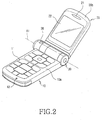
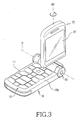
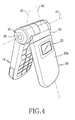
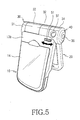
- first, second and third hinge axes A1, A2, and A3 will be described in more detail with reference to FIGs. 1 to 4.
- the second hinge axis A2 when the second housing 20 is closed to the first housing 10, the second hinge axis A2 is parallel to the third hinge axis A3, while the second and third hinge axes A2 and A3 are perpendicular to the first hinge axis A1.
- the second hinge axis A2 when the second housing 20 is fully opened from the first housing 10, the second hinge axis A2 is tilted to the third hinge axis A3.
- the second hinge axis A2 is perpendicular to the third hinge axis A3, apart from each other, and also perpendicular to the first hinge axis A1.
- the first, second, and third hinge axes A1, A2, and A3 are in the same relationship as illustrated in FIG. 1.
- first and second housings 10 and 20 the hinge housing 30, and the camera lens housing 40 will be described in more detail.
- the first housing 10 has a key array 11 with a plurality of keys and a nearby microphone 12 on its top surface 10a.
- a battery pack 14 is detachably installed on the bottom surface 10b of the first housing 10.
- the second housing 20 has an auxiliary display 23 on its top surface 20a and a main display 22 on its bottom surface 20b.
- a speaker 21 is positioned near the main display 22.
- An auxiliary frame 25 is interposed between the second housing 20 and the hinge housing 30.
- the second housing 20 is connected to the auxiliary frame 25 rotatably around the second hinge axis A2.
- the auxiliary frame 25 extends in the direction of the first hinge axis A1.
- the hinge housing 30 comprises a pair of side hinge arms 31 and 32 integrally connected to the first housing 10, a center hinge arm 33 integrally connected to the second housing 20, specifically the auxiliary frame 25 between the side hinge arms 31 and 32, and a camera lens hinge arm 34 at one side of the side hinge arm 31, for containing the camera lens housing 40 therein.
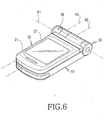
- a hinge module (not shown) is installed in the center hinge arm 33 and the auxiliary frame 25 to enable the second housing 20 to rotate around the first and second hinge axes A1 and A2. By rotating around the first and second hinge axes A1 and A2, the second housing 20 can be brought into close contact with the first housing 10 with the main display 22 exposed, as is illustrated in FIG. 6.
- the camera lens hinge arm 34 has the exposurer for exposing a camera lens (41 in FIG. 7) in the camera lens housing 40.
- the exposurer is comprised of first, second, and third openings 35, 36, and 37 formed in the camera lens hinge arm 34.
- the first opening 35 is formed on a side surface 34a of the camera lens hinge arm 34 along the first hinge axis A1.
- the second opening 36 is formed on a surface of the camera lens hinge arm 34 facing a user when the second housing 20 is closed to the first housing 10 as illustrated in FIG. 1.
- the third opening 37 is formed in a position opposite to the second opening 36 with respect to the third hinge axis A3.
- the second and third openings 36 and 37 are on the outer surface of the camera lens hinge arm 34.
- the first opening 35 is larger in diameter than the second and third openings 36 and 37.
- the second and third openings 36 and 37 of the same shape are apart from each other, symmetrically with respect to the third hinge axis A3.
- the camera lens housing 40 may be cylindrical, though it is shown as spherical.
- the camera lens housing 40 is installed to be rotatable with respect to the third hinge axis A3, having the camera lens 41 exposed from its outer circumferential surface.
- the outer circumferential surface of the camera lens housing 40 is partially exposed from the first opening 35 and the camera lens 41 can be positioned in any of the first, second, and third openings 35, 36, and 37.
- the camera lens housing 40 rotates around the third hinge axis A3 within a predetermined first angle.
- the first angle can be 180° or less. It is shown as 180°. However, if the second and third openings 36 and 37 are formed in different positions, the first angle may be changed.
- an angle controller 50 for manually controlling the camera lens housing 40 will be described below with reference to FIG. 7.
- the angle controller 50 is formed at an edge 10c of the bottom surface of the first housing 10, particularly, near the camera lens hinge arm 34.
- the angle controller 50 includes a teeth gear 51 partially protruding from a through hole formed at the edge 10c of the bottom surface of the first housing 10, and one or more gears 42 and 52 for transferring the rotational force of the teeth gear 51 to the camera lens housing 40.
- the teeth gear 51 rotates with respect to a fourth hinge axis A4 by a user's manual manipulation.
- the third hinge axis A3 and the fourth hinge axis A4 are parallel to each other.
- the second gear 52 is at en end of a rotational shaft S1 of the teeth gear 51.
- a rotational shaft S2 is extended along the third hinge axis A3 and the third gear 42 is on the rotational shaft S2.
- the second gear 52 is engaged with the third gear 42.
- the third gear 42 rotates, which in turn rotates the camera lens housing 40.
- the rotation of the camera lens housing 40 displaces the camera lens 41 coaxially with a selected one of the first, second, and third openings 35, 36, and 37. At the position, the camera lens 41 captures an object.
- a CCD Charge Coupled Device: not shown
- the FPCB is directed to the first housing 10 via a through opening 38 and the side hinge arm 32.
- a mobile phone 100 includes a first housing 101, a second housing 102, which is connected to the first housing 101 in such a manner that it can be rotated in a receding direction from the first housing 101 or turned crosswise to the first housing 101, and a camera lens assembly 200 at a portion of the mobile phone 100.
- the camera lens assembly 200 comprises a rotational camera lens housing 202 in FIG. 13, a camera lens hinge arm 201 at a portion, specifically, at an upper portion of the mobile phone 100, for holding the camera lens housing 202 therein, and exposurers 235, 213, and 217 defined on the camera lens hinge arm 201, for exposing the camera lens housing 202 at least twice.
- the camera lens assembly 200 includes angle controllers 203 and 204 for controlling the rotational angle of the camera lens housing 202 around predetermined hinge axes by user manipulation.
- a key array 111 having a plurality of keys is installed on the top surface of the first housing 101.
- a 2-way key 113 is provided on a side of the first housing 101.
- the 2-way key 113 can be used for menu selection or volume adjustment in a speech mode or standby mode. It can also provide a zoom-in/zoom-out functionality during photographing a still image or a moving picture.
- a pair of side hinge arms 115 face each other, spaced by a predetermined distance on the upper end of the first housing 101, and the camera lens hinge arm 201 is extended from one of the side hinge arms 115.
- the second housing 102 has an auxiliary display 125 on its top surface and a main display 121 on its bottom surface.
- a speaker 123 is disposed above the main display 121.
- the second housing 102 is connected to the first housing 101 in such a manner that it can be rotated face to face in a receding/advancing direction from/toward the first housing 101 and turned crosswise to the first housing 101.
- the connection is made by means of a predetermined connection member 103.
- connection member 103 has a center hinge arm 131 between the side hinge arms 115. It rotates around a first hinge axis A1 extended widthwise from the first housing 101.
- the connection member 103 also has an auxiliary frame 133 at a portion of the center hinge arm 131, thus defining a second hinge axis A2 perpendicular to the first hinge axis A1.
- An end portion of the second housing 102 is engaged with the auxiliary frame 122 to rotate around the second hinge axis A2.
- the camera lens hinge arm 201 is extended in the direction of the first hinge axis A1 from the side hinge arm 115 and contains the camera lens housing 202 therein.
- the camera lens housing 202 is rotatable around the first hinge axis A1 within the camera lens hinge arm 201. At the same time, it is rotatable around a third hinge axis A3 perpendicular to the first hinge axis A1.
- the camera lens hinge arm 201 includes the angle controllers 203 and 204 for adjusting the rotational angle of the camera lens housing 202.
- the angle controllers 203 and 204 are rotatably engaged with the camera lens hinge arm 201.
- the angle controller 203 is a first control knob for rotating the camera lens housing 202 around the first hinge axis A1.
- the angle controller 204 rotatably engaged at a predetermined position of the outer circumferential surface of the camera lens hinge arm 201, is a second knob for rotating the camera lens housing 202 around the third hinge axis A3.
- the exposurers 235, 213, and 217 are a first opening (exposurer 235) in FIG. 13 for exposing the camera lens housing 202 in a side direction of the camera lens hinge arm 201, a second opening (exposurer 213) for exposing the camera lens housing 202 in a frontal direction of the mobile phone 100, and a third opening (exposurer 217) for exposing the camera lens housing 202 in a rear direction of the mobile phone 200. That is, the camera lens housing 202 is rotated around the first, second, and third hinge axes A1, A2, and A3 within the camera lens hinge arm 201 to enable photography of a still image or a moving picture through the first, second, or third exposurer 235, 213, or 217.
- the second exposurer 213 has a pair of holes that enables a user to select a photograph angle according to the angle at which the second housing 102 is opened.
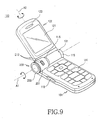
- FIGs. 9 and 10 are perspective views of the mobile phone 100 with the second housing 102 fully opened in a receding direction from the first housing 101. With the second housing 102 fully opened from the first housing 101, the main display 121 is directed toward the front of the mobile phone 100. If the user intends to photograph a still image or moving picture, he rotates the camera lens housing 202 is rotated in a manner that exposes the camera lens housing 202 through the second or third exposurer 213 or 217.
- FIGs. 11 and 12 are perspective views of the mobile phone 100 where the second housing 102 is opened at a predetermined angle from the first housing 101 and then turned crosswise to the first housing 101.
- the second housing 101 When the second housing 101 is opened at a predetermined angle, specifically about 90° or above from the first housing 101, it can rotate around the second hinge axis A2.
- the main display 121 faces in a selected one of both directions of the mobile phone 100.
- the user rotates the camera lens housing 202 in the manner that exposes the camera lens housing 202 through the first exposurer 235. With the camera lens housing 202 exposed through the first exposurer 235 and the main display 121 positioned as illustrated in FIG. 11, the user can manipulate the mobile phone 100 in the same manner as a camcorder.
- the main display 121 can be exposed outward while the second housing 102 is in close contact with the first housing 101.
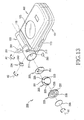
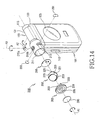
- FIGs. 13 to 15 illustrate the camera lens assembly 200 for the mobile phone illustrated in FIG. 8.
- the camera lens assembly 200 comprises the camera lens hinge arm 201, the camera lens housing 202, the first and second control knobs 203 and 204, and the exposurers 235, 213, and 217.
- the camera lens hinge arm 201 is integrally formed with one side hinge arm 115 of the first housing 101 and provides a space 211 opened in a side direction of the mobile phone 100.
- the camera lens housing 202 is held in the space 211 to rotate around the first hinge axis A1 and the third hinge axis A3 perpendicular to the first hinge axis A1.
- the opened side portion of the camera lens hinge arm 201 is closed with the first control knob 203.
- the first control knob 203 rotates around the first hinge axis A1, which in turn rotates the camera lens housing 202 around the first hinge axis A1.
- the second control knob 204 is rotatably installed at a predetermined position of the outer circumferential surface of the camera lens housing 202, specifically on the third hinge axis A3.
- the second control knob 204 rotates around the third hinge axis A3, which in turn rotates the camera lens housing 202 around the third hinge axis A3.
- a pair of guide grooves 223 are formed circumferentially on the outer circumferential surface of the camera lens housing 202 to provide a rotation trajectory to the camera lens housing 202.
- the guide grooves 223 cross each other at predetermined positions and the intersections (not shown) are symmetrical with respect to the respective first and third hinge axes A1 and A3.
- the guide grooves 223 are perpendicular to each other at the intersection.
- the first and second control knobs 203 and 204 are provided with guide protrusions 233 and 243 in correspondence with the guide grooves 223.
- the first control knob 203 includes the first guide protrusion 233 which is extended in a diameter direction on its inner side surface facing the camera lens housing 202, protruding in the direction of the first hinge axis A1, for fitting into one of the guide grooves 223, and a plurality of protrusions 231 on its outer circumferential surface.
- the second control knob 204 is formed on the outer circumferential surface of the camera lens hinge arm 201 so that its inner surface faces the camera lens housing 202.
- the second guide protrusions 243 are extended in a diameter direction on the inner surface of the second control knob 204, protruding in the direction of the third hinge axis A3, for fitting into the other guide groove 223.
- the guide protrusion 233 or 243 in engagement with the guide groove 223 rotates the camera lens housing 202.
- the first or second guide protrusion 233 or 243 guides the rotation of the camera lens housing 202.
- the first guide protrusion 233 in engagement with the guide groove 223 rotates the camera lens housing 202 around the first hinge axis A1.
- the second guide protrusions 243 guide the rotation of the camera lens housing 202 because the guide groove 223 is in engagement with the second guide protrusions 243.
- a mounting groove 215a is formed to a predetermined depth from the outer circumferential surface of the camera lens hinge arm 201 and rotation holes 215b are formed in the mounting groove 215a in order to position the second guide protrusions 243 of the second control knob 204 within the space 211.
- the mounting groove 215a is centered on the third hinge axis A3, and the rotation holes 215b can be formed within a predetermined angular range with respect to rotation around the third hinge axis A3. That is, the rotation holes 215b can limit the rotational range of the second control knob 204.
- the exposurers 235, 213, and 217 are means for exposing a camera lens 221 in the camera lens housing 201 in a photograph direction. They are the first opening directed along the first hinge axis A1, the second opening directed toward the front of the mobile phone 100, and the third opening directed toward the rear of the mobile phone 100, respectively.
- the first 235 is formed through the first control knob 203 along the first hinge axis A1.
- the second exposurer 213 can be a pair of through holes spaced from each other by a predetermined distance on the outer circumferential surface of the camera lens hinge arm 201.
- the third exposurer 217 is positioned symmetrically with the second exposurer 213 on the outer circumferential surface of the camera lens hinge arm 201.
- the second and third exposurers 213 and 217 are symmetrical on the camera lens hinge arm 201 with respect to the respective hinge axes A1 and A3. Because the second exposurer 213 has the pair of adjacent through holes along the circumferential direction of the camera lens hinge arm 201, the user can photograph an object at various angles using the mobile phone 100.
- the exposurers 235, 213, and 217 are preferably sealed with transparent acryl or glass covers 291, 293, and 295.
- a tension plate 205 is fixed within the camera lens hinge arm 201 to prevent the movement of the camera lens housing 202 after rotation.
- the tension plate 205 is brought into close contact with a surface of the camera lens housing 202 by its accumulated elastic force and thus prevents the unintended movement of the camera lens housing 202.
- a stopper protrusion 225 is formed on the surface of the camera lens housing 202 facing the tension plate 205 and stopper holes 251 are formed at a predetermined interval on the tension plate 205 along the rotation trajectory of the stopper protrusion 225 to thereby stop the rotation of the camera lens housing 202 at the predetermined interval.
- the stopper protrusion 225 can be formed on the tension plate 205 and the stopper holes 251 are formed at the predetermined interval on the outer circumferential surface of the camera lens housing 202.
- the thus-constituted camera lens assembly 200 is so configured that the camera lens housing 202 can rotate within the camera lens hinge arm 201 with respect to the respective hinge axes A1 and A3. Therefore, photography can be carried out not only in various directions but also in the same manner as with a camcorder by directing the main display 121 in a side direction of the mobile phone 100.
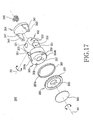
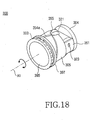
- FIGs. 16 to 19 illustrate a camera lens assembly 300 for the mobile phone 100 illustrated in FIG. 8 according to another embodiment of the present invention.
- the camera lens assembly 300 comprises a camera lens hinge arm 301, first and second rotational members 304 and 305, a camera lens housing 302, and a control knob 303.
- the camera lens hinge arm 301 extends along the first hinge axis A1 from one side hinge arm 115, opened at one side and thus providing a space 311.
- a second opening 3 13 having a pair of through holes is formed on the outer circumferential surface of the camera lens hinge arm 301, and a third opening (not shown) is formed symmetrically with the second opening 313 with respect to the first and third hinge axes A1 and A3.
- the exposurers for the camera lens hinge arm 301 will be apparent by referring to the above-described embodiment.
- the first rotational member 304 is contained in the camera lens hinge arm 301 rotatably around the first hinge axis A1.
- One or more first link arms 341 are protruded along the first hinge axis A1 from one surface of the first rotational member 304.
- a link hole 343 is formed at an end portion of each of the first link arms 341.
- the second rotational member 305 is contained in the camera lens hinge arm 301 rotatably around the first hinge axis A1. It is linked to the first rotational member 304 in the manner that enables the second rotational member 305 to make a linear reciprocal movement along the first hinge axis A1.
- One or more second link arms 351 protrude along the first hinge axis A1 from one surface of the second rotational member 305, facing the first link arms 341.
- a link hole 353 is formed at an end portion of each of the second link arms 351. It is to be noted here that the link holes 343 or 353 are elongated in a direction in which the second rotational member 305 moves linearly, that is, in a direction perpendicular to the first hinge axis A1. Referring to FIG.
- the link holes 353 are shown elongated in the embodiment of the present invention.
- the second rotational member 305 is provided with exposing holes 355 and 357 respectively at an end portion and at a predetermined position of the outer circumferential surface.
- Guide slopes 354a and 354b are also defined on the outer circumferential surface of the second rotational member 305.
- the guide slops 354a and 354b are steep and slow respectively to an end of the second rotational member 305.
- the guide slopes 354a and 354b restrict the rotational ranges of the first and second rotational members 304 and 305, or prevent the movement of the first and second rotational members 304 and 305 away from the camera lens hinge arm 301.
- the camera lens housing 302 is like a cylinder extended along the third hinge axis A3. It has a camera lens 321 at a predetermined position of its outer circumferential surface and a pair of link protrusions 323 on both ends.
- the link protrusions 323 are selectively inserted into the link holes 343 and 353. That is, the first and second rotational members 304 and 305 are linked to each other via the camera lens housing 302 and the first and second link arms 341 and 351 are formed preferably in pairs to stabilize the link connection.
- the camera lens housing 302 rotates around the third hinge axis A3.
- the camera lens 321 is exposed from the hole 355. If the second rotational member 305 moves in an arrowed direction "a", the camera lens 321 is exposed from the hole 357. That is, as the second rotational member 305 moves linearly along the first hinge axis A1, the camera lens housing 302 rotates around the third hinge axis A3. Because the link holes 353 of the second link arms 351 are elongated, it provides room in which the link protrusions 323 move by the rotation of the camera lens housing 302.
- One or more engagement protrusion 359 is formed on the other end surface of the second rotational member 305 to be engaged with the control knob 303.
- the control knob 303 is engaged with the end of the second rotational member 305.
- the control knob 303 has a first opening 335 penetrating there through, and a plurality of protrusions 331 on its outer circumferential surface.
- the first opening 335 is used to expose the camera lens 321. That is, the camera lens 321 in the camera lens housing 302 can capture an object through one of the first, second, and third openings 335 and 313 according to user selection.
- the first, second, and third openings 335 and 313 are sealed with transparent acryl or glass covers 391, 393, and 395.
- a guide ring 397 is fit around the end of the camera lens hinge arm 301 to prevent the movement of the first and second rotational members 304 and 305 and the camera lens housing 302 away from the camera lens hinge arm 301.
- the guide ring 397 has a guide rib 397a protruding from its inner surface.
- the guide rib 397a is formed in correspondence with the guide slopes 354a and 354b formed on the outer circumferential surface of the second rotational member 305.
- the guide rib 397a restricts an excessive movement of the second rotational member 305. Also, as the second rotational member 305 rotates, the guide rib 397a moves along the slow slope 354b, moving the second rotational member 305 toward the first rotational member 304.
- a coil spring 399 is positioned within the camera lens hinge arm 301 to provide elastic force to the first rotational member 304.
- the first and second rotational members 304 and 305 and the camera lens housing 302 are rotated smoothly around the first hinge axis A1.
- the camera lens housing 302 In the camera lens assembly 300, as the second rotational member 305 moves linearly along the first hinge axis A1, the camera lens housing 302 is directed to the first or second opening 335 or 313. By rotating the control knob 303 with respect to the first hinge axis A1, the camera lens housing 302 is directed to the second opening 313 or the third opening. When the control knob 303 is rotated with the camera lens housing 302 directed to the first opening 335, the camera lens 321 is directed to the third opening by the guide rib 397a and the slow guide slope 354b.
- the mobile phone of the present invention is user-friendly and cost-effective because two or more photograph directions are available by use of one camera lens module.
Landscapes
- Engineering & Computer Science (AREA)
- Signal Processing (AREA)
- Multimedia (AREA)
- Human Computer Interaction (AREA)
- Telephone Set Structure (AREA)
- Studio Devices (AREA)
- Camera Bodies And Camera Details Or Accessories (AREA)
- Structure And Mechanism Of Cameras (AREA)
Applications Claiming Priority (4)
| Application Number | Priority Date | Filing Date | Title |
|---|---|---|---|
| KR20030023301 | 2003-04-14 | ||
| KR2003023301 | 2003-04-14 | ||
| KR1020030056031A KR100557065B1 (ko) | 2003-04-14 | 2003-08-13 | 회전성 카메라 렌즈 하우징을 구비한 휴대용 단말기 |
| KR2003056031 | 2003-08-13 |
Publications (2)
| Publication Number | Publication Date |
|---|---|
| EP1469656A2 true EP1469656A2 (de) | 2004-10-20 |
| EP1469656A3 EP1469656A3 (de) | 2006-02-01 |
Family
ID=32911525
Family Applications (1)
| Application Number | Title | Priority Date | Filing Date |
|---|---|---|---|
| EP04008781A Withdrawn EP1469656A3 (de) | 2003-04-14 | 2004-04-13 | Mobiltelefon mit einem drehbaren Kameraobjektivgehäuse |
Country Status (4)
| Country | Link |
|---|---|
| US (1) | US20040203535A1 (de) |
| EP (1) | EP1469656A3 (de) |
| JP (1) | JP4188867B2 (de) |
| CN (1) | CN100409649C (de) |
Cited By (5)
| Publication number | Priority date | Publication date | Assignee | Title |
|---|---|---|---|---|
| EP1511312A1 (de) * | 2003-08-21 | 2005-03-02 | Samsung Electronics Co., Ltd. | Kameralinsenbaugruppe für ein tragbares Endgerät |
| WO2006006023A1 (en) * | 2004-06-29 | 2006-01-19 | Nokia Corporation | A mobile terminal concept with a slide and twist mechanism |
| WO2006079694A1 (en) * | 2005-01-31 | 2006-08-03 | Elcoteq Se | Mobile communications device |
| US8073502B2 (en) | 2005-03-18 | 2011-12-06 | Sony Ericsson Mobile Communications Ab | Hinged portable radio communication equipment with a double action hinge |
| EP3984826A1 (de) * | 2020-10-19 | 2022-04-20 | Veoneer Sweden AB | Fahrerüberwachungssystem und verfahren zur herstellung eines fahrerüberwachungssystems |
Families Citing this family (124)
| Publication number | Priority date | Publication date | Assignee | Title |
|---|---|---|---|---|
| US20060034601A1 (en) * | 2003-04-23 | 2006-02-16 | Tage Andersson | Multi-function two panel electronic device with 360° relative motion |
| US7426406B2 (en) * | 2003-04-23 | 2008-09-16 | Nokia Corporation | Mobile communications device with synchronising hinge |
| US7512426B2 (en) * | 2003-04-23 | 2009-03-31 | Nokia Corporation | Mobile communications device with synchronising hinge |
| US7155266B2 (en) * | 2004-04-21 | 2006-12-26 | Nokia Corporation | Hinge for fold phone |
| TW588902U (en) * | 2003-04-25 | 2004-05-21 | Hon Hai Prec Ind Co Ltd | Lens module for a communication unit |
| USD524776S1 (en) * | 2003-05-26 | 2006-07-11 | Lg Electronics Inc. | Cellular phone |
| USD506452S1 (en) * | 2003-07-26 | 2005-06-21 | Lg Electronics Inc. | Cellular phone |
| USD506737S1 (en) * | 2003-07-29 | 2005-06-28 | Motorola, Inc. | Communication device |
| KR100739564B1 (ko) * | 2003-07-31 | 2007-07-16 | 엘지전자 주식회사 | 카메라가 장착된 이동통신 단말기 |
| JP2005054890A (ja) * | 2003-08-04 | 2005-03-03 | Kato Electrical Mach Co Ltd | 携帯端末用ヒンジ |
| USD507251S1 (en) * | 2003-10-23 | 2005-07-12 | Nokia Corporation | Handset |
| JP4048435B2 (ja) * | 2003-10-23 | 2008-02-20 | ソニー株式会社 | 電子機器 |
| USD511336S1 (en) * | 2003-12-04 | 2005-11-08 | Samsung Electronics Co., Ltd. | Cellular phone |
| USD508032S1 (en) * | 2003-12-06 | 2005-08-02 | Samsung Electronics Co., Ltd. | Cellular phone |
| USD507252S1 (en) * | 2003-12-11 | 2005-07-12 | Samsung Electronics Co., Ltd. | Portable telephone |
| USD507551S1 (en) * | 2003-12-11 | 2005-07-19 | Samsung Electronics Co., Ltd. | Portable telephone |
| USD510922S1 (en) * | 2003-12-11 | 2005-10-25 | Samsung Electronics Co., Ltd. | Portable telephone |
| USD512038S1 (en) * | 2004-01-06 | 2005-11-29 | Samsung Electronics Co. | Portable telephone |
| USD508036S1 (en) * | 2004-04-02 | 2005-08-02 | Sony Ericsson Mobile Communications Ab | Mobile phone |
| USD512395S1 (en) * | 2004-04-06 | 2005-12-06 | Samsung Electronics Co., Ltd. | Cellular phone |
| TWD106978S1 (zh) * | 2004-04-13 | 2005-10-11 | 日本電氣股份有限公司 | 攜帶式無線電話機 |
| TWD105105S1 (zh) * | 2004-04-29 | 2005-06-11 | 明基電通股份有限公司 | 行動電話 |
| USD508035S1 (en) * | 2004-05-06 | 2005-08-02 | Samsung Electronics Co., Ltd. | Portable telephone |
| KR100617688B1 (ko) * | 2004-05-19 | 2006-08-28 | 삼성전자주식회사 | 휴대 단말기의 힌지 장치 |
| USD527380S1 (en) * | 2004-05-28 | 2006-08-29 | Nokia Corporation | Front cover portion of a handset |
| JP4778207B2 (ja) * | 2004-06-08 | 2011-09-21 | 日本電気株式会社 | ヒンジ機構及びそれを組み込んだ電子機器、その組み立て方法 |
| USD521477S1 (en) * | 2004-06-09 | 2006-05-23 | Samsung Electronics Co., Ltd. | Cellular phone |
| USD520482S1 (en) * | 2004-06-09 | 2006-05-09 | Samsung Electronics Co., Ltd. | Cellular phone |
| USD512040S1 (en) * | 2004-06-09 | 2005-11-29 | Samsung Electronics Co., Ltd. | Cellular phone |
| USD534530S1 (en) * | 2004-06-11 | 2007-01-02 | Nokia Corporation | Key button area for a handset |
| US20060023411A1 (en) * | 2004-07-27 | 2006-02-02 | Samsung Electronics Co., Ltd. | Swing hinge apparatus and portable terminal with the same |
| USD519971S1 (en) * | 2004-08-27 | 2006-05-02 | Kabushiki Kaisha Toshiba | Portable phone |
| USD521479S1 (en) * | 2004-08-31 | 2006-05-23 | Samsung Electronics Co., Ltd. | Portable telephone |
| TWD109807S1 (zh) * | 2004-09-06 | 2006-03-21 | 松下電器產業股份有限公司 | 無線電話機 |
| KR100606073B1 (ko) * | 2004-10-25 | 2006-07-28 | 삼성전자주식회사 | 휴대 통신 장치 |
| KR100735266B1 (ko) * | 2004-10-26 | 2007-07-03 | 삼성전자주식회사 | 멀티미디어용 휴대용 통신 단말기 |
| JP2006135385A (ja) * | 2004-11-02 | 2006-05-25 | Canon Inc | カメラ |
| USD561144S1 (en) * | 2004-11-11 | 2008-02-05 | Nokia Corporation | Handset |
| US7565183B2 (en) * | 2004-11-15 | 2009-07-21 | Sony Ericsson Mobile Communications Ab | Mobile device with selectable camera position |
| USD519972S1 (en) * | 2004-11-16 | 2006-05-02 | Samsung Electronics Co., Ltd. | Cellular phone |
| TWM268831U (en) | 2004-11-19 | 2005-06-21 | Lite On Technology Corp | Portable electronic apparatus |
| USD526303S1 (en) * | 2004-12-08 | 2006-08-08 | Samsung Electronics Co., Ltd. | Cellular phone |
| TWM269695U (en) * | 2004-12-22 | 2005-07-01 | Lite On Technology Corp | Hand-held-type electronic data processor |
| USD540767S1 (en) * | 2004-12-24 | 2007-04-17 | Samsung Electronics Co., Ltd. | Portable phone |
| USD518812S1 (en) * | 2005-01-03 | 2006-04-11 | Samsung Electronics Co., Ltd. | Cellular phone |
| USD518467S1 (en) * | 2005-01-03 | 2006-04-04 | Samsung Electronics Co., Ltd. | Cellular phone |
| KR100689472B1 (ko) * | 2005-01-11 | 2007-03-08 | 삼성전자주식회사 | 휴대 통신 장치 |
| USD541248S1 (en) * | 2005-01-14 | 2007-04-24 | Samsung Electronics Co., Ltd. | Mobile phone |
| USD543169S1 (en) * | 2005-01-21 | 2007-05-22 | Samsung Electronics Co., Ltd. | Mobile phone |
| KR100630068B1 (ko) * | 2005-01-25 | 2006-09-27 | 삼성전자주식회사 | 디스플레이 회전형 휴대 단말기의 힌지 장치 |
| USD531975S1 (en) * | 2005-01-26 | 2006-11-14 | Samsung Electronics Co., Ltd. | Portable phone |
| USD531974S1 (en) * | 2005-01-26 | 2006-11-14 | Samsung Electronics Co., Ltd. | Portable phone |
| USD531610S1 (en) * | 2005-01-26 | 2006-11-07 | Samsung Electronics Co., Ltd. | Portable phone |
| USD531973S1 (en) * | 2005-01-26 | 2006-11-14 | Samsung Electronics Co., Ltd. | Portable phone |
| TWD109652S1 (zh) * | 2005-02-05 | 2006-03-11 | 華碩電腦股份有限公司 | 行動電話按鍵 |
| USD542254S1 (en) * | 2005-02-07 | 2007-05-08 | Lg Electronics Inc. | Mobile phone |
| US7528885B2 (en) * | 2005-02-07 | 2009-05-05 | Ensky Technology Co., Ltd. | Portable electronic device with lens rotation positioning structure |
| USD524785S1 (en) * | 2005-02-07 | 2006-07-11 | Li Huang | Mobile-phone thermal imager |
| USD521480S1 (en) * | 2005-03-09 | 2006-05-23 | Benq Corporation | Folding cell phone |
| USD528091S1 (en) * | 2005-03-29 | 2006-09-12 | Samsung Electronics Co., Ltd. | Portable telephone |
| USD521969S1 (en) * | 2005-03-29 | 2006-05-30 | Samsung Electronics Co., Ltd. | Portable telephone |
| USD521971S1 (en) * | 2005-03-29 | 2006-05-30 | Samsung Electronics Co., Ltd. | Portable telephone |
| KR20080004546A (ko) * | 2005-03-30 | 2008-01-09 | 코닌클리케 필립스 일렉트로닉스 엔.브이. | 회전식 카메라 장치를 갖춘 휴대용 전자 디바이스 |
| USD530301S1 (en) * | 2005-04-06 | 2006-10-17 | Samsung Electronics Co., Ltd. | Portable phone |
| USD533533S1 (en) * | 2005-04-06 | 2006-12-12 | Samsung Electronics Co., Ltd. | Portable phone |
| US7414834B2 (en) * | 2005-04-21 | 2008-08-19 | Nokia Corporation | Mobile communications device with synchronising hinge |
| USD545287S1 (en) * | 2005-04-28 | 2007-06-26 | Samsung Electronics Co., Ltd. | Portable phone |
| USD543176S1 (en) * | 2005-04-28 | 2007-05-22 | Samsung Electronics Co., Ltd. | Portable phone |
| USD558167S1 (en) * | 2005-05-27 | 2007-12-25 | Samsung Electronics Co., Ltd. | Portable phone |
| USD558168S1 (en) * | 2005-05-27 | 2007-12-25 | Samsung Electronics Co., Ltd. | Portable phone |
| KR100901860B1 (ko) * | 2005-06-15 | 2009-06-09 | (주)케이티에프테크놀로지스 | 휴대 단말기 |
| USD551645S1 (en) * | 2005-06-24 | 2007-09-25 | Samsung Electronics Co., Ltd. | Mobile phone |
| USD552066S1 (en) * | 2005-06-27 | 2007-10-02 | Samsung Electronics Co., Ltd. | Mobile phone |
| USD551644S1 (en) * | 2005-06-27 | 2007-09-25 | Samsung Electronics Co., Ltd. | Mobile phone |
| USD542764S1 (en) * | 2005-07-01 | 2007-05-15 | Samsung Electronics Co., Ltd. | Portable phone |
| USD552067S1 (en) * | 2005-07-15 | 2007-10-02 | Samsung Electronics Co., Ltd. | Mobile phone |
| USD562278S1 (en) * | 2005-08-03 | 2008-02-19 | Samsung Electronics Co., Ltd. | Portable phone |
| US20070060216A1 (en) * | 2005-09-12 | 2007-03-15 | Cheng-Wen Huang | Portable communication apparatus |
| TWI276340B (en) * | 2005-09-16 | 2007-03-11 | Asustek Comp Inc | Electronic device having a housing capable of being rotated horizontally and moved vertically |
| EP1768387B1 (de) * | 2005-09-22 | 2014-11-05 | Samsung Electronics Co., Ltd. | Bildaufnahmevorrichtung mit Bildkompensation und Verfahren dafür |
| US20070071438A1 (en) * | 2005-09-27 | 2007-03-29 | Universal Scientific Industrial Co., Ltd. | Handheld electronic device including a rotatable camera unit |
| USD542767S1 (en) * | 2005-09-29 | 2007-05-15 | Samsung Electronics Co., Ltd. | Portable phone |
| USD554091S1 (en) * | 2005-10-07 | 2007-10-30 | Nokia Corporation | Handset |
| CA115160S (en) * | 2005-10-28 | 2007-05-29 | Nokia Corp | Handset |
| AU309844S (en) * | 2005-10-31 | 2006-09-13 | Microsoft Mobile Oy | A handset |
| USD564486S1 (en) * | 2005-12-13 | 2008-03-18 | Samsung Electronics Co., Ltd. | Mobile phone |
| AU308511S (en) * | 2005-12-28 | 2006-08-09 | Samsung Electronics Co Ltd | Mobile phone |
| TWD118217S1 (zh) * | 2006-02-03 | 2007-07-21 | 諾基亞股份有限公司 | 手機 |
| USD568858S1 (en) * | 2006-03-17 | 2008-05-13 | Samsung Electronics Co., Ltd. | Portable phone |
| KR100728926B1 (ko) * | 2006-03-20 | 2007-06-15 | 삼성전자주식회사 | 3축 힌지 구조를 갖는 휴대용 전자기기 |
| USD573125S1 (en) * | 2006-03-22 | 2008-07-15 | Samsung Electronics Co., Ltd. | Cellular phone |
| USD568279S1 (en) * | 2006-05-17 | 2008-05-06 | Samsung Electronics Co., Ltd. | Mobile phone |
| US20080058008A1 (en) * | 2006-08-02 | 2008-03-06 | Jae-Woong Yoon | Mobile telecommunication apparatus with a built-in camera and the camera therein |
| AU313916S (en) | 2006-08-30 | 2007-05-04 | Nokia Corp | Handset |
| USD567207S1 (en) * | 2006-09-29 | 2008-04-22 | Samsung Electronics Co., Ltd. | Portable phone |
| USD561722S1 (en) * | 2006-11-29 | 2008-02-12 | Samsung Electronics Co., Ltd. | Mobile phone |
| TWI386009B (zh) * | 2007-01-22 | 2013-02-11 | Hon Hai Prec Ind Co Ltd | 具有照相功能之便攜式電子裝置 |
| JP4586175B2 (ja) * | 2007-10-15 | 2010-11-24 | Necカシオモバイルコミュニケーションズ株式会社 | 端末装置 |
| US8577957B2 (en) * | 2008-04-01 | 2013-11-05 | Litl Llc | System and method for streamlining user interaction with electronic content |
| US9003315B2 (en) | 2008-04-01 | 2015-04-07 | Litl Llc | System and method for streamlining user interaction with electronic content |
| US8624844B2 (en) | 2008-04-01 | 2014-01-07 | Litl Llc | Portable computer with multiple display configurations |
| US8612888B2 (en) | 2008-04-01 | 2013-12-17 | Litl, Llc | Method and apparatus for managing digital media content |
| US20090322790A1 (en) * | 2008-04-01 | 2009-12-31 | Yves Behar | System and method for streamlining user interaction with electronic content |
| CN101750698A (zh) | 2008-12-10 | 2010-06-23 | 深圳富泰宏精密工业有限公司 | 镜头模组及应用该镜头模组的电子装置 |
| CN101750853B (zh) | 2008-12-17 | 2012-10-10 | 鸿富锦精密工业(深圳)有限公司 | 电子装置及取像模组 |
| USD605635S1 (en) * | 2009-04-06 | 2009-12-08 | Aquent, Llc | Remote control device |
| USD618674S1 (en) * | 2009-04-15 | 2010-06-29 | Panasonic Corporation | Mobile phone |
| US8938753B2 (en) | 2010-05-12 | 2015-01-20 | Litl Llc | Configurable computer system |
| US9436219B2 (en) | 2010-05-12 | 2016-09-06 | Litl Llc | Remote control to operate computer system |
| USD669587S1 (en) * | 2010-09-06 | 2012-10-23 | FotoFinder Systems GmbH | External lens for cell phones |
| JP2012119851A (ja) * | 2010-11-30 | 2012-06-21 | Brother Ind Ltd | 端末機器 |
| KR101390392B1 (ko) * | 2011-11-24 | 2014-04-30 | 안성기 | 키보드 형 단말기 케이스 |
| EP2610856A1 (de) * | 2011-12-29 | 2013-07-03 | Samsung Electronics Co., Ltd | Anzeigevorrichtung |
| CN102905062B (zh) * | 2012-10-17 | 2015-12-09 | 歌尔声学股份有限公司 | 一种内置摄像头及内置摄像头的实现方法 |
| KR20140145301A (ko) * | 2013-06-13 | 2014-12-23 | 삼성전자주식회사 | 통화 모드 중 기능 실행 방법 및 이를 구현하는 휴대용 전자 장치 |
| US9122455B2 (en) * | 2013-11-22 | 2015-09-01 | Dell Products L.P. | Information handling system housing lid with synchronized motion provided by unequal gears |
| US20150185704A1 (en) * | 2013-12-30 | 2015-07-02 | Tau-Jeng Hsu | Electronic watch structure capable of selectively mounting a camera lens |
| US10571972B2 (en) * | 2014-03-28 | 2020-02-25 | Intel Corporation | Rotation sensor device |
| USD816666S1 (en) | 2015-10-30 | 2018-05-01 | Lenovo (Beijing) Co., Ltd. | Tablet computer |
| CN105704356A (zh) * | 2016-03-25 | 2016-06-22 | 北京亮亮视野科技有限公司 | 一种应用于穿戴设备的多自由度摄像系统 |
| US10955268B2 (en) * | 2018-08-20 | 2021-03-23 | Ford Global Technologies, Llc | Methods and apparatus to facilitate active protection of peripheral sensors |
| CN209105228U (zh) * | 2018-10-31 | 2019-07-12 | Oppo广东移动通信有限公司 | 折叠式移动终端 |
| TWI789562B (zh) * | 2019-06-04 | 2023-01-11 | 仁寶電腦工業股份有限公司 | 電子裝置 |
| USD1065120S1 (en) * | 2020-08-07 | 2025-03-04 | Samsung Electronics Co., Ltd. | Electronic device |
Family Cites Families (14)
| Publication number | Priority date | Publication date | Assignee | Title |
|---|---|---|---|---|
| US6639625B1 (en) * | 1997-07-16 | 2003-10-28 | Minolta Co., Ltd. | Image sensing device |
| JP2000253124A (ja) * | 1999-03-01 | 2000-09-14 | Matsushita Electric Ind Co Ltd | 撮像機能付き情報携帯端末 |
| JP2001094840A (ja) * | 1999-09-27 | 2001-04-06 | Matsushita Electric Ind Co Ltd | 監視カメラ装置 |
| JP3546784B2 (ja) * | 1999-12-14 | 2004-07-28 | 日本電気株式会社 | 携帯端末 |
| KR20010068807A (ko) * | 2000-01-10 | 2001-07-23 | 윤종용 | 영상 통신용 무선 단말기 |
| JP2001352380A (ja) * | 2000-06-08 | 2001-12-21 | Minolta Co Ltd | 携帯端末 |
| US6532035B1 (en) * | 2000-06-29 | 2003-03-11 | Nokia Mobile Phones Ltd. | Method and apparatus for implementation of close-up imaging capability in a mobile imaging system |
| JP4520009B2 (ja) * | 2000-10-02 | 2010-08-04 | 株式会社ケンウッド | 折り畳み式携帯電話装置 |
| JP3483144B2 (ja) * | 2001-05-31 | 2004-01-06 | 松下電器産業株式会社 | カメラ付き携帯端末装置 |
| KR100539527B1 (ko) * | 2001-06-12 | 2005-12-29 | 엘지전자 주식회사 | 카메라를 구비한 휴대전화기 |
| KR100442598B1 (ko) * | 2001-09-06 | 2004-08-02 | 삼성전자주식회사 | 회전성 렌즈 하우징 장착 장치 및 이를 채용한 폴더형단말기 |
| JP3704496B2 (ja) * | 2001-11-02 | 2005-10-12 | Necアクセステクニカ株式会社 | 携帯端末装置 |
| JP3675430B2 (ja) * | 2002-09-20 | 2005-07-27 | 株式会社日立製作所 | 携帯電話機 |
| US20040192220A1 (en) * | 2003-03-24 | 2004-09-30 | Inventec Appliances Corp. | Mechanism for switching cellular phone to digital camera |
-
2004
- 2004-03-29 JP JP2004097017A patent/JP4188867B2/ja not_active Expired - Fee Related
- 2004-04-07 US US10/819,430 patent/US20040203535A1/en not_active Abandoned
- 2004-04-13 EP EP04008781A patent/EP1469656A3/de not_active Withdrawn
- 2004-04-14 CN CNB2004100329871A patent/CN100409649C/zh not_active Expired - Fee Related
Cited By (8)
| Publication number | Priority date | Publication date | Assignee | Title |
|---|---|---|---|---|
| EP1511312A1 (de) * | 2003-08-21 | 2005-03-02 | Samsung Electronics Co., Ltd. | Kameralinsenbaugruppe für ein tragbares Endgerät |
| EP1843589A3 (de) * | 2003-08-21 | 2009-09-30 | Samsung Electronics Co., Ltd. | Kameraobjektivanordnung für tragbare drahtlose Endgeräte |
| WO2006006023A1 (en) * | 2004-06-29 | 2006-01-19 | Nokia Corporation | A mobile terminal concept with a slide and twist mechanism |
| WO2006079694A1 (en) * | 2005-01-31 | 2006-08-03 | Elcoteq Se | Mobile communications device |
| US8073502B2 (en) | 2005-03-18 | 2011-12-06 | Sony Ericsson Mobile Communications Ab | Hinged portable radio communication equipment with a double action hinge |
| EP3984826A1 (de) * | 2020-10-19 | 2022-04-20 | Veoneer Sweden AB | Fahrerüberwachungssystem und verfahren zur herstellung eines fahrerüberwachungssystems |
| WO2022084101A1 (en) * | 2020-10-19 | 2022-04-28 | Veoneer Sweden Ab | Vision module for monitoring a driver of a vehicle and method for manufacturing a vision module for monitoring a driver of a vehicle |
| US12301974B2 (en) | 2020-10-19 | 2025-05-13 | Magna Electronics Sweden Ab | Vision module for monitoring a driver of a vehicle and method for manufacturing a vision module for monitoring a driver of a vehicle |
Also Published As
| Publication number | Publication date |
|---|---|
| JP2004320742A (ja) | 2004-11-11 |
| CN1538715A (zh) | 2004-10-20 |
| EP1469656A3 (de) | 2006-02-01 |
| CN100409649C (zh) | 2008-08-06 |
| US20040203535A1 (en) | 2004-10-14 |
| JP4188867B2 (ja) | 2008-12-03 |
Similar Documents
| Publication | Publication Date | Title |
|---|---|---|
| US20040203535A1 (en) | Mobile phone having a rotational camera lens housing | |
| US7636124B2 (en) | Portable terminal having digital camera function | |
| KR100842529B1 (ko) | 힌지 장치를 구비하는 휴대용 단말기 | |
| KR100703495B1 (ko) | 양 방향 슬라이딩 타입 휴대용 단말기 | |
| KR20050105790A (ko) | 휴대용 무선 단말기 | |
| KR20050120852A (ko) | 3축 회전 폴더 타입 휴대 장치 | |
| KR20060102723A (ko) | 다방향으로 촬영되는 카메라 렌즈 모듈을 구비한 휴대단말기 | |
| EP1630331B1 (de) | Biaxiales Scharnier für tragbaren Geräte und Montagevorrichtung | |
| KR20050080336A (ko) | 그립감이 향상된 휴대용 디지털 통신 장치 | |
| EP1650934B1 (de) | Klappbares Telefon mit einem 3d Gelenk und einer Kamera im Gelenk | |
| EP1484921B1 (de) | Kameralinsenbaugruppe für ein tragbares Endgerät | |
| KR20030089359A (ko) | 줌 기능을 갖는 촬상소자 모듈 | |
| KR100557065B1 (ko) | 회전성 카메라 렌즈 하우징을 구비한 휴대용 단말기 | |
| KR20050100745A (ko) | 이동통신단말기용 카메라의 접사렌즈 회전 장치 | |
| KR100469855B1 (ko) | 휴대용 통신 장치 | |
| KR100790089B1 (ko) | 스토퍼 장치를 구비한 휴대 단말기 | |
| KR20040102483A (ko) | 폴더형 휴대폰의 카메라 도어 개폐장치 | |
| KR20070006360A (ko) | 휴대용 단말기의 카메라 렌즈 어셈블리 | |
| KR100531936B1 (ko) | 카메라가 구비된 폴더형 이동통신 단말기 | |
| KR100790169B1 (ko) | 휴대용 단말기의 스윙 힌지 장치 | |
| KR20050010556A (ko) | 휴대용 디지털 무선 통신 장치 | |
| KR100467847B1 (ko) | 카메라가 구비된 플립형 휴대전화기 | |
| KR100619869B1 (ko) | 휴대용 단말기의 카메라 접사 조절장치 | |
| KR20050041632A (ko) | 휴대용 디지털 통신 단말기 | |
| KR20050087711A (ko) | 3축 힌지 폴더를 구비한 휴대 통신 장치 및 그의 회전락킹 장치 |
Legal Events
| Date | Code | Title | Description |
|---|---|---|---|
| PUAI | Public reference made under article 153(3) epc to a published international application that has entered the european phase |
Free format text: ORIGINAL CODE: 0009012 |
|
| 17P | Request for examination filed |
Effective date: 20040413 |
|
| AK | Designated contracting states |
Kind code of ref document: A2 Designated state(s): AT BE BG CH CY CZ DE DK EE ES FI FR GB GR HU IE IT LI LU MC NL PL PT RO SE SI SK TR |
|
| AX | Request for extension of the european patent |
Extension state: AL HR LT LV MK |
|
| PUAL | Search report despatched |
Free format text: ORIGINAL CODE: 0009013 |
|
| AK | Designated contracting states |
Kind code of ref document: A3 Designated state(s): AT BE BG CH CY CZ DE DK EE ES FI FR GB GR HU IE IT LI LU MC NL PL PT RO SE SI SK TR |
|
| AX | Request for extension of the european patent |
Extension state: AL HR LT LV MK |
|
| RIC1 | Information provided on ipc code assigned before grant |
Ipc: H04N 1/00 20060101ALI20051213BHEP Ipc: H04M 1/02 20060101AFI20040621BHEP |
|
| AKX | Designation fees paid |
Designated state(s): DE FR GB |
|
| STAA | Information on the status of an ep patent application or granted ep patent |
Free format text: STATUS: THE APPLICATION IS DEEMED TO BE WITHDRAWN |
|
| 18D | Application deemed to be withdrawn |
Effective date: 20091218 |