EP1450716B1 - Methods and systems for preparing blood products - Google Patents
Methods and systems for preparing blood products Download PDFInfo
- Publication number
- EP1450716B1 EP1450716B1 EP02789836.0A EP02789836A EP1450716B1 EP 1450716 B1 EP1450716 B1 EP 1450716B1 EP 02789836 A EP02789836 A EP 02789836A EP 1450716 B1 EP1450716 B1 EP 1450716B1
- Authority
- EP
- European Patent Office
- Prior art keywords
- container
- plasma
- approximately
- platelets
- blood component
- Prior art date
- Legal status (The legal status is an assumption and is not a legal conclusion. Google has not performed a legal analysis and makes no representation as to the accuracy of the status listed.)
- Expired - Lifetime
Links
Images



Classifications
-
- A—HUMAN NECESSITIES
- A61—MEDICAL OR VETERINARY SCIENCE; HYGIENE
- A61J—CONTAINERS SPECIALLY ADAPTED FOR MEDICAL OR PHARMACEUTICAL PURPOSES; DEVICES OR METHODS SPECIALLY ADAPTED FOR BRINGING PHARMACEUTICAL PRODUCTS INTO PARTICULAR PHYSICAL OR ADMINISTERING FORMS; DEVICES FOR ADMINISTERING FOOD OR MEDICINES ORALLY; BABY COMFORTERS; DEVICES FOR RECEIVING SPITTLE
- A61J1/00—Containers specially adapted for medical or pharmaceutical purposes
- A61J1/05—Containers specially adapted for medical or pharmaceutical purposes for collecting, storing or administering blood, plasma or medical fluids ; Infusion or perfusion containers
-
- A—HUMAN NECESSITIES
- A61—MEDICAL OR VETERINARY SCIENCE; HYGIENE
- A61M—DEVICES FOR INTRODUCING MEDIA INTO, OR ONTO, THE BODY; DEVICES FOR TRANSDUCING BODY MEDIA OR FOR TAKING MEDIA FROM THE BODY; DEVICES FOR PRODUCING OR ENDING SLEEP OR STUPOR
- A61M1/00—Suction or pumping devices for medical purposes; Devices for carrying-off, for treatment of, or for carrying-over, body-liquids; Drainage systems
- A61M1/36—Other treatment of blood in a by-pass of the natural circulatory system, e.g. temperature adaptation, irradiation ; Extra-corporeal blood circuits
- A61M1/3681—Other treatment of blood in a by-pass of the natural circulatory system, e.g. temperature adaptation, irradiation ; Extra-corporeal blood circuits by irradiation
-
- A—HUMAN NECESSITIES
- A61—MEDICAL OR VETERINARY SCIENCE; HYGIENE
- A61J—CONTAINERS SPECIALLY ADAPTED FOR MEDICAL OR PHARMACEUTICAL PURPOSES; DEVICES OR METHODS SPECIALLY ADAPTED FOR BRINGING PHARMACEUTICAL PRODUCTS INTO PARTICULAR PHYSICAL OR ADMINISTERING FORMS; DEVICES FOR ADMINISTERING FOOD OR MEDICINES ORALLY; BABY COMFORTERS; DEVICES FOR RECEIVING SPITTLE
- A61J1/00—Containers specially adapted for medical or pharmaceutical purposes
-
- A—HUMAN NECESSITIES
- A61—MEDICAL OR VETERINARY SCIENCE; HYGIENE
- A61M—DEVICES FOR INTRODUCING MEDIA INTO, OR ONTO, THE BODY; DEVICES FOR TRANSDUCING BODY MEDIA OR FOR TAKING MEDIA FROM THE BODY; DEVICES FOR PRODUCING OR ENDING SLEEP OR STUPOR
- A61M1/00—Suction or pumping devices for medical purposes; Devices for carrying-off, for treatment of, or for carrying-over, body-liquids; Drainage systems
- A61M1/36—Other treatment of blood in a by-pass of the natural circulatory system, e.g. temperature adaptation, irradiation ; Extra-corporeal blood circuits
- A61M1/3681—Other treatment of blood in a by-pass of the natural circulatory system, e.g. temperature adaptation, irradiation ; Extra-corporeal blood circuits by irradiation
- A61M1/3683—Other treatment of blood in a by-pass of the natural circulatory system, e.g. temperature adaptation, irradiation ; Extra-corporeal blood circuits by irradiation using photoactive agents
Definitions
- the present invention generally relates to methods and systems for preparing blood products that are ready for treatment in established pathogen inactivation procedures, are suitable for extended storage and readily transfusable to a patient.
- Human whole blood is made up of several different components, including red blood cells, white blood cells and platelets. These blood components are suspended in plasma, the liquid medium component of blood. As used herein, the term "component" includes plasma.
- Red blood cells may be administered to a patient to replace blood loss or to treat patients with chronic anemia.
- Plasma may be administered to treat clotting factor deficiencies.
- Platelets are commonly administered as a therapy to cancer patients whose ability to generate platelets has been compromised by chemotherapy.
- Blood components can be separated and collected by so called “manual” methods or by "apheresis.” For example, in a manual system for collecting platelets, whole blood is withdrawn from a donor and then separated (by, for example, centrifugation) into platelets (suspended in plasma) and red blood cells. The separated platelets are collected and typically stored until administration to the patient. The collected platelets from several "random" donors are often pooled to provide a single therapeutic dose for a patient.
- a “therapeutic dose” of platelets i.e., the number of platelets transfused to a patient in a single transfusion
- the term “therapeutic dose,” as used herein, however, is not limited to the above-identified number of platelets, but includes any number of platelets that may be administered to a patient as part of a therapy.
- Platelets can also be collected by "apheresis.”
- apheresis whole blood is withdrawn from a donor and passed through a disposable fluid circuit that includes a phlebotomy needle for insertion into the donor, tubing and interconnected containers.
- the fluid circuit is associated with a separation device.
- the withdrawn whole blood is introduced into the separation device where it is separated into its desired components.
- the separated platelets are collected in the separation device and/or pre-attached collection containers.
- a platelet apheresis procedure During a platelet apheresis procedure, the donor remains "connected" to the device, and red cells and some plasma are returned to the donor. Return of the other components such as red cells and plasma provides for a continuous process and allows a greater volume of blood to be processed.
- a therapeutic dose of about 3 x 10 11 platelets can be collected from a single donor. Such platelets are sometimes referred to as "single donor platelets.” In fact, some of today's apheresis systems also allow for collection of a "double dose” or even a "triple dose” of single donor platelets.
- Red blood cells have traditionally been collected by manual methods. More recently, however, systems and methods have been developed to allow for the collection of red blood cells by apheresis. Whether collected manually or by apheresis, the red cells are separated from platelets and plasma, collected and usually stored until later administration to a patient.
- the Alyx TM device also made by Baxter Healthcare Corporation, is a portable apheresis device adapted for the collection of red blood cells as well as other blood components.
- the AlyxTM device is generally described in U.S. Patent No. 6,294,094 , which is incorporated herein by reference.
- apheresis systems such as the COBE Spectra and COBE Trima are available from COBE Laboratories, Inc. (a division of Gambro) of Arvada, Colorado. Fresenius AG, of Bad Homburg, Germany, sells apheresis systems under the product designations AS-104 and the AS.TEC-204. Haemonetics Corporation of Braintree, Massachusetts, sells a device under the name MCS Plus. All of the above apheresis systems are believed to be capable of providing at least one therapeutic dose of about 3 x 10 11 platelets suspended in plasma. At least some of the above-described apheresis systems may also be adapted to collect red blood cells.
- the collected blood component may be subjected to an additional treatment to ensure the safety of the blood component (e.g., platelets, plasma, red blood cells) intended for transfusion.
- the collected blood components are treated to remove or otherwise inactivate virus and/or bacteria ("pathogens") which may reside in the particular blood component.
- pathogens virus and/or bacteria
- Many of the pathogen inactivation methods involve combining the platelets with a chemical compound which acts directly on the pathogen, or adding a photoactivation compound which, when stimulated by light, acts on the pathogen.
- pathogen inactivation methods have been developed to provide a blood product that is substantially free of pathogens. These methods are subject to government regulatory review and approval.
- a method for the inactivation of pathogens in red blood cells is described in U.S. Patent No. 6, 093, 725 , which is incorporated herein by reference.
- a method for the inactivation of pathogens in platelets and plasma is described in U.S. Patent Application Serial No. 09/325,325, filed June 3, 1999 , also incorporated by reference herein. That method utilizes a photoactivated psoralen compound that is added to blood platelets and/or blood plasma.
- the platelets with psoralen compound are contacted with flight of a specific wavelength (e.g., UV-A) to activate the psoralen compound and, consequently, inactivate pathogens present in the blood product.
- a specific wavelength e.g., UV-A
- the collected platelets (in plasma) are combined with a specific quantity of a synthetic storage medium.
- the relative quantities and/or ratio of synthetic storage medium and plasma in which the platelets are suspended are selected to enhance the efficacy of the pathogen inactivation method, as well as to maintain the viability of the platelets during storage, and prior to transfusion.
- the ratio of synthetic storage medium and plasma provides an environment that enhances the activation of the photochemical compound and results in increased viral and bacterial kill.
- the synthetic storage medium (with plasma) also provides and/or helps maintain favorable physiologic conditions, such as pH, buffering and sources of nutrients which are conducive to effecting pathogen inactivation and/or to sustaining platelet metabolism and viability during extended storage.
- WO97/18844 describes a container system having three containers witch are part of a self-contained system suitable for inactivation of pathogens.
- the sysytem in this application does not disclose separate source container cantaining a blood product or platelets which may be treated to produce a blood product suitable for subsequent pathogen inactivation tratment.
- the resulting "converted" product is one that is (1) suitable for treatment using established pathogen inactivation protocols, (2) suitable for extended, storage, if necessary, and, (3) suitable for transfusion to a patient.
- the present invention is directed to a method for preparing a pathogen inactivation treatment-ready blood product as defined in claim 1.
- the method includes providing a container system that has at least an interim container and a container including a synthetic medium.
- the Synthetic medium container is in flow communication with the interim container.
- the method further includes providing a source container including a quantity of blood or blood components that is separate from the container system.
- the source container and interim container are placed in flow communication and the blood or blood component is transferred to the interim container.
- the method includes combining the quantity of the blood or blood component with a selected quantity of the synthetic medium to provide the selected ratio of medium and blood component (and, thus, the treatment-ready blood product).
- the present invention is directed to a method for preparing a blood product that includes platelets, a synthetic storage medium and plasma.
- the method includes providing a container system that has an interim container and a container including a liquid synthetic storage medium.
- the synthetic storage medium container is in flow communication with the interim container.
- the method further includes providing a source container including platelets suspended in plasma.
- the source container is attached to the interim container and the platelets in plasma are transferred to the interim container.
- the platelets in plasma are combined with the synthetic storage medium in a selected ratio.
- a container system for preparing a platelet product that includes platelets, a synthetic storage medium and plasma suitably includes an empty interim container in flow communication with a container that includes a synthetic storage medium.
- the container system further includes a flow path between the empty interim container and the synthetic storage medium container.
- the interim container is adapted for connection to a platelet source that includes at least one therapeutic dose of platelets.
- the present invention finds application in the processing of any blood components including red blood cells, plasma and platelets. Red cells, plasma or platelets collected manually or by apheresis can be converted to a pathogen inactivation treatment-ready blood product.
- the present invention is directed to methods and systems for preparing a treatment-ready platelet product. Accordingly, the description that follows is, in large part, set forth in the context of preparing a treatment-ready platelet product. Of course, it will be understood that other embodiments directed to the preparation of other blood products are also possible and within the scope of the present invention.
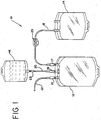
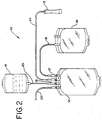
- container system 10 includes an empty interim container 12, a synthetic storage medium container 16 and an empty excess fluid container 14.
- the containers 12, 14 and 16 are interconnected by tubings 18 and 20, which provide flow paths between the interim container and the two satellite containers, 14 and 16.
- Tubings 18 and 20 may be associated with devices for controlling liquid flow therethrough.
- tubings may include flow control devices 23 and 25.
- Flow control device may be a frangible connector 23 which, when broken, establish an open flow path through the tubing. Frangible connectors are described in U.S. Patent No. 4,294,247 .
- Flow control device may also be a clamp 25, such as Roberts-type clamps, as described, for example, in U.S. Patent No. 3,942,228 .
- Fig. 1 shows one embodiment of the placement of flow control devices. It will, of course, be understood that the type of device used and its location may be determined by one of ordinary skill, as necessary or desired.
- the containers of container system 10 may be made of biocompatible materials suitable for use in the medical field, including, but not limited to, polyvinyl chloride (PVC) based materials and non-PVC based materials.
- the container material should be one that can be sterilized by known sterilization techniques such as (but not limited to) autoclaving.
- filled container 16 may be autoclaved and the empty containers may be sterilized by other forms of sterilization such as electron beam or gamma radiation.
- Container system 10 may be assembled by joining the separately sterilized portions and sterilizing the point of connection by, for example, electron beam in the manner described in U.S. Patent No. 5,009,654 .
- Interim container 12 may be empty and may have an internal volume sufficient to hold the volume of blood product collected by apheresis or by other (e.g., manual) blood collection procedures. In one preferred embodiment, where the blood component collected includes platelets in plasma, interim container 12 may have an internal volume sufficient to hold between about 500 ml and 1 liter of liquid.
- interim container 12 may be made of a thermoplastic material such as polyvinyl chloride (PVC) that has been plasticized with a plasticizer such as DEHP, TEHTM, or a citrate ester including, but not limited to, n-butyryltri-n-hexyl citrate.
- PVC polyvinyl chloride
- DEHP TEHTM
- citrate ester including, but not limited to, n-butyryltri-n-hexyl citrate.
- Containers made from such plasticized PVC are available from Baxter Healthcare Corporation of Deerfield, Illinois, under the product codes PL-146, PL-1240 and PL-2209.
- thermoplastic materials may also be used to make interim container 12, including a styrene ethylene butylene styrene (SEBS) block copolymer such as KRATON ® or other polyolefin copolymer blended with ethylene-vinyl-acetate and polypropylene.
- SEBS styrene ethylene butylene styrene
- KRATON ® polyolefin copolymer blended with ethylene-vinyl-acetate and polypropylene.
- a suitable material for use in container 12 is one that includes the SEBS block copolymer described above blended with ultra-low density polyethylene and ethylene vinyl acetate.
- Such containers are also available from Baxter Healthcare Corporation of Deerfield, Illinois, under the codes PL-732 and PL-2410, respectively.
- container 12 may include several tubing ports 17 and 19 with plastic tubings 18 and 20 extending therefrom and communicating with the other containers 14 and 16.
- Container 12 may further include a tubing port 21 and associated tube 22 for attachment to a blood component source 26, as shown, for example, in Fig. 5 .
- Container 12 may also include a separate port and tube (not shown) for attachment to a disposable processing set for pathogen inactivation treatment 28 ( Fig. 10 ).
- container syst.em 10 may also include a sampling pouch 13 for sampling the blood component in interim container 12. Sampling pouch 13 may be pre-attached to interim container 12 by tubing 24.
- container system 10 includes an empty excess fluid container 14.
- the excess fluid container 14 should have an internal volume sufficient to hold whatever quantity of excess plasma transferred from interim container 12, as will be described in more detail below.
- excess fluid container 14 may have an internal volume sufficient to hold approximately 400 ml of fluid.
- Excess fluid container 14 may be made of any thermoplastic material.
- One preferred material is a thermoplastic material that includes plasticized polyvinyl chloride. Containers of this type are also available from Baxter Healthcare Corporation of Deerfield, Illinois, under the code PL-146 or PL-1240. Of course other suitable plastic materials may also be used.
- Synthetic medium container 16 is provided as a filled container of a liquid synthetic medium for use in the processing of the collected blood component.
- synthetic medium container 16 may have an internal volume sufficient to hold the quantity of medium needed for combination with the blood component.
- container 16 may hold at least approximately 250 ml of a synthetic storage medium.
- Synthetic medium container 16 may be made of any suitable, biocompatible thermoplastic material.
- one such material includes the plasticized PVC material described above.
- Other suitable materials include a blend of ultra-low density polyethylene, polypropylene, polyamide and the SEBS copolymer previously described. Containers made of such materials are available from Baxter Healthcare Corporation of Deerfield, Illinois, under the product codes PL-146, PL-1240 and PL-2411.
- the synthetic medium itself may be any medium suitable and useful in the processing, treatment, conditioning and/or storage of the blood component.
- the liquid synthetic medium may be one that enhances the subsequent pathogen inactivation treatment of the component.
- the liquid synthetic medium may be a storage medium designed to extend the life of the blood component during storage.
- the liquid synthetic medium may also be one that both enhances the efficacy of the pathogen inactivation treatment and extends the storage life of the blood product.
- the synthetic storage medium may be any medium that is suitable for extended storage of platelets.
- suitable storage media are described in U.S. Patent Nos. Re. 32, 874 , 4,695,460 , 4, 828, 976 .
- Other suitable media include a sodium chloride, sodium acetate and sodium citrate solution.
- red blood cells still other synthetic media may be used to condition the red blood cells for pathogen inactivation.
- suitable solution are those described in U.S. Patent Nos. 5,906,915 and 4,267,269 .
- Particularly preferable in the preparation and conditioning of a treatment-ready red blood cell product is a solution like the one described in U.S. Patent No. 5,906,915 which includes at least sodium citrate, sodium phosphate monobasic, sodium phosphate dibasic, adenine and mannitol and, optionally, dextrose.
- a solution that includes approximately 25 mM sodium citrate dihydrate, approximately 4.4 mM sodium phosphate monobasic, approximately 16 mM sodium phosphate dibasic, approximately 1.5 mM adenine, approximately 39.9 mM mannitol and optionally, approximately 45.4 mM dextrose, having a pH of 7.0-7.5, and preferably approximately 7.3-7.5.
- This solution is known as Erythrosol (or E-Sol) and is available from Baxter Healthcare Corporation.
- E-Sol may be added to red blood cells as two separate parts.
- Part I sometimes referred to as E-Sol A, includes approximately 26.6, mM sodium citrate, approximately 17.0 mM sodium phosphate dibasic, approximately 4.7 mM sodium phosphate, approximately 1.6 mM adenine and approximately 42.5 mM mannitol, and Part II includes the dextrose.
- the pH of E-Sol A may be approximately 7.0-7.5, and, preferably, approximately 7.3-7.5.
- the above compositions can also be made by modifying the above concentrations by ⁇ 15%.
- a preferred storage medium for the storage of platelets is one that includes sodium chloride, sodium citrate, sodium acetate and sodium phosphate. More preferably, the synthetic storage medium is one that includes between approximately 45-120 mM sodium chloride, 5-15 mM sodium citrate, 20-40 mM sodium acetate and 20-40 mM sodium phosphate, having a pH of approximately 7.0-7.4, and preferably approximately 7.2.
- the synthetic platelet storage medium may include approximately 70-90 mM sodium chloride, approximately 8-12 mM sodium citrate, approximately 25-35 mM sodium acetate and approximately 22-5 mM sodium phosphate (which can be a combination of various protonated sodium phosphate species, such as dibasic sodium phosphate and monobasic sodium phosphate.
- the pH of such solution is a approximately 7.0-7.4 and preferably, approximately 7.2.
- Most preferred is a synthetic storage medium that has any pH of approximately 7.2 and the formulation set forth in Table 1 below.
- the platelet storage medium described above is effective to extend the life of the collected platelets during storage to at least 5 days and possibly up to approximately 7 or more days. It is also effective in enhancing the efficacy of pathogen inactivation in certain established platelet pathogen inactivation procedures and protocols, particularly for those protocols that utilize a psoralen such as, 5'-(4-amino-2-oxa) butyl-4,5',8-trimethyl psoralen as the pathogen inactivation compound. Examples of such pathogen inactivation protocols are described in U.S. Patent Nos. 5,578,736 and 5,593,823 .
- the final platelet product includes platelets suspended approximately 50-80% (by volume) of a synthetic platelet storage medium that includes sodium chloride, sodium citrate, sodium acetate and sodium phosphate and approximately 20-50% (by volume) of plasma. More preferably, the final platelet product includes platelets suspended in approximately 60-70% (by volume) of a synthetic platelet storage medium that includes sodium chloride, sodium citrate, sodium acetate and sodium phosphate and approximately 30-40% (by volume) of plasma.
- the treatment-ready platelet product should include platelets suspended in approximately 65% (by volume) of a synthetic medium of the type set forth in Table 1 above approximately and 35% (by volume) of plasma.
- the synthetic media 22, optionally mixed with plasma, can condition the platelet concentrate for other pathogen inactivating systems employing other types of pathogen inactivating compounds.
- pathogen inactivating systems can employ other pathogen inactivating compounds such as phthalocyanine derivatives, phenothiazine derivatives (including methylene blue or dimethyl-methylene blue); endogenous and exogenous photosensitizers such as alloxazines, isoalloxazines (including riboflavin), vitamin Ks, vitamin L, napththoguinones, naphthalenes, naphthols, and other pathogen inactivating compounds disclosed in United States Patent Nos. 6,258,577 , 6,268,120 , and 6,277,337 or "Pen 110," which is made by V.I. Technologies, Inc. (which is also known as the InactineTM compound).
- a preferred compound for red blood cell pathogen inactivation is p-alanine, N-(acridin-9-yl), 2-[bis(2-chloroethyl)amino] ethyl ester.
- interim container 12 of container system 10 is adapted for attachment to a source of collected platelets 26 ( Fig. 4 ).
- Source container 26 may be attached to the interim container 12 by joining tubings 22 and 27 in a sterile manner.
- Methods and systems for joining tubing in, preferably, a sterile manner are well known in the field of blood processing.
- One particularly useful system for attaching the tubings of interim container 12 and source container 26 is the Terumo SCD 312 sterile connection device generally described in U.S. Patent No. 5,802,689 .
- Other possible means for sterile connection will also be known and recognized by those of ordinary skill in the art. In any event, once the sterile connection is made, source platelets from source container 26 are transferred to interim container
- Container system 10 and the associated method of preparing a blood product finds particular application for preparing platelet products from source platelets that include at least a standard therapeutic dose of approximately 3 x 10 11 platelets suspended in a volume of plasma.
- a therapeutic dose of approximately 3 x 10 11 platelets may be made up from several units of pooled random donor platelets. More preferably, such platelets are obtained by apheresis using apheresis machines such as the Baxter CS3000, the Baxter Amicus®, the COBE Spectra, the COBE Trima, the Haemonetics MCS Plus and the Fresenius AS-104, AS-204 and Com.tec.
- Some apheresis systems of the type identified above are described, for example, in U.S. Patent Nos. 5,704,889 , 5,496,265 , 5,720,716 and 6,113,554 .
- platelets collected using some of these commercially available apheresis systems are often suspended in more than a desirable quantity of plasma and, such systems do not have readily available means for adding the selected amount or even an acceptable type of synthetic medium.
- the platelets may be more or less concentrated and, consequently, may include less or more plasma.
- the volume of collected plasma (which includes the platelets) is approximately 300 ml. Platelets stored in approximately 300 ml of plasma may not be acceptable for treatment as part of certain established methods for pathogen inactivation, particularly those that use a psoralen photoactivation compound.
- the platelet product For purposes of pathogen inactivation using such established methods as well as for storage, the platelet product must be suspended in the selected quantities (and/or ratio) of synthetic medium and plasma. In short, the platelet product obtained must, in many instances, be "converted" to a platelet product suitable for treatment (i,e., "treatment-ready") in such established protocols and suitable for extended storage.
- source platelets that include an excess amount of plasma must have some of the excess plasma removed prior to addition of the synthetic storage medium.
- connection e.g., sterile
- the platelets in plasma residing in interim container 12 may be centrifuged to separate excess plasma from the platelets.
- flow control devices 23 and 25 Fig. 1
- a Sorval RC 3B Plus centrifuge may be spun at approximately 3800 rpm for approximately 6 minutes to achieve sufficient separation of platelets from plasma.
- other speeds, "g" forces and centrifugation times may also be employed to achieve such separation.
- Plasma upon centrifugation, plasma generally forms in upper layer 62 in interim container 12 and platelet concentrate suspended in some plasma 64 forms the bottom layer, as shown in Fig. 6 .
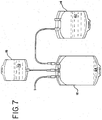
- Upper plasma layer 62 may then be expressed from interim container 12 through tubing 18 (by opening flow control device 25) to excess fluid container 14, as generally shown in Fig. 7 .
- the excess plasma may be expressed manually, by simply squeezing the container to remove the plasma layer or, more preferably, using devices specifically designed for expression of separated layers of biological fluid. Such devices are known to those of skill in the art and are available from Baxter Healthcare Corporation of Deerfield, Illinois.
- the quantity of plasma 62 removed from interim container 12 or the amount of platelet concentrate in plasma remaining may be determined by weighing either interim container 12 or excess liquid container 14. For example, in one embodiment, where the original platelet source includes 300 ml of platelets in plasma, (after centrifugation) excess plasma is removed from interim container 12 until it is determined, by weighing, that the volume remaining in interim container is approximately 105 ml platelets in plasma, or that the volume of plasma removed from interim container is approximately 195 ml.
- the volume of platelet concentrate in plasma is approximately 105 ml
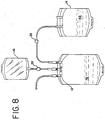
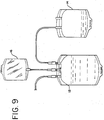
- the volume of synthetic storage medium added may be approximately 195 ml, thus providing a platelet concentrate in synthetic storage medium and plasma 76 ( Fig. 8 ).
- the quantity of synthetic medium to be added may be determined by the quantity of plasma removed.
- the quantity of the synthetic medium to be added may also be determined by monitoring the weight of container 16 as medium is transferred, or by simply observing the changing fluid level in containers 12 and/or 16.
- synthetic storage medium container 16 may be filled with 195 ml of the medium, thus ensuring that by completely emptying container 16, the required amount of media has been added to achieve the required ratio of medium and plasma.
- Flow control devices 23 and 25 may also optionally be used in association with tubing 18 and 20 to control the flow of plasma and/or storage medium from the containers.
- the ratio should be between approximately 60-70% storage medium to 30-40% plasma. More preferably, the platelets are suspended in a ratio of 65:35 synthetic storage medium to plasma.
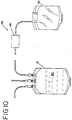
- the platelet product is now treatment-ready and may be connected (in, for example, a sterile manner) to a pathogen inactivation system as generally shown in Fig. 10 .
- the platelet product may be transferred from the interim container 12 of set 28 to a disposable processing set designed for pathogen inactivation treatment.
- a processing set is described in U.S. Serial No. 09/325,599, filed on June 3, 1999 .
- the interim container 12 may be attached via one of the existing tubings 18, 20, 22 or a separate dedicated tube (not shown) to set 28 which includes a container 40 holding a photochemical compound and a treatment container 42.
- the disposable processing set may include additional containers required in the pathogen inactivation treatment.
- container system 10 may not include an excess fluid container 14 for receiving excess plasma.
- therapeutic dose of platelets with some but not much residual plasma may simply be transferred to interim container 12 with no further separation step required.
- a selected amount of synthetic storage medium may be added to obtain the desired ratio of 65:35 storage medium to plasma.
- the platelet product may then be ready for attachment to a pathogen inactivation treatment set for treatment therein.
- interim container 12 may already include the required volume or quantity of the synthetic storage medium.
- concentrated platelets may be transferred from a source container to the interim container which already includes the synthetic storage medium in the required or desired quantity.
- no further processing is required prior to connection of the interim container including the platelet product to the disposable processing set for pathogen inactivation.
Landscapes
- Health & Medical Sciences (AREA)
- Vascular Medicine (AREA)
- Heart & Thoracic Surgery (AREA)
- Life Sciences & Earth Sciences (AREA)
- Animal Behavior & Ethology (AREA)
- General Health & Medical Sciences (AREA)
- Public Health (AREA)
- Veterinary Medicine (AREA)
- Hematology (AREA)
- Cardiology (AREA)
- Engineering & Computer Science (AREA)
- Anesthesiology (AREA)
- Biomedical Technology (AREA)
- Pharmacology & Pharmacy (AREA)
- External Artificial Organs (AREA)
- Medicines Containing Material From Animals Or Micro-Organisms (AREA)
- Medical Preparation Storing Or Oral Administration Devices (AREA)
Applications Claiming Priority (3)
| Application Number | Priority Date | Filing Date | Title |
|---|---|---|---|
| US10/004,696 US6936413B1 (en) | 2001-12-05 | 2001-12-05 | Methods and systems for preparing blood products |
| US4696 | 2001-12-05 | ||
| PCT/US2002/037554 WO2003049634A1 (en) | 2001-12-05 | 2002-11-22 | Methods and systems for preparing blood products |
Publications (3)
| Publication Number | Publication Date |
|---|---|
| EP1450716A1 EP1450716A1 (en) | 2004-09-01 |
| EP1450716A4 EP1450716A4 (en) | 2010-11-10 |
| EP1450716B1 true EP1450716B1 (en) | 2016-04-06 |
Family
ID=21712067
Family Applications (1)
| Application Number | Title | Priority Date | Filing Date |
|---|---|---|---|
| EP02789836.0A Expired - Lifetime EP1450716B1 (en) | 2001-12-05 | 2002-11-22 | Methods and systems for preparing blood products |
Country Status (9)
| Country | Link |
|---|---|
| US (2) | US6936413B1 (https=) |
| EP (1) | EP1450716B1 (https=) |
| JP (1) | JP2005511197A (https=) |
| KR (1) | KR20050044689A (https=) |
| CN (1) | CN100500231C (https=) |
| AU (2) | AU2002352877B2 (https=) |
| CA (1) | CA2469364C (https=) |
| MX (1) | MXPA04005457A (https=) |
| WO (1) | WO2003049634A1 (https=) |
Families Citing this family (23)
| Publication number | Priority date | Publication date | Assignee | Title |
|---|---|---|---|---|
| US6936413B1 (en) * | 2001-12-05 | 2005-08-30 | Baxter International Inc. | Methods and systems for preparing blood products |
| EP1455860B1 (en) * | 2001-12-10 | 2011-08-31 | CaridianBCT, Inc. | Method for the leukoreduction of red blood cells |
| EP1496947A1 (en) * | 2002-04-24 | 2005-01-19 | Gambro, Inc. | Removal of adenine during a process of pathogen reducing blood and blood components |
| KR100765249B1 (ko) * | 2006-03-23 | 2007-10-09 | 송영완 | 농축혈소판 겔 형성 트레이 |
| US20070243608A1 (en) * | 2006-04-14 | 2007-10-18 | Board Of Regents, The University Of Texas System | Platelet bioreactor |
| US8835104B2 (en) | 2007-12-20 | 2014-09-16 | Fenwal, Inc. | Medium and methods for the storage of platelets |
| US8871434B2 (en) * | 2008-03-21 | 2014-10-28 | Fenwal, Inc. | Red blood cell storage medium for extended storage |
| US8968992B2 (en) * | 2008-03-21 | 2015-03-03 | Fenwal, Inc. | Red blood cell storage medium for extended storage |
| US11864553B2 (en) | 2009-10-23 | 2024-01-09 | Fenwal, Inc. | Methods and systems for providing red blood cell products with reduced plasma |
| US9164079B2 (en) * | 2011-03-17 | 2015-10-20 | Greyledge Technologies Llc | Systems for autologous biological therapeutics |
| EP3662750A1 (en) | 2011-04-07 | 2020-06-10 | Fenwal, Inc. | Automated methods and systems for providing platelet concentrates with reduced residual plasma volumes and storage media for such platelet concentrates |
| US20140043930A1 (en) * | 2011-05-03 | 2014-02-13 | Fenwal, Inc. | Platelet resuspension method and apparatus |
| US20140086892A1 (en) * | 2011-09-19 | 2014-03-27 | FENWAL, INC. a Delaware Corporation | Red blood cell products and the storage of red blood cells in non-pvc containers |
| CN103028154B (zh) * | 2011-12-14 | 2015-10-07 | 南京双威生物医学科技有限公司 | 一种血小板分离袋及手工分离血小板的方法 |
| WO2014051537A1 (en) * | 2012-09-25 | 2014-04-03 | Biovec Transfusion, Llc | Device and method for removing additives in the blood products |
| US10098813B2 (en) * | 2014-09-03 | 2018-10-16 | Sun Pharmaceutical Industries Limited | Perfusion dosage form |
| EP3313418B1 (en) | 2015-06-26 | 2024-03-13 | Cerus Corporation | Cryoprecipitate compositions and methods of preparation thereof |
| CA3003097A1 (en) | 2015-10-23 | 2017-04-27 | Cerus Corporation | Plasma compositions and methods of use thereof |
| IL260393B2 (en) * | 2016-01-07 | 2024-06-01 | Cerus Corp | Systems and methods for preparation of platelets |
| IL261038B2 (en) | 2016-02-09 | 2024-06-01 | Sun Pharmaceutical Ind Ltd | perfusion system |
| US20180078694A1 (en) * | 2016-09-21 | 2018-03-22 | Fenwal, Inc. | Disposable Fluid Circuits for Extracorporeal Photopheresis with Integrated Source of Photoactive Agent |
| CA3055203A1 (en) | 2017-03-03 | 2018-09-07 | Cerus Corporation | Kits and methods for preparing pathogen-inactivated platelet compositions |
| US12391922B2 (en) | 2019-02-15 | 2025-08-19 | Terumo Kabushiki Kaisha | Platelet lysate production method, production system, and bag set |
Family Cites Families (29)
| Publication number | Priority date | Publication date | Assignee | Title |
|---|---|---|---|---|
| US4322298A (en) * | 1981-06-01 | 1982-03-30 | Advanced Blood Component Technology, Inc. | Centrifugal cell separator, and method of use thereof |
| US4670013A (en) | 1982-12-27 | 1987-06-02 | Miles Laboratories, Inc. | Container for blood and blood components |
| IT1217938B (it) * | 1988-06-28 | 1990-03-30 | Girolamo Sirchia | Procedimento per la preparazione e la conservazione di concentrati eritrocitari e piastrinici |
| US5089146A (en) | 1990-02-12 | 1992-02-18 | Miles Inc. | Pre-storage filtration of platelets |
| SE9001271D0 (sv) | 1990-04-06 | 1990-04-06 | Eric Westberg | Blodpaase foer anvaendning vid separation av blod i komponenter |
| JP3182145B2 (ja) * | 1990-04-16 | 2001-07-03 | 日本赤十字社 | 血小板保存液 |
| JP2838725B2 (ja) | 1990-05-02 | 1998-12-16 | テルモ株式会社 | 血液採取器具 |
| JP2980663B2 (ja) | 1990-10-05 | 1999-11-22 | テルモ株式会社 | バッグ連結体 |
| DE9102709U1 (de) | 1991-03-07 | 1991-05-23 | Blutspendedienst der Landesverbände des Deutschen Roten Kreuzes Niedersachsen, Oldenburg und Bremen Gemeinnützige GmbH, 3257 Springe | Blutbeutelanordnung |
| WO1992019355A1 (en) | 1991-05-08 | 1992-11-12 | Baxter International Inc. | Methods for processing red blood cell products for long term storage free of microorganisms |
| US5269946A (en) * | 1991-05-22 | 1993-12-14 | Baxter Healthcare Corporation | Systems and methods for removing undesired matter from blood cells |
| US5618662A (en) | 1992-03-02 | 1997-04-08 | Cerus Corporation | Intravenous administration of psoralen |
| WO1996014740A1 (en) | 1992-03-02 | 1996-05-23 | Cerus Corporation | Synthetic media for blood components |
| US5459030A (en) * | 1992-03-02 | 1995-10-17 | Steritech, Inc. | Synthetic media compositions for inactivating bacteria and viruses in blood preparations with 8-methoxypsoralen |
| AT406638B (de) * | 1992-07-13 | 2000-07-25 | Pall Corp | Automatisiertes behandlungssystem für biologische fluide und verfahren hiezu |
| US5399719A (en) * | 1993-06-28 | 1995-03-21 | Steritech, Inc. | Compounds for the photodecontamination of pathogens in blood |
| US5445629A (en) * | 1993-12-21 | 1995-08-29 | Baxter International Inc. | Blood storage container and methods of using same |
| WO1996014741A2 (en) * | 1994-11-14 | 1996-05-23 | Pall Corporation | Long-term blood component storage system and method |
| US6544727B1 (en) | 1995-06-07 | 2003-04-08 | Cerus Corporation | Methods and devices for the removal of psoralens from blood products |
| US5836934A (en) | 1995-06-07 | 1998-11-17 | Baxter International Inc. | Closed system and methods for mixing additive solutions while removing undesired matter from blood cells |
| WO1997018844A1 (en) * | 1995-11-21 | 1997-05-29 | Pall Corporation | Inactivation method and system in biological fluids |
| ES2210846T3 (es) * | 1997-11-20 | 2004-07-01 | Cerus Corporation | Nuevos psoralenos para inactivar agentes patogenos. |
| US7025877B1 (en) * | 1999-06-03 | 2006-04-11 | Baxter International Inc. | Processing set for processing and treating a biological fluid |
| CA2386040A1 (en) * | 1999-10-16 | 2001-04-26 | Abinash Nayak | Automated collection systems and methods for obtaining red blood cells, platelets, and plasma from whole blood |
| JP2001252350A (ja) * | 2000-03-08 | 2001-09-18 | Terumo Corp | 赤血球アフェレーシス装置 |
| DE10054159A1 (de) | 2000-11-02 | 2002-05-16 | Wacker Siltronic Halbleitermat | Verfahren zur Montage von Halbleiterscheiben |
| US6548241B1 (en) * | 2000-11-28 | 2003-04-15 | Gambro, Inc. | Storage solution containing photosensitizer for inactivation of biological contaminants |
| US20020138066A1 (en) * | 2001-03-23 | 2002-09-26 | Gambro, Inc. | Multiple compartment bag with openable closure assembly |
| US6936413B1 (en) * | 2001-12-05 | 2005-08-30 | Baxter International Inc. | Methods and systems for preparing blood products |
-
2001
- 2001-12-05 US US10/004,696 patent/US6936413B1/en not_active Expired - Lifetime
-
2002
- 2002-11-22 WO PCT/US2002/037554 patent/WO2003049634A1/en not_active Ceased
- 2002-11-22 EP EP02789836.0A patent/EP1450716B1/en not_active Expired - Lifetime
- 2002-11-22 JP JP2003550685A patent/JP2005511197A/ja active Pending
- 2002-11-22 KR KR1020047008577A patent/KR20050044689A/ko not_active Ceased
- 2002-11-22 CN CNB028242882A patent/CN100500231C/zh not_active Expired - Lifetime
- 2002-11-22 AU AU2002352877A patent/AU2002352877B2/en not_active Expired
- 2002-11-22 CA CA2469364A patent/CA2469364C/en not_active Expired - Lifetime
- 2002-11-22 MX MXPA04005457A patent/MXPA04005457A/es active IP Right Grant
-
2005
- 2005-07-01 US US11/173,214 patent/US20050256443A1/en not_active Abandoned
-
2008
- 2008-06-19 AU AU2008202709A patent/AU2008202709B2/en not_active Expired
Also Published As
| Publication number | Publication date |
|---|---|
| KR20050044689A (ko) | 2005-05-12 |
| CA2469364A1 (en) | 2003-06-19 |
| CN100500231C (zh) | 2009-06-17 |
| US6936413B1 (en) | 2005-08-30 |
| CN1599581A (zh) | 2005-03-23 |
| AU2002352877B2 (en) | 2008-03-20 |
| MXPA04005457A (es) | 2004-10-11 |
| WO2003049634A1 (en) | 2003-06-19 |
| AU2008202709A1 (en) | 2008-07-17 |
| AU2002352877A1 (en) | 2003-06-23 |
| AU2008202709B2 (en) | 2010-06-17 |
| EP1450716A4 (en) | 2010-11-10 |
| JP2005511197A (ja) | 2005-04-28 |
| US20050256443A1 (en) | 2005-11-17 |
| EP1450716A1 (en) | 2004-09-01 |
| CA2469364C (en) | 2013-04-09 |
Similar Documents
| Publication | Publication Date | Title |
|---|---|---|
| AU2008202709B2 (en) | Methods and systems for preparing blood products | |
| US5445629A (en) | Blood storage container and methods of using same | |
| US5879318A (en) | Method of and closed system for collecting and processing umbilical cord blood | |
| EP3194576B1 (en) | Methods for preparing platelet products | |
| EP2490751B1 (en) | Methods and systems for providing red blood cell products with reduced plasma | |
| US20050137517A1 (en) | Processing systems and methods for providing leukocyte-reduced blood components conditioned for pathogen inactivation | |
| JP2005511209A (ja) | 病原体不活性化のために調整された血液成分を提供するための、手動の処理システムおよび方法 | |
| US11096963B2 (en) | Cryoprecipitate compositions and methods of preparation thereof | |
| US20100189597A1 (en) | Methods and Systems for Preparing Blood Products | |
| CN119700973A (zh) | 用于血小板的病原体灭活的组合物和方法 | |
| US20020138066A1 (en) | Multiple compartment bag with openable closure assembly | |
| EP2777727B1 (en) | Methods and systems for processing biological fluids | |
| EA042974B1 (ru) | Композиции и способы инактивации патогенных микроорганизмов тромбоцитов |
Legal Events
| Date | Code | Title | Description |
|---|---|---|---|
| PUAI | Public reference made under article 153(3) epc to a published international application that has entered the european phase |
Free format text: ORIGINAL CODE: 0009012 |
|
| 17P | Request for examination filed |
Effective date: 20040528 |
|
| AK | Designated contracting states |
Kind code of ref document: A1 Designated state(s): AT BE BG CH CY CZ DE DK EE ES FI FR GB GR IE IT LI LU MC NL PT SE SK TR |
|
| RAP1 | Party data changed (applicant data changed or rights of an application transferred) |
Owner name: FENWAL, INC. |
|
| RAP1 | Party data changed (applicant data changed or rights of an application transferred) |
Owner name: FENWAL, INC. |
|
| A4 | Supplementary search report drawn up and despatched |
Effective date: 20101012 |
|
| 17Q | First examination report despatched |
Effective date: 20101215 |
|
| GRAP | Despatch of communication of intention to grant a patent |
Free format text: ORIGINAL CODE: EPIDOSNIGR1 |
|
| INTG | Intention to grant announced |
Effective date: 20150518 |
|
| GRAS | Grant fee paid |
Free format text: ORIGINAL CODE: EPIDOSNIGR3 |
|
| GRAP | Despatch of communication of intention to grant a patent |
Free format text: ORIGINAL CODE: EPIDOSNIGR1 |
|
| INTG | Intention to grant announced |
Effective date: 20151012 |
|
| REG | Reference to a national code |
Ref country code: DE Ref legal event code: R079 Ref document number: 60247940 Country of ref document: DE Free format text: PREVIOUS MAIN CLASS: A61B0019000000 Ipc: A61M0001360000 |
|
| GRAA | (expected) grant |
Free format text: ORIGINAL CODE: 0009210 |
|
| RIC1 | Information provided on ipc code assigned before grant |
Ipc: A61M 1/36 20060101AFI20160211BHEP |
|
| AK | Designated contracting states |
Kind code of ref document: B1 Designated state(s): AT BE BG CH CY CZ DE DK EE ES FI FR GB GR IE IT LI LU MC NL PT SE SK TR |
|
| REG | Reference to a national code |
Ref country code: GB Ref legal event code: FG4D |
|
| REG | Reference to a national code |
Ref country code: AT Ref legal event code: REF Ref document number: 787032 Country of ref document: AT Kind code of ref document: T Effective date: 20160415 Ref country code: CH Ref legal event code: EP |
|
| REG | Reference to a national code |
Ref country code: IE Ref legal event code: FG4D |
|
| REG | Reference to a national code |
Ref country code: DE Ref legal event code: R096 Ref document number: 60247940 Country of ref document: DE |
|
| REG | Reference to a national code |
Ref country code: NL Ref legal event code: MP Effective date: 20160406 |
|
| REG | Reference to a national code |
Ref country code: AT Ref legal event code: MK05 Ref document number: 787032 Country of ref document: AT Kind code of ref document: T Effective date: 20160406 |
|
| PG25 | Lapsed in a contracting state [announced via postgrant information from national office to epo] |
Ref country code: NL Free format text: LAPSE BECAUSE OF FAILURE TO SUBMIT A TRANSLATION OF THE DESCRIPTION OR TO PAY THE FEE WITHIN THE PRESCRIBED TIME-LIMIT Effective date: 20160406 |
|
| PG25 | Lapsed in a contracting state [announced via postgrant information from national office to epo] |
Ref country code: FI Free format text: LAPSE BECAUSE OF FAILURE TO SUBMIT A TRANSLATION OF THE DESCRIPTION OR TO PAY THE FEE WITHIN THE PRESCRIBED TIME-LIMIT Effective date: 20160406 |
|
| REG | Reference to a national code |
Ref country code: FR Ref legal event code: PLFP Year of fee payment: 15 |
|
| PG25 | Lapsed in a contracting state [announced via postgrant information from national office to epo] |
Ref country code: PT Free format text: LAPSE BECAUSE OF FAILURE TO SUBMIT A TRANSLATION OF THE DESCRIPTION OR TO PAY THE FEE WITHIN THE PRESCRIBED TIME-LIMIT Effective date: 20160808 Ref country code: SE Free format text: LAPSE BECAUSE OF FAILURE TO SUBMIT A TRANSLATION OF THE DESCRIPTION OR TO PAY THE FEE WITHIN THE PRESCRIBED TIME-LIMIT Effective date: 20160406 Ref country code: AT Free format text: LAPSE BECAUSE OF FAILURE TO SUBMIT A TRANSLATION OF THE DESCRIPTION OR TO PAY THE FEE WITHIN THE PRESCRIBED TIME-LIMIT Effective date: 20160406 Ref country code: ES Free format text: LAPSE BECAUSE OF FAILURE TO SUBMIT A TRANSLATION OF THE DESCRIPTION OR TO PAY THE FEE WITHIN THE PRESCRIBED TIME-LIMIT Effective date: 20160406 Ref country code: GR Free format text: LAPSE BECAUSE OF FAILURE TO SUBMIT A TRANSLATION OF THE DESCRIPTION OR TO PAY THE FEE WITHIN THE PRESCRIBED TIME-LIMIT Effective date: 20160707 |
|
| PG25 | Lapsed in a contracting state [announced via postgrant information from national office to epo] |
Ref country code: IT Free format text: LAPSE BECAUSE OF FAILURE TO SUBMIT A TRANSLATION OF THE DESCRIPTION OR TO PAY THE FEE WITHIN THE PRESCRIBED TIME-LIMIT Effective date: 20160406 Ref country code: BE Free format text: LAPSE BECAUSE OF FAILURE TO SUBMIT A TRANSLATION OF THE DESCRIPTION OR TO PAY THE FEE WITHIN THE PRESCRIBED TIME-LIMIT Effective date: 20160406 |
|
| REG | Reference to a national code |
Ref country code: DE Ref legal event code: R097 Ref document number: 60247940 Country of ref document: DE |
|
| PG25 | Lapsed in a contracting state [announced via postgrant information from national office to epo] |
Ref country code: EE Free format text: LAPSE BECAUSE OF FAILURE TO SUBMIT A TRANSLATION OF THE DESCRIPTION OR TO PAY THE FEE WITHIN THE PRESCRIBED TIME-LIMIT Effective date: 20160406 Ref country code: DK Free format text: LAPSE BECAUSE OF FAILURE TO SUBMIT A TRANSLATION OF THE DESCRIPTION OR TO PAY THE FEE WITHIN THE PRESCRIBED TIME-LIMIT Effective date: 20160406 Ref country code: CZ Free format text: LAPSE BECAUSE OF FAILURE TO SUBMIT A TRANSLATION OF THE DESCRIPTION OR TO PAY THE FEE WITHIN THE PRESCRIBED TIME-LIMIT Effective date: 20160406 Ref country code: SK Free format text: LAPSE BECAUSE OF FAILURE TO SUBMIT A TRANSLATION OF THE DESCRIPTION OR TO PAY THE FEE WITHIN THE PRESCRIBED TIME-LIMIT Effective date: 20160406 |
|
| PLBE | No opposition filed within time limit |
Free format text: ORIGINAL CODE: 0009261 |
|
| STAA | Information on the status of an ep patent application or granted ep patent |
Free format text: STATUS: NO OPPOSITION FILED WITHIN TIME LIMIT |
|
| 26N | No opposition filed |
Effective date: 20170110 |
|
| REG | Reference to a national code |
Ref country code: CH Ref legal event code: PL |
|
| PG25 | Lapsed in a contracting state [announced via postgrant information from national office to epo] |
Ref country code: CH Free format text: LAPSE BECAUSE OF NON-PAYMENT OF DUE FEES Effective date: 20161130 Ref country code: LI Free format text: LAPSE BECAUSE OF NON-PAYMENT OF DUE FEES Effective date: 20161130 |
|
| REG | Reference to a national code |
Ref country code: IE Ref legal event code: MM4A |
|
| PG25 | Lapsed in a contracting state [announced via postgrant information from national office to epo] |
Ref country code: LU Free format text: LAPSE BECAUSE OF NON-PAYMENT OF DUE FEES Effective date: 20161130 |
|
| REG | Reference to a national code |
Ref country code: FR Ref legal event code: PLFP Year of fee payment: 16 |
|
| PG25 | Lapsed in a contracting state [announced via postgrant information from national office to epo] |
Ref country code: IE Free format text: LAPSE BECAUSE OF NON-PAYMENT OF DUE FEES Effective date: 20161122 |
|
| PG25 | Lapsed in a contracting state [announced via postgrant information from national office to epo] |
Ref country code: CY Free format text: LAPSE BECAUSE OF FAILURE TO SUBMIT A TRANSLATION OF THE DESCRIPTION OR TO PAY THE FEE WITHIN THE PRESCRIBED TIME-LIMIT Effective date: 20160406 |
|
| PG25 | Lapsed in a contracting state [announced via postgrant information from national office to epo] |
Ref country code: TR Free format text: LAPSE BECAUSE OF FAILURE TO SUBMIT A TRANSLATION OF THE DESCRIPTION OR TO PAY THE FEE WITHIN THE PRESCRIBED TIME-LIMIT Effective date: 20160406 Ref country code: MC Free format text: LAPSE BECAUSE OF FAILURE TO SUBMIT A TRANSLATION OF THE DESCRIPTION OR TO PAY THE FEE WITHIN THE PRESCRIBED TIME-LIMIT Effective date: 20160406 |
|
| PG25 | Lapsed in a contracting state [announced via postgrant information from national office to epo] |
Ref country code: BG Free format text: LAPSE BECAUSE OF FAILURE TO SUBMIT A TRANSLATION OF THE DESCRIPTION OR TO PAY THE FEE WITHIN THE PRESCRIBED TIME-LIMIT Effective date: 20160406 |
|
| PGFP | Annual fee paid to national office [announced via postgrant information from national office to epo] |
Ref country code: GB Payment date: 20211129 Year of fee payment: 20 Ref country code: FR Payment date: 20211124 Year of fee payment: 20 Ref country code: DE Payment date: 20211126 Year of fee payment: 20 |
|
| REG | Reference to a national code |
Ref country code: DE Ref legal event code: R071 Ref document number: 60247940 Country of ref document: DE |
|
| REG | Reference to a national code |
Ref country code: GB Ref legal event code: PE20 Expiry date: 20221121 |
|
| PG25 | Lapsed in a contracting state [announced via postgrant information from national office to epo] |
Ref country code: GB Free format text: LAPSE BECAUSE OF EXPIRATION OF PROTECTION Effective date: 20221121 |