TECHNICAL FIELD
The present invention relates to a glass ceramic
composition suitable for preparation of an electronic
circuit board by calcination.
BACKGROUND ART
Heretofore, an alumina substrate prepared by
sintering an alumina powder has been widely used as an
electronic circuit board.
For the above alumina substrate, since the alumina
powder has a high sintering temperature of about 1,600°C,
only a high melting point metal such as tungsten (melting
point: 3,400°C) or molybdenum (melting point: 2,620°C)
can be used as a material of an electrode which is
calcined simultaneously with preparation of the alumina
substrate. Accordingly, a non-high melting point metal
such as silver (melting point: 962°C) having a small
resistivity but having a melting point of at most 1,600°C
can not be used as a material of the above electrode,
such being problematic.
In recent years, a material for an electronic
circuit board with which an electronic circuit board can
be prepared by calcination at a temperature of at most
900°C, as the alternative to the above alumina powder,
has been required.
It is an object of the present invention to overcome
the above problems, and to provide a glass ceramic
composition suitable for preparation of an electronic
circuit board.
DISCLOSURE OF THE INVENTION
The present invention provides a glass ceramic
composition which consists essentially of an inorganic
material powder having a melting point or a glass
transition point of at least 1,000°C and a glass powder
having a glass transition point of from 450 to 800°C,
wherein the average of the major axes L of particles of
the above inorganic material powder is from 0.5 to 15 µm,
and the average of the ratios L/W of the major axes L to
the minor axes W is at most 1.4 (first invention).
The present invention further provides a glass
ceramic composition which consists essentially of, as
represented by mass percentage, from 10 to 58% of an
inorganic material powder having a melting point or a
glass transition point of at least 1,000°C and from 42 to
90% of a glass powder having a glass transition point of
from 450 to 800°C, wherein the glass powder consists
essentially of, as represented by mol% based on the
following oxides, SiO2: 35 to 70%, B2O3: 0 to 30%, Al2O3:
3 to 18%, MgO: 0 to 40%, CaO: 0 to 19%, BaO: 0 to 35%
and ZnO: 0 to 9% (second invention).
BEST MODE FOR CARRYING OUT THE INVENTION
When a glass ceramic composition of the present
invention (hereinafter referred to as the composition of
the present invention) is used for preparation of an
electronic circuit board, usually it is formed into a
green sheet. Namely, to the composition of the present
invention, a resin such as polyvinyl butyral or an acryl
resin, and further, e.g. a plasticizer such as dibutyl
phthalate, dioctyl phthalate or butylbenzyl phthalate as
the case requires are added, followed by mixing. Then, a
solvent such as toluene, xylene or butanol is added
thereto to prepare a slurry, and this slurry is formed
into a sheet on a film of e.g. polyethylene terephthalate
(PET) by means of e.g. doctor blade method. Finally, the
product formed into a sheet is dried to remove the
solvent, whereby a green sheet is obtained. This green
sheet is subjected to a calcination step of holding it
typically at from 800 to 900°C or from 900 to 950°C for
from 5 to 180 minutes, more typically at 850°C to 900°C
for from 5 to 150 minutes, to obtain an electronic
circuit board.
The method for preparing the above slurry is not
limited to the above method of mixing the glass ceramic
composition with a resin and e.g. a plasticizer as the
case requires, and then adding a solvent thereto. For
example, it is preferred that after a resin and a solvent
are mixed, the glass ceramic composition and e.g. a
plasticizer as the case requires are added thereto,
followed by mixing to obtain a slurry, or after the glass
ceramic composition and a solvent are mixed, and a resin
and e.g. a plasticizer as the case requires are added
thereto, followed by mixing to obtain a slurry.
The relative dielectric constant ε of a calcined
product obtained by calcining the composition of the
present invention at 900°C, at 20°C at 35 GHz is
preferably at most 8.6. It is more preferably at most
7.8. Further, ε is typically at least 4. The above time
of holding the composition of the present invention at
900°C is typically from 30 to 60 minutes.
Further, the dissipation loss tanδ of the above
calcined product at 20°C at 35 GHz is preferably at most
0.0030. It is more preferably at most 0.0019. Tanδ is
typically at least 0.0010.
Further, the transmission loss S21 of the above
calcined product at 20°C at 40 GHz is preferably at most
0.08 dB/mm. If it exceeds 0.08 dB/mm, it may not be used
for an electronic circuit board for high frequency. It
is more preferably at most 0.05 dB/mm. S21 of an alumina
substrate (96% alumina) is 0.05 dB/mm.
The above S21 is one of elements of a scattering
matrix (S matrix), and represents transparency loss
property of a circuit. The S matrix is a square matrix
of complex number which consists of a transmission
coefficient and a reflection coefficient of a circuit and
which defines circuit characteristics.
S21 is obtained, for example, by forming a
microstrip line designed so that the characteristic
impedance will be 50 Ω on a board made of the above
calcined product, followed by measurement by using a
network analyzer.
The microstrip line is such that a conductor
transmission line is formed on the upper side of the
board, and a ground conductor is formed on the lower side
of the board, and the characteristic impedance is
determined by the thickness of the board, the relative
dielectric constant of the board i.e. the above ε, the
thickness of the conductor transmission line, the
electric conductivity of the conductor transmission line
and the width of the conductor transmission line.
Adjustment of the characteristic impedance to 50 Ω is
carried out finally by adjustment of the width of the
conductor transmission line.
For the conductor transmission line and the ground
conductor, a conductor such as silver is employed.
The typical shape or dimension of the microstrip
line for measurement of the above S21 is as follows.
Namely, of the board, the length is 30 mm, the width is 6
mm and the thickness is 0.254 mm, and of the conductor
transmission line, the length is 20 mm, the width is 295
µm and the thickness is 7 µm.
S21 is obtained by measuring the amplitude ratio or
the phase difference of the incident wave to the
reflected wave or the transmitted wave of the microstrip
line by means of a network analyzer such as network
analyzer 8510 manufactured by Agilent Technologies, and
analyzing the results.
For measurement of S21 of the present invention, S21
is obtained by calibrating the S matrix by TRL
calibration method. Namely, influences of e.g. the loss
due to a detector or a cable are corrected with respect
to the S matrix for each frequency to obtain S21.
The TRL calibration method is a calibration method
by means of "Thru" having terminals for calibration
directly connected, "Reflect" having terminals for
calibration not connected and having waves reflected on
each terminal part, and "Line" having a standard having
an appropriate transmission line formed thereon connected
between terminals, and is a calibration method suitable
for high-frequency measurement.
Now, components in the glass ceramic composition
according to the first invention (hereinafter referred to
as the composition of the first invention) will be
explained. The content is represented by mass
percentage.
The inorganic material powder having a melting point
or a glass transition point of at least 1,000°C
(hereinafter referred to as fire resisting powder) is a
component to increase strength of a calcined product and
is essential.
In order to lower tanδ of a calcined product, the
fire resisting powder is preferably a powder of at least
one type of an inorganic material selected from the group
consisting of α-alumina (melting point: 2,050°C),
cordierite (melting point: 1,460°C), forsterite (melting
point: 1,890°C), enstatite (melting point: 1,550°C) and
spinel (melting point: 2,050°C). It is more preferred
that an α-alumina powder is contained.
The average LAV of the major axes L of particles of
the fire resisting powder is from 0.5 to 15 µm. If it is
less than 0.5 µm, strength of the calcined product tends
to decrease. It is preferably at least 0.7 µm, more
preferably at least 1 µm. If it exceeds 15 µm, the
degree of mixing decreases, whereby strength of the
sintered product tends to decrease, ε tends to be high,
or it tends to be difficult to fabricate the green sheet
precisely.
In e.g. a case where ε has to be further lower, LAV
is preferably at most 9 µm, more preferably at most 6 µm.
If the composition of the first invention is formed
into a green sheet, and a conductor such as silver is
formed on the surface, followed by calcination, since
sintering shrinkage behaviors of the green sheet and the
burning shrinkage behaviors of the conductor are
different, deformation such as warpage may form on the
calcined product. In a case where such a deformation has
to be more suppressed, LAV is preferably at least 9 µm.
The average ΨAV of the ratios L/W of the major axes L
to the minor axes W of particles of the fire resisting
powder is at most 1.4. If it exceeds 1.4, the denseness
i.e. sintering properties of the calcined product tend to
decrease, whereby tanδ of the calcined product tends to
be high, in a case where crystals are precipitated from a
glass powder having a glass transition point of from 450
to 800°C (hereinafter referred to as low-melting glass
powder) as another component of the composition of the
first invention at the time of calcination. Further, in
a case where no crystals are precipitated from the low-melting
glass powder at the time of calcination, strength
of the calcined product tends to decrease. ΨAV is
preferably at most 1.3, more preferably at most 1.25.
The above L, LAV, W and ΨAV are measured or
calculated as follows.
First, the fire resisting powder is spread on a
stage of a scanning electron microscope (SEM). Here, a
fixing agent such as colorless nail lacquer (manicure) is
preliminarily coated on the stage so as to fix the
particles. In a case where the particles on the stage
are agglomerated, they are dispersed by means of a soft
brush, and then particles which are not fixed on the
stage are blown away by means of e.g. a rubber blower.
Then, the particles on the stage are observed by a
SEM to measure L and W. Namely, a particle which can be
observed without being blocked by another particle is
selected, and the shortest distance of two parallel lines
which sandwich the image of the particle is taken as W,
and the distance of two parallel lines which cross at
right angles with the above two parallel lines and which
sandwich the image is taken as L.
This measurement is carried out with respect to at
least 20 particles, and the average LAV of L and the
average ΨAV of L/W are calculated.
The ratio D90/D10 of the 90% particle diameter D90 to
the 10% particle diameter D10 of the fire resisting
powder is preferably at most 5. If it exceeds 5,
sintering properties of the calcined product tend to
decrease, whereby strength of the calcined product tends
to decrease, or tanδ of the calcined product tends to be
high. It is more preferably at most 3. Here, D90 and D10
may be measured by means of e.g. a laser diffraction type
particle size analyzer.
The content of the fire resisting powder is
preferably from 10 to 60%. If it is less than 10%,
strength of the calcined product tends to decrease. It
is more preferably at least 15%. If it exceeds 60%, the
sintering properties tends to decrease, thus decreasing
strength of the calcined product on the contrary. It is
more preferably at most 55%. In a case where no crystals
are precipitated from the low-melting glass powder at the
time of calcination, the content of the fire resisting
powder is preferably at least 30%.
The low-melting glass powder is a component to
improve denseness of the calcined product and is
essential.
The average particle diameter D50 of the low-melting
glass powder is preferably from 0.5 to 10 µm. If it is
less than 0.5 µm, storage stability tends to decrease.
If it exceeds 10 µm, sintering properties tend to
decrease.
The glass transition point TG of the low-melting
glass powder is at most 800°C, whereby a dense calcined
product can be obtained even by calcining the composition
of the first invention at a temperature of 900°C or
below. TG is preferably at most 760°C, more preferably at
most 730°C.
Further, the above TG is at least 450°C, whereby
fluidity will not be excessive even when the composition
of the present invention is calcined at 900°C, and a
desired calcined product will be obtained. TG is
preferably at least 550°C.
The relative dielectric constant ε0 of a calcined
product obtained by calcining the low-melting glass
powder at 900°C, at 20°C at 35 GHz is preferably at most
8. Further, ε0 is typically at least 4. Here, the time
of holding the low-melting glass powder at 900°C is
typically from 30 to 60 minutes.
Further, the dissipation loss tan δ0 of the above
calcined product at 20°C at 35 GHz is preferably at most
0.0070. It is more preferably at most 0.0055,
particularly preferably at most 0.0030. Further, tanδ0
is typically at least 0.0010.
It is preferred that the low-melting glass powder
consists essentially of, as represented by mol% based on
the following oxides:
| SiO2 | 20 to 72%, |
| B2O3 | 0 to 30%, |
| Al2O3 | 0 to 20%, |
| MgO+CaO | 0 to 60%, |
| SrO+BaO | 0 to 40%, |
| ZnO | 0 to 30%, |
| Li2O+Na2O+K2O | 0 to 10%, |
| TiO2+ZrO2 | 0 to 5%, and |
| SnO2 | 0 to 5%, |
and SiO
2+B
2O
3 is at least 30% (glass powder A). Here, in
e.g. a case where the expansion coefficient of the above
calcined product has to be low, SrO+BaO is preferably
from 0 to 20%.
Hereinafter, the content of each component of the
low-melting glass powder is represented by mol%.
In a more preferred embodiment, SiO2: over 55 to 72%,
B2O3: 5 to 30%, Al2O3: 0 to 10% and MgO+CaO: 0 to 10%
(glass powder A1). The glass powder A1 is particularly
preferably such that no crystals are precipitated when
calcined at 900°C, or the amount is small even if
crystals are precipitated. Typically, of a calcined
product thereof, ε0 is from 3 to 6 and tanδ0 is from
0.0010 to 0.0040.
In another more preferred embodiment, SiO2: 35 to 60%,
B2O3: 0 to 10%, Al2O3: 5 to 18%, MgO: 5 to 40%, CaO: 7 to
40% and ZnO: 0 to 10% (glass powder A2). The glass
powder A2 is particularly preferably such that crystals
are precipitated when calcined at 900°C. Further,
typically, of a calcined product thereof, ε0 is from 5
to 9 and tanδ0 is from 0.0050 to 0.0100. Here, it
becomes possible to improve strength of the calcined
product by crystal precipitation.
The above precipitated crystals are preferably of at
least one member selected from the group consisting of
anorthite, cordierite, diopside, enstatite and forsterite.
In a case where the average coefficient of linear
expansion α0 of the calcined product at from 50 to 350°C
is set to be at most 80×10-7/°C for example, the above
precipitated crystals are more preferably of anorthite or
cordierite.
In a case where tanδ0 of the calcined product has to
be further smaller, the above precipitated crystals are
more preferably of at least one member selected from the
group consisting of cordierite, diopside, enstatite and
forsterite.
In another more preferred embodiment, SiO2: 20 to 60%,
B2O3: 0 to 20%, Al2O3: 2 to 20% and MgO: 10 to 50% and
CaO: 0 to 20% (glass powder A3). SiO2 is particularly
preferably at most 55%.
The glass powder A3 is particularly preferably such
that crystals are precipitated when calcined at 900°C.
Typically, of a calcined product thereof, ε0 is from 6
to 9 and tanδ0 is from 0.0030 to 0.0100. Here, it
becomes possible to improve strength of the calcined
product by crystal precipitation.
In a case where α0 has to be high or in a case where
tanδ0 has to be small, the above precipitated crystals
are preferably of at least one member selected from the
group consisting of diopside, enstatite, forsterite and
gahnite, and in a case where α0 has to be at most
80×10-7/°C for example, the above precipitated crystals
are more preferably of anorthite or cordierite.
Now, the composition of the above glass powder A will
be explained.
SiO2 is a network former and is essential. If it is
less than 20%, vitrification is less likely to take place,
ε0 tends to be high, or chemical durability tends to
decrease. It is preferably at least 60% with respect to
the glass powder A1, at least 40% with respect to the
glass powder A2 or at least 25% with respect to the glass
powder A3. If it exceeds 72%, the glass melt temperature
tends to be high, or TG tends to be high. It is
preferably at most 67% with respect to the glass powder
A1, and with respect to the glass powder A2, preferably
at most 55%, more preferably at most 50%, particularly
preferably less than 45%.
B2O3 is not essential, but may be contained up to 30%
in order to increase fluidity or in order to lower ε0.
If it exceeds 30%, chemical durability tends to decrease,
or the viscosity of the slurry tends to be unstable when
the composition is formed into a green sheet. It is
preferably at most 25%.
In a case where crystals are precipitated when the
glass powder is calcined at 900°C, B2O3 is preferably at
most 20%. If it exceeds 20%, tanδ0 tends to be high. It
is more preferred that no B2O3 is contained substantially.
If the total of SiO2 and B2O3 is less than 30%, glass
tends to be unstable.
Al2O3 is not essential, but may be contained up to
20% in order to stabilize glass or in order to increase
the chemical durability. If it exceeds 20%, TG tends to
be high. It is preferably at most 8% with respect to the
glass powder A1. Here, in the glass powder A2, Al2O3 is a
constituent of cordierite and anorthite and is essential,
and it is preferably at least 7%. Further, in the glass
powder A3, Al2O3 is essential to stabilize glass.
Each of MgO and CaO is not essential, but may be
contained up to 60% in total, in order to stabilize glass,
in order to lower ε0 or in order to lower tanδ0. If it
exceeds 60%, glass tends to be unstable on the contrary.
In the glass powder A2, each of MgO and CaO is essential,
and in the glass powder A3, MgO is essential.
Each of SrO and BaO is not essential, but may be
contained up to 20% in total, in order to lower the glass
melt temperature, in order to lower TG or in order to
lower tanδ0. If it exceeds 20%, devitrification is
likely to take place, or ε0 tends to be high. In the
glass powder A3, at least one of SrO and BaO is essential.
ZnO is not essential, but may be contained up to 30%
in order to lower the glass melt temperature, in order to
increase fluidity or in order to lower TG. If it exceeds
30%, chemical durability, particularly acid resistance
tends to decrease. It is preferably at most 10%.
Each of Li2O, Na2O and K2O is not essential, but may
be contained up to 10% in total, in order to increase
fluidity or in order to lower TG. If it exceeds 10%, tan
δ0 tends to be high, or electrical insulating properties
tend to be low. It is preferably at most 6%. In a case
where the electrical insulating properties have to be
high, or in a case where SiO2 is at most 55%, none of
them are preferably contained.
Each of TiO2 and ZrO2 is not essential, but may be
contained up to 5% in total, in order to lower the glass
melt temperature or in order to accelerate precipitation
of crystals at the time of calcination. If it exceeds 5%,
ε0 tends to be high, or glass tends to be unstable. It
is preferably at most 3% in total, more preferably at
most 2% in total.
SnO2 is not essential, but may be contained up to 5%
in order to increase chemical durability. If it exceeds
5%, ε0 tends to be high.
The glass powder A consists essentially of the above
components, but may contain other components within a
range of not impairing the object of the present
invention. The total of contents of said other
components is preferably at most 10%. If it exceeds 10%,
devitrification is likely to take place. The total
content is more preferably at most 5%. Here, none of
lead, cadmium and arsenic are preferably contained.
Examples of said other components are as follows.
Namely, e.g. Bi2O3, P2O5 or F may be contained in order to
lower the glass melt temperature or for another purpose.
Further, e.g. Fe2O3, MnO, CuO, CoO, V2O5 or Cr2O3 may be
contained in order to color the glass or for another
purpose.
The content of the low-melting glass powder is
preferably from 40 to 90%. If it is less than 40%,
sintering properties tend to be low. It is more
preferably at least 45%. If it exceeds 90%, strength of
the calcined product tends to be low. It is more
preferably at most 85%.
The composition of the first invention consists
essentially of the fire resisting powder and the low-melting
glass powder, but may contain other components
such as a heat resistant coloring pigment within a range
of not impairing the object of the present invention.
The total of contents of said other components is
preferably at most 10%, more preferably at most 5%.
Now, the components of the glass ceramic composition
according to the second invention (hereinafter referred
to as the composition of the second invention) will be
explained according to the explanation regarding the
composition of the first invention. Explanation may be
omitted in some cases regarding a part which overlaps
with the explanation regarding the composition of the
first invention.
The fire resisting powder is a component to increase
strength of a calcined product and is essential. If it
exceeds 58% as represented by mass percentage, sintering
properties tend to decrease.
In a case where crystals are precipitated from the
low-melting glass powder at the time of calcination, in a
case where the average LAV of the major axes L of
particles of the fire resisting powder is less than 0.5
µm or exceeds 15 µm, in a case where the average ΨAV of
the ratios L/W of the major axes L to the minor axes W of
particles of the fire resisting powder exceeds 1.4, or
the like, sintering properties tend to decrease, and in
such a case, the content of the fire resisting powder is
preferably at most 52%, more preferably at most 46%.
In a case not corresponding to the above cases where
sintering properties tend to decrease, the content of the
fire resisting powder is preferably at least 30%.
The fire resisting powder is preferably a powder of
at least one type of an inorganic material selected from
the group consisting of α-alumina, cordierite,
forsterite, enstatite and spinel. It is more preferred
that an α-alumina powder is contained.
The average LAV of the major axes L of particles of
the fire resisting powder is preferably from 0.5 to 15 µm,
and the average ΨAV of the ratios L/W of the major axes L
to the minor axes W is preferably at most 1.4.
LAV is more preferably at least 0.7 µm, particularly
preferably at least 1 µm. Further, in e.g. a case where
ε has to be further lower, it is more preferably at most
9 µm, particularly preferably at most 6 µm. Further, in
a case where deformation such as warpage on the calcined
product due to difference between the sintering shrinkage
behaviors of the green sheet and the sintering shrinkage
behaviors of the above conductor has to be more
suppressed, LAV is preferably at least 9 µm.
ΨAV is preferably at most 1.3, more preferably at
most 1.25.
The ratio D90/D10 of the 90% particle diameter D90 to
the 10% particle diameter D10 of the fire resisting
powder is preferably at most 5. It is more preferably at
most 3.
The low-melting glass powder is a component to
improve denseness of the calcined product and is
essential. If it exceeds 90% as represented by mass
percentage, strength of the calcined product tends to
decrease.
In a case corresponding to the above cases where the
sintering properties tend to decrease, the content of the
low-melting glass powder is preferably at least 48%, more
preferably at least 54%.
In a case not corresponding to the above cases where
the sintering properties tend to decrease, the content of
the low-melting glass powder is preferably at most 70%.
The average particle diameter D50 of the low-melting
glass powder is preferably from 0.5 to 10 µm.
The glass transition point TG of the low-melting
glass powder is preferably at most 760°C, more preferably
at most 730°C. Further, TG is preferably at least 550°C.
The relative dielectric constant ε0 of a calcined
product obtained by calcining the low-melting glass
powder at 900°C, at 20°C at 35 GHz is preferably at most
8. It is more preferably at most 7.5. Further, ε0 is
typically at least 4. The time of holding the low-melting
glass powder at 900°C is typically from 30 to 60
minutes.
The dissipation loss tanδ0 of the above calcined
product at 20°C at 35 GHz is preferably at most 0.0070.
It is more preferably at most 0.0055, particularly
preferably at most 0.0030. Tanδ0 is typically at least
0.0010.
In a case where an electronic circuit board is
prepared by employing the composition of the present
invention, the preferred range of the average coefficient
of linear expansion α0 of the above calcined product at
from 50 to 350°C varies depending upon the application of
the electronic circuit board.
In a case where silicon is formed on the electronic
circuit board, α0 is preferably from 30×10-7 to 55×10-7/°C.
In a case where gallium arsenide is formed on the
electronic circuit board, α0 is preferably from 56×10-7
to 83×10-7/°C.
In a case where the electronic circuit board is
joined with a circuit board made of a resin, it is
preferably from 84×10-7 to 130×10-7/°C.
As described above, the low-melting glass powder
consists essentially of SiO2: 35 to 70%, B2O3: 0 to 30%,
Al2O3: 3 to 18%, MgO: 0 to 40%, CaO: 0 to 19%, BaO: 0 to
35% and ZnO: 0 to 9% (glass powder B).
The glass powder B is included in the above glass
powder A. Namely, the glass powder B may contain Li2O,
Ni2O and K2O in a total amount of at most 10%, TiO2 and
ZrO2 in a total amount of at most 5%, and SnO2 in an
amount of at most 5%, although each of them is not
essential.
It is preferred that the glass powder B contains
substantially no Li2O, Na2O nor K2O. Even when the glass
powder B contains SnO2, its content is preferably at most
2%, and in a case where at least one of TiO2, ZrO2 and
SnO2 is contained, the total of their contents is
preferably at most 5%.
With respect to the glass powder B, in a case where
it is preferred that α0 is from 30×10-7 to 55×10-7/°C, and
that no crystals are precipitated at the time of
calcination, or their amount is small even if crystals
are precipitated, the glass powder B preferably consists
essentially of SiO2: 60 to 70%, B2O3: 20 to 30%, Al2O3: 3
to 8%, MgO: 0 to 1%, CaO: 2 to 8%, BaO: 0 to 2% and ZnO:
0 to 2%, and SiO2+B2O3 is from 86 to 93% and
SiO2+B2O3+Al2O3+CaO exceeds 98% (glass powder B1).
The glass powder B1 is included in the above glass
powder A1.
Here, in a case where no crystals are precipitated at
the time of calcination, or their amount is small even if
crystals are precipitated, improvement in dimensional
accuracy of an electronic circuit board can be expected.
Of the glass powder B1, ε0 is typically from 3.8 to
4.8 and tanδ0 is from 0.0020 to 0.0030.
With respect to the glass powder B, in a case where
it is preferred that α0 is from 66×10-7 to 83×10-7/°C, and
that crystals are precipitated at the time of calcination,
the glass powder B preferably consists essentially of
SiO2: 35 to 53%, B2O3: 0 to 2%, Al2O3: 5 to 18%, MgO: 20
to 40%, CaO: over 7 to 19%, BaO: 0 to 3% and ZnO: 0 to 9%,
and SiO2+Al2O3 is at most 59%, and Al2O3/(MgO+CaO) is at
least 0.13 (glass powder B2).
The glass powder B2 is included in the above glass
powder A2.
The glass powder B2 is preferably such that both
anorthite and diopside are precipitated therefrom when it
is held at 900°C for 60 minutes and calcined. Anorthite
has an effect of lowering α0. Diopside has effects of
increasing α0 and lowering tan δ0.
In a case where crystals are precipitated at the time
of calcination, improvement in strength of an electronic
circuit board can be expected.
Of the glass powder B2, ε0 is typically from 6.5 to
7.4 and tanδ0 is from 0.0020 to 0.0058.
With respect to the glass powder B, in a case where
it is preferred that α0 is from 30×10-7 to 66×10-7/°C and
that crystals are precipitated at the time of calcination,
the glass powder B preferably consists essentially of
SiO2: 48 to 60%, B2O3: 2 to 10%, Al2O3: 5 to 18%, MgO: 15
to 40%, CaO: 0.5 to 7%, BaO: 0 to 3% and ZnO: 0.5 to 9%
(glass powder B3).
The glass powder B3 is included in the above glass
powder A3.
Of the glass powder B3, ε0 is typically from 4.5 to
7.0 and tanδ0 is from 0.0020 to 0.0075.
The glass powder B3 is preferably such that
cordierite is precipitated when it is held at 900°C for
60 minutes and calcined. Cordierite has effects of
lowering α0, lowering ε0 and lowering tanδ0.
With respect to the glass powder B, in a case where
it is preferred that α0 is from 84×10-7 to 110×10-7/°C,
the glass powder B preferably consists essentially of
SiO2: 48 to 60%, B2O3: 0 to 10%, Al2O3: 9 to 18%, MgO: 0
to 5%, CaO: 0 to 5%, BaO: 25 to 35% and ZnO: 0 to 5%
(glass powder B4).
Of the glass powder B4, ε0 is typically from 4.8 to
7.0 and tanδ0 is from 0.0020 to 0.0050.
The glass powder B4 is preferably such that BaAl2Si2O8
crystals are precipitated therefrom when it is held at
900°C for 60 minutes and calcined. The BaAl2Si2O8
crystals have effects of increasing α0, lowering ε0 and
lowering tanδ0.
Now, the composition of the above glass powder B
will be explained.
SiO2 is a network former and is essential. If it is
less than 35%, ε0 tends to be high. If it exceeds 70%,
the glass transition point TG tends to be high.
With respect to the glass powder B1, it is at least
60% in order to lower tanδ0. It is preferably at least
63%.
With respect to the glass powder B2, it is at most
53% in order that both anorthite and diopside are likely
to be precipitated. It is preferably at most 46%.
With respect to the glass powders B3 and B4, it is
at least 48% in order that crystals are likely to be
precipitated. It is preferably at least 50%. Further,
it is at most 60% in order to lower TG. It is preferably
at most 57%.
B2O3 is not essential, but may be contained up to 30%
in order to increase fluidity or in order to lower ε0. If
it exceeds 30%, chemical durability, particularly water
resistance tends to decrease.
With respect to the glass powder B1, B2O3 is
essential in order to lower TG or in order to lower ε0.
It is preferably from 22 to 26%.
With respect to the glass powder B2, it is at most
2% in order to lower tanδ0. It is preferably at most
1.5%. In a case where B2O3 is contained, the content is
preferably at least 0.5%.
With respect to the glass powder B3, B2O3 is
essential in order to increase the fluidity. Further, it
is at most 10% in order to lower tanδ0. It is preferably
from 1 to 5%.
With respect to the glass powder B4, it is at most
10% in order to lower tanδ0. It is preferably at most
6%. In a case where B2O3 is contained, the content is
preferably at least 0.5%.
Al2O3 has an effect of stabilizing glass and is
essential. If it exceeds 18%, TG tends to be high.
With respect to the glass powder B1, it is at most
8% in order to lower TG. It is preferably from 4 to 6%.
With respect to the glass powder B2, it is at least
5% in order to accelerate precipitation of anorthite. It
is preferably from 7 to 12%.
With respect to the glass powder B3, it is at least
5% in order to accelerate crystal precipitation. It is
preferably from 7 to 12%.
With respect to the glass powder B4, it is at least
9% in order to accelerate crystal precipitation. It is
preferably from 9.5 to 12%.
MgO is not essential, but may be contained up to 40%
in e.g. a case of accelerating crystal precipitation. If
it exceeds 40%, glass tends to be unstable.
With respect to the glass powder B1, MgO may be
contained up to 1%, but substantially no MgO is
preferably contained.
With respect to the glass powder B2, it is at least
20% in order to accelerate precipitation of diopside. It
is preferably from 25 to 33%.
With respect to the glass powder B3, it is at least
15% in order to accelerate precipitation of cordierite.
It is preferably from 18 to 36%.
With respect to the glass powder B4, MgO may be
contained up to 5%. If it exceeds 5%, BaAl2Si2O8 crystals
are less likely to be precipitated. It is preferably at
most 3%.
CaO is not essential, but may be contained up to 19%
in order to stabilize glass or for another purpose. If
it exceeds 19%, glass tends to be unstable on the
contrary.
With respect to the glass powder B1, it is at least
2% in order to stabilize glass. Further, it is at most
8% in order to stabilize glass also. It is preferably
from 3 to 6%.
With respect to the glass powder B2, it exceeds 7%
in order to accelerate precipitation of anorthite. It is
preferably from 12 to 20%.
With respect to the glass powder B3, it is at least
0.5% in order to stabilize glass. Further, it is at most
7% in order to accelerate precipitation of cordierite.
It is preferably from 1 to 6%.
With respect to the glass powder B4, CaO may be
contained up to 5%. If it exceeds 5%, BaAl2Si2O8 crystals
are less likely to be precipitated. It is preferably at
most 3%.
BaO is not essential, but may be contained up to 35%
in a case of accelerating precipitation of BaAl2Si2O8
crystals, in a case of lowering TG or in another case.
If it exceeds 35%, glass tends to be unstable.
With respect to the glass powder B1, BaO may be
contained up to 2%.
With respect to the glass powders B2 and B3, BaO may
be contained up to 3%. If it exceeds 3%, ε 0 tends to
increase.
With respect to the glass powder B4, it is at least
25% in order to accelerate BaAl2Si2O8 crystal
precipitation. It is preferably from 28 to 33%.
ZnO is not essential, but may be contained up to 9%
in order to increase the fluidity or for another purpose.
If it exceeds 9%, tanδ0 tends to be high. It is
preferably at most 7%.
With respect to the glass powder B1, ZnO may be
contained up to 2%. It is preferably at most 1%.
With respect to the glass powder B3, it is at least
0.5 in order to increase fluidity. It is preferably from
2 to 7%.
With respect to the glass powder B4, ZnO may be
contained up to 5%. If it exceeds 5%, devitrification is
likely to take place. It is preferably at most 3%.
With respect to the glass powder B1, SiO2+B2O3 is
from 86 to 93%, and SiO2+B2O3+Al2O3+CaO exceeds 98%. If
SiO2+B2O3 is less than 86%, ε0 tends to be high. Further,
it is preferred that none of Li2O, Na2O, K2O and Sb2O3 are
contained.
With respect to the glass powder B2, SiO2+Al2O3 is at
most 59%, and Al2O3/(MgO+CaO) is at least 0.13. If
SiO2+Al2O3 exceeds 59%, crystals are less likely to be
precipitated. Further, if Al2O3/(MgO+CaO) is less than
0.13, anorthite is less likely to be precipitated.
The glass powder B consists essentially of the above
components, but may contain other components within a
range of not impairing the object of the present
invention. The total of contents of said other
components is preferably at most 10%. If it exceeds 10%,
devitrification is likely to take place. The total is
more preferably at most 5%. None of lead, cadmium and
arsenic are preferably contained.
As said other components, the following may be
exemplified in addition to the above-mentioned Li2O,
Na2O, K2O, SnO2, TiO2 and ZrO2. Namely, e.g. Bi2O3, P2O5 or
F may be contained in order to lower the glass melt
temperature or for another purpose. Further, e.g. Fe2O3,
MnO, CuO, CoO, V2O5 or Cr2O3 may be contained in order to
color the glass or for another purpose.
The composition of the second invention consists
essentially of the fire resisting powder and the glass
powder B, but may contain other components such as a heat
resistant coloring pigment within a range of not
impairing the object of the present invention. The total
of contents of said other components is preferably at
most 10%, more preferably at most 5%.
Starting materials were blended and mixed so that
the composition would be as identified in columns "SiO2"
to "K2O" in Table 1 as represented by mol%, and the mixed
starting materials were put into a platinum crucible and
melted at from 1,500 to 1,650°C for 120 minutes, and the
molten glass was drawn off and cooled. The obtained
glass was pulverized by an alumina ball mill for 30 hours
to obtain each of glass powders (G1 to G5).
With respect to each of the glass powders G1 to G5,
D50 (unit: µm), TG (unit: °C), crystallization temperature
TC (unit: °C), α0 (unit: 10-7/°C), relative dielectric
constant ε0, dissipation loss tanδ0 and precipitated
crystals were measured as follows. The results are shown
in Table 1.
D50: measured by means of laser diffraction particle
size analyzer SALD2100 manufactured by Shimadzu
Corporation, employing water as a solvent.
TG, TC: measured by means of differential thermal
analysis, employing an alumina powder as a standard
substance, from room temperature to 1,000°C at a
temperature-raising rate of 10°C/min. The first
exothermic peak temperature is taken as TC, and TC=∞ with
respect to one having no exothermic peak confirmed.
α0: the average coefficient of linear expansion at
from 50 to 350°C was measured by means of a differential
thermal expansion meter DILATOMETER5000 manufactured by
Mac Science Co., Ltd., employing quartz glass as a
standard, with respect to 5 g of the glass powder
subjected to pressure molding, calcined at 900°C and
formed into a diameter of 5 mm and a length of 20 mm.
ε0, tanδ0: 40 g of the glass powder was subjected to
press molding into a shape of 60 mm × 60 mm, which was
held at 900°C for 1 hour and calcined. The obtained
calcined product was cut and ground, and the upper and
lower surfaces are subjected to mirror polishing to
prepare a sample having a thickness of 250 µm and a size
of 50 mm × 50 mm. With respect to this sample, the
relative dielectric constant and the dissipation loss
were measured at 20°C at 35 GHz by means of cavity
resonance method.
Precipitated crystals: a calcined product obtained
by holding the glass powder at 900°C for 1 hour for
calcination was pulverized, and presence or absence of
crystal precipitation was confirmed and identification of
precipitated crystals was carried out by means of X-ray
diffraction. "-" means that no crystal precipitation was
confirmed, and "A" represents anorthite, "B" represents
BaAl2Si2O8 crystals, "C" represents cordierite, "D"
represents diopside, and "F" represents forsterite.
On the other hand, four types of α-alumina powders
i.e. Sumikorandom AA-07 (alumina AL1), Sumikorandom AA-2
(alumina AL2), Sumikorandom AA-10 (alumina AL3), each
manufactured by Sumitomo Chemical Co., Ltd., and AL-45H
(alumina AL4) manufactured by SHOWA DENKO K.K. were
prepared.
23 Particles of each of alumina AL1, AL2, AL3 and
AL4 were observed by a SEM as described above to measure
L and W. The average LAV (unit: µm) of L and the average
ΨAV of L/W are shown in Table 2. With respect to AL1,
observation was carried out under 10,000 magnifications,
with respect to alumina AL2 and AL4, observation was
carried out under 5,000 magnifications, and with respect
to alumina AL3, observation was carried out under 2,000
magnifications.
Further, with respect to alumina AL1 to AL4, the
particle size distribution (represented by mass
percentage) was measured by means of laser diffraction
particle size analyzer SALD2100 manufactured by Shimadzu
Corporation employing water as a solvent. The results
are shown in Table 3 together with the 90% particle
diameter D90 (unit: µm), the 10% particle diameter D10
(unit: µm) and the ratio thereof D90/D10.
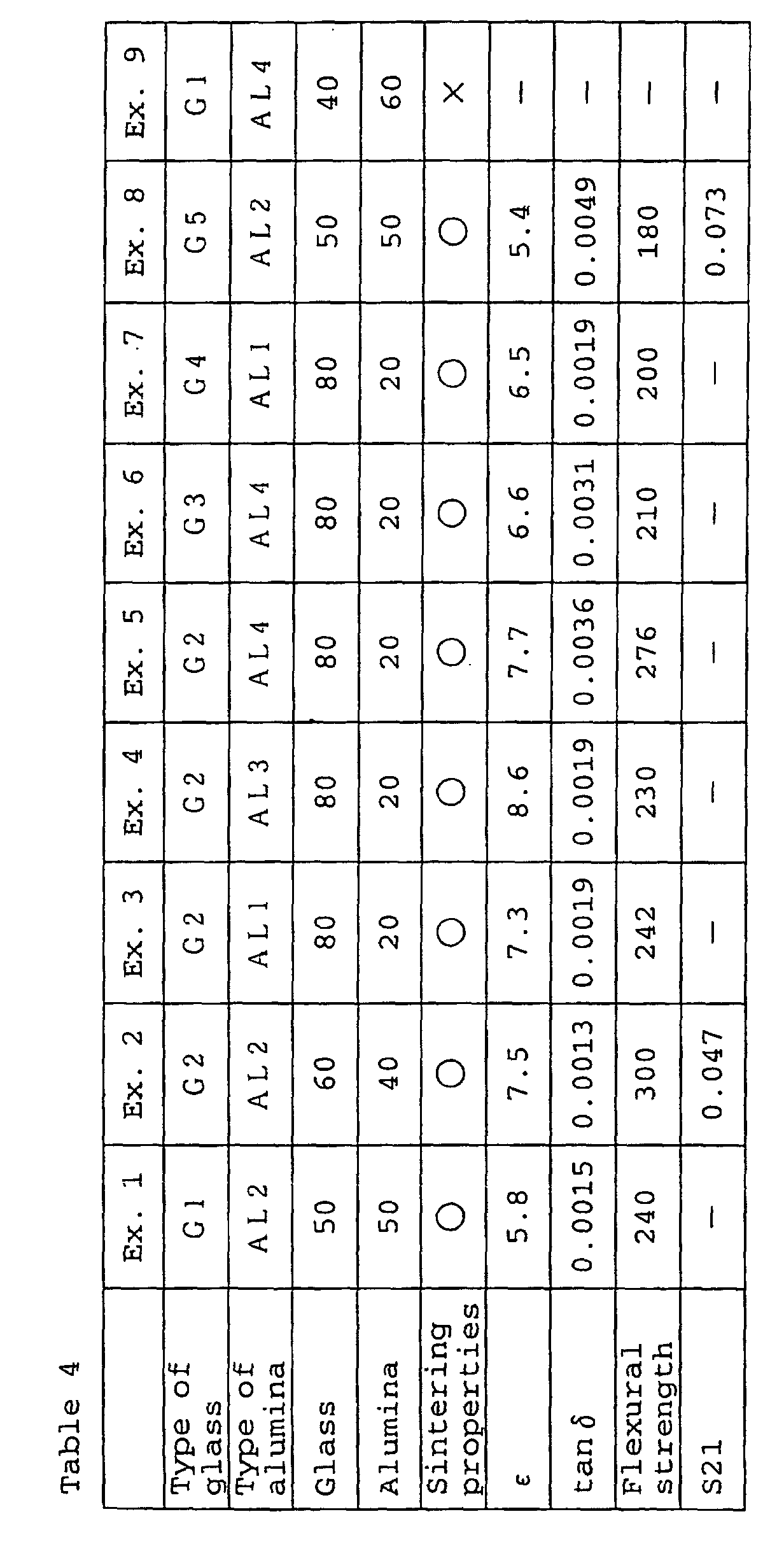
Then, a glass powder and an α-alumina powder as
identified in the columns "type of glass" and "type of
alumina", respectively, in Table 4, were mixed in a
proportion as identified in columns "glass" and "alumina"
in Table 4 as represented by mass percentage. The
obtained mixed powder was mixed with an organic solvent
(mixture comprising toluene and isopropyl alcohol in a
mass ratio of 3:1), a plasticizer (di-2-ethylhexyl
phthalate) and a resin (polyvinyl butyral PVK#3000k
manufactured by Denki Kagaku Kogyo K.K.). The above
organic solvent was optionally added to the mixture to
adjust the viscosity, which was coated on a PET film by
means of doctor blade method, followed by drying to
prepare a green sheet.
The obtained green sheet was cut into 50 mm × 50 mm,
and 12 sheets thereof were laminated one on another,
followed by pressing under 20 MPa for 1 minute. This
pressed product was held at 550°C for 5 hours to
decompose and remove resin components, followed by
calcination by holding the pressed product at 900°C for 1
hour to obtain a calcined product.
With respect to the obtained calcined product,
sintering properties, ε, tanδ and flexural strength
(unit: MPa) were evaluated or measured as follows.
Examples 1 to 8 are Examples of the present invention,
and Example 9 is a Comparative Example. In Example 9, no
dense calcined product could be obtained, and ε, tanδ
and flexural strength were not measured.
Sintering properties: the calcined product was
immersed in a red soakage (Super Check UP-G3 manufactured
by Marktec Corporation) and washed with water, and
whether the calcined product was reddened or not was
observed. "○" represents a case where the calcined
product was not reddened, and "×" represents a case
where the calcined product was reddened.
ε, tanδ: a sample was prepared and measurement was
carried out in the same manner as in measurement of ε0
and tanδ0.
Flexural strength: the calcined product was cut into
4 mm × 20 mm, the surface was finished with #1000 Si3N4
abrasive, and three-point flexural strength was measured
at a cross head speed of 0.5 mm/min in a span of 15 mm.
The average of results of five measurements was taken as
the flexural strength. The flexural strength is
preferably at least 150 MPa, more preferably at least 200
MPa.
Further, in Examples 2 and 8, the transmission loss
S21 (unit: dB/mm) at 20°C at 40 GHz was measured as
described above.
| | G1 | G2 | G3 | G4 | G5 |
| SiO2 | 65 | 44 | 53 | 55 | 75 |
| B2O3 | 25 | 0 | 3 | 5 | 2 1 |
| Al2O3 | 5 | 8 | 1 2 | 1 0 | 0 |
| MgO | 0 | 30 | 22 | 0 | 0 |
| CaO | 5 | 16 | 5 | 0 | 0 |
| BaO | 0 | 0 | 0 | 30 | 0 |
| ZnO | 0 | 2 | 5 | 0 | 0 |
| K2O | 0 | 0 | 0 | 0 | 4 |
| D50 | 2.5 | 2.5 | 3.1 | 4.5 | 2.4 |
| TG | 600 | 720 | 700 | 680 | 490 |
| TC | ∞ | 948 | 985 | 956 | ∞ |
| α0 | 32 | 76 | 48 | 94 | 29 |
| ε0 | 4.3 | 6.7 | 6.2 | 6.0 | 4.5 |
| tanδ0 | 0.0022 | 0.0052 | 0.0036 | 0.0025 | 0.0040 |
| Precipitated crystals | - | A, D, F | C, F | B | - |
| | AL1 | AL2 | AL3 | AL4 |
| LAV | 0.87 | 1.93 | 9.73 | 2.94 |
| ΨAV | 1.21 | 1.22 | 1.31 | 1.57 |
| | AL1 | AL2 | AL3 | AL4 |
| 19.11µm | 100 | 100 | 100 | 100 |
| 12.60µm | 100 | 100 | 73.95 | 100 |
| 8.31µm | 100 | 100 | 10.57 | 100 |
| 5.48µm | 100 | 98.60 | 0 | 87.67 |
| 3.61µm | 100 | 79.75 | 0 | 65.06 |
| 2.38µm | 100 | 37.89 | 0 | 41.20 |
| 1.57µm | 75.79 | 7.12 | 0 | 25.29 |
| 1.04µm | 30.57 | 5.95 | 0 | 18.88 |
| 0.68µm | 2.26 | 5.95 | 0 | 13.44 |
| 0.45µm | 0 | 2.56 | 0 | 8.35 |
| 0.30µm | 0 | 0 | 0 | 5.64 |
| 0.20µm | 0 | 0 | 0 | 3.84 |
| 0.13µm | 0 | 0 | 0 | 1.7 1 |
| D90 | 1.86 | 4.28 | 14.74 | 5.80 |
| D10 | 0.80 | 1.66 | 8.22 | 0.52 |
| D90/D10 | 2.33 | 2.58 | 1.79 | 11.15 |
According to the present invention, a sintered
product suitable for an electronic circuit board can be
obtained by calcination at a temperature of 900°C or
below. Further, a sintered product having low ε and
tanδ and having high strength can be obtained. Further,
a calcined product having a small transmission loss S21
can be obtained.