EP1439240A1 - METHOD FOR PRESS WORKING, PLATED STEEL PRODUCT FOR USE THEREIN AND METHOD FOR PRODUCING THE STEEL PRODUCT - Google Patents
METHOD FOR PRESS WORKING, PLATED STEEL PRODUCT FOR USE THEREIN AND METHOD FOR PRODUCING THE STEEL PRODUCT Download PDFInfo
- Publication number
- EP1439240A1 EP1439240A1 EP02777929A EP02777929A EP1439240A1 EP 1439240 A1 EP1439240 A1 EP 1439240A1 EP 02777929 A EP02777929 A EP 02777929A EP 02777929 A EP02777929 A EP 02777929A EP 1439240 A1 EP1439240 A1 EP 1439240A1
- Authority
- EP
- European Patent Office
- Prior art keywords
- steel material
- zinc
- press forming
- hot press
- plated
- Prior art date
- Legal status (The legal status is an assumption and is not a legal conclusion. Google has not performed a legal analysis and makes no representation as to the accuracy of the status listed.)
- Granted
Links
Images
Classifications
-
- C—CHEMISTRY; METALLURGY
- C23—COATING METALLIC MATERIAL; COATING MATERIAL WITH METALLIC MATERIAL; CHEMICAL SURFACE TREATMENT; DIFFUSION TREATMENT OF METALLIC MATERIAL; COATING BY VACUUM EVAPORATION, BY SPUTTERING, BY ION IMPLANTATION OR BY CHEMICAL VAPOUR DEPOSITION, IN GENERAL; INHIBITING CORROSION OF METALLIC MATERIAL OR INCRUSTATION IN GENERAL
- C23C—COATING METALLIC MATERIAL; COATING MATERIAL WITH METALLIC MATERIAL; SURFACE TREATMENT OF METALLIC MATERIAL BY DIFFUSION INTO THE SURFACE, BY CHEMICAL CONVERSION OR SUBSTITUTION; COATING BY VACUUM EVAPORATION, BY SPUTTERING, BY ION IMPLANTATION OR BY CHEMICAL VAPOUR DEPOSITION, IN GENERAL
- C23C28/00—Coating for obtaining at least two superposed coatings either by methods not provided for in a single one of groups C23C2/00 - C23C26/00 or by combinations of methods provided for in subclasses C23C and C25C or C25D
- C23C28/30—Coatings combining at least one metallic layer and at least one inorganic non-metallic layer
- C23C28/34—Coatings combining at least one metallic layer and at least one inorganic non-metallic layer including at least one inorganic non-metallic material layer, e.g. metal carbide, nitride, boride, silicide layer and their mixtures, enamels, phosphates and sulphates
- C23C28/345—Coatings combining at least one metallic layer and at least one inorganic non-metallic layer including at least one inorganic non-metallic material layer, e.g. metal carbide, nitride, boride, silicide layer and their mixtures, enamels, phosphates and sulphates with at least one oxide layer
-
- C—CHEMISTRY; METALLURGY
- C22—METALLURGY; FERROUS OR NON-FERROUS ALLOYS; TREATMENT OF ALLOYS OR NON-FERROUS METALS
- C22C—ALLOYS
- C22C38/00—Ferrous alloys, e.g. steel alloys
- C22C38/001—Ferrous alloys, e.g. steel alloys containing N
-
- C—CHEMISTRY; METALLURGY
- C22—METALLURGY; FERROUS OR NON-FERROUS ALLOYS; TREATMENT OF ALLOYS OR NON-FERROUS METALS
- C22C—ALLOYS
- C22C38/00—Ferrous alloys, e.g. steel alloys
- C22C38/02—Ferrous alloys, e.g. steel alloys containing silicon
-
- C—CHEMISTRY; METALLURGY
- C22—METALLURGY; FERROUS OR NON-FERROUS ALLOYS; TREATMENT OF ALLOYS OR NON-FERROUS METALS
- C22C—ALLOYS
- C22C38/00—Ferrous alloys, e.g. steel alloys
- C22C38/04—Ferrous alloys, e.g. steel alloys containing manganese
-
- C—CHEMISTRY; METALLURGY
- C22—METALLURGY; FERROUS OR NON-FERROUS ALLOYS; TREATMENT OF ALLOYS OR NON-FERROUS METALS
- C22C—ALLOYS
- C22C38/00—Ferrous alloys, e.g. steel alloys
- C22C38/06—Ferrous alloys, e.g. steel alloys containing aluminium
-
- C—CHEMISTRY; METALLURGY
- C22—METALLURGY; FERROUS OR NON-FERROUS ALLOYS; TREATMENT OF ALLOYS OR NON-FERROUS METALS
- C22C—ALLOYS
- C22C38/00—Ferrous alloys, e.g. steel alloys
- C22C38/14—Ferrous alloys, e.g. steel alloys containing titanium or zirconium
-
- C—CHEMISTRY; METALLURGY
- C23—COATING METALLIC MATERIAL; COATING MATERIAL WITH METALLIC MATERIAL; CHEMICAL SURFACE TREATMENT; DIFFUSION TREATMENT OF METALLIC MATERIAL; COATING BY VACUUM EVAPORATION, BY SPUTTERING, BY ION IMPLANTATION OR BY CHEMICAL VAPOUR DEPOSITION, IN GENERAL; INHIBITING CORROSION OF METALLIC MATERIAL OR INCRUSTATION IN GENERAL
- C23C—COATING METALLIC MATERIAL; COATING MATERIAL WITH METALLIC MATERIAL; SURFACE TREATMENT OF METALLIC MATERIAL BY DIFFUSION INTO THE SURFACE, BY CHEMICAL CONVERSION OR SUBSTITUTION; COATING BY VACUUM EVAPORATION, BY SPUTTERING, BY ION IMPLANTATION OR BY CHEMICAL VAPOUR DEPOSITION, IN GENERAL
- C23C2/00—Hot-dipping or immersion processes for applying the coating material in the molten state without affecting the shape; Apparatus therefor
- C23C2/26—After-treatment
- C23C2/261—After-treatment in a gas atmosphere, e.g. inert or reducing atmosphere
-
- C—CHEMISTRY; METALLURGY
- C23—COATING METALLIC MATERIAL; COATING MATERIAL WITH METALLIC MATERIAL; CHEMICAL SURFACE TREATMENT; DIFFUSION TREATMENT OF METALLIC MATERIAL; COATING BY VACUUM EVAPORATION, BY SPUTTERING, BY ION IMPLANTATION OR BY CHEMICAL VAPOUR DEPOSITION, IN GENERAL; INHIBITING CORROSION OF METALLIC MATERIAL OR INCRUSTATION IN GENERAL
- C23C—COATING METALLIC MATERIAL; COATING MATERIAL WITH METALLIC MATERIAL; SURFACE TREATMENT OF METALLIC MATERIAL BY DIFFUSION INTO THE SURFACE, BY CHEMICAL CONVERSION OR SUBSTITUTION; COATING BY VACUUM EVAPORATION, BY SPUTTERING, BY ION IMPLANTATION OR BY CHEMICAL VAPOUR DEPOSITION, IN GENERAL
- C23C2/00—Hot-dipping or immersion processes for applying the coating material in the molten state without affecting the shape; Apparatus therefor
- C23C2/26—After-treatment
- C23C2/28—Thermal after-treatment, e.g. treatment in oil bath
- C23C2/29—Cooling or quenching
-
- C—CHEMISTRY; METALLURGY
- C23—COATING METALLIC MATERIAL; COATING MATERIAL WITH METALLIC MATERIAL; CHEMICAL SURFACE TREATMENT; DIFFUSION TREATMENT OF METALLIC MATERIAL; COATING BY VACUUM EVAPORATION, BY SPUTTERING, BY ION IMPLANTATION OR BY CHEMICAL VAPOUR DEPOSITION, IN GENERAL; INHIBITING CORROSION OF METALLIC MATERIAL OR INCRUSTATION IN GENERAL
- C23C—COATING METALLIC MATERIAL; COATING MATERIAL WITH METALLIC MATERIAL; SURFACE TREATMENT OF METALLIC MATERIAL BY DIFFUSION INTO THE SURFACE, BY CHEMICAL CONVERSION OR SUBSTITUTION; COATING BY VACUUM EVAPORATION, BY SPUTTERING, BY ION IMPLANTATION OR BY CHEMICAL VAPOUR DEPOSITION, IN GENERAL
- C23C28/00—Coating for obtaining at least two superposed coatings either by methods not provided for in a single one of groups C23C2/00 - C23C26/00 or by combinations of methods provided for in subclasses C23C and C25C or C25D
- C23C28/30—Coatings combining at least one metallic layer and at least one inorganic non-metallic layer
- C23C28/32—Coatings combining at least one metallic layer and at least one inorganic non-metallic layer including at least one pure metallic layer
- C23C28/321—Coatings combining at least one metallic layer and at least one inorganic non-metallic layer including at least one pure metallic layer with at least one metal alloy layer
-
- C—CHEMISTRY; METALLURGY
- C23—COATING METALLIC MATERIAL; COATING MATERIAL WITH METALLIC MATERIAL; CHEMICAL SURFACE TREATMENT; DIFFUSION TREATMENT OF METALLIC MATERIAL; COATING BY VACUUM EVAPORATION, BY SPUTTERING, BY ION IMPLANTATION OR BY CHEMICAL VAPOUR DEPOSITION, IN GENERAL; INHIBITING CORROSION OF METALLIC MATERIAL OR INCRUSTATION IN GENERAL
- C23C—COATING METALLIC MATERIAL; COATING MATERIAL WITH METALLIC MATERIAL; SURFACE TREATMENT OF METALLIC MATERIAL BY DIFFUSION INTO THE SURFACE, BY CHEMICAL CONVERSION OR SUBSTITUTION; COATING BY VACUUM EVAPORATION, BY SPUTTERING, BY ION IMPLANTATION OR BY CHEMICAL VAPOUR DEPOSITION, IN GENERAL
- C23C28/00—Coating for obtaining at least two superposed coatings either by methods not provided for in a single one of groups C23C2/00 - C23C26/00 or by combinations of methods provided for in subclasses C23C and C25C or C25D
- C23C28/30—Coatings combining at least one metallic layer and at least one inorganic non-metallic layer
- C23C28/32—Coatings combining at least one metallic layer and at least one inorganic non-metallic layer including at least one pure metallic layer
- C23C28/322—Coatings combining at least one metallic layer and at least one inorganic non-metallic layer including at least one pure metallic layer only coatings of metal elements only
- C23C28/3225—Coatings combining at least one metallic layer and at least one inorganic non-metallic layer including at least one pure metallic layer only coatings of metal elements only with at least one zinc-based layer
-
- C—CHEMISTRY; METALLURGY
- C23—COATING METALLIC MATERIAL; COATING MATERIAL WITH METALLIC MATERIAL; CHEMICAL SURFACE TREATMENT; DIFFUSION TREATMENT OF METALLIC MATERIAL; COATING BY VACUUM EVAPORATION, BY SPUTTERING, BY ION IMPLANTATION OR BY CHEMICAL VAPOUR DEPOSITION, IN GENERAL; INHIBITING CORROSION OF METALLIC MATERIAL OR INCRUSTATION IN GENERAL
- C23C—COATING METALLIC MATERIAL; COATING MATERIAL WITH METALLIC MATERIAL; SURFACE TREATMENT OF METALLIC MATERIAL BY DIFFUSION INTO THE SURFACE, BY CHEMICAL CONVERSION OR SUBSTITUTION; COATING BY VACUUM EVAPORATION, BY SPUTTERING, BY ION IMPLANTATION OR BY CHEMICAL VAPOUR DEPOSITION, IN GENERAL
- C23C28/00—Coating for obtaining at least two superposed coatings either by methods not provided for in a single one of groups C23C2/00 - C23C26/00 or by combinations of methods provided for in subclasses C23C and C25C or C25D
- C23C28/30—Coatings combining at least one metallic layer and at least one inorganic non-metallic layer
- C23C28/32—Coatings combining at least one metallic layer and at least one inorganic non-metallic layer including at least one pure metallic layer
- C23C28/325—Coatings combining at least one metallic layer and at least one inorganic non-metallic layer including at least one pure metallic layer with layers graded in composition or in physical properties
-
- C—CHEMISTRY; METALLURGY
- C23—COATING METALLIC MATERIAL; COATING MATERIAL WITH METALLIC MATERIAL; CHEMICAL SURFACE TREATMENT; DIFFUSION TREATMENT OF METALLIC MATERIAL; COATING BY VACUUM EVAPORATION, BY SPUTTERING, BY ION IMPLANTATION OR BY CHEMICAL VAPOUR DEPOSITION, IN GENERAL; INHIBITING CORROSION OF METALLIC MATERIAL OR INCRUSTATION IN GENERAL
- C23C—COATING METALLIC MATERIAL; COATING MATERIAL WITH METALLIC MATERIAL; SURFACE TREATMENT OF METALLIC MATERIAL BY DIFFUSION INTO THE SURFACE, BY CHEMICAL CONVERSION OR SUBSTITUTION; COATING BY VACUUM EVAPORATION, BY SPUTTERING, BY ION IMPLANTATION OR BY CHEMICAL VAPOUR DEPOSITION, IN GENERAL
- C23C8/00—Solid state diffusion of only non-metal elements into metallic material surfaces; Chemical surface treatment of metallic material by reaction of the surface with a reactive gas, leaving reaction products of surface material in the coating, e.g. conversion coatings, passivation of metals
- C23C8/02—Pretreatment of the material to be coated
-
- C—CHEMISTRY; METALLURGY
- C25—ELECTROLYTIC OR ELECTROPHORETIC PROCESSES; APPARATUS THEREFOR
- C25D—PROCESSES FOR THE ELECTROLYTIC OR ELECTROPHORETIC PRODUCTION OF COATINGS; ELECTROFORMING; APPARATUS THEREFOR
- C25D11/00—Electrolytic coating by surface reaction, i.e. forming conversion layers
- C25D11/02—Anodisation
- C25D11/34—Anodisation of metals or alloys not provided for in groups C25D11/04 - C25D11/32
-
- C—CHEMISTRY; METALLURGY
- C25—ELECTROLYTIC OR ELECTROPHORETIC PROCESSES; APPARATUS THEREFOR
- C25D—PROCESSES FOR THE ELECTROLYTIC OR ELECTROPHORETIC PRODUCTION OF COATINGS; ELECTROFORMING; APPARATUS THEREFOR
- C25D5/00—Electroplating characterised by the process; Pretreatment or after-treatment of workpieces
- C25D5/10—Electroplating with more than one layer of the same or of different metals
-
- C—CHEMISTRY; METALLURGY
- C25—ELECTROLYTIC OR ELECTROPHORETIC PROCESSES; APPARATUS THEREFOR
- C25D—PROCESSES FOR THE ELECTROLYTIC OR ELECTROPHORETIC PRODUCTION OF COATINGS; ELECTROFORMING; APPARATUS THEREFOR
- C25D9/00—Electrolytic coating other than with metals
- C25D9/04—Electrolytic coating other than with metals with inorganic materials
- C25D9/08—Electrolytic coating other than with metals with inorganic materials by cathodic processes
- C25D9/10—Electrolytic coating other than with metals with inorganic materials by cathodic processes on iron or steel
-
- C—CHEMISTRY; METALLURGY
- C21—METALLURGY OF IRON
- C21D—MODIFYING THE PHYSICAL STRUCTURE OF FERROUS METALS; GENERAL DEVICES FOR HEAT TREATMENT OF FERROUS OR NON-FERROUS METALS OR ALLOYS; MAKING METAL MALLEABLE, e.g. BY DECARBURISATION OR TEMPERING
- C21D1/00—General methods or devices for heat treatment, e.g. annealing, hardening, quenching or tempering
- C21D1/62—Quenching devices
- C21D1/673—Quenching devices for die quenching
-
- Y—GENERAL TAGGING OF NEW TECHNOLOGICAL DEVELOPMENTS; GENERAL TAGGING OF CROSS-SECTIONAL TECHNOLOGIES SPANNING OVER SEVERAL SECTIONS OF THE IPC; TECHNICAL SUBJECTS COVERED BY FORMER USPC CROSS-REFERENCE ART COLLECTIONS [XRACs] AND DIGESTS
- Y10—TECHNICAL SUBJECTS COVERED BY FORMER USPC
- Y10T—TECHNICAL SUBJECTS COVERED BY FORMER US CLASSIFICATION
- Y10T428/00—Stock material or miscellaneous articles
- Y10T428/12—All metal or with adjacent metals
- Y10T428/12493—Composite; i.e., plural, adjacent, spatially distinct metal components [e.g., layers, joint, etc.]
- Y10T428/12771—Transition metal-base component
-
- Y—GENERAL TAGGING OF NEW TECHNOLOGICAL DEVELOPMENTS; GENERAL TAGGING OF CROSS-SECTIONAL TECHNOLOGIES SPANNING OVER SEVERAL SECTIONS OF THE IPC; TECHNICAL SUBJECTS COVERED BY FORMER USPC CROSS-REFERENCE ART COLLECTIONS [XRACs] AND DIGESTS
- Y10—TECHNICAL SUBJECTS COVERED BY FORMER USPC
- Y10T—TECHNICAL SUBJECTS COVERED BY FORMER US CLASSIFICATION
- Y10T428/00—Stock material or miscellaneous articles
- Y10T428/12—All metal or with adjacent metals
- Y10T428/12493—Composite; i.e., plural, adjacent, spatially distinct metal components [e.g., layers, joint, etc.]
- Y10T428/12771—Transition metal-base component
- Y10T428/12785—Group IIB metal-base component
- Y10T428/12792—Zn-base component
Definitions
- This invention relates to a steel material for hot press forming and particularly a steel material for hot press forming suitable for use in the manufacture of suspensions, bodies, reinforcing parts, and similar parts of automobiles, to a method for its manufacture, and to a hot press forming method for such a steel material.
- hot press forming it is possible to form a steel sheet into a complicated shape with good dimensional accuracy since the steel sheet is softer and more ductile at a high temperature.
- Another advantage of hot press forming is that strengthening of the steel sheet due to martensite transformation (so-called hardening) can be simultaneously achieved by heating the steel sheet to the austenite region and then performing quenching at the same time as press forming in the die.
- hot press forming is a method in which a heated steel sheet is subjected to working, the surface of the steel sheet to be worked is unavoidably oxidized. Even if the steel sheet is heated in a non-oxidizing atmosphere in a heating furnace, the sheet has a possibility of contacting the atmosphere, for example, when it is removed from the furnace before press forming, resulting in the formation of iron oxides on the surface of the steel sheet.
- These iron oxides have the problem that they may fall off during press forming and adhere to dies, thereby decreasing productivity, or that an oxide film (scale) made from such iron oxides remains on a product produced by press forming and worsens its appearance. Furthermore, if such an oxide film remains on a press formed product, in the case where the product is subsequently coated with a paint, the resulting painted film has poor adhesion to the steel sheet.
- hot press forming is that heat treatment can be performed simultaneously with press forming. It is proposed in JP 07-116900A (1995) to simultaneously perform surface treatment at this time. However, there is no disclosure therein with respect to a means of solving the above-described problems due to surface oxidation.
- JP 2000-38640A A steel sheet for hot working is proposed in JP 2000-38640A, which is coated with aluminum in order to provide the steel sheet with resistance to oxidation at the time of hot working.
- this steel sheet too, is much more expensive than plain steel.
- An object of this invention is to provide a steel material for hot press forming, which can guarantee sufficient corrosion resistance without causing a significant deterioration in appearance during hot press forming.
- a specific object of this invention is to provide a technique which makes hot press forming of a steel sheet possible without the need for post treatment for guaranteeing corrosion resistance and which can at the same time guarantee corrosion resistance.
- press forming is not performed on a steel sheet at room temperature but after it is heated to a high temperature in order to decrease the resistance of the sheet to deformation and that such hot press forming is applied to a plated steel sheet, which by nature has excellent corrosion resistance, in order to guarantee excellent corrosion resistance without performing post treatment of the steel sheet.
- hot press forming indicates that steel sheet should be heated to a temperature of 700 - 1000°C before press forming, and this temperature is higher than the melting point of the zinc-based plated coating.
- hot press forming can be carried out by utilizing a zinc plated steel sheet having a zinc oxide film on its surface.
- a steel sheet having a plated layer formed by zinc plating or zinc alloy plating (these two plating methods being hereinafter referred to collectively as “zinc-based plating” or simply as “zinc plating” in some cases) is heated so as to form a ZnO layer sufficiently on the surface of the plated layer, it is possible to suppress the vaporization of zinc during the heating stage in the process of hot press forming. Furthermore, while the plated steel sheet is heated so as to form the ZnO layer, mutual diffusion of Fe and Zn occurs between the base steel sheet and the plated layer, and as a result, the mass % of Fe in the plated layer increases to form a Fe-Zn alloy layer.
- the reason why a plated layer remains even when the plated layer is heated to a temperature close to the melting point of the plated layer is thought to be that an oxide film layer having good adhesion and having better heat resistance than the plated layer is formed on the surface of the plated layer and it acts as a barrier layer which obstructs vaporization of zinc.
- the degree of alloying between the plated layer and the steel sheet has an influence, and such alloying should progresses sufficiently to increase the melting point of the plated layer itself.
- such a surface ZnO layer may be previously formed on the surface of the plated layer by various means other than heating.
- heating may be applied in some cases to a steel sheet when the steel sheet is subjected to hot press forming.
- heating may be performed in some cases at a higher temperature (such as at 900°C or above) or for a longer period of time (such as 5 minutes or more) than usual in order to provide the steel material with increased strength, or a heating line may be stopped by accident or its traveling speed may be decreased for convenience of production.
- the upper metal plated layer can function as the above-described barrier layer, and as described above, hot press formed products with stable quality can be produced even if excessive heating is applied in the process of hot press forming.
- JP 2000-144238A and JP 2000-248338A a technique is disclosed in which a portion of a metallic part formed by cold working a steel sheet is quenched after high frequency induction heating to perform transformation strengthening of the steel sheet.
- steel sheets having a zinc-based coating are used for the purpose of rust prevention, but in order to suppress dissipation of zinc during heating, the heating is limited in such a manner that the heating temperature is at most 850°C or the heating time is short. If heating is performed at 850°C or below, the desired single austenitic phase does not form by heating, so the volume percentage of martensite formed after quenching becomes too small to attain a high strength. If heating is performed for a short period of time, cementite can not be completely dissolved during heating, and the amount of carbon in solid solution becomes so small that an insufficient strength may be obtained after quenching.
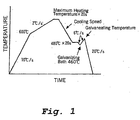
- Figure 1 is a schematic view of a thermal history which simulates a continuous hot dip galvanizing line used in Example 8.
- the base steel of a plated steel material for hot press forming according to the present invention is not critical as long as it has good wettability with molten plating metal when subjected to zinc-based plating by hot dipping and good adhesion of the plated coating thus formed.
- a difficult-to-press form steel material such as a high tensile steel sheet or a hardenable steel sheet (such as a steel sheet having a chemical composition like that shown below in Table 1) which exhibits a high strength and high hardness by quenching after hot forming is particularly preferred from a practical standpoint.
- a soft material is desired in some cases. In such cases, it is possible to use a steel sheet having low hardenability, for example.
- the chemical composition of the above-described hardenable steel is as follows.
- Carbon (C) is an important element for increasing the hardenability and determining the strength after hot press forming of a steel sheet. If the C content is less than 0.08 %, its effect is insufficient. On the other hand, a C content exceeding 0.45% leads to a deterioration in toughness and weldability.
- the C content is more preferably 0.1 - 0.3%. When hardenability is not required, the C content need not be in this range, but it is preferably at most 3.0% since a C content exceeding 3.0% may cause a decrease in toughness.
- Mn and Cr are extremely effective elements for increasing the hardenability of steel sheet and guaranteeing stable strength after hot press forming.
- the total content of (Mn and/or Cr) is less than 0.5%, the effect thereof is insufficient.
- the total content of (Mn and/or Cr) exceeds 3.0%, the effect thereof saturates, and it becomes difficult to guarantee a stable strength. More preferably, the total content of (Mn and/or Cr) is 0.8 - 2.0%.
- Si at most 0.5%
- P at most 0.05%
- S at most 0.05%
- Ni at most 2%
- Cu at most 1%
- Mo at most 1%
- V at most 1%
- Ti at most 1%
- Nb at most 1%
- Al at most 1%
- N at most 0.01 %
- B is an optional element which increases the hardenability of steel sheet and which is important for further increasing the effect of obtaining the desired strength after hot press forming with certainty.
- the effect of B is insufficient if the content thereof is less than 0.0001%, whereas its effect saturates and costs increase if the B content exceeds 0.004%. More preferably the B content is 0.0005 - 0.002 %.
- the base steel sheet when zinc-based plating is performed by hot dipping and particularly by galvanealing (hot dip galvanizing followed by annealing to cause alloying of the plated layer), it is desirable for the base steel sheet to have good wettability with plating metal, good adhesion of plated coating formed by plating, and a good galvanealing speed when performing heat treatment for galvanealing. From this standpoint, it is more preferred to control the P and Si content of the base steel sheet in the following manner.
- P is an element which reduces the galvanealing speed of a zinc plated coating.
- the galvanealing speed increases with reducing the P content, thereby making it possible to reduce the temperature of an galvanealing furnace or increase the transport speed of sheet through the furnace, contributing to an increase in productivity.
- a preferred range of the P content is at most 0.015% and more preferably at most 0.010%.
- Si is an element which impedes the wettability with plating metal at the time of hot dip zinc-based plating and reduces the galvanealing speed of a zinc plated coating.
- the Si content is at most 0.5% in order to guarantee wettability with plating metal. If the Si content is decreased, the galvanealing speed increases, thereby making it possible to reduce the temperature of an galvanealing furnace or increase the transport speed of sheet through the furnace, contributing to an increase in productivity.
- a preferred range of the Si content for this purpose is at most 0.1 % and more preferably at most 0.05%.
- the steel material on which press forming is performed according to the present invention is generally in the form of a steel sheet.
- Types of hot press forming which can be applied in accordance with the present invention include bending, drawing, bulging, bore (hole) expanding, flanging, and the like.
- bar steel, steel wire, steel pipe, and the like can be used as a material for working.
- a zinc-based plated layer having a surface barrier layer can be formed on a base steel sheet by performing hot dip galvanizing (zinc plating) as usual, for example, followed by heating in an oxidizing atmosphere, i.e., galvanealing heat treatment under prescribed conditions.
- Such heat treatment is carried out by reheating the galvanized steel sheet in a gas furnace or the like. At this time, not only oxidation of the surface of the plated layer but metal diffusion between the plated layer and the base steel sheet takes place.
- the heating temperature therefor is usually 550 - 650°C.
- Such a plated layer is usually formed directly on the surface of the steel sheet, but another plated layer or the like may be present between such a plated layer and the surface of the steel sheet.
- the plated layer is usually formed on both surfaces of the steel sheet, but as long as the other surface has a pretreatment layer or a protective layer which is not harmful to hot press forming, the above-described plated layer according to the present invention may be formed on just one surface of the steel sheet.
- a steel sheet is dipped in a molten zinc or zinc alloy plating bath and pulled up from the bath.
- the coating weight of plating is controlled by the speed of pulling up and by adjusting the flow rate of wiping gas which is blown from nozzles.
- Galvanelaing heat treatment is carried out by additional heating in a gas furnace or induction heating furnace or the like after plating treatment. Such a plating operation can be carried out either continuously using a steel strip or batchwise using cut steel sheets.
- a plated layer of a prescribed thickness can be obtained, a plated layer can be formed by any other plating method, such as electroplating, flame spraying, or vapor deposition plating.
- the coating weight of plating is preferably at most 90 g/m 2 as converted to the weight of Zn. If it exceeds this value, a zinc oxide layer as a barrier layer is adequately formed during heating, but it may be formed in nonuniform manner, thereby causing problems with respect to its appearance. In addition, the mutual diffusion of Fe and Zn does not progress sufficiently, and a molten zinc layer remain at the end of the heating. As a result, zinc may scatter at the time of hot press forming and contaminate a die. If it is too thin, such as less than 10 g/m 2 , it becomes impossible to guarantee a desired corrosion resistance after press forming, or it becomes impossible to form a zinc oxide layer necessary to suppress oxidation of the steel sheet during heating.
- the coating weight of plating is at least approximately 20 g/m 2 .
- good performance is obtained when it is preferably in the range of 40 - 80 g/m 2 and more preferably in the range of 45 - 65 g/m 2 .
- the zinc-based plated layer may have any composition. It may be a pure zinc plated layer, or it may be a zinc alloy plated layer which contains at least one alloying element such as Al, Mn, Ni, Cr, Co, Mg, Sn, and Pb in a suitable amount in accordance with the objective of addition of such element.
- the plating layer may contain some of Be, B, Si, P, S, Ti, V, W, Mo, Sb, Cd, Nb, Cu, Sr, and the like, which may be unavoidably incorporated from raw materials or other sources.
- Examples of zinc alloy plating include the following alloy systems: zinc-iron alloy plating, zinc-12% nickel alloy plating, zinc-1% cobalt alloy plating, 55% aluminum-zinc alloy plating, zinc-5% aluminum alloy plating, zinc-chromium alloy plating, zinc-aluminum-magnesium alloy plating, tin-8% zinc alloy plating, and zinc-manganese alloy plating.
- Preferred is a pure zinc plated layer or a galvanealed layer obtained by heating or annealing a pure zinc plated layer because of its low cost.
- a still more preferred plated layer is one formed by galvanealing and containing 5 - 80% Fe, more preferably 10 - 30% Fe, and still more preferably 13 - 20% Fe in the plated coating.
- a hot dip galvanizing bath contains Al.
- the Al content of the plated coating is preferably in the range of 0.08 - 0.4%. More preferably it is 0.08 - 0.3%. In order to increase the Fe content of the plated coating, it is preferable to have a low Al content.
- the zinc-based plated layer has a barrier layer formed on the surface of the plated layer for preventing Zn vaporization during heating.
- a barrier layer formed on the surface of the plated layer for preventing Zn vaporization during heating.
- ZnO zinc oxide
- its thickness is usually around 0.01 - 5.0 ⁇ m, and its weight is sufficient if it is at least 10 mg/m 2 as converted to the weight of Zn.
- an upper plated layer of a metal or an alloy may be formed as a barrier layer.
- the coating weight thereof is on the order of 0.2 - 10 g/m 2 .
- An upper plate layer may be formed as a barrier layer atop the zinc-based plated layer by plating with at least one metal or alloy selected from the group consisting of Fe, Co, Ni, and alloys thereof.
- the plated layer is less susceptible to the formation of an oxide layer, since the Fe, Co, or Ni metal in the upper plated layer quickly reacts with zinc in the zinc-based plated layer to form a heat-resisting alloy layer, so it is more suitable for hot press forming.
- the coating weight of the upper plated layer is preferably at least 0.2 g/m 2 . If it is lower than this value, no appreciable effect of the upper plated layer compared to zinc plating can be observed.
- a preferable maximum coating weight of the upper plated layer is 10.0 g/m 2 . If the coating weight exceeds this value, the effect of the upper metal or alloy plated layer atop the zinc-based plated layer saturates, so it is disadvantageous from the standpoint of economy. Furthermore, metals such as Fe, Co, and Ni or their alloys generate a potential difference with respect to zinc, which often causes corrosion to occur easily, thereby deteriorating the post-painting corrosion resistance of the plated steel sheet.
- Such an upper plated layer is normally formed by electroplating, but it may be formed by sputtering, vapor deposition, or other suitable method in some cases.
- ZnO zinc oxide
- a ZnO layer acts as a "barrier layer".
- the effect thereof is appreciable when the amount of Zn contained in the ZnO layer is at least 10 mg/m 2 . There is no particular upper limit for this amount. However, if the amount is too large, powdering and the like may occur, and the above-described function as a barrier layer saturates, so it is preferably at most 10,000 mg/m 2 . More preferably, the amount of Zn in the ZnO layer is in the range of at least 100 mg/m 2 and at most 2000 mg/m 2 .
- the amount of ZnO and the method for its manufacture are preferably selected so as to be suitable for the hot press forming process.
- the amount (weight) of Zn contained in a zinc oxide layer of a zinc-based plated steel material can be determined either of the following methods: a method in which the plated coating is dissolved in a 5% iodine solution in methanol, and the residue which is separated from the solution is dissolved in hydrochloric acid to determine the amount of Zn in the resulting solution; and a method in which only the surface oxide film of the plated coating is dissolved in an aqueous ammonium bichromate solution to determine the amount of Zn in the resulting solution.
- the amount of Zn in a solution can be determined by emission spectrometry such as ICP (inductive coupling plasma) emission spectrometry using a blank solution thereof as a control.
- a zinc oxide layer can be formed during cooling by adjusting the cooling atmosphere to a slightly oxidizing atmosphere.
- the same object can also be achieved by heating a zinc plated layer after a plating process is performed under normal conditions.
- a preferable oxidizing atmosphere which is used for this purpose can be obtained by increasing the dew point of the atmosphere.
- a ZnO layer can be efficiently formed by heating in an atmosphere with a dew point of 30°C or above. The heating temperature is preferably at most the melting point of zinc.
- the object can also be achieved by increasing the dew point of the atmosphere of the galvanealing furnace used to cause alloying of a zinc coating formed by hot dipping. This can be carried out by heating in an oxidizing atmosphere, i.e., by carrying out normal galvanealing heat treatment.
- an aqueous solution containing nitric acid (HNO 3 ), a nitrate (such as NaNO 3 , KNO 3 , or Zn(NO 3 ) 2 ), a permanganate (such as KMnO 4 ), a bichromate (such as K 2 Cr 2 O 7 ), hydrogen peroxide (H 2 O 2 ), or the like as an oxidizing agent can be used to contact with a plated steel material, resulting in the formation of a ZnO layer on the surface of the plated material.
- the concentration of the oxidizing agent in the solution which is used can be determined based on the allowable process conditions (the duration and temperature for contact). It is possible to form a ZnO layer with the weight of at least 10 mg/m 2 (as converted to the weight of Zn) when the concentration is roughly in the range of 1 - 100 g/l.
- the duration of contact is preferably at least 0.5 seconds and more preferably 2 - 10 seconds.
- a longer duration of contact does not impair the effects of the present invention, but large equipment may be required or productivity may be impeded. Therefore, it is important to efficiently form a ZnO layer in a shorter length of time.
- the surface be contacted by an aqueous alkaline solution (such as an aqueous 10% NaOH solution) prior to this treatment to remove any impurities such as Al on the surface.
- an aqueous alkaline solution such as an aqueous 10% NaOH solution
- the contact of the plated steel material with the aqueous solution may be performed using any of immersion, spraying, roll coating, knife coating, and the like, and it is preferably followed by rinsing with water and drying. Without rinsing with water, while ZnO is formed, the salt used as an oxidizing agent remains deposited on the surface, thereby deteriorating the resistance to rusting of the steel material.
- the aqueous solution to be contacted contains, in addition to an oxidizing agent, a compound which liberates Zn ions.
- the oxidizing agent in this case may be the same as that in the above-described oxidizing agent contacting method.
- An aqueous solution of a zinc source such as zinc sulfate (ZnSO 4 ⁇ 7H 2 O), zinc nitrate ((Zn(NO 3 ) 2 ⁇ 6H 2 O), or the like can be prepared, and it can be used with the above-described oxidizing agent to form ZnO on the surface of a plated steel sheet.
- a zinc source such as zinc sulfate (ZnSO 4 ⁇ 7H 2 O), zinc nitrate ((Zn(NO 3 ) 2 ⁇ 6H 2 O), or the like
- ZnO zinc nitrate
- Other conditions can be the same as for the above-described oxidizing agent contacting method.
- a ZnO layer can be formed on the surface of a plated steel material by performing electrolytic oxidation in an aqueous solution using the plated steel material as an anode.
- the aqueous solution is preferably either an acidic or alkaline solution.
- it is alkaline it is preferable to use an aqueous NaOH or KOH solution with 1 - 10 mass % concentration. If the concentration is too low, the current efficiency of the solution decreases. If it is too high, the zinc in the plated layer is etched excessively, thereby adversely affecting the surface quality.
- an aqueous hydrochloric acid or sulfuric acid solution may be used with a concentration of 0.1 - 1 mass %.
- the concentration is too low, the solution has a decreased current efficiency, and if it is too high, the zinc in the plated layer is etched excessively, thereby adversely affecting the surface quality.
- the current density is preferably in the range of 1 - 100 A/dm 2 and can be varied depending on the process and the treatment speed. However, if the current density is too large, the current efficiency worsens, and the surface quality decreases. If the current density is too small, the treatment time becomes long. For these reasons, the current density is more preferably in the range of 5 - 30 A/dm 2 .
- a ZnO layer can be formed on the surface of the plated steel material by this method.
- the contents of a source of Zn ions and an oxidizing agent in the aqueous solution may be the same as for the Zn/oxidizing agent contacting method.
- one or more salts may be added so as to guarantee the required conductivity.
- the current density is preferably in the range of 1 - 100 A/dm 2 , but it can be suitably selected based on the process and the treatment speed. However, if the current density is too large, the current efficiency worsens, and the surface quality decreases. If the current density is too small, the treatment time becomes long. For these reasons, the current density is more preferably in the range of 5 - 30 A/dm 2 .
- a ZnO sol can be formed by gradually neutralizing an aqueous acidic solution containing zinc ions after an organic additive capable of stabilizing a colloid (such as organic acid ions) has been added to the aqueous solution. It is also possible to form a ZnO sol by finely dividing ZnO into microparticles and combining them with an organic binder (such as polyacrylic acid or polyvinyl alcohol).
- a ZnO layer can be formed by applying such a ZnO sol-containing solution on a zinc-plated steel material followed by drying the applied film.
- the amount of the organic additive or binder which is added is preferably at most 5 parts by weight and more preferably at most 1 part by weight with respect to 100 parts by weight of ZnO.
- the ZnO sol-containing solution may be applied by any suitable method such as immersion, spraying, roll coating, knife coating, and the like.
- the subsequent drying is preferably carried out at 80°C or higher. If moisture remains after drying, the plated layer may have a deteriorated resistance to rusting or a tacky surface which makes handling of the steel material poor.
- a steel sheet according to the present invention is preferably heated to a temperature in the austenitic range or near the austenitic range prior to hot press forming and then subjected to press forming in this temperature range.
- the mechanical properties of the steel sheet at room temperature prior to heating are not critical, and there are no particular restrictions on the metallographic structure of the steel sheet prior to heating.
- either a hot rolled steel sheet or a cold rolled steel sheet may be used as the base steel sheet which is subjected to plating, and as long as it is a steel sheet, there are no restrictions on the method of its manufacture.
- a preferred manufacturing method of a base steel sheet is as described below.
- Hot rolling can be carried out in a conventional manner. From the standpoint of the stability of rolling, it is preferably carried out at a temperature in the austenitic range. If the coiling temperature is too low, the hot-rolled steel has the martensitic structure with an increased strength, which makes transport of the steel sheet in a continuous hot dip galvanizing line and cold rolling difficult. On the other hand, if the coiling temperature is too high, an oxide scale having an increased thickness is formed, and it causes the efficiency of the subsequent pickling to decrease, or when plating is immediately performed without pickling, it causes the adhesion of the plated coating to worsen. Accordingly, the coiling temperature is preferably in the range of 500-600°C.
- Cold rolling is performed in a conventional manner.
- the steel sheet has a high carbon content
- the load on the mill becomes high.
- the strength after cold rolling becomes too high due to work hardening, there are problems in a zinc plating line with respect to the weld strength when connecting coils and the sheet transport capacity of the line. Therefore, the reduction of cold rolling is preferably at most 80% and more preferably at most 70%.
- the zinc-based plated layer of a plated steel sheet according to the present invention may be formed by any plating method including hot dipping, electroplating, flame spraying, vapor deposition, and the like.
- the plating operation may be performed either continuously on a steel strip or successively on cut steel sheets. In general, it is preferable to use a continuous hot dip galvanizing line, which has excellent productivity.
- a typical continuous hot dip galvanizing line comprises a heating furnace, a cooling zone, a molten zinc bath, and a galvanealing furnace disposed in series.
- the heat patterns in the heating furnace and the cooling zone are not particularly restricted.
- the steel sheet has a high carbon content or includes elements which make the steel hardenable, there is the possibility that the steel sheet have an extremely increased strength while passing through the line.
- the heat patterns are preferably selected such that the strength of the steel sheet does not excessively increase.
- the maximum heating temperature is the Ac 1 point or higher, recovery and recrystallization of the steel sheet occur during heating, and an austenitic phase develops. Thus, depending on the subsequent cooling conditions, a transformed phase of high strength may be formed.
- the steel sheet which has been heated is cooled to the bath temperature. If the heating temperature is less than the Ac 1 point, the cooling speed does not affect the metallographic structure of the steel sheet, so cooling may be performed at any speed.
- the heating temperature is the Ac 1 point or higher leading to the formation of an austenitic phase
- the average cooling speed from the maximum heating temperature to 500°C is preferably at most the critical cooling speed.
- the critical cooling speed which is used as an index of the hardenability of a steel sheet, is the minimum cooling speed which produces a structure which consists solely of a martensitic phase.
- the cooling speed is preferably made as low as possible in order to avoid the formation of bainite or martensite.
- a barrier layer is formed by galvanelaing heat treatment which is performed subsequent to hot dip galvanizing or by other treatment for forming a ZnO layer, or it may be formed by another plating to form an upper plated layer.
- Temper rolling may be carried out, if necessary, in order to flatten and straighten the steel sheet or to adjust the surface roughness thereof.
- a steel sheet which is manufactured in this manner namely, a zinc-based plated steel sheet having a barrier layer on the surface of the plated layer, is then subjected to hot press forming after heating to a prescribed temperature.
- press forming can be carried out as usual, but in a hot state. If a steel sheet which has been heated to at least the Ac 3 point is press formed under such conditions that cooling occurs at the critical cooling speed or higher, the maximum strength which depends on the composition of the base steel can be obtained.
- the steel sheet Prior to hot press forming, the steel sheet is heated normally to 700 - 1000 °C, for example. However, some types of base steel sheet have fairly good press formability, and with such materials, heating can be performed to a somewhat lower temperature. In the present invention, depending upon the steel type, it is also possible that the heating temperature is in the range of so-called warm pressing, but normally, it is in the range of 700 - 1000°C as described above.
- the steel sheet in the heating step prior to press forming, is heated to a temperature at which a target hardness is attained by quench hardening and kept at that temperature for a certain period. Thereafter, the heated steel sheet is press formed while hot in a die and quenched in the die simultaneously with press forming.
- heating can be performed at a temperature at which the material softens to the extent that press forming can be carried out.
- This heating may be performed by a heating method such as heating in an electric furnace or gas furnace, flame heating, resistance heating, high frequency heating, inductive heating, and the like.
- a heating method such as heating in an electric furnace or gas furnace, flame heating, resistance heating, high frequency heating, inductive heating, and the like.
- the atmosphere for heating There are no particular restrictions on the atmosphere for heating. In the case of a steel material on which a barrier layer is previously formed, any atmosphere may be employed as long as it does not adversely affect the retention of the barrier layer.
- An advantage of hot press forming is that hardening is achieved simultaneously with press forming. Therefore, it is preferable to use a steel for which such hardening is possible. It is of course possible to heat a pressing die in advance of press forming so as to vary the hardening temperature and control the properties of the pressed product.
- a post-press forming step such as the above-described shot blasting is not always necessary.
- the zinc oxide layer on the surface may be removed by shot blasting or the like.
- a hot dipped galvanized (zinc plated) steel sheet of Steel A shown in Table 1 having a sheet thickness of 1.0 mm was subjected to galvanealing heat treatment at 650°C. It was then heated in an atmospheric furnace (furnace under atmospheric conditions) at 950°C for 5 minutes, after which it was removed from the heating furnace, and in this high temperature state, the steel sheet was subjected to hot press forming by cupping.
- the hot press forming conditions were a drawing depth of 25 mm, a shoulder radius R of 5 mm, a blank diameter of 90 mm, a punch diameter of 50 mm, and a die diameter of 53 mm.
- the state of adhesion of the plated layer after press forming was determined by visual observation to determine whether there was peeling of the plated layer. In this example, the temperature of the steel sheet reached 900°C in nearly 2 minutes.
- the painted film adhesion and the post-painting corrosion resistance (referred to simply as the corrosion resistance) of the resulting hot press formed product were evaluated in the following manner.
- a test piece cut from the cupped body obtained in this example was subjected to zinc phosphate treatment under normal conditions therefor using PBL-3080 manufactured by Nihon Parkerizing and then painted by electrodeposition coating with GT-10 coating composition manufactured by Kansai Paint by slope conduction at 200 V. It was then baked at a baking temperature of 150°C for 20 minutes to form a painted film having a thickness of 20 ⁇ m.
- the painted test piece was immersed in ion exchange water at 50°C for 240 hours, after which scratches were made on the painted film in a grid pattern with a spacing of 1 mm using a knife cutter. A peeling test was then performed using polyester adhesive tape manufactured by Nichiban, and the number of remaining squares of the painted film were counted to evaluate the painted film adhesion. The total number of squares made by scratching was 100.
- the painted film adhesion was evaluated by the number of remaining squares as follows: 90 - 100 was good (indicated by the symbol ⁇ ), and 0 - 89 was poor (indicated by the symbol ⁇ ).
- a painted test piece was prepared in the same manner as for the painted film adhesion test. Using a knife cutter, a scratch was made on the painted test piece to a depth reaching the base steel, and the test piece was then subjected to a salt spray test as prescribed by JIS Z2371 for 480 hours. Thereafter, the width of blistering of the painted film and that of rusting from the scratch was measured to evaluate the post-painting corrosion resistance.
- the post-painting corrosion resistance was evaluated by the larger of either the width of rusting or the width of blistering of the painted film. From 0 mm to less than 4 mm was good (indicated by the symbol ⁇ ), and 4 mm or larger was poor (indicated by the symbol ⁇ ).
- a Cr-Mo steel sheet, a cold rolled steel sheet, and a stainless steel sheet were heated at 950°C for 5 minutes, and then the same hot press forming was performed thereon for evaluation of properties as described above.
- the galvanealed steel sheet was heated, prior to hot press forming, by either (A) in an atmospheric furnace at 950°C for 5 minutes, or (B) in an atmospheric furnace at 850°C for 3 minutes.
- the Fe content in the plated layer was varied by varying the temperature (500 - 800°C) and the duration (at most 30 minutes) of galvanealing heat treatment before the steel sheet is heated prior to hot press forming.
- the heating time prior to hot press forming for condition (B) was prolonged from 3 minutes to 6 minutes, and hot press forming was performed under more severe condition (C).
- each of the steels shown in Table 1 was tested in the same manner as described in Example 1 to evaluate formability, painted film adhesion, and corrosion resistance. The results are shown in Table 4. Run No. Plated coating weight per side (g/m 2 ) Fe content of plated layer (mass%) Type of base Steel (1.2 mm thick) Appearance after heating Formability Adhesion of painted film Corrosion resistance 1 60 15 A Uniform oxide film formed No problems ⁇ ⁇ 2 60 15 B ⁇ ⁇ 3 60 15 C ⁇ ⁇
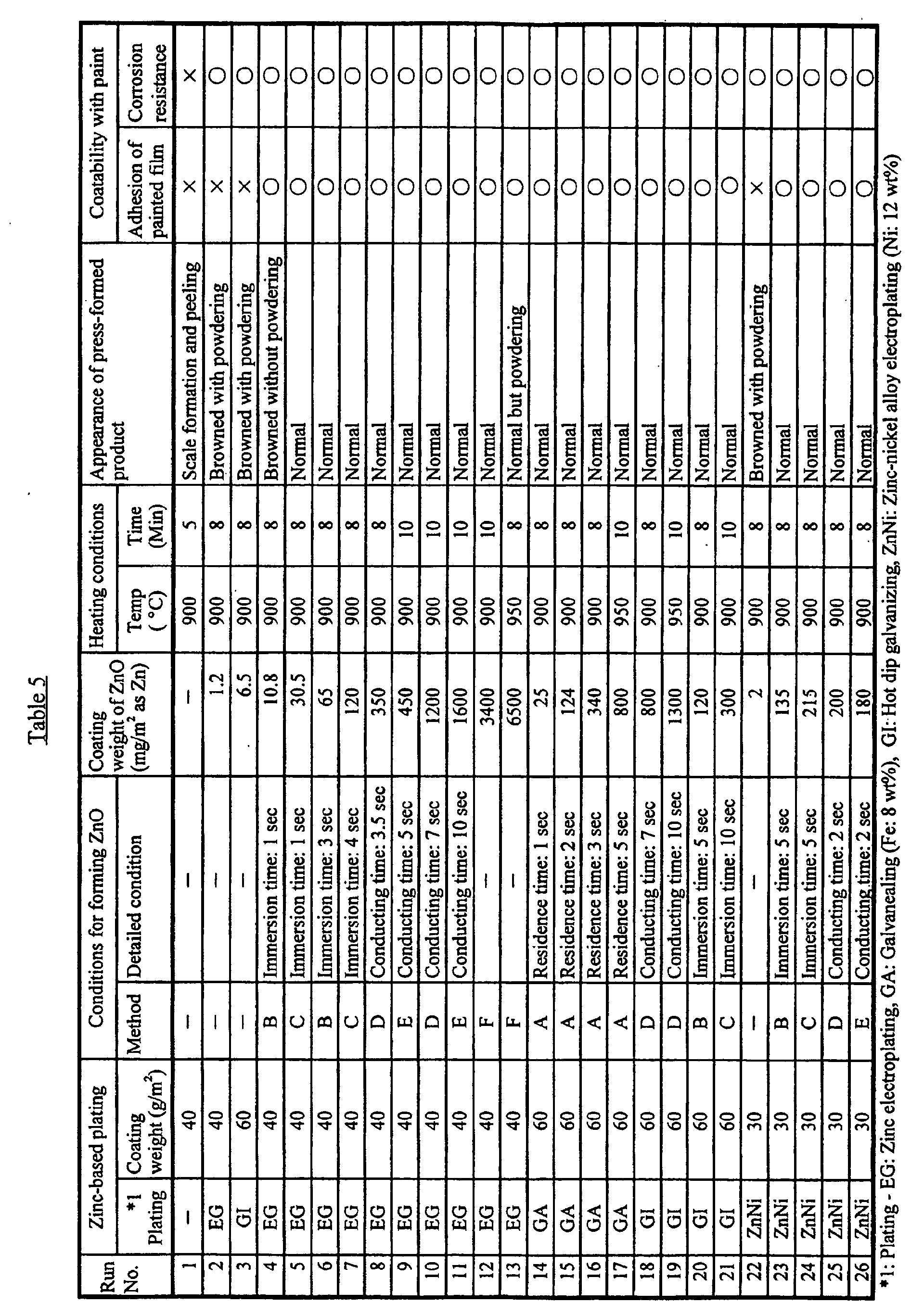
- each plated steel was heated under the conditions shown in Table 5 in an atmospheric furnace, it was subjected to a cupping test.
- the hot press forming in the cupping test was performed on a circular blank with a diameter of 90 mm under the conditions for simulation: a punch diameter of 50 mm, a punch shoulder radius R of 5 mm, a die diameter of 53 mm, a die shoulder radius R of 5 mm, and a drawing depth of 25 mm.
- the blank holding force (BHF) was 1 ton-F.
- the hot press forming in the cupping test was performed on a circular blank with a diameter of 90 mm under the conditions for simulation: a punch diameter of 50 mm, a punch shoulder radius R of 5 mm, a die diameter of 53 mm, a die shoulder radius R of 5 mm, and a drawing depth of 25 mm.
- the blank holding force (BHF) was 1 ton-F.
- the surface condition after press forming was evaluated by visual observation.
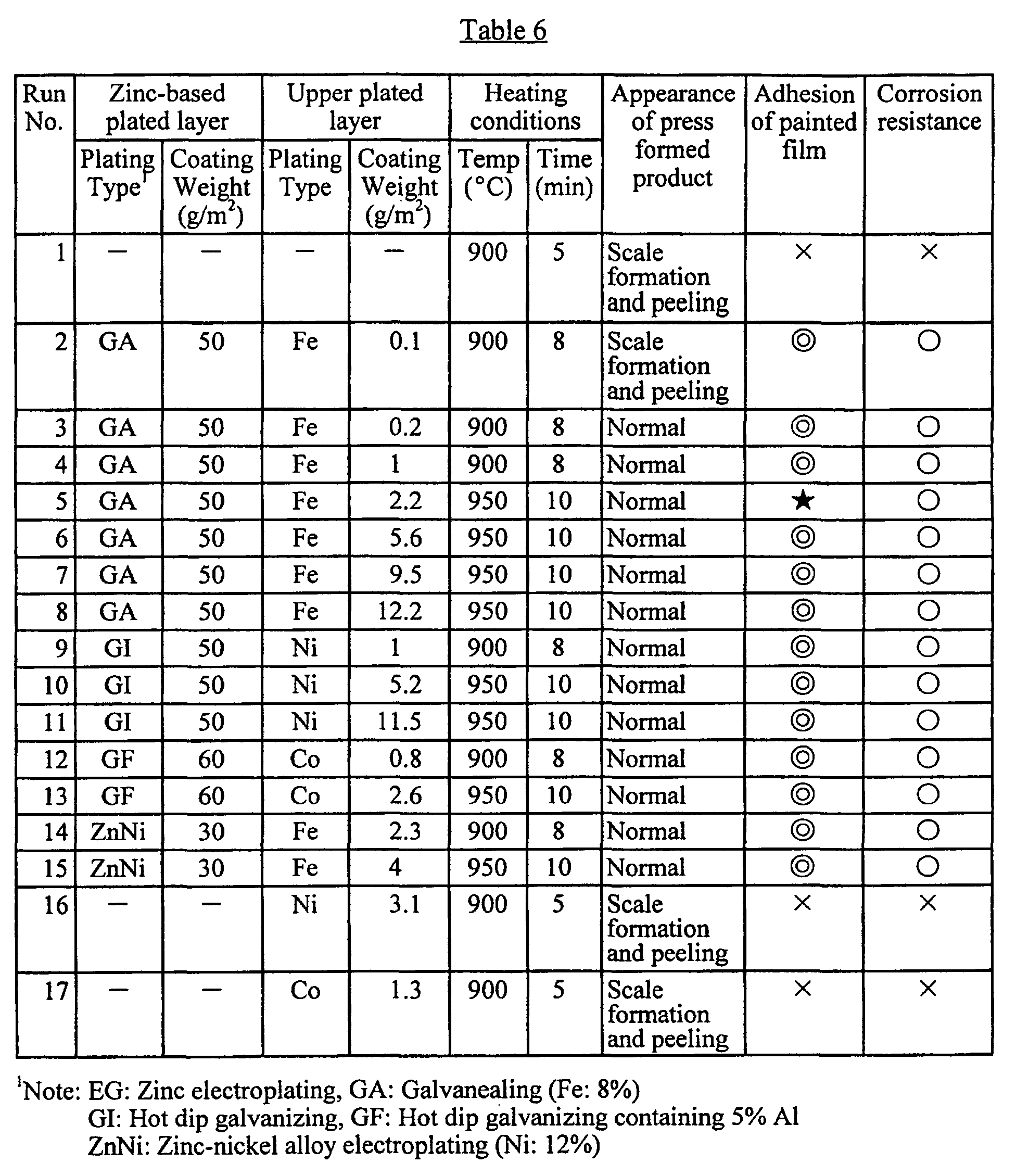
- painted film adhesion and post-painting corrosion resistance were evaluated in the same manner as in Example 1 for the resulting hot press formed products.
- the evaluation of painted film adhesion was as follows: 100 remaining squares was extremely good (indicated by the symbol ) , 95 - 99 was good (indicated by the symbol o ⁇ ), 90 - 94 was fairly good (indicated by the symbol ⁇ ), and 0 - 89 was poor (indicated by the symbol ⁇ ).
- the same hot press forming was performed on a cold rolled steel sheet after the steel sheet was heated at 950°C for 5 minutes, and an evaluation of properties was performed in the same manner as described above.
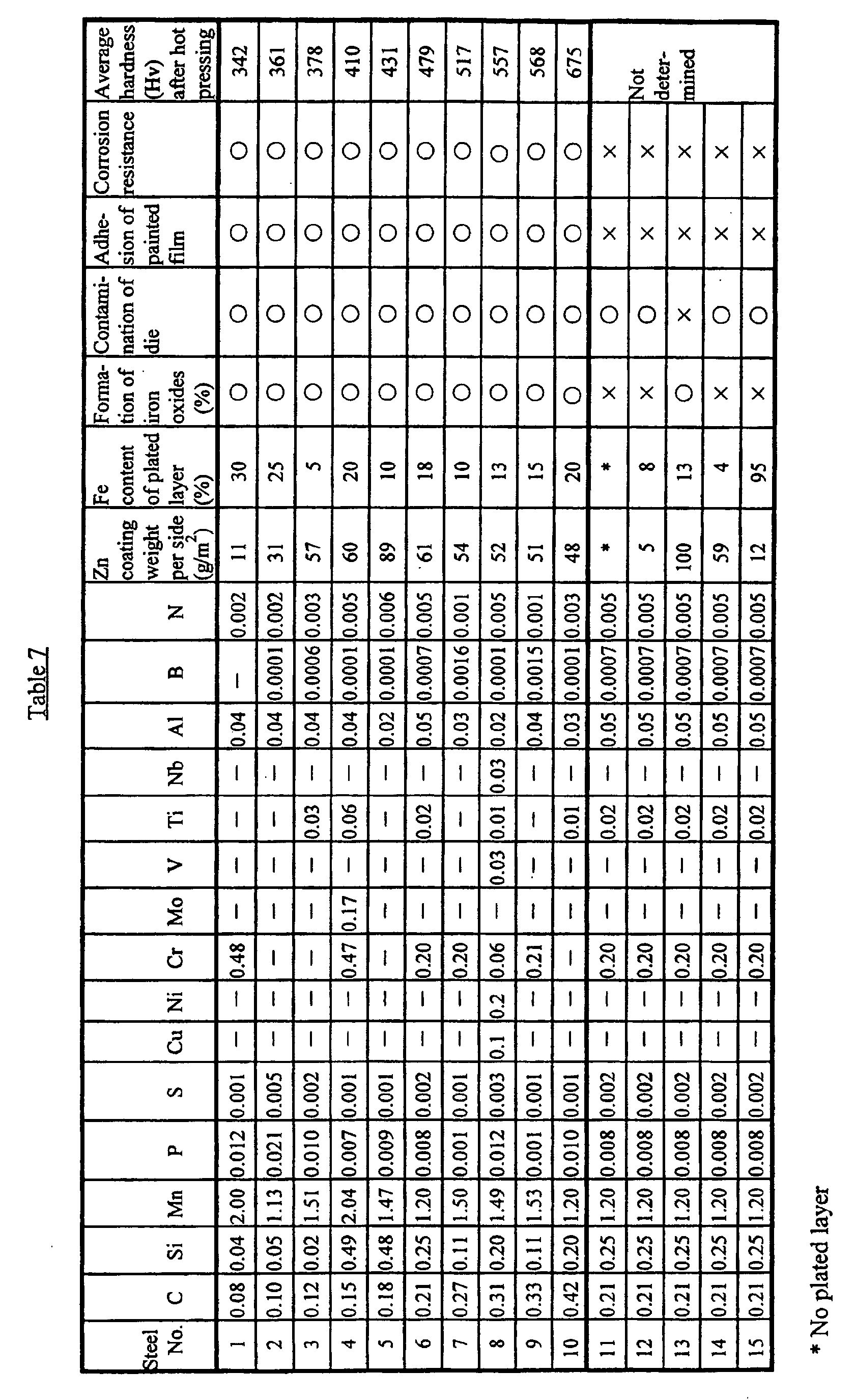
- Steels having the compositions shown in Table 7 were prepared in a laboratory and cast into slabs. After the slabs were heated at 1200°C for 30 minutes, they were hot rolled at 900°C or above to form steel sheets with a thickness of 3.2 mm. After hot rolling, in order to simulate the process of coiling, each steel sheet was cooled to 550°C by water spraying, then placed in a furnace and held therein at 550°C for 30 minutes, and finally cooled to room temperature at a speed of 20°C/hour. After the resulting hot rolled sheet was descaled by pickling, it was cold rolled to reduce its thickness to 1.0 mm.
- the galvanealed steel sheet was cut into rectangular pieces with a width of 50 mm, which were heated in an atmospheric furnace at 850°C for 3 minutes and then, while hot, subjected to hot press forming into a cup shape.
- the die which was used had a punch width of 50 mm, a punch shoulder radius R of 5 mm, and a die shoulder radius R of 5 mm, and the drawing depth was 25 mm.
- Measurement of the Vickers hardness load of 9.8 N, 10 measurements was also performed at the center of the wall portion of the cup-like body after pressing. In this example, the temperature of the steel sheet reached 850° in nearly 2 minutes.
- the appearance after press forming was evaluated based on whether a harmful scale of iron oxides was formed.
- the case in which such scale was formed is indicated by ⁇ , and the case in which it was not formed is indicated by ⁇ . It was also determined whether there was any contamination by scattering of a remaining molten zinc layer onto the press die. The case in which there was no contamination is indicted by ⁇ , and the case in which there was contamination of the die are indicated by ⁇ .
- a molten steel having the composition of Steel No. 6 in Table 7 was prepared in a laboratory and cast into a slab. After the slab was heated at 1200°C for 30 minutes, it was hot rolled at 900°C or above to form a steel sheet with a thickness of 3.2 mm. After hot rolling, in order to simulate the process of coiling, each steel sheet was cooled to 550°C by water spraying, then placed in a furnace and held therein at 550°C for 30 minutes, and finally cooled to room temperature at a speed of 20°C/hour. After the resulting hot rolled sheet was descaled by pickling, it was cold rolled to reduce its thickness to 1.0 mm.
- the critical cooling speed of each steel was determined as an index of the hardenability of the steel in the following manner.
- a cylindrical test piece with a diameter of 3.0 mm and a length of 10 mm which was cut from the hot rolled steel sheet was heated in air to 950°C at a speed of 100°C/minute, then kept for 5 minutes at that temperature, and cooled to room temperature at various cooling speeds. Then, measurement of the Vickers hardness (load of 49 N, 5 measurements) and observation of the microstructure of the resulting test piece were performed. By measuring the variation of thermal expansion of the test piece during heating and cooling, the Ac 1 point and the Ac 3 point of the steel were determined.
- the critical cooling speed for the steel composition of Steel No. 6 of Table 7 was 17°C/second.
- the Ac 1 point and the Ac 3 point of this steel were 728°C and 823°C, respectively.
- each of the heat treated had a hardness (Hv) of at most 200, and good sheet transportability could be guaranteed.
- hot press forming of a difficult-to-press form steel material such as a high tensile steel sheet or a stainless steel sheet or a hardenable steel suited for high strength, high hardness products becomes possible.
- equipment for controlling the atmosphere of a heating furnace becomes unnecessary, and a step of peeling off oxides on a steel sheet at the time of press forming becomes unnecessary, too.
- the manufacturing process for hot press formed products can be simplified.
- the steel material has a zinc-based plated layer which exhibits a sacrificial corrosion preventing effect, thereby improving the corrosion resistance of the press formed products.
Landscapes
- Chemical & Material Sciences (AREA)
- Engineering & Computer Science (AREA)
- Organic Chemistry (AREA)
- Metallurgy (AREA)
- Materials Engineering (AREA)
- Chemical Kinetics & Catalysis (AREA)
- Mechanical Engineering (AREA)
- Inorganic Chemistry (AREA)
- Electrochemistry (AREA)
- Physics & Mathematics (AREA)
- Thermal Sciences (AREA)
- Oil, Petroleum & Natural Gas (AREA)
- Crystallography & Structural Chemistry (AREA)
- Other Surface Treatments For Metallic Materials (AREA)
- Coating With Molten Metal (AREA)
- Electroplating Methods And Accessories (AREA)
- Mounting, Exchange, And Manufacturing Of Dies (AREA)
Abstract
Description
More preferably, the total content of (Mn and/or Cr) is 0.8 - 2.0%.
| Chemical Compositions of Steels (mass%) | ||||||||||
| Steel Type | C | Si | Mn | P | S | Al | Ti | N | Cr | Mo |
| A | 0.2 | 0.3 | 1.3 | 0.01 | 0.002 | 0.05 | 0.02 | 0.004 | - | - |
| B | 0.4 | 0.2 | 1.2 | 0.01 | 0.001 | 0.03 | 0.01 | 0.003 | - | - |
| C | 0.1 | 0.05 | 1.1 | 0.02 | 0.005 | 0.04 | 0.01 | 0.003 | - | - |
zinc-iron alloy plating, zinc-12% nickel alloy plating, zinc-1% cobalt alloy plating, 55% aluminum-zinc alloy plating, zinc-5% aluminum alloy plating, zinc-chromium alloy plating, zinc-aluminum-magnesium alloy plating, tin-8% zinc alloy plating, and zinc-manganese alloy plating.
| Run No. | Material for press forming | Plated coating weight per side (g/m2) | Appearance after heating | Formability | Adhesion of painted film | Corrosion resistance |
| 1 | Galvanealed steel sheet | 60 | Uniform oxide film formed | No problems | ○ | ○ |
| 2 | Cr-Mo Steel sheet (SCM430) | 0 | Blackened | Peeling of oxide film | × | × |
| 3 | Cold rolled steel sheet (SPC) | 0 | Blackened | Peeling of oxide film | × | × |
| 4 | Stainless steel sheet (SUS410) | 0 | Blackened | Peeling of oxide film | × | × |
| Run No. | Plated coating weight per side (g/m2) | Fe content of plated coating (mass%) | Heating conditions | Appearance after heating | Formability | Adhesion of painted film | Corrosion resistance |
| 1 | 20 | 10 | B | ○ | ○ | ||
| 2 | 40 | 10 | B | ○ | ○ | ||
| 3 | 60 | 10 | B | ○ | ○ | ||
| 4 | 80 | 10 | B | ○ | ○ | ||
| 5 | 90 | 10 | B | ○ | ○ | ||
| 6 | 40 | 10 | A | ○ | ○ | ||
| 7 | 60 | 10 | A | ○ | ○ | ||
| 8 | 80 | 10 | A | ○ | ○ | ||
| 9 | 60 | 5 | B | ○ | ○ | ||
| 10 | 60 | 10 | B | ○ | ○ | ||
| 11 | 60 | 13 | B | Uniform | No | ○ | ○ |
| 12 | 60 | 15 | B | oxide film | problems | ○ | ○ |
| 13 | 60 | 20 | B | formed | ○ | ○ | |
| 14 | 60 | 25 | B | ○ | ○ | ||
| 15 | 60 | 30 | B | ○ | ○ | ||
| 16 | 60 | 50 | B | ○ | ○ | ||
| 17 | 60 | 80 | B | ○ | ○ | ||
| 18 | 60 | 10 | C | ○ | ○ | ||
| 19 | 60 | 13 | C | ○ | ○ | ||
| 20 | 60 | 15 | C | ○ | ○ | ||
| 21 | 60 | 20 | C | ○ | ○ | ||
| 22 | 60 | 25 | C | ○ | ○ | ||
| 23 | 60 | 30 | C | ○ | ○ | ||
| Heating Condition | |||||||
| A: Press forming after heating in atomospheric furnace at 950°C×5 minutes | |||||||
| B: Press forming after heating in atomospheric furnace at 850°C×3 minutes | |||||||
| C: Press forming after heating in atomospheric furnace at 850°C×6 minutes |
| Run No. | Plated coating weight per side (g/m2) | Fe content of plated layer (mass%) | Type of base Steel (1.2 mm thick) | Appearance after heating | Formability | Adhesion of painted film | Corrosion resistance |
| 1 | 60 | 15 | A | Uniform oxide film formed | No problems | ○ | ○ |
| 2 | 60 | 15 | B | ○ | ○ | ||
| 3 | 60 | 15 | C | ○ | ○ |

| Run No. | Maximum Heating Temp. (°C) | Cooling Speed (°C/sec) | Galvanealing Temperature (°C) | Vickers Hardness |
| 2-1 | 650 | 8 | 560 | 198 |
| 2-2 | 700 | 8 | 560 | 187 |
| 2-3 | 740 | 8 | 560 | 179 |
| 2-4 | 760 | 8 | 560 | 177 |
| 2-5 | 780 | 8 | 560 | 165 |
| 2-6 | 800 | 8 | 560 | 164 |
| 2-7 | 820 | 8 | 560 | 154 |
| 2-8 | 840 | 8 | 560 | 158 |
| 2-9 | 650 | 30 | 560 | 197 |
| 2-10 | 700 | 30 | 560 | 193 |
| 2-11 | 740 | 30 | 560 | 204 |
| 2-12 | 760 | 30 | 560 | 207 |
| 2-13 | 780 | 30 | 560 | 212 |
| 2-14 | 800 | 30 | 560 | 219 |
| 2-15 | 820 | 30 | 560 | 233 |
| 2-16 | 840 | 30 | 560 | 244 |
| 2-17 | 700 | 8 | 700 | 185 |
| 2-18 | 700 | 8 | 740 | 215 |
| 2-19 | 840 | 8 | 700 | 164 |
| 2-20 | 840 | 8 | 740 | 215 |
Claims (20)
- A steel material for hot press forming characterized by comprising a base steel material having a zinc or zinc alloy plated layer formed on the surface of the base steel material, the plated layer having on its surface a barrier layer which prevents vaporization of zinc during heating.
- A steel material for hot press forming as claimed in claim 1 wherein the barrier layer is an oxide layer based on an oxide of zinc.
- A steel material for hot press forming as claimed in claim 2 wherein the oxide layer has a weight of at least 10 mg/m2 as Zn.
- A steel material for hot press forming as claimed in claim 1 wherein the barrier layer is a plated coating based on at least one metallic substance selected from the group consisting of Fe, Ni, Co, and alloys thereof.
- A steel material for hot press forming as claimed in claim 4 wherein the plated coating has a coating weight of 0.2 - 10 g/m2.
- A steel material for hot press forming as claimed in claim 1 wherein the zinc or zinc alloy plated layer is a galvanealed layer.
- A steel material for hot press forming as claimed in claim 6 wherein the galvanealed layer has a Fe content of 5 - 80% and a coating weight of 10 - 90 g/m2 as Zn.
- A steel material for hot press forming as claimed in claim 6 wherein the base steel material has a P content of at most 0.015%.
- A steel material for hot press forming as claimed in claim 6 wherein the base steel material has a Si content of at most 0.1 %.
- A steel material for hot press forming as claimed in claim 1 wherein the base steel material has a C content of 0.08 - 0.45%.
- A steel material for hot press forming as claimed in claim 10 wherein the base steel material contains one or both of Mn and Cr in an amount of 0.5 - 3.0% in total.
- A steel material for hot press forming as claimed in claim 10 wherein the base steel material contains 0.0001 - 0.004% of B.
- A method of manufacturing a surface treated steel material for hot press forming characterized by applying zinc or zinc alloy plating to the surface of a steel material, and oxidizing the surface of the resulting plated coating to form on the surface of the plated coating a barrier layer which suppresses vaporization of zinc.
- A method of manufacturing a steel material for hot press forming characterized by applying zinc or zinc alloy plating to the surface of a steel material, and contacting the resulting plated steel material with a solution containing an oxidizing agent.
- A method of manufacturing a steel material for hot press forming characterized by applying zinc or zinc alloy plating to the surface of a steel material, and contacting the resulting plated steel material with a solution containing Zn ions and an oxidizing agent to form on the surface of the plated coating a barrier layer which suppresses vaporization of zinc.
- A method of manufacturing a steel material for hot press forming characterized by applying zinc or zinc alloy plating to the surface of a steel material, and subjecting the resulting plated steel material to anodic electrolysis in an aqueous solution to form on the surface of the plated coating a barrier layer which suppresses vaporization of zinc.
- A method of manufacturing a steel material for hot press forming characterized by applying zinc or zinc alloy plating to the surface of a steel material, and subjecting the resulting plated steel material to electrolysis in an aqueous solution containing Zn ions and an oxidizing agent with the steel material as a cathode to form on the surface of the plated coating a barrier layer which suppresses vaporization of zinc.
- A method of manufacturing a steel material for hot press forming characterized by applying zinc or zinc alloy plating to the surface of a steel material, and forming on the surface of the resulting plated coating a barrier layer which suppresses vaporization of zinc by coating the surface of the plated steel material with a solution containing a ZnO sol followed by drying.
- A method of manufacturing a steel material for hot press forming comprising subjecting a steel material to hot dip galvanizing and subsequent galvanealing heat treatment in a continuous hot dip galvanizing line, characterized in that the maximum heating temperature in the continuous hot dip galvanizing line is less than the Ac1 point of the steel and the galvanealing heat treatment temperature is at least 500°C and at most the Ac1 point.
- A method of manufacturing a steel material for hot press forming comprising subjecting a steel material to hot dip galvanizing and subsequent galvanealing heat treatment in a continuous hot dip galvanizing line, characterized in that the maximum heating temperature in the continuous hot dip galvanizing line is not lower than the Ac1 point of the steel, the average cooling speed from the maximum heating temperature to 500°C is less than the critical cooling speed for the steel, and the galvanealing heat treatment temperature is at least 500°C and at most the Ac1 point.
Applications Claiming Priority (7)
| Application Number | Priority Date | Filing Date | Title |
|---|---|---|---|
| JP2001324573 | 2001-10-23 | ||
| JP2001324572 | 2001-10-23 | ||
| JP2001324573A JP3591501B2 (en) | 2001-10-23 | 2001-10-23 | Steel for hot press forming |
| JP2001324572A JP3582511B2 (en) | 2001-10-23 | 2001-10-23 | Surface-treated steel for hot press forming and its manufacturing method |
| JP2001342151A JP3582512B2 (en) | 2001-11-07 | 2001-11-07 | Steel plate for hot pressing and method for producing the same |
| JP2001342151 | 2001-11-07 | ||
| PCT/JP2002/010972 WO2003035922A1 (en) | 2001-10-23 | 2002-10-23 | Method for press working, plated steel product for use therein and method for producing the steel product |
Publications (4)
| Publication Number | Publication Date |
|---|---|
| EP1439240A1 true EP1439240A1 (en) | 2004-07-21 |
| EP1439240A4 EP1439240A4 (en) | 2005-09-07 |
| EP1439240B1 EP1439240B1 (en) | 2010-05-19 |
| EP1439240B2 EP1439240B2 (en) | 2018-10-03 |
Family
ID=27347713
Family Applications (1)
| Application Number | Title | Priority Date | Filing Date |
|---|---|---|---|
| EP02777929.7A Expired - Lifetime EP1439240B2 (en) | 2001-10-23 | 2002-10-23 | Method for hot-press forming a plated steel product |
Country Status (7)
| Country | Link |
|---|---|
| US (2) | US20040166360A1 (en) |
| EP (1) | EP1439240B2 (en) |
| KR (2) | KR100678406B1 (en) |
| CN (1) | CN100434564C (en) |
| AT (1) | ATE468416T1 (en) |
| DE (1) | DE60236447D1 (en) |
| WO (1) | WO2003035922A1 (en) |
Cited By (30)
| Publication number | Priority date | Publication date | Assignee | Title |
|---|---|---|---|---|
| WO2005021820A1 (en) * | 2003-07-29 | 2005-03-10 | Voestalpine Stahl Gmbh | Method for producing a hardened profile part |
| FR2877157A1 (en) * | 2004-10-26 | 2006-04-28 | Mitsubishi Electric Corp | ROTARY ELECTRIC MACHINE |
| EP1642991A4 (en) * | 2003-05-28 | 2006-09-27 | Sumitomo Metal Ind | THERMOFORMING METHOD AND THERMOFORMING ELEMENT |
| EP1857566A1 (en) * | 2006-05-15 | 2007-11-21 | ThyssenKrupp Steel AG | Flat steel product provided with a corrosion protection coating and method of its manufacture |
| WO2008135445A1 (en) * | 2007-05-02 | 2008-11-13 | Corus Staal B.V. | Method for hot dip galvanising of ahss or uhss strip material, and such material |
| WO2009021490A2 (en) | 2007-08-13 | 2009-02-19 | Nano-X Gmbh | Process for protecting vehicle body components, chassis components, engine components or exhaust systems from corrosion |
| DE102007038215A1 (en) | 2007-08-13 | 2009-02-19 | Nano-X Gmbh | Process for producing an active corrosion protection coating on steel components |
| WO2009070078A1 (en) * | 2007-11-26 | 2009-06-04 | Gestamp Hardtech Ab | A method of producing a painted steel sheet product of high strength |
| WO2010069588A1 (en) * | 2008-12-19 | 2010-06-24 | Corus Staal Bv | Method for manufacturing a coated part using hot forming techniques |
| US20110030441A1 (en) * | 2008-04-22 | 2011-02-10 | Jun Maki | Plated steel sheet and method of hot-stamping plated steel sheet |
| EP2248927A4 (en) * | 2008-01-28 | 2012-01-04 | Sumitomo Metal Ind | HEAT TREATED GALVANIZED STEEL-REINFORCED STEEL MATERIAL AND PROCESS FOR PRODUCING THE SAME |
| DE112006003169B4 (en) * | 2005-12-01 | 2013-03-21 | Posco | Steel sheets for hot press forming with excellent heat treatment and impact properties, hot pressed parts produced therefrom and process for their production |
| EP2687620A4 (en) * | 2011-03-18 | 2014-10-15 | Nippon Steel & Sumitomo Metal Corp | STEEL SHEET FOR HOT STAMPED ELEMENT AND METHOD FOR MANUFACTURING THE SAME |
| WO2015007723A1 (en) | 2013-07-16 | 2015-01-22 | Rautaruukki Oyj | Method of manufacturing a galvannealed steel strip product for hot press forming, method of manufacturing a hot-pressed steel component, and galvannealed steel strip product |
| EP2848715A1 (en) * | 2013-09-13 | 2015-03-18 | ThyssenKrupp Steel Europe AG | Method for producing a steel component with an anti-corrosive metal coating |
| AU2011332940B2 (en) * | 2010-11-25 | 2015-10-08 | Jfe Steel Corporation | Steel sheet for hot pressing and method for manufacturing hot-pressed member using the same |
| WO2015149900A1 (en) * | 2014-03-29 | 2015-10-08 | Daimler Ag | Component, particularly a structural component for a motor vehicle, and a method for producing a component |
| EP2899290A4 (en) * | 2012-09-20 | 2016-03-30 | Nippon Steel & Sumitomo Metal Corp | CURED STEEL PIPE ELEMENT, MOTOR AXLE BEAM USING THE CURED STEEL PIPE ELEMENT, AND METHOD FOR MANUFACTURING THE CURED STEEL PIPE ELEMENT |
| WO2016071399A1 (en) * | 2014-11-04 | 2016-05-12 | Voestalpine Stahl Gmbh | Method for producing an anti-corrosion coating for hardenable steel sheets and anti-corrosion layer for hardenable steel sheets |
| US9498810B2 (en) | 2010-12-03 | 2016-11-22 | Jfe Steel Corporation | Method for manufacturing warm pressed-formed members |
| WO2016198186A1 (en) * | 2015-06-08 | 2016-12-15 | Volkswagen Aktiengesellschaft | Method for the hot forming of a steel component |
| EP2233598B1 (en) | 2009-03-26 | 2017-05-03 | Bayerische Motoren Werke Aktiengesellschaft | Method for producing a coatable and/or joinable sheet metal part with a corrosion protection coating |
| WO2017075290A1 (en) | 2015-10-29 | 2017-05-04 | Electric Power Research Institute, Inc. | Methods for creating a zinc-metal oxide layer in metal components for corrosion resistance |
| EP2239350B1 (en) * | 2009-04-08 | 2019-10-16 | Bayerische Motoren Werke Aktiengesellschaft | Thermally treated sheet metal moulded parts from sheet metal material with an anti-corrosion coating |
| EP2683843B1 (en) * | 2011-03-08 | 2021-06-16 | ThyssenKrupp Steel Europe AG | Flat steel product and method for producing a flat steel product |
| DE102020202171A1 (en) | 2020-02-20 | 2021-08-26 | Thyssenkrupp Steel Europe Ag | Process for the production of a surface-finished steel sheet and surface-finished steel sheet |
| US11396712B2 (en) | 2018-07-06 | 2022-07-26 | Posco | Manufacturing method of surface-treated zinc-nickel alloy electroplated steel sheet having excellent corrosion resistivity and paintability |
| US11846027B2 (en) | 2020-03-23 | 2023-12-19 | Nippon Steel Corporation | Hot stamped component |
| US11878488B2 (en) | 2020-03-23 | 2024-01-23 | Nippon Steel Corporation | Hot stamped component |
| US12546012B2 (en) | 2020-10-30 | 2026-02-10 | Nippon Steel Corporation | Zn-plated hot stamped product |
Families Citing this family (73)
| Publication number | Priority date | Publication date | Assignee | Title |
|---|---|---|---|---|
| JP4671634B2 (en) * | 2004-07-09 | 2011-04-20 | 新日本製鐵株式会社 | High-strength quenched molded body with excellent corrosion resistance and method for producing the same |
| DE102004053620A1 (en) * | 2004-11-03 | 2006-05-04 | Salzgitter Flachstahl Gmbh | High-strength, air-hardening steel with excellent forming properties |
| US8134977B2 (en) * | 2005-10-27 | 2012-03-13 | Qualcomm Incorporated | Tune-away protocols for wireless systems |
| US8229433B2 (en) * | 2005-10-27 | 2012-07-24 | Qualcomm Incorporated | Inter-frequency handoff |
| US8068835B2 (en) * | 2005-10-27 | 2011-11-29 | Qualcomm Incorporated | Tune-away and cross paging systems and methods |
| US9247467B2 (en) * | 2005-10-27 | 2016-01-26 | Qualcomm Incorporated | Resource allocation during tune-away |
| JP4912013B2 (en) | 2006-03-31 | 2012-04-04 | 株式会社神戸製鋼所 | Manufacturing method of press-bend cold-formed circular steel pipe with excellent earthquake resistance |
| KR101133870B1 (en) * | 2006-05-10 | 2012-04-06 | 수미도모 메탈 인더스트리즈, 리미티드 | Hot-pressed steel sheet member and process for production thereof |
| WO2008033175A2 (en) * | 2006-06-14 | 2008-03-20 | Board Of Regents, The University Of Texas System | Fabrication of heat-treated laminations for high-speed rotors in electrical machines |
| FI2086755T4 (en) | 2006-10-30 | 2026-01-23 | Arcelormittal | Coated steel strips, methods of making the same, methods of using the same, stamping blanks prepared from the same, stamped products prepared from the same, and articles of manufacture which contain such a stamped product |
| WO2008110670A1 (en) * | 2007-03-14 | 2008-09-18 | Arcelormittal France | Steel for hot working or quenching with a tool having an improved ductility |
| CN101680048B (en) * | 2007-06-15 | 2013-12-25 | 新日铁住金株式会社 | Process for manufacturing shaped article |
| US9126255B2 (en) * | 2007-10-24 | 2015-09-08 | Honda Motor Co., Ltd. | Press die for metal plate molding, the processing method of the surface of the press die, and manufacturing method of a vehicle body |
| DE102007058222A1 (en) * | 2007-12-03 | 2009-06-04 | Salzgitter Flachstahl Gmbh | Steel for high-strength components made of tapes, sheets or tubes with excellent formability and special suitability for high-temperature coating processes |
| US20090152256A1 (en) * | 2007-12-12 | 2009-06-18 | Honda Motor Co., Ltd. | Method for manufacturing a stamped/heated part from a steel sheet plated with aluminum alloy |
| US8653399B2 (en) * | 2008-01-29 | 2014-02-18 | Honda Motor Co., Ltd | Steel sheet heat treatment/stamp system and method |
| BRPI0823283B1 (en) * | 2008-11-14 | 2019-05-14 | Primetals Technologies France SAS | METHOD AND DEVICE FOR CONTROL OF A INTRODUCTION OF SEVERAL METALS IN A CAVITY ADAPTED TO A METHOD OF THESE METALS |
| DE102010024664A1 (en) * | 2009-06-29 | 2011-02-17 | Salzgitter Flachstahl Gmbh | Method for producing a component made of an air-hardenable steel and a component produced therewith |
| JP4849186B2 (en) * | 2009-10-28 | 2012-01-11 | Jfeスチール株式会社 | Hot pressed member and method for manufacturing the same |
| WO2011081043A1 (en) * | 2009-12-28 | 2011-07-07 | 住友金属工業株式会社 | Method for manufacturing a hot press-molded member |
| US9068255B2 (en) | 2009-12-29 | 2015-06-30 | Posco | Zinc-plated steel sheet for hot pressing having outstanding surface characteristics, hot-pressed moulded parts obtained using the same, and a production method for the same |
| KR101171450B1 (en) | 2009-12-29 | 2012-08-06 | 주식회사 포스코 | Method for hot press forming of coated steel and hot press formed prodicts using the same |
| JP4883240B1 (en) * | 2010-08-04 | 2012-02-22 | Jfeスチール株式会社 | Steel sheet for hot press and method for producing hot press member using the same |
| US20120118437A1 (en) * | 2010-11-17 | 2012-05-17 | Jian Wang | Zinc coated steel with inorganic overlay for hot forming |
| DE102010056265C5 (en) * | 2010-12-24 | 2021-11-11 | Voestalpine Stahl Gmbh | Process for producing hardened components |
| DE102011053939B4 (en) | 2011-09-26 | 2015-10-29 | Voestalpine Stahl Gmbh | Method for producing hardened components |
| DE102010056264C5 (en) | 2010-12-24 | 2020-04-09 | Voestalpine Stahl Gmbh | Process for producing hardened components |
| EP2655675B1 (en) | 2010-12-24 | 2021-03-10 | Voestalpine Stahl GmbH | Method for producing hardened structural elements |
| DE102011053941B4 (en) | 2011-09-26 | 2015-11-05 | Voestalpine Stahl Gmbh | Method for producing hardened components with regions of different hardness and / or ductility |
| KR101143037B1 (en) * | 2010-12-28 | 2012-05-08 | 주식회사 포스코 | Zn-plated steel sheet for hot press forming and method for manufacturing the same |
| CN102677128B (en) * | 2011-03-07 | 2015-02-18 | 弘运钢铁工业股份有限公司 | Electrogalvanized steel sheet with zinc electrolytic oxide film and manufacturing method thereof |
| JP6237729B2 (en) * | 2011-03-10 | 2017-11-29 | Jfeスチール株式会社 | Steel sheet for hot press |
| PL2703511T3 (en) | 2011-04-27 | 2018-10-31 | Nippon Steel & Sumitomo Metal Corporation | Steel sheet for hot stamping members and method for producing same |
| JP6006587B2 (en) * | 2011-09-01 | 2016-10-12 | 株式会社神戸製鋼所 | Hot press-formed product and method for producing the same |
| KR101382981B1 (en) * | 2011-11-07 | 2014-04-09 | 주식회사 포스코 | Steel sheet for warm press forming, warm press formed parts and method for manufacturing thereof |
| EP2808417B1 (en) | 2012-03-07 | 2019-04-24 | JFE Steel Corporation | Steel sheet for hot press-forming, method for manufacturing the same and method for producing hot press-formed parts using the same |
| JP5965344B2 (en) | 2012-03-30 | 2016-08-03 | 株式会社神戸製鋼所 | Hot-dip galvanized steel sheet for press forming excellent in cold workability, mold hardenability and surface properties, and method for producing the same |
| KR101679492B1 (en) * | 2012-04-18 | 2016-11-24 | 신닛테츠스미킨 카부시키카이샤 | Al-plated steel sheet, method for hot-pressing al-plated steel sheet, and automotive part |
| MX378125B (en) * | 2012-04-23 | 2025-03-10 | Kobe Steel Ltd | METHOD OF MANUFACTURING GALVANIZED STEEL SHEET FOR HOT STAMPING, HOT DIP GALVANIZED AND ANNEALED STEEL SHEET FOR HOT STAMPING AND METHOD OF MANUFACTURING THE SAME, AND HOT STAMPED COMPONENT. |
| WO2013160567A1 (en) | 2012-04-25 | 2013-10-31 | Arcelormittal Investigacion Y Desarrollo, S.L. | Method for producing a pre-lacquered metal sheet having zn-al-mg coatings, and corresponding metal sheet |
| DE102012110650C5 (en) * | 2012-11-07 | 2017-12-14 | Benteler Automobiltechnik Gmbh | Hot forming line for the production of hot-formed and press-hardened sheet steel products |
| KR101448473B1 (en) * | 2012-12-03 | 2014-10-10 | 현대하이스코 주식회사 | Tailor welded blnk and hot stamping parts using the same |
| KR101482357B1 (en) * | 2012-12-27 | 2015-01-13 | 주식회사 포스코 | Steel for hot press forming having excellent formability and method for manufacturing the same |
| DE102013100682B3 (en) * | 2013-01-23 | 2014-06-05 | Voestalpine Metal Forming Gmbh | A method of producing cured components and a structural component made by the method |
| JP5852690B2 (en) | 2013-04-26 | 2016-02-03 | 株式会社神戸製鋼所 | Alloyed hot-dip galvanized steel sheet for hot stamping |
| PL2997173T3 (en) | 2013-05-17 | 2019-04-30 | Ak Steel Properties Inc | Method of production of zinc-coated steel for press hardening application |
| GB201316829D0 (en) * | 2013-09-23 | 2013-11-06 | Rolls Royce Plc | Flow Forming method |
| KR101528057B1 (en) * | 2013-11-27 | 2015-06-10 | 주식회사 포스코 | Steel for hot press forming with excellent formability and method for manufacturing the same |
| KR101569508B1 (en) * | 2014-12-24 | 2015-11-17 | 주식회사 포스코 | Hot press formed parts having excellent bendability, and method for the same |
| WO2016192993A1 (en) | 2015-05-29 | 2016-12-08 | Voestalpine Stahl Gmbh | Method for contactlessly cooling steel sheets and device therefor |
| DE102015113056B4 (en) | 2015-08-07 | 2018-07-26 | Voestalpine Metal Forming Gmbh | Method for the contactless cooling of steel sheets and device therefor |
| CN105063530A (en) * | 2015-08-07 | 2015-11-18 | 昆山—邦泰汽车零部件制造有限公司 | Method for manufacturing high-hardness automobile hardware |
| CN105057586A (en) * | 2015-08-07 | 2015-11-18 | 昆山—邦泰汽车零部件制造有限公司 | Method for manufacturing automobile hardware |
| CN105063696A (en) * | 2015-08-07 | 2015-11-18 | 昆山—邦泰汽车零部件制造有限公司 | Manufacturing method of abrasion-proof automotive hardware |
| WO2017054867A1 (en) * | 2015-09-30 | 2017-04-06 | Thyssenkrupp Steel Europe Ag | Steel-sheet product and steel component produced by forming such a steel-sheet product |
| DE102015016656A1 (en) * | 2015-12-19 | 2017-06-22 | GM Global Technology Operations LLC (n. d. Ges. d. Staates Delaware) | A method of making a coated hot worked cured body and a body made by the method |
| RU2749413C2 (en) | 2016-05-10 | 2021-06-09 | Юнайтид Стейтс Стил Корпорэйшн | High-strength steel products and their manufacturing methods |
| US11993823B2 (en) | 2016-05-10 | 2024-05-28 | United States Steel Corporation | High strength annealed steel products and annealing processes for making the same |
| US11560606B2 (en) | 2016-05-10 | 2023-01-24 | United States Steel Corporation | Methods of producing continuously cast hot rolled high strength steel sheet products |
| WO2017213021A1 (en) * | 2016-06-09 | 2017-12-14 | Jfeスチール株式会社 | Method for producing electroplated steel sheet and production device therefor |
| CN105839047A (en) * | 2016-06-16 | 2016-08-10 | 福建大统铁路精密装备股份有限公司 | Zincizing infiltrated layer corrosion resistance process for metal |
| CN107299379A (en) * | 2017-06-01 | 2017-10-27 | 安徽诚远医疗科技有限公司 | A kind of nurse station electrolysis special steel plate preparation technology |
| CN107739809B (en) * | 2017-10-24 | 2019-03-08 | 浙江博星工贸有限公司 | A kind of solution treatment method of austenitic stainless steel strip |
| US20210108301A1 (en) | 2018-03-01 | 2021-04-15 | Nucor Corporation | Zinc-based alloy coating for steel and methods |
| US12668860B2 (en) * | 2019-07-02 | 2026-06-30 | Nippon Steel Corporation | Zinc-plated steel sheet for hot stamping, method of manufacturing zinc-plated steel sheet for hot stamping, and hot-stamping formed body |
| CN114059143A (en) * | 2020-07-31 | 2022-02-18 | 苏州市汉宜化学有限公司 | Special anode for alkaline electro-deposition of zinc and zinc alloy and preparation method thereof |
| CN114657613A (en) * | 2020-12-22 | 2022-06-24 | 苏州普热斯勒先进成型技术有限公司 | Method for manufacturing stamped parts |
| CN112872718A (en) * | 2020-12-30 | 2021-06-01 | 苏州威利博工具有限公司 | Surface processing technology for C-shaped accessory |
| CN113881922B (en) * | 2021-09-18 | 2023-08-18 | 上海理工大学 | A method for preparing high-density W-Ti alloy sputtering target at low temperature |
| CN115369317A (en) * | 2022-06-08 | 2022-11-22 | 首钢集团有限公司 | Nickel-plated and zinc-plated hot-formed steel plate, preparation method thereof and preparation method of hot-formed part |
| CN115101706B (en) * | 2022-07-14 | 2024-04-19 | 吉林大学 | Preparation method of zinc metal negative electrode of water-based zinc ion secondary battery and recoverable iodine auxiliary strategy of zinc metal negative electrode |
| US20260028705A1 (en) * | 2022-08-09 | 2026-01-29 | Tata Steel Ijmuiden B.V. | Hot-rolled high-strength steel strip |
| EP4640921A4 (en) * | 2022-12-19 | 2026-04-15 | Posco Co Ltd | CLATED STEEL SHEET WITH EXCELLENT DEGREASING PROPERTIES AND METHOD FOR MANUFACTURING IT |
Family Cites Families (58)
| Publication number | Priority date | Publication date | Assignee | Title |
|---|---|---|---|---|
| US248338A (en) * | 1881-10-18 | Bob-sleigh | ||
| US179922A (en) * | 1876-07-18 | Improvement in registering apparatus | ||
| US38640A (en) * | 1863-05-19 | Improved paint-oil | ||
| US116900A (en) * | 1871-07-11 | Improvement in stove-pipe drums | ||
| US263954A (en) * | 1882-09-05 | Steam-generator for road-vehicles or other purposes | ||
| US287686A (en) * | 1883-10-30 | joues | ||
| US240414A (en) * | 1881-04-19 | bemis | ||
| US190483A (en) * | 1877-05-08 | Improvement in apparatus and processes for the separation and treatment of oils | ||
| US54161A (en) * | 1866-04-24 | Improvement in machines for polishing wood | ||
| US144238A (en) * | 1873-11-04 | Improvement in paper bags | ||
| US1490535A (en) * | 1923-08-02 | 1924-04-15 | Moore Thomas | Elastic web |
| SE435527B (en) | 1973-11-06 | 1984-10-01 | Plannja Ab | PROCEDURE FOR PREPARING A PART OF Hardened Steel |
| US3934441A (en) * | 1974-07-08 | 1976-01-27 | Rockwell International Corporation | Controlled environment superplastic forming of metals |
| JPS5573888A (en) * | 1978-11-22 | 1980-06-03 | Nippon Kokan Kk <Nkk> | High corrosion resistant zinc-electroplated steel sheet with coating and non-coating |
| JPS5669359A (en) * | 1979-10-16 | 1981-06-10 | Kobe Steel Ltd | Composite structure type high strength cold rolled steel sheet |
| JPS5751283A (en) * | 1980-09-12 | 1982-03-26 | Nippon Steel Corp | Electroplating method for zinc-iron alloy |
| JPS5858294A (en) * | 1981-10-02 | 1983-04-06 | Kobe Steel Ltd | Surface treated steel products with superior corrosion resistance and adhesion resistant to water after coating |
| JPS6167773A (en) † | 1984-09-11 | 1986-04-07 | Nippon Dakuro Shamrock:Kk | Metal surface treatment method |
| US4957594A (en) * | 1988-02-19 | 1990-09-18 | Nippon Steel Corporation | Process for producing a zinc or zinc alloy coated steel sheet having excellent spot weldability |
| JPH0762212B2 (en) * | 1988-12-09 | 1995-07-05 | 住友金属工業株式会社 | High carbon thin steel sheet with high toughness and heat crack resistance |
| JPH02190483A (en) * | 1989-01-19 | 1990-07-26 | Nippon Steel Corp | Galvanized steel sheet having superior press formability |
| JPH0361396A (en) * | 1989-07-27 | 1991-03-18 | Nkk Corp | Production of double-layer plated steel sheet excellent in electrodeposition coating property capable of preventing generation of bubbly defect in electrodeposition coating film |
| JPH0317282A (en) | 1989-06-14 | 1991-01-25 | Kobe Steel Ltd | Production of galvanized steel sheet excellent in press formability |
| JPH0762276B2 (en) * | 1989-09-22 | 1995-07-05 | 新日本製鐵株式会社 | Zinc-chromium alloy plated steel sheet excellent in weldability and workability and method for producing the same |
| EP0456834B1 (en) † | 1989-12-12 | 1996-06-12 | Nippon Steel Corporation | Galvanized steel plate having excellent capability of press working, chemical conversion and the like, and production of said plate |
| US5525431A (en) * | 1989-12-12 | 1996-06-11 | Nippon Steel Corporation | Zinc-base galvanized sheet steel excellent in press-formability, phosphatability, etc. and process for producing the same |
| JPH0472048A (en) | 1990-07-10 | 1992-03-06 | Nippon Steel Corp | Galvannealed steel sheet excellent in weldability |
| JPH04325665A (en) | 1991-04-26 | 1992-11-16 | Nippon Steel Corp | Galvanized steel sheet excellent in press formability and its production |
| JPH06179922A (en) * | 1992-12-12 | 1994-06-28 | Sumitomo Metal Ind Ltd | Production of high tensile strength steel sheet for deep drawing |
| JPH06240414A (en) | 1993-02-16 | 1994-08-30 | Nisshin Steel Co Ltd | High strength hardened steel tube excellent in corrosion resistance |
| JPH06287686A (en) * | 1993-03-31 | 1994-10-11 | Nippon Steel Corp | Clad hot-dip galvanized steel sheet with excellent dent resistance and surface strain resistance and method for producing the same |
| JPH07116900A (en) * | 1993-10-26 | 1995-05-09 | Aisin Seiki Co Ltd | Steel plate press machine for heat treatment and surface treatment |
| JP3107494B2 (en) | 1994-06-24 | 2000-11-06 | 文化シヤッター株式会社 | Lighting window of steel plate door |
| CA2175105C (en) * | 1995-05-23 | 1999-09-21 | C. Ramadeva Shastry | Process for improving the formability and weldability properties of zinc coated steel sheet |
| US5866521A (en) * | 1995-09-05 | 1999-02-02 | Nalco Chemical Company | ISO-steric acid-2-amino-2-methyl-1-propanol salt for improving petroleum oil rejection properties of synthetic and semi-synthetic metal-working fluids |
| DE19634615A1 (en) * | 1996-08-27 | 1998-03-05 | Faist M Gmbh & Co Kg | Sound absorbing component |
| JP3149801B2 (en) | 1996-11-13 | 2001-03-26 | 住友金属工業株式会社 | Alloyed hot-dip galvanized steel sheet and method for producing the same |
| JP3254160B2 (en) | 1997-01-21 | 2002-02-04 | 日本鋼管株式会社 | Alloyed hot-dip galvanized steel sheet with excellent adhesion |
| FR2780984B1 (en) * | 1998-07-09 | 2001-06-22 | Lorraine Laminage | COATED HOT AND COLD STEEL SHEET HAVING VERY HIGH RESISTANCE AFTER HEAT TREATMENT |
| JP3879266B2 (en) * | 1998-08-04 | 2007-02-07 | 住友金属工業株式会社 | Alloyed hot-dip galvanized steel sheet excellent in formability and manufacturing method thereof |
| JP2000144238A (en) | 1998-11-16 | 2000-05-26 | Toyota Motor Corp | Quenching method for coated steel |
| JP3397150B2 (en) | 1998-11-25 | 2003-04-14 | 住友金属工業株式会社 | Hot-dip galvanized steel sheet |
| JP3109500B2 (en) * | 1998-12-16 | 2000-11-13 | ダイキン工業株式会社 | Refrigeration equipment |
| JP2000248338A (en) | 1998-12-28 | 2000-09-12 | Kobe Steel Ltd | Steel plate for induction hardening excellent in toughness of quenched part, induction hardening strengthened member, and method of manufacturing the same |
| JP3367466B2 (en) | 1999-05-13 | 2003-01-14 | 住友金属工業株式会社 | Galvannealed steel sheet |
| JP3346338B2 (en) | 1999-05-18 | 2002-11-18 | 住友金属工業株式会社 | Galvanized steel sheet and method for producing the same |
| US6312536B1 (en) * | 1999-05-28 | 2001-11-06 | Kabushiki Kaisha Kobe Seiko Sho | Hot-dip galvanized steel sheet and production thereof |
| JP3675313B2 (en) * | 1999-07-15 | 2005-07-27 | Jfeスチール株式会社 | Method for producing alloyed hot-dip galvanized steel sheet with excellent slidability |
| US6230539B1 (en) * | 1999-09-03 | 2001-05-15 | The United States Of America As Represented By The Secretary Of The Army | Ultra precision net forming process employing controlled plastic deformation of metals at elevated temperatures |
| FR2807447B1 (en) | 2000-04-07 | 2002-10-11 | Usinor | METHOD FOR MAKING A PART WITH VERY HIGH MECHANICAL CHARACTERISTICS, SHAPED BY STAMPING, FROM A STRIP OF LAMINATED AND IN PARTICULAR HOT ROLLED AND COATED STEEL SHEET |
| US6253588B1 (en) * | 2000-04-07 | 2001-07-03 | General Motors Corporation | Quick plastic forming of aluminum alloy sheet metal |
| WO2001081646A1 (en) * | 2000-04-24 | 2001-11-01 | Nkk Corporation | Galvannealed sheet steel and method for production thereof |
| JP3661559B2 (en) | 2000-04-25 | 2005-06-15 | 住友金属工業株式会社 | Alloyed hot-dip galvanized high-tensile steel plate with excellent workability and plating adhesion and its manufacturing method |
| JP2002054161A (en) | 2000-08-07 | 2002-02-20 | Makiminato Hyuumukan Kogyosho:Kk | Construction method and construction method of concrete retaining wall by precast concrete member |
| JP3608519B2 (en) | 2001-03-05 | 2005-01-12 | Jfeスチール株式会社 | Method for producing alloyed hot-dip galvanized steel sheet and alloyed hot-dip galvanized steel sheet |
| JP4696376B2 (en) | 2001-03-06 | 2011-06-08 | Jfeスチール株式会社 | Alloy hot-dip galvanized steel sheet |
| JP3582504B2 (en) * | 2001-08-31 | 2004-10-27 | 住友金属工業株式会社 | Hot-press plated steel sheet |
| US6655181B2 (en) * | 2001-10-15 | 2003-12-02 | General Motors Corporation | Coating for superplastic and quick plastic forming tool and process of using |
-
2002
- 2002-10-23 KR KR1020067014733A patent/KR100678406B1/en not_active Expired - Lifetime
- 2002-10-23 CN CNB028210816A patent/CN100434564C/en not_active Expired - Lifetime
- 2002-10-23 KR KR1020047005977A patent/KR100646619B1/en not_active Expired - Lifetime
- 2002-10-23 AT AT02777929T patent/ATE468416T1/en not_active IP Right Cessation
- 2002-10-23 EP EP02777929.7A patent/EP1439240B2/en not_active Expired - Lifetime
- 2002-10-23 WO PCT/JP2002/010972 patent/WO2003035922A1/en not_active Ceased
- 2002-10-23 DE DE60236447T patent/DE60236447D1/en not_active Expired - Lifetime
-
2003
- 2003-12-10 US US10/730,978 patent/US20040166360A1/en not_active Abandoned
-
2005
- 2005-07-22 US US11/186,973 patent/US7673485B2/en not_active Expired - Lifetime
Cited By (51)
| Publication number | Priority date | Publication date | Assignee | Title |
|---|---|---|---|---|
| EP1642991A4 (en) * | 2003-05-28 | 2006-09-27 | Sumitomo Metal Ind | THERMOFORMING METHOD AND THERMOFORMING ELEMENT |
| US7832242B2 (en) | 2003-07-29 | 2010-11-16 | Voestalpine Stahl Gmbh | Method for producing a hardened profile part |
| WO2005021820A1 (en) * | 2003-07-29 | 2005-03-10 | Voestalpine Stahl Gmbh | Method for producing a hardened profile part |
| US8181331B2 (en) | 2003-07-29 | 2012-05-22 | Voestalpine Automotive Gmbh | Method for producing hardened parts from sheet steel |
| FR2877157A1 (en) * | 2004-10-26 | 2006-04-28 | Mitsubishi Electric Corp | ROTARY ELECTRIC MACHINE |
| DE112006003169B4 (en) * | 2005-12-01 | 2013-03-21 | Posco | Steel sheets for hot press forming with excellent heat treatment and impact properties, hot pressed parts produced therefrom and process for their production |
| EP1857566A1 (en) * | 2006-05-15 | 2007-11-21 | ThyssenKrupp Steel AG | Flat steel product provided with a corrosion protection coating and method of its manufacture |
| WO2007132007A1 (en) * | 2006-05-15 | 2007-11-22 | Thyssenkrupp Steel Ag | Sheet steel product provided with an anticorrosion coating and process for producing it |
| US8481172B2 (en) | 2006-05-15 | 2013-07-09 | Thyssenkrupp Steel Ag | Steel sheet product provided with an anticorrosion coating and process for producing it |
| WO2008135445A1 (en) * | 2007-05-02 | 2008-11-13 | Corus Staal B.V. | Method for hot dip galvanising of ahss or uhss strip material, and such material |
| US8465806B2 (en) | 2007-05-02 | 2013-06-18 | Tata Steel Ijmuiden B.V. | Method for hot dip galvanizing of AHSS or UHSS strip material, and such material |
| DE102007038215A1 (en) | 2007-08-13 | 2009-02-19 | Nano-X Gmbh | Process for producing an active corrosion protection coating on steel components |
| WO2009021490A2 (en) | 2007-08-13 | 2009-02-19 | Nano-X Gmbh | Process for protecting vehicle body components, chassis components, engine components or exhaust systems from corrosion |
| WO2009021489A2 (en) | 2007-08-13 | 2009-02-19 | Nano-X Gmbh | Process for producing an active cathodic anti-corrosion coating on steel components |
| DE102007038214A1 (en) | 2007-08-13 | 2009-02-19 | Volkswagen Ag | Method for corrosion protection of body, chassis, engine components or exhaust systems |
| WO2009070078A1 (en) * | 2007-11-26 | 2009-06-04 | Gestamp Hardtech Ab | A method of producing a painted steel sheet product of high strength |
| US9045817B2 (en) | 2008-01-28 | 2015-06-02 | Nippon Steel & Sumitomo Metal Corporation | Heat treated galvannealed steel material and a method for its manufacture |
| EP2248927A4 (en) * | 2008-01-28 | 2012-01-04 | Sumitomo Metal Ind | HEAT TREATED GALVANIZED STEEL-REINFORCED STEEL MATERIAL AND PROCESS FOR PRODUCING THE SAME |
| US8453482B2 (en) * | 2008-04-22 | 2013-06-04 | Nippon Steel & Sumitomo Metal Corporation | Plated steel sheet and method of hot-stamping plated steel sheet |
| AU2009238926B2 (en) * | 2008-04-22 | 2012-03-29 | Nippon Steel Corporation | Plated steel sheet and method of hot-pressing plated steel sheet |
| US9074277B2 (en) | 2008-04-22 | 2015-07-07 | Nippon Steel & Sumitomo Metal Corporation | Plated steel sheet and method of hot-stamping plated steel sheet |
| EP2270257A4 (en) * | 2008-04-22 | 2011-05-11 | Nippon Steel Corp | PLATED STEEL SHEET AND METHOD FOR HOT PRESSING PLATED STEEL SHEET |
| US20110030441A1 (en) * | 2008-04-22 | 2011-02-10 | Jun Maki | Plated steel sheet and method of hot-stamping plated steel sheet |
| WO2010069588A1 (en) * | 2008-12-19 | 2010-06-24 | Corus Staal Bv | Method for manufacturing a coated part using hot forming techniques |
| EP2379756A1 (en) | 2008-12-19 | 2011-10-26 | Tata Steel IJmuiden B.V. | Method for manufacturing a coated part using hot forming techniques |
| EP2233598B1 (en) | 2009-03-26 | 2017-05-03 | Bayerische Motoren Werke Aktiengesellschaft | Method for producing a coatable and/or joinable sheet metal part with a corrosion protection coating |
| EP2239350B1 (en) * | 2009-04-08 | 2019-10-16 | Bayerische Motoren Werke Aktiengesellschaft | Thermally treated sheet metal moulded parts from sheet metal material with an anti-corrosion coating |
| AU2011332940B2 (en) * | 2010-11-25 | 2015-10-08 | Jfe Steel Corporation | Steel sheet for hot pressing and method for manufacturing hot-pressed member using the same |
| EP2647739A4 (en) * | 2010-12-03 | 2017-01-04 | JFE Steel Corporation | Process for production of hot-pressed member |
| US9498810B2 (en) | 2010-12-03 | 2016-11-22 | Jfe Steel Corporation | Method for manufacturing warm pressed-formed members |
| EP2683843B1 (en) * | 2011-03-08 | 2021-06-16 | ThyssenKrupp Steel Europe AG | Flat steel product and method for producing a flat steel product |
| EP2687620A4 (en) * | 2011-03-18 | 2014-10-15 | Nippon Steel & Sumitomo Metal Corp | STEEL SHEET FOR HOT STAMPED ELEMENT AND METHOD FOR MANUFACTURING THE SAME |
| EP2899290A4 (en) * | 2012-09-20 | 2016-03-30 | Nippon Steel & Sumitomo Metal Corp | CURED STEEL PIPE ELEMENT, MOTOR AXLE BEAM USING THE CURED STEEL PIPE ELEMENT, AND METHOD FOR MANUFACTURING THE CURED STEEL PIPE ELEMENT |
| US9702019B2 (en) | 2012-09-20 | 2017-07-11 | Nippon Steel & Sumitomo Metal Corporation | Quenched steel pipe member, vehicle axle beam using quenched steel pipe member, and method for manufacturing quenched steel pipe member |
| WO2015007723A1 (en) | 2013-07-16 | 2015-01-22 | Rautaruukki Oyj | Method of manufacturing a galvannealed steel strip product for hot press forming, method of manufacturing a hot-pressed steel component, and galvannealed steel strip product |
| US10030284B2 (en) | 2013-09-13 | 2018-07-24 | Thyssenkrupp Steel Europe Ag | Method for producing a steel component provided with a metallic coating providing protection against corosion |
| EP2848715A1 (en) * | 2013-09-13 | 2015-03-18 | ThyssenKrupp Steel Europe AG | Method for producing a steel component with an anti-corrosive metal coating |
| WO2015036150A1 (en) * | 2013-09-13 | 2015-03-19 | Thyssenkrupp Steel Europe Ag | Method for producing a steel component provided with a metallic coating providing protection against corrosion |
| WO2015149900A1 (en) * | 2014-03-29 | 2015-10-08 | Daimler Ag | Component, particularly a structural component for a motor vehicle, and a method for producing a component |
| WO2016071399A1 (en) * | 2014-11-04 | 2016-05-12 | Voestalpine Stahl Gmbh | Method for producing an anti-corrosion coating for hardenable steel sheets and anti-corrosion layer for hardenable steel sheets |
| US10900110B2 (en) | 2015-06-08 | 2021-01-26 | Volkswagen Aktiengesellschaft | Method for the hot forming of a steel component |
| WO2016198186A1 (en) * | 2015-06-08 | 2016-12-15 | Volkswagen Aktiengesellschaft | Method for the hot forming of a steel component |
| DE102015210459B4 (en) * | 2015-06-08 | 2021-03-04 | Volkswagen Aktiengesellschaft | Process for hot forming a steel component |
| EP3368616A4 (en) * | 2015-10-29 | 2019-03-13 | Electric Power Research Institute, Inc. | METHODS FOR CREATING A ZINC-METAL OXIDE LAYER IN METALLIC ELEMENTS FOR CORROSION RESISTANCE |
| WO2017075290A1 (en) | 2015-10-29 | 2017-05-04 | Electric Power Research Institute, Inc. | Methods for creating a zinc-metal oxide layer in metal components for corrosion resistance |
| US11136660B2 (en) | 2015-10-29 | 2021-10-05 | Electric Power Research Institute, Inc. | Methods for creating a zinc-metal oxide layer in metal components for corrosion resistance |
| US11396712B2 (en) | 2018-07-06 | 2022-07-26 | Posco | Manufacturing method of surface-treated zinc-nickel alloy electroplated steel sheet having excellent corrosion resistivity and paintability |
| DE102020202171A1 (en) | 2020-02-20 | 2021-08-26 | Thyssenkrupp Steel Europe Ag | Process for the production of a surface-finished steel sheet and surface-finished steel sheet |
| US11846027B2 (en) | 2020-03-23 | 2023-12-19 | Nippon Steel Corporation | Hot stamped component |
| US11878488B2 (en) | 2020-03-23 | 2024-01-23 | Nippon Steel Corporation | Hot stamped component |
| US12546012B2 (en) | 2020-10-30 | 2026-02-10 | Nippon Steel Corporation | Zn-plated hot stamped product |
Also Published As
| Publication number | Publication date |
|---|---|
| ATE468416T1 (en) | 2010-06-15 |
| DE60236447D1 (en) | 2010-07-01 |
| KR20040048981A (en) | 2004-06-10 |
| EP1439240B2 (en) | 2018-10-03 |
| EP1439240B1 (en) | 2010-05-19 |
| KR20060090309A (en) | 2006-08-10 |
| WO2003035922A1 (en) | 2003-05-01 |
| CN1575348A (en) | 2005-02-02 |
| KR100678406B1 (en) | 2007-02-02 |
| EP1439240A4 (en) | 2005-09-07 |
| US20040166360A1 (en) | 2004-08-26 |
| KR100646619B1 (en) | 2006-11-23 |
| US7673485B2 (en) | 2010-03-09 |
| CN100434564C (en) | 2008-11-19 |
| US20050252262A1 (en) | 2005-11-17 |
Similar Documents
| Publication | Publication Date | Title |
|---|---|---|
| US7673485B2 (en) | Hot press forming method | |
| CN101144162B (en) | Hot press forming method, electroplating steel products thereof and preparation method for the same | |
| JP3582512B2 (en) | Steel plate for hot pressing and method for producing the same | |
| US6564604B2 (en) | Process for the manufacture of a part with very high mechanical properties, formed by stamping of a strip of rolled steel sheet and more particularly hot rolled and coated | |
| CN1829817B (en) | Method for producing a hardened steel part | |
| CN103806029B (en) | From the method for the band article of manufacture of flexible rolling | |
| KR101772308B1 (en) | Hot-stamped product and process for producing hot-stamped product | |
| KR20160057418A (en) | Method for producing a steel component having a metal coating protecting it against corrosion, and steel component | |
| CN100543170C (en) | High-strength quenched formed article having good corrosion resistance and method for producing same | |
| EP2808417A1 (en) | Steel sheet for hot pressing, manufacturing process therefor, and process for producing hot-pressed member using same | |
| JP4329639B2 (en) | Steel plate for heat treatment with excellent liquid metal brittleness resistance | |
| EP3553201A1 (en) | Method for producing a formed steel sheet coated with a metallic coating based on aluminum and comprising titanium | |
| US11807924B2 (en) | Al plated welded pipe for hardening use and Al plated hollow member and method for producing same | |
| US20260132494A1 (en) | Zinc-plated steel sheet for hot stamping, method of manufacturing zinc-plated steel sheet for hot stamping, and hot-stamping formed body | |
| JP7469711B2 (en) | Zn-plated hot stamped products | |
| EP4353860A1 (en) | Pre-coated steel plate for hot forming and preparation method therefor, and hot-formed steel member and application thereof | |
| JP3758549B2 (en) | Hot pressing method | |
| WO2013099316A1 (en) | Method for producing cold-rolled steel sheet having excellent chemical conversion properties and excellent corrosion resistance after coating | |
| JP3716718B2 (en) | Alloyed hot-dip galvanized steel sheet and manufacturing method thereof | |
| JP2018090879A (en) | Steel plate for hot press molding, method for producing hot press molding, and hot press molding | |
| JP6414387B2 (en) | Manufacturing method of automobile parts | |
| JP2016176101A (en) | Surface treated steel sheet for press molding, and press molded article | |
| JP2000073183A (en) | Galvanized steel sheet excellent in formability and weldability and its manufacturing method | |
| US20200232057A1 (en) | Method for coating steel sheets or steel strips and method for producing press-hardened components therefrom | |
| CN116507760A (en) | Hot-pressed member, steel plate for hot-pressing, and manufacturing method of hot-pressed member |
Legal Events
| Date | Code | Title | Description |
|---|---|---|---|
| PUAI | Public reference made under article 153(3) epc to a published international application that has entered the european phase |
Free format text: ORIGINAL CODE: 0009012 |
|
| 17P | Request for examination filed |
Effective date: 20031217 |
|
| AK | Designated contracting states |
Kind code of ref document: A1 Designated state(s): AT BE BG CH CY CZ DE DK EE ES FI FR GB GR IE IT LI LU MC NL PT SE SK TR |
|
| AX | Request for extension of the european patent |
Extension state: AL LT LV MK RO SI |
|
| A4 | Supplementary search report drawn up and despatched |
Effective date: 20050721 |
|
| 17Q | First examination report despatched |
Effective date: 20070502 |
|
| RTI1 | Title (correction) |
Free format text: METHOD FOR HOT-PRESS FORMING A PLATED STEEL PRODUCT |
|
| GRAP | Despatch of communication of intention to grant a patent |
Free format text: ORIGINAL CODE: EPIDOSNIGR1 |
|
| GRAS | Grant fee paid |
Free format text: ORIGINAL CODE: EPIDOSNIGR3 |
|
| GRAA | (expected) grant |
Free format text: ORIGINAL CODE: 0009210 |
|
| AK | Designated contracting states |
Kind code of ref document: B1 Designated state(s): AT BE BG CH CY CZ DE DK EE ES FI FR GB GR IE IT LI LU MC NL PT SE SK TR |
|
| REG | Reference to a national code |
Ref country code: GB Ref legal event code: FG4D |
|
| REG | Reference to a national code |
Ref country code: CH Ref legal event code: EP |
|
| REG | Reference to a national code |
Ref country code: IE Ref legal event code: FG4D |
|
| REF | Corresponds to: |
Ref document number: 60236447 Country of ref document: DE Date of ref document: 20100701 Kind code of ref document: P |
|
| REG | Reference to a national code |
Ref country code: NL Ref legal event code: VDEP Effective date: 20100519 |
|
| PG25 | Lapsed in a contracting state [announced via postgrant information from national office to epo] |
Ref country code: ES Free format text: LAPSE BECAUSE OF FAILURE TO SUBMIT A TRANSLATION OF THE DESCRIPTION OR TO PAY THE FEE WITHIN THE PRESCRIBED TIME-LIMIT Effective date: 20100830 Ref country code: SE Free format text: LAPSE BECAUSE OF FAILURE TO SUBMIT A TRANSLATION OF THE DESCRIPTION OR TO PAY THE FEE WITHIN THE PRESCRIBED TIME-LIMIT Effective date: 20100519 |
|
| PG25 | Lapsed in a contracting state [announced via postgrant information from national office to epo] |
Ref country code: AT Free format text: LAPSE BECAUSE OF FAILURE TO SUBMIT A TRANSLATION OF THE DESCRIPTION OR TO PAY THE FEE WITHIN THE PRESCRIBED TIME-LIMIT Effective date: 20100519 Ref country code: FI Free format text: LAPSE BECAUSE OF FAILURE TO SUBMIT A TRANSLATION OF THE DESCRIPTION OR TO PAY THE FEE WITHIN THE PRESCRIBED TIME-LIMIT Effective date: 20100519 |
|
| PG25 | Lapsed in a contracting state [announced via postgrant information from national office to epo] |
Ref country code: CY Free format text: LAPSE BECAUSE OF FAILURE TO SUBMIT A TRANSLATION OF THE DESCRIPTION OR TO PAY THE FEE WITHIN THE PRESCRIBED TIME-LIMIT Effective date: 20100519 Ref country code: GR Free format text: LAPSE BECAUSE OF FAILURE TO SUBMIT A TRANSLATION OF THE DESCRIPTION OR TO PAY THE FEE WITHIN THE PRESCRIBED TIME-LIMIT Effective date: 20100820 |
|
| PG25 | Lapsed in a contracting state [announced via postgrant information from national office to epo] |
Ref country code: PT Free format text: LAPSE BECAUSE OF FAILURE TO SUBMIT A TRANSLATION OF THE DESCRIPTION OR TO PAY THE FEE WITHIN THE PRESCRIBED TIME-LIMIT Effective date: 20100920 Ref country code: NL Free format text: LAPSE BECAUSE OF FAILURE TO SUBMIT A TRANSLATION OF THE DESCRIPTION OR TO PAY THE FEE WITHIN THE PRESCRIBED TIME-LIMIT Effective date: 20100519 Ref country code: EE Free format text: LAPSE BECAUSE OF FAILURE TO SUBMIT A TRANSLATION OF THE DESCRIPTION OR TO PAY THE FEE WITHIN THE PRESCRIBED TIME-LIMIT Effective date: 20100519 Ref country code: DK Free format text: LAPSE BECAUSE OF FAILURE TO SUBMIT A TRANSLATION OF THE DESCRIPTION OR TO PAY THE FEE WITHIN THE PRESCRIBED TIME-LIMIT Effective date: 20100519 |
|
| PLBI | Opposition filed |
Free format text: ORIGINAL CODE: 0009260 |
|
| PG25 | Lapsed in a contracting state [announced via postgrant information from national office to epo] |
Ref country code: CZ Free format text: LAPSE BECAUSE OF FAILURE TO SUBMIT A TRANSLATION OF THE DESCRIPTION OR TO PAY THE FEE WITHIN THE PRESCRIBED TIME-LIMIT Effective date: 20100519 Ref country code: SK Free format text: LAPSE BECAUSE OF FAILURE TO SUBMIT A TRANSLATION OF THE DESCRIPTION OR TO PAY THE FEE WITHIN THE PRESCRIBED TIME-LIMIT Effective date: 20100519 Ref country code: BE Free format text: LAPSE BECAUSE OF FAILURE TO SUBMIT A TRANSLATION OF THE DESCRIPTION OR TO PAY THE FEE WITHIN THE PRESCRIBED TIME-LIMIT Effective date: 20100519 |
|
| PLAX | Notice of opposition and request to file observation + time limit sent |
Free format text: ORIGINAL CODE: EPIDOSNOBS2 |
|
| 26 | Opposition filed |
Opponent name: BENTELER AUTOMOBILTECHNIK GMBH & CO. KG Effective date: 20110214 |
|
| PG25 | Lapsed in a contracting state [announced via postgrant information from national office to epo] |
Ref country code: IT Free format text: LAPSE BECAUSE OF FAILURE TO SUBMIT A TRANSLATION OF THE DESCRIPTION OR TO PAY THE FEE WITHIN THE PRESCRIBED TIME-LIMIT Effective date: 20100519 |
|
| REG | Reference to a national code |
Ref country code: DE Ref legal event code: R026 Ref document number: 60236447 Country of ref document: DE Effective date: 20110214 |
|
| PG25 | Lapsed in a contracting state [announced via postgrant information from national office to epo] |
Ref country code: MC Free format text: LAPSE BECAUSE OF NON-PAYMENT OF DUE FEES Effective date: 20101031 |
|
| REG | Reference to a national code |
Ref country code: CH Ref legal event code: PL |
|
| PLAF | Information modified related to communication of a notice of opposition and request to file observations + time limit |
Free format text: ORIGINAL CODE: EPIDOSCOBS2 |
|
| PG25 | Lapsed in a contracting state [announced via postgrant information from national office to epo] |
Ref country code: CH Free format text: LAPSE BECAUSE OF NON-PAYMENT OF DUE FEES Effective date: 20101031 Ref country code: LI Free format text: LAPSE BECAUSE OF NON-PAYMENT OF DUE FEES Effective date: 20101031 |
|
| PLBB | Reply of patent proprietor to notice(s) of opposition received |
Free format text: ORIGINAL CODE: EPIDOSNOBS3 |
|
| PG25 | Lapsed in a contracting state [announced via postgrant information from national office to epo] |
Ref country code: IE Free format text: LAPSE BECAUSE OF NON-PAYMENT OF DUE FEES Effective date: 20101023 |
|
| PG25 | Lapsed in a contracting state [announced via postgrant information from national office to epo] |
Ref country code: BG Free format text: LAPSE BECAUSE OF FAILURE TO SUBMIT A TRANSLATION OF THE DESCRIPTION OR TO PAY THE FEE WITHIN THE PRESCRIBED TIME-LIMIT Effective date: 20100519 Ref country code: LU Free format text: LAPSE BECAUSE OF NON-PAYMENT OF DUE FEES Effective date: 20101023 |
|
| PG25 | Lapsed in a contracting state [announced via postgrant information from national office to epo] |
Ref country code: TR Free format text: LAPSE BECAUSE OF FAILURE TO SUBMIT A TRANSLATION OF THE DESCRIPTION OR TO PAY THE FEE WITHIN THE PRESCRIBED TIME-LIMIT Effective date: 20100519 |
|
| PLAB | Opposition data, opponent's data or that of the opponent's representative modified |
Free format text: ORIGINAL CODE: 0009299OPPO |
|
| R26 | Opposition filed (corrected) |
Opponent name: BENTELER AUTOMOBILTECHNIK GMBH Effective date: 20110214 |
|
| RAP2 | Party data changed (patent owner data changed or rights of a patent transferred) |
Owner name: NIPPON STEEL & SUMITOMO METAL CORPORATION |
|
| APBM | Appeal reference recorded |
Free format text: ORIGINAL CODE: EPIDOSNREFNO |
|
| APBP | Date of receipt of notice of appeal recorded |
Free format text: ORIGINAL CODE: EPIDOSNNOA2O |
|
| APAH | Appeal reference modified |
Free format text: ORIGINAL CODE: EPIDOSCREFNO |
|
| APBQ | Date of receipt of statement of grounds of appeal recorded |
Free format text: ORIGINAL CODE: EPIDOSNNOA3O |
|
| TPAC | Observations filed by third parties |
Free format text: ORIGINAL CODE: EPIDOSNTIPA |
|
| PG25 | Lapsed in a contracting state [announced via postgrant information from national office to epo] |
Ref country code: BG Free format text: LAPSE BECAUSE OF FAILURE TO SUBMIT A TRANSLATION OF THE DESCRIPTION OR TO PAY THE FEE WITHIN THE PRESCRIBED TIME-LIMIT Effective date: 20100819 |
|
| REG | Reference to a national code |
Ref country code: GB Ref legal event code: 732E Free format text: REGISTERED BETWEEN 20131010 AND 20131016 |
|
| TPAC | Observations filed by third parties |
Free format text: ORIGINAL CODE: EPIDOSNTIPA |
|
| REG | Reference to a national code |
Ref country code: DE Ref legal event code: R082 Ref document number: 60236447 Country of ref document: DE Representative=s name: RECHTS- UND PATENTANWAELTE LORENZ SEIDLER GOSS, DE |
|
| REG | Reference to a national code |
Ref country code: DE Ref legal event code: R081 Ref document number: 60236447 Country of ref document: DE Owner name: NIPPON STEEL & SUMITOMO METAL CORPORATION, JP Free format text: FORMER OWNER: SUMITOMO METAL INDUSTRIES, LTD., OSAKA, JP Effective date: 20140402 Ref country code: DE Ref legal event code: R082 Ref document number: 60236447 Country of ref document: DE Representative=s name: RECHTS- UND PATENTANWAELTE LORENZ SEIDLER GOSS, DE Effective date: 20140402 Ref country code: DE Ref legal event code: R082 Ref document number: 60236447 Country of ref document: DE Representative=s name: LORENZ SEIDLER GOSSEL RECHTSANWAELTE PATENTANW, DE Effective date: 20140402 |
|
| REG | Reference to a national code |
Ref country code: FR Ref legal event code: PLFP Year of fee payment: 15 |
|
| APAH | Appeal reference modified |
Free format text: ORIGINAL CODE: EPIDOSCREFNO |
|
| REG | Reference to a national code |
Ref country code: FR Ref legal event code: PLFP Year of fee payment: 16 |
|
| APBU | Appeal procedure closed |
Free format text: ORIGINAL CODE: EPIDOSNNOA9O |
|
| PUAH | Patent maintained in amended form |
Free format text: ORIGINAL CODE: 0009272 |
|
| STAA | Information on the status of an ep patent application or granted ep patent |
Free format text: STATUS: PATENT MAINTAINED AS AMENDED |
|
| REG | Reference to a national code |
Ref country code: FR Ref legal event code: PLFP Year of fee payment: 17 |
|
| 27A | Patent maintained in amended form |
Effective date: 20181003 |
|
| AK | Designated contracting states |
Kind code of ref document: B2 Designated state(s): AT BE BG CH CY CZ DE DK EE ES FI FR GB GR IE IT LI LU MC NL PT SE SK TR |
|
| REG | Reference to a national code |
Ref country code: DE Ref legal event code: R102 Ref document number: 60236447 Country of ref document: DE |
|
| REG | Reference to a national code |
Ref country code: DE Ref legal event code: R082 Ref document number: 60236447 Country of ref document: DE Representative=s name: LORENZ SEIDLER GOSSEL RECHTSANWAELTE PATENTANW, DE Ref country code: DE Ref legal event code: R081 Ref document number: 60236447 Country of ref document: DE Owner name: NIPPON STEEL CORP., JP Free format text: FORMER OWNER: NIPPON STEEL & SUMITOMO METAL CORPORATION, TOKYO, JP |
|
| PGFP | Annual fee paid to national office [announced via postgrant information from national office to epo] |
Ref country code: FR Payment date: 20210913 Year of fee payment: 20 |
|
| PGFP | Annual fee paid to national office [announced via postgrant information from national office to epo] |
Ref country code: GB Payment date: 20210915 Year of fee payment: 20 |
|
| PGFP | Annual fee paid to national office [announced via postgrant information from national office to epo] |
Ref country code: DE Payment date: 20210914 Year of fee payment: 20 |
|
| REG | Reference to a national code |
Ref country code: DE Ref legal event code: R071 Ref document number: 60236447 Country of ref document: DE |
|
| REG | Reference to a national code |
Ref country code: GB Ref legal event code: PE20 Expiry date: 20221022 |
|
| PG25 | Lapsed in a contracting state [announced via postgrant information from national office to epo] |
Ref country code: GB Free format text: LAPSE BECAUSE OF EXPIRATION OF PROTECTION Effective date: 20221022 |