EP1425352B1 - Smudge resistant nanocomposite hardcoats and methods for making same - Google Patents
Smudge resistant nanocomposite hardcoats and methods for making same Download PDFInfo
- Publication number
- EP1425352B1 EP1425352B1 EP02759562A EP02759562A EP1425352B1 EP 1425352 B1 EP1425352 B1 EP 1425352B1 EP 02759562 A EP02759562 A EP 02759562A EP 02759562 A EP02759562 A EP 02759562A EP 1425352 B1 EP1425352 B1 EP 1425352B1
- Authority
- EP
- European Patent Office
- Prior art keywords
- nanocomposite
- nanoparticles
- reactive
- article
- latent
- Prior art date
- Legal status (The legal status is an assumption and is not a legal conclusion. Google has not performed a legal analysis and makes no representation as to the accuracy of the status listed.)
- Expired - Lifetime
Links
- 239000002114 nanocomposite Substances 0.000 title claims abstract description 140
- 238000000034 method Methods 0.000 title claims description 59
- 239000002105 nanoparticle Substances 0.000 claims abstract description 115
- 239000000758 substrate Substances 0.000 claims abstract description 82
- 239000011230 binding agent Substances 0.000 claims abstract description 61
- 238000005299 abrasion Methods 0.000 claims abstract description 21
- 239000010410 layer Substances 0.000 claims description 46
- 238000000576 coating method Methods 0.000 claims description 45
- 239000002243 precursor Substances 0.000 claims description 45
- 239000007822 coupling agent Substances 0.000 claims description 41
- 239000011248 coating agent Substances 0.000 claims description 38
- 125000000962 organic group Chemical group 0.000 claims description 17
- 150000001412 amines Chemical class 0.000 claims description 14
- 239000004820 Pressure-sensitive adhesive Substances 0.000 claims description 6
- 230000001413 cellular effect Effects 0.000 claims description 5
- KXDHJXZQYSOELW-UHFFFAOYSA-M Carbamate Chemical compound NC([O-])=O KXDHJXZQYSOELW-UHFFFAOYSA-M 0.000 claims description 3
- 238000002156 mixing Methods 0.000 claims description 3
- 239000000203 mixture Substances 0.000 description 41
- VYPSYNLAJGMNEJ-UHFFFAOYSA-N silicon dioxide Inorganic materials O=[Si]=O VYPSYNLAJGMNEJ-UHFFFAOYSA-N 0.000 description 41
- 239000000976 ink Substances 0.000 description 40
- NIXOWILDQLNWCW-UHFFFAOYSA-N acrylic acid group Chemical group C(C=C)(=O)O NIXOWILDQLNWCW-UHFFFAOYSA-N 0.000 description 38
- 238000002360 preparation method Methods 0.000 description 37
- -1 t-butoxycarbonyl group Chemical group 0.000 description 35
- 239000000463 material Substances 0.000 description 32
- 238000012360 testing method Methods 0.000 description 29
- 230000001070 adhesive effect Effects 0.000 description 24
- 239000000853 adhesive Substances 0.000 description 23
- IJGRMHOSHXDMSA-UHFFFAOYSA-N Atomic nitrogen Chemical compound N#N IJGRMHOSHXDMSA-UHFFFAOYSA-N 0.000 description 20
- 239000002245 particle Substances 0.000 description 20
- 239000012790 adhesive layer Substances 0.000 description 19
- 239000002131 composite material Substances 0.000 description 18
- 125000006239 protecting group Chemical group 0.000 description 16
- RTZKZFJDLAIYFH-UHFFFAOYSA-N Diethyl ether Chemical compound CCOCC RTZKZFJDLAIYFH-UHFFFAOYSA-N 0.000 description 15
- 239000004417 polycarbonate Substances 0.000 description 15
- 239000005022 packaging material Substances 0.000 description 14
- 239000000243 solution Substances 0.000 description 13
- XLYOFNOQVPJJNP-UHFFFAOYSA-N water Substances O XLYOFNOQVPJJNP-UHFFFAOYSA-N 0.000 description 13
- KFZMGEQAYNKOFK-UHFFFAOYSA-N Isopropanol Chemical compound CC(C)O KFZMGEQAYNKOFK-UHFFFAOYSA-N 0.000 description 12
- KWYUFKZDYYNOTN-UHFFFAOYSA-M Potassium hydroxide Chemical compound [OH-].[K+] KWYUFKZDYYNOTN-UHFFFAOYSA-M 0.000 description 12
- 239000000377 silicon dioxide Substances 0.000 description 12
- 238000010511 deprotection reaction Methods 0.000 description 11
- 229920002799 BoPET Polymers 0.000 description 10
- 229910052757 nitrogen Inorganic materials 0.000 description 10
- 230000005855 radiation Effects 0.000 description 10
- 239000002904 solvent Substances 0.000 description 10
- 230000000052 comparative effect Effects 0.000 description 9
- 239000007788 liquid Substances 0.000 description 9
- 229920006254 polymer film Polymers 0.000 description 9
- AFVFQIVMOAPDHO-UHFFFAOYSA-N Methanesulfonic acid Chemical compound CS(O)(=O)=O AFVFQIVMOAPDHO-UHFFFAOYSA-N 0.000 description 8
- 239000003054 catalyst Substances 0.000 description 8
- 238000004821 distillation Methods 0.000 description 8
- 239000012153 distilled water Substances 0.000 description 8
- 238000001704 evaporation Methods 0.000 description 8
- 230000008020 evaporation Effects 0.000 description 8
- 239000003517 fume Substances 0.000 description 8
- 239000010702 perfluoropolyether Substances 0.000 description 8
- 239000000126 substance Substances 0.000 description 8
- 229920001169 thermoplastic Polymers 0.000 description 8
- 238000013519 translation Methods 0.000 description 8
- ILJSQTXMGCGYMG-UHFFFAOYSA-N triacetic acid Chemical compound CC(=O)CC(=O)CC(O)=O ILJSQTXMGCGYMG-UHFFFAOYSA-N 0.000 description 8
- ARXJGSRGQADJSQ-UHFFFAOYSA-N 1-methoxypropan-2-ol Chemical compound COCC(C)O ARXJGSRGQADJSQ-UHFFFAOYSA-N 0.000 description 7
- YPCHGLDQZXOZFW-UHFFFAOYSA-N [2-[[4-methyl-3-[[3-prop-2-enoyloxy-2,2-bis(prop-2-enoyloxymethyl)propoxy]carbonylamino]phenyl]carbamoyloxymethyl]-3-prop-2-enoyloxy-2-(prop-2-enoyloxymethyl)propyl] prop-2-enoate Chemical compound CC1=CC=C(NC(=O)OCC(COC(=O)C=C)(COC(=O)C=C)COC(=O)C=C)C=C1NC(=O)OCC(COC(=O)C=C)(COC(=O)C=C)COC(=O)C=C YPCHGLDQZXOZFW-UHFFFAOYSA-N 0.000 description 7
- 229920001971 elastomer Polymers 0.000 description 7
- 239000003999 initiator Substances 0.000 description 7
- 239000007787 solid Substances 0.000 description 7
- 239000004416 thermosoftening plastic Substances 0.000 description 7
- 125000001797 benzyl group Chemical group [H]C1=C([H])C([H])=C(C([H])=C1[H])C([H])([H])* 0.000 description 6
- 238000010438 heat treatment Methods 0.000 description 6
- 239000003550 marker Substances 0.000 description 6
- 230000003287 optical effect Effects 0.000 description 6
- 229920000139 polyethylene terephthalate Polymers 0.000 description 6
- 239000005020 polyethylene terephthalate Substances 0.000 description 6
- 150000001252 acrylic acid derivatives Chemical class 0.000 description 5
- 150000001875 compounds Chemical class 0.000 description 5
- 239000011253 protective coating Substances 0.000 description 5
- 229920005989 resin Polymers 0.000 description 5
- 239000011347 resin Substances 0.000 description 5
- 229910052710 silicon Inorganic materials 0.000 description 5
- 239000010703 silicon Substances 0.000 description 5
- 125000000999 tert-butyl group Chemical group [H]C([H])([H])C(*)(C([H])([H])[H])C([H])([H])[H] 0.000 description 5
- QQQSFSZALRVCSZ-UHFFFAOYSA-N triethoxysilane Chemical compound CCO[SiH](OCC)OCC QQQSFSZALRVCSZ-UHFFFAOYSA-N 0.000 description 5
- QNODIIQQMGDSEF-UHFFFAOYSA-N (1-hydroxycyclohexyl)-phenylmethanone Chemical compound C=1C=CC=CC=1C(=O)C1(O)CCCCC1 QNODIIQQMGDSEF-UHFFFAOYSA-N 0.000 description 4
- XDLMVUHYZWKMMD-UHFFFAOYSA-N 3-trimethoxysilylpropyl 2-methylprop-2-enoate Chemical compound CO[Si](OC)(OC)CCCOC(=O)C(C)=C XDLMVUHYZWKMMD-UHFFFAOYSA-N 0.000 description 4
- CSCPPACGZOOCGX-UHFFFAOYSA-N Acetone Chemical compound CC(C)=O CSCPPACGZOOCGX-UHFFFAOYSA-N 0.000 description 4
- QGZKDVFQNNGYKY-UHFFFAOYSA-N Ammonia Chemical compound N QGZKDVFQNNGYKY-UHFFFAOYSA-N 0.000 description 4
- VEXZGXHMUGYJMC-UHFFFAOYSA-N Hydrochloric acid Chemical compound Cl VEXZGXHMUGYJMC-UHFFFAOYSA-N 0.000 description 4
- DKGAVHZHDRPRBM-UHFFFAOYSA-N Tert-Butanol Chemical compound CC(C)(C)O DKGAVHZHDRPRBM-UHFFFAOYSA-N 0.000 description 4
- 125000004183 alkoxy alkyl group Chemical group 0.000 description 4
- 125000000217 alkyl group Chemical group 0.000 description 4
- 229910052782 aluminium Inorganic materials 0.000 description 4
- XAGFODPZIPBFFR-UHFFFAOYSA-N aluminium Chemical compound [Al] XAGFODPZIPBFFR-UHFFFAOYSA-N 0.000 description 4
- 229920001400 block copolymer Polymers 0.000 description 4
- 150000005690 diesters Chemical class 0.000 description 4
- 239000006185 dispersion Substances 0.000 description 4
- 239000000806 elastomer Substances 0.000 description 4
- 150000002148 esters Chemical class 0.000 description 4
- 239000003365 glass fiber Substances 0.000 description 4
- 229910052736 halogen Inorganic materials 0.000 description 4
- 150000002367 halogens Chemical class 0.000 description 4
- 229910052809 inorganic oxide Inorganic materials 0.000 description 4
- 229910052751 metal Inorganic materials 0.000 description 4
- 239000002184 metal Substances 0.000 description 4
- 229940098779 methanesulfonic acid Drugs 0.000 description 4
- 239000000178 monomer Substances 0.000 description 4
- 230000000704 physical effect Effects 0.000 description 4
- 229920001187 thermosetting polymer Polymers 0.000 description 4
- BPSIOYPQMFLKFR-UHFFFAOYSA-N trimethoxy-[3-(oxiran-2-ylmethoxy)propyl]silane Chemical compound CO[Si](OC)(OC)CCCOCC1CO1 BPSIOYPQMFLKFR-UHFFFAOYSA-N 0.000 description 4
- UUEWCQRISZBELL-UHFFFAOYSA-N 3-trimethoxysilylpropane-1-thiol Chemical compound CO[Si](OC)(OC)CCCS UUEWCQRISZBELL-UHFFFAOYSA-N 0.000 description 3
- 229920002284 Cellulose triacetate Polymers 0.000 description 3
- LFQSCWFLJHTTHZ-UHFFFAOYSA-N Ethanol Chemical compound CCO LFQSCWFLJHTTHZ-UHFFFAOYSA-N 0.000 description 3
- XEEYBQQBJWHFJM-UHFFFAOYSA-N Iron Chemical compound [Fe] XEEYBQQBJWHFJM-UHFFFAOYSA-N 0.000 description 3
- NNLVGZFZQQXQNW-ADJNRHBOSA-N [(2r,3r,4s,5r,6s)-4,5-diacetyloxy-3-[(2s,3r,4s,5r,6r)-3,4,5-triacetyloxy-6-(acetyloxymethyl)oxan-2-yl]oxy-6-[(2r,3r,4s,5r,6s)-4,5,6-triacetyloxy-2-(acetyloxymethyl)oxan-3-yl]oxyoxan-2-yl]methyl acetate Chemical compound O([C@@H]1O[C@@H]([C@H]([C@H](OC(C)=O)[C@H]1OC(C)=O)O[C@H]1[C@@H]([C@@H](OC(C)=O)[C@H](OC(C)=O)[C@@H](COC(C)=O)O1)OC(C)=O)COC(=O)C)[C@@H]1[C@@H](COC(C)=O)O[C@@H](OC(C)=O)[C@H](OC(C)=O)[C@H]1OC(C)=O NNLVGZFZQQXQNW-ADJNRHBOSA-N 0.000 description 3
- 239000002253 acid Substances 0.000 description 3
- 239000003377 acid catalyst Substances 0.000 description 3
- 125000004453 alkoxycarbonyl group Chemical group 0.000 description 3
- 125000005107 alkyl diaryl silyl group Chemical group 0.000 description 3
- 125000003277 amino group Chemical group 0.000 description 3
- 238000013459 approach Methods 0.000 description 3
- 239000007864 aqueous solution Substances 0.000 description 3
- 125000001584 benzyloxycarbonyl group Chemical group C(=O)(OCC1=CC=CC=C1)* 0.000 description 3
- 229920001577 copolymer Polymers 0.000 description 3
- 125000005105 dialkylarylsilyl group Chemical group 0.000 description 3
- 238000010894 electron beam technology Methods 0.000 description 3
- 238000009472 formulation Methods 0.000 description 3
- 125000000524 functional group Chemical group 0.000 description 3
- 239000011521 glass Substances 0.000 description 3
- 125000005179 haloacetyl group Chemical group 0.000 description 3
- 125000004356 hydroxy functional group Chemical group O* 0.000 description 3
- 125000002887 hydroxy group Chemical group [H]O* 0.000 description 3
- 238000010030 laminating Methods 0.000 description 3
- 150000002734 metacrylic acid derivatives Chemical class 0.000 description 3
- 150000003961 organosilicon compounds Chemical class 0.000 description 3
- 125000001181 organosilyl group Chemical group [SiH3]* 0.000 description 3
- UYWQUFXKFGHYNT-UHFFFAOYSA-N phenylmethyl ester of formic acid Natural products O=COCC1=CC=CC=C1 UYWQUFXKFGHYNT-UHFFFAOYSA-N 0.000 description 3
- 125000003170 phenylsulfonyl group Chemical group C1(=CC=CC=C1)S(=O)(=O)* 0.000 description 3
- 125000002924 primary amino group Chemical group [H]N([H])* 0.000 description 3
- 230000008569 process Effects 0.000 description 3
- 239000005060 rubber Substances 0.000 description 3
- RMAQACBXLXPBSY-UHFFFAOYSA-N silicic acid Chemical compound O[Si](O)(O)O RMAQACBXLXPBSY-UHFFFAOYSA-N 0.000 description 3
- 235000012239 silicon dioxide Nutrition 0.000 description 3
- 125000000472 sulfonyl group Chemical group *S(*)(=O)=O 0.000 description 3
- 239000012815 thermoplastic material Substances 0.000 description 3
- 125000003396 thiol group Chemical group [H]S* 0.000 description 3
- 125000004665 trialkylsilyl group Chemical group 0.000 description 3
- 125000005106 triarylsilyl group Chemical group 0.000 description 3
- 125000004044 trifluoroacetyl group Chemical group FC(C(=O)*)(F)F 0.000 description 3
- 125000001889 triflyl group Chemical group FC(F)(F)S(*)(=O)=O 0.000 description 3
- 125000002221 trityl group Chemical group [H]C1=C([H])C([H])=C([H])C([H])=C1C([*])(C1=C(C(=C(C(=C1[H])[H])[H])[H])[H])C1=C([H])C([H])=C([H])C([H])=C1[H] 0.000 description 3
- 238000011179 visual inspection Methods 0.000 description 3
- 125000003860 C1-C20 alkoxy group Chemical group 0.000 description 2
- VEXZGXHMUGYJMC-UHFFFAOYSA-M Chloride anion Chemical compound [Cl-] VEXZGXHMUGYJMC-UHFFFAOYSA-M 0.000 description 2
- VYZAMTAEIAYCRO-UHFFFAOYSA-N Chromium Chemical compound [Cr] VYZAMTAEIAYCRO-UHFFFAOYSA-N 0.000 description 2
- 229920002633 Kraton (polymer) Polymers 0.000 description 2
- 229920000877 Melamine resin Polymers 0.000 description 2
- RTAQQCXQSZGOHL-UHFFFAOYSA-N Titanium Chemical compound [Ti] RTAQQCXQSZGOHL-UHFFFAOYSA-N 0.000 description 2
- HVVWZTWDBSEWIH-UHFFFAOYSA-N [2-(hydroxymethyl)-3-prop-2-enoyloxy-2-(prop-2-enoyloxymethyl)propyl] prop-2-enoate Chemical compound C=CC(=O)OCC(CO)(COC(=O)C=C)COC(=O)C=C HVVWZTWDBSEWIH-UHFFFAOYSA-N 0.000 description 2
- UKLDJPRMSDWDSL-UHFFFAOYSA-L [dibutyl(dodecanoyloxy)stannyl] dodecanoate Chemical compound CCCCCCCCCCCC(=O)O[Sn](CCCC)(CCCC)OC(=O)CCCCCCCCCCC UKLDJPRMSDWDSL-UHFFFAOYSA-L 0.000 description 2
- 125000002777 acetyl group Chemical group [H]C([H])([H])C(*)=O 0.000 description 2
- 125000002252 acyl group Chemical group 0.000 description 2
- 239000002671 adjuvant Substances 0.000 description 2
- 125000005529 alkyleneoxy group Chemical group 0.000 description 2
- 229910021529 ammonia Inorganic materials 0.000 description 2
- 230000003667 anti-reflective effect Effects 0.000 description 2
- 229910052787 antimony Inorganic materials 0.000 description 2
- WATWJIUSRGPENY-UHFFFAOYSA-N antimony atom Chemical compound [Sb] WATWJIUSRGPENY-UHFFFAOYSA-N 0.000 description 2
- 239000003963 antioxidant agent Substances 0.000 description 2
- 239000002585 base Substances 0.000 description 2
- 239000011324 bead Substances 0.000 description 2
- 125000003236 benzoyl group Chemical group [H]C1=C([H])C([H])=C(C([H])=C1[H])C(*)=O 0.000 description 2
- 125000000649 benzylidene group Chemical group [H]C(=[*])C1=C([H])C([H])=C([H])C([H])=C1[H] 0.000 description 2
- 239000006227 byproduct Substances 0.000 description 2
- 125000003178 carboxy group Chemical group [H]OC(*)=O 0.000 description 2
- 230000015556 catabolic process Effects 0.000 description 2
- CETPSERCERDGAM-UHFFFAOYSA-N ceric oxide Chemical compound O=[Ce]=O CETPSERCERDGAM-UHFFFAOYSA-N 0.000 description 2
- 229910000422 cerium(IV) oxide Inorganic materials 0.000 description 2
- 238000006243 chemical reaction Methods 0.000 description 2
- 229910052804 chromium Inorganic materials 0.000 description 2
- 239000011651 chromium Substances 0.000 description 2
- 238000001246 colloidal dispersion Methods 0.000 description 2
- 239000008119 colloidal silica Substances 0.000 description 2
- 238000010276 construction Methods 0.000 description 2
- 238000003851 corona treatment Methods 0.000 description 2
- 238000006731 degradation reaction Methods 0.000 description 2
- 230000006866 deterioration Effects 0.000 description 2
- 239000012975 dibutyltin dilaurate Substances 0.000 description 2
- 125000005982 diphenylmethyl group Chemical group [H]C1=C([H])C([H])=C(C([H])=C1[H])C([H])(*)C1=C([H])C([H])=C([H])C([H])=C1[H] 0.000 description 2
- 230000009977 dual effect Effects 0.000 description 2
- 239000003822 epoxy resin Substances 0.000 description 2
- FWDBOZPQNFPOLF-UHFFFAOYSA-N ethenyl(triethoxy)silane Chemical compound CCO[Si](OCC)(OCC)C=C FWDBOZPQNFPOLF-UHFFFAOYSA-N 0.000 description 2
- WOXXJEVNDJOOLV-UHFFFAOYSA-N ethenyl-tris(2-methoxyethoxy)silane Chemical compound COCCO[Si](OCCOC)(OCCOC)C=C WOXXJEVNDJOOLV-UHFFFAOYSA-N 0.000 description 2
- 238000001125 extrusion Methods 0.000 description 2
- 239000000945 filler Substances 0.000 description 2
- 230000004927 fusion Effects 0.000 description 2
- LNEPOXFFQSENCJ-UHFFFAOYSA-N haloperidol Chemical compound C1CC(O)(C=2C=CC(Cl)=CC=2)CCN1CCCC(=O)C1=CC=C(F)C=C1 LNEPOXFFQSENCJ-UHFFFAOYSA-N 0.000 description 2
- 229910052739 hydrogen Inorganic materials 0.000 description 2
- 239000001257 hydrogen Substances 0.000 description 2
- 239000004615 ingredient Substances 0.000 description 2
- 239000010954 inorganic particle Substances 0.000 description 2
- 125000001261 isocyanato group Chemical group *N=C=O 0.000 description 2
- 239000012939 laminating adhesive Substances 0.000 description 2
- 239000011159 matrix material Substances 0.000 description 2
- 229910044991 metal oxide Inorganic materials 0.000 description 2
- 150000004706 metal oxides Chemical class 0.000 description 2
- 150000002739 metals Chemical class 0.000 description 2
- 125000004184 methoxymethyl group Chemical group [H]C([H])([H])OC([H])([H])* 0.000 description 2
- 239000011368 organic material Substances 0.000 description 2
- 150000001282 organosilanes Chemical class 0.000 description 2
- 229920001568 phenolic resin Polymers 0.000 description 2
- 239000005011 phenolic resin Substances 0.000 description 2
- 239000000049 pigment Substances 0.000 description 2
- 229920000058 polyacrylate Polymers 0.000 description 2
- 229920000515 polycarbonate Polymers 0.000 description 2
- 229920000647 polyepoxide Polymers 0.000 description 2
- 229920000728 polyester Polymers 0.000 description 2
- 239000004848 polyfunctional curative Substances 0.000 description 2
- 229920000642 polymer Polymers 0.000 description 2
- 239000004926 polymethyl methacrylate Substances 0.000 description 2
- 229920001296 polysiloxane Polymers 0.000 description 2
- 230000001681 protective effect Effects 0.000 description 2
- 239000011241 protective layer Substances 0.000 description 2
- 239000010453 quartz Substances 0.000 description 2
- 238000004381 surface treatment Methods 0.000 description 2
- 239000004094 surface-active agent Substances 0.000 description 2
- 238000010998 test method Methods 0.000 description 2
- 239000010936 titanium Substances 0.000 description 2
- 229910052719 titanium Inorganic materials 0.000 description 2
- 238000012546 transfer Methods 0.000 description 2
- 239000002023 wood Substances 0.000 description 2
- WQZGKKKJIJFFOK-SVZMEOIVSA-N (+)-Galactose Chemical compound OC[C@H]1OC(O)[C@H](O)[C@@H](O)[C@H]1O WQZGKKKJIJFFOK-SVZMEOIVSA-N 0.000 description 1
- 125000003837 (C1-C20) alkyl group Chemical group 0.000 description 1
- 125000000229 (C1-C4)alkoxy group Chemical group 0.000 description 1
- 125000006736 (C6-C20) aryl group Chemical group 0.000 description 1
- WBYCUETVRCXUPE-UHFFFAOYSA-N 1,1,1,2,2,3,3,4,4,5,5,6,6,7,7,8,8,9,9,10,10,11,11,12,12-pentacosafluoro-12-iodododecane Chemical compound FC(F)(F)C(F)(F)C(F)(F)C(F)(F)C(F)(F)C(F)(F)C(F)(F)C(F)(F)C(F)(F)C(F)(F)C(F)(F)C(F)(F)I WBYCUETVRCXUPE-UHFFFAOYSA-N 0.000 description 1
- PGRFXXCKHGIFSV-UHFFFAOYSA-N 1,1,1,2,2,3,3,4,4-nonafluoro-4-iodobutane Chemical compound FC(F)(F)C(F)(F)C(F)(F)C(F)(F)I PGRFXXCKHGIFSV-UHFFFAOYSA-N 0.000 description 1
- MYWOJODOMFBVCB-UHFFFAOYSA-N 1,2,6-trimethylphenanthrene Chemical compound CC1=CC=C2C3=CC(C)=CC=C3C=CC2=C1C MYWOJODOMFBVCB-UHFFFAOYSA-N 0.000 description 1
- JTYRBFORUCBNHJ-UHFFFAOYSA-N 1-bromo-1,1,2,2,3,3,4,4,5,5,6,6,6-tridecafluorohexane Chemical compound FC(F)(F)C(F)(F)C(F)(F)C(F)(F)C(F)(F)C(F)(F)Br JTYRBFORUCBNHJ-UHFFFAOYSA-N 0.000 description 1
- 239000012956 1-hydroxycyclohexylphenyl-ketone Substances 0.000 description 1
- YIKSHDNOAYSSPX-UHFFFAOYSA-N 1-propan-2-ylthioxanthen-9-one Chemical compound S1C2=CC=CC=C2C(=O)C2=C1C=CC=C2C(C)C YIKSHDNOAYSSPX-UHFFFAOYSA-N 0.000 description 1
- UTQNKKSJPHTPBS-UHFFFAOYSA-N 2,2,2-trichloroethanone Chemical group ClC(Cl)(Cl)[C]=O UTQNKKSJPHTPBS-UHFFFAOYSA-N 0.000 description 1
- GMKMEZVLHJARHF-UHFFFAOYSA-N 2,6-diaminopimelic acid Chemical compound OC(=O)C(N)CCCC(N)C(O)=O GMKMEZVLHJARHF-UHFFFAOYSA-N 0.000 description 1
- JKNCOURZONDCGV-UHFFFAOYSA-N 2-(dimethylamino)ethyl 2-methylprop-2-enoate Chemical compound CN(C)CCOC(=O)C(C)=C JKNCOURZONDCGV-UHFFFAOYSA-N 0.000 description 1
- DJXNLVJQMJNEMN-UHFFFAOYSA-N 2-[difluoro(methoxy)methyl]-1,1,1,2,3,3,3-heptafluoropropane Chemical compound COC(F)(F)C(F)(C(F)(F)F)C(F)(F)F DJXNLVJQMJNEMN-UHFFFAOYSA-N 0.000 description 1
- PINYIMREBAFXFI-UHFFFAOYSA-N 2-ethylhexyl 2-(dimethylamino)benzoate Chemical compound CCCCC(CC)COC(=O)C1=CC=CC=C1N(C)C PINYIMREBAFXFI-UHFFFAOYSA-N 0.000 description 1
- NLGDWWCZQDIASO-UHFFFAOYSA-N 2-hydroxy-1-(7-oxabicyclo[4.1.0]hepta-1,3,5-trien-2-yl)-2-phenylethanone Chemical compound OC(C(=O)c1cccc2Oc12)c1ccccc1 NLGDWWCZQDIASO-UHFFFAOYSA-N 0.000 description 1
- NLSFWPFWEPGCJJ-UHFFFAOYSA-N 2-methylprop-2-enoyloxysilicon Chemical compound CC(=C)C(=O)O[Si] NLSFWPFWEPGCJJ-UHFFFAOYSA-N 0.000 description 1
- FNUBKINEQIEODM-UHFFFAOYSA-N 3,3,4,4,5,5,5-heptafluoropentanal Chemical compound FC(F)(F)C(F)(F)C(F)(F)CC=O FNUBKINEQIEODM-UHFFFAOYSA-N 0.000 description 1
- OKQXCDUCLYWRHA-UHFFFAOYSA-N 3-[chloro(dimethyl)silyl]propyl 2-methylprop-2-enoate Chemical compound CC(=C)C(=O)OCCC[Si](C)(C)Cl OKQXCDUCLYWRHA-UHFFFAOYSA-N 0.000 description 1
- SJECZPVISLOESU-UHFFFAOYSA-N 3-trimethoxysilylpropan-1-amine Chemical compound CO[Si](OC)(OC)CCCN SJECZPVISLOESU-UHFFFAOYSA-N 0.000 description 1
- QTBSBXVTEAMEQO-UHFFFAOYSA-M Acetate Chemical compound CC([O-])=O QTBSBXVTEAMEQO-UHFFFAOYSA-M 0.000 description 1
- NIXOWILDQLNWCW-UHFFFAOYSA-M Acrylate Chemical compound [O-]C(=O)C=C NIXOWILDQLNWCW-UHFFFAOYSA-M 0.000 description 1
- 239000012958 Amine synergist Substances 0.000 description 1
- 229920004939 Cariflex™ Polymers 0.000 description 1
- 229920001747 Cellulose diacetate Polymers 0.000 description 1
- RWSOTUBLDIXVET-UHFFFAOYSA-N Dihydrogen sulfide Chemical class S RWSOTUBLDIXVET-UHFFFAOYSA-N 0.000 description 1
- 229920013645 Europrene Polymers 0.000 description 1
- KRHYYFGTRYWZRS-UHFFFAOYSA-M Fluoride anion Chemical compound [F-] KRHYYFGTRYWZRS-UHFFFAOYSA-M 0.000 description 1
- PXGOKWXKJXAPGV-UHFFFAOYSA-N Fluorine Chemical compound FF PXGOKWXKJXAPGV-UHFFFAOYSA-N 0.000 description 1
- 239000004831 Hot glue Substances 0.000 description 1
- UFHFLCQGNIYNRP-UHFFFAOYSA-N Hydrogen Chemical compound [H][H] UFHFLCQGNIYNRP-UHFFFAOYSA-N 0.000 description 1
- 235000007688 Lycopersicon esculentum Nutrition 0.000 description 1
- BHFJBHMTEDLICO-UHFFFAOYSA-N Perfluorooctylsulfonyl fluoride Chemical compound FC(F)(F)C(F)(F)C(F)(F)C(F)(F)C(F)(F)C(F)(F)C(F)(F)C(F)(F)S(F)(=O)=O BHFJBHMTEDLICO-UHFFFAOYSA-N 0.000 description 1
- 239000004952 Polyamide Substances 0.000 description 1
- 239000004698 Polyethylene Substances 0.000 description 1
- 239000004642 Polyimide Substances 0.000 description 1
- 239000004721 Polyphenylene oxide Substances 0.000 description 1
- 239000004743 Polypropylene Substances 0.000 description 1
- 239000004793 Polystyrene Substances 0.000 description 1
- 229920002396 Polyurea Polymers 0.000 description 1
- 239000006087 Silane Coupling Agent Substances 0.000 description 1
- XUIMIQQOPSSXEZ-UHFFFAOYSA-N Silicon Chemical compound [Si] XUIMIQQOPSSXEZ-UHFFFAOYSA-N 0.000 description 1
- 108091092920 SmY RNA Proteins 0.000 description 1
- 241001237710 Smyrna Species 0.000 description 1
- CDBYLPFSWZWCQE-UHFFFAOYSA-L Sodium Carbonate Chemical compound [Na+].[Na+].[O-]C([O-])=O CDBYLPFSWZWCQE-UHFFFAOYSA-L 0.000 description 1
- 240000003768 Solanum lycopersicum Species 0.000 description 1
- 229920013623 Solprene Polymers 0.000 description 1
- PPBRXRYQALVLMV-UHFFFAOYSA-N Styrene Natural products C=CC1=CC=CC=C1 PPBRXRYQALVLMV-UHFFFAOYSA-N 0.000 description 1
- ATJFFYVFTNAWJD-UHFFFAOYSA-N Tin Chemical compound [Sn] ATJFFYVFTNAWJD-UHFFFAOYSA-N 0.000 description 1
- 239000012963 UV stabilizer Substances 0.000 description 1
- QYKIQEUNHZKYBP-UHFFFAOYSA-N Vinyl ether Chemical class C=COC=C QYKIQEUNHZKYBP-UHFFFAOYSA-N 0.000 description 1
- HCHKCACWOHOZIP-UHFFFAOYSA-N Zinc Chemical compound [Zn] HCHKCACWOHOZIP-UHFFFAOYSA-N 0.000 description 1
- QCWXUUIWCKQGHC-UHFFFAOYSA-N Zirconium Chemical compound [Zr] QCWXUUIWCKQGHC-UHFFFAOYSA-N 0.000 description 1
- NOZAQBYNLKNDRT-UHFFFAOYSA-N [diacetyloxy(ethenyl)silyl] acetate Chemical compound CC(=O)O[Si](OC(C)=O)(OC(C)=O)C=C NOZAQBYNLKNDRT-UHFFFAOYSA-N 0.000 description 1
- 239000006096 absorbing agent Substances 0.000 description 1
- 238000005903 acid hydrolysis reaction Methods 0.000 description 1
- 150000007513 acids Chemical class 0.000 description 1
- XECAHXYUAAWDEL-UHFFFAOYSA-N acrylonitrile butadiene styrene Chemical compound C=CC=C.C=CC#N.C=CC1=CC=CC=C1 XECAHXYUAAWDEL-UHFFFAOYSA-N 0.000 description 1
- 239000004676 acrylonitrile butadiene styrene Substances 0.000 description 1
- 229920000122 acrylonitrile butadiene styrene Polymers 0.000 description 1
- 229920001893 acrylonitrile styrene Polymers 0.000 description 1
- 125000004423 acyloxy group Chemical group 0.000 description 1
- 238000004220 aggregation Methods 0.000 description 1
- 230000002776 aggregation Effects 0.000 description 1
- 150000001298 alcohols Chemical class 0.000 description 1
- 125000003545 alkoxy group Chemical group 0.000 description 1
- 229920000180 alkyd Polymers 0.000 description 1
- 125000002877 alkyl aryl group Chemical group 0.000 description 1
- 125000001118 alkylidene group Chemical group 0.000 description 1
- 125000000746 allylic group Chemical group 0.000 description 1
- PNEYBMLMFCGWSK-UHFFFAOYSA-N aluminium oxide Inorganic materials [O-2].[O-2].[O-2].[Al+3].[Al+3] PNEYBMLMFCGWSK-UHFFFAOYSA-N 0.000 description 1
- GHPGOEFPKIHBNM-UHFFFAOYSA-N antimony(3+);oxygen(2-) Chemical compound [O-2].[O-2].[O-2].[Sb+3].[Sb+3] GHPGOEFPKIHBNM-UHFFFAOYSA-N 0.000 description 1
- 239000002216 antistatic agent Substances 0.000 description 1
- 125000003710 aryl alkyl group Chemical group 0.000 description 1
- 125000003118 aryl group Chemical group 0.000 description 1
- 125000003968 arylidene group Chemical group [H]C(c)=* 0.000 description 1
- 125000004104 aryloxy group Chemical group 0.000 description 1
- 239000012298 atmosphere Substances 0.000 description 1
- 125000000751 azo group Chemical group [*]N=N[*] 0.000 description 1
- 238000010945 base-catalyzed hydrolysis reactiony Methods 0.000 description 1
- 230000008901 benefit Effects 0.000 description 1
- RWCCWEUUXYIKHB-UHFFFAOYSA-N benzophenone Chemical compound C=1C=CC=CC=1C(=O)C1=CC=CC=C1 RWCCWEUUXYIKHB-UHFFFAOYSA-N 0.000 description 1
- 239000012965 benzophenone Substances 0.000 description 1
- 230000015572 biosynthetic process Effects 0.000 description 1
- CSXPRVTYIFRYPR-UHFFFAOYSA-N bis(ethenyl)-diethoxysilane Chemical compound CCO[Si](C=C)(C=C)OCC CSXPRVTYIFRYPR-UHFFFAOYSA-N 0.000 description 1
- MQDJYUACMFCOFT-UHFFFAOYSA-N bis[2-(1-hydroxycyclohexyl)phenyl]methanone Chemical compound C=1C=CC=C(C(=O)C=2C(=CC=CC=2)C2(O)CCCCC2)C=1C1(O)CCCCC1 MQDJYUACMFCOFT-UHFFFAOYSA-N 0.000 description 1
- 230000000903 blocking effect Effects 0.000 description 1
- 150000004657 carbamic acid derivatives Chemical class 0.000 description 1
- 125000004432 carbon atom Chemical group C* 0.000 description 1
- 150000001735 carboxylic acids Chemical class 0.000 description 1
- 239000012952 cationic photoinitiator Substances 0.000 description 1
- 229920002678 cellulose Polymers 0.000 description 1
- 229920002301 cellulose acetate Polymers 0.000 description 1
- 229920006217 cellulose acetate butyrate Polymers 0.000 description 1
- 239000000919 ceramic Substances 0.000 description 1
- 235000013351 cheese Nutrition 0.000 description 1
- 238000003486 chemical etching Methods 0.000 description 1
- 239000003795 chemical substances by application Substances 0.000 description 1
- 239000008199 coating composition Substances 0.000 description 1
- 235000021443 coca cola Nutrition 0.000 description 1
- 229920001940 conductive polymer Polymers 0.000 description 1
- 238000011109 contamination Methods 0.000 description 1
- 239000013078 crystal Substances 0.000 description 1
- 229910002026 crystalline silica Inorganic materials 0.000 description 1
- 239000004643 cyanate ester Substances 0.000 description 1
- 150000001913 cyanates Chemical class 0.000 description 1
- 230000007547 defect Effects 0.000 description 1
- 230000002939 deleterious effect Effects 0.000 description 1
- VTEHVUWHCBXMPI-UHFFFAOYSA-N dichloro-bis(prop-2-enyl)silane Chemical compound C=CC[Si](Cl)(Cl)CC=C VTEHVUWHCBXMPI-UHFFFAOYSA-N 0.000 description 1
- OLLFKUHHDPMQFR-UHFFFAOYSA-N dihydroxy(diphenyl)silane Chemical compound C=1C=CC=CC=1[Si](O)(O)C1=CC=CC=C1 OLLFKUHHDPMQFR-UHFFFAOYSA-N 0.000 description 1
- 239000003085 diluting agent Substances 0.000 description 1
- YYLGKUPAFFKGRQ-UHFFFAOYSA-N dimethyldiethoxysilane Chemical compound CCO[Si](C)(C)OCC YYLGKUPAFFKGRQ-UHFFFAOYSA-N 0.000 description 1
- 238000007598 dipping method Methods 0.000 description 1
- 239000000975 dye Substances 0.000 description 1
- 230000000694 effects Effects 0.000 description 1
- 238000005516 engineering process Methods 0.000 description 1
- 125000003700 epoxy group Chemical group 0.000 description 1
- UHESRSKEBRADOO-UHFFFAOYSA-N ethyl carbamate;prop-2-enoic acid Chemical compound OC(=O)C=C.CCOC(N)=O UHESRSKEBRADOO-UHFFFAOYSA-N 0.000 description 1
- 230000001747 exhibiting effect Effects 0.000 description 1
- 239000004744 fabric Substances 0.000 description 1
- 239000012530 fluid Substances 0.000 description 1
- 229910052731 fluorine Inorganic materials 0.000 description 1
- 239000011737 fluorine Substances 0.000 description 1
- 239000006260 foam Substances 0.000 description 1
- 239000012949 free radical photoinitiator Substances 0.000 description 1
- 239000007789 gas Substances 0.000 description 1
- 238000001879 gelation Methods 0.000 description 1
- 238000007429 general method Methods 0.000 description 1
- 229920000578 graft copolymer Polymers 0.000 description 1
- 125000005252 haloacyl group Chemical group 0.000 description 1
- 239000008131 herbal destillate Substances 0.000 description 1
- 229920001519 homopolymer Polymers 0.000 description 1
- 150000002431 hydrogen Chemical class 0.000 description 1
- 125000004435 hydrogen atom Chemical group [H]* 0.000 description 1
- 238000010348 incorporation Methods 0.000 description 1
- 239000012784 inorganic fiber Substances 0.000 description 1
- 239000011229 interlayer Substances 0.000 description 1
- 229910052742 iron Inorganic materials 0.000 description 1
- 239000012948 isocyanate Substances 0.000 description 1
- IQPQWNKOIGAROB-UHFFFAOYSA-N isocyanate group Chemical group [N-]=C=O IQPQWNKOIGAROB-UHFFFAOYSA-N 0.000 description 1
- 150000002513 isocyanates Chemical class 0.000 description 1
- 229920000126 latex Polymers 0.000 description 1
- 239000000314 lubricant Substances 0.000 description 1
- 238000004519 manufacturing process Methods 0.000 description 1
- 230000000873 masking effect Effects 0.000 description 1
- 239000006224 matting agent Substances 0.000 description 1
- JDSHMPZPIAZGSV-UHFFFAOYSA-N melamine Chemical compound NC1=NC(N)=NC(N)=N1 JDSHMPZPIAZGSV-UHFFFAOYSA-N 0.000 description 1
- 239000012528 membrane Substances 0.000 description 1
- 229910003455 mixed metal oxide Inorganic materials 0.000 description 1
- 238000012986 modification Methods 0.000 description 1
- 239000003607 modifier Substances 0.000 description 1
- 229920006030 multiblock copolymer Polymers 0.000 description 1
- PHQOGHDTIVQXHL-UHFFFAOYSA-N n'-(3-trimethoxysilylpropyl)ethane-1,2-diamine Chemical compound CO[Si](OC)(OC)CCCNCCN PHQOGHDTIVQXHL-UHFFFAOYSA-N 0.000 description 1
- 229930014626 natural product Natural products 0.000 description 1
- 239000012299 nitrogen atmosphere Substances 0.000 description 1
- 239000012038 nucleophile Substances 0.000 description 1
- 150000002894 organic compounds Chemical class 0.000 description 1
- 239000003960 organic solvent Substances 0.000 description 1
- 125000006503 p-nitrobenzyl group Chemical group [H]C1=C([H])C(=C([H])C([H])=C1[N+]([O-])=O)C([H])([H])* 0.000 description 1
- 238000004806 packaging method and process Methods 0.000 description 1
- 239000003973 paint Substances 0.000 description 1
- FZUGPQWGEGAKET-UHFFFAOYSA-N parbenate Chemical compound CCOC(=O)C1=CC=C(N(C)C)C=C1 FZUGPQWGEGAKET-UHFFFAOYSA-N 0.000 description 1
- 125000005010 perfluoroalkyl group Chemical group 0.000 description 1
- LUYQYZLEHLTPBH-UHFFFAOYSA-N perfluorobutanesulfonyl fluoride Chemical compound FC(F)(F)C(F)(F)C(F)(F)C(F)(F)S(F)(=O)=O LUYQYZLEHLTPBH-UHFFFAOYSA-N 0.000 description 1
- 150000002978 peroxides Chemical class 0.000 description 1
- 239000003504 photosensitizing agent Substances 0.000 description 1
- 238000013031 physical testing Methods 0.000 description 1
- 238000001020 plasma etching Methods 0.000 description 1
- 229920003023 plastic Polymers 0.000 description 1
- 239000004033 plastic Substances 0.000 description 1
- 239000004014 plasticizer Substances 0.000 description 1
- 229920003229 poly(methyl methacrylate) Polymers 0.000 description 1
- 229920002647 polyamide Polymers 0.000 description 1
- 229920006289 polycarbonate film Polymers 0.000 description 1
- 229920006267 polyester film Polymers 0.000 description 1
- 229920000573 polyethylene Polymers 0.000 description 1
- 229920001721 polyimide Polymers 0.000 description 1
- 229920005862 polyol Polymers 0.000 description 1
- 229920000098 polyolefin Polymers 0.000 description 1
- 150000003077 polyols Chemical class 0.000 description 1
- 229920006380 polyphenylene oxide Polymers 0.000 description 1
- 229920001155 polypropylene Polymers 0.000 description 1
- 229920002223 polystyrene Polymers 0.000 description 1
- 229920002635 polyurethane Polymers 0.000 description 1
- 239000004814 polyurethane Substances 0.000 description 1
- 229920005749 polyurethane resin Polymers 0.000 description 1
- 229920000915 polyvinyl chloride Polymers 0.000 description 1
- 239000004800 polyvinyl chloride Substances 0.000 description 1
- 239000002244 precipitate Substances 0.000 description 1
- 238000001556 precipitation Methods 0.000 description 1
- 150000003141 primary amines Chemical class 0.000 description 1
- 238000012545 processing Methods 0.000 description 1
- 230000001737 promoting effect Effects 0.000 description 1
- SCUZVMOVTVSBLE-UHFFFAOYSA-N prop-2-enenitrile;styrene Chemical compound C=CC#N.C=CC1=CC=CC=C1 SCUZVMOVTVSBLE-UHFFFAOYSA-N 0.000 description 1
- 150000003254 radicals Chemical class 0.000 description 1
- 229920005604 random copolymer Polymers 0.000 description 1
- 239000000376 reactant Substances 0.000 description 1
- 230000009257 reactivity Effects 0.000 description 1
- 230000002787 reinforcement Effects 0.000 description 1
- 239000013557 residual solvent Substances 0.000 description 1
- 235000015067 sauces Nutrition 0.000 description 1
- 230000003678 scratch resistant effect Effects 0.000 description 1
- 238000006748 scratching Methods 0.000 description 1
- 230000002393 scratching effect Effects 0.000 description 1
- 150000003335 secondary amines Chemical class 0.000 description 1
- 125000005372 silanol group Chemical group 0.000 description 1
- 238000002791 soaking Methods 0.000 description 1
- 238000004528 spin coating Methods 0.000 description 1
- 239000007921 spray Substances 0.000 description 1
- 238000005507 spraying Methods 0.000 description 1
- 239000003381 stabilizer Substances 0.000 description 1
- 238000003860 storage Methods 0.000 description 1
- 239000012756 surface treatment agent Substances 0.000 description 1
- 239000000375 suspending agent Substances 0.000 description 1
- 238000003786 synthesis reaction Methods 0.000 description 1
- 229920003051 synthetic elastomer Polymers 0.000 description 1
- 229920002994 synthetic fiber Polymers 0.000 description 1
- 239000005061 synthetic rubber Substances 0.000 description 1
- 238000010345 tape casting Methods 0.000 description 1
- SGGGQXKYTPWHOA-UHFFFAOYSA-N tert-butyl n-(3-triethoxysilylpropyl)carbamate Chemical compound CCO[Si](OCC)(OCC)CCCNC(=O)OC(C)(C)C SGGGQXKYTPWHOA-UHFFFAOYSA-N 0.000 description 1
- HTKRZVLDPRMENJ-UHFFFAOYSA-N tert-butyl n-(3-trimethoxysilylpropyl)carbamate Chemical compound CO[Si](OC)(OC)CCCNC(=O)OC(C)(C)C HTKRZVLDPRMENJ-UHFFFAOYSA-N 0.000 description 1
- QZOMSBFHEFKVFM-UHFFFAOYSA-N tert-butyl n-(4-trimethoxysilylbutyl)carbamate Chemical compound CO[Si](OC)(OC)CCCCNC(=O)OC(C)(C)C QZOMSBFHEFKVFM-UHFFFAOYSA-N 0.000 description 1
- BCJRIBXEPOZKHQ-UHFFFAOYSA-N tert-butyl n-(4-trimethoxysilylphenyl)carbamate Chemical compound CO[Si](OC)(OC)C1=CC=C(NC(=O)OC(C)(C)C)C=C1 BCJRIBXEPOZKHQ-UHFFFAOYSA-N 0.000 description 1
- PGIPTMJZMXQDMA-UHFFFAOYSA-N tert-butyl n-[(4-trimethoxysilylphenyl)methyl]carbamate Chemical compound CO[Si](OC)(OC)C1=CC=C(CNC(=O)OC(C)(C)C)C=C1 PGIPTMJZMXQDMA-UHFFFAOYSA-N 0.000 description 1
- XBXCNNQPRYLIDE-UHFFFAOYSA-N tert-butylcarbamic acid Chemical compound CC(C)(C)NC(O)=O XBXCNNQPRYLIDE-UHFFFAOYSA-N 0.000 description 1
- 125000001412 tetrahydropyranyl group Chemical group 0.000 description 1
- 239000004634 thermosetting polymer Substances 0.000 description 1
- 229910052718 tin Inorganic materials 0.000 description 1
- XOLBLPGZBRYERU-UHFFFAOYSA-N tin dioxide Chemical compound O=[Sn]=O XOLBLPGZBRYERU-UHFFFAOYSA-N 0.000 description 1
- 229910001887 tin oxide Inorganic materials 0.000 description 1
- 230000001131 transforming effect Effects 0.000 description 1
- FRGPKMWIYVTFIQ-UHFFFAOYSA-N triethoxy(3-isocyanatopropyl)silane Chemical compound CCO[Si](OCC)(OCC)CCCN=C=O FRGPKMWIYVTFIQ-UHFFFAOYSA-N 0.000 description 1
- FYUZFGQCEXHZQV-UHFFFAOYSA-N triethoxy(hydroxy)silane Chemical compound CCO[Si](O)(OCC)OCC FYUZFGQCEXHZQV-UHFFFAOYSA-N 0.000 description 1
- UMFJXASDGBJDEB-UHFFFAOYSA-N triethoxy(prop-2-enyl)silane Chemical compound CCO[Si](CC=C)(OCC)OCC UMFJXASDGBJDEB-UHFFFAOYSA-N 0.000 description 1
- JXUKBNICSRJFAP-UHFFFAOYSA-N triethoxy-[3-(oxiran-2-ylmethoxy)propyl]silane Chemical compound CCO[Si](OCC)(OCC)CCCOCC1CO1 JXUKBNICSRJFAP-UHFFFAOYSA-N 0.000 description 1
- HGCVEHIYVPDFMS-UHFFFAOYSA-N trimethoxy(7-oxabicyclo[4.1.0]heptan-4-ylmethyl)silane Chemical compound C1C(C[Si](OC)(OC)OC)CCC2OC21 HGCVEHIYVPDFMS-UHFFFAOYSA-N 0.000 description 1
- LFRDHGNFBLIJIY-UHFFFAOYSA-N trimethoxy(prop-2-enyl)silane Chemical compound CO[Si](OC)(OC)CC=C LFRDHGNFBLIJIY-UHFFFAOYSA-N 0.000 description 1
- PZJJKWKADRNWSW-UHFFFAOYSA-N trimethoxysilicon Chemical compound CO[Si](OC)OC PZJJKWKADRNWSW-UHFFFAOYSA-N 0.000 description 1
- 229910052720 vanadium Inorganic materials 0.000 description 1
- GPPXJZIENCGNKB-UHFFFAOYSA-N vanadium Chemical compound [V]#[V] GPPXJZIENCGNKB-UHFFFAOYSA-N 0.000 description 1
- 229920001567 vinyl ester resin Polymers 0.000 description 1
- 125000000391 vinyl group Chemical group [H]C([*])=C([H])[H] 0.000 description 1
- 230000000007 visual effect Effects 0.000 description 1
- 238000005406 washing Methods 0.000 description 1
- 229910052727 yttrium Inorganic materials 0.000 description 1
- VWQVUPCCIRVNHF-UHFFFAOYSA-N yttrium atom Chemical compound [Y] VWQVUPCCIRVNHF-UHFFFAOYSA-N 0.000 description 1
- RUDFQVOCFDJEEF-UHFFFAOYSA-N yttrium(III) oxide Inorganic materials [O-2].[O-2].[O-2].[Y+3].[Y+3] RUDFQVOCFDJEEF-UHFFFAOYSA-N 0.000 description 1
- 229910052725 zinc Inorganic materials 0.000 description 1
- 239000011701 zinc Substances 0.000 description 1
- 235000014692 zinc oxide Nutrition 0.000 description 1
- RNWHGQJWIACOKP-UHFFFAOYSA-N zinc;oxygen(2-) Chemical class [O-2].[Zn+2] RNWHGQJWIACOKP-UHFFFAOYSA-N 0.000 description 1
- 229910052726 zirconium Inorganic materials 0.000 description 1
Images
Classifications
-
- C—CHEMISTRY; METALLURGY
- C03—GLASS; MINERAL OR SLAG WOOL
- C03C—CHEMICAL COMPOSITION OF GLASSES, GLAZES OR VITREOUS ENAMELS; SURFACE TREATMENT OF GLASS; SURFACE TREATMENT OF FIBRES OR FILAMENTS MADE FROM GLASS, MINERALS OR SLAGS; JOINING GLASS TO GLASS OR OTHER MATERIALS
- C03C17/00—Surface treatment of glass, not in the form of fibres or filaments, by coating
- C03C17/006—Surface treatment of glass, not in the form of fibres or filaments, by coating with materials of composite character
- C03C17/007—Surface treatment of glass, not in the form of fibres or filaments, by coating with materials of composite character containing a dispersed phase, e.g. particles, fibres or flakes, in a continuous phase
-
- C—CHEMISTRY; METALLURGY
- C09—DYES; PAINTS; POLISHES; NATURAL RESINS; ADHESIVES; COMPOSITIONS NOT OTHERWISE PROVIDED FOR; APPLICATIONS OF MATERIALS NOT OTHERWISE PROVIDED FOR
- C09C—TREATMENT OF INORGANIC MATERIALS, OTHER THAN FIBROUS FILLERS, TO ENHANCE THEIR PIGMENTING OR FILLING PROPERTIES ; PREPARATION OF CARBON BLACK ; PREPARATION OF INORGANIC MATERIALS WHICH ARE NO SINGLE CHEMICAL COMPOUNDS AND WHICH ARE MAINLY USED AS PIGMENTS OR FILLERS
- C09C3/00—Treatment in general of inorganic materials, other than fibrous fillers, to enhance their pigmenting or filling properties
- C09C3/10—Treatment with macromolecular organic compounds
-
- B—PERFORMING OPERATIONS; TRANSPORTING
- B82—NANOTECHNOLOGY
- B82Y—SPECIFIC USES OR APPLICATIONS OF NANOSTRUCTURES; MEASUREMENT OR ANALYSIS OF NANOSTRUCTURES; MANUFACTURE OR TREATMENT OF NANOSTRUCTURES
- B82Y30/00—Nanotechnology for materials or surface science, e.g. nanocomposites
-
- C—CHEMISTRY; METALLURGY
- C03—GLASS; MINERAL OR SLAG WOOL
- C03C—CHEMICAL COMPOSITION OF GLASSES, GLAZES OR VITREOUS ENAMELS; SURFACE TREATMENT OF GLASS; SURFACE TREATMENT OF FIBRES OR FILAMENTS MADE FROM GLASS, MINERALS OR SLAGS; JOINING GLASS TO GLASS OR OTHER MATERIALS
- C03C2217/00—Coatings on glass
- C03C2217/40—Coatings comprising at least one inhomogeneous layer
- C03C2217/43—Coatings comprising at least one inhomogeneous layer consisting of a dispersed phase in a continuous phase
- C03C2217/44—Coatings comprising at least one inhomogeneous layer consisting of a dispersed phase in a continuous phase characterized by the composition of the continuous phase
- C03C2217/445—Organic continuous phases
-
- C—CHEMISTRY; METALLURGY
- C03—GLASS; MINERAL OR SLAG WOOL
- C03C—CHEMICAL COMPOSITION OF GLASSES, GLAZES OR VITREOUS ENAMELS; SURFACE TREATMENT OF GLASS; SURFACE TREATMENT OF FIBRES OR FILAMENTS MADE FROM GLASS, MINERALS OR SLAGS; JOINING GLASS TO GLASS OR OTHER MATERIALS
- C03C2217/00—Coatings on glass
- C03C2217/40—Coatings comprising at least one inhomogeneous layer
- C03C2217/43—Coatings comprising at least one inhomogeneous layer consisting of a dispersed phase in a continuous phase
- C03C2217/46—Coatings comprising at least one inhomogeneous layer consisting of a dispersed phase in a continuous phase characterized by the dispersed phase
- C03C2217/47—Coatings comprising at least one inhomogeneous layer consisting of a dispersed phase in a continuous phase characterized by the dispersed phase consisting of a specific material
- C03C2217/475—Inorganic materials
-
- C—CHEMISTRY; METALLURGY
- C03—GLASS; MINERAL OR SLAG WOOL
- C03C—CHEMICAL COMPOSITION OF GLASSES, GLAZES OR VITREOUS ENAMELS; SURFACE TREATMENT OF GLASS; SURFACE TREATMENT OF FIBRES OR FILAMENTS MADE FROM GLASS, MINERALS OR SLAGS; JOINING GLASS TO GLASS OR OTHER MATERIALS
- C03C2217/00—Coatings on glass
- C03C2217/40—Coatings comprising at least one inhomogeneous layer
- C03C2217/43—Coatings comprising at least one inhomogeneous layer consisting of a dispersed phase in a continuous phase
- C03C2217/46—Coatings comprising at least one inhomogeneous layer consisting of a dispersed phase in a continuous phase characterized by the dispersed phase
- C03C2217/47—Coatings comprising at least one inhomogeneous layer consisting of a dispersed phase in a continuous phase characterized by the dispersed phase consisting of a specific material
- C03C2217/475—Inorganic materials
- C03C2217/478—Silica
-
- Y—GENERAL TAGGING OF NEW TECHNOLOGICAL DEVELOPMENTS; GENERAL TAGGING OF CROSS-SECTIONAL TECHNOLOGIES SPANNING OVER SEVERAL SECTIONS OF THE IPC; TECHNICAL SUBJECTS COVERED BY FORMER USPC CROSS-REFERENCE ART COLLECTIONS [XRACs] AND DIGESTS
- Y10—TECHNICAL SUBJECTS COVERED BY FORMER USPC
- Y10T—TECHNICAL SUBJECTS COVERED BY FORMER US CLASSIFICATION
- Y10T428/00—Stock material or miscellaneous articles
- Y10T428/25—Web or sheet containing structurally defined element or component and including a second component containing structurally defined particles
-
- Y—GENERAL TAGGING OF NEW TECHNOLOGICAL DEVELOPMENTS; GENERAL TAGGING OF CROSS-SECTIONAL TECHNOLOGIES SPANNING OVER SEVERAL SECTIONS OF THE IPC; TECHNICAL SUBJECTS COVERED BY FORMER USPC CROSS-REFERENCE ART COLLECTIONS [XRACs] AND DIGESTS
- Y10—TECHNICAL SUBJECTS COVERED BY FORMER USPC
- Y10T—TECHNICAL SUBJECTS COVERED BY FORMER US CLASSIFICATION
- Y10T428/00—Stock material or miscellaneous articles
- Y10T428/25—Web or sheet containing structurally defined element or component and including a second component containing structurally defined particles
- Y10T428/252—Glass or ceramic [i.e., fired or glazed clay, cement, etc.] [porcelain, quartz, etc.]
-
- Y—GENERAL TAGGING OF NEW TECHNOLOGICAL DEVELOPMENTS; GENERAL TAGGING OF CROSS-SECTIONAL TECHNOLOGIES SPANNING OVER SEVERAL SECTIONS OF THE IPC; TECHNICAL SUBJECTS COVERED BY FORMER USPC CROSS-REFERENCE ART COLLECTIONS [XRACs] AND DIGESTS
- Y10—TECHNICAL SUBJECTS COVERED BY FORMER USPC
- Y10T—TECHNICAL SUBJECTS COVERED BY FORMER US CLASSIFICATION
- Y10T428/00—Stock material or miscellaneous articles
- Y10T428/25—Web or sheet containing structurally defined element or component and including a second component containing structurally defined particles
- Y10T428/256—Heavy metal or aluminum or compound thereof
-
- Y—GENERAL TAGGING OF NEW TECHNOLOGICAL DEVELOPMENTS; GENERAL TAGGING OF CROSS-SECTIONAL TECHNOLOGIES SPANNING OVER SEVERAL SECTIONS OF THE IPC; TECHNICAL SUBJECTS COVERED BY FORMER USPC CROSS-REFERENCE ART COLLECTIONS [XRACs] AND DIGESTS
- Y10—TECHNICAL SUBJECTS COVERED BY FORMER USPC
- Y10T—TECHNICAL SUBJECTS COVERED BY FORMER US CLASSIFICATION
- Y10T428/00—Stock material or miscellaneous articles
- Y10T428/25—Web or sheet containing structurally defined element or component and including a second component containing structurally defined particles
- Y10T428/256—Heavy metal or aluminum or compound thereof
- Y10T428/257—Iron oxide or aluminum oxide
-
- Y—GENERAL TAGGING OF NEW TECHNOLOGICAL DEVELOPMENTS; GENERAL TAGGING OF CROSS-SECTIONAL TECHNOLOGIES SPANNING OVER SEVERAL SECTIONS OF THE IPC; TECHNICAL SUBJECTS COVERED BY FORMER USPC CROSS-REFERENCE ART COLLECTIONS [XRACs] AND DIGESTS
- Y10—TECHNICAL SUBJECTS COVERED BY FORMER USPC
- Y10T—TECHNICAL SUBJECTS COVERED BY FORMER US CLASSIFICATION
- Y10T428/00—Stock material or miscellaneous articles
- Y10T428/29—Coated or structually defined flake, particle, cell, strand, strand portion, rod, filament, macroscopic fiber or mass thereof
- Y10T428/2982—Particulate matter [e.g., sphere, flake, etc.]
- Y10T428/2991—Coated
- Y10T428/2998—Coated including synthetic resin or polymer
Definitions
- the invention relates to the field of protective coatings and methods for making same.
- the invention relates to smudge resistant hardcoats containing nanoparticles.
- thermoplastic and thermosetting polymers have excellent rigidity, dimensional stability, transparency, and impact resistance, but unfortunately have poor abrasion resistance. Consequently, structures formed from these materials are susceptible to scratches, abrasion, and similar damage.
- a tough, abrasion resistant "hardcoat” layer may be coated onto the structure. Such coatings are desirably transparent and are typically present as very thin coatings:
- the hardcoat provide resistance to marking and/or easy removal (that is, smudge resistance), by fingerprints, markers, spray paint, and the like.
- Smudge resistant nanocomposite hardcoats are of particular interest for optical display applications requiring the protection of a plastic substrate from marring or scratching while also providing an easily cleaned surface.
- inorganic nanometer scale particles into a binder precursor resin matrix.
- the surface of the particles may be functionalized with a variety of coupling agents to improve compatibility with and/or bonding to the binder resin to improve the abrasion resistance of the hardcoat.
- a fluorinated organosilane coating applied to the surface of a hardcoat may not effectively bond to the hardcoat, and lose smudge resistance upon repeated chemical or mechanical insult to the coating due to a lack of covalent bonding between the smudge resistant layer and the hardcoat layer.
- nanocomposite hardcoat constructions having improved durability of smudge resistance.
- the present invention relates to smudge and abrasion resistant protective coatings, methods for their preparation and articles employing them.
- the present invention provides nanocomposite hardcoats having exposed reactive groups that can covalently attach smudge resistant moieties to the surface of the hardcoat.
- the invention is typically achieved by combining a binder precursor and surface modified nanoparticles, wherein nanoparticles have been surface modified with a latent coupling agent. After curing the binder precursor, the latent coupling agent can be deprotected at the surface of the coating, or throughout the bulk, to form nanoparticles having organic reactive groups covalently bonded thereto. Subsequently, the organic reactive groups can be treated with a reactive fluorochemical to provide smudge resistant nanocomposite hardcoats.
- the invention provides a method for preparing a smudge and abrasion resistant article comprising the steps of:
- the method further comprises the additional step of coating the mixture of binder precursor and latent reactive nanoparticles on a primary substrate.
- the methods of the invention may be used to prepare articles and protective coatings that exhibit smudge and abrasion resistance. Deprotection of the surface-modified nanoparticles may be advantageously carried out under mild conditions, thereby allowing the method to be used with thermally or chemically sensitive primary substrates.
- the invention provides a nanocomposite article having a first major surface and an interior portion comprising a binder and nanoparticles wherein the first major surface comprises nanoparticles having covalently bonded fluorinated organic groups, and wherein the interior portion comprises latent reactive nanoparticles.
- the invention provides nanocomposite articles having a first major surface and an interior portion comprising a binder and nanoparticles wherein the first major surface comprises reactive nanoparticles, and wherein the interior portion comprises latent reactive nanoparticles.
- smudge resistant nanocomposite hardcoats prepared according to the invention may intimately contact a first major surface of a flexible primary substrate having first and second major surfaces.
- an adhesive layer intimately contacts the second major surface.
- a plurality of such articles may be stacked upon each other to form a stack of adhesive backed protective flexible primary substrates. The number of stacked articles may be from as few as 2 to as many as 1000, or more.
- Smudge and abrasion resistant articles and coatings of the invention have particular applicability to the manufacture of electronic displays (especially those having touch screens) and optical elements where scratch and/or smudge resistance is desirable, and are characterized by improved chemical and mechanical durability compared to alternative approaches.
- nanoparticle refers to an inorganic oxide particle characterized typically by a maximum particle diameter size of 500 nm.
- nanoparticle diameter and “nanoparticle size” refer to the maximum cross-sectional dimension of a nanoparticle. If the nanoparticle is present in the form of an aggregate, the terms “particle diameter” and “particle size” refer to the maximum cross-sectional dimension of the aggregate.
- latent reactive nanoparticle refers to a nanoparticle having at least one covalently bound organic latent reactive group on its surface.
- reactive nanoparticle refers to a nanoparticle having at least one covalently bound organic reactive group on its surface.
- organic latent reactive group refers to an organic reactive group that has been chemically protected.
- nanocomposite refers to a mixture of either nanoparticles or surface-modified nanoparticles in a binder.
- binder precursor refers to a thermosettable continuous phase of organic material in which nanoparticles are dispersed.
- binder refers to a thermoset continuous phase of organic material in which nanoparticles are dispersed.
- thermosettable binder precursor refers to a binder precursor exhibiting latent crosslinkability, that is, the thermosettable binder precursor can be thermoset by exposing it to heat and/or actinic radiation (for example, ultraviolet, visible, and/or e-beam radiation).
- latent coupling agent refers to an organic compound having one or more reactive groups capable of covalently bonding to a nanoparticle surface, and having one or more protected reactive groups which upon deprotection form one or more reactive groups capable of covalently bonding to a reactive fluorochemical, and optionally to a binder precursor.
- deprotect refers to the process of transforming a chemically unreactive group into a reactive one within the context of the chemical system in which it is present.
- fluorinated organic group refers to an organic group containing fluorine in an amount of at least 20 weight percent.
- fluorochemical refers to a compound having a fluorinated organic group.
- reactive fluorochemical refers to a fluorochemical that reacts with the deprotected functional group of a latent coupling agent on a surface-modified nanoparticle.
- primary substrate refers to a substrate bearing a nanocomposite hardcoat.
- second substrate refers to a substrate adhesively bonded to a primary substrate bearing a nanocomposite hardcoat.
- substrate when used alone without the modifiers "primary” or “secondary”, refers any substrate, whether primary, secondary, or other. Further preferred embodiments are described as follows.
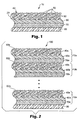
- Nanocomposite 40 may optionally be supported on a first major surface of a primary substrate 60.
- Primary substrate 60 may optionally have a second major surface that intimately contacts optional adhesive layer 70.
- the optional adhesive layer may be supported on a release liner 80.
- another embodiment of the invention concerns a composite article 100 in which multiple composite articles 10, denoted 10a, 10b, ... 10n, are provided in the form of a stack.
- all individual adhesive layers 70a, 70b, ... except 70n of respective composite articles 10a, 10b, ... 10n intimately contact smudge resistant nanocomposite hardcoats 50b, ... 50n of adjacent composite articles 10b, ... 10n .
- Outermost adhesive layer 70n intimately contacts primary substrate 60n and may be supported on an optional release liner 80.
- the number of multiple composite articles 10 stacked in this embodiment is at least 2, and typically may be greater than 5 or more.
- Nanocomposite 40 is supported on a first major surface of a flexible primary substrate 60 .
- Nanoparticles 30 are contained within a binder phase 20 to form a nanocomposite 40 .
- Nanoparticles having covalently bound fluorinated organic groups 50 are exposed at the surface of the nanocomposite to impart smudge resistance.
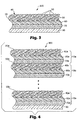
- Nanocomposite 40 is supported on a first major surface of a primary substrate 60 .
- Primary substrate 60 has a second major surface that intimately contacts adhesive layer 70 .
- Adhesive layer 70 is bonded to secondary substrate 90 .
- another embodiment of the invention concerns a composite article 300 in which multiple composite articles 10, denoted 10a, 10b, ... 10n, are provided in the form of a stack.
- all individual adhesive layers 70a, 70b, ... except 70n of respective composite articles 10a, 10b, ... 10n intimately contact smudge resistant nanocomposite hardcoats 50b, ... 50n of adjacent composite articles 10b, ... 10n.
- Outermost adhesive layer 70n intimately contacts primary substrate 60n and is bonded to secondary substrate 90.
- the number of multiple composite articles 10 stacked in this embodiment is at least 2, and typically may be greater than 5 or more.
- Nanocomposites employed in practice of the invention comprise nanoparticles and a binder resin.
- Nanoparticles useful in the invention are typically characterized by an average particle diameter size of from 1 nm up to 500 nm. In some embodiments, the nanoparticles typically have an average particle diameter size range of from 5 nm up to 200 nm. In embodiments, where transparency is important, the nanoparticles typically have an average particle diameter size of from 10 to 100 nm. Nanoparticles suitable for use in the invention are typically substantially spherical in shape and are relatively uniform in size and remain substantially non-aggregated, as nanoparticle aggregation may result in precipitation, gelation, or a dramatic increase in sol viscosity that may make uniform coatings difficult to achieve.
- the nanoparticles may aggregate to form aggregate particles, wherein each the aggregate particle comprises a plurality of smaller sized nanoparticles; however, typically the average aggregate particle diameter is less than 500 nm. For applications in which transparency of the coating is important, an average aggregate particle diameter of 100 nm or less may be desirable.
- the nanoparticles comprise inorganic oxides.
- Exemplary inorganic oxides include oxides of silicon, chromium, aluminum, titanium, zirconium, zinc, titanium, vanadium, chromium, iron, yttrium, antimony, tin, as well as other colloidal metal oxides, colloidal mixed metal oxides (for example, mixed oxides of aluminum and silicon), and mixtures thereof.
- the nanoparticles may also comprise a core of an oxide of one type (or a core of a material other than a metal oxide) on which is deposited an oxide of another type.
- a particularly desirable class of nanoparticles for use in practice of the invention includes sols of inorganic oxides (for example, colloidal dispersions of nanoparticles in liquid media), especially sols of amorphous, semi-crystalline, and/or crystalline silica.
- sols can be prepared by a variety of techniques and in a variety of forms, which include hydrosols (where water serves as the liquid medium), organosols (where organic liquids are used), and mixed sols (where the liquid medium comprises both water and an organic liquid). See, for example, the descriptions of the techniques and forms given in U.S. Pat. Nos. 2,801,185 (Iler); 4,522,958 (Das et al.); and 5,648,407(Goetz et al.).
- Useful nanoparticles may also be commercially obtained as colloidal dispersions or sols from vendors such as ONDEO Nalco Co. of Naperville, IL, for example, NALCO 1040, 1042, 1050, 1060, 2327, and 2329 colloidal silicas; Nyacol Nano Technologies, Inc.
- Ashland, MA for example, NYACOL AL20 colloidal alumina, NYACOL A1530, A1540N, and A1550 colloidal antimony pentoxides, NYACOL CeO 2 colloidal ceria, NYACOL SN15CG colloidal tin oxide, NYACOL ZR10/20, ZR50/20 PH 0.5, and ZRO 2 (ACETATE STABILIZED) colloidal zirconias, NYACOL DP5370, DP5371, and DP5372 colloidal zinc oxides, NYACOL colloidal yttria; and W.R. Grace and Co. of Columbia, MD, for example, colloidal silicas sold under the tradename LUDOX.
- the surface of nanoparticles typically used in practice of the invention are functionalized with organic moieties that have latent reactive functionality, typically accomplished by the use of latent coupling agents.
- the organic moieties enable proper dispersion of the nanoparticles in the binder precursor. In the absence of such surface-modification, the nanoparticles may aggregate, clump, precipitate and otherwise result in inhomogeneous mixtures that are less desirable for use as protective nanocomposite hardcoats.
- the latent coupling agent typically reacts covalently with the surface of the nanoparticle such that the resultant latent reactive nanoparticle is not reactive to the binder precursor under ambient conditions, yet when the latent reactive nanoparticle is exposed to energy (for example, heat, light, etc.) or chemical treatment (for example, exposure to acids, bases, nucleophiles (for example, fluoride), etc.) it becomes reactive to a reactive fluorochemical and, optionally, the binder precursor (that is, it becomes deprotected).
- energy for example, heat, light, etc.
- chemical treatment for example, exposure to acids, bases, nucleophiles (for example, fluoride), etc.
- the latent coupling agent comprises one or more groups that are chemically reactive with the nanoparticle surface.
- Useful latent coupling agents may have groups that are covalently reactive with surface hydroxyl groups of the nanoparticles.
- Useful groups that are covalently reactive with surface hydroxyl groups are those present in conventional coupling agents, and include groups depicted in Formula I: wherein R 1 is C 1 -C 20 alkoxy, C 6 -C 20 aryloxy, halogen or hydroxy, and R 2 and R 3 may independently be C 1 -C 20 alkoxy, C 6 -C 20 aryloxy, C 1 -C 20 alkyl, C 6 -C 20 aryl, C 7 -C 30 aralkyl, C 7 -C 30 alkaryl, halogen, hydroxy, and hydrogen.
- R 1 is C 1 -C 4 alkoxy, C 6 -C 10 aryloxy, halogen or hydroxy.
- Typical latent coupling agents also have reactive functionality that has been masked by a protecting group, which may be removed when desired, typically after the binder precursor has been cured.
- a protecting group which may be removed when desired, typically after the binder precursor has been cured.
- the t-butoxycarbonyl group may be used to mask reactive amino functionality as a t-butyl carbamate. Deprotection (that is, removal) of the t-butyl carbamato protecting group regenerates the original amino functionality.
- useful protecting groups are numerous and may be found in reference works such as P. J. Kocienski, "Protecting Groups”, Georg Thieme Verlag, Stuttgart (1994); and T. W. Greene and P. G. M. Wuts, "Protective Groups in Organic Synthesis", Wiley, NY (1999), on the internet, and the like.
- useful reactive groups may be successfully protected and deprotected, desirably, useful reactive groups that may be generated by deprotection have at least one active hydrogen, for example, hydroxyl groups, 1° and 2° amino groups, sulfhydryl groups, carboxyl groups, and the like. Of these, amino groups may be desirable in some embodiments because of their high reactivity and ease of handling.
- Exemplary protecting groups for amines include, but are not limited to, tertiary alkyl groups such as t-butyl groups; organosilyl groups, such as trialkylsilyl, dialkylarylsilyl, alkyldiarylsilyl and triarylsilyl groups, and the like; alkoxycarbonyl groups, such as alpha-bromobutyloxycarbonyl and t-alkoxycarbonyl groups, including t-butoxycarbonyl, and the like; arlyoxycarbonyl groups, such as benzyloxycarbonyl, and the like; haloacetyl groups, such as trifluoroacetyl groups, and the like; sulfonyl groups such as benzenesulfonyl, p-toluenesulfonyl and trifluoromethanesulfonyl groups, and the like; alkylidene groups, such as cyclohexylidene, iso
- Exemplary protecting groups for alcohols and thiols include, but are not limited to, tertiary alkyl groups such as t-butyl groups; organosilyl groups, such as trialkylsilyl, dialkylarylsilyl, alkyldiarylsilyl and triarylsilyl groups, and the like; alkoxycarbonyl groups, such as t-alkoxycarbonyl groups, including t-butoxycarbonyl, and the like; arlyoxycarbonyl groups, such as benzyloxycarbonyl, and the like; haloacetyl groups, such as trifluoroacetyl groups, and the like; acyl groups, such as acetyl and benzoyl groups, and the like; sulfonyl groups such as benzenesulfonyl, p-toluenesulfonyl and trifluoromethanesulfonyl groups, and the like; alkoxyalkyl and
- Exemplary protecting groups for carboxylic acids include, but are not limited to, alkyl and substituted groups such as t-butyl groups, cyanomethyl groups, and the like; organosilyl groups, such as trialkylsilyl, dialkylarylsilyl, alkyldiarylsilyl and triarylsilyl groups, and the like; alkoxycarbonyl groups, such as t-alkoxycarbonyl groups, including t-butoxycarbonyl, and the like; arlyoxycarbonyl groups, such as benzyloxycarbonyl, and the like; haloacetyl groups, such as trifluoroacetyl groups, trichloroacetyl, and the like; acyl groups, such as acetyl and benzoyl groups, and the like; sulfonyl groups such as benzenesulfonyl, p-toluenesulfonyl and trifluoromethanesulfony
- latent coupling agents are prepared by selecting a conventional coupling agent having a reactive group that is capable of reacting with a fluorochemical, and optionally reacting with the binder precursor, and masking the reactive group with a protecting group so that it is no longer reactive.
- a conventional coupling agent is a chemical substance capable of reacting with both the reinforcement (that is, inorganic particles or fibers) and the resin matrix of a composite material.
- the selection of the conventional coupling agent will typically depend on the nature of the binder precursor into which the surface-modified nanoparticles are to be dispersed.
- Exemplary conventional coupling agents include organosilicon compounds (that is, silane coupling agents) and organozirconium compounds.
- organosilicon compounds include A-151 vinyltriethoxysilane, A-172 vinyltri-(2-methoxyethoxy)silane, A-174 gamma-methacryloxypropyltrimethoxysilane, A-186 3,4-epoxycyclohexylmethyltrimethoxysilane, A-187 gamma-glycidoxypropyltrimethoxysilane, and A-189 gamma-mercaptopropyltrimethoxysilane (commercially available from OSi Specialties, Endicott, NY); Z-6030 gamma-methacryloxypropyltrimethoxysilane, Z-6040 gamma-glycidoxypropyltrimethoxysilane, XZ-8-0951 gamma-mercaptopropyltrimethoxysilane (all commercially available
- Organozirconium coupling agents include amino functional zircoaluminates, carboxy functional zircoaluminates, and mercapto functional zircoaluminates.
- smudge resistant protective coating In cases, where the smudge resistant protective coating is to be applied to thermally sensitive articles, chemical deprotection (for example, using an acid catalyst) may be used.
- Additional useful reactive groups that may be generated by deprotection of the surface-modified nanoparticles include those groups that are reactive to groups having active hydrogens.
- Non-limiting examples of such groups include isocyanato groups, epoxy groups, haloacyl groups, and the like. Of these, isocyanato groups are especially desirable.
- surface-modified nanoparticles may be prepared by a variety of similar general methods.
- surface-modified nanoparticles may be prepared by combining an inorganic particle sol (for example, a silica sol) with an alcohol water-miscible organic liquid (for example, an alcohol, ether, etc.) and then adding the latent coupling agent. The mixture is then heated and the latent coupling agent is added dropwise. Water is removed by distillation. The resultant dispersion may be directly combined with the binder precursor and any residual solvent may optionally be removed or replaced.
- an inorganic particle sol for example, a silica sol
- an alcohol water-miscible organic liquid for example, an alcohol, ether, etc.
- surface-modified nanoparticles used in practice of the invention desirably have a particle size of less than 500 nm, more desirably less than 200 nm, most desirably less than 100 nm.
- the latent coupling agent used is desirably in an amount sufficient to react with at least 30% of the available nanoparticle surface reactive groups, more desirably with at least 70% of the available nanoparticle surface reactive groups, and still more desirably with at least 90% of the available nanoparticle surface reactive groups. Desirably the amount of latent coupling agent does not exceed 110% of the available nanoparticle surface reactive groups.
- Exemplary coupling agents are latent amine coupling agents such as tert-alkyl carbamate organosilicon compounds, and the like. These compounds are readily obtained, are non-reactive to most binder precursors, especially acrylates, and easily deprotected to liberate an amine.
- the tert-alkyl blocking (protecting) group can be removed thermally (that is, by heating) or the tert-alkyl protecting group can be removed under mild conditions by the addition of a catalyst such as an acid.
- a catalyst such as an acid
- the by-product of deprotection may be a gas
- the deprotection step may help to clean the surface of the modified nanoparticles from excess material such as binder residue.
- Exemplary latent amine coupling agents include, but are not limited to, tert-alkyl carbamate organosilicon compounds as disclosed in U.S. Pat. No. 5,322,873 (Pohl et al.).
- Exemplary latent amine coupling agents include tert-butyl N-(omega-trialkoxysilylalkyl)carbamates, such as for example, tert-butyl N-(3-trimethoxysilylpropyl)carbamate, tert-butyl N-(4-trimethoxysilylbutyl)carbamate, tert-butyl N-(4-trimethoxysilylphenyl)carbamate, tert-butyl N-(4-trimethoxysilylbenzyl)carbamate, tert-butyl N-(3-triethoxysilylpropyl)carbamate, and the like.
- tert-butyl N-(omega-trialkoxysilylalkyl)carbamates such as for example, tert-butyl N-(3-trimethoxysilylpropyl)carbamate, tert-butyl N-
- latent isocyanate group containing coupling agents include organosilicon aspartic ester compounds. These compounds are readily obtained, are non-reactive to most binder precursors, and easily deprotected to liberate an isocyanate.
- the surface-modified nanoparticles are intimately mixed with a curable binder precursor that may be subsequently processed prior to curing.
- binder precursor is not critical so long as it is not reactive under ambient conditions with the surface-modified nanoparticles.
- binder precursors include, but are not limited to, free-radically polymerizable monomers and oligomers such as acrylates, methacrylates, allylic compounds, vinyl ethers, vinyl esters, and the like; epoxy resins; alkyd resins; phenolic resins; cyanate esters; melamine and melamine-formaldehyde resins; polyurethane resins and mixtures thereof.
- binder precursors comprise acrylates and/or methacrylates.
- the binder precursor may include a catalyst or other curative in order to facilitate cure.
- catalysts and other curatives will depend on the nature of the binder precursor and may include those well known in the curing art, for example, thermal free radical initiators such as peroxides and azo compounds, free radical photoinitiators, latent acid catalysts, amine hardeners, mercaptans, etc.
- the binder precursor may be cured by application of energy such as heat or actinic radiation (for example, ultraviolet light and electron beam radiation), or through addition of a catalyst or curative.
- energy such as heat or actinic radiation (for example, ultraviolet light and electron beam radiation)
- actinic radiation for example, ultraviolet light and electron beam radiation
- a photoinitiator is present in the binder precursor and the mixture is irradiated with ultraviolet actinic radiation from a lamp, desirably in an inert atmosphere such as nitrogen.
- actinic radiation to cure the binder precursor allows a high degree of flexibility in the choice of protecting groups.
- actinic radiation energy used for curing depends upon a number of factors, such as the amount and the type of reactants involved, the energy source, web speed, the distance from the energy source, and the thickness of the material to be cured.
- actinic radiation typically involves a total energy exposure from 0.1 to 10 Joules per square centimeter
- electron beam radiation typically involves a total energy exposure in the range from less than 1 megarad to 100 megarads or more, desirably 1 to 10 megarads. Exposure times may be from less than 1 second up to 10 minutes or more.
- free-radical generating photoinitiators suitable for the invention include, but are not limited to, benzophenone, benzoin ether and acylphosphine photoinitiators such as those sold under the trade designations IRGACURE and DAROCUR from Ciba-Geigy Corp. of Ardsey, NY.
- the amount of photoinitiator(s) used typically varies between 0.1 and 15 weight percent, desirably between 0.5 and 7 weight percent based on the total weight of the binder precursor.
- Co-initiators and amine synergists can be included in order to improve curing rate.
- Examples include isopropylthioxanthone, ethyl 4-( dimethylamino )benzoate, 2-ethylhexyl dimethylaminobenzoate, and dimethylaminoethyl methacrylate.
- the binder precursor/surface-modified particle mixture may contain additional solvents, catalysts, hardeners, matting agents, antioxidants, UV stabilizers, optical brighteners, pigments, and the like. If a solvent is used, it may be present in sufficient amount to facilitate the chosen coating method and desired film thickness. Thus, solvent or solvents may be present at level up to 95 weight percent or even more. Alternatively, in many cases it may advantageous to use solvent-free formulations.
- the volume ratio of surface-modified nanoparticles to binder precursor may range from 1:99 up to 70:30, desirably from 5:95 up to 55:45, and more desirably from 10:90 up to 40:60.
- Deprotection of the surface-modified nanoparticles is carried out after the binder precursor resin is cured to form a nanocomposite material. Deprotection may be done exclusively on the surface, or throughout the bulk (as for example, by heating), of the nanocomposite. If carried out on the surface, such as by contact with an acid catalyst, or by application of heat, the process may be carried out in an image-wise fashion, such as by writing with a laser, to allow image-wise bonding of the fluorinated organic group.
- the choice of reactive fluorochemical will necessarily depend on the nature of the latent coupling agent. Desirably, the reactive fluorochemical is reactive to primary and/or secondary amines to form a covalent bond at temperatures of less than 100 °C, desirably less than 50 °C, and more desirably at ambient temperatures. The formation of permanent covalent bonds helps to ensure durability of the resultant coating.
- Surface treatment of the nanocomposite hardcoat with the reactive fluorochemical may generally be achieved by immersing or otherwise coating a surface of the nanocomposite hardcoat with the reactive fluorochemical, and optionally heating. Excess reactive fluorochemical and reaction byproducts are rinsed away to yield the inventive smudge resistant nanocomposite hardcoats.
- Exemplary reactive fluorochemicals include perfluoropolyether mono- or di-esters.
- perfluoropolyether esters have the formula RO 2 CCF 2 O(CF 2 O) a (C 2 F 4 O) b CF 2 CO 2 R where R represents an alkyl group having from 1 to 8 carbon atoms, and a and b represent integers greater than 4.
- R represents an alkyl group having from 1 to 8 carbon atoms, and a and b represent integers greater than 4.
- Materials of this type are available under the FOMBLIN trade designation (for example, FOMBLIN Z-DEAL) from Ausimont USA of Morristown, NJ. Additional desirable perfluoropolyether esters are described in U.S. Pat. No.
- Additional exemplary reactive fluorochemicals include those having a C 4 -C 18 perfluoroalkyl group.
- Non-limiting examples of such materials include perfluorobutanesulfonyl fluoride, perfluorobutyl iodide, perfluorododecyl iodide, perfluorohexyl bromide, perfluorooctanesulfonyl fluoride all of which are commercially available from Sigma-Aldrich Chemical Co. of Milwaukee, WI.
- Smudge resistant nanocomposite hardcoats of the invention may be utilized on virtually any substrate (for example, primary or secondary), rigid or flexible, but the greatest benefit will be obtained when on a substrate that may be easily scratched.
- substrates may include glass (including electronic displays), quartz, transparent or translucent ceramics wood, metal, painted surfaces including painted metals, and thermoset and thermoplastic materials such as acrylic polymers (for example, polymethyl methacrylate), polycarbonates, polyurethanes, polystyrene, styrene copolymers such as acrylonitrile-butadiene-styrene copolymer and acrylonitrile- styrene copolymer, cellulose esters (for example, cellulose acetate, cellulose diacetate, cellulose triacetate and cellulose acetate-butyrate copolymer), polyvinyl chloride, polyolefins (for example, polyethylene and polypropylene), polyamides, polyimides, phenolic resins
- the layer of fluorinated material covalently attached to the surface of the deprotected nanocomposite hardcoat fluorinated "layer” desirably has a thickness of at least 1/4 wavelength thickness (that is, at least 100 nanometers thickness).
- Substrates useful in practice of present invention may be virtually any thickness as dictated by the specific application. Typically, for flexible thermoplastic film substrates it typically ranges from 0. 1 mm to 1 mm. Substrates can be a laminate of two or more different materials adhered together, either with or without an adhesive layer therebetween.
- the substrates may individually be the same or different.
- rigid substrates have been found to enhance the properties of the smudge resistant nanocomposite hardcoats prepared according to the invention, as compared to flexible substrates.
- a flexible or rigid substrate may be chosen depending on the need.
- Thermoplastic polymer substrates can be formed into a film using conventional filmmaking techniques such as extrusion, with optional uniaxial or biaxial orientation of the extruded film.
- the primary substrate can, optionally, be treated to improve adhesion between the primary substrate and the nanocomposite hardcoat, using, for example, a corona treatment such as air or nitrogen corona, plasma flame, or actinic radiation.
- a corona treatment such as air or nitrogen corona, plasma flame, or actinic radiation.
- an optional tie layer can also be applied between the primary substrate and the nanocomposite hardcoat to increase the interlayer adhesion.
- an organic solvent can be added to the resulting ceramer composition before it is applied, in order to impart improved viscosity characteristics and assist in coating the ceramer composition onto the primary substrate. After coating, the ceramer composition can be dried to remove any added solvent.
- the primary substrate may have an adhesive backing, optionally in intimate contact with (that is, supported on) a release liner.
- Typical useful adhesives include pressure-sensitive adhesives, hot melt adhesives and thermosettable adhesives.
- Exemplary release liners include silicone treated papers and polymer films.
- an adhesive is present, it is desirably transparent or sufficiently translucent so that it will not unduly hamper viewing of an underlying display device.
- the adhesive can be derived from a natural product (for example, a rubber-base adhesive) or can be a synthetic material such as a homopolymer, random copolymer, graft copolymer, or block copolymer.
- the adhesive can be crosslinked or uncrosslinked, tacky or non-tacky. Desirably the adhesive has pressure-sensitive properties.
- PSA's pressure-sensitive adhesives
- G' storage modulus
- Exemplary suitable adhesives include those described in U.S. Pat. Nos. 5,389,438 (Miller et al.); 5,851,664 (Bennett et al.); 6,004,670 (Kobe et al.); and 6,099,682 (Krampe et al.).
- the adhesive comprises a thermoplastic block copolymer elastomers (copolymers of segmented A and B blocks or segments, displaying both thermoplastic and elastomeric behavior).
- thermoplastic block copolymer elastomers include multiblock copolymers having radial, linear A-B diblock, and linear A-B-A triblock structures, as well as blends of such copolymers.
- thermoplastic block copolymer elastomers include the SOLPRENE family of materials (Philips Petroleum Co.), the FINAPRENE family of materials (FINA), the TUFPRENE and ASAPRENE family of materials (Asahi), the STEREON family of materials (Firestone Synthetic Rubber & Latex Co.), the EUROPRENE SOL T family of materials (Enichem), the VECTOR family of materials (Dexco Polymers), and the CARIFLEX TR family of materials (Shell Chemical Co.).
- Other suitable adhesive materials include highly crosslinked acrylic adhesives, silicone polyurea elastomers such as are described in U.S. Pat. No.
- the adhesive (or a liner that protects the adhesive from contamination and bears against the adhesive) can be microtextured. Typically the adhesive layer of a single sheet or the lowermost layer of a stack of sheets will be covered by a liner. If the adhesive is a tacky adhesive, then the liner desirably has a low surface energy. If the adhesive is low tack or non-tacky then a liner made of plain paper or other high surface energy material may be used.
- the substrate can be made by a variety of different methods.
- a thermoplastic material can be extruded as a film and then cut to the desired dimension. It can be molded to form the desired shape and dimensions. Also, it can be solvent cast and subsequently heated and stretched to form a film.
- the primary substrate underlying the smudge resistant nanocomposite hardcoat may include a primed surface, typically in contact with the smudge resistant nanocomposite hardcoat.
- the primed surface can result from the application of a chemical primer layer, such as an acrylic layer, or from chemical etching, electron-beam irradiation, corona treatment, plasma etching, or co-extrusion of adhesion promoting layers.
- the smudge resistant nanocomposite hardcoat may be formed on the primary substrate in a variety of ways.
- the mixture of binder precursor containing surface-modified nanoparticles and any additional ingredients may be coated onto the primary substrate prior to curing.
- Suitable coating methods include, for example, spin coating, knife coating, wire coating, flood coating, padding, spraying, exhaustion, dipping, roll coating, foam techniques, and the like.
- the thickness of the coating of curable coating composition that is applied will depend on the particular primary substrate and application.
- the thickness of the film should be sufficient so that when the composition is cured, the protective layer will have a final thickness that ranges from 1 nm up to 50 microns (50 micrometers) or even thicker, desirably from 0.5 microns (0.5 micrometer) to 10 microns (10 micrometers), and more desirably from 3 microns (3 micrometers) to 6 microns (6 micrometers).
- Thicker protective layers can lead to crazing and other defects over time; however, thinner layers often do not provide enough surface material to be scratch resistant.
- the ingredients in the smudge resistant nanocomposite hardcoat are desirably chosen so that the cured hardcoat has a refractive index close to that of the substrate. This can help reduce the likelihood of Moiré patterns or other visible interference fringes.
- the smudge resistant nanocomposite hardcoat can contain other optional adjuvants, such as surface treatment agents, surfactants, antistatic agents (for example, conductive polymers), leveling agents, initiators (for example, photoinitiators), photosensitizers, UV absorbers, stabilizers, antioxidants, fillers, lubricants, pigments, dyes, plasticizers, suspending agents, and the like.
- surface treatment agents such as surfactants, antistatic agents (for example, conductive polymers), leveling agents, initiators (for example, photoinitiators), photosensitizers, UV absorbers, stabilizers, antioxidants, fillers, lubricants, pigments, dyes, plasticizers, suspending agents, and the like.
- Exemplary substrates on which the smudge resistant protective coatings may be applied and used as described herein include, but are not limited to, optical elements such as lenses (including eyeglass lenses, camera lenses, binocular lenses, telescope lenses, fresnel lenses, etc.), mirrors, watch crystals, holograms, windows, computer privacy filters, compact discs, DVD discs, and the like; articles with electronic display devices including touch-screen displays (such as those of computer touch screens and personal data assistants), televisions, flexible electronic displays such as electronic paper, computer monitors, cellular phones, global positioning systems, calculators, and the like; graphic articles, including outdoor signage including backlit and traffic signage; motor vehicles, sculpture, membrane switches, jewelry, and the like.
- optical elements such as lenses (including eyeglass lenses, camera lenses, binocular lenses, telescope lenses, fresnel lenses, etc.), mirrors, watch crystals, holograms, windows, computer privacy filters, compact discs, DVD discs, and the like
- articles with electronic display devices including touch-screen displays (such
- the Permanent Marker Pen Challenge test consists of two parts:
- Smudge resistant properties of the coatings were evaluated by an ink removal test performed using repeated cycles of applying SHARPIE black permanent ink followed by dry wiping with a KIMWIPE paper wiper using hand pressure. According to the test procedure, lines are written on an approximately 2.5 cm x 2.5 cm area of sample to be tested using a SHARPIE black permanent marker. Results are determined by visual inspection: P means that the ink beads up as discrete droplets; PB means that ink beads up forming lines or non-discrete droplets; F means ink beading does not occur on the surface of the sample being tested.
- the ink is wiped using a dry KIMWIPE paper wiper and light hand pressure. Results are determined by visual inspection: P means the ink is "removed” easily; F means the ink residue remains on the wiped surface; PB means that ink removal from the surface may only be achieved using added pressure. The test is repeated until failure is observed. Ease of ink removal as a function of the number of cycles was noted.
- the abraded area is then typically challenged by the ink beading and ink removability tests.
- Droplets (15-20 mm diameter) of COCA-COLA soda pop, coffee, tomato sauce, acetone, isopropyl alcohol, glass cleaner, permanent ink and diluted ammonia are placed onto the surface of the material(s) to be tested. The droplets are allowed to remain on the surface for 24 hours at room temperature. Each droplet is then dry-wiped by hand with a KIMWIPE paper wiper, and each area is inspected visually for sign of degradation.
- NALCO 2327 (54.92 g) colloidal silica was diluted with DOWANOL PM ether (propylene glycol methyl ether, commercially available from Dow Chemical Co., Midland, MI) to achieve a 25 wt. % silica concentration and then heated. When the temperature of the mixture reached 65 °C, (tert-butylcarbamatopropyl)triethoxysilane (2.82 g, 0.009 mol) was added dropwise. Water was removed from the mixture by distillation. During the distillation, DOWANOL PM ether was periodically replenished to maintain the solids content at about 25 wt. %. When the vapor temperature reached 117 °C, distillation was stopped providing a transparent sol having 23 wt. % silica content (Sol A).
- DOWANOL PM ether propylene glycol methyl ether, commercially available from Dow Chemical Co., Midland, MI
- NALCO 2327 (371.92 g) was diluted with 250.9 g of DOWANOL PM. The mixture was stirred with heating. 3-(Methacryloxypropyl)trimethoxysilane (18.70 g) was diluted with 23.63 g DOWANOL PM and added to the mixture when the liquid reached 74.5 °C. An additional 112.98 g DOWANOL PM was added immediately and more (a total of 733.2 g of additional alcohol) was added throughout the process. The distillation was discontinued when the liquid reached ⁇ 120 °C, resulting in a clear sol which had 28.0 wt. % silica content (Sol B).
- NALCO 2327 (70.00 g) was diluted with DOWANOL PM ether to achieve a 25 wt. % silica concentration and then heated. When the temperature of the mixture reached 65 °C, (tert-butylcarbamatopropyl)triethoxysilane (5.58 g, 0.017 mol) was added dropwise. Water was removed from the mixture by distillation. During the distillation, DOWANOL PM ether was periodically replenished to maintain the solids content at about 25 wt. %. When the vapor temperature reached 117 °C, distillation was stopped providing a transparent sol having 22.5 wt. % silica content (Sol C).
- IRGACURE 184 photoinitiator was added to the coating solution at a level of 2 wt. % based on total solids weight of the solution.
- the coating solution was then flowcoated through a 1 micron (1 micrometer) glass fiber syringe filter onto an acrylic sheet and the excess coating solution allowed to drip into a collection tray for 4 minutes.
- the coated sheet was then placed in a fume hood with 200 ft/min (61 m/min) air flow for 12 minutes to remove the DOWANOL PM ether by evaporation.
- the coated acrylic sheet was then cured using UV Processor A under nitrogen, at a translation speed of 20 ft/min (6.1 m/min) to form nanocomposite hardcoat H 1 as a coating on an acrylic sheet.
- This example describes the preparation of an acrylic sheet having a deprotected nanocomposite hardcoat layer.
- the coated sheet was thoroughly rinsed with distilled water and allowed to dry in air resulting in a deprotected nanocomposite hardcoat as a coating on an acrylic sheet.
- This example describes the preparation of an acrylic sheet having a deprotected nanocomposite hardcoat layer.
- Example 1 The procedure of Example 1 was repeated except that the nanocomposite hardcoat was soaked for 3 hours in a 10 wt. % aqueous solution of methanesulfonic acid.
- This example describes the preparation of an acrylic sheet having a deprotected nanocomposite hardcoat layer.
- Example 1 The procedure of Example 1 was repeated except that the nanocomposite hardcoat was flow coated with a 50 wt. % diethyl ether solution of methanesulfonic acid then immediately rinsed instead of soaking.
- Example 6 The smudge resistant hardcoat (that is, fluorinated) surface of Example 6 was subjected to the chemical exposure test. Untreated acrylic sheeting was also tested as a control. Example 6 remained visually unchanged after the test, while untreated acrylic sheeting that had been exposed to acetone, coffee and ink showed visual signs of degradation (that is, haze and/or stain).
- This example describes the preparation of an acrylic sheet having a deprotected nanocomposite hardcoat layer.
- This example describes the preparation of an acrylic sheet having a smudge resistant nanocomposite hardcoat layer.
- FOMBLIN Z-DEAL was applied to the deprotected coating of Example 7 according to the procedure of Example 4. Physical properties of the coated sheet are shown in Table 2.
- This example describes the preparation of an acrylic sheet having a deprotected nanocomposite hardcoat layer.
- This example describes the preparation of an acrylic sheet having a smudge resistant nanocomposite hardcoat layer.
- FOMBLIN Z-DEAL was applied to the deprotected coating of Example 9 according to the procedure of Example 4. Physical properties of the coated sheet are shown in Table 2.
- This example describes the preparation of an acrylic sheet having a deprotected nanocomposite hardcoat layer.
- This example describes the preparation of an acrylic sheet having a smudge resistant nanocomposite hardcoat layer.
- FOMBLIN Z-DEAL was applied to the deprotected coating of Example 11 according to the procedure of Example 4. Physical properties of the coated sheet are shown in Table 2.
- Example 8 P during first two ink removals; F to remove ink on the third challenge; Example 10, PB for ink removal during the second ink challenge; F ink removal during the third ink challenge; Example 12, PB for ink removal after 10 ink challenges.
- Dry Rub Durability Test Results Example No. of Dry Rubs Ink Removability Test 8 25 PB 50 PB 75 F 10 25 P 50 P 75 PB 100 F 12 25 P 50 PB 75 F
- This example describes the preparation of a PET film having a deprotected nanocomposite hardcoat layer.
- Nanocomposite hardcoat H5 coated PET film prepared as described above, was soaked for 3 hours in a 10 wt. % aqueous solution of hydrochloric acid, rinsed with distilled water, and immediately treated with 8 wt. % aqueous potassium hydroxide for 1 minute. The coated sheet was thoroughly rinsed with distilled water and allowed to dry in air resulting in a deprotected nanocomposite hardcoat on PET film.
- This example describes the preparation of a PET film having a deprotected nanocomposite hardcoat layer.
- This example describes the preparation of a PET film having a deprotected nanocomposite hardcoat layer.
- This example describes the preparation of a PC film having a deprotected nanocomposite hardcoat layer.
- This example describes the preparation of a PC film having a deprotected nanocomposite hardcoat layer.
- This example describes the preparation of a PC film having a deprotected nanocomposite hardcoat layer.
- This example describes the preparation of a TAC film having a deprotected nanocomposite hardcoat layer.
- This example describes the preparation of a TAC film having a deprotected nanocomposite hardcoat layer.
- Example 18 The procedure of Example 18 was followed except that TAC film was used in place of PC film.
- the coated films were then placed in an oven at 60 °C for 12 hours to give Examples 21 - 28, respectively (for example, Example 27 is derived from Example 19), as smudge resistant nanocomposite hardcoats coated on polymer film primary substrates.
- Physical properties of Examples 21 - 28 are shown in Table 3. Smudge and Abrasion Resistance of Examples 21 - 28 Example Dry Rub Durability Test No.
- COMPARATIVE EXAMPLES A and B were separately treated with a 0.1 wt. % solution of FOMBLIN Z-DEAL in HFE 7100 using a #9 wire wound rod (nominal film thickness 20.3 micron (20.3 micrometers)). The coated films were then placed in an oven at 60 °C for 12 hours to give COMPARATIVE EXAMPLES C and D, respectively.
- This example describes the preparation of a PC film having a deprotected nanocomposite hardcoat layer.
- Example 22 The procedure of Example 22 was followed except that PC film was used in place of PET film.
- This example describes the preparation of a PET film having a deprotected nanocomposite hardcoat layer.
- Example 27 The procedure of Example 27 was followed except that PET film was used in place of TAC film.
- This example describes the preparation of a PC film having a deprotected nanocomposite hardcoat layer.
- Example 27 The procedure of Example 27 was followed except that PC film was used in place of TAC film.
- the coated films were then placed in an oven at 60 °C for 12 hours to give Examples 32 - 34, respectively (for example, Example 33 was derived from Example 30), as smudge resistant nanocomposite hardcoats coated on polymer film primary substrates.
- Table 4 shows the results of physical testing of nanocomposite hardcoat films before and after rinsing with HFE-7100 solvent. Rinsing of the coated surface was accomplished using a squirt bottle filled with HFE-7100 solvent for approximately 30 seconds. Effect of Solvent Rinsing of Ink resistance Example Ink Beading Test Before Rinsing Ink Removability Test Before Rinsing Ink Beading Test After Rinsing Ink Removability Test After Rinsing Comparative Example A F F NM NM Comparative Example B F F NM NM Comparative Example C F PB F F Comparative Example D F PB F F F 25 F PB F PB 32 PB PB F PB 33 PB P PB P 34 PB P PB P PB P 25 F* PB* F* PB* 21 P* P* PB* P* 22 PB* P* P* P* P* 23 PB* P* F* P* 24 F* P* F* P* P* 26 F* P* F* P* 27 PB* P
- This example describes applying a PSA layer to the second major surface of a substrate bearing a smudge resistant hardcoat layer on its first major surface to make a composite article.
- One release liner was removed from a 0.13 mm thick acrylic transfer PSA film having dual release liners (having the trade designation 3M 9843 Optically Clear Laminating Adhesive, available from 3M Company, St. Paul, MN) was applied to the uncoated surface (that is, second major surface) of the PET polymer film of Example 33 using a laminating rubber roller.
- This example describes applying a PSA layer backed smudge resistant hardcoat treated film to a hand held electronic display device.
- Example 35 The remaining release liner of Example 35 was removed and the adhesive layer was applied to the front surface of a hand held display panel using a laminating rubber roller.
- This example describes applying a PSA layer to the second major surface of a substrate bearing a smudge resistant hardcoat layer on its first major surface to make a composite article.
- One release liner was removed from 0.13 mm thick acrylic transfer PSA film having dual release liners (having the trade designation 3M 9483 Optically Clear Laminating Adhesive) was applied to the uncoated surface (that is, second major surface) of the PET polymer film of Example 33 using a laminating rubber roller.
- This example describes the preparation of a stack of PSA backed smudge resistant hardcoat bearing films.
- Example 37 Four identically shaped sheets were cut from the material prepared in Example 37. The remaining release liner of the first sheet was removed and the adhesive layer was applied to the smudge resistant front surface of the second sheet. The remaining release liner of the second sheet was removed and the adhesive layer was applied to the smudge resistant front surface of the third sheet. The remaining release liner of the third sheet was removed and the adhesive layer was applied to the smudge resistant front surface of the fourth sheet.
Landscapes
- Chemical & Material Sciences (AREA)
- Organic Chemistry (AREA)
- Materials Engineering (AREA)
- Dispersion Chemistry (AREA)
- Engineering & Computer Science (AREA)
- Chemical Kinetics & Catalysis (AREA)
- General Chemical & Material Sciences (AREA)
- Geochemistry & Mineralogy (AREA)
- Composite Materials (AREA)
- Life Sciences & Earth Sciences (AREA)
- Laminated Bodies (AREA)
- Adhesive Tapes (AREA)
- Lubricants (AREA)
- Silicon Compounds (AREA)
- Adhesives Or Adhesive Processes (AREA)
- Application Of Or Painting With Fluid Materials (AREA)
- Paints Or Removers (AREA)
- Pigments, Carbon Blacks, Or Wood Stains (AREA)
Applications Claiming Priority (3)
| Application Number | Priority Date | Filing Date | Title |
|---|---|---|---|
| US95213501A | 2001-09-11 | 2001-09-11 | |
| US952135 | 2001-09-11 | ||
| PCT/US2002/028334 WO2003022935A1 (en) | 2001-09-11 | 2002-09-06 | Smudge resistant nanocomposite hardcoats and methods for making same |
Publications (2)
| Publication Number | Publication Date |
|---|---|
| EP1425352A1 EP1425352A1 (en) | 2004-06-09 |
| EP1425352B1 true EP1425352B1 (en) | 2005-01-12 |
Family
ID=25492622
Family Applications (1)
| Application Number | Title | Priority Date | Filing Date |
|---|---|---|---|
| EP02759562A Expired - Lifetime EP1425352B1 (en) | 2001-09-11 | 2002-09-06 | Smudge resistant nanocomposite hardcoats and methods for making same |
Country Status (9)
| Country | Link |
|---|---|
| US (1) | US7101616B2 (enExample) |
| EP (1) | EP1425352B1 (enExample) |
| JP (1) | JP4149924B2 (enExample) |
| KR (1) | KR100862262B1 (enExample) |
| CN (1) | CN1268695C (enExample) |
| AT (1) | ATE286943T1 (enExample) |
| DE (1) | DE60202624T2 (enExample) |
| ES (1) | ES2235076T3 (enExample) |
| WO (1) | WO2003022935A1 (enExample) |
Cited By (1)
| Publication number | Priority date | Publication date | Assignee | Title |
|---|---|---|---|---|
| RU2516846C2 (ru) * | 2008-01-16 | 2014-05-20 | Бим Кеми Аб | Композиция, cодержащая оксид кремния |
Families Citing this family (87)
| Publication number | Priority date | Publication date | Assignee | Title |
|---|---|---|---|---|
| FR2840313B1 (fr) * | 2002-05-28 | 2004-08-27 | Rhodia Elect & Catalysis | Composition a base d'une peinture aqueuse, notamment d'une lasure ou d'un vernis, et d'une dispersion colloidale aqueuse de cerium |
| US20040115239A1 (en) * | 2002-09-20 | 2004-06-17 | Shastri Venkatram P. | Engineering of material surfaces |
| DE10248583A1 (de) * | 2002-10-17 | 2004-04-29 | Nanogate Technologies Gmbh | Textilbehandlungsmittel |
| EP1418448A1 (en) * | 2002-11-06 | 2004-05-12 | Koninklijke DSM N.V. | Preparation of a mechanically durable single layer coating with anti-reflective properties |
| FR2848563B1 (fr) * | 2002-12-16 | 2006-07-28 | Rhodia Chimie Sa | Composition silicone pour revetement dur, a base de silice colloidale, durcissable par voie cationique, antibuee et/ou antisalissures |
| WO2005056174A2 (en) * | 2003-12-02 | 2005-06-23 | Ppg Industries Ohio, Inc. | Colloidal particle sols and methods for preparing the same |
| US20050136180A1 (en) * | 2003-12-19 | 2005-06-23 | 3M Innovative Properties Company | Method of coating a substrate with a fluoropolymer |
| US7288619B2 (en) * | 2004-05-07 | 2007-10-30 | 3M Innovative Properties Company | Fluorinated polyether polyamine and method of making the same |
| US7342080B2 (en) * | 2004-05-07 | 2008-03-11 | 3M Innovative Properties Company | Polymerizable compositions, methods of making the same, and composite articles therefrom |
| US7294405B2 (en) | 2004-08-26 | 2007-11-13 | 3M Innovative Properties Company | Antiglare coating and articles |
| US7291386B2 (en) * | 2004-08-26 | 2007-11-06 | 3M Innovative Properties Company | Antiglare coating and articles |
| US20070261601A1 (en) * | 2004-09-22 | 2007-11-15 | Fujifilm Corporation | Hardening Composition, Antireflective Film, Method of Producing the Same, Polarizing Plate and Image Display Unit |
| US7691932B2 (en) | 2004-09-27 | 2010-04-06 | 3M Innovative Properties Company | Method of making a composition and nanocomposites therefrom |
| US8193270B2 (en) | 2004-12-14 | 2012-06-05 | 3M Innovative Properties Company | Method of making composites and nanocomposites |
| US8618202B2 (en) * | 2004-12-30 | 2013-12-31 | 3M Innovative Properties Company | Polymer blends including surface-modified nanoparticles and methods of making the same |
| US20060286382A1 (en) * | 2005-06-16 | 2006-12-21 | Rohm And Haas Electronic Materials Llc | Articles |
| EP1908801A4 (en) * | 2005-06-24 | 2014-10-22 | Daikin Ind Ltd | SURFACE TREATED NANO FILLER AND POLYMER COMPOSITE |
| US20070049164A1 (en) * | 2005-08-26 | 2007-03-01 | Thomson Clifford O | Polishing pad and method for manufacturing polishing pads |
| US20070065638A1 (en) * | 2005-09-20 | 2007-03-22 | Eastman Kodak Company | Nano-structured thin film with reduced light reflection |
| US7962641B1 (en) * | 2005-09-30 | 2011-06-14 | Cleversafe, Inc. | Streaming media software interface to a dispersed data storage network |
| US7553543B2 (en) * | 2005-12-16 | 2009-06-30 | E. I. Du Pont De Nemours And Company | Composite structure having a fluoroelastomeric anti-reflective coating with non-fluorinated cross-linking |
| US8258206B2 (en) | 2006-01-30 | 2012-09-04 | Ashland Licensing And Intellectual Property, Llc | Hydrophobic coating compositions for drag reduction |
| US20080221263A1 (en) * | 2006-08-31 | 2008-09-11 | Subbareddy Kanagasabapathy | Coating compositions for producing transparent super-hydrophobic surfaces |
| WO2007102960A2 (en) * | 2006-01-30 | 2007-09-13 | Ashland Licensing And Intellectual Property Llc | Hydrophobic self-cleaning coating compositions |
| US20080221009A1 (en) * | 2006-01-30 | 2008-09-11 | Subbareddy Kanagasabapathy | Hydrophobic self-cleaning coating compositions |
| US7879449B2 (en) * | 2006-03-14 | 2011-02-01 | Cerasol Hong Kong Ltd. | Non-stick ceramic coating composition and process |
| US7981949B2 (en) | 2006-05-23 | 2011-07-19 | 3M Innovative Properties Company | Curable hydrophilic compositions |
| US20100000181A1 (en) * | 2008-07-03 | 2010-01-07 | Muhler Laminated Glass, Inc. | Impact resistant multipane window |
| US20080190070A1 (en) * | 2007-02-13 | 2008-08-14 | Muhler Laminated Glass, Inc. | Impact resistant multipane window |
| US20090229216A1 (en) * | 2008-03-17 | 2009-09-17 | Muhler Laminated Glass, Inc. | Impact resistant multipane window |
| US20080196317A1 (en) * | 2007-02-13 | 2008-08-21 | Muhler Laminated Glass, Inc. | Impact resistant multipane window |
| US20080250978A1 (en) * | 2007-04-13 | 2008-10-16 | Baumgart Richard J | Hydrophobic self-cleaning coating composition |
| WO2009016388A1 (en) * | 2007-08-02 | 2009-02-05 | Dupont Teijin Films U.S. Limited Partnership | Coated polyester film |
| US20090041984A1 (en) * | 2007-08-10 | 2009-02-12 | Nano Terra Inc. | Structured Smudge-Resistant Coatings and Methods of Making and Using the Same |
| US20090064894A1 (en) * | 2007-09-05 | 2009-03-12 | Ashland Licensing And Intellectual Property Llc | Water based hydrophobic self-cleaning coating compositions |
| EP2048116A1 (en) * | 2007-10-09 | 2009-04-15 | ChemIP B.V. | Dispersion of nanoparticles in organic solvents |
| EP2222463A4 (en) * | 2007-11-28 | 2013-06-05 | 3M Innovative Properties Co | HARD-FILM FILMS FOR GRAPHIC SUBSTRATES |
| EP2215171B1 (en) * | 2007-11-29 | 2013-07-03 | LG Chem, Ltd. | Coating composition and coating film having enhanced abrasion resistance and fingerprint traces removability |
| US7923133B2 (en) * | 2007-12-21 | 2011-04-12 | 3M Innovative Properties Company | Coatings and methods for particle reduction |
| JP2011508058A (ja) * | 2007-12-28 | 2011-03-10 | スリーエム イノベイティブ プロパティズ カンパニー | ナノ粒子、ビニルモノマー、及びシリコーンのコポリマー |
| CN101910224B (zh) * | 2007-12-28 | 2012-11-14 | 3M创新有限公司 | 纳米粒子、乙烯基单体和有机硅的共聚物 |
| KR20150126980A (ko) * | 2008-12-26 | 2015-11-13 | 데이진 가부시키가이샤 | 투명 도전성 적층체 및 투명 터치 패널 |
| TW201024088A (en) * | 2008-12-31 | 2010-07-01 | Ichia Tech Inc | Coating structure, chemical composition for forming the same, and method of forming the same |
| CN101775243B (zh) * | 2009-01-12 | 2012-08-29 | 毅嘉科技股份有限公司 | 涂层结构、用于形成其的化学组合物、及形成其的方法 |
| US8147607B2 (en) * | 2009-10-26 | 2012-04-03 | Ashland Licensing And Intellectual Property Llc | Hydrophobic self-cleaning coating compositions |
| US9296926B2 (en) * | 2010-03-26 | 2016-03-29 | 3M Inovative Properties Company | Overlaminate films and graphic articles containing them |
| KR101886882B1 (ko) * | 2010-05-19 | 2018-09-11 | 솔베이(소시에떼아노님) | Pvdf 코팅 조성물 |
| US20120029222A1 (en) * | 2010-07-30 | 2012-02-02 | E. I. Du Pont De Nemours And Company | Surface-modified particles for polyester nanocomposites |
| US8368106B2 (en) * | 2010-11-04 | 2013-02-05 | Industrial Technology Research Institute | Gradient composite material and method of manufacturing the same |
| CN103228444A (zh) * | 2010-11-04 | 2013-07-31 | 新日铁住金化学株式会社 | 带有硬涂层的聚碳酸酯 |
| US10155361B2 (en) * | 2011-11-09 | 2018-12-18 | Corning Incorporated | Method of binding nanoparticles to glass |
| US8715779B2 (en) | 2011-06-24 | 2014-05-06 | Apple Inc. | Enhanced glass impact durability through application of thin films |
| US20130045371A1 (en) | 2011-08-18 | 2013-02-21 | Dennis P. O'Donnell | Screen protector film |
| DE102011081604A1 (de) * | 2011-08-26 | 2013-02-28 | Bayerische Motoren Werke Aktiengesellschaft | Bedienvorrichtung |
| WO2013036502A1 (en) * | 2011-09-07 | 2013-03-14 | Microchem Corp. | Epoxy formulations and processes for fabrication of relief patterns on low surface energy substrates |
| EP2818498B1 (en) * | 2012-02-25 | 2019-03-06 | Mitsubishi Chemical Corporation | Coated film |
| US11635688B2 (en) | 2012-03-08 | 2023-04-25 | Kayaku Advanced Materials, Inc. | Photoimageable compositions and processes for fabrication of relief patterns on low surface energy substrates |
| ES2606641T3 (es) | 2012-03-22 | 2017-03-24 | 3M Innovative Properties Company | Composición de cubierta dura de polimetilmetacrilato y artículo recubierto |
| JP6371032B2 (ja) * | 2012-08-01 | 2018-08-08 | スリーエム イノベイティブ プロパティズ カンパニー | 反射防止ハードコートおよび反射防止物品 |
| JP6062680B2 (ja) * | 2012-08-01 | 2017-01-18 | スリーエム イノベイティブ プロパティズ カンパニー | 防汚性ハードコートおよび防汚性ハードコート前駆体 |
| US20140078658A1 (en) * | 2012-09-18 | 2014-03-20 | Joseph C. Rubin | Detection of oleophobic coating |
| US20140106165A1 (en) * | 2012-10-12 | 2014-04-17 | Georgia-Pacific Chemicals Llc | Paper with higher oil repellency |
| KR102111726B1 (ko) * | 2013-10-30 | 2020-05-18 | 삼성디스플레이 주식회사 | 표시 장치 |
| EP3171072A4 (en) * | 2014-07-18 | 2018-04-04 | Toppan Printing Co., Ltd. | Protective film for wavelength conversion sheet, wavelength conversion sheet and backlight unit |
| US10571619B2 (en) | 2014-10-16 | 2020-02-25 | Toppan Printing Co., Ltd. | Quantum dot protective film, quantum dot film using same, and backlight unit |
| US10000626B2 (en) | 2014-12-22 | 2018-06-19 | 3M Innovative Properties Company | Sterically hindered amine and oxyalkyl amine light stabilizers |
| EP3237427A1 (en) | 2014-12-22 | 2017-11-01 | 3M Innovative Properties Company | Sterically hindered amine and oxyalkyl amine light stabilizers |
| WO2017043483A1 (ja) * | 2015-09-07 | 2017-03-16 | 凸版印刷株式会社 | 波長変換シート用保護フィルム及びその製造方法、並びに、波長変換シート及びバックライトユニット |
| US10442935B2 (en) * | 2016-08-06 | 2019-10-15 | Hrl Laboratories, Llc | Coatings combining oil-absorbing and oil-repelling components for increased smudge resistance |
| AU2018250262B2 (en) | 2017-04-06 | 2021-03-04 | Nissan Chemical America Corporation | Hydrocarbon formation treatment micellar solutions |
| JP2021006595A (ja) | 2017-09-13 | 2021-01-21 | 日産化学株式会社 | 原油回収用薬液 |
| US10801310B2 (en) * | 2017-09-26 | 2020-10-13 | Nissan Chemcial America Corporation | Using gases and hydrocarbon recovery fluids containing nanoparticles to enhance hydrocarbon recovery |
| MX2020004470A (es) | 2017-11-03 | 2020-09-03 | Nissan Chemical America Corp | Uso de dispersiones de nanoparticulas de dioxido de silicio resistentes a la salmuera para mejorar la recuperacion de petroleo. |
| KR102731347B1 (ko) | 2017-12-08 | 2024-11-15 | 쓰리엠 이노베이티브 프로퍼티즈 컴파니 | 가요성 하드코트 |
| AU2018409655A1 (en) * | 2018-02-22 | 2020-10-08 | Azra Shs Tech Inc. | Durable superhydrophobic coating |
| US11661536B2 (en) | 2018-02-28 | 2023-05-30 | 3M Innovative Properties Company | Adhesives comprising polymerized units of secondary hexyl (meth)acrylates |
| JP7347427B2 (ja) * | 2018-08-08 | 2023-09-20 | 三菱瓦斯化学株式会社 | 成形用積層体 |
| US10934478B2 (en) | 2018-11-02 | 2021-03-02 | Nissan Chemical America Corporation | Enhanced oil recovery using treatment fluids comprising colloidal silica with a proppant |
| US11827811B2 (en) | 2019-05-09 | 2023-11-28 | 3M Innovative Properties Company | Flexible hardcoat |
| KR102914527B1 (ko) | 2019-05-09 | 2026-01-16 | 쓰리엠 이노베이티브 프로퍼티즈 컴파니 | 가요성 하드코트 |
| WO2020225704A1 (en) | 2019-05-09 | 2020-11-12 | 3M Innovative Properties Company | Flexible hardcoat |
| CN110931657A (zh) * | 2019-12-06 | 2020-03-27 | 中国乐凯集团有限公司 | 一种钙钛矿薄膜太阳能电池用柔性复合衬底及其制备方法 |
| KR20210137255A (ko) | 2020-05-06 | 2021-11-17 | 삼성디스플레이 주식회사 | 표시 장치 |
| EP4330765A4 (en) | 2021-04-26 | 2024-06-19 | Milwaukee Electric Tool Corporation | HEATED LENS SAFETY GLASSES |
| CN114774855B (zh) * | 2022-03-24 | 2024-03-22 | 四川虹基光玻新材料科技有限公司 | 一种ar膜和af膜及其制备方法和应用 |
| AR129071A1 (es) | 2022-04-15 | 2024-07-10 | Championx Usa Inc | Composiciones y métodos para mejorar la estabilidad térmica y de salmuera de nanopartículas |
| EP4720214A1 (en) | 2023-06-02 | 2026-04-08 | ChampionX LLC | Synergistic effects of nanoparticles and surfactants for gas lift flow improvement |
Family Cites Families (54)
| Publication number | Priority date | Publication date | Assignee | Title |
|---|---|---|---|---|
| US588290A (en) * | 1897-08-17 | poindexter | ||
| US2801185A (en) * | 1952-05-16 | 1957-07-30 | Du Pont | Silica hydrosol powder |
| US3950588A (en) * | 1974-11-01 | 1976-04-13 | Minnesota Mining And Manufacturing Company | Coating of silanol-reactive surfaces with di-silyl poly(perfluorooxyalkylenes) |
| US4188246A (en) * | 1977-06-23 | 1980-02-12 | Julius Lipshaw | Microscope slide and method for making same |
| US4522958A (en) * | 1983-09-06 | 1985-06-11 | Ppg Industries, Inc. | High-solids coating composition for improved rheology control containing chemically modified inorganic microparticles |
| DE3637188A1 (de) | 1986-10-31 | 1988-05-05 | Bayerische Motoren Werke Ag | Flexible scheibe |
| US5104929A (en) * | 1988-04-11 | 1992-04-14 | Minnesota Mining And Manufacturing Company | Abrasion resistant coatings comprising silicon dioxide dispersions |
| US4907090A (en) * | 1988-08-12 | 1990-03-06 | Fredrick Ananian | Projection television screen protector |
| US5132588A (en) | 1989-02-13 | 1992-07-21 | Warman William J | Viewing screen protective shield |
| US6004670A (en) * | 1989-10-26 | 1999-12-21 | Minnesota Mining And Manufacturing Company | Multiple releasable contact responsive fasteners |
| US5252743A (en) * | 1989-11-13 | 1993-10-12 | Affymax Technologies N.V. | Spatially-addressable immobilization of anti-ligands on surfaces |
| US5002326A (en) * | 1990-01-22 | 1991-03-26 | Westfield William R | Automotive windshield laminated protector |
| CA2032125A1 (en) * | 1990-02-22 | 1991-08-23 | John A. Miller | Repositionable adhesive tape |
| US5220047A (en) | 1990-09-17 | 1993-06-15 | Union Carbide Chemicals & Plastics Technology Corporation | Carbamate silicon compounds as latent coupling agents and process for preparation and use |
| US5488142A (en) * | 1993-10-04 | 1996-01-30 | Minnesota Mining And Manufacturing Company | Fluorination in tubular reactor system |
| AU2236295A (en) | 1994-04-04 | 1995-10-23 | Ppg Industries, Inc. | Non-aqueous dispersions of carboxylic acid-functional polymeric microparticles used for flow control in polyepoxide-polyacid based coating compositions |
| US5670598A (en) | 1995-03-24 | 1997-09-23 | Minnesota Mining And Manufacturing Company | Diblock and triblock polydiorganosiloxane-polyurea block copolymers |
| US5648407A (en) * | 1995-05-16 | 1997-07-15 | Minnesota Mining And Manufacturing Company | Curable resin sols and fiber-reinforced composites derived therefrom |
| US5888290A (en) | 1996-05-24 | 1999-03-30 | Minnesota Mining And Manufacturing Company | Composition and process for imparting durable repellency to substrates |
| TW311927B (enExample) * | 1995-07-11 | 1997-08-01 | Minnesota Mining & Mfg | |
| US6160067A (en) * | 1995-10-03 | 2000-12-12 | Dsm N.V. | Reactive silica particles, process for manufacturing the same, use of the same |
| US5846650A (en) * | 1996-05-10 | 1998-12-08 | Minnesota Mining And Manufacturing Company | Anti-reflective, abrasion resistant, anti-fogging coated articles and methods |
| ATE240370T1 (de) | 1996-09-30 | 2003-05-15 | Basf Corp | Kratzfeste klarlacke enthaltend oberflächig reaktive mikroteilchen und verfahren zu deren herstellung |
| DE19715426A1 (de) * | 1997-04-14 | 1998-10-15 | Bayer Ag | Blockierte Isocyanatgruppen aufweisende kolloidale Metalloxide |
| US6485789B1 (en) * | 1997-04-14 | 2002-11-26 | 3M Innovative Properties Company | Fluorochemical composition containing a condensation product of a fluorochemical polyether and a poly-isocyanate to impart stain release properties to a substrate |
| DE19746885A1 (de) * | 1997-10-23 | 1999-06-24 | Inst Neue Mat Gemein Gmbh | Nanostrukturierte Formkörper und Schichten sowie Verfahren zu deren Herstellung |
| MY122234A (en) * | 1997-05-13 | 2006-04-29 | Inst Neue Mat Gemein Gmbh | Nanostructured moulded bodies and layers and method for producing same |
| CA2290455C (en) * | 1997-05-23 | 2007-04-10 | Bayer Aktiengesellschaft | Organosilane oligomers |
| US5851674A (en) * | 1997-07-30 | 1998-12-22 | Minnesota Mining And Manufacturing Company | Antisoiling coatings for antireflective surfaces and methods of preparation |
| US5925918A (en) * | 1997-07-30 | 1999-07-20 | Micron, Technology, Inc. | Gate stack with improved sidewall integrity |
| US5998919A (en) * | 1997-09-10 | 1999-12-07 | Samsung Electronics Co., Ltd. | Image display devices including image display screen shields |
| US6121143A (en) * | 1997-09-19 | 2000-09-19 | 3M Innovative Properties Company | Abrasive articles comprising a fluorochemical agent for wafer surface modification |
| US6277485B1 (en) * | 1998-01-27 | 2001-08-21 | 3M Innovative Properties Company | Antisoiling coatings for antireflective surfaces and methods of preparation |
| CA2318900A1 (en) | 1998-01-27 | 1999-07-29 | Minnesota Mining And Manufacturing Company | Adhesion-enhancing coatings for optically functional coatings materials |
| US6099682A (en) * | 1998-02-09 | 2000-08-08 | 3M Innovative Properties Company Corporation Of Delaware | Cold seal package and method for making the same |
| DE19811790A1 (de) * | 1998-03-18 | 1999-09-23 | Bayer Ag | Nanopartikel enthaltende transparente Lackbindemittel mit verbesserter Verkratzungsbeständigkeit, ein Verfahren zur Herstellung sowie deren Verwendung |
| AU3744299A (en) | 1998-04-09 | 1999-11-01 | 3M Innovative Properties Company | Adhesive cover slip and method for microscopy |
| US6245833B1 (en) * | 1998-05-04 | 2001-06-12 | 3M Innovative Properties | Ceramer composition incorporating fluoro/silane component and having abrasion and stain resistant characteristics |
| WO1999057205A1 (en) | 1998-05-04 | 1999-11-11 | 3M Innovative Properties Company | Ceramer composition having abrasion and stain resistant characteristics |
| US6132861A (en) * | 1998-05-04 | 2000-10-17 | 3M Innovatives Properties Company | Retroreflective articles including a cured ceramer composite coating having a combination of excellent abrasion, dew and stain resistant characteristics |
| US6352758B1 (en) | 1998-05-04 | 2002-03-05 | 3M Innovative Properties Company | Patterned article having alternating hydrophilic and hydrophobic surface regions |
| JP2000020240A (ja) | 1998-06-26 | 2000-01-21 | Sumitomo Chem Co Ltd | タッチパネル用透明表面基板とそれを含む装置 |
| US6329058B1 (en) * | 1998-07-30 | 2001-12-11 | 3M Innovative Properties Company | Nanosize metal oxide particles for producing transparent metal oxide colloids and ceramers |
| DE19845496A1 (de) | 1998-10-02 | 2000-04-06 | Argotec Lacksysteme Gmbh | Lack, Druckfarbe oder Beschichtung mit Nanopartikeln |
| US6461709B1 (en) | 1998-10-28 | 2002-10-08 | 3M Innovative Properties Company | Graffiti and/or environmental protective article having removable sheets, substrates protected therewith, and a method of use |
| DE19857317A1 (de) * | 1998-12-11 | 2000-06-15 | Inst Neue Mat Gemein Gmbh | Haushaltsgeräte |
| US6261700B1 (en) * | 1998-12-30 | 2001-07-17 | 3M Innovative Properties Co | Ceramer containing a brominated polymer and inorganic oxide particles |
| US6238798B1 (en) * | 1999-02-22 | 2001-05-29 | 3M Innovative Properties Company | Ceramer composition and composite comprising free radically curable fluorochemical component |
| JP3188246B2 (ja) * | 1999-03-11 | 2001-07-16 | 株式会社阿部製作所 | 携帯型ゲーム機ディスプレイ用防眩シート |
| US20020099119A1 (en) | 1999-05-27 | 2002-07-25 | Bradley D. Craig | Water-borne ceramer compositions and antistatic abrasion resistant ceramers made therefrom |
| DE19933098A1 (de) | 1999-07-15 | 2001-01-18 | Herberts Gmbh & Co Kg | Mit Nanopartikeln modifizierte Bindemittel für Überzugsmittel und deren Verwendung |
| DE60022667T2 (de) | 1999-10-28 | 2006-06-14 | 3M Innovative Properties Co | Dentalmaterialien mit siliciumdioxid-nanoteilchen |
| DE19952040A1 (de) * | 1999-10-28 | 2001-05-03 | Inst Neue Mat Gemein Gmbh | Substrat mit einem abriebfesten Diffusionssperrschichtsystem |
| US6329059B1 (en) * | 1999-11-12 | 2001-12-11 | Amsil Ltd. | Polymeric composition having self-extinguishing properties |
-
2002
- 2002-09-06 US US10/236,737 patent/US7101616B2/en not_active Expired - Fee Related
- 2002-09-06 ES ES02759562T patent/ES2235076T3/es not_active Expired - Lifetime
- 2002-09-06 AT AT02759562T patent/ATE286943T1/de not_active IP Right Cessation
- 2002-09-06 EP EP02759562A patent/EP1425352B1/en not_active Expired - Lifetime
- 2002-09-06 DE DE60202624T patent/DE60202624T2/de not_active Expired - Lifetime
- 2002-09-06 JP JP2003527004A patent/JP4149924B2/ja not_active Expired - Fee Related
- 2002-09-06 WO PCT/US2002/028334 patent/WO2003022935A1/en not_active Ceased
- 2002-09-06 KR KR1020047003518A patent/KR100862262B1/ko not_active Expired - Fee Related
- 2002-09-06 CN CNB028175700A patent/CN1268695C/zh not_active Expired - Fee Related
Cited By (1)
| Publication number | Priority date | Publication date | Assignee | Title |
|---|---|---|---|---|
| RU2516846C2 (ru) * | 2008-01-16 | 2014-05-20 | Бим Кеми Аб | Композиция, cодержащая оксид кремния |
Also Published As
| Publication number | Publication date |
|---|---|
| JP4149924B2 (ja) | 2008-09-17 |
| US20030068486A1 (en) | 2003-04-10 |
| JP2005502504A (ja) | 2005-01-27 |
| US7101616B2 (en) | 2006-09-05 |
| CN1553940A (zh) | 2004-12-08 |
| CN1268695C (zh) | 2006-08-09 |
| KR100862262B1 (ko) | 2008-10-09 |
| ATE286943T1 (de) | 2005-01-15 |
| EP1425352A1 (en) | 2004-06-09 |
| ES2235076T3 (es) | 2005-07-01 |
| DE60202624D1 (de) | 2005-02-17 |
| DE60202624T2 (de) | 2006-03-23 |
| WO2003022935A1 (en) | 2003-03-20 |
| KR20040044875A (ko) | 2004-05-31 |
Similar Documents
| Publication | Publication Date | Title |
|---|---|---|
| US7101616B2 (en) | Smudge resistant nanocomposite hardcoats and methods for making same | |
| JP6062680B2 (ja) | 防汚性ハードコートおよび防汚性ハードコート前駆体 | |
| CN104619790B (zh) | 抗反射硬涂层和抗反射制品 | |
| EP1051448B1 (en) | Antisoiling coatings for antireflective surfaces and methods of preparation | |
| JPWO2004070436A1 (ja) | 低反射処理物品の製造方法、低反射層形成用溶液および低反射処理物品 | |
| JP5081147B2 (ja) | 反射防止コーティング組成物及びそのようなコーティングを堆積させる方法 | |
| TW200530030A (en) | Hard coat film | |
| KR101953594B1 (ko) | 투명 피막 형성용 도포액 및 투명 피막부 기재 | |
| JP2003034761A (ja) | ハードコート組成物およびハードコート製品 | |
| JP2005146272A (ja) | 防汚膜被覆樹脂物品の製造方法 | |
| JP2014030910A (ja) | ハードコートを有するウィンドウフィルム | |
| CN114503016A (zh) | 具有涂覆有临时超疏水膜的亲水表面的制品及获得其的方法 | |
| JP2002348534A (ja) | ハードコート組成物およびハードコート製品 | |
| JP6089709B2 (ja) | タッチパネル用前面基板 | |
| KR20180120189A (ko) | 적층 필름 | |
| JP2000094584A (ja) | ウインドーフイルム | |
| JPH09127305A (ja) | 耐汚染性に優れた防眩性フィルムまたはシート | |
| CN1723237A (zh) | 被覆防污膜的树脂物品的制造方法 | |
| JP2004043689A (ja) | 表面改質層被覆非晶質ポリオレフィン樹脂物品の製造方法と物品 | |
| JP2007185824A (ja) | 反射防止積層フィルム | |
| JP2014030908A (ja) | ハードコートを有する保護具 | |
| JPWO1996041831A1 (ja) | 耐擦傷性有機ハードコート層及び防曇性有機ハードコート層を有する樹脂成形品及びその製造方法並びにそれに用いる被覆材 |
Legal Events
| Date | Code | Title | Description |
|---|---|---|---|
| PUAI | Public reference made under article 153(3) epc to a published international application that has entered the european phase |
Free format text: ORIGINAL CODE: 0009012 |
|
| 17P | Request for examination filed |
Effective date: 20040316 |
|
| AK | Designated contracting states |
Kind code of ref document: A1 Designated state(s): AT BE BG CH CY CZ DE DK EE ES FI FR GB GR IE IT LI LU MC NL PT SE SK TR |
|
| GRAP | Despatch of communication of intention to grant a patent |
Free format text: ORIGINAL CODE: EPIDOSNIGR1 |
|
| GRAS | Grant fee paid |
Free format text: ORIGINAL CODE: EPIDOSNIGR3 |
|
| GRAA | (expected) grant |
Free format text: ORIGINAL CODE: 0009210 |
|
| AK | Designated contracting states |
Kind code of ref document: B1 Designated state(s): AT BE BG CH CY CZ DE DK EE ES FI FR GB GR IE IT LI LU MC NL PT SE SK TR |
|
| PG25 | Lapsed in a contracting state [announced via postgrant information from national office to epo] |
Ref country code: IT Free format text: LAPSE BECAUSE OF FAILURE TO SUBMIT A TRANSLATION OF THE DESCRIPTION OR TO PAY THE FEE WITHIN THE PRESCRIBED TIME-LIMIT;WARNING: LAPSES OF ITALIAN PATENTS WITH EFFECTIVE DATE BEFORE 2007 MAY HAVE OCCURRED AT ANY TIME BEFORE 2007. THE CORRECT EFFECTIVE DATE MAY BE DIFFERENT FROM THE ONE RECORDED. Effective date: 20050112 Ref country code: SK Free format text: LAPSE BECAUSE OF FAILURE TO SUBMIT A TRANSLATION OF THE DESCRIPTION OR TO PAY THE FEE WITHIN THE PRESCRIBED TIME-LIMIT Effective date: 20050112 Ref country code: TR Free format text: LAPSE BECAUSE OF FAILURE TO SUBMIT A TRANSLATION OF THE DESCRIPTION OR TO PAY THE FEE WITHIN THE PRESCRIBED TIME-LIMIT Effective date: 20050112 Ref country code: BG Free format text: LAPSE BECAUSE OF FAILURE TO SUBMIT A TRANSLATION OF THE DESCRIPTION OR TO PAY THE FEE WITHIN THE PRESCRIBED TIME-LIMIT Effective date: 20050112 Ref country code: AT Free format text: LAPSE BECAUSE OF FAILURE TO SUBMIT A TRANSLATION OF THE DESCRIPTION OR TO PAY THE FEE WITHIN THE PRESCRIBED TIME-LIMIT Effective date: 20050112 Ref country code: FI Free format text: LAPSE BECAUSE OF FAILURE TO SUBMIT A TRANSLATION OF THE DESCRIPTION OR TO PAY THE FEE WITHIN THE PRESCRIBED TIME-LIMIT Effective date: 20050112 Ref country code: EE Free format text: LAPSE BECAUSE OF FAILURE TO SUBMIT A TRANSLATION OF THE DESCRIPTION OR TO PAY THE FEE WITHIN THE PRESCRIBED TIME-LIMIT Effective date: 20050112 Ref country code: LI Free format text: LAPSE BECAUSE OF FAILURE TO SUBMIT A TRANSLATION OF THE DESCRIPTION OR TO PAY THE FEE WITHIN THE PRESCRIBED TIME-LIMIT Effective date: 20050112 Ref country code: CZ Free format text: LAPSE BECAUSE OF FAILURE TO SUBMIT A TRANSLATION OF THE DESCRIPTION OR TO PAY THE FEE WITHIN THE PRESCRIBED TIME-LIMIT Effective date: 20050112 Ref country code: CH Free format text: LAPSE BECAUSE OF FAILURE TO SUBMIT A TRANSLATION OF THE DESCRIPTION OR TO PAY THE FEE WITHIN THE PRESCRIBED TIME-LIMIT Effective date: 20050112 Ref country code: NL Free format text: LAPSE BECAUSE OF FAILURE TO SUBMIT A TRANSLATION OF THE DESCRIPTION OR TO PAY THE FEE WITHIN THE PRESCRIBED TIME-LIMIT Effective date: 20050112 Ref country code: BE Free format text: LAPSE BECAUSE OF FAILURE TO SUBMIT A TRANSLATION OF THE DESCRIPTION OR TO PAY THE FEE WITHIN THE PRESCRIBED TIME-LIMIT Effective date: 20050112 |
|
| REG | Reference to a national code |
Ref country code: GB Ref legal event code: FG4D |
|
| REG | Reference to a national code |
Ref country code: CH Ref legal event code: EP |
|
| REF | Corresponds to: |
Ref document number: 60202624 Country of ref document: DE Date of ref document: 20050217 Kind code of ref document: P |
|
| REG | Reference to a national code |
Ref country code: IE Ref legal event code: FG4D |
|
| PG25 | Lapsed in a contracting state [announced via postgrant information from national office to epo] |
Ref country code: SE Free format text: LAPSE BECAUSE OF FAILURE TO SUBMIT A TRANSLATION OF THE DESCRIPTION OR TO PAY THE FEE WITHIN THE PRESCRIBED TIME-LIMIT Effective date: 20050412 Ref country code: DK Free format text: LAPSE BECAUSE OF FAILURE TO SUBMIT A TRANSLATION OF THE DESCRIPTION OR TO PAY THE FEE WITHIN THE PRESCRIBED TIME-LIMIT Effective date: 20050412 |
|
| NLV1 | Nl: lapsed or annulled due to failure to fulfill the requirements of art. 29p and 29m of the patents act | ||
| REG | Reference to a national code |
Ref country code: ES Ref legal event code: FG2A Ref document number: 2235076 Country of ref document: ES Kind code of ref document: T3 |
|
| REG | Reference to a national code |
Ref country code: CH Ref legal event code: PL |
|
| PG25 | Lapsed in a contracting state [announced via postgrant information from national office to epo] |
Ref country code: CY Free format text: LAPSE BECAUSE OF FAILURE TO SUBMIT A TRANSLATION OF THE DESCRIPTION OR TO PAY THE FEE WITHIN THE PRESCRIBED TIME-LIMIT Effective date: 20050906 Ref country code: IE Free format text: LAPSE BECAUSE OF NON-PAYMENT OF DUE FEES Effective date: 20050906 |
|
| PG25 | Lapsed in a contracting state [announced via postgrant information from national office to epo] |
Ref country code: LU Free format text: LAPSE BECAUSE OF NON-PAYMENT OF DUE FEES Effective date: 20050930 Ref country code: MC Free format text: LAPSE BECAUSE OF NON-PAYMENT OF DUE FEES Effective date: 20050930 |
|
| PLBE | No opposition filed within time limit |
Free format text: ORIGINAL CODE: 0009261 |
|
| STAA | Information on the status of an ep patent application or granted ep patent |
Free format text: STATUS: NO OPPOSITION FILED WITHIN TIME LIMIT |
|
| ET | Fr: translation filed | ||
| 26N | No opposition filed |
Effective date: 20051013 |
|
| REG | Reference to a national code |
Ref country code: IE Ref legal event code: MM4A |
|
| PGFP | Annual fee paid to national office [announced via postgrant information from national office to epo] |
Ref country code: FR Payment date: 20060918 Year of fee payment: 5 |
|
| PGFP | Annual fee paid to national office [announced via postgrant information from national office to epo] |
Ref country code: ES Payment date: 20060926 Year of fee payment: 5 |
|
| PG25 | Lapsed in a contracting state [announced via postgrant information from national office to epo] |
Ref country code: PT Free format text: LAPSE BECAUSE OF NON-PAYMENT OF DUE FEES Effective date: 20050612 |
|
| PG25 | Lapsed in a contracting state [announced via postgrant information from national office to epo] |
Ref country code: GR Free format text: LAPSE BECAUSE OF NON-PAYMENT OF DUE FEES Effective date: 20050112 |
|
| REG | Reference to a national code |
Ref country code: FR Ref legal event code: ST Effective date: 20080531 |
|
| PG25 | Lapsed in a contracting state [announced via postgrant information from national office to epo] |
Ref country code: FR Free format text: LAPSE BECAUSE OF NON-PAYMENT OF DUE FEES Effective date: 20071001 |
|
| REG | Reference to a national code |
Ref country code: ES Ref legal event code: FD2A Effective date: 20070907 |
|
| PG25 | Lapsed in a contracting state [announced via postgrant information from national office to epo] |
Ref country code: ES Free format text: LAPSE BECAUSE OF NON-PAYMENT OF DUE FEES Effective date: 20070907 |
|
| PGFP | Annual fee paid to national office [announced via postgrant information from national office to epo] |
Ref country code: GB Payment date: 20090929 Year of fee payment: 8 |
|
| PGFP | Annual fee paid to national office [announced via postgrant information from national office to epo] |
Ref country code: DE Payment date: 20100901 Year of fee payment: 9 |
|
| GBPC | Gb: european patent ceased through non-payment of renewal fee |
Effective date: 20100906 |
|
| PG25 | Lapsed in a contracting state [announced via postgrant information from national office to epo] |
Ref country code: GB Free format text: LAPSE BECAUSE OF NON-PAYMENT OF DUE FEES Effective date: 20100906 |
|
| REG | Reference to a national code |
Ref country code: DE Ref legal event code: R119 Ref document number: 60202624 Country of ref document: DE Effective date: 20120403 |
|
| PG25 | Lapsed in a contracting state [announced via postgrant information from national office to epo] |
Ref country code: DE Free format text: LAPSE BECAUSE OF NON-PAYMENT OF DUE FEES Effective date: 20120403 |