EP1423473B1 - Medical tubing made from polybutadiene - Google Patents
Medical tubing made from polybutadiene Download PDFInfo
- Publication number
- EP1423473B1 EP1423473B1 EP02752759A EP02752759A EP1423473B1 EP 1423473 B1 EP1423473 B1 EP 1423473B1 EP 02752759 A EP02752759 A EP 02752759A EP 02752759 A EP02752759 A EP 02752759A EP 1423473 B1 EP1423473 B1 EP 1423473B1
- Authority
- EP
- European Patent Office
- Prior art keywords
- tubing
- polybutadiene
- blend
- melting point
- point temperature
- Prior art date
- Legal status (The legal status is an assumption and is not a legal conclusion. Google has not performed a legal analysis and makes no representation as to the accuracy of the status listed.)
- Expired - Lifetime
Links
- 229920002857 polybutadiene Polymers 0.000 title claims description 56
- 239000005062 Polybutadiene Substances 0.000 title claims description 52
- 239000000203 mixture Substances 0.000 claims abstract description 82
- 229920002589 poly(vinylethylene) polymer Polymers 0.000 claims abstract description 50
- 238000002844 melting Methods 0.000 claims abstract description 38
- 230000008018 melting Effects 0.000 claims abstract description 38
- 229920002959 polymer blend Polymers 0.000 claims abstract description 25
- 229940127554 medical product Drugs 0.000 claims abstract description 7
- 239000000463 material Substances 0.000 claims description 31
- 229920000098 polyolefin Polymers 0.000 claims description 20
- 230000005855 radiation Effects 0.000 claims description 20
- -1 cyclic olefins Chemical class 0.000 claims description 12
- 230000001954 sterilising effect Effects 0.000 claims description 10
- 239000012530 fluid Substances 0.000 claims description 9
- 150000001336 alkenes Chemical class 0.000 claims description 7
- 238000001802 infusion Methods 0.000 claims description 7
- JRZJOMJEPLMPRA-UHFFFAOYSA-N olefin Natural products CCCCCCCC=C JRZJOMJEPLMPRA-UHFFFAOYSA-N 0.000 claims description 7
- 150000001412 amines Chemical class 0.000 claims description 5
- 230000000379 polymerizing effect Effects 0.000 claims description 2
- 230000004044 response Effects 0.000 claims description 2
- 239000013618 particulate matter Substances 0.000 claims 1
- 238000010438 heat treatment Methods 0.000 description 42
- 239000002904 solvent Substances 0.000 description 31
- 229920000089 Cyclic olefin copolymer Polymers 0.000 description 23
- 239000004713 Cyclic olefin copolymer Substances 0.000 description 22
- 239000010410 layer Substances 0.000 description 18
- 229920000642 polymer Polymers 0.000 description 18
- 229920000915 polyvinyl chloride Polymers 0.000 description 18
- 239000004800 polyvinyl chloride Substances 0.000 description 18
- CXWXQJXEFPUFDZ-UHFFFAOYSA-N tetralin Chemical compound C1=CC=C2CCCCC2=C1 CXWXQJXEFPUFDZ-UHFFFAOYSA-N 0.000 description 18
- NNBZCPXTIHJBJL-UHFFFAOYSA-N decalin Chemical compound C1CCCC2CCCCC21 NNBZCPXTIHJBJL-UHFFFAOYSA-N 0.000 description 14
- 238000000034 method Methods 0.000 description 13
- 150000004945 aromatic hydrocarbons Chemical class 0.000 description 12
- 229920005989 resin Polymers 0.000 description 12
- 239000011347 resin Substances 0.000 description 12
- 239000003054 catalyst Substances 0.000 description 11
- 239000000047 product Substances 0.000 description 11
- 150000001338 aliphatic hydrocarbons Chemical class 0.000 description 10
- 230000032683 aging Effects 0.000 description 9
- 238000001125 extrusion Methods 0.000 description 7
- 230000008569 process Effects 0.000 description 7
- 229920001862 ultra low molecular weight polyethylene Polymers 0.000 description 7
- PXXNTAGJWPJAGM-UHFFFAOYSA-N vertaline Natural products C1C2C=3C=C(OC)C(OC)=CC=3OC(C=C3)=CC=C3CCC(=O)OC1CC1N2CCCC1 PXXNTAGJWPJAGM-UHFFFAOYSA-N 0.000 description 7
- XDTMQSROBMDMFD-UHFFFAOYSA-N Cyclohexane Chemical compound C1CCCCC1 XDTMQSROBMDMFD-UHFFFAOYSA-N 0.000 description 6
- YXFVVABEGXRONW-UHFFFAOYSA-N Toluene Chemical compound CC1=CC=CC=C1 YXFVVABEGXRONW-UHFFFAOYSA-N 0.000 description 6
- 238000000502 dialysis Methods 0.000 description 6
- 230000000694 effects Effects 0.000 description 6
- 238000009472 formulation Methods 0.000 description 6
- VLKZOEOYAKHREP-UHFFFAOYSA-N n-Hexane Chemical class CCCCCC VLKZOEOYAKHREP-UHFFFAOYSA-N 0.000 description 6
- 239000002356 single layer Substances 0.000 description 6
- 238000004659 sterilization and disinfection Methods 0.000 description 6
- 239000004698 Polyethylene Substances 0.000 description 5
- 239000000654 additive Substances 0.000 description 5
- 230000008859 change Effects 0.000 description 5
- 238000004519 manufacturing process Methods 0.000 description 5
- 229920000573 polyethylene Polymers 0.000 description 5
- 238000011282 treatment Methods 0.000 description 5
- IMNFDUFMRHMDMM-UHFFFAOYSA-N N-Heptane Chemical compound CCCCCCC IMNFDUFMRHMDMM-UHFFFAOYSA-N 0.000 description 4
- 125000000484 butyl group Chemical group [H]C([*])([H])C([H])([H])C([H])([H])C([H])([H])[H] 0.000 description 4
- 229920001577 copolymer Polymers 0.000 description 4
- RWGFKTVRMDUZSP-UHFFFAOYSA-N cumene Chemical compound CC(C)C1=CC=CC=C1 RWGFKTVRMDUZSP-UHFFFAOYSA-N 0.000 description 4
- DMEGYFMYUHOHGS-UHFFFAOYSA-N cycloheptane Chemical compound C1CCCCCC1 DMEGYFMYUHOHGS-UHFFFAOYSA-N 0.000 description 4
- 239000000243 solution Substances 0.000 description 4
- VEXZGXHMUGYJMC-UHFFFAOYSA-N Hydrochloric acid Chemical compound Cl VEXZGXHMUGYJMC-UHFFFAOYSA-N 0.000 description 3
- 239000004743 Polypropylene Substances 0.000 description 3
- 230000008901 benefit Effects 0.000 description 3
- 239000008280 blood Substances 0.000 description 3
- 210000004369 blood Anatomy 0.000 description 3
- 238000006243 chemical reaction Methods 0.000 description 3
- 150000001875 compounds Chemical class 0.000 description 3
- 239000000178 monomer Substances 0.000 description 3
- 239000004014 plasticizer Substances 0.000 description 3
- 229920001155 polypropylene Polymers 0.000 description 3
- WKBPZYKAUNRMKP-UHFFFAOYSA-N 1-[2-(2,4-dichlorophenyl)pentyl]1,2,4-triazole Chemical compound C=1C=C(Cl)C=C(Cl)C=1C(CCC)CN1C=NC=N1 WKBPZYKAUNRMKP-UHFFFAOYSA-N 0.000 description 2
- KAKZBPTYRLMSJV-UHFFFAOYSA-N Butadiene Chemical compound C=CC=C KAKZBPTYRLMSJV-UHFFFAOYSA-N 0.000 description 2
- OKTJSMMVPCPJKN-UHFFFAOYSA-N Carbon Chemical compound [C] OKTJSMMVPCPJKN-UHFFFAOYSA-N 0.000 description 2
- VGGSQFUCUMXWEO-UHFFFAOYSA-N Ethene Chemical compound C=C VGGSQFUCUMXWEO-UHFFFAOYSA-N 0.000 description 2
- 239000005977 Ethylene Substances 0.000 description 2
- CTQNGGLPUBDAKN-UHFFFAOYSA-N O-Xylene Chemical compound CC1=CC=CC=C1C CTQNGGLPUBDAKN-UHFFFAOYSA-N 0.000 description 2
- QVGXLLKOCUKJST-UHFFFAOYSA-N atomic oxygen Chemical compound [O] QVGXLLKOCUKJST-UHFFFAOYSA-N 0.000 description 2
- 230000009286 beneficial effect Effects 0.000 description 2
- 229910052799 carbon Inorganic materials 0.000 description 2
- 125000004432 carbon atom Chemical group C* 0.000 description 2
- 239000007795 chemical reaction product Substances 0.000 description 2
- 230000000052 comparative effect Effects 0.000 description 2
- 229920006037 cross link polymer Polymers 0.000 description 2
- 125000004122 cyclic group Chemical group 0.000 description 2
- 238000009826 distribution Methods 0.000 description 2
- 230000009977 dual effect Effects 0.000 description 2
- 229920001971 elastomer Polymers 0.000 description 2
- 125000001495 ethyl group Chemical group [H]C([H])([H])C([H])([H])* 0.000 description 2
- 229920001038 ethylene copolymer Polymers 0.000 description 2
- 230000002349 favourable effect Effects 0.000 description 2
- 125000004051 hexyl group Chemical group [H]C([H])([H])C([H])([H])C([H])([H])C([H])([H])C([H])([H])C([H])([H])* 0.000 description 2
- 229920001519 homopolymer Polymers 0.000 description 2
- 150000002430 hydrocarbons Chemical group 0.000 description 2
- 125000004435 hydrogen atom Chemical group [H]* 0.000 description 2
- 238000002347 injection Methods 0.000 description 2
- 239000007924 injection Substances 0.000 description 2
- 238000001990 intravenous administration Methods 0.000 description 2
- 125000000959 isobutyl group Chemical group [H]C([H])([H])C([H])(C([H])([H])[H])C([H])([H])* 0.000 description 2
- 238000002156 mixing Methods 0.000 description 2
- XULSCZPZVQIMFM-IPZQJPLYSA-N odevixibat Chemical compound C12=CC(SC)=C(OCC(=O)N[C@@H](C(=O)N[C@@H](CC)C(O)=O)C=3C=CC(O)=CC=3)C=C2S(=O)(=O)NC(CCCC)(CCCC)CN1C1=CC=CC=C1 XULSCZPZVQIMFM-IPZQJPLYSA-N 0.000 description 2
- 230000003287 optical effect Effects 0.000 description 2
- 229910052760 oxygen Inorganic materials 0.000 description 2
- 239000001301 oxygen Substances 0.000 description 2
- 230000000704 physical effect Effects 0.000 description 2
- 238000006116 polymerization reaction Methods 0.000 description 2
- 239000003755 preservative agent Substances 0.000 description 2
- 230000002335 preservative effect Effects 0.000 description 2
- 125000001436 propyl group Chemical group [H]C([*])([H])C([H])([H])C([H])([H])[H] 0.000 description 2
- 238000009877 rendering Methods 0.000 description 2
- 239000005060 rubber Substances 0.000 description 2
- 239000003381 stabilizer Substances 0.000 description 2
- 230000001225 therapeutic effect Effects 0.000 description 2
- XLYOFNOQVPJJNP-UHFFFAOYSA-N water Substances O XLYOFNOQVPJJNP-UHFFFAOYSA-N 0.000 description 2
- 239000008096 xylene Substances 0.000 description 2
- QIVUCLWGARAQIO-OLIXTKCUSA-N (3s)-n-[(3s,5s,6r)-6-methyl-2-oxo-1-(2,2,2-trifluoroethyl)-5-(2,3,6-trifluorophenyl)piperidin-3-yl]-2-oxospiro[1h-pyrrolo[2,3-b]pyridine-3,6'-5,7-dihydrocyclopenta[b]pyridine]-3'-carboxamide Chemical compound C1([C@H]2[C@H](N(C(=O)[C@@H](NC(=O)C=3C=C4C[C@]5(CC4=NC=3)C3=CC=CN=C3NC5=O)C2)CC(F)(F)F)C)=C(F)C=CC(F)=C1F QIVUCLWGARAQIO-OLIXTKCUSA-N 0.000 description 1
- 238000011925 1,2-addition Methods 0.000 description 1
- HFGHRUCCKVYFKL-UHFFFAOYSA-N 4-ethoxy-2-piperazin-1-yl-7-pyridin-4-yl-5h-pyrimido[5,4-b]indole Chemical compound C1=C2NC=3C(OCC)=NC(N4CCNCC4)=NC=3C2=CC=C1C1=CC=NC=C1 HFGHRUCCKVYFKL-UHFFFAOYSA-N 0.000 description 1
- FZLSDZZNPXXBBB-KDURUIRLSA-N 5-chloro-N-[3-cyclopropyl-5-[[(3R,5S)-3,5-dimethylpiperazin-1-yl]methyl]phenyl]-4-(6-methyl-1H-indol-3-yl)pyrimidin-2-amine Chemical compound C[C@H]1CN(Cc2cc(Nc3ncc(Cl)c(n3)-c3c[nH]c4cc(C)ccc34)cc(c2)C2CC2)C[C@@H](C)N1 FZLSDZZNPXXBBB-KDURUIRLSA-N 0.000 description 1
- 229920002943 EPDM rubber Polymers 0.000 description 1
- OWYWGLHRNBIFJP-UHFFFAOYSA-N Ipazine Chemical compound CCN(CC)C1=NC(Cl)=NC(NC(C)C)=N1 OWYWGLHRNBIFJP-UHFFFAOYSA-N 0.000 description 1
- 239000006057 Non-nutritive feed additive Substances 0.000 description 1
- 229920012485 Plasticized Polyvinyl chloride Polymers 0.000 description 1
- 239000004952 Polyamide Substances 0.000 description 1
- 239000004793 Polystyrene Substances 0.000 description 1
- 125000002015 acyclic group Chemical group 0.000 description 1
- 125000001931 aliphatic group Chemical group 0.000 description 1
- 230000000712 assembly Effects 0.000 description 1
- 238000000429 assembly Methods 0.000 description 1
- 230000015572 biosynthetic process Effects 0.000 description 1
- XITRBUPOXXBIJN-UHFFFAOYSA-N bis(2,2,6,6-tetramethylpiperidin-4-yl) decanedioate Chemical compound C1C(C)(C)NC(C)(C)CC1OC(=O)CCCCCCCCC(=O)OC1CC(C)(C)NC(C)(C)C1 XITRBUPOXXBIJN-UHFFFAOYSA-N 0.000 description 1
- 229920001400 block copolymer Polymers 0.000 description 1
- 238000010241 blood sampling Methods 0.000 description 1
- 239000006227 byproduct Substances 0.000 description 1
- 239000003795 chemical substances by application Substances 0.000 description 1
- 238000004132 cross linking Methods 0.000 description 1
- 230000001186 cumulative effect Effects 0.000 description 1
- 239000008380 degradant Substances 0.000 description 1
- 239000000385 dialysis solution Substances 0.000 description 1
- 150000001993 dienes Chemical class 0.000 description 1
- 238000010894 electron beam technology Methods 0.000 description 1
- 230000002708 enhancing effect Effects 0.000 description 1
- 150000002148 esters Chemical class 0.000 description 1
- 239000012632 extractable Substances 0.000 description 1
- 235000013305 food Nutrition 0.000 description 1
- 229920000578 graft copolymer Polymers 0.000 description 1
- 229910000041 hydrogen chloride Inorganic materials 0.000 description 1
- IXCSERBJSXMMFS-UHFFFAOYSA-N hydrogen chloride Substances Cl.Cl IXCSERBJSXMMFS-UHFFFAOYSA-N 0.000 description 1
- 238000001746 injection moulding Methods 0.000 description 1
- 238000005304 joining Methods 0.000 description 1
- 239000008155 medical solution Substances 0.000 description 1
- 239000012968 metallocene catalyst Substances 0.000 description 1
- 150000007522 mineralic acids Chemical class 0.000 description 1
- 239000003607 modifier Substances 0.000 description 1
- 150000005673 monoalkenes Chemical class 0.000 description 1
- 238000000465 moulding Methods 0.000 description 1
- AYOOGWWGECJQPI-NSHDSACASA-N n-[(1s)-1-(5-fluoropyrimidin-2-yl)ethyl]-3-(3-propan-2-yloxy-1h-pyrazol-5-yl)imidazo[4,5-b]pyridin-5-amine Chemical compound N1C(OC(C)C)=CC(N2C3=NC(N[C@@H](C)C=4N=CC(F)=CN=4)=CC=C3N=C2)=N1 AYOOGWWGECJQPI-NSHDSACASA-N 0.000 description 1
- 235000016709 nutrition Nutrition 0.000 description 1
- 229920003023 plastic Polymers 0.000 description 1
- 239000004033 plastic Substances 0.000 description 1
- 229920002647 polyamide Polymers 0.000 description 1
- 229920001083 polybutene Polymers 0.000 description 1
- 239000004417 polycarbonate Substances 0.000 description 1
- 229920000515 polycarbonate Polymers 0.000 description 1
- 229920000728 polyester Polymers 0.000 description 1
- 239000002861 polymer material Substances 0.000 description 1
- 238000010094 polymer processing Methods 0.000 description 1
- 229920003245 polyoctenamer Polymers 0.000 description 1
- 229920002223 polystyrene Polymers 0.000 description 1
- 229920002635 polyurethane Polymers 0.000 description 1
- 239000004814 polyurethane Substances 0.000 description 1
- 230000009467 reduction Effects 0.000 description 1
- 230000003014 reinforcing effect Effects 0.000 description 1
- 238000007788 roughening Methods 0.000 description 1
- 230000002000 scavenging effect Effects 0.000 description 1
- 238000000926 separation method Methods 0.000 description 1
- 230000006641 stabilisation Effects 0.000 description 1
- 238000011105 stabilization Methods 0.000 description 1
- 230000000087 stabilizing effect Effects 0.000 description 1
- 229920003051 synthetic elastomer Polymers 0.000 description 1
- 229920003002 synthetic resin Polymers 0.000 description 1
- 239000000057 synthetic resin Substances 0.000 description 1
- 239000005061 synthetic rubber Substances 0.000 description 1
- 238000012360 testing method Methods 0.000 description 1
- 238000012546 transfer Methods 0.000 description 1
- 229910052723 transition metal Inorganic materials 0.000 description 1
- 150000003624 transition metals Chemical class 0.000 description 1
- 150000004670 unsaturated fatty acids Chemical class 0.000 description 1
- 235000021122 unsaturated fatty acids Nutrition 0.000 description 1
- 229930195735 unsaturated hydrocarbon Natural products 0.000 description 1
- 229910052720 vanadium Inorganic materials 0.000 description 1
- LEONUFNNVUYDNQ-UHFFFAOYSA-N vanadium atom Chemical compound [V] LEONUFNNVUYDNQ-UHFFFAOYSA-N 0.000 description 1
- 230000000007 visual effect Effects 0.000 description 1
- 238000011179 visual inspection Methods 0.000 description 1
Images


Classifications
-
- B—PERFORMING OPERATIONS; TRANSPORTING
- B32—LAYERED PRODUCTS
- B32B—LAYERED PRODUCTS, i.e. PRODUCTS BUILT-UP OF STRATA OF FLAT OR NON-FLAT, e.g. CELLULAR OR HONEYCOMB, FORM
- B32B25/00—Layered products comprising a layer of natural or synthetic rubber
- B32B25/04—Layered products comprising a layer of natural or synthetic rubber comprising rubber as the main or only constituent of a layer, which is next to another layer of the same or of a different material
- B32B25/08—Layered products comprising a layer of natural or synthetic rubber comprising rubber as the main or only constituent of a layer, which is next to another layer of the same or of a different material of synthetic resin
-
- C—CHEMISTRY; METALLURGY
- C08—ORGANIC MACROMOLECULAR COMPOUNDS; THEIR PREPARATION OR CHEMICAL WORKING-UP; COMPOSITIONS BASED THEREON
- C08L—COMPOSITIONS OF MACROMOLECULAR COMPOUNDS
- C08L9/00—Compositions of homopolymers or copolymers of conjugated diene hydrocarbons
-
- A—HUMAN NECESSITIES
- A61—MEDICAL OR VETERINARY SCIENCE; HYGIENE
- A61L—METHODS OR APPARATUS FOR STERILISING MATERIALS OR OBJECTS IN GENERAL; DISINFECTION, STERILISATION OR DEODORISATION OF AIR; CHEMICAL ASPECTS OF BANDAGES, DRESSINGS, ABSORBENT PADS OR SURGICAL ARTICLES; MATERIALS FOR BANDAGES, DRESSINGS, ABSORBENT PADS OR SURGICAL ARTICLES
- A61L29/00—Materials for catheters, medical tubing, cannulae, or endoscopes or for coating catheters
-
- A—HUMAN NECESSITIES
- A61—MEDICAL OR VETERINARY SCIENCE; HYGIENE
- A61L—METHODS OR APPARATUS FOR STERILISING MATERIALS OR OBJECTS IN GENERAL; DISINFECTION, STERILISATION OR DEODORISATION OF AIR; CHEMICAL ASPECTS OF BANDAGES, DRESSINGS, ABSORBENT PADS OR SURGICAL ARTICLES; MATERIALS FOR BANDAGES, DRESSINGS, ABSORBENT PADS OR SURGICAL ARTICLES
- A61L29/00—Materials for catheters, medical tubing, cannulae, or endoscopes or for coating catheters
- A61L29/04—Macromolecular materials
- A61L29/049—Mixtures of macromolecular compounds
-
- B—PERFORMING OPERATIONS; TRANSPORTING
- B32—LAYERED PRODUCTS
- B32B—LAYERED PRODUCTS, i.e. PRODUCTS BUILT-UP OF STRATA OF FLAT OR NON-FLAT, e.g. CELLULAR OR HONEYCOMB, FORM
- B32B1/00—Layered products having a non-planar shape
- B32B1/08—Tubular products
-
- B—PERFORMING OPERATIONS; TRANSPORTING
- B32—LAYERED PRODUCTS
- B32B—LAYERED PRODUCTS, i.e. PRODUCTS BUILT-UP OF STRATA OF FLAT OR NON-FLAT, e.g. CELLULAR OR HONEYCOMB, FORM
- B32B25/00—Layered products comprising a layer of natural or synthetic rubber
- B32B25/16—Layered products comprising a layer of natural or synthetic rubber comprising polydienes homopolymers or poly-halodienes homopolymers
-
- B—PERFORMING OPERATIONS; TRANSPORTING
- B32—LAYERED PRODUCTS
- B32B—LAYERED PRODUCTS, i.e. PRODUCTS BUILT-UP OF STRATA OF FLAT OR NON-FLAT, e.g. CELLULAR OR HONEYCOMB, FORM
- B32B27/00—Layered products comprising a layer of synthetic resin
-
- B—PERFORMING OPERATIONS; TRANSPORTING
- B32—LAYERED PRODUCTS
- B32B—LAYERED PRODUCTS, i.e. PRODUCTS BUILT-UP OF STRATA OF FLAT OR NON-FLAT, e.g. CELLULAR OR HONEYCOMB, FORM
- B32B27/00—Layered products comprising a layer of synthetic resin
- B32B27/16—Layered products comprising a layer of synthetic resin specially treated, e.g. irradiated
-
- B—PERFORMING OPERATIONS; TRANSPORTING
- B32—LAYERED PRODUCTS
- B32B—LAYERED PRODUCTS, i.e. PRODUCTS BUILT-UP OF STRATA OF FLAT OR NON-FLAT, e.g. CELLULAR OR HONEYCOMB, FORM
- B32B27/00—Layered products comprising a layer of synthetic resin
- B32B27/32—Layered products comprising a layer of synthetic resin comprising polyolefins
-
- B—PERFORMING OPERATIONS; TRANSPORTING
- B32—LAYERED PRODUCTS
- B32B—LAYERED PRODUCTS, i.e. PRODUCTS BUILT-UP OF STRATA OF FLAT OR NON-FLAT, e.g. CELLULAR OR HONEYCOMB, FORM
- B32B38/00—Ancillary operations in connection with laminating processes
- B32B38/0036—Heat treatment
-
- C—CHEMISTRY; METALLURGY
- C08—ORGANIC MACROMOLECULAR COMPOUNDS; THEIR PREPARATION OR CHEMICAL WORKING-UP; COMPOSITIONS BASED THEREON
- C08K—Use of inorganic or non-macromolecular organic substances as compounding ingredients
- C08K5/00—Use of organic ingredients
- C08K5/16—Nitrogen-containing compounds
- C08K5/17—Amines; Quaternary ammonium compounds
-
- B—PERFORMING OPERATIONS; TRANSPORTING
- B32—LAYERED PRODUCTS
- B32B—LAYERED PRODUCTS, i.e. PRODUCTS BUILT-UP OF STRATA OF FLAT OR NON-FLAT, e.g. CELLULAR OR HONEYCOMB, FORM
- B32B2250/00—Layers arrangement
- B32B2250/24—All layers being polymeric
-
- B—PERFORMING OPERATIONS; TRANSPORTING
- B32—LAYERED PRODUCTS
- B32B—LAYERED PRODUCTS, i.e. PRODUCTS BUILT-UP OF STRATA OF FLAT OR NON-FLAT, e.g. CELLULAR OR HONEYCOMB, FORM
- B32B2307/00—Properties of the layers or laminate
- B32B2307/50—Properties of the layers or laminate having particular mechanical properties
- B32B2307/54—Yield strength; Tensile strength
-
- B—PERFORMING OPERATIONS; TRANSPORTING
- B32—LAYERED PRODUCTS
- B32B—LAYERED PRODUCTS, i.e. PRODUCTS BUILT-UP OF STRATA OF FLAT OR NON-FLAT, e.g. CELLULAR OR HONEYCOMB, FORM
- B32B2319/00—Synthetic rubber
-
- B—PERFORMING OPERATIONS; TRANSPORTING
- B32—LAYERED PRODUCTS
- B32B—LAYERED PRODUCTS, i.e. PRODUCTS BUILT-UP OF STRATA OF FLAT OR NON-FLAT, e.g. CELLULAR OR HONEYCOMB, FORM
- B32B2597/00—Tubular articles, e.g. hoses, pipes
-
- Y—GENERAL TAGGING OF NEW TECHNOLOGICAL DEVELOPMENTS; GENERAL TAGGING OF CROSS-SECTIONAL TECHNOLOGIES SPANNING OVER SEVERAL SECTIONS OF THE IPC; TECHNICAL SUBJECTS COVERED BY FORMER USPC CROSS-REFERENCE ART COLLECTIONS [XRACs] AND DIGESTS
- Y10—TECHNICAL SUBJECTS COVERED BY FORMER USPC
- Y10T—TECHNICAL SUBJECTS COVERED BY FORMER US CLASSIFICATION
- Y10T428/00—Stock material or miscellaneous articles
- Y10T428/13—Hollow or container type article [e.g., tube, vase, etc.]
- Y10T428/1352—Polymer or resin containing [i.e., natural or synthetic]
-
- Y—GENERAL TAGGING OF NEW TECHNOLOGICAL DEVELOPMENTS; GENERAL TAGGING OF CROSS-SECTIONAL TECHNOLOGIES SPANNING OVER SEVERAL SECTIONS OF THE IPC; TECHNICAL SUBJECTS COVERED BY FORMER USPC CROSS-REFERENCE ART COLLECTIONS [XRACs] AND DIGESTS
- Y10—TECHNICAL SUBJECTS COVERED BY FORMER USPC
- Y10T—TECHNICAL SUBJECTS COVERED BY FORMER US CLASSIFICATION
- Y10T428/00—Stock material or miscellaneous articles
- Y10T428/13—Hollow or container type article [e.g., tube, vase, etc.]
- Y10T428/1352—Polymer or resin containing [i.e., natural or synthetic]
- Y10T428/139—Open-ended, self-supporting conduit, cylinder, or tube-type article
-
- Y—GENERAL TAGGING OF NEW TECHNOLOGICAL DEVELOPMENTS; GENERAL TAGGING OF CROSS-SECTIONAL TECHNOLOGIES SPANNING OVER SEVERAL SECTIONS OF THE IPC; TECHNICAL SUBJECTS COVERED BY FORMER USPC CROSS-REFERENCE ART COLLECTIONS [XRACs] AND DIGESTS
- Y10—TECHNICAL SUBJECTS COVERED BY FORMER USPC
- Y10T—TECHNICAL SUBJECTS COVERED BY FORMER US CLASSIFICATION
- Y10T428/00—Stock material or miscellaneous articles
- Y10T428/13—Hollow or container type article [e.g., tube, vase, etc.]
- Y10T428/1352—Polymer or resin containing [i.e., natural or synthetic]
- Y10T428/139—Open-ended, self-supporting conduit, cylinder, or tube-type article
- Y10T428/1393—Multilayer [continuous layer]
Definitions
- This invention relates to a polyolefin formulation and more particularly to manufacturing medical products from polybutadiene polymers and polymer blends containing polybutadiene. This invention also relates to the treatment of polybutadiene material to enhance property and performance for pump tubing application.
- the optically transparent tubing finds applications, for example, in I.V. administration sets, peritoneal dialysis administration sets and numerous other tubing-containing medical devices where optical clarity is required for whatever reason.
- Other applications (such as for the delivery of light sensitive compounds and light sensitive fluids) require the tubing to provide visual light and ultra-violet light blockers or filters.
- the blockers by necessity render the tubing somewhat opaque.
- tubing materials be environmentally compatible as a significant quantity of medical tubing is disposed of in landfills and through incineration. Further benefits are realized by using a material that is thermoplastically recyclable so that scrap generated during manufacturing may be incorporated into virgin material and refabricated into other useful articles.
- tubing that is disposed of by incineration, it is necessary to use a material that does not generate or minimizes the formation of by-products such as inorganic acids which may be environmentally harmful, irritating, and corrosive.
- PVC may generate objectionable amounts of hydrogen chloride (or hydrochloric acid when contacted with water) upon incineration.
- the tubing material be free from or have a minimal content of low molecular weight additives such as plasticizers, stabilizers and the like. These components could be extracted into the dialysis or therapeutic solutions that come into contact with the material. The additives may react with the solutions or otherwise render the solutions ineffective.
- PVC Polyvinyl chloride
- Polyolefins have been developed which meet many of the requirements of medical containers and tubing, without the disadvantages associated with PVC. Polyolefins typically are compatible with medical applications because they have minimal extractability to the fluids and contents which they contact. Most polyolefins are environmentally sound as they do not generate harmful degradants upon incineration, and in most cases are capable of being thermoplastically recycled. Many polyolefins are cost effective materials that may provide an economic alternative to PVC. However, there are many hurdles to overcome to replace all the favorable attributes of PVC with a polyolefin.
- One particular polyolefin of interest is an ethylene and olefin copolymer obtained using a single-site catalyst such as a metallocene catalyst, a vanadium catalyst or the like.
- a single-site catalyst such as a metallocene catalyst, a vanadium catalyst or the like.
- a single-site catalyst such as a metallocene catalyst, a vanadium catalyst or the like.
- m-ULDPE ultra-low density polyethylene
- the m-ULDPE copolymers have better clarity and softness, a low level of extractables and also have fewer additives than traditional polyolefins.
- m-ULDPE having a narrow molecular weight distribution and a narrow composition distribution.
- the m-ULDPE is a newly commercialized resin that recently has been used in food and some medical applications.
- the use of m-ULDPE resins to manufacture medical tubing is the subject of commonly assigned U.S. Patent No. 5,741,452 which is incorporated herein by reference and made a part hereof.
- the 452 Patent does not disclose using a polybutadiene or a blend of various grades of polybutadiene to manufacture flexible components such as medical tubings, and semi-flexible components such as drip chambers.
- the present inventors have found encouraging results using polybutadienes to manufacture such flexible and semi-flexible components.
- Japanese Kokai Patent Application No: Hei 2[1990]-305834 discloses a radiation-resistant polybutadiene composition containing 0.01-2 parts by weight of hindered amine in 100 parts by weight of polybutadiene.
- This Japanese patent applications discloses using syndiotactic 1,2-polybutadiene containing 90% or more of 1,2 bonds as the polybutadiene because it has both softness and strength.
- the crystallinity is preferably in the range of 15-30%.
- the Japanese patent application further discloses molding medical devices from polybutadiene and sterilizing by exposing the medical device to radiation.
- Such medical devices include, for example, tubing, syringe, needle bases for syringe needles, transfusion/blood transfusion sets, blood sampling appliances, and transfusion packs containing the fluid to be transfused.
- This Japanese patent application does not disclose using blends of polybutadiene resins to form medical products or using solvent bonding techniques to assemble products made therefrom, or using heat treatment to enhance the performance of polybutadiene based medical product such as medical tubing for pump applications.
- EP 0 612 799 A1 discloses a 1,2-polybutadiene composition for reinforcing rubber and synthetic resin materials including at least two 1,2-polybutadiene components produced by polymerising a 1,3-butadience-containing monomer in a water-containing polymerisation system.
- US 5,310,497 discloses an oxygen scavenging composition in the form of a film consisting of a polymer selected from atactic-1,2-polybutadiene, EPDM, rubbers, polyoctenamer, 1,4-polybutadiene, partially polymerized unsaturated fatty acids and esters, and block or graft copolymers thereof, and a transition metal catalyst
- EP 0 417 552 A2 discloses a process for the stabilization of articles made from an unsaturated polymer or polymer blend by exposing the articles to high-energy radiation for cross-linking and/or sterilisation.
- a polymer blend for fabricating medical products having a first 1,2 polybutadiene present from about 1% to about 99% by weight of the blend and having a first melting point temperature; and a second 1,2 polybutadiene present from about 1 % to about 99% by weight of the blend and having a second melting point temperature higher than the first melting point temperature.
- the present invention provides non-PVC containing polymers and polymer blends for fabricating medical products such as tubings, drip chambers and the like.
- the polymers that are used in the polymer blends of the invention are 1,2-addition products of 1,3 butadiene (these shall be referred to as 1,2 polybutadienes).
- the polymer of interest is a low crystallinity, syndiotactic 1,2 polybutadiene having a crystallinity less than 50%, more preferably less than about 45%, even more preferably less than about 40%, even more preferably the crystallinity will be from about 13% to about 40%, and most preferably from about 15% to about 30%.
- the low crystallinity, syndiotactic 1,2 polybutadiene will have a melting point temperature measured in accordance with ASTM D 3418 from about 70°C to about 120°C.
- Suitable resins include those sold by JSR (Japan Synthetic Rubber) under the grade designations: JSRRB 810, JSRRB 820, and ISRRB 830.
- JSR polybutadiene grades have the following reported properties set forth in the following table: Polybutadiene 300% Tensile Modulus (psi) Density (g/cc) Melting Point (°C) JSRRB810 566 0.901 71 JSR RB 820 886 0.906 95 JSRRB 830 1130 0.909 105
- the present invention provides multiple component polymer blends including the polybutadiene resins set forth above.
- the polybutadiene resins will constitute at least 50% by weight of the blend.
- the polymer blend includes a first low-crystallinity syndiotactic 1,2 polybutadiene having a crystallinity less than 50% and a first melting point temperature and a second low-crystallinity syndiotactic 1,2 polybutadiene having a crystallinity less than 50% and a second melting point temperature lower than the first melting point temperature,
- the first melting point temperature will be higher than about 90°C.
- the first melting point temperature will be lower than about 120°C and even more preferably lower than about 110°C and even more preferably lower than about 105°C. In an even more preferred form of the invention, the first melting point temperature will be higher than about 90°C and more preferably from about 91°C to about 120°C. In a preferred form of the invention, the second melting point temperature will be lower than 91°C.
- the first low-crystallinity syndiotactic 1,2 polybutadiene will be present by weight of the blend from about 1% to about 99%, more preferably from about 40% to about 70% and even more preferably from about 45% to about 65% while the second low-crystallinity syndiotactic 1,2 polybutadiene will be present by weight of the blend from about 99% to about 1%, even more preferably from about 30% to about 60% and even more preferably from about 35% to about 55%.
- polyolefin polymers obtained through polymerizing an olefin.
- olefin is any unsaturated hydrocarbons containing one or more pairs of carbon atoms linked by a double bond.
- Olefins are meant to include: (1) cyclic and acyclic (aliphatic) olefins wherein the double bond is located between carbon atoms forming part of a cyclic (closed-ring) or of an open-chain grouping, respectively, and (2) monoolefins, diolefins, triolefins etc., in which the number of double bonds per molecule is, respectively, one, two, three or some other number.
- Polyolefins include homopolymers and copolymers.
- Polyolefins include, to name a few, polyethylene, polypropylene, polybutene, polybutadiene (especially the low-crystallinity syndiotactic 1,2 polybutadienes described above), norbomene/ethylene copolymers and the like.
- additional processing aids can be added.
- a preservative and more preferably a preservative selected from hindered amines.
- Such hindered amines are identified in Plastics Additives and Modifiers Handbook , which is incorporated in its entirety herein by reference and made a part hereof.
- One particularly suitable hindered amine is sold by Ciba Geigy under the tradename Tinuvin 770 .
- the components of the blends will have refractive indicies that differ by equal to or less than about 0.08, more preferably equal to or less than about 0.04 and most preferably equal to or less than about 0.01. Also, in a preferred form of the invention, the components of the blends will have a difference in their densities of equal to or less than about 0.008 g/cc, more preferably equal to or less than about 0.004 g/cc and most preferably equal to or less than about 0.002 g/cc.
- the blends of the present invention can be provided individually and blended by tumble blending or using standard Banburry type mixers, twin screw type mixers, or a single screw type mixer. It is also contemplated that the desired components can be blended, extruded and pellitized. It is also contemplated to prepare the desired blend of resins using series of reactors connected in sequence.
- a reactor provided for each of the polymers in the blend.
- Monomers and catalyst are added into the first reactor.
- the reaction conditions, particularly pressure, temperature, and residence time, are controlled so that the amount of product produced in each reactor is within certain limits and the product has certain properties.
- the catalyst used in each reactor is a single-site catalyst or a blend of single-site catalysts or a blend of single-site catalyst with other types of catalysts.
- a first reaction step monomers and catalyst are added into the first reactor.
- the reaction conditions particularly pressure, temperature, and residence time, are controlled in the first reactor.
- the reacted and unreacted components from the first reactor are transported to the second reactor.
- the conditions in the reactor are controlled to produce the desired grade of resin.
- the reacted and unreacted components from the second reactor are transported to the third reactor to produce a third grade.
- U.S. Pat. No. 4,336,352 discloses polyethylene compositions consisting of three different polyethylenes.
- the present invention contemplates using two or more reactors in series to prepare blends of more than one type of polybutadiene or to mix polybutadiene with other polyolefins and particularly polyethylene.
- a series of two reactors are utilized. In the first stage polybutadiene having a density between 0.905-0.915 g/cc is polymerized and the proportion of this fraction to the end product is 1-50%.
- polybutadiene having a density between 0.904-0.895 g/cc is produced and the proportion of this fraction to the end product is 1-50%. It is contemplated that additional stages could be added to this process or substituted for one of the first two stages to add ethylene.
- the polymer blends and products made therefrom are exposed to a sterilization dosage of radiation.
- Acceptable, radiation treatments include, for example, exposing the blend or product to electron beam radiation or gamma radiation.
- Sterilization radiation is typically carried out at much lower doses of radiation than are used to cross-link polymer. The typical magnitude of such sterilization radiation is on the order of about 25 kGys, but can sometimes be as low as 15 kGys
- exposing the blend or product made therefrom to radiation sterilization results in a measurable change in gel content of the blend or product.
- Gel content indicates the percentage of the weight of insolubles to the weight of the blend or product. This definition is based on the well-accepted principle that cross-linked polymer materials are not dissolvable.
- a gel content above 20%, more preferably greater than about 40%, or any range or combination of ranges therein, may increase the mechanical strength and prolong the time of service in the medical pump tubing application.
- a monolayer or a multilayer tubing made of a blend of two or more low crystallinity syndiotactic 1,2 polybutadiene resins can be heat treated to enhance its performance for pump tubing applications.
- the tubing material For pump tubing applications, it is desirable for the tubing material to display minimal changes in physical properties over time, to have a low and stable elastic modulus, and to be strong in tensile properties.
- the elastic modulus usually increases with time after the tubing extrusion. Heat treatment of these tubings will usually increase the crystallinity as well as the elastic modulus, rendering the tubing too stiff for pump applications.
- the pump tubing from syndiotactic, 1,2 polybudiene materials with a relatively high elastic modulus to take the benefit of higher mechanical strength.
- the elastic modulus will increase over time as its crystallinity increases over time, rendering the tubing less and less suitable for pump application.
- the elastic modulus drops to a stable and desired level. More surprisingly, even when the tubing material has been stiffened to a different level over time after the extrusion, the controlled heat treatment can reduce the elastic modulus to the stable level, where it remains.
- the ability to lower and stabilize the elastic modulus of an initially stiff and strong tubing material will be beneficial for pump tubing applications as the enhanced durability and elasticity of a stiffer tubing is not lost' with a reduction in the elasticity.
- the tensile property of the 1,2 polybutadiene material is fundamentally changed. The material before treatment has a distinct tensile yield point as is apparent in the kink point on a stress-strain curve. After the treatment, the tensile curve becomes a smooth curve without a distinct yield point as a kink on the stress-strain curve. The tensile curve of the heat treated curve behaves similarly to a flexible plasticized polyvinyl chloride material.
- the heat treatment process includes the steps of exposing the tubing to heat from about 45°C to about 95°C and more preferably from about 50°C to about 90°C and most preferably 60°C to about 90°C.
- the heat in a preferred form of the invention, is provided by an oven , and more preferably in a reduced oxygen concentration environment.
- the tubing should be placed in the oven from about 2 minutes to about 360 minutes or beyond depending upon the temperature of the oven and the amount of stabilizer levels in the material formulation.
- Tubing from the same material if subjected to a heat treatment process having various initial moduli of elasticity results in tubings having substantially the same modulus of elasticity (from 12.8 MPa to 15.2 MPa (1850 psi to 2210 psi)) (see Example 3).
- tubing after heat treatment has a lower modulus of elasticity, which is desirable for tubing used with pumps, and maintains this reduced modulus of elasticity over time.
- modulus of elasticity which is desirable for tubing used with pumps, and maintains this reduced modulus of elasticity over time.
- the tendency of the non-heat treated tubing to increase in modulus of elasticity is reduced or almost completely eliminated.
- Examples 4 and 5 below show that there can be a broad heat treatment window in terms of temperature of the oven and the time in the oven to achieve desirable results. Examples 4 and 5 also show that this heat treatment stabilizing effect is present regardless of whether the tubing has been sterilized with gamma radiation.
- the gamma irradiated tubings show a slightly increased modulus of elasticity over the corresponding non-irradiated tubings; however, both non-irradiated and irradiated tubings show a stable modulus of elasticity over time.
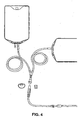
- the polybutadiene polymer blends are capable of being fabricated into monolayer tubings ( FIG. 1 ), multiple layered tubings ( FIG. 2 ), a dual lumen tubing ( FIG. 3 ), peritoneal dialysis administration set ( FIG. 4 ), an LV. administration set ( FIG. 5 ) and a drip chamber ( FIG. 6 ).
- the tubings of the present invention shall have the following physical properties; a modulus of elasticity of less than about 187.9 MPa (20,000 psi), more preferably less than about 68.9MPa (10,000 psi) and most preferably less than about 34.5MPa(5,000 psi), an internal haze of less than about 25% when measured in accordance with ASTM D1003, is capable of being fabricated at a throughput rate of greater than about 50.8 cm/s (100 ft/min), more preferably greater than about 102 cm/s (200 ft/min), even more preferably greater than about (127 cm/s (250 ft/min) and most preferably equal to or greater than about 152 cm/s (300 ft/min); a yield strength of from about 2.8MPa (400 psi) to about 10.3MPa (1500 psi) and more preferably from about 4.1MPa (600 psi) to about 5.5MPa (800 psi), and the tens
- the monolayer tubing 10 shown in FIG. 1 has a sidewall 11 made from one of the multiple component polymer blends described above.
- the tubing from the blend is exposed to radiation in accordance with the processes described above.
- the multiple layered tubing 2.0 shown in FIG. 2 will preferably have two layers, concentrically mounted with respect to one another, but could have additional layers without departing from the scope of the present invention.
- the multiple layered tubing 20 will have a first layer 22 and a second layer 24. At least one of the first layer 22 or the second layer 24 will have at least 50% of the 1,2 polybutadienes set forth above. In one embodiment of the present invention, either the first layer 22 or the second layer 24 will contain at least 50% of the 1,2 polybutadienes set forth above and the other layer will be a polyolefin.
- each of the first layer 22 and the second layer 24 will have at least 50% of the 1,2 polybutadienes set forth above.
- One of the first layer 22 or the second layer 24 will be a two-component blend of low-crystallinity syndiotactic 1,2 polybutadienes.
- the other layer can be a polyolefin, a single low-crystallinity syndiotactic 1,2 polybutadiene, or a blend containing at least 50% of a low-crystallinity syndiotactic 1,2 polybutadiene.
- the first layer 22 and the second layer 24 can be selected from the polybutadiene containing blends set forth above.
- the first layer 22 (outer) will be a low-crystallinity syndiotactic 1,2 polybutadiene having a melting point temperature higher than about 90°C, or is a two-component blend containing a first low-crystallinity syndiotactic 1,2 polybutadiene having a melting point higher than about 90°C (more preferably from about 91°C to about 120°C) and a second low-crystallinity syndiotactic 1,2 polybutadiene having a melting point lower than about 90°C.
- the second layer 24 (inner) will be of a blend of a low-crystallinity syndiotactic 1,2 polybutadiene having a melting point higher than about 90°C and a low-crystallinity syndiotactic 1,2 polybutadiene having a melting point lower than about 90°C.
- the relative amounts of the components within these blends are set forth above in Section II.
- the tubing is capable of delivering fluid in response to energy applied to the tubing by a medical infusion pump for a 24 hour period without more than 10% change in flow rate and more preferably without more than 5% change.
- the present invention further contemplates fabricating the drip chamber 40 shown in FIG. 6 from the blends described above in Sections I and II.
- the drip chamber can have a monolayer structure or a multiple layered structure.
- the drip chamber is a monolayer structure of one of the blends of the present invention.
- the drip chamber 40 is preferably made in an injection molding process but can be made from other polymer processing techniques well known in the art without departing from the scope of the present invention.
- solvent bonding is that one of the products made from a blend describe above can be exposed to a solvent to melt, dissolve or swell the product and then can be attached to another polymeric component to form a permanent bond.
- Suitable solvents typically include those having a solubility parameter of less than about 20 (MPa) 1 ⁇ 2 , more preferably less than about 19 (MPa) 1/2 and most preferably less than about 18 (MPa) 1/2 and include, but are not limited to, aliphatic hydrocarbons, aromatic hydrocarbons, mixtures of aliphatic hydrocarbons, mixtures of aromatic hydrocarbons and mixtures of aromatic and aliphatic hydrocarbons.
- Suitable aliphatic hydrocarbons include substituted and unsubstituted hexane, heptane, cyclohexane, cycloheptane, decalin, and the like.
- Suitable aromatic hydrocarbons include substituted and unsubstituted aromatic hydrocarbon solvents such as xylene, tetralin, toluene, and cumene.
- Suitable hydrocarbon substituents include aliphatic substituents having from 1-12 carbons and include propyl, ethyl, butyl, hexyl, tertiary butyl, isobutyl and combinations, of the same. What is meant by the terms "aliphatic hydrocarbon” and "aromatic hydrocarbon” is a compound containing only carbon and hydrogen atoms.
- Suitable solvents will also have a molecular weight less than about 200 g/mole, more preferably less than about 180 g/mole and most preferably less than about 140 g/mole.
- a rigid component is a connector or other device commonly used in peritoneal dialysis or IV. administration sets and typically having a modulus of elasticity of greater than about 206.8MPa (30,000 psi).
- Suitable polymers for fabricating a rigid component includes homopolymers and copolymers of polypropylenes, polyesters, polyamides, polystyrenes, polyurethanes, polycarbonates, cylic olefin containing polymers and bridged polycyclic olefin containing polymers. Suitable cyclic olefin containing polymers and bridged polycylic olefin containing polymers are disclosed in U.S. Patent Nos. US-6,632,318 and US-6,297,322 .
- the present invention provides a method for assembling components of an infusion set into medical assemblies using solvent bonding techniques.
- Solvent bonding techniques can be used to join together separate articles made from the polybutadiene blends set forth above in Sections I and II. An example would be joining a polybutadiene blend tubing to a polybutadiene drip chamber.
- the present invention further provides solvent bonding articles made from the blends set forth above in Sections I and II with COC containing polymers and polymer blends.
- the COC containing polymers can be pure COC or blends of COC resins with other COC resins.
- Suitable COC containing polymer blends include any blends of COC with polybutadienes notwithstanding the relative amounts by weight of COC and polybutadiene in the blend.
- Other suitable COC blends, such as COC/ULDPE blends will preferably have at least about 30% by weight of COC and more preferably more than about 50% COC by weight of the blend.
- the method of solvent bonding includes the steps of: (1) providing a first article of a polymer blend described above in Sections I and II; (2) providing a second article of a material selected from the group comprising: (a) polybutadiene and polybutadiene containing blends described above in Sections I and II (b) COC/polybutadiene blends, and (c) COC/other polymer blends where the COC is present in an amount by weight of at least about 30% by weight of the blend; (3) applying a solvent to one of the first article or the second article to define an interface area; and (4) bonding the first article to the second article along the interface area.
- Suitable solvents are those having a solubility parameter of less than about 20 (MPa) 1 ⁇ 2 , more preferably less than about 19 (MPa) 1/2 and most preferably less than about 18 (MPa) 1/2 and include, but are not limited to, aliphatic hydrocarbons, aromatic hydrocarbons, mixtures of aliphatic hydrocarbons, mixtures of aromatic hydrocarbons and mixtures of aromatic and aliphatic hydrocarbons.
- Suitable aliphatic hydrocarbons include substituted and unsubstituted hexane, heptane, cyclohexane, cycloheptane, decalin, and the like.
- Suitable aromatic hydrocarbons include substituted and unsubstituted aromatic hydrocarbon solvents such as xylene, tetralin, toluene, and cumene.
- Suitable hydrocarbon substituents include aliphatic substituents having from 1-12 carbons and include propyl, ethyl, butyl, hexyl, tertiary butyl, isobutyl and combinations of the same. What is meant by the terms "aliphatic hydrocarbon” and "aromatic hydrocarbon” is a compound containing only carbon and hydrogen atoms.
- Suitable solvents will also have a molecular weight less than about 200 g/mole, more preferably less than about 180 g/mole and most preferably less than about 140 g/mole.
- Tubing made of JSR RB820 polybutadiene was extruded and tested for tensile modulus at 20 in/min speed over a period of 50 days.
- the tensile modulus was listed in Table-2.
- Table-2 Tensile modulus of RBS20 tubing measure at various days after the tubing extrusion. Time (days) Modulus (psi) MPa 3 (2900) 20 1.5 (3200) 22.1 21 (4100) 28.3 23 (4400) 30.3 31 (4900) 33.8 43 (4950) 34.1 55 (5000) 34.5
- tubing modulus will reduce to a consistent lower level than the initially higher and different moduli, and stayed stable after the heat treatment.
- Table-3 lists the tubing modulus as a function of time of aging after extrusion but before heat treatment, time of heat treatment at 80C, and time of aging after heat treatment.
- T1 (days) T2(minutes) T3(days) Modulus (psi) MPa 2 60 2 (1850) 12.8 10 60 4 (2130) 14.7 10 60 46 (2270) 15.7 23 10 1 (2090) 14.4 23 30 1 (2100) 14.5 23 30 9 (2160) 14.9 23 30 35 (2210) 15.2
- T1 Aging time at ambient after extrusion but before heat treatment
- T2 Time of heat treatment at 80 degree
- T3 Aging time after heat treatment
- Tubing made from a 50/50 blend of RB810 and RB820 was extruded and aged at ambient condition for about 6 months and then heat treated at 60C, 70C and 80C for 10 minutes to 120 minutes, and then aged at ambient condition for up to 22 days. It was found that the modulus of the tubing was also reduced to a consistently lower value than the initially higher modulus, and stayed stable after the heat treatment. Table-4 lists the tubing modulus as a function ofheat treatment temperature, heat treatment time, and aging time after the heat treatment.
- Tubing made from a 50/50 blend of RB810 and RB820 was extruded and aged at ambient condition for about 6 months, Gamma sterilized at about 25 kGy, and heat treated at 60C, 70C and 80C for 10 minutes to 120 minutes, and then aged at ambient condition for up to 22 days. It was found that the tensile modulus of the tubing was also reduced to a value consistently lower than the initially higher modulus, and stayed stable after the heat treatment. Table-5 lists the tubing modulus as a function of heat treatment temperature, heat treatment time, and aging time after the heat treatment.
- Tubing made from a 50/50 blend of RB810 and RB820 le polybutadienes from Example-5 was tensile tested and compared with flexible medical PVC tubing.
- the figure above shows the curves of the flexible PVC tubing, the polybutadiene tubing with and without heat treatment at 70 C for 10 minutes, and polybutadiene tubing with both radiation sterilization and heat treatment.
- the figure shows that heat treatment can remove the distinct yield phenomena as shown as the kink point from the stress-strain tensile curve, and makes the material more like flexible PVC tubing.
- the heat treatment also further shifts the stress-strain curve of radiation sterilized polybuladiene closer to the shape of flexible PVC tubing.
- Example-7 Solvent bonding of polybutadiene to cyclic-olefin copolymer
- Tubing made from RB810 and RB820 was solvent bonded to a Y-site which was injection molded from a cyclic olefin copolymer, Grade name Topas 8007, made by Ticona
- the polybutadiene tubing had an outside diameter of about 3.6mm (0.14 inches) and a wall thickness of about 0.5mm (0.019 inches).
- the outside diameter of the tubing was to be solvent bonded to the inside diameter of the y-site component.
- the solvent used for the bonding was Decalin, available from Aldrich Chemicals Co. Table-6 summarizes the solvent bond strength results of polybutadiene tubing to the y-site made of cyclic-olefin copolymer.
- the bond strength is strong Roughening the tubing surface futher enhances the bond strength.
- Example-8 Solvent bonding of polybutadiene to cyclic-olefin copolymer
- Tubing made from RB810 and RB820 was solvent bonded to a Y-site which was injection molded from a cyclic olefin copolymer, Grade name Topas 8007, made by Ticona
- the polybutadiene tubing had an outside diameter of about 3.6mm (0.14 inches) and a wall thickness of about 0.5mm (0.019 inches).
- the outside diameter of the tubing was to be solvent bonded to the inside diameter of the y-site component.
- the solvent used for the bonding was Cyclohexane, Decalin, or Tetralin, all available from Aldrich Chemicals Co. Table-7 summarizes the solvent bond results of polybutadiene tubing to the cyclic-olefin copolymer y-site.
- Table-7 Formulation Solvent Solvent bond strength RB810/RB820 (lb force), N 20/80 cyclohexane (5.5) 24.5 20/80 decalin (7.7) 34.3 20/80 tetralin (7.2) 32.0 30/70 cyclohexane (7.4) 32.9 30/70 decalin (10.1) 44.9 30/70 tetralin (10.7) 47.6 60/40 cyclohexane (6.8) 30.2 60/40 decalin (11) 48.9 60/40 tetralin (8.2) 36.5
Landscapes
- Health & Medical Sciences (AREA)
- Chemical & Material Sciences (AREA)
- Chemical Kinetics & Catalysis (AREA)
- Medicinal Chemistry (AREA)
- Polymers & Plastics (AREA)
- Organic Chemistry (AREA)
- Animal Behavior & Ethology (AREA)
- Life Sciences & Earth Sciences (AREA)
- Epidemiology (AREA)
- General Health & Medical Sciences (AREA)
- Public Health (AREA)
- Veterinary Medicine (AREA)
- Engineering & Computer Science (AREA)
- Mechanical Engineering (AREA)
- Physics & Mathematics (AREA)
- Thermal Sciences (AREA)
- Materials For Medical Uses (AREA)
- Compositions Of Macromolecular Compounds (AREA)
- Laminated Bodies (AREA)
Applications Claiming Priority (3)
| Application Number | Priority Date | Filing Date | Title |
|---|---|---|---|
| US09/939,294 US7011872B2 (en) | 2001-08-24 | 2001-08-24 | Method and process for enhancing properties and medical tubing performance in a polybutadiene material |
| US939294 | 2001-08-24 | ||
| PCT/US2002/025258 WO2003018685A2 (en) | 2001-08-24 | 2002-08-08 | Medical tubing made from polybutadiene |
Publications (2)
| Publication Number | Publication Date |
|---|---|
| EP1423473A2 EP1423473A2 (en) | 2004-06-02 |
| EP1423473B1 true EP1423473B1 (en) | 2008-12-03 |
Family
ID=25472897
Family Applications (1)
| Application Number | Title | Priority Date | Filing Date |
|---|---|---|---|
| EP02752759A Expired - Lifetime EP1423473B1 (en) | 2001-08-24 | 2002-08-08 | Medical tubing made from polybutadiene |
Country Status (19)
| Country | Link |
|---|---|
| US (1) | US7011872B2 (enExample) |
| EP (1) | EP1423473B1 (enExample) |
| JP (2) | JP2005527642A (enExample) |
| KR (1) | KR100855797B1 (enExample) |
| CN (1) | CN1545535B (enExample) |
| AR (1) | AR036278A1 (enExample) |
| AT (1) | ATE416231T1 (enExample) |
| BR (1) | BR0212133A (enExample) |
| CA (1) | CA2458188C (enExample) |
| CO (1) | CO5560618A2 (enExample) |
| DE (1) | DE60230161D1 (enExample) |
| ES (1) | ES2318030T3 (enExample) |
| MX (1) | MXPA04001628A (enExample) |
| NO (1) | NO20041223L (enExample) |
| NZ (1) | NZ531524A (enExample) |
| PT (1) | PT1423473E (enExample) |
| TR (1) | TR200400289T2 (enExample) |
| TW (1) | TWI230179B (enExample) |
| WO (1) | WO2003018685A2 (enExample) |
Families Citing this family (22)
| Publication number | Priority date | Publication date | Assignee | Title |
|---|---|---|---|---|
| US7011872B2 (en) * | 2001-08-24 | 2006-03-14 | Baxter International Inc. | Method and process for enhancing properties and medical tubing performance in a polybutadiene material |
| EP1607434A4 (en) * | 2003-03-27 | 2007-08-15 | Jsr Corp | RESIN MOLDING AND WORKING ARTICLE OBTAINED THEREFROM |
| JP4561964B2 (ja) * | 2003-04-11 | 2010-10-13 | Jsr株式会社 | 医療用部材および医療用器具 |
| DE602004004937T2 (de) * | 2003-04-11 | 2007-11-15 | Jsr Corp. | Medizinischer Artikel auf Basis von syndiotaktischem 1,2-Polybutadien |
| JP2005152039A (ja) * | 2003-11-20 | 2005-06-16 | Jms Co Ltd | 医療用成形部材 |
| WO2005063859A1 (ja) * | 2003-12-26 | 2005-07-14 | Jsr Corporation | ポリブタジエン成形品の接着方法、これより得られるポリブタジエン複合成形品、医療用部材、および輸液セット |
| JP2005206824A (ja) * | 2003-12-26 | 2005-08-04 | Jsr Corp | ポリブタジエン成形品の接着方法、これより得られるポリブタジエン複合成形品、医療用部材、および輸液セット |
| CN101415552A (zh) | 2006-04-06 | 2009-04-22 | 弗雷泽纽斯医疗保健德国有限公司 | 医用导管 |
| US7955295B2 (en) | 2007-07-05 | 2011-06-07 | Baxter International Inc. | Fluid delivery system with autoconnect features |
| US9981113B2 (en) * | 2012-03-14 | 2018-05-29 | Access Scientific, Llc | Flexible medical article and method of making the same |
| EP3733374B1 (en) | 2012-03-14 | 2023-01-04 | Smiths Medical ASD, Inc. | Method for forming a flexible medical article |
| US9284147B2 (en) | 2012-09-21 | 2016-03-15 | Paper Converting Machine Company | Method and apparatus for producing coreless rolls of paper |
| KR101897132B1 (ko) * | 2013-05-07 | 2018-09-12 | 제이더블유케미타운 주식회사 | 넌피브이시계 의료용 수액세트의 제조 방법 |
| US10517892B2 (en) | 2013-10-22 | 2019-12-31 | Medtronic Minimed, Inc. | Methods and systems for inhibiting foreign-body responses in diabetic patients |
| KR101532933B1 (ko) * | 2015-01-26 | 2015-07-01 | 주식회사 폴리사이언텍 | 안티-블로킹성 폴리올레핀 의료용 튜브 및 이로부터 제조되는 의료용품 |
| US9540475B2 (en) | 2015-03-12 | 2017-01-10 | Chevron Phillips Chemical Company Lp | Styrene-butadiene block copolymers for tubing applications |
| US9598524B1 (en) | 2015-09-18 | 2017-03-21 | Chevron Phillips Chemical Company Lp | Styrene-butadiene block copolymers with a terminal butadiene block for tubing applications |
| US9441090B1 (en) | 2015-03-12 | 2016-09-13 | Chevron Phillips Chemical Company Lp | Methods for controlling hardness of styrene-butadiene block copolymers |
| US9738781B2 (en) | 2015-09-03 | 2017-08-22 | Ineos Styrolution Group Gmbh | Blends of styrene-butadiene block copolymer with styrenic thermoplastic elastomers for tubing applications |
| US10023676B2 (en) | 2016-02-24 | 2018-07-17 | Ineos Styrolution Group Gmbh | Styrene-butadiene block copolymers with an internal butadiene block for tubing applications |
| US9828455B2 (en) | 2016-02-24 | 2017-11-28 | Ineos Styrolution Group Gmbh | Styrene-butadiene block copolymers with an internal butadiene block for tubing applications |
| US11197949B2 (en) | 2017-01-19 | 2021-12-14 | Medtronic Minimed, Inc. | Medication infusion components and systems |
Family Cites Families (20)
| Publication number | Priority date | Publication date | Assignee | Title |
|---|---|---|---|---|
| US2961389A (en) * | 1957-12-10 | 1960-11-22 | Du Pont | Process for modifying polymers and products obtained thereby |
| JPS5375278A (en) * | 1976-12-17 | 1978-07-04 | Asahi Dow Ltd | Production of heat shrinkable film |
| CA1269487A (en) * | 1984-07-11 | 1990-05-22 | Nobuyuki Ito | Polymer particles and process for producing the same |
| JPH02305834A (ja) * | 1989-03-15 | 1990-12-19 | Terumo Corp | 耐放射線性ポリブタジエン組成物 |
| DE3914388A1 (de) | 1989-04-29 | 1990-11-08 | Hoechst Ag | Verwendung von polymeren, die von 4-hydroxy- oder 4-acetoxystyrol abgeleitete einheiten enthalten als verstaerkerharze und haftungspromotoren in kautschukmischungen |
| DE3930753A1 (de) | 1989-09-14 | 1991-03-28 | Rehau Ag & Co | Verfahren zur stabilisierung von halbzeugen oder fertigteilen aus polymeren werkstoffen |
| US5310497A (en) | 1992-10-01 | 1994-05-10 | W. R. Grace & Co.-Conn. | Oxygen scavenging compositions for low temperature use |
| JP3538879B2 (ja) * | 1993-02-09 | 2004-06-14 | 宇部興産株式会社 | 新規なポリブタジエン組成物の製造方法 |
| DE69418364T2 (de) | 1993-02-09 | 1999-10-07 | Ube Industries, Ltd. | Verfahren zur Herstellung von Polybutadienzusammensetzungen |
| US6461696B1 (en) | 1993-11-16 | 2002-10-08 | Baxter International Inc. | Multi-layered polymer based moisture barrier structure for medical grade products |
| JP3377011B2 (ja) * | 1994-06-30 | 2003-02-17 | 日本ゼオン株式会社 | 医用材料組成物及び医用成形物 |
| US5741452A (en) | 1996-05-03 | 1998-04-21 | Baxter International Inc. | Orienting extrusion processes for medical tubing applications |
| US6187400B1 (en) * | 1996-05-03 | 2001-02-13 | Baxter International Inc. | Medical tubing and pump performance enhancement by ionizing radiation during sterilization |
| US5986026A (en) * | 1997-05-05 | 1999-11-16 | The Goodyear Tire & Rubber Company | Syndiotactic 1,2-polybutadiene synthesis |
| JPH11228957A (ja) * | 1998-02-16 | 1999-08-24 | Sumitomo Chem Co Ltd | 安定剤組成物、その製造法及びその用途 |
| JP2000129017A (ja) * | 1998-10-22 | 2000-05-09 | Terumo Corp | 医療用部材およびその製造方法 |
| US6590033B2 (en) * | 1999-09-09 | 2003-07-08 | Baxter International Inc. | Cycloolefin blends and method for solvent bonding polyolefins |
| JP2001161813A (ja) | 1999-12-09 | 2001-06-19 | Nissho Corp | 医療用チューブ |
| JP3770191B2 (ja) * | 2001-04-09 | 2006-04-26 | Jsr株式会社 | 熱可塑性重合体組成物およびその成形品 |
| US7011872B2 (en) * | 2001-08-24 | 2006-03-14 | Baxter International Inc. | Method and process for enhancing properties and medical tubing performance in a polybutadiene material |
-
2001
- 2001-08-24 US US09/939,294 patent/US7011872B2/en not_active Expired - Fee Related
-
2002
- 2002-07-30 TW TW091116975A patent/TWI230179B/zh not_active IP Right Cessation
- 2002-08-08 MX MXPA04001628A patent/MXPA04001628A/es active IP Right Grant
- 2002-08-08 JP JP2003523540A patent/JP2005527642A/ja not_active Withdrawn
- 2002-08-08 NZ NZ531524A patent/NZ531524A/xx unknown
- 2002-08-08 AT AT02752759T patent/ATE416231T1/de active
- 2002-08-08 EP EP02752759A patent/EP1423473B1/en not_active Expired - Lifetime
- 2002-08-08 CN CN028163400A patent/CN1545535B/zh not_active Expired - Fee Related
- 2002-08-08 PT PT02752759T patent/PT1423473E/pt unknown
- 2002-08-08 BR BRPI0212133-6A patent/BR0212133A/pt not_active Application Discontinuation
- 2002-08-08 KR KR1020047002644A patent/KR100855797B1/ko not_active Expired - Fee Related
- 2002-08-08 ES ES02752759T patent/ES2318030T3/es not_active Expired - Lifetime
- 2002-08-08 CA CA2458188A patent/CA2458188C/en not_active Expired - Fee Related
- 2002-08-08 DE DE60230161T patent/DE60230161D1/de not_active Expired - Lifetime
- 2002-08-08 WO PCT/US2002/025258 patent/WO2003018685A2/en not_active Ceased
- 2002-08-22 AR ARP020103154A patent/AR036278A1/es active IP Right Grant
- 2002-10-08 TR TR2004/00289T patent/TR200400289T2/xx unknown
-
2004
- 2004-02-26 CO CO04017390A patent/CO5560618A2/es not_active Application Discontinuation
- 2004-03-23 NO NO20041223A patent/NO20041223L/no not_active Application Discontinuation
-
2009
- 2009-01-21 JP JP2009011453A patent/JP2009144167A/ja active Pending
Also Published As
| Publication number | Publication date |
|---|---|
| DE60230161D1 (de) | 2009-01-15 |
| BR0212133A (pt) | 2006-05-23 |
| JP2009144167A (ja) | 2009-07-02 |
| KR20040029437A (ko) | 2004-04-06 |
| CA2458188A1 (en) | 2003-03-06 |
| AR036278A1 (es) | 2004-08-25 |
| NZ531524A (en) | 2006-03-31 |
| US7011872B2 (en) | 2006-03-14 |
| CN1545535A (zh) | 2004-11-10 |
| CO5560618A2 (es) | 2005-09-30 |
| JP2005527642A (ja) | 2005-09-15 |
| PT1423473E (pt) | 2009-02-02 |
| CN1545535B (zh) | 2010-04-28 |
| WO2003018685A3 (en) | 2003-09-18 |
| EP1423473A2 (en) | 2004-06-02 |
| MXPA04001628A (es) | 2004-09-28 |
| ATE416231T1 (de) | 2008-12-15 |
| TR200400289T2 (tr) | 2007-01-22 |
| CA2458188C (en) | 2010-10-12 |
| WO2003018685A2 (en) | 2003-03-06 |
| TWI230179B (en) | 2005-04-01 |
| KR100855797B1 (ko) | 2008-09-01 |
| NO20041223L (no) | 2004-03-23 |
| US20030044555A1 (en) | 2003-03-06 |
| ES2318030T3 (es) | 2009-05-01 |
Similar Documents
| Publication | Publication Date | Title |
|---|---|---|
| US7011872B2 (en) | Method and process for enhancing properties and medical tubing performance in a polybutadiene material | |
| US6255396B1 (en) | Cycloolefin blends and method for solvent bonding polyolefins | |
| US6297322B1 (en) | Cycloolefin blends and method for solvent bonding polyolefins | |
| US6372848B1 (en) | Blend of ethylene and α-olefin copolymers obtained using a metallocene catalyst for fabricating medical films and tubings | |
| KR100684227B1 (ko) | 시클로올레핀 배합물 및 폴리올레핀의 용매 결합 방법 | |
| EP0556034B1 (en) | A medical instrument | |
| US6590033B2 (en) | Cycloolefin blends and method for solvent bonding polyolefins | |
| CN1675299A (zh) | 用矿物油对间规聚丙烯的改性 | |
| TWI577370B (zh) | 注射液用袋及注射用製劑 | |
| CN1094955C (zh) | 弹性聚烯烃组合物和由其制得的成形制件 | |
| AU2002356125B2 (en) | Medical tubing made from polybutadiene | |
| EP0980892A1 (en) | Molded product for medical use from a resin composition comprising a polyolefin resin and a specific block terpolymer | |
| AU2002356125A1 (en) | Medical tubing made from polybutadiene | |
| US6613187B1 (en) | Solvent bonding method for polyolefin materials | |
| JP3689900B2 (ja) | 医療用成形品 | |
| JP2000033111A (ja) | 医療用成形品 | |
| AU2002307552A1 (en) | Cycloolefin polymer lends with diene polymer | |
| HK1228728A1 (en) | Injection fluid bag and injection preparation | |
| JPH05293168A (ja) | ポリオレフィン系医療容器用基材 | |
| CA2620651A1 (en) | Cycloolefin blends and method for solvent bonding polyolefins | |
| JPH05253287A (ja) | 医療容器用基材 |
Legal Events
| Date | Code | Title | Description |
|---|---|---|---|
| PUAI | Public reference made under article 153(3) epc to a published international application that has entered the european phase |
Free format text: ORIGINAL CODE: 0009012 |
|
| 17P | Request for examination filed |
Effective date: 20040305 |
|
| AK | Designated contracting states |
Kind code of ref document: A2 Designated state(s): AT BE BG CH CY CZ DE DK EE ES FI FR GB GR IE IT LI LU MC NL PT SE SK TR |
|
| AX | Request for extension of the european patent |
Extension state: AL LT LV MK RO SI |
|
| 17Q | First examination report despatched |
Effective date: 20061213 |
|
| 17Q | First examination report despatched |
Effective date: 20061213 |
|
| GRAP | Despatch of communication of intention to grant a patent |
Free format text: ORIGINAL CODE: EPIDOSNIGR1 |
|
| GRAS | Grant fee paid |
Free format text: ORIGINAL CODE: EPIDOSNIGR3 |
|
| GRAA | (expected) grant |
Free format text: ORIGINAL CODE: 0009210 |
|
| AK | Designated contracting states |
Kind code of ref document: B1 Designated state(s): AT BE BG CH CY CZ DE DK EE ES FI FR GB GR IE IT LI LU MC NL PT SE SK TR |
|
| REG | Reference to a national code |
Ref country code: GB Ref legal event code: FG4D |
|
| REG | Reference to a national code |
Ref country code: CH Ref legal event code: EP Ref country code: CH Ref legal event code: NV Representative=s name: KIRKER & CIE S.A. |
|
| REG | Reference to a national code |
Ref country code: IE Ref legal event code: FG4D |
|
| REF | Corresponds to: |
Ref document number: 60230161 Country of ref document: DE Date of ref document: 20090115 Kind code of ref document: P |
|
| REG | Reference to a national code |
Ref country code: PT Ref legal event code: SC4A Free format text: AVAILABILITY OF NATIONAL TRANSLATION Effective date: 20090121 |
|
| REG | Reference to a national code |
Ref country code: ES Ref legal event code: FG2A Ref document number: 2318030 Country of ref document: ES Kind code of ref document: T3 |
|
| PG25 | Lapsed in a contracting state [announced via postgrant information from national office to epo] |
Ref country code: FI Free format text: LAPSE BECAUSE OF FAILURE TO SUBMIT A TRANSLATION OF THE DESCRIPTION OR TO PAY THE FEE WITHIN THE PRESCRIBED TIME-LIMIT Effective date: 20081203 |
|
| PG25 | Lapsed in a contracting state [announced via postgrant information from national office to epo] |
Ref country code: BG Free format text: LAPSE BECAUSE OF FAILURE TO SUBMIT A TRANSLATION OF THE DESCRIPTION OR TO PAY THE FEE WITHIN THE PRESCRIBED TIME-LIMIT Effective date: 20090303 Ref country code: EE Free format text: LAPSE BECAUSE OF FAILURE TO SUBMIT A TRANSLATION OF THE DESCRIPTION OR TO PAY THE FEE WITHIN THE PRESCRIBED TIME-LIMIT Effective date: 20081203 |
|
| PG25 | Lapsed in a contracting state [announced via postgrant information from national office to epo] |
Ref country code: CZ Free format text: LAPSE BECAUSE OF FAILURE TO SUBMIT A TRANSLATION OF THE DESCRIPTION OR TO PAY THE FEE WITHIN THE PRESCRIBED TIME-LIMIT Effective date: 20081203 Ref country code: SE Free format text: LAPSE BECAUSE OF FAILURE TO SUBMIT A TRANSLATION OF THE DESCRIPTION OR TO PAY THE FEE WITHIN THE PRESCRIBED TIME-LIMIT Effective date: 20090303 |
|
| PG25 | Lapsed in a contracting state [announced via postgrant information from national office to epo] |
Ref country code: SK Free format text: LAPSE BECAUSE OF FAILURE TO SUBMIT A TRANSLATION OF THE DESCRIPTION OR TO PAY THE FEE WITHIN THE PRESCRIBED TIME-LIMIT Effective date: 20081203 |
|
| PLBE | No opposition filed within time limit |
Free format text: ORIGINAL CODE: 0009261 |
|
| STAA | Information on the status of an ep patent application or granted ep patent |
Free format text: STATUS: NO OPPOSITION FILED WITHIN TIME LIMIT |
|
| PG25 | Lapsed in a contracting state [announced via postgrant information from national office to epo] |
Ref country code: DK Free format text: LAPSE BECAUSE OF FAILURE TO SUBMIT A TRANSLATION OF THE DESCRIPTION OR TO PAY THE FEE WITHIN THE PRESCRIBED TIME-LIMIT Effective date: 20081203 |
|
| 26N | No opposition filed |
Effective date: 20090904 |
|
| PGFP | Annual fee paid to national office [announced via postgrant information from national office to epo] |
Ref country code: LU Payment date: 20090831 Year of fee payment: 8 |
|
| PG25 | Lapsed in a contracting state [announced via postgrant information from national office to epo] |
Ref country code: MC Free format text: LAPSE BECAUSE OF NON-PAYMENT OF DUE FEES Effective date: 20090831 |
|
| REG | Reference to a national code |
Ref country code: PT Ref legal event code: MM4A Free format text: LAPSE DUE TO NON-PAYMENT OF FEES Effective date: 20100510 |
|
| PG25 | Lapsed in a contracting state [announced via postgrant information from national office to epo] |
Ref country code: PT Free format text: LAPSE BECAUSE OF NON-PAYMENT OF DUE FEES Effective date: 20100510 |
|
| PG25 | Lapsed in a contracting state [announced via postgrant information from national office to epo] |
Ref country code: GR Free format text: LAPSE BECAUSE OF FAILURE TO SUBMIT A TRANSLATION OF THE DESCRIPTION OR TO PAY THE FEE WITHIN THE PRESCRIBED TIME-LIMIT Effective date: 20090304 |
|
| PG25 | Lapsed in a contracting state [announced via postgrant information from national office to epo] |
Ref country code: TR Free format text: LAPSE BECAUSE OF FAILURE TO SUBMIT A TRANSLATION OF THE DESCRIPTION OR TO PAY THE FEE WITHIN THE PRESCRIBED TIME-LIMIT Effective date: 20081203 |
|
| PG25 | Lapsed in a contracting state [announced via postgrant information from national office to epo] |
Ref country code: CY Free format text: LAPSE BECAUSE OF FAILURE TO SUBMIT A TRANSLATION OF THE DESCRIPTION OR TO PAY THE FEE WITHIN THE PRESCRIBED TIME-LIMIT Effective date: 20081203 |
|
| PGFP | Annual fee paid to national office [announced via postgrant information from national office to epo] |
Ref country code: CH Payment date: 20110825 Year of fee payment: 10 |
|
| PG25 | Lapsed in a contracting state [announced via postgrant information from national office to epo] |
Ref country code: LU Free format text: LAPSE BECAUSE OF NON-PAYMENT OF DUE FEES Effective date: 20100808 |
|
| PGFP | Annual fee paid to national office [announced via postgrant information from national office to epo] |
Ref country code: GB Payment date: 20120828 Year of fee payment: 11 Ref country code: IE Payment date: 20120827 Year of fee payment: 11 |
|
| PGFP | Annual fee paid to national office [announced via postgrant information from national office to epo] |
Ref country code: IT Payment date: 20120823 Year of fee payment: 11 Ref country code: FR Payment date: 20120830 Year of fee payment: 11 Ref country code: DE Payment date: 20120829 Year of fee payment: 11 Ref country code: ES Payment date: 20120827 Year of fee payment: 11 Ref country code: BE Payment date: 20120827 Year of fee payment: 11 |
|
| PGFP | Annual fee paid to national office [announced via postgrant information from national office to epo] |
Ref country code: NL Payment date: 20120825 Year of fee payment: 11 |
|
| PGFP | Annual fee paid to national office [announced via postgrant information from national office to epo] |
Ref country code: AT Payment date: 20120719 Year of fee payment: 11 |
|
| BERE | Be: lapsed |
Owner name: BAXTER INTERNATIONAL INC. Effective date: 20130831 |
|
| REG | Reference to a national code |
Ref country code: NL Ref legal event code: V1 Effective date: 20140301 |
|
| REG | Reference to a national code |
Ref country code: CH Ref legal event code: PL |
|
| REG | Reference to a national code |
Ref country code: AT Ref legal event code: MM01 Ref document number: 416231 Country of ref document: AT Kind code of ref document: T Effective date: 20130808 |
|
| GBPC | Gb: european patent ceased through non-payment of renewal fee |
Effective date: 20130808 |
|
| PG25 | Lapsed in a contracting state [announced via postgrant information from national office to epo] |
Ref country code: LI Free format text: LAPSE BECAUSE OF NON-PAYMENT OF DUE FEES Effective date: 20130831 Ref country code: CH Free format text: LAPSE BECAUSE OF NON-PAYMENT OF DUE FEES Effective date: 20130831 Ref country code: DE Free format text: LAPSE BECAUSE OF NON-PAYMENT OF DUE FEES Effective date: 20140301 Ref country code: NL Free format text: LAPSE BECAUSE OF NON-PAYMENT OF DUE FEES Effective date: 20140301 |
|
| REG | Reference to a national code |
Ref country code: IE Ref legal event code: MM4A |
|
| REG | Reference to a national code |
Ref country code: FR Ref legal event code: ST Effective date: 20140430 |
|
| PG25 | Lapsed in a contracting state [announced via postgrant information from national office to epo] |
Ref country code: IT Free format text: LAPSE BECAUSE OF NON-PAYMENT OF DUE FEES Effective date: 20130808 Ref country code: BE Free format text: LAPSE BECAUSE OF NON-PAYMENT OF DUE FEES Effective date: 20130831 Ref country code: AT Free format text: LAPSE BECAUSE OF NON-PAYMENT OF DUE FEES Effective date: 20130808 |
|
| REG | Reference to a national code |
Ref country code: DE Ref legal event code: R119 Ref document number: 60230161 Country of ref document: DE Effective date: 20140301 |
|
| PG25 | Lapsed in a contracting state [announced via postgrant information from national office to epo] |
Ref country code: GB Free format text: LAPSE BECAUSE OF NON-PAYMENT OF DUE FEES Effective date: 20130808 Ref country code: IE Free format text: LAPSE BECAUSE OF NON-PAYMENT OF DUE FEES Effective date: 20130808 |
|
| PG25 | Lapsed in a contracting state [announced via postgrant information from national office to epo] |
Ref country code: FR Free format text: LAPSE BECAUSE OF NON-PAYMENT OF DUE FEES Effective date: 20130902 |
|
| REG | Reference to a national code |
Ref country code: ES Ref legal event code: FD2A Effective date: 20150429 |
|
| PG25 | Lapsed in a contracting state [announced via postgrant information from national office to epo] |
Ref country code: ES Free format text: LAPSE BECAUSE OF NON-PAYMENT OF DUE FEES Effective date: 20130809 |