EP1411095A2 - Verwendung von Photoinitiatoren vom Typ Hydroxyalkylphenon in strahlenhärtbaren Organopolysiloxanen für die Herstellung von abhäsiven Beschichtungen - Google Patents
Verwendung von Photoinitiatoren vom Typ Hydroxyalkylphenon in strahlenhärtbaren Organopolysiloxanen für die Herstellung von abhäsiven Beschichtungen Download PDFInfo
- Publication number
- EP1411095A2 EP1411095A2 EP03022074A EP03022074A EP1411095A2 EP 1411095 A2 EP1411095 A2 EP 1411095A2 EP 03022074 A EP03022074 A EP 03022074A EP 03022074 A EP03022074 A EP 03022074A EP 1411095 A2 EP1411095 A2 EP 1411095A2
- Authority
- EP
- European Patent Office
- Prior art keywords
- radiation
- photoinitiator
- carbon atoms
- coating compositions
- photoinitiators
- Prior art date
- Legal status (The legal status is an assumption and is not a legal conclusion. Google has not performed a legal analysis and makes no representation as to the accuracy of the status listed.)
- Granted
Links
Classifications
-
- C—CHEMISTRY; METALLURGY
- C09—DYES; PAINTS; POLISHES; NATURAL RESINS; ADHESIVES; COMPOSITIONS NOT OTHERWISE PROVIDED FOR; APPLICATIONS OF MATERIALS NOT OTHERWISE PROVIDED FOR
- C09D—COATING COMPOSITIONS, e.g. PAINTS, VARNISHES OR LACQUERS; FILLING PASTES; CHEMICAL PAINT OR INK REMOVERS; INKS; CORRECTING FLUIDS; WOODSTAINS; PASTES OR SOLIDS FOR COLOURING OR PRINTING; USE OF MATERIALS THEREFOR
- C09D183/00—Coating compositions based on macromolecular compounds obtained by reactions forming in the main chain of the macromolecule a linkage containing silicon, with or without sulfur, nitrogen, oxygen, or carbon only; Coating compositions based on derivatives of such polymers
- C09D183/04—Polysiloxanes
- C09D183/06—Polysiloxanes containing silicon bound to oxygen-containing groups
-
- C—CHEMISTRY; METALLURGY
- C08—ORGANIC MACROMOLECULAR COMPOUNDS; THEIR PREPARATION OR CHEMICAL WORKING-UP; COMPOSITIONS BASED THEREON
- C08K—Use of inorganic or non-macromolecular organic substances as compounding ingredients
- C08K5/00—Use of organic ingredients
- C08K5/04—Oxygen-containing compounds
- C08K5/07—Aldehydes; Ketones
-
- Y—GENERAL TAGGING OF NEW TECHNOLOGICAL DEVELOPMENTS; GENERAL TAGGING OF CROSS-SECTIONAL TECHNOLOGIES SPANNING OVER SEVERAL SECTIONS OF THE IPC; TECHNICAL SUBJECTS COVERED BY FORMER USPC CROSS-REFERENCE ART COLLECTIONS [XRACs] AND DIGESTS
- Y10—TECHNICAL SUBJECTS COVERED BY FORMER USPC
- Y10T—TECHNICAL SUBJECTS COVERED BY FORMER US CLASSIFICATION
- Y10T428/00—Stock material or miscellaneous articles
- Y10T428/14—Layer or component removable to expose adhesive
- Y10T428/1452—Polymer derived only from ethylenically unsaturated monomer
- Y10T428/1457—Silicon
-
- Y—GENERAL TAGGING OF NEW TECHNOLOGICAL DEVELOPMENTS; GENERAL TAGGING OF CROSS-SECTIONAL TECHNOLOGIES SPANNING OVER SEVERAL SECTIONS OF THE IPC; TECHNICAL SUBJECTS COVERED BY FORMER USPC CROSS-REFERENCE ART COLLECTIONS [XRACs] AND DIGESTS
- Y10—TECHNICAL SUBJECTS COVERED BY FORMER USPC
- Y10T—TECHNICAL SUBJECTS COVERED BY FORMER US CLASSIFICATION
- Y10T428/00—Stock material or miscellaneous articles
- Y10T428/31504—Composite [nonstructural laminate]
- Y10T428/31652—Of asbestos
- Y10T428/31663—As siloxane, silicone or silane
Definitions
- the invention relates to the use of radiation-curable Coating compositions based on radiation-curing organopolysiloxanes with (meth) acrylic acid ester groups for the preparation Abhesive coatings, which are used for photo-induced curing Hydroxyalkylphenon-type photoinitiators contain.
- Abhesive coating compounds become larger Scope for coating especially flat materials used to reduce the adhesion tendency of adherent products to lessen against these surfaces.
- Abhesive coating compositions are used, for example, for coating of papers or foils used as a carrier should serve for self-adhesive labels.
- the one Labels with pressure sensitive adhesive stick to the coated Surface still sufficient to handle the the To enable carrier films with adhesive labels.
- the Adhesion of the adhesive labels on the carrier films must be so high be that in the mechanical application of labels, e.g. on containers, during the run of the carrier foils provided with the labels No premature detachment takes place via deflection rollers. on the other hand however, the labels must be coated from the Carrier film can be peeled off without losing its adhesive force for the later use is significantly impaired. Is to particularly good curing of the silicone release layer is required, otherwise silicone components on the adhesive surface can pass over and reduce the adhesive force.
- adhesive coating compounds are packaging papers, especially for packaging of sticky goods.
- Such adhesive papers or Foils are used, for example, for packaging food or for packaging technical products such as Bitumen, used.
- organosiloxanes with (meth) acrylate modified organic groups over Si-O- and / or over Si-C bonds attached to the siloxane unit is in described numerous patents. Become representative state of the art the following patent and Called disclosure documents.
- Organopolysiloxanes in which the (meth) acrylate-containing organic Groups via a Si-O-C bond with the polysiloxane skeleton are connected are in DE-C-27 47 233 and DE-C-29 48 708.
- Organopolysiloxanes in which the organic ester-containing Groups over Si-C bonds with the polysiloxane skeleton connected, e.g. be made by one on a hydrogen siloxane allyl glycidyl ether or another suitable epoxy with an olefinic double bond added and after the deposition the epoxy with acrylic acid with opening of the epoxy ring esterified. This procedure is in the DE-C-38 20 294.
- organosilicon compounds mentioned are e.g. from the company Goldschmidt / Germany under the product name TEGO® RC, from Shin Etsu / Japan under the name X-8010 and from Rhodia / France under the designation UV 900, UV 911 and UV 970 available.
- photoinitiators among others also evaluate photoinitiators of the hydroxyalkylphenone type their reactivity in the organic compounds mentioned.
- the Efficacy of photoinitiators is due to a variety of factors dependent, which also depends essentially on the photoreactive Group and the concentration of this group in the photoinitiator molecule, thus on the ratio of the molecular weight of the reactive Group to total molecular weight, depend.
- the molecular weight of the radical cleavage products and thus the photoinitiator molecule itself, is important for effectiveness.
- Photoinitiators must also be soluble in the coating composition to be of sufficient effectiveness in UV curing to reach. Due to the very hydrophobic matrix of the above Organosilicon compounds is in contrast to the organic ones Compounds the use of very many known photoinitiators not possible because it is not in the silicone matrix let it be tolerated. Particularly suitable photoinitiators for the organosilicon compounds mentioned are therefore those which are liquid or easily meltable and are in the silicone matrix mix well.
- US 4,507,187 discloses diketo photoinitiators with silyl groups as good in silicone polymers soluble photoinitiators.
- Polymeric photoinitiators with Siloxane residues are described in US 4,587,276.
- A. Kolar et al report in J.M.S. Pure appl. Chem. A31 (3) (1994), 305-318 via reactive silyl-derived hydroxyalkylphenone photoinitiators.
- EP-A-1 072 326 describes siloxane-modified photoinitiators described with surface-active properties, which are also derivatives of hydroxyalkylphenon.
- the solubility is determined by the connection of partially polymeric siloxane residues to the photoreactive Group reached.
- the disadvantage of this solution is that the concentration of the photoreactive group due to the high molecular weight of the silyl or siloxane residue reduced to the extent is in which the solubility with the organosilicon compounds mentioned increases.
- Such photoinitiators need to be balanced the reduced concentration of the photoreactive group the organosilicon compounds mentioned with an increased use concentration be added.
- the for connecting the silyl or siloxane residues also represent necessary process steps represents an additional cost-increasing process step.
- organosilicon compounds mentioned an easily accessible, easy to mix and to find compatible photoinitiator that still with a high concentration of photoreactive groups.
- the photoinitiators can be used alone or as a mixture with one another, optionally with other photoinitiators not according to the invention and / or photosensitizers, in proportions of preferably 0.01 to 10% by weight, in particular 0.1 to 5 % By weight, based on the weight of the acrylate-functional organopolysiloxanes, can also be used.
- the curable mixtures according to the invention can be radiation-curing Varnishes, coatings, coating compositions or as additives be used in such systems.
- Stabilizers and antioxidants are especially those that catch oxygen or can decompose peroxides, e.g. Phosphites, in particular Trialkylphosphites. They can be three-dimensional through free Radicals are networked and harden under the influence of high energy Radiation like UV light, too mechanical within a very short time and chemically resistant layers.
- the mixtures according to the invention and the comparative examples not according to the invention are applied to flat supports (oriented polypropylene film) after addition of the respective photoinitiator and, by the action of UV light, a medium-pressure mercury vapor lamp corresponding to the prior art with a UV output of 50 W / cm hardened under nitrogen inerting with controlled residual oxygen content of ⁇ 50 ppm at the web speed of 200 m / min.
- the application quantity is in any case approx. 1 g / m 2 .
- a 25 mm wide adhesive tape is used to determine the separation values, that is coated with a rubber adhesive and as TESA® 7476 is commercially available from Beiersdorf used.
- these adhesive tapes are rolled onto the substrate and then stored at 40 ° C. under a weight of 70 g / cm 2 . After 24 hours, the force is measured which is required to pull the respective adhesive tape off the substrate at a speed of 30 cm / min at a peeling angle of 180 °. This force is called the separation force or separation value.
- the general test procedure corresponds essentially to test method No. 10 of the "Fédération Internationale des Fabricants et Transformateurs D'Adhésifs et Thermocollants sur Textil et render Supports" (FINAT).
- the loop test is used to quickly determine the degree of hardening a release coating. For this, an approximately 20 cm long Strip the adhesive tape TESA® 4154 from Beiersdorf 3 times rolled onto the surface and immediately pulled off again by hand. Then by folding the ends of the tape formed a loop so that the adhesive surfaces of both ends have contact over a distance of about one centimeter. Then be the ends pulled apart again by hand, making the contact surface Walk evenly to the center of the tape should. In case of contamination with badly hardened Release material, the adhesive strength of the adhesive tape is no longer sufficient, around the contact surface when pulling the ends apart together. In this case the test is considered failed.
- the residual adhesive strength is largely determined in accordance with FINAT test specification No. 11.
- the TESA® 7475 adhesive tape from Beiersdorf is rolled onto the substrate and then stored at 40 ° C. under a weight of 70 g / cm 2 .
- the adhesive tape is separated from the separating substrate and rolled onto a defined surface (steel plate, glass plate, foil).
- the force is measured which is required to pull the adhesive tape off the surface at a speed of 30 cm / min at a peeling angle of 180 °.
- the value measured in this way is divided by the value that an untreated adhesive tape produces under otherwise identical test conditions.
- the result is referred to as residual adhesive strength and is usually given in percent. Values above 80% are considered sufficient by the specialist and speak for good curing.
- TEGO® RC 902 (according to US-6 211 322) has a very good one in the hardened coating abhesive effect against adhesive substances.
- the content of the Polymerization capable double bonds is very low.
- TEGO® RC 902 becomes a substrate to improve adhesion mixed with TEGO® RC 711 (according to DE-A-38 20 294).
- TEGO® RC 711 has a higher content of double bonds capable of polymerization and thus, when coated on its own, in the hardened coating also has less abhesivity adhesive substances.
- Organosilicon compounds are a mixture of RC 902 / RC 711 manufactured in a 70:30 ratio and with photoinitiator mixed according to the example.
- Photoinitiators represent a high cost factor. High allowances the photoinitiator can also have negative separating properties influence. Therefore, the photoinitiator should if possible low concentrations are added. Have in practice amounts of approx. 2% by weight of photoinitiator No. 3, based on curable polymer, proven. The assessment of the application technology Properties in the examples are therefore oriented at this amount.
- test series 1 example Loop test Residual adhesive strength% Separation value after 24 hours TESA® 7476 cN / 2.5 cm 1 + 96 45 2 + 97 46 3 - 57 40 4 - 63 42
- test series 2 example Loop test Residual adhesive strength% Separation value after 24 hours TESA® 7476 cN / 2.5 cm 5 + 91 51 6 + 90 53 7 - 57 40 8th - 42 41
Landscapes
- Chemical & Material Sciences (AREA)
- Chemical Kinetics & Catalysis (AREA)
- Life Sciences & Earth Sciences (AREA)
- Engineering & Computer Science (AREA)
- Materials Engineering (AREA)
- Wood Science & Technology (AREA)
- Organic Chemistry (AREA)
- Paints Or Removers (AREA)
- Adhesives Or Adhesive Processes (AREA)
Abstract

- R1
- ein linearer oder verzweigter Alkylrest mit 3 bis 18 C-Atomen, vorzugsweise 4 bis 12 C-Atomen,
- R2
- ein Alkylrest mit 1 bis 4 C-Atomen, vorzugsweise Wasserstoff,
- R3, R4
- Alkylreste mit 1 bis 6 C-Atomen, die auch zu einem 5- oder 6-gliedrigen Kohlenstoffring verknüpft sein können oder einer dieser Reste auch Wasserstoff sein kann, und
- R5
- ein Alkyl- oder Alkanoylrest, vorzugsweise Wasserstoff bedeuten,
Description

- R1
- ein linearer oder verzweigter Alkylrest mit 3 bis 18 C-Atomen, vorzugsweise 4 bis 12 C-Atomen,
- R2
- ein Alkylrest mit 1 bis 4 C-Atomen, vorzugsweise Wasserstoff,
- R3, R4
- Alkylreste mit 1 bis 6 C-Atomen, die auch zu einem 5- oder 6-gliedrigen Kohlenstoffring verknüpft sein können oder einer dieser Reste auch Wasserstoff sein kann, und
- R5
- ein Alkyl- oder Alkanoylrest, vorzugsweise Wasserstoff ist,

- R1
- ein linearer oder verzweigter Alkylrest mit 3 bis 18 C-Atomen, vorzugsweise 4 bis 12 C-Atomen,
- R2
- ein Alkylrest mit 1 bis 4 C-Atomen, vorzugsweise Wasserstoff,
- R3, R4
- Alkylreste mit 1 bis 6 C-Atomen, die auch zu einem 5- oder 6-gliedrigen Kohlenstoffring verknüpft sein können oder einer dieser Reste auch Wasserstoff sein kann, und
- R5
- ein Alkyl- oder Alkanoylrest, vorzugsweise Wasserstoff bedeuten,
- Sehr geringe Zugabe der erfindungsgemäßen Photoinitiatoren möglich;
- Aushärtung der Produkte auf Trägermaterial mit deutlich erhöhter Geschwindigkeit;
- bessere Durchhärtung der erhaltenen abhäsiven Beschichtungen und damit einen geringeren Anteil an potentiell migrierfähigen Siliconbestandteilen, die auf den Kleber übergehen und die Klebereigenschaften verschlechtern können;
- Veränderungen der Abhäsivität ausgehärteter Produkte bei der Lagerung, erkennbar durch den Anstieg der Trennwerte, sind nicht oder nur in vernachlässigbarem Umfang gegeben.

mit
- R1, R2 =
- H;
- R3, R4 =
- CH3;
- R5 =
- H

- R1 =
- tert. Butyl;
- R2 =
- H;
- R3,R4 =
- CH3;
- R5 =
- H
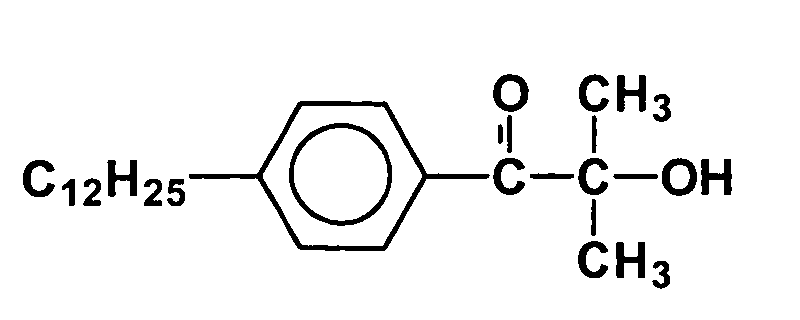
- R1 =
- C12H25;
- R2 =
- H;
- R3, R4 =
- CH3;
- R5 =
- H
Der Alkylrest R1 hat herstellungsbedingt eine Homologenverteilung von C9H19 bis C15H31 mit einem Maximum bei C12H25. Die Alkylreste sind jeweils eine Mischung aus linearem und verzweigtem Alkyl; Anteil photoreaktive Gruppe: 0,5.

- R1, R2 =
- H;
- R3, R4 =
- CH3;
- R5 =
- H
Die Verbindung ist als Handelsprodukt der Firma Ciba Additives unter der Bezeichnung Darocur® 1173 verfügbar. Dieser Photoinitiator hat ein Molgewicht von 164,2 g/Mol; Anteil photoreaktive Gruppe definitionsbedingt 1.

- R2 =
- H;
- R3, R4 =
- CH3;
- R5 =
- H
- n
- im Mittel = 7
| Beispiel | Photoinitiator | Anteil photoreaktive Gruppe in der Mischung strahlenhärtenden Organosiliziumverbindungen % | Zugabe Photoinitiator in Gew.-% | Restsauerstoff bei der UV-Härtung ppm |
| 1 | Nr. 1 | 2 | 2,67 | 25 |
| 2 | Nr. 2 | 2 | 4 | 25 |
| 3 | Nr. 3 | 2 | 2 | 25 |
| 4 | Nr. 4 | 2 | 6,67 | 25 |
| Beispiel | Loop Test | Restklebkraft % | Trennwert nach 24 Stunden TESA® 7476 cN/2,5 cm |
| 1 | + | 96 | 45 |
| 2 | + | 97 | 46 |
| 3 | - | 57 | 40 |
| 4 | - | 63 | 42 |
| Beispiel | Photoinitiator | Anteil photoreaktive Gruppe in der Mischung strahlenhärtenden Organosiliziumverbindungen % | Zugabe Photoinitiator in Gew.-% | Restsauerstoff bei der UV-Härtung ppm |
| 5 | Nr. 1 | 1,5 | 2 | 25 |
| 6 | Nr. 2 | 1 | 2 | 25 |
| 7 | Nr. 3 | 2 | 2 | 25 |
| 8 | Nr. 4 | 0,6 | 2 | 25 |
| Beispiel | Loop Test | Restklebkraft % | Trennwert nach 24 Stunden TESA® 7476 cN/2,5 cm |
| 5 | + | 91 | 51 |
| 6 | + | 90 | 53 |
| 7 | - | 57 | 40 |
| 8 | - | 42 | 41 |
Claims (7)
- Verwendung strahlenhärtbarer Beschichtungsmassen, enthaltend mindestens ein strahlungshärtbares Organopolysiloxan mit (Meth)acrylsäureestergruppen und einen Photoinitiator, dadurch gekennzeichnet, dass als Photoinitiator mindestens eine Verbindung der allgemeinen Formelmitverwendet wird, worin
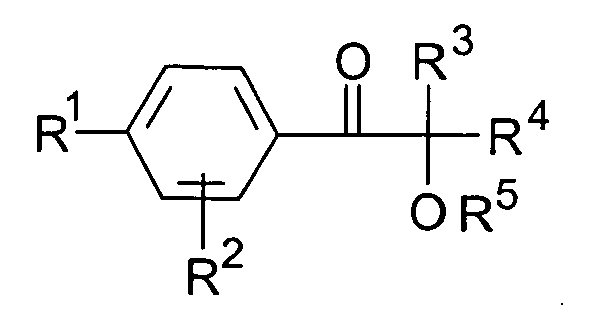
- R1
- ein linearer oder verzweigter Alkylrest mit 3 bis 18 C-Atomen
- R2
- H oder ein Alkylrest mit 1 bis 4 C-Atomen,
- R3, R4
- H oder Alkylreste mit 1 bis 6 C-Atomen, die auch zu einem 5- oder 6-gliedrigen Kohlenstoffring verknüpft sein können und
- R5
- H oder ein Alkyl- oder Alkanoylrest bedeuten,
- Verwendung strahlenhärtbarer Beschichtungsmassen gemäß Anspruch 1, dadurch gekennzeichnet, dass eine Verbindung der allgemeinen Formel mitverwendet wird worin R1 ein linearer oder verzweigter Alkylrest mit 4 bis 12 C-Atomen ist.
- Verwendung strahlenhärtbarer Beschichtungsmassen gemäß den Ansprüchen 1 bis 2, dadurch gekennzeichnet, dass eine Verbindung der allgemeinen Formel mitverwendet wird worin R2, R5 = H sind.
- Verwendung strahlenhärtbarer Beschichtungsmassen gemäß den Ansprüchen 1 bis 3, dadurch gekennzeichnet, dass eine Verbindung der allgemeinen Formel mitverwendet wird worin R3, R4 = CH3 sind.
- Verwendung strahlenhärtbarer Beschichtungsmassen gemäß den Ansprüchen 1 bis 4, dadurch gekennzeichnet, dass der Photoinitiator gemäß der allgemeinen Formel in Mengen von 0,01 bis 10 Gew.-%, bezogen auf das Gewicht der acrylatfunktionellen Siliconkomponente, mitverwendet wird.
- Verwendung strahlenhärtbarer Beschichtungsmassen gemäß den Ansprüchen 1 bis 5, dadurch gekennzeichnet, dass mindestens ein Photoinitiator gemäß der allgemeinen Formel in Mischung mit nicht erfindungsgemäßen Photoinitiatoren und/oder Photosensibilisatoren in Mengen von 0,1 bis 5 Gew.-%, bezogen auf das Gewicht der acrylatfunktionellen Siliconmassen, mitverwendet wird.
- Verwendung strahlenhärtbarer Beschichtungsmassen gemäß den Ansprüchen 1 bis 6, dadurch gekennzeichnet, dass sie mit Stabilisatoren, Füllstoffen, Pigmenten, anderen an sich bekannten Acrylatsystemen und weiteren üblichen Zusatzstoffen compoundiert werden.
Applications Claiming Priority (2)
| Application Number | Priority Date | Filing Date | Title |
|---|---|---|---|
| DE10248111 | 2002-10-15 | ||
| DE2002148111 DE10248111A1 (de) | 2002-10-15 | 2002-10-15 | Verwendung von Photoinitiatoren vom Typ Hydroxyalkylphenon in strahlenhärtbaren Organopolysiloxanen für die Herstellung von abhäsiven Beschichtungen |
Publications (3)
| Publication Number | Publication Date |
|---|---|
| EP1411095A2 true EP1411095A2 (de) | 2004-04-21 |
| EP1411095A3 EP1411095A3 (de) | 2004-09-15 |
| EP1411095B1 EP1411095B1 (de) | 2006-04-26 |
Family
ID=32038710
Family Applications (1)
| Application Number | Title | Priority Date | Filing Date |
|---|---|---|---|
| EP20030022074 Expired - Lifetime EP1411095B1 (de) | 2002-10-15 | 2003-10-02 | Verwendung von Photoinitiatoren vom Typ Hydroxyalkylphenon in strahlenhärtbaren Organopolysiloxanen für die Herstellung von abhäsiven Beschichtungen |
Country Status (4)
| Country | Link |
|---|---|
| US (1) | US7250204B2 (de) |
| EP (1) | EP1411095B1 (de) |
| DE (2) | DE10248111A1 (de) |
| ES (1) | ES2260555T3 (de) |
Cited By (2)
| Publication number | Priority date | Publication date | Assignee | Title |
|---|---|---|---|---|
| CN113518805A (zh) * | 2018-12-28 | 2021-10-19 | 意大利艾坚蒙树脂有限公司 | 光引发剂 |
| WO2022148932A1 (fr) | 2021-01-08 | 2022-07-14 | Elkem Silicones France Sas | Composition silicone réticulable par irradiation comprenant un modulateur d'adhérence |
Families Citing this family (15)
| Publication number | Priority date | Publication date | Assignee | Title |
|---|---|---|---|---|
| DE10232828A1 (de) * | 2002-07-19 | 2004-02-05 | Goldschmidt Ag | Verwendung von Antioxidantien in strahlenhärtbaren Beschichtungsmassen für die Herstellung von abhäsiven Beschichtungen |
| US7402648B2 (en) * | 2004-11-05 | 2008-07-22 | Toagosei Co., Ltd. | Method for producing cyclic organic silicon compound and organic silicon resin having alcoholic hydroxyl group |
| WO2008003601A1 (en) * | 2006-07-04 | 2008-01-10 | Ciba Holding Inc. | Water based concentrated product forms of photoinitiators made by a heterophase polymerization technique |
| DE102007005508A1 (de) | 2007-02-03 | 2008-08-07 | Evonik Goldschmidt Gmbh | Verfahren zur Reduktion des Trennwert-Anstiegs bei der Herstellung von No-Label-Look-Etiketten |
| US20090029053A1 (en) * | 2007-07-25 | 2009-01-29 | United Solar Ovonic Llc | Method for stabilizing silicone material, stabilized silicone material, and devices incorporating that material |
| DE102007054885A1 (de) * | 2007-11-15 | 2009-05-20 | Evonik Degussa Gmbh | Verfahren zur Fraktionierung oxidischer Nanopartikel durch Querstrom-Membranfiltration |
| DE102008043422B3 (de) | 2008-11-03 | 2010-01-07 | Evonik Degussa Gmbh | Verfahren zur Aufreinigung niedermolekularer Hydridosilane |
| DE102009001230A1 (de) | 2009-02-27 | 2010-09-02 | Evonik Oxeno Gmbh | Verfahren zur Abtrennung und teilweiser Rückführung von Übergangsmetallen bzw. deren katalytisch wirksamen Komplexverbindungen aus Prozessströmen |
| DE102009001225A1 (de) | 2009-02-27 | 2010-09-02 | Evonik Oxeno Gmbh | Verfahren zur Anreicherung eines Homogenkatalysators aus einem Prozessstrom |
| DE102009047351A1 (de) | 2009-12-01 | 2011-06-09 | Evonik Goldschmidt Gmbh | Komposit-Siliconmembranen mit hoher Trennwirkung |
| US10465032B2 (en) | 2014-12-18 | 2019-11-05 | Evonik Degussa Gmbh | Radiation-curable coating compounds consisting of a plurality of components, and the use of same in release-coated substrates |
| ES2676430T3 (es) | 2015-11-11 | 2018-07-19 | Evonik Degussa Gmbh | Polímeros curables |
| CN115820115B (zh) | 2018-12-19 | 2024-05-07 | 赢创运营有限公司 | 具有芳族基团的有机硅氧烷在隔离涂层中的用途 |
| CN114430757A (zh) | 2019-09-27 | 2022-05-03 | 赢创运营有限公司 | 硅酮(甲基)丙烯酸酯、其制备方法及其在可固化组合物中的用途 |
| CN116144178B (zh) * | 2021-11-19 | 2025-05-02 | 艾坚蒙(安庆)科技发展有限公司 | 可光固化有机硅组合物及其应用 |
Family Cites Families (22)
| Publication number | Priority date | Publication date | Assignee | Title |
|---|---|---|---|---|
| GB1589064A (en) | 1977-01-12 | 1981-05-07 | Goldschmidt Ag Th | Process for the manufacture of organopolysiloxanes |
| DE2722264C2 (de) | 1977-05-17 | 1984-06-28 | Merck Patent Gmbh, 6100 Darmstadt | Verwendung von substituierten Oxyalkylphenonen als Photosensibilisatoren |
| DE2948708C2 (de) | 1979-02-02 | 1984-06-28 | Th. Goldschmidt Ag, 4300 Essen | Verfahren zur Herstellung von mit Pentaerythrittriacrylsäure- oder Pentaerythrittrimethacrylsäureestern modifizierten Organopolysiloxanen |
| JPS56102793A (en) | 1979-12-28 | 1981-08-17 | Takeda Chem Ind Ltd | Preparation of antibiotic c-15003 p-3 |
| JPS57207622A (en) | 1981-06-18 | 1982-12-20 | Toray Silicone Co Ltd | Photopolymerization sensitizer and its preparation |
| EP0088842B1 (de) | 1982-03-16 | 1986-01-02 | Toray Silicone Company Limited | Organopolysiloxan Photosensibilisatoren und Methoden zu ihrer Herstellung |
| US4477326A (en) | 1983-06-20 | 1984-10-16 | Loctite Corporation | Polyphotoinitiators and compositions thereof |
| DE3567880D1 (en) | 1984-04-16 | 1989-03-02 | Loctite Corp | Siloxane polyphotoinitiators of the substituted acetophenone type |
| US4534838A (en) | 1984-04-16 | 1985-08-13 | Loctite Corporation | Siloxane polyphotoinitiators of the substituted acetophenone type |
| US4507187A (en) | 1984-04-19 | 1985-03-26 | Loctite Corporation | Siloxane photoinitiators with aryoyl formate groups |
| JPS62125825A (ja) * | 1985-11-26 | 1987-06-08 | Matsushita Electric Ind Co Ltd | 気体分離膜 |
| US4956221A (en) * | 1987-11-06 | 1990-09-11 | Dow Corning Corporation | UV curable conformal coating with moisture shadow cure |
| DE68919490T2 (de) * | 1988-03-07 | 1995-05-18 | Shinetsu Chemical Co | Photohärtbare Polysiloxanzusammensetzung. |
| DE3810140C1 (de) | 1988-03-25 | 1989-10-05 | Th. Goldschmidt Ag, 4300 Essen, De | |
| DE3820294C1 (de) | 1988-06-15 | 1989-10-05 | Th. Goldschmidt Ag, 4300 Essen, De | |
| DE4435487A1 (de) | 1994-10-04 | 1996-04-11 | Hoechst Ag | Mit Silikonen kompatible Photoinitiatoren und diese enthaltende lichtempfindliche Gemische |
| US5908873A (en) * | 1995-12-20 | 1999-06-01 | Borden Chemicals, Inc. | Peelable bonded ribbon matrix material; optical fiber bonded ribbon arrays containing same; and process for preparing said optical fiber bonded ribbon arrays |
| US5621020A (en) * | 1996-06-19 | 1997-04-15 | Moore Business Forms, Inc. | Release composition for printable linerless labels |
| FR2750429B1 (fr) | 1996-06-27 | 1998-08-07 | Essilor Int | Materiau a base de silicone reticule comportant un photoamorceur fixe, son procede de preparation, produit polymerique hydrophile obtenu a partir de ce materiau et son procede de preparation, et nouveaux photoamorceurs |
| JP3618951B2 (ja) * | 1997-03-14 | 2005-02-09 | 信越化学工業株式会社 | 光硬化性オルガノポリシロキサン組成物 |
| KR100338136B1 (ko) | 1998-03-03 | 2002-05-24 | 울프 크라스텐센, 스트라쎄 로텐베르그 | 오르가노폴리실록산 및 오르가노폴리실록산의 제조방법 |
| US6376568B1 (en) | 1999-07-29 | 2002-04-23 | Ciba Specialty Chemicals Corporation | Surface-active photoinitiators |
-
2002
- 2002-10-15 DE DE2002148111 patent/DE10248111A1/de not_active Withdrawn
-
2003
- 2003-10-02 EP EP20030022074 patent/EP1411095B1/de not_active Expired - Lifetime
- 2003-10-02 ES ES03022074T patent/ES2260555T3/es not_active Expired - Lifetime
- 2003-10-02 DE DE50303094T patent/DE50303094D1/de not_active Expired - Lifetime
- 2003-10-14 US US10/685,141 patent/US7250204B2/en not_active Expired - Lifetime
Cited By (5)
| Publication number | Priority date | Publication date | Assignee | Title |
|---|---|---|---|---|
| CN113518805A (zh) * | 2018-12-28 | 2021-10-19 | 意大利艾坚蒙树脂有限公司 | 光引发剂 |
| US20220098333A1 (en) * | 2018-12-28 | 2022-03-31 | Igm Resins Italia S.R.L. | Photoinitiators |
| CN113518805B (zh) * | 2018-12-28 | 2023-08-08 | 意大利艾坚蒙树脂有限公司 | 光引发剂 |
| US11834532B2 (en) * | 2018-12-28 | 2023-12-05 | Igh Resins Italia S.R.L. | Photoinitiators |
| WO2022148932A1 (fr) | 2021-01-08 | 2022-07-14 | Elkem Silicones France Sas | Composition silicone réticulable par irradiation comprenant un modulateur d'adhérence |
Also Published As
| Publication number | Publication date |
|---|---|
| DE50303094D1 (de) | 2006-06-01 |
| DE10248111A1 (de) | 2004-04-29 |
| EP1411095B1 (de) | 2006-04-26 |
| US7250204B2 (en) | 2007-07-31 |
| ES2260555T3 (es) | 2006-11-01 |
| US20040082681A1 (en) | 2004-04-29 |
| EP1411095A3 (de) | 2004-09-15 |
Similar Documents
| Publication | Publication Date | Title |
|---|---|---|
| EP0979851B1 (de) | Strahlenhärtbare Beschichtungsmassen | |
| EP1411095B1 (de) | Verwendung von Photoinitiatoren vom Typ Hydroxyalkylphenon in strahlenhärtbaren Organopolysiloxanen für die Herstellung von abhäsiven Beschichtungen | |
| EP1764394B1 (de) | Verwendung von Epoxy-funktionellen Silanen als Haftungsadditiv für kationisch strahlenhärtende Silicontrennbeschichtungen | |
| DE2651009C3 (de) | Durch Bestrahlung härtbare Polydiorganosiloxanmasse und ihre Verwendung zur Bildung von Trennüberzügen | |
| DE2622126C3 (de) | Verwendung einer durch Bestrahlung hartbaren Beschichtungsmasse auf Polydiorganosiloxanbasis zur Herstellung von Trennüberzügen auf Trägermaterialien | |
| DE69028674T2 (de) | Verfahren zur Herstellung von Vinylsilikon-Copolymer mit merkaptofunktionalen Silikon-Kettenübertragungsmitteln und damit hergestellte Trennbeschichtungen | |
| DE2850611C2 (de) | Durch Strahlung härtbare Polydiorganosiloxanformmassen und deren Verwendung zur Verbesserung der Abtrennbarkeit von Klebstoffen von festen Substraten | |
| DE102007005508A1 (de) | Verfahren zur Reduktion des Trennwert-Anstiegs bei der Herstellung von No-Label-Look-Etiketten | |
| EP1820825A1 (de) | Verfahren zur Herstellung von siloxanhaltigen Trennbeschichtungen | |
| DE102006041971A1 (de) | Verwendung von partikulären Emulgatoren in abhäsiven siloxanhaltigen Beschichtungsmassen | |
| EP1544232A1 (de) | Polysiloxane mit über SiOC-Gruppen gebundenen (Meth)acrylsäureestergruppen, Verfahren zu deren Herstellung sowie deren Verwendung als strahlenhärtbare abhäsive Beschichtung | |
| CH504498A (de) | Haftungsverhinderndes Mittel und dessen Verwendung | |
| WO2018001687A1 (de) | Permeationsinhibierende trennbeschichtung | |
| DE69730800T2 (de) | Oxaalkylcarbonsäure-modifizierte Epoxysiliconzusammensetzungen | |
| EP1382651A1 (de) | Verwendung von Antioxidantien in strahlenhärtbaren Beschichtungsmassen für die Herstellung von abhäsiven Beschichtungen | |
| DE60114797T2 (de) | Silikon-klebstoffkomplex mit durch elektronenbestrahlung modulierbarer trennkraft an der schichtgrenze | |
| EP0468270A1 (de) | Verwendung von mit Oxyalkylenethergruppen modifizierten Epoxypolysiloxanen als härtbare Beschichtungsmittel | |
| EP1403349B1 (de) | Verwendung von mit Oxyalkylenethergruppen modifizierten Epoxypolysiloxanen als Additive für strahlenhärtende Beschichtungen | |
| DE102005001040B4 (de) | Mehrfachfunktionelle Polysiloxane mit über SiOC-Gruppen gebundenen (Meth)acrylsäureestergruppen und einem unmodifizierten Polysiloxan-Block, Verfahren zu deren Herstellung sowie deren Verwendung als strahlenhärtbare abhäsive Beschichtung | |
| EP3898858B1 (de) | Verwendung von organosiloxanen mit aromatischen resten in trennbeschichtungen | |
| EP0617094B1 (de) | Abhäsive Beschichtungsmasse mit einem den Grad der Abhäsivität beeinflussenden Zusatzmittel | |
| DE102004034740A1 (de) | Polysiloxane mit über SiOC-Gruppen gebundenen (Meth)arcylsäureestergruppen und fluorierten Resten sowie deren Verwendung als strahlenhärtbare abhäsive Beschichtung | |
| EP0058909B1 (de) | Durch Bestrahlung härtbare Polyorganosiloxanmasse und ihre Verwendung zur Bildung von Trennüberzügen | |
| DE60018106T2 (de) | Komplex aus kationisch vernetzbarer silikonverbindung und klebstoff mit modulierbarer trennkraft an deren schnittstelle | |
| DE10219734A1 (de) | Herstellung von (meth)acrylfunktionellen Siloxanen |
Legal Events
| Date | Code | Title | Description |
|---|---|---|---|
| PUAI | Public reference made under article 153(3) epc to a published international application that has entered the european phase |
Free format text: ORIGINAL CODE: 0009012 |
|
| 17P | Request for examination filed |
Effective date: 20031009 |
|
| AK | Designated contracting states |
Kind code of ref document: A2 Designated state(s): AT BE BG CH CY CZ DE DK EE ES FI FR GB GR HU IE IT LI LU MC NL PT RO SE SI SK TR |
|
| AX | Request for extension of the european patent |
Extension state: AL LT LV MK |
|
| PUAL | Search report despatched |
Free format text: ORIGINAL CODE: 0009013 |
|
| AK | Designated contracting states |
Kind code of ref document: A3 Designated state(s): AT BE BG CH CY CZ DE DK EE ES FI FR GB GR HU IE IT LI LU MC NL PT RO SE SI SK TR |
|
| AX | Request for extension of the european patent |
Extension state: AL LT LV MK |
|
| RAP1 | Party data changed (applicant data changed or rights of an application transferred) |
Owner name: GOLDSCHMIDT GMBH |
|
| AKX | Designation fees paid |
Designated state(s): BE DE ES FI GB IT |
|
| GRAP | Despatch of communication of intention to grant a patent |
Free format text: ORIGINAL CODE: EPIDOSNIGR1 |
|
| GRAS | Grant fee paid |
Free format text: ORIGINAL CODE: EPIDOSNIGR3 |
|
| GRAA | (expected) grant |
Free format text: ORIGINAL CODE: 0009210 |
|
| AK | Designated contracting states |
Kind code of ref document: B1 Designated state(s): BE DE ES FI GB IT |
|
| PG25 | Lapsed in a contracting state [announced via postgrant information from national office to epo] |
Ref country code: IT Free format text: LAPSE BECAUSE OF FAILURE TO SUBMIT A TRANSLATION OF THE DESCRIPTION OR TO PAY THE FEE WITHIN THE PRESCRIBED TIME-LIMIT;WARNING: LAPSES OF ITALIAN PATENTS WITH EFFECTIVE DATE BEFORE 2007 MAY HAVE OCCURRED AT ANY TIME BEFORE 2007. THE CORRECT EFFECTIVE DATE MAY BE DIFFERENT FROM THE ONE RECORDED. Effective date: 20060426 |
|
| REG | Reference to a national code |
Ref country code: GB Ref legal event code: FG4D Free format text: NOT ENGLISH |
|
| REF | Corresponds to: |
Ref document number: 50303094 Country of ref document: DE Date of ref document: 20060601 Kind code of ref document: P |
|
| GBT | Gb: translation of ep patent filed (gb section 77(6)(a)/1977) |
Effective date: 20060814 |
|
| REG | Reference to a national code |
Ref country code: ES Ref legal event code: FG2A Ref document number: 2260555 Country of ref document: ES Kind code of ref document: T3 |
|
| PLBE | No opposition filed within time limit |
Free format text: ORIGINAL CODE: 0009261 |
|
| STAA | Information on the status of an ep patent application or granted ep patent |
Free format text: STATUS: NO OPPOSITION FILED WITHIN TIME LIMIT |
|
| 26N | No opposition filed |
Effective date: 20070129 |
|
| REG | Reference to a national code |
Ref country code: DE Ref legal event code: R081 Ref document number: 50303094 Country of ref document: DE Owner name: EVONIK DEGUSSA GMBH, DE Free format text: FORMER OWNER: EVONIK GOLDSCHMIDT GMBH, 45127 ESSEN, DE Effective date: 20131024 |
|
| REG | Reference to a national code |
Ref country code: GB Ref legal event code: 732E Free format text: REGISTERED BETWEEN 20140320 AND 20140326 |
|
| REG | Reference to a national code |
Ref country code: ES Ref legal event code: PC2A Owner name: EVONIK DEGUSSA GMBH Effective date: 20140424 |
|
| REG | Reference to a national code |
Ref country code: DE Ref legal event code: R081 Ref document number: 50303094 Country of ref document: DE Owner name: EVONIK OPERATIONS GMBH, DE Free format text: FORMER OWNER: EVONIK DEGUSSA GMBH, 45128 ESSEN, DE |
|
| REG | Reference to a national code |
Ref country code: BE Ref legal event code: HC Owner name: EVONIK OPERATIONS GMBH; DE Free format text: DETAILS ASSIGNMENT: CHANGE OF OWNER(S), CHANGEMENT DE NOM DU PROPRIETAIRE Effective date: 20200403 |
|
| REG | Reference to a national code |
Ref country code: FI Ref legal event code: PCE Owner name: EVONIK OPERATIONS GMBH |
|
| PGFP | Annual fee paid to national office [announced via postgrant information from national office to epo] |
Ref country code: IT Payment date: 20221026 Year of fee payment: 20 Ref country code: GB Payment date: 20221019 Year of fee payment: 20 Ref country code: FI Payment date: 20221020 Year of fee payment: 20 Ref country code: ES Payment date: 20221222 Year of fee payment: 20 Ref country code: DE Payment date: 20221019 Year of fee payment: 20 |
|
| PGFP | Annual fee paid to national office [announced via postgrant information from national office to epo] |
Ref country code: BE Payment date: 20221019 Year of fee payment: 20 |
|
| P01 | Opt-out of the competence of the unified patent court (upc) registered |
Effective date: 20230524 |
|
| REG | Reference to a national code |
Ref country code: DE Ref legal event code: R071 Ref document number: 50303094 Country of ref document: DE |
|
| REG | Reference to a national code |
Ref country code: BE Ref legal event code: MK Effective date: 20231002 |
|
| REG | Reference to a national code |
Ref country code: GB Ref legal event code: PE20 Expiry date: 20231001 |
|
| REG | Reference to a national code |
Ref country code: ES Ref legal event code: FD2A Effective date: 20231027 |
|
| PG25 | Lapsed in a contracting state [announced via postgrant information from national office to epo] |
Ref country code: GB Free format text: LAPSE BECAUSE OF EXPIRATION OF PROTECTION Effective date: 20231001 |
|
| PG25 | Lapsed in a contracting state [announced via postgrant information from national office to epo] |
Ref country code: ES Free format text: LAPSE BECAUSE OF EXPIRATION OF PROTECTION Effective date: 20231003 |
|
| PG25 | Lapsed in a contracting state [announced via postgrant information from national office to epo] |
Ref country code: ES Free format text: LAPSE BECAUSE OF EXPIRATION OF PROTECTION Effective date: 20231003 |