EP1407428B1 - Vertriebsanlage für waren - Google Patents
Vertriebsanlage für waren Download PDFInfo
- Publication number
- EP1407428B1 EP1407428B1 EP02787102A EP02787102A EP1407428B1 EP 1407428 B1 EP1407428 B1 EP 1407428B1 EP 02787102 A EP02787102 A EP 02787102A EP 02787102 A EP02787102 A EP 02787102A EP 1407428 B1 EP1407428 B1 EP 1407428B1
- Authority
- EP
- European Patent Office
- Prior art keywords
- goods
- distribution
- station
- address
- stations
- Prior art date
- Legal status (The legal status is an assumption and is not a legal conclusion. Google has not performed a legal analysis and makes no representation as to the accuracy of the status listed.)
- Expired - Lifetime
Links
Images

Classifications
-
- G—PHYSICS
- G07—CHECKING-DEVICES
- G07F—COIN-FREED OR LIKE APPARATUS
- G07F7/00—Mechanisms actuated by objects other than coins to free or to actuate vending, hiring, coin or paper currency dispensing or refunding apparatus
-
- G—PHYSICS
- G06—COMPUTING OR CALCULATING; COUNTING
- G06Q—INFORMATION AND COMMUNICATION TECHNOLOGY [ICT] SPECIALLY ADAPTED FOR ADMINISTRATIVE, COMMERCIAL, FINANCIAL, MANAGERIAL OR SUPERVISORY PURPOSES; SYSTEMS OR METHODS SPECIALLY ADAPTED FOR ADMINISTRATIVE, COMMERCIAL, FINANCIAL, MANAGERIAL OR SUPERVISORY PURPOSES, NOT OTHERWISE PROVIDED FOR
- G06Q10/00—Administration; Management
- G06Q10/08—Logistics, e.g. warehousing, loading or distribution; Inventory or stock management
- G06Q10/083—Shipping
- G06Q10/08355—Routing methods
Definitions
- the invention relates to a distribution system for goods with distribution stations, which have a control unit operable lockers for receiving goods and connected to the control unit, connected to an input and display device and memory for receiver and authorization codes computer unit.
- the distribution stations with lockers include, in which the ordered goods are stored by the dealer and then picked up by a customer, preferably under a cashless payment.
- the lockers on a control unit from a computer unit can be actuated on the one hand checks the dealer authorization to access free lockers using stored authorization codes and on the other hand, the access authorization of a goods recipient for stored in a locker goods using a stored receiver code.
- the dealer entering via the input and display device is a free locker for the delivered goods with the request to enter the data required for the collection of the goods, such as the recipient code and the price. Due to this data entry, the associated locker is opened, so that the ordered goods can be stored in the locker.
- the recipient is asked to enter the recipient code and the data required for cashless payment transactions before the locker associated with the entered recipient code is displayed together with the price of the goods. Via a receiver-side confirmation
- the displayed locker is then opened by means of the control unit in order to remove the paid goods can.
- these known sales systems can be used only in localized areas, because the users only one distribution station is available.
- the invention is therefore an object of the invention to provide a distribution system for goods with locally separate distribution stations, between which goods of different senders can be sent to different recipients, without use restrictions.
- the invention solves the problem by the fact that the interconnected computer units of each locally separate distribution stations on the one hand ever a printer for machine-readable address addresses from an loadable via the input and display address memory and a reading device for such assigned to the goods recipient addresses and on the other hand each program memory for defining a material path between each formed by a distribution station task and destination stations depending on the recipient address, the locker offer the distribution stations and optionally provided conveyor sections are assigned, that the distribution stations connected to their computer unit send - And receiving unit for selecting at least one due the set, multiple distribution stations comprehensive material path from stored addresses selected address of an authorized freight forwarder or the recipient address include that the computer units of the distribution stations are provided with encoders for storing in free lockers goods, which encoders in the storage of goods in a free locker create a code which is assigned to the stored goods, the order and the created code being communicated to the authorized carrier in separate transmission paths and the lockers containing the stored goods after entering the code of the distribution station in which the respective locker is located;
- the respective material path is determined depending on the entered recipient address, taking into account not only the locker offer in the individual distribution stations, but also possibly predetermined, individual carriers assigned conveyor sections can be.
- a free locker is reserved in the destination station or an optionally provided intermediate station, so that overfilling a distribution station can be excluded.
- the freight forwarders provided for the specified material route are notified of the availability of a product to be transported via a transmitting and receiving unit connected to the computer unit, which can thus be picked up by a forwarding agent accepting the transport order.
- the computer unit checks in the loading station whether a product is reserved for the freight forwarder is, and causes the display of the respective locker and its opening.
- the forwarder removes the goods from the locker and causes a reprinting of the machine-readable recipient address in the event that no recipient address has been attached to the goods to be received. With the closing of the opened locker an Oberdgingbest ausist can be printed out for the forwarder.
- the freight forwarder to whom the destination station or the intermediate station to which the goods are to be delivered, has been informed via the sending and receiving unit, now transports the goods to the specified destination or intermediate station, where he receives the recipient address on the goods via a reading device after having verified his entitlement via the authorization code.
- the reserved for the goods locker is displayed and opened to receive the goods.
- the completed by closing the locker goods acquisition causes the control of the transmitting and receiving unit via the computer unit, which in case of storage in an intermediate station, the responsible for the next conveyor section carriers are notified to in the manner already described for the further transport of the goods to care.
- the recipient is dialed on the basis of the recipient address entered by the sender and informed that a product is ready for him to pick up. With the help of a corresponding recipient code, which can also be transmitted with the message, then the goods can be picked up from the specified distribution station. Since all distribution stations of the distribution system are constructed in the same way, high reliability is achieved for the distribution system, because even if one distribution station fails, the distribution system can continue to be used via the remaining distribution stations.
- an additional identifier of the goods by the computer units of the individual distribution stations are provided with encoders for storage in free lockers goods and the transmitting and receiving units at least the goods in the transmit the codes assigned to the respective distribution station to the selected forwarders and / or receivers, so that access to the stored in a distribution station goods only with a code is possible, which is created only when storing the goods in this distribution station.
- a code can be created in a simple manner, for example from the address of the distribution station, the number of used locker and the time of storage of the goods.
- the commodity path can advantageously be traced on the basis of this code.
- the code issued by the code sender of the delivery station of a commodity forms a commodity code for all distribution stations, then the commodity path can advantageously be traced on the basis of this code.
- the code issued by the code sender of the delivery station of a commodity forms a commodity code for all distribution stations, then the commodity path can advantageously be traced on the basis of this code.
- the codes created by the delivery station and the destination station to the recipient address it is possible with great probability to preclude an abusive removal of goods.
- the lockers 1 of a distribution station are controlled via a common control unit 2 which is connected to a superordinate computer unit 3.
- This computer unit 3 can be actuated via an input and display device 4, for example, to give up a product for a particular recipient.
- the data required for the shipment of goods must be entered.
- these will mainly be data about the sender, the method of dispatch and the payment methods.
- a free locker 1 suitable for the selected shipping method is selected and displayed.
- the entered recipient address is stored in an address memory 5, from which it is output to a printer 6 via the computer unit 3 for printing in a machine-readable form.
- the printer 6 thus provides a sticker with a machine-readable address for attaching to the goods.
- a reading device 7 is provided for attachable to the goods recipient addresses.
- a plurality of substantially equally constructed distribution stations 10 are provided, which are connected to each other via a network 11.
- the computer units 3 of the distribution stations 10 are equipped with corresponding transmitting and receiving units 12.
- a program memory 13 in the individual distribution stations 10 from the input recipient address based on the existing distribution stations 10 a goods path from the respective feeding station to a destination station optionally be set using intermediate stations, in the determination of this commodity path between the individual distribution stations 10 the respective offer of free lockers can be considered.
- the transport of goods between the distribution stations 10 is handled by freight forwarders, which may be authorized only for the transport of goods in certain conveyor sections, so that the respective material path from the loading station to the destination station must also take into account such a division of the total paths in conveyor sections by appropriate intermediate stations are determined .
- the setting of intermediate stations may also be required due to the shipping method, for example, if a certain temperature control for the goods to be transported is required. Since, due to the networking of the individual distribution stations 10, the respective feeding station via the connection network 11 can query the information required for the determination of the goods path of the destination or the intermediate stations to be selected under certain circumstances, can be set on the program memory 13 of the respective material path to in the each located on this material distribution distribution stations 10 to reserve a locker 1 for receiving goods.
- one of the distribution stations 10 serves as a loading station A, in which after the corresponding data input on the basis of the stored data on the program memory 13, the material path is determined in dependence on provided conveyor sections and locker offers.
- This conveyor route to the destination station E passes through an intermediate station Z. Due to the defined material path, the lockers 1 required for the goods reception are reserved both in the intermediate station Z and in the destination station E.
- the addresses of forwarders 14 are selected via the transmitting and receiving unit 12, which are authorized for the transport of goods between the loading station A and the intermediate station Z. The addresses of these forwarders 14 are stored in the address memory of each distribution station 10.
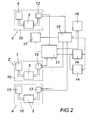
- the network 11 can be used, as shown in the Fig. 2 is shown.
- a separate network 15 for connecting the individual distribution stations 10 with the forwarders 14, as shown in the Fig. 2 is indicated by dashed lines confirms one of the selected forwarders 14 the order transfer for the transport of goods from the loading station A to the intermediate station Z, the order for the other carriers 14 is blocked, so that double bookings can be excluded.
- the transmitted order confirmation stations A and Z of the order receiving forwarder 14 is notified, who must prove his authorization via a predetermined authorization code, which is stored for the individual carriers 14 in the identification memories 9.
- the taking over the order forwarder 14 now fetches the goods from the loading station A by entering his authorization code via the input and display device 4, after which the lockers 1 are displayed and opened, in which goods are ready for this forwarder 14.
- the carrier 14 checks whether the machine-readable recipient address is properly attached to the goods, and causes in the absence of such a recipient address a new expression stored in the address memory 5 receiver address on the printer 6- With the goods acceptance and closing the respective locker 1 is on the Printer 6 printed out a transfer slip for the carrier 14, who now the goods transferred to the intermediate station Z. where he must log in again using his authorization code.
- the goods to be transferred are identified in the intermediate station Z on the basis of the recipient address, which preferably comprises the code produced in the loading station A for the goods, in order to display and open the locker 1 reserved for the respective goods.
- theSchemahmevorgang With the storage of the goods in the locker and the closing of the locker theSchemahmevorgang is completed, being assigned by the code transmitter 8 of the intermediate station Z of the acquired goods an additional code that is decisive for the collection of the goods.
- a for the conveyor section between the intermediate station Z and the destination station E responsible forwarder 16 is selected by the transmitting and receiving unit 12 of the intermediate station Z via the network 11 and the network 15.
- the selected forwarder 16 retrieves the goods from the intermediate station Z in the manner already described after the order is accepted and delivers them to the destination station E, in which the goods are taken over as in all previous distribution stations 10.
- the receiver 17 is selected according to the receiver address via the transmitting and receiving unit 12 of the destination station E, for example via the network 15 for radio telephones.
- the selection of the receiver 17 can of course also be done via the network 11, if the receiver 17 is connected to the network 11.
- the receiver 17, which is notified in this way the arrival of a product intended for him, with this message receives a receiver code corresponding to the code generated in the destination station E by the code generator 8.
- the receiver 17 may also be notified of the goods in the loading station A associated code, preferably on a separate transmission path, so that the picking up in a locker 1 of the destination station E stored goods only on the input of the goods in the loading station A and in the destination station E associated code is possible.
- the receiver 17 transmitted code on the input and display device 4 of the destination station E the receiver 17, the goods containing locker 1 is displayed and this compartment is opened, which the goods are removed from the sales facility. It need not be mentioned that in connection with the described distribution system a cashless payment can be linked in a known manner in order to make the goods transport or the goods issue of a proper payment of the goods.
- Goods can also be distributed between distributing stations without transport via the individual distribution stations 10, if the feeding station A is at the same time the destination station E, because in this case it is not the freight forwarder but the receiver 17 that is selected by the loading station A.
Landscapes
- Business, Economics & Management (AREA)
- Engineering & Computer Science (AREA)
- General Physics & Mathematics (AREA)
- Physics & Mathematics (AREA)
- Economics (AREA)
- Marketing (AREA)
- Entrepreneurship & Innovation (AREA)
- Human Resources & Organizations (AREA)
- Development Economics (AREA)
- Operations Research (AREA)
- Quality & Reliability (AREA)
- Strategic Management (AREA)
- Tourism & Hospitality (AREA)
- General Business, Economics & Management (AREA)
- Theoretical Computer Science (AREA)
- Warehouses Or Storage Devices (AREA)
- Vending Machines For Individual Products (AREA)
- Management, Administration, Business Operations System, And Electronic Commerce (AREA)
Description
- Die Erfindung bezieht sich auf eine Vertriebsanlage für Waren mit Verteilerstationen, die über eine Steuereinheit betätigbare Schließfächer zur Warenaufnahme und eine mit der Steuereinheit verbundene, an eine Eingabe- und Anzeigeeinrichtung sowie an Speicher für Empfänger- und Berechtigungscodes angeschlossene Rechnereinheit aufweisen.
- Um bestellte Waren unabhängig von Öffnungszeiten abholen zu können, sind Verkaufssysteme bekannt (
EP 0 396 139 A1 ,EP 0 531 942 A2 ), die Verteilerstationen mit Schließfächern umfassen, in die die bestellten Waren vom Händler eingelagert und dann von einem Kunden vorzugsweise unter eine bargeldlosen Zahlungsabwicklung abgeholt werden. Zu diesem Zweck sind die Schließfächer über eine Steuereinheit von einer Rechnereinheit her betätigbar, die einerseits die Händlerberechtigung zum Zugriff auf freie Schließfächer anhand abgespeicherter Berechtigungscodes und anderseits die Zugriffsberechtigung eines Warenempfängers für in einem Schließfach gelagerte Waren anhand eines abgespeicherten Empfängercodes überprüft. Zur Erfüllung einer Bestellung, die beispielsweise über eine Eingabe- und Anzeigeeinrichtung der Rechnereinheit einer solchen Verteilerstation aufgegeben werden kann, wenn die jeweiligen Händler an diese Rechnereinheit angeschlossen sind, wird dem sich über die Eingabe-und Anzeigeeinrichtung anmeldenden Händler ein freies Schließfach für die angelieferten Waren zugeordnet, und zwar mit der Aufforderung die für die Abholung der Waren erforderlichen Daten, wie Empfängercode und Preis einzugeben. Aufgrund dieser Dateneingabe wird das zugeordnete Schließfach geöffnet, so daß die bestellte Ware in das Schließfach eingelagert werden kann. Zum Abholen der Ware wird der Empfänger zur Eingabe des Empfängercodes und der für den bargeldlosen Zahlungsverkehr erforderlichen Daten aufgefordert, bevor das dem eingegebenen Empfängercode zugeordnete Schließfach zusammen mit dem Warenpreis angezeigt wird. Über eine empfängerseitige Bestätigung wird dann das angezeigte Schließfach mittels der Steuereinheit geöffnet, um die bezahlte Ware entnehmen zu können. Diese bekannten Verkaufssysteme können allerdings nur in örtlich begrenzten Bereichen eingesetzt werden, weil den Benützern jeweils nur eine Verteilerstation zur Verfügung steht. - Um die Verfügbarkeit von Speicherplätzen einer Verteilerstation anzuzeigen, ist es darüber hinaus bereits bekannt (
WO 01/31827 A2 - Der Erfindung liegt somit die Aufgabe zugrunde, eine Vertriebsanlage für Waren mit voneinander örtlich getrennten Verteilerstationen zu schaffen, zwischen denen Waren unterschiedlicher Absender an verschiedene Empfänger verschickt werden können, und zwar ohne Benutzungseinschränkungen.
- Ausgehend von einer Vertriebsanlage der eingangs geschilderten Art löst die Erfindung die gestellte Aufgabe dadurch, daß den miteinander verbundenen Rechnereinheiten der einzelnen voneinander örtlich getrennten Verteilerstationen einerseits je ein Drucker für maschinenlesbare Empfängeradressen aus einem über die Eingabe- und Anzeigeeinrichtung ladbaren Adressenspeicher sowie eine Leseeinrichtung für solche an den Waren anbringbare Empfängeradressen und anderseits je ein Programmspeicher zum Festlegen eines Warenweges zwischen durch je eine Verteilerstation gebildeten Aufgabe- und Zielstationen in Abhängigkeit von der Empfängeradresse, dem Schließfachangebot der Verteilerstationen und von gegebenenfalls vorgesehenen Förderabschnitten zugeordnet sind, daß die Verteilerstationen eine an ihre Rechnereinheit angeschlossene Sende- und Empfangseinheit zum Anwählen wenigstens einer aufgrund des festgelegten, mehrere Verteilerstationen umfassenden Warenweges aus abgespeicherten Adressen ausgewählten Adresse eines berechtigten Spediteurs für den Warentransport oder der Empfängeradresse umfassen, daß die Rechnereinheiten der Verteilerstationen mit Codegebern für in freie Schließfächer einzulagernde Waren versehen sind, welche Codegeber bei der Einlagerung einer Ware in ein freies Schließfach einen Code erstellen, der der eingelagerten Ware zugeordnet wird, wobei der Auftrag und der erstellte Code auf getrennten Übertragungswegen dem berechtigten Spediteur mitgeteilt werden und wobei die Schließfächer mit den eingelagerten Waren nach der Eingabe des Codes der Verteilerstation, in dem sich das jeweilige Schließfach befindet, und des Codes der vorherigen Verteilerstation auf dem definierten Warenweg über die entsprechende Eingabe- und Anzeigeeinrichtung der Verteilerstation geöffnet werden.
- Mit der durch diese Maßnahmen gegebenen Vernetzung der einzelnen Verteilerstationen kann unter Einbeziehung von Spediteuren für den Warentransport eine vorteilhafte, allen Anforderungen genügende Vertriebsanlage bereitgestellt werden, die weitgehend uneingeschränkt für einen Warenverkehr genutzt werden kann. Zu diesem Zweck wird beim Aufgeben einer Ware in einer Verteilerstation die Angabe aller für den Warenversand erforderlichen Daten, insbesondere die Empfängeradresse, gefordert, bevor ein freies Schließfach angezeigt und zur Wareneingabe geöffnet wird. Über einen in jeder Verteilerstation vorgesehenen Drucker werden die für den Warenverkehr erforderlichen Daten, zumindest aber die Empfängeradresse, in einer maschinenlesbaren Art, vorzugsweise auf Aufklebern ausgegeben, die auf der Ware anzubringen sind. Nach dem Ausdrucken eines Aufgabebeleges kann der Aufgabevorgang als abgeschlossen betrachtet werden.
- Über einen Programmspeicher zum Festlegen eines Warenweges zwischen einer Aufgabe- und einer Zielstation wird der jeweilige Warenweg in Abhängigkeit von der eingegebenen Empfängeradresse festgelegt, wobei nicht nur das Schließfachangebot in den einzelnen Verteilerstationen, sondern auch allenfalls vorgegebene, einzelnen Spediteuren zugeordnete Förderabschnitte berücksichtigt werden können. Mit der Festlegung des jeweiligen Warenweges wird in der Zielstation oder einer gegebenenfalls vorgesehenen Zwischenstation ein freies Schließfach reserviert, so daß eine Überfüllung einer Verteilerstation ausgeschlossen werden kann. Außerdem werden die für den festgelegten Warenweg vorgesehenen Spediteure über eine an die Rechnereinheit angeschlossene Sende- und Empfangseinheit vom Bereitliegen einer zu transportierenden Ware verständigt, die somit von einem den Transportauftrag übernehmenden Spediteur abgeholt werden kann. Anhand seines Berechtigungscodes überprüft die Rechnereinheit in der Aufgabestation, ob für den Spediteur eine Ware reserviert ist, und veranlaßt die Anzeige des jeweiligen Schließfaches und seine Öffnung. Der Spediteur entnimmt die Ware dem Schließfach und veranlaßt ein neuerliches Ausdrucken der maschinenlesbaren Empfängeradresse für den Fall, daß an der zu übernehmenden Ware keine Empfängeradresse angebracht worden ist. Mit dem Schließen des geöffneten Schließfaches kann eine Obernahmebestätigung für den Spediteur ausgedruckt werden. Der Spediteur, dem die Zielstation bzw. die Zwischenstation, an die die Ware zu liefern ist, über die Sende- und Empfangseinheit mitgeteilt wurde, transportiert nunmehr die Ware zur angegebenen Ziel- bzw. Zwischenstation, wo er die Empfängeradresse auf der Ware über eine Leseeinrichtung eingibt, nachdem er seine Berechtigung über den Berechtigungscode nachgewiesen hat. Aufgrund der eingelesenen Empfängeradresse wird das für die Ware reservierte Schließfach angezeigt und geöffnet, um die Ware aufzunehmen. Die durch das Schließen des Schließfaches abgeschlossene Warenübernahme bewirkt die Ansteuerung der Sende- und Empfangseinheit über die Rechnereinheit, wobei im Falle der Einlagerung in eine Zwischenstation die für den nächsten Förderabschnitt zuständigen Spediteure verständigt werden, um in der bereits beschriebenen Art für den Weitertransport der Ware zu sorgen. In der Zielstation wird jedoch der Empfänger aufgrund der vom Absender eingegebenen Empfängeradresse angewählt und davon unterrichtet, daß für ihn eine Ware zum Abholen bereitliege. Mit Hilfe eines entsprechenden Empfängercodes, der auch mit der Nachricht übermittelt werden kann, kann dann die Ware aus der angegebenen Verteilerstation abgeholt werden. Da alle Verteilerstationen der Vertriebsanlage in gleicher Weise aufgebaut sind, wird eine hohe Funktionssicherheit für die Vertriebsanlage erreicht, weil selbst beim Ausfall einer Vertriebsstation die Vertriebsanlage über die übrigen Verteilerstationen weiter benützt werden kann.
- Um eine aufgegebene Ware nicht nur anhand der Empfängeradresse identifizieren zu können, ist für eine zusätzliche Kennung der Ware gesorgt, indem die Rechnereinheiten der einzelnen Verteilerstationen mit Codegebern für in freie Schließfächer einzulagernde Waren versehen werden und die Sende- und Empfangseinheiten zumindest die den Waren in der jeweiligen Verteilerstation zugeordneten Codes den angewählten Spediteuren und/oder Empfängern übermitteln, so daß der Zugriff auf die in eine Verteilerstation eingelagerten Waren nur mit einem Code möglich ist, der erst beim Einlagern der Waren in diese Verteilerstation erstellt wird. Ein solcher Code kann in einfacher Weise, beispielsweise aus der Adresse der Verteilerstation, der Nummer des benützten Schließfaches sowie der Uhrzeit der Einlagerung der Waren, erstellt werden. Bildet dabei der vom Codegeber der Aufgabestation einer Ware ausgegebene Code eine Warenkennung für alle Verteilerstationen, so kann anhand dieses Codes der Warenweg vorteilhaft verfolgt werden. Außerdem kann bei einer getrennten Übermittlung der von der Aufgabestation und von der Zielstation erstellten Codes an die Empfängeradresse eine mißbräuchliche Warenentnahme mit großer Wahrscheinlichkeit ausgeschlossen werden.
- In der Zeichnung ist der Erfindungsgegenstand beispielsweise dargestellt. Es zeigen
- Fig. 1
- eine Verteilerstation einer erfindungsgemäßen Vertriebsanlage für Waren in einem schematischen Blockschaltbild und
- Fig. 2
- ein Blockschaltbild einer aus solchen Verteilerstationen aufgebauten Vertriebsanlage.
- Gemäß der
Fig. 1 werden die Schließfächer 1 einer Verteilerstation über eine gemeinsame Steuereinheit 2 angesteuert, die mit einer übergeordneten Rechnereinheit 3 verbunden ist. Diese Rechnereinheit 3 kann über eine Eingabe- und Anzeigeeinrichtung 4 betätigt werden, um beispielsweise eine Ware für einen bestimmten Empfänger aufzugeben. Zu diesem Zweck sind die für den Warenversand erforderlichen Daten einzugeben. Neben der Empfängeradresse werden dies vor allem Daten über den Absender, die Versandart und die Zahlungsmodalitäten sein. Aufgrund der eingegebenen Daten wird ein freies, für die ausgewählte Versandart geeignetes Schließfach 1 ausgewählt und angezeigt Außerdem wird die eingegebene Empfängeradresse in einem Adressenspeicher 5 abgelegt, aus dem sie zum Ausdrucken in einer maschinenlesbaren Form an einen Drukker 6 über die Rechnereinheit 3 ausgegeben wird. Der Drucker 6 stellt somit einen Aufkleber mit einer maschinenlesbaren Empfängeradresse zum Anbringen an der Ware zur Verfügung. Zum Einlagern einer bereits mit einer maschinenlesbaren Empfängeradresse versehenen Ware ist eine Leseeinrichtung 7 für die an den Waren anbringbaren Empfängeradressen vorgesehen. Mit der Einlagerung einer Ware in ein freies Schließfach 1 wird dieser Ware ein Code zugeordnet, der in einem Codegeber 8 aus der jeweiligen Stationsadresse, der Schließfachnummer und der Uhrzeit der Wareneinlagerung erstellt wird. Dieser Code, der der Empfängeradresse zugeordnet werden kann, wird in einem Kennungsspeicher 9 verwaltet. - Wie der
Fig. 2 entnommen werden kann, sind mehrere im wesentlichen gleich aufgebaute Verteilerstationen 10 vorgesehen, die miteinander über ein Netz 11 verbunden sind. Zu diesem Zweck sind die Rechnereinheiten 3 der Verteilerstationen 10 mit entsprechenden Sende- und Empfangseinheiten 12 ausgerüstet. Mit Hilfe eines Programmspeichers 13, kann in den einzelnen Verteilerstationen 10 aus der eingegebenen Empfängeradresse anhand der vorhandenen Verteilerstationen 10 ein Warenweg von der jeweiligen Aufgabestation zu einer Zielstation gegebenenfalls unter Benützung von Zwischenstationen festgelegt werden, wobei bei der Festlegung dieses Warenweges zwischen den einzelnen Verteilerstationen 10 das jeweilige Angebot an freien Schließfächern berücksichtigt werden kann. Der Warentransport zwischen den Verteilerstationen 10 wird über Spediteure abgewickelt, die unter Umständen nur für den Warentransport in bestimmten Förderabschnitten berechtigt sind, so daß der jeweilige Warenweg von der Aufgabestation zur Zielstation auch eine solche Aufteilung der Gesamtwege in Förderabschnitte berücksichtigen muß, indem entsprechende Zwischenstationen bestimmt werden. Das Festlegen von Zwischenstationen kann aber auch aufgrund der Versandart erforderlich werden, beispielsweise wenn eine bestimmte Temperaturführung für die zu transportierenden Waren gefordert wird. Da aufgrund der Vernetzung der einzelnen Verteilerstationen 10 die jeweilige Aufgabestation über das Verbindungsnetz 11 die für die Festlegung des Warenweges erforderlichen Informationen von der Zielstation bzw, den unter Umständen anzuwählenden Zwischenstationen abfragen kann, kann über den Programmspeicher 13 der jeweilige Warenweg festgelegt werden, um in den jeweils auf diesem Warenweg liegenden Verteilerstationen 10 ein Schließfach 1 für die Warenaufnahme zu reservieren. - Gemäß dem Ausführungsbeispiel nach der
Fig. 2 wird angenommen, daß eine der Verteilerstationen 10 als Aufgabestation A dient, in der nach der entsprechenden Dateneingabe anhand der abgespeicherten Daten über den Programmspeicher 13 der Warenweg in Abhängigkeit von vorgesehenen Förderabschnitten und Schließfachangeboten festgelegt wird. Dieser Förderweg zur Zielstation E verläuft über eine Zwischenstation Z. Aufgrund des festgelegten Warenweges werden sowohl in der Zwischenstation Z als auch in der Zielstation E die für die Warenaufnahme erforderlichen Schließfächer 1 reserviert. Außerdem werden über die Sende- und Empfangseinheit 12 die Adressen von Spediteuren 14 angewählt, die für den Warentransport zwischen der Aufgabestation A und der Zwischenstation Z berechtigt sind. Die Adressen dieser Spediteure 14 sind im Adressenspeicher jeder Verteilerstation 10 abgespeichert. Zur Anwahl der Spediteure 14 kann das Netz 11 herangezogen werden, wie dies in derFig. 2 dargestellt ist. Es ist aber auch möglich, ein getrenntes Netz 15 zur Verbindung der einzelnen Verteilerstationen 10 mit den Spediteuren 14 einzusetzen, wie dies in derFig. 2 strichliert angedeutet wird- Bestätigt einer der angewählten Spediteure 14 die Auftragsübernahme für den Warentransport von der Aufgabestation A zur Zwischenstation Z, so wird der Auftrag für die anderen Spediteure 14 gesperrt, so daß Doppelbuchungen ausgeschlossen werden können. Mit der übermittelten Auftragsbestätigung wird den Stationen A und Z der den Auftrag übernehmende Spediteur 14 mitgeteilt, der seine Berechtigung über einen vorgegebenen Berechtigungscode nachweisen muß, der für die einzelnen Spediteure 14 in den Kennungsspeichern 9 abgespeichert ist. Der den Auftrag übernehmende Spediteur 14 holt nunmehr die Ware aus der Aufgabestation A ab, indem er über die Eingabe- und Anzeigeeinrichtung 4 seinen Berechtigungscode eingibt, wonach die Schließfächer 1 angezeigt und geöffnet werden, in denen für diesen Spediteur 14 Waren bereitliegen. Der Spediteur 14 überprüft, ob auf den Waren die maschinenlesbare Empfängeradresse ordnungsgemäß angebracht ist, und veranlaßt beim Fehlen einer solchen Empfängeradresse einen neuerlichen Ausdruck der im Adressenspeicher 5 abgelegten Empfängeradresse über den Drucker 6- Mit der Warenübernahme und dem Schließen des jeweiligen Schließfaches 1 wird über den Drucker 6 ein Übernahmebeleg für den Spediteur 14 ausgedruckt, der nunmehr die übernommenen Waren zur Zwischenstation Z transportiert, wo er sich wieder mit Hilfe seines Berechtigungscodes anmelden muß. Über die Leseeinrichtung 7 wird in der Zwischenstation Z die zu übernehmende Ware anhand der Empfängeradresse, die vorzugsweise den in der Aufgabestation A für die Ware erstellten Code umfaßt, identifiziert, um das für die jeweilige Ware reservierte Schließfach 1 anzuzeigen und zu öffnen. Mit der Einlagerung der Ware in das Schließfach und dem Schließen des Schließfaches ist der Übemahmevorgang abgeschlossen, wobei durch den Codegeber 8 der Zwischenstation Z der übernommenen Ware ein zusätzlicher Code zugeordnet wird, der für das Abholen der Ware maßgebend ist. Mit der Warenübernahme in der Zwischenstation Z wird ein für den Förderabschnitt zwischen der Zwischenstation Z und der Zielstation E zuständiger Spediteuer 16 von der Sende- und Empfangseinheit 12 der Zwischenstation Z über das Netz 11 bzw. das Netz 15 angewählt. Der angewählte Spediteur 16 holt nach der Auftragsübernahme die Ware aus der Zwischenstation Z in der bereits beschriebenen Weise ab und liefert sie an die Zielstation E, in der die Warenübernahme wie in allen vorhergehenden Verteilerstationen 10 durchgeführt wird. Zum Unterschied von der Zwischenstation Z wird jedoch der Empfänger 17 gemäß der Empfängeradresse über die Sende- und Empfangseinheit 12 der Zielstation E angewählt, beispielsweise über das Netz 15 für Funktelefone. Die Anwahl des Empfängers 17 kann selbstverständlich auch über das Netz 11 erfolgen, falls der Empfänger 17 am Netz 11 angeschlossen ist. - Der Empfänger 17, dem auf diesem Wege die Ankunft einer für ihn bestimmten Ware mitgeteilt wird, erhält mit dieser Mitteilung einen Empfängercode, der dem in der Zielstation E durch den Codegeber 8 erstellten Code entspricht. Um die Sicherheit zu erhöhen, kann dem Empfänger 17 zusätzlich der der Ware in der Aufgabestation A zugeordnete Code mitgeteilt werden, und zwar vorzugsweise auf einem getrennten Übertragungsweg, so daß das Abholen der in einem Schließfach 1 der Zielstation E gelagerten Ware nur über die Eingabe der den Waren in der Aufgabestation A und in der Zielstation E zugeordneten Codes möglich ist. Nach Eingabe des dem Empfänger 17 übermittelten Codes über die Eingabe- und Anzeigeeinrichtung 4 der Zielstation E wird dem Empfänger 17 das die Ware enthaltende Schließfach 1 angezeigt und dieses Fach geöffnet, womit die Ware aus der Vertriebsanlage ausscheidet. Es braucht wohl nicht erwähnt zu werden, daß auch im Zusammenhang mit der beschriebenen Vertriebsanlage ein bargeldloser Zahlungsverkehr in bekannter Weise verknüpft werden kann, um den Warentransport bzw. die Warenausgabe von einer ordnungsgemäßen Bezahlung der Ware abhängig zu machen.
- Über die einzelnen Verteilerstationen 10 können Waren auch ohne Transport zwischen Verteilerstationen verteilt werden, wenn die Aufgabestation A zugleich Zielstation E ist, weil in diesem Fall nicht ein Spediteur, sondern der Empfänger 17 von der Aufgabestation A angewählt wird.
Claims (2)
- Vertriebsanlage für Waren mit Verteilerstationen (10), die über eine Steuereinheit (2) betätigbare Schließfächer (1) zur Warenaufnahme und eine mit der Steuereinheit (2) verbundene, an eine Eingabe- und Anzeigeeinrichtung (4) sowie an Speicher (9) für Empfänger- und Berechtigungscodes angeschlossene Rechnereinheit (3) aufweisen, wobei den miteinander verbundenen Rechnereinheiten (3) der einzelnen voneinander örtlich getrennten Verteilerstationen (10) einerseits je ein Drucker (6) für maschinenlesbare Empfängeradressen aus einem über die Eingabe- und Anzeigeeinrichtung (4) ladbaren Adressenspeicher (5) sowie eine Leseeinrichtung (7) für solche an den Waren anbringbare Empfängeradressen und anderseits je ein Programmspeicher (13) zum Festlegen eines Warenweges zwischen durch je eine Verteilerstation (10) gebildeten Aufgabe- und Zielstationen (A, E) in Abhängigkeit von der Empfängeradresse, dem Schließfachangebot der Verteilerstationen (10) und von gegebenenfalls vorgesehenen Förderabschnitten zugeordnet sind, wobei die Verteilerstationen (10) eine an ihre Rechnereinheit (3) angeschlossene Sende- und Empfangseinheit (12) zum Anwählen wenigstens einer aufgrund des festgelegten, mehrere Verteilerstationen (10) umfassenden Warenweges aus abgespeicherten Adressen ausgewählten Adresse eines berechtigten Spediteurs (14) für den Warentransport oder der Empfängeradresse umfassen, wobei die Rechnereinheiten (3) der Verteilerstationen mit Codegebern (8) für in freie Schließfächer (1) einzulagernde Waren versehen sind, welche Codegeber (8) bei der Einlagerung einer Ware in ein freies Schließfach (1) einen Code erstellen, der der eingelagerten Ware zugeordnet wird, wobei der Auftrag und der erstellte Code auf getrennten Übertragungswegen dem berechtigten Spediteur (14) mitgeteilt werden und wobei die Schließfächer (1) mit den eingelagerten Waren nach der Eingabe des Codes der Verteilerstation, in dem sich das jeweilige Schließfach (1) befindet, und des Codes der vorherigen Verteilerstation auf dem definierten Warenweg über die entsprechende Eingabe- und Anzeigeeinrichtung (4) der Verteilerstation geöffnet werden.
- Vertriebsanlage nach Anspruch 1, dadurch gekennzeichnet, daß der vom Codegeber (8) der Aufgabestation (A) einer Ware ausgegebene Code eine Warenkennung für alle Verteilerstationen (10) bildet.
Applications Claiming Priority (3)
| Application Number | Priority Date | Filing Date | Title |
|---|---|---|---|
| AT0109301A AT410606B (de) | 2001-07-13 | 2001-07-13 | Vertriebsanlage für waren |
| AT10932001 | 2001-07-13 | ||
| PCT/AT2002/000177 WO2003009244A2 (de) | 2001-07-13 | 2002-06-19 | Vertriebsanlage für waren |
Publications (2)
| Publication Number | Publication Date |
|---|---|
| EP1407428A2 EP1407428A2 (de) | 2004-04-14 |
| EP1407428B1 true EP1407428B1 (de) | 2008-04-02 |
Family
ID=3685357
Family Applications (1)
| Application Number | Title | Priority Date | Filing Date |
|---|---|---|---|
| EP02787102A Expired - Lifetime EP1407428B1 (de) | 2001-07-13 | 2002-06-19 | Vertriebsanlage für waren |
Country Status (7)
| Country | Link |
|---|---|
| US (1) | US20040193434A1 (de) |
| EP (1) | EP1407428B1 (de) |
| AT (2) | AT410606B (de) |
| AU (1) | AU2002354967A1 (de) |
| DE (1) | DE50212022D1 (de) |
| ES (1) | ES2304459T3 (de) |
| WO (1) | WO2003009244A2 (de) |
Family Cites Families (11)
| Publication number | Priority date | Publication date | Assignee | Title |
|---|---|---|---|---|
| US4803348A (en) * | 1987-06-30 | 1989-02-07 | Lohrey David W | Automated customer interface for services involving drop-off and pickup |
| DE3914686A1 (de) * | 1989-05-03 | 1991-03-07 | Accumulata Verwaltungs Gmbh | Verkaufssystem |
| US5656799A (en) * | 1991-04-10 | 1997-08-12 | U-Ship, Inc. | Automated package shipping machine |
| US5475378A (en) * | 1993-06-22 | 1995-12-12 | Canada Post Corporation | Electronic access control mail box system |
| US6323782B1 (en) * | 1999-06-21 | 2001-11-27 | Freight Locker, Inc. | Unattended item delivery system |
| GB2352073B (en) * | 1999-07-10 | 2003-09-03 | Int Computers Ltd | Secure locker system |
| US6300873B1 (en) * | 1999-09-16 | 2001-10-09 | Atlantes Services, Inc. | Locking mechanism for use with one-time access code |
| AU1118401A (en) * | 1999-10-27 | 2001-05-08 | Imaging Technologies Pty Limited | Electronic commerce delivery system |
| US7693745B1 (en) * | 1999-10-27 | 2010-04-06 | Keba Ag | Asynchronous item transfer facility, system and method |
| WO2001030213A2 (en) * | 1999-10-28 | 2001-05-03 | Brivo Systems, Inc. | Unattended package delivery cross-docking apparatus and method |
| DE19953622A1 (de) * | 1999-11-08 | 2001-05-10 | Flexchip Ag | Verfahren zum Betreiben eines Warenversandsystems mit einer Vielzahl von Warencontainern sowie entsprechendes System |
-
2001
- 2001-07-13 AT AT0109301A patent/AT410606B/de not_active IP Right Cessation
-
2002
- 2002-06-19 EP EP02787102A patent/EP1407428B1/de not_active Expired - Lifetime
- 2002-06-19 US US10/483,468 patent/US20040193434A1/en not_active Abandoned
- 2002-06-19 AT AT02787102T patent/ATE391322T1/de not_active IP Right Cessation
- 2002-06-19 DE DE50212022T patent/DE50212022D1/de not_active Expired - Lifetime
- 2002-06-19 AU AU2002354967A patent/AU2002354967A1/en not_active Abandoned
- 2002-06-19 WO PCT/AT2002/000177 patent/WO2003009244A2/de not_active Ceased
- 2002-06-19 ES ES02787102T patent/ES2304459T3/es not_active Expired - Lifetime
Also Published As
| Publication number | Publication date |
|---|---|
| ATE391322T1 (de) | 2008-04-15 |
| WO2003009244A2 (de) | 2003-01-30 |
| WO2003009244A3 (de) | 2003-11-06 |
| EP1407428A2 (de) | 2004-04-14 |
| AU2002354967A1 (en) | 2003-03-03 |
| US20040193434A1 (en) | 2004-09-30 |
| AT410606B (de) | 2003-06-25 |
| ATA10932001A (de) | 2002-10-15 |
| DE50212022D1 (de) | 2008-05-15 |
| ES2304459T3 (es) | 2008-10-16 |
Similar Documents
| Publication | Publication Date | Title |
|---|---|---|
| DE69628308T2 (de) | Behälter-überwachungssystem und verfahren | |
| EP0821518B1 (de) | Übergabevorrichtung und Distributionsvorrichtung | |
| EP3115319B1 (de) | Nutzfahrzeug zum versenden von versandgut | |
| EP2106302B1 (de) | Verfahren und anordnung von vorrichtungen zur bearbeitung von an paketfachanlagen gerichtete postsendungen innerhalb eines posttransport- und postverteilsystems | |
| EP1921586A1 (de) | Verfahren und Anordnung von Vorrichtungen zum Betreiben einer elektronischen Paketfachanlage | |
| DE102008059529A1 (de) | Dezentral gesteuerte Materialförderung | |
| EP0235498B1 (de) | Einrichtung und Verfahren zur Vermittlung von Lohnfuhrwerken | |
| EP0877997A1 (de) | Verfahren und vorrichtung zum steuern einer flotte aus land- und/oder wasserfahrzeugen | |
| WO2003019425A1 (de) | Zwischenlager für identifizierte waren und verfahren zur weitergabe von bestellten waren | |
| DE10238344A1 (de) | Verfahren und System zur Datenübermittlung zwischen einer Paketfachanlage und wenigstens einer zentralen Datenverarbeitungseinheit eines Logistiksystems | |
| EP1407428B1 (de) | Vertriebsanlage für waren | |
| WO2019072801A1 (de) | Verfahren zum betrieb eines paketautomaten und paketautomat | |
| EP1204953A1 (de) | Verfahren und einrichtung zum automatischen ausgeben von stückgut | |
| DE102016205844A1 (de) | Verfahren zur personenlosen Auslieferung von Waren | |
| EP2026290A1 (de) | Schließfachanlage, Logistiksystem und Verfahren zum Betreiben der Schließfachanlage | |
| DE202018006807U1 (de) | Paketautomat | |
| WO2001013286A2 (de) | Verfahren zur distribution von gütern | |
| EP1530782A1 (de) | Verfahren zum betreiben eines verkaufsautomaten und verkaufssystem | |
| DE102011005383A1 (de) | Vorrichtung und Verfahren zur Übergabe von Münzen | |
| EP3101605A1 (de) | System und verfahren für den versand von postsendungen | |
| WO2018033619A1 (de) | Verfahren und sendungsinformationssystem zur auslieferung von postsendungen | |
| DE102012200578A1 (de) | Verfahren und Vorrichtung zum Transportieren von Gegenständen in zwei Auslieferungsvorgängen | |
| CH695714A5 (de) | Verfahren zum Betrieb eines Stückgutlagersystems und Vorrichtung dazu. | |
| DE102006009430B3 (de) | Verfahren und Kommunikationsanordnung zur Datenübermittlung zwischen mindestens zwei Teilnehmern eines Transportgut- oder Personen-Tranportprozesses | |
| EP2124198A1 (de) | Einrichtung zur Annahme von zum Versand vorbereiteten Gegenständen und/oder Gütern und zur Aufbereitung der Durchführung des Versandes der Gegenstände und/oder Güter |
Legal Events
| Date | Code | Title | Description |
|---|---|---|---|
| PUAI | Public reference made under article 153(3) epc to a published international application that has entered the european phase |
Free format text: ORIGINAL CODE: 0009012 |
|
| 17P | Request for examination filed |
Effective date: 20040126 |
|
| AK | Designated contracting states |
Kind code of ref document: A2 Designated state(s): AT BE CH CY DE DK ES FI FR GB GR IE IT LI LU MC NL PT SE TR |
|
| AX | Request for extension of the european patent |
Extension state: AL LT LV MK RO SI |
|
| 17Q | First examination report despatched |
Effective date: 20040430 |
|
| GRAP | Despatch of communication of intention to grant a patent |
Free format text: ORIGINAL CODE: EPIDOSNIGR1 |
|
| GRAS | Grant fee paid |
Free format text: ORIGINAL CODE: EPIDOSNIGR3 |
|
| GRAA | (expected) grant |
Free format text: ORIGINAL CODE: 0009210 |
|
| AK | Designated contracting states |
Kind code of ref document: B1 Designated state(s): AT BE CH CY DE DK ES FI FR GB GR IE IT LI LU MC NL PT SE TR |
|
| REG | Reference to a national code |
Ref country code: GB Ref legal event code: FG4D Free format text: NOT ENGLISH |
|
| REG | Reference to a national code |
Ref country code: CH Ref legal event code: EP Ref country code: IE Ref legal event code: FG4D Free format text: LANGUAGE OF EP DOCUMENT: GERMAN |
|
| REF | Corresponds to: |
Ref document number: 50212022 Country of ref document: DE Date of ref document: 20080515 Kind code of ref document: P |
|
| REG | Reference to a national code |
Ref country code: GR Ref legal event code: EP Ref document number: 20080401625 Country of ref document: GR |
|
| REG | Reference to a national code |
Ref country code: SE Ref legal event code: TRGR |
|
| REG | Reference to a national code |
Ref country code: CH Ref legal event code: NV Representative=s name: E. BLUM & CO. AG PATENT- UND MARKENANWAELTE VSP |
|
| REG | Reference to a national code |
Ref country code: ES Ref legal event code: FG2A Ref document number: 2304459 Country of ref document: ES Kind code of ref document: T3 |
|
| REG | Reference to a national code |
Ref country code: IE Ref legal event code: FD4D |
|
| PG25 | Lapsed in a contracting state [announced via postgrant information from national office to epo] |
Ref country code: FI Free format text: LAPSE BECAUSE OF FAILURE TO SUBMIT A TRANSLATION OF THE DESCRIPTION OR TO PAY THE FEE WITHIN THE PRESCRIBED TIME-LIMIT Effective date: 20080402 Ref country code: PT Free format text: LAPSE BECAUSE OF FAILURE TO SUBMIT A TRANSLATION OF THE DESCRIPTION OR TO PAY THE FEE WITHIN THE PRESCRIBED TIME-LIMIT Effective date: 20080902 |
|
| ET | Fr: translation filed | ||
| PG25 | Lapsed in a contracting state [announced via postgrant information from national office to epo] |
Ref country code: MC Free format text: LAPSE BECAUSE OF NON-PAYMENT OF DUE FEES Effective date: 20080630 Ref country code: IE Free format text: LAPSE BECAUSE OF FAILURE TO SUBMIT A TRANSLATION OF THE DESCRIPTION OR TO PAY THE FEE WITHIN THE PRESCRIBED TIME-LIMIT Effective date: 20080402 Ref country code: DK Free format text: LAPSE BECAUSE OF FAILURE TO SUBMIT A TRANSLATION OF THE DESCRIPTION OR TO PAY THE FEE WITHIN THE PRESCRIBED TIME-LIMIT Effective date: 20080402 |
|
| PLBE | No opposition filed within time limit |
Free format text: ORIGINAL CODE: 0009261 |
|
| STAA | Information on the status of an ep patent application or granted ep patent |
Free format text: STATUS: NO OPPOSITION FILED WITHIN TIME LIMIT |
|
| 26N | No opposition filed |
Effective date: 20090106 |
|
| PG25 | Lapsed in a contracting state [announced via postgrant information from national office to epo] |
Ref country code: AT Free format text: LAPSE BECAUSE OF NON-PAYMENT OF DUE FEES Effective date: 20080619 |
|
| PG25 | Lapsed in a contracting state [announced via postgrant information from national office to epo] |
Ref country code: CY Free format text: LAPSE BECAUSE OF FAILURE TO SUBMIT A TRANSLATION OF THE DESCRIPTION OR TO PAY THE FEE WITHIN THE PRESCRIBED TIME-LIMIT Effective date: 20080402 |
|
| PG25 | Lapsed in a contracting state [announced via postgrant information from national office to epo] |
Ref country code: LU Free format text: LAPSE BECAUSE OF NON-PAYMENT OF DUE FEES Effective date: 20080619 |
|
| PGFP | Annual fee paid to national office [announced via postgrant information from national office to epo] |
Ref country code: SE Payment date: 20110622 Year of fee payment: 10 Ref country code: GR Payment date: 20110628 Year of fee payment: 10 Ref country code: ES Payment date: 20110602 Year of fee payment: 10 Ref country code: TR Payment date: 20110613 Year of fee payment: 10 |
|
| PGFP | Annual fee paid to national office [announced via postgrant information from national office to epo] |
Ref country code: NL Payment date: 20110705 Year of fee payment: 10 Ref country code: BE Payment date: 20110715 Year of fee payment: 10 |
|
| PGFP | Annual fee paid to national office [announced via postgrant information from national office to epo] |
Ref country code: CH Payment date: 20120629 Year of fee payment: 11 Ref country code: DE Payment date: 20120627 Year of fee payment: 11 |
|
| PGFP | Annual fee paid to national office [announced via postgrant information from national office to epo] |
Ref country code: GB Payment date: 20120627 Year of fee payment: 11 |
|
| PGFP | Annual fee paid to national office [announced via postgrant information from national office to epo] |
Ref country code: IT Payment date: 20120626 Year of fee payment: 11 |
|
| BERE | Be: lapsed |
Owner name: UNGER, ROLAND Effective date: 20120630 Owner name: VORMAIR, ANTON Effective date: 20120630 |
|
| PGFP | Annual fee paid to national office [announced via postgrant information from national office to epo] |
Ref country code: FR Payment date: 20120712 Year of fee payment: 11 |
|
| REG | Reference to a national code |
Ref country code: NL Ref legal event code: V1 Effective date: 20130101 |
|
| REG | Reference to a national code |
Ref country code: SE Ref legal event code: EUG |
|
| PG25 | Lapsed in a contracting state [announced via postgrant information from national office to epo] |
Ref country code: SE Free format text: LAPSE BECAUSE OF NON-PAYMENT OF DUE FEES Effective date: 20120620 |
|
| REG | Reference to a national code |
Ref country code: GR Ref legal event code: ML Ref document number: 20080401625 Country of ref document: GR Effective date: 20130104 |
|
| PG25 | Lapsed in a contracting state [announced via postgrant information from national office to epo] |
Ref country code: BE Free format text: LAPSE BECAUSE OF NON-PAYMENT OF DUE FEES Effective date: 20120630 Ref country code: NL Free format text: LAPSE BECAUSE OF NON-PAYMENT OF DUE FEES Effective date: 20130101 |
|
| PG25 | Lapsed in a contracting state [announced via postgrant information from national office to epo] |
Ref country code: GR Free format text: LAPSE BECAUSE OF NON-PAYMENT OF DUE FEES Effective date: 20130104 |
|
| REG | Reference to a national code |
Ref country code: ES Ref legal event code: FD2A Effective date: 20131021 |
|
| PG25 | Lapsed in a contracting state [announced via postgrant information from national office to epo] |
Ref country code: ES Free format text: LAPSE BECAUSE OF NON-PAYMENT OF DUE FEES Effective date: 20120620 |
|
| REG | Reference to a national code |
Ref country code: CH Ref legal event code: PL |
|
| GBPC | Gb: european patent ceased through non-payment of renewal fee |
Effective date: 20130619 |
|
| REG | Reference to a national code |
Ref country code: DE Ref legal event code: R119 Ref document number: 50212022 Country of ref document: DE Effective date: 20140101 |
|
| REG | Reference to a national code |
Ref country code: FR Ref legal event code: ST Effective date: 20140228 |
|
| PG25 | Lapsed in a contracting state [announced via postgrant information from national office to epo] |
Ref country code: CH Free format text: LAPSE BECAUSE OF NON-PAYMENT OF DUE FEES Effective date: 20130630 Ref country code: LI Free format text: LAPSE BECAUSE OF NON-PAYMENT OF DUE FEES Effective date: 20130630 Ref country code: GB Free format text: LAPSE BECAUSE OF NON-PAYMENT OF DUE FEES Effective date: 20130619 Ref country code: DE Free format text: LAPSE BECAUSE OF NON-PAYMENT OF DUE FEES Effective date: 20140101 |
|
| PG25 | Lapsed in a contracting state [announced via postgrant information from national office to epo] |
Ref country code: TR Free format text: LAPSE BECAUSE OF NON-PAYMENT OF DUE FEES Effective date: 20120619 Ref country code: FR Free format text: LAPSE BECAUSE OF NON-PAYMENT OF DUE FEES Effective date: 20130701 Ref country code: IT Free format text: LAPSE BECAUSE OF NON-PAYMENT OF DUE FEES Effective date: 20130619 |