EP1391331A2 - Hydropneumatisches Federelement mit integriertem Höhensensor oder Höhenregulierventil, für ein Schienenfahrzeug - Google Patents
Hydropneumatisches Federelement mit integriertem Höhensensor oder Höhenregulierventil, für ein Schienenfahrzeug Download PDFInfo
- Publication number
- EP1391331A2 EP1391331A2 EP03018941A EP03018941A EP1391331A2 EP 1391331 A2 EP1391331 A2 EP 1391331A2 EP 03018941 A EP03018941 A EP 03018941A EP 03018941 A EP03018941 A EP 03018941A EP 1391331 A2 EP1391331 A2 EP 1391331A2
- Authority
- EP
- European Patent Office
- Prior art keywords
- piston
- spring
- cylinder
- spring element
- strut
- Prior art date
- Legal status (The legal status is an assumption and is not a legal conclusion. Google has not performed a legal analysis and makes no representation as to the accuracy of the status listed.)
- Granted
Links
Images




Classifications
-
- B—PERFORMING OPERATIONS; TRANSPORTING
- B60—VEHICLES IN GENERAL
- B60G—VEHICLE SUSPENSION ARRANGEMENTS
- B60G17/00—Resilient suspensions having means for adjusting the spring or vibration-damper characteristics, for regulating the distance between a supporting surface and a sprung part of vehicle or for locking suspension during use to meet varying vehicular or surface conditions, e.g. due to speed or load
- B60G17/015—Resilient suspensions having means for adjusting the spring or vibration-damper characteristics, for regulating the distance between a supporting surface and a sprung part of vehicle or for locking suspension during use to meet varying vehicular or surface conditions, e.g. due to speed or load the regulating means comprising electric or electronic elements
- B60G17/019—Resilient suspensions having means for adjusting the spring or vibration-damper characteristics, for regulating the distance between a supporting surface and a sprung part of vehicle or for locking suspension during use to meet varying vehicular or surface conditions, e.g. due to speed or load the regulating means comprising electric or electronic elements characterised by the type of sensor or the arrangement thereof
- B60G17/01933—Velocity, e.g. relative velocity-displacement sensors
-
- B—PERFORMING OPERATIONS; TRANSPORTING
- B60—VEHICLES IN GENERAL
- B60G—VEHICLE SUSPENSION ARRANGEMENTS
- B60G17/00—Resilient suspensions having means for adjusting the spring or vibration-damper characteristics, for regulating the distance between a supporting surface and a sprung part of vehicle or for locking suspension during use to meet varying vehicular or surface conditions, e.g. due to speed or load
- B60G17/02—Spring characteristics, e.g. mechanical springs and mechanical adjusting means
- B60G17/027—Mechanical springs regulated by fluid means
- B60G17/0272—Mechanical springs regulated by fluid means the mechanical spring being a coil spring
-
- B—PERFORMING OPERATIONS; TRANSPORTING
- B60—VEHICLES IN GENERAL
- B60G—VEHICLE SUSPENSION ARRANGEMENTS
- B60G17/00—Resilient suspensions having means for adjusting the spring or vibration-damper characteristics, for regulating the distance between a supporting surface and a sprung part of vehicle or for locking suspension during use to meet varying vehicular or surface conditions, e.g. due to speed or load
- B60G17/02—Spring characteristics, e.g. mechanical springs and mechanical adjusting means
- B60G17/04—Spring characteristics, e.g. mechanical springs and mechanical adjusting means fluid spring characteristics
-
- B—PERFORMING OPERATIONS; TRANSPORTING
- B60—VEHICLES IN GENERAL
- B60G—VEHICLE SUSPENSION ARRANGEMENTS
- B60G17/00—Resilient suspensions having means for adjusting the spring or vibration-damper characteristics, for regulating the distance between a supporting surface and a sprung part of vehicle or for locking suspension during use to meet varying vehicular or surface conditions, e.g. due to speed or load
- B60G17/02—Spring characteristics, e.g. mechanical springs and mechanical adjusting means
- B60G17/04—Spring characteristics, e.g. mechanical springs and mechanical adjusting means fluid spring characteristics
- B60G17/056—Regulating distributors or valves for hydropneumatic systems
-
- B—PERFORMING OPERATIONS; TRANSPORTING
- B61—RAILWAYS
- B61F—RAIL VEHICLE SUSPENSIONS, e.g. UNDERFRAMES, BOGIES OR ARRANGEMENTS OF WHEEL AXLES; RAIL VEHICLES FOR USE ON TRACKS OF DIFFERENT WIDTH; PREVENTING DERAILING OF RAIL VEHICLES; WHEEL GUARDS, OBSTRUCTION REMOVERS OR THE LIKE FOR RAIL VEHICLES
- B61F5/00—Constructional details of bogies; Connections between bogies and vehicle underframes; Arrangements or devices for adjusting or allowing self-adjustment of wheel axles or bogies when rounding curves
- B61F5/02—Arrangements permitting limited transverse relative movements between vehicle underframe or bolster and bogie; Connections between underframes and bogies
-
- B—PERFORMING OPERATIONS; TRANSPORTING
- B60—VEHICLES IN GENERAL
- B60G—VEHICLE SUSPENSION ARRANGEMENTS
- B60G2202/00—Indexing codes relating to the type of spring, damper or actuator
- B60G2202/10—Type of spring
- B60G2202/15—Fluid spring
- B60G2202/154—Fluid spring with an accumulator
-
- B—PERFORMING OPERATIONS; TRANSPORTING
- B60—VEHICLES IN GENERAL
- B60G—VEHICLE SUSPENSION ARRANGEMENTS
- B60G2202/00—Indexing codes relating to the type of spring, damper or actuator
- B60G2202/30—Spring/Damper and/or actuator Units
- B60G2202/32—The spring being in series with the damper and/or actuator
-
- B—PERFORMING OPERATIONS; TRANSPORTING
- B60—VEHICLES IN GENERAL
- B60G—VEHICLE SUSPENSION ARRANGEMENTS
- B60G2204/00—Indexing codes related to suspensions per se or to auxiliary parts
- B60G2204/10—Mounting of suspension elements
- B60G2204/11—Mounting of sensors thereon
- B60G2204/112—Mounting of sensors thereon on dampers, e.g. fluid dampers
-
- B—PERFORMING OPERATIONS; TRANSPORTING
- B60—VEHICLES IN GENERAL
- B60G—VEHICLE SUSPENSION ARRANGEMENTS
- B60G2300/00—Indexing codes relating to the type of vehicle
- B60G2300/10—Railway vehicles
-
- B—PERFORMING OPERATIONS; TRANSPORTING
- B60—VEHICLES IN GENERAL
- B60G—VEHICLE SUSPENSION ARRANGEMENTS
- B60G2500/00—Indexing codes relating to the regulated action or device
- B60G2500/20—Spring action or springs
- B60G2500/206—Variable pressure accumulators for hydropneumatic suspensions
-
- B—PERFORMING OPERATIONS; TRANSPORTING
- B60—VEHICLES IN GENERAL
- B60G—VEHICLE SUSPENSION ARRANGEMENTS
- B60G2800/00—Indexing codes relating to the type of movement or to the condition of the vehicle and to the end result to be achieved by the control action
- B60G2800/01—Attitude or posture control
- B60G2800/012—Rolling condition
-
- B—PERFORMING OPERATIONS; TRANSPORTING
- B60—VEHICLES IN GENERAL
- B60G—VEHICLE SUSPENSION ARRANGEMENTS
- B60G2800/00—Indexing codes relating to the type of movement or to the condition of the vehicle and to the end result to be achieved by the control action
- B60G2800/90—System Controller type
- B60G2800/91—Suspension Control
- B60G2800/912—Attitude Control; levelling control
- B60G2800/9122—ARS - Anti-Roll System Control
Definitions
- the present invention relates to a spring element with a hydropneumatic Suspension strut for arrangement between bogie and car body one Rail vehicle, the suspension strut is displaceable in a cylinder recorded piston comprises, the piston or the cylinder with the Bogie and the other of the components can be connected to the car body and the piston chamber of the cylinder being connected to a pressure accumulator.
- a spring element is known for example from WO 94/22702.
- Such spring elements generally serving as secondary spring elements are known in numerous different embodiments. It is known, to regulate the strut height and thus the vehicle height, whereby between Car body and bogie arranged height sensors are used, by means of which the desired vehicle height is set via a control loop. Such sensors are subject to considerable pollution and are arranged on the other such that their change the disassembly or at least require the strut to be removed. Known height sensors also has the disadvantage that a wheel wear compensation Readjustment of the sensor setting must take place.
- the hydropneumatic strut is a hydraulic Height control valve or a control circuit or connectable height sensor, by means of which the position of the piston in the Cylinder is adjustable or detectable.
- the height sensor or the height regulating valve integrated in the shock absorber which for example it is possible that the height sensor or the height regulating valve in the cylinder head of the shock absorber is inserted and screwed there.
- suitable positioning of the height sensor or the height control valve can be easily Achieve replacement or maintenance without the strut itself disassembling or should be expanded. Due to the detection of the piston position, it is not required to readjust the height sensor when the wheel wear is balanced.
- the height control valve and the height sensor can be a mechanical Have feedback that exclusively or in the setting range of Strut emits a signal depending on the position of the piston.
- the stroke of the mechanical return proportional to the position of the piston in the setting range.
- the piston can have an approach that is at least partially conical have, the mechanical return of the height control valve or Height sensor with the surface of the approach at least in the conical Area is in contact and one depending on the position of the approach Experiences deflection.
- an emergency spring can be provided, which is integrated in the spring strut in this way is that the overall length of the shock absorber is not increased by the emergency spring.
- a spring element is provided, which at minimal space requirement provides a maximum of functions.
- the emergency spring and the strut are concentric are arranged and the emergency spring surrounds the cylinder of the shock absorber.
- the emergency spring a relatively long installation space with a large diameter available, which enables a spring element (rubber, screw or Disc spring) with a very soft characteristic.
- the emergency spring can be biased, e.g. on vehicle curb weight.
- the emergency spring is also free of transverse forces and Transverse movements.
- the emergency spring can be biased, for example on Vehicle curb weight or part of the vehicle curb weight or also maximum vehicle weight.
- the emergency spring means a mechanical end stop or by means of a hydraulic cylinder is biased.
- the end stop can be, for example, by a plunger or Ring are formed, which is supported on the cylinder of the shock absorber and the is movable relative to the cylinder. It can be about the frictional resistance between cylinder and end stop on the damping characteristics in Emergency spring operation can be influenced.
- the emergency spring When preloading using a hydraulic cylinder, there is the possibility that Preload the emergency spring as required.
- the emergency spring in normal operation by hydraulic pressure to maximum vehicle weight be biased. This results in the possibility of the vehicle in Lower normal operation below the emergency spring height, which in certain Use cases is desired. If the hydraulic pressure drops in the event of a fault, the The spring is lowered due to the pressure drop in the hydraulic cylinder and represents the Emergency operation available.
- the adjustment unit can be a piston guided in a hydraulic cylinder include, which is adjustable in the longitudinal direction of the strut and on the the piston or the cylinder of the shock absorber is supported.
- a separate one Piston chamber used for height adjustment.
- a wheel wear compensation through mechanical means such as the insertion of spacers, or that With this solution, the shock absorber's piston does not extend required.
- the arrangement according to the invention also ensures that with the Adjustment of the strut length automatically adjusts the height of the emergency spring and the height sensor, so that an adjustment is not necessary.
- the adjustment using the hydraulic cylinder can be done manually (e.g. using a hand pump) or automatically by means of a control loop.
- a compensation pendulum provided that with its one end region with the piston of the shock absorber and with its other end area with the piston of the hydraulic cylinder in Connection is established, the end regions of the compensating pendulum being spherical are formed so that a movement of the strut transverse to Direction of movement of the piston is possible.
- the present invention further relates to a spring element with a hydropneumatic shock absorber for arrangement between bogie and Car body of a rail vehicle, the shock absorber one in one Includes cylinder slidably received piston, the piston or the Cylinder with the bogie and the other of the components with the car body is connectable and wherein the piston chamber of the cylinder with a pressure accumulator in Connection is established.
- the total height of the vehicle can be easily can be changed in that one arranged in series with the shock absorber Adjustment unit is provided, which in the direction of movement of the piston Suspension strut is adjustable in height and on which the piston or the cylinder of the Shock absorber is supported indirectly or directly.
- the adjustment unit is preferably designed as a hydraulic unit.
- the arrangement of such an adjusting element has the advantage that with the adjustment of the length of the spring element for the purpose of Wheel wear compensation also the setting of the emergency spring height and the Height sensor or height control valve also changed.
- the present invention further relates to a spring element with a hydropneumatic shock absorber for arrangement between bogie and Car body of a rail vehicle, the shock absorber one in one Includes cylinder slidably received piston, the piston or the Cylinder with the bogie and the other of the components with the car body is connectable and wherein the piston chamber of the cylinder with a pressure accumulator in Connection is established.
- a spring element provided that in line with the hydropneumatic shock absorber is switched and regardless of the position of the piston of the shock absorber in Intervention stands. In normal operation, the damping between the bogie and Body of the hydropneumatic shock absorber and the other Spring element taken over.
- the further spring element can be designed as a screw or rubber spring. Basically, every standard spring element can be used.
- the series connection of the HP shock absorber with another spring element has The following advantages:
- the strut ends can be moved relative to one another given by the further spring element.
- An elaborate pendulum support as with other solutions can be omitted.
- the transverse stiffness of the shock absorber can be caused by the suitable choice of the further spring element is influenced in wide areas become.
- the arrangement according to the invention is simple, solid, error-prone and inexpensive.
- the solution does not necessarily require an emergency spring, since that is in series switched spring element serves as an emergency spring when the HP strut, due to a line break, for example, no longer works and none Damping effect more unfolded.
- the HP spring can be used with the same ride comfort higher spring rate are carried out, which has the consequence that the Strut connected pressure accumulator volume, in particular Nitrogen storage volume, can be chosen much smaller. Further Due to the series connection, the spring travel of the HP spring is reduced because Part of the required travel is taken over by the further spring element becomes. This means that the HP spring system has significantly less oil volume includes, whereby the reservoir volume of the hydraulic unit also can be chosen much smaller. Finally, through this Arrangement of lower heights than conventional struts become.
- a stop element provided that in the direction of movement of the piston in the cylinder is designed to be longitudinally displaceable and by means of which the end position of the piston is changeable in the cylinder. In this way, e.g. change the overall height of the vehicle using a hand pump or automatically. Fully automatic wheel wear compensation is also possible.
- the emergency spring and the HP springs are adjusted at the same time.
- the stop element can be in the end region facing the piston chamber of the piston.
- a further piston chamber is provided, which is connected to the stop element in the piston chamber of the cylinder of the shock absorber is in the opposite end area and in which a pressure fluid is recorded or is recordable.
- the stop element can at least partially in a recess of the piston of the shock absorber.
- the Hydraulic pressure of the further piston chamber containing a hydraulic fluid Pressure accumulator connectable.
- the memory can be compressible Gas volume included.
- nitrogen spring nitrogen spring
- the other one is in emergency spring mode Piston chamber filled with pressurized hydraulic medium, whereby the End stop in the piston chamber of the shock absorber is extended and held. The resilient effect results from the further spring element. A backflow of the hydraulic medium in the other piston chamber into the pressure accumulator is prevented by a check valve.
- Pressure-controlled valves can be provided which connect the accumulator to the Connect another piston chamber when the hydraulic pressure of the shock absorber falls below the specified value. These valves are in normal operation the hydraulic pressure of the shock absorber is kept in a closed position, which leads to The consequence is that the further piston chamber is not in connection with the pressure accumulator stands. However, if the pressure in the hydraulic system of the shock absorber falls, it occurs due to the bias of the valves release the pressure accumulator, whereby the additional piston chamber is filled with hydraulic medium.
- the present invention further relates to a spring element with a hydropneumatic shock absorber for arrangement between bogie and Car body of a rail vehicle, the shock absorber one in one Includes cylinder slidably received piston, the piston or the Cylinder with the bogie and the other of the components with the car body is connectable and wherein the piston chamber of the cylinder with a pressure accumulator in Connection is established.
- a stop element is provided which in the direction of Piston movement is longitudinally displaceable and by means of which End position of the piston in the cylinder is changeable. The height adjustment is thus integrated into the shock absorber.
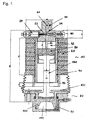
- Fig. 1 shows a longitudinal section of a spring element 10 with an emergency spring 20 and a hydropneumatic strut (HP strut) for arrangement between bogie and car body of a rail vehicle.
- the HP shock absorber has the piston 30 which is longitudinally displaceable in the cylinder 40 is led.
- A is located in the pressure chamber 42 of the cylinder 40 Hydraulic medium, preferably oil, via the connection 60 with a Pressure accumulator is connected.
- the emergency spring 20 surrounds the cylinder 40 of the HP-strut.
- a height sensor 50 is accommodated in the cylinder head 44 mechanical feedback (displacement sensor) 52 movable in the horizontal direction is executed.
- mechanical feedback (displacement sensor) 52 movable in the horizontal direction is executed.
- the cylinder head 44 there is also the vertical bore 46, in which a projection 32 connected to the piston 30 is movably received.
- the approach 32 has the conical region 34.
- the cylinder 40 has in its lower end region the ring 70, which is against a frictional resistance relative to the cylinder 40 up to a stop is movable, which holds the ring 70 in a lowermost position.
- the ring 70 will pressed by the emergency spring 20 on the stop of the cylinder 40.
- the emergency spring 20 is preloaded to approx. 90% of the vehicle's empty weight.
- the adjustment unit 80 is shown, the one Cylinder 90 and a piston 100 slidably received therein.
- the piston 100 and the cylinder 90 delimit a piston chamber 110 into which a medium under pressure can be introduced.
- Pendulum support 120 which supports the HP strut such that also Cross movements are possible.
- the mechanical feedback 52 of the height sensor engages during operation 50 from the surface of the neck 32 of the piston 30.
- the mechanical feedback 52 is proportional to vertical deflection of the extension 32 and thus to the position of the piston 30 emotional.
- the position of the mechanical return 52 not when the neck 32 is moved.
- the height sensor 50 merely reports that the extension 32 is above or below the setting range defined by the conical area 34 located. Using this information, the control can put the shock absorber in the Set the setting range and adjust the desired position here.
- the control takes place by means of the hydraulic circuit shown in FIG. 3. reports the height sensor 50 that the current position of the piston 30 is not the target value corresponds, the oil volume in the piston chamber 42 is increased or decreased.
- the piston chamber 42 of the HP struts stands with the pressure accumulator 140 in connection in which is under pressure Hydraulic fluid and a biased nitrogen volume is located.
- Such one "Nitrogen leather" is also found in the high-pressure accumulator, which uses a Pump is supplied with oil from the low pressure accumulator.
- control of the solenoid valves is carried out by control electronics that work with the actual values of the piston position determined by the height sensors 50 are supplied.
- the height is adjusted by means of the digital one shown in FIG. 3 Control loop. Is the actual value determined by the height sensors 50 correct? Piston position corresponds to the setpoint, there is no change in the oil volume and the solenoid valves are in the closed position. Is the vehicle height too low, the high-pressure accumulator with the piston chamber becomes by means of the solenoid valves 42 connected, whereby the amount of oil in the piston chamber 42 increases and the vehicle is raised. If the measured vehicle height is too high, the piston chamber becomes 42 connected to the low pressure accumulator by means of the solenoid valves and the withdrawn the required amount of oil from the piston chamber 42.
- the vehicle level is determined by two Position sensor 52 determined.
- the adjustment unit shown in Fig. 1 80 operated. This has the piston 100, the piston chamber 110 with a Hydraulic medium is applied. As a result, the piston 100 and the Pendulum support 120 move the entire HP strut upwards until the desired height is reached. After this setting process, there is no Readjustment of the height sensor still necessary the emergency spring height.
- Fig. 2 shows an alternative embodiment of the HP shock absorber, in which the End stop of the emergency spring 20 is designed hydraulically.
- the same parts are shown in Fig. 2 marked with the same reference numerals as in Fig. 1.
- the hydraulic one End stop includes a hydraulic cylinder 200, which has its own Pressure supply or with the pressure system of the HP shock absorber in Connection is established.
- the emergency spring 20 is on one by means of the hydraulic cylinder 200 any value can be preloaded.
- the emergency spring 20 biased to the maximum vehicle weight. This results in the Possibility of lowering the vehicle below the emergency spring height in normal operation, what is desired in certain applications. If the hydraulic pressure drops, the emergency spring automatically lowers and is then available for emergency operation Available.
- When connecting the hydraulic cylinder 200 (room B) to the Piston chamber 42 (chamber A) of the HP spring becomes the emergency spring 20 when the pressure drops Piston chamber 42 unlocked.
- FIG. 2 shows the adjustment unit 80 in a position in which the piston 100 by means of a suitable pressure medium in the piston chamber 110 in the cylinder 90 has been moved up.
- Fig. 4 shows a system diagram with mechanical-hydraulic control of the Piston position of an HP shock absorber according to FIG. 1.
- a mechanical-hydraulic height control valve 210 in the HP strut integrated, whereby the advantage is achieved that no separate control loop is required.
- the valve 210 is on the high pressure as well as on the Low-pressure accumulator connected and controlled by means of a mechanical Returning the position of the piston 30 to the oil volume in the piston chamber 42 long until the vehicle height has reached its setpoint accordingly.
- This System is less expensive than that shown in Fig. 1, but does not allow one Primary spring balancing.
- the arrangement of the mechanical return and the Execution of the approach of the piston correspond to that explained in relation to FIG. 1.
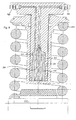
- FIG 5 and 6 show a longitudinal sectional view through a spring element with HP strut in a second embodiment.
- the HP strut includes cylinder 310 and piston 320, which in the Cylinder 310 is guided in a longitudinally displaceable manner.
- the piston 320 points in its Piston chamber 330 directed end region a recess in which the Stop element 400 is added.
- the stop element 400 is relative to the Piston 320 is longitudinally displaceable.
- This pressure fluid can, but does not have to Hydraulic medium of the HP shock absorber correspond, which is preferably made of oil consists.
- the piston chamber 330 is in contact with the pressure supply of the HP shock absorber Connection.
- the connection to the pressure supply is designated by reference number 340 characterized.
- the coil spring 500 is connected in series with the HP shock absorber on the one hand on a projection of the cylinder 310 and on the other hand on one End plate 510 supports. Both are in normal operation of the vehicle Spring elements, i.e. the HP strut and spring 500 engaged, i.e. to take part of the suspension of the vehicle.
- the desired vehicle height is regulated by means of that from FIG. 7 apparent system configuration. 3 in the manner already explained the oil volume in the piston chamber 330 is adjusted to the desired value.
- As Actual value transmitter is used in the area next to the struts Position measuring system 600, which determines the height of the shock absorber.
- the stop element 400 is longitudinally displaceable in the end region of the Piston 320 arranged.
- the introduction of the hydraulic medium through the connection 420 can be done manually using a hand pump or automatically using a control loop respectively.
- the hydraulic system After setting the desired emergency spring height, the hydraulic system is in Put into operation and the vehicle height adjusted to the desired value.
- hydraulic medium is fed through line 350 into the piston chamber 330 introduced until the target value of the vehicle height is reached.
- Fig. 8 shows the hydraulic system with fully automatic wheel wear compensation.
- the wheel diameter is entered via the ZSG.
- the control electronics are the same then the emergency spring height is automatically included each time the vehicle is upgraded predetermined wheel diameters.
- Fig. 9 shows the corresponding Hydraulic diagram.
- the piston chamber 410 has an emergency spring accumulator 700 connectable, the pressurized hydraulic medium and a compressible Gas, preferably nitrogen, which biases the emergency spring accumulator 700.
- a compressible Gas preferably nitrogen
- the memory 700 is also available the piston chamber 410 in connection and hydraulic medium flows out of the Accumulator 700 in the piston chamber 410. This causes the piston to The deflection limit is extended, which keeps the vehicle at the level of the emergency spring is raised. If the normal system state prevails, the return is due Piston on; if there is no system pressure, the pressure of the accumulator 700 is present Piston on.
Landscapes
- Engineering & Computer Science (AREA)
- Mechanical Engineering (AREA)
- Vehicle Body Suspensions (AREA)
- Fluid-Damping Devices (AREA)
Abstract
Description
- Fig. 1:
- Längsschnittdarstellung durch ein HP-Federbein mit mechanischem Endanschlag in einer ersten Ausführungsform,
- Fig .2:
- Längsschnittdarstellung durch ein HP-Federbein mit hydraulischem Endanschlag in einer ersten Ausführungsform,
- Fig. 3:
- Systemschaubild der elektronischen Regelung der Kolbenposition eines HP-Federbeins in einer ersten Ausführungsform,
- Fig. 4:
- Systemschaubild der mechanisch-hydraulischen Regelung der Kolbenposition eines HP-Federbeins in einer ersten Ausführungsform,
- Fig. 5:
- Längsschnittdarstellung durch ein HP-Federbein in einer zweiten Ausführungsform,
- Fig.6:
- vergrößerte Darstellung eines HP-Federbeins in einer zweiten Ausführungsform,
- Fig. 7:
- Systemschaubild der elektronischen Regelung der Kolbenposition eines HP-Federbeins in einer zweiten Ausführungsform mit manuellem Radverschleißausgleich,
- Fig. 8:
- Systemschaubild der elektronischen Regelung der Kolbenposition eines HP-Federbeins in einer zweiten Ausführungsform mit automatischem Radverschleißausgleich und
- Fig. 9:
- Systemschaubild der elektronischen Regelung der Kolbenposition eines HP-Federbeins in einer zweiten Ausführungsform mit hydraulischem Notfederspeicher.
Claims (26)
- Federelement mit einem hydropneumatischen Federbein zur Anordnung zwischen Drehgestell und Wagenkasten eines Schienenfahrzeuges, wobei das Federbein einen in einem Zylinder verschieblich aufgenommenen Kolben umfaßt, wobei der Kolben oder der Zylinder mit dem Drehgestell und das andere der Bauteile mit dem Wagenkasten verbindbar ist und wobei der Kolbenraum des Zylinders mit einem Druckspeicher in Verbindung steht, dadurch gekennzeichnet, daß das hydropneumatische Federbein ein hydraulisches Höhenregulierventil oder einen mit einem Regelkreis in Verbindung stehenden oder verbindbaren Höhensensor umfaßt, mittels derer die Position des Kolbens in dem Zylinder regelbar bzw. erfassbar ist.
- Federelement nach Anspruch 1, dadurch gekennzeichnet, daß das Höhenregulierventil und der Höhensensor eine mechanische Rückführung aufweisen, welche ausschließlich oder auch im Einstellbereich des Federbeins ein von der Position des Kolbens abhängiges Signal abgibt.
- Federelement nach Anspruch 2, dadurch gekennzeichnet, daß die mechanische Rückführung ausschließlich im Einstellbereich des Federbeins ein von der Position des Kolbens abhängiges Signal abgibt, während die Position der mechanischen Rückführung oberhalb und unterhalb des Einstellbereichs konstant ist.
- Federelement nach einem der vorhergehenden Ansprüche, dadurch gekennzeichnet, daß der Kolben einen zumindest abschnittsweise konisch ausgeführten Ansatz aufweist, und daß das Höhenregulierventil und der Höhensensor eine mechanische Rückführung aufweisen, die mit der Oberfläche des Ansatzes zumindest in dem konischen Bereich in Berührung steht und eine von der Position des Ansatzes abhängige Auslenkung erfährt.
- Federelement nach einem der vorhergehenden Ansprüche, dadurch gekennzeichnet, daß im Zylinderkopf eine sich in Längsrichtung des Zylinders erstreckende Bohrung angeordnet ist und daß sich die mechanische Rückführung des Höhenregulierventils oder des Höhensensors in einer sich dazu senkrecht erstreckenden Bohrung des Zylinderkopfes befindet.
- Federelement nach einem der vorhergehenden Ansprüche, dadurch gekennzeichnet, daß eine Notfeder vorgesehen ist, die in das Federbein derart integriert ist, daß die Baulänge des Federbeins durch die Notfeder nicht vergrößert wird.
- Federelement nach Anspruch 6, dadurch gekennzeichnet, daß die Notfeder und das Federbein konzentrisch angeordnet sind und daß die Notfeder den Zylinder des Federbeins umgibt.
- Federelement nach einem der Ansprüche 6 oder 7, dadurch gekennzeichnet, daß die Notfeder vorgespannt ist.
- Federelement nach Anspruch 8, dadurch gekennzeichnet, daß die Notfeder mittels eines mechanischen Endanschlages oder mittels eines Hydraulikzylinders vorgespannt ist.
- Federelement nach Anspruch 9, dadurch gekennzeichnet, daß der Hydraulikzylinder mit dem Kolbenraum des Zylinders des Federbeins in Verbindung steht.
- Federelement nach einem der vorhergehenden Ansprüche, dadurch gekennzeichnet, daß zum Zwecke des Radverschleißausgleiches eine mit dem Federbein in Reihe angeordnete Verstelleinheit vorgesehen ist, die in Bewegungsrichtung des Federbeins höhenverstellbar ist und auf der sich der Kolben oder der Zylinder des Federbeins abstützt.
- Federelement nach Anspruch 11, dadurch gekennzeichnet, daß die Verstelleinheit einen in einem Hydraulikzylinder geführten Kolben umfaßt, der in Bewegungsrichtung des Federbeins höhenverstellbar ist und auf dem sich der Kolben oder der Zylinder des Federbeins abstützt.
- Federelement nach Anspruch 12, dadurch gekennzeichnet, daß ein Ausgleichspendel vorgesehen ist, der mit seinem einen Endbereich mit dem Kolben des Federbeins und mit seinem anderen Endbereich mit dem Kolben des Hydraulikzylinders in Verbindung steht, wobei die Endbereiche des Ausgleichspendels sphärisch ausgebildet sind, so daß eine Bewegung des Federbeins quer zur Bewegungsrichtung des Kolbens möglich ist.
- Federelement mit einem hydropneumatischen Federbein zur Anordnung zwischen Drehgestell und Wagenkasten eines Schienenfahrzeuges, wobei das Federbein einen in einem Zylinder verschieblich aufgenommenen Kolben umfaßt, wobei der Kolben oder der Zylinder mit dem Drehgestell und das andere der Bauteile mit dem Wagenkasten verbindbar ist und wobei der Kolbenraum des Zylinders mit einem Druckspeicher in Verbindung steht, dadurch gekennzeichnet, daß eine mit dem Federbein in Reihe angeordnete Verstelleinheit vorgesehen ist, die in Bewegungsrichtung des Kolbens des Federbeins höhenverstellbar ist und auf der sich der Kolben oder der Zylinder des Federbeins abstützt.
- Federelement nach Anspruch 14, dadurch gekennzeichnet, daß das Federelement nach Anspruch 1 und/oder nach dem kennzeichnenden Teil eines der Ansprüche 2 bis 13 ausgeführt ist.
- Federelement mit einem hydropneumatischen Federbein zur Anordnung zwischen Drehgestell und Wagenkasten eines Schienenfahrzeuges, wobei das Federbein einen in einem Zylinder verschieblich aufgenommenen Kolben umfaßt, wobei der Kolben oder der Zylinder mit dem Drehgestell und das andere der Bauteile mit dem Wagenkasten verbindbar ist und wobei der Kolbenraum des Zylinders mit einem Druckspeicher in Verbindung steht, dadurch gekennzeichnet, daß ein weiteres Federelement vorgesehen ist, das mit dem Federbein in Reihe geschaltet ist und unabhängig von der Position des Kolbens des Federbeins in Eingriff steht.
- Federelement nach Anspruch 16, dadurch gekennzeichnet, daß das weitere Federelement als Schrauben- oder Gummifeder ausgeführt ist.
- Federelement nach Anspruch 16 oder 17, dadurch gekennzeichnet, daß ein Anschlagelement vorgesehen ist, das in Richtung der Bewegung des Kolbens im Zylinder längsverschieblich ausgeführt ist und mittels dessen die Endposition des Kolbens im Zylinder veränderbar ist.
- Federelement nach Anspruch 18, dadurch gekennzeichnet, daß das Anschlagelement in dem zu dem Kolbenraum gerichteten Endbereich des Kolbens vorgesehen ist.
- Federelement nach Anspruch 19, dadurch gekennzeichnet, daß ein weiterer Kolbenraum vorgesehen ist, der mit dem Anschlagelement in dessen vom Kolbenraum des Zylinders des Federbeins abgewandten Endbereich in Verbindung steht und in dem ein Druckfluid aufgenommen ist oder aufnehmbar ist.
- Federelement nach einem der Ansprüche 16 bis 20, dadurch gekennzeichnet, daß das Anschlagelement wenigstens teilweise in einer Ausnehmung des Kolbens des Federbeins aufgenommen ist.
- Federelement nach Anspruch 20 oder 21, dadurch gekennzeichnet, daß bei Ausfall des Hydraulikdruckes des Federbeins der weitere Kolbenraum mit einem Hydraulikfluid enthaltenden Druckspeicher verbindbar ist.
- Federelement nach Anspruch 22, dadurch gekennzeichnet, daß der Speicher ein kompressibles Gasvolumen enthält.
- Federelement nach Anspruch 22 oder 23, dadurch gekennzeichnet, daß druckgesteuerte Ventile vorgesehen sind, die den Druckspeicher mit dem weiteren Kolbenraum verbinden, wenn der Hydraulikdruck des Federbeins einen vorgegebenen Wert unterschreitet.
- Federelement mit einem hydropneumatischen Federbein zur Anordnung zwischen Drehgestell und Wagenkasten eines Schienenfahrzeuges, wobei das Federbein einen in einem Zylinder verschieblich aufgenommenen Kolben umfaßt, wobei der Kolben oder der Zylinder mit dem Drehgestell und das andere der Bauteile mit dem Wagenkasten verbindbar ist und wobei der Kolbenraum des Zylinders mit einem Druckspeicher in Verbindung steht, dadurch gekennzeichnet, daß ein Anschlagelement vorgesehen ist, das in Richtung der Kolbenbewegung längsverschieblich ausgeführt ist und mittels dessen die Endposition des Kolbens im Zylinder veränderbar ist.
- Federelement nach Anspruch 25, dadurch gekennzeichnet, daß das Federelement nach Anspruch 16 und/oder nach einem der kennzeichnenden Teile der Ansprüche 17 bis 24 ausgeführt ist.
Priority Applications (1)
| Application Number | Priority Date | Filing Date | Title |
|---|---|---|---|
| DE20321079U DE20321079U1 (de) | 2003-08-20 | 2003-08-20 | Federelement |
Applications Claiming Priority (2)
| Application Number | Priority Date | Filing Date | Title |
|---|---|---|---|
| DE10238059.7A DE10238059B4 (de) | 2002-08-20 | 2002-08-20 | Federelement |
| DE10238059 | 2002-08-20 |
Publications (3)
| Publication Number | Publication Date |
|---|---|
| EP1391331A2 true EP1391331A2 (de) | 2004-02-25 |
| EP1391331A3 EP1391331A3 (de) | 2004-07-14 |
| EP1391331B1 EP1391331B1 (de) | 2007-06-27 |
Family
ID=30775446
Family Applications (1)
| Application Number | Title | Priority Date | Filing Date |
|---|---|---|---|
| EP03018941A Expired - Lifetime EP1391331B1 (de) | 2002-08-20 | 2003-08-20 | Hydropneumatisches Federelement mit integriertem Höhensensor oder Höhenregulierventil, für ein Schienenfahrzeug |
Country Status (4)
| Country | Link |
|---|---|
| US (1) | US7520494B2 (de) |
| EP (1) | EP1391331B1 (de) |
| DE (2) | DE10238059B4 (de) |
| ES (1) | ES2287391T3 (de) |
Cited By (8)
| Publication number | Priority date | Publication date | Assignee | Title |
|---|---|---|---|---|
| WO2011039092A3 (de) * | 2009-09-30 | 2011-10-13 | Bombardier Transportation Gmbh | Federanordnung zur niveauregulierung in einem fahrzeug |
| AT514305A1 (de) * | 2013-04-23 | 2014-11-15 | Siemens Ag Oesterreich | Tragestruktur eines Schienenfahrzeugs |
| CN104196948A (zh) * | 2014-08-26 | 2014-12-10 | 合肥工业大学 | 馈能型自传感磁流变减振器 |
| CN106704443A (zh) * | 2016-12-27 | 2017-05-24 | 胡满航 | 一种新型的电动车减震器总成 |
| EP3254924A1 (de) * | 2016-06-09 | 2017-12-13 | ALSTOM Transport Technologies | Schienenfahrzeug, das mit einem nivelliersystem ausgestattet ist, und entsprechendes verkehrsverfahren |
| EP3263419A1 (de) * | 2016-06-29 | 2018-01-03 | ALSTOM Transport Technologies | Verfahren zur höhensteuerung eines transportfahrzeugs, und entsprechendes transportfahrzeug |
| WO2018189072A1 (de) * | 2017-04-11 | 2018-10-18 | Knorr-Bremse Systeme für Schienenfahrzeuge GmbH | Niveauregelsystem für ein fahrzeug, insbesondere schienenfahrzeug |
| CN113492889A (zh) * | 2020-04-07 | 2021-10-12 | 利勃海尔交通系统股份有限公司 | 用于车辆的液压气动的弹性支撑装置 |
Families Citing this family (15)
| Publication number | Priority date | Publication date | Assignee | Title |
|---|---|---|---|---|
| CA2563547C (en) * | 2004-04-19 | 2015-01-27 | Synthes Gmbh | Elastic element produced from radiolucent material for a medical device |
| DE202005009909U1 (de) * | 2005-06-23 | 2006-10-26 | Liebherr-Aerospace Lindenberg Gmbh | Federsystem |
| CA2827898C (en) * | 2011-02-22 | 2018-01-16 | Tec Tran Brake Corp. | Leveling railway vehicle and related systems and methods |
| US8991832B2 (en) * | 2012-05-11 | 2015-03-31 | Doefer Companies | Double-acting suspension axle assembly for heavy load transporters |
| KR101896716B1 (ko) * | 2012-11-08 | 2018-09-07 | 현대자동차주식회사 | 트러니언 베이스 하중 분배장치 |
| US9771147B2 (en) * | 2013-10-11 | 2017-09-26 | Goodrich Corporation | Shrink strut landing gear system, method, and apparatus |
| DE102014216965A1 (de) * | 2014-08-26 | 2016-03-03 | Siemens Aktiengesellschaft | Fahrwerk für ein Schienenfahrzeug |
| DE102015013605B4 (de) | 2015-10-21 | 2018-08-23 | Liebherr-Transportation Systems Gmbh & Co. Kg | Niveauregulierung |
| FR3049503B1 (fr) * | 2016-03-29 | 2019-06-14 | Unac | Dispositif de suspension pour vehicule ferroviaire ou rail-route. |
| US10442448B2 (en) | 2017-03-08 | 2019-10-15 | Bombardier Transportation Gmbh | Height adjustable secondary suspension for a rail vehicle |
| WO2019091636A1 (de) * | 2017-11-09 | 2019-05-16 | Knorr-Bremse Systeme für Schienenfahrzeuge GmbH | Niveauregelsystem zur einstellung des niveaus eines fahrzeugs, insbesondere schienenfahrzeugs |
| WO2019091635A1 (de) * | 2017-11-09 | 2019-05-16 | Knorr-Bremse Systeme für Schienenfahrzeuge GmbH | Niveauregelsystem zur einstellung des niveaus eines fahrzeugs, insbesondere schienenfahrzeugs |
| ES2913093T3 (es) * | 2017-11-09 | 2022-05-31 | Knorr Bremse Systeme | Sistema de nivelación para un vehículo, en particular un vehículo ferroviario. |
| WO2019091637A1 (de) * | 2017-11-09 | 2019-05-16 | Knorr-Bremse Systeme für Schienenfahrzeuge GmbH | Niveauregelsystem zur einstellung des niveaus eines fahrzeugs, insbesondere schienenfahrzeugs |
| DE102018212109A1 (de) * | 2018-07-20 | 2020-01-23 | Bayerische Motoren Werke Aktiengesellschaft | Höhenverstellbare Federanordnung für ein Fahrzeug |
Family Cites Families (22)
| Publication number | Priority date | Publication date | Assignee | Title |
|---|---|---|---|---|
| DE1833520U (de) * | 1958-05-21 | 1961-06-22 | Daimler Benz Ag | Hoehenregler fuer druckmittelfederungen in kraftfahrzeugen. |
| FR1281356A (fr) * | 1960-11-28 | 1962-01-12 | Dispositif de commande pour circuit hydraulique | |
| US4828231A (en) * | 1986-01-30 | 1989-05-09 | Nhk Spring Co., Ltd. | Car suspension system |
| US4890822A (en) * | 1986-02-13 | 1990-01-02 | Nhk Spring Co., Ltd. | Car suspension system |
| JP2575439B2 (ja) * | 1988-01-19 | 1997-01-22 | 日本発条株式会社 | アキュムレータ |
| JP2628947B2 (ja) * | 1991-08-06 | 1997-07-09 | 本田技研工業株式会社 | 能動型懸架装置の油圧制御装置 |
| DE4234523A1 (de) * | 1992-10-13 | 1994-04-14 | Knorr Bremse Ag | Niveau- und Neigungssteuerung eines Wagenkastens |
| DE9304837U1 (de) * | 1993-03-30 | 1993-05-27 | Knorr-Bremse AG, 8000 München | Pendelstütze mit federndem Stützkörper und Zusatz- und Notfeder |
| DE4406607C2 (de) * | 1994-03-01 | 1997-05-28 | Daimler Benz Ag | Luftfederaggregat |
| AU1869097A (en) * | 1995-12-12 | 1997-07-03 | Phoenix Aktiengesellschaft | Spring device |
| US5988607A (en) * | 1996-05-28 | 1999-11-23 | Fichtel & Sachs Ag | Self-pumping hydropneumatic strut with an internal level control |
| JPH10338017A (ja) * | 1997-04-11 | 1998-12-22 | Tokico Ltd | シリンダ装置および車高調整装置 |
| DE29813031U1 (de) * | 1997-07-23 | 1998-11-12 | Integral Verkehrstechnik Ag, Jenbach | Federvorrichtung |
| DE19805896C1 (de) | 1998-02-13 | 1999-07-15 | Abb Daimler Benz Transp | Schienenfahrzeug |
| DE19815197C1 (de) * | 1998-04-04 | 1999-07-22 | Abb Daimler Benz Transp | Schienenfahrzeug mit einem verikalen Stützaktuator |
| AUPP521598A0 (en) * | 1998-08-13 | 1998-09-03 | Birrana Engineering Pty Ltd | Improved hydraulic adaptive vehicle suspension system |
| AT407031B (de) * | 1998-12-03 | 2000-11-27 | Integral Verkehrstechnik Ag | Federund für ein schienenfahrzeug |
| JP4966467B2 (ja) | 2000-03-20 | 2012-07-04 | コンティテック ルフトフェデルシステメ ゲーエムベーハー | 副次緩衝システム |
| DE10056929A1 (de) | 2000-11-17 | 2002-05-29 | Knorr Bremse Systeme | Hydropneumatische Federungeinheit sowie hydropneumatisches Federungssystem |
| US6698729B2 (en) * | 2001-06-15 | 2004-03-02 | Mark A. Popjoy | Gas spring having a controllable output force |
| US6695294B2 (en) * | 2001-07-20 | 2004-02-24 | Lord Corporation | Controlled equilibrium device with displacement dependent spring rates and integral damping |
| US6637348B1 (en) * | 2002-07-02 | 2003-10-28 | Siemens Sgp Verkehrstechnik Gmbh | Level-adjustable main spring and actively biased emergency spring with fail-safe behavior |
-
2002
- 2002-08-20 DE DE10238059.7A patent/DE10238059B4/de not_active Expired - Fee Related
-
2003
- 2003-08-20 EP EP03018941A patent/EP1391331B1/de not_active Expired - Lifetime
- 2003-08-20 DE DE50307549T patent/DE50307549D1/de not_active Expired - Lifetime
- 2003-08-20 ES ES03018941T patent/ES2287391T3/es not_active Expired - Lifetime
- 2003-08-20 US US10/644,134 patent/US7520494B2/en not_active Expired - Fee Related
Cited By (20)
| Publication number | Priority date | Publication date | Assignee | Title |
|---|---|---|---|---|
| WO2011039092A3 (de) * | 2009-09-30 | 2011-10-13 | Bombardier Transportation Gmbh | Federanordnung zur niveauregulierung in einem fahrzeug |
| CN102639381A (zh) * | 2009-09-30 | 2012-08-15 | 庞巴迪运输有限公司 | 车辆内进行水平调整的弹簧阵列 |
| US8899159B2 (en) | 2009-09-30 | 2014-12-02 | Bombardier Transportation Gmbh | Spring assembly for level control in a vehicle |
| CN102639381B (zh) * | 2009-09-30 | 2015-04-15 | 庞巴迪运输有限公司 | 车辆内进行水平调整的弹簧阵列 |
| AT514305A1 (de) * | 2013-04-23 | 2014-11-15 | Siemens Ag Oesterreich | Tragestruktur eines Schienenfahrzeugs |
| US9878726B2 (en) | 2013-04-23 | 2018-01-30 | Siemens Ag Österreich | Carrying structure of a rail vehicle |
| CN104196948A (zh) * | 2014-08-26 | 2014-12-10 | 合肥工业大学 | 馈能型自传感磁流变减振器 |
| CN104196948B (zh) * | 2014-08-26 | 2016-02-24 | 合肥工业大学 | 馈能型自传感磁流变减振器 |
| CN107487336A (zh) * | 2016-06-09 | 2017-12-19 | 阿尔斯通运输科技公司 | 设置有高度调整装置的轨道车辆及相关运行方法 |
| FR3052423A1 (fr) * | 2016-06-09 | 2017-12-15 | Alstom Transp Tech | Vehicule ferroviaire pourvu d'un nivellement et procede de circulation associe |
| EP3254924A1 (de) * | 2016-06-09 | 2017-12-13 | ALSTOM Transport Technologies | Schienenfahrzeug, das mit einem nivelliersystem ausgestattet ist, und entsprechendes verkehrsverfahren |
| US10543857B2 (en) | 2016-06-09 | 2020-01-28 | Alstom Transport Technologies | Rail vehicle provided with a leveling and associated running method |
| CN107487336B (zh) * | 2016-06-09 | 2021-08-27 | 阿尔斯通运输科技公司 | 设置有高度调整装置的轨道车辆及相关运行方法 |
| EP3263419A1 (de) * | 2016-06-29 | 2018-01-03 | ALSTOM Transport Technologies | Verfahren zur höhensteuerung eines transportfahrzeugs, und entsprechendes transportfahrzeug |
| FR3053301A1 (fr) * | 2016-06-29 | 2018-01-05 | Alstom Transport Technologies | Procede de commande de la hauteur d'un vehicule de transport et vehicule de transport associe |
| US10787185B2 (en) | 2016-06-29 | 2020-09-29 | Alstom Transport Technologies | Method for controlling the height of a transport vehicle and related transport vehicle |
| CN106704443A (zh) * | 2016-12-27 | 2017-05-24 | 胡满航 | 一种新型的电动车减震器总成 |
| WO2018189072A1 (de) * | 2017-04-11 | 2018-10-18 | Knorr-Bremse Systeme für Schienenfahrzeuge GmbH | Niveauregelsystem für ein fahrzeug, insbesondere schienenfahrzeug |
| US11459001B2 (en) | 2017-04-11 | 2022-10-04 | Knorr-Bremse Systeme für Schienenfahrzeuge GmbH | Level control system for a vehicle, in particular a rail vehicle |
| CN113492889A (zh) * | 2020-04-07 | 2021-10-12 | 利勃海尔交通系统股份有限公司 | 用于车辆的液压气动的弹性支撑装置 |
Also Published As
| Publication number | Publication date |
|---|---|
| DE10238059B4 (de) | 2014-02-13 |
| US7520494B2 (en) | 2009-04-21 |
| ES2287391T3 (es) | 2007-12-16 |
| DE10238059A1 (de) | 2004-03-11 |
| EP1391331A3 (de) | 2004-07-14 |
| US20050029064A1 (en) | 2005-02-10 |
| EP1391331B1 (de) | 2007-06-27 |
| DE50307549D1 (de) | 2007-08-09 |
Similar Documents
| Publication | Publication Date | Title |
|---|---|---|
| EP1391331A2 (de) | Hydropneumatisches Federelement mit integriertem Höhensensor oder Höhenregulierventil, für ein Schienenfahrzeug | |
| AT500202B1 (de) | Vorrichtung zur sekundärfederung eines wagenkastens bei einem schienenfahrzeug mit einem aktiven federelement | |
| DE102015016024B4 (de) | Federsystem eines Schienenfahrzeuges | |
| EP2129538A1 (de) | Federanordnung mit verstellbarer federrate und federbein mit einer solchen federanordnung | |
| EP0534075A1 (de) | Hydraulischer regelbarer Schwingungsdämpfer | |
| WO2020001962A1 (de) | FAHRZEUG-RADAUFHÄNGUNG MIT EINEM VERSTELLSYSTEM FÜR DEN FUßPUNKT EINER AUFBAU-TRAGFEDER | |
| DE3619402C2 (de) | ||
| DE202005009909U1 (de) | Federsystem | |
| DE3934385A1 (de) | Hydropneumatisches federungssystem | |
| WO2019020625A1 (de) | Tragfeder-dämpfer-system eines fahrzeug-rades | |
| WO2002064387A1 (de) | Federungssystem, insbesondere für eine arbeitsmaschine | |
| DE102016201649B4 (de) | Selbstpumpendes hydropneumatisches Federbein | |
| DE4193088C2 (de) | Hydraulischer Schwingungsdämpfer mit integrierter Nivellier-Regeleinrichtung | |
| EP0548734A1 (de) | Unterlage für einen beweglichen Oberbaugleisabschnitt | |
| DE3300662A1 (de) | Niveauregeleinrichtung fuer fahrzeuge | |
| DE10321997A1 (de) | Fahrzeug-Federungssystem mit veränderbarem Höhenstand des Fahrzeug-Aufbaus | |
| DE20321079U1 (de) | Federelement | |
| DE1482917C3 (de) | Regelvorrichtung zur Aufrechterhaltung eines konstanten Druckes eines Strömungsmittels in einem Stellzylinder einer Landmaschine | |
| DE1605836A1 (de) | Vorrichtung zum Steuern der Neigung eines Fahrzeugs | |
| DE2728199A1 (de) | Vorrichtung zum schwenken einer maschinenbaugruppe | |
| EP1657470B1 (de) | Hydropneumatisches Federelement für Kraftfahrzeuge, insbesondere Kettenfahrzeuge | |
| DE102006027388B4 (de) | Federsystem | |
| DE102021204158B3 (de) | Dämpfventileinrichtung mit einem Notbetriebsventil | |
| DE2740635C2 (de) | Hydropneumatischer Antrieb | |
| DE3122272A1 (de) | "niveauregelvorrichtung fuer fahrzeuge mit einem selbstpumpenden hydropneumatischen federbein" |
Legal Events
| Date | Code | Title | Description |
|---|---|---|---|
| PUAI | Public reference made under article 153(3) epc to a published international application that has entered the european phase |
Free format text: ORIGINAL CODE: 0009012 |
|
| AK | Designated contracting states |
Kind code of ref document: A2 Designated state(s): AT BE BG CH CY CZ DE DK EE ES FI FR GB GR HU IE IT LI LU MC NL PT RO SE SI SK TR |
|
| AX | Request for extension of the european patent |
Extension state: AL LT LV MK |
|
| PUAL | Search report despatched |
Free format text: ORIGINAL CODE: 0009013 |
|
| RIC1 | Information provided on ipc code assigned before grant |
Ipc: 7B 61F 5/14 B Ipc: 7B 60G 17/015 A Ipc: 7B 61F 5/22 B Ipc: 7B 60G 11/62 B |
|
| AK | Designated contracting states |
Kind code of ref document: A3 Designated state(s): AT BE BG CH CY CZ DE DK EE ES FI FR GB GR HU IE IT LI LU MC NL PT RO SE SI SK TR |
|
| AX | Request for extension of the european patent |
Extension state: AL LT LV MK |
|
| 17P | Request for examination filed |
Effective date: 20050114 |
|
| AKX | Designation fees paid |
Designated state(s): DE ES FR IT |
|
| GRAP | Despatch of communication of intention to grant a patent |
Free format text: ORIGINAL CODE: EPIDOSNIGR1 |
|
| GRAS | Grant fee paid |
Free format text: ORIGINAL CODE: EPIDOSNIGR3 |
|
| GRAA | (expected) grant |
Free format text: ORIGINAL CODE: 0009210 |
|
| AK | Designated contracting states |
Kind code of ref document: B1 Designated state(s): DE ES FR IT |
|
| REF | Corresponds to: |
Ref document number: 50307549 Country of ref document: DE Date of ref document: 20070809 Kind code of ref document: P |
|
| ET | Fr: translation filed | ||
| REG | Reference to a national code |
Ref country code: ES Ref legal event code: FG2A Ref document number: 2287391 Country of ref document: ES Kind code of ref document: T3 |
|
| PLBE | No opposition filed within time limit |
Free format text: ORIGINAL CODE: 0009261 |
|
| STAA | Information on the status of an ep patent application or granted ep patent |
Free format text: STATUS: NO OPPOSITION FILED WITHIN TIME LIMIT |
|
| 26N | No opposition filed |
Effective date: 20080328 |
|
| REG | Reference to a national code |
Ref country code: FR Ref legal event code: PLFP Year of fee payment: 14 |
|
| REG | Reference to a national code |
Ref country code: FR Ref legal event code: PLFP Year of fee payment: 15 |
|
| REG | Reference to a national code |
Ref country code: FR Ref legal event code: PLFP Year of fee payment: 16 |
|
| PGFP | Annual fee paid to national office [announced via postgrant information from national office to epo] |
Ref country code: IT Payment date: 20220831 Year of fee payment: 20 Ref country code: ES Payment date: 20220901 Year of fee payment: 20 Ref country code: DE Payment date: 20220829 Year of fee payment: 20 |
|
| PGFP | Annual fee paid to national office [announced via postgrant information from national office to epo] |
Ref country code: FR Payment date: 20220824 Year of fee payment: 20 |
|
| REG | Reference to a national code |
Ref country code: DE Ref legal event code: R071 Ref document number: 50307549 Country of ref document: DE |
|
| REG | Reference to a national code |
Ref country code: ES Ref legal event code: FD2A Effective date: 20230828 |
|
| PG25 | Lapsed in a contracting state [announced via postgrant information from national office to epo] |
Ref country code: ES Free format text: LAPSE BECAUSE OF EXPIRATION OF PROTECTION Effective date: 20230821 |