EP1382702B1 - Hochfestes Stahlblech mit hervorragender Verformbarkeit und Verfahren zu dessen Herstellung - Google Patents
Hochfestes Stahlblech mit hervorragender Verformbarkeit und Verfahren zu dessen Herstellung Download PDFInfo
- Publication number
- EP1382702B1 EP1382702B1 EP03254416A EP03254416A EP1382702B1 EP 1382702 B1 EP1382702 B1 EP 1382702B1 EP 03254416 A EP03254416 A EP 03254416A EP 03254416 A EP03254416 A EP 03254416A EP 1382702 B1 EP1382702 B1 EP 1382702B1
- Authority
- EP
- European Patent Office
- Prior art keywords
- steel sheet
- less
- mass
- martensite
- equal
- Prior art date
- Legal status (The legal status is an assumption and is not a legal conclusion. Google has not performed a legal analysis and makes no representation as to the accuracy of the status listed.)
- Expired - Lifetime
Links
Images

Classifications
-
- C—CHEMISTRY; METALLURGY
- C21—METALLURGY OF IRON
- C21D—MODIFYING THE PHYSICAL STRUCTURE OF FERROUS METALS; GENERAL DEVICES FOR HEAT TREATMENT OF FERROUS OR NON-FERROUS METALS OR ALLOYS; MAKING METAL MALLEABLE, e.g. BY DECARBURISATION OR TEMPERING
- C21D8/00—Modifying the physical properties of ferrous metals or ferrous alloys by deformation combined with, or followed by, heat treatment
- C21D8/02—Modifying the physical properties of ferrous metals or ferrous alloys by deformation combined with, or followed by, heat treatment during manufacturing of plates or strips
- C21D8/021—Modifying the physical properties of ferrous metals or ferrous alloys by deformation combined with, or followed by, heat treatment during manufacturing of plates or strips involving particular fabrication steps or treatments of ingots or slabs
-
- C—CHEMISTRY; METALLURGY
- C21—METALLURGY OF IRON
- C21D—MODIFYING THE PHYSICAL STRUCTURE OF FERROUS METALS; GENERAL DEVICES FOR HEAT TREATMENT OF FERROUS OR NON-FERROUS METALS OR ALLOYS; MAKING METAL MALLEABLE, e.g. BY DECARBURISATION OR TEMPERING
- C21D1/00—General methods or devices for heat treatment, e.g. annealing, hardening, quenching or tempering
- C21D1/18—Hardening; Quenching with or without subsequent tempering
- C21D1/19—Hardening; Quenching with or without subsequent tempering by interrupted quenching
-
- C—CHEMISTRY; METALLURGY
- C22—METALLURGY; FERROUS OR NON-FERROUS ALLOYS; TREATMENT OF ALLOYS OR NON-FERROUS METALS
- C22C—ALLOYS
- C22C38/00—Ferrous alloys, e.g. steel alloys
- C22C38/02—Ferrous alloys, e.g. steel alloys containing silicon
-
- C—CHEMISTRY; METALLURGY
- C22—METALLURGY; FERROUS OR NON-FERROUS ALLOYS; TREATMENT OF ALLOYS OR NON-FERROUS METALS
- C22C—ALLOYS
- C22C38/00—Ferrous alloys, e.g. steel alloys
- C22C38/04—Ferrous alloys, e.g. steel alloys containing manganese
-
- C—CHEMISTRY; METALLURGY
- C21—METALLURGY OF IRON
- C21D—MODIFYING THE PHYSICAL STRUCTURE OF FERROUS METALS; GENERAL DEVICES FOR HEAT TREATMENT OF FERROUS OR NON-FERROUS METALS OR ALLOYS; MAKING METAL MALLEABLE, e.g. BY DECARBURISATION OR TEMPERING
- C21D2211/00—Microstructure comprising significant phases
- C21D2211/001—Austenite
-
- C—CHEMISTRY; METALLURGY
- C21—METALLURGY OF IRON
- C21D—MODIFYING THE PHYSICAL STRUCTURE OF FERROUS METALS; GENERAL DEVICES FOR HEAT TREATMENT OF FERROUS OR NON-FERROUS METALS OR ALLOYS; MAKING METAL MALLEABLE, e.g. BY DECARBURISATION OR TEMPERING
- C21D2211/00—Microstructure comprising significant phases
- C21D2211/005—Ferrite
-
- C—CHEMISTRY; METALLURGY
- C21—METALLURGY OF IRON
- C21D—MODIFYING THE PHYSICAL STRUCTURE OF FERROUS METALS; GENERAL DEVICES FOR HEAT TREATMENT OF FERROUS OR NON-FERROUS METALS OR ALLOYS; MAKING METAL MALLEABLE, e.g. BY DECARBURISATION OR TEMPERING
- C21D2211/00—Microstructure comprising significant phases
- C21D2211/008—Martensite
-
- C—CHEMISTRY; METALLURGY
- C21—METALLURGY OF IRON
- C21D—MODIFYING THE PHYSICAL STRUCTURE OF FERROUS METALS; GENERAL DEVICES FOR HEAT TREATMENT OF FERROUS OR NON-FERROUS METALS OR ALLOYS; MAKING METAL MALLEABLE, e.g. BY DECARBURISATION OR TEMPERING
- C21D8/00—Modifying the physical properties of ferrous metals or ferrous alloys by deformation combined with, or followed by, heat treatment
- C21D8/02—Modifying the physical properties of ferrous metals or ferrous alloys by deformation combined with, or followed by, heat treatment during manufacturing of plates or strips
- C21D8/0221—Modifying the physical properties of ferrous metals or ferrous alloys by deformation combined with, or followed by, heat treatment during manufacturing of plates or strips characterised by the working steps
- C21D8/0226—Hot rolling
Definitions
- the present invention relates to a high-strength steel sheet having excellent workability and, specifically, to a high-strength steel sheet which is excellent in balance between strength and total elongation (especially local elongation in the latter stage of transformation out of total elongation) and has a low yield ratio. More specifically, there is provided a steel sheet which satisfies strength [TS (MPa)] ⁇ local elongation [1-EL (%)] ⁇ 5500, ratio [(1-EL)/(t-EL)] of local elongation to total elongation [t-EL (%)] ⁇ 0.25, and yield ratio (YR) ⁇ 65 %.
- moldability is strongly desired even for high-strength steel sheets and it is important to select and use a high-strength steel sheet having suitable moldability according to application purpose.
- a high-strength steel sheet which has both stretch-formability (ductility) and stretch-flange properties (hole expandability (local ductility)) (that is, low yield ratio) and good balance between strength and local elongation is earnestly desired.
- the residual austenite steel sheet in which the residual austenite is formed in the structure and ductility is improved by the induction transformation (transformation-induced plasticity: TRIP) of ⁇ R during processing deformation
- TRIP transformation-induced plasticity
- Japanese Laid-open Patent Application No. 2-97620 discloses a TRIP composite structure steel (PF steel) composed of a mixed structure of ferrite, bainite and the residual austenite. According to the above publication, the steel is produced by heating at a bainite transformation temperature range and maintaining that temperature for a predetermined time (so-called austempering) .
- C having a large dispersion constant is concentrated in untransformed austenite and stabilized to cause austenite to remain without transforming it into martensite at room temperature, thereby obtaining a high-strength steel sheet having excellent workability.
- ductility especially local elongation
- Japanese Laid-open Patent Application No. 5-255799 discloses a steel sheet which contains one or more out of bainite, martensite and the residual austenite and ferrite and its local ductility is much higher than a conventional TRIP steel sheet.
- the yield ratio of Example is calculated, it is 78 % or more which means the steel sheet is inferior in stretch-formability. The reason for this seems to be that the amount of the formed martensite and the like useful for the reduction of yield ratio greatly decreases because the top priority is placed on the improvement of ductility (especially local elongation) in the above steel sheet.
- EPO 0 952 235 discloses high-strength steel sheets containing in terms of weight percentage, carbon at from 0.03% to 0.3%, either or both silicon and aluminium at a total of from 0.5% to 3.0%, and if necessary one or more from among manganese, nickel, chromium, copper and molybdenum at a total of from 0.5% to 3.5%, with the remainder being iron as the primary component.
- the steel microstructure comprises: a volume fraction of ferrite of at least 40%, a volume fraction of retained austenite 3 to 50% and a volume fraction of martensite 3 to 30%. Carbon concentrations in retained austenite lie between 1,01% and 1,4%.
- a goal of the present invention which has been made in view of the above situation, is to provide a high-strength steel sheet which has good balance between strength and local elongation and a low yield ratio and a process for producing this high-strength steel sheet efficiently.
- the process for producing the steel sheet of the present invention which solves the above problem is a process for producing a high-strength steel sheet by hot rolling, optionally cold rolling and continuous annealing according to the present invention, which comprises the steps of subjecting a slab containing the above components to solution treatment at 1,270°C or higher for 5 hours or more before hot rolling, hot rolling the slab into a steel sheet and subjecting the steel sheet to austempering to be wound up after the hot rolled steel sheet is cooled to a bainite transformation range and maintained at that temperature range for 50 to 200 seconds.
- the present invention is constituted as described above, there can be provided a high-strength steel sheet which has good balance between strength and local elongation and a low yield ratio and a process for producing this high-strength steel sheet efficiently.
- the inventors of the present invention have conducted intensive studies to provide a TRIP steel sheet having "high ductility (especially excellent local elongation)" and “high moldability (low yield ratio)" which have been considered difficult to be obtained at the same time for a conventional TRIP steel sheet, paying special attention to the residual austenite ( ⁇ R ). As a result, they have found that a high-strength steel sheet having both of the above properties is obtained by carrying out solution treatment and suitably carrying out austempering. Solution treatment has not been employed to produce a TRIP steel sheet because it takes a long time before hot rolling.
- ⁇ R having small differences in the concentration distribution of C can be formed stably in an arbitrary portion at the grain boundary of ferrite or within the ferrite particle, (2) ⁇ R which contributes to the improvement of ductility, martensite which contributes to the improvement of moldability (reduction of yield ratio) and instable ⁇ R which readily transforms into martensite can be thereby deposited in a well-balanced manner, and (3) a large amount of ⁇ R which contributes to the improvement of local elongation in the latter stage of transformation is formed within the ferrite particle when the amount of ⁇ R in the steel sheet is measured.
- ductility especially local elongation
- ⁇ R controls ductility in the structure of a TRIP steel sheet.
- ⁇ R existent in the grain boundary of ferrite has low C ⁇ R or is coarse, that is, "the stability of ⁇ R is low”. Therefore, it is considered to be highly probable that it is existent as martensite at room temperature.
- the cause of forming " ⁇ R having large differences in the concentration distribution of C" is considered to be the central segregation (macrosegregation) of a substituted alloy element (slowly dispersed element in the center portion of the slab) such as Mn.
- Mn added to steel is useful as an element for forming ⁇ R but has a defect that it is easily segregated by casting. It is extremely difficult to eliminate the central segregation of a substituted alloy element such as Mn by a winding treatment during hot rolling or heat treatment during recrystallization annealing (CAL/CGL) . Therefore, it is considered that ⁇ R having large differences in the concentration distribution of C is formed in the grain boundary of ferrite in large quantities and nonuniformly along with the central segregation by coagulation segregation at the time of casting.
- CAL/CGL recrystallization annealing
- ⁇ R of the steel sheet of the present invention in particular, in the present invention, ⁇ R whose average C ⁇ R content is controlled to a relatively high level of 0.95 to 1.2 % and to an extremely narrow range (small differences in the concentration distribution of C) is formed within the ferrite particle in large quantities, which makes the steel sheet of the present invention clearly different from a TRIP steel sheet (TRIP steel sheet having enhanced ductility in particular) of the prior arts.
- the TRIP steel sheet of the prior arts which attaches importance to the improvement of ductility has an average C ⁇ R content of about 1.2 to 1.3 %, which is a relatively high value.
- nonuniform ⁇ R having large differences in the concentration distribution of C is formed particularly in the grain boundary of ferrite in large quantities.
- Fig. 2 is a graph showing changes in the C content [C ⁇ R (mass%)] and volume fraction [V ⁇ R (vol%)] of ⁇ R based on the results of Examples to be described hereinafter according to the existence of solution treatment and when the austemper time is changed.
- V ⁇ R signifies the volume fraction (amount of ⁇ R existent within the ferrite particle) of ⁇ R calculated by a saturation magnetization measurement method described in (2) above.
- the region (1) is a region where " ⁇ R has low stability” and is very likely to be existent as martensite at room temperature
- the region (2) is a region where " ⁇ R is existent relatively stably”
- the region (3) is a region where " ⁇ R has high stability”.
- the curves shown by dot lines show hot rolled steel sheets of the prior arts obtained by changing the austempering time to 180, 300 and 600 seconds without solution treatment.
- C ⁇ R becomes higher.
- the steel sheets of the prior arts are not subjected to solution treatment, in either case, nonuniform ⁇ R having large differences in the concentration distribution of C is formed and the amount of ⁇ R existent within the ferrite particle remains unchanged and small.
- the austempering time is 180 seconds
- the average value of C ⁇ R is 0.90 % which is below the lower limit (0.95 %) of the present invention.
- the average value of C ⁇ R satisfies the range (0.95 to 1.2 %) of the present invention, but the region where ⁇ R has high stability increases and the region where ⁇ R has low stability decreases, whereby YR becomes high and desired characteristic properties are not obtained.
- the curves shown by solid lines are hot rolled steel sheets obtained by carrying out solution treatment and changing the austempering time to 30, 180 and 300 seconds.
- C ⁇ R becomes higher
- the steel sheets are subjected to solution treatment, the differences in the concentration distribution of C are small and the amount of ⁇ R existent within the ferrite particle greatly increases.
- the austempering time is short at 30 seconds, desired C ⁇ R is not obtained and when the austempering time is long at 300 seconds, C ⁇ R is 1.25 % which is larger than the upper limit value of the present invention.
- the austempering time is 180 seconds, desired C ⁇ R is obtained, whereby the targeted characteristic properties of the present invention can be ensured (relationship with the characteristic properties will be detailed in Example).
- its mother phase structure has ferrite
- its second phase structure has martensite and the residual austenite
- the second phase structure ( ⁇ 1 + ⁇ R ) measured by image analysis has an area fraction of 25 % or less based on the total structure.
- the "ferrite” in the present invention refers to polygonal ferrite, that is, ferrite having a low dislocation density.
- the above ferrite is excellent in ductility such as elongation but inferior in moldability such as stretch-flange properties when it is existent in large quantities. Therefore, it is recommended to suitably control the area fraction of ferrite to the total structure by balance between the ferrite and the second phase structure (martensite and ⁇ R ) to be described hereinafter so that desired high ductility and high moldability are obtained.
- the second phase structure out of other structures excluding the above mother phase structure (ferrite), martensite and ⁇ R are defined as the second phase structure.
- the area fraction of the second phase structure to the total structure must be controlled to 25 % or less (preferably 20 % or less, more preferably 15 % or less) so that desired characteristic properties are exhibited from the relationship with the above mother phase structure.
- the area fraction of the above second phase structure is higher than 25 %, the amount of the ferrite as the mother phase structure becomes small and hard martensite is formed, thereby making it difficult to ensure satisfactory elongation.
- the area fraction of the above second phase structure is obtained by image analysis at a position which is about t/4 of the steel material.
- the steel sheet is corroded by a Lepera etching method and observed through an optical microscope (X1000), and a plane parallel to the rolled surface is photographed at the position (t/4 position) which is about 1/4 the thickness of the plate.
- the area fraction of the second phase structure is measured using commercially available image software "NanoHunter NS2K-Lt general-purpose image processing software" (of Nanosystems Co., Ltd.) by tracing the white corroded second phase structure in the above photo.
- the steel sheet of the present invention is substantially composed of ferrite as the mother-phase structure and martensite and ⁇ R as the second phase structure. It may contain also a different structure (bainite) in limits that do not impair the function of the present invention. Bainite may remain inevitably in the production process of the present invention. When the area fraction of bainite is about 10 % or less based on the total structure, it does not impede the function of the present invention. Therefore, a steel sheet containing bainite in that amount is included in the scope of the present invention.
- These requirements specify the amount, space factor and C content of ⁇ R in the second phase structure and the space factor of martensite to obtain desired characteristic properties effectively in the present invention which is aimed to provide a high-strength steel sheet having ductility and moldability.
- first steel sheet what satisfies the following requirements (1), (2) and (3)
- second steel sheet what satisfies the following requirements (1), (4) and (3).
- the both steel sheets differ from each other only in ⁇ R for characterizing the present invention the most.
- Vt ⁇ R is a ⁇ R (vol%) obtained when a measurement specimen is measured by saturation magnetization measurement.
- the above expression (1) specifies the amount of ⁇ R for exhibiting the function of ⁇ R which contributes to the improvement of ductility effectively by a saturation magnetization measurement method.
- the saturation magnetization amount (I) of a measurement specimen (test specimen measuring 3.6 mm (thickness) ⁇ 4 mm (width) ⁇ 30 mm (length)) having a certain shape and the saturation magnetization amount (Is) of a measurement specimen which comprises substantially the same components as the measurement specimen and has a volume fraction of ⁇ R of 0 % are obtained by actual measurement or calculation so as to calculate the amount of ⁇ R in the measurement specimen based on the following equation (A).
- ⁇ R (vol%) (1 - I/Is) ⁇ 100
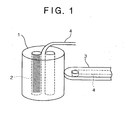
- the apparatus shown in Fig. 1 was used, the gap between electrodes was 30 mm, application magnetization at room temperature was carried out at 5,000 to 10,000 Oe (oersted), and the both-pole maximum magnetization average value of a hysteresis loop was taken as saturation magnetization amount. Since the above saturation magnetization amount is easily influenced by variations in measurement temperature, when it is measured at room temperature, it is preferably measured at 23°C ⁇ 3°C.
- the specimen used for the measurement of Is is preferably (1) a specimen obtained by subjecting steel having substantially the same components as the measurement specimen to austempering for a long time or strong cold processing.
- it is (2) a specimen obtained by subjecting a steel material which differs from the measurement specimen but comprises substantially the same components as the measurement specimen to austempering for a long time or strong cold processing.
- a specimen obtained by subjecting the measurement specimen measured for the amount of saturation magnetization (I) to the above austempering for a long time or strong cold processing may be used as an Is measurement specimen.
- the residual austenite (Vt ⁇ R ) measured as described above is extremely useful because the amount of ⁇ R existent in the measurement specimen (3.6 (thickness) ⁇ 4 mm (width) ⁇ 30 mm (length)) can be accurately determined.
- the difference between the FE-SEM/EBSP (Electron BackScatter diffraction Pattern) method described in the expression (2) to be described hereinafter and the above saturation magnetization measurement method will be described next.
- the crystal structure and crystal direction can be specified by analyzing EBSP which appears when an electron beam is irradiated onto a certain point.
- this method has an advantage that the evaluation of a form by mapping can be made by combining an electron microscope such as FE-SEM so that the quantities of ⁇ R existent within the ferrite particle and in the grain boundary of ferrite can be determined independently from each other, it has a disadvantage that ⁇ R within a bulk cannot be measured.
- the central segregation of Mn and the like added to steel readily occurs at the time of casting and ⁇ R is easily formed by the segregation, thereby increasing the amount of ⁇ R in the center portion of a steel material.
- the FE-SEM/EBSP method can determine only the amount of ⁇ R existent in the surface layer portion, it has a problem that ⁇ R existent in the specimen cannot be measured accurately.
- the above saturation magnetization measurement method can measure ⁇ R existent in a measurement specimen accurately whether it is existent in the surface layer portion or within a bulk. Therefore, the method can determine the amount of whole ⁇ R including ⁇ R formed within the bulk by central segregation accurately.
- the above saturation magnetization measurement method has advantages that operation is easy and highly accurate data on ⁇ R is obtained in a short period of time and at a low cost compared with the FE-SEM/EBSP method. Therefore, in the present invention, excluding a case where the amount of ⁇ R within the ferrite particle is determined, ⁇ R is measured by the above saturation magnetization measurement method.
- Vt ⁇ R measured by the above saturation magnetization measurement method is set to 5 % or more as an index for ensuring desired ductility. Meanwhile, since elongation flange properties deteriorate when the second phase is existent in large quantities, it is recommended to control it to 20 % or less (preferably 15 % or less, more preferably 10 % or less).
- SF ⁇ R is the area fraction of ⁇ R within the ferrite particle measured by FE-SEM/EBSP and Vt ⁇ R is as defined above.
- the above expression (2) is determined from the viewpoint that what has a ratio of ⁇ R (SF ⁇ R ) existent within the ferrite particle to ⁇ R existent in a measurement specimen (test specimen measuring 3.6 (thickness) ⁇ 4 m (width) ⁇ 30 mm (length)) of 0.65 or more contributes particularly to the improvement of local elongation in the latter stage of transformation. That is, since ⁇ R existent within the ferrite particle receives the spatial restriction of the ferrite mother phase existent in the surface of the specimen, it has a relatively higher content of C and less differences in the concentration distribution of C than coarse ⁇ R existent in the grain boundary of ferrite.
- ⁇ R which contributes to the improvement of ductility is called "relatively stable ⁇ R " which is specified by the above expression (2) from the viewpoint of the ratio within the ferrite particle.
- ⁇ R (SF ⁇ R ) existent within the ferrite particle is expressed as an fcc phase (face centered cubic lattice) in a mapped region by FE-SEM/EBSP.
- FE-SEM/EBSP the reason for use of FE-SEM/EBSP is that out of ⁇ R existent in the surface layer portion, the amount of ⁇ R existent within the ferrite particle can be determined independently from ⁇ R existent in the grain boundary of ferrite as described above.
- FE-SEM high-resolution FE-SEM equipped with an EBSP detector (XL30S-FEG of Philips Co., Ltd.) and the OIM (Orientation Imaging MicroscopyTM), EBSP-related hardware and software for detection, measurement and analysis of Tecsem Laboratory (TSL) Co., Ltd. were used.
- a measurement specimen was electrolytically polished and its surface layer portion (the most surface portion) was observed immediately (measurement intervals of 0.1 ⁇ m).
- the ratio (SF ⁇ R / Vt ⁇ R ) of SF ⁇ R calculated as described above to Vt ⁇ R obtained from the above expression (1) must be 0.65 or more. When the ratio is lower than 0.65, the amount of ⁇ R existent in the grain boundary of ferrite increases and desired local elongation is not obtained. It is preferably 0.70 or more.
- the upper limit of the ratio is not particularly limited. As it is higher, more excellent characteristic properties are obtained.
- C ⁇ R is the average content (mass%) of C in ⁇ R .
- ⁇ 2 is the space factor of martensite and ( ⁇ 1 + ⁇ R ) is the area fraction of the second phase structure.
- the above expression (3) is determined from the viewpoint that what has a ratio of martensite to the second phase structure (martensite and ⁇ R ) of 0. 25 to 0. 60 obtains a desired yield ratio reduction effect and improved moldability.
- martensite is considered to reduce the yield ratio by increasing the moving dislocation density of a portion therearound.
- the above expression (3) is specified to obtain this function of martensite effectively.
- the area fraction ( ⁇ 1 + ⁇ R ) of the second phase structure is measured by image-analyzing the about t/4 position of a steel material as described above.
- the space factor ( ⁇ 2) of martensite is defined as being calculated from a difference between the area fraction ( ⁇ 1 + ⁇ R ) of the above second phase structure and Vt ⁇ R specified by the above expression (1).
- the reason for use of Vt ⁇ R [ ⁇ R (volume fraction) in a measurement specimen calculated by the saturation magnetization measurement method] for the calculation of the space factor ( ⁇ 2) of martensite is that a measurement value obtained by the saturation magnetization measurement method is considered to be the most effective as an index indicating the amount of ⁇ R accurately.
- the value obtained from the above expression (3) is smaller than 0.25, the function of martensite cannot be obtained effectively, the yield ratio becomes high and desired moldability cannot be obtained.
- the value obtained from the above expression (3) is larger than 0.60, hard martensite is formed and becomes a starting point of destruction, thereby making it impossible to obtain desired ⁇ R and to develop the ductility improving function of ⁇ R effectively. It is preferably 0.5 or less, more preferably 0.4 or less.
- C is an essential element which ensures the strength and ⁇ R of the steel sheet.
- the amount of C is smaller than 0.05 %, after a hot rolled steel sheet is wound up or after a cold rolled steel sheet is annealed, the amount of ⁇ R existent in the steel sheet becomes extremely small, thereby making it impossible to fully obtain the desired TRIP effect of ⁇ R ⁇
- It is preferably 0.08 % or more, more preferably 0.10% or more.
- C is added in an amount of 0.25 % or more, the strength and the formation of the second phase structure become excessive and the number of the starting points of destruction increases, whereby a desired local ductility effect is not obtained. It is preferably 0.20 % or less, more preferably 0.15 % or less.
- Si is an element which contributes to the formation of ⁇ R .
- the amount of Si is preferably 1.0 % or more, more preferably 1.2 % or more.
- Si is added in an amount of more than 3.5 %, cracking may occur and workability also deteriorates. It is preferably 3 % or less, more preferably 2.5 % or less, much more preferably 2.0 % or less.
- Mn is an element which contributes to the formation of ⁇ R like Si. To develop this function effectively, Mn must be added in an amount of 0.7 % or more.
- the amount of Mn is preferably 1.0 % or more, more preferably 1.5 % or more. When the amount is larger than 4 %, the above effect is saturated and it is economically wasteful. It is preferably 3 . 0 % or less, more preferably 2.0 % or less.
- the present invention basically contains the above components and the balance consists substantially of iron and impurities. Besides the above components, the following admissible components can be added in limits that do not impair the function of the present invention.
- These elements are both austenite stabilizing elements and contribute to the formation of ⁇ R .
- 0.1 % or more (preferably 0.3 % or more) of Ni and 0.1 % or more (preferably 0.3 % or more) of Cu are preferably added. When they are added excessively, cracking may occur. Therefore, it is recommended to set the upper limit of Ni to 2 % (preferably 1 %) and that of Cu to 2 % (preferably 1 %).
- 0.1 % or more (preferably 0.2 % or more) of Cr and 0.1 % or more (preferably 0.2 % or more) of Mo are preferably added.
- Cr is added excessively, a carbide is formed and the formation of ⁇ R lowers.
- Mo is added excessively, strength becomes too high and cracking may occur.
- the upper limit of Cr is 1.0 % (preferably 0.5 %) and that of Mo is 1.0 % (preferably 0.5 %).
- P is an element which contributes to the improvement of strength by solid solution strengthening. To this end, it is recommended to add 0.05 % or more (preferably 0.1 % or more) of P. When more than 0.3 % of P is added, strength becomes too high and workability deteriorates, thereby causing cracking. It is preferably 0.2 % or less.
- Al is an element which contributes to the removal of an acid.
- the amount of Al is larger than 2.0 %, cracking is caused by continuous casting. It is preferably 1.0 % or less.
- These elements have a deposition promoting function. In order to develop this function effectively, it is recommended to add at least one (one or more) of the above elements in a total amount of 0 . 01 % or more (preferably 0.05 % or more) .
- a carbide is formed and a desired amount of ⁇ R cannot be obtained. It is preferably 0.08 % or less.
- the process of the present invention is a process for producing the above high-strength steel sheet by hot rolling, optionally cold rolling and continuous annealing, which comprises the steps of:
- the most characteristic feature of the steel sheet of the present invention is that it contains a large amount of ⁇ R having a predetermined C content in the ferrite particles.
- the above solution treatment is extremely important to obtain this structure.
- solution treatment is generally carried out before the curing of an age hardening alloy, it is not employed for the production of a TRIP steel sheet because it takes time, the production process becomes complicated by the addition of a new step and the production cost is boosted.
- the inventors of the present invention have found through their studies for the first time that when appropriate solution treatment is carried out before hot rolling, it is extremely useful as means of preventing the central segregation of Mn or the like.
- solution treatment is carried out at 1,270°C or higher for 5 hours or more.
- solution treatment temperature is lower than 1,270°C, a solubility curve cannot be reached and a desired effect cannot be obtained.
- solution treatment time is shorter than 5 hours, the dispersion time before the dissolved atoms are uniformly distributed becomes insufficient, whereby a desired effect cannot be obtained as well.
- the desired effect is obtained only when the temperature and time are suitably controlled. It is recommended to carry out solution treatment preferably at 1,300°C or higher for 10 hours or more, more preferably at 1, 350°C or higher for 15 hours or more.
- the upper limits of the solution treatment temperature and time are not particularly limited from the viewpoint "desired relatively stable ⁇ R is formed". A higher treatment temperature and a longer treatment time are more preferred. However, taking productivity and cost in consideration, it is recommended to carry out the treatment at 1, 430°C or lower for 25 hours or less (preferably 1,400°C or lower for 20 hours or less).
- the austempering time is preferably 60 seconds or more, more preferably 120 seconds or more.
- the austempering time is longer than 200 seconds, the concentration of C in ⁇ R proceeds too far, whereby martensite which contributes to moldability and instable ⁇ R which readily transforms into martensite are not obtained, the yield ratio becomes high and moldability deteriorates though local transformability becomes excellent.
- the austempering time is preferably 190 seconds or less, more preferably 180 seconds or less.
- Treatments other than these are not particularly limited and a process which is generally employed for a TRIP steel sheet can be suitably selected and carried out so that the function of the present invention can be developed effectively.
- a hot rolling step for example, after hot rolling at A r3 point or higher, the obtained steep plate is cooled at an average cooling rate of about 30°C/s and wound up at a temperature of about 500 to 600°C.
- cold rolling which is optionally carried out at a cold rolling rate of about 30 to 70 %. Further, as for continuous annealing, it is recommended to cool at an average cooling rate of 5°C/s or more and carry out austempering at a baitenite transformation range.
- the present invention is in no way limited to these methods.
- Example 1 studies on composition of components, existence of solution treatment and austempering time
- a steel piece containing chemical components shown in Table 1 (unit in Table 1 is mass%) was continuously cast, and the obtained slab was subjected to solution treatment at 1, 280°C for 10 hours, heated at 1,200°C, finish rolled at 900°C, cooled and wound up at about 500°C to obtain a 3 mm-thick hot rolled steel sheet.
- the hot rolled steel sheet was cold rolled to a thickness of 1.2 mm.
- the cold rolled steel sheet was subjected to recrystallization annealing (continuous annealing) in a continuous annealing line (CAL) in accordance with a commonly used method and cooled to a baitenite transformation range.
- steel sheets were measured for their tensile strength (TS), local elongation (1-EL), uniform elongation (u-EL), total elongation (T-EL) and yield power (YP) using JIS No. 5 tensile test specimens.
- TS tensile strength
- u-EL uniform elongation
- T-EL total elongation
- YP yield power
- the area fraction of the second phase structure, the area fraction (SF ⁇ R /Vt ⁇ R ) of ⁇ R within the mother phase ferrite particle, the space factor [ ⁇ 2/ ( ⁇ 1 + ⁇ R )] of martensite and C ⁇ R in each steel sheet were measured in accordance with the above methods and the total volume fraction (Vt ⁇ R ) of ⁇ R was measured by the following method.
- Nos. 1 to 6 (type of steel in Table 1 is A) and Nos. 16 to 21 (type of steel in Table 1 is F) in Table 2 are examples in which a slab having the composition of the present invention was used and solution treatment and austempering time were changed.
- Nos. 2 and 17 are examples in which predetermined solution treatment and austempering were carried out, and high-strength steel sheets having all the above characteristic properties (1) to (3) were obtained.
- Nos. 1 and 16 are examples in which instable ⁇ R which readily transforms into martensite and martensite were formed in large quantities due to a short austempering time (30 seconds) though predetermined solution treatment was carried out, desired elongation was not obtained as the instable ⁇ R and martensite became the starting points of destruction, and balance between strength and local ductility was bad.
- Nos. 3 and 18 are examples in which predetermined solution treatment was carried out, austempering was carried out for 300 seconds, extremely stable ⁇ R was formed, and balance between strength and local ductility was excellent but moldability was poor due to high YR resulted by the formation of a small amount of martensite.
- Nos. 4 and 19 are examples in which solution treatment was not carried out at all and only austempering was carried out.
- central segregation could not be eliminated and instable ⁇ R which readily transforms into martensite and martensite were formed in large quantities and became the starting points of destruction, thereby making it impossible to obtain desired elongation and good balance between strength and local ductility.
- Nos. 5 and 20 are examples in which solution treatment was not carried out at all and austempering was carried out for 300 seconds.
- the amount of extremely stable ⁇ R which contributes to uniform transformation was small and balance between strength and local ductility was bad.
- Nos. 6 and 21 are examples in which solution treatment was not carried out at all and austempering was carried out for 600 seconds. Extremely stable ⁇ R was formed and balance between strength and local ductility was excellent but moldability was poor due to high YR resulted by the formation of a small amount of martensite.
- No. 7 is an example in which B type steel in Table 1 having a low C content was used and balance between strength and local ductility was bad.
- Nos. 8 to 13 are examples in which C type steel having a high C content was used and solution treatment and austempering time were changed.
Landscapes
- Chemical & Material Sciences (AREA)
- Engineering & Computer Science (AREA)
- Mechanical Engineering (AREA)
- Materials Engineering (AREA)
- Metallurgy (AREA)
- Organic Chemistry (AREA)
- Physics & Mathematics (AREA)
- Thermal Sciences (AREA)
- Crystallography & Structural Chemistry (AREA)
- Heat Treatment Of Sheet Steel (AREA)
Claims (2)
- Hochfestes Stahlblech mit ausgezeichneter Verarbeitbarkeit, bestehend aus:worin die Grundstruktur von genanntem Stahlblech Ferrit darstellt, die Struktur der zweiten Phase von genanntem Stahlblech Martensit und den Restaustenit umfasst und die genannte Struktur der zweiten Phase (α1 + γR) einen Flächenbruchteil von 25 % oder weniger bezogen auf die Gesamtstruktur aufweist, wenn er mittels Bildanalyse gemessen wird,0,06 bis 0,25 Masseprozent Kohlenstoff;0,5 bis 3,5 Masseprozent Si; und0,7 bis 4 Masseprozent Mn,optional weniger als oder gleich 2 Masseprozent Nickel, weniger als oder gleich 2 Masseprozent Kupfer,weniger als oder gleich 1,0 Masseprozent Chrom,weniger als oder gleich 1,0 Masseprozent Molybdän,weniger als oder gleich 0,3 Masseprozent Phosphor,weniger als oder gleich 2,0 Masseprozent Aluminium,weniger als oder gleich 0,1 % insgesamt von mindestenseinem, ausgewählt aus Titan, Niob und Vanadium, wobei der Rest Eisen und unvermeidliche Verunreinigungen darstellt,
und worin das genannte Stahlblech den folgenden Anforderungen (1) bis (4) Genüge leistet:(1) Der Volumenbruchteil (VtγR) von genanntem Restaustenit 5 % oder mehr darstellt, wenn eine Messprobe von genanntem Restaustenit mittels Messung der Sättigungsmagnetisierung gemessen wird,(2) das Verhältnis (SFγR/VtγR) des Flächenbruchteils (SFγR) von genanntem Restaustenit im Ferritpartikel zu VtγR 0,65 oder mehr beträgt, wenn der Flächenbruchteil mittels FE-REM/EBSP gemessen wird,(3) das Verhältnis [α2/ (α1 + γR) ] des Füllfaktors (α2) von genanntem Martensit zur Struktur der zweiten Phase (α1 + γR) den folgenden Ausdruck zufriedenstellt:(4) der durchschnittliche C-Gehalt von genanntem Restaustenit 0,95 bis 1,2 Masseprozent beträgt. - Verfahren zur Herstellung des hochfesten Stahlblechs nach Anspruch 1, durch Heißwalzen, optional Kaltwalzen und kontinuierliches Glühen, umfassend die Schritte von:Aussetzen einer Bramme, welche die in Anspruch 1 dargelegten Komponenten umfasst, einer Behandlung mit einer Lösung bei 1 270 °C oder höher für 5 Stunden oder länger;Heißwalzen der Bramme zu einem Stahlblech; undAussetzen des Stahlblechs der Zwischenstufenvergütung, um aufgewickelt zu werden, nachdem die heißgewalzte Platte auf einen Bainit-Umwandlungsbereich abgekühlt ist und in diesem Temperaturbereich für 50 bis 200 Sekunden aufrechterhalten wird.und den Restaustenit (VtγR).
Applications Claiming Priority (2)
| Application Number | Priority Date | Filing Date | Title |
|---|---|---|---|
| JP2002204168A JP3840436B2 (ja) | 2002-07-12 | 2002-07-12 | 加工性に優れた高強度鋼板 |
| JP2002204168 | 2002-07-12 |
Publications (2)
| Publication Number | Publication Date |
|---|---|
| EP1382702A1 EP1382702A1 (de) | 2004-01-21 |
| EP1382702B1 true EP1382702B1 (de) | 2005-12-14 |
Family
ID=29774572
Family Applications (1)
| Application Number | Title | Priority Date | Filing Date |
|---|---|---|---|
| EP03254416A Expired - Lifetime EP1382702B1 (de) | 2002-07-12 | 2003-07-11 | Hochfestes Stahlblech mit hervorragender Verformbarkeit und Verfahren zu dessen Herstellung |
Country Status (3)
| Country | Link |
|---|---|
| US (1) | US7008488B2 (de) |
| EP (1) | EP1382702B1 (de) |
| JP (1) | JP3840436B2 (de) |
Families Citing this family (17)
| Publication number | Priority date | Publication date | Assignee | Title |
|---|---|---|---|---|
| JP4119758B2 (ja) * | 2003-01-16 | 2008-07-16 | 株式会社神戸製鋼所 | 加工性および形状凍結性に優れた高強度鋼板、並びにその製法 |
| US7634384B2 (en) * | 2003-03-18 | 2009-12-15 | Fisher-Rosemount Systems, Inc. | Asset optimization reporting in a process plant |
| US7314532B2 (en) * | 2003-03-26 | 2008-01-01 | Kabushiki Kaisha Kobe Seiko Sho (Kobe Steel, Ltd.) | High-strength forged parts having high reduction of area and method for producing same |
| EP1512760B1 (de) * | 2003-08-29 | 2011-09-28 | Kabushiki Kaisha Kobe Seiko Sho (Kobe Steel, Ltd.) | Hohes Stahlblech der Dehnfestigkeit ausgezeichnet für die Verarbeitung und Proze für die Produktion desselben |
| US20050150580A1 (en) * | 2004-01-09 | 2005-07-14 | Kabushiki Kaisha Kobe Seiko Sho(Kobe Steel, Ltd.) | Ultra-high strength steel sheet having excellent hydrogen embrittlement resistance, and method for manufacturing the same |
| EP1559798B1 (de) * | 2004-01-28 | 2016-11-02 | Kabushiki Kaisha Kobe Seiko Sho (Kobe Steel, Ltd.) | Hochfestes kaltgewalztes Stahlblech mit niedrigem Streckgrenzenverhältnis und Verfahren zu seiner Herstellung |
| ATE426686T1 (de) * | 2004-04-22 | 2009-04-15 | Kobe Steel Ltd | Hochfestes und kaltgewaltzes stahlblech mit hervorragender verformbarkeit und plattiertes stahlblech |
| JP4288364B2 (ja) | 2004-12-21 | 2009-07-01 | 株式会社神戸製鋼所 | 伸びおよび伸びフランジ性に優れる複合組織冷延鋼板 |
| JP4555694B2 (ja) * | 2005-01-18 | 2010-10-06 | 新日本製鐵株式会社 | 加工性に優れる焼付け硬化型熱延鋼板およびその製造方法 |
| JP4716359B2 (ja) * | 2005-03-30 | 2011-07-06 | 株式会社神戸製鋼所 | 均一伸びに優れた高強度冷延鋼板およびその製造方法 |
| JP4716358B2 (ja) * | 2005-03-30 | 2011-07-06 | 株式会社神戸製鋼所 | 強度と加工性のバランスに優れた高強度冷延鋼板およびめっき鋼板 |
| KR100992225B1 (ko) | 2005-12-06 | 2010-11-05 | 가부시키가이샤 고베 세이코쇼 | 내파우더링성이 우수한 고강도 합금화 용융 아연 도금 강판및 그 제조 방법 |
| CN100357460C (zh) * | 2006-03-14 | 2007-12-26 | 钢铁研究总院 | 一种获得多元组织马氏体钢的冷却工艺 |
| US20090071219A1 (en) * | 2007-09-14 | 2009-03-19 | Western Canada Machining Inc. | Apparatus and method for forging premium coupling blanks |
| CN101504389B (zh) * | 2009-03-20 | 2011-08-17 | 河北师范大学 | 一种钢中残余奥氏体热稳定性的测量方法 |
| JP5323563B2 (ja) * | 2009-03-31 | 2013-10-23 | 株式会社神戸製鋼所 | 加工性および形状凍結性に優れた高強度冷延鋼板 |
| EP3390040B2 (de) | 2015-12-15 | 2023-08-30 | Tata Steel IJmuiden B.V. | Hochfester feuerverzinkter bandstahl |
Family Cites Families (11)
| Publication number | Priority date | Publication date | Assignee | Title |
|---|---|---|---|---|
| JPH0670246B2 (ja) | 1988-10-05 | 1994-09-07 | 新日本製鐵株式会社 | 加工性良好な高強度鋼板の製造方法 |
| JP2840479B2 (ja) * | 1991-05-10 | 1998-12-24 | 株式会社神戸製鋼所 | 疲労強度と疲労亀裂伝播抵抗の優れた高強度熱延鋼板の製造方法 |
| JPH05255799A (ja) | 1992-03-11 | 1993-10-05 | Nippon Steel Corp | 加工性に優れた溶融めっき熱延高強度鋼板およびその製造方法 |
| JP3231092B2 (ja) * | 1992-08-24 | 2001-11-19 | 新日本製鐵株式会社 | 疲労耐久性に優れた加工用高強度熱延鋼板 |
| KR100318213B1 (ko) | 1996-11-28 | 2001-12-22 | 아사무라 타카싯 | 높은 동적 변형 저항을 가진 고 강도 강 시트 및 그 제조 방법 |
| JP3320014B2 (ja) | 1997-06-16 | 2002-09-03 | 川崎製鉄株式会社 | 耐衝撃特性に優れた高強度高加工性冷延鋼板 |
| JP3172505B2 (ja) | 1998-03-12 | 2001-06-04 | 株式会社神戸製鋼所 | 成形性に優れた高強度熱延鋼板 |
| JPH11323490A (ja) * | 1998-05-13 | 1999-11-26 | Nippon Steel Corp | 形状凍結性に優れた良加工性高強度冷延鋼板およびその製造方法 |
| JP3831137B2 (ja) | 1999-01-20 | 2006-10-11 | 株式会社神戸製鋼所 | 延性と伸びフランジ性に優れた高強度鋼板の製造方法 |
| JP3750789B2 (ja) | 1999-11-19 | 2006-03-01 | 株式会社神戸製鋼所 | 延性に優れる溶融亜鉛めっき鋼板およびその製造方法 |
| KR100441414B1 (ko) | 2000-04-21 | 2004-07-23 | 신닛뽄세이테쯔 카부시키카이샤 | 버링 가공성이 우수한 고피로강도 강판 및 그의 제조방법 |
-
2002
- 2002-07-12 JP JP2002204168A patent/JP3840436B2/ja not_active Expired - Lifetime
-
2003
- 2003-07-09 US US10/614,821 patent/US7008488B2/en not_active Expired - Lifetime
- 2003-07-11 EP EP03254416A patent/EP1382702B1/de not_active Expired - Lifetime
Also Published As
| Publication number | Publication date |
|---|---|
| US7008488B2 (en) | 2006-03-07 |
| EP1382702A1 (de) | 2004-01-21 |
| JP3840436B2 (ja) | 2006-11-01 |
| JP2004043908A (ja) | 2004-02-12 |
| US20040007298A1 (en) | 2004-01-15 |
Similar Documents
| Publication | Publication Date | Title |
|---|---|---|
| KR102643398B1 (ko) | 핫 스탬프 성형체 | |
| US7008488B2 (en) | High-strength steel sheet having excellent workability and production process therefor | |
| JP5408383B2 (ja) | 冷延鋼板及びその製造方法 | |
| EP2130938B1 (de) | Hochfestes warmgewalztes stahlblech, welches frei von abblättern ist und hervorragende oberflächen- und abgratungseigenschaften aufweist und verfahren zu seiner herstellung | |
| CN114630917B (zh) | 热轧钢板及其制造方法 | |
| KR20130133032A (ko) | 국부 변형능이 우수한 고강도 열연 강판과 그 제조 방법 | |
| US20140234660A1 (en) | High-strength hot-dip galvanized steel sheet, high-strength alloyed hot-dip galvanized steel sheet excellent in bake hardenability, and manufacturing method thereof | |
| KR20130140205A (ko) | 열연 강판 및 그 제조 방법 | |
| US20050252577A1 (en) | Fe-Ni based permalloy and method of producing the same and cast slab | |
| KR102918970B1 (ko) | 열연 강판 | |
| JP6773252B2 (ja) | 熱延鋼板 | |
| JPWO2020070810A1 (ja) | 浸炭用鋼板、及び、浸炭用鋼板の製造方法 | |
| JP7348573B2 (ja) | 熱延鋼板 | |
| JP7277833B2 (ja) | 熱延鋼板 | |
| KR20230146611A (ko) | 핫 스탬프용 강판 및 핫 스탬프 성형체 | |
| CN115003835B (zh) | 热轧钢板 | |
| RU2511000C2 (ru) | Холоднокатаный стальной лист, обладающий превосходной формуемостью, и способ его производства | |
| JP6390573B2 (ja) | 冷延鋼板およびその製造方法 | |
| JP7810906B2 (ja) | 熱延鋼板およびその製造方法 | |
| WO2020241260A1 (ja) | ホットスタンプ成形体 | |
| JPH09271830A (ja) | 強靭で均質な高強度厚鋼板の製造方法 | |
| JP7549281B2 (ja) | 鋼板 | |
| WO2024135043A1 (ja) | 熱延鋼板 | |
| JP4234671B2 (ja) | 高強度鋼板およびその製法 | |
| WO2026028900A1 (ja) | 鋼板及び部品 |
Legal Events
| Date | Code | Title | Description |
|---|---|---|---|
| PUAI | Public reference made under article 153(3) epc to a published international application that has entered the european phase |
Free format text: ORIGINAL CODE: 0009012 |
|
| 17P | Request for examination filed |
Effective date: 20030730 |
|
| AK | Designated contracting states |
Kind code of ref document: A1 Designated state(s): AT BE BG CH CY CZ DE DK EE ES FI FR GB GR HU IE IT LI LU MC NL PT RO SE SI SK TR |
|
| AX | Request for extension of the european patent |
Extension state: AL LT LV MK |
|
| 17Q | First examination report despatched |
Effective date: 20040812 |
|
| AKX | Designation fees paid |
Designated state(s): CZ FR GB |
|
| REG | Reference to a national code |
Ref country code: DE Ref legal event code: 8566 |
|
| GRAP | Despatch of communication of intention to grant a patent |
Free format text: ORIGINAL CODE: EPIDOSNIGR1 |
|
| GRAS | Grant fee paid |
Free format text: ORIGINAL CODE: EPIDOSNIGR3 |
|
| GRAA | (expected) grant |
Free format text: ORIGINAL CODE: 0009210 |
|
| AK | Designated contracting states |
Kind code of ref document: B1 Designated state(s): CZ FR GB |
|
| REG | Reference to a national code |
Ref country code: GB Ref legal event code: FG4D |
|
| ET | Fr: translation filed | ||
| PLBE | No opposition filed within time limit |
Free format text: ORIGINAL CODE: 0009261 |
|
| STAA | Information on the status of an ep patent application or granted ep patent |
Free format text: STATUS: NO OPPOSITION FILED WITHIN TIME LIMIT |
|
| 26N | No opposition filed |
Effective date: 20060915 |
|
| REG | Reference to a national code |
Ref country code: FR Ref legal event code: PLFP Year of fee payment: 14 |
|
| REG | Reference to a national code |
Ref country code: FR Ref legal event code: PLFP Year of fee payment: 15 |
|
| REG | Reference to a national code |
Ref country code: FR Ref legal event code: PLFP Year of fee payment: 16 |
|
| PGFP | Annual fee paid to national office [announced via postgrant information from national office to epo] |
Ref country code: FR Payment date: 20200611 Year of fee payment: 18 |
|
| PGFP | Annual fee paid to national office [announced via postgrant information from national office to epo] |
Ref country code: CZ Payment date: 20200630 Year of fee payment: 18 Ref country code: GB Payment date: 20200701 Year of fee payment: 18 |
|
| GBPC | Gb: european patent ceased through non-payment of renewal fee |
Effective date: 20210711 |
|
| PG25 | Lapsed in a contracting state [announced via postgrant information from national office to epo] |
Ref country code: GB Free format text: LAPSE BECAUSE OF NON-PAYMENT OF DUE FEES Effective date: 20210711 |
|
| PG25 | Lapsed in a contracting state [announced via postgrant information from national office to epo] |
Ref country code: FR Free format text: LAPSE BECAUSE OF NON-PAYMENT OF DUE FEES Effective date: 20210731 Ref country code: CZ Free format text: LAPSE BECAUSE OF NON-PAYMENT OF DUE FEES Effective date: 20210711 |