EP1378600A1 - Wässrige Zusammensetzung zur Filzfreiausrüstung von Wolle - Google Patents
Wässrige Zusammensetzung zur Filzfreiausrüstung von Wolle Download PDFInfo
- Publication number
- EP1378600A1 EP1378600A1 EP03015121A EP03015121A EP1378600A1 EP 1378600 A1 EP1378600 A1 EP 1378600A1 EP 03015121 A EP03015121 A EP 03015121A EP 03015121 A EP03015121 A EP 03015121A EP 1378600 A1 EP1378600 A1 EP 1378600A1
- Authority
- EP
- European Patent Office
- Prior art keywords
- component
- wool
- weight
- prepolymer
- polyisocyanate
- Prior art date
- Legal status (The legal status is an assumption and is not a legal conclusion. Google has not performed a legal analysis and makes no representation as to the accuracy of the status listed.)
- Granted
Links
Classifications
-
- C—CHEMISTRY; METALLURGY
- C08—ORGANIC MACROMOLECULAR COMPOUNDS; THEIR PREPARATION OR CHEMICAL WORKING-UP; COMPOSITIONS BASED THEREON
- C08G—MACROMOLECULAR COMPOUNDS OBTAINED OTHERWISE THAN BY REACTIONS ONLY INVOLVING UNSATURATED CARBON-TO-CARBON BONDS
- C08G18/00—Polymeric products of isocyanates or isothiocyanates
- C08G18/06—Polymeric products of isocyanates or isothiocyanates with compounds having active hydrogen
- C08G18/08—Processes
- C08G18/10—Prepolymer processes involving reaction of isocyanates or isothiocyanates with compounds having active hydrogen in a first reaction step
- C08G18/12—Prepolymer processes involving reaction of isocyanates or isothiocyanates with compounds having active hydrogen in a first reaction step using two or more compounds having active hydrogen in the first polymerisation step
-
- C—CHEMISTRY; METALLURGY
- C08—ORGANIC MACROMOLECULAR COMPOUNDS; THEIR PREPARATION OR CHEMICAL WORKING-UP; COMPOSITIONS BASED THEREON
- C08G—MACROMOLECULAR COMPOUNDS OBTAINED OTHERWISE THAN BY REACTIONS ONLY INVOLVING UNSATURATED CARBON-TO-CARBON BONDS
- C08G18/00—Polymeric products of isocyanates or isothiocyanates
- C08G18/06—Polymeric products of isocyanates or isothiocyanates with compounds having active hydrogen
- C08G18/28—Polymeric products of isocyanates or isothiocyanates with compounds having active hydrogen characterised by the compounds used containing active hydrogen
- C08G18/40—High-molecular-weight compounds
-
- D—TEXTILES; PAPER
- D06—TREATMENT OF TEXTILES OR THE LIKE; LAUNDERING; FLEXIBLE MATERIALS NOT OTHERWISE PROVIDED FOR
- D06M—TREATMENT, NOT PROVIDED FOR ELSEWHERE IN CLASS D06, OF FIBRES, THREADS, YARNS, FABRICS, FEATHERS OR FIBROUS GOODS MADE FROM SUCH MATERIALS
- D06M15/00—Treating fibres, threads, yarns, fabrics, or fibrous goods made from such materials, with macromolecular compounds; Such treatment combined with mechanical treatment
- D06M15/19—Treating fibres, threads, yarns, fabrics, or fibrous goods made from such materials, with macromolecular compounds; Such treatment combined with mechanical treatment with synthetic macromolecular compounds
- D06M15/37—Macromolecular compounds obtained otherwise than by reactions only involving carbon-to-carbon unsaturated bonds
- D06M15/564—Polyureas, polyurethanes or other polymers having ureide or urethane links; Precondensation products forming them
- D06M15/568—Reaction products of isocyanates with polyethers
-
- D—TEXTILES; PAPER
- D06—TREATMENT OF TEXTILES OR THE LIKE; LAUNDERING; FLEXIBLE MATERIALS NOT OTHERWISE PROVIDED FOR
- D06M—TREATMENT, NOT PROVIDED FOR ELSEWHERE IN CLASS D06, OF FIBRES, THREADS, YARNS, FABRICS, FEATHERS OR FIBROUS GOODS MADE FROM SUCH MATERIALS
- D06M15/00—Treating fibres, threads, yarns, fabrics, or fibrous goods made from such materials, with macromolecular compounds; Such treatment combined with mechanical treatment
- D06M15/19—Treating fibres, threads, yarns, fabrics, or fibrous goods made from such materials, with macromolecular compounds; Such treatment combined with mechanical treatment with synthetic macromolecular compounds
- D06M15/37—Macromolecular compounds obtained otherwise than by reactions only involving carbon-to-carbon unsaturated bonds
- D06M15/564—Polyureas, polyurethanes or other polymers having ureide or urethane links; Precondensation products forming them
- D06M15/572—Reaction products of isocyanates with polyesters or polyesteramides
-
- D—TEXTILES; PAPER
- D06—TREATMENT OF TEXTILES OR THE LIKE; LAUNDERING; FLEXIBLE MATERIALS NOT OTHERWISE PROVIDED FOR
- D06M—TREATMENT, NOT PROVIDED FOR ELSEWHERE IN CLASS D06, OF FIBRES, THREADS, YARNS, FABRICS, FEATHERS OR FIBROUS GOODS MADE FROM SUCH MATERIALS
- D06M2101/00—Chemical constitution of the fibres, threads, yarns, fabrics or fibrous goods made from such materials, to be treated
- D06M2101/02—Natural fibres, other than mineral fibres
- D06M2101/10—Animal fibres
-
- D—TEXTILES; PAPER
- D06—TREATMENT OF TEXTILES OR THE LIKE; LAUNDERING; FLEXIBLE MATERIALS NOT OTHERWISE PROVIDED FOR
- D06M—TREATMENT, NOT PROVIDED FOR ELSEWHERE IN CLASS D06, OF FIBRES, THREADS, YARNS, FABRICS, FEATHERS OR FIBROUS GOODS MADE FROM SUCH MATERIALS
- D06M2200/00—Functionality of the treatment composition and/or properties imparted to the textile material
- D06M2200/45—Shrinking resistance, anti-felting properties
Definitions
- the present invention relates to an aqueous composition for felt-free finishing of wool or wool-containing Textiles and a process for the felt-free finishing of wool or wool-containing materials.
- wool mattes with changing mechanical stress when wet. Because irreversible when felting Dimensional changes (shrinkage) and also a deterioration of the product appearance, wool is generally with a Provide felt-free equipment.
- processes namely chlorination processes, Oxidation processes, enzymatic, alkaline processes and Resin process.
- the latter also includes felt-free equipment with self-crosslinking polyurethanes (PU).
- PU self-crosslinking polyurethanes
- the wool fabric e.g. on a foulard only has brief contact ( ⁇ 1 min) with the treatment fleet
- the pull-out process the wool article e.g. on a roller skate for a longer time (> 1 min) with the fleet is treated.
- Crosslinking of the prepolymer can be thermal and / or chemical (e.g. pH change or polarization reversal by adding electrolyte).
- GB 1,419,306 A describes a process for the production of Bisulfite addition products of polyisocyanates, being water-insoluble Polyisocyanate prepolymers with at least two Isocyanate groups and a bisulfite are reacted.
- the polyisocyanate prepolymers can be obtained by Reaction of polyisocyanates with hydroxyl groups Compounds that are polyether, polyester, Polythioethers, blended polyester-polyethers or blended Can act polyether-polythioether.
- Preferred hydroxyl group-containing Compounds are polyethers, such as on glycerin launched polypropylene glycol.
- the bisulfite-capped polyisocyanate prepolymers obtained are used for shrink-proofing of wool, by being applied to the fabric and then be cured at a higher temperature.
- the present invention is therefore based on the object a composition for the felt-free finishing of wool and to provide wool-containing materials, on the one hand the advantages of those described in DE-A 199 19 816 has aqueous preparations and which also with increased Temperature has improved storage stability without stabilization with radical inhibitors is required.
- the compositions should be at low temperatures of For example, remain stable below 5 ° C or in frost.
- Polyetherols are understood to mean both linear and branched polyethers which have an average of at least 2 (hydroxyl functionality vorzug mecanic 2) per molecule, preferably hydroxyl groups arranged on their termini.
- polyether polyols are obtained by polymerizing alkylene oxides having 2 to 4 carbon atoms, oxetane or tetrahydrofuran, optionally in the presence of a starter such as water or a di- or polyol.
- alkylene oxide include ethylene oxide, 1,2-propylene oxide, 1,2- and 2,3-butylene oxide, in particular ethylene oxide and propylene oxide.
- As a starter molecule come z.
- B water and low molecular weight diols or polyols.
- Suitable starters are bifunctional alcohols, for example alkanediols having 2 to 10 carbon atoms, such as ethanediol, 1,2- and 1,3-propanediol, 1,4-butanediol, bisphenol A, cycloaliphatic diols, for example cyclohexane-1,4- diol, 1,4-bis (hydroxymethyl) cyclohexane or 2,2-bis (4-hydroxycyclohexyl) propane, and polyfunctional alcohols with more than 2 OH groups such as glycerol, trimethylolpropane, pentaerythritol, and sugar alcohols such as sorbitol.
- alkanediols having 2 to 10 carbon atoms such as ethanediol, 1,2- and 1,3-propanediol, 1,4-butanediol, bisphenol A
- cycloaliphatic diols for example cyclohex
- Preferred polyether polyols are linear or a branched aliphatic polyether polyols, in particular linear poly-C 2 -C 4 -alkylene oxides or poly-C 2 -C 4 -alkylene glycols or branched poly-C 2 -C 4 -alkylene oxides. Linear or branched polyethylene oxides, polypropylene oxides and linear or branched poly (ethylene oxide / propylene oxide) copolymers are particularly preferred.
- the number average molecular weight of the polyether polyol is preferably in the range from 400 to 4000, especially 500 to 3000 and especially 800 to 2000.
- the Hydroxyl functionality is generally in the range of 2 to 4, preferably in the range of 2 to 3.
- the term Hydroxyl functionality denotes the average number of hydroxyl groups per molecule.
- component a) is a linear or branched poly-C 2 -C 4 -alkylene oxide with a molecular weight in the range from 400 to 4000, in particular 500 to 3000 and especially 800 to 2000 and one Hydroxyl functionality from 2 to 4, especially 2 to 3.
- polycarbonate polyols and / or polycaprolactone polyols are used as component b).
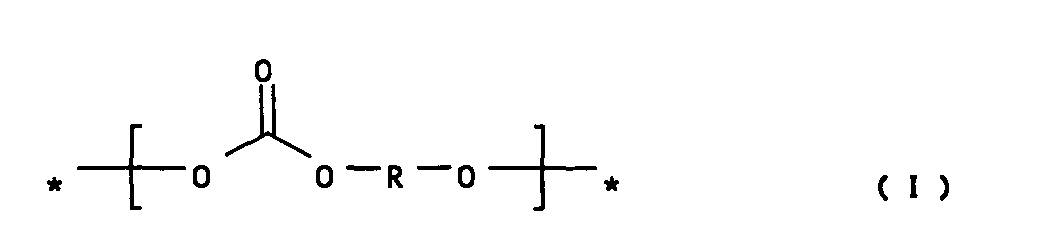
- Polycarbonate polyols are understood to mean those polycarbonates, that is to say polymers or oligomers, which essentially, generally to more than 80% by weight, preferably more than 90% by weight, repeat units of the general formula I and which have on average at least 2, for example 2, 3, 4 or 5, preferably hydroxyl groups arranged on their termini per molecule.
- R represents a divalent organic radical which generally has 2 to 20 carbon atoms and can be interrupted by one or more, for example, 1, 2, 3 or 4, non-adjacent oxygen atoms.
- R is preferably derived from an aliphatic or cycloaliphatic diol.
- Such polycarbonate polyols are usually referred to as aliphatic polycarbonate polyols.
- the polycarbonate polyol can also be one or more, e.g. 1, 2 or have 3 branch points that differ from polyvalent ones Alcohols, such as glycerol, trimethylolpropane, pentaerythritol, or derived from sugar alcohols such as sorbitol. In dependence of the number of branch points and the functionality of the The resulting polycarbonate polyol has alcohol Hydroxyl functionality> 2.
- Polycaprolactone polyols are oligomers or Polymers produced by ring opening polymerization of caprolactone are available in the presence of dihydric or polyhydric alcohols. Suitable di- or polyhydric alcohols are those in the Polycarbonate polyols mentioned aliphatic and cycloaliphatic Diols, in particular 1,4-butanediol, 1,6-hexanediol, Neopentyl glycol, diethylene glycol and those mentioned there polyhydric alcohols. Polycaprolactone diols are known and under the trade name CAPA® from Solvay S.A. in the Available commercially.
- the average molecular weight (number average) of component b) is generally in the range of 500 to 6000, preferably 700 to 4000, especially 800 to 3000.
- the hydroxyl functionality component b) is generally in the range from 2 to 4, preferably 2 to 3.
- a polycaprolactone diol is used as component b).
- the polyisocyanate of component c) is preferably a diisocyanate.
- Aromatic or aliphatic (or cycloaliphatic) diisocyanates can be used.
- Aromatic diisocyanates which can be used are 2,4-toluenediisocyanate, 2,6-toluenediisocyanate and mixtures thereof, and 4,4'-diphenylmethane diisocyanate.
- Suitable aliphatic diisocyanates are isophorone diisocyanate, cyclohexane-1,4-diisocyanate and 4,4'-methylene-bis (cyclohexyl isocyanate).
- Aliphatic diisocyanates of the formula are preferred OCN- (CH 2 ) n -NCO, where n is 2 to 8, in particular 4 to 8. Tetramethylene diisocyanate and in particular hexamethylene diisocyanate are particularly preferred. However, higher-functional isocyanates, for example the biurets and cyanurates of the abovementioned diisocyanates, and mixtures thereof with diisocyanates are also suitable.
- the other component d) is usually Connections with at least one, e.g. 1, 2 or 3 hydroxyl, Amino or mercapto groups.
- Examples are mono alcohols with preferably 1 to 4 carbon atoms such as methanol, ethanol, etc .; low molecular weight diols with preferably 2 to 10 carbon atoms such as Ethylene glycol, propylene glycol; Mono- or diamines with preferably 2 to 10 carbon atoms such as 1,6-hexanediamine, ethylenediamine Etc.; Amino alcohols with preferably 2 to 10 carbon atoms such as Aminoethanol, 2-aminomethylpropanol, thiols, such as butyl mercaptan Etc.
- Component d) comes in an amount of, for example at least 0.1 wt .-% and in particular 0.5 to 20 wt .-% for Application. In a preferred embodiment of the invention becomes less than 0.5% by weight and in particular none, i.e. less than 0.1% by weight, component d) for the preparation of the Prepolymers used.
- the polyisocyanate prepolymers are produced in the Usually by simultaneously implementing the components without Use of a solvent.
- the implementation takes place in the Usually at elevated temperature, especially at a Temperature in the range of 60 to 120 ° C. The implementation will in doing so until the above-mentioned NCO value is reached is.
- the NCO value is the weight percentage of free isocyanate groups in the prepolymer.
- the NCO value can be in can be determined in a known manner (DIN 53185 isocyanate resin test).
- the quantitative ratio of components a) to c), and optionally d) preferably chosen so that at Reaching the NCO value of at least 50% of the isocyanate groups have reacted. The proportion of unreacted isocyanate groups results from the NCO value.
- the polyisocyanate prepolymer is then in the form of the melt in an aqueous bisulfite solution dispersed, whereby the bisulfite-capped prepolymer receives.
- the bisulfite is based on the NCO number of the prepolymer used in excess.
- An excess of 10 to 80 mol% is preferably used, especially 10 to 40 mol%, bisulfite.
- the aqueous bisulfite solution can also contain sulfite, for example in the form of the alkali metal sulfite.
- sulfite for example in the form of the alkali metal sulfite.
- the proportion of sulfite is generally in the range from 0.1 to 10% by weight, based on the total amount of sulfite + bisulfite (calculated as HSO 3 ) and is in particular in the range from 0.5 up to 5% by weight.
- the concentration of the bisulfite solution is in general Range from 1 to 20, preferably 2.5% to 10% by weight, preferably 2.8% to 8% by weight.
- the bisulfite is usually in the form of an aqueous solution submitted in which the melt of the polyisocyanate prepolymer is dispersed.
- the dispersion is carried out in the usual way Way, for example using a high-speed Stirrer or an Ultra-Turrax.
- the implementation of the bisulfite solution with the polyisocyanate prepolymer takes place at the lowest possible temperature, in general at a temperature less than 50 ° C, especially not more than 40 ° C and especially in the range of 30 to 40 ° C.
- the Temperature is preferably at least about 5 to 10 ° C above the freezing range of the uncapped polyisocyanate prepolymer.
- the reaction has ended, for example by means of IR spectroscopy no more isocyanate groups can be detected can.
- the pH of the dispersion will be after Implementation to a value in the range of 5 to 7, especially 5 to 6, set, for example by adding alkali metal sulfite or alkali metal bisulfite solution.
- the received Dispersion in contrast to the products of the prior art Technology even at elevated temperatures, i.e. above 40 ° C above a period of several months and even at 50 ° C Is stable for at least 1 week.
- the aqueous compositions according to the invention after storage little or no undesirable increase in viscosity and meet the IWS standard even after storage at an elevated temperature TM 31, that is, the compositions show Storage at elevated temperature no or no significant Disadvantages with their use according to the invention. It is not necessary to introduce sulfur dioxide to lower the pH, so that the odor nuisance in the invention Composition is significantly reduced, nor is the addition a radical inhibitor is necessary.
- compositions according to the invention In addition, at Use of the compositions according to the invention the advantageous Properties of those described in DE-A 199 19 816 Preparations reached.
- invention compositions through high stability at low Temperatures of e.g. below 5 ° C, e.g. 0 to 5 ° C as well in the event of frost.
- composition of the invention also contain a radical inhibitor.
- a radical inhibitor is preferably sterically hindered phenols, hydroquinones, Anilines and phosphites (antioxidants).
- examples are Di-t-butylhydroquinone, and the Irganox and Irgafos types, Chimassorb and Tinuvin types from Ciba, such as Irganox 245, 1010, 1035, 1076, 1098, 5057, Irgafors 168, Irgafos TNPP, TPP and DDPP, Chimassorb 119 and 944, Tinuvin 123, 144, 770 and 791.
- the Free radical inhibitor after the preparation of the polyisocyanate prepolymer added.
- the amount of radical inhibitor is if desired, generally 0.05 to 5% by weight, preferably 0.1 to 3 wt .-%, based on the polyisocyanate prepolymer.
- radical inhibitors basically to stabilize the invention Preparations are not necessary, so one embodiment of the invention relates to compositions which do not i.e. contain less than 0.05 wt .-% radical inhibitors.
- a liquor is prepared for use by the inventive Compositions with water to a content of 20 to 200 g, preferably 30 to 100 g and in particular 50 to 90 g of the capped isocyanate group-containing prepolymer diluted per liter of liquor.
- the fleet can also contain conventional additives and auxiliaries, such as surfactants, Defoamers, wetting agents, deaerators, plasticizers etc.
- the pH is adjusted to a value in the range from 4 to 9, preferably 5 to 8, with an acid such as HCl, NaHSO 3 etc. or a base such as NaOH.
- the wool or wool-containing material to be treated is then impregnated with the fleet in the usual way, for example with the help of the order process mentioned at the beginning conventional impregnation devices, such as a foulard.
- the tissue is soaked to a liquor intake of about 30 up to 120% squeezed and the squeezed tissue is followed by a heat treatment at a temperature in the Range from 100 to 190 ° C, preferably 120 to 180 ° C and in particular 140 to 180 ° C, subjected.
- a heat treatment at a temperature in the Range from 100 to 190 ° C, preferably 120 to 180 ° C and in particular 140 to 180 ° C, subjected.
- the fabric is dried and at the same time the masked Prepolymer hardened, i.e. the prepolymer is crosslinked with the wool fibers.
- the duration of the heat treatment depends on the concentration of the fleet, the fleet intake and the treatment temperature. In general, the Heat treatment for a period of 10 to 300 seconds, especially 30 to 160 sec.
- the capped prepolymer on wool apply a fleet of water in which 2 - 6% by weight (based on the mass of the equipment to be equipped Wool article) of the capped isocyanate group-containing Prepolymers are included.
- the wool article is about one Period of 10-60 min, in particular 15-30 min, with the Treatment fleet in suitable equipment (e.g. reel runner; roller runner; paddle; etc.) soaked and then squeezed as indicated above.
- Winding up the capped prepolymer, as well as the simultaneous Crosslinking can also be done by setting the pH in alkaline the range of pH 7.1-12.0, especially pH 8.0-10.0 and / or by polarization reversal of the wool surface (reversal of the negative zeta potential into a positive one) appropriate addition of electrolyte, especially of alkali and Alkaline earth compounds, such as sodium sulfate, sodium chloride, Magnesium sulfate, magnesium chloride, etc. take place.
- wool and wool-containing materials i.e. mixtures of wool and other textile fibers such as cotton, polyester, Treat polyamide etc. Treatment can be on everyone Processing level and type, e.g. as Comb, yarn, woven, knitted or finished textiles.
- the fabrics treated in this way are wash-permanent Non-felting equipment, i.e. it's just a very low warp shrinkage and weft shrinkage can be observed.
- the various IWS standards for fabrics, Knitted fabrics, textiles etc. e.g. TM31 for fabrics
- Storage of the composition at elevated temperature fulfilled. It has also been shown that the tissues have a relative soft grip even without using additional plasticizers own the fleet.
- a sample of the Composition for a defined period (e.g. 100 h) at a defined temperature (e.g. 40 ° C, 50 ° C or 55 ° C) stored. Then the viscosity is checked and with compared the viscosity of the sample before storage.
- a sample is not considered stable in storage if the viscosity is noticeable changed, for example the product specification is achieved.
- a sample is also not considered to be stable in storage, if when using the stored sample according to the invention IWS standard TM 31 is no longer met.
- the dispersion obtained has a storage stability at 50 ° C. from more than 100 h.
- the dispersion obtained shows after 4 h at 50 ° C. Signs of irreversible networking.
- Example 1 the following amounts of raw material implemented: 250 g polyether polyol (polyethylene glycol: MW 1500, Functionality 3, Simulsol TO 300 / E from Seppic), 540 g Polycarbonate diol based on 1,6-hexanediol (MW 1000, Functionality 2, Carb UH 100 from UBE-Europe GmbH) and 210 g hexamethylene diisocyanate.
- the implementation in step a) was up to 58% conversion of the isocyanate groups.
- the NCO number was 3.9.
- step b) was carried out in the for Example 1 described by.
- the dispersion obtained has a storage stability at 50 ° C. from more than 100 h.
- the implementation in step a) was up to 58% Sales of the isocyanate groups led.
- the NCO number was 3.0.
- the dispersion obtained has a storage stability at 50 ° C. from more than 100 h.
- the implementation in step a) was until 58.3% conversion of the isocyanate groups.
- the NCO number was 2.85.
- step b) was in the for example 1 described way performed.
- the dispersion obtained has a storage stability at 50 ° C. from more than 100 h.
- the dispersion obtained has a storage stability at 50 ° C. from more than 100 h.
- Example 1 The reaction was carried out as in Example 1 with the Difference that the melt obtained in step a) before the Emulsify 5 g of vitamin E in the aqueous bisulfite solution were added and the aqueous bisulfite solution 10 wt .-% 2-propanol contained.
- the dispersion obtained has a storage stability at 50 ° C. from more than 100 h.
- the dispersion obtained has a storage stability at 50 ° C. of more than 100 h and at 2 ° C for 3 months.
- Example 1 the following amounts of raw material implemented: 373 g polyether polyol (polyethylene glycol: MW 1500, Functionality 3, Simulsol TO 300 / E from Seppic), 472 g Polycarbonate diol based on 1,6-hexanediol (MW 1000,
- step a) was up to 55% conversion of the isocyanate groups.
- the NCO number was 3.5.
- step b) was carried out in the for Example 1 described by.
- the dispersion obtained has a storage stability at 50 ° C. of more than 100 h and at 2 ° C for 3 months.
- Example 1 the following amounts of raw material implemented: 315 g polyether polyol (polyethylene glycol: MW 1500, Functionality 3, Simulsol TO 300 / E from Seppic), 532 g Polycarbonate diol based on 1,6-hexanediol (MW 2000, Functionality 2, Carb UH 200 from UBE-Europe GmbH) and 152 g hexamethylene diisocyanate.
- the implementation in step a) was up to 54% conversion of the isocyanate groups.
- the NCO number was 3.5.
- step b) was carried out in the for Example 1 described by.
- the dispersion obtained has a storage stability at 50 ° C. of more than 100 h and at 2 ° C for 3 months.
- Example 1 the following amounts of raw material implemented: 315 g polyether polyol (polyethylene glycol: MW 1500, Functionality 3, Simulsol TO 300 / E from Seppic), 532 g Polycarbonate diol based on 1,6-hexanediol (MW 2000, Functionality 2, Carb UH 200 from UBE-Europe GmbH), 152 g Hexamethylene diisocyanate and 0.25 g of 70% phosphoric acid.
- the Implementation in step a) was up to 54% Isocyanate groups performed.
- the NCO number was 3.5.
- step b) was carried out in the manner described for example 1 by.
- the dispersion obtained has a storage stability at 50 ° C. of more than 100 h and at 2 ° C for 3 months.
- the dispersion from Example 1 was cold water on a Concentration of 40 g / l diluted and with sodium hydrogen carbonate adjusted to pH 7.0. Furthermore, this was Liquor 1 g / l of a nonionic wetting agent based on a Phosphoric acid ester added. With this fleet was in one Foulard chassis impregnated a medium-weight wool fabric, which from the pad press to a fleet absorption of 70% was squeezed. Then this was with the Treatment fleet through wet woven fabrics without tension on one Drying frame dried at 160 ° C. The dwell time in Stenter was 120 s.
- the wool fabric thus equipped showed the test washing program of the IWS (International Wool Secretariat) for the superwash equipment (see TM 31 of the IWS as of July 1996, this based on ISO 6330) a chain shrinkage of 0.0% and a shot shrinkage of -1.2%.
- the same woolen fabric points without finishing with the product a chain shrinkage of -25.7% and a shot shrinkage of -30.0%.
- Application examples 2 to 14 were carried out according to the method given for application example 1, with the liquor containing a different concentration, a different pH value and / or a different product, in contrast to application example 1.
- the respective parameters of the fleet and the results of the application test are shown in Table 1. No.
Landscapes
- Chemical & Material Sciences (AREA)
- Chemical Kinetics & Catalysis (AREA)
- Health & Medical Sciences (AREA)
- Medicinal Chemistry (AREA)
- Polymers & Plastics (AREA)
- Organic Chemistry (AREA)
- Engineering & Computer Science (AREA)
- Textile Engineering (AREA)
- Polyurethanes Or Polyureas (AREA)
- Compositions Of Macromolecular Compounds (AREA)
- Treatments For Attaching Organic Compounds To Fibrous Goods (AREA)
Abstract
Description
| Nr. | Produkt | c [g/l] | pH | Schrumpf [%] | |
| Kette | Schuß | ||||
| 2 | Beispiel 1 | 60 | 7,2 | 0,0 | 0,0 |
| 3 | Beispiel 1 | 40 | 6,5 | 0,0 | 0,0 |
| 4 | Beispiel 1 | 40 | 9,5 | -0,05 | 0,0 |
| 5 | Beispiel 1 nach 72 h bei 50°C | 40 | 7,2 | 0,0 | -0,5 |
| 6 | Beispiel 1 nach 30 d bei 40 °C | 40 | 7,2 | 0,0 | -0,7 |
| 7 | Beispiel 2 | 60 | 7,2 | -0,03 | -1,2 |
| 8 | Beispiel 3 | 60 | 7,2 | -0,24 | -1,2 |
| 9 | Beispiel 4 | 60 | 7,2 | -0,1 | -0,02 |
| 10 | Beispiel 5 | 60 | 7,2 | 0,0 | 0,0 |
| 11 | Beispiel 6 | 60 | 7,2 | 0,0 | 0,0 |
| 12 | Beispiel 7 | 60 | 7,2 | 0,0 | 0,0 |
| 13 | Beispiel 8 | 60 | 7,2 | 0,0 | 0,0 |
| 14 | Beispiel 9 | 60 | 7,2 | 0,0 | 0,0 |
| V15 | Vergleichsbeispiel 1 | 60 | 7,0 | -2,8 | -3,5 |
Claims (12)
- Wässrige Zusammensetzung, umfassend ein mit Bisulfit verkapptes Polyisocyanat-Präpolymer, das, bezogen auf den unverkappten Zustand, aufgebaut ist aus(jeweils bezogen auf das unverkappte Präpolymer) und einen NCO-Wert im Bereich von 2,5 bis 5,0 aufweist.a) 10 bis 40 Gew.-% mindestens eines Polyetherpolyols als Komponente a);b) 20 bis 85 Gew.-% mindestens eines oligomeren Polyols als Komponente b), die ausgewählt ist unter Polycarbonatpolyolen und Polycaprolactonpolyolen;c) 5 bis 30 Gew.-% mindestens eines Polyisocyanats als Komponente c); undd) 0 bis 30 Gew.-% einer oder mehrerer weiterer Komponenten d), die mindestens eine Gruppe aufweist, welche mit Isocyanatgruppen reagieren kann,
- Zusammensetzung nach Anspruch 1, wobei das Polyisocyanat-Präpolymer aufgebaut ist ausa) 10 bis 35 Gew.-% Komponente a),b) 40 bis 80 Gew.-% Komponente b) undc) 10 bis 25 Gew.-% Komponente c).
- Zusammensetzung nach Anspruch 1 oder 2, wobei es sich bei dem Polyetherpolyol um ein lineares oder verzweigtes Poly-C2-C4alkylenglykol mit einem Molekulargewicht im Bereich von 400 bis 4000 und einer Hydroxylfunktionalität von 2 bis 4 handelt.
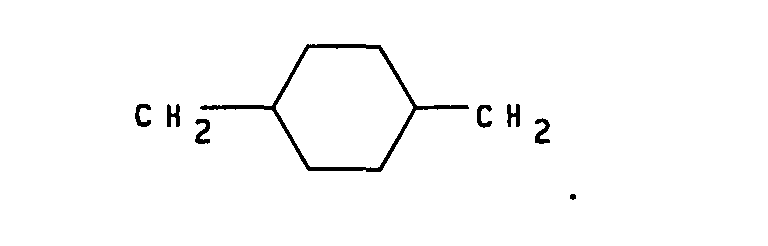
- Zusammensetzung nach einem der vorhergehenden Ansprüche, wobei es sich bei der Komponente b) um ein Polycarbonatpolyol handelt, das im wesentlichen aus Wiederholungseinheiten der allgemeinen Formel Iaufgebaut ist, worin R für -(CH2)n mit n = 3, 4, 5, 6 oder 7 oder für einen Rest der Formel:
 steht, und das eine Hydroxylfunktionalität im Bereich von 2 bis 4 aufweist.
- Zusammensetzung nach einem der vorhergehenden Ansprüche, wobei es sich bei der Komponente b) um ein Polycaprolactondiol handelt.
- Zusammensetzung nach einem der vorhergehenden Ansprüche, wobei es sich bei dem Polyisocyanat um ein Diisocyanat der Formel
- Zusammensetzung nach einem der vorhergehenden Ansprüche, wobei das verkappte Polyisocyanat-Präpolymer erhältlich ist durch Umsetzung der Komponenten a) bis d) zu dem entsprechenden Präpolymer mit freien Isocyanatgruppen und Dispergieren des Präpolymers in einer wässrigen Bisulfitlösung.
- Zusammensetzung nach Anspruch 7, wobei die Bisulfitlösung eine Konzentration im Bereich von 3 bis 30 Gew.-% aufweist.
- Zusammensetzung nach einem der vorhergehenden Ansprüche in Form einer wässrigen Dispersion mit einem pH-Wert im Bereich von 5 bis 7.
- Zusammensetzung nach einem der vorhergehenden Ansprüche, die im wesentlichen frei von einem organischen Lösungsmittel ist.
- Verfahren zur Filzfreiausrüstung von Wolle oder wollhaltigen Materialien, wobei man auf die Wolle oder die wollhaltigen Materialien eine Zusammensetzung nach einem der Ansprüche 1 bis 10 aufbringt und anschließend einer Wärmebehandlung bei 100 bis 190°C unterwirft.
- Verfahren nach Anspruch 11, dadurch gekennzeichnet, daß die Wärmebehandlung während einer Zeitdauer von 10 s bis 300 s erfolgt.
Applications Claiming Priority (2)
| Application Number | Priority Date | Filing Date | Title |
|---|---|---|---|
| EP02015086 | 2002-07-05 | ||
| EP02015086 | 2002-07-05 |
Publications (2)
| Publication Number | Publication Date |
|---|---|
| EP1378600A1 true EP1378600A1 (de) | 2004-01-07 |
| EP1378600B1 EP1378600B1 (de) | 2007-12-12 |
Family
ID=34178378
Family Applications (1)
| Application Number | Title | Priority Date | Filing Date |
|---|---|---|---|
| EP03015121A Expired - Lifetime EP1378600B1 (de) | 2002-07-05 | 2003-07-03 | Wässrige Zusammensetzung zur Filzfreiausrüstung von Wolle |
Country Status (6)
| Country | Link |
|---|---|
| EP (1) | EP1378600B1 (de) |
| CN (1) | CN1244732C (de) |
| AT (1) | ATE380897T1 (de) |
| DE (1) | DE50308762D1 (de) |
| ES (1) | ES2299646T3 (de) |
| PT (1) | PT1378600E (de) |
Cited By (1)
| Publication number | Priority date | Publication date | Assignee | Title |
|---|---|---|---|---|
| CN101906201A (zh) * | 2010-07-01 | 2010-12-08 | 东华大学 | 一种采用纳米纤维素改性制备聚氨酯整理剂的方法 |
Families Citing this family (1)
| Publication number | Priority date | Publication date | Assignee | Title |
|---|---|---|---|---|
| CN119083186B (zh) * | 2024-10-29 | 2025-01-21 | 浙江米皇服饰股份有限公司 | 一种利用天然植物改性山羊绒的制备工艺 |
Citations (3)
| Publication number | Priority date | Publication date | Assignee | Title |
|---|---|---|---|---|
| US4039517A (en) * | 1974-05-29 | 1977-08-02 | Dai-Ichi Kogyo Seiyaku Co., Ltd. | Hydrophilic and thermoreactive urethane compositions with improved properties |
| GB2003521A (en) * | 1977-08-03 | 1979-03-14 | Teijin Ltd | Process for the preparation of suede-like raised woven or knitted fabric |
| DE19919816A1 (de) * | 1999-04-30 | 2000-11-02 | Rotta Gmbh | Wässrige Zusammensetzung zur Filzfreiausrüstung von Wolle |
-
2003
- 2003-07-03 PT PT03015121T patent/PT1378600E/pt unknown
- 2003-07-03 AT AT03015121T patent/ATE380897T1/de not_active IP Right Cessation
- 2003-07-03 ES ES03015121T patent/ES2299646T3/es not_active Expired - Lifetime
- 2003-07-03 DE DE50308762T patent/DE50308762D1/de not_active Expired - Fee Related
- 2003-07-03 EP EP03015121A patent/EP1378600B1/de not_active Expired - Lifetime
- 2003-07-04 CN CN03146256.1A patent/CN1244732C/zh not_active Expired - Fee Related
Patent Citations (3)
| Publication number | Priority date | Publication date | Assignee | Title |
|---|---|---|---|---|
| US4039517A (en) * | 1974-05-29 | 1977-08-02 | Dai-Ichi Kogyo Seiyaku Co., Ltd. | Hydrophilic and thermoreactive urethane compositions with improved properties |
| GB2003521A (en) * | 1977-08-03 | 1979-03-14 | Teijin Ltd | Process for the preparation of suede-like raised woven or knitted fabric |
| DE19919816A1 (de) * | 1999-04-30 | 2000-11-02 | Rotta Gmbh | Wässrige Zusammensetzung zur Filzfreiausrüstung von Wolle |
Cited By (2)
| Publication number | Priority date | Publication date | Assignee | Title |
|---|---|---|---|---|
| CN101906201A (zh) * | 2010-07-01 | 2010-12-08 | 东华大学 | 一种采用纳米纤维素改性制备聚氨酯整理剂的方法 |
| CN101906201B (zh) * | 2010-07-01 | 2012-07-18 | 东华大学 | 一种采用纳米纤维素改性制备聚氨酯整理剂的方法 |
Also Published As
| Publication number | Publication date |
|---|---|
| PT1378600E (pt) | 2008-02-28 |
| EP1378600B1 (de) | 2007-12-12 |
| CN1475624A (zh) | 2004-02-18 |
| DE50308762D1 (de) | 2008-01-24 |
| ATE380897T1 (de) | 2007-12-15 |
| CN1244732C (zh) | 2006-03-08 |
| ES2299646T3 (es) | 2008-06-01 |
Similar Documents
| Publication | Publication Date | Title |
|---|---|---|
| DE69807872T3 (de) | Thermoplastisches polyetherurethan | |
| DE2535376A1 (de) | Gegen verfaerbung stabilisiertes polyurethan | |
| EP0313951B1 (de) | Verfahren zur Herstellung von Beschichtungen | |
| EP1159324A1 (de) | Verfahren zur koagulation wässriger pur-dispersionen, die reaktives oder nachvernetzbares polyurethan dispergiert enthalten, so erhaltene produkte und deren verwendung | |
| DE1902931A1 (de) | Semicarbazid-alkylamin-Elastomerfaeden | |
| DE102009014699A1 (de) | Verfahren zur Herstellung einer reaktiven Polyurethan-Emulsion | |
| EP0854888B1 (de) | Elastomere fasern, polyurethan-elastomere, verfahren zu deren herstellung und ihre verwendung | |
| DE4236569A1 (de) | Wäßrige Beschichtungsmittel und ihre Verwendung zur Erzeugung wasserdampfdurchlässiger Beschichtungen | |
| DE19754886A1 (de) | Verfahren zur Herstellung von Polyurethan-Elastomerfäden und danach hergestellte Fäden | |
| EP0065688B1 (de) | Verfahren zur Herstellung von Lösungsmittelarmen, hitzehärtbaren Polyurethan-Reaktivbeschichtungsmassen und ihre Verwendung in Direkt- und Umkehr-Beschichtungsverfahren | |
| EP1177343B1 (de) | Wässrige zusammensetzung zur filzfreiausrüstung von wolle | |
| EP1514968B9 (de) | Lederartiges flächengebilde und verfahren zu dessen herstellung | |
| EP1378600B1 (de) | Wässrige Zusammensetzung zur Filzfreiausrüstung von Wolle | |
| DE2906136A1 (de) | Verfahren zur herstellung von niedrigschmelzenden polyurethanen mit verbesserten festigkeitseigenschaften | |
| EP0643159B1 (de) | Verfahren zur Herstellung von Elastanfasern durch Einspinnen einer Kombination von Polydimethylsiloxan und ethoxyliertem Polydimethylsiloxan | |
| DE3420308A1 (de) | Polyurethanzusammensetzung mit verbesserten faerbeeigenschaften | |
| DE2419803A1 (de) | Isocyanatprepolymer | |
| DE3505098A1 (de) | Verfahren zur verbesserung der abriebsbestaendigkeit eines textilguertels bzw. -riemens | |
| DE2609206A1 (de) | Polymere verbindung, verfahren zu ihrer herstellung sowie ihre verwendung zum schrumpffestmachen von keratinfasern | |
| EP1491563A2 (de) | Wässrige Zubereitungen hydrophiler Polyurethanharze | |
| CN111040118A (zh) | 一种超纤革用水性聚氨酯及其制备方法和应用 | |
| DE69818729T2 (de) | Behandlungsmittel für Keratinfasern und Verfahren | |
| EP0147668A1 (de) | Hitzevernetzbare PUR-Beschichtungsmassen, Verfahren zu ihrer Herstellung und ihre Verwendung | |
| DE3802633A1 (de) | Modifizierte, perfluoraliphatische gruppen enthaltende polyurethane und deren verwendung | |
| DE4431635A1 (de) | Verfahren zur Herstellung von Cellulosefasern |
Legal Events
| Date | Code | Title | Description |
|---|---|---|---|
| PUAI | Public reference made under article 153(3) epc to a published international application that has entered the european phase |
Free format text: ORIGINAL CODE: 0009012 |
|
| AK | Designated contracting states |
Kind code of ref document: A1 Designated state(s): AT BE BG CH CY CZ DE DK EE ES FI FR GB GR HU IE IT LI LU MC NL PT RO SE SI SK TR |
|
| AX | Request for extension of the european patent |
Extension state: AL LT LV MK |
|
| 17P | Request for examination filed |
Effective date: 20040702 |
|
| AKX | Designation fees paid |
Designated state(s): AT BE BG CH CY CZ DE DK EE ES FI FR GB GR HU IE IT LI LU MC NL PT RO SE SI SK TR |
|
| RAP1 | Party data changed (applicant data changed or rights of an application transferred) |
Owner name: DYSTAR AUXILIARIES GMBH |
|
| RAP1 | Party data changed (applicant data changed or rights of an application transferred) |
Owner name: DYSTAR TEXTILFARBEN GMBH & CO. DEUTSCHLAND KG |
|
| GRAP | Despatch of communication of intention to grant a patent |
Free format text: ORIGINAL CODE: EPIDOSNIGR1 |
|
| GRAS | Grant fee paid |
Free format text: ORIGINAL CODE: EPIDOSNIGR3 |
|
| GRAA | (expected) grant |
Free format text: ORIGINAL CODE: 0009210 |
|
| AK | Designated contracting states |
Kind code of ref document: B1 Designated state(s): AT BE BG CH CY CZ DE DK EE ES FI FR GB GR HU IE IT LI LU MC NL PT RO SE SI SK TR |
|
| REG | Reference to a national code |
Ref country code: GB Ref legal event code: FG4D Free format text: NOT ENGLISH |
|
| REG | Reference to a national code |
Ref country code: CH Ref legal event code: EP |
|
| REG | Reference to a national code |
Ref country code: IE Ref legal event code: FG4D Free format text: LANGUAGE OF EP DOCUMENT: GERMAN |
|
| REF | Corresponds to: |
Ref document number: 50308762 Country of ref document: DE Date of ref document: 20080124 Kind code of ref document: P |
|
| REG | Reference to a national code |
Ref country code: PT Ref legal event code: SC4A Free format text: AVAILABILITY OF NATIONAL TRANSLATION Effective date: 20080218 |
|
| GBT | Gb: translation of ep patent filed (gb section 77(6)(a)/1977) |
Effective date: 20080305 |
|
| PG25 | Lapsed in a contracting state [announced via postgrant information from national office to epo] |
Ref country code: SE Free format text: LAPSE BECAUSE OF FAILURE TO SUBMIT A TRANSLATION OF THE DESCRIPTION OR TO PAY THE FEE WITHIN THE PRESCRIBED TIME-LIMIT Effective date: 20080312 |
|
| PG25 | Lapsed in a contracting state [announced via postgrant information from national office to epo] |
Ref country code: NL Free format text: LAPSE BECAUSE OF FAILURE TO SUBMIT A TRANSLATION OF THE DESCRIPTION OR TO PAY THE FEE WITHIN THE PRESCRIBED TIME-LIMIT Effective date: 20071212 Ref country code: SI Free format text: LAPSE BECAUSE OF FAILURE TO SUBMIT A TRANSLATION OF THE DESCRIPTION OR TO PAY THE FEE WITHIN THE PRESCRIBED TIME-LIMIT Effective date: 20071212 Ref country code: FI Free format text: LAPSE BECAUSE OF FAILURE TO SUBMIT A TRANSLATION OF THE DESCRIPTION OR TO PAY THE FEE WITHIN THE PRESCRIBED TIME-LIMIT Effective date: 20071212 |
|
| REG | Reference to a national code |
Ref country code: ES Ref legal event code: FG2A Ref document number: 2299646 Country of ref document: ES Kind code of ref document: T3 |
|
| NLV1 | Nl: lapsed or annulled due to failure to fulfill the requirements of art. 29p and 29m of the patents act | ||
| ET | Fr: translation filed | ||
| PG25 | Lapsed in a contracting state [announced via postgrant information from national office to epo] |
Ref country code: SK Free format text: LAPSE BECAUSE OF FAILURE TO SUBMIT A TRANSLATION OF THE DESCRIPTION OR TO PAY THE FEE WITHIN THE PRESCRIBED TIME-LIMIT Effective date: 20071212 Ref country code: RO Free format text: LAPSE BECAUSE OF FAILURE TO SUBMIT A TRANSLATION OF THE DESCRIPTION OR TO PAY THE FEE WITHIN THE PRESCRIBED TIME-LIMIT Effective date: 20071212 |
|
| REG | Reference to a national code |
Ref country code: IE Ref legal event code: FD4D |
|
| PLBE | No opposition filed within time limit |
Free format text: ORIGINAL CODE: 0009261 |
|
| STAA | Information on the status of an ep patent application or granted ep patent |
Free format text: STATUS: NO OPPOSITION FILED WITHIN TIME LIMIT |
|
| PG25 | Lapsed in a contracting state [announced via postgrant information from national office to epo] |
Ref country code: DK Free format text: LAPSE BECAUSE OF FAILURE TO SUBMIT A TRANSLATION OF THE DESCRIPTION OR TO PAY THE FEE WITHIN THE PRESCRIBED TIME-LIMIT Effective date: 20071212 Ref country code: IE Free format text: LAPSE BECAUSE OF FAILURE TO SUBMIT A TRANSLATION OF THE DESCRIPTION OR TO PAY THE FEE WITHIN THE PRESCRIBED TIME-LIMIT Effective date: 20071212 |
|
| PGFP | Annual fee paid to national office [announced via postgrant information from national office to epo] |
Ref country code: CH Payment date: 20080912 Year of fee payment: 6 Ref country code: DE Payment date: 20080711 Year of fee payment: 6 Ref country code: ES Payment date: 20080821 Year of fee payment: 6 |
|
| 26N | No opposition filed |
Effective date: 20080915 |
|
| PGFP | Annual fee paid to national office [announced via postgrant information from national office to epo] |
Ref country code: AT Payment date: 20080711 Year of fee payment: 6 Ref country code: FR Payment date: 20080718 Year of fee payment: 6 |
|
| PGFP | Annual fee paid to national office [announced via postgrant information from national office to epo] |
Ref country code: GB Payment date: 20080709 Year of fee payment: 6 |
|
| PG25 | Lapsed in a contracting state [announced via postgrant information from national office to epo] |
Ref country code: GR Free format text: LAPSE BECAUSE OF FAILURE TO SUBMIT A TRANSLATION OF THE DESCRIPTION OR TO PAY THE FEE WITHIN THE PRESCRIBED TIME-LIMIT Effective date: 20080313 |
|
| PG25 | Lapsed in a contracting state [announced via postgrant information from national office to epo] |
Ref country code: MC Free format text: LAPSE BECAUSE OF NON-PAYMENT OF DUE FEES Effective date: 20080731 |
|
| PG25 | Lapsed in a contracting state [announced via postgrant information from national office to epo] |
Ref country code: EE Free format text: LAPSE BECAUSE OF FAILURE TO SUBMIT A TRANSLATION OF THE DESCRIPTION OR TO PAY THE FEE WITHIN THE PRESCRIBED TIME-LIMIT Effective date: 20071212 Ref country code: BG Free format text: LAPSE BECAUSE OF FAILURE TO SUBMIT A TRANSLATION OF THE DESCRIPTION OR TO PAY THE FEE WITHIN THE PRESCRIBED TIME-LIMIT Effective date: 20080312 |
|
| PG25 | Lapsed in a contracting state [announced via postgrant information from national office to epo] |
Ref country code: CY Free format text: LAPSE BECAUSE OF FAILURE TO SUBMIT A TRANSLATION OF THE DESCRIPTION OR TO PAY THE FEE WITHIN THE PRESCRIBED TIME-LIMIT Effective date: 20071212 |
|
| REG | Reference to a national code |
Ref country code: CH Ref legal event code: PL |
|
| GBPC | Gb: european patent ceased through non-payment of renewal fee |
Effective date: 20090703 |
|
| REG | Reference to a national code |
Ref country code: FR Ref legal event code: ST Effective date: 20100331 |
|
| PG25 | Lapsed in a contracting state [announced via postgrant information from national office to epo] |
Ref country code: LI Free format text: LAPSE BECAUSE OF NON-PAYMENT OF DUE FEES Effective date: 20090731 Ref country code: FR Free format text: LAPSE BECAUSE OF NON-PAYMENT OF DUE FEES Effective date: 20090731 Ref country code: CH Free format text: LAPSE BECAUSE OF NON-PAYMENT OF DUE FEES Effective date: 20090731 |
|
| PG25 | Lapsed in a contracting state [announced via postgrant information from national office to epo] |
Ref country code: GB Free format text: LAPSE BECAUSE OF NON-PAYMENT OF DUE FEES Effective date: 20090703 |
|
| PG25 | Lapsed in a contracting state [announced via postgrant information from national office to epo] |
Ref country code: DE Free format text: LAPSE BECAUSE OF NON-PAYMENT OF DUE FEES Effective date: 20100202 Ref country code: AT Free format text: LAPSE BECAUSE OF NON-PAYMENT OF DUE FEES Effective date: 20090703 |
|
| PG25 | Lapsed in a contracting state [announced via postgrant information from national office to epo] |
Ref country code: HU Free format text: LAPSE BECAUSE OF FAILURE TO SUBMIT A TRANSLATION OF THE DESCRIPTION OR TO PAY THE FEE WITHIN THE PRESCRIBED TIME-LIMIT Effective date: 20080613 Ref country code: BE Free format text: LAPSE BECAUSE OF NON-PAYMENT OF DUE FEES Effective date: 20080731 Ref country code: LU Free format text: LAPSE BECAUSE OF NON-PAYMENT OF DUE FEES Effective date: 20080703 |
|
| REG | Reference to a national code |
Ref country code: ES Ref legal event code: FD2A Effective date: 20090704 |
|
| PG25 | Lapsed in a contracting state [announced via postgrant information from national office to epo] |
Ref country code: ES Free format text: LAPSE BECAUSE OF NON-PAYMENT OF DUE FEES Effective date: 20090704 |
|
| PGFP | Annual fee paid to national office [announced via postgrant information from national office to epo] |
Ref country code: CZ Payment date: 20110704 Year of fee payment: 9 Ref country code: PT Payment date: 20110701 Year of fee payment: 9 Ref country code: TR Payment date: 20110701 Year of fee payment: 9 |
|
| PGFP | Annual fee paid to national office [announced via postgrant information from national office to epo] |
Ref country code: IT Payment date: 20110728 Year of fee payment: 9 |
|
| REG | Reference to a national code |
Ref country code: PT Ref legal event code: MM4A Free format text: LAPSE DUE TO NON-PAYMENT OF FEES Effective date: 20130103 |
|
| PG25 | Lapsed in a contracting state [announced via postgrant information from national office to epo] |
Ref country code: CZ Free format text: LAPSE BECAUSE OF NON-PAYMENT OF DUE FEES Effective date: 20120703 |
|
| PG25 | Lapsed in a contracting state [announced via postgrant information from national office to epo] |
Ref country code: PT Free format text: LAPSE BECAUSE OF NON-PAYMENT OF DUE FEES Effective date: 20130103 Ref country code: IT Free format text: LAPSE BECAUSE OF NON-PAYMENT OF DUE FEES Effective date: 20120703 |
|
| PG25 | Lapsed in a contracting state [announced via postgrant information from national office to epo] |
Ref country code: TR Free format text: LAPSE BECAUSE OF NON-PAYMENT OF DUE FEES Effective date: 20120703 |